Unit 1 — Atomic Structure and Properties
Every lesson, checkpoint, FRQ practice set and test of this unit, in course order. Answer keys are marked ✓ KEY. Feedback, model responses and rubrics are shown in full.
Contents — 10 sequences, 66 lessons
U1-S01 — Counting particles with moles
10 lessons
Why we need moles
Outcome: Explain why chemists calculate particle counts from measured mass
Part 1Why chemists count by weighing
A glass of water stands on a laboratory balance.
The display reads 250.0 g.
The balance was zeroed with the empty glass, so the display shows the water's mass alone.
Water reacts molecule by molecule: each reaction event uses up individual molecules.
A chemist planning a reaction needs the number of molecules in the glass.
No instrument counts molecules one by one.
How can the chemist turn the mass on the display into a number of molecules?
Chemical reactions combine particles in fixed number ratios.
So the chemist needs a particle count, not just a mass.
For a solid or liquid sample, the quantity a chemist measures most easily is its mass.
Chemistry therefore defines a quantity that states a sample's size as a count of particles, taken in fixed-size bundles.
That bundled count is called the amount of substance. Its symbol is n.
The unit of amount of substance is the mole, written mol.
This course now builds the bridge from the measured mass to the particle count, one step at a time.
The idea to carry: a balance reports a mass, and a reaction plan needs a particle count, so chemistry states sample sizes as an amount of substance, in moles.
Check — multiple choice
Which quantity does a laboratory balance report?
Feedback if chosen: Correct. A balance reports a mass, in grams. The particle count has to be calculated from that mass.
Feedback if chosen: This option is wrong — you gave the balance a job no instrument does. Nothing counts particles one by one; the balance reports a mass.
Feedback if chosen: This option is wrong — you put the particle count on the display. The display shows the mass alone; the count has to be calculated from it.
Check — multiple choice
Suppose a chemist dissolves a strip of iron in acid. The plan needs the number of iron atoms in the strip. The balance reads 12.5 g. Why does the mass alone not answer the chemist's question?
Feedback if chosen: This option is wrong — you blamed the instrument. A balance reports a solid's mass very well; the problem is that a mass is a different quantity from a particle count.
Feedback if chosen: Correct. The plan needs an atom count. The balance reports grams. The two are different quantities, so one more step is needed to get from one to the other.
Feedback if chosen: This option is wrong — you made the atom count unstable. An undisturbed strip keeps its atoms; the problem is that the balance reports a mass, not a count.
Check — multiple choice
Maya puts a sugar sample on a balance. The display reads 10.0 g. Maya says the reading alone tells her how many sugar molecules the sample holds. Is she correct?
Feedback if chosen: This option is wrong — you let the balance count. The display reports the mass of the sugar alone; a molecule count needs the bridge from grams to particle numbers, and the reading is only its starting point.
Feedback if chosen: Correct. The display reports the mass of the sugar alone. To turn 10.0 g into a molecule count, Maya needs the bridge from grams to particle numbers. The reading by itself is not a count.
Check — multiple choice
A bench holds two samples: 10.0 g of aluminum and 10.0 g of iron. One iron atom is heavier than one aluminum atom. Which sample holds more atoms?
Feedback if chosen: Correct. The two samples carry the same total mass. Each aluminum atom is lighter, so more aluminum atoms are needed to reach 10.0 g.
Feedback if chosen: This option is wrong — you gave the heavier atom the bigger count. Heavier atoms reach 10.0 g with fewer of them, so the iron sample holds fewer atoms.
Feedback if chosen: This option is wrong — you matched the counts to the matching masses. Equal masses built from atoms of different masses hold different numbers of atoms.
Part 2Quick practice with the new words
Check — multiple choice
A label on a flask reads 2 mol of water. Which quantity does the label state?
Feedback if chosen: This option is wrong — you read mol as a mass unit. A mass comes in grams; mol counts bundles of particles.
Feedback if chosen: Correct. The mole is the unit of amount of substance, so a value in mol states an amount of substance.
Feedback if chosen: This option is wrong — you read mol as a volume unit. A volume comes in liters; mol counts bundles of particles.
Check — multiple choice
What is the unit of amount of substance?
Feedback if chosen: This option is wrong — you named the unit of mass. The gram measures mass; amount of substance comes in moles.
Feedback if chosen: This option is wrong — you named a unit of volume. The liter measures volume; amount of substance comes in moles.
Feedback if chosen: Correct. Amount of substance comes in moles, written mol.
Check — multiple choice
Two bottles of copper pieces carry two labels: 3 mol of copper, and 3 g of copper. Which label states an amount of substance?
Feedback if chosen: Correct. The unit mol marks an amount of substance; the unit g marks a mass.
Feedback if chosen: This option is wrong — you picked the mass label. The unit g marks a mass; the unit mol marks an amount of substance.
Check — multiple choice
Which symbol does this course use for amount of substance?
Feedback if chosen: This option is wrong — you picked the symbol for mass. A lowercase m marks a mass, in g; amount of substance takes the lowercase n.
Feedback if chosen: Correct. A lowercase n marks an amount of substance, in mol.
Feedback if chosen: This option is wrong — you picked a capital letter. The capital N marks a different counting quantity later in the course; amount of substance takes the lowercase n.
Avogadro's number
Outcome: State Avogadro's number and what it counts
Part 1A bundle everyone agrees on
We've seen that chemists state a sample's size as an amount of substance, in moles.
A label on a beaker reads 1 mol of water.
The label names one bundle of molecules.
A bundle is only useful when everyone agrees on its size.
A dozen always means 12.
How many particles does one mole always mean?
One mole of any substance contains 6.022 × 10²³ particles.
That fixed count is called Avogadro's number, written Nᴀ.
Its unit is per mole, written mol⁻¹: the count applies to each mole.
The counted particles can be atoms or molecules.
Sodium chloride is different: it is not made of separate molecules.
Solid sodium chloride comes in repeating NaCl units. One such unit is called a formula unit.
Whichever kind a substance comes in, chemists call the counted particles its constituent particles.
The count never changes with the substance: 1 mol of water and 1 mol of sodium chloride hold the same number of particles.
Written as an equation, the number of particles, N, comes from the amount: N = n × Nᴀ.
The fact to carry: one mole of any substance contains 6.022 × 10²³ constituent particles.
Check — numeric entry
State Avogadro's number, in particles for each mole. Give 4 significant figures, in scientific notation; a form such as 3.0e5 works.
Feedback when correct: Correct. One mole of any substance contains 6.022 × 10²³ constituent particles.
Anticipated wrong answers (feedback shown):
| 6.022 | That is the mantissa alone. The full value is 6.022 × 10²³; include the power of ten (the e23 part) when you type it. |
| 6.02e23 | That shows 3 significant figures. Give all 4: 6.022 × 10²³. |
Check — multiple choice
How many particles does 1 mol of a pure substance contain?
Feedback if chosen: This option is wrong — you let the substance set the count. The mole is a fixed bundle: 6.022 × 10²³ particles, whatever the substance.
Feedback if chosen: Correct. The mole is a fixed bundle. Every substance's mole holds 6.022 × 10²³ constituent particles.
Feedback if chosen: This option is wrong — you let the particle's mass set the count. Heavier particles make a heavier mole, not a different count; the count stays 6.022 × 10²³.
Check — multiple choice
In N = n × Nᴀ, what does N stand for?
Feedback if chosen: Correct. The capital N is a plain count: the number of constituent particles in the sample.
Feedback if chosen: This option is wrong — you swapped the two sides' jobs. The lowercase n is the amount in mol; the capital N is the particle count that comes out.
Feedback if chosen: This option is wrong — you brought mass in. No mass appears in this equation; N counts particles, n counts moles.
Check — multiple choice
Two flasks sit side by side: one holds 1 mol of argon, the other holds 1 mol of krypton. One krypton atom is heavier than one argon atom. Which flask holds more atoms?
Feedback if chosen: This option is wrong — you gave the lighter atom a bigger count. The flasks hold one mole each, and a mole is a fixed count, so the counts match.
Feedback if chosen: This option is wrong — you let the heavier atom change the count. A heavier atom makes a heavier mole, not a bigger count; a mole is a fixed count.
Feedback if chosen: Correct. Each flask holds one mole, and one mole always means 6.022 × 10²³ atoms. The krypton flask is heavier, but the counts are equal.
Check — multiple choice
A sample of water holds 6.022 × 10²³ molecules. How many moles of water is that?
Feedback if chosen: Correct. 6.022 × 10²³ molecules is one whole bundle: 1 mol.
Feedback if chosen: This option is wrong — you counted two bundles. 6.022 × 10²³ molecules fills Avogadro's count once, so the sample holds 1 mol.
Feedback if chosen: This option is wrong — you counted half a bundle. 6.022 × 10²³ molecules fills Avogadro's count once, so the sample holds 1 mol.
Check — multiple choice
Which name does the constant 6.022 × 10²³ mol⁻¹ carry?
Feedback if chosen: This option is wrong — you named the quantity n measures. Amount of substance is what a sample holds; the fixed count per mole is Avogadro's number.
Feedback if chosen: Correct. The count of particles in one mole, 6.022 × 10²³ mol⁻¹, is Avogadro's number.
Feedback if chosen: This option is wrong — you named a particle, not a constant. A formula unit is one repeating NaCl-style unit; the fixed count per mole is Avogadro's number.
Particle mass and molar mass
Outcome: State that a particle's average mass in amu and the molar mass in g/mol share one number
Part 1One number on two scales
One water molecule is far too light to weigh in grams.
No balance can register a single molecule.
Chemists need a mass unit sized for single particles.
Chemists also need lab masses in grams, for whole samples.
How does a particle's tiny mass connect the two scales: particle-sized and lab-sized?
A single particle's mass is measured in a tiny unit sized for particles.
The unit is called the unified atomic mass unit, written u. Many sources write the same unit as amu.
One u is roughly the mass of one proton or one neutron.
Chemists also need the mass of one whole mole of a substance.
The mass of one mole of a substance is called its molar mass. Its symbol is M and its unit is g/mol.
Here is the bridge: a particle's average mass in amu and the substance's molar mass in g/mol share one numerical value.
One water molecule averages 18.02 amu.
So one mole of water has a mass of 18.02 g.
The same bridge works for every substance.
One carbon atom averages 12.01 amu, so one mole of carbon has a mass of 12.01 g.
One formula unit of sodium chloride averages 58.44 amu, so one mole of sodium chloride has a mass of 58.44 g.
The shared number carries a chemist from one particle to a lab-sized sample in one step.
The bridge to carry: the amu number for one particle is the g/mol number for one mole of the same substance.
Check — numeric entry
One N₂ molecule has an average mass of 28.02 amu. What is the molar mass of N₂, in g/mol? Give 4 significant figures.
Feedback when correct: Correct. The bridge copies the number straight across: 28.02 amu for one molecule, so 28.02 g/mol for the substance.
Anticipated wrong answers (feedback shown):
| 14.01 | That is one atom's share of the molecule, from halving 28.02. The question gave the whole molecule's average mass, and the bridge copies that whole number across: 28.02. |
Check — numeric entry
The molar mass of copper is 63.55 g/mol. What is the average mass of one copper atom, in amu? Give 4 significant figures.
Feedback when correct: Correct. The bridge works in both directions: 63.55 g/mol for the mole, so 63.55 amu for one atom.
Anticipated wrong answers (feedback shown):
| 1.055e-22 | That is one atom's mass in grams: you divided by Avogadro's number. In amu, the bridge copies the number across with no arithmetic: 63.55. |
Check — numeric entry
One ammonia molecule, NH₃, has an average mass of 17.03 amu. What is the molar mass of ammonia, in g/mol? Give 4 significant figures.
Feedback when correct: Correct. The amu number and the g/mol number match: 17.03.
Anticipated wrong answers (feedback shown):
| 1.026e25 | You multiplied by Avogadro's number. The bridge needs no multiplication: the amu number and the g/mol number are the same, 17.03. |
Check — multiple choice
One mole of CaCO₃ has a mass of 100.09 g. What is the average mass of one CaCO₃ formula unit?
Feedback if chosen: This option is wrong — you carried the gram unit down to a single particle. One formula unit is far lighter than a gram; on the particle scale the same number reads 100.09 amu.
Feedback if chosen: This option is wrong — you put Avogadro's count where a mass belongs. The particle-scale mass reuses the mole-scale number: 100.09 amu.
Feedback if chosen: Correct. The bridge copies the number across and swaps the unit: 100.09 g for the mole, 100.09 amu for one formula unit.
Check — multiple choice
Leo reads a label: the molar mass of water is 18.02 g/mol. Leo says one water molecule therefore has a mass of 18.02 g. Is he correct?
Feedback if chosen: This option is wrong — you carried the unit across the bridge along with the number. Only the number is shared: one molecule averages 18.02 amu, and one mole has a mass of 18.02 g.
Feedback if chosen: Correct. The number crosses the bridge; the unit does not. One molecule averages 18.02 amu; one whole mole has a mass of 18.02 g. A gram is enormously larger than an amu.
Check — multiple choice
What is the mass of one mole of a substance called?
Feedback if chosen: This option is wrong — you named the bundle count. Amount of substance counts moles; the mass of one mole is the molar mass.
Feedback if chosen: This option is wrong — you named the particle-scale unit. The unified atomic mass unit measures one particle; the mass of one mole is the molar mass.
Feedback if chosen: Correct. The mass of one mole of a substance is its molar mass, M, in g/mol.
Molar mass from a formula
Outcome: Calculate a compound's molar mass from its formula
Part 1Build M from the formula
A procedure needs the molar mass of calcium nitrate, Ca(NO₃)₂.
The periodic table lists one molar mass per element.
No table lists compounds: there are far too many of them.
Yet every mole calculation starts from M.
How does a chemist build a compound's molar mass out of its formula?
A formula counts each element's atoms in one unit of the compound.
Each atom brings its own molar mass, read from the periodic table.
Multiply each element's molar mass by its subscript.
Add the products.
The sum is the compound's molar mass, in g/mol.
Q: What is the molar mass of carbon dioxide, CO₂?
Read each element's molar mass from the periodic table
C: 12.01 O: 16.00
Multiply each by its subscript, then add the products
C: 12.01 × 1 = 12.01
O: 16.00 × 2 = 32.00
M = 12.01 + 32.00 = 44.01 g/mol
The same working, set out as a table:
| Element | M from the table | Subscript | Product |
|---|---|---|---|
| C | 12.01 | × 1 | 12.01 |
| O | 16.00 | × 2 | 32.00 |
| Molar mass of CO₂ = 44.01 g/mol | |||
| Element | M from the table | Count in one unit | Product |
|---|---|---|---|
| N | 14.01 | × 2 | 28.02 |
| H | 1.008 | × 8 | 8.064 |
| S | 32.06 | × 1 | 32.06 |
| O | 16.00 | × 4 | 64.00 |
| Molar mass of (NH₄)₂SO₄ = 132.14 g/mol | |||
A parenthesis multiplies everything inside it by the subscript that follows it.
Q: What is the molar mass of ammonium sulfate, (NH₄)₂SO₄?
Expand the parentheses into atom counts
(NH₄)₂ means 2 N and 8 H; SO₄ means 1 S and 4 O
Multiply each element's molar mass by its count, then add the products
N: 14.01 × 2 = 28.02
H: 1.008 × 8 = 8.064
S: 32.06 × 1 = 32.06
O: 16.00 × 4 = 64.00
M = 28.02 + 8.064 + 32.06 + 64.00 = 132.14 g/mol
The routine to carry: multiply each element's molar mass by its subscript, expand any parentheses, then add. Every value comes from the supplied periodic table.
The next three checks build one molar mass together: glucose, C₆H₁₂O₆. Use C 12.01, H 1.008, O 16.00 from the periodic table.
Check — numeric entry
For glucose, C₆H₁₂O₆: what do the 6 carbon atoms add to the molar mass? Use C 12.01. Give 4 significant figures.
Feedback when correct: Correct. 6 × 12.01 = 72.06. That is carbon's share of the sum.
Anticipated wrong answers (feedback shown):
| 12.01 | That is one carbon atom's molar mass, before the subscript. Glucose carries 6 carbon atoms in each molecule: 6 × 12.01 = 72.06. |
Worked solution revealed after a second miss
Read carbon's molar mass from the table
C: 12.01
Multiply by the subscript
6 × 12.01 = 72.06 g/mol
Check — numeric entry
Still on glucose, C₆H₁₂O₆: what do the 12 hydrogen atoms add? Use H 1.008. Give 4 significant figures.
Feedback when correct: Correct. 12 × 1.008 = 12.096, which prints as 12.10 to 4 significant figures.
Anticipated wrong answers (feedback shown):
| 1.008 | That is one hydrogen atom's molar mass, before the subscript. Glucose carries 12 hydrogen atoms in each molecule: 12 × 1.008 = 12.10. |
Worked solution revealed after a second miss
Read hydrogen's molar mass from the table
H: 1.008
Multiply by the subscript
12 × 1.008 = 12.10 g/mol
Check — numeric entry
Oxygen adds 6 × 16.00 = 96.00 to glucose's sum. Now add the three shares: carbon's, hydrogen's, and oxygen's. What is the molar mass of glucose? Give your answer to 2 decimal places.
Feedback when correct: Correct. 72.06 + 12.10 + 96.00 = 180.16. One mole of glucose has a mass of 180.16 g.
Anticipated wrong answers (feedback shown):
| 168.06 | You left hydrogen's share out: 72.06 + 96.00 = 168.06. All three shares belong in the sum: 72.06 + 12.10 + 96.00 = 180.16. |
Worked solution revealed after a second miss
Write down the three shares
C: 72.06 H: 12.10 O: 96.00
Add the products
M = 72.06 + 12.10 + 96.00 = 180.16 g/mol
Check — numeric entry
What is the molar mass of sodium hydroxide, NaOH? Use Na 22.99, O 16.00, H 1.008. Give 4 significant figures.
Feedback when correct: Correct. 22.99 + 16.00 + 1.008 = 40.00, to 4 significant figures.
Anticipated wrong answers (feedback shown):
| 17.01 | You left sodium out of the sum: 16.00 + 1.008 = 17.01. All three elements belong in it: 22.99 + 16.00 + 1.008 = 40.00. |
Worked solution revealed after a second miss
Read each element's molar mass from the table
Na: 22.99 O: 16.00 H: 1.008
Multiply each by its subscript
each subscript is 1, so the values stand
Add the products
M = 22.99 + 16.00 + 1.008 = 40.00 g/mol
Check — numeric entry
What is the molar mass of magnesium chloride, MgCl₂? Use Mg 24.31, Cl 35.45. Give 4 significant figures.
Feedback when correct: Correct. 24.31 + 2 × 35.45 = 95.21.
Anticipated wrong answers (feedback shown):
| 59.76 | You added one chlorine instead of two: 24.31 + 35.45 = 59.76. The subscript 2 doubles the chlorine share: 24.31 + 70.90 = 95.21. |
Worked solution revealed after a second miss
Read each element's molar mass from the table
Mg: 24.31 Cl: 35.45
Multiply each by its subscript, then add the products
Mg: 24.31 × 1 = 24.31
Cl: 35.45 × 2 = 70.90
M = 24.31 + 70.90 = 95.21 g/mol
Check — numeric entry
What is the molar mass of calcium nitrate, Ca(NO₃)₂? Use Ca 40.08, N 14.01, O 16.00. Give your answer to 2 decimal places.
Feedback when correct: Correct. The parenthesis doubles everything inside it: 2 × (14.01 + 3 × 16.00) = 124.02. Then 40.08 + 124.02 = 164.10.
Anticipated wrong answers (feedback shown):
| 102.09 | You skipped the outer subscript: 40.08 + 14.01 + 48.00 = 102.09. The 2 outside the parenthesis doubles the whole NO₃ group: 40.08 + 2 × 62.01 = 164.10. |
Worked solution revealed after a second miss
Expand the parentheses into atom counts
Ca(NO₃)₂ means 1 Ca, 2 N and 6 O
Multiply each element's molar mass by its count, then add the products
Ca: 40.08 × 1 = 40.08
N: 14.01 × 2 = 28.02
O: 16.00 × 6 = 96.00
M = 40.08 + 28.02 + 96.00 = 164.10 g/mol
Moles from mass: n = m/M
Outcome: Calculate moles from mass with n = m/M
Part 1From grams to moles
A beaker holds 90.10 g of water.
The worksheet asks for the amount of water, in moles.
The balance gave grams.
We've seen that one mole of water has a mass of 18.02 g.
So the beaker holds some number of 18.02-g portions.
How does a measured mass become an amount in moles?
Divide the mass by the molar mass.
In symbols: n = m/M.
The lowercase m is the mass, in g.
The capital M is the molar mass, in g/mol.
The n comes out in mol.
The units prove the route: g ÷ (g/mol) → mol.
Every mass-to-moles question in this course travels this one line.
Q: A beaker holds 90.10 g of water. The molar mass of water is 18.02 g/mol. How many moles of water is that?
Write down the values from the question
m = 90.10 g
M = 18.02 g/mol
Write down the equation
n = m/M
Substitute in the values, and calculate
n = 90.10 ÷ 18.02 = 5.000 mol
The move to carry: divide the mass by the molar mass, and the amount comes out in mol.
The next three checks use one sample: 146.10 g of sodium chloride, NaCl. Its molar mass is 58.44 g/mol.
Check — multiple choice
A sample holds 146.10 g of sodium chloride, NaCl (M = 58.44 g/mol). Which pairing of values is right for n = m/M?
Feedback if chosen: Correct. The sample's mass is m = 146.10 g, and sodium chloride's molar mass is M = 58.44 g/mol.
Feedback if chosen: This option is wrong — you swapped the two values. The balance reading, 146.10 g, is the mass m; the per-mole value, 58.44 g/mol, is the molar mass M.
Feedback if chosen: This option is wrong — you took sodium's molar mass alone. The sample is sodium chloride, NaCl, so M is the compound's value, 58.44 g/mol.
Check — numeric entry
Substitute and calculate: how many moles of sodium chloride is 146.10 g? Give 4 significant figures.
Feedback when correct: Correct. n = 146.10 ÷ 58.44 = 2.500 mol.
Anticipated wrong answers (feedback shown):
| 0.4000 | You divided the molar mass by the mass: 58.44 ÷ 146.10 = 0.4000. The equation divides the other way: n = m/M = 146.10 ÷ 58.44 = 2.500. |
Worked solution revealed after a second miss
Write down the values from the question
m = 146.10 g
M = 58.44 g/mol
Write down the equation
n = m/M
Substitute in the values, and calculate
n = 146.10 ÷ 58.44 = 2.500 mol
Check — multiple choice
A classmate checks the route by its units: g ÷ (g/mol) = mol. Is the unit check right?
Feedback if chosen: Correct. Dividing by g/mol flips the per-mole unit over, so the grams cancel and mol is left. The route lands on the unit an amount needs.
Feedback if chosen: This option is wrong — you rejected a sound check. Dividing by g/mol flips the per-mole unit over, so the grams cancel and mol is left.
Check — numeric entry
A dish holds 54.05 g of glucose (M = 180.16 g/mol). How many moles of glucose is that? Give 4 significant figures.
Feedback when correct: Correct. n = 54.05 ÷ 180.16 = 0.3000 mol.
Anticipated wrong answers (feedback shown):
| 3.333 | You divided the molar mass by the mass: 180.16 ÷ 54.05 = 3.333. The equation divides the other way: n = 54.05 ÷ 180.16 = 0.3000. |
Worked solution revealed after a second miss
Write down the values from the question
m = 54.05 g
M = 180.16 g/mol
Write down the equation
n = m/M
Substitute in the values, and calculate
n = 54.05 ÷ 180.16 = 0.3000 mol
Check — numeric entry
A cylinder holds 66.02 g of carbon dioxide, CO₂ (M = 44.01 g/mol). How many moles of CO₂ is that? Give 4 significant figures.
Feedback when correct: Correct. n = 66.02 ÷ 44.01 = 1.500 mol.
Anticipated wrong answers (feedback shown):
| 0.6666 | You divided the molar mass by the mass: 44.01 ÷ 66.02 = 0.6666. The equation divides the other way: n = 66.02 ÷ 44.01 = 1.500. |
Worked solution revealed after a second miss
Write down the values from the question
m = 66.02 g
M = 44.01 g/mol
Write down the equation
n = m/M
Substitute in the values, and calculate
n = 66.02 ÷ 44.01 = 1.500 mol
Check — multiple choice
| Sample | Substance | Mass (g) | Molar mass (g/mol) |
|---|---|---|---|
| A | sodium chloride, NaCl | 29.22 | 58.44 |
| B | water, H₂O | 13.52 | 18.02 |
The table gives two samples. Which sample holds more moles?
Feedback if chosen: This option is wrong — you let the bigger mass win. Each mole of sodium chloride needs far more grams: 29.22 ÷ 58.44 = 0.5000 mol, against 13.52 ÷ 18.02 = 0.7503 mol of water.
Feedback if chosen: Correct. Each mole of water needs fewer grams, so 13.52 g holds more moles: 13.52 ÷ 18.02 = 0.7503 mol, against 29.22 ÷ 58.44 = 0.5000 mol.
Mass from moles: m = n × M
Outcome: Calculate mass from moles with m = n × M
Part 1From moles to grams
A procedure calls for 2.50 mol of sodium chloride.
The balance weighs grams, not moles.
The chemist must put the matching mass on the balance.
What mass of sodium chloride delivers 2.50 mol?
We've seen the one equation: n = m/M.
This question gives the amount n and the molar mass M, and asks for the mass m.
Make m the subject: multiply both sides by M, giving m = n × M.
Substitute, then calculate.
It is one equation, rearranged when needed, not a second equation to memorize.
Only one arrangement of n and M leaves a mass:
| Arrangement | Unit check | Verdict | Why |
|---|---|---|---|
| m = n × M | mol × g/mol → g | the units end in g, a mass | |
| m = n ÷ M | mol ÷ g/mol → mol²/g | divided instead of multiplying | |
| m = M ÷ n | g/mol ÷ mol → g/mol² | divided the wrong way around |
Size check: when n is greater than 1 mol, the mass in grams is numerically larger than M.
Q: A procedure calls for 0.750 mol of carbon dioxide, CO₂ (M = 44.01 g/mol). What mass of CO₂ is that?
Write down the values from the question
n = 0.750 mol
M = 44.01 g/mol
Write down the equation
n = m/M, so m = n × M
Substitute in the values, and calculate
m = 0.750 × 44.01 = 33.01 g
The move to carry: multiply the amount by the molar mass, and the mass comes out in g.
The next three checks use one request: 3.00 mol of sodium hydroxide, NaOH (M = 40.00 g/mol).
Check — multiple choice
Which subject change of n = m/M is correct for finding the mass?
Feedback if chosen: This option is wrong — you divided the molar mass by the amount. Multiplying both sides of n = m/M by M leaves m = n × M.
Feedback if chosen: This option is wrong — you divided the amount by the molar mass. Multiplying both sides of n = m/M by M leaves m = n × M.
Feedback if chosen: Correct. Multiply both sides of n = m/M by M, and m = n × M is left.
Check — numeric entry
Substitute and calculate: what mass delivers 3.00 mol of sodium hydroxide, NaOH (M = 40.00 g/mol)? Give 3 significant figures.
Feedback when correct: Correct. m = 3.00 × 40.00 = 120. g.
Anticipated wrong answers (feedback shown):
| 0.0750 | You divided the amount by the molar mass: 3.00 ÷ 40.00 = 0.0750. The mass comes from multiplying: m = 3.00 × 40.00 = 120. g. |
| 13.3 | You divided the molar mass by the amount: 40.00 ÷ 3.00 = 13.3. The mass comes from multiplying: m = 3.00 × 40.00 = 120. g. |
Worked solution revealed after a second miss
Write down the values from the question
n = 3.00 mol
M = 40.00 g/mol
Write down the equation
m = n × M
Substitute in the values, and calculate
m = 3.00 × 40.00 = 120. g
Check — multiple choice
Here n is 3.00 mol, more than 1 mol. Should the mass in grams come out numerically larger than M?
Feedback if chosen: Correct. m = n × M multiplies M by a number greater than 1, so the grams number ends up larger than the g/mol number: 120. against 40.00.
Feedback if chosen: This option is wrong — you dropped the size check. With n greater than 1 mol, m = n × M multiplies M by more than 1, so the grams number ends up larger.
Check — numeric entry
A recipe needs 0.400 mol of glucose (M = 180.16 g/mol). What mass of glucose is that? Give 3 significant figures.
Feedback when correct: Correct. m = 0.400 × 180.16 = 72.06, which prints as 72.1 g to 3 significant figures.
Anticipated wrong answers (feedback shown):
| 0.00222 | You divided the amount by the molar mass: 0.400 ÷ 180.16 = 0.00222. The mass comes from multiplying: m = 0.400 × 180.16 = 72.1 g. |
| 450. | You divided the molar mass by the amount: 180.16 ÷ 0.400 = 450. The mass comes from multiplying: m = 0.400 × 180.16 = 72.1 g. |
Worked solution revealed after a second miss
Write down the values from the question
n = 0.400 mol
M = 180.16 g/mol
Write down the equation
m = n × M
Substitute in the values, and calculate
m = 0.400 × 180.16 = 72.1 g
Check — numeric entry
A preparation needs 0.0500 mol of potassium permanganate, KMnO₄ (M = 158.04 g/mol). What mass is that? Give 3 significant figures.
Feedback when correct: Correct. m = 0.0500 × 158.04 = 7.902, which prints as 7.90 g to 3 significant figures.
Anticipated wrong answers (feedback shown):
| 3160.8 | You divided the molar mass by the amount: 158.04 ÷ 0.0500 = 3160.8. The mass comes from multiplying: m = 0.0500 × 158.04 = 7.90 g. |
Worked solution revealed after a second miss
Write down the values from the question
n = 0.0500 mol
M = 158.04 g/mol
Write down the equation
m = n × M
Substitute in the values, and calculate
m = 0.0500 × 158.04 = 7.90 g
Check — multiple choice
| Sample | Substance | Amount (mol) | Molar mass (g/mol) |
|---|---|---|---|
| A | glucose, C₆H₁₂O₆ | 0.300 | 180.16 |
| B | water, H₂O | 1.75 | 18.02 |
The table gives two samples. Which sample has the greater mass?
Feedback if chosen: Correct. Each mole of glucose is heavy: 0.300 × 180.16 = 54.0 g, against 1.75 × 18.02 = 31.5 g of water.
Feedback if chosen: This option is wrong — you let the bigger mole count win. More moles does not mean more mass when each mole is light: 1.75 × 18.02 = 31.5 g, against 0.300 × 180.16 = 54.0 g.
Particle count from moles
Outcome: Calculate a particle count from moles with Avogadro's number: N = n × Nᴀ
Part 1From moles to a particle count
A beaker holds 2.50 mol of water.
A classmate asks for the actual number of molecules.
We've seen that each mole contains 6.022 × 10²³ particles.
So 2.50 mol holds two and a half of those bundles.
What is the molecule count, as one number?
Multiply the amount in moles by Avogadro's number.
In symbols: N = n × Nᴀ.
N is a plain count of particles.
The units agree: mol × (1/mol) leaves a pure number.
Lab-scale samples give counts around 10²² to 10²⁵.
An answer smaller than 1 means you divided by Nᴀ instead of multiplying.
Q: A flask holds 1.25 mol of ammonia, NH₃. How many NH₃ molecules is that?
Write down the values from the question
n = 1.25 mol
Write down the equation
N = n × Nᴀ
Substitute in the values, and calculate
N = 1.25 × 6.022 × 10²³ = 7.53 × 10²³ molecules
The move to carry: multiply the amount by Avogadro's number, and a particle count comes out.
Check — numeric entry
A balloon holds 4.00 mol of helium. How many helium atoms is that? Give 3 significant figures, in scientific notation; a form such as 3.0e5 works.
Feedback when correct: Correct. N = 4.00 × 6.022 × 10²³ = 2.41 × 10²⁴ atoms.
Anticipated wrong answers (feedback shown):
| 6.64e-24 | You divided by Avogadro's number: a count below 1 is the giveaway. Multiply instead: N = 4.00 × 6.022 × 10²³ = 2.41 × 10²⁴. |
Worked solution revealed after a second miss
Write down the values from the question
n = 4.00 mol
Write down the equation
N = n × Nᴀ
Substitute in the values, and calculate
N = 4.00 × 6.022 × 10²³ = 2.41 × 10²⁴ atoms
Check — numeric entry
A cylinder holds 0.600 mol of carbon dioxide, CO₂. How many CO₂ molecules is that? Give 3 significant figures, in scientific notation; a form such as 3.0e5 works.
Feedback when correct: Correct. N = 0.600 × 6.022 × 10²³ = 3.61 × 10²³ molecules.
Anticipated wrong answers (feedback shown):
| 9.96e-25 | You divided by Avogadro's number: a count below 1 is the giveaway. Multiply instead: N = 0.600 × 6.022 × 10²³ = 3.61 × 10²³. |
Worked solution revealed after a second miss
Write down the values from the question
n = 0.600 mol
Write down the equation
N = n × Nᴀ
Substitute in the values, and calculate
N = 0.600 × 6.022 × 10²³ = 3.61 × 10²³ molecules
Check — numeric entry
Back to the opening beaker: 2.50 mol of water. How many water molecules is that? Give 3 significant figures, in scientific notation; a form such as 3.0e5 works.
Feedback when correct: Correct. N = 2.50 × 6.022 × 10²³ = 1.51 × 10²⁴ molecules. The classmate's number was waiting one multiplication away.
Anticipated wrong answers (feedback shown):
| 4.15e-24 | You divided by Avogadro's number: a count below 1 is the giveaway. Multiply instead: N = 2.50 × 6.022 × 10²³ = 1.51 × 10²⁴. |
Worked solution revealed after a second miss
Write down the values from the question
n = 2.50 mol
Write down the equation
N = n × Nᴀ
Substitute in the values, and calculate
N = 2.50 × 6.022 × 10²³ = 1.51 × 10²⁴ molecules
Check — numeric entry
A dish holds 0.320 mol of sodium chloride. How many NaCl formula units is that? Give 3 significant figures, in scientific notation; a form such as 3.0e5 works.
Feedback when correct: Correct. N = 0.320 × 6.022 × 10²³ = 1.93 × 10²³ formula units.
Anticipated wrong answers (feedback shown):
| 5.31e-25 | You divided by Avogadro's number: a count below 1 is the giveaway. Multiply instead: N = 0.320 × 6.022 × 10²³ = 1.93 × 10²³. |
Worked solution revealed after a second miss
Write down the values from the question
n = 0.320 mol
Write down the equation
N = n × Nᴀ
Substitute in the values, and calculate
N = 0.320 × 6.022 × 10²³ = 1.93 × 10²³ formula units
Check — multiple choice
| Flask | Substance | Amount (mol) |
|---|---|---|
| 1 | methane, CH₄ | 1.25 |
| 2 | carbon dioxide, CO₂ | 0.750 |
The table gives two flasks. Which flask holds more molecules?
Feedback if chosen: Correct. More moles means more molecules: 1.25 × 6.022 × 10²³ = 7.53 × 10²³, against 0.750 × 6.022 × 10²³ = 4.52 × 10²³.
Feedback if chosen: This option is wrong — you compared the molecules' masses, not their counts. The count follows the moles alone: 0.750 mol holds 4.52 × 10²³ molecules, fewer than 1.25 mol's 7.53 × 10²³.
Check — multiple choice
A student's answer for the molecules in 2.00 mol comes out at 3.32 × 10⁻²⁴. Did the student multiply by Nᴀ or divide by it?
Feedback if chosen: This option is wrong — you trusted the tiny answer. Multiplying 2.00 by 6.022 × 10²³ lands near 10²⁴; a result far below 1 comes from dividing.
Feedback if chosen: Correct. A count far below 1 is the dividing giveaway: 2.00 ÷ (6.022 × 10²³) = 3.32 × 10⁻²⁴. Multiplying lands near 10²⁴.
Atoms within molecules
Outcome: Calculate the atoms of a named element in a sample
Part 1From molecules to atoms of one element
One CO₂ molecule carries one carbon atom and two oxygen atoms.
A sample holds 0.50 mol of CO₂.
A question asks for the number of oxygen atoms, not the number of molecules.
The molecule count alone does not answer the question.
How does a molecule count become an atom count for one named element?
Count the molecules first: the moles times Avogadro's number, N = n × Nᴀ.
Read the subscript: each CO₂ molecule carries 2 oxygen atoms.
Multiply the molecule count by the atoms per molecule.
In symbols: N(atoms) = n × Nᴀ × atoms per formula unit.
Q: How many oxygen atoms are in 0.50 mol of CO₂?
Count the molecules first
N = 0.50 × 6.022 × 10²³ = 3.0 × 10²³ molecules
Read the subscript
each CO₂ molecule carries 2 oxygen atoms
Multiply the molecule count by the atoms per molecule
N(O) = 3.0 × 10²³ × 2 = 6.0 × 10²³ atoms
The two-step to carry: count the particles with n × Nᴀ, then multiply by the atoms of the named element in each one.
Check — numeric entry
How many oxygen atoms are in one formula unit of Ca(NO₃)₂?
Tolerance: 0
Feedback when correct: Correct. The parenthesis doubles the NO₃ group: 2 × 3 = 6 oxygen atoms.
Anticipated wrong answers (feedback shown):
| 3 | That counts one NO₃ group. The subscript 2 outside the parenthesis doubles it: 2 × 3 = 6 oxygen atoms. |
| 2 | That is the parenthesis subscript alone. Each NO₃ group carries 3 oxygen atoms, and there are 2 groups: 6 in all. |
Check — numeric entry
How many hydrogen atoms are in one formula unit of (NH₄)₂SO₄?
Tolerance: 0
Feedback when correct: Correct. The parenthesis doubles the NH₄ group: 2 × 4 = 8 hydrogen atoms.
Anticipated wrong answers (feedback shown):
| 4 | That counts one NH₄ group. The subscript 2 outside the parenthesis doubles it: 2 × 4 = 8 hydrogen atoms. |
| 2 | That is the parenthesis subscript alone. Each NH₄ group carries 4 hydrogen atoms, and there are 2 groups: 8 in all. |
The next two checks use one sample: 0.250 mol of water, H₂O.
Keep the unrounded count for the next step; round only the final answer.
Check — numeric entry
A sample holds 0.250 mol of water, H₂O. Count the molecules first: how many H₂O molecules are in the sample? Give 3 significant figures, in scientific notation; a form such as 3.0e5 works.
Feedback when correct: Correct. N = 0.250 × 6.022 × 10²³ = 1.506 × 10²³, which prints as 1.51 × 10²³ molecules. Keep the unrounded 1.506 × 10²³ for the next step.
Anticipated wrong answers (feedback shown):
| 3.01e23 | You multiplied by the 2 hydrogen atoms a step early. This step asks for molecules only: 0.250 × 6.022 × 10²³ = 1.51 × 10²³. |
Worked solution revealed after a second miss
Write down the values from the question
n = 0.250 mol
Write down the equation
N = n × Nᴀ
Substitute in the values, and calculate
N = 0.250 × 6.022 × 10²³ = 1.506 × 10²³ molecules
to 3 significant figures: 1.51 × 10²³ molecules
Check — numeric entry
Now the atoms: how many hydrogen atoms are in the 0.250 mol of water? Give 3 significant figures, in scientific notation; a form such as 3.0e5 works.
Tolerance: 1e+21
Feedback when correct: Correct. Each H₂O molecule carries 2 hydrogen atoms: 1.506 × 10²³ × 2 = 3.01 × 10²³ atoms.
Anticipated wrong answers (feedback shown):
| 1.51e23 | You stopped at the molecule count. Each H₂O molecule carries 2 hydrogen atoms; multiply the unrounded count by 2: 1.506 × 10²³ × 2 = 3.01 × 10²³. |
Worked solution revealed after a second miss
Count the molecules first
N = 0.250 × 6.022 × 10²³ = 1.506 × 10²³ molecules
Read the subscript
each H₂O molecule carries 2 hydrogen atoms
Multiply the molecule count by the atoms per molecule
N(H) = 1.506 × 10²³ × 2 = 3.01 × 10²³ atoms
Check — numeric entry
How many oxygen atoms are in 0.200 mol of glucose, C₆H₁₂O₆? Give 3 significant figures, in scientific notation; a form such as 3.0e5 works.
Feedback when correct: Correct. 0.200 × 6.022 × 10²³ = 1.2044 × 10²³ molecules, and each carries 6 oxygen atoms: 1.2044 × 10²³ × 6 = 7.23 × 10²³ atoms.
Anticipated wrong answers (feedback shown):
| 1.20e23 | You stopped at the molecule count. Each glucose molecule carries 6 oxygen atoms; multiply the unrounded count by 6: 1.2044 × 10²³ × 6 = 7.23 × 10²³. |
| 7.22e23 | You rounded the molecule count to 1.204 × 10²³ before multiplying. Carry the exact count: 1.2044 × 10²³ × 6 = 7.23 × 10²³. |
| 7.20e23 | You rounded the molecule count to 1.20 × 10²³ before multiplying. Carry the unrounded count: 1.2044 × 10²³ × 6 = 7.23 × 10²³. |
| 1.45e24 | You multiplied by 12, the hydrogen subscript. The question asks for oxygen, and glucose carries 6 oxygen atoms per molecule: 7.23 × 10²³. |
Worked solution revealed after a second miss
Count the molecules first
N = 0.200 × 6.022 × 10²³ = 1.2044 × 10²³ molecules
Read the subscript
each C₆H₁₂O₆ molecule carries 6 oxygen atoms
Multiply the molecule count by the atoms per molecule
N(O) = 1.2044 × 10²³ × 6 = 7.23 × 10²³ atoms
Check — numeric entry
How many hydrogen atoms are in 0.100 mol of ammonium sulfate, (NH₄)₂SO₄? Give 3 significant figures, in scientific notation; a form such as 3.0e5 works.
Feedback when correct: Correct. 0.100 × 6.022 × 10²³ = 0.6022 × 10²³ formula units, and each carries 8 hydrogen atoms: 0.6022 × 10²³ × 8 = 4.82 × 10²³ atoms.
Anticipated wrong answers (feedback shown):
| 6.02e22 | You stopped at the formula-unit count, 6.02 × 10²². Each unit carries 8 hydrogen atoms; multiply by 8: 4.82 × 10²³. |
| 1.20e23 | You multiplied by 2, the parenthesis subscript alone. Each (NH₄)₂SO₄ unit carries 2 × 4 = 8 hydrogen atoms: 4.82 × 10²³. |
Worked solution revealed after a second miss
Count the formula units first
N = 0.100 × 6.022 × 10²³ = 0.6022 × 10²³ formula units
Read the subscripts
each (NH₄)₂SO₄ unit carries 2 × 4 = 8 hydrogen atoms
Multiply the unit count by the atoms per unit
N(H) = 0.6022 × 10²³ × 8 = 4.82 × 10²³ atoms
Moles from particle count
Outcome: Divide a particle count by Avogadro's number to get back to moles: n = N/Nᴀ
Part 1From a particle count back to moles
About two and a half tablespoons of water hold about 1.2 × 10²⁴ molecules.
An exam question can hand over a particle count like that and ask for moles.
We've seen the forward direction: N = n × Nᴀ.
How does a particle count turn back into an amount in moles?
Keep the one equation: N = n × Nᴀ.
This question gives N and asks for n.
Make n the subject: divide both sides by Nᴀ, giving n = N/Nᴀ.
Divide the particle count by Avogadro's number.
Bracket the top and the bottom when you write the division.
Counted precisely, the tablespoons hold 1.204 × 10²⁴ molecules: n = (1.204 × 10²⁴) ÷ (6.022 × 10²³) = 1.999 mol, almost exactly 2 mol.
A lab-scale answer lands between about 0.01 mol and 10 mol.
An answer around 10⁴⁷ or larger means you multiplied by Nᴀ instead of dividing.
The move to carry: divide the particle count by Avogadro's number, and the amount comes back in mol.
Check — numeric entry
A calculation shows that a flask holds 4.517 × 10²³ molecules of sulfur dioxide, SO₂. How many moles of SO₂ is that? Give 3 significant figures.
Feedback when correct: Correct. n = (4.517 × 10²³) ÷ (6.022 × 10²³) = 0.750 mol.
Anticipated wrong answers (feedback shown):
| 2.72e47 | You multiplied by Avogadro's number: an answer near 10⁴⁷ is the giveaway. Divide instead: (4.517 × 10²³) ÷ (6.022 × 10²³) = 0.750 mol. |
Worked solution revealed after a second miss
Write down the values from the question
N = 4.517 × 10²³ molecules
Write down the equation
n = N/Nᴀ
Substitute in the values, and calculate
n = (4.517 × 10²³) ÷ (6.022 × 10²³) = 0.750 mol
Check — numeric entry
A crystal holds 2.409 × 10²⁴ formula units of potassium chloride, KCl. How many moles of KCl is that? Give 4 significant figures.
Feedback when correct: Correct. n = (2.409 × 10²⁴) ÷ (6.022 × 10²³) = 4.000 mol.
Anticipated wrong answers (feedback shown):
| 1.45e48 | You multiplied by Avogadro's number: an answer near 10⁴⁸ is the giveaway. Divide instead: (2.409 × 10²⁴) ÷ (6.022 × 10²³) = 4.000 mol. |
Worked solution revealed after a second miss
Write down the values from the question
N = 2.409 × 10²⁴ formula units
Write down the equation
n = N/Nᴀ
Substitute in the values, and calculate
n = (2.409 × 10²⁴) ÷ (6.022 × 10²³) = 4.000 mol
Check — numeric entry
A flask holds 1.506 × 10²³ molecules of ammonia, NH₃. How many moles of NH₃ is that? Give 3 significant figures.
Feedback when correct: Correct. n = (1.506 × 10²³) ÷ (6.022 × 10²³) = 0.250 mol.
Anticipated wrong answers (feedback shown):
| 9.07e46 | You multiplied by Avogadro's number: an answer near 10⁴⁷ is the giveaway. Divide instead: (1.506 × 10²³) ÷ (6.022 × 10²³) = 0.250 mol. |
Worked solution revealed after a second miss
Write down the values from the question
N = 1.506 × 10²³ molecules
Write down the equation
n = N/Nᴀ
Substitute in the values, and calculate
n = (1.506 × 10²³) ÷ (6.022 × 10²³) = 0.250 mol
Check — numeric entry
A wire contains 3.011 × 10²⁴ atoms of copper. How many moles of copper is that? Give 4 significant figures.
Feedback when correct: Correct. n = (3.011 × 10²⁴) ÷ (6.022 × 10²³) = 5.000 mol.
Anticipated wrong answers (feedback shown):
| 1.81e48 | You multiplied by Avogadro's number: an answer near 10⁴⁸ is the giveaway. Divide instead: (3.011 × 10²⁴) ÷ (6.022 × 10²³) = 5.000 mol. |
Worked solution revealed after a second miss
Write down the values from the question
N = 3.011 × 10²⁴ atoms
Write down the equation
n = N/Nᴀ
Substitute in the values, and calculate
n = (3.011 × 10²⁴) ÷ (6.022 × 10²³) = 5.000 mol
Check — multiple choice
A question gives a particle count and asks for moles. Which way does Nᴀ go?
Feedback if chosen: This option is wrong — you went the forward way. Multiplying turns moles into a count; a count turns back into moles by dividing by Nᴀ.
Feedback if chosen: Correct. Every mole contributes Nᴀ particles to the count, so dividing the count by Nᴀ leaves the moles.
The mole chain: mass to moles to particles
Outcome: Chain mass, moles and particle count through moles in either direction
Part 1Joining the two equations
A bottle holds 90.08 g of glucose.
An exam question asks for the number of glucose molecules.
The two tools are on the bench already: the molar mass, M, and Avogadro's number, Nᴀ.
Check — multiple choice
First, a recall: which equation converts a mass into moles?
Feedback if chosen: Correct. Dividing the mass by the molar mass leaves the amount in moles.
Feedback if chosen: This option is wrong — you picked the reverse move. m = n × M turns moles into a mass; a mass turns into moles through n = m/M.
Feedback if chosen: This option is wrong — you picked the particle equation. N = n × Nᴀ starts from moles; a mass reaches moles through n = m/M.
Check — multiple choice
And the other tool: which equation converts moles into a particle count?
Feedback if chosen: This option is wrong — you picked the reverse move. n = N/Nᴀ turns a count into moles; moles turn into a count through N = n × Nᴀ.
Feedback if chosen: Correct. Multiplying the amount by Avogadro's number leaves the particle count.
Feedback if chosen: This option is wrong — you picked the mass equation. n = m/M handles grams; moles turn into a count through N = n × Nᴀ.
No single taught equation connects mass to particle count.
n = m/M stops at moles.
N = n × Nᴀ starts from moles.
How do the two equations join into one route?
Moles sit at the hub of every conversion.
Convert the mass to moles first: n = m/M.
Then convert the moles to particles: N = n × Nᴀ.
The same chain, reversed, carries a particle count back to a mass.
Q: A bottle holds 90.08 g of glucose, C₆H₁₂O₆ (M = 180.16 g/mol). How many glucose molecules is that?
Convert the mass to moles
n = m/M = 90.08 ÷ 180.16 = 0.5000 mol
Convert the moles to particles
N = n × Nᴀ = 0.5000 × 6.022 × 10²³ = 3.01 × 10²³ molecules
Writing each conversion factor as a fraction, so the unwanted units cancel, is called dimensional analysis.
Chemists also call that layout the factor-label method.
The factor-label layout makes the same journey on one line: 90.08 g × (1 mol ÷ 180.16 g) × (6.022 × 10²³ molecules ÷ 1 mol) = 3.01 × 10²³ molecules.
Q: A sample holds 9.033 × 10²³ molecules of carbon dioxide, CO₂ (M = 44.01 g/mol). What is the sample's mass?
Convert the particles to moles
n = N/Nᴀ = (9.033 × 10²³) ÷ (6.022 × 10²³) = 1.500 mol
Convert the moles to a mass
m = n × M = 1.500 × 44.01 = 66.02 g
Whichever direction you travel, the route passes through moles.
Sanity check: for a lab-scale sample, the mole value in the middle lands between about 0.01 and 10 mol.
The chain to carry: into moles first, then out of moles, whatever the question gives.
The next two checks walk one chain together: a canister of 33.01 g of carbon dioxide, CO₂ (M = 44.01 g/mol).
Check — numeric entry
A canister holds 33.01 g of carbon dioxide, CO₂ (M = 44.01 g/mol). Stage one: how many moles of CO₂ does the canister hold? Give 3 significant figures.
Feedback when correct: Correct. n = 33.01 ÷ 44.01 = 0.750 mol.
Anticipated wrong answers (feedback shown):
| 1.333 | You divided the molar mass by the mass: 44.01 ÷ 33.01 = 1.333. The route divides the other way: n = 33.01 ÷ 44.01 = 0.750. |
Worked solution revealed after a second miss
Write down the values from the question
m = 33.01 g
M = 44.01 g/mol
Write down the equation
n = m/M
Substitute in the values, and calculate
n = 33.01 ÷ 44.01 = 0.750 mol
Check — numeric entry
Stage two: the canister holds 0.750 mol of CO₂. How many CO₂ molecules is that? Give 3 significant figures, in scientific notation; a form such as 3.0e5 works.
Feedback when correct: Correct. N = 0.750 × 6.022 × 10²³ = 4.52 × 10²³ molecules.
Anticipated wrong answers (feedback shown):
| 1.25e-24 | You divided by Avogadro's number: a count below 1 is the giveaway. Multiply instead: 0.750 × 6.022 × 10²³ = 4.52 × 10²³. |
Worked solution revealed after a second miss
Write down the values from the question
n = 0.750 mol
Write down the equation
N = n × Nᴀ
Substitute in the values, and calculate
N = 0.750 × 6.022 × 10²³ = 4.52 × 10²³ molecules
Check — numeric entry
A shaker holds 73.05 g of sodium chloride, NaCl (M = 58.44 g/mol). How many formula units is that? Give 3 significant figures, in scientific notation; a form such as 3.0e5 works.
Feedback when correct: Correct. Into moles first: 73.05 ÷ 58.44 = 1.250 mol. Then out to particles: 1.250 × 6.022 × 10²³ = 7.53 × 10²³ formula units.
Anticipated wrong answers (feedback shown):
| 4.40e25 | You multiplied the mass itself by Avogadro's number. Convert to moles first with n = m/M, then multiply: 1.250 × 6.022 × 10²³ = 7.53 × 10²³. |
| 1.25 | You stopped at the mole stage. The question asks for formula units: 1.250 × 6.022 × 10²³ = 7.53 × 10²³. |
Worked solution revealed after a second miss
Convert the mass to moles
n = m/M = 73.05 ÷ 58.44 = 1.250 mol
Convert the moles to particles
N = n × Nᴀ = 1.250 × 6.022 × 10²³ = 7.53 × 10²³ formula units
Check — numeric entry
A cylinder holds 4.216 × 10²³ molecules of methane, CH₄ (M = 16.04 g/mol). What is the sample's mass? Give 3 significant figures.
Feedback when correct: Correct. Into moles first: (4.216 × 10²³) ÷ (6.022 × 10²³) = 0.700 mol. Then out to a mass: 0.700 × 16.04 = 11.2 g.
Anticipated wrong answers (feedback shown):
| 0.700 | You stopped at the mole stage. The question asks for a mass: m = 0.700 × 16.04 = 11.2 g. |
| 2.54e47 | You multiplied the count by Avogadro's number: an answer near 10⁴⁷ is the giveaway. Divide instead: (4.216 × 10²³) ÷ (6.022 × 10²³) = 0.700 mol, then m = 0.700 × 16.04 = 11.2 g. |
Worked solution revealed after a second miss
Convert the particles to moles
n = N/Nᴀ = (4.216 × 10²³) ÷ (6.022 × 10²³) = 0.700 mol
Convert the moles to a mass
m = n × M = 0.700 × 16.04 = 11.2 g
Check — numeric entry
A bag holds 46.25 g of ammonium sulfate, (NH₄)₂SO₄. Build M from the formula first, using N 14.01, H 1.008, S 32.06, O 16.00. How many formula units does the bag hold? Give 3 significant figures, in scientific notation; a form such as 3.0e5 works.
Feedback when correct: Correct. M = 2 × 14.01 + 8 × 1.008 + 32.06 + 4 × 16.00 = 132.14 g/mol. Then 46.25 ÷ 132.14 = 0.3500 mol, and 0.3500 × 6.022 × 10²³ = 2.11 × 10²³ formula units.
Anticipated wrong answers (feedback shown):
| 2.44e23 | You expanded (NH₄)₂ as a single NH₄ group, giving M = 114.10 g/mol. The outer subscript doubles the whole group, so M = 132.14 g/mol, and the chain lands on 2.11 × 10²³. |
| 0.3500 | You stopped at the mole stage. The question asks for formula units: 0.3500 × 6.022 × 10²³ = 2.11 × 10²³. |
Worked solution revealed after a second miss
Build the molar mass from the formula
M = 2 × 14.01 + 8 × 1.008 + 32.06 + 4 × 16.00 = 132.14 g/mol
Convert the mass to moles
n = m/M = 46.25 ÷ 132.14 = 0.3500 mol
Convert the moles to particles
N = n × Nᴀ = 0.3500 × 6.022 × 10²³ = 2.11 × 10²³ formula units
Check — numeric entry
A dish holds 36.03 g of glucose, C₆H₁₂O₆ (M = 180.16 g/mol). How many oxygen atoms does it hold? Give 3 significant figures, in scientific notation; a form such as 3.0e5 works.
Feedback when correct: Correct. Into moles: 36.03 ÷ 180.16 = 0.2000 mol. Out to molecules: 0.2000 × 6.022 × 10²³ = 1.2044 × 10²³ molecules. Each molecule carries 6 oxygen atoms: 1.2044 × 10²³ × 6 = 7.23 × 10²³ atoms.
Anticipated wrong answers (feedback shown):
| 1.20e23 | You stopped at the molecule count. Each glucose molecule carries 6 oxygen atoms; multiply the unrounded count by 6: 1.2044 × 10²³ × 6 = 7.23 × 10²³. |
| 7.22e23 | You rounded the molecule count to 1.204 × 10²³ before multiplying. Carry the exact count: 1.2044 × 10²³ × 6 = 7.23 × 10²³. |
| 7.20e23 | You rounded the molecule count to 1.20 × 10²³ before multiplying. Carry the unrounded count: 1.2044 × 10²³ × 6 = 7.23 × 10²³. |
| 0.2000 | You stopped at the mole stage. Carry on: 0.2000 × 6.022 × 10²³ molecules, then × 6 oxygen atoms each, giving 7.23 × 10²³. |
Worked solution revealed after a second miss
Convert the mass to moles
n = m/M = 36.03 ÷ 180.16 = 0.2000 mol
Convert the moles to molecules
N = n × Nᴀ = 0.2000 × 6.022 × 10²³ = 1.2044 × 10²³ molecules
Multiply by the atoms per molecule
N(O) = 1.2044 × 10²³ × 6 = 7.23 × 10²³ atoms
Checkpoint — the mole chain
Check — multiple choice
A plan needs a known number of zinc atoms. The chemist weighs the zinc on a balance instead of counting its atoms. Why does the measured mass give the chemist the atom count?
Feedback if chosen: This option is wrong — you gave every element one shared atomic mass. A zinc atom and a carbon atom have different masses, so each element needs its own conversion.
Feedback if chosen: This option is wrong — you gave the balance a counting job. A balance reports the sample's mass only; the count comes from a calculation afterward.
Feedback if chosen: Correct. Atoms of one element have a fixed average mass. So a measured mass of zinc corresponds to exactly one count of zinc atoms.
Feedback if chosen: This option is wrong — you let mass stand in for count directly. Heavier atoms pack fewer atoms into the same mass, so equal masses hold different counts.
Check — multiple choice
A chemist multiplies a sample's amount of substance, in moles, by Avogadro's number, 6.022 × 10²³ mol⁻¹. Which quantity does the result state?
Feedback if chosen: This option is wrong — you kept the starting quantity. The moles went in; multiplying by Avogadro's number converts them into a particle count.
Feedback if chosen: Correct. Avogadro's number states the particles in each mole. So N = n × Nᴀ turns an amount in moles into a count of constituent particles.
Feedback if chosen: This option is wrong — you treated Avogadro's number like a molar mass. A mass in grams comes from m = n × M, not from Avogadro's number.
Feedback if chosen: This option is wrong — you treated Avogadro's number like a formula subscript. The subscripts in a formula count atoms inside one molecule; Avogadro's number counts particles in a mole.
Check — numeric entry
What is the molar mass of calcium chloride, CaCl₂? Use atomic masses Ca = 40.08 and Cl = 35.45, in g/mol. Give your answer to 2 decimal places.
Feedback when correct: Correct. M = 40.08 + 2 × 35.45 = 110.98 g/mol.
Anticipated wrong answers (feedback shown):
| 75.53 | You added one chlorine: 40.08 + 35.45 = 75.53. The formula CaCl₂ counts two chlorines: M = 40.08 + 2 × 35.45 = 110.98 g/mol. |
| 151.06 | You doubled the calcium too: 2 × (40.08 + 35.45) = 151.06. The subscript 2 belongs to chlorine alone: M = 40.08 + 2 × 35.45 = 110.98. |
Worked solution revealed after a second miss
Write down the values from the question
Ca 40.08 g/mol
Cl 35.45 g/mol
formula CaCl₂: one Ca, two Cl
Write down the equation
M = M(Ca) + 2 × M(Cl)
Substitute in the values, and calculate
M = 40.08 + 2 × 35.45 = 110.98 g/mol
Check — numeric entry
A sample holds 0.750 mol of lithium bromide, LiBr (M = 86.84 g/mol). What is the sample's mass? Give 3 significant figures.
Feedback when correct: Correct. m = n × M = 0.750 × 86.84 = 65.1 g.
Anticipated wrong answers (feedback shown):
| 115.8 | You divided the molar mass by the moles: 86.84 ÷ 0.750 = 115.8. Mass multiplies: m = n × M = 0.750 × 86.84 = 65.1 g. |
| 0.00864 | You divided the moles by the molar mass: 0.750 ÷ 86.84 = 0.00864. Mass multiplies: m = n × M = 0.750 × 86.84 = 65.1 g. |
Worked solution revealed after a second miss
Write down the values from the question
n = 0.750 mol
M = 86.84 g/mol
Write down the equation
m = n × M
Substitute in the values, and calculate
m = 0.750 × 86.84 = 65.1 g
Check — numeric entry
A flask holds 7.829 × 10²³ molecules of methanol. How many moles of methanol is that? Give 3 significant figures.
Feedback when correct: Correct. n = N/Nᴀ = (7.829 × 10²³) ÷ (6.022 × 10²³) = 1.30 mol.
Anticipated wrong answers (feedback shown):
| 0.769 | You divided Avogadro's number by the molecule count. Divide the other way: n = (7.829 × 10²³) ÷ (6.022 × 10²³) = 1.30 mol. |
| 4.71e47 | You multiplied by Avogadro's number. Moles come from dividing: n = (7.829 × 10²³) ÷ (6.022 × 10²³) = 1.30 mol. |
Worked solution revealed after a second miss
Write down the values from the question
N = 7.829 × 10²³ molecules
Write down the equation
n = N/Nᴀ
Substitute in the values, and calculate
n = (7.829 × 10²³) ÷ (6.022 × 10²³) = 1.30 mol
Check — numeric entry
A jar holds 52.21 g of potassium sulfate, K₂SO₄. Use atomic masses K = 39.10, S = 32.06 and O = 16.00, in g/mol. How many K₂SO₄ formula units does the jar hold? Give 3 significant figures, in scientific notation; a form such as 3.05e5 works.
Feedback when correct: Correct. M = 2 × 39.10 + 32.06 + 4 × 16.00 = 174.26 g/mol. n = 52.21 ÷ 174.26 = 0.2996 mol. So the count is 0.2996 × 6.022 × 10²³ = 1.80 × 10²³ formula units.
Anticipated wrong answers (feedback shown):
| 1.81e23 | You rounded the moles to 0.300 before multiplying, which nudged the count up to 1.81 × 10²³. Carry the unrounded 0.2996 mol through: 0.2996 × 6.022 × 10²³ = 1.80 × 10²³. |
| 3.14e25 | You multiplied the mass itself by Avogadro's number. Convert to moles first: 52.21 ÷ 174.26 = 0.2996 mol, then 0.2996 × 6.022 × 10²³ = 1.80 × 10²³. |
| 2.01e24 | You divided the molar mass by the mass: 174.26 ÷ 52.21 = 3.338. Moles divide the other way: 52.21 ÷ 174.26 = 0.2996 mol, so the count is 1.80 × 10²³. |
Worked solution revealed after a second miss
Write down the values from the question
m = 52.21 g
K 39.10, S 32.06 and O 16.00, in g/mol
formula K₂SO₄: two K, one S, four O
Write down the equations
M = 2 × M(K) + M(S) + 4 × M(O)
n = m/M
N = n × Nᴀ
Substitute in the values, and calculate
M = 78.20 + 32.06 + 64.00 = 174.26 g/mol
n = 52.21 ÷ 174.26 = 0.2996 mol
N = 0.2996 × 6.022 × 10²³ = 1.80 × 10²³ formula units
Check — numeric entry
A beaker holds 47.70 g of sodium carbonate, Na₂CO₃. Use atomic masses Na = 22.99, C = 12.01 and O = 16.00, in g/mol. How many oxygen atoms does the sample hold? Give 3 significant figures, in scientific notation; a form such as 3.05e5 works.
Feedback when correct: Correct. M = 2 × 22.99 + 12.01 + 3 × 16.00 = 105.99 g/mol. n = 47.70 ÷ 105.99 = 0.4500 mol. The count is 0.4500 × 6.022 × 10²³ = 2.71 × 10²³ formula units. Each Na₂CO₃ carries three O atoms: 3 × 2.71 × 10²³ = 8.13 × 10²³ O atoms.
Anticipated wrong answers (feedback shown):
| 2.71e23 | You stopped at the formula-unit count. Each Na₂CO₃ carries three O atoms: 3 × 2.71 × 10²³ = 8.13 × 10²³ O atoms. |
| 1.04e24 | You counted one sodium in the molar mass, 83.00, giving 3.46 × 10²³ formula units. Na₂CO₃ counts two: M = 105.99, so 2.71 × 10²³ formula units and 8.13 × 10²³ O atoms. |
| 8.62e25 | You multiplied the mass by Avogadro's number and then by three. Convert to moles first: 47.70 ÷ 105.99 = 0.4500 mol, then 0.4500 × 6.022 × 10²³ × 3 = 8.13 × 10²³ O atoms. |
Worked solution revealed after a second miss
Write down the values from the question
m = 47.70 g
Na 22.99, C 12.01 and O 16.00, in g/mol
formula Na₂CO₃: two Na, one C, three O
Write down the equations
M = 2 × M(Na) + M(C) + 3 × M(O)
n = m/M
N = n × Nᴀ
O atoms = 3 × N
Substitute in the values, and calculate
M = 45.98 + 12.01 + 48.00 = 105.99 g/mol
n = 47.70 ÷ 105.99 = 0.4500 mol
N = 0.4500 × 6.022 × 10²³ = 2.71 × 10²³ formula units
O atoms: 3 × 2.71 × 10²³ = 8.13 × 10²³ O atoms
Check — numeric entry
A sample of potassium hydroxide, KOH, holds 3.914 × 10²³ formula units. What is the sample's mass, in grams? Use M(KOH) = 56.11 g/mol. Give 3 significant figures.
Feedback when correct: Correct. n = (3.914 × 10²³) ÷ (6.022 × 10²³) = 0.6500 mol. m = 0.6500 × 56.11 = 36.5 g.
Anticipated wrong answers (feedback shown):
| 0.650 | You stopped at the amount in moles. Finish the chain: m = n × M = 0.6500 × 56.11 = 36.5 g. |
| 0.0116 | You divided the moles by the molar mass: 0.6500 ÷ 56.11 = 0.0116. Mass multiplies: m = 0.6500 × 56.11 = 36.5 g. |
Worked solution revealed after a second miss
Write down the values from the question
N = 3.914 × 10²³ formula units
M = 56.11 g/mol
Write down the equations
n = N/Nᴀ
m = n × M
Substitute in the values, and calculate
n = (3.914 × 10²³) ÷ (6.022 × 10²³) = 0.6500 mol
m = 0.6500 × 56.11 = 36.5 g
U1-S02 — Isotopes and mass spectra
5 lessons
Isotopes and mass number
Outcome: Read an isotope symbol: the atomic number counts the protons, and the mass number counts the protons plus the neutrons.
Part 1One element, two masses
The periodic table lists chlorine's atomic mass as 35.45 amu.
Yet no single chlorine atom has a mass of 35.45 amu.
Every chlorine atom carries 17 protons in its nucleus.
Some chlorine atoms carry 18 neutrons.
Other chlorine atoms carry 20 neutrons.
How can atoms of one element differ in mass?
Part 2The proton count fixes the element
The proton count fixes the element: every atom with 17 protons is a chlorine atom.
Chemists call the proton count the atomic number, Z.
Atoms of one element can still differ in neutron count.
Chemists call those versions isotopes of the element.
A chlorine atom with 18 neutrons has 17 + 18 = 35 particles in its nucleus.
The mass number, A, counts the protons plus the neutrons.
The label ³⁵Cl marks a chlorine atom with mass number 35.
A mass number is a count of particles, not a measured mass.
Now consider a carbon atom with 6 protons and 7 neutrons.
Carbon's atomic number is 6: every carbon atom carries 6 protons.
A carbon atom with 7 neutrons has mass number A = 6 + 7 = 13, written ¹³C.
A carbon atom with 6 neutrons has mass number A = 6 + 6 = 12, written ¹²C.
The two atoms are isotopes of carbon: the same 6 protons, different neutron counts.
Read an isotope symbol: the atomic number counts the protons, the mass number counts the protons plus the neutrons, and isotopes of one element differ only in neutron count.
Part 3Check what you just learned
Check — numeric entry
A potassium atom carries the label ⁴¹K. Potassium's atomic number is 19. How many neutrons does this atom carry?
Tolerance: 0
Feedback when correct: Correct. The mass number counts protons plus neutrons. So the neutron count is 41 − 19 = 22 neutrons.
Anticipated wrong answers (feedback shown):
| 41 | That is the mass number, which counts protons plus neutrons together. Subtract the 19 protons: 41 − 19 = 22 neutrons. |
| 19 | That is the atomic number, the proton count. The neutron count is the mass number minus the proton count: 41 − 19 = 22 neutrons. |
| 60 | That is the mass number plus the atomic number. The mass number already contains the protons, so subtract: 41 − 19 = 22 neutrons. |
Check — numeric entry
A copper atom carries the label ⁶⁵Cu. Copper's atomic number is 29. How many neutrons does this atom carry?
Tolerance: 0
Feedback when correct: Correct. The mass number counts protons plus neutrons. So the neutron count is 65 − 29 = 36 neutrons.
Anticipated wrong answers (feedback shown):
| 65 | That is the mass number, which counts protons plus neutrons together. Subtract the 29 protons: 65 − 29 = 36 neutrons. |
| 29 | That is the atomic number, the proton count. The neutron count is the mass number minus the proton count: 65 − 29 = 36 neutrons. |
| 94 | That is the mass number plus the atomic number. The mass number already contains the protons, so subtract: 65 − 29 = 36 neutrons. |
Check — multiple choice
Which pair of atoms are isotopes of one element?
Feedback if chosen: This option is wrong — you matched the mass numbers. ¹⁴C carries 6 protons and ¹⁴N carries 7, so the two atoms are different elements.
Feedback if chosen: Correct. Both atoms carry nitrogen's 7 protons, and the neutron counts differ: 7 against 8. Same protons, different neutrons — isotopes.
Feedback if chosen: This option is wrong — you paired two different elements. ¹⁴C carries 6 protons and ¹⁵N carries 7. Isotopes share one proton count.
Check — multiple choice
Uranium atoms carry the labels ²³⁸U and ²³⁵U. The two mass numbers differ. Are the two atoms the same element?
Feedback if chosen: Correct. Both atoms carry uranium's proton count, so both are uranium. The different mass numbers mean different neutron counts — the two atoms are isotopes of uranium.
Feedback if chosen: The proton count fixes the element, and both atoms carry uranium's proton count. Only the neutron counts differ, so the two atoms are isotopes of one element.
Check — multiple choice
An iron atom carries the label ⁵⁷Fe. Iron's atomic number is 26. How many protons and how many neutrons does this atom carry?
Feedback if chosen: This option is wrong — you swapped the two counts. The atomic number 26 is the proton count; the neutrons are 57 − 26 = 31.
Feedback if chosen: This option is wrong — you read the mass number as the neutron count. The mass number 57 counts protons plus neutrons, so the neutrons are 57 − 26 = 31.
Feedback if chosen: Correct. The atomic number 26 counts the protons. The mass number 57 counts protons plus neutrons, so the neutrons are 57 − 26 = 31.
Check — multiple choice
A student reads the label ³⁵Cl and says: "The mass number 35 reports this atom's measured mass in amu." Is the student correct?
Feedback if chosen: The mass number is a count of particles: 17 protons plus 18 neutrons. A count of particles is not a measured mass in amu.
Feedback if chosen: Correct. The mass number 35 counts the particles in the nucleus: 17 protons plus 18 neutrons. A count of particles is not a measured mass in amu.
Check — multiple choice
Which quantity does the atomic number count?
Feedback if chosen: This option is wrong — you described the mass number. The atomic number counts the protons only.
Feedback if chosen: Correct. The atomic number, Z, counts the protons, and the proton count fixes the element.
Feedback if chosen: This option is wrong — you counted the neutrons. The atomic number counts the protons only.
Check — multiple choice
What does the mass number, A, report?
Feedback if chosen: Correct. The mass number, A, counts the protons plus the neutrons in the nucleus.
Feedback if chosen: This option is wrong — you dropped the protons. The mass number counts the protons plus the neutrons.
Feedback if chosen: This option is wrong — you read a count as a measurement. The mass number is a count of particles, not a measured mass.
Check — multiple choice
Two atoms carry the same number of protons but different numbers of neutrons. Are the two atoms isotopes of one element?
Feedback if chosen: Correct. The shared proton count makes them one element, and the different neutron counts make them isotopes of that element.
Feedback if chosen: The shared proton count makes the two atoms one element, and the different neutron counts make them isotopes of that element.
Read a mass spectrum
Outcome: Read a pure element's mass spectrum: each peak's position gives one isotope's mass, and each peak's height gives its relative amount.
Part 1Two peaks from one pure element
Here is an instrument that sorts atoms by their mass. Chemists call it a mass spectrometer.
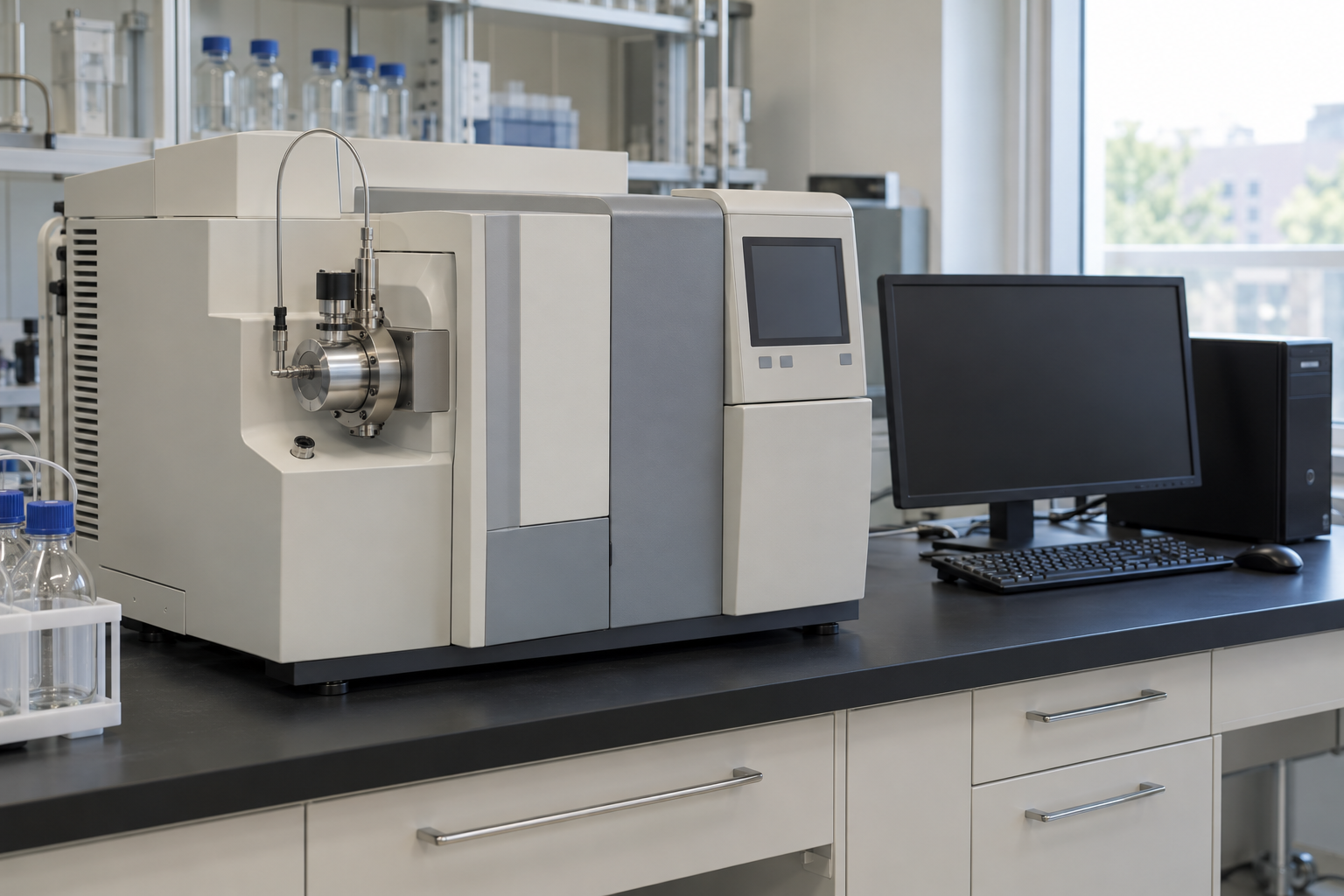
A chemist vaporizes a pure chlorine sample inside the instrument.
Every atom in the sample is a chlorine atom.
The instrument plots two separate peaks, not one.
One peak sits at 35 amu.
The other peak sits at 37 amu.
Why does one pure element give two peaks?
Part 2Each peak records one isotope
Each peak in the plot records one isotope of the element.
The instrument gives each atom a +1 charge before sorting it.
The horizontal axis shows the mass-to-charge ratio, m/z.
With a +1 charge, an atom's m/z position equals its mass in amu.
So chlorine's peak at 35 records ³⁵Cl, and the peak at 37 records ³⁷Cl.
A peak's height shows the isotope's relative amount in the sample.
Chlorine's peak at 35 stands about three times as tall as the peak at 37.
So the sample holds about three ³⁵Cl atoms for every one ³⁷Cl atom.
Chemists call the whole plot a mass spectrum.
Every mass spectrum in this course comes from a pure element, recorded as singly charged atoms.
Read a pure element's mass spectrum: count the peaks to count the isotopes, read each peak's position as an isotope's mass, and read each peak's height as that isotope's relative amount.
Part 3Check what you just learned
Check — numeric entry
The figure shows the mass spectrum of a pure element, recorded as singly charged atoms. How many isotopes does the element have?
Tolerance: 0
Feedback when correct: Correct. Each peak records one isotope. The spectrum shows two peaks, so the element has 2 isotopes.
Anticipated wrong answers (feedback shown):
| 1 | The sample is one pure element, but each separate peak records one isotope. Count the peaks: there are 2. |
| 63 | That is a peak's position, an isotope's mass. To count the isotopes, count the peaks: there are 2. |
| 61 | You may have worked with the peak heights. To count the isotopes, count the peaks: there are 2. |
Check — multiple choice
The figure shows the mass spectrum of pure silver, recorded as singly charged atoms. Which isotope is the most abundant?
Feedback if chosen: This option is wrong — you picked the heavier isotope. Abundance is read from height, and the peak at 107 stands taller: 26 against 24.
Feedback if chosen: Correct. The peak at 107 stands taller than the peak at 109 — 26 against 24 — so the isotope of mass 107 amu is the most abundant.
Feedback if chosen: This option is wrong — you read two close heights as equal. The heights differ: 26 at 107 against 24 at 109, so the isotope at 107 is more abundant.
Check — multiple choice
The figure shows the mass spectrum of a pure element, recorded as singly charged atoms. What does this spectrum tell you?
Feedback if chosen: This option is wrong — you read a position as a count. Each peak records one isotope, and this spectrum has one peak.
Feedback if chosen: This option is wrong — you read the m/z position as a proton count. With a +1 charge, the position is the atom's mass in amu.
Feedback if chosen: Correct. One peak means one isotope, and the peak's position means that isotope's mass is 197 amu. So every atom in this sample has a mass of 197 amu.
Check — multiple choice
The figure shows the mass spectrum of a pure element, recorded as singly charged atoms. Which isotope is the most abundant?
Feedback if chosen: This option is wrong — you picked the heaviest isotope. Abundance is read from height, and the tallest peak stands at 90.
Feedback if chosen: Correct. The tallest peak stands at 90, with height 103, so the isotope of mass 90 amu is the most abundant.
Feedback if chosen: This option is wrong — you picked the taller of the two right-hand peaks. The tallest peak of the whole spectrum stands at 90, with height 103.
Check — multiple choice
The figure shows the mass spectrum of pure copper, recorded as singly charged atoms. What does the height of the peak at 63 report?
Feedback if chosen: Correct. A peak's height reports the isotope's relative amount in the sample. The position, not the height, reports the mass.
Feedback if chosen: This option is wrong — you read the height as a mass. The peak's position reports the mass; the height reports the isotope's relative amount.
Feedback if chosen: This option is wrong — you read the height as a charge. Every atom here carries the same +1 charge; the height reports the isotope's relative amount.
Check — multiple choice
Bromine has two isotopes, with masses 79 and 81, in amu (rounded for this problem), and nearly equal abundances. A pure bromine sample is recorded as singly charged bromine atoms. Which description matches the sample's mass spectrum?
Feedback if chosen: This option is wrong — you averaged the two masses. Each atom is one isotope or the other, so no atom lands at 80 amu.
Feedback if chosen: Correct. Each atom lands at its own isotope's mass — 79 or 81 — and the nearly equal abundances give the two peaks nearly equal heights.
Feedback if chosen: This option is wrong — you added a two-atom species. The sample is recorded as singly charged bromine atoms, one atom per ion, so no Br₂⁺ ion forms and no peak sits near 158.
Check — multiple choice
In a mass spectrum recorded with a +1 charge, what does an atom's position on the horizontal axis equal?
Feedback if chosen: Correct. The horizontal axis is the mass-to-charge ratio, m/z, and with a +1 charge the position equals the atom's mass in amu.
Feedback if chosen: This option is wrong — you read the axis as a neutron count. The axis is the mass-to-charge ratio, and with a +1 charge the position equals the mass in amu.
Feedback if chosen: This option is wrong — you described the peak's height. The position gives the mass; the height gives the relative amount.
Check — multiple choice
What is the whole plot of peak positions and heights from the instrument called?
Feedback if chosen: Correct. The whole plot — one peak per isotope, heights showing relative amounts — is called a mass spectrum.
Feedback if chosen: This option is wrong — an isotope symbol is a label for one atom, such as ³⁵Cl. The whole plot is called a mass spectrum.
Feedback if chosen: This option is wrong — the periodic table lists the elements. The instrument's plot of peaks is called a mass spectrum.
Percent abundance from peak heights
Outcome: Calculate each isotope's percent abundance from relative peak heights: divide each height by the sum of the heights, then multiply by 100.
Part 1Heights are not percents
Copper's mass spectrum shows two peaks.
The peak at 63 has a height of 138.
The peak at 65 has a height of 62.
The two heights add to 200, not to 100.
So the heights cannot be percents.
What share of the copper atoms does each isotope make up?
Part 2Divide each height by the sum of the heights
Divide each peak's height by the sum of all the heights.
Multiply the quotient by 100.
The product is that isotope's share of the atoms, as a percent.
Chemists call that share the isotope's percent abundance.
| height | the isotope's peak height (arbitrary units) |
| sum of heights | all the peak heights added |
| % abundance | the isotope's share of the atoms (%) |
Q: What is the percent abundance of ⁶³Cu, from the copper spectrum's peak heights?
Write down the values from the question
peak heights: 138 at m/z 63, and 62 at m/z 65
Write down the equation
% abundance = (height ÷ sum of heights) × 100
Substitute in the values, and calculate
sum of heights: 138 + 62 = 200(all the peak heights added)
% abundance of ⁶³Cu = 138 ÷ 200 × 100 = 69.0%
The percent abundances of all the isotopes total 100.
Calculate an isotope's percent abundance from a mass spectrum: divide its peak height by the sum of all the peak heights, and multiply by 100.
Part 3Check what you just learned
Check — numeric entry
The figure shows the mass spectrum of pure copper, recorded as singly charged atoms, with the heights idealized for this problem. What is the percent abundance of ⁶⁵Cu, the isotope of mass 65 amu? Give your answer to 3 significant figures.
Feedback when correct: Correct. The sum of the heights is 138 + 62 = 200. So the percent abundance of ⁶⁵Cu is 62 ÷ 200 × 100 = 31.0%.
Anticipated wrong answers (feedback shown):
| 69.0 | That is the percent abundance of ⁶³Cu, the other isotope. For ⁶⁵Cu, divide its own height: 62 ÷ 200 × 100 = 31.0%. |
| 44.9 | You divided one height by the other height. Divide the isotope's height by the sum of the heights: 62 ÷ 200 × 100 = 31.0%. |
| 62 | That is the raw peak height. Heights are not percents: divide by the sum of the heights, 200, and multiply by 100 to get 31.0%. |
Worked solution revealed after a second miss
Write down the values from the question
peak heights: 138 at m/z 63, and 62 at m/z 65
Write down the equation
% abundance = (height ÷ sum of heights) × 100
Substitute in the values, and calculate
sum of heights: 138 + 62 = 200
% abundance of ⁶⁵Cu = 62 ÷ 200 × 100 = 31.0%
Check — numeric entry
The figure shows the mass spectrum of pure boron, recorded as singly charged atoms, with the heights idealized for this problem. What is the percent abundance of ¹¹B? Give your answer to 3 significant figures.
Feedback when correct: Correct. The sum of the heights is 8 + 32 = 40. So the percent abundance of ¹¹B is 32 ÷ 40 × 100 = 80.0%.
Anticipated wrong answers (feedback shown):
| 20.0 | That is the percent abundance of ¹⁰B, the other isotope. For ¹¹B, divide its own height: 32 ÷ 40 × 100 = 80.0%. |
| 25.0 | You divided one height by the other height. Divide the isotope's height by the sum of the heights: 32 ÷ 40 × 100 = 80.0%. |
| 32 | That is the raw peak height. Heights are not percents: divide by the sum of the heights, 40, and multiply by 100 to get 80.0%. |
Worked solution revealed after a second miss
Write down the values from the question
peak heights: 8 at m/z 10, and 32 at m/z 11
Write down the equation
% abundance = (height ÷ sum of heights) × 100
Substitute in the values, and calculate
sum of heights: 8 + 32 = 40
% abundance of ¹¹B = 32 ÷ 40 × 100 = 80.0%
Check — numeric entry
The figure shows the mass spectrum of pure silver, recorded as singly charged atoms, with the heights idealized for this problem. What is the percent abundance of ¹⁰⁷Ag? Give your answer to 3 significant figures.
Feedback when correct: Correct. The sum of the heights is 26 + 24 = 50. So the percent abundance of ¹⁰⁷Ag is 26 ÷ 50 × 100 = 52.0%.
Anticipated wrong answers (feedback shown):
| 48.0 | That is the percent abundance of ¹⁰⁹Ag, the other isotope. For ¹⁰⁷Ag, divide its own height: 26 ÷ 50 × 100 = 52.0%. |
| 92.3 | You divided one height by the other height. Divide the isotope's height by the sum of the heights: 26 ÷ 50 × 100 = 52.0%. |
| 26 | That is the raw peak height. Heights are not percents: divide by the sum of the heights, 50, and multiply by 100 to get 52.0%. |
Worked solution revealed after a second miss
Write down the values from the question
peak heights: 26 at m/z 107, and 24 at m/z 109
Write down the equation
% abundance = (height ÷ sum of heights) × 100
Substitute in the values, and calculate
sum of heights: 26 + 24 = 50
% abundance of ¹⁰⁷Ag = 26 ÷ 50 × 100 = 52.0%
Check — multiple choice
The figure shows the mass spectrum of pure magnesium, recorded as singly charged atoms, with the heights idealized for this problem. What are the percent abundances of ²⁴Mg, ²⁵Mg and ²⁶Mg, in that order?
Feedback if chosen: This option is wrong — you read the raw heights as percents. The heights total 200, so divide each by 200 and multiply by 100.
Feedback if chosen: Correct. The heights total 158 + 20 + 22 = 200. Dividing each height by 200 and multiplying by 100 gives 79.0%, 10.0% and 11.0%.
Feedback if chosen: This option is wrong — you divided each height by the tallest peak. Divide each height by the sum of all the heights, 200.
Feedback if chosen: This option is wrong — you swapped the two smaller abundances. The peak at 25 has height 20, giving 10.0%, and the peak at 26 has height 22, giving 11.0%.
Check — numeric entry
The figure shows the mass spectrum of pure gallium, recorded as singly charged atoms, with the heights idealized for this problem. What is the percent abundance of the isotope of mass 71 amu? Give your answer to 3 significant figures.
Feedback when correct: Correct. The sum of the heights is 12 + 8 = 20. So the percent abundance of the isotope at 71 is 8 ÷ 20 × 100 = 40.0%.
Anticipated wrong answers (feedback shown):
| 60.0 | That is the percent abundance of the isotope at 69, the other peak. For the isotope at 71, divide its own height: 8 ÷ 20 × 100 = 40.0%. |
| 66.7 | You divided one height by the other height. Divide the isotope's height by the sum of the heights: 8 ÷ 20 × 100 = 40.0%. |
| 8 | That is the raw peak height. Heights are not percents: divide by the sum of the heights, 20, and multiply by 100 to get 40.0%. |
Worked solution revealed after a second miss
Write down the values from the question
peak heights: 12 at m/z 69, and 8 at m/z 71
Write down the equation
% abundance = (height ÷ sum of heights) × 100
Substitute in the values, and calculate
sum of heights: 12 + 8 = 20
% abundance at m/z 71 = 8 ÷ 20 × 100 = 40.0%
Check — multiple choice
The figure shows the mass spectrum a student received, recorded as singly charged atoms. The student reads the height 45 as 45 percent, then writes 55 percent for the other isotope so the two total 100. Is the student's method correct?
Feedback if chosen: A peak height is not a percent. Divide each height by the sum of the heights: 45 ÷ 60 × 100 = 75.0%, and 15 ÷ 60 × 100 = 25.0%.
Feedback if chosen: Correct. A peak height is not a percent. Divide each height by the sum of the heights, 60: the abundances are 45 ÷ 60 × 100 = 75.0% and 15 ÷ 60 × 100 = 25.0%.
Check — multiple choice
An isotope's share of the atoms in a sample is called the isotope's what?
Feedback if chosen: This option is wrong — the mass-to-charge ratio is the peak's position on the horizontal axis, not a share of the atoms.
Feedback if chosen: Correct. The isotope's share of the atoms, as a percent, is its percent abundance — and the abundances of all the isotopes total 100.
Feedback if chosen: This option is wrong — the mass number counts one atom's protons plus neutrons, not a share of the atoms.
Calculate average atomic mass
Outcome: Calculate an element's average atomic mass: multiply each isotope's mass by its fractional abundance, then add the products.
Part 1Where 35.45 comes from
Chlorine has two isotopes.
One isotope has a mass of 34.97 amu; the other has a mass of 36.97 amu.
The periodic table lists one mass for chlorine: 35.45 amu.
Neither isotope has that mass.
The midpoint of the two isotope masses would be 35.97 amu.
The table does not say 35.97 either.
So how does 35.45 come from the two isotope masses?
Part 2A weighted average
The table's 35.45 counts each isotope in proportion to its abundance.
In a chlorine sample, 75.77 percent of the atoms are ³⁵Cl, and 24.23 percent are ³⁷Cl.
Write each percent as a fraction: 0.7577 and 0.2423.
Multiply each isotope's mass by its fraction of the atoms.
Then add the products.
Q: What is the average atomic mass of chlorine, from isotope masses 34.97 and 36.97 (in amu) and fractional abundances 0.7577 and 0.2423?
Write down the values from the question
isotope masses: 34.97 and 36.97, in amu
fractional abundances: 0.7577 and 0.2423
Write down the equation
average atomic mass = (mass 1 × fraction 1) + (mass 2 × fraction 2)
Substitute in the values, and calculate
average atomic mass = 34.97 × 0.7577 + 36.97 × 0.2423
average atomic mass = 26.4968 + 8.9578 = 35.45 amu
The sum, 35.45 amu, is chlorine's average atomic mass.
Chemists call this kind of average a weighted average: each mass counts in proportion to its abundance.
The average atomic mass lies between the lightest and heaviest isotope masses.
The average is pulled toward the more abundant isotopes' masses.
For a two-isotope element, the average sits closer to the more abundant isotope's mass.
Calculate an element's average atomic mass: write each abundance as a fraction, multiply each isotope's mass by its fraction, and add the products.
Part 3Check what you just learned
Check — multiple choice
Neon has two isotopes: mass 20 amu at 90.0 percent abundance, and mass 22 amu at 10.0 percent (rounded for this problem). Between which two values must neon's average atomic mass lie?
Feedback if chosen: This option is wrong — you added the two masses. The average lies between the lightest and heaviest isotope masses: 20 and 22 amu.
Feedback if chosen: Correct. A weighted average of 20 and 22 lies between the lightest and heaviest isotope masses, whatever the abundances.
Feedback if chosen: This option is wrong — you placed the average below the lightest isotope. A weighted average can never sit below the lightest mass.
Check — multiple choice
Closer to which isotope's mass must neon's average atomic mass sit: the mass-20 isotope at 90.0 percent abundance, or the mass-22 isotope at 10.0 percent?
Feedback if chosen: Correct. The average is pulled toward the more abundant isotope's mass, and 90.0 percent of the atoms have mass 20 amu.
Feedback if chosen: The average is pulled toward the more abundant isotope's mass. Here 90.0 percent of the atoms have mass 20 amu, so the average sits closer to 20.
Check — numeric entry
Copper has two isotopes. Rounded for this problem, their masses are 63.0 and 65.0, in amu, with abundances 70.0 percent and 30.0 percent. What is the average atomic mass, in amu, to 3 significant figures?
Feedback when correct: Correct. The fractions are 0.700 and 0.300. So the average is 63.0 × 0.700 + 65.0 × 0.300 = 44.1 + 19.5 = 63.6 amu.
Anticipated wrong answers (feedback shown):
| 64.0 | You took the midpoint of the two masses. The average counts each mass in proportion to its abundance: 63.0 × 0.700 + 65.0 × 0.300 = 63.6 amu. |
| 63.0 | That is the more abundant isotope's own mass. The average mixes both masses: 63.0 × 0.700 + 65.0 × 0.300 = 63.6 amu. |
| 44.1 | That is the first product only. Add the second product: 44.1 + 19.5 = 63.6 amu. |
Worked solution revealed after a second miss
Write down the values from the question
isotope masses: 63.0 and 65.0, in amu
fractional abundances: 0.700 and 0.300
Write down the equation
average atomic mass = (mass 1 × fraction 1) + (mass 2 × fraction 2)
Substitute in the values, and calculate
average atomic mass = 63.0 × 0.700 + 65.0 × 0.300
average atomic mass = 44.1 + 19.5 = 63.6 amu
Check — numeric entry
Gallium has two isotopes. Rounded for this problem, their masses are 69.0 and 71.0, in amu, with abundances 60.0 percent and 40.0 percent. What is the average atomic mass, in amu, to 3 significant figures?
Feedback when correct: Correct. The fractions are 0.600 and 0.400. So the average is 69.0 × 0.600 + 71.0 × 0.400 = 41.4 + 28.4 = 69.8 amu.
Anticipated wrong answers (feedback shown):
| 70.0 | You took the midpoint of the two masses. The average counts each mass in proportion to its abundance: 69.0 × 0.600 + 71.0 × 0.400 = 69.8 amu. |
| 70.2 | You swapped the two abundances. The mass 69.0 carries the 60.0 percent share: 69.0 × 0.600 + 71.0 × 0.400 = 69.8 amu. |
| 41.4 | That is the first product only. Add the second product: 41.4 + 28.4 = 69.8 amu. |
Check — numeric entry
Magnesium has three isotopes. Rounded for this problem, their masses are 24.0, 25.0 and 26.0, in amu, with abundances 79.0, 10.0 and 11.0 percent. What is the average atomic mass, in amu, to 4 significant figures?
Feedback when correct: Correct. The fractions are 0.790, 0.100 and 0.110. So the average is 24.0 × 0.790 + 25.0 × 0.100 + 26.0 × 0.110 = 18.96 + 2.50 + 2.86 = 24.32 amu.
Anticipated wrong answers (feedback shown):
| 25.0 | You took the midpoint of the three masses. The average counts each mass in proportion to its abundance, and the mass 24.0 carries 79.0 percent of the atoms: the sum is 24.32 amu. |
| 2432 | You multiplied by the percents without converting them to fractions. Divide each percent by 100 first: 24.0 × 0.790 + 25.0 × 0.100 + 26.0 × 0.110 = 24.32 amu. |
Check — numeric entry
The figure shows the mass spectrum of pure element Q, recorded as singly charged atoms, with the heights idealized for this problem. The isotopic masses equal the peak positions, in amu. What is Q's average atomic mass, in amu, to 4 significant figures?
Feedback when correct: Correct. The heights total 10, so the fractions are 0.300 and 0.700. The average is 191 × 0.300 + 193 × 0.700 = 57.30 + 135.1 = 192.4 amu.
Anticipated wrong answers (feedback shown):
| 192.0 | You took the midpoint of the two masses. Weight each mass by its fraction of the atoms: 191 × 0.300 + 193 × 0.700 = 192.4 amu. |
| 191.6 | You swapped the two fractions. The taller peak, height 7, sits at 193: 191 × 0.300 + 193 × 0.700 = 192.4 amu. |
Worked solution revealed after a second miss
Write down the values from the question
isotope masses: 191 and 193, in amu
peak heights: 3.0 and 7.0
Turn the heights into fractions
sum of heights: 3.0 + 7.0 = 10.0
fraction at 191: 3.0 ÷ 10.0 = 0.300
fraction at 193: 7.0 ÷ 10.0 = 0.700
Substitute in the values, and calculate
average atomic mass = 191 × 0.300 + 193 × 0.700
average atomic mass = 57.30 + 135.1 = 192.4 amu
Check — multiple choice
The figure shows the mass spectrum of pure zirconium, recorded as singly charged atoms. Computed from the figure, zirconium's average atomic mass is 91.33 amu, and the most abundant isotope has mass 90 amu. A student states a rule: "Pick the most abundant isotope — the element's average atomic mass always sits closest to that isotope's mass." Is the student's rule correct?
Feedback if chosen: Zirconium itself breaks the rule: the average, 91.33 amu, sits closer to 91 than to the most abundant mass, 90. The average lies between the lightest and heaviest isotope masses, pulled toward the more abundant isotopes.
Feedback if chosen: Correct. Zirconium's average, 91.33 amu, sits closer to 91 than to the most abundant mass, 90. The average lies between the lightest and heaviest isotope masses, pulled toward the more abundant isotopes. For a two-isotope element the average must sit closer to the more abundant isotope's mass. With more isotopes there is no such guarantee — zirconium's average sits nearer a minor peak.
Check — multiple choice
An element's average atomic mass counts each isotope's mass in proportion to its abundance. What is this kind of average called?
Feedback if chosen: Correct. An average in which each value counts in proportion to its share is called a weighted average.
Feedback if chosen: This option is wrong — a midpoint counts each mass equally. In a weighted average, each mass counts in proportion to its abundance.
Feedback if chosen: This option is wrong — a mass number counts one atom's protons plus neutrons. The table's value is a weighted average over all the isotopes.
Check — multiple choice
Which quantity does the periodic table list as an element's atomic mass?
Feedback if chosen: This option is wrong — the table does not pick one isotope. The listed value is the weighted average over all the isotopes.
Feedback if chosen: This option is wrong — a mass number is a count of particles in one atom. The listed value is a measured, weighted average mass.
Feedback if chosen: Correct. The table lists the average atomic mass: each isotope's mass weighted by its abundance.
Work backward from average atomic mass
Outcome: Calculate an unknown isotopic abundance, or an unknown isotope mass, from the average atomic mass and the other isotope data.
Part 1The average already contains the abundances
A reference table lists boron's average atomic mass as 10.8 amu.
Boron has two isotopes, with masses of 10.0 amu and 11.0 amu (rounded for this problem).
The table does not list the two abundances.
Yet the weighted average was built from the two abundances.
How can a chemist recover an abundance from the average?
Part 2Let x stand for the unknown fraction
Check — multiple choice
You've already seen the weighted average. Which rule gives an element's average atomic mass?
Feedback if chosen: Correct. Each isotope's mass counts in proportion to its abundance: multiply each mass by its fraction, then add the products.
Feedback if chosen: This option is wrong — that is a plain midpoint, counting each mass equally. In the weighted average, each mass counts in proportion to its abundance.
Feedback if chosen: This option is wrong — the average mixes every isotope's mass, weighted by abundance, so it rarely equals any single isotope's mass.
Let x stand for the fraction of boron atoms that are boron-11.
Every boron atom is boron-11 or boron-10.
So the fraction of boron-10 atoms is 1 − x.
The weighted-average equation then has one unknown; solving it recovers the fraction.
This work-backward route needs an element with exactly two isotopes: only then does 1 − x give the other fraction.
Q: What fraction of boron atoms are boron-11, if boron's average atomic mass is 10.8 and the isotope masses are 11.0 and 10.0, in amu (rounded for this problem)?
Write down the values from the question
average atomic mass: 10.8, in amu
isotope masses: 11.0 and 10.0, in amu
Write down the equation, with x as the boron-11 fraction
10.8 = 11.0x + 10.0(1 − x)
Solve the equation, one step per line
10.8 = 11.0x + 10.0 − 10.0x
10.8 = 10.0 + 1.0x
0.8 = 1.0x
x = 0.800, the fraction of boron atoms that are boron-11
State the answer as percents
boron is 80.0% boron-11 and 20.0% boron-10
The working keeps full significant figures: x = 0.800, so 80.0 percent.
The same equation recovers a missing isotope mass when the abundances are known: substitute the known values, and solve for the unknown mass.
Recover a missing abundance or isotope mass from the average atomic mass, for an element with two isotopes: let x stand for the unknown fraction, write the weighted-average equation, and solve.
Part 3Check what you just learned
Check — numeric entry
Lithium has two isotopes. Rounded for this problem, their masses are 6.00 and 7.00, in amu, and lithium's average atomic mass is 6.90, in amu. What percent of lithium atoms are ⁷Li? Give your answer to 3 significant figures.
Feedback when correct: Correct. With x as the ⁷Li fraction: 6.90 = 7.00x + 6.00(1 − x), so 6.90 = 6.00 + 1.00x, so x = 0.900. That is 90.0% ⁷Li.
Anticipated wrong answers (feedback shown):
| 10.0 | That is the ⁶Li share. The question demands the ⁷Li share: x = 0.900, so 90.0%. |
| 0.900 | That is the fraction x. The question demands a percent: multiply by 100 to get 90.0%. |
Worked solution revealed after a second miss
Write down the values from the question
average atomic mass: 6.90, in amu
isotope masses: 7.00 and 6.00, in amu
Write down the equation, with x as the ⁷Li fraction
6.90 = 7.00x + 6.00(1 − x)
Solve the equation, one step per line
6.90 = 7.00x + 6.00 − 6.00x
6.90 = 6.00 + 1.00x
0.90 = 1.00x
x = 0.900, the fraction of atoms that are ⁷Li
State the answer as a percent
the sample is 90.0% ⁷Li
Check — numeric entry
Europium has two isotopes, with masses 150.92 and 152.92, in amu, and an average atomic mass of 151.96, in amu. What percent of europium atoms are ¹⁵¹Eu, the isotope of mass 150.92? Give your answer to 3 significant figures.
Feedback when correct: Correct. With x as the ¹⁵¹Eu fraction: 151.96 = 150.92x + 152.92(1 − x), so 151.96 = 152.92 − 2.00x, so x = 0.96 ÷ 2.00 = 0.480. That is 48.0% ¹⁵¹Eu.
Anticipated wrong answers (feedback shown):
| 52.0 | That is the other isotope's share. The question demands the ¹⁵¹Eu share: x = 0.480, so 48.0%. |
| 0.480 | That is the fraction x. The question demands a percent: multiply by 100 to get 48.0%. |
Check — numeric entry
Gallium's average atomic mass is 69.8, in amu (rounded for this problem). The isotope ⁶⁹Ga has mass 69.0, in amu, and 60.0 percent abundance. What is the mass of gallium's other isotope, in amu, to 3 significant figures?
Feedback when correct: Correct. The other isotope carries the remaining 40.0 percent: 69.8 = 69.0 × 0.600 + m × 0.400, so m = (69.8 − 41.4) ÷ 0.400 = 71.0 amu.
Anticipated wrong answers (feedback shown):
| 70.3 | You gave the unknown isotope the 60.0 percent share. The known isotope carries 60.0 percent, so the unknown carries 0.400: m = (69.8 − 41.4) ÷ 0.400 = 71.0 amu. |
| 41.4 | That is the known isotope's product, 69.0 × 0.600. Subtract that product from the average and divide by 0.400: m = 71.0 amu. |
Worked solution revealed after a second miss
Write down the values from the question
average atomic mass: 69.8, in amu
known isotope: mass 69.0, in amu, at fraction 0.600
unknown isotope: mass m, at fraction 1 − 0.600 = 0.400
Write down the equation
69.8 = 69.0 × 0.600 + m × 0.400
Solve the equation, one step per line
69.8 = 41.4 + 0.400m
28.4 = 0.400m
m = 28.4 ÷ 0.400 = 71.0 amu
Check — multiple choice
Antimony's two isotopes have masses 120.90 and 122.90, in amu, and antimony's average atomic mass is 121.76 amu. Which abundance pair reproduces the average from these masses?
Feedback if chosen: This option is wrong — an even split gives the midpoint, 121.90, not 121.76. The average sits closer to 120.90, so that isotope carries the larger share.
Feedback if chosen: Correct. 120.90 × 0.570 + 122.90 × 0.430 = 68.91 + 52.85 = 121.76. The average sits closer to the lighter mass, so the lighter isotope carries the larger share.
Feedback if chosen: This option is wrong — you gave the heavier isotope the larger share. That pair gives 120.90 × 0.430 + 122.90 × 0.570 = 122.04, which overshoots the average.
U1-S03 — Composition, formulas and purity
8 lessons
Molecules vs formula units
Outcome: Tell a molecular substance, made of separate molecules, from an ionic solid counted in formula units.
Part 1What does the formula NaCl count?
Solid carbon dioxide and solid sodium chloride both have two-element formulas.
Up close, the two solids look nothing alike.
Dry ice is solid carbon dioxide, CO₂.
Dry ice holds separate CO₂ molecules, each sitting apart from its neighbors.
Solid sodium chloride holds no separate NaCl particle at all.
Its Na⁺ ions and Cl⁻ ions alternate in one unbroken, repeating grid.
So what does the formula NaCl count?
Part 2Formula units count a ratio
Some compounds exist as small, separate particles called molecules.
Solid CO₂ is molecular: each particle is one complete CO₂ molecule.
Sodium chloride is different: it is an ionic solid.
Its Na⁺ and Cl⁻ ions sit in one continuous repeating grid, and chemists call that grid a lattice.
No separate NaCl molecule exists inside the lattice.
The formula NaCl records the lowest whole-number ratio of the ions: one Na⁺ for every one Cl⁻.
One Na⁺ counted with one Cl⁻ is one counting unit of the solid.
Chemists call that counting unit a formula unit.
Now sort some solids. Is each solid made of separate molecules, or counted in formula units in a lattice?
Solid CO₂ is made of separate molecules: each particle is one complete CO₂ molecule.
Solid SO₂ is made of separate molecules: each particle is one complete SO₂ molecule.
But solid NH₄NO₃ is counted in formula units: its NH₄⁺ and NO₃⁻ ions sit in one continuous lattice, even though every atom in it is a nonmetal atom.
And solid KBr is counted in formula units: its K⁺ and Br⁻ ions sit in one continuous lattice.
A metal with a nonmetal usually forms an ionic lattice.
Nonmetals alone usually form molecules.
Ammonium compounds are the named exception: NH₄NO₃ and (NH₄)₂SO₄ contain only nonmetal atoms, yet each forms an ionic lattice.
An ammonium compound holds NH₄⁺ ions, and ions in a solid pack into a lattice. So an ammonium compound is counted in formula units, not molecules.
Sort a solid by its particles: separate molecules make it molecular; ions in a continuous lattice make it ionic, counted in formula units — a metal with a nonmetal usually means a lattice, and ammonium compounds are the all-nonmetal exception.
Part 3Check what you just learned
Check — multiple choice
Ice is solid H₂O. Is ice made of separate molecules, or counted in formula units in a lattice?
Feedback if chosen: Correct. H₂O contains only nonmetal atoms and no ions, so ice holds separate H₂O molecules.
Feedback if chosen: H₂O contains only nonmetal atoms, no metal and no ammonium ion, so ice holds separate H₂O molecules.
Check — multiple choice
Solid KBr: is it made of separate molecules, or counted in formula units in a lattice?
Feedback if chosen: Potassium is a metal with a nonmetal partner, so KBr forms an ionic lattice of K⁺ and Br⁻ ions, counted in formula units.
Feedback if chosen: Correct. Potassium is a metal with a nonmetal partner, so KBr forms an ionic lattice of K⁺ and Br⁻ ions, counted in formula units.
Check — multiple choice
Solid NH₄NO₃: is it made of separate molecules, or counted in formula units in a lattice?
Feedback if chosen: Every atom in NH₄NO₃ is a nonmetal atom, but NH₄NO₃ is an ammonium compound: it holds NH₄⁺ and NO₃⁻ ions, which pack into a lattice counted in formula units.
Feedback if chosen: Correct. NH₄NO₃ is an ammonium compound: it holds NH₄⁺ and NO₃⁻ ions, which pack into a lattice counted in formula units — even though every atom in it is a nonmetal atom.
Check — multiple choice
Solid SO₂: is it made of separate molecules, or counted in formula units in a lattice?
Feedback if chosen: Correct. Sulfur and oxygen are both nonmetals, with no metal and no ammonium ion, so solid SO₂ holds separate SO₂ molecules.
Feedback if chosen: Sulfur and oxygen are both nonmetals, with no metal and no ammonium ion, so solid SO₂ holds separate SO₂ molecules.
Check — multiple choice
Solid MgCl₂: is it made of separate molecules, or counted in formula units in a lattice?
Feedback if chosen: Magnesium is a metal with a nonmetal partner, so MgCl₂ forms an ionic lattice; its formula unit counts one magnesium ion for every two chloride ions.
Feedback if chosen: Correct. Magnesium is a metal with a nonmetal partner, so MgCl₂ forms an ionic lattice; its formula unit counts one magnesium ion for every two chloride ions.
Check — multiple choice
Solid (NH₄)₂SO₄: is it made of separate molecules, or counted in formula units in a lattice?
Feedback if chosen: Every atom in (NH₄)₂SO₄ is a nonmetal atom, but (NH₄)₂SO₄ is an ammonium compound: it holds NH₄⁺ and SO₄²⁻ ions, which pack into a lattice counted in formula units.
Feedback if chosen: Correct. (NH₄)₂SO₄ is an ammonium compound: it holds NH₄⁺ and SO₄²⁻ ions, which pack into a lattice counted in formula units — even though every atom in it is a nonmetal atom.
Check — multiple choice
Solid CaF₂: is it made of separate molecules, or counted in formula units in a lattice?
Feedback if chosen: Correct. Calcium is a metal with a nonmetal partner, so CaF₂ forms an ionic lattice; its formula unit counts one calcium ion for every two fluoride ions.
Feedback if chosen: Calcium is a metal with a nonmetal partner, so CaF₂ forms an ionic lattice; its formula unit counts one calcium ion for every two fluoride ions.
Check — multiple choice
A student draws solid KCl as separate K–Cl pairs with empty space between them. Which correction fixes the drawing?
Feedback if chosen: This option is wrong — you kept the separate pairs. KCl is an ionic solid: no separate KCl particle exists, however close the pairs are drawn.
Feedback if chosen: Correct. KCl is a metal-with-nonmetal compound, so its ions sit in one continuous lattice; the formula KCl counts the 1-to-1 ion ratio, not a separate particle.
Feedback if chosen: This option is wrong — you split the compound into its elements. Solid KCl holds potassium ions and chloride ions together in one lattice.
Check — multiple choice
In an ionic solid, what is the counting unit set by the lowest whole-number ratio of the ions called?
Feedback if chosen: This option is wrong — a molecule is a separate particle, and an ionic solid holds no separate particle.
Feedback if chosen: This option is wrong — the lattice is the whole continuous grid of ions, not the counting unit.
Feedback if chosen: Correct. The lowest whole-number ratio of the ions — one Na⁺ with one Cl⁻ in NaCl — is one formula unit.
Pure substance or mixture?
Outcome: Sort a sample as a pure substance or a mixture by counting its chemical identities.
Part 1Three sealed boxes
Here are three sealed boxes of particles.
Box one holds only copper atoms.
Box two holds only CO₂ molecules.
Box three holds N₂ molecules and O₂ molecules mingled together.
Box two contains two different elements, carbon and oxygen.
Does that make box two a mixture?
Part 2Count the chemical identities
Every particle in box two is the same substance: carbon dioxide.
One kind of matter a sample contains — copper, water, carbon dioxide — is called a chemical identity.
Count the chemical identities in a sample, not the elements inside one formula.
A sample holding one chemical identity is called a pure substance.
A sample holding more than one chemical identity is called a mixture.
Box one holds one chemical identity, copper. So box one is a pure substance.
Box two holds one chemical identity, carbon dioxide. So box two is a pure substance.
But box three holds two chemical identities, nitrogen and oxygen. So box three is a mixture.
A mixture's proportions can vary from sample to sample: another box three could hold more N₂ and less O₂.
Now consider a fourth box: salt water.
Salt water holds water molecules, with sodium ions and chloride ions mingled among them.
The dissolved sodium chloride is still one chemical identity, present as its ions.
So salt water holds exactly two chemical identities: water, and sodium chloride.
So salt water is a mixture, however uniform it looks.
Sort a sample by counting its chemical identities: one identity makes a pure substance; more than one makes a mixture, whose proportions can vary.
Part 3Check what you just learned
Check — multiple choice
A liquid holds only C₂H₅OH molecules. Is the sample a pure substance or a mixture?
Feedback if chosen: Correct. Every particle is the same substance, so the sample holds one chemical identity: a pure substance.
Feedback if chosen: Every particle is the same substance, C₂H₅OH. One chemical identity makes a pure substance, however many elements the formula holds.
Check — multiple choice
A beaker holds Na⁺ ions, Cl⁻ ions and H₂O molecules. Is the sample a pure substance or a mixture?
Feedback if chosen: The beaker holds two chemical identities: water, and sodium chloride present as its dissolved ions. Two identities make a mixture.
Feedback if chosen: Correct. The beaker holds two chemical identities: water, and sodium chloride present as its dissolved ions. Two identities make a mixture.
Check — multiple choice
A flask holds N₂ molecules and O₂ molecules. Is the sample a pure substance or a mixture?
Feedback if chosen: The flask holds two chemical identities, nitrogen and oxygen. Two identities make a mixture.
Feedback if chosen: Correct. The flask holds two chemical identities, nitrogen and oxygen. Two identities make a mixture.
Check — multiple choice
A flask holds only NH₃ molecules. Is the sample a pure substance or a mixture?
Feedback if chosen: Correct. Every particle is the same substance, ammonia, so the flask holds one chemical identity: a pure substance.
Feedback if chosen: Every particle is the same substance, NH₃. One chemical identity makes a pure substance, however many elements the formula holds.
Check — multiple choice
A sealed box holds only Ne atoms. Is the sample a pure substance or a mixture?
Feedback if chosen: Correct. Every particle is the same substance, neon, so the box holds one chemical identity: a pure substance.
Feedback if chosen: Every particle is the same substance, neon. One chemical identity makes a pure substance.
Check — multiple choice
A glass holds water and ethanol. Is the sample a pure substance or a mixture?
Feedback if chosen: The glass holds two chemical identities, water and ethanol. Two identities make a mixture, however uniform the liquid looks.
Feedback if chosen: Correct. The glass holds two chemical identities, water and ethanol. Two identities make a mixture, however uniform the liquid looks.
Check — multiple choice
A student says: "Carbon dioxide contains two elements, carbon and oxygen, so a sample of pure CO₂ must be a mixture." Is the student correct?
Feedback if chosen: Count the chemical identities, not the elements inside one formula. Every particle in the sample is the same substance, CO₂, so the sample is a pure substance.
Feedback if chosen: Correct. Count the chemical identities, not the elements inside one formula. Every particle in the sample is the same substance, CO₂ — one chemical identity, so a pure substance.
Check — multiple choice
Four sealed containers hold: container 1, only Ne atoms; container 2, N₂ and O₂ mingled; container 3, only NH₃ molecules; container 4, water with dissolved sodium chloride. Which containers hold a pure substance?
Feedback if chosen: This option is wrong — container 2 holds two chemical identities, nitrogen and oxygen, so it is a mixture.
Feedback if chosen: Correct. Containers 1 and 3 each hold one chemical identity — neon, and ammonia — so each is a pure substance. The other two containers hold two identities each.
Feedback if chosen: This option is wrong — container 4 holds two chemical identities, water and dissolved sodium chloride, so it is a mixture.
Feedback if chosen: This option is wrong — container 3 also holds one chemical identity, ammonia. A compound of several elements still counts as one identity.
Check — multiple choice
One kind of matter a sample contains — copper, water, or carbon dioxide — is called what?
Feedback if chosen: Correct. Each kind of matter in a sample is one chemical identity, and the identity count sorts pure substances from mixtures.
Feedback if chosen: This option is wrong — a mass number counts one atom's protons plus neutrons. One kind of matter in a sample is a chemical identity.
Feedback if chosen: This option is wrong — a percent abundance is an isotope's share of an element's atoms. One kind of matter in a sample is a chemical identity.
Check — multiple choice
Which quantity can vary between two samples of one mixture?
Feedback if chosen: Correct. A mixture's proportions can vary from sample to sample — one flask of air can hold more oxygen than another.
Feedback if chosen: This option is wrong — each substance keeps its own identity in every sample; only the proportions vary.
Feedback if chosen: This option is wrong — a formula's element count is fixed by the compound, not by the sample.
Same compound, same mass ratio
Outcome: State the law of definite proportions: in any pure sample of a given compound, the ratio of the masses of the elements is always the same.
Part 1The split that never changes
Now consider pure water from three sources: rainwater, seawater from a still, and water made in a lab.
A laboratory measures the mass of hydrogen and the mass of oxygen in each sample.
Every sample gives the same split: about 1 g of hydrogen for every 8 g of oxygen.
A 9 g sample shows the 1-to-8 split.
A 900 g sample shows the same 1-to-8 split.
Why does the mass split never change?
Part 2The law of definite proportions
Every particle of a pure compound holds the same elements in the same counts.
Every water molecule holds two hydrogen atoms and one oxygen atom.
Any sample of pure water is just more or fewer of that one kind of particle.
So the hydrogen-to-oxygen mass ratio comes out the same in every pure sample.
This regularity is called the law of definite proportions.
In any pure sample of a given compound, the ratio of the masses of the elements is always the same.
The 1-to-8 split for water is an approximate illustration, not a quantity to calculate here.
State the law of definite proportions: in any pure sample of a given compound, the ratio of the masses of the elements is always the same.
Part 3Check what you just learned
Check — multiple choice
Which statement is the law of definite proportions?
Feedback if chosen: This option is wrong — the element masses need not be equal. The law fixes the ratio of the masses, which can be 1 to 8.
Feedback if chosen: Correct. In any pure sample of a given compound, the ratio of the masses of the elements is always the same.
Feedback if chosen: This option is wrong — a ratio does not grow with the sample. A larger sample holds larger masses in the same ratio.
Check — multiple choice
A 22.0 g sample of pure CO₂ holds 6.0 g of carbon and 16.0 g of oxygen. What does a 44.0 g sample of pure CO₂ hold?
Feedback if chosen: Correct. Doubling the sample doubles each element's mass, and the carbon-to-oxygen mass ratio stays 6.0 to 16.0.
Feedback if chosen: This option is wrong — you held the carbon fixed and grew only the oxygen. Both masses double together, keeping the ratio: 12.0 g of carbon and 32.0 g of oxygen.
Feedback if chosen: This option is wrong — you split the new mass equally. The compound keeps its fixed ratio: 12.0 g of carbon and 32.0 g of oxygen.
Check — multiple choice
To which samples does the law of definite proportions apply?
Feedback if chosen: This option is wrong — the source does not matter. Rainwater and lab-made water carry the same mass ratio, because the law covers any pure sample.
Feedback if chosen: Correct. The law covers any pure sample of the compound — any size, any source — because every particle of the compound is identical.
Feedback if chosen: This option is wrong — the size does not matter. A 9 g sample and a 900 g sample carry the same mass ratio.
Check — multiple choice
Four students analyze samples labeled pure copper(II) sulfide. Three measure a copper-to-sulfur mass ratio of 2.0; one measures 1.3. The stated measurement uncertainty is ±0.1. What conclusion is justified?
Feedback if chosen: This option is wrong — the law covers pure samples. A result far off the fixed ratio says that sample is not what its label claims, not that the law failed.
Feedback if chosen: This option is wrong — 1.3 misses 2.0 by 0.7, far more than the stated ±0.1.
Feedback if chosen: Correct. The fixed ratio is 2.0 and the stated uncertainty is ±0.1, so 1.3 disagrees beyond the uncertainty. Check that sample for contamination, mislabeling or measurement error.
Check — multiple choice
What is the name of the law that fixes a pure compound's element-mass ratio?
Feedback if chosen: Correct. The law of definite proportions: in any pure sample of a given compound, the ratio of the masses of the elements is always the same.
Feedback if chosen: This option is wrong — the law of conservation of mass concerns the total mass in a change, not a compound's element-mass ratio. The fixed ratio is the law of definite proportions.
Feedback if chosen: This option is wrong — a weighted average combines isotope masses by abundance. The fixed element-mass ratio is the law of definite proportions.
Calculate percent composition by mass
Outcome: Calculate the percent composition by mass of each element in a compound from the formula and atomic masses.
Part 1Carbon's share of CO₂
One mole of CO₂ has a mass of 44.01 g.
The molar mass of CO₂ comes from its formula: 12.01 + 2 × 16.00 = 44.01 g/mol.
Each CO₂ molecule holds exactly one carbon atom.
So one mole of CO₂ contains one mole of carbon atoms: 12.01 g of carbon.
Carbon supplies 12.01 g of every 44.01 g of CO₂.
What percent of CO₂'s mass does carbon supply?
Part 2Divide the element's mass by the molar mass
Multiply the element's atomic mass by its subscript in the formula. That is the element's mass in one mole of the compound.
Divide that mass by the compound's molar mass, M.
Multiply the quotient by 100.
The result is called the element's percent composition by mass.
Q: What is the percent composition by mass of carbon in CO₂?
Write down the values from the question
carbon: atomic mass 12.01 g/mol, subscript 1
molar mass of CO₂: M = 44.01 g/mol
Write down the equation
% of the element = (mass of the element in one mole ÷ M) × 100
Substitute in the values, and calculate
% carbon = (12.01 ÷ 44.01) × 100 = 27.29%
Every element's percent lands between 0 and 100.
The percents of all the elements in one compound total 100.
Calculate an element's percent composition by mass: multiply its atomic mass by its subscript, divide by the compound's molar mass, and multiply by 100.
Part 3Check what you just learned
Check — numeric entry
What is the percent composition by mass of sodium in NaCl? Use atomic masses Na = 22.99 and Cl = 35.45, in g/mol. Give your answer to 4 significant figures.
Feedback when correct: Correct. M of NaCl = 22.99 + 35.45 = 58.44 g/mol. So the percent of sodium is 22.99 ÷ 58.44 × 100 = 39.34%.
Anticipated wrong answers (feedback shown):
| 60.66 | That is chlorine's percent. For sodium, divide sodium's mass: 22.99 ÷ 58.44 × 100 = 39.34%. |
| 64.85 | You divided sodium's mass by chlorine's mass. Divide by the compound's molar mass, 58.44: 22.99 ÷ 58.44 × 100 = 39.34%. |
Worked solution revealed after a second miss
Write down the values from the question
sodium: atomic mass 22.99 g/mol, subscript 1
M of NaCl = 22.99 + 35.45 = 58.44 g/mol
Write down the equation
% of the element = (mass of the element in one mole ÷ M) × 100
Substitute in the values, and calculate
% sodium = (22.99 ÷ 58.44) × 100 = 39.34%
Check — numeric entry
What is the percent composition by mass of oxygen in MgO? Use atomic masses Mg = 24.31 and O = 16.00, in g/mol. Give your answer to 4 significant figures.
Feedback when correct: Correct. The compound's molar mass adds up: 24.31 + 16.00, which is 40.31 g/mol. Then 16.00 ÷ 40.31 × 100 = 39.69%.
Anticipated wrong answers (feedback shown):
| 60.31 | That is the metal's percent. For oxygen, divide oxygen's mass: 16.00 ÷ 40.31 × 100 = 39.69%. |
| 65.82 | You divided oxygen's mass by the other atomic mass. Divide by the compound's molar mass, 40.31: 16.00 ÷ 40.31 × 100 = 39.69%. |
Check — numeric entry
What is the percent composition by mass of carbon in glucose, C₆H₁₂O₆? The molar mass of C₆H₁₂O₆ is 180.16 g/mol, and carbon's atomic mass is 12.01 g/mol. Give your answer to 4 significant figures.
Feedback when correct: Correct. The formula holds 6 carbon atoms: 6 × 12.01 = 72.06 g of carbon per mole. So the percent of carbon is 72.06 ÷ 180.16 × 100 = 40.00%.
Anticipated wrong answers (feedback shown):
| 6.666 | You used one carbon atom. The subscript is 6: the carbon per mole is 6 × 12.01 = 72.06 g, giving 72.06 ÷ 180.16 × 100 = 40.00%. |
| 53.29 | That is oxygen's percent. For carbon: 6 × 12.01 = 72.06 g per mole, giving 72.06 ÷ 180.16 × 100 = 40.00%. |
Worked solution revealed after a second miss
Write down the values from the question
carbon: atomic mass 12.01 g/mol, subscript 6
M of C₆H₁₂O₆ = 180.16 g/mol
Write down the equation
% of the element = (mass of the element in one mole ÷ M) × 100
Substitute in the values, and calculate
mass of carbon in one mole: 6 × 12.01 = 72.06 g
% carbon = (72.06 ÷ 180.16) × 100 = 40.00%
Check — numeric entry
What is the percent composition by mass of nitrogen in NH₄NO₃? Use atomic masses: nitrogen 14.01, hydrogen 1.008 and oxygen 16.00, in g/mol. Give your answer to 4 significant figures.
Feedback when correct: Correct. Nitrogen appears twice: 2 × 14.01 = 28.02 g per mole. M of NH₄NO₃ = 28.02 + 4 × 1.008 + 3 × 16.00 = 80.05 g/mol. So the percent is 28.02 ÷ 80.05 × 100 = 35.00%.
Anticipated wrong answers (feedback shown):
| 17.50 | You counted one nitrogen atom. The formula holds two — one in NH₄ and one in NO₃: 28.02 ÷ 80.05 × 100 = 35.00%. |
| 28.02 | That is the mass of nitrogen in one mole, in g. Divide it by the molar mass and multiply by 100: 28.02 ÷ 80.05 × 100 = 35.00%. |
Worked solution revealed after a second miss
Write down the values from the question
nitrogen: atomic mass 14.01 g/mol, subscripts 1 + 1 = 2
M of NH₄NO₃ = 2 × 14.01 + 4 × 1.008 + 3 × 16.00 = 80.05 g/mol
Write down the equation
% of the element = (mass of the element in one mole ÷ M) × 100
Substitute in the values, and calculate
mass of nitrogen in one mole: 2 × 14.01 = 28.02 g
% nitrogen = (28.02 ÷ 80.05) × 100 = 35.00%
Check — numeric entry
What is the percent composition by mass of oxygen in Ca(NO₃)₂? The molar mass of Ca(NO₃)₂ is 164.10 g/mol, and oxygen's atomic mass is 16.00 g/mol. Give your answer to 4 significant figures.
Feedback when correct: Correct. The parentheses double the group, giving 6 oxygen atoms per formula: 6 × 16.00 = 96.00 g per mole. The percent is 96.00 ÷ 164.10 × 100 = 58.50%.
Anticipated wrong answers (feedback shown):
| 29.25 | You counted the 3 oxygen atoms inside one group. The subscript 2 doubles the group: 6 × 16.00 = 96.00 g, giving 96.00 ÷ 164.10 × 100 = 58.50%. |
| 9.750 | You counted one oxygen atom. The formula holds 6: 96.00 ÷ 164.10 × 100 = 58.50%. |
Check — multiple choice
Fe₂O₃ is 69.94 percent iron by mass. Without a fresh division, what is the percent composition by mass of oxygen in Fe₂O₃?
Feedback if chosen: Correct. The compound holds only iron and oxygen, and the percents of all the elements total 100: 100 − 69.94 = 30.06 percent.
Feedback if chosen: The percents of all the elements in one compound total 100, so oxygen's percent is 100 − 69.94 = 30.06 percent — no fresh division needed.
Check — multiple choice
The percent of a compound's mass that one element supplies is called the element's what?
Feedback if chosen: This option is wrong — percent abundance is an isotope's share of an element's atoms, not an element's share of a compound's mass.
Feedback if chosen: Correct. An element's share of a compound's mass is its percent composition by mass.
Feedback if chosen: This option is wrong — a mass number counts one atom's protons plus neutrons.
What is an empirical formula?
Outcome: State that the empirical formula lists the lowest whole-number ratio of atoms of each element in a compound.
Part 1The formula that shrinks
One glucose molecule holds 6 carbon atoms, 12 hydrogen atoms and 6 oxygen atoms.
The formula C₆H₁₂O₆ records those actual counts.
The subscripts 6, 12 and 6 share a greatest common factor: 6.
Divide every subscript by 6, and the formula shrinks to CH₂O.
What information does the shrunken formula still carry?
Part 2Two formulas, two jobs
A molecular formula lists the actual counts of the atoms in one molecule.
An empirical formula lists the lowest whole-number ratio of atoms of each element.
Glucose's molecular formula is C₆H₁₂O₆.
Glucose's empirical formula is CH₂O.
CH₂O keeps the 1 : 2 : 1 atom ratio.
CH₂O drops the molecule's identity: acetic acid, C₂H₄O₂, shrinks to the same CH₂O.
To find an empirical formula from a molecular formula, divide every subscript by the subscripts' greatest common factor.
State what an empirical formula is — the lowest whole-number ratio of atoms of each element — and reduce a molecular formula to it by dividing every subscript by the greatest common factor.
Part 3Check what you just learned
Check — multiple choice
What is the empirical formula of N₂O₄?
Feedback if chosen: This option is wrong — the subscripts 2 and 4 still share a factor of 2. The empirical formula lists the lowest whole-number ratio: NO₂.
Feedback if chosen: Correct. The empirical formula lists the lowest whole-number ratio of atoms of each element. For N₂O₄, the ratio 2 : 4 reduces to 1 : 2, so the empirical formula is NO₂.
Feedback if chosen: This option is wrong — you divided only the nitrogen subscript. Every subscript is divided by the same factor: 2 : 4 reduces to 1 : 2, giving NO₂.
Check — multiple choice
What is the empirical formula of C₆H₁₄?
Feedback if chosen: Correct. The empirical formula lists the lowest whole-number ratio of atoms of each element. For C₆H₁₄, the greatest common factor of 6 and 14 is 2, so 6 : 14 reduces to 3 : 7 — C₃H₇.
Feedback if chosen: This option is wrong — 6 : 14 does not reduce to 1 : 2. The greatest common factor of 6 and 14 is 2, giving 3 : 7 — C₃H₇.
Feedback if chosen: This option is wrong — the subscripts 6 and 14 share a factor of 2. The lowest whole-number ratio is 3 : 7, so the empirical formula is C₃H₇.
Check — multiple choice
What is the empirical formula of P₄O₁₀?
Feedback if chosen: This option is wrong — the subscripts 4 and 10 still share a factor of 2. The lowest whole-number ratio is 2 : 5, so the empirical formula is P₂O₅.
Feedback if chosen: Correct. The empirical formula lists the lowest whole-number ratio of atoms of each element. For P₄O₁₀, the greatest common factor of 4 and 10 is 2, so the ratio reduces to 2 : 5 — P₂O₅.
Feedback if chosen: This option is wrong — you divided only the phosphorus subscript by 4. Every subscript is divided by the same factor, 2, giving P₂O₅.
Check — multiple choice
What is the empirical formula of C₄H₈?
Feedback if chosen: Correct. The empirical formula lists the lowest whole-number ratio of atoms of each element. For C₄H₈, the greatest common factor of 4 and 8 is 4, so the ratio reduces to 1 : 2 — CH₂.
Feedback if chosen: This option is wrong — you divided by 2 and stopped. The greatest common factor of 4 and 8 is 4, so the ratio reduces to 1 : 2 — CH₂.
Feedback if chosen: This option is wrong — the subscripts 4 and 8 share a factor of 4. The lowest whole-number ratio is 1 : 2, so the empirical formula is CH₂.
Check — multiple choice
Which formula is already an empirical formula?
Feedback if chosen: This option is wrong — the subscripts 2 and 4 share a factor of 2, so C₂H₄ reduces to CH₂.
Feedback if chosen: Correct. The subscripts 3 and 8 share no common factor beyond 1, so C₃H₈ is already the lowest whole-number ratio — an empirical formula.
Feedback if chosen: This option is wrong — the subscripts 6 and 6 share a factor of 6, so C₆H₆ reduces to CH.
Check — multiple choice
Which pair of molecular formulas shares one empirical formula?
Feedback if chosen: This option is wrong — C₂H₄ reduces to CH₂, but C₃H₈ is already in lowest terms. The ratios differ.
Feedback if chosen: This option is wrong — C₂H₆ reduces to CH₃, and C₆H₁₂ reduces to CH₂. The ratios differ.
Feedback if chosen: Correct. C₂H₄ reduces to CH₂, and C₆H₁₂ also reduces to CH₂ — the same lowest whole-number ratio, so the same empirical formula.
Check — multiple choice
Glucose's empirical formula is CH₂O. What does CH₂O tell you about glucose?
Feedback if chosen: This option is wrong — the empirical formula gives a ratio, not the actual counts. One glucose molecule holds 6, 12 and 6 atoms, in the ratio 1 : 2 : 1.
Feedback if chosen: Correct. The empirical formula lists the lowest whole-number ratio of atoms of each element — here 1 : 2 : 1 — not the actual counts and not the identity.
Feedback if chosen: This option is wrong — glucose is one pure compound, one chemical identity. CH₂O gives the atom ratio inside that compound.
Check — multiple choice
Which formula lists the actual counts of atoms in one molecule?
Feedback if chosen: This option is wrong — the empirical formula lists the lowest whole-number ratio, which can be smaller than the actual counts.
Feedback if chosen: Correct. The molecular formula lists the actual counts of the atoms in one molecule, such as glucose's C₆H₁₂O₆.
Feedback if chosen: This option is wrong — a formula unit is the counting unit of an ionic solid, not a molecule's atom counts.
Check — multiple choice
Which formula lists the lowest whole-number ratio of atoms of each element?
Feedback if chosen: Correct. The empirical formula lists the lowest whole-number ratio of atoms of each element in the compound.
Feedback if chosen: This option is wrong — the molecular formula lists the actual counts, which can be a multiple of the lowest ratio.
Feedback if chosen: This option is wrong — a formula unit counts one set of ions in an ionic solid. The lowest whole-number ratio of atoms of each element is the empirical formula.
Find the empirical formula
Outcome: Calculate a compound's empirical formula from percent composition or element masses.
Part 1Three percents fix a formula
A laboratory analyzes a white solid.
The report lists only percents by mass: 40.00 percent carbon, 6.71 percent hydrogen and 53.29 percent oxygen.
No formula appears anywhere on the report.
Yet those three percents fix the solid's empirical formula.
How does a chemist turn three percents into a formula?
Part 2Percents to masses, masses to moles, moles to a ratio
Check — multiple choice
You've already seen the equation n = m/M. What does it give?
Feedback if chosen: Correct. n = m/M turns a mass in grams into moles, using the substance's molar mass.
Feedback if chosen: This option is wrong — the molar mass M is a given value, read from the periodic table or the formula, not the equation's output.
Feedback if chosen: This option is wrong — percent composition comes from a different division. n = m/M turns a mass into moles.
Set the sample mass at 100 g.
Each percent then becomes a mass in grams: 40.00 g of carbon, 6.71 g of hydrogen and 53.29 g of oxygen.
Convert each element's mass to moles with n = m/M.
Divide every mole amount by the smallest mole amount.
The division gives the atom ratios.
A ratio near a whole number becomes that element's subscript.
Never round a mole amount before the division.
And a ratio near 1.33 or 1.25 is not rounded to 1: multiply every ratio by 3 or 4 — the smallest whole number that makes all the ratios whole.
Q: What is the empirical formula of the white solid — 40.00% carbon, 6.71% hydrogen, 53.29% oxygen? Atomic masses: C = 12.01, H = 1.008, O = 16.00, in g/mol.
Take 100 g, so each percent is a mass
in 100 g: carbon 40.00 g, hydrogen 6.71 g, oxygen 53.29 g
Write down the equation
n = m/M for each element
Substitute in the values, and calculate
n of carbon = 40.00 ÷ 12.01 = 3.331 mol
n of hydrogen = 6.71 ÷ 1.008 = 6.657 mol
n of oxygen = 53.29 ÷ 16.00 = 3.331 mol
Divide every mole amount by the smallest
carbon 3.331 ÷ 3.331 = 1.00, hydrogen 6.657 ÷ 3.331 = 2.00, oxygen 3.331 ÷ 3.331 = 1.00 — the ratio 1 : 2 : 1
State the formula
empirical formula: CH₂O
Calculate an empirical formula from percents or element masses: take 100 g if given percents, convert each element's mass to moles with n = m/M, divide every mole amount by the smallest, and turn near-whole ratios into subscripts — multiplying all the ratios by 2, 3 or 4 where a ratio lands near 1.50, 1.33 or 1.25.
Part 3Check what you just learned
Check — numeric entry
A sample of a compound of iron and sulfur holds 5.585 g of iron and 6.412 g of sulfur. The compound's formula is FeSₓ. Use atomic masses Fe = 55.85 and S = 32.06, in g/mol. What is x?
Tolerance: 0
Feedback when correct: Correct. n of iron = 5.585 ÷ 55.85 = 0.1000 mol, and n of sulfur = 6.412 ÷ 32.06 = 0.2000 mol. The ratio 0.2000 ÷ 0.1000 = 2.000, so the subscript x = 2.
Anticipated wrong answers (feedback shown):
| 0.5 | You divided iron's moles by sulfur's. The subscript x counts sulfur atoms per iron atom: 0.2000 ÷ 0.1000 = 2. |
| 1 | That is iron's ratio after the divide-by-smallest step. The subscript x counts the sulfur atoms per iron atom: 0.2000 ÷ 0.1000 = 2.000, so x = 2. |
Worked solution revealed after a second miss
Write down the values from the question
iron 5.585 g, sulfur 6.412 g
Write down the equation
n = m/M for each element
Substitute in the values, and calculate
n of iron = 5.585 ÷ 55.85 = 0.1000 mol
n of sulfur = 6.412 ÷ 32.06 = 0.2000 mol
Divide every mole amount by the smallest
sulfur per iron: 0.2000 ÷ 0.1000 = 2.000, so the subscript x = 2
Check — numeric entry
An oxide of sulfur is 40.05 percent sulfur and 59.95 percent oxygen by mass. Its formula is SOₓ. Use atomic masses S = 32.06 and O = 16.00, in g/mol. What is x?
Tolerance: 0
Feedback when correct: Correct. In 100 g: n of sulfur = 40.05 ÷ 32.06 = 1.249 mol, and n of oxygen = 59.95 ÷ 16.00 = 3.747 mol. The ratio 3.747 ÷ 1.249 = 3.00, so the subscript x = 3.
Anticipated wrong answers (feedback shown):
| 1.5 | You divided the percents without converting them to moles. Convert each mass to moles with n = m/M first: 3.747 ÷ 1.249 = 3.00, so x = 3. |
| 2 | Check the division: n of oxygen = 3.747 mol and n of sulfur = 1.249 mol, and 3.747 ÷ 1.249 = 3.00, so x = 3. |
Worked solution revealed after a second miss
Take 100 g, so each percent is a mass
sulfur 40.05 g, oxygen 59.95 g
Write down the equation
n = m/M for each element
Substitute in the values, and calculate
n of sulfur = 40.05 ÷ 32.06 = 1.249 mol
n of oxygen = 59.95 ÷ 16.00 = 3.747 mol
Divide every mole amount by the smallest
oxygen per sulfur: 3.747 ÷ 1.249 = 3.00, so the subscript x = 3
Check — multiple choice
An oxide of phosphorus is 43.64 percent phosphorus and 56.36 percent oxygen by mass. Atomic masses: P = 30.97 and O = 16.00, in g/mol. What is the empirical formula?
Feedback if chosen: This option is wrong — you rounded the ratio 2.50 down to 2. A ratio near 2.50 is doubled: 2 phosphorus to 5 oxygen, P₂O₅.
Feedback if chosen: Correct. In 100 g: n of phosphorus = 43.64 ÷ 30.97 = 1.409 mol, and n of oxygen = 56.36 ÷ 16.00 = 3.523 mol. The ratio is 3.523 ÷ 1.409 = 2.50, and doubling both sides gives 2 : 5 — P₂O₅.
Feedback if chosen: This option is wrong — you rounded the ratio 2.50 up to 3. A ratio near 2.50 is not rounded: multiply both sides by 2, giving 2 : 5 — P₂O₅.
Check — multiple choice
An oxide of iron is 72.36 percent iron and 27.64 percent oxygen by mass. Atomic masses: Fe = 55.85 and O = 16.00, in g/mol. What is the empirical formula?
Feedback if chosen: This option is wrong — you rounded the ratio 1.333 down to 1. A ratio near 1.33 is tripled: 3 iron to 4 oxygen, Fe₃O₄.
Feedback if chosen: This option is wrong — you inverted the ratio. There are more moles of oxygen than of iron: 1.728 against 1.296, giving Fe₃O₄.
Feedback if chosen: Correct. In 100 g: n of iron = 72.36 ÷ 55.85 = 1.296 mol, and n of oxygen = 27.64 ÷ 16.00 = 1.728 mol. The ratio is 1.728 ÷ 1.296 = 1.333, and tripling both sides gives 3 : 4 — Fe₃O₄.
Judge purity from elemental analysis
Outcome: Judge whether a sample is pure by comparing its measured elemental composition against the expected value, within measurement uncertainty.
Part 1Two identical-looking powders
A supplier ships a white solid labeled pure potassium chloride, KCl.
A chemist's eyes cannot tell pure KCl powder from a contaminated powder.
Pure KCl works out, from its formula, to 47.55 percent chlorine by mass.
A laboratory measures 47.5 percent chlorine in the shipped sample.
Is the sample pure?
Part 2Compare measured against expected
Measuring the percent of an element in a real sample is called elemental analysis.
Compare the measured percent against the expected percent for the pure compound.
Every real measurement carries some measurement uncertainty.
Where a stem states an uncertainty, such as ±0.3 percent, use that value.
Where no uncertainty is stated, compare at the precision the measurement shows.
Is the shipped sample consistent with pure KCl? The laboratory measured 47.5 percent chlorine, and the expected value is 47.55. The two agree at the precision shown, so the sample is consistent with pure KCl.
Is a second shipment consistent with pure KCl? The laboratory measures 44.0 percent chlorine in it. 44.0 misses 47.55 by far more than the measurement uncertainty, so the second shipment is impure.
A measured percent that matches within measurement uncertainty is consistent with a pure sample.
A measured percent that misses by more than the measurement uncertainty shows an impure sample.
A match is consistent with purity.
A match never proves purity: another substance could imitate the expected percent of one element.
| shipment | expected % Cl | measured % Cl | verdict |
|---|---|---|---|
| first | 47.55 | 47.5 | consistent with pure |
| second | 47.55 | 44.0 | impure |
Judge a sample's purity: compare the measured percent of an element against the expected percent for the pure compound — a miss beyond the measurement uncertainty shows an impure sample, and a match is consistent with purity but never proves it.
Part 3Check what you just learned
Check — multiple choice
Pure CaCO₃ is 40.04 percent calcium by mass. A laboratory measures 40.0 percent calcium in a sample labeled CaCO₃. Is the sample consistent with pure CaCO₃, or impure?
Feedback if chosen: Correct. The measured 40.0 agrees with the expected 40.04 at the precision shown — within measurement uncertainty. Therefore, the sample is consistent with pure CaCO₃.
Feedback if chosen: The measured 40.0 agrees with the expected 40.04 at the precision shown — within measurement uncertainty. Therefore, the sample is consistent with pure CaCO₃.
Check — multiple choice
Pure glucose is 40.00 percent carbon by mass. A laboratory measures 44.4 percent carbon in a sample labeled glucose. Is the sample consistent with pure glucose, or impure?
Feedback if chosen: The measured 44.4 misses the expected 40.00 by 4.4 percent — far more than the measurement uncertainty. Therefore, the sample is impure.
Feedback if chosen: Correct. The measured 44.4 misses the expected 40.00 by 4.4 percent — far more than the measurement uncertainty. Therefore, the sample is impure.
Check — multiple choice
Pure glucose is 40.00 percent carbon by mass. A laboratory measures 40.9 percent carbon, with a stated uncertainty of ±0.3 percent. Is the sample consistent with pure glucose, or impure?
Feedback if chosen: The miss is 0.9 percent, and the stated uncertainty is ±0.3 percent. A miss beyond the stated uncertainty shows impurity. Therefore, the sample is impure.
Feedback if chosen: Correct. The miss is 0.9 percent, three times the stated ±0.3 percent uncertainty. Therefore, the sample is impure.
Check — multiple choice
Pure CuSO₄ is 39.82 percent copper by mass. A laboratory measures 32.5 percent copper in a sample labeled CuSO₄. Is the sample consistent with pure CuSO₄, or impure?
Feedback if chosen: Correct. The measured 32.5 misses the expected 39.82 by about 7 percent — far more than the measurement uncertainty. Therefore, the sample is impure.
Feedback if chosen: The measured 32.5 misses the expected 39.82 by about 7 percent — far more than the measurement uncertainty. Therefore, the sample is impure.
Check — numeric entry
Lithium fluoride is LiF. Use atomic masses Li = 6.94 and F = 19.00, in g/mol. What is the expected percent of fluorine by mass in pure LiF? Give your answer to 4 significant figures.
Feedback when correct: Correct. M of LiF = 6.94 + 19.00 = 25.94 g/mol. So the expected percent of fluorine is 19.00 ÷ 25.94 × 100 = 73.25%.
Anticipated wrong answers (feedback shown):
| 26.75 | That is lithium's percent. For fluorine, divide fluorine's mass: 19.00 ÷ 25.94 × 100 = 73.25%. |
| 36.53 | You divided the two atomic masses. Divide fluorine's mass by the compound's molar mass, 25.94: 19.00 ÷ 25.94 × 100 = 73.25%. |
Worked solution revealed after a second miss
Write down the values from the question
fluorine: atomic mass 19.00 g/mol, subscript 1
M of LiF = 6.94 + 19.00 = 25.94 g/mol
Write down the equation
% of the element = (mass of the element in one mole ÷ M) × 100
Substitute in the values, and calculate
% fluorine = (19.00 ÷ 25.94) × 100 = 73.25%
Check — multiple choice
A laboratory measures 70.0 percent fluorine in a sample labeled LiF. The expected percent for pure LiF is 73.25. Is the sample consistent with pure LiF, or impure?
Feedback if chosen: Correct. The measured 70.0 misses the expected 73.25 by about 3 percent — far more than the measurement uncertainty. Therefore, the sample is impure.
Feedback if chosen: The measured 70.0 misses the expected 73.25 by about 3 percent — far more than the measurement uncertainty. Therefore, the sample is impure.
Check — multiple choice
Pure NaCl is 60.66 percent chlorine by mass. Sample 1 measures 60.7 percent chlorine; sample 2 measures 55.1 percent. Which verdict fits the two samples?
Feedback if chosen: This option is wrong — you swapped the verdicts. 60.7 agrees with 60.66 at the precision shown; 55.1 misses by over 5 percent.
Feedback if chosen: Correct. Sample 1's 60.7 agrees with 60.66 at the precision shown, so sample 1 is consistent with pure NaCl. Sample 2's 55.1 misses by over 5 percent, so sample 2 is impure.
Feedback if chosen: This option is wrong — sample 1's 60.7 agrees with the expected 60.66 at the precision shown, within measurement uncertainty.
Check — multiple choice
A sample's measured percent matches the expected percent within measurement uncertainty. What does the match show?
Feedback if chosen: This option is wrong — a match never proves purity, because another substance could imitate the expected percent of one element.
Feedback if chosen: Correct. A match is consistent with purity — and no more, because another substance could imitate the expected percent of one element.
Feedback if chosen: This option is wrong — a miss beyond the uncertainty shows impurity; a match points the other way.
Check — multiple choice
Measuring the percent of an element in a real sample is called what?
Feedback if chosen: Correct. Measuring an element's percent in a real sample is elemental analysis, and the measured value is compared against the expected one.
Feedback if chosen: This option is wrong — percent abundance is an isotope's share of an element's atoms, not a measurement on a sample.
Feedback if chosen: This option is wrong — the law of definite proportions is why a pure compound has one expected percent; the measurement itself is elemental analysis.
Composition of a mixture
Outcome: Calculate a two-component mixture's composition from whole-mixture elemental analysis, using a weighted average with the mass fraction x.
Part 1A percent between two percents
Pure KCl is always 47.55 percent chlorine by mass.
Pure NaCl is always 60.66 percent chlorine by mass.
A chemist mixes the two salts, and a laboratory measures the whole mixture: 54.11 percent chlorine.
The measured percent lands between the two pure percents.
Where the measured percent lands depends on how much KCl the mixture holds.
What percent of the mixture's mass is KCl?
Part 2A weighted average with one unknown
Check — multiple choice
You've already seen the weighted average: each value counts in proportion to its share. Which calculation is a weighted average of 47.55 and 60.66, with shares 0.25 and 0.75?
Feedback if chosen: Correct. Each value is multiplied by its share, and the products are added — the same shape as the average atomic mass.
Feedback if chosen: This option is wrong — that is a plain midpoint, counting each value equally. A weighted average multiplies each value by its share.
Feedback if chosen: This option is wrong — the products are added, never subtracted. A weighted average is a sum of value-times-share products.
The mixture's chlorine percent is a weighted average of the two pure percents.
Each pure percent counts in proportion to that compound's share of the mixture's mass.
Let x stand for KCl's share of the mixture's mass.
Chemists call x the mass fraction of KCl.
The rest of the mass is NaCl, so NaCl's mass fraction is 1 − x.
The weighted-average equation reads: % Cl in the mixture = x × 47.55 + (1 − x) × 60.66.
Q: What percent of the mixture's mass is KCl, if the mixture is 54.11% chlorine, pure KCl is 47.55% chlorine, and pure NaCl is 60.66% chlorine?
Write down the values from the question
mixture: 54.11% chlorine · pure KCl: 47.55% · pure NaCl: 60.66%
Write down the equation, with x as KCl's mass fraction
54.11 = 47.55x + 60.66(1 − x)
Rearrange for x
x = (54.11 − 60.66) ÷ (47.55 − 60.66)
Calculate
x = (−6.55) ÷ (−13.11) = 0.500, the mass fraction of KCl
State the answer
the mixture is 50.0% KCl by mass
Solved for NaCl instead, the same equation reads: NaCl's mass fraction = (54.11 − 47.55) ÷ (60.66 − 47.55).
That diagnostic twin gives 6.56 ÷ 13.11 = 0.500 — the two fractions total 1, as they must.
A check on any answer: the measured percent must land between the two pure percents, and x must land between 0 and 1.
Calculate a two-component mixture's composition: let x be one component's mass fraction, write the mixture's percent as the weighted average x × (first pure percent) + (1 − x) × (second pure percent), and solve.
Part 3Check what you just learned
Check — numeric entry
A fertilizer mixes NH₄NO₃ and (NH₄)₂SO₄. Pure NH₄NO₃ is 35.00 percent nitrogen by mass; pure (NH₄)₂SO₄ is 21.20 percent. A laboratory measures 24.65 percent nitrogen in the mixture. What percent of the mixture's mass is NH₄NO₃? Give your answer to 3 significant figures.
Feedback when correct: Correct. With x as NH₄NO₃'s mass fraction: 24.65 = 35.00x + 21.20(1 − x), so x = (24.65 − 21.20) ÷ (35.00 − 21.20) = 3.45 ÷ 13.80 = 0.250. That is 25.0% NH₄NO₃.
Anticipated wrong answers (feedback shown):
| 75.0 | That is the (NH₄)₂SO₄ share. The question demands the NH₄NO₃ share: x = 0.250, so 25.0%. |
| 0.250 | That is the mass fraction x. The question demands a percent: multiply by 100 to get 25.0%. |
Worked solution revealed after a second miss
Write down the values from the question
mixture: 24.65% nitrogen · pure NH₄NO₃: 35.00% · pure (NH₄)₂SO₄: 21.20%
Write down the equation, with x as NH₄NO₃'s mass fraction
24.65 = 35.00x + 21.20(1 − x)
Rearrange for x
x = (24.65 − 21.20) ÷ (35.00 − 21.20)
Calculate
x = 3.45 ÷ 13.80 = 0.250, the mass fraction of NH₄NO₃
State the answer
the mixture is 25.0% NH₄NO₃ by mass
Check — numeric entry
A mixture holds KBr and NaBr. Pure KBr is 67.14 percent bromine by mass; pure NaBr is 77.66 percent. The mixture measures 75.03 percent bromine. What percent of the mixture's mass is KBr? Give your answer to 3 significant figures.
Feedback when correct: Correct. With x as KBr's mass fraction: 75.03 = 67.14x + 77.66(1 − x), so x = (75.03 − 77.66) ÷ (67.14 − 77.66) = (−2.63) ÷ (−10.52) = 0.250. That is 25.0% KBr.
Anticipated wrong answers (feedback shown):
| 75.0 | That is the NaBr share. The question demands the KBr share: x = 0.250, so 25.0%. |
| 0.250 | That is the mass fraction x. The question demands a percent: multiply by 100 to get 25.0%. |
Check — numeric entry
A 20.00 g mixture of KCl and NaCl holds 10.17 g of chlorine. Pure KCl is 47.55 percent chlorine by mass; pure NaCl is 60.66 percent. What percent of the mixture's mass is KCl? Give your answer to 3 significant figures.
Feedback when correct: Correct. The mixture's chlorine percent is 10.17 ÷ 20.00 × 100 = 50.85%. Then the mass fraction x = (50.85 − 60.66) ÷ (47.55 − 60.66) = (−9.81) ÷ (−13.11) = 0.748. That is 74.8% KCl.
Anticipated wrong answers (feedback shown):
| 50.9 | That is the mixture's chlorine percent — the input to the weighted-average equation. Carry on: x = (50.85 − 60.66) ÷ (47.55 − 60.66) = 0.748, so 74.8%. |
| 25.2 | That is the NaCl share. The question demands the KCl share: x = 0.748, so 74.8%. |
Worked solution revealed after a second miss
Turn the grams into the mixture's percent
% chlorine in the mixture = 10.17 ÷ 20.00 × 100 = 50.85%
Write down the equation, with x as KCl's mass fraction
50.85 = 47.55x + 60.66(1 − x)
Rearrange for x
x = (50.85 − 60.66) ÷ (47.55 − 60.66)
Calculate
x = (−9.81) ÷ (−13.11) = 0.748, the mass fraction of KCl
State the answer
the mixture is 74.8% KCl by mass
Check — numeric entry
A 10.00 g mixture of NaCl and sucrose holds 3.640 g of chlorine. Sucrose contains no chlorine. Pure NaCl is 60.66 percent chlorine by mass. What percent of the mixture's mass is NaCl? Give your answer to 3 significant figures.
Feedback when correct: Correct. The mixture's chlorine percent is 3.640 ÷ 10.00 × 100 = 36.40%. All the chlorine sits in the NaCl, so the mass fraction x = 36.40 ÷ 60.66 = 0.600. That is 60.0% NaCl.
Anticipated wrong answers (feedback shown):
| 36.4 | That is the mixture's chlorine percent. The sucrose supplies no chlorine, so divide by pure NaCl's percent: 36.40 ÷ 60.66 = 0.600, giving 60.0%. |
| 0.600 | That is the mass fraction x. The question demands a percent: multiply by 100 to get 60.0%. |
Check — multiple choice
A claimed KCl/NaCl mixture measures 62.1 percent chlorine. Pure KCl is 47.55 percent chlorine by mass; pure NaCl is 60.66 percent. Can a KCl/NaCl mixture measure 62.1 percent chlorine?
Feedback if chosen: No KCl/NaCl mixture can measure 62.1 percent chlorine. The mixture's chlorine percent is a weighted average of 47.55 and 60.66, so it must land between them — and 62.1 lands above both. Even pure NaCl alone is only 60.66 percent chlorine.
Feedback if chosen: Correct. The mixture's chlorine percent is a weighted average of 47.55 and 60.66, so it must land between them — and 62.1 lands above both. Even pure NaCl alone is only 60.66 percent chlorine. The measurement or the labels need rechecking.
Check — multiple choice
A component's share of a mixture's mass is called the component's what?
Feedback if chosen: Correct. A component's share of the mixture's mass is its mass fraction — the x in the weighted-average equation.
Feedback if chosen: This option is wrong — percent abundance is an isotope's share of an element's atoms, not a component's share of a mixture.
Feedback if chosen: This option is wrong — molar mass is the mass of one mole of a substance, not a share of a mixture.
AP practice — a real question: moles and an empirical formula
Outcome: Score two real exam points: convert a measured mass of chlorine to moles, then determine the empirical formula the mole ratio fixes.
Part 1What a calculation point pays for
On the free-response section, a calculation point pays for the work shown: the equation, the substitution, and the answer with its unit.
A Determine point pays for the decision plus the work it rests on: state the formula only after the mole comparison that fixes it.
A long free-response question carries 10 points in about 23 minutes, so a two-point slice like this one has a budget of about 5 minutes.
The question below is part of the real question 1 from the 2023 exam. Parts (a) and (b) of the released question sit outside what this unit drills, so this page takes parts (c) and (d).
On the real exam, part (b) finds the mass of Cl, in grams, from the table: 62.673 g − 61.262 g = 1.411 g of Cl. Take that value as a given, together with the atomic mass of chlorine, Cl = 35.45 g/mol. Answer both parts on paper, showing every setup with its units. Then reveal the model response and score yourself one rubric line at a time.
Free-response question
Source note (not shown as part of the question): 2023 FRQ Q1, parts (c)–(d) (real past question; the released print writes the unknown salt's formula with variable subscripts, which this page writes as 'the manganese chloride', and states the reaction as an equation, restated here as a sentence); one data sentence added at the blind reader’s request, giving the atomic masses the AP periodic table would supply.
| Measurement | Mass |
|---|---|
| Mass of empty beaker | 60.169 g |
| Mass of beaker and Mn(s) | 61.262 g |
| Mass of beaker and the manganese chloride after heating to constant mass | 62.673 g |
Answer the following questions related to manganese compounds. A student performs an experiment to produce a manganese salt of unknown composition and determine its empirical formula. The student places a sample of Mn(s) in a beaker containing excess HCl(aq). The manganese reacts: a manganese chloride forms and stays dissolved, and hydrogen gas bubbles away. The student heats the resulting mixture until only the solid manganese chloride remains in the beaker. The data are given in the table. On the AP Exam a periodic table is provided; for this question, use the atomic masses Mn 54.94 and Cl 35.45.
(c) Calculate the number of moles of Cl in the sample of the manganese chloride remaining in the beaker. [1 point]
(d) The student determines that 0.0199 mol of Mn was used in the experiment. Use the data to determine the empirical formula of the manganese chloride. [1 point]
✓ Model response (the key)
(c)
The sample holds 1.411 g of Cl — the given carried over from part (b).
n = m/M
n(Cl) = 1.411 ÷ 35.45 = 0.03980 mol
The sample holds 0.03980 mol of Cl.
(d)
The sample holds 0.0199 mol of Mn and 0.03980 mol of Cl.
Divide both amounts by the smaller one: Mn gives 0.0199 ÷ 0.0199 = 1.00, and Cl gives 0.03980 ÷ 0.0199 = 2.00.
The atoms combine in the ratio 1 Mn to 2 Cl.
The empirical formula is MnCl₂.
Scoring rubric — 2 points available
- (c) One point is earned for the correct calculated value, consistent with the given mass of Cl: 1.411 g ÷ 35.45 g/mol = 0.03980 mol of Cl. [1 pt]
- (d) One point is earned for the correct answer, consistent with part (c): 0.03980 mol of Cl for 0.0199 mol of Mn is 2.00 mol of Cl per 1 mol of Mn, so the empirical formula is MnCl₂. The formula without the mole comparison does not earn the point. [1 pt]
Checkpoint — isotopes and composition
Check — multiple choice
The figure shows the mass spectrum of pure chromium, recorded as singly charged atoms, with the heights idealized and the masses rounded for this problem. What is the mass of chromium's most abundant isotope?
Feedback if chosen: This option is wrong — you picked the lightest isotope. Abundance rides the peak's height, and the tallest peak sits at m/z 52.
Feedback if chosen: Correct. The tallest peak sits at m/z 52, so the isotope of mass 52 amu is the most abundant. Its mass number, 52, counts protons plus neutrons — a count, not a measured mass.
Feedback if chosen: This option is wrong — you picked the heaviest isotope. Abundance rides the peak's height, and the tallest peak sits at m/z 52.
Feedback if chosen: This option is wrong — you read the tallest bar's height as a mass. A peak's height reports relative amount; its position, m/z 52, is the mass.
Check — numeric entry
The figure shows the mass spectrum of pure titanium, recorded as singly charged atoms, with the heights idealized for this problem. What is the percent abundance of ⁴⁶Ti, the isotope at m/z 46? Give your answer to 3 significant figures.
Feedback when correct: Correct. The heights sum to 200.0. The percent abundance of ⁴⁶Ti is 16.5 ÷ 200.0 × 100 = 8.25%.
Anticipated wrong answers (feedback shown):
| 73.7 | That is the percent abundance of ⁴⁸Ti, under the tallest peak. For ⁴⁶Ti, divide its own height by the sum: 16.5 ÷ 200.0 × 100 = 8.25%. |
| 11.2 | You divided by the tallest height: 16.5 ÷ 147.4 = 0.112. Divide by the sum of all five heights: 16.5 ÷ 200.0 × 100 = 8.25%. |
| 16.5 | That is the raw peak height. Heights are not percents: divide by the sum of the heights, 200.0, and multiply by 100 to get 8.25%. |
Worked solution revealed after a second miss
Write down the values from the question
peak heights: 16.5 at m/z 46, 14.9 at 47, 147.4 at 48, 10.8 at 49, and 10.4 at 50
Write down the equation
% abundance = (height ÷ sum of heights) × 100
Substitute in the values, and calculate
sum of heights: 16.5 + 14.9 + 147.4 + 10.8 + 10.4 = 200.0
% abundance of ⁴⁶Ti = 16.5 ÷ 200.0 × 100 = 8.25%
Check — numeric entry
The figure shows the mass spectrum of pure thallium, recorded as singly charged atoms, with the heights idealized and the masses rounded for this problem. The isotopic masses equal the peak positions, in amu. What is thallium's average atomic mass, in amu, to 4 significant figures?
Feedback when correct: Correct. The heights sum to 100.0, so the fractional abundances are 0.295 and 0.705. Average = 0.295 × 203 + 0.705 × 205 = 204.4 amu.
Anticipated wrong answers (feedback shown):
| 204.0 | You took the unweighted midpoint of 203 and 205. Weight each mass by its abundance: 0.295 × 203 + 0.705 × 205 = 204.4 amu. |
| 204 | You took the unweighted midpoint of 203 and 205. Weight each mass by its abundance: 0.295 × 203 + 0.705 × 205 = 204.4 amu. |
| 203.6 | You swapped the two abundances. The taller peak, at 205, carries the 70.5: 0.295 × 203 + 0.705 × 205 = 204.4 amu. |
Worked solution revealed after a second miss
Write down the values from the question
peak heights: 29.5 at m/z 203, and 70.5 at m/z 205
isotopic masses: 203 and 205, in amu
Write down the equation
average atomic mass = (fraction at 203) × 203 + (fraction at 205) × 205
Substitute in the values, and calculate
sum of heights: 29.5 + 70.5 = 100.0, so the fractions are 0.295 and 0.705
average = 0.295 × 203 + 0.705 × 205 = 59.885 + 144.525 = 204.410
to 4 significant figures: 204.4 amu
Check — numeric entry
Rubidium has two isotopes, with masses 84.91 and 86.91, in amu, and an average atomic mass of 85.47, in amu. What percent of rubidium atoms are ⁸⁵Rb, the isotope of mass 84.91? Give your answer to 3 significant figures.
Feedback when correct: Correct. With fraction x at mass 84.91: 86.91 − 2.00x = 85.47, so x = 1.44 ÷ 2.00 = 0.720. That is 72.0%.
Anticipated wrong answers (feedback shown):
| 28.0 | That is the percent of ⁸⁷Rb, the other isotope. The question asks for ⁸⁵Rb: x = (86.91 − 85.47) ÷ 2.00 = 0.720, so 72.0%. |
| 0.720 | That is the fraction of rubidium atoms. The question asks for a percent: 0.720 × 100 = 72.0%. |
Worked solution revealed after a second miss
Write down the values from the question
isotope masses: 84.91 and 86.91, in amu
average atomic mass: 85.47 amu
Write down the equation
84.91x + 86.91(1 − x) = 85.47, with x the fraction of ⁸⁵Rb
Substitute in the values, and calculate
86.91 − 2.00x = 85.47
2.00x = 86.91 − 85.47 = 1.44
x = 1.44 ÷ 2.00 = 0.720, so 72.0% of rubidium atoms are ⁸⁵Rb
Check — multiple choice
A storeroom shelf holds four solid samples: calcium bromide, CaBr₂; iodine, I₂; phosphorus, P₄; and sulfur, S₈. Which solid is counted in formula units rather than separate molecules?
Feedback if chosen: Correct. Calcium is a metal and bromine is a nonmetal, so CaBr₂ forms a lattice of ions. A lattice has no separate molecules, so chemists count formula units.
Feedback if chosen: This option is wrong — you put a nonmetal element in a lattice. Solid iodine is made of separate I₂ molecules, so chemists count molecules.
Feedback if chosen: This option is wrong — you put a nonmetal element in a lattice. Solid phosphorus is made of separate P₄ molecules, so chemists count molecules.
Feedback if chosen: This option is wrong — you put a nonmetal element in a lattice. Solid sulfur is made of separate S₈ molecules, so chemists count molecules.
Check — multiple choice
Quartz is the pure compound SiO₂. One quartz crystal was dug from a mine; a second, larger crystal was grown in a laboratory. Both crystals are pure SiO₂. What does the law of definite proportions say about the two crystals?
Feedback if chosen: This option is wrong — you let the source set the composition. In any pure sample of SiO₂, the ratio of oxygen mass to silicon mass is fixed.
Feedback if chosen: This option is wrong — you let the size set the composition. A larger pure sample holds more of both elements, in the same fixed ratio.
Feedback if chosen: This option is wrong — you asked for data the law does not need. For a pure compound, the mass ratio is fixed before any weighing.
Feedback if chosen: Correct. In any pure sample of a given compound, the ratio of the elements' masses is fixed. Both crystals are pure SiO₂, so their ratios match.
Check — numeric entry
What is the percent composition by mass of fluorine in aluminum fluoride, AlF₃? Use atomic masses Al = 26.98 and F = 19.00, in g/mol. Give your answer to 4 significant figures.
Feedback when correct: Correct. M = 26.98 + 3 × 19.00 = 83.98 g/mol. Fluorine supplies 57.00 of it: 57.00 ÷ 83.98 × 100 = 67.87%.
Anticipated wrong answers (feedback shown):
| 32.13 | That is aluminum's percent: 26.98 ÷ 83.98 × 100 = 32.13. Fluorine's share is 57.00 ÷ 83.98 × 100 = 67.87%. |
| 22.62 | You counted one fluorine: 19.00 ÷ 83.98 × 100 = 22.62. AlF₃ counts three: 57.00 ÷ 83.98 × 100 = 67.87%. |
Worked solution revealed after a second miss
Write down the values from the question
Al 26.98 and F 19.00, in g/mol
formula AlF₃: one Al, three F
Write down the equation
% F = (3 × M(F) ÷ M) × 100, with M = M(Al) + 3 × M(F)
Substitute in the values, and calculate
M = 26.98 + 57.00 = 83.98 g/mol
% F = 57.00 ÷ 83.98 × 100 = 67.87%
Check — numeric entry
An oxide of chlorine is 52.56 percent chlorine and 47.44 percent oxygen by mass. Its formula is ClOₓ. Use atomic masses Cl = 35.45 and O = 16.00, in g/mol. What is x?
Tolerance: 0
Also accepted: 2.0, 2.00
Feedback when correct: Correct. In 100 g: n of chlorine = 52.56 ÷ 35.45 = 1.483 mol, and n of oxygen = 47.44 ÷ 16.00 = 2.965 mol. The ratio 2.965 ÷ 1.483 = 2.00, so the subscript x = 2.
Anticipated wrong answers (feedback shown):
| 0.5 | You divided chlorine's moles by oxygen's: 1.483 ÷ 2.965 = 0.500. The subscript x counts oxygens per chlorine: 2.965 ÷ 1.483 = 2.00, so x = 2. |
| 1 | You compared the mass percents, 52.56 and 47.44, which sit close together. Compare moles instead: 2.965 ÷ 1.483 = 2.00, so x = 2. |
Worked solution revealed after a second miss
Write down the values from the question
in 100 g: 52.56 g of Cl and 47.44 g of O
Cl 35.45 g/mol, O 16.00 g/mol
Write down the equation
moles of each element = mass ÷ atomic mass; x = moles of O ÷ moles of Cl
Substitute in the values, and calculate
Cl: 52.56 ÷ 35.45 = 1.483 mol
O: 47.44 ÷ 16.00 = 2.965 mol
oxygens per chlorine: 2.965 ÷ 1.483 = 2.00, so the subscript x = 2
Check — multiple choice
A jar is labeled pure potassium fluoride, KF. Pure KF is 32.70 percent fluorine by mass. A laboratory measures 32.6 percent fluorine in the jar's powder, with a stated uncertainty of ±0.2 percent. Which conclusion do the data support?
Feedback if chosen: This option is wrong — you required an exact match. The uncertainty makes 32.6 ± 0.2 a range, 32.4 to 32.8, and the expected 32.70 lies inside it.
Feedback if chosen: This option is wrong — you read a match as proof. A match within uncertainty is consistent with purity; an impure sample can land on the expected percent by coincidence.
Feedback if chosen: Correct. The measured 32.6 ± 0.2 spans 32.4 to 32.8, and the expected 32.70 lies inside the span. The data are consistent with pure KF.
Feedback if chosen: This option is wrong — you asked for the total mass. A percent of the sample's mass is the same whatever the sample's mass, so the jar's total adds nothing.
Check — numeric entry
A powder is a mixture of only two solids: sodium nitrate, NaNO₃, and potassium nitrate, KNO₃. Pure NaNO₃ is 16.48 percent nitrogen by mass; pure KNO₃ is 13.86 percent. A laboratory measures 14.91 percent nitrogen in the powder. What percent of the powder's mass is NaNO₃? Give your answer to 3 significant figures.
Feedback when correct: Correct. With mass fraction x of NaNO₃: 16.48x + 13.86(1 − x) = 14.91, so 2.62x = 1.05, and x = 0.401. That is 40.1% NaNO₃.
Anticipated wrong answers (feedback shown):
| 59.9 | You solved for the potassium nitrate fraction: (16.48 − 14.91) ÷ 2.62 = 0.599. The question asks for NaNO₃: (14.91 − 13.86) ÷ 2.62 = 0.401, so 40.1%. |
| 0.401 | That is the mass fraction. The question asks for a percent: 0.401 × 100 = 40.1%. |
Worked solution revealed after a second miss
Write down the values from the question
pure NaNO₃: 16.48% nitrogen
pure KNO₃: 13.86% nitrogen
the mixture: 14.91% nitrogen
Write down the equation
16.48x + 13.86(1 − x) = 14.91, with x the mass fraction of NaNO₃
Substitute in the values, and calculate
13.86 + 2.62x = 14.91
2.62x = 14.91 − 13.86 = 1.05
x = 1.05 ÷ 2.62 = 0.401, so 40.1% of the powder's mass is NaNO₃
U1-S04 — Inside the atom: charges and Coulomb's law
5 lessons
The two charged parts of an atom
Outcome: State that an atom consists of negatively charged electrons and a positively charged nucleus of protons and neutrons.
Part 1The two charged parts of an atom
Suppose you rub a balloon on a wool sweater, then hold the balloon against a wall.
The balloon clings to the wall.
Something charged moved from the sweater's atoms onto the balloon.
So atoms must contain charged parts that can move.
Which parts of an atom carry charge?
At the center of the atom sits a tiny, dense core — the nucleus.
The nucleus holds particles with a positive charge, called protons.
The nucleus also holds particles with no charge, called neutrons.
Particles with a negative charge move through the space outside the nucleus — the electrons.
Here is the whole atom: the nucleus at the center, and the electrons outside it.
Each proton carries one unit of positive charge. Each electron carries one unit of negative charge, the same size.
The protons make the nucleus positive overall.
The electrons carry all of the atom's negative charge.
So the charged parts that moved from the sweater onto the balloon were electrons. Protons stay locked inside the nucleus; electrons can move from one object to another.
Name the three particles in an atom, say where each one sits, and say which charge each one carries.
Check — multiple choice
Which two particles make up the nucleus?
Feedback if chosen: This option is wrong — you put an electron inside the nucleus. Electrons move through the space outside the nucleus.
Feedback if chosen: Correct. The nucleus holds the protons and the neutrons. The electrons stay outside it.
Feedback if chosen: This option is wrong — you left the protons out and put an electron in. The nucleus holds protons and neutrons; electrons stay outside.
Check — multiple choice
Which particle carries a negative charge?
Feedback if chosen: This option is wrong — you gave the proton the wrong sign. Each proton carries a positive charge.
Feedback if chosen: This option is wrong — you gave the neutron a charge. A neutron carries no charge at all.
Feedback if chosen: Correct. Each electron carries one unit of negative charge.
Check — multiple choice
A nucleus holds 6 protons and 6 neutrons. What is the overall charge of this nucleus?
Feedback if chosen: Correct. Each proton carries one unit of positive charge, and the neutrons carry none. So the nucleus carries 6 units of positive charge.
Feedback if chosen: This option is wrong — you gave the nucleus the electrons' sign. The electrons sit outside the nucleus; inside it, only the protons carry charge, and they are positive.
Feedback if chosen: This option is wrong — you let the neutrons cancel the protons. Neutrons carry no charge, so there is nothing to cancel the protons' positive charge.
Check — multiple choice
Where does an atom's positive charge sit?
Feedback if chosen: This option is wrong — you swapped the two charges. Electrons are negative; the positive charge belongs to the protons, inside the nucleus.
Feedback if chosen: Correct. The protons carry the positive charge, and the protons sit in the nucleus.
Feedback if chosen: This option is wrong — you spread the charge out. The positive charge is packed into the tiny nucleus, where the protons are.
Check — multiple choice
Which statement describes the structure of an atom?
Feedback if chosen: Correct. The protons and neutrons form the positive nucleus; the negative electrons move through the space outside it.
Feedback if chosen: This option is wrong — you swapped the electrons and the neutrons. The nucleus holds protons and neutrons; the electrons move outside it.
Feedback if chosen: This option is wrong — you swapped the two signs. Electrons are negative, and the nucleus, holding the protons, is positive.
Check — multiple choice
The tiny, dense core at the center of an atom is called —
Feedback if chosen: This option is wrong — you named one outer particle. An electron moves through the space outside the core.
Feedback if chosen: This option is wrong — you named one particle inside the core. A neutron is one of the particles the core holds.
Feedback if chosen: Correct. The dense core at the center of an atom is the nucleus.
Force and distance
Outcome: Describe how the force between two charged particles grows as they move closer and weakens as they move apart, with the charges unchanged.
Part 1Force and distance
We've seen that a charged balloon clings to a wall.
Now imagine you hold that charged balloon an arm's length from the wall.
No pull on the balloon can be felt at all.
Now move the balloon to a finger's width from the wall.
The pull is now strong enough to hold the balloon against the wall.
The balloon's charge never changed. The wall never changed.
Why does the same pair of charges pull harder up close?
The push or pull between two charged particles is called the electrostatic force.
Here is one positive charge beside one negative charge, drawn at two separations.
At the small separation, the pull between the two charges is strong.
At the large separation, the pull between the same two charges is weak.
The charges themselves are identical in the two drawings. Only the distance differs.
So the force between two charges depends on the distance between them.
Move the charges closer together, and the force between them grows.
Move the charges farther apart, and the force between them weakens.
The same distance effect holds for repulsion: move two like charges farther apart, and their push on each other weakens.
So the balloon up close feels a strong pull, and the balloon at arm's length feels almost none — the same two charges, at two distances.
Say how the force between two charged particles changes as the distance between them changes, with the charges unchanged.
Check — multiple choice
An electron and a proton attract each other. The two particles move closer together. What happens to the force between them?
Feedback if chosen: Correct. The charges are unchanged, and the distance between them shrinks, so the force between them grows.
Feedback if chosen: This option is wrong — you moved the force the wrong way. A smaller distance between unchanged charges gives a stronger force.
Feedback if chosen: This option is wrong — you treated the distance as irrelevant. The force between two charges grows as the distance between them shrinks.
Check — multiple choice
Two charged dust grains attract each other. The grains drift farther apart, and neither charge changes. What happens to the force between them?
Feedback if chosen: This option is wrong — you moved the force the wrong way. A larger distance between unchanged charges gives a weaker force.
Feedback if chosen: Correct. The charges are unchanged, and the distance between them grows, so the force between them weakens.
Feedback if chosen: This option is wrong — you treated the distance as irrelevant. The force between two charges weakens as the distance between them grows.
Check — multiple choice
Two identical electrons sit near one nucleus. One electron sits twice as far from the nucleus as the other. Which electron feels the stronger pull from the nucleus?
Feedback if chosen: This option is wrong — you moved the force the wrong way. The charges match, so the electron at the smaller distance feels the stronger pull.
Feedback if chosen: Correct. The two electrons carry the same charge, so only the distance differs — and the force grows as the distance shrinks.
Check — multiple choice
Two protons push each other apart. The two protons move farther apart. What happens to the push between them?
Feedback if chosen: This option is wrong — you moved the force the wrong way. Repulsion follows the same distance rule as attraction: more distance, less force.
Feedback if chosen: Correct. The distance effect holds for repulsion too: as the distance between the protons grows, their push on each other weakens.
Feedback if chosen: This option is wrong — you treated repulsion as fixed. Repulsion follows the same distance rule as attraction: more distance, less force.
Check — multiple choice
Two charged specks of dust sit in still air. The distance between them stays fixed, and both charges stay the same. What happens to the force between them?
Feedback if chosen: This option is wrong — you strengthened a force with nothing to strengthen it. The force depends on the charges and the distance, and neither changed.
Feedback if chosen: This option is wrong — you weakened a force with nothing to weaken it. The force depends on the charges and the distance, and neither changed.
Feedback if chosen: Correct. The force between two charges depends on the charges and the distance between them. Neither changed, so the force is unchanged.
Force and charge size
Outcome: Describe how the force between two charged particles grows when either charge is larger, with the distance unchanged.
Part 1Force and charge size
Now consider an electron a fixed distance from a hydrogen nucleus.
A hydrogen nucleus holds one proton.
Swap in a helium nucleus at the same distance. A helium nucleus holds two protons.
The pull on the electron grows, yet the distance never changed.
How does the size of a charge set the force?
Here is the same negative charge drawn twice, at the same separation — first beside a 1+ charge, then beside a 2+ charge.
Beside the 1+ charge, the pull on the negative charge is weaker.
Beside the 2+ charge, the pull on the same negative charge is stronger.
The distance between the charges is fixed in both drawings. Only a charge size differs.
So the force between two charges also depends on the size of each charge.
Make the positive charge bigger, and the force grows.
Make the negative charge bigger, and the force grows.
Two protons pull the same electron at the same distance twice as hard as one proton does.
So the helium nucleus, holding two protons, pulls the electron harder than the hydrogen nucleus did — the same distance, with a bigger charge.
Say how the force between two charged particles changes when either charge gets bigger, with the distance unchanged.
Check — multiple choice
Two charged particles attract each other. One charge is doubled, and the distance between them stays fixed. What happens to the force between them?
Feedback if chosen: Correct. The distance is fixed, and one charge got bigger, so the force between the pair grows.
Feedback if chosen: This option is wrong — you moved the force the wrong way. A bigger charge at a fixed distance gives a stronger force.
Feedback if chosen: This option is wrong — you treated the charge size as irrelevant. The force grows when either charge gets bigger.
Check — multiple choice
One electron sits a fixed distance from a lithium nucleus of 3 protons. An identical electron sits the same distance from a hydrogen nucleus of 1 proton. Which electron feels the stronger pull?
Feedback if chosen: This option is wrong — you picked the smaller nuclear charge. The distances match, so the bigger positive charge — 3 protons — gives the stronger pull.
Feedback if chosen: Correct. The distances and the electron charges match, so only the nuclear charges differ: 3 protons pull harder than 1.
Check — multiple choice
Pair A holds a 2+ charge beside a 1− charge. Pair B holds a 1+ charge beside a 1− charge. The separations are equal. Which pair feels the stronger attraction?
Feedback if chosen: Correct. The distances match, so the pair with the bigger positive charge — the 2+ charge — feels the stronger attraction.
Feedback if chosen: This option is wrong — you picked the smaller charge. At equal separations, the pair holding the bigger charge feels the stronger force.
Feedback if chosen: This option is wrong — you treated the two pairs as identical. One pair holds a 2+ charge where the other holds a 1+, so their forces differ.
Check — multiple choice
One nucleus holds 11 protons. Another nucleus holds 17 protons. One identical electron sits the same distance from each nucleus. Which electron feels the stronger pull?
Feedback if chosen: This option is wrong — you picked the smaller nuclear charge. With everything else matched, 17 protons pull the electron harder than 11 protons do.
Feedback if chosen: Correct. The distances and the electron charges match, so the bigger nuclear charge — 17 protons against 11 — gives the stronger pull.
Check — multiple choice
Two charged particles attract each other. The 1− particle is replaced by a 3− particle at the same position. What happens to the force between the pair?
Feedback if chosen: Correct. The force grows when either charge gets bigger — the negative one included. One charge is positive and one is negative, so the force stays attractive; the sizes set its strength.
Feedback if chosen: This option is wrong — you treated a bigger negative charge as a subtraction. A bigger charge of either sign makes the force stronger.
Feedback if chosen: This option is wrong — you treated the charge size as irrelevant. The force grows when either charge gets bigger, the negative one included.
Check — multiple choice
Two charged particles attract each other. Which change makes the force between them stronger?
Feedback if chosen: This option is wrong — you moved the distance the wrong way. More distance weakens the force; a bigger charge strengthens it.
Feedback if chosen: This option is wrong — you shrank a charge. A smaller charge weakens the force; a bigger charge strengthens it.
Feedback if chosen: Correct. The force grows when either charge gets bigger, and it also grows when the distance shrinks — this change makes a charge bigger.
Coulomb's law
Outcome: State Coulomb's law in its proportional form, and tell the force's strength apart from its direction: like charges repel, opposite charges attract.
Part 1Coulomb's law
We've seen that two separate effects set the force between charges: the distance between them, and the size of each charge.
A second question hangs over every pair as well.
Two electrons push each other apart. An electron and a proton pull each other together.
One proportionality, read together with the two signs, settles both.
Chemists write both strength effects in one proportionality.
| |F| | the size of the force between the two charges |
| q₁ and q₂ | the two charges |
| r | the distance between the centers of the two charges |
The force grows with the size of each charge.
The force shrinks with the square of the distance between the charges.
This proportionality is called Coulomb's law.
Coulomb's law sets only the strength of the force. The signs of the charges set the direction.
Here are the two directions, drawn.
Charges with like signs repel each other.
Charges with opposite signs attract each other.
The two electrons from the opening carry like signs, so they repel. The proportionality sets how strong that push is.
The electron and the proton carry opposite signs, so they attract. The same proportionality sets how strong that pull is.
State Coulomb's law as a proportionality, name each symbol in it, and use the signs of two charges to say whether they attract or repel.
Check — multiple choice
Which proportionality is Coulomb's law?
Feedback if chosen: This option is wrong — you put the distance on top. A bigger distance must weaken the force, so r² sits underneath.
Feedback if chosen: Correct. The force grows with the charge product and shrinks with the square of the distance.
Feedback if chosen: This option is wrong — you turned the fraction upside down. Bigger charges must strengthen the force, so the charge product sits on top.
Check — multiple choice
In |F| ∝ |q₁q₂|/r², the symbol r is which distance?
Feedback if chosen: Correct. In Coulomb's law, r is the center-to-center distance between the two charged particles.
Feedback if chosen: This option is wrong — you halved the separation. The symbol r spans the whole gap, from one particle's center to the other's.
Feedback if chosen: This option is wrong — you measured one particle instead of the gap. The symbol r measures the separation between the two particles' centers.
Check — multiple choice
In Coulomb's law, which quantity is squared?
Feedback if chosen: This option is wrong — you squared the charges. The charges are multiplied together, not squared; the square belongs to the distance.
Feedback if chosen: Correct. The distance between the charges is squared: the force shrinks with r².
Feedback if chosen: This option is wrong — you squared the result. The force itself is not squared; the square belongs to the distance.
Check — multiple choice
Two electrons sit near each other. Do the two electrons attract or repel each other?
Feedback if chosen: This option is wrong — you attracted two like charges. Both charges are negative, and charges with like signs repel each other.
Feedback if chosen: Correct. Both charges are negative — like signs — so the force pushes the two electrons apart.
Check — multiple choice
An electron and a proton sit near each other. Do the two particles attract or repel each other?
Feedback if chosen: This option is wrong — you repelled two opposite charges. One charge is negative and one is positive, and opposite signs attract.
Feedback if chosen: Correct. One charge is positive and one is negative, so the force pulls the two particles together; the sizes set its strength.
Check — multiple choice
Two 2+ ions sit near each other. Do the two ions attract or repel each other?
Feedback if chosen: Correct. Both charges are positive — like signs — so the force pushes the two ions apart.
Feedback if chosen: This option is wrong — you attracted two like charges. Both charges are positive, and charges with like signs repel each other.
Check — multiple choice
What does Coulomb's law describe?
Feedback if chosen: This option is wrong — you described electron arrangement. Coulomb's law is about the force between two charges.
Feedback if chosen: This option is wrong — you described mass. Coulomb's law is about the force between two charges.
Feedback if chosen: Correct. Coulomb's law says the force between two charges grows with the charge product and shrinks with the square of the distance.
Comparing forces with Coulomb's law
Outcome: Use Coulomb's law in its proportional form to judge which of two charge-and-distance situations has the stronger electrostatic force.
Part 1Comparing forces with Coulomb's law
Here is an exam question about two ion pairs at the same separation.
One pair holds Mg²⁺ beside O²⁻. The other pair holds Na⁺ beside Cl⁻.
The question asks which pair feels the stronger attraction.
The question supplies no force values, and the answer needs none.
How does a chemist compare two forces without calculating either one?
Coulomb's law, |F| ∝ |q₁q₂|/r², compares two situations without computing either force.
First find the charge product |q₁q₂| and the distance r in both situations.
At equal distance, the pair with the bigger charge product feels the stronger force.
At equal charges, the pair with the smaller distance feels the stronger force.
Start with a generic case: a 2+/2− pair and a 1+/1− pair, at the same separation.
The 2+/2− pair has charge product 2 × 2 = 4. The 1+/1− pair has charge product 1 × 1 = 1.
The distances match, so only the charge products differ.
The charge products compare 4 against 1. So the 2+/2− pair feels the stronger attraction.
Now the exam question's two ion pairs, the same way.
| pair | charges | separation | charge product |
|---|---|---|---|
| Mg²⁺ and O²⁻ | 2+ and 2− | equal | 2 × 2 = 4 |
| Na⁺ and Cl⁻ | 1+ and 1− | equal | 1 × 1 = 1 |
Here too the distances match, so only the charge products differ.
The charge products compare 4 against 1. So the Mg²⁺ and O²⁻ pair feels the stronger attraction.
Compare the electrostatic forces in two charge-and-distance situations using the charge products and the distances — never a force value.
Check — multiple choice
| pair | charges | separation |
|---|---|---|
| J | 3+ and 1− | d |
| L | 1+ and 1− | d |
The table shows pair J and pair L at equal separations. Which pair feels the stronger attraction?
Feedback if chosen: Correct. The distances match, so the charge products decide: 3 × 1 = 3 against 1 × 1 = 1.
Feedback if chosen: This option is wrong — you picked the smaller charge product. At equal distance, pair J's product 3 beats pair L's product 1.
Feedback if chosen: This option is wrong — you treated the pairs as identical. Their charge products differ: 3 against 1.
Check — multiple choice
| pair | charges | separation |
|---|---|---|
| M | 1+ and 1− | 2d |
| R | 1+ and 1− | d |
The table shows pair M and pair R, whose charges match. Which pair feels the stronger attraction?
Feedback if chosen: This option is wrong — you picked the larger separation. At equal charges, the smaller distance gives the stronger force.
Feedback if chosen: Correct. The charges match, so the distances decide: pair R sits at the smaller distance, and the force shrinks with r².
Feedback if chosen: This option is wrong — you treated the pairs as identical. Their separations differ: d against 2d.
Check — multiple choice
| pair | charges | separation |
|---|---|---|
| G | 2+ and 1− | d |
| T | 1+ and 2− | d |
The table shows pair G and pair T at equal separations. Which pair feels the stronger attraction?
Feedback if chosen: This option is wrong — you let the positive charge decide alone. The charge product counts both charges: 2 × 1 = 2 for each pair.
Feedback if chosen: This option is wrong — you let the negative charge decide alone. The charge product counts both charges: 1 × 2 = 2 for each pair.
Feedback if chosen: Correct. The charge products match: 2 × 1 = 2 and 1 × 2 = 2. The distances match too, so the attractions are equal.
Check — multiple choice
A 2+/2− pair sits at separation 2d. A 1+/1− pair sits at separation d. Which pair has the larger charge product?
Feedback if chosen: Correct. The products compare 2 × 2 = 4 against 1 × 1 = 1.
Feedback if chosen: This option is wrong — you picked the smaller charges. The products compare 4 against 1.
Feedback if chosen: This option is wrong — you treated 4 and 1 as equal. The products compare 2 × 2 = 4 against 1 × 1 = 1.
Check — multiple choice
A 2+/2− pair sits at separation 2d. A 1+/1− pair sits at separation d. Which pair's distance factor r² is larger?
Feedback if chosen: Correct. (2d)² is four times d² — the wider pair's r² is four times larger, which weakens its force by a factor of 4.
Feedback if chosen: This option is wrong — you squared the smaller distance into the larger value. (2d)² is four times d².
Feedback if chosen: This option is wrong — you skipped the squaring. The separations differ, so the squared separations differ too: (2d)² is four times d².
Check — multiple choice
A 2+/2− pair sits at separation 2d. A 1+/1− pair sits at separation d. Which pair feels the stronger attraction?
Feedback if chosen: This option is wrong — you counted the charges and dropped the distance. The charge factor of 4 is cancelled by the distance factor: (2d)² is four times d².
Feedback if chosen: This option is wrong — you counted the distance and dropped the charges. The distance factor of 4 is cancelled by the charge product of 4.
Feedback if chosen: Correct. The 2+/2− pair's charge product is 4 times bigger, and its r² is also 4 times bigger. The two factors cancel, so the attractions are equal.
Check — multiple choice
| pair | charges | separation |
|---|---|---|
| K⁺ and Br⁻ | 1+ and 1− | 2d |
| Li⁺ and F⁻ | 1+ and 1− | d |
The table shows a K⁺/Br⁻ pair and a Li⁺/F⁻ pair. Which pair feels the stronger attraction?
Feedback if chosen: This option is wrong — you picked the wider pair. With matching charge products, the smaller separation gives the stronger force.
Feedback if chosen: Correct. The charge products match at 1 × 1 = 1, so the distances decide — and Li⁺ and F⁻ sit at the smaller separation.
Feedback if chosen: This option is wrong — you treated the pairs as identical. Their separations differ: d against 2d.
Check — multiple choice
| pair | charges | separation |
|---|---|---|
| Ca²⁺ and S²⁻ | 2+ and 2− | d |
| K⁺ and Br⁻ | 1+ and 1− | d |
The table shows a Ca²⁺/S²⁻ pair and a K⁺/Br⁻ pair at the same separation. Which pair feels the stronger attraction?
Feedback if chosen: This option is wrong — you picked the smaller charge product. The distances match, so 2 × 2 = 4 beats 1 × 1 = 1.
Feedback if chosen: Correct. The distances match, so the charge products decide: 2 × 2 = 4 against 1 × 1 = 1.
Feedback if chosen: This option is wrong — you treated the pairs as identical. Their charge products differ: 4 against 1.
Check — multiple choice
Two charges attract each other. The distance between them is halved, and the charges stay the same. The force between them becomes —
Feedback if chosen: This option is wrong — you skipped the squaring. The force follows 1/r², so halving r multiplies the force by 2² = 4.
Feedback if chosen: Correct. The force follows 1/r². Halving the distance divides r² by 4, so the force grows by a factor of 4.
Feedback if chosen: This option is wrong — you moved the force the wrong way. A smaller distance strengthens the force: halving r multiplies it by 4.
U1-S05 — Shells, subshells and electron configurations
7 lessons
Shells and subshells
Outcome: Describe shells as regions of generally increasing average distance from the nucleus, and name the s, p, d and f subshells each shell divides into.
Part 1Shells and subshells
A sodium atom holds eleven electrons.
Every sodium atom on Earth arranges those eleven electrons in exactly the same way.
That fixed arrangement decides how sodium behaves in every reaction it joins.
Where do an atom's electrons actually sit?
Electrons occupy bands of space around the nucleus, at increasing average distance — the shells.
A higher shell number means a greater average distance from the nucleus.
Each shell divides into smaller groups of electron room, labeled s, p, d and f — the subshells.
Here are the first three shells, with the subshells each one holds.
Shell 1 holds one subshell: 1s.
Shell 2 holds two subshells: 2s and 2p.
Shell 3 holds three subshells: 3s, 3p and 3d.
Within one shell of a multi-electron atom, the s subshell sits lowest in energy, then p, then d.
Subshell energies from different shells can overlap in a multi-electron atom.
So sodium's eleven electrons are not scattered at random: each one occupies a subshell, inside a shell, at its own average distance from the nucleus.
Name the subshells each of shells 1 to 3 holds, and say what a higher shell number means for an electron's average distance from the nucleus.
Check — multiple choice
Which subshells make up shell 1?
Feedback if chosen: Correct. Shell 1 holds a single subshell, 1s.
Feedback if chosen: This option is wrong — you gave shell 1 a p subshell. The p subshells start at shell 2; shell 1 holds only 1s.
Feedback if chosen: This option is wrong — you emptied shell 1. Every shell divides into subshells; shell 1 holds exactly one, the 1s.
Check — multiple choice
Which subshells make up shell 2?
Feedback if chosen: This option is wrong — you gave shell 2 a d subshell. The d subshells start at shell 3; shell 2 holds 2s and 2p.
Feedback if chosen: This option is wrong — you dropped the 2p subshell. Shell 2 holds two subshells: 2s and 2p.
Feedback if chosen: Correct. Shell 2 holds two subshells: 2s and 2p.
Check — multiple choice
Which subshells make up shell 3?
Feedback if chosen: This option is wrong — you dropped the 3d subshell. Shell 3 holds three subshells: 3s, 3p and 3d.
Feedback if chosen: Correct. Shell 3 holds three subshells: 3s, 3p and 3d.
Feedback if chosen: This option is wrong — you gave shell 3 an f subshell. The f subshells start at shell 4; shell 3 ends at 3d.
Check — multiple choice
In a multi-electron atom, which subshell of shell 3 sits lowest in energy?
Feedback if chosen: This option is wrong — you started the energy order at p. Within one shell of a multi-electron atom, s sits lowest, then p, then d.
Feedback if chosen: Correct. Within one shell of a multi-electron atom, the s subshell sits lowest in energy, then p, then d.
Feedback if chosen: This option is wrong — you put d lowest. Within one shell of a multi-electron atom, d sits highest of the three, not lowest.
Check — multiple choice
What does a higher shell number generally mean for an electron in that shell?
Feedback if chosen: Correct. A higher shell number means a greater average distance from the nucleus.
Feedback if chosen: This option is wrong — you changed the electron's charge. Every electron carries the same one unit of negative charge; the shell number sets its average distance from the nucleus.
Feedback if chosen: This option is wrong — you grew the electron. Electrons stay the same size; the shell number sets the electron's average distance from the nucleus.
Check — multiple choice
The lettered groups s, p, d and f that a shell divides into are called —
Feedback if chosen: Correct. Each shell divides into subshells, labeled s, p, d and f.
Feedback if chosen: This option is wrong — you named the bigger group. The shells are the numbered bands; the lettered groups inside each shell are the subshells.
Feedback if chosen: This option is wrong — you named the atom's core. The nucleus sits at the center; the lettered groups of electron room are the subshells.
The Aufbau principle
Outcome: State that each new electron settles into the lowest-energy subshell that still has room, and give the filling order through 4s.
Part 1The Aufbau principle
Imagine a bare sodium nucleus collecting its eleven electrons one at a time.
Each arriving electron settles into some subshell.
The shells offer many subshells with room to spare.
Yet every sodium atom ends up with the same arrangement.
Which subshell does each new electron take?
Each new electron settles into the lowest-energy subshell that still has room.
Filling from the lowest energy upward is called the Aufbau principle.
Here is the energy ladder the electrons fill, from the bottom rung up.
For this unit's atoms, the energy order is 1s, 2s, 2p, 3s, 3p, 4s.
The 3d subshell sits just above 4s on the ladder. It is named here and filled in later units.
An atom whose electrons all sit as low in energy as possible is in its ground state.
Sodium's first ten electrons fill 1s, 2s and 2p. Sodium's eleventh electron lands in 3s — the lowest rung with room left.
So every sodium atom ends up the same, because every sodium atom fills the same ladder from the bottom.
State the Aufbau principle, and name the subshell the next electron takes at any point in the filling order through 4s.
Check — multiple choice
The 1s subshell is full. Which subshell does the next electron take?
Feedback if chosen: This option is wrong — you skipped a rung. Within shell 2, the 2s subshell sits lower in energy than 2p, so 2s fills first.
Feedback if chosen: Correct. The lowest-energy subshell with room after 1s is 2s.
Feedback if chosen: This option is wrong — you gave shell 1 a p subshell. Shell 1 holds only 1s; the next rung up is 2s.
Check — multiple choice
Every subshell through 2p is full. Which subshell does the next electron take?
Feedback if chosen: Correct. After 2p, the lowest-energy subshell with room is 3s.
Feedback if chosen: This option is wrong — you gave shell 2 a d subshell. Shell 2 holds only 2s and 2p; the next rung is 3s.
Feedback if chosen: This option is wrong — you skipped a rung. Within shell 3, the 3s subshell sits lower in energy than 3p, so 3s fills first.
Check — multiple choice
Every subshell through 3p is full. Which subshell does the next electron take?
Feedback if chosen: This option is wrong — you filled by shell number. The 4s subshell sits lower in energy than 3d, so 4s fills first.
Feedback if chosen: Correct. The 4s subshell sits lower in energy than 3d, so after 3p the next electron takes 4s.
Feedback if chosen: This option is wrong — you skipped a rung. The lowest-energy subshell with room after 3p is 4s, not 4p.
Check — multiple choice
Which statement is the Aufbau principle?
Feedback if chosen: Correct. Electrons fill from the lowest energy upward — that filling rule is the Aufbau principle.
Feedback if chosen: This option is wrong — you sent electrons outward first. Filling starts at the lowest energy, which is 1s.
Feedback if chosen: This option is wrong — you made the electrons share evenly. Each subshell fills to its capacity before the next, in energy order.
Check — multiple choice
A student lists the filling order as 1s, 2s, 2p, 3s, 3p, 3d, 4s. What is wrong with the list?
Feedback if chosen: This option is wrong — you reversed the order inside the shell. Within one shell of a multi-electron atom, s fills before p, and p before d.
Feedback if chosen: This option is wrong — you filled by shell number. The ladder is an energy order, and the 4s rung sits below 3d.
Feedback if chosen: Correct. The 4s subshell sits lower in energy than 3d, so 4s fills first: 1s, 2s, 2p, 3s, 3p, 4s.
Check — multiple choice
What does it mean for an atom to be in its ground state?
Feedback if chosen: Correct. An atom whose electrons all sit as low in energy as possible is in its ground state.
Feedback if chosen: This option is wrong — you packed every electron into shell 1. Shell 1 holds only 2 electrons; the rest fill the next rungs up, still as low as possible.
Feedback if chosen: This option is wrong — you removed electrons. The ground state removes nothing: it is the arrangement with every electron sitting as low in energy as possible.
Subshell capacities
Outcome: State that every s subshell holds up to 2 electrons and every p subshell up to 6, with the capacity set by the letter, never the shell number.
Part 1Subshell capacities
The filling order says where the next electron goes.
One fact is still missing: how many electrons each subshell holds.
Sodium's eleven electrons do not all fit in 1s.
How many electrons does each subshell hold?
A subshell's capacity follows its letter, never its shell number.
Here are the s and p boxes for shells 1 to 3.
Every s subshell holds up to 2 electrons.
Every p subshell holds up to 6 electrons.
The 1s subshell and the 3s subshell each hold the same 2.
A d subshell holds up to 10 electrons.
In this unit, the atoms we fill use only s and p subshells.
So sodium's eleven electrons spread out: 2 in 1s, 2 in 2s, 6 in 2p, and the eleventh in 3s.
Give the capacity of any s or p subshell, whatever its shell number.
Check — numeric entry
How many electrons can the 2p subshell hold, at most?
Tolerance: 0
Feedback when correct: Correct. Every p subshell holds up to 6 electrons — the letter sets the capacity.
Anticipated wrong answers (feedback shown):
| 2 | You gave an s subshell's capacity. The letter sets the capacity, and a p subshell holds up to 6. |
| 10 | 10 is a d subshell's capacity; a p subshell holds 6. |
Check — numeric entry
How many electrons can the 3s subshell hold, at most?
Tolerance: 0
Feedback when correct: Correct. Every s subshell holds up to 2 electrons, whatever its shell number — 3s holds the same 2 as 1s.
Anticipated wrong answers (feedback shown):
| 6 | You gave a p subshell's capacity. The letter sets the capacity, and an s subshell holds up to 2. |
| 10 | 10 is a d subshell's capacity; an s subshell holds 2. |
Check — numeric entry
How many electrons can the 4p subshell hold, at most?
Tolerance: 0
Feedback when correct: Correct. The shell number makes no difference: every p subshell holds up to 6 electrons.
Anticipated wrong answers (feedback shown):
| 2 | You gave an s subshell's capacity. The letter sets the capacity, and a p subshell holds up to 6. |
| 10 | 10 is a d subshell's capacity; a p subshell holds 6. |
| 8 | You may have added the shell's s capacity. The question asks about the 4p subshell alone, which holds 6. |
Check — numeric entry
Shell 2 holds a 2s subshell and a 2p subshell. How many electrons can shell 2 hold in total?
Tolerance: 0
Feedback when correct: Correct. The 2s subshell holds up to 2 and the 2p holds up to 6, so shell 2 holds 2 + 6 = 8 electrons.
Anticipated wrong answers (feedback shown):
| 2 | You counted the 2s subshell alone. Shell 2 also holds the 2p subshell's 6: 2 + 6 = 8. |
| 6 | You counted the 2p subshell alone. Shell 2 also holds the 2s subshell's 2: 2 + 6 = 8. |
| 10 | 10 is a d subshell's capacity, not a shell total. Shell 2 holds 2s and 2p: 2 + 6 = 8. |
Check — multiple choice
Which holds more electrons: the 1s subshell or the 3s subshell?
Feedback if chosen: Correct. Capacity follows the letter: every s subshell holds up to 2, whatever its shell number.
Feedback if chosen: This option is wrong — you let the shell set the capacity. Shell 3 holds more subshells, but each s subshell still holds the same 2.
Feedback if chosen: This option is wrong — you let the distance set the capacity. Capacity follows the letter, and every s subshell holds the same 2.
Check — multiple choice
A subshell is holding exactly 5 electrons. Which letter could it be?
Feedback if chosen: This option is wrong — an s subshell tops out at 2 electrons, so it can never be holding 5.
Feedback if chosen: Correct. A p subshell holds up to 6, so a partly filled p subshell can be holding 5. An s subshell tops out at 2.
Writing a ground-state electron configuration
Outcome: Write the ground-state electron configuration of a main-group atom from its electron count, using the filling order and the capacities.
Part 1Writing a ground-state electron configuration
Here is an exam question: write the ground-state electron configuration of silicon.
The answer must say which subshells silicon's 14 electrons occupy, and in what numbers.
The filling order and the capacities together determine every entry.
How does a chemist turn an element's electron count into its configuration?
The routine has four steps: count, fill, write, check.
Count the electrons: a neutral atom carries as many electrons as protons, and the proton count is the atomic number Z.
Fill subshells in the energy order, each to its capacity, until the electrons run out.
Write each occupied subshell with its electron count as a superscript.
Check that the superscripts add back up to Z.
The full list of an atom's occupied subshells, each with its electron count, is the atom's electron configuration.
Q: What is the ground-state electron configuration of sodium (Z = 11)?
Count the electrons
A neutral sodium atom has 11 protons, so 11 electrons
Fill subshells in the energy order, each to its capacity
1s takes 2, 2s takes 2, 2p takes 6 — 10 electrons placed, 1 left
3s takes the last electron
Write each occupied subshell with its count
1s² 2s² 2p⁶ 3s¹
Check the superscripts add back up to Z
2 + 2 + 6 + 1 = 11 electrons
A second run: sulfur (Z = 16) gives 1s² 2s² 2p⁶ 3s² 3p⁴. The 3p subshell holds 4 of its 6 — a subshell may end partly filled.
A third run crosses into shell 4. Potassium (Z = 19) fills through 3p with 18 electrons placed; the 19th lands in 4s, because 4s sits lower in energy than 3d.
So potassium's configuration is 1s² 2s² 2p⁶ 3s² 3p⁶ 4s¹.
And the exam question's silicon? Fourteen electrons fill 1s² 2s² 2p⁶ 3s² 3p², and the superscripts add back: 2 + 2 + 6 + 2 + 2 = 14.
Write the ground-state electron configuration of any main-group atom from its atomic number, and spot the error in a configuration that breaks the order, a capacity, or the count.
Check — numeric entry
A neutral magnesium atom has Z = 12. How many electrons does it carry?
Tolerance: 0
Feedback when correct: Correct. A neutral atom carries as many electrons as protons, and Z counts the protons: 12.
Anticipated wrong answers (feedback shown):
| 24 | You used magnesium's atomic mass. The electron count of a neutral atom equals its proton count, Z = 12. |
| 10 | You removed two electrons. A neutral atom keeps all Z of its electrons — 12 for magnesium. |
Check — multiple choice
Magnesium's electrons fill 1s, 2s and 2p first. Which subshell takes magnesium's 11th and 12th electrons?
Feedback if chosen: Correct. After 2p, the lowest-energy subshell with room is 3s, and it holds up to 2 — both remaining electrons fit.
Feedback if chosen: This option is wrong — you skipped a rung. The 3s subshell sits below 3p in energy, and it still has room for both electrons.
Feedback if chosen: This option is wrong — you overfilled 2p. The 2p subshell tops out at 6 electrons, and the first ten electrons already filled it.
Check — multiple choice
Which is the ground-state electron configuration of magnesium (Z = 12)?
Feedback if chosen: This option is wrong — you overfilled 2p. A p subshell holds up to 6 electrons; the last two go to 3s.
Feedback if chosen: Correct. Twelve electrons fill 1s², 2s², 2p⁶ and 3s², and the superscripts add back to 12.
Feedback if chosen: This option is wrong — the superscripts add to 11, not 12. Check the count: magnesium has Z = 12 electrons.
Check — multiple choice
Which is the ground-state electron configuration of chlorine (Z = 17)?
Feedback if chosen: This option is wrong — you moved a 3s electron into 3p. The 3s subshell fills to its capacity of 2 before 3p takes any.
Feedback if chosen: This option is wrong — the superscripts add to 18, not 17. Check the count against Z.
Feedback if chosen: Correct. Seventeen electrons fill 1s², 2s², 2p⁶, 3s², and five of 3p's six slots — and 2 + 2 + 6 + 2 + 5 = 17.
Feedback if chosen: This option is wrong — you overfilled 2p. A p subshell holds up to 6 electrons, never 7.
Check — multiple choice
A neutral atom has the ground-state electron configuration 1s² 2s² 2p⁶ 3s² 3p⁶ 4s². Which element is it?
Feedback if chosen: This option is wrong — the superscripts add to 20, one more than potassium's 19.
Feedback if chosen: Correct. The superscripts add to 2 + 2 + 6 + 2 + 6 + 2 = 20, and the element with Z = 20 is calcium.
Feedback if chosen: This option is wrong — you stopped at 3p⁶. This configuration carries two more electrons, in 4s, for 20 in all.
Feedback if chosen: This option is wrong — the superscripts add to 20, not 12. Add them back up and match the total to Z.
Check — multiple choice
A student writes phosphorus (Z = 15) as 1s² 2s² 2p⁶ 3s³ 3p². What is the error?
Feedback if chosen: This option is wrong — the order is fine the other way: 3s fills before 3p. The error is a capacity, not the order.
Feedback if chosen: Correct. An s subshell holds up to 2 electrons, so 3s³ is impossible; phosphorus is 1s² 2s² 2p⁶ 3s² 3p³.
Feedback if chosen: This option is wrong — the superscripts do add to 15: 2 + 2 + 6 + 3 + 2. The count is right; the 3s capacity is broken.
Check — numeric entry
Silicon's ground-state electron configuration is 1s² 2s² 2p⁶ 3s² 3p². How many electrons sit in its 2p subshell?
Tolerance: 0
Feedback when correct: Correct. The 2p entry is 2p⁶ — six electrons.
Anticipated wrong answers (feedback shown):
| 2 | You read a different subshell's count. The 2p entry is 2p⁶ — six electrons. |
| 14 | You summed the whole configuration. The question asks about the 2p subshell alone: 6. |
Check — multiple choice
The list 1s² 2s² 2p⁶ 3s² — every occupied subshell with its electron count — is called the atom's —
Feedback if chosen: Correct. The full list of occupied subshells with their electron counts is the atom's electron configuration.
Feedback if chosen: This option is wrong — you named the energy arrangement. The ground state says the electrons sit as low as possible; the written list itself is the electron configuration.
Feedback if chosen: This option is wrong — you named the proton count. The atomic number is Z; the written list is the electron configuration.
Noble-gas-core shorthand
Outcome: Write ground-state configurations in noble-gas-core shorthand, bracketing the noble gas that comes just before the element.
Part 1Noble-gas-core shorthand
Calcium's full configuration is 1s² 2s² 2p⁶ 3s² 3p⁶ 4s².
Chemists write that same opening for element after element.
Argon's full configuration matches calcium's first eighteen electrons exactly.
How can a chemist write the repeated part just once?
Replace the repeated opening with the noble gas whose configuration it is.
Write that noble gas's symbol in square brackets. Then write the tail that remains.
Calcium becomes [Ar]4s².
This form is called noble-gas-core shorthand.
The standard shorthand always brackets the noble gas that comes just before the element.
Here is sodium collapsing the same way.
Sodium's first ten electrons are neon's configuration, so sodium is [Ne]3s¹.
The bracket changes nothing about the atom — [Ne]3s¹ and 1s² 2s² 2p⁶ 3s¹ list the same eleven electrons. A configuration's electron total is the element's proton count, the atomic number Z, so each shorthand names exactly one element.
Write any main-group configuration in noble-gas-core shorthand, and read an element back out of a shorthand form.
Check — multiple choice
Magnesium's full configuration is 1s² 2s² 2p⁶ 3s². Which is its standard noble-gas-core shorthand?
Feedback if chosen: Correct. Neon is the noble gas just before magnesium, and its configuration is magnesium's first ten electrons — the tail 3s² remains.
Feedback if chosen: This option is wrong — you bracketed a noble gas that comes after magnesium. Argon's 18 electrons are more than magnesium's 12.
Feedback if chosen: This option is wrong — the electron count is right, but this is not the standard shorthand. The standard form brackets the noble gas just before the element: neon.
Check — multiple choice
In noble-gas-core shorthand, what goes inside the square brackets?
Feedback if chosen: This option is wrong — you bracketed the element. The brackets hold a noble gas whose configuration replaces the repeated opening.
Feedback if chosen: Correct. The standard shorthand brackets the noble gas just before the element, and the tail follows.
Feedback if chosen: This option is wrong — you bracketed the gas ahead. A noble gas after the element holds too many electrons to be the opening.
Check — multiple choice
Which element has the ground-state configuration [Ne]3s²3p¹?
Feedback if chosen: This option is wrong — you ignored the neon core. The bracket carries neon's 10 electrons; with 3s²3p¹ the total is 13.
Feedback if chosen: This option is wrong — you dropped the 3p electron. Neon's 10 plus 3s² plus 3p¹ makes 13 electrons, not 12.
Feedback if chosen: Correct. Neon's 10 electrons plus 2 in 3s plus 1 in 3p make 13 — and Z = 13 is aluminum.
Check — multiple choice
Which element has the ground-state configuration [Ar]4s¹?
Feedback if chosen: Correct. Argon's 18 electrons plus 1 in 4s make 19 — and Z = 19 is potassium.
Feedback if chosen: This option is wrong — you read the single s electron but took the wrong core. Sodium is [Ne]3s¹; this core is argon's 18.
Feedback if chosen: This option is wrong — you added one electron too many. Calcium is [Ar]4s², with two 4s electrons.
Check — multiple choice
Which is the standard noble-gas-core shorthand for sulfur (Z = 16)?
Feedback if chosen: This option is wrong — you bracketed a noble gas that comes after sulfur. Argon already holds 18 electrons, more than sulfur's 16.
Feedback if chosen: Correct. Neon is the noble gas just before sulfur: its 10 electrons plus 3s²3p⁴ make 16.
Feedback if chosen: This option is wrong — you bracketed magnesium, which is not a noble gas. Only a noble gas's configuration may stand inside the brackets.
Check — multiple choice
Writing [Ne]3s¹ in place of sodium's full configuration is called —
Feedback if chosen: Correct. Replacing the repeated opening with a bracketed noble gas is noble-gas-core shorthand.
Feedback if chosen: This option is wrong — you named the filling rule. The Aufbau principle says which subshell fills next; the bracketed form is noble-gas-core shorthand.
Core and valence electrons
Outcome: Identify the core and valence electrons of a main-group atom from its configuration: the valence electrons sit in every occupied subshell of the outermost shell.
Part 1Core and valence electrons
Chlorine's configuration is 1s² 2s² 2p⁶ 3s² 3p⁵.
Chlorine's reactions come almost entirely from a few of those seventeen electrons.
The rest stay out of its chemistry almost completely.
Which of an atom's electrons do its chemistry?
The outermost occupied shell draws the line.
The electrons in every occupied subshell of the outermost shell are the valence electrons.
The electrons in all the shells below it are the core electrons.
Here is chlorine's configuration, split along that line.
Chlorine's outermost occupied shell is shell 3, holding 3s² and 3p⁵.
So chlorine has 7 valence electrons and 10 core electrons.
Now sodium: 1s² 2s² 2p⁶ 3s¹. Shell 3 is occupied only at 3s¹ — its 3p subshell is empty.
The rule counts the OCCUPIED subshells of the outermost shell, so sodium has 1 valence electron and 10 core electrons.
And neon: 1s² 2s² 2p⁶. The outermost occupied shell is shell 2, so neon has 8 valence electrons and 2 core electrons.
The valence electrons are the electrons an atom uses when it bonds.
One caveat: for transition metals, counting valence electrons takes more than this outermost-shell rule. Those atoms wait for later units.
Split any main-group configuration into its core and valence electrons, and count each.
Check — multiple choice
Sulfur's ground-state configuration is 1s² 2s² 2p⁶ 3s² 3p⁴. Which electrons are sulfur's valence electrons?
Feedback if chosen: This option is wrong — you kept only the last subshell written. The valence electrons span every occupied subshell of shell 3: 3s² and 3p⁴.
Feedback if chosen: This option is wrong — you counted shell 2, which sits below the outermost shell. Shell 2's electrons are core electrons here.
Feedback if chosen: Correct. Sulfur's outermost occupied shell is shell 3, occupied at 3s² and 3p⁴ — 6 valence electrons.
Check — numeric entry
Phosphorus's ground-state configuration is 1s² 2s² 2p⁶ 3s² 3p³. How many core electrons does phosphorus have?
Tolerance: 0
Feedback when correct: Correct. Everything below shell 3 is core: 2 + 2 + 6 = 10 electrons.
Anticipated wrong answers (feedback shown):
| 5 | You counted the valence electrons. The core electrons sit below the outermost shell: 2 + 2 + 6 = 10. |
| 15 | You counted every electron. Only the electrons below the outermost occupied shell are core electrons: 10. |
Check — numeric entry
Magnesium's ground-state configuration is 1s² 2s² 2p⁶ 3s². How many valence electrons does magnesium have?
Tolerance: 0
Feedback when correct: Correct. Magnesium's outermost occupied shell is shell 3, occupied only at 3s² — 2 valence electrons.
Anticipated wrong answers (feedback shown):
| 10 | You counted the core electrons. The valence electrons sit in the outermost occupied shell: the 3s pair. |
| 12 | You counted every electron. Only the outermost occupied shell's electrons are valence electrons: 2. |
Check — numeric entry
An atom's configuration in noble-gas-core shorthand is [Ne]3s²3p¹. How many valence electrons does it have?
Tolerance: 0
Feedback when correct: Correct. The outermost occupied shell is shell 3, occupied at 3s² and 3p¹, so 2 + 1 = 3 electrons.
Anticipated wrong answers (feedback shown):
| 13 | You counted every electron, the bracketed neon core included. The valence electrons are shell 3's: 2 + 1 = 3. |
| 1 | You counted only the 3p electron. Shell 3 is occupied at 3s and 3p, so the valence count is 2 + 1 = 3. |
Check — numeric entry
Argon's ground-state configuration is 1s² 2s² 2p⁶ 3s² 3p⁶. How many valence electrons does argon have?
Tolerance: 0
Feedback when correct: Correct. Argon's outermost occupied shell is shell 3, occupied at 3s² and 3p⁶: 8 valence electrons.
Anticipated wrong answers (feedback shown):
| 0 | You treated a full outer shell as giving no valence electrons. The outermost occupied shell's electrons are the valence electrons, full or not: 8. |
| 18 | You counted every electron. Only shell 3's electrons are valence electrons here: 8. |
Check — multiple choice
Which statement defines an atom's valence electrons?
Feedback if chosen: Correct. The valence electrons are the electrons in every occupied subshell of the outermost shell.
Feedback if chosen: This option is wrong — the subshells need not be full. Sodium's shell 3 is occupied only at 3s¹, yet that one electron is sodium's valence electron.
Feedback if chosen: This option is wrong — you picked the innermost shell. The shell closest to the nucleus holds core electrons; the valence electrons sit in the outermost occupied shell.
Configurations of ions
Outcome: Write the ground-state configuration of a monatomic main-group ion from its parent atom, removing p before s within the outer shell for cations.
Part 1Configurations of ions
Here is an exam question: write the ground-state configuration of the oxide ion, O²⁻.
Table salt, lime and alumina are all built from ions like this one.
The 2− charge means the ion carries two more electrons than a neutral oxygen atom.
How does a chemist write the ion's configuration?
An ion's configuration starts from its parent atom's configuration.
A positive ion is called a cation. A negative ion is called an anion.
For an anion, add the extra electrons to the lowest-energy subshell that has room.
For a cation, remove electrons from the outermost occupied shell.
Within that outermost shell, electrons leave the p subshell before the s subshell.
Q: What is the ground-state electron configuration of the oxide ion, O²⁻?
Start from the parent atom's configuration
A neutral oxygen atom has 8 electrons: 1s² 2s² 2p⁴
Count the electrons the ion gains or loses
The 2− charge means 2 extra electrons: 8 + 2 = 10 electrons
Add the extra electrons to the lowest-energy subshell with room
The 2p subshell holds 4 of its 6, so both new electrons fit in 2p
Write the ion's configuration, and check the count
O²⁻ is 1s² 2s² 2p⁶
2 + 2 + 6 = 10 electrons
O²⁻ ends as 1s² 2s² 2p⁶ — the same configuration as neon.
Now two cations, by removal.
Sodium loses its one 3s electron: Na⁺ is 1s² 2s² 2p⁶.
Calcium loses both 4s electrons: Ca²⁺ is 1s² 2s² 2p⁶ 3s² 3p⁶.
The p-before-s order shows up in aluminum. Aluminum's outer shell holds 3s² and 3p¹; forming Al³⁺ removes the 3p electron first, then the two 3s electrons.
Count check for every ion: the electron total is the atomic number Z minus the charge. For O²⁻, 8 − (−2) = 10.
Write the ground-state configuration of a main-group monatomic ion, adding electrons to the lowest-energy room or removing them from the outer shell, p before s.
Check — multiple choice
Which is the ground-state configuration of a neutral sulfur atom (Z = 16)?
Feedback if chosen: Correct. Sixteen electrons fill through 3p⁴, and the superscripts add back to 16.
Feedback if chosen: This option is wrong — the superscripts add to 18. That is the sulfide ion's count, not the neutral atom's 16.
Feedback if chosen: This option is wrong — the superscripts add to 14, two short of sulfur's 16.
Check — numeric entry
How many electrons does a sulfur atom gain when it forms the sulfide ion, S²⁻?
Tolerance: 0
Feedback when correct: Correct. A 2− charge means 2 electrons gained: 16 + 2 = 18 electrons in the ion.
Anticipated wrong answers (feedback shown):
| 18 | You gave the ion's electron total. The question asks how many electrons the atom gains: 2. |
| 16 | You gave the neutral atom's electron count. The 2− charge adds 2 electrons to that count. |
Check — multiple choice
A sulfur atom (1s² 2s² 2p⁶ 3s² 3p⁴) gains two electrons to form S²⁻. Into which subshell do the two new electrons go?
Feedback if chosen: Correct. The lowest-energy subshell with room is 3p, which holds 4 of its 6 — both new electrons fit there.
Feedback if chosen: This option is wrong — you skipped the room lower down. The 3p subshell still has two empty slots below 4s in energy.
Feedback if chosen: This option is wrong — the 3s subshell is already full at 2. The room is in 3p.
Check — multiple choice
Which is the ground-state configuration of the sulfide ion, S²⁻?
Feedback if chosen: This option is wrong — you removed two electrons. A 2− charge means two electrons GAINED, giving 18 in all.
Feedback if chosen: Correct. The two gained electrons fill 3p to the full 6: eighteen electrons, matching 16 − (−2).
Feedback if chosen: This option is wrong — you added the new electrons to 4s. They go to the lowest-energy subshell with room, which is 3p.
Feedback if chosen: This option is wrong — you added only one electron. A 2− charge means two gained, filling 3p to 6.
Check — multiple choice
Which is the ground-state configuration of the chloride ion, Cl⁻?
Feedback if chosen: This option is wrong — you removed an electron. A 1− charge means one electron GAINED: 17 + 1 = 18.
Feedback if chosen: This option is wrong — you added the new electron to 4s. The 3p subshell still has one empty slot, lower in energy.
Feedback if chosen: Correct. Chlorine's 17 electrons plus 1 gained fill 3p to the full 6 — 18 electrons, the same configuration as argon.
Check — multiple choice
Which is the ground-state configuration of the magnesium ion, Mg²⁺?
Feedback if chosen: This option is wrong — you removed electrons from 2p. A cation loses electrons from the outermost occupied shell, which is shell 3 here.
Feedback if chosen: Correct. Magnesium loses both 3s electrons — the outermost occupied shell — leaving 10: 12 − 2.
Feedback if chosen: This option is wrong — you added two electrons. A 2+ charge means two electrons LOST, leaving 10 in all.
Check — multiple choice
Aluminum (1s² 2s² 2p⁶ 3s² 3p¹) loses three electrons, one at a time, to form Al³⁺. Which electron leaves first?
Feedback if chosen: Correct. Within the outermost shell, electrons leave the p subshell before the s subshell — the 3p electron goes first.
Feedback if chosen: This option is wrong — you emptied s before p. Within the outer shell, the p subshell loses its electrons first.
Feedback if chosen: This option is wrong — you reached into the core. A cation loses electrons from the outermost occupied shell, shell 3.
Check — multiple choice
A positive ion is called —
Feedback if chosen: This option is wrong — you named the negative kind. An anion carries a negative charge; a positive ion is a cation.
Feedback if chosen: Correct. A positive ion is a cation; a negative ion is an anion.
U1-S06 — Shielding and photoelectron spectroscopy
7 lessons
Shielding and effective nuclear charge
Outcome: Explain how core electrons shield outer electrons from the full nuclear charge, and estimate the effective nuclear charge as protons minus core electrons.
Part 1Shielding and effective nuclear charge
Sodium's nucleus holds 11 protons.
Sodium's outermost electron sits in the 3s subshell.
We've seen that a bigger nuclear charge pulls an electron harder — by Coulomb's law, 11 protons should grip that 3s electron hard.
Yet the 3s electron behaves as if only about one proton pulled on it.
Where did the rest of the nuclear pull go?
Ten core electrons sit between sodium's nucleus and its 3s electron.
Those inner electrons repel the 3s electron, because like charges repel.
That repulsion cancels most of the nucleus's pull on the 3s electron.
This cancelling of the nuclear pull by inner electrons is called shielding.
Here is sodium's 3s electron outside its shielded nucleus.
The leftover pull acts like a nucleus with a charge of about +1.
The leftover charge an outer electron actually feels is called the effective nuclear charge.
A quick estimate of the effective nuclear charge is the proton count minus the core-electron count.
For sodium's 3s electron: 11 protons, minus 10 core electrons, leaves a net pull of about +1.
So the missing pull never vanished. Sodium's ten core electrons cancel most of it, and the 3s electron feels only the leftover +1.
Explain who shields whom inside an atom, and estimate the effective nuclear charge a valence electron feels from the proton and core-electron counts.
Check — numeric entry
Aluminum has 13 protons and 10 core electrons. Estimate the effective nuclear charge felt by one of aluminum's valence electrons.
Tolerance: 0
Also accepted: +3
Feedback when correct: Correct. 13 protons, minus 10 core electrons, leaves a net pull of about +3.
Anticipated wrong answers (feedback shown):
| 13 | You used the full proton count. The 10 core electrons cancel most of that pull: 13 minus 10 leaves about +3. |
| 10 | You gave the core-electron count. The estimate is protons minus core electrons: 13 minus 10, about +3. |
Check — multiple choice
Potassium has 19 protons. Its 4s electron behaves as if only about one proton pulled on it. Why?
Feedback if chosen: Correct. The 18 core electrons sit between the nucleus and the 4s electron and repel it, cancelling most of the 19-proton pull: about +1 is left.
Feedback if chosen: This option is wrong — you let the electron shield itself. The cancelling comes from the 18 core electrons between the nucleus and the 4s electron.
Feedback if chosen: This option is wrong — you made the protons choose targets. Every proton pulls on every electron; the core electrons' repulsion is what cancels most of the pull.
Check — numeric entry
Silicon has 14 protons and 10 core electrons. Estimate the effective nuclear charge felt by one of silicon's valence electrons.
Tolerance: 0
Also accepted: +4
Feedback when correct: Correct. 14 protons, minus 10 core electrons, leaves a net pull of about +4.
Anticipated wrong answers (feedback shown):
| 14 | You used the full proton count. The 10 core electrons cancel most of that pull: 14 minus 10 leaves about +4. |
| 10 | You gave the core-electron count. The estimate is protons minus core electrons: 14 minus 10, about +4. |
Check — numeric entry
Calcium has 20 protons and 18 core electrons. Estimate the effective nuclear charge felt by one of calcium's valence electrons.
Tolerance: 0
Also accepted: +2
Feedback when correct: Correct. 20 protons, minus 18 core electrons, leaves a net pull of about +2.
Anticipated wrong answers (feedback shown):
| 20 | You used the full proton count. The 18 core electrons cancel most of that pull: 20 minus 18 leaves about +2. |
| 10 | You used a core of 10, but calcium's core fills shells 1, 2 and 3: 18 electrons. 20 minus 18 leaves about +2. |
| 18 | You gave the core-electron count. The estimate is protons minus core electrons: 20 minus 18, about +2. |
Check — multiple choice
Magnesium (12 protons) and sulfur (16 protons) each have 10 core electrons. Whose valence electrons feel the stronger effective nuclear charge?
Feedback if chosen: Correct. The cores match at 10, so the proton counts decide: 16 minus 10 leaves about +6, against magnesium's 12 minus 10, about +2.
Feedback if chosen: This option is wrong — you picked the smaller leftover pull. With equal cores, more protons leave a bigger net pull: sulfur's +6 against magnesium's +2.
Check — multiple choice
Which electrons do the shielding in an atom?
Feedback if chosen: This option is wrong — you shielded from the outside. The shielding electrons sit BETWEEN the nucleus and the electron being shielded — mainly the core electrons.
Feedback if chosen: Correct. The core electrons sit between the nucleus and the outer electrons, and their repulsion cancels most of the nuclear pull.
Check — multiple choice
The cancelling of the nuclear pull by inner electrons is called —
Feedback if chosen: This option is wrong — you named the leftover. The effective nuclear charge is the pull LEFT OVER after the cancelling; the cancelling itself is shielding.
Feedback if chosen: Correct. The inner electrons' cancelling of the nuclear pull is shielding.
Which electron is easier to remove?
Outcome: Predict which of two electrons needs less energy to remove, from shell distance and effective nuclear charge.
Part 1Which electron is easier to remove?
Suppose a chemist strips one electron from a sodium atom.
Removing the 3s electron costs 0.50 MJ/mol.
Removing a 2p electron instead costs 3.67 MJ/mol.
Both costs are rounded reference values from one standard table. They sit close to — not identical to — the removal energies taught later in this unit.
The inner electron costs about seven times as much to remove.
Why do two electrons in one atom cost such different energies to remove?
Two factors set the energy needed to remove an electron.
The first factor is the electron's average distance from the nucleus.
The second factor is the effective nuclear charge the electron feels.
The farther out an electron sits, and the more it is shielded, the less energy its removal costs.
Here are the two factors, drawn.
Sodium's 3s electron sits farther out than its 2p electrons, and more inner electrons shield it.
So the 3s electron needs the least energy of sodium's electrons to remove.
Now hold the subshell fixed and compare two atoms. Sodium's 3s electron and magnesium's 3s electrons are shielded mainly by the same 10 inner electrons.
Magnesium's nucleus holds 12 protons against sodium's 11, so magnesium grips its 3s electrons harder.
So removing a 3s electron costs more from magnesium than from sodium.
Given two electrons — in one atom or in two — say which needs less energy to remove, and which factor decides it.
Check — multiple choice
Potassium's configuration is 1s² 2s² 2p⁶ 3s² 3p⁶ 4s¹. Which costs less energy to remove: the 4s electron or a 3p electron?
Feedback if chosen: Correct. The 4s electron sits farther from the nucleus, and more inner electrons shield it, so its removal costs less energy.
Feedback if chosen: This option is wrong — you picked the inner electron. A 3p electron sits closer in and is shielded by fewer inner electrons, so it is gripped harder.
Check — multiple choice
Phosphorus's configuration is 1s² 2s² 2p⁶ 3s² 3p³. Which costs less energy to remove: a 3s electron or a 1s electron?
Feedback if chosen: This option is wrong — you picked the electron beside the nucleus. A 1s electron sits closest in, almost unshielded, so it is gripped hardest of all.
Feedback if chosen: Correct. The 3s electron sits much farther out, and ten inner electrons shield it, so its removal costs far less energy.
Check — multiple choice
Silicon's configuration is 1s² 2s² 2p⁶ 3s² 3p². Which costs less energy to remove: a 3p electron or a 2p electron?
Feedback if chosen: This option is wrong — you picked the inner subshell. The 2p electrons sit closer to the nucleus and are shielded mainly by the two 1s electrons.
Feedback if chosen: Correct. The 3p electrons sit farther out and are shielded by ten inner electrons, so one costs less energy to remove.
Check — multiple choice
Aluminum (13 protons) and phosphorus (15 protons) each have 10 core electrons. From which atom does removing a 3p electron cost less energy?
Feedback if chosen: This option is wrong — you picked the stronger grip. Phosphorus's 15 protons, behind the same shielding, hold its 3p electrons harder.
Feedback if chosen: Correct. The two atoms' 3p electrons are shielded mainly by the same 10 core electrons, and aluminum's nucleus holds fewer protons — so aluminum's grip is weaker.
Check — multiple choice
A neon atom and a Na⁺ ion carry identical electron configurations, 1s² 2s² 2p⁶. From which species does removing a 2p electron cost less energy?
Feedback if chosen: Correct. The electrons and the shielding are identical, but neon's nucleus holds 10 protons against Na⁺'s 11 — the weaker nuclear grip makes neon's 2p electron cheaper to remove.
Feedback if chosen: This option is wrong — you picked the bigger nuclear charge. Na⁺'s 11 protons grip the same ten electrons harder than neon's 10 protons do.
Reading a PES spectrum
Outcome: Identify the subshell and relative electron count each PES peak represents: position is binding energy, height is electron count.
Part 1Reading a PES spectrum
A chemist shines high-energy light on neon gas.
The light knocks electrons out of the neon atoms.
A detector measures the energy each removal cost, in MJ/mol.
Here is the plot the detector produces.
The plot shows exactly three sharp peaks.
Neon's configuration 1s² 2s² 2p⁶ also lists exactly three occupied subshells.
What does each peak say about neon's electrons?
This experiment is called photoelectron spectroscopy, or PES.
The energy needed to remove an electron from its subshell is called the electron's binding energy.
Each sharp spike in the plot is a peak. Each peak sits at one subshell's binding energy.
A peak at higher binding energy marks electrons held more tightly.
A taller peak marks a subshell holding more electrons.
Now read neon's three peaks. The peak at 84 MJ/mol is 1s, held tightest, with height 2.
The peak at 4.68 MJ/mol is 2s, with height 2. The peak at 2.08 MJ/mol is 2p, with height 6.
The heights read 2, 2 and 6 — one peak for each of 1s², 2s² and 2p⁶.
Heights can tie. Here is carbon, 1s² 2s² 2p²: three peaks of equal height 2.
When heights tie, the positions still order the subshells: 1s sits at the highest binding energy, then 2s, then 2p.
So each of neon's peaks reports one occupied subshell — where it sits says how tightly its electrons are held, and how tall it is says how many electrons it holds.
Read any PES peak as a subshell: its position gives the binding energy, and its height gives the relative electron count.
Check — multiple choice
Here is the complete PES spectrum of a neutral element (binding-energy values approximate). Which subshell produces the peak at 1.4 MJ/mol?
Feedback if chosen: This option is wrong — you took the middle peak's subshell. The peak at 1.4 MJ/mol sits at the LOWEST binding energy: the outermost occupied subshell, 2p.
Feedback if chosen: Correct. The peak at 1.4 MJ/mol sits at the lowest binding energy, so it is the outermost occupied subshell — 2p, holding the atom's 3 outermost electrons.
Feedback if chosen: This option is wrong — you took the tightest-held subshell. The 1s peak sits at the HIGHEST binding energy, 39.6 MJ/mol.
Check — numeric entry
Here is the complete PES spectrum of a neutral element (binding-energy values approximate). How many electrons does the peak at 1.4 MJ/mol report?
Tolerance: 0
Feedback when correct: Correct. The peak at 1.4 MJ/mol rises to height 3, so it reports 3 electrons.
Anticipated wrong answers (feedback shown):
| 2 | You read one of the height-2 peaks. The peak at 1.4 MJ/mol rises to height 3. |
| 7 | You summed every peak. The question asks about the one peak at 1.4 MJ/mol: height 3. |
Check — multiple choice
Here is the complete PES spectrum of oxygen (binding-energy values approximate). Which subshell produces the peak at 52.6 MJ/mol?
Feedback if chosen: This option is wrong — you took the outermost subshell. The 2p peak sits at the LOWEST binding energy, 1.31 MJ/mol, with height 4.
Feedback if chosen: Correct. The peak at 52.6 MJ/mol sits at the highest binding energy, so it is 1s — the subshell held most tightly.
Feedback if chosen: This option is wrong — you took the middle subshell. The 2s peak is the one at 3.12 MJ/mol.
Check — multiple choice
Here is the complete PES spectrum of aluminum (binding-energy values approximate). Which peak belongs to the electrons held most tightly?
Feedback if chosen: Correct. Held most tightly means the highest binding energy — the peak at 151 MJ/mol.
Feedback if chosen: This option is wrong — you read the height as the grip. Height counts electrons; the POSITION gives the binding energy, and 151 MJ/mol is the highest.
Feedback if chosen: This option is wrong — you took the lowest binding energy. The peak at 0.58 MJ/mol marks the electrons easiest to remove, not the tightest held.
Check — multiple choice
Here is the complete PES spectrum of a neutral element (binding-energy values approximate). Which peak represents the 3p subshell?
Feedback if chosen: This option is wrong — you picked a height-6 peak, but that is the inner 2p. The 3p subshell is the outermost here: the LOWEST binding energy.
Feedback if chosen: This option is wrong — that height-2 peak is 3s. The 3p peak holds 4 electrons and sits at the lowest binding energy.
Feedback if chosen: Correct. The spectrum reads 1s² 2s² 2p⁶ 3s² 3p⁴: the outermost subshell, 3p, sits at the lowest binding energy — the peak labeled 1 MJ/mol — with height 4.
Feedback if chosen: This option is wrong — you took the highest binding energy, which is 1s. The 3p subshell is the outermost, at the lowest binding energy.
Check — numeric entry
Here is the complete PES spectrum of chlorine (binding-energy values approximate). How many electrons sit in the subshell whose electrons need the most energy to remove?
Tolerance: 0
Feedback when correct: Correct. The most energy to remove means the highest binding energy — the peak at 273 MJ/mol, with height 2.
Anticipated wrong answers (feedback shown):
| 5 | You read the peak at the LOWEST binding energy. The most energy to remove means the highest: the peak at 273 MJ/mol, height 2. |
| 6 | You read the tallest peak. Height counts electrons; the hardest-to-remove electrons sit at the highest binding energy, 273 MJ/mol, height 2. |
| 17 | You summed every peak. The question asks about one subshell — the peak at 273 MJ/mol, height 2. |
Check — multiple choice
Here is the complete PES spectrum of argon (binding-energy values approximate). Which statement correctly interprets the peaks at 24.1 and 2.82 MJ/mol?
Feedback if chosen: Correct. Reading from the highest binding energy, argon's subshells are 1s, 2s, 2p, 3s, 3p — so 24.1 MJ/mol is 2p (height 6) and 2.82 MJ/mol is 3s (height 2).
Feedback if chosen: This option is wrong — you matched by height. Two subshells share height 6; the POSITIONS tell them apart, and 24.1 MJ/mol is the inner one, 2p.
Feedback if chosen: This option is wrong — you read a lower binding energy as a tighter grip. The peak at 24.1 MJ/mol sits at the higher binding energy, so ITS electrons are held more tightly.
Check — multiple choice
The energy needed to remove an electron from its subshell is called the electron's —
Feedback if chosen: Correct. A PES peak's position gives its subshell's binding energy — the energy its electrons' removal costs.
Feedback if chosen: This option is wrong — you named a charge, not an energy. The effective nuclear charge is the net pull an electron feels; the removal cost is the binding energy.
Feedback if chosen: This option is wrong — you named the cancelling. Shielding is the inner electrons' cancelling of the nuclear pull; the removal cost is the binding energy.
Predicting a PES spectrum
Outcome: Predict the relative peak positions and heights of a PES spectrum from an electron configuration.
Part 1Predicting a PES spectrum
Here is an exam question: predict magnesium's full PES spectrum from its configuration.
Magnesium's ground-state configuration is 1s² 2s² 2p⁶ 3s².
No spectrum of the sample has been measured yet.
What does the configuration alone predict?
A reading starts from the peaks. A prediction starts from the configuration.
Each occupied subshell produces one peak.
Each peak's height matches its subshell's electron count.
The peaks sit in binding-energy order, 1s highest.
Magnesium's four occupied subshells therefore give four peaks, with heights 2, 2, 6 and 2.
Here is the prediction, drawn — magnesium above sodium.
Now compare sodium with magnesium. Sodium has one fewer electron and one fewer proton than magnesium.
One fewer electron changes a height: sodium's 3s peak drops to height 1. Still four peaks, in the same order.
One fewer proton changes every position: the nucleus pulls every electron more weakly, so every peak shifts to lower binding energy.
Sodium's 1s peak sits at about 104 MJ/mol against magnesium's 126.
So the exam question's answer: four peaks, heights 2, 2, 6 and 2, with 1s at the highest binding energy.
Predict a PES spectrum's peak count, heights and order from any main-group configuration — atom or ion.
Check — numeric entry
Silicon's ground-state configuration is 1s² 2s² 2p⁶ 3s² 3p². How many peaks does its PES spectrum show?
Tolerance: 0
Feedback when correct: Correct. Silicon occupies five subshells — 1s, 2s, 2p, 3s and 3p — and each occupied subshell produces one peak.
Anticipated wrong answers (feedback shown):
| 3 | You counted the shells. Each occupied SUBSHELL produces one peak, and silicon occupies five. |
| 7 | You counted electron pairs. Each occupied subshell produces one peak, whatever its electron count: five. |
| 14 | You counted the electrons. Each occupied subshell produces one peak: five. |
Check — multiple choice
Silicon's ground-state configuration is 1s² 2s² 2p⁶ 3s² 3p². Which heights does its predicted spectrum show, from the highest binding energy to the lowest?
Feedback if chosen: This option is wrong — you moved the height-6 peak to the outside. The 2p subshell's 6 electrons sit third in the order: 1s, 2s, 2p, 3s, 3p.
Feedback if chosen: Correct. The five occupied subshells hold 2, 2, 6, 2 and 2 electrons, in binding-energy order.
Feedback if chosen: This option is wrong — you merged 3s and 3p into one peak per shell. Each occupied SUBSHELL gets its own peak: five peaks, 2, 2, 6, 2 and 2.
Check — multiple choice
In silicon's predicted PES spectrum, which peak sits at the highest binding energy?
Feedback if chosen: Correct. The 1s electrons sit closest to the nucleus and are held most tightly, so the 1s peak takes the highest binding energy.
Feedback if chosen: This option is wrong — you took the outermost subshell. The 3p electrons are the easiest to remove, so their peak sits at the LOWEST binding energy.
Feedback if chosen: This option is wrong — you read height as position. The tallest peak just holds the most electrons; the highest binding energy belongs to 1s.
Check — multiple choice
Potassium's ground-state configuration is 1s² 2s² 2p⁶ 3s² 3p⁶ 4s¹. Which description matches its predicted PES spectrum?
Feedback if chosen: This option is wrong — you dropped the 4s subshell. Every occupied subshell produces a peak, even one holding a single electron.
Feedback if chosen: This option is wrong — you gave each electron its own peak. Electrons in one subshell share one peak; potassium occupies six subshells.
Feedback if chosen: Correct. Six occupied subshells give six peaks, heights 2, 2, 6, 2, 6 and 1 — and the lone 4s electron, easiest to remove, sits at the lowest binding energy.
Feedback if chosen: This option is wrong — you reversed the order. The 4s electron is the easiest to remove, so its height-1 peak sits at the LOWEST binding energy.
Check — multiple choice
The oxide ion O²⁻ has the ground-state configuration 1s² 2s² 2p⁶. Which description matches its predicted PES spectrum?
Feedback if chosen: This option is wrong — you predicted the neutral oxygen atom. The ion's two extra electrons fill 2p to 6.
Feedback if chosen: Correct. The ion occupies three subshells — 1s², 2s², 2p⁶ — so three peaks, heights 2, 2 and 6.
Feedback if chosen: This option is wrong — you sent the two extra electrons to 3s. They fill the room in 2p, so the ion still shows three peaks.
Testing a proposed configuration against a spectrum
Outcome: Explain whether a measured PES spectrum is consistent with a proposed electron configuration, using the peak count, the heights and the order.
Part 1Testing a proposed configuration against a spectrum
Suppose a lab hands over a sample's measured PES spectrum.
A student proposes a configuration for the sample.
The spectrum shows three peaks, and the proposal lists three occupied subshells.
A matching count alone does not prove the proposal right.
How does a chemist test a proposed configuration against a measured spectrum?
The test has three checks, in order.
**1** Peak count: the number of peaks must equal the number of occupied subshells.
**2** Heights: each peak's height must match its subshell's electron count.
**3** Order: the heights must sit in the right binding-energy order for their subshells.
A proposal that passes all three checks is consistent with the spectrum. One failed check makes the proposal inconsistent.
First a passing case: boron's spectrum against the proposal 1s² 2s² 2p¹.
Three peaks, heights 2, 2 and 1 in the right order: the proposal passes all three checks, so it is consistent with the spectrum.
Now a failing case: a neon sample's spectrum against the proposal 1s² 2s² 2p⁵.
The peak count matches, but the tallest peak reports 6 electrons where the proposal writes 5.
One failed check is enough: the proposal is inconsistent with the spectrum.
Run the three checks — count, heights, order — and give the verdict: consistent or inconsistent.
Check — multiple choice
Here is a sample's measured PES spectrum (values approximate). A student proposes the configuration 1s² 2s² 2p⁶ 3s². Does the peak count match the proposal?
Feedback if chosen: Correct. The spectrum shows four peaks, and the proposal occupies four subshells — 1s, 2s, 2p and 3s. Check 1 passes.
Feedback if chosen: This option is wrong — count again. The spectrum shows four peaks, and the proposal lists four occupied subshells, so the counts match.
Check — multiple choice
The same sample's spectrum shows peak heights 2, 2, 6 and 1. The proposal 1s² 2s² 2p⁶ 3s² predicts heights 2, 2, 6 and 2. Do the heights match?
Feedback if chosen: This option is wrong — compare the last pair. The spectrum's outermost peak rises to height 1, but 3s² predicts height 2.
Feedback if chosen: Correct. The outermost peak's height 1 does not match 3s²'s predicted height 2. Check 2 fails.
Check — multiple choice
A sample's spectrum shows peak heights 2, 2, 6 and 1, in binding-energy order. A student proposes 1s² 2s² 2p⁶ 3s². What is the verdict on the proposal?
Feedback if chosen: This option is wrong — a matching peak count is not enough. The outermost height is 1 against the proposal's 2, and one failed check settles it.
Feedback if chosen: Correct. The heights check fails — the spectrum's height-1 peak against the proposed 3s² — so the proposal is inconsistent.
Check — multiple choice
Here is a sample's measured PES spectrum (values approximate). A student proposes the configuration 1s² 2s² 2p². What is the verdict on the proposal?
Feedback if chosen: Correct. Three peaks match three occupied subshells, the heights 2, 2 and 2 match 1s², 2s², 2p², and the order is right — all three checks pass.
Feedback if chosen: This option is wrong — run the three checks. Count: 3 peaks, 3 subshells. Heights: 2, 2, 2 against 1s² 2s² 2p². Order: right. Nothing fails.
Check — multiple choice
Here is lithium's measured PES spectrum (values approximate). A student's model places all three of lithium's electrons together at a single energy. What is the verdict on the model?
Feedback if chosen: This option is wrong — a single energy predicts a single peak. The spectrum shows TWO peaks, at two energies, so the electrons sit at two levels.
Feedback if chosen: Correct. One shared energy would give one peak; the spectrum shows two — a height-2 peak at 6.26 MJ/mol and a height-1 peak at 0.52. The model fails the peak count.
Check — multiple choice
Here is beryllium's measured PES spectrum (values approximate). A student's model places all four of beryllium's electrons in a single shell at one energy. What is the verdict on the model?
Feedback if chosen: This option is wrong — one shared energy predicts one peak. The spectrum shows two peaks at two energies, two electrons at each.
Feedback if chosen: Correct. The spectrum shows two height-2 peaks at different binding energies, so beryllium's electrons sit at two levels — the one-level model fails the peak count.
Check — multiple choice
Here is a sample's measured PES spectrum (values approximate). Which proposed configuration is consistent with it?
Feedback if chosen: This option is wrong — it occupies three subshells, but the spectrum shows FOUR peaks.
Feedback if chosen: This option is wrong — the counts and order pass, but 3s² predicts height 2 where the spectrum's outermost peak rises to 1.
Feedback if chosen: Correct. Four peaks, heights 2, 2, 6 and 1, in the right order — 1s² 2s² 2p⁶ 3s¹ passes all three checks.
Feedback if chosen: This option is wrong — a p subshell holds at most 6 electrons, and three subshells cannot give four peaks.
Check — multiple choice
A sample's proposed configuration is 1s² 2s² 2p⁶ 3s² 3p⁴. Which observed feature of a measured spectrum would be inconsistent with this proposal?
Feedback if chosen: Correct. The proposal occupies five subshells, so a consistent spectrum must show five peaks — four is one too few.
Feedback if chosen: This option is wrong — this feature fits the proposal. The third subshell down, 2p⁶, predicts exactly a height-6 peak there.
Feedback if chosen: This option is wrong — this feature fits the proposal. The outermost subshell, 3p⁴, predicts a height-4 peak at the lowest binding energy.
Feedback if chosen: This option is wrong — this feature fits the proposal. 1s² and 2s² predict height-2 peaks at the two highest binding energies.
Identifying an element from its spectrum
Outcome: Identify an unknown element from its complete PES spectrum by converting the peaks to a configuration and summing the electrons to the atomic number Z.
Part 1Identifying an element from its spectrum
A spectrum arrives with no element name on it.
The spectrum shows five peaks. The peak heights read 2, 2, 6, 2 and 1.
Every neutral element produces its own peak pattern.
Which element produced this spectrum?
Read each peak as a subshell with its electron count.
Write the full configuration from those counts, then add up all the electrons.
A neutral atom's electron count equals its proton count — the atomic number Z.
The periodic table then matches Z to the element's name.
Q: Which element produced the five-peak spectrum above?
Read each peak as a subshell with its electron count
In binding-energy order, the heights read 2, 2, 6, 2 and 1
The configuration is 1s² 2s² 2p⁶ 3s² 3p¹
Add up all the electrons
2 + 2 + 6 + 2 + 1 = 13 electrons
Match the electron count to the element
A neutral atom's electron count is its atomic number Z
Z = 13 is aluminum
So the nameless spectrum belonged to aluminum: heights 2, 2, 6, 2 and 1 add to 13, and element 13 is aluminum.
Turn any complete PES spectrum of a neutral element into a configuration, sum the heights to Z, and name the element.
Check — multiple choice
Here is the complete PES spectrum of a neutral element (values approximate). Which subshells does it show occupied?
Feedback if chosen: Correct. Three peaks mean three occupied subshells, and from the highest binding energy down they are 1s, 2s and 2p.
Feedback if chosen: This option is wrong — you dropped a peak. The spectrum shows THREE peaks, so three subshells are occupied.
Feedback if chosen: This option is wrong — you skipped 2s. The subshells fill in order, so three peaks read 1s, 2s and 2p.
Check — numeric entry
The same element's three peaks have heights 2, 2 and 3. How many electrons does the atom hold in total?
Tolerance: 0
Feedback when correct: Correct. The heights count the electrons subshell by subshell: 2 + 2 + 3 = 7 electrons.
Anticipated wrong answers (feedback shown):
| 3 | You counted the peaks. The HEIGHTS count the electrons: 2 + 2 + 3 = 7. |
| 6 | You dropped one electron in the sum. Add the heights again: 2 + 2 + 3 = 7. |
Check — multiple choice
A neutral element's spectrum shows peaks of heights 2, 2 and 3. Which element is it?
Feedback if chosen: This option is wrong — carbon's 6 electrons would top out the heights at 2, 2 and 2. This spectrum's heights add to 7.
Feedback if chosen: Correct. A neutral atom's electron count is its atomic number: 7 electrons means Z = 7, nitrogen.
Feedback if chosen: This option is wrong — boron's 5 electrons would give heights 2, 2 and 1. This spectrum's heights add to 7.
Check — multiple choice
A neutral element produced this complete PES spectrum (values approximate). Which element is it?
Feedback if chosen: This option is wrong — you read the height-5 peak as 4. The heights add to 2 + 2 + 5 = 9.
Feedback if chosen: Correct. The heights add to 2 + 2 + 5 = 9, and element 9 is fluorine.
Feedback if chosen: This option is wrong — you read the height-5 peak as 6. The outermost peak rises to 5, so the sum is 9, not 10.
Feedback if chosen: This option is wrong — sodium's 11 electrons would need a fourth peak. This spectrum's three heights add to 9.
Check — multiple choice
A lab measured this complete PES spectrum of a neutral element (values approximate). Which element produced it?
Feedback if chosen: Correct. The heights add to 2 + 2 + 6 + 2 + 4 = 16, and element 16 is sulfur.
Feedback if chosen: This option is wrong — you read the height-4 peak as 2. The outermost peak rises to 4, so the sum is 2 + 2 + 6 + 2 + 4 = 16.
Feedback if chosen: This option is wrong — you read the height-4 peak as 6. The outermost peak rises to 4, so the sum is 16, not 18.
Feedback if chosen: This option is wrong — the sum is one short. Add the heights again: 2 + 2 + 6 + 2 + 4 = 16.
Check — multiple choice
This complete PES spectrum belongs to a neutral element (values approximate). Which element is it?
Feedback if chosen: This option is wrong — the sum is one short. Add the heights: 2 + 2 + 6 + 2 + 6 + 2 = 20.
Feedback if chosen: Correct. The heights add to 2 + 2 + 6 + 2 + 6 + 2 = 20, and element 20 is calcium.
Feedback if chosen: This option is wrong — you dropped the height-2 peak at 0.59 MJ/mol. Counting it, the heights add to 20.
Feedback if chosen: This option is wrong — 21 needs one extra electron. Re-add the heights: 2 + 2 + 6 + 2 + 6 + 2 = 20.
Check — multiple choice
Shown here is the complete PES spectrum of a neutral element (values approximate). Which element produced it?
Feedback if chosen: This option is wrong — the sum is one short. Add the heights: 2 + 2 + 6 + 2 + 2 = 14.
Feedback if chosen: This option is wrong — you read the outermost peak's height 2 as 3. The heights add to 2 + 2 + 6 + 2 + 2 = 14.
Feedback if chosen: Correct. The heights add to 2 + 2 + 6 + 2 + 2 = 14, and element 14 is silicon.
Feedback if chosen: This option is wrong — you read one of the height-2 peaks as 4. The five heights add to 2 + 2 + 6 + 2 + 2 = 14.
Check — multiple choice
One more complete PES spectrum of a neutral element (values approximate). Which element is it?
Feedback if chosen: This option is wrong — the sum is one short. Add the heights: 2 + 2 + 6 + 2 + 3 = 15.
Feedback if chosen: This option is wrong — you read the height-3 peak as 5. The outermost peak rises to 3, so the sum is 15.
Feedback if chosen: Correct. The heights add to 2 + 2 + 6 + 2 + 3 = 15, and element 15 is phosphorus.
Feedback if chosen: This option is wrong — you read the height-3 peak as 1. The outermost peak rises to 3, so the sum is 15.
Explaining peak energies Coulombically
Outcome: Explain relative PES peak binding energies with Coulomb's law: distance decides within one species; nuclear charge, with similar shielding, decides across species in the same subshell.
Part 1Explaining peak energies Coulombically
Neon's PES spectrum shows a 1s peak at 84.0 MJ/mol.
The same spectrum shows a 2p peak at 2.08 MJ/mol.
Both peaks come from the same atom and the same nucleus.
Yet the 1s electrons cost about forty times more energy to remove.
Why are electrons in one subshell gripped so much harder than electrons in another?
Coulomb's law explains every peak position: the force between charges grows with the charges and shrinks with the distance squared.
Within one atom, the deciding factor is the electron's distance from the nucleus.
Here are the two comparisons, drawn.
Neon's 1s electrons sit close to the nucleus. Neon's 2p electrons sit far from the nucleus.
So neon's 1s peak sits at the far higher binding energy — that is the forty-fold gap in the opening.
Across two atoms, the same subshell compares by nuclear charge, with similar shielding.
Neon's nucleus pulls each 1s electron with 10 protons. Lithium's nucleus pulls each 1s electron with 3 protons.
The two atoms' 1s electrons are shielded about equally — almost nothing sits beneath them.
So neon's 1s peak sits at the higher binding energy of the two.
Explain a within-atom peak contrast by distance, and a same-subshell contrast across two atoms by nuclear charge with similar shielding.
Check — multiple choice
Silicon's PES spectrum shows a 2p peak at 10.3 MJ/mol and a 3p peak at 0.79 MJ/mol. Which electrons does silicon hold more tightly?
Feedback if chosen: Correct. The higher binding energy marks the tighter grip: 10.3 MJ/mol against 0.79.
Feedback if chosen: This option is wrong — you read the lower binding energy as the tighter grip. The 3p electrons cost LESS energy to remove, so they are held less tightly.
Check — multiple choice
Fluorine's 1s peak sits at 67.2 MJ/mol. Carbon's 1s peak sits at 28.6 MJ/mol. Why do fluorine's 1s electrons need more energy to remove?
Feedback if chosen: This option is wrong — extra OUTER electrons do not grip the 1s pair harder. The pull comes from the nucleus: 9 protons against 6, with similar shielding.
Feedback if chosen: Correct. Same subshell, similar shielding — so the nuclear charges decide: fluorine's 9 protons grip its 1s pair harder than carbon's 6. Both 1s peaks have height 2; only the positions differ.
Feedback if chosen: This option is wrong — a greater distance would LOWER the binding energy. Fluorine's stronger nuclear charge actually pulls its 1s electrons in tighter.
Check — multiple choice
Phosphorus's 1s peak sits at 208 MJ/mol, and its 3p peak at 1.06 MJ/mol. Why do the 1s electrons need about two hundred times more energy to remove?
Feedback if chosen: This option is wrong — the filling order is history, not force. The grip comes from Coulomb's law: distance and charge, not the order of arrival.
Feedback if chosen: This option is wrong — shielding works from the inside. Outer electrons sit beyond the 1s pair, so they shield it hardly at all.
Feedback if chosen: Correct. Within one atom, distance decides: the 1s electrons sit closest to the 15-proton nucleus, with almost nothing beneath them to shield, so removing one costs by far the most.
Check — multiple choice
Sodium and aluminum each show a 2s peak in their PES spectra. Which atom's 2s peak sits at the higher binding energy?
Feedback if chosen: Correct. The two atoms' 2s electrons are shielded about equally — mainly by the two 1s electrons beneath them — so the nuclear charges decide: aluminum's 13 protons against sodium's 11.
Feedback if chosen: This option is wrong — you picked the smaller nuclear charge. With similar shielding on the same subshell, more protons mean a higher binding energy, and aluminum has 13 to sodium's 11.
Checkpoint — Coulomb's law, electron configurations and PES
Check — multiple choice
| pair | separation |
|---|---|
| the 1+/1− pair | d |
| the 2+/1− pair | 2d |
The table shows two pairs of charged particles. Which pair feels the stronger attraction?
Feedback if chosen: Correct. The charge products compare 2 against 1, but the squared separations compare 4 against 1. The distance factor of 4 outweighs the charge factor of 2.
Feedback if chosen: This option is wrong — you counted the charges and dropped the distance. The 2+/1− pair's charge product is twice as big, but its r² is four times as big.
Feedback if chosen: This option is wrong — you let the factor of 2 in charge cancel the factor of 2 in distance. The distance is squared: (2d)² is four times d².
Feedback if chosen: This option is wrong — you reached for a calculation. Coulomb's law compares the pairs as a proportionality: charge products 2 against 1, squared separations 4 against 1.
Check — multiple choice
Two charged particles attract each other. The distance between them is tripled, and both charges stay the same. The force between them becomes —
Feedback if chosen: This option is wrong — you turned the proportionality upside down. More distance weakens the force, and the square makes the factor 3² = 9.
Feedback if chosen: This option is wrong — you strengthened the force. More distance weakens the force: tripling r divides it by 3² = 9.
Feedback if chosen: This option is wrong — you skipped the squaring. The force follows 1/r², so tripling the distance divides the force by 3² = 9.
Feedback if chosen: Correct. The force follows 1/r². Tripling the distance multiplies r² by 9, so the force drops to one-ninth.
Check — multiple choice
Which is the ground-state electron configuration of nitrogen (Z = 7)?
Feedback if chosen: This option is wrong — you skipped the 2s subshell. The 2s subshell sits below 2p in energy and fills first: 1s² 2s² 2p³.
Feedback if chosen: Correct. Seven electrons fill 1s², 2s² and three of 2p's six slots — and 2 + 2 + 3 = 7.
Feedback if chosen: This option is wrong — the superscripts add to 14, the mass number of nitrogen's most common isotope. A neutral atom carries Z = 7 electrons.
Feedback if chosen: This option is wrong — you overfilled 2s. An s subshell holds at most 2 electrons; the third electron belongs in 2p.
Check — numeric entry
An atom's ground-state configuration in noble-gas-core shorthand is [He]2s¹. How many core electrons does it have?
Tolerance: 0
Feedback when correct: Correct. The core electrons are the bracketed helium's 2; the 2s¹ electron, in the outermost occupied shell, is the valence electron.
Anticipated wrong answers (feedback shown):
| 1 | You counted the valence electron. The 2s¹ electron sits in the outermost occupied shell; the core electrons are the bracketed helium's 2. |
| 3 | You counted every electron. Only the electrons below the outermost occupied shell are core electrons: the bracketed helium's 2. |
Check — multiple choice
Which is the ground-state electron configuration of the fluoride ion, F⁻? (For fluorine, Z = 9.)
Feedback if chosen: This option is wrong — you removed an electron. A 1− charge means one electron GAINED: 9 + 1 = 10.
Feedback if chosen: This option is wrong — this is the neutral fluorine atom. The 1− charge adds one electron, filling 2p to its full 6.
Feedback if chosen: This option is wrong — you sent the gained electron to 3s. The 2p subshell still has one empty slot, lower in energy.
Feedback if chosen: Correct. Fluorine's 9 electrons plus 1 gained fill 2p to the full 6 — and 9 − (−1) = 10 electrons in all.
Check — numeric entry
Here is the complete PES spectrum of boron (binding-energy values approximate). How many electrons sit in the subshell whose electrons need the least energy to remove?
Tolerance: 0
Feedback when correct: Correct. The least energy to remove means the lowest binding energy — the peak at 0.8 MJ/mol, with height 1.
Anticipated wrong answers (feedback shown):
| 2 | You read a height-2 peak. The least energy to remove means the LOWEST binding energy: the peak at 0.8 MJ/mol, height 1. |
| 5 | You summed every peak. The question asks about one subshell — the peak at 0.8 MJ/mol, with height 1. |
| 3 | You counted the peaks. The height counts the electrons, and the peak at 0.8 MJ/mol rises to height 1. |
Check — multiple choice
The calcium ion Ca²⁺ has the ground-state configuration 1s² 2s² 2p⁶ 3s² 3p⁶. Which heights does its predicted PES spectrum show, from the highest binding energy to the lowest?
Feedback if chosen: This option is wrong — you drew one peak per shell. Each occupied SUBSHELL produces its own peak: five subshells, five peaks.
Feedback if chosen: Correct. The five occupied subshells hold 2, 2, 6, 2 and 6 electrons, and 1s sits at the highest binding energy.
Feedback if chosen: This option is wrong — you reversed the order. The 1s electrons are held most tightly, so the list starts with 1s's height 2, not the outermost 6.
Feedback if chosen: This option is wrong — you predicted the neutral calcium atom, 4s² included. The given configuration ends at 3p⁶ — five peaks.
Check — multiple choice
Here is a sample's measured PES spectrum (binding-energy values approximate). Which proposed configuration is consistent with the spectrum?
Feedback if chosen: This option is wrong — the peak count passes, but the height fails: the peak rises to height 2 where 1s¹ predicts height 1.
Feedback if chosen: This option is wrong — 1s¹ 2s¹ occupies two subshells, so it predicts two height-1 peaks. The spectrum shows one peak, of height 2.
Feedback if chosen: Correct. One occupied subshell predicts one peak, and 1s² predicts height 2 — the count and the height both pass.
Feedback if chosen: This option is wrong — 1s² 2s² occupies two subshells, so it predicts two height-2 peaks. The spectrum shows a single peak.
Check — multiple choice
A neutral element produced this complete PES spectrum (binding-energy values approximate). Which element is it?
Feedback if chosen: This option is wrong — you read the height-5 peak as 3. The heights add to 2 + 2 + 6 + 2 + 5 = 17.
Feedback if chosen: This option is wrong — you read the height-5 peak as 4. The outermost peak rises to 5, so the sum is 17.
Feedback if chosen: Correct. The heights add to 2 + 2 + 6 + 2 + 5 = 17, and element 17 is chlorine.
Feedback if chosen: This option is wrong — you read the height-5 peak as 6. The outermost peak rises to 5, so the sum is 17, not 18.
Check — multiple choice
In their PES spectra, nitrogen's 1s peak sits at 39.6 MJ/mol and oxygen's 1s peak sits at 52.6 MJ/mol. Why do oxygen's 1s electrons need more energy to remove?
Feedback if chosen: Correct. Same subshell, similar shielding — so the nuclear charges decide: oxygen's 8 protons grip its 1s pair harder than nitrogen's 7.
Feedback if chosen: This option is wrong — extra OUTER electrons do not grip the 1s pair harder. The pull comes from the nucleus: 8 protons against 7, with similar shielding.
Feedback if chosen: This option is wrong — a greater distance would LOWER the binding energy. Oxygen's stronger nuclear pull holds its 1s electrons tighter.
Feedback if chosen: This option is wrong — shielding comes from electrons BENEATH, and almost nothing sits beneath either atom's 1s pair. Both 1s pairs are barely shielded.
U1-S07 — The periodic table and ionization energy
6 lessons
The table's columns repeat configurations
Outcome: Identify an element's group from its ground-state configuration ending, and the reverse.
Part 1Three elements, one ending
Beryllium's ground-state electron configuration ends in 2s².
Magnesium's ends in 3s².
Calcium's ends in 4s².
The shell number grows, but the ending pattern repeats.
All three elements sit in the same column of the periodic table.
Why does one column collect elements with the same configuration ending?
Part 2Columns collect configuration endings
Chemists arranged the periodic table around repeating configurations.
A column of the periodic table is called a group.
A row of the periodic table is called a period.
Here are the main-group columns, each headed by the configuration ending its elements share.
Elements whose configurations share an outer-electron pattern sit in the same group.
Every Group 2 element ends its configuration in ns²: beryllium 2s², magnesium 3s², calcium 4s².
Every Group 17 element ends its configuration in ns²np⁵.
The outer pattern repeats down each group, so the chemical properties repeat with it.
Read a configuration's ending, and the table hands you the element's group.
Try one: which group holds the element whose ground-state configuration is 1s² 2s² 2p⁶ 3s¹?
The ending is 3s¹, an ns¹ pattern, so the element sits in Group 1 — it is sodium.
One caution applies before you trust an ns¹ or ns² ending.
An ns¹ or ns² ending places an element in Group 1 or 2 only when no d electrons sit beyond the noble-gas core.
Zinc's configuration also ends in 4s², with ten d electrons beneath, and zinc sits in Group 12.
Every configuration you will be asked to place in this course is main-group, so the ending rule applies directly.
The first period holds its own exceptions.
Helium's configuration ends in 1s², but helium's outer shell is already full at two electrons.
A full outer shell makes helium behave like the Group 18 elements, so helium sits in Group 18.
Hydrogen's lone 1s¹ electron makes hydrogen hard to place, and many tables print it above Group 1 on configuration alone.
Read a ground-state configuration's ending and name the element's group, and state when an ns¹ or ns² ending cannot be trusted on its own.
Part 3Check what you just learned
Check — numeric entry
A ground-state atom's electron configuration is 1s² 2s² 2p⁶ 3s² 3p³. Enter the number of the group this element sits in, from 1 to 18.
Tolerance: 0
Feedback when correct: Correct. The ending 3s² 3p³ is the ns²np³ pattern, and the ns²np³ column is Group 15 — this element is phosphorus.
Anticipated wrong answers (feedback shown):
| 13 | You counted one p electron where the configuration shows three. The ending 3s² 3p³ is the ns²np³ pattern, and that column is Group 15. |
| 17 | You counted five p electrons where the configuration shows three. The ending 3s² 3p³ is the ns²np³ pattern, and that column is Group 15. |
| 5 | You added the outer-shell electrons, 2 + 3 = 5, and stopped. Five outer electrons do mark the ns²np³ pattern, but that pattern's column carries the group number 15. |
Check — numeric entry
A ground-state configuration is [Ne]3s². Enter the group number.
Tolerance: 0
Feedback when correct: Correct. The ending is 3s², and no d electrons sit beyond the neon core, so the ns² ending places the element in Group 2 — this is magnesium.
Anticipated wrong answers (feedback shown):
| 12 | An ns² ending places an element in Group 2 only when no d electrons sit beyond the noble-gas core. Zinc's configuration also ends in 4s², with ten d electrons beneath, and zinc sits in Group 12 — but [Ne]3s² holds no d electrons, so this element sits in Group 2. |
Check — numeric entry
A ground-state configuration is [Ar]4s¹. Enter the group number.
Tolerance: 0
Feedback when correct: Correct. The ending is 4s¹, and no d electrons sit beyond the argon core, so the ns¹ ending places the element in Group 1 — this is potassium.
Anticipated wrong answers (feedback shown):
| 11 | An ns¹ ending places an element in Group 1 only when no d electrons sit beyond the noble-gas core. Silver's configuration also ends in 5s¹, with a filled d subshell beneath, and silver sits in Group 11 — but [Ar]4s¹ holds no d electrons, so this element sits in Group 1. |
Check — multiple choice
Bromine sits in Group 17. Which pattern ends bromine's ground-state electron configuration?
Feedback if chosen: Correct. Group 17 is the ns²np⁵ column — one p electron short of the full ns²np⁶ shell.
Feedback if chosen: This option is wrong — you counted bromine through to the noble-gas ending. ns²np⁶ is Group 18's full-shell pattern; Group 17 sits one p electron short, at ns²np⁵.
Feedback if chosen: This option is wrong — you stopped one p electron early. ns²np⁴ is Group 16's pattern; Group 17's pattern is ns²np⁵.
Check — multiple choice
Oxygen and sulfur show similar chemical behavior. Why?
Feedback if chosen: This option is wrong — you counted shells, and the counts differ: oxygen fills two shells, sulfur three. The shared thing is the outer ending, ns²np⁴, and the outer pattern sets the chemistry.
Feedback if chosen: This option is wrong — you counted electrons, and the totals differ: oxygen holds 8, sulfur 16. The shared thing is the outer ending, ns²np⁴, and the outer pattern sets the chemistry.
Feedback if chosen: Correct. Oxygen ends 2s² 2p⁴ and sulfur ends 3s² 3p⁴ — the same ns²np⁴ pattern one shell apart, and a shared outer pattern repeats the chemistry.
Check — multiple choice
Noah says helium must sit in Group 2, because helium's ground-state configuration ends in 1s². Is Noah right?
Feedback if chosen: This option is wrong — you read helium's 1s² ending as an ordinary ns² group marker. Helium's outer shell is already full at two electrons, and a full outer shell makes helium behave like, and sit with, the Group 18 elements.
Feedback if chosen: Correct. Helium's two electrons fill its outer shell completely, so helium behaves like the Group 18 elements and sits in Group 18, not Group 2.
What ionization energy is
Outcome: State what ionization energy and first ionization energy measure, and identify the process equation.
Part 1Pulling an electron off sodium
Here is one sodium atom, alone in the gas phase.
Its nucleus holds 11 protons.
We've seen that opposite charges attract, so those 11 protons attract every one of the atom's 11 electrons.
Now pull the outermost electron completely away from the atom.
The pull of 11 protons fights you the whole way.
How much energy does removing that electron demand?
Part 2The energy of removing an electron
Removing an electron from a gaseous atom always takes energy.
The energy required to remove an electron from a gaseous atom or ion is called the ionization energy.
The first ionization energy is the energy required to remove the outermost, least tightly held electron, unless a different electron is stated.
Here is the sodium atom losing that outermost electron.
Each ring in this drawing is a shell. We've seen that each shell divides into subshells: shell 1 holds 1s, and shell 2 holds 2s and 2p together — 2 + 6 = 8 electrons. So 2, 8, 1 is sodium's configuration, 1s² 2s² 2p⁶ 3s¹, counted shell by shell. Both pictures show the same atom.
In symbols for sodium: Na(g) → Na⁺(g) + e⁻.
The (g) marks matter: the definition starts from an isolated gaseous atom, so no neighboring atoms interfere with the energy measured.
The atom absorbs the energy you supply.
Removing an electron never releases energy.
State the full definitions of ionization energy and first ionization energy, name the gaseous-atom condition, and pick out the process equation they describe.
Part 3Check what you just learned
Check — multiple choice
Ionization energy measures the energy change of which process?
Feedback if chosen: Correct. Ionization energy is the energy required to remove an electron from a gaseous atom or ion.
Feedback if chosen: This option is wrong — you picked the gaining direction. Ionization energy is the energy required to remove an electron from a gaseous atom or ion.
Feedback if chosen: This option is wrong — you kept the electron inside the atom. Ionization means the electron is removed completely, from a gaseous atom or ion.
Check — multiple choice
The first ionization energy removes which electron?
Feedback if chosen: This option is wrong — you picked the hardest electron to remove. The first ionization energy removes the outermost, least tightly held electron, unless a different electron is stated.
Feedback if chosen: This option is wrong — you aimed the removal at a target configuration. The first ionization energy removes the outermost, least tightly held electron, whatever configuration is left behind.
Feedback if chosen: Correct. The first ionization energy removes the outermost, least tightly held electron, unless a different electron is stated.
Check — multiple choice
The definition of ionization energy specifies which physical state for the atom?
Feedback if chosen: This option is wrong — in a solid, neighboring atoms would interfere with the energy measured. The definition fixes an isolated gaseous atom.
Feedback if chosen: Correct. An isolated gaseous atom keeps neighboring atoms from interfering with the energy measured, so the definition fixes the gas phase.
Feedback if chosen: This option is wrong — the state matters, because neighboring atoms would interfere with the energy measured. The definition fixes an isolated gaseous atom.
Check — multiple choice
Which process shows the first ionization energy of potassium?
Feedback if chosen: Correct. A gaseous potassium atom loses its outermost electron: K(g) → K⁺(g) + e⁻.
Feedback if chosen: This option is wrong — you started from solid potassium. The definition starts from a gaseous atom, so the left side must read K(g).
Feedback if chosen: This option is wrong — you added an electron instead of removing one. Ionization removes an electron from the gaseous atom.
Feedback if chosen: This option is wrong — you removed two electrons. The first ionization energy removes one electron, the outermost.
Check — multiple choice
When a gaseous atom is ionized, does the atom absorb energy or release energy?
Feedback if chosen: Correct. The nucleus attracts the leaving electron the whole way out, so removing an electron always demands energy, and the atom absorbs it.
Feedback if chosen: This option is wrong — you let the removal pay for itself. The nucleus attracts the leaving electron the whole way out, so removal always demands energy, and the atom absorbs it.
Check — multiple choice
What is the name of the energy required to remove an electron from a gaseous atom or ion?
Feedback if chosen: This option is wrong — binding energy is the energy a photoelectron spectrum reports for ejecting an electron from a subshell; this lesson's quantity, defined for removing an electron from a gaseous atom or ion, is the ionization energy.
Feedback if chosen: Correct. The energy required to remove an electron from a gaseous atom or ion is the ionization energy.
Feedback if chosen: This option is wrong — effective nuclear charge is the net pull an electron feels, not an energy. The energy required to remove an electron from a gaseous atom or ion is the ionization energy.
First ionization energy generally increases across a period
Outcome: State the general across-period increase in first ionization energy, and explain it through effective nuclear charge.
Part 1Same shell, different grip
Sodium and chlorine both sit in Period 3.
Both atoms keep their outermost electrons in the same third shell.
Sodium's nucleus holds 11 protons, and chlorine's holds 17.
Removing chlorine's outermost electron takes far more energy than removing sodium's.
The same shell holds both electrons, yet one atom grips far harder.
Why does the grip strengthen from left to right along a row?
Part 2More protons, the same shielding
Each step right across a period adds one proton to the nucleus.
Each added electron joins the same outer shell, so the shielding from the inner shells barely changes.
We've seen that effective nuclear charge is the net pull an outer electron actually feels, after the inner electrons cancel part of the nuclear pull.
More protons with unchanged shielding means the effective nuclear charge increases across the period.
The outer electrons are held more tightly, so removing one takes more energy.
First ionization energy therefore generally increases across a period.
Here is the pattern on the table, with the four interruptions marked.
A property pattern that repeats across the table's periods and groups is called a periodic trend.
Does the same hold in Period 2, from lithium to neon?
Neon's ten protons out-pull lithium's three over the same second shell, so removing neon's outermost electron takes far more energy.
The increase is a strong trend, not a staircase without breaks.
The values dip at four steps: beryllium to boron, nitrogen to oxygen, magnesium to aluminum, and phosphorus to sulfur.
For now, read the dips as marked exceptions.
No comparison here puts the two elements of a dip side by side.
State that first ionization energy generally increases across a period, and explain the increase through rising effective nuclear charge at roughly constant shielding.
Part 3Check what you just learned
Check — multiple choice
Sodium and sulfur sit in Period 3. Which element has the higher first ionization energy?
Feedback if chosen: This option is wrong — you ranked the left-hand element higher. Sulfur's five extra protons pull on outer electrons in the same third shell, so sulfur holds them more tightly and its first ionization energy is higher.
Feedback if chosen: Correct. Sulfur's five extra protons pull on outer electrons in the same third shell, with the shielding barely changed, so sulfur's outermost electron takes more energy to remove.
Check — multiple choice
Sulfur's first ionization energy is higher than aluminum's. Why?
Feedback if chosen: This option is wrong — both elements keep their outermost electrons in the third shell. The difference is the proton count: sulfur's extra protons raise the net pull on that same shell.
Feedback if chosen: This option is wrong — shielding stays roughly constant across a period, because the added electrons join the same outer shell. The rising proton count, not shielding, strengthens the grip.
Feedback if chosen: Correct. Three extra protons pull on outer electrons in the same third shell, the shielding barely changes, and the net pull — the effective nuclear charge — is higher for sulfur.
Feedback if chosen: This option is wrong — heaviness does not grip electrons. The nucleus's charge does the pulling, and sulfur's extra protons raise that charge on the same shell.
Check — multiple choice
Priya says krypton's first ionization energy is lower than potassium's, because krypton's many electrons repel one another and leave more easily. Is Priya right?
Feedback if chosen: This option is wrong — you let the electron count outweigh the proton count. Each step across Period 4's main groups adds a proton while the new electron joins the same outer shell, so krypton's outermost electron is held far more tightly.
Feedback if chosen: Correct. Across the period the proton count rises while shielding stays roughly constant, so the effective nuclear charge on krypton's outer electrons is far higher than on potassium's — krypton's first ionization energy is higher, not lower.
Check — multiple choice
Boron and fluorine sit in Period 2. Which has the higher first ionization energy?
Feedback if chosen: Correct. Fluorine sits four steps further right: four more protons pull on outer electrons in the same second shell, so fluorine holds its outermost electron more tightly.
Feedback if chosen: This option is wrong — you ranked the left-hand element higher. Fluorine's four extra protons pull on the same second shell, so fluorine's outermost electron takes more energy to remove.
Check — multiple choice
A property pattern that repeats across the table's periods and groups is called what?
Feedback if chosen: Correct. A repeating property pattern across the table's periods and groups is a periodic trend.
Feedback if chosen: This option is wrong — a configuration ending is the outer-electron pattern that places an element in its group. The repeating property pattern itself is a periodic trend.
Feedback if chosen: This option is wrong — a noble-gas core is the filled inner part of a configuration, written in brackets. The repeating property pattern is a periodic trend.
First ionization energy increases up a group
Outcome: State the general up-a-group increase in first ionization energy, and explain it by distance and shielding.
Part 1Fluorine against iodine
Fluorine and iodine both sit in Group 17.
Fluorine's outermost electrons sit in the second shell, close to the nucleus.
Iodine's outermost electrons sit in the fifth shell, far from the nucleus.
Iodine's nucleus holds 53 protons against fluorine's 9.
Yet removing fluorine's outermost electron takes far more energy than removing iodine's.
How does fluorine out-grip a nucleus with six times the protons?
Part 2Distance decides
We've seen Coulomb's law: the attraction between charges falls off quickly as the distance grows.
Here are the two atoms side by side, drawn shell by shell.
Fluorine's outermost electron sits much closer to the nucleus, so the nucleus holds it far more strongly.
Iodine's extra protons do pull harder in total.
But the extra protons lower in the group are largely cancelled by the extra shielding of the added inner shells.
So the effective nuclear charge on the outermost electron stays roughly similar down a main group.
Distance decides, and the closer electron wins.
First ionization energy therefore generally increases up a group.
Here is the pattern on the table.
The same contest repeats inside Group 1: cesium's outermost electron sits four shells farther out than lithium's, so lithium holds its electron far more tightly.
Generally, not always.
A few heavy-element pairs break the pattern: gallium sits below aluminum in Group 13, yet gallium's first ionization energy is slightly the higher of the two.
So the rule carries a scope word, not a guarantee.
State that first ionization energy generally increases up a group, and explain it by the outer electron's distance, with the extra protons largely cancelled by extra shielding.
Part 3Check what you just learned
Check — multiple choice
Nitrogen and phosphorus sit in Group 15. Which has the higher first ionization energy?
Feedback if chosen: Correct. Nitrogen's outermost electrons sit one shell closer to the nucleus, and the closer electron takes more energy to remove.
Feedback if chosen: This option is wrong — you ranked the lower element higher. Phosphorus's extra protons are largely cancelled by its extra shielding, and its outermost electron sits a whole shell farther out, so phosphorus's electron is easier to remove.
Check — multiple choice
Beryllium's first ionization energy is higher than barium's. Why?
Feedback if chosen: This option is wrong — beryllium has far fewer protons than barium: 4 against 56. Distance, not proton count, decides this comparison.
Feedback if chosen: Correct. Beryllium's outermost electrons sit in the second shell; barium's sit in the sixth, far out and behind heavy shielding. Coulomb's law makes the closer electron far harder to remove.
Feedback if chosen: This option is wrong — down a main group, the extra protons are largely cancelled by extra shielding, so the effective nuclear charge on the outermost electron stays roughly similar. Distance is what differs.
Feedback if chosen: This option is wrong — beryllium's outer shell is not full: the second shell holds up to eight electrons, and beryllium fills two of them. The real difference is how close those two electrons sit to the nucleus.
Check — multiple choice
Mateo says cesium's first ionization energy is higher than lithium's, because cesium's nucleus holds many more protons. Is Mateo right?
Feedback if chosen: This option is wrong — you counted protons and stopped. Cesium's extra protons are largely cancelled by the extra shielding of its inner shells, and its outermost electron sits much farther from the nucleus; the distant electron is far easier to remove.
Feedback if chosen: Correct. The extra protons are largely cancelled by the extra shielding of cesium's inner shells. Cesium's outermost electron also sits much farther from the nucleus. The distant electron is far easier to remove, so cesium's first ionization energy is lower, not higher.
Check — multiple choice
Oxygen and selenium sit in Group 16. Which atom holds its outermost electron more tightly?
Feedback if chosen: Correct. Oxygen's outermost electron sits in the second shell, two shells closer to the nucleus than selenium's, so oxygen grips it more tightly and its first ionization energy is higher.
Feedback if chosen: This option is wrong — selenium's extra protons are largely cancelled by its extra shielding, and its outermost electron sits two shells farther out, so selenium's grip on that electron is weaker.
Check — multiple choice
Which statement describes the up-a-group pattern honestly?
Feedback if chosen: This option is wrong — the direction is real and usable: moving up a main group, the values generally increase, with only a few heavy-element exceptions.
Feedback if chosen: This option is wrong — a few heavy-element pairs break the pattern, gallium and aluminum among them, so the rule needs its scope word.
Feedback if chosen: Correct. The increase is general, and the scope word earns its place: a few heavy-element pairs, such as gallium and aluminum, sit against the direction.
Ranking elements by first ionization energy
Outcome: Rank elements by first ionization energy by chaining pairwise comparisons, and decide when supplied data must settle the order.
Part 1Three elements, no single trend
An exam question hands you cesium, sodium and phosphorus.
It asks for the order of their first ionization energies.
We've seen the two trends: higher toward the right across a period, higher toward the top of a group.
No single trend covers all three elements at once.
How do two one-direction trends combine into one full ranking?
Part 2Chain the pairs
Rank pair by pair, then chain the comparisons.
Cesium and sodium share Group 1, so the group trend ranks them: sodium higher.
Sodium and phosphorus share Period 3, so the period trend ranks them: phosphorus higher.
Chain the two comparisons: cesium lowest, then sodium, then phosphorus.
Here are the three elements on the table, with both trend arrows.
Position answers only some sets.
Use position only when both trends point the same way, pair by pair, and the pair is not beryllium/boron, nitrogen/oxygen, magnesium/aluminum or phosphorus/sulfur.
Otherwise, use supplied data.
Now rank magnesium, aluminum and sulfur.
Magnesium and aluminum are one of the named dip pairs, so position cannot rank them — the question must supply data.
Here are the three measured values.
| Element | First ionization energy (kJ/mol) |
|---|---|
| Mg | 738 |
| Al | 578 |
| S | 1000 |
The data settle it: aluminum 578, then magnesium 738, then sulfur 1000 kJ/mol.
Position alone would have ranked aluminum above magnesium, and the measured values say otherwise.
Position is a tool with a stated scope, not a rule that covers every set.
Chain pairwise trend comparisons into a full ranking, and use supplied data whenever the trends conflict or a named dip pair is involved.
Part 3Check what you just learned
Check — multiple choice
A question asks you to rank potassium, calcium and selenium by first ionization energy, with no data supplied. Can position alone rank the set?
Feedback if chosen: Correct. All three share Period 4, both trends point the same way for every pair, and no named dip pair is involved — the across-period trend chains the whole set.
Feedback if chosen: This option is wrong — you reached for data where position suffices. All three elements share Period 4, every pairwise comparison follows the across-period trend, and no named dip pair is involved.
Check — multiple choice
A question asks you to rank magnesium, aluminum and chlorine by first ionization energy, with no data supplied. Can position alone rank the set?
Feedback if chosen: This option is wrong — magnesium and aluminum are one of the named dip pairs, and position mis-ranks a dip pair. Supplied data must settle this set.
Feedback if chosen: Correct. Magnesium and aluminum are one of the named dip pairs — beryllium/boron, nitrogen/oxygen, magnesium/aluminum, phosphorus/sulfur — so the rule says: use supplied data.
Check — multiple choice
Rubidium, strontium and iodine all sit in Period 5. Which of rubidium and strontium has the higher first ionization energy?
Feedback if chosen: Correct. Strontium sits one step right of rubidium in Period 5, so one more proton pulls on the same outer shell, and strontium holds its outermost electron more tightly.
Feedback if chosen: This option is wrong — you ranked the left-hand element higher. Strontium sits right of rubidium in the same period, so strontium's outermost electron is held more tightly.
Check — multiple choice
Now the full Period 5 set: rank rubidium, strontium and iodine from lowest to highest first ionization energy.
Feedback if chosen: This option is wrong — you reversed the rubidium/strontium step. Strontium sits right of rubidium, so strontium's value is the higher of the two.
Feedback if chosen: Correct. All three share Period 5, and the across-period trend chains them: rubidium, then strontium, then iodine.
Feedback if chosen: This option is wrong — you reversed the strontium/iodine step. Iodine sits far right of strontium in Period 5, so iodine's value is the highest of the three.
Check — multiple choice
Rank potassium, germanium and bromine from lowest to highest first ionization energy.
Feedback if chosen: This option is wrong — you read the across-period trend backwards. Moving right along Period 4, the values increase, so potassium sits lowest and bromine highest.
Feedback if chosen: This option is wrong — you reversed the potassium/germanium step. Germanium sits right of potassium in Period 4, so germanium's value is the higher of the two.
Feedback if chosen: Correct. All three share Period 4, so the across-period trend chains them: potassium, then germanium, then bromine.
Feedback if chosen: This option is wrong — you reversed the germanium/bromine step. Bromine sits right of germanium in Period 4, so bromine's value is the higher of the two.
Check — multiple choice
Rank barium, calcium and bromine from lowest to highest first ionization energy.
Feedback if chosen: Correct. Barium sits below calcium in Group 2, so calcium ranks higher; calcium sits left of bromine in Period 4, so bromine ranks higher still. Chained: barium, then calcium, then bromine.
Feedback if chosen: This option is wrong — you reversed the group step. Calcium sits above barium in Group 2, so calcium's value is the higher of those two.
Feedback if chosen: This option is wrong — you reversed the period step. Bromine sits far right of calcium in Period 4, so bromine's value is the highest of the three.
Check — multiple choice
| Element | First ionization energy (kJ/mol) |
|---|---|
| Mg | 738 |
| Al | 578 |
| P | 1012 |
The table lists measured first ionization energies for magnesium, aluminum and phosphorus. Rank the three from lowest to highest first ionization energy.
Feedback if chosen: This option is wrong — you ranked magnesium and aluminum by position. The question supplied data exactly because magnesium/aluminum is a named dip pair: the measured values put aluminum, 578 kJ/mol, below magnesium, 738.
Feedback if chosen: Correct. Read straight from the data: aluminum 578, then magnesium 738, then phosphorus 1012 kJ/mol.
Feedback if chosen: This option is wrong — you ordered the values from highest to lowest. The question asks lowest to highest: aluminum 578, magnesium 738, phosphorus 1012 kJ/mol.
The two dips in the ionization energy trend
Outcome: Explain the two dips in first ionization energy across a period, and locate them in supplied data.
Part 1Two steps where the grip weakens
Here are Period 2's measured first ionization energies, in kJ/mol: Li 520, Be 900, B 801, C 1086, N 1402, O 1314, F 1681, Ne 2081.
From lithium to neon, the measured values generally increase.
But boron's value sits below beryllium's, even though boron has one more proton.
And oxygen's value sits below nitrogen's, even though oxygen has one more proton.
The extra proton should strengthen the grip, yet twice the grip weakens.
What loosens the outermost electron at exactly these two steps?
Part 2A new subshell, then a first pairing
The dip at boron comes from a new subshell.
Boron's outermost electron is the first electron in the 2p subshell.
Within a shell, a p subshell sits slightly higher in energy than the s subshell.
A higher-energy electron needs less energy to remove, and that outweighs the extra proton.
So the measured values read beryllium 900 kJ/mol, boron 801: the extra proton loses to the new subshell.
The dip at oxygen comes from the first pairing.
Oxygen's fourth 2p electron is the first that must pair up, and paired electrons repel each other.
That repulsion makes one of the pair easier to remove, and it outweighs the extra proton.
So oxygen's value, 1314 kJ/mol, sits below nitrogen's 1402.
The same two dips repeat in Period 3.
Here are both periods' values, with the dips marked.
The 3p subshell opens at aluminum: magnesium's 738 kJ/mol drops to aluminum's 578.
The first 3p pair forms at sulfur: phosphorus's 1012 kJ/mol drops to sulfur's 1000.
Each dip has the same cause in both periods, one shell higher.
Explain the new-subshell dip and the first-pairing dip, and locate both in a period's measured values.
Part 3Check what you just learned
Check — multiple choice
Measured first ionization energies: magnesium 738 kJ/mol, aluminum 578 kJ/mol — yet aluminum has one more proton. Why does the trend dip at aluminum?
Feedback if chosen: This option is wrong — you reached for the other dip's mechanism. Pairing first happens at sulfur in Period 3; aluminum's outermost electron is the first in the 3p subshell, and the new subshell's slightly higher energy is what makes it easier to remove.
Feedback if chosen: This option is wrong — magnesium and aluminum both keep their outermost electrons in the third shell. The step is from the 3s subshell to the 3p subshell, inside that same shell.
Feedback if chosen: This option is wrong — the gap is 160 kJ/mol, far too large to dismiss. The dip is real, and the new 3p subshell explains it.
Feedback if chosen: Correct. The 3p subshell opens at aluminum, a p subshell sits slightly higher in energy than the s subshell of the same shell, and the higher-energy electron needs less energy to remove — that outweighs the extra proton.
Check — multiple choice
Measured first ionization energies: phosphorus 1012 kJ/mol, sulfur 1000 kJ/mol. Why does the trend dip at sulfur?
Feedback if chosen: This option is wrong — you reached for the other dip's mechanism. The 3p subshell opened back at aluminum; at sulfur the fourth 3p electron pairs up, and the pair's repulsion is what loosens one electron.
Feedback if chosen: Correct. Sulfur's fourth 3p electron is the first that must pair, paired electrons repel each other, and that repulsion outweighs the extra proton.
Feedback if chosen: This option is wrong — phosphorus and sulfur both hold three occupied shells. The change at sulfur is the first pairing within the 3p subshell.
Feedback if chosen: This option is wrong — the dip is small but real, and it repeats at the same spot in Period 2, at oxygen. The first pairing in the p subshell explains it.
Check — multiple choice
| Na | Mg | Al | Si |
|---|---|---|---|
| 496 | 738 | 578 | 786 |
| P | S | Cl | Ar |
|---|---|---|---|
| 1012 | 1000 | 1251 | 1521 |
The table lists the Period 3 first ionization energies. Between which neighboring elements does the value decrease?
Feedback if chosen: This option is wrong — you caught the first decrease and stopped reading. The values also drop from phosphorus, 1012, to sulfur, 1000.
Feedback if chosen: This option is wrong — both of those steps increase: 786 up to 1012, and 1000 up to 1251. The decreases sit at magnesium to aluminum and at phosphorus to sulfur.
Feedback if chosen: Correct. 738 drops to 578 at aluminum, and 1012 drops to 1000 at sulfur — the new-subshell dip and the first-pairing dip.
Check — multiple choice
Jade sees sulfur's value below phosphorus's in the table and says the data must be wrong, because first ionization energy always increases across a period. Is Jade right?
Feedback if chosen: This option is wrong — you held the trend above the measurement. The across-period increase is general, not unbroken, and the dip at sulfur is real: the fourth 3p electron is the first that must pair, and the pair's repulsion makes one electron easier to remove.
Feedback if chosen: Correct. The across-period increase is general, not unbroken. Sulfur's dip is real and explained: the fourth 3p electron is the first that must pair, and the pair's repulsion loosens one electron.
Check — multiple choice
In Period 2, the measured first ionization energies are carbon 1086 kJ/mol, nitrogen 1402 kJ/mol and oxygen 1314 kJ/mol. Which subshell event produces the dip at oxygen?
Feedback if chosen: Correct. Oxygen's fourth 2p electron is the first that must pair, and the pair's repulsion makes one electron easier to remove than nitrogen's unpaired three.
Feedback if chosen: This option is wrong — the 2p subshell opened back at boron, three elements earlier. At oxygen the subshell gains its first pair.
Feedback if chosen: This option is wrong — the 2p subshell fills at neon, with six electrons. Oxygen holds four, and the fourth is the first that must pair.
U1-S08 — Atomic and ionic radius
5 lessons
Atomic radius decreases across a period
Outcome: State that atomic radius decreases across a period, and explain why the atoms get smaller.
Part 1Which atom takes up more room?
Sodium and chlorine both sit in Period 3.
Both atoms hold their outer electrons in the same third shell.
Chlorine's nucleus holds 17 protons against sodium's 11.
Same shell, different pull.
Which atom takes up more room?
Part 2Stronger pull, smaller atom
An atom has no hard edge.
So chemists measure the distance between the nuclei of two bonded identical atoms, and halve it.
That half-distance is called the atomic radius.
As a picture, the atomic radius reads as how far the atom's outer electrons reach.
Across Period 3, each step right adds one proton, and the added electron joins the same shell.
We've seen that shielding barely changes while the shell stays the same, so the effective nuclear charge increases.
The stronger net pull draws the outer electrons closer to the nucleus, so the atom is smaller.
Atomic radius therefore decreases across a period: sodium is the largest Period 3 atom, chlorine the smallest.
Here is Period 3 drawn to that rule.
Compare magnesium and sulfur, four steps apart in Period 3: which atom is smaller?
Sulfur's four extra protons pull the same third shell closer, so sulfur is the smaller atom.
This lesson compares neutral atoms only — ions get their own lessons later in this sequence.
State that atomic radius decreases across a period, and explain it by the rising effective nuclear charge pulling the outer electrons closer — ending at the size.
Part 3Check what you just learned
Check — multiple choice
Aluminum and chlorine sit in Period 3. Which atom is larger?
Feedback if chosen: Correct. Chlorine's four extra protons pull the same third shell closer, so chlorine is the smaller atom and aluminum the larger.
Feedback if chosen: This option is wrong — you ranked the right-hand element larger. Chlorine's extra protons pull the same third shell closer, so chlorine is the smaller atom.
Check — multiple choice
Why is an aluminum atom larger than a sulfur atom?
Feedback if chosen: This option is wrong — both atoms fill three shells. The difference is the proton count pulling on that same third shell: sulfur's 16 against aluminum's 13.
Feedback if chosen: This option is wrong — shielding is roughly the same for both atoms, and shielding cancels pull rather than pushing electrons outward. The rising proton count is what changes across the period.
Feedback if chosen: Correct. Same third shell, roughly the same shielding, three more protons — sulfur's net pull is higher, its electrons sit closer, and sulfur ends up the smaller atom.
Feedback if chosen: This option is wrong — aluminum holds fewer electrons than sulfur, 13 against 16. The size difference comes from sulfur's stronger net pull drawing its shell closer.
Check — multiple choice
Tom says a phosphorus atom is larger than a magnesium atom, because phosphorus holds more electrons. Is Tom right?
Feedback if chosen: This option is wrong — you let the electron count set the size. Phosphorus's three extra electrons join the same third shell, while its three extra protons pull that whole shell closer, so phosphorus is the smaller atom.
Feedback if chosen: Correct. The extra electrons join the same third shell, and the extra protons pull the whole shell closer, so phosphorus is the smaller atom, not the larger.
Check — multiple choice
Beryllium and nitrogen sit in Period 2. Which atom is larger?
Feedback if chosen: This option is wrong — you ranked the right-hand element larger. Nitrogen's three extra protons pull the same second shell closer, so nitrogen is the smaller atom.
Feedback if chosen: Correct. Beryllium sits further left: fewer protons pull on the same second shell, the electrons sit farther out, and beryllium is the larger atom.
Check — multiple choice
Which measurement defines the atomic radius?
Feedback if chosen: Correct. An atom has no hard edge, so chemists measure between two bonded identical nuclei and halve the distance.
Feedback if chosen: This option is wrong — an atom has no hard outer edge to measure to. Chemists measure the distance between two bonded identical nuclei and halve it.
Feedback if chosen: This option is wrong — a diameter is a full width, and shells have no hard edge to measure. The atomic radius is half the distance between two bonded identical nuclei.
Check — multiple choice
What is the name of the half-distance between the nuclei of two bonded identical atoms?
Feedback if chosen: This option is wrong — a diameter would be the whole nucleus-to-nucleus distance. The half-distance is the atomic radius.
Feedback if chosen: Correct. Half the distance between two bonded identical nuclei is the atomic radius.
Feedback if chosen: This option is wrong — effective nuclear charge is the net pull an electron feels, not a distance. The half-distance is the atomic radius.
Atomic and ionic radii decrease up a group
Outcome: State the up-a-group decrease for atoms and same-charge ions, and explain it by shells, distance and shielding.
Part 1Two effects, one winner
Lithium and cesium both sit in Group 1.
The across-a-period rule cannot separate two elements in one column.
Lithium holds 2 occupied shells, and cesium holds 6.
Cesium also holds 52 more protons than lithium.
More shells push the edge outward, and more protons pull it inward.
Which effect sets the size?
Part 2The shells win
The shells win.
Cesium's outermost electron sits in a far higher shell, farther from the nucleus, behind more shielding.
The extra protons lower in the group are largely cancelled by the extra shielding.
We've seen the same cancellation decide the ionization-energy group trend, and it decides size the same way.
So the effective nuclear charge on the outermost electron stays roughly similar down the group, and distance decides.
Cesium is the larger atom, and lithium the smaller.
Atomic radius decreases up a group: fewer occupied shells, a closer outermost electron, less shielding.
Here is Group 1 drawn circle by circle.
The same rule covers ions of one charge in one group: a sodium ion is smaller than a potassium ion, because its outermost electrons sit one shell lower.
The matching measured size of an ion is called its ionic radius.
Fluorine and iodine repeat the story in Group 17: fluorine's outer electrons sit in the second shell, iodine's in the fifth, so fluorine is the far smaller atom.
State that atomic and ionic radii decrease up a group, and explain it by shell count, distance and shielding — with the effective nuclear charge roughly similar down the group.
Part 3Check what you just learned
Check — multiple choice
Magnesium and barium both sit in Group 2. Which atom is larger?
Feedback if chosen: This option is wrong — you ranked the higher element larger. Barium's outermost electrons sit four shells farther out than magnesium's, so barium is the larger atom.
Feedback if chosen: Correct. Barium's outermost electrons sit in the sixth shell against magnesium's third, and the extra protons are largely cancelled by extra shielding, so barium is the larger atom.
Check — multiple choice
Why is a potassium atom larger than a lithium atom?
Feedback if chosen: Correct. Potassium's outermost electron sits in the fourth shell against lithium's second — farther out, behind more shielding — so potassium is the larger atom.
Feedback if chosen: This option is wrong — more protons pull electrons inward, never outward. Potassium is larger because its outermost electron sits two shells farther out.
Feedback if chosen: This option is wrong — down a main group the extra protons are largely cancelled by extra shielding, so the effective nuclear charge on the outermost electron stays roughly similar. The higher occupied shell is what sets the size.
Feedback if chosen: This option is wrong — an electron count alone sets nothing. Where the outermost electrons sit does: potassium's occupy a shell two levels higher than lithium's.
Check — multiple choice
Li⁺ and Rb⁺ are both Group 1 ions with a 1+ charge. Which ion is larger?
Feedback if chosen: This option is wrong — you ranked the higher ion larger. Li⁺ holds 2 electrons in 1 shell; Rb⁺ holds 36 electrons in 4 shells, with its outermost electrons three shells higher, so Rb⁺ is the larger ion.
Feedback if chosen: Correct. Rb⁺ holds 36 electrons in 4 shells where Li⁺ holds 2 electrons in 1 shell. The outermost electrons sit three shells higher, so Rb⁺ is the larger ion.
Check — multiple choice
Ana says an iodide ion is larger than a bromide ion because iodine has more protons, and more protons attract a larger electron cloud. Ana's size call is right. What is the correct reason?
Feedback if chosen: This option is wrong — both ions carry the same 1− charge. The size comes from where the outermost electrons sit: one shell higher in I⁻.
Feedback if chosen: This option is wrong — it is Ana's own reason, and more protons pull electrons inward, never outward. I⁻ is larger because its outermost electrons occupy a higher shell, farther out and more shielded.
Feedback if chosen: Correct. I⁻'s outermost electrons sit in the fifth shell against Br⁻'s fourth — farther out, behind more shielding — so I⁻ is the larger ion.
Check — multiple choice
Oxygen and selenium sit in Group 16. Which atom is smaller?
Feedback if chosen: Correct. Oxygen's outermost electrons sit in the second shell against selenium's fourth — closer in, behind less shielding — so oxygen is the smaller atom.
Feedback if chosen: This option is wrong — you ranked the lower element smaller. Selenium's outermost electrons sit two shells farther out, so selenium is the larger atom and oxygen the smaller.
An ion against its own atom
Outcome: Compare a monatomic ion with its own parent atom, and explain both directions.
Part 1One electron moves
A sodium atom loses one electron and becomes Na⁺.
A chlorine atom gains one electron and becomes Cl⁻.
Each change moves exactly one electron.
The sodium nucleus still holds 11 protons, and the chlorine nucleus still holds 17.
One electron seems a small change for an atom holding ten or more.
How much can one electron change a radius — and in which direction?
Part 2A cation shrinks; an anion grows
The two directions behave very differently, so take them one at a time.
A cation is smaller than its own atom: the outer shell loses electrons, and the same protons pull fewer electrons.
Na loses its only third-shell electron, so the outermost occupied shell of Na⁺ is the second shell.
The whole outer shell is gone.
The remaining 10 electrons also repel one another less than 11 did, while the same 11 protons pull them.
So the 11 protons pull the remaining electrons closer, and Na⁺ is smaller than Na.
An anion is larger than its own atom: the outer shell gains electrons, and the same protons pull more electrons.
Cl⁻ holds 18 electrons where Cl held 17, with the same 17 protons pulling.
The added electron raises the electron–electron repulsion in the outer shell, and the crowd spreads out.
So Cl⁻ is larger than Cl.
Here are both pairs drawn to one layout.
Compare a monatomic ion with its own parent atom: the cation is smaller, with its outer shell emptied and less repulsion; the anion is larger, with more repulsion — the proton count unchanged in both.
Part 3Check what you just learned
Check — multiple choice
A magnesium atom forms Mg²⁺. Which is smaller, the Mg atom or the Mg²⁺ ion?
Feedback if chosen: This option is wrong — you kept the atom smaller than its cation. Mg²⁺ holds 10 electrons where the atom held 12: the third shell empties, and the same 12 protons pull the rest closer.
Feedback if chosen: Correct. Mg²⁺ holds 10 electrons where the atom held 12 — the third shell empties — and the same 12 protons pull the remaining electrons closer, so the cation is smaller.
Check — multiple choice
A sulfur atom forms S²⁻. Which is larger, the S atom or the S²⁻ ion?
Feedback if chosen: Correct. S²⁻ holds 18 electrons where the atom held 16, with the same 16 protons pulling. The extra repulsion spreads the outer shell out, so the anion is larger.
Feedback if chosen: This option is wrong — you kept the atom larger than its anion. S²⁻ holds two more electrons for the same 16 protons, the outer-shell repulsion rises, and the anion is larger.
Check — multiple choice
Why is K⁺ smaller than K?
Feedback if chosen: This option is wrong — the proton count never changes when an electron leaves: both hold 19 protons. What changes is the electron side: the fourth shell empties.
Feedback if chosen: This option is wrong — neighboring ions sit outside this comparison; the ion is measured as an isolated species. K⁺ is smaller because its own outermost shell has emptied.
Feedback if chosen: This option is wrong — the nucleus is untouched by losing an electron. The change is in the shells: the only fourth-shell electron is gone, so the outermost occupied shell sits one level lower.
Feedback if chosen: Correct. The lone fourth-shell electron leaves, the outermost occupied shell drops to the third, and 19 protons now pull 18 electrons — the ion is smaller.
Check — multiple choice
Why is Br⁻ larger than Br?
Feedback if chosen: This option is wrong — gaining an electron changes nothing in the nucleus: both species hold 35 protons. The extra electron is what raises the repulsion.
Feedback if chosen: Correct. 36 electrons now share the pull of 35 protons, the outer-shell repulsion rises, and the crowd spreads out — the anion is larger.
Feedback if chosen: This option is wrong — bromine's fourth shell has room, and the added electron joins it. No new shell opens; the existing outer shell spreads out under the extra repulsion.
Feedback if chosen: This option is wrong — a charge sign is not a mechanism. The size grows because one more electron raises the outer-shell repulsion while the proton count stays at 35.
Check — multiple choice
Lena says O²⁻ is larger than O, because the two added electrons raise the repulsion in the outer shell while the proton count stays the same. Is Lena right?
Feedback if chosen: Correct. O²⁻ holds 10 electrons where O holds 8, the same 8 protons pull them, and the extra outer-shell repulsion spreads the electrons out — the anion is larger.
Feedback if chosen: This option is wrong — you rejected a true claim. O²⁻ holds two more electrons than O, with the same 8 protons pulling, so the outer-shell repulsion rises and O²⁻ is larger than O.
Check — multiple choice
A calcium atom forms Ca²⁺. How does the ion's radius compare with the atom's?
Feedback if chosen: Correct. Ca²⁺ holds 18 electrons where the atom held 20: the fourth shell empties, and the same 20 protons pull the remaining electrons closer.
Feedback if chosen: This option is wrong — you took the anion direction. Calcium loses electrons here: the fourth shell empties, and the same 20 protons pull the rest closer, so the ion is smaller.
Feedback if chosen: This option is wrong — the unchanged proton count does not freeze the size. The fourth shell empties, and 20 protons now pull only 18 electrons, so the ion is smaller.
Isoelectronic species
Outcome: Rank isoelectronic ions by radius: confirm the electron counts, then rank by protons.
Part 1Same electrons, different nuclei
Count the electrons in F⁻ and in Na⁺.
Fluorine's 9 electrons plus one gained makes 10.
Sodium's 11 electrons minus one lost makes 10.
Each ion holds exactly 10.
The radius rules so far compare species with different electron arrangements.
Here only the proton counts differ: 9 against 11.
Which nucleus holds its 10 electrons in a smaller cloud?
Part 2The protons decide
Species that hold identical electron counts are called isoelectronic.
Among isoelectronic species, the proton count decides the size.
The same 10 electrons feel 11 protons in Na⁺ but only 9 in F⁻.
More protons pull the same electrons closer, so Na⁺ is the smaller ion.
The routine has two steps.
First, count the electrons and confirm the species are isoelectronic.
An ion's electron count is the atomic number minus the charge: for Na⁺, 11 − 1 = 10 electrons.
Then, rank by protons: the fewest protons give the largest radius.
Take the 10-electron set O²⁻, F⁻, Na⁺ and Mg²⁺: which order does the proton rule give?
Here are the four ions drawn to one scale.
The proton counts are 8, 9, 11 and 12, so the sizes follow in reverse: O²⁻ largest, then F⁻, then Na⁺, then Mg²⁺ smallest.
Ranked sets in this course use ions only.
Neutral-atom radii and ionic radii come from different kinds of measurement, so a neutral atom never joins a ranked set.
Confirm identical electron counts, then rank isoelectronic ions by proton count — the fewest protons give the largest radius.
Part 3Check what you just learned
Check — numeric entry
How many electrons does Ca²⁺ hold?
Tolerance: 0
Feedback when correct: Correct. Calcium's atomic number is 20, and the 2+ charge means two electrons lost: 20 − 2 = 18 electrons.
Anticipated wrong answers (feedback shown):
| 20 | You counted the neutral atom's electrons. The 2+ charge means two electrons are gone: 20 − 2 = 18 electrons. |
| 22 | You added the charge instead of subtracting it. A positive charge means electrons lost: 20 − 2 = 18 electrons. |
Check — multiple choice
Which pair of ions is isoelectronic?
Feedback if chosen: This option is wrong — you paired ions of the same charge rather than the same electron count: Na⁺ holds 10 electrons, K⁺ holds 18.
Feedback if chosen: Correct. K⁺ holds 19 − 1 = 18 electrons and Cl⁻ holds 17 + 1 = 18 electrons — identical counts, so the pair is isoelectronic.
Feedback if chosen: This option is wrong — you paired ions of the same element family rather than the same electron count: F⁻ holds 10 electrons, Cl⁻ holds 18.
Check — numeric entry
The four species S²⁻, Cl⁻, K⁺ and Ca²⁺ form one set. How many electrons does each species hold?
Tolerance: 0
Feedback when correct: Correct. 16 + 2, 17 + 1, 19 − 1 and 20 − 2 all come to 18 electrons — the set is isoelectronic.
Anticipated wrong answers (feedback shown):
| 16 | That is sulfur's proton count. S²⁻ holds 16 + 2 = 18 electrons, and the other three species also come to 18. |
Check — multiple choice
Rank S²⁻, Cl⁻, K⁺ and Ca²⁺ from largest to smallest radius.
Feedback if chosen: This option is wrong — S²⁻ has fewer protons — 16 against 17 — for the same 18 electrons, so S²⁻ is larger than Cl⁻.
Feedback if chosen: Correct. All four hold 18 electrons, and the proton counts are 16, 17, 19 and 20 — the fewest protons hold the electrons least tightly, so S²⁻ is the largest and Ca²⁺ the smallest.
Feedback if chosen: This option is wrong — you ranked the most protons as the largest. More protons pull the same 18 electrons closer, so calcium's 20 protons make Ca²⁺ the smallest of the set.
Check — multiple choice
Rank P³⁻, Cl⁻ and Ca²⁺ from largest to smallest radius.
Feedback if chosen: Correct. 15 + 3, 17 + 1 and 20 − 2 all come to 18 electrons, and the proton counts 15, 17 and 20 rank the sizes: P³⁻ largest, then Cl⁻, then Ca²⁺.
Feedback if chosen: This option is wrong — you put the more-proton anion first. For the same 18 electrons, phosphorus's 15 protons pull less strongly than chlorine's 17, so P³⁻ is larger than Cl⁻.
Feedback if chosen: This option is wrong — you ranked the most protons as the largest. All three hold 18 electrons, and more protons pull them closer, so calcium's 20 protons make Ca²⁺ the smallest.
Check — multiple choice
Why is S²⁻ larger than Ca²⁺?
Feedback if chosen: This option is wrong — the two ions hold the same 18 electrons; that is what makes them comparable. The difference is the proton count doing the pulling.
Feedback if chosen: This option is wrong — both ions fill the same three shells with their 18 electrons. The difference is how hard those shells are pulled: by 16 protons in S²⁻, by 20 in Ca²⁺.
Feedback if chosen: This option is wrong — a blanket always-rule is not a mechanism, and it is not even true across the table: a large cation such as Cs⁺ is larger than a small anion such as F⁻. Here the proton counts decide: 16 pull less strongly than 20 on the same 18 electrons.
Feedback if chosen: Correct. Same 18 electrons, different nuclei: sulfur's 16 protons pull less strongly than calcium's 20, so S²⁻ keeps the larger radius.
Check — multiple choice
What is the name for species that hold identical electron counts?
Feedback if chosen: This option is wrong — isotopes are atoms of one element with different neutron counts. Species with identical electron counts are isoelectronic.
Feedback if chosen: Correct. Species that hold identical electron counts are isoelectronic.
Feedback if chosen: This option is wrong — ionic describes charged species in general. Species with identical electron counts are isoelectronic.
Ranking radius: pick the rule, then rank
Outcome: Classify a radius-ranking set — same period, same group, isoelectronic, or ion against its own atom — then apply that rule.
Part 1Four rules, one question each time
Rank Na, Mg and Al, and the period rule answers.
Rank Li, Na and K, and the group rule answers.
Rank N³⁻, O²⁻ and F⁻, and the isoelectronic rule answers.
Rank K and K⁺, and the ion-against-its-own-atom rule answers.
Four rules, one question each time.
Which rule does a given set call for — and what happens when you pick the wrong one?
Part 2Decide the rule, then rank
Every radius ranking starts with the same first step: decide which rule applies.
Same period: radius decreases across, so the leftmost species is largest.
Same group: radius decreases up, so the lowest species is largest.
Identical electron counts: the species with the fewest protons is largest.
An ion beside its own atom: the cation is smaller than its atom, the anion larger.
Here are all four rules on one map.
Now one worked set per rule, each asking its question first.
Rank sodium, magnesium and aluminum, largest first: all three sit in Period 3, so the period rule applies, and the leftmost wins — Na > Mg > Al.
Rank lithium, sodium and potassium, largest first: all three sit in Group 1, so the group rule applies, and the lowest wins — K > Na > Li.
Rank N³⁻, O²⁻ and F⁻, largest first: the counts 7 + 3, 8 + 2 and 9 + 1 all come to 10 electrons, so the isoelectronic rule applies, and the fewest protons win — N³⁻ > O²⁻ > F⁻.
Rank cesium, potassium and K⁺, largest first: cesium and potassium share Group 1, so Cs > K; K⁺ sits beside its own atom, and the cation is smaller, so K > K⁺. Chained: Cs > K > K⁺.
Pick the rule from the set's makeup, then rank pair by pair.
A set that fits none of the four rules is not rankable by position in this course — supplied data would have to decide.
Classify the set, apply its rule, and chain pairwise comparisons into the full radius ranking.
Part 3Check what you just learned
Check — multiple choice
Which rule ranks the set Rb⁺, Br⁻ and Sr²⁺ by radius?
Feedback if chosen: This option is wrong — you ranked by the parents' positions on the table, which would put Rb⁺ largest. The three ions hold 36 electrons each, and the proton counts rank them: Br⁻, with 35, is the largest.
Feedback if chosen: This option is wrong — rubidium, bromine and strontium sit in three different groups. What the three ions share is their electron count: 36 each.
Feedback if chosen: Correct. 37 − 1, 35 + 1 and 38 − 2 all come to 36 electrons, so the set is isoelectronic, and the proton counts rank the sizes.
Feedback if chosen: This option is wrong — no ion in this set sits beside its own parent atom. The three ions share one electron count, 36, so the isoelectronic rule ranks them.
Check — multiple choice
Which rule ranks the set Ca and Ca²⁺ by radius?
Feedback if chosen: This option is wrong — only one element is here, so no row comparison exists. Ca²⁺ sits beside its own parent atom, and the cation rule answers directly.
Feedback if chosen: This option is wrong — only one element is here, so no column comparison exists. Ca²⁺ sits beside its own parent atom, and the cation rule answers directly.
Feedback if chosen: This option is wrong — the two species hold different electron counts: 20 for the atom, 18 for the ion. An ion beside its own atom takes the ion-against-its-own-atom rule.
Feedback if chosen: Correct. Ca²⁺ is calcium's own cation, and a cation is smaller than its own atom — the fourth shell has emptied.
Check — numeric entry
Se²⁻, Br⁻, Rb⁺ and Sr²⁺ form one set. How many electrons does each species hold?
Tolerance: 0
Feedback when correct: Correct. 34 + 2, 35 + 1, 37 − 1 and 38 − 2 all come to 36 electrons — one isoelectronic set.
Anticipated wrong answers (feedback shown):
| 34 | That is selenium's proton count. Se²⁻ holds 34 + 2 = 36 electrons, and the other three species also come to 36. |
Check — multiple choice
Rank Se²⁻, Br⁻, Rb⁺ and Sr²⁺ from largest to smallest radius.
Feedback if chosen: This option is wrong — Br⁻ has one more proton than Se²⁻ — 35 against 34 — for the same 36 electrons, so Br⁻ is the smaller of the two anions.
Feedback if chosen: Correct. All four hold 36 electrons, and the proton counts 34, 35, 37 and 38 rank the sizes: the fewest protons, selenium's 34, hold the cloud least tightly.
Feedback if chosen: This option is wrong — you ranked the most protons as the largest. More protons pull the same 36 electrons closer, so strontium's 38 make Sr²⁺ the smallest of the set.
Check — multiple choice
Rank Be, N and F from largest to smallest atomic radius.
Feedback if chosen: This option is wrong — you read the period rule backwards. Radius decreases across Period 2, so beryllium, the leftmost, is the largest.
Feedback if chosen: This option is wrong — you reversed the nitrogen/fluorine step. Fluorine sits right of nitrogen, with more protons pulling the same shell closer, so fluorine is the smaller of the two.
Feedback if chosen: Correct. All three sit in Period 2, and radius decreases across the period: Be > N > F.
Check — multiple choice
Rank K, Na and Na⁺ from largest to smallest radius.
Feedback if chosen: This option is wrong — you reversed the group step. Potassium sits below sodium in Group 1, with its outermost electron a shell farther out, so potassium is the larger atom.
Feedback if chosen: This option is wrong — you placed the cation above its own atom. Na⁺ has lost its whole third shell, so Na⁺ is smaller than Na.
Feedback if chosen: Correct. The group rule ranks K above Na, and the ion-against-its-own-atom rule puts Na⁺ below Na — its outer shell has emptied. Chained: K > Na > Na⁺.
Check — multiple choice
S²⁻ and Cl⁻ hold 18 electrons each. A student ranks Cl⁻ as the larger ion. Which error produces that ranking?
Feedback if chosen: Correct. Chlorine's 17 protons against sulfur's 16 read as 'more means bigger' puts Cl⁻ on top — and the proton rule says the opposite: S²⁻ has fewer protons — 16 against 17 — for the same 18 electrons, so S²⁻ is the larger ion.
Feedback if chosen: This option is wrong — that error would have produced the correct order. Sulfur sits left of chlorine in Period 3, so a parent-position ranking puts S²⁻ above Cl⁻, exactly where the proton rule puts it.
Feedback if chosen: This option is wrong — that error would also have produced the correct order. Reading the 2− charge as the larger ion puts S²⁻ on top, which is where the proton rule puts it.
U1-S09 — Electron affinity, electronegativity and estimation
9 lessons
What electron affinity is
Outcome: State what electron affinity measures, and read its sign.
Part 1The opposite event
We've seen that removing an electron from a gaseous atom always costs energy.
Now run the opposite event.
A gaseous chlorine atom gains one electron and becomes a chloride ion.
This event does not cost energy: the atom releases 349 kJ/mol.
Gaining can release energy where removing always costs it.
How do chemists record the energy change of gaining an electron?
Part 2Recording the energy of gaining
The energy change when an electron is added to a gaseous atom is called the electron affinity, written EA.
Chemists record released energy as a negative change.
Chlorine's electron affinity is −349 kJ/mol.
Here is chlorine's electron gain on an energy diagram.
Sodium's electron affinity is −53 kJ/mol.
A more negative value means the atom attracts the added electron more strongly.
So chlorine attracts an added electron far more strongly than sodium.
The sign records the direction of the energy flow, never a repulsion.
Ionization energy is the removal cost, written positive; electron affinity is the gain's energy change, and for the atoms compared in this course it is negative.
State the electron affinity definition, name its gas-phase condition, and read a more negative value as stronger attraction for the added electron.
Part 3Check what you just learned
Check — multiple choice
Electron affinity measures the energy change of which process?
Feedback if chosen: Correct. The electron affinity is the energy change when an electron is added to a gaseous atom.
Feedback if chosen: This option is wrong — you picked the removal direction, which ionization energy measures. The electron affinity is the energy change when an electron is added to a gaseous atom.
Feedback if chosen: This option is wrong — no sharing happens here. The electron affinity is the energy change when a single gaseous atom gains an electron outright.
Check — multiple choice
Which process has an energy change equal to bromine's electron affinity?
Feedback if chosen: This option is wrong — you removed an electron. That process's energy change is bromine's ionization energy; the electron affinity belongs to the gaining process.
Feedback if chosen: Correct. A gaseous bromine atom gains one electron and becomes a bromide ion — the energy change of that process is bromine's electron affinity.
Feedback if chosen: This option is wrong — you reversed the process. The electron affinity belongs to the gain, an atom becoming its anion, not the anion giving the electron back.
Check — multiple choice
Measured electron affinities: potassium −48 kJ/mol, bromine −325 kJ/mol. Which atom attracts an added electron more strongly?
Feedback if chosen: This option is wrong — you read −48 as the larger value and stopped. On a number line −48 does sit above −325, but attraction strength follows the more negative value: bromine's −325 kJ/mol marks the stronger pull on an added electron.
Feedback if chosen: Correct. Bromine's −325 kJ/mol is far more negative than potassium's −48, and a more negative electron affinity means the stronger attraction for the added electron.
Check — multiple choice
Atom A's electron affinity is more negative than atom B's. Does atom A attract an added electron more strongly or more weakly than B?
Feedback if chosen: Correct. A more negative electron affinity records more energy released on gaining the electron — the mark of a stronger attraction.
Feedback if chosen: This option is wrong — you read the minus sign as weakness. The sign records released energy, and more released energy means the atom attracts the added electron more strongly.
Check — multiple choice
Adding one electron to a gaseous sulfur atom releases 200 kJ/mol. What is sulfur's electron affinity?
Feedback if chosen: Correct. The atom released 200 kJ/mol on gaining the electron, and released energy is recorded as a negative change: −200 kJ/mol.
Feedback if chosen: This option is wrong — you dropped the direction. The sign carries the direction of the energy flow, and a release is recorded as negative: −200 kJ/mol.
Feedback if chosen: This option is wrong — nothing cancels. The atom gained an electron and released 200 kJ/mol, so its electron affinity is −200 kJ/mol.
Check — multiple choice
What is the name of the energy change when a gaseous atom gains an electron?
Feedback if chosen: This option is wrong — ionization energy is the cost of removing an electron from a gaseous atom or ion. The gaining process's energy change is the electron affinity.
Feedback if chosen: Correct. The energy change when an electron is added to a gaseous atom is the electron affinity.
Feedback if chosen: This option is wrong — effective nuclear charge is the net pull an electron feels, not an energy change. The gaining process's energy change is the electron affinity.
Electron affinity across a period: a jagged tendency
Outcome: Describe the broad across-period tendency, name the three interrupting groups, and compare atoms from supplied values.
Part 1A trend that staggers
Here are Period 3 electron affinities, in kJ/mol: Na −53, Al −42, Si −134, P −72, S −200, Cl −349.
Magnesium and argon form no stable gaseous anion at all.
Chlorine's value is by far the most negative, and sodium's sits near the top.
So from sodium to chlorine, the values broadly grow more negative.
But aluminum breaks the slide, and phosphorus breaks it again.
Why does this trend stagger where ionization energy merely dipped?
Part 2A real tendency with three interruptions
The broad tendency is real.
We've seen that effective nuclear charge rises across a period, as protons are added at roughly constant shielding.
The same rising pull that shrinks the atoms across a period also strengthens the hold on an added electron.
So electron affinity broadly becomes more negative from left to right.
But electron affinity is the least regular periodic trend.
A filled ns² subshell resists an added electron.
A half-filled np³ subshell resists one too.
A filled noble-gas shell resists one most of all.
So Groups 2, 15 and 18 interrupt the slide — in Period 3, at magnesium, phosphorus and argon.
Here is the Period 3 chart, interruptions and all.
Use the tendency to read a chart, and use supplied values to answer a comparison.
Describe the broad across-period tendency, name Groups 2, 15 and 18 as its interruptions, and compare attraction strengths from the values a question supplies.
Part 3Check what you just learned
Check — multiple choice
Measured electron affinities: silicon −134 kJ/mol, sulfur −200 kJ/mol. Which atom attracts an added electron more strongly?
Feedback if chosen: This option is wrong — you took the value nearer zero as the stronger one. Sulfur's −200 kJ/mol is the more negative, so sulfur attracts the added electron more strongly.
Feedback if chosen: Correct. Sulfur's −200 kJ/mol is more negative than silicon's −134 — and this pair follows the broad left-to-right tendency.
Check — multiple choice
Measured electron affinities: aluminum −42 kJ/mol, silicon −134 kJ/mol. Which atom attracts an added electron more strongly?
Feedback if chosen: Correct. Silicon's −134 kJ/mol is the more negative value, so silicon attracts an added electron more strongly.
Feedback if chosen: This option is wrong — you took the value nearer zero as the stronger one. Silicon's −134 kJ/mol is the more negative, so silicon holds an added electron more strongly.
Check — multiple choice
Measured electron affinities: silicon −134 kJ/mol, phosphorus −72 kJ/mol. Which of these two atoms attracts an added electron more strongly?
Feedback if chosen: Correct. Silicon's −134 kJ/mol is more negative than phosphorus's −72. Phosphorus's half-filled 3p subshell resists the added electron — position alone would have predicted phosphorus here, and the values say otherwise.
Feedback if chosen: This option is wrong — you reasoned from position. Phosphorus sits further right, but its half-filled 3p subshell resists an added electron, and the supplied values decide: −134 kJ/mol against −72.
Check — multiple choice
Reading the Period 3 chart, which element interrupts the slide between silicon and sulfur?
Feedback if chosen: This option is wrong — aluminum does interrupt the slide, but between sodium and silicon, at the left end of the chart. Between silicon and sulfur, phosphorus is the point that sits above its neighbor.
Feedback if chosen: This option is wrong — chlorine sits past sulfur, and its value continues the slide downward. Between silicon and sulfur, phosphorus is the interruption.
Feedback if chosen: Correct. Phosphorus's −72 kJ/mol sits above silicon's −134 — the half-filled 3p interruption on the way to sulfur's −200.
Check — multiple choice
Without data, Marcus predicts that phosphorus's electron affinity must be more negative than silicon's, because phosphorus sits further right in Period 3. Is Marcus right?
Feedback if chosen: This option is wrong — you trusted position where the trend staggers. The measured values are −72 kJ/mol for phosphorus against −134 for silicon: the half-filled 3p subshell resists the added electron, and Group 15 interrupts the tendency.
Feedback if chosen: Correct. The measured values are −72 kJ/mol for phosphorus against −134 for silicon. Phosphorus's half-filled 3p subshell resists the added electron, so Group 15 interrupts the tendency — a comparison needs the values.
Check — multiple choice
Which groups interrupt the broad across-period tendency in electron affinity?
Feedback if chosen: Correct. The filled ns² subshell at Group 2, the half-filled np³ subshell at Group 15, and the filled noble-gas shell at Group 18 each resist an added electron.
Feedback if chosen: This option is wrong — Groups 13 and 17 sit after interruptions and continue the slide; Group 17 holds the most negative values of all. The resisting configurations sit at Groups 2, 15 and 18.
Feedback if chosen: This option is wrong — Groups 14 and 16 follow the broad tendency. The resisting configurations — filled ns², half-filled np³, filled noble-gas shell — sit at Groups 2, 15 and 18.
Electron affinity within groups: the data decide
Outcome: Explain the two data-established group series, and why fluorine and oxygen break them.
Part 1The smallest halogen breaks the climb
Here are the Group 17 electron affinities, in kJ/mol: F −328, Cl −349, Br −325, I −295.
From iodine up to chlorine, each value is more negative than the one below it.
Then fluorine breaks the climb: −328 is less negative than chlorine's −349.
Fluorine sits at the very top, and fluorine attracts an added electron more weakly than chlorine.
Why does the pattern hold from iodine to chlorine and then fail at fluorine?
Part 2A climb, then a crowded break
Take the pattern first.
From iodine up to chlorine, the added electron enters a shell closer to the nucleus, behind fewer shielding shells.
A closer, less-shielded nucleus attracts the added electron more strongly, so the values grow more negative from iodine up to chlorine.
The same holds from tellurium up to sulfur: Te −190, Se −195, S −200 kJ/mol.
Here are both groups' values in one view.
Now the break.
Fluorine packs its outer electrons into the small, crowded 2p subshell.
An added electron is strongly repelled inside that crowded subshell, and the repulsion weakens the net attraction.
So fluorine's −328 kJ/mol is less negative than chlorine's −349.
Oxygen breaks its group the same way.
So oxygen's −141 kJ/mol is less negative than sulfur's −200.
Outside these data-established series, judge every atom from supplied values.
Explain the iodine-up-to-chlorine and tellurium-up-to-sulfur climbs by distance and shielding, and the fluorine and oxygen breaks by crowded-subshell repulsion.
Part 3Check what you just learned
Check — multiple choice
Measured electron affinities: bromine −325 kJ/mol, iodine −295 kJ/mol. Why is bromine's value more negative?
Feedback if chosen: Correct. The added electron joins bromine's fourth shell against iodine's fifth — closer in, behind fewer shielding shells — so bromine holds it more strongly.
Feedback if chosen: This option is wrong — bromine has fewer protons than iodine: 35 against 53. The difference is the added electron's distance from the nucleus, one shell closer in bromine.
Feedback if chosen: This option is wrong — small size is not room, and room is not a mechanism. The added electron sits closer to bromine's nucleus, behind fewer shielding shells, and that stronger attraction is the mechanism.
Feedback if chosen: This option is wrong — mass releases nothing. The added electron's closer, less-shielded approach to the nucleus is what strengthens the attraction, and fluorine will show the pattern has a limit.
Check — multiple choice
Measured electron affinities: sulfur −200 kJ/mol, tellurium −190 kJ/mol. Why is sulfur's value more negative?
Feedback if chosen: This option is wrong — sulfur holds far fewer protons than tellurium: 16 against 52. The added electron's shorter, less-shielded distance to sulfur's nucleus is what wins.
Feedback if chosen: Correct. In sulfur the added electron joins the third shell; in tellurium, the fifth. Closer in and less shielded, the electron is held more strongly.
Feedback if chosen: This option is wrong — both values are sound measurements. The difference is real and mechanical: the added electron sits closer to sulfur's nucleus, behind less shielding.
Check — multiple choice
Measured electron affinities: fluorine −328 kJ/mol, chlorine −349 kJ/mol. Which atom attracts an added electron more strongly?
Feedback if chosen: This option is wrong — you expected the top of the group to win. The values decide: chlorine's −349 kJ/mol is more negative than fluorine's −328, and fluorine is the taught exception, its crowded 2p subshell repelling the newcomer.
Feedback if chosen: Correct. Chlorine's −349 kJ/mol is the more negative value. Fluorine is the taught exception: its small, crowded 2p subshell repels the added electron and weakens the net attraction.
Check — multiple choice
Because fluorine sits at the top of Group 17, Ava predicts fluorine has the most negative electron affinity of the halogens. Is Ava right?
Feedback if chosen: This option is wrong — you carried the climb one step too far. The climb holds from iodine up to chlorine, and then the top member breaks it: fluorine −328 kJ/mol, chlorine −349, because the crowded 2p subshell repels the added electron.
Feedback if chosen: Correct. Chlorine's −349 kJ/mol is more negative than fluorine's −328. The climb holds from iodine up to chlorine, and fluorine breaks it — the added electron is strongly repelled inside the small, crowded 2p subshell.
Check — multiple choice
Why is fluorine's electron affinity less negative than chlorine's?
Feedback if chosen: This option is wrong — fluorine's nine protons attract an added electron strongly; −328 kJ/mol is still a large release. The repulsion inside the crowded 2p subshell is what trims it below chlorine's.
Feedback if chosen: This option is wrong — fluorine's outer shell holds seven of its eight places, so one place is open. The shell is crowded, not full, and that crowding repels the newcomer.
Feedback if chosen: Correct. The added electron squeezes into a small, already crowded 2p subshell, the electrons there repel it, and the net attraction lands below chlorine's.
Check — multiple choice
Measured electron affinities: oxygen −141 kJ/mol, sulfur −200 kJ/mol. Which of these two atoms attracts an added electron more strongly?
Feedback if chosen: Correct. Sulfur's −200 kJ/mol is the more negative value — oxygen is Group 16's break, its crowded 2p subshell repelling the added electron.
Feedback if chosen: This option is wrong — you expected the top of the group to win. Oxygen breaks its group's climb just as fluorine does: its small, crowded 2p subshell repels the newcomer, and the values decide — −200 kJ/mol against −141.
Ranking electron affinities
Outcome: Rank electron affinities from supplied data or a data-established series, never from position alone.
Part 1Three values, no shared row
A question hands you three electron affinities: Se −195, Br −325, K −48 kJ/mol.
It asks which atom attracts an added electron most strongly, and for the full order.
The three elements share no group and no period.
Position gives you nothing to chain.
The values sit right there in the stem.
How do you rank attraction strength straight from the numbers?
Part 2The values decide
Rank from the values: the most negative value marks the strongest attraction.
Here is the worked set sorted.
| Rank | Element | Electron affinity (kJ/mol) |
|---|---|---|
| 1 — strongest attraction | Br | −325 |
| 2 | Se | −195 |
| 3 — weakest attraction | K | −48 |
So the order is bromine −325, then selenium −195, then potassium −48 kJ/mol.
When a question supplies values, the values decide — always.
When a question names a series whose order the course established from data, that order may be used: Cl, Br, I and S, Se, Te.
We've seen the mechanism behind those series: the added electron enters a closer, less-shielded shell.
The mechanism explains the data, and fluorine shows it cannot predict on its own.
So every ranking rests on supplied or data-established values, and the mechanism explains data it never overrules.
Never stretch an upper-right arrow across the table into a ranking rule for electron affinity.
Rank electron affinities from supplied values — most negative first — or from the two data-established series, and refuse a position-only ranking.
Part 3Check what you just learned
Check — multiple choice
| Element | Electron affinity (kJ/mol) |
|---|---|
| P | −72 |
| Na | −53 |
| S | −200 |
The table lists three electron affinities. Rank the three atoms from most negative to least negative electron affinity.
Feedback if chosen: This option is wrong — you ranked the bare numbers 53, 72, 200 from small to large and ignored the signs. Most negative first means sulfur's −200 leads, then phosphorus's −72, then sodium's −53.
Feedback if chosen: This option is wrong — you read −53 as more negative than −72. On the number line −72 sits lower, so phosphorus comes before sodium.
Feedback if chosen: Correct. −200 is the most negative, then −72, then −53: sulfur, phosphorus, sodium.
Check — multiple choice
Given Al −42, Si −134 and Cl −349 kJ/mol, which atom attracts an added electron most strongly?
Feedback if chosen: Correct. Chlorine's −349 kJ/mol is the most negative of the three values, marking the strongest attraction for an added electron.
Feedback if chosen: This option is wrong — you took the value nearest zero as the strongest. Aluminum's −42 kJ/mol marks the weakest attraction of the three; chlorine's −349 marks the strongest.
Feedback if chosen: This option is wrong — silicon's −134 kJ/mol sits in the middle. Chlorine's −349 is the most negative value, and most negative marks the strongest attraction.
Check — multiple choice
| Element | Electron affinity (kJ/mol) |
|---|---|
| F | −328 |
| Cl | −349 |
| Br | −325 |
The table lists the top three Group 17 electron affinities. Rank the three atoms from most negative to least negative electron affinity.
Feedback if chosen: This option is wrong — you trusted top-of-group position over the printed values. Chlorine's −349 kJ/mol is the most negative; fluorine's −328 comes second.
Feedback if chosen: Correct. The values rank them: chlorine −349, fluorine −328, bromine −325 kJ/mol — and the data make even the close fluorine/bromine margin readable.
Feedback if chosen: This option is wrong — you ordered the values from least negative to most negative. The ask was most negative first: chlorine −349, then fluorine −328, then bromine −325.
Check — multiple choice
Sulfur, selenium and tellurium have electron affinities −200, −195 and −190 kJ/mol, in some order. Which assignment matches the data-established series?
Feedback if chosen: Correct. The series grows more negative from tellurium up to sulfur, so sulfur takes −200, selenium −195 and tellurium −190 kJ/mol.
Feedback if chosen: This option is wrong — you reversed the whole series, handing tellurium the most negative value. The values grow more negative from tellurium up to sulfur, so sulfur takes −200.
Feedback if chosen: This option is wrong — you swapped the sulfur/selenium step. The series climbs all the way up to sulfur, so sulfur takes the most negative value, −200 kJ/mol.
Check — multiple choice
A question asks you to rank calcium, arsenic and krypton by electron affinity and supplies no values. Can the ranking be answered from position?
Feedback if chosen: This option is wrong — all three elements sit in the interrupting groups: calcium in Group 2, arsenic in Group 15, krypton in Group 18. Position is exactly what fails there; only supplied data or an established series can rank them.
Feedback if chosen: Correct. Calcium, arsenic and krypton sit in Groups 2, 15 and 18 — the three interrupting groups — so position cannot rank the set. Supplied data or a data-established series would have to decide.
Check — multiple choice
Ranking Cl, Br and I without data, Leo picks iodine's electron affinity as the most negative, reasoning that the largest atom has the most room for an extra electron. Is Leo right?
Feedback if chosen: This option is wrong — room is not a mechanism, and the established series says the opposite: Cl −349, Br −325, I −295 kJ/mol. The added electron is held most strongly where it sits closest to the nucleus, in chlorine.
Feedback if chosen: Correct. The established series is Cl −349, Br −325, I −295 kJ/mol: chlorine's is the most negative. The taught closer-shell mechanism explains why chlorine tops this series, and fluorine's break shows why the values, not a size story, settle every ranking.
What electronegativity is
Outcome: State what electronegativity measures, and tell it apart from ionization energy and electron affinity.
Part 1Unequal sharing
In hydrogen chloride, a hydrogen atom and a chlorine atom share one pair of electrons.
That shared pair is the covalent bond.
Measurements show the shared pair sits closer to the chlorine atom.
Chlorine pulls the pair harder than hydrogen does.
Sharing, it turns out, is not always equal.
Which atoms pull a shared pair hardest — and how do chemists measure that pull?
Part 2The pull on shared electrons
Every bonded atom pulls on the electrons it shares.
The measure of an atom's tendency to attract shared electrons toward itself within a covalent bond is called electronegativity.
Chemists report it on the Pauling scale, a comparative scale that carries no unit.
Here is the hydrogen–chlorine pair drawn.
An atom with a higher electronegativity pulls the shared pair closer to itself.
Electronegativity describes shared electrons only.
It is not the energy needed to remove an electron from a gaseous atom — that is ionization energy.
It is not the energy change when a gaseous atom gains an electron — that is electron affinity.
State the full electronegativity definition, name the unitless Pauling scale, and keep the quantity apart from ionization energy and electron affinity.
Part 3Check what you just learned
Check — multiple choice
Which statement defines electronegativity?
Feedback if chosen: Correct. Electronegativity measures an atom's tendency to attract shared electrons toward itself within a covalent bond.
Feedback if chosen: This option is wrong — that is ionization energy. Electronegativity is the measure of an atom's tendency to attract shared electrons toward itself within a covalent bond.
Feedback if chosen: This option is wrong — that is electron affinity. Electronegativity is the measure of an atom's tendency to attract shared electrons toward itself within a covalent bond.
Check — multiple choice
Electronegativity describes an atom's attraction for which electrons?
Feedback if chosen: This option is wrong — inner-shell electrons already belong to the atom. Electronegativity is about the electrons shared with a bonded partner.
Feedback if chosen: This option is wrong — a passing free electron is the electron-affinity story, and even that needs the electron to be added. Electronegativity is about the shared pair inside a covalent bond.
Feedback if chosen: Correct. Electronegativity measures the pull on shared electrons — the pair inside a covalent bond.
Check — multiple choice
In hydrogen fluoride, fluorine is more electronegative than hydrogen. Which atom does the shared pair sit closer to?
Feedback if chosen: This option is wrong — the shared pair sits closer to the harder puller, and the higher electronegativity names fluorine as that puller.
Feedback if chosen: Correct. The more electronegative atom pulls the shared pair closer to itself, so the pair sits closer to the fluorine atom.
Check — multiple choice
Atoms Q and X share a pair of electrons, and the pair sits closer to X. What follows?
Feedback if chosen: This option is wrong — the pair is still shared; it merely sits closer to one end. An unequal pull is not a complete transfer.
Feedback if chosen: This option is wrong — radius does not follow from the pair's position; if anything, the harder puller tends to be the smaller atom. What follows directly is that X pulls shared electrons harder.
Feedback if chosen: Correct. The pair sits closer to the atom that pulls it harder, and the measure of that pull is electronegativity — X's is higher.
Check — multiple choice
A student writes: 'Electronegativity is the energy released when a gaseous atom gains an electron.' Which property did the student actually define?
Feedback if chosen: Correct. The energy change when a gaseous atom gains an electron is the electron affinity. Electronegativity is the measure of an atom's tendency to attract shared electrons toward itself within a covalent bond.
Feedback if chosen: This option is wrong — ionization energy is the removal cost, not a gain's release. The student defined electron affinity, and electronegativity is the pull on shared electrons within a covalent bond.
Feedback if chosen: This option is wrong — the student's sentence has no sharing in it. Electronegativity is the measure of an atom's tendency to attract shared electrons toward itself within a covalent bond; the sentence defines electron affinity.
Check — multiple choice
Electronegativity is reported on which scale?
Feedback if chosen: This option is wrong — atomic number counts protons. Electronegativity is reported on the Pauling scale, a comparative scale that carries no unit.
Feedback if chosen: Correct. Electronegativity is reported on the Pauling scale — a comparative scale that carries no unit.
Feedback if chosen: This option is wrong — kJ/mol is an energy unit, and electronegativity is not an energy. The Pauling scale is comparative and carries no unit.
Electronegativity increases across a period
Outcome: State the across-period electronegativity increase, and explain it through effective nuclear charge ending at the shared pair.
Part 1Same shell, harder pull
Carbon and fluorine both sit in Period 2.
In a bond, fluorine pulls a shared pair far harder than carbon does.
Both atoms hold their bonding electrons in the same second shell.
Fluorine's nucleus holds three more protons than carbon's.
Same shell, more protons.
Why does the pull on a shared pair strengthen along a row?
Part 2The same engine as the other trends
The mechanism is the engine behind the other across-period trends.
Each step right adds a proton, and the shielding stays roughly constant in the same shell.
So the effective nuclear charge on the bonding electrons increases.
A bonded atom with a higher effective nuclear charge pulls the shared pair closer to itself.
Electronegativity therefore increases across a period.
Here is the pattern on the table.
Noble gases sit outside these comparisons, because noble gases rarely form bonds.
Across Period 3 the story repeats: phosphorus out-pulls sodium for a shared pair, four protons stronger over the same third shell.
State that electronegativity increases across a period, and explain it by rising effective nuclear charge at roughly constant shielding, ending the chain at the shared pair.
Part 3Check what you just learned
Check — multiple choice
Boron and oxygen sit in Period 2. Which is more electronegative?
Feedback if chosen: This option is wrong — you ranked the left-hand element higher. Oxygen's three extra protons raise the pull on bonding electrons in the same second shell, so oxygen draws a shared pair closer.
Feedback if chosen: Correct. Oxygen sits three steps further right: three more protons pull on bonding electrons in the same second shell, so oxygen's electronegativity is the higher.
Check — multiple choice
Why is chlorine more electronegative than magnesium?
Feedback if chosen: This option is wrong — a gap in a shell is not a force, and electronegativity measures a pull, not a need. Chlorine's extra protons raise the net pull on the bonding electrons, and that pull draws the shared pair closer.
Feedback if chosen: This option is wrong — shielding stays roughly constant across a period, because the added electrons join the same shell. The rising proton count is what strengthens chlorine's pull.
Feedback if chosen: This option is wrong — magnesium and chlorine both hold their outer electrons in the third shell. The difference is five extra protons pulling on that same shell.
Feedback if chosen: Correct. Five more protons at roughly constant shielding raise the effective nuclear charge on the bonding electrons, and the harder-pulled shared pair sits closer to chlorine.
Check — multiple choice
Aluminum and sulfur sit in Period 3. Which pulls a shared pair more strongly?
Feedback if chosen: Correct. Sulfur sits three steps further right, with three more protons pulling on the same third shell, so sulfur draws a shared pair closer to itself.
Feedback if chosen: This option is wrong — you ranked the left-hand element higher. Sulfur's extra protons raise the net pull on bonding electrons in the same shell, so sulfur is the stronger puller.
Check — multiple choice
How does electronegativity change from left to right across Period 3, and why?
Feedback if chosen: Correct. One proton joins the nucleus at each step while the shielding barely changes, so the pull on the bonding electrons — and with it the electronegativity — increases.
Feedback if chosen: This option is wrong — the direction is right but the reason is not: every Period 3 element holds three occupied shells. The rising proton count at roughly constant shielding is what strengthens the pull.
Feedback if chosen: This option is wrong — the same shell is exactly why the trend increases: each added proton pulls that unchanged shell harder, so the electronegativity climbs from sodium to chlorine.
Electronegativity increases up a group — most pairs
Outcome: State the up-a-group electronegativity increase scoped to most main-group pairs, and explain it by distance and shielding.
Part 1The small atom wins again
Fluorine and iodine both sit in Group 17.
In bonds, fluorine pulls a shared pair far harder than iodine does.
Iodine's nucleus holds 44 more protons than fluorine's.
Yet the small atom wins the tug for the shared pair.
We've seen this shape of contest before, with ionization energy.
Why does the pull on a shared pair strengthen up a column?
Part 2Distance decides once more
Fluorine's bonding electrons sit in the second shell, close to the nucleus, behind one inner shell.
Iodine's bonding electrons sit in the fifth shell, far out, behind four shielding shells.
The extra protons lower in the group are largely cancelled by the extra shielding.
So the effective nuclear charge on the bonding electrons stays roughly similar down the group.
Distance decides, and the closer bonding pair feels the stronger pull.
Electronegativity therefore increases up a group — for most main-group pairs.
Most, not all: a few heavier pairs break the pattern, so the rule carries a scope word.
Here is the pattern on the table.
Oxygen over sulfur tells the same story in Group 16: oxygen's bonding electrons sit one shell closer, so oxygen pulls a shared pair harder.
State that electronegativity increases up a group for most main-group pairs, and explain it by shell count, distance and shielding — the course's one group mechanism.
Part 3Check what you just learned
Check — multiple choice
Nitrogen and phosphorus sit in Group 15. Which is more electronegative?
Feedback if chosen: This option is wrong — you ranked the lower element higher. Phosphorus's extra protons are largely cancelled by its extra shielding, and its bonding electrons sit a shell farther out, so phosphorus pulls a shared pair more weakly.
Feedback if chosen: Correct. Nitrogen's bonding electrons sit one shell closer to the nucleus, behind less shielding, so nitrogen pulls a shared pair harder.
Check — multiple choice
Why is chlorine more electronegative than iodine?
Feedback if chosen: Correct. Chlorine's bonding electrons sit in the third shell against iodine's fifth — closer in, behind fewer shielding shells — so the shared pair feels chlorine's nucleus more strongly.
Feedback if chosen: This option is wrong — chlorine holds far fewer protons than iodine: 17 against 53. Distance and shielding, not proton count, decide this comparison.
Feedback if chosen: This option is wrong — electrons repel electrons; iodine's crowd cannot attract the shared pair. The pair simply sits farther from iodine's nucleus, behind more shielding.
Feedback if chosen: This option is wrong — up a main group the extra protons below are largely cancelled by extra shielding, so the effective nuclear charge on the bonding electrons stays roughly similar. The distance is what changes.
Check — multiple choice
Bromine sits directly above iodine in Group 17. Which atom pulls a shared pair more strongly?
Feedback if chosen: Correct. Bromine's bonding electrons sit one shell closer to the nucleus, behind one fewer shielding shell, so bromine pulls the shared pair harder.
Feedback if chosen: This option is wrong — iodine's extra protons are largely cancelled by its extra shielding, and its bonding electrons sit a shell farther out, so iodine's pull on the shared pair is the weaker one.
Check — multiple choice
Which statement gives the up-a-group pattern its honest scope?
Feedback if chosen: This option is wrong — a few heavier pairs sit against the direction, aluminum and gallium among them, so the rule needs its scope word.
Feedback if chosen: This option is wrong — height is not a dial. A few heavier pairs break the direction entirely, so the honest rule says most main-group pairs, not an exact column ladder.
Feedback if chosen: Correct. The increase is real for most main-group pairs, and the scope word carries the exceptions — a few heavier pairs, such as aluminum and gallium, sit against it.
Ranking electronegativity by chaining
Outcome: Rank elements by electronegativity by chaining same-period and same-group comparisons, and recognize the pair no chain can order.
Part 1Three elements, two steps
Rank nitrogen, phosphorus and silicon by electronegativity.
Nitrogen and phosphorus share Group 15.
Phosphorus and silicon share Period 3.
No single trend covers all three at once; we've seen this shape before, in the ionization-energy ranking.
But electronegativity carries no printed values here.
How far can two one-direction trends carry a three-element ranking?
Part 2Chain the shared lines
Chain the comparisons, one shared row or column at a time.
Nitrogen sits above phosphorus in Group 15, so nitrogen ranks higher.
Phosphorus sits right of silicon in Period 3, so phosphorus ranks higher.
Chain the two steps: nitrogen, then phosphorus, then silicon.
Here are the two steps on the table.
Every step must share a period or a group with the last.
Elements near fluorine tend to rank high, but nearness is not a rule: a ranking is built only by chaining.
A pair that no chain of shared rows and columns can order is not rankable by position — supplied data would have to decide.
Build an electronegativity ranking by chaining same-period and same-group comparisons, and name the pair no chain can order.
Part 3Check what you just learned
Check — multiple choice
Calcium sits above strontium in Group 2, and strontium sits right of rubidium in Period 5. Which of calcium and strontium ranks higher in electronegativity?
Feedback if chosen: Correct. Calcium sits directly above strontium in Group 2, and electronegativity increases up a group for most main-group pairs — this pair follows it.
Feedback if chosen: This option is wrong — you ranked the lower element higher. Calcium sits above strontium in Group 2, so calcium's pull on a shared pair is the stronger.
Check — multiple choice
Now the full set: rank calcium, strontium and rubidium from most to least electronegative.
Feedback if chosen: This option is wrong — you reversed the calcium/strontium step. Calcium sits above strontium in Group 2, so calcium ranks higher.
Feedback if chosen: Correct. Calcium over strontium is the group step; strontium over rubidium is the period step. Chained: calcium, then strontium, then rubidium.
Feedback if chosen: This option is wrong — you read the ask backwards. Rubidium sits leftmost in Period 5 and lowest in the chain, so rubidium ranks least electronegative, not most.
Check — multiple choice
Arsenic, selenium and bromine all sit in Period 4. Rank them from most to least electronegative.
Feedback if chosen: This option is wrong — you read the across-period trend backwards. Electronegativity increases toward the right, so bromine, the rightmost, ranks highest.
Feedback if chosen: This option is wrong — you reversed the selenium/bromine step. Bromine sits right of selenium in Period 4, so bromine ranks the higher of the two.
Feedback if chosen: Correct. All three share Period 4, and electronegativity increases toward the right: bromine, then selenium, then arsenic.
Check — multiple choice
Boron sits right of beryllium in Period 2, and beryllium sits above magnesium in Group 2. Rank boron, beryllium and magnesium from most to least electronegative.
Feedback if chosen: Correct. Boron over beryllium is the period step; beryllium over magnesium is the group step. Chained: boron, then beryllium, then magnesium.
Feedback if chosen: This option is wrong — you reversed the boron/beryllium step. Boron sits right of beryllium in Period 2, so boron ranks the higher of those two.
Feedback if chosen: This option is wrong — you read the ask backwards. Magnesium sits lowest in the chain — below beryllium, which sits left of boron — so magnesium ranks least electronegative.
Check — multiple choice
Which pair can the chaining method not rank — nitrogen and chlorine, or oxygen and sulfur?
Feedback if chosen: Correct. Oxygen sits directly above sulfur — one group step. Nitrogen and chlorine share no period and no group: chaining orders each against phosphorus, nitrogen from above and chlorine from the right, but never against each other. Supplied data would have to decide.
Feedback if chosen: This option is wrong — oxygen sits directly above sulfur in Group 16, so one group step ranks that pair. The stuck pair is nitrogen and chlorine, which share no row and no column.
Check — multiple choice
Which rule builds an electronegativity ranking in this course?
Feedback if chosen: This option is wrong — nearness to fluorine is not a ranking rule. It gives no answer for a diagonal pair, which sits in neither fluorine's row nor its column, and it fails outright for aluminum and gallium, where the element farther from fluorine has the higher electronegativity. Chain shared rows and columns instead.
Feedback if chosen: Correct. Every step shares a period or a group with the last, and the chain carries the ranking as far as the shared lines reach.
Feedback if chosen: This option is wrong — the trends have no average, and diagonals share neither a row nor a column to compare along. Rankings are built by chaining same-period and same-group steps.
Estimating an unmeasured property
Outcome: Decide what supplied neighbors license — bounds, or a midpoint — then compute the licensed estimate with honest precision.
Part 1Two neighbors, one gap
Strontium sits directly between calcium and barium in Group 2.
The measured first ionization energies read calcium 590 kJ/mol, barium 503 kJ/mol.
Suppose a question hides strontium's value and asks you to estimate it.
From calcium down to barium, the measured values head in one direction.
Two measured neighbors stand on either side of one gap.
How much can two neighbors honestly say about the value between them?
Part 2What the neighbors can honestly say
When the property changes in one direction through the set, the neighbors fence the unknown in.
Strontium's value plausibly sits between 503 and 590 kJ/mol: the neighbors are its bounds.
That interval is what the trend alone supports.
Estimating a missing value from measured neighbors on both sides is called interpolation.
The midpoint asks for more than the trend.
Q: The change from calcium to barium is stated to be approximately linear. What midpoint estimate does interpolation give for strontium's first ionization energy?
Write down the values from the question
calcium 590 kJ/mol
barium 503 kJ/mol
Write down the equation
midpoint estimate = (neighbor above + neighbor below) ÷ 2
Substitute in the values, and calculate
midpoint = (590 + 503) ÷ 2 = 1093 ÷ 2 ≈ 547 kJ/mol(to the nearest whole number)
Take the midpoint only when the question states, or the data show, an approximately linear change over the interval.
Strontium's measured value is 549 kJ/mol.
The measurement lands inside the bounds and near the midpoint.
The 2 kJ/mol gap between estimate and measurement is model error, not a broken law.
Without a stated or shown linear change, report the interval, never the midpoint.
Here is the whole decision on one picture.
Bound an unknown with its measured neighbors whenever the change heads one way; compute the midpoint only when an approximately linear change is stated or shown, at the data's own precision.
Part 3Check what you just learned
Check — numeric entry
Measured electron affinities: chlorine −349 kJ/mol, iodine −295 kJ/mol. Bromine sits directly between them in Group 17, and the change over the interval is approximately linear. Calculate the midpoint estimate for bromine's electron affinity, in kJ/mol.
Tolerance: 0.5
Feedback when correct: Correct. (−349 + (−295)) ÷ 2 = −322 kJ/mol. The measured value, −325 kJ/mol, lands inside the bounds; the 3 kJ/mol gap is model error, not a broken law.
Anticipated wrong answers (feedback shown):
| -644 | You added the two neighbors but never divided by two: −349 + (−295) = −644, and the midpoint is −644 ÷ 2 = −322 kJ/mol. |
| -349 | You copied the chlorine neighbor instead of estimating between the two neighbors. Add them and divide by two, and the midpoint comes out as (−349 + (−295)) ÷ 2 = −322, in kJ/mol. |
| -295 | You copied the iodine neighbor instead of estimating between the two neighbors. Add them and divide by two, and the midpoint comes out as (−349 + (−295)) ÷ 2 = −322, in kJ/mol. |
Sign-error retry feedback:
| 322 | Check the sign. Both neighbors' values are negative, so their midpoint is negative too: (−349 + (−295)) ÷ 2 = −322 kJ/mol. |
Worked solution revealed after a second miss
Write down the values from the question
chlorine −349 kJ/mol
iodine −295 kJ/mol
Write down the equation
midpoint estimate = (neighbor above + neighbor below) ÷ 2
Substitute in the values, and calculate
midpoint = (−349 + (−295)) ÷ 2 = −322 kJ/mol
Check — numeric entry
Magnesium's electronegativity is 1.3 and silicon's is 1.9 on the Pauling scale. Aluminum sits directly between them in Period 3, and the change over the interval is approximately linear. Calculate the midpoint estimate for aluminum's electronegativity. The Pauling scale carries no unit, so enter the number alone.
Tolerance: 0.05
Feedback when correct: Correct. (1.3 + 1.9) ÷ 2 = 1.6 — a unitless value on the Pauling scale, at the two significant figures the data support.
Anticipated wrong answers (feedback shown):
| 3.2 | You added the neighbors but never divided by two: 1.3 + 1.9 = 3.2, and the midpoint is 3.2 ÷ 2 = 1.6, unitless on the Pauling scale. |
| 1.3 | You copied the magnesium neighbor instead of estimating between the two: (1.3 + 1.9) ÷ 2 = 1.6, unitless on the Pauling scale. |
| 1.9 | You copied the silicon neighbor instead of estimating between the two: (1.3 + 1.9) ÷ 2 = 1.6, unitless on the Pauling scale. |
Worked solution revealed after a second miss
Write down the values from the question
magnesium 1.3 on the Pauling scale
silicon 1.9 on the Pauling scale
Write down the equation
midpoint estimate = (neighbor above + neighbor below) ÷ 2
Substitute in the values, and calculate
midpoint = (1.3 + 1.9) ÷ 2 = 1.6, unitless on the Pauling scale
Check — numeric entry
Magnesium's single-bond covalent radius is 141 pm and strontium's is 195 pm. Calcium sits directly between them in Group 2, and the change over the interval is approximately linear. Calculate the midpoint estimate for calcium's radius, in pm.
Tolerance: 0.5
Feedback when correct: Correct. (141 + 195) ÷ 2 = 336 ÷ 2 = 168 pm. The measured value, 176 pm, lands inside the bounds; the 8 pm gap is model error, and the bounds were never wrong.
Anticipated wrong answers (feedback shown):
| 336 | You added the neighbors but never divided by two: 141 + 195 = 336, and the midpoint is 336 ÷ 2 = 168 pm. |
| 141 | You copied the magnesium neighbor instead of estimating between the two: (141 + 195) ÷ 2 = 168 pm. |
| 195 | You copied the strontium neighbor instead of estimating between the two: (141 + 195) ÷ 2 = 168 pm. |
Worked solution revealed after a second miss
Write down the values from the question
magnesium 141 pm
strontium 195 pm
Write down the equation
midpoint estimate = (neighbor above + neighbor below) ÷ 2
Substitute in the values, and calculate
midpoint = (141 + 195) ÷ 2 = 168 pm
Check — multiple choice
A property changes in one direction across three neighboring elements. The left neighbor's value is 0.9 and the right neighbor's is 1.5, and no linear change is stated or shown. What is the most defensible conclusion about the middle element's value?
Feedback if chosen: This option is wrong — the midpoint needs a stated or shown linear change, and this question gives neither. The one-direction change supports only the bounds.
Feedback if chosen: Correct. A one-direction change fences the middle value between its neighbors, 0.9 and 1.5 — and without a stated or shown linear change, no single point inside the interval is uniquely justified.
Feedback if chosen: This option is wrong — the neighbors do constrain the value. The change heads one way through the set, so the middle value plausibly sits between 0.9 and 1.5.
Check — multiple choice
A stem supplies two neighbors' values, and it states that the property changes approximately linearly over the interval. May the midpoint be reported as the estimate?
Feedback if chosen: Correct. The bounds come free with a one-direction change; the midpoint needs the linear statement, and this stem supplies it.
Feedback if chosen: This option is wrong — the interval is the floor, not the ceiling. A stated approximately linear change is exactly the licence the midpoint needs.
Check — multiple choice
A stem supplies two neighbors' values, and it states only that the property changes in one direction. May the midpoint be reported as the estimate?
Feedback if chosen: This option is wrong — the midpoint needs a stated or shown linear change, and this stem gives neither. Report the interval the neighbors fence in.
Feedback if chosen: Correct. A one-direction change supports the bounds and nothing sharper — without a stated or shown linear change, the honest report is the interval.
Check — multiple choice
Given two neighbors' values and no statement about the shape of the change, Sofia reports the midpoint and argues the middle element must take the average value. Is Sofia right?
Feedback if chosen: This option is wrong — you let the average stand in for the trend. A one-direction change supports the bounds and nothing sharper; the midpoint needs a stated or shown linear change.
Feedback if chosen: Correct. A one-direction change supports the bounds and nothing sharper. The midpoint needs a stated or shown linear change; without one, the honest report is the interval.
Check — multiple choice
Interpolating bromine's electron affinity from chlorine's −349 kJ/mol and iodine's −295 kJ/mol, a student reports a midpoint of −644. Which step went wrong?
Feedback if chosen: Correct. −349 + (−295) = −644 is the sum, not the midpoint; dividing by two gives −322 kJ/mol.
Feedback if chosen: This option is wrong — dropping the signs would give +322 or +644, not −644. The −644 is the undivided sum of the two neighbors.
Feedback if chosen: This option is wrong — copying a neighbor would give −349 or −295, not −644. The −644 is the undivided sum of the two neighbors.
AP practice — two real excerpts: isotopes, configurations, ion size
Outcome: Score four real exam points: complete a mass spectrum in words, account for an isotope's extra mass, write a configuration, and explain an ion's size.
Part 1Pacing the opening parts of a long question
The opening parts of a long free-response question are often the fastest points on the paper: a spectrum read, a configuration, a one-sentence account.
The first question below is the real question 1 from the 2025 exam, parts A(i) and A(ii). Its wording is the exam's, with one change this course needs, explained in the note.
The real part A(i) says: 'Complete the mass spectrum in part A by drawing thick lines in the appropriate locations to represent the percent abundance of magnesium-25 and magnesium-26.' This course cannot take a drawing, so the part below asks you to state the same two features the drawn lines must have — on the real exam, you draw them. Answer both parts on paper, then reveal the model response and score yourself one rubric line at a time.
Free-response question
Source note (not shown as part of the question): 2025 FRQ Q1, parts A(i)–A(ii) (real past question; part A(i) converted from the exam's draw task to a state task — same atom, same point; the released wording is quoted in the note above)
Answer the following questions about magnesium. An incomplete mass spectrum for magnesium is shown in the diagram. The percent abundance of magnesium-24 is 79%. The percent abundances of the other two natural isotopes of magnesium, magnesium-25 and magnesium-26, are approximately equal.
A(i) Two peaks are missing from the mass spectrum. State where on the spectrum each missing peak belongs, and the percent abundance each peak reaches. [1 point]
A(ii) Describe the difference in atomic structure that accounts for the difference in mass between magnesium-25 and magnesium-26. [1 point]
✓ Model response (the key)
A(i)
Magnesium-24 holds 79% of the atoms, so the other two isotopes share 100 − 79 = 21%.
The two shares are approximately equal, so each is about 21 ÷ 2 = 10.5%.
One missing peak belongs at mass 25 and the other at mass 26.
Each peak reaches a percent abundance between 10 and 11.
A(ii)
Both isotopes hold 12 protons and 12 electrons.
A magnesium-26 atom has one more neutron than a magnesium-25 atom has.
That one extra neutron is the difference in atomic structure, and it accounts for the one-unit difference in mass.
Scoring rubric — 2 points available
- A(i) One point is earned for both features together: the missing peaks belong at mass 25 and mass 26, and each reaches a percent abundance between 10 and 11 (the two isotopes share the remaining 21% approximately equally). On the released exam this point is earned by drawing the two lines in those locations at those heights. [1 pt]
- A(ii) One point is earned for the difference in atomic structure: a magnesium-26 atom has one more neutron than a magnesium-25 atom. An answer resting on protons or electrons does not earn the point — the two isotopes match on both. [1 pt]
Part 2A reconstructed pair: configuration, then ion size
The second question is the real 2022 exam's question 3, parts (a) and (b).
The released 2022 booklet is not in this course's archive, so the wording below is rebuilt from the official scoring guidelines and the chief reader's report. The tasks and the points are the exam's; the exact phrasing may differ.
Answer both parts on paper. For part (b), write the explanation as a few short sentences, each carrying one step.
Free-response question
Source note (not shown as part of the question): 2022 FRQ Q3, parts (a)–(b) (real past question; stems reconstructed from the scoring guidelines and chief-reader report — the released paper is not archived, so this wording is not labeled verbatim)
Answer the following questions about the atomic structure of aluminum.
(a) Write the electron configuration of the Al atom. [1 point]
(b) Using principles of atomic structure, explain why the Al³⁺ cation is smaller than the Al atom. [1 point]
✓ Model response (the key)
(a)
An Al atom has 13 electrons.
Filling from the lowest energy upward: 1s² 2s² 2p⁶ 3s² 3p¹.
The noble-gas shorthand [Ne] 3s² 3p¹ is also accepted.
(b)
An Al atom's outermost electrons sit in the third shell (n = 3).
Forming Al³⁺ removes all three of the third-shell electrons, so the ion's outermost occupied shell is the second shell (n = 2).
The second shell sits closer, on average, to the nucleus than the third shell.
So the Al³⁺ cation is smaller than the Al atom.
Scoring rubric — 2 points available
- (a) One point is earned for a correct electron configuration. Accept one of: 1s² 2s² 2p⁶ 3s² 3p¹, or [Ne] 3s² 3p¹. [1 pt]
- (b) One point is earned for a correct explanation: the highest occupied electron shell of Al (n = 3) is at a greater average distance from the nucleus than the highest occupied electron shell of Al³⁺ (n = 2). A bare 'it lost electrons', with no shell or distance ground, does not earn the point. [1 pt]
Checkpoint — Periodic trends
Check — multiple choice
Thallium sits in Group 13, Period 6 of the periodic table. Which pattern ends thallium's ground-state electron configuration?
Feedback if chosen: This option is wrong — you took the outermost shell from the period above. The period number names the outermost occupied shell, and thallium sits in Period 6.
Feedback if chosen: Correct. Group 13 opens the p subshell with one electron, and Period 6 makes the outermost occupied shell the sixth: 6s²6p¹.
Feedback if chosen: This option is wrong — you read the 3 in Group 13 as three p electrons. ns²np³ is Group 15's pattern; Group 13 holds one p electron.
Feedback if chosen: This option is wrong — you filled the shell. ns²np⁶ is Group 18's full-shell pattern; Group 13 sits at one p electron.
Check — multiple choice
Across Period 4's main groups, the first ionization energy generally increases from potassium through krypton. At which of the following steps does the measured value decrease?
Feedback if chosen: This option is wrong — you placed the new-subshell dip one step late. The 4p subshell opens at gallium itself, so that dip sits on the step into gallium, and the gallium-to-germanium step rises.
Feedback if chosen: This option is wrong — you put a dip in the middle of the p filling. Arsenic adds a third unpaired 4p electron: no new subshell opens and no pair forms, so the value rises.
Feedback if chosen: Correct. Selenium's fourth 4p electron is the first that must pair, paired electrons repel each other, and that repulsion outweighs the extra proton.
Feedback if chosen: This option is wrong — you placed the pairing dip one step late. The first 4p pair forms at selenium; bromine adds to pairs that already exist, and its value rises.
Check — multiple choice
Indium (Group 13), tin (Group 14) and antimony (Group 15) sit side by side in Period 5. Using their positions, rank the three from lowest to highest first ionization energy.
Feedback if chosen: Correct. Each step to the right across Period 5 adds a proton pulling on the same occupied shells, so from indium through tin to antimony the values rise.
Feedback if chosen: This option is wrong — you dropped antimony below tin as if antimony's three 5p electrons held a pair. Antimony's 5p electrons are all unpaired, so no pairing dip lands on antimony; it ranks highest of the three.
Feedback if chosen: This option is wrong — you treated the Group 13 to Group 14 step as a dip. No new subshell opens at tin and no pair forms there, so from indium to tin the value rises.
Feedback if chosen: This option is wrong — you reversed the trend's direction. Across a period each added proton pulls on the same occupied shells more strongly, so the values rise toward the right.
Check — multiple choice
Calcium sits directly right of potassium in Period 4, and rubidium sits directly below potassium in Group 1. Rank the three atoms from smallest to largest atomic radius.
Feedback if chosen: This option is wrong — you grew the atom toward the right of the period. Calcium's extra proton pulls the same occupied shells in more tightly, so calcium is smaller than potassium.
Feedback if chosen: This option is wrong — you ranked by proton count, treating more protons as a smaller atom everywhere. That works only along one period; rubidium's extra occupied shell makes it the largest of the three.
Feedback if chosen: Correct. Across Period 4 the extra proton pulls the same shells in, so calcium is smaller than potassium; down Group 1 rubidium adds a whole occupied shell, so rubidium is the largest.
Feedback if chosen: This option is wrong — you shrank the atom down the group. Each step down Group 1 adds an occupied shell, and the extra protons are largely cancelled by the extra shielding, so rubidium is larger than potassium.
Check — multiple choice
| Ion | Protons |
|---|---|
| Te²⁻ | 52 |
| I⁻ | 53 |
| Ba²⁺ | 56 |
The table gives the proton counts of three ions. Rank the ions from largest to smallest radius.
Feedback if chosen: This option is wrong — you gave the most protons the largest ion. All three ions hold 54 electrons; the 56 protons of Ba²⁺ pull that same cloud in the most tightly, so Ba²⁺ is the smallest.
Feedback if chosen: This option is wrong — Te²⁻ holds the same 54 electrons as I⁻ with fewer protons, 52 against 53, so Te²⁻ is the larger of the two anions.
Feedback if chosen: This option is wrong — you ranked by the size of each ion's charge. The three ions hold 54 electrons each, so only the proton counts — 52, 53 and 56 — set the sizes.
Feedback if chosen: Correct. Each ion holds 54 electrons: 52 protons for Te²⁻, 53 for I⁻ and 56 for Ba²⁺. The fewest protons hold that shared electron count most loosely, so Te²⁻ is the largest.
Check — multiple choice
A lithium atom loses one electron and becomes Li⁺. Sodium sits directly below lithium in Group 1. Rank Li⁺, Li and Na from smallest to largest radius.
Feedback if chosen: This option is wrong — you made the cation larger than its own atom. Li⁺ holds two electrons where Li held three, with the same three protons pulling, so Li⁺ is smaller than Li.
Feedback if chosen: Correct. Li⁺ has lost its only second-shell electron, so its outermost occupied shell is the first; Li keeps two occupied shells, and Na occupies three.
Feedback if chosen: This option is wrong — you shrank the atom down the group. Sodium's third occupied shell outweighs its extra protons, which the extra shielding largely cancels, so Na is larger than Li.
Feedback if chosen: This option is wrong — you ranked by proton count. Sodium's 11 protons sit behind an extra occupied shell, and the added shell wins, so Na is the largest of the three.
Check — multiple choice
Measured electron affinities: bismuth −91 kJ/mol, lead −35 kJ/mol. Based on these values, which statement is correct?
Feedback if chosen: This option is wrong — you compared −35 and −91 as plain numbers. The more negative value records the larger release, and −91 kJ/mol is more negative than −35 kJ/mol.
Feedback if chosen: This option is wrong — you read the minus sign as energy taken in. A negative electron affinity records energy released when the gaseous atom gains an electron.
Feedback if chosen: Correct. Both values are negative, so both atoms release energy on gaining an electron, and bismuth's −91 kJ/mol is the more negative: the larger release and the stronger attraction for the added electron.
Feedback if chosen: This option is wrong — you turned the sign reading upside down. A more negative electron affinity records a larger energy release, and a larger release means a stronger attraction for the added electron.
Check — multiple choice
Carbon sits directly right of boron in Period 2, and aluminum sits directly below boron in Group 13. Rank boron, carbon and aluminum from most to least electronegative.
Feedback if chosen: This option is wrong — you reversed both comparisons. The pull on a shared pair strengthens across a period and up a group, so carbon ranks highest and aluminum lowest.
Feedback if chosen: This option is wrong — you ranked boron above carbon. Carbon sits right of boron in their shared period, and electronegativity increases across a period, so carbon ranks higher.
Feedback if chosen: This option is wrong — you placed aluminum above boron. Boron sits above aluminum in Group 13, and the pull on a shared pair strengthens up the column, so boron ranks higher.
Feedback if chosen: Correct. Chain the two steps: carbon over boron in Period 2, boron over aluminum in Group 13. The measured values — carbon 2.6, boron 2.0, aluminum 1.6 — run the same way.
Check — multiple choice
Tin sits directly between germanium and lead in Group 14. Measured electron affinities: germanium −119 kJ/mol, lead −35 kJ/mol; from germanium down to lead the values head in one direction. Using only this information, which estimate of tin's electron affinity does the trend support?
Feedback if chosen: Correct. The change heads one way through the set, so the two measured neighbors fence tin's value in: the interval is what the trend alone supports.
Feedback if chosen: This option is wrong — you computed the midpoint. The question gives only the direction of the change; the midpoint asks for an approximately linear change, stated or shown, and none is given here.
Feedback if chosen: This option is wrong — you extended the change outward past germanium. The values head one way from germanium down to lead, so tin's value sits between its two neighbors, not outside them.
Feedback if chosen: This option is wrong — you withheld the bounds. A one-way change already fences the value in between the neighbors; it is the midpoint, not the interval, that needs the stated linear change.
Check — multiple choice
Measured first ionization energies: argon 1521 kJ/mol, xenon 1170 kJ/mol. Krypton sits directly between them in Group 18, and the decrease from argon down to xenon is approximately linear. Kiran estimates krypton's value as the midpoint, about 1346 kJ/mol. Is Kiran's estimate justified?
Feedback if chosen: Correct. Bounds come from the one-way change alone; the midpoint is licensed exactly when an approximately linear change is stated or shown, and this question states it.
Feedback if chosen: This option is wrong — you reached for the midpoint by reflex. Without a stated or shown linear change, a trend supports only the interval between the neighbors; here the stated shape, not habit, licenses the midpoint.
Feedback if chosen: This option is wrong — you kept the interval rule after the question gave more. A stated approximately linear change upgrades the estimate from the interval to the midpoint.
Feedback if chosen: This option is wrong — you reversed the group trend. The printed values fall from argon's 1521 kJ/mol to xenon's 1170, and first ionization energy decreases down a group.
U1-S10 — Valence electrons and ionic compounds
4 lessons
Why elements bond: valence electrons and nuclei
Outcome: Explain what decides whether and how two elements bond, and classify a fresh pair as bonding by transfer (ionic), by sharing (covalent), or neither.
Part 1What decides whether two elements bond
A chunk of soft gray sodium metal drops into a flask of pale green chlorine gas.
The flask flashes with light.
White crystals of table salt, sodium chloride, coat the glass.
The sodium atoms and the chlorine atoms have bonded into a compound.
A flask of helium never does this — helium atoms bond with nothing.
What decides whether two elements bond, and how they bond?
Here is the whole answer, up front.
Whether two elements bond, and how, is decided by the interactions between their valence electrons and their nuclei.
Each atom's nucleus attracts valence electrons — its own, and the other atom's.
A metal atom's nucleus holds the valence electrons weakly.
A nonmetal atom's nucleus holds the valence electrons strongly.
Between a metal atom and a nonmetal atom, the valence electrons transfer.
Between two nonmetal atoms, the valence electrons are shared.
A bond built by transferring valence electrons is an ionic bond.
A bond built by sharing valence electrons is a covalent bond.
Start with whether two atoms bond at all.
You've already seen that opposite charges attract.
You've already seen that a larger charge, or a smaller distance, means a stronger attraction.
You've already seen that an atom's outermost electrons are its valence electrons.
Now consider two atoms that drift close to each other.
Each nucleus is positively charged.
Each valence electron is negatively charged.
So each atom's nucleus pulls on the other atom's valence electrons, as well as its own.
Those pulls are what can hold two atoms together as a bond.
Helium is the exception from the opening scene.
A helium atom's outermost shell is already full.
An atom with a full outermost shell gains nothing by taking an electron, and nothing by sharing one.
So noble gases like helium and argon rarely bond — with each other, or with anything else.
Part 2Check what you just learned
Check — multiple choice
Two atoms drift close to each other. What does each atom's nucleus attract?
Feedback if chosen: This option is wrong — the attraction does not stop at the atom's own electrons. Every nearby valence electron is negatively charged, so each nucleus attracts the other atom's valence electrons too.
Feedback if chosen: Correct. A nucleus is positively charged. Valence electrons are negatively charged. Opposite charges attract. So each nucleus attracts its own valence electrons and the other atom's.
Feedback if chosen: This option is wrong — both nuclei are positively charged, and like charges repel. Each nucleus attracts the valence electrons instead.
Check — multiple choice
Suppose a flask holds argon gas. The argon atoms bond with nothing, not even each other. Why?
Feedback if chosen: This option is wrong — argon's nucleus is positively charged, so it attracts electrons just as any nucleus does. The full outermost shell is what stops the bonding.
Feedback if chosen: This option is wrong — gas atoms collide constantly, so distance does not stop them. Even in a collision, a full outermost shell gains nothing from transfer or sharing.
Feedback if chosen: Correct. An argon atom's outermost shell is full. A full outermost shell gains nothing by transferring electrons, and nothing by sharing them. So argon atoms rarely bond.
Feedback if chosen: This option is wrong — an argon atom has eight valence electrons. The shell is full, not empty, so the atom gains nothing by transferring or sharing them.
Check — multiple choice
Zoe says that when two bromine atoms bond into Br₂, one bromine atom transfers an electron to the other atom, so the bond is ionic. Is she correct?
Feedback if chosen: This option is wrong — two identical atoms pull equally on the valence electrons, so neither takes an electron from the other. The atoms share, and the bond is covalent.
Feedback if chosen: Correct. The two bromine atoms are identical, so their nuclei pull equally on the valence electrons. Neither atom takes an electron from the other. The atoms share the valence electrons, so the bond is covalent.
Check — multiple choice
Lithium is a metal and fluorine is a nonmetal. When a lithium atom bonds with a fluorine atom, what happens to lithium's valence electron?
Feedback if chosen: Correct. Lithium's nucleus holds its valence electron weakly. Fluorine's nucleus pulls on that electron strongly. So the electron transfers to the fluorine atom, and the bond is ionic.
Feedback if chosen: This option is wrong — equal sharing needs two atoms that pull equally. Fluorine's nucleus pulls far more strongly than lithium's, so the electron transfers instead.
Feedback if chosen: This option is wrong — electrons never move into a nucleus. The electron leaves lithium's outermost shell and joins the fluorine atom's outermost shell.
Part 3Transfer or share: two kinds of bond
Now we look at how the atoms bond.
Metals sit on the left side of the periodic table, and nonmetals sit on the right.
Hydrogen is the one exception: it sits at the top left, but it is a nonmetal.
A metal atom's nucleus holds its valence electrons weakly.
A nonmetal atom's nucleus holds its valence electrons strongly.
So the question for any pair of atoms is the same.
Do the atoms bond by transferring valence electrons, or by sharing them?
For example, sodium, a metal, meets the nonmetal chlorine. Do the atoms bond by transferring valence electrons, or by sharing them?
The sodium atom's nucleus holds its one valence electron weakly.
The chlorine atom's nucleus pulls on that electron strongly.
So the valence electron transfers to the chlorine atom.
Nothing disappears: the electron now sits in the chlorine atom's outermost shell.
The sodium atom has become Na⁺, and the chlorine atom has become Cl⁻.
The two oppositely charged ions attract each other.
That attraction is the bond.
When a metal atom meets a nonmetal atom, the metal's valence electrons transfer to the nonmetal atom. A bond built by that transfer is called an ionic bond.
But now the sodium is gone: one chlorine atom meets another chlorine atom. Do the atoms bond by transferring valence electrons, or by sharing them?
The two atoms are identical, so each nucleus pulls on the valence electrons equally strongly.
Neither atom can take an electron from the other.
So the two atoms share a pair of valence electrons between their nuclei.
When two nonmetal atoms meet each other, both nuclei pull strongly on the valence electrons. The two atoms share valence electrons between them. A bond built by that sharing is called a covalent bond.
Here are the two kinds of bond, side by side.
And magnesium, a metal, meets the nonmetal oxygen. Do the atoms bond by transferring valence electrons, or by sharing them?
Magnesium's nucleus holds its two valence electrons weakly, so both electrons transfer to the oxygen atom.
The bond is ionic.
And hydrogen, a nonmetal, meets the nonmetal oxygen. Do the atoms bond by transferring valence electrons, or by sharing them?
Both atoms are nonmetals, so both nuclei pull strongly on the valence electrons.
Neither atom takes an electron from the other: the atoms share.
The bond is covalent.
But a helium atom meets another helium atom, and nothing happens. Do the atoms bond by transferring valence electrons, or by sharing them?
The atoms do neither: each helium atom's outermost shell is already full, so neither atom gains anything by transferring or sharing.
The dividing line between the two bond kinds is the metal atom.
A pair of a metal atom with a nonmetal atom is sorted as ionic.
A pair with two nonmetal atoms is sorted as covalent.
A pair with full outermost shells is sorted as neither: the atoms rarely bond at all.
Here are the five cases from this part, sorted.
| Pair | What the electrons do | Bond |
|---|---|---|
| sodium + chlorine | transfer | ionic |
| chlorine + chlorine | share | covalent |
| magnesium + oxygen | transfer | ionic |
| hydrogen + oxygen | share | covalent |
| helium + helium | neither | no bond forms |
Now the opening scene explains itself.
The chunk of sodium metal drops into the pale green chlorine gas, and the flask flashes with light.
Each chlorine atom's nucleus pulls a valence electron off a sodium atom.
Na⁺ ions and Cl⁻ ions form.
The oppositely charged ions attract each other and stack into the white crystals of sodium chloride on the glass.
The flask of helium stays clear: every helium atom's outermost shell is already full.
Here is a preview of Unit 2. You've already seen electronegativity: the number for how strongly an atom pulls on shared electrons. Unit 2 compares the electronegativities of the two bonded atoms. The difference between them places each bond on a continuum from ionic to covalent, instead of in two boxes.
Explain what decides whether and how two elements bond — each nucleus attracts both atoms' valence electrons — and classify a fresh pair of elements as forming an ionic bond, a covalent bond, or neither.
Part 4Classify some fresh pairs
Check — multiple choice
Argon atoms in a flask collide with each other constantly. Which kind of bond forms between two argon atoms?
Feedback if chosen: This option is wrong — a transfer needs a metal atom that holds its valence electrons weakly. An argon atom's outermost shell is already full, so argon atoms rarely bond at all.
Feedback if chosen: This option is wrong — sharing happens between two nonmetal atoms that each gain by it. An argon atom's outermost shell is already full, so it gains nothing by sharing.
Feedback if chosen: Correct. An argon atom's outermost shell is already full. The atom gains nothing by transferring or sharing valence electrons, so argon atoms rarely bond.
Check — multiple choice
Potassium, a metal, bonds with bromine, a nonmetal. Which kind of bond forms?
Feedback if chosen: Correct. Potassium's nucleus holds its valence electron weakly, and bromine's nucleus pulls strongly. The electron transfers to the bromine atom, so the bond is ionic.
Feedback if chosen: This option is wrong — sharing is what two nonmetal atoms do: both nuclei pull strongly on the valence electrons. Potassium, a metal, holds its valence electron weakly, so the electron transfers to the bromine atom instead.
Feedback if chosen: This option is wrong — only an atom with a full outermost shell gains nothing from bonding. Potassium transfers its valence electron to bromine, so the bond is ionic.
Check — multiple choice
Calcium, a metal, bonds with iodine, a nonmetal. Which kind of bond forms?
Feedback if chosen: Correct. Calcium's nucleus holds its two valence electrons weakly, and iodine's nucleus pulls strongly. The electrons transfer to the iodine atoms, so the bond is ionic.
Feedback if chosen: This option is wrong — calcium is a metal, and a metal's nucleus holds its valence electrons weakly. The electrons transfer to the iodine atoms instead of being shared.
Feedback if chosen: This option is wrong — neither atom has a full outermost shell. Calcium transfers its valence electrons to iodine, so the bond is ionic.
Check — multiple choice
Sulfur and oxygen are both nonmetals. Sulfur bonds with oxygen. Which kind of bond forms?
Feedback if chosen: This option is wrong — a transfer needs a metal atom that holds its valence electrons weakly. Sulfur and oxygen are both nonmetals, so the atoms share valence electrons instead.
Feedback if chosen: Correct. Sulfur and oxygen are both nonmetals, so both nuclei pull strongly on the valence electrons. Neither atom takes an electron from the other: the atoms share, and the bond is covalent.
Feedback if chosen: This option is wrong — neither atom has a full outermost shell, so both gain by bonding. Two nonmetals share valence electrons: the bond is covalent.
Check — multiple choice
Nitrogen and hydrogen are both nonmetals. Nitrogen bonds with hydrogen. Which kind of bond forms?
Feedback if chosen: This option is wrong — a transfer needs a metal atom. Nitrogen and hydrogen are both nonmetals, so neither nucleus lets go of an electron: the atoms share.
Feedback if chosen: Correct. Nitrogen and hydrogen are both nonmetals, so both nuclei pull strongly on the valence electrons. The atoms share valence electrons, and the bond is covalent.
Feedback if chosen: This option is wrong — neither atom has a full outermost shell, so both gain by bonding. Two nonmetals share valence electrons: the bond is covalent.
Check — multiple choice
What is the name for a bond built when two atoms share valence electrons?
Feedback if chosen: Correct. Two atoms that share valence electrons build a covalent bond.
Feedback if chosen: This option is wrong — an ionic bond is built by transfer: the metal atom's valence electrons move to the nonmetal atom. A bond built by sharing is covalent.
Typical ion charges from the periodic table
Outcome: Predict a main-group element's typical ion charge from its group, and state which elements the pattern never covers.
Part 1The table predicts the charge
We've seen that a metal atom transfers its valence electrons to a nonmetal atom.
In table salt, each sodium atom has lost one electron to a chlorine atom.
So table salt is built from Na⁺ ions and Cl⁻ ions.
Thousands of ionic compounds exist, each built from its own ions.
Nobody can memorize every ion's charge, one compound at a time.
The periodic table already fixes where each element sits.
How does an element's position on the table predict its ion's charge?
You've already seen that a positive ion is called a cation, and a negative ion an anion.
A metal atom loses valence electrons.
A nonmetal atom gains valence electrons.
Electrons are negative, so the atom that loses them turns positive, and the atom that gains them turns negative.
The metal's ion carries a positive charge.
The nonmetal's ion carries a negative charge.
Chlorine shows the gain side.
A chlorine atom has seven valence electrons.
One more electron fills its outermost shell.
So a chlorine atom gains one electron, and the ion is Cl⁻: charge 1−.
Now consider magnesium, a metal.
A magnesium atom has two valence electrons.
The atom loses both, and the ion is Mg²⁺: charge 2+.
Neither answer needed a new experiment: the element's group fixed how many electrons move.
The element's group fixes how many electrons move, so the group fixes the ion's charge.
In simple ionic compounds, a main-group element usually forms an ion with one predictable charge. That usual charge is called the element's typical charge.
Here is the charge map: every group the pattern covers, with its typical charge.
Aluminum, Al³⁺, is the one Group 13 case the pattern covers.
The pattern covers selected main-group elements only.
The pattern never covers hydrogen, Group 14, the transition metals, or the noble gases.
So nobody memorizes thousands of ions one compound at a time: the element's place on the table predicts its ion's charge.
Predict a main-group element's typical ion charge from its group, and name the elements the pattern never covers.
Part 2Quick-fire: predict the charge
Check — multiple choice
Cesium sits in Group 1. What is the typical charge of a cesium ion?
Feedback if chosen: This option is wrong — the size is right but the sign is flipped. Cesium is a metal: a cesium atom loses its one valence electron, so the ion is positive, 1+.
Feedback if chosen: Correct. Cesium, in Group 1, has one valence electron. The cesium atom loses it, so the ion's charge is 1+.
Feedback if chosen: This option is wrong — this had cesium gain seven electrons to fill its shell. Cesium is a metal: it loses its one valence electron instead, giving 1+.
Feedback if chosen: This option is wrong — this took two electrons from cesium, the Group 2 pattern. Cesium sits in Group 1 and loses one electron, giving 1+.
Check — multiple choice
Barium sits in Group 2. What is the typical charge of a barium ion?
Feedback if chosen: Correct. Barium, in Group 2, has two valence electrons. The barium atom loses both, so the ion's charge is 2+.
Feedback if chosen: This option is wrong — this is the Group 1 pattern. Barium sits in Group 2 and loses both of its two valence electrons, giving 2+.
Feedback if chosen: This option is wrong — the size is right but the sign is flipped. Barium is a metal: it loses electrons, so the ion is positive, 2+.
Feedback if chosen: This option is wrong — this had barium gain six electrons to fill its shell. Barium is a metal: it loses its two valence electrons instead, giving 2+.
Check — multiple choice
Sulfur sits in Group 16. What is the typical charge of a sulfur ion?
Feedback if chosen: Correct. Sulfur, in Group 16, has six valence electrons. The sulfur atom gains two electrons to fill its outermost shell, so the ion's charge is 2−.
Feedback if chosen: This option is wrong — the size is right but the sign is flipped. Sulfur is a nonmetal: it gains two electrons, so the ion is negative, 2−.
Feedback if chosen: This option is wrong — this had sulfur gain six electrons. Sulfur has six valence electrons and needs only two more to fill its shell, giving 2−.
Feedback if chosen: This option is wrong — this removed all six valence electrons, the metal pattern. Sulfur is a nonmetal: it gains two electrons instead, giving 2−.
Check — multiple choice
Bromine sits in Group 17. What is the typical charge of a bromine ion?
Feedback if chosen: This option is wrong — this had bromine gain seven electrons. Bromine has seven valence electrons and needs only one more to fill its shell, giving 1−.
Feedback if chosen: This option is wrong — the size is right but the sign is flipped. Bromine is a nonmetal: it gains an electron, so the ion is negative, 1−.
Feedback if chosen: This option is wrong — this removed all seven valence electrons, the metal pattern. Bromine is a nonmetal: it gains one electron instead, giving 1−.
Feedback if chosen: Correct. Bromine, in Group 17, has seven valence electrons. The bromine atom gains one electron to fill its outermost shell, so the ion's charge is 1−.
Check — multiple choice
Nitrogen sits in Group 15. What is the typical charge of a nitrogen ion?
Feedback if chosen: Correct. Nitrogen, in Group 15, has five valence electrons. The nitrogen atom gains three electrons to fill its outermost shell, so the ion's charge is 3−.
Feedback if chosen: This option is wrong — the size is right but the sign is flipped. Nitrogen is a nonmetal: it gains electrons, so the ion is negative, 3−.
Feedback if chosen: This option is wrong — this had nitrogen gain five electrons. Nitrogen has five valence electrons and needs only three more to fill its shell, giving 3−.
Feedback if chosen: This option is wrong — this removed all five valence electrons, the metal pattern. Nitrogen is a nonmetal: it gains three electrons instead, giving 3−.
Check — multiple choice
Aluminum sits in Group 13. What is the typical charge of an aluminum ion?
Feedback if chosen: This option is wrong — the size is right but the sign is flipped. Aluminum loses its three valence electrons — electrons are negative, so losing them leaves the ion positive, 3+.
Feedback if chosen: This option is wrong — this had aluminum gain five electrons to fill its shell. Aluminum, the one Group 13 metal this pattern covers, loses its three valence electrons instead, giving 3+.
Feedback if chosen: Correct. Aluminum, the one Group 13 metal this pattern covers, loses its three valence electrons, so the ion is Al³⁺: charge 3+.
Feedback if chosen: This option is wrong — this had aluminum lose only one electron. Aluminum has three valence electrons and loses all three, giving 3+.
Check — multiple choice
An element forms 2− ions in its simple ionic compounds. In which group does the element most likely sit?
Feedback if chosen: This option is wrong — a Group 2 metal loses two electrons and forms a 2+ ion. A 2− ion gained two electrons, which is the Group 16 pattern.
Feedback if chosen: Correct. A 2− ion gained two electrons. A Group 16 nonmetal has six valence electrons and gains two to fill its outermost shell.
Feedback if chosen: This option is wrong — a Group 17 nonmetal gains only one electron and forms a 1− ion. A 2− ion gained two electrons, which is the Group 16 pattern.
Check — multiple choice
What is the name for the one predictable charge an element usually shows in simple ionic compounds?
Feedback if chosen: This option is wrong — the atomic number counts the protons in the nucleus, and it never changes when an ion forms. The usual ion charge is the element's typical charge.
Feedback if chosen: This option is wrong — the mass number counts protons plus neutrons, and it never changes when an ion forms. The usual ion charge is the element's typical charge.
Feedback if chosen: Correct. The one predictable charge an element usually shows in simple ionic compounds is its typical charge.
Formula from the ion charges
Outcome: Write an ionic compound's formula from its two ion charges: count each kind of ion until the charges cancel, write the metal first, and divide out any common factor.
Part 1Count the ions until the charges cancel
We've seen that magnesium typically forms Mg²⁺ and chlorine typically forms Cl⁻.
The two ions bond into a compound, magnesium chloride.
Every ionic compound carries zero overall charge.
But one Mg²⁺ supplies 2+ and one Cl⁻ supplies only 1−.
One ion of each kind leaves 1+ uncancelled.
How many ions of each kind build a compound with zero overall charge?
Combine the ions in the smallest whole numbers that make the positive charge cancel the negative charge.
Sodium chloride shows the simplest case.
One Na⁺ supplies 1+, and one Cl⁻ supplies 1−.
The totals cancel to zero, so the formula is NaCl.
Now the headache case returns: magnesium chloride.
One Mg²⁺ supplies 2+.
Each Cl⁻ supplies only 1−, so two Cl⁻ ions supply 2−.
The totals cancel to zero, so the formula is MgCl₂.
The subscript 2 counts the Cl⁻ ions.
A count of 1 is never written.
The metal's ion is written first.
In an ionic compound, the total positive charge equals the total negative charge — the charges cancel to zero. Chemists call that state charge balance.
The rule in one line: total positive charge = total negative charge.
One case needs one more step.
Magnesium bonds with oxygen.
Magnesium forms Mg²⁺, and oxygen forms O²⁻.
Two of each would balance: 4+ cancels 4−.
But the counts 2 and 2 share a common factor, 2.
If the two counts share a common factor, divide the factor out.
One Mg²⁺ cancels one O²⁻, so the formula shows the lowest whole-number ratio: MgO.
Here are the two builds, drawn as cancelling charges.
Write an ionic compound's formula from its two ion charges: count each kind of ion until the charges cancel, write the metal first, and divide out any common factor.
Part 2Build the formulas
Check — numeric entry
Potassium forms K⁺ (charge 1+) and oxygen forms O²⁻ (charge 2−). How many K⁺ ions balance one O²⁻ ion?
Tolerance: 0
Feedback when correct: Correct. One O²⁻ ion supplies 2−. Each K⁺ ion supplies 1+. Two K⁺ ions supply 2+, so two K⁺ ions balance one O²⁻ ion.
Anticipated wrong answers (feedback shown):
| 1 | One K⁺ ion supplies only 1+, and one O²⁻ ion supplies 2−, so 1− is left uncancelled. Two K⁺ ions supply the 2+ that cancels it. |
| 3 | Three K⁺ ions supply 3+, but one O²⁻ ion supplies only 2−, so 1+ is left uncancelled. Two K⁺ ions supply exactly 2+. |
Check — multiple choice
Potassium forms K⁺ (charge 1+) and oxygen forms O²⁻ (charge 2−). What is the formula of the compound?
Feedback if chosen: This option is wrong — one K⁺ supplies 1+ and one O²⁻ supplies 2−, leaving 1− uncancelled. Two K⁺ balance one O²⁻: K₂O.
Feedback if chosen: Correct. Two K⁺ supply 2+ and one O²⁻ supplies 2−. The charges cancel, so the formula is K₂O.
Feedback if chosen: This option is wrong — the 2 moved onto the oxygen: one K⁺ supplies 1+ and two O²⁻ supply 4−, leaving 3− uncancelled. KO₂ is a real compound, potassium superoxide, built from a different anion, not from O²⁻. Two K⁺ balance one O²⁻: K₂O.
Feedback if chosen: This option is wrong — two K⁺ supply 2+ but two O²⁻ supply 4−, leaving 2− uncancelled. K₂O₂ is a real compound, potassium peroxide, built from a different anion. Two K⁺ balance one O²⁻: K₂O.
Check — multiple choice
Sodium forms Na⁺ (charge 1+) and sulfur forms S²⁻ (charge 2−). What is the formula of the compound?
Feedback if chosen: This option is wrong — this paired one ion of each kind without balancing the charges. A total of 1+ does not cancel 2−. Two Na⁺ cancel one S²⁻: Na₂S.
Feedback if chosen: This option is wrong — the 2 moved onto the sulfur. One Na⁺ supplies 1+ and two S²⁻ supply 4−, leaving 3− uncancelled. Two Na⁺ balance one S²⁻: Na₂S.
Feedback if chosen: Correct. Two Na⁺ supply 2+ and one S²⁻ supplies 2−. The charges cancel, so the formula is Na₂S.
Feedback if chosen: This option is wrong — two Na⁺ and two S²⁻ leave 2− uncancelled. Two Na⁺ balance one S²⁻, so the formula is Na₂S.
Check — numeric entry
Aluminum forms Al³⁺ (charge 3+) and chlorine forms Cl⁻ (charge 1−). How many Cl⁻ ions balance one Al³⁺ ion?
Tolerance: 0
Feedback when correct: Correct. One Al³⁺ ion supplies 3+. Each Cl⁻ ion supplies 1−. Three Cl⁻ ions supply 3−, so three Cl⁻ ions balance one Al³⁺ ion. The formula is AlCl₃.
Anticipated wrong answers (feedback shown):
| 1 | One Cl⁻ ion supplies only 1−, so 2+ is left uncancelled. Three Cl⁻ ions supply the 3− that cancels one Al³⁺. |
| 2 | Two Cl⁻ ions supply 2−, so 1+ is left uncancelled. Three Cl⁻ ions supply the 3− that cancels one Al³⁺. |
Check — multiple choice
Magnesium forms Mg²⁺ (charge 2+) and nitrogen forms N³⁻ (charge 3−). What is the formula of the compound?
Feedback if chosen: This option is wrong — one Mg²⁺ supplies 2+ and one N³⁻ supplies 3−, leaving 1− uncancelled. Three Mg²⁺ and two N³⁻ cancel: Mg₃N₂.
Feedback if chosen: Correct. Three Mg²⁺ supply 6+ and two N³⁻ supply 6−. The totals cancel, so the formula is Mg₃N₂.
Feedback if chosen: This option is wrong — each subscript got attached to its own ion's charge. Two Mg²⁺ supply 4+ and three N³⁻ supply 9−, so the charges do not cancel. Three Mg²⁺ and two N³⁻ cancel: Mg₃N₂.
Feedback if chosen: This option is wrong — two Mg²⁺ supply 4+ and one N³⁻ supplies 3−, leaving 1+ uncancelled. Three Mg²⁺ and two N³⁻ cancel: Mg₃N₂.
Check — multiple choice
Aluminum forms Al³⁺ (charge 3+) and oxygen forms O²⁻ (charge 2−). What is the formula of the compound?
Feedback if chosen: This option is wrong — one Al³⁺ supplies 3+ and one O²⁻ supplies 2−, leaving 1+ uncancelled. Two Al³⁺ and three O²⁻ cancel: Al₂O₃.
Feedback if chosen: This option is wrong — the two counts are swapped. Three Al³⁺ supply 9+ and two O²⁻ supply 4−, so the charges do not cancel. Two Al³⁺ and three O²⁻ cancel: Al₂O₃.
Feedback if chosen: This option is wrong — one Al³⁺ supplies 3+ and two O²⁻ supply 4−, leaving 1− uncancelled. Two Al³⁺ and three O²⁻ cancel: Al₂O₃.
Feedback if chosen: Correct. Two Al³⁺ supply 6+ and three O²⁻ supply 6−. The totals cancel, so the formula is Al₂O₃.
Check — multiple choice
What is the name for the state where the total positive charge cancels the total negative charge?
Feedback if chosen: Correct. When the total positive charge equals the total negative charge, the charges cancel to zero — that state is charge balance.
Feedback if chosen: This option is wrong — a typical charge is one element's usual ion charge. The cancelled totals across the whole compound are charge balance.
Same column, analogous compound
Outcome: Predict a same-column analogous compound by swapping one element, then verify the prediction by charge balance — and correct it when the check fails.
Part 1Copy the pattern, then check it
Sodium and oxygen form the simple oxide Na₂O.
Potassium sits directly below sodium, in the same column of the periodic table.
We've seen that same-column elements carry the same number of valence electrons and form ions with the same typical charge.
So a chemist who knows Na₂O can predict potassium's oxide without a new experiment.
What formula does potassium's oxide take — and how can the chemist check the prediction?
Elements in the same column tend to form compounds with matching formulas.
The matching compound built from an element's same-column neighbor is called an analogous compound — the analogue.
Predicting one is a chemical analogy.
The method has two steps: swap the element for its same-column neighbor and keep the subscript pattern, then verify by charge balance.
The copied formula is a prediction, not a promise.
A prediction that fails the charge-balance check is corrected, never kept.
The known compound is Na₂O.
Potassium takes sodium's role, and the subscript pattern stays: Na₂O predicts K₂O.
Here is the swap, drawn on the column.
Now verify: two K⁺ supply 2+, and one O²⁻ supplies 2−, so the charges cancel to zero.
The prediction K₂O stands.
Potassium also forms other real compounds with oxygen: K₂O₂ and KO₂.
Each is built from a different anion, so neither is the analogue of Na₂O's pattern.
One honest caution: potassium burned in air mainly forms KO₂, not K₂O.
Chemists make K₂O by other routes, and K₂O is a real compound.
The analogy predicts a formula. The analogy does not say what a flame mainly produces.
A second swap changes the other element.
Sodium forms NaCl with chlorine.
Fluorine sits directly above chlorine, in chlorine's column.
Fluorine takes chlorine's role: NaCl predicts NaF.
Verify: one Na⁺ supplies 1+, and one F⁻ supplies 1−, so the charges cancel.
The prediction NaF stands.
One warning keeps the shortcut honest.
The swap works only inside a column: same column, same typical charge.
A swap across columns changes the typical charge, and the charge-balance check catches it.
The shortcut covers the simple main-group compounds whose typical charges we've seen — never transition metals or other variable-charge elements.
Predict a same-column analogous compound by swapping one element and keeping the pattern, then verify the prediction by charge balance — and correct it when the check fails.
Part 2Predict and verify
Check — multiple choice
Magnesium forms MgO with oxygen. Calcium sits directly below magnesium, in magnesium's column. What formula does the analogy predict for calcium oxide?
Feedback if chosen: This option is wrong — a 2 was added to the metal: two Ca²⁺ supply 4+ and one O²⁻ supplies 2−, so the charges do not cancel. MgO pairs its ions 1 to 1, and the analogy keeps the pattern: CaO.
Feedback if chosen: Correct. Calcium takes magnesium's role and the pattern stays 1 to 1: MgO predicts CaO.
Feedback if chosen: This option is wrong — a 2 was added to the oxygen: one Ca²⁺ supplies 2+ and two O²⁻ supply 4−, so the charges do not cancel. MgO pairs its ions 1 to 1, and the analogy keeps the pattern: CaO. CaO₂ is a real compound, calcium peroxide, built from a different anion.
Check — multiple choice
In the predicted formula CaO, the calcium ion Ca²⁺ supplies 2+ and the oxide ion O²⁻ supplies 2−. Do the charges cancel?
Feedback if chosen: Correct. The 2+ from one Ca²⁺ and the 2− from one O²⁻ are equal in size and opposite in sign, so the total charge is zero. The prediction CaO passes the charge-balance check.
Feedback if chosen: This option is wrong — 2+ and 2− are equal in size and opposite in sign, so they cancel to zero. The prediction CaO passes the charge-balance check.
Check — multiple choice
We've seen that sodium and sulfur build Na₂S. Rubidium sits below sodium, in sodium's column. What formula does the analogy predict for rubidium sulfide?
Feedback if chosen: This option is wrong — Rb₂S₂ pairs the ions 1 to 1. Two Rb⁺ supply 2+, but two S²⁻ supply 4−, so the charges do not cancel. Keep Na₂S's 2-to-1 pattern: Rb₂S.
Feedback if chosen: This option is wrong — one Rb⁺ supplies 1+ and one S²⁻ supplies 2−, leaving 1− uncancelled. Keep Na₂S's 2-to-1 pattern: Rb₂S.
Feedback if chosen: Correct. Rubidium takes sodium's role and the 2-to-1 pattern stays: Na₂S predicts Rb₂S. Two Rb⁺ supply 2+ and one S²⁻ supplies 2−, so the prediction passes the check.
Feedback if chosen: This option is wrong — the 2 moved onto the sulfur. One Rb⁺ supplies 1+ and two S²⁻ supply 4−, leaving 3− uncancelled. Keep Na₂S's 2-to-1 pattern: Rb₂S.
Check — multiple choice
Lithium forms Li₂S with sulfur. Oxygen sits directly above sulfur, in sulfur's column. What formula does the analogy predict for lithium oxide?
Feedback if chosen: Correct. Oxygen takes sulfur's role and the 2-to-1 pattern stays: Li₂S predicts Li₂O. Two Li⁺ supply 2+ and one O²⁻ supplies 2−, so the prediction passes the check.
Feedback if chosen: This option is wrong — one Li⁺ supplies 1+ and one O²⁻ supplies 2−, leaving 1− uncancelled. Keep Li₂S's 2-to-1 pattern: Li₂O.
Feedback if chosen: This option is wrong — for Li⁺ with O²⁻, one Li⁺ supplies 1+ and two O²⁻ supply 4−, leaving 3− uncancelled. Keep the 2-to-1 pattern: Li₂O.
Feedback if chosen: This option is wrong — Li₂O₂ is a real compound, lithium peroxide, built from a different anion, the peroxide ion. For Li⁺ with O²⁻, two Li⁺ supply 2+ and two O²⁻ supply 4−, leaving 2− uncancelled. Keep the 2-to-1 pattern: Li₂O.
Check — multiple choice
Aluminum forms AlCl₃ with chlorine. Bromine sits directly below chlorine, in chlorine's column. What formula does the analogy predict for aluminum bromide?
Feedback if chosen: This option is wrong — one Al³⁺ supplies 3+ and one Br⁻ supplies 1−, leaving 2+ uncancelled. Keep AlCl₃'s 1-to-3 pattern: AlBr₃.
Feedback if chosen: This option is wrong — two Br⁻ supply only 2−, so 1+ is left uncancelled against Al³⁺'s 3+. Three Br⁻ cancel one Al³⁺: AlBr₃.
Feedback if chosen: This option is wrong — the 3 moved onto the metal. Three Al³⁺ supply 9+ and one Br⁻ supplies 1−, leaving 8+ uncancelled. Keep the 1-to-3 pattern: AlBr₃.
Feedback if chosen: Correct. Bromine takes chlorine's role and the 1-to-3 pattern stays: AlCl₃ predicts AlBr₃. One Al³⁺ supplies 3+ and three Br⁻ supply 3−, so the prediction passes the check.
Check — multiple choice
Sodium forms NaBr with bromine. Theo swaps the sodium for magnesium and predicts that magnesium bromide is MgBr. Is Theo's formula charge-balanced?
Feedback if chosen: This option is wrong — magnesium forms Mg²⁺, and one Br⁻ supplies only 1−, so MgBr leaves 1+ uncancelled. Magnesium does not sit in sodium's column, so the copying shortcut does not apply. Charge balance gives MgBr₂.
Feedback if chosen: Correct. Magnesium does not sit in sodium's column, so the copying shortcut does not apply. Mg²⁺ with one Br⁻ leaves 1+ uncancelled. The charge-balance check catches the bad copy: the formula is MgBr₂.
Check — multiple choice
What is the name for the matching-formula compound that an element's same-column neighbor forms?
Feedback if chosen: Correct. Same-column elements tend to form compounds with matching formulas, and the matching compound is the analogous compound — the analogue.
Feedback if chosen: This option is wrong — a typical charge is one element's usual ion charge. The matching-formula compound from the same-column neighbor is the analogous compound.
Feedback if chosen: This option is wrong — charge balance is the cancelled charge totals inside one compound. The matching-formula compound from the same-column neighbor is the analogous compound.
FRQ practice — an ion's configuration and its size, the exam way
Outcome: Earn the opening-part points: write an ion's complete configuration, then explain its size against its own atom.
Part 1The opening pair, on an ion
The 2026 exam opens its question 1 with an ion: write the ion's complete configuration, then compare the ion's radius with its own atom's and explain.
The question below is written in that released style. It is not a released question.
Answer both parts on paper. In part (ii), give the comparison and its ground: say which species is larger, then say what changed between the two and what stayed the same.
Free-response question
Source note (not shown as part of the question): authored to the 2026 FRQ Q1 opening archetype (ion configuration, then ion-vs-parent radius with explanation); the released 2026 scoring guidelines are not yet archived, so the real excerpt is not used — this question is authored in the released style and is not a released question
A sulfur atom can form the ion S²⁻. (For sulfur, Z = 16.)
(i) Write the complete ground-state electron configuration of the S²⁻ ion. [1 point]
(ii) Which has the larger radius, S²⁻ or S? Explain your answer using principles of atomic structure. [1 point]
✓ Model response (the key)
(i)
A neutral sulfur atom has 16 electrons.
The 2− charge means the ion gained two electrons: 16 + 2 = 18 electrons.
Filling from the lowest energy upward: 1s² 2s² 2p⁶ 3s² 3p⁶.
(ii)
S²⁻ has the larger radius.
Both species hold 16 protons, and S²⁻ holds 18 electrons where S holds 16.
The same 16 protons now attract more electrons, and the added electrons raise the electron–electron repulsion in the outer shell.
The outer electrons spread out, so S²⁻ is larger than S.
Scoring rubric — 2 points available
- (i) One point is earned for the correct 18-electron configuration: 1s² 2s² 2p⁶ 3s² 3p⁶. Accept the shorthand [Ne] 3s² 3p⁶. The neutral atom's configuration, ending 3s² 3p⁴, does not earn the point. [1 pt]
- (ii) One point is earned for S²⁻ AND a valid ground: the proton count is unchanged at 16 while the electron count rises from 16 to 18, so the added electron–electron repulsion spreads the outer electrons — or, equivalently, the same nuclear pull is shared across more electrons, so each outer electron is held less tightly. A bare 'it gained electrons', with no attraction or repulsion ground, does not earn the point. [1 pt]
Checkpoint — the whole of Unit 1
Check — multiple choice
Two charged particles attract each other. One particle's charge is doubled, and the distance between them is also doubled. What happens to the force between them?
Feedback if chosen: This option is wrong — you kept only the distance change. The doubled charge also multiplies the force by 2, so the net factor is 2 ÷ 4 = one-half.
Feedback if chosen: Correct. The doubled charge multiplies the force by 2. The doubled distance divides it by 2² = 4. The net factor is 2 ÷ 4, so the force halves.
Feedback if chosen: This option is wrong — you let the two doublings cancel one for one. The distance is squared: doubling r divides the force by 4, and the charge's factor of 2 recovers only half of that.
Feedback if chosen: This option is wrong — you kept only the charge change. The doubled distance also divides the force by 2² = 4, so the force cannot grow.
Check — numeric entry
The figure shows the mass spectrum of pure rhenium, recorded as singly charged atoms, with the heights idealized and the masses rounded for this problem. The isotopic masses equal the peak positions, in amu. What is rhenium's average atomic mass, in amu, to 4 significant figures?
Feedback when correct: Correct. The heights sum to 100.0, so the fractional abundances are 0.374 and 0.626. Average = 0.374 × 185 + 0.626 × 187 = 186.3 amu.
Anticipated wrong answers (feedback shown):
| 186.0 | You took the unweighted midpoint of 185 and 187. Weight each mass by its abundance: 0.374 × 185 + 0.626 × 187 = 186.3 amu. |
| 186 | You took the unweighted midpoint of 185 and 187. Weight each mass by its abundance: 0.374 × 185 + 0.626 × 187 = 186.3 amu. |
| 185.7 | You swapped the two abundances. The taller peak, at 187, carries the 62.6: 0.374 × 185 + 0.626 × 187 = 186.3 amu. |
Worked solution revealed after a second miss
Write down the values from the question
peak heights: 37.4 at m/z 185, and 62.6 at m/z 187
isotopic masses: 185 and 187, in amu
Write down the equation
average atomic mass = (fraction at 185) × 185 + (fraction at 187) × 187
Substitute in the values, and calculate
sum of heights: 37.4 + 62.6 = 100.0, so the fractions are 0.374 and 0.626
average = 0.374 × 185 + 0.626 × 187 = 69.190 + 117.062 = 186.252
to 4 significant figures: 186.3 amu
Check — multiple choice
Calcium forms the ion Ca²⁺, and nitrogen forms the nitride ion, N³⁻. Which is the formula of the ionic compound these two ions form?
Feedback if chosen: This option is wrong — you paired the ions one for one. One Ca²⁺ and one N³⁻ carry 2+ and 3−, which leave 1− uncancelled; the charges must sum to zero.
Feedback if chosen: This option is wrong — you used each ion's own charge as its own subscript. Two Ca²⁺ and three N³⁻ carry 4+ and 9−, which do not cancel.
Feedback if chosen: Correct. Three Ca²⁺ carry 6+, and two N³⁻ carry 6−. The charges sum to zero, and 3 : 2 is the lowest whole-number ratio.
Feedback if chosen: This option is wrong — you balanced the charges but kept doubled counts. Six Ca²⁺ and four N³⁻ do cancel, but a formula unit shows the lowest whole-number ratio, Ca₃N₂.
Check — multiple choice
Which is the ground-state electron configuration of the phosphide ion, P³⁻? (For phosphorus, Z = 15.)
Feedback if chosen: This option is wrong — you removed three electrons. The 3− charge means three electrons GAINED: 15 + 3 = 18.
Feedback if chosen: This option is wrong — this is the neutral phosphorus atom. The 3− charge adds three electrons, filling 3p to its full 6.
Feedback if chosen: This option is wrong — you sent an electron to 4s while 3p still had room. A p subshell holds 6, so the 18 electrons end at 3p⁶.
Feedback if chosen: Correct. Phosphorus's 15 electrons plus 3 gained make 18, and the last six fill the 3p subshell.
Check — multiple choice
A neutral element produced this complete PES spectrum (binding-energy values approximate). Which element is it?
Feedback if chosen: This option is wrong — you read a height-6 peak as 7. The heights add to 18, and a neutral potassium atom would show a sixth peak, for its 4s electron.
Feedback if chosen: Correct. The heights add to 2 + 2 + 6 + 2 + 6 = 18, and element 18 is argon.
Feedback if chosen: This option is wrong — you read a height-6 peak as 5. Both tall peaks rise to 6, so the heights add to 18.
Feedback if chosen: This option is wrong — you read a height-6 peak as 4. The heights add to 2 + 2 + 6 + 2 + 6 = 18.
Check — multiple choice
Measured electron affinities: oxygen −141 kJ/mol, fluorine −328 kJ/mol. Which statement do the values support?
Feedback if chosen: Correct. Both values are negative, so both atoms release energy on gaining an electron, and fluorine's −328 kJ/mol is the more negative: the larger release.
Feedback if chosen: This option is wrong — you compared −141 and −328 as plain numbers. The more negative value records the larger release, and −328 kJ/mol is more negative than −141 kJ/mol.
Feedback if chosen: This option is wrong — you read the minus signs as energy taken in. A negative electron affinity records energy released when the gaseous atom gains an electron.
Feedback if chosen: This option is wrong — you turned the sign reading upside down. A more negative electron affinity records a larger energy release, and a larger release means a stronger attraction.
Check — numeric entry
A flask holds 0.880 mol of acetone. How many molecules of acetone does the flask hold? Give 3 significant figures, in scientific notation; a form such as 3.05e5 works.
Feedback when correct: Correct. N = n × Nᴀ = 0.880 × 6.022 × 10²³ = 5.30 × 10²³ molecules.
Anticipated wrong answers (feedback shown):
| 1.46e-24 | You divided the moles by Avogadro's number: 0.880 ÷ (6.022 × 10²³). A count comes from multiplying: N = 0.880 × 6.022 × 10²³ = 5.30 × 10²³. |
| 6.84e23 | You divided Avogadro's number by the moles: (6.022 × 10²³) ÷ 0.880. A count comes from multiplying: N = 0.880 × 6.022 × 10²³ = 5.30 × 10²³. |
Worked solution revealed after a second miss
Write down the values from the question
n = 0.880 mol
Write down the equation
N = n × Nᴀ
Substitute in the values, and calculate
N = 0.880 × 6.022 × 10²³ = 5.30 × 10²³ acetone molecules
Check — numeric entry
A powder is a mixture of only two solids: magnesium sulfate, MgSO₄, and calcium sulfate, CaSO₄. A laboratory measures 24.16 percent sulfur by mass in the powder. Use atomic masses Mg = 24.31, Ca = 40.08, S = 32.06 and O = 16.00, in g/mol. What percent of the powder's mass is MgSO₄? Give your answer to 3 significant figures.
Tolerance: 0.1
Feedback when correct: Correct. Pure MgSO₄ is 26.63% sulfur, and pure CaSO₄ is 23.55%. With mass fraction x of MgSO₄: 26.63x + 23.55(1 − x) = 24.16, so 3.08x = 0.61, and x = 0.198. That is 19.8% MgSO₄.
Anticipated wrong answers (feedback shown):
| 80.2 | You solved for the calcium sulfate fraction: (26.63 − 24.16) ÷ 3.08 = 0.802. The question asks for MgSO₄: (24.16 − 23.55) ÷ 3.08 = 0.198, so 19.8%. |
| 0.198 | That is the mass fraction. The question asks for a percent: 0.198 × 100 = 19.8%. |
Worked solution revealed after a second miss
Write down the values from the question
the mixture: 24.16% sulfur by mass
Mg 24.31, Ca 40.08, S 32.06 and O 16.00, in g/mol
formulas MgSO₄ and CaSO₄: one metal atom, one S, four O each
Write down the equations
M = M(metal) + M(S) + 4 × M(O)
% S in a pure solid = (32.06 ÷ M) × 100
(% S in MgSO₄)x + (% S in CaSO₄)(1 − x) = 24.16, with x the mass fraction of MgSO₄
Substitute in the values, and calculate
M(MgSO₄) = 24.31 + 32.06 + 64.00 = 120.37 g/mol
% S in MgSO₄ = 32.06 ÷ 120.37 × 100 = 26.63%
M(CaSO₄) = 40.08 + 32.06 + 64.00 = 136.14 g/mol
% S in CaSO₄ = 32.06 ÷ 136.14 × 100 = 23.55%
26.63x + 23.55(1 − x) = 24.16, so 3.08x = 24.16 − 23.55 = 0.61
x = 0.61 ÷ 3.08 = 0.198, so 19.8% of the powder's mass is MgSO₄
Check — multiple choice
A main-group element's ground-state electron configuration ends ns²np², where n is the number of its outermost occupied shell. In which group of the periodic table does the element sit?
Feedback if chosen: This option is wrong — you counted only the two p electrons. Group 2's pattern is ns² with no p electrons; an np² ending sits in the p columns.
Feedback if chosen: This option is wrong — you read the four outer electrons as the group number. Between Group 2 and Group 13 sit the ten d-block columns, so ns²np² lands in Group 14.
Feedback if chosen: Correct. Group 13 opens the p subshell; np² is the second p column, so the element sits in Group 14. The ending's shape sets the group, whatever n is.
Feedback if chosen: This option is wrong — you reached for the period. The shell number n sets the period; the ending's shape, s²p², fixes the group by itself.
Check — multiple choice
A beryllium atom loses two electrons and becomes Be²⁺. Magnesium sits directly below beryllium in Group 2. Rank Be²⁺, Be and Mg from smallest to largest radius.
Feedback if chosen: This option is wrong — you made the cation larger than its own atom. Be²⁺ holds two electrons where Be held four, with the same four protons pulling, so Be²⁺ is smaller than Be.
Feedback if chosen: This option is wrong — you shrank the atom down the group. Magnesium's third occupied shell outweighs its extra protons, which the extra shielding largely cancels, so Mg is larger than Be.
Feedback if chosen: This option is wrong — you ranked by proton count. Magnesium's 12 protons sit behind an extra occupied shell, and the added shell wins, so Mg is the largest of the three.
Feedback if chosen: Correct. Be²⁺ has lost both of its second-shell electrons, so its outermost occupied shell is the first; Be keeps two occupied shells, and Mg occupies three.
Unit 1 test
Check — multiple choice
What is the molar mass of barium chloride, BaCl₂? Use atomic masses Ba = 137.33 and Cl = 35.45, in g/mol.
Feedback if chosen: This option is wrong — you added one chlorine: 137.33 + 35.45 = 172.78. The formula BaCl₂ carries two chlorines: 137.33 + 2 × 35.45 = 208.23 g/mol.
Feedback if chosen: Correct. M = 137.33 + 2 × 35.45 = 208.23 g/mol — one barium and two chlorines.
Feedback if chosen: This option is wrong — you put the subscript 2 on the metal: 2 × 137.33 + 35.45 = 310.11. In BaCl₂ the subscript 2 doubles the 35.45: M = 137.33 + 2 × 35.45 = 208.23 g/mol.
Feedback if chosen: This option is wrong — you doubled both atomic masses: 2 × 137.33 + 2 × 35.45 = 345.56. Only the 35.45 is doubled in BaCl₂, so M = 208.23 g/mol.
Check — multiple choice
A laboratory jar contains 1.50 mol of lithium carbonate, Li₂CO₃. Use M(Li₂CO₃) = 73.89 g/mol. What is the mass of the Li₂CO₃ in the jar?
Feedback if chosen: This option is wrong — you divided the moles by the molar mass: 1.50 ÷ 73.89 = 0.0203. Mass multiplies: m = n × M = 1.50 × 73.89 = 110.8 g.
Feedback if chosen: This option is wrong — you divided the molar mass by the moles: 73.89 ÷ 1.50 = 49.3. Mass multiplies: m = n × M = 1.50 × 73.89 = 110.8 g.
Feedback if chosen: This option is wrong — you wrote down one mole's mass. The jar holds 1.50 mol, so m = 1.50 × 73.89 = 110.8 g.
Feedback if chosen: Correct. m = n × M = 1.50 × 73.89 = 110.8 g.
Check — multiple choice
A bottle of disinfectant contains 18.71 g of hydrogen peroxide, H₂O₂. Use atomic masses H = 1.008 and O = 16.00, in g/mol. How many H₂O₂ molecules does the bottle contain?
Feedback if chosen: This option is wrong — you divided the moles by Avogadro's number. A count multiplies: N = 0.5500 × 6.022 × 10²³ = 3.31 × 10²³ molecules.
Feedback if chosen: Correct. M = 2 × 1.008 + 2 × 16.00 = 34.02 g/mol. n = 18.71 ÷ 34.02 = 0.5500 mol. So the count is 0.5500 × 6.022 × 10²³ = 3.31 × 10²³ molecules.
Feedback if chosen: This option is wrong — you counted every atom. Each H₂O₂ molecule holds four atoms, and the question asks for molecules: 3.31 × 10²³.
Feedback if chosen: This option is wrong — you multiplied the mass itself by Avogadro's number. Convert to moles first: 18.71 ÷ 34.02 = 0.5500 mol, then 0.5500 × 6.022 × 10²³ = 3.31 × 10²³.
Check — multiple choice
The mass spectrum of a pure sample of nickel is shown, with masses and peak heights rounded for this problem. Which value is closest to the average atomic mass of nickel?
Feedback if chosen: This option is wrong — you took the tallest peak's mass. The average weights every isotope: the heavier peaks pull the average up to 58.7 amu.
Feedback if chosen: Correct. The weighted average is 0.69 × 58 + 0.26 × 60 + 0.01 × 61 + 0.03 × 62 + 0.01 × 64 = 58.7 amu.
Feedback if chosen: This option is wrong — you averaged the five masses as if they were equally abundant. The 58 peak carries most of the sample, so the weighted average sits at 58.7 amu.
Feedback if chosen: This option is wrong — you took the heaviest isotope's mass. The average weights each mass by its abundance, and most of the sample sits at 58: 58.7 amu.
Check — multiple choice
What is the mass percent of sulfur in sodium sulfate, Na₂SO₄? Use atomic masses Na = 22.99, S = 32.06 and O = 16.00, in g/mol.
Feedback if chosen: Correct. M = 2 × 22.99 + 32.06 + 4 × 16.00 = 142.04 g/mol, and 32.06 ÷ 142.04 × 100 = 22.57%.
Feedback if chosen: This option is wrong — you computed the two sodium atoms' share: 45.98 ÷ 142.04 × 100 = 32.37. Sulfur's share is 32.06 ÷ 142.04 × 100 = 22.57%.
Feedback if chosen: This option is wrong — you computed oxygen's share: 64.00 ÷ 142.04 × 100 = 45.06. Sulfur's share is 32.06 ÷ 142.04 × 100 = 22.57%.
Feedback if chosen: This option is wrong — you summed every element except sulfur: 100 − 22.57 = 77.43. The question asks for sulfur's own share, 22.57%.
Check — multiple choice
Two jars are labeled potassium carbonate, K₂CO₃. Pure K₂CO₃ is 56.6% potassium by mass. A chemist measures the mass percent of potassium in a sample from each jar, with an uncertainty of ±0.3 percentage points. Jar 1 reads 56.5%; jar 2 reads 48.9%. Which conclusion do the measurements support?
Feedback if chosen: Correct. Jar 1's range, 56.2% to 56.8%, includes 56.6%, so jar 1 is consistent with pure. Jar 2's 48.9% sits far outside, so jar 2 is not pure K₂CO₃.
Feedback if chosen: This option is wrong — you let agreement prove purity. A matching percent is consistent with pure K₂CO₃, but another substance could still hide inside; agreement never proves purity.
Feedback if chosen: This option is wrong — you let the uncertainty cover jar 2's gap. The uncertainty is ±0.3 points, and jar 2 reads 7.7 points below 56.6%.
Feedback if chosen: This option is wrong — you let the compound's composition vary. Pure K₂CO₃ always carries 56.6% potassium; a reading far from that means the sample is not pure K₂CO₃.
Check — multiple choice
Two oppositely charged particles attract each other with an electrostatic force F, where |F| ∝ |q₁q₂|/r². The charge on one particle is doubled, and the distance between the particles is halved. What is the new force?
Feedback if chosen: This option is wrong — you let the two changes cancel. Doubling one charge gives × 2; halving the distance gives × 4, because r is squared. Together: 8F.
Feedback if chosen: This option is wrong — you counted only the charge change. Halving the distance also quadruples the force, because r is squared: 2 × 4 = 8F.
Feedback if chosen: This option is wrong — you counted only the distance change. Doubling one charge also doubles the force: 2 × 4 = 8F.
Feedback if chosen: Correct. Doubling one charge multiplies the force by 2. Halving the distance multiplies it by 2² = 4. Together the force becomes 2 × 4 = 8F.
Check — multiple choice
Which of the following is the ground-state electron configuration of a beryllium atom? (For beryllium, Z = 4.)
Feedback if chosen: This option is wrong — you put all four electrons into the 1s subshell. The 1s subshell holds at most two electrons; the next two fill 2s: 1s² 2s².
Feedback if chosen: This option is wrong — you skipped the 2s subshell. The 2s subshell fills before 2p, so beryllium's last two electrons sit in 2s: 1s² 2s².
Feedback if chosen: Correct. Beryllium's four electrons fill from the lowest energy upward: two in 1s, then two in 2s.
Feedback if chosen: This option is wrong — you spread electrons into 2p before 2s was full. The 2s subshell holds two electrons and fills first: 1s² 2s².
Check — multiple choice
An element's ground-state electron configuration is [He] 2s² 2p¹. Which element is it?
Feedback if chosen: This option is wrong — you read the core symbol as the element. [He] is shorthand for helium's two inner electrons; the whole atom carries 2 + 3 = 5 electrons — boron.
Feedback if chosen: Correct. [He] carries 2 electrons, and 2s² 2p¹ adds 3 more: 5 electrons in a neutral atom, so 5 protons — boron.
Feedback if chosen: This option is wrong — you read the three outer electrons as three 2p electrons. A nitrogen atom holds 7 electrons; this atom holds 5 — boron.
Feedback if chosen: This option is wrong — you matched the s²p¹ ending one period down. Aluminum's outer electrons sit in the third shell; this configuration's outer shell is the second — boron.
Check — multiple choice
The complete photoelectron spectrum of a neutral atom of an element is shown. Which element is it?
Feedback if chosen: This option is wrong — you counted only the outer peak's single electron. Both peaks count: 2 + 1 = 3 electrons, so 3 protons — lithium.
Feedback if chosen: This option is wrong — you counted the two peaks as two electrons. The heights carry the counts: 2 + 1 = 3 electrons — lithium.
Feedback if chosen: Correct. The peak heights read 2 and 1, so the atom holds 3 electrons; a neutral atom with 3 electrons has 3 protons — lithium.
Feedback if chosen: This option is wrong — you read both peaks as height 2. The peak at 0.52 MJ/mol is half the height of the other: 2 + 1 = 3 electrons — lithium.
Check — multiple choice
In photoelectron spectra, boron's 1s peak appears at 19.3 MJ/mol and carbon's 1s peak appears at 28.6 MJ/mol. Which statement explains why carbon's 1s electrons need more energy to remove than boron's?
Feedback if chosen: Correct. Six protons pull on carbon's 1s pair against boron's five, over the same first shell with nothing beneath it to shield — a stronger pull, so a higher binding energy.
Feedback if chosen: This option is wrong — you moved carbon's 1s electrons up a shell. Both atoms' 1s electrons occupy the first shell; carbon's are held tighter by one more proton.
Feedback if chosen: This option is wrong — you shielded the innermost electrons. Nothing sits beneath the 1s pair in either atom; the difference is the proton count.
Feedback if chosen: This option is wrong — you made repulsion raise the binding energy. Repulsion from other electrons makes an electron easier to remove, and the outer electrons sit outside the 1s pair.
Check — multiple choice
The ground-state electron configuration of an element ends 5s² 5p⁵. Where does the element sit on the periodic table?
Feedback if chosen: This option is wrong — you stopped at the filled 5s subshell. The configuration continues into 5p⁵, and five p electrons place the element in Group 17.
Feedback if chosen: This option is wrong — you counted the seven outer electrons as the group number. The main groups resume at Group 13 after the middle block, so an s² p⁵ ending lands in Group 17.
Feedback if chosen: Correct. The outer shell is the fifth, so Period 5; the s² p⁵ ending sits five columns into the p-block — Group 17.
Feedback if chosen: This option is wrong — you added the superscripts, 2 + 5 = 7, to get the period. The period is the outer shell's number, 5; the s² p⁵ ending sets Group 17.
Check — multiple choice
Which of the following processes has an energy change equal to the first ionization energy of calcium?
Feedback if chosen: This option is wrong — you added an electron. That process's energy change is the electron affinity; the first ionization energy removes an electron from the gaseous atom.
Feedback if chosen: This option is wrong — you ionized the solid. The first ionization energy is defined for a gaseous atom, free of its neighbors: Ca(g) → Ca⁺(g) + e⁻.
Feedback if chosen: This option is wrong — you removed the second electron. That energy change is the second ionization energy; the first starts from the neutral gaseous atom.
Feedback if chosen: Correct. The first ionization energy is the energy required to remove the outermost electron from a neutral gaseous atom: Ca(g) → Ca⁺(g) + e⁻.
Check — multiple choice
Which of the following correctly compares the radius of a fluoride ion, F⁻, with the radius of a neutral fluorine atom, and gives the correct reason?
Feedback if chosen: Correct. The tenth electron joins the same outer shell; nine protons now hold ten electrons, and the added repulsion spreads the outer electrons — a larger radius.
Feedback if chosen: This option is wrong — you opened a new shell. Fluorine's 2p subshell has room, so the added electron joins the same second shell; the spread comes from added repulsion.
Feedback if chosen: This option is wrong — you let an added electron pull. Electrons repel one another, so the added electron pushes the outer shell outward: F⁻ is larger.
Feedback if chosen: This option is wrong — you let the protons alone set the size. Electron repulsion counts too: ten electrons under nine protons spread wider, so F⁻ is larger.
Check — multiple choice
Measured electron affinities: phosphorus −72 kJ/mol, chlorine −349 kJ/mol. Which statement is consistent with these values?
Feedback if chosen: This option is wrong — you read the minus signs as energy absorbed. A negative electron affinity means the atom releases energy when it gains an electron.
Feedback if chosen: This option is wrong — you read the value nearer zero as a positive one. Both values carry minus signs, so both atoms release energy; chlorine's −349 is the larger release.
Feedback if chosen: This option is wrong — you compared −72 and −349 as ordinary numbers. The more negative value is the larger release: chlorine's −349 kJ/mol against phosphorus's −72.
Feedback if chosen: Correct. Both values are negative, so both atoms release energy, and chlorine's −349 kJ/mol is more negative than phosphorus's −72 — the larger release.
Check — multiple choice
Magnesium sits one column right of sodium in Period 3, and sodium sits one row above potassium in Group 1. Using only these positions, rank the three elements from highest electronegativity to lowest.
Feedback if chosen: This option is wrong — you reversed both trends. Electronegativity rises across a period and falls down a group, so magnesium ranks highest and potassium lowest.
Feedback if chosen: This option is wrong — you ranked potassium above sodium. Potassium sits a row below sodium in Group 1, and electronegativity falls down a group.
Feedback if chosen: This option is wrong — you ranked sodium above magnesium. Magnesium sits right of sodium in Period 3, and electronegativity rises across a period.
Feedback if chosen: Correct. Across Period 3, magnesium out-ranks sodium; down Group 1, sodium out-ranks potassium. Chained: magnesium, sodium, potassium — measured values 1.3, 0.9 and 0.8 agree.
Check — multiple choice
Measured first ionization energies: potassium 419 kJ/mol, cesium 376 kJ/mol. Rubidium is one row below potassium and one row above cesium in Group 1, and no other information about the shape of the change is given. Which is the best supported estimate of rubidium's first ionization energy?
Feedback if chosen: This option is wrong — you reached for the midpoint. The midpoint is licensed only when a steady change is stated or shown; here the trend supports only the interval.
Feedback if chosen: This option is wrong — you reversed the group trend. First ionization energy decreases down a group, and the printed values fall from potassium's 419 to cesium's 376.
Feedback if chosen: Correct. The values fall one way down the group, from 419 to 376 kJ/mol, so rubidium's value must sit between its neighbors' values.
Feedback if chosen: This option is wrong — you gave up on the data. The one-way fall down the group brackets rubidium's value between 376 and 419 kJ/mol.
Check — multiple choice
Barium (Group 2) and bromine (Group 17) form an ionic compound. Which is the compound's formula?
Feedback if chosen: This option is wrong — you paired one ion of each. Ba²⁺ carries 2+ and Br⁻ carries 1−, so one of each leaves 1+ unbalanced; two Br⁻ are needed: BaBr₂.
Feedback if chosen: Correct. A Group 2 atom forms Ba²⁺ and a Group 17 atom forms Br⁻; one 2+ charge needs two 1− charges to reach zero: BaBr₂.
Feedback if chosen: This option is wrong — you swapped the charges. Barium, in Group 2, forms 2+; bromine, in Group 17, forms 1−. One Ba²⁺ balances two Br⁻: BaBr₂.
Feedback if chosen: This option is wrong — you balanced the charges but kept doubled counts. 2(2+) and 4(1−) cancel, but the lowest whole-number ratio is one Ba²⁺ to two Br⁻: BaBr₂.
Free-response question
Source note (not shown as part of the question): 2021 AP Chemistry Free-Response Question 2, parts (a)(i) and (a)(ii) — a real past exam question, shown as released; the excerpt continues in the next item.
Answer the following questions about the element Si. (a) The mass spectrum of a pure sample of Si is shown above.
(a)(i) How many protons and how many neutrons are in the nucleus of an atom of the most abundant isotope of Si? [1 point]
(a)(ii) Write the ground-state electron configuration of Si. [1 point]
✓ Model response (the key)
(a)(i)
The tallest peak sits at 28 amu, so the most abundant isotope is silicon-28.
Silicon's atomic number is 14, so the atom has 14 protons.
Neutrons = mass number − protons: 28 − 14 = 14.
So the nucleus has 14 protons and 14 neutrons.
(a)(ii)
A neutral silicon atom has 14 electrons.
Filling from the lowest energy upward gives 1s² 2s² 2p⁶ 3s² 3p².
The noble-gas shorthand [Ne] 3s² 3p² is also accepted.
Scoring rubric — 2 points available
- (a)(i) One point is earned for the correct answer: 14 protons and 14 neutrons. Both numbers are required. (Scoring guideline: 'For the correct answer: 14 protons and 14 neutrons.') [1 pt]
- (a)(ii) One point is earned for the ground-state electron configuration of Si. Accept one of the following: 1s² 2s² 2p⁶ 3s² 3p², or [Ne] 3s² 3p². [1 pt]
Free-response question
Source note (not shown as part of the question): 2021 AP Chemistry Free-Response Question 2, parts (g) and (h) — the same real past exam question, continued; part (g) is converted from the exam's draw task to a state task (same point, both features still required; the released wording is quoted in the part).
Two further questions about the element Si. The figure shows a partial photoelectron spectrum of a pure sample of Si.
(g) The peak for the electrons in the 3p sublevel is missing from the spectrum. State where on the spectrum the missing 3p peak belongs, and how tall it should be relative to the peaks shown. (On the AP exam this part is a drawing task: 'A partial photoelectron spectrum of pure Si is shown below. On the spectrum, draw the missing peak that corresponds to the electrons in the 3p sublevel.' This course asks you to state the two features the drawn peak must have.) [1 point]
(h) Using principles of atomic structure, explain why the first ionization energy of Ge is lower than that of Si. [1 point]
✓ Model response (the key)
(g)
The 3p electrons are the easiest to remove, so the 3p peak has the lowest binding energy of all five.
The missing peak belongs to the right of every peak shown.
Silicon's configuration ends 3p², so the peak's height is 2 — the same height as the 3s peak, and one-third the height of the 2p peak.
(h)
A Ge atom's valence electrons are in a higher shell (the fourth) than a Si atom's (the third).
So germanium's valence electrons sit farther, on average, from the nucleus.
Germanium's extra protons are largely cancelled by its extra core shielding.
The farther valence electrons feel a weaker Coulombic attraction, so less energy removes one.
That is why germanium's first ionization energy is lower than silicon's.
Scoring rubric — 2 points available
- (g) One point is earned for stating BOTH features: the missing peak belongs to the right of every peak shown (the lowest binding energy), AND its height is 2 — level with the peak at 1.46 MJ/mol, one-third the height of the peak at 10.3 MJ/mol. (Scoring guideline, for the drawn peak: 'drawn to the right of the other peaks… reach the second line above the horizontal axis.') [1 pt]
- (h) One point is earned for an explanation from atomic structure: Ge's valence electrons occupy a higher shell (the fourth) than Si's (the third), so they sit farther from the nucleus on average, feel a weaker Coulombic attraction, and need less energy to remove. [1 pt]
Your notes — review, then send
Every note you typed on this page is gathered below, in page order. Notes save in this browser as you type; nothing leaves this page until you press Send.
They land in the inbox James reads, and the build session implements them. Sending twice is safe — later notes supersede earlier ones.