Unit 5 — Kinetics
Every lesson, checkpoint, FRQ practice set and test of this unit, in course order. Answer keys are marked ✓ KEY. Feedback, model responses and rubrics are shown in full.
Contents — 11 sequences, 122 lessons
U5-S01 — Reaction rate and its measurement
11 lessons
Reaction rate
Outcome: State what a reaction rate is: the change in a concentration per unit time, in M/s.
Part 1One number for how fast
A flask holds hydrogen peroxide solution at a concentration of 0.80 M.
The hydrogen peroxide slowly decomposes into water and oxygen gas.
After 60 s, the concentration of hydrogen peroxide has fallen to 0.74 M.
A chemist calls this reaction slow.
But "slow" is a feeling, not a number.
How can the chemist put one number on how fast the hydrogen peroxide disappears?
Part 2Change per unit time
You've already seen molarity: the moles of solute per liter of solution, M = n/V.
The chemist watches one substance's concentration as time passes.
The hydrogen peroxide's concentration dropped by 0.06 M in 60 s.
Divide the change by the time: 0.06 M ÷ 60 s = 0.0010 M/s.
That change in concentration per unit time, 0.0010 M/s here, is called the reaction rate.
A rate of 0.0010 M/s means the molarity falls by 0.0010 mol/L each second.
So M/s and mol/L·s name the same unit.
A rate can track a reactant being consumed or a product being formed.
Every rate question that follows starts from this one number.
State that the rate of a reaction is the change in a reactant's or product's concentration per unit time, with units of M/s.
Part 3Check what you just learned
Check — numeric entry
Dinitrogen pentoxide, N₂O₅, decomposes in a sealed flask. Its concentration falls from 0.50 M to 0.44 M over 30 s. What is the rate of consumption of N₂O₅? Give your answer to two significant figures.
Feedback when correct: Correct. The concentration of N₂O₅ fell by 0.06 M in 30 s, so the rate is 0.06 M ÷ 30 s = 0.0020 M/s.
Anticipated wrong answers (feedback shown):
| 0.06 | This is the concentration change alone. A rate is the change per unit time: divide the 0.06 M by the 30 s to get 0.0020 M/s. |
| -0.0020 | Right size, wrong sign. The rate of consumption says how fast the N₂O₅ disappears, reported as a positive number: 0.0020 M/s. |
| 0.015 | This comes from dividing the final concentration, 0.44 M, by the 30 s. Divide the change, 0.50 M − 0.44 M = 0.06 M, by the time instead: 0.0020 M/s. |
| 0.0147 | This comes from dividing the final concentration, 0.44 M, by the 30 s. Divide the change, 0.50 M − 0.44 M = 0.06 M, by the time instead: 0.0020 M/s. |
Worked solution revealed after a second miss
Write down the values from the question
change in concentration = 0.50 M − 0.44 M = 0.06 M
time = 30 s
Write down the equation
rate = change in concentration ÷ time
Substitute in the values, and calculate
rate = 0.06 M ÷ 30 s
rate = 0.0020 M/s
Check — numeric entry
Iodine, I₂, forms in a sealed flask as hydrogen iodide decomposes. The concentration of I₂ rises from 0 M to 0.030 M over 60 s. What is the rate of formation of I₂? Give your answer to two significant figures.
Feedback when correct: Correct. The concentration of I₂ rose by 0.030 M in 60 s, so the rate of formation is 0.030 M ÷ 60 s = 0.00050 M/s.
Anticipated wrong answers (feedback shown):
| 0.030 | This is the concentration change alone. Divide it by the 60 s: 0.030 M ÷ 60 s = 0.00050 M/s. |
| 1.8 | This comes from multiplying 0.030 M by 60 s. A rate is the change divided by the time: 0.030 ÷ 60 = 0.00050 M/s. |
| 2000 | This comes from dividing the time by the concentration change, 60 ÷ 0.030. A rate is the change divided by the time: 0.00050 M/s. |
Worked solution revealed after a second miss
Write down the values from the question
change in concentration = 0.030 M − 0 M = 0.030 M
time = 60 s
Write down the equation
rate = change in concentration ÷ time
Substitute in the values, and calculate
rate = 0.030 M ÷ 60 s
rate = 0.00050 M/s
Check — multiple choice
In reaction A, the reactant's concentration falls by 0.20 M. In reaction B, the reactant's concentration falls by 0.05 M. Can you tell from these two changes alone which reaction had the higher rate?
Feedback if chosen: This option is wrong — you compared the concentration changes without their times. A rate is change per unit time: 0.05 M in one second beats 0.20 M spread over an hour.
Feedback if chosen: Correct. A rate is a concentration change per unit time. Neither change names its time, so the two rates cannot be compared.
Check — multiple choice
A reaction's change in concentration per unit time, with units such as M/s, is called what?
Feedback if chosen: Correct. The change in a reactant's or product's concentration per unit time is the reaction rate.
Feedback if chosen: This option is wrong — molarity is a concentration itself, the moles of solute per liter. The change per unit time is the reaction rate.
Feedback if chosen: This option is wrong — a mole ratio compares two species' coefficients and carries no time. The change per unit time is the reaction rate.
Keeping the rate positive
Outcome: State why a reactant's consumption is written rate = −Δ[reactant]/Δt, with the rate reported positive.
Part 1A rate that seems negative
In the first lesson's flask, the concentration of hydrogen peroxide dropped from 0.80 M to 0.74 M in 60 s.
Compute the change: 0.74 M minus 0.80 M equals −0.06 M.
Divide by 60 s, and the rate seems to come out at −0.0010 M/s.
A negative rate sounds as if the reaction had reversed, turning water and oxygen back into hydrogen peroxide.
But the hydrogen peroxide is still decomposing: the flask bubbles out oxygen the whole time.
How can the rate stay positive when the reactant's concentration change is negative?
Part 2The built-in minus sign
Square brackets name a concentration: [H₂O₂] stands for the hydrogen peroxide's concentration, in M.
The Greek letter Δ (delta) names a change: Δ[H₂O₂] is the change in [H₂O₂], and Δt is the change in time.
Chemists report every reaction rate as a positive quantity.
The reaction consumes the reactant.
So, while the reaction is consuming reactant, the reactant's concentration change is negative.
The definition carries a built-in minus sign: rate = −Δ[reactant]/Δt.
The minus sign flips the negative change into a positive rate.
For the flask: rate = −(−0.0010 M/s) = +0.0010 M/s — the same positive number we found for the hydrogen peroxide.
A product's concentration change is already positive.
So a product's rate needs no minus sign.
The table compares a consumed reactant with a formed product: the sign of Δ[X]/Δt, where the minus sign goes, and the sign of the reported rate.
| Consumed reactant | Formed product | |
|---|---|---|
| Sign of | negative | positive |
| Rate expression | rate = | rate = |
| Sign of the reported rate | positive | positive |
State that a reaction rate is reported as a positive quantity, so a reactant's consumption is written rate = −Δ[reactant]/Δt.
Part 3Check what you just learned
Check — multiple choice
Sulfur dioxide is consumed in the reaction 2 SO₂ + O₂ → 2 SO₃. While the SO₂ is being consumed, what is the sign of Δ[SO₂]/Δt?
Feedback if chosen: Correct. The reaction consumes the SO₂, so [SO₂] falls, and a falling concentration makes Δ[SO₂]/Δt negative.
Feedback if chosen: This option is wrong — you gave the sign of the reported rate. The reaction consumes the SO₂, so [SO₂] falls, and Δ[SO₂]/Δt is negative.
Check — multiple choice
Chlorine, Cl₂, is consumed as it reacts with hydrogen in a flask. Which expression gives chlorine's rate of consumption as a positive quantity?
Feedback if chosen: This option is wrong — you left the minus sign out. Δ[Cl₂]/Δt is negative for a consumed reactant, so this rate would come out negative.
Feedback if chosen: Correct. Δ[Cl₂]/Δt is negative because the Cl₂ is consumed; the built-in minus sign flips it into a positive rate.
Feedback if chosen: This option is wrong — you inverted the fraction. A rate is a concentration change divided by a time interval, with the minus sign in front: rate = −Δ[Cl₂]/Δt.
Check — multiple choice
In the reaction 2 SO₂ + O₂ → 2 SO₃, a student computes Δ[SO₂]/Δt = −0.0040 M/s and says the negative sign shows the reaction is going in reverse, turning SO₃ back into SO₂ and O₂. Is the student correct?
Feedback if chosen: This option is wrong — you read the minus sign as a direction. A forwards reaction consumes its reactant, so Δ[SO₂]/Δt is negative even while the reaction goes forwards.
Feedback if chosen: Correct. A forwards reaction consumes its reactant, so a reactant's Δ[X]/Δt is negative. The sign marks consumption, not direction.
Check — numeric entry
In the reaction 2 SO₂ + O₂ → 2 SO₃, [SO₂] falls from 0.060 M to 0.036 M over 120 s. What is Δ[SO₂]/Δt over this stretch, with its sign? Give your answer to two significant figures.
Feedback when correct: Correct. Δ[SO₂] = 0.036 M − 0.060 M = −0.024 M, over Δt = 120 s: −0.00020 M/s. The negative sign marks the falling concentration.
Anticipated wrong answers (feedback shown):
| -0.024 | This is the concentration change alone. Divide it by the 120 s: −0.024 M ÷ 120 s = −0.00020 M/s. |
| 0.024 | This is the size of the concentration change alone. Divide by the 120 s, and keep the minus sign, because [SO₂] fell: −0.00020 M/s. |
| 0.0003 | This comes from dividing the final concentration, 0.036 M, by the time. Use the change: (0.036 − 0.060) M ÷ 120 s = −0.00020 M/s. |
| -0.0003 | This comes from dividing the final concentration, 0.036 M, by the time. Use the change: (0.036 − 0.060) M ÷ 120 s = −0.00020 M/s. |
Sign-error retry feedback:
| 0.00020 | Right size, wrong sign. Δ[SO₂]/Δt is the change in [SO₂], and [SO₂] fell. Write the change with its minus sign. |
Worked solution revealed after a second miss
Write down the values from the question
Δ[SO₂] = 0.036 M − 0.060 M = −0.024 M
Δt = 120 s
Write down the equation
Δ[SO₂]/Δt = Δ[SO₂] ÷ Δt
Substitute in the values, and calculate
Δ[SO₂]/Δt = −0.024 M ÷ 120 s
Δ[SO₂]/Δt = −0.00020 M/s
Average rate
Outcome: State what an average rate is, and name the interval it covers.
Part 1Fast at the start, slower later
The flask of decomposing hydrogen peroxide loses 0.06 M in the first 60 s.
Over the next 60 s, the flask loses only 0.04 M more.
The hydrogen peroxide disappears quickly in the first minute and more slowly in the second.
So one overall number cannot honestly describe the whole 120 s.
Any fair rate must name the stretch of time it covers.
What does a rate taken over one chosen stretch of time actually tell the chemist?
Part 2The average over a stated stretch
Pick a stretch of time, say the first 60 s.
Divide the concentration change by the length of that stretch.
The answer is the rate averaged over that whole stretch.
Chemists call this number the average rate.
For the flask's first 60 s: average rate = −Δ[H₂O₂]/Δt = −(−0.06 M) ÷ 60 s = 0.0010 M/s.
Over the next 60 s, the average rate is only 0.04 M ÷ 60 s ≈ 0.00067 M/s.
On the graph of [H₂O₂] against time, the points at 0 s and 60 s are marked and joined with a straight line.
The size of that joining line's slope is the average rate over the 60 s.
An average rate hides any speeding up or slowing down inside its interval.
So a stated average rate always names its interval.
State that an average rate is a concentration change divided by the finite time interval over which the change happens.
Part 3Check what you just learned
Check — numeric entry
Nitrosyl chloride, NOCl, decomposes in a sealed flask. [NOCl] is 0.500 M at t = 0 and 0.420 M at t = 100 s. What is the average rate of consumption of NOCl between t = 0 and t = 100 s? Give your answer to two significant figures.
Feedback when correct: Correct. [NOCl] fell by 0.080 M over the 100 s stretch, so the average rate is 0.080 M ÷ 100 s = 0.00080 M/s.
Anticipated wrong answers (feedback shown):
| 0.080 | This is the concentration change over the interval. Divide it by the 100 s: 0.00080 M/s. |
| -0.00080 | Right size, wrong sign. A rate of consumption is reported as a positive quantity: 0.00080 M/s. |
| 0.0042 | This comes from dividing the final concentration, 0.420 M, by the time. Use the change: (0.500 − 0.420) M ÷ 100 s = 0.00080 M/s. |
Worked solution revealed after a second miss
Write down the values from the question
Δ[NOCl] = 0.420 M − 0.500 M = −0.080 M
Δt = 100 s
Write down the equation
average rate = −Δ[NOCl]/Δt
Substitute in the values, and calculate
average rate = −(−0.080 M) ÷ 100 s
average rate = 0.00080 M/s
Check — multiple choice
A lab report says a reaction's average rate was 0.0025 M/s. Which further detail must the report give for that number to carry its meaning?
Feedback if chosen: This option is wrong — concentration already accounts for volume: molarity is moles per liter. What the average still hides is its time stretch.
Feedback if chosen: This option is wrong — the rate tracks the concentration change, not the amount present. What the average still hides is its time stretch.
Feedback if chosen: Correct. An average rate always names its interval: 0.0025 M/s over one minute and 0.0025 M/s over an hour describe different experiments.
Check — multiple choice
A concentration change divided by the stretch of time over which the change happened is called what?
Feedback if chosen: This option is wrong — molarity is a single concentration, not a change over time. A change divided by its time stretch is the average rate.
Feedback if chosen: This option is wrong — a mole ratio compares coefficients and has no time in it. A change divided by its time stretch is the average rate.
Feedback if chosen: Correct. The concentration change divided by the finite time interval it happened over is the average rate over that interval.
Instantaneous rate
Outcome: State what an instantaneous rate is: the slope of the tangent to the concentration–time curve at that instant.
Part 1The rate at one moment
The average rate over the first 60 s blends the fast start with the slower finish.
A chemist wants the rate at exactly t = 30 s.
Shrink the interval around 30 s, and the average settles toward one steady number.
But an interval of zero seconds would divide the change by zero.
How can anyone read a rate at a single instant?
Part 2The tangent
Here is the curve of [H₂O₂] against time.
At t = 30 s, the figure lays a straight line that just touches the curve and matches its steepness there.
That line is called the tangent.
The slope of the tangent is the rate at that single instant.
Chemists call this slope the instantaneous rate.
Rise over run turns the curve's steepness at one point into one readable number.
Q: What is the instantaneous rate of consumption of H₂O₂ at t = 30 s, from the drawn tangent?
Read two points on the tangent
(30 s, 0.76 M)(the touch point)
(90 s, 0.70 M)(far along the tangent)
Write down the equation
slope = rise ÷ run
Substitute in the values, and calculate
slope = (0.70 M − 0.76 M) ÷ (90 s − 30 s)
slope = −0.06 M ÷ 60 s = −0.0010 M/s
instantaneous rate = −(−0.0010) = 0.0010 M/s(a consumption rate is reported positive)
Where the curve is steep, the tangent is steep, and the instantaneous rate is large.
Where the curve is flat, the tangent is flat, and the instantaneous rate is small.
State that an instantaneous rate is the rate at one moment, given by the slope of the line tangent to the concentration–time curve at that instant.
Part 3Check what you just learned
Check — multiple choice
The graph shows [NO₂] falling as NO₂ reacts away in a sealed flask. Two straight lines, J and K, are drawn on the curve. Which line's slope gives the instantaneous rate at t = 40 s?
Feedback if chosen: Correct. Line J touches the curve at t = 40 s and matches its steepness there — the tangent. Its slope is the instantaneous rate at 40 s.
Feedback if chosen: This option is wrong — line K passes through the curve at 20 s and again at 80 s, so its slope averages the change over that stretch. It does not match the curve's steepness at 40 s.
Check — multiple choice
A student reads a concentration–time curve. At t = 90 s the curve sits at a height of 0.25 M. The student says the instantaneous rate at 90 s is therefore 0.25 M/s. Is the student correct?
Feedback if chosen: This option is wrong — you read the curve's height, which is a concentration in M. The instantaneous rate is the slope of the tangent at 90 s, in M/s.
Feedback if chosen: Correct. The curve's height at 90 s is a concentration, 0.25 M. The instantaneous rate at 90 s is the slope of the tangent there: how fast that concentration is changing.
Check — numeric entry
The graph shows [NO₂] against time, with the tangent at t = 50 s drawn and two points on the tangent marked. What is the instantaneous rate of consumption of NO₂ at t = 50 s? Give your answer to two significant figures. Scientific notation such as 1.2e-4 works.
Feedback when correct: Correct. The tangent drops from 0.040 M at 25 s to 0.020 M at 75 s: a rise of −0.020 M over a run of 50 s, so the rate is 4.0 × 10⁻⁴ M/s.
Anticipated wrong answers (feedback shown):
| -4.0e-4 | Right size, wrong sign. A rate of consumption is reported positive; the tangent's negative slope marks the falling concentration. |
| 6.0e-4 | This comes from dividing the curve's height at 50 s, 0.030 M, by the 50 s. Use the tangent's two marked points: rise −0.020 M over run 50 s. |
| 2.7e-4 | This comes from dividing one marked point's concentration, 0.020 M, by its clock time, 75 s. Use rise over run between the two marked points instead. |
Worked solution revealed after a second miss
Read the two marked points on the tangent
(25 s, 0.040 M)
(75 s, 0.020 M)
Write down the equation
slope = rise ÷ run
Substitute in the values, and calculate
slope = (0.020 M − 0.040 M) ÷ (75 s − 25 s) = −4.0 × 10⁻⁴ M/s
rate of consumption = 4.0 × 10⁻⁴ M/s
Check — multiple choice
The rate at one single moment, read as the slope of the tangent at that instant, is called what?
Feedback if chosen: This option is wrong — an average rate covers a stretch of time between two clock readings. The rate at one single moment is the instantaneous rate.
Feedback if chosen: Correct. The slope of the tangent at one instant is the instantaneous rate at that instant.
Feedback if chosen: This option is wrong — the curve's height at an instant is a concentration, in M. The rate at that instant is the slope of the tangent there, in M/s.
Initial rate
Outcome: State what the initial rate is: the instantaneous rate at the moment the reaction begins, t = 0.
Part 1The moment of mixing
At the moment of mixing, the chemist knows every concentration exactly.
The chemist chose those concentrations and poured them into the flask.
Sixty seconds later, the reaction has already consumed part of the reactant.
The concentrations now sitting in the flask are whatever the reaction left behind.
Which moment's rate belongs to the mixture the chemist actually made?
Part 2The rate at t = 0
The rate at the moment a reaction begins deserves its own name.
At that moment, the concentrations are exactly the ones the chemist mixed.
Chemists call the instantaneous rate at t = 0 the initial rate.
On the concentration–time curve, the initial rate is the slope of the tangent drawn at t = 0.
This flask's curve is steepest at the start, so its tangent at t = 0 is its steepest tangent.
The three named rates differ only in where the rate is read.
An average rate covers a stated stretch of time.
An instantaneous rate sits at one single instant.
The initial rate is the instantaneous rate at the first instant of all, t = 0.
Whole experiments rest on comparing the initial rates of different mixtures.
State that the initial rate is the instantaneous rate at the moment the reaction begins, at t = 0.
Part 3Check what you just learned
Check — multiple choice
A chemist watches one reaction for 90 s, then divides the whole concentration change over those 90 s by the 90 s. Which rate has the chemist computed? Choose the most exact name.
Feedback if chosen: Correct. A concentration change divided by a finite stretch of time, here the first 90 s, is the average rate over that stretch.
Feedback if chosen: This option is wrong — an instantaneous rate belongs to one single moment, read from a tangent. Dividing a change by a 90 s stretch averages over the whole stretch.
Feedback if chosen: This option is wrong — the initial rate is a tangent's slope at the single instant t = 0. Dividing a change by a 90 s stretch averages over the whole stretch.
Check — multiple choice
A chemist draws the tangent to a concentration–time curve at t = 45 s and computes its slope. Which rate has the chemist computed? Choose the most exact name.
Feedback if chosen: This option is wrong — no stretch of time was averaged. A tangent's slope belongs to one single instant: the instantaneous rate at 45 s.
Feedback if chosen: Correct. The slope of the tangent at t = 45 s is the instantaneous rate at that instant.
Feedback if chosen: This option is wrong — the initial rate sits at t = 0, the moment of mixing. This tangent sits at t = 45 s, so its slope is the instantaneous rate there.
Check — multiple choice
A chemist draws the tangent to a concentration–time curve at t = 0 and computes its slope. Which rate has the chemist computed? Choose the most exact name.
Feedback if chosen: This option is wrong — no stretch of time was averaged; a tangent's slope belongs to one instant. At t = 0, that slope has its own name: the initial rate.
Feedback if chosen: This option is wrong — the slope at t = 0 is indeed an instantaneous rate, but the instantaneous rate at t = 0 has a more exact name: the initial rate.
Feedback if chosen: Correct. The tangent's slope at t = 0 is the instantaneous rate at the moment the reaction begins — the initial rate.
Check — multiple choice
Chemists give the instantaneous rate at the moment a reaction begins, t = 0, its own name. What is that name?
Feedback if chosen: Correct. The instantaneous rate at t = 0 is called the initial rate.
Feedback if chosen: This option is wrong — an average rate covers a stretch of time. The rate at the single moment t = 0 is the initial rate.
Feedback if chosen: This option is wrong — a molarity is a concentration, not a rate. The rate at the moment of mixing is the initial rate.
Rates follow the coefficients
Outcome: State how the balanced equation's coefficients relate the species' rates of change.
Part 1The classmate's question
In the hydrogen peroxide flask, the following reaction occurs: 2 H₂O₂ → 2 H₂O + O₂.
The hydrogen peroxide disappears at 0.0010 M/s.
A classmate asks how fast the oxygen appears.
Nobody measured the oxygen.
Does the balanced equation already answer the classmate's question?
Part 2The coefficients answer it
Check — multiple choice
In the reaction N₂ + 3 H₂ → 2 NH₃, how many moles of H₂ are consumed for every 1 mol of N₂ consumed?
Feedback if chosen: This option is wrong — you matched the two reactants one-for-one. The coefficients say 3 H₂ for every 1 N₂.
Feedback if chosen: This option is wrong — 2 is the coefficient of the NH₃ formed. The H₂ : N₂ mole ratio is 3 : 1.
Feedback if chosen: Correct. The coefficients give the mole ratio: 3 mol of H₂ are consumed for every 1 mol of N₂.
You've already seen that a balanced equation's coefficients give the mole ratio between every pair of species.
In the flask's reaction, every 2 mol of hydrogen peroxide consumed makes 1 mol of oxygen.
So the oxygen appears at half the speed the hydrogen peroxide disappears.
Half of 0.0010 M/s is 0.0005 M/s: the oxygen's concentration rises at 0.0005 M/s.
The species' rates of change stand in the same ratio as their coefficients.
The graph shows the two tracked species in one flask: [H₂O₂] falls twice as steeply as [O₂] rises.
The reaction also makes water, but that water joins the solvent, so nobody tracks its concentration.
Measure one species, and the coefficients turn that one rate into every other species' rate — no second measurement needed.
State that the rates of change of reactant and product concentrations are related by the ratio of their coefficients in the balanced equation.
Part 3Check what you just learned
Check — multiple choice
In N₂ + 3 H₂ → 2 NH₃, both reactants are consumed. Does [H₂] fall faster than [N₂] falls, slower, or at the same speed?
Feedback if chosen: Correct. Every 1 mol of N₂ consumed takes 3 mol of H₂ with it, so [H₂] falls three times as fast as [N₂].
Feedback if chosen: This option is wrong — you inverted the ratio. The coefficients say 3 H₂ per 1 N₂, so the H₂ is consumed three times as fast.
Feedback if chosen: This option is wrong — the same speed would need equal coefficients. The coefficients say 3 H₂ per 1 N₂, so [H₂] falls three times as fast.
Check — multiple choice
In N₂ + 3 H₂ → 2 NH₃, ammonia forms while hydrogen is consumed. Does [NH₃] rise faster than [H₂] falls, slower, or at the same speed?
Feedback if chosen: This option is wrong — faster would need NH₃'s coefficient to beat H₂'s. The coefficients say 2 NH₃ form for every 3 H₂ consumed.
Feedback if chosen: Correct. The coefficients say 2 mol of NH₃ form for every 3 mol of H₂ consumed, so [NH₃] rises at two-thirds of the speed [H₂] falls.
Feedback if chosen: This option is wrong — the same speed would need equal coefficients. The coefficients say 2 NH₃ per 3 H₂, so the NH₃ appears more slowly.
Check — multiple choice
In the reaction 2 CO + O₂ → 2 CO₂, the CO is consumed at 0.0080 M/s. At what rate is the O₂ consumed?
Feedback if chosen: Correct. The coefficients say 1 mol of O₂ per 2 mol of CO, so the O₂ is consumed at half the CO's rate: 0.0040 M/s.
Feedback if chosen: This option is wrong — you matched the two reactants one-for-one. The coefficients say 1 O₂ per 2 CO, so the O₂ rate is half the CO's.
Feedback if chosen: This option is wrong — you doubled instead of halving. The ratio of O₂ to CO is 1 : 2, so the O₂ is consumed at half the CO's rate.
One rate for one reaction
Outcome: State the one-rate expression: rate = −(1/a)Δ[A]/Δt = (1/c)Δ[C]/Δt.
Part 1Two speeds, one reaction
The following reaction occurs in the hydrogen peroxide flask: 2 H₂O₂ → 2 H₂O + O₂.
The hydrogen peroxide changes at −0.0010 M/s.
The oxygen changes at +0.0005 M/s.
Nobody tracks the water: the water formed just joins the solvent.
Two chemists watching different species would quote two different speeds for the same reaction.
So which single number is the rate of the reaction?
Part 2Divide by the coefficient
Divide each species' rate of change by that species' own coefficient.
Fix the sign with the rule we've seen: report the rate positive, so a consumed reactant's change takes the minus sign.
Every species then yields the same single number.
From the hydrogen peroxide: −(−0.0010 M/s) ÷ 2 = 0.0005 M/s.
From the oxygen: (+0.0005 M/s) ÷ 1 = 0.0005 M/s.
The table applies the same two steps to both species.
| Species | Divide by its coefficient | Rate of the reaction | |
|---|---|---|---|
| H₂O₂ | −0.0010 M/s | −(−0.0010) ÷ 2 | 0.0005 M/s |
| O₂ | +0.0005 M/s | +0.0005 ÷ 1 | 0.0005 M/s |
Chemists write the shared number as one expression.
| a | the coefficient of reactant A in the balanced equation |
| c | the coefficient of product C in the balanced equation |
| Δ[A]/Δt | reactant A's rate of concentration change (negative) |
| Δ[C]/Δt | product C's rate of concentration change (positive) |
One reaction now has one rate, whichever species the laboratory happened to watch.
State that dividing each species' rate of concentration change by its coefficient gives the same single reaction rate, written rate = −(1/a)Δ[A]/Δt = (1/c)Δ[C]/Δt.
Part 3Check what you just learned
Check — multiple choice
For the reaction 2 N₂O₅ → 4 NO₂ + O₂, which expression gives the rate of the reaction from each species?
Feedback if chosen: This option is wrong — you ignored the coefficients and the sign. The N₂O₅'s change must be divided by 2 and sign-flipped, and the NO₂'s divided by 4.
Feedback if chosen: Correct. Each species' change is divided by its own coefficient, and the consumed reactant's term carries the minus sign.
Feedback if chosen: This option is wrong — you multiplied by the coefficients instead of dividing. Dividing each change by its own coefficient is what makes every species give the same number.
Feedback if chosen: This option is wrong — you put a minus sign on the NO₂ term, but NO₂ is a formed product. Only the consumed reactant's term needs the minus sign.
Check — multiple choice
Two chemists watch the same flask of reacting N₂O₅: one measures the N₂O₅, the other measures the O₂. A student says the two chemists will compute the same reaction rate, because each will divide the species' Δ[X]/Δt by its own coefficient and fix the sign. Is the student correct?
Feedback if chosen: Correct. Dividing each species' Δ[X]/Δt by its own coefficient, with the sign fixed, turns both measurements into the same single number: the rate of the reaction.
Feedback if chosen: This option is wrong — you stopped at the raw Δ[X]/Δt values, which do differ between species. Dividing each by its own coefficient, sign fixed, gives both chemists the same rate.
Check — numeric entry
In 2 N₂O₅ → 4 NO₂ + O₂, a measurement gives Δ[NO₂]/Δt = +0.024 M/s. What is the rate of the reaction? Give your answer to two significant figures.
Feedback when correct: Correct. rate = (1/4)Δ[NO₂]/Δt = 0.024 ÷ 4 = 0.0060 M/s. Any species, divided by its own coefficient, gives this same number.
Anticipated wrong answers (feedback shown):
| 0.024 | This is Δ[NO₂]/Δt itself. Divide it by NO₂'s coefficient, 4: 0.024 ÷ 4 = 0.0060 M/s. |
| 0.096 | This comes from multiplying by the coefficient. Divide by it instead: 0.024 ÷ 4 = 0.0060 M/s. |
| 0.012 | This comes from dividing by 2, the N₂O₅'s coefficient. Divide the NO₂'s change by NO₂'s own coefficient, 4: 0.0060 M/s. |
Worked solution revealed after a second miss
Write down the values from the question
Δ[NO₂]/Δt = +0.024 M/s
coefficient of NO₂ = 4
Write down the equation
rate = (1/4)Δ[NO₂]/Δt
Substitute in the values, and calculate
rate = 0.024 ÷ 4
rate = 0.0060 M/s
Converting one species' rate into another's
Outcome: Calculate one species' rate of concentration change from another species' measured rate.
Part 1Which species gets the 2?
A question supplies only the oxygen's rate of change: Δ[O₂]/Δt = +0.10 M/s.
The question asks for the hydrogen peroxide's rate of change.
Nobody measured the hydrogen peroxide.
We've seen that the hydrogen peroxide's and the oxygen's rates stand in a 2 : 1 ratio.
Which species gets multiplied by 2?
And which sign does the answer carry?
Part 2Ratio first, then sign
Multiply the known rate by the mole ratio of the wanted species to the known species.
Then set the sign: negative for a consumed reactant, positive for a formed product.
Here the ratio is 2 mol of H₂O₂ per 1 mol of O₂.
Q: In 2 H₂O₂ → 2 H₂O + O₂, a measurement gives Δ[O₂]/Δt = +0.10 M/s. What is Δ[H₂O₂]/Δt?
Write down the values from the question
Δ[O₂]/Δt = +0.10 M/s(the known species)
wanted: Δ[H₂O₂]/Δt
Multiply by the mole ratio of the wanted species to the known species
ratio = 2 mol H₂O₂ : 1 mol O₂(from the coefficients)
size = 0.10 × 2 = 0.20 M/s
Set the sign
H₂O₂ is a consumed reactant, so the sign is negative
Δ[H₂O₂]/Δt = −0.20 M/s
Two moves, the ratio and then the sign, answer every convert-the-rate question on the AP exam.
Calculate one species' rate of concentration change from another species' measured rate, using the coefficient ratio and the sign rule.
Part 3Check what you just learned
Check — numeric entry
In the reaction 2 NO + O₂ → 2 NO₂, a measurement gives Δ[NO]/Δt = −0.062 M/s. What is Δ[O₂]/Δt, with its sign? Give your answer to two significant figures.
Feedback when correct: Correct. The ratio of O₂ to NO is 1 : 2, so the size is 0.062 ÷ 2 = 0.031 M/s; the O₂ is consumed, so the sign is negative.
Anticipated wrong answers (feedback shown):
| -0.124 | You multiplied by 2. The ratio of O₂ to NO is 1 : 2, so the O₂ changes at half the NO's speed: −0.031 M/s. |
| -0.062 | You carried the NO's value across unchanged. The ratio of O₂ to NO is 1 : 2, so halve it: −0.031 M/s. |
| 0.062 | Two fixes needed: the ratio of O₂ to NO is 1 : 2, so halve the 0.062, and the O₂ is consumed, so the sign is negative: −0.031 M/s. |
| 0.124 | You multiplied by 2 and dropped the sign. The ratio of O₂ to NO is 1 : 2, and the O₂ is consumed: −0.031 M/s. |
Sign-error retry feedback:
| 0.031 | Right size, wrong sign. The O₂ is a consumed reactant, so its concentration falls: Δ[O₂]/Δt is negative. |
Worked solution revealed after a second miss
Write down the values from the question
Δ[NO]/Δt = −0.062 M/s
wanted: Δ[O₂]/Δt
ratio = 1 mol O₂ : 2 mol NO
Multiply by the mole ratio of the wanted species to the known species
size = 0.062 × (1/2) = 0.031 M/s
Set the sign
O₂ is a consumed reactant, so the sign is negative
Δ[O₂]/Δt = −0.031 M/s
Check — numeric entry
In the reaction 2 NO + O₂ → 2 NO₂, a measurement gives Δ[NO]/Δt = −0.062 M/s. What is Δ[NO₂]/Δt, with its sign? Give your answer to two significant figures.
Feedback when correct: Correct. The ratio of NO₂ to NO is 2 : 2, one for one, so the size stays 0.062 M/s; the NO₂ is a formed product, so the sign is positive.
Anticipated wrong answers (feedback shown):
| -0.062 | Right size, wrong sign. The NO₂ is a formed product, so its concentration rises: Δ[NO₂]/Δt is positive. |
| 0.031 | You halved the value. The ratio of NO₂ to NO is 2 : 2 — one for one — so the size stays 0.062 M/s. |
| 0.124 | You doubled the value. The ratio of NO₂ to NO is 2 : 2 — one for one — so the size stays 0.062 M/s. |
Worked solution revealed after a second miss
Write down the values from the question
Δ[NO]/Δt = −0.062 M/s
wanted: Δ[NO₂]/Δt
ratio = 2 mol NO₂ : 2 mol NO
Multiply by the mole ratio of the wanted species to the known species
size = 0.062 × (2/2) = 0.062 M/s
Set the sign
NO₂ is a formed product, so the sign is positive
Δ[NO₂]/Δt = +0.062 M/s
Check — numeric entry
Ozone decomposes by the reaction 2 O₃ → 3 O₂. A measurement gives Δ[O₃]/Δt = −0.040 M/s. What is Δ[O₂]/Δt, with its sign? Give your answer to two significant figures.
Feedback when correct: Correct. The ratio of O₂ to O₃ is 3 : 2, so the size is 0.040 × (3/2) = 0.060 M/s; the O₂ is a formed product, so the sign is positive.
Anticipated wrong answers (feedback shown):
| -0.060 | Right size, wrong sign. The O₂ is a formed product here, so its concentration rises: Δ[O₂]/Δt is positive. |
| 0.027 | You used the ratio upside down, 2/3. The wanted species is O₂, coefficient 3; the known is O₃, coefficient 2: 0.040 × (3/2) = +0.060 M/s. |
| 0.0267 | You used the ratio upside down, 2/3. The wanted species is O₂, coefficient 3; the known is O₃, coefficient 2: 0.040 × (3/2) = +0.060 M/s. |
| 0.040 | You carried the O₃'s size across unchanged. The ratio of O₂ to O₃ is 3 : 2: 0.040 × (3/2) = +0.060 M/s. |
Worked solution revealed after a second miss
Write down the values from the question
Δ[O₃]/Δt = −0.040 M/s
wanted: Δ[O₂]/Δt
ratio = 3 mol O₂ : 2 mol O₃
Multiply by the mole ratio of the wanted species to the known species
size = 0.040 × (3/2) = 0.060 M/s
Set the sign
O₂ is a formed product, so the sign is positive
Δ[O₂]/Δt = +0.060 M/s
Watching a reaction without stopping it
Outcome: Identify the instrument that can follow a given reaction as it happens.
Part 1Watching without stopping
Every rate in this sequence so far came from concentrations measured at several times.
But a chemist cannot reach into the flask mid-reaction and count molecules.
Pulling one sample out and testing it costs the chemist minutes.
The mixture keeps reacting for every one of those minutes.
Which instruments can watch a concentration change without stopping the reaction?
Part 2Three properties an instrument can read
Check — multiple choice
A calibration line is built from a set of standard solutions. What does the line let a chemist turn an absorbance reading into?
Feedback if chosen: This option is wrong — volumes come from glassware, not from the line. The calibration line maps an absorbance onto a concentration.
Feedback if chosen: This option is wrong — molar mass comes from the formula, not from the line. The calibration line maps an absorbance onto a concentration.
Feedback if chosen: Correct. The calibration line turns a measured absorbance into the colored species' concentration, read within the standards' range.
Check — multiple choice
Partway through a reaction, a solution's electrical conductivity is rising. What does the rise show is happening in the solution?
Feedback if chosen: Correct. A material carries current through charged particles that are free to move, so a rising conductivity means more mobile ions.
Feedback if chosen: This option is wrong — dissolved particles with no charge carry no current. Conductivity rises only when mobile charged particles become more plentiful.
Feedback if chosen: This option is wrong — electrons do not travel through the solution. The current in a solution is carried by ions, so a rising conductivity means more mobile ions.
Pick a property that follows one species' concentration.
Read that property continuously as the reaction happens.
A spectrophotometer reads the falling absorbance of a mixture whose colored reactant is being consumed.
You've already seen the calibration line from Unit 3: built from standard solutions, it turns each absorbance into the colored species' concentration, read within the standards' range.
A pressure gauge reads the rising pressure of a sealed flask while a reaction makes more gas.
Seal the first lesson's flask, and its oxygen would raise the pressure exactly that way.
A conductivity probe reads the rising conductivity of a mixture while a reaction creates ions.
You've already seen why: a material carries an electric current only when it holds charged particles that are free to move.
One clear case: tert-butyl chloride reacts with water, and the products are tert-butyl alcohol and hydrochloric acid — H⁺(aq) and Cl⁻(aq) ions.
Written once with formulas: (CH₃)₃CCl + H₂O → (CH₃)₃COH + H⁺(aq) + Cl⁻(aq).
Each new pair of ions carries current, so the conductivity climbs as the ions accumulate.
The table compares the three methods: the property each reads, the instrument that reads it, and a reaction it suits.
| Property the probe reads | Instrument | Example reaction |
|---|---|---|
| Absorbance, falling | Spectrophotometer | Crystal violet, a purple dye, fades in a basic solution |
| Gas pressure, rising | Pressure gauge | 2 H₂O₂ → 2 H₂O + O₂ in a sealed flask |
| Conductivity, rising | Conductivity probe | tert-Butyl chloride reacts with water, releasing H⁺ and Cl⁻ |
Each method turns a reaction in progress into a concentration–time table a chemist can read.
Identify experimental methods for monitoring reactant or product amounts as a reaction proceeds: absorbance of a colored species, pressure of an evolved gas, or conductivity as ions form.
Part 3Check what you just learned
Check — multiple choice
Heated in a sealed flask, solid calcium carbonate decomposes into solid calcium oxide and carbon dioxide gas. No species is colored, and no solution is present. Which instrument lets a chemist follow the reaction as it happens?
Feedback if chosen: This option is wrong — nothing in the flask is colored, so there is no absorbance change to read. The CO₂ gas raises the sealed flask's pressure; read that.
Feedback if chosen: Correct. The reaction releases CO₂ gas into a sealed flask, so the pressure increases as the CO₂ accumulates, and the gauge reads it continuously.
Feedback if chosen: This option is wrong — a conductivity probe needs a solution with mobile ions, and this flask holds two solids and a gas. Read the rising gas pressure instead.
Check — multiple choice
In a colorless solvent, orange-brown bromine reacts with excess cyclohexene, and the mixture's color fades. No gas forms and no ions form. Which instrument lets a chemist follow the reaction as it happens?
Feedback if chosen: Correct. The bromine's orange-brown color fades as the bromine is consumed, so the mixture's absorbance falls, and the spectrophotometer reads it continuously.
Feedback if chosen: This option is wrong — no gas forms, so a sealed flask's pressure would not change. The color is the property that changes: read the absorbance.
Feedback if chosen: This option is wrong — no ions form, so the conductivity does not change. The color is the property that changes: read the absorbance.
Check — multiple choice
Benzoyl chloride reacts with water, releasing H⁺(aq) and Cl⁻(aq) ions as it goes. The mixture stays colorless, and no gas leaves it. Which instrument lets a chemist follow the reaction as it happens?
Feedback if chosen: This option is wrong — the mixture stays colorless, so there is no absorbance change to read. Each new H⁺ and Cl⁻ pair raises the conductivity; read that.
Feedback if chosen: This option is wrong — no gas leaves the mixture, so there is no pressure change to read. Each new H⁺ and Cl⁻ pair raises the conductivity; read that.
Feedback if chosen: Correct. Every reacting molecule releases one H⁺ ion and one Cl⁻ ion, so the solution's conductivity climbs as the ions accumulate.
Check — multiple choice
In a sealed flask, gaseous cyclobutane decomposes, each molecule splitting into two ethene molecules, so the moles of gas increase. Every species is colorless, and no solution is present. Which instrument lets a chemist follow the reaction as it happens?
Feedback if chosen: This option is wrong — every species is colorless, so there is no absorbance change to read. The moles of gas increase in a sealed flask, so read the rising pressure.
Feedback if chosen: Correct. One molecule becomes two, so the moles of gas increase, and in a sealed flask the pressure increases with them.
Feedback if chosen: This option is wrong — a gas-filled flask holds no ionic solution to probe. The moles of gas increase, so read the rising pressure.
Average rate from a data table
Outcome: Calculate the average rate over a stated interval from a concentration–time table or graph.
Part 1Four rows from a real fade
Crystal violet is a purple dye that slowly loses its color in a basic solution.
A spectrophotometer watched the fade, reading the dye's falling absorbance — the method you've already seen.
The chemist now has a table of the dye's concentration at 0 s, 60 s, 120 s and 180 s.
| Time (s) | [crystal violet] (M) |
|---|---|
| 0 | 5.00 × 10⁻⁵ |
| 60 | 4.35 × 10⁻⁵ |
| 120 | 3.80 × 10⁻⁵ |
| 180 | 3.32 × 10⁻⁵ |
Here is an exam question about this table: what is the average rate of consumption of the dye between t = 0 and t = 120 s?
Which two rows of the table answer the question?
Part 2Two rows answer the question
Take the concentration at each end of the stated interval.
Subtract the two concentrations to get the change in concentration.
Subtract the two times to get the change in time.
Divide the change in concentration by the change in time.
The dye is a consumed reactant.
A consumed reactant's concentration change is negative.
So the rate takes the definition's built-in minus sign: average rate = −Δ[crystal violet]/Δt.
Q: What is the average rate of consumption of crystal violet between t = 0 and t = 120 s?
Write down the values from the table
[crystal violet] at 0 s = 5.00 × 10⁻⁵ M(the interval's first row)
[crystal violet] at 120 s = 3.80 × 10⁻⁵ M(the interval's last row)
Δt = 120 s − 0 s = 120 s
Write down the equation
average rate = −Δ[crystal violet]/Δt
Substitute in the values, and calculate
average rate = −(3.80 × 10⁻⁵ − 5.00 × 10⁻⁵) ÷ 120
average rate = 1.20 × 10⁻⁵ ÷ 120
average rate = 1.0 × 10⁻⁷ M/s
The answer is the same average rate as before, now computed from real laboratory rows.
Calculate the average rate over a specified interval from concentration–time data supplied as a table or a graph.
Part 3Check what you just learned
Check — numeric entry
| Time (s) | [methylene blue] (M) |
|---|---|
| 0 | 8.00 × 10⁻⁶ |
| 90 | 6.35 × 10⁻⁶ |
| 180 | 4.85 × 10⁻⁶ |
| 270 | 3.65 × 10⁻⁶ |
The blue dye methylene blue loses its color as it reacts in a basic solution. The table gives its concentration at four times. What is Δ[methylene blue]/Δt between t = 0 and t = 180 s, with its sign? Give your answer to three significant figures. Scientific notation such as 1.23e-6 works.
Feedback when correct: Correct. Δ[methylene blue] = 4.85 × 10⁻⁶ − 8.00 × 10⁻⁶ = −3.15 × 10⁻⁶ M, over Δt = 180 s: −1.75 × 10⁻⁸ M/s.
Anticipated wrong answers (feedback shown):
| -1.5e-8 | You took the rows at 90 s and 270 s. The stem asks between t = 0 and t = 180 s: (4.85 − 8.00) × 10⁻⁶ M ÷ 180 s = −1.75 × 10⁻⁸ M/s. |
| -3.15e-6 | This is the concentration change alone. Divide it by the 180 s: −1.75 × 10⁻⁸ M/s. |
| -1.61e-8 | You averaged over the whole table, 0 to 270 s. The stem asks between t = 0 and t = 180 s: (4.85 − 8.00) × 10⁻⁶ M ÷ 180 s = −1.75 × 10⁻⁸ M/s. |
Sign-error retry feedback:
| 1.75e-8 | Right size, wrong sign. The dye is consumed, so its concentration change is negative: −1.75 × 10⁻⁸ M/s. |
Worked solution revealed after a second miss
Write down the values from the table
[methylene blue] at 0 s = 8.00 × 10⁻⁶ M
[methylene blue] at 180 s = 4.85 × 10⁻⁶ M
Δt = 180 s
Write down the equation
Δ[methylene blue]/Δt = (final − initial) ÷ Δt
Substitute in the values, and calculate
Δ[methylene blue]/Δt = (4.85 × 10⁻⁶ − 8.00 × 10⁻⁶) ÷ 180
Δ[methylene blue]/Δt = −1.75 × 10⁻⁸ M/s
Check — numeric entry
| Time (s) | [allura red] (M) |
|---|---|
| 0 | 6.40 × 10⁻⁵ |
| 50 | 5.90 × 10⁻⁵ |
| 100 | 5.46 × 10⁻⁵ |
| 150 | 5.08 × 10⁻⁵ |
The red food dye allura red loses its color as it reacts with bleach. The table gives its concentration at four times. What is the average rate of consumption of the dye between t = 50 s and t = 150 s? Give your answer to two significant figures. Scientific notation such as 1.2e-7 works.
Feedback when correct: Correct. The dye fell from 5.90 × 10⁻⁵ M at 50 s to 5.08 × 10⁻⁵ M at 150 s: 0.82 × 10⁻⁵ M ÷ 100 s = 8.2 × 10⁻⁸ M/s.
Anticipated wrong answers (feedback shown):
| -8.2e-8 | Right size, wrong sign. A rate of consumption is reported as a positive quantity: 8.2 × 10⁻⁸ M/s. |
| 8.8e-8 | You averaged over the whole table, 0 to 150 s. The stem asks between 50 s and 150 s: (5.90 − 5.08) × 10⁻⁵ M ÷ 100 s = 8.2 × 10⁻⁸ M/s. |
| 8.2e-7 | Check the powers of ten: the change is 0.82 × 10⁻⁵ M, and dividing by 100 s gives 8.2 × 10⁻⁸ M/s. |
Worked solution revealed after a second miss
Write down the values from the table
[allura red] at 50 s = 5.90 × 10⁻⁵ M
[allura red] at 150 s = 5.08 × 10⁻⁵ M
Δt = 100 s
Write down the equation
average rate = −Δ[allura red]/Δt
Substitute in the values, and calculate
average rate = −(5.08 × 10⁻⁵ − 5.90 × 10⁻⁵) ÷ 100
average rate = 8.2 × 10⁻⁸ M/s
Check — numeric entry
Sulfuryl chloride, SO₂Cl₂, decomposes in a sealed flask. The graph shows its concentration against time, with two points marked on gridline crossings. What is the average rate of consumption of SO₂Cl₂ between t = 100 s and t = 300 s? Give your answer to two significant figures. Scientific notation such as 1.2e-4 works.
Feedback when correct: Correct. The graph reads 0.08 M at 100 s and 0.04 M at 300 s: a change of 0.04 M over 200 s, so 2.0 × 10⁻⁴ M/s.
Anticipated wrong answers (feedback shown):
| -2.0e-4 | Right size, wrong sign. A rate of consumption is reported as a positive quantity: 2.0 × 10⁻⁴ M/s. |
| 1.3e-4 | You divided by 300 s, the second point's clock time. The interval is 100 s to 300 s, so Δt = 200 s: 0.04 M ÷ 200 s = 2.0 × 10⁻⁴ M/s. |
| 0.04 | This is the concentration change read from the graph. Divide it by the 200 s interval: 2.0 × 10⁻⁴ M/s. |
Worked solution revealed after a second miss
Read the two marked points from the graph
(100 s, 0.08 M)
(300 s, 0.04 M)
Write down the equation
average rate = −Δ[SO₂Cl₂]/Δt
Substitute in the values, and calculate
average rate = −(0.04 − 0.08) M ÷ 200 s
average rate = 2.0 × 10⁻⁴ M/s
Instantaneous rate from a tangent
Outcome: Calculate an instantaneous rate, including the initial rate, from a drawn tangent's slope.
Part 1An exam question no rows can answer
The hydrogen peroxide flask has been measured at four times; here is its data table.
| Time (s) | [H₂O₂] (M) |
|---|---|
| 0 | 0.80 |
| 30 | 0.76 |
| 60 | 0.74 |
| 120 | 0.70 |
Here is an exam question about this table: what is the initial rate of consumption of the H₂O₂?
We've seen that rate's name: the initial rate is the instantaneous rate at the moment the reaction begins, t = 0.
Any pair of table rows gives an average rate: a change spread over a stretch of time.
But the question asks for the rate at the single instant t = 0.
So no pair of rows can answer it.
Only the curve through the rows can answer it.
How does a line drawn on that curve turn into a rate in M/s?
Part 2Draw the tangent, read the slope
Draw the tangent at the asked instant: the straight line that touches the curve there and matches its steepness.
Pick two easy-to-read points that sit far apart on the tangent line.
Compute the slope from those two points: rise over run.
We've seen the sign rule: a rate is reported positive, so the built-in minus sign flips a reactant's negative slope.
The final line states the rate in M/s.
Here is the curve through the table's four rows, with the tangent drawn at t = 0 and two read points marked.
Q: What is the initial rate of consumption of H₂O₂ in the flask?
Read the two marked points on the tangent
(0 s, 0.80 M)(the touch point at t = 0)
(100 s, 0.65 M)(far along the tangent)
Write down the equation
slope = rise ÷ run
Substitute in the values, and calculate
slope = (0.65 M − 0.80 M) ÷ (100 s − 0 s)
slope = −0.15 M ÷ 100 s = −0.0015 M/s
initial rate = −(−0.0015) = 0.0015 M/s(the definition's built-in minus sign)
That answers the exam question: the initial rate the table's rows could not give is 0.0015 M/s.
The tangent's slope at t = 0 is the initial rate the AP exam asks for by name.
Calculate an instantaneous rate, including the initial rate, by drawing a tangent to a concentration–time curve and computing the tangent's slope.
Part 3Check what you just learned
Check — multiple choice
A student computes a drawn tangent's slope from two points, using rise over run. Where must both points sit?
Feedback if chosen: Correct. The slope being computed is the tangent line's, so both read points must sit on the tangent line — far apart, on easy-to-read crossings.
Feedback if chosen: This option is wrong — the curve's steepness keeps changing, so two curve points give the average rate over the stretch between them, not the tangent's slope.
Feedback if chosen: This option is wrong — a mixed pair gives the slope of neither the tangent nor the curve. Both read points must sit on the tangent line itself.
Check — numeric entry
Cyclopropane gas slowly rearranges into propene in a sealed flask. The graph shows [cyclopropane] against time; the tangent at t = 100 s is drawn, with two points on the tangent marked on gridline crossings. What is Δ[cyclopropane]/Δt at t = 100 s, with its sign? Give your answer to two significant figures. Scientific notation such as 1.2e-4 works.
Feedback when correct: Correct. The tangent reads 0.45 M at 0 s and 0.15 M at 400 s: a rise of −0.30 M over a run of 400 s gives −7.5 × 10⁻⁴ M/s.
Anticipated wrong answers (feedback shown):
| -0.30 | This is the rise alone. Divide it by the run, 400 s: −7.5 × 10⁻⁴ M/s. |
| -0.0030 | You divided the rise by the touch point's clock time, 100 s. The run is the time between the two marked points: 400 s − 0 s = 400 s. |
| 0.0030 | You divided the rise by the touch point's clock time, 100 s, and dropped the sign. The run is 400 s, and the change is negative: −7.5 × 10⁻⁴ M/s. |
Sign-error retry feedback:
| 7.5e-4 | Right size, wrong sign. The cyclopropane is consumed, so its concentration change is negative: −7.5 × 10⁻⁴ M/s. |
Worked solution revealed after a second miss
Read the two marked points on the tangent
(0 s, 0.45 M)
(400 s, 0.15 M)
Write down the equation
slope = rise ÷ run
Substitute in the values, and calculate
slope = (0.15 M − 0.45 M) ÷ (400 s − 0 s)
Δ[cyclopropane]/Δt = −7.5 × 10⁻⁴ M/s
Check — numeric entry
Azomethane gas decomposes in a sealed flask. The graph shows its concentration against time; the tangent at t = 0 is drawn, with two points on the tangent marked on gridline crossings. What is the initial rate of consumption of azomethane? Give your answer to two significant figures. Scientific notation such as 1.2e-4 works.
Feedback when correct: Correct. The tangent reads 0.032 M at 0 s and 0.008 M at 150 s: a rise of −0.024 M over a run of 150 s, so the initial rate is 1.6 × 10⁻⁴ M/s.
Anticipated wrong answers (feedback shown):
| -1.6e-4 | Right size, wrong sign. The question asks the initial rate of consumption, which is reported positive: 1.6 × 10⁻⁴ M/s. |
| 2.1e-4 | This comes from dividing the tangent's starting concentration, 0.032 M, by the 150 s. Use rise over run between the two marked points: 0.024 M ÷ 150 s. |
| 0.024 | This is the rise alone. Divide it by the run, 150 s: 1.6 × 10⁻⁴ M/s. |
Worked solution revealed after a second miss
Read the two marked points on the tangent
(0 s, 0.032 M)
(150 s, 0.008 M)
Write down the equation
slope = rise ÷ run
Substitute in the values, and calculate
slope = (0.008 M − 0.032 M) ÷ (150 s − 0 s) = −1.6 × 10⁻⁴ M/s
initial rate = 1.6 × 10⁻⁴ M/s
U5-S02 — What changes a reaction's rate
9 lessons
Concentration raises the rate
Outcome: Predict which way a reaction's rate moves when a reactant's concentration increases.
Part 1Two beakers, one difference
A chemist drops a strip of zinc into a beaker of 1 M hydrochloric acid.
Hydrogen bubbles rise off the metal slowly.
The chemist drops an identical zinc strip into a beaker of 6 M hydrochloric acid.
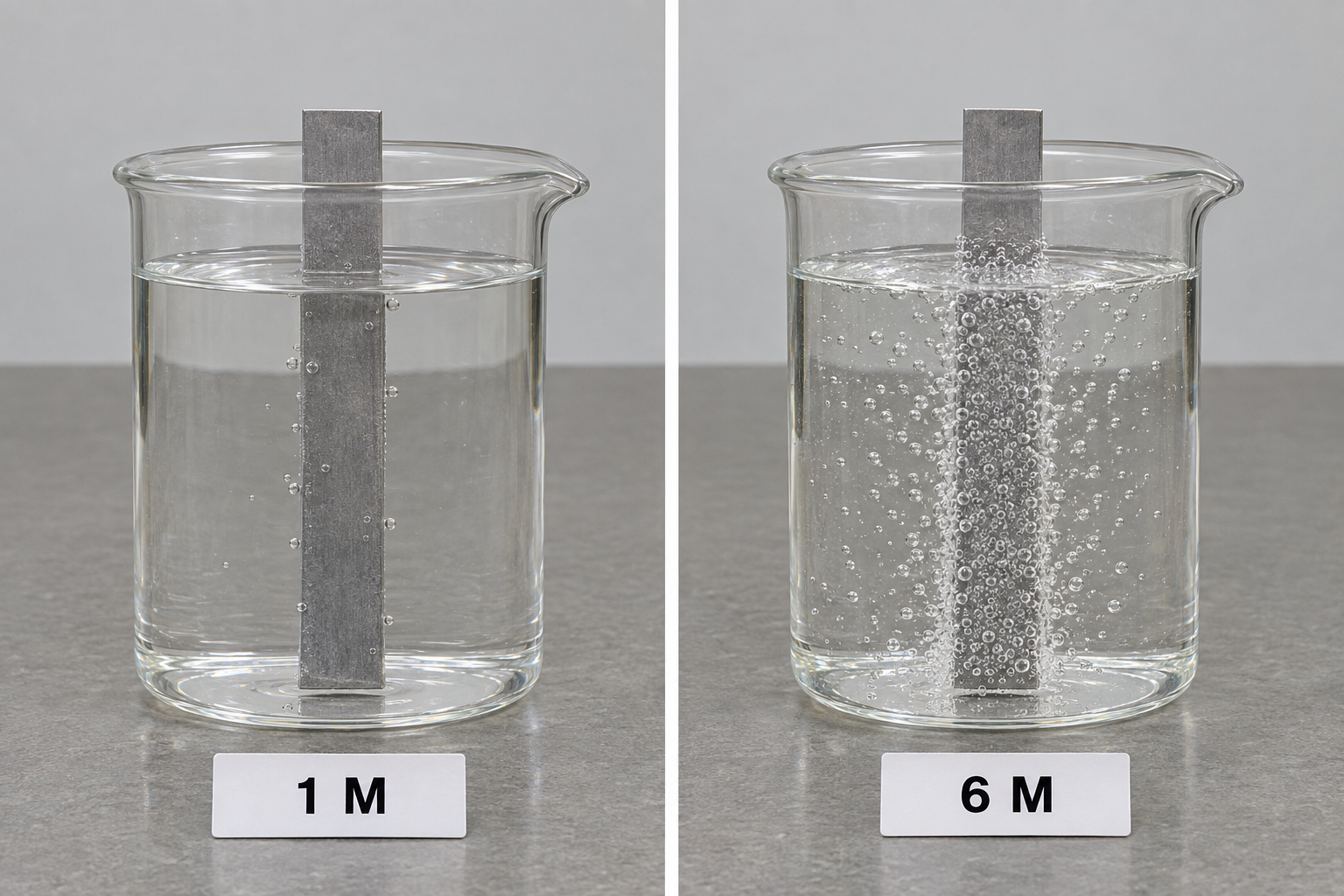
The second strip fizzes vigorously and shrinks within minutes.
Only the acid's concentration differs between the two beakers.
Why does the zinc disappear faster in the more concentrated acid?
Part 2The rate increases with the concentration
You've already seen the reaction rate: the change in a concentration per unit time, in M/s.
A faster reaction is simply a reaction with a higher rate.
The beakers' reaction, written once with formulas: Zn + 2 HCl → ZnCl₂ + H₂.
Which way does a reaction's rate move when a reactant's concentration increases?
The rate increases with the concentration, when all other conditions are held constant.
The 6 M acid consumed the zinc faster than the 1 M acid did.
The same prediction covers any reactant in any reaction.
A chemist who wants a faster reaction can raise a reactant's concentration.
Predict that increasing a reactant's concentration increases the reaction rate, when all other conditions are held constant.
Part 3Check what you just learned
Check — multiple choice
Magnesium ribbon reacts with acetic acid in a flask. A chemist repeats the setup with a more concentrated acetic acid, with everything else held constant. What happens to the reaction's rate?
Feedback if chosen: Correct. A higher reactant concentration raises the rate, when all other conditions are held constant.
Feedback if chosen: This option is wrong — you moved the rate against the concentration. A higher reactant concentration raises the rate.
Feedback if chosen: This option is wrong — you treated the acid's concentration as irrelevant. A higher reactant concentration raises the rate.
Check — multiple choice
Sodium thiosulfate solution reacts with hydrochloric acid, and the mixture slowly turns cloudy. A chemist repeats the setup with twice the volume of each solution, at the same concentrations and temperature. What happens to the reaction's rate?
Feedback if chosen: This option is wrong — you read a bigger volume as a higher concentration. The volume and the particle count doubled together, so each liter holds the same number of particles.
Feedback if chosen: This option is wrong — you moved the rate down with no change to move it. The concentration is the same, so the rate is the same.
Feedback if chosen: Correct. The concentration is unchanged: each liter holds the same number of particles as before, so the rate is unchanged.
Check — multiple choice
Sodium thiosulfate solution reacts with hydrochloric acid, and the mixture slowly turns cloudy. A chemist dilutes the thiosulfate solution with water before adding the acid, with the temperature held constant. What happens to the rate of the clouding reaction?
Feedback if chosen: This option is wrong — you moved the rate up while the concentration went down. Diluting lowers the thiosulfate's concentration, and a lower reactant concentration lowers the rate.
Feedback if chosen: Correct. Diluting lowers the thiosulfate's concentration, and a lower reactant concentration lowers the rate.
Feedback if chosen: This option is wrong — you treated dilution as no change. Diluting lowers the thiosulfate's concentration, and a lower concentration lowers the rate.
Why concentration raises the rate
Outcome: Explain why a higher reactant concentration increases the rate: more particles share a given volume, so collisions occur more frequently.
Part 1Six times the particles
We've seen the zinc dissolve faster in the 6 M acid than in the 1 M acid.
Both beakers sat at the same temperature.
Both strips of zinc matched in size and shape.
The 6 M acid crowds six times as many acid particles into each liter.
How does crowding more particles into the same volume speed up the reaction?
Part 2More particles, more frequent collisions
Check — multiple choice
A 2 M solution and a 1 M solution of the same solute fill two identical flasks. Which solution holds more solute particles per liter?
Feedback if chosen: Correct. Molarity counts the moles of solute per liter, so a 2 M solution holds twice as many solute particles in each liter.
Feedback if chosen: This option is wrong — you put the larger count with the smaller molarity. Molarity counts the moles of solute per liter, so the 2 M solution holds more.
Feedback if chosen: This option is wrong — you read the two molarities as equal crowding. Molarity counts the moles of solute per liter, so the 2 M solution holds twice as many.
You've already seen molarity: the moles of solute per liter of solution, M = n/V.
Particles can react with each other only when they collide.
The two boxes below show equal volumes of the two acids.
The 6 M box packs six times more particles into the same space.
Zinc dissolves faster in the 6 M acid because a higher reactant concentration puts more particles in a given volume, so collisions between reactant particles occur more frequently.
More frequent collisions make more reactions happen each second.
So raising the concentration raises the rate.
The acid particles themselves behave no differently in the 6 M beaker: each liter simply contains six times more of them.
Explain that a higher reactant concentration increases the rate: more particles share a given volume, so collisions between reactant particles occur more frequently.
Part 3Check what you just learned
Check — multiple choice
Sodium thiosulfate solution reacts with hydrochloric acid, and the mixture slowly turns cloudy. A chemist doubles the thiosulfate's concentration, with everything else held constant. What happens to the reaction's rate?
Feedback if chosen: Correct. The doubled concentration puts more thiosulfate particles in each liter, so collisions between reactant particles occur more frequently.
Feedback if chosen: This option is wrong — you moved the rate against the concentration. More particles share each liter, so collisions occur more frequently and the rate increases.
Feedback if chosen: This option is wrong — you treated the doubled concentration as no change. More particles share each liter, so collisions occur more frequently and the rate increases.
Check — multiple choice
The doubled thiosulfate solution clouds faster than the original. Why does the higher concentration make the reaction faster?
Feedback if chosen: This option is wrong — you gave concentration temperature's job. A particle's speed follows the temperature, and the temperature did not change.
Feedback if chosen: Correct. A higher concentration puts more particles in a given volume, so collisions between reactant particles occur more frequently.
Feedback if chosen: This option is wrong — you gave concentration temperature's job. The energy a collision transfers follows the temperature, and the temperature did not change.
Check — multiple choice
A chemist dilutes acetic acid with water before lowering in a strip of magnesium. What happens to how often acid particles collide with the magnesium's surface?
Feedback if chosen: This option is wrong — you moved the collision frequency against the concentration. Diluting leaves fewer acid particles in each liter, so collisions with the magnesium occur less frequently.
Feedback if chosen: Correct. Diluting leaves fewer acid particles in each liter, so collisions with the magnesium's surface occur less frequently.
Feedback if chosen: This option is wrong — you treated dilution as no change. Diluting leaves fewer acid particles in each liter, so collisions occur less frequently.
Temperature raises the rate
Outcome: Predict that raising the temperature increases the rate of a reaction.
Part 1Two cartons of milk
A carton of milk stands on the kitchen counter overnight, at about 20 °C.
By morning that milk smells sour.
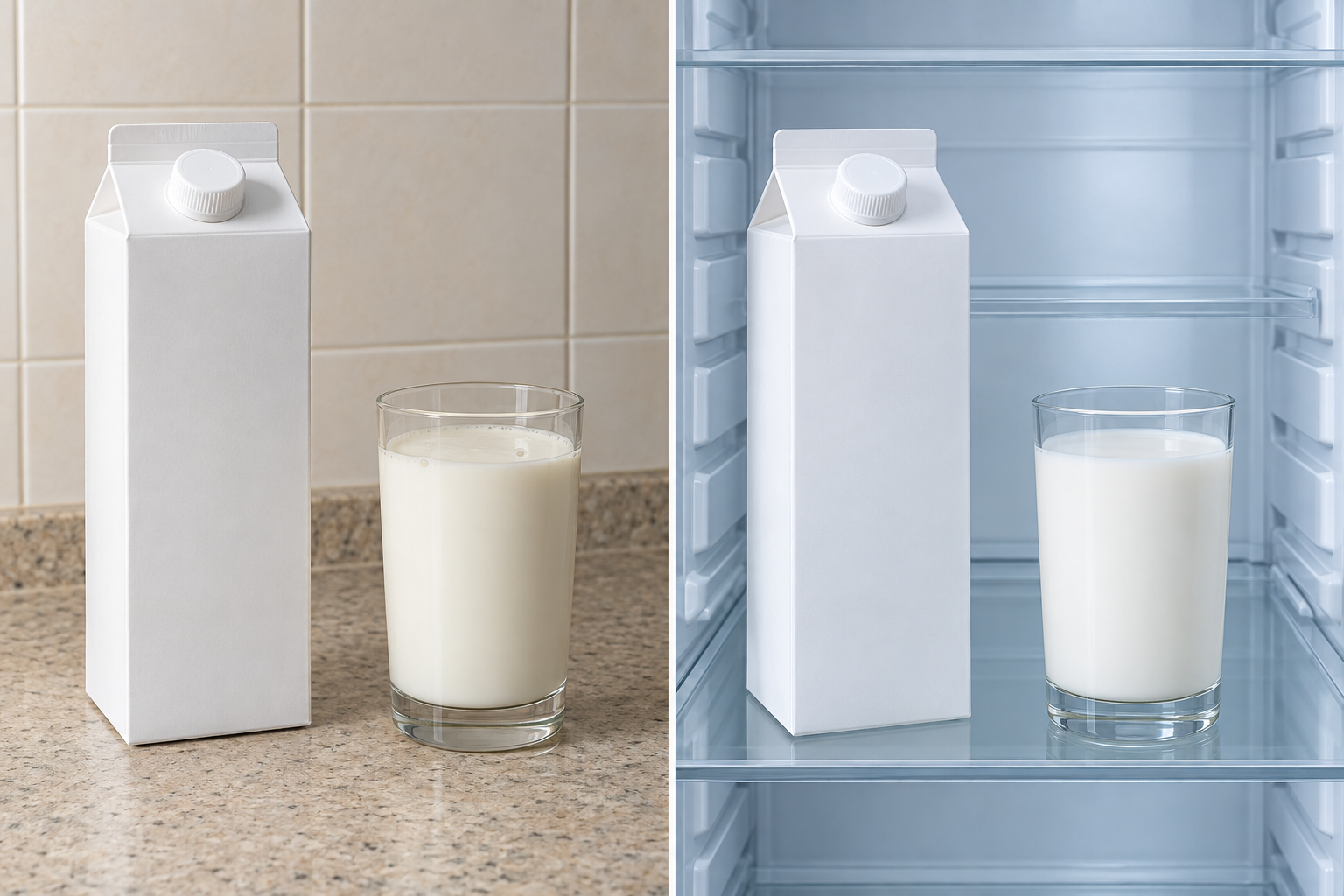
An identical carton stayed overnight in the refrigerator, at about 4 °C.
That milk still smells fresh days later.
The same chemical reactions sour both cartons, sooner or later.
Why does a warmer kitchen sour the milk so much faster?
Part 2Warmer is faster
Raising the temperature increases the rate of a reaction.
The counter's warmth sped the souring reactions.
The refrigerator's cold slowed the same souring reactions.
The rule reaches far beyond milk: warmer reactions go faster.
A refrigerator is a rate-control device: it slows the reactions that spoil food.
Predict that raising the temperature increases the rate of a reaction.
Part 3Check what you just learned
Check — multiple choice
A glow stick makes its light with a chemical reaction. A student moves a glowing glow stick from a refrigerator into a cup of warm water. What happens to the rate of the light-making reaction?
Feedback if chosen: Correct. The warm water raises the glow stick's temperature, and raising the temperature raises the rate.
Feedback if chosen: This option is wrong — you moved the rate against the temperature. The warm water raises the temperature, and a higher temperature raises the rate.
Feedback if chosen: This option is wrong — you treated the warming as no change. The warm water raises the temperature, and a higher temperature raises the rate.
Check — multiple choice
Hydrogen and iodine vapor react inside a sealed glass tube held in a hot oven. A chemist moves the tube to a cooler oven. What happens to the reaction's rate?
Feedback if chosen: This option is wrong — you moved the rate up as the temperature went down. Cooling is the temperature rule read backwards: a lower temperature lowers the rate.
Feedback if chosen: Correct. Cooling is the temperature rule read backwards: a lower temperature lowers the rate.
Feedback if chosen: This option is wrong — you treated the cooling as no change. A lower temperature lowers the rate.
Check — multiple choice
A sealed tube of hydrogen and iodine vapor sits in a hot oven. A chemist moves the tube to a larger oven at the same temperature. What happens to the reaction's rate?
Feedback if chosen: This option is wrong — you read a bigger oven as a hotter oven. The temperature is unchanged, and nothing inside the sealed tube changed, so the rate is unchanged.
Feedback if chosen: This option is wrong — you moved the rate down with no change to move it. The temperature is unchanged, so the rate is unchanged.
Feedback if chosen: Correct. The oven's size is not a condition of the reaction. The temperature is unchanged, and nothing inside the sealed tube changed, so the rate is unchanged.
Why temperature raises the rate
Outcome: Explain why raising the temperature increases the rate: the particles' average kinetic energy rises, so collisions occur more often and transfer more energy.
Part 1One number on a thermometer
The milk on the kitchen counter soured overnight at about 20 °C.
The refrigerated milk stayed fresh for days at about 4 °C.
Nothing else differed between the two cartons.
Temperature is one number read off a thermometer.
Somehow that one number controls how fast the milk's particles react.
What does a higher temperature change about the particles themselves?
Part 2What a higher temperature changes
Check — multiple choice
Which quantity is proportional to the Kelvin temperature of a sample of particles?
Feedback if chosen: Correct. The Kelvin temperature of a sample is proportional to the average kinetic energy of its particles.
Feedback if chosen: This option is wrong — you tied the temperature to the particle count. The Kelvin temperature is proportional to the particles' average kinetic energy, not to their number.
Feedback if chosen: This option is wrong — you tied the temperature to each particle's mass. A particle's mass is fixed; the Kelvin temperature is proportional to the particles' average kinetic energy.
You've already seen that the Kelvin temperature of a sample is proportional to the average kinetic energy of its particles.
Doubling the Kelvin temperature doubles the average kinetic energy.
The two boxes below show the same sealed gas sample at 300 K and at 600 K.
Hotter particles move faster on average, so the 600 K box carries longer motion arrows.
Raising the temperature increases the reaction rate because Kelvin temperature is proportional to the average kinetic energy of the particles, so collisions occur more often and transfer more energy.
Faster particles collide more often.
Each collision also transfers more energy.
So the counter's milk sours faster than the refrigerator's milk.
Explain that raising the temperature increases the rate: the particles' average kinetic energy rises, so collisions occur more often and transfer more energy.
Part 3Check what you just learned
Check — multiple choice
A sealed tube of hydrogen and iodine vapor is moved from a 600 K oven to a 700 K oven. What happens to the reaction's rate?
Feedback if chosen: Correct. At 700 K the particles carry more average kinetic energy, so collisions occur more often and transfer more energy.
Feedback if chosen: This option is wrong — you moved the rate against the temperature. Hotter particles collide more often, and each collision transfers more energy.
Feedback if chosen: This option is wrong — you treated the 100 K rise as no change. Hotter particles collide more often, and each collision transfers more energy.
Check — multiple choice
The tube's reaction goes faster at 700 K than at 600 K. Why does the higher temperature make the reaction faster?
Feedback if chosen: This option is wrong — you gave the speed-up concentration's reason. The tube is sealed, so heating changes no particle count.
Feedback if chosen: This option is wrong — you reversed the energy change. Hotter particles carry more average kinetic energy, so each collision transfers more energy, not less.
Feedback if chosen: Correct. Kelvin temperature is proportional to the particles' average kinetic energy, so at 700 K collisions occur more often and transfer more energy.
Check — multiple choice
A student puts a glowing glow stick into iced water. What happens to how often the glow stick's reacting particles collide?
Feedback if chosen: This option is wrong — you moved the collisions against the temperature. The cold lowers the particles' average kinetic energy, so they move more slowly and collide less often.
Feedback if chosen: Correct. The cold lowers the particles' average kinetic energy, so they move more slowly and collide less often.
Feedback if chosen: This option is wrong — you treated the cooling as no change. The cold slows the particles, so they collide less often.
Surface area raises the rate
Outcome: Predict that increasing a solid reactant's exposed surface area increases the rate of its reaction.
Part 1A chip and a powder
A single marble chip of calcium carbonate rests in a beaker of hydrochloric acid.
Carbon dioxide bubbles rise off the chip gently.
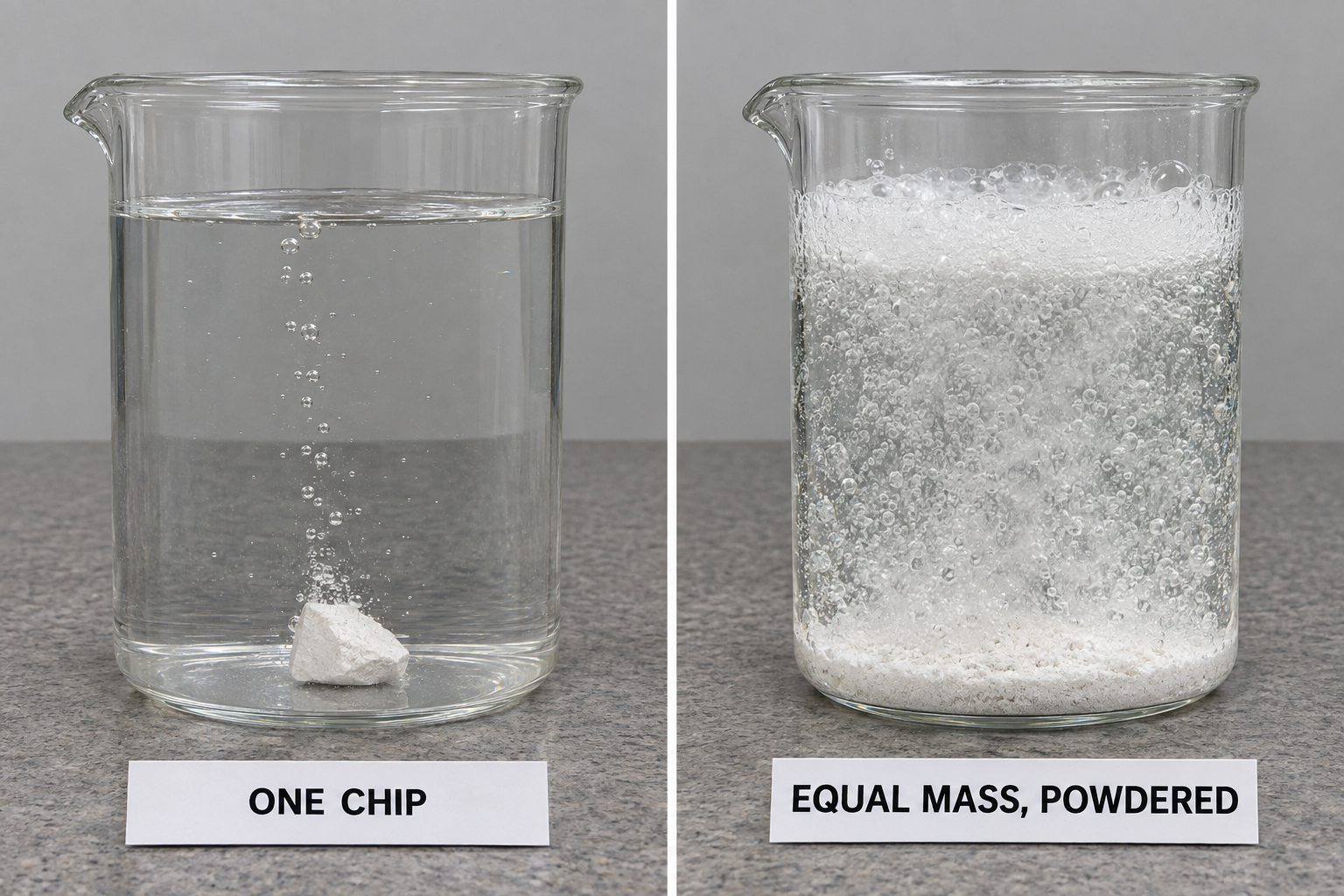
An equal mass of powdered calcium carbonate goes into an identical beaker of the same acid.
The powder froths violently and disappears within seconds.
Grinding changed neither the acid, nor the temperature, nor the mass of solid.
Why does the powdered solid react so much faster than the lump?
Part 2More exposed surface, faster reaction
The beakers' reaction, written once with formulas: CaCO₃ + 2 HCl → CaCl₂ + H₂O + CO₂.
Increasing a solid reactant's exposed surface area increases the rate of its reaction with a surrounding liquid or gas.
Grinding turns one lump into thousands of tiny grains.
The thousands of grains together expose far more surface to the acid than the single chip exposes.
More exposed surface means a faster reaction.
A chemist who wants a solid to react faster grinds it, cuts it, or crushes it first.
Predict that increasing the exposed surface area of a solid reactant increases the rate of its reaction with a surrounding liquid or gas.
Part 3Check what you just learned
Check — multiple choice
An effervescent antacid tablet fizzes as it reacts with water. A student crushes an identical tablet into powder before dropping it into identical water. What happens to the reaction's rate?
Feedback if chosen: Correct. Crushing increases the solid's exposed surface area, and more exposed surface raises the rate.
Feedback if chosen: This option is wrong — you moved the rate against the exposed surface. Crushing exposes more surface, and more exposed surface raises the rate.
Feedback if chosen: This option is wrong — you treated crushing as no change. Crushing exposes more surface, and more exposed surface raises the rate.
Check — multiple choice
Loose sugar sprinkled through a burner flame burns in quick flashes. A cook presses the same mass of sugar into one hard cube and holds the cube in the same flame. What happens to the burning rate?
Feedback if chosen: This option is wrong — you moved the rate against the exposed surface. The cube buries most of the sugar inside, and less exposed surface lowers the rate.
Feedback if chosen: Correct. Pressing the grains into one cube buries most of the sugar inside, and less exposed surface lowers the rate.
Feedback if chosen: This option is wrong — you treated the pressing as no change. The cube exposes far less surface than the loose grains, and less exposed surface lowers the rate.
Check — multiple choice
Steel wool reacts with dilute acid in a beaker. A chemist pours the same acid into a wider beaker and lowers in the same steel wool. The acid still covers the steel wool. What happens to the reaction's rate?
Feedback if chosen: This option is wrong — you read the wider beaker as more exposed solid. The steel wool's exposed surface is unchanged, so the rate is unchanged.
Feedback if chosen: This option is wrong — you moved the rate down with no change to move it. The steel wool's exposed surface is unchanged, so the rate is unchanged.
Feedback if chosen: Correct. The beaker's shape is not a condition of the reaction. The steel wool's exposed surface and the acid's concentration are unchanged, so the rate is unchanged.
Why surface area raises the rate
Outcome: Explain why more exposed surface area increases the rate: more of the solid's particles are exposed and available to collide.
Part 1What did grinding change?
The ground marble powder reacted with the acid within seconds.
The marble chip of the same mass kept fizzing for many minutes.
Grinding added no new acid, no extra heat and no extra calcium carbonate.
Yet the acid consumed the powder many times faster.
What did grinding change at the level of the particles?
Part 2Exposing buried particles
An acid particle can hit only the solid particles sitting at the lump's surface.
The particles buried inside the lump sit out of the acid's reach.
The drawing below shows one cube of solid cut into eight pieces.
Every cut exposes surface that was buried inside the lump.
Grinding breaks the lump open and exposes those buried particles.
Grinding a solid increases the rate because more of its particles are exposed and available to collide with the other reactant.
More exposed particles collide with acid particles more often.
So the powder reacts faster than the chip ever could.
Explain that more exposed surface area increases the rate: more of the solid's particles are exposed and available to collide with the other reactant.
Part 3Check what you just learned
Check — multiple choice
Fine steel wool and a solid iron bar of equal mass are each held in a burner flame in air. Which iron reacts faster with the oxygen?
Feedback if chosen: Correct. The thin strands expose far more iron particles to the oxygen, and more exposed particles raise the rate.
Feedback if chosen: This option is wrong — you put the faster reaction with the smaller exposed surface. The bar buries most of its iron inside; the strands expose far more of theirs.
Feedback if chosen: This option is wrong — you matched the equal masses to equal rates. The masses are equal, but the strands expose far more iron particles to the oxygen.
Check — multiple choice
The steel wool reacts with the oxygen far faster than the iron bar does. Why does the steel wool react faster?
Feedback if chosen: This option is wrong — you overlooked the equal masses. The two samples hold the same number of iron particles; the strands simply expose more of them.
Feedback if chosen: This option is wrong — you gave the speed-up temperature's reason. Both samples sit in the same flame, so their particles' average kinetic energies match.
Feedback if chosen: Correct. More of the strands' iron particles are exposed and available to collide with oxygen particles, so collisions occur more often.
Check — multiple choice
A student presses loose antacid powder into one solid pellet before dropping it into water. What happens to the number of the solid's particles exposed to the water?
Feedback if chosen: Correct. Pressing the powder into one pellet buries most of the particles inside, so fewer particles are exposed to the water.
Feedback if chosen: This option is wrong — you moved the exposure against the pressing. The pellet buries most of the particles inside, so fewer are exposed.
Feedback if chosen: This option is wrong — you treated the pressing as no change. The pellet buries most of the particles inside, so fewer are exposed.
What a catalyst is
Outcome: State what a catalyst is: a substance that increases a reaction's rate without being consumed overall.
Part 1The powder that came back
Hydrogen peroxide decomposes slowly into water and oxygen, as the first lessons of this unit measured.
The unit's opening lesson measured one such flask: the hydrogen peroxide's concentration fell at just 0.0010 M/s.
A chemist tips a spoonful of black manganese dioxide powder into the flask.
The mixture erupts at once into oxygen froth.
After the froth settles, the chemist filters out the black powder and dries it.
The recovered powder has exactly the mass the spoonful had.
The manganese dioxide sped the reaction enormously, yet the reaction consumed none of it.
How can a substance speed up a reaction without being consumed by it?
Part 2A substance that speeds and survives
The flask's reaction is the one the unit opened with: 2 H₂O₂ → 2 H₂O + O₂.
The manganese dioxide appears nowhere in that equation: it is not a reactant and not a product.
A substance that increases a reaction's rate without being consumed overall is called a catalyst.
The manganese dioxide is a catalyst for the decomposition of hydrogen peroxide.
The table below gives the evidence that the powder was not consumed.
| Mass of manganese dioxide | |
|---|---|
| added to the flask | 0.50 g |
| recovered afterward | 0.50 g |
A reactant's amount falls as the reaction proceeds.
A catalyst's amount stays the same as the reaction proceeds.
Now judge three substances in this hydrogen peroxide flask by the same two questions.
Did the substance speed the reaction, and was it consumed overall?
First, a chemist stirs concentrated hydrogen peroxide into the flask, raising the hydrogen peroxide's concentration.
We've seen the rule behind that: a higher reactant concentration raises the rate.
Did the extra hydrogen peroxide speed the reaction, and was it consumed? It sped the reaction, and the reaction consumed it.
So the extra hydrogen peroxide is not a catalyst.
The extra hydrogen peroxide is a reactant.
Next, the chemist adds the spoonful of manganese dioxide.
Did it speed the reaction, and was it consumed? It sped the reaction, and the reaction consumed none of it.
So the manganese dioxide is a catalyst.
Last, the chemist drops in a spoonful of clean sand.
Did it speed the reaction, and was it consumed? It did not speed the reaction, and the reaction consumed none of it.
So the sand is not a catalyst.
The sand is simply present.
The table below sorts the three substances by the two questions.
| extra hydrogen peroxide | manganese dioxide | clean sand | |
|---|---|---|---|
| Sped the reaction? | |||
| Consumed overall? | |||
| A catalyst? |
State that a catalyst is a substance that increases a reaction's rate without being consumed overall.
Part 3Check what you just learned
Check — multiple choice
A car's exhaust gases react as they pass over a platinum surface inside the catalytic converter. The reactions go far faster over the platinum, and the platinum is still there, unchanged, after years of driving. Is the platinum a catalyst for these reactions?
Feedback if chosen: Correct. The platinum increases the reactions' rates and is not consumed overall, so it is a catalyst.
Feedback if chosen: This option is wrong — you refused a substance that passes both tests. The platinum speeds the reactions and survives them unchanged, so it is a catalyst.
Check — multiple choice
Iron speeds the reaction N₂ + 3 H₂ → 2 NH₃ in an industrial reactor. The hydrogen in the reactor is consumed as the ammonia forms. Is the hydrogen a catalyst?
Feedback if chosen: This option is wrong — you overlooked the consumption. The reaction consumes the hydrogen, so the hydrogen is a reactant, not a catalyst.
Feedback if chosen: Correct. The reaction consumes the hydrogen, so the hydrogen is a reactant, not a catalyst.
Check — multiple choice
Argon gas is also present in the same ammonia reactor. The argon is all recovered unchanged, and the rate is the same with or without it. Is the argon a catalyst?
Feedback if chosen: This option is wrong — you stopped at the unchanged argon. A catalyst must also increase the rate, and the rate is the same with or without the argon.
Feedback if chosen: Correct. The argon survives unchanged but increases nothing, so it is simply present, not a catalyst.
Check — multiple choice
A substance that increases a reaction's rate without being consumed overall is called what?
Feedback if chosen: Correct. A substance that increases a reaction's rate without being consumed overall is a catalyst.
Feedback if chosen: This option is wrong — you named the substance a reaction consumes. A reactant's amount falls; this substance's amount stays the same.
Feedback if chosen: This option is wrong — you named a substance the reaction makes. A product forms during the reaction; this substance speeds the reaction and survives it.
A catalyst raises the rate
Outcome: Predict that adding a suitable catalyst increases the rate of a reaction.
Part 1The flask that erupted
The flask of hydrogen peroxide erupted the moment the manganese dioxide went in.
Without the black powder, the same hydrogen peroxide decomposed at just 0.0010 M/s.
The powder changed no concentration and no temperature.
Still the oxygen froth appeared within seconds of the powder going in.
What happens to a reaction's rate whenever a suitable catalyst is added?
Part 2Add a catalyst, raise the rate
Adding a suitable catalyst increases the rate of a reaction.
The hydrogen peroxide decomposed visibly faster after the manganese dioxide was added.
The catalyst is still there at the end, ready to speed the next flask.
The word "suitable" matters: a catalyst suits particular reactions.
A substance that does not act on a reaction leaves its rate alone.
Why a catalyst speeds a reaction needs ideas that this unit teaches later.
For now, you predict the speed-up without explaining it.
Predict that adding a suitable catalyst increases the rate of a reaction.
Part 3Check what you just learned
Check — multiple choice
Iron is a suitable catalyst for the reaction N₂ + 3 H₂ → 2 NH₃. A chemist adds iron to a hot reactor holding the two gases. What happens to the reaction's rate?
Feedback if chosen: Correct. Adding a suitable catalyst increases the rate of the reaction.
Feedback if chosen: This option is wrong — you moved the rate down on a catalyst's arrival. Adding a suitable catalyst increases the rate.
Feedback if chosen: This option is wrong — you read the unconsumed iron as an idle iron. A catalyst is not consumed, yet it still increases the rate.
Check — multiple choice
A chemist drops powdered glass, which does not act on the reaction N₂ + 3 H₂ → 2 NH₃, into a hot reactor holding the two gases. What happens to the reaction's rate?
Feedback if chosen: This option is wrong — you treated any added solid as a catalyst. A substance that does not act on the reaction leaves its rate alone.
Feedback if chosen: This option is wrong — you moved the rate down with no change to move it. The glass does not act on the reaction, so the rate is unchanged.
Feedback if chosen: Correct. The glass does not act on this reaction, so it is not a suitable catalyst for it, and the rate is unchanged.
Predict and explain any single change
Outcome: Predict the effect of one described single change on a reaction's rate, and name the matching particle-level reason.
Part 1One change at a time
A zinc strip sits in a beaker of 1 M hydrochloric acid.
A chemist can change exactly one condition of this reaction at a time.
The chemist could double the acid's concentration.
The chemist could warm the beaker.
The chemist could grind the zinc.
The chemist could add a catalyst.
For any one of these single changes, what happens to the rate, and why does it happen?
Part 2Two answers for every change
Every rate-factor question asks for the same two answers: the rate's direction, and the reason behind it.
The chemist first names the factor behind the change: concentration, temperature, surface area, or catalyst.
First, suppose the chemist doubles the acid's concentration.
Which way does the rate move, and why?
Doubling the acid's concentration crowds more acid particles into each liter.
The crowded particles collide with the zinc more often.
So the chemist predicts a faster rate and names the more frequent collisions as the reason.
Next, suppose the chemist warms the beaker instead.
Which way does the rate move, and why?
The warmed particles carry more average kinetic energy.
They collide more often, and each collision transfers more energy.
So the rate increases, for temperature's reason.
Next, suppose the chemist grinds the zinc strip into powder instead.
Which way does the rate move, and why?
Grinding exposes zinc particles that were buried inside the strip.
More exposed zinc particles collide with acid particles more often.
So the rate increases, for surface area's reason.
Last, suppose the chemist adds a suitable catalyst instead.
Which way does the rate move? The rate increases.
A catalyst case states its reason differently: the added substance speeds the reaction without being consumed.
Why a catalyst speeds a reaction needs ideas that this unit teaches later.
Each change also reads backwards: diluting the acid, cooling the beaker, or pressing powder back into a lump lowers the rate.
The table below collects the four changes, the rate's direction, and each particle-level reason.
| The described change | The rate | The particle-level reason |
|---|---|---|
| Raise a reactant's concentration | increases | More particles share each liter, so collisions occur more frequently |
| Raise the temperature | increases | Particles carry more average kinetic energy, so collisions occur more often and transfer more energy |
| Increase a solid's exposed surface area | increases | More of the solid's particles are exposed and available to collide |
| Add a suitable catalyst | increases | It speeds the reaction without being consumed: the why comes later in this unit |
Predict the effect of one described single change — concentration, temperature, surface area, or a catalyst — on a reaction's rate, and name the matching particle-level reason.
Part 3Check what you just learned
Check — multiple choice
An egg white sets as its proteins react in hot water. A cook moves the egg from water at 70 °C to water at 90 °C. What happens to the rate of the setting reactions?
Feedback if chosen: Correct. The hotter water raises the temperature, and raising the temperature raises the rate.
Feedback if chosen: This option is wrong — you moved the rate against the temperature. The 90 °C water is hotter, and a higher temperature raises the rate.
Feedback if chosen: This option is wrong — you treated the 20 °C rise as no change. A higher temperature raises the rate.
Check — multiple choice
Household bleach reacts with a food dye, and the dye's color fades. A chemist dilutes the bleach with water before adding the same amount of dye, with the temperature held constant. What happens to the rate of the fading reaction?
Feedback if chosen: This option is wrong — you moved the rate up while a reactant's concentration went down. Diluting lowers the bleach's concentration, and a lower concentration lowers the rate.
Feedback if chosen: Correct. Diluting lowers the bleach's concentration, so collisions between the reacting particles occur less frequently and the rate falls.
Feedback if chosen: This option is wrong — you treated dilution as no change. Diluting lowers the bleach's concentration, and a lower concentration lowers the rate.
Check — multiple choice
A camper's pile of thin kindling sticks burns briskly. The camper instead burns a single log of the same mass of the same wood, in the same fire pit. What happens to the burning rate?
Feedback if chosen: This option is wrong — you moved the rate against the exposed surface. The log buries most of its wood inside, and less exposed surface lowers the rate.
Feedback if chosen: Correct. The single log exposes far less wood surface to the oxygen than the pile of thin sticks, and less exposed surface lowers the rate.
Feedback if chosen: This option is wrong — you matched the equal masses to equal rates. The log exposes far less surface than the sticks, and less exposed surface lowers the rate.
Check — multiple choice
A reaction in a flask creeps along slowly. A chemist adds a spoonful of a solid that is a suitable catalyst for this reaction. What happens to the reaction's rate?
Feedback if chosen: Correct. Adding a suitable catalyst increases the rate of the reaction.
Feedback if chosen: This option is wrong — you moved the rate down on a catalyst's arrival. Adding a suitable catalyst increases the rate.
Feedback if chosen: This option is wrong — you read the unconsumed catalyst as an idle catalyst. A catalyst is not consumed, yet it still increases the rate.
Check — multiple choice
An egg sets faster in water at 90 °C than at 70 °C. Which particle-level reason explains the faster rate?
Feedback if chosen: This option is wrong — you gave the speed-up concentration's reason. Heating the water adds no protein particles to any liter.
Feedback if chosen: This option is wrong — you gave the speed-up surface area's reason. Heating the water exposes nothing new; the egg's surface is what it was.
Feedback if chosen: Correct. Kelvin temperature is proportional to the particles' average kinetic energy, so at 90 °C collisions occur more often and transfer more energy.
Check — multiple choice
A camper's thin kindling burns faster than a single log of the same mass. Which particle-level reason explains the faster rate?
Feedback if chosen: This option is wrong — you gave the speed-up concentration's reason. The same air surrounds both fires, so each liter of it holds the same number of oxygen particles.
Feedback if chosen: Correct. The thin sticks expose far more wood particles to the oxygen, so collisions with oxygen particles occur more often.
Feedback if chosen: This option is wrong — you gave the speed-up temperature's reason. Both fires start at the same temperature, so the particles' starting average kinetic energies match.
U5-S03 — The rate law from initial-rate experiments
18 lessons
Testing one reactant at a time
Outcome: Explain how changing one concentration at a time isolates that reactant's effect on the initial rate.
Part 1One flask, two suspects
Nitrogen monoxide and hydrogen react in a heated flask: 2 NO + 2 H₂ → N₂ + 2 H₂O.
In the first experiment, both starting concentrations are 0.10 M.
That mixture's initial rate is 0.0060 M/s.
In the second experiment, the chemist doubles both starting concentrations at once.
| Experiment | [NO] (M) | [H₂] (M) | Initial rate (M/s) |
|---|---|---|---|
| 1 | 0.10 | 0.10 | 0.0060 |
| 2 | 0.20 | 0.20 | 0.048 |
That mixture's initial rate is 0.048 M/s.
The second rate is eight times the first rate.
Did the NO cause the speed-up, or did the H₂?
Part 2Change one concentration at a time
Check — multiple choice
In the heated flask, [NO]'s starting concentration is raised, with everything else held constant. What happens to the initial rate?
Feedback if chosen: Correct. A higher reactant concentration raises the rate for this reaction, when all other conditions are held constant.
Feedback if chosen: This option is wrong — you moved the rate against the concentration. A higher [NO] raises this reaction's rate.
Feedback if chosen: This option is wrong — you treated the concentration as irrelevant. A higher [NO] raises this reaction's rate.
You've already seen that a higher reactant concentration raises the rate (the lesson Concentration raises the rate).
You've already seen the initial rate: the instantaneous rate at the moment the reaction begins, t = 0 (the lesson Initial rate).
In the heated flask, both concentrations rose at once.
So the eight-times speed-up could belong to the NO, to the H₂, or to both.
This pair of trials cannot separate the two causes.
So the chemist changes one reactant's starting concentration at a time.
Every other concentration stays the same from trial to trial.
The temperature stays the same too.
Then any change in the initial rate belongs to the one concentration that changed.
That comparison isolates the changed reactant's effect on the initial rate.
Experiments one and two below change only [NO].
| Experiment | [NO] (M) | [H₂] (M) | Initial rate (M/s) |
|---|---|---|---|
| 1 | 0.10 | 0.10 | 0.0060 |
| 2 | 0.20 | 0.10 | 0.024 |
Between experiment one and experiment two, the chemist raises [NO] from 0.10 M to 0.20 M.
[H₂] stays at 0.10 M, and the temperature stays the same.
The measured initial rate changes from 0.0060 M/s to 0.024 M/s.
That whole change belongs to the NO.
Every experiment in this sequence is built from pairs of trials that differ in one concentration only.
Explain that changing one reactant's initial concentration from trial to trial, holding the other concentrations and the temperature constant, isolates that reactant's effect on the initial rate.
Part 3Check what you just learned
Check — multiple choice
| Experiment | [ClO₂] (M) | [OH⁻] (M) |
|---|---|---|
| 1 | 0.010 | 0.030 |
| 2 | 0.020 | 0.030 |
| 3 | 0.020 | 0.060 |
A chemist plans trials of the reaction 2 ClO₂ + 2 OH⁻ → ClO₃⁻ + ClO₂⁻ + H₂O, all at one temperature. Which pair of experiments isolates the effect of ClO₂ on the initial rate?
Feedback if chosen: Correct. From experiment 1 to experiment 2, only [ClO₂] changes, so any change in the initial rate belongs to ClO₂.
Feedback if chosen: This option is wrong — you picked a pair in which both concentrations change. A rate change between those trials could belong to either reactant.
Feedback if chosen: This option is wrong — you picked the pair in which only [OH⁻] changes. That pair isolates the effect of OH⁻, not of ClO₂.
Check — multiple choice
A chemist studies the reaction BrO₃⁻ + 5 Br⁻ + 6 H⁺ → 3 Br₂ + 3 H₂O. To test how [H⁺] affects the initial rate, the chemist changes only [H⁺] from trial to trial, keeping [BrO₃⁻], [Br⁻] and the temperature fixed. Why must [BrO₃⁻] and [Br⁻] stay fixed?
Feedback if chosen: This option is wrong — you treated the fixed concentrations as irrelevant. They are fixed because they do affect the rate: fixing them keeps their effects out of the comparison.
Feedback if chosen: This option is wrong — you expected fixed concentrations to fix the rate. The rate still changes as [H⁺] changes; the fixing means only [H⁺] could have changed it.
Feedback if chosen: Correct. With [BrO₃⁻] and [Br⁻] fixed, only [H⁺] changes, so any change in the initial rate belongs to [H⁺].
Check — multiple choice
| Experiment | [BrO₃⁻] (M) | [Br⁻] (M) | [H⁺] (M) |
|---|---|---|---|
| 1 | 0.050 | 0.050 | 0.050 |
| 2 | 0.10 | 0.050 | 0.050 |
| 3 | 0.10 | 0.10 | 0.050 |
| 4 | 0.10 | 0.10 | 0.10 |
Here are four planned trials of the same bromate reaction, all at one temperature. Which pair of experiments isolates the effect of Br⁻ on the initial rate?
Feedback if chosen: This option is wrong — you picked the pair in which only [BrO₃⁻] changes. That pair isolates the effect of BrO₃⁻, not of Br⁻.
Feedback if chosen: Correct. From experiment 2 to experiment 3, only [Br⁻] changes, so any change in the initial rate belongs to Br⁻.
Feedback if chosen: This option is wrong — you picked a pair in which both [Br⁻] and [H⁺] change. A rate change could belong to either.
Feedback if chosen: This option is wrong — you picked the pair in which only [H⁺] changes. That pair isolates the effect of H⁺, not of Br⁻.
Doubling that changes nothing
Outcome: State what an unchanged initial rate after a doubling says: the rate does not depend on that reactant's concentration.
Part 1The doubling that did nothing
Ammonia gas decomposes on a hot platinum wire: 2 NH₃ → N₂ + 3 H₂.
The wire is heated electrically, and the ammonia decomposes on its hot surface.
You've already seen that raising a reactant's concentration raises the rate (the lesson Concentration raises the rate).
So the chemist doubles the ammonia's starting concentration, from 0.10 M to 0.20 M, holding the temperature constant.
The chemist expects a faster reaction.
The initial rate is 5.0 × 10⁻⁴ M/s in both experiments: exactly the same.
| Experiment | [NH₃] (M) | Initial rate (M/s) |
|---|---|---|
| 1 | 0.10 | 5.0 × 10⁻⁴ |
| 2 | 0.20 | 5.0 × 10⁻⁴ |
How can doubling a reactant's concentration leave the initial rate unchanged?
Part 2No change means no dependence
Doubling one reactant's concentration, with everything else held constant, sometimes leaves the initial rate unchanged.
An unchanged rate means the rate does not depend on that reactant's concentration.
The hot-platinum ammonia reaction is one of these cases.
Here is the chemist's question for any doubling trial: did the initial rate change?
Double the concentration of NH₃ from 0.10 M to 0.20 M, holding everything else constant.
The measured initial rate is 5.0 × 10⁻⁴ M/s in both trials.
Did the initial rate change? No: it is unchanged.
So the rate does not depend on [NH₃].
Now double the concentration of NH₃ again, from 0.20 M to 0.40 M, holding everything else constant.
The measured initial rate is still 5.0 × 10⁻⁴ M/s.
Did the initial rate change? No: it is unchanged.
So the rate still does not depend on [NH₃].
Why a doubling sometimes changes nothing needs ideas that this unit teaches later.
For now, you read the trial's result and state what it says.
Doubling one reactant's concentration most often gives one of three responses.
The no-effect response is the first of the three.
State that when doubling one reactant's initial concentration, with the others held constant, leaves the initial rate unchanged, the rate does not depend on that reactant's concentration.
Part 3Check what you just learned
Check — multiple choice
Acetone reacts with Br₂ in acid: CH₃COCH₃ + Br₂ → CH₃COCH₂Br + HBr. Doubling [Br₂], with everything else held constant, leaves the initial rate unchanged. Does the rate depend on [Br₂]?
Feedback if chosen: This option is wrong — you read a doubled concentration as a changed rate. The measured initial rate did not change, so the rate does not depend on [Br₂].
Feedback if chosen: Correct. The unchanged initial rate means the rate does not depend on [Br₂].
Check — multiple choice
In the acetone reaction, CH₃COCH₃ + Br₂ → CH₃COCH₂Br + HBr, doubling [CH₃COCH₃] doubles the initial rate. Does the rate depend on [CH₃COCH₃]?
Feedback if chosen: Correct. The initial rate changed when only [CH₃COCH₃] changed, so the rate depends on [CH₃COCH₃].
Feedback if chosen: This option is wrong — you read a changed rate as no dependence. The rate doubled when [CH₃COCH₃] doubled, so the rate depends on it.
Check — multiple choice
CH₃Br reacts with OH⁻ in solution: CH₃Br + OH⁻ → CH₃OH + Br⁻. Doubling [OH⁻] doubles the initial rate. Does the rate depend on [OH⁻]?
Feedback if chosen: Correct. The initial rate changed when only [OH⁻] changed, so the rate depends on [OH⁻].
Feedback if chosen: This option is wrong — you read a changed rate as no dependence. The rate doubled when [OH⁻] doubled, so the rate depends on it.
Check — multiple choice
In the acetone reaction, CH₃COCH₃ + Br₂ → CH₃COCH₂Br + HBr, halving [Br₂], with everything else held constant, also leaves the initial rate unchanged. Does the rate depend on [Br₂]?
Feedback if chosen: This option is wrong — you read a halved concentration as a changed rate. The measured initial rate did not change, so the rate does not depend on [Br₂].
Feedback if chosen: Correct. The initial rate did not change when [Br₂] halved, so the rate does not depend on [Br₂].
Check — multiple choice
In the bromate reaction, BrO₃⁻ + 5 Br⁻ + 6 H⁺ → 3 Br₂ + 3 H₂O, doubling [Br⁻] doubles the initial rate. Does the rate depend on [Br⁻]?
Feedback if chosen: Correct. The initial rate changed when only [Br⁻] changed, so the rate depends on [Br⁻].
Feedback if chosen: This option is wrong — you read a changed rate as no dependence. The rate doubled when [Br⁻] doubled, so the rate depends on it.
Doubling that doubles the rate
Outcome: State what a doubled initial rate after a doubling says: the rate is directly proportional to that reactant's concentration.
Part 1The rate that kept pace
Dinitrogen pentoxide decomposes in solution at 25 °C: 2 N₂O₅ → 4 NO₂ + O₂.
With [N₂O₅] = 0.020 M, the initial rate is 1.0 × 10⁻⁵ M/s.
The chemist doubles the starting concentration of N₂O₅ to 0.040 M.
The initial rate doubles too, to 2.0 × 10⁻⁵ M/s.
The chemist doubles the starting concentration of N₂O₅ again, to 0.080 M.
| Experiment | [N₂O₅] (M) | Initial rate (M/s) |
|---|---|---|
| 1 | 0.020 | 1.0 × 10⁻⁵ |
| 2 | 0.040 | 2.0 × 10⁻⁵ |
| 3 | 0.080 | 4.0 × 10⁻⁵ |
The initial rate doubles again, to 4.0 × 10⁻⁵ M/s.
What does a rate that doubles whenever the concentration doubles tell the chemist?
Part 2Doubled concentration, doubled rate
Doubling one reactant's concentration, with everything else held constant, sometimes doubles the initial rate.
A doubled rate means the rate is directly proportional to that reactant's concentration.
Directly proportional means the rate changes by the same factor as the concentration.
So halving such a concentration halves the rate.
Here is the chemist's question again: did the initial rate change?
Double the concentration of N₂O₅ from 0.020 M to 0.040 M, holding everything else constant.
The measured initial rate changes from 1.0 × 10⁻⁵ M/s to 2.0 × 10⁻⁵ M/s.
Did the initial rate change? Yes: it doubled.
So the rate is directly proportional to [N₂O₅].
Now double the concentration of N₂O₅ again, from 0.040 M to 0.080 M, holding everything else constant.
The measured initial rate changes from 2.0 × 10⁻⁵ M/s to 4.0 × 10⁻⁵ M/s.
Did the initial rate change? Yes: it doubled again.
So the rate is still directly proportional to [N₂O₅].
But double [NH₃] on the hot platinum wire, and the initial rate does not change.
So that rate does not depend on [NH₃]: the no-effect response we've already seen.
The doubled response is the second of the three doubling responses.
State that when doubling one reactant's initial concentration, with the others held constant, doubles the initial rate, the rate is directly proportional to that reactant's concentration.
Part 3Check what you just learned
Check — multiple choice
Cyclopropane isomerizes to propene in the gas phase. Doubling [cyclopropane], with everything else held constant, doubles the initial rate. Is the rate directly proportional to [cyclopropane]?
Feedback if chosen: Correct. The rate changed by the same factor as the concentration, so the rate is directly proportional to [cyclopropane].
Feedback if chosen: This option is wrong — you refused a matched pair of factors. The rate doubled exactly as [cyclopropane] doubled, and that is direct proportionality.
Check — multiple choice
Acetone reacts with Br₂ in acid. Doubling [Br₂] leaves the initial rate unchanged. Is the rate directly proportional to [Br₂]?
Feedback if chosen: This option is wrong — you matched an unchanged rate to a doubled concentration. Direct proportionality would have doubled the rate; this rate does not depend on [Br₂] at all.
Feedback if chosen: Correct. A directly proportional rate would have doubled. This rate did not change, so it does not depend on [Br₂].
Check — multiple choice
A chemist halves [cyclopropane], with everything else held constant, and the initial rate halves. Is the rate directly proportional to [cyclopropane]?
Feedback if chosen: Correct. Halving [cyclopropane] halved the rate: the rate changes by the same factor as the concentration, which is direct proportionality.
Feedback if chosen: This option is wrong — you treated halving as outside the rule. Direct proportionality works in both directions: half the concentration, half the rate.
Check — multiple choice
In the reaction of CH₃Br with OH⁻, doubling [CH₃Br] doubles the initial rate. Is the rate directly proportional to [CH₃Br]?
Feedback if chosen: Correct. The rate changed by the same factor as the concentration, so the rate is directly proportional to [CH₃Br].
Feedback if chosen: This option is wrong — you refused a matched pair of factors. The rate doubled exactly as [CH₃Br] doubled, and that is direct proportionality.
Doubling that quadruples the rate
Outcome: State what a quadrupled initial rate after a doubling says: the rate is proportional to the square of that reactant's concentration.
Part 1Four times, not two
Nitrogen dioxide decomposes when heated: 2 NO₂ → 2 NO + O₂.
With [NO₂] = 0.010 M, the initial rate is 3.0 × 10⁻⁵ M/s.
The chemist doubles the starting concentration of NO₂ to 0.020 M.
| Experiment | [NO₂] (M) | Initial rate (M/s) |
|---|---|---|
| 1 | 0.010 | 3.0 × 10⁻⁵ |
| 2 | 0.020 | 1.2 × 10⁻⁴ |
The initial rate jumps to 1.2 × 10⁻⁴ M/s.
That new rate is four times the old rate, not two times.
How can doubling a concentration quadruple the rate?
Part 2The square response completes the set
Doubling one reactant's concentration, with everything else held constant, sometimes quadruples the initial rate.
Two squared is four.
A quadrupled rate means the rate is proportional to the square of that reactant's concentration.
Double the concentration, and the rate grows by two squared: four.
Triple such a concentration, and the rate grows by three squared: nine.
Here is the chemist's question one last time: did the initial rate change?
Double the concentration of NO₂ from 0.010 M to 0.020 M, holding everything else constant.
The measured initial rate jumps from 3.0 × 10⁻⁵ M/s to 1.2 × 10⁻⁴ M/s.
Did the initial rate change? Yes: it quadrupled.
So the rate is proportional to the square of [NO₂].
But double [N₂O₅] in the N₂O₅ solution we've seen, and the initial rate only doubles.
So that rate is directly proportional to [N₂O₅], not to its square.
And double [NH₃] on the hot platinum wire, and the initial rate does not change at all.
So that rate does not depend on [NH₃].
The quadrupled response completes the set of three doubling responses: no effect, doubled, quadrupled.
State that when doubling one reactant's initial concentration, with the others held constant, quadruples the initial rate, the rate is proportional to the square of that reactant's concentration.
Part 3Check what you just learned
Check — multiple choice
Butadiene dimerizes in the gas phase: 2 C₄H₆ → C₈H₁₂. Doubling [C₄H₆], with everything else held constant, quadruples the initial rate. Is the rate proportional to the square of [C₄H₆]?
Feedback if chosen: Correct. The doubled concentration multiplied the rate by two squared, four, so the rate is proportional to the square of [C₄H₆].
Feedback if chosen: This option is wrong — you refused the square response. A quadrupled rate from a doubled concentration is exactly two squared.
Check — multiple choice
CH₃Br reacts with OH⁻, and doubling [CH₃Br] doubles the initial rate. Is the rate proportional to the square of [CH₃Br]?
Feedback if chosen: This option is wrong — you matched a doubled rate to the square response. The square response would have quadrupled the rate; a doubled rate is direct proportionality.
Feedback if chosen: Correct. The square response would have quadrupled the rate. This rate only doubled, so it is directly proportional to [CH₃Br], not proportional to its square.
Check — multiple choice
Acetone reacts with Br₂ in acid, and doubling [H⁺] doubles the initial rate. What does the trial say about how the rate depends on [H⁺]?
Feedback if chosen: This option is wrong — you read a doubled rate as no effect. An unchanged rate would mean no dependence; this rate doubled.
Feedback if chosen: Correct. The rate changed by the same factor as the concentration, so the rate is directly proportional to [H⁺].
Feedback if chosen: This option is wrong — you matched a doubled rate to the square response. The square response would have quadrupled the rate.
Check — multiple choice
In the butadiene dimerization, halving [C₄H₆] divides the initial rate by four. What does the trial say about how the rate depends on [C₄H₆]?
Feedback if chosen: This option is wrong — you read a quartered rate as no effect. The rate changed, so it depends on [C₄H₆].
Feedback if chosen: This option is wrong — you matched a quartered rate to a halved concentration. Direct proportionality would have halved the rate, not quartered it.
Feedback if chosen: Correct. One half squared is one quarter, so the rate follows the square of [C₄H₆].
Check — multiple choice
In the acetone reaction, doubling [Br₂] leaves the initial rate unchanged. What does the trial say about how the rate depends on [Br₂]?
Feedback if chosen: Correct. The initial rate did not change when [Br₂] doubled, so the rate does not depend on [Br₂].
Feedback if chosen: This option is wrong — you matched an unchanged rate to the doubled response. Direct proportionality would have doubled the rate.
Feedback if chosen: This option is wrong — you matched an unchanged rate to the square response. The square response would have quadrupled the rate.
Check — multiple choice
In the bromate reaction, BrO₃⁻ + 5 Br⁻ + 6 H⁺ → 3 Br₂ + 3 H₂O, doubling [H⁺] quadruples the initial rate. What does the trial say about how the rate depends on [H⁺]?
Feedback if chosen: This option is wrong — you read a quadrupled rate as no effect. The rate changed, so it depends on [H⁺].
Feedback if chosen: This option is wrong — you matched a quadrupled rate to the doubled response. Direct proportionality would have doubled the rate.
Feedback if chosen: Correct. The doubled concentration multiplied the rate by two squared, four, so the rate is proportional to the square of [H⁺].
The rate law
Outcome: State what a rate law is, and read its exponents as the three doubling responses.
Part 1Two responses, one line of symbols
The NO and H₂ reaction comes back: 2 NO + 2 H₂ → N₂ + 2 H₂O.
Trials that double only [NO] quadruple the initial rate.
Trials that double only [H₂] double the initial rate.
Written out in sentences, each new reaction would need its own paragraph of response records.
How can one line of symbols record both responses at once?
Part 2One expression records every response
Chemists record every doubling response in one expression.
For a reaction of A with B, the expression reads rate = k[A]ᵐ[B]ⁿ, with a proportionality constant k in front.
The letters m and n are the exponents on the two concentrations.
Each exponent records how the initial rate responds when that reactant's concentration doubles.
An exponent of 0 records the no-effect response.
An exponent of 1 records the doubled response.
An exponent of 2 records the quadrupled response.
The exponents in rate laws are most often 0, 1 or 2.
The symbol k is a proportionality constant: the fixed number that scales the concentration factors into a rate.
An expression of this form is called the rate law of the reaction.
Here is the NO and H₂ reaction written as a rate law.
Doubling [NO] quadruples the rate, so the exponent on [NO] is 2.
Doubling [H₂] doubles the rate, so the exponent on [H₂] is 1.
An exponent of 1 is left unwritten: [H₂] means [H₂]¹.
So the rate law reads rate = k[NO]²[H₂].
One line now records both doubling responses and the scaling constant.
State that a rate law is an expression of the form rate = k[A]ᵐ[B]ⁿ, whose exponents, most often 0, 1 or 2, record the doubling responses, and whose k is a proportionality constant.
Part 3Check what you just learned
Check — multiple choice
For the reaction 2 ClO₂ + 2 OH⁻ → ClO₃⁻ + ClO₂⁻ + H₂O, doubling [ClO₂] alone quadruples the initial rate, and doubling [OH⁻] alone doubles it. Which rate law records both responses?
Feedback if chosen: Correct. The quadrupled response puts a 2 on [ClO₂], and the doubled response leaves the unwritten 1 on [OH⁻].
Feedback if chosen: This option is wrong — you swapped the two responses. The quadrupled response belongs to ClO₂, so the 2 sits on [ClO₂].
Feedback if chosen: This option is wrong — you squared both factors. Only ClO₂ gave the quadrupled response; OH⁻ gave the doubled response, exponent 1.
Feedback if chosen: This option is wrong — you gave both reactants the doubled response. Doubling [ClO₂] quadrupled the rate, so [ClO₂] carries the exponent 2.
Check — multiple choice
A reaction of CH₃Br with OH⁻ has the rate law rate = k[CH₃Br][OH⁻]. A chemist doubles [CH₃Br] alone, holding everything else constant. What happens to the initial rate?
Feedback if chosen: This option is wrong — you read the exponent as 0. A reactant in the rate law with exponent 1 does change the rate: it doubles it.
Feedback if chosen: Correct. The unwritten exponent on [CH₃Br] is 1, which records the doubled response.
Feedback if chosen: This option is wrong — you read the exponent as 2. The exponent on [CH₃Br] is the unwritten 1, which records the doubled response.
Check — multiple choice
Which exponent in a rate law records the no-effect response?
Feedback if chosen: Correct. An exponent of 0 records the no-effect response: the rate does not depend on that concentration.
Feedback if chosen: This option is wrong — you picked the doubled response's exponent. The no-effect response is recorded by 0.
Feedback if chosen: This option is wrong — you picked the quadrupled response's exponent. The no-effect response is recorded by 0.
Check — multiple choice
An expression of the form rate = k[A]ᵐ[B]ⁿ, whose exponents record how the initial rate responds to each reactant's concentration, is called what?
Feedback if chosen: This option is wrong — you named the equation that counts the substances. A balanced equation records amounts, not rate responses.
Feedback if chosen: This option is wrong — you named a ratio of amounts. A mole ratio comes from coefficients, not from rate responses.
Feedback if chosen: Correct. The expression rate = k[A]ᵐ[B]ⁿ is called the rate law of the reaction.
The rate constant
Outcome: State what the rate constant k is: the rate law's proportionality constant, characteristic of the particular reaction.
Part 1Same form, different speeds
Dinitrogen pentoxide decomposes with the rate law rate = k[N₂O₅].
tert-Butyl chloride, (CH₃)₃CCl, reacts with water with a rate law of the same shape: rate = k[(CH₃)₃CCl].
At the same 0.010 M starting concentration, and at the same temperature, the two reactions proceed at different initial rates.
The two concentration factors are identical: both read 0.010 M.
Why do the two reactions differ in rate when their concentration factors match?
Part 2The number that belongs to the reaction
The difference lives in k.
The proportionality constant k is characteristic of the particular reaction.
Each reaction carries its own value of k.
The table below compares the two reactions at 25 °C.
| N₂O₅ decomposition | (CH₃)₃CCl + water reaction | |
|---|---|---|
| Rate law | rate = k[N₂O₅] | rate = k[(CH₃)₃CCl] |
| k at 25 °C | 5.0 × 10⁻⁴ s⁻¹ | 1.5 × 10⁻³ s⁻¹ |
| Initial rate at 0.010 M | 5.0 × 10⁻⁶ M/s | 1.5 × 10⁻⁵ M/s |
The units written on k are explained later in this sequence; for now, compare only the two sizes.
Between rate laws of the same form, the larger k means the faster reaction at equal concentrations.
The tert-butyl chloride's k is three times the dinitrogen pentoxide's k, so the tert-butyl chloride's initial rate at 0.010 M is three times higher.
Chemists call k the rate constant.
The rate constant is the number you will soon learn to calculate.
State that the rate constant k is the proportionality constant in the rate law and is characteristic of a particular reaction.
Part 3Check what you just learned
Check — multiple choice
In the rate law rate = k[cyclopropane], what is k?
Feedback if chosen: This option is wrong — you read k as a concentration. The concentration sits inside the brackets; k is the constant that scales it.
Feedback if chosen: This option is wrong — you read k as the rate itself. The rate is the whole left side; k is the constant that scales the concentration factor.
Feedback if chosen: Correct. k is the rate law's proportionality constant, and each reaction carries its own value of it.
Check — multiple choice
Cyclopropane isomerizes to propene with rate = k[cyclopropane] and k = 1.2 × 10⁻⁴ s⁻¹. Sulfuryl chloride decomposes with rate = k[SO₂Cl₂] and k = 3.0 × 10⁻⁵ s⁻¹, measured at the same temperature. At equal starting concentrations, which reaction has the higher initial rate?
Feedback if chosen: This option is wrong — you put the faster reaction with the smaller k. At equal concentrations, the larger k gives the higher rate.
Feedback if chosen: Correct. The two rate laws have the same form and the concentrations match, so the larger k, 1.2 × 10⁻⁴, gives the higher rate.
Feedback if chosen: This option is wrong — you compared only the concentration factors. The two k values differ, and k scales the whole rate.
Check — multiple choice
The proportionality constant k in a rate law is called what?
Feedback if chosen: Correct. The proportionality constant k in the rate law is called the rate constant.
Feedback if chosen: This option is wrong — you named the whole left side of the rate law. The reaction rate changes with concentration; k is the constant that scales it.
Feedback if chosen: This option is wrong — you named the rate at t = 0. The initial rate is one measured rate; k is the constant in the rate law.
The exponents come from experiment
Outcome: State that rate-law exponents come from experiments, not from the balanced equation's coefficients.
Part 1The student and the coefficient
Here is an exam question: what is the rate law for 2 N₂O₅ → 4 NO₂ + O₂?
The question's table shows two trials of the reaction at 25 °C.
| Experiment | [N₂O₅] (M) | Initial rate (M/s) |
|---|---|---|
| 1 | 0.020 | 1.0 × 10⁻⁵ |
| 2 | 0.040 | 2.0 × 10⁻⁵ |
You've already seen the form the answer takes: a rate law, with the rate constant k in front.
A student copies the balanced equation's coefficient and writes rate = k[N₂O₅]².
But the table shows that doubling [N₂O₅] doubles the initial rate.
We've seen the rule that reads that response: a doubled rate means the rate is directly proportional to that concentration.
Direct proportionality is an exponent of 1, not 2.
Which one is right, the balanced equation or the experiment?
Part 2The experiment decides
The experiment wins.
Rate-law exponents must be determined from experiments.
The exponents are not, in general, equal to the coefficients of the balanced equation.
The balanced equation says how much of each substance reacts overall.
The balanced equation does not record how the rate responds to each concentration.
Only initial-rate experiments record that response.
The correct rate law here is rate = k[N₂O₅].
Sometimes a coefficient and an exponent do match.
Butadiene dimerizes, 2 C₄H₆ → C₈H₁₂, and its experiments set the exponent at 2, the same as its coefficient.
The match is a coincidence the experiment confirms, never a shortcut the equation offers.
State that rate-law exponents must be determined from experiments and are not, in general, equal to the coefficients of the balanced equation.
Part 3Check what you just learned
Check — multiple choice
How must the exponents in a rate law be determined?
Feedback if chosen: This option is wrong — you gave the balanced equation a job it cannot do. Coefficients record amounts, not rate responses.
Feedback if chosen: Correct. Only experiments record how the rate responds to each concentration, so only experiments can set the exponents.
Feedback if chosen: This option is wrong — you counted products. The exponents record how the rate responds to each concentration, measured in experiments.
Check — multiple choice
Acetone reacts with Br₂ in acid: CH₃COCH₃ + Br₂ → CH₃COCH₂Br + HBr. In initial-rate trials, doubling [Br₂], with everything else held constant, leaves the initial rate unchanged. Jonah copies the coefficient of Br₂ and writes the exponent on [Br₂] as 1. Is Jonah correct?
Feedback if chosen: This option is wrong — you accepted the copied coefficient. The unchanged rate is the no-effect response, so the experiment sets the exponent on [Br₂] at 0.
Feedback if chosen: Correct. The unchanged rate is the no-effect response, so the exponent on [Br₂] is 0. The exponent comes from the experiment, never from the coefficient.
Check — multiple choice
For the butadiene dimerization, 2 C₄H₆ → C₈H₁₂, a table shows that doubling [C₄H₆] quadruples the initial rate. Priya writes the exponent on [C₄H₆] as 2, because the quadrupled response is the square response. Is Priya correct?
Feedback if chosen: Correct. The quadrupled response sets the exponent at 2. The matching coefficient is a coincidence the experiment confirms.
Feedback if chosen: This option is wrong — you refused an exponent the experiment itself supports. Doubling quadrupled the rate, so the exponent on [C₄H₆] is 2.
Check — numeric entry
In the reaction 2 ClO₂ + 2 OH⁻ → ClO₃⁻ + ClO₂⁻ + H₂O, doubling [OH⁻] alone doubles the initial rate. The coefficient of OH⁻ is 2. Which exponent does OH⁻ take in the rate law? Give a whole number.
Feedback when correct: Correct. The doubled rate is the doubled response, so the exponent on [OH⁻] is 1. The coefficient 2 records amounts, not rate responses.
Anticipated wrong answers (feedback shown):
| 2 | You copied the coefficient of OH⁻. The experiment shows the doubled response, and the doubled response is an exponent of 1. |
Order with respect to a reactant
Outcome: State what the order of the reaction with respect to a reactant is, and read it from the rate law.
Part 1One word the course has not met
You've already seen the rate constant k, the rate law's proportionality constant.
Here is an exam question: for rate = k[NO]²[H₂], what is the order of the reaction with respect to NO?
The question uses one word this course has not met: order.
AP kinetics questions ask for orders in exactly this wording.
What is the question asking the student to find?
Part 2The power has a one-word name
Pick one reactant in the rate law.
The power on that reactant's concentration is called the order of the reaction with respect to that reactant.
In rate = k[NO]²[H₂], the power on [NO] is 2.
So the reaction is second order in NO.
The power on [H₂] is the unwritten 1.
So the reaction is first order in H₂.
A power of 0 reads the same way: the reaction is zeroth order in that reactant.
Order is the exam's one-word name for the doubling response the rate law records as an exponent.
The exam question is answered: the reaction is second order with respect to NO.
State that the order of the reaction with respect to a reactant is the power to which that reactant's concentration is raised in the rate law.
Part 3Check what you just learned
Check — numeric entry
The bromate reaction, BrO₃⁻ + 5 Br⁻ + 6 H⁺ → 3 Br₂ + 3 H₂O, has the rate law rate = k[BrO₃⁻][Br⁻][H⁺]². What is the order of the reaction with respect to H⁺? Give a whole number.
Feedback when correct: Correct. The power on [H⁺] in the rate law is 2, so the reaction is second order in H⁺.
Anticipated wrong answers (feedback shown):
| 6 | You copied the coefficient of H⁺ from the balanced equation. The order is the power in the rate law: 2. |
| 1 | You read the power on one of the other reactants. The power on [H⁺] itself is 2. |
Check — numeric entry
For the same rate law, rate = k[BrO₃⁻][Br⁻][H⁺]², what is the order of the reaction with respect to Br⁻? Give a whole number.
Feedback when correct: Correct. The power on [Br⁻] is the unwritten 1, so the reaction is first order in Br⁻.
Anticipated wrong answers (feedback shown):
| 5 | You copied the coefficient of Br⁻ from the balanced equation. The order is the power in the rate law: the unwritten 1. |
| 0 | You treated the unwritten power as zero. A reactant written in the rate law with no shown exponent carries the power 1. |
Check — multiple choice
The isomerization of cyclopropane to propene is first order in cyclopropane. A chemist doubles [cyclopropane], holding everything else constant. What happens to the initial rate?
Feedback if chosen: This option is wrong — you matched first order to the no-effect response. The power 0 records no effect; the power 1 doubles the rate.
Feedback if chosen: Correct. First order is the power 1, and the power 1 records the doubled response.
Feedback if chosen: This option is wrong — you matched first order to the square response. The power 1 records the doubled response.
Check — multiple choice
The power to which a reactant's concentration is raised in the rate law is called what?
Feedback if chosen: This option is wrong — you named the balanced equation's number. A coefficient records amounts; the power in the rate law is the order.
Feedback if chosen: Correct. That power is the order of the reaction with respect to that reactant.
Feedback if chosen: This option is wrong — you named the constant k. The rate constant scales the whole expression; the power on one concentration is the order.
Overall order
Outcome: State what the overall order of the reaction is, and compute it as the sum of the powers.
Part 1Two orders into one
You've already seen the rate constant k, the rate law's proportionality constant.
Here is the exam question's twin: for rate = k[NO]²[H₂], what is the overall order of the reaction?
We've seen the answers: second order in NO and first order in H₂.
The new question asks for one order for the whole reaction.
How can two separate orders combine into one?
Part 2Add the powers
Add the powers of the concentrations in the rate law.
The sum is called the overall order of the reaction.
In rate = k[NO]²[H₂], the sum is 2 + 1 = 3.
So the reaction is third order overall.
The unwritten power on [H₂] still counts: it enters the sum as a 1.
The overall order is one number the AP exam asks for by name.
State that the overall order of the reaction is the sum of the powers of the concentrations in the rate law.
Part 3Check what you just learned
Check — multiple choice
How is the overall order of a reaction found from its rate law?
Feedback if chosen: This option is wrong — you multiplied where the definition adds. The overall order is the sum of the powers.
Feedback if chosen: This option is wrong — you kept only one power. Every power enters the sum, including each unwritten 1.
Feedback if chosen: Correct. The overall order is the sum of the powers of the concentrations.
Check — numeric entry
The reaction of ClO₂ with OH⁻ has the rate law rate = k[ClO₂]²[OH⁻]. What is the overall order of the reaction? Give a whole number.
Feedback when correct: Correct. The powers are 2 and the unwritten 1, and 2 + 1 = 3: third order overall.
Anticipated wrong answers (feedback shown):
| 2 | You took the largest power alone. The overall order adds every power: 2 + 1 = 3. |
| 4 | You added the balanced equation's coefficients. The overall order adds the rate law's powers: 2 + 1 = 3. |
Check — numeric entry
The reaction of CH₃Br with OH⁻ has the rate law rate = k[CH₃Br][OH⁻]. What is the overall order of the reaction? Give a whole number.
Feedback when correct: Correct. Each factor carries the unwritten power 1, and 1 + 1 = 2: second order overall.
Anticipated wrong answers (feedback shown):
| 1 | You counted one unwritten power and stopped. Both factors carry a 1, and 1 + 1 = 2. |
| 0 | You treated the unwritten powers as zeros. A written concentration factor with no shown exponent carries the power 1. |
Check — multiple choice
The sum of the powers of the concentrations in the rate law is called what?
Feedback if chosen: This option is wrong — you named the constant k. The rate constant scales the rate law; the sum of the powers is the overall order.
Feedback if chosen: This option is wrong — you named a single power. One reactant's power is its own order; the sum of all the powers is the overall order.
Feedback if chosen: Correct. That sum is the overall order of the reaction.
Reading orders from a rate law
Outcome: Identify the order with respect to each reactant, and the overall order, from a given rate law.
Part 1Three reads of one expression
You've already seen the rate constant k, the rate law's proportionality constant.
Here is an exam question: for rate = k[NO]²[H₂], state the order in NO, the order in H₂, and the overall order.
A classmate answers second order to all three parts.
Only one of the three answers is right.
Which answer belongs to which part?
Part 2Each part reads a different place
Each part of the question reads the same rate law in a different place.
The order in NO is the power on [NO]: 2.
The order in H₂ is the power on [H₂], and an unwritten power is 1.
The overall order is the sum of the powers: 2 + 1 = 3.
So the classmate's second order is right for NO only.
One more read matters: a reactant that does not appear in the rate law has a power of 0.
The rate does not depend on that reactant, and the reaction is zeroth order in it.
Three reads of one expression answer the whole exam line.
Identify the order with respect to each reactant and the overall order from a given rate law.
Part 3Check what you just learned
Check — numeric entry
The bromate reaction has the rate law rate = k[BrO₃⁻][Br⁻][H⁺]². What is the order of the reaction with respect to BrO₃⁻? Give a whole number.
Feedback when correct: Correct. [BrO₃⁻] carries the unwritten power 1, so the reaction is first order in BrO₃⁻.
Anticipated wrong answers (feedback shown):
| 0 | You treated the unwritten power as zero. A written concentration factor with no shown exponent carries the power 1. |
| 2 | You read the power on [H⁺]. The power on [BrO₃⁻] itself is the unwritten 1. |
Check — numeric entry
For the same rate law, rate = k[BrO₃⁻][Br⁻][H⁺]², what is the overall order of the reaction? Give a whole number.
Feedback when correct: Correct. The powers are 1, 1 and 2, and 1 + 1 + 2 = 4: fourth order overall.
Anticipated wrong answers (feedback shown):
| 3 | You dropped one of the unwritten 1s. The powers are 1, 1 and 2, and they add to 4. |
| 12 | You added the balanced equation's coefficients, 1 + 5 + 6. The overall order adds the rate law's powers: 1 + 1 + 2 = 4. |
| 2 | You took the largest power alone. The overall order adds every power: 1 + 1 + 2 = 4. |
Check — numeric entry
The acid-catalyzed acetone bromination, CH₃COCH₃ + Br₂ → CH₃COCH₂Br + HBr, has the rate law rate = k[CH₃COCH₃][H⁺]. What is the order of the reaction with respect to H⁺? Give a whole number.
Feedback when correct: Correct. [H⁺] carries the unwritten power 1, so the reaction is first order in H⁺. The acid's H⁺ appears in the rate law even though the equation does not consume it; its power counts like any other.
Anticipated wrong answers (feedback shown):
| 2 | You counted the number of concentration factors. The power on [H⁺] itself is the unwritten 1. |
| 0 | You treated the unwritten power as zero. [H⁺] is written in the rate law, so it carries the power 1. |
Check — numeric entry
In that same acetone reaction, the rate law is rate = k[CH₃COCH₃][H⁺]. What is the order of the reaction with respect to Br₂? Give a whole number.
Feedback when correct: Correct. Br₂ does not appear in the rate law, so its power is 0: the rate does not depend on [Br₂].
Anticipated wrong answers (feedback shown):
| 1 | You gave Br₂ an unwritten 1. Only a factor written in the rate law carries a power; Br₂ is absent, so its power is 0. |
The rate constant ignores concentration
Outcome: State that the value of k does not change when reactant concentrations change.
Part 1Is k shrinking?
The N₂O₅ in a flask of solution decomposes through the afternoon.
As the N₂O₅ is consumed, its concentration falls.
You've already seen this kind of curve: concentration against time, from the unit's first sequence.
The rate law rate = k[N₂O₅] then makes the rate fall too.
A classmate concludes that k itself must be shrinking as the reaction slows.
Did k really change?
Part 2The concentration factor does the falling
The value of the rate constant k does not change when reactant concentrations change.
In rate = k[N₂O₅], the concentration factor [N₂O₅] carries the whole concentration effect.
The falling concentration explains the falling rate on its own.
k for the N₂O₅ decomposition at 25 °C is the same whether [N₂O₅] starts at 0.1 M or at 1 M.
k is also the same at the start of the afternoon and at the end of it.
That constancy is why chemists call k a constant.
State that the value of the rate constant k does not change when reactant concentrations change.
Part 3Check what you just learned
Check — multiple choice
A chemist doubles the starting concentration of cyclopropane in its isomerization, at the same temperature. Does the value of k change?
Feedback if chosen: This option is wrong — you moved k with the concentration. The concentration factor carries the whole concentration effect; k does not change.
Feedback if chosen: Correct. k ignores concentration: the doubled starting concentration changes the rate, not k.
Check — multiple choice
Halfway through a sulfuryl chloride decomposition, with the temperature steady, half the SO₂Cl₂ has been consumed and the rate has fallen. Is the value of k smaller than it was at the start?
Feedback if chosen: This option is wrong — you moved k with the rate. The falling [SO₂Cl₂] explains the falling rate on its own; k is unchanged.
Feedback if chosen: Correct. The falling concentration factor explains the falling rate; the value of k is the same as at the start.
Check — multiple choice
A chemist makes up a fresh cyclopropane mixture at half the usual starting concentration, at the same temperature. Which quantity is lower for this mixture?
Feedback if chosen: This option is wrong — you moved k with the concentration. k is characteristic of the reaction and ignores concentration.
Feedback if chosen: Correct. The halved concentration factor halves the initial rate, while k stays what it was.
Feedback if chosen: This option is wrong — you moved both quantities. Only the rate falls; k ignores concentration.
The rate constant grows with temperature
Outcome: State that k for a reaction is larger at a higher temperature.
Part 1Two water baths
Two water baths hold the same N₂O₅ solution, one at 25 °C and one at 45 °C.
Both solutions start at 0.020 M.
The 45 °C solution reacts four times faster at the start.
| 25 °C bath | 45 °C bath | |
|---|---|---|
| Starting [N₂O₅] | 0.020 M | 0.020 M |
| Initial rate | 1.0 × 10⁻⁵ M/s | 4.0 × 10⁻⁵ M/s |
The two rate laws read the same: rate = k[N₂O₅].
The two concentration factors are identical at the start.
So which part of the rate law carries the temperature effect?
Part 2k carries the temperature effect
Check — multiple choice
The temperature of a reaction mixture is raised, with everything else held constant. What happens to the reaction's rate?
Feedback if chosen: Correct. Raising the temperature increases the rate of a reaction.
Feedback if chosen: This option is wrong — you moved the rate against the temperature. Raising the temperature raises the rate.
Feedback if chosen: This option is wrong — you treated the warming as no change. Raising the temperature raises the rate.
You've already seen that fact (the lesson Temperature raises the rate).
The rate law splits the work: the bracketed concentration factors carry the whole concentration effect.
The rate constant k carries the whole temperature effect.
The value of k for a reaction is larger at a higher temperature.
k for the N₂O₅ decomposition is four times larger at 45 °C than at 25 °C.
A published value of k therefore names its temperature.
Why heating enlarges k needs ideas that this unit teaches later.
State that the value of the rate constant k for a reaction is larger at a higher temperature.
Part 3Check what you just learned
Check — multiple choice
A chemist measures k for the isomerization of cyclopropane at 500 °C, and again at 550 °C. At which temperature is k larger?
Feedback if chosen: This option is wrong — you put the larger k at the lower temperature. k grows as the temperature rises.
Feedback if chosen: Correct. k for a reaction is larger at a higher temperature.
Feedback if chosen: This option is wrong — you treated k as temperature-proof. k ignores concentration, but it does grow with temperature.
Check — multiple choice
An oven holding a butadiene dimerization cools from 330 °C to 280 °C. What happens to the value of k?
Feedback if chosen: This option is wrong — you moved k against the temperature. Cooling lowers the temperature, and a lower temperature means a smaller k.
Feedback if chosen: Correct. k is larger at a higher temperature, so cooling makes k smaller.
Feedback if chosen: This option is wrong — you treated the cooling as no change. k follows the temperature: cooler means smaller.
Check — multiple choice
A chemist warms a mixture of CH₃Br and OH⁻, with both concentrations unchanged. Which quantities increase?
Feedback if chosen: This option is wrong — you kept k fixed through a temperature change. k carries the temperature effect, so it grows as the mixture warms.
Feedback if chosen: This option is wrong — you stopped at k. The rate equals k times the unchanged concentration factors, so the larger k raises the rate as well.
Feedback if chosen: Correct. Warming enlarges k, and with unchanged concentration factors the larger k raises the rate too.
The units of the rate constant
Outcome: Calculate the units of the rate constant from the overall order, so the rate comes out in M/s.
Part 1A rate in the wrong units
A student substitutes concentrations into rate = k[NO]²[H₂].
The student treats k as a bare number with no units.
The concentration factors multiply to give units of M times M times M: M³.
So the student's calculated rate comes out in M³, not in M/s.
You've already seen that every reaction rate carries units of M/s (the lesson Reaction rate).
Which units must k carry so the rate comes out in M/s?
Part 2Units obey algebra
Units obey the same algebra as numbers.
Write the rate law in units alone, and solve it for the units of k.
Q: Which units must k carry in rate = k[NO]²[H₂], so the calculated rate comes out in M/s?
Write down the units of each part
units of the rate: M/s
units of [NO]²[H₂]: M × M × M, which is M³
Write down the units equation
M/s = (units of k) × M³
Solve for the units of k
units of k = (M/s) ÷ M³
units of k = M⁻²·s⁻¹
The overall order sets how many M factors need cancelling.
For an order-n reaction, the units of k are (M/s) ÷ Mⁿ.
For a second-order-overall reaction, k carries M⁻¹·s⁻¹.
k's units always make the calculated rate carry units of M/s.
Calculate the units of the rate constant from the overall reaction order, so that the calculated rate carries units of M/s.
Part 3Check what you just learned
Check — numeric entry
The acid-catalyzed acetone bromination has the rate law rate = k[CH₃COCH₃][H⁺]. What is the overall order of the reaction? Give a whole number.
Feedback when correct: Correct. The powers are 1 and 1, and 1 + 1 = 2: second order overall.
Anticipated wrong answers (feedback shown):
| 1 | You counted one unwritten power and stopped. Both factors carry a 1, and 1 + 1 = 2. |
| 0 | You treated the unwritten powers as zeros. A written concentration factor with no shown exponent carries the power 1. |
Check — multiple choice
A reaction is second order overall, so its units equation reads M/s = (units of k) × M². Which units must k carry?
Feedback if chosen: This option is wrong — you moved the M² onto k instead of cancelling it. M²·s⁻¹ × M² gives M⁴/s, not M/s.
Feedback if chosen: This option is wrong — you gave k the rate's own units, leaving the M² uncancelled. M·s⁻¹ × M² gives M³/s, not M/s.
Feedback if chosen: This option is wrong — you cancelled only one of the two M factors. s⁻¹ × M² gives M²/s, not M/s.
Feedback if chosen: Correct. (M/s) ÷ M² = M⁻¹·s⁻¹, and M⁻¹·s⁻¹ × M² gives back M/s.
Check — multiple choice
The cyclopropane isomerization is first order overall. Which units must its k carry so the calculated rate comes out in M/s?
Feedback if chosen: This option is wrong — you gave k the rate's own units instead of cancelling the M. M·s⁻¹ × M gives M²/s, not M/s.
Feedback if chosen: Correct. (M/s) ÷ M¹ = s⁻¹, and s⁻¹ × M gives back M/s.
Feedback if chosen: This option is wrong — you cancelled two M factors where the rate law has one. M⁻¹·s⁻¹ × M gives s⁻¹, not M/s.
Check — multiple choice
A reaction is zeroth order overall: its rate does not depend on any concentration. Which units must its k carry?
Feedback if chosen: Correct. With no concentration factor, the units equation reads M/s = units of k, so k itself carries M·s⁻¹.
Feedback if chosen: This option is wrong — you cancelled an M that is not there. With no concentration factor, k alone must supply the whole M/s.
Feedback if chosen: This option is wrong — you cancelled two M factors that are not there. With no concentration factor, k alone must supply the whole M/s.
Reading the order from the rate constant's units
Outcome: Identify the overall order of a reaction from the units of its rate constant.
Part 1The units give it back
Here is an exam question: a rate constant is reported as k = 0.54 M⁻¹·s⁻¹.
The question asks for the overall order of the reaction.
No table and no rate law come with it.
How can the units M⁻¹·s⁻¹, on their own, give the overall order?
Part 2The units rule, read backwards
We've seen the units set from the order: units of k = (M/s) ÷ Mⁿ.
So the units of k give the overall order back.
k in s⁻¹ means first order overall.
k in M⁻¹·s⁻¹ means second order overall.
k in M⁻²·s⁻¹ means third order overall.
k in M·s⁻¹ means zeroth order overall.
| Units of k | Overall order |
|---|---|
| M·s⁻¹ | zeroth |
| s⁻¹ | first |
| M⁻¹·s⁻¹ | second |
| M⁻²·s⁻¹ | third |
To confirm a read, multiply back: M⁻¹·s⁻¹ × M² = M/s.
So 0.54 M⁻¹·s⁻¹ answers the exam question: the reaction is second order overall.
Identify the overall reaction order from the units given for a rate constant.
Part 3Check what you just learned
Check — numeric entry
A rate constant for a gas-phase reaction is reported as k = 8.8 M⁻¹·s⁻¹. What is the overall order of the reaction? Give a whole number.
Feedback when correct: Correct. M⁻¹·s⁻¹ × M² = M/s, so the reaction is second order overall.
Anticipated wrong answers (feedback shown):
| 1 | You read the −1 on the M as first order. Multiply back: M⁻¹·s⁻¹ needs M² to give M/s, so the order is 2. |
| 3 | You counted the exponents on M and s together. Only the M factors count: M⁻¹·s⁻¹ needs M², so the order is 2. |
Check — numeric entry
A rate constant for a decomposition in solution is reported as k = 4.2 × 10⁻³ s⁻¹. What is the overall order of the reaction? Give a whole number.
Feedback when correct: Correct. s⁻¹ × M¹ = M/s, so the reaction is first order overall.
Anticipated wrong answers (feedback shown):
| 0 | You read the missing M as order zero. A zeroth-order k carries M·s⁻¹; a bare s⁻¹ needs one M, so the order is 1. |
Check — numeric entry
A rate constant for a reaction on a metal surface is reported as k = 2.5 × 10⁻⁵ M·s⁻¹. What is the overall order of the reaction? Give a whole number.
Feedback when correct: Correct. M·s⁻¹ already is M/s, so no concentration factor is needed: zeroth order overall.
Anticipated wrong answers (feedback shown):
| 1 | You read the single M as first order. M·s⁻¹ already is M/s, so the rate needs no concentration factor at all: order 0. |
Check — numeric entry
A rate constant for a reaction between two dissolved ions is reported as k = 0.016 M⁻²·s⁻¹. What is the overall order of the reaction? Give a whole number.
Feedback when correct: Correct. M⁻²·s⁻¹ × M³ = M/s, so the reaction is third order overall.
Anticipated wrong answers (feedback shown):
| 2 | You read the −2 on the M as second order. Multiply back: M⁻²·s⁻¹ needs M³ to give M/s, so the order is 3. |
The order from one pair of trials
Outcome: Calculate the order with respect to one reactant from two trials that change only that concentration.
Part 1Any pair, any ratio
Here is an exam question about the NO and H₂ table of trials: what is the order of the reaction with respect to NO?
Experiments one and two change only [NO], from 0.10 M to 0.20 M.
| Experiment | [NO] (M) | [H₂] (M) | Initial rate (M/s) |
|---|---|---|---|
| 1 | 0.10 | 0.10 | 0.0060 |
| 2 | 0.20 | 0.10 | 0.024 |
The measured initial rate changes from 0.0060 M/s to 0.024 M/s.
That rate change is a quadrupling.
We've seen the rule that answers this case: a quadrupled rate means the rate is proportional to the square, so the order is 2.
But the next exam question might triple a concentration instead.
How does the chemist turn any pair of trials into an order?
Part 2Divide the two trials
Check — multiple choice
Doubling one reactant's concentration, with everything else held constant, quadruples the initial rate. What does the trial say about how the rate depends on that reactant's concentration?
Feedback if chosen: This option is wrong — you read a quadrupled rate as no effect. The rate changed, so it depends on that concentration.
Feedback if chosen: This option is wrong — you matched a quadrupled rate to the doubled response. Direct proportionality would only have doubled the rate.
Feedback if chosen: Correct. A quadrupled rate from a doubled concentration is two squared, the square response.
The chemist writes the rate law with unknown powers, rate = k[NO]ᵐ[H₂]ⁿ, once for each trial.
Then the chemist divides the second trial's equation by the first trial's equation.
Every factor that stayed the same cancels in the division: the rate constant k cancels, and the fixed [H₂] factor cancels.
Call the unknown power m: the order of the reaction with respect to NO.
What remains is one clean equation: the rate ratio equals the concentration ratio raised to the power m.
Q: What is the order of the reaction with respect to NO?
Write down the two ratios from the table
rate ratio = 0.024 ÷ 0.0060 = 4
concentration ratio = 0.20 ÷ 0.10 = 2
Write down the equation
(concentration ratio)ᵐ = rate ratio
2ᵐ = 4 (a ratio equation: no units)
Solve for the power
2² = 4, so m = 2
the order in NO is 2 (an order is a pure number: no units)
The same division handles a tripled concentration, or any other changed factor.
If tripling a concentration triples the rate, the equation reads 3ᵐ = 3, so m = 1.
Calculate the order with respect to one reactant by comparing two initial-rate trials in which only that reactant's initial concentration changes.
Part 3Check what you just learned
Check — numeric entry
| Experiment | [CH₃COCH₃] (M) | [H⁺] (M) | [Br₂] (M) | Initial rate (M/s) |
|---|---|---|---|---|
| 1 | 0.20 | 0.10 | 0.010 | 4.0 × 10⁻⁵ |
| 2 | 0.20 | 0.20 | 0.010 | 8.0 × 10⁻⁵ |
Acetone reacts with Br₂ in acid: CH₃COCH₃ + Br₂ → CH₃COCH₂Br + HBr. The two trials below change only [H⁺]. What is the order of the reaction with respect to H⁺? Give the order as a whole number.
Feedback when correct: Correct. The rate ratio is 2 and the concentration ratio is 2, so 2ᵐ = 2 and m = 1.
Anticipated wrong answers (feedback shown):
| 2 | That is the rate ratio, not the order. Solve 2ᵐ = 2: m = 1. |
| 0 | An unchanged rate would give order 0. This rate doubled, so 2ᵐ = 2 and m = 1. |
Worked solution revealed after a second miss
Write down the two ratios from the table
rate ratio = 8.0 × 10⁻⁵ ÷ 4.0 × 10⁻⁵ = 2
concentration ratio = 0.20 ÷ 0.10 = 2
Write down the equation
(concentration ratio)ᵐ = rate ratio
2ᵐ = 2 (a ratio equation: no units)
Solve for the power
2¹ = 2, so m = 1 (an order is a pure number: no units)
Check — numeric entry
| Experiment | [C₄H₆] (M) | Initial rate (M/s) |
|---|---|---|
| 1 | 0.020 | 2.0 × 10⁻⁶ |
| 2 | 0.040 | 8.0 × 10⁻⁶ |
Butadiene dimerizes: 2 C₄H₆ → C₈H₁₂. The two trials below change only [C₄H₆]. What is the order of the reaction with respect to C₄H₆? Give the order as a whole number.
Feedback when correct: Correct. The rate ratio is 4 and the concentration ratio is 2, so 2ᵐ = 4 and m = 2.
Anticipated wrong answers (feedback shown):
| 4 | That is the rate ratio, not the order. Solve 2ᵐ = 4: m = 2. |
| 1 | You matched the doubled concentration to the doubled response. The rate quadrupled, so 2ᵐ = 4 and m = 2. |
Check — numeric entry
| Experiment | [cyclopropane] (M) | Initial rate (M/s) |
|---|---|---|
| 1 | 0.050 | 6.0 × 10⁻⁶ |
| 2 | 0.150 | 1.8 × 10⁻⁵ |
Cyclopropane isomerizes to propene. The two trials below triple [cyclopropane]. What is the order of the reaction with respect to cyclopropane? Give the order as a whole number.
Feedback when correct: Correct. The rate ratio is 3 and the concentration ratio is 3, so 3ᵐ = 3 and m = 1.
Anticipated wrong answers (feedback shown):
| 3 | That is the concentration ratio, not the order. Solve 3ᵐ = 3: m = 1. |
| 2 | m = 2 would have multiplied the rate by three squared, nine. The rate only tripled, so 3ᵐ = 3 and m = 1. |
Check — numeric entry
| Experiment | [CH₃COCH₃] (M) | [H⁺] (M) | [Br₂] (M) | Initial rate (M/s) |
|---|---|---|---|---|
| 1 | 0.20 | 0.10 | 0.010 | 4.0 × 10⁻⁵ |
| 2 | 0.20 | 0.10 | 0.020 | 4.0 × 10⁻⁵ |
In the acetone reaction, the two trials below change only [Br₂]. What is the order of the reaction with respect to Br₂? Give the order as a whole number.
Feedback when correct: Correct. The rate ratio is 1 while the concentration ratio is 2, so 2ᵐ = 1 and m = 0.
Anticipated wrong answers (feedback shown):
| 1 | An order of 1 would have doubled the rate. The rate ratio is 1, so 2ᵐ = 1 and m = 0. |
Orders from a full table
Outcome: Calculate the order with respect to every reactant from a table of initial-rates experiments.
Part 1Six pairs, two needed
Here is the exam question in full: determine the order with respect to each reactant, using the four-experiment table.
| Experiment | [NO] (M) | [H₂] (M) | Initial rate (M/s) |
|---|---|---|---|
| 1 | 0.10 | 0.10 | 0.0060 |
| 2 | 0.20 | 0.10 | 0.024 |
| 3 | 0.10 | 0.20 | 0.012 |
| 4 | 0.20 | 0.20 | 0.048 |
Four experiments offer six possible pairs of trials.
Two of the six pairs change both concentrations at once.
We've seen the rule: a fair comparison changes one concentration only.
Which pairs can the chemist compare?
Part 2Pick the pair that changes one thing
For each reactant, the chemist selects a pair of trials in which only that reactant's concentration changes.
Experiments one and two change only [NO].
| Experiment | [NO] (M) | [H₂] (M) | Initial rate (M/s) |
|---|---|---|---|
| 1 | 0.10 | 0.10 | 0.0060 |
| 2 | 0.20 | 0.10 | 0.024 |
| 3 | 0.10 | 0.20 | 0.012 |
| 4 | 0.20 | 0.20 | 0.048 |
Experiments one and three change only [H₂].
| Experiment | [NO] (M) | [H₂] (M) | Initial rate (M/s) |
|---|---|---|---|
| 1 | 0.10 | 0.10 | 0.0060 |
| 2 | 0.20 | 0.10 | 0.024 |
| 3 | 0.10 | 0.20 | 0.012 |
| 4 | 0.20 | 0.20 | 0.048 |
Dividing the two trials, as we've seen, turns each selected pair into its order.
Q: What are the orders of the reaction with respect to NO and with respect to H₂?
Select the pair for each reactant
experiments 1 and 2 change only [NO]
experiments 1 and 3 change only [H₂]
Divide the NO pair's trials
rate ratio = 0.024 ÷ 0.0060 = 4
concentration ratio = 0.20 ÷ 0.10 = 2
2ᵐ = 4, so the order in NO is 2 (a pure number: no units)
Divide the H₂ pair's trials
rate ratio = 0.012 ÷ 0.0060 = 2
concentration ratio = 0.20 ÷ 0.10 = 2
2ⁿ = 2, so the order in H₂ is 1 (a pure number: no units)
The full rate law then reads rate = k[NO]²[H₂], with its rate constant k still unknown.
The exam question is answered: second order in NO, first order in H₂.
Calculate the order with respect to every reactant from a table of initial-rates experiments by selecting, for each reactant, a pair of trials in which only its concentration changes.
Part 3Check what you just learned
Check — multiple choice
| Experiment | [BrO₃⁻] (M) | [Br⁻] (M) | [H⁺] (M) | Initial rate (M/s) |
|---|---|---|---|---|
| 1 | 0.10 | 0.10 | 0.10 | 8.0 × 10⁻⁴ |
| 2 | 0.20 | 0.10 | 0.10 | 1.6 × 10⁻³ |
| 3 | 0.10 | 0.20 | 0.10 | 1.6 × 10⁻³ |
| 4 | 0.10 | 0.10 | 0.20 | 3.2 × 10⁻³ |
The bromate reaction, BrO₃⁻ + 5 Br⁻ + 6 H⁺ → 3 Br₂ + 3 H₂O, is studied in the four experiments below. Which pair of experiments isolates the effect of H⁺ on the initial rate?
Feedback if chosen: This option is wrong — you picked the pair in which only [BrO₃⁻] changes. That pair isolates BrO₃⁻, not H⁺.
Feedback if chosen: Correct. From experiment 1 to experiment 4, only [H⁺] changes, so any rate change belongs to H⁺.
Feedback if chosen: This option is wrong — you picked a pair in which both [BrO₃⁻] and [H⁺] change. A rate change could belong to either.
Feedback if chosen: This option is wrong — you picked a pair in which both [Br⁻] and [H⁺] change. A rate change could belong to either.
Check — numeric entry
| Experiment | [BrO₃⁻] (M) | [Br⁻] (M) | [H⁺] (M) | Initial rate (M/s) |
|---|---|---|---|---|
| 1 | 0.10 | 0.10 | 0.10 | 8.0 × 10⁻⁴ |
| 2 | 0.20 | 0.10 | 0.10 | 1.6 × 10⁻³ |
| 3 | 0.10 | 0.20 | 0.10 | 1.6 × 10⁻³ |
| 4 | 0.10 | 0.10 | 0.20 | 3.2 × 10⁻³ |
Using the pair of experiments in the table that changes only [BrO₃⁻], what is the order of the reaction with respect to BrO₃⁻? Give the order as a whole number.
Feedback when correct: Correct. Experiments 1 and 2 change only [BrO₃⁻]: the rate ratio is 2 and the concentration ratio is 2, so 2ᵐ = 2 and m = 1.
Anticipated wrong answers (feedback shown):
| 2 | That is the rate ratio of the isolating pair, not the order. Solve 2ᵐ = 2: m = 1. |
| 0 | The rate did change when [BrO₃⁻] doubled, from 8.0 × 10⁻⁴ to 1.6 × 10⁻³. The order is 1, not 0. |
Worked solution revealed after a second miss
Select the pair that changes only [BrO₃⁻]
experiments 1 and 2
Write down the two ratios
rate ratio = 1.6 × 10⁻³ ÷ 8.0 × 10⁻⁴ = 2
concentration ratio = 0.20 ÷ 0.10 = 2
Solve for the power
2ᵐ = 2, so m = 1 (an order is a pure number: no units)
Check — numeric entry
| Experiment | [BrO₃⁻] (M) | [Br⁻] (M) | [H⁺] (M) | Initial rate (M/s) |
|---|---|---|---|---|
| 1 | 0.10 | 0.10 | 0.10 | 8.0 × 10⁻⁴ |
| 2 | 0.20 | 0.10 | 0.10 | 1.6 × 10⁻³ |
| 3 | 0.10 | 0.20 | 0.10 | 1.6 × 10⁻³ |
| 4 | 0.10 | 0.10 | 0.20 | 3.2 × 10⁻³ |
Using the pair of experiments in the table that changes only [H⁺], what is the order of the reaction with respect to H⁺? Give the order as a whole number.
Feedback when correct: Correct. Experiments 1 and 4 change only [H⁺]: the rate ratio is 4 and the concentration ratio is 2, so 2ᵐ = 4 and m = 2.
Anticipated wrong answers (feedback shown):
| 4 | That is the rate ratio of the isolating pair, not the order. Solve 2ᵐ = 4: m = 2. |
| 1 | You matched the doubled concentration to the doubled response. The rate quadrupled, so 2ᵐ = 4 and m = 2. |
| 6 | You copied the coefficient of H⁺ from the balanced equation. The trials set the order: 2ᵐ = 4, m = 2. |
Check — numeric entry
| Experiment | [CH₃Br] (M) | [OH⁻] (M) | Initial rate (M/s) |
|---|---|---|---|
| 1 | 0.10 | 0.10 | 2.0 × 10⁻⁴ |
| 2 | 0.20 | 0.10 | 4.0 × 10⁻⁴ |
| 3 | 0.20 | 0.20 | 8.0 × 10⁻⁴ |
CH₃Br reacts with OH⁻: CH₃Br + OH⁻ → CH₃OH + Br⁻. Three experiments are listed below. What is the order of the reaction with respect to CH₃Br? Give the order as a whole number.
Feedback when correct: Correct. Experiments 1 and 2 change only [CH₃Br]: the rate ratio is 2 and the concentration ratio is 2, so 2ᵐ = 2 and m = 1.
Anticipated wrong answers (feedback shown):
| 2 | That is the rate ratio of the isolating pair, not the order. Solve 2ᵐ = 2: m = 1. |
Check — numeric entry
| Experiment | [CH₃Br] (M) | [OH⁻] (M) | Initial rate (M/s) |
|---|---|---|---|
| 1 | 0.10 | 0.10 | 2.0 × 10⁻⁴ |
| 2 | 0.20 | 0.10 | 4.0 × 10⁻⁴ |
| 3 | 0.20 | 0.20 | 8.0 × 10⁻⁴ |
Using the same three experiments on CH₃Br + OH⁻, what is the order of the reaction with respect to OH⁻? Give the order as a whole number.
Feedback when correct: Correct. Experiments 2 and 3 change only [OH⁻]: the rate ratio is 2 and the concentration ratio is 2, so 2ᵐ = 2 and m = 1.
Anticipated wrong answers (feedback shown):
| 2 | You compared experiments 1 and 3, in which both concentrations change. Compare experiments 2 and 3: doubled [OH⁻], doubled rate, so m = 1. |
| 0 | The rate did change between experiments 2 and 3, from 4.0 × 10⁻⁴ to 8.0 × 10⁻⁴. The order is 1, not 0. |
The rate constant from one trial
Outcome: Calculate the rate constant, with its units, from one experiment's row and the determined rate law.
Part 1A letter with no value
We've seen the rate law rate = k[NO]²[H₂].
The symbol k is still just a letter with no number.
Without a number for k, the rate law cannot predict a single rate.
Yet every row of the table lists a full set of concentrations and a measured initial rate.
| Experiment | [NO] (M) | [H₂] (M) | Initial rate (M/s) |
|---|---|---|---|
| 1 | 0.10 | 0.10 | 0.0060 |
| 2 | 0.20 | 0.10 | 0.024 |
| 3 | 0.10 | 0.20 | 0.012 |
| 4 | 0.20 | 0.20 | 0.048 |
How does one row of the table give k its value?
Part 2One row gives k
Check — multiple choice
A reaction is third order overall. Which units must its rate constant carry so the calculated rate comes out in M/s?
Feedback if chosen: This option is wrong — you used the zeroth-order units. A third-order rate law needs three M factors cancelled: M⁻²·s⁻¹.
Feedback if chosen: Correct. (M/s) ÷ M³ = M⁻²·s⁻¹, and M⁻²·s⁻¹ × M³ gives back M/s.
Feedback if chosen: This option is wrong — you cancelled one M too many. (M/s) ÷ M³ leaves M⁻²·s⁻¹, not M⁻³·s⁻¹.
The chemist picks one row of the table.
| Experiment | [NO] (M) | [H₂] (M) | Initial rate (M/s) |
|---|---|---|---|
| 1 | 0.10 | 0.10 | 0.0060 |
| 2 | 0.20 | 0.10 | 0.024 |
| 3 | 0.10 | 0.20 | 0.012 |
| 4 | 0.20 | 0.20 | 0.048 |
The chemist substitutes that row's initial rate and concentrations into the determined rate law.
Only k remains unknown.
Q: What is k for 2 NO + 2 H₂ → N₂ + 2 H₂O, using experiment one's row?
Write down the values from the table
initial rate = 0.0060 M/s
[NO] = 0.10 M
[H₂] = 0.10 M
Write down the equation
rate = k[NO]²[H₂]
Make k the subject
k = rate ÷ ([NO]²[H₂])
Substitute in the values, and calculate
k = 0.0060 ÷ ((0.10)² × 0.10)
k = 0.0060 ÷ 0.0010
k = 6.0 M⁻²·s⁻¹
The units rule we've seen names those units: a third-order-overall reaction's k carries (M/s) ÷ M³ = M⁻²·s⁻¹.
Any row gives the same value of k.
Experiment four confirms it: 0.048 ÷ ((0.20)² × 0.20) = 0.048 ÷ 0.0080 = 6.0 M⁻²·s⁻¹ again.
We've seen why: k ignores concentration.
Calculate the rate constant, with correct units, by substituting one experiment's initial concentrations and initial rate into the determined rate law.
Part 3Check what you just learned
Check — numeric entry
The reaction 2 ClO₂ + 2 OH⁻ → ClO₃⁻ + ClO₂⁻ + H₂O has the determined rate law rate = k[ClO₂]²[OH⁻]. In one experiment, [ClO₂] = 0.010 M, [OH⁻] = 0.030 M, and the initial rate is 6.0 × 10⁻⁴ M/s. What is k, in M⁻²·s⁻¹? Give your answer to two significant figures. Scientific notation such as 1.5e3 works.
Feedback when correct: Correct. k = 6.0 × 10⁻⁴ ÷ ((0.010)² × 0.030) = 6.0 × 10⁻⁴ ÷ 3.0 × 10⁻⁶ = 2.0 × 10² M⁻²·s⁻¹.
Anticipated wrong answers (feedback shown):
| 2.0 | You used [ClO₂] to the first power. The rate law squares it: k = 6.0 × 10⁻⁴ ÷ ((0.010)² × 0.030) = 2.0 × 10² M⁻²·s⁻¹. |
| 5.0e-3 | You divided the concentration product by the rate. k = rate ÷ ([ClO₂]²[OH⁻]) = 2.0 × 10² M⁻²·s⁻¹. |
Worked solution revealed after a second miss
Write down the values from the question
initial rate = 6.0 × 10⁻⁴ M/s
[ClO₂] = 0.010 M
[OH⁻] = 0.030 M
Write down the equation, and make k the subject
rate = k[ClO₂]²[OH⁻]
k = rate ÷ ([ClO₂]²[OH⁻])
Substitute in the values, and calculate
k = 6.0 × 10⁻⁴ ÷ ((0.010)² × 0.030)
k = 6.0 × 10⁻⁴ ÷ 3.0 × 10⁻⁶
k = 2.0 × 10² M⁻²·s⁻¹
Check — numeric entry
The reaction CH₃Br + OH⁻ → CH₃OH + Br⁻ has the determined rate law rate = k[CH₃Br][OH⁻]. In one experiment, [CH₃Br] = 0.10 M, [OH⁻] = 0.10 M, and the initial rate is 2.0 × 10⁻⁴ M/s. What is k, in M⁻¹·s⁻¹? Give your answer to two significant figures.
Feedback when correct: Correct. k = 2.0 × 10⁻⁴ ÷ (0.10 × 0.10) = 2.0 × 10⁻⁴ ÷ 0.010 = 0.020 M⁻¹·s⁻¹.
Anticipated wrong answers (feedback shown):
| 2.0e-3 | You divided by one concentration only. Divide by both: k = 2.0 × 10⁻⁴ ÷ (0.10 × 0.10) = 0.020 M⁻¹·s⁻¹. |
| 50 | You divided the concentration product by the rate. k = rate ÷ ([CH₃Br][OH⁻]) = 0.020 M⁻¹·s⁻¹. |
Worked solution revealed after a second miss
Write down the values from the question
initial rate = 2.0 × 10⁻⁴ M/s
[CH₃Br] = 0.10 M
[OH⁻] = 0.10 M
Write down the equation, and make k the subject
rate = k[CH₃Br][OH⁻]
k = rate ÷ ([CH₃Br][OH⁻])
Substitute in the values, and calculate
k = 2.0 × 10⁻⁴ ÷ (0.10 × 0.10)
k = 0.020 M⁻¹·s⁻¹
The complete rate law from a table
Outcome: Calculate the complete rate law from an initial-rates table: each order, the overall order, and the rate constant k with its units.
Part 1The whole question at once
Here is the AP exam's favorite kinetics question, in one piece.
A four-experiment table of starting concentrations and initial rates is given for 2 NO + 2 H₂ → N₂ + 2 H₂O.
| Experiment | [NO] (M) | [H₂] (M) | Initial rate (M/s) |
|---|---|---|---|
| 1 | 0.10 | 0.10 | 0.0060 |
| 2 | 0.20 | 0.10 | 0.024 |
| 3 | 0.10 | 0.20 | 0.012 |
| 4 | 0.20 | 0.20 | 0.048 |
Part one asks for the order with respect to each reactant.
Part two asks for the rate law.
Part three asks for the value of k, with its units.
Every lesson of this sequence sits somewhere inside this one question.
How do those separate tools combine into one complete answer?
Part 2Five steps to the complete answer
The complete answer walks five steps in a fixed order.
1. Select the trial pairs that each change one concentration only.
2. Divide each pair's rates to find each reactant's order.
3. Write the rate law with those exponents.
4. Add the exponents for the overall order.
5. Substitute one row to calculate k, with the units that keep the rate in M/s.
Q: Determine the complete rate law for 2 NO + 2 H₂ → N₂ + 2 H₂O from the table.
Select the trial pairs that each change one concentration only
experiments 1 and 2 change only [NO]
experiments 1 and 3 change only [H₂]
Divide each pair's rates to find each order
NO: 0.024 ÷ 0.0060 = 4, and 2ᵐ = 4, so the order m = 2 (no units)
H₂: 0.012 ÷ 0.0060 = 2, and 2ⁿ = 2, so the order n = 1 (no units)
Write the rate law
rate = k[NO]²[H₂]
Add the exponents for the overall order
2 + 1 = 3: third order overall (a pure number: no units)
Substitute one row to calculate k
k = 0.0060 ÷ ((0.10)² × 0.10)
k = 6.0 M⁻²·s⁻¹
The complete answer reads: rate = k[NO]²[H₂], third order overall, with k = 6.0 M⁻²·s⁻¹.
Calculate the complete experimental rate law from an initial-rates data set: the order with respect to each reactant, the overall order, and the rate constant with correct units.
Part 3Check what you just learned
Check — numeric entry
| Experiment | [ClO₂] (M) | [OH⁻] (M) | Initial rate (M/s) |
|---|---|---|---|
| 1 | 0.010 | 0.020 | 4.0 × 10⁻⁴ |
| 2 | 0.020 | 0.020 | 1.6 × 10⁻³ |
| 3 | 0.010 | 0.040 | 8.0 × 10⁻⁴ |
The reaction 2 ClO₂ + 2 OH⁻ → ClO₃⁻ + ClO₂⁻ + H₂O is studied in the three experiments below. What is the order of the reaction with respect to ClO₂? Give the order as a whole number.
Feedback when correct: Correct. Experiments 1 and 2 change only [ClO₂]: the rate ratio is 4 and the concentration ratio is 2, so 2ᵐ = 4 and m = 2.
Anticipated wrong answers (feedback shown):
| 4 | That is the rate ratio of the isolating pair, not the order. Solve 2ᵐ = 4: m = 2. |
| 1 | You matched the doubled concentration to the doubled response. The rate quadrupled, so 2ᵐ = 4 and m = 2. |
Worked solution revealed after a second miss
Select the pair that changes only [ClO₂]
experiments 1 and 2
Write down the two ratios
rate ratio = 1.6 × 10⁻³ ÷ 4.0 × 10⁻⁴ = 4
concentration ratio = 0.020 ÷ 0.010 = 2
Solve for the power
2ᵐ = 4, so m = 2 (an order is a pure number: no units)
Check — numeric entry
| Experiment | [ClO₂] (M) | [OH⁻] (M) | Initial rate (M/s) |
|---|---|---|---|
| 1 | 0.010 | 0.020 | 4.0 × 10⁻⁴ |
| 2 | 0.020 | 0.020 | 1.6 × 10⁻³ |
| 3 | 0.010 | 0.040 | 8.0 × 10⁻⁴ |
Using the same three ClO₂ experiments, what is the order of the reaction with respect to OH⁻? Give the order as a whole number.
Feedback when correct: Correct. Experiments 1 and 3 change only [OH⁻]: the rate ratio is 2 and the concentration ratio is 2, so 2ⁿ = 2 and n = 1.
Anticipated wrong answers (feedback shown):
| 2 | You copied the coefficient of OH⁻. Experiments 1 and 3 give a doubled rate from a doubled [OH⁻]: n = 1. |
Check — numeric entry
| Experiment | [ClO₂] (M) | [OH⁻] (M) | Initial rate (M/s) |
|---|---|---|---|
| 1 | 0.010 | 0.020 | 4.0 × 10⁻⁴ |
| 2 | 0.020 | 0.020 | 1.6 × 10⁻³ |
| 3 | 0.010 | 0.040 | 8.0 × 10⁻⁴ |
Substituting experiment 1 into the determined rate law, rate = k[ClO₂]²[OH⁻], what is k, in M⁻²·s⁻¹? Give your answer to two significant figures. Scientific notation such as 1.5e3 works.
Feedback when correct: Correct. k = 4.0 × 10⁻⁴ ÷ ((0.010)² × 0.020) = 4.0 × 10⁻⁴ ÷ 2.0 × 10⁻⁶ = 2.0 × 10² M⁻²·s⁻¹.
Anticipated wrong answers (feedback shown):
| 2.0 | You used [ClO₂] to the first power. The rate law squares it: k = 4.0 × 10⁻⁴ ÷ ((0.010)² × 0.020) = 2.0 × 10² M⁻²·s⁻¹. |
| 5.0e-3 | You divided the concentration product by the rate. k = rate ÷ ([ClO₂]²[OH⁻]) = 2.0 × 10² M⁻²·s⁻¹. |
Worked solution revealed after a second miss
Write down the values from experiment 1
initial rate = 4.0 × 10⁻⁴ M/s
[ClO₂] = 0.010 M
[OH⁻] = 0.020 M
Write down the equation, and make k the subject
rate = k[ClO₂]²[OH⁻]
k = rate ÷ ([ClO₂]²[OH⁻])
Substitute in the values, and calculate
k = 4.0 × 10⁻⁴ ÷ ((0.010)² × 0.020)
k = 2.0 × 10² M⁻²·s⁻¹
Check — numeric entry
| Experiment | [BrO₃⁻] (M) | [Br⁻] (M) | [H⁺] (M) | Initial rate (M/s) |
|---|---|---|---|---|
| 1 | 0.050 | 0.10 | 0.10 | 4.0 × 10⁻⁴ |
| 2 | 0.10 | 0.10 | 0.10 | 8.0 × 10⁻⁴ |
| 3 | 0.10 | 0.20 | 0.10 | 1.6 × 10⁻³ |
| 4 | 0.10 | 0.10 | 0.20 | 3.2 × 10⁻³ |
The bromate reaction, BrO₃⁻ + 5 Br⁻ + 6 H⁺ → 3 Br₂ + 3 H₂O, is studied in the four experiments below. What is the order of the reaction with respect to BrO₃⁻? Give the order as a whole number.
Feedback when correct: Correct. Experiments 1 and 2 change only [BrO₃⁻]: the rate ratio is 2 and the concentration ratio is 2, so 2ᵐ = 2 and m = 1.
Anticipated wrong answers (feedback shown):
| 2 | That is the rate ratio of the isolating pair, not the order. Solve 2ᵐ = 2: m = 1. |
Check — numeric entry
| Experiment | [BrO₃⁻] (M) | [Br⁻] (M) | [H⁺] (M) | Initial rate (M/s) |
|---|---|---|---|---|
| 1 | 0.050 | 0.10 | 0.10 | 4.0 × 10⁻⁴ |
| 2 | 0.10 | 0.10 | 0.10 | 8.0 × 10⁻⁴ |
| 3 | 0.10 | 0.20 | 0.10 | 1.6 × 10⁻³ |
| 4 | 0.10 | 0.10 | 0.20 | 3.2 × 10⁻³ |
Using the same four bromate experiments, what is the order of the reaction with respect to Br⁻? Give the order as a whole number.
Feedback when correct: Correct. Experiments 2 and 3 change only [Br⁻]: the rate ratio is 2 and the concentration ratio is 2, so 2ᵐ = 2 and m = 1.
Anticipated wrong answers (feedback shown):
| 2 | You compared experiments 1 and 3, in which both [BrO₃⁻] and [Br⁻] change. Compare experiments 2 and 3: doubled [Br⁻], doubled rate, m = 1. |
| 5 | You copied the coefficient of Br⁻ from the balanced equation. The trials set the order: 2ᵐ = 2, m = 1. |
Check — numeric entry
| Experiment | [BrO₃⁻] (M) | [Br⁻] (M) | [H⁺] (M) | Initial rate (M/s) |
|---|---|---|---|---|
| 1 | 0.050 | 0.10 | 0.10 | 4.0 × 10⁻⁴ |
| 2 | 0.10 | 0.10 | 0.10 | 8.0 × 10⁻⁴ |
| 3 | 0.10 | 0.20 | 0.10 | 1.6 × 10⁻³ |
| 4 | 0.10 | 0.10 | 0.20 | 3.2 × 10⁻³ |
Using the same four bromate experiments, what is the order of the reaction with respect to H⁺? Give the order as a whole number.
Feedback when correct: Correct. Experiments 2 and 4 change only [H⁺]: the rate ratio is 4 and the concentration ratio is 2, so 2ᵐ = 4 and m = 2.
Anticipated wrong answers (feedback shown):
| 4 | That is the rate ratio of the isolating pair, not the order. Solve 2ᵐ = 4: m = 2. |
| 1 | You matched the doubled concentration to the doubled response. The rate quadrupled, so 2ᵐ = 4 and m = 2. |
| 6 | You copied the coefficient of H⁺ from the balanced equation. The trials set the order: 2ᵐ = 4, m = 2. |
Check — multiple choice
| Experiment | [BrO₃⁻] (M) | [Br⁻] (M) | [H⁺] (M) | Initial rate (M/s) |
|---|---|---|---|---|
| 1 | 0.050 | 0.10 | 0.10 | 4.0 × 10⁻⁴ |
| 2 | 0.10 | 0.10 | 0.10 | 8.0 × 10⁻⁴ |
| 3 | 0.10 | 0.20 | 0.10 | 1.6 × 10⁻³ |
| 4 | 0.10 | 0.10 | 0.20 | 3.2 × 10⁻³ |
Which rate law follows from the four bromate experiments?
Feedback if chosen: This option is wrong — you gave H⁺ the doubled response. Doubling [H⁺] quadrupled the rate, so [H⁺] carries the exponent 2.
Feedback if chosen: This option is wrong — you moved the square onto BrO₃⁻. Doubling [BrO₃⁻] only doubled the rate; the quadrupling belongs to H⁺.
Feedback if chosen: Correct. The trials set the orders at 1, 1 and 2, and only [H⁺] carries the 2.
Feedback if chosen: This option is wrong — you copied the balanced equation's coefficients into the exponents. The exponents come from the trials: 1, 1 and 2.
Check — numeric entry
The determined rate law for the bromate reaction is rate = k[BrO₃⁻][Br⁻][H⁺]². What is the overall order of the reaction? Give a whole number.
Feedback when correct: Correct. The powers are 1, 1 and 2, and 1 + 1 + 2 = 4: fourth order overall.
Anticipated wrong answers (feedback shown):
| 3 | You dropped one of the unwritten 1s. The powers are 1, 1 and 2, and they add to 4. |
| 12 | You added the balanced equation's coefficients, 1 + 5 + 6. The overall order adds the rate law's powers: 1 + 1 + 2 = 4. |
Check — numeric entry
| Experiment | [BrO₃⁻] (M) | [Br⁻] (M) | [H⁺] (M) | Initial rate (M/s) |
|---|---|---|---|---|
| 1 | 0.050 | 0.10 | 0.10 | 4.0 × 10⁻⁴ |
| 2 | 0.10 | 0.10 | 0.10 | 8.0 × 10⁻⁴ |
| 3 | 0.10 | 0.20 | 0.10 | 1.6 × 10⁻³ |
| 4 | 0.10 | 0.10 | 0.20 | 3.2 × 10⁻³ |
Substituting experiment 1 into the determined rate law, rate = k[BrO₃⁻][Br⁻][H⁺]², what is k, in M⁻³·s⁻¹? Give your answer to two significant figures.
Feedback when correct: Correct. k = 4.0 × 10⁻⁴ ÷ (0.050 × 0.10 × (0.10)²) = 4.0 × 10⁻⁴ ÷ 5.0 × 10⁻⁵ = 8.0 M⁻³·s⁻¹.
Anticipated wrong answers (feedback shown):
| 0.80 | You used [H⁺] to the first power. The rate law squares it: k = 4.0 × 10⁻⁴ ÷ (0.050 × 0.10 × (0.10)²) = 8.0 M⁻³·s⁻¹. |
| 0.13 | You divided the concentration product by the rate. k = rate ÷ ([BrO₃⁻][Br⁻][H⁺]²) = 8.0 M⁻³·s⁻¹. |
Worked solution revealed after a second miss
Write down the values from experiment 1
initial rate = 4.0 × 10⁻⁴ M/s
[BrO₃⁻] = 0.050 M
[Br⁻] = 0.10 M
[H⁺] = 0.10 M
Write down the equation, and make k the subject
rate = k[BrO₃⁻][Br⁻][H⁺]²
k = rate ÷ ([BrO₃⁻][Br⁻][H⁺]²)
Substitute in the values, and calculate
k = 4.0 × 10⁻⁴ ÷ (0.050 × 0.10 × (0.10)²)
k = 4.0 × 10⁻⁴ ÷ 5.0 × 10⁻⁵
k = 8.0 M⁻³·s⁻¹
Checkpoint — rates, rate factors, and the experimental rate law
Check — multiple choice
Aspirin hydrolyzes slowly in hot water. A student dissolves aspirin, records the aspirin concentration every 10 minutes for two hours, and plots concentration against time. Which procedure gives the reaction's initial rate — the instantaneous rate at the moment the reaction begins?
Feedback if chosen: This option is wrong — you divided a concentration by a time. That ratio uses how much aspirin was present at the start, not how fast the amount was changing at the start.
Feedback if chosen: Correct. The initial rate is the instantaneous rate at the moment the reaction begins, t = 0, and the slope of the tangent drawn at t = 0 is exactly that instantaneous rate.
Feedback if chosen: This option is wrong — you averaged over the first 10 minutes. The curve already flattens inside that stretch, so this average sits below the rate at the moment t = 0.
Feedback if chosen: This option is wrong — you calculated the average rate across the whole two hours. The initial rate belongs to the single moment t = 0, read from the tangent there.
Check — multiple choice
Phosphine gas decomposes when heated: 4 PH₃(g) → P₄(g) + 6 H₂(g). In a sealed flask, the phosphine is consumed at Δ[PH₃]/Δt = −0.0060 M/s. What is Δ[H₂]/Δt?
Feedback if chosen: This option is wrong — you divided 0.0060 by the coefficient 4 and stopped, which gives Δ[P₄]/Δt. For H₂, multiply that per-coefficient rate by 6: 0.0090 M/s.
Feedback if chosen: This option is wrong — you applied the coefficient ratio upside down: 0.0060 × 4/6. Six H₂ appear for every four PH₃ consumed, so Δ[H₂]/Δt = 0.0060 × 6/4 = +0.0090 M/s.
Feedback if chosen: This option is wrong — you carried the PH₃ rate across unchanged. The coefficients differ: six H₂ appear for every four PH₃ consumed, so the H₂ rate is larger.
Feedback if chosen: Correct. Δ[H₂]/Δt = (6/4) × 0.0060 = +0.0090 M/s — positive, because H₂ is being produced.
Check — multiple choice
Benzenediazonium ions, C₆H₅N₂⁺, decompose in warm water, releasing nitrogen gas. The graph shows [C₆H₅N₂⁺] against time, with the tangent at t = 200 s drawn through the two marked points. What is the instantaneous rate of the reaction at t = 200 s, to two significant figures?
Feedback if chosen: Correct. The tangent falls 0.070 − 0.030 = 0.040 M over 400 − 0 = 400 s, so the rate is 0.040 ÷ 400 = 1.0 × 10⁻⁴ M/s.
Feedback if chosen: This option is wrong — you joined the curve's two ends and took that line's slope, about 0.072 ÷ 600. That is the average rate over 600 s, not the instantaneous rate at t = 200 s.
Feedback if chosen: This option is wrong — you divided the tangent's fall, 0.040 M, by the 200 s at the touch point. The run belongs to the tangent's two marked points: 400 s.
Feedback if chosen: This option is wrong — you divided the concentration at t = 200 s, 0.050 M, by the 200 s elapsed. A rate is the slope of the tangent, never concentration ÷ time.
Check — multiple choice
A metalworker's torch burns acetylene in air. The metalworker switches the gas fed around the acetylene from air to pure oxygen, keeping the acetylene flow the same. What happens to the rate of the combustion reaction at the moment of the switch, and why?
Feedback if chosen: This option is wrong — you held the rate to the unchanged reactant. Pure oxygen packs about five times as many O₂ molecules into each volume as air does, so collisions with the acetylene come more often.
Feedback if chosen: This option is wrong — you gave the collisions more energy. Collision energy follows temperature; packing in more O₂ molecules changes how often collisions happen, not how hard each one hits.
Feedback if chosen: Correct. Air is only about one-fifth oxygen. Pure oxygen raises the concentration of O₂, so O₂ molecules collide with the acetylene more often, and more collisions per second means a faster reaction.
Feedback if chosen: This option is wrong — you lowered the energy a collision needs. Only a catalyst's new path does that; extra oxygen changes how often collisions happen, not what each collision needs.
Check — multiple choice
Peroxydisulfate ions oxidize iodide ions in solution: S₂O₈²⁻(aq) + 2 I⁻(aq) → 2 SO₄²⁻(aq) + I₂(aq). Experiments show the reaction is first order in S₂O₈²⁻ and first order in I⁻. A student objects that the order in I⁻ must be 2, to match the coefficient of I⁻. Which statement is correct?
Feedback if chosen: This option is wrong — you let the balanced equation dictate the rate law. The equation records the overall change; the exponents are measured, and here the measurements gave 1 and 1.
Feedback if chosen: This option is wrong — you invented a single-reactant exception. N₂O₅'s decomposition has one reactant with coefficient 2, and its measured rate law is still rate = k[N₂O₅].
Feedback if chosen: This option is wrong — you made the rate law a matter of choice. A rate law reports what experiments measured, and the data here allow only first order in I⁻.
Feedback if chosen: Correct. Rate-law exponents come from experiment. Here the measured orders are 1 and 1, whatever the coefficients say.
Check — multiple choice
Ethanol is removed from the bloodstream by a reaction in the liver. The measured rate constant is k = 6.0 × 10⁻⁷ M·s⁻¹. What is the overall order of the reaction?
Feedback if chosen: Correct. This k's units, M·s⁻¹, are already a rate's units — so rate = k with no concentration factor at all, a zeroth-order rate law.
Feedback if chosen: This option is wrong — you expected s⁻¹. A first-order k carries s⁻¹, so that one concentration factor (M) cancels into M/s; this k carries M·s⁻¹, leaving room for no factor.
Feedback if chosen: This option is wrong — you matched the units of a second-order k, M⁻¹·s⁻¹. In this k the M sits on top, not underneath.
Feedback if chosen: This option is wrong — a third-order k carries M⁻²·s⁻¹, so that three concentration factors cancel into M/s. This k's units are already M/s on their own.
Check — multiple choice
| Experiment | [HgCl₂] (M) | [C₂O₄²⁻] (M) | Initial rate (M/s) |
|---|---|---|---|
| 1 | 0.10 | 0.20 | 3.2 × 10⁻⁵ |
| 2 | 0.10 | 0.40 | 1.28 × 10⁻⁴ |
| 3 | 0.20 | 0.40 | 2.56 × 10⁻⁴ |
| 4 | 0.20 | 0.20 | 6.4 × 10⁻⁵ |
Mercury(II) chloride reacts with oxalate ions in hot aqueous solution: 2 HgCl₂(aq) + C₂O₄²⁻(aq) → 2 Cl⁻(aq) + 2 CO₂(g) + Hg₂Cl₂(s). The table gives four initial-rate experiments. Which experimental rate law, with its rate constant, fits the data?
Feedback if chosen: This option is wrong — you read the fourfold rate change between experiments 1 and 2 as first order. Doubling [C₂O₄²⁻] alone multiplies the rate by 4 = 2², so the order in C₂O₄²⁻ is 2.
Feedback if chosen: Correct. Experiments 1 → 2: doubling [C₂O₄²⁻] multiplies the rate by 4, so order 2. Experiments 2 → 3: doubling [HgCl₂] doubles the rate, so order 1. k = 3.2 × 10⁻⁵ ÷ (0.10 × 0.20²) = 8.0 × 10⁻³ M⁻²·s⁻¹.
Feedback if chosen: This option is wrong — you kept a second-order constant's units. This rate law multiplies three concentration factors (M³), so k must carry M⁻²·s⁻¹ to leave a rate in M/s.
Feedback if chosen: This option is wrong — you copied the coefficients 2 and 1 into the exponents. The exponents come from the data: doubling [C₂O₄²⁻] multiplies the rate by 4, and doubling [HgCl₂] only doubles it.
U5-S04 — Concentration change over time
27 lessons
The zeroth-order shape
Outcome: State that a zeroth-order reactant's concentration–time graph is a straight declining line, because the rate stays constant.
Part 1A graph that refuses to bend
Ammonia gas decomposes on a hot platinum surface.
A chemist plots [NH₃] against time and expects the familiar bending curve.
We've seen hydrogen peroxide decomposing quickly at first, then ever more slowly.
The ammonia graph comes out as a straight declining line instead.
The reaction consumes ammonia just as steadily at 0.15 M as it did at 0.40 M.
Why does this reaction never slow down as its reactant is consumed?
Part 2A constant rate draws a straight line
You've already seen that a zeroth-order reactant leaves the rate unchanged when its concentration doubles.
On the hot platinum surface, the decomposition is zeroth order in ammonia.
A rate that ignores the concentration stays constant from start to finish.
A constant rate removes the same amount of ammonia in every equal stretch of time.
Equal removals in equal stretches trace out a straight line sloping down.
So [NH₃] falls along exactly this straight line until the ammonia is gone.
A straight declining concentration–time line marks a zeroth-order reactant, whatever the substance.
State that a zeroth-order reactant's concentration–time graph is a straight declining line, because the rate stays constant as the concentration falls.
Part 3Check what you just learned
Check — numeric entry
Dinitrogen monoxide, N₂O, decomposes on a hot platinum surface, and the reaction is zeroth order in N₂O. The graph shows [N₂O] falling along a straight line, with two points marked. How much N₂O does the reaction remove in each 100 s stretch? Give your answer in M to two significant figures.
Feedback when correct: Correct. The line falls 0.40 M between the marked points, over 500 s. That span holds five equal 100 s stretches, so each stretch removes 0.40 M ÷ 5 = 0.080 M.
Anticipated wrong answers (feedback shown):
| 0.00080 | This is the fall in each single second. The question asks about each 100 s stretch: 8.0 × 10⁻⁴ M/s × 100 s = 0.080 M. |
| 0.40 | This is the whole fall between the marked points, which spans 500 s. Divide it over the five 100 s stretches: 0.40 M ÷ 5 = 0.080 M. |
| 0.16 | This divides the starting concentration, 0.80 M, by the five stretches. Divide the fall instead: 0.40 M ÷ 5 = 0.080 M. |
Worked solution revealed after a second miss
Write down the values from the question
fall between the marked points = 0.80 M − 0.40 M = 0.40 M
time between the marked points = 500 s
Write down the equation
fall per 100 s stretch = whole fall ÷ number of 100 s stretches
Substitute in the values, and calculate
fall per 100 s stretch = 0.40 M ÷ 5
fall per 100 s stretch = 0.080 M
Check — multiple choice
A zeroth-order reactant's concentration–time graph is a straight line. Why?
Feedback if chosen: This option is wrong — you described a first-order reactant. A rate that falls with the concentration draws a curve that flattens, not a straight line.
Feedback if chosen: This option is wrong — you read the straight line as flat. The concentration still falls; it falls at a constant rate, so the line slopes down without bending.
Feedback if chosen: Correct. A zeroth-order rate ignores the concentration, so equal amounts are removed in equal stretches of time, and the line never bends.
Check — multiple choice
A student says: "A reaction can remove its reactant at a constant rate, never slowing, until the reactant is gone." Is the student correct?
Feedback if chosen: Correct. A zeroth-order rate ignores the concentration, so the removal never slows, and the concentration–time graph is a straight declining line.
Feedback if chosen: This option is wrong — you expected every reaction to fall along the familiar bending curve. A zeroth-order rate ignores the concentration and stays constant until the reactant is gone.
The first-order shape: a constant halving time
Outcome: State that a first-order reactant falls by the same fraction in each equal time interval, so its halving time is the same wherever you start.
Part 1A slowing reaction that halves on schedule
Dinitrogen pentoxide, N₂O₅, decomposes in solution at 65 °C while a chemist tracks its concentration.
The graph starts at 0.80 M and falls along a bending curve.
The concentration of N₂O₅ takes 30.0 s to fall from 0.80 M to 0.40 M.
A classmate expects the next halving, 0.40 M to 0.20 M, to take far longer on the flattening curve.
The curve shows the second halving also takes exactly 30.0 s.
How can a slowing reaction keep halving its reactant in the same 30.0 s?
Part 2Equal fractions in equal times
You've already seen that a first-order rate doubles when the reactant's concentration doubles.
Halve the concentration, and the rate halves with it.
A half-as-fast reaction working on half as much reactant takes the same time to halve it again.
So the concentration falls by the same fraction in every equal stretch of time.
The time to halve the concentration is the same wherever you start on the curve.
Every first-order curve shows this constant halving time, whatever the substance.
State that a first-order reactant falls by the same fraction in each equal time interval, so the time to halve its concentration is the same wherever you start.
Part 3Check what you just learned
Check — multiple choice
Cyclopropane gas slowly rearranges into propene, and the reaction is first order in cyclopropane. The graph shows [cyclopropane] against time, with three points marked. Compare the time taken to fall from 0.60 M to 0.30 M with the time taken to fall from 0.30 M to 0.15 M.
Feedback if chosen: This option is wrong — you read the smaller fall as a faster one. The marked points show both halvings spanning 300 s each.
Feedback if chosen: Correct. The marked points show each halving taking 300 s: 0.60 M at 0 s, 0.30 M at 300 s, 0.15 M at 600 s. A first-order reactant halves in the same time wherever it starts.
Feedback if chosen: This option is wrong — you expected the flattening curve to stretch the second halving. The marked points show both halvings take the same 300 s.
Check — multiple choice
Azomethane decomposes in the gas phase, and the reaction is first order in azomethane. In each equal stretch of time, what happens to [azomethane]?
Feedback if chosen: Correct. A first-order reactant loses the same fraction of what remains in every equal stretch of time. That equal-fraction fall is what keeps the halving time constant.
Feedback if chosen: This option is wrong — you described a zeroth-order reactant. Equal amounts in equal stretches make a straight line; a first-order curve loses equal fractions instead.
Feedback if chosen: This option is wrong — you made the fall speed up. The fraction lost per stretch stays the same; only the amount of azomethane that fraction represents shrinks.
Check — multiple choice
Azomethane's concentration halves in 173 s. The reaction is first order in azomethane. A student says the next halving must take longer than 173 s, because less azomethane remains and the reaction has slowed. Is the student correct?
Feedback if chosen: This option is wrong — you kept only the slowing. The reaction also works on half as much azomethane: half the material at half the rate needs 173 s again.
Feedback if chosen: Correct. When the concentration halves, a first-order rate halves with it. Half the material, removed at half the speed, takes the same 173 s to halve again.
The second-order shape
Outcome: State that a second-order reactant drops steeply at first, then approaches zero with a long slowing tail, each halving taking longer than the one before.
Part 1Each halving takes longer
Nitrogen dioxide decomposes by the reaction 2 NO₂ → 2 NO + O₂.
A chemist tracks [NO₂] at 300 °C from a starting concentration of 0.50 M.
The concentration falls from 0.50 M to 0.25 M in 200 s.
The next halving, 0.25 M to 0.125 M, takes 400 s.
The curve then creeps toward zero with a long slowing tail.
Why does each halving take longer than the one before?
Part 2A quarter-speed reaction on half the material
You've already seen that a second-order rate quadruples when the concentration doubles.
Halve the concentration, and the rate falls to one quarter.
A quarter-speed reaction working on half as much reactant needs twice as long to halve it.
So the curve drops steeply at first and then approaches zero with a long slowing tail.
Each successive halving takes longer than the one before.
The lengthening halvings set a second-order curve apart from a first-order one.
State that a second-order reactant drops steeply at first and approaches zero with a long slowing tail, each successive halving taking longer than the one before.
Part 3Check what you just learned
Check — multiple choice
Nitrosyl bromide, NOBr, decomposes in the gas phase, and the reaction is second order in NOBr. As the reaction proceeds, how does the time taken by each successive halving of [NOBr] compare with the one before?
Feedback if chosen: This option is wrong — you made the halvings speed up. The rate falls to one quarter at each halving, so each halving takes longer, not less time.
Feedback if chosen: This option is wrong — you gave the curve the first-order pattern. A constant halving time needs the rate to halve with the concentration; this rate falls to one quarter.
Feedback if chosen: Correct. Halving [NOBr] cuts a second-order rate to one quarter, so each halving works slower on less material and takes longer than the one before.
Check — numeric entry
Hydrogen iodide decomposes by the second-order reaction 2 HI → H₂ + I₂. The graph shows [HI] against time, with three points marked; the fall from 0.40 M to 0.20 M takes 500 s. Read from the graph: how long does the fall from 0.20 M to 0.10 M take? Give your answer in s.
Feedback when correct: Correct. The marked points put 0.20 M at 500 s and 0.10 M at 1500 s. The second halving spans 1500 s − 500 s = 1000 s, twice as long as the first.
Anticipated wrong answers (feedback shown):
| 500 | This is the first halving's duration. Read the second one: 0.20 M sits at 500 s and 0.10 M at 1500 s, so the second halving takes 1000 s. |
| 1500 | This is the clock time when [HI] reaches 0.10 M. The second halving began at 500 s, so it takes 1500 s − 500 s = 1000 s. |
| 250 | You made the second halving faster than the first. The curve slows: [HI] does not reach 0.10 M until 1500 s, so the second halving takes 1000 s. |
Check — multiple choice
A student tracks the second-order decomposition of NOBr and says: "[NOBr] falls by the same fraction in every equal stretch of time." Is the student correct?
Feedback if chosen: This option is wrong — you gave the second-order curve the first-order pattern. Halving [NOBr] cuts the rate to one quarter, so the fraction lost per stretch keeps shrinking.
Feedback if chosen: Correct. Equal fractions in equal times belongs to first order. A second-order rate falls to one quarter when the concentration halves, so each halving takes longer and the fraction lost per stretch shrinks.
Reading the order from the curve's shape
Outcome: Classify a reaction as zeroth, first, or second order in the monitored reactant from the shape of its concentration–time graph.
Part 1A graph with no rate law attached
A chemist receives a concentration–time graph for an unfamiliar decomposition.
The order with respect to the reactant decides which later calculation applies.
No rate law and no initial-rates table comes with the graph.
The curve's own shape is the only evidence on the page.
How can the curve's shape alone reveal the order?
Part 2Three shapes, three orders
The last three lessons gave each order its own shape; here are the three graphs side by side.
A zeroth-order reactant falls along a straight line.
A first-order reactant falls along a curve with equal halving times.
A second-order reactant falls along a curve with lengthening halving times.
Compare the halving times on the graph, and the order follows.
One read of the halving pattern sorts any curve into zeroth, first, or second order.
Classify a reaction as zeroth, first, or second order in the monitored reactant from the shape of its concentration–time graph.
Part 3Check what you just learned
Check — multiple choice
Cyclopropane gas rearranges into propene in a sealed flask. The graph shows [cyclopropane] against time, with three points marked. From the graph, what is the order with respect to cyclopropane?
Feedback if chosen: This option is wrong — you matched a bending curve to the straight-line shape. The curve bends, so the rate changes as cyclopropane is consumed.
Feedback if chosen: Correct. The marked points show equal halving times: 0.48 M to 0.24 M in 300 s, then 0.24 M to 0.12 M in the next 300 s. A constant halving time is the first-order shape.
Feedback if chosen: This option is wrong — you expected the halvings to lengthen. The marked points show both halvings taking 300 s, and equal halving times are the first-order shape.
Check — multiple choice
Hydrogen iodide decomposes by the reaction 2 HI → H₂ + I₂. The graph shows [HI] against time, with its first two halvings bracketed. From the graph, what is the order with respect to HI?
Feedback if chosen: This option is wrong — you matched a bending curve to the straight-line shape. The brackets show the rate changing as HI is consumed.
Feedback if chosen: This option is wrong — you read the two halvings as equal. The brackets show 500 s, then 1000 s; lengthening halvings rule first order out.
Feedback if chosen: Correct. The first halving takes 500 s and the second takes 1000 s. Halvings that lengthen, with a long slowing tail, are the second-order shape.
Check — multiple choice
Dinitrogen monoxide, N₂O, decomposes on a hot platinum surface. The graph shows [N₂O] against time. From the graph, what is the order with respect to N₂O?
Feedback if chosen: Correct. The graph is a straight declining line: the reaction removes the same amount of N₂O in every equal stretch, so the rate ignores [N₂O].
Feedback if chosen: This option is wrong — you expected a curve with equal halving times. This graph never bends: equal amounts, not equal fractions, are removed in equal stretches.
Feedback if chosen: This option is wrong — you expected a steep drop with a slowing tail. This graph is a straight line; the rate never changes as N₂O is consumed.
Sketching the concentration–time curve
Outcome: Sketch the concentration–time curve expected for a zeroth-, first-, or second-order reactant.
Part 1Your pen chooses the shape
A free-response question supplies empty axes, concentration against time.
It says: sketch the curve expected if the decomposition is first order in the reactant.
Reading a supplied curve is a skill you already have.
Drawing the right curve from a bare order is a different skill.
Which features must a sketched curve show for each order?
Part 2A sketch is graded on its features
A sketch is graded on its features, not its artistry.
A zeroth-order sketch shows a fall along a straight line.
A first-order sketch shows a fall along a curve with equal halving times.
A second-order sketch shows a fall along a curve with a steep start and a long slowing tail.
The axes carry their labels, and every curve starts at the given starting concentration.
A feature checklist after the drawing lets you grade your own sketch.
Sketch the concentration–time curve expected for a zeroth-, first-, or second-order reactant.
Part 3Check what you just learned
Check — drawing task (pen and paper, self-marked)
Take a pen and paper and draw one pair of axes: concentration [A] on the vertical axis, time on the horizontal axis. Starting all three curves from the same point, [A]₀, sketch and label the three curves expected when the decomposition is zeroth order, first order, and second order in A. When you are done, select Check to compare your answer with the model answer.
Model answer shown to the student
Self-mark checklist — the drawing should show:
- Your answer shows both axes labeled: concentration on the vertical axis, time on the horizontal axis.
- Your answer shows all three curves starting at the same concentration on the vertical axis.
- Your answer shows the zeroth-order curve as a straight line falling toward the time axis.
- Your answer shows the first-order curve bending, with equal halving times from start to finish.
- Your answer shows the second-order curve dropping steeply at first, then flattening into a long tail that approaches zero.
- Your answer shows each curve labeled with its order.
Check — multiple choice
A classmate makes three attempts, J, K, and L, at the concentration–time sketch for a zeroth-order decomposition. Which attempt is correct?
Feedback if chosen: This option is wrong — you accepted a bending fall. A bend means the rate is changing; a zeroth-order rate stays constant, so the line must be straight.
Feedback if chosen: Correct. A straight declining line is the zeroth-order signature: a constant rate removes equal amounts in equal times.
Feedback if chosen: This option is wrong — you accepted a rising line. The reactant is consumed, so its concentration must fall with time.
The zeroth-order straight plot carries the rate constant
Outcome: State that a zeroth-order reactant gives a linear plot of [A] itself against time, with slope equal to minus the rate constant, −k.
Part 1Find k from the graph alone
We've seen the ammonia graph come out as a straight declining line.
You've already seen the rate constant k: the proportionality constant in the rate law.
Here is an exam question about that graph: find k for the ammonia decomposition from the graph alone.
The graph shows no rate and no rate law, only the straight line.
How can a straight line's steepness hand over the rate constant?
Part 2The slope carries the rate constant
Check — multiple choice
Which quantity is the rate constant k?
Feedback if chosen: Correct. The rate law reads rate = k[A]ⁿ, and k is its proportionality constant, fixed at a given temperature.
Feedback if chosen: This option is wrong — you merged k with the rate itself. The rate changes as concentrations change; k stays fixed at a given temperature.
Feedback if chosen: This option is wrong — you reached for a concentration. k is the constant that ties the rate to the concentrations in the rate law.
A zeroth-order rate equals k and never changes.
A graph that falls at a constant rate is a straight line.
So the plot of [NH₃] itself against time is linear, and its slope equals −k.
Here is the ammonia plot, with two points marked where the line crosses gridlines.
The slope is the rise over the run: −0.20 M ÷ 400 s = −5.0 × 10⁻⁴ M/s.
The line falls, so its slope comes out negative.
k is the positive rate constant, so flip the sign: k = 5.0 × 10⁻⁴ M/s.
Write [NH₃]ₜ for the concentration after time t, and [NH₃]₀ for the starting concentration.
Then the line's equation reads [NH₃]ₜ = −kt + [NH₃]₀.
That is y = mx + b: the slope m is −k, and the intercept b is the starting concentration [NH₃]₀.
Read the slope from two points, flip the sign, and k is in hand.
State that a zeroth-order reactant gives a linear plot of [A] itself against time, with slope equal to −k.
Part 3Check what you just learned
Check — multiple choice
For a zeroth-order reactant, the plot of [A] against time is a straight line. What does its slope equal?
Feedback if chosen: Correct. The concentration falls at the constant rate k, so the line's slope is −k; flipping the sign gives the rate constant.
Feedback if chosen: This option is wrong — you dropped the fall. [A] decreases with time, so the slope is negative: −k.
Feedback if chosen: This option is wrong — you inverted the constant. The slope is the constant rate of fall with a minus sign, −k, not a reciprocal.
Check — numeric entry
Dinitrogen monoxide, N₂O, decomposes on a hot platinum surface, and the reaction is zeroth order in N₂O. The graph plots [N₂O] against time, with two points marked. Calculate k. Give your answer in M/s to two significant figures.
Feedback when correct: Correct. The slope is the rise over the run: (0.40 M − 0.80 M) ÷ 500 s = −8.0 × 10⁻⁴ M/s. The line falls, so flip the sign: k = 8.0 × 10⁻⁴ M/s.
Anticipated wrong answers (feedback shown):
| -0.00080 | Right size, wrong sign. The falling line's slope is −8.0 × 10⁻⁴ M/s; the rate constant is its positive partner, k = 8.0 × 10⁻⁴ M/s. |
| 0.40 | This is the rise alone. Divide the 0.40 M fall by the 500 s run, then flip the sign: k = 8.0 × 10⁻⁴ M/s. |
| 1250 | This comes from dividing the run by the rise, 500 ÷ 0.40. The slope is the rise over the run: 0.40 M ÷ 500 s gives k = 8.0 × 10⁻⁴ M/s. |
Worked solution revealed after a second miss
Write down the values from the question
marked points: (0 s, 0.80 M) and (500 s, 0.40 M)
Write down the equation
slope = rise ÷ run
k = −slope
Substitute in the values, and calculate
slope = (0.40 M − 0.80 M) ÷ (500 s − 0 s) = −8.0 × 10⁻⁴ M/s
k = 8.0 × 10⁻⁴ M/s
Logarithms straighten the first-order curve
Outcome: State that a first-order reactant gives a linear plot of ln[A] against time, with slope equal to minus the rate constant, −k.
Part 1A bent curve hides its constant
The N₂O₅ curve you've already seen bends the whole way down.
A bent curve offers no single slope to read.
The rate constant k still sets the curve's steepness at every point, but no single read hands it over.
A chemist tries a mathematical move: take the natural logarithm, written ln, of each concentration.
The calculator's ln key does the work.
The table adds a ln[N₂O₅] column to the same N₂O₅ data.
| Time (s) | [N₂O₅] (M) | ln[N₂O₅] |
|---|---|---|
| 0 | 0.80 | −0.22 |
| 30 | 0.40 | −0.92 |
| 60 | 0.20 | −1.61 |
| 90 | 0.10 | −2.30 |
Plot the new column against time, and the bent curve straightens into a perfect line.
Why does taking logarithms straighten a first-order curve?
Part 2Equal fractions become equal steps
A first-order reactant falls by the same fraction in every equal stretch of time.
A logarithm turns equal fractions into equal downward steps.
In the table, each 30.0 s stretch halves the concentration of N₂O₅, and each ln value falls by the same 0.69.
Equal downward steps in equal times make a straight line.
So a plot of ln[A] against time is linear exactly when the reaction is first order.
Its slope equals −k, just as the zeroth-order plot's slope did.
Here [A]ₜ is the concentration after time t, and [A]₀ is the starting concentration.
The line's equation reads ln[A]ₜ = −kt + ln[A]₀: again y = mx + b, with slope −k and intercept ln[A]₀.
One straight line now carries both the order's test and the rate constant.
State that a first-order reactant gives a linear plot of ln[A] against time, with slope equal to −k.
Part 3Check what you just learned
Check — multiple choice
A reaction is first order in its reactant A. Which plot against time comes out as a straight line?
Feedback if chosen: Correct. A first-order reactant falls by equal fractions in equal times, and ln turns those equal fractions into the equal steps of a straight line.
Feedback if chosen: This option is wrong — you gave first order the zeroth-order plot. [A] itself is straight only when the rate ignores the concentration; a first-order [A] curve bends.
Check — numeric entry
Azomethane decomposes in the gas phase, and the reaction is first order in azomethane. The graph plots ln[azomethane] against time, with two points marked. Calculate k. Give your answer in s⁻¹ to two significant figures.
Feedback when correct: Correct. The slope is the rise over the run: (−3.00 − (−1.00)) ÷ 500 s = −0.0040 s⁻¹. The ln plot falls, so flip the sign: k = 0.0040 s⁻¹.
Anticipated wrong answers (feedback shown):
| -0.0040 | Right size, wrong sign. The falling ln plot's slope is −0.0040 s⁻¹; the rate constant is its positive partner, k = 0.0040 s⁻¹. |
| 250 | This comes from dividing the run by the rise, 500 ÷ 2.00. The slope is the rise over the run: 2.00 ÷ 500 s gives k = 0.0040 s⁻¹. |
| -2.0 | This is the rise alone. Divide it by the 500 s run, then flip the sign: k = 0.0040 s⁻¹. |
Worked solution revealed after a second miss
Write down the values from the question
marked points: (0 s, −1.00) and (500 s, −3.00)
Write down the equation
slope = rise ÷ run
k = −slope
Substitute in the values, and calculate
slope = (−3.00 − (−1.00)) ÷ (500 s − 0 s) = −0.0040 s⁻¹
k = 0.0040 s⁻¹
Check — multiple choice
A student says: "The ln move straightens a first-order fall only; a falling curve without the equal-fraction pattern stays bent under ln." Is the student correct?
Feedback if chosen: Correct. ln turns equal fractions into equal downward steps, so only the equal-fraction fall of a first-order reactant comes out straight.
Feedback if chosen: This option is wrong — you expected ln to straighten every falling curve. The straightening needs equal fractions in equal times, and only a first-order fall has them.
Reciprocals straighten the second-order curve
Outcome: State that a second-order reactant gives a linear plot of 1/[A] against time, with slope equal to plus the rate constant, +k.
Part 1The ln move fails on this curve
The NO₂ curve you've already seen tails off even more stubbornly.
We've seen logarithms straighten the first-order curve.
The chemist plots ln[NO₂] against time, and the line still bends.
For this curve a different move works: divide 1 by each concentration, and plot 1/[NO₂] against time.
The table adds a 1/[NO₂] column to the same NO₂ data.
| Time (s) | [NO₂] (M) | (M⁻¹) |
|---|---|---|
| 0 | 0.50 | 2.0 |
| 200 | 0.25 | 4.0 |
| 400 | 0.167 | 6.0 |
| 600 | 0.125 | 8.0 |
The reciprocal plot comes out straight, and it climbs instead of falling.
Why does the second-order straight line rise while the others fall?
Part 2Reciprocals climb by equal steps
A second-order reactant makes 1/[A] grow by equal amounts in equal times.
In the table, every 200 s step adds the same 2.0 M⁻¹ to 1/[NO₂].
As [NO₂] falls, 1/[NO₂] rises, so the straight line slopes upward.
A plot of 1/[A] against time is linear exactly when the reaction is second order.
Its slope equals +k, with no minus sign to flip.
Here [A]ₜ is the concentration after time t, and [A]₀ is the starting concentration.
The line's equation reads 1/[A]ₜ = kt + 1/[A]₀: y = mx + b once more, with slope +k and intercept 1/[A]₀.
This family's one climbing plot carries its k with a plus sign.
State that a second-order reactant gives a linear plot of 1/[A] against time, with slope equal to +k.
Part 3Check what you just learned
Check — multiple choice
For a second-order reactant, the plot of 1/[A] against time is a straight line. What does its slope equal?
Feedback if chosen: This option is wrong — you carried the falling plots' minus sign over. The 1/[A] plot climbs, so its slope is already positive and equals +k.
Feedback if chosen: Correct. 1/[A] grows by k's worth every second, so the climbing line's slope equals +k directly.
Feedback if chosen: This option is wrong — you inverted the constant. The reciprocal sits on the axis, not in the slope; the slope equals k itself.
Check — numeric entry
Nitrosyl bromide, NOBr, decomposes in the gas phase, and the reaction is second order in NOBr. The graph plots 1/[NOBr] against time, with two points marked. Calculate k. Give your answer in M⁻¹·s⁻¹ to two significant figures.
Feedback when correct: Correct. The slope is the rise over the run: (10.0 − 2.5) M⁻¹ ÷ 300 s = 0.025 M⁻¹·s⁻¹. The 1/[NOBr] plot climbs, so k equals the slope directly: k = 0.025 M⁻¹·s⁻¹.
Anticipated wrong answers (feedback shown):
| -0.025 | You flipped a sign that was already right. The 1/[NOBr] plot climbs, its slope is positive, and k equals that slope directly: 0.025 M⁻¹·s⁻¹. |
| 40 | This comes from dividing the run by the rise, 300 ÷ 7.5. The slope is the rise over the run: 7.5 M⁻¹ ÷ 300 s = 0.025 M⁻¹·s⁻¹. |
| 7.5 | This is the rise alone. Divide it by the 300 s run: k = 0.025 M⁻¹·s⁻¹. |
Worked solution revealed after a second miss
Write down the values from the question
marked points: (0 s, 2.5 M⁻¹) and (300 s, 10.0 M⁻¹)
Write down the equation
slope = rise ÷ run
k = +slope
Substitute in the values, and calculate
slope = (10.0 M⁻¹ − 2.5 M⁻¹) ÷ (300 s − 0 s) = 0.025 M⁻¹·s⁻¹
k = 0.025 M⁻¹·s⁻¹
Check — multiple choice
A student reads a slope of +0.040 M⁻¹·s⁻¹ off a 1/[A] plot and flips the sign before reporting the rate constant, saying every slope needs its sign flipped. Is the student correct?
Feedback if chosen: This option is wrong — you carried the falling plots' rule onto the climbing one. Falling plots have slope −k; the climbing 1/[A] plot's slope equals +k.
Feedback if chosen: Correct. The sign flip belongs to the falling plots, [A] and ln[A], whose slope is −k. The 1/[A] plot climbs; its slope equals +k, with nothing to flip.
Sketching the ln[A] plot
Outcome: Sketch the ln[A]-against-time plot for a first-order process: a straight line with a negative slope.
Part 1One pen stroke apart
A free-response part supplies axes labeled ln[A] and time.
It says: sketch the plot expected for a first-order decomposition.
We've seen how to read such a plot, not how to draw one.
An upward line, a downward line, and a curve are all one pen stroke apart.
Which drawn features make the first-order ln plot right?
Part 2Three features decide the grade
The ln[A]–time plot for a first-order process is a straight line.
The line slopes downward, because ln[A] falls as the reactant is consumed.
The starting concentration is written [A]₀, so the line starts at ln[A]₀ on the vertical axis.
Three features decide the grade: straight, falling, and starting at ln[A]₀.
Sketch the ln[A]-against-time plot for a first-order process as a straight line with a negative slope.
Part 3Check what you just learned
Check — drawing task (pen and paper, self-marked)
Cyclopropane rearranges into propene by a first-order reaction; call its concentration [A]. Take a pen and paper and draw axes labeled ln[A] on the vertical axis and time on the horizontal axis. Sketch the plot you expect, marking its start on the vertical axis as ln[A]₀. When you are done, select Check to compare your answer with the model answer.
Model answer shown to the student
Self-mark checklist — the drawing should show:
- Your answer shows a straight line, not a curve.
- Your answer shows the line sloping downward from left to right.
- Your answer shows the line starting at ln[A]₀ on the vertical axis.
- Your answer shows the axes labeled: ln[A] on the vertical axis, time on the horizontal axis.
Check — multiple choice
Three attempts, J, K, and L, at the ln[A]–time plot for a first-order decomposition are shown. Which attempt is correct?
Feedback if chosen: This option is wrong — you accepted a climbing line. ln[A] falls as the reactant is consumed, so the straight line must slope downward.
Feedback if chosen: This option is wrong — you accepted a bend. The point of plotting ln[A] for a first-order process is that the result comes out straight.
Feedback if chosen: Correct. Straight, falling, and starting at ln[A]₀ on the vertical axis: the three features of the first-order ln plot.
Sketching the reciprocal concentration plot
Outcome: Sketch the 1/[A]-against-time plot for a second-order process: a straight line with a positive slope.
Part 1One flipped slope
The next free-response part swaps the axis label: 1/[A] against time, second order.
The ln plot you've just sketched sloped downward; this one must not.
One sketch differs from the other by a single feature, the direction of the slope.
Which drawn features make the 1/[A] plot right?
Part 2The climbing line
The 1/[A]–time plot for a second-order process is a straight line.
The line slopes upward, because 1/[A] grows as [A] falls.
The starting concentration is written [A]₀.
The line starts at 1/[A]₀ on the vertical axis.
One flipped slope separates it from the ln plot, so the direction is the feature to check.
Sketch the 1/[A]-against-time plot for a second-order process as a straight line with a positive slope.
Part 3Check what you just learned
Check — drawing task (pen and paper, self-marked)
Hydrogen iodide decomposes by the second-order reaction 2 HI → H₂ + I₂; call its concentration [A]. Take a pen and paper and draw axes labeled 1/[A] on the vertical axis and time on the horizontal axis. Sketch the plot you expect, marking its start on the vertical axis as 1/[A]₀. When you are done, select Check to compare your answer with the model answer.
Model answer shown to the student
Self-mark checklist — the drawing should show:
- Your answer shows a straight line, not a curve.
- Your answer shows the line sloping upward from left to right.
- Your answer shows the line starting at 1/[A]₀ on the vertical axis.
- Your answer shows the axes labeled: 1/[A] on the vertical axis, time on the horizontal axis.
Check — multiple choice
Three attempts, J, K, and L, at the 1/[A]–time plot for a second-order decomposition are shown. Which attempt is correct?
Feedback if chosen: This option is wrong — you kept the ln plot's falling slope. 1/[A] grows as the reactant is consumed, so this line must climb.
Feedback if chosen: Correct. Straight, climbing, and starting at 1/[A]₀ on the vertical axis: the features of the second-order reciprocal plot.
Feedback if chosen: This option is wrong — you accepted a bend. For a second-order process, 1/[A] grows by equal amounts in equal times, so the plot comes out straight.
Which plot comes out straight names the order
Outcome: Identify the order in the monitored reactant by testing which plot — [A], ln[A], or 1/[A] against time — is linear.
Part 1Three straight-line claims, one verdict
A chemist measures an unfamiliar decomposition and tabulates the concentration at several times.
The raw curve bends, but the eye cannot tell a gentle first-order bend from a second-order one.
Three straight-line claims stand ready: [A], ln[A], and 1/[A] against time.
Only one of the three plots can come out straight.
Which plot's straightness names the order?
Part 2Plot it three ways
Plot the same concentrations three ways: [A], ln[A], and 1/[A], each against time.
A straight [A] plot means zeroth order.
A straight ln[A] plot means first order.
A straight 1/[A] plot means second order.
Here are the three plots for the N₂O₅ data you've already seen, taken at 65 °C: only the ln[N₂O₅] plot comes out straight, so the decomposition is first order in N₂O₅.
The plot that comes out straight is the test's whole verdict.
One decisive look replaces guessing at a curve's bend.
Identify the order in the monitored reactant by testing which plot — [A], ln[A], or 1/[A] against time — is linear.
Part 3Check what you just learned
Check — multiple choice
A chemist plots one set of concentration–time data for NOBr three ways, shown left to right: [NOBr], ln[NOBr], and 1/[NOBr], each against time. Exactly one plot is a straight line. What is the order with respect to NOBr?
Feedback if chosen: This option is wrong — you need the [NOBr] plot itself to be straight, and the left plot drops steeply and then flattens.
Feedback if chosen: This option is wrong — you need the ln[NOBr] plot to be straight, and the middle plot still bends.
Feedback if chosen: Correct. The right plot, 1/[NOBr] against time, is the straight one, and a straight 1/[A] plot means second order.
Check — multiple choice
A chemist plots one set of concentration–time data for N₂O three ways, shown left to right: [N₂O], ln[N₂O], and 1/[N₂O], each against time. Exactly one plot is a straight line. What is the order with respect to N₂O?
Feedback if chosen: Correct. The left plot, [N₂O] itself against time, is the straight one, and a straight [A] plot means zeroth order.
Feedback if chosen: This option is wrong — you need the ln[N₂O] plot to be straight, and the middle plot steepens as it falls.
Feedback if chosen: This option is wrong — you need the 1/[N₂O] plot to be straight, and the right plot bends sharply upward.
Check — multiple choice
A chemist plots one set of concentration–time data for azomethane three ways, shown left to right: [azomethane], ln[azomethane], and 1/[azomethane], each against time. Exactly one plot is a straight line. What is the order with respect to azomethane?
Feedback if chosen: This option is wrong — you need the [azomethane] plot itself to be straight, and the left plot bends.
Feedback if chosen: Correct. The middle plot, ln[azomethane] against time, is the straight one, and a straight ln plot means first order.
Feedback if chosen: This option is wrong — you need the 1/[azomethane] plot to be straight, and the right plot bends upward.
Reading the rate constant off the straight plot
Outcome: Calculate the rate constant from the slope of the appropriate linear plot, handling the sign correctly.
Part 1One slope read, one sign decision
The which-plot-is-straight test tells the chemist the N₂O₅ decomposition is first order.
Here is the next exam demand: calculate k from the ln[N₂O₅] plot.
The plot's slope reads as a negative quantity.
We've seen that each falling plot's slope equals −k, not k.
Which sign and which unit does the reported k carry?
Part 2Rise over run, then the sign
Pick two marked points on the straight plot and compute the rise over the run.
The [A] and ln[A] plots fall; the 1/[A] plot rises.
On a falling plot the slope equals −k, so flip the sign.
On a rising plot the slope equals +k, so keep the sign.
The plot's own axes supply the unit: s⁻¹ for a ln[A] plot, M/s for an [A] plot, M⁻¹·s⁻¹ for a 1/[A] plot.
A slope read plus one sign decision turns any linear plot into its rate constant.
Q: The graph plots ln[N₂O₅] against time at 65 °C, with the points (0 s, −0.22) and (90 s, −2.30) marked. What is k, to three significant figures?
Write down the values from the question
marked points: (0 s, −0.22) and (90 s, −2.30)
Write down the equation
slope = rise ÷ run
falling ln[A] plot, so k = −slope
Substitute in the values, and calculate
slope = (−2.30 − (−0.22)) ÷ (90 s − 0 s) = −0.0231 s⁻¹
k = 0.0231 s⁻¹
Calculate the rate constant from the slope of the appropriate linear plot, handling the sign correctly.
Part 3Check what you just learned
Check — numeric entry
Cyclopropane rearranges into propene, and the reaction is first order in cyclopropane. The graph plots ln[cyclopropane] against time, with two points marked. First find the slope of the line, with its sign. Give your answer in s⁻¹ to two significant figures.
Feedback when correct: Correct. The slope is the rise over the run: (−1.90 − (−0.51)) ÷ 600 s = −1.39 ÷ 600 s = −0.0023 s⁻¹. The line falls, so the slope carries a minus sign.
Anticipated wrong answers (feedback shown):
| -1.39 | This is the rise alone. Divide it by the 600 s run: −1.39 ÷ 600 s = −0.0023 s⁻¹. |
| -430 | This comes from dividing the run by the rise, 600 ÷ 1.39. The slope is the rise over the run: −1.39 ÷ 600 s = −0.0023 s⁻¹. |
Sign-error retry feedback:
| 0.0023 | Right size, wrong sign. This question asks for the slope itself, and the line falls, so the slope is negative. k comes next. |
Worked solution revealed after a second miss
Write down the values from the question
marked points: (0 s, −0.51) and (600 s, −1.90)
Write down the equation
slope = rise ÷ run
Substitute in the values, and calculate
slope = (−1.90 − (−0.51)) ÷ (600 s − 0 s)
slope = −0.0023 s⁻¹
Check — numeric entry
The slope of that falling ln[cyclopropane] plot came out at −0.0023 s⁻¹. What is the rate constant k for the cyclopropane reaction? Give your answer in s⁻¹ to two significant figures.
Feedback when correct: Correct. A falling ln[A] plot's slope equals −k, so flip the sign: k = 0.0023 s⁻¹, a positive quantity.
Anticipated wrong answers (feedback shown):
| -0.0023 | This is the slope itself. The slope of a falling ln[A] plot equals −k, so the rate constant is its positive partner: k = 0.0023 s⁻¹. |
Worked solution revealed after a second miss
Write down the values from the question
slope = −0.0023 s⁻¹, on a falling ln[A] plot
Write down the equation
k = −slope
Substitute in the values, and calculate
k = −(−0.0023 s⁻¹)
k = 0.0023 s⁻¹
Check — numeric entry
Hydrogen iodide decomposes by a reaction that is second order in HI. The graph plots 1/[HI] against time, with two points marked. Calculate k. Give your answer in M⁻¹·s⁻¹ to two significant figures.
Feedback when correct: Correct. The slope is the rise over the run: (5.0 − 2.5) M⁻¹ ÷ 500 s = 0.0050 M⁻¹·s⁻¹. The 1/[HI] plot climbs, so k equals the slope directly, with no sign flip.
Anticipated wrong answers (feedback shown):
| -0.0050 | You flipped a sign that was already right. A climbing 1/[A] plot's slope equals +k directly: k = 0.0050 M⁻¹·s⁻¹. |
| 2.5 | This is the rise alone. Divide it by the 500 s run: 2.5 M⁻¹ ÷ 500 s = 0.0050 M⁻¹·s⁻¹. |
| 200 | This comes from dividing the run by the rise, 500 ÷ 2.5. The slope is the rise over the run: 2.5 M⁻¹ ÷ 500 s = 0.0050 M⁻¹·s⁻¹. |
Worked solution revealed after a second miss
Write down the values from the question
marked points: (0 s, 2.5 M⁻¹) and (500 s, 5.0 M⁻¹)
Write down the equation
slope = rise ÷ run
climbing 1/[A] plot, so k = +slope
Substitute in the values, and calculate
slope = (5.0 M⁻¹ − 2.5 M⁻¹) ÷ (500 s − 0 s) = 0.0050 M⁻¹·s⁻¹
k = 0.0050 M⁻¹·s⁻¹
Predicting a zeroth-order concentration
Outcome: Calculate the concentration remaining after a given time for a zeroth-order process using its integrated rate law.
Part 1Beyond the edge of the page
On the hot platinum surface, ammonia keeps decomposing after the chemist stops watching.
The plotted line ends at 600 s.
Here is the exam demand: calculate [NH₃] at 700 s, off the right edge of the page.
Extending the drawn line by ruler invites drawing error.
How can an equation predict the concentration at any future time?
Part 2The line as an equation
A straight line is an equation as much as a picture.
You've already seen the rate constant k: on this plot it sets how fast the line falls.
Write [NH₃]₀ for ammonia's starting concentration, and [NH₃]ₜ for its concentration at time t.
We've already read the ammonia line as [NH₃]ₜ = −kt + [NH₃]₀.
The AP equation sheet writes the same line with the concentrations gathered on the left: [A]ₜ − [A]₀ = −kt.
An equation that tracks the concentration itself over time is called an integrated rate law.
Each order owns one integrated rate law, and this straight-line case is the simplest.
Put in the starting concentration, k, and the elapsed time, and the remaining concentration comes out.
Q: On hot platinum, ammonia decomposes with k = 5.0 × 10⁻⁴ M/s, starting at [NH₃]₀ = 0.40 M. What is [NH₃] after 200 s, to two significant figures?
Write down the values from the question
[NH₃]₀ = 0.40 M
k = 5.0 × 10⁻⁴ M/s
t = 200 s
Write down the equation
[A]ₜ − [A]₀ = −kt
Make [A]ₜ the subject
[A]ₜ = [A]₀ − kt
Substitute in the values, and calculate
[NH₃]ₜ = 0.40 − (5.0 × 10⁻⁴)(200)
[NH₃]ₜ = 0.40 − 0.10 = 0.30 M
At 700 s the same equation gives 0.40 − 0.35 = 0.05 M, with no ruler and no drawing error.
Calculate the concentration remaining after a given time for a zeroth-order process using [A]ₜ − [A]₀ = −kt.
Part 3Check what you just learned
Check — numeric entry
Dinitrogen monoxide decomposes on a hot platinum surface by a zeroth-order process with k = 8.0 × 10⁻⁴ M/s. A flask starts at [N₂O] = 0.80 M. Using [A]ₜ − [A]₀ = −kt, calculate [N₂O] after 250 s. Give your answer in M to two significant figures.
Feedback when correct: Correct. The drop is kt = (8.0 × 10⁻⁴ M/s)(250 s) = 0.20 M, so [N₂O]ₜ = 0.80 M − 0.20 M = 0.60 M.
Anticipated wrong answers (feedback shown):
| 0.20 | This is the drop, kt, on its own. Subtract it from the starting concentration: 0.80 M − 0.20 M = 0.60 M. |
| 1.0 | You added the drop instead of subtracting it. The reactant is consumed, so [N₂O]ₜ = 0.80 M − 0.20 M = 0.60 M. |
| 0.0000032 | This comes from dividing k by the time instead of multiplying. The drop is k × t = (8.0 × 10⁻⁴)(250) = 0.20 M, so 0.60 M remains. |
Worked solution revealed after a second miss
Write down the values from the question
[N₂O]₀ = 0.80 M
k = 8.0 × 10⁻⁴ M/s
t = 250 s
Write down the equation
[A]ₜ − [A]₀ = −kt
Make [A]ₜ the subject
[A]ₜ = [A]₀ − kt
Substitute in the values, and calculate
[N₂O]ₜ = 0.80 − (8.0 × 10⁻⁴)(250)
[N₂O]ₜ = 0.80 − 0.20 = 0.60 M
Check — numeric entry
On a hot gold surface, hydrogen iodide decomposes by a zeroth-order process with k = 1.2 × 10⁻³ M/s. A flask starts at [HI] = 0.90 M. Calculate [HI] after 350 s. Give your answer in M to two significant figures.
Feedback when correct: Correct. The drop is kt = (1.2 × 10⁻³ M/s)(350 s) = 0.42 M, so [HI]ₜ = 0.90 M − 0.42 M = 0.48 M.
Anticipated wrong answers (feedback shown):
| 0.42 | This is the drop, kt, on its own. Subtract it from the starting concentration: 0.90 M − 0.42 M = 0.48 M. |
| 1.32 | You added the drop instead of subtracting it. The reactant is consumed, so [HI]ₜ = 0.90 M − 0.42 M = 0.48 M. |
| 0.45 | You halved the starting concentration. Nothing in this question halves: the drop is kt = 0.42 M, so 0.90 M − 0.42 M = 0.48 M remains. |
Worked solution revealed after a second miss
Write down the values from the question
[HI]₀ = 0.90 M
k = 1.2 × 10⁻³ M/s
t = 350 s
Write down the equation
[A]ₜ − [A]₀ = −kt
Make [A]ₜ the subject
[A]ₜ = [A]₀ − kt
Substitute in the values, and calculate
[HI]ₜ = 0.90 − (1.2 × 10⁻³)(350)
[HI]ₜ = 0.90 − 0.42 = 0.48 M
Zeroth order backwards: time or the rate constant
Outcome: Calculate the elapsed time or the rate constant for a zeroth-order process by rearranging its integrated rate law.
Part 1The same equation, asked backwards
We've seen [NH₃] predicted from a chosen time.
The next exam demand reverses the question: how long until [NH₃] falls from 0.40 M to 0.10 M?
The integrated rate law states the concentration, not the time.
No second equation exists for this question.
How does the same equation answer for time or for k?
Part 2One rearrangement serves both directions
Here [A]₀ is the starting concentration, and [A]ₜ is the concentration at time t.
Keep the one standard equation: [A]ₜ − [A]₀ = −kt.
Rearrange it for whichever symbol the question asks for.
Solving for t divides the concentration drop by k.
Solving for k divides the same drop by the elapsed time.
One rearrangement serves both directions, so no new equation needs memorizing.
Q: On hot platinum, ammonia decomposes with k = 5.0 × 10⁻⁴ M/s. How long does [NH₃] take to fall from 0.40 M to 0.10 M, to two significant figures?
Write down the values from the question
[NH₃]₀ = 0.40 M
[NH₃]ₜ = 0.10 M
k = 5.0 × 10⁻⁴ M/s
Write down the equation
[A]ₜ − [A]₀ = −kt
Make t the subject
t = ([A]₀ − [A]ₜ) ÷ k
Substitute in the values, and calculate
t = (0.40 − 0.10) ÷ 5.0 × 10⁻⁴
t = 0.30 ÷ 5.0 × 10⁻⁴ = 600 s
Calculate the elapsed time or the rate constant for a zeroth-order process by rearranging [A]ₜ − [A]₀ = −kt.
Part 3Check what you just learned
Check — numeric entry
Dinitrogen monoxide decomposes on a hot platinum surface by a zeroth-order process. [N₂O] falls from 0.80 M to 0.56 M in 300 s. Rearrange [A]ₜ − [A]₀ = −kt to calculate k. Give your answer in M/s to two significant figures.
Feedback when correct: Correct. The drop is 0.80 M − 0.56 M = 0.24 M over 300 s, so k = 0.24 ÷ 300 = 8.0 × 10⁻⁴ M/s.
Anticipated wrong answers (feedback shown):
| 0.0019 | This comes from dividing the final concentration, 0.56 M, by the time. Divide the drop instead: (0.80 − 0.56) M ÷ 300 s = 8.0 × 10⁻⁴ M/s. |
| -0.00080 | Right size, wrong sign. The rate constant is reported positive; the built-in minus sign in [A]ₜ − [A]₀ = −kt has already turned the falling concentration into a positive k: 8.0 × 10⁻⁴ M/s. |
| 0.24 | This is the drop alone. Divide it by the 300 s: k = 8.0 × 10⁻⁴ M/s. |
Worked solution revealed after a second miss
Write down the values from the question
[N₂O]₀ = 0.80 M
[N₂O]ₜ = 0.56 M
t = 300 s
Write down the equation
[A]ₜ − [A]₀ = −kt
Make k the subject
k = ([A]₀ − [A]ₜ) ÷ t
Substitute in the values, and calculate
k = (0.80 − 0.56) ÷ 300
k = 8.0 × 10⁻⁴ M/s
Check — numeric entry
On a hot gold surface, hydrogen iodide decomposes by a zeroth-order process with k = 1.2 × 10⁻³ M/s. How long does [HI] take to fall from 0.90 M to 0.30 M? Give your answer in s to two significant figures.
Feedback when correct: Correct. The drop is 0.90 M − 0.30 M = 0.60 M, so t = 0.60 ÷ 1.2 × 10⁻³ = 500 s.
Anticipated wrong answers (feedback shown):
| 750 | This comes from dividing the starting concentration, 0.90 M, by k. Divide the drop instead: (0.90 − 0.30) M ÷ 1.2 × 10⁻³ M/s = 500 s. |
| 250 | This comes from dividing the final concentration, 0.30 M, by k. Divide the drop instead: (0.90 − 0.30) M ÷ 1.2 × 10⁻³ M/s = 500 s. |
| 0.6 | This is the drop alone, in M. Divide it by k to get the time: 0.60 ÷ 1.2 × 10⁻³ = 500 s. |
Worked solution revealed after a second miss
Write down the values from the question
[HI]₀ = 0.90 M
[HI]ₜ = 0.30 M
k = 1.2 × 10⁻³ M/s
Write down the equation
[A]ₜ − [A]₀ = −kt
Make t the subject
t = ([A]₀ − [A]ₜ) ÷ k
Substitute in the values, and calculate
t = (0.90 − 0.30) ÷ 1.2 × 10⁻³
t = 500 s
Predicting a first-order concentration
Outcome: Calculate the concentration remaining after a given time for a first-order process using its integrated rate law.
Part 1The bending curve needs its own equation
The N₂O₅ solution decomposes at 65 °C with rate constant k = 0.0231 s⁻¹, starting at 0.80 M.
Here is the exam demand: calculate [N₂O₅] remaining after 60 s.
The curve bends, so the zeroth-order straight-line equation cannot serve it.
Reading the drawn curve only reaches as far as the page.
Which equation predicts a first-order concentration at any chosen time?
Part 2The first-order integrated rate law
Here [A]₀ is the starting concentration, and [A]ₜ is the concentration at time t.
First order owns its own integrated rate law: ln[A]ₜ − ln[A]₀ = −kt.
The logarithms carry the equal-fraction fall you've already seen.
The straight ln plot we've seen is this same equation: ln[A]ₜ = −kt + ln[A]₀.
Put in ln of the starting concentration, k, and the time; ln[A]ₜ comes out; undo the logarithm last, with the calculator's eˣ key.
Q: N₂O₅ decomposes in solution at 65 °C with k = 0.0231 s⁻¹, starting at [N₂O₅]₀ = 0.80 M. What is [N₂O₅] after 60 s, to two significant figures?
Write down the values from the question
[N₂O₅]₀ = 0.80 M
k = 0.0231 s⁻¹
t = 60 s
Write down the equation
ln[A]ₜ − ln[A]₀ = −kt
Make ln[A]ₜ the subject
ln[A]ₜ = ln[A]₀ − kt
Substitute in the values, and calculate
ln[N₂O₅]ₜ = ln 0.80 − (0.0231)(60)
ln[N₂O₅]ₜ = −0.22 − 1.39 = −1.61
undo the logarithm: [N₂O₅]ₜ = 0.20 M
Counting halvings agrees: 60 s is two 30.0 s halvings, and 0.80 M halved twice is 0.20 M.
One equation now answers for any time, on or off the drawn page.
Calculate the concentration remaining after a given time for a first-order process using ln[A]ₜ − ln[A]₀ = −kt.
Part 3Check what you just learned
Check — numeric entry
Cyclopropane rearranges into propene by a first-order reaction with k = 2.31 × 10⁻³ s⁻¹. A flask starts at [cyclopropane] = 0.60 M. Using ln[A]ₜ − ln[A]₀ = −kt, calculate [cyclopropane] after 600 s. Give your answer in M to two significant figures.
Feedback when correct: Correct. ln[A]ₜ = ln 0.60 − (2.31 × 10⁻³)(600) = −0.51 − 1.39 = −1.90. Undo the logarithm: [cyclopropane]ₜ = 0.15 M.
Anticipated wrong answers (feedback shown):
| -1.90 | This is ln[A]ₜ, not the concentration. Undo the logarithm with the calculator's eˣ key: [cyclopropane]ₜ = 0.15 M. |
| 1.4 | This is the drop in ln, kt, on its own. Subtract it from ln 0.60 to get −1.90, then undo the logarithm: 0.15 M. |
| 0.30 | You halved only once. The elapsed 600 s is two of this reaction's 300 s halving times, so 0.60 M halves twice: 0.15 M. |
Worked solution revealed after a second miss
Write down the values from the question
[cyclopropane]₀ = 0.60 M
k = 2.31 × 10⁻³ s⁻¹
t = 600 s
Write down the equation
ln[A]ₜ − ln[A]₀ = −kt
Make ln[A]ₜ the subject
ln[A]ₜ = ln[A]₀ − kt
Substitute in the values, and calculate
ln[A]ₜ = ln 0.60 − (2.31 × 10⁻³)(600) = −1.90
undo the logarithm: [cyclopropane]ₜ = 0.15 M
Check — numeric entry
Azomethane decomposes in the gas phase by a first-order reaction with k = 0.0040 s⁻¹. A flask starts at [azomethane] = 0.50 M. Calculate [azomethane] after 250 s. Give your answer in M to two significant figures.
Feedback when correct: Correct. ln[A]ₜ = ln 0.50 − (0.0040)(250) = −0.69 − 1.00 = −1.69. Undo the logarithm: [azomethane]ₜ = 0.18 M.
Anticipated wrong answers (feedback shown):
| -1.69 | This is ln[A]ₜ, not the concentration. Undo the logarithm with the calculator's eˣ key: [azomethane]ₜ = 0.18 M. |
| 1.36 | You undid the logarithm with the wrong sign, computing e to the +1.00 times 0.50. ln[A]ₜ is −1.69, and undoing it gives 0.18 M. |
| 0.25 | You halved the starting concentration once. The elapsed time here is not one halving time; work through the equation: ln[A]ₜ = −1.69, so 0.18 M remains. |
Worked solution revealed after a second miss
Write down the values from the question
[azomethane]₀ = 0.50 M
k = 0.0040 s⁻¹
t = 250 s
Write down the equation
ln[A]ₜ − ln[A]₀ = −kt
Make ln[A]ₜ the subject
ln[A]ₜ = ln[A]₀ − kt
Substitute in the values, and calculate
ln[A]ₜ = ln 0.50 − (0.0040)(250) = −1.69
undo the logarithm: [azomethane]ₜ = 0.18 M
First order backwards: time or the rate constant
Outcome: Calculate the elapsed time or the rate constant for a first-order process by rearranging its integrated rate law.
Part 1How long must the supervisor wait?
A lab supervisor wants the N₂O₅ concentration down at 0.10 M before the next step.
The flask starts at 0.80 M, with k = 0.0231 s⁻¹ at 65 °C.
The question asks for the waiting time, not the concentration.
The first-order integrated rate law states ln of the concentration at time t, ln[A]ₜ, with t buried inside the right-hand side.
How long must the supervisor wait?
Part 2Rearrange for t, or for k
Here [A]₀ is the starting concentration, and [A]ₜ is the concentration at time t.
Keep the one standard equation: ln[A]ₜ − ln[A]₀ = −kt.
Rearrange it for t, or for k, as the question demands.
The same rearrangement reads k from one measured concentration pair and the elapsed time.
Forward or backward, the first-order family still uses one equation only.
Q: The flask starts at [N₂O₅]₀ = 0.80 M, with k = 0.0231 s⁻¹ at 65 °C. How long until [N₂O₅] reaches 0.10 M, to three significant figures?
Write down the values from the question
[N₂O₅]₀ = 0.80 M
[N₂O₅]ₜ = 0.10 M
k = 0.0231 s⁻¹
Write down the equation
ln[A]ₜ − ln[A]₀ = −kt
Make t the subject
t = (ln[A]₀ − ln[A]ₜ) ÷ k
Substitute in the values, and calculate
t = (ln 0.80 − ln 0.10) ÷ 0.0231
t = 2.08 ÷ 0.0231 = 90.0 s
The supervisor waits 90.0 s, which the curve confirms: three 30.0 s halvings take 0.80 M down to 0.10 M.
Calculate the elapsed time or the rate constant for a first-order process by rearranging ln[A]ₜ − ln[A]₀ = −kt.
Part 3Check what you just learned
Check — numeric entry
Azomethane decomposes in the gas phase by a first-order reaction. [azomethane] falls from 0.50 M to 0.10 M in 400 s. Rearrange ln[A]ₜ − ln[A]₀ = −kt to calculate k. Give your answer in s⁻¹ to two significant figures.
Feedback when correct: Correct. k = (ln 0.50 − ln 0.10) ÷ 400 s = 1.61 ÷ 400 = 0.0040 s⁻¹.
Anticipated wrong answers (feedback shown):
| -0.0040 | Right size, wrong sign. With the drop written as ln[A]₀ − ln[A]ₜ, the two minus signs cancel and k comes out positive: 0.0040 s⁻¹. |
| 0.0010 | This treats the fall as zeroth order, dividing the concentration drop 0.40 M by the time. First order divides the drop in ln: (ln 0.50 − ln 0.10) ÷ 400 s = 0.0040 s⁻¹. |
| 1.61 | This is the drop in ln on its own. Divide it by the 400 s: k = 0.0040 s⁻¹. |
Worked solution revealed after a second miss
Write down the values from the question
[azomethane]₀ = 0.50 M
[azomethane]ₜ = 0.10 M
t = 400 s
Write down the equation
ln[A]ₜ − ln[A]₀ = −kt
Make k the subject
k = (ln[A]₀ − ln[A]ₜ) ÷ t
Substitute in the values, and calculate
k = (ln 0.50 − ln 0.10) ÷ 400
k = 0.0040 s⁻¹
Check — numeric entry
Cyclopropane rearranges into propene by a first-order reaction with k = 2.31 × 10⁻³ s⁻¹. How long does [cyclopropane] take to fall from 0.60 M to 0.15 M? Give your answer in s to two significant figures.
Feedback when correct: Correct. t = (ln 0.60 − ln 0.15) ÷ 2.31 × 10⁻³ = 1.39 ÷ 2.31 × 10⁻³ = 600 s.
Anticipated wrong answers (feedback shown):
| 190 | This treats the fall as zeroth order, dividing the concentration drop 0.45 M by k. First order divides the drop in ln: (ln 0.60 − ln 0.15) ÷ 2.31 × 10⁻³ = 600 s. |
| 300 | This is one halving time, but 0.60 M to 0.15 M is two halvings. The equation gives t = 1.39 ÷ 2.31 × 10⁻³ = 600 s. |
| 1.39 | This is the drop in ln on its own. Divide it by k to get the time: 1.39 ÷ 2.31 × 10⁻³ = 600 s. |
Worked solution revealed after a second miss
Write down the values from the question
[cyclopropane]₀ = 0.60 M
[cyclopropane]ₜ = 0.15 M
k = 2.31 × 10⁻³ s⁻¹
Write down the equation
ln[A]ₜ − ln[A]₀ = −kt
Make t the subject
t = (ln[A]₀ − ln[A]ₜ) ÷ k
Substitute in the values, and calculate
t = (ln 0.60 − ln 0.15) ÷ 2.31 × 10⁻³
t = 600 s
Predicting a second-order concentration
Outcome: Calculate the concentration remaining after a given time for a second-order process using its integrated rate law.
Part 1Counting halvings misleads here
In a flask, NO₂ decomposes at 300 °C with rate constant k = 0.010 M⁻¹·s⁻¹, starting at 0.50 M.
Here is the exam demand: calculate [NO₂] remaining after 300 s.
We've seen this curve's halvings stretch out, so counting halvings misleads here.
The first-order equation belongs to a different shape.
Which equation predicts a second-order concentration at any chosen time?
Part 2The second-order integrated rate law
Here [A]₀ is the starting concentration, and [A]ₜ is the concentration at time t.
Second order owns the last integrated rate law: 1/[A]ₜ − 1/[A]₀ = kt.
The reciprocals increase by equal steps, as the straight 1/[A] plot showed.
The straight 1/[A] plot we've seen is this same equation: 1/[A]ₜ = kt + 1/[A]₀.
No minus sign appears: kt adds, because 1/[A] grows with time.
Put in the starting reciprocal, k, and the time; 1/[A]ₜ comes out; invert it last.
Q: NO₂ decomposes by 2 NO₂ → 2 NO + O₂ at 300 °C with k = 0.010 M⁻¹·s⁻¹, starting at [NO₂]₀ = 0.50 M. What is [NO₂] after 300 s, to two significant figures?
Write down the values from the question
[NO₂]₀ = 0.50 M, so 1/[NO₂]₀ = 2.0 M⁻¹
k = 0.010 M⁻¹·s⁻¹
t = 300 s
Write down the equation
1/[A]ₜ − 1/[A]₀ = kt
Make 1/[A]ₜ the subject
1/[A]ₜ = 1/[A]₀ + kt
Substitute in the values, and calculate
1/[NO₂]ₜ = 2.0 + (0.010)(300)
1/[NO₂]ₜ = 2.0 + 3.0 = 5.0 M⁻¹
invert it: [NO₂]ₜ = 0.20 M
Calculate the concentration remaining after a given time for a second-order process using 1/[A]ₜ − 1/[A]₀ = kt.
Part 3Check what you just learned
Check — numeric entry
Hydrogen iodide decomposes by the second-order reaction 2 HI → H₂ + I₂ with k = 0.0050 M⁻¹·s⁻¹. A flask starts at [HI] = 0.40 M. Using 1/[A]ₜ − 1/[A]₀ = kt, calculate [HI] after 300 s. Give your answer in M to two significant figures.
Feedback when correct: Correct. 1/[HI]ₜ = 1/0.40 + (0.0050)(300) = 2.5 + 1.5 = 4.0 M⁻¹. Invert it: [HI]ₜ = 0.25 M.
Anticipated wrong answers (feedback shown):
| 4.0 | This is 1/[HI]ₜ, the reciprocal, not the concentration. Invert it: [HI]ₜ = 1 ÷ 4.0 M⁻¹ = 0.25 M. |
| 1.0 | You subtracted kt from the starting reciprocal. For second order, kt adds, because 1/[A] grows: 2.5 + 1.5 = 4.0 M⁻¹, so 0.25 M remains. |
| 1.9 | You used [HI]₀ itself, 0.40, in place of its reciprocal. Start from 1/0.40 = 2.5 M⁻¹: 2.5 + 1.5 = 4.0 M⁻¹, so 0.25 M remains. |
Worked solution revealed after a second miss
Write down the values from the question
[HI]₀ = 0.40 M, so 1/[HI]₀ = 2.5 M⁻¹
k = 0.0050 M⁻¹·s⁻¹
t = 300 s
Write down the equation
1/[A]ₜ − 1/[A]₀ = kt
Make 1/[A]ₜ the subject
1/[A]ₜ = 1/[A]₀ + kt
Substitute in the values, and calculate
1/[HI]ₜ = 2.5 + (0.0050)(300) = 4.0 M⁻¹
invert it: [HI]ₜ = 0.25 M
Check — numeric entry
Nitrosyl bromide decomposes by the second-order reaction 2 NOBr → 2 NO + Br₂ with k = 0.025 M⁻¹·s⁻¹. A flask starts at [NOBr] = 0.40 M. Calculate [NOBr] after 300 s. Give your answer in M to two significant figures.
Feedback when correct: Correct. 1/[NOBr]ₜ = 1/0.40 + (0.025)(300) = 2.5 + 7.5 = 10.0 M⁻¹. Invert it: [NOBr]ₜ = 0.10 M.
Anticipated wrong answers (feedback shown):
| 10 | This is 1/[NOBr]ₜ, the reciprocal, not the concentration. Invert it: [NOBr]ₜ = 1 ÷ 10.0 M⁻¹ = 0.10 M. |
| 0.13 | You dropped the starting reciprocal, inverting kt alone: 1 ÷ 7.5 is not the route. Add first: 2.5 + 7.5 = 10.0 M⁻¹, so 0.10 M remains. |
| 0.2 | You halved the starting concentration once, first-order style. A second-order fall follows its own equation: 1/[NOBr]ₜ = 10.0 M⁻¹, so 0.10 M remains. |
| 0.05 | You halved the starting concentration three times, first-order style. A second-order fall follows its own equation: 1/[NOBr]ₜ = 10.0 M⁻¹, so 0.10 M remains. |
Worked solution revealed after a second miss
Write down the values from the question
[NOBr]₀ = 0.40 M, so 1/[NOBr]₀ = 2.5 M⁻¹
k = 0.025 M⁻¹·s⁻¹
t = 300 s
Write down the equation
1/[A]ₜ − 1/[A]₀ = kt
Make 1/[A]ₜ the subject
1/[A]ₜ = 1/[A]₀ + kt
Substitute in the values, and calculate
1/[NOBr]ₜ = 2.5 + (0.025)(300) = 10.0 M⁻¹
invert it: [NOBr]ₜ = 0.10 M
Second order backwards: time or the rate constant
Outcome: Calculate the elapsed time or the rate constant for a second-order process by rearranging its integrated rate law.
Part 1The tenfold drop
A technician must bring the NO₂ concentration from 0.50 M down to 0.05 M.
The rate constant stays k = 0.010 M⁻¹·s⁻¹ at 300 °C.
The question again asks for time, and the equation again states a concentration.
Guessing from the long slowing tail could miss by hundreds of seconds.
How long does the tenfold drop take?
Part 2Rearrange the climbing equation
Here [A]₀ is the starting concentration, and [A]ₜ is the concentration at time t.
Keep the one standard equation: 1/[A]ₜ − 1/[A]₀ = kt.
Rearrange it for t, or for k, as the question demands.
Q: With k = 0.010 M⁻¹·s⁻¹ at 300 °C, how long does [NO₂] take to fall from 0.50 M to 0.05 M, to two significant figures?
Write down the values from the question
1/[NO₂]₀ = 1/0.50 = 2.0 M⁻¹
1/[NO₂]ₜ = 1/0.05 = 20 M⁻¹
k = 0.010 M⁻¹·s⁻¹
Write down the equation
1/[A]ₜ − 1/[A]₀ = kt
Make t the subject
t = (1/[A]ₜ − 1/[A]₀) ÷ k
Substitute in the values, and calculate
t = (20 − 2.0) ÷ 0.010
t = 18 ÷ 0.010 = 1800 s
The answer is 1800 s, though the first halving took only 200 s.
The slowing tail accounts for most of the wait.
Each of the three families now answers forward and backward questions with its one equation.
Calculate the elapsed time or the rate constant for a second-order process by rearranging 1/[A]ₜ − 1/[A]₀ = kt.
Part 3Check what you just learned
Check — numeric entry
Hydrogen iodide decomposes by a second-order reaction. In one experiment, 1/[HI] rises from 2.5 M⁻¹ to 6.5 M⁻¹ over 800 s. Rearrange 1/[A]ₜ − 1/[A]₀ = kt to calculate k. Give your answer in M⁻¹·s⁻¹ to two significant figures.
Feedback when correct: Correct. The climb in the reciprocal is 6.5 − 2.5 = 4.0 M⁻¹ over 800 s, so k = 4.0 ÷ 800 = 0.0050 M⁻¹·s⁻¹.
Anticipated wrong answers (feedback shown):
| 0.0081 | This comes from dividing the final reciprocal, 6.5 M⁻¹, by the time. Divide the climb instead: (6.5 − 2.5) M⁻¹ ÷ 800 s = 0.0050 M⁻¹·s⁻¹. |
| 4.0 | This is the climb in the reciprocal on its own. Divide it by the 800 s: k = 0.0050 M⁻¹·s⁻¹. |
| -0.0050 | Right size, wrong sign. The reciprocal climbs, so the second-order equation carries no minus sign anywhere: k = 0.0050 M⁻¹·s⁻¹. |
Worked solution revealed after a second miss
Write down the values from the question
1/[HI]₀ = 2.5 M⁻¹
1/[HI]ₜ = 6.5 M⁻¹
t = 800 s
Write down the equation
1/[A]ₜ − 1/[A]₀ = kt
Make k the subject
k = (1/[A]ₜ − 1/[A]₀) ÷ t
Substitute in the values, and calculate
k = (6.5 − 2.5) ÷ 800
k = 0.0050 M⁻¹·s⁻¹
Check — numeric entry
Nitrosyl bromide decomposes by a second-order reaction with k = 0.025 M⁻¹·s⁻¹. How long does [NOBr] take to fall from 0.40 M to 0.10 M? Give your answer in s to two significant figures.
Feedback when correct: Correct. The reciprocal climbs from 1/0.40 = 2.5 M⁻¹ to 1/0.10 = 10.0 M⁻¹, a climb of 7.5 M⁻¹, so t = 7.5 ÷ 0.025 = 300 s.
Anticipated wrong answers (feedback shown):
| 12 | This divides the concentration drop, 0.30 M, by k. Second order works in reciprocals: the climb is 10.0 − 2.5 = 7.5 M⁻¹, so t = 7.5 ÷ 0.025 = 300 s. |
| 400 | This comes from dividing the final reciprocal, 10.0 M⁻¹, by k. Divide the climb instead: (10.0 − 2.5) M⁻¹ ÷ 0.025 M⁻¹·s⁻¹ = 300 s. |
| 7.5 | This is the climb in the reciprocal on its own, in M⁻¹. Divide it by k to get the time: 7.5 ÷ 0.025 = 300 s. |
Worked solution revealed after a second miss
Write down the values from the question
1/[NOBr]₀ = 1/0.40 = 2.5 M⁻¹
1/[NOBr]ₜ = 1/0.10 = 10.0 M⁻¹
k = 0.025 M⁻¹·s⁻¹
Write down the equation
1/[A]ₜ − 1/[A]₀ = kt
Make t the subject
t = (1/[A]ₜ − 1/[A]₀) ÷ k
Substitute in the values, and calculate
t = (10.0 − 2.5) ÷ 0.025
t = 300 s
Half-life
Outcome: State that the half-life t½ of a reactant is the time its concentration takes to fall to one-half of its current value.
Part 1One stretch of time, used everywhere
One phrase keeps returning: the time for a concentration to fall to half its current value.
The N₂O₅ curve at 65 °C shows that time as 30.0 s.
Chemists often compare reactions by this one stretch of time rather than by the rate constant k itself.
A quantity used this often earns a name and a symbol of its own.
How much can one halving time say about a whole reaction?
Part 2The name for the halving time
The time a reactant's concentration takes to fall to one-half of its current value is called the half-life, written t½.
On the N₂O₅ curve, [N₂O₅] falls from 0.80 M to 0.40 M in 30.0 s, so that half-life is 30.0 s.
A half-life can be read at any starting point, not only at t = 0.
A reactant's half-life answers a practical question: how long until half of what is here now is gone?
State that the half-life, t½, of a reactant is the time required for its concentration to fall to one-half of its current value.
Part 3Check what you just learned
Check — numeric entry
Hydrogen iodide decomposes by a second-order reaction. The graph shows [HI] against time, with three points marked. What is the half-life of HI at the start, where [HI] = 0.40 M? Give your answer in s.
Feedback when correct: Correct. Half of 0.40 M is 0.20 M, and the curve reaches 0.20 M at 500 s. The half-life at the start is 500 s.
Anticipated wrong answers (feedback shown):
| 1000 | This is the half-life at 0.20 M: the fall from 0.20 M to 0.10 M spans 500 s to 1500 s. At the start, 0.40 M halves by 500 s, so that half-life is 500 s. |
| 250 | You halved the time instead of the concentration. The curve reaches 0.20 M, half of 0.40 M, at 500 s, so the half-life is 500 s. |
| 1500 | This is when the second halving ends. The first halving, 0.40 M to 0.20 M, is done at 500 s, so the half-life at the start is 500 s. |
Check — numeric entry
Cyclopropane rearranges into propene by a first-order reaction. The graph shows [cyclopropane] against time, with two points marked. What is the half-life of cyclopropane at the moment [cyclopropane] = 0.30 M? Give your answer in s.
Feedback when correct: Correct. Half of 0.30 M is 0.15 M. The curve sits at 0.30 M at 300 s and reaches 0.15 M at 600 s, so the half-life at that moment is 600 s − 300 s = 300 s.
Anticipated wrong answers (feedback shown):
| 600 | This is the clock time when [cyclopropane] reaches 0.15 M. The halving began at 300 s, so the half-life is 600 s − 300 s = 300 s. |
| 150 | You took half of the 300 s span, as if the half-life were half the halving time. The fall from 0.30 M to 0.15 M spans 300 s to 600 s on the graph: a half-life of 300 s. |
Check — multiple choice
The time a reactant's concentration takes to fall to one-half of its current value is called what?
Feedback if chosen: This option is wrong — you named the rate law's proportionality constant. The time to halve the concentration is the half-life, t½.
Feedback if chosen: This option is wrong — you named a concentration change divided by a time. The time to halve the concentration is the half-life, t½.
Feedback if chosen: Correct. That stretch of time is the half-life, written t½.
A first-order half-life is constant
Outcome: State that a first-order reactant's half-life is constant, whatever the starting concentration.
Part 1Which curve keeps one half-life?
We've seen each halving of [N₂O₅] at 65 °C take the same 30.0 s.
We've seen each halving of [NO₂] take longer than the one before.
So "the half-life of the reaction" is a safe phrase for one of these reactions only.
A single quantity can describe N₂O₅'s halvings from start to finish.
Which order lets one half-life speak for the whole curve?
Part 2One number for the whole curve
A first-order reactant's half-life is constant.
The half-life of N₂O₅ is the same 30.0 s whether the curve sits at 0.80 M or at 0.20 M.
We've seen the second-order halvings of [NO₂] lengthen as the concentration fell.
A first-order reactant keeps one half-life from start to finish.
A second-order reactant does not keep one half-life from start to finish.
That constancy is why chemists quote a first-order reaction by its half-life alone.
One quantity serves at every concentration: that is the whole appeal.
State that a first-order reactant's half-life is constant, the same no matter what the starting concentration is.
Part 3Check what you just learned
Check — multiple choice
Cyclopropane rearranges into propene by a first-order reaction. Its concentration first halves in 300 s. How long does the second halving take?
Feedback if chosen: This option is wrong — you made the halvings speed up. A first-order half-life is constant: the second halving also takes 300 s.
Feedback if chosen: Correct. A first-order reactant's half-life is constant, so every halving takes the same 300 s.
Feedback if chosen: This option is wrong — you doubled the halving time, which is the second-order pattern. A first-order half-life is constant: 300 s again.
Check — multiple choice
Azomethane decomposes by a first-order reaction. A student watches [azomethane] fall and says the half-life grows as the concentration falls. Is the student correct?
Feedback if chosen: This option is wrong — you gave a first-order reactant the second-order pattern. Lengthening halvings belong to second order; a first-order half-life never changes.
Feedback if chosen: Correct. A first-order half-life is constant, the same at every concentration. Halvings that lengthen as the concentration falls are the second-order pattern.
Check — multiple choice
Cyclopropane's decomposition is first order in cyclopropane; hydrogen iodide's is second order in HI. For which reaction does one single half-life describe the whole curve?
Feedback if chosen: Correct. A first-order half-life is constant from start to finish, so one number serves at every concentration.
Feedback if chosen: This option is wrong — you picked the reaction whose halvings lengthen. Each halving of HI takes longer than the one before, so no single half-life describes that curve.
Why a first-order half-life is constant
Outcome: Explain why a first-order half-life is constant: when the concentration halves, the rate halves with it.
Part 1Less removed, same clock time
The first halving of [N₂O₅] at 65 °C removes 0.40 M in 30.0 s.
The second halving removes only 0.20 M, half as much, in the same 30.0 s.
Less gets removed, yet the clock time stays identical.
The coincidence repeats at every halving, for every first-order reaction.
Why does every halving of a first-order reactant take exactly the same time?
Part 2Half the material at half the speed
Check — multiple choice
You've already seen how a first-order rate responds to concentration. When the reactant's concentration halves, what happens to the rate?
Feedback if chosen: This option is wrong — you described a zeroth-order rate. A first-order rate is directly proportional to the concentration, so it halves.
Feedback if chosen: Correct. A first-order rate is directly proportional to the concentration, so halving the concentration halves the rate.
Feedback if chosen: This option is wrong — you described a second-order rate. A first-order rate is directly proportional to the concentration, so it halves.
A first-order rate is directly proportional to the concentration.
When the concentration halves, the rate halves with it.
Half the material, removed at half the speed, takes the same time to clear.
So every halving lasts exactly as long as the one before.
The table sets the first two halvings of the N₂O₅ curve side by side.
| First halving | Second halving | |
|---|---|---|
| Concentration span | 0.80 M → 0.40 M | 0.40 M → 0.20 M |
| Amount removed | 0.40 M | 0.20 M |
| Average rate over the span | 0.0133 M/s | 0.00667 M/s |
| Time taken | 30.0 s | 30.0 s |
Half the amount at half the average rate costs the same 30.0 s.
The proportionality that defines first order is itself the reason the half-life never changes.
Explain that a first-order half-life is constant because the rate is directly proportional to the concentration: when the concentration halves, the rate halves with it.
Part 3Check what you just learned
Check — multiple choice
Cyclopropane rearranges into propene by a first-order reaction, and every halving of [cyclopropane] takes the same 300 s. Why?
Feedback if chosen: This option is wrong — you described a zeroth-order rate. A constant rate would clear half as much material in half the time, making each halving shorter, not equal.
Feedback if chosen: Correct. First order means the rate is directly proportional to the concentration. Half the material at half the speed takes the same time to clear.
Feedback if chosen: This option is wrong — you described a second-order rate. A rate that falls to one quarter makes each halving take twice as long, not the same time.
Check — numeric entry
Azomethane decomposes by a first-order reaction. Its concentration first halves in 173 s. Predict how long the third halving takes. Give your answer in s.
Feedback when correct: Correct. At each halving the rate halves along with the concentration, so half the material is cleared at half the speed. Every halving, the third included, takes 173 s.
Anticipated wrong answers (feedback shown):
| 519 | This is the total time for three halvings. The question asks for the third halving's own duration, and each halving takes the same 173 s. |
| 692 | You doubled the halving time at each step, which is the second-order pattern. A first-order halving always takes the same 173 s. |
| 346 | You doubled the halving time, which is the second-order pattern. A first-order halving always takes the same 173 s. |
Half-life from the rate constant
Outcome: Calculate the half-life of a first-order reaction from its rate constant using t½ = 0.693/k.
Part 1No curve, only k
A reference table lists k = 0.0231 s⁻¹ at 65 °C for the N₂O₅ decomposition and no half-life.
Here is the exam demand: calculate the half-life from k alone.
No concentration–time curve comes with the question.
We've seen the half-life tied to the rate through proportionality.
How does k alone fix the half-life's length?
Part 2Where the 0.693 comes from
Write [A]₀ for the starting concentration, and [A]ₜ for the concentration at time t.
Set [A]ₜ equal to one-half of [A]₀ in the first-order equation: ln of one-half is −0.693, so −0.693 = −kt½.
The concentrations cancel, leaving t½ = 0.693/k.
A first-order half-life depends on k and on nothing else.
Here t½ is 0.693 ÷ 0.0231 s⁻¹ = 30.0 s, matching the 30.0 s halvings read off the N₂O₅ curve.
Big k, short half-life: dividing 0.693 by a bigger k gives a shorter half-life.
Calculate the half-life of a first-order reaction from its rate constant using t½ = 0.693/k.
Part 3Check what you just learned
Check — numeric entry
Azomethane decomposes by a first-order reaction with k = 0.0040 s⁻¹. Calculate its half-life. Give your answer in s to three significant figures.
Feedback when correct: Correct. t½ = 0.693 ÷ 0.0040 s⁻¹ = 173 s.
Anticipated wrong answers (feedback shown):
| 250 | This is 1 ÷ k, with the 0.693 left out. The half-life is 0.693 ÷ 0.0040 = 173 s. |
| 0.0058 | This comes from dividing k by 0.693, upside down. The half-life is 0.693 ÷ k = 173 s. |
Worked solution revealed after a second miss
Write down the values from the question
k = 0.0040 s⁻¹
Write down the equation
t½ = 0.693/k
Substitute in the values, and calculate
t½ = 0.693 ÷ 0.0040
t½ = 173 s
Check — numeric entry
Cyclopropane rearranges into propene with k = 0.139 min⁻¹. Calculate the half-life of cyclopropane. Give your answer in minutes to two significant figures.
Feedback when correct: Correct. t½ = 0.693 ÷ 0.139 min⁻¹ = 5.0 min. The time unit rides along with k: a k in min⁻¹ gives a half-life in minutes.
Anticipated wrong answers (feedback shown):
| 7.2 | This is 1 ÷ k, with the 0.693 left out. The half-life is 0.693 ÷ 0.139 = 5.0 min. |
| 0.20 | This comes from dividing k by 0.693, upside down. The half-life is 0.693 ÷ k = 5.0 min. |
| 300 | This is the right span expressed in seconds. The question asks for minutes, and k is in min⁻¹: t½ = 0.693 ÷ 0.139 = 5.0 min. |
Worked solution revealed after a second miss
Write down the values from the question
k = 0.139 min⁻¹
Write down the equation
t½ = 0.693/k
Substitute in the values, and calculate
t½ = 0.693 ÷ 0.139
t½ = 5.0 min
The rate constant from the half-life
Outcome: Calculate the rate constant of a first-order reaction from its half-life by rearranging t½ = 0.693/k.
Part 1One ruler read replaces the slope
Unit five opened on hydrogen peroxide decomposing in a flask.
Its decomposition is first order, and its curve shows a half-life of 400 s.
No reference table lists this flask's k.
The slope route we've seen needs the whole straightened plot first.
Can one halving time hand back the rate constant?
Part 2The pair converts both ways
Rearrange the same relationship: k = 0.693/t½.
Q: The hydrogen peroxide curve shows a half-life of 400 s, and the decomposition is first order. What is k, to three significant figures?
Write down the values from the question
t½ = 400 s
Write down the equation
t½ = 0.693/k
Make k the subject
k = 0.693/t½
Substitute in the values, and calculate
k = 0.693 ÷ 400
k = 1.73 × 10⁻³ s⁻¹
One ruler read on the curve replaces the whole slope construction.
Half-life to k, k to half-life: the pair converts both ways.
Questions quote whichever of the two they please, so the conversion must work both ways.
Calculate the rate constant of a first-order reaction from its half-life by rearranging t½ = 0.693/k.
Part 3Check what you just learned
Check — numeric entry
Azomethane decomposes by a first-order reaction with a half-life of 173 s. Calculate k. Give your answer in s⁻¹ to two significant figures.
Feedback when correct: Correct. k = 0.693 ÷ 173 s = 0.0040 s⁻¹.
Anticipated wrong answers (feedback shown):
| 0.0058 | This is 1 ÷ t½, with the 0.693 left out. The rate constant is 0.693 ÷ 173 = 0.0040 s⁻¹. |
| 250 | This comes from dividing t½ by 0.693, upside down. The rate constant is 0.693 ÷ t½ = 0.0040 s⁻¹. |
Worked solution revealed after a second miss
Write down the values from the question
t½ = 173 s
Write down the equation
t½ = 0.693/k
Make k the subject
k = 0.693/t½
Substitute in the values, and calculate
k = 0.693 ÷ 173
k = 0.0040 s⁻¹
Check — numeric entry
At a lower temperature, azomethane decomposes by a first-order reaction with a half-life of 990 s. Calculate k under these conditions. Give your answer in s⁻¹ to two significant figures.
Feedback when correct: Correct. k = 0.693 ÷ 990 s = 7.0 × 10⁻⁴ s⁻¹. Dividing 0.693 by a long half-life gives a small k.
Anticipated wrong answers (feedback shown):
| 0.0010 | This is 1 ÷ t½, with the 0.693 left out. The rate constant is 0.693 ÷ 990 = 7.0 × 10⁻⁴ s⁻¹. |
| 1430 | This comes from dividing t½ by 0.693, upside down. The rate constant is 0.693 ÷ t½ = 7.0 × 10⁻⁴ s⁻¹. |
Worked solution revealed after a second miss
Write down the values from the question
t½ = 990 s
Write down the equation
t½ = 0.693/k
Make k the subject
k = 0.693/t½
Substitute in the values, and calculate
k = 0.693 ÷ 990
k = 7.0 × 10⁻⁴ s⁻¹
Counting half-lives
Outcome: Calculate the fraction of a first-order reactant remaining, or the time to reach a given fraction, by counting whole half-lives.
Part 1Three halvings, no logarithms
At 65 °C, the N₂O₅ flask starts at 0.80 M with its 30.0 s half-life.
Here is the exam demand: what fraction of the N₂O₅ remains after 90.0 s?
The full equation route asks for logarithms and three substitutions.
But 90.0 s is exactly three halvings of 30.0 s.
Can counting alone finish this question?
Part 2Halve, halve, halve
Each half-life cuts the remaining amount in half.
After one half-life, one-half remains; after two, one-quarter; after three, one-eighth.
| Half-lives passed | Fraction remaining | Elapsed time |
|---|---|---|
| 1 | 1/2 | 30.0 s |
| 2 | 1/4 | 60.0 s |
| 3 | 1/8 | 90.0 s |
| 4 | 1/16 | 120 s |
So after 90.0 s, one-eighth of the N₂O₅ remains.
The count reverses too: reaching one-sixteenth needs four half-lives, 120 s here.
Whole halvings turn a logarithm question into whole-number counting.
Calculate the fraction of a first-order reactant remaining, or the time required to reach a given fraction, by counting whole half-lives.
Part 3Check what you just learned
Check — numeric entry
Cyclopropane rearranges into propene by a first-order reaction with a half-life of 300 s. A flask starts at [cyclopropane] = 0.60 M. Counting whole half-lives, calculate [cyclopropane] after 900 s. Give your answer in M.
Feedback when correct: Correct. The elapsed 900 s is three half-lives of 300 s. Halve 0.60 M three times: 0.30 M, 0.15 M, 0.075 M. So 0.075 M remains.
Anticipated wrong answers (feedback shown):
| 0.15 | This is two halvings. The elapsed 900 s holds three half-lives of 300 s, so halve once more: 0.075 M. |
| 0.20 | You divided 0.60 M by three. Each half-life halves what remains, so three half-lives leave one-eighth: 0.60 M ÷ 8 = 0.075 M. |
| 0.30 | This is one halving. The elapsed 900 s holds three half-lives of 300 s: 0.30 M, then 0.15 M, then 0.075 M. |
Worked solution revealed after a second miss
Write down the values from the question
starting concentration = 0.60 M
t½ = 300 s
t = 900 s
Write down the equation
number of half-lives = t ÷ t½
each one halves what remains
Substitute in the values, and calculate
number of half-lives = 900 ÷ 300 = 3
remaining concentration = 0.60 M → 0.30 M → 0.15 M → 0.075 M
remaining concentration = 0.075 M
Check — numeric entry
Azomethane decomposes by a first-order reaction with a half-life of 173 s. How long until one-sixteenth of the starting azomethane remains? Give your answer in s.
Feedback when correct: Correct. One-sixteenth is half of half of half of half: four half-lives. Four half-lives of 173 s take 4 × 173 s = 692 s.
Anticipated wrong answers (feedback shown):
| 519 | This is three half-lives, which leaves one-eighth. One-sixteenth needs a fourth halving: 4 × 173 s = 692 s. |
| 43 | You divided the half-life by four. One-sixteenth needs four whole half-lives: 4 × 173 s = 692 s. |
| 2768 | You multiplied by sixteen. Each half-life halves what remains, so one-sixteenth needs only four of them: 4 × 173 s = 692 s. |
Worked solution revealed after a second miss
Write down the values from the question
fraction remaining = 1/16
t½ = 173 s
Write down the equation
1/16 = (1/2)⁴, so four half-lives pass
t = 4 × t½
Substitute in the values, and calculate
t = 4 × 173 s
t = 692 s
Radioactive decay keeps first-order time
Outcome: State that radioactive decay follows first-order kinetics, with a constant half-life that nothing environmental can change.
Part 1A clock buried for centuries
An archaeologist pulls a wooden beam from a buried doorway.
Living wood contains carbon-14, an unstable form of carbon that breaks down over time.
The beam stopped taking in carbon the day its tree was felled.
Its leftover carbon-14 has been breaking down ever since, through burial, damp, and frost.
Can a breakdown clock keep honest time through centuries of changing conditions?
Part 2First-order time in the nucleus
Check — multiple choice
You've already seen isotopes in unit one. Carbon-12 and carbon-14 are atoms of the same element with different numbers of what?
Feedback if chosen: Correct. Isotopes of an element share a proton count and differ in their neutron count; carbon-14 carries two more neutrons than carbon-12.
Feedback if chosen: This option is wrong — a different proton count would make a different element. Isotopes differ in their neutron count.
Feedback if chosen: This option is wrong — electron counts change with charge, not with the isotope. Isotopes differ in their neutron count.
Atoms of one element with different numbers of neutrons are called isotopes, and carbon-14 is one isotope of carbon.
The breakdown of unstable atomic nuclei, happening on its own with no outside trigger, is called radioactive decay.
Radioactive decay follows first-order kinetics: the same mathematics as the N₂O₅ flask.
So each isotope carries a constant half-life: 5,730 years for carbon-14.
Temperature, moisture, and chemical surroundings leave that half-life untouched.
The nucleus sits far inside the atom, where none of those surroundings reach.
A clock that nothing environmental can reset is exactly what a dating method needs.
State that radioactive decay follows first-order kinetics, with a constant half-life characteristic of the isotope and independent of temperature and chemical environment.
Part 3Check what you just learned
Check — multiple choice
A hospital stores a sample of iodine-131, whose half-life is 8.0 days at room temperature, in a freezer at −20 °C. What is the sample's half-life in the freezer?
Feedback if chosen: Correct. Radioactive decay happens in the nucleus, which temperature does not reach. The half-life of iodine-131 stays 8.0 days at any temperature.
Feedback if chosen: This option is wrong — you cooled the decay as you would a flask reaction. Decay happens in the nucleus, which temperature does not reach: 8.0 days either way.
Feedback if chosen: This option is wrong — temperature does not reach the nucleus in either direction. The half-life of iodine-131 stays 8.0 days.
Check — multiple choice
Cobalt-60 decays with a half-life of 5.27 years. What kind of kinetics does its decay follow?
Feedback if chosen: This option is wrong — a constant rate would remove equal amounts in equal times. Decay removes equal fractions in equal times, the first-order pattern.
Feedback if chosen: Correct. Radioactive decay follows first-order kinetics, so cobalt-60 keeps one half-life, 5.27 years, from the first halving to the last.
Feedback if chosen: This option is wrong — you gave decay the second-order pattern. A constant half-life, the same 5.27 years every halving, is the first-order signature.
Check — multiple choice
The breakdown of unstable atomic nuclei, happening on its own with no outside trigger, is called what?
Feedback if chosen: This option is wrong — thermal decomposition is a molecule breaking apart under heat, a chemical change outside the nucleus. The nuclear breakdown is radioactive decay.
Feedback if chosen: This option is wrong — combustion is a reaction with oxygen, a chemical change outside the nucleus. The nuclear breakdown is radioactive decay.
Feedback if chosen: Correct. That on-its-own breakdown of unstable nuclei is radioactive decay, and it follows first-order kinetics.
Dating by whole half-lives
Outcome: Calculate the fraction of a radioactive sample remaining, or the elapsed time, using its constant half-life and whole halvings.
Part 1How old is the beam?
The beam's carbon-14 content measures one-quarter of living wood's level.
Carbon-14's half-life is 5,730 years.
Here is the question the archaeologist must answer: how old is the beam?
No concentration in M exists here, only a fraction of the original amount.
Can the kinetics of a flask date a doorway?
Part 2Count the halvings
The counting routine we've seen carries over unchanged: each half-life halves what remains.
Q: The beam holds one-quarter of living wood's carbon-14, and carbon-14's half-life is 5,730 years. How old is the beam?
Write down the values from the question
fraction remaining = 1/4
t½ = 5,730 years
Write down the equation
1/4 = (1/2)², so two half-lives have passed
t = 2 × t½
Substitute in the values, and calculate
t = 2 × 5,730 years
t = 11,460 years
The beam is about 11,460 years old.
The count reverses as well: after three half-lives, one-eighth of any sample remains.
Every decay question that follows keeps to whole half-lives, so counting always suffices.
Calculate the fraction of a radioactive sample remaining after a given time, or the elapsed time from the fraction remaining, using its constant half-life.
Part 3Check what you just learned
Check — numeric entry
Iodine-131 has a half-life of 8.0 days. A hospital sample has decayed until one-sixteenth of the original iodine-131 remains. How much time has passed? Give your answer in days.
Feedback when correct: Correct. One-sixteenth is four halvings: 1/2, 1/4, 1/8, 1/16. Four half-lives of 8.0 days take 4 × 8.0 = 32 days.
Anticipated wrong answers (feedback shown):
| 24 | This is three half-lives, which leaves one-eighth. One-sixteenth needs a fourth halving: 4 × 8.0 days = 32 days. |
| 128 | You multiplied by sixteen. Each half-life halves what remains, so one-sixteenth needs only four of them: 4 × 8.0 days = 32 days. |
| 2 | You divided the half-life by four. One-sixteenth needs four whole half-lives: 4 × 8.0 days = 32 days. |
Worked solution revealed after a second miss
Write down the values from the question
fraction remaining = 1/16
t½ = 8.0 days
Write down the equation
1/16 = (1/2)⁴, so four half-lives have passed
t = 4 × t½
Substitute in the values, and calculate
t = 4 × 8.0 days
t = 32 days
Check — numeric entry
Phosphorus-32 has a half-life of 14.3 days. What fraction of a phosphorus-32 sample remains after 28.6 days? Give your answer as a decimal.
Feedback when correct: Correct. The elapsed 28.6 days is two half-lives of 14.3 days. Two halvings leave 1/2 × 1/2 = 1/4, which is 0.25 of the sample.
Anticipated wrong answers (feedback shown):
| 0.5 | This is one halving. The elapsed 28.6 days holds two half-lives of 14.3 days, so halve again: 0.25 remains. |
| 0.125 | This is three halvings. The elapsed 28.6 days holds only two half-lives of 14.3 days: 0.25 remains. |
| 2 | This is the number of half-lives, not the fraction. Two halvings leave 1/4 of the sample: 0.25. |
Worked solution revealed after a second miss
Write down the values from the question
t = 28.6 days
t½ = 14.3 days
Write down the equation
number of half-lives = t ÷ t½
each one halves what remains
Substitute in the values, and calculate
number of half-lives = 28.6 ÷ 14.3 = 2
fraction remaining = 1/2 × 1/2 = 1/4 = 0.25
Check — numeric entry
Cobalt-60 has a half-life of 5.27 years. A hospital must store a cobalt-60 source until one-eighth of the original cobalt-60 remains. How long is that? Give your answer in years to three significant figures.
Feedback when correct: Correct. One-eighth is three halvings: 1/2, 1/4, 1/8. Three half-lives of 5.27 years take 3 × 5.27 = 15.8 years.
Anticipated wrong answers (feedback shown):
| 10.5 | This is two half-lives, which leaves one-quarter. One-eighth needs a third halving: 3 × 5.27 = 15.8 years. |
| 42.2 | You multiplied by eight. Each half-life halves what remains, so one-eighth needs only three of them: 3 × 5.27 = 15.8 years. |
| 21.1 | This is four half-lives, which leaves one-sixteenth. One-eighth needs three: 3 × 5.27 = 15.8 years. |
Worked solution revealed after a second miss
Write down the values from the question
fraction remaining = 1/8
t½ = 5.27 years
Write down the equation
1/8 = (1/2)³, so three half-lives pass
t = 3 × t½
Substitute in the values, and calculate
t = 3 × 5.27 years
t = 15.8 years
Rate law from concentration–time data
Outcome: Identify the rate law from concentration–time data: test which plot is linear, assign the order, and calculate the rate constant k with its units.
Part 1From a bare table to a finished rate law
A laboratory hands over its complete record of the N₂O₅ decomposition at 65 °C: concentrations at 0, 30, 60, and 90 s.
Here is the full exam demand: determine the rate law and the value of k, with units.
No single earlier lesson answers this alone.
The order, the straight plot, the slope, the sign, and the units each wait on a different lesson's skill.
Which chain of moves turns a bare table into a finished rate law?
Part 2The whole chain, in order
Check — multiple choice
You've already seen the units of k in the rate-law sequence. A reaction is first order overall. What are the units of its rate constant k?
Feedback if chosen: Correct. In rate = k[A], the M on each side cancels, leaving k in s⁻¹.
Feedback if chosen: This option is wrong — M/s is the rate's own unit, and k carries it only when the rate law has no concentration at all: zeroth order.
Feedback if chosen: This option is wrong — M⁻¹·s⁻¹ belongs to a second-order rate law, where k multiplies a squared concentration.
Here is the laboratory's table, with the two transformed columns already computed.
| Time (s) | [N₂O₅] (M) | ln[N₂O₅] | (M⁻¹) |
|---|---|---|---|
| 0 | 0.80 | −0.22 | 1.25 |
| 30 | 0.40 | −0.92 | 2.5 |
| 60 | 0.20 | −1.61 | 5.0 |
| 90 | 0.10 | −2.30 | 10.0 |
Plot the concentrations three ways and find the straight one, as we've seen.
Only ln[N₂O₅] against time is straight, so the reaction is first order in N₂O₅.
The order writes the rate law: rate = k[N₂O₅].
Q: Using the table's first and last rows, what is k for this first-order decomposition, with its units, to three significant figures?
Write down the values from the question
ln column, first and last rows: (0 s, −0.22) and (90 s, −2.30)
Write down the equation
slope = rise ÷ run
falling ln[A] plot, so k = −slope
Substitute in the values, and calculate
slope = (−2.30 − (−0.22)) ÷ 90 = −0.0231 s⁻¹
k = 0.0231 s⁻¹
The finished answer reads: rate = k[N₂O₅], with k = 0.0231 s⁻¹.
This one performance is what the unit test and the AP exam reward.
Identify the rate law from concentration–time data by testing which plot is linear, assigning the order, and calculating k from the slope with correct units.
Part 3Check what you just learned
Check — multiple choice
A laboratory tabulates [NOBr] during the decomposition 2 NOBr → 2 NO + Br₂ and computes the two transformed columns; the three plots of the data are shown left to right as [NOBr], ln[NOBr], and 1/[NOBr], each against time. Exactly one plot is a straight line. What is the rate law?
Feedback if chosen: This option is wrong — zeroth order needs [NOBr] itself to fall along a straight line, and the left plot bends.
Feedback if chosen: This option is wrong — first order needs the ln[NOBr] plot to be straight, and the middle plot still bends.
Feedback if chosen: Correct. The straight plot is 1/[NOBr] against time, so the reaction is second order in NOBr, and the rate law is rate = k[NOBr]².
Check — numeric entry
| Time (s) | [NOBr] (M) | ln[NOBr] | (M⁻¹) |
|---|---|---|---|
| 0 | 0.50 | −0.69 | 2.0 |
| 100 | 0.222 | −1.50 | 4.5 |
| 200 | 0.143 | −1.95 | 7.0 |
| 300 | 0.105 | −2.25 | 9.5 |
The same NOBr data are tabulated below, and the straight plot was 1/[NOBr] against time. Using the 1/[NOBr] column's first and last rows, calculate k, with the sign handled. Give your answer in M⁻¹·s⁻¹ to two significant figures.
Feedback when correct: Correct. The climb is 9.5 − 2.0 = 7.5 M⁻¹ over 300 s, so the slope is 7.5 ÷ 300 = 0.025 M⁻¹·s⁻¹. A climbing 1/[A] plot's slope equals +k, so k = 0.025 M⁻¹·s⁻¹.
Anticipated wrong answers (feedback shown):
| -0.025 | You flipped a sign that was already right. The 1/[NOBr] plot climbs, so its slope equals +k directly: 0.025 M⁻¹·s⁻¹. |
| 0.032 | This comes from dividing the last reciprocal, 9.5 M⁻¹, by the time. Divide the climb instead: (9.5 − 2.0) ÷ 300 = 0.025 M⁻¹·s⁻¹. |
| 0.0052 | This divides the ln column's fall by the time, the first-order route. The straight plot here is 1/[NOBr], so divide its climb: (9.5 − 2.0) ÷ 300 = 0.025 M⁻¹·s⁻¹. |
Worked solution revealed after a second miss
Write down the values from the question
1/[NOBr] column, first and last rows: (0 s, 2.0 M⁻¹) and (300 s, 9.5 M⁻¹)
Write down the equation
slope = rise ÷ run
climbing 1/[A] plot, so k = +slope
Substitute in the values, and calculate
slope = (9.5 − 2.0) ÷ 300 = 0.025 M⁻¹·s⁻¹
k = 0.025 M⁻¹·s⁻¹
AP practice — a real short question, with a Unit 2 callback
Outcome: Score a real 4-point exam question against its real rubric: two kinetics points, then two Unit 2 points the exam folds in.
Part 1Pacing a four-point short question
The free-response section gives you 7 questions in 105 minutes: questions 4 to 7 are 4-point short questions, so each has a budget of about 9 minutes.
The question below is the real question 6 from the 2024 exam — its wording is the exam's, with one change this course needs, explained before part (c).
Parts (a) and (b) are this unit's skills: reading an order from transformed plots, and converting one species' rate into another's.
Parts (c) reach back to Unit 2, exactly as the real exam does: a short question may end on Lewis diagrams and bond angles.
Set a 9-minute timer and answer the whole question — both items below — on paper before revealing either model response. The exam scores all four points as one question.
Free-response question
Source note (not shown as part of the question): 2024 FRQ Q6, parts (a)–(b) (real past question, reserved in past_exams/USAGE.md; the question's parts (c) follow as the next item)
At elevated temperatures, NO₂ undergoes decomposition in the gas phase, forming NO and O₂ as represented by the following equation: 2 NO₂ → 2 NO + O₂. A scientist measures the change in [NO₂] over the first 100. s of the reaction at 546 °C. The scientist uses the data collected from the experiment to generate the two graphs shown above. Based on these data, the scientist makes the claim that the rate law for the reaction is rate = k[NO₂]².
(a) Explain how the graphs indicate that the reaction is second order with respect to NO₂. [1 point]
(b) At a certain point in the reaction, the rate of disappearance of NO₂ is determined to be 6.52 × 10⁻⁷ M/s. Determine the rate of appearance, in M/s, of O₂ at this same point in the reaction. [1 point]
✓ Model response (the key)
(a)
The plot of 1/[NO₂] against time is a straight line; the plot of ln[NO₂] against time keeps bending.
A reaction is second order in a reactant when 1/[reactant] rises linearly with time.
So the straight 1/[NO₂] line — and not the curved ln[NO₂] plot — shows the reaction is second order with respect to NO₂.
(b)
The equation 2 NO₂ → 2 NO + O₂ says one O₂ molecule forms for every two NO₂ molecules that react.
So O₂ appears at half the rate at which NO₂ disappears.
Rate of appearance of O₂ = 6.52 × 10⁻⁷ M/s × (1 mol O₂ ÷ 2 mol NO₂) = 3.26 × 10⁻⁷ M/s
Scoring rubric — 2 points available
- (a) One point is earned for stating that the plot of 1/[NO₂] versus time is linear (accept 'the most linear'), indicating that the reaction is second order with respect to NO₂. [1 pt]
- (b) One point is earned for the correct calculated value: 6.52 × 10⁻⁷ M/s × (1 mol O₂ ÷ 2 mol NO₂) = 3.26 × 10⁻⁷ M/s. [1 pt]
The question's last two points leave kinetics: the exam prints NO₂'s Lewis diagram in one box and asks you to complete NO₂⁺'s in another.
The real part (c)(i) says: 'In the box on the right, complete the Lewis diagram for NO₂⁺. Be sure to show all bonding and nonbonding electrons.' This course cannot take a drawing, so the part below asks you to describe that diagram, for the same point — on the real exam, you draw it.
Free-response question
Source note (not shown as part of the question): 2024 FRQ Q6, parts (c) (real past question, continued from the previous item; part (c)(i) converted from the exam's draw-in-the-box task to a describe task — same atom, same point)
NO₂ is a molecule that contains an odd number of electrons and can be oxidized to form the NO₂⁺ ion. In NO₂, the unpaired electron is presumed to be localized on the nitrogen atom, as shown in the Lewis diagram above.
(c)(i) Describe the complete Lewis diagram for NO₂⁺: state the number of bonds between the nitrogen atom and each oxygen atom, and the number of lone pairs on each atom. Be sure to account for every bonding and nonbonding electron. [1 point]
(c)(ii) A student makes the claim that the bond angles in NO₂ and NO₂⁺ are different from each other. Do you agree or disagree with the student's claim? Justify your answer. [1 point]
✓ Model response (the key)
(c)(i)
NO₂⁺ has 16 valence electrons: 5 from the nitrogen atom, 6 from each oxygen atom, minus 1 for the positive charge.
The nitrogen atom forms a double bond to each oxygen atom: O=N=O.
Each oxygen atom carries two lone pairs; the nitrogen atom carries none.
That places all 16 electrons: 8 in the two double bonds and 8 in the four lone pairs.
(c)(ii)
I agree with the claim.
In NO₂, the nitrogen atom carries an unpaired electron as well as its two bonds, so the O–N–O angle bends to roughly 120°.
In NO₂⁺, that electron is gone: the nitrogen atom holds only the two double bonds and nothing else.
Two bonding domains spread as far apart as they can, so NO₂⁺ is linear, with a 180° bond angle.
The angles differ: about 120° in NO₂ and 180° in NO₂⁺.
Scoring rubric — 2 points available
- (c)(i) One point is earned for the correct Lewis diagram (here, the correct description): an O=N=O arrangement with a double bond from the nitrogen atom to each oxygen atom and two lone pairs on each oxygen atom — 16 electrons in total, all accounted for. [1 pt]
- (c)(ii) One point is earned for agreeing AND a valid justification consistent with your (c)(i). Accept one of: NO₂⁺ has no nonbonding electron on the central atom, so the oxygen atoms spread to a linear 180° arrangement, unlike bent NO₂; OR the hybridization argument — the nitrogen atom is sp² in NO₂ (about 120°) and sp in NO₂⁺ (180°). [1 pt]
Checkpoint — concentration change over time
Check — multiple choice
Ethylene oxide gas, C₂H₄O, decomposes in a heated flask. The graph shows [C₂H₄O] against time, with four points marked. From the graph, what is the order of the reaction in C₂H₄O?
Feedback if chosen: This option is wrong — you expected a straight-line fall. A zeroth-order concentration falls along a straight line; this curve bends.
Feedback if chosen: Correct. The marked points show the concentration halving in the same 400 s again and again — 0.080 to 0.040 to 0.020 to 0.010 M — and a constant halving time is the first-order signature.
Feedback if chosen: This option is wrong — you matched only the bend. A second-order fall bends too, but each successive halving takes longer; here every halving takes the same 400 s.
Feedback if chosen: This option is wrong — you reached for the straight-line plots too soon. The halvings can be read straight off this graph, and equal halving times mean first order.
Check — multiple choice
Iodoethane gas, C₂H₅I, decomposes at high temperature by a reaction that is first order in iodoethane. The graph plots ln[C₂H₅I] against time, with the line's rise and run marked. What is the rate constant k, to two significant figures?
Feedback if chosen: This option is wrong — you kept the slope's sign. The slope of a falling ln[A] line equals −k, so k is the positive magnitude: 1.80 ÷ 600 = 3.0 × 10⁻³ s⁻¹.
Feedback if chosen: This option is wrong — you gave k a second-order constant's units. The slope of a ln[A]–time plot carries s⁻¹; M⁻¹·s⁻¹ belongs to the slope of a 1/[A] plot.
Feedback if chosen: Correct. slope = rise ÷ run = −1.80 ÷ 600 s = −3.0 × 10⁻³ s⁻¹, and for a first-order plot the slope equals −k, so k = 3.0 × 10⁻³ s⁻¹.
Feedback if chosen: This option is wrong — you divided the run by the rise: 600 ÷ 1.80 ≈ 330. A slope is rise ÷ run: −1.80 ÷ 600 s = −3.0 × 10⁻³ s⁻¹.
Check — multiple choice
Acetic anhydride reacts with the water it is dissolved in, by a reaction that is first order in acetic anhydride with k = 0.0120 s⁻¹ at 45 °C. A flask starts at 0.400 M. Using ln[A]ₜ − ln[A]₀ = −kt, what is the acetic anhydride concentration after 200 s, to three significant figures?
Feedback if chosen: Correct. ln[A]ₜ = ln 0.400 − (0.0120)(200) = −0.916 − 2.40 = −3.32. Undo the logarithm: 0.0363 M.
Feedback if chosen: This option is wrong — you left out the 0.400 M start. Undoing the logarithm on −kt alone gives the fraction remaining, 0.0907; multiply it by 0.400 M to get 0.0363 M.
Feedback if chosen: This option is wrong — you divided the start by kt: 0.400 ÷ 2.40. The fall is logarithmic: ln[A]ₜ = ln 0.400 − 2.40 = −3.32, and undoing the logarithm gives 0.0363 M.
Feedback if chosen: This option is wrong — you added kt instead of subtracting it: ln 0.400 + 2.40 leads to 4.41 M, more than the flask started with. A reactant's concentration can only fall.
Check — multiple choice
Dimethyl ether gas, CH₃OCH₃, decomposes at 504 °C by a reaction that is first order in dimethyl ether. Flask A starts at 0.040 M; flask B starts at 0.120 M, at the same temperature. How does the half-life of the dimethyl ether in flask B compare with the half-life in flask A?
Feedback if chosen: This option is wrong — you shortened the half-life because flask B reacts faster. The rate is higher, but there is proportionally more to remove; for first order the two effects cancel exactly.
Feedback if chosen: Correct. A first-order half-life depends only on k — t½ = 0.693/k — so the dimethyl ether halves in the same time whatever concentration the flask starts at.
Feedback if chosen: This option is wrong — you stretched the half-life to match the threefold start. Halving is a fraction, and a first-order fall removes the same fraction in the same time whatever the start.
Feedback if chosen: This option is wrong — you reached for k's value. No number is needed: t½ = 0.693/k is the same for both flasks, because k is the same at one temperature.
Check — multiple choice
The insecticide carbaryl breaks down in river water by a reaction that is first order in carbaryl, with a half-life of 12 days. What fraction of the original carbaryl in a water sample remains after 60 days?
Feedback if chosen: This option is wrong — you used the five half-lives as the fraction's denominator. Each half-life halves what remains, so five of them leave (1/2)⁵ = 1/32.
Feedback if chosen: This option is wrong — you divided by 2 × 5 = 10. Five halvings multiply rather than add: 1/2 × 1/2 × 1/2 × 1/2 × 1/2 = 1/32.
Feedback if chosen: This option is wrong — you counted four half-lives. 60 ÷ 12 = 5, and five halvings leave (1/2)⁵ = 1/32.
Feedback if chosen: Correct. 60 days holds 60 ÷ 12 = 5 whole half-lives, and five successive halvings leave (1/2)⁵ = 1/32 of the original carbaryl.
Check — multiple choice
| Time (s) | [C₂F₄] (M) | ln[C₂F₄] | (M⁻¹) |
|---|---|---|---|
| 0 | 0.100 | −2.30 | 10.0 |
| 100 | 0.0714 | −2.64 | 14.0 |
| 200 | 0.0556 | −2.89 | 18.0 |
| 300 | 0.0455 | −3.09 | 22.0 |
| 400 | 0.0385 | −3.26 | 26.0 |
Tetrafluoroethylene dimerizes in the gas phase: 2 C₂F₄ → C₄F₈. The table lists [C₂F₄] during one experiment in a heated flask, with the two transformed columns computed. Which conclusion fits the data, with k to two significant figures?
Feedback if chosen: This option is wrong — you joined the ends of the [C₂F₄] column with one straight slope, (0.100 − 0.0385) ÷ 400. Its steps shrink (−0.029, −0.016, −0.010, −0.007), so [C₂F₄] against time is not linear.
Feedback if chosen: This option is wrong — you took the ln[C₂F₄] column's endpoints, (−3.26 + 2.30) ÷ 400. Its steps shrink too (−0.34, −0.25, −0.20, −0.17), so ln[C₂F₄] against time is not linear.
Feedback if chosen: Correct. Only 1/[C₂F₄] climbs by equal steps, +4.0 M⁻¹ every 100 s, so 1/[C₂F₄] against time is the linear plot: second order, with k = slope = 4.0 ÷ 100 = 0.040 M⁻¹·s⁻¹.
Feedback if chosen: This option is wrong — you reported the equal step, +4.0 M⁻¹, as the slope itself. A slope divides the step by the 100 s it spans: 4.0 ÷ 100 = 0.040 M⁻¹·s⁻¹.
U5-S05 — Elementary reactions
6 lessons
The elementary reaction
Outcome: State what an elementary reaction is: a reaction that happens in a single particle-level event, exactly as its equation is written.
Part 1Two kinds of chemical equation
You've already seen that a balanced equation says how much of each substance reacts overall.
Take the reaction 2 NO + 2 H₂ → N₂ + 2 H₂O.
Its equation does not claim that four molecules crash together at one point.
Now imagine the stratosphere, where one NO molecule drifts toward one O₃ molecule.
The two molecules collide.
That one collision turns the pair into NO₂ and O₂.
Which chemical equations show the actual particle event, and which only record the overall amounts?
Part 2The equation that shows the event
One NO molecule hits one O₃ molecule.
That single collision turns the pair into the products: NO + O₃ → NO₂ + O₂.
The whole reaction is one particle-level event.
A reaction that happens in a single particle-level event, exactly as its equation is written, is called an elementary reaction.
For two or more particles, that single event is a collision.
Some elementary reactions involve one particle changing on its own, with no collision.
The equation NO + O₃ → NO₂ + O₂ shows the particle event.
The equation 2 NO + 2 H₂ → N₂ + 2 H₂O shows the overall amounts.
No one can tell from an equation alone whether its reaction is elementary.
Once a question names a reaction as elementary, you can read its equation as the event itself.
State that an elementary reaction occurs in a single particle-level event, a single collision when two or more particles react, exactly as its equation is written.
Part 3Check what you just learned
Check — multiple choice
The stratospheric reaction Cl + O₃ → ClO + O₂ is elementary. What does that label claim about the reaction?
Feedback if chosen: Correct. Elementary means the equation shows the particle event itself: one Cl atom and one O₃ molecule collide once, and the products form.
Feedback if chosen: This option is wrong — you read the equation as an overall record. The elementary label claims the opposite: the equation shows one single collision.
Feedback if chosen: This option is wrong — you added repeated collisions. An elementary reaction happens in one single collision, exactly as its equation is written.
Check — multiple choice
One Br atom collides with one H₂ molecule, and that single collision forms HBr and one H atom. Does the reaction Br + H₂ → HBr + H, as written, fit the definition of an elementary reaction?
Feedback if chosen: Correct. The products form in one single collision, exactly as the equation is written, so the reaction fits the definition.
Feedback if chosen: This option is wrong — you refused a reaction that fits the definition. The described event is one collision forming the products, exactly as the equation is written.
Check — multiple choice
Iron rusts in air. The equation 4 Fe + 3 O₂ → 2 Fe₂O₃ records the overall amounts, and the rust forms through many separate particle-level events. Does the reaction, as written, fit the definition of an elementary reaction?
Feedback if chosen: This option is wrong — you accepted an overall record. The rust forms through many separate events, so the equation is not a picture of one single event.
Feedback if chosen: Correct. The equation records overall amounts, and the rust forms through many separate particle-level events, so the reaction, as written, is not elementary.
Check — multiple choice
A reaction that happens in a single particle-level event, exactly as its equation is written, is called what?
Feedback if chosen: This option is wrong — you named the record of overall amounts. A reaction that happens in a single particle-level event is an elementary reaction.
Feedback if chosen: Correct. A reaction that happens in a single particle-level event, exactly as its equation is written, is an elementary reaction.
Feedback if chosen: This option is wrong — you named the expression that records doubling responses. A reaction that happens in a single particle-level event is an elementary reaction.
Molecularity
Outcome: State what molecularity is, and name the three classes: unimolecular, bimolecular, termolecular.
Part 1A reaction with no partner
A second elementary reaction happens in the stratosphere: O₃ → O₂ + O.
One ozone molecule breaks apart on its own.
No partner molecule takes part in the event.
The reaction NO + O₃ → NO₂ + O₂ involves two particles.
The reaction O₃ → O₂ + O involves one particle.
What separates an elementary reaction that needs a partner from one that needs none?
Part 2Counting the particles in the event
Count the particles that react in the single event.
That count is called the molecularity of the elementary reaction.
A one-particle reaction is unimolecular.
A two-particle reaction is bimolecular.
A three-particle reaction is termolecular.
Here are the three kinds of event, drawn at the particle level.
The prefixes count in Latin: uni means one, bi means two, ter means three.
The unimolecular case involves no collision: the one particle changes on its own.
Molecularity sorts every elementary reaction into one of three classes.
| Class | Particles in the event | Example event |
|---|---|---|
| Unimolecular | one | one O₃ molecule splits into O₂ and O |
| Bimolecular | two | one NO and one O₃ collide |
| Termolecular | three | two NO and one O₂ collide at once |
State that the molecularity of an elementary reaction is the number of particles that react in it: unimolecular for one, bimolecular for two, termolecular for three.
Part 3Check what you just learned
Check — multiple choice
What does the molecularity of an elementary reaction count?
Feedback if chosen: This option is wrong — you counted the products. Molecularity counts the particles that react in the single event.
Feedback if chosen: Correct. The molecularity is the number of particles that react in the single event.
Feedback if chosen: This option is wrong — you added every coefficient on both sides. Molecularity counts only the reacting particles in the event.
Check — multiple choice
In one elementary reaction, two particles react in a single collision. What is the reaction's molecularity?
Feedback if chosen: This option is wrong — you named the one-particle class. Two particles react in the event, so the reaction is bimolecular.
Feedback if chosen: Correct. Two particles react in the single collision, so the reaction is bimolecular.
Feedback if chosen: This option is wrong — you named the three-particle class. Two particles react in the event, so the reaction is bimolecular.
Check — multiple choice
Another elementary reaction happens when one molecule changes on its own, with no partner. What is its molecularity?
Feedback if chosen: Correct. One particle reacts, with no partner, so the reaction is unimolecular.
Feedback if chosen: This option is wrong — you named the two-particle class. One particle reacts on its own, so the reaction is unimolecular.
Feedback if chosen: This option is wrong — you named the three-particle class. One particle reacts on its own, so the reaction is unimolecular.
Check — multiple choice
In a third elementary reaction, three particles react in one simultaneous collision. What is its molecularity?
Feedback if chosen: This option is wrong — you named the one-particle class. Three particles react in the one collision, so the reaction is termolecular.
Feedback if chosen: This option is wrong — you named the two-particle class. Three particles react in the one collision, so the reaction is termolecular.
Feedback if chosen: Correct. Three particles react in the one simultaneous collision, so the reaction is termolecular.
Check — multiple choice
The number of particles that react in a single elementary-reaction event is called what?
Feedback if chosen: This option is wrong — you named the sum of a rate law's exponents. The particle count of the single event is the molecularity.
Feedback if chosen: This option is wrong — you named the ratio the coefficients give in moles. The particle count of the single event is the molecularity.
Feedback if chosen: Correct. The number of particles that react in a single elementary-reaction event is the molecularity.
Classifying by count
Outcome: Classify an elementary reaction as unimolecular, bimolecular or termolecular from its reactant particles.
Part 1One formula, a coefficient of 2
Here is an exam question: the gas reaction 2 NO₂ → NO₃ + NO is elementary.
The question asks for the reaction's molecularity.
The reactant side shows a single formula, NO₂.
That formula carries a coefficient of 2.
A hurried student counts one formula and answers unimolecular.
How many particles does this one collision actually involve?
Part 2Count the particles, not the formulas
Read the reactant side of the elementary equation.
The coefficient 2 means two separate NO₂ molecules.
Two NO₂ molecules collide in the one event.
So the reaction is bimolecular.
The hurried student counted formulas.
Molecularity counts particles, with every coefficient written out.
The particle count, not the formula count, decides the molecularity.
So the exam question's answer is bimolecular.
Classify a given elementary reaction as unimolecular, bimolecular or termolecular from the particles on its reactant side.
Part 3Check what you just learned
Check — multiple choice
The gas reaction 2 HI → H₂ + I₂ is elementary. What is its molecularity?
Feedback if chosen: This option is wrong — you counted the single formula HI. The coefficient 2 means two separate HI molecules collide, so the reaction is bimolecular.
Feedback if chosen: Correct. The coefficient 2 written out is HI + HI: two molecules collide, so the reaction is bimolecular.
Feedback if chosen: This option is wrong — you counted three particles. The reactant side holds two HI molecules only, so the reaction is bimolecular.
Check — multiple choice
The gas reaction CH₃NC → CH₃CN is elementary. What is its molecularity?
Feedback if chosen: Correct. The reactant side holds one CH₃NC molecule, so the reaction is unimolecular.
Feedback if chosen: This option is wrong — you counted two particles. The reactant side holds one CH₃NC molecule only, so the reaction is unimolecular.
Feedback if chosen: This option is wrong — you counted three particles. The reactant side holds one CH₃NC molecule only, so the reaction is unimolecular.
Check — multiple choice
The reaction Cl + CH₄ → CH₃ + HCl is elementary. What is its molecularity?
Feedback if chosen: This option is wrong — you counted one particle. The reactant side holds one Cl atom and one CH₄ molecule: two particles, so the reaction is bimolecular.
Feedback if chosen: Correct. One Cl atom and one CH₄ molecule collide: two particles, so the reaction is bimolecular.
Feedback if chosen: This option is wrong — you may have split CH₄ into CH₃ and H before the collision. The reactant side holds one Cl atom and one whole CH₄ molecule: two particles, so the reaction is bimolecular.
Check — multiple choice
The reaction I + I + Ar → I₂ + Ar is elementary. What is its molecularity?
Feedback if chosen: This option is wrong — you counted one particle. The reactant side holds two I atoms and one Ar atom: three particles, so the reaction is termolecular.
Feedback if chosen: This option is wrong — you left the Ar atom out. The Ar takes part in the collision yet leaves unchanged: three particles, so the reaction is termolecular.
Feedback if chosen: Correct. Two I atoms and one Ar atom collide at once: three particles, so the reaction is termolecular.
Check — multiple choice
The reaction F + H₂ → HF + H is elementary. What is its molecularity?
Feedback if chosen: This option is wrong — you counted one particle. The reactant side holds one F atom and one H₂ molecule: two particles, so the reaction is bimolecular.
Feedback if chosen: Correct. One F atom and one H₂ molecule collide: two particles, so the reaction is bimolecular.
Feedback if chosen: This option is wrong — you counted H₂'s two atoms separately. A molecule is one particle: one F atom and one H₂ molecule make two, so the reaction is bimolecular.
Why three-particle collisions are rare
Outcome: State why elementary reactions that need three colliding particles are rare.
Part 1Suppose it all happens in one collision
Nitrogen monoxide reacts with the oxygen in air: 2 NO + O₂ → 2 NO₂.
The product NO₂ is a brown gas.
Suppose the whole reaction happens in one collision.
Then two NO molecules and one O₂ molecule must collide at one point, at one instant.
Collisions between two molecules happen constantly in any gas sample.
How often do three molecules collide at one point, at one instant?
Part 2Why the third particle rarely arrives in time
A two-particle collision needs two particles at one point at one instant.
A three-particle collision needs three particles at one point at one instant.
The third particle must arrive while the first two are still touching.
A collision lasts almost no time, so the third particle almost never arrives in time.
Three-particle collisions are therefore far less probable than two-particle collisions.
So elementary reactions that need three colliding particles are rare.
Rare is not impossible: a three-particle collision still happens now and then.
State that elementary reactions requiring three or more particles to collide at one point at one instant are rare, because a simultaneous three-particle collision is far less probable than a two-particle collision.
Part 3Check what you just learned
Check — multiple choice
A sealed flask holds a mixture of CO gas and O₂ gas. Which kind of collision happens less often in the flask: two molecules at one point at one instant, or three?
Feedback if chosen: This option is wrong — you picked the common event. Pairs of molecules collide constantly; three molecules at one point at one instant is the rarer event.
Feedback if chosen: Correct. Three molecules at one point at one instant is the far rarer event.
Check — multiple choice
Why is a three-particle collision far less probable than a two-particle collision?
Feedback if chosen: This option is wrong — you made the collision impossible. Three particles can collide; the event is rare because the third must arrive while the first two are still touching.
Feedback if chosen: Correct. A collision lasts almost no time, so a third particle almost never arrives while the first two are still touching.
Feedback if chosen: This option is wrong — you blamed the particles' speed. Gas particles move fast. The third particle must arrive during the instant the first two are touching.
Check — multiple choice
In the stratosphere, ozone forms when an O atom, an O₂ molecule and an N₂ molecule collide at one point at one instant: O + O₂ + N₂ → O₃ + N₂. Compared with two-particle collisions in the same air, how often do these three-particle collisions happen?
Feedback if chosen: Correct. Three particles must share one point at one instant, so the event is far less frequent. Rare is not impossible: it happens often enough to form the ozone layer.
Feedback if chosen: This option is wrong — you made the two collision kinds equally frequent. The third particle must arrive while the first two are touching, so three-particle collisions are far rarer.
Feedback if chosen: This option is wrong — you made the three-particle event the common one. The third particle must arrive while the first two are touching, so three-particle collisions are far rarer.
Judging a proposed reaction
Outcome: Judge a proposed elementary reaction as plausible or implausible from its particle count.
Part 1A proposal to judge
A chemist proposes that the brown-gas reaction happens in one collision: 2 NO + O₂ → 2 NO₂.
The proposal needs two NO molecules and one O₂ molecule at one point, at one instant.
We've seen that three-particle collisions are far less probable than two-particle collisions.
An AP question asks whether a proposal like this one is believable.
How does a chemist judge a proposed elementary reaction from its equation alone?
Part 2Count, then judge
Count the particles that must collide in the proposed elementary reaction.
Chemists call a believable proposal plausible, and an unbelievable one implausible.
A proposal with at most two colliding particles is plausible.
A proposal with three or more colliding particles is implausible.
The chemist rejects the implausible proposal.
The reason is the fact we've seen: three particles almost never collide at one point at one instant.
For example, a question proposes that the stratosphere reaction happens in one collision: NO + O₃ → NO₂ + O₂.
How many particles must collide at once?
Two particles must collide: one NO molecule and one O₃ molecule.
So the proposal is plausible: the particle count stays at two or fewer.
Next, a question proposes that an ozone molecule splits in one particle-level event: O₃ → O₂ + O.
How many particles must collide at once?
No particles must collide: the one O₃ molecule changes on its own.
So the proposal is plausible: the particle count stays at two or fewer.
Now consider city smog, where NO builds up in the air.
A question proposes that two NO molecules join in one collision: 2 NO → N₂O₂.
How many particles must collide at once?
Two particles must collide: the two NO molecules.
So the proposal is plausible: the particle count stays at two or fewer.
But now the O₂ in the air joins the proposed collision: 2 NO + O₂ → 2 NO₂.
How many particles must collide at once?
Three particles must collide: the two NO molecules and the O₂ molecule.
So the proposal is implausible: the particle count reaches three.
The O₂ is taken back out, and the proposal is 2 NO → N₂O₂ again.
How many particles must collide at once?
Two particles must collide: the two NO molecules.
So the proposal is plausible: the particle count stays at two or fewer.
A three-particle collision is rare, not impossible.
So implausible means unlikely to be the real event, not forbidden.
The chemist's proposal, 2 NO + O₂ → 2 NO₂ in one collision, fails the count and gets rejected.
Judge the plausibility of a proposed elementary reaction from its molecularity, rejecting proposals that require three or more particles to collide at one point at one instant.
Part 3Check what you just learned
Check — multiple choice
An AP question proposes that the reaction Cl + CH₄ → CH₃ + HCl happens in a single collision. Is the proposal plausible or implausible?
Feedback if chosen: Correct. One Cl atom and one CH₄ molecule must collide: two particles, so the proposal is plausible.
Feedback if chosen: This option is wrong — you rejected a two-particle collision. One Cl atom and one CH₄ molecule collide: two particles, so the proposal is plausible.
Check — multiple choice
A question proposes that the gas reaction 2 HI → H₂ + I₂ happens in a single collision. Is the proposal plausible or implausible?
Feedback if chosen: Correct. The coefficient 2 written out is HI + HI: two particles must collide, so the proposal is plausible.
Feedback if chosen: This option is wrong — you rejected a two-particle collision. The coefficient 2 written out is HI + HI: two particles, so the proposal is plausible.
Check — multiple choice
A question proposes that the reaction 2 SO₂ + O₂ → 2 SO₃ happens in a single collision. Is the proposal plausible or implausible?
Feedback if chosen: This option is wrong — you accepted three colliding particles. Two SO₂ molecules and one O₂ must collide at one point at one instant, so the proposal is implausible.
Feedback if chosen: Correct. The proposal needs two SO₂ molecules and one O₂ molecule at one point at one instant: three particles, so the proposal is implausible.
Check — multiple choice
A question proposes that the reaction 2 H₂ + O₂ → 2 H₂O happens in a single collision. Is the proposal plausible or implausible?
Feedback if chosen: This option is wrong — you accepted three colliding particles. Two H₂ molecules and one O₂ must collide at one point at one instant, so the proposal is implausible.
Feedback if chosen: Correct. The proposal needs two H₂ molecules and one O₂ molecule at one point at one instant: three particles, so the proposal is implausible.
Check — multiple choice
A question proposes that CH₃NC → CH₃CN happens in a single particle-level event: one molecule changes on its own. Is the proposal plausible or implausible?
Feedback if chosen: Correct. One CH₃NC molecule changes on its own, and no collision is needed, so the particle count stays at two or fewer: the proposal is plausible.
Feedback if chosen: This option is wrong — you rejected a one-particle event. One CH₃NC molecule changes on its own, with no partner needed, so the proposal is plausible.
The rate law you can read off
Outcome: Predict an elementary reaction's rate law: each colliding reactant's coefficient becomes its exponent.
Part 1A rate law with no experiments
Here is an exam question: state the rate law for the elementary reaction NO + O₃ → NO₂ + O₂.
You've already seen that rate-law exponents must be determined from experiments.
The question carries no initial-rates table and no doubling trials.
Yet the AP exam expects the rate law in one line.
How can anyone state a rate law without a single experiment?
Part 2Read the exponents off the collision
Check — multiple choice
You've already seen the rate law, written with the rate constant k in front. For a reaction of A with B, which expression is the rate law's form?
Feedback if chosen: Correct. The rate law is rate = k[A]ᵐ[B]ⁿ: the rate constant k times each concentration raised to its exponent.
Feedback if chosen: This option is wrong — you added the two concentration factors. The rate law multiplies them: rate = k[A]ᵐ[B]ⁿ.
Feedback if chosen: This option is wrong — you turned the exponents into multipliers. Each exponent sits as a power on its concentration: rate = k[A]ᵐ[B]ⁿ.
Check — multiple choice
For an overall reaction, how must the rate-law exponents be determined?
Feedback if chosen: Correct. Only experiments record how the rate responds to each concentration, so only experiments can set an overall reaction's exponents.
Feedback if chosen: This option is wrong — you gave the coefficients a job they cannot do. Coefficients record overall amounts; the exponents come from initial-rate experiments.
Each exponent in a rate law records how the initial rate responds when that reactant's concentration doubles.
The exam question's reaction is different from an overall one: the question names it elementary.
An elementary reaction happens in a single particle-level event, exactly as its equation is written.
Here, one NO molecule collides with one O₃ molecule.
That one collision is the whole reaction.
You've already seen why concentration raises the rate.
A higher reactant concentration puts more particles in a given volume.
So collisions between reactant particles occur more frequently.
Doubling [NO] doubles how often an NO molecule collides with an O₃ molecule.
The reaction happens through those collisions, so doubling [NO] doubles the rate.
A doubled response means an exponent of 1 on [NO].
Doubling [O₃] doubles the same collisions, so [O₃] also takes the exponent 1.
So the rate law is rate = k[NO][O₃].
Each colliding reactant's coefficient, 1 here, has become its exponent.
Now take a reaction we've seen: NO₂ + NO₂ → NO₃ + NO.
Doubling [NO₂] doubles the count of each colliding partner.
Twice as many of each partner means the partners collide four times as often.
A quadrupled response is recorded by the exponent 2.
So the rate law is rate = k[NO₂]².
The coefficient 2 on NO₂ has become the exponent 2.
For an elementary reaction, the coefficients set the exponents.
For an overall reaction, only experiments set the exponents.
Reading exponents from coefficients is allowed only when the question names the reaction as elementary.
For every other equation, the exponents still come only from experiments.
| The question's reaction | Where the exponents come from |
|---|---|
| Named as elementary | The coefficients of the colliding particles |
| Overall (anything else) | Experiments only |
So the exam question's answer takes one line: rate = k[NO][O₃].
Predict the rate law of an elementary reaction from its colliding particles, with each reactant's coefficient appearing as its exponent.
Part 3Check what you just learned
Check — multiple choice
The reaction Cl + CH₄ → CH₃ + HCl is elementary. Which rate law does it have?
Feedback if chosen: This option is wrong — you dropped the Cl. Both colliding reactants appear: one Cl and one CH₄ each take the exponent 1, so rate = k[Cl][CH₄].
Feedback if chosen: This option is wrong — you squared a reactant whose coefficient is 1. Each coefficient here is 1, so each exponent is 1: rate = k[Cl][CH₄].
Feedback if chosen: Correct. The collision involves one Cl atom and one CH₄ molecule, so each takes the exponent 1: rate = k[Cl][CH₄].
Feedback if chosen: This option is wrong — you wrote the products into the rate law. The colliding reactants set the rate law: rate = k[Cl][CH₄].
Check — multiple choice
The gas reaction 2 HI → H₂ + I₂ is elementary. Which rate law does it have?
Feedback if chosen: Correct. Two HI molecules collide, so the coefficient 2 becomes the exponent 2: rate = k[HI]².
Feedback if chosen: This option is wrong — you kept the exponent at 1. The coefficient 2 means two HI molecules collide, so the exponent is 2: rate = k[HI]².
Feedback if chosen: This option is wrong — you wrote the products into the rate law. The two colliding HI molecules set it: rate = k[HI]².
Feedback if chosen: This option is wrong — you applied the overall-reaction rule. The question names the reaction elementary, so the coefficient 2 becomes the exponent: rate = k[HI]².
Check — multiple choice
| Experiment | [N₂O] (M) | Initial rate (M/s) |
|---|---|---|
| 1 | 0.10 | 1.5 × 10⁻⁵ |
| 2 | 0.20 | 3.0 × 10⁻⁵ |
Here is an exam question about the overall gas reaction 2 N₂O → 2 N₂ + O₂, with the two trials shown in the table. Marco copies the balanced equation's coefficient and writes rate = k[N₂O]². Is Marco correct?
Feedback if chosen: This option is wrong — you accepted the copied coefficient. Doubling [N₂O] from 0.10 M to 0.20 M doubles the rate, so the exponent on [N₂O] is 1.
Feedback if chosen: Correct. Nothing names the reaction elementary, so its exponents come only from experiments. The trials show the doubled response, so the exponent on [N₂O] is 1, not 2.
Check — multiple choice
A different exam question shows the same equation, 2 HI → H₂ + I₂, as an overall reaction. Nothing names it elementary, and no rate experiments are given. Which statement about its rate law is correct?
Feedback if chosen: This option is wrong — you read the coefficient of a reaction nobody named elementary. For an overall reaction, only experiments set the exponents.
Feedback if chosen: This option is wrong — you gave [HI] the exponent 1 by default. For an overall reaction, only experiments set the exponents.
Feedback if chosen: Correct. Nothing names the reaction elementary, so the coefficients set nothing here. The exponents must come from experiments.
U5-S06 — The collision model
8 lessons
A reaction needs a collision
Outcome: State that an elementary reaction can make products only when the reactant particles collide, with the collision starting the bond-breaking and bond-making.
Part 1An O atom must change molecules
A flask holds a mixture of NO₂ gas and CO gas.
You've already seen their reaction written as one elementary step: NO₂ + CO → NO + CO₂.
That one-step description holds at high temperatures.
So picture this flask hot.
For that step to happen, an N–O bond must break and a new C–O bond must form.
But each NO₂ molecule and each CO molecule flies around as its own separate particle.
An O atom cannot jump across empty space from one molecule to the other.
So how does the O atom ever get from the NO₂ to the CO?
Part 2Only a collision can move the O atom
You've already seen that an elementary reaction occurs in a single collision event, exactly as its equation is written.
You've already seen that a covalent bond is one or more shared pairs of valence electrons (the lesson What makes a bond covalent).
Breaking the N–O bond means the N and O atoms stop sharing their electron pair.
Forming the new C–O bond means the C and O atoms start sharing a pair.
The figure shows the two molecules still apart, then in contact.
While the molecules are apart, no electron pair can move between them.
An elementary reaction can make products only when the reactant particles collide.
Two molecules must touch before any bond between them can break or form.
The collision itself starts the bond-breaking and the bond-making.
During the contact, the O atom passes from the NO₂ molecule to the CO molecule.
Molecules that never collide never react.
This picture is called the collision model.
Every lesson in this sequence asks what a collision needs before it succeeds.
State that an elementary reaction can make products only when the reactant particles collide, and that the collision starts the bond-breaking and bond-making.
Part 3Check what you just learned
Check — multiple choice
A sealed bulb holds ICl gas. A second sealed bulb holds H₂ gas. A closed valve separates them. Can the two gases react?
Feedback if chosen: This option is wrong — you let the gases react without a collision. The closed valve keeps the ICl and H₂ molecules apart, and molecules that never collide never react.
Feedback if chosen: Correct. An ICl molecule and an H₂ molecule can react only when they collide, and the closed valve keeps them from ever colliding.
Check — multiple choice
The valve between the two bulbs opens, and the ICl and H₂ gases mix. ICl molecules now collide with H₂ molecules. Can the reaction now make products?
Feedback if chosen: Correct. The reactant particles now collide, and an elementary reaction can make products only when they do.
Feedback if chosen: This option is wrong — you treated the opened bulbs as still separated. ICl molecules now collide with H₂ molecules, so the reaction can make products.
Check — multiple choice
In the mixed bulb, one ICl molecule and one H₂ molecule are in contact. Can bond-breaking and bond-making start in this pair?
Feedback if chosen: Correct. The two molecules are colliding, and the collision itself starts the bond-breaking and the bond-making.
Feedback if chosen: This option is wrong — you asked the pair to wait for something more. Contact is the collision, and the collision itself starts the bond-breaking and the bond-making.
Check — multiple choice
An ICl molecule and an H₂ molecule pass close by each other without touching. Does this near miss start any bond-breaking?
Feedback if chosen: This option is wrong — you let a near miss act like a collision. Without contact there is no collision, and only a collision starts the bond-breaking.
Feedback if chosen: Correct. The molecules never touch, so no electron pair can move between them and no bond starts to break.
Check — multiple choice
Two reactant molecules collide in a gas mixture. What does the collision itself start?
Feedback if chosen: This option is wrong — you turned one collision into a mixture-wide heating. One collision is an event in two molecules, and it starts the bond-breaking and the bond-making.
Feedback if chosen: Correct. The collision itself starts the bond-breaking and the bond-making.
Feedback if chosen: This option is wrong — you let a collision create or destroy atoms. A collision rearranges bonds; the atoms keep their number.
Check — multiple choice
Two reactant molecules must touch before any bond between them can break or form, and the touch itself starts the bond-breaking and the bond-making. What is this picture of a reaction called?
Feedback if chosen: Correct. This picture of a reaction — products form only in a collision, and the collision starts the bond-breaking and the bond-making — is called the collision model.
Feedback if chosen: This option is wrong — you named Unit 3's account of how gas particles move. The picture of a reaction starting in a collision is called the collision model.
Feedback if chosen: This option is wrong — you named the equation that gives a rate from concentrations. The picture of a reaction starting in a collision is called the collision model.
The energy a collision must supply
Outcome: State that the activation energy (Ea) is the minimum energy a collision must supply for the reaction to occur.
Part 1Billions of collisions, almost all failing
The flask you've already seen holds the hot NO₂ and CO mixture.
A single NO₂ molecule in that flask collides about a billion times each second.
If every collision formed products, the whole flask would finish reacting in well under a second.
The real mixture reacts over many minutes.
So almost every one of those billions of collisions must fail.
These are collisions between exactly the right molecules.
What does a failing collision lack?
Part 2The minimum a collision must supply
Breaking a bond costs energy.
A colliding pair can supply energy, because both molecules arrive moving.
A gentle collision supplies too little energy to start breaking the N–O bond.
The gentle pair just bounces apart, unchanged.
There is a minimum energy a collision must supply for the reaction to occur.
That minimum is called the activation energy.
Chemists write the activation energy as Ea.
Each reaction has its own activation energy.
The figure shows the colliding pair at the moment of contact.
The bond that must break is marked.
The minimum is drawn as a line on an energy scale.
The NO₂ + CO collision must deliver at least its activation energy to form products.
State that the activation energy (Ea) is the minimum energy a collision must supply for the reaction to occur.
Part 3Check what you just learned
Check — multiple choice
Which quantity is a reaction's activation energy?
Feedback if chosen: This option is wrong — you took an average for a minimum. The activation energy is a threshold: the minimum energy a collision must supply for the reaction to occur.
Feedback if chosen: This option is wrong — you sent the collision's energy to the flask walls. The activation energy is the minimum energy the collision must supply for the reaction to occur.
Feedback if chosen: Correct. The activation energy is the minimum energy a collision must supply for the reaction to occur.
Check — multiple choice
A collision between two CH₃CHO molecules supplies 150 kJ/mol. The reaction's activation energy is 190 kJ/mol. Can this collision supply enough energy for the reaction to occur?
Feedback if chosen: This option is wrong — you let a collision below the minimum pass. The activation energy is a minimum, and 150 kJ/mol falls short of 190 kJ/mol.
Feedback if chosen: Correct. 150 kJ/mol is less than the 190 kJ/mol minimum, so this collision cannot supply enough energy.
Part 4Quick-fire practice on the new term
Check — multiple choice
A collision between an ICl molecule and an H₂ molecule supplies 180 kJ/mol. The reaction's activation energy is 150 kJ/mol. Does this collision meet the activation-energy minimum?
Feedback if chosen: Correct. 180 kJ/mol is more than the 150 kJ/mol minimum, so this collision supplies enough energy.
Feedback if chosen: This option is wrong — you failed a collision that clears the minimum. 180 kJ/mol is more than 150 kJ/mol.
Check — multiple choice
An N₂ molecule and an O₂ molecule collide, and the collision supplies energy exactly equal to the reaction's activation energy. Does this collision meet the activation-energy minimum?
Feedback if chosen: Correct. The activation energy is itself the minimum, so a collision at exactly that energy satisfies the requirement.
Feedback if chosen: This option is wrong — you asked for more than the minimum. A collision at exactly the activation energy satisfies the at-or-above requirement.
Check — multiple choice
A reaction occurs only when a collision supplies at least one particular minimum energy. What is this minimum called?
Feedback if chosen: This option is wrong — you named the energy of motion itself. The minimum a collision must supply for the reaction to occur is called the activation energy.
Feedback if chosen: This option is wrong — you named the rate law's constant, which is not an energy. The minimum a collision must supply is called the activation energy.
Feedback if chosen: Correct. The minimum energy a collision must supply for the reaction to occur is called the activation energy.
Reason one: enough energy
Outcome: State that a successful collision must have total energy at or above the activation energy, one of the two reasons only a small fraction of collisions reacts.
Part 1Constant collisions, almost no product
A chemist seals hydrogen gas and iodine vapor together in a flask at room temperature.
The purple color is the iodine vapor.
The H₂ and I₂ molecules collide with each other constantly.
Yet the mixture forms almost no HI at room temperature.
We've seen that a collision must supply at least the activation energy.
Collisions are clearly not in short supply here.
So why do almost none of them make products?
Part 2The energy requirement
A successful collision must have total energy at or above the activation energy.
Watch the same H₂ and I₂ pair collide, four times.
First, the pair collides gently.
Can this collision make products?
No.
The collision supplies less than the activation energy, so it cannot break the old bonds.
The too-gentle pair just bounces apart, unchanged.
Now the same pair collides forcefully.
Can this collision make products?
Yes.
The collision supplies at least the activation energy, so it can break the old bonds.
Two new HI molecules leave the collision.
Suppose the same pair collides a third time, with even more energy.
Can this collision make products?
Yes.
The collision supplies at least the activation energy, so it can break the old bonds.
Last, the same pair drifts together gently once more.
Can this collision make products?
No.
The collision supplies less than the activation energy, so it cannot break the old bonds.
Part 3The first of two reasons
A collision at or above the activation energy can break the old bonds.
A collision below the activation energy cannot break the old bonds.
Most room-temperature collisions between H₂ and I₂ are too gentle to reach the activation energy.
Only the forceful-enough collisions make any HI.
This energy demand is the first of two reasons why only a small fraction of collisions reacts.
State that a successful collision must have total energy at or above the activation energy, one of the two reasons only a small fraction of collisions leads to reaction.
Part 4Check what you just learned
Check — multiple choice
An ICl molecule and an H₂ molecule collide with a total energy of 170 kJ/mol. The reaction's activation energy is 150 kJ/mol. Can this collision make products?
Feedback if chosen: Correct. 170 kJ/mol is at or above the 150 kJ/mol activation energy, so the collision can break the old bonds.
Feedback if chosen: This option is wrong — you failed a collision that clears the activation energy. 170 kJ/mol is more than 150 kJ/mol, so the collision can break the old bonds.
Check — multiple choice
An ICl molecule and an H₂ molecule collide with a total energy of exactly 150 kJ/mol, the reaction's activation energy. Can this collision make products?
Feedback if chosen: Correct. The requirement is energy at or above the activation energy, and a collision at exactly 150 kJ/mol is at it.
Feedback if chosen: This option is wrong — you asked for more than the activation energy. The requirement is at or above, so a collision at exactly the activation energy can react.
Check — multiple choice
Two CH₃CHO molecules collide with a total energy of 40 kJ/mol. The reaction's activation energy is 190 kJ/mol. Can this collision make products?
Feedback if chosen: This option is wrong — you let a below-minimum collision react. 40 kJ/mol is less than the 190 kJ/mol activation energy, so no old bond can start to break.
Feedback if chosen: Correct. 40 kJ/mol is below the 190 kJ/mol activation energy, so the collision cannot break the old bonds: the pair bounces apart unchanged.
Check — multiple choice
Room air holds N₂ and O₂ molecules colliding constantly. Almost no collision reaches the reaction's very large activation energy. What happens to almost every one of these collisions?
Feedback if chosen: This option is wrong — you let below-minimum collisions react. Below the activation energy no old bond can start to break.
Feedback if chosen: Correct. A collision below the activation energy cannot break the old bonds, so the molecules bounce apart unchanged — which is why air does not react with itself.
Check — multiple choice
Only a small fraction of the collisions in a room-temperature mixture of ICl and H₂ leads to reaction. Why do most of these collisions fail?
Feedback if chosen: This option is wrong — you made collisions scarce. The molecules collide constantly; the shortage is in energy, because most collisions supply less than the activation energy.
Feedback if chosen: Correct. Most room-temperature collisions are too gentle: they supply less energy than the activation energy, so they cannot break the old bonds.
Feedback if chosen: This option is wrong — you stretched one collision over minutes. A collision either supplies the activation energy or it fails at once; most supply too little.
Reason two: a workable orientation
Outcome: State that a successful collision must also have an orientation that lets the bonds rearrange, the other of the two reasons only a small fraction of collisions reacts.
Part 1A forceful collision that still fails
Come back to the NO₂ + CO collision we've seen.
Suppose a collision arrives with plenty of energy, well above the activation energy.
The new bond must form between the C atom of the CO and an O atom of the NO₂.
But a gas molecule tumbles as it flies.
So the CO can arrive carbon-end first, oxygen-end first, or side-on.
Can a forceful collision still fail?
Part 2The orientation requirement
Watch the same NO₂ and CO pair collide four times, always at the same energy, well above the activation energy.
First, the collision presents the C atom of the CO to an O atom of the NO₂.
Can this collision rearrange the bonds?
Yes.
The C atom arrives at an O atom, so the new C–O bond can form.
An NO molecule and a CO₂ molecule leave the collision.
Now the same pair collides again, and the O end of the CO arrives first.
Can this collision rearrange the bonds?
No.
The C atom arrives pointing away from the NO₂, so the new C–O bond cannot form.
The same pair collides a third time, and the C atom arrives at the N atom of the NO₂.
Can this collision rearrange the bonds?
No.
The C atom arrives at the N atom, so the new C–O bond cannot form.
One more collision: the C atom arrives at the other O atom of the NO₂.
Can this collision rearrange the bonds?
Yes.
The C atom arrives at the other O atom, so the new C–O bond can form.
Every failed pairing just bounces apart, unchanged.
Part 3The second of two reasons
A successful collision must also have an orientation that lets the bonds rearrange.
This orientation demand is the second of the two reasons why only a small fraction of collisions reacts.
A successful collision passes both requirements at once: enough energy and a workable orientation.
State that a successful collision must also have an orientation that lets the bonds rearrange, the other of the two reasons only a small fraction of collisions leads to reaction.
Part 4Check what you just learned
Check — multiple choice
In the ICl + H₂ reaction, the bonds can rearrange only when an H atom of the H₂ meets the Cl atom of the ICl. A collision well above the activation energy arrives with one H atom meeting the Cl atom. Can this collision make products?
Feedback if chosen: Correct. The collision has enough energy, and the H atom meets the Cl atom, so the bonds can rearrange.
Feedback if chosen: This option is wrong — you failed a collision that passes both requirements. The energy is above the minimum, and the H atom meets the Cl atom.
Check — multiple choice
In the ICl + H₂ reaction, the bonds can rearrange only when an H atom of the H₂ meets the Cl atom of the ICl. A collision well above the activation energy arrives with the H₂ at the I end of the ICl. Can this collision make products?
Feedback if chosen: This option is wrong — you let energy stand in for orientation. No H atom meets the Cl atom, so the bonds cannot rearrange.
Feedback if chosen: Correct. No H atom meets the Cl atom, so the bonds cannot rearrange, however forceful the collision is.
Check — multiple choice
In the ICl + H₂ reaction, the bonds can rearrange only when an H atom of the H₂ meets the Cl atom of the ICl. A collision well above the activation energy arrives with one H atom meeting the Cl atom and the other H atom pointing away from the ICl. Can this collision make products?
Feedback if chosen: Correct. One H atom meets the Cl atom, which is all the requirement names.
Feedback if chosen: This option is wrong — you added a demand the requirement does not make. One H atom meets the Cl atom, so the bonds can rearrange.
Part 5Diagnose the collision
Check — multiple choice
An ICl + H₂ collision supplies 90 kJ/mol against an activation energy of 150 kJ/mol, and one H atom meets the Cl atom — the contact the bonds need. Which verdict fits this collision?
Feedback if chosen: This option is wrong — you passed a collision that fails the energy minimum. 90 kJ/mol is less than the 150 kJ/mol activation energy.
Feedback if chosen: Correct. 90 kJ/mol is less than the 150 kJ/mol activation energy, so no bond can start to break, whichever atoms touch.
Feedback if chosen: This option is wrong — you blamed the orientation. The H atom meets the Cl atom, exactly the contact the bonds need; the shortfall is the energy.
Check — multiple choice
An ICl + H₂ collision supplies 210 kJ/mol against an activation energy of 150 kJ/mol, but the H₂ arrives at the I end of the ICl, away from the Cl-atom contact the bonds need. Which verdict fits this collision?
Feedback if chosen: This option is wrong — you let energy stand in for orientation. 210 kJ/mol clears the minimum, but no H atom meets the Cl atom, so the bonds cannot rearrange.
Feedback if chosen: This option is wrong — you blamed the energy. 210 kJ/mol is above the 150 kJ/mol activation energy; the failure is the orientation.
Feedback if chosen: Correct. The energy clears the minimum, but the H₂ is at the I end, so no H atom meets the Cl atom and the bonds cannot rearrange.
Check — multiple choice
An ICl + H₂ collision supplies 200 kJ/mol against an activation energy of 150 kJ/mol, and one H atom meets the Cl atom — the contact the bonds need. Which verdict fits this collision?
Feedback if chosen: Correct. 200 kJ/mol clears the 150 kJ/mol minimum, and the H atom meets the Cl atom, so the collision passes both requirements.
Feedback if chosen: This option is wrong — you failed a collision that clears the minimum. 200 kJ/mol is above the 150 kJ/mol activation energy.
Feedback if chosen: This option is wrong — you blamed the orientation. The H atom meets the Cl atom, exactly the contact the bonds need.
Reading the fraction off the energy distribution
Outcome: Identify the area under the curve beyond Ea, on a Maxwell–Boltzmann energy distribution with the activation energy marked, as a qualitative estimate of the fraction of collisions with enough energy to react.
Part 1Billions of collisions in one drawing
We've seen that only a small fraction of collisions can react.
But a flask's collisions arrive with billions of different energies at once.
No chemist can list every collision one by one.
The activation energy splits the collisions into two groups: below Ea and at or above Ea.
One drawing can show both groups at a glance.
How does that drawing show which share of the collisions can react?
Part 2From the speed curve to the energy curve
You've already read this curve, in Unit 3's lesson Identify the features of a Maxwell-Boltzmann distribution.
The Maxwell–Boltzmann distribution shows how particle speeds spread across one sample at one temperature.
The height of the curve at each speed is the number of particles moving at speeds close to that speed.
You've already seen that a faster particle has more kinetic energy (Unit 3's lesson Kinetic energy grows with speed).
So the same sample can be drawn again, with collision energy along the horizontal axis.
The curve's height at each energy is the number of collisions arriving with about that energy.
The shape is the one you've already read: up from zero, one peak, a long falling tail.
Part 3The tail that can react
A vertical line on the energy axis marks the activation energy.
The collisions beyond that line arrive with energy at or above the activation energy.
The area under the curve beyond the line is the high-energy tail.
The tail's share of the whole area shows, qualitatively, the fraction of collisions able to react.
The drawing gives a comparison by eye, never an exact number.
Identify the area under the curve beyond Ea, on a Maxwell–Boltzmann energy distribution with the activation energy marked, as a qualitative estimate of the fraction of collisions with enough energy to react.
Part 4Check what you just learned
Check — multiple choice
The curve shows the collision energies in a sample of CH₃CHO vapor, with the activation energy marked and one region shaded. What does the shaded area estimate?
Feedback if chosen: This option is wrong — you read an area as an energy. Energies sit along the horizontal axis; an area under the curve counts collisions.
Feedback if chosen: Correct. The shaded area beyond the activation energy estimates, qualitatively, the fraction of collisions with enough energy to react.
Feedback if chosen: This option is wrong — you took the tail for the whole. The whole curve's area counts all the collisions; the shaded tail holds only those at or above Ea.
Check — multiple choice
The curve shows the collision energies in a mixture of ICl and H₂, with the activation energy marked. Two regions sit under the curve: below the line and beyond the line. Which region holds the collisions able to react?
Feedback if chosen: This option is wrong — you put the reacting collisions on the gentle side. A collision below the activation energy cannot break the old bonds.
Feedback if chosen: Correct. The collisions beyond the line arrive with energy at or above the activation energy, so they are the ones able to react.
Check — multiple choice
A flask holds a mixture of ICl, H₂, N₂ and O₂ at one temperature. The curve shows the mixture's collision energies, with two activation energies marked: the ICl + H₂ reaction's, and the far larger N₂ + O₂ reaction's. Which reaction's collisions include the larger fraction able to react?
Feedback if chosen: Correct. The ICl + H₂ line sits at a lower energy, so the area under the curve beyond it is larger — a larger fraction of the collisions can react.
Feedback if chosen: This option is wrong — you gave the larger fraction to the larger Ea. The N₂ + O₂ line sits far right, so almost no area lies beyond it.
Why heating multiplies the successful collisions
Outcome: Explain why raising the temperature increases the fraction of collisions that can react: the Maxwell–Boltzmann distribution shifts toward higher energies, multiplying the tail beyond the activation energy.
Part 1A few percent cannot explain a several-fold speed-up
A chemist warms the H₂ and I₂ flask we've seen from 25 °C to 50 °C.
The rate does not just edge up.
A modest warming like this can multiply the rate several times over.
You've already seen the coarse reason (the lesson Why temperature raises the rate): hotter particles collide more often and hit harder.
But at 50 °C the collisions come only a few percent more often than at 25 °C.
A few percent more collisions cannot explain a several-fold speed-up.
What else does warming change?
Part 2The multiplying tail
Check — multiple choice
One sealed neon sample is drawn as two Maxwell–Boltzmann speed curves, at 300 K and at 600 K, on one set of axes. Which statement matches the 600 K curve?
Feedback if chosen: This option is wrong — you let the warmer curve grow taller. The particle count does not change, so the warmer curve spreads wider and its peak sits lower.
Feedback if chosen: Correct. For one gas, the higher-temperature curve peaks at a higher speed, sits lower, and encloses the same total area.
Feedback if chosen: This option is wrong — you moved the peak the wrong way. Hotter particles move faster, so the warmer curve's peak sits at a higher speed.
You've already sketched that pair, in Unit 3's lesson Sketching Maxwell-Boltzmann curves at two temperatures: the higher-temperature curve peaks at a higher speed, sits lower, and encloses the same total area.
The same two rules carry to the energy axis, because faster particles bring more energy to their collisions.
The figure draws both temperature curves against one fixed activation-energy line.
At 25 °C, a small tail of collisions lies beyond the activation energy.
At 50 °C, a much larger tail of collisions lies beyond the activation energy.
In the real mixture, the whole curve shifts only a little.
Yet the tail area beyond the line multiplies several-fold.
Raising the temperature increases the fraction of collisions that can react, because raising the temperature shifts the Maxwell–Boltzmann distribution toward higher energies, increasing the fraction of collisions with energy at or above the activation energy.
That multiplying tail, not the few extra collisions, drives the speed-up.
Part 3Two earlier lessons, closed
The lesson Why temperature raises the rate gave two parts: collisions occur more often, and collisions transfer more energy.
Both parts were true, and now you can rank them.
The more-often part adds only a few percent.
The more-energy part shifts the whole distribution, and the tail beyond the activation energy multiplies.
You've also seen a fact with its why deferred (the lesson The rate constant grows with temperature): k, the rate constant, is larger at a higher temperature.
The multiplying tail is that why.
Warming multiplies the fraction of collisions able to react.
So k climbs steeply with temperature.
Explain that raising the temperature increases the fraction of collisions that can react, because the Maxwell–Boltzmann distribution shifts toward higher energies.
Part 4Check what you just learned
Check — multiple choice
Room air is warmed from 20 °C to 40 °C. What happens to the fraction of N₂–O₂ collisions with energy at or above that reaction's activation energy?
Feedback if chosen: Correct. Warming shifts the Maxwell–Boltzmann distribution toward higher energies, so a larger fraction of collisions sits at or above the activation energy — even though for N₂ + O₂ that fraction stays tiny.
Feedback if chosen: This option is wrong — you moved the fraction against the temperature. Warming shifts the distribution toward higher energies, growing the beyond-Ea fraction.
Feedback if chosen: This option is wrong — you treated the warming as no change. Warming shifts the distribution toward higher energies, growing the beyond-Ea fraction.
Check — multiple choice
A chemist warms a sample of CH₃CHO vapor, and the decomposition's rate multiplies several times. Which statement gives the main reason?
Feedback if chosen: This option is wrong — you leaned on collision frequency. Warming adds only a few percent more collisions; a few percent cannot multiply the rate several times.
Feedback if chosen: This option is wrong — you grew the warmer curve's peak. The particle count does not change, so its peak sits lower; the growth is in the tail beyond Ea.
Feedback if chosen: Correct. Raising the temperature shifts the Maxwell–Boltzmann distribution toward higher energies, multiplying the fraction of collisions with energy at or above the activation energy.
Check — multiple choice
One mixture of ICl and H₂ sits at 30 °C. An identical mixture sits at 60 °C. In which mixture does the larger fraction of collisions have energy at or above the activation energy?
Feedback if chosen: This option is wrong — you gave the larger reacting fraction to the cooler mixture. The warmer mixture's distribution sits further toward high energies, so its beyond-Ea tail is larger.
Feedback if chosen: Correct. At 60 °C the distribution shifts toward higher energies, so a larger fraction of collisions sits at or above the activation energy.
Drawing the two-temperature comparison
Outcome: Sketch Maxwell–Boltzmann energy distributions for one sample at two temperatures against a fixed activation-energy marker, shading the larger high-energy fraction at the higher temperature.
Part 1An exam question asks for the drawing
Here is an exam question of the kind Topic 5.5 asks.
A blank energy axis carries one marked activation energy.
The question: draw the same sample's Maxwell–Boltzmann curves at 25 °C and at 50 °C, and shade the collisions able to react on each curve.
So far we've only read a finished drawing.
Drawing it yourself forces the choices: where the warmer curve peaks, how tall it sits, which tail gets the bigger shade.
Which drawing choices make the sketch right?
Part 2Three rules, then the walk
You've already sketched two-temperature Maxwell–Boltzmann curves on the speed axis, in Unit 3's lesson Sketching Maxwell-Boltzmann curves at two temperatures.
The same three rules carry over to the energy axis.
The higher-temperature curve peaks at a higher energy.
The higher-temperature curve sits lower at its peak.
The sample's particle count does not change, so the two curves enclose the same total area.
Against the fixed activation-energy line, the warmer curve's shaded tail comes out larger.
Here is the walk for the exam question above, on the NO₂ + CO mixture.
First, draw the 25 °C curve: up from zero, one peak, a long falling tail.
Next, place the 50 °C peak at a higher energy, and draw it lower.
Keep the two areas looking equal.
Last, shade beyond the activation-energy line under each curve: the 50 °C shade comes out larger.
One drawing now carries the whole temperature story you've seen.
Sketch Maxwell–Boltzmann energy distributions for the same sample at two temperatures against a fixed Ea marker, shading the larger high-energy fraction at the higher temperature.
Part 3Check what you just learned
Check — drawing task (pen and paper, self-marked)
Take a pen and paper. A mixture of ICl gas and H₂ gas is held first at 20 °C, then at 80 °C. Draw the mixture's Maxwell–Boltzmann energy distributions at the two temperatures on one set of axes, mark the reaction's activation energy as one vertical line, and shade the collisions able to react on each curve. When you are done, select Check to compare your answer with the model answer.
Model answer shown to the student
Self-mark checklist — the drawing should show:
- Your answer shows two curves on one set of axes: collision energy across, number of collisions up.
- The 80 °C curve's peak sits at a higher energy than the 20 °C curve's peak.
- The 80 °C curve's peak sits lower than the 20 °C curve's peak.
- The two curves enclose roughly equal areas.
- One fixed vertical activation-energy line crosses both curves.
- Both tails beyond the line are shaded, and the 80 °C shade is visibly larger.
Check — multiple choice
Four students answer this lesson's exam question for one sample at 25 °C and 50 °C against one marked activation energy. Their sketches are labeled J, K, L and M. Which sketch is correct?
Feedback if chosen: Correct. The 50 °C curve peaks at a higher energy, sits lower, encloses the same area, and its shaded tail beyond the one fixed line is larger.
Feedback if chosen: This option is wrong — you let the warmer curve peak at a lower energy. Heating shifts the distribution toward higher energies, so the warmer peak sits further right.
Feedback if chosen: This option is wrong — you let the warmer curve grow taller. The sample's particle count does not change, so the warmer curve spreads and its peak sits lower.
Feedback if chosen: This option is wrong — you moved the Ea line to keep the shades equal. The activation energy belongs to the reaction: one fixed line; the warmer tail is larger.
One rate from three factors
Outcome: Explain the rate of an elementary reaction as the product of three factors, and predict how the rate responds when one condition changes.
Part 1Three demands on one collision
Now consider the NO₂ + CO mixture one last time.
This sequence has put three separate demands on its collisions.
The two molecules must collide at all.
The two molecules must collide with enough energy.
The two molecules must collide in a workable orientation.
Each demand cuts down the number of collisions that succeed.
How do the three demands combine into one rate?
Part 2Three factors, one product
Check — multiple choice
A reaction mixture's reactant concentration is raised, with the temperature unchanged. Why does the rate increase?
Feedback if chosen: This option is wrong — you gave concentration the temperature's job. Crowding the particles changes how often they collide, not how hard.
Feedback if chosen: This option is wrong — you moved the activation energy. Each reaction keeps its own activation energy; crowding the particles changes how often they collide.
Feedback if chosen: Correct. A higher reactant concentration puts more particles in a given volume, so collisions between reactant particles occur more frequently.
You've already seen that reason (the lesson Why concentration raises the rate): a higher reactant concentration puts more particles in a given volume, so collisions between reactant particles occur more frequently.
The rate of an elementary reaction is a product of three factors.
Chemists combine them as: rate of an elementary reaction = how often the particles collide × the fraction of collisions with enough energy × the fraction with a workable orientation.
The table lists the three factors, with the change this unit showed that raises each.
| Factor | What it counts | A change that raises it |
|---|---|---|
| How often the particles collide | collisions each second | a higher concentration |
| The fraction with enough energy | collisions at or above Ea | a higher temperature |
| The fraction with a workable orientation | collisions that present the right atoms | none: the molecules' shapes fix it |
A higher concentration raises how often the particles collide.
A higher temperature raises the fraction of collisions with enough energy.
No everyday change raises the orientation fraction: the colliding molecules' own shapes fix it.
A change in any one factor moves the rate the same way.
Every rate prediction in this sequence reduces to asking which factor changed.
Explain the rate of an elementary reaction as the product of how often the particles collide, the fraction of collisions with energy at or above the activation energy, and the fraction with a workable orientation — and predict how the rate responds when one condition changes.
Part 3Mixed mastery
Check — multiple choice
A sealed mixture of ICl gas and H₂ gas is warmed, with both concentrations unchanged. What happens to the rate?
Feedback if chosen: Correct. Warming multiplies the fraction of collisions with enough energy, and a rise in any one factor raises the rate.
Feedback if chosen: This option is wrong — you moved the rate against the temperature. Warming multiplies the fraction of collisions with enough energy, so the rate rises.
Feedback if chosen: This option is wrong — you treated the warming as no change. Warming multiplies the fraction of collisions with enough energy, so the rate rises.
Check — multiple choice
More H₂ is added to a sealed ICl and H₂ mixture, raising the H₂ concentration at a steady temperature. What happens to the rate?
Feedback if chosen: Correct. A higher concentration makes collisions between reactant particles more frequent, and a rise in any one factor raises the rate.
Feedback if chosen: This option is wrong — you moved the rate against the concentration. More particles in the same volume collide more often, so the rate rises.
Feedback if chosen: This option is wrong — you treated the added H₂ as no change. More particles in the same volume collide more often, so the rate rises.
Check — multiple choice
A sample of CH₃CHO vapor is cooled, with its concentration unchanged. What happens to the rate?
Feedback if chosen: This option is wrong — you moved the rate against the cooling. Cooling shrinks the fraction of collisions with enough energy, so the rate falls.
Feedback if chosen: Correct. Cooling shifts the distribution toward lower energies, shrinking the fraction of collisions with enough energy, so the rate falls.
Feedback if chosen: This option is wrong — you treated the cooling as no change. Cooling shrinks the fraction of collisions with enough energy, so the rate falls.
Check — multiple choice
A sealed ICl and H₂ mixture is warmed, with both concentrations unchanged. Which factor of the rate does the warming mainly raise?
Feedback if chosen: This option is wrong — you leaned on collision frequency. Warming adds only a few percent more collisions; the multiplying happens in the energy fraction.
Feedback if chosen: Correct. Warming shifts the Maxwell–Boltzmann distribution toward higher energies, multiplying the fraction of collisions at or above the activation energy.
Feedback if chosen: This option is wrong — you let temperature steer the molecules. Orientation is fixed by the molecules' own shapes, whatever the temperature.
Check — multiple choice
The concentration of CH₃CHO in a flask is raised, at a steady temperature. Which factor of the rate does this change raise?
Feedback if chosen: Correct. More particles in the same volume collide more often; the energy and orientation fractions stay where the temperature and the molecules' shapes put them.
Feedback if chosen: This option is wrong — you gave concentration the temperature's lever. The energy fraction follows the temperature; crowding changes how often the particles collide.
Feedback if chosen: This option is wrong — you let crowding steer the molecules. Orientation is fixed by the molecules' own shapes; crowding changes how often they collide.
Check — multiple choice
A flask of CH₃CHO vapor is warmed, and its decomposition rate multiplies several times. Why?
Feedback if chosen: This option is wrong — you leaned on collision frequency. Warming adds only a few percent more collisions, and a few percent cannot multiply the rate.
Feedback if chosen: This option is wrong — you let temperature steer the molecules. Orientation is fixed by the molecules' own shapes, whatever the temperature.
Feedback if chosen: Correct. Warming shifts the Maxwell–Boltzmann distribution toward higher energies, multiplying the fraction of collisions with energy at or above the activation energy.
U5-S07 — Energy profiles and temperature dependence
12 lessons
Bonds break and form
Outcome: State that elementary reactions typically involve breaking some bonds and forming new ones.
Part 1One O atom changes molecules
A molecule of NO₂ collides with a molecule of CO.
You've already seen this reaction happen in a single collision at high temperatures (the lesson A reaction needs a collision).
Picture the flask hot, so that one-collision picture holds.
The collision supplies enough energy, and the two molecules react.
The products are NO and CO₂.
Count the O atoms: one O atom has moved from the N atom onto the C atom.
Before the collision, that O atom bonds to the N atom.
After the collision, that O atom bonds to the C atom.
What must happen to the bonds while the two molecules touch?
Part 2Breaking and forming happen together
You've already seen that a covalent bond is one or more pairs of valence electrons shared between two atoms (the lesson What makes a bond covalent).
Breaking the N–O bond means the N and O atoms stop sharing their electron pair.
Forming the new C–O bond means the C and O atoms start sharing a pair.
The figure shows the collision's before and after: the bond that breaks, and the bond that forms.
In this collision, the N–O bond breaks.
In this collision, a new C–O bond forms.
The breaking and the forming happen together, during the contact.
Elementary reactions typically rearrange their atoms this way: some bonds break, and new bonds form.
Read which bond breaks and which bond forms, and the balanced equation becomes a statement about atoms.
State that elementary reactions typically involve breaking some bonds and forming new ones.
Part 3Check what you just learned
Check — multiple choice
You've already seen covalent bonds. What is a covalent bond?
Feedback if chosen: This option is wrong — you described the electron transfer that forms ions. A covalent bond keeps the electrons shared between the two atoms.
Feedback if chosen: This option is wrong — you described an attraction between ions. A covalent bond is a shared pair of electrons, not a pull between separate charges.
Feedback if chosen: Correct. A covalent bond is one or more pairs of valence electrons shared between two atoms.
Check — multiple choice
The elementary reaction Cl + O₃ → ClO + O₂ happens in one collision. Which bond breaks in this collision?
Feedback if chosen: Correct. One O atom leaves the O₃, so an O–O bond in the O₃ breaks.
Feedback if chosen: This option is wrong — you read a product. The ClO forms during the collision; its Cl–O bond is the bond that forms, not a bond that breaks.
Feedback if chosen: This option is wrong — you read a product. The O₂ leaves the collision intact; its O–O bond survives from the O₃.
Check — multiple choice
In the same elementary reaction, Cl + O₃ → ClO + O₂, which bond forms during the collision?
Feedback if chosen: This option is wrong — you picked a bond the reactants already have. The O–O bonds sit in the O₃; the new Cl–O bond is the bond that forms.
Feedback if chosen: Correct. The Cl atom and one O atom start sharing a pair during the collision, so a new Cl–O bond forms.
Check — multiple choice
The elementary reaction H + Cl₂ → HCl + Cl happens in one collision. Which bond breaks in this collision?
Feedback if chosen: This option is wrong — you read a product. The HCl forms during the collision; its H–Cl bond is the new bond.
Feedback if chosen: This option is wrong — you paired the lone H atom with a second H atom. Only one H atom enters this collision, so no H–H bond exists to break.
Feedback if chosen: Correct. The two Cl atoms stop sharing their pair, so the Cl–Cl bond breaks.
Check — multiple choice
In the same elementary reaction, H + Cl₂ → HCl + Cl, which bond forms during the collision?
Feedback if chosen: Correct. The H atom and one Cl atom start sharing a pair during the collision, so a new H–Cl bond forms.
Feedback if chosen: This option is wrong — you rebuilt the bond that breaks. The Cl–Cl bond is the reactants' bond; the leftover Cl atom leaves the collision alone.
The reaction coordinate
Outcome: State what the reaction coordinate plots: the progress of the rearrangement from reactants to products.
Part 1An axis for progress
The O atom does not jump from the N atom to the C atom in one instant.
During the collision, the O atom moves away from the N atom gradually.
Partway through, the O atom sits between the two molecules.
A chemist wants to plot how far the rearrangement has gone, from start to finish.
A graph needs one axis for that progress.
What would an axis of progress show at its left end, its middle and its right end?
Part 2The progress axis
The figure shows three snapshots of the collision, placed over one horizontal axis.
Chemists plot the progress of the rearrangement along one horizontal axis.
The left end of the axis shows the unchanged reactants.
The right end of the axis shows the finished products.
A point partway along the axis marks a partway arrangement of the atoms.
In the middle snapshot, the O atom is partly joined to both molecules.
The dashed lines mark those partly formed joins.
This progress axis is called the reaction coordinate.
For NO₂ and CO, the reaction coordinate measures the O atom's progress from the N atom to the C atom.
The atoms' real motions are a complex set of shifts and stretches.
The reaction coordinate compresses them into one line from reactants to products.
State that the reaction coordinate is the axis along which the rearrangement of reactants into products is plotted.
Part 3Check what you just learned
Check — multiple choice
What does the reaction coordinate plot?
Feedback if chosen: Correct. The reaction coordinate plots the progress of the rearrangement, from unchanged reactants to finished products.
Feedback if chosen: This option is wrong — you read the axis as a clock. The reaction coordinate measures progress through the rearrangement, not elapsed time.
Feedback if chosen: This option is wrong — you read the axis as an energy scale. The reaction coordinate is the horizontal progress axis; energy is a different quantity.
Check — multiple choice
In a one-step reaction, one atom transfers from one molecule to another. Partway through the collision, the moving atom sits between the two molecules. Where on the reaction coordinate does this arrangement sit?
Feedback if chosen: This option is wrong — you placed a half-finished arrangement with the unchanged reactants. The left end shows the reactants before anything has moved.
Feedback if chosen: Correct. A partway arrangement of the atoms sits partway along the reaction coordinate.
Feedback if chosen: This option is wrong — you placed a half-finished arrangement with the finished products. The right end shows the products after the transfer is complete.
Part 4Quick-fire practice on the new term
Check — multiple choice
In a one-step reaction, the atoms have finished rearranging into the products. Where on the reaction coordinate does this arrangement sit?
Feedback if chosen: This option is wrong — you placed the finished products at the reactants' end. The left end shows the unchanged reactants.
Feedback if chosen: This option is wrong — you placed the finished products partway. A partway position marks a half-finished arrangement.
Feedback if chosen: Correct. The right end of the reaction coordinate shows the finished products.
Check — multiple choice
Which end of the reaction coordinate shows the unchanged reactants?
Feedback if chosen: Correct. The reaction coordinate reads left to right: unchanged reactants on the left, finished products on the right.
Feedback if chosen: This option is wrong — you reversed the axis. The right end shows the finished products; the reactants sit on the left.
Check — multiple choice
Chemists plot the progress of a rearrangement along one horizontal axis, from unchanged reactants to finished products. What is this axis called?
Feedback if chosen: This option is wrong — you named a clock axis. The progress axis measures how far the rearrangement has gone, not how long it took.
Feedback if chosen: Correct. The progress axis is called the reaction coordinate.
Feedback if chosen: This option is wrong — you named the other axis of a graph. The progress axis is horizontal.
The reaction energy profile
Outcome: State what a reaction energy profile is: a plot of the system's energy against the reaction coordinate.
Part 1The energy of the journey
Partway through the collision, the O atom has partly left the N atom.
The O atom has only partly joined the C atom.
You've already seen that the potential energy of a pair of atoms depends on how its charged particles are positioned (the lesson Potential energy of a pair of atoms).
So the system's energy changes at every point along the reaction coordinate.
A chemist wants the energy cost of the whole journey in one picture.
What does the system's energy look like, plotted against the reaction coordinate?
Part 2One curve for the whole rearrangement
The chemist plots the system's energy on the vertical axis, in kJ/mol.
The chemist plots the reaction coordinate on the horizontal axis.
The figure shows this plot for NO₂ + CO → NO + CO₂.
The curve begins at the reactants' energy, 20 kJ/mol, on the left.
The curve climbs to a single peak, then falls to the products' energy, −30 kJ/mol, on the right.
This plot of the system's energy against the reaction coordinate is called the reaction energy profile.
One curve now shows how the energy changes over the whole rearrangement.
State that a reaction energy profile is a plot of the system's energy against the reaction coordinate as reactants change into products.
Part 3Check what you just learned
Check — multiple choice
You've already seen the potential energy of a pair of atoms. What does it depend on?
Feedback if chosen: This option is wrong — you reached for temperature. The potential energy of a pair of atoms depends on where its charged particles sit, not on the flask's temperature.
Feedback if chosen: Correct. The potential energy of a pair of atoms depends on how its charged particles are positioned relative to one another.
Feedback if chosen: This option is wrong — you reached for mass. Moving the charged particles changes the potential energy; their mass alone does not set it.
Check — multiple choice
On a reaction energy profile, at which end of the horizontal axis is the unchanged reactants' energy read?
Feedback if chosen: Correct. The reaction coordinate reads left to right, so the curve starts at the reactants' energy on the left.
Feedback if chosen: This option is wrong — you reversed the axis. The right end of the curve ends at the products' energy.
Check — multiple choice
The drawing shows the reaction energy profile for a one-step reaction, reaction A, with the reactants and the products labeled. What is the products' energy?
Feedback if chosen: Correct. The products' flat level on the right sits on the 10 kJ/mol gridline.
Feedback if chosen: This option is wrong — you read the reactants' level. The reactants sit on the left; the products' level is the flat level on the right.
Feedback if chosen: This option is wrong — you read the peak. The peak is the highest point of the climb, not the products' level.
Part 4Quick-fire practice on the new term
Check — multiple choice
What does a reaction energy profile show?
Feedback if chosen: This option is wrong — you described a concentration–time curve. A reaction energy profile carries energy on its vertical axis, not concentration.
Feedback if chosen: This option is wrong — you described a rate comparison. A reaction energy profile plots energy against progress, not rate against temperature.
Feedback if chosen: Correct. A reaction energy profile plots the system's energy against the reaction coordinate, from reactants to products.
Check — multiple choice
On a reaction energy profile, on which axis is the system's energy read?
Feedback if chosen: Correct. The vertical axis carries the system's energy, in kJ/mol; the horizontal axis carries the reaction coordinate.
Feedback if chosen: This option is wrong — you swapped the axes. The horizontal axis is the reaction coordinate; energy is read on the vertical axis.
Check — multiple choice
A plot shows the system's energy on the vertical axis and the reaction coordinate on the horizontal axis. What is this plot called?
Feedback if chosen: This option is wrong — you named the horizontal axis alone. The reaction coordinate is one axis of the plot, not the plot itself.
Feedback if chosen: Correct. The plot of the system's energy against the reaction coordinate is called the reaction energy profile.
Feedback if chosen: This option is wrong — you named the equation that ties rate to concentrations. This plot shows energy against progress.
The transition state
Outcome: State what the transition state is: the maximum-energy arrangement of atoms, with bonds partially broken and partially formed.
Part 1The top of the climb
The reaction energy profile for NO₂ + CO climbs to a single peak.
The peak is the highest-energy point of the whole rearrangement.
At the peak, the O atom has not fully left the N atom.
At the peak, the O atom has not fully joined the C atom.
Some arrangement of the atoms owns that highest energy.
What do the atoms look like at the top of the climb?
Part 2The maximum-energy arrangement
The figure shows the same reaction energy profile, with the peak's arrangement drawn beside it.
At the peak, the N–O bond is partially broken.
At the peak, the C–O bond is partially formed.
Chemists draw the partial bonds as dashed lines, with the O atom held between the N atom and the C atom.
This maximum-energy arrangement of the atoms is called the transition state.
You've already seen that a collision must supply at least the activation energy to react (the lesson The energy a collision must supply).
A collision that supplies at least the activation energy can reach the transition state, at the peak of the curve.
State that the transition state is the maximum-energy arrangement of atoms along the reaction coordinate, with bonds partially broken and partially formed.
Part 3Check what you just learned
Check — multiple choice
At the transition state, what is true of the bonds?
Feedback if chosen: Correct. The transition state holds partially broken and partially formed bonds, drawn as dashed lines.
Feedback if chosen: This option is wrong — you described the finished products. At the transition state the rearrangement is caught mid-change.
Feedback if chosen: This option is wrong — you broke everything. The old bond is only partly broken, and the new bond is already partly formed.
Check — multiple choice
The drawing shows the reaction energy profile for a one-step reaction, with one point marked on the rising part of the curve. At the marked point, the old bond is partially broken and the new bond is partially formed. Is the marked point the transition state?
Feedback if chosen: This option is wrong — you took partial bonds alone as the test. Bonds are partially broken and formed all along the climb; the transition state is the maximum-energy arrangement.
Feedback if chosen: Correct. The marked point sits below the peak, so some other arrangement holds more energy. The transition state is the maximum-energy point of the curve.
Check — multiple choice
The same reaction energy profile is drawn again, with the marked point moved to the top of the curve. Is the marked point the transition state?
Feedback if chosen: Correct. The marked point is the maximum-energy point of the curve, so it marks the transition state.
Feedback if chosen: This option is wrong — you rejected the peak. The transition state is exactly the maximum-energy arrangement, and no point on this curve sits higher.
Check — multiple choice
The same reaction energy profile is drawn once more, with the marked point moved onto the falling part of the curve. Is the marked point the transition state?
Feedback if chosen: This option is wrong — you accepted a downhill point. Past the peak the energy is falling, so a higher-energy arrangement came before this one.
Feedback if chosen: Correct. The marked point sits past the peak, below the maximum. Only the peak's arrangement is the transition state.
Check — multiple choice
The drawing shows the reaction energy profile for a different one-step reaction, with three points marked J, K and L. Which marked point shows the transition state?
Feedback if chosen: This option is wrong — you picked a point on the climb. Point J sits below the maximum, so a higher-energy arrangement comes after it.
Feedback if chosen: Correct. Point K sits at the single maximum of the curve, the maximum-energy arrangement: the transition state.
Feedback if chosen: This option is wrong — you picked a point on the descent. Point L sits past the maximum, below the peak's energy.
Part 4Quick-fire practice on the new term
Check — multiple choice
Which description fits the transition state?
Feedback if chosen: This option is wrong — you inverted the energy. The transition state owns the highest energy of the whole rearrangement.
Feedback if chosen: This option is wrong — you went to the end of the axis. The products sit at the right end; the transition state sits at the peak.
Feedback if chosen: Correct. The transition state is the maximum-energy arrangement of the atoms along the reaction coordinate.
Check — multiple choice
At the top of a reaction energy profile's climb sits one arrangement of the atoms, with bonds partially broken and partially formed. What is this arrangement called?
Feedback if chosen: This option is wrong — you named an energy, not an arrangement. The activation energy is the minimum energy a collision must supply.
Feedback if chosen: This option is wrong — you named the progress axis. The reaction coordinate is the axis the arrangement sits on, not the arrangement itself.
Feedback if chosen: Correct. The maximum-energy arrangement at the peak is called the transition state.
The forward activation energy
Outcome: Calculate the forward activation energy from a labeled single-step reaction energy profile.
Part 1How large is the climb
We've seen the transition state at the peak of the reaction energy profile.
On the NO₂ + CO reaction energy profile, the reactants sit at 20 kJ/mol.
The transition state sits at 90 kJ/mol.
A forward collision must climb from the reactants' level to the peak.
How large is that climb, in kJ/mol?
Part 2One subtraction
The figure marks the climb with one arrow, from the reactants' level up to the peak.
The activation energy of the forward reaction is the energy difference between the reactants and the transition state.
forward activation energy = energy of the transition state − energy of the reactants
Read the transition state's level: 90 kJ/mol.
Read the reactants' level: 20 kJ/mol.
Subtract: 90 kJ/mol − 20 kJ/mol = 70 kJ/mol.
The forward activation energy of this reaction is 70 kJ/mol.
Every forward-activation-energy question on the AP exam is this one subtraction, read off a labeled reaction energy profile.
Calculate the activation energy of the forward reaction from a labeled single-step reaction energy profile: the energy difference between the reactants and the transition state.
Part 3Check what you just learned
Check — multiple choice
You've already seen the activation energy (the lesson The energy a collision must supply). Which quantity is it?
Feedback if chosen: Correct. The activation energy is the minimum energy a collision must supply for the reaction to occur.
Feedback if chosen: This option is wrong — you averaged the collisions. The activation energy is a minimum requirement, not an average.
Feedback if chosen: This option is wrong — you read the end of the curve. The products' energy is a level, not the minimum a collision must supply.
Check — numeric entry
The drawing shows the reaction energy profile for a one-step reaction, reaction A, with the reactants, the transition state and the products labeled. What is the activation energy of the forward reaction? Give your answer as a whole number in kJ/mol.
Feedback when correct: Correct. The transition state sits at 60 kJ/mol and the reactants at 10 kJ/mol, so the forward activation energy is 60 kJ/mol − 10 kJ/mol = 50 kJ/mol.
Anticipated wrong answers (feedback shown):
| 60 | This is the transition state's level alone. The activation energy is a difference: subtract the reactants' level, 60 kJ/mol − 10 kJ/mol = 50 kJ/mol. |
| 70 | This adds the two levels. The activation energy is a difference: 60 kJ/mol − 10 kJ/mol = 50 kJ/mol. |
| 10 | This is the reactants' level alone. Subtract it from the transition state's level: 60 kJ/mol − 10 kJ/mol = 50 kJ/mol. |
| -50 | Right size, wrong order. Subtract the reactants' level from the transition state's level: 60 kJ/mol − 10 kJ/mol = 50 kJ/mol. |
Worked solution revealed after a second miss
Write down the values from the question
energy of the transition state = 60 kJ/mol
energy of the reactants = 10 kJ/mol
Write down the equation
forward activation energy = energy of the transition state − energy of the reactants
Substitute in the values, and calculate
forward activation energy = 60 kJ/mol − 10 kJ/mol
forward activation energy = 50 kJ/mol
Check — numeric entry
The drawing shows the reaction energy profile for a different one-step reaction, reaction B, with the reactants, the transition state and the products labeled. The reactants' level is negative. What is the activation energy of the forward reaction? Give your answer as a whole number in kJ/mol.
Feedback when correct: Correct. The transition state sits at 40 kJ/mol and the reactants at −20 kJ/mol, so the forward activation energy is 40 kJ/mol − (−20 kJ/mol) = 60 kJ/mol.
Anticipated wrong answers (feedback shown):
| 20 | This comes from 40 kJ/mol − 20 kJ/mol, dropping the minus sign. The reactants sit at −20 kJ/mol, so the climb is 40 kJ/mol − (−20 kJ/mol) = 60 kJ/mol. |
| 40 | This is the transition state's level alone. Subtract the reactants' level: 40 kJ/mol − (−20 kJ/mol) = 60 kJ/mol. |
| -60 | Right size, wrong order. Subtract the reactants' level from the transition state's level: 40 kJ/mol − (−20 kJ/mol) = 60 kJ/mol. |
Worked solution revealed after a second miss
Write down the values from the question
energy of the transition state = 40 kJ/mol
energy of the reactants = −20 kJ/mol
Write down the equation
forward activation energy = energy of the transition state − energy of the reactants
Substitute in the values, and calculate
forward activation energy = 40 kJ/mol − (−20 kJ/mol)
forward activation energy = 60 kJ/mol
The reverse activation energy
Outcome: Calculate the reverse activation energy from the same single-step reaction energy profile.
Part 1The same hill from the other side
Read forward, the curve describes NO₂ and CO becoming NO and CO₂.
Read backward, the same curve describes NO and CO₂ becoming NO₂ and CO.
That reverse change must climb the same hill from the other side.
The products sit at −30 kJ/mol.
The peak sits at 90 kJ/mol.
How much energy must a reverse collision supply to reach the peak?
Part 2Measure from the products' level
The figure marks both climbs.
Each arrow is measured from its own level up to the peak.
The activation energy of the reverse reaction is the energy difference between the products and the transition state.
reverse activation energy = energy of the transition state − energy of the products
Read the transition state's level: 90 kJ/mol.
Read the products' level: −30 kJ/mol.
Subtract: 90 kJ/mol − (−30 kJ/mol) = 120 kJ/mol.
The reverse activation energy of this reaction is 120 kJ/mol.
The products start lower than the reactants.
So the reverse climb costs more than the forward climb's 70 kJ/mol.
One reaction energy profile answers both directions with the same kind of subtraction.
Calculate the activation energy of the reverse reaction from the same single-step reaction energy profile: the energy difference between the products and the transition state.
Part 3Check what you just learned
Check — multiple choice
The drawing shows the reaction energy profile for a one-step reaction, with three energy differences marked by arrows J, K and L. Which arrow spans the activation energy of the reverse reaction?
Feedback if chosen: This option is wrong — you measured from the reactants' level. Arrow J spans the reactants' level to the peak, which is the forward activation energy.
Feedback if chosen: Correct. Arrow K spans the products' level to the peak. The reverse reaction starts from the products, so its activation energy is measured from their level.
Feedback if chosen: This option is wrong — you took the gap between the end levels. That gap does not reach the peak, and every activation energy is measured up to the peak.
Check — numeric entry
The drawing shows the reaction energy profile for a one-step reaction, reaction A, with the reactants, the transition state and the products labeled. The products end below the reactants. What is the activation energy of the reverse reaction? Give your answer as a whole number in kJ/mol.
Feedback when correct: Correct. The transition state sits at 90 kJ/mol and the products at −10 kJ/mol, so the reverse activation energy is 90 kJ/mol − (−10 kJ/mol) = 100 kJ/mol.
Anticipated wrong answers (feedback shown):
| 50 | This measures from the reactants' level: the forward activation energy. The reverse reaction climbs from the products' level: 90 kJ/mol − (−10 kJ/mol) = 100 kJ/mol. |
| 80 | This comes from 90 kJ/mol − 10 kJ/mol, dropping the minus sign. The products sit at −10 kJ/mol: 90 kJ/mol − (−10 kJ/mol) = 100 kJ/mol. |
| -100 | Right size, wrong order. Subtract the products' level from the transition state's level: 90 kJ/mol − (−10 kJ/mol) = 100 kJ/mol. |
Worked solution revealed after a second miss
Write down the values from the question
energy of the transition state = 90 kJ/mol
energy of the products = −10 kJ/mol
Write down the equation
reverse activation energy = energy of the transition state − energy of the products
Substitute in the values, and calculate
reverse activation energy = 90 kJ/mol − (−10 kJ/mol)
reverse activation energy = 100 kJ/mol
Check — numeric entry
The drawing shows the reaction energy profile for a different one-step reaction, reaction B, with the reactants, the transition state and the products labeled. The products end above the reactants. What is the activation energy of the reverse reaction? Give your answer as a whole number in kJ/mol.
Feedback when correct: Correct. The transition state sits at 70 kJ/mol and the products at 40 kJ/mol, so the reverse activation energy is 70 kJ/mol − 40 kJ/mol = 30 kJ/mol. Here the reverse climb is the smaller one.
Anticipated wrong answers (feedback shown):
| 60 | This measures from the reactants' level: the forward activation energy. The reverse reaction climbs from the products' level: 70 kJ/mol − 40 kJ/mol = 30 kJ/mol. |
| 70 | This is the transition state's level alone. Subtract the products' level: 70 kJ/mol − 40 kJ/mol = 30 kJ/mol. |
| 110 | This adds the two levels. The activation energy is a difference: 70 kJ/mol − 40 kJ/mol = 30 kJ/mol. |
| -30 | Right size, wrong order. Subtract the products' level from the transition state's level: 70 kJ/mol − 40 kJ/mol = 30 kJ/mol. |
Worked solution revealed after a second miss
Write down the values from the question
energy of the transition state = 70 kJ/mol
energy of the products = 40 kJ/mol
Write down the equation
reverse activation energy = energy of the transition state − energy of the products
Substitute in the values, and calculate
reverse activation energy = 70 kJ/mol − 40 kJ/mol
reverse activation energy = 30 kJ/mol
The overall energy change
Outcome: Calculate the overall energy change from a reaction energy profile, and state whether energy is released or absorbed.
Part 1Higher or lower overall
The forward climb costs 70 kJ/mol.
The reverse climb costs 120 kJ/mol.
Each climb compares one side's level with the peak.
Neither climb states whether the products end higher or lower than the reactants.
The reactants sit at 20 kJ/mol.
The products sit at −30 kJ/mol.
Overall, does this reaction release energy or absorb energy?
Part 2Products minus reactants
The figure marks the gap between the two end levels.
The overall energy change is the energy of the products minus the energy of the reactants.
overall energy change = energy of the products − energy of the reactants
Subtract: −30 kJ/mol − 20 kJ/mol = −50 kJ/mol.
The products end 50 kJ/mol below the reactants.
When the products end below the reactants, the reaction releases energy overall.
When the products end above the reactants, the reaction absorbs energy overall.
This reaction releases 50 kJ/mol.
Calculate the overall energy change from a reaction energy profile as the energy of the products minus the energy of the reactants, and state whether energy is released or absorbed overall.
Part 3Check what you just learned
Check — numeric entry
The drawing shows the reaction energy profile for a one-step reaction, reaction D, with the reactants, the transition state and the products labeled. What is the overall energy change of the reaction, with its sign? Give your answer as a whole number in kJ/mol.
Feedback when correct: Correct. overall energy change = 20 kJ/mol − 60 kJ/mol = −40 kJ/mol. The products end 40 kJ/mol below the reactants.
Anticipated wrong answers (feedback shown):
| 50 | This subtracts the reactants' level from the transition state's: the forward activation energy. The overall change compares the two end levels: 20 kJ/mol − 60 kJ/mol = −40 kJ/mol. |
| 90 | This measures from the products' level to the peak: the reverse activation energy. The overall change compares the two end levels: 20 kJ/mol − 60 kJ/mol = −40 kJ/mol. |
| 20 | This is the products' level alone. Subtract the reactants' level: 20 kJ/mol − 60 kJ/mol = −40 kJ/mol. |
Sign-error retry feedback:
| 40 | Right size, wrong sign. The products end below the reactants, so the overall energy change is negative: 20 kJ/mol − 60 kJ/mol = −40 kJ/mol. |
Worked solution revealed after a second miss
Write down the values from the question
energy of the products = 20 kJ/mol
energy of the reactants = 60 kJ/mol
Write down the equation
overall energy change = energy of the products − energy of the reactants
Substitute in the values, and calculate
overall energy change = 20 kJ/mol − 60 kJ/mol
overall energy change = −40 kJ/mol
Check — multiple choice
The drawing shows the reaction energy profile for a one-step reaction, reaction E, with the reactants and the products labeled. Overall, does reaction E release energy or absorb energy?
Feedback if chosen: Correct. The products end below the reactants, so the reaction releases energy overall.
Feedback if chosen: This option is wrong — you read the levels the wrong way. The products' level sits below the reactants' level, and products below reactants means energy is released.
Check — multiple choice
The same curve is drawn again, with only the products' level moved so that it now sits above the reactants'. Overall, does this reaction release energy or absorb energy?
Feedback if chosen: This option is wrong — you kept the earlier verdict after the level moved. The products now end above the reactants, and products above reactants means energy is absorbed.
Feedback if chosen: Correct. The products end above the reactants, so the reaction absorbs energy overall.
Check — multiple choice
The same curve is drawn once more, with only the products' level moved again, to just below the reactants'. Overall, does this reaction release energy or absorb energy?
Feedback if chosen: Correct. The products end below the reactants again, so the reaction releases energy overall. How far below sets the size, not the verdict.
Feedback if chosen: This option is wrong — you kept the previous verdict after the level moved back. The products end below the reactants, and products below reactants means energy is released.
Sketching a reaction energy profile
Outcome: Sketch a single-step reaction energy profile from a given activation energy and overall energy change, with every feature labeled.
Part 1Two numbers become one drawing
So far, every reaction energy profile arrived already drawn.
You read the activation energy and the overall energy change off the drawing.
Now suppose an exam question gives only two quantities.
The activation energy is 50 kJ/mol.
The products lie 100 kJ/mol below the reactants.
The question asks for the drawing itself.
How do two given quantities become one correctly shaped curve?
Part 2Build the three heights, then join them
Draw the reactants' energy level on the left.
Draw the products' energy level on the right, 100 kJ/mol lower.
Place the peak 50 kJ/mol above the reactants' level.
Join the three heights with one smooth curve through one single peak.
Label the reactants, the products, the transition state, the activation energy and the overall energy change.
The figure shows the finished sketch for these two given values: reactants at 100 kJ/mol, peak at 150 kJ/mol, products at 0 kJ/mol.
A sketch with every level, every label and one single peak carries every feature an AP grader looks for.
Sketch a single-step reaction energy profile consistent with a given activation energy and overall energy change, labeling the reactants, the transition state, the products, the activation energy and the overall energy change.
Part 3Check what you just learned
Check — drawing task (pen and paper, self-marked)
Take a pen and paper and draw the single-step reaction energy profile for a reaction with an activation energy of 60 kJ/mol that absorbs 40 kJ/mol overall. Label both axes, the reactants, the transition state, the products, the activation energy and the overall energy change. When you are done, select Check to compare your answer with the model answer.
Model answer shown to the student
Self-mark checklist — the drawing should show:
- Your answer shows both axes labeled: energy in kJ/mol on the vertical axis, reaction coordinate on the horizontal axis.
- Your answer shows one smooth curve with one single peak.
- Your answer shows the reactants' level on the left, labeled.
- Your answer shows the products' level on the right, 40 kJ/mol above the reactants' level, labeled.
- Your answer shows the peak 60 kJ/mol above the reactants' level, labeled as the transition state.
- Your answer shows an activation-energy arrow from the reactants' level up to the peak, labeled.
- Your answer shows an overall-energy-change arrow from the reactants' level to the products' level, labeled.
Check — multiple choice
A question asks for the single-step reaction energy profile of a reaction with an activation energy of 40 kJ/mol that releases 30 kJ/mol overall. Four sketches are labeled J, K, L and M. Which sketch is correct?
Feedback if chosen: This option is wrong — you measured the activation energy from the products' level. The activation energy of the forward reaction spans the reactants' level up to the peak.
Feedback if chosen: This option is wrong — you drew the overall energy change up to the peak. That climb belongs to the activation energy; the overall change spans the two end levels.
Feedback if chosen: This option is wrong — you placed the products above the reactants. A reaction that releases energy overall ends with its products below its reactants.
Feedback if chosen: Correct. The peak sits 40 kJ/mol above the reactants, the products end 30 kJ/mol below the reactants, and each arrow spans its own two levels.
A larger barrier means a smaller rate constant
Outcome: Predict which of two similar reactions is slower at the same temperature: the one with the larger activation energy.
Part 1Two barriers, one temperature
Two otherwise similar reactions sit at the same temperature, 25 °C.
Reaction A's activation energy is 50 kJ/mol.
Reaction B's activation energy is 150 kJ/mol.
In both mixtures, the particles collide constantly.
Only the height of the energy barrier — the activation energy — differs between the two reactions.
Which reaction has the smaller rate constant?
Part 2The larger barrier is slower
The figure draws the reaction energy profile of each reaction on one shared axis.
You've already seen that the rate constant k sets how fast a reaction goes at given concentrations (the lesson The rate constant).
At the same temperature, the reaction with the larger activation energy has the smaller rate constant.
A smaller k means a slower reaction.
Reaction B, with its 150 kJ/mol barrier, is the slower of the two at 25 °C.
Two stated activation energies now predict which of two similar reactions is slower.
Predict that, at the same temperature, the elementary reaction with the larger activation energy has the smaller rate constant and is slower.
Part 3Check what you just learned
Check — multiple choice
You've already seen the rate constant k (the lesson The rate constant). Which description fits k?
Feedback if chosen: Correct. The rate constant k is the rate law's proportionality constant, characteristic of the particular reaction.
Feedback if chosen: This option is wrong — you turned k into a clock. The rate constant sets how fast the reaction goes; it is not a finishing time.
Feedback if chosen: This option is wrong — you turned k into a concentration. The bracketed concentration factors carry the concentrations; k is the constant in front of them.
Check — multiple choice
Two otherwise similar reactions sit at 40 °C. Reaction A's activation energy is 60 kJ/mol. Reaction B's activation energy is 120 kJ/mol. Which reaction is slower?
Feedback if chosen: This option is wrong — you gave the smaller barrier the slower rate. At one temperature, the larger activation energy produces the smaller rate constant and the slower reaction.
Feedback if chosen: Correct. Reaction B's 120 kJ/mol barrier is the larger one, so reaction B has the smaller rate constant and is slower at 40 °C.
Check — multiple choice
Two otherwise similar reactions sit at the same temperature. Reaction A's activation energy is 140 kJ/mol. Reaction B's activation energy is 90 kJ/mol. Which reaction has the smaller rate constant?
Feedback if chosen: Correct. Reaction A's 140 kJ/mol barrier is the larger one, so reaction A has the smaller rate constant.
Feedback if chosen: This option is wrong — you gave the smaller barrier the smaller rate constant. At one temperature, the larger activation energy produces the smaller k.
Check — multiple choice
Two otherwise similar reactions sit at the same temperature. Reaction A's activation energy is 30 kJ/mol. Reaction B's activation energy is 110 kJ/mol. Which reaction is faster?
Feedback if chosen: Correct. Reaction A's 30 kJ/mol barrier is the smaller one, so reaction A has the larger rate constant and is faster.
Feedback if chosen: This option is wrong — you gave the larger barrier the faster rate. The larger activation energy produces the smaller rate constant, and a smaller k means a slower reaction.
Check — multiple choice
| Reaction | Activation energy (kJ/mol) |
|---|---|
| A | 40 |
| B | 120 |
The table states the activation energies of two otherwise similar reactions at one shared temperature. Which reaction is slower?
Feedback if chosen: This option is wrong — you gave the smaller barrier the slower rate. Reaction A's 40 kJ/mol barrier is the smaller one, so reaction A is the faster reaction.
Feedback if chosen: Correct. Reaction B's 120 kJ/mol barrier is the larger one, so reaction B has the smaller rate constant and is slower.
Why a larger barrier slows the reaction
Outcome: Explain why a larger activation energy produces a smaller rate constant at a given temperature.
Part 1An unchanged curve, a moved line
We've seen that the 150 kJ/mol reaction is slower than the 50 kJ/mol reaction.
Both mixtures sit at 25 °C.
So the collision energies in both mixtures follow the same Maxwell–Boltzmann distribution.
The distribution itself did not change between the two reactions.
Only the activation-energy cutoff differs between the two reactions.
How does moving one cutoff on an unchanged curve slow a whole reaction?
Part 2Two cutoffs on one distribution
You've already read this drawing (the lesson Reading the fraction off the energy distribution).
The area under the curve beyond the marked activation energy estimates, qualitatively, the fraction of collisions able to react.
Now the two reactions' activation energies sit on that same distribution, as two marked cutoffs.
Move the cutoff to the right, and the area beyond it shrinks.
A smaller area means a smaller fraction of collisions able to react.
A smaller reacting fraction means a smaller rate constant.
So the 150 kJ/mol cutoff leaves reaction B the smaller shaded tail, and the smaller k.
Explain why a larger activation energy produces a smaller rate constant at a given temperature: a fixed Maxwell–Boltzmann distribution has less area beyond a higher cutoff, so a smaller fraction of collisions can react.
Part 3Check what you just learned
Check — multiple choice
Two otherwise similar reactions sit at 25 °C. Reaction A's activation energy is 40 kJ/mol. Reaction B's activation energy is 130 kJ/mol. Which reaction's collisions include the smaller fraction able to react?
Feedback if chosen: This option is wrong — you shrank the wrong tail. Reaction A's cutoff sits low on the distribution, so a large area lies beyond it.
Feedback if chosen: Correct. Reaction B's cutoff sits far to the right on the same distribution, so a smaller area lies beyond it, and a smaller fraction of collisions can react.
Check — multiple choice
Two otherwise similar reactions sit at the same temperature, with activation energies of 30 kJ/mol and 120 kJ/mol. Why does the 120 kJ/mol reaction have the smaller rate constant?
Feedback if chosen: Correct. One temperature means one distribution; the higher cutoff leaves less area beyond it, so a smaller fraction of collisions can react, and k is smaller.
Feedback if chosen: This option is wrong — you changed the collision count. At one temperature the two mixtures collide at similar rates; the difference is the fraction of collisions beyond each cutoff.
Feedback if chosen: This option is wrong — you moved the distribution. One temperature means one Maxwell–Boltzmann distribution; only the cutoff differs between the two reactions.
Check — multiple choice
Two otherwise similar reactions sit at the same temperature, with activation energies of 70 kJ/mol and 160 kJ/mol. Which reaction is slower?
Feedback if chosen: This option is wrong — you gave the smaller barrier the slower rate. The 70 kJ/mol cutoff leaves the larger reacting tail, so that reaction is faster.
Feedback if chosen: Correct. The 160 kJ/mol cutoff leaves the smaller area beyond it, so a smaller fraction of collisions can react, and that reaction is slower.
The Arrhenius equation
Outcome: State that the Arrhenius equation relates the rate constant to the temperature and the activation energy.
Part 1Two controls, one equation
You have now seen two separate controls on the rate constant k.
Raising the temperature makes k larger.
Raising the activation energy makes k smaller.
So far, the two facts sit in two separate statements.
An AP question can change the temperature and compare two barriers at once.
Is there one equation that says how k responds to both changes?
Part 2The equation that covers both
One equation covers both controls.
That one equation is called the Arrhenius equation.
The Arrhenius equation states how the rate constant k depends on the temperature and on the activation energy.
Under the Arrhenius equation, a higher temperature makes k larger.
Under the Arrhenius equation, a larger activation energy makes k smaller.
The table collects the two controls, with the lesson that showed each.
| The change | What k does | The lesson that showed it |
|---|---|---|
| Raise the temperature | k grows | The rate constant grows with temperature |
| Raise the activation energy | k shrinks | A larger barrier means a smaller rate constant |
You've already seen the temperature control on a real reaction: k for the N₂O₅ decomposition is four times larger at 45 °C than at 25 °C (the lesson The rate constant grows with temperature).
You've already seen why: heating multiplies the fraction of collisions able to react (the lesson Why heating multiplies the successful collisions).
The Arrhenius equation is the relationship behind both observations.
The AP exam never asks you to compute with the Arrhenius equation.
The AP exam does ask which way k moves, and that judgment is Arrhenius reasoning.
State that the Arrhenius equation relates the rate constant of an elementary reaction to the temperature and the activation energy.
Part 3Check what you just learned
Check — multiple choice
Which quantities does the Arrhenius equation tie together?
Feedback if chosen: This option is wrong — you described a concentration–time problem. The Arrhenius equation is about the rate constant itself, not about concentrations changing through time.
Feedback if chosen: Correct. The Arrhenius equation relates the rate constant k to the temperature and the activation energy.
Feedback if chosen: This option is wrong — you described a half-life problem. The Arrhenius equation says how k responds to temperature and to the barrier.
Check — multiple choice
Which pair of established effects does the Arrhenius equation capture?
Feedback if chosen: Correct. The Arrhenius equation captures both established effects: a higher temperature makes k larger, and a larger activation energy makes k smaller.
Feedback if chosen: This option is wrong — you handed k to the concentrations. The rate constant ignores concentration; the bracketed factors carry that effect.
Feedback if chosen: This option is wrong — you swapped the two directions. A higher temperature makes k larger, and a larger activation energy makes k smaller.
Part 4Quick-fire practice on the new term
Check — multiple choice
The temperature of a reaction mixture rises. Under the Arrhenius equation, what happens to the rate constant k?
Feedback if chosen: Correct. Under the Arrhenius equation, a higher temperature makes k larger.
Feedback if chosen: This option is wrong — you moved k the wrong way. A higher temperature makes k larger, not smaller.
Feedback if chosen: This option is wrong — you froze k. The rate constant ignores concentration, but it does respond to temperature.
Check — multiple choice
Two otherwise similar reactions sit at one temperature. Reaction B has the larger activation energy. Under the Arrhenius equation, which reaction has the smaller rate constant?
Feedback if chosen: This option is wrong — you gave the smaller barrier the smaller k. Under the Arrhenius equation, a larger activation energy makes k smaller.
Feedback if chosen: Correct. Reaction B carries the larger activation energy, so its rate constant is the smaller one.
Check — multiple choice
One equation relates the rate constant of an elementary reaction to the temperature and the activation energy. What is this equation called?
Feedback if chosen: This option is wrong — you named the concentration equation. The rate law ties the rate to the concentrations; this equation ties k to temperature and barrier.
Feedback if chosen: This option is wrong — you named the concentration–time equation. The integrated rate law follows a concentration through time; this equation is about k itself.
Feedback if chosen: Correct. The equation relating k to the temperature and the activation energy is called the Arrhenius equation.
Comparing two reactions with Arrhenius reasoning
Outcome: Judge which of two reactions is slower, and which rate constant is more sensitive to a temperature change, using Arrhenius reasoning.
Part 1Which k is more sensitive
Reaction A's activation energy is 50 kJ/mol.
Reaction B's activation energy is 150 kJ/mol.
We've seen that the larger-barrier reaction has the smaller rate constant.
So reaction B is the slower reaction at 25 °C.
Now both mixtures are heated from 25 °C to 45 °C.
Both rate constants grow.
Which reaction's rate constant, k, grows by the larger factor?
Part 2The tiny tail multiplies hardest
Heating shifts each mixture's Maxwell–Boltzmann distribution toward higher energies.
The figure draws the same two temperature curves twice, once against each reaction's cutoff.
Beyond the 50 kJ/mol cutoff, the tail was already large.
Beyond the 150 kJ/mol cutoff, the tail was tiny.
The same shift grows the large tail by a small factor.
The same shift grows the tiny tail by a large factor.
So the larger-barrier reaction's k is more sensitive to a temperature change.
The AP judgment names which k changes by the larger factor.
The exam never asks for the factor's size.
Judge qualitative comparisons between two reactions, or one reaction at two temperatures, using Arrhenius reasoning: the larger-barrier reaction is slower at a given temperature, and its rate constant is more sensitive to a temperature change.
Part 3Check what you just learned
Check — multiple choice
Reaction A's activation energy is 140 kJ/mol. Reaction B's activation energy is 60 kJ/mol. Both otherwise similar mixtures sit at 30 °C. Which reaction is slower?
Feedback if chosen: Correct. Reaction A's 140 kJ/mol barrier is the larger one, so its rate constant is the smaller and reaction A is slower at 30 °C.
Feedback if chosen: This option is wrong — you gave the smaller barrier the slower rate. At one temperature, the larger activation energy produces the smaller rate constant.
Check — multiple choice
Reaction A's activation energy is 130 kJ/mol. Reaction B's activation energy is 40 kJ/mol. Both otherwise similar mixtures are heated from 25 °C to 45 °C. Which reaction's rate constant grows by the larger factor?
Feedback if chosen: Correct. Reaction A's cutoff sits far into the tail, where the reacting fraction was tiny, so the same shift multiplies it by the larger factor.
Feedback if chosen: This option is wrong — you gave the low barrier the larger growth. Beyond 40 kJ/mol the tail was large, so the same shift grows it by a small factor.
Check — multiple choice
One reaction's mixture is measured at 20 °C and again at 60 °C. At which temperature is its rate constant larger?
Feedback if chosen: This option is wrong — you cooled k larger. Heating shifts the distribution toward higher energies, so the reacting fraction grows with temperature.
Feedback if chosen: Correct. At 60 °C the distribution sits at higher energies, a larger fraction of collisions can react, and k is larger.
Check — multiple choice
Reaction A's activation energy is 120 kJ/mol. Reaction B's activation energy is 30 kJ/mol. Both otherwise similar mixtures are heated from 20 °C to 40 °C. Which reaction's rate constant grows by the smaller factor?
Feedback if chosen: This option is wrong — you gave the high barrier the smaller growth. Beyond 120 kJ/mol the tail was tiny, so the same shift multiplies it by the larger factor.
Feedback if chosen: Correct. Beyond the 30 kJ/mol cutoff the tail was already large, so the same heating grows it by only a small factor, and reaction B's k grows least.
Reading the data: rate law, k, and time
Outcome: Earn the data-analysis points: name the experiments compared, state what was held constant, and show every setup with its units.
Part 1What an initial-rates point pays for
On the free-response section, an order point pays for a complete comparison: name the two experiments compared, say which concentration was held constant, and say what the rate did.
Real scoring guidelines withhold the point when a response skips either the experiment numbers or the held-constant statement.
A rate-constant point often splits in two: one point for the value, one for units consistent with your rate law.
Write the units into the setup: when they do not cancel to M/s, the order you used is wrong.
A relative-rates point converts one species' rate into another's with the mole ratio from the balanced equation.
A rate is reported positive, but Δ[reactant]/Δt carries a minus sign, because the reactant's concentration falls.
Answer each part on paper, showing every setup with its units. Then reveal the model response and score yourself one rubric line at a time.
Free-response question
Source note (not shown as part of the question): authored to the initial-rates archetype (FRQ playbook T7 data analysis + T3 multi-step calculation; modeled on 2025 FRQ Q2(c) and 2022 FRQ Q5(a))
| Experiment | [NH₄⁺] (M) | [NO₂⁻] (M) | Initial rate (M/s) |
|---|---|---|---|
| 1 | 0.0100 | 0.100 | 2.7 × 10⁻⁷ |
| 2 | 0.0200 | 0.100 | 5.4 × 10⁻⁷ |
| 3 | 0.0200 | 0.300 | 1.62 × 10⁻⁶ |
Ammonium ions react with nitrite ions in aqueous solution: NH₄⁺(aq) + NO₂⁻(aq) → N₂(g) + 2 H₂O(l). A student measures the initial rate of the reaction at 25 °C in three experiments, shown in the table.
(a) Determine the order of the reaction with respect to NH₄⁺ and the order with respect to NO₂⁻. Justify your answers using the data in the table. [2 points]
(b) Write the rate law for the reaction, and calculate the value of the rate constant, k, to two significant figures. Include units with your answer. [2 points]
(c) At one point in the reaction, N₂ is appearing at a rate of 3.0 × 10⁻⁷ M/s. Determine the value of Δ[NH₄⁺]/Δt, in M/s, at this same point in the reaction. [1 point]
✓ Model response (the key)
(a)
Compare experiments 1 and 2: [NH₄⁺] doubles from 0.0100 M to 0.0200 M while [NO₂⁻] is held constant at 0.100 M.
The rate doubles, from 2.7 × 10⁻⁷ M/s to 5.4 × 10⁻⁷ M/s.
The rate changes by the same factor as [NH₄⁺], so the reaction is first order with respect to NH₄⁺.
Compare experiments 2 and 3: [NO₂⁻] triples from 0.100 M to 0.300 M while [NH₄⁺] is held constant at 0.0200 M.
The rate triples, from 5.4 × 10⁻⁷ M/s to 1.62 × 10⁻⁶ M/s.
The rate changes by the same factor as [NO₂⁻], so the reaction is first order with respect to NO₂⁻.
(b)
rate = k[NH₄⁺][NO₂⁻]
Using experiment 1: k = rate ÷ ([NH₄⁺][NO₂⁻]) = (2.7 × 10⁻⁷ M/s) ÷ (0.0100 M × 0.100 M)
k = (2.7 × 10⁻⁷ M/s) ÷ (1.00 × 10⁻³ M²) = 2.7 × 10⁻⁴ M⁻¹s⁻¹
The rate carries M/s and the two concentrations multiply to M², so k carries the unit M⁻¹s⁻¹.
(c)
The equation says one NH₄⁺ ion is consumed for every one N₂ molecule that forms.
So NH₄⁺ disappears at the same rate at which N₂ appears: 3.0 × 10⁻⁷ M/s.
[NH₄⁺] is falling, so the value is negative: Δ[NH₄⁺]/Δt = −3.0 × 10⁻⁷ M/s.
Scoring rubric — 5 points available
- (a) One point is earned for first order with respect to NH₄⁺, justified from the data: comparing experiments 1 and 2, [NH₄⁺] doubles while [NO₂⁻] is held constant, and the rate doubles. Stating the order without naming the two experiments and the constant [NO₂⁻] does not earn the point. [1 pt]
- (a) One point is earned for first order with respect to NO₂⁻, justified from the data: comparing experiments 2 and 3, [NO₂⁻] triples while [NH₄⁺] is held constant, and the rate triples. The same naming requirement applies. [1 pt]
- (b) One point is earned for the rate law consistent with your part (a) orders: rate = k[NH₄⁺][NO₂⁻]. [1 pt]
- (b) One point is earned for the value of k with its setup shown and units consistent with your rate law: k = (2.7 × 10⁻⁷) ÷ (0.0100 × 0.100) = 2.7 × 10⁻⁴ M⁻¹s⁻¹. Any experiment's row is accepted. [1 pt]
- (c) One point is earned for Δ[NH₄⁺]/Δt = −3.0 × 10⁻⁷ M/s, with the negative sign: NH₄⁺ and N₂ are in a 1:1 ratio, and [NH₄⁺] decreases. A bare 3.0 × 10⁻⁷ M/s without the sign does not earn the point. [1 pt]
Part 2From plot to prediction
An order point from graphs pays for two things together: which plot is a straight line, and the order that linearity indicates.
A calculated-concentration point pays only with the work shown: write the integrated rate law, substitute the values, then report the answer with its unit at the stated precision.
The next question swaps the data table for a pair of transformed plots. Diagnose the order first; then calculate.
Free-response question
Source note (not shown as part of the question): authored to the integrated-law archetype (FRQ playbook T7 data analysis + T3 multi-step calculation; modeled on 2024 FRQ Q6(a) and 2022 FRQ Q5(a))
Urea, (NH₂)₂CO, slowly converts to ammonium cyanate in hot water: (NH₂)₂CO(aq) → NH₄⁺(aq) + OCN⁻(aq). A student follows the urea concentration at 90 °C, starting at [urea] = 0.500 M, and plots the same data two ways, shown above.
(a) Identify the order of the reaction with respect to urea. Justify your answer using the two plots. [1 point]
(b) The slope of the plot of ln[urea] against time is −0.0693 hr⁻¹. Determine the value of the rate constant, k, for the reaction. Include units with your answer. [1 point]
(c) Calculate [urea] at 20.0 hours after the start of the reaction. Include units, and report your answer to three significant figures. [2 points]
✓ Model response (the key)
(a)
The plot of ln[urea] against time is a straight line; the plot of 1/[urea] against time keeps bending.
A reaction is first order in a reactant when ln[reactant] falls linearly with time.
So the straight ln[urea] line shows the reaction is first order with respect to urea.
(b)
For a first-order reaction, the plot of ln[urea] against time is a straight line with slope −k.
k = −slope = −(−0.0693 hr⁻¹) = 0.0693 hr⁻¹
(c)
ln[urea]ₜ − ln[urea]₀ = −kt
Make ln[urea]ₜ the subject: ln[urea]ₜ = ln[urea]₀ − kt
ln[urea]ₜ = ln 0.500 − (0.0693)(20.0) = −0.693 − 1.386 = −2.079
Undo the logarithm with the calculator's eˣ key: [urea]ₜ = 0.125 M
Scoring rubric — 4 points available
- (a) One point is earned for first order with respect to urea AND the ground: the plot of ln[urea] versus time is linear (accept 'the most linear'). Reading the order from the curved 1/[urea] plot does not earn the point. [1 pt]
- (b) One point is earned for k = 0.0693 hr⁻¹ with units: the slope of a first-order ln plot is −k, so k = −(−0.0693 hr⁻¹). Accept the converted equivalent 1.93 × 10⁻⁵ s⁻¹. [1 pt]
- (c) One point is earned for a correct first-order setup with the values substituted: ln[urea]ₜ = ln 0.500 − (0.0693)(20.0). Accept the half-life route: t½ = 0.693 ÷ 0.0693 = 10.0 hr, and 20.0 hr is exactly two half-lives. [1 pt]
- (c) One point is earned for [urea] = 0.125 M, with its unit, to three significant figures, consistent with your part (b) value of k (the halving route gives the same value: 0.500 M → 0.250 M → 0.125 M). [1 pt]
Checkpoint — elementary reactions, the collision model, and energy profiles
Check — multiple choice
The gas reaction C₄H₈ → 2 C₂H₄, in which cyclobutane forms ethylene, is elementary. What is the reaction's molecularity?
Feedback if chosen: Correct. The reactant side holds one C₄H₈ molecule, so the reaction is unimolecular.
Feedback if chosen: This option is wrong — you counted the two product C₂H₄ molecules. Molecularity counts the particles that react: one C₄H₈ molecule, so the reaction is unimolecular.
Feedback if chosen: This option is wrong — you counted every molecule in the equation. Molecularity counts only the reacting particles: one C₄H₈ molecule, so the reaction is unimolecular.
Feedback if chosen: This option is wrong — you set the elementary label aside. The question names the reaction elementary, so its equation shows the event itself: one C₄H₈ molecule reacts.
Check — multiple choice
Silane gas, SiH₄, ignites in air. Four elementary reactions are proposed for the burning silane, each happening in a single particle-level event. Which proposal is implausible?
Feedback if chosen: This option is wrong — you rejected a one-particle event. One SiH₄ molecule changes on its own, so the particle count stays at two or fewer: the proposal is plausible.
Feedback if chosen: This option is wrong — you rejected a two-particle collision. One SiH₄ molecule and one SiH₂ molecule collide: two particles, so the proposal is plausible.
Feedback if chosen: This option is wrong — you rejected a two-particle collision. The coefficient 2 written out is SiH₃ + SiH₃: two particles, so the proposal is plausible.
Feedback if chosen: Correct. The proposal needs one SiH₄ molecule and two O₂ molecules at one point at one instant: three particles, so the proposal is implausible. Silane burns through many smaller events.
Check — multiple choice
When butane gas is heated strongly, it breaks down through several elementary reactions. Which of the following elementary reactions has the rate law rate = k[C₂H₅]²?
Feedback if chosen: This option is wrong — you matched the lone C₂H₅. Its coefficient is 1, so the exponent is 1: this reaction's rate law is rate = k[C₂H₅].
Feedback if chosen: Correct. Two C₂H₅ particles collide, so the coefficient 2 becomes the exponent 2: rate = k[C₂H₅]².
Feedback if chosen: This option is wrong — you squared a two-particle collision. The two colliding particles differ, so each takes the exponent 1: rate = k[C₂H₅][H₂].
Feedback if chosen: This option is wrong — you read the 2 C₂H₅ on the product side. The colliding reactant sets the rate law: one C₄H₁₀ molecule, so rate = k[C₄H₁₀].
Check — multiple choice
The curve shows the collision energies in a heated sample of hydrazine vapor, N₂H₄, with the decomposition's activation energy marked as a vertical line. Which feature of the drawing shows, qualitatively, the fraction of collisions with enough energy to react?
Feedback if chosen: This option is wrong — you took the whole for the share. The whole curve's area counts every collision in the sample, able to react or not.
Feedback if chosen: This option is wrong — you picked the gentle side. The collisions below the line supply less than the activation energy, so they cannot react.
Feedback if chosen: Correct. The collisions beyond the line arrive with energy at or above the activation energy, so that area estimates, qualitatively, the reacting fraction.
Feedback if chosen: This option is wrong — you read a height for an area. The height counts collisions near one energy; a fraction of the sample is an area's share.
Check — multiple choice
Two cyclopentadiene molecules join in a single collision: 2 C₅H₆ → C₁₀H₁₂. A sealed sample of cyclopentadiene vapor is warmed from 25 °C to 45 °C, and the reaction rate multiplies several times over. The rate multiplies mainly because the warming…
Feedback if chosen: This option is wrong — you leaned on collision frequency. Warming adds only a few percent more collisions, and a few percent cannot multiply the rate several times.
Feedback if chosen: Correct. Warming shifts the Maxwell–Boltzmann distribution toward higher energies, multiplying the fraction of collisions with energy at or above the activation energy.
Feedback if chosen: This option is wrong — you let temperature steer the molecules. The orientation fraction is fixed by the molecules' own shapes, whatever the temperature.
Feedback if chosen: This option is wrong — you moved the barrier. Each reaction keeps its own activation energy; warming changes the collisions, not the minimum they must supply.
Check — multiple choice
The drawing shows the reaction energy profile for reaction Q, with the reactants' level, the single peak, and the products' level labeled. What is the activation energy of the reverse reaction, in kJ/mol?
Feedback if chosen: This option is wrong — you took the gap between the two end levels. Every activation energy is measured up to the peak: 120 kJ/mol − (−10 kJ/mol) = 130 kJ/mol.
Feedback if chosen: This option is wrong — you measured from the reactants' level: the forward activation energy. The reverse reaction climbs from the products' level: 120 kJ/mol − (−10 kJ/mol) = 130 kJ/mol.
Feedback if chosen: This option is wrong — you dropped the minus sign on the products' level. The products sit at −10 kJ/mol: 120 kJ/mol − (−10 kJ/mol) = 130 kJ/mol.
Feedback if chosen: Correct. The transition state sits at 120 kJ/mol and the products at −10 kJ/mol, so the reverse activation energy is 120 kJ/mol − (−10 kJ/mol) = 130 kJ/mol.
Check — multiple choice
A question asks for the single-step reaction energy profile of a reaction with an activation energy of 80 kJ/mol that absorbs 30 kJ/mol overall. Four sketches are labeled J, K, L and M. Which sketch is correct?
Feedback if chosen: This option is wrong — you drew the overall energy change up to the peak. That climb belongs to the activation energy; the overall change spans the two end levels.
Feedback if chosen: This option is wrong — you placed the products below the reactants. A reaction that absorbs energy overall ends with its products above its reactants.
Feedback if chosen: Correct. The peak sits 80 kJ/mol above the reactants, the products end 30 kJ/mol above the reactants, and each arrow spans its own two levels.
Feedback if chosen: This option is wrong — you measured the activation energy from the products' level. The forward activation energy spans the reactants' level up to the peak.
Check — multiple choice
Two otherwise similar reactions run at 25 °C. Reaction A's activation energy is 145 kJ/mol; reaction B's activation energy is 55 kJ/mol. Which reaction is slower at 25 °C, and what happens to that reaction's rate constant, k, when its mixture is warmed to 45 °C?
Feedback if chosen: Correct. Reaction A's 145 kJ/mol barrier is the larger, so its rate constant is the smaller and reaction A is slower — and warming makes any rate constant grow.
Feedback if chosen: This option is wrong — you shrank k on warming. Reaction A is the slower one, but warming shifts the collisions toward higher energies, so its rate constant grows.
Feedback if chosen: This option is wrong — you gave the smaller barrier the slower rate. At one temperature, the larger activation energy, 145 kJ/mol, produces the smaller rate constant.
Feedback if chosen: This option is wrong — you inverted both judgments. The 145 kJ/mol barrier makes reaction A the slower reaction, and warming makes a rate constant grow.
U5-S08 — Reaction mechanisms
9 lessons
The reaction mechanism
Outcome: State that a reaction mechanism is a series of elementary reactions, or steps, that occur in sequence to bring about the overall reaction.
Part 1A reaction with no way through
Here is the NO₂ and CO mixture again, this time in a flask at a lower temperature.
The gases still react.
The flask still makes NO and CO₂.
You've already seen this reaction's one-collision picture.
In that picture, one sufficiently energetic collision moves an O atom from the NO₂ to the CO.
The collision model's first lesson called that picture the reaction's high-temperature behavior.
At this lower temperature, almost no NO₂-to-CO collision arrives with enough energy for that single step.
Yet the products keep appearing.
How does the reaction reach its products without that single collision?
Part 2A series of steps
You've already seen that an elementary reaction occurs in a single particle-level event, exactly as its equation is written.
A reaction can also occur as a series of elementary reactions, or steps, that happen one after another.
When a series of steps brings about the overall reaction, we call the series the reaction mechanism.
At lower temperatures, NO₂ + CO → NO + CO₂ occurs by two steps.
Step one is an elementary reaction you've already seen: NO₂ + NO₂ → NO₃ + NO.
In step one, two NO₂ molecules collide, and one O atom moves across.
Step two is NO₃ + CO → NO₂ + CO₂.
In step two, the NO₃ passes its extra O atom to the CO.
Each step is a real event at the particle level.
The overall equation states only the net change.
The reaction mechanism states what the molecules actually do, collision by collision.
At high temperatures, the one-collision route carries the reaction.
At lower temperatures, the two-step route carries the reaction.
The one-collision picture and the two-step mechanism describe one reaction at two different temperatures.
State that a reaction mechanism is a series of elementary reactions, or steps, that occur in sequence to bring about the overall reaction.
Part 3Check what you just learned
Check — multiple choice
A mechanism lists two steps for a gas reaction. What does the mechanism claim about the two steps?
Feedback if chosen: This option is wrong — you gave the steps the overall equation's job. The overall equation records amounts; the mechanism's steps are events that actually occur.
Feedback if chosen: Correct. A mechanism claims that each step is a real particle-level event, and that the steps occur one after another.
Feedback if chosen: This option is wrong — you made the steps simultaneous. A mechanism's steps occur in sequence, one after another.
Check — multiple choice
A heated container holds N₂O gas, which reacts as shown. Which lines state the reaction mechanism?
Feedback if chosen: Correct. The two steps are the series of elementary reactions, so the two step lines state the mechanism. The bottom line states only the net change.
Feedback if chosen: This option is wrong — you picked the net change. The overall equation records amounts; the mechanism is the series of steps above it.
Feedback if chosen: This option is wrong — you folded the net change into the mechanism. The mechanism is the series of steps; the overall equation only records the net change.
Check — multiple choice
A series of elementary reactions that occur in sequence to bring about the overall reaction is called what?
Feedback if chosen: This option is wrong — you named the record of the net change. The series of steps is called a reaction mechanism.
Feedback if chosen: This option is wrong — you named the expression that records how rate responds to concentration. The series of steps is called a reaction mechanism.
Feedback if chosen: Correct. A series of elementary reactions that occur in sequence to bring about the overall reaction is called a reaction mechanism.
The steps must add up
Outcome: State that a mechanism's elementary steps, when combined, must align with the overall balanced equation of the reaction.
Part 1A classmate's proposal
We've seen two proposed steps for the NO₂ + CO reaction.
A classmate proposes a different pair of steps for the same flask.
Her step one reads NO₂ + NO₂ → N₂O₄.
Her step two reads N₂O₄ + CO → N₂O₃ + CO₂.
Combined, her two steps turn 2 NO₂ and CO into N₂O₃ and CO₂.
But the flask's measured overall change is NO₂ + CO → NO + CO₂.
Can her proposal describe this reaction?
Part 2The alignment requirement
The overall balanced equation is fixed by experiment.
Any proposed mechanism must answer to it.
When a mechanism's elementary steps are combined, they must align with the overall balanced equation.
The two proposed steps combine to give exactly NO₂ + CO → NO + CO₂.
The classmate's two steps combine to give a different equation.
Her combined equation makes N₂O₃, a gas the flask never shows.
Her combined equation never makes the NO the flask does show.
So her proposal is rejected before any other test is applied.
Every proposed mechanism must pass this alignment requirement first.
State that the elementary steps of a mechanism, when combined, must align with the overall balanced equation of the reaction.
Part 3Check what you just learned
Check — multiple choice
When a mechanism's elementary steps are combined, what must the result align with?
Feedback if chosen: This option is wrong — you measured the mechanism against its own first step. The combined steps must align with the overall balanced equation.
Feedback if chosen: This option is wrong — you reached for the rate law. The combined steps must align with the overall balanced equation.
Feedback if chosen: Correct. When the elementary steps are combined, they must align with the overall balanced equation, which experiment fixes.
Check — multiple choice
Here is a proposed mechanism for the reaction of NO₂ with ozone, with the measured overall equation printed beneath the steps. Does the proposal align with the measured overall equation?
Feedback if chosen: Correct. Combined, the steps give exactly 2 NO₂ + O₃ → N₂O₅ + O₂. Every species the measured equation shows is made or used by a step.
Feedback if chosen: This option is wrong — you rejected an aligned proposal. Combined, the steps give exactly 2 NO₂ + O₃ → N₂O₅ + O₂, the measured overall equation.
Check — multiple choice
A different proposal for the same reaction of NO₂ with ozone is shown, with the same measured overall equation beneath it. Does the proposal align with the measured overall equation?
Feedback if chosen: This option is wrong — you accepted steps that never make N₂O₅. The measured overall equation shows N₂O₅; these steps combine to N₂O₄ and O instead.
Feedback if chosen: Correct. The measured overall equation shows N₂O₅, and no step ever makes N₂O₅. Combined, these steps give N₂O₄ and O instead, so the proposal fails the alignment requirement.
Add the steps, cancel the shared species
Outcome: Identify the net equation of a mechanism by adding its elementary steps and canceling species that appear on both sides, then check the result against the given overall equation.
Part 1An exam question
Here is an exam question of a kind the AP exam asks.
Two proposed steps are shown for a gas reaction.
Step one makes NO₃ and NO from two NO₂ molecules.
Step two uses NO₃ and CO to make NO₂ and CO₂.
The question asks which overall equation these two steps produce.
Writing the two steps together gives four formulas on each side.
Which of those formulas belong in the overall equation?
Part 2The add-and-cancel routine
Check — multiple choice
You've already seen balanced equations. In CH₄ + 2 O₂ → CO₂ + 2 H₂O, how many O atoms sit on each side of the arrow?
Feedback if chosen: This option is wrong — you counted the 2 O₂ as two atoms. Each O₂ molecule carries two O atoms: the left holds 2 × 2 = 4.
Feedback if chosen: This option is wrong — you missed an O atom. Left: 2 × 2 = 4. Right: 2 in CO₂ plus 2 × 1 in the water: 4.
Feedback if chosen: Correct. Left: 2 × 2 = 4 O atoms. Right: 2 in the CO₂ plus 2 × 1 in the 2 H₂O: 4 O atoms. A balanced equation equalizes every element's atom count.
Add the two steps as if they were one long equation.
Write every reactant from both steps on the left.
Write every product from both steps on the right.
The added equation reads NO₂ + NO₂ + NO₃ + CO → NO₃ + NO + NO₂ + CO₂.
A species that appears on both sides was made and then used up along the way.
Cancel each species that appears on both sides, one-for-one.
The NO₃ on the left cancels the NO₃ on the right.
One NO₂ on the left cancels the one NO₂ on the right.
The other NO₂ on the left has no partner, so it stays.
What remains is the net equation: NO₂ + CO → NO + CO₂.
The net equation must match the given overall equation, atom for atom.
Here the two match, so the proposal passes the alignment requirement.
Identify the net equation of a mechanism by adding its elementary steps and canceling species that appear on both sides, then check the result against the given overall equation.
Part 3Check what you just learned
Check — multiple choice
A mechanism for the reaction of NO₂ with F₂ is shown. Add the two steps as one long equation. Which species appears on both sides of the added equation?
Feedback if chosen: This option is wrong — you picked a species that appears only on the left. F₂ is a reactant of step one and a product of nothing.
Feedback if chosen: Correct. Step one makes F and step two uses F, so F appears on the right and on the left of the added equation.
Feedback if chosen: This option is wrong — you picked a species that appears only on the right. Both steps make NO₂F; neither step uses it.
Check — multiple choice
The same mechanism for the reaction of NO₂ with F₂ is shown again. Add the steps and cancel the shared species one-for-one. Which net equation do the two steps produce?
Feedback if chosen: This option is wrong — you left the F on both sides. Step one makes F and step two uses F, so the two F cancel one-for-one.
Feedback if chosen: This option is wrong — you cancelled an NO₂ against an NO₂F. Only the same species cancels, and NO₂ and NO₂F are different species.
Feedback if chosen: Correct. The added equation is 2 NO₂ + F₂ + F → 2 NO₂F + F. The F on each side cancels one-for-one, leaving 2 NO₂ + F₂ → 2 NO₂F.
Feedback if chosen: This option is wrong — you swapped the sides. The steps' reactants stay on the left: 2 NO₂ + F₂ → 2 NO₂F.
Check — multiple choice
A mechanism for the reaction of H₂ with ICl is shown. Add the steps and cancel the shared species one-for-one. Which net equation does this mechanism produce?
Feedback if chosen: This option is wrong — you left the HI on both sides. Step one makes HI and step two uses HI, so the two HI cancel one-for-one.
Feedback if chosen: This option is wrong — you cancelled an ICl against an HCl. Only the same species cancels, and ICl and HCl are different species.
Feedback if chosen: This option is wrong — you swapped the sides. The steps' reactants stay on the left: H₂ + 2 ICl → I₂ + 2 HCl.
Feedback if chosen: Correct. The added equation is H₂ + 2 ICl + HI → HI + I₂ + 2 HCl. The HI on each side cancels one-for-one, leaving H₂ + 2 ICl → I₂ + 2 HCl.
Check — multiple choice
The same mechanism for the reaction of H₂ with ICl is shown. A student writes its overall equation as H₂ + 2 ICl → 2 HI + Cl₂. Add the steps and cancel the shared species. Does the student's equation match the mechanism's net equation?
Feedback if chosen: This option is wrong — you kept the HI as a final product. Step two uses up the HI from step one, so the HI cancels from the net equation.
Feedback if chosen: Correct. The mechanism's net equation is H₂ + 2 ICl → I₂ + 2 HCl. The student's equation shows HI and Cl₂, which the net equation never shows.
The species the overall equation never shows
Outcome: State that a reaction intermediate is a species produced by an earlier step and consumed by a later one, present only while the reaction is occurring and absent from the overall equation.
Part 1The crossed-out species is real
The addition we've just seen crossed out the NO₃.
But the crossed-out NO₃ is not imaginary.
Step one really makes NO₃ molecules.
Step two really consumes NO₃ molecules.
The overall equation never mentions NO₃ at all.
So when does the NO₃ exist, and why does the overall equation stay silent about it?
Part 2Made, then used up
A species can be produced by an earlier step and consumed by a later one.
Such a species is present only while the reaction is occurring.
When a species is made by one step and used up by a later step, we call it a reaction intermediate.
An intermediate never appears in the overall equation, because the addition cancels it.
NO₃ is the reaction intermediate of the NO₂ + CO mechanism.
A chemist can sample the reacting mixture mid-reaction.
Instruments can detect the NO₃ in that mid-reaction sample.
Once the reaction finishes, the intermediate is gone.
Step two has used up every NO₃ molecule that step one made.
State that a reaction intermediate is a species produced by an earlier elementary step and consumed by a later one, present only while the reaction is occurring and absent from the overall equation.
Part 3Check what you just learned
Check — multiple choice
When is a reaction intermediate present in the reacting mixture?
Feedback if chosen: Correct. An earlier step makes the intermediate and a later step uses it up, so it is present only while the reaction is occurring.
Feedback if chosen: This option is wrong — you treated the intermediate like a reactant. No intermediate exists before the first step makes it, and a later step uses it up.
Feedback if chosen: This option is wrong — you treated the intermediate like a product. A later step uses the intermediate up, so none remains after the reaction finishes.
Check — multiple choice
A mechanism for the reaction of F₂ with ClO₂ has two steps. Step one makes F atoms. Step two uses the F atoms up. Mid-reaction, is F present in the reacting mixture?
Feedback if chosen: Correct. Step one has made F atoms, and step two has not yet used them all up, so mid-reaction the reacting mixture holds F atoms.
Feedback if chosen: This option is wrong — you removed the species too early. Step one really makes F atoms; they are present until step two uses them up.
Check — multiple choice
The same two steps combine to the overall equation F₂ + 2 ClO₂ → 2 FClO₂. Step one makes F atoms, and step two uses the F atoms up. Does the F atom appear in the overall equation?
Feedback if chosen: This option is wrong — you read the F₂ as the F atom. The F₂ is the reactant molecule. The addition cancels the free F atom, made and used up.
Feedback if chosen: Correct. The F atom is made by one step and used up by the later step, so the addition cancels it. The F₂ in the overall equation is the reactant molecule, not the free F atom.
Check — multiple choice
Which species is a reaction intermediate?
Feedback if chosen: This option is wrong — you named a product. A product survives to the end and appears in the overall equation; an intermediate does neither.
Feedback if chosen: Correct. A reaction intermediate is produced by an earlier elementary step and consumed by a later one.
Feedback if chosen: This option is wrong — you named a reactant. A reactant is present from the start; an intermediate does not exist until a step makes it.
Check — multiple choice
A species produced by an earlier elementary step and consumed by a later step is called what?
Feedback if chosen: This option is wrong — you named the species that is recovered unchanged. A catalyst is not consumed overall; a species made and then used up is a reaction intermediate.
Feedback if chosen: This option is wrong — you named a species that survives to the end. A species made and then used up is a reaction intermediate.
Feedback if chosen: Correct. A species produced by an earlier elementary step and consumed by a later step is called a reaction intermediate.
Find the intermediate
Outcome: Identify the intermediate(s) in a given multistep mechanism as the species formed in one step and consumed in a later one.
Part 1A mechanism nobody has seen
Here is an exam question of a kind the AP exam asks.
A mechanism's two steps are printed with no labels at all.
The question asks which species is the reaction intermediate.
You've already seen the reaction intermediate on the NO₂ + CO mechanism, so memory could answer there.
The exam's next mechanism will be one nobody has seen before.
Which test finds the intermediate in any mechanism, seen or unseen?
Part 2Two questions for every species
Ask two questions of each species in the steps.
Which step makes it?
Which step uses it up?
A species made by an earlier step and used up by a later step passes both questions.
The species that passes both questions, in that order, is the reaction intermediate.
In the NO₂ + CO mechanism, step one makes NO₃ and step two uses NO₃ up.
NO₃ passes both questions, so NO₃ is the intermediate.
A species that fails either question is not an intermediate.
For example, here is a fresh mechanism: NO reacts with Br₂ through the two steps shown.
Is NOBr₂ made by an earlier step and used up by a later one?
Step one makes NOBr₂.
Step two uses NOBr₂ up.
Yes: NOBr₂ passes both questions, so NOBr₂ is the intermediate.
Is NOBr made by an earlier step and used up by a later one?
Step two makes NOBr.
No step uses NOBr up, so NOBr stays to the end of the reaction.
No: NOBr fails the used-up question, so NOBr is not an intermediate.
Is NO made by an earlier step and used up by a later one?
Both steps use NO up.
No step makes NO.
No: NO fails the made question, so NO is not an intermediate.
Now imagine the same two steps proposed in the reversed order.
Is NOBr₂ made by an earlier step and used up by a later one?
The earlier step uses NOBr₂ up.
The later step makes NOBr₂.
No: here NOBr₂ is not made by an earlier step, so in this order NOBr₂ is not an intermediate.
Now consider the steps in their original order again.
Is NOBr₂ made by an earlier step and used up by a later one?
Yes: step one makes NOBr₂ and step two uses NOBr₂ up, so NOBr₂ is the intermediate again.
The order of the two appearances decides.
Identify the intermediate(s) in a given multistep mechanism as the species formed in one step and consumed in a later one.
Part 3Check what you just learned
Check — multiple choice
A mechanism for the reaction of NO with Br₂ is shown. Which species is the reaction intermediate?
Feedback if chosen: Correct. Step one makes NOBr₂ and step two uses NOBr₂ up: made by an earlier step, used up by a later one.
Feedback if chosen: This option is wrong — you picked a species no step makes. Both steps use NO up; a reactant is not an intermediate.
Feedback if chosen: This option is wrong — you picked a species no step uses up. Step two makes NOBr, and NOBr stays to the end of the reaction.
Check — multiple choice
A proposed mechanism lists its two steps in the order shown. In this mechanism, is NOBr₂ the reaction intermediate?
Feedback if chosen: This option is wrong — you skipped the order test. Here the earlier step uses NOBr₂ up and the later step makes it; an intermediate is made first.
Feedback if chosen: Correct. In this order the earlier step uses NOBr₂ up and the later step makes it. NOBr₂ fails the made-by-an-earlier-step test, so it is not an intermediate here.
Check — multiple choice
In the mechanism shown, NOBr is not the reaction intermediate. Which test does NOBr fail?
Feedback if chosen: Correct. Step two makes NOBr, but no step uses NOBr up, so NOBr stays to the end and is not an intermediate.
Feedback if chosen: This option is wrong — you read step two past its products. Step two does make NOBr; what NOBr lacks is a later step that uses it up.
The catalyst inside the mechanism
Outcome: State that a catalyst in a mechanism is consumed in an earlier elementary step and regenerated in a later one, so its amount is unchanged overall and it appears in the mechanism but not in the overall equation.
Part 1The ozone hole
High above Antarctica, a layer of ozone gas absorbs the Sun's harshest ultraviolet light.

In the 1980s, scientists found a hole growing in that ozone layer each spring.
A main destroyer is the chlorine atom, carried up inside leaked refrigerant chemicals.
One chlorine atom can destroy more than one hundred thousand ozone molecules.
Yet you've already seen that a catalyst increases a reaction's rate without being consumed overall.
How can one atom keep destroying ozone without ever being used up?
Part 2Consumed early, given back later
Check — multiple choice
You've already seen the catalyst. Which statement says what a catalyst does?
Feedback if chosen: This option is wrong — you consumed the catalyst. A catalyst increases the rate without being consumed overall; it is recovered unchanged afterward.
Feedback if chosen: Correct. A catalyst increases a reaction's rate without being consumed overall, and it is recovered unchanged afterward.
Feedback if chosen: This option is wrong — you put the catalyst into the overall equation. A catalyst is not a product; it is recovered unchanged and the overall equation never shows it.
The mechanism shows where the catalyst goes, step by step.
Here is one mechanism by which chlorine atoms destroy ozone.
Step one consumes the chlorine atom: Cl + O₃ → ClO + O₂.
Step two gives the chlorine atom back: ClO + O₃ → Cl + 2 O₂.
Adding the steps cancels the Cl, so the overall equation reads 2 O₃ → 3 O₂.
A catalyst is consumed in an earlier elementary step and regenerated in a later one.
So the amount of catalyst is unchanged once the reaction finishes.
The catalyst appears in the mechanism but not in the overall equation.
The given-back Cl atom collides with a fresh ozone molecule.
The two steps then repeat.
Repeating steps like these are how one chlorine atom can destroy more than one hundred thousand ozone molecules.
Why the catalyzed route is faster needs ideas the unit teaches later.
State that a catalyst in a mechanism is consumed in an earlier elementary step and regenerated in a later one, so its amount is unchanged overall and it appears in the mechanism but not in the overall equation.
Part 3Check what you just learned
Check — multiple choice
A mechanism includes a catalyst. What does the mechanism show happening to the catalyst?
Feedback if chosen: Correct. A catalyst is consumed in an earlier elementary step and regenerated in a later one, so its amount is unchanged overall.
Feedback if chosen: This option is wrong — you described a reactant's pattern. A catalyst is given back by a later step, so it is not consumed overall.
Feedback if chosen: This option is wrong — you reversed where the catalyst shows up. A catalyst appears in the mechanism's steps but not in the overall equation.
Check — multiple choice
In a two-step mechanism, step one consumes species Q, and step two produces Q again. The overall equation never shows Q. Over the whole reaction, what happens to the amount of Q?
Feedback if chosen: This option is wrong — you stopped at step one. Step two produces Q again, so the amount of Q does not fall to zero.
Feedback if chosen: This option is wrong — you made Q a product. Step two only gives back what step one consumed, so no extra Q accumulates.
Feedback if chosen: Correct. Step one consumes Q and step two gives Q back, so the amount of Q is unchanged once the reaction finishes.
Catalyst or intermediate
Outcome: Identify the catalyst in a given multistep mechanism as the species consumed in an early step and regenerated later, distinguishing it from an intermediate by the order of appearance.
Part 1A tempting shortcut
The ozone mechanism we've seen carries two species that the overall equation never shows: Cl and ClO.
The NO₃ intermediate was also missing from its overall equation.
So a tempting shortcut says: absent from the overall equation means intermediate.
The shortcut calls both Cl and ClO intermediates.
But the refrigerant leak supplied the Cl before any reaction started.
The ClO exists only mid-reaction.
How do you tell a catalyst from an intermediate inside one mechanism?
Part 2The order of appearance decides
The order of appearance decides.
Ask of the species: is it consumed first and given back, or made first and used up?
An early step consumes the catalyst.
A later step gives the catalyst back.
An early step makes the intermediate.
A later step uses the intermediate up.
Now consider the ozone mechanism's Cl.
Is Cl consumed first and given back, or made first and used up?
Step one consumes Cl.
Step two gives Cl back.
Cl is consumed first and given back: Cl is the catalyst.
Now consider ClO, on the same two steps.
Is ClO consumed first and given back, or made first and used up?
Step one makes ClO.
Step two uses ClO up.
ClO is made first and used up: ClO is the intermediate.
The two species sit side by side in one mechanism.
| Species | Class | First seen | Second seen | In the overall equation? |
|---|---|---|---|---|
| Cl | catalyst | consumed by step one | given back by step two | no |
| ClO | intermediate | made by step one | used up by step two | no |
The shortcut fails: absent from the overall equation does not mean intermediate.
Both the catalyst and the intermediate are absent from the overall equation.
Only the order of appearance tells the two apart.
Identify the catalyst in a given multistep mechanism as the species consumed in an early step and regenerated later, distinguishing it from an intermediate by the order of appearance.
Part 3Check what you just learned
Check — multiple choice
A mechanism for the reaction of SO₂ with O₂ is shown, with its overall equation. Which of NO's two appearances comes first?
Feedback if chosen: Correct. Step one consumes the NO; step two gives NO back later.
Feedback if chosen: This option is wrong — you read step two first. The steps occur in order, and step one consumes the NO before step two makes any.
Check — multiple choice
The same mechanism for the reaction of SO₂ with O₂ is shown. Which species is the catalyst?
Feedback if chosen: This option is wrong — you picked a species never given back. Step two consumes SO₂ and no step returns it; the overall equation shows SO₂ on the left.
Feedback if chosen: Correct. Step one consumes NO and step two gives NO back: consumed first, regenerated later, and absent from the overall equation.
Feedback if chosen: This option is wrong — you picked a species the steps only make. SO₃ is never consumed, and the overall equation shows it on the right.
Check — multiple choice
The same mechanism for the reaction of SO₂ with O₂ is shown. Which species is the reaction intermediate?
Feedback if chosen: This option is wrong — you picked the species the steps consume first. NO is consumed first and given back later; an intermediate is made first.
Feedback if chosen: Correct. Step one makes NO₂ and step two uses NO₂ up: made first, used up later, and absent from the overall equation.
Feedback if chosen: This option is wrong — you picked a species no step makes. Step one consumes O₂, and the overall equation shows it on the left.
Evidence for a mechanism
Outcome: State that experimentally detecting a proposed intermediate is a common way to build evidence supporting one mechanism over an alternative.
Part 1Two routes, one equation
Two proposed routes for the NO₂ + CO reaction now stand.
The single-collision route makes NO and CO₂ in one step.
The route we've seen makes them in two steps, through NO₃.
Both routes add up to the identical overall equation.
So the alignment requirement passes both of them.
Which experiment could say which route the molecules actually take at this temperature?
Part 2Detect the species only one route makes
The two routes differ in one testable way.
The two-step route makes NO₃ molecules mid-reaction.
The one-step route never makes NO₃ at all.
You've already seen that an intermediate is present only while the reaction is occurring.
The intermediate's mid-reaction presence is something an experiment can look for.
Instruments can detect NO₃ in a gas mixture.
Detecting NO₃ in the reacting mixture therefore supports the two-step mechanism.
Detecting a proposed intermediate is a common way to build evidence for one mechanism over another.
The detection supports the mechanism.
Support is not proof: a mechanism stays a model of the route.
State that experimentally detecting a proposed intermediate is a common way to build evidence supporting one mechanism over an alternative.
Part 3Check what you just learned
Check — multiple choice
A chemist detects a proposed intermediate in a reacting mixture. What does the detection support?
Feedback if chosen: This option is wrong — you aimed the evidence at the overall equation. Experiment fixed the overall equation already; the detection supports the mechanism that makes the intermediate.
Feedback if chosen: Correct. Only a mechanism that makes the intermediate predicts its presence mid-reaction, so detecting it supports that mechanism over an alternative.
Feedback if chosen: This option is wrong — you supported every proposal at once. A mechanism that never makes the detected species gains no support from the detection.
Check — multiple choice
Two routes are proposed for the decomposition of N₂O, shown with the overall equation both give. Detecting which species in the reacting mixture would support route two over route one?
Feedback if chosen: This option is wrong — you picked the reactant. N₂O is present from the start on either route, so finding it separates nothing.
Feedback if chosen: This option is wrong — you picked a product both routes make. N₂ appears either way, so finding it separates nothing.
Feedback if chosen: Correct. Only route two makes free O atoms mid-reaction, so detecting O atoms supports route two over route one.
Check — multiple choice
For the same two proposed N₂O routes, a chemist samples the reacting mixture and finds no O atoms. Which proposal does that result weaken?
Feedback if chosen: This option is wrong — you weakened the route that predicts nothing here. Route one never makes O atoms, so finding none does not count against it.
Feedback if chosen: Correct. Route two predicts O atoms mid-reaction. Finding none counts against route two. The result weakens the proposal; it does not disprove it.
Classify every species
Outcome: Classify every species appearing in a multistep mechanism as a reactant, product, intermediate, or catalyst.
Part 1An exam question with four labels
Here is an exam question of a kind the AP exam asks.
The whole chlorine and ozone mechanism is printed: both steps and the overall equation.
The question asks for the class of every species in it: O₃, O₂, ClO and Cl.
Four labels now exist: reactant, product, intermediate and catalyst.
One mechanism can carry all four at once.
Which label belongs to each species?
Part 2Overall equation first, then the steps
Read each species against the overall equation first, then against the steps.
A species on the left of the overall equation is a reactant.
A species on the right of the overall equation is a product.
A species the overall equation never shows is the intermediate or the catalyst.
The steps then split those two.
A species the steps make first is the intermediate.
A species the steps use up first is the catalyst.
O₃ sits on the left of the overall equation: O₃ is a reactant.
O₂ sits on the right of the overall equation: O₂ is a product.
ClO is absent from the overall equation, and the steps make ClO first: ClO is the intermediate.
Cl is absent from the overall equation, and the steps use Cl up first: Cl is the catalyst.
Now consider the NO₂ + CO mechanism again.
Step two gives one NO₂ back.
So NO₂ can look consumed first and given back, like a catalyst.
But the overall equation still shows NO₂, on the left.
The steps consume two NO₂ and give back only one.
The addition cancels only the matched one.
The other NO₂ is consumed for good.
A species the overall equation keeps is a reactant or a product, whatever the steps do with it.
So NO₂ is a reactant, never a catalyst.
Classify every species appearing in a multistep mechanism as a reactant, product, intermediate, or catalyst.
Part 3Check what you just learned
Check — multiple choice
A mechanism for the decomposition of NO₂Cl is shown, with its overall equation. In step one, an NO₂Cl molecule splits after collisions with neighboring molecules energize it. What is NO₂Cl in this mechanism?
Feedback if chosen: Correct. NO₂Cl sits on the left of the overall equation: a reactant. Both steps consume it, and no step gives it back.
Feedback if chosen: This option is wrong — you read the wrong side of the overall equation. NO₂Cl sits on the left, not the right.
Feedback if chosen: This option is wrong — you need a species the steps make first. Both steps consume NO₂Cl; no step makes it.
Feedback if chosen: This option is wrong — you need a species that is given back and absent from the overall equation. The overall equation shows NO₂Cl on its left.
Check — multiple choice
The same mechanism for the decomposition of NO₂Cl is shown. What is Cl in this mechanism?
Feedback if chosen: This option is wrong — you need a species on the overall equation's left. The overall equation never shows the free Cl atom.
Feedback if chosen: This option is wrong — you need a species on the overall equation's right. The Cl₂ there is the molecule; the free Cl atom never appears.
Feedback if chosen: Correct. Step one makes Cl and step two uses Cl up: made first, used up later, and absent from the overall equation. The pattern decides the class, not the species' name.
Feedback if chosen: This option is wrong — you followed the species, not the pattern. The ozone mechanism consumed Cl first; here the steps make Cl first, so Cl is the intermediate.
Check — multiple choice
The same mechanism for the decomposition of NO₂Cl is shown. What is NO₂ in this mechanism?
Feedback if chosen: This option is wrong — you read the wrong side of the overall equation. NO₂ sits on the right, not the left.
Feedback if chosen: Correct. NO₂ sits on the right of the overall equation: a product. Both steps make it, and no step consumes it.
Feedback if chosen: This option is wrong — you need a species the overall equation never shows. The overall equation shows NO₂ on its right.
Feedback if chosen: This option is wrong — you need a species that is consumed and given back. No step consumes NO₂, and the overall equation shows it.
Check — multiple choice
A mechanism in which ozone decomposes with OH present is shown, with its overall equation. Which species is the catalyst?
Feedback if chosen: This option is wrong — you picked a species the overall equation shows. O₃ sits on its left: a reactant.
Feedback if chosen: This option is wrong — you picked a species the overall equation shows. O₂ sits on its right: a product.
Feedback if chosen: Correct. Step one consumes OH and step two gives OH back: consumed first, regenerated later, and absent from the overall equation.
Check — multiple choice
The same mechanism, in which ozone decomposes with OH present, is shown. Which species is the reaction intermediate?
Feedback if chosen: Correct. Step one makes HO₂ and step two uses HO₂ up: made first, used up later, and absent from the overall equation.
Feedback if chosen: This option is wrong — you picked the catalyst's pattern. The steps consume OH first and give it back later; an intermediate is made first.
Feedback if chosen: This option is wrong — you picked a species the overall equation shows. O₃ sits on its left: a reactant.
U5-S09 — Mechanisms and rate laws
8 lessons
The rate-determining step
Outcome: State that the rate-determining (rate-limiting) step is the slowest elementary step of a mechanism and sets the overall rate.
Part 1A step left waiting
The last sequence gave NO₂ + CO → NO + CO₂ a two-step mechanism.
You've already seen that a reaction mechanism is a series of elementary steps that occur in sequence.
Step one is slow: NO₂ + NO₂ → NO₃ + NO.
Step two is fast: NO₃ + CO → NO₂ + CO₂.
Step two consumes each NO₃ almost as soon as step one makes one.
So step two spends nearly all of its time waiting for step one.
Which step decides how fast the CO₂ appears?
Part 2The bottleneck step
A mechanism's slowest step sets the overall rate, because the overall reaction can proceed no faster than that step.
The slowest step is a bottleneck on the whole sequence.
When the slowest step sets the overall rate this way, we call that step the rate-determining step.
Exam wording sometimes says rate-limiting step for the same step.
Speeding up a fast step barely raises the overall rate.
Speeding up the rate-determining step directly raises the overall rate.
In the NO₂ + CO mechanism, step one is the slow step.
So step one is the rate-determining step: the CO₂ appears only as fast as step one makes NO₃.
State that the rate-determining (rate-limiting) step is the slowest elementary step of a mechanism and sets the overall rate.
Part 3Check what you just learned
Check — multiple choice
A mechanism for the decomposition of N₂O is shown, with each step tagged slow or fast. Which step is the rate-determining step?
Feedback if chosen: Correct. Step 1 is tagged slow, and the slowest elementary step of a mechanism is the rate-determining step.
Feedback if chosen: This option is wrong — you picked the fast step. The rate-determining step is the slowest elementary step, and step 2 is tagged fast.
Check — multiple choice
In a mechanism for the decomposition of N₂O, the slow first step sets the overall rate. Why does the slowest step set the overall rate?
Feedback if chosen: This option is wrong — you reached for molecularity. A step's particle count does not decide which step sets the pace; its slowness does.
Feedback if chosen: This option is wrong — you reached for energy released. How much energy a step releases does not decide which step sets the pace; its slowness does.
Feedback if chosen: Correct. The slowest step acts as a bottleneck: the overall reaction can proceed no faster than its slowest elementary step.
Check — multiple choice
A reaction occurs by a two-step mechanism with a slow first step and a fast second step. One proposed change speeds up only the fast step. Another proposed change speeds up only the slow step. Which change speeds up the overall reaction?
Feedback if chosen: This option is wrong — you sped up a step that was already waiting. The fast step still waits for the slow step, so the overall rate barely changes.
Feedback if chosen: Correct. The slow step is the bottleneck. Speeding up the rate-determining step directly raises the overall rate.
Check — multiple choice
The slowest elementary step of a mechanism, the step that sets the overall rate, is called what?
Feedback if chosen: This option is wrong — you named the record of the net change. The slowest step that sets the overall rate is called the rate-determining step.
Feedback if chosen: Correct. The slowest elementary step is called the rate-determining step; exam wording sometimes says rate-limiting step.
Feedback if chosen: This option is wrong — you named a species, not a step. A reaction intermediate is made and used up along the way; the slowest step is the rate-determining step.
When the measured rate law is the slow step's
Outcome: State the conditions under which the measured rate law equals the rate-determining step's rate law.
Part 1Two rate laws for one reaction
The slow first step of the NO₂ + CO mechanism is a collision of two NO₂ molecules.
You've already seen how to read an elementary step's rate law, with its rate constant k, straight off its colliding particles: rate = k[NO₂]².
A separate experiment measures the overall reaction's rate law from initial rates.
The experiment sees only mixed gases in a flask, never the steps.
Will the measured rate law match the slow step's rate law?
Part 2Two conditions for a match
Check — multiple choice
You've already seen the read-off rule for elementary reactions. The step NO + NO₃ → 2 NO₂ is elementary. What is its rate law?
Feedback if chosen: This option is wrong — you squared the NO. One NO collides with one NO₃, so each concentration takes the exponent 1.
Feedback if chosen: Correct. An elementary step's rate law reads straight off its colliding particles: one NO and one NO₃ collide, so rate = k[NO][NO₃].
Feedback if chosen: This option is wrong — you read the products. An elementary step's rate law comes from the particles that collide, not from what the collision makes.
You've already seen, in the energy-profiles sequence, that an elementary step can also proceed in reverse.
Two conditions each guarantee the match.
The match is guaranteed when the slow step comes first.
The match is guaranteed when no step proceeds in reverse.
Under either condition, the measured rate law equals the rate-determining step's own rate law.
The slow step's molecularity sets that rate law, particle for particle.
For NO₂ + CO, the slow NO₂ + NO₂ collision predicts rate = k[NO₂]².
| Source | Rate law |
|---|---|
| Predicted from the slow step | rate = k[NO₂]² |
| Measured from initial rates | rate = k[NO₂]² |
Experiments at lower temperatures measure exactly that.
One arrangement breaks the guarantee: a fast first step that also proceeds readily in reverse, ahead of the slow step.
State the conditions under which the measured rate law equals the rate-determining step's rate law: the slow step comes first, or no step proceeds in reverse.
Part 3Check what you just learned
Check — multiple choice
Which condition guarantees that a reaction's measured rate law equals its rate-determining step's rate law?
Feedback if chosen: This option is wrong — you picked the arrangement that breaks the guarantee. A fast reversible step ahead of the slow step is exactly the case the conditions exclude.
Feedback if chosen: This option is wrong — you read a mechanism feature that decides nothing here. The guarantee rests on where the slow step sits, or on no step proceeding in reverse.
Feedback if chosen: Correct. A slow first step guarantees the match; so does a mechanism in which no step proceeds in reverse.
Check — multiple choice
A proposed mechanism for the reaction of F₂ with ClO₂ is shown, its slow step first. Is the measured rate law guaranteed to equal the slow step's rate law?
Feedback if chosen: Correct. The slow step comes first, and that condition alone guarantees the match.
Feedback if chosen: This option is wrong — you missed the first condition. The slow step comes first in this proposal, and a slow first step guarantees the match.
Check — multiple choice
A different proposal for the same reaction of F₂ with ClO₂ moves the slow step second, and neither step proceeds in reverse. Is the measured rate law guaranteed to equal the slow step's rate law?
Feedback if chosen: Correct. The slow step comes second, but no step proceeds in reverse, and that second condition also guarantees the match.
Feedback if chosen: This option is wrong — you stopped at the slow step's position. The second condition still holds: no step proceeds in reverse, so the match is guaranteed.
Check — multiple choice
A third proposal for the same reaction of F₂ with ClO₂ keeps the fast first step, but the first step now also proceeds readily in reverse, ahead of the slow step. Is the measured rate law guaranteed to equal the slow step's rate law?
Feedback if chosen: This option is wrong — you applied the guarantee where neither condition holds. The slow step is not first, and a step proceeds in reverse, so nothing guarantees the match.
Feedback if chosen: Correct. Neither condition holds: the slow step comes second, and the first step proceeds in reverse. The match is not guaranteed here.
Rate law from a slow first step
Outcome: Predict the rate law of a reaction from a mechanism whose first step is slow by writing the slow step's elementary rate law.
Part 1The reactant that leaves no mark
We've seen the NO₂ + CO mechanism matched to its measured rate law: rate = k[NO₂]², with the measured rate constant k.
CO is a reactant, yet [CO] appears nowhere in that rate law.
Doubling the CO concentration leaves the rate unchanged.
The mechanism itself must explain CO's missing concentration.
How can a reactant's concentration not matter to the rate?
Part 2Write the slow step's rate law and stop
To predict a slow-first-step mechanism's rate law, write the slow step's elementary rate law and stop there.
The slow step collides two NO₂ molecules, so the prediction is rate = k[NO₂]².
CO appears only in the fast second step.
The fast step waits for NO₃ from the slow step, however much CO crowds the flask.
So CO's order is zero: the mechanism predicts rate = k[NO₂]², zeroth order in CO.
A reactant missing from the slow step leaves no mark on the predicted rate law.
That one move answers every slow-first-step rate-law question on the AP exam.
Predict the rate law of a reaction from a mechanism whose first step is slow by writing the slow step's elementary rate law; a reactant absent from the slow step takes order zero.
Part 3Check what you just learned
Check — multiple choice
A mechanism for the reaction of NO₂ with ozone is shown, its slow step first. Which rate law does the mechanism predict?
Feedback if chosen: This option is wrong — you copied the overall equation's 2 NO₂. The prediction reads off the slow step, where one NO₂ collides with one O₃.
Feedback if chosen: Correct. The slow step collides one NO₂ with one O₃, so the mechanism predicts rate = k[NO₂][O₃].
Feedback if chosen: This option is wrong — you read the fast step. The fast step waits for NO₃ from the slow step; only the slow step's particles set the prediction.
Check — multiple choice
A mechanism for the decomposition of NO₂Cl is shown, its slow step first. Which rate law does the mechanism predict?
Feedback if chosen: This option is wrong — you copied the overall equation's 2 NO₂Cl. The slow step is one NO₂Cl molecule splitting on its own.
Feedback if chosen: This option is wrong — you took a particle from the fast step. The slow step is one NO₂Cl alone; the free Cl exists only after that step.
Feedback if chosen: Correct. The slow step is a single NO₂Cl molecule splitting, so the mechanism predicts rate = k[NO₂Cl].
Check — numeric entry
A mechanism for the reaction of ICl with H₂ is shown, its slow step first. In the predicted rate law, what is the order with respect to ICl?
Feedback when correct: Correct. The slow step collides one ICl with one H₂, so the prediction is first order in ICl.
Anticipated wrong answers (feedback shown):
| 2 | You copied the overall equation's 2 ICl. The exponents come from the slow step's colliding particles, and the slow step uses one ICl. |
| 0 | You dropped a particle the slow step collides. ICl sits in the slow step itself, so its concentration marks the prediction: first order. |
Check — numeric entry
An AP-style mechanism is written with letters standing for the species. Step 1, slow: X + X → Q. Step 2, fast: Q + Z → R. In the predicted rate law, what is the order with respect to Z?
Feedback when correct: Correct. Z is absent from the slow step, and a reactant missing from the slow step leaves no mark on the predicted rate law. The order with respect to Z is zero.
Anticipated wrong answers (feedback shown):
| 1 | You read Z out of the fast step. The fast step waits for Q from the slow step, however much Z is present, so Z's order is zero. |
| 2 | You gave Z the slow step's exponent. The slow step collides two X and no Z, so Z's order is zero. |
Judging a mechanism against experiment
Outcome: Judge whether a proposed mechanism with a slow first step is consistent with the measured rate law and the overall equation.
Part 1Two rivals, one measurement
Two rival mechanisms both claim to explain NO₂ + CO → NO + CO₂.
Proposal A explains the reaction with two steps.
Proposal B explains the reaction with one step.
Proposal A is the familiar mechanism, its slow NO₂ + NO₂ collision coming first.
Proposal B is a single collision: one NO₂ strikes one CO directly.
At lower temperatures, the measured rate law is rate = k[NO₂]², its rate constant k fixed by experiment.
Which proposal survives that measured rate law?
Part 2The two tests
Check — multiple choice
You've already seen the alignment requirement. When a mechanism's elementary steps are combined, what must the result align with?
Feedback if chosen: Correct. The combined steps must align with the overall balanced equation, which experiment fixes.
Feedback if chosen: This option is wrong — you measured the mechanism against one of its own steps. The combined steps must align with the overall balanced equation.
Feedback if chosen: This option is wrong — you reached for a rate law. The combining test is about the equation; the rate-law test is this lesson's second test.
A proposed mechanism must pass two tests.
Do the summed steps match the overall equation?
Does the predicted rate law match the measured one?
Proposal A's summed steps give exactly NO₂ + CO → NO + CO₂, and so do proposal B's.
So both proposals pass the first test.
Proposal A's slow step predicts rate = k[NO₂]²: a match.
Proposal B's single collision predicts rate = k[NO₂][CO], but the measured law gives CO no effect at these temperatures.
So proposal B fails the second test, and proposal A passes both.
You've already seen the one-collision picture of NO₂ + CO as the reaction's high-temperature behavior.
At high temperatures, the one-collision route carries the reaction.
The measured rate = k[NO₂]² belongs to the lower temperatures.
So the judgment here rejects proposal B only as the route at these lower temperatures.
Passing both tests makes a mechanism consistent with experiment: supported, never proven.
Judge whether a proposed mechanism with a slow first step is consistent with the measured rate law and the overall equation, citing the slow step's molecularity.
Part 3Check what you just learned
Check — multiple choice
Two proposals for the reaction of NO₂ with ozone are shown. The measured rate law is rate = k[NO₂][O₃]. Is proposal one, the two-step proposal with its slow step first, consistent with the measured rate law and the overall equation?
Feedback if chosen: Correct. The two steps sum to 2 NO₂ + O₃ → N₂O₅ + O₂, and the slow step's one NO₂ and one O₃ predict rate = k[NO₂][O₃]: both tests pass.
Feedback if chosen: This option is wrong — you rejected a proposal that passes both tests. The steps sum to the overall equation, and the slow step predicts the measured rate = k[NO₂][O₃].
Check — multiple choice
The same two proposals for the reaction of NO₂ with ozone are shown, and the measured rate law is still rate = k[NO₂][O₃]. Is proposal two, the single-step proposal, consistent with the measured rate law and the overall equation?
Feedback if chosen: This option is wrong — you accepted a prediction the measurement contradicts. Proposal two's single collision uses two NO₂, predicting rate = k[NO₂]²[O₃]; the measured order in NO₂ is one.
Feedback if chosen: Correct. Proposal two's summed step matches the overall equation, but its molecularity predicts rate = k[NO₂]²[O₃]. The measured order in NO₂ is one, so proposal two fails the rate-law test.
Check — multiple choice
A mechanism for the reaction of NO₂ with F₂ is proposed, its slow step first, with the measured overall equation printed beneath it. The measured rate law is rate = k[NO₂][F₂]. Is the proposal consistent with the measured rate law and the overall equation?
Feedback if chosen: Correct. The summed steps give exactly 2 NO₂ + F₂ → 2 NO₂F, and the slow step's one NO₂ and one F₂ predict rate = k[NO₂][F₂]: both tests pass.
Feedback if chosen: This option is wrong — you rejected a proposal that passes both tests. The steps sum to the overall equation, and the slow step predicts the measured rate = k[NO₂][F₂].
Check — multiple choice
The single-step proposal for the reaction of NO₂ with ozone is not consistent with experiment. What is the reason?
Feedback if chosen: This option is wrong — you failed the proposal on the test it passes. Its single step is the overall equation, so the sum test holds.
Feedback if chosen: Correct. The single collision uses two NO₂, predicting second order in NO₂; the measured order in NO₂ is one.
Feedback if chosen: This option is wrong — you doubted the exponent the proposal gets right. It predicts first order in O₃, and the measured order in O₃ is one.
Why an intermediate blocks the test
Outcome: Explain why a rate law containing an intermediate's concentration cannot be compared with experiment.
Part 1A prediction no experiment can face
The elementary-reactions sequence rejected a one-step 2 NO + O₂ → 2 NO₂, because three particles almost never collide at once.
The real mechanism dodges the three-body collision with two steps.
Step one, fast: two NO molecules join into N₂O₂.
Step two, slow: N₂O₂ + O₂ → 2 NO₂.
Each step owns its own rate constant, numbered by its step: step one's rate constant is k₁, and step two's is k₂.
The slow step sets the rate, so its elementary rate law is the prediction: rate = k₂[N₂O₂][O₂].
But no bottle of N₂O₂ exists: the mechanism makes it and consumes it mid-reaction.
How can a chemist test a rate law containing [N₂O₂]?
Part 2Only concentrations a laboratory can set
Check — multiple choice
You've already seen the reaction intermediate. A species produced by an earlier step and consumed by a later one is called what?
Feedback if chosen: This option is wrong — you named the species that is consumed first and given back. A species made first and used up later is a reaction intermediate.
Feedback if chosen: Correct. A reaction intermediate is produced by an earlier elementary step and consumed by a later one.
Feedback if chosen: This option is wrong — you named a species that survives to the end. An intermediate is used up before the reaction finishes.
A measured rate law may contain only concentrations an experimenter can set and vary.
Reactant concentrations qualify, and a catalyst's concentration qualifies too.
An intermediate's concentration is never the experimenter's to set: the mechanism makes N₂O₂ and consumes it mid-reaction.
So rate = k₂[N₂O₂][O₂] cannot face any experiment as it stands.
The prediction is not wrong, but no experiment can check it.
To face experiment, the mechanism must trade [N₂O₂] for concentrations a laboratory can set.
Explain why a rate law written from a slow step that follows an earlier fast step cannot be compared with experiment while it contains an intermediate's concentration.
Part 3Check what you just learned
Check — multiple choice
A mechanism for the reaction of NO with Br₂ is shown, its fast step first. The slow step's rate law is rate = k₂[NOBr₂][NO]. Which concentration stops this rate law from facing experiment as written?
Feedback if chosen: This option is wrong — you picked a reactant's concentration. NO goes into the flask, so an experimenter can set [NO].
Feedback if chosen: Correct. NOBr₂ is the intermediate: the mechanism makes it and consumes it mid-reaction, so no experimenter can set [NOBr₂].
Check — multiple choice
A mechanism for the reaction of NO with Cl₂ goes through NOCl₂: fast NO + Cl₂ → NOCl₂, then slow NOCl₂ + NO → 2 NOCl. The prediction rate = k₂[NOCl₂][NO] cannot be compared with experiment as written. What is the reason?
Feedback if chosen: This option is wrong — you counted the concentrations. Measured rate laws often carry two concentrations; the fault is which species one of them belongs to.
Feedback if chosen: This option is wrong — you failed the proposal on a test it passes. The steps sum to 2 NO + Cl₂ → 2 NOCl.
Feedback if chosen: Correct. A measured rate law may contain only concentrations an experimenter can set and vary, and NOCl₂ exists only mid-reaction.
Check — multiple choice
For the reaction of ICl with H₂, a rate law is proposed for testing: rate = k[ICl][H₂]. Both species go into the flask as reactants. Can an experiment test this rate law as written?
Feedback if chosen: Correct. Every concentration in it belongs to a reactant, and an experimenter can set and vary each reactant's concentration.
Feedback if chosen: This option is wrong — you blocked a rate law with nothing blocking it. ICl and H₂ are both reactants, so an experimenter can set both concentrations.
Check — multiple choice
For the reaction of NO with Cl₂, whose mechanism is fast NO + Cl₂ → NOCl₂, then slow NOCl₂ + NO → 2 NOCl, a classmate proposes testing rate = k₂[NOCl₂][NO] directly, as written. Can an experiment test this rate law as written?
Feedback if chosen: This option is wrong — you let the intermediate through. NOCl₂ exists only mid-reaction, so no experimenter can set [NOCl₂].
Feedback if chosen: Correct. The rate law contains [NOCl₂], an intermediate's concentration, and no experimenter can set or vary it.
The pre-equilibrium approximation
Outcome: State that the pre-equilibrium approximation treats a fast reversible first step as settling where its forward and reverse rates are equal.
Part 1Joining and falling apart
Step one of the NO mechanism is fast in both directions.
Two NO molecules join into N₂O₂, and N₂O₂ just as readily falls apart into two NO.
The slow step drains only a trickle of N₂O₂ away.
So joining and falling apart each happen many times before the slow step consumes one N₂O₂.
Where does all that joining and falling apart leave the N₂O₂ concentration?
Part 2The settled fast step
The fast step settles where its forward rate equals its reverse rate.
Joining then makes N₂O₂ exactly as fast as falling apart unmakes it, so the N₂O₂ concentration stops changing.
Chemists mark a step whose reverse reaction also occurs readily with a double arrow: 2 NO ⇌ N₂O₂.
Treating the fast first step as settled in this way is called the pre-equilibrium approximation.
The equal-rates fact is the tool the approximation hands you.
That one equality lets a chemist rewrite [N₂O₂] in terms of [NO].
State that the pre-equilibrium approximation treats a fast reversible first step as settling where its forward and reverse rates are equal, so the intermediate's concentration can be rewritten in reactant concentrations.
Part 3Check what you just learned
Check — multiple choice
The pre-equilibrium approximation treats a mechanism's fast reversible first step as settled. Which statement says what settled means for that step?
Feedback if chosen: Correct. The fast step settles where its forward and reverse rates are equal, so the intermediate's concentration stops changing.
Feedback if chosen: This option is wrong — you stopped the step. Joining and falling apart both keep happening; they proceed equally fast.
Feedback if chosen: This option is wrong — you used the reactants up. The fast step settles long before the reactants are gone; the slow step is still draining only a trickle.
Check — multiple choice
A mechanism for the reaction of NO with Br₂ is shown; its fast first step, NO + Br₂ ⇌ NOBr₂, also proceeds readily in reverse. Which equality does the pre-equilibrium approximation license for this step?
Feedback if chosen: This option is wrong — you set two different steps equal. The approximation speaks only about the fast step's own two directions.
Feedback if chosen: This option is wrong — you set two concentrations equal. The approximation equates the fast step's two rates, not any concentrations.
Feedback if chosen: Correct. The approximation treats the fast step as settled: its forward rate equals its reverse rate.
Check — multiple choice
A proposed mechanism has three steps: a fast reversible first step, a slow second step, and a fast third step. Which step does the pre-equilibrium approximation treat as settled?
Feedback if chosen: Correct. The approximation applies to a fast reversible step ahead of the slow step, treating it as settled where its forward and reverse rates are equal.
Feedback if chosen: This option is wrong — you picked the rate-determining step. The slow step is the bottleneck the mechanism waits for; the approximation settles the fast reversible step before it.
Feedback if chosen: This option is wrong — you picked a step after the bottleneck. The approximation treats the fast reversible step ahead of the slow step as settled.
Check — multiple choice
Treating a fast reversible first step as settling where its forward and reverse rates are equal is called what?
Feedback if chosen: This option is wrong — you named the slowest step itself. The settled-step treatment is called the pre-equilibrium approximation.
Feedback if chosen: Correct. That treatment is called the pre-equilibrium approximation.
Feedback if chosen: This option is wrong — you named the routine that finds a mechanism's net equation. The settled-step treatment is called the pre-equilibrium approximation.
Substituting the intermediate away
Outcome: Calculate the predicted rate law via the pre-equilibrium substitution and collect the constants.
Part 1One equality against one unknown
Here is the untestable prediction we've seen: rate = k₂[N₂O₂][O₂], written with step two's rate constant k₂.
The approximation you've just seen hands you one equality: the fast step's forward rate equals its reverse rate.
Can that one equality turn [N₂O₂] into concentrations an experimenter can set?
Part 2The substitution, move by move
Check — multiple choice
You've already seen the read-off rule for elementary reactions. The step O₃ + O → 2 O₂ is elementary. What is its rate law?
Feedback if chosen: Correct. An elementary step's rate law reads straight off its colliding particles: rate = k[O₃][O].
Feedback if chosen: This option is wrong — you squared the ozone. One O₃ collides with one O atom, so each concentration takes the exponent 1.
Feedback if chosen: This option is wrong — you read the product. An elementary step's rate law comes from the particles that collide, not from what the collision makes.
Each direction of the fast step is elementary, so its rate law reads straight off its colliding particles.
Step one's forward rate constant is k₁, and the reverse direction owns its own rate constant too: chemists write it k₋₁.
The forward direction proceeds at rate k₁[NO]².
The reverse direction proceeds at rate k₋₁[N₂O₂].
Q: What rate law does the N₂O₂ mechanism predict for 2 NO + O₂ → 2 NO₂, written in concentrations an experimenter can set?
Set the fast step's forward rate equal to its reverse rate
k₁[NO]² = k₋₁[N₂O₂]
Make the intermediate's concentration the subject
[N₂O₂] = (k₁/k₋₁)[NO]²
Write down the slow step's rate law
rate = k₂[N₂O₂][O₂]
Substitute in the intermediate's concentration
rate = k₂(k₁/k₋₁)[NO]²[O₂]
Collect the constants into one observed constant
rate = k_obs[NO]²[O₂]
k_obs = k₂k₁/k₋₁
Every concentration left belongs to a reactant, so experiments can now test the prediction.
Experiments agree: the measured rate law for 2 NO + O₂ is rate = k[NO]²[O₂].
A measured rate law writes its one constant simply as k; writing k_obs reminds you that the constant collects k₂k₁/k₋₁.
Calculate the predicted rate law via the pre-equilibrium substitution: set the forward and reverse rates equal, solve for the intermediate's concentration, substitute it into the slow step's rate law, and collect the constants.
Part 3Check what you just learned
Check — multiple choice
A mechanism for the reaction of NO with Br₂ is shown: fast NO + Br₂ ⇌ NOBr₂, then slow NOBr₂ + NO → 2 NOBr. The forward rate constant is k₁, the reverse is k₋₁, and the slow step's is k₂. Which equality does the pre-equilibrium approximation give for the fast step?
Feedback if chosen: Correct. The fast step's forward rate, k₁[NO][Br₂], equals its reverse rate, k₋₁[NOBr₂].
Feedback if chosen: This option is wrong — you set the fast step's forward rate equal to the slow step's rate. The approximation equates the fast step's own two directions.
Feedback if chosen: This option is wrong — you swapped the two rate constants. The forward direction carries k₁ and collides NO with Br₂; the reverse carries k₋₁ and is NOBr₂ falling apart.
Check — multiple choice
For the same NO and Br₂ mechanism, make [NOBr₂] the subject of the equality k₁[NO][Br₂] = k₋₁[NOBr₂]. Which expression results?
Feedback if chosen: This option is wrong — you divided by k₁ instead of k₋₁. Dividing both sides by k₋₁ puts k₁ on top: [NOBr₂] = (k₁/k₋₁)[NO][Br₂].
Feedback if chosen: This option is wrong — you squared the NO. The fast step collides one NO with one Br₂, so the equality carries [NO] to the first power.
Feedback if chosen: Correct. Dividing both sides by k₋₁ gives [NOBr₂] = (k₁/k₋₁)[NO][Br₂].
Check — multiple choice
For the same NO and Br₂ mechanism, the slow step's rate law is rate = k₂[NOBr₂][NO]. Substitute in [NOBr₂] = (k₁/k₋₁)[NO][Br₂]. Which prediction results?
Feedback if chosen: This option is wrong — you dropped the slow step's own NO. The slow step collides NOBr₂ with one more NO, so the two [NO] multiply to [NO]².
Feedback if chosen: Correct. Replacing [NOBr₂] gives rate = k₂(k₁/k₋₁)[NO][Br₂][NO] = k₂(k₁/k₋₁)[NO]²[Br₂].
Feedback if chosen: This option is wrong — you lost the slow step's rate constant. The slow step's k₂ stays in front; only [NOBr₂] was replaced.
Check — numeric entry
After the substitution, the NO and Br₂ prediction is collected into one observed constant. What is the order of the predicted rate law with respect to NO?
Feedback when correct: Correct. The slow step contributes one [NO], and the substituted [NOBr₂] brings one more, so the orders add: second order in NO.
Anticipated wrong answers (feedback shown):
| 1 | You stopped at the slow step's own NO. The substituted [NOBr₂] brings one more [NO], so the orders add: 1 + 1 = 2. |
| 3 | You added the overall equation's two NO to the slow step's one. Count only the substituted law's concentrations: one [NO] from the slow step and one from the substitution. |
Check — multiple choice
A mechanism for the reaction of NO with Cl₂ is shown: fast NO + Cl₂ ⇌ NOCl₂, then slow NOCl₂ + NO → 2 NOCl. Which rate law does the pre-equilibrium substitution predict?
Feedback if chosen: This option is wrong — you left the intermediate in. The substitution exists to trade [NOCl₂] for reactant concentrations.
Feedback if chosen: This option is wrong — you read only the fast step's colliding particles. The slow step adds one more [NO], so the prediction is second order in NO.
Feedback if chosen: Correct. [NOCl₂] = (k₁/k₋₁)[NO][Cl₂], and the slow step adds one more [NO]: rate = k_obs[NO]²[Cl₂]. Writing the constant as k names the same collected constant.
Judging a fast-first mechanism
Outcome: Judge whether a proposed mechanism whose first step is not rate-limiting is consistent with the measured rate law.
Part 1Two rivals for one reaction
Two rival mechanisms both claim to explain 2 NO + O₂ → 2 NO₂.
Proposal A goes through the intermediate N₂O₂.
Proposal B goes through the intermediate NO₃.
Proposal A places the slow step second.
Proposal B places the slow step first.
The measured rate law is rate = k[NO]²[O₂], its rate constant k measured from initial rates.
Which proposal is consistent with the measured rate law?
Part 2The same two tests
The two tests we've seen still decide the judgment.
Do the summed steps match the overall equation?
Does the predicted rate law match the measured one?
Both proposals pass the first test.
We've already derived proposal A's prediction: rate = k_obs[NO]²[O₂], a match.
Proposal B's slow first step predicts rate = k[NO][O₂], missing the measured second order in NO.
So proposal A is consistent with experiment, and proposal B is not.
Consistency supports proposal A; it does not prove proposal A.
Judge whether a proposed mechanism whose first step is not rate-limiting is consistent with the measured rate law, deriving the prediction with the pre-equilibrium approximation.
Part 3Check what you just learned
Check — multiple choice
Two proposals for the reaction of NO with Cl₂ are shown, and the measured rate law is rate = k[NO]²[Cl₂]. Is the slow-first proposal consistent with the measured rate law?
Feedback if chosen: This option is wrong — you accepted a prediction the measurement contradicts. The slow first step predicts rate = k[NO][Cl₂], first order in NO; the measured order is two.
Feedback if chosen: Correct. The slow-first proposal predicts its slow step's own law, rate = k[NO][Cl₂]. The measured law is second order in NO, so the proposal is not consistent.
Check — multiple choice
The same two proposals for the reaction of NO with Cl₂ are shown, and the measured rate law is still rate = k[NO]²[Cl₂]. Is the fast-first proposal, whose reversible first step precedes the slow step, consistent with the measured rate law?
Feedback if chosen: Correct. The pre-equilibrium substitution gives [NOCl₂] = (k₁/k₋₁)[NO][Cl₂], and the slow step adds one more [NO]: rate = k_obs[NO]²[Cl₂], a match.
Feedback if chosen: This option is wrong — you judged the fast-first proposal by its slow step's raw law. Deriving the prediction with the pre-equilibrium approximation gives rate = k_obs[NO]²[Cl₂], which matches.
Check — multiple choice
The slow-first proposal for the reaction of NO with Cl₂ is not consistent with the measured rate law. What is the reason?
Feedback if chosen: Correct. Its slow first step predicts rate = k[NO][Cl₂], first order in NO; the measured law is second order in NO.
Feedback if chosen: This option is wrong — you failed the proposal on a test it passes. Its two steps sum to exactly 2 NO + Cl₂ → 2 NOCl.
Feedback if chosen: This option is wrong — you doubted the exponent the proposal gets right. It predicts first order in Cl₂, and the measured order in Cl₂ is one.
Check — multiple choice
A mechanism for the reaction of NO with Br₂ is proposed: fast NO + Br₂ ⇌ NOBr₂, then slow NOBr₂ + NO → 2 NOBr. The measured rate law is rate = k[NO]²[Br₂]. Is the proposal consistent with the measured rate law?
Feedback if chosen: Correct. The substitution gives [NOBr₂] = (k₁/k₋₁)[NO][Br₂], and the slow step adds one more [NO]: rate = k_obs[NO]²[Br₂], a match.
Feedback if chosen: This option is wrong — you judged the proposal by its slow step's raw law. Deriving the prediction with the pre-equilibrium approximation gives rate = k_obs[NO]²[Br₂], which matches.
Check — multiple choice
A classmate proposes a different route for the same reaction of NO with Br₂, through N₂O₂: fast 2 NO ⇌ N₂O₂, then slow N₂O₂ + Br₂ → 2 NOBr. The measured overall equation is 2 NO + Br₂ → 2 NOBr, and the measured rate law is rate = k[NO]²[Br₂]. Judged on both tests, is this proposal consistent with experiment?
Feedback if chosen: Correct. The steps sum to 2 NO + Br₂ → 2 NOBr, and the substitution gives [N₂O₂] = (k₁/k₋₁)[NO]², so rate = k_obs[NO]²[Br₂]: both tests pass. Two different proposals now pass both tests for this reaction. The measurement supports each; it proves neither.
Feedback if chosen: This option is wrong — you rejected a proposal that passes both tests. The steps sum to the measured overall equation, and the substitution gives rate = k_obs[NO]²[Br₂], a match.
Checkpoint — mechanisms and their rate laws
Check — multiple choice
Diborane gas, B₂H₆, reacts with carbon monoxide, CO. The drawing shows a proposed two-step mechanism. Adding the steps and canceling, what is the overall equation for the reaction?
Feedback if chosen: This option is wrong — you took step 2 on its own as the overall equation. Step 2 occurs twice, and the overall equation adds step 1 as well, canceling the BH₃.
Feedback if chosen: This option is wrong — you started the reaction from BH₃. Step 1 makes the BH₃ and step 2 uses it up, so BH₃ cancels and never appears in the overall equation.
Feedback if chosen: This option is wrong — you added step 2 only once. Step 2 occurs twice, using up both BH₃ molecules from step 1, so no BH₃ survives into the overall equation.
Feedback if chosen: Correct. Step 1 makes 2 BH₃; step 2, occurring twice, uses both up along with 2 CO. The 2 BH₃ cancel, leaving B₂H₆ + 2 CO → 2 BH₃CO.
Check — multiple choice
Hydrogen bromide gas reacts with oxygen gas. The drawing shows a proposed three-step mechanism for the reaction. Which species in the mechanism is an intermediate?
Feedback if chosen: This option is wrong — you picked the species that appears in the most steps. HBr is only ever consumed, never formed by a step, so HBr is a reactant.
Feedback if chosen: This option is wrong — you picked a starting species. O₂ is consumed in step 1 and formed by no step, so O₂ is a reactant.
Feedback if chosen: Correct. Step 1 forms HOOBr and step 2 consumes it, so HOOBr is an intermediate: made by one step and used up by a later one.
Feedback if chosen: This option is wrong — you picked a species the mechanism only forms. Step 3 forms Br₂ and no step consumes it, so Br₂ is a product.
Check — multiple choice
In aqueous solution, iron(III) ions oxidize vanadium(III) ions: V³⁺ + Fe³⁺ → V⁴⁺ + Fe²⁺. A proposed mechanism for the reaction in a solution that also contains copper ions — Step 1: Cu²⁺ + V³⁺ → Cu⁺ + V⁴⁺. Step 2: Cu⁺ + Fe³⁺ → Cu²⁺ + Fe²⁺. Which classification of Cu²⁺ and Cu⁺ is correct?
Feedback if chosen: Correct. Step 1 consumes Cu²⁺ and step 2 gives it back — the catalyst's order. Step 1 forms Cu⁺ and step 2 consumes it — an intermediate's order.
Feedback if chosen: This option is wrong — you swapped the two orders. Cu²⁺ is consumed first and given back later, the catalyst's order; Cu⁺ is formed first and consumed later, an intermediate's.
Feedback if chosen: This option is wrong — you called both canceling species catalysts. Cu⁺ is formed in step 1 before step 2 consumes it — that order marks an intermediate.
Feedback if chosen: This option is wrong — you called both canceling species intermediates. Cu²⁺ is consumed in step 1 before step 2 gives it back — that order marks the catalyst.
Check — multiple choice
A solution of nitramide (NH₂NO₂) in water decomposes slowly; with aniline (C₆H₅NH₂) also dissolved, the reaction proceeds by the proposed three-step mechanism — Step 1: NH₂NO₂ + C₆H₅NH₂ → NHNO₂⁻ + C₆H₅NH₃⁺. Step 2: NHNO₂⁻ → N₂O + OH⁻. Step 3: C₆H₅NH₃⁺ + OH⁻ → C₆H₅NH₂ + H₂O. Which classification of NH₂NO₂, C₆H₅NH₂, C₆H₅NH₃⁺, and NHNO₂⁻ is correct?
Feedback if chosen: This option is wrong — you swapped the two orders. C₆H₅NH₃⁺ and NHNO₂⁻ are each formed before a later step consumes them — intermediates; C₆H₅NH₂ is consumed before step 3 gives it back — the catalyst.
Feedback if chosen: Correct. C₆H₅NH₂ is consumed in step 1 and given back in step 3: the catalyst. C₆H₅NH₃⁺ and NHNO₂⁻ are formed first and consumed later: intermediates. NH₂NO₂ is only ever consumed: a reactant.
Feedback if chosen: This option is wrong — you classified from step 1 alone. Step 2 consumes NHNO₂⁻ and step 3 consumes C₆H₅NH₃⁺ — both are intermediates; the species the overall reaction makes are N₂O and H₂O.
Feedback if chosen: This option is wrong — you called every recycled species an intermediate. C₆H₅NH₂ is consumed in step 1 before step 3 gives it back, so C₆H₅NH₂ is the catalyst.
Check — multiple choice
In aqueous solution, tert-butyl bromide reacts with hydroxide ions: (CH₃)₃CBr + OH⁻ → (CH₃)₃COH + Br⁻. A proposed mechanism — Step 1, slow: (CH₃)₃CBr → (CH₃)₃C⁺ + Br⁻. Step 2, fast: (CH₃)₃C⁺ + OH⁻ → (CH₃)₃COH. Which rate law does this mechanism predict?
Feedback if chosen: Correct. The slow first step sets the rate, and its elementary rate law is rate = k[(CH₃)₃CBr]. OH⁻ enters only in the fast second step, so the reaction is zeroth order in OH⁻.
Feedback if chosen: This option is wrong — you let the mixed-in hydroxide set the rate. OH⁻ takes no part in the slow step, and the slow step alone sets the rate.
Feedback if chosen: This option is wrong — you wrote the rate law from the overall equation's reactants. The exponents come from the slow step alone: one (CH₃)₃CBr molecule, no OH⁻.
Feedback if chosen: This option is wrong — you wrote the fast second step's rate law. It also carries the intermediate (CH₃)₃C⁺, whose concentration cannot be measured.
Check — multiple choice
Nitrogen monoxide reacts with fluorine gas: 2 NO + F₂ → 2 NOF. Experiments give the rate law rate = k[NO][F₂]. The drawing shows a proposed two-step mechanism for the reaction. Judged on both tests — the steps' sum and the predicted rate law — is the proposal consistent with experiment?
Feedback if chosen: This option is wrong — you mis-added the steps. Adding them gives 2 NO + F₂ → 2 NOF, with the F canceling — exactly the overall equation.
Feedback if chosen: This option is wrong — you predicted the rate law from the overall equation's coefficients. The slow step is the elementary event NO + F₂ → NOF + F, so the prediction is rate = k[NO][F₂].
Feedback if chosen: This option is wrong — you let the overall coefficients justify the verdict. The exponents, 1 and 1, do not match the coefficients, 2 and 1; the prediction comes from the slow step.
Feedback if chosen: Correct. The steps add up to 2 NO + F₂ → 2 NOF with the F canceling, and the slow step's rate law, rate = k[NO][F₂], matches the measured law. Both tests pass.
Check — multiple choice
In aqueous solution, iron(III) ions oxidize iodide ions: 2 Fe³⁺ + 2 I⁻ → 2 Fe²⁺ + I₂. A proposed mechanism — Step 1, fast and reversible: Fe³⁺ + I⁻ ⇌ FeI²⁺. Step 2, slow: FeI²⁺ + I⁻ → Fe²⁺ + I₂⁻. Step 3, fast: I₂⁻ + Fe³⁺ → Fe²⁺ + I₂. Treating the fast, reversible first step as settled, which rate law does this mechanism predict?
Feedback if chosen: This option is wrong — you took the first step's forward rate law as the prediction. The slow second step sets the rate; the settled first step only rewrites [FeI²⁺].
Feedback if chosen: Correct. The slow step gives rate = k₂[FeI²⁺][I⁻]. The settled first step licenses [FeI²⁺] = (k₁/k₋₁)[Fe³⁺][I⁻]. Substituting gives rate = k[Fe³⁺][I⁻]², with k collecting k₂k₁/k₋₁.
Feedback if chosen: This option is wrong — you copied the overall equation's coefficients into the exponents. Substituting for [FeI²⁺] in the slow step's law gives rate = k[Fe³⁺][I⁻]².
Feedback if chosen: This option is wrong — you left the intermediate in the rate law. FeI²⁺'s concentration cannot be measured; the settled first step rewrites it as (k₁/k₋₁)[Fe³⁺][I⁻].
Check — multiple choice
Chlorine dissolved in water oxidizes bromide ions: Cl₂ + 2 Br⁻ → Br₂ + 2 Cl⁻. The measured rate law is rate = k[Cl₂][Br⁻]. A student proposes this mechanism — Step 1, fast and reversible: Cl₂ + Br⁻ ⇌ Cl₂Br⁻. Step 2, slow: Cl₂Br⁻ + Br⁻ → Br₂ + 2 Cl⁻. Is the proposal consistent with the measured rate law?
Feedback if chosen: This option is wrong — you took the fast first step's own rate law as the prediction. The slow step sets the rate, and substituting for [Cl₂Br⁻] brings in a second factor of [Br⁻].
Feedback if chosen: This option is wrong — you counted the slow step's two particles instead of deriving the law. Substituting for [Cl₂Br⁻] gives rate = k[Cl₂][Br⁻]² — second order in Br⁻.
Feedback if chosen: Correct. The settled first step licenses [Cl₂Br⁻] = (k₁/k₋₁)[Cl₂][Br⁻], so the slow step predicts rate = k[Cl₂][Br⁻]². Experiment measures first order in Br⁻, so the proposal fails.
Feedback if chosen: This option is wrong — you mis-added the steps. They add up to Cl₂ + 2 Br⁻ → Br₂ + 2 Cl⁻ with the Cl₂Br⁻ canceling; the proposal fails on the rate law instead.
U5-S10 — Multistep energy profiles
4 lessons
One peak for every step
Outcome: State that each elementary step has its own transition state and activation energy, so a multistep profile shows one peak per step with valleys between them.
Part 1Two collisions instead of one
At high temperatures, NO₂ + CO → NO + CO₂ happens in one single collision.
You've already seen that one-collision journey drawn as a reaction energy profile with one single peak (the lesson The reaction energy profile).
At lower temperatures, the same reaction happens through a two-step mechanism.
You've already seen that a reaction mechanism is a series of elementary steps that occur in sequence (the lesson The reaction mechanism).
In step 1, an NO₂ molecule collides with another NO₂ molecule, forming NO₃ and NO.
In step 2, the NO₃ molecule collides with a CO molecule, forming NO₂ and CO₂.
Each step is its own collision over its own energy hill.
What does the reaction energy profile of the whole two-step route look like?
Part 2Two peaks and a valley
Each elementary step rearranges its own bonds.
You've already seen the transition state: the maximum-energy arrangement of the atoms, with bonds partially broken and partially formed (the lesson The transition state).
So each step has its own transition state and its own activation energy.
The figure shows the two-step route's reaction energy profile: both steps drawn on one curve.
Each step's transition state appears as its own peak — its own energy maximum — on the curve.
The two-step NO₂ + CO route shows two peaks.
Between the two peaks, the curve dips into a valley.
You've already seen that NO₃ is this mechanism's reaction intermediate: made by step 1, consumed by step 2 (the lesson The species the overall equation never shows).
In the valley, the atoms sit as that intermediate, NO₃.
A valley appears between every pair of neighbouring peaks: one valley for each intermediate.
Count the peaks, and you have counted the elementary steps.
State that in a multistep reaction each elementary step has its own transition state and its own activation energy, so the reaction energy profile shows one peak per step, with a valley for each intermediate between the peaks.
Part 3Check what you just learned
Check — multiple choice
You've already seen the reaction intermediate (the lesson The species the overall equation never shows). Which description fits a reaction intermediate?
Feedback if chosen: This option is wrong — you described a product. A product survives to the end of the reaction and appears in the overall equation.
Feedback if chosen: This option is wrong — you described a reactant. A reactant is present before the reaction starts; an intermediate is made by an earlier step.
Feedback if chosen: Correct. An earlier step makes the intermediate and a later step consumes it, so the overall equation never shows it.
Check — multiple choice
On a reaction energy profile, what does each elementary step of a mechanism carry?
Feedback if chosen: This option is wrong — you carried the single-peak picture over. Each step rearranges its own bonds, so each step has its own transition state and its own activation energy.
Feedback if chosen: Correct. Each step rearranges its own bonds, so each step has its own transition state and its own activation energy.
Part 4Quick-fire counting practice
Check — multiple choice
A reaction occurs by a three-step mechanism. How many peaks does its reaction energy profile show?
Feedback if chosen: This option is wrong — you drew the whole route as one single collision. Each of the three steps has its own transition state, so the curve shows three peaks.
Feedback if chosen: This option is wrong — you counted the valleys. A three-step route has two valleys between its three peaks.
Feedback if chosen: Correct. Each of the three steps has its own transition state, and each transition state appears as one peak.
Check — multiple choice
The reaction energy profile of a different reaction shows two peaks. How many elementary steps does its mechanism have?
Feedback if chosen: This option is wrong — you read the whole curve as one journey. Each peak is one step's transition state, so two peaks mean two steps.
Feedback if chosen: Correct. Each peak is one step's transition state, so a two-peak profile describes a two-step mechanism.
Feedback if chosen: This option is wrong — you counted the valley as a step. Only the peaks count the steps, and this curve shows two peaks.
Check — multiple choice
The reaction energy profile of another reaction also shows two peaks. How many reaction intermediates does its mechanism have?
Feedback if chosen: Correct. One valley sits between the two peaks, and each valley holds one intermediate.
Feedback if chosen: This option is wrong — you counted the peaks. The peaks hold the transition states; the one valley between them holds the one intermediate.
Feedback if chosen: This option is wrong — you counted the peaks and the valley together. Only the valley between the peaks holds an intermediate.
Reading a multistep profile
Outcome: Read the number of elementary steps, each transition state, each intermediate and the overall energy change off a multistep reaction energy profile.
Part 1A bare curve on an exam page
Here is a reaction energy profile you have not seen before.
The curve climbs over two peaks and dips through one valley.
No mechanism is written beside the curve.
An exam question asks how many elementary steps this reaction has.
The question also asks what exists at the valley, partway through the reaction.
You've already seen that each peak is one step's transition state (the lesson One peak for every step).
Can the bare curve answer both questions on its own?
Part 2Read the curve in three moves
Each peak on the curve marks one step's transition state.
So the number of peaks equals the number of elementary steps.
Each valley on the curve marks one intermediate.
You've already seen the overall energy change: the energy of the products minus the energy of the reactants (the lesson The overall energy change).
The overall energy change is still read at the two ends, whatever the curve does between them.
The figure shows the same curve again, with the three reads marked.
The curve climbs over two peaks, so the mechanism has two elementary steps.
The curve dips through one valley, so the mechanism has one intermediate.
Subtract the two end levels: −10 kJ/mol − 20 kJ/mol = −30 kJ/mol.
The products end 30 kJ/mol below the reactants, so this reaction releases energy overall.
A bare two-peak curve describes a two-step mechanism with one intermediate.
Identify the number of elementary steps, each transition state, each intermediate and the overall energy change on a multistep reaction energy profile.
Part 3Check what you just learned
Check — multiple choice
You've already seen the overall energy change (the lesson The overall energy change). Which subtraction gives it?
Feedback if chosen: This option is wrong — you subtracted in the reverse order. The overall energy change is the energy of the products minus the energy of the reactants.
Feedback if chosen: This option is wrong — you measured a climb up to a peak. That subtraction gives an activation energy, not the overall energy change.
Feedback if chosen: Correct. The overall energy change compares the two end levels: the products' level minus the reactants' level.
Check — numeric entry
The drawing shows the reaction energy profile for a reaction, reaction B, with the reactants' and products' levels labeled and three points marked J, L and M. How many elementary steps does reaction B's mechanism have?
Feedback when correct: Correct. The curve shows two peaks, and each peak is one step's transition state, so the mechanism has two elementary steps.
Anticipated wrong answers (feedback shown):
| 1 | The whole curve is one drawing, but not one step. Each peak is one step's transition state, and this curve shows two peaks. |
| 3 | This counts the valley as a step. Only the peaks count the steps, and this curve shows two peaks. |
Check — multiple choice
The same profile for reaction B is drawn again. Which marked point is a transition state?
Feedback if chosen: This option is wrong — you picked a point on a climb. J sits partway up the first climb; a transition state sits at a peak.
Feedback if chosen: Correct. L sits at a peak, and each peak is one step's transition state.
Feedback if chosen: This option is wrong — you picked the valley, not a peak. A transition state sits at a peak.
Check — multiple choice
The same profile for reaction B is drawn once more. At which marked point do the atoms sit as the reaction intermediate?
Feedback if chosen: This option is wrong — you picked a point partway up a climb. The intermediate sits in the valley between the two peaks.
Feedback if chosen: This option is wrong — you picked a peak. A peak holds a transition state; the intermediate sits in the valley between the peaks.
Feedback if chosen: Correct. M sits in the valley between the two peaks, where an earlier step's product waits for the next step.
Part 4Bare reads on fresh curves
Check — numeric entry
The drawing shows the reaction energy profile for a different reaction, reaction D, with the reactants' and products' levels labeled. How many elementary steps does reaction D's mechanism have?
Feedback when correct: Correct. The curve shows three peaks, and each peak is one step's transition state, so the mechanism has three elementary steps.
Anticipated wrong answers (feedback shown):
| 2 | This counts the valleys. Reaction D's curve dips through two valleys, but the peaks count the steps, and the curve shows three peaks. |
| 5 | This counts every peak and valley together. Only the peaks count the steps, and the curve shows three peaks. |
Check — numeric entry
The same profile for reaction D is drawn again, with every level on a gridline. What is the overall energy change of the reaction, with its sign? Give your answer as a whole number in kJ/mol.
Feedback when correct: Correct. overall energy change = 10 kJ/mol − 30 kJ/mol = −20 kJ/mol. The products end 20 kJ/mol below the reactants, whatever the curve does between the two ends.
Anticipated wrong answers (feedback shown):
| 70 | This measures from the reactants' level up to the tallest peak. The overall change compares the two end levels: 10 kJ/mol − 30 kJ/mol = −20 kJ/mol. |
| 10 | This is the products' level alone. Subtract the reactants' level: 10 kJ/mol − 30 kJ/mol = −20 kJ/mol. |
Sign-error retry feedback:
| 20 | Right size, wrong sign. The products end below the reactants, so the overall energy change is negative: 10 kJ/mol − 30 kJ/mol = −20 kJ/mol. |
Worked solution revealed after a second miss
Write down the values from the question
energy of the products = 10 kJ/mol
energy of the reactants = 30 kJ/mol
Write down the equation
overall energy change = energy of the products − energy of the reactants
Substitute in the values, and calculate
overall energy change = 10 kJ/mol − 30 kJ/mol
overall energy change = −20 kJ/mol
Check — multiple choice
Hydrogen reacts with iodine monochloride in two steps: H₂ + ICl → HI + HCl, then HI + ICl → I₂ + HCl. The drawing shows the reaction's energy profile, with three points marked Q, R and T. Which two marked points show transition states?
Feedback if chosen: This option is wrong — you included the valley in place of the second peak. The transition states sit at the two peaks, Q and T.
Feedback if chosen: Correct. Q and T sit at the two peaks, and each peak is one step's transition state.
Feedback if chosen: This option is wrong — you included the valley in place of the first peak. The transition states sit at the two peaks, Q and T.
Check — multiple choice
Hydrogen reacts with iodine monochloride in two steps: H₂ + ICl → HI + HCl, then HI + ICl → I₂ + HCl. Step 1 makes HI and step 2 consumes it, so HI is the reaction intermediate. On the profile in the drawing, at which marked point do the atoms sit as HI?
Feedback if chosen: This option is wrong — you picked the first peak. A peak holds a transition state; the intermediate HI sits in the valley.
Feedback if chosen: Correct. R sits in the valley between the two peaks, where the HI made by step 1 waits for step 2.
Feedback if chosen: This option is wrong — you picked the second peak. A peak holds a transition state; the intermediate HI sits in the valley.
Finding the slow step on a profile
Outcome: Identify the rate-determining step on a multistep energy profile as the step with the largest activation energy, measured from its own starting level.
Part 1Tallest peak, or largest climb
You've already seen that the rate-determining step is the slowest elementary step of a mechanism (the lesson The rate-determining step).
Here is a two-step reaction energy profile for a new reaction.
The first peak is the highest point on the whole curve.
But the valley between the two peaks dips low.
Measured from that valley, step 2's climb is the larger climb.
One of the two steps acts as the bottleneck.
Which step is the slow one: the step with the tallest peak, or the step with the largest climb?
Part 2Each climb starts at its own level
A step's activation energy is the climb from that step's own starting level up to its own peak.
Step 1 starts at the reactants' level.
Step 2 starts at the intermediate's valley.
The figure shows the same curve again, with each step's activation energy drawn from its own starting level.
each step's activation energy = energy of its own peak − energy of its own starting level
Step 1's activation energy: 100 kJ/mol − 40 kJ/mol = 60 kJ/mol.
Step 2's activation energy: 90 kJ/mol − 10 kJ/mol = 80 kJ/mol.
The rate-determining step is the step with the largest activation energy.
So compare the sizes of the climbs, never the heights of the peaks.
A climb measured from the reactants' level belongs only to step 1.
Step 2's climb starts where step 2 itself starts: at the valley.
On this curve, step 2's climb is larger, even though step 1's peak is taller.
Step 2 is the rate-determining step.
Identify the rate-determining step on a multistep reaction energy profile: the step with the largest activation energy, each activation energy measured from that step's own starting level — the reactants' level for step 1, the preceding valley after that.
Part 3Check what you just learned
Check — multiple choice
You've already seen the rate-determining step (the lesson The rate-determining step). Which elementary step of a mechanism is it?
Feedback if chosen: Correct. The overall reaction can proceed no faster than its slowest elementary step, so the slowest step sets the overall rate.
Feedback if chosen: This option is wrong — you inverted the bottleneck. A fast step spends its time waiting; the slowest step sets the overall rate.
Feedback if chosen: This option is wrong — you fixed the position instead of the speed. The rate-determining step can sit anywhere in the sequence; it is the slowest step.
Check — numeric entry
The drawing shows the two-step reaction energy profile for a reaction, reaction E, with the reactants' and products' levels labeled and every level on a gridline. What is the activation energy of step 1? Give your answer as a whole number in kJ/mol.
Feedback when correct: Correct. Step 1 climbs from the reactants' level to the first peak: 60 kJ/mol − 10 kJ/mol = 50 kJ/mol.
Anticipated wrong answers (feedback shown):
| 60 | This is the first peak's level alone. Subtract step 1's starting level, the reactants' level: 60 kJ/mol − 10 kJ/mol = 50 kJ/mol. |
| 30 | This measures from the valley to the first peak. The valley comes after step 1; step 1 starts at the reactants' level: 60 kJ/mol − 10 kJ/mol = 50 kJ/mol. |
| 90 | This measures from the reactants' level up to the second peak. Step 1's own peak is the first peak: 60 kJ/mol − 10 kJ/mol = 50 kJ/mol. |
Worked solution revealed after a second miss
Write down the values from the question
energy of step 1's peak = 60 kJ/mol
energy of the reactants = 10 kJ/mol
Write down the equation
step 1's activation energy = energy of step 1's peak − energy of the reactants
Substitute in the values, and calculate
step 1's activation energy = 60 kJ/mol − 10 kJ/mol
step 1's activation energy = 50 kJ/mol
Check — numeric entry
The same profile for reaction E is drawn again. What is the activation energy of step 2? Give your answer as a whole number in kJ/mol.
Feedback when correct: Correct. Step 2 climbs from its own starting level, the valley, to its own peak: 100 kJ/mol − 30 kJ/mol = 70 kJ/mol.
Anticipated wrong answers (feedback shown):
| 90 | This measures step 2's climb from the reactants' level. Step 2 starts where step 1 left the atoms, at the valley: 100 kJ/mol − 30 kJ/mol = 70 kJ/mol. |
| 100 | This is the second peak's level alone. Subtract step 2's starting level, the valley: 100 kJ/mol − 30 kJ/mol = 70 kJ/mol. |
| 50 | This measures from the second peak down to the products. An activation energy is the climb from the valley to the peak: 100 kJ/mol − 30 kJ/mol = 70 kJ/mol. |
Worked solution revealed after a second miss
Write down the values from the question
energy of step 2's peak = 100 kJ/mol
energy of the valley = 30 kJ/mol
Write down the equation
step 2's activation energy = energy of step 2's peak − energy of the valley
Substitute in the values, and calculate
step 2's activation energy = 100 kJ/mol − 30 kJ/mol
step 2's activation energy = 70 kJ/mol
Check — multiple choice
The drawing shows the two-step reaction energy profile for a different reaction, reaction G, with every level on a gridline. Which step is the rate-determining step?
Feedback if chosen: Correct. Step 1's climb from the reactants' level is 100 kJ/mol − 30 kJ/mol = 70 kJ/mol; step 2 climbs 110 kJ/mol − 60 kJ/mol = 50 kJ/mol from its own valley. The larger climb, not the taller peak, marks the rate-determining step.
Feedback if chosen: This option is wrong — you picked the step with the tallest peak. Step 2 climbs 110 kJ/mol − 60 kJ/mol = 50 kJ/mol from its own valley; step 1 climbs 100 kJ/mol − 30 kJ/mol = 70 kJ/mol from the reactants' level.
Check — multiple choice
The drawing shows the three-step reaction energy profile for another reaction, reaction J, with every level on a gridline. Which step is the rate-determining step?
Feedback if chosen: This option is wrong — you picked the first climb. Step 1 climbs 40 kJ/mol; step 2 climbs 110 kJ/mol − 40 kJ/mol = 70 kJ/mol from its own valley.
Feedback if chosen: Correct. Step 2's climb from its own valley is 110 kJ/mol − 40 kJ/mol = 70 kJ/mol, the largest of the three. On this curve the tallest peak and the largest climb sit on the same step.
Feedback if chosen: This option is wrong — you picked the last climb. Step 3 climbs 40 kJ/mol from its own valley; step 2 climbs 110 kJ/mol − 40 kJ/mol = 70 kJ/mol.
Sketching a multistep profile
Outcome: Sketch a two-step reaction energy profile from each step's activation energy and energy change, with every feature labeled.
Part 1No drawing supplied
Now suppose an exam question supplies no profile drawing at all.
The question states each step's activation energy and each step's energy change, in kJ/mol.
The question also names the slow step.
The question asks you to draw the two-step profile and label every feature.
You've already sketched a one-step profile from a given activation energy and a given overall change (the lesson Sketching a reaction energy profile).
This curve needs two peaks and a valley, each at the right height.
How do the given energies fix every height on the curve?
Part 2Build the heights in order
Draw the reactants' level on the left, at a convenient height.
A step's energy change is measured from that step's own starting level.
Step 1's peak sits its own activation energy above the reactants' level.
Step 1's energy change sets the valley's level.
Step 2's peak sits its own activation energy above the valley.
Step 2's energy change sets the products' level.
Join the five heights with one smooth curve: up, down, up, down.
Check that the named slow step shows the largest climb on your finished curve.
Label the transition states, the intermediate's valley and the overall energy change.
Now consider one worked set of givens.
Step 1's activation energy is 60 kJ/mol, and its energy change is −20 kJ/mol.
Step 2's activation energy is 30 kJ/mol, and its energy change is −10 kJ/mol.
Step 1 is the slow step.
Put the reactants at 80 kJ/mol.
Step 1's peak: 80 kJ/mol + 60 kJ/mol = 140 kJ/mol.
The valley: 80 kJ/mol − 20 kJ/mol = 60 kJ/mol.
Step 2's peak: 60 kJ/mol + 30 kJ/mol = 90 kJ/mol.
The products: 60 kJ/mol − 10 kJ/mol = 50 kJ/mol.
The figure shows the finished sketch for these given values, with every feature labeled.
Step 1's climb is 60 kJ/mol, and step 2's climb is 30 kJ/mol.
So the named slow step, step 1, shows the largest climb on the finished curve.
Sketch a multistep reaction energy profile from each step's activation energy and energy change and the named slow step, labeling the transition states, the intermediate's valley and the overall energy change.
Part 3Check what you just learned
Check — drawing task (pen and paper, self-marked)
Take a pen and paper and draw the two-step reaction energy profile for a reaction with these values: step 1's activation energy is 30 kJ/mol and its energy change is −10 kJ/mol; step 2's activation energy is 50 kJ/mol and its energy change is +30 kJ/mol; step 2 is the slow step. Label both axes, the two transition states, the intermediate's valley and the overall energy change. When you are done, select Check to compare your answer with the model answer.
Model answer shown to the student
Self-mark checklist — the drawing should show:
- Your answer shows both axes labeled: energy in kJ/mol on the vertical axis, reaction coordinate on the horizontal axis.
- Your answer shows one smooth curve with two peaks and one valley between them.
- Your answer shows step 1's peak 30 kJ/mol above the reactants' level, labeled as a transition state.
- Your answer shows the valley 10 kJ/mol below the reactants' level, labeled as the intermediate's valley.
- Your answer shows step 2's peak 50 kJ/mol above the valley, labeled as a transition state.
- Your answer shows the products' level 30 kJ/mol above the valley, which is 20 kJ/mol above the reactants' level.
- Your answer shows the overall energy change marked from the reactants' level to the products' level.
- Your answer shows step 2, the named slow step, with the largest climb: 50 kJ/mol from its own valley, against step 1's 30 kJ/mol.
Check — multiple choice
A question asks for the two-step reaction energy profile of a reaction whose step 1 has an activation energy of 20 kJ/mol and an energy change of −20 kJ/mol, and whose step 2 has an activation energy of 60 kJ/mol and an energy change of +10 kJ/mol. Step 2 is the slow step. Four sketches are labeled J, K, L and M. Which sketch is correct?
Feedback if chosen: Correct. The valley sits 20 kJ/mol below the reactants, step 2's peak sits 60 kJ/mol above the valley, the products end 10 kJ/mol above the valley, and the slow step, step 2, shows the largest climb.
Feedback if chosen: This option is wrong — you measured step 2's activation energy from the reactants' level. Step 2 starts at its own valley: its peak sits 60 kJ/mol above the valley.
Feedback if chosen: This option is wrong — you drew step 1 with step 2's energies and step 2 with step 1's. The named slow step, step 2, must show the largest climb.
Feedback if chosen: This option is wrong — you put the products above the reactants. The overall change: −20 kJ/mol + 10 kJ/mol = −10 kJ/mol, so the products end below the reactants.
U5-S11 — Catalysis
10 lessons
Why the powder works: a lower barrier
Outcome: Explain that a catalyst can increase a reaction's rate because the catalyzed pathway has a lower activation energy.
Part 1The promise this unit made
A flask of hydrogen peroxide solution sits almost still.
A spatula tips in black manganese dioxide powder.
Within seconds, the mixture erupts in white oxygen froth.
The lesson What a catalyst is named the black powder: the manganese dioxide is a catalyst.
The lesson A catalyst raises the rate showed you this speed-up.
That lesson also made a promise: "Why a catalyst speeds a reaction needs ideas that this unit teaches later."
You have since learned activation energy, energy profiles, and mechanisms.
Why does the manganese dioxide make the decomposition faster?
Part 2A new pathway with a lower barrier
A catalyst leaves the colliding particles' energies unchanged.
Instead, the catalyst opens a new pathway from the same reactants to the same products.
The figure shows both pathways for the decomposition of hydrogen peroxide.
The pathway with the manganese dioxide has the lower maximum.
So its activation energy is smaller.
The manganese dioxide speeds the decomposition because the catalyzed pathway has a lower activation energy, so a larger fraction of collisions has sufficient energy to react.
You've already seen that fraction on a Maxwell–Boltzmann distribution (the lesson Why a larger barrier slows the reaction).
The figure shows one fixed distribution with the two activation energies marked.
The curve itself does not move: the collisions' energies are what they were.
The catalyst lowers the cutoff, so the shaded fraction able to react grows.
A lower barrier turns more of the collisions that already happen into successful ones.
That explanation is the one the lesson A catalyst raises the rate promised you.
Explain that a catalyst can increase a reaction's rate because the catalyzed pathway has a lower activation energy, so a larger fraction of collisions has sufficient energy to react.
Part 3Check what you just learned
Check — multiple choice
You've already seen a fixed Maxwell–Boltzmann distribution with two activation-energy cutoffs (the lesson Why a larger barrier slows the reaction). On one fixed curve, which cutoff leaves more area beyond it?
Feedback if chosen: Correct. Moving the cutoff down adds area to the region beyond it, so the lower cutoff leaves the larger fraction able to react.
Feedback if chosen: This option is wrong — you shaded toward the peak. The area beyond a cutoff shrinks as the cutoff moves up; the lower cutoff leaves more.
Check — multiple choice
A suitable catalyst is added to a reaction mixture. What does the catalyst change?
Feedback if chosen: This option is wrong — you gave the catalyst a heating job. A catalyst leaves the particles' energies unchanged; it opens a new pathway.
Feedback if chosen: Correct. A catalyst opens a new pathway from the same reactants to the same products, and the new pathway has a lower activation energy.
Feedback if chosen: This option is wrong — you changed the mixture. The amounts mixed stay as they were; the catalyst opens a new pathway.
Check — multiple choice
Hydrogen iodide gas decomposes into hydrogen and iodine. On a gold surface, the decomposition is much faster than in the open gas. Why does the gold raise the rate?
Feedback if chosen: This option is wrong — you gave the catalyst a heating job. The collisions' energies are unchanged; the pathway's barrier is what the gold lowers.
Feedback if chosen: This option is wrong — you consumed the catalyst. A catalyst is not consumed overall; the gold opens a lower-barrier pathway instead.
Feedback if chosen: Correct. The gold opens a pathway with a lower activation energy, so a larger fraction of the collisions that already happen can react.
Check — multiple choice
A reaction's energy profile is drawn, and then a suitable catalyst is added. Which drawn feature of the profile changes?
Feedback if chosen: This option is wrong — you moved an end level. The reactants' energy does not change when a catalyst is added.
Feedback if chosen: Correct. The catalyzed pathway climbs a lower barrier; the two end levels stay exactly where they were.
Feedback if chosen: This option is wrong — you moved an end level. The products' energy does not change when a catalyst is added.
Why catalysts work: better collisions
Outcome: Explain that a catalyst can also increase a reaction's rate by raising the number of effective collisions.
Part 1Too slow in the open gas
Hydrogen gas, H₂, and ethene gas, C₂H₄, can react to form ethane, C₂H₆.
You've already seen that a successful collision needs an orientation that lets the bonds rearrange (the lesson Reason two: a workable orientation).
In the open gas mixture, the molecules collide in every possible orientation.
Most of those orientations fail.
Mixed freely, the two gases react too slowly to notice.
On platinum metal, the two gases react quickly.
What does the platinum change about the collisions?
Part 2Held side by side
The platinum binds the hydrogen molecule and the ethene molecule side by side.
Side by side, the two molecules collide in a workable orientation far more often.
The collisions' energies are unchanged.
A larger fraction of the collisions succeeds.
So the rate rises.
A catalyst can therefore speed a reaction in a second way: by raising the number of effective collisions.
A real catalyst may lower the barrier, raise the fraction of effective collisions, or do both.
Explain that a catalyst can also increase a reaction's rate by increasing the number of effective collisions, for example by holding reactants in a favorable orientation.
Part 3Check what you just learned
Check — multiple choice
You've already seen what a successful collision needs (the lesson Reason two: a workable orientation). Besides sufficient energy, what else does a successful collision need?
Feedback if chosen: This option is wrong — you added a helper the collision does not need. The two colliding particles need an orientation that lets the bonds rearrange.
Feedback if chosen: This option is wrong — you made every reaction catalytic. Collisions succeed without any catalyst when the orientation lets the bonds rearrange.
Feedback if chosen: Correct. A collision succeeds only when its energy is sufficient and its orientation lets the bonds rearrange.
Check — multiple choice
What does the platinum change about the collisions between the hydrogen and the ethene?
Feedback if chosen: Correct. Bound side by side, the molecules collide in a workable orientation far more often, so a larger fraction of collisions succeeds.
Feedback if chosen: This option is wrong — you gave the catalyst a heating job. The collisions' energies are unchanged; the orientation is what the platinum fixes.
Feedback if chosen: This option is wrong — you changed the mixture. The amounts of the gases stay as they were; the platinum holds the molecules side by side.
Check — multiple choice
A solid catalyst binds two reactant molecules side by side, and the reaction speeds up. The molecules' energies are unchanged. Why does the rate rise?
Feedback if chosen: This option is wrong — you contradicted the given. The energies are unchanged; the orientation is what the binding fixes.
Feedback if chosen: This option is wrong — you added reactant from nowhere. The surface holds the molecules it is given; it makes none.
Feedback if chosen: Correct. The binding sets the two molecules up side by side, so a larger fraction of their collisions has a workable orientation.
Check — multiple choice
A catalyst holds two reactants side by side without changing their energies. Which fraction of the collisions rises?
Feedback if chosen: This option is wrong — you moved the energy fraction. The energies are unchanged, so that fraction stays put; the orientation fraction rises.
Feedback if chosen: Correct. Holding the reactants side by side raises the fraction of collisions with a workable orientation; the energy fraction is untouched.
Reading a catalyzed-versus-uncatalyzed profile
Outcome: Identify the catalyzed pathway on overlaid profiles and state that the overall energy change is unchanged.
Part 1Two curves on one set of axes
An exam drawing shows two energy curves on one set of axes.
Both curves start from the same reactant level.
Both curves end at the same product level.
One curve climbs over a single peak at 180 kJ/mol.
The other curve crosses two peaks near 120 kJ/mol, with a valley between them.
One of these pathways belongs to the catalyzed reaction.
Which features pick out the catalyzed curve?
Part 2Read the overlay in three moves
The catalyzed pathway is the curve with the lower maximum.
A catalyzed pathway often has more steps.
So its curve can show two or more peaks, with a new valley for each intermediate.
You've already seen that a valley on a profile holds an intermediate (the lesson Reading a multistep profile).
The figure shows the same two curves again, with the pathways named.
The reactant energy does not change when a catalyst is added.
The product energy does not change when a catalyst is added.
So the overall energy change stays exactly the same.
A catalyst reshapes the pathway between the two end levels, never the end levels themselves.
Identify the catalyzed pathway on overlaid energy profiles by its lower barrier and possible new valleys, and state that the reactant and product energies, and therefore the overall energy change, are unchanged.
Part 3Check what you just learned
Check — multiple choice
The drawing shows the two energy profiles of a reaction, reaction M: the pathway with a catalyst and the pathway without, labeled pathway J and pathway L. Which is the catalyzed pathway?
Feedback if chosen: This option is wrong — you picked the single higher peak. The catalyzed pathway has the lower maximum, and pathway L's highest point sits lower.
Feedback if chosen: Correct. Pathway L's highest point sits lower, and its valley holds a new intermediate. The catalyzed pathway is the one with the lower maximum.
Check — multiple choice
The drawing shows the two energy profiles of a different reaction, reaction R, labeled pathway J and pathway L. Which is the catalyzed pathway?
Feedback if chosen: Correct. Pathway J's maximum sits lower, and the catalyzed pathway is the one with the lower maximum — whichever side of the reactants the products end on.
Feedback if chosen: This option is wrong — you picked the higher barrier. The catalyzed pathway has the lower maximum, and that is pathway J here.
Check — multiple choice
The profiles for reaction R are drawn again. Reading from the drawing, what happens to reaction R's overall energy change when the catalyst is added?
Feedback if chosen: This option is wrong — you shrank the gap between the end levels. Both drawn pathways start and end at the same levels, so the overall change is identical.
Feedback if chosen: Correct. The two drawn pathways share their reactant level and their product level, so the overall energy change is exactly the same on both.
Feedback if chosen: This option is wrong — you widened the gap between the end levels. Both drawn pathways start and end at the same levels, so the overall change is identical.
Check — multiple choice
The profiles for reaction M are drawn again. Which drawn energy levels do the two pathways share?
Feedback if chosen: This option is wrong — you let the product levels drift apart. Read the right-hand ends: both curves finish at one shared level.
Feedback if chosen: This option is wrong — you let the reactant levels drift apart. Read the left-hand ends: both curves start at one shared level.
Feedback if chosen: Correct. The two curves start together and end together; a catalyst reshapes only the pathway between those two levels.
Sketching the catalyzed pathway
Outcome: Sketch a catalyzed energy profile over a given uncatalyzed profile, with a lower maximum and identical end levels.
Part 1Your pen must choose
A printed profile shows the uncatalyzed decomposition of hydrogen peroxide.
Here is an exam question about this drawing: add the pathway that the manganese dioxide opens.
Your pen must choose how high the new curve climbs.
Your pen must also choose where the new curve starts and ends.
One wrong choice would claim that the catalyst changed the overall energy change.
Which features of the new curve are fixed?
Which features are yours to choose?
Part 2Fixed ends, lower top
The catalyzed curve starts at the drawn reactant level.
The catalyzed curve ends at the drawn product level.
Those two features are fixed.
A catalyst never changes the overall energy change.
The new curve's highest point sits below the uncatalyzed peak.
The new curve may cross more than one peak, with a valley between the peaks.
The figure shows the finished answer for the hydrogen peroxide question.
On the checklist an examiner reads, the identical start and end is the line that decides the mark.
Sketch a catalyzed energy profile on top of a given uncatalyzed profile, with a lower maximum, possibly more steps and new valleys, and identical reactant and product energies.
Part 3Check what you just learned
Check — drawing task (pen and paper, self-marked)
The drawing shows the uncatalyzed energy profile for a different reaction, reaction T, with every level on a gridline. A suitable catalyst exists, and its pathway crosses two peaks. Take a pen and paper and copy the drawn profile, label both axes, then add the catalyzed pathway and label both pathways. When you are done, select Check to compare your answer with the model answer.
Model answer shown to the student
Self-mark checklist — the drawing should show:
- Your answer shows both axes labeled: energy in kJ/mol on the vertical axis, reaction coordinate on the horizontal axis.
- Your answer shows the catalyzed curve starting at the drawn reactant level, 70 kJ/mol.
- Your answer shows the catalyzed curve ending at the drawn product level, 50 kJ/mol — the identical start and end is the line that decides the mark.
- Your answer shows the catalyzed curve's highest point below the uncatalyzed peak at 130 kJ/mol.
- Your answer shows one smooth catalyzed curve with two peaks and one valley between them.
- Your answer shows both pathways labeled: catalyzed and uncatalyzed.
- The exact heights of your two catalyzed peaks are yours to choose, as long as the highest sits below the uncatalyzed peak.
Check — multiple choice
Another question supplies the uncatalyzed profile of a different reaction, reaction W: the reactants at 50 kJ/mol, the peak at 100 kJ/mol, the products at 40 kJ/mol. The question asks for the catalyzed pathway to be added. Four finished sketches are labeled J, K, L and M. Which sketch adds the catalyzed pathway correctly?
Feedback if chosen: This option is wrong — you let the catalyzed curve end at a new product level. A catalyst never changes the overall energy change; both curves end at 40 kJ/mol.
Feedback if chosen: This option is wrong — you drew the catalyzed barrier above the uncatalyzed peak. The catalyzed pathway's maximum sits below it, never above.
Feedback if chosen: This option is wrong — you drew the same single-peak curve again, shifted sideways. A shifted copy climbs the same barrier; the catalyzed pathway must climb a lower one.
Feedback if chosen: Correct. Sketch M's new curve starts at 50 kJ/mol, ends at 40 kJ/mol, and its maximum sits below the uncatalyzed peak.
A catalyst inside the rate law
Outcome: Explain that a catalyst's concentration can appear in an experimental rate law when the slow step consumes it.
Part 1Missing from the equation, present in the rate law
Dissolved iodide ions, I⁻, also speed the decomposition of hydrogen peroxide.
A chemist doubles the iodide concentration and keeps everything else fixed.
The measured rate doubles.
The measured rate law is shown with its rate constant, k.
But the iodide ion is a catalyst.
The overall equation, 2 H₂O₂ → 2 H₂O + O₂, does not contain the iodide ion at all.
How can a species missing from the overall equation control the rate?
Part 2The slow step consumes it
You've already seen that a mechanism's catalyst is consumed in an early step and regenerated in a later one (the lesson The catalyst inside the mechanism).
The iodide pathway crosses two elementary steps.
Step 1 makes a new ion, IO⁻, and step 2 consumes it: the IO⁻ is this pathway's intermediate.
The slow first step is a collision between one H₂O₂ molecule and one I⁻ ion.
You've already seen that the rate-determining step sets the overall rate (the lesson The rate-determining step).
The slow step happens more often when the concentration of either colliding species rises.
So both concentrations appear in the experimental rate law.
The later fast step regenerates the iodide ion, so its net concentration stays constant.
When the slow step consumes the catalyst, the catalyst's concentration belongs in the rate law.
Explain that a catalyst's concentration can appear in an experimental rate law when the catalyst is consumed in the rate-determining step and regenerated in a later step.
Part 3Check what you just learned
Check — multiple choice
You've already seen the catalyst inside a mechanism (the lesson The catalyst inside the mechanism). What does a mechanism show happening to a catalyst?
Feedback if chosen: This option is wrong — you used the catalyst up. A catalyst's amount is unchanged overall: an early step consumes it and a later step regenerates it.
Feedback if chosen: Correct. An early step consumes the catalyst and a later step regenerates it, so its amount is unchanged overall.
Feedback if chosen: This option is wrong — you kept the catalyst out of the chemistry. The catalyst appears in the mechanism's steps; only the overall equation omits it.
Check — multiple choice
The slow step of the iodide pathway consumes an iodide ion, and a later fast step regenerates it. Can the iodide ion's concentration appear in the measured rate law?
Feedback if chosen: Correct. The slow step consumes an iodide ion, so how often that step happens depends on the iodide concentration.
Feedback if chosen: This option is wrong — you reasoned from the overall equation. The slow step consumes an iodide ion, so the iodide concentration controls how often that step happens.
Check — multiple choice
Suppose a compound R reacts with iodine in aqueous solution, and a little strong acid speeds the reaction. The acid is a catalyst, and the measured rate law is rate = k[R][H⁺]. Why does the concentration of H⁺ appear in the rate law?
Feedback if chosen: This option is wrong — you read the rate law off the overall equation. A rate law comes from the slow step, which here consumes an H⁺ ion.
Feedback if chosen: This option is wrong — you gave the catalyst a heating job. A catalyst leaves the particles' energies unchanged; the slow step consumes an H⁺ ion.
Feedback if chosen: Correct. The slow step consumes an H⁺ ion and a later step regenerates it, so the H⁺ concentration controls how often the slow step happens.
Check — multiple choice
The drawing shows a reaction's two-step mechanism. Species Z is the catalyst. Which species' concentrations can the experimental rate law contain?
Feedback if chosen: This option is wrong — you dropped the catalyst the overall equation omits. The slow step consumes one X and one Z, so both concentrations control how often it happens.
Feedback if chosen: Correct. The slow step is a collision between one X and one Z, so the rate law can contain both concentrations.
Feedback if chosen: This option is wrong — you took the fast step's species. The slow step sets the rate, and the slow step consumes X and Z.
Catalysts that bind the reactant
Outcome: State that some catalysts work by binding to the reactant, and that many enzymes work this way.
Part 1Faster than any powder
Living cells make hydrogen peroxide as a by-product of their own chemistry.
Hydrogen peroxide damages a cell's molecules.
A protein called catalase destroys the hydrogen peroxide almost on contact.
One catalase molecule can decompose millions of hydrogen peroxide molecules every second.
The catalase comes out of every round unchanged.
No lump of manganese dioxide comes close to that speed.
How does one dissolved molecule speed the reaction that strongly?
Part 2Binding the reactant itself
Some catalysts speed a reaction by binding to the reactant itself.
The catalase molecule binds a hydrogen peroxide molecule directly, in a shaped pocket.
The bound catalyst-reactant pair is a new intermediate.
You've already seen that an intermediate is made by one step and consumed by a later one (the lesson The species the overall equation never shows).
That intermediate sits on a pathway with a lower activation energy.
Binding can also hold the reactant in a favorable orientation.
A biological catalyst is called an enzyme.
Catalase is an enzyme.
Many enzymes work exactly this way: each enzyme binds the molecule it acts on.
State that some catalysts work by binding to the reactant, orienting it favorably or lowering the activation energy through a new catalyst-bound intermediate, and that many enzymes work this way.
Part 3Check what you just learned
Check — multiple choice
Which of the following describes a catalyst that binds its reactant?
Feedback if chosen: This option is wrong — you described heating. A catalyst leaves the particles' energies unchanged; a binding catalyst holds the reactant itself.
Feedback if chosen: This option is wrong — you described a reactant being used up. A catalyst is regenerated; a binding catalyst holds the reactant and comes out unchanged.
Feedback if chosen: Correct. Holding the reactant in a shaped pocket is binding: the bound pair is a new intermediate on a lower-barrier pathway.
Check — multiple choice
Amylase is a protein in saliva. An amylase molecule holds one starch chain in a groove on the amylase molecule, the bound chain is broken down, and the amylase molecule is unchanged at the end. Which feature marks amylase as a catalyst that binds its reactant?
Feedback if chosen: This option is wrong — you named the feature that marks any catalyst. Coming out unchanged says catalyst; the groove's hold says binding.
Feedback if chosen: Correct. The amylase molecule holds its reactant, the starch chain, so amylase is a catalyst that binds its reactant.
Feedback if chosen: This option is wrong — you sorted by where the catalyst sits. A dissolved catalyst could work in any mode; the groove's hold on the starch chain marks binding.
Part 4The word for a biological catalyst
Check — multiple choice
Which of these catalysts is an enzyme?
Feedback if chosen: Correct. A biological catalyst is called an enzyme, and a cell's own catalytic protein is a biological catalyst.
Feedback if chosen: This option is wrong — you picked a catalyst, but not a biological one. A metal powder is not made by a living thing.
Feedback if chosen: This option is wrong — you picked a catalyst, but not a biological one. A laboratory acid is not made by a living thing.
Check — multiple choice
What is a biological catalyst called?
Feedback if chosen: This option is wrong — you named a species a mechanism makes and consumes. A biological catalyst is called an enzyme.
Feedback if chosen: This option is wrong — you named the maximum-energy arrangement at a peak. A biological catalyst is called an enzyme.
Feedback if chosen: Correct. A biological catalyst is called an enzyme; catalase and amylase are both enzymes.
Acid-base catalysis
Outcome: State that in acid-base catalysis a reactant or intermediate gains or loses a proton, introducing a new intermediate.
Part 1The acid that is not consumed
Ethyl acetate is a sweet-smelling liquid used in some nail-polish removers.
Ethyl acetate is an ester: a molecule built from an acid part and an alcohol part.
Water can split an ethyl acetate molecule into an acid molecule and an alcohol molecule.
In plain water, that splitting is far too slow to watch.
Stir in a little strong acid, and the splitting speeds up sharply.
The added acid is not consumed.
The overall equation shows no added acid anywhere.
What does the added acid do to the ethyl acetate first?
Part 2A proton moves first
You've already seen that a Brønsted-Lowry acid donates a proton, H⁺ (the lesson The Brønsted-Lowry acid).
You've already seen that a Brønsted-Lowry base accepts a proton (the lesson The Brønsted-Lowry base).
The added acid donates a proton to the ethyl acetate molecule.
The figure shows that first step once, as context.
The protonated molecule is a new intermediate.
New elementary reactions involving that intermediate carry the splitting forward.
A later step returns the proton.
When a reactant or an intermediate gains or loses a proton this way, chemists call it acid-base catalysis.
State that in acid-base catalysis a reactant or intermediate gains or loses a proton, introducing a new intermediate and new elementary reactions involving it.
Part 3Check what you just learned
Check — multiple choice
You've already seen the Brønsted-Lowry acid (the lesson The Brønsted-Lowry acid). What does a Brønsted-Lowry acid do?
Feedback if chosen: Correct. A Brønsted-Lowry acid donates a proton, H⁺, to another species.
Feedback if chosen: This option is wrong — you described the base. A Brønsted-Lowry acid donates a proton.
Feedback if chosen: This option is wrong — you moved an electron. The Brønsted-Lowry definition moves a proton, H⁺.
Check — multiple choice
You've already seen the Brønsted-Lowry base (the lesson The Brønsted-Lowry base). What does a Brønsted-Lowry base do?
Feedback if chosen: This option is wrong — you described the acid. A Brønsted-Lowry base accepts a proton; the acid donates it.
Feedback if chosen: Correct. A Brønsted-Lowry base accepts a proton, H⁺, from another species.
Feedback if chosen: This option is wrong — you moved an electron. The Brønsted-Lowry definition moves a proton, H⁺.
Check — multiple choice
An added acid catalyzes a reaction in solution. What happens first between the acid and a reactant molecule?
Feedback if chosen: This option is wrong — you moved an electron. Acid-base catalysis moves a proton: the reactant gains an H⁺ from the acid.
Feedback if chosen: Correct. The acid donates a proton to the reactant, and the protonated molecule is the new intermediate that carries the reaction forward.
Feedback if chosen: This option is wrong — you described a binding catalyst, the kind catalase is. An added acid moves a proton instead.
Check — multiple choice
Ethene gas reacts with water to form ethanol in an industrial reactor, with a little phosphoric acid as the catalyst. Which first event marks this as acid-base catalysis?
Feedback if chosen: Correct. In acid-base catalysis a reactant gains or loses a proton; here the ethene gains a proton from the phosphoric acid, forming the new intermediate.
Feedback if chosen: This option is wrong — you moved an electron. Acid-base catalysis moves a proton onto or off a reactant or intermediate.
Feedback if chosen: This option is wrong — you let the reactant break up on its own. The catalysis begins when the acid's proton moves onto the ethene.
Check — multiple choice
A reaction speeds up when a reactant gains a proton from the catalyst, forming a new intermediate. What is this kind of catalysis called?
Feedback if chosen: This option is wrong — you named the unit's picture of how reactions happen. Catalysis that moves a proton is called acid-base catalysis.
Feedback if chosen: Correct. When a reactant or intermediate gains or loses a proton, chemists call it acid-base catalysis.
Feedback if chosen: This option is wrong — you named the slowest step of a mechanism. Catalysis that moves a proton is called acid-base catalysis.
Surface catalysis
Outcome: State that in surface catalysis a reactant binds to, or bonds with, a surface, introducing new elementary reactions.
Part 1The honeycomb in the exhaust pipe
A ceramic honeycomb coated with platinum sits inside a car's exhaust pipe.
The gases flowing in are harmful.
The gases flowing out are far less harmful.
The platinum is a solid.
The reacting species are gases.
The platinum is never consumed.
What happens where a gas molecule touches the metal?
Part 2Bound to the surface
A reactant binds to the surface of a solid catalyst.
You've already seen the covalent bond: one or more shared pairs of valence electrons (the lesson What makes a bond covalent).
Some reactants form a covalent bond with the surface atoms.
The surface-bound molecule is a new intermediate.
New elementary reactions involving the surface-bound intermediate carry the reaction forward.
When the binding happens on a solid's surface, chemists call it surface catalysis.
The figure shows the platinum scene you've already seen doing exactly this (the lesson Why catalysts work: better collisions).
A surface catalyst therefore also binds its reactants.
The name surface catalysis says where that binding happens.
State that in surface catalysis a reactant or intermediate binds to, or forms a covalent bond with, a surface, introducing elementary reactions involving the surface-bound intermediates.
Part 3Check what you just learned
Check — multiple choice
You've already seen what makes a bond covalent (the lesson What makes a bond covalent). What is a covalent bond?
Feedback if chosen: This option is wrong — you moved the electrons across. A covalent bond shares them: one or more shared pairs of valence electrons.
Feedback if chosen: Correct. A covalent bond is one or more shared pairs of valence electrons.
Feedback if chosen: This option is wrong — you described an ionic attraction. A covalent bond is one or more shared pairs of valence electrons.
Check — multiple choice
A gas-phase reaction speeds up over a solid catalyst. What happens to a reactant molecule first?
Feedback if chosen: This option is wrong — you matched acid-base catalysis. A solid surface binds the molecule; no proton moves first here.
Feedback if chosen: This option is wrong — you let the molecule break up on its own. The new chemistry starts on the surface, after the molecule binds to it.
Feedback if chosen: Correct. The reactant binds to the solid's surface, and the surface-bound intermediate carries the new elementary reactions.
Check — multiple choice
Dinitrogen monoxide gas, N₂O, decomposes quickly on hot platinum but only slowly in the open gas at the same temperature. Which first event marks the platinum's catalysis as surface catalysis?
Feedback if chosen: Correct. The N₂O binds to the platinum surface, and the surface-bound intermediate reacts through new elementary steps.
Feedback if chosen: This option is wrong — you matched acid-base catalysis. A platinum surface donates no proton; the molecule binds to the surface.
Feedback if chosen: This option is wrong — you gave the catalyst a heating job. A catalyst leaves the particles' energies unchanged; the surface binds the molecule instead.
Check — multiple choice
A reactant molecule binds to a solid catalyst, and new elementary reactions involving the surface-bound intermediate carry the reaction forward. What is this kind of catalysis called?
Feedback if chosen: This option is wrong — you matched the proton-moving kind. Binding to a solid's surface is called surface catalysis.
Feedback if chosen: This option is wrong — you named the unit's picture of how reactions happen. Binding to a solid's surface is called surface catalysis.
Feedback if chosen: Correct. When the binding happens on a solid's surface, chemists call it surface catalysis.
Which kind of catalysis is this?
Outcome: Classify a described catalytic process as acid-base, surface, or catalyst-binds-the-reactant catalysis.
Part 1Three descriptions, one question
An exam question describes a catalytic process in two or three sentences.
In one description, the reactant first gains a proton.
In another description, the reactant first binds to a platinum surface.
In a third description, the reactant first binds to an enzyme.
Three taught lessons sit behind these three descriptions.
Which sentence in a description decides the mode?
Part 2One fixed question sorts every case
Every case answers one fixed question: what does the catalyst do to the reactant first?
For example, here is the unit's flask of hydrogen peroxide again, with black manganese dioxide powder stirred in.
What does the catalyst do to the reactant first? The solid's surface binds the H₂O₂ molecule.
So this is surface catalysis.
But now the powder is filtered out, and dissolved iodide ions go into the same flask.
What does the catalyst do to the reactant first? The I⁻ ion itself binds the H₂O₂ molecule, forming the catalyst-bound intermediate IO⁻.
So this is catalysis in which the catalyst binds directly to the reactant.
And in a living cell, catalase destroys the same H₂O₂.
What does the catalyst do to the reactant first? The enzyme binds the H₂O₂ molecule in its pocket.
So this is also catalysis in which the catalyst binds directly to the reactant.
But now the iodide is removed, and the black powder goes back into the same flask.
What does the catalyst do to the reactant first? The solid's surface binds the H₂O₂ molecule, so this is surface catalysis again.
Now a different reaction: a little strong acid is stirred into an ester solution.
What does the catalyst do to the reactant first? The ester molecule gains a proton.
So this is acid-base catalysis.
Each case's first interaction marks its mode.
The table lines the three modes up.
| Mode | The catalyst's first interaction with the reactant | The new intermediate | Taught example |
|---|---|---|---|
| acid-base catalysis | the reactant gains or loses a proton | the protonated (or deprotonated) molecule | acid + ester solution |
| surface catalysis | the reactant binds to the solid's surface | the surface-bound molecule | H₂ and C₂H₄ on platinum |
| catalysis in which the catalyst binds directly to the reactant | the catalyst itself binds the reactant | the catalyst-bound pair | catalase + H₂O₂ |
A surface catalyst also binds its reactants.
So the modes overlap.
The first interaction named in the description decides the mode.
Classify a described catalytic process as acid-base catalysis, surface catalysis, or catalysis in which the catalyst binds directly to the reactant, from the first catalyst-reactant interaction described.
Part 3Classify fresh cases
Check — multiple choice
Nitrogen gas and hydrogen gas form ammonia in an industrial reactor over solid iron. Each gas molecule first binds to the iron surface. Which mode of catalysis is this?
Feedback if chosen: This option is wrong — you matched a proton move the description never names. The first interaction is binding to the iron surface.
Feedback if chosen: Correct. The first interaction named is binding to a solid catalyst's surface, and that marks surface catalysis.
Feedback if chosen: This option is wrong — you took the overlap the wrong way. The description names the solid's SURFACE as what binds the molecules, so surface catalysis is the classification.
Check — multiple choice
A little dilute acid is stirred into a sucrose solution, and the sucrose splits into two simpler sugars much faster. A sucrose molecule first gains a proton, and a later step returns it. Which mode of catalysis is this?
Feedback if chosen: Correct. The first interaction named is the sucrose gaining a proton, and a moving proton marks acid-base catalysis.
Feedback if chosen: This option is wrong — you looked for a solid surface. The description names no surface; the first interaction is a proton moving onto the sucrose.
Feedback if chosen: This option is wrong — you read the proton transfer as a binding hold. The first interaction named is a proton moving onto the sucrose, which marks acid-base catalysis.
Check — multiple choice
In red blood cells, the protein carbonic anhydrase speeds the reaction of carbon dioxide with water. A CO₂ molecule first binds in a pocket on the carbonic anhydrase molecule. Which mode of catalysis is this?
Feedback if chosen: This option is wrong — you matched a proton move the description never names. The first interaction is the CO₂ binding in the protein's pocket.
Feedback if chosen: This option is wrong — you read the protein as a solid surface. The catalyst here is a dissolved molecule, and it binds the CO₂ directly in its pocket.
Feedback if chosen: Correct. The catalyst molecule itself binds the reactant in its pocket, and that marks catalysis in which the catalyst binds directly to the reactant.
Check — multiple choice
Carbon monoxide and hydrogen form methanol in an industrial reactor. Each gas molecule first binds to the surface of a solid copper-bearing catalyst. Which mode of catalysis is this?
Feedback if chosen: This option is wrong — you matched a proton move the description never names. The first interaction is binding to the solid's surface.
Feedback if chosen: Correct. The gases bind to a solid catalyst's surface first, and that marks surface catalysis.
Feedback if chosen: This option is wrong — you took the overlap the wrong way. The description names the solid's SURFACE as what binds the molecules, so surface catalysis is the classification.
Check — multiple choice
Pepsin is a protein in the stomach. A pepsin molecule holds one food-protein molecule in a groove on the pepsin molecule while the food protein is split. Which mode of catalysis is this?
Feedback if chosen: This option is wrong — you matched a proton move the description never names. The first interaction is the pepsin molecule holding its reactant.
Feedback if chosen: This option is wrong — you read the groove as a solid's surface. Pepsin is a dissolved catalyst molecule, and it binds the food protein directly.
Feedback if chosen: Correct. The catalyst molecule itself holds the reactant, and that marks catalysis in which the catalyst binds directly to the reactant.
Check — multiple choice
Hydrogen and ethene react on platinum: the metal binds the two molecules side by side, and the surface-bound intermediates react. Which classification or classifications apply to this process?
Feedback if chosen: This option is wrong — you matched a proton move the description never names. No proton moves; the platinum binds the molecules.
Feedback if chosen: This option is wrong — you stopped at the surface. The platinum binds its reactants, and binding the reactants is also the third mode: the two classifications overlap.
Feedback if chosen: This option is wrong — you dropped the surface. The binding happens on a solid catalyst's surface, so surface catalysis applies as well.
Feedback if chosen: Correct. The platinum binds its reactants, and the binding happens on its surface, so both classifications apply. The modes overlap.
Explaining a catalyzed rate increase
Outcome: Explain how a specific catalyzed reaction's mechanism change produces its rate increase.
Part 1An exam question supplies the mechanism
An exam question supplies the mechanism of the iodide-catalyzed decomposition of hydrogen peroxide.
The question asks why the iodide makes the decomposition faster.
A complete answer must connect the new steps to the rate increase.
Which sentences belong in that answer?
Part 2Name the change, then the consequence
A complete explanation opens with the mechanism change: the pathway now crosses two lower barriers, through the new intermediate IO⁻.
The figure shows the unit's closing picture: the iodide pathway drawn over the uncatalyzed one.
The rate increases because the catalyzed pathway has a lower activation energy, so a larger fraction of collisions has sufficient energy to react.
When the described catalyst also holds reactants in a favorable orientation, the explanation names the extra effective collisions too.
The explanation closes with the catalyst's return: step 2 regenerates the iodide ion.
A complete answer names the new steps, the lower barrier, and the regeneration, in that order.
Explain how a specific catalyzed reaction's mechanism change produces its rate increase: new steps and intermediates that lower the activation energy or raise the number of effective collisions, with the catalyst regenerated by the end.
Part 3A fresh mechanism to explain
Check — multiple choice
Iodide ions react with persulfate ions, S₂O₈²⁻, in solution: 2 I⁻ + S₂O₈²⁻ → I₂ + 2 SO₄²⁻. The reaction is slow. With a little dissolved iron(III), Fe³⁺, it is much faster. The drawing shows the two steps of the catalyzed pathway. What did adding the iron(III) change?
Feedback if chosen: This option is wrong — you gave the catalyst a concentration job. The amounts mixed are unchanged; the iron opened a new pathway.
Feedback if chosen: Correct. The iron(III) opened a new two-step pathway: step 1 forms Fe²⁺, a new intermediate, and step 2 regenerates the Fe³⁺.
Feedback if chosen: This option is wrong — you changed the chemistry. Both pathways give iodine and sulfate ions; a catalyst changes the pathway, never the products.
Check — multiple choice
The same two steps for the iron(III)-catalyzed reaction are drawn again. With the iron(III) present, the rate rises. Why?
Feedback if chosen: Correct. The new two-step pathway has a lower activation energy, so a larger fraction of the collisions that already happen can react.
Feedback if chosen: This option is wrong — you gave the catalyst a heating job. The collisions' energies are unchanged; the new pathway's barrier is lower.
Feedback if chosen: This option is wrong — you consumed the catalyst. Step 2 regenerates the Fe³⁺, and the products are the same iodine and sulfate ions either way.
Check — multiple choice
Vegetable oil and hydrogen gas react on solid nickel to form a solid fat. In the open mixture the reaction is too slow to notice. Why does the rate rise?
Feedback if chosen: Correct. The nickel surface binds the two reactants side by side, so a larger fraction of their collisions has a workable orientation, and the rate rises.
Feedback if chosen: This option is wrong — you gave the catalyst a heating job. A catalyst leaves the mixture's temperature alone; the surface holds the reactants side by side instead.
Feedback if chosen: This option is wrong — you consumed the catalyst. A catalyst is regenerated by the end; the nickel surface binds the reactants and comes back unchanged.
Mechanisms and catalysis, the exam way
Outcome: Earn mechanism points: classify every species by the steps that make and use it, test a proposal against experiment, and ground the catalyst claim in the steps.
Part 1What a mechanism point pays for
On a mechanism question, a naming point pays only with its ground: the graders award 'intermediate' or 'catalyst' only when the response says which step makes the species and which step uses it.
Real scoring guidelines refuse the bare definition: 'a catalyst speeds up the reaction without being used up' earns nothing until the response names the step that consumes the catalyst and the step that regenerates it.
A consistency point needs two checks: the elementary steps must sum to the overall equation, and the rate-determining step's rate law must match the measured rate law.
Passing both checks makes a mechanism consistent with experiment: supported, never proven.
An activation-energy point states the consequence in full: the catalyzed pathway has a lower activation energy, so a larger fraction of collisions has enough energy to react.
Answer each part on paper, grounding every claim in a numbered step. Then reveal the model response and score yourself one rubric line at a time.
Free-response question
Source note (not shown as part of the question): authored to the mechanism/catalysis archetype (FRQ playbook T2 claim evaluation + T7; grader currency modeled on 2025 FRQ Q7 and 2022 FRQ Q5(b)); no unit-5-pure real mechanism FRQ remains unspent in 2021–2025
In acidic solution, cerium(IV) ions oxidize thallium(I) ions: 2 Ce⁴⁺(aq) + Tl⁺(aq) → 2 Ce³⁺(aq) + Tl³⁺(aq). The reaction is very slow at 25 °C. With a small amount of Mn²⁺(aq) added, the reaction is much faster, and chemists propose that it then follows the three-step mechanism shown above. The measured rate law for the faster reaction is rate = k[Ce⁴⁺][Mn²⁺].
(a) Identify each intermediate in the proposed mechanism. Justify your answer. [1 point]
(b) Identify the catalyst in the proposed mechanism. Justify your answer. [1 point]
(c) The chemists propose that step 1 is the rate-determining step. Evaluate whether the proposed mechanism, with step 1 rate-determining, is consistent with the measured rate law and with the overall balanced equation. [2 points]
(d) Explain, in terms of activation energy and the fraction of collisions that can react, why the reaction is faster with the Mn²⁺ present. [1 point]
✓ Model response (the key)
(a)
Mn³⁺ and Mn⁴⁺ are the intermediates.
Step 1 makes Mn³⁺, and step 2 uses it up.
Step 2 makes Mn⁴⁺, and step 3 uses it up.
A species made in an early step, used up in a later step, and absent from the overall equation is an intermediate.
(b)
Mn²⁺ is the catalyst.
Step 1 consumes Mn²⁺, and step 3 regenerates it.
So Mn²⁺ speeds the reaction without being used up overall, and it does not appear in the overall equation: Mn²⁺ is the catalyst.
(c)
The mechanism is consistent with both.
First check — the overall equation: the three steps add, Mn³⁺, Mn⁴⁺, and Mn²⁺ cancel, and 2 Ce⁴⁺ + Tl⁺ → 2 Ce³⁺ + Tl³⁺ remains, which matches.
Second check — the rate law: step 1 is an elementary step, so its rate law comes from its own reactants: rate = k[Ce⁴⁺][Mn²⁺].
Step 1 is proposed as the rate-determining step, so this is the predicted rate law for the whole reaction, and it matches the measured rate law.
Tl⁺ reacts only after the rate-determining step, so Tl⁺ is absent from the rate law, as measured.
Passing both checks makes the mechanism consistent with experiment: supported, never proven.
(d)
The Mn²⁺ opens a different pathway from the same reactants to the same products.
The catalyzed pathway has a lower activation energy than the uncatalyzed pathway.
At the same temperature, a larger fraction of collisions has at least that lower activation energy.
More of the collisions that already happen can react each second, so the reaction is faster.
Scoring rubric — 5 points available
- (a) One point is earned for identifying BOTH Mn³⁺ and Mn⁴⁺ as the intermediates AND the ground: each is formed in an earlier step (Mn³⁺ in step 1; Mn⁴⁺ in step 2) and consumed in a later step (steps 2 and 3). Naming the species without the step-based ground does not earn the point. [1 pt]
- (b) One point is earned for identifying Mn²⁺ as the catalyst AND the ground: Mn²⁺ is consumed in step 1 and regenerated in step 3. 'A catalyst speeds up the reaction without being used up', with no reference to the steps, does not earn the point. [1 pt]
- (c) One point is earned for showing that the steps sum to the overall equation: the three steps add, Mn²⁺, Mn³⁺, and Mn⁴⁺ cancel, and 2 Ce⁴⁺ + Tl⁺ → 2 Ce³⁺ + Tl³⁺ remains. [1 pt]
- (c) One point is earned for the rate-law check with the judgement stated: step 1's elementary rate law is rate = k[Ce⁴⁺][Mn²⁺], which matches the measured rate law, so the mechanism is consistent. Accept adding: Tl⁺ is absent from the rate law because it reacts only after the rate-determining step. [1 pt]
- (d) One point is earned for a justification through the activation energy: the catalyzed pathway has a lower activation energy, so a larger fraction of collisions has enough energy to react. 'The catalyst speeds up the reaction' alone, or 'the catalyst gives the colliding particles more energy', does not earn the point. [1 pt]
Check — multiple choice
Four students answered part (b) of the question you just did. Which response earns the point?
Feedback if chosen: This option is wrong — you accepted the bare definition. The graders pay only when the response names the step that consumes the Mn²⁺ and the step that regenerates it.
Feedback if chosen: Correct. The response grounds the claim in the steps: step 1 consumes the Mn²⁺ and step 3 regenerates it, so it speeds the reaction without being used up overall.
Feedback if chosen: This option is wrong — you accepted a misreading of the steps. Step 1 consumes Mn²⁺; a species made first and consumed later would be an intermediate.
Feedback if chosen: This option is wrong — you accepted a true fact as the ground. Reactants appear in rate laws too, so appearing in the rate law does not make a species the catalyst.
Checkpoint — the whole unit, interleaved
Check — multiple choice
Oxygen difluoride gas, OF₂, decomposes in a heated flask: 2 OF₂ → O₂ + 2 F₂. The graph shows [OF₂] against time, with four points marked. From the graph, what is the order of the reaction in OF₂?
Feedback if chosen: This option is wrong — you expected a straight-line fall. A zeroth-order concentration drops by equal amounts in equal times; this curve flattens sharply as the OF₂ is used up.
Feedback if chosen: This option is wrong — you saw halvings and stopped. A first-order fall halves in equal times; here the halvings take 100 s, then 200 s, then 400 s — each twice the one before.
Feedback if chosen: Correct. The concentration of OF₂ halves, but each successive halving takes twice as long — 100 s, then 200 s, then 400 s — and a halving time that grows as the concentration falls is the second-order signature.
Feedback if chosen: This option is wrong — you reached for the straight-line plots too soon. The marked points can be read straight off this graph, and halvings that take ever longer mean second order.
Check — multiple choice
The drawing shows two energy pathways for one reaction on the same set of axes, labeled Q and G. One is the reaction's uncatalyzed pathway; the other is its pathway with a catalyst added. Which statement reads the drawing correctly?
Feedback if chosen: This option is wrong — you took the single-peak route for the catalyzed one and let the catalyst touch the overall energy change. The catalyzed pathway climbs the lower peaks, and both pathways span the same two end levels.
Feedback if chosen: This option is wrong — you counted peaks instead of comparing their heights. A catalyst often adds steps — more peaks — but every peak it adds sits lower; the lower-climbing pathway G is the catalyzed one.
Feedback if chosen: This option is wrong — you let the lower peaks pull the end levels down. Only the climbs between the levels shrink; the drawing shows both pathways starting and ending on the same levels, so the overall energy change is unchanged.
Feedback if chosen: Correct. Pathway G's highest point sits well below pathway Q's single peak — the catalyst's lower barrier, with a valley for a new intermediate — and the two pathways share their reactant and product levels, so the overall energy change is unchanged.
Check — multiple choice
| Experiment | [OCl⁻] (M) | [I⁻] (M) | Initial rate (M/s) |
|---|---|---|---|
| 1 | 0.0010 | 0.0020 | 1.2 × 10⁻⁴ |
| 2 | 0.0020 | 0.0020 | 2.4 × 10⁻⁴ |
| 3 | 0.0020 | 0.0040 | 4.8 × 10⁻⁴ |
| 4 | 0.0010 | 0.0060 | 3.6 × 10⁻⁴ |
In a solution held at constant pH, hypochlorite ions oxidize iodide ions: OCl⁻ + I⁻ → OI⁻ + Cl⁻. The table gives four initial-rate experiments, all at one temperature. Which experimental rate law, with its rate constant, fits the data?
Feedback if chosen: This option is wrong — you kept a first-order constant's units. This law multiplies two concentrations (M²), so k must carry M⁻¹·s⁻¹ to leave a rate in M/s.
Feedback if chosen: Correct. Experiments 1 → 2: doubling [OCl⁻] alone doubles the rate, so the order in OCl⁻ is 1. Experiments 2 → 3: doubling [I⁻] alone doubles the rate, so the order in I⁻ is 1. k = 1.2 × 10⁻⁴ ÷ (0.0010 × 0.0020) = 60 M⁻¹·s⁻¹.
Feedback if chosen: This option is wrong — you read the fourfold jump from experiment 1 to 3 as order 2 in I⁻. Both concentrations change between those two trials; comparing 2 → 3, where only [I⁻] doubles, the rate only doubles.
Feedback if chosen: This option is wrong — you squared both orders to explain the fourfold jump from experiment 1 to 3. Tested one at a time — experiments 1 → 2 and 2 → 3 — each doubling only doubles the rate.
Check — multiple choice
Lactase, an enzyme that is stirred into milk as drops to make lactose-free milk, dissolves in the milk and speeds the breakdown of lactose — the sugar in milk — into two simpler sugars. Each lactose molecule fits into a groove on the lactase molecule and is broken apart there; the two simpler sugars then leave, and the same lactase molecule goes on to do the same to lactose molecule after lactose molecule. Which classification of this catalysis is correct?
Feedback if chosen: This option is wrong — you reached for a proton transfer. No step here moves a proton onto the lactose; the deciding interaction is the lactase holding the lactose molecule directly.
Feedback if chosen: This option is wrong — you read the groove as a solid's surface. The lactase is dissolved in the milk alongside the lactose; it is not a solid, and it holds its reactant molecule directly.
Feedback if chosen: Correct. The lactase — the catalyst — holds the lactose molecule itself while it is broken apart, and comes out unchanged: catalysis in which the catalyst binds directly to the reactant, the way many enzymes work.
Feedback if chosen: This option is wrong — you read the holding as consuming. The lactase comes out of each breakdown unchanged and goes on to the next lactose molecule; a consumed reactant could not be used again and again.
Check — multiple choice
Two otherwise similar reactions are compared. Reaction A's activation energy is 40 kJ/mol; reaction B's activation energy is 120 kJ/mol. Both reaction mixtures are warmed from 20 °C to 40 °C. Which reaction's rate constant, k, multiplies by the larger factor, and what happens to the other reaction's rate constant?
Feedback if chosen: This option is wrong — you gave the small barrier the larger boost and shrank the other constant. The large-barrier reaction's k is the more temperature-sensitive, and warming makes every rate constant grow.
Feedback if chosen: This option is wrong — you gave the small barrier the larger boost. The warming's extra high-energy collisions matter most to the reaction that needs them most — the one with the 120 kJ/mol barrier.
Feedback if chosen: This option is wrong — you shrank reaction A's constant. Warming makes every rate constant grow; reaction A's k simply grows by the smaller factor.
Feedback if chosen: Correct. The larger the activation energy, the more sensitive the rate constant is to warming, so reaction B's k multiplies by the larger factor — and reaction A's k still grows, only by less.
Check — multiple choice
Iodine vapor speeds up the conversion of cis-2-butene into trans-2-butene — two arrangements of the same molecule that differ by a twist about its carbon–carbon double bond. Without iodine the conversion is extremely slow. With iodine it is proposed to proceed — Step 1: I₂ → 2 I. Step 2: I + cis-C₄H₈ → C₄H₈I. Step 3: C₄H₈I → trans-C₄H₈ + I. Step 4: 2 I → I₂. In C₄H₈I the double bond has become a single bond, which twists easily. Which statement explains why the iodine speeds up the conversion?
Feedback if chosen: This option is wrong — you let the iodine energize the collisions. Collision energies follow the temperature, which is unchanged; the iodine's help comes from new steps, not harder hits.
Feedback if chosen: Correct. The new pathway never twists an intact double bond: I adds to it, the single bond in C₄H₈I twists easily, and steps 3 and 4 give the iodine back — new steps and a new intermediate, every barrier far lower, so a far larger fraction of collisions succeeds.
Feedback if chosen: This option is wrong — you tied the speed to the energy released. The cis and trans forms keep their own energies whether or not iodine is present, so the overall energy change is unchanged; only the barriers fall.
Feedback if chosen: This option is wrong — you made the iodine a reactant. Step 2 consumes I, but steps 3 and 4 give it back as I₂: the iodine ends unchanged, the mark of a catalyst, not a reactant.
Check — multiple choice
| Time (min) | [peroxide] (M) | ln[peroxide] | (M⁻¹) |
|---|---|---|---|
| 0 | 0.0800 | −2.53 | 12.5 |
| 30 | 0.0400 | −3.22 | 25.0 |
| 60 | 0.0200 | −3.91 | 50.0 |
| 90 | 0.0100 | −4.61 | 100 |
| 120 | 0.00500 | −5.30 | 200 |
Di-tert-butyl peroxide vapor, (CH₃)₃COOC(CH₃)₃, decomposes in a heated flask. The table lists its concentration during one experiment, with the two transformed columns computed. Which conclusion fits the data, with k to two significant figures?
Feedback if chosen: This option is wrong — you joined the ends of the concentration column with one straight slope, (0.0800 − 0.00500) ÷ 120. Its steps shrink (−0.0400, −0.0200, −0.0100, −0.00500), so the concentration against time is not linear.
Feedback if chosen: Correct. Only the ln column falls by equal steps, −0.69 every 30 min, so the ln of the concentration against time is the linear plot: first order, with k = 0.69 ÷ 30 = 0.023 min⁻¹.
Feedback if chosen: This option is wrong — you reported the equal step, −0.69, as the slope itself. A slope divides the step by the 30 min it spans: 0.69 ÷ 30 = 0.023 min⁻¹.
Feedback if chosen: This option is wrong — you took the reciprocal column's endpoints, (200 − 12.5) ÷ 120. Its steps grow (+12.5, +25.0, +50.0, +100), so the reciprocal against time is not linear.
Check — multiple choice
A question asks for the energy profile of a two-step reaction. Step 1, the slow step, has an activation energy of 50 kJ/mol and releases 10 kJ/mol. Step 2 has an activation energy of 40 kJ/mol and releases another 10 kJ/mol. Four sketches are labeled J, K, L and M. Which sketch is correct?
Feedback if chosen: This option is wrong — you measured step 2's activation energy from the reactants' level. A step's climb starts at its own starting level — here the intermediate's valley, not the reactants.
Feedback if chosen: This option is wrong — you swapped the two climbs. Step 1, with its 50 kJ/mol activation energy, must show the larger climb from its own starting level; this sketch gives the larger climb to step 2.
Feedback if chosen: Correct. The first climb is 50 kJ/mol and ends 10 kJ/mol below the start; the second climb is 40 kJ/mol from the valley; the products sit 20 kJ/mol below the reactants.
Feedback if chosen: This option is wrong — you placed the products above the reactants. Each step releases energy, so each stretch ends lower than it began; the products must sit 20 kJ/mol below the reactants.
Check — multiple choice
1,3-Butadiene gas and ethene gas react; the two molecules join in a single collision: C₄H₆ + C₂H₄ → C₆H₁₀. At constant temperature, the mixture is compressed to one-third of its volume, and the reaction rate multiplies ninefold. The rate multiplies mainly because the compression…
Feedback if chosen: Correct. At one-third the volume, each concentration triples, and the collision rate scales with both: 3 × 3 = 9. The energy and orientation fractions are unchanged, so the ninefold rise is all collision frequency.
Feedback if chosen: This option is wrong — you let the squeeze energize the collisions. Collision energies follow the temperature, which has not changed; the collisions are more frequent, not more energetic.
Feedback if chosen: This option is wrong — you let the crowding align the molecules. The fraction of collisions with a workable orientation is set by the two molecules' shapes, however crowded the flask.
Feedback if chosen: This option is wrong — you moved the barrier. The activation energy is the reaction's own property; compression changes how often the molecules collide, not the energy a collision must supply.
Check — multiple choice
In aqueous solution, dissolved chlorine oxidizes hydrogen sulfide: Cl₂ + H₂S → S + 2 H⁺ + 2 Cl⁻. Experiments give the rate law rate = k[Cl₂][H₂S]. A student proposes a two-step mechanism — Step 1, slow: H₂S → H⁺ + HS⁻. Step 2, fast: HS⁻ + Cl₂ → S + H⁺ + 2 Cl⁻. Judged on both tests — the steps' sum and the predicted rate law — is the proposal consistent with experiment?
Feedback if chosen: Correct. The slow step sets the rate, and the proposed slow step is a single H₂S molecule splitting — a unimolecular event, predicting rate = k[H₂S]. The measured law also carries [Cl₂], so the proposal fails the rate-law test.
Feedback if chosen: This option is wrong — you mis-added the steps. They sum to Cl₂ + H₂S → S + 2 H⁺ + 2 Cl⁻ with the HS⁻ canceling — exactly the overall equation; the proposal fails on the rate law instead.
Feedback if chosen: This option is wrong — you stopped at the sum test. The proposal must also predict the measured rate law, and its unimolecular slow step predicts rate = k[H₂S], with no [Cl₂].
Feedback if chosen: This option is wrong — you counted reactants across the whole mechanism. Only the slow step predicts the rate law, and the proposed slow step consumes one H₂S and no Cl₂.
Unit 5 test
Check — multiple choice
Ethane burns in a sealed test chamber according to the equation 2 C₂H₆(g) + 7 O₂(g) → 4 CO₂(g) + 6 H₂O(g). At one moment, O₂ is being consumed at 0.140 M/s. What is the rate of appearance of CO₂ at that moment?
Feedback if chosen: Correct. The equation makes 4 CO₂ for every 7 O₂ consumed, so CO₂ appears at 0.140 M/s × (4/7) = 0.0800 M/s.
Feedback if chosen: This option is wrong — you gave CO₂ the same rate as O₂. The coefficients differ: 4 CO₂ form for every 7 O₂ consumed, so CO₂ appears at 0.140 × (4/7) = 0.0800 M/s.
Feedback if chosen: This option is wrong — you multiplied by 7/4 instead of 4/7. Four CO₂ form for every seven O₂ consumed, so CO₂ appears more slowly than O₂ disappears: 0.0800 M/s.
Feedback if chosen: This option is wrong — you multiplied by the coefficient 4 on its own. The coefficients work as a ratio, 4 CO₂ per 7 O₂: 0.140 × (4/7) = 0.0800 M/s.
Check — multiple choice
Bromine reacts with formic acid in aqueous solution: Br₂(aq) + HCOOH(aq) → 2 Br⁻(aq) + 2 H⁺(aq) + CO₂(g). The orange color of Br₂ lets a spectrometer track [Br₂] as the reaction proceeds. The graph shows [Br₂] against time, with the tangent at t = 0 drawn. What is the initial rate of the reaction?
Feedback if chosen: This option is wrong — you reported the tangent's slope as the rate. A rate is reported as a positive quantity: the slope is −4.0 × 10⁻⁴ M/s, so the initial rate is 4.0 × 10⁻⁴ M/s.
Feedback if chosen: This option is wrong — you averaged over the whole graph: (0.040 − 0.015)/100 = 2.5 × 10⁻⁴ M/s. The initial rate is the tangent's slope at t = 0, where the curve falls fastest.
Feedback if chosen: Correct. The tangent at t = 0 falls 0.020 M over 50 s, so its slope is −4.0 × 10⁻⁴ M/s. The initial rate is reported positive: 4.0 × 10⁻⁴ M/s.
Feedback if chosen: This option is wrong — you divided the starting concentration by the run: 0.040/50. The rate uses the tangent's rise over its run: 0.020/50 = 4.0 × 10⁻⁴ M/s.
Check — multiple choice
Two-part epoxy glue hardens by a chemical reaction between its two components. A repair in a 30 °C workshop hardens within hours; the same glue applied at 5 °C takes days. Which statement explains the difference at the particle level?
Feedback if chosen: This option is wrong — you moved the energy barrier. The activation energy belongs to the reaction pathway and does not change with the weather; warmth changes the particles' energy, not the barrier.
Feedback if chosen: This option is wrong — you treated warmth as a catalyst. A catalyst is a substance that gives the reaction a new pathway; warmth adds no substance and opens no new pathway.
Feedback if chosen: Correct. Raising the temperature raises the particles' average kinetic energy, so collisions occur more often and transfer more energy — and more of them can clear the activation energy.
Feedback if chosen: This option is wrong — you turned the temperature change into a concentration change. Warming the glue does not pack more particles into each milliliter; the particles move faster instead.
Check — multiple choice
| Experiment | [X] (M) | [Y] (M) | Initial rate (M/s) |
|---|---|---|---|
| 1 | 0.10 | 0.10 | 4.0 × 10⁻⁵ |
| 2 | 0.20 | 0.10 | 8.0 × 10⁻⁵ |
| 3 | 0.20 | 0.20 | 3.2 × 10⁻⁴ |
The initial rate of the reaction X(g) + Y(g) → products is measured in three experiments at the same temperature, shown in the table. Which rate law is consistent with the data?
Feedback if chosen: This option is wrong — you read Y's comparison as a doubling. Doubling [Y] alone (experiments 2 and 3) multiplies the rate by 4, from 8.0 × 10⁻⁵ to 3.2 × 10⁻⁴ — and a quadrupled rate is second order.
Feedback if chosen: Correct. Experiments 1 and 2: doubling [X] alone doubles the rate, so the order in X is 1. Experiments 2 and 3: doubling [Y] alone multiplies the rate by 4 (= 2²), so the order in Y is 2.
Feedback if chosen: This option is wrong — you compared experiments 1 and 3, where both concentrations change. The ×8 there is X's ×2 times Y's ×4; no order can be read from a pair in which both concentrations change.
Feedback if chosen: This option is wrong — you read X's doubled rate as second order. A doubled concentration that doubles the rate is first order; only a quadrupled rate, like Y's, means second order.
Check — multiple choice
For a reaction studied at constant temperature, the rate constant is k = 3.6 × 10⁻² M⁻¹·s⁻¹. What is the overall order of the reaction?
Feedback if chosen: This option is wrong — you made the rate equal k alone. A zeroth-order k carries the rate's own units, M/s, with no M⁻¹.
Feedback if chosen: This option is wrong — you paired k with one concentration. First order needs k × M = M/s, so k would be in s⁻¹, with no M⁻¹.
Feedback if chosen: Correct. The rate in M/s equals k times the concentration factors. With k in M⁻¹·s⁻¹, the concentration factors must multiply to M² — a second-order reaction.
Feedback if chosen: This option is wrong — you paired k with three concentrations. Third order needs k × M³ = M/s, so k would be in M⁻²·s⁻¹.
Check — multiple choice
A student measures initial rates for the reaction between permanganate ions (MnO₄⁻) and iron(II) ions (Fe²⁺) in acidic solution. Experiment 1 uses [MnO₄⁻] = 0.0010 M and [Fe²⁺] = 0.010 M at 25 °C. The student wants one more experiment that determines the order of the reaction with respect to Fe²⁺. Which experiment should the student run?
Feedback if chosen: This option is wrong — you varied MnO₄⁻ instead. [Fe²⁺] never changes in this pair, so the pair cannot show how the rate responds to Fe²⁺.
Feedback if chosen: This option is wrong — you changed both concentrations at once. A rate change could then come from either ion; hold [MnO₄⁻] constant and change only [Fe²⁺].
Feedback if chosen: Correct. Only [Fe²⁺] changes between the two experiments, so any change in the initial rate belongs to Fe²⁺ alone.
Feedback if chosen: This option is wrong — you changed the temperature as well. Raising the temperature changes the rate constant between the experiments, so the pair no longer isolates [Fe²⁺].
Check — multiple choice
A decomposition is first order in the reactant being monitored. Which plot of the measurements falls along a straight line?
Feedback if chosen: This option is wrong — you chose the zeroth-order line. [reactant] against time is straight only when the rate stays constant as the concentration falls.
Feedback if chosen: Correct. For a first-order reactant, ln[reactant] falls along a straight line with slope −k.
Feedback if chosen: This option is wrong — you chose the second-order line. 1/[reactant] against time is straight when the reaction is second order in the reactant.
Feedback if chosen: This option is wrong — you plotted the rate itself. A first-order rate falls as the reactant is used up, and its plot against time is a falling curve, not the diagnostic line.
Check — multiple choice
Caffeine leaves the body by a first-order reaction with k = 0.14 h⁻¹. Right after a strong coffee, the caffeine concentration in a student's blood is 8.0 mg/L. Which value is closest to the concentration 7.5 hours later?
Feedback if chosen: This option is wrong — you stopped at the logarithm. ln(8.0) − 0.14 × 7.5 = 2.08 − 1.05 = 1.03 is ln of the answer; raising e to 1.03 gives 2.8 mg/L.
Feedback if chosen: Correct. ln[caffeine] falls by kt = 0.14 × 7.5 = 1.05. ln(8.0) − 1.05 = 1.03, and raising e to 1.03 gives 2.8 mg/L.
Feedback if chosen: This option is wrong — you halved once, as if 7.5 hours were exactly one half-life. Nothing in the question says it is: the integrated law gives ln(8.0) − 1.05 = 1.03, so 2.8 mg/L.
Feedback if chosen: This option is wrong — the concentration grew. The ln falls over time: ln(8.0) − 1.05 = 1.03, so the concentration is 2.8 mg/L.
Check — multiple choice
A spill of sodium-24, a radioactive isotope with a half-life of 15 hours, closes a laboratory room. The room has now been closed for 45 hours. What fraction of the spilled sodium-24 remains?
Feedback if chosen: This option is wrong — you divided 1 by the number of half-lives. Each half-life halves what remains, so three half-lives leave 1/2 × 1/2 × 1/2 = 1/8.
Feedback if chosen: This option is wrong — you halved once and then divided by the three half-lives. Each half-life halves what remains: 1/2 × 1/2 × 1/2 = 1/8.
Feedback if chosen: Correct. 45 hours is three half-lives (45 ÷ 15 = 3). Each half-life halves what remains: 1/2 × 1/2 × 1/2 = 1/8.
Feedback if chosen: This option is wrong — you counted one halving too many. 45 ÷ 15 = 3 half-lives, and three halvings leave 1/8.
Check — multiple choice
| Time (s) | [G] (M) |
|---|---|
| 0 | 0.800 |
| 50 | 0.400 |
| 150 | 0.200 |
| 350 | 0.100 |
Gas G decomposes in a sealed flask at constant temperature, and the reaction is second order with respect to G. The table shows [G] as the reaction proceeds. What is the rate constant for the reaction?
Feedback if chosen: This option is wrong — you divided the concentration drop by the time. That is an average rate; for a second-order reaction, k is the rise of 1/[G] per second: (2.50 − 1.25)/50 = 0.025 M⁻¹·s⁻¹.
Feedback if chosen: Correct. For a second-order reaction, 1/[G] rises linearly: 1/0.400 − 1/0.800 = 2.50 − 1.25 = 1.25 M⁻¹ over the first 50 s, so k = 1.25/50 = 0.025 M⁻¹·s⁻¹.
Feedback if chosen: This option is wrong — you paired the rise of 1/[G] from 2.50 to 5.00 M⁻¹ with the wrong interval. That rise takes 100 s (from 50 s to 150 s): k = 2.50/100 = 0.025 M⁻¹·s⁻¹.
Feedback if chosen: This option is wrong — you stopped at the rise of 1/[G]. The 1.25 M⁻¹ rise takes 50 s, so k = 1.25/50 = 0.025 M⁻¹·s⁻¹.
Check — multiple choice
A student proposes that the gas-phase reaction 4 HCl(g) + O₂(g) → 2 Cl₂(g) + 2 H₂O(g) occurs as a single elementary reaction. Which statement best explains why the proposal is implausible?
Feedback if chosen: This option is wrong — you made energy the problem. Extra particles bring more energy, not less; the problem is the vanishing chance that five particles collide at the same instant.
Feedback if chosen: This option is wrong — you ruled out gas collisions. Pairs of gas particles react in single collisions all the time; the problem here is the number of particles, not their state.
Feedback if chosen: This option is wrong — you capped the products. One collision can form two products; the problem is that five reactant particles would have to collide at the same instant.
Feedback if chosen: Correct. An elementary reaction happens in one collision — here, four HCl molecules and one O₂ molecule all colliding at the same instant. That is far less probable than any two-particle collision, so the change must happen through a sequence of simpler steps.
Check — multiple choice
In a reaction mixture held at constant temperature, two reactant molecules collide with total energy above the activation energy, yet no reaction occurs. Which statement explains the failed collision?
Feedback if chosen: This option is wrong — you made speed a fault. Faster molecules carry more energy, which helps a collision clear the activation energy; the failure here is the orientation.
Feedback if chosen: This option is wrong — you required an exact energy. Any collision at or above the activation energy has enough energy; this one failed because of its orientation.
Feedback if chosen: This option is wrong — you let the barrier move. The activation energy is a fixed property of the reaction pathway; the collision was aligned wrongly, not fighting a higher barrier.
Feedback if chosen: Correct. A successful collision needs enough energy and a workable orientation. This collision had the energy, but the atoms that must bond never came into contact, so no bonds could rearrange.
Check — multiple choice
The energy profile of a single-step reaction is shown. What is the activation energy of the reverse reaction?
Feedback if chosen: This option is wrong — you took the overall energy change, reactants to products. The reverse reaction climbs from the products at −20 kJ/mol to the transition state at 110: 130 kJ/mol.
Feedback if chosen: This option is wrong — you took the forward activation energy, from the reactants at 30 kJ/mol to the peak. The reverse reaction starts at the products: 110 − (−20) = 130 kJ/mol.
Feedback if chosen: This option is wrong — you read the peak's height above zero. An activation energy is measured from where the climb starts — here the products at −20 kJ/mol, giving 130 kJ/mol.
Feedback if chosen: Correct. The reverse reaction starts at the products, −20 kJ/mol, and must climb to the transition state at 110 kJ/mol: 110 − (−20) = 130 kJ/mol.
Check — multiple choice
Reaction 1 and reaction 2 are both elementary reactions. At 25 °C, reaction 1 has an activation energy of 40 kJ/mol and reaction 2 has an activation energy of 80 kJ/mol. Which statement correctly compares the two reactions at 25 °C?
Feedback if chosen: Correct. At one temperature, the fraction of collisions that can clear 40 kJ/mol is larger than the fraction that can clear 80 kJ/mol, so reaction 1's rate constant is larger.
Feedback if chosen: This option is wrong — you gave the higher barrier the faster constant. A larger activation energy lets fewer collisions react, so reaction 2's rate constant is the smaller one.
Feedback if chosen: This option is wrong — you let temperature alone set k. The rate constant also depends on the activation energy, and the two barriers differ.
Feedback if chosen: This option is wrong — you reached for the concentrations. Concentrations set the rate, not the rate constant; k compares on temperature and activation energy alone.
Check — multiple choice
At high temperature, iodine and bromine form iodine monobromide, IBr. A proposed mechanism is shown. Which species are intermediates in the mechanism?
Feedback if chosen: This option is wrong — you missed Br. Step 2 makes a Br atom and step 3 consumes it, so Br is an intermediate alongside I.
Feedback if chosen: Correct. Step 1 makes two I atoms, and steps 2 and 3 use them; step 2 makes a Br atom, and step 3 uses it. Each is made in one step, consumed in a later one, and absent from the overall equation.
Feedback if chosen: This option is wrong — you picked the product. IBr is formed and never consumed, and it appears in the overall equation.
Feedback if chosen: This option is wrong — you picked the reactants. I₂ and Br₂ enter from the flask and are only consumed; an intermediate is made by one step and used up by a later one.
Check — multiple choice
In a proposed mechanism, letters stand for the species. Step 1, fast and reversible: J + J ⇌ J₂. Step 2, slow: J₂ + L → products. The forward rate constant of step 1 is k₁, its reverse is k₋₁, and the slow step's is k₂. Which rate law, written only in reactant concentrations, does the pre-equilibrium substitution predict?
Feedback if chosen: This option is wrong — you kept the intermediate. [J₂] is not a concentration an experimenter sets or measures; the settled fast step replaces it: [J₂] = (k₁/k₋₁)[J]².
Feedback if chosen: This option is wrong — you dropped the square. Step 1 uses two J particles, so [J₂] = (k₁/k₋₁)[J]², and the substitution carries [J]².
Feedback if chosen: This option is wrong — you used the fast first step as if it set the rate. The slow step sets the rate; substitute [J₂] away inside the slow step's law.
Feedback if chosen: Correct. The settled fast step gives [J₂] = (k₁/k₋₁)[J]². Substituting into the slow step's law, rate = k₂[J₂][L], gives rate = k₂(k₁/k₋₁)[J]²[L], written rate = k_obs[J]²[L].
Check — multiple choice
The energy profile of a two-step reaction is shown. Which step is rate-determining?
Feedback if chosen: Correct. Each step's activation energy is its rise from its own starting level: step 1 climbs from 0 to 80 kJ/mol, a rise of 80; step 2 climbs from the valley at 20 up to 75, a rise of 55. The larger climb is step 1's, so step 1 is the slow step.
Feedback if chosen: This option is wrong — you measured each step's climb from the level after it: 80 − 20 = 60 and 75 − (−10) = 85 are the reverse barriers. A step's activation energy is its rise from its own starting level: 80 against 55.
Feedback if chosen: This option is wrong — you called the climbs equal. Step 1 rises 80 − 0 = 80 kJ/mol and step 2 rises 75 − 20 = 55; the step with the larger rise is slower.
Feedback if chosen: This option is wrong — you gave up on the profile. It carries exactly this information: each step's activation energy is its rise from its own starting level, 80 kJ/mol against 55.
Check — multiple choice
The figure shows the energy profile of a reaction without a catalyst and, over it, the profile of the same reaction with a catalyst present. Which quantity is the same for both pathways?
Feedback if chosen: This option is wrong — lowering the largest barrier is exactly what the catalyst does; the catalyzed curve's highest climb is the smaller one.
Feedback if chosen: This option is wrong — that fraction follows the barrier height, and the two pathways' barriers differ. The quantity the catalyst cannot touch is where the curve starts and ends.
Feedback if chosen: This option is wrong — the two pathways differ in exactly the climb that sets the rate constant, so their rate constants differ at any one temperature.
Feedback if chosen: Correct. The catalyst gives a new pathway between the same reactants and the same products. Their energy levels are unchanged, so the overall energy change — products minus reactants — is identical for both curves.
Free-response question
Source note (not shown as part of the question): 2022 FRQ Q5, converted to the course frq shape (real past question; reserved in past_exams/USAGE.md)
| Time (hr) | [N₂O₅] (M) |
|---|---|
| 0 | 0.160 |
| 1.67 | 0.0800 |
| 3.33 | 0.0400 |
| 5.00 | 0.0200 |
Dinitrogen pentoxide, N₂O₅, decomposes according to the equation 2 N₂O₅ → 4 NO₂ + O₂. The concentration of N₂O₅ is measured as the reaction proceeds at constant temperature. The data are shown in the table.
(a) Using the data in the table, calculate the rate constant, k, for the reaction. Include units with your answer. [2 points]
(b) The reaction is proposed to occur by the following three-step mechanism. Step 1, which occurs twice: N₂O₅ → NO₂ + NO₃. Step 2: NO₂ + NO₃ → NO + NO₂ + O₂. Step 3: NO + NO₃ → 2 NO₂. The experimentally observed rate law is rate = k[N₂O₅]. Identify the rate-determining step of the mechanism. Justify your answer. [1 point]
(c) The experiment is repeated at the same temperature, but with a different initial concentration of N₂O₅. Predict whether the value of the rate constant, k, increases, decreases, or remains the same. Justify your answer. [1 point]
✓ Model response (the key)
(a)
Each 1.67 hr, [N₂O₅] halves: 0.160 M falls to 0.0800 M, then to 0.0400 M, then to 0.0200 M.
The half-life is constant, so the reaction is first order in N₂O₅.
For a first-order reaction, k = 0.693 / t½.
k = 0.693 / 1.67 hr = 0.415 hr⁻¹.
The time data are in hours, so k carries the unit hr⁻¹.
(b)
Step 1 is the rate-determining step.
Step 1 is unimolecular: its only reactant is one N₂O₅ molecule.
An elementary step's rate law comes from its own reactants, so step 1's rate law is rate = k[N₂O₅].
That matches the observed rate law for the overall reaction, so step 1 sets the rate.
(c)
The value of k remains the same.
The rate constant depends on temperature, not on concentration.
The temperature has not changed, so k has not changed.
A different starting concentration changes the rate (rate = k[N₂O₅]), not the constant k.
Scoring rubric — 4 points available
- (a) One point is earned for a correct value of k from a first-order treatment of the data. Accept one of the following: k = 0.693/1.67 hr = 0.415 hr⁻¹; k = (ln 0.160 − ln 0.0800)/1.67 hr = 0.415 hr⁻¹; k = (ln 0.160 − ln 0.0400)/3.33 hr = 0.416 hr⁻¹; k = (ln 0.160 − ln 0.0200)/5.00 hr = 0.416 hr⁻¹. [1 pt]
- (a) One point is earned for units consistent with the calculated value: hr⁻¹ (accept a correctly converted equivalent, e.g. 0.00693 min⁻¹ or 1.16 × 10⁻⁴ s⁻¹). Per the released scoring: a response that assumes a different order consistently can still earn this point with the matching units (zero order: 0.028 M/hr; second order: 8.75 M⁻¹hr⁻¹). [1 pt]
- (b) One point is earned for identifying step 1 AND a valid justification: the elementary rate law of step 1 is rate = k[N₂O₅], which is consistent with the observed first-order rate law (accept: step 1 is unimolecular as the observed rate law requires; N₂O₅ is the only reactant in step 1 and the rate law is first order in N₂O₅). 'Step 1 because it is the first step' or 'because N₂O₅ is a reactant' does not earn the point. [1 pt]
- (c) One point is earned for 'remains the same' AND a valid justification: k is independent of concentration and stays the same at constant temperature (accept: k depends only on temperature, which has not changed). [1 pt]
Free-response question
Source note (not shown as part of the question): authored to the kinetics long archetype (FRQ playbook); no unit-5-pure real long FRQ exists in 2021–2026
| Experiment | [IO₃⁻] (M) | [HSO₃⁻] (M) | Initial rate (M/s) |
|---|---|---|---|
| 1 | 0.0100 | 0.0100 | 2.0 × 10⁻⁵ |
| 2 | 0.0200 | 0.0100 | 4.0 × 10⁻⁵ |
| 3 | 0.0200 | 0.0200 | 8.0 × 10⁻⁵ |
A student measures the initial rate of the reaction between iodate ions (IO₃⁻) and hydrogen sulfite ions (HSO₃⁻) in aqueous solution at 25 °C: IO₃⁻(aq) + 3 HSO₃⁻(aq) → I⁻(aq) + 3 SO₄²⁻(aq) + 3 H⁺(aq). The results of three experiments are shown in the table.
(a) Determine the order of the reaction with respect to IO₃⁻ and the order with respect to HSO₃⁻. Justify your answers using the data in the table. [2 points]
(b) Write the rate law for the reaction, and calculate the value of the rate constant, k. Include units with your answer. [2 points]
(c) In experiment 1, at the moment the rate of disappearance of IO₃⁻ is 2.0 × 10⁻⁵ M/s, determine the rate of disappearance of HSO₃⁻. [1 point]
(d) A student proposes the following mechanism. Step 1, slow: IO₃⁻ + HSO₃⁻ → IO₂⁻ + SO₄²⁻ + H⁺. Step 2, fast: IO₂⁻ + HSO₃⁻ → IO⁻ + SO₄²⁻ + H⁺. Step 3, fast: IO⁻ + HSO₃⁻ → I⁻ + SO₄²⁻ + H⁺. Evaluate whether the proposed mechanism is consistent with the rate law you determined in part (b). Identify each intermediate in the mechanism. [3 points]
(e) A catalyst is found for the reaction. State the effect of the catalyst on the activation energy of the rate-determining step and on the value of k, and explain why the catalyzed reaction is faster. [2 points]
✓ Model response (the key)
(a)
Experiments 1 and 2: [HSO₃⁻] is unchanged and [IO₃⁻] doubles, and the rate doubles from 2.0 × 10⁻⁵ to 4.0 × 10⁻⁵ M/s.
A doubled concentration that doubles the rate is first order, so the reaction is first order in IO₃⁻.
Experiments 2 and 3: [IO₃⁻] is unchanged and [HSO₃⁻] doubles, and the rate doubles from 4.0 × 10⁻⁵ to 8.0 × 10⁻⁵ M/s.
So the reaction is first order in HSO₃⁻.
(b)
rate = k[IO₃⁻][HSO₃⁻]
Using experiment 1: k = rate / ([IO₃⁻][HSO₃⁻]) = (2.0 × 10⁻⁵) / (0.0100 × 0.0100)
k = 0.20 M⁻¹·s⁻¹
(c)
The equation consumes 3 HSO₃⁻ for every 1 IO₃⁻.
Rate of disappearance of HSO₃⁻ = 3 × 2.0 × 10⁻⁵ M/s = 6.0 × 10⁻⁵ M/s
(d)
The slow step sets the rate, and an elementary step's rate law comes from its own reactants: step 1 gives rate = k[IO₃⁻][HSO₃⁻].
That matches the rate law from part (b).
Adding the three steps cancels IO₂⁻ and IO⁻ and gives IO₃⁻ + 3 HSO₃⁻ → I⁻ + 3 SO₄²⁻ + 3 H⁺, the overall equation.
So the mechanism is consistent with the rate law.
IO₂⁻ is made in step 1 and consumed in step 2, and IO⁻ is made in step 2 and consumed in step 3.
So the intermediates are IO₂⁻ and IO⁻.
(e)
The catalyst lowers the activation energy of the rate-determining step.
The value of k increases.
At the same temperature the collision energies are unchanged, but the energy a collision needs is now smaller.
So a larger fraction of collisions has enough energy to react, and the catalyzed reaction is faster.
Scoring rubric — 10 points available
- (a) One point is earned for first order in IO₃⁻ with a justification from the data: between experiments 1 and 2, [IO₃⁻] doubles at constant [HSO₃⁻] and the rate doubles. [1 pt]
- (a) One point is earned for first order in HSO₃⁻ with a justification from the data: between experiments 2 and 3, [HSO₃⁻] doubles at constant [IO₃⁻] and the rate doubles. [1 pt]
- (b) One point is earned for the rate law consistent with the response's part (a) orders: rate = k[IO₃⁻][HSO₃⁻]. [1 pt]
- (b) One point is earned for k = (2.0 × 10⁻⁵) / (0.0100 × 0.0100) = 0.20 M⁻¹·s⁻¹, with units consistent with the response's rate law (any experiment's row may be used). [1 pt]
- (c) One point is earned for 6.0 × 10⁻⁵ M/s: HSO₃⁻ disappears three times as fast as IO₃⁻, from the 3 : 1 coefficients. [1 pt]
- (d) One point is earned for writing the slow step's elementary rate law from its own reactants: rate = k[IO₃⁻][HSO₃⁻]. [1 pt]
- (d) One point is earned for the claim that the mechanism is consistent, grounded in the comparison: the slow step's rate law matches the experimental rate law from part (b). (A bare 'consistent' with no comparison does not earn the point.) [1 pt]
- (d) One point is earned for identifying BOTH intermediates: IO₂⁻ and IO⁻ (each is formed in one step and consumed in a later step). One intermediate alone does not earn the point. [1 pt]
- (e) One point is earned for stating BOTH effects: the activation energy of the rate-determining step decreases AND the value of k increases. [1 pt]
- (e) One point is earned for the explanation: at the same temperature, a larger fraction of collisions has energy at or above the lowered activation energy, so more collisions lead to reaction each second. [1 pt]
Your notes — review, then send
Every note you typed on this page is gathered below, in page order. Notes save in this browser as you type; nothing leaves this page until you press Send.
They land in the inbox James reads, and the build session implements them. Sending twice is safe — later notes supersede earlier ones.