Unit 6 — Thermochemistry
Every lesson, checkpoint, FRQ practice set and test of this unit, in course order. Answer keys are marked ✓ KEY. Feedback, model responses and rubrics are shown in full.
Contents — 10 sequences, 94 lessons
U6-S01 — Energy, system, and surroundings
13 lessons
The system and the surroundings
Outcome: State what the system is and what the surroundings are.
Part 1Where to draw the line
A glass of iced tea stands on a porch table on a hot afternoon.
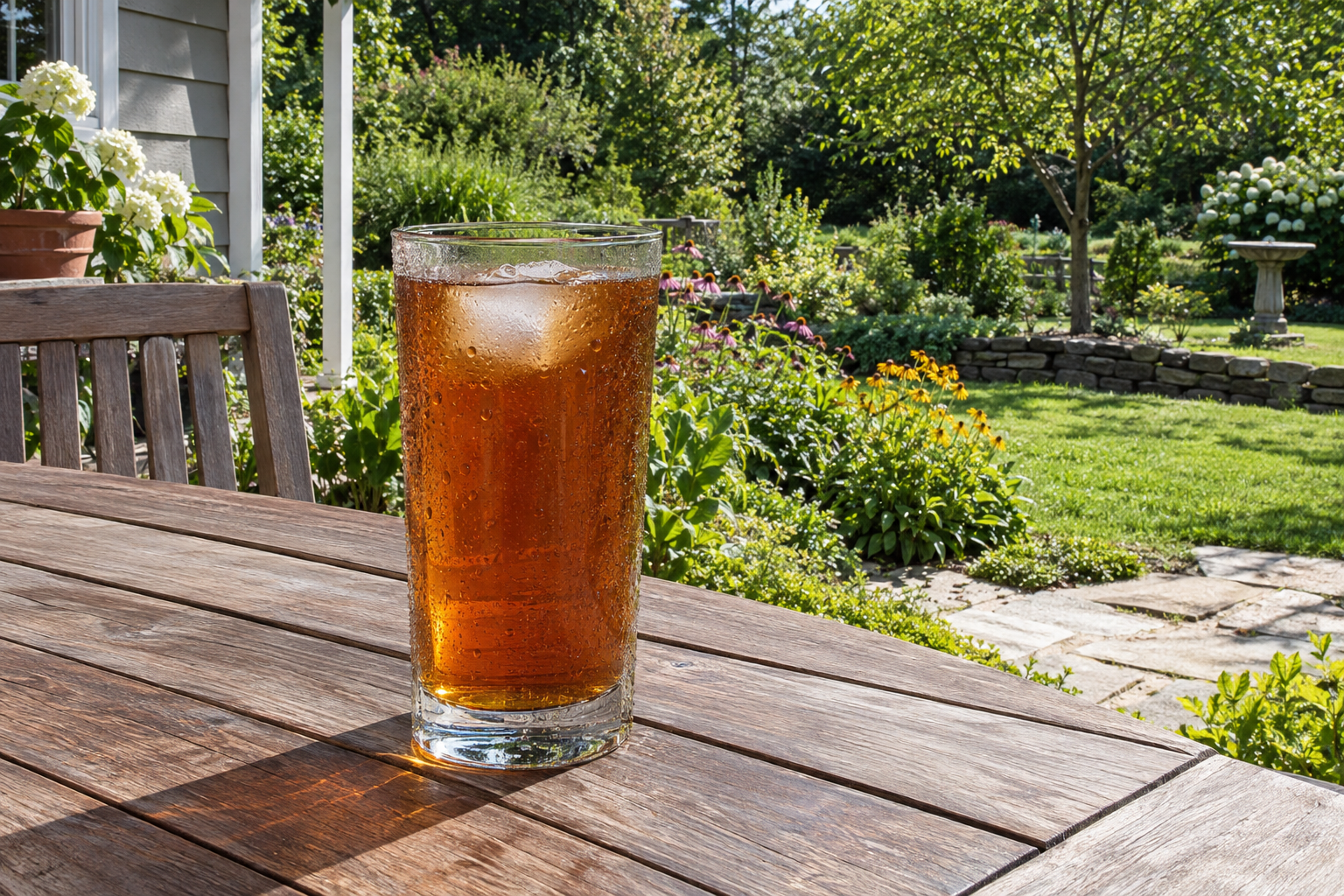
One ice cube floats in the tea.
The ice cube melts, little by little.
The tea around the shrinking cube turns cooler.
The melting involves the ice, the tea, the glass, and the summer air all at once.
A chemist wants to study the melting ice, and nothing else.
Where should the chemist draw the line between the ice and everything around it?
Chemists split the universe in two before they track any energy.
The part a chemist chooses to study is called the system.
Everything else that can exchange energy with the system is called the surroundings.
Here is the iced-tea scene drawn with the chemist's line in place.
The dashed line marks the chemist's choice, not a real wall.
Everything inside the dashed line is the system.
Everything outside the dashed line that can exchange energy with the ice is the surroundings.
For the melting ice cube, the ice is the system.
The tea, the glass, and the summer air are the surroundings.
Every question in this unit asks what moved between these two parts.
State that the system is the part of the universe being studied, and that the surroundings are everything else that can exchange energy with it.
Part 2Check what you just learned
Check — multiple choice
A student melts a block of paraffin wax in a beaker of warm water and studies only the melting wax. Is the wax the system or the surroundings?
Feedback if chosen: Correct. The wax is the part the student chose to study, so the wax is the system.
Feedback if chosen: This option is wrong — the student chose the wax as the thing to study. The part chosen for study is the system, so the wax is the system.
Check — multiple choice
A student melts a block of paraffin wax in a beaker of warm water and studies only the melting wax. Is the warm water the system or the surroundings?
Feedback if chosen: This option is wrong — the student is studying the wax, not the water. The water can exchange energy with the wax, so the water is part of the surroundings.
Feedback if chosen: Correct. The water sits outside the studied wax and can exchange energy with it, so the water is part of the surroundings.
Check — multiple choice
A student melts a block of paraffin wax in a beaker of warm water and studies only the melting wax. The beaker's wall touches the wax. Is the beaker's wall the system or the surroundings?
Feedback if chosen: This option is wrong — touching the wax does not put the wall inside the studied part. The student chose only the wax, so the wall is part of the surroundings.
Feedback if chosen: Correct. The student chose only the wax. The wall touches the wax and can exchange energy with it. The student did not pick the wall, so the wall is part of the surroundings.
Check — multiple choice
A chemist studies an iron nail rusting in moist air. Is the nail the system or the surroundings?
Feedback if chosen: Correct. The chemist chose the rusting nail as the thing to study, so the nail is the system.
Feedback if chosen: This option is wrong — the nail is the thing the chemist chose to study. The chosen part is the system, so the nail is the system.
Check — multiple choice
A bowl of hot soup cools on a kitchen table, and a student studies the cooling soup. Is the air above the bowl the system or the surroundings?
Feedback if chosen: This option is wrong — the student chose the soup, not the air. The air can exchange energy with the soup, so the air is part of the surroundings.
Feedback if chosen: Correct. The student chose the soup as the system. The air above the bowl can exchange energy with the soup, so the air is part of the surroundings.
Check — multiple choice
A chemist chooses to study the dissolving sugar in a mug of tea, and nothing else. What is everything around the dissolving sugar that can exchange energy with it called?
Feedback if chosen: This option is wrong — the system is the dissolving sugar itself, the part chosen for study. Everything around the sugar that can exchange energy with it is the surroundings.
Feedback if chosen: Correct. The chosen part is the system, and everything else that can exchange energy with it is the surroundings.
Check — multiple choice
What do chemists call the part of the universe chosen for study?
Feedback if chosen: Correct. The part of the universe chosen for study is the system.
Feedback if chosen: This option is wrong — the surroundings are everything outside the chosen part. The chosen part itself is the system.
A temperature change signals an energy change
Outcome: State that a temperature change in a system shows that the system's energy changed.
Part 1The thermometer's message
A student stirs a white solid into a beaker of water.
Before the stirring, the thermometer in the water reads 22 °C.
Two minutes later, the same thermometer reads 30 °C.
The solution looks as clear and still as the water did.
Yet the water in the beaker warmed by 8 °C.
What does that warming tell the student about the energy of the beaker's contents?
Check — multiple choice
You've already seen how temperature and particle motion are related. Which quantity is proportional to the average kinetic energy of a sample's particles?
Feedback if chosen: This option is wrong — two samples of different mass can share one temperature and one average kinetic energy. The Kelvin temperature is the quantity proportional to the average kinetic energy.
Feedback if chosen: Correct. The Kelvin temperature of a sample is proportional to the average kinetic energy of its particles.
Feedback if chosen: This option is wrong — a sample's volume can change with no change in its particles' average kinetic energy. The Kelvin temperature is the quantity proportional to the average kinetic energy.
How can a student tell that a system's energy changed, with only a thermometer?
We've seen that the Kelvin temperature of a sample is proportional to the average kinetic energy of its particles.
A sample whose temperature rose has particles with more kinetic energy on average.
So the sample has more energy than it had before.
A temperature change in a system signals a change in the system's energy.
The warming solution gained energy.
A steady temperature, on its own, does not tell you whether the system's energy changed.
State that a temperature change in a system shows that the system's energy changed.
Part 2Check what you just learned
Check — multiple choice
A swimming pool warms in the afternoon sun. The pool water reads 21 °C at noon and 26 °C at three o'clock. What do the two readings tell you about the pool water's energy?
Feedback if chosen: This option is wrong — the pool water's temperature rose from 21 °C to 26 °C, and a temperature change signals an energy change. The pool water's energy changed.
Feedback if chosen: Correct. The pool water's temperature rose, and a temperature change in a system signals a change in the system's energy.
Feedback if chosen: This option is wrong — the readings do say. The pool water's temperature rose, and a temperature change signals an energy change.
Check — multiple choice
A kettle of water stands on a counter, and a thermometer in the water reads 20 °C all afternoon. What do the readings tell you about the water's energy?
Feedback if chosen: This option is wrong — these readings show no temperature change, so they give no signal that the water's energy changed. The readings do not say what the water's energy did.
Feedback if chosen: This option is wrong — a steady temperature, on its own, does not prove that the water's energy stayed the same. The readings do not say.
Feedback if chosen: Correct. A temperature change signals an energy change, and these readings show no change, so they do not say what the water's energy did.
Check — multiple choice
A can of soda chills in a refrigerator from 22 °C to 5 °C. What do the two readings tell you about the soda's energy?
Feedback if chosen: This option is wrong — the readings do say. The soda's temperature fell, and a temperature change signals an energy change.
Feedback if chosen: This option is wrong — the soda's temperature fell from 22 °C to 5 °C, and a temperature change signals an energy change. The soda's energy changed.
Feedback if chosen: Correct. The soda's temperature fell, and a temperature change in a system signals a change in the system's energy.
Reading the energy direction from a temperature change
Outcome: Identify the direction of a system's energy change from its measured temperatures.
Part 1Which way the energy moved
A second beaker of water stands on the same bench, at 22 °C.
The student stirs in a different white solid.
The solid dissolves.
This time the water cools from 22 °C to 15 °C.
The first solid warmed the water.
The second solid cooled the water.
Did the contents of the second beaker gain energy, or lose energy?
A temperature change tells you which way the energy moved, not only that it moved.
A system whose temperature rose has gained energy.
A system whose temperature fell has lost energy.
The second beaker's contents cooled from 22 °C to 15 °C.
So the contents of the second beaker lost energy.
Every judgment in this unit starts with reading which way the temperature changed.
Identify the direction of a system's energy change from an observed temperature change.
Part 2Check what you just learned
Check — multiple choice
An aquarium's water is measured in the morning and again in the evening. The two readouts are shown. Did the aquarium water gain energy or lose energy?
Feedback if chosen: This option is wrong — the evening readout, 23.4 °C, is lower than the morning readout, 26.0 °C. The aquarium water's temperature fell, so the water lost energy.
Feedback if chosen: Correct. The aquarium water's temperature fell from 26.0 °C to 23.4 °C, and a system whose temperature fell has lost energy.
Check — multiple choice
An engine's coolant warms from 20 °C to 85 °C as the engine idles. Did the coolant gain energy or lose energy?
Feedback if chosen: Correct. The coolant's temperature rose from 20 °C to 85 °C, and a system whose temperature rose has gained energy.
Feedback if chosen: This option is wrong — the coolant's temperature rose, not fell. A system whose temperature rose has gained energy.
Check — multiple choice
A juice box cools from 20.0 °C to 5.0 °C in a lunchbox packed with an ice block. Did the juice gain energy or lose energy?
Feedback if chosen: This option is wrong — the juice's temperature fell from 20.0 °C to 5.0 °C. A system whose temperature fell has lost energy.
Feedback if chosen: Correct. The juice's temperature fell from 20.0 °C to 5.0 °C, and a system whose temperature fell has lost energy.
Endothermic processes
Outcome: State that an endothermic process is one in which the system absorbs energy from the surroundings.
Part 1Where the palm's energy goes
A hiker holds an ice cube in a bare palm.
The ice melts into a puddle within a minute.
The palm under the ice grows colder the whole time.
We've seen that a falling temperature means energy was lost.
So the palm lost energy.
The palm's lost energy did not vanish.
Where did the energy that left the palm go?
Some processes take energy in from their surroundings.
The melting ice absorbed the energy that left the hiker's palm.
A process in which the system absorbs energy from the surroundings is called endothermic.
The melting ice is the system.
The warm palm is part of the surroundings.
The name carries the direction: endo- means in.
Here is the ice cube on the hiker's palm, with the energy arrow drawn.
Part 2The same ice, five places
An ice cube sits on a freezer shelf, as cold as the air around it. Does the ice absorb energy from its surroundings?
No. The freezer air is not warmer than the ice, so the ice does not absorb energy from the freezer air.
Now the same cube sits on a hiker's warm palm. Does the ice absorb energy from its surroundings?
Yes. The palm is warmer than the ice, so the ice absorbs energy from the palm.
Now the same cube floats in a glass of warm tea. Does the ice absorb energy from its surroundings?
Yes. The tea is warmer than the ice, so the ice absorbs energy from the tea.
Now the same cube lies on a sunlit counter. Does the ice absorb energy from its surroundings?
Yes. The counter is warmer than the ice, so the ice absorbs energy from the counter.
Now the same cube is back on the freezer shelf. Does the ice absorb energy from its surroundings?
No. The freezer air is not warmer than the ice, so the ice does not absorb energy from the freezer air.
Here are the five cases in one table.
| case | Does the ice absorb energy from its surroundings? |
|---|---|
| on the freezer shelf | |
| on a warm palm | |
| in warm tea | |
| on a sunlit counter | |
| back on the freezer shelf |
Wherever the surroundings are warmer than the ice, the ice absorbs energy from them, and the melting is endothermic.
State that an endothermic process is one in which the system absorbs energy from the surroundings.
Part 3Check what you just learned
Check — multiple choice
Sweat evaporates off a runner's arm, with the sweat as the system. Does the evaporating sweat absorb energy from its surroundings?
Feedback if chosen: Correct. The runner's warm skin is warmer than the sweat, and the evaporating sweat absorbs energy from the skin. The evaporating is endothermic.
Feedback if chosen: This option is wrong — the runner's skin is warmer than the sweat, and the evaporating sweat absorbs energy from the skin. That absorbing is why the arm feels cooler.
Check — multiple choice
A puddle freezes overnight, with the puddle's water as the system. Does the freezing water absorb energy from its surroundings?
Feedback if chosen: This option is wrong — the freezing water does not absorb energy. The water releases energy to the cold night air as it freezes.
Feedback if chosen: Correct. The freezing water releases energy to the cold night air; it does not absorb energy, so the freezing is not endothermic.
Check — multiple choice
Snow melts on a driveway on a mild morning, with the snow as the system. Does the melting snow absorb energy from its surroundings?
Feedback if chosen: Correct. The driveway and the air are warmer than the snow, and the melting snow absorbs energy from them. The melting is endothermic.
Feedback if chosen: This option is wrong — the snow melts only while it takes energy in. The warmer driveway and air supply that energy, so the melting snow absorbs energy from them.
Check — multiple choice
Rubbing alcohol evaporates on a student's wrist, with the alcohol as the system. Does the evaporating alcohol absorb energy from its surroundings?
Feedback if chosen: Correct. The student's skin is warmer than the alcohol, and the evaporating alcohol absorbs energy from the skin. That absorbing is why the wrist feels cold.
Feedback if chosen: This option is wrong — the wrist feels cold because the alcohol absorbs energy from the skin. The skin is warmer than the alcohol, and energy moves into the evaporating alcohol.
Check — multiple choice
The word endothermic tells you which way energy moves. What does the system do in an endothermic process?
Feedback if chosen: This option is wrong — endo- means in. In an endothermic process the system absorbs energy from the surroundings.
Feedback if chosen: Correct. Endo- means in: in an endothermic process the system absorbs energy from the surroundings.
Exothermic processes
Outcome: State that an exothermic process is one in which the system releases energy to the surroundings.
Part 1Where the candle's energy goes
A lit candle burns on a dinner table.
The air above the flame feels hot from a hand's length away.
The glass holder under the candle warms too.
Only the wax and the wick are reacting.
Which way is the energy moving between the burning candle and everything around it?
Some processes send energy out into their surroundings.
The burning candle releases energy to the air, the holder, and the table.
A process in which the system releases energy to the surroundings is called exothermic.
The burning wax is the system.
The air, the holder, and the table are the surroundings.
The name carries the direction: exo- means out.
Here is the candle drawn with the energy arrow in place.
You've already seen combustion reactions like the candle's, written as a word equation.
Part 2The same candle, five moments
A candle stands unlit on a dinner table. Does the candle release energy to its surroundings?
No. Nothing around the candle warms, so the candle does not release energy to its surroundings.
Now the same candle is lit. Does the candle release energy to its surroundings?
Yes. The air above the candle warms, so the candle releases energy to its surroundings.
Now the same lit candle burns inside a glass lantern. Does the candle release energy to its surroundings?
Yes. The lantern's glass warms, so the candle releases energy to its surroundings.
Now the same lit candle burns on a cold porch table. Does the candle release energy to its surroundings?
Yes. The porch air warms, so the candle releases energy to its surroundings.
Later that night, the same candle stands on the porch, blown out and cold. Does the candle release energy to its surroundings?
No. Nothing around the candle warms, so the candle does not release energy to its surroundings.
Here are the five moments in one table.
| case | Does the candle release energy to its surroundings? |
|---|---|
| unlit on the table | |
| lit on the table | |
| lit in a lantern | |
| lit on a cold porch | |
| blown out that night |
While the candle burns, the burning is exothermic, wherever the candle stands.
Here are the two labels side by side.
| process type | what the system does |
|---|---|
| endothermic | absorbs energy from the surroundings |
| exothermic | releases energy to the surroundings |
State that an exothermic process is one in which the system releases energy to the surroundings.
Part 3Check what you just learned
Check — multiple choice
A log burns in a fireplace, with the burning log as the system. Does the burning log release energy to its surroundings?
Feedback if chosen: Correct. The burning log warms the fireplace and the air, so the burning log releases energy to its surroundings. The burning is exothermic.
Feedback if chosen: This option is wrong — the fireplace and the air around the log warm up. The burning log releases energy to its surroundings.
Check — multiple choice
Overnight, water vapor from the air condenses into dew on lawn grass, with the water as the system. Does the condensing water release energy to its surroundings?
Feedback if chosen: Correct. As the water vapor condenses into dew, the water releases energy to the grass and the air. The condensing is exothermic.
Feedback if chosen: This option is wrong — condensing water releases energy to its surroundings. The grass under the dew gains that energy.
Check — multiple choice
Overnight, water vapor turns to frost on a windshield, with the water as the system. Does the water release energy to its surroundings as the frost forms?
Feedback if chosen: Correct. As the vapor turns to frost, the water releases energy to the windshield and the air. The frost-forming is exothermic.
Feedback if chosen: This option is wrong — the water releases energy as the frost forms. The windshield gains that energy.
Check — multiple choice
An ice cube melts in a glass of soda, with the ice as the system. Does the melting ice release energy to its surroundings?
Feedback if chosen: This option is wrong — the melting ice absorbs energy from the soda; it does not release energy. That absorbing is why the soda turns colder.
Feedback if chosen: Correct. The melting ice absorbs energy from the soda around it; it does not release energy to its surroundings, so the melting is not exothermic.
Check — multiple choice
The word exothermic tells you which way energy moves. What does the system do in an exothermic process?
Feedback if chosen: Correct. Exo- means out: in an exothermic process the system releases energy to the surroundings.
Feedback if chosen: This option is wrong — absorbing energy from the surroundings is the endothermic direction. Exo- means out: in an exothermic process the system releases energy to the surroundings.
Classifying a process as endothermic or exothermic
Outcome: Classify a described process as endothermic or exothermic from which way the energy moves.
Part 1The freezer's puzzle
A tray full of liquid water goes into a freezer overnight.
By morning the tray holds solid ice.
The change happened in the coldest place in the kitchen.
Did the freezing water absorb energy from the freezer's air, or release energy into it?
One question sorts any process: which way did the energy move?
We've seen that a falling temperature means the system lost energy.
The freezing water released energy to the freezer's air.
So freezing is exothermic.
The same ice melting on a counter takes energy in.
So melting is endothermic.
The energy direction settles the label, never the place where the process happens.
Here is the tray at both moments, with the energy arrows drawn.
Part 2Four cases, one question
The tray of water freezes in the freezer. Which way does the energy move: into the system, or out of it?
Out. The freezing water releases energy to the freezer's air, so freezing is exothermic.
The same tray's ice now melts on the counter. Which way does the energy move: into the system, or out of it?
In. The melting ice absorbs energy from the counter's air, so melting is endothermic.
Now consider a lime kiln, an industrial oven where burning natural gas keeps crushed limestone glowing hot.
Here are the kiln's two reactions as word equations.
First the chemist chooses the burning natural gas as the system. Which way does the energy move: into the system, or out of it?
Out. The burning gas releases energy to everything around it, so the burning is exothermic.
Now the chemist chooses the limestone as the system, in the same kiln. Which way does the energy move: into the system, or out of it?
In. The decomposing limestone absorbs energy from the hot kiln gases, so the decomposition is endothermic.
Only the chosen system changed between the last two cases.
The kiln did not change; the chemist's dashed line did.
Here are the four cases in one table.
| process | which way the energy moves | verdict |
|---|---|---|
| water freezing in the tray | out of the system | exothermic |
| ice melting on the counter | into the system | endothermic |
| natural gas burning in the kiln | out of the system | exothermic |
| limestone decomposing in the kiln | into the system | endothermic |
Classify a described physical or chemical process as endothermic or exothermic from which way the energy moves.
Part 3Check what you just learned
Check — multiple choice
A student mixes baking soda and vinegar in a beaker. The mixture fizzes, and the beaker turns cold. Is the reaction endothermic or exothermic?
Feedback if chosen: Correct. The beaker turned cold, so the reaction absorbed energy from it. A process in which the system absorbs energy from the surroundings is endothermic.
Feedback if chosen: This option is wrong — the beaker turned cold, so the reaction did not release energy to it. The reaction absorbed energy from the beaker, and that direction is endothermic.
Check — multiple choice
An oil lamp burns with a flame that warms everything near it. Is the burning endothermic or exothermic?
Feedback if chosen: This option is wrong — everything near the flame warms, so the burning oil releases energy; it does not absorb energy. The releasing direction is exothermic.
Feedback if chosen: Correct. The burning oil releases energy to everything around the flame. A process in which the system releases energy to the surroundings is exothermic.
Check — multiple choice
Fresh concrete sets on a building site, and the air just above the slab warms. Is the setting reaction endothermic or exothermic?
Feedback if chosen: This option is wrong — the air above the slab warms, so the setting reaction releases energy; it does not absorb energy. The releasing direction is exothermic.
Feedback if chosen: Correct. The setting reaction releases energy, and the air just above the slab warms. A process in which the system releases energy to the surroundings is exothermic.
Check — multiple choice
Wet laundry dries on a line as the water evaporates. The evaporating water absorbs energy from the air. Is the evaporating endothermic or exothermic?
Feedback if chosen: Correct. The evaporating water absorbs energy from the air, and a process in which the system absorbs energy from the surroundings is endothermic.
Feedback if chosen: This option is wrong — the evaporating water absorbs energy from the air; it does not release energy. The absorbing direction is endothermic.
Three outcomes for a reaction's energy
Outcome: State the three things a reacting system's energy can do, and the label each one takes.
Part 1A third possibility
The freezing water released energy.
The melting ice absorbed energy.
Every process we have sorted so far moved energy one way or the other.
Could a reaction leave the system's energy exactly where it started?
During a chemical reaction, the energy of the system does one of three things.
If the system's energy decreases, the reaction is exothermic.
If the system's energy increases, the reaction is endothermic.
If the system's energy stays the same, the reaction is neither exothermic nor endothermic.
The three labels cover every possible reaction.
Imagine a reaction whose products hold exactly as much energy as its reactants held.
That imagined reaction is neither exothermic nor endothermic.
Reactions like that are rare, but the label exists for them.
Here are the three outcomes as a table.
| what the system's energy does | the label |
|---|---|
| decreases | exothermic |
| increases | endothermic |
| stays the same | neither exothermic nor endothermic |
State that during a chemical reaction the system's energy either decreases (exothermic), increases (endothermic), or stays the same (neither).
Part 2Check what you just learned
Check — multiple choice
During a reaction in a sealed flask, the energy of the reacting system decreases. Which label fits the reaction?
Feedback if chosen: Correct. The system's energy decreases, and a reaction whose system loses energy is exothermic.
Feedback if chosen: This option is wrong — an endothermic reaction's system gains energy. This system's energy decreases, so the reaction is exothermic.
Feedback if chosen: This option is wrong — the neither label fits only a system whose energy stays the same. This system's energy decreases, so the reaction is exothermic.
Check — multiple choice
During a reaction in a beaker, the energy of the reacting system increases. Which label fits the reaction?
Feedback if chosen: This option is wrong — an exothermic reaction's system loses energy. This system's energy increases, so the reaction is endothermic.
Feedback if chosen: Correct. The system's energy increases, and a reaction whose system gains energy is endothermic.
Feedback if chosen: This option is wrong — the neither label fits only a system whose energy stays the same. This system's energy increases, so the reaction is endothermic.
Check — multiple choice
A chemist imagines a reaction in which the products hold exactly as much energy as the reactants held. Which label fits the imagined reaction?
Feedback if chosen: This option is wrong — an exothermic reaction's system loses energy. This system's energy stays the same, so the reaction is neither exothermic nor endothermic.
Feedback if chosen: This option is wrong — an endothermic reaction's system gains energy. This system's energy stays the same, so the reaction is neither exothermic nor endothermic.
Feedback if chosen: Correct. The system's energy stays the same, so the reaction is neither exothermic nor endothermic.
Heat and work: the two ways energy moves
Outcome: State the two ways energy moves between a system and its surroundings, and what drives each one.
Part 1How energy crosses the line
A climber snaps a hand warmer and tucks it inside a glove.
A reaction starts inside the pouch.
The pouch grows hot within minutes.
The climber's palm warms against the hot pouch.
Energy is moving from the pouch into the palm.
How does energy actually cross from a system into its surroundings?
Energy moves between a system and its surroundings in exactly two ways.
When energy moves because two touching bodies are at different temperatures, that transfer is called heat.
When energy moves because a force pushes something through a distance, that transfer is called work.
The pouch is hotter than the palm.
So the energy crossing into the palm moves as heat.
The pouch's reaction is iron rusting quickly: iron reacting with the oxygen in the air.
Here are the two ways drawn side by side.
In the left panel, the pouch sits at 54 °C against a palm at 33 °C, so the energy crosses as heat.
In the right panel, gas made by a reaction pushes the cork outward through a distance, so the energy crosses as work.
Here are the two transfers as a table.
| transfer | what drives it |
|---|---|
| heat | a temperature difference between touching bodies |
| work | a force pushing something through a distance |
In this unit, every energy amount you will calculate moves as heat.
State that energy moves between a system and its surroundings as heat (driven by a temperature difference) or as work (driven by a force acting through a distance).
Part 2Check what you just learned
Check — multiple choice
A hot sauna stone warms the air touching it. The stone is hotter than the air. How does the energy move from the stone to the air?
Feedback if chosen: Correct. The stone and the air touch at different temperatures, and a transfer driven by a temperature difference is heat.
Feedback if chosen: This option is wrong — nothing here pushes through a distance. The stone and the air touch at different temperatures, so the energy moves as heat.
Check — multiple choice
Gas made by a reaction pushes a syringe's plunger outward through a distance. How does the energy move from the gas to the plunger?
Feedback if chosen: This option is wrong — this transfer is not driven by a temperature difference. The gas pushes the plunger through a distance, so the energy moves as work.
Feedback if chosen: Correct. The gas pushes the plunger through a distance, and a transfer driven by a force acting through a distance is work.
Check — multiple choice
Steam in a covered pot pushes the lid upward through a small distance. How does the energy that lifts the lid move from the steam to the lid?
Feedback if chosen: This option is wrong — the lid moves because the steam pushes it, not because the two sit still at different temperatures. A push through a distance moves energy as work.
Feedback if chosen: Correct. The steam pushes the lid upward through a distance, and a transfer driven by a force acting through a distance is work.
Check — multiple choice
A mug of hot cider warms the cold hands wrapped around it. The cider is hotter than the hands. How does the energy move from the cider to the hands?
Feedback if chosen: Correct. The mug and the hands touch at different temperatures, and a transfer driven by a temperature difference is heat.
Feedback if chosen: This option is wrong — nothing here pushes through a distance. The cider, the mug, and the hands touch at different temperatures, so the energy moves as heat.
Check — multiple choice
One of the two transfers is driven by a temperature difference between touching bodies. Which transfer is it?
Feedback if chosen: Correct. Heat is the transfer driven by a temperature difference; work is the transfer driven by a force acting through a distance.
Feedback if chosen: This option is wrong — work is the transfer driven by a force acting through a distance. The transfer driven by a temperature difference is heat.
Where the energy goes in an exothermic reaction
Outcome: State where the energy a system loses in an exothermic reaction ends up.
Part 1Every kilojoule accounted for
The hand warmer's reaction released energy into the climber's palm for six hours.
Hour after hour, energy left the pouch.
The palm stayed warm the whole climb.
Where does every kilojoule the reaction loses end up?
In an exothermic reaction, the energy the system loses is gained by the surroundings.
The energy leaves the system as heat, or as work done by the system.
The hand warmer's reaction released energy as heat into the climber's palm.
The palm and the glove's air gained exactly the energy the reaction lost.
The energy does not vanish on the way.
If a system loses 2 kJ, its surroundings gain 2 kJ.
Here is the hand warmer drawn with the amounts in place.
State that in an exothermic reaction the energy lost by the system is gained by the surroundings, as heat or as work done by the system.
Part 2Check what you just learned
Check — multiple choice
A campfire burns on a beach, and the burning wood releases energy. Where does that energy end up?
Feedback if chosen: This option is wrong — energy never disappears on the way. The energy the burning wood loses is gained by the surroundings: the campers, the air, and the sand.
Feedback if chosen: Correct. In an exothermic reaction the energy the system loses is gained by the surroundings: here, the campers, the air, and the sand.
Feedback if chosen: This option is wrong — the burning wood loses the energy it releases; it does not keep it. The surroundings gain exactly that energy.
Check — numeric entry
A reaction inside a sealed pouch releases 3 kJ of energy. How much energy do the pouch's surroundings gain?
Feedback when correct: Correct. The surroundings gain exactly the energy the system loses. The reaction loses 3 kJ, so the surroundings gain 3 kJ.
Anticipated wrong answers (feedback shown):
| -3 | This answer carries a minus sign, but the question asks how much the surroundings gain. The surroundings gain the energy the reaction loses: 3 kJ. |
| 0 | This answer would mean the released energy vanished. Energy does not vanish on the way: the surroundings gain exactly the 3 kJ the reaction loses. |
Where the energy comes from in an endothermic reaction
Outcome: State where the energy a system gains in an endothermic reaction comes from.
Part 1What the cold pack takes
An athletic trainer snaps a cold pack and presses it onto a sprained ankle.
A salt dissolves in a pouch of water inside the pack.
The pack turns icy cold within seconds.
The skin under the pack cools too.
We've seen that in an endothermic process the system absorbs energy from the surroundings.
Which part of the surroundings supplies the energy the dissolving salt absorbs?
In an endothermic reaction, the system gains energy from the surroundings.
The energy arrives as heat, or as work done on the system.
The dissolving salt gained energy as heat from the skin under the pack.
The skin and the air lost exactly the energy the salt gained.
Cold does not move into the skin.
Energy moves out of the skin.
So the skin cooled.
If the salt absorbs 1.5 kJ, the skin and the air lose 1.5 kJ.
Here is the cold pack drawn with the amounts in place.
State that in an endothermic reaction the system gains energy from the surroundings, as heat or as work done on the system.
Part 2Check what you just learned
Check — multiple choice
Sherbet powder fizzes as it dissolves on a student's tongue, and the tongue turns cold. The dissolving sherbet absorbs energy. Where does that energy come from?
Feedback if chosen: This option is wrong — cold is not a substance and supplies nothing. The warm tongue loses energy to the dissolving sherbet; that loss is what the student feels as cold.
Feedback if chosen: This option is wrong — energy never appears from nowhere. The dissolving sherbet gains exactly the energy the tongue and the saliva lose.
Feedback if chosen: Correct. The tongue is part of the dissolving sherbet's surroundings, and an endothermic process absorbs energy from its surroundings. The tongue loses that energy, so the tongue turns cold.
Check — numeric entry
A process inside a pack absorbs 5 kJ of energy from the skin and air around it. How much energy do the surroundings lose?
Feedback when correct: Correct. The system gains exactly the energy the surroundings lose. The process absorbs 5 kJ, so the surroundings lose 5 kJ.
Anticipated wrong answers (feedback shown):
| -5 | This answer carries a minus sign, but the question asks how much the surroundings lose, as an amount. The surroundings lose 5 kJ. |
| 0 | This answer would mean the absorbed energy appeared from nowhere. Energy never appears from nowhere: the surroundings lose exactly the 5 kJ the system gains. |
Dissolving can go either way
Outcome: State that forming a solution may be endothermic or exothermic, depending on the attractions broken and formed.
Part 1Two salts, two directions
A teacher sets two beakers of water on the front bench, each at 21 °C.
Into the first beaker goes a scoop of sodium hydroxide.
Into the second beaker goes a scoop of ammonium nitrate.
Both solids dissolve within a minute.
The sodium hydroxide's water ends at 35 °C.
The ammonium nitrate's water ends at 10 °C.
Why does one salt warm the water, and the other salt cool it?
Check — multiple choice
You've already seen dissolving described as a trade of contacts. Which trade happens when a solute dissolves in a solvent?
Feedback if chosen: Correct. Dissolving gives up solute-solute and solvent-solvent contacts and forms solute-solvent contacts.
Feedback if chosen: This option is wrong — this trade would un-mix the solution. Dissolving gives up solute-solute and solvent-solvent contacts and forms solute-solvent contacts.
Forming a solution may release energy or absorb energy.
We've seen that dissolving trades contacts: solute-solute and solvent-solvent contacts are given up, and solute-solvent contacts form.
Each contact is an attraction between particles.
Whether the dissolving releases or absorbs energy depends on the relative strengths of the attractions broken and formed.
Sodium hydroxide dissolving in water is exothermic.
Ammonium nitrate dissolving in water is endothermic.
The sodium hydroxide released energy into its water, so that water warmed.
The ammonium nitrate absorbed energy from its water, so that water cooled.
The cold pack's salt is ammonium nitrate.
One salt's dissolving is no guide to another's.
Here are the two salts side by side in a table.
| salt | water, before | water, after | energy direction | verdict |
|---|---|---|---|---|
| NaOH | 21 °C | 35 °C | releases energy | exothermic |
| NH₄NO₃ | 21 °C | 10 °C | absorbs energy | endothermic |
You've already seen dissolving equations like these two.
State that forming a solution may be endothermic or exothermic, depending on the relative strengths of the interactions broken and formed.
Part 2Check what you just learned
Check — multiple choice
A student stirs calcium chloride into a beaker of water at 21 °C, and the water ends at 38 °C. Which label fits this dissolving?
Feedback if chosen: This option is wrong — the water warmed, so the dissolving calcium chloride released energy; it did not absorb energy. The releasing direction is exothermic.
Feedback if chosen: Correct. The water warmed from 21 °C to 38 °C, so the dissolving calcium chloride released energy to it. A dissolving that releases energy to the surroundings is exothermic.
Feedback if chosen: This option is wrong — the temperature change has been measured here. The water warmed from 21 °C to 38 °C, and that measured warming settles the label as exothermic.
Check — multiple choice
A student stirs potassium chloride into a beaker of water at 21 °C, and the water ends at 16 °C. Which label fits this dissolving?
Feedback if chosen: Correct. The water cooled from 21 °C to 16 °C, so the dissolving potassium chloride absorbed energy from it. A dissolving that absorbs energy from the surroundings is endothermic.
Feedback if chosen: This option is wrong — the water cooled, so the dissolving potassium chloride absorbed energy; it did not release energy. The absorbing direction is endothermic.
Feedback if chosen: This option is wrong — the temperature change has been measured here. The water cooled from 21 °C to 16 °C, and that measured cooling settles the label as endothermic.
Check — multiple choice
A student plans to dissolve an unfamiliar salt in water tomorrow. No temperature has been measured yet. Which label fits this dissolving now?
Feedback if chosen: This option is wrong — nothing measured yet says the salt will absorb energy. Some salts release energy as they dissolve, so either label is possible until the change is measured.
Feedback if chosen: This option is wrong — nothing measured yet says the salt will release energy. Some salts absorb energy as they dissolve, so either label is possible until the change is measured.
Feedback if chosen: Correct. Forming a solution may release or absorb energy, and one salt's dissolving is no guide to another's. Until the temperature change is measured, either label is possible.
Predicting a dissolution's direction
Outcome: Predict whether a dissolution is endothermic or exothermic by comparing the energy amounts for the attractions broken and formed.
Part 1The two amounts that decide
The sodium hydroxide warmed its water by 14 °C.
The ammonium nitrate cooled its water by 11 °C.
Both salts gave up old attractions as they dissolved.
Both salts formed new attractions with the water.
The same kind of swap happened in both beakers.
What decides whether a dissolving salt releases energy overall or absorbs energy overall?
Check — multiple choice
You've already seen how to rank the interactions between pairs of species. Which interaction type is the strongest of these three?
Feedback if chosen: This option is wrong — hydrogen bonding sits below ion-dipole in the ranking: ion-dipole, then hydrogen bonding, then dipole-dipole.
Feedback if chosen: Correct. Across pairs of species, the ranking is ion-dipole, then hydrogen bonding, then dipole-dipole.
Feedback if chosen: This option is wrong — dipole-dipole sits at the bottom of this ranking: ion-dipole, then hydrogen bonding, then dipole-dipole.
The prediction needs only two energy amounts.
Dissolving breaks the solute-solute and solvent-solvent attractions.
Dissolving forms the new solute-solvent attractions.
Breaking attractions costs energy.
Forming attractions releases energy.
If the formed attractions release more energy than the broken ones cost, the dissolution is exothermic.
If the formed attractions release less energy than the broken ones cost, the dissolution is endothermic.
Here are the two amounts drawn side by side.
Predict whether a dissolution is endothermic or exothermic by comparing the energy cost of the attractions broken with the energy released by the attractions formed.
Part 2Check what you just learned
Check — multiple choice
Potassium chloride dissolves in water. Breaking the solute-solute and solvent-solvent attractions costs more energy than forming the solute-solvent attractions releases. Is the dissolution endothermic or exothermic?
Feedback if chosen: Correct. The breaking costs more than the forming releases, so the dissolving absorbs energy overall. A dissolution that absorbs energy is endothermic.
Feedback if chosen: This option is wrong — the forming releases less than the breaking costs, so the dissolving does not release energy overall. It absorbs energy overall, and that is endothermic.
Free-response question
Source note (not shown as part of the question): Authored to the EK 6.1.A.4 archetype (dissolution energetics, qualitative).
A student stirs urea into a beaker of water at 22 °C. The urea dissolves, and the solution cools to 17 °C.
(a) Explain why dissolving urea absorbs energy overall, in terms of the attractions broken and formed. [2 points]
✓ Model response (the key)
A full-credit explanation
Dissolving urea breaks the urea-urea and water-water attractions.
Breaking attractions costs energy.
Dissolving urea forms new urea-water attractions.
Forming attractions releases energy.
The broken attractions cost more energy than the formed attractions released.
So the dissolving absorbed energy overall, and the solution cooled from 22 °C to 17 °C.
Scoring rubric — 2 points available
- (a) States that breaking the urea-urea and water-water attractions costs energy, and that forming the urea-water attractions releases energy. [1 pt]
- (a) Compares the two amounts: the broken attractions cost more energy than the formed attractions released, so the dissolving absorbed energy from the water. [1 pt]
Check — multiple choice
Calcium chloride dissolves in water. Forming the solute-solvent attractions releases more energy than breaking the solute-solute and solvent-solvent attractions costs. Is the dissolution endothermic or exothermic?
Feedback if chosen: This option is wrong — the forming releases more than the breaking costs, so the dissolving does not absorb energy overall. It releases energy overall, and that is exothermic.
Feedback if chosen: Correct. The forming releases more than the breaking costs, so the dissolving releases energy overall. A dissolution that releases energy is exothermic.
Judging a transformation from observations
Outcome: Judge from measured observations whether a transformation is endothermic or exothermic, and explain the energy exchange.
Part 1The hidden reaction
A chemist clamps a sealed reaction vessel inside a beaker of water.
A thermometer sits in the water, not in the vessel.
Here is the rig, with the chemist's line drawn.
The reaction starts inside the vessel, hidden from view.
Over five minutes, the water around the vessel warms from 21.0 °C to 27.5 °C.
Here are the thermometer's readings as a table.
| time | water temperature |
|---|---|
| 0 min | 21.0 °C |
| 5 min | 27.5 °C |
Can the chemist judge the hidden reaction from the water's temperature alone?
The water around the vessel is part of the reaction's surroundings.
The water warmed from 21.0 °C to 27.5 °C.
So the water gained energy.
The energy the water gained came from the reaction inside the vessel.
A reaction that releases energy to its surroundings is exothermic.
So the chemist judges the hidden reaction exothermic without ever seeing it.
Read the surroundings, then judge the system.
Judge from experimental observations whether a transformation is endothermic or exothermic, and explain the energy exchange between system and surroundings.
Part 2Check what you just learned
Check — multiple choice
A chemist mixes barium hydroxide and ammonium thiocyanate in a flask standing on a damp wooden board. The flask's outside frosts over, and the flask freezes to the board. Is the reaction endothermic or exothermic?
Feedback if chosen: Correct. The flask, the moisture, and the board cooled enough to freeze, so the surroundings lost energy. The reaction absorbed that energy, and a reaction that absorbs energy from its surroundings is endothermic.
Feedback if chosen: This option is wrong — the frost shows the flask and its moisture cooled, so the surroundings lost energy to the reaction. Absorbing energy from the surroundings is endothermic.
Check — multiple choice
A self-heating coffee can mixes calcium oxide with water in a sealed chamber under the coffee. The coffee above the chamber warms from 15 °C to 60 °C. Is the reaction endothermic or exothermic?
Feedback if chosen: This option is wrong — the coffee warmed, so the surroundings gained energy from the reaction; the reaction did not absorb energy. Releasing energy to the surroundings is exothermic.
Feedback if chosen: Correct. The coffee warmed from 15 °C to 60 °C, so the surroundings gained energy. The reaction released that energy, and a reaction that releases energy to its surroundings is exothermic.
Check — multiple choice
A soldier adds water to a flameless ration heater tucked under a sealed meal pouch. Within minutes the meal is hot. Is the heater's reaction endothermic or exothermic?
Feedback if chosen: This option is wrong — the meal warmed, so the surroundings gained energy from the heater's reaction. A reaction that releases energy to its surroundings is exothermic.
Feedback if chosen: Correct. The meal warmed, so the surroundings gained energy. The heater's reaction released that energy, and a reaction that releases energy to its surroundings is exothermic.
Check — multiple choice
Two clear solutions are mixed inside a vessel clamped in a small water bath. The bath's water cools from 21.0 °C to 14.2 °C. Is the reaction endothermic or exothermic?
Feedback if chosen: Correct. The bath's water cooled from 21.0 °C to 14.2 °C, so the surroundings lost energy. The reaction absorbed that energy, and a reaction that absorbs energy from its surroundings is endothermic.
Feedback if chosen: This option is wrong — the bath's water cooled, so the surroundings lost energy to the reaction; they did not gain energy. Absorbing energy from the surroundings is endothermic.
Free-response question
Source note (not shown as part of the question): Authored to the LO 6.1.A archetype (judge and explain from observations).
A self-heating coffee can mixes calcium oxide with water in a sealed chamber under the coffee. The coffee warms from 15 °C to 60 °C. The reaction is exothermic.
(a) Explain where the energy that warms the coffee comes from, naming the system and the surroundings. [2 points]
✓ Model response (the key)
A full-credit explanation
The reacting calcium oxide and water are the system.
The coffee is part of the surroundings.
The coffee warmed from 15 °C to 60 °C, so the coffee gained energy.
In an exothermic reaction, the energy the system loses is gained by the surroundings.
So the energy that warms the coffee comes from the reacting calcium oxide and water.
Scoring rubric — 2 points available
- (a) Names the reacting calcium oxide and water as the system and the coffee as part of the surroundings. [1 pt]
- (a) States that the energy the coffee gained is the energy the reacting system lost (released to the surroundings). [1 pt]
Free-response question
Source note (not shown as part of the question): Authored to the LO 6.1.A archetype (judge and explain from observations).
A chemist mixes barium hydroxide and ammonium thiocyanate in a flask on a damp wooden board. The flask frosts over and freezes to the board. The reaction is endothermic.
(a) Explain where the energy the reaction absorbs comes from, naming the system and the surroundings. [2 points]
✓ Model response (the key)
A full-credit explanation
The reacting barium hydroxide and ammonium thiocyanate are the system.
The flask, the moisture on it, and the board are part of the surroundings.
The flask and the moisture cooled enough to frost, so the surroundings lost energy.
In an endothermic reaction, the system gains energy from the surroundings.
So the energy the reaction absorbs comes from the flask, the moisture, and the board around it.
Scoring rubric — 2 points available
- (a) Names the reacting barium hydroxide and ammonium thiocyanate as the system and names at least one of the flask, the moisture, the board, or the nearby air as part of the surroundings. [1 pt]
- (a) States that the energy the reaction gained is the energy the surroundings lost. [1 pt]
U6-S02 — Energy diagrams
5 lessons
What an energy diagram shows
Outcome: State what an energy diagram shows: the energy of the system, as one level for the reactants and one for the products.
Part 1Before and after, in one drawing
Charcoal glows in a grill.
The carbon in the charcoal reacts with oxygen from the air.
Here is the burning, written as an equation.
The burning releases energy to the surroundings.
We've seen that a process that releases energy to the surroundings is exothermic.
So the energy of the system is lower after the reaction than before it.
No sentence shows the energy before, the energy after, and the size of the drop at one glance.
How can one drawing show the energy of the system before the reaction, after it, and the size of the drop?
We've seen that the potential energy of a pair of atoms depends on how its charged particles are positioned.
We've seen that when two atoms sit close, the attractions pull the pair's potential energy down.
Here is the potential-energy curve you've already seen, for two hydrogen atoms.
The reacting system in the grill — the carbon and the oxygen — also carries energy that depends on how its atoms are arranged.
A drawing that shows the energy of the system before and after a process is called an energy diagram.
Here is the energy diagram for the burning charcoal.
The vertical axis plots the energy of the system.
One horizontal level marks the energy of the reactants: the carbon and the oxygen.
A second horizontal level marks the energy of the products: the carbon dioxide.
A lower level means the system carries less energy in that state.
The carbon-dioxide level sits lower, so the system carries less energy after the burning.
One glance at the two levels shows the direction of the energy change, before any arithmetic.
State that an energy diagram plots the energy of the system on the vertical axis, with one level for the initial state (reactants) and one for the final state (products).
Part 2Check what you just learned
Check — multiple choice
On an energy diagram, which axis plots the energy of the system?
Feedback if chosen: Correct. An energy diagram plots the energy of the system on the vertical axis.
Feedback if chosen: This option is wrong — the horizontal direction on an energy diagram carries no quantity. The energy of the system is plotted on the vertical axis.
Check — multiple choice
Copper carbonate decomposes into copper oxide and carbon dioxide when it is heated. The energy diagram for the decomposition is shown. Which level marks the reactants?
Feedback if chosen: This option is wrong — the upper level is labeled copper oxide + carbon dioxide, and those are the products. The reactant is the copper carbonate, and its level sits lower.
Feedback if chosen: Correct. The reactant is the starting substance, the copper carbonate, and the copper-carbonate level is the lower one on this diagram.
Check — multiple choice
Iron reacts with sulfur to form iron sulfide. The energy diagram for the reaction is shown. Where is the energy of the products read?
Feedback if chosen: This option is wrong — the iron and the sulfur are the reactants, so their level gives the reactants' energy. The product's energy is read across from the iron-sulfide level.
Feedback if chosen: This option is wrong — the horizontal axis carries no quantity on an energy diagram. Energy is read on the vertical axis, straight across from the iron-sulfide level.
Feedback if chosen: Correct. The product is the iron sulfide. Its energy is read on the vertical axis, straight across from the iron-sulfide level.
Check — multiple choice
A chemist draws the energy of a system before a process and after it, as two horizontal levels against a vertical energy axis. What is this drawing called?
Feedback if chosen: This option is wrong — a potential-energy curve plots a pair of atoms' potential energy against their distance. Two levels before and after a process make an energy diagram.
Feedback if chosen: Correct. A drawing that shows the energy of the system before and after a process, as two levels on a vertical energy axis, is an energy diagram.
Feedback if chosen: This option is wrong — a Maxwell-Boltzmann distribution plots the number of particles near each speed. Two levels before and after a process make an energy diagram.
Endothermic or exothermic from the diagram
Outcome: Classify a process as endothermic or exothermic from the two levels of its energy diagram.
Part 1Two levels, one verdict
A chemist hands you the energy diagram for an unfamiliar reaction.
The sheet names the reactants and the products.
No temperature appears anywhere on the sheet.
The product level sits below the reactant level.
You never watched the reaction happen.
Can the two levels alone tell you whether the reaction releases energy or absorbs it?
Check — multiple choice
You've already seen the three outcomes for a reacting system's energy. During one reaction, the energy of the system ends lower than it started. Which label fits the reaction?
Feedback if chosen: This option is wrong — an endothermic reaction's system gains energy. This system's energy decreased, so the reaction is exothermic.
Feedback if chosen: Correct. The system's energy decreased, and a reaction whose system loses energy is exothermic.
Feedback if chosen: This option is wrong — the neither label fits only a system whose energy stays the same. This system's energy decreased, so the reaction is exothermic.
We've seen that pulling a bonded pair of atoms completely apart costs energy.
So different arrangements of atoms carry different amounts of energy.
That is why the reactant level and the product level may sit at different heights.
You classify the process from the relative heights of the two levels.
A product level below the reactant level means the system ended the process with less energy.
The system released that energy to the surroundings.
So the process is exothermic.
A product level above the reactant level means the system ended the process with more energy.
The system absorbed that energy from the surroundings.
So the process is endothermic.
Part 2The same diagram, four cases
Here is the chemist's diagram. What did the system's energy do?
The product level sits below the reactant level, so the system ended with less energy. The process is exothermic.
Now the same diagram is drawn with twice the gap. What did the system's energy do?
The product level still sits below the reactant level, so the system still ended with less energy. The process is still exothermic — a larger gap never changes the side.
Now the same diagram is drawn with its two levels swapped. What did the system's energy do?
The product level sits above the reactant level, so the system ended with more energy. The process is endothermic.
Now the same diagram is drawn with its two levels at one height. What did the system's energy do?
The two levels sit at the same height, so the system ended with the energy it started with. The process is neither exothermic nor endothermic.
Here are the four cases in one table.
| the product level | verdict |
|---|---|
| below the reactant level | exothermic |
| below, with a larger gap | exothermic |
| above the reactant level | endothermic |
| level with the reactant level | neither exothermic nor endothermic |
The side of the product level settles the verdict; the size of the gap never does.
Classify a process as endothermic or exothermic from the relative heights of the reactant and product levels on its energy diagram.
Part 3Check what you just learned
Check — multiple choice
Magnesium burns in air to form magnesium oxide. The energy diagram for the burning is shown. Is the burning endothermic or exothermic?
Feedback if chosen: This option is wrong — the magnesium-oxide level sits below the magnesium-and-oxygen level, so the system ended with less energy. A process whose system loses energy is exothermic.
Feedback if chosen: Correct. The magnesium-oxide level sits below the magnesium-and-oxygen level, so the system released energy to the surroundings. The burning is exothermic.
Check — multiple choice
An electric current splits water into hydrogen and oxygen. The energy diagram for the splitting is shown. Is the splitting endothermic or exothermic?
Feedback if chosen: Correct. The hydrogen-and-oxygen level sits above the water level, so the system absorbed energy from the surroundings. The splitting is endothermic.
Feedback if chosen: This option is wrong — the hydrogen-and-oxygen level sits above the water level, so the system ended with more energy. A process whose system gains energy is endothermic.
Check — multiple choice
The energy diagram for a reaction is shown. What does the diagram say about the reaction?
Feedback if chosen: This option is wrong — an endothermic reaction's product level sits above its reactant level. These two levels sit at one height, so the system's energy does not change.
Feedback if chosen: This option is wrong — an exothermic reaction's product level sits below its reactant level. These two levels sit at one height, so the system's energy does not change.
Feedback if chosen: Correct. The two levels sit at the same height, so the system ended with the energy it started with. The system's energy does not change.
Check — multiple choice
In a leaf, carbon dioxide and water react to form glucose and oxygen. The energy diagram for the reaction is shown. Is the reaction endothermic or exothermic?
Feedback if chosen: Correct. The glucose-and-oxygen level sits above the carbon-dioxide-and-water level, so the system absorbed energy. The gap is large, but the size of the gap never settles the verdict — the side does.
Feedback if chosen: This option is wrong — the glucose-and-oxygen level sits above the carbon-dioxide-and-water level, whatever the size of the gap. A process whose system gains energy is endothermic.
Reading the energy change from the diagram
Outcome: Read the sign and the size of the energy change from a labeled energy diagram.
Part 1From two levels to one signed number
Here is the energy diagram for the burning charcoal again.
The diagram shows the burning of one mole of carbon.
The reactant level sits high on the vertical axis.
The product level sits 394 kilojoules lower.
The drawing states the direction of the energy change and its size in one gap.
A chemist writes the whole story as one quantity with a sign.
Which energy change does the diagram state, sign included?
We've seen that a vertical gap on a drawing is read off its energy axis. Here is the labeled potential-energy curve you've already seen, for two hydrogen atoms.
Reading an energy diagram makes the same move on two levels.
Two moves turn any energy diagram into one signed energy change.
The gap between the two levels is the size of the energy change.
A product level below the reactant level makes the energy change negative.
A product level above the reactant level makes the energy change positive.
For the burning charcoal, the gap spans 394 kilojoules.
The product level sits below the reactant level.
So the energy change of the burning charcoal is −394 kilojoules.
Here is the diagram with the energy change drawn on.
The arrow is drawn from the reactant level to the product level.
The label carries the words energy change, then the sign, then the size.
Identify the sign and size of the energy change from a labeled energy diagram, counting the change negative when the product level lies below the reactant level.
Part 2Check what you just learned
Check — multiple choice
Reaction A's energy diagram is shown, drawn on a gridded energy axis. Which level lies lower?
Feedback if chosen: Correct. The reactant level sits at 40 kJ on the axis and the product level at 100 kJ, so the reactant level lies lower.
Feedback if chosen: This option is wrong — the product level sits at 100 kJ on the axis and the reactant level at 40 kJ. The reactant level lies lower.
Check — numeric entry
Reaction A's energy diagram is shown, drawn on a gridded energy axis. How large is the gap between the two levels?
Feedback when correct: Correct. The product level sits at 100 kJ and the reactant level at 40 kJ, so the gap spans 100 − 40 = 60 kJ.
Anticipated wrong answers (feedback shown):
| 100 | This is the product level's own value on the axis. The gap is the difference between the two levels: 100 − 40 = 60 kJ. |
| 40 | This is the reactant level's own value on the axis. The gap is the difference between the two levels: 100 − 40 = 60 kJ. |
| -60 | The question asks for the size of the gap, which is an amount. The gap spans 60 kJ. |
Check — numeric entry
Reaction A's energy diagram is shown, drawn on a gridded energy axis. What is the energy change of reaction A, sign included?
Feedback when correct: Correct. The gap spans 60 kJ, and the product level sits above the reactant level, so the energy change of reaction A is +60 kJ.
Anticipated wrong answers (feedback shown):
| -60 | The size is right, but the product level sits above the reactant level, so the system gained energy. The energy change of reaction A is +60 kJ. |
| 100 | This is the product level's own value on the axis. The energy change of reaction A is the gap, signed: 100 − 40 = +60 kJ. |
| 40 | This is the reactant level's own value on the axis. The energy change of reaction A is the gap, signed: 100 − 40 = +60 kJ. |
Check — numeric entry
Reaction B's energy diagram is shown, drawn on a gridded energy axis. What is the energy change of reaction B, sign included?
Feedback when correct: Correct. The gap spans 120 − 30 = 90 kJ, and the product level sits below the reactant level, so the energy change of reaction B is −90 kJ.
Anticipated wrong answers (feedback shown):
| 30 | This is the product level's own value on the axis. The energy change of reaction B is the gap, signed: 30 − 120 = −90 kJ. |
| 120 | This is the reactant level's own value on the axis. The energy change of reaction B is the gap, signed: 30 − 120 = −90 kJ. |
Sign-error retry feedback:
| 90 | The size is right. Now look at which level lies lower: the product level sits below the reactant level, so the system lost energy and the change is negative. |
Check — numeric entry
Reaction C's energy diagram is shown, drawn on a gridded energy axis. What is the energy change of reaction C, sign included?
Feedback when correct: Correct. The gap spans 160 − 40 = 120 kJ, and the product level sits above the reactant level, so the energy change of reaction C is +120 kJ.
Anticipated wrong answers (feedback shown):
| -120 | The size is right, but the product level sits above the reactant level, so the system gained energy. The energy change of reaction C is +120 kJ. |
| 160 | This is the product level's own value on the axis. The energy change of reaction C is the gap, signed: 160 − 40 = +120 kJ. |
| 40 | This is the reactant level's own value on the axis. The energy change of reaction C is the gap, signed: 160 − 40 = +120 kJ. |
Sketching an energy diagram
Outcome: Sketch an energy diagram for a described process, with the levels, the arrow, and the label placed to match it.
Part 1Drawing the diagram yourself
Water vapor condenses on a cold window.
The condensing vapor releases energy to its surroundings.
A teacher asks you for the energy diagram of this process.
This time no drawing sits in front of you.
You draw the two levels and the arrow yourself.
Which level goes where, and what does the label on the arrow say?
A described process turns into its energy diagram in two steps.
The description of the process fixes the product level's side.
For an exothermic process, the product level sits below the reactant level.
For an endothermic process, the product level sits above the reactant level.
The supplied size of the energy change fixes the gap between the levels.
Watch the condensation sketch happen, one feature at a time.
Here is the change, written as an equation.
Condensing water vapor is exothermic, so the liquid-water level is placed below the water-vapor level.
Condensing one mole of water vapor releases 44 kilojoules, so the gap is drawn to span 44 kilojoules.
The arrow is drawn from the water-vapor level to the liquid-water level.
The label says: energy change = −44 kJ.
Here is the finished sketch.
So the finished sketch places the liquid-water level below the water-vapor level, with the arrow labeled −44 kilojoules.
Sketch an energy diagram for a described chemical or physical process, placing the product level to match its endothermic or exothermic character and labeling the energy change.
Part 2Check what you just learned
Check — multiple choice
A reaction between two gases releases 150 kilojoules for each mole of product formed. A student sketches the reaction's energy diagram. On which side of the reactant level does the product level go?
Feedback if chosen: This option is wrong — a product level above the reactant level would say the system gained energy. This reaction releases energy, so its product level goes below the reactant level.
Feedback if chosen: Correct. The reaction releases energy, so the system ends with less energy than it started with. The product level goes below the reactant level.
Check — multiple choice
A reaction between two gases releases 150 kilojoules for each mole of product formed. A student sketches the reaction's energy diagram. Which sign does the label on the sketch's arrow carry?
Feedback if chosen: This option is wrong — the reaction releases energy, so its product level sits below the reactant level and the label's sign is negative: −150 kJ.
Feedback if chosen: Correct. The reaction releases energy, so its product level sits below the reactant level. A product level below the reactant level makes the energy change negative: −150 kJ.
Check — drawing task (pen and paper, self-marked)
Acetone, the liquid in nail-polish remover, evaporates from a student's skin. The evaporating acetone absorbs energy from the skin, and evaporating one mole of acetone absorbs 31 kilojoules. Take a pen and paper and draw the energy diagram for this process: the two levels, the arrow, and the label. When you are done, select Check to compare your answer with the model answer.
Model answer shown to the student
Self-mark checklist — the drawing should show:
- Your answer shows exactly two horizontal levels against a vertical energy axis, with no path drawn between them.
- Your answer labels one level liquid acetone (the starting state) and the other acetone vapor (the final state).
- Your answer places the acetone-vapor level above the liquid level, because the evaporating acetone absorbs energy.
- Your answer draws the arrow from the liquid level to the vapor level.
- Your answer labels the arrow energy change = +31 kJ, with the positive sign matching the acetone-vapor level's higher side.
Check — multiple choice
An electric current splits water into hydrogen and oxygen. The splitting absorbs 286 kilojoules for each mole of water split. Four candidate energy diagrams are shown. Which diagram correctly represents the splitting?
Feedback if chosen: This option is wrong — diagram J places the hydrogen-and-oxygen level below the water level. The splitting absorbs energy, so the product level must sit above the reactant level.
Feedback if chosen: This option is wrong — diagram K draws its arrow from the product level to the reactant level. The arrow is drawn from the reactant level to the product level.
Feedback if chosen: Correct. Diagram L places the hydrogen-and-oxygen level 286 kJ above the water level, draws the arrow from the reactant level to the product level, and labels the change +286 kJ.
Feedback if chosen: This option is wrong — diagram M's label carries a negative sign while its product level sits above its reactant level. A higher product level makes the energy change positive.
Judging a flawed energy diagram
Outcome: Judge whether a supplied energy diagram correctly represents a described process, and name the one flaw when it does not.
Part 1Does the drawing tell the truth?
A classmate sketches the energy diagram for iron rusting.
Rusting iron releases energy to its surroundings.
The sketch marks the rusting as exothermic: its label reads −130 kilojoules.
Yet the sketch places the rust level above the iron-and-oxygen level.
The label says one direction and the levels say the other.
How do you decide whether a drawn energy diagram tells the truth about its process?
A correct energy diagram agrees with its process on every feature.
The description says whether the process releases energy or absorbs it.
The diagram must place its product level on the matching side.
The arrow must be drawn from the reactant level to the product level.
The labeled energy change must match the levels in sign.
The labeled size must match the drawn gap, wherever the axis lets you read the gap.
A diagram that fails one of those comparisons is wrong.
The failed comparison names the one specific flaw.
We've seen the checklist a finished sketch must pass. The same checklist is the audit list for judging someone else's diagram.
| feature to audit | what a correct diagram shows |
|---|---|
| the levels | exactly two horizontal levels, with no path between them |
| the product level's side | the side the described process fixes |
| the arrow | drawn from the reactant level to the product level |
| the label's sign | negative for a lower product level, positive for a higher one |
| the label's size | the drawn gap, read off the axis |
Audit the classmate's sketch, one feature at a time.
Rusting iron releases energy, so the rust level must sit below the iron-and-oxygen level.
The sketch places the rust level above the iron-and-oxygen level.
The side comparison fails.
The label's negative sign matches the described direction, so the label is not the flaw.
So the sketch is wrong, and the one specific flaw is the product level's side.
Move the rust level below the iron-and-oxygen level, and the label's sign agrees with the levels too — the one misplaced level broke both comparisons.
Evaluate whether a supplied energy diagram correctly represents a described process, identifying one specific flaw if it does not.
Part 2Check what you just learned
Check — multiple choice
In a leaf, carbon dioxide and water react to form glucose and oxygen. The reaction absorbs 2803 kilojoules for each mole of glucose formed. A sketch of the reaction is shown. Does the diagram correctly represent the reaction?
Feedback if chosen: This option is wrong — the reaction absorbs energy, so its product level must sit above the reactant level. The sketch places the glucose-and-oxygen level below the carbon-dioxide-and-water level.
Feedback if chosen: Correct. The reaction absorbs energy, so its product level must sit above the reactant level. The sketch places the glucose-and-oxygen level below it — the product level sits on the wrong side.
Check — multiple choice
A butane lighter burns butane in air, and the flame warms everything near it. Burning one mole of butane releases 2877 kilojoules. A sketch of the burning is shown. Does the diagram correctly represent the burning?
Feedback if chosen: Correct. The burning releases energy, and the sketch places the carbon-dioxide-and-water level below the butane-and-oxygen level, draws the arrow from the reactant level to the product level, and labels the change −2877 kJ. Every feature agrees with the process.
Feedback if chosen: This option is wrong — every feature of this sketch agrees with the process: the product level sits below the reactant level, the arrow is drawn from the reactant level to the product level, and the label reads −2877 kJ for a releasing process.
Check — multiple choice
A candle softens and melts in a hot car. Melting the candle's 100 grams of wax absorbs 20 kilojoules. A sketch of the melting is shown. Does the diagram correctly represent the melting?
Feedback if chosen: Correct. The melting absorbs energy, and the sketch places the liquid-wax level above the solid-wax level, draws the arrow from the solid level to the liquid level, and labels the change +20 kJ. Every feature agrees with the process.
Feedback if chosen: This option is wrong — every feature of this sketch agrees with the process: the liquid-wax level sits above the solid-wax level, the arrow is drawn from the solid level to the liquid level, and the label reads +20 kJ for an absorbing process.
Check — multiple choice
In a runner's muscle, glucose reacts with oxygen. The reaction releases 2803 kilojoules for each mole of glucose. A sketch of the reaction is shown. Does the diagram correctly represent the reaction?
Feedback if chosen: This option is wrong — the product level correctly sits below the reactant level, but the label carries a positive sign. A lower product level makes the energy change negative.
Feedback if chosen: Correct. The product level sits below the reactant level, matching the released energy — but the label reads +2803 kJ. A product level below the reactant level makes the energy change negative, so the label's sign disagrees with the levels.
Check — multiple choice
A reaction releases 120 kilojoules for each mole of product formed. A student's sketch of the reaction is shown. The sketch is wrong. Which feature is wrong?
Feedback if chosen: Correct. A correct diagram draws its arrow from the reactant level to the product level. This sketch draws the arrow from the product level to the reactant level.
Feedback if chosen: This option is wrong — the product level correctly sits below the reactant level. The flawed feature is the arrow: it is drawn from the product level to the reactant level.
Feedback if chosen: This option is wrong — the label's negative sign matches the lower product level. The flawed feature is the arrow: it is drawn from the product level to the reactant level.
Check — multiple choice
A reaction absorbs 50 kilojoules for each mole of product formed. A student's sketch of the reaction is shown, drawn on a gridded energy axis. The sketch is wrong. Which feature is wrong?
Feedback if chosen: This option is wrong — the arrow is correctly drawn from the reactant level. The size is the flaw: the drawn gap spans 100 kJ, the label reads 50 kJ.
Feedback if chosen: This option is wrong — the product level correctly sits above the reactant level. The size is the flaw: the drawn gap spans 100 kJ, the label reads 50 kJ.
Feedback if chosen: This option is wrong — the label's positive sign matches the higher product level. The size is the flaw: the drawn gap spans 100 kJ, the label reads 50 kJ.
Feedback if chosen: Correct. The levels sit at 50 kJ and 150 kJ on the axis, so the drawn gap spans 100 kJ — but the label reads +50 kJ. The labeled size disagrees with the drawn gap.
U6-S03 — Heat transfer and thermal equilibrium
6 lessons
Temperature compares average kinetic energy
Outcome: Predict which of two bodies has the particles with the greater average kinetic energy, from the two bodies' temperatures.
Part 1Two mugs from one kettle
A barista fills two mugs of tea from one kettle.
The first mug stands fresh on the counter at 80 °C.
The second mug has stood forgotten since the early morning.
Its tea has cooled to 20 °C.
The same tea sits in both mugs.
Yet something about the molecules must differ between the 80 °C tea and the 20 °C tea.
What is actually different about the molecules in the hotter tea?
The tool for this question is one we've already seen.
Check — multiple choice
Two sealed flasks hold neon gas. One flask sits at 300 K, the other at 600 K. How do the two flasks' atoms compare in average kinetic energy?
Feedback if chosen: Correct. Kelvin temperature is proportional to the average kinetic energy of the particles, so doubling the kelvin value doubles the average kinetic energy.
Feedback if chosen: This option is wrong — equal averages need equal temperatures. The 600 K flask is hotter, and doubling the kelvin value doubles the average kinetic energy.
Feedback if chosen: This option is wrong — you inverted the proportionality. Doubling the kelvin value doubles the average kinetic energy, never halves it.
So the comparison starts in kelvin.
The 80 °C tea sits at 353 K.
The 20 °C tea sits at 293 K.
So the 80 °C tea's molecules have the greater average kinetic energy, because Kelvin temperature is proportional to the average kinetic energy of the particles.
Here are the two teas' molecules, drawn with their motion arrows.
In the hotter tea, the molecules move faster on average.
The size of the body changes nothing about the average.
The kind of substance changes nothing about the average.
So the two temperatures alone settle which body's particles move faster on average.
Predict which of two bodies has the particles with the greater average kinetic energy, from the two bodies' temperatures.
Part 2Check what you just learned
Check — multiple choice
A swimming pool holds water at 28 °C. A teacup holds tea at 75 °C. Which body's particles have the greater average kinetic energy?
Feedback if chosen: This option is wrong — you compared the sizes. Size changes nothing about the average. The tea is hotter, so its molecules have the greater average kinetic energy.
Feedback if chosen: Correct. The tea is hotter, and Kelvin temperature is proportional to the average kinetic energy of the particles.
Feedback if chosen: This option is wrong — the same average needs the same temperature. The tea sits at 75 °C and the pool at 28 °C, so the averages differ.
Check — multiple choice
A helium cylinder and a nitrogen cylinder both sit at 25 °C. How do the two gases' particles compare in average kinetic energy?
Feedback if chosen: This option is wrong — you reasoned from the lighter, faster atoms. Helium's atoms do move faster at 25 °C, but equal temperatures mean equal average kinetic energies.
Feedback if chosen: This option is wrong — you reasoned from the heavier particle. The kind of particle changes nothing about the average; equal temperatures mean equal averages.
Feedback if chosen: Correct. The two temperatures are equal, and Kelvin temperature is proportional to the average kinetic energy of the particles.
Check — multiple choice
A glass of lemonade sits at 5 °C. A mug of cocoa sits at 60 °C. Which body's particles have the greater average kinetic energy?
Feedback if chosen: Correct. The cocoa is hotter: 333 K against the lemonade's 278 K. The hotter body's molecules have the greater average kinetic energy.
Feedback if chosen: This option is wrong — you picked the colder body. The cocoa at 60 °C is hotter, so its molecules have the greater average kinetic energy.
Feedback if chosen: This option is wrong — the same average needs the same temperature. The two temperatures differ by 55 °C, so the averages differ.
Check — multiple choice
Two sealed argon samples sit side by side. One sample sits at 350 K, the other at 300 K. Which sample's atoms have the greater average kinetic energy?
Feedback if chosen: This option is wrong — you picked the lower kelvin value. Kelvin temperature is proportional to the average kinetic energy, so the 350 K sample's atoms have the greater average.
Feedback if chosen: Correct. The temperatures are already in kelvin, and 350 K is the higher value, so that sample's atoms have the greater average kinetic energy.
Feedback if chosen: This option is wrong — the same average needs the same temperature. 350 K and 300 K differ, so the averages differ.
Heat transfer and thermal contact
Outcome: State what heat transfer is, and what it means for two bodies to be in thermal contact.
Part 1A cold spoon in hot soup
A cook drops a cold metal spoon into a bowl of hot soup.
Two minutes later, the spoon handle feels hot.
No flame touched the spoon.
Nothing stirred the bowl.
Still the spoon gained energy from somewhere.
How does energy pass from the hot soup into the cold spoon?
Start from the two kinds of energy transfer we've already seen.
Check — multiple choice
A transfer of energy driven by a temperature difference between touching bodies is called…
Feedback if chosen: Correct. Heat is the transfer driven by a temperature difference; work is the transfer driven by a force acting through a distance.
Feedback if chosen: This option is wrong — work is the transfer driven by a force acting through a distance. The transfer driven by a temperature difference is heat.
The soup is hotter than the spoon, so the energy entering the spoon moves as heat.
But what actually happens where the two touch?
Here are the soup and the spoon at the particle level, with one boundary collision magnified.
Where the soup touches the spoon, soup particles collide with spoon particles.
Each collision can transfer kinetic energy from one particle to the other.
Energy transfer that results from collisions between the particles of touching bodies is called heat transfer.
Chemists also call it heat exchange, or transfer of energy as heat.
Bodies that touch so that energy can pass between them are in thermal contact.
The soup and the spoon are in thermal contact, so energy passes between them where they touch.
State that heat transfer (also called heat exchange, or transfer of energy as heat) is energy transfer that results from collisions between the particles of bodies in thermal contact, meaning bodies touching so that energy can pass between them.
Part 2Check what you just learned
Check — multiple choice
A saucepan sits on a glowing stove ring, touching it, and energy passes from the ring into the pan. Is this heat transfer between bodies in thermal contact?
Feedback if chosen: Correct. The pan touches the hotter ring, so collisions between ring particles and pan particles transfer the energy.
Feedback if chosen: This option is wrong — the pan and the ring touch. Collisions between their particles transfer the energy, and that is heat transfer.
Check — multiple choice
A warm brick and a cool brick rest on two separate benches, a hand's width apart. Are the two bricks in thermal contact with each other?
Feedback if chosen: This option is wrong — the two bricks do not touch each other. Bodies in thermal contact touch so that energy can pass between them.
Feedback if chosen: Correct. The two bricks do not touch each other, so the brick pair is not in thermal contact. Each brick is in thermal contact with the bench and the air it touches, not with the other brick.
Check — multiple choice
A vacuum flask keeps a gap with no particles between its inner and outer walls. Can heat transfer happen across the empty gap itself?
Feedback if chosen: This option is wrong — heat transfer is energy transfer by particle collisions. The empty gap has no particles, so no collisions happen there.
Feedback if chosen: Correct. Heat transfer needs particle collisions, and the empty gap has no particles to collide.
Check — multiple choice
Compressed gas in a bicycle pump pushes the piston outward through a distance, transferring energy to the piston. Does that energy move as heat?
Feedback if chosen: This option is wrong — the gas pushes the piston through a distance, so the energy moves as work. Heat is the transfer driven by a temperature difference.
Feedback if chosen: Correct. A force pushing something through a distance moves energy as work, so this transfer is not heat.
Check — multiple choice
A glass marble rests on a warm radiator shelf, touching it, and the shelf warms the marble. Is this heat transfer between bodies in thermal contact?
Feedback if chosen: Correct. The marble touches the warmer shelf, so collisions between shelf particles and marble particles transfer the energy.
Feedback if chosen: This option is wrong — the marble and the shelf touch. Collisions between their particles transfer the energy, and that is heat transfer.
Check — multiple choice
Energy transfer that results from collisions between the particles of touching bodies is called…
Feedback if chosen: Correct. Heat transfer is energy transfer by particle collisions between touching bodies.
Feedback if chosen: This option is wrong — energy transfer by particle collisions between touching bodies is heat transfer, not thermal contact.
Feedback if chosen: This option is wrong — work is the transfer driven by a force acting through a distance, not by particle collisions.
Check — multiple choice
Two bodies touch so that energy can pass between them. What is this arrangement called?
Feedback if chosen: This option is wrong — heat exchange names the energy transfer itself, not the arrangement of touching bodies.
Feedback if chosen: Correct. Bodies touching so that energy can pass between them are in thermal contact.
Feedback if chosen: This option is wrong — a temperature difference is what drives heat, not the name for the touching arrangement.
Why the hotter body loses energy
Outcome: Explain why the net energy transfer goes from the hotter body to the cooler body.
Part 1Collisions go both ways
The cold spoon sits in the hot soup.
At the surface where the two touch, particles collide in both directions.
Sometimes a fast soup particle transfers energy to a slow spoon particle.
Sometimes a fast spoon particle transfers energy to a slow soup particle.
So single collisions move energy both ways across the boundary.
Why does the soup, and never the spoon, end up the net loser of energy?
When a hotter body and a cooler body touch, the hotter body is the net loser, because collisions between particles transfer kinetic energy, on average, from the faster particles of the warmer body to the slower particles of the cooler body.
In one collision, energy can pass either way.
Averaged over billions of collisions, the warmer body's particles transfer more energy than they receive.
Here are the soup and the spoon at two moments.
The soup's temperature falls.
The spoon's temperature rises.
The rule works on any touching pair: the hotter body heats the cooler body.
Take the soup at 80 °C and the spoon at 20 °C. Which one heats the other?
The soup is the hotter body, so the soup heats the other.
Now take a hot spoon at 80 °C, fresh from the dishwasher, dropped into leftover soup at 20 °C. Which one heats the other?
The spoon is the hotter body, so the spoon heats the other.
Now take the soup and the spoon both at 50 °C. Which one heats the other?
Neither is the hotter body, so neither heats the other.
At one shared temperature, neither body's particles are faster on average, so the collisions transfer equal energy in both directions.
Explain why the net energy transfer goes from the hotter body to the cooler body, at the particle level.
Part 2Check what you just learned
Check — multiple choice
A warm ceramic tile rests on a cold steel bench, touching it. Which body loses energy overall?
Feedback if chosen: Correct. The tile is the hotter body, and the hotter body is the net loser of energy.
Feedback if chosen: This option is wrong — the bench is the cooler body. On average, the collisions transfer kinetic energy from the tile's faster particles to the bench's slower particles.
Feedback if chosen: This option is wrong — the two temperatures differ, so the exchange is lopsided. The warm tile loses more energy than it receives.
Check — multiple choice
A hot glass rod is plunged into a beaker of cool ethanol, and the rod's temperature falls. Why does the rod, and never the ethanol, end up the net loser of energy?
Feedback if chosen: This option is wrong — single collisions move energy both ways across the boundary. Only the average is lopsided, toward the ethanol.
Feedback if chosen: Correct. In one collision, energy can pass either way. Averaged over billions of collisions, the rod's faster particles transfer more energy than they receive.
Feedback if chosen: This option is wrong — the collisions continue the whole time the rod and the ethanol touch. The lopsided average, not a stopped collision count, makes the rod the net loser.
Check — multiple choice
A cold metal spoon stands in a bowl of hot soup. Priya says the cold passed from the spoon into the soup, and that is why the soup cools down. Is Priya correct?
Feedback if chosen: This option is wrong — cold is not a substance that passes between bodies. The soup heats the spoon, and the soup cools because it loses that energy.
Feedback if chosen: Correct. No substance passes out of the spoon. On average, the collisions transfer kinetic energy from the soup's faster particles to the spoon's slower particles.
Check — multiple choice
A chilled brass weight is buried in warm sand, touching it on every side. Predict the direction of the net energy transfer.
Feedback if chosen: Correct. The sand is the warmer body, so on average the collisions transfer kinetic energy from the sand's particles to the brass weight's particles.
Feedback if chosen: This option is wrong — the brass weight is the cooler body. The hotter body is the net loser, so the sand transfers net energy to the weight.
Feedback if chosen: This option is wrong — equal transfer needs equal temperatures. The sand is warm and the weight is chilled, so the exchange is lopsided toward the weight.
Thermal equilibrium
Outcome: State what thermal equilibrium is, and identify when two touching bodies have reached it.
Part 1The cooling that stops
A fresh mug of coffee steams on an office desk at 90 °C.

Beside it stands an identical mug, poured hours ago. No steam rises from that one.
The office air sits at 21 °C.
Hour by hour, the coffee cools: 60 °C, 40 °C, 28 °C, then 21 °C.
At 21 °C, the cooling stops.
The coffee never cools below the air's own 21 °C, however long it stands.
Why does the cooling stop exactly where the two temperatures match?
The coffee stops cooling when the coffee and the air reach one shared temperature.
We've seen that two bodies at one temperature have particles with the same average kinetic energy.
At 21 °C and 21 °C, the coffee's molecules and the air's molecules have the same average kinetic energy.
So neither body is hotter, and neither body heats the other.
The state in which two touching bodies have the same average particle kinetic energy, and therefore the same temperature, is called thermal equilibrium.
Here are two touching bodies at thermal equilibrium, drawn at the particle level.
In the drawing, the motion arrows are equally long on both sides, because the soup's and the spoon's average kinetic energies are equal.
A spoon left in soup ends up at the same temperature as the soup, in thermal equilibrium with it.
Take a spoon at 20 °C just dropped into soup at 80 °C. Have the two reached thermal equilibrium?
No: the two temperatures differ.
The soup is still heating the spoon.
A while later, the spoon sits at 50 °C and the soup at 60 °C, the spoon still warming. Have the two reached thermal equilibrium?
No: the two temperatures differ.
The gap has shrunk to 10 °C, but the two temperatures still differ.
Later still, the spoon and the soup both sit at 55 °C, and neither temperature changes. Have the two reached thermal equilibrium?
Yes: the two temperatures match.
The soup's molecules and the spoon's molecules now have the same average kinetic energy.
Now take the office coffee that has stood all afternoon: the coffee and the air both sit at 21 °C. Have the two reached thermal equilibrium?
Yes: the two temperatures match.
The air is the second body here, touching the coffee at its open surface.
A fresh refill at 90 °C lands in the same mug, in the same 21 °C air. Have the two reached thermal equilibrium?
No: the two temperatures differ.
The coffee heats the air until the two match.
Once two bodies sit at thermal equilibrium, neither body heats the other.
State that thermal equilibrium is the state in which two bodies in thermal contact have the same average particle kinetic energy, and therefore the same temperature.
Part 2Check what you just learned
Check — multiple choice
A meat thermometer has sat in a roast for an hour, and its reading has stopped changing. Have the thermometer and the roast reached thermal equilibrium?
Feedback if chosen: Correct. The reading has stopped changing because the two touching bodies share one temperature.
Feedback if chosen: This option is wrong — a steady reading means the thermometer's temperature has stopped changing. The thermometer and the roast share one temperature, so they are at thermal equilibrium.
Check — multiple choice
A large steel block and a small steel block are pressed together, and both blocks sit at 40 °C. Have the two blocks reached thermal equilibrium?
Feedback if chosen: Correct. The temperatures are equal, so the averages are equal. The blocks' sizes change nothing about it.
Feedback if chosen: This option is wrong — you weighed the sizes. Thermal equilibrium needs only one thing: one shared temperature. Both blocks sit at 40 °C.
Check — multiple choice
A mug of milk at 30 °C stands on a kitchen counter at 22 °C. Have the mug and the counter reached thermal equilibrium?
Feedback if chosen: This option is wrong — the two temperatures still differ. The mug heats the counter until the two match.
Feedback if chosen: Correct. Thermal equilibrium needs one shared temperature, and 30 °C and 22 °C differ.
Check — multiple choice
A 50 °C steel block and a 30 °C steel block have just been placed together, touching. Have the two blocks reached thermal equilibrium?
Feedback if chosen: This option is wrong — the temperatures differ by 20 °C. The hotter block heats the cooler block until the two match.
Feedback if chosen: Correct. The two temperatures differ, so the hotter block is still heating the cooler block.
Check — multiple choice
Two touching bodies have the same average particle kinetic energy, and therefore the same temperature. What is this state called?
Feedback if chosen: Correct. Thermal equilibrium is the state in which two touching bodies share one temperature, with the same average particle kinetic energy.
Feedback if chosen: This option is wrong — thermal contact names touching so that energy can pass, whatever the two temperatures are.
Feedback if chosen: This option is wrong — heat exchange names an energy transfer, not a state. At thermal equilibrium the net exchange has stopped.
How collisions close the temperature gap
Outcome: Explain why two touching bodies approach one shared temperature quickly at first, then more slowly.
Part 1Fast at first, then slow
A cold spoon at 20 °C goes into soup at 80 °C.
In the first minute, the spoon warms by 15 °C.
In the tenth minute, the spoon warms by barely 1 °C.
Collisions keep happening at the boundary the whole time.
Why does the temperature gap close quickly at first and then more slowly?
The answer starts with a picture we've already seen: the spread of particle speeds.
Check — multiple choice
On a Maxwell-Boltzmann distribution, what does the height of the curve above one speed show?
Feedback if chosen: Correct. The curve's height counts the particles near each speed; one sample's particles spread over many speeds.
Feedback if chosen: This option is wrong — one particle's kinetic energy comes from its own speed. The curve's height counts the particles near each speed.
Feedback if chosen: This option is wrong — the whole sample has one temperature. The curve's height counts the particles near each speed.
Each body's particles spread over many speeds, with one average kinetic energy per body.
Every collision at the boundary still transfers kinetic energy between the two bodies.
Early on, the soup's particles move much faster, on average, than the spoon's particles.
While the soup's and the spoon's average kinetic energies sit far apart, the collisions transfer far more energy from soup to spoon than back.
As the spoon warms and the soup cools, the two average kinetic energies converge.
The net energy transferred from soup to spoon shrinks as the two averages converge.
So the collisions raise the spoon's temperature quickly at first, then more and more slowly.
Here are the two temperatures drawn against time.
The soup's curve falls, the spoon's curve climbs, and the two approach one shared level.
The curves never cross: the spoon never ends up hotter than the soup.
The collisions keep transferring net energy until the two bodies reach one shared temperature: thermal equilibrium.
Explain how continued particle collisions drive two bodies toward thermal equilibrium, with the net energy transferred shrinking as the two average kinetic energies converge.
Part 2Check what you just learned
Check — multiple choice
A cold juice box sits inside a warm lunchbox, with the lunchbox air touching it on every side. In which minute do the collisions transfer the most net energy to the juice box?
Feedback if chosen: This option is wrong — by the fifth minute the two averages have converged part of the way, so the exchange is less lopsided than at the start.
Feedback if chosen: Correct. The temperature gap is widest at the start, so the averages sit farthest apart and the collisions transfer the most net energy.
Feedback if chosen: This option is wrong — collisions keep happening every minute, but the net energy transferred shrinks as the two averages converge.
Check — multiple choice
A beaker of cold glycerin is lowered into a warm water bath. The glycerin's temperature changes fastest in the moments just after the beaker goes in. Why?
Feedback if chosen: This option is wrong — the collisions continue at the boundary the whole time. What shrinks is the net energy the exchange moves, not the collision count.
Feedback if chosen: This option is wrong — single collisions move energy both ways at every stage. The average is lopsided at the start and balanced at the end.
Feedback if chosen: Correct. The wider the gap between the two average kinetic energies, the more lopsided the exchange at the boundary.
Check — multiple choice
Two pairs of identical aluminum blocks are pressed together: one pair at 90 °C and 10 °C, the other pair at 60 °C and 40 °C. In which pair do the collisions transfer more net energy in the first second?
Feedback if chosen: This option is wrong — this pair's temperatures differ by only 20 °C. The wider the gap, the more net energy the collisions transfer.
Feedback if chosen: This option is wrong — equal net transfers need equal gaps. One pair's temperatures differ by 80 °C, the other pair's by 20 °C.
Feedback if chosen: Correct. This pair's temperatures differ by 80 °C against the other pair's 20 °C, so its averages sit farther apart and its boundary collisions transfer more net energy.
Predict the transfer and the final temperature
Outcome: Predict the direction of energy transfer and the final equal-temperature condition for two touching bodies, and explain both at the particle level.
Part 1Two questions for every pair
A metalworker drops a hot iron block at 90 °C into a bucket of water at 15 °C.
The block and the water touch everywhere across the block's surface.
Collisions start transferring energy across that surface at once.
Every prediction about this bucket answers two questions.
Which body transfers energy to which?
And where do the two temperatures end up?
A two-body prediction answers the same two questions every time.
First comes the direction.
The iron transfers energy to the water, because the iron's particles move faster on average.
We've seen why the hotter body is the net loser: because collisions between particles transfer kinetic energy, on average, from the faster particles of the warmer body to the slower particles of the cooler body.
Here are the iron and the water at two moments.
Second comes the final condition.
The transfer continues until the iron and the water reach one shared temperature.
The shared final temperature lies between 15 °C and 90 °C.
Exactly where between the two starting temperatures the final temperature sits needs ideas that this unit teaches later.
Here is the whole prediction as a table.
| moment | the direction | at the particle level |
|---|---|---|
| at the moment of contact | the iron heats the water | the iron's particles move faster on average, so the boundary collisions transfer more energy to the water than back |
| while the temperatures differ | the iron keeps heating the water | the two average kinetic energies converge, so the net transfer shrinks |
| at thermal equilibrium | neither body heats the other | the two averages are equal; the shared value waits for ideas this unit teaches later |
Predict the direction of energy transfer and the final equal-temperature condition for two bodies placed in thermal contact, and explain both at the particle level.
Part 2Check what you just learned
Check — multiple choice
A cook plunges a hot wok into a basin of cool water until the water covers it. Which way does the net energy transfer go?
Feedback if chosen: This option is wrong — the water is the cooler body. On average, the cooler body's particles receive more energy than they pass back.
Feedback if chosen: Correct. The wok is the hotter body, so on average the collisions transfer kinetic energy from its particles to the water's particles.
Feedback if chosen: This option is wrong — equal exchange needs equal temperatures. A hot wok and cool water differ, so the exchange is lopsided.
Check — multiple choice
A hot pizza at 70 °C rests on a cold granite slab at 20 °C, and the two stay touching for a long time. Where do the two temperatures end up?
Feedback if chosen: Correct. The transfer continues until the two bodies reach one shared temperature, and that temperature lies between the two starts.
Feedback if chosen: This option is wrong — the pizza loses energy as it heats the slab, so the pizza's own temperature falls below 70 °C.
Feedback if chosen: This option is wrong — the slab gains the energy the pizza loses, so the slab's temperature rises above 20 °C.
Check — multiple choice
A large copper block and a small copper block, both at 35 °C, are pressed together. Which way does the net energy transfer go?
Feedback if chosen: This option is wrong — you weighed the sizes. The temperatures are equal, so the boundary collisions transfer equal energy in both directions.
Feedback if chosen: This option is wrong — neither block is hotter. Equal temperatures mean equal averages, so the exchange balances.
Feedback if chosen: Correct. The two temperatures are equal, so neither block's particles are faster on average, and the collisions transfer equal energy in both directions.
Check — multiple choice
A carton of cream at 5 °C, straight from the fridge, stands in pantry air at 22 °C. Which way does the net energy transfer go?
Feedback if chosen: Correct. The air is the warmer body here, and the air touches the carton on every side, so the air heats the cream.
Feedback if chosen: This option is wrong — the cream is the cooler body. On average, the air's faster particles transfer more energy to the carton than they receive.
Feedback if chosen: This option is wrong — 22 °C and 5 °C differ, so the exchange is lopsided toward the cream.
Check — multiple choice
The pantry air heats a carton of cream standing in it. Why does the net energy transfer go from the air to the cream?
Feedback if chosen: This option is wrong — the average, not the total, sets the direction. A large cool body can hold more total energy yet gain net energy from a small hot body.
Feedback if chosen: Correct. The air is warmer, so its particles move faster on average, and the boundary collisions pass more energy to the cream than back.
Feedback if chosen: This option is wrong — the temperatures, not the states, set the direction. Cool air above hot soup receives energy from the soup.
Check — multiple choice
A hot pizza rests on a cold granite slab. In the first minute, the boundary collisions transfer 900 J from the pizza to the slab; in a much later minute, only 50 J; eventually the net transfer stops. Why does the net transfer stop?
Feedback if chosen: This option is wrong — the particles keep colliding at the boundary. The exchange balances; it does not stop.
Feedback if chosen: This option is wrong — the pizza's particles keep moving at the shared temperature. Matching averages, not stopped particles, end the net transfer.
Feedback if chosen: Correct. The collisions continue, and the two directions' transfers balance, so the net transfer is zero.
Checkpoint — energy and the surroundings, energy diagrams, and heat transfer
Check — multiple choice
Which of the following processes is endothermic?
Feedback if chosen: This option is wrong — you classified the freezing by how cold the night feels. Freezing water releases energy to its surroundings, so the freezing is exothermic.
Feedback if chosen: This option is wrong — you tied the condensing to the cold air around it. Condensing water vapor releases energy to that air, so the condensing is exothermic.
Feedback if chosen: Correct. The evaporating water absorbs energy from its surroundings, so the evaporating is endothermic.
Feedback if chosen: This option is wrong — burning diesel warms everything around the engine. The burning releases energy to its surroundings, so the burning is exothermic.
Check — multiple choice
A student adds potassium chlorate crystals to a beaker of water, and the crystals dissolve. The dissolution is endothermic. Which statement describes the energy exchange?
Feedback if chosen: Correct. In an endothermic process the system gains energy from the surroundings. The dissolving potassium chlorate is the system, and the water around it supplies the energy.
Feedback if chosen: This option is wrong — you gave the exchange the exothermic direction. In an endothermic dissolution the system gains energy from its surroundings: the water supplies it.
Feedback if chosen: This option is wrong — you made the system its own supplier. The energy an endothermic process absorbs comes from the surroundings — here, the water.
Feedback if chosen: This option is wrong — you left the temperature drop unexplained. The water's temperature falls because the water transfers that energy to the dissolving crystals.
Check — multiple choice
A student drops a strip of magnesium into a beaker of dilute hydrochloric acid. The mixture fizzes, and a thermometer standing in the solution shows the temperature rising from 19.5 °C to 32.0 °C. Which conclusion do these observations support?
Feedback if chosen: Correct. The water's temperature rose, so the water gained energy. The reacting magnesium and acid are the only source present, so the reaction released energy to the water.
Feedback if chosen: This option is wrong — you read the rise as the reaction taking energy in. Water that warms has gained energy, so the energy moved from the reaction to the water.
Feedback if chosen: This option is wrong — you reversed the signal. A body that loses energy cools; this water warmed, so the water gained energy.
Feedback if chosen: This option is wrong — energy is never created. The energy that warmed the water was transferred to it by the reacting magnesium and acid.
Check — multiple choice
Powdered nickel burns in oxygen, forming solid nickel(II) oxide. The reaction's energy diagram is shown, drawn on a gridded energy axis. What is the reaction's energy change, sign included?
Feedback if chosen: This option is wrong — you read the reactant level's own height, 300 kJ, as the change. The change is the gap between the levels: 60 − 300 = −240 kJ.
Feedback if chosen: Correct. The product level sits at 60 kJ and the reactant level at 300 kJ: 60 − 300 = −240 kJ, negative because the product level lies below the reactant level.
Feedback if chosen: This option is wrong — you read the product level's own height, 60 kJ, as the change. The change is the gap between the levels: 60 − 300 = −240 kJ.
Feedback if chosen: This option is wrong — you took the right gap but counted it positive. The change counts negative when the product level lies below the reactant level.
Check — multiple choice
A chocolatier pours melted chocolate into a mold and lets it harden. Hardening the mold's 300 g of chocolate releases 15 kilojoules. Four candidate energy diagrams are shown. Which diagram correctly represents the hardening?
Feedback if chosen: This option is wrong — you picked the diagram whose levels drop but whose label reads +15 kJ. The hardening releases energy, so its energy change is −15 kJ: the label carries the wrong sign.
Feedback if chosen: Correct. The hardening releases energy, so the solid-chocolate level sits below the melted-chocolate level, the arrow drops to the product level, and the label reads −15 kJ.
Feedback if chosen: This option is wrong — you picked the diagram whose arrow points up while its product level lies below. The arrow must run from the reactant level down to the product level.
Feedback if chosen: This option is wrong — you picked the diagram whose product level sits above the reactant level. That is the diagram of a process that absorbs energy.
Check — multiple choice
An unplugged clothes iron, still hot, rests on a cool cotton shirt. At the surface where the iron's hot metal base touches the cotton, what do the collisions between the two bodies' particles do?
Feedback if chosen: This option is wrong — you treated cold as a substance the particles can pass. Collisions pass kinetic energy, and on average it moves from the faster particles to the slower ones.
Feedback if chosen: This option is wrong — you made every collision run iron-to-cotton. Some collisions pass energy from the cotton to the iron; the iron-to-cotton direction only wins on average.
Feedback if chosen: This option is wrong — you let the kinetic energy vanish. A collision that slows an iron particle passes that kinetic energy to the cotton particle it hit.
Feedback if chosen: Correct. Collisions transfer kinetic energy, on average, from the faster particles of the warmer body to the slower particles of the cooler body — so the cotton gains.
Check — multiple choice
A baker sets a hot loaf of bread on a rack in a cool kitchen. As the loaf cools toward the kitchen air's temperature, what happens to the net energy that collisions transfer from the loaf to the air each second?
Feedback if chosen: This option is wrong — you counted the total energy passed so far, which does grow. The energy the loaf hands the air each second shrinks as the two bodies' average kinetic energies converge.
Feedback if chosen: This option is wrong — you held the transfer at one rate. As the loaf's average kinetic energy falls toward the air's, each second's collisions hand over less net energy.
Feedback if chosen: Correct. As the two average kinetic energies converge, each second's collisions transfer less net energy, and the net transfer approaches zero as the two temperatures match.
Feedback if chosen: This option is wrong — you let the transfer overshoot. Net energy keeps moving from the loaf to the air for as long as the loaf is the warmer body; the direction never swaps.
Check — multiple choice
A cook pours warm maple syrup at 60 °C into a glass jar at 15 °C and wraps the sealed jar in a thick towel, so the syrup and the jar exchange energy only with each other. Which of the following happens?
Feedback if chosen: This option is wrong — you sent the net energy out of the cooler body. The syrup's particles are faster on average, so the net energy moves from the syrup to the jar.
Feedback if chosen: This option is wrong — you balanced the two-way transfers too early. They balance only once the two bodies share one temperature; until then the syrup hands over more than it receives.
Feedback if chosen: This option is wrong — you kept the syrup at 60 °C while it supplies energy. A body that transfers net energy away cools; the syrup's temperature falls as the jar's rises.
Feedback if chosen: Correct. Net energy transfers from the warmer syrup to the cooler jar, the gap closes, and the transfers balance once both sit at one shared temperature between 15 °C and 60 °C.
U6-S04 — Heat capacity and the heat transfer equation
15 lessons
What heating does to a system's energy
Outcome: State that heating a system increases the system's energy, and that cooling a system decreases it.
Part 1A warming and a cooling
A beaker of water stands on a hot plate.
The hot plate transfers energy to the water.
The water warms.
Later, the same beaker stands in a tub of ice water.
Now the beaker's water transfers energy to the colder ice water.
The beaker's water cools.
What happens to the water's energy when it warms, and when it cools?
We've seen that a temperature change signals an energy change.
We've seen that energy is transferred from the hotter body to the cooler body.
Heating a system increases the energy of the system.
The warming water gained energy.
Cooling a system decreases the energy of the system.
The cooling water released energy.
Here are the two moments side by side, with the energy arrows drawn.
In this sequence, we will work out how much energy a warming or a cooling transfers.
State that heating a system increases the energy of the system, and that cooling a system decreases it.
Part 2Check what you just learned
Check — multiple choice
A cold can of soda stands in the sun. The soda warms. Does the soda gain energy or lose energy?
Feedback if chosen: Correct. The soda warms, and a warming system gains energy.
Feedback if chosen: This option is wrong — the soda warms. A warming signals an energy gain, not an energy loss.
Check — multiple choice
A cook switches on a griddle. The griddle warms from cold to sizzling hot. Does the griddle gain energy or lose energy?
Feedback if chosen: Correct. The griddle warms, so the griddle gains energy.
Feedback if chosen: This option is wrong — the griddle warms. Heating a system increases the energy of the system.
Check — multiple choice
A pie cools on a windowsill. Does the pie gain energy or lose energy?
Feedback if chosen: This option is wrong — the pie cools. Cooling a system decreases the energy of the system.
Feedback if chosen: Correct. The pie cools, and a cooling system releases energy.
Check — multiple choice
Bath water cools from 38.0 °C to 33.0 °C in a cool bathroom. Does the bath water gain energy or lose energy?
Feedback if chosen: This option is wrong — the bath water's temperature falls from 38.0 °C to 33.0 °C, so the bath water cools and releases energy.
Feedback if chosen: Correct. The bath water cools from 38.0 °C to 33.0 °C, so the bath water releases energy.
More mass needs more energy
Outcome: Predict how a sample's mass sets the energy its warming needs, with substance and temperature change held constant.
Part 1Two pots on two matching burners
One camper heats 100 g of water from 20 °C to 30 °C.
Another camper heats 200 g of water from 20 °C to 30 °C.
The two matching burners transfer energy at the same steady rate.
The 200 g pot takes twice as long to reach 30 °C.
Only the mass of water differs between the two pots.
How does a sample's mass set the energy its warming needs?
Here are the two warmings as a table.
| pot | mass of water | warming |
|---|---|---|
| the first pot | 100 g | 20 °C → 30 °C |
| the second pot | 200 g | 20 °C → 30 °C |
Measurements show the 100 g warming needs 4,180 J.
The same warming of 200 g needs 8,360 J.
That is exactly twice the energy for twice the mass.
More water needs more energy for the same warming.
Double the mass, and the warming needs double the energy.
Halve the mass, and the warming needs half the energy.
The energy scales in direct proportion to the mass, with the substance and the temperature change held constant.
Predict that, with substance and temperature change held constant, the energy a warming needs scales in direct proportion to the mass.
Part 2Check what you just learned
Check — multiple choice
| sample | mass | warming |
|---|---|---|
| the first sample of olive oil | 50 g | 20 °C → 30 °C |
| the second sample of olive oil | 100 g | 20 °C → 30 °C |
Only the mass differs between the two samples in the table. Does the second sample's warming need more energy, less energy, or the same energy as the first sample's warming?
Feedback if chosen: Correct. The second sample has more mass, and more mass needs more energy for the same warming.
Feedback if chosen: This option is wrong — the second sample has more mass, and more mass needs more energy for the same warming.
Feedback if chosen: This option is wrong — the two masses differ, so the two energies differ. More mass needs more energy for the same warming.
Check — multiple choice
| sample | mass | warming |
|---|---|---|
| the first tray of sand | 100 g | 15 °C → 35 °C |
| the second tray of sand | 200 g | 15 °C → 35 °C |
Only the mass differs between the two samples in the table, and the second sample's mass is double the first's. How much energy does the second warming need?
Feedback if chosen: Correct. The energy scales in direct proportion to the mass, so double the mass needs double the energy.
Feedback if chosen: This option is wrong — you inverted the proportion. Double the mass needs double the energy, never half.
Feedback if chosen: This option is wrong — the two masses differ, so the two energies differ. Double the mass needs double the energy.
Check — multiple choice
The same 100 g of olive oil is poured from a narrow pot into a wide pan. Both times, the oil is warmed from 20 °C to 30 °C. Does the warming in the wide pan need more energy, less energy, or the same energy?
Feedback if chosen: This option is wrong — the mass did not change. The same 100 g of olive oil needs the same energy for the same warming, whatever the pan's shape.
Feedback if chosen: This option is wrong — the mass did not change. The same 100 g of olive oil needs the same energy for the same warming, whatever the pan's shape.
Feedback if chosen: Correct. The mass and the warming are unchanged, so the energy is unchanged. The pan's shape sets neither.
Check — multiple choice
A plumber warms 300 g of lead shot by 15 °C. The plumber then warms a second batch, 150 g of lead shot, by the same 15 °C. How much energy does the second warming need?
Feedback if chosen: This option is wrong — the second batch has half the mass, and half the mass needs half the energy for the same warming.
Feedback if chosen: Correct. The second batch's mass is half the first's, and the energy scales in direct proportion to the mass.
Feedback if chosen: This option is wrong — the two masses differ, so the two energies differ. Half the mass needs half the energy.
A bigger temperature change needs more energy
Outcome: Predict how the size of the temperature change sets the energy a warming needs, with mass and substance held constant.
Part 1Two kettles, two warmings
One kettle warms 100 g of water from 20 °C to 30 °C.
An identical kettle warms another 100 g of water from 20 °C to 40 °C.
Both kettles transfer energy at the same steady rate.
The warming by 20 °C takes twice as long as the warming by 10 °C.
Only the size of the temperature change differs between the two warmings.
How does the size of the temperature change set the energy a warming needs?
Measurements show the warming by 10 °C needs 4,180 J.
The warming by 20 °C of the same 100 g needs 8,360 J.
A bigger temperature change needs more energy, for the same mass of the same substance.
Double the temperature change, and the warming needs double the energy.
The energy scales in direct proportion to the temperature change.
The starting temperature does not set the energy a warming needs.
The size of the temperature change sets the energy a warming needs.
Warming 100 g of water from 50 °C to 60 °C needs the same energy as warming it from 20 °C to 30 °C.
Predict that, with mass and substance held constant, the energy a warming needs scales in direct proportion to the temperature change.
Part 2Check what you just learned
Check — multiple choice
| sample | mass | warming |
|---|---|---|
| the first tray of sand | 200 g | warmed by 5 °C |
| the second tray of sand | 200 g | warmed by 15 °C |
Only the size of the warming differs between the two trays in the table. Does the second tray's warming need more energy, less energy, or the same energy as the first tray's warming?
Feedback if chosen: Correct. The second tray's temperature change is bigger, and a bigger temperature change needs more energy for the same mass.
Feedback if chosen: This option is wrong — the second tray's temperature change is bigger, and a bigger temperature change needs more energy for the same mass.
Feedback if chosen: This option is wrong — the two temperature changes differ, so the two energies differ. A bigger temperature change needs more energy.
Check — multiple choice
| sample | mass | warming |
|---|---|---|
| the first granite slab | 250 g | warmed by 30 °C |
| the second granite slab | 250 g | warmed by 15 °C |
Only the size of the warming differs between the two slabs in the table, and the second slab's warming is half the first's. How much energy does the second slab's warming need?
Feedback if chosen: This option is wrong — you inverted the proportion. Half the temperature change needs half the energy, never twice.
Feedback if chosen: Correct. The energy scales in direct proportion to the temperature change, so half the change needs half the energy.
Feedback if chosen: This option is wrong — the two temperature changes differ, so the two energies differ. Half the change needs half the energy.
Check — multiple choice
The same 250 g granite slab is warmed by 10 °C, once starting from 20 °C and once starting from 60 °C. Does the warming that starts from 60 °C need more energy, less energy, or the same energy?
Feedback if chosen: This option is wrong — the starting temperature does not set the energy. Both warmings change the slab's temperature by the same 10 °C, so both need the same energy.
Feedback if chosen: This option is wrong — the starting temperature does not set the energy. Both warmings change the slab's temperature by the same 10 °C, so both need the same energy.
Feedback if chosen: Correct. The size of the temperature change sets the energy, and both warmings are 10 °C changes of the same slab.
Check — multiple choice
A jeweler warms a silver bracelet by 8 °C one day, and warms the same bracelet by 16 °C the next day. How much energy does the second warming need?
Feedback if chosen: Correct. The second temperature change is double the first, and the energy scales in direct proportion to the temperature change.
Feedback if chosen: This option is wrong — you inverted the proportion. Double the temperature change needs double the energy, never half.
Feedback if chosen: This option is wrong — the two temperature changes differ, so the two energies differ. Double the change needs double the energy.
Same energy, different substances, different warming
Outcome: State that transferring the same energy to equal masses of different substances produces different temperature changes.
Part 1Hot sand, cool sea
At noon on a sunny beach, the dry sand burns your bare feet.

Two steps away, the sea water feels cool.
The same sun shines on the sand and on the sea.
Hour after hour, the sunshine delivers about the same energy to the sand and to the sea.
The sand finishes the afternoon scorching hot.
The sea water finishes the afternoon cool.
Why does the same energy warm one substance so much more than another?
A fair test compares the two substances: equal masses, equal energy.
100 g of iron and 100 g of water each absorb 1,000 J.
Both samples start at 20.0 °C.
The iron warms by about 22 °C.
The water warms by about 2 °C.
Equal energy warms equal masses of different substances by different amounts.
So the temperature change depends on three things: the mass, the energy transferred, and the identity of the substance.
This course treats each substance's response to energy as a measured property of that substance.
State that transferring the same energy to equal masses of different substances produces different temperature changes.
Part 2Check what you just learned
Check — multiple choice
| sample | mass | energy absorbed |
|---|---|---|
| copper | 100 g | 500 J |
| ethanol | 100 g | 500 J |
The table gives two equal-mass samples that each absorb the same energy. Do the two samples show the same temperature change?
Feedback if chosen: This option is wrong — copper and ethanol are different substances, and equal energy warms equal masses of different substances by different amounts.
Feedback if chosen: Correct. Copper and ethanol are different substances, so the same energy gives the two samples different temperature changes.
Check — multiple choice
| sample | mass | energy absorbed |
|---|---|---|
| olive oil, first sample | 50 g | 200 J |
| olive oil, second sample | 50 g | 200 J |
The table gives two equal-mass samples that each absorb the same energy. Do the two samples show the same temperature change?
Feedback if chosen: Correct. The two samples are the same substance with equal masses and equal energy, so their temperature changes match.
Feedback if chosen: This option is wrong — both samples are olive oil. One substance, equal masses, equal energy: the temperature changes match.
Check — multiple choice
| sample | mass | energy absorbed |
|---|---|---|
| granite | 200 g | 1,000 J |
| sand | 200 g | 1,000 J |
The table gives two equal-mass samples that each absorb the same energy. Do the two samples show the same temperature change?
Feedback if chosen: This option is wrong — granite and sand are different substances, and equal energy warms equal masses of different substances by different amounts.
Feedback if chosen: Correct. Granite and sand are different substances, so the same energy gives the two samples different temperature changes.
Check — multiple choice
Equal masses of silver and of lead each absorb equal energy. Do the two samples show the same temperature change?
Feedback if chosen: This option is wrong — silver and lead are different substances, and equal energy warms equal masses of different substances by different amounts.
Feedback if chosen: Correct. Silver and lead are different substances, so the same energy gives the two samples different temperature changes.
Specific heat capacity
Outcome: State what the specific heat capacity of a substance is.
Part 1A number for each substance's response
We've seen that 1,000 J warms 100 g of iron by about 22 °C.
The same 1,000 J warms 100 g of water by only about 2 °C.
Each substance responds to energy in its own measured way.
A cook, a builder, and a chemist each need that response as a quantity they can look up.
How much energy warms 1 g of a named substance by 1 °C?
The energy needed to raise the temperature of 1 g of a substance by 1 °C is called the substance's specific heat capacity.
'Specific' says the value is for exactly 1 g.
We write it c.
Water's specific heat capacity is 4.18 J/(g·°C).
So 4.18 J raises 1 g of water by 1 °C.
Iron needs far less energy for the same warming of the same mass.
So iron's specific heat capacity is smaller than water's.
Here are measured specific heat capacities for five substances.
| substance | specific heat capacity |
|---|---|
| water | 4.18 J/(g·°C) |
| ethanol | 2.44 J/(g·°C) |
| granite | 0.79 J/(g·°C) |
| iron | 0.449 J/(g·°C) |
| copper | 0.385 J/(g·°C) |
Back on the beach: dry sand's specific heat capacity is about 0.84 J/(g·°C).
Sea water's is close to pure water's 4.18 J/(g·°C).
The same sunshine warms each gram of sand about five times as much as each gram of sea water.
That is why the sand burns your feet while the sea stays cool.
A substance with a larger specific heat capacity needs more energy for the same warming of the same mass.
Every question in this course supplies the specific heat capacity it uses.
No question asks you to memorize one.
State that the specific heat capacity c of a substance is the energy required to raise the temperature of 1 g of that substance by 1 °C.
Part 2Check what you just learned
Check — multiple choice
A handbook lists granite's specific heat capacity as 0.79 J/(g·°C). What does that value state?
Feedback if chosen: This option is wrong — you dropped the per-gram basis. The value is for exactly 1 g of granite, not for a whole sample.
Feedback if chosen: Correct. A specific heat capacity states the energy that raises 1 g of the substance by 1 °C.
Feedback if chosen: This option is wrong — you inverted the quantity. The value states an energy for a 1 °C rise of 1 g of granite, not a rise per joule.
Check — numeric entry
Olive oil's specific heat capacity is 1.97 J/(g·°C). How much energy raises the temperature of 1 g of olive oil by 1 °C? Give your answer in J.
Feedback when correct: Correct. The specific heat capacity states exactly this energy: 1.97 J raises 1 g of olive oil by 1 °C.
Anticipated wrong answers (feedback shown):
| 1 | You gave 1 J for each gram and each degree. The substance's own specific heat capacity states that energy — read it from the question. |
Check — multiple choice
Which unit does a specific heat capacity carry?
Feedback if chosen: This option is wrong — you dropped the per-degree part. The energy is per gram and per degree Celsius.
Feedback if chosen: This option is wrong — you dropped the per-gram part. The energy is per gram and per degree Celsius.
Feedback if chosen: Correct. The energy is per gram and per degree Celsius, so the unit is J/(g·°C).
Feedback if chosen: This option is wrong — a bare joule count names an energy, not an energy per gram and per degree Celsius.
Part 3Quick quiz: specific heat capacity
Check — multiple choice
A student measures the energy that raises the temperature of 1 g of sand by 1 °C. Which quantity of the sand has the student measured?
Feedback if chosen: This option is wrong — the student measured an energy, not a temperature change. The energy that raises 1 g by 1 °C is the specific heat capacity.
Feedback if chosen: Correct. The energy that raises 1 g of a substance by 1 °C is that substance's specific heat capacity.
Feedback if chosen: This option is wrong — the student measured an energy, not a mass. The energy that raises 1 g by 1 °C is the specific heat capacity.
Check — multiple choice
What do we call the energy required to raise the temperature of 1 g of a substance by 1 °C?
Feedback if chosen: This option is wrong — a temperature change is measured in °C. The energy that raises 1 g by 1 °C is the specific heat capacity.
Feedback if chosen: This option is wrong — heat names energy in transfer, not a per-gram, per-degree property. The energy that raises 1 g by 1 °C is the specific heat capacity.
Feedback if chosen: Correct. That energy is the substance's specific heat capacity, written c.
A larger capacity means a smaller temperature change
Outcome: Predict which of two equal-mass samples shows the smaller temperature change, from their supplied specific heat capacities.
Part 1The capacity and the warming, side by side
Equal 100 g masses of water and of iron each absorb 1,000 J.
We've seen that the iron ends up far hotter than the water.
Now both specific heat capacities sit on the page: 4.18 J/(g·°C) for water, 0.449 J/(g·°C) for iron.
The substance with the bigger warming carries the smaller specific heat capacity.
Does a larger specific heat capacity always mean a smaller temperature change?
For equal masses receiving equal energy, the substance with the larger specific heat capacity shows the smaller temperature change.
The temperature change scales in inverse proportion to the specific heat capacity.
Double the specific heat capacity, and the same energy produces half the temperature change.
Water's specific heat capacity is about nine times iron's.
So the water's temperature change is about one-ninth of the iron's temperature change.
Predict that, with mass and energy held constant, the temperature change scales in inverse proportion to the specific heat capacity.
Part 2Check what you just learned
Check — multiple choice
| sample | mass | specific heat capacity |
|---|---|---|
| lead | 100 g | 0.129 J/(g·°C) |
| sand | 100 g | 0.84 J/(g·°C) |
The table gives two equal-mass samples that each absorb 400 J. Which sample shows the smaller temperature change?
Feedback if chosen: Correct. The sand's specific heat capacity is the larger, and the substance with the larger capacity shows the smaller temperature change.
Feedback if chosen: This option is wrong — you read the proportion forward. The temperature change scales inversely with the capacity, so the sand, with the larger capacity, shows the smaller change.
Check — multiple choice
Two equal-mass samples each absorb equal energy. The first substance's specific heat capacity is double the second's. What is the first sample's temperature change?
Feedback if chosen: This option is wrong — you read the proportion forward. The sample with double the capacity shows half the temperature change, never double.
Feedback if chosen: This option is wrong — the two capacities differ, so the two temperature changes differ. The sample with double the capacity shows half the change.
Feedback if chosen: Correct. The temperature change scales in inverse proportion to the capacity: the sample with double the capacity shows half the change.
Check — multiple choice
| sample | mass | specific heat capacity |
|---|---|---|
| granite, first sample | 75 g | 0.79 J/(g·°C) |
| granite, second sample | 75 g | 0.79 J/(g·°C) |
The table gives two equal-mass granite samples that each absorb 300 J. How does the first sample's temperature change compare with the second's?
Feedback if chosen: This option is wrong — the two samples share one substance, one mass, and one energy, so nothing differs between their warmings.
Feedback if chosen: Correct. Equal capacities, equal masses, and equal energy give equal temperature changes.
Feedback if chosen: This option is wrong — the two samples share one substance, one mass, and one energy, so nothing differs between their warmings.
Check — multiple choice
| sample | mass | specific heat capacity |
|---|---|---|
| silver | 60 g | 0.235 J/(g·°C) |
| ethanol | 60 g | 2.44 J/(g·°C) |
The table gives two equal-mass samples that each absorb equal energy. Which sample warms more?
Feedback if chosen: Correct. The silver's specific heat capacity is the smaller, and the substance with the smaller capacity shows the bigger temperature change.
Feedback if chosen: This option is wrong — the ethanol's capacity is the larger, and the substance with the larger capacity shows the smaller change. The silver warms more.
Ranking specific heat capacities from data
Outcome: Rank substances by specific heat capacity from the measured temperature changes of equal-mass samples receiving equal energy.
Part 1A ranking of warmings, read in reverse
Equal 50.0 g samples of ethanol, granite, and copper each absorb 500 J.
The ethanol warms by 4.1 °C.
The copper warms by 26.0 °C.
Here is the exam demand: rank the three substances by specific heat capacity.
The question supplies no specific heat capacity for any of the three.
How does a ranking of warmings become a ranking of specific heat capacities?
Here are the three measurements together.
| substance | mass | energy absorbed | temperature change |
|---|---|---|---|
| ethanol | 50.0 g | 500 J | +4.1 °C |
| granite | 50.0 g | 500 J | +12.7 °C |
| copper | 50.0 g | 500 J | +26.0 °C |
We've seen that the substance with the larger capacity shows the smaller temperature change.
So the sample that warmed least has the largest specific heat capacity.
The sample that warmed most has the smallest specific heat capacity.
Reverse the order of the temperature changes, and the order of the capacities appears.
The ethanol warmed least, so the ethanol has the largest specific heat capacity of the three.
The copper warmed most, so the copper has the smallest specific heat capacity of the three.
The comparison is fair only because the masses matched and the energy matched.
Rank substances by specific heat capacity from the measured temperature changes of equal-mass samples receiving equal energy.
Part 2Check what you just learned
Check — multiple choice
| substance | mass | energy absorbed | temperature change |
|---|---|---|---|
| sand | 100 g | 400 J | +4.8 °C |
| lead | 100 g | 400 J | +31.0 °C |
| silver | 100 g | 400 J | +17.0 °C |
The table gives three equal-mass samples that each absorb 400 J. Which substance has the largest specific heat capacity?
Feedback if chosen: Correct. The sand warmed least, and the sample that warmed least has the largest specific heat capacity.
Feedback if chosen: This option is wrong — the lead warmed most, so the lead has the smallest specific heat capacity, not the largest.
Feedback if chosen: This option is wrong — the silver's warming sits in the middle, so its capacity sits in the middle. The sample that warmed least, the sand, has the largest capacity.
Check — multiple choice
| substance | mass | energy absorbed | temperature change |
|---|---|---|---|
| olive oil | 20.0 g | 250 J | +6.3 °C |
| granite | 20.0 g | 250 J | +15.8 °C |
| copper | 20.0 g | 250 J | +32.5 °C |
The table gives three equal-mass samples that each absorb 250 J. Which substance has the smallest specific heat capacity?
Feedback if chosen: This option is wrong — the olive oil warmed least, so the olive oil has the largest specific heat capacity, not the smallest.
Feedback if chosen: This option is wrong — the granite's warming sits in the middle, so its capacity sits in the middle. The sample that warmed most, the copper, has the smallest capacity.
Feedback if chosen: Correct. The copper warmed most, and the sample that warmed most has the smallest specific heat capacity.
Check — multiple choice
Equal-mass samples of olive oil, sand, and silver each absorb equal energy. Their specific heat capacities are 1.97, 0.84, and 0.235 J/(g·°C). Which sample warmed least?
Feedback if chosen: This option is wrong — the sand's capacity sits in the middle, so its warming sits in the middle. The largest capacity, the olive oil's, gives the smallest warming.
Feedback if chosen: Correct. The olive oil's specific heat capacity is the largest of the three, and the largest capacity shows the smallest warming.
Feedback if chosen: This option is wrong — the silver's capacity is the smallest, so the silver warmed most, not least.
Temperature change and its sign
Outcome: Calculate a temperature change as final temperature minus initial temperature, with its sign.
Part 1One signed quantity for warmings and coolings
One cup of water cools from 40.0 °C to 25.0 °C.
Another cup of water warms from 25.0 °C to 40.0 °C.
One change is a cooling.
The other change is a warming.
A single signed quantity must record both the size and the direction of a temperature change.
How does one signed quantity capture a warming and a cooling?
The temperature change, written ΔT, equals the final temperature minus the initial temperature.
ΔT = T_final − T_initial
Always subtract the initial temperature from the final temperature, never the reverse.
Here is the cup that cools.
For the cooling cup, ΔT = 25.0 − 40.0 = −15.0 °C.
A cooling gives a negative ΔT.
Here is the cup that warms.
For the warming cup, ΔT = 40.0 − 25.0 = +15.0 °C.
A warming gives a positive ΔT.
The sign records the direction, and the size records the amount.
Calculate a temperature change as ΔT = T_final − T_initial, positive for a warming and negative for a cooling.
Part 2Check what you just learned
Check — numeric entry
A cold can of soda warms from 5.0 °C to 21.5 °C in the sun. What is the soda's temperature change ΔT, in °C?
Feedback when correct: Correct. ΔT = 21.5 − 5.0 = +16.5 °C. The soda warmed, so its ΔT is positive.
Anticipated wrong answers (feedback shown):
| -16.5 | You subtracted the final temperature from the initial temperature. ΔT is the final temperature minus the initial temperature. |
| 26.5 | You added the two temperatures. ΔT is the final temperature minus the initial temperature: take the initial 5.0 °C from the final 21.5 °C. |
Check — numeric entry
A griddle cools from 215.0 °C to 180.5 °C after the cook switches it off. What is the griddle's temperature change ΔT, in °C?
Feedback when correct: Correct. ΔT = 180.5 − 215.0 = −34.5 °C. The griddle cooled, so its ΔT is negative.
Anticipated wrong answers (feedback shown):
| -35.5 | Check the subtraction: take the initial 215.0 °C from the final 180.5 °C. |
Sign-error retry feedback:
| 34.5 | You found the right size. Now give the sign: the griddle cooled, and a cooling gives a negative ΔT. |
Check — numeric entry
A pan of olive oil warms from 19.5 °C to 87.0 °C on a stove. What is the oil's temperature change ΔT, in °C?
Feedback when correct: Correct. ΔT = 87.0 − 19.5 = +67.5 °C. The oil warmed, so its ΔT is positive.
Anticipated wrong answers (feedback shown):
| -67.5 | You subtracted the final temperature from the initial temperature. ΔT is the final temperature minus the initial temperature. |
| 68.5 | Check the subtraction: take the initial 19.5 °C from the final 87.0 °C. |
Check — numeric entry
A lead block cools from 60.2 °C to 45.9 °C on a bench. What is the block's temperature change ΔT, in °C?
Feedback when correct: Correct. ΔT = 45.9 − 60.2 = −14.3 °C. The block cooled, so its ΔT is negative.
Anticipated wrong answers (feedback shown):
| -15.3 | Check the subtraction: take the initial 60.2 °C from the final 45.9 °C. |
Sign-error retry feedback:
| 14.3 | You found the right size. Now give the sign: the block cooled, and a cooling gives a negative ΔT. |
The heat transfer equation
Outcome: State the heat transfer equation and identify what each symbol names.
Part 1Three effects, one equation
We've seen that doubling the mass doubles the energy a warming needs.
We've seen that doubling the temperature change also doubles the energy.
We've seen that each substance carries its own specific heat capacity.
Suppose one question supplies all three at once: a mass, a substance, and a temperature change.
Which single equation joins the mass, the specific heat capacity, and the temperature change?
The energy transferred as heat is written q.
The heat transfer equation joins the three factors: q = mcΔT.
Multiplying the three factors gives the energy transferred, in joules.
c is the only quantity in q = mcΔT that is a property of the substance itself.
The mass and the temperature change belong to the particular sample and the particular change.
State the heat transfer equation q = mcΔT and identify each symbol: q the energy transferred as heat, m the mass, c the specific heat capacity, and ΔT the temperature change.
Part 2Check what you just learned
Check — multiple choice
In the heat transfer equation q = mcΔT, which quantity does the symbol c name?
Feedback if chosen: This option is wrong — the mass is m. c names the specific heat capacity.
Feedback if chosen: Correct. c names the specific heat capacity, the substance's own measured property.
Feedback if chosen: This option is wrong — the temperature change is ΔT. c names the specific heat capacity.
Feedback if chosen: This option is wrong — the energy transferred as heat is q. c names the specific heat capacity.
Check — multiple choice
Which symbol in q = mcΔT names the one quantity that is a property of the substance itself?
Feedback if chosen: This option is wrong — the mass m belongs to the particular sample, not to the substance in general.
Feedback if chosen: Correct. The specific heat capacity c belongs to the substance; the mass, the temperature change, and the energy belong to the particular sample and change.
Feedback if chosen: This option is wrong — the temperature change ΔT belongs to the particular change, not to the substance in general.
Feedback if chosen: This option is wrong — the energy q belongs to the particular transfer, not to the substance in general.
Check — multiple choice
A sample's mass doubles, with the substance and the temperature change unchanged. What happens to q?
Feedback if chosen: Correct. q = mcΔT multiplies the three factors, so doubling m doubles q — the equation restates the mass proportion.
Feedback if chosen: This option is wrong — m multiplies the other factors in q = mcΔT, so doubling m doubles q, never halves it.
Feedback if chosen: This option is wrong — m is a factor in q = mcΔT, so changing m changes q. Doubling m doubles q.
Check — multiple choice
A sample's temperature change doubles, with the mass and the substance unchanged. What happens to q?
Feedback if chosen: This option is wrong — ΔT is a factor in q = mcΔT, so changing ΔT changes q. Doubling ΔT doubles q.
Feedback if chosen: This option is wrong — ΔT multiplies the other factors in q = mcΔT, so doubling ΔT doubles q, never halves it.
Feedback if chosen: Correct. q = mcΔT multiplies the three factors, so doubling ΔT doubles q — the equation restates the temperature-change proportion.
Check — numeric entry
A beaker holds 2.0 g of water. The water warms, and its ΔT is +10.0 °C. Water's specific heat capacity is 4.18 J/(g·°C). Calculate the heat q absorbed by the water, in J.
Feedback when correct: Correct. q = (2.0)(4.18)(10.0) = 83.6 J. The water absorbed 83.6 J.
Anticipated wrong answers (feedback shown):
| 41.8 | You left out the mass. q multiplies all three factors: q = mcΔT. |
| 8.36 | You left out the temperature change. q multiplies all three factors: q = mcΔT. |
| 20 | You multiplied only the mass and the temperature change. Include the specific heat capacity: q = mcΔT. |
Worked solution revealed after a second miss
Write down the values in the question:
m = 2.0 g
c = 4.18 J/(g·°C)
ΔT = +10.0 °C
Write down the equation:
q = mcΔT
Substitute the values into the equation:
q = (2.0)(4.18)(10.0)
q = 83.6 J
Part 3Quick quiz: the heat transfer equation
Check — multiple choice
Which symbol in the heat transfer equation names the energy transferred as heat?
Feedback if chosen: This option is wrong — m names the mass. The energy transferred as heat is q.
Feedback if chosen: This option is wrong — c names the specific heat capacity. The energy transferred as heat is q.
Feedback if chosen: Correct. q names the energy transferred as heat, measured in joules.
Feedback if chosen: This option is wrong — ΔT names the temperature change. The energy transferred as heat is q.
Check — multiple choice
Which of the following is the heat transfer equation?
Feedback if chosen: This option is wrong — you divided by the specific heat capacity. The equation multiplies all three factors: q = mcΔT.
Feedback if chosen: This option is wrong — you divided by the mass. The equation multiplies all three factors: q = mcΔT.
Feedback if chosen: Correct. The heat transfer equation multiplies the mass, the specific heat capacity, and the temperature change.
The sign of q
Outcome: Identify the sign of q from the direction of the energy transfer.
Part 1Which sign belongs to which direction
A beaker of warm water stands in a cold room.
The warm water transfers energy to the colder air.
The water cools.
Later, a hot plate transfers energy into a second beaker of water.
That water warms.
Which sign does q take when the water gains energy, and which when the water loses energy?
We've seen that q names the energy transferred as heat.
q is positive when the system absorbs energy.
q is negative when the system releases energy.
The cooling beaker released energy, so its q is negative.
The warming beaker absorbed energy, so its q is positive.
We've seen that a cooling gives a negative temperature change ΔT.
So q = mcΔT delivers the negative q for a cooling on its own.
The sign of q reports the direction of the transfer.
The size of q reports the amount of energy.
Identify the sign of q: q > 0 when the system absorbs energy, q < 0 when the system releases energy.
Part 2Check what you just learned
Check — multiple choice
A cold granite block is carried from a refrigerator into a warm room, and the block warms. For the block, which sign does q take?
Feedback if chosen: Correct. The block warmed, so the block absorbed energy, and q > 0 for a system that absorbs energy.
Feedback if chosen: This option is wrong — the block warmed, so the block absorbed energy. q < 0 belongs to a system that releases energy.
Check — multiple choice
A pie warms in an oven. For the pie, which sign does q take?
Feedback if chosen: Correct. The pie warms, so the pie absorbs energy, and q > 0 for a system that absorbs energy.
Feedback if chosen: This option is wrong — the pie warms, so the pie absorbs energy. q < 0 belongs to a system that releases energy.
Check — multiple choice
A tray of sand cools on a bench, and its temperature change ΔT is −12.0 °C. For the sand, which sign does q take?
Feedback if chosen: This option is wrong — a negative ΔT is a cooling, and a cooling system releases energy. q is negative.
Feedback if chosen: Correct. A negative ΔT is a cooling, a cooling system releases energy, and q < 0 for a system that releases energy.
Check — multiple choice
A hot griddle stands in a cool kitchen, and the kitchen air warms a little. The griddle is the system. Which sign does the griddle's q take?
Feedback if chosen: This option is wrong — the air is the surroundings, not the system. The griddle, the system, released the energy the air gained, so the griddle's q is negative.
Feedback if chosen: Correct. The griddle released the energy that warmed the air, and q < 0 for a system that releases energy.
Calculating q with the heat transfer equation
Outcome: Calculate q from a sample's mass, specific heat capacity, and temperature change.
Part 1From the values to the joules, line by line
A student heats 50.0 g of water from 20.0 °C to 80.0 °C.
Here is the exam demand: calculate the heat q absorbed by the water.
The question supplies water's specific heat capacity, 4.18 J/(g·°C).
Every symbol in q = mcΔT is now known.
How does the working reach the heat in joules, line by line?
Check — multiple choice
A metal bead cools from 31.0 °C to 24.0 °C. What is the bead's temperature change ΔT?
Feedback if chosen: Correct. ΔT = 24.0 − 31.0 = −7.0 °C, negative because the bead cooled.
Feedback if chosen: This option is wrong — you subtracted the final temperature from the initial temperature. ΔT = 24.0 − 31.0 = −7.0 °C.
Feedback if chosen: This option is wrong — you added the two temperatures. ΔT is the final temperature minus the initial one: 24.0 − 31.0 = −7.0 °C.
Q: A student heats 50.0 g of water from 20.0 °C to 80.0 °C. Water's specific heat capacity is 4.18 J/(g·°C). What is the heat q absorbed by the water?
Write down the values in the question:
m = 50.0 g
c = 4.18 J/(g·°C)
ΔT = 80.0 − 20.0 = +60.0 °C
Write down the equation:
q = mcΔT
Substitute the values into the equation:
q = (50.0)(4.18)(60.0)
q = 12,540 J
So q = +12,540 J: the water absorbed 12,540 J, about 12.5 kJ.
The same three steps answer every question that asks for q.
Calculate the heat q absorbed or released by a sample from its mass, specific heat capacity, and temperature change, using q = mcΔT.
Part 2Check what you just learned
Check — multiple choice
A 200.0 g copper block warms, and its ΔT is +10.0 °C. Copper's specific heat capacity is 0.385 J/(g·°C). Which substitution into q = mcΔT is correct?
Feedback if chosen: This option is wrong — you left out the mass. All three factors multiply: q = mcΔT.
Feedback if chosen: Correct. The mass, the specific heat capacity, and the temperature change all multiply together.
Feedback if chosen: This option is wrong — you left out the specific heat capacity. All three factors multiply: q = mcΔT.
Check — numeric entry
Now calculate q for that copper block: m = 200.0 g, c = 0.385 J/(g·°C), ΔT = +10.0 °C. Give your answer in J.
Feedback when correct: Correct. q = (200.0)(0.385)(10.0) = 770 J. The copper block absorbed 770 J.
Anticipated wrong answers (feedback shown):
| 2000 | You left out the specific heat capacity. q multiplies all three factors: q = mcΔT. |
| 3.85 | You left out the mass. q multiplies all three factors: q = mcΔT. |
Worked solution revealed after a second miss
Write down the values in the question:
m = 200.0 g
c = 0.385 J/(g·°C)
ΔT = +10.0 °C
Write down the equation:
q = mcΔT
Substitute the values into the equation:
q = (200.0)(0.385)(10.0)
q = 770 J
Check — numeric entry
A 25.0 g sample of ethanol cools, and its ΔT is −4.0 °C. Ethanol's specific heat capacity is 2.44 J/(g·°C). Calculate q for the ethanol, in J.
Feedback when correct: Correct. q = (25.0)(2.44)(−4.0) = −244 J. The ethanol released 244 J, so its q is negative.
Anticipated wrong answers (feedback shown):
| -100 | You left out the specific heat capacity. q multiplies all three factors: q = mcΔT. |
| -9.76 | You left out the mass. q multiplies all three factors: q = mcΔT. |
Sign-error retry feedback:
| 244 | You found the right size. Now the sign: the ethanol's ΔT is negative, so q = mcΔT comes out negative. |
Worked solution revealed after a second miss
Write down the values in the question:
m = 25.0 g
c = 2.44 J/(g·°C)
ΔT = −4.0 °C
Write down the equation:
q = mcΔT
Substitute the values into the equation:
q = (25.0)(2.44)(−4.0)
q = −244 J
Rearranging the heat transfer equation
Outcome: Calculate an unknown mass, specific heat capacity, or temperature change by making it the subject of the heat transfer equation.
Part 1The same equation, a different unknown
A 60.0 g bead of an unmarked metal absorbs 1,350 J.
The bead warms, and its ΔT is +25.0 °C.
Here is the exam demand: calculate the metal's specific heat capacity.
q = mcΔT is written to give q.
This question asks for c instead.
How does the same equation answer for c, or for any other single unknown?
Keep the one equation, and make the unknown the subject.
Q: A 60.0 g bead of an unmarked metal absorbs 1,350 J, and its ΔT is +25.0 °C. What is the metal's specific heat capacity?
Write down the values in the question:
q = 1,350 J
m = 60.0 g
ΔT = +25.0 °C
Write down the equation:
q = mcΔT
Make c the subject:
c = q/(mΔT)
Substitute the values into the equation:
c = 1,350/(60.0 × 25.0)
c = 0.90 J/(g·°C)
Here are three metals' measured specific heat capacities.
| metal | specific heat capacity |
|---|---|
| aluminum | 0.897 J/(g·°C) |
| iron | 0.449 J/(g·°C) |
| silver | 0.235 J/(g·°C) |
The bead's 0.90 J/(g·°C) sits closest to aluminum's 0.897 J/(g·°C).
The bead is most likely aluminum.
Solving for c is how a chemist identifies an unknown metal.
The same two steps solve for an unknown mass or an unknown temperature change.
Whatever the unknown, make it the subject first, then substitute and calculate.
Calculate an unknown mass, specific heat capacity, or temperature change by rearranging q = mcΔT to make the unknown the subject.
Part 2Check what you just learned
Check — multiple choice
A sample of ethanol absorbs 1,220 J and warms, with ΔT = +10.0 °C. Ethanol's specific heat capacity is 2.44 J/(g·°C). Which rearrangement of q = mcΔT makes the mass m the subject?
Feedback if chosen: This option is wrong — you multiplied instead of dividing. Dividing both sides by cΔT leaves m = q/(cΔT).
Feedback if chosen: Correct. Dividing both sides of q = mcΔT by cΔT leaves m on its own.
Feedback if chosen: This option is wrong — you inverted the fraction. Dividing both sides by cΔT leaves m = q/(cΔT).
Check — numeric entry
Now calculate that ethanol sample's mass m, in g: q = 1,220 J, c = 2.44 J/(g·°C), ΔT = +10.0 °C.
Feedback when correct: Correct. m = 1,220/(2.44 × 10.0) = 1,220/24.4 = 50.0 g.
Anticipated wrong answers (feedback shown):
| 29768 | You multiplied the three values. Make m the subject first: m = q/(cΔT). |
| 500 | You divided by the specific heat capacity only. The divisor is cΔT = 2.44 × 10.0 = 24.4. |
Worked solution revealed after a second miss
Write down the values in the question:
q = 1,220 J
c = 2.44 J/(g·°C)
ΔT = +10.0 °C
Write down the equation:
q = mcΔT
Make m the subject:
m = q/(cΔT)
Substitute the values into the equation:
m = 1,220/(2.44 × 10.0)
m = 50.0 g
Check — numeric entry
A 300.0 g copper block releases 1,155 J as it cools, so q = −1,155 J. Copper's specific heat capacity is 0.385 J/(g·°C). Calculate the block's temperature change ΔT, in °C.
Feedback when correct: Correct. ΔT = −1,155/(300.0 × 0.385) = −1,155/115.5 = −10.0 °C, negative because the block cooled.
Anticipated wrong answers (feedback shown):
| -3.85 | You divided by the mass only. The divisor is mc = 300.0 × 0.385 = 115.5. |
Sign-error retry feedback:
| 10.0 | You found the right size. Now the sign: q is negative, so ΔT = q/(mc) comes out negative. |
Worked solution revealed after a second miss
Write down the values in the question:
q = −1,155 J
m = 300.0 g
c = 0.385 J/(g·°C)
Write down the equation:
q = mcΔT
Make ΔT the subject:
ΔT = q/(mc)
Substitute the values into the equation:
ΔT = −1,155/(300.0 × 0.385)
ΔT = −10.0 °C
Molar heat capacity
Outcome: State what the molar heat capacity of a substance is, in contrast to the specific heat capacity.
Part 1A capacity for moles instead of grams
A specific heat capacity states the energy that warms 1 g of a substance by 1 °C.
Many chemistry questions state their amounts in moles instead of grams.
A question that supplies 2.00 mol of water names no mass in grams at all.
How much energy warms one mole of a substance by 1 °C?
Check — multiple choice
How many particles does one mole of any substance contain?
Feedback if chosen: This option is wrong — the exponent is 23, not 22. One mole contains 6.022 × 10²³ particles.
Feedback if chosen: Correct. One mole of any substance contains 6.022 × 10²³ particles.
Feedback if chosen: This option is wrong — the exponent is 23, not 26. One mole contains 6.022 × 10²³ particles.
We've seen that one mole of any substance contains 6.022 × 10²³ particles.
The energy needed to raise the temperature of 1 mol of a substance by 1 °C is called the substance's molar heat capacity.
Specific heat capacity states the energy per gram.
Molar heat capacity states the energy per mole.
Water's molar heat capacity is 75.3 J/(mol·°C).
Here are water's two capacities side by side.
| basis | capacity of water |
|---|---|
| per 1 g | 4.18 J/(g·°C) |
| per 1 mol | 75.3 J/(mol·°C) |
Both capacities describe the same substance.
Only the amount unit differs between them.
State that the molar heat capacity of a substance is the energy required to raise the temperature of 1 mol of that substance by 1 °C, in contrast to the per-gram basis of specific heat capacity.
Part 2Check what you just learned
Check — multiple choice
A handbook lists ethanol: 112.4 J/(mol·°C). Which capacity is this?
Feedback if chosen: Correct. The unit reads per mole, and the energy per mole per degree is the molar heat capacity.
Feedback if chosen: This option is wrong — the unit reads per mole, not per gram. The energy per mole per degree is the molar heat capacity.
Check — multiple choice
A handbook lists copper: 0.385 J/(g·°C). Which capacity is this?
Feedback if chosen: This option is wrong — the unit reads per gram, not per mole. The energy per gram per degree is the specific heat capacity.
Feedback if chosen: Correct. The unit reads per gram, and the energy per gram per degree is the specific heat capacity.
Check — numeric entry
Copper's molar heat capacity is 24.5 J/(mol·°C). How much energy raises the temperature of 1 mol of copper by 1 °C? Give your answer in J.
Feedback when correct: Correct. The molar heat capacity states exactly this energy: 24.5 J raises 1 mol of copper by 1 °C.
Anticipated wrong answers (feedback shown):
| 1 | You gave 1 J for each mole and each degree. The substance's own molar heat capacity states that energy — read it from the question. |
Part 3Quick quiz: molar heat capacity
Check — multiple choice
A chemist measures the energy that warms 1 mol of silver by 1 °C. Which quantity of the silver has the chemist measured?
Feedback if chosen: Correct. The energy that warms 1 mol by 1 °C is the molar heat capacity.
Feedback if chosen: This option is wrong — the amount here is a mole, not a gram. The energy that warms 1 mol by 1 °C is the molar heat capacity.
Check — multiple choice
What do we call the energy required to raise the temperature of 1 mol of a substance by 1 °C?
Feedback if chosen: This option is wrong — the specific heat capacity is the per-gram quantity. The energy that raises 1 mol by 1 °C is the molar heat capacity.
Feedback if chosen: Correct. That energy is the substance's molar heat capacity.
Feedback if chosen: This option is wrong — the molar mass is a mass, not an energy. The energy that raises 1 mol by 1 °C is the molar heat capacity.
Calculating heat from moles
Outcome: Choose the molar heat capacity for an amount in moles, and calculate the heat with the molar form of the heat transfer equation.
Part 1The molar form of the heat transfer equation
A water bath contains 2.00 mol of water.
Here is the exam demand: calculate the heat that warms the bath by 5.0 °C.
The question supplies water's molar heat capacity, 75.3 J/(mol·°C).
No mass in grams appears anywhere in the question.
Which capacity belongs in the calculation when the amount arrives in moles?
We've seen that the heat transfer equation multiplies the mass, the specific heat capacity, and the temperature change.
Write n for the amount in moles, and C for the molar heat capacity.
Then the heat transfer equation takes its molar form: q = nCΔT.
Choose C for an amount in moles.
Choose c for an amount in grams.
Q: A water bath contains 2.00 mol of water, and the bath warms by 5.0 °C. Water's molar heat capacity is 75.3 J/(mol·°C). What is the heat q absorbed by the bath?
Write down the values in the question:
n = 2.00 mol
C = 75.3 J/(mol·°C)
ΔT = +5.0 °C
Write down the equation:
q = nCΔT
Substitute the values into the equation:
q = (2.00)(75.3)(5.0)
q = 753 J
The bath absorbed +753 J.
Choose the molar heat capacity when the amount is given in moles, and calculate the heat using q = nCΔT.
Part 2Check what you just learned
Check — multiple choice
A question supplies 2.50 mol of silver and asks for the heat of a warming. Which capacity belongs in the calculation?
Feedback if chosen: Correct. The amount arrives in moles, and C is the per-mole capacity.
Feedback if chosen: This option is wrong — c is the per-gram capacity, and this question names no mass in grams. An amount in moles takes C.
Check — numeric entry
A crucible holds 4.00 mol of copper. The copper warms, and its ΔT is +10.0 °C. Copper's molar heat capacity is 24.5 J/(mol·°C). Calculate q for the copper, in J.
Feedback when correct: Correct. q = (4.00)(24.5)(10.0) = 980 J. The copper absorbed 980 J.
Anticipated wrong answers (feedback shown):
| 245 | You left out the amount in moles. q multiplies all three factors: q = nCΔT. |
| 40 | You multiplied only the amount and the temperature change. Include the molar heat capacity: q = nCΔT. |
Worked solution revealed after a second miss
Write down the values in the question:
n = 4.00 mol
C = 24.5 J/(mol·°C)
ΔT = +10.0 °C
Write down the equation:
q = nCΔT
Substitute the values into the equation:
q = (4.00)(24.5)(10.0)
q = 980 J
Check — numeric entry
A flask holds 3.00 mol of ethanol. The ethanol cools, and its ΔT is −5.0 °C. Ethanol's molar heat capacity is 112.4 J/(mol·°C). Calculate q for the ethanol, in J.
Feedback when correct: Correct. q = (3.00)(112.4)(−5.0) = −1,686 J. The ethanol released 1,686 J, so its q is negative.
Anticipated wrong answers (feedback shown):
| -562 | You left out the amount in moles. q multiplies all three factors: q = nCΔT. |
| -15 | You multiplied only the amount and the temperature change. Include the molar heat capacity: q = nCΔT. |
Sign-error retry feedback:
| 1686 | You found the right size. Now the sign: the ethanol's ΔT is negative, so q = nCΔT comes out negative. |
Worked solution revealed after a second miss
Write down the values in the question:
n = 3.00 mol
C = 112.4 J/(mol·°C)
ΔT = −5.0 °C
Write down the equation:
q = nCΔT
Substitute the values into the equation:
q = (3.00)(112.4)(−5.0)
q = −1,686 J
Converting between the two capacities
Outcome: Calculate a molar heat capacity from a specific heat capacity and the molar mass, or the specific value from the molar values.
Part 1One multiplication joins the two capacities
A reference sheet lists water's specific heat capacity, 4.18 J/(g·°C), and water's molar mass, 18.02 g/mol.
Here is the exam demand: calculate water's molar heat capacity from those two quantities.
The sheet lists no molar heat capacity at all.
How does one multiplication turn the per-gram capacity into the per-mole capacity?
Check — multiple choice
Ethanol's molar mass is 46.07 g/mol. What is the mass of 1 mol of ethanol?
Feedback if chosen: This option is wrong — 1 g is one gram of ethanol, not one mole. The molar mass states that 1 mol is 46.07 g.
Feedback if chosen: Correct. The molar mass states the mass of one mole: 1 mol of ethanol is 46.07 g.
Feedback if chosen: This option is wrong — 6.022 × 10²³ is the number of particles in a mole, not a mass. The molar mass states that 1 mol is 46.07 g.
We've seen that a substance's molar mass states the mass in grams of one mole of it.
One mole of water is 18.02 g of water.
Warming 18.02 g of water by 1 °C needs 18.02 times the energy of warming 1 g by 1 °C.
So the molar heat capacity equals the specific heat capacity times the molar mass, written M.
C = c × M
Q: Water's specific heat capacity is 4.18 J/(g·°C), and its molar mass is 18.02 g/mol. What is water's molar heat capacity, to 3 significant figures?
Write down the values in the question:
c = 4.18 J/(g·°C)
M = 18.02 g/mol
Write down the equation:
C = c × M
Substitute the values into the equation:
C = (4.18)(18.02)
C = 75.3 J/(mol·°C)(to 3 significant figures)
To convert back, divide the molar heat capacity by the molar mass:
c = C ÷ M
Calculate a molar heat capacity from a specific heat capacity and the molar mass, or the specific heat capacity from the molar values.
Part 2Check what you just learned
Check — numeric entry
Silver's specific heat capacity is 0.235 J/(g·°C), and silver's molar mass is 107.87 g/mol. Calculate silver's molar heat capacity, in J/(mol·°C), to 3 significant figures.
Feedback when correct: Correct. C = (0.235)(107.87) = 25.3 J/(mol·°C) to 3 significant figures.
Anticipated wrong answers (feedback shown):
| 459 | You divided the molar mass by the specific heat capacity. Multiply them instead: C = c × M. |
| 0.00218 | You divided the specific heat capacity by the molar mass. Multiply them instead: C = c × M. |
Worked solution revealed after a second miss
Write down the values in the question:
c = 0.235 J/(g·°C)
M = 107.87 g/mol
Write down the equation:
C = c × M
Substitute the values into the equation:
C = (0.235)(107.87)
C = 25.3 J/(mol·°C)
Check — numeric entry
Tin's molar heat capacity is 27.0 J/(mol·°C), and tin's molar mass is 118.71 g/mol. Calculate tin's specific heat capacity, in J/(g·°C), to 3 significant figures.
Feedback when correct: Correct. c = 27.0 ÷ 118.71 = 0.227 J/(g·°C) to 3 significant figures.
Anticipated wrong answers (feedback shown):
| 3205.2 | You multiplied the two values. The per-gram capacity divides the molar value by the molar mass: c = C ÷ M. |
| 4.40 | You divided the molar mass by the molar heat capacity. Divide the molar heat capacity by the molar mass: c = C ÷ M. |
Worked solution revealed after a second miss
Write down the values in the question:
C = 27.0 J/(mol·°C)
M = 118.71 g/mol
Write down the equation:
c = C ÷ M
Substitute the values into the equation:
c = 27.0 ÷ 118.71
c = 0.227 J/(g·°C)
U6-S05 — Calorimetry
7 lessons
The first law of thermodynamics
Outcome: State the first law of thermodynamics: energy is never created and never destroyed in a chemical or physical process.
Part 1Where the horseshoe's energy goes
A blacksmith pulls a glowing iron horseshoe from the forge.
The blacksmith plunges the horseshoe into a barrel of cool water.
The water hisses.
Steam bursts off the surface.
An hour later, the horseshoe lies cold at the bottom of the barrel.
We've seen that a body whose temperature falls has lost energy.
Where did the horseshoe's energy go?
Energy is never created and never destroyed in a chemical or physical process.
Chemists call this rule the first law of thermodynamics.
The water and the air around the horseshoe gained every joule the iron lost.
An energy loss in one place is always an energy gain somewhere else.
We've seen that energy moves between a system and its surroundings in two ways: as heat, and as work.
The first law of thermodynamics covers both ways: however the energy moves, none of it appears from nowhere, and none of it disappears.
The rule also covers a body that warms.
When a cold body warms, its gained energy came from somewhere: the surroundings lost exactly what the body gained.
The first law of thermodynamics lets a chemist find a hidden energy change by measuring the surroundings instead.
State the first law of thermodynamics: energy is never created and never destroyed in a chemical or physical process.
Part 2Check what you just learned
Check — multiple choice
A cast-iron skillet cools on a trivet all evening. Where does the energy the skillet loses end up?
Feedback if chosen: This option is wrong — energy is never destroyed in a chemical or physical process. The skillet's lost energy still exists, in its surroundings.
Feedback if chosen: Correct. The first law of thermodynamics says energy is never created and never destroyed, so every joule the skillet loses is gained by the trivet and the air.
Feedback if chosen: This option is wrong — a body that keeps its energy does not cool. The skillet cooled, so its energy left it.
Check — multiple choice
A reaction in a flask releases 500 J to its surroundings. How much energy do the surroundings gain?
Feedback if chosen: Correct. Energy is never created and never destroyed, so the surroundings gain exactly the 500 J the reaction released.
Feedback if chosen: This option is wrong — none of the released energy disappears on the way. The surroundings gain exactly 500 J.
Check — multiple choice
A chilled water bottle warms on a desk. Where does the energy the bottle gains come from?
Feedback if chosen: Correct. The first law of thermodynamics works for a warming body too: the desk and the air lose exactly the energy the bottle gains.
Feedback if chosen: This option is wrong — energy is never created in a chemical or physical process. The bottle's gained energy came from its surroundings.
Part 3Quick quiz: the first law of thermodynamics
Check — multiple choice
A hot drink cooled on a desk overnight. What happened to the energy the drink lost?
Feedback if chosen: Correct. The drink's lost energy was gained by its surroundings.
Feedback if chosen: This option is wrong — energy never stops existing in a chemical or physical process. The desk and the air gained it.
Check — multiple choice
During a chemical or physical process, what happens to the total energy of the system and its surroundings together?
Feedback if chosen: This option is wrong — a process moves energy between the system and the surroundings. The total stays the same.
Feedback if chosen: Correct. Energy only moves between the system and the surroundings; the total is never created or destroyed.
Check — multiple choice
A reaction releases 650 J. How much energy do the reaction's surroundings gain?
Feedback if chosen: This option is wrong — none of the energy disappears on the way. The surroundings gain exactly 650 J.
Feedback if chosen: Correct. Every joule the reaction released is gained by the surroundings.
Check — multiple choice
An endothermic process absorbs 300 J. How much energy do its surroundings lose?
Feedback if chosen: Correct. The 300 J the process absorbed came from its surroundings, so the surroundings lost exactly 300 J.
Feedback if chosen: This option is wrong — every joule the process absorbed came from its surroundings. The surroundings lost exactly 300 J.
Check — multiple choice
Energy is never created and never destroyed in a chemical or physical process. What do chemists call this rule?
Feedback if chosen: This option is wrong — thermal equilibrium names two touching bodies at one shared temperature, not a rule about energy.
Feedback if chosen: Correct. The rule that energy is never created and never destroyed is the first law of thermodynamics.
Feedback if chosen: This option is wrong — the heat transfer equation, q = mcΔT, computes a body's heat from its mass, specific heat capacity, and temperature change.
Heat lost equals heat gained
Outcome: State that when two bodies exchange energy with nothing else, the heat one body loses equals the heat the other body gains: q_hot = −q_cold.
Part 1Two heats, one exchange
Suppose a chemist heats a 200.0 g copper block to 70.0 °C in a water bath.
The chemist then lowers the hot block into an insulated flask holding 100.0 g of water at 25.0 °C.
The block cools.
The water warms.
We've seen that the two bodies end at one shared temperature.
Here, the thermometer ends at 32.0 °C.
From the water's mass, specific heat capacity, and temperature change, the water gained +2,926 J.
How much energy did the copper block lose?
Check — multiple choice
A metal block releases energy to the water around it. Which sign does the block's q take?
Feedback if chosen: Correct. q is negative when a body releases energy, and positive when it absorbs energy.
Feedback if chosen: This option is wrong — q is positive when a body absorbs energy. A body releasing energy has a negative q.
Here are the block and the water, before and after.
When a hot block cools in insulated water, how do the two heats compare?
When two bodies exchange energy with nothing else, the heat one body loses equals the heat the other body gains.
In symbols, q_hot = −q_cold.
We've seen that q is negative for a body releasing energy.
We've seen that q is positive for a body absorbing energy.
The minus sign in q_hot = −q_cold converts the one q into the other.
For example, suppose one body's q is +500 J. The other body's q is −500 J.
So a chemist measures one body and calculates the other body's q from the first.
The relation holds only while the two bodies exchange energy with nothing else.
Now suppose the same hot block cools in an open beaker instead.
The block also heats the room's air.
Some of the block's lost energy ends up in the air, not in the water.
So in an open beaker, the water gains less than the block loses, and q_hot = −q_cold does not hold.
State that when two bodies exchange energy with nothing else, the heat one body loses equals the heat the other body gains: q_hot = −q_cold.
Part 2Check what you just learned
Check — multiple choice
In the chemist's insulated flask, the copper block cools while the water warms. Which body's q is negative?
Feedback if chosen: Correct. The copper block released energy as it cooled, so the block's q is negative.
Feedback if chosen: This option is wrong — the water absorbed energy as it warmed, so the water's q is positive.
Check — numeric entry
In the insulated flask, the water gained +2,926 J from the copper block. What is the copper block's q, in joules, to 4 significant figures?
Feedback when correct: Correct. The two bodies exchange energy with nothing else, so q_hot = −q_cold. The water's q is +2,926 J, so the block's q is −2,926 J.
Anticipated wrong answers (feedback shown):
| 2926 | The size is right. The block released energy, so the block's q carries a negative sign. |
Sign-error retry feedback:
| 2926 | You found the right size. Now the sign: the block released energy, and a body releasing energy has a negative q. |
Check — numeric entry
A cold zinc block is lowered into warm water in an insulated flask. The zinc block's q is +836 J. What is the water's q, in joules, to 3 significant figures?
Feedback when correct: Correct. The two bodies exchange energy with nothing else, so q_hot = −q_cold. The zinc block absorbed +836 J, so the water's q is −836 J.
Anticipated wrong answers (feedback shown):
| 836 | The size is right. The water released energy to the zinc block, so the water's q carries a negative sign. |
Sign-error retry feedback:
| 836 | You found the right size. Now the sign: the water released energy to the zinc block, and a body releasing energy has a negative q. |
Check — multiple choice
A student drops one hot metal block into water in an insulated flask, and an identical hot block into water in an open beaker. The open beaker's block also heats the room's air. In which setup does the heat the block loses equal the heat the water gains?
Feedback if chosen: This option is wrong — in the open beaker, some of the block's lost energy ends up in the room's air, so the water gains less than the block loses.
Feedback if chosen: Correct. In the insulated flask, the block and the water exchange energy with nothing else, so the heat the block loses equals the heat the water gains.
How calorimetry measures heat
Outcome: State that a calorimetry experiment measures the heat of a process by letting it exchange energy with a known mass of water inside an insulated container, computing q = mcΔT for the water.
Part 1Measuring an invisible energy change
A chemist stirs a spoonful of magnesium sulfate into a flask of water.
The dissolving salt releases energy.
The chemist needs to know how many joules the salt released.
No instrument measures the energy of a process directly.
A thermometer measures only temperature.
How can the chemist measure the heat the dissolving salt releases?
Check — multiple choice
25.0 g of a liquid with specific heat capacity 4.00 J/(g·°C) warms by 2.00 °C. How much energy did the liquid absorb?
Feedback if chosen: This option is wrong — 8.00 J multiplies only the specific heat capacity and the temperature change. The mass belongs in the product too.
Feedback if chosen: This option is wrong — 100 J multiplies only the mass and the specific heat capacity. The temperature change belongs in the product too.
Feedback if chosen: Correct. q = mcΔT = (25.0)(4.00)(2.00) = 200 J.
How do chemists measure the heat an invisible process releases or absorbs?
Chemists let the process exchange energy with a known mass of water inside an insulated container.
The chemist computes the water's q from the water's measured temperature change, using q = mcΔT.
We've seen that when two bodies exchange energy with nothing else, q_hot = −q_cold.
The same relation holds between a process and the water it touches.
So the process's q is the water's q with the sign flipped.
Chemists call this measuring method calorimetry.
Chemists call the insulated container a calorimeter.
Two nested foam cups with a lid and a thermometer form the classic coffee-cup calorimeter.
Here is the real apparatus on a lab bench.
The foam cups insulate the water, so the process exchanges energy with the water and nothing else.
We treat the cups as absorbing nothing: every joule the process releases goes into the water.
Here is the magnesium sulfate run, measured in the coffee-cup calorimeter.
The calorimeter holds 100.0 g of water at 21.0 °C.
The magnesium sulfate dissolves, and the water warms to 26.0 °C.
State that a calorimetry experiment measures the heat of a process by letting it exchange energy with a known mass of water inside an insulated container, computing q = mcΔT for the water.
Part 2Check what you just learned
Check — multiple choice
In a coffee-cup calorimeter, the water warms while a salt dissolves. What does the water's temperature rise report?
Feedback if chosen: Correct. The dissolving process released energy, the water absorbed it, and the water's temperature rise reports that energy.
Feedback if chosen: This option is wrong — the water created none of it. The water absorbed energy that the dissolving process released.
Feedback if chosen: This option is wrong — a thermometer reports temperature, not mass. The rise reports the energy the water absorbed.
Check — numeric entry
The calorimeter's 100.0 g of water warms from 21.0 °C to 26.0 °C while the magnesium sulfate dissolves. Water's specific heat capacity is 4.18 J/(g·°C). What is the water's q, in joules?
Feedback when correct: Correct. ΔT = 26.0 − 21.0 = +5.00 °C, so q = (100.0)(4.18)(+5.00) = +2,090 J. The water absorbed 2,090 J.
Anticipated wrong answers (feedback shown):
| 10868 | You used the final temperature, 26.0 °C, in place of the temperature change. ΔT = 26.0 − 21.0 = +5.00 °C. |
| 8778 | You used the starting temperature, 21.0 °C, in place of the temperature change. ΔT = 26.0 − 21.0 = +5.00 °C. |
| 20.9 | You left out the water's mass. q = mcΔT multiplies the mass, the specific heat capacity, and the temperature change. |
| -2090 | You subtracted the temperatures in the wrong order. ΔT = final − initial = 26.0 − 21.0 = +5.00 °C. |
Worked solution revealed after a second miss
Write down the values in the question:
m = 100.0 g
c = 4.18 J/(g·°C)
ΔT = 26.0 − 21.0 = +5.00 °C
Write down the equation:
q = mcΔT
Substitute the values into the equation:
q = (100.0)(4.18)(+5.00)
q = +2,090 J
Check — numeric entry
The calorimeter's water absorbed +2,090 J while the magnesium sulfate dissolved. What is the dissolving process's q, in joules?
Feedback when correct: Correct. The process exchanges energy with the water and nothing else, so the process's q is the water's q with the sign flipped: −2,090 J.
Anticipated wrong answers (feedback shown):
| 2090 | The size is right. The dissolving process released energy, so the process's q carries a negative sign. |
Sign-error retry feedback:
| 2090 | You found the right size. Now the sign: the dissolving process released energy, and a process releasing energy has a negative q. |
Check — multiple choice
A student stirs potassium sulfate into a calorimeter's water, and the mixture cools. What did the dissolving process do?
Feedback if chosen: This option is wrong — energy is never destroyed in a chemical or physical process. The cooling water's energy went into the dissolving process.
Feedback if chosen: This option is wrong — a process releasing energy warms the water. This mixture cooled.
Feedback if chosen: Correct. The mixture cooled, so the water lost energy, and the dissolving process absorbed it.
Part 3Quick quiz: calorimetry and the calorimeter
Check — multiple choice
Why does a calorimeter's container need insulation?
Feedback if chosen: Correct. The insulation keeps the exchange between the process and the water, so the water's q reports the whole energy change.
Feedback if chosen: This option is wrong — insulation does not speed the thermometer. It keeps the exchange between the process and the water.
Check — multiple choice
A student lets a reaction warm the water in an uninsulated beaker on an open bench. Is the beaker a calorimeter?
Feedback if chosen: This option is wrong — an uninsulated beaker also heats the bench and the air, so the water's q misses part of the energy change.
Feedback if chosen: Correct. The beaker's water also exchanges energy with the bench and the air, so its temperature change reports only part of the process's heat.
Check — multiple choice
A calorimeter's water warms during a process. Which q does the chemist find first?
Feedback if chosen: Correct. The water's mass, specific heat capacity, and temperature change are the measured values, so the water's q comes first; the sign flip then gives the process's q.
Feedback if chosen: This option is wrong — the process has no measured mass or temperature change of its own. The water's q comes first.
Check — multiple choice
An insulated container in which a process exchanges energy with a known mass of water is called a…
Feedback if chosen: This option is wrong — a thermometer is the instrument that reads the temperature inside the container.
Feedback if chosen: This option is wrong — a beaker is open glassware with no insulation.
Feedback if chosen: Correct. The insulated container is a calorimeter, and the measuring method is calorimetry.
System and surroundings in dissolution calorimetry
Outcome: Identify the system and the surroundings in dissolution calorimetry: the dissolving process is the system, and the aqueous mixture is the surroundings whose temperature reports the energy flow.
Part 1Where the line sits in a calorimeter
Suppose a student dissolves potassium nitrate in the water of a coffee-cup calorimeter.
The mixture cools as the solid dissolves.
The student wants the heat of the dissolving process.
The thermometer sits in the water together with the dissolved ions.
Those dissolved ions came out of the dissolving solid itself.
So where do the surroundings sit in this experiment?
Check — multiple choice
A chemist chooses to study one reaction happening in a beaker. What do chemists call the reaction being studied?
Feedback if chosen: This option is wrong — the surroundings are everything else that can exchange energy with the part being studied.
Feedback if chosen: Correct. The part a chemist chooses to study is the system; everything else that can exchange energy with it is the surroundings.
Which part of a dissolution experiment reports the energy flow?
In dissolution calorimetry, the dissolving process is the system.
The aqueous mixture inside the calorimeter, the water plus the dissolved ions, is the surroundings.
Here is the calorimeter with the two labels in place.
The dissolved ions came out of the solid, but the ions are no longer changing.
The ions sit in the water, gaining or losing energy alongside it.
So the dissolved ions are sorted as surroundings, not as the system.
A solid that is still dissolving is still changing, so it sorts with the process: inside the system.
The mixture's temperature reports the energy the dissolving process released or absorbed.
The thermometer therefore reads the surroundings, never the system.
A student who swaps the two labels reads every energy direction backwards.
Identify the system and the surroundings in dissolution calorimetry: the dissolving process is the system, and the aqueous mixture, the water plus the dissolved ions, is the surroundings whose temperature reports the energy flow.
Part 2Check what you just learned
Check — multiple choice
A salt dissolves in a coffee-cup calorimeter's water. Is the dissolving process the system or the surroundings?
Feedback if chosen: Correct. The dissolving process is the part being studied, so the dissolving process is the system.
Feedback if chosen: This option is wrong — the dissolving process is the part being studied. The surroundings are the mixture around it.
Check — multiple choice
A salt dissolves in a coffee-cup calorimeter. Is the water in the calorimeter part of the system or part of the surroundings?
Feedback if chosen: This option is wrong — the water is not the process being studied. The water receives or supplies the process's energy.
Feedback if chosen: Correct. The water is part of the aqueous mixture, and the mixture is the surroundings whose temperature reports the energy flow.
Check — multiple choice
A salt has dissolved in a calorimeter, and its dissolved ions now drift through the water. Are the dissolved ions part of the system or part of the surroundings?
Feedback if chosen: This option is wrong — the ions came out of the solid, but they are no longer changing. They sit in the water, gaining or losing energy alongside it.
Feedback if chosen: Correct. The dissolved ions belong to the aqueous mixture, and the mixture is the surroundings.
Check — multiple choice
Partway through a run, some solid salt at the bottom of a calorimeter is still dissolving. Is that still-dissolving solid part of the system or part of the surroundings?
Feedback if chosen: Correct. The still-dissolving solid is the substance undergoing the change being studied, so it belongs to the system.
Feedback if chosen: This option is wrong — the surroundings receive or supply energy. The still-dissolving solid is the substance undergoing the change being studied.
Check — multiple choice
A student mixes two solutions in a coffee-cup calorimeter, and a reaction happens between them. Is the reacting process the system or the surroundings?
Feedback if chosen: Correct. Whatever the process is, dissolution or reaction, the process being studied is the system; the mixture around it is the surroundings.
Feedback if chosen: This option is wrong — the reacting process is the part being studied, so it is the system.
Exothermic or endothermic, from the mixture's temperature
Outcome: Classify a dissolution as exothermic or endothermic from the direction of the calorimeter mixture's temperature change.
Part 1Four calorimeters, four verdicts
A class dissolves four different salts, one salt per coffee-cup calorimeter.
Each calorimeter starts with 100.0 g of water at 21.0 °C.
Here are the class's four measurements.
| salt | water /g | initial /°C | final /°C |
|---|---|---|---|
| lithium chloride | 100.0 | 21.0 | 26.5 |
| ammonium chloride | 100.0 | 21.0 | 14.8 |
| potassium bromide | 100.0 | 21.0 | 19.9 |
| sodium acetate | 100.0 | 21.0 | 22.1 |
The lithium chloride mixture warms to 26.5 °C.
The ammonium chloride mixture cools to 14.8 °C.
The potassium bromide mixture cools slightly.
The sodium acetate mixture warms slightly.
Which salts released energy as they dissolved, and which salts absorbed energy?
Check — multiple choice
A process releases energy to its surroundings. Is the process endothermic or exothermic?
Feedback if chosen: Correct. A process that releases energy to its surroundings is exothermic; a process that absorbs energy is endothermic.
Feedback if chosen: This option is wrong — an endothermic process absorbs energy from its surroundings. A process releasing energy is exothermic.
What does the direction of the mixture's temperature change say about the dissolution?
We've seen that in dissolution calorimetry, the mixture is the surroundings.
When the mixture warms, the dissolving process is releasing energy.
When the mixture cools, the dissolving process is absorbing energy.
A dissolution that releases energy is exothermic.
A dissolution that absorbs energy is endothermic.
When the thermometer moves, one glance sorts the dissolution: a warmed mixture means exothermic, a cooled mixture means endothermic.
The lithium chloride mixture warmed.
So that dissolution is exothermic.
The ammonium chloride mixture cooled.
So that dissolution is endothermic.
The potassium bromide mixture cooled.
So that dissolution is endothermic.
The sodium acetate mixture warmed.
So that dissolution is exothermic.
Classify a dissolution as exothermic when the calorimeter mixture warms, and endothermic when the mixture cools.
Part 2Check what you just learned
Check — multiple choice
| salt | water /g | initial /°C | final /°C |
|---|---|---|---|
| potassium carbonate | 100.0 | 20.0 | 24.6 |
The table row shows a class's measurement for potassium carbonate. Is this dissolution exothermic or endothermic?
Feedback if chosen: Correct. The mixture warmed from 20.0 °C to 24.6 °C, so the dissolving process released energy: exothermic.
Feedback if chosen: This option is wrong — an endothermic dissolution cools its mixture. This mixture warmed.
Check — multiple choice
| salt | water /g | initial /°C | final /°C |
|---|---|---|---|
| sodium carbonate | 100.0 | 20.0 | 23.1 |
The table row shows a class's measurement for sodium carbonate. Is this dissolution exothermic or endothermic?
Feedback if chosen: Correct. The mixture warmed from 20.0 °C to 23.1 °C, so the dissolving process released energy: exothermic.
Feedback if chosen: This option is wrong — an endothermic dissolution cools its mixture. This mixture warmed.
Check — multiple choice
| salt | water /g | initial /°C | final /°C |
|---|---|---|---|
| sodium nitrate | 100.0 | 20.0 | 15.8 |
The table row shows a class's measurement for sodium nitrate. Is this dissolution exothermic or endothermic?
Feedback if chosen: This option is wrong — an exothermic dissolution warms its mixture. This mixture cooled.
Feedback if chosen: Correct. The mixture cooled from 20.0 °C to 15.8 °C, so the dissolving process absorbed energy: endothermic.
Check — multiple choice
| salt | water /g | initial /°C | final /°C |
|---|---|---|---|
| ammonium sulfate | 100.0 | 20.0 | 18.9 |
The table row shows a class's measurement for ammonium sulfate. Is this dissolution exothermic or endothermic?
Feedback if chosen: This option is wrong — an exothermic dissolution warms its mixture. This mixture cooled.
Feedback if chosen: Correct. The mixture cooled from 20.0 °C to 18.9 °C, so the dissolving process absorbed energy: endothermic.
Check — multiple choice
A student stirs a few crystals of sodium chloride into a calorimeter's water. The thermometer reads 21.0 °C before and 21.0 °C after. What do these data show about the dissolution?
Feedback if chosen: This option is wrong — an exothermic dissolution warms its mixture, and this thermometer did not move.
Feedback if chosen: This option is wrong — an endothermic dissolution cools its mixture, and this thermometer did not move.
Feedback if chosen: Correct. The thermometer did not move, so these data give no evidence of energy released or absorbed.
Check — multiple choice
A reaction mixture in a coffee-cup calorimeter warms from 22.0 °C to 29.5 °C as the reaction happens. Is the reaction exothermic or endothermic?
Feedback if chosen: Correct. The same reading works for any process in a calorimeter: the mixture warmed, so the reaction released energy — exothermic.
Feedback if chosen: This option is wrong — an endothermic process cools its calorimeter mixture. This mixture warmed.
Heating, phase transition, or chemical reaction
Outcome: Classify a scenario as heating or cooling, a phase transition, or a chemical reaction.
Part 1Three containers on one stove
A stove heats three containers at once.
In the saucepan, the water warms from 20 °C toward 80 °C.
In the kettle, the water boils away at a steady 100 °C.
In the frying pan, a beaten egg sets solid.
Energy enters all three containers.
What does the incoming energy do differently in each container?
Consider the saucepan first. What does the incoming energy do here?
The water's temperature rises, and nothing else about the water changes.
This is heating.
Now consider the kettle. What does the incoming energy do here?
The water's temperature stays at 100 °C while liquid water becomes steam.
The water changes state, but it is still water.
A change of physical state, such as liquid water boiling to steam, is called a phase transition.
In a phase transition, the substance keeps its identity.
A phase transition is one substance changing its own state, with nothing mixed in.
Now consider the frying pan. What does the incoming energy do here?
The runny egg sets into a firm solid, and new substances form in the egg.
This is a chemical reaction.
In heating or cooling, only the substance's temperature changes.
In a phase transition, the substance's state changes, but the substance keeps its identity.
In a chemical reaction, new substances form.
Here are the three kinds side by side.
| kind of process | what changes | what stays the same | one example |
|---|---|---|---|
| heating or cooling | the temperature | the state and the substance | water warming in a saucepan |
| phase transition | the state | the substance | water boiling to steam |
| chemical reaction | the substance | — | an egg setting in a pan |
Every energy problem opens by naming which kind of process is happening.
Classify a scenario as heating or cooling, a phase transition, or a chemical reaction.
Part 2Check what you just learned
Check — multiple choice
A pancake browns as it cooks. Which kind of process is this?
Feedback if chosen: This option is wrong — more than the temperature changes here. The browned pancake is made of new substances.
Feedback if chosen: This option is wrong — the pancake does not change state. New substances form in it.
Feedback if chosen: Correct. Browning forms new substances in the pancake, so this is a chemical reaction.
Check — multiple choice
A bowl of oatmeal warms in a microwave. Which kind of process is this?
Feedback if chosen: Correct. Only the oatmeal's temperature changes, so this is heating.
Feedback if chosen: This option is wrong — the oatmeal does not change state. Only its temperature changes.
Feedback if chosen: This option is wrong — no new substances form. Only the oatmeal's temperature changes.
Check — multiple choice
A bathroom mirror fogs as water from the air forms liquid droplets on the glass. Which kind of process is this?
Feedback if chosen: This option is wrong — more than the temperature changes. The water changes from gas to liquid.
Feedback if chosen: Correct. The water changes state, from gas to liquid droplets, and stays water: a phase transition.
Feedback if chosen: This option is wrong — no new substances form. The water on the glass is still water.
Check — multiple choice
A chocolate bar melts in a pocket. Which kind of process is this?
Feedback if chosen: This option is wrong — more than the temperature changes. The chocolate changes from solid to liquid.
Feedback if chosen: Correct. The chocolate changes state, from solid to liquid, and stays chocolate: a phase transition. No flame is needed.
Feedback if chosen: This option is wrong — no new substances form. The melted chocolate is still chocolate.
Check — multiple choice
A lit sparkler burns down to a bare wire. Which kind of process is this?
Feedback if chosen: This option is wrong — more than the temperature changes. The sparkler's coating burns away into new substances.
Feedback if chosen: This option is wrong — the coating does not simply change state. Burning forms new substances.
Feedback if chosen: Correct. Burning forms new substances from the sparkler's coating, so this is a chemical reaction.
Check — multiple choice
A bowl of cooked rice cools on a table. Which kind of process is this?
Feedback if chosen: Correct. Only the cooked rice's temperature changes, so this is cooling.
Feedback if chosen: This option is wrong — the cooked rice does not change state. Only its temperature changes.
Feedback if chosen: This option is wrong — no new substances form. Only the cooked rice's temperature changes.
Part 3Quick quiz: phase transition
Check — multiple choice
A substance changes from liquid to gas, and nothing new forms. Is this a phase transition?
Feedback if chosen: Correct. A change of physical state, such as liquid to gas, is a phase transition.
Feedback if chosen: This option is wrong — a change of physical state is exactly what a phase transition is.
Check — multiple choice
In a phase transition, what happens to the substance's identity?
Feedback if chosen: This option is wrong — new substances form in a chemical reaction. A phase transition changes only the state.
Feedback if chosen: Correct. A phase transition changes the state; the substance itself stays the same.
Check — multiple choice
A spoonful of sugar dissolves in a glass of tea. Which kind of process is this?
Feedback if chosen: This option is wrong — nothing warms or cools here. The sugar spreads through the tea.
Feedback if chosen: This option is wrong — dissolving mixes the sugar into the tea; it is not a change of one substance's physical state.
Feedback if chosen: This option is wrong — no new substances form. The sugar in the tea is still sugar.
Feedback if chosen: Correct. Dissolving mixes two substances together: not heating or cooling, not a phase transition, and not a chemical reaction.
Check — multiple choice
A change of physical state, such as solid to liquid, is called a…
Feedback if chosen: Correct. A change of physical state is a phase transition.
Feedback if chosen: This option is wrong — a chemical reaction forms new substances; a change of state keeps the substance.
Feedback if chosen: This option is wrong — thermal equilibrium names two touching bodies at one shared temperature.
Solving a complete calorimetry problem
Outcome: Calculate an unknown final temperature, specific heat capacity, or process heat by combining q = mcΔT with q_hot = −q_cold.
Part 1The unlabeled cylinder
A student receives a shiny 50.0 g metal cylinder with no label.
Aluminum, iron, and lead cylinders look alike.
Their specific heat capacities differ widely.
| metal | specific heat capacity /J/(g·°C) |
|---|---|
| aluminum | 0.897 |
| iron | 0.449 |
| lead | 0.129 |
The student heats the cylinder to 100.0 °C in a boiling-water bath.
The student then drops the hot cylinder into 100.0 g of water at 20.0 °C in a coffee-cup calorimeter.
The thermometer settles at 27.8 °C.
Which of the three metals did the student receive?
How do the heat transfer equation q = mcΔT and the relation q_hot = −q_cold combine to solve a whole calorimetry problem?
We've seen that q = mcΔT computes one body's q from its mass, specific heat capacity, and temperature change.
We've seen that when two bodies exchange energy with nothing else, q_hot = −q_cold.
The chemist computes q for the body whose mass, specific heat capacity, and both temperatures are known.
The chemist then flips the sign of that q to get the other body's q.
One rearrangement of q = mcΔT then solves for the unknown the problem names.
Check — multiple choice
A 10.0 g sample of a liquid with specific heat capacity 2.00 J/(g·°C) warms by 3.00 °C. How much energy did the liquid absorb?
Feedback if chosen: This option is wrong — 6.00 J multiplies only the specific heat capacity and the temperature change. The mass belongs in the product too.
Feedback if chosen: This option is wrong — 15.0 J adds the three values. q = mcΔT multiplies them.
Feedback if chosen: Correct. q = mcΔT = (10.0)(2.00)(3.00) = 60.0 J.
Check — multiple choice
A 50.0 g sample absorbs 500 J and warms by 2.00 °C. What is the sample's specific heat capacity?
Feedback if chosen: Correct. Make c the subject: c = q/(mΔT) = 500/(50.0 × 2.00) = 5.00 J/(g·°C).
Feedback if chosen: This option is wrong — 0.200 divides the product the wrong way. c = q/(mΔT) = 500/100 = 5.00 J/(g·°C).
Feedback if chosen: This option is wrong — 50,000 multiplies instead of dividing. c = q/(mΔT) = 500/100 = 5.00 J/(g·°C).
Q: A 50.0 g metal cylinder at 100.0 °C is dropped into 100.0 g of water at 20.0 °C in a coffee-cup calorimeter, and the thermometer settles at 27.8 °C. Water's specific heat capacity is 4.18 J/(g·°C). What is the metal's specific heat capacity?
Write down the values in the question:
m = 100.0 g(the water)
c = 4.18 J/(g·°C)(the water)
ΔT = 27.8 − 20.0 = +7.8 °C(the water)
m = 50.0 g(the metal)
ΔT = 27.8 − 100.0 = −72.2 °C(the metal)
Write down the equations:
q = mcΔT
q_hot = −q_cold
Substitute the water's values into the equation:
q_water = (100.0)(4.18)(+7.8)
q_water = +3,260.4 J
Flip the sign to get the metal's q:
q_metal = −q_water
q_metal = −3,260.4 J
Make c the subject:
c = q/(mΔT)
Substitute the metal's values into the equation:
c = −3,260.4/(50.0 × (−72.2))
c = 3,260.4/3,610(the two negative signs cancel)
c = 0.903 J/(g·°C)
The cylinder's computed specific heat capacity, 0.903 J/(g·°C), sits closest to aluminum's 0.897 J/(g·°C).
The student received the aluminum cylinder.
Now for the question this unit left open.
We've seen that a metalworker drops a hot iron block at 90.0 °C into a bucket of water at 15.0 °C.
We've seen that partway through that exchange, the iron block reads about 70 °C while the water reads about 30 °C.
What we could not yet compute is the shared final temperature.
Suppose the iron block's mass is 7.00 kg and the bucket holds 1.00 kg of water.
Treat the bucket as insulated: the iron block and the water exchange energy with nothing else.
Q: A 7.00 kg iron block at 90.0 °C is lowered into 1.00 kg of water at 15.0 °C in an insulated bucket. Iron's specific heat capacity is 0.449 J/(g·°C), and water's is 4.18 J/(g·°C). What final temperature do the two reach?
Write down the values in the question:
m = 7,000 g(the iron block, 7.00 kg)
c = 0.449 J/(g·°C)(the iron block)
m = 1,000 g(the water, 1.00 kg)
c = 4.18 J/(g·°C)(the water)
T_initial = 90.0 °C(the iron block)
T_initial = 15.0 °C(the water)
Write down the equations:
q = mcΔT
q_hot = −q_cold
Write each body's q in terms of T_final:
q_metal = (7,000)(0.449)(T_final − 90.0)
q_metal = 3,143(T_final − 90.0)
q_water = (1,000)(4.18)(T_final − 15.0)
q_water = 4,180(T_final − 15.0)
Set the hot body's q equal to minus the cold body's q:
3,143(T_final − 90.0) = −4,180(T_final − 15.0)
Solve for T_final:
3,143 T_final − 282,870 = −4,180 T_final + 62,700
3,143 T_final + 4,180 T_final = 282,870 + 62,700
7,323 T_final = 345,570
T_final = 345,570/7,323
T_final = 47.2 °C
The iron block and the water settle at 47.2 °C.
The shared 47.2 °C sits between the two starting temperatures.
The water's mass times its specific heat capacity is 1,000 × 4.18 = 4,180 J/°C.
The iron block's is 7,000 × 0.449 = 3,143 J/°C.
The body with the larger product changes temperature less, so the final temperature sits nearer the water's 15.0 °C.
The partway readings we've seen agree with these numbers.
By that moment the water had warmed from 15.0 °C to 30.0 °C: a rise of 15.0 °C.
So the water had gained 4,180 × 15.0 = 62,700 J.
The iron block had lost the same 62,700 J.
62,700 ÷ 3,143 = 19.9, so the iron block had cooled by 19.9 °C, from 90.0 °C to about 70 °C.
That is exactly the picture we saw: the iron block near 70 °C while the water read 30 °C.
Calculate an unknown final temperature, specific heat capacity, or process heat by combining q = mcΔT with q_hot = −q_cold.
Part 2Check what you just learned
Check — multiple choice
A student stirs 8.2 g of sodium bicarbonate into 91.8 g of water in a coffee-cup calorimeter, and the mixture cools from 25.0 °C to 21.0 °C. Treat the whole 100.0 g mixture as having water's specific heat capacity, 4.18 J/(g·°C). Which q can be computed directly from q = mcΔT?
Feedback if chosen: Correct. The mixture's mass, specific heat capacity, and both temperatures are known, so its q comes straight from q = mcΔT.
Feedback if chosen: This option is wrong — the dissolving process has no mass, specific heat capacity, or temperature change to substitute. Its q comes later, from the sign flip.
Check — numeric entry
A student stirs 8.2 g of sodium bicarbonate into 91.8 g of water in a coffee-cup calorimeter, and the mixture cools from 25.0 °C to 21.0 °C. Treat the whole 100.0 g mixture as having water's specific heat capacity, 4.18 J/(g·°C). What is the mixture's q, in joules, to 4 significant figures?
Feedback when correct: Correct. ΔT = 21.0 − 25.0 = −4.00 °C, so q = (100.0)(4.18)(−4.00) = −1,672 J. The mixture released 1,672 J.
Anticipated wrong answers (feedback shown):
| -1535 | You used the water's 91.8 g alone. The assumption in the question says to use the whole 100.0 g mixture. |
| -8778 | You used the final temperature, 21.0 °C, in place of the temperature change. ΔT = 21.0 − 25.0 = −4.00 °C. |
| 8778 | You used the final temperature, 21.0 °C, in place of the temperature change. ΔT = 21.0 − 25.0 = −4.00 °C. |
Sign-error retry feedback:
| 1672 | You found the right size. Now the sign: the mixture cooled, so its ΔT is negative, and q = mcΔT comes out negative. |
Worked solution revealed after a second miss
Write down the values in the question:
m = 100.0 g (the whole mixture)
c = 4.18 J/(g·°C)
ΔT = 21.0 − 25.0 = −4.00 °C
Write down the equation:
q = mcΔT
Substitute the values into the equation:
q = (100.0)(4.18)(−4.00)
q = −1,672 J
Check — numeric entry
The aqueous mixture in a coffee-cup calorimeter lost 1,672 J while sodium bicarbonate dissolved: the mixture's q is −1,672 J. What is q for the dissolving process, in joules, to 4 significant figures?
Feedback when correct: Correct. The process and the mixture exchange energy with nothing else, so the process's q is the mixture's q with the sign flipped: +1,672 J absorbed.
Anticipated wrong answers (feedback shown):
| -1672 | You kept the mixture's sign. The dissolving process absorbed what the mixture lost, so the process's q is positive. |
Check — multiple choice
A hot metal block is dropped into insulated water, and the problem asks for the final shared temperature. Neither body's ΔT is known on its own. Which setup finds T_final?
Feedback if chosen: Correct. With T_final unknown, each body's q is written in terms of T_final, and q_hot = −q_cold gives one equation to solve.
Feedback if chosen: This option is wrong — the water's q cannot be computed alone: its ΔT contains the unknown T_final. The two equations must be combined.
Check — numeric entry
| metal | specific heat capacity /J/(g·°C) |
|---|---|
| titanium | 0.523 |
| iron | 0.449 |
| lead | 0.129 |
A student receives an unmarked 150.0 g metal bar, heats it to 100.0 °C in a boiling-water bath, and drops it into 100.0 g of water at 20.0 °C in a coffee-cup calorimeter. The thermometer settles at 32.6 °C. Water's specific heat capacity is 4.18 J/(g·°C), and the table shows three candidate metals. What is the bar's specific heat capacity, in J/(g·°C), to 3 significant figures?
Feedback when correct: Correct. The water gained +5,266.8 J. So the bar's q is −5,266.8 J. c = −5,266.8/(150.0 × (−67.4)) = 0.521 J/(g·°C). That sits closest to titanium's 0.523, so the bar is titanium.
Anticipated wrong answers (feedback shown):
| 2.79 | You divided by the water's temperature change, +12.6 °C. The bar's own ΔT is 32.6 − 100.0 = −67.4 °C. |
| -0.521 | You kept the water's positive q. Flip the sign first: the bar's q is −5,266.8 J, so the two negatives cancel. A specific heat capacity is never negative. |
| 0.781 | You used the water's 100.0 g in the last step. The bar's own mass, 150.0 g, belongs there. |
Worked solution revealed after a second miss
Write down the values in the question:
m = 100.0 g (the water)
c = 4.18 J/(g·°C) (the water)
ΔT = 32.6 − 20.0 = +12.6 °C (the water)
m = 150.0 g (the bar)
ΔT = 32.6 − 100.0 = −67.4 °C (the bar)
Write down the equations:
q = mcΔT
q_hot = −q_cold
Substitute the water's values into the equation:
q_water = (100.0)(4.18)(+12.6)
q_water = +5,266.8 J
Flip the sign to get the bar's q:
q_metal = −5,266.8 J
Make c the subject:
c = q/(mΔT)
Substitute the bar's values into the equation:
c = −5,266.8/(150.0 × (−67.4))
c = 5,266.8/10,110
c = 0.521 J/(g·°C)
Check — numeric entry
An 80.0 g zinc block at 90.0 °C is dropped into 50.0 g of water at 25.0 °C in a coffee-cup calorimeter. Zinc's specific heat capacity is 0.388 J/(g·°C), and water's is 4.18 J/(g·°C). What final temperature does the thermometer settle at, in °C, to 3 significant figures?
Also accepted: 33.40, 33.405, 33.4052
Feedback when correct: Correct. 31.04(T_final − 90.0) = −209(T_final − 25.0) gives 240.04 T_final = 8,018.6, so T_final = 33.4 °C — between the two starts, and nearer the water's 25.0 °C.
Anticipated wrong answers (feedback shown):
| 13.7 | You dropped the sign flip. 13.7 °C sits below both starting temperatures, which is impossible: the final temperature always sits between the two starts. |
| 86.4 | You swapped the two specific heat capacities. The zinc block takes 0.388 J/(g·°C) and the water takes 4.18 J/(g·°C). |
| 57.5 | You took the midpoint of the two starting temperatures. The final temperature sits nearer the start of the body with the larger mass times specific heat capacity — here, the water. |
Worked solution revealed after a second miss
Write down the values in the question:
m = 80.0 g, c = 0.388 J/(g·°C) (the zinc block)
m = 50.0 g, c = 4.18 J/(g·°C) (the water)
T_initial = 90.0 °C (the zinc block)
T_initial = 25.0 °C (the water)
Write down the equations:
q = mcΔT
q_hot = −q_cold
Write each body's q in terms of T_final:
q_metal = 31.04(T_final − 90.0)
q_water = 209(T_final − 25.0)
Set the hot body's q equal to minus the cold body's q:
31.04(T_final − 90.0) = −209(T_final − 25.0)
Solve for T_final:
31.04 T_final − 2,793.6 = −209 T_final + 5,225
240.04 T_final = 8,018.6
T_final = 33.4 °C
Check — numeric entry
A student stirs 5.6 g of potassium hydroxide into 94.4 g of water in a coffee-cup calorimeter, and the mixture warms from 20.0 °C to 33.5 °C. Treat the whole 100.0 g mixture as having water's specific heat capacity, 4.18 J/(g·°C). What is q for the dissolving process, in joules, to 4 significant figures?
Feedback when correct: Correct. The mixture gained (100.0)(4.18)(+13.5) = +5,643 J. So the dissolving process's q is −5,643 J. The process released 5,643 J.
Anticipated wrong answers (feedback shown):
| -5327 | You used the water's 94.4 g alone. The assumption in the question says to use the whole 100.0 g mixture. |
| -14003 | You used the final temperature, 33.5 °C, in place of the temperature change. ΔT = 33.5 − 20.0 = +13.5 °C. |
| 14003 | You used the final temperature, 33.5 °C, in place of the temperature change. ΔT = 33.5 − 20.0 = +13.5 °C. |
Sign-error retry feedback:
| 5643 | You found the right size. Now the sign: the mixture warmed, so the dissolving process released energy, and a process releasing energy has a negative q. |
Worked solution revealed after a second miss
Write down the values in the question:
m = 100.0 g (the whole mixture)
c = 4.18 J/(g·°C)
ΔT = 33.5 − 20.0 = +13.5 °C
Write down the equation:
q = mcΔT
Substitute the values into the equation:
q = (100.0)(4.18)(+13.5)
q = +5,643 J
Flip the sign to get the process's q:
q = −5,643 J
Checkpoint — heat capacity, the heat transfer equation, and calorimetry
Check — multiple choice
A metalworker leaves equal-mass bars of magnesium and of stainless steel in a drying oven, and each bar absorbs the same energy. Magnesium's specific heat capacity is 1.02 J/(g·°C), and the stainless steel's is 0.51 J/(g·°C). The steel bar's temperature change is +8.0 °C. What is the magnesium bar's temperature change?
Feedback if chosen: This option is wrong — you halved the 8.0 °C twice. The magnesium's capacity is double the steel's, so one halving gives its change: 4.0 °C.
Feedback if chosen: Correct. The magnesium's capacity is double the steel's, and the temperature change scales in inverse proportion to the capacity: half of 8.0 °C is 4.0 °C.
Feedback if chosen: This option is wrong — you let the capacity make no difference. The two capacities differ, so the two temperature changes differ: double the capacity gives half the change.
Feedback if chosen: This option is wrong — you read the proportion forward. The substance with the larger capacity shows the smaller temperature change: half of 8.0 °C, never double.
Check — multiple choice
A server ladles warm gravy into a cold stoneware bowl. The gravy cools, and the bowl warms. Which of the following gives the sign of each body's q?
Feedback if chosen: This option is wrong — you gave both bodies a positive q. The gravy cooled, so the gravy released energy, and a body releasing energy has a negative q.
Feedback if chosen: This option is wrong — you tied the positive sign to the warmer body. The sign of q reports the direction of the transfer: the gravy released energy, so its q is negative.
Feedback if chosen: Correct. The gravy cooled, so the gravy released energy: its q is negative. The bowl warmed, so the bowl absorbed energy: its q is positive.
Feedback if chosen: This option is wrong — you gave both bodies a negative q. The bowl warmed, so the bowl absorbed energy, and a body absorbing energy has a positive q.
Check — numeric entry
A lab assistant sets a hot 50.0 g platinum dish on a bench to cool, and the dish cools from 81.0 °C to 21.0 °C. Platinum's specific heat capacity is 0.133 J/(g·°C). Calculate q for the platinum, in J.
Feedback when correct: Correct. ΔT = 21.0 − 81.0 = −60.0 °C, so q = (50.0)(0.133)(−60.0) = −399 J. The platinum released 399 J.
Anticipated wrong answers (feedback shown):
| -7.98 | You left out the mass. q multiplies all three factors: q = mcΔT. |
| -3000 | You left out the specific heat capacity. q multiplies all three factors: q = mcΔT. |
| 139.65 | You used the final temperature, 21.0 °C, in place of the temperature change. ΔT = 21.0 − 81.0 = −60.0 °C. |
Sign-error retry feedback:
| 399 | You found the right size. Now the sign: the platinum's ΔT is negative, so q = mcΔT comes out negative. |
Worked solution revealed after a second miss
Write down the values in the question:
m = 50.0 g
c = 0.133 J/(g·°C)
ΔT = 21.0 − 81.0 = −60.0 °C
Write down the equation:
q = mcΔT
Substitute the values into the equation:
q = (50.0)(0.133)(−60.0)
q = −399 J
Check — multiple choice
A sealed bottle of antifreeze sits in a warm garage, and the 2.00 mol of ethylene glycol inside warms by 6.0 °C. Ethylene glycol's molar heat capacity is 150 J/(mol·°C). What is q for the ethylene glycol?
Feedback if chosen: This option is wrong — you multiplied only the amount and the temperature change. Include the molar heat capacity: q = nCΔT.
Feedback if chosen: This option is wrong — you left out the temperature change. q multiplies all three factors: q = nCΔT.
Feedback if chosen: This option is wrong — you left out the amount in moles. q multiplies all three factors: q = nCΔT.
Feedback if chosen: Correct. q = (2.00)(150)(6.0) = 1,800 J. The ethylene glycol absorbed 1,800 J.
Check — multiple choice
A hot soapstone block and a cool pewter tray sit sealed together in an insulated chest, exchanging energy with nothing else. The pewter tray's q is +520 J. What is the soapstone block's q?
Feedback if chosen: Correct. The two bodies exchange energy with nothing else, so q_hot = −q_cold. The tray's q is +520 J, so the soapstone block's q is −520 J.
Feedback if chosen: This option is wrong — you split the 520 J between the two bodies. The tray's whole +520 J came from the soapstone block, so the block's q is −520 J.
Feedback if chosen: This option is wrong — you summed the two heats. The two q values add to zero, but each body's own q is not zero: the soapstone block released the 520 J the tray gained.
Feedback if chosen: This option is wrong — you kept the tray's sign. The soapstone block released energy, and a body releasing energy has a negative q.
Check — multiple choice
| salt | water /g | initial /°C | final /°C |
|---|---|---|---|
| lithium bromide | 100.0 | 21.0 | 32.8 |
| magnesium chloride | 100.0 | 21.0 | 36.5 |
| cesium chloride | 100.0 | 21.0 | 18.2 |
| potassium acetate | 100.0 | 21.0 | 23.9 |
A student dissolves four salts, one salt per coffee-cup calorimeter, each in 100.0 g of water at 21.0 °C. The table shows the four measurements. Which salt's dissolution is endothermic?
Feedback if chosen: This option is wrong — the lithium bromide mixture warmed from 21.0 °C to 32.8 °C. A mixture that warms gained energy from the dissolving process, so that dissolution is exothermic.
Feedback if chosen: This option is wrong — the magnesium chloride mixture warmed from 21.0 °C to 36.5 °C, the biggest rise in the table. The dissolving process released energy: exothermic.
Feedback if chosen: Correct. The cesium chloride mixture cooled from 21.0 °C to 18.2 °C, so the dissolving process absorbed energy: endothermic.
Feedback if chosen: This option is wrong — the potassium acetate mixture warmed from 21.0 °C to 23.9 °C. A small warming is still a warming: the dissolution released energy, so it is exothermic.
Check — numeric entry
A metallurgist heats a 90.0 g cobalt disc to 95.0 °C and drops it into 60.0 g of water at 22.0 °C in a coffee-cup calorimeter. Cobalt's specific heat capacity is 0.421 J/(g·°C), and water's is 4.18 J/(g·°C). What final temperature does the thermometer settle at, in °C, to 3 significant figures?
Also accepted: 31.58, 31.581, 31.5813
Feedback when correct: Correct. Setting the cobalt's q equal to minus the water's q gives T_final = 31.6 °C — between the two starting temperatures, and nearer the water's 22.0 °C.
Anticipated wrong answers (feedback shown):
| 9.01 | You dropped the sign flip. 9.01 °C sits below both starting temperatures, which is impossible: the final temperature always sits between the two starts. |
| 90.4 | You swapped the two specific heat capacities. The cobalt disc takes 0.421 J/(g·°C) and the water takes 4.18 J/(g·°C). |
| 58.5 | You took the midpoint of the two starting temperatures. The final temperature sits nearer the start of the body with the larger mass times specific heat capacity — here, the water. |
Worked solution revealed after a second miss
Write down the values in the question:
m = 90.0 g, c = 0.421 J/(g·°C) (the cobalt disc)
m = 60.0 g, c = 4.18 J/(g·°C) (the water)
T_initial = 95.0 °C (the cobalt disc)
T_initial = 22.0 °C (the water)
Write down the equations:
q = mcΔT
q_hot = −q_cold
Write each body's q in terms of T_final:
q_metal = 37.89(T_final − 95.0)
q_water = 250.8(T_final − 22.0)
Set the hot body's q equal to minus the cold body's q:
37.89(T_final − 95.0) = −250.8(T_final − 22.0)
Solve for T_final:
37.89 T_final − 3,599.55 = −250.8 T_final + 5,517.6
288.69 T_final = 9,117.15
T_final = 31.6 °C
U6-S06 — Energy of phase changes
14 lessons
Melting and boiling absorb energy
Outcome: State that melting and boiling require an energy input, so the system's energy increases during these transitions.
Part 1Where the hand's energy goes
A student holds an ice cube in a bare hand.
The ice melts into a small pool of water.
Within a minute the hand aches with cold.
The hand is losing energy the whole time the ice melts.
Where does the hand's lost energy go?
We've seen that a change of physical state, such as solid to liquid, is called a phase transition.
We've seen that a process in which the system absorbs energy from the surroundings is called endothermic.
Melting a solid requires an energy input.
Boiling a liquid requires an energy input.
The melting ice absorbs energy from the student's hand.
So the ice's energy increases while the hand's energy decreases.
Melting and boiling are endothermic.
A sample cannot melt or boil unless its surroundings supply that energy.
State that melting and boiling require an energy input, so the system's energy increases during these transitions.
Part 2Quick quiz: energy in during a melt or boil
Check — multiple choice
A hailstone lies on the warm hood of a car and melts. Does the hailstone's energy increase or decrease as it melts?
Feedback if chosen: Correct. Melting requires an energy input, so the melting hailstone absorbs energy from the hood and its energy increases.
Feedback if chosen: This option is wrong — melting requires an energy input. The hailstone absorbs energy from the warm hood, so its energy increases.
Check — multiple choice
Butter melts in a warm pan. Does the butter absorb energy or release energy as it melts?
Feedback if chosen: Correct. Melting requires an energy input, so the melting butter absorbs energy from the pan.
Feedback if chosen: This option is wrong — a sample cannot melt unless energy arrives. The butter absorbs energy from the warm pan.
Check — multiple choice
After a swim, the water in a swimmer's wet hair vaporizes. Does the water's energy increase or decrease as it vaporizes?
Feedback if chosen: This option is wrong — drying feels like losing something, but vaporizing requires an energy input. The water absorbs energy, so its energy increases.
Feedback if chosen: Correct. Vaporizing requires an energy input, so the water absorbs energy and its energy increases.
Check — multiple choice
As the water vaporizes from the swimmer's hair, the water absorbs energy. Which of these loses that energy?
Feedback if chosen: Correct. The vaporizing water is the system, and it absorbs energy. The scalp and the nearby air are the surroundings, and they lose that energy.
Feedback if chosen: This option is wrong — the water is the sample doing the vaporizing, and it gains energy. The scalp and the nearby air lose it.
Check — multiple choice
The hailstone on the car keeps melting. Which thing supplies the energy the melting hailstone absorbs?
Feedback if chosen: This option is wrong — the hailstone is the sample gaining energy. A melting sample absorbs energy from its surroundings.
Feedback if chosen: Correct. The melting hailstone absorbs energy from its surroundings, and the warm hood is the surroundings supplying it.
Freezing and condensing release energy
Outcome: State that freezing and condensing release energy, so the system's energy decreases during these transitions.
Part 1Why steam burns worse than boiling water
A cook lifts the lid off a pan of boiling water.
A cloud of steam sweeps across the cook's wrist.
The steam burn hurts far more than a splash of the boiling water itself.
Both the steam and the water sit at 100 °C.
Why does steam at 100 °C burn skin so much more severely than water at 100 °C?
We've seen that a process in which the system releases energy to the surroundings is called exothermic.
Condensing a gas releases energy.
Freezing a liquid releases energy.
The steam condenses into liquid water on the cook's wrist.
The condensing steam releases energy into the skin as the liquid forms.
That released energy is what makes the steam burn so severe.
For example, a pat of coconut oil melts in a warm pan. Does the oil absorb energy or release energy? The melting oil absorbs energy.
Now the same coconut oil cools and solidifies on the counter. Does the oil absorb energy or release energy? The solidifying oil releases energy.
On a cool evening, some of a lake's water vapor condenses into mist above the surface. Does that water absorb energy or release energy? The condensing water releases energy.
The next morning, the same water vaporizes off the lake again. Does the water absorb energy or release energy? The vaporizing water absorbs energy.
A sample releases energy whenever it freezes or condenses, and absorbs energy whenever it melts or boils.
| transition | energy direction |
|---|---|
| melting | the sample absorbs energy |
| boiling | the sample absorbs energy |
| freezing | the sample releases energy |
| condensing | the sample releases energy |
Freezing and condensing are exothermic.
State that freezing and condensing release energy, so the system's energy decreases during these transitions.
Part 2Quick quiz: energy in or energy out
Check — multiple choice
Candle wax hardens on the side of a candlestick. Does the wax absorb energy or release energy as it solidifies?
Feedback if chosen: Correct. Freezing releases energy, so the solidifying wax releases energy to the candlestick and the air.
Feedback if chosen: This option is wrong — a liquid releases energy as it solidifies. The hardening wax releases energy to the candlestick and the air.
Check — multiple choice
Butter solidifies in a refrigerator. Does the butter absorb energy or release energy as it solidifies?
Feedback if chosen: Correct. Freezing releases energy, so the solidifying butter releases energy to the refrigerator's cold air.
Feedback if chosen: This option is wrong — a liquid releases energy as it solidifies. The butter releases energy to the refrigerator's cold air.
Check — multiple choice
A hailstone melts on the warm hood of a car. Does the hailstone absorb energy or release energy as it melts?
Feedback if chosen: Correct. Melting requires an energy input, so the hailstone absorbs energy from the warm hood.
Feedback if chosen: This option is wrong — melting requires an energy input. The hailstone absorbs energy from the warm hood.
Check — multiple choice
Water droplets form on the outside of a cold milk bottle taken from the refrigerator. Does the condensing water absorb energy or release energy?
Feedback if chosen: This option is wrong — a gas releases energy as it condenses. The condensing water releases energy to the cold bottle.
Feedback if chosen: Correct. Condensing releases energy, so the water releases energy to the cold bottle as the droplets form.
Check — multiple choice
After a swim, the water in a swimmer's wet hair vaporizes. Does the water absorb energy or release energy as it vaporizes?
Feedback if chosen: This option is wrong — vaporizing requires an energy input. The water absorbs energy from the scalp and the nearby air.
Feedback if chosen: Correct. Vaporizing requires an energy input, so the water absorbs energy from the scalp and the nearby air.
Check — multiple choice
A jar candle is blown out, and the pool of molten wax around the wick hardens overnight. Does the wax absorb energy or release energy as it hardens?
Feedback if chosen: Correct. Freezing releases energy, so the hardening wax releases energy to the jar and the air.
Feedback if chosen: This option is wrong — a liquid releases energy as it solidifies. The hardening wax releases energy to the jar and the air.
Why phase changes absorb or release energy
Outcome: Explain the energy direction of a phase change from the intermolecular attractions that are overcome or re-formed.
Part 1What the absorbed energy does
We've seen that melting and boiling absorb energy from the surroundings.
We've seen that freezing and condensing release energy to the surroundings.
Check — multiple choice
We've seen what boiling breaks. When water boils, which attractions are overcome?
Feedback if chosen: Correct. Boiling overcomes the intermolecular attractions between neighboring molecules. The O–H bonds inside each molecule stay intact.
Feedback if chosen: This option is wrong — the steam is still H₂O, so the O–H bonds survive. Boiling overcomes the intermolecular attractions between neighboring molecules.
The steam coming off boiling water is still H₂O.
Boiling breaks none of the water's O–H bonds.
So what does the absorbed energy do to the water's particles?
We've seen that intermolecular attractions pull neighboring particles toward each other.
Overcoming an attraction requires energy.
Re-forming an attraction releases energy.
Melting partly overcomes a solid's intermolecular attractions.
Vaporizing requires completely overcoming intermolecular attractions.
The absorbed energy goes into separating the particles against their attractions.
Freezing and condensing re-form the attractions the sample had overcome.
So a melting or boiling sample absorbs energy, and a freezing or condensing sample releases energy.
Explain the energy direction of a phase change from intermolecular attractions: overcoming them costs energy, and re-forming them releases energy.
Part 2Check what you just learned
Check — multiple choice
A few drops of diethyl ether evaporate from a watch glass on a lab bench. Does the ether absorb energy or release energy as it vaporizes?
Feedback if chosen: Correct. Vaporizing requires completely overcoming the intermolecular attractions between the ether molecules, and overcoming an attraction requires energy.
Feedback if chosen: This option is wrong — vaporizing overcomes the attractions between the ether molecules, and overcoming an attraction requires energy. The ether absorbs energy.
Check — multiple choice
Diethyl ether evaporates from a watch glass, and the vaporizing ether absorbs energy. Why does vaporizing the ether require an energy input?
Feedback if chosen: This option is wrong — the particles' average speed does not change on the way out. The energy input goes into separating the particles against their attractions.
Feedback if chosen: Correct. Intermolecular attractions pull neighboring particles toward each other. Vaporizing completely overcomes those attractions, and overcoming an attraction requires energy.
Feedback if chosen: This option is wrong — the vapor is still diethyl ether, so its covalent bonds survive. Vaporizing overcomes the attractions between separate molecules.
Check — multiple choice
Steam from a hot shower reaches a cold bathroom mirror, and liquid droplets form on the glass. Does the condensing water absorb energy or release energy?
Feedback if chosen: This option is wrong — as the droplets form, the attractions between the water molecules re-form. Re-forming an attraction releases energy.
Feedback if chosen: Correct. As the droplets form, the attractions between the water molecules re-form, and re-forming an attraction releases energy.
Temperature stays constant during a phase change
Outcome: State that the temperature of a pure substance remains constant while a phase change is in progress.
Part 1The thermometer that would not move
A glass of ice water stands in a warm kitchen.
A digital thermometer sits in the water and reads 0.0 °C.
Ten minutes later, half the ice has melted.
The thermometer still reads 0.0 °C.
We've seen that when two bodies touch, energy is transferred from the hotter body to the cooler body.
So the warm kitchen air transferred energy into the glass the whole time.
What happens to the water's temperature while the ice keeps melting?
The ice water stays at 0.0 °C until the last of the ice melts.
After the last ice melts, the kitchen's warm air heats the liquid water, and the thermometer's reading rises.
A pure substance's temperature stays constant during its phase change.
A mixture's temperature can change during its phase change.
So a constant temperature marks a phase change in progress, for a pure substance.
State that the temperature of a pure substance remains constant while a phase change is in progress — a claim valid for pure substances rather than mixtures.
Part 2Quick quiz: what the temperature does
Check — multiple choice
Molten stearic acid solidifies in a school cooling-curve tube. While the stearic acid solidifies, what does its temperature do?
Feedback if chosen: This option is wrong — a solidifying sample is in a phase change, and stearic acid is a pure substance. The stearic acid's temperature stays constant until the last liquid solidifies.
Feedback if chosen: This option is wrong — the tube is cooling, but the stearic acid is in a phase change. A pure substance's temperature stays constant while its phase change is in progress.
Feedback if chosen: Correct. Stearic acid is a pure substance in a phase change, so its temperature stays constant until the last liquid solidifies.
Check — multiple choice
A gold bar sits half-melted in a crucible, and the operator turns the burner higher. While solid gold remains, what does the gold's temperature do?
Feedback if chosen: This option is wrong — the burner now supplies energy faster, but the gold is still in its phase change. The gold's temperature stays constant until the last solid melts.
Feedback if chosen: This option is wrong — energy is arriving, not leaving. The gold is in its phase change, so its temperature stays constant until the last solid melts.
Feedback if chosen: Correct. The gold is a pure substance in a phase change. The extra energy melts the solid faster, and the temperature stays constant until the last solid melts.
Check — multiple choice
A tube of molten stearic acid cools in the air, and no solid has appeared yet. What does the stearic acid's temperature do?
Feedback if chosen: This option is wrong — the liquid is losing energy to the cooler air. With no phase change in progress, the stearic acid's temperature falls.
Feedback if chosen: Correct. No phase change is in progress yet, so the cooling liquid's temperature falls until the stearic acid begins to solidify.
Feedback if chosen: This option is wrong — the temperature holds constant only while a phase change is in progress. No solid has appeared yet, so the temperature falls.
Check — multiple choice
The gold in the crucible has fully melted, and the burner keeps heating it. What does the gold's temperature do?
Feedback if chosen: Correct. The phase change has finished, so the arriving energy now heats the liquid gold and its temperature rises.
Feedback if chosen: This option is wrong — the burner keeps supplying energy. With the phase change finished, the liquid gold's temperature rises.
Feedback if chosen: This option is wrong — the temperature holds constant only while a phase change is in progress. The melt has finished, so the temperature rises.
Check — multiple choice
Salt water is a mixture of water and dissolved salt. A pot of salt water freezes slowly in a freezer. Does the constant-temperature claim from this lesson cover the freezing salt water?
Feedback if chosen: This option is wrong — the claim covers pure substances only. Salt water is a mixture, so the claim does not cover its temperature while it freezes.
Feedback if chosen: Correct. The claim covers pure substances only. Salt water is a mixture, so the claim does not cover its temperature while it freezes.
Check — multiple choice
A cooling-curve tube now holds only solid stearic acid, and the tube keeps cooling in the air. What does the stearic acid's temperature do?
Feedback if chosen: This option is wrong — the solid is losing energy to the cooler air, and no phase change is in progress. The stearic acid's temperature falls.
Feedback if chosen: Correct. The phase change has finished, so the solid's temperature falls as it loses energy to the cooler air.
Feedback if chosen: This option is wrong — the temperature holds constant only while a phase change is in progress. The solidifying has finished, so the temperature falls.
Why temperature stays constant during a phase change
Outcome: Explain why temperature stays constant during a phase change: the transferred energy changes the potential energy of particle separation, not the average kinetic energy.
Part 1Where the burner's extra energy goes
A pan of water boils hard on a stove.
A thermometer in the water reads 100 °C.
The cook turns the burner to full power.
The water boils faster.
The thermometer still reads 100 °C.
The burner transfers energy into the water every second.
Why does the extra energy not raise the water's temperature?
Check — multiple choice
We've seen what temperature measures. Which quantity is proportional to the Kelvin temperature of a sample?
Feedback if chosen: Correct. Kelvin temperature is proportional to the average kinetic energy of the particles.
Feedback if chosen: This option is wrong — Kelvin temperature is proportional to the average kinetic energy of the particles, not their potential energy.
Check — multiple choice
We've seen the potential energy of a pair of particles. What does that potential energy depend on?
Feedback if chosen: This option is wrong — speed belongs to kinetic energy. The potential energy of a pair depends on the particles' separation.
Feedback if chosen: Correct. The potential energy of a pair of particles depends on their separation.
We've seen that Kelvin temperature is proportional to the average kinetic energy of the particles.
We've seen that the potential energy of a pair of particles depends on their separation.
The temperature stays constant because energy transferred during a phase change goes into changing the potential energy of particle separation (overcoming or forming intermolecular attractions), not the average kinetic energy, so the temperature does not change.
During boiling, the added energy moves particles apart against their attractions.
The particles' average speed does not change.
So the thermometer stays at 100 °C until the last liquid vaporizes.
Explain why temperature stays constant during a phase change: the transferred energy changes the potential energy of particle separation, not the average kinetic energy.
Part 2Check what you just learned
Check — multiple choice
Molten silver solidifies in a mold at its freezing temperature. What does the silver's temperature do while the silver solidifies?
Feedback if chosen: This option is wrong — the silver releases energy as it solidifies, but that energy comes from the potential energy of particle separation. The silver's temperature stays constant.
Feedback if chosen: This option is wrong — the silver is in a phase change. The silver's temperature stays constant until the last liquid solidifies.
Feedback if chosen: Correct. The silver is a pure substance in a phase change, so its temperature stays constant until the last liquid solidifies.
Check — multiple choice
Molten silver solidifies in a mold, releasing energy the whole time, and its temperature stays constant. Why does the temperature not fall?
Feedback if chosen: This option is wrong — if the average kinetic energy fell, the temperature would fall with it. The released energy comes from the potential energy of particle separation.
Feedback if chosen: This option is wrong — the rate of absorption sets how fast the solidifying goes, not what the temperature does. The released energy comes from the potential energy of particle separation.
Feedback if chosen: Correct. As the attractions re-form, the particles' potential energy of separation falls and that energy is released. The average kinetic energy does not change, so the temperature does not change.
Check — multiple choice
Butane boils steadily at −0.5 °C in a camping canister. While liquid butane remains, what does a thermometer in the butane read?
Feedback if chosen: Correct. The arriving energy moves the butane's particles apart against their attractions. Their average kinetic energy does not change, so the reading stays at −0.5 °C until the last liquid vaporizes.
Feedback if chosen: This option is wrong — the arriving energy changes the potential energy of particle separation, not the average kinetic energy. The reading stays at −0.5 °C while liquid remains.
Read a heating curve
Outcome: Identify a heating curve's sloped segments as single-phase heating and its flat plateaus as phase changes, and read the melting and boiling points from the plateaus.
Part 1A graph with two flat stretches
A chemist heats a beaker of ice at a steady rate.
The chemist plots the temperature against the energy added so far.
The plotted line slopes up, lies flat, slopes up again, lies flat again, then slopes up once more.
The two flat stretches sit at exactly 0 °C and 100 °C.
What is happening to the water along each flat stretch?
This graph of temperature against energy added is called a heating curve.
Each sloped segment shows a single phase warming.
We've seen that the temperature of a pure substance stays constant during a phase change.
So each flat plateau shows a phase change in progress.
The first plateau sits at the melting point.
The second plateau sits at the boiling point.
A chemist reads both transition temperatures straight off the plateaus.
Identify a heating curve's sloped segments as single-phase heating and its flat plateaus as phase changes, reading the melting and boiling points from the plateau temperatures.
Part 2Check what you just learned
Check — multiple choice
Point 1 is marked on the heating curve for ethanol. Which process is happening at point 1?
Feedback if chosen: Correct. Point 1 sits on a sloped segment, and a sloped segment shows a single phase warming.
Feedback if chosen: This option is wrong — a phase change draws a flat plateau. Point 1 sits on a sloped segment, so a single phase is warming.
Check — multiple choice
Point 2 is marked on the same heating curve for ethanol. Which process is happening at point 2?
Feedback if chosen: This option is wrong — a warming phase draws a sloped segment. Point 2 sits on a flat plateau, which shows a phase change in progress.
Feedback if chosen: Correct. Point 2 sits on a flat plateau, and a flat plateau shows a phase change in progress.
Check — multiple choice
Read ethanol's melting point from the heating curve.
Feedback if chosen: This option is wrong — −130 °C is where the heating starts, on a sloped segment. The melting point is the temperature of the first plateau, −114 °C.
Feedback if chosen: Correct. The first plateau sits at −114 °C, and the first plateau is the melt. So ethanol melts at −114 °C.
Feedback if chosen: This option is wrong — 78 °C is the second plateau, where the ethanol boils. The melting point is the first plateau's temperature, −114 °C.
Check — multiple choice
Read mercury's boiling point from its heating curve.
Feedback if chosen: This option is wrong — −39 °C is the first plateau, where the mercury melts. The boiling point is the second plateau's temperature, 357 °C.
Feedback if chosen: Correct. The second plateau sits at 357 °C, and the second plateau is the boil. So mercury boils at 357 °C.
Feedback if chosen: This option is wrong — 450 °C is where the heating ends, on a sloped segment. The boiling point is the second plateau's temperature, 357 °C.
Check — multiple choice
Point 1 is marked on the mercury heating curve. Which phases of mercury are present at point 1?
Feedback if chosen: Correct. Point 1 sits on the plateau at −39 °C, the melt. While the melt is in progress, solid and liquid mercury are both present.
Feedback if chosen: This option is wrong — point 1 sits on a plateau, so a phase change is in progress. At the −39 °C plateau, solid and liquid mercury are both present.
Feedback if chosen: This option is wrong — liquid and gas share the plateau at 357 °C. Point 1 sits on the plateau at −39 °C, where solid and liquid are both present.
Check — multiple choice
Point 2 is marked on the mercury heating curve. Which process is happening at point 2?
Feedback if chosen: Correct. Point 2 sits on a sloped segment above the second plateau, so a single phase — gaseous mercury — is warming.
Feedback if chosen: This option is wrong — a phase change draws a flat plateau. Point 2 sits on a sloped segment, so a single phase is warming.
Part 3Quick quiz: the heating curve
Check — multiple choice
On a heating curve, what does a flat stretch of the line show?
Feedback if chosen: Correct. The temperature of a pure substance stays constant during a phase change, so a flat stretch shows a phase change in progress.
Feedback if chosen: This option is wrong — a single phase warming draws a sloped stretch. A flat stretch shows a phase change in progress.
Check — multiple choice
On a heating curve, what does a sloped stretch of the line show?
Feedback if chosen: This option is wrong — a phase change holds the temperature constant, which draws a flat stretch. A sloped stretch shows a single phase warming.
Feedback if chosen: Correct. A single phase's temperature rises as energy arrives, so a single phase warming draws a sloped stretch.
Check — multiple choice
A chemist heats a sample steadily and plots its temperature against the energy added so far. What is this graph called?
Feedback if chosen: This option is wrong — an energy diagram shows two levels for the reactants and the products. A plot of temperature against energy added is a heating curve.
Feedback if chosen: Correct. A graph of temperature against energy added, for a steadily heated sample, is called a heating curve.
Feedback if chosen: This option is wrong — the sample is being heated, not cooled. A plot of temperature against energy added is a heating curve.
Sketch a heating curve
Outcome: Sketch a heating curve for a substance from its melting and boiling points.
Part 1Drawing the curve before the experiment
A lab plans to heat a sample of ethanol steadily, from solid to gas.
Ethanol melts at −114 °C.
Ethanol boils at 78 °C.
The experiment has not started yet.
Can the chemist draw the heating curve before the heater ever switches on?
Two temperatures fix the whole shape of a substance's heating curve.
The melting point fixes the height of the first plateau.
The boiling point fixes the height of the second plateau.
The chemist draws sloped warming segments between the plateaus.
Here is the sketch for water heated from −20 °C ice to 120 °C steam: plateaus at 0 °C and 100 °C, with three sloped warming segments around them.
The finished sketch shows the curve's shape before the heater ever warms the sample.
Sketch a heating curve for a substance from its melting and boiling points, drawing sloped single-phase segments and flat plateaus at the two transition temperatures.
Part 2Check what you just learned
Check — drawing task (pen and paper, self-marked)
Acetic acid melts at 17 °C and boils at 118 °C. Take a pen and paper and draw the heating curve for a sample of acetic acid heated steadily from 0 °C to 130 °C: the axes, the sloped segments, and the two plateaus, labeling each plateau with its transition. When you are done, select Check to compare your answer with the model answer.
Model answer shown to the student
Self-mark checklist — the drawing should show:
- Your answer labels the vertical axis temperature and the horizontal axis energy added.
- Your answer shows two flat plateaus, one at exactly 17 °C and one at exactly 118 °C, each labeled with its transition (melting at 17 °C, boiling at 118 °C).
- Your answer shows three sloped warming segments — solid, then liquid, then gas — in that order along the curve.
- Your answer draws both plateaus level, with no plateau sloping upward.
- Your answer draws every segment climbing or level, with no segment going downhill.
Check — multiple choice
Naphthalene melts at 80 °C and boils at 218 °C. A sample is heated steadily from 25 °C to 240 °C. Four candidate sketches are shown. Which sketch correctly shows naphthalene's heating curve?
Feedback if chosen: This option is wrong — curve J puts its level stretches at 218 °C then 80 °C, forcing the middle segment downhill. A steadily heated sample's temperature never falls.
Feedback if chosen: Correct. Curve K climbs to a flat plateau at exactly 80 °C, climbs again to a flat plateau at exactly 218 °C, and every sloped segment climbs.
Feedback if chosen: This option is wrong — curve L's first level stretch climbs as it goes. A pure substance's temperature stays constant during its phase change, so a plateau is drawn flat.
Feedback if chosen: This option is wrong — curve M climbs straight through 80 °C with no level stretch. Melting naphthalene holds the temperature constant, so the sketch needs a plateau at 80 °C.
More substance, proportionally more energy
Outcome: Predict that the energy of a phase change scales in direct proportion to the amount of substance changing phase.
Part 1The double load of ice
Two identical pans sit on two identical burners.
One pan contains 50 g of crushed ice.
The other pan contains 100 g of the same crushed ice.
Both pans must melt their ice completely.
How much more energy does the double load need?
The energy of a phase change scales in direct proportion to the amount of substance changing phase.
Melting 2 mol of ice takes twice the energy of melting 1 mol.
| amount of ice | energy to melt it |
|---|---|
| 1 mol | 6.0 kJ |
| 2 mol | 12.0 kJ |
Melting half the amount takes half the energy.
So the 100 g load of ice needs exactly twice the energy of the 50 g load.
Changing the amount changes the energy required, never the transition temperature.
A chemist who knows the energy for one mole can scale it to any amount.
Predict that the energy of a phase change scales in direct proportion to the amount of substance changing phase.
Part 2Quick quiz: scaling the energy
Check — multiple choice
A crucible holds a load of copper at its melting temperature. The foundry doubles the load. How does the energy required to melt the load change?
Feedback if chosen: Correct. The energy of a phase change scales in direct proportion to the amount, so twice the copper needs twice the energy.
Feedback if chosen: This option is wrong — each added mole of copper needs its own energy to melt. Twice the copper needs twice the energy.
Feedback if chosen: This option is wrong — more copper needs more energy, not less. Twice the copper needs twice the energy.
Check — multiple choice
Melting one tray of copper takes a certain amount of energy. A load three times as large must melt. How much energy does the triple load need?
Feedback if chosen: This option is wrong — each tray's worth of copper needs its own energy. The triple load needs three times one tray's energy.
Feedback if chosen: Correct. The energy scales in direct proportion to the amount, so three times the copper needs three times the energy.
Feedback if chosen: This option is wrong — the scaling is direct proportion, not proportion squared. Three times the copper needs three times the energy.
Check — multiple choice
A foundry melts half of its usual copper load. How does the energy required compare with the usual load's energy?
Feedback if chosen: This option is wrong — less copper needs less energy. Half the copper needs half the energy.
Feedback if chosen: This option is wrong — the energy scales with the amount. Half the copper needs half the energy.
Feedback if chosen: Correct. The energy scales in direct proportion to the amount, so half the copper needs half the energy.
Check — multiple choice
The foundry doubles the copper load. What happens to the temperature at which the copper melts?
Feedback if chosen: This option is wrong — the amount changes the energy required, never the transition temperature. The copper still melts at the same temperature.
Feedback if chosen: Correct. Changing the amount changes the energy required, never the transition temperature. The copper still melts at the same temperature.
Check — numeric entry
Yesterday a workshop melted a batch of scrap copper, and the melt took 40 kJ. Today's batch is twice as large. How much energy does today's melt need, in kJ?
Feedback when correct: Correct. The energy scales in direct proportion to the amount. Twice the copper needs twice the energy: 2 × 40 = 80 kJ.
Anticipated wrong answers (feedback shown):
| 40 | Each batch's worth of copper needs its own energy. Twice the copper needs twice the energy: 2 × 40 = 80 kJ. |
| 20 | You halved instead of doubling. Today's batch is twice as large, so it needs 2 × 40 = 80 kJ. |
The molar enthalpy of a phase transition
Outcome: State that the molar enthalpy of a phase transition is the energy absorbed per mole of substance undergoing that transition.
Part 1One number for every possible amount
We've seen that doubling the amount of ice doubles the melting energy.
A handbook cannot print the melting energy for every possible mass of water.
So the handbook prints the energy for one fixed amount of each substance.
Which fixed amount should the printed energy describe?
Check — multiple choice
We've seen the chemist's counting unit for particles. How many particles does one mole of a substance contain?
Feedback if chosen: Correct. One mole of any substance contains 6.022 × 10²³ particles.
Feedback if chosen: This option is wrong — the exponent is 23. One mole of any substance contains 6.022 × 10²³ particles.
Feedback if chosen: This option is wrong — the mole is the same count for every substance: 6.022 × 10²³ particles.
Chemists record the energy absorbed per mole of substance changing phase.
That per-mole energy is called the molar enthalpy of the phase transition.
The molar enthalpy of melting is written ΔH_fus.
The molar enthalpy of vaporization is written ΔH_vap.
The fus is short for fusion, an older name for melting.
The ΔH_fus of water is 6.01 kJ/mol.
| substance | transition | molar enthalpy |
|---|---|---|
| water | melting | 6.01 kJ/mol |
| water | vaporization | 40.7 kJ/mol |
| nitrogen | vaporization | 5.56 kJ/mol |
So melting one mole of ice absorbs 6.01 kJ.
State that the molar enthalpy of a phase transition — ΔH_fus for melting, ΔH_vap for vaporization — is the energy absorbed per mole undergoing that transition.
Part 2Check what you just learned
Check — multiple choice
A handbook lists nitrogen's ΔH_vap as 5.56 kJ/mol. Which transition does this value describe?
Feedback if chosen: This option is wrong — the vap subscript marks vaporization. ΔH_vap is the energy absorbed as one mole of the liquid vaporizes.
Feedback if chosen: Correct. ΔH_vap is the molar enthalpy of vaporization: the energy absorbed as one mole of liquid nitrogen vaporizes.
Check — numeric entry
Exactly 1.00 mol of liquid nitrogen vaporizes at its boiling point. Nitrogen's ΔH_vap is 5.56 kJ/mol. How much energy does the nitrogen absorb? Give your answer in kJ.
Feedback when correct: Correct. The molar enthalpy of vaporization is the energy absorbed per mole. Exactly one mole vaporizes, so the nitrogen absorbs exactly 5.56 kJ.
Anticipated wrong answers (feedback shown):
| 5560 | You converted to joules. The question asks for kilojoules: one mole absorbs 5.56 kJ. |
Check — multiple choice
For tin, one handbook value is 296 kJ/mol and another is 7.0 kJ/mol. One is tin's ΔH_fus and the other its ΔH_vap. Which value is tin's ΔH_fus?
Feedback if chosen: This option is wrong — vaporizing completely overcomes the attractions, so it costs far more energy per mole than melting. The smaller value, 7.0 kJ/mol, is ΔH_fus.
Feedback if chosen: Correct. Melting only partly overcomes the attractions, while vaporizing completely overcomes them. So the smaller value, 7.0 kJ/mol, is tin's ΔH_fus.
Part 3Quick quiz: the molar enthalpy of a phase transition
Check — multiple choice
Nitrogen's ΔH_vap is 5.56 kJ/mol. Exactly what does this value state?
Feedback if chosen: Correct. A molar enthalpy is the energy per mole of substance undergoing the transition.
Feedback if chosen: This option is wrong — the unit is kilojoules per mole, not per gram. The value is the energy absorbed per mole vaporizing.
Check — multiple choice
Solid tin melts in a crucible. Which molar enthalpy describes this transition?
Feedback if chosen: This option is wrong — vaporization is the liquid-to-gas transition. A melt is described by the molar enthalpy of fusion, ΔH_fus.
Feedback if chosen: Correct. Melting is the solid-to-liquid transition, and fus is short for fusion, an older name for melting. So the melt is described by ΔH_fus.
Check — multiple choice
What is the name for the energy absorbed per mole of substance undergoing a phase transition?
Feedback if chosen: This option is wrong — the specific heat capacity describes warming a single phase, per gram and per degree. The per-mole energy of a transition is the molar enthalpy.
Feedback if chosen: Correct. The energy absorbed per mole undergoing the transition is called the molar enthalpy of the phase transition.
Reverse the transition, flip the sign
Outcome: State that the molar enthalpy of a phase change run in reverse has the same magnitude and the opposite sign.
Part 1The condensing mole of steam
Boiling away one mole of water absorbs 40.7 kJ.
On a cold window, a mole of steam condenses back into liquid water.
Condensing is vaporizing run in reverse.
How much energy does that condensing mole of steam release?
Vaporizing one mole of water absorbs 40.7 kJ.
Condensing one mole of steam releases 40.7 kJ.
| transition | molar enthalpy |
|---|---|
| vaporizing | +40.7 kJ/mol |
| condensing | −40.7 kJ/mol |
The molar enthalpy of a reverse transition has the same magnitude and the opposite sign.
The molar enthalpy of condensation equals the negative of the molar enthalpy of vaporization.
We've seen that the heat q is negative whenever the system releases energy.
The same sign convention carries the direction of every phase change.
State that the molar enthalpy of a phase change run in reverse has the same magnitude and the opposite sign.
Part 2Quick quiz: reversed transitions
Check — numeric entry
Bromine's ΔH_vap is +30.0 kJ/mol. One mole of bromine vapor condenses on a cold surface. What is bromine's molar enthalpy of condensation, in kJ/mol?
Feedback when correct: Correct. Condensing is vaporizing run in reverse, so the molar enthalpy keeps its magnitude and flips its sign: −30.0 kJ/mol.
Anticipated wrong answers (feedback shown):
| -40.7 | You took water's molar enthalpy from the lesson's table. The question asks about bromine, whose ΔH_vap is 30.0 kJ/mol, so the molar enthalpy of condensation is −30.0 kJ/mol. |
Sign-error retry feedback:
| 30.0 | You found the right size. Now give the sign: condensing releases energy, so the molar enthalpy of condensation is negative. |
Check — numeric entry
Zinc's molar enthalpy of fusion, ΔH_fus, is +7.32 kJ/mol. Molten zinc freezes in a mold. What is zinc's molar enthalpy of freezing, in kJ/mol?
Feedback when correct: Correct. Freezing is melting run in reverse, so the molar enthalpy keeps its magnitude and flips its sign: −7.32 kJ/mol.
Anticipated wrong answers (feedback shown):
| -40.7 | You took water's molar enthalpy from the lesson's table. The question asks about zinc, whose ΔH_fus is 7.32 kJ/mol, so the molar enthalpy of freezing is −7.32 kJ/mol. |
Sign-error retry feedback:
| 7.32 | You found the right size. Now give the sign: freezing releases energy, so the molar enthalpy of freezing is negative. |
Check — multiple choice
How does bromine's molar enthalpy of condensation compare with its molar enthalpy of vaporization?
Feedback if chosen: Correct. Condensation re-forms exactly the attractions vaporization overcame, so the magnitude is the same and the sign flips.
Feedback if chosen: This option is wrong — vaporizing absorbs energy and condensing releases it, so the signs are opposite. The magnitudes are the same.
Feedback if chosen: This option is wrong — condensation re-forms exactly the attractions vaporization overcame, so the magnitude does not shrink. Only the sign changes.
Check — multiple choice
Molten zinc freezes in a mold, and its molar enthalpy of freezing is negative. What does the negative sign say about the freezing zinc?
Feedback if chosen: This option is wrong — q is positive when a system absorbs energy. A negative sign says the freezing zinc releases energy.
Feedback if chosen: Correct. q is negative whenever the system releases energy, so the negative molar enthalpy says the freezing zinc releases energy.
Check — multiple choice
A sample of bromine vaporizes. Later, the same amount of bromine condenses. How does the size of the energy change on condensing compare with the size on vaporizing?
Feedback if chosen: Correct. Reversing a transition flips the sign and keeps the magnitude. The size of the energy change never changes on reversal.
Feedback if chosen: This option is wrong — condensing re-forms exactly the attractions vaporizing overcame, so the size is the same. Only the sign flips.
Feedback if chosen: This option is wrong — no extra energy appears on the reverse trip. The size is the same, and only the sign flips.
The equation for the heat of a phase change
Outcome: State the equation for the heat of a phase change and identify each symbol.
Part 1One multiplication for any amount
A chemist must melt 3.00 mol of ice.
We've seen that melting one mole of ice absorbs 6.01 kJ.
We've seen that the energy scales in direct proportion to the amount.
One multiplication gives the heat for any amount.
Which multiplication turns moles and a molar enthalpy into the heat q?
The heat of a phase change equals the moles changing phase times the molar enthalpy.
Chemists write this as q = nΔH.
n is the moles of substance changing phase.
ΔH is the molar enthalpy of the transition, in kJ/mol.
For melting, ΔH is ΔH_fus.
For vaporizing, ΔH is ΔH_vap.
So the chemist multiplies 3.00 mol by 6.01 kJ/mol.
q = (3.00)(6.01) = 18.0 kJ, the heat for the melt.
State the equation q = nΔH for the heat of a phase change and identify each symbol: q the heat, n the moles changing phase, ΔH the molar enthalpy of the transition.
Part 2Check what you just learned
Check — multiple choice
In the equation q = nΔH, what does n count?
Feedback if chosen: Correct. n is the moles of substance changing phase, matching ΔH's per-mole unit.
Feedback if chosen: This option is wrong — ΔH is energy per mole, so n must count moles, not grams.
Feedback if chosen: This option is wrong — ΔH is energy per mole, so n counts moles. A particle count would need a different per-particle value.
Check — multiple choice
A foundry melts a load of aluminum. Which form of the equation gives the heat for the melt?
Feedback if chosen: This option is wrong — ΔH_vap describes vaporization, the liquid-to-gas transition. A melt takes the molar enthalpy of fusion: q = nΔH_fus.
Feedback if chosen: Correct. Melting is the fusion transition, so the melt's heat is q = nΔH_fus.
Check — multiple choice
Which symbol in q = nΔH is a property of the substance itself?
Feedback if chosen: This option is wrong — n depends on the sample's size, not on the substance. The substance's own property is ΔH.
Feedback if chosen: Correct. ΔH, the molar enthalpy of the transition, belongs to the substance. The amount n and the heat q change from sample to sample.
Feedback if chosen: This option is wrong — q depends on how much substance changes phase. The substance's own property is ΔH.
Check — numeric entry
A crucible melts 2.00 mol of aluminum. Aluminum's ΔH_fus is 10.7 kJ/mol. Calculate the heat the melting aluminum absorbs, in kJ.
Feedback when correct: Correct. q = nΔH_fus = (2.00)(10.7) = 21.4 kJ. The melt absorbs 21.4 kJ.
Anticipated wrong answers (feedback shown):
| 5.35 | You divided the molar enthalpy by the moles. q = nΔH multiplies them: (2.00)(10.7) = 21.4 kJ. |
Worked solution revealed after a second miss
Write down the values in the question:
n = 2.00 mol
ΔH_fus = 10.7 kJ/mol
Write down the equation:
q = nΔH_fus
Substitute the values into the equation:
q = (2.00)(10.7)
q = 21.4 kJ
Calculate the heat of a phase change
Outcome: Calculate the heat of a phase change from the moles and the molar enthalpy, converting mass to moles where needed and setting the sign from the direction.
Part 1From grams on the balance to the heat
A chemist must melt 36.0 g of ice.
The handbook lists water's molar enthalpy of fusion, ΔH_fus, as 6.01 kJ/mol.
We've seen that q = nΔH takes the amount in moles.
The chemist's sample is weighed in grams.
How does the chemist find q for a mass given in grams?
Check — multiple choice
We've seen the mole conversion. Which equation converts a mass in grams to moles?
Feedback if chosen: Correct. The moles equal the mass divided by the molar mass: n = m/M.
Feedback if chosen: This option is wrong — the division is the mass over the molar mass, not the other way: n = m/M.
Feedback if chosen: This option is wrong — multiplying the mass by the molar mass gives no useful quantity. The moles are n = m/M.
Check — multiple choice
We've seen the sign convention for q. A sample releases energy to its surroundings. What is the sign of the sample's q?
Feedback if chosen: Correct. q is negative when the system releases energy.
Feedback if chosen: This option is wrong — q is positive when the system absorbs energy. A releasing sample's q is negative.
The calculation takes two steps.
First, n = m/M converts the mass in grams to moles.
Then q = nΔH converts the moles to heat.
The direction of the change sets the sign of q.
A melt's q takes a positive sign.
A freeze's q takes a negative sign.
Q: A chemist melts 36.0 g of ice. Water's molar mass is 18.0 g/mol, and its ΔH_fus is 6.01 kJ/mol. What is q for the melt?
Write down the values in the question:
m = 36.0 g
M = 18.0 g/mol
ΔH_fus = 6.01 kJ/mol
Write down the equations:
n = m/M
q = nΔH_fus
Convert the mass to moles:
n = 36.0/18.0
n = 2.00 mol
Substitute the values into the equation:
q = (2.00)(6.01)
q = 12.02 kJ
q = +12.0 kJ(a melt absorbs energy, so q takes a positive sign)
Calculate the heat of a phase change from moles and molar enthalpy using q = nΔH, converting mass to moles where needed and setting the sign from the direction of the change.
Part 2Check what you just learned
Check — numeric entry
A chemist condenses 34.0 g of ammonia vapor. Ammonia's molar mass is 17.0 g/mol. Convert the mass to moles.
Feedback when correct: Correct. n = m/M = 34.0/17.0 = 2.00 mol.
Anticipated wrong answers (feedback shown):
| 578 | You multiplied the mass by the molar mass. The moles are the mass divided by the molar mass: 34.0/17.0 = 2.00 mol. |
| 0.500 | You divided the molar mass by the mass. The division goes the other way: n = m/M = 34.0/17.0 = 2.00 mol. |
Check — multiple choice
The 34.0 g of ammonia condenses from vapor to liquid. What sign does the ammonia's q take?
Feedback if chosen: Correct. Condensing releases energy, and q is negative when the system releases energy.
Feedback if chosen: This option is wrong — q is positive for an absorbing system. Condensing releases energy, so the ammonia's q is negative.
Check — numeric entry
The 34.0 g of ammonia vapor condenses completely. Ammonia's molar enthalpy of vaporization, ΔH_vap, is 23.4 kJ/mol. Using your mole conversion, calculate q for the condensing ammonia, in kJ.
Feedback when correct: Correct. The magnitude is nΔH_vap = (2.00)(23.4) = 46.8 kJ. Condensing releases energy, so q = −46.8 kJ.
Anticipated wrong answers (feedback shown):
| -796 | You multiplied the mass in grams by the molar enthalpy: 34.0 × 23.4. q = nΔH takes moles: (2.00)(23.4) = 46.8, released, so −46.8 kJ. |
| -11.7 | You inverted the mole conversion. n = m/M = 2.00 mol, so the magnitude is (2.00)(23.4) = 46.8 kJ, released. |
Sign-error retry feedback:
| 46.8 | You found the right size. Now give the sign: condensing releases energy, so q is negative. |
Worked solution revealed after a second miss
Write down the values in the question:
n = 2.00 mol
ΔH_vap = 23.4 kJ/mol
Write down the equation:
q = nΔH_vap
Substitute the values into the equation:
q = (2.00)(23.4)
q = 46.8 kJ in magnitude
q = −46.8 kJ
Check — numeric entry
A lab melts 139.4 g of gallium. Gallium's ΔH_fus is 5.59 kJ/mol, and its molar mass is 69.7 g/mol. Calculate q for the melt, in kJ, to 3 significant figures.
Feedback when correct: Correct. n = 139.4/69.7 = 2.00 mol. q = nΔH_fus = (2.00)(5.59) = 11.18 kJ. The melt absorbs energy, so q = +11.2 kJ.
Anticipated wrong answers (feedback shown):
| 779 | You multiplied the mass in grams by the molar enthalpy: 139.4 × 5.59. Convert to moles first: n = 139.4/69.7 = 2.00 mol, then q = (2.00)(5.59) = 11.2 kJ. |
| 2.80 | You inverted the mole conversion: 69.7/139.4 = 0.500 mol. The moles are n = m/M = 139.4/69.7 = 2.00 mol, so q = 11.2 kJ. |
Worked solution revealed after a second miss
Write down the values in the question:
m = 139.4 g
M = 69.7 g/mol
ΔH_fus = 5.59 kJ/mol
Write down the equations:
n = m/M
q = nΔH_fus
Convert the mass to moles:
n = 139.4/69.7
n = 2.00 mol
Substitute the values into the equation:
q = (2.00)(5.59)
q = 11.18 kJ
q = +11.2 kJ
Check — numeric entry
A mold holds 209.1 g of molten gallium, which solidifies completely. Gallium's ΔH_fus is 5.59 kJ/mol, and its molar mass is 69.7 g/mol. Calculate q for the solidifying gallium, in kJ, to 3 significant figures.
Feedback when correct: Correct. n = 209.1/69.7 = 3.00 mol. The magnitude is (3.00)(5.59) = 16.77 kJ. Solidifying releases energy, so q = −16.8 kJ.
Anticipated wrong answers (feedback shown):
| -1170 | You multiplied the mass in grams by the molar enthalpy: 209.1 × 5.59. Convert to moles first: n = 209.1/69.7 = 3.00 mol, so the magnitude is 16.8 kJ. |
Sign-error retry feedback:
| 16.8 | You found the right size. Now give the sign: solidifying releases energy, so q is negative. |
Worked solution revealed after a second miss
Write down the values in the question:
m = 209.1 g
M = 69.7 g/mol
ΔH_fus = 5.59 kJ/mol
Write down the equations:
n = m/M
q = nΔH_fus
Convert the mass to moles:
n = 209.1/69.7
n = 3.00 mol
Substitute the values into the equation:
q = (3.00)(5.59)
q = 16.77 kJ in magnitude
q = −16.8 kJ
Rearrange the equation for the heat of a phase change
Outcome: Calculate an unknown amount of substance or molar enthalpy by rearranging the phase-change heat equation.
Part 1When the unknown is not q
A chemist boils away 2.00 mol of ethanol in a flask.
The ethanol absorbs 77.2 kJ as it boils away.
No handbook in the room lists ethanol's molar enthalpy of vaporization, ΔH_vap.
The chemist has the heat q and the moles n.
How does the chemist rearrange q = nΔH to find ΔH_vap?
The equation q = nΔH stays true whichever quantity is unknown.
Making ΔH the subject gives ΔH = q/n.
Making n the subject gives n = q/ΔH.
Q: A chemist boils away 2.00 mol of ethanol, and the ethanol absorbs 77.2 kJ. What is ethanol's ΔH_vap?
Write down the values in the question:
q = 77.2 kJ
n = 2.00 mol
Write down the equation:
q = nΔH_vap
Make ΔH_vap the subject:
ΔH_vap = q/n
Substitute the values into the equation:
ΔH_vap = 77.2/2.00
ΔH_vap = 38.6 kJ/mol
A lab that measures q and n can find a substance's molar enthalpy itself.
Calculate an unknown amount of substance or molar enthalpy by rearranging q = nΔH to make the unknown the subject.
Part 2Check what you just learned
Check — multiple choice
A sample of benzene absorbs 92.1 kJ as it fully vaporizes, and benzene's ΔH_vap is 30.7 kJ/mol. Which rearrangement of q = nΔH gives the moles vaporized?
Feedback if chosen: Correct. Making n the subject divides both sides by ΔH: n = q/ΔH.
Feedback if chosen: This option is wrong — ΔH = q/n makes the molar enthalpy the subject. The unknown here is the moles: n = q/ΔH.
Feedback if chosen: This option is wrong — multiplying q by ΔH gives no useful quantity. Dividing q by ΔH gives the moles: n = q/ΔH.
Check — numeric entry
A sample of benzene absorbs 92.1 kJ as it fully vaporizes. Benzene's ΔH_vap is 30.7 kJ/mol. Calculate the moles of benzene vaporized, to 3 significant figures.
Feedback when correct: Correct. n = q/ΔH_vap = 92.1/30.7 = 3.00 mol.
Anticipated wrong answers (feedback shown):
| 2827 | You multiplied q by the molar enthalpy: 92.1 × 30.7. The moles are the heat divided by the molar enthalpy: 92.1/30.7 = 3.00 mol. |
| 0.333 | You inverted the division: 30.7/92.1. The moles are n = q/ΔH = 92.1/30.7 = 3.00 mol. |
Worked solution revealed after a second miss
Write down the values in the question:
q = 92.1 kJ
ΔH_vap = 30.7 kJ/mol
Write down the equation:
q = nΔH_vap
Make n the subject:
n = q/ΔH_vap
Substitute the values into the equation:
n = 92.1/30.7
n = 3.00 mol
Check — numeric entry
Melting 2.00 mol of iron at its melting point absorbs 27.6 kJ. Calculate iron's molar enthalpy of fusion, ΔH_fus, in kJ/mol.
Feedback when correct: Correct. ΔH_fus = q/n = 27.6/2.00 = 13.8 kJ/mol.
Anticipated wrong answers (feedback shown):
| 55.2 | You multiplied q by the moles: 27.6 × 2.00. The molar enthalpy is the heat divided by the moles: 27.6/2.00 = 13.8 kJ/mol. |
| 0.0725 | You inverted the division: 2.00/27.6. The molar enthalpy is ΔH = q/n = 27.6/2.00 = 13.8 kJ/mol. |
Worked solution revealed after a second miss
Write down the values in the question:
q = 27.6 kJ
n = 2.00 mol
Write down the equation:
q = nΔH_fus
Make ΔH_fus the subject:
ΔH_fus = q/n
Substitute the values into the equation:
ΔH_fus = 27.6/2.00
ΔH_fus = 13.8 kJ/mol
Check — numeric entry
A sample of pentane absorbs 129 kJ as it fully vaporizes. Pentane's ΔH_vap is 25.8 kJ/mol. Calculate the moles of pentane vaporized, to 3 significant figures.
Feedback when correct: Correct. n = q/ΔH_vap = 129/25.8 = 5.00 mol.
Anticipated wrong answers (feedback shown):
| 3328 | You multiplied q by the molar enthalpy: 129 × 25.8. The moles are the heat divided by the molar enthalpy: 129/25.8 = 5.00 mol. |
| 5000 | You converted the heat to 129,000 J but kept ΔH_vap in kilojoules per mole. Keep both in kilojoules: n = 129/25.8 = 5.00 mol. |
Worked solution revealed after a second miss
Write down the values in the question:
q = 129 kJ
ΔH_vap = 25.8 kJ/mol
Write down the equation:
q = nΔH_vap
Make n the subject:
n = q/ΔH_vap
Substitute the values into the equation:
n = 129/25.8
n = 5.00 mol
Total heat along a heating curve
Outcome: Calculate the total heat for a path that crosses a phase change by summing the heats of its single-phase stretches and its plateaus.
Part 1Three stretches, one total
A chemist takes 36.0 g of ice from a freezer at −10.0 °C.
The ice must become drinking water at 25.0 °C.
On a heating curve, that path climbs a slope, crosses the 0 °C plateau, and climbs again.
Check — multiple choice
We've seen the heat transfer equation for a single phase warming or cooling. Which equation is it?
Feedback if chosen: Correct. The heat for a single phase warming or cooling is q = mcΔT.
Feedback if chosen: This option is wrong — the specific heat capacity multiplies, never divides. The equation is q = mcΔT.
Feedback if chosen: This option is wrong — the mass multiplies, never divides. The equation is q = mcΔT.
We've seen that q = mcΔT, with the temperature change ΔT, covers warming within one phase.
We've seen that q = nΔH, with the molar enthalpy ΔH, covers a phase change.
Neither equation alone covers the whole path.
How does the chemist find the total heat for all three stretches?
The chemist splits the path at the edges of the plateau.
Each sloped segment takes q = mcΔT.
Each plateau takes q = nΔH.
The moles n for the plateau come from n = m/M, as we've seen.
The total heat is the sum q₁ + q₂ + q₃.
Q: 36.0 g of ice warms from −10.0 °C to 25.0 °C drinking water. Ice's specific heat capacity is 2.09 J/(g·°C), liquid water's is 4.18 J/(g·°C), water's molar enthalpy of fusion, ΔH_fus, is 6.01 kJ/mol, and its molar mass is 18.0 g/mol. What is the total heat?
Write down the values in the question:
m = 36.0 g
c = 2.09 J/(g·°C)(the ice)
c = 4.18 J/(g·°C)(the liquid water)
ΔH_fus = 6.01 kJ/mol
M = 18.0 g/mol
Write down the equations:
q = mcΔT(each sloped stretch)
q = nΔH_fus(the plateau)
Substitute the values into the equation:
q₁ = (36.0)(2.09)(10.0)(the ice warms from −10.0 °C to 0 °C)
q₁ = 752.4 J
n = 36.0/18.0 = 2.00 mol
q₂ = (2.00)(6.01)(the ice melts at 0 °C)
q₂ = 12.02 kJ
q₃ = (36.0)(4.18)(25.0)(the water warms from 0 °C to 25.0 °C)
q₃ = 3,762 J
Convert every stretch to one unit, then add:
q₂ = 12.02 kJ = 12,020 J
q = 752.4 + 12,020 + 3,762
q = 16,534.4 J
q = 16.5 kJ(to 3 significant figures)
A heating curve's shape tells the chemist exactly which equation each stretch takes.
Calculate the total heat for a path that crosses one or more phase changes by summing q = mcΔT over the single-phase segments and q = nΔH over the plateaus.
Part 2Check what you just learned
Check — multiple choice
Point 1 is marked on the heating curve for ethanol. Which equation gives the heat for the stretch carrying point 1?
Feedback if chosen: Correct. Point 1 sits on a sloped segment, where a single phase warms, and a single phase warming takes q = mcΔT.
Feedback if chosen: This option is wrong — q = nΔH covers a plateau, where a phase change is in progress. Point 1 sits on a sloped segment, which takes q = mcΔT.
Check — multiple choice
Point 1 is marked on the heating curve for mercury. Which equation gives the heat for the stretch carrying point 1?
Feedback if chosen: This option is wrong — q = mcΔT covers a sloped segment, where a single phase warms. Point 1 sits on a plateau, so the stretch takes q = nΔH.
Feedback if chosen: Correct. Point 1 sits on a plateau, where a phase change is in progress, and a phase change takes q = nΔH.
Check — numeric entry
A flask holds 64.0 g of liquid methanol at 39.7 °C, and a heater warms it to its boiling point, 64.7 °C. Liquid methanol's specific heat capacity is 2.53 J/(g·°C). Calculate q for this warming stretch, in J, to 4 significant figures.
Feedback when correct: Correct. ΔT = 64.7 − 39.7 = +25.0 °C, so q = mcΔT = (64.0)(2.53)(25.0) = 4,048 J.
Anticipated wrong answers (feedback shown):
| 10476 | You used the boiling point as the temperature change. ΔT = 64.7 − 39.7 = 25.0 °C, so q = (64.0)(2.53)(25.0) = 4,048 J. |
Worked solution revealed after a second miss
Write down the values in the question:
m = 64.0 g
c = 2.53 J/(g·°C)
ΔT = 64.7 − 39.7 = +25.0 °C
Write down the equation:
q = mcΔT
Substitute the values into the equation:
q = (64.0)(2.53)(25.0)
q = 4,048 J
Check — numeric entry
The 64.0 g of methanol then vaporizes completely at 64.7 °C. Methanol's molar enthalpy of vaporization, ΔH_vap, is 35.2 kJ/mol, and its molar mass is 32.0 g/mol. Calculate q for the vaporization, in kJ.
Feedback when correct: Correct. n = 64.0/32.0 = 2.00 mol, so q = nΔH_vap = (2.00)(35.2) = 70.4 kJ.
Anticipated wrong answers (feedback shown):
| 2253 | You multiplied the mass in grams by the molar enthalpy: 64.0 × 35.2. Convert to moles first: n = 64.0/32.0 = 2.00 mol, so q = (2.00)(35.2) = 70.4 kJ. |
Worked solution revealed after a second miss
Write down the values in the question:
m = 64.0 g
M = 32.0 g/mol
ΔH_vap = 35.2 kJ/mol
Write down the equations:
n = m/M
q = nΔH_vap
Convert the mass to moles:
n = 64.0/32.0
n = 2.00 mol
Substitute the values into the equation:
q = (2.00)(35.2)
q = 70.4 kJ
Check — numeric entry
Using your answers for the methanol's two stretches, calculate the total heat for the whole path, in kJ, to 3 significant figures. Write both stretches in kilojoules before adding.
Feedback when correct: Correct. The warming stretch is 4,048 J = 4.048 kJ. The total is 4.048 + 70.4 = 74.448 kJ, which is 74.4 kJ to 3 significant figures.
Anticipated wrong answers (feedback shown):
| 4118 | You added the warming stretch in joules to the vaporization in kilojoules: 4,048 + 70.4. Convert first: 4.048 + 70.4 = 74.4 kJ. |
| 74448 | You added correctly in joules. The question asks for kilojoules: 74,448 J = 74.4 kJ. |
| 74.5 | You rounded the warming stretch to 4.05 kJ before adding. Carry the unrounded 4.048 kJ: 4.048 + 70.4 = 74.448, which is 74.4 kJ. |
Check — numeric entry
A crucible warms 46.0 g of sodium from 88.0 °C to 108.0 °C, straight across sodium's 98 °C melting plateau. Solid sodium's specific heat capacity is 1.23 J/(g·°C), liquid sodium's is 1.38 J/(g·°C), sodium's ΔH_fus is 2.60 kJ/mol, and its molar mass is 23.0 g/mol. Calculate the total heat, in kJ, to 3 significant figures.
Feedback when correct: Correct. q₁ = (46.0)(1.23)(10.0) = 565.8 J. n = 46.0/23.0 = 2.00 mol, so q₂ = (2.00)(2.60) = 5.20 kJ = 5,200 J. q₃ = (46.0)(1.38)(10.0) = 634.8 J. The total is 565.8 + 5,200 + 634.8 = 6,400.6 J = 6.40 kJ.
Anticipated wrong answers (feedback shown):
| 1.20 | You skipped the melting plateau. Between the two warming stretches, 2.00 mol of sodium melts: q₂ = (2.00)(2.60) = 5.20 kJ. The total is 6.40 kJ. |
| 1.13 | You stretched q = mcΔT across the whole 20.0 °C climb. The path splits at the plateau: warm the solid, melt it, warm the liquid. The total is 6.40 kJ. |
| 121 | You multiplied the mass by ΔH_fus: 46.0 × 2.60. The plateau takes moles: n = 46.0/23.0 = 2.00 mol, so q₂ = 5.20 kJ and the total is 6.40 kJ. |
Worked solution revealed after a second miss
Write down the values in the question:
m = 46.0 g
c of the solid = 1.23 J/(g·°C)
c of the liquid = 1.38 J/(g·°C)
ΔH_fus = 2.60 kJ/mol
M = 23.0 g/mol
Write down the equations:
q = mcΔT
q = nΔH_fus
Substitute the values into the equation:
q₁ = (46.0)(1.23)(10.0) = 565.8 J
n = 46.0/23.0 = 2.00 mol
q₂ = (2.00)(2.60) = 5.20 kJ
q₃ = (46.0)(1.38)(10.0) = 634.8 J
Convert every stretch to one unit, then add:
q₂ = 5.20 kJ = 5,200 J
q = 565.8 + 5,200 + 634.8
q = 6,400.6 J
q = 6.40 kJ
Check — numeric entry
A mold holds 414.4 g of molten lead, which arrives exactly at lead's melting temperature, 327 °C. The lead solidifies completely, and the solid then cools to 302 °C. Solid lead's specific heat capacity is 0.129 J/(g·°C), lead's ΔH_fus is 4.77 kJ/mol, and its molar mass is 207.2 g/mol. Calculate the total q for the whole path, in kJ, to 3 significant figures.
Feedback when correct: Correct. n = 414.4/207.2 = 2.00 mol, so the solidifying lead releases (2.00)(4.77) = 9.54 kJ. The cooling stretch: ΔT = 302 − 327 = −25.0 °C, so q = (414.4)(0.129)(−25.0) = −1,336 J = −1.34 kJ. Both stretches release energy: q = −9.54 − 1.34 = −10.9 kJ.
Anticipated wrong answers (feedback shown):
| -1.34 | You skipped the solidifying plateau. Before the solid cools, 2.00 mol of lead solidifies, releasing (2.00)(4.77) = 9.54 kJ. The total is −10.9 kJ. |
| -1980 | You multiplied the mass by ΔH_fus: 414.4 × 4.77. The plateau takes moles: n = 414.4/207.2 = 2.00 mol. The solidifying lead releases 9.54 kJ; the total is −10.9 kJ. |
Sign-error retry feedback:
| 10.9 | You found the right size. Now give the sign: the lead solidifies and then cools, releasing energy the whole way, so the total q is negative. |
Worked solution revealed after a second miss
Write down the values in the question:
m = 414.4 g
c of the solid lead = 0.129 J/(g·°C)
ΔH_fus = 4.77 kJ/mol
M = 207.2 g/mol
ΔT = 302 − 327 = −25.0 °C
Write down the equations:
q = nΔH_fus
q = mcΔT
Substitute the values into the equation:
n = 414.4/207.2 = 2.00 mol
q₁ = −(2.00)(4.77) = −9.54 kJ
q₂ = (414.4)(0.129)(−25.0) = −1,336 J
Convert every stretch to one unit, then add:
q₂ = −1,336 J = −1.34 kJ
q = −9.54 − 1.34
q = −10.9 kJ
Heat, calorimetry, and the heating curve — the exam way
Outcome: Earn the thermochemistry points the exam pays for: name the system, ground every verdict in the measured data, and show the setup for every stretch of a heating path.
Part 1What a thermochemistry point pays for
On the free-response section, an endothermic-or-exothermic point pays for the verdict and its ground together: say what the measured temperature did, and name whose temperature it was.
A system point pays for naming the exact thing: the substance the question tracks, named as a chemical — never 'the cup', 'the mixture', or 'the experiment'.
A calorimetry calculation point pays for the q = mcΔT setup with the stated solution mass and the value with its unit.
A point that converts the solution's q into the system's q pays only when you state the assumption that makes the two magnitudes equal.
Answer each part on paper, showing every setup with its units. Then reveal the model response and score yourself one rubric line at a time.
Free-response question
Source note (not shown as part of the question): authored to the solution-calorimetry archetype (FRQ playbook T3 multi-step calculation + T2 claim support; grader currency modeled on the 2023 FRQ Q3 and 2024 FRQ Q4 scoring guidelines)
| Measurement | Value |
|---|---|
| Mass of NH₄I(s) added | 14.5 g |
| Mass of water | 100.0 g |
| Initial temperature of water | 23.1 °C |
| Lowest temperature of solution | 20.2 °C |
A student adds a sample of ammonium iodide, NH₄I(s), to water in an insulated foam cup and stirs until all of the solid dissolves. The student's measurements are given in the table. For the calculation in part (c): the total mass of the solution is 114.5 g (the mass of the salt plus the mass of the water), and the specific heat of the solution is 4.18 J/(g·°C).
(a) Identify the system and the surroundings in the student's experiment. Then make a claim about whether the dissolution of NH₄I is endothermic or exothermic, and support your claim using the data in the table. [2 points]
(b) After recording the lowest temperature, the student pours the solution into an open beaker on the bench. The solution is still at 20.2 °C, and the air in the laboratory is at 23.1 °C. Predict the direction in which energy is transferred between the laboratory air and the solution, and state the condition under which the net transfer stops. [2 points]
(c) Calculate the magnitude of q for the solution as the NH₄I dissolves. Include units with your answer, and report the value to two significant figures. [1 point]
(d) The student claims that the magnitude of q for the dissolving NH₄I is equal to the magnitude of q for the solution. State the assumption about the experiment that is required for the student's claim to be correct. [1 point]
✓ Model response (the key)
(a)
The system is the dissolving ammonium iodide, and the surroundings are the water it dissolves into.
The dissolution is endothermic.
The table shows the solution's temperature falling as the solid dissolves, from 23.1 °C to 20.2 °C.
The water lost energy, and the dissolving NH₄I absorbed it.
A process whose system absorbs energy from its surroundings is endothermic.
(b)
Energy is transferred from the laboratory air to the solution.
The air is at 23.1 °C and the solution is at 20.2 °C, so the air is the hotter body, and the hotter body heats the cooler one.
The net transfer stops when the solution and the air reach the same temperature.
At that point their particles have the same average kinetic energy: the two are in thermal equilibrium.
(c)
q = mcΔT, applied to the whole solution.
q = (114.5 g) × (4.18 J/(g·°C)) × (23.1 °C − 20.2 °C)
q = 114.5 × 4.18 × 2.9 = 1,388 J → 1,400 J at 2 s.f.
(d)
The claim requires that the solution exchanges energy with the dissolving NH₄I and with nothing else.
The foam cup must absorb nothing, and the solution must not exchange energy with the air outside the cup.
Only then does every joule the solution released end up in the dissolving salt.
Scoring rubric — 6 points available
- (a) One point is earned for identifying the system as the dissolving NH₄I (the salt) and the surroundings as the water (accept: the solution) it dissolves into. [1 pt]
- (a) One point is earned for the claim endothermic AND its support from the data: the temperature of the solution falls (23.1 °C → 20.2 °C), so the surroundings lost energy to the dissolving salt. A bare 'endothermic' with no temperature evidence does not earn the point. [1 pt]
- (b) One point is earned for the direction with its ground: the air (23.1 °C) is hotter than the solution (20.2 °C), so energy is transferred from the air to the solution. [1 pt]
- (b) One point is earned for the stopping condition: the net transfer stops when the solution and the air are at the same temperature. Accept: when their particles have the same average kinetic energy, or when the two reach thermal equilibrium. [1 pt]
- (c) One point is earned for the correct calculated value with units: q = (114.5 g)(4.18 J/(g·°C))(2.9 °C) = 1,388 J → 1,400 J at 2 s.f. Accept 1.4 kJ, and accept 1,390 J (the 3 s.f. form) with the setup shown. [1 pt]
- (d) One point is earned for the isolation assumption: the solution exchanges energy with the dissolving NH₄I and with nothing else — the cup absorbs nothing, and the solution exchanges energy only with the dissolving salt. Accept: every joule the solution released is absorbed by the dissolving salt, stated as an assumption. [1 pt]
Part 2Scoring a heating path, stretch by stretch
A multi-step phase-change calculation pays by the stretch: each warming stretch takes q = mcΔT, and each phase change takes q = nΔH.
Match the c to the phase on the stretch: the liquid's c for the liquid stretch, the vapor's c for the vapor stretch.
A q = nΔH setup pays only through the moles: convert the mass with n = m/M before multiplying.
The total pays for the sum of every stretch, with the unit carried onto the final value.
The next question follows a three-stretch heating path. Read the three stretches off the curve first; then show the setup for each stretch with its units.
Free-response question
Source note (not shown as part of the question): authored to the heating-curve q-sum archetype (FRQ playbook T3 multi-step calculation)
A 50.0 g sample of hexane, C₆H₁₄, is heated steadily by a burner: the liquid warms from 20.0 °C to its boiling point, boils away completely, and the hexane vapor then warms to 90.0 °C. The heating curve for this process is shown above. For hexane: molar mass 86.18 g/mol; boiling point 68.7 °C; specific heat of the liquid 2.26 J/(g·°C); specific heat of the vapor 1.66 J/(g·°C); molar enthalpy of vaporization at the boiling point 28.85 kJ/mol.
(e) Calculate the total energy absorbed by the hexane over the whole path shown on the curve. Show the setup for each stretch of the path, and report your answer in kilojoules to three significant figures. [3 points]
(f) While the sample boils, the curve is flat: the temperature stays at 68.7 °C even though the burner continues to transfer energy to the hexane. Explain why the temperature does not change during this stretch. Your explanation should refer to the potential energy and the average kinetic energy of the hexane molecules. [1 point]
✓ Model response (the key)
(e)
Stretch 1 — the liquid warms from 20.0 °C to 68.7 °C: q₁ = mcΔT = (50.0 g) × (2.26 J/(g·°C)) × (68.7 °C − 20.0 °C) = 5,503 J = 5.50 kJ.
Stretch 2 — the liquid boils at 68.7 °C: n = m/M = 50.0 g ÷ 86.18 g/mol = 0.580 mol.
q₂ = nΔH_vap = (0.580 mol) × (28.85 kJ/mol) = 16.7 kJ.
Stretch 3 — the vapor warms from 68.7 °C to 90.0 °C: q₃ = mcΔT = (50.0 g) × (1.66 J/(g·°C)) × (90.0 °C − 68.7 °C) = 1,768 J = 1.77 kJ.
q_total = 5.50 + 16.7 + 1.77 = 23.97 kJ → 24.0 kJ to three significant figures.
(f)
During the flat stretch the hexane is boiling: liquid is becoming gas.
The energy transferred during a phase change goes into changing the potential energy of particle separation (overcoming the intermolecular attractions between the molecules), not the average kinetic energy.
Temperature measures the average kinetic energy of the molecules.
The average kinetic energy does not change, so the temperature does not change.
Scoring rubric — 4 points available
- (e) One point is earned for the two warming stretches set up with q = mcΔT using the matching c and ΔT: q₁ = (50.0 g)(2.26 J/(g·°C))(48.7 °C) = 5.50 kJ and q₃ = (50.0 g)(1.66 J/(g·°C))(21.3 °C) = 1.77 kJ. [1 pt]
- (e) One point is earned for the phase change set up through the moles: n = 50.0 g ÷ 86.18 g/mol = 0.580 mol, and q₂ = (0.580 mol)(28.85 kJ/mol) = 16.7 kJ. [1 pt]
- (e) One point is earned for the total with its unit at the stated precision, consistent with your stretch values: q_total = 5.50 + 16.7 + 1.77 = 23.97 kJ → 24.0 kJ to three significant figures. [1 pt]
- (f) One point is earned for the mechanism, both halves required: the energy transferred while the hexane boils goes into changing the potential energy of particle separation (overcoming the intermolecular attractions), not the average kinetic energy — and temperature measures the average kinetic energy, so the temperature stays constant. [1 pt]
Checkpoint — energy of phase changes and the heating curve
Check — multiple choice
A soapmaker's tray of melted palmitic acid sets solid overnight. Which of the following explains why the solidifying palmitic acid releases energy?
Feedback if chosen: This option is wrong — you joined the molecules with covalent bonds. The molecules stay intact as the solid forms; the attractions that re-form act between whole molecules.
Feedback if chosen: This option is wrong — you stopped the molecules. They keep vibrating in the solid; the released energy comes from the attractions re-forming.
Feedback if chosen: This option is wrong — you made the temperature drop the source. While the palmitic acid solidifies, its temperature holds; the release comes from attractions re-forming between its molecules.
Feedback if chosen: Correct. As the liquid sets, attractions re-form between its molecules, and forming an attraction releases energy to the surroundings.
Check — multiple choice
Powdered sulfur melts in a test tube standing in a hot oil bath, and the bath transfers energy to the sulfur the whole time. A thermometer in the sulfur holds steady at 115 °C while solid sulfur remains. Why does the sulfur's temperature not rise while it melts?
Feedback if chosen: This option is wrong — you balanced the two transfers. Net energy is transferred into the sulfur the whole time; that energy separates the particles instead of warming them.
Feedback if chosen: Correct. While the sulfur melts, the incoming energy works against the attractions between its particles. The particles' average speed does not rise, so the temperature does not rise.
Feedback if chosen: This option is wrong — you let the bath set the reading. The bath sits hotter than 115 °C; the melting sulfur holds at its melting temperature until the last solid is gone.
Feedback if chosen: This option is wrong — you spread the energy thin. The incoming energy is not warming the particles at all; it is pulling them apart against their attractions.
Check — multiple choice
The heating curve for cyclohexane is shown. On which stretch of the curve is the cyclohexane boiling?
Feedback if chosen: This option is wrong — you took the first plateau. The flat stretch at 6.5 °C is the cyclohexane melting; the boil sits at the higher of the two plateau temperatures.
Feedback if chosen: This option is wrong — you read a climbing stretch as a phase change. A climbing stretch is one phase warming; here the liquid cyclohexane warms from 6.5 °C to 80.7 °C.
Feedback if chosen: Correct. While the cyclohexane boils, its temperature holds at 80.7 °C, so the boil draws as the flat stretch at the higher of the two plateau temperatures.
Feedback if chosen: This option is wrong — you went past the boil. Above 80.7 °C the sample is all gas, and that climbing stretch is the gas warming.
Check — multiple choice
A handbook lists toluene's molar enthalpy of condensation as −33.2 kJ/mol. What is toluene's molar enthalpy of vaporization, ΔH_vap?
Feedback if chosen: This option is wrong — you kept the handbook's sign. Vaporization is condensation run in reverse: the magnitude stays 33.2 kJ/mol, and the sign flips to positive.
Feedback if chosen: This option is wrong — you cancelled the two directions inside one value. Each direction keeps its own enthalpy: reversing the condensation keeps the magnitude and flips the sign.
Feedback if chosen: Correct. A phase change run in reverse keeps the same magnitude and takes the opposite sign, so toluene's ΔH_vap is +33.2 kJ/mol.
Feedback if chosen: This option is wrong — you subtracted the condensation value from its mirror image: 33.2 − (−33.2). Reversing flips the sign only; the magnitude stays 33.2 kJ/mol.
Check — numeric entry
In a distillation, a water-cooled condenser turns 59.7 g of chloroform vapor back to liquid chloroform. Chloroform's molar mass is 119.4 g/mol, and its molar enthalpy of vaporization, ΔH_vap, is 29.2 kJ/mol. Calculate q for the condensation, in kJ, to 3 significant figures.
Feedback when correct: Correct. n = 59.7/119.4 = 0.500 mol. Condensing is vaporization run in reverse, so q = −(0.500)(29.2) = −14.6 kJ: the chloroform releases 14.6 kJ.
Anticipated wrong answers (feedback shown):
| -1740 | You multiplied the mass in grams by the molar enthalpy: 59.7 × 29.2. Convert to moles first: n = 59.7/119.4 = 0.500 mol. |
| -29.2 | You took one mole's worth. Only 0.500 mol of chloroform condenses: multiply the molar enthalpy by n = 59.7/119.4 = 0.500 mol. |
| -58.4 | You divided by the moles instead of multiplying. q = nΔH: multiply n = 0.500 mol by the molar enthalpy. |
Sign-error retry feedback:
| 14.6 | You found the right size. Now the sign: the chloroform condenses, releasing energy, so its q is negative. |
| +14.6 | You found the right size. Now the sign: the chloroform condenses, releasing energy, so its q is negative. |
Worked solution revealed after a second miss
Write down the values in the question:
m = 59.7 g
M = 119.4 g/mol
ΔH_vap = 29.2 kJ/mol
Write down the equations:
n = m/M
q = nΔH
Convert the mass to moles:
n = 59.7/119.4
n = 0.500 mol
Substitute the values into the equation:
q = −(0.500)(29.2)
q = −14.6 kJ
Check — numeric entry
A lab heater warms 45.0 g of ice at −25.0 °C steadily until it is steam at 115.0 °C. Ice's specific heat capacity is 2.09 J/(g·°C), liquid water's is 4.18 J/(g·°C), and steam's is 2.00 J/(g·°C). Water's ΔH_fus is 6.01 kJ/mol, its ΔH_vap is 40.7 kJ/mol, and its molar mass is 18.0 g/mol. Calculate the total heat for the whole path, in kJ, to 3 significant figures.
Also accepted: 139.3, 139.29, 139.286, 139.2863, 139.28625, 139.28
Feedback when correct: Correct. Five stretches: warm the ice, melt it, warm the water, boil it, warm the steam. In kilojoules: 2.35125 + 15.025 + 18.810 + 101.75 + 1.350 = 139.28625, which is 139 kJ to 3 significant figures.
Anticipated wrong answers (feedback shown):
| 26.3 | You stretched q = mcΔT with liquid water's c across the whole climb from −25.0 °C to 115.0 °C. The path crosses two plateaus: each plateau takes q = nΔH, and each phase's warming takes its own c. |
| 37.5 | You left out the boiling plateau. At 100 °C the 2.50 mol of water vaporizes: add q = nΔH_vap for that stretch. |
| 124 | You left out the melting plateau. At 0 °C the 2.50 mol of ice melts: add q = nΔH_fus for that stretch. |
| 2120 | You multiplied the mass in grams by each molar enthalpy. The plateaus take moles: n = 45.0/18.0 = 2.50 mol, then q = nΔH on each plateau. |
| 140 | You rounded a stretch before adding — 101.75 kJ became 102 kJ. Carry the unrounded stretches through the sum, and round only the final total. |
| 139286 | You added correctly in joules. The stem asks for kilojoules: convert the total before you answer. |
Worked solution revealed after a second miss
Write down the values in the question:
m = 45.0 g
M = 18.0 g/mol
c of the ice = 2.09 J/(g·°C)
c of the liquid water = 4.18 J/(g·°C)
c of the steam = 2.00 J/(g·°C)
ΔH_fus = 6.01 kJ/mol
ΔH_vap = 40.7 kJ/mol
Write down the equations:
q = mcΔT
q = nΔH
Convert the mass to moles:
n = 45.0/18.0
n = 2.50 mol
Substitute the values into the equation:
q₁ = (45.0)(2.09)(25.0) = 2,351.25 J
q₂ = (2.50)(6.01) = 15.025 kJ
q₃ = (45.0)(4.18)(100.0) = 18,810 J
q₄ = (2.50)(40.7) = 101.75 kJ
q₅ = (45.0)(2.00)(15.0) = 1,350 J
Convert every stretch to one unit, then add:
q₁ = 2,351.25 J = 2.35125 kJ
q₃ = 18,810 J = 18.810 kJ
q₅ = 1,350 J = 1.350 kJ
q = 2.35125 + 15.025 + 18.810 + 101.75 + 1.350
q = 139.28625 kJ
q = 139 kJ
U6-S07 — Enthalpy of reaction
9 lessons
The heat a reaction exchanges, per mole of reaction
Outcome: State that the enthalpy change of reaction is the heat a reaction absorbs or releases at constant pressure, per mole of the reaction as written.
Part 1A flame with no number
A kitchen stove burns methane from the gas line.
Here is the burning written two ways.
The flame boils a pan of water in minutes.
The balanced equation names every substance and counts every atom.
Nowhere does the equation state how much energy the flame releases.
Burning one mole of methane releases one definite amount of energy.
How much energy does one mole of burning methane release?
We've seen that a process is classified as exothermic or endothermic from which way the energy moves.
We've seen that q names the energy transferred as heat: positive when the system absorbs energy, negative when the system releases energy.
Every reaction comes with one definite heat: released, absorbed — or, for the rare reaction that does neither, zero.
Chemists attach that heat to the balanced equation as one signed quantity.
The heat absorbed or released by a reaction run at constant pressure is called the enthalpy change of reaction, ΔH_rxn.
A reaction in an open vessel sits at the constant pressure of the air. Every reaction in this unit is treated that way.
At constant pressure, ΔH_rxn equals the reaction's q. So ΔH_rxn follows the sign convention we've seen: negative for a release, positive for an absorption.
ΔH_rxn is stated per mole of the reaction as its equation is written.
One mole of reaction means the equation happening once in mole units: 1 mol of CH₄ burning with 2 mol of O₂.
So the unit of ΔH_rxn is kilojoules per mole of reaction, written kJ/mol_rxn.
For methane combustion, a reference table lists the equation and its value side by side.
| reaction | |
|---|---|
| CH₄ + 2 O₂ → CO₂ + 2 H₂O | −890 kJ/mol_rxn |
Each mole of reaction releases 890 kJ, and the minus sign records that the energy is released, not absorbed.
The 890 kJ is stated for the whole equation at once. The 890 kJ is the release per 1 mol of CH₄ burned. The 890 kJ is the release per 2 mol of O₂ consumed.
State that the enthalpy change of reaction, ΔH_rxn, is the heat a reaction absorbs or releases at constant pressure, expressed per mole of the reaction as its equation is written.
Part 2Check what you just learned
Check — numeric entry
Silver(I) oxide decomposes when heated: 2 Ag₂O(s) → 4 Ag(s) + O₂(g), ΔH_rxn = +62 kJ/mol_rxn. The reaction happens once in mole units. How much heat does it absorb, in kJ?
Feedback when correct: Correct. ΔH_rxn states the heat per mole of reaction.
One mole of reaction absorbs 62 kJ.
Anticipated wrong answers (feedback shown):
| -62 | The question asks how much heat the reaction absorbs. The plus sign on ΔH_rxn already records the direction, so the amount absorbed is 62 kJ. |
Check — multiple choice
Zinc burns in oxygen: 2 Zn(s) + O₂(g) → 2 ZnO(s), ΔH_rxn = −701 kJ/mol_rxn. One mole of reaction releases 701 kJ. Per which amounts of the species is that release stated?
Feedback if chosen: This option is wrong — you read the value as per single mole of each species. One mole of reaction is the equation as written: 2 mol of Zn burning with 1 mol of O₂.
Feedback if chosen: Correct. One mole of reaction is the equation as written.
The 701 kJ is released per 2 mol of Zn and per 1 mol of O₂.
Feedback if chosen: This option is wrong — you swapped the two coefficients. The equation as written burns 2 mol of Zn with 1 mol of O₂.
Check — multiple choice
Zinc burns in oxygen: 2 Zn(s) + O₂(g) → 2 ZnO(s), ΔH_rxn = −701 kJ/mol_rxn. Exactly 2 mol of Zn burn with 1 mol of O₂. How much heat is released?
Feedback if chosen: This option is wrong — you halved the 701 kJ for the coefficient 2. The −701 kJ/mol_rxn already belongs to 2 mol of Zn burning with 1 mol of O₂, exactly as written.
Feedback if chosen: Correct. 2 mol of Zn with 1 mol of O₂ is the equation as written, happening once in mole units: one mole of reaction, releasing 701 kJ.
Feedback if chosen: This option is wrong — you doubled the 701 kJ. The −701 kJ/mol_rxn already belongs to 2 mol of Zn burning with 1 mol of O₂, exactly as written.
Check — multiple choice
The water-gas reaction C(s) + H₂O(g) → CO(g) + H₂(g) has ΔH_rxn = +131 kJ/mol_rxn. A chemist rewrites the equation with every coefficient doubled: 2 C(s) + 2 H₂O(g) → 2 CO(g) + 2 H₂(g). What is ΔH_rxn for the doubled equation?
Feedback if chosen: This option is wrong — you halved the +131 kJ/mol_rxn. One mole of the doubled reaction converts 2 mol of carbon, twice the original amount, so its ΔH_rxn is doubled: +262 kJ/mol_rxn.
Feedback if chosen: This option is wrong — you kept the value unchanged. ΔH_rxn belongs to the equation as written. One mole of the doubled reaction converts 2 mol of carbon, so its ΔH_rxn doubles to +262 kJ/mol_rxn.
Feedback if chosen: Correct. ΔH_rxn belongs to the equation as written.
One mole of the doubled reaction converts twice the amounts, so it absorbs twice the heat: +262 kJ/mol_rxn.
Check — multiple choice
The water-gas reaction C(s) + H₂O(g) → CO(g) + H₂(g) has ΔH_rxn = +131 kJ/mol_rxn. Which statement restates that value correctly?
Feedback if chosen: Correct. The plus sign marks an absorption.
Each mole of reaction absorbs 131 kJ.
Feedback if chosen: This option is wrong — you read the plus sign as a release. A positive ΔH_rxn marks heat absorbed.
Feedback if chosen: This option is wrong — you read the value as per gram. ΔH_rxn is stated per mole of the reaction as written, never per gram.
Check — multiple choice
ΔH_rxn states the heat a reaction exchanges per what amount?
Feedback if chosen: This option is wrong — you took a per-gram reading. ΔH_rxn is stated per mole of the reaction as its equation is written.
Feedback if chosen: Correct. ΔH_rxn is stated per mole of the reaction as its equation is written.
Feedback if chosen: This option is wrong — you attached the value to each product separately. The one value belongs to the whole equation happening once in mole units.
Check — multiple choice
Under which condition does a reaction's ΔH_rxn equal its q?
Feedback if chosen: This option is wrong — you swapped the condition. The enthalpy change of reaction is defined for a reaction run at constant pressure, as in an open vessel.
Feedback if chosen: Correct. At constant pressure, the heat the reaction absorbs or releases is its ΔH_rxn.
Check — multiple choice
What do chemists call the heat absorbed or released by a reaction run at constant pressure, expressed per mole of the reaction as written?
Feedback if chosen: This option is wrong — you named the wrong quantity. Specific heat capacity is the energy that warms 1 g of a substance by 1 °C; it is not attached to a reaction equation.
Feedback if chosen: This option is wrong — you named the phase-change quantity. A molar enthalpy of a phase transition belongs to melting or vaporizing, not to a chemical reaction.
Feedback if chosen: Correct. The heat per mole of reaction, at constant pressure, is the enthalpy change of reaction, ΔH_rxn.
The sign of the enthalpy change of reaction
Outcome: Classify a reaction as exothermic when its enthalpy change of reaction is negative and endothermic when it is positive.
Part 1A plus sign in the kiln
We've seen that a lime kiln heats calcium carbonate until it decomposes.
Here is the kiln's reaction written two ways.
A reference table lists ΔH_rxn = +178 kJ/mol_rxn for this reaction.
We've seen that methane combustion's ΔH_rxn, −890 kJ/mol_rxn, carries a minus sign.
The kiln's reaction carries a plus sign instead.
Which way does the energy flow when ΔH_rxn carries a plus sign?
The sign of ΔH_rxn records the direction of the energy flow.
We've seen that exothermic and endothermic name the two directions of energy flow.
In an exothermic process, energy leaves the system.
In an endothermic process, energy enters the system.
A negative ΔH_rxn marks an exothermic reaction.
A positive ΔH_rxn marks an endothermic reaction.
The kiln's reaction absorbs 178 kJ per mole of reaction, so chemists classify it as endothermic.
Here are the two reactions side by side.
| reaction | sign of | direction of energy flow | classification |
|---|---|---|---|
| methane combustion | negative (−890 kJ/mol_rxn) | energy leaves the system | exothermic |
| limestone decomposition | positive (+178 kJ/mol_rxn) | energy enters the system | endothermic |
Now read five table entries the same way.
Methane combustion is listed at ΔH_rxn = −890 kJ/mol_rxn. Is the reaction exothermic or endothermic?
Exothermic. The minus sign says energy leaves the system.
The table lists another reaction at ΔH_rxn = −65 kJ/mol_rxn. Is the reaction exothermic or endothermic?
Exothermic. The minus sign says energy leaves the system.
The table lists the kiln's decomposition at ΔH_rxn = +178 kJ/mol_rxn. Is the reaction exothermic or endothermic?
Endothermic. The plus sign says energy enters the system.
The table lists a third reaction at ΔH_rxn = +12 kJ/mol_rxn. Is the reaction exothermic or endothermic?
Endothermic. The plus sign says energy enters the system.
The table's last reaction sits at ΔH_rxn = −3 kJ/mol_rxn. Is the reaction exothermic or endothermic?
Exothermic. The minus sign says energy leaves the system, however small the number.
The size of ΔH_rxn never sets the class: the sign alone does.
Classify a reaction as exothermic when its ΔH_rxn is negative and endothermic when its ΔH_rxn is positive.
Part 2Check what you just learned
Check — multiple choice
Silver(I) oxide decomposes when heated: 2 Ag₂O(s) → 4 Ag(s) + O₂(g), ΔH_rxn = +62 kJ/mol_rxn. Is the reaction exothermic or endothermic?
Feedback if chosen: This option is wrong — you read the plus sign as a release. A positive ΔH_rxn marks energy entering the system: endothermic.
Feedback if chosen: Correct. The plus sign marks an absorption, so the decomposition is endothermic.
Check — multiple choice
Zinc burns in oxygen: 2 Zn(s) + O₂(g) → 2 ZnO(s), ΔH_rxn = −701 kJ/mol_rxn. Is the reaction exothermic or endothermic?
Feedback if chosen: Correct. The minus sign marks a release, so the burning is exothermic.
Feedback if chosen: This option is wrong — you read the minus sign as an absorption. A negative ΔH_rxn marks energy leaving the system: exothermic.
Check — multiple choice
A reaction has ΔH_rxn = −88 kJ/mol_rxn. Whose energy change does the minus sign describe?
Feedback if chosen: Correct. ΔH_rxn is the system's quantity: the minus sign says the reacting system releases the 88 kJ.
Feedback if chosen: This option is wrong — you attached the sign to the surroundings. ΔH_rxn belongs to the reacting system; the surroundings gain the 88 kJ the system releases.
Check — multiple choice
The water-gas reaction C(s) + H₂O(g) → CO(g) + H₂(g) has ΔH_rxn = +131 kJ/mol_rxn. Is the reaction exothermic or endothermic?
Feedback if chosen: This option is wrong — you read the plus sign as a release. A positive ΔH_rxn marks energy entering the system: endothermic.
Feedback if chosen: Correct. The plus sign marks an absorption, so the reaction is endothermic.
Check — multiple choice
A reaction's ΔH_rxn is positive. Which way does the energy flow?
Feedback if chosen: This option is wrong — you read a positive ΔH_rxn as a release. The plus sign marks an absorption: energy enters the system.
Feedback if chosen: Correct. A positive ΔH_rxn marks an absorption: energy enters the system.
Check — multiple choice
A chemist mixes two solutions in a beaker, and the mixture warms as the reaction happens. Which sign does the reaction's ΔH_rxn carry?
Feedback if chosen: This option is wrong — you matched the warming mixture to a plus sign. The mixture is the surroundings: it gained the energy the reaction released, so the reaction's ΔH_rxn is negative.
Feedback if chosen: Correct. The warming mixture gained energy, so the reaction released it: ΔH_rxn is negative.
Products equilibrate with the surroundings
Outcome: State that products at a different temperature than their surroundings exchange energy with the surroundings until thermal equilibrium is reached.
Part 1After the flame goes out
A cook turns the stove's gas off.
The flame's last product gases, carbon dioxide and water vapor, leave far hotter than the kitchen air.
Minutes later, the air above the burner feels slightly warmer than the rest of the kitchen.
The product gases cooled.
The nearby air warmed.
What happens between hot product gases and the cooler air around them?
Check — multiple choice
We've seen two touching bodies reach thermal equilibrium. What is true of the two bodies at thermal equilibrium?
Feedback if chosen: This option is wrong — the particles keep moving at every temperature. At thermal equilibrium the two bodies' particles have the same average kinetic energy.
Feedback if chosen: This option is wrong — at thermal equilibrium the two temperatures match exactly. The two bodies' particles have the same average kinetic energy.
Feedback if chosen: Correct. Equal average kinetic energies mean equal temperatures, so neither body heats the other.
We've seen that two bodies in thermal contact exchange energy until they reach thermal equilibrium.
Many reactions leave their products hotter than the surroundings; many others leave their products colder.
When the products are hotter than the surroundings, energy leaves the products until the two temperatures match.
When the products are colder than the surroundings, energy enters the products until the two temperatures match.
Here are the stove's product gases and the kitchen air on one graph.
In the drawing, the product gases start at 75 °C and the kitchen air at 21 °C.
The gases' curve falls a long way, and the air's curve rises slightly, because the kitchen holds far more air than gas.
The exchange stops at one shared level: gases and air sit at one temperature, in thermal equilibrium.
State that products at a different temperature than their surroundings exchange energy with the surroundings until thermal equilibrium is reached.
Part 2Check what you just learned
Check — multiple choice
A car's engine burns fuel, and the hot exhaust gases leave the tailpipe into the winter air. Which way does energy move between the exhaust gases and the air?
Feedback if chosen: Correct. The exhaust gases are hotter than the winter air, so the gases transfer energy to the air until the temperatures match.
Feedback if chosen: This option is wrong — you sent the energy the wrong way. The exhaust gases are hotter than the air, so energy leaves the gases.
Feedback if chosen: This option is wrong — you treated the two temperatures as equal. The exhaust gases leave far hotter than the winter air, so energy leaves the gases until the temperatures match.
Check — multiple choice
A salt dissolves in a glass of water, and the solution ends colder than the kitchen air around the glass. Which way does energy move between the solution and the air?
Feedback if chosen: This option is wrong — you sent the energy the wrong way. The solution is colder than the air, so energy enters the solution.
Feedback if chosen: Correct. The cold solution sits below the air's temperature, so it absorbs energy from the air until the temperatures match.
Feedback if chosen: This option is wrong — you treated the two temperatures as equal. The solution ends colder than the air, so energy enters the solution until the temperatures match.
Check — multiple choice
A reaction in a test tube finishes with its products hotter than the room's air. Which way does energy move between the products and the air?
Feedback if chosen: Correct. The products are hotter than the air, so the products transfer energy to the air until the temperatures match.
Feedback if chosen: This option is wrong — you sent the energy the wrong way. The products are hotter than the air, so energy leaves the products.
Feedback if chosen: This option is wrong — you treated the two temperatures as equal. The products finish hotter than the air, so energy leaves the products until the temperatures match.
Check — multiple choice
The contents of a beaker finished reacting long ago and now sit at exactly the air's temperature. Which way does energy move between the contents and the air?
Feedback if chosen: This option is wrong — a body transfers net energy only to a cooler body. The contents and the air sit at one temperature, so there is no net exchange.
Feedback if chosen: This option is wrong — a body absorbs net energy only from a hotter body. The contents and the air sit at one temperature, so there is no net exchange.
Feedback if chosen: Correct. The two temperatures already match: the contents and the air are at thermal equilibrium, and there is no net exchange.
Check — multiple choice
A flask's hot products are warming the lab's air. When does the net exchange stop?
Feedback if chosen: Correct. The exchange continues until the two temperatures match: thermal equilibrium.
Feedback if chosen: This option is wrong — 0 °C is not the stopping point. The exchange stops when the products and the air reach one shared temperature, whatever that temperature is.
Why the energy moves the way it does
Outcome: Explain which way the energy moves between a reaction's products and the surroundings: outward in an exothermic reaction, inward in an endothermic one.
Part 1No pump, no wire
The stove's product gases cooled.
The kitchen air warmed.
Energy left the hot gases and entered the cooler air.
No wire, pump, or flame pushed the energy either way.
An endothermic reaction's cold products absorb energy from the surroundings instead.
What decides which way the energy moves between products and surroundings?
Check — multiple choice
We've seen why the hotter of two touching bodies ends as the net loser of energy. On average, which way do collisions between particles transfer kinetic energy?
Feedback if chosen: Correct. Single collisions pass energy both ways, but on average the faster particles pass more than they receive.
Feedback if chosen: This option is wrong — you reversed the average. On average, the warmer body's faster particles pass kinetic energy to the cooler body's slower particles.
We've seen that energy is transferred from the hotter body to the cooler body.
The products of an exothermic reaction are the warmer body.
The products of an endothermic reaction are the cooler body.
Collisions between particles transfer kinetic energy, on average, from the faster particles of the warmer body to the slower particles of the cooler body.
So in an exothermic reaction, the energy moves out of the products.
In an endothermic reaction, the energy moves into the products.
Here are the hot product gases and the kitchen air at the particle level.
In the drawing, the gas particles' motion arrows are longer, and the magnified circle shows one collision at the boundary.
So the stove's hot gases pass kinetic energy to the kitchen air's slower particles, collision by collision.
The exchange continues until products and surroundings reach one temperature.
Explain which way the energy moves between a reaction's products and the surroundings: outward in an exothermic reaction, inward in an endothermic one.
Part 2Check what you just learned
Check — multiple choice
Inside a glass flask, barium hydroxide octahydrate reacts with ammonium chloride, and the mixture ends far colder than the room's air. In which direction does energy move between the air and the flask's mixture?
Feedback if chosen: This option is wrong — you sent the energy from the colder body. The mixture is colder than the air, so energy moves from the air into the mixture.
Feedback if chosen: Correct. The air is the warmer body, so energy moves from the air into the cold mixture.
Check — multiple choice
A flask's mixture of barium hydroxide octahydrate and ammonium chloride sits far colder than the room's air, and energy passes from the air into the mixture. Why does the energy pass that way, and not from the mixture into the air?
Feedback if chosen: This option is wrong — the particle count does not set the direction. On average, collisions pass kinetic energy from the faster particles of the warmer body to the slower particles of the cooler body.
Feedback if chosen: This option is wrong — the total energy does not set the direction; the average kinetic energy does. The warmer body's faster particles pass kinetic energy to the cooler body's slower particles.
Feedback if chosen: Correct. The air's particles are faster on average, so the collisions pass kinetic energy from the air's particles to the mixture's slower particles.
Check — multiple choice
A student mixes two solids in a beaker, and the reaction between them is endothermic: the products end colder than the bench. Predict what happens to the patch of bench top under the beaker.
Feedback if chosen: Correct. The bench patch is warmer than the beaker's cold contents, so the bench transfers energy to them and the patch cools.
Feedback if chosen: This option is wrong — the bench would warm only if the beaker's contents were hotter. The contents are colder, so the bench loses energy to them.
Feedback if chosen: This option is wrong — the bench and the cold contents differ in temperature, so they exchange energy. The bench loses energy to the colder contents and cools.
Products and reactants differ in chemical potential energy
Outcome: State that the chemical potential energy of a reaction's products differs from that of its reactants because bonds are broken and formed.
Part 1Where the 890 kilojoules were stored
One mole of the stove's reaction releases 890 kJ to the kitchen.
That energy leaves while the carbon dioxide and the water form.
Before the spark, the methane and the oxygen were no hotter than the kitchen air.
Their particles moved no faster than the air's particles.
Where was the 890 kJ stored before the flame started the reaction?
Check — multiple choice
We've seen that a pair of bonded atoms has chemical potential energy. What sets its value?
Feedback if chosen: This option is wrong — speed sets kinetic energy, not potential energy. The potential energy is set by the positions of the charged particles.
Feedback if chosen: Correct. The potential energy of the pair is set by how its charged particles are positioned.
Feedback if chosen: This option is wrong — temperature reads the particles' average kinetic energy. The potential energy is set by the positions of the charged particles.
We've seen that a pair of bonded atoms has chemical potential energy, set by the positions of its charged particles.
A reaction breaks some bonds and forms new ones.
New bonds place the charged particles in new positions.
So the products' chemical potential energy differs from the reactants'.
In methane combustion, the products have less chemical potential energy than the reactants.
We've seen that an energy diagram draws the reactants and the products as two horizontal levels.
Here is methane combustion's energy diagram.
The products' level sits 890 kJ below the reactants' level.
That gap is the stored energy the flame released: the ΔH_rxn of −890 kJ/mol_rxn, drawn as a vertical interval.
Before the spark, the 890 kJ was stored as the reactants' chemical potential energy.
In an exothermic reaction, the products' level sits below the reactants' level.
In an endothermic reaction, the products' level sits above the reactants' level.
State that the chemical potential energy of a reaction's products differs from that of its reactants because bonds are broken and formed during the reaction.
Part 2Check what you just learned
Check — multiple choice
Octane burns in a lawn mower's engine: 2 C₈H₁₈ + 25 O₂ → 16 CO₂ + 18 H₂O. Here is the reaction's energy diagram. Do the products have more or less chemical potential energy than the reactants?
Feedback if chosen: Correct. The products' level sits lower on the energy axis, so the products hold less chemical potential energy than the reactants.
Feedback if chosen: This option is wrong — you read the levels the wrong way. The products' level sits lower on the energy axis, so the products have less chemical potential energy.
Check — multiple choice
Why do the products of octane's combustion hold a different amount of chemical potential energy than the reactants?
Feedback if chosen: Correct. New bonds place the charged particles in new positions, and the positions set the chemical potential energy.
Feedback if chosen: This option is wrong — speed sets kinetic energy, not chemical potential energy. The potential energy changes because new bonds place the charged particles in new positions.
Feedback if chosen: This option is wrong — a reaction never destroys atoms; every atom is kept. The potential energy changes because new bonds place the charged particles in new positions.
Check — multiple choice
Ethyne burns in a welder's torch: 2 C₂H₂ + 5 O₂ → 4 CO₂ + 2 H₂O. Here is the reaction's energy diagram. Which sign of ΔH_rxn matches the diagram?
Feedback if chosen: This option is wrong — a positive ΔH_rxn belongs to a products' level drawn above the reactants'. This diagram draws the products lower, so the system released energy: ΔH_rxn is negative.
Feedback if chosen: Correct. The products' level sits below the reactants' level, so the system released energy and ΔH_rxn is negative.
Check — multiple choice
On the welding torch reaction's energy diagram, what does the vertical gap between the two levels state?
Feedback if chosen: Correct. The axis is the system's energy, so the gap between the levels is the chemical potential energy difference.
Feedback if chosen: This option is wrong — the diagram's axis is the system's energy, not its temperature. The gap states the chemical potential energy difference between reactants and products.
Check — multiple choice
Silver(I) oxide decomposes when heated: 2 Ag₂O → 4 Ag + O₂. The decomposition is endothermic. On the reaction's energy diagram, where does the products' level sit?
Feedback if chosen: Correct. An endothermic reaction's products hold more chemical potential energy, so their level sits above the reactants' level.
Feedback if chosen: This option is wrong — a lower products' level belongs to an exothermic reaction. This decomposition absorbs energy, so its products' level sits above the reactants' level.
Potential energy becomes kinetic energy becomes temperature
Outcome: Explain the temperature change of a reaction mixture: the potential-energy difference reappears as the particles' kinetic energy, which registers as a temperature change.
Part 1A beaker that warms itself
A strip of zinc stands in a beaker of blue copper(II) sulfate solution.
Here is the reaction written two ways.
Dark copper builds up on the zinc.
The solution's blue slowly fades.
The beaker's side feels warmer within minutes.
No flame touches the beaker, and no hot plate sits under it.
What warms the mixture while the reaction proceeds?
Check — multiple choice
We've seen what Kelvin temperature measures about a sample's particles. Which quantity is Kelvin temperature proportional to?
Feedback if chosen: Correct. Kelvin temperature is proportional to the average kinetic energy of the particles.
Feedback if chosen: This option is wrong — temperature does not read the stored potential energy. Kelvin temperature is proportional to the particles' average kinetic energy.
Feedback if chosen: This option is wrong — temperature does not read the spacing. Kelvin temperature is proportional to the particles' average kinetic energy.
We've seen that an exothermic reaction's products have less chemical potential energy than its reactants.
The lost potential energy does not vanish: we've seen that energy is never created and never destroyed.
The difference reappears as kinetic energy of the particles in the mixture.
The particles of the mixture move faster on average.
In the drawing, the after box's motion arrows are longer: the same particles, moving faster.
We've seen that Kelvin temperature is proportional to the average kinetic energy of the particles.
Faster particles mean a higher temperature, so the mixture warms.
An endothermic reaction reverses every step.
Its products hold more chemical potential energy than its reactants.
The difference comes out of the particles' kinetic energy, so the particles slow.
Slower particles mean a lower temperature, so the mixture cools.
Explain the temperature change of a reaction mixture: the potential-energy difference between products and reactants appears as a change in the particles' kinetic energy, which registers as a temperature change.
Part 2Check what you just learned
Check — multiple choice
Octane burns in a lawn mower's engine, and the reaction is exothermic. Does the gas mixture in the engine's cylinder warm or cool as the reaction happens?
Feedback if chosen: This option is wrong — cooling belongs to an endothermic reaction. This reaction's lost potential energy reappears as the particles' kinetic energy, so the mixture warms.
Feedback if chosen: Correct. The products hold less chemical potential energy, and the difference reappears as the particles' kinetic energy: the mixture warms.
Check — multiple choice
Octane burns in a lawn mower's engine, and the gas mixture in the cylinder ends far hotter than it began. Why does the mixture's temperature rise?
Feedback if chosen: This option is wrong — you reversed the energy ledger, and slower particles would mean a lower temperature. The products hold less potential energy, and the difference reappears as the particles' kinetic energy.
Feedback if chosen: Correct. The potential-energy difference reappears as kinetic energy, the particles move faster on average, and the temperature rises.
Feedback if chosen: This option is wrong — the incoming oxygen is no hotter than the air. The extra kinetic energy comes from the reaction: the products hold less chemical potential energy, and the difference becomes particle motion.
Check — multiple choice
A student stirs sodium thiosulfate pentahydrate into a beaker of water, and the dissolving is endothermic. Predict what happens to the temperature of the beaker's mixture.
Feedback if chosen: Correct. An endothermic process leaves the products with more chemical potential energy, the difference comes out of the particles' kinetic energy, and the mixture cools.
Feedback if chosen: This option is wrong — a rising temperature belongs to an exothermic process. This dissolving stores energy as chemical potential energy, so the particles slow and the temperature falls.
Feedback if chosen: This option is wrong — an endothermic process changes the particles' kinetic energy. The stored potential energy comes out of the particles' motion, so the temperature falls.
More reacting, proportionally more heat
Outcome: Predict that the heat a reaction exchanges scales in direct proportion to the amount that reacts.
Part 1Twice the methane
We've seen that one mole of the stove's reaction releases 890 kJ.
A cook burns 2 mol of methane instead of 1 mol.
The equation stays the same.
ΔH_rxn stays −890 kJ/mol_rxn.
How much heat does burning 2 mol of methane release?
The heat a reaction exchanges scales in direct proportion to the amount that reacts.
Burning 2 mol of CH₄ releases twice one mole's heat.
Burning 0.5 mol of CH₄ releases half one mole's heat.
Here are the three amounts in one table.
| moles of CH₄ burned | heat released |
|---|---|
| 0.5 mol | 445 kJ |
| 1 mol | 890 kJ |
| 2 mol | 1,780 kJ |
ΔH_rxn itself never changes with the amount: it states the heat per mole of reaction.
Doubling the moles reacting doubles the heat.
The per-mole quantity, ΔH_rxn, stays fixed.
Predict that the heat a reaction exchanges scales in direct proportion to the amount that reacts: with the reaction fixed, doubling the moles reacting doubles the heat.
Part 2Check what you just learned
Check — multiple choice
Sodium reacts with chlorine: 2 Na(s) + Cl₂(g) → 2 NaCl(s), ΔH_rxn = −822 kJ/mol_rxn. A chemist triples the amount reacting, from 1 mol of reaction to 3 mol. What happens to the heat released?
Feedback if chosen: Correct. The heat scales in direct proportion to the amount reacting: three times the amount, three times the heat.
Feedback if chosen: This option is wrong — the heat is not fixed; the per-mole quantity is. Three times the amount reacting releases three times the heat.
Feedback if chosen: This option is wrong — you divided instead of multiplying. Three times the amount reacting releases three times the heat.
Check — multiple choice
Hydrogen reacts with iodine: H₂(g) + I₂(s) → 2 HI(g), ΔH_rxn = +53 kJ/mol_rxn. A chemist halves the amount reacting. What happens to the heat the reaction absorbs?
Feedback if chosen: This option is wrong — you went the wrong way. Half the amount reacting absorbs half the heat.
Feedback if chosen: Correct. The heat scales in direct proportion to the amount reacting: half the amount, half the heat. The plus sign is unchanged.
Feedback if chosen: This option is wrong — the heat is not fixed; the per-mole quantity is. Half the amount reacting absorbs half the heat.
Check — multiple choice
In the sodium and chlorine reaction, with ΔH_rxn = −822 kJ/mol_rxn, a chemist reacts a tenth of a mole of reaction instead of 1 mol. What happens to the heat released?
Feedback if chosen: This option is wrong — the heat is not fixed; the per-mole quantity is. A tenth of the amount reacting releases a tenth of the heat.
Feedback if chosen: This option is wrong — you went the wrong way. A tenth of the amount reacting releases a tenth of the heat.
Feedback if chosen: Correct. The heat scales in direct proportion to the amount reacting: a tenth of the amount, a tenth of the heat.
Check — numeric entry
Sodium reacts with chlorine: 2 Na(s) + Cl₂(g) → 2 NaCl(s), ΔH_rxn = −822 kJ/mol_rxn, so 1 mol of reaction releases 822 kJ. How much heat does 3 mol of reaction release, in kJ?
Feedback when correct: Correct. The heat scales with the amount: 3 × 822 = 2,466 kJ.
Anticipated wrong answers (feedback shown):
| 274 | You divided 822 by 3 instead of multiplying. Three moles of reaction release three times one mole's heat: 3 × 822 = 2,466 kJ. |
| 822 | You left the heat unchanged. The 822 kJ belongs to 1 mol of reaction; 3 mol of reaction release 3 × 822 = 2,466 kJ. |
Check — numeric entry
Hydrogen reacts with iodine: H₂(g) + I₂(s) → 2 HI(g), ΔH_rxn = +53 kJ/mol_rxn, so 1 mol of reaction absorbs 53 kJ. How much heat does 0.5 mol of reaction absorb, in kJ? Give your answer to 1 decimal place.
Feedback when correct: Correct. The heat scales with the amount: 0.5 × 53 = 26.5 kJ.
Anticipated wrong answers (feedback shown):
| 106 | You doubled instead of halving. Half a mole of reaction absorbs half of one mole's heat: 0.5 × 53 = 26.5 kJ. |
| 53 | You left the heat unchanged. The 53 kJ belongs to 1 mol of reaction; 0.5 mol of reaction absorbs 0.5 × 53 = 26.5 kJ. |
Check — multiple choice
A chemist doubles the amount reacting in the sodium and chlorine reaction, with the equation unchanged. What happens to ΔH_rxn itself?
Feedback if chosen: This option is wrong — you doubled the per-mole quantity. The heat exchanged doubles, but ΔH_rxn states the heat per mole of reaction, and the equation is unchanged, so ΔH_rxn stays −822 kJ/mol_rxn.
Feedback if chosen: Correct. ΔH_rxn states the heat per mole of reaction. With the equation unchanged, doubling the amount doubles the heat exchanged, and ΔH_rxn stays −822 kJ/mol_rxn.
Feedback if chosen: This option is wrong — you halved the per-mole quantity. ΔH_rxn states the heat per mole of reaction, and the equation is unchanged, so ΔH_rxn stays −822 kJ/mol_rxn.
Calculate the heat from the moles and the enthalpy change
Outcome: Calculate the heat absorbed or released from the moles of one species and the enthalpy change of reaction, converting through the species' coefficient.
Part 1From a burner's moles to its heat
A burner consumes 0.30 mol of methane while it heats a flask.
We've seen that each mole of the stove's reaction, CH₄ + 2 O₂ → CO₂ + 2 H₂O, releases 890 kJ.
0.30 mol of methane is less than the 1 mol of CH₄ that one mole of reaction burns.
The same flame also consumed 0.60 mol of oxygen, a species whose coefficient is 2.
Starting from either amount, how much heat did the flame release?
Check — multiple choice
We've seen the mole-ratio conversion between two species of one equation. Which quantity multiplies the given moles to convert them into moles of the other species?
Feedback if chosen: Correct. The wanted species sits on top, so the given species' unit cancels.
Feedback if chosen: This option is wrong — with the given species on top, nothing cancels. The mole ratio is written with the wanted species on top.
Feedback if chosen: This option is wrong — coefficients are never added for a conversion. The mole ratio is written as a fraction with the wanted species on top.
Check — multiple choice
We've seen how to find the moles of a substance from its mass. Which equation gives the moles?
Feedback if chosen: This option is wrong — you inverted the fraction. The moles are the mass divided by the molar mass: n = m/M.
Feedback if chosen: Correct. The moles are the mass divided by the molar mass.
Feedback if chosen: This option is wrong — multiplying the mass by the molar mass produces no moles. The moles are the mass divided by the molar mass: n = m/M.
One equation turns any species' moles into the reaction's heat.
The equation reads q = (n ÷ coefficient) × ΔH_rxn.
n is the moles of the one species you start from, and the coefficient is that species' own coefficient in the equation.
Dividing the species' moles by its coefficient converts them into moles of reaction.
Multiplying the moles of reaction by ΔH_rxn converts them into heat.
Q: A burner consumes 0.30 mol of methane: CH₄ + 2 O₂ → CO₂ + 2 H₂O, ΔH_rxn = −890 kJ/mol_rxn. What is q for the burn?
Write down the values in the question:
n(CH₄) = 0.30 mol
coefficient of CH₄ = 1
ΔH_rxn = −890 kJ/mol_rxn
Write down the equation:
q = (n ÷ coefficient) × ΔH_rxn
Substitute the values into the equation:
q = (0.30 ÷ 1) × (−890)
q = −267 kJ(the flame released 267 kJ)
Here is the same burn, counted from the oxygen instead.
The flame consumed 0.60 mol of O₂, and oxygen's coefficient is 2.
Dividing by oxygen's coefficient gives 0.60 ÷ 2 = 0.30 mol of reaction.
So q = 0.30 × (−890) = −267 kJ.
Counting from either species gives the same q.
Calculate the heat a reaction absorbs or releases from the moles of one species and the enthalpy change of reaction, converting through the species' coefficient.
Part 2Check what you just learned
Check — multiple choice
A camping canister burns butane: 2 C₄H₁₀ + 13 O₂ → 8 CO₂ + 10 H₂O(l), ΔH_rxn = −5,754 kJ/mol_rxn. The canister burns 0.50 mol of butane. Which operation converts the 0.50 mol of butane into moles of reaction?
Feedback if chosen: This option is wrong — multiplying moves the wrong way. One mole of reaction burns 2 mol of butane, so the moles of butane are divided by 2.
Feedback if chosen: This option is wrong — you took another species' coefficient. The conversion divides the butane's moles by butane's own coefficient, 2.
Feedback if chosen: Correct. One mole of reaction burns 2 mol of butane, so dividing the 0.50 mol by 2 counts the moles of reaction.
Check — numeric entry
A camping canister burns 0.50 mol of butane: 2 C₄H₁₀ + 13 O₂ → 8 CO₂ + 10 H₂O(l), ΔH_rxn = −5,754 kJ/mol_rxn. How many moles of reaction happen as the 0.50 mol of butane burns? Give your answer in mol to 2 significant figures.
Feedback when correct: Correct. Butane's coefficient is 2, so 0.50 ÷ 2 = 0.25 mol of reaction.
Anticipated wrong answers (feedback shown):
| 1.0 | You multiplied by the coefficient instead of dividing. One mole of reaction burns 2 mol of butane, so the conversion is 0.50 ÷ 2 = 0.25 mol of reaction. |
Check — numeric entry
A camping canister burns 0.50 mol of butane: 2 C₄H₁₀ + 13 O₂ → 8 CO₂ + 10 H₂O(l), ΔH_rxn = −5,754 kJ/mol_rxn. What is q for the burn, in kJ? Give your answer to 1 decimal place.
Feedback when correct: Correct.
q = (0.50 ÷ 2) × (−5,754)
q = 0.25 × (−5,754)
q = −1,438.5 kJ
Anticipated wrong answers (feedback shown):
| -2877 | You skipped the coefficient: 0.50 × 5,754 uses the butane's moles as moles of reaction. Divide by butane's coefficient first: q = (0.50 ÷ 2) × (−5,754) = −1,438.5 kJ. |
| -5754 | You multiplied the butane's moles by its coefficient, reaching 1 mol of reaction. Divide instead: q = (0.50 ÷ 2) × (−5,754) = −1,438.5 kJ. |
Sign-error retry feedback:
| 1438.5 | You found the right size. Now give the sign: the burn releases energy, so q is negative. |
Check — numeric entry
A metalworker burns 1.2 mol of aluminum powder: 4 Al(s) + 3 O₂(g) → 2 Al₂O₃(s), ΔH_rxn = −3,352 kJ/mol_rxn. How much heat is released, in kJ? Give your answer to 1 decimal place.
Feedback when correct: Correct.
moles of reaction = 1.2 ÷ 4 = 0.30
heat released = 0.30 × 3,352 = 1,005.6 kJ
Anticipated wrong answers (feedback shown):
| -1005.6 | The question asks how much heat is released. The minus sign on ΔH_rxn already records the release, so the amount is 1,005.6 kJ. |
| 4022.4 | You skipped aluminum's coefficient: 1.2 × 3,352 uses the aluminum's moles as moles of reaction. Divide by 4 first: (1.2 ÷ 4) × 3,352 = 1,005.6 kJ. |
| 16089.6 | You multiplied by aluminum's coefficient instead of dividing. The conversion is 1.2 ÷ 4 = 0.30 mol of reaction, so the release is 0.30 × 3,352 = 1,005.6 kJ. |
Check — numeric entry
Mercury(II) oxide decomposes when heated: 2 HgO(s) → 2 Hg(l) + O₂(g), ΔH_rxn = +182 kJ/mol_rxn. A chemist decomposes 0.50 mol of mercury(II) oxide. How much heat is absorbed, in kJ? Give your answer to 1 decimal place.
Feedback when correct: Correct.
moles of reaction = 0.50 ÷ 2 = 0.25
heat absorbed = 0.25 × 182 = 45.5 kJ
Anticipated wrong answers (feedback shown):
| 91 | You skipped the coefficient: 0.50 × 182 uses the mercury(II) oxide's moles as moles of reaction. Divide by its coefficient 2 first: (0.50 ÷ 2) × 182 = 45.5 kJ. |
| -45.5 | The question asks how much heat is absorbed. The plus sign on ΔH_rxn already records the absorption, so the amount is 45.5 kJ. |
Check — numeric entry
A generator burns octane: 2 C₈H₁₈(l) + 25 O₂(g) → 16 CO₂(g) + 18 H₂O(l), ΔH_rxn = −10,940 kJ/mol_rxn. The generator burns 11.42 g of octane, whose molar mass is 114.2 g/mol. How much heat is released, in kJ?
Feedback when correct: Correct.
n = m/M = 11.42/114.2 = 0.100 mol of octane
moles of reaction = 0.100 ÷ 2 = 0.0500
heat released = 0.0500 × 10,940 = 547 kJ
Anticipated wrong answers (feedback shown):
| 1094 | You skipped octane's coefficient: 0.100 × 10,940 uses the octane's moles as moles of reaction. Divide by 2 first: (0.100 ÷ 2) × 10,940 = 547 kJ. |
| 2188 | You multiplied by octane's coefficient instead of dividing. The conversion is 0.100 ÷ 2 = 0.0500 mol of reaction, so the release is 0.0500 × 10,940 = 547 kJ. |
A molar enthalpy from calorimetry
Outcome: Calculate a molar enthalpy of reaction or dissolution from calorimetry data: the heat of the mixture, the sign reversed, divided by the moles.
Part 1A temperature into a per-mole heat
A camper snaps a cold pack.

The pack chills within seconds.
Inside the pack, ammonium nitrate dissolves into a pouch of water.
We've seen that the dissolving ammonium nitrate absorbs energy from the water around it.
Chemists list the heat this salt absorbs for every mole that dissolves.
A thermometer measures only a temperature.
How can anyone work out the heat absorbed per mole of salt from a temperature change?
Check — multiple choice
We've seen how to find the moles of solute dissolved in a solution. Which calculation gives the moles?
Feedback if chosen: Correct. The molarity times the volume in liters gives the moles of solute.
Feedback if chosen: This option is wrong — dividing the molarity by the volume produces no moles. The moles are the molarity times the volume in liters: n = M × V.
Feedback if chosen: This option is wrong — dividing the volume by the molarity produces no moles. The moles are the molarity times the volume in liters: n = M × V.
Check — multiple choice
We've seen q = mcΔT applied to a calorimeter's mixture. The mixture's temperature falls. Which sign does the mixture's q carry?
Feedback if chosen: This option is wrong — a positive q belongs to a body that absorbs energy. The cooling mixture released energy, so its q is negative.
Feedback if chosen: Correct. The mixture's temperature fell, so the mixture released energy and its q is negative.
Calorimetry turns one temperature change into a molar enthalpy in three steps.
First, the student calculates the mixture's q with q = mcΔT.
Second, the student reverses the sign. The energy the mixture lost is the energy the dissolving salt absorbed.
Third, the student divides the salt's q by the moles that dissolved.
That division produces the molar enthalpy, in kilojoules per mole.
We've seen the coffee-cup calorimeter this measurement sits in.
The same simplification we've seen still applies: the mixture's mass and specific heat capacity are taken as the water's.
Here are the cold pack's givens.
| given | value |
|---|---|
| mass of the mixture, m | 100.0 g |
| specific heat capacity, c | 4.18 J/(g·°C) |
| thermometer reading | 21.4 °C → 15.3 °C |
| moles dissolving, n | 0.100 mol |
Q: A cold pack's pouch holds 100.0 g of mixture, and 0.100 mol of ammonium nitrate dissolves in it. The mixture's specific heat capacity is 4.18 J/(g·°C), and a student measures the thermometer falling from 21.4 °C to 15.3 °C. What is the molar enthalpy of dissolution of ammonium nitrate?
Write down the values in the question:
m = 100.0 g
c = 4.18 J/(g·°C)
T_initial = 21.4 °C, T_final = 15.3 °C
n = 0.100 mol
Find the temperature change:
ΔT = 15.3 − 21.4
ΔT = −6.1 °C
Write down the equations:
q = mcΔT
ΔH = q/n(after the sign is reversed)
Substitute the values into the equation:
q = (100.0)(4.18)(−6.1)
q = −2,549.8 J
q = −2.5498 kJ(the mixture lost 2.5498 kJ)
Reverse the sign to get q of the dissolving salt:
q of the salt = +2.5498 kJ(the salt absorbed exactly what the mixture lost)
Divide by the moles that dissolved:
ΔH = 2.5498/0.100
ΔH = 25.498 kJ/mol
ΔH = +25.5 kJ/mol(the dissolution absorbs 25.5 kJ per mole of salt, to 3 significant figures)
Calculate a molar enthalpy of reaction or dissolution from calorimetry data: q = mcΔT on the mixture, reverse the sign to get q of the process, and divide by the moles that reacted.
Part 2Check what you just learned
Check — numeric entry
A student mixes 50.0 mL of 1.00 M hydrochloric acid with 50.0 mL of 1.00 M sodium hydroxide solution in a coffee-cup calorimeter, and the two react: HCl + NaOH → NaCl + H₂O. How many moles of HCl react? Give your answer in mol to 3 significant figures.
Feedback when correct: Correct.
n = M × V = 1.00 × 0.0500 L
n = 0.0500 mol
The sodium hydroxide supplies the same 0.0500 mol, so the two react completely.
Anticipated wrong answers (feedback shown):
| 50.0 | You multiplied by the volume in milliliters. The volume is substituted in liters: 50.0 mL = 0.0500 L, so n = 1.00 × 0.0500 = 0.0500 mol. |
Check — numeric entry
In the same neutralization, the calorimeter holds a 100.0 g mixture whose specific heat capacity is taken as water's, 4.18 J/(g·°C), and the student measures the temperature rising by 6.8 °C. What is q for the calorimeter's mixture, in J? Give your answer to 1 decimal place.
Feedback when correct: Correct.
q = (100.0)(4.18)(+6.8)
q = +2,842.4 J
The mixture warmed, so its q is positive.
Anticipated wrong answers (feedback shown):
| -2842.4 | The mixture's temperature rose, so the mixture absorbed energy and its q is positive: +2,842.4 J. |
| 1421.2 | You used one solution's 50.0 g as the mass. The two solutions together make the 100.0 g mixture, so q = (100.0)(4.18)(6.8) = 2,842.4 J. |
Check — multiple choice
A calorimeter's mixture gains 2,842.4 J while the HCl and the NaOH react. What is q for the reaction itself?
Feedback if chosen: This option is wrong — you kept the mixture's sign. The mixture gained the energy the reaction released, so the reaction's q is −2,842.4 J.
Feedback if chosen: Correct. The mixture gained exactly the energy the reaction released, so the reaction's q carries the opposite sign: −2,842.4 J.
Check — numeric entry
Using your answers: divide the reaction's q by the moles of reaction (HCl + NaOH → NaCl + H₂O, so the moles of reaction equal the moles of HCl). What is ΔH_rxn for the neutralization, in kJ/mol_rxn? Give your answer to 3 significant figures.
Feedback when correct: Correct.
ΔH_rxn = −2,842.4 J ÷ 0.0500 mol
ΔH_rxn = −56,848 J/mol
ΔH_rxn = −56.8 kJ/mol_rxn
Anticipated wrong answers (feedback shown):
| -2.84 | You took the 1.00 M as 1.00 mol. n = 1.00 × 0.0500 L = 0.0500 mol, so ΔH_rxn = −2,842.4 ÷ 0.0500 = −56,848 J/mol = −56.8 kJ/mol_rxn. |
| -28.4 | You divided by the mixture's 100.0 g instead of the moles. Dividing by a mass produces joules per gram; dividing by the 0.0500 mol of reaction produces −56.8 kJ/mol_rxn. |
Sign-error retry feedback:
| 56.8 | You found the right size. Now give the sign: the mixture warmed, so the reaction released energy, and ΔH_rxn is negative. |
Check — numeric entry
A student stirs 5.81 g of potassium fluoride, whose molar mass is 58.1 g/mol, into 50.0 g of water in a coffee-cup calorimeter. The mixture's mass is taken as the water's 50.0 g and its specific heat capacity as water's, 4.18 J/(g·°C). The student measures the temperature rising by 8.5 °C. What is the molar enthalpy of dissolution of potassium fluoride, in kJ/mol? Give your answer to 3 significant figures.
Feedback when correct: Correct.
n = 5.81/58.1 = 0.100 mol
q of the mixture = (50.0)(4.18)(+8.5) = +1,776.5 J
q of the salt = −1,776.5 J
ΔH = −1,776.5 ÷ 0.100 = −17,765 J/mol
ΔH = −17.8 kJ/mol
Anticipated wrong answers (feedback shown):
| -2.06 | You used the salt's 5.81 g as the mass. The warmed body is the 50.0 g mixture: q = (50.0)(4.18)(8.5) = 1,776.5 J, so ΔH = −17.8 kJ/mol. |
| -35.5 | You divided by the water's 50.0 g instead of the moles. Dividing by a mass produces joules per gram; dividing by the 0.100 mol gives −17.8 kJ/mol. |
Sign-error retry feedback:
| 17.8 | You found the right size. Now give the sign: the mixture warmed, so the dissolving released energy, and the molar enthalpy is negative. |
AP practice — a real long question, with Unit 4 and Unit 5 callbacks
Outcome: Score a real 10-point exam question against its real rubric: seven points of Unit 4 and Unit 5 retrieval, then the three calorimetry points this unit taught.
Part 1Pacing a ten-point long question
The free-response section gives you 7 questions in 105 minutes: questions 1 to 3 are 10-point long questions, so each has a budget of about 23 minutes.
The question below is the real question 3 from the 2023 exam — its wording is the exam's. It is split across the two items below because this course shows one figure per item; the exam prints it as one question.
Parts (a) and (e) reach back to Unit 4, exactly as the real exam does: a long question may open on a net ionic equation and fold in stoichiometry.
Parts (b), (c), and (d) reach back to Unit 5: judging a trial against the others, particle size and collisions, and reading an order from the data.
Parts (f) and (g) are this unit's points: an endothermic-or-exothermic verdict from temperature data, then q = mcΔT and the enthalpy of reaction in kJ/mol_rxn.
Set a 23-minute timer and answer the whole question — both items below — on paper before revealing either model response. The exam scores all ten points as one question.
Free-response question
Source note (not shown as part of the question): 2023 FRQ Q3, parts (a)–(e) (real past question, reserved in past_exams/USAGE.md 2026-10-08; parts (f)–(g) follow as the next item; (a)/(e) are deliberate Unit 4 retrieval and (b)/(c)/(d) deliberate Unit 5 retrieval — the page says so above)
| Trial | Concentration of HCl(aq) (M) | Particle Size of CaCO₃(s) | Time of Reaction (s) |
|---|---|---|---|
| 1 | 1.00 | Fine powder | 67 |
| 2 | 1.00 | Small chunks | 112 |
| 3 | 1.00 | Large chunk | 342 |
| 4 | 3.00 | Fine powder | 22 |
| 5 | 3.00 | Small chunks | 227 |
| 6 | 3.00 | Large chunk | 114 |
Answer the following questions about an experiment in which CaCO₃(s) is combined with HCl(aq), represented by the following balanced equation: CaCO₃(s) + 2 HCl(aq) → CaCl₂(aq) + CO₂(g) + H₂O(l). A student performs an investigation to study factors that affect the rate of the reaction. In each trial the student combines 50.0 mL of HCl(aq) at 21.2 °C with 1.00 g of CaCO₃(s) and measures the time required for the reaction to go to completion. The data are given in the table.
(a) Write the balanced net ionic equation for the reaction. [1 point]
(b) The student correctly identifies that trial 5 is inconsistent with the other trials. Explain why the student's claim is correct using the data in the table. [1 point]
(c) Based on the reaction conditions and the collisions that occur between particles, explain the reason for the difference in the reaction times for trial 2 and trial 3. [2 points]
(d) The student claims that the reaction is zero order with respect to HCl(aq). Do you agree or disagree with the student's claim? Justify your answer using the student's data. [1 point]
(e) The HCl(aq) was present in excess in all trials of the experiment. Determine the molarity of the HCl(aq) in the beaker after the reaction is complete in trial 2. Assume that the volume of the mixture remains constant at 50.0 mL throughout the trial. (The molar mass of CaCO₃ is 100.09 g/mol.) [2 points]
✓ Model response (the key)
(a)
CaCO₃(s) + 2 H⁺(aq) → Ca²⁺(aq) + CO₂(g) + H₂O(l)
CaCO₃ is a solid, so it stays whole; the chloride ions appear unchanged on both sides, so they leave the equation as spectators.
(b)
Trial 5 and trial 2 both use small chunks, and everything else about them matches except the concentration of HCl.
Trial 5's HCl is more concentrated (3.00 M against 1.00 M), yet its reaction time is longer: 227 s against 112 s.
The other pairs show the opposite trend: trials 1 and 4 (67 s → 22 s) and trials 3 and 6 (342 s → 114 s) both show that a higher concentration of HCl shortens the reaction time.
So trial 5 is inconsistent with the other trials.
(c)
The calcium carbonate in trial 2 is in small chunks, and in trial 3 it is one large chunk.
The same mass in smaller pieces has a larger surface area, so more CaCO₃ particles are exposed to the H⁺ particles in the solution.
A larger exposed surface means more collisions between the reacting particles in a given amount of time, and so more successful collisions each second.
So trial 2's reaction finishes sooner: 112 s against trial 3's 342 s.
(d)
I disagree with the claim.
If the reaction were zero order with respect to HCl, changing the concentration of HCl would not change the rate, and the reaction time would be the same for trials that differ only in [HCl].
The data show otherwise: tripling [HCl] cuts the reaction time to about one third (trials 1 and 4: 67 s → 22 s; trials 3 and 6: 342 s → 114 s).
A time cut to one third means the rate tripled: first order with respect to HCl, not zero order.
(e)
Write down the values in the question: 1.00 g CaCO₃, M = 100.09 g/mol; 50.0 mL of 1.00 M HCl.
Moles of CaCO₃ = 1.00 g ÷ 100.09 g/mol = 0.00999 mol.
The equation uses 2 mol HCl per 1 mol CaCO₃, so moles of HCl reacted = 2 × 0.00999 = 0.0200 mol.
Moles of HCl initially present = 0.0500 L × 1.00 mol/L = 0.0500 mol.
Moles remaining = 0.0500 − 0.0200 = 0.0300 mol.
Molarity remaining = 0.0300 mol ÷ 0.0500 L = 0.600 M.
Scoring rubric — 7 points available
- (a) One point is earned for the correct balanced net ionic equation (state symbols not required). Accept one of: CaCO₃(s) + 2 H⁺(aq) → Ca²⁺(aq) + CO₂(g) + H₂O(l); OR CaCO₃(s) + 2 H₃O⁺(aq) → Ca²⁺(aq) + CO₂(g) + 3 H₂O(l). [1 pt]
- (b) One point is earned for a correct explanation grounded in the table. Accept one of: trial 5's time (227 s) is longer than trial 2's (112 s) although its [HCl] is higher under otherwise identical conditions, against the trend trials 1 and 4 show; OR trial 5's small chunks take longer (227 s) than trial 6's large chunk (114 s) under otherwise identical conditions, against the trend trials 1–3 show. [1 pt]
- (c) One point is earned for the surface area: trial 2's reaction time is shorter because its small chunks have a larger surface area, exposing more CaCO₃ particles to the H⁺ particles in the solution. [1 pt]
- (c) One point is earned for the collision frequency: the larger interface between the two reacting substances gives more collisions between the particles in a given amount of time, and so a higher frequency of successful collisions that form products. [1 pt]
- (d) One point is earned for disagreeing AND a valid justification from the data. Accept one of: if the reaction were zero order in HCl, changing [HCl] would not change the reaction time, but trials 1 and 4 (likewise 3 and 6) show it changes it significantly; OR tripling [HCl] cuts the time to one third, so the rate tripled — first order, not zero order. [1 pt]
- (e) One point is earned for the correct moles of HCl reacted (may be implicit): 1.00 g ÷ 100.09 g/mol = 0.00999 mol CaCO₃, × 2 = 0.0200 mol HCl. [1 pt]
- (e) One point is earned for the correct [HCl] remaining, consistent with the moles reacted: 0.0500 mol initially − 0.0200 mol = 0.0300 mol remaining; 0.0300 mol ÷ 0.0500 L = 0.600 M. [1 pt]
The question's last three points move to the calorimeter: the student repeats trial 1 in a coffee cup to measure the enthalpy of the reaction.
Free-response question
Source note (not shown as part of the question): 2023 FRQ Q3, parts (f)–(g) (real past question, continued from the previous item; fresh Unit 6 calorimetry — the balanced equation and trial 1's data (1.00 M HCl; molar mass of CaCO₃ 100.09 g/mol) are restated because the engine shows one item at a time)
| Time (s) | Measured Temperature of Solution (°C) |
|---|---|
| 0 | 21.20 |
| 20 | 21.51 |
| 40 | 21.70 |
| 60 | 21.85 |
| 80 | 21.90 |
| 100 | 21.90 |
In order to measure the enthalpy of the reaction shown — CaCO₃(s) + 2 HCl(aq) → CaCl₂(aq) + CO₂(g) + H₂O(l) — the student repeats trial 1 by mixing 50.0 mL of HCl(aq) with 1.00 g of CaCO₃(s) using a coffee cup calorimeter. The student records the temperature of the system every 20 seconds. The data are given in the table. From trial 1: the concentration of the HCl(aq) is 1.00 M. (The molar mass of CaCO₃ is 100.09 g/mol.) For parts (g): based on the experimental data, the mass of the system is 51.0 g, and the specific heat of the reaction mixture is 4.0 J/(g·°C).
(f) Is the reaction endothermic or exothermic? Justify your answer using the information in the table. [1 point]
(g)(i) Calculate the magnitude of heat transfer, q, in joules. [1 point]
(g)(ii) Calculate the enthalpy of reaction in units of kJ/mol_rxn. Include the algebraic sign on your answer. [1 point]
✓ Model response (the key)
(f)
The reaction is exothermic.
The table shows the solution's temperature rising as the reaction proceeds, from 21.20 °C to 21.90 °C.
The reaction released energy into the solution, and that is what an exothermic reaction does.
(g)(i)
q = mcΔT, applied to the solution (the surroundings).
q = (51.0 g) × (4.0 J/(g·°C)) × (21.90 °C − 21.20 °C)
q = 51.0 × 4.0 × 0.70 = 140 J
(g)(ii)
The solution absorbed 140 J, so the reaction released it: q_rxn = −140 J = −0.14 kJ.
Moles of reaction = moles of CaCO₃ = 1.00 g ÷ 100.09 g/mol = 0.00999 mol_rxn.
ΔH_rxn = −0.14 kJ ÷ 0.00999 mol = −14 kJ/mol_rxn
The sign is negative, matching part (f): the reaction is exothermic.
Scoring rubric — 3 points available
- (f) One point is earned for exothermic AND the justification: the solution's temperature increases as the reaction proceeds. [1 pt]
- (g)(i) One point is earned for the correct calculated value (sign not required): q = (51.0 g)(4.0 J/(g·°C))(21.90 − 21.20 °C) = 140 J. [1 pt]
- (g)(ii) One point is earned for the correct calculated value, consistent with (g)(i), with the correct sign, consistent with (f): ΔH_rxn = −0.14 kJ ÷ 0.00999 mol = −14 kJ/mol_rxn. [1 pt]
Checkpoint — enthalpy of reaction
Check — multiple choice
Solid ammonium chloride decomposes: NH₄Cl(s) → NH₃(g) + HCl(g), ΔH_rxn = +176 kJ/mol_rxn. Which option classifies the reaction and gives the direction of its energy flow?
Feedback if chosen: Correct. The plus sign on ΔH_rxn marks an absorption: the reaction is endothermic, and energy enters the system.
Feedback if chosen: This option is wrong — you took the right class with the wrong direction. Endothermic names energy entering the system, and the plus sign on ΔH_rxn marks that absorption.
Feedback if chosen: This option is wrong — you kept the right direction under the wrong label. Energy does enter the system here, and a reaction that absorbs energy is endothermic.
Feedback if chosen: This option is wrong — you read the plus sign as a release. A positive ΔH_rxn marks an absorption: energy enters the system, so the reaction is endothermic.
Check — multiple choice
A sculptor stirs plaster of Paris into water in a ceramic bowl, and the mixture reacts and sets. The setting mixture ends warmer than the bowl, and energy passes from the mixture into the bowl. Why does the energy pass that way, and not from the bowl into the mixture?
Feedback if chosen: This option is wrong — you compared total energies. The direction follows the particles' average kinetic energy: the mixture's particles are faster, so their collisions hand the bowl net energy.
Feedback if chosen: This option is wrong — you let the bowl pull the energy in. No body draws energy toward itself; the mixture's faster particles simply hand the bowl's particles more than they receive.
Feedback if chosen: Correct. Each boundary collision can pass kinetic energy either way. The mixture's particles are faster on average, so the mixture hands the bowl more energy than the bowl hands back.
Feedback if chosen: This option is wrong — you let the exothermic label set the direction. The temperatures set it: the mixture is the warmer body; beside hotter surroundings the products would absorb energy instead.
Check — multiple choice
A student stirs ammonium bromide into a beaker of water. The salt dissolves, and the mixture's temperature falls. Why does the temperature fall?
Feedback if chosen: This option is wrong — you reversed the energy ledger. Particles that end up holding less potential energy release the difference, and that release would warm the mixture.
Feedback if chosen: This option is wrong — you let the kinetic energy vanish. Energy is never destroyed: the kinetic energy the particles lose is stored as the dissolved particles' chemical potential energy.
Feedback if chosen: This option is wrong — you treated cold as a substance the salt carries. The mixture cools because the particles' kinetic energy becomes the dissolved particles' chemical potential energy.
Feedback if chosen: Correct. The dissolved particles hold more chemical potential energy, the increase comes out of the kinetic energy of the mixture's particles, and slower particles register as a lower temperature.
Check — multiple choice
Nitrous oxide decomposes over a hot metal catalyst: 2 N₂O(g) → 2 N₂(g) + O₂(g), ΔH_rxn = −163.2 kJ/mol_rxn. A chemist carries out 5 mol of reaction instead of 1 mol, with the equation unchanged. What happens to the heat released, and to ΔH_rxn?
Feedback if chosen: This option is wrong — you scaled ΔH_rxn with the amount. The heat does rise fivefold, but ΔH_rxn states the heat per mole of reaction and stays −163.2 kJ/mol_rxn.
Feedback if chosen: Correct. The heat scales in direct proportion to the amount reacting — five times the amount, five times the heat — while ΔH_rxn stays the per-mole quantity, −163.2 kJ/mol_rxn.
Feedback if chosen: This option is wrong — you swapped the two quantities. The heat released rises fivefold with the amount, and the per-mole quantity, ΔH_rxn, is the one that stays fixed.
Feedback if chosen: This option is wrong — you froze the heat along with ΔH_rxn. ΔH_rxn does stay −163.2 kJ/mol_rxn, but five times the amount reacting releases five times the heat.
Check — numeric entry
A repair crew ignites a thermite mixture to mend a rail joint: 2 Al(s) + Fe₂O₃(s) → Al₂O₃(s) + 2 Fe(s), ΔH_rxn = −851.5 kJ/mol_rxn. The mixture holds 13.5 g of aluminum, whose molar mass is 27.0 g/mol, and all of the aluminum reacts. Calculate q for the reaction, in kJ, to 3 significant figures.
Also accepted: -212.875, -212.88, -212.9
Feedback when correct: Correct. n = 13.5/27.0 = 0.500 mol of aluminum, and aluminum's coefficient is 2, so 0.500 ÷ 2 = 0.250 mol of reaction: q = 0.250 × (−851.5) = −212.875 kJ, which is −213 kJ to 3 significant figures.
Anticipated wrong answers (feedback shown):
| -426 | You skipped aluminum's coefficient: 0.500 × 851.5 treats the aluminum's moles as moles of reaction. Divide the 0.500 mol by the coefficient 2 first. |
| -851.5 | You multiplied the aluminum's moles by its coefficient instead of dividing. One mole of reaction consumes 2 mol of aluminum, so divide the 0.500 mol by 2. |
| -5748 | You used the 13.5 g as moles. Convert the mass to moles first: n = m/M = 13.5/27.0 = 0.500 mol of aluminum. |
Sign-error retry feedback:
| 213 | You found the right size. Now the sign: the reaction releases energy, so q is negative. |
| +213 | You found the right size. Now the sign: the reaction releases energy, so q is negative. |
Worked solution revealed after a second miss
Write down the values in the question:
m = 13.5 g
M = 27.0 g/mol
coefficient of Al = 2
ΔH_rxn = −851.5 kJ/mol_rxn
Write down the equations:
n = m/M
q = (n ÷ coefficient) × ΔH_rxn
Convert the mass to moles:
n = 13.5/27.0
n = 0.500 mol
Substitute the values into the equation:
q = (0.500 ÷ 2) × (−851.5)
q = −212.875 kJ
q = −213 kJ
Check — numeric entry
A student stirs 33.2 g of potassium iodide, whose molar mass is 166.0 g/mol, into 100.0 g of water in a coffee-cup calorimeter. The mixture's mass is taken as the water's 100.0 g and its specific heat capacity as water's, 4.18 J/(g·°C). The student measures the temperature falling from 21.5 °C to 11.8 °C. What is the molar enthalpy of dissolution of potassium iodide, in kJ/mol? Give your answer to 3 significant figures.
Also accepted: 20.27, 20.273
Feedback when correct: Correct. n = 33.2/166.0 = 0.200 mol. q of the mixture = (100.0)(4.18)(−9.7) = −4,054.6 J, so the dissolving salt absorbed 4,054.6 J, and ΔH = +4.0546 ÷ 0.200 = +20.273 kJ/mol, which is +20.3 kJ/mol to 3 significant figures.
Anticipated wrong answers (feedback shown):
| 40.5 | You divided the mixture's q by its 100.0 g of mass. Dividing by a mass gives joules per gram; divide the salt's q by the 0.200 mol that dissolved. |
| 6.73 | You used the salt's 33.2 g as the warmed body's mass. The body that cooled is the 100.0 g mixture: q = mcΔT takes the mixture's 100.0 g as m. |
| 0.122 | You divided by the salt's 33.2 g as if the grams were moles. Convert the mass first: n = m/M = 33.2/166.0 = 0.200 mol. |
| 20273 | You stayed in joules per mole. The stem asks for kilojoules per mole: convert your value before you answer. |
Sign-error retry feedback:
| -20.3 | You found the right size. Now the sign: the mixture cooled, so the dissolving salt absorbed energy — a dissolution that released energy would have warmed the mixture. Reverse the mixture's negative q. |
| -20.27 | You found the right size. Now the sign: the mixture cooled, so the dissolving salt absorbed energy — a dissolution that released energy would have warmed the mixture. Reverse the mixture's negative q. |
| -20.273 | You found the right size. Now the sign: the mixture cooled, so the dissolving salt absorbed energy — a dissolution that released energy would have warmed the mixture. Reverse the mixture's negative q. |
Worked solution revealed after a second miss
Write down the values in the question:
m of the mixture = 100.0 g
c = 4.18 J/(g·°C)
T_initial = 21.5 °C, T_final = 11.8 °C
m of the salt = 33.2 g
M = 166.0 g/mol
Find the temperature change:
ΔT = 11.8 − 21.5
ΔT = −9.7 °C
Write down the equations:
n = m/M
q = mcΔT
ΔH = q/n, after the sign is reversed
Convert the salt's mass to moles:
n = 33.2/166.0
n = 0.200 mol
Substitute the values into the equation:
q = (100.0)(4.18)(−9.7)
q = −4,054.6 J
q = −4.0546 kJ
Reverse the sign to get q of the dissolving salt:
q of the salt = +4.0546 kJ
Divide by the moles that dissolved:
ΔH = 4.0546/0.200
ΔH = +20.273 kJ/mol
ΔH = +20.3 kJ/mol
U6-S08 — Bond enthalpies
8 lessons
Breaking a bond always requires energy
Outcome: State that breaking a bond always requires an energy input, raising the potential energy of the atoms.
Part 1The torch that splits hydrogen
A welder points a special torch, an atomic hydrogen torch, at two steel plates.
Inside the torch, an electric arc splits H₂ molecules into single hydrogen atoms.
For every mole of H–H bonds it breaks, the arc must supply 436 kJ of electrical energy.
Does breaking a bond require energy, or release energy?
Breaking a bond always requires an energy input.
Why does pulling two bonded atoms apart always require an energy input?
We've seen that a bonded pair of atoms sits at the bottom of its potential-energy curve, below the zero line.
The arc lifts the pair from that low point back up to the zero line.
That lift is the energy input.
The input raises the potential energy of the atoms.
For H–H bonds the input equals the bond energy: 436 kJ per mole of bonds.
We've seen that bonds break and bonds form during every reaction.
Even in a reaction that releases energy overall, breaking the reactant bonds still requires an energy input.
State that breaking a bond always requires an energy input, raising the potential energy of the atoms.
Part 2Check what you just learned
Check — multiple choice
An electric discharge splits Cl₂ molecules into separate chlorine atoms. Does breaking the Cl–Cl bonds require an energy input, or release energy?
Feedback if chosen: Correct. Pulling the bonded atoms apart requires an energy input, whatever the bond.
Feedback if chosen: This option is wrong — you counted bond breaking as a release. Pulling the bonded atoms apart lifts them to the zero line; that lift is an energy input.
Check — multiple choice
An arc furnace splits N₂ molecules into separate nitrogen atoms. Does breaking the N≡N bonds require an energy input, or release energy?
Feedback if chosen: Correct. However strong the bond, breaking it requires an energy input — for N≡N a very large one.
Feedback if chosen: This option is wrong — you counted bond breaking as a release. The furnace must supply energy to lift each bonded pair to the zero line.
Check — multiple choice
One mole of O=O bonds is broken. What happens to the potential energy of the atoms?
Feedback if chosen: This option is wrong — you treated the breaking as a release. The input lifts the atoms from the curve's low point, so their potential energy rises.
Feedback if chosen: Correct. The energy input lifts the atoms from the bottom of the curve toward the zero line.
Check — multiple choice
A bonded pair of atoms is compared with the same two atoms pulled completely apart. Which arrangement has the higher potential energy?
Feedback if chosen: This option is wrong — you placed the bonded pair above the zero line. The bonded pair sits at the bottom of the curve, below the pulled-apart atoms.
Feedback if chosen: Correct. The bonded pair sits at the curve's minimum; the pulled-apart atoms sit at the zero line, above it.
Check — numeric entry
Breaking one mole of Cl–Cl bonds requires 243 kJ. How much energy, in kJ, does breaking 3.00 mol of Cl–Cl bonds require?
Feedback when correct: Correct. Each mole of bonds requires 243 kJ.
3.00 × 243 = 729 kJ.
Anticipated wrong answers (feedback shown):
| 243 | That is the input for one mole of bonds. The question asks about 3.00 mol: 3.00 × 243 = 729 kJ. |
| 81 | You divided by 3.00. Each of the 3.00 mol of bonds needs its own 243 kJ, so multiply: 3.00 × 243 = 729 kJ. |
Check — multiple choice
A reaction releases energy overall. Early in the reaction, the O=O bond of each O₂ molecule breaks. Does breaking the O=O bonds require an energy input, or release energy?
Feedback if chosen: Correct. The overall release does not change the breaking step: breaking a bond always requires an energy input.
Feedback if chosen: This option is wrong — you read the overall release onto the breaking step. Breaking the O=O bonds still requires an energy input; the overall sign belongs to the whole reaction.
Forming a bond always releases energy
Outcome: State that forming a bond always releases energy, lowering the potential energy of the atoms.
Part 1The heat at the weld
The torch's hydrogen atoms stream out of the arc.
At the cold steel surface, pairs of atoms snap back together into H₂ molecules.
The joint glows white, far hotter than an ordinary gas flame could make it.
No fuel burns at the surface.
The atoms simply re-pair.
Where does the fierce heat at the joint come from?
The heat at the joint comes from bond formation, not from burning.
Each new H–H bond releases the same 436 kJ per mole that breaking one requires.
We've seen why the potential energy falls as two atoms come close: each nucleus attracts the other atom's electrons.
Forming the bond drops the pair below the zero line, into the well of the curve.
The drop lowers the potential energy of the atoms.
The re-pairing atoms release the energy difference to the steel as heat.
Breaking a bond always requires an energy input.
Forming a bond always releases energy.
State that forming a bond always releases energy, lowering the potential energy of the atoms.
Part 2Check what you just learned
Check — multiple choice
Separate hydrogen and chlorine atoms pair up, forming H–Cl bonds. Does forming the bonds require an energy input, or release energy?
Feedback if chosen: This option is wrong — you treated the pairing as a lift. Forming a bond drops the atoms into the well of the curve, and the drop releases energy.
Feedback if chosen: Correct. Forming a bond always releases energy: the atoms drop below the zero line.
Check — multiple choice
Two carbon atoms join, forming a C–C bond. Does forming the bond require an energy input, or release energy?
Feedback if chosen: This option is wrong — you treated the joining as a lift. The joining atoms fall into the well of their curve, and the fall releases energy.
Feedback if chosen: Correct. Forming a bond always releases energy, whatever the two atoms are.
Check — multiple choice
An F₂ molecule is split into two separate fluorine atoms, breaking its F–F bond. Does the change require an energy input, or release energy?
Feedback if chosen: Correct. Breaking a bond always requires an energy input — the split lifts the atoms to the zero line.
Feedback if chosen: This option is wrong — you read a breaking as a release. Splitting the molecule lifts the two atoms out of the well, and that lift requires an energy input.
Check — multiple choice
An H–Cl bond is broken, separating the two atoms. Does the change require an energy input, or release energy?
Feedback if chosen: Correct. Breaking the bond lifts the pair to the zero line, and the lift requires an energy input.
Feedback if chosen: This option is wrong — you read a breaking as a release. The separation lifts the atoms out of the well, and that lift requires an energy input.
Check — multiple choice
Two fluorine atoms pair up, forming an F–F bond. Does the change require an energy input, or release energy?
Feedback if chosen: This option is wrong — you treated the pairing as a lift. The pairing atoms drop into the well of their curve, and the drop releases energy.
Feedback if chosen: Correct. Forming a bond always releases energy: the pairing atoms drop below the zero line.
Check — multiple choice
A student watches a reaction release energy and says: “The energy came from breaking the bonds of the reactants.” Is the student correct?
Feedback if chosen: This option is wrong — you agreed that breaking releases energy. Breaking a bond always requires an energy input; the released energy comes from forming the product bonds.
Feedback if chosen: Correct. Breaking a bond always requires an energy input.
The released energy comes from forming the product bonds.
Average bond enthalpy
Outcome: State what the average bond enthalpy of a bond type is, and the conditions it is defined for.
Part 1One entry, many molecules
A chemist opens a reference table to find the energy needed to break a C–H bond.
The table prints one entry: C–H, 413 kJ/mol.
| bond | table entry (kJ/mol) |
|---|---|
| C–H | 413 |
But breaking a C–H bond in methane requires about 439 kJ/mol.
Breaking a C–H bond in ethane requires about 421 kJ/mol.
Neither molecule matches the table's entry.
Which molecule does the 413 kJ/mol actually describe?
The table's entry describes no single molecule, because it is an average built from many.
We've seen that pulling a bonded pair completely apart requires its bond energy.
Chemists measure the energy to break one mole of C–H bonds in many different gas-phase compounds.
They average the measured energies into one entry: about 413 kJ/mol.
An energy averaged this way is called the average bond enthalpy of that bond type.
The average sits close to each molecule's own bond energy and equals almost none of them.
| C–H bond in… | energy to break (kJ/mol) |
|---|---|
| methane | about 439 |
| ethane | about 421 |
| the table's entry (the average) | 413 |
State that the average bond enthalpy of a bond type is the average energy required to break 1 mol of that bond in gas-phase molecules, averaged across many different compounds.
Part 2Check what you just learned
Check — multiple choice
A reference table lists the average bond enthalpy of the O–H bond as 467 kJ/mol. Does breaking one mole of O–H bonds in any particular compound require exactly 467 kJ?
Feedback if chosen: This option is wrong — you attached the average to every molecule. Each molecule's own O–H bonds differ a little from the averaged entry.
Feedback if chosen: Correct. The entry is an average over many compounds; water's O–H bonds and methanol's O–H bonds each differ a little from it.
Check — multiple choice
Chemists build the table's O–H entry from measurements on water, methanol, and many other compounds. Which value does the entry print?
Feedback if chosen: This option is wrong — one entry cannot print many values. The entry prints one number: the average across the measured compounds.
Feedback if chosen: Correct. The entry is the one averaged value, built from the many measured compounds.
Check — multiple choice
Chemists build each entry from measurements made on molecules in one particular state. Which state?
Feedback if chosen: Correct. Average bond enthalpies are defined for gas-phase molecules.
Feedback if chosen: This option is wrong — in a liquid, attractions between molecules would add to the measured energy. The entries are measured on gas-phase molecules.
Feedback if chosen: This option is wrong — in a solid, attractions between particles would add to the measured energy. The entries are measured on gas-phase molecules.
Check — multiple choice
A table lists C–C at 347 kJ/mol. Does breaking one mole of C–C bonds in propane require roughly 347 kJ, or exactly 347 kJ?
Feedback if chosen: Correct. The entry is an average over many compounds, so propane's own C–C bonds sit close to it, not exactly on it.
Feedback if chosen: This option is wrong — you read the average as propane's own value. The entry averages many compounds; propane's C–C bonds differ a little from it.
Check — multiple choice
Which molecule does the table's C–C entry, 347 kJ/mol, describe exactly?
Feedback if chosen: This option is wrong — you attached the average to ethane. Ethane's own C–C value sits near the entry, not on it; the entry averages many compounds.
Feedback if chosen: This option is wrong — you attached the average to propane. Propane's own C–C value sits near the entry, not on it; the entry averages many compounds.
Feedback if chosen: This option is wrong — you made the average every molecule's own value. Each molecule's C–C bonds differ a little from the averaged entry.
Feedback if chosen: Correct. The entry is an average built from many compounds, so it describes no single molecule exactly.
Check — multiple choice
A table entry gives the average energy required to break 1 mol of a bond type in gas-phase molecules, averaged across many different compounds. What is this quantity called?
Feedback if chosen: Correct. That averaged, gas-phase, per-mole-of-bonds energy is the average bond enthalpy of the bond type.
Feedback if chosen: This option is wrong — a bond energy belongs to one particular bonded pair. The averaged table entry is the average bond enthalpy.
Feedback if chosen: This option is wrong — the enthalpy change of reaction belongs to a whole reaction. The averaged per-bond entry is the average bond enthalpy.
Why bond-enthalpy answers are estimates
Outcome: Explain why an enthalpy change computed from average bond enthalpies is an estimate.
Part 1Sixteen kilojoules adrift
A chemist estimates the enthalpy change of burning methane from a table of average bond enthalpies.
The estimated enthalpy change is −818 kJ/mol_rxn.
A calorimeter measures the same reaction at −802 kJ/mol_rxn.
| methane combustion, all species gaseous | |
|---|---|
| estimated from average bond enthalpies | −818 kJ/mol_rxn |
| measured by calorimetry | −802 kJ/mol_rxn |
The chemist's arithmetic contains no mistake.
Why does the estimate miss the measured enthalpy change by 16 kJ/mol_rxn?
We've seen methane combustion listed at ΔH_rxn = −890 kJ/mol_rxn.
That listed value is for liquid water in the products.
Average bond enthalpies are measured on gas-phase molecules, so this comparison keeps the water as a gas: CH₄ + 2 O₂ → CO₂ + 2 H₂O(g).
Nearly every entry in the table is an average over many different compounds.
A real molecule's bond almost never requires exactly the averaged energy.
Breaking a C–H bond in methane requires about 439 kJ/mol, not the table's 413 kJ/mol.
Each small gap between the average and the real bond makes the final answer slightly wrong.
So an enthalpy change computed from average bond enthalpies is an estimate.
The estimate sits close to the measured enthalpy change and rarely equals it.
Explain why enthalpy changes computed from average bond enthalpies are estimates: each tabulated value is an average over many compounds, so it rarely equals the exact bond energy in any one molecule.
Part 2Check what you just learned
Check — multiple choice
A student finds the enthalpy change of a gas-phase reaction from a table of average bond enthalpies, with no arithmetic mistake. What kind of result is the answer?
Feedback if chosen: This option is wrong — you trusted the table's entries as exact. Each entry is an average over many compounds, so the computed answer is an estimate.
Feedback if chosen: Correct. The table's entries are averages, so the computed enthalpy change is an estimate.
Free-response question
Source note (not shown as part of the question): Authored to the EK 6.7.A.2 archetype (reliability of bond-enthalpy estimates, qualitative).
A student burns ethane and compares two values for the reaction 2 C₂H₆ + 7 O₂ → 4 CO₂ + 6 H₂O, with every substance a gas. Her estimate from a table of average bond enthalpies is −2,860 kJ/mol_rxn. A calorimeter measures −2,856 kJ/mol_rxn. Her arithmetic contains no mistake.
(a) Explain why the estimate differs from the measured value. [2 points]
✓ Model response (the key)
A full-credit explanation
Nearly every entry in the table is an average over many different compounds.
Ethane's own bonds each require an energy close to the averaged entry, not exactly the entry.
Each small gap between an average and the real bond makes the computed total slightly wrong.
So the computed enthalpy change is an estimate, close to the measured value and rarely equal to it.
Scoring rubric — 2 points available
- (a) States that the table's entries are averages over many compounds, so they rarely equal ethane's own bond energies. [1 pt]
- (a) States that the gaps between the averaged entries and the real bonds carry into the computed total, so the computed enthalpy change differs from the measured value. [1 pt]
Check — multiple choice
Now consider hydrogen reacting with chlorine: H₂(g) + Cl₂(g) → 2 HCl(g). Each bond here — H–H, Cl–Cl, H–Cl — occurs in only one molecule, so no entry used is an average over many different compounds. A student estimates ΔH_rxn from the table. Where will the estimate land?
Feedback if chosen: Correct. With nothing averaged, each entry is that bond's own value: the estimate, −183 kJ/mol_rxn, lands almost exactly on the measured −185 kJ/mol_rxn.
Feedback if chosen: This option is wrong — you applied the averaging gap where no averaging happened. Each entry here is a single molecule's own value, so the estimate lands almost exactly on the measurement.
Count the bonds broken and formed
Outcome: Identify every bond broken and every bond formed in a reaction, from supplied Lewis diagrams.
Part 1Count every bond, miss none
Methane burns on a kitchen stove.
The equation is CH₄ + 2 O₂ → CO₂ + 2 H₂O(g).
A student lists the bonds broken in the reactants as 4 C–H and 1 O=O.
The equation shows two O₂ molecules, and each O₂ molecule contains its own O=O bond.
The student's list misses a whole bond.
How do you count every bond broken and every bond formed, without missing any?
Check — multiple choice
In a Lewis diagram, what does one line drawn between two atom symbols show?
Feedback if chosen: Correct. Each line is one shared pair of valence electrons — one bond.
Feedback if chosen: This option is wrong — a single valence electron is drawn as one dot. A line is one shared pair of electrons.
Feedback if chosen: This option is wrong — an unshared pair is drawn as two dots beside the atom. A line is one shared pair of electrons.
Count bonds from the Lewis diagram of each species, never from its formula alone.
We've seen the routine for drawing a complete Lewis diagram.
Each single line in a supplied diagram is one single bond.
A double line counts as one bond of the double-bond type, never as two single bonds.
Multiply each molecule's bonds by its coefficient: 2 O₂ means 2 O=O bonds per mole of reaction.
On this route, every reactant bond counts as broken, and every product bond counts as formed.
The worked example counts burning methane bond by bond, into a broken list and a formed list.
Part 2Counting burning methane
Here are the Lewis diagrams of the two reactants.
CH₄ shows four single lines: 4 C–H bonds break per mole of reaction.
The equation shows 2 O₂, and each diagram shows one double line: 2 O=O bonds break per mole of reaction.
Here are the Lewis diagrams of the two products.
CO₂ shows two double lines: 2 C=O bonds form per mole of reaction.
The equation shows 2 H₂O, and each diagram shows two single lines: 4 O–H bonds form per mole of reaction.
Here are the two lists side by side.
| bonds broken (reactants) | bonds formed (products) |
|---|---|
| 4 C–H | 2 C=O |
| 2 O=O | 4 O–H |
Identify every bond broken in the reactants and every bond formed in the products, using supplied Lewis diagrams to count bond types and numbers, per mole of reaction.
Part 3Check what you just learned
Check — numeric entry
Ethane burns: 2 C₂H₆ + 7 O₂ → 4 CO₂ + 6 H₂O(g). The Lewis diagram of ethane is supplied. How many C–H bonds break per mole of reaction?
Feedback when correct: Correct. Each ethane molecule shows 6 C–H lines, and the equation shows 2 C₂H₆.
2 × 6 = 12 C–H bonds break.
Anticipated wrong answers (feedback shown):
| 6 | You counted one ethane molecule. The equation shows 2 C₂H₆, so 2 × 6 = 12 C–H bonds break per mole of reaction. |
| 7 | You counted every line in one ethane diagram, including its C–C bond. The C–H count in one molecule is 6, and the coefficient doubles it: 12. |
Check — numeric entry
In the same burning, 2 C₂H₆ + 7 O₂ → 4 CO₂ + 6 H₂O(g), the Lewis diagram of O₂ is supplied. How many O=O bonds break per mole of reaction?
Feedback when correct: Correct. Each O₂ diagram shows one double line — one O=O bond — and the equation shows 7 O₂.
7 × 1 = 7 O=O bonds break.
Anticipated wrong answers (feedback shown):
| 1 | You counted the bond type once. Each of the 7 O₂ molecules contains its own O=O bond: 7 break per mole of reaction. |
| 14 | You counted the double line as two bonds. A double line is one bond of the double-bond type, so 7 O₂ means 7 O=O bonds. |
Check — numeric entry
In the same burning, 2 C₂H₆ + 7 O₂ → 4 CO₂ + 6 H₂O(g), the Lewis diagram of water is supplied. How many O–H bonds form per mole of reaction?
Feedback when correct: Correct. Each water diagram shows two O–H lines, and the equation shows 6 H₂O.
6 × 2 = 12 O–H bonds form.
Anticipated wrong answers (feedback shown):
| 2 | You counted one water molecule. The equation shows 6 H₂O, so 6 × 2 = 12 O–H bonds form per mole of reaction. |
| 6 | You counted the water molecules, not their bonds. Each of the 6 molecules shows two O–H lines: 6 × 2 = 12. |
Check — multiple choice
Nitrogen reacts with fluorine: N₂ + 3 F₂ → 2 NF₃, every substance a gas. Using the supplied Lewis diagrams, which option lists every bond broken and every bond formed per mole of reaction?
Feedback if chosen: This option is wrong — you ignored the coefficients. 3 F₂ means 3 F–F bonds break, and 2 NF₃ means 2 × 3 = 6 N–F bonds form.
Feedback if chosen: This option is wrong — you swapped the lists. The reactant bonds, 1 N≡N and 3 F–F, break; the product bonds, 6 N–F, form.
Feedback if chosen: Correct. Reactants: one triple line in N₂ and one single line in each of 3 F₂. Products: three single lines in each of 2 NF₃, so 6 N–F.
Feedback if chosen: This option is wrong — you counted the triple line as three separate N–N bonds. A triple line is one bond of the triple-bond type: 1 N≡N.
Check — multiple choice
Ethene reacts with hydrogen: C₂H₄ + H₂ → C₂H₆, every substance a gas. The route counts every reactant bond as broken and every product bond as formed. Using the supplied Lewis diagrams, which option lists the counts per mole of reaction?
Feedback if chosen: This option is wrong — you read ethene's double line as a C–C single bond. Ethene's diagram shows one double line: 1 C=C.
Feedback if chosen: Correct. Reactants: ethene's 4 C–H lines and 1 C=C double line, plus H₂'s 1 H–H. Products: ethane's 6 C–H lines and 1 C–C.
Feedback if chosen: This option is wrong — you swapped the lists. Ethene and hydrogen are the reactants, so their bonds break; ethane's bonds form.
Feedback if chosen: This option is wrong — you listed only the bonds that change. The route counts every reactant bond broken and every product bond formed: ethene's 4 C–H and ethane's 6 C–H join the lists too.
Estimate the enthalpy change: broken minus formed
Outcome: State how the enthalpy change of reaction is estimated from bond enthalpies: the broken-bond total minus the formed-bond total.
Part 1Two totals, one enthalpy change
Burning methane breaks bonds and forms bonds in the same reaction.
Breaking the reactant bonds requires 2,648 kJ per mole of reaction.
Forming the product bonds releases 3,466 kJ per mole of reaction.
| total | kJ per mole of reaction |
|---|---|
| bonds broken (energy in) | 2,648 |
| bonds formed (energy out) | 3,466 |
How do the two totals combine into one enthalpy change of reaction, ΔH_rxn?
We've seen that the enthalpy change of reaction, ΔH_rxn, is the heat a reaction absorbs or releases.
Subtract the formed-bond total from the broken-bond total.
The broken-bond total is the energy going in.
The formed-bond total is the energy coming out.
On this route the subtraction reads reactants minus products.
Written as an equation, with Σ meaning the sum of a list:
ΔH_rxn ≈ Σ(bond enthalpies of bonds broken) − Σ(bond enthalpies of bonds formed)
For burning methane the estimate comes to 2,648 − 3,466 ≈ −818 kJ/mol_rxn.
Because nearly every bond enthalpy in the totals is an average, the answer is an estimate.
State that ΔH_rxn can be estimated as the broken-bond total minus the formed-bond total: the broken-bond total is energy in, the formed-bond total is energy out, and the subtraction reads reactants minus products.
Part 2Check what you just learned
Check — multiple choice
When ΔH_rxn is estimated from bond enthalpies, which total counts as the energy going in?
Feedback if chosen: Correct. Breaking the reactant bonds requires an energy input, so the broken-bond total is the energy going in.
Feedback if chosen: This option is wrong — you counted the released energy as energy going in. Forming bonds releases energy, so the formed-bond total is the energy coming out.
Check — multiple choice
When ΔH_rxn is estimated from bond enthalpies, the subtraction reads broken total minus formed total. In terms of reactants and products, which way does the subtraction read?
Feedback if chosen: This option is wrong — you put the broken bonds on the product side. The broken bonds belong to the reactants, so broken total minus formed total reads reactants minus products.
Feedback if chosen: Correct. The broken bonds are the reactants' bonds, so subtracting the formed total reads reactants minus products.
Check — multiple choice
In a reaction, new O–H bonds appear in the products. Which total do these bonds join?
Feedback if chosen: This option is wrong — you placed product bonds in the breaking list. Bonds that appear in the products form, so they join the formed-bond total.
Feedback if chosen: Correct. Bonds that appear in the products form, so they join the formed-bond total — the energy coming out.
Check — numeric entry
Hydrogen reacts with fluorine: H₂(g) + F₂(g) → 2 HF(g). Breaking the reactant bonds requires 591 kJ per mole of reaction. Forming the product bonds releases 1,134 kJ per mole of reaction. Estimate ΔH_rxn, in kJ/mol_rxn.
Feedback when correct: Correct. 591 − 1,134 = −543.
Forming releases more than breaking requires, so the estimate is negative — and it is an estimate, because the totals are built from averages.
Anticipated wrong answers (feedback shown):
| 1725 | You added the two totals. The route subtracts the formed total from the broken total: 591 − 1,134 = −543 kJ/mol_rxn. |
Sign-error retry feedback:
| 543 | You found the right size. Now give the sign: forming releases more than breaking requires, so ΔH_rxn is negative. |
Calculate the enthalpy change from bond enthalpies
Outcome: Calculate an estimate of the enthalpy change of reaction from a supplied bond-enthalpy table and Lewis diagrams.
Part 1Everything on one page
An exam page supplies a bond-enthalpy table and one equation: CH₄ + 2 O₂ → CO₂ + 2 H₂O(g).
| bond | average bond enthalpy |
|---|---|
| C–H | 413 kJ/mol |
| C–C | 347 kJ/mol |
| O=O | 498 kJ/mol |
| O–H | 467 kJ/mol |
| C=O (in CO₂) | 799 kJ/mol |
No calorimeter appears anywhere in the question.
The question asks for an estimate of the enthalpy change of reaction, ΔH_rxn.
Everything you need already sits on the page.
How do you turn a bond-enthalpy table and an equation into one ΔH_rxn estimate?
The whole estimate has three steps.
First, count every bond broken and every bond formed, from the supplied Lewis diagrams.
Here are the products' diagrams for the same page.
Second, total the bond enthalpies of each list, using the supplied table.
Third, subtract the formed-bond total from the broken-bond total.
The worked answer keeps one algebraic step per line and puts the unit on the final line.
Because the table's entries are averages, say that the final answer is an estimate.
Q: Use the supplied table of average bond enthalpies to estimate ΔH_rxn for CH₄ + 2 O₂ → CO₂ + 2 H₂O(g).
Count every bond broken and every bond formed:
broken: 4 C–H and 2 O=O
formed: 2 C=O and 4 O–H
Total the bond enthalpies of each list:
broken total = 4(413) + 2(498)
broken total = 2,648 kJ
formed total = 2(799) + 4(467)
formed total = 3,466 kJ
Subtract the formed total from the broken total:
ΔH_rxn ≈ 2,648 − 3,466
ΔH_rxn ≈ −818 kJ/mol_rxn(an estimate — nearly every value in the totals is an average)
Calculate ΔH_rxn from average bond enthalpies: sum the enthalpies of all bonds broken, sum the enthalpies of all bonds formed, and subtract the formed total from the broken total. The answer is an estimate.
Part 2Check what you just learned
Check — numeric entry
| bond | average bond enthalpy |
|---|---|
| H–H | 436 kJ/mol |
| Cl–Cl | 243 kJ/mol |
| H–Cl | 431 kJ/mol |
Hydrogen reacts with chlorine: H₂(g) + Cl₂(g) → 2 HCl(g). Use the supplied table. What is the broken-bond total, in kJ per mole of reaction?
Feedback when correct: Correct. The reactant bonds are 1 H–H and 1 Cl–Cl.
436 + 243 = 679 kJ.
Anticipated wrong answers (feedback shown):
| 862 | You totaled the product bonds. H–H and Cl–Cl are the reactant bonds: 436 + 243 = 679 kJ. |
| 1110 | You added every row of the table. Only the reactant bonds break: 436 + 243 = 679 kJ. |
Check — numeric entry
| bond | average bond enthalpy |
|---|---|
| H–H | 436 kJ/mol |
| Cl–Cl | 243 kJ/mol |
| H–Cl | 431 kJ/mol |
In the same reaction, H₂(g) + Cl₂(g) → 2 HCl(g), what is the formed-bond total, in kJ per mole of reaction?
Feedback when correct: Correct. The equation forms 2 HCl, so two H–Cl bonds form.
2 × 431 = 862 kJ.
Anticipated wrong answers (feedback shown):
| 431 | You counted one H–Cl bond. The equation forms 2 HCl, so 2 × 431 = 862 kJ. |
| 679 | You totaled the reactant bonds. The formed bonds are the two H–Cl bonds: 2 × 431 = 862 kJ. |
Check — numeric entry
For the same reaction, the two totals are 679 kJ broken and 862 kJ formed, per mole of reaction. Estimate ΔH_rxn, in kJ/mol_rxn.
Feedback when correct: Correct. 679 − 862 = −183.
The minus sign says the reaction releases energy — and the answer is an estimate, because the table's entries are averages.
Anticipated wrong answers (feedback shown):
| 1541 | You added the totals. The route subtracts the formed total from the broken total: 679 − 862 = −183 kJ/mol_rxn. |
Sign-error retry feedback:
| 183 | You found the right size. Now give the sign: forming releases more than breaking requires, so ΔH_rxn is negative. |
Check — numeric entry
| bond | average bond enthalpy |
|---|---|
| H–H | 436 kJ/mol |
| Br–Br | 193 kJ/mol |
| H–Br | 366 kJ/mol |
Hydrogen reacts with bromine: H₂(g) + Br₂(g) → 2 HBr(g). Use the supplied table to estimate ΔH_rxn, in kJ/mol_rxn.
Feedback when correct: Correct. Broken: 436 + 193 = 629 kJ. Formed: 2 × 366 = 732 kJ.
629 − 732 = −103 kJ/mol_rxn, an estimate.
Anticipated wrong answers (feedback shown):
| 263 | You counted one H–Br bond. The equation forms 2 HBr: the formed total is 732 kJ, and 629 − 732 = −103 kJ/mol_rxn. |
Sign-error retry feedback:
| 103 | You found the right size. Now give the sign: forming releases more than breaking requires, so ΔH_rxn is negative. |
Check — numeric entry
Nitrogen reacts with hydrogen: N₂(g) + 2 H₂(g) → N₂H₄(g). The Lewis diagrams are supplied. Average bond enthalpies, in kJ/mol: N≡N 941, H–H 436, N–N 163, N–H 391. Estimate ΔH_rxn, in kJ/mol_rxn.
Feedback when correct: Correct. Broken: 941 + 2(436) = 1,813 kJ. Formed: 163 + 4(391) = 1,727 kJ.
1,813 − 1,727 = +86 kJ/mol_rxn — the reaction absorbs energy, and the answer is an estimate.
Anticipated wrong answers (feedback shown):
| 249 | You missed hydrazine's N–N bond. The formed list is 1 N–N and 4 N–H: 163 + 1,564 = 1,727 kJ, and 1,813 − 1,727 = +86 kJ/mol_rxn. |
| -350 | You counted one H–H bond. The equation breaks 2 H₂: the broken total is 941 + 872 = 1,813 kJ, and 1,813 − 1,727 = +86 kJ/mol_rxn. |
Sign-error retry feedback:
| -86 | You found the right size. Now give the sign: breaking requires more than forming releases, so ΔH_rxn is positive. |
Endothermic or exothermic from the totals
Outcome: Judge whether a reaction is exothermic or endothermic by comparing its broken-bond and formed-bond totals.
Part 1A verdict before the subtraction
Nitrogen reacts with oxygen inside a hot engine: N₂ + O₂ → 2 NO.
Breaking the reactant bonds requires 1,439 kJ per mole of reaction.
Forming the product bonds releases 1,214 kJ per mole of reaction.
| total | kJ per mole of reaction |
|---|---|
| bonds broken (energy in) | 1,439 |
| bonds formed (energy out) | 1,214 |
Nobody has subtracted anything yet.
Can you already say whether this reaction is exothermic or endothermic?
Check — multiple choice
A reaction has ΔH_rxn = +74 kJ/mol_rxn. Is the reaction exothermic or endothermic?
Feedback if chosen: This option is wrong — you read the plus sign as a release. A positive ΔH_rxn marks energy entering the system: endothermic.
Feedback if chosen: Correct. The plus sign marks an absorption, so the reaction is endothermic.
Compare the two totals before you subtract anything.
When the bigger total is the formed-bond total, the reaction is exothermic.
When the bigger total is the broken-bond total, the reaction is endothermic.
We've seen that the sign of the enthalpy change of reaction, ΔH_rxn, carries the same verdict: negative for exothermic, positive for endothermic.
In the engine's reaction, breaking requires 225 kJ more than forming releases.
Here is the engine's reaction as a two-level energy diagram.
The drawn energy change, +225 kJ, carries a plus sign.
So the engine's reaction is endothermic.
Burning methane is the contrast: its formed-bond total, 3,466 kJ, is bigger than its broken-bond total, 2,648 kJ.
Here is burning methane as the same kind of diagram.
The drawn change, −890 kJ, is the listed value — the one with liquid water in the products.
Our two totals keep the water as a gas, so their difference, −818 kJ, estimates the smaller all-gas release.
The products' level sits below the reactants' level, so burning methane is exothermic.
The estimate for the engine's reaction is about +225 kJ/mol_rxn; a measured value sits near +180 kJ/mol_rxn.
The totals are built from averages, so the estimate is coarse. But both values carry the same plus sign, so the verdict stands.
Judge whether a reaction is exothermic or endothermic by comparing the total energy required to break the reactant bonds with the total energy released in forming the product bonds.
Part 2Check what you just learned
Check — multiple choice
| total | kJ per mole of reaction |
|---|---|
| bonds broken (energy in) | 808 |
| bonds formed (energy out) | 760 |
Oxygen reacts with fluorine: O₂ + 2 F₂ → 2 OF₂, every substance a gas. The two bond totals are in the table. Is the reaction exothermic or endothermic?
Feedback if chosen: This option is wrong — you read the bigger total as the formed one. Breaking requires 808 kJ and forming releases 760 kJ, so the reaction absorbs the difference: endothermic.
Feedback if chosen: Correct. The broken-bond total, 808 kJ, is bigger than the formed-bond total, 760 kJ, so the reaction absorbs energy: endothermic.
Check — multiple choice
| total | kJ per mole of reaction |
|---|---|
| bonds broken (energy in) | 1,236 |
| bonds formed (energy out) | 1,655 |
Phosphorus trichloride reacts with chlorine: PCl₃ + Cl₂ → PCl₅, every substance a gas. The two bond totals are in the table. Is the reaction exothermic or endothermic?
Feedback if chosen: Correct. The formed-bond total, 1,655 kJ, is bigger than the broken-bond total, 1,236 kJ, so the reaction releases energy: exothermic.
Feedback if chosen: This option is wrong — you read the bigger total as the broken one. Forming releases 1,655 kJ and breaking requires 1,236 kJ, so the reaction releases the difference: exothermic.
Check — multiple choice
| total | kJ per mole of reaction |
|---|---|
| bonds broken (energy in) | 1,315 |
| bonds formed (energy out) | 1,423 |
Carbon monoxide reacts with chlorine: CO + Cl₂ → COCl₂, every substance a gas. The two bond totals are in the table. Is the reaction exothermic or endothermic?
Feedback if chosen: Correct. The formed-bond total, 1,423 kJ, is bigger than the broken-bond total, 1,315 kJ, so the reaction releases energy: exothermic.
Feedback if chosen: This option is wrong — you read the bigger total as the broken one. Forming releases 1,423 kJ and breaking requires 1,315 kJ, so the reaction releases the difference: exothermic.
Check — multiple choice
| total | kJ per mole of reaction |
|---|---|
| bonds broken (energy in) | 2,120 |
| bonds formed (energy out) | 1,980 |
A reaction's two bond totals are in the table. Is the reaction exothermic or endothermic?
Feedback if chosen: This option is wrong — you read the bigger total as the formed one. Breaking requires 2,120 kJ and forming releases 1,980 kJ, so the reaction absorbs the difference: endothermic.
Feedback if chosen: Correct. The broken-bond total, 2,120 kJ, is bigger than the formed-bond total, 1,980 kJ, so the reaction absorbs energy: endothermic.
Check — multiple choice
| total | kJ per mole of reaction |
|---|---|
| bonds broken (energy in) | 1,480 |
| bonds formed (energy out) | 1,730 |
Another reaction's two bond totals are in the table. Is the reaction exothermic or endothermic?
Feedback if chosen: Correct. The formed-bond total, 1,730 kJ, is bigger than the broken-bond total, 1,480 kJ, so the reaction releases energy: exothermic.
Feedback if chosen: This option is wrong — you read the bigger total as the broken one. Forming releases 1,730 kJ and breaking requires 1,480 kJ, so the reaction releases the difference: exothermic.
U6-S09 — Enthalpy of formation
7 lessons
The standard state
Outcome: State that the standard state of an element or compound is its most stable form under standard conditions, marked with the degree symbol.
Part 1Two labs, one carbon
One lab burns pure graphite in oxygen.
A second lab burns pure diamond in oxygen.
Graphite and diamond are both pure carbon.
Diamond stores slightly more energy than graphite.
So the two labs record two different enthalpy changes for the very same CO₂(g).
A shared reference table cannot carry two different enthalpies for one substance.
Which form of carbon should every lab agree to start from?
Chemists choose one agreed reference form for every element and compound.
The agreed form is the substance's most stable form under standard conditions.
Standard conditions here are ordinary bench conditions: a pressure of 1 atm and a temperature of 25 °C.
That form is called the substance's standard state.
Carbon's standard state is solid graphite.
Oxygen's standard state is O₂(g).
We've seen that ΔH_rxn is the enthalpy change for a reaction as its equation is written.
A small degree symbol, as in ΔH°, marks a quantity measured with every substance in its standard state.
One agreed starting form per element lets every lab add its enthalpies to one shared table.
Now judge seven forms in one frame.
Is graphite carbon's standard state?
Yes: graphite is carbon's most stable form under standard conditions.
Is diamond carbon's standard state?
No: diamond is not carbon's most stable form, because diamond stores slightly more energy than graphite.
Is O₃(g) oxygen's standard state?
No: O₃(g) is not oxygen's most stable form under standard conditions.
Is O₂(g) oxygen's standard state?
Yes: O₂(g) is oxygen's most stable form under standard conditions.
Is Hg(l) mercury's standard state?
Yes: mercury's most stable form under standard conditions is the liquid, so a standard state can be a liquid.
Is Br₂(l) bromine's standard state?
Yes: bromine's most stable form under standard conditions is the liquid.
Is Br₂(g) bromine's standard state?
No: Br₂(g) is the same substance in the wrong physical state under standard conditions.
Here are the four elements in one table.
| element | candidate forms | standard state |
|---|---|---|
| carbon | C(graphite) or C(diamond) | C(graphite) |
| oxygen | O₂(g) or O₃(g) | O₂(g) |
| bromine | Br₂(l) or Br₂(g) | Br₂(l) |
| mercury | Hg(l) or Hg(g) | Hg(l) |
State that the standard state of an element or compound is its most stable form under standard conditions, and that a small degree symbol marks a quantity measured with every substance in its standard state.
Part 2Check what you just learned
Check — multiple choice
Under standard conditions, nitrogen's most stable form is N₂(g). Is N₂(g) nitrogen's standard state?
Feedback if chosen: Correct. An element's most stable form under standard conditions is its standard state.
Feedback if chosen: This option is wrong — you refused the most stable form. N₂(g) is nitrogen's most stable form under standard conditions, so it is the standard state.
Check — multiple choice
Under standard conditions, sodium's most stable form is the solid metal. Is Na(s) sodium's standard state?
Feedback if chosen: Correct. Sodium's most stable form under standard conditions is the solid, so Na(s) is sodium's standard state.
Feedback if chosen: This option is wrong — you refused the most stable form. Na(s) is sodium's most stable form under standard conditions, so it is the standard state.
Check — multiple choice
Under standard conditions, chlorine's most stable form is Cl₂(g). Is Cl(g) chlorine's standard state?
Feedback if chosen: This option is wrong — you accepted single chlorine atoms. Chlorine's most stable form is the Cl₂ molecule, so chlorine's standard state is Cl₂(g).
Feedback if chosen: Correct. Cl(g) is single chlorine atoms, and chlorine's most stable form is the Cl₂ molecule: the standard state is Cl₂(g).
Check — multiple choice
Bromine's most stable form under standard conditions is the liquid. Is Br₂(g) bromine's standard state?
Feedback if chosen: This option is wrong — you accepted the right substance in the wrong state. Bromine's most stable form is the liquid, so the standard state is Br₂(l).
Feedback if chosen: Correct. Br₂(g) is bromine in the wrong physical state: the standard state is Br₂(l).
Check — multiple choice
Sulfur's most stable form under standard conditions is the solid. Is S(s) sulfur's standard state?
Feedback if chosen: Correct. Sulfur's most stable form under standard conditions is the solid, so S(s) is sulfur's standard state.
Feedback if chosen: This option is wrong — you refused the most stable form. S(s) is sulfur's most stable form under standard conditions, so it is the standard state.
Check — multiple choice
Under standard conditions, helium's most stable form is a gas of single He atoms. Is He(g) helium's standard state?
Feedback if chosen: Correct. A standard state can be single atoms when that is the element's most stable form, as it is for helium.
Feedback if chosen: This option is wrong — you required a molecule. Helium's most stable form is single He atoms, so He(g) is helium's standard state.
Check — multiple choice
Under standard conditions, tin's most stable form is the solid. What is tin's standard state?
Feedback if chosen: This option is wrong — you picked the liquid. Tin's most stable form under standard conditions is the solid, so its standard state is Sn(s).
Feedback if chosen: Correct. Tin's most stable form under standard conditions is the solid, so its standard state is Sn(s).
Feedback if chosen: This option is wrong — you picked the gas. Tin's most stable form under standard conditions is the solid, so its standard state is Sn(s).
Check — multiple choice
Grey tin slowly converts into white tin under standard conditions, and white tin stays as it is. Which form is tin's standard state?
Feedback if chosen: Correct. The form that stays as it is under standard conditions is the more stable form, so white tin is the standard state.
Feedback if chosen: This option is wrong — you picked the form that converts away. The form that stays as it is, white tin, is the more stable form and the standard state.
Check — multiple choice
Under standard conditions, neon is a gas of single Ne atoms. What is neon's standard state?
Feedback if chosen: This option is wrong — you paired the atoms up. Neon's most stable form is single Ne atoms, so its standard state is Ne(g).
Feedback if chosen: Correct. Neon's most stable form under standard conditions is a gas of single atoms, so its standard state is Ne(g).
Feedback if chosen: This option is wrong — you picked the liquid. Under standard conditions neon is a gas, so its standard state is Ne(g).
Check — multiple choice
A reference table marks one quantity with a small degree symbol, as in ΔH°. What does the degree symbol say about the measurement?
Feedback if chosen: This option is wrong — you read the mark as a temperature unit. The small degree symbol on ΔH° says every substance in the measurement is in its standard state.
Feedback if chosen: This option is wrong — you read the mark as a boiling-point condition. The small degree symbol on ΔH° says every substance in the measurement is in its standard state.
Feedback if chosen: Correct. The small degree symbol marks a quantity measured with every substance in its standard state.
Check — multiple choice
What do chemists call the most stable form of an element or compound under standard conditions?
Feedback if chosen: Correct. The most stable form under standard conditions is the substance's standard state.
Feedback if chosen: This option is wrong — you named the wider everyday idea. A physical state is solid, liquid or gas; the agreed most stable form is the standard state.
Feedback if chosen: This option is wrong — you named a drawing. An energy diagram draws two energy levels; the agreed most stable form is the standard state.
The standard enthalpy of formation
Outcome: State that the standard enthalpy of formation of a substance is the enthalpy change when 1 mol of the substance forms from its elements in their standard states.
Part 1One entry per substance
Chemists have measured enthalpy changes for many thousands of different reactions.
A calorimetry experiment measures one reaction's ΔH_rxn at a time.
Millions more reactions have no measured ΔH_rxn at all.
A table with one row per reaction would never end.
Suppose the table carried one entry per substance instead.
A few thousand substances appear across millions of reactions.
Which single reaction of each substance should that one entry describe?
We've seen that every element and compound has one standard state: its most stable form under standard conditions.
The entry for a substance is the enthalpy change when 1 mol of it forms from its elements in their standard states.
That quantity is called the substance's standard enthalpy of formation, written ΔH_f.
The standard enthalpy of formation of liquid water is −285.8 kJ/mol.
That entry describes H₂(g) and O₂(g) forming exactly 1 mol of H₂O(l).
We've seen that a negative enthalpy change marks a release of energy.
So the minus sign says forming 1 mol of liquid water from its elements releases 285.8 kJ.
Every ΔH_f a problem needs is supplied with the problem.
Here is the start of the table.
| substance | (kJ/mol) |
|---|---|
| H₂O(l) | −285.8 |
| CO₂(g) | −393.5 |
| Fe₂O₃(s) | −824.2 |
One short table of formation enthalpies can replace a separate experiment for every reaction.
State that the standard enthalpy of formation, ΔH_f, of a substance is the enthalpy change when 1 mol of the substance forms from its elements in their standard states.
Part 2Check what you just learned
Check — multiple choice
A table lists the ΔH_f of H₂S(g) as −20.6 kJ/mol. Which process does that entry describe?
Feedback if chosen: This option is wrong — you read the entry as a combustion. A ΔH_f entry describes the substance forming from its elements in their standard states.
Feedback if chosen: Correct. The entry describes exactly 1 mol of H₂S(g) forming from its elements in their standard states, H₂(g) and S(s).
Feedback if chosen: This option is wrong — you doubled the amount. A ΔH_f entry describes exactly 1 mol of H₂S(g) forming.
Check — multiple choice
The ΔH_f of CuO(s) is −157.3 kJ/mol. Is forming 1 mol of CuO(s) from its elements exothermic or endothermic?
Feedback if chosen: Correct. The minus sign marks a release of energy, so the formation is exothermic.
Feedback if chosen: This option is wrong — you read the minus sign as an absorption. A negative ΔH_f marks energy released as the compound forms: exothermic.
Check — multiple choice
The ΔH_f of C₂H₂(g) is +227.4 kJ/mol. Is forming 1 mol of C₂H₂(g) from its elements exothermic or endothermic?
Feedback if chosen: This option is wrong — you read every formation as a release. The plus sign on +227.4 marks an absorption: endothermic.
Feedback if chosen: Correct. The plus sign marks an absorption: some compounds absorb energy as they form.
Check — multiple choice
The ΔH_f entry for C₂H₂(g) describes forming 1 mol of C₂H₂(g) from which starting substances?
Feedback if chosen: Correct. The starting substances are carbon and hydrogen in their standard states: C(graphite) and H₂(g).
Feedback if chosen: This option is wrong — you started from carbon's less stable form. The elements start in their standard states, and carbon's standard state is graphite.
Feedback if chosen: This option is wrong — you started from two compounds. A ΔH_f entry's process starts from the substance's elements in their standard states.
Check — multiple choice
A table lists the ΔH_f of H₂S(g) as −20.6 kJ/mol. Per what amount is the −20.6 kJ stated?
Feedback if chosen: This option is wrong — you took a per-gram reading. A ΔH_f is stated per 1 mol of the substance formed.
Feedback if chosen: This option is wrong — you attached the value to the elements. A ΔH_f is stated per 1 mol of the substance formed.
Feedback if chosen: Correct. A standard enthalpy of formation is stated per 1 mol of the substance formed.
Check — multiple choice
A ΔH_f entry describes forming exactly how much of its substance?
Feedback if chosen: Correct. A ΔH_f entry describes forming exactly 1 mol of the substance.
Feedback if chosen: This option is wrong — you took a mass. A ΔH_f entry describes forming exactly 1 mol of the substance.
Feedback if chosen: This option is wrong — you took a single molecule. A ΔH_f entry describes forming exactly 1 mol of the substance.
Check — multiple choice
In the process a ΔH_f entry describes, the starting elements are in which form?
Feedback if chosen: This option is wrong — you sent every element to the gas phase. The elements start in their standard states, and many standard states are solids or liquids.
Feedback if chosen: Correct. The elements start in their standard states: each element's most stable form under standard conditions.
Feedback if chosen: This option is wrong — you picked whichever form reacts fastest. The elements start in their standard states, the agreed reference forms.
Check — multiple choice
An exam problem needs the ΔH_f of a substance. Where does the value come from?
Feedback if chosen: This option is wrong — you set out to memorize thousands of entries. Every ΔH_f a problem needs is supplied with the problem.
Feedback if chosen: Correct. Every ΔH_f a problem needs is supplied with the problem.
Check — multiple choice
What do chemists call the enthalpy change when 1 mol of a substance forms from its elements in their standard states?
Feedback if chosen: This option is wrong — you named the bond quantity. An average bond enthalpy belongs to breaking 1 mol of one bond type, not to forming a substance.
Feedback if chosen: This option is wrong — you named the phase-change quantity. A molar enthalpy of a phase transition belongs to melting or vaporizing, not to forming a substance from its elements.
Feedback if chosen: Correct. The enthalpy change when 1 mol of a substance forms from its elements in their standard states is its standard enthalpy of formation, ΔH_f.
An element in its standard state sits at zero
Outcome: State that the standard enthalpy of formation equals 0 for an element in its standard state.
Part 1Oxygen's own row
The new table needs a row for each element itself.
Oxygen's own row comes next.
A ΔH_f describes 1 mol of the substance forming from its elements in their standard states.
For O₂(g), the starting element is O₂(g) itself.
That formation reaction starts at O₂(g) and ends at O₂(g).
Nothing changes anywhere along it.
What enthalpy change can a reaction that changes nothing produce?
An element in its standard state forms from itself with no change at all.
O₂(g) is oxygen's standard state.
The ΔH_f of O₂(g) equals exactly 0 kJ/mol.
O₃(g) is not oxygen's standard state.
The ΔH_f of O₃(g) is not 0 kJ/mol.
The table lists the ΔH_f of O₃(g) at +142.7 kJ/mol: forming 1 mol of ozone from O₂(g) absorbs energy.
Here is the table with the element rows added.
| substance | (kJ/mol) |
|---|---|
| H₂O(l) | −285.8 |
| CO₂(g) | −393.5 |
| Fe₂O₃(s) | −824.2 |
| O₂(g) | 0 |
| H₂(g) | 0 |
| C(graphite) | 0 |
| O₃(g) | +142.7 |
An element's row contributes 0 to every later calculation.
State that the standard enthalpy of formation equals 0 for an element in its standard state.
Part 2Check what you just learned
Check — multiple choice
Iron's standard state is Fe(s). Is the ΔH_f of Fe(s) equal to 0 kJ/mol?
Feedback if chosen: Correct. Fe(s) is an element in its standard state, and it forms from itself with no change, so its ΔH_f is 0 kJ/mol.
Feedback if chosen: This option is wrong — you gave the element a nonzero value. Fe(s) is an element in its standard state, so its ΔH_f is exactly 0 kJ/mol.
Check — multiple choice
Bromine's standard state is Br₂(l). Is the ΔH_f of Br₂(g) equal to 0 kJ/mol?
Feedback if chosen: This option is wrong — you zeroed the wrong state. Only an element in its STANDARD state sits at 0, and bromine's standard state is Br₂(l), not Br₂(g).
Feedback if chosen: Correct. Br₂(g) is bromine in the wrong state. Only an element in its standard state, Br₂(l), sits at 0 kJ/mol.
Check — multiple choice
Argon's standard state is Ar(g). Is the ΔH_f of Ar(g) equal to 0 kJ/mol?
Feedback if chosen: Correct. Ar(g) is an element in its standard state, so its ΔH_f is exactly 0 kJ/mol.
Feedback if chosen: This option is wrong — you gave the element a nonzero value. Ar(g) is an element in its standard state, so its ΔH_f is exactly 0 kJ/mol.
Check — multiple choice
Iodine's standard state is I₂(s). Is the ΔH_f of I₂(s) equal to 0 kJ/mol?
Feedback if chosen: Correct. I₂(s) is an element in its standard state, so its ΔH_f is exactly 0 kJ/mol.
Feedback if chosen: This option is wrong — you gave the element a nonzero value. I₂(s) is an element in its standard state, so its ΔH_f is exactly 0 kJ/mol.
Check — multiple choice
Calcium oxide is a solid under standard conditions. Is the ΔH_f of CaO(s) equal to 0 kJ/mol?
Feedback if chosen: This option is wrong — you zeroed a compound. CaO(s) is a compound, and forming it from Ca(s) and O₂(g) is a real change, so its ΔH_f is not 0.
Feedback if chosen: Correct. CaO(s) is a compound, not an element. Forming it from Ca(s) and O₂(g) is a real change, so its ΔH_f is not 0.
Check — multiple choice
Copper's standard state is Cu(s). Is the ΔH_f of Cu(s) equal to 0 kJ/mol?
Feedback if chosen: Correct. Cu(s) is an element in its standard state, so its ΔH_f is exactly 0 kJ/mol.
Feedback if chosen: This option is wrong — you gave the element a nonzero value. Cu(s) is an element in its standard state, so its ΔH_f is exactly 0 kJ/mol.
The formation equation
Outcome: Identify the formation equation for a substance: exactly 1 mol of the substance produced from its elements in their standard states, fractions permitted on the elements.
Part 1Two equations for one entry
Here are two balanced equations that make liquid water.
The first reads 2 H₂(g) + O₂(g) → 2 H₂O(l).
The second reads H₂(g) + ½ O₂(g) → H₂O(l).
Check — multiple choice
We've seen balanced equations. What does a balanced equation guarantee?
Feedback if chosen: Correct. Balanced means every element's atom count matches across the arrow.
Feedback if chosen: This option is wrong — you promoted a finishing habit to a guarantee. Doubling every coefficient keeps an equation balanced; balanced means the atom counts match.
Feedback if chosen: This option is wrong — you counted molecules. Balanced means equal atom counts per element, not equal molecule counts.
We've seen that a balanced equation equalizes every element's atom count.
Both equations pass that test.
Yet liquid water's recorded standard enthalpy of formation, ΔH_f = −285.8 kJ/mol, describes exactly one of them.
Which equation shows the exact reaction behind that recorded ΔH_f?
An equation that forms exactly 1 mol of one substance from its elements in their standard states is called a formation equation.
The formation equation for liquid water is H₂(g) + ½ O₂(g) → H₂O(l).
The product's coefficient is locked at 1.
The elements then take whatever coefficients the balance requires, fractions included.
Our balancing routine finishes on the smallest whole numbers.
Chemists break that habit on purpose when they write a formation equation.
Exactly 1 mol of product outranks whole-number coefficients.
Now judge six equations in one frame.
Is 2 H₂(g) + O₂(g) → 2 H₂O(l) the formation equation for liquid water?
No: the equation forms 2 mol of product, and a formation equation forms exactly 1 mol.
Is H₂(g) + ½ O₂(g) → H₂O(l) the formation equation for liquid water?
Yes: the equation forms exactly 1 mol of H₂O(l) from its elements in their standard states.
Is C(graphite) + O₂(g) → CO₂(g) the formation equation for carbon dioxide gas?
Yes: the equation forms exactly 1 mol of CO₂(g) from its elements in their standard states.
Is C(diamond) + O₂(g) → CO₂(g) the formation equation for carbon dioxide gas?
No: diamond is not carbon's standard state.
With the graphite back in place, C(graphite) + O₂(g) → CO₂(g) is the formation equation again.
Is CO(g) + ½ O₂(g) → CO₂(g) the formation equation for carbon dioxide gas?
No: CO(g) is a compound, so the reactants are not all elements.
Here are the three questions to ask of any candidate equation.
| equation | 1 mol of product? | all elements? | standard states? |
|---|---|---|---|
| 2 H₂(g) + O₂(g) → 2 H₂O(l) | |||
| H₂(g) + ½ O₂(g) → H₂O(l) | |||
| C(diamond) + O₂(g) → CO₂(g) | |||
| CO(g) + ½ O₂(g) → CO₂(g) |
Only the second equation passes all three tests, so only the second is a formation equation.
Identify the formation equation for a substance: exactly 1 mol of the substance produced from its elements in their standard states, with fractional coefficients permitted on the elements.
Part 2Check what you just learned
Check — multiple choice
Potassium bromide is a solid under standard conditions. Is K(s) + ½ Br₂(l) → KBr(s) the formation equation for solid potassium bromide?
Feedback if chosen: Correct. The equation forms exactly 1 mol of KBr(s) from its elements in their standard states, and the ½ on Br₂(l) is allowed.
Feedback if chosen: This option is wrong — you refused the fraction. A formation equation locks the product at 1 mol, so an element may carry ½.
Check — multiple choice
Is 2 Na(s) + ½ O₂(g) → Na₂O(s) the formation equation for solid sodium oxide?
Feedback if chosen: Correct. The product Na₂O(s) has the coefficient 1, and the elements take whatever coefficients the balance requires, fractions included.
Feedback if chosen: This option is wrong — you read the 2 on sodium as a fault. Only the PRODUCT's coefficient is locked at 1; the elements take what the balance requires.
Check — multiple choice
Is 2 K(s) + Cl₂(g) → 2 KCl(s) the formation equation for solid potassium chloride?
Feedback if chosen: This option is wrong — you accepted 2 mol of product. A formation equation forms exactly 1 mol: K(s) + ½ Cl₂(g) → KCl(s).
Feedback if chosen: Correct. The equation forms 2 mol of KCl(s), and a formation equation forms exactly 1 mol.
Check — multiple choice
Silicon's standard state is the solid, Si(s). Is Si(g) + 2 H₂(g) → SiH₄(g) the formation equation for silane gas?
Feedback if chosen: This option is wrong — you accepted an element in the wrong state. The silicon starts as Si(g), and silicon's standard state is the solid.
Feedback if chosen: Correct. The silicon starts as Si(g), not its standard state Si(s), so this is not the formation equation.
Check — multiple choice
Is SO₃(g) + H₂O(l) → H₂SO₄(l) the formation equation for liquid sulfuric acid?
Feedback if chosen: This option is wrong — you accepted compound reactants. SO₃(g) and H₂O(l) are compounds, and a formation equation starts from elements only.
Feedback if chosen: Correct. SO₃(g) and H₂O(l) are compounds, and a formation equation starts from the substance's elements in their standard states.
Check — multiple choice
Is 3/2 O₂(g) → O₃(g) the formation equation for ozone gas?
Feedback if chosen: Correct. The equation forms exactly 1 mol of O₃(g) from oxygen's standard state, O₂(g). A formation equation can form an element's less stable form.
Feedback if chosen: This option is wrong — you required a compound product. A formation equation forms exactly 1 mol of ONE substance from elements in their standard states, and O₃(g) qualifies.
Check — multiple choice
In a formation equation, whose coefficient is locked at exactly 1?
Feedback if chosen: This option is wrong — you locked the elements. The elements take whatever coefficients the balance requires; the product is locked at 1.
Feedback if chosen: Correct. The product's coefficient is locked at 1, and the elements take what the balance requires.
Check — multiple choice
May a formation equation carry a fractional coefficient on an element?
Feedback if chosen: Correct. Exactly 1 mol of product outranks whole-number coefficients, so an element may carry a fraction like ½.
Feedback if chosen: This option is wrong — you kept the whole-number habit. A formation equation locks the product at 1 mol, so an element may carry a fraction like ½.
Check — multiple choice
A formation equation's reactants are the product's elements in which form?
Feedback if chosen: This option is wrong — you sent every element to the gas phase. The elements start in their standard states, and many standard states are solids or liquids.
Feedback if chosen: This option is wrong — you picked each element's most reactive form. The elements start in their standard states, the agreed reference forms.
Feedback if chosen: Correct. The reactants are the product's elements in their standard states.
Check — multiple choice
What do chemists call a balanced equation that forms exactly 1 mol of one substance from its elements in their standard states?
Feedback if chosen: This option is wrong — you named the reference form itself. The standard state is a form of a substance; the equation is a formation equation.
Feedback if chosen: Correct. An equation forming exactly 1 mol of one substance from its elements in their standard states is a formation equation.
Feedback if chosen: This option is wrong — you named a drawing. An energy diagram draws two energy levels; the equation is a formation equation.
Products minus reactants
Outcome: State the equation ΔH_rxn = Σ ΔH_f(products) − Σ ΔH_f(reactants), each standard enthalpy of formation weighted by its coefficient, and note the order contrast with the bond-enthalpy estimate.
Part 1Two entries, one vaporization
Now suppose one mole of water vaporizes: H₂O(l) → H₂O(g).
The table lists H₂O(l) at −285.8 kJ/mol.
| substance | (kJ/mol) |
|---|---|
| H₂O(l) | −285.8 |
| H₂O(g) | −241.8 |
| CO₂(g) | −393.5 |
| Fe₂O₃(s) | −824.2 |
| O₂(g) | 0 |
| H₂(g) | 0 |
| C(graphite) | 0 |
| O₃(g) | +142.7 |
The table lists H₂O(g) at −241.8 kJ/mol.
Each entry describes forming that substance from H₂(g) and O₂(g).
Neither entry mentions vaporizing anything.
How can two formation enthalpies reveal the ΔH_rxn of vaporization?
Both table entries describe forming water from the same starting substances: H₂(g) and O₂(g).
The reaction's enthalpy change equals the products' formation sum minus the reactants' formation sum.
Written as an equation, with Σ meaning the sum of a list:
ΔH_rxn = Σ ΔH_f(products) − Σ ΔH_f(reactants)
Each ΔH_f is first multiplied by its coefficient in the balanced equation.
Q: One mole of liquid water vaporizes: H₂O(l) → H₂O(g). The table lists H₂O(l) at −285.8 kJ/mol and H₂O(g) at −241.8 kJ/mol. What is ΔH_rxn?
Write down the values in the question:
ΔH_f(H₂O(g)) = −241.8 kJ/mol
ΔH_f(H₂O(l)) = −285.8 kJ/mol
Write down the equation:
ΔH_rxn = Σ ΔH_f(products) − Σ ΔH_f(reactants)
Substitute the values into the equation:
ΔH_rxn = (−241.8) − (−285.8)
ΔH_rxn = −241.8 + 285.8
ΔH_rxn = +44.0 kJ/mol_rxn
The plus sign says vaporizing 1 mol of water absorbs 44.0 kJ.
We've seen that water's molar enthalpy of vaporization is 40.7 kJ/mol, measured at the boiling point.
The formation table's entries are tabulated at 25 °C.
So the subtraction's +44.0 kJ/mol_rxn and the measured 40.7 kJ/mol describe the same vaporization at two different temperatures.
We've seen that the bond-enthalpy estimate subtracts the bonds formed from the bonds broken.
The bond-enthalpy calculation puts the bonds broken first.
The formation-enthalpy calculation puts the products first.
State the equation ΔH_rxn = Σ ΔH_f(products) − Σ ΔH_f(reactants), with each term multiplied by its coefficient. The order puts the products first, the reverse of the bond-enthalpy estimate.
Part 2Check what you just learned
Check — multiple choice
A balanced combustion equation forms 4 CO₂(g). Before the products' sum is taken, the ΔH_f of CO₂(g) is multiplied by which number?
Feedback if chosen: This option is wrong — you dropped the coefficient. Each ΔH_f is multiplied by its own coefficient in the equation, and CO₂(g)'s coefficient is 4.
Feedback if chosen: Correct. Each ΔH_f is multiplied by its own coefficient in the balanced equation, and CO₂(g)'s coefficient is 4.
Feedback if chosen: This option is wrong — you multiplied by CO₂'s molar mass. The multiplier is the substance's coefficient in the equation, 4.
Check — multiple choice
Which difference does the formation calculation take?
Feedback if chosen: Correct. The formation calculation subtracts the reactants' formation sum from the products' formation sum.
Feedback if chosen: This option is wrong — you swapped the two sums. The products' sum comes first: ΔH_rxn = Σ ΔH_f(products) − Σ ΔH_f(reactants).
Feedback if chosen: This option is wrong — you named the bond-enthalpy estimate's difference. The formation calculation subtracts the reactants' formation sum from the products' formation sum.
Check — numeric entry
Calcium burns: Ca(s) + ½ O₂(g) → CaO(s). The ΔH_f of CaO(s) is −635.1 kJ/mol, and Ca(s) and O₂(g) are elements in their standard states. What is ΔH_rxn, in kJ/mol_rxn? Give your answer to 1 decimal place.
Feedback when correct: Correct. The product's term is 1 × (−635.1) kJ.
Each reactant is an element in its standard state, so each contributes 0.
ΔH_rxn = −635.1 − 0 = −635.1 kJ/mol_rxn.
Anticipated wrong answers (feedback shown):
| -317.6 | You multiplied CaO's −635.1 by the oxygen's ½ coefficient. Each ΔH_f takes its OWN coefficient, and CaO(s)'s coefficient is 1: ΔH_rxn = −635.1 kJ/mol_rxn. |
| -317.55 | You multiplied CaO's −635.1 by the oxygen's ½ coefficient. Each ΔH_f takes its OWN coefficient, and CaO(s)'s coefficient is 1: ΔH_rxn = −635.1 kJ/mol_rxn. |
Sign-error retry feedback:
| 635.1 | You found the right size. Now give the sign: the products' sum, −635.1 kJ, lies below the reactants' 0, so ΔH_rxn is negative. |
Check — multiple choice
Which calculation puts the bonds broken first?
Feedback if chosen: This option is wrong — you swapped the two methods. The formation calculation puts the products first; the bond-enthalpy estimate puts the bonds broken first.
Feedback if chosen: Correct. The bond-enthalpy estimate subtracts the bonds formed from the bonds broken; the formation calculation puts the products first.
Calculate the enthalpy change from a formation table
Outcome: Calculate the standard enthalpy change of a chemical or physical process from a table of standard enthalpies of formation.
Part 1A burner with no calorimeter
A spirit burner burns liquid ethanol: C₂H₅OH(l) + 3 O₂(g) → 2 CO₂(g) + 3 H₂O(l).
A fuel chemist wants the ΔH_rxn of that combustion.
Nobody has measured this reaction in the lab's calorimeter.
The formation table below carries a supplied formation enthalpy, ΔH_f, for every substance in the equation.
| substance | (kJ/mol) |
|---|---|
| C₂H₅OH(l) | −277.0 |
| O₂(g) | 0 |
| CO₂(g) | −393.5 |
| H₂O(l) | −285.8 |
How do four supplied formation enthalpies combine into one ΔH_rxn?
Check — multiple choice
We've seen ΔH_rxn stated in kJ/mol_rxn. What does one mole of reaction mean?
Feedback if chosen: Correct. One mole of reaction is the equation as written happening once in mole units: 1 mol of ethanol burning with 3 mol of O₂.
Feedback if chosen: This option is wrong — you gave every reactant the coefficient 1. One mole of reaction follows the equation's own coefficients.
Feedback if chosen: This option is wrong — you attached the value to one product. One mole of reaction is the whole equation happening once in mole units.
We've seen that ΔH_rxn equals the products' formation sum minus the reactants' formation sum.
The supplied table carries every term the subtraction needs.
Each formation enthalpy is multiplied by its coefficient before the sums are taken.
Oxygen's term contributes exactly 0.
Q: Use the supplied table to calculate ΔH_rxn for C₂H₅OH(l) + 3 O₂(g) → 2 CO₂(g) + 3 H₂O(l).
Write down the values in the question:
ΔH_f(C₂H₅OH(l)) = −277.0 kJ/mol
ΔH_f(O₂(g)) = 0 kJ/mol
ΔH_f(CO₂(g)) = −393.5 kJ/mol
ΔH_f(H₂O(l)) = −285.8 kJ/mol
Write down the equation:
ΔH_rxn = Σ ΔH_f(products) − Σ ΔH_f(reactants)
Substitute the values into the equation:
ΔH_rxn = [2(−393.5) + 3(−285.8)] − [1(−277.0) + 3(0)]
ΔH_rxn = [−787.0 + (−857.4)] − (−277.0)
ΔH_rxn = −1,644.4 + 277.0
ΔH_rxn = −1,367.4 kJ/mol_rxn
The subtraction lands at −1,367.4 kJ/mol_rxn.
Burning 1 mol of ethanol releases 1,367.4 kJ.
Calculate the standard enthalpy change of a chemical or physical process from a table of standard enthalpies of formation: sum the coefficient-weighted ΔH_f of the products, then subtract the coefficient-weighted ΔH_f of the reactants.
Part 2Check what you just learned
Check — numeric entry
Methanol burns: CH₃OH(l) + 3/2 O₂(g) → CO₂(g) + 2 H₂O(l). The supplied values are ΔH_f(CH₃OH(l)) = −239.2 kJ/mol, ΔH_f(O₂(g)) = 0 kJ/mol, ΔH_f(CO₂(g)) = −393.5 kJ/mol, and ΔH_f(H₂O(l)) = −285.8 kJ/mol. What is the products' coefficient-weighted sum, in kJ? Give your answer to 1 decimal place.
Feedback when correct: Correct. The products are 1 CO₂(g) and 2 H₂O(l).
1(−393.5) + 2(−285.8) = −393.5 + (−571.6) = −965.1 kJ.
Anticipated wrong answers (feedback shown):
| -679.3 | You dropped the coefficient 2 on H₂O(l). The products' sum is 1(−393.5) + 2(−285.8) = −965.1 kJ. |
Sign-error retry feedback:
| 965.1 | You found the right size. Now give the sign: both products' formation enthalpies are negative, so their sum is negative. |
Check — numeric entry
In the same combustion, CH₃OH(l) + 3/2 O₂(g) → CO₂(g) + 2 H₂O(l), the supplied values are ΔH_f(CH₃OH(l)) = −239.2 kJ/mol and ΔH_f(O₂(g)) = 0 kJ/mol. What is the reactants' coefficient-weighted sum, in kJ? Give your answer to 1 decimal place.
Feedback when correct: Correct. The reactants are 1 CH₃OH(l) and 3/2 O₂(g).
1(−239.2) + 3/2 × 0 = −239.2 kJ.
Anticipated wrong answers (feedback shown):
| -358.8 | You multiplied methanol's −239.2 by the oxygen's 3/2 coefficient. Methanol's own coefficient is 1, and O₂(g) contributes 3/2 × 0 = 0: the sum is −239.2 kJ. |
Sign-error retry feedback:
| 239.2 | You found the right size. Now give the sign: methanol's formation enthalpy is negative, so the reactants' sum is negative. |
Check — numeric entry
In the methanol combustion, your products' sum is −965.1 kJ and your reactants' sum is −239.2 kJ. What is ΔH_rxn, in kJ/mol_rxn? Give your answer to 1 decimal place.
Feedback when correct: Correct. ΔH_rxn = −965.1 − (−239.2).
ΔH_rxn = −965.1 + 239.2 = −725.9 kJ/mol_rxn.
Anticipated wrong answers (feedback shown):
| -1204.3 | You added the two sums. The calculation subtracts: −965.1 − (−239.2) = −725.9 kJ/mol_rxn. |
Sign-error retry feedback:
| 725.9 | You found the right size. Now give the sign: the products' sum lies below the reactants' sum, so ΔH_rxn is negative. |
Check — multiple choice
Your ΔH_rxn for methanol's combustion is −725.9 kJ/mol_rxn. What does the minus sign say?
Feedback if chosen: Correct. A negative ΔH_rxn marks a release: burning 1 mol of methanol releases 725.9 kJ.
Feedback if chosen: This option is wrong — you read the minus sign as an absorption. A negative ΔH_rxn marks energy released.
Check — numeric entry
Nitrogen monoxide reacts with oxygen: 2 NO(g) + O₂(g) → 2 NO₂(g). The supplied values are ΔH_f(NO(g)) = +91.3 kJ/mol, ΔH_f(O₂(g)) = 0 kJ/mol, and ΔH_f(NO₂(g)) = +33.2 kJ/mol. What is ΔH_rxn, in kJ/mol_rxn? Give your answer to 1 decimal place.
Feedback when correct: Correct. The products' sum is 2(33.2) = 66.4 kJ.
The reactants' sum is 2(91.3) + 0 = 182.6 kJ.
ΔH_rxn = 66.4 − 182.6 = −116.2 kJ/mol_rxn: two positive entries can still give a release.
Anticipated wrong answers (feedback shown):
| -58.1 | You dropped the coefficient 2 on NO(g) and on NO₂(g). With both kept: ΔH_rxn = 2(33.2) − [2(91.3) + 0] = −116.2 kJ/mol_rxn. |
| 249 | You added the two sums. The calculation subtracts: 66.4 − 182.6 = −116.2 kJ/mol_rxn. |
| -249 | You added the two sums and attached a minus sign. The calculation subtracts: 66.4 − 182.6 = −116.2 kJ/mol_rxn. |
Sign-error retry feedback:
| 116.2 | You found the right size. Now give the sign: the products' sum, 66.4 kJ, lies below the reactants' sum, 182.6 kJ, so ΔH_rxn is negative. |
Worked solution revealed after a second miss
Write down the values in the question:
ΔH_f(NO(g)) = +91.3 kJ/mol
ΔH_f(O₂(g)) = 0 kJ/mol
ΔH_f(NO₂(g)) = +33.2 kJ/mol
Write down the equation:
ΔH_rxn = Σ ΔH_f(products) − Σ ΔH_f(reactants)
Substitute the values into the equation:
ΔH_rxn = 2(33.2) − [2(91.3) + 0]
ΔH_rxn = 66.4 − 182.6
ΔH_rxn = −116.2 kJ/mol_rxn
Check — numeric entry
Mercury's standard state is the liquid, Hg(l). One mole of mercury vaporizes: Hg(l) → Hg(g). The supplied value is ΔH_f(Hg(g)) = +61.4 kJ/mol. What is ΔH_rxn, in kJ/mol_rxn? Give your answer to 1 decimal place.
Feedback when correct: Correct. The product's term is +61.4 kJ.
Hg(l) is an element in its standard state, so the reactant contributes 0.
ΔH_rxn = 61.4 − 0 = +61.4 kJ/mol_rxn: the table handles a physical change the same way.
Anticipated wrong answers (feedback shown):
| -61.4 | You swapped the two sums. Hg(g) is the product, so its +61.4 comes first: ΔH_rxn = 61.4 − 0 = +61.4 kJ/mol_rxn. |
| 0 | You set the ΔH_f of Hg(g) to 0. Only an element in its STANDARD state sits at 0, and mercury's standard state is Hg(l), not Hg(g). |
Worked solution revealed after a second miss
Write down the values in the question:
ΔH_f(Hg(g)) = +61.4 kJ/mol
ΔH_f(Hg(l)) = 0 kJ/mol
Write down the equation:
ΔH_rxn = Σ ΔH_f(products) − Σ ΔH_f(reactants)
Substitute the values into the equation:
ΔH_rxn = 61.4 − 0
ΔH_rxn = +61.4 kJ/mol_rxn
Solve for an unknown formation enthalpy
Outcome: Calculate one unknown standard enthalpy of formation by rearranging the formation calculation when the reaction enthalpy and the other formation values are supplied.
Part 1The row no calorimeter can fill
No chemist can build propane directly from carbon and hydrogen in a flask.
So the formation reaction of propane sits beyond any calorimeter.
Burning propane in a calorimeter is easy.
The measured combustion is C₃H₈(g) + 5 O₂(g) → 3 CO₂(g) + 4 H₂O(l), with ΔH_rxn = −2,220.0 kJ/mol_rxn.
The table already lists formation enthalpies for CO₂(g) and H₂O(l).
| substance | (kJ/mol) |
|---|---|
| C₃H₈(g) | ? |
| O₂(g) | 0 |
| CO₂(g) | −393.5 |
| H₂O(l) | −285.8 |
How can the measured combustion fill propane's empty row in the table?
We've seen that an equation is rearranged to make the unknown the subject before the numbers go in.
The equation ΔH_rxn = Σ ΔH_f(products) − Σ ΔH_f(reactants) contains four quantities for this combustion.
Three of the four quantities are supplied: ΔH_rxn, the ΔH_f of CO₂(g) and the ΔH_f of H₂O(l).
Only propane's ΔH_f stays unknown.
The equation is rearranged to leave propane's ΔH_f alone on one side.
Q: Propane burns: C₃H₈(g) + 5 O₂(g) → 3 CO₂(g) + 4 H₂O(l), with a measured ΔH_rxn = −2,220.0 kJ/mol_rxn. Using the supplied table, what is the ΔH_f of C₃H₈(g)?
Write down the values in the question:
ΔH_rxn = −2,220.0 kJ/mol_rxn
ΔH_f(CO₂(g)) = −393.5 kJ/mol
ΔH_f(H₂O(l)) = −285.8 kJ/mol
ΔH_f(O₂(g)) = 0 kJ/mol
x = ΔH_f(C₃H₈(g))
Write down the equation:
ΔH_rxn = Σ ΔH_f(products) − Σ ΔH_f(reactants)
Substitute the values into the equation:
−2,220.0 = [3(−393.5) + 4(−285.8)] − [x + 5(0)]
−2,220.0 = −2,323.7 − x
Make x the subject:
x = −2,323.7 + 2,220.0
ΔH_f(C₃H₈(g)) = −103.7 kJ/mol
Propane's ΔH_f equals −103.7 kJ/mol.
The −103.7 kJ/mol belongs to 1 mol of propane formed, not to one mole of the combustion reaction.
One measured combustion filled a table row that no calorimeter could measure directly.
Calculate one unknown standard enthalpy of formation by rearranging ΔH_rxn = Σ ΔH_f(products) − Σ ΔH_f(reactants) when ΔH_rxn and the other formation enthalpies are supplied.
Part 2Check what you just learned
Check — multiple choice
Pentane burns: C₅H₁₂(l) + 8 O₂(g) → 5 CO₂(g) + 6 H₂O(l), with a measured ΔH_rxn = −3,509.0 kJ/mol_rxn. The supplied values are ΔH_f(CO₂(g)) = −393.5 kJ/mol, ΔH_f(H₂O(l)) = −285.8 kJ/mol, and ΔH_f(O₂(g)) = 0 kJ/mol. Let x be the ΔH_f of C₅H₁₂(l). Which equation finds x?
Feedback if chosen: This option is wrong — you swapped the two sums. The products' sum comes first: ΔH_rxn = Σ ΔH_f(products) − Σ ΔH_f(reactants).
Feedback if chosen: Correct. The products' weighted sum comes first, and x, pentane's own term, is subtracted with its coefficient 1.
Feedback if chosen: This option is wrong — you attached the oxygen's coefficient 8 to x. Pentane's own coefficient is 1, and the oxygen contributes 8 × 0 = 0.
Check — numeric entry
In the same pentane combustion, C₅H₁₂(l) + 8 O₂(g) → 5 CO₂(g) + 6 H₂O(l), the supplied values are ΔH_f(CO₂(g)) = −393.5 kJ/mol and ΔH_f(H₂O(l)) = −285.8 kJ/mol. What is the products' coefficient-weighted sum, in kJ? Give your answer to 1 decimal place.
Feedback when correct: Correct. The products are 5 CO₂(g) and 6 H₂O(l).
5(−393.5) + 6(−285.8) = −1,967.5 + (−1,714.8) = −3,682.3 kJ.
Anticipated wrong answers (feedback shown):
| -679.3 | You dropped both coefficients. With them kept: 5(−393.5) + 6(−285.8) = −3,682.3 kJ. |
Sign-error retry feedback:
| 3682.3 | You found the right size. Now give the sign: both products' formation enthalpies are negative, so their sum is negative. |
Check — numeric entry
For the pentane combustion, with its measured ΔH_rxn = −3,509.0 kJ/mol_rxn, your equation is −3,509.0 = −3,682.3 − x, where x is the ΔH_f of C₅H₁₂(l). What is x, in kJ/mol? Give your answer to 1 decimal place.
Feedback when correct: Correct. x = −3,682.3 + 3,509.0.
x = −173.3 kJ/mol, pentane's standard enthalpy of formation.
Anticipated wrong answers (feedback shown):
| -7191.3 | You added −3,509.0 to −3,682.3. Making x the subject gives x = −3,682.3 + 3,509.0 = −173.3 kJ/mol. |
Sign-error retry feedback:
| 173.3 | You found the right size. Now give the sign: x = −3,682.3 + 3,509.0, and the −3,682.3 outweighs the +3,509.0, so x is negative. |
Check — numeric entry
Hydrogen sulfide burns: 2 H₂S(g) + 3 O₂(g) → 2 SO₂(g) + 2 H₂O(l), with a measured ΔH_rxn = −1,124.0 kJ/mol_rxn. The supplied values are ΔH_f(SO₂(g)) = −296.8 kJ/mol, ΔH_f(H₂O(l)) = −285.8 kJ/mol, and ΔH_f(O₂(g)) = 0 kJ/mol. What is the ΔH_f of H₂S(g), in kJ/mol? Give your answer to 1 decimal place.
Feedback when correct: Correct. The products' sum is 2(−296.8) + 2(−285.8) = −1,165.2 kJ.
−1,124.0 = −1,165.2 − 2x, with x the ΔH_f of H₂S(g).
2x = −1,165.2 + 1,124.0 = −41.2 kJ/mol.
x = −20.6 kJ/mol.
Anticipated wrong answers (feedback shown):
| -41.2 | You stopped at 2x. The unknown carries the coefficient 2, so divide: x = −41.2 ÷ 2 = −20.6 kJ/mol. |
| -1144.6 | You swapped the two sums at the rearrangement. The products' sum comes first: −1,124.0 = −1,165.2 − 2x, so x = −20.6 kJ/mol. |
Sign-error retry feedback:
| 20.6 | You found the right size. Now give the sign: 2x = −41.2, so x is negative. |
Worked solution revealed after a second miss
Write down the values in the question:
ΔH_rxn = −1,124.0 kJ/mol_rxn
ΔH_f(SO₂(g)) = −296.8 kJ/mol
ΔH_f(H₂O(l)) = −285.8 kJ/mol
ΔH_f(O₂(g)) = 0 kJ/mol
x = ΔH_f(H₂S(g))
Write down the equation:
ΔH_rxn = Σ ΔH_f(products) − Σ ΔH_f(reactants)
Substitute the values into the equation:
−1,124.0 = [2(−296.8) + 2(−285.8)] − [2x + 3(0)]
−1,124.0 = −1,165.2 − 2x
Make x the subject:
2x = −1,165.2 + 1,124.0
2x = −41.2
x = −20.6 kJ/mol
U6-S10 — Hess's law and choosing a route
10 lessons
Break one change into two steps
Outcome: State that many chemical and physical processes can be broken into a series of steps, each with its own enthalpy change.
Part 1The snow that skips the puddle
A snowbank sits in full sunshine on a day that stays below freezing.
All week the snow shrinks, yet no puddle ever forms.
Each ice crystal turns straight into water vapor, skipping the liquid stage.
We've seen that melting a solid absorbs energy.
We've seen that vaporizing a liquid absorbs energy.
The snow's direct change looks like neither one alone.
Can the direct change be treated as melting followed by vaporizing?
Many chemical and physical processes can be broken into a series of steps.
Each step carries its own enthalpy change.
When a solid changes straight to a gas, we call the change sublimation.
Sublimation can be treated as two steps: melting, then vaporizing.
The two steps start at the very same solid.
The two steps end at the very same vapor.
Breaking a change into steps lets us use enthalpy changes we already know.
State that many chemical and physical processes can be broken into a series of steps, each with its own enthalpy change — sublimation, for example, can be treated as melting followed by vaporizing.
Part 2Check what you just learned
Check — multiple choice
Solid iodine turns straight into iodine vapor. A student treats the change as two steps: the solid melts to liquid iodine, then the liquid vaporizes to iodine vapor. Can the change be treated as these two steps?
Feedback if chosen: Correct. The first step starts at the solid, the second step ends at the vapor, and the liquid connects them.
Feedback if chosen: This option is wrong — you refused connected steps. The first step starts at the solid, the second step ends at the vapor, and the liquid connects them.
Check — multiple choice
A block of dry ice, solid carbon dioxide, turns straight into carbon dioxide gas. A student treats the change as two steps: the solid melts to the liquid, then the liquid vaporizes to the gas. Can the change be treated as these two steps?
Feedback if chosen: Correct. The two steps start at the solid carbon dioxide and end at the gas, with the liquid connecting them. The liquid never actually forms in open air. The change is treated as these two steps, not performed through them.
Feedback if chosen: This option is wrong — you refused connected steps. The two steps start at the solid and end at the gas, with the liquid connecting them. The liquid never needs to form — the change is treated as these steps, not performed through them.
Check — multiple choice
A naphthalene mothball turns straight into naphthalene vapor. A student writes two steps: the solid melts to liquid naphthalene, and solid naphthalene vaporizes to the vapor. Can the change be treated as these two steps?
Feedback if chosen: This option is wrong — you accepted steps whose middles do not connect. The first step ends at the liquid, but the second step starts back at the solid.
Feedback if chosen: Correct. The first step ends at the liquid, but the second step starts back at the solid, so the two steps do not connect.
Check — multiple choice
Solid iodine turns straight into iodine vapor. A student writes two steps: liquid iodine vaporizes to the vapor, then the solid melts to liquid iodine. Can the change be treated as these two steps, in that order?
Feedback if chosen: This option is wrong — you accepted steps in the wrong order. The first step starts at the liquid, but the overall change starts at the solid.
Feedback if chosen: Correct. The first step starts at the liquid, but the overall change starts at the solid, so the steps do not run from the change's start.
Check — multiple choice
A naphthalene mothball turns straight into naphthalene vapor. A student writes two steps: the solid melts to liquid naphthalene, then the liquid vaporizes to naphthalene vapor. Can the change be treated as these two steps?
Feedback if chosen: Correct. The first step starts at the solid, the second step ends at the vapor, and the liquid connects them.
Feedback if chosen: This option is wrong — you refused connected steps. The steps start at the solid, end at the vapor, and the liquid connects them.
Hess's law
Outcome: State Hess's law: the enthalpy change of an overall process equals the sum of the enthalpy changes of its individual steps.
Part 1The missing table row
The reference table for water lists the molar enthalpy of melting, 6.0 kJ/mol.
The same table lists the molar enthalpy of vaporizing, 40.7 kJ/mol.
No row names the enthalpy of sublimation.
We've seen that sublimation can be treated as melting followed by vaporizing.
How much energy does one mole of ice absorb when it sublimes?
The enthalpy change of an overall process equals the sum of the enthalpy changes of its individual steps.
This adding-up rule is called Hess's law.
One mole of ice absorbs 6.0 kJ in the melting step.
The same mole absorbs 40.7 kJ more in the vaporizing step.
So subliming one mole of ice absorbs 6.0 kJ + 40.7 kJ = 46.7 kJ.
Hess's law turns two enthalpies the table lists into one the table never lists.
State Hess's law: the enthalpy change of an overall process equals the sum of the enthalpy changes of its individual steps.
Part 2Check what you just learned
Check — numeric entry
Solid iodine sublimes straight to iodine vapor. Treated as two steps, melting absorbs 15.5 kJ/mol and vaporizing absorbs 41.6 kJ/mol, each at its own transition temperature. How much energy does subliming one mole of iodine absorb, in kJ/mol? Give your answer to 1 decimal place.
Feedback when correct: Correct. Hess's law adds the steps.
15.5 + 41.6 = 57.1 kJ/mol.
Anticipated wrong answers (feedback shown):
| 26.1 | You subtracted the two steps. Hess's law adds them: 15.5 + 41.6 = 57.1 kJ/mol. |
Check — numeric entry
A naphthalene mothball sublimes straight to naphthalene vapor. Treated as two steps, melting absorbs 19.0 kJ/mol and vaporizing absorbs 43.2 kJ/mol, each at its own transition temperature. How much energy does subliming one mole of naphthalene absorb, in kJ/mol? Give your answer to 1 decimal place.
Feedback when correct: Correct. Hess's law adds the steps.
19.0 + 43.2 = 62.2 kJ/mol.
Anticipated wrong answers (feedback shown):
| 24.2 | You subtracted the two steps. Hess's law adds them: 19.0 + 43.2 = 62.2 kJ/mol. |
Check — multiple choice
A block of dry ice turns straight into carbon dioxide gas, treated as melting followed by vaporizing. Which sentence states Hess's law for this change?
Feedback if chosen: This option is wrong — you subtracted the steps. Hess's law says the overall enthalpy change equals the sum of the steps' enthalpy changes.
Feedback if chosen: Correct. Hess's law says the enthalpy change of an overall process equals the sum of the enthalpy changes of its individual steps.
Feedback if chosen: This option is wrong — you kept only the larger step. Hess's law sums every step's enthalpy change.
Check — multiple choice
Solid iodine sublimes to iodine vapor. A student adds the enthalpy of melting to the enthalpy of condensing, the change from vapor to liquid. May the two enthalpy changes be summed to give the enthalpy of subliming?
Feedback if chosen: This option is wrong — you accepted a step in the wrong direction. Condensing starts at the vapor, so the two steps do not end where subliming ends.
Feedback if chosen: Correct. Condensing starts at the vapor and ends at the liquid, so the two steps do not span the change from solid to vapor, and Hess's law cannot be applied to them.
Check — multiple choice
An industrial reaction is carried out in two stages. Stage one releases 120.0 kJ per mole of reaction; stage two releases 45.0 kJ per mole of reaction. What is the overall reaction's enthalpy change, in kJ per mole of reaction?
Feedback if chosen: Correct. Each stage releases energy, so each stage's enthalpy change is negative: −120.0 + (−45.0) = −165.0 kJ.
Feedback if chosen: This option is wrong — you subtracted the stages. Hess's law adds them: −120.0 + (−45.0) = −165.0 kJ.
Feedback if chosen: This option is wrong — you read two releases as an absorption. A release is negative: −120.0 + (−45.0) = −165.0 kJ.
Check — multiple choice
A pilot-plant process is carried out in two steps. Step one absorbs 30.0 kJ; step two releases 10.0 kJ. What is the overall enthalpy change, in kJ?
Feedback if chosen: This option is wrong — you flipped the overall sign. The absorption outweighs the release: +30.0 + (−10.0) = +20.0 kJ.
Feedback if chosen: Correct. Hess's law adds the steps with their signs: +30.0 + (−10.0) = +20.0 kJ.
Feedback if chosen: This option is wrong — you added the two sizes without their signs. Step two releases energy, so its enthalpy change is negative: +30.0 + (−10.0) = +20.0 kJ.
Check — multiple choice
A student sums the enthalpy changes of two steps that start exactly where the overall change starts and end exactly where it ends. Does the sum equal the overall enthalpy change?
Feedback if chosen: Correct. The steps span the overall change, so Hess's law says their sum equals the overall enthalpy change.
Feedback if chosen: This option is wrong — you refused Hess's law on its own ground. Steps that span the overall change sum to exactly its enthalpy change.
Check — multiple choice
What do chemists call the rule that the enthalpy change of an overall process equals the sum of the enthalpy changes of its individual steps?
Feedback if chosen: This option is wrong — you named the conservation rule itself. Conservation of energy is why the adding-up rule holds; the rule is Hess's law.
Feedback if chosen: This option is wrong — you named a rule about mass. The adding-up rule for enthalpy changes is Hess's law.
Feedback if chosen: Correct. The adding-up rule is Hess's law.
Why Hess's law holds
Outcome: Explain why Hess's law follows from the first law of thermodynamics.
Part 1Two samples, one vapor
Imagine two one-mole samples of ice sitting side by side.
The first sample turns to vapor by subliming.
The second sample turns to vapor by melting, then vaporizing.
Both samples end as the same water vapor.
We've seen that the two-step sample absorbs 6.0 kJ + 40.7 kJ = 46.7 kJ in total.
Why must the subliming sample absorb exactly the same 46.7 kJ?
We've seen that energy is conserved in every chemical and physical process.
We've seen that a sample's particles hold potential energy in their attractions.
The solid's particles sit at a lower potential energy.
The vapor's particles sit at a higher potential energy.
Each step absorbs the energy that lifts its particles from the step's start to the step's end.
Energy is conserved, so no extra energy appears between the steps, and none vanishes.
So the two-step total must match the direct change's total.
Explain why Hess's law follows from the first law of thermodynamics: each step transfers the energy its particles' potential energy changes by, and conservation of energy forces the steps' total to equal the direct change's total.
Part 2Check what you just learned
Check — multiple choice
A chemical change can run directly, or by two steps that start and end at the same substances. What must be true of the two-step total enthalpy change?
Feedback if chosen: This option is wrong — you let the extra step add energy. Conservation of energy lets no extra energy appear between the steps, so the totals match.
Feedback if chosen: Correct. The steps start and end where the direct change starts and ends, and energy is conserved, so the totals match.
Feedback if chosen: This option is wrong — you let the extra step lose energy. Conservation of energy lets no part of the energy vanish between the steps, so the totals match.
Free-response question
Source note (not shown as part of the question): Authored to the EK 6.9.B.1 archetype (why Hess's law holds, qualitative).
In a sealed tube, one sample of iodine vapor deposits straight to solid iodine on a cold surface. A second sample of iodine vapor condenses to liquid iodine, and the liquid then freezes to the solid.
(a) Explain why the two samples must release the same total quantity of energy. Write one short sentence per step of your reasoning, in order. [3 points]
✓ Model response (the key)
Part (a)
Both samples start as the same iodine vapor.
Both samples end as the same solid iodine.
The vapor's particles hold more potential energy in their attractions than the solid's particles.
Each step releases the energy its particles give up between the step's start and the step's end.
Energy is conserved, so no extra energy appears between the steps, and none vanishes.
So the two-step total must equal the direct change's total.
Scoring rubric — 3 points available
- (a) States that both paths start at the same vapor and end at the same solid. [1 pt]
- (a) States that energy is conserved — nothing extra appears and nothing vanishes along either path. [1 pt]
- (a) Concludes that the two-step total must equal the direct change's total. [1 pt]
Check — numeric entry
Hydrogen and oxygen can make liquid water in two steps. Step one forms hydrogen peroxide: H₂(g) + O₂(g) → H₂O₂(l), with ΔH = −187.8 kJ/mol_rxn. Step two decomposes it: H₂O₂(l) → H₂O(l) + ½ O₂(g), with ΔH = −98.0 kJ/mol_rxn. Predict ΔH for the overall change, H₂(g) + ½ O₂(g) → H₂O(l), in kJ/mol_rxn. Give your answer to 1 decimal place.
Feedback when correct: Correct. The two steps span the overall change, so their enthalpy changes sum.
ΔH = −187.8 + (−98.0)
ΔH = −285.8 kJ/mol_rxn.
Anticipated wrong answers (feedback shown):
| -89.8 | You flipped the second step's sign. Both steps release energy: −187.8 + (−98.0) = −285.8 kJ/mol_rxn. |
Sign-error retry feedback:
| 285.8 | You found the right size. Now give the sign: both steps release energy, so the overall enthalpy change is negative. |
Reversing a reaction flips the sign
Outcome: State that reversing a reaction keeps the magnitude of its enthalpy change and flips its sign.
Part 1Shipping hydrogen as ammonia
The following reaction occurs in an ammonia plant's reactor: N₂(g) + 3 H₂(g) → 2 NH₃(g).
The forward reaction releases 92 kJ per mole of reaction.
A fuel company stores hydrogen by shipping it as ammonia.
At the destination, the company decomposes the ammonia back into nitrogen and hydrogen.
That decomposition reverses the plant's equation exactly.
How much energy does the reversed reaction absorb or release?
We've seen that the molar enthalpy of condensation equals the negative of the molar enthalpy of vaporization.
The same flip covers every chemical reaction.
Reversing a reaction keeps the magnitude of its enthalpy change.
Reversing a reaction flips the sign of its enthalpy change.
The forward ammonia reaction releases 92 kJ per mole of reaction.
So the reversed reaction absorbs 92 kJ per mole of reaction.
We've seen that a negative enthalpy change marks a release of energy, and a positive one an absorption.
State that reversing a reaction keeps the magnitude of its enthalpy change and flips its sign.
Part 2Check what you just learned
Check — numeric entry
Sodium bicarbonate decomposes when heated: 2 NaHCO₃(s) → Na₂CO₃(s) + H₂O(g) + CO₂(g), with ΔH = +135.6 kJ/mol_rxn. What is ΔH for the reverse reaction, Na₂CO₃(s) + H₂O(g) + CO₂(g) → 2 NaHCO₃(s), in kJ/mol_rxn? Give your answer to 1 decimal place.
Feedback when correct: Correct. Reversing keeps the magnitude and flips the sign.
ΔH = −135.6 kJ/mol_rxn.
Anticipated wrong answers (feedback shown):
| 271.2 | You doubled the decomposition's enthalpy change. Reversing changes no magnitude — it only flips the sign: ΔH = −135.6 kJ/mol_rxn. |
Sign-error retry feedback:
| 135.6 | You found the right size. Now give the sign: the forward reaction absorbs 135.6 kJ, so the reversed reaction releases that energy. |
Check — numeric entry
Hydrogen peroxide decomposes: 2 H₂O₂(l) → 2 H₂O(l) + O₂(g), with ΔH = −196.0 kJ/mol_rxn. What is ΔH for the reverse reaction, 2 H₂O(l) + O₂(g) → 2 H₂O₂(l), in kJ/mol_rxn? Give your answer to 1 decimal place.
Feedback when correct: Correct. Reversing keeps the magnitude and flips the sign.
ΔH = +196.0 kJ/mol_rxn.
Anticipated wrong answers (feedback shown):
| -196.0 | You kept the forward sign. Reversing a reaction flips the sign: ΔH = +196.0 kJ/mol_rxn. |
Check — numeric entry
Dinitrogen tetroxide decomposes: N₂O₄(g) → 2 NO₂(g), with ΔH = +57.2 kJ/mol_rxn. What is ΔH for 2 NO₂(g) → N₂O₄(g), in kJ/mol_rxn? Give your answer to 1 decimal place.
Feedback when correct: Correct. Reversing keeps the magnitude and flips the sign.
ΔH = −57.2 kJ/mol_rxn.
Anticipated wrong answers (feedback shown):
| 114.4 | You doubled the decomposition's enthalpy change. Reversing changes no magnitude — it only flips the sign: ΔH = −57.2 kJ/mol_rxn. |
Sign-error retry feedback:
| 57.2 | You found the right size. Now give the sign: the forward reaction absorbs 57.2 kJ, so the reversed reaction releases that energy. |
Check — numeric entry
Hydrogen peroxide forms from its elements: H₂(g) + O₂(g) → H₂O₂(l), with ΔH = −187.8 kJ/mol_rxn. What is ΔH for H₂O₂(l) → H₂(g) + O₂(g), in kJ/mol_rxn? Give your answer to 1 decimal place.
Feedback when correct: Correct. Reversing keeps the magnitude and flips the sign.
ΔH = +187.8 kJ/mol_rxn.
Anticipated wrong answers (feedback shown):
| -187.8 | You kept the forward sign. Reversing a reaction flips the sign: ΔH = +187.8 kJ/mol_rxn. |
Check — numeric entry
Propyne reacts with hydrogen: C₃H₄(g) + H₂(g) → C₃H₆(g), with ΔH = −164.5 kJ/mol_rxn. What is ΔH for C₃H₆(g) → C₃H₄(g) + H₂(g), in kJ/mol_rxn? Give your answer to 1 decimal place.
Feedback when correct: Correct. Reversing keeps the magnitude and flips the sign.
ΔH = +164.5 kJ/mol_rxn.
Anticipated wrong answers (feedback shown):
| -164.5 | You kept the forward sign. Reversing a reaction flips the sign: ΔH = +164.5 kJ/mol_rxn. |
Check — multiple choice
When a reaction is reversed, what happens to the size of its enthalpy change?
Feedback if chosen: This option is wrong — you let the reversal change the magnitude. The same bonds break and form, just in the opposite direction, so only the sign flips.
Feedback if chosen: Correct. Reversing a reaction flips only the sign; the magnitude stays.
Scaling an equation scales its enthalpy change
Outcome: State that multiplying a reaction by a factor multiplies its enthalpy change by the same factor.
Part 1Doubling the equation
We've seen that ΔH_rxn belongs to an equation exactly as written, per mole of reaction.
A chemist doubles every coefficient in the ammonia equation.
The doubled equation reads 2 N₂(g) + 6 H₂(g) → 4 NH₃(g).
One mole of the doubled reaction converts twice as much nitrogen and hydrogen.
What happens to the enthalpy change when the chemist doubles every coefficient?
Multiplying a reaction by a factor multiplies its enthalpy change by the same factor.
The doubled equation describes twice as much chemical change.
Twice the chemical change transfers twice the energy.
The original equation releases 92 kJ per mole of reaction.
The doubled equation releases 184 kJ per mole of reaction.
Halving an equation halves its enthalpy change in just the same way.
We've seen that a chemical equation may carry fractional coefficients when it is scaled.
State that multiplying a reaction by a factor multiplies its enthalpy change by the same factor.
Part 2Check what you just learned
Check — numeric entry
Sodium bicarbonate decomposes: 2 NaHCO₃(s) → Na₂CO₃(s) + H₂O(g) + CO₂(g), with ΔH = +135.6 kJ/mol_rxn. The equation is halved: NaHCO₃(s) → ½ Na₂CO₃(s) + ½ H₂O(g) + ½ CO₂(g). What is the halved equation's ΔH, in kJ/mol_rxn? Give your answer to 1 decimal place.
Feedback when correct: Correct. Half the chemical change transfers half the energy.
ΔH = +135.6 × ½ = +67.8 kJ/mol_rxn.
Anticipated wrong answers (feedback shown):
| 135.6 | You halved the equation but not its enthalpy change. The matching move is ΔH = +135.6 × ½ = +67.8 kJ/mol_rxn. |
| -67.8 | You flipped the sign. Scaling never flips the sign: ΔH = +135.6 × ½ = +67.8 kJ/mol_rxn. |
Check — numeric entry
Hydrogen peroxide decomposes: 2 H₂O₂(l) → 2 H₂O(l) + O₂(g), with ΔH = −196.0 kJ/mol_rxn. The equation is tripled: 6 H₂O₂(l) → 6 H₂O(l) + 3 O₂(g). What is the tripled equation's ΔH, in kJ/mol_rxn? Give your answer to 1 decimal place.
Feedback when correct: Correct. Three times the chemical change transfers three times the energy.
ΔH = −196.0 × 3 = −588.0 kJ/mol_rxn.
Anticipated wrong answers (feedback shown):
| -196.0 | You tripled the equation but not its enthalpy change. The matching move is ΔH = −196.0 × 3 = −588.0 kJ/mol_rxn. |
Sign-error retry feedback:
| 588.0 | You found the right size. Now give the sign: scaling never flips the sign, and the reaction releases energy. |
Check — numeric entry
Dinitrogen tetroxide decomposes: N₂O₄(g) → 2 NO₂(g), with ΔH = +57.2 kJ/mol_rxn. The equation is doubled: 2 N₂O₄(g) → 4 NO₂(g). What is the doubled equation's ΔH, in kJ/mol_rxn? Give your answer to 1 decimal place.
Feedback when correct: Correct. Twice the chemical change transfers twice the energy.
ΔH = +57.2 × 2 = +114.4 kJ/mol_rxn.
Anticipated wrong answers (feedback shown):
| 57.2 | You doubled the equation but not its enthalpy change. The matching move is ΔH = +57.2 × 2 = +114.4 kJ/mol_rxn. |
| -114.4 | You flipped the sign. Scaling never flips the sign: ΔH = +114.4 kJ/mol_rxn. |
Check — numeric entry
Propyne reacts with hydrogen: C₃H₄(g) + H₂(g) → C₃H₆(g), with ΔH = −164.5 kJ/mol_rxn. The equation is doubled: 2 C₃H₄(g) + 2 H₂(g) → 2 C₃H₆(g). What is the doubled equation's ΔH, in kJ/mol_rxn? Give your answer to 1 decimal place.
Feedback when correct: Correct. Twice the chemical change transfers twice the energy.
ΔH = −164.5 × 2 = −329.0 kJ/mol_rxn.
Anticipated wrong answers (feedback shown):
| -164.5 | You doubled the equation but not its enthalpy change. The matching move is ΔH = −164.5 × 2 = −329.0 kJ/mol_rxn. |
Sign-error retry feedback:
| 329.0 | You found the right size. Now give the sign: scaling never flips the sign, and the reaction releases energy. |
Check — numeric entry
Hydrogen peroxide forms from its elements: H₂(g) + O₂(g) → H₂O₂(l), with ΔH = −187.8 kJ/mol_rxn. The equation is doubled: 2 H₂(g) + 2 O₂(g) → 2 H₂O₂(l). What is the doubled equation's ΔH, in kJ/mol_rxn? Give your answer to 1 decimal place.
Feedback when correct: Correct. Twice the chemical change transfers twice the energy.
ΔH = −187.8 × 2 = −375.6 kJ/mol_rxn.
Anticipated wrong answers (feedback shown):
| -187.8 | You doubled the equation but not its enthalpy change. The matching move is ΔH = −187.8 × 2 = −375.6 kJ/mol_rxn. |
Sign-error retry feedback:
| 375.6 | You found the right size. Now give the sign: scaling never flips the sign, and the reaction releases energy. |
Check — multiple choice
A reaction releases energy. Its equation is multiplied by 3. Does the tripled equation still release energy?
Feedback if chosen: Correct. Scaling multiplies the size of the enthalpy change and never flips its sign.
Feedback if chosen: This option is wrong — you let the scaling flip the sign. Three times the same release is still a release.
Adding equations adds their enthalpy changes
Outcome: State that adding two or more reactions adds their enthalpy changes.
Part 1Burning sulfur in two stages
A sulfuric-acid plant burns sulfur in two stages.
Stage one burns the sulfur to sulfur dioxide: S(s) + O₂(g) → SO₂(g).
Stage two converts the sulfur dioxide to sulfur trioxide: SO₂(g) + ½ O₂(g) → SO₃(g).
Each stage releases its own measured quantity of energy.
An engineer wants one enthalpy change for sulfur going straight to sulfur trioxide.
How much energy does the overall change release?
Adding two reactions adds their enthalpy changes.
When two equations are added, a species that appears on both sides cancels out.
Stage one makes the sulfur dioxide.
Stage two consumes that same sulfur dioxide.
So the sulfur dioxide cancels from the added equation.
We've seen that a balanced equation equalizes every element's atom count.
Adding two balanced equations keeps every element's atom count equal.
So the overall equation is balanced too.
The overall equation reads S(s) + 3/2 O₂(g) → SO₃(g).
The overall reaction releases 296.8 kJ + 98.9 kJ = 395.7 kJ per mole of reaction.
State that adding two or more reactions adds their enthalpy changes, and that a species appearing on both sides of the added equations cancels out.
Part 2Check what you just learned
Check — numeric entry
Propyne converts to propane in two steps. Step one: C₃H₄(g) + H₂(g) → C₃H₆(g), with ΔH = −164.5 kJ/mol_rxn. Step two: C₃H₆(g) + H₂(g) → C₃H₈(g), with ΔH = −124.1 kJ/mol_rxn. The two steps are added. What is ΔH for the overall reaction, C₃H₄(g) + 2 H₂(g) → C₃H₈(g), in kJ/mol_rxn? Give your answer to 1 decimal place.
Feedback when correct: Correct. Adding reactions adds their enthalpy changes.
ΔH = −164.5 + (−124.1)
ΔH = −288.6 kJ/mol_rxn.
Anticipated wrong answers (feedback shown):
| -40.4 | You subtracted the steps. Adding reactions adds their enthalpy changes: −164.5 + (−124.1) = −288.6 kJ/mol_rxn. |
Sign-error retry feedback:
| 288.6 | You found the right size. Now give the sign: both steps release energy, so the overall enthalpy change is negative. |
Check — numeric entry
Two equations are added. The first: H₂O₂(l) → H₂(g) + O₂(g), with ΔH = +187.8 kJ/mol_rxn. The second: H₂(g) + ½ O₂(g) → H₂O(l), with ΔH = −285.8 kJ/mol_rxn. What is ΔH for the added equation, H₂O₂(l) → H₂O(l) + ½ O₂(g), in kJ/mol_rxn? Give your answer to 1 decimal place.
Feedback when correct: Correct. Adding reactions adds their enthalpy changes, each sign included.
ΔH = +187.8 + (−285.8)
ΔH = −98.0 kJ/mol_rxn.
Anticipated wrong answers (feedback shown):
| 473.6 | You subtracted the second equation. Adding reactions adds their enthalpy changes: +187.8 + (−285.8) = −98.0 kJ/mol_rxn. |
Sign-error retry feedback:
| 98.0 | You found the right size. Now give the sign: the release outweighs the absorption, so the sum is negative. |
Check — numeric entry
Two equations are added. The first: N₂(g) + 2 O₂(g) → 2 NO₂(g), with ΔH = +66.4 kJ/mol_rxn. The second: 2 NO₂(g) → N₂O₄(g), with ΔH = −57.2 kJ/mol_rxn. What is ΔH for the added equation, N₂(g) + 2 O₂(g) → N₂O₄(g), in kJ/mol_rxn? Give your answer to 1 decimal place.
Feedback when correct: Correct. Adding reactions adds their enthalpy changes, each sign included.
ΔH = +66.4 + (−57.2)
ΔH = +9.2 kJ/mol_rxn.
Anticipated wrong answers (feedback shown):
| 123.6 | You subtracted the second equation. Adding reactions adds their enthalpy changes: +66.4 + (−57.2) = +9.2 kJ/mol_rxn. |
| -9.2 | You flipped the overall sign. The absorption outweighs the release: +66.4 + (−57.2) = +9.2 kJ/mol_rxn. |
Check — multiple choice
The two equations shown are added. Which species cancels from the added equation?
Feedback if chosen: Correct. H₂(g) is made by the first equation and consumed by the second — one on each side — so it cancels.
Feedback if chosen: This option is wrong — you cancelled a species that appears twice on the same side. C₃H₆(g) is a reactant in both equations, and cancellation needs one on each side.
Feedback if chosen: This option is wrong — you cancelled a species that appears only once. C₃H₄(g) is a product of the first equation and appears nowhere else.
Check — numeric entry
Two equations are added. The first: C₃H₆(g) → C₃H₄(g) + H₂(g), with ΔH = +164.5 kJ/mol_rxn. The second: C₃H₆(g) + H₂(g) → C₃H₈(g), with ΔH = −124.1 kJ/mol_rxn. What is ΔH for the added equation, 2 C₃H₆(g) → C₃H₄(g) + C₃H₈(g), in kJ/mol_rxn? Give your answer to 1 decimal place.
Feedback when correct: Correct. Adding reactions adds their enthalpy changes, each sign included.
ΔH = +164.5 + (−124.1)
ΔH = +40.4 kJ/mol_rxn.
Anticipated wrong answers (feedback shown):
| 288.6 | You subtracted the second equation. Adding reactions adds their enthalpy changes: +164.5 + (−124.1) = +40.4 kJ/mol_rxn. |
Check — numeric entry
Two equations are added. The first: H₂(g) + O₂(g) → H₂O₂(l), with ΔH = −187.8 kJ/mol_rxn. The second: H₂O₂(l) → H₂O(g) + ½ O₂(g), with ΔH = −54.0 kJ/mol_rxn. What is ΔH for the added equation, H₂(g) + ½ O₂(g) → H₂O(g), in kJ/mol_rxn? Give your answer to 1 decimal place.
Feedback when correct: Correct. Adding reactions adds their enthalpy changes.
ΔH = −187.8 + (−54.0)
ΔH = −241.8 kJ/mol_rxn.
Anticipated wrong answers (feedback shown):
| -133.8 | You subtracted the second equation. Adding reactions adds their enthalpy changes: −187.8 + (−54.0) = −241.8 kJ/mol_rxn. |
Sign-error retry feedback:
| 241.8 | You found the right size. Now give the sign: both steps release energy, so the sum is negative. |
One manipulation, one matching change
Outcome: Calculate the enthalpy change of a reaction after a single manipulation, reversing or scaling.
Part 1One move on the equation
We've seen that N₂(g) + 3 H₂(g) → 2 NH₃(g) releases 92 kJ per mole of reaction.
The equation as written makes two moles of ammonia.
An engineer wants the energy released per single mole of ammonia.
A half-scale copy of the equation makes exactly one mole: ½ N₂(g) + 3/2 H₂(g) → NH₃(g).
What is the enthalpy change of the half-scale equation?
Each manipulation of an equation brings one matching move for its enthalpy change.
Reversing the equation changes only the sign of its ΔH.
Scaling the equation changes only the size of its ΔH.
The half-scale ammonia equation releases 92 kJ × ½ = 46 kJ per mole of reaction.
Q: The reaction N₂(g) + 3 H₂(g) → 2 NH₃(g) has ΔH = −92 kJ/mol_rxn. What is ΔH for ½ N₂(g) + 3/2 H₂(g) → NH₃(g)?
Identify the manipulation that turns the given equation into the asked equation:
the asked equation is the given equation × ½(every coefficient is halved)
Apply the same manipulation to the enthalpy change:
ΔH = −92 × ½
ΔH = −46 kJ/mol_rxn
Whoever changes the equation makes the matching change to its ΔH.
Calculate the enthalpy change of a reaction after a single manipulation: reversing flips the sign; scaling multiplies the value by the same factor.
Part 2Check what you just learned
Check — multiple choice
The reaction C₃H₆(g) + H₂(g) → C₃H₈(g) has a known enthalpy change. A chemist wants ΔH for 2 C₃H₆(g) + 2 H₂(g) → 2 C₃H₈(g). Which single manipulation turns the given equation into the wanted one?
Feedback if chosen: Correct. Every coefficient in the wanted equation is the given one's doubled.
Feedback if chosen: This option is wrong — you turned the equation around. The wanted equation's reactants and products sit on the same sides as the given equation's.
Feedback if chosen: This option is wrong — you brought in a second equation. The wanted equation is the given equation with every coefficient doubled.
Check — numeric entry
The reaction C₃H₆(g) + H₂(g) → C₃H₈(g) has ΔH = −124.1 kJ/mol_rxn. What is ΔH for 2 C₃H₆(g) + 2 H₂(g) → 2 C₃H₈(g), in kJ/mol_rxn? Give your answer to 1 decimal place.
Feedback when correct: Correct. The equation was multiplied by 2, so its enthalpy change is too.
ΔH = −124.1 × 2
ΔH = −248.2 kJ/mol_rxn.
Anticipated wrong answers (feedback shown):
| -124.1 | You doubled the equation but not its enthalpy change. The matching move is ΔH = −124.1 × 2 = −248.2 kJ/mol_rxn. |
Sign-error retry feedback:
| 248.2 | You found the right size. Now give the sign: scaling never flips the sign, and the reaction releases energy. |
Check — numeric entry
The reaction 2 NO₂(g) → N₂O₄(g) has ΔH = −57.2 kJ/mol_rxn. What is ΔH for N₂O₄(g) → 2 NO₂(g), in kJ/mol_rxn? Give your answer to 1 decimal place.
Feedback when correct: Correct. The equation was reversed, so the sign flips and the magnitude stays.
ΔH = +57.2 kJ/mol_rxn.
Anticipated wrong answers (feedback shown):
| -57.2 | You kept the given sign. The asked equation is the given one reversed, and reversing flips the sign: ΔH = +57.2 kJ/mol_rxn. |
Check — numeric entry
Sodium bicarbonate decomposes: 2 NaHCO₃(s) → Na₂CO₃(s) + H₂O(g) + CO₂(g), with ΔH = +135.6 kJ/mol_rxn. What is ΔH for 6 NaHCO₃(s) → 3 Na₂CO₃(s) + 3 H₂O(g) + 3 CO₂(g), in kJ/mol_rxn? Give your answer to 1 decimal place.
Feedback when correct: Correct. The equation was multiplied by 3, so its enthalpy change is too.
ΔH = +135.6 × 3
ΔH = +406.8 kJ/mol_rxn.
Anticipated wrong answers (feedback shown):
| 135.6 | You tripled the equation but not its enthalpy change. The matching move is ΔH = +135.6 × 3 = +406.8 kJ/mol_rxn. |
| -406.8 | You flipped the sign. Scaling never flips the sign: ΔH = +406.8 kJ/mol_rxn. |
Arrange the steps to reach the target
Outcome: Identify how each given step equation must be reversed or scaled so that the intermediate species cancel and the steps add up to a target equation.
Part 1The reaction no calorimeter can see
A charcoal grill's coals, starved of oxygen, make carbon monoxide: C(graphite) + ½ O₂(g) → CO(g).
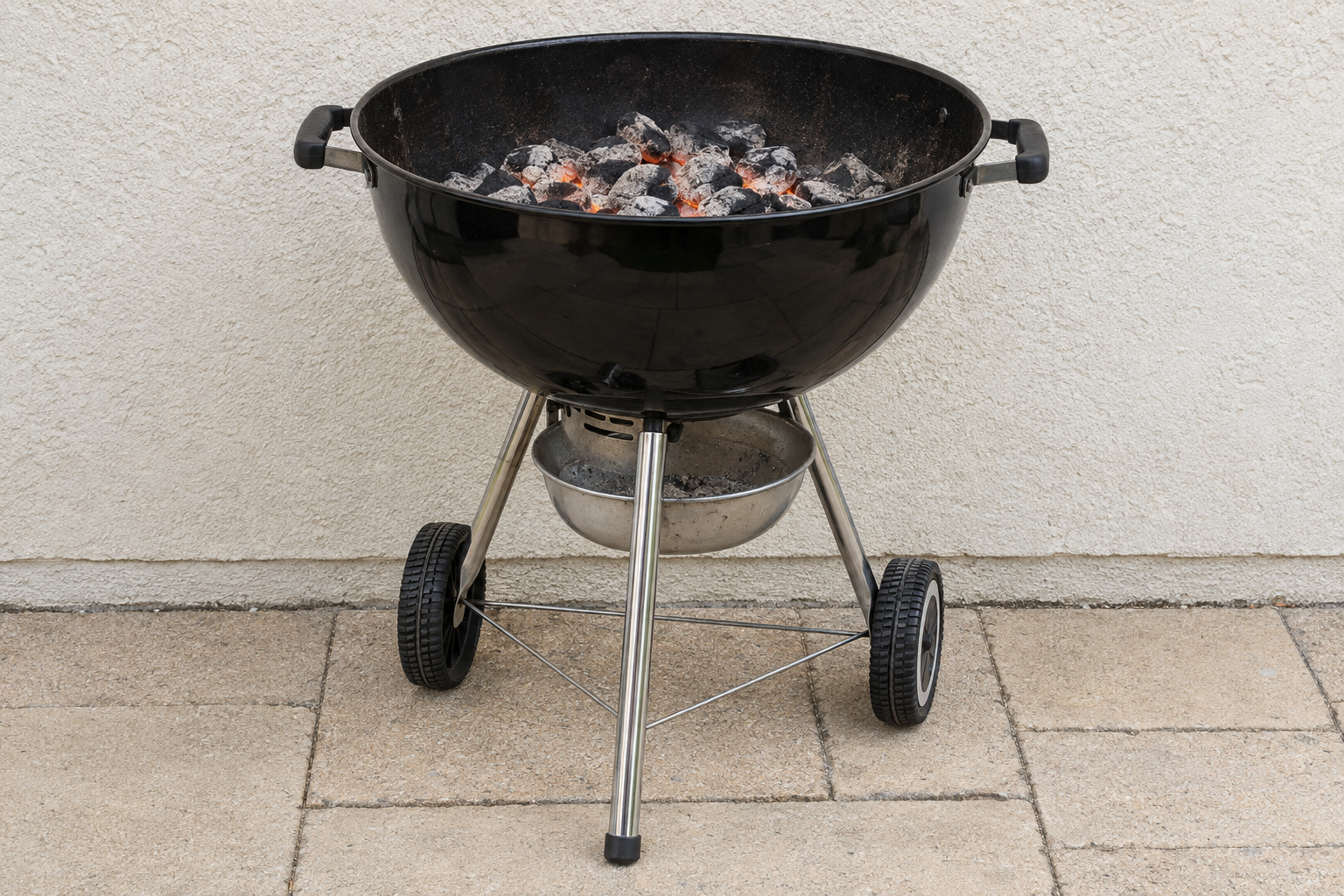
No calorimeter can measure that reaction's enthalpy change directly.
Burning carbon always makes some carbon dioxide alongside the carbon monoxide.
In plenty of oxygen, carbon burns cleanly to carbon dioxide.
In plenty of oxygen, carbon monoxide burns cleanly to carbon dioxide.
Each clean burning carries a measured enthalpy change.
How must the two clean equations be arranged so they add up to the carbon monoxide equation?
Check — multiple choice
A balanced equation is written: 2 Al(s) + 3 Cl₂(g) → 2 AlCl₃(s). How many chlorine atoms does each side carry?
Feedback if chosen: This option is wrong — you counted the aluminium coefficient. Each side carries 3 × 2 = 6 chlorine atoms.
Feedback if chosen: This option is wrong — you counted the Cl₂ molecules. Each molecule holds two atoms: 3 × 2 = 6 chlorine atoms per side.
Feedback if chosen: Correct. A balanced equation equalizes every element's atom count: 3 Cl₂ carries 6 chlorine atoms, and 2 AlCl₃ carries 6.
The equation we want to reach is called the target equation.
Each given step gets compared with the target, one species at a time.
Here are the two clean burnings, each with its measured enthalpy change.
The target makes carbon monoxide, yet one clean equation consumes it.
So the step that consumes carbon monoxide gets reversed.
A step whose target species carries the wrong coefficient needs scaling instead.
Every species missing from the target must cancel when the steps are added.
The kept step and the reversed step then add up to the target exactly.
The carbon dioxide was missing from the target, and it cancels one-for-one when the steps are added.
Identify how each given step equation must be reversed or scaled so that the intermediate species cancel and the steps add up to the target equation.
Part 2Check what you just learned
Check — multiple choice
A chemist wants ΔH for the target equation 6 C(graphite) + 3 H₂(g) → C₆H₆(l), from the three equations shown. Which given equation must be reversed?
Feedback if chosen: This option is wrong — you reversed an equation whose target species already sits on the right side. The target consumes carbon, and the given equation consumes carbon too.
Feedback if chosen: Correct. The target makes benzene, yet the given equation consumes it, so that equation gets reversed.
Feedback if chosen: This option is wrong — you reversed an equation whose target species already sits on the right side. The target consumes hydrogen, and the given equation consumes hydrogen too.
Check — multiple choice
In the same benzene problem, the target needs 6 C(graphite) and 3 H₂(g). Which scalings ready the carbon and hydrogen equations?
Feedback if chosen: This option is wrong — you swapped the two factors. The target's 6 C(graphite) sets the carbon equation's factor, and its 3 H₂(g) sets the hydrogen equation's.
Feedback if chosen: This option is wrong — you kept the hydrogen equation at one mole. The target needs 3 H₂(g), so the hydrogen equation takes × 3.
Feedback if chosen: Correct. The target needs 6 C(graphite), so the carbon equation takes × 6; it needs 3 H₂(g), so the hydrogen equation takes × 3.
Check — multiple choice
In the same benzene problem, the three manipulated equations are added. Which species cancel from the added equation?
Feedback if chosen: Correct. All three are missing from the target, and after the manipulations each one's counts match across the two sides.
Feedback if chosen: This option is wrong — you left the oxygen standing. The scaled steps consume 15/2 O₂(g) and the reversed benzene equation makes 15/2 O₂(g), so the oxygen cancels too.
Feedback if chosen: This option is wrong — you cancelled the target's own species. C(graphite) and H₂(g) must survive the addition — they are the target's reactants.
Check — multiple choice
A chemist wants ΔH for the target equation 2 H₂O₂(l) → 2 H₂O(l) + O₂(g), from the two equations shown. Which full set of manipulations makes the steps add up to the target?
Feedback if chosen: This option is wrong — you reversed the wrong equation. The target MAKES water, and the water equation already makes it; the target consumes hydrogen peroxide, so that equation gets reversed.
Feedback if chosen: This option is wrong — you forgot a scale. The reversed hydrogen-peroxide equation supplies only 1 H₂O₂(l), and the target consumes 2.
Feedback if chosen: Correct. The target consumes 2 H₂O₂(l), so that equation is reversed and doubled; the target makes 2 H₂O(l), so the water equation is doubled as written.
Feedback if chosen: This option is wrong — you skipped the reversal. As written, both equations make their products from hydrogen, and the hydrogen would not cancel.
Calculate an enthalpy change by Hess's law
Outcome: Calculate the enthalpy change of a target reaction by reversing and scaling given step reactions and summing their adjusted enthalpy changes.
Part 1Three combustions, one unmeasurable reaction
Every reference table lists −74.8 kJ/mol beside methane's formation equation: C(graphite) + 2 H₂(g) → CH₄(g).
Yet no chemist has ever made methane cleanly from carbon and hydrogen.
That reaction cannot be measured in any calorimeter.
The combustions of carbon, hydrogen, and methane all measure cleanly.
Each combustion carries a supplied enthalpy change.
How can three combustion equations be combined into the one equation nobody can measure?
A full Hess's-law calculation makes three moves, in order.
First, each step equation gets reversed or scaled until its target species matches the target equation.
Second, the manipulated equations are added together.
Every species missing from the target cancels one-for-one.
Third, the adjusted enthalpy changes are added too, each sign included.
Here are the three combustions as supplied.
The carbon equation is kept: its C(graphite) already matches the target.
The hydrogen equation is multiplied by 2: the target needs 2 H₂(g).
The methane equation is reversed: the target makes CH₄(g), and the combustion consumes it.
Here is the arranged stack: every intermediate cancels one-for-one, and the steps add up to the target.
Q: Using the three supplied combustions, what is ΔH for C(graphite) + 2 H₂(g) → CH₄(g)?
Identify the manipulation for each step:
keep C(graphite) + O₂(g) → CO₂(g)
multiply H₂(g) + ½ O₂(g) → H₂O(l) by 2
reverse CH₄(g) + 2 O₂(g) → CO₂(g) + 2 H₂O(l)
Apply the same manipulations to the enthalpy changes:
ΔH₁ = −393.5 kJ/mol_rxn
ΔH₂ = 2 × (−285.8) = −571.6 kJ/mol_rxn
ΔH₃ = +890.3 kJ/mol_rxn(reversed — sign flipped)
Add the adjusted enthalpy changes:
ΔH = −393.5 + (−571.6) + 890.3
ΔH = −74.8 kJ/mol_rxn
The reference table's −74.8 kJ/mol beside methane's formation equation is exactly this sum.
Three measurable enthalpy changes add up to the one nobody can measure.
Calculate the enthalpy change of a target reaction by reversing and scaling the given step reactions and summing their adjusted enthalpy changes.
Part 2Check what you just learned
Check — multiple choice
A chemist wants ΔH for the target equation 2 C(graphite) + 2 H₂(g) + O₂(g) → CH₃COOH(l), from the three equations shown. Which manipulation readies the carbon equation?
Feedback if chosen: This option is wrong — you kept the carbon at 1 mol. The target consumes 2 C(graphite), so the carbon equation takes × 2.
Feedback if chosen: This option is wrong — you reversed an equation whose carbon already sits where the target's does. The target consumes carbon, and this equation consumes carbon too.
Feedback if chosen: Correct. The target consumes 2 C(graphite), so the carbon equation is multiplied by 2.
Check — multiple choice
In the same acetic-acid problem, which manipulation readies the hydrogen equation?
Feedback if chosen: This option is wrong — you kept the hydrogen at 1 mol. The target consumes 2 H₂(g), so the hydrogen equation takes × 2.
Feedback if chosen: This option is wrong — you reversed an equation whose hydrogen already sits where the target's does. The target consumes hydrogen, and this equation consumes hydrogen too.
Feedback if chosen: Correct. The target consumes 2 H₂(g), so the hydrogen equation is multiplied by 2.
Check — multiple choice
In the same acetic-acid problem, which manipulation readies the acetic-acid equation?
Feedback if chosen: This option is wrong — you kept acetic acid as a reactant. The target MAKES acetic acid, and the given equation consumes it.
Feedback if chosen: Correct. The target makes CH₃COOH(l), yet the given equation consumes it, so that equation gets reversed.
Feedback if chosen: This option is wrong — you scaled an equation that already carries the right amount. The target makes exactly 1 CH₃COOH(l); the needed move is the reversal.
Check — numeric entry
In the same acetic-acid problem, the acetic-acid equation is reversed. What is its adjusted ΔH, in kJ/mol_rxn? Give your answer to 1 decimal place.
Feedback when correct: Correct. Reversing keeps the magnitude and flips the sign.
ΔH = +874.2 kJ/mol_rxn.
Anticipated wrong answers (feedback shown):
| -874.2 | You kept the given sign. The equation was reversed, and reversing flips the sign: ΔH = +874.2 kJ/mol_rxn. |
Check — numeric entry
In the same acetic-acid problem, the carbon equation is multiplied by 2. What is its adjusted ΔH, in kJ/mol_rxn? Give your answer to 1 decimal place.
Feedback when correct: Correct. Scaling multiplies the enthalpy change by the same factor.
ΔH = −393.5 × 2 = −787.0 kJ/mol_rxn.
Anticipated wrong answers (feedback shown):
| -393.5 | You doubled the equation but not its enthalpy change. The matching move is ΔH = −393.5 × 2 = −787.0 kJ/mol_rxn. |
Sign-error retry feedback:
| 787.0 | You found the right size. Now give the sign: scaling never flips the sign, and the combustion releases energy. |
Check — numeric entry
In the same acetic-acid problem, the three adjusted enthalpy changes are −787.0, −571.6, and +874.2 kJ/mol_rxn. What is ΔH for the target equation, 2 C(graphite) + 2 H₂(g) + O₂(g) → CH₃COOH(l), in kJ/mol_rxn? Give your answer to 1 decimal place.
Feedback when correct: Correct. The adjusted enthalpy changes are added, each sign included.
ΔH = −787.0 + (−571.6) + 874.2
ΔH = −484.4 kJ/mol_rxn.
Anticipated wrong answers (feedback shown):
| -2232.8 | You flipped the +874.2 back to a release. The reversed equation's adjusted ΔH is positive: −787.0 + (−571.6) + 874.2 = −484.4 kJ/mol_rxn. |
Sign-error retry feedback:
| 484.4 | You found the right size. Now give the sign: the two releases outweigh the absorption, so the sum is negative. |
Check — numeric entry
Using the three equations shown, what is ΔH for the target equation 6 C(graphite) + 3 H₂(g) → C₆H₆(l), in kJ/mol_rxn? Give your answer to 1 decimal place.
Feedback when correct: Correct. ΔH = 6 × (−393.5) + 3 × (−285.8) + 3,267.6.
ΔH = −2,361.0 + (−857.4) + 3,267.6
ΔH = +49.2 kJ/mol_rxn.
Anticipated wrong answers (feedback shown):
| -49.2 | You reversed the carbon and hydrogen equations instead of the benzene equation. The target makes benzene, so reversing its combustion gives +3,267.6, and the sum is +49.2 kJ/mol_rxn. |
| -6486.0 | You forgot to reverse the benzene equation. The target makes benzene, so reversing its combustion flips its ΔH to +3,267.6, and the sum is +49.2 kJ/mol_rxn. |
Worked solution revealed after a second miss
Identify the manipulation for each step:
multiply C(graphite) + O₂(g) → CO₂(g) by 6
multiply H₂(g) + ½ O₂(g) → H₂O(l) by 3
reverse C₆H₆(l) + 15/2 O₂(g) → 6 CO₂(g) + 3 H₂O(l)
Apply the same manipulations to the enthalpy changes:
ΔH₁ = 6 × (−393.5) = −2,361.0 kJ/mol_rxn
ΔH₂ = 3 × (−285.8) = −857.4 kJ/mol_rxn
ΔH₃ = +3,267.6 kJ/mol_rxn
Add the adjusted enthalpy changes:
ΔH = −2,361.0 + (−857.4) + 3,267.6
ΔH = +49.2 kJ/mol_rxn
Check — numeric entry
Using the two equations shown, what is ΔH for the target equation 2 H₂O₂(l) → 2 H₂O(l) + O₂(g), in kJ/mol_rxn? Give your answer to 1 decimal place.
Feedback when correct: Correct. ΔH = 2 × (+187.8) + 2 × (−285.8).
ΔH = +375.6 + (−571.6)
ΔH = −196.0 kJ/mol_rxn.
Anticipated wrong answers (feedback shown):
| -947.2 | You forgot to reverse the hydrogen-peroxide equation. The target consumes H₂O₂(l), so reversing it flips its ΔH to +187.8 before the doubling. |
| -98.0 | You forgot to multiply the two steps by 2. The target consumes 2 H₂O₂(l) and makes 2 H₂O(l), so both adjusted values double. |
Sign-error retry feedback:
| 196.0 | You found the right size. Now give the sign: the doubled release outweighs the doubled absorption, so the sum is negative. |
Worked solution revealed after a second miss
Identify the manipulation for each step:
reverse H₂(g) + O₂(g) → H₂O₂(l), then multiply it by 2
multiply H₂(g) + ½ O₂(g) → H₂O(l) by 2
Apply the same manipulations to the enthalpy changes:
ΔH₁ = 2 × (+187.8) = +375.6 kJ/mol_rxn
ΔH₂ = 2 × (−285.8) = −571.6 kJ/mol_rxn
Add the adjusted enthalpy changes:
ΔH = +375.6 + (−571.6)
ΔH = −196.0 kJ/mol_rxn
Choose the method the data support
Outcome: Judge which method the supplied data support — average bond enthalpies, standard enthalpies of formation, or a Hess's-law combination of step reactions — and calculate ΔH_rxn by that method.
Part 1Three problems, three kits
An exam page shows three reactions.
The first reaction arrives with its own table of average bond enthalpies.
The second reaction arrives with its own table of formation enthalpies.
The third reaction arrives with its own two ready-made step equations.
All three problems ask for the same quantity, ΔH_rxn.
Which method does each reaction's supplied material support?
Check — multiple choice
We've seen the estimate from average bond enthalpies. Which subtraction does it take?
Feedback if chosen: Correct. The broken-bond total is energy in, the formed-bond total is energy out, and the subtraction reads broken minus formed.
Feedback if chosen: This option is wrong — you swapped the two totals. The estimate reads the broken-bond total minus the formed-bond total.
Feedback if chosen: This option is wrong — you named the formation calculation's difference. The bond estimate reads the broken-bond total minus the formed-bond total.
Check — multiple choice
We've seen the calculation from a formation table. Which sum comes first in its subtraction?
Feedback if chosen: This option is wrong — you swapped the two sums. The products' sum comes first: ΔH_rxn = Σ ΔH_f(products) − Σ ΔH_f(reactants).
Feedback if chosen: Correct. The products' sum comes first: ΔH_rxn = Σ ΔH_f(products) − Σ ΔH_f(reactants).
Feedback if chosen: This option is wrong — you named the bond estimate's total. The formation calculation subtracts the reactants' formation sum from the products'.
A chemist picks the method that the supplied material supports.
The three methods are average bond enthalpies, formation enthalpies, and a Hess's-law combination of steps.
Suppose a problem supplies a table of standard enthalpies of formation.
That table supports exactly one method: the calculation from formation enthalpies.
We've seen that a bond-enthalpy answer is only an estimate, averaged over many compounds.
After the choice, the calculation proceeds exactly as we've practiced.
Here is the first problem: ethene burns, C₂H₄(g) + 3 O₂(g) → 2 CO₂(g) + 2 H₂O(g), with every substance a gas.
Its kit is a table of average bond enthalpies.
| bond | average bond enthalpy |
|---|---|
| C–H | 413 kJ/mol |
| C=C | 614 kJ/mol |
| O=O | 498 kJ/mol |
| C=O (in CO₂) | 799 kJ/mol |
| O–H | 467 kJ/mol |
A bond table supports the estimate from bond enthalpies.
Q: Use the supplied table of average bond enthalpies to estimate ΔH_rxn for C₂H₄(g) + 3 O₂(g) → 2 CO₂(g) + 2 H₂O(g).
Count every bond broken and every bond formed:
broken: 1 C=C, 4 C–H, and 3 O=O
formed: 4 C=O and 4 O–H
Total the bond enthalpies of each list:
broken total = 614 + 4(413) + 3(498)
broken total = 3,760 kJ
formed total = 4(799) + 4(467)
formed total = 5,064 kJ
Subtract the formed total from the broken total:
ΔH_rxn ≈ 3,760 − 5,064
ΔH_rxn ≈ −1,304 kJ/mol_rxn
So the −1,304 kJ/mol_rxn is an estimate.
We've seen that average bond enthalpies are defined for gas-phase molecules.
So the estimate from bond enthalpies works only when every substance in the reaction is a gas.
Here is the second problem: sucrose burns, C₁₂H₂₂O₁₁(s) + 12 O₂(g) → 12 CO₂(g) + 11 H₂O(l).
Its kit is a table of standard enthalpies of formation.
| substance | (kJ/mol) |
|---|---|
| C₁₂H₂₂O₁₁(s) | −2,226.1 |
| O₂(g) | 0 |
| CO₂(g) | −393.5 |
| H₂O(l) | −285.8 |
A formation table supports the calculation from formation enthalpies.
Q: Use the supplied formation table to calculate ΔH_rxn for C₁₂H₂₂O₁₁(s) + 12 O₂(g) → 12 CO₂(g) + 11 H₂O(l).
Write down the values in the question:
ΔH_f(C₁₂H₂₂O₁₁(s)) = −2,226.1 kJ/mol
ΔH_f(O₂(g)) = 0 kJ/mol
ΔH_f(CO₂(g)) = −393.5 kJ/mol
ΔH_f(H₂O(l)) = −285.8 kJ/mol
Write down the equation:
ΔH_rxn = Σ ΔH_f(products) − Σ ΔH_f(reactants)
Substitute the values into the equation:
ΔH_rxn = [12(−393.5) + 11(−285.8)] − [1(−2,226.1) + 12(0)]
ΔH_rxn = −7,865.8 + 2,226.1
ΔH_rxn = −5,639.7 kJ/mol_rxn
Here is the third problem: carbon burns to carbon monoxide, C(graphite) + ½ O₂(g) → CO(g).
Its kit is two ready-made step equations — we've seen this exact pair.
Ready-made step equations support a Hess's-law combination: reverse or scale each step, add them, and sum the adjusted enthalpy changes.
The combination gives −110.5 kJ/mol_rxn, exactly as we've practiced.
Here are the three kits and their methods in one table.
| the supplied material | the method it supports | what the method computes |
|---|---|---|
| a table of average bond enthalpies | the estimate from bond enthalpies | an estimate of |
| a table of standard enthalpies of formation | the calculation from formation enthalpies | from the table's values |
| ready-made step equations | a Hess's-law combination of the steps | from the steps' values |
When a problem supplies both a bond table and a formation table, the formation calculation is chosen.
The formation calculation computes ΔH_rxn from each substance's own value.
The bond-enthalpy estimate computes ΔH_rxn from averaged values.
So the formation calculation's answer is the more reliable one.
Judge which method the supplied data support — average bond enthalpies, standard enthalpies of formation, or a Hess's-law combination of step reactions — and calculate ΔH_rxn by that method.
Part 2Check what you just learned
Check — multiple choice
| bond | average bond enthalpy |
|---|---|
| H–H | 436 kJ/mol |
| C–C | 347 kJ/mol |
| C=C | 614 kJ/mol |
| C–H | 413 kJ/mol |
A problem asks for ΔH_rxn of C₃H₆(g) + H₂(g) → C₃H₈(g), with every substance a gas. It supplies the table shown. Which method do the supplied data support?
Feedback if chosen: Correct. The kit is a bond table, the reaction is all gas, and a bond table supports the estimate from bond enthalpies.
Feedback if chosen: This option is wrong — you reached for a formation table the problem never supplied. The kit is a table of average bond enthalpies.
Feedback if chosen: This option is wrong — you reached for step equations the problem never supplied. The kit is a table of average bond enthalpies.
Check — multiple choice
| substance | (kJ/mol) |
|---|---|
| C₃H₇OH(l) | −302.6 |
| O₂(g) | 0 |
| CO₂(g) | −393.5 |
| H₂O(l) | −285.8 |
A problem asks for ΔH_rxn of C₃H₇OH(l) + 9/2 O₂(g) → 3 CO₂(g) + 4 H₂O(l). It supplies the table shown. Which method do the supplied data support?
Feedback if chosen: This option is wrong — you reached for a bond table the problem never supplied, and the reaction holds two liquids besides.
Feedback if chosen: Correct. The kit is a formation table, and a formation table supports the products-first calculation from formation enthalpies.
Feedback if chosen: This option is wrong — you reached for step equations the problem never supplied. The kit is a table of formation enthalpies.
Check — multiple choice
A problem asks for ΔH_rxn of Fe₂O₃(s) + 3 CO(g) → 2 Fe(s) + 3 CO₂(g). It supplies a table of average bond enthalpies and two ready-made step equations whose sum is the target equation. Each step equation comes with its ΔH value. Which method do the supplied data support?
Feedback if chosen: This option is wrong — you accepted the bond table for a reaction with solids. Average bond enthalpies are defined for gas-phase molecules, and Fe₂O₃(s) and Fe(s) are solids.
Feedback if chosen: This option is wrong — you reached for a formation table the problem never supplied.
Feedback if chosen: Correct. Average bond enthalpies are defined for gas-phase molecules, Fe₂O₃(s) and Fe(s) are solids, and the two ready-made step equations support a Hess's-law combination.
Check — multiple choice
A problem asks for ΔH_rxn of CH₃OCH₃(g) + 3 O₂(g) → 2 CO₂(g) + 3 H₂O(g), with every substance a gas. It supplies a table of average bond enthalpies AND a table of standard enthalpies of formation covering every substance. Which method gives the more reliable ΔH_rxn?
Feedback if chosen: This option is wrong — you chose the estimate over each substance's own value.
Feedback if chosen: Correct. Both tables could run here, but the formation calculation computes ΔH_rxn from each substance's own value.
Feedback if chosen: This option is wrong — you reached for step equations the problem never supplied.
Check — multiple choice
In the last problem, both tables could run, and the calculation from formation enthalpies was chosen. What is the correct reason?
Feedback if chosen: Correct. The table's entries are averages, so the bond answer is an estimate; the formation calculation computes ΔH_rxn from each substance's own value.
Feedback if chosen: This option is wrong — you shrank the estimate's scope. The bond estimate works for any all-gas reaction, combustion or not; the formation calculation is chosen for reliability, not scope.
Feedback if chosen: This option is wrong — you dropped the balance requirement. Both methods read their coefficients from the balanced equation.
Feedback if chosen: This option is wrong — you judged the methods by speed. The formation table lists a value for one substance; the bond table lists a value averaged over many compounds.
Check — numeric entry
Propan-1-ol burns: C₃H₇OH(l) + 9/2 O₂(g) → 3 CO₂(g) + 4 H₂O(l). The supplied values are ΔH_f(C₃H₇OH(l)) = −302.6 kJ/mol, ΔH_f(O₂(g)) = 0 kJ/mol, ΔH_f(CO₂(g)) = −393.5 kJ/mol, and ΔH_f(H₂O(l)) = −285.8 kJ/mol. Calculate ΔH_rxn by the one method these data support, in kJ/mol_rxn. Give your answer to 1 decimal place.
Feedback when correct: Correct. The products' sum is 3(−393.5) + 4(−285.8) = −2,323.7 kJ.
The reactants' sum is 1(−302.6) + 9/2 × 0 = −302.6 kJ.
ΔH_rxn = −2,323.7 − (−302.6) = −2,021.1 kJ/mol_rxn.
Anticipated wrong answers (feedback shown):
| -2323.7 | You stopped at the products' sum. The reactants' sum, −302.6 kJ, is still to be subtracted: ΔH_rxn = −2,323.7 + 302.6 = −2,021.1 kJ/mol_rxn. |
| -2626.3 | You added the propan-1-ol term instead of subtracting it. ΔH_rxn = −2,323.7 − (−302.6) = −2,021.1 kJ/mol_rxn. |
Sign-error retry feedback:
| 2021.1 | You found the right size. Now give the sign: the products' sum lies below the reactants' sum, so ΔH_rxn is negative. |
Worked solution revealed after a second miss
Write down the values in the question:
ΔH_f(C₃H₇OH(l)) = −302.6 kJ/mol
ΔH_f(O₂(g)) = 0 kJ/mol
ΔH_f(CO₂(g)) = −393.5 kJ/mol
ΔH_f(H₂O(l)) = −285.8 kJ/mol
Write down the equation:
ΔH_rxn = Σ ΔH_f(products) − Σ ΔH_f(reactants)
Substitute the values into the equation:
ΔH_rxn = [3(−393.5) + 4(−285.8)] − [1(−302.6) + 9/2(0)]
ΔH_rxn = −2,323.7 + 302.6
ΔH_rxn = −2,021.1 kJ/mol_rxn
Routes to ΔH: bond enthalpies, formation tables, and Hess's law
Outcome: Earn the points each route to an enthalpy change pays: count the bonds from the supplied diagrams, take products minus reactants with the coefficients, and arrange given equations until they add to the target.
Part 1What each route to an enthalpy change pays for
On the free-response section, a bond-enthalpy point pays for the counting: every bond broken and every bond formed, read from the supplied Lewis diagrams.
The bond-route value pays as the broken-bond total minus the formed-bond total, with the algebraic sign on the answer.
A formation-table point pays for products minus reactants, each standard enthalpy of formation multiplied by its coefficient from the balanced equation.
A value in kJ/mol_rxn belongs to the equation as written: before scaling to a sample, convert moles of the substance into moles of reaction using its coefficient.
The three items below are one practice set. Answer every part on paper, showing each setup with its units, before revealing any model response. Then score yourself one rubric line at a time.
Free-response question
Source note (not shown as part of the question): authored to the enthalpy-routes archetype (FRQ playbook T3 multi-step calculation; bond-enthalpy estimate)
1,3-Butadiene, C₄H₆, is a gas used to make synthetic rubber. Butadiene burns in oxygen according to the equation 2 C₄H₆(g) + 11 O₂(g) → 8 CO₂(g) + 6 H₂O(g). The Lewis diagrams of the four substances are shown in the figure, with butadiene in the top row and O₂, CO₂, and H₂O in the bottom row. The average bond enthalpies, in kJ/mol, are: C–H 413; C–C 347; C=C 614; O=O 498; C=O (in CO₂) 799; O–H 467.
(a) Identify the number of bonds of each type that are broken and the number of bonds of each type that are formed when the reaction occurs as written. [1 point]
(b) Using the average bond enthalpies given, calculate the value of ΔH_rxn for the reaction as written. Include the algebraic sign on your answer. [2 points]
✓ Model response (the key)
(a)
Bonds broken are the reactants' bonds: in 2 C₄H₆, 12 C–H bonds, 2 C–C bonds, and 4 C=C bonds; in 11 O₂, 11 O=O bonds.
Bonds formed are the products' bonds: in 8 CO₂, 16 C=O bonds; in 6 H₂O, 12 O–H bonds.
(b)
Energy in, to break the reactants' bonds: 12(413) + 2(347) + 4(614) + 11(498) = 13,584 kJ.
Energy out, as the products' bonds form: 16(799) + 12(467) = 18,388 kJ.
ΔH_rxn ≈ 13,584 − 18,388 = −4,804 kJ/mol_rxn.
Scoring rubric — 3 points available
- (a) One point is earned for all six bond counts correct: 12 C–H, 2 C–C, 4 C=C, and 11 O=O broken; 16 C=O and 12 O–H formed. [1 pt]
- (b) One point is earned for the two totals built from the supplied values, consistent with your counts in part (a): broken-bond total 12(413) + 2(347) + 4(614) + 11(498) = 13,584 kJ, and formed-bond total 16(799) + 12(467) = 18,388 kJ. [1 pt]
- (b) One point is earned for the broken-bond total minus the formed-bond total, with the sign: ΔH_rxn ≈ 13,584 − 18,388 = −4,804 kJ/mol_rxn. [1 pt]
Free-response question
Source note (not shown as part of the question): authored to the enthalpy-routes archetype (FRQ playbook T3 multi-step calculation + T2 claim support; formation-table route, continued from the previous item)
| Substance | (kJ/mol) |
|---|---|
| C₄H₆(g) | +108.8 |
| O₂(g) | 0 |
| CO₂(g) | −393.5 |
| H₂O(g) | −241.8 |
The combustion of 1,3-butadiene is represented by the equation 2 C₄H₆(g) + 11 O₂(g) → 8 CO₂(g) + 6 H₂O(g). (The molar mass of C₄H₆ is 54.09 g/mol.) In part (b) you calculated ΔH_rxn for this reaction from average bond enthalpies. The table gives standard enthalpies of formation, tabulated at 25 °C.
(c) Write the balanced chemical equation for the formation reaction of 1,3-butadiene, C₄H₆(g), from its elements in their standard states. [1 point]
(d) Using the information in the table, calculate the value of ΔH_rxn for the combustion reaction as written. Include the algebraic sign on your answer. [2 points]
(e) The bond-enthalpy value from part (b) and the formation-table value from part (d) differ. Determine which of the two is expected to be the more reliable value of ΔH_rxn for this reaction, and justify your choice. [1 point]
(f) Using your answer from part (d), calculate the amount of energy released when 54.1 g of C₄H₆(g) burns completely in excess oxygen. Report your answer in kilojoules to three significant figures. [1 point]
✓ Model response (the key)
(c)
4 C(graphite) + 3 H₂(g) → C₄H₆(g)
A formation equation produces exactly 1 mol of C₄H₆(g), and each element enters as its standard state: solid graphite and H₂(g).
(d)
ΔH_rxn = Σ ΔH_f(products) − Σ ΔH_f(reactants), each value multiplied by its coefficient.
Products: 8(−393.5) + 6(−241.8) = −3,148.0 + (−1,450.8) = −4,598.8 kJ.
Reactants: 2(+108.8) + 11(0) = +217.6 kJ.
ΔH_rxn = −4,598.8 − 217.6 = −4,816.4 kJ/mol_rxn.
(e)
The value from part (d) is expected to be the more reliable value.
The formation-table values are tabulated for these exact substances: C₄H₆(g), CO₂(g), and H₂O(g).
The bond-enthalpy values are averages, each taken over the same bond type in many different molecules.
The actual bonds in these molecules differ from those averages, so the bond-route value is an estimate.
(f)
Moles of C₄H₆ = 54.1 g ÷ 54.09 g/mol = 1.00 mol.
The equation as written burns 2 mol of C₄H₆, so moles of reaction = 1.00 ÷ 2 = 0.500 mol_rxn.
q = (0.500 mol_rxn) × (−4,816.4 kJ/mol_rxn) = −2,408.2 kJ.
q is negative, so the reaction releases the energy.
Energy released = 2,408.2 kJ → 2,410 kJ to three significant figures.
Scoring rubric — 5 points available
- (c) One point is earned for the correct formation equation: 4 C(graphite) + 3 H₂(g) → C₄H₆(g), with exactly 1 mol of C₄H₆(g) formed, carbon as solid graphite, and hydrogen as H₂(g). Accept C(s) for C(graphite). [1 pt]
- (d) One point is earned for the products-minus-reactants setup with every value multiplied by its coefficient: [8(−393.5) + 6(−241.8)] − [2(+108.8) + 11(0)]. [1 pt]
- (d) One point is earned for the value with its sign: ΔH_rxn = −4,598.8 − 217.6 = −4,816.4 kJ/mol_rxn. Accept −4,816 kJ/mol_rxn. [1 pt]
- (e) One point is earned for the decision AND its ground: the part (d) value, because the formation-table values are tabulated for these exact substances, while the bond-enthalpy values are averages over many different molecules, so the actual bonds in these molecules differ from those averages. A bare choice with no ground does not earn the point. [1 pt]
- (f) One point is earned for the energy with its unit, consistent with your part (d) value: moles of reaction = 1.00 ÷ 2 = 0.500 mol_rxn, and energy released = 0.500 × 4,816.4 = 2,408.2 kJ → 2,410 kJ at three significant figures. Accept 2,408.2 kJ (the unrounded form) with the setup shown, and accept q = −2,410 kJ with the release stated. [1 pt]
Part 2Arranging given equations
A Hess point pays twice: once for the manipulations, naming what is done to each given equation, and once for the sum.
Check the arrangement before summing: a substance the target equation does not carry must appear in equal amounts on the two sides of the manipulated equations, so it cancels.
Free-response question
Source note (not shown as part of the question): authored to the enthalpy-routes archetype (FRQ playbook T3 multi-step calculation; Hess arrangement)
Tungsten powder is made industrially by the reaction of solid tungsten(VI) oxide, WO₃, with hydrogen gas. The target equation and two given equations are shown in the figure, each given equation with its enthalpy change.
(g) Identify how each of the two given equations must be manipulated (reversed, multiplied by a factor, or both), and calculate the value of ΔH_rxn for the target equation. Include the algebraic sign on your answer. [2 points]
✓ Model response (the key)
(g)
The target has WO₃(s) as a reactant, so reverse the tungsten equation: WO₃(s) → W(s) + 3/2 O₂(g), ΔH = +842.9 kJ/mol_rxn.
The target has 3 H₂(g), so multiply the hydrogen equation by 3: 3 H₂(g) + 3/2 O₂(g) → 3 H₂O(l), ΔH = 3(−285.8) = −857.4 kJ/mol_rxn.
Add the two manipulated equations: the 3/2 O₂(g) on each side cancels, leaving WO₃(s) + 3 H₂(g) → W(s) + 3 H₂O(l).
ΔH_rxn = +842.9 + (−857.4) = −14.5 kJ/mol_rxn.
Scoring rubric — 2 points available
- (g) One point is earned for both manipulations: the tungsten equation reversed, its ΔH becoming +842.9 kJ/mol_rxn, and the hydrogen equation multiplied by 3, its ΔH becoming 3(−285.8) = −857.4 kJ/mol_rxn. [1 pt]
- (g) One point is earned for the summed value with its sign, consistent with your manipulations: ΔH_rxn = +842.9 − 857.4 = −14.5 kJ/mol_rxn. [1 pt]
Checkpoint — the whole unit: energy, heat, and the three routes to ΔH
Check — multiple choice
Two separate bromine atoms pair up, forming the Br–Br bond of a Br₂ molecule. Which option gives the energy change of the pairing and what happens to the two atoms' potential energy?
Feedback if chosen: Correct. Forming a bond releases energy, and the released energy is the drop: the paired atoms sit at a lower potential energy than the separate atoms.
Feedback if chosen: This option is wrong — you let the released energy come from nowhere. The release IS the drop: the paired atoms end at a lower potential energy.
Feedback if chosen: This option is wrong — you crossed the two halves. An energy input would raise the potential energy; this pairing releases energy as the potential energy falls.
Feedback if chosen: This option is wrong — you gave the pairing the cost that bond breaking carries. Breaking a bond requires an input; forming one releases energy, lowering the potential energy.
Check — numeric entry
A jeweler's annealing furnace warms a 40.0 g tungsten ring blank from 18.0 °C to 68.0 °C. Tungsten's specific heat capacity is 0.132 J/(g·°C). Calculate q for the tungsten, in J.
Feedback when correct: Correct. ΔT = 68.0 − 18.0 = +50.0 °C, so q = (40.0)(0.132)(+50.0) = +264 J. The tungsten absorbed 264 J.
Anticipated wrong answers (feedback shown):
| 6.6 | You left out the mass. q multiplies all three factors: q = mcΔT. |
| 2000 | You left out the specific heat capacity. q multiplies all three factors: q = mcΔT. |
| 359.04 | You used the final temperature, 68.0 °C, in place of the temperature change. ΔT = 68.0 − 18.0 = +50.0 °C. |
| -264 | You subtracted the temperatures the wrong way. ΔT = T_final − T_initial = 68.0 − 18.0 = +50.0 °C: the warming tungsten absorbed energy, so q is positive. |
Worked solution revealed after a second miss
Write down the values in the question:
m = 40.0 g
c = 0.132 J/(g·°C)
ΔT = 68.0 − 18.0 = +50.0 °C
Write down the equation:
q = mcΔT
Substitute the values into the equation:
q = (40.0)(0.132)(+50.0)
q = +264 J
Check — multiple choice
A chemical oxygen generator decomposes potassium chlorate when heated: 2 KClO₃(s) → 2 KCl(s) + 3 O₂(g), ΔH = −77.6 kJ/mol_rxn. What is ΔH for the reverse reaction, 2 KCl(s) + 3 O₂(g) → 2 KClO₃(s)?
Feedback if chosen: This option is wrong — you subtracted the forward value from its mirror image: 77.6 − (−77.6). Reversing flips the sign only; the magnitude stays 77.6 kJ/mol_rxn.
Feedback if chosen: Correct. A reaction run in reverse keeps the same magnitude and takes the opposite sign, so the reverse reaction's ΔH is +77.6 kJ/mol_rxn.
Feedback if chosen: This option is wrong — you cancelled the two directions inside one value. Each direction keeps its own enthalpy: reversing keeps the magnitude and flips the sign.
Feedback if chosen: This option is wrong — you kept the forward sign. The forward decomposition releases 77.6 kJ per mole of reaction; the reverse reaction absorbs the same 77.6 kJ.
Check — multiple choice
Chromium's standard state is Cr(s), and nitrogen's is N₂(g). Which of the following has a standard enthalpy of formation, ΔH_f, of 0 kJ/mol?
Feedback if chosen: This option is wrong — you let a stable, common gas sit at zero. Carbon dioxide is a compound: forming it from its elements has a real, nonzero enthalpy change.
Feedback if chosen: Correct. Cr(s) is chromium's standard state, and an element in its standard state forms from itself with no change at all, so its ΔH_f is exactly 0 kJ/mol.
Feedback if chosen: This option is wrong — you counted any pure element as zero. The zero belongs to nitrogen's standard form, N₂(g); making separate atoms from N₂(g) takes a real energy input.
Feedback if chosen: This option is wrong — you let a familiar mineral sit at zero. Silicon dioxide is a compound: forming it from its elements has a real, nonzero enthalpy change.
Check — multiple choice
Solid magnesium carbonate decomposes into solid magnesium oxide and carbon dioxide gas when heated. The reaction's energy diagram is shown, drawn on a gridded energy axis. What is the reaction's energy change, sign included?
Feedback if chosen: This option is wrong — you took the right gap but counted it negative. The change counts positive when the product level lies above the reactant level.
Feedback if chosen: This option is wrong — you read the reactant level's own height, 50 kJ, as the change. The change is the gap between the levels: 150 − 50 = +100 kJ.
Feedback if chosen: Correct. The product level sits at 150 kJ and the reactant level at 50 kJ: 150 − 50 = +100 kJ, positive because the product level lies above the reactant level.
Feedback if chosen: This option is wrong — you read the product level's own height, 150 kJ, as the change. The change is the gap between the levels: 150 − 50 = +100 kJ.
Check — numeric entry
Chlorine reacts with fluorine: Cl₂(g) + F₂(g) → 2 ClF(g). Average bond enthalpies, in kJ/mol: Cl–Cl 243, F–F 155, Cl–F 253. Estimate ΔH_rxn, in kJ/mol_rxn.
Feedback when correct: Correct. Broken: 243 + 155 = 398 kJ. Formed: 2 × 253 = 506 kJ.
398 − 506 = −108 kJ/mol_rxn, an estimate.
Anticipated wrong answers (feedback shown):
| 145 | You counted one Cl–F bond. The equation forms 2 ClF: the formed total is 506 kJ, and 398 − 506 = −108 kJ/mol_rxn. |
| 904 | You added the two totals. The estimate subtracts: 398 − 506 = −108 kJ/mol_rxn. |
Sign-error retry feedback:
| 108 | You found the right size. Now give the sign: forming releases more than breaking requires, so ΔH_rxn is negative. |
| +108 | You found the right size. Now give the sign: forming releases more than breaking requires, so ΔH_rxn is negative. |
Worked solution revealed after a second miss
Write down the values in the question:
Cl–Cl 243 kJ/mol
F–F 155 kJ/mol
Cl–F 253 kJ/mol
Total the bonds broken and the bonds formed:
broken: 243 + 155 = 398 kJ
formed: 2 × 253 = 506 kJ
Subtract the formed total from the broken total:
ΔH_rxn = 398 − 506
ΔH_rxn = −108 kJ/mol_rxn
Check — multiple choice
A chemist wants ΔH for the target equation 2 SnO(s) + O₂(g) → 2 SnO₂(s), from the two equations shown. Which full set of manipulations makes the steps add up to the target?
Feedback if chosen: This option is wrong — you reversed the equation whose product the target also makes. Those steps add up to the reverse of the target: 2 SnO₂(s) → 2 SnO(s) + O₂(g).
Feedback if chosen: This option is wrong — you kept both equations forward. Added as written they only MAKE SnO and SnO₂; the target consumes the 2 SnO, so the SnO equation must be reversed.
Feedback if chosen: This option is wrong — you gave the SnO equation a scaling it does not need. Reversed, it already supplies the 2 SnO the target consumes; doubling it leaves 2 Sn uncancelled.
Feedback if chosen: Correct. The target makes 2 SnO₂, so the SnO₂ equation is multiplied by 2; the target consumes 2 SnO, so the equation that makes 2 SnO is reversed. The 2 Sn cancel.
Check — numeric entry
A student heats a 100.0 g metal cube with no label to 80.0 °C in a water bath and drops it into 100.0 g of water at 20.0 °C in a coffee-cup calorimeter. The thermometer settles at 25.0 °C. Water's specific heat capacity is 4.18 J/(g·°C). What is the metal's specific heat capacity, in J/(g·°C), to 3 significant figures?
Feedback when correct: Correct. The water gained q = (100.0)(4.18)(+5.0) = +2,090 J, so the metal's q is −2,090 J. The metal's ΔT = 25.0 − 80.0 = −55.0 °C, and c = −2,090 ÷ (100.0 × (−55.0)) = 0.380 J/(g·°C).
Anticipated wrong answers (feedback shown):
| -0.380 | A specific heat capacity is never negative — you kept the water's +2,090 J as the metal's q. The metal released that energy: q_hot = −q_cold gives the metal −2,090 J, and c comes out positive. |
| 4.18 | You divided the water's q by the water's own mass and ΔT — that returns water's capacity. Divide the metal's q by the metal's mass and the metal's ΔT. |
| 0.836 | You used the final temperature, 25.0 °C, as the metal's temperature change. The metal's ΔT = 25.0 − 80.0 = −55.0 °C. |
Worked solution revealed after a second miss
Write down the values in the question:
m = 100.0 g, T_initial = 80.0 °C (the metal cube)
m = 100.0 g, c = 4.18 J/(g·°C), T_initial = 20.0 °C (the water)
T_final = 25.0 °C
Write down the equations:
q = mcΔT
q_hot = −q_cold
Compute the water's q:
q_water = (100.0)(4.18)(25.0 − 20.0)
q_water = +2,090 J
Flip the sign to get the metal's q:
q_metal = −2,090 J
Make c the subject, and calculate:
c = q/(mΔT)
c = −2,090/(100.0 × (25.0 − 80.0))
c = 0.380 J/(g·°C)
Check — numeric entry
A fuel chemist burns a sample of liquid hydrazine, a rocket fuel: N₂H₄(l) + O₂(g) → N₂(g) + 2 H₂O(l). The supplied values are ΔH_f(N₂H₄(l)) = +50.6 kJ/mol, ΔH_f(O₂(g)) = 0 kJ/mol, ΔH_f(N₂(g)) = 0 kJ/mol, and ΔH_f(H₂O(l)) = −285.8 kJ/mol. What is ΔH_rxn, in kJ/mol_rxn? Give your answer to 1 decimal place.
Feedback when correct: Correct. The products' sum is 0 + 2(−285.8) = −571.6 kJ.
The reactants' sum is +50.6 + 0 = +50.6 kJ.
ΔH_rxn = −571.6 − 50.6 = −622.2 kJ/mol_rxn.
Anticipated wrong answers (feedback shown):
| -521.0 | You added the reactants' sum instead of subtracting it: −571.6 + 50.6 takes subtraction. ΔH_rxn = −571.6 − 50.6 = −622.2 kJ/mol_rxn. |
| -336.4 | You dropped the coefficient 2 on H₂O(l). The products' sum is 2(−285.8) = −571.6 kJ, and −571.6 − 50.6 = −622.2 kJ/mol_rxn. |
| -571.6 | You set the hydrazine's row to zero. Hydrazine is a compound; only an element in its standard state sits at zero. Subtract its +50.6 kJ. |
Sign-error retry feedback:
| 622.2 | You found the right size. Now give the sign: the products' sum, −571.6 kJ, lies below the reactants' sum, +50.6 kJ, so ΔH_rxn is negative. |
| +622.2 | You found the right size. Now give the sign: the products' sum, −571.6 kJ, lies below the reactants' sum, +50.6 kJ, so ΔH_rxn is negative. |
Worked solution revealed after a second miss
Write down the values in the question:
ΔH_f(N₂H₄(l)) = +50.6 kJ/mol
ΔH_f(O₂(g)) = 0 kJ/mol
ΔH_f(N₂(g)) = 0 kJ/mol
ΔH_f(H₂O(l)) = −285.8 kJ/mol
Write down the equation:
ΔH_rxn = Σ ΔH_f(products) − Σ ΔH_f(reactants)
Substitute the values into the equation:
ΔH_rxn = [0 + 2(−285.8)] − [+50.6 + 0]
ΔH_rxn = −571.6 − 50.6
ΔH_rxn = −622.2 kJ/mol_rxn
Check — numeric entry
A metals lab melts 78.2 g of potassium in a sealed vessel. Potassium's molar mass is 39.1 g/mol, and its molar enthalpy of fusion, ΔH_fus, is 2.33 kJ/mol. Calculate q for the melt, in kJ, to 3 significant figures.
Feedback when correct: Correct. n = 78.2/39.1 = 2.00 mol. A melt absorbs energy, so q = +(2.00)(2.33) = +4.66 kJ.
Anticipated wrong answers (feedback shown):
| 182 | You multiplied the mass in grams by the molar enthalpy: 78.2 × 2.33. Convert to moles first: n = 78.2/39.1 = 2.00 mol. |
| 2.33 | You took one mole's worth. 2.00 mol of potassium melts: multiply the molar enthalpy by n = 78.2/39.1 = 2.00 mol. |
| 1.165 | You divided by the moles instead of multiplying. q = nΔH: multiply n = 2.00 mol by the molar enthalpy. |
| -4.66 | You gave the melt a release's sign. Melting absorbs energy, so the melting potassium's q is positive. |
Worked solution revealed after a second miss
Write down the values in the question:
m = 78.2 g
M = 39.1 g/mol
ΔH_fus = 2.33 kJ/mol
Write down the equations:
n = m/M
q = nΔH
Convert the mass to moles:
n = 78.2/39.1
n = 2.00 mol
Substitute the values into the equation:
q = +(2.00)(2.33)
q = +4.66 kJ
Check — numeric entry
Using the three equations shown, what is ΔH for the target equation 7 C(graphite) + 4 H₂(g) → C₇H₈(l), in kJ/mol_rxn? Give your answer to 1 decimal place.
Feedback when correct: Correct. ΔH = 7 × (−393.5) + 4 × (−285.8) + 3,910.3.
ΔH = −2,754.5 + (−1,143.2) + 3,910.3
ΔH = +12.6 kJ/mol_rxn.
Anticipated wrong answers (feedback shown):
| -12.6 | You reversed the carbon and hydrogen equations instead of the toluene equation. The target makes toluene, so reversing its combustion gives +3,910.3, and the sum is +12.6 kJ/mol_rxn. |
| -7808.0 | You forgot to reverse the toluene equation. The target makes toluene, so reversing its combustion flips its ΔH to +3,910.3. |
| 3231.0 | You skipped the scalings. The target needs 7 C(graphite) and 4 H₂(g): multiply the carbon equation by 7 and the hydrogen equation by 4. |
Worked solution revealed after a second miss
Identify the manipulation for each step:
multiply C(graphite) + O₂(g) → CO₂(g) by 7
multiply H₂(g) + ½ O₂(g) → H₂O(l) by 4
reverse C₇H₈(l) + 9 O₂(g) → 7 CO₂(g) + 4 H₂O(l)
Apply the same manipulations to the enthalpy changes:
ΔH₁ = 7 × (−393.5) = −2,754.5 kJ/mol_rxn
ΔH₂ = 4 × (−285.8) = −1,143.2 kJ/mol_rxn
ΔH₃ = +3,910.3 kJ/mol_rxn
Add the adjusted enthalpy changes:
ΔH = −2,754.5 + (−1,143.2) + 3,910.3
ΔH = +12.6 kJ/mol_rxn
Check — multiple choice
A student uses a table of average bond enthalpies to estimate ΔH_rxn for the gas-phase combustion of formaldehyde: CH₂O(g) + O₂(g) → CO₂(g) + H₂O(g). The arithmetic contains no mistake, yet a calorimeter measurement of the same reaction, with the water a gas in both, differs from the estimate. What explains the difference?
Feedback if chosen: This option is wrong — ΔH_rxn states the energy per mole of reaction, whatever amount burns. The amount cannot separate the two values.
Feedback if chosen: This option is wrong — both values describe the same equation, with the water a gas in each. A state choice shared by both values cannot separate them.
Feedback if chosen: This option is wrong — the calorimeter measures the real reaction. The estimate is the approximate value, because its table entries are averages.
Feedback if chosen: Correct. Averaged entries rarely match formaldehyde's own C–H and C=O bonds exactly, so the estimate lands near the measured value without equaling it.
Check — numeric entry
Acetone burns: CH₃COCH₃(l) + 4 O₂(g) → 3 CO₂(g) + 3 H₂O(l), with a measured ΔH_rxn = −1,790.0 kJ/mol_rxn. The supplied values are ΔH_f(CO₂(g)) = −393.5 kJ/mol, ΔH_f(H₂O(l)) = −285.8 kJ/mol, and ΔH_f(O₂(g)) = 0 kJ/mol. What is the ΔH_f of CH₃COCH₃(l), in kJ/mol? Give your answer to 1 decimal place.
Feedback when correct: Correct. The products' sum is 3(−393.5) + 3(−285.8) = −2,037.9 kJ.
−1,790.0 = −2,037.9 − x, so x = −2,037.9 + 1,790.0 = −247.9 kJ/mol.
Anticipated wrong answers (feedback shown):
| -3827.9 | You moved the measured ΔH_rxn across with the wrong sign: x = −2,037.9 + 1,790.0, never −2,037.9 − 1,790.0. |
| 1110.7 | You dropped the coefficients 3. The products' sum is 3(−393.5) + 3(−285.8) = −2,037.9 kJ, and x = −2,037.9 + 1,790.0 = −247.9 kJ/mol. |
Sign-error retry feedback:
| 247.9 | You found the right size. Now the sign: the products' sum, −2,037.9 kJ, lies 247.9 kJ below the measured −1,790.0, so the acetone's ΔH_f is negative. |
| +247.9 | You found the right size. Now the sign: the products' sum, −2,037.9 kJ, lies 247.9 kJ below the measured −1,790.0, so the acetone's ΔH_f is negative. |
Worked solution revealed after a second miss
Write down the values in the question:
ΔH_rxn = −1,790.0 kJ/mol_rxn
ΔH_f(CO₂(g)) = −393.5 kJ/mol
ΔH_f(H₂O(l)) = −285.8 kJ/mol
ΔH_f(O₂(g)) = 0 kJ/mol
Write down the equation:
ΔH_rxn = Σ ΔH_f(products) − Σ ΔH_f(reactants)
Substitute the values, with x as the ΔH_f of CH₃COCH₃(l):
−1,790.0 = [3(−393.5) + 3(−285.8)] − x
−1,790.0 = −2,037.9 − x
Make x the subject, and calculate:
x = −2,037.9 + 1,790.0
x = −247.9 kJ/mol
Check — numeric entry
The first step of nitric acid manufacture burns ammonia over a catalyst: 4 NH₃(g) + 5 O₂(g) → 4 NO(g) + 6 H₂O(g), with every substance a gas. The supplied values are ΔH_f(NH₃(g)) = −46.0 kJ/mol, ΔH_f(O₂(g)) = 0 kJ/mol, ΔH_f(NO(g)) = +91.3 kJ/mol, and ΔH_f(H₂O(g)) = −241.8 kJ/mol. Calculate ΔH_rxn by the one method these data support, in kJ/mol_rxn. Give your answer to 1 decimal place.
Feedback when correct: Correct. The data supply formation enthalpies, so the formation calculation is the method — the all-gas equation changes nothing.
Products: 4(91.3) + 6(−241.8) = −1,085.6 kJ. Reactants: 4(−46.0) + 0 = −184.0 kJ.
ΔH_rxn = −1,085.6 − (−184.0) = −901.6 kJ/mol_rxn.
Anticipated wrong answers (feedback shown):
| -104.5 | You dropped the coefficients. With them kept: ΔH_rxn = [4(91.3) + 6(−241.8)] − [4(−46.0) + 0] = −901.6 kJ/mol_rxn. |
| -1269.6 | You added the reactants' sum instead of subtracting it. ΔH_rxn = −1,085.6 − (−184.0) = −901.6 kJ/mol_rxn. |
| -1085.6 | You set the ammonia's row to zero. Ammonia is a compound; only an element in its standard state sits at zero. Subtract the reactants' −184.0 kJ. |
Sign-error retry feedback:
| 901.6 | You found the right size. Now give the sign: the products' sum, −1,085.6 kJ, lies below the reactants' sum, −184.0 kJ, so ΔH_rxn is negative. |
| +901.6 | You found the right size. Now give the sign: the products' sum, −1,085.6 kJ, lies below the reactants' sum, −184.0 kJ, so ΔH_rxn is negative. |
Worked solution revealed after a second miss
Write down the values in the question:
ΔH_f(NH₃(g)) = −46.0 kJ/mol
ΔH_f(O₂(g)) = 0 kJ/mol
ΔH_f(NO(g)) = +91.3 kJ/mol
ΔH_f(H₂O(g)) = −241.8 kJ/mol
Write down the equation:
ΔH_rxn = Σ ΔH_f(products) − Σ ΔH_f(reactants)
Substitute the values into the equation:
ΔH_rxn = [4(91.3) + 6(−241.8)] − [4(−46.0) + 0]
ΔH_rxn = −1,085.6 − (−184.0)
ΔH_rxn = −901.6 kJ/mol_rxn
Unit 6 test
Check — multiple choice
A student studies a chemical reaction and observes that the temperature of the surroundings rises as the reaction proceeds. Which option describes the change in the system's energy, with the reason?
Feedback if chosen: Correct. The surroundings gained the energy the system lost; the release happens because forming the product bonds gives out more energy than breaking the reactant bonds takes in.
Feedback if chosen: This option is wrong — you made bond breaking release energy. Breaking a bond always requires an energy input; the release comes from bond forming.
Feedback if chosen: This option is wrong — you gave the system the surroundings' gain. The surroundings warmed because the system released energy, so the system's energy decreased.
Feedback if chosen: This option is wrong — you read stronger product bonds as a higher system energy. Stronger bonds sit lower in energy, so the system's energy decreases and the difference is released.
Check — multiple choice
A student mixes barium chloride solution and sodium sulfate solution in a beaker. A white solid forms as the two react, and the student tracks the mixture's temperature to study the reaction's energy change. Which of the following is the system?
Feedback if chosen: Correct. The system is the portion being studied — the reacting substances. The water, the beaker, and the air are surroundings whose temperature registers the change.
Feedback if chosen: This option is wrong — you picked the part whose temperature is read. The water is the nearest surroundings; the reacting process itself is the system.
Feedback if chosen: This option is wrong — you picked the container. The beaker and the air are surroundings; the portion being studied is the reacting substances.
Feedback if chosen: This option is wrong — you included everything. With nothing left outside the system, there would be no surroundings to receive or supply energy.
Check — multiple choice
The energy diagram for a reaction is shown. Which option gives ΔH_rxn, with the comparison of bond energies that produces its sign?
Feedback if chosen: This option is wrong — you read the change from products down to reactants. The product level, 100 kJ, sits above the reactant level, 25 kJ: the change is +75.
Feedback if chosen: This option is wrong — you made bond breaking release energy. Breaking always requires an input; and the product level sits above the reactant level, so ΔH_rxn is +75.
Feedback if chosen: This option is wrong — you paired the right value with the wrong comparison. A positive ΔH_rxn means breaking costs more than forming returns.
Feedback if chosen: Correct. The product level, 100 kJ, sits 75 kJ above the reactant level, 25 kJ, so ΔH_rxn = +75 kJ/mol_rxn: breaking the reactant bonds costs more than forming the product bonds returns.
Check — multiple choice
A barista pours hot espresso into a cold porcelain cup. Which statement describes how, at the particle level, energy is transferred from the espresso to the cup?
Feedback if chosen: This option is wrong — you made temperature a transferable stuff. Temperature is a reading, not a substance; collisions transfer kinetic energy, and equilibrium equalizes the averages, not the totals.
Feedback if chosen: This option is wrong — you made every espresso particle faster. A temperature compares averages; some cup particles outrun some espresso particles.
Feedback if chosen: This option is wrong — you made bond breaking release energy. Breaking a bond requires an input, and warming the cup breaks no bonds; collisions pass on kinetic energy.
Feedback if chosen: Correct. At the contact surface, collisions transfer kinetic energy, on average, from the espresso's faster particles to the cup's slower particles.
Check — multiple choice
A 250.0 g marble cheese board comes out of a refrigerator at 5.0 °C and warms on a kitchen counter to 23.0 °C. Marble's specific heat capacity is 0.88 J/(g·°C). What is q for the marble?
Feedback if chosen: This option is wrong — you reversed ΔT. The marble warms: ΔT = 23.0 − 5.0 = +18.0 °C, so q = 250.0 × 0.88 × 18.0 = +3,960 J.
Feedback if chosen: This option is wrong — you used the initial temperature, 5.0 °C, as ΔT. ΔT = 23.0 − 5.0 = 18.0 °C, and q = 250.0 × 0.88 × 18.0 = +3,960 J.
Feedback if chosen: Correct. ΔT = 23.0 − 5.0 = +18.0 °C, and q = mcΔT = 250.0 × 0.88 × 18.0 = +3,960 J: the marble absorbs energy.
Feedback if chosen: This option is wrong — you used the final temperature, 23.0 °C, as ΔT. ΔT is the change, 18.0 °C, so q = 250.0 × 0.88 × 18.0 = +3,960 J.
Check — multiple choice
An immersion heater delivers 16,080 J to 400.0 g of kerosene in an insulated tank. Kerosene's specific heat capacity is 2.01 J/(g·°C), and the kerosene starts at 15.0 °C. What is the kerosene's final temperature?
Feedback if chosen: This option is wrong — you subtracted the temperature change. The kerosene absorbs energy and warms: 15.0 + 20.0 = 35.0 °C.
Feedback if chosen: This option is wrong — you stopped at the temperature change. ΔT = 16,080/(400.0 × 2.01) = 20.0 °C; the final temperature is 15.0 + 20.0 = 35.0 °C.
Feedback if chosen: Correct. ΔT = q/(mc) = 16,080/(400.0 × 2.01) = 20.0 °C, and the kerosene starts at 15.0 °C, so it finishes at 35.0 °C.
Feedback if chosen: This option is wrong — you left out the specific heat capacity: 16,080/400.0 = 40.2. Dividing by mc gives ΔT = 20.0 °C and a final temperature of 35.0 °C.
Check — multiple choice
| liquid | energy absorbed (J) | temperature rise (°C) |
|---|---|---|
| J | 2,400 | 4.0 |
| K | 2,400 | 12.0 |
Equal 100.0 g samples of two liquids, J and K, start at the same temperature, and each absorbs 2,400 J. The table shows each liquid's temperature rise. Which option correctly compares their specific heat capacities?
Feedback if chosen: Correct. K rose 3 times as far as J for the same 2,400 J (12.0 against 4.0 °C), so J needs 3 times the energy per degree — J's capacity is 3 times K's. K rose 3 times as far as J (12.0 against 4.0 °C), so J's capacity is 3 times K's.
Feedback if chosen: This option is wrong — you used the difference of the rises, 12.0 − 4.0 = 8.0. The capacities compare as the ratio of the rises: 12.0/4.0 = 3.
Feedback if chosen: This option is wrong — you read equal energy as equal capacity. The rises differ, so the capacities differ: the liquid that warmed less needs more energy per degree.
Feedback if chosen: This option is wrong — you gave the larger capacity to the larger rise. J rose less for the same 2,400 J, so J's capacity is the larger.
Check — multiple choice
A student stirs 6.0 g of lithium hydroxide into 150.0 g of water in an insulated foam cup, and the mixture's temperature rises from 21.5 °C to 30.6 °C. Treat the whole 156.0 g mixture as having water's specific heat capacity, 4.18 J/(g·°C), and treat the cup as absorbing nothing. Which value is q for the dissolving process, to 3 significant figures?
Feedback if chosen: This option is wrong — you used the final temperature, 30.6 °C, as ΔT. The rise is 30.6 − 21.5 = 9.1 °C, so the mixture gained 156.0 × 4.18 × 9.1 = 5,930 J.
Feedback if chosen: Correct. The mixture gained 156.0 × 4.18 × 9.1 = 5,930 J. That energy came from the dissolving process, so the process released it: q = −5,930 J.
Feedback if chosen: This option is wrong — you used the water's 150.0 g alone. The stated convention uses the whole mixture, 156.0 g: the mixture gained 5,930 J, so the process's q is −5,930 J.
Feedback if chosen: This option is wrong — you gave the process the mixture's gain. The mixture gained +5,930 J; the dissolving process supplied that energy, so the process's q is −5,930 J.
Check — multiple choice
The heating curve for a 50.0 g sample of phenol is shown. What is phenol's boiling point?
Feedback if chosen: This option is wrong — you read the curve's starting temperature. The boiling point is the temperature of the second flat stretch, 181.7 °C.
Feedback if chosen: This option is wrong — you read the first flat stretch. That plateau is the melting point; boiling is the second plateau, at 181.7 °C.
Feedback if chosen: Correct. Boiling holds the temperature constant while liquid turns to gas, so the boiling point is the second flat stretch's temperature, 181.7 °C.
Feedback if chosen: This option is wrong — you read the curve's final temperature. By 220 °C the sample is all gas and warming again; boiling happened on the plateau at 181.7 °C.
Check — multiple choice
A foundry crucible holds solid and liquid nickel together at 1455 °C, nickel's melting point, while the furnace steadily adds energy and the mixture stays at 1455 °C. Which quantity is increasing as the energy arrives?
Feedback if chosen: This option is wrong — you raised the average kinetic energy. The temperature is constant, and temperature tracks average kinetic energy; the arriving energy changes the particles' separation instead.
Feedback if chosen: Correct. During a phase change the arriving energy goes into the potential energy of particle separation — pulling particles apart against their attractions — not into average kinetic energy.
Feedback if chosen: This option is wrong — you raised both. The constant 1455 °C shows the average kinetic energy is not rising; only the separation's potential energy grows.
Feedback if chosen: This option is wrong — you kept the nickel's energy fixed. The furnace transfers energy in the whole time; the constant temperature means that energy raises the separation's potential energy, not the speed.
Check — multiple choice
In a refinery distillation, 57.1 g of octane boils away at octane's boiling point. Octane's molar mass is 114.2 g/mol, and its molar enthalpy of vaporization at the boiling point is 34.4 kJ/mol. What is q for the octane?
Feedback if chosen: This option is wrong — you gave boiling a release sign. Vaporizing absorbs energy, so the octane's q is positive: +17.2 kJ.
Feedback if chosen: Correct. n = 57.1/114.2 = 0.500 mol, and q = nΔH_vap = 0.500 × 34.4 = +17.2 kJ: vaporizing absorbs energy.
Feedback if chosen: This option is wrong — you used one whole mole. The sample is 57.1/114.2 = 0.500 mol, so q = 0.500 × 34.4 = +17.2 kJ.
Feedback if chosen: This option is wrong — you multiplied the mass by the molar enthalpy: 57.1 × 34.4. Convert to moles first: 57.1/114.2 = 0.500 mol, so q = +17.2 kJ.
Check — multiple choice
Magnesium reacts with nitrogen gas: 3 Mg(s) + N₂(g) → Mg₃N₂(s), ΔH_rxn = −461 kJ/mol_rxn. What is q when 1.50 mol of magnesium reacts completely with excess nitrogen?
Feedback if chosen: This option is wrong — you multiplied by the 1.50 mol directly. One mole of reaction uses 3 mol of Mg, so 1.50 mol of Mg carries out 0.500 mol of reaction: q = −230.5 kJ.
Feedback if chosen: This option is wrong — you kept the whole equation's value. Only 0.500 mol of reaction is carried out (1.50 mol of Mg ÷ 3), so q = 0.500 × (−461) = −230.5 kJ.
Feedback if chosen: Correct. The equation uses 3 mol of Mg per mole of reaction, so 1.50 mol of Mg carries out 1.50/3 = 0.500 mol of reaction: q = 0.500 × (−461) = −230.5 kJ.
Feedback if chosen: This option is wrong — you flipped the sign. ΔH_rxn is negative, so the reaction releases energy: q for 0.500 mol of reaction is −230.5 kJ.
Check — multiple choice
Silicon reacts with chlorine: Si(s) + 2 Cl₂(g) → SiCl₄(l), ΔH_rxn = −687.0 kJ/mol_rxn. Which statement correctly reads this equation?
Feedback if chosen: This option is wrong — you read the negative sign as absorbing. A negative ΔH_rxn means the reaction releases energy: 687.0 kJ per mole of reaction.
Feedback if chosen: This option is wrong — you gave the whole equation's energy to each mole of chlorine. One mole of reaction consumes 2 mol of Cl₂ and releases 687.0 kJ.
Feedback if chosen: This option is wrong — you multiplied by chlorine's coefficient. The 687.0 kJ already belongs to the whole equation as written, its 2 mol of Cl₂ included.
Feedback if chosen: Correct. ΔH_rxn is the energy per mole of reaction as written: one run of the equation consumes 1 mol of Si and 2 mol of Cl₂ and releases 687.0 kJ.
Check — multiple choice
A reference table lists the bond enthalpy of the N–H bond as 391 kJ/mol. Which statement correctly interprets the table's value?
Feedback if chosen: Correct. The N–H bond's strength differs a little from compound to compound, so the table's 391 kJ/mol is an average over many nitrogen–hydrogen compounds.
Feedback if chosen: This option is wrong — you made the entry exact. An N–H bond's strength depends on the molecule around it; the table averages those values.
Feedback if chosen: This option is wrong — you made bond breaking release energy. Breaking a bond always requires an energy input; 391 kJ is the input per mole of bonds.
Feedback if chosen: This option is wrong — you broke the whole molecule. The entry is for 1 mol of N–H bonds; NH₃ holds three per molecule, so its full teardown needs about three times as much.
Check — multiple choice
For a gas-phase reaction, breaking all the reactant bonds requires a total of 3,010 kJ/mol_rxn, and forming all the product bonds releases a total of 3,380 kJ/mol_rxn. What is the bond-enthalpy estimate of ΔH_rxn?
Feedback if chosen: This option is wrong — you took the formed-bond total alone. The estimate is the broken total minus the formed total: 3,010 − 3,380 = −370 kJ/mol_rxn.
Feedback if chosen: Correct. The estimate is the broken total minus the formed total: 3,010 − 3,380 = −370 kJ/mol_rxn — forming returns more than breaking costs, so energy is released.
Feedback if chosen: This option is wrong — you subtracted the broken total from the formed total. The estimate is the broken total minus the formed total: 3,010 − 3,380 = −370 kJ/mol_rxn.
Feedback if chosen: This option is wrong — you took the broken-bond total alone. The estimate is the broken total minus the formed total: 3,010 − 3,380 = −370 kJ/mol_rxn.
Check — multiple choice
| substance | (kJ/mol) |
|---|---|
| C₅H₁₁OH(l) | −351.6 |
| O₂(g) | 0 |
| CO₂(g) | −393.5 |
| H₂O(l) | −285.8 |
Pentan-1-ol burns completely: 2 C₅H₁₁OH(l) + 15 O₂(g) → 10 CO₂(g) + 12 H₂O(l). Using the standard enthalpies of formation in the table, what is ΔH_rxn for the equation as written?
Feedback if chosen: This option is wrong — you subtracted only one pentan-1-ol. The equation burns 2: the products' −7,364.6 minus the reactants' 2 × (−351.6) = −703.2 gives −6,661.4 kJ/mol_rxn.
Feedback if chosen: Correct. Products: 10(−393.5) + 12(−285.8) = −7,364.6. Reactants: 2(−351.6) + 0 = −703.2. ΔH_rxn = −7,364.6 − (−703.2) = −6,661.4 kJ/mol_rxn.
Feedback if chosen: This option is wrong — you dropped every coefficient. Each ΔH_f is weighted by its coefficient: 10 on CO₂, 12 on H₂O, and 2 on the pentan-1-ol.
Feedback if chosen: This option is wrong — you subtracted the products from the reactants. The rule is products minus reactants: −7,364.6 − (−703.2) = −6,661.4 kJ/mol_rxn.
Check — multiple choice
Boron burns in oxygen: 4 B(s) + 3 O₂(g) → 2 B₂O₃(s), ΔH_rxn = −2,547.0 kJ/mol_rxn. What is ΔH for the formation equation 2 B(s) + 3/2 O₂(g) → B₂O₃(s)?
Feedback if chosen: This option is wrong — you doubled instead of halving. The target equation is the given one multiplied by ½, so its ΔH is −2,547.0 × ½ = −1,273.5 kJ/mol_rxn.
Feedback if chosen: This option is wrong — you kept the value while the coefficients halved. ΔH scales with the equation: half the equation, half the value — −1,273.5 kJ/mol_rxn.
Feedback if chosen: Correct. Every coefficient is halved (4 → 2, 3 → 3/2, 2 → 1), so the enthalpy change halves with the equation: −2,547.0 × ½ = −1,273.5 kJ/mol_rxn.
Feedback if chosen: This option is wrong — you flipped the sign while scaling. The equation's direction is unchanged; halving changes the size, not the direction: −1,273.5 kJ/mol_rxn.
Check — multiple choice
| substance | (kJ/mol) | average bond enthalpy (kJ/mol) |
|---|---|---|
| SrCO₃(s) | −1,220.1 | — |
| SrO(s) | −592.0 | — |
| CO₂(g) | −393.5 | 799 (C=O) |
A student needs ΔH_rxn for the decomposition SrCO₃(s) → SrO(s) + CO₂(g). The table shows all the data the student has. Which method gives ΔH_rxn from this data?
Feedback if chosen: This option is wrong — you reached for the bond route. Average bond enthalpies work for gas-phase molecules; the table holds a bond value only for CO₂(g), and the two solids have none.
Feedback if chosen: This option is wrong — you reached for step equations. A Hess's-law sum needs step equations with known enthalpy changes, and none are supplied.
Feedback if chosen: This option is wrong — you reached for calorimetry. q = mcΔT needs measured masses and temperatures, and none are supplied.
Feedback if chosen: Correct. The table lists a standard enthalpy of formation for every species in the equation, so that method works: the products' weighted total minus the reactants' weighted total gives ΔH_rxn.
Free-response question
Source note (not shown as part of the question): 2024 FRQ Q4, converted to the course frq shape (real past question; reserved in past_exams/USAGE.md; part (b)'s draw task converted to a describe task — see the note in part (b))
| Quantity | Value |
|---|---|
| Mass of metal cube | 98.1 g |
| Mass of water | 52.0 g |
| Initial temperature of metal cube | 100.0 °C |
| Initial temperature of water | 25.0 °C |
| Highest temperature of water | ? |
A student performs an experiment to determine the specific heat capacity of a metal. The student places a cube of the metal in boiling water so its temperature will be 100.0 °C. The student then places the metal cube into a calorimeter that contains water and records the highest temperature of the water. A data table and a diagram of the thermometer at the highest temperature are shown.
(a) What should the student report as the highest temperature of the water? [1 point]
(b) A particle-level representation of water molecules in the calorimeter before and after the metal cube was added is shown. The length of the arrows in the Before diagram represents the speed of the water molecules in the system. Describe the arrows you would draw in the After diagram, one for each molecule, to indicate how the speed of each of the molecules changes after the metal cube is added. (On the real exam, this part says: "In the After diagram, draw an arrow for each molecule to indicate how the speed of each of the molecules changes after the metal cube is added." This course takes no drawing, so describe the arrows you would draw, for the same point.) [1 point]
(c) Assuming the metal transfers 2940 J of thermal energy to the water, calculate the specific heat of the metal in J/(g·°C). [1 point]
(d) In a second experiment, 2940 J of thermal energy is transferred from 98.1 g of aluminum, which has a specific heat capacity of 0.897 J/(g·°C). Explain how the magnitude of the temperature change of the aluminum, ΔT_Al, compares with the magnitude of the temperature change of the metal in the original experiment. [1 point]
✓ Model response (the key)
(a)
The thermometer's smallest marks are 0.5 °C apart, and the column's top sits on the mark halfway between 38 and 39.
So the student reports 38.5 °C — to one decimal place, matching the scale.
(b)
I would draw an arrow on each of the three molecules, and each arrow would be longer than the arrows in the Before diagram, on average.
The hot metal cube transfers energy to the water, so the water's temperature rises.
A higher temperature means the water molecules move faster on average, and a longer arrow shows a faster molecule.
(c)
q = mcΔT, applied to the metal.
The metal transfers 2940 J away, so q_metal = −2940 J.
ΔT_metal = 38.5 °C − 100.0 °C = −61.5 °C.
Make c the subject: c = q/(mΔT) = (−2940)/(98.1 × (−61.5))
c = 0.487 J/(g·°C)
(d)
The magnitude of the aluminum's temperature change is smaller: |ΔT_Al| < |ΔT_metal|.
Aluminum's specific heat capacity, 0.897 J/(g·°C), is greater than the original metal's, 0.487 J/(g·°C).
The same 2940 J leaves the same 98.1 g in both experiments, and q = mcΔT says that at the same q and m, a greater c gives a smaller change in temperature.
(By calculation: |ΔT_Al| = 2940/(98.1 × 0.897) = 33.4 °C, against the original metal's 61.5 °C.)
Scoring rubric — 4 points available
- (a) One point is earned for the correct answer, reported to the correct decimal place: 38.5 °C. A reading reported as 38 °C or 38.50 °C does not earn the point (released scoring commentary). [1 pt]
- (b) One point is earned for a description whose After arrows are longer, on average, than the Before arrows (the released point: 'The After drawing should contain arrows that are longer, on average.'). A description that makes the arrows shorter, unchanged, or slows some molecules does not earn the point. [1 pt]
- (c) One point is earned for the correct calculated value, consistent with your part (a) reading: c = −2940 J / [(98.1 g)(38.5 °C − 100.0 °C)] = 0.487 J/(g·°C). [1 pt]
- (d) One point is earned for a valid explanation, consistent with your part (c) value. Accept one of: |ΔT_Al| is smaller because aluminum's specific heat capacity is greater than the original metal's, so the same thermal energy transferred from the same mass gives a smaller change in temperature, by q = mcΔT; OR the calculation route — |ΔT_Al| = 2940/(98.1 × 0.897) = 33.4 °C and |ΔT_metal| = 100.0 − 38.5 = 61.5 °C, so |ΔT_Al| < |ΔT_metal|. [1 pt]
Free-response question
Source note (not shown as part of the question): authored to the thermochemistry long archetype (FRQ playbook); no unit-6-pure real long FRQ exists in 2021–2026
| Quantity | Value |
|---|---|
| Mass of butan-1-ol burned | 0.7412 g |
| Mass of water in the can | 250.0 g |
| Initial temperature of the water | 20.6 °C |
| Highest temperature of the water | 42.6 °C |
A student determines the enthalpy of combustion of butan-1-ol, C₄H₉OH, whose molar mass is 74.12 g/mol. The student burns butan-1-ol in a wick burner beneath a metal can holding 250.0 g of water, stirring the water and recording its temperature. The combustion equation is C₄H₉OH(l) + 6 O₂(g) → 4 CO₂(g) + 5 H₂O(l). The student's measurements are shown in the table. The specific heat capacity of water is 4.18 J/(g·°C).
(a) Is the combustion of butan-1-ol endothermic or exothermic? Justify your answer using the student's data. [1 point]
(b) Calculate the heat absorbed by the water, in joules. [1 point]
(c) Assuming the water received the combustion's full energy release, calculate ΔH_rxn for the equation as written, in kJ/mol_rxn. [2 points]
(d) In the experiment, some of the energy released by the flame warmed the surrounding air and the can instead of the water. The student claims that, because of this, the true ΔH_rxn is more negative than the value calculated in part (c). Evaluate the student's claim. [2 points]
(e) Using the standard enthalpies of formation in the table, calculate ΔH_rxn for the combustion of butan-1-ol. [2 points]
(f) Using your answer to part (e), determine ΔH for the equation 12 CO₂(g) + 15 H₂O(l) → 3 C₄H₉OH(l) + 18 O₂(g). [2 points]
✓ Model response (the key)
(a)
The water is part of the surroundings, and its temperature rose from 20.6 °C to 42.6 °C.
The surroundings gained energy, so the combustion released energy.
A process that releases energy to the surroundings is exothermic.
(b)
q = mcΔT, applied to the water.
ΔT = 42.6 − 20.6 = 22.0 °C.
q = 250.0 × 4.18 × 22.0
q = 22,990 J
(c)
n = m/M = 0.7412/74.12 = 0.0100 mol of butan-1-ol.
The equation as written burns 1 mol of butan-1-ol, so 0.0100 mol of butan-1-ol is 0.0100 mol of reaction.
The reaction released the 22,990 J the water gained: 22.99 kJ.
ΔH_rxn = −22.99/0.0100 = −2,299 kJ/mol_rxn.
The sign is negative because the reaction releases energy.
(d)
The student's claim is correct.
The water's 22,990 J is only part of the energy the combustion released, because some of the released energy warmed the air and the can.
So the 22.99 kJ undercounts the release, and the true release per mole is larger in magnitude than 2,299 kJ.
A larger release per mole is a more negative ΔH_rxn.
(e)
ΔH_rxn is the products' formation total minus the reactants' formation total, each value weighted by its coefficient.
Products: 4(−393.5) + 5(−285.8) = −1,574.0 − 1,429.0 = −3,003.0 kJ.
Reactants: 1(−327.3) + 6(0) = −327.3 kJ.
ΔH_rxn = −3,003.0 − (−327.3) = −2,675.7 kJ/mol_rxn.
(f)
The target equation is the combustion equation reversed and multiplied by 3.
Reversing flips the sign: +2,675.7 kJ/mol_rxn.
Multiplying by 3 scales the value: 3 × 2,675.7 = 8,027.1.
ΔH = +8,027.1 kJ/mol_rxn.
Scoring rubric — 10 points available
- (a) One point is earned for 'exothermic' AND a justification from the data: the water — part of the surroundings — rose in temperature, so the reaction released energy to the surroundings. A bare 'exothermic' with no ground in the data does not earn the point. [1 pt]
- (b) One point is earned for q = 250.0 × 4.18 × 22.0 = 22,990 J (accept 22,990 J, 23.0 kJ, or 2.30 × 10⁴ J). [1 pt]
- (c) One point is earned for converting to moles of reaction and dividing: n = 0.7412/74.12 = 0.0100 mol, and 22.99 kJ ÷ 0.0100 mol = 2,299 kJ/mol_rxn in magnitude (accept a magnitude consistent with the response's part (b)). [1 pt]
- (c) One point is earned for the sign: ΔH_rxn = −2,299 kJ/mol_rxn, negative because the reaction releases energy. [1 pt]
- (d) One point is earned for the judgement: the claim is correct (or valid), consistent with the response's part (c). [1 pt]
- (d) One point is earned for the ground: the water's measured q missed part of the released energy, so the measured magnitude is too small and the true ΔH_rxn is larger in magnitude — more negative. A bare 'correct' with no ground does not earn the point. [1 pt]
- (e) One point is earned for the weighted setup: ΔH_rxn = [4(−393.5) + 5(−285.8)] − [1(−327.3) + 6(0)]. [1 pt]
- (e) One point is earned for the value with its sign: ΔH_rxn = −2,675.7 kJ/mol_rxn (accept −2,675.7 to −2,676). [1 pt]
- (f) One point is earned for reversing the sign of the part (e) value (working that shows +2,675.7 before scaling, or a positive final answer with the reversal named, earns it). [1 pt]
- (f) One point is earned for scaling by 3: ΔH = 3 × 2,675.7 = +8,027.1 kJ/mol_rxn, consistent with the response's part (e). [1 pt]
Your notes — review, then send
Every note you typed on this page is gathered below, in page order. Notes save in this browser as you type; nothing leaves this page until you press Send.
They land in the inbox James reads, and the build session implements them. Sending twice is safe — later notes supersede earlier ones.