Unit 7 — Equilibrium
Every lesson, checkpoint, FRQ practice set and test of this unit, in course order. Answer keys are marked ✓ KEY. Feedback, model responses and rubrics are shown in full.
Contents — 12 sequences, 95 lessons
U7-S01 — Reversible processes and the equilibrium state
8 lessons
Reversible processes
Outcome: State that many physical and chemical processes are reversible: the forward change and its reverse change can both occur.
Part 1The flask that never dries out
An open beaker of water stands on a lab bench.
The open water dries out within a week.
Now a teacher seals the same amount of water inside a stoppered flask.
The sealed water never dries out.
Yet mist beads keep forming on the glass above the liquid.
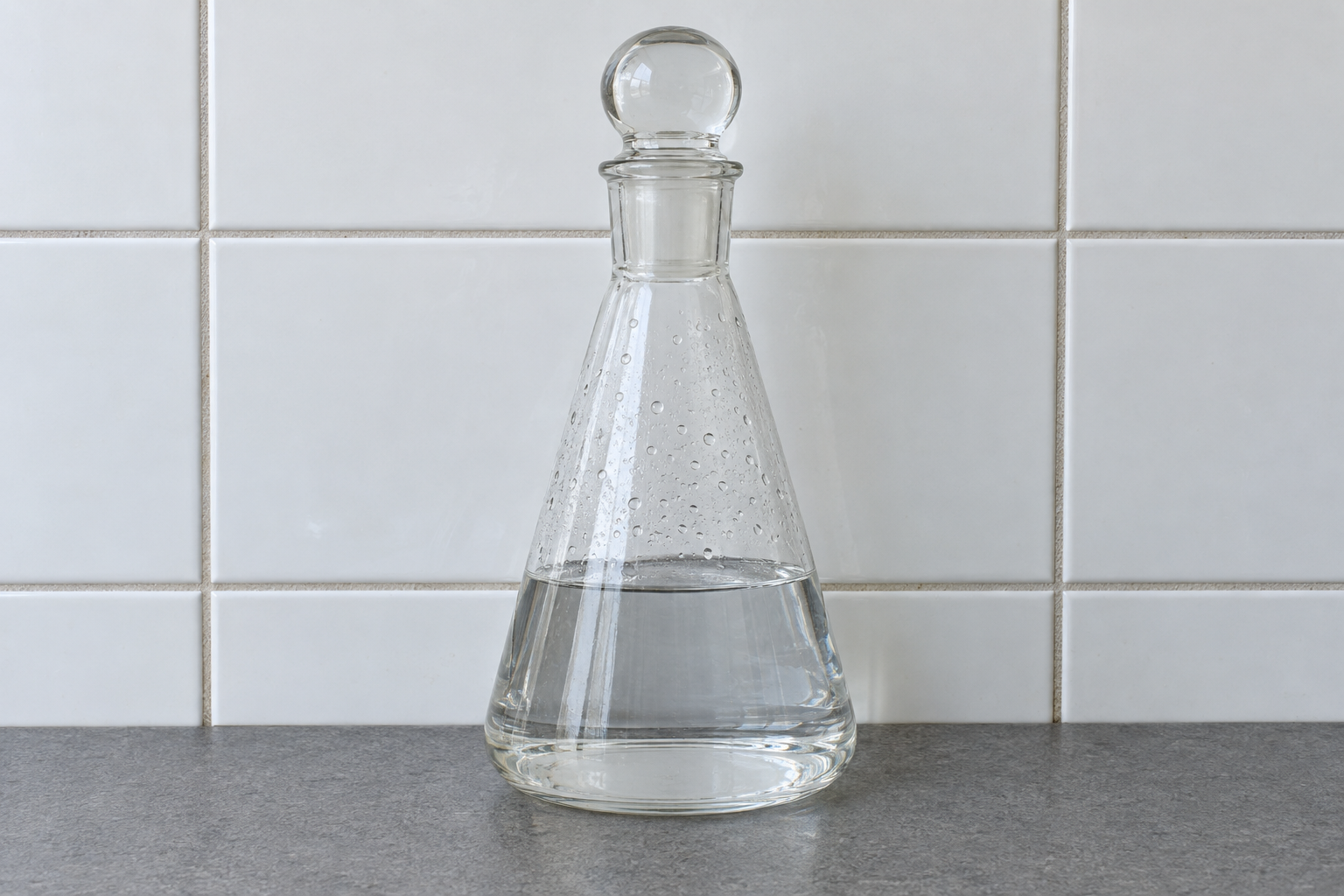
So evaporation still happens inside the sealed flask.
Why does the sealed flask never dry out?
Water molecules keep leaving the liquid as vapor.
Water molecules keep returning from the vapor to the liquid.
The returning molecules condense into the mist beads on the glass.
Condensation keeps returning water to the liquid.
So the sealed flask never dries out.
Here is the sealed flask, with the two changes drawn.
The forward change and its reverse change both occur in the flask.
A process whose forward and reverse changes can both occur is called a reversible process.
Now think again about the open beaker.
Its vapor drifts away into the room's air.
So the reverse change cannot restock the beaker's liquid.
The open beaker only dries out.
State that many physical and chemical processes are reversible: the forward change and its reverse change can both occur.
Part 2Check what you just learned
Check — multiple choice
In a sealed jar, a naphthalene mothball keeps shrinking while naphthalene crystals keep reappearing on the lid. Does the reverse of the mothball's change also occur?
Feedback if chosen: Correct. The solid turns to vapor, and the vapor turns back to solid on the lid. Both changes occur.
Feedback if chosen: This option is wrong — the crystals on the lid show vapor turning back into solid, so the reverse change does occur.
Check — multiple choice
Isopropyl alcohol sits in a capped bottle, and drops of the alcohol keep forming on the cap's underside. Does the reverse of the alcohol's evaporation also occur?
Feedback if chosen: Correct. The drops on the cap show alcohol vapor condensing back to liquid. Both changes occur.
Feedback if chosen: This option is wrong — the drops on the cap's underside are condensed alcohol, so the reverse change does occur.
Check — multiple choice
Helium keeps seeping out through a party balloon's skin into the room's air. Does the reverse change also occur?
Feedback if chosen: This option is wrong — the escaped helium spreads through the room's air, and no helium returns through the balloon's skin.
Feedback if chosen: Correct. The escaped helium never returns through the skin, so only the forward change occurs.
Check — multiple choice
A puddle on a playground dries out in the sun. Does the reverse change also occur?
Feedback if chosen: This option is wrong — the puddle's vapor drifts away into the open air, and nothing returns that vapor to the puddle.
Feedback if chosen: Correct. The vapor drifts away into the open air, so nothing restocks the puddle. Only the forward change occurs.
Check — multiple choice
A chemist calls the change in a sealed vial a reversible process. What does that name say about the change?
Feedback if chosen: This option is wrong — a one-direction change is exactly what a reversible process is not; both directions occur.
Feedback if chosen: This option is wrong — reversible says the reverse change also occurs, not that it cancels the forward change at once.
Feedback if chosen: Correct. A reversible process is one whose forward change and reverse change can both occur.
Check — multiple choice
Which name belongs to a process whose forward change and reverse change can both occur?
Feedback if chosen: Correct. A process whose forward and reverse changes can both occur is called a reversible process.
Feedback if chosen: This option is wrong — a one-way process is written in a single direction; this process's reverse change also occurs.
The double arrow
Outcome: Identify the double arrow ⇌ as the symbol for a reversible process, in contrast to the one-way arrow →.
Part 1One equation, two directions
We've seen that every change can be written as an equation whose atom counts balance.
A student writes the sealed flask's change that way: H₂O(l) → H₂O(g).
The arrow → points in one direction only.
But inside the flask, the reverse change also occurs.
Vapor keeps condensing back into liquid water.
The one-way equation tells only half of what happens.
How can one equation say that a change occurs in both directions?
We've seen that chemists mark a reaction step whose reverse also occurs readily with a double arrow: 2 NO ⇌ N₂O₂.
The same mark now covers any reversible process.
Chemists write a reversible process with the double arrow: H₂O(l) ⇌ H₂O(g).
The double arrow says that the forward change and the reverse change both occur.
The one-way arrow → stays for a process written in a single direction.
Here are the two arrows side by side.
| arrow | what the arrow says | worked example |
|---|---|---|
| → | the change is written in a single direction | H₂O(l) → H₂O(g) |
| ⇌ | the forward change and the reverse change both occur | H₂O(l) ⇌ H₂O(g) |
So one equation can say that a change occurs in both directions.
Identify the double arrow ⇌ as the symbol for a reversible process, in contrast to the one-way arrow → used for a process written in a single direction.
Part 2Check what you just learned
Check — multiple choice
Inside a sealed flashbulb, magnesium burns to a white powder, and the reverse change is never observed. Which arrow does this change take?
Feedback if chosen: This option is wrong — the double arrow claims the reverse change also occurs, and the powder never turns back into magnesium.
Feedback if chosen: Correct. The reverse change is never observed, so the change is written in a single direction: 2 Mg + O₂ → 2 MgO.
Check — multiple choice
In a sealed sample of lake water, dissolved O₂ keeps leaving the water while O₂ gas keeps dissolving back in. Which arrow does this change take?
Feedback if chosen: Correct. Both directions occur, so the change takes the double arrow: O₂(g) ⇌ O₂(aq).
Feedback if chosen: This option is wrong — the one-way arrow claims a single direction, and the stem names both directions occurring.
Check — multiple choice
In a sealed ice chest, dry ice keeps subliming to CO₂ gas while CO₂ gas keeps depositing back onto the dry ice. Which arrow does this change take?
Feedback if chosen: This option is wrong — deposition is named in the stem, so the reverse change occurs and a single direction is not enough.
Feedback if chosen: Correct. Sublimation and deposition both occur, so the change takes the double arrow: CO₂(s) ⇌ CO₂(g).
Check — multiple choice
Butane burns away in a camp stove, open to the air. Which arrow does this change take?
Feedback if chosen: Correct. The burned gases drift away and never rebuild butane, so the change is written in a single direction.
Feedback if chosen: This option is wrong — the double arrow claims the reverse change also occurs, and burned butane is never rebuilt.
Check — multiple choice
An equation carries the double arrow ⇌ between its two sides. What does the arrow say about the change?
Feedback if chosen: This option is wrong — a single written direction is the one-way arrow's meaning, →.
Feedback if chosen: This option is wrong — atom counts balance in every equation; the double arrow instead says that both directions occur.
Feedback if chosen: Correct. The double arrow marks a reversible process: the forward change and the reverse change both occur.
Check — multiple choice
Which mark do chemists write in an equation to say that the forward change and the reverse change both occur?
Feedback if chosen: Correct. The double arrow ⇌ says both directions occur.
Feedback if chosen: This option is wrong — the one-way arrow → is kept for a process written in a single direction.
Reversible physical pairs
Outcome: Classify a described physical process as reversible by naming its paired forward and reverse changes.
Part 1A pair of changes in a soda bottle
A sealed bottle of soda stands in a pantry.
The drink contains dissolved CO₂.
The space under the cap — the headspace — contains CO₂ gas.
Some CO₂ keeps moving out of the drink into that space.
Some CO₂ keeps moving out of that space into the drink.
The two changes form a pair: a forward change and its reverse.
Do all physical changes come in pairs like this one?
No: some changes have no reverse.
To classify a physical process as reversible, you name its two paired changes.
First you name the forward change you are shown.
Then you name the reverse change, the same change in the reverse direction.
If the reverse change also occurs, the process is reversible.
If the reverse change does not occur, the process is not reversible.
Two gases that mix in a sealed flask never unmix.
Part 2The same question, five cases
Look again at the sealed soda bottle.
Does the reverse change also occur? Yes.
The forward change: CO₂ escapes from the drink into the headspace.
The reverse change: CO₂ dissolves from the headspace back into the drink.
So the process is reversible.
Now look at the water in the same bottle.
Does the reverse change also occur? Yes.
The forward change: water evaporates from the drink into the headspace.
The reverse change: water vapor condenses from the headspace back into the drink.
So the process is reversible.
Now consider a sealed vial of iodine crystals.
The solid iodine keeps subliming into violet iodine vapor.
The iodine vapor keeps depositing back onto the crystals.
Does the reverse change also occur? Yes.
The forward change: iodine sublimes from the crystals into the vapor.
The reverse change: iodine vapor deposits back onto the crystals.
So the process is reversible.
Now a chemist lets argon into the same vial. The chemist reseals the vial.
The iodine crystals still sit at the bottom of the vial.
The iodine vapor and the argon mix evenly through the vial.
Does the reverse change also occur? No.
The forward change: the iodine vapor and the argon mix evenly through the vial.
The reverse change: the mixed gases unmix into separate gases.
Two mixed gases never unmix.
So the mixing is not reversible.
Now watch the iodine in the same vial again.
The subliming and the depositing continue as before.
Does the reverse change also occur? Yes.
The forward change: iodine sublimes from the crystals into the vapor.
The reverse change: iodine vapor deposits back onto the crystals.
So the process is reversible.
Here are the five cases in one table.
| case | Does the reverse change also occur? |
|---|---|
| CO₂ moving between the drink and the headspace | |
| water moving between the drink and the headspace | |
| iodine moving between the crystals and the vapor | |
| iodine vapor mixing with argon | |
| the same vial, back to subliming and depositing |
Classify a described physical process as reversible by naming its paired forward and reverse changes.
Part 3Check what you just learned
Check — multiple choice
Liquid bromine keeps evaporating in a sealed vial. Which change is the reverse change?
Feedback if chosen: This option is wrong — escaping vapor is a loss from the vial, not the evaporation happening backward.
Feedback if chosen: Correct. The reverse change is the same change backward: vapor returning to liquid.
Feedback if chosen: This option is wrong — more evaporation is the forward change again, not the same change backward.
Check — multiple choice
In a sealed jar, sugar keeps dissolving into the water while sugar crystals keep growing on the jar's bottom. Is the process reversible?
Feedback if chosen: Correct. Dissolving and crystallizing are a forward change and its reverse, and both occur.
Feedback if chosen: This option is wrong — the growing crystals show sugar leaving the water, so the reverse change does occur.
Check — multiple choice
In a sealed terrarium, water keeps evaporating from the soil while drops keep forming on the glass. Is the process reversible?
Feedback if chosen: Correct. Evaporation and condensation are a forward change and its reverse, and both occur.
Feedback if chosen: This option is wrong — the drops on the glass are condensed water, so the reverse change does occur.
Check — multiple choice
A perfume vapor spreads through the air of a sealed room. Does the reverse change also occur?
Feedback if chosen: This option is wrong — the reverse change would be the mixed gases unmixing, and two mixed gases never unmix.
Feedback if chosen: Correct. The perfume vapor and the air mix, and two mixed gases never unmix.
Check — multiple choice
A sealed jar at 0 °C holds an ice cube in water: the ice keeps melting while some water keeps freezing back onto it. Is the process reversible?
Feedback if chosen: Correct. Melting and freezing are a forward change and its reverse, and both occur.
Feedback if chosen: This option is wrong — the water freezing back onto the cube is melting's reverse, so both changes occur.
Reversible chemical pairs
Outcome: Classify a described chemical process, such as a proton-transfer or electron-transfer reaction, as reversible by naming its paired forward and reverse changes.
Part 1A proton moves both ways
A chemist dissolves nitrous acid, HNO₂, in water.
Some HNO₂ molecules each give a proton to a water molecule.
We've seen that a reaction that transfers a proton is an acid-base reaction.
The transfer makes NO₂⁻ ions and H₃O⁺ ions.
We've seen that physical processes can come in forward-and-reverse pairs.
Can a chemical change also occur in reverse?
Yes: an H₃O⁺ ion can give the proton back to an NO₂⁻ ion.
The reverse transfer rebuilds HNO₂ and water.
So this proton transfer occurs in both directions: HNO₂ + H₂O ⇌ NO₂⁻ + H₃O⁺.
You classify a chemical process by the same two steps.
First you name the forward change you are shown.
Then you name the reverse change, the same change in the reverse direction.
If the reverse change also occurs, the reaction is reversible.
Part 2The same question, four reactions
Start with the nitrous acid beaker.
Does the reverse change also occur? Yes.
The forward change: HNO₂ gives a proton to H₂O.
The reverse change: H₃O⁺ gives the proton back to NO₂⁻.
So the process is reversible.
Now consider a beaker where a chemist mixes an iron(II) solution with a silver nitrate solution.
Each Fe²⁺ ion gives one electron to an Ag⁺ ion.
We've seen that a reaction that transfers electrons is a redox reaction.
The silver atoms can give the electrons back: Fe²⁺ + Ag⁺ ⇌ Fe³⁺ + Ag.
Does the reverse change also occur? Yes.
The forward change: Fe²⁺ gives an electron to Ag⁺.
The reverse change: a silver atom gives the electron back to Fe³⁺.
So the process is reversible.
Now the chemist dissolves HCl in water in place of HNO₂.
Essentially every HCl molecule gives its proton to a water molecule.
The transfer makes Cl⁻ ions and H₃O⁺ ions.
Does the reverse change also occur? No.
The forward change: HCl gives a proton to H₂O.
The reverse change: H₃O⁺ gives the proton back to Cl⁻.
That reverse transfer is not observed.
So the process is not reversible.
Chemists write it with the one-way arrow: HCl + H₂O → Cl⁻ + H₃O⁺.
Now look again at the nitrous acid beaker.
There the reverse transfer does occur.
Does the reverse change also occur? Yes.
The forward change: HNO₂ gives a proton to H₂O.
The reverse change: H₃O⁺ gives the proton back to NO₂⁻.
So the process is reversible.
Chemists keep the double arrow for it: HNO₂ + H₂O ⇌ NO₂⁻ + H₃O⁺.
Here are the four reactions in one table.
| case | Does the reverse change also occur? |
|---|---|
| HNO₂ giving a proton to water | |
| Fe²⁺ giving an electron to Ag⁺ | |
| HCl giving a proton to water | |
| the nitrous acid beaker again |
Classify a described chemical process, such as a proton-transfer or electron-transfer reaction, as reversible by naming its paired forward and reverse changes.
Part 3Check what you just learned
Check — multiple choice
Which of these does an acid-base reaction transfer from one species to another?
Feedback if chosen: This option is wrong — electron transfer marks a redox reaction, not an acid-base reaction.
Feedback if chosen: This option is wrong — neutrons stay inside their nuclei during a chemical reaction; no reaction moves them between species.
Feedback if chosen: Correct. An acid-base reaction transfers one or more protons from a donor species to an acceptor.
Check — multiple choice
In the reaction NH₃ + H₂O ⇌ NH₄⁺ + OH⁻, water gives a proton to ammonia. Which change is the reverse change?
Feedback if chosen: Correct. The reverse change is the forward transfer backward: NH₄⁺ returns the proton to OH⁻, rebuilding NH₃ and H₂O.
Feedback if chosen: This option is wrong — water giving the proton to ammonia is the forward transfer restated.
Feedback if chosen: This option is wrong — the proton travels from NH₄⁺ to OH⁻ in the reverse change, not the other way.
Check — multiple choice
In the reaction 2 Fe³⁺ + 2 I⁻ ⇌ 2 Fe²⁺ + I₂, iodide ions give electrons to iron(III) ions. Which change is the reverse change?
Feedback if chosen: This option is wrong — iodide giving electrons to iron(III) is the forward transfer restated.
Feedback if chosen: This option is wrong — Fe³⁺ ions are the electron acceptors here; they hold no gained electrons to give.
Feedback if chosen: Correct. The reverse change is the forward transfer backward: Fe²⁺ ions return electrons to I₂, rebuilding Fe³⁺ and I⁻.
Check — multiple choice
Kerosene burns away at a lamp's wick, and the reverse change is never observed. Is the reaction reversible?
Feedback if chosen: This option is wrong — a reversible reaction needs its reverse change to occur, and this reverse change is never observed.
Feedback if chosen: Correct. The reverse change is never observed, so the reaction is not reversible and is written with →.
Check — multiple choice
Acetic acid, HC₂H₃O₂, transfers protons to water, and the reverse transfer also occurs. Is the reaction reversible?
Feedback if chosen: Correct. The forward transfer and the reverse transfer both occur, so the reaction is reversible.
Feedback if chosen: This option is wrong — the stem names the reverse transfer occurring, so both changes occur.
No observable change at equilibrium
Outcome: State that when equilibrium is reached, no observable changes occur: the concentrations or partial pressures of all species remain constant.
Part 1The tube whose shade settles
A teacher seals a sample of N₂O₄ gas in a glass tube.
N₂O₄ is a colorless gas.
Inside the tube, some N₂O₄ converts to NO₂, a brown gas.
The contents of the tube turn pale brown, then deeper brown.
Within minutes, the shade stops changing altogether.
The tube then shows the same shade for hours.
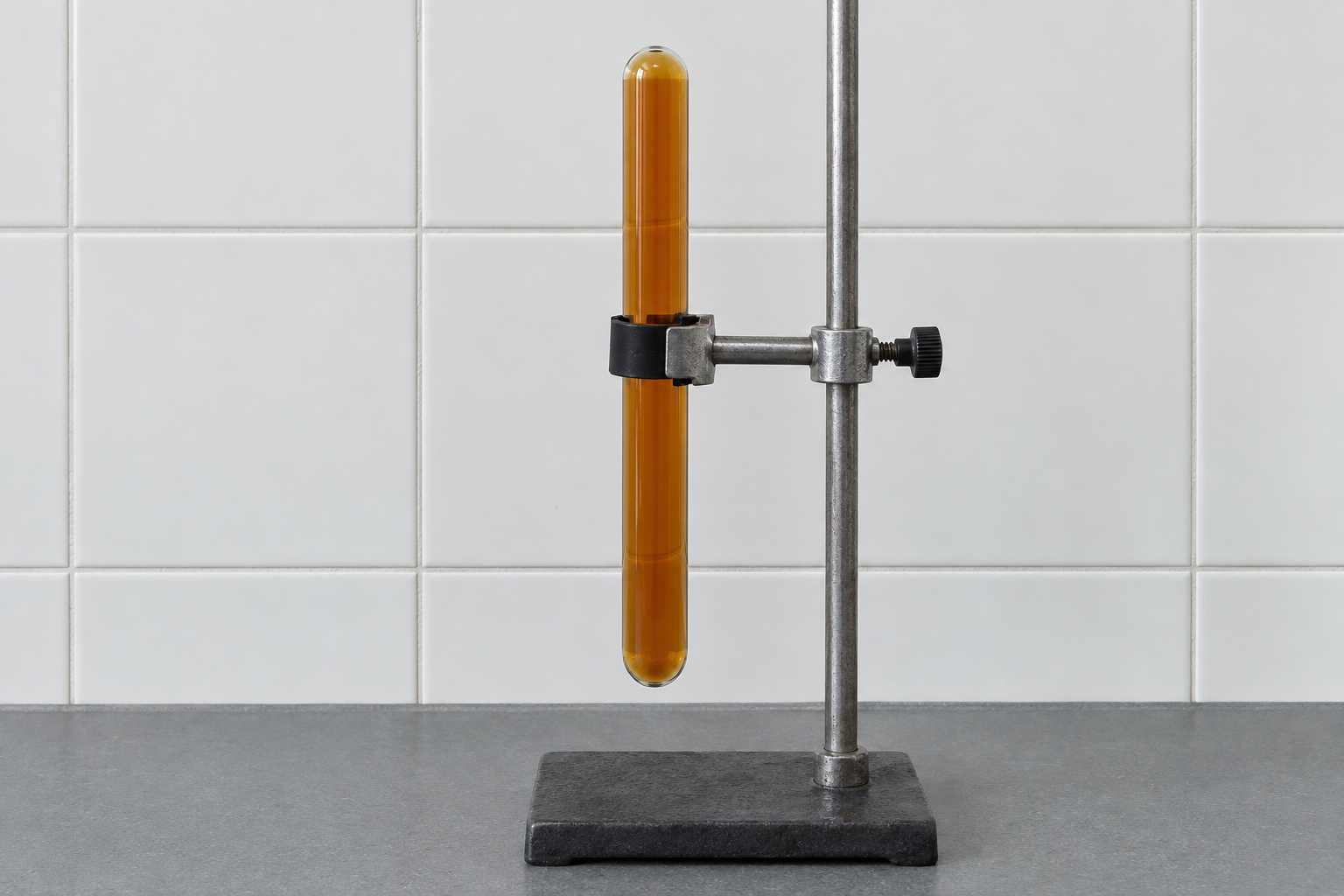
Is the color the only property of the mixture that has stopped changing?
No: every measurable property of the mixture has stopped changing.
We've seen that each gas in a mixture exerts its own partial pressure.
Each gas pushes as if it were alone in the tube.
The partial pressure of each gas in the tube stays constant.
The concentration of each gas in the tube stays constant.
Here is the tube's observation log.
| time | shade of the tube | partial pressures |
|---|---|---|
| at sealing | colorless | changing |
| two minutes in | pale brown | changing |
| five minutes in | deepening brown | still changing |
| one hour in | deep brown, now steady | constant |
| the next day | the same deep brown | constant |
Chemists call this settled state equilibrium: the state in which no observable changes occur.
At equilibrium, the concentrations or partial pressures of all species remain constant.
What are the molecules themselves doing at equilibrium? That is the next question.
Part 2The same question, four moments
Watch the tube while its shade still deepens.
Have the contents reached equilibrium? No.
The shade is still changing, so an observable change is still occurring.
Now watch the same tube once its shade stays steady. Its partial pressures and its concentrations stay constant.
Have the contents reached equilibrium? Yes.
No observable changes occur in the tube.
Now watch the same tube hours later, every property still constant.
Have the contents reached equilibrium? Yes.
The constancy has simply continued.
Now think back to the sealed water flask, its level and pressure constant for days.
Have the contents reached equilibrium? Yes.
No observable changes occur in the flask, so the flask's contents are at equilibrium.
State that when equilibrium is reached, no observable changes occur: the concentrations or partial pressures of all species remain constant.
Part 3Check what you just learned
Check — multiple choice
A sealed tube holds a mixture of two gases. What is the partial pressure of one gas in the mixture?
Feedback if chosen: This option is wrong — the gases need not push equally; each gas exerts its own pressure, set by its own particles.
Feedback if chosen: Correct. Each gas's particles push independently, so each gas exerts the pressure it would exert alone.
Feedback if chosen: This option is wrong — ideal-gas particles push independently; the other gas does not change a gas's own pressure.
Check — multiple choice
A sealed tube holds H₂, Br₂ and HBr, and the mixture's orange shade is still fading. Has the mixture reached equilibrium?
Feedback if chosen: This option is wrong — the fading shade is an observable change, and at equilibrium no observable changes occur.
Feedback if chosen: Correct. A property of the mixture is still changing, so the mixture has not reached equilibrium.
Check — multiple choice
In a sealed vessel holding SO₂, NO₂, SO₃ and NO, the partial pressure of SO₃ is still rising. Has the mixture reached equilibrium?
Feedback if chosen: This option is wrong — a rising partial pressure is an observable change; at equilibrium every partial pressure stays constant.
Feedback if chosen: Correct. One partial pressure is still changing, so the mixture has not reached equilibrium.
Check — multiple choice
In a sealed tube of H₂, Br₂ and HBr, the orange shade stopped fading an hour ago, and every measured property has stayed constant since. Has the mixture reached equilibrium?
Feedback if chosen: Correct. No observable changes occur, so the mixture has reached equilibrium.
Feedback if chosen: This option is wrong — every property of the mixture stays constant, and that constancy is exactly the equilibrium state.
Check — multiple choice
In a sealed vessel of SO₂, NO₂, SO₃ and NO, all four partial pressures have stayed constant through the afternoon. Has the mixture reached equilibrium?
Feedback if chosen: Correct. The partial pressures of all species remain constant, so the mixture has reached equilibrium.
Feedback if chosen: This option is wrong — constant partial pressures are the mark of equilibrium, not an argument against it.
Check — multiple choice
A sealed vessel has reached equilibrium. What does that say about the vessel's measurable properties?
Feedback if chosen: This option is wrong — at equilibrium the properties do not change at all; no observable changes occur.
Feedback if chosen: This option is wrong — every measurable property stays constant at equilibrium, not the color alone.
Feedback if chosen: Correct. At equilibrium no observable changes occur: concentrations and partial pressures all remain constant.
Check — multiple choice
A sealed tube's concentrations and partial pressures all stay constant, and no observable changes occur. Which name does chemistry give this settled state?
Feedback if chosen: Correct. The settled state in which no observable changes occur is called equilibrium.
Feedback if chosen: This option is wrong — a reversible process names a change whose reverse also occurs; the settled state itself is called equilibrium.
Equilibrium is not completion
Outcome: State that reactants and products are simultaneously present at equilibrium, so reaching equilibrium is not the same as the reaction going to completion.
Part 1Is the change finished?
We've seen that a sealed tube of N₂O₄ and NO₂ settles to a steady brown shade. That shade has now stayed the same for a day.
A student, Priya, says the change must have finished.
Finished would mean every N₂O₄ molecule has converted to NO₂.
The teacher measures the amounts of both gases in the tube.
The tube still contains plenty of N₂O₄ alongside the NO₂.
Is a mixture at equilibrium a finished mixture?
No: at equilibrium, reactants and products are present at the same time.
The constant shade means only that the amounts have stopped changing.
A mixture at equilibrium still contains reactants.
A mixture at completion contains no reactants.
The teacher found both gases still in the tube.
So the tube has reached equilibrium, not completion.
Here is the tube's mixture at equilibrium, drawn particle by particle.
State that reactants and products are simultaneously present at equilibrium, so reaching equilibrium is not the same as the reaction going to completion.
Part 2Check what you just learned
Check — multiple choice
A sealed vessel holds the reaction PCl₅ ⇌ PCl₃ + Cl₂ at equilibrium, every property constant. What does the vessel contain?
Feedback if chosen: This option is wrong — the vessel still holds PCl₅; at equilibrium no species has run out.
Feedback if chosen: Correct. Reactants and products are simultaneously present at equilibrium.
Feedback if chosen: This option is wrong — unreacted PCl₅ alone would mean the reaction made no product; at equilibrium all three gases are present.
Check — multiple choice
A sealed vessel holds the reaction CO + 2 H₂ ⇌ CH₃OH, and its pressure has stayed constant for hours. Ben says the constant pressure means all the CO and H₂ have become CH₃OH. Is Ben correct?
Feedback if chosen: This option is wrong — constant pressure marks equilibrium, not completion. The vessel still contains CO, H₂ and CH₃OH together.
Feedback if chosen: Correct. Constant pressure means the amounts have stopped changing, and the vessel still contains all three gases.
Check — multiple choice
A reaction goes to completion. What does its final mixture contain?
Feedback if chosen: Correct. At completion the reactants are used up, so only products remain.
Feedback if chosen: This option is wrong — reactants and products together mark a mixture at equilibrium, not at completion.
Feedback if chosen: This option is wrong — a mixture of reactants only has not reacted at all.
Dynamic equilibrium
Outcome: State that the equilibrium state is dynamic: the forward and reverse processes continue to occur at equal rates, resulting in no net observable change.
Part 1Still water, busy molecules
A sealed flask of water has stood on a shelf for a month.
The water level has not changed all month.
The pressure inside the flask has not changed all month.
The flask has reached equilibrium.
Have the evaporation and the condensation stopped?
Or do the two changes still continue, hidden behind the constant level?
The changes have not stopped.
We've seen that a fast reaction step settles where its forward rate equals its reverse rate.
The sealed flask behaves the same way.
Water molecules keep evaporating from the liquid.
Water molecules keep condensing into the liquid.
The forward and reverse processes continue to occur at equal rates, resulting in no net observable change.
Here is the flask at two times, with a few molecules followed.
Chemists call this state a dynamic equilibrium, because both processes continue while nothing observable changes.
Part 2The tube, read again
Now think back to the sealed tube of N₂O₄ and NO₂.
Its brown shade stays constant for hours.
The two conversions have not stopped there either.
Inside the tube, N₂O₄ molecules keep converting to NO₂ molecules.
Inside the tube, NO₂ molecules keep converting back to N₂O₄ molecules.
The forward and reverse conversions continue at equal rates.
So the shade stays constant.
A constant shade, like a constant level, hides two processes continuing at equal rates.
State that the equilibrium state is dynamic: the forward and reverse processes continue to occur at equal rates, resulting in no net observable change.
Part 3Check what you just learned
Check — multiple choice
A reaction step is fast in both directions. Where does it settle?
Feedback if chosen: This option is wrong — the forward reaction continues at the settling point; its rate simply equals the reverse rate.
Feedback if chosen: This option is wrong — the reverse reaction continues too; the two rates become equal.
Feedback if chosen: Correct. The step settles where the forward rate and the reverse rate are equal.
Check — multiple choice
A sealed jar of acetone has kept a constant liquid level for weeks. What is happening at the liquid's surface?
Feedback if chosen: This option is wrong — the exchange continues; the two processes simply move molecules at equal rates.
Feedback if chosen: Correct. Both processes continue at equal rates, so the level shows no net change.
Feedback if chosen: This option is wrong — condensation alone would raise the liquid level; evaporation continues alongside it.
Check — multiple choice
A CuSO₄ solution sits above CuSO₄ crystals in a sealed jar, and the solution's blue shade has stayed constant for days. Which prediction fits the crystals' surface?
Feedback if chosen: This option is wrong — dissolving alone would deepen the blue shade; crystallizing continues alongside it.
Feedback if chosen: This option is wrong — the exchange continues at the surface; the equal rates are what keep the shade constant.
Feedback if chosen: Correct. The constant shade hides a dynamic equilibrium: both processes continue at equal rates.
Check — multiple choice
A flask's contents sit at a dynamic equilibrium. What does the word dynamic say about the flask's contents?
Feedback if chosen: Correct. Dynamic says both processes continue, even while nothing observable changes.
Feedback if chosen: This option is wrong — the properties stay constant at equilibrium; dynamic says the processes continue.
Feedback if chosen: This option is wrong — the two rates stay equal and steady; dynamic says the processes continue, not that they accelerate.
Check — multiple choice
In a sealed container, two opposite processes continue at equal rates while nothing observable changes. Which name does chemistry give this state?
Feedback if chosen: This option is wrong — a completed reaction has used up its reactants; here both processes continue.
Feedback if chosen: Correct. Chemists call this state a dynamic equilibrium, because both processes continue while nothing observable changes.
Feedback if chosen: This option is wrong — a one-way process has no reverse change; here both directions continue.
Why constancy is not stoppage
Outcome: Explain why constant macroscopic properties do not mean the forward and reverse processes have stopped.
Part 1The labeled water experiment
A sealed flask of water stands at equilibrium.
The water level has not changed for days.
A chemist adds a spoonful of labeled water to the liquid.
Labeled water is ordinary water made with a heavier hydrogen isotope.
If evaporation and condensation have stopped, the labeled molecules should stay in the liquid.
Days later, instruments find labeled molecules throughout the vapor as well.
How did labeled molecules reach the vapor while nothing observable changed?
Evaporation never stopped inside the flask.
Condensation never stopped inside the flask.
Evaporation kept moving molecules into the vapor.
Condensation kept moving molecules into the liquid.
So evaporation spread the labeled molecules through the vapor.
Here are two snapshots of the flask, with the labeled molecules drawn dark.
The flask's properties stay constant because the forward and reverse processes continue to occur at equal rates, so there is no net observable change.
Constant properties mean equal rates, never stopped processes.
Explain why constant macroscopic properties do not mean the forward and reverse processes have stopped.
Part 2Check what you just learned
Check — multiple choice
A sealed flask of diethyl ether has kept a constant liquid level for a week. What is happening at the liquid's surface?
Feedback if chosen: This option is wrong — the processes continue; their equal rates are why the level looks frozen.
Feedback if chosen: This option is wrong — condensation alone would raise the level; evaporation continues alongside it.
Feedback if chosen: Correct. The two processes continue at equal rates, so the level shows no net change.
Check — multiple choice
Solid iodine sits at the bottom of an iodine-in-ethanol solution in a sealed bottle, and the solution's color has stayed constant for days. Why does the color stay constant?
Feedback if chosen: Correct. Dissolving and crystallizing continue at equal rates, so the amount of dissolved iodine shows no net change.
Feedback if chosen: This option is wrong — the solid keeps releasing iodine; the solution returns iodine to the solid at the same rate.
Feedback if chosen: This option is wrong — the exchange continues in both directions at equal rates; that balance is what fixes the amount dissolved.
Check — multiple choice
A marked NaCl crystal has sat in a sealed salt solution for weeks. The crystal's shape has changed, while the solution's concentration of NaCl stayed constant. What does this show?
Feedback if chosen: This option is wrong — a crystal that exchanged nothing would keep its shape; the exchange continues.
Feedback if chosen: Correct. The changed shape shows the exchange continuing; the equal rates keep the concentration of NaCl constant.
Feedback if chosen: This option is wrong — ions leaving alone would raise the concentration of NaCl; returning ions balance them.
Check — multiple choice
Theo looks at the sealed ether flask, its level steady for a week, and says the steady level means evaporation has stopped. Is Theo correct?
Feedback if chosen: This option is wrong — evaporation continues inside the flask even while the level stays steady.
Feedback if chosen: Correct. Theo reads the steady level as stoppage, but evaporation continues inside the flask.
Check — multiple choice
Theo is wrong: evaporation has not stopped in the ether flask. Why does the level stay steady?
Feedback if chosen: Correct. The two processes continue at equal rates, so the liquid loses exactly as many molecules as it regains.
Feedback if chosen: This option is wrong — a faster return would raise the level; the level stays steady because the two rates are equal.
Feedback if chosen: This option is wrong — even slow evaporation would lower the level over a week; the returning molecules are what balance it.
U7-S02 — Approach to equilibrium: rates and graphs
11 lessons
Net forward conversion
Outcome: State that when the rate of the forward reaction exceeds the rate of the reverse reaction, there is net conversion of reactants to products.
Part 1The fresh mixture makes ammonia
A chemist fills a sealed reactor with nitrogen gas and hydrogen gas, and nothing else.
The forward reaction of N₂ + 3H₂ ⇌ 2NH₃ makes ammonia.
The reverse reaction breaks ammonia back into nitrogen and hydrogen.
No ammonia exists in the fresh mixture yet.
So the forward reaction is fast.
And the reverse reaction does not run at all.
What happens to the amount of ammonia in the reactor?
The amount of ammonia grows.
We've seen that a reaction rate measures the change in a concentration per unit time, in M/s.
In the fresh mixture, the rate of the forward reaction exceeds the rate of the reverse reaction.
Every second, the forward reaction makes more ammonia than the reverse reaction breaks apart.
So there is net conversion of reactants into products.
Both reactions continue the whole time.
The net change is the difference between the two rates.
Now consider a sealed vessel in which nitrogen monoxide and chlorine form nitrosyl chloride: 2 NO + Cl₂ ⇌ 2 NOCl.
A chemist has just mixed NO and Cl₂, and no NOCl exists yet.
Is there net conversion of reactants into products? Yes.
The rate of the forward reaction far exceeds the rate of the reverse reaction.
So every second, the vessel gains NOCl.
An hour on, the same vessel holds all three gases.
The rate of the forward reaction still exceeds the rate of the reverse reaction, by less than before.
Is there net conversion of reactants into products? Yes.
The forward reaction still makes more NOCl each second than the reverse reaction breaks apart.
Later still, the two rates in the same vessel become equal.
Is there net conversion of reactants into products? No.
Each second, the forward reaction makes exactly as much NOCl as the reverse reaction breaks apart.
So the amount of each gas shows no net change.
State that when the rate of the forward reaction exceeds the rate of the reverse reaction, there is net conversion of reactants to products.
Part 2Check what you just learned
Check — multiple choice
In a sealed NOCl vessel, the rate of the forward reaction equals the rate of the reverse reaction. Is there net conversion of reactants into products?
Feedback if chosen: This option is wrong — the two rates are equal, so the forward reaction makes exactly as much NOCl each second as the reverse reaction breaks apart.
Feedback if chosen: Correct. The two rates are equal, so each second's gain of NOCl is matched by that second's loss.
Check — multiple choice
A measurement on an NOCl vessel shows the rate of the forward reaction exceeding the rate of the reverse reaction. Is there net conversion of reactants into products?
Feedback if chosen: Correct. Every second, the forward reaction makes more NOCl than the reverse reaction breaks apart, so the vessel gains product.
Feedback if chosen: This option is wrong — the forward reaction is making more NOCl each second than the reverse reaction breaks apart, so the amount of NOCl grows.
Check — multiple choice
A chemist has just mixed NO and Cl₂ in a clean sealed vessel, and no NOCl exists yet. Is there net conversion of reactants into products?
Feedback if chosen: Correct. With no NOCl present, the reverse reaction cannot run at all, so the forward reaction's rate exceeds the reverse reaction's rate.
Feedback if chosen: This option is wrong — no NOCl exists yet, so the reverse reaction cannot run, and the forward reaction converts reactants into product unopposed.
Check — multiple choice
In another NOCl vessel, the rate of the reverse reaction exceeds the rate of the forward reaction. Is there net conversion of reactants into products?
Feedback if chosen: This option is wrong — the reverse reaction breaks apart more NOCl each second than the forward reaction makes, so the amount of NOCl falls.
Feedback if chosen: Correct. The reverse reaction is ahead, so the vessel loses NOCl each second; nothing is converted from reactants into products on net.
Net reverse conversion
Outcome: State that when the rate of the reverse reaction exceeds the rate of the forward reaction, there is net conversion of products to reactants.
Part 1The vessel that starts with only ammonia
A technician injects pure ammonia into an empty, sealed vessel.
No nitrogen and no hydrogen exist in the vessel at the start.
The forward reaction of N₂ + 3H₂ ⇌ 2NH₃ needs nitrogen and hydrogen.
So at the first moment, the forward reaction cannot run at all.
The reverse reaction has plenty of ammonia to break apart.
What happens to the amount of ammonia now?
The amount of ammonia falls.
Here the rate of the reverse reaction exceeds the rate of the forward reaction.
Every second, the reverse reaction breaks apart more ammonia than the forward reaction makes.
So there is net conversion of products into reactants.
The net conversion is in the direction of the faster reaction.
A mixture of pure products starts with the reverse reaction ahead.
Now consider a heated, sealed vessel for the reaction SO₂ + Cl₂ ⇌ SO₂Cl₂.
A technician injects pure SO₂Cl₂ into the empty vessel.
No SO₂ and no Cl₂ exist at the start, so the forward reaction cannot run yet.
In which direction is the net conversion? Reverse.
The rate of the reverse reaction exceeds the rate of the forward reaction.
So every second, the vessel gains SO₂ and Cl₂ and loses SO₂Cl₂.
Later, the two rates in the same vessel become equal.
In which direction is the net conversion? Neither.
Each second's changes cancel, so no net conversion occurs.
Now the technician pumps extra SO₂ and Cl₂ into the same vessel.
The rate of the forward reaction now exceeds the rate of the reverse reaction.
In which direction is the net conversion? Forward.
Every second, the forward reaction makes more SO₂Cl₂ than the reverse reaction breaks apart.
State that when the rate of the reverse reaction exceeds the rate of the forward reaction, there is net conversion of products to reactants.
Part 2Check what you just learned
Check — multiple choice
In a sealed SO₂Cl₂ vessel, the rate of the forward reaction exceeds the rate of the reverse reaction. In which direction is the net conversion?
Feedback if chosen: Correct. The forward reaction is ahead, so the vessel gains SO₂Cl₂ each second.
Feedback if chosen: This option is wrong — the reverse reaction is the slower one here, so it cannot carry the net change.
Feedback if chosen: This option is wrong — the two rates differ, so one reaction outpaces the other and a net conversion occurs.
Check — multiple choice
A later measurement on the SO₂Cl₂ vessel shows the rate of the reverse reaction exceeding the rate of the forward reaction. In which direction is the net conversion?
Feedback if chosen: This option is wrong — the forward reaction is now the slower one, so the vessel is not gaining SO₂Cl₂ on net.
Feedback if chosen: Correct. The reverse reaction is ahead, so the vessel loses SO₂Cl₂ and gains SO₂ and Cl₂ each second.
Feedback if chosen: This option is wrong — the two rates differ, so a net conversion occurs in the faster reaction's direction.
Check — multiple choice
In an SO₂Cl₂ vessel, the two rates are measured as exactly equal. In which direction is the net conversion?
Feedback if chosen: This option is wrong — the forward reaction's gains are exactly matched by the reverse reaction's losses.
Feedback if chosen: This option is wrong — the reverse reaction's losses are exactly matched by the forward reaction's gains.
Feedback if chosen: Correct. Equal rates mean the two changes cancel each second, so no net conversion occurs.
Check — multiple choice
A technician injects pure SO₂Cl₂ into an empty sealed vessel in which SO₂ + Cl₂ ⇌ SO₂Cl₂ occurs. At the first moment, in which direction is the net conversion?
Feedback if chosen: This option is wrong — no SO₂ and no Cl₂ exist yet, so the forward reaction cannot run at the first moment.
Feedback if chosen: Correct. Only SO₂Cl₂ is present, so only the reverse reaction can run, and the vessel converts product into reactants.
Feedback if chosen: This option is wrong — the reverse reaction occurs while the forward reaction cannot, so the two rates are not equal.
Check — multiple choice
Extra SO₂ and Cl₂ are pumped into a settled SO₂Cl₂ vessel, and the rate of the forward reaction now exceeds the rate of the reverse reaction. In which direction is the net conversion?
Feedback if chosen: Correct. The forward reaction is ahead again, so the vessel gains SO₂Cl₂ each second.
Feedback if chosen: This option is wrong — the reverse reaction is now the slower one, so it cannot carry the net change.
Feedback if chosen: This option is wrong — the two rates differ after the addition, so a net conversion occurs.
Why the forward rate falls and the reverse rate rises
Outcome: Explain why a system starting from pure reactants approaches equilibrium with a falling forward rate and a rising reverse rate.
Part 1Nobody touched the reactor
A chemist watches the fresh nitrogen-and-hydrogen reactor over an hour.
At the start, the forward reaction is fast.
At the start, the reverse reaction does not run at all.
An hour later, the forward rate has fallen.
An hour later, the reverse rate has risen.
Nobody touched the reactor in between.
Why does each rate change in the direction it does?
We've seen that increasing a reactant's concentration increases the reaction rate.
The net conversion turns nitrogen and hydrogen into ammonia.
The reactant concentrations fall.
So the forward rate falls.
The ammonia concentration rises.
So the reverse rate rises.
When the two rates become equal, the mixture has reached equilibrium.
Here is the whole approach, drawn for the ammonia reactor.
Walk the falling curve first.
At the start, the reactor holds its highest concentrations of nitrogen and hydrogen.
So the forward rate starts at its highest value.
The net conversion consumes nitrogen and hydrogen.
A lower reactant concentration gives a lower reaction rate.
So the forward rate falls, hour by hour.
Now walk the rising curve.
At the start, the reactor holds no ammonia, so the reverse reaction cannot run at all.
The net conversion produces ammonia.
A higher concentration of ammonia gives the reverse reaction more to break apart each second.
So the reverse rate rises.
The forward rate falls while the reverse rate rises. So the gap between the two rates shrinks.
When the two rates become equal, the net conversion stops, and the mixture sits at a dynamic equilibrium.
Explain why a system starting from pure reactants approaches equilibrium with a falling forward rate and a rising reverse rate: reactant concentrations fall while product concentrations grow, and each rate rises or falls with the concentrations that drive it.
Part 2Check what you just learned
Check — multiple choice
We've seen the relationship between a reactant's concentration and the reaction rate. A chemist increases a reactant's concentration, all other conditions held constant. What happens to the reaction rate?
Feedback if chosen: Correct. Increasing a reactant's concentration increases the reaction rate, all other conditions held constant.
Feedback if chosen: This option is wrong — more reactant makes the reaction faster, not slower.
Feedback if chosen: This option is wrong — the reaction rate does change: a higher reactant concentration raises it.
Check — multiple choice
A sealed vessel is filled with NO and Br₂ only, and 2 NO + Br₂ ⇌ 2 NOBr begins. What happens to the rate of the forward reaction over the first hour?
Feedback if chosen: This option is wrong — the reactant concentrations fall over the hour, and a falling reactant concentration lowers the forward rate.
Feedback if chosen: Correct. The net conversion consumes NO and Br₂, and a lower reactant concentration gives a lower forward rate.
Feedback if chosen: This option is wrong — the reactant concentrations change over the hour, so the forward rate changes with them.
Check — multiple choice
The vessel was filled with NO and Br₂ only, and over the first hour the forward rate falls. Why does the forward rate fall?
Feedback if chosen: This option is wrong — the two reactions run independently; the reverse reaction does not push on the forward one.
Feedback if chosen: Correct. The forward rate follows the reactant concentrations, and the net conversion lowers them hour by hour.
Feedback if chosen: This option is wrong — the product does not block the forward reaction; the forward rate falls because the reactant concentrations fall.
Check — multiple choice
In the vessel of NO and Br₂, the reverse rate rises over the first hour. Why does the reverse rate rise?
Feedback if chosen: This option is wrong — neither rate forces the other; each rate follows the concentrations that drive it.
Feedback if chosen: Correct. The reverse rate follows the concentration of NOBr, and the net conversion raises it hour by hour.
Feedback if chosen: This option is wrong — no temperature change is described; the reverse rate rises because the concentration of NOBr grows.
Check — multiple choice
A flask is filled with acetic acid and ethanol only, and CH₃COOH + C₂H₅OH ⇌ CH₃COOC₂H₅ + H₂O begins to approach equilibrium. What happens to the two rates as the mixture approaches equilibrium?
Feedback if chosen: Correct. The net conversion lowers the reactant concentrations and raises the product concentrations, so the forward rate falls while the reverse rate rises.
Feedback if chosen: This option is wrong — the product concentrations grow from zero, so the reverse rate rises rather than falling.
Feedback if chosen: This option is wrong — the reactant concentrations fall, so the forward rate falls rather than rising.
Feedback if chosen: This option is wrong — the vessel starts with reactants only, so the forward rate starts at its highest and falls while the reverse rate rises from zero.
Check — multiple choice
Partway to equilibrium, the forward rate in the ester flask still exceeds the reverse rate. In which direction is the net conversion?
Feedback if chosen: Correct. The faster reaction carries the net change, so the flask still gains ester and water on net.
Feedback if chosen: This option is wrong — the reverse reaction is still the slower one, so it cannot carry the net change.
Feedback if chosen: This option is wrong — the two rates still differ, so a net conversion still occurs.
Reactant and product curves
Outcome: Identify which curves on a concentration-versus-time graph belong to reactants and which to products as a system approaches equilibrium.
Part 1Two curves with no labels
A chemist seals pale N₂O₄ gas in a glass tube, and nothing else.
The N₂O₄ begins to convert into brown NO₂: N₂O₄ ⇌ 2NO₂.
The photograph shows the tube partway through the run, its brown shade already deep.
An instrument plots the concentration of each gas against time.
One curve starts high and falls.
One curve starts at zero and rises.
Neither curve carries its label yet.
Which curve belongs to the N₂O₄, and which to the NO₂?
On this graph, the x-axis shows the time.
The y-axis shows the concentration of each gas, in M.
We've seen that square brackets name a concentration: [NO₂] is the concentration of NO₂, in M.
The reaction consumes the N₂O₄.
So the falling curve is the [N₂O₄] curve.
The reaction produces the NO₂.
So the rising curve is the [NO₂] curve.
Here is the same graph, with each curve labeled.
On every such graph, the same reading works.
A curve that falls belongs to a species the net conversion consumes.
A curve that rises belongs to a species the net conversion produces.
From a start of pure reactants, the reactants' curves fall and the products' curves rise.
Identify which curves on a concentration-versus-time graph belong to reactants and which to products as a system approaches equilibrium.
Part 2Check what you just learned
Check — multiple choice
A sealed flask starts with I₂ and Cl₂ only, and I₂ + Cl₂ ⇌ 2 ICl approaches equilibrium. The graph tracks two of the gases. Which curve shows [ICl]?
Feedback if chosen: This option is wrong — curve 1 starts high and falls, and the flask starts with no ICl at all.
Feedback if chosen: Correct. The reaction produces ICl from a start of zero, so the curve that starts at zero and rises is the [ICl] curve.
Check — multiple choice
A fresh flask starts with I₂ and Cl₂ only, and I₂ + Cl₂ ⇌ 2 ICl approaches equilibrium. The graph tracks all three gases. Which curve shows [ICl]?
Feedback if chosen: This option is wrong — curve 1 falls, and a falling curve belongs to a species the net conversion consumes.
Feedback if chosen: This option is wrong — curve 2 falls, and a falling curve belongs to a species the net conversion consumes.
Feedback if chosen: Correct. The flask starts with no ICl, and the net conversion produces ICl, so the one rising curve is the [ICl] curve.
Check — multiple choice
A flask starts with more I₂ than Cl₂ and no ICl, and I₂ + Cl₂ ⇌ 2 ICl approaches equilibrium. The graph tracks all three gases. Which curve shows [Cl₂]?
Feedback if chosen: This option is wrong — curve 1 is a falling curve, but it starts higher, and the flask starts with more I₂ than Cl₂.
Feedback if chosen: Correct. Cl₂ is consumed, so its curve falls, and Cl₂ starts as the smaller of the two reactant concentrations, so [Cl₂] is the lower falling curve.
Feedback if chosen: This option is wrong — curve 3 starts at zero and rises, and the flask starts with no ICl, so curve 3 is the [ICl] curve.
Check — multiple choice
A sealed flask starts with pure ICl and nothing else, and I₂ + Cl₂ ⇌ 2 ICl approaches equilibrium. The graph tracks ICl and Cl₂. Which curve shows [Cl₂]?
Feedback if chosen: Correct. From pure ICl the net conversion is in the reverse direction, producing Cl₂ from a start of zero, so the rising curve is the [Cl₂] curve.
Feedback if chosen: This option is wrong — curve 2 starts high and falls, and only the ICl starts above zero in this flask.
When equilibrium is established
Outcome: Identify the time at which equilibrium is established on a concentration-versus-time graph as the point after which every curve stays constant.
Part 1The moment the graph settles
We've seen that a sealed tube of N₂O₄ turning into brown NO₂ gives one falling and one rising concentration curve. A chemist watches the tube and its graph together.
On many of these graphs, the rising curve crosses the falling curve early in the run.
Later in the run, neither concentration changes again.
The tube's brown color deepens for a while, then stays the same.
The tube reaches equilibrium at one definite moment.
Which moment on the graph marks the establishment of equilibrium?
We've seen that at equilibrium the concentrations of all species remain constant.
A constant concentration appears on the graph as a flat stretch.
Equilibrium is established at the time after which every curve stays flat.
Both of this tube's curves flatten at the same moment.
So the equilibrium time is read where the flat stretches begin.
The curves keep changing after their crossing.
So the crossing does not mark equilibrium.
Here is the tube's graph again, with the equilibrium time marked.
The dashed line marks the moment both curves turn flat.
To the left of the dashed line, the curves are still changing.
To the right of the dashed line, the curves are flat.
So the mixture is at equilibrium from the dashed line onward, and not before.
On a graph with a numbered time axis, you read the equilibrium time off the axis at that moment.
Identify the time at which equilibrium is established on a concentration-versus-time graph as the point after which every curve stays constant.
Part 2Check what you just learned
Check — numeric entry
A sealed flask holds Br₂ and Cl₂ forming BrCl: Br₂ + Cl₂ ⇌ 2 BrCl. The graph tracks [Br₂] and [BrCl]. At which time is equilibrium established? Give your answer in seconds, read to the nearest gridline.
Feedback when correct: Correct. Both curves stay flat after 80 s, so equilibrium is established at 80 s.
Anticipated wrong answers (feedback shown):
| 120 | That is where the plotting stops. Both curves turned flat earlier, and equilibrium is established where the flat stretches begin. |
| 20 | That is close to where the two curves cross. The curves keep changing after their crossing, so the crossing does not mark equilibrium. |
| 60 | At 60 s the curves are still closing their last visible gap. Equilibrium is established where every curve has turned flat and stays flat: 80 s. |
| 100 | The flat stretches begin earlier — equilibrium is established where every curve has turned flat: 80 s. |
Check — numeric entry
A fresh flask of Br₂ and Cl₂ holds the same reaction with more of each gas. The graph tracks [Br₂] and [BrCl]. At which time is equilibrium established? Give your answer in seconds, read to the nearest gridline.
Feedback when correct: Correct. Both curves stay flat after 40 s, so equilibrium is established at 40 s.
Anticipated wrong answers (feedback shown):
| 80 | That is where the plotting stops. Both curves turned flat earlier, and equilibrium is established where the flat stretches begin. |
| 10 | That is close to where the two curves cross. The curves keep changing after their crossing, so the crossing does not mark equilibrium. |
| 30 | At 30 s the curves are still closing their last visible gap. Equilibrium is established where every curve has turned flat and stays flat: 40 s. |
| 50 | The flat stretches begin earlier — equilibrium is established where every curve has turned flat: 40 s. |
Check — multiple choice
A third Br₂ and Cl₂ flask gives this graph. At which time is equilibrium established?
Feedback if chosen: This option is wrong — 10 s is where the two curves cross, and the curves keep changing after their crossing.
Feedback if chosen: Correct. Both curves stay flat after 60 s, so equilibrium is established at 60 s.
Feedback if chosen: This option is wrong — 100 s is only where the plotting stops; both curves turned flat at 60 s.
Check — multiple choice
The graph shows the first 30 s of a fresh Br₂ and Cl₂ run. Has equilibrium been established within the window shown?
Feedback if chosen: This option is wrong — both curves are still changing at the right edge of the window, so no flat stretch has begun.
Feedback if chosen: Correct. Both curves are still changing at the end of the window, so equilibrium has not been established within the window shown.
Sketching concentration curves
Outcome: Sketch concentration-versus-time curves for the establishment of equilibrium from given initial conditions.
Part 1Drawing tomorrow's curves today
A chemist plans tomorrow's run: a sealed tube holding 0.100 M N₂O₄ and no NO₂.
The instrument will plot both concentrations against time.
The run has not started yet.
Can the chemist draw the shape of both curves before the instrument measures anything?
The chemist can draw both curves now.
On the sketch, the x-axis shows the time and the y-axis shows each concentration, in M.
We've seen that the consumed species' curve falls and the produced species' curve rises.
The [N₂O₄] curve starts at 0.100 M.
The [NO₂] curve starts at 0 M.
Both curves flatten at the same time.
The two flat levels generally sit apart.
Here is the chemist's sketch for tomorrow's run.
The sketch follows from the given start, feature by feature.
The given start fixes each curve's first point.
The reaction consumes N₂O₄.
So the [N₂O₄] curve falls.
The reaction produces NO₂.
So the [NO₂] curve rises.
Every curve flattens at the same time, because the whole mixture reaches equilibrium together.
A sketch needs no numbers beyond the starting values.
The curves' shape carries the answer.
Sketch concentration-versus-time curves for the establishment of equilibrium from given initial conditions.
Part 2Check what you just learned
Check — multiple choice
A heated, sealed flask will start with 0.080 M SO₂Cl₂ and no products, and SO₂Cl₂ ⇌ SO₂ + Cl₂ will approach equilibrium. At which value does the [SO₂] curve start?
Feedback if chosen: Correct. The flask starts with no SO₂ at all, so the [SO₂] curve starts at 0 M and rises.
Feedback if chosen: This option is wrong — 0.080 M is the starting concentration of SO₂Cl₂; the flask holds no SO₂ at the start.
Check — drawing task (pen and paper, self-marked)
A heated, sealed flask starts with 0.080 M SO₂Cl₂ and no products, and SO₂Cl₂ ⇌ SO₂ + Cl₂ approaches equilibrium. Take a pen and paper and draw the concentration-versus-time curves for all three gases, from the start until after equilibrium is established. When you are done, select Check to compare your answer with the model answer.
Model answer shown to the student
Self-mark checklist — the drawing should show:
- Your answer labels the x-axis as time and the y-axis as concentration, in M.
- Your answer starts the [SO₂Cl₂] curve at 0.080 M.
- Your answer starts the [SO₂] and [Cl₂] curves at 0 M.
- Your answer draws the [SO₂Cl₂] curve falling.
- Your answer draws the [SO₂] and [Cl₂] curves rising.
- Your answer flattens every curve at the same time.
- Your answer keeps the flat levels apart, rather than bringing every curve to one shared level.
- Your answer draws smooth curves, with no corners and nothing below 0 M.
Check — multiple choice
A heated, sealed vessel will start with 0.100 M NOCl and no products, and 2 NOCl ⇌ 2 NO + Cl₂ will approach equilibrium. Which graph shows concentration curves consistent with this start and with equilibrium being established?
Feedback if chosen: This option is wrong — on Graph 1 the three curves flatten at different times, and one mixture reaches equilibrium at one time.
Feedback if chosen: Correct. Each curve starts where the pure-NOCl start puts it, every curve flattens at the same time, and the flat levels sit apart.
Feedback if chosen: This option is wrong — on Graph 3 every curve has been brought to one shared level, and equilibrium does not force the concentrations to one level.
Feedback if chosen: This option is wrong — on Graph 4 the [NO] curve starts above zero, and the vessel starts with no NO at all.
Forward- and reverse-rate curves
Outcome: Identify which curve on a rate-versus-time graph is the forward rate and which is the reverse rate as a system approaches equilibrium.
Part 1A new graph for the same tube
We've seen the sealed tube of N₂O₄ and its two concentration curves. Inside that tube, two reactions run at once: the forward one and the reverse one.
A new graph plots the rate of each reaction against time, in M/s.
One curve starts high and falls.
One curve starts at zero and rises.
The tube started with pure N₂O₄ and no NO₂.
Which curve belongs to the forward reaction, and which to the reverse reaction?
On this graph, the x-axis shows the time.
The y-axis shows a reaction rate, in M/s.
We've seen that each rate rises or falls with the concentrations that drive it.
The tube starts full of N₂O₄ and empty of NO₂.
So the curve that starts high is the forward rate.
And the curve that starts at zero is the reverse rate.
Here is the tube's rate graph, with each curve labeled.
This graph shares its x-axis with the concentration graphs: time.
The y-axis now shows a different quantity: a reaction rate, not a concentration.
The tube starts full of N₂O₄, so the forward reaction starts at its fastest.
So the forward-rate curve starts high.
The tube starts with no NO₂, so the reverse reaction cannot run at the start.
So the reverse-rate curve starts at zero.
As the run continues, the forward-rate curve falls.
As the run continues, the reverse-rate curve rises.
From a start of pure products, the same reading flips: the reverse-rate curve starts high, and the forward-rate curve starts at zero.
Identify which curve on a rate-versus-time graph is the forward rate and which is the reverse rate as a system approaches equilibrium.
Part 2Check what you just learned
Check — multiple choice
We've seen the reaction rate in an earlier unit. What does a reaction rate measure?
Feedback if chosen: Correct. A reaction rate measures the change in a concentration per unit time, in M/s.
Feedback if chosen: This option is wrong — a rate is a change per unit time, not a total time.
Feedback if chosen: This option is wrong — a rate measures how fast a concentration changes, not the value it reaches.
Check — multiple choice
A sealed flask starts with Br₂ and Cl₂ only, and Br₂ + Cl₂ ⇌ 2 BrCl approaches equilibrium. Which curve is the rate of the forward reaction?
Feedback if chosen: Correct. The flask starts full of the reactants, so the forward reaction starts at its fastest, and the forward rate is the curve that starts high.
Feedback if chosen: This option is wrong — curve 2 starts at zero, and the forward reaction has plenty of Br₂ and Cl₂ to work on from the first moment.
Check — multiple choice
A second sealed flask starts with pure BrCl, and Br₂ + Cl₂ ⇌ 2 BrCl approaches equilibrium. Which curve is the rate of the forward reaction?
Feedback if chosen: This option is wrong — curve 1 starts high, but this flask starts with no Br₂ and no Cl₂, so the forward reaction cannot run at the first moment.
Feedback if chosen: Correct. The flask starts with no Br₂ and no Cl₂, so the forward reaction starts at zero, and the forward rate is the curve that rises from zero.
Check — multiple choice
A third sealed flask holds a mixture of far more Br₂ and Cl₂ than BrCl, and Br₂ + Cl₂ ⇌ 2 BrCl approaches equilibrium. Which curve is the rate of the reverse reaction?
Feedback if chosen: This option is wrong — curve 1 starts higher, and the mixture holds far more Br₂ and Cl₂, so the higher starting rate belongs to the forward reaction.
Feedback if chosen: Correct. The flask holds only a little BrCl, so the reverse reaction starts slowly, and the reverse rate is the lower starting curve.
The two rates become equal
Outcome: Identify the establishment of equilibrium on a rate-versus-time graph as the point where the forward- and reverse-rate curves become equal and stay equal.
Part 1Where the two curves become one line
We've seen the tube's rate graph: the forward rate falls while the reverse rate rises. On that graph, the falling curve and the rising curve move closer together.
Then the two curves touch.
From then on, the two curves continue as one level line.
At that same moment, the tube's brown color stops deepening.
We've seen that the concentration curves flatten at that same moment too.
What do the two rate curves show at the moment equilibrium is established?
Equilibrium is established where the two rate curves become equal and stay equal.
We've seen that the forward and reverse processes continue to occur at equal rates at equilibrium.
Both reactions continue after the curves become equal.
So the merged line sits level above zero.
At equilibrium, the two rates are equal.
At equilibrium, the two concentrations are generally not equal.
Equal rates never force equal concentrations.
Here are the tube's two graphs, one above the other, sharing one time axis.
The dashed line passes through both panels at the same moment.
On the top panel, the two curves become equal at that moment.
On the bottom panel, the two curves turn flat at that moment.
The top panel's rate curves stay equal from then on.
The bottom panel's flat levels sit apart: the concentration of N₂O₄ settles above the concentration of NO₂.
A pair of rate curves that touch and then separate has not reached equilibrium.
Equilibrium is established only where the two rate curves become equal and then stay equal.
Identify the establishment of equilibrium on a rate-versus-time graph as the point where the forward- and reverse-rate curves become equal and stay equal.
Part 2Check what you just learned
Check — numeric entry
A sealed reactor holds CO + H₂S ⇌ COS + H₂, started from a fresh mixture of CO and H₂S. The graph plots the forward and reverse rates. At which time is equilibrium established? Give your answer in seconds, read to the nearest gridline.
Feedback when correct: Correct. The two rate curves become equal at 60 s and stay equal, so equilibrium is established at 60 s.
Anticipated wrong answers (feedback shown):
| 100 | That is where the plotting stops. The curves became equal earlier and stayed equal from then on. |
| 20 | At 20 s the two curves are still approaching each other; equilibrium needs them equal and staying equal. |
| 40 | At 40 s the two curves still sit visibly apart. Equilibrium is established where they become equal and stay equal: 60 s. |
| 80 | The curves became equal before 80 s — equilibrium is established where they become equal and stay equal: 60 s. |
Check — multiple choice
On the same reactor's graph, the two curves continue as one level line late in the run. What does that level line show?
Feedback if chosen: Correct. The merged line sits above zero, so both reactions continue, at equal rates.
Feedback if chosen: This option is wrong — a stopped pair of reactions would put the merged line at zero, and this line sits level above zero.
Feedback if chosen: This option is wrong — the line carries both rates, and the reverse reaction's rate is equal to the forward reaction's rate, not zero.
Check — multiple choice
The same run is shown as a pair of graphs: rates above, [CO] and [H₂] below. At the moment the rate curves become equal, are [CO] and [H₂] equal?
Feedback if chosen: This option is wrong — read the lower panel at the dashed guide: the two flat levels sit apart, so the two concentrations differ.
Feedback if chosen: Correct. The drawn plateaus sit at different heights, so the two concentrations stay unequal while the two rates are equal.
Check — multiple choice
Maya reads the reactor's rate graph and says: "The curves' becoming equal means the concentrations of the gases have become equal." Is Maya correct?
Feedback if chosen: This option is wrong — the rate graph says the two rates are equal; the concentrations settle at their own separate values.
Feedback if chosen: Correct. Equal rates never force equal concentrations: the concentration curves flatten at levels that generally sit apart.
Check — numeric entry
A second CO and H₂S reactor gives this rate graph. At which time is equilibrium established? Give your answer in seconds, read to the nearest gridline.
Feedback when correct: Correct. The two rate curves become equal at 30 s and stay equal, so equilibrium is established at 30 s.
Anticipated wrong answers (feedback shown):
| 50 | That is where the plotting stops. The curves became equal earlier and stayed equal from then on. |
| 10 | At 10 s the two curves are still approaching each other; equilibrium needs them equal and staying equal. |
| 20 | At 20 s the two curves still sit visibly apart. Equilibrium is established where they become equal and stay equal: 30 s. |
| 40 | The curves became equal before 40 s — equilibrium is established where they become equal and stay equal: 30 s. |
Sketching rate curves
Outcome: Sketch forward- and reverse-rate-versus-time curves for a system approaching equilibrium from given starting conditions.
Part 1A sketch before the experiment
A teacher asks for a sketch before any experiment begins.
A vessel will start with pure reactants of a reversible reaction.
The sketch must show the forward rate and the reverse rate against time.
No instrument has measured anything yet.
Which features must the two drawn curves show?
The whole sketch follows from the starting mixture.
On the sketch, the x-axis shows the time and the y-axis shows the rate, in M/s.
The vessel starts with reactants only.
We've seen that from pure reactants the forward rate starts high and the reverse rate starts at zero.
The forward curve falls.
The reverse curve rises.
The two curves become equal once, then continue together above zero.
Here is the finished sketch for the vessel of pure reactants.
The starting mixture fixes each curve's first point.
A vessel of pure reactants gives the forward reaction its fastest start.
The same vessel gives the reverse reaction nothing to break apart, so the reverse rate starts at zero.
The forward curve falls as the reactant concentrations fall.
The reverse curve rises as the product concentrations grow.
The shared final level sits above zero, because both reactions continue at equilibrium.
Sketch forward- and reverse-rate-versus-time curves for a system approaching equilibrium from given starting conditions.
Part 2Check what you just learned
Check — multiple choice
A sealed vessel will start with pure NOBr, and 2 NOBr ⇌ 2 NO + Br₂ will approach equilibrium. On the rate sketch, which curve begins at zero?
Feedback if chosen: This option is wrong — the vessel starts full of NOBr, so the forward reaction starts at its fastest, not at zero.
Feedback if chosen: Correct. The vessel starts with no NO and no Br₂, so the reverse reaction cannot run at the start, and its curve begins at zero.
Check — drawing task (pen and paper, self-marked)
A sealed vessel starts with pure NOBr and nothing else, and 2 NOBr ⇌ 2 NO + Br₂ approaches equilibrium. Take a pen and paper and draw the forward-rate and reverse-rate curves against time, from the start until after equilibrium is established. When you are done, select Check to compare your answer with the model answer.
Model answer shown to the student
Self-mark checklist — the drawing should show:
- Your answer labels the x-axis as time and the y-axis as rate, in M/s.
- Your answer starts the forward-rate curve high.
- Your answer starts the reverse-rate curve at zero.
- Your answer draws the forward-rate curve falling.
- Your answer draws the reverse-rate curve rising.
- Your answer brings the two curves together once, then keeps them together as one line.
- Your answer keeps the shared final level above zero.
- Your answer labels each curve: forward rate and reverse rate.
Check — multiple choice
A sealed vessel will start with pure NOBr, and 2 NOBr ⇌ 2 NO + Br₂ will approach equilibrium. Which graph shows rate curves consistent with this start and with equilibrium being established?
Feedback if chosen: This option is wrong — on Graph 1 the two curves level off at different heights, and the two rates become equal at equilibrium.
Feedback if chosen: This option is wrong — on Graph 2 both curves fall to zero, and both reactions continue at equilibrium.
Feedback if chosen: Correct. The forward rate starts high and falls, the reverse rate starts at zero and rises, and the two become equal once and stay together above zero.
Feedback if chosen: This option is wrong — on Graph 4 the curves become equal and then separate again, and at equilibrium the rates stay equal.
Evaluating an equilibrium graph
Outcome: Evaluate whether a supplied concentration- or rate-versus-time graph is consistent with the given starting conditions and the establishment of equilibrium, identifying one specific flaw when it is not.
Part 1A printed graph on trial
A student finds a printed graph in a revision guide.
The caption says the mixture starts from pure reactants and approaches equilibrium.
On the graph, the forward-rate curve crosses the reverse-rate curve and then pulls away again.
The printed curves disagree with the story the caption tells.
How does the student decide whether a graph like this one is consistent?
Judge a printed graph against its start and against its finish.
At the start, each curve begins where the starting mixture puts it.
At the finish, the two rate curves become equal and stay equal.
At the finish, every concentration curve turns flat at the same time.
A graph that breaks any one of these features is inconsistent.
This guide's curves separate again after becoming equal.
So the printed graph is inconsistent.
Run the judgment on the sealed tube's own graphs, one feature at a time.
Here is the tube's rate graph, as the instrument drew it.
Is this graph consistent with the described start and with equilibrium being established? Yes.
From pure N₂O₄, the forward rate starts high and the reverse rate starts at zero.
The two curves become equal and stay equal.
Now a revision guide redraws the same graph with one change: the curves cross and then separate.
Is this graph consistent with the described start and with equilibrium being established? No.
At equilibrium the two rates stay equal, so a graph whose rate curves separate again is inconsistent.
Here is the honest rate graph once more.
Is this graph consistent with the described start and with equilibrium being established? Yes.
Now one more redraw: the two curves level off at two different heights.
Is this graph consistent with the described start and with equilibrium being established? No.
The two rates become equal at equilibrium, so two different final heights are impossible.
Now judge the tube's concentration graph the same way.
Is this graph consistent with the described start and with equilibrium being established? Yes.
Each curve starts where the pure-N₂O₄ start puts it, and both curves flatten at the same time.
A guide redraws it with the two plateaus forced to one shared level.
Is this graph consistent with the described start and with equilibrium being established? No.
Equilibrium does not force the concentrations to one shared level.
The drawn finals claim the two concentrations became equal, and equal rates never force equal concentrations.
Here is the honest concentration graph again.
Is this graph consistent with the described start and with equilibrium being established? Yes.
One last redraw: the two curves flatten at different times.
Is this graph consistent with the described start and with equilibrium being established? No.
One mixture reaches equilibrium at one time, so every curve flattens together.
Judge any printed graph the same way: check the start, then check the finish.
Evaluate whether a supplied concentration- or rate-versus-time graph is consistent with the given starting conditions and the establishment of equilibrium, identifying one specific flaw when it is not.
Part 2Check what you just learned
Check — multiple choice
A guide prints this graph for a sealed flask in which 2 ICl ⇌ I₂ + Cl₂ approaches equilibrium from pure ICl. The graph tracks [ICl] and [I₂]. Is the graph consistent with this start and with equilibrium being established?
Feedback if chosen: Correct. The [ICl] curve starts high and falls, the [I₂] curve starts at zero and rises, and both flatten at the same time at separate levels.
Feedback if chosen: This option is wrong — every taught feature holds: the curves start where pure ICl puts them and flatten together at separate levels.
Check — multiple choice
A different guide prints this graph for the same pure-ICl flask, tracking [ICl] and [I₂]. Is the graph consistent with this start and with equilibrium being established?
Feedback if chosen: This option is wrong — look at where each curve turns flat: the two moments differ, and one mixture reaches equilibrium at one time.
Feedback if chosen: Correct. The two curves flatten at different times, and every concentration curve turns flat at the same time.
Check — multiple choice
A guide prints this graph for a high-temperature sealed reactor in which CH₄ + H₂O ⇌ CO + 3 H₂ approaches equilibrium from a fresh mixture of CH₄ and H₂O only. The graph plots the forward and reverse rates. Is the graph consistent with this start and with equilibrium being established?
Feedback if chosen: This option is wrong — follow the two curves to the right edge: both end at zero, and both reactions continue at equilibrium.
Feedback if chosen: Correct. Both curves fall to zero, and at equilibrium the two reactions continue at one shared rate above zero.
Check — multiple choice
This graph for the pure-ICl flask is inconsistent. Which feature makes it inconsistent?
Feedback if chosen: Correct. The plateaus have been forced to one level, and equilibrium does not force the concentrations to one shared level.
Feedback if chosen: This option is wrong — the two curves flatten together on this graph; the fault lies in where their flat levels sit.
Feedback if chosen: This option is wrong — the [I₂] curve starts at zero, as a pure-ICl start demands; the fault lies in the finish.
Check — multiple choice
This rate graph for a fresh CH₄ and H₂O mixture in a high-temperature sealed reactor is inconsistent. Which feature makes it inconsistent?
Feedback if chosen: This option is wrong — the curves do touch on this graph; the fault is what they do after touching.
Feedback if chosen: Correct. The curves pass through each other and pull apart, and at equilibrium the two rates become equal and stay equal.
Feedback if chosen: This option is wrong — neither curve ends at zero on this graph; the fault is the curves' separating after becoming equal.
Judging equilibrium from observations
Outcome: Judge from described experimental observations whether a system has reached equilibrium, citing both the constancy of measurable properties and the simultaneous presence of all species.
Part 1Two steady traces, two readings of them
A lab team seals an NO₂/N₂O₄ mixture into a rigid flask and watches two meters.
For twenty minutes, the brown-color absorbance stays steady.
For twenty minutes, the total pressure stays steady.
One teammate says the mixture must be at equilibrium.
One teammate says the two reactions must have stopped.
Who reads the two steady traces correctly?
The mixture has indeed reached equilibrium.
The steady absorbance shows the NO₂ concentration staying constant.
The steady pressure shows the total gas amount staying constant.
A steady brown shade above zero also shows that NO₂ is still present.
Constant properties, with all species present, are the observable marks of equilibrium.
We've seen that the forward and reverse processes continue to occur at equal rates.
So the teammate who says the reactions have stopped is wrong.
Watch the same flask from the start of the experiment.
In the first minutes, both traces still drift.
| reading | early | a little later | later still |
|---|---|---|---|
| absorbance of the brown color | 0.72 | 0.79 | 0.83 |
| total pressure (atm) | 1.22 | 1.23 | 1.24 |
Has the mixture reached equilibrium? Not yet.
A drifting reading is an observable change still occurring.
Now the twenty steady minutes arrive, with the brown shade still visible.
| reading | at the start | ten minutes in | twenty minutes in |
|---|---|---|---|
| absorbance of the brown color | 0.84 | 0.84 | 0.84 |
| total pressure (atm) | 1.24 | 1.24 | 1.24 |
Has the mixture reached equilibrium? Yes.
Every measured property stays constant.
The steady absorbance above zero shows NO₂ still present in the mixture.
Now suppose the team switches the color meter off. Only the constant pressure trace is left.
Has the mixture reached equilibrium? These observations cannot settle it.
A constant pressure shows that no net change is occurring now.
But a constant pressure alone does not show that both gases are still present.
We've seen that a completed change also shows constant properties.
To establish equilibrium, you cite two things together: the constancy of the measured properties, and the presence of all species.
The same judgment works on every sealed system, physical changes included.
Here is a sealed ampoule of bromine: liquid bromine pooled below orange bromine vapor.
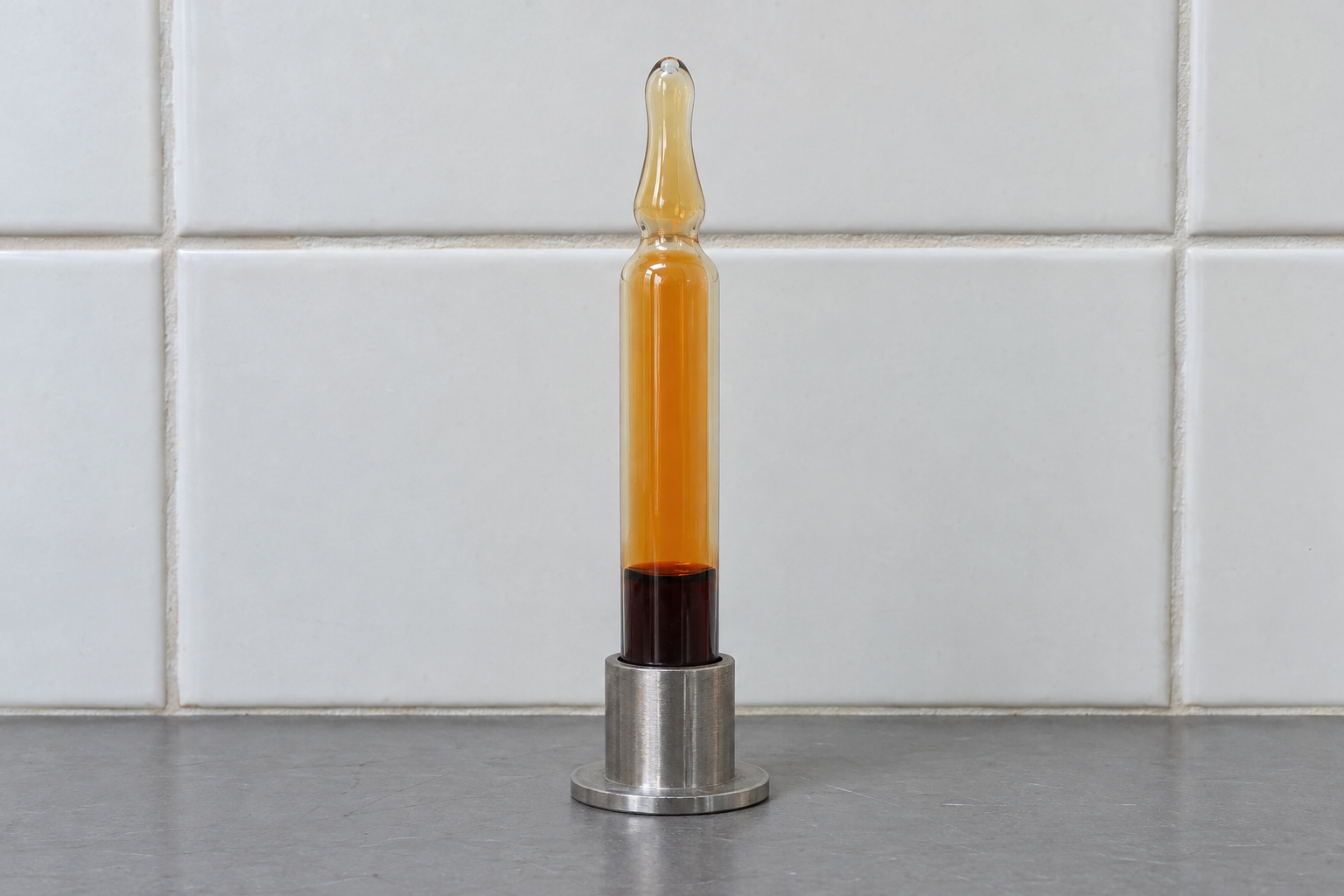
Constant readings on the ampoule, with liquid and vapor both present, mark the same equilibrium: Br₂(l) ⇌ Br₂(g).
Judge from described experimental observations whether a system has reached equilibrium, citing both the constancy of measurable properties and the simultaneous presence of all species.
Part 2Check what you just learned
Check — multiple choice
We've seen why a settled sealed flask's properties stay constant. What keeps a sealed flask's water level constant at equilibrium?
Feedback if chosen: Correct. The two processes continue at equal rates, so the level shows no net change.
Feedback if chosen: This option is wrong — evaporation continues; condensation returns molecules just as fast.
Feedback if chosen: This option is wrong — a faster return would raise the level; the level stays constant because the two rates are equal.
Check — multiple choice
| reading | at 0 min | at 10 min | at 20 min |
|---|---|---|---|
| mass of liquid CCl₄ (g) | 8.4 | 8.4 | 8.4 |
| total pressure (atm) | 0.15 | 0.15 | 0.15 |
A sealed flask holds liquid carbon tetrachloride below its vapor: CCl₄(l) ⇌ CCl₄(g). The table shows its readings. What do these observations establish?
Feedback if chosen: Correct. Every reading stays constant, the liquid's mass shows liquid present, and the pressure above zero shows vapor present.
Feedback if chosen: This option is wrong — no reading is still changing; every property stays constant across the twenty minutes.
Feedback if chosen: This option is wrong — these observations do settle it: the readings are constant, and both the liquid and the vapor are shown present.
Check — multiple choice
| reading | at 0 min | at 10 min | at 20 min |
|---|---|---|---|
| concentration of dissolved KNO₃ (M) | 3.2 | 3.2 | 3.2 |
A sealed jar of water with KNO₃ dissolved in it sits at a fixed temperature. The table shows the only quantity measured. What do these observations establish?
Feedback if chosen: This option is wrong — the constant concentration shows no net change, but nothing here shows whether any solid KNO₃ remains in the jar.
Feedback if chosen: This option is wrong — no reading is still changing, so nothing shows the mixture still approaching equilibrium.
Feedback if chosen: Correct. The reading is constant, but the table does not show whether solid KNO₃ is present, so the two marks of equilibrium cannot both be cited.
Check — multiple choice
| reading | at 0 min | at 1 min | at 2 min |
|---|---|---|---|
| total pressure (atm) | 0.04 | 0.09 | 0.13 |
A second CCl₄ flask was sealed moments ago. The table shows its readings, one minute apart. What do these observations establish?
Feedback if chosen: This option is wrong — the pressure is still rising, and at equilibrium every measurable property remains constant.
Feedback if chosen: Correct. The pressure trace is still rising, so an observable change is still occurring, and the flask has not yet reached equilibrium.
Feedback if chosen: This option is wrong — these observations do settle it: a reading is still changing, so the flask is not at equilibrium.
Check — multiple choice
Imani reads the settled CCl₄ flask's table and says: "The readings stopped changing, so the evaporation and the condensation must have stopped." Is Imani correct?
Feedback if chosen: This option is wrong — evaporation and condensation both continue inside the flask; their equal rates hold the readings constant.
Feedback if chosen: Correct. The readings stay constant because the forward and reverse processes continue to occur at equal rates, so there is no net observable change.
Check — multiple choice
Which pair of observations, taken together, establishes that a sealed CCl₄ flask's contents are at equilibrium?
Feedback if chosen: Correct. Equilibrium is established by citing the constancy of the measured properties together with the presence of all species.
Feedback if chosen: This option is wrong — a calibrated gauge reads accurately; it does not show which species are present.
Feedback if chosen: This option is wrong — a tight seal keeps the system closed; neither half of this pair shows that the properties are staying constant.
Checkpoint — reversibility, the equilibrium state, and the approach to equilibrium
Check — multiple choice
In a solution of hydrofluoric acid, HF molecules transfer protons to water molecules: HF + H₂O ⇌ F⁻ + H₃O⁺. Which proton transfer is the reverse change of this equation?
Feedback if chosen: Correct. The H₃O⁺ ion carries the transferred proton. Handing that proton to an F⁻ ion re-forms H₂O and HF, so this change undoes the forward transfer.
Feedback if chosen: This option is wrong — a proton passed from H₃O⁺ to H₂O re-forms water but never re-forms HF. The reverse change hands the proton to the F⁻ ion.
Feedback if chosen: This option is wrong — an F⁻ ion has no extra proton to give. The transferred proton sits on the H₃O⁺ ion, which returns it to the F⁻ ion.
Feedback if chosen: This option is wrong — HF handing a proton to F⁻ is the forward donor acting again. The reverse change starts from the products, H₃O⁺ and F⁻.
Check — multiple choice
A chemist seals acetic acid vapor in a flask, where pairs of molecules can join: 2 CH₃COOH(g) ⇌ (CH₃COOH)₂(g). The mixture reaches equilibrium, and its properties stay constant. Which statement describes the flask's molecules at equilibrium?
Feedback if chosen: This option is wrong — reaching equilibrium is not going to completion. Single CH₃COOH molecules are still present in the flask alongside the pairs.
Feedback if chosen: Correct. At equilibrium both species are present: pairs have formed, and single CH₃COOH molecules remain beside them.
Feedback if chosen: This option is wrong — the constant mixture is not the unchanged start. Pairs are present at equilibrium, together with single CH₃COOH molecules.
Feedback if chosen: This option is wrong — the mixture never swings between all-paired and all-single. At equilibrium pairs and single molecules are present together, in steady amounts.
Check — multiple choice
A sealed flask holds liquid methanol under methanol vapor at a fixed temperature. The flask's contents reached equilibrium days ago. A chemist stirs a few drops of methanol whose molecules carry a heavy-isotope label into the liquid. What will happen to the labeled molecules, and to the total pressure?
Feedback if chosen: Correct. Evaporation keeps carrying molecules, labeled ones included, into the vapor. Equal numbers of molecules leave and return each second, so the total pressure stays constant.
Feedback if chosen: This option is wrong — continuing exchange is not net change. As many molecules condense as evaporate each second, so the total pressure cannot rise.
Feedback if chosen: This option is wrong — constant readings do not mean the exchange stopped. Molecules still evaporate, so labeled molecules reach the vapor.
Feedback if chosen: This option is wrong — labeled molecules evaporate like any others, and the balanced exchange keeps the total pressure constant.
Check — multiple choice
A sealed vessel held at a steady high temperature is charged with only Cl₂ and F₂, and Cl₂ + F₂ ⇌ 2 ClF approaches equilibrium. The forward rate falls while the reverse rate rises, until the two rates become equal. Why do the rates change this way?
Feedback if chosen: This option is wrong — neither reaction pushes on the other. Each rate follows its own concentrations: less Cl₂ and F₂ slows the forward reaction, more ClF speeds the reverse.
Feedback if chosen: This option is wrong — the forward reaction never stops. Cl₂ and F₂ are still present and still reacting; both reactions occur together the whole time.
Feedback if chosen: Correct. The net conversion uses up Cl₂ and F₂, slowing the forward reaction, and builds up ClF, giving the reverse reaction more to break apart.
Feedback if chosen: This option is wrong — the vessel is held at a steady temperature, so warming is not the cause. The concentrations change: less Cl₂ and F₂, more ClF.
Check — multiple choice
A sealed vessel will start with 0.100 M NO, 0.070 M NO₂ and no N₂O₃, and NO + NO₂ ⇌ N₂O₃ will approach equilibrium. Which graph shows concentration curves consistent with this start and with equilibrium being established?
Feedback if chosen: This option is wrong — on Graph 1 the three curves flatten one after another, and one mixture reaches equilibrium at one time.
Feedback if chosen: This option is wrong — on Graph 2 all three curves have been brought to one shared level, and equilibrium does not force the concentrations to one level.
Feedback if chosen: This option is wrong — on Graph 3 the [NO₂] curve rises, and the vessel's net change consumes NO₂: a reactant's curve falls from its start.
Feedback if chosen: Correct. Each curve starts where the vessel's start puts it, every curve flattens at the same time, and the three flat levels sit apart.
Check — multiple choice
A heated, sealed vessel is charged with pure N₂F₄, and N₂F₄ ⇌ 2 NF₂ approaches equilibrium. The graph plots the forward and reverse rates. At which time is equilibrium established?
Feedback if chosen: This option is wrong — at 40 s the two rate curves still sit clearly apart. Equilibrium is established only once the two rates are equal.
Feedback if chosen: This option is wrong — at 60 s the gap between the two curves is still closing. They become equal, and stay equal, only from 80 s.
Feedback if chosen: Correct. From 80 s the forward-rate curve and the reverse-rate curve lie together and stay together — the two rates are equal from then on.
Feedback if chosen: This option is wrong — 120 s is only where the plotted window ends. The two curves already lie together from 80 s onward.
Check — multiple choice
| flask | 0 min | 30 min | 60 min | liquid visible? |
|---|---|---|---|---|
| J | 0.26 | 0.41 | 0.45 | yes |
| L | 0.48 | 0.48 | 0.48 | yes |
| M | 0.48 | 0.48 | 0.48 | not recorded |
| R | 0.31 | 0.31 | 0.31 | no |
Four sealed flasks, J, L, M and R, each hold carbon disulfide: CS₂(l) ⇌ CS₂(g). The flasks sit in the same 25 °C room, each fitted with a pressure gauge. The table shows each flask's readings. Which flask's observations establish that the flask's contents have reached equilibrium?
Feedback if chosen: This option is wrong — flask J's pressure is still rising across the hour, so flask J's contents have not yet settled into equilibrium.
Feedback if chosen: Correct. Flask L's pressure stays constant, the pressure above zero shows vapor present, and the visible liquid shows liquid present — constancy and presence together establish equilibrium.
Feedback if chosen: This option is wrong — flask M's constant readings alone cannot establish equilibrium. The table does not show whether any liquid remains, so the liquid's presence is not shown.
Feedback if chosen: This option is wrong — flask R shows no liquid: the CS₂ has fully evaporated. A completed change also shows constant readings, and equilibrium needs the liquid and the vapor both present.
U7-S03 — The reaction quotient and equilibrium constant
12 lessons
The reaction quotient
Outcome: State that the reaction quotient Q measures the relative amounts of products and reactants present at any moment, whether or not the system is at equilibrium.
Part 1Three tubes, one question
We've seen the sealed-tube reaction in which colorless N₂O₄ splits into brown NO₂.
The brown NO₂ also pairs back up into colorless N₂O₄.
A chemist prepares three of these tubes at one temperature.
Each tube is filled with the same amount of N₂O₄, then a different puff of NO₂.
One tube is barely tinted, one sits mid brown, one is deep brown.
A deeper brown means the tube holds more NO₂ beside the same N₂O₄.
The chemist wants one quantity that reports product relative to reactant, tube by tube.
How can one quantity report where each tube's mixture sits, between all reactant and all product?
Chemists compare the amounts of product and reactant present at one moment.
A mixture holding mostly product sits near the product end.
A mixture holding mostly reactant sits near the reactant end.
The quantity that measures the relative amounts of products and reactants at any moment is called the reaction quotient, written Q.
A mixture rich in product has a large Q.
A mixture rich in reactant has a small Q.
Here are the three tubes again, now ranked by their NO₂.
The barely tinted tube holds the least NO₂, so its mixture has the smallest Q of the three.
The deep tube holds the most NO₂, so its mixture has the largest Q of the three.
Q exists at every moment, even for a fresh mixture that holds no product yet.
A fresh mixture with no product yet has the smallest possible Q.
A mixture at equilibrium has a Q too, read at that settled moment.
So one quantity reports where each tube's mixture sits: its reaction quotient Q.
State that the reaction quotient Q measures the relative amounts of products and reactants present in a system at any moment, whether or not the system is at equilibrium.
Part 2Check what you just learned
Check — multiple choice
A chemist has just filled a flask with pure A gas, and the reaction A(g) ⇌ 2B(g) has not yet made any B. Does the mixture have a Q at this moment?
Feedback if chosen: Correct. Q exists at every moment. With no product yet, this mixture's Q is simply the smallest it can be.
Feedback if chosen: This option is wrong — Q exists at every moment, even before any product forms; this fresh mixture's Q is the smallest it can be.
Check — multiple choice
A sealed flask of the reaction X(g) + Y(g) ⇌ 2Z(g) has reached equilibrium. Does the settled mixture have a Q?
Feedback if chosen: Correct. Q exists at every moment, whether or not the system is at equilibrium; the settled mixture has its own Q.
Feedback if chosen: This option is wrong — Q exists at every moment, including at equilibrium; settling does not take a mixture's Q away.
Check — multiple choice
Two mixtures of the reaction D(g) ⇌ 2E(g) sit at one temperature. The first holds mostly E, the second mostly D. Which mixture has the larger Q?
Feedback if chosen: This option is wrong — D is the reactant, so a mixture holding mostly D sits near the reactant end, with a small Q.
Feedback if chosen: Correct. E is the product, and a mixture rich in product has a large Q.
Check — multiple choice
A mixture of the reaction G(g) ⇌ 2J(g) holds almost no J beside plenty of G. Is the mixture's Q large or small?
Feedback if chosen: This option is wrong — J is the product, and this mixture holds almost none of it; a mixture poor in product has a small Q.
Feedback if chosen: Correct. The mixture is rich in reactant and poor in product, so its Q is small.
Check — multiple choice
A chemist writes down a mixture's reaction quotient Q. What does Q measure?
Feedback if chosen: This option is wrong — speed is the reaction rate's job; Q reports amounts, not speed.
Feedback if chosen: This option is wrong — Q reads the mixture's composition at one moment; the settling time is a separate question.
Feedback if chosen: Correct. Q measures the relative amounts of products and reactants present at any moment.
Check — multiple choice
Which name belongs to the quantity that measures the relative amounts of products and reactants at any moment?
Feedback if chosen: Correct. The quantity that measures the relative amounts of products and reactants at any moment is the reaction quotient, Q.
Feedback if chosen: This option is wrong — the reaction rate measures how fast a concentration changes, not how much product sits beside reactant.
Products raise the reaction quotient
Outcome: Predict that Q increases when a product is added and decreases when a product is removed, with everything else held constant.
Part 1A puff of extra product
One sealed tube of the N₂O₄ and NO₂ mixture stands at equilibrium.
A chemist injects an extra puff of brown NO₂ into the tube.
NO₂ is the product in this reaction.
The mixture now holds more product than it held a moment ago.
Nothing else about the mixture has changed yet.
What happens to the tube's reaction quotient Q at the moment of the injection?
We've seen that Q measures how much product the mixture holds relative to reactant.
The injection raises the concentration of NO₂, the product.
The mixture now holds more product relative to reactant.
So Q rises.
Here is the tube just before and just after the puff.
| quantity | before the puff | just after the puff |
|---|---|---|
| the concentration of NO₂ (the product) | its settled value | raised by the puff |
| the concentration of N₂O₄ (the reactant) | its settled value | unchanged |
| Q | its settled value | larger |
Add product, and Q rises.
Remove product, and Q falls.
The prediction holds one change at a time, with everything else held constant.
Predict that Q increases when a product concentration (or partial pressure) is increased and decreases when a product is removed, with everything else held constant.
Part 2Check what you just learned
Check — multiple choice
A sealed flask of the reaction A(g) ⇌ B(g) + C(g) stands at equilibrium. A chemist injects extra C, with everything else held constant. Is the flask's Q now larger, smaller, or unchanged?
Feedback if chosen: Correct. C is a product, so the injection raised the amount of product relative to reactant, and Q rose.
Feedback if chosen: This option is wrong — C is a product, and extra product raises Q; removing product is what lowers it.
Feedback if chosen: This option is wrong — the injection raised the amount of C, a product, so Q changed: it rose.
Check — multiple choice
A sealed flask of the reaction A(g) ⇌ B(g) + C(g) stands at equilibrium. The chemist leaves the settled flask untouched for an hour. Is the flask's Q now larger, smaller, or unchanged?
Feedback if chosen: This option is wrong — nothing was added, so the mixture holds no more product than before; Q stays where it was.
Feedback if chosen: This option is wrong — nothing was removed, so the mixture holds no less product than before; Q stays where it was.
Feedback if chosen: Correct. No amount changed, so product relative to reactant is exactly what it was, and Q is unchanged.
Check — multiple choice
A sealed flask of the reaction A(g) ⇌ B(g) + C(g) stands at equilibrium. A chemist pumps some C gas out, lowering the concentration of C, with everything else held constant. Is the flask's Q now larger, smaller, or unchanged?
Feedback if chosen: This option is wrong — C is a product, and removing product lowers Q; adding product is what raises it.
Feedback if chosen: Correct. C is a product, so pumping it out lowered the amount of product relative to reactant, and Q fell.
Feedback if chosen: This option is wrong — the pumping lowered the concentration of C, a product, so Q changed: it fell.
Check — multiple choice
A sealed flask of the reaction A(g) ⇌ B(g) + C(g) stands at equilibrium. A chemist lets some C bleed out through a valve, lowering the partial pressure of C, with everything else held constant. Is the flask's Q now larger, smaller, or unchanged?
Feedback if chosen: This option is wrong — C is a product, and losing product lowers Q, whether the amount is tracked as a concentration or a partial pressure.
Feedback if chosen: Correct. A partial pressure counts the same way a concentration does: the flask lost product, so Q fell.
Feedback if chosen: This option is wrong — the partial pressure of C, a product, fell, so Q changed: it fell.
Reactants lower the reaction quotient
Outcome: Predict that Q decreases when a reactant is added and increases when a reactant is removed, with everything else held constant.
Part 1Extra reactant this time
Another sealed tube of the N₂O₄ and NO₂ mixture stands at equilibrium.
This time the chemist injects extra colorless N₂O₄.
N₂O₄ is the reactant in this reaction.
The mixture now holds more reactant beside the same product.
We've seen that adding product raises the reaction quotient Q.
Does adding reactant move Q the same way, or the opposite way?
Q measures product relative to reactant.
The injection raises the concentration of N₂O₄, the reactant.
The mixture now holds less product relative to reactant.
So Q falls.
Here is the tube just before and just after this injection.
| quantity | before the injection | just after the injection |
|---|---|---|
| the concentration of N₂O₄ (the reactant) | its settled value | raised by the injection |
| the concentration of NO₂ (the product) | its settled value | unchanged |
| Q | its settled value | smaller |
Add reactant, and Q falls.
Remove reactant, and Q rises.
A product change and a reactant change move Q in opposite directions.
Predict that Q decreases when a reactant concentration (or partial pressure) is increased and increases when a reactant is removed, with everything else held constant.
Part 2Check what you just learned
Check — multiple choice
A sealed flask of the reaction X(g) ⇌ Y(g) + Z(g) stands at equilibrium. A chemist injects extra X, with everything else held constant. Is the flask's Q now larger, smaller, or unchanged?
Feedback if chosen: This option is wrong — X is the reactant, and extra reactant lowers Q; extra product is what raises it.
Feedback if chosen: Correct. X is the reactant, so the injection lowered product relative to reactant, and Q fell.
Feedback if chosen: This option is wrong — the injection raised the amount of X, the reactant, so Q changed: it fell.
Check — multiple choice
A sealed flask of the reaction X(g) ⇌ Y(g) + Z(g) stands at equilibrium. A chemist pumps some X out, with everything else held constant. Is the flask's Q now larger, smaller, or unchanged?
Feedback if chosen: Correct. X is the reactant, so removing it raised product relative to reactant, and Q rose.
Feedback if chosen: This option is wrong — removing reactant raises Q; adding reactant is what lowers it.
Feedback if chosen: This option is wrong — the pumping lowered the amount of X, the reactant, so Q changed: it rose.
Check — multiple choice
A sealed flask of the reaction X(g) ⇌ Y(g) + Z(g) stands at equilibrium. The chemist leaves the settled flask untouched overnight. Is the flask's Q now larger, smaller, or unchanged?
Feedback if chosen: This option is wrong — no amount changed overnight, so product relative to reactant stayed exactly where it was.
Feedback if chosen: This option is wrong — nothing was added or removed, so Q had no reason to move.
Feedback if chosen: Correct. No amount changed, so Q is unchanged.
Check — multiple choice
A sealed flask of the reaction X(g) ⇌ Y(g) + Z(g) stands at equilibrium. A chemist injects extra Z, with everything else held constant. Is the flask's Q now larger, smaller, or unchanged?
Feedback if chosen: Correct. Z is a product, so the injection raised product relative to reactant, and Q rose.
Feedback if chosen: This option is wrong — Z is a product; extra product raises Q, and extra reactant is what lowers it.
Feedback if chosen: This option is wrong — the injection raised the amount of Z, a product, so Q changed: it rose.
Check — multiple choice
A sealed flask of the reaction 2 M(g) ⇌ W(g) stands at equilibrium. A chemist injects extra M, raising its partial pressure, with everything else held constant. Is the flask's Q now larger, smaller, or unchanged?
Feedback if chosen: This option is wrong — M is the reactant; extra reactant lowers Q whether the amount is tracked as a concentration or a partial pressure.
Feedback if chosen: Correct. The partial pressure of M, the reactant, rose, so product relative to reactant fell, and Q fell.
Feedback if chosen: This option is wrong — the injection raised the amount of M, the reactant, so Q changed: it fell.
Coefficients become exponents
Outcome: State that each species' concentration or partial pressure enters the reaction quotient raised to the power of that species' coefficient in the balanced equation.
Part 1Where the 2 goes
We've seen that the coefficients of a balanced equation fix the mole ratio between its species.
The balanced equation N₂O₄ ⇌ 2NO₂ carries a 2 on its product side.
Each N₂O₄ that splits delivers two NO₂ molecules.
Everywhere else in the reaction's arithmetic, the 2 counts.
The reaction quotient Q so far ignores every coefficient.
How does the equation's 2 enter Q?
We've seen that square brackets name a concentration: [NO₂] means the concentration of NO₂, in M.
Each species enters Q raised to the power of its own coefficient in the balanced equation.
The 2 in 2NO₂ makes Q depend on [NO₂]².
A coefficient of 1, as on N₂O₄, leaves its concentration at the first power.
Here are the two species of this equation, with each coefficient and the exponent it becomes.
| species | coefficient in N₂O₄ ⇌ 2NO₂ | exponent in Q |
|---|---|---|
| N₂O₄ | 1 | 1 |
| NO₂ | 2 | 2 |
Double [NO₂], holding everything else constant, and Q grows four times as large.
The squared term is why the doubling multiplies Q by four, not by two.
State that each species' concentration or partial pressure enters the reaction quotient raised to the power of that species' coefficient in the balanced equation.
Part 2Check what you just learned
Check — multiple choice
We've seen coefficients before. What do the coefficients of a balanced equation fix?
Feedback if chosen: This option is wrong — the coefficients count particles in moles; the masses follow only after the molar masses join in.
Feedback if chosen: Correct. The coefficients fix the mole ratio between every pair of species in the balanced equation.
Feedback if chosen: This option is wrong — the coefficients fix the mole ratio between the species; the reaction's speed is a separate fact.
Check — multiple choice
In the reaction 4HCl(g) + O₂(g) ⇌ 2Cl₂(g) + 2H₂O(g), which power does [HCl] carry in Q?
Feedback if chosen: This option is wrong — the first power belongs to a species with coefficient 1, and HCl carries a 4.
Feedback if chosen: This option is wrong — the second power belongs to the species with coefficient 2; HCl carries a 4.
Feedback if chosen: Correct. HCl's coefficient is 4, so [HCl] enters Q raised to the fourth power.
Check — multiple choice
In the reaction 4HCl(g) + O₂(g) ⇌ 2Cl₂(g) + 2H₂O(g), which power does [O₂] carry in Q?
Feedback if chosen: Correct. O₂'s coefficient is 1, so [O₂] stays at the first power.
Feedback if chosen: This option is wrong — the second power belongs to Cl₂ and H₂O, whose coefficients are 2; O₂ carries a 1.
Feedback if chosen: This option is wrong — the fourth power belongs to HCl, whose coefficient is 4; O₂ carries a 1.
Check — multiple choice
A settled mixture of 4HCl(g) + O₂(g) ⇌ 2Cl₂(g) + 2H₂O(g) sits in a sealed flask at high temperature. A chemist doubles the concentration of Cl₂, holding everything else constant. What happens to Q?
Feedback if chosen: This option is wrong — Cl₂ sits in Q as [Cl₂]², so changing its concentration changes Q.
Feedback if chosen: This option is wrong — [Cl₂] enters Q squared, so the doubling counts twice over: Q grows by a factor of four.
Feedback if chosen: Correct. Cl₂ is a product with coefficient 2, so Q depends on [Cl₂]²; doubling [Cl₂] multiplies Q by four.
Check — multiple choice
A settled mixture of 4HCl(g) + O₂(g) ⇌ 2Cl₂(g) + 2H₂O(g) sits in a sealed flask at high temperature. A chemist doubles the concentration of O₂, holding everything else constant. What happens to Q?
Feedback if chosen: This option is wrong — O₂ is a reactant, and we've seen that raising a reactant lowers Q; here it falls to half.
Feedback if chosen: This option is wrong — a quarter would need [O₂] squared, and O₂'s coefficient is 1; Q falls to half.
Feedback if chosen: Correct. O₂ carries coefficient 1, so the doubling changes Q by one factor of two, and a raised reactant lowers Q: it falls to half.
Writing the Qc expression
Outcome: Write the reaction-quotient expression Qc for a reaction from its balanced equation, products over reactants, each raised to its coefficient.
Part 1One expression for all three effects
Here is the exam demand: write the reaction quotient for the ethanol synthesis, C₂H₄(g) + H₂O(g) ⇌ C₂H₅OH(g).
We've seen the three effects one at a time.
More product means a larger Q.
More reactant means a smaller Q.
Each coefficient becomes an exponent.
One written expression must carry all three at once.
Which single expression joins the products, the reactants, and their coefficients?
We've seen that molarity is the moles of solute per liter of solution, written M.
A reaction quotient built from molar concentrations is written Qc.
The product concentrations multiply together on the top of the fraction.
The reactant concentrations multiply together on the bottom of the fraction.
Each concentration carries its coefficient as its exponent.
For aA + bB ⇌ cC + dD, the one canonical form is Qc = [C]ᶜ[D]ᵈ/([A]ᵃ[B]ᵇ).
Here is the canonical form with each part labelled.
Every reaction quotient you will write is this one form, filled in for one reaction.
Part 2The exam demand, answered step by step
Now answer the exam demand for C₂H₄(g) + H₂O(g) ⇌ C₂H₅OH(g), one step at a time.
The product is C₂H₅OH, so [C₂H₅OH] goes on the top of the fraction.
The reactants are C₂H₄ and H₂O, so [C₂H₄] and [H₂O] multiply together on the bottom of the fraction.
Every species here carries a coefficient of 1, so every concentration stays at the first power.
So Qc = [C₂H₅OH]/([C₂H₄][H₂O]).
Now a case where a coefficient is not 1: the sealed tube's reaction, N₂O₄(g) ⇌ 2NO₂(g).
The 2 in 2NO₂ becomes the exponent on [NO₂], and N₂O₄'s coefficient of 1 leaves [N₂O₄] at the first power.
So Qc = [NO₂]²/[N₂O₄].
Write the reaction-quotient expression Qc for a reaction from its balanced equation, with product concentrations in the numerator and reactant concentrations in the denominator, each raised to its coefficient.
Part 3Check what you just learned
Check — multiple choice
We've seen molarity before. What does a solution's molarity state?
Feedback if chosen: This option is wrong — molarity counts the solute in moles, not grams.
Feedback if chosen: Correct. Molarity is the moles of solute per liter of solution, written M.
Feedback if chosen: This option is wrong — molarity measures the solution by its volume in liters, not by the solvent's mass.
Check — multiple choice
In the reaction 2H₂S(g) ⇌ 2H₂(g) + S₂(g), which concentrations go on the top of the Qc fraction?
Feedback if chosen: This option is wrong — H₂S is the reactant, and reactant concentrations go on the bottom of the fraction.
Feedback if chosen: Correct. H₂ and S₂ are the products, and the product concentrations multiply on the top of the fraction.
Feedback if chosen: This option is wrong — the top carries the products only; the reactant H₂S belongs on the bottom.
Check — multiple choice
In the reaction 2H₂S(g) ⇌ 2H₂(g) + S₂(g), which exponents do [H₂S], [H₂] and [S₂] carry in Qc, in that order?
Feedback if chosen: This option is wrong — the coefficients are not all 1; the 2 on H₂S and the 2 on H₂ become exponents.
Feedback if chosen: This option is wrong — S₂ carries a coefficient of 1, so [S₂] stays at the first power.
Feedback if chosen: Correct. Each concentration carries its own coefficient: 2 on H₂S, 2 on H₂, and 1 on S₂.
Check — multiple choice
Which expression is Qc for 2H₂S(g) ⇌ 2H₂(g) + S₂(g)?
Feedback if chosen: This option is wrong — this fraction is upside down: it puts the reactant on top and the products below.
Feedback if chosen: This option is wrong — this expression ignores the coefficients; the 2 on H₂S and the 2 on H₂ must become exponents.
Feedback if chosen: Correct. The products H₂ and S₂ multiply on top, the reactant H₂S sits below, and each carries its coefficient as its exponent.
Feedback if chosen: This option is wrong — S₂ carries a coefficient of 1, so [S₂] stays at the first power, not squared.
Check — multiple choice
Which expression is Qc for CS₂(g) + 4H₂(g) ⇌ CH₄(g) + 2H₂S(g)?
Feedback if chosen: Correct. The products CH₄ and H₂S multiply on top, the reactants CS₂ and H₂ below, each raised to its own coefficient.
Feedback if chosen: This option is wrong — this fraction is upside down: the products CH₄ and H₂S belong on top.
Feedback if chosen: This option is wrong — the exponents sit on the wrong species: the 2 belongs to H₂S and the 4 to H₂.
Feedback if chosen: This option is wrong — this expression ignores the coefficients; the 2 on H₂S and the 4 on H₂ must become exponents.
Check — multiple choice
What does the subscript c in Qc say about how that reaction quotient is built?
Feedback if chosen: Correct. The c marks a reaction quotient built from molar concentrations, in M.
Feedback if chosen: This option is wrong — every reaction quotient uses the coefficients as exponents; the c names the concentrations the quotient is built from.
The equilibrium constant
Outcome: State that the equilibrium constant K is the value the reaction quotient reaches at equilibrium: Q tends toward K over time, and Q = K exactly at equilibrium.
Part 1Five starts, one ending
A chemist fills five flasks with five different starting mixtures of N₂O₄ and NO₂.
Every flask stands sealed at 25 °C until its color stops changing.
We've seen that a mixture at equilibrium shows no further change in any concentration.
The five settled mixtures hold five different concentrations of NO₂.
A table lists each settled mixture's Qc: the same 4.6 × 10⁻³, five times over.
| flask | [N₂O₄] (M) | [NO₂] (M) | Qc |
|---|---|---|---|
| 1 | 0.0250 | 0.0107 | 4.6 × 10⁻³ |
| 2 | 0.0500 | 0.0152 | 4.6 × 10⁻³ |
| 3 | 0.100 | 0.0215 | 4.6 × 10⁻³ |
| 4 | 0.150 | 0.0263 | 4.6 × 10⁻³ |
| 5 | 0.200 | 0.0304 | 4.6 × 10⁻³ |
Five different starts have landed on one shared Qc.
Is the shared ending a coincidence, or a fixed property of the reaction?
The shared ending is a fixed property of the reaction at its temperature.
The reaction drives its reaction quotient Q toward one resting point as the mixture settles.
The resting point that Q reaches at equilibrium is called the equilibrium constant, written K.
At equilibrium, Q equals K exactly.
Away from equilibrium, a mixture shows its own Qc.
At equilibrium, a mixture shows the shared Qc.
That shared Qc is the reaction's Kc, the equilibrium constant in concentration form.
For the five flasks, Kc = 4.6 × 10⁻³ at 25 °C.
State that the equilibrium constant K is the value the reaction quotient reaches at equilibrium: Q tends toward K over time, and Q = K exactly at equilibrium.
Part 2Check what you just learned
Check — multiple choice
A sealed flask of the reaction A(g) ⇌ 2B(g) has Kc = 4.0 at the flask's temperature. The concentration of B is still rising. Is the mixture's Qc equal to Kc at this moment?
Feedback if chosen: This option is wrong — Q equals K exactly at equilibrium, and a mixture whose concentrations are still changing has not reached equilibrium.
Feedback if chosen: Correct. The mixture is still changing, so it has not reached equilibrium, and its Qc is still on its way toward Kc.
Check — multiple choice
A sealed flask of the reaction X(g) + Y(g) ⇌ 2Z(g) has Kc = 0.25 at the flask's temperature. Every concentration has stayed constant for hours. Is the mixture's Qc equal to Kc?
Feedback if chosen: Correct. Constant concentrations mark equilibrium, and at equilibrium Q equals K exactly.
Feedback if chosen: This option is wrong — the mixture has reached equilibrium, and at equilibrium Qc equals Kc exactly.
Check — multiple choice
A chemist has just mixed some D and some E in a flask for the reaction D(g) ⇌ 2E(g), whose Kc at this temperature is 2.0. Is the fresh mixture's Qc equal to Kc?
Feedback if chosen: This option is wrong — a fresh mixture starts wherever the chemist happened to fill it; its Qc equals Kc only once the mixture has settled.
Feedback if chosen: Correct. The fresh mixture's Qc is whatever the filled amounts give; Q is only guaranteed to equal K at equilibrium.
Check — multiple choice
A mixture of the reaction G(g) ⇌ 2J(g) is not at equilibrium. Which of these does the mixture have at this moment?
Feedback if chosen: This option is wrong — Kc is the reaction's fixed resting point, not a property each mixture carries; the mixture has its own Qc.
Feedback if chosen: Correct. A mixture always has a Qc; Kc belongs to the reaction at its temperature, and Qc reaches it at equilibrium.
Check — multiple choice
What does a reaction's equilibrium constant K tell you?
Feedback if chosen: This option is wrong — K is the resting value Q reaches, however long the settling takes; time plays no part in it.
Feedback if chosen: This option is wrong — K is a ratio of products to reactants, not an amount of product on its own.
Feedback if chosen: Correct. K is the value Q reaches at equilibrium: Q tends toward K, and Q = K exactly at equilibrium.
Check — multiple choice
Which symbol names the equilibrium constant written from molar concentrations?
Feedback if chosen: Correct. Kc is the equilibrium constant in concentration form.
Feedback if chosen: This option is wrong — Qc is the reaction quotient, read at any moment; the constant that Qc reaches at equilibrium is Kc.
Qp and Kp
Outcome: Write the reaction quotient and equilibrium constant in partial-pressure form, Qp and Kp, for a gas-phase reaction.
Part 1An analyzer that speaks in atm
A sealed tube of N₂O₄ and NO₂ sits on a gas analyzer at 25 °C.
The tube's gas analyzer reports each gas's partial pressure in atm.
| gas | partial pressure |
|---|---|
| N₂O₄ | 0.100 atm |
| NO₂ | 0.106 atm |
No concentration in mol/L appears anywhere on the display.
We've seen that each gas in a mixture exerts its own partial pressure, pushing as if it were alone.
A partial pressure measures how much of one gas the tube holds, just as a concentration does.
Can Q and K be written from partial pressures instead?
The reaction quotient Q and the equilibrium constant K keep the same canonical form when gases are measured by pressure.
Each concentration's place is taken by that species' partial pressure.
The reaction quotient written from partial pressures is called Qp.
The equilibrium constant written from partial pressures is called Kp.
For N₂O₄(g) ⇌ 2NO₂(g), the expression reads Kp = (P_NO₂)²/P_N₂O₄.
The partial pressure of NO₂, the product, stands on top, squared for its coefficient of 2.
The partial pressure of N₂O₄, the reactant, stands below.
The products still stand over the reactants.
The coefficients still become exponents.
Write the reaction quotient and equilibrium constant in partial-pressure form (Qp, Kp) for a gas-phase reaction: the same products-over-reactants form with each concentration replaced by that species' partial pressure.
Part 2Check what you just learned
Check — multiple choice
Which pressure is one gas's partial pressure, in a sealed mixture of gases?
Feedback if chosen: This option is wrong — the gases need not push equally; each gas's own particles set its own pressure.
Feedback if chosen: Correct. Each gas pushes as if it were alone, so its partial pressure is the pressure it would exert by itself in the same container.
Feedback if chosen: This option is wrong — the particles push independently; the other gases do not change a gas's own pressure.
Check — multiple choice
Which expression is Kp for CH₄(g) + CO₂(g) ⇌ 2CO(g) + 2H₂(g)?
Feedback if chosen: This option is wrong — this fraction is upside down: the products CO and H₂ belong on top.
Feedback if chosen: This option is wrong — square brackets name concentrations; Kp is built from partial pressures.
Feedback if chosen: Correct. The products' partial pressures multiply on top, the reactants' below, and each 2 becomes its species' exponent.
Feedback if chosen: This option is wrong — this expression ignores the coefficients; the 2 on 2CO and the 2 on 2H₂ must become exponents.
Check — multiple choice
Which expression is Qp for A(g) + 2B(g) ⇌ 2C(g)?
Feedback if chosen: Correct. The product C's partial pressure, squared, stands over the reactants' partial pressures, with the 2 on B as its exponent.
Feedback if chosen: This option is wrong — this fraction is upside down: the product C belongs on top.
Feedback if chosen: This option is wrong — the exponents sit on the wrong species: the 2 belongs to B, and A carries a coefficient of 1.
Check — multiple choice
Which symbol names the reaction quotient written from partial pressures?
Feedback if chosen: Correct. Qp is the reaction quotient in partial-pressure form, read at any moment.
Feedback if chosen: This option is wrong — Kp is the equilibrium constant in partial-pressure form; the quotient read at any moment is Qp.
Check — multiple choice
What does the symbol Kp name, for a gas-phase reaction?
Feedback if chosen: This option is wrong — the any-moment quotient is Qp; Kp is the value Qp reaches at equilibrium.
Feedback if chosen: Correct. Kp is the equilibrium constant with each concentration's place taken by that species' partial pressure.
Feedback if chosen: This option is wrong — Kp is a ratio built from the separate partial pressures, not the total pressure.
Kc or Kp?
Outcome: Identify whether a problem is using Kc or Kp from the quantities it supplies.
Part 1Two questions, one reaction
Two exam questions describe the same industrial gas reaction: CO(g) + H₂O(g) ⇌ CO₂(g) + H₂(g).
The first question supplies its amounts as concentrations.
The second question supplies its amounts as partial pressures.
Each question quotes a constant it simply calls K.
Which constant is each question actually using?
The supplied quantities name the constant.
A question that supplies concentrations is working with Kc.
A question that supplies partial pressures is working with Kp.
Concentrations arrive in mol/L.
Partial pressures arrive in atm.
Here are the two questions side by side.
| question 1 | question 2 | |
|---|---|---|
| the reaction | CO(g) + H₂O(g) ⇌ CO₂(g) + H₂(g) | CO(g) + H₂O(g) ⇌ CO₂(g) + H₂(g) |
| the supplied amounts | in mol/L | in atm |
| the constant in use | Kc | Kp |
The AP exam never asks you to convert between Kc and Kp.
The job is to identify which constant the question uses.
Part 2The same card, read four ways
Here is the first card: the same industrial gas reaction, its amounts listed in mol/L.
Which constant is this question using? Kc.
Amounts in mol/L are concentrations, and concentrations go with Kc.
Now the same card, with each amount swapped to atm.
Which constant is this question using? Kp.
Amounts in atm are partial pressures, and partial pressures go with Kp.
Now the card quotes a constant K beside a table of partial pressures.
Which constant is this question using? Kp.
The quoted K sits beside pressures in atm, so that K is Kp.
Now the same card quotes its K beside a table of concentrations.
Which constant is this question using? Kc.
The quoted K sits beside concentrations in mol/L, so that K is Kc.
Identify whether a problem is using Kc or Kp from the quantities it supplies: concentrations in mol/L go with Kc, partial pressures in atm with Kp. Conversion between Kc and Kp is not assessed on the AP Exam.
Part 3Check what you just learned
Check — multiple choice
A question supplies the reaction CH₄(g) + CO₂(g) ⇌ 2CO(g) + 2H₂(g) with each gas's partial pressure in atm, and quotes a constant K. Which constant is the question using?
Feedback if chosen: This option is wrong — the supplied amounts are partial pressures in atm, and partial pressures go with Kp.
Feedback if chosen: Correct. The question supplies partial pressures in atm, so its constant is Kp.
Check — multiple choice
A question describes a reaction in aqueous solution, A(aq) + B(aq) ⇌ 2C(aq), and supplies each amount in mol/L. Which constant is the question using?
Feedback if chosen: Correct. Amounts in mol/L are concentrations, and concentrations go with Kc.
Feedback if chosen: This option is wrong — Kp is built from partial pressures in atm, and this question supplies concentrations in mol/L.
Check — multiple choice
A question supplies the gas reaction CH₄(g) + CO₂(g) ⇌ 2CO(g) + 2H₂(g) with each amount as a concentration in mol/L. Which constant is the question using?
Feedback if chosen: Correct. Even for an all-gas reaction, amounts supplied in mol/L are concentrations, and concentrations go with Kc.
Feedback if chosen: This option is wrong — a gas reaction can be worked in either form; the supplied mol/L amounts are concentrations, so the constant is Kc.
Check — multiple choice
A question quotes a constant beside a table of partial pressures for the gas reaction X(g) ⇌ 2Y(g). Which constant is it using?
Feedback if chosen: This option is wrong — the quoted constant sits beside partial pressures, and partial pressures go with Kp.
Feedback if chosen: Correct. The constant is quoted beside partial pressures in atm, so it is Kp.
Solids and liquids are omitted
Outcome: State that pure solids and pure liquids are omitted from the expressions for the reaction quotient Q and the equilibrium constant K.
Part 1Lumps in the furnace
In a blast furnace, carbon monoxide gas reacts with solid iron oxide.
The equation reads Fe₂O₃(s) + 3CO(g) ⇌ 2Fe(s) + 3CO₂(g).
Two of the four species carry the label (s), for solid.
Each gas spreads through the whole furnace, so each gas has a concentration.
The two solids sit as lumps.
A lump does not spread through the mixture the way a gas does.
Which species belong in this reaction's Q and K expressions?
We've seen that the reaction quotient Q and the equilibrium constant K take one canonical form: products over reactants, coefficients as exponents.
Pure solids and pure liquids are left out of Q and K expressions.
Gases and dissolved species stay in.
For the blast furnace, the expression reads Kc = [CO₂]³/[CO]³.
Fe₂O₃(s) and Fe(s) add no term at all.
The state label settles each species: (g) and (aq) go in, (s) and (l) stay out.
Part 2The same question, species by species
Here are the blast furnace's four species, one at a time.
Does CO(g) appear in the expression? Yes.
CO is a gas, and gases stay in.
Does CO₂(g) appear in the expression? Yes.
CO₂ is a gas, and gases stay in.
Does Fe₂O₃(s) appear in the expression? No.
Fe₂O₃ is a pure solid, and pure solids are left out.
Does Fe(s) appear in the expression? No.
Fe is a pure solid, and pure solids are left out.
Here are the four species in one table.
| species | state label | Does the species appear in the expression? |
|---|---|---|
| CO(g) | gas | |
| CO₂(g) | gas | |
| Fe₂O₃(s) | solid | |
| Fe(s) | solid |
Water shows the same rule from both sides.
In the steam-iron reaction, 3Fe(s) + 4H₂O(g) ⇌ Fe₃O₄(s) + 4H₂(g), the water is a gas.
Does this water appear in the expression? Yes.
Water as a gas goes into the expression.
In a reaction in dilute aqueous solution, the water is a liquid.
Does that water appear in the expression? No.
Water as a liquid stays out of the expression.
State that pure solids and pure liquids are omitted from Q and K expressions.
Part 3Check what you just learned
Check — multiple choice
In the reaction 2HgO(s) ⇌ 2Hg(l) + O₂(g), does Hg(l) appear in the K expression?
Feedback if chosen: This option is wrong — Hg(l) is a pure liquid, and pure liquids are left out of Q and K expressions.
Feedback if chosen: Correct. Hg(l) is a pure liquid, so it contributes no term.
Check — multiple choice
In the reaction 2HgO(s) ⇌ 2Hg(l) + O₂(g), does O₂(g) appear in the K expression?
Feedback if chosen: Correct. O₂ is a gas, and gases stay in the expression.
Feedback if chosen: This option is wrong — only pure solids and pure liquids are left out; O₂ is a gas, so it stays in.
Check — multiple choice
In the same decomposition, 2HgO(s) ⇌ 2Hg(l) + O₂(g), does HgO(s) appear in the K expression?
Feedback if chosen: This option is wrong — HgO(s) is a pure solid, and pure solids are left out, reactant side or not.
Feedback if chosen: Correct. HgO(s) is a pure solid, so it contributes no term.
Check — multiple choice
A reaction in dilute aqueous solution produces water: D(aq) + E(aq) ⇌ 2F(aq) + H₂O(l). Does H₂O(l) appear in the K expression?
Feedback if chosen: This option is wrong — this water is a pure liquid, and pure liquids are left out of the expression.
Feedback if chosen: Correct. Water as a liquid stays out of the expression.
Check — multiple choice
In the same aqueous reaction, D(aq) + E(aq) ⇌ 2F(aq) + H₂O(l), does F(aq) appear in the K expression?
Feedback if chosen: Correct. F is a dissolved species, and dissolved species stay in the expression.
Feedback if chosen: This option is wrong — only pure solids and pure liquids are left out; the dissolved F stays in.
Why solids and liquids are omitted
Outcome: Explain why pure solids and pure liquids are omitted from the expressions for the reaction quotient Q and the equilibrium constant K.
Part 1Ten times the solid, the same gas
Two sealed tubes hold the same decomposition at the same high temperature.
The equation reads CaCO₃(s) ⇌ CaO(s) + CO₂(g).
The first tube holds a small amount of CaCO₃.
The second tube holds ten times that amount of CaCO₃.
At equilibrium, both tubes show exactly the same pressure of CO₂.
Ten times the solid made no difference to the CO₂.
Why does the amount of solid change nothing?
We've seen that pure solids and pure liquids are left out of the reaction quotient Q and the equilibrium constant K.
Pure solids and pure liquids are omitted from Q and K expressions, because the concentration of a pure solid or pure liquid is a fixed property of the substance, unchanged by how much of it is present, so it contributes no variable term.
A small lump of CaCO₃ and a heap of CaCO₃ are packed equally tightly.
Each tube's solid offers the same fixed concentration, however much solid sits there.
Only the CO₂ has a partial pressure that can vary.
So the CO₂ alone carries a variable term.
Adding more solid CaCO₃ does not change how far the decomposition proceeds.
Explain why pure solids and pure liquids are omitted from Q and K expressions: the concentration of a pure solid or pure liquid is a fixed property of the substance, unchanged by how much of it is present, so it contributes no variable term.
Part 2Check what you just learned
Check — multiple choice
A sealed flask holds NH₄HS(s) ⇌ NH₃(g) + H₂S(g) at equilibrium. A chemist drops in more solid NH₄HS, and the temperature stays the same. What happens to the partial pressures of NH₃ and H₂S?
Feedback if chosen: This option is wrong — adding solid adds no gas; neither partial pressure moves.
Feedback if chosen: This option is wrong — no gas was removed from the flask; neither partial pressure moves.
Feedback if chosen: Correct. Both partial pressures stay exactly where they were.
Free-response question
Source note (not shown as part of the question): authored to archetype: AP heterogeneous-equilibrium justification (pure-phase omission)
A sealed flask holds solid NH₄HS and its two gases at equilibrium: NH₄HS(s) ⇌ NH₃(g) + H₂S(g). A chemist drops in an extra spoonful of solid NH₄HS, and the temperature stays the same. The partial pressures of NH₃ and H₂S do not change.
a Explain why the partial pressures of the two gases are unchanged. [2 points]
✓ Model response (the key)
Model answer
The concentration of a pure solid is a fixed property of the substance, unchanged by how much of it is present.
So the extra spoonful offers the gases the same fixed solid concentration the first portion offered.
The solid therefore contributes no variable term; only the two gases carry variable terms.
Those variable terms were already at their equilibrium values, so the partial pressures of NH₃ and H₂S stay unchanged.
Scoring rubric — 2 points available
- States that a pure solid's concentration is a fixed property of the substance, unchanged by the amount present (equivalent reasoning accepted). [1 pt]
- Concludes that the solid contributes no variable term, so the gas partial pressures are unchanged (equivalent reasoning accepted). [1 pt]
Check — multiple choice
A sealed flask holds solid ammonium carbamate decomposing reversibly, NH₄NH₂CO₂(s) ⇌ 2NH₃(g) + CO₂(g), at equilibrium. A chemist scoops out half of the solid, leaving plenty in place, and the temperature stays the same. What happens to the partial pressures of the two gases?
Feedback if chosen: This option is wrong — no gas was added; the remaining solid offers the same fixed concentration, so no variable term changed.
Feedback if chosen: This option is wrong — the solid left in place offers the gases the same fixed solid concentration as before, so no variable term changed.
Feedback if chosen: Correct. A pure solid's concentration is a fixed property, unchanged by how much of it is present, so the partial pressures stay where they were.
Expressions with solids or liquids present
Outcome: Write expressions for the reaction quotient Q or the equilibrium constant K for reactions involving pure solids or pure liquids, correctly omitting them.
Part 1An expression one term long
Here is the exam demand: write the Kp expression for CaCO₃(s) ⇌ CaO(s) + CO₂(g).
Three species stand in the equation.
Two of the three are pure solids.
We've seen that pure solids and pure liquids contribute no term.
Cross the two solids out, and almost nothing of the equation is left.
Can an expression really be that short?
We've seen that the equilibrium constant can be written as Kc from concentrations or as Kp from partial pressures.
The canonical form still governs: products over reactants, coefficients as exponents.
Every pure solid and pure liquid is left out.
Here is the whole demand worked: the two solids struck out, and what survives.
For CaCO₃(s) ⇌ CaO(s) + CO₂(g), the whole expression is Kp = P_CO₂.
Yes, an expression really can be one term long.
Part 2More heterogeneous cases
We've seen lead iodide, PbI₂, as the bright yellow precipitate from mixed solutions.
Dissolving PbI₂ is a reversible process: PbI₂(s) ⇌ Pb²⁺(aq) + 2I⁻(aq).
The solid contributes no term, so Kc = [Pb²⁺][I⁻]².
The dissolved ions stay in, each raised to its coefficient.
One more pair shows how sharply the state labels decide the expression.
Consider H₂(g) + I₂(g) ⇌ 2HI(g), with the iodine present as a gas.
Does the iodine appear in the expression? Yes.
Every species is a gas, so every species appears: Kp = (P_HI)²/((P_H₂)(P_I₂)).
Now consider the same reaction with the iodine present as a solid: H₂(g) + I₂(s) ⇌ 2HI(g).
Does the iodine appear in the expression? No.
The solid iodine contributes no term, so Kp = (P_HI)²/P_H₂.
One state label moved, and one term left the expression.
Here are the taught cases in one table.
| reaction | the expression |
|---|---|
| CaCO₃(s) ⇌ CaO(s) + CO₂(g) | Kp = |
| PbI₂(s) ⇌ Pb²⁺(aq) + 2I⁻(aq) | Kc = [Pb²⁺][I⁻]² |
| H₂(g) + I₂(g) ⇌ 2HI(g) | Kp = |
| H₂(g) + I₂(s) ⇌ 2HI(g) | Kp = |
Write Q or K expressions for reactions involving pure solids or pure liquids, correctly omitting them.
Part 3Check what you just learned
Check — multiple choice
In the reaction SnO₂(s) + 2H₂(g) ⇌ Sn(s) + 2H₂O(g), which species are left out of the Kp expression?
Feedback if chosen: This option is wrong — H₂ and H₂O(g) are the gases, and gases stay in the expression.
Feedback if chosen: Correct. The two pure solids contribute no term; the two gases stay in.
Feedback if chosen: This option is wrong — Sn(s) is a pure solid too, and every pure solid is left out.
Feedback if chosen: This option is wrong — pure solids are left out of Q and K expressions, and this reaction carries two of them.
Check — multiple choice
Which expression is Kp for SnO₂(s) + 2H₂(g) ⇌ Sn(s) + 2H₂O(g)?
Feedback if chosen: This option is wrong — this expression keeps both pure solids in, and pure solids contribute no term.
Feedback if chosen: Correct. The two solids contribute no term, so only the gas H₂O stands over the gas H₂, each squared.
Feedback if chosen: This option is wrong — this fraction is upside down: the product gas H₂O belongs on top.
Feedback if chosen: This option is wrong — this expression plants the pure solid SnO₂ in the denominator, and pure solids contribute no term.
Check — multiple choice
Which expression is Kp for C(s) + CO₂(g) ⇌ 2CO(g)?
Feedback if chosen: This option is wrong — this fraction is upside down: the product CO belongs on top.
Feedback if chosen: This option is wrong — this expression keeps the pure solid carbon in, and pure solids contribute no term.
Feedback if chosen: This option is wrong — this expression ignores the coefficient; the 2 on 2CO must become the exponent on its partial pressure.
Feedback if chosen: Correct. The solid carbon is left out, so the product CO, squared, stands over the reactant gas CO₂.
Check — multiple choice
A reaction in dilute aqueous solution produces water: A(aq) + 2B(aq) ⇌ C(aq) + H₂O(l). Which expression is Kc?
Feedback if chosen: This option is wrong — this expression keeps the liquid water in, and pure liquids contribute no term.
Feedback if chosen: This option is wrong — this expression ignores the coefficient; the 2 on 2B must become the exponent on [B].
Feedback if chosen: Correct. The liquid water contributes no term, and each dissolved species carries its coefficient as its exponent.
Check — multiple choice
The solid XZ₂ dissolves reversibly: XZ₂(s) ⇌ X²⁺(aq) + 2Z⁻(aq). Which expression is Kc?
Feedback if chosen: This option is wrong — this expression plants the pure solid XZ₂ in the denominator, and pure solids contribute no term.
Feedback if chosen: Correct. The solid contributes no term, so the expression is just the two dissolved ions, the Z⁻ squared for its coefficient.
Feedback if chosen: This option is wrong — this expression ignores the coefficient; the 2 on 2Z⁻ must become the exponent on [Z⁻].
Check — multiple choice
In the gas reaction 2D(g) ⇌ E(l) + F(g), the product E is a pure liquid. Which expression is Kp?
Feedback if chosen: This option is wrong — this expression keeps the pure liquid E in, and pure liquids contribute no term.
Feedback if chosen: This option is wrong — this fraction is upside down: the product gas F belongs on top.
Feedback if chosen: Correct. The pure liquid E is left out, so the product gas F stands over the reactant gas D, squared for its coefficient.
K depends only on temperature
Outcome: State that the value of K for a given reaction depends only on temperature: at a fixed temperature, the same K is reached from any starting composition.
Part 1Opposite starts, the same constant
A chemist seals two flasks of the same reaction.
The first flask starts as pure colorless N₂O₄.
The second flask starts as pure brown NO₂.
Both flasks stand sealed at 25 °C until their colors stop changing.
The two flasks settle with different concentrations of NO₂.
| flask | started as | [N₂O₄] (M) | [NO₂] (M) | settled Qc |
|---|---|---|---|---|
| 1 | pure N₂O₄ | 0.100 | 0.0215 | 4.6 × 10⁻³ |
| 2 | pure NO₂ | 0.0250 | 0.0107 | 4.6 × 10⁻³ |
Yet each flask's settled Qc comes out at the same 4.6 × 10⁻³.
Which change to a flask could land the reaction on a different Kc?
The equilibrium constant K for a given reaction depends only on temperature.
At one temperature, every starting mixture settles to the same K.
Adding more of a species leaves K exactly where it was.
We've seen that a catalyst speeds up a reaction without being used up.
Adding a catalyst leaves K exactly where it was.
A catalyst speeds the mixture's approach to equilibrium, and leaves the destination unchanged.
A quoted K holds at its stated temperature.
The reason K depends only on temperature arrives in a later unit.
State that the value of K for a given reaction depends only on temperature: at a fixed temperature, the same K is reached from any starting composition.
Part 2Check what you just learned
Check — multiple choice
We've seen catalysts before. What does a catalyst do to a reaction?
Feedback if chosen: This option is wrong — a catalyst is not used up; speeding the reaction is its whole effect.
Feedback if chosen: Correct. A catalyst speeds a reaction up and is not used up by it.
Feedback if chosen: This option is wrong — a catalyst changes the speed, never the products.
Check — multiple choice
A sealed flask holds 2COF₂(g) ⇌ CO₂(g) + CF₄(g) at equilibrium, at one fixed temperature. A chemist injects extra CO₂, and the temperature stays the same. Once the flask settles again, is its Kc the same value as before?
Feedback if chosen: Correct. Kc depends only on temperature. The injection raised the mixture's Qc for a while; it never touched Kc.
Feedback if chosen: This option is wrong — adding a species moves the mixture's Qc, never the reaction's Kc; Kc depends only on temperature.
Check — multiple choice
A sealed flask holds 2COF₂(g) ⇌ CO₂(g) + CF₄(g) at equilibrium. A chemist adds a small amount of a solid catalyst, and the temperature stays the same. Is the reaction's Kc the same value as before?
Feedback if chosen: Correct. A catalyst speeds the approach to equilibrium and leaves Kc exactly where it was.
Feedback if chosen: This option is wrong — a catalyst changes speed only; Kc depends only on temperature.
Check — multiple choice
Two flasks of the reaction 2COF₂(g) ⇌ CO₂(g) + CF₄(g) stand at one temperature. One is filled with a mixture of the two products; the other is filled with pure COF₂. Once both settle, is the second flask's Kc the same value as the first flask's?
Feedback if chosen: Correct. At a fixed temperature, the same Kc is reached from any starting composition.
Feedback if chosen: This option is wrong — the starting composition changes where the mixture begins, never the Kc it settles to.
Check — multiple choice
A chemist moves a settled mixture of 2COF₂(g) ⇌ CO₂(g) + CF₄(g) into a flask of twice the volume, at the same temperature. Is the reaction's Kc the same value as before?
Feedback if chosen: Correct. The move changed the concentrations, not the temperature, and Kc depends only on temperature.
Feedback if chosen: This option is wrong — a new volume changes concentrations, never the temperature; Kc depends only on temperature.
Check — multiple choice
The value of K for a given reaction depends on which one quantity?
Feedback if chosen: This option is wrong — every starting composition settles to the same K at one temperature.
Feedback if chosen: This option is wrong — changing the volume moves the concentrations for a while; the K the mixture settles to is unchanged.
Feedback if chosen: Correct. K for a given reaction depends only on temperature.
U7-S04 — Calculating K and the ICE table
7 lessons
Calculate Kc from a complete set of concentrations
Outcome: Calculate Kc by substituting a complete set of measured equilibrium concentrations into the Kc expression.
Part 1Three measured concentrations, one constant
Suppose a chemist heats a sealed vessel of nitrogen, hydrogen, and ammonia to 500 °C.
The mixture settles at equilibrium.
The chemist measures all three equilibrium concentrations.
| Gas | Equilibrium concentration (M) |
|---|---|
| N₂ | 0.75 |
| H₂ | 2.00 |
| NH₃ | 0.60 |
The vessel holds 0.75 M of N₂, 2.00 M of H₂, and 0.60 M of NH₃.
We've seen that the equilibrium constant Kc is Qc evaluated with equilibrium concentrations.
No reference table lists Kc for this reaction at 500 °C.
How does the chemist turn three measured concentrations into Kc?
The chemist substitutes each equilibrium concentration into the Kc expression.
We've seen that the Kc expression puts products over reactants, each raised to its coefficient.
The chemist then calculates the whole expression in one step on the calculator.
Kc is reported without a unit.
Here is the whole calculation for the ammonia vessel.
Q: At 500 °C, the vessel holds 0.75 M of N₂, 2.00 M of H₂, and 0.60 M of NH₃ at equilibrium. What is Kc for N₂ + 3 H₂ ⇌ 2 NH₃?
Write down the values from the question
[N₂] = 0.75 M
[H₂] = 2.00 M
[NH₃] = 0.60 M
Write down the expression
Kc = [NH₃]²/([N₂][H₂]³)
Substitute in the values, and calculate
Kc = (0.60)²/((0.75)(2.00)³)
Kc = 0.36/((0.75)(8.00))
Kc = 0.36/6.00
Kc = 0.060
So the vessel's Kc is 0.060 at 500 °C.
One substitution turns three measured concentrations into the one constant that describes the mixture at that temperature.
Calculate Kc by substituting a complete set of measured equilibrium concentrations into the Kc expression.
Part 2Check what you just learned
Check — multiple choice
We've seen the Kc expression. Which side's concentrations sit on top of the fraction?
Feedback if chosen: Correct. The Kc expression puts the product concentrations on top, each raised to its coefficient.
Feedback if chosen: This option is wrong — the reactant concentrations sit on the bottom of the fraction. The product concentrations sit on top.
Check — multiple choice
Bromine and iodine gases react in a sealed flask: Br₂(g) + I₂(g) ⇌ 2 IBr(g). Which fraction is the Kc expression for this reaction?
Feedback if chosen: This option is wrong — you inverted the fraction. The product concentration goes on top: Kc = [IBr]²/([Br₂][I₂]).
Feedback if chosen: This option is wrong — you dropped IBr's exponent. IBr carries the coefficient 2, so its concentration is raised to the power 2.
Feedback if chosen: Correct. The product IBr goes on top, squared for its coefficient 2, over the two reactant concentrations.
Check — numeric entry
| Gas | Equilibrium concentration (M) |
|---|---|
| Br₂ | 0.0100 |
| I₂ | 0.0100 |
| IBr | 0.110 |
Bromine and iodine gases settle at equilibrium at 150 °C: Br₂(g) + I₂(g) ⇌ 2 IBr(g). Using the concentrations in the table, calculate Kc. Give your answer to 3 significant figures.
Feedback when correct: Correct. Kc = (0.110)²/((0.0100)(0.0100)) = 121. Kc is reported without a unit.
Anticipated wrong answers (feedback shown):
| 0.00826 | You inverted the fraction, so the reactant concentrations went on top. The product concentration goes on top: Kc = [IBr]²/([Br₂][I₂]). |
| 1100 | You left the IBr concentration unsquared. IBr carries the coefficient 2, so its concentration is raised to the power 2. |
Worked solution revealed after a second miss
Write down the values from the question
[Br₂] = 0.0100 M
[I₂] = 0.0100 M
[IBr] = 0.110 M
Write down the expression
Kc = [IBr]²/([Br₂][I₂])
Substitute in the values, and calculate
Kc = (0.110)²/((0.0100)(0.0100))
Kc = 0.0121/0.000100
Kc = 121
Check — numeric entry
| Gas | Equilibrium concentration (M) |
|---|---|
| A | 0.040 |
| B | 0.060 |
| C | 0.096 |
| D | 0.120 |
Four gases sit at equilibrium at one fixed temperature: A(g) + B(g) ⇌ C(g) + D(g). Using the concentrations in the table, calculate Kc. Give your answer to 3 significant figures.
Feedback when correct: Correct. Kc = ([C][D])/([A][B]) = ((0.096)(0.120))/((0.040)(0.060)) = 4.80.
Anticipated wrong answers (feedback shown):
| 0.208 | You inverted the fraction, so the reactant concentrations went on top. The product concentrations go on top: Kc = ([C][D])/([A][B]). |
| 2.16 | You added the concentrations instead of multiplying them. The Kc expression multiplies the concentrations on each level of the fraction. |
| 40.0 | You left out the concentration of D. Every product appears on top, so the top is [C] multiplied by [D]. |
Worked solution revealed after a second miss
Write down the values from the question
[A] = 0.040 M
[B] = 0.060 M
[C] = 0.096 M
[D] = 0.120 M
Write down the expression
Kc = [C][D]/([A][B])
Substitute in the values, and calculate
Kc = ((0.096)(0.120))/((0.040)(0.060))
Kc = 0.01152/0.0024
Kc = 4.80
Calculate Kp from partial pressures
Outcome: Calculate Kp by substituting a complete set of measured equilibrium partial pressures into the Kp expression.
Part 1A gauge reads pressures, not concentrations
Suppose an engineer studies a sealed flask at one fixed temperature where colorless N₂O₄ splits into brown NO₂.
The engineer's gauges report partial pressures, not concentrations.
At equilibrium, the gauges show 0.64 atm of N₂O₄ and 0.30 atm of NO₂.
| Gas | Equilibrium partial pressure (atm) |
|---|---|
| N₂O₄ | 0.64 |
| NO₂ | 0.30 |
We've seen that the equilibrium constant Kp takes the same fraction as Kc, written with partial pressures.
The engineer has no concentrations to substitute.
How does the engineer calculate Kp straight from the two partial pressures?
The chemist substitutes each equilibrium partial pressure into the Kp expression.
The routine matches the Kc routine step for step.
Each species' partial pressure takes the place its concentration held in Kc.
Kp is reported without a unit, just like Kc.
Q: At one fixed temperature, the flask settles with a partial pressure of 0.64 atm of N₂O₄ and 0.30 atm of NO₂. What is Kp for N₂O₄ ⇌ 2 NO₂?
Write down the values from the question
P_N₂O₄ = 0.64 atm
P_NO₂ = 0.30 atm
Write down the expression
Kp = (P_NO₂)²/P_N₂O₄
Substitute in the values, and calculate
Kp = (0.30)²/(0.64)
Kp = 0.09/0.64
Kp = 0.141
So the flask's Kp is 0.141 at the flask's one fixed temperature.
A chemist with a pressure gauge can therefore find Kp without converting anything to a concentration.
Calculate Kp by substituting a complete set of measured equilibrium partial pressures into the Kp expression.
Part 2Check what you just learned
Check — multiple choice
A data table lists each gas's equilibrium amount in atm. Substituting those values into the fraction delivers which constant?
Feedback if chosen: This option is wrong — Kc is built from concentrations in M. Amounts in atm are partial pressures, and they deliver Kp.
Feedback if chosen: Correct. Amounts in atm are partial pressures, and partial pressures substituted into the fraction deliver Kp.
Check — multiple choice
A chemist seals antimony(V) chloride gas into a flask, where it splits: SbCl₅(g) ⇌ SbCl₃(g) + Cl₂(g). Which fraction is the Kp expression for this reaction?
Feedback if chosen: Correct. The two product partial pressures sit on top, multiplied together, over the reactant's partial pressure.
Feedback if chosen: This option is wrong — you inverted the fraction. The product partial pressures go on top: Kp = (P_SbCl₃)(P_Cl₂)/P_SbCl₅.
Feedback if chosen: This option is wrong — you squared every partial pressure. Each partial pressure is raised to its coefficient, and every coefficient here is 1.
Check — numeric entry
| Gas | Equilibrium partial pressure (atm) |
|---|---|
| SbCl₅ | 0.12 |
| SbCl₃ | 0.24 |
| Cl₂ | 0.24 |
A flask of SbCl₅, SbCl₃, and Cl₂ settles at one fixed temperature: SbCl₅(g) ⇌ SbCl₃(g) + Cl₂(g). Using the partial pressures in the table, calculate Kp. Give your answer to 3 significant figures.
Feedback when correct: Correct. Kp = ((0.24)(0.24))/(0.12) = 0.480.
Anticipated wrong answers (feedback shown):
| 2.08 | You inverted the fraction, so the reactant's partial pressure went on top. The product partial pressures go on top: Kp = (P_SbCl₃)(P_Cl₂)/P_SbCl₅. |
| 4.00 | You added the two product partial pressures instead of multiplying them. The Kp expression multiplies the partial pressures on each level of the fraction. |
Worked solution revealed after a second miss
Write down the values from the question
P_SbCl₅ = 0.12 atm
P_SbCl₃ = 0.24 atm
P_Cl₂ = 0.24 atm
Write down the expression
Kp = (P_SbCl₃)(P_Cl₂)/P_SbCl₅
Substitute in the values, and calculate
Kp = ((0.24)(0.24))/(0.12)
Kp = 0.0576/0.12
Kp = 0.480
Check — numeric entry
| Gas | Equilibrium partial pressure (atm) |
|---|---|
| E | 0.75 |
| G | 0.025 |
| L | 0.025 |
Gas E splits into two other gases at one fixed temperature: E(g) ⇌ G(g) + L(g). Using the partial pressures in the table, calculate Kp. Give your answer to 3 significant figures.
Tolerance: 5e-07
Feedback when correct: Correct. Kp = ((0.025)(0.025))/(0.75) = 8.33 × 10⁻⁴.
Anticipated wrong answers (feedback shown):
| 1200 | You inverted the fraction, so the reactant's partial pressure went on top. The product partial pressures go on top: Kp = (P_G)(P_L)/P_E. |
| 0.0333 | You left out one of the product partial pressures. Both products appear on top, so the top is (P_G)(P_L). |
Worked solution revealed after a second miss
Write down the values from the question
P_E = 0.75 atm
P_G = 0.025 atm
P_L = 0.025 atm
Write down the expression
Kp = (P_G)(P_L)/P_E
Substitute in the values, and calculate
Kp = ((0.025)(0.025))/(0.75)
Kp = 0.000625/0.75
Kp = 8.33 × 10⁻⁴
The ICE table
Outcome: State that an ICE table organizes an equilibrium calculation into three rows, Initial, Change, and Equilibrium, with one column per species.
Part 1Nine quantities to keep straight
Now consider a hot flask where sulfur dioxide and oxygen form sulfur trioxide: 2 SO₂(g) + O₂(g) ⇌ 2 SO₃(g).
The chemist mixes 0.40 M of SO₂ with 0.20 M of O₂ and waits.
On the way to equilibrium, the reaction consumes some of each reactant and forms SO₃.
The chemist must now track nine quantities: three starting concentrations, three changes, and three equilibrium concentrations.
A student who mixes up a starting concentration with an equilibrium concentration wrecks the whole calculation.
How can the chemist keep the nine quantities straight?
Chemists write the nine quantities in a grid, one row at a time.
The top row holds each species' starting amount.
| 2 SO₂(g) | O₂(g) | 2 SO₃(g) | |
|---|---|---|---|
| Initial (M) | 0.40 | 0.20 | 0 |
In this flask the chemist tracked every amount, so every cell is a measured number.
The middle row holds each species' change.
| 2 SO₂(g) | O₂(g) | 2 SO₃(g) | |
|---|---|---|---|
| Initial (M) | 0.40 | 0.20 | 0 |
| Change (M) | −0.10 | −0.05 | +0.10 |
The reaction consumed 0.10 M of SO₂ and 0.05 M of O₂, and it formed 0.10 M of SO₃.
The bottom row holds each species' equilibrium amount.
| 2 SO₂(g) | O₂(g) | 2 SO₃(g) | |
|---|---|---|---|
| Initial (M) | 0.40 | 0.20 | 0 |
| Change (M) | −0.10 | −0.05 | +0.10 |
| Equilibrium (M) | 0.30 | 0.15 | 0.10 |
Look down the SO₂ column: 0.40 at the start plus a change of −0.10 gives 0.30 at equilibrium.
Look along the middle row: the changes 0.10, 0.05, and 0.10 sit in the same 2 to 1 to 2 ratio as the coefficients.
The three rows carry the grid's name.
The starting amounts are the Initial amounts.
The changes are the Change entries.
The settled amounts are the Equilibrium amounts.
Chemists call the grid an ICE table: I for Initial, C for Change, and E for Equilibrium.
How do chemists organize the nine quantities of an equilibrium calculation?
Chemists write the quantities in an ICE table: a three-row grid with one column per species.
The Initial row holds each species' initial amount.
The Change row holds each species' change.
The Equilibrium row holds each species' equilibrium amount.
Chemists open an equilibrium calculation by writing the ICE table first.
State that an ICE table organizes an equilibrium calculation into three rows, Initial amounts, Change during the approach to equilibrium, and Equilibrium amounts, with one column per species.
Part 2Check what you just learned
Check — multiple choice
At 150 °C, a flask of bromine and iodine settles: Br₂(g) + I₂(g) ⇌ 2 IBr(g). The settled flask holds 0.44 M of IBr. Into which row of the ICE table does the 0.44 M go?
Feedback if chosen: This option is wrong — the Initial row holds the amounts present at the start, before any reaction.
Feedback if chosen: This option is wrong — the Change row holds how much each amount moved on the way, not a settled amount.
Feedback if chosen: Correct. The flask has settled, so the 0.44 M is an equilibrium amount and goes in the Equilibrium row.
Check — multiple choice
The chemist starts the same flask by mixing in 0.26 M of Br₂. Into which row of the ICE table does the 0.26 M go?
Feedback if chosen: Correct. The 0.26 M is the amount present at the start, so the 0.26 M goes in the Initial row.
Feedback if chosen: This option is wrong — the Change row holds how much each amount moved on the way, not a starting amount.
Feedback if chosen: This option is wrong — the Equilibrium row holds the settled amounts, and this flask has only just been mixed.
Check — multiple choice
On the way to equilibrium, the reaction consumes 0.22 M of the flask's I₂. Into which row of the ICE table does the −0.22 M entry go?
Feedback if chosen: This option is wrong — the Initial row holds the starting amounts, not how much an amount moved.
Feedback if chosen: Correct. The 0.22 M consumed on the way is a change, so −0.22 goes in the Change row.
Feedback if chosen: This option is wrong — the Equilibrium row holds the settled amounts, not how much an amount moved.
Check — multiple choice
A probe reads the Br₂ concentration at the moment the gases are mixed, before any reaction. Into which row of the ICE table does the probe's reading go?
Feedback if chosen: Correct. A reading taken before any reaction is a starting amount, so the reading goes in the Initial row, even though a probe measured it.
Feedback if chosen: This option is wrong — a measured number is not automatically an equilibrium amount. This reading was taken before any reaction, so it is an Initial amount.
Check — multiple choice
A probe reads the Br₂ concentration after the flask has fully settled. Into which row of the ICE table does the probe's reading go?
Feedback if chosen: This option is wrong — the flask has settled, so this reading is no longer a starting amount.
Feedback if chosen: Correct. A reading taken after the flask settles is an equilibrium amount, so it goes in the Equilibrium row.
Check — multiple choice
In an ICE table, what does the letter C stand for?
Feedback if chosen: This option is wrong — every row of the table can hold concentrations. The middle row holds each species' change.
Feedback if chosen: This option is wrong — the equilibrium constant lives outside the table. The C row holds each species' change.
Feedback if chosen: Correct. The C row holds each species' change on the way to equilibrium.
Check — multiple choice
Which row of an ICE table holds the amounts present once the mixture settles?
Feedback if chosen: Correct. The settled amounts are the equilibrium amounts, and they sit in the bottom row.
Feedback if chosen: This option is wrong — the Initial row holds the amounts present at the start.
Feedback if chosen: This option is wrong — the Change row holds how much each amount moved on the way.
Check — multiple choice
A student's page lists the four families of salts that may be assumed soluble. Is that list an ICE table?
Feedback if chosen: This option is wrong — an ICE table is a three-row grid: Initial, Change, and Equilibrium amounts, one column per species. A salt-family list has none of those rows.
Feedback if chosen: Correct. An ICE table is a three-row grid of Initial amounts, Changes, and Equilibrium amounts, with one column per species. A list of salt families has none of those rows.
Check — multiple choice
How many rows does an ICE table have?
Feedback if chosen: This option is wrong — the species get one COLUMN each. The rows are the three kinds of amount.
Feedback if chosen: This option is wrong — an ICE table has three rows: Initial, Change, and Equilibrium.
Feedback if chosen: Correct. An ICE table has three rows: Initial, Change, and Equilibrium.
Check — multiple choice
What do chemists call the three-row grid that organizes an equilibrium calculation?
Feedback if chosen: This option is wrong — the expression is the fraction Kc or Qc is calculated from. The three-row grid is an ICE table.
Feedback if chosen: Correct. The three-row grid of Initial, Change, and Equilibrium amounts is called an ICE table.
Write the Change row
Outcome: Write the Change row of an ICE table as one shared unknown, x, scaled by each species' coefficient, with opposite signs for reactants and products.
Part 1One unknown fills the whole row
Now look again at the ICE table for 2 SO₂(g) + O₂(g) ⇌ 2 SO₃(g).
The chemist has written the Initial row: 0.40, 0.20, and 0.
| 2 SO₂(g) | O₂(g) | 2 SO₃(g) | |
|---|---|---|---|
| Initial (M) | 0.40 | 0.20 | 0 |
Nobody has measured how much SO₂ has reacted.
The Change row still sits empty.
We've seen that the coefficients of a balanced equation give the mole ratio between every pair of species.
So the three changes cannot be three independent unknowns.
How can the chemist write the whole Change row without measuring anything?
The chemist writes each species' entry as one shared unknown, the single variable x, multiplied by that species' coefficient.
The forward shift consumes the reactants.
So each reactant's entry takes a minus sign.
The forward shift forms the products.
So each product's entry takes a plus sign.
For 2 SO₂ + O₂ ⇌ 2 SO₃ shifting forward, the Change row reads −2x, −x, +2x.
| 2 SO₂(g) | O₂(g) | 2 SO₃(g) | |
|---|---|---|---|
| Initial (M) | 0.40 | 0.20 | 0 |
| Change (M) | −2x | −x | +2x |
Now judge some candidate Change rows against that rule.
Case 1. Does this Change row follow the balanced equation and the stated direction?
Does this Change row follow the balanced equation and the stated direction?
✓ Yes
Yes. Each entry is x multiplied by that species' coefficient, with minus on the consumed side and plus on the formed side.
Case 2. Does this Change row follow the balanced equation and the stated direction?
Does this Change row follow the balanced equation and the stated direction?
✗ No
No. The SO₂ and SO₃ entries dropped the coefficient 2, and each entry must be x multiplied by that species' coefficient.
Case 3. Does this Change row follow the balanced equation and the stated direction?
Does this Change row follow the balanced equation and the stated direction?
✓ Yes
Yes. The coefficients are back, so each entry is x multiplied by that species' coefficient again.
Case 4. Does this Change row follow the balanced equation and the stated direction?
Does this Change row follow the balanced equation and the stated direction?
✗ No
No. The forward shift forms SO₃, so the SO₃ entry takes a plus sign, not a minus sign.
Case 5. Does this Change row follow the balanced equation and the stated direction?
Does this Change row follow the balanced equation and the stated direction?
✓ Yes
Yes. The plus sign is back on the formed side.
Case 6. Now the same equation shifts in reverse. Does this Change row follow the balanced equation and the stated direction?
Does this Change row follow the balanced equation and the stated direction?
✓ Yes
Yes. The reverse shift consumes SO₃ and forms SO₂ and O₂, so the minus sign sits on SO₃ and the plus signs sit on the other side.
Write the Change row of an ICE table using a single variable: every species' change is x scaled by its coefficient, with opposite signs for reactants and products.
Part 2Check what you just learned
Check — multiple choice
In a balanced equation, one reactant carries the coefficient 1 and another carries the coefficient 3. When the reaction consumes 0.2 mol of the first reactant, how much of the second does it consume?
Feedback if chosen: This option is wrong — the two reactants carry different coefficients, so they are not consumed in equal amounts.
Feedback if chosen: Correct. The coefficients give the mole ratio, 1 to 3, so three times as much of the second reactant is consumed: 0.6 mol.
Feedback if chosen: This option is wrong — you divided by 3 instead of multiplying. The second reactant carries the larger coefficient, so more of it is consumed.
Check — multiple choice
Four gases react: J(g) + R(g) ⇌ T(g) + 3 W(g), shifting forward. A student writes the Change row as −x, −x, +x, +x. Does the row follow the balanced equation and the stated direction?
Feedback if chosen: This option is wrong — W carries the coefficient 3, so its entry must be +3x, not +x.
Feedback if chosen: Correct. W carries the coefficient 3, so its entry must be +3x. The written row dropped that coefficient.
Check — multiple choice
Four gases react: J(g) + R(g) ⇌ T(g) + 3 W(g), shifting forward. A student writes the Change row as −x, −x, +x, +3x. Does the row follow the balanced equation and the stated direction?
Feedback if chosen: Correct. Each entry is x multiplied by its coefficient, the consumed reactants carry minus signs, and the formed products carry plus signs.
Feedback if chosen: This option is wrong — every entry is x multiplied by its coefficient, with minus on the consumed reactants and plus on the formed products. The row follows the rule.
Check — multiple choice
Gas G splits: G(g) ⇌ D(g) + 3 L(g), shifting forward. Which entry goes in the L column of the Change row?
Feedback if chosen: This option is wrong — you dropped L's coefficient. L carries the coefficient 3, so its entry is 3x.
Feedback if chosen: This option is wrong — the forward shift forms L, so L's entry takes a plus sign.
Feedback if chosen: Correct. L is a formed product with the coefficient 3, so its entry is +3x.
Check — multiple choice
G(g) ⇌ D(g) + 3 L(g) shifts forward. Which entry goes in the G column of the Change row?
Feedback if chosen: This option is wrong — you used L's coefficient. G carries the coefficient 1, so its entry is 1x.
Feedback if chosen: This option is wrong — the forward shift consumes G, so G's entry takes a minus sign.
Feedback if chosen: Correct. G is a consumed reactant with the coefficient 1, so its entry is −x.
Check — multiple choice
Two gases react: 2 U(g) ⇌ 3 V(g), shifting forward. Which entry goes in the V column of the Change row?
Feedback if chosen: Correct. V is a formed product with the coefficient 3, so its entry is +3x.
Feedback if chosen: This option is wrong — you used U's coefficient. V carries the coefficient 3, so its entry is 3x.
Feedback if chosen: This option is wrong — the forward shift forms V, so V's entry takes a plus sign.
Check — multiple choice
Two gases react: 2 U(g) ⇌ 3 V(g), shifting in reverse. Which entry goes in the U column of the Change row?
Feedback if chosen: This option is wrong — the reverse shift forms U, so U's entry takes a plus sign.
Feedback if chosen: This option is wrong — you used V's coefficient. U carries the coefficient 2, so its entry is 2x.
Feedback if chosen: Correct. The reverse shift forms U, and U carries the coefficient 2, so its entry is +2x.
Write the Equilibrium row
Outcome: Write the Equilibrium row of an ICE table by adding each species' initial amount and its change.
Part 1The bottom row comes from adding
Now consider the ICE table for 2 SO₂(g) + O₂(g) ⇌ 2 SO₃(g) with its first two rows filled.
The Initial row reads 0.40, 0.20, and 0.
The Change row reads −2x, −x, and +2x.
| 2 SO₂(g) | O₂(g) | 2 SO₃(g) | |
|---|---|---|---|
| Initial (M) | 0.40 | 0.20 | 0 |
| Change (M) | −2x | −x | +2x |
| Equilibrium (M) | ? | ? | ? |
We've seen that Kc is calculated from equilibrium concentrations.
The Equilibrium row is still empty.
What does the chemist write in each Equilibrium cell?
Each equilibrium amount equals the initial amount plus the change.
So the chemist adds each column's Initial entry to its Change entry.
With [SO₂] initially 0.40 M and a change of −2x, the Equilibrium entry is 0.40 − 2x.
| 2 SO₂(g) | O₂(g) | 2 SO₃(g) | |
|---|---|---|---|
| Initial (M) | 0.40 | 0.20 | 0 |
| Change (M) | −2x | −x | +2x |
| Equilibrium (M) | 0.40 − 2x | 0.20 − x | 2x |
A plus change leaves the equilibrium amount above the start.
A minus change leaves the equilibrium amount below the start.
The SO₃ column starts at 0.
So its Equilibrium entry is 0 + 2x, which is just 2x.
Every later calculation reads its concentrations from this bottom row.
Write the Equilibrium row of an ICE table by adding each species' initial amount and its change.
Part 2Check what you just learned
Check — multiple choice
| A(g) | B(g) | D(g) | |
|---|---|---|---|
| Initial (M) | 0.50 | 0.80 | 0 |
| Change (M) | −x | −x | +x |
| Equilibrium (M) | ? | ? | ? |
Two gases combine into a third: A(g) + B(g) ⇌ D(g), shifting forward. Using the table, which entry goes in the A column of the Equilibrium row?
Feedback if chosen: Correct. A starts at 0.50 and its change is −x, so its Equilibrium entry is 0.50 − x.
Feedback if chosen: This option is wrong — the forward shift consumes A, so A's change is −x and the entry is 0.50 − x.
Feedback if chosen: This option is wrong — you used B's initial amount. A's column starts at 0.50.
Check — multiple choice
| A(g) | B(g) | D(g) | |
|---|---|---|---|
| Initial (M) | 0.50 | 0.80 | 0 |
| Change (M) | −x | −x | +x |
| Equilibrium (M) | ? | ? | ? |
Two gases combine into a third: A(g) + B(g) ⇌ D(g), shifting forward. Using the table, which entry goes in the D column of the Equilibrium row?
Feedback if chosen: This option is wrong — you subtracted for a product. The forward shift forms D, so D's change is +x.
Feedback if chosen: Correct. D starts at 0 and its change is +x, so its Equilibrium entry is 0 + x, which is just x.
Feedback if chosen: This option is wrong — you used A's initial amount. D's column starts at 0.
Check — multiple choice
| A(g) | B(g) | D(g) | |
|---|---|---|---|
| Initial (M) | 0.50 | 0.80 | 0 |
| Change (M) | −x | −x | +x |
| Equilibrium (M) | ? | ? | ? |
Two gases combine into a third: A(g) + B(g) ⇌ D(g), shifting forward. Using the table, which entry goes in the B column of the Equilibrium row?
Feedback if chosen: This option is wrong — B carries the coefficient 1, so its change is −x, not −2x.
Feedback if chosen: This option is wrong — you used A's initial amount. B's column starts at 0.80.
Feedback if chosen: Correct. B starts at 0.80 and its change is −x, so its Equilibrium entry is 0.80 − x.
Check — multiple choice
| 2 E(g) | 2 G(g) | J(g) | |
|---|---|---|---|
| Initial (M) | 0.60 | 0 | 0 |
| Change (M) | −2x | +2x | +x |
| Equilibrium (M) | ? | ? | ? |
Gas E splits: 2 E(g) ⇌ 2 G(g) + J(g), shifting forward. Using the table, which entry goes in the E column of the Equilibrium row?
Feedback if chosen: This option is wrong — E carries the coefficient 2, so its change is −2x, not −x.
Feedback if chosen: Correct. E starts at 0.60 and its change is −2x, so its Equilibrium entry is 0.60 − 2x.
Feedback if chosen: This option is wrong — the forward shift consumes E, so E's change takes a minus sign.
Check — multiple choice
| 2 E(g) | 2 G(g) | J(g) | |
|---|---|---|---|
| Initial (M) | 0.60 | 0.40 | 0.20 |
| Change (M) | +2x | −2x | −x |
| Equilibrium (M) | ? | ? | ? |
A mixture of E, G, and J shifts in reverse: 2 E(g) ⇌ 2 G(g) + J(g). Using the table, which entry goes in the E column of the Equilibrium row?
Feedback if chosen: Correct. The reverse shift forms E, so E's change is +2x and its Equilibrium entry is 0.60 + 2x.
Feedback if chosen: This option is wrong — the reverse shift forms E, so E's change takes a plus sign.
Feedback if chosen: This option is wrong — you used G's initial amount. E's column starts at 0.60.
Complete the table from one measurement
Outcome: Calculate every entry of an ICE table from the initial amounts plus one measured equilibrium amount.
Part 1One measurement, three empty cells
Suppose a chemist seals colorless dinitrogen tetroxide gas, N₂O₄, into a flask at 1.00 M.
Some of the N₂O₄ splits into brown NO₂.
The mixture settles at equilibrium.
The chemist measures 0.060 M of NO₂ from the depth of the brown color.
The chemist cannot measure the colorless N₂O₄ the same way.
Three cells of the ICE table stay empty.
| N₂O₄(g) | 2 NO₂(g) | |
|---|---|---|
| Initial (M) | 1.00 | 0 |
| Change (M) | ? | ? |
| Equilibrium (M) | ? | 0.060 |
Can one measured concentration fill every empty cell?
The chemist first writes the Change and Equilibrium rows in x.
| N₂O₄(g) | 2 NO₂(g) | |
|---|---|---|
| Initial (M) | 1.00 | 0 |
| Change (M) | −x | +2x |
| Equilibrium (M) | 1.00 − x | 2x |
We've seen that every change in the table is the single variable x scaled by its coefficient.
For the NO₂ column, the Equilibrium entry 2x must equal the measured 0.060 M.
So x equals 0.030 M.
Every other empty cell is written in that same x, so every cell now takes a number.
Here is the whole routine, one line at a time.
Q: A flask starts at 1.00 M of N₂O₄ and no NO₂. At equilibrium it holds 0.060 M of NO₂. What is the equilibrium concentration of N₂O₄ in N₂O₄ ⇌ 2 NO₂?
Write down the values from the question
[N₂O₄] at the start = 1.00 M
[NO₂] at the start = 0 M
[NO₂] at equilibrium = 0.060 M
Write down the expression
[NO₂] at equilibrium = 2x
Make x the subject
2x = 0.060
x = 0.060/2
x = 0.030 M
Substitute in the values, and calculate
[N₂O₄] at equilibrium = 1.00 − x
[N₂O₄] at equilibrium = (1.00) − (0.030)
[N₂O₄] at equilibrium = 0.970 M
So the equilibrium concentration of N₂O₄ is 0.970 M.
| N₂O₄(g) | 2 NO₂(g) | |
|---|---|---|
| Initial (M) | 1.00 | 0 |
| Change (M) | −0.030 | +0.060 |
| Equilibrium (M) | 0.970 | 0.060 |
Every change in the table shares that same x.
So one measured concentration fills in every cell.
Calculate every entry of an ICE table from the initial amounts plus one measured equilibrium amount, by solving for the single variable and filling in the remaining entries.
Part 2Check what you just learned
Check — numeric entry
| 2 G(g) | 2 J(g) | L(g) | |
|---|---|---|---|
| Initial (M) | 0.500 | 0 | 0 |
| Change (M) | ? | ? | ? |
| Equilibrium (M) | ? | ? | 0.025 |
Gas G splits: 2 G(g) ⇌ 2 J(g) + L(g). Using the table, what is x? Give your answer to 2 significant figures.
Feedback when correct: Correct. L carries the coefficient 1, so L's equilibrium cell is 0 + x. x = 0.025 M.
Anticipated wrong answers (feedback shown):
| 0.0125 | You divided the measured concentration by 2, but L carries the coefficient 1. L's equilibrium cell is x itself, so x = 0.025 M. |
| 0.050 | You doubled the measured concentration, but L carries the coefficient 1. L's equilibrium cell is x itself, so x = 0.025 M. |
Worked solution revealed after a second miss
Write down the values from the question
[L] at equilibrium = 0.025 M
Write down the expression
[L] at equilibrium = 0 + x
Make x the subject
x = 0.025 M
Check — numeric entry
| 2 G(g) | 2 J(g) | L(g) | |
|---|---|---|---|
| Initial (M) | 0.500 | 0 | 0 |
| Change (M) | ? | ? | ? |
| Equilibrium (M) | ? | ? | 0.025 |
Gas G splits: 2 G(g) ⇌ 2 J(g) + L(g), and the table's measured cell gives x = 0.025 M. What is the equilibrium concentration of J? Give your answer to 2 significant figures.
Feedback when correct: Correct. J carries the coefficient 2, so its change is +2x and [J] at equilibrium = 2(0.025) = 0.050 M.
Anticipated wrong answers (feedback shown):
| 0.025 | You took x itself, but J carries the coefficient 2. J's change is 2x, so [J] at equilibrium = 0.050 M. |
Worked solution revealed after a second miss
Write down the values from the question
x = 0.025 M
Write down the expression
[J] at equilibrium = 0 + 2x
Substitute in the values, and calculate
[J] at equilibrium = 2(0.025)
[J] at equilibrium = 0.050 M
Check — numeric entry
| 2 G(g) | 2 J(g) | L(g) | |
|---|---|---|---|
| Initial (M) | 0.500 | 0 | 0 |
| Change (M) | ? | ? | ? |
| Equilibrium (M) | ? | ? | 0.025 |
Gas G splits: 2 G(g) ⇌ 2 J(g) + L(g), and the table's measured cell gives x = 0.025 M. What is the equilibrium concentration of G? Give your answer to 3 significant figures.
Feedback when correct: Correct. G carries the coefficient 2, so its change is −2x and [G] at equilibrium = 0.500 − 2(0.025) = 0.450 M.
Anticipated wrong answers (feedback shown):
| 0.475 | You subtracted x itself, but G carries the coefficient 2. The reaction consumed 2x = 0.050 M of G. |
| 0.500 | You left G at its starting concentration. The reaction consumed 2x = 0.050 M of G on the way to equilibrium. |
Worked solution revealed after a second miss
Write down the values from the question
[G] at the start = 0.500 M
x = 0.025 M
Write down the expression
[G] at equilibrium = 0.500 − 2x
Substitute in the values, and calculate
[G] at equilibrium = (0.500) − 2(0.025)
[G] at equilibrium = 0.450 M
Check — numeric entry
| A(g) | 2 D(g) | E(g) | |
|---|---|---|---|
| Initial (M) | 0.35 | 0.60 | 0 |
| Change (M) | ? | ? | ? |
| Equilibrium (M) | ? | ? | 0.050 |
Two gases combine: A(g) + 2 D(g) ⇌ E(g). The table shows the starting concentrations and the one measured equilibrium concentration. What is the equilibrium concentration of D? Give your answer to 2 significant figures.
Feedback when correct: Correct. E's cell gives x = 0.050. D carries the coefficient 2, so [D] at equilibrium = 0.60 − 2(0.050) = 0.50 M.
Anticipated wrong answers (feedback shown):
| 0.55 | You subtracted x itself, but D carries the coefficient 2. The reaction consumed 2x = 0.10 M of D. |
| 0.60 | You left D at its starting concentration. The reaction consumed 2x = 0.10 M of D on the way to equilibrium. |
Worked solution revealed after a second miss
Write down the values from the question
[D] at the start = 0.60 M
[E] at equilibrium = 0.050 M
Make x the subject
[E] at equilibrium = 0 + x
x = 0.050 M
Substitute in the values, and calculate
[D] at equilibrium = (0.60) − 2(0.050)
[D] at equilibrium = 0.50 M
Check — numeric entry
| A(g) | 2 D(g) | E(g) | |
|---|---|---|---|
| Initial (M) | 0.35 | 0.60 | 0 |
| Change (M) | ? | ? | ? |
| Equilibrium (M) | ? | ? | 0.050 |
Two gases combine: A(g) + 2 D(g) ⇌ E(g). The table shows the starting concentrations and the one measured equilibrium concentration. What is the equilibrium concentration of A? Give your answer to 2 significant figures.
Feedback when correct: Correct. E's cell gives x = 0.050. A carries the coefficient 1, so [A] at equilibrium = 0.35 − 0.050 = 0.30 M.
Anticipated wrong answers (feedback shown):
| 0.35 | You left A at its starting concentration. The reaction consumed x = 0.050 M of A on the way to equilibrium. |
| 0.25 | You subtracted 2x, but A carries the coefficient 1. The change in A is x = 0.050 M. |
Worked solution revealed after a second miss
Write down the values from the question
[A] at the start = 0.35 M
[E] at equilibrium = 0.050 M
Make x the subject
[E] at equilibrium = 0 + x
x = 0.050 M
Substitute in the values, and calculate
[A] at equilibrium = (0.35) − (0.050)
[A] at equilibrium = 0.30 M
Calculate K from an incomplete measurement set
Outcome: Calculate Kc or Kp when only some equilibrium amounts are measured: complete the ICE table, then substitute the Equilibrium row into the K expression.
Part 1Only one concentration was measured
Now consider again the sealed flask where N₂O₄ splits into brown NO₂.
The chemist wants the equilibrium constant Kc for this reaction at this temperature.
We've seen that calculating Kc takes a complete set of equilibrium concentrations.
The chemist has measured only the NO₂ concentration, 0.060 M.
The flask started with 1.00 M of N₂O₄ and no NO₂.
| N₂O₄(g) | 2 NO₂(g) | |
|---|---|---|
| Initial (M) | 1.00 | 0 |
| Change (M) | ? | ? |
| Equilibrium (M) | ? | 0.060 |
Nobody measured the equilibrium concentration of N₂O₄.
How can the chemist calculate Kc when only one concentration was measured?
The chemist first completes the ICE table from the initial amounts and the one measured cell.
We've seen that the measured 0.060 M fixes the single variable x at 0.030 M.
The finished Equilibrium row then supplies every concentration the Kc expression needs.
| N₂O₄(g) | 2 NO₂(g) | |
|---|---|---|
| Initial (M) | 1.00 | 0 |
| Change (M) | −0.030 | +0.060 |
| Equilibrium (M) | 0.970 | 0.060 |
For the N₂O₄ flask, the Equilibrium row reads 0.970 and 0.060.
Part 2Substitute the finished row
The second half of the routine is the substitution we've already practiced.
Q: The flask settled with [N₂O₄] = 0.970 M and [NO₂] = 0.060 M. What is Kc for N₂O₄ ⇌ 2 NO₂?
Write down the values from the question
[N₂O₄] = 0.970 M
[NO₂] = 0.060 M
Write down the expression
Kc = [NO₂]²/[N₂O₄]
Substitute in the values, and calculate
Kc = (0.060)²/(0.970)
Kc = 0.0036/0.970
Kc = 3.71 × 10⁻³
So Kc = 3.71 × 10⁻³ for this flask's temperature.
The two-step routine turns one measured concentration into the equilibrium constant.
Real equilibrium problems often arrive in this incomplete form.
Calculate Kc or Kp when only some equilibrium amounts are measured: complete the ICE table from the initial amounts plus the measured value, then substitute the Equilibrium row into the K expression.
Part 3Check what you just learned
Check — multiple choice
In a Kc expression, each concentration is raised to which power?
Feedback if chosen: This option is wrong — each concentration is raised to that species' coefficient in the balanced equation.
Feedback if chosen: Correct. Each concentration is raised to that species' coefficient in the balanced equation.
Check — numeric entry
| B(g) | 2 D(g) | |
|---|---|---|
| Initial (M) | 0.0400 | 0 |
| Change (M) | ? | ? |
| Equilibrium (M) | ? | 0.0020 |
Gas B splits: B(g) ⇌ 2 D(g). Using the table, what is x? Give your answer to 2 significant figures.
Feedback when correct: Correct. D carries the coefficient 2, so D's equilibrium cell is 2x. 2x = 0.0020, so x = 0.0010 M.
Anticipated wrong answers (feedback shown):
| 0.0020 | You took the measured concentration as x itself, but D carries the coefficient 2. 2x = 0.0020, so x = 0.0020/2 = 0.0010 M. |
Worked solution revealed after a second miss
Write down the values from the question
[D] at equilibrium = 0.0020 M
Write down the expression
[D] at equilibrium = 0 + 2x
Make x the subject
2x = 0.0020
x = 0.0020/2
x = 0.0010 M
Check — numeric entry
| B(g) | 2 D(g) | |
|---|---|---|
| Initial (M) | 0.0400 | 0 |
| Change (M) | ? | ? |
| Equilibrium (M) | ? | 0.0020 |
Gas B splits: B(g) ⇌ 2 D(g), and the table's measured cell gives x = 0.0010 M. What is the equilibrium concentration of B? Give your answer to 3 significant figures.
Feedback when correct: Correct. B carries the coefficient 1, so its change is −x and [B] at equilibrium = 0.0400 − 0.0010 = 0.0390 M.
Anticipated wrong answers (feedback shown):
| 0.0380 | You subtracted 2x from B's start, but B carries the coefficient 1. The change in B is x = 0.0010 M. |
| 0.0400 | You left B at its starting concentration. The reaction consumed x = 0.0010 M of B on the way to equilibrium. |
Worked solution revealed after a second miss
Write down the values from the question
[B] at the start = 0.0400 M
x = 0.0010 M
Write down the expression
[B] at equilibrium = 0.0400 − x
Substitute in the values, and calculate
[B] at equilibrium = (0.0400) − (0.0010)
[B] at equilibrium = 0.0390 M
Check — numeric entry
Gas B splits: B(g) ⇌ 2 D(g). The Equilibrium row is complete: [B] = 0.0390 M and [D] = 0.0020 M. Calculate Kc. Give your answer to 3 significant figures.
Tolerance: 5e-07
Feedback when correct: Correct. Kc = (0.0020)²/(0.0390) = 1.03 × 10⁻⁴.
Anticipated wrong answers (feedback shown):
| 0.0513 | You left the D concentration unsquared. D carries the coefficient 2, so its concentration is raised to the power 2. |
| 9750 | You inverted the fraction, so the reactant went on top. The product's concentration goes on top: Kc = [D]²/[B]. |
Worked solution revealed after a second miss
Write down the values from the question
[B] = 0.0390 M
[D] = 0.0020 M
Write down the expression
Kc = [D]²/[B]
Substitute in the values, and calculate
Kc = (0.0020)²/(0.0390)
Kc = 0.0000040/0.0390
Kc = 1.03 × 10⁻⁴
Check — numeric entry
| E(g) | G(g) | 2 J(g) | |
|---|---|---|---|
| Initial (M) | 0.800 | 0.200 | 0 |
| Change (M) | ? | ? | ? |
| Equilibrium (M) | ? | ? | 0.016 |
Two gases react: E(g) + G(g) ⇌ 2 J(g). The table shows the starting concentrations and the one measured equilibrium concentration. Calculate Kc. Give your answer to 3 significant figures.
Tolerance: 5e-06
Feedback when correct: Correct. x = 0.016/2 = 0.0080, so the Equilibrium row reads 0.792, 0.192, and 0.016. Kc = (0.016)²/((0.792)(0.192)) = 1.68 × 10⁻³.
Anticipated wrong answers (feedback shown):
| 0.00177 | You took the measured 0.016 M as x itself, but J carries the coefficient 2. x = 0.016/2 = 0.0080 M. |
| 0.00160 | You left the starting concentrations in the fraction. Kc takes the equilibrium concentrations, 0.792 M and 0.192 M. |
| 0.105 | You left the J concentration unsquared. J carries the coefficient 2, so its concentration is raised to the power 2. |
Worked solution revealed after a second miss
Write down the values from the question
[J] at equilibrium = 0.016 M
[E] at the start = 0.800 M
[G] at the start = 0.200 M
Make x the subject
2x = 0.016
x = 0.016/2
x = 0.0080 M
Write down the expression
[E] at equilibrium = 0.800 − 0.0080 = 0.792 M
[G] at equilibrium = 0.200 − 0.0080 = 0.192 M
Kc = [J]²/([E][G])
Substitute in the values, and calculate
Kc = (0.016)²/((0.792)(0.192))
Kc = 0.000256/0.152064
Kc = 1.68 × 10⁻³
Check — numeric entry
| L(g) | R(g) | T(g) | |
|---|---|---|---|
| Initial (atm) | 1.20 | 0 | 0 |
| Change (atm) | ? | ? | ? |
| Equilibrium (atm) | ? | ? | 0.30 |
Gas L splits: L(g) ⇌ R(g) + T(g). The table shows the starting partial pressures and the one measured equilibrium partial pressure. Calculate Kp. Give your answer to 3 significant figures.
Feedback when correct: Correct. x = 0.30 atm, so the Equilibrium row reads 0.90, 0.30, and 0.30. Kp = ((0.30)(0.30))/(0.90) = 0.100.
Anticipated wrong answers (feedback shown):
| 0.0750 | You left L at its starting partial pressure. Kp takes the equilibrium value: 1.20 − 0.30 = 0.90 atm. |
| 0.333 | You left out one of the product partial pressures. Both products appear on top, so the top is (P_R)(P_T). |
| 10.0 | You inverted the fraction, so the reactant's partial pressure went on top. The product partial pressures go on top: Kp = (P_R)(P_T)/P_L. |
Worked solution revealed after a second miss
Write down the values from the question
P_T at equilibrium = 0.30 atm
P_L at the start = 1.20 atm
Make x the subject
P_T at equilibrium = 0 + x
x = 0.30 atm
Write down the expression
P_L at equilibrium = 1.20 − 0.30 = 0.90 atm
P_R at equilibrium = 0 + 0.30 = 0.30 atm
Kp = (P_R)(P_T)/P_L
Substitute in the values, and calculate
Kp = ((0.30)(0.30))/(0.90)
Kp = 0.09/0.90
Kp = 0.100
Free-response question
Source note (not shown as part of the question): authored to archetype: AP equilibrium-calculation justification (LO 7.4.A)
A chemist mixes known starting concentrations of gases U and V, and no W, in a sealed flask: 2 U(g) + V(g) ⇌ 2 W(g). The mixture settles at equilibrium, and the chemist measures only the equilibrium concentration of W.
a Explain why that one measured concentration is enough to calculate Kc for the flask. [4 points]
✓ Model response (the key)
Model answer
Every change in the table comes from the same shift of the reaction.
So the three changes share one unknown, x, each scaled by its species' coefficient.
W started at 0, so W's measured equilibrium concentration equals 2x, and that fixes x.
Each equilibrium amount is its initial amount plus its change, so the whole Equilibrium row fills in.
The Kc expression takes its concentrations from that Equilibrium row, so Kc follows.
Scoring rubric — 4 points available
- States that the changes share one unknown x, because every change comes from the same shift (equivalent reasoning accepted). [1 pt]
- States that each species' change is x scaled by that species' coefficient. [1 pt]
- States that each equilibrium amount is its initial amount plus its change, so the measured cell fixes x and the remaining cells fill in. [1 pt]
- Concludes that the completed Equilibrium row supplies the concentrations the Kc expression needs (equivalent reasoning accepted). [1 pt]
U7-S05 — The magnitude of K
4 lessons
Very large K
Outcome: State what a very large K means for the equilibrium mixture: the products strongly dominate.
Part 1The balloon that explodes into steam
A teacher fills a balloon with two parts hydrogen and one part oxygen.
A flame touches the balloon.
The mixture explodes into a flash of steam.
The hydrogen and the oxygen have reacted to make water vapor: 2 H₂(g) + O₂(g) ⇌ 2 H₂O(g).
Chemists measure the equilibrium constant K ≈ 1 × 10⁸⁰ for this reaction at 25 °C.
Written out, that K is a 1 followed by 80 zeros.
What does a K that enormous say about the mixture left after the flash?
A very large K means the products strongly dominate the equilibrium mixture.
We've seen that at equilibrium the reaction quotient equals K.
The reaction quotient is a fraction with the product concentrations on top and the reactant concentrations on the bottom.
A fraction is only huge when its top is far larger than its bottom.
So a mixture with a huge K contains far more product than reactant.
Essentially every hydrogen molecule in the balloon ends up inside a water molecule.
Chemists say the reaction proceeds essentially to completion.
Before the flame touched it, the balloon's mixture showed no change at all.
K for the reaction was already 1 × 10⁸⁰ while the balloon sat unchanged.
The magnitude of K predicts what the settled mixture contains, never how quickly the reaction settles.
Part 2The same question, two reactions
Start with the balloon's reaction: 2 H₂(g) + O₂(g) ⇌ 2 H₂O(g), K ≈ 1 × 10⁸⁰ at 25 °C.
Which species dominate the equilibrium mixture? The products, because K is much greater than 1.
The flash leaves water vapor and essentially nothing else.
Now consider hydrogen reacting with chlorine: H₂(g) + Cl₂(g) ⇌ 2 HCl(g), K ≈ 3 × 10³³ at 25 °C.
The chemistry has changed.
K is still much greater than 1.
Which species dominate the equilibrium mixture? The products, because K is much greater than 1.
Here is what that dominance looks like in numbers.
| species | equilibrium concentration (M) |
|---|---|
| HCl | 2.00 |
| H₂ | 3.7 × 10⁻¹⁷ |
| Cl₂ | 3.7 × 10⁻¹⁷ |
The flask contains 2.00 M of HCl.
The flask contains only 3.7 × 10⁻¹⁷ M of each reactant.
The product's concentration is more than 10¹⁶ times each reactant's concentration.
State that a very large K, much greater than 1, means the products strongly dominate the equilibrium mixture: the reaction proceeds essentially to completion.
Part 3Check what you just learned
Check — multiple choice
We've seen that the reaction quotient Q changes as a reacting mixture approaches equilibrium. What value does Q reach at equilibrium?
Feedback if chosen: This option is wrong — Q equals zero only when a mixture contains no products at all. At equilibrium, Q has reached the equilibrium constant, K.
Feedback if chosen: Correct. Q moves toward K as the mixture reacts. At equilibrium, Q equals K exactly.
Feedback if chosen: This option is wrong — Q settles at 1 only for a reaction whose K happens to equal 1. Q settles at K, whatever K's value is.
Check — multiple choice
Carbon disulfide burns in a sealed flask of oxygen, and the mixture settles: CS₂(g) + 3 O₂(g) ⇌ CO₂(g) + 2 SO₂(g), K ≈ 1 × 10¹⁸⁶ at 25 °C. Which species dominate the equilibrium mixture?
Feedback if chosen: This option is wrong — K is much greater than 1, and a huge K means a huge products-over-reactants fraction. The products dominate, not the reactants.
Feedback if chosen: Correct. K is much greater than 1. So the products-over-reactants fraction is huge, and the products dominate the equilibrium mixture.
Check — multiple choice
A sealed flask holds the settled mixture of CS₂(g) + 3 O₂(g) ⇌ CO₂(g) + 2 SO₂(g), K ≈ 1 × 10¹⁸⁶ at 25 °C. At equilibrium, which part of the fraction Q is far larger?
Feedback if chosen: Correct. At equilibrium Q equals K, and this K is huge. A fraction is only huge when its top is far larger than its bottom.
Feedback if chosen: This option is wrong — a far larger bottom would make the fraction tiny. Q equals K at equilibrium, and this K is huge, so the top is far larger.
Check — multiple choice
Hydrazine gas decomposes in a sealed flask, and the mixture settles: N₂H₄(g) ⇌ N₂(g) + 2 H₂(g), K ≈ 1 × 10²⁸ at 25 °C. Roughly how much of the hydrazine remains in the equilibrium mixture?
Feedback if chosen: Correct. K is much greater than 1, so the reaction proceeds essentially to completion. Essentially none of the hydrazine remains.
Feedback if chosen: This option is wrong — about half remaining would give a K somewhere near 1. This K is much greater than 1, so essentially no hydrazine remains.
Feedback if chosen: This option is wrong — most hydrazine remaining would leave the fraction's bottom large, giving a small K. This K is much greater than 1.
Check — multiple choice
A sealed flask holds the settled carbon disulfide combustion, CS₂(g) + 3 O₂(g) ⇌ CO₂(g) + 2 SO₂(g), K ≈ 1 × 10¹⁸⁶ at 25 °C. Does the reaction proceed essentially to completion?
Feedback if chosen: Correct. K is much greater than 1, so essentially every CS₂ molecule ends up inside a product molecule. Chemists say the reaction proceeds essentially to completion.
Feedback if chosen: This option is wrong — K is much greater than 1, so the settled flask holds essentially no CS₂ or O₂. The reaction proceeds essentially to completion.
Very small K
Outcome: State what a very small K means for the equilibrium mixture: the reactants strongly dominate.
Part 1The air in this room
The air in this room is a mixture of nitrogen and oxygen.
The two gases can react to make nitrogen monoxide, NO: N₂(g) + O₂(g) ⇌ 2 NO(g).
Chemists measure the equilibrium constant K ≈ 4.5 × 10⁻³¹ for this reaction at 25 °C.
Earth's air has kept nitrogen and oxygen side by side for billions of years.
Yet an analysis of clean air finds essentially no nitrogen monoxide.
What does a K that tiny say about the mixture left after billions of years?
A very small K means the reactants strongly dominate the equilibrium mixture.
A fraction is only tiny when its top is far smaller than its bottom.
So a mixture with a tiny K contains far less product than reactant.
Essentially all the nitrogen in the air stays as N₂.
Essentially all the oxygen in the air stays as O₂.
Chemists say the reaction barely proceeds.
Part 2The same question, side by side
Here are the hydrogen-and-chlorine reaction and the nitrogen-and-oxygen reaction side by side.
| reaction | K at 25 °C |
|---|---|
| H₂(g) + Cl₂(g) ⇌ 2 HCl(g) | ≈ 3 × 10³³ |
| N₂(g) + O₂(g) ⇌ 2 NO(g) | ≈ 4.5 × 10⁻³¹ |
Both equations share the same shape: A₂ + B₂ ⇌ 2 AB.
Both mixtures are gases at 25 °C.
The one feature that differs is the magnitude of K.
The hydrogen-and-chlorine row comes first.
Which species dominate the equilibrium mixture? The products, because K is much greater than 1.
The nitrogen-and-oxygen row comes next.
But which species dominate the equilibrium mixture? The reactants, because K is much less than 1.
Here is the air's settled mixture in numbers.
| species | equilibrium concentration (M) |
|---|---|
| N₂ | 0.032 |
| O₂ | 0.0086 |
| NO | 1.1 × 10⁻¹⁷ |
The air contains 0.032 M of N₂.
The air contains 0.0086 M of O₂.
The air contains only 1.1 × 10⁻¹⁷ M of NO.
Each reactant's concentration is more than 10¹⁴ times the product's concentration.
State that a very small K, much less than 1, means the reactants strongly dominate the equilibrium mixture: the reaction barely proceeds.
Part 3Check what you just learned
Check — multiple choice
Nitrogen trifluoride gas can decompose to its elements: 2 NF₃(g) ⇌ N₂(g) + 3 F₂(g), Kp ≈ 2 × 10⁻³² at 25 °C. Which species dominate the equilibrium mixture?
Feedback if chosen: Correct. Kp is much less than 1, so the products-over-reactants fraction is tiny. The reactant, NF₃, dominates the equilibrium mixture.
Feedback if chosen: This option is wrong — dominant products would make the fraction's top large, giving a big Kp. This Kp is much less than 1, so the reactant dominates.
Check — multiple choice
Ethyne and hydrogen settle at equilibrium with ethene: C₂H₂(g) + H₂(g) ⇌ C₂H₄(g), K ≈ 1 × 10²⁵ at 25 °C. Which species dominate the equilibrium mixture?
Feedback if chosen: This option is wrong — the reactants dominate only when K is much less than 1. This K is much greater than 1, so the product dominates.
Feedback if chosen: Correct. K is much greater than 1, so the products-over-reactants fraction is huge. The product, C₂H₄, dominates the equilibrium mixture.
Check — multiple choice
Oxygen molecules can split into single oxygen atoms: O₂(g) ⇌ 2 O(g), K ≈ 1 × 10⁻⁸¹ at 25 °C. Roughly what fraction of the O₂ molecules have split at equilibrium?
Feedback if chosen: Correct. K is much less than 1, so the reaction barely proceeds. Essentially none of the O₂ molecules have split.
Feedback if chosen: This option is wrong — about half split would give a K somewhere near 1. This K is much less than 1, so the reaction barely proceeds.
Feedback if chosen: This option is wrong — most molecules split would put far more product than reactant in the flask, giving a huge K. This K is much less than 1.
Check — multiple choice
Nitrogen molecules can split into single nitrogen atoms: N₂(g) ⇌ 2 N(g), K ≈ 1 × 10⁻¹⁶⁰ at 25 °C. Which species dominate the equilibrium mixture?
Feedback if chosen: Correct. K is much less than 1, so the reaction barely proceeds. The reactant, N₂, dominates the equilibrium mixture.
Feedback if chosen: This option is wrong — the product dominates only when K is much greater than 1. This K is much less than 1, so essentially all the nitrogen stays as N₂.
Check — multiple choice
A flask of the settled ethyne reaction, C₂H₂(g) + H₂(g) ⇌ C₂H₄(g), has K ≈ 1 × 10²⁵ at 25 °C. Roughly how much of the ethyne has reacted at equilibrium?
Feedback if chosen: This option is wrong — essentially no ethyne reacts only when K is much less than 1. This K is much greater than 1, so the reaction proceeds essentially to completion.
Feedback if chosen: This option is wrong — about half reacted would give a K somewhere near 1. This K is much greater than 1.
Feedback if chosen: Correct. K is much greater than 1, so the reaction proceeds essentially to completion. Most of the ethyne has reacted; in fact essentially all of it has.
Predict the mixture from the magnitude of K
Outcome: Predict which species dominate an equilibrium mixture from the magnitude of K.
Part 1Three flasks on a bench
Three sealed flasks sit side by side on a bench.
Each flask contains a different pair of gases, settled at equilibrium.
Each reaction has its own equilibrium constant, K.
The table beside the flasks lists each reaction and its K.
| reaction | K | quoted at |
|---|---|---|
| H₂(g) + Cl₂(g) ⇌ 2 HCl(g) | ≈ 3 × 10³³ | 25 °C |
| H₂(g) + I₂(g) ⇌ 2 HI(g) | Kc = 49 | 730 K |
| N₂(g) + O₂(g) ⇌ 2 NO(g) | ≈ 4.5 × 10⁻³¹ | 25 °C |
The three equations match almost symbol for symbol.
The largest K and the smallest K differ by sixty-four powers of ten.
Which species dominate the mixture in each flask?
The magnitude of K predicts what an equilibrium mixture contains.
For K much greater than 1, the products dominate the mixture.
For K much less than 1, the reactants dominate the mixture.
For K near 1, neither side dominates the mixture.
A mixture with K near 1 contains comparable amounts of reactants and products.
We've seen that the value of K for a reaction depends only on temperature.
So the table quotes each K at its own temperature.
The hydrogen-and-iodine reaction has Kc = 49 at 730 K.
At 730 K, iodine is a gas.
Part 2The ladder, top to bottom
The top flask holds hydrogen and chlorine: H₂(g) + Cl₂(g) ⇌ 2 HCl(g), K ≈ 3 × 10³³ at 25 °C.
Which species dominate the equilibrium mixture? The products, because K is much greater than 1.
Here is the top flask's mixture in numbers.
| species | equilibrium concentration (M) |
|---|---|
| HCl | 2.00 |
| H₂ | 3.7 × 10⁻¹⁷ |
| Cl₂ | 3.7 × 10⁻¹⁷ |
Now the middle flask: H₂(g) + I₂(g) ⇌ 2 HI(g), Kc = 49 at 730 K.
Compared with 10³³ or 10⁻³¹, a K of 49 sits close to 1.
Which species dominate the equilibrium mixture? Neither side, because K is near 1.
Here is the middle flask's mixture in numbers.
| species | equilibrium concentration (M) |
|---|---|
| H₂ | 0.200 |
| I₂ | 0.200 |
| HI | 1.40 |
The flask contains hydrogen, iodine, and hydrogen iodide in comparable amounts.
Every concentration in the flask sits within one power of ten of the others.
But the bottom flask holds nitrogen and oxygen: N₂(g) + O₂(g) ⇌ 2 NO(g), K ≈ 4.5 × 10⁻³¹ at 25 °C.
Which species dominate the equilibrium mixture? The reactants, because K is much less than 1.
Here is the bottom flask's mixture in numbers.
| species | equilibrium concentration (M) |
|---|---|
| N₂ | 0.032 |
| O₂ | 0.0086 |
| NO | 1.1 × 10⁻¹⁷ |
In every flask, you read the verdict from the magnitude of K alone.
The top and bottom flasks hold one-sided mixtures.
Only the middle flask holds comparable amounts of every species.
Predict which species dominate an equilibrium mixture from the magnitude of K: products for K much greater than 1, reactants for K much less than 1, comparable amounts for K near 1.
Part 3Check what you just learned
Check — multiple choice
cis-2-Butene and its isomer settle at equilibrium in a sealed flask: cis-2-butene(g) ⇌ trans-2-butene(g), K ≈ 3 at 25 °C. Which best describes the equilibrium mixture?
Feedback if chosen: This option is wrong — the products dominate only when K is much greater than 1, such as 10³³. A K of 3 sits close to 1, so neither side dominates.
Feedback if chosen: Correct. K ≈ 3 sits close to 1 compared with 10³³ or 10⁻³¹. So the flask contains comparable amounts of each isomer.
Feedback if chosen: This option is wrong — the reactants dominate only when K is much less than 1, such as 10⁻³¹. A K of 3 sits close to 1, so neither side dominates.
Check — multiple choice
Butane can rearrange into its branched isomer: butane(g) ⇌ isobutane(g), K ≈ 2.5 at 25 °C. Which best describes the equilibrium mixture?
Feedback if chosen: This option is wrong — the products dominate only when K is much greater than 1, such as 10³³. A K of 2.5 sits close to 1, so neither side dominates.
Feedback if chosen: Correct. K ≈ 2.5 sits close to 1 compared with 10³³ or 10⁻³¹. So the flask contains comparable amounts of butane and isobutane.
Feedback if chosen: This option is wrong — the reactants dominate only when K is much less than 1, such as 10⁻³¹. A K of 2.5 sits close to 1, so neither side dominates.
Check — multiple choice
Fluorine molecules can split into single fluorine atoms: F₂(g) ⇌ 2 F(g), K ≈ 2 × 10⁻²² at 25 °C. Which species dominate the equilibrium mixture?
Feedback if chosen: This option is wrong — the products dominate only when K is much greater than 1. This K is much less than 1, so the reactant dominates.
Feedback if chosen: This option is wrong — comparable amounts appear only when K is near 1. This K sits about twenty-two powers of ten below 1.
Feedback if chosen: Correct. K is much less than 1, so the reactant, F₂, dominates the equilibrium mixture.
Check — multiple choice
A reference table lists K = 2 × 10¹⁸ at 400 K for a gas-phase reaction. Noah says a K that large means the reaction settles to equilibrium within seconds. Is Noah correct?
Feedback if chosen: This option is wrong — the magnitude of K predicts what the settled mixture contains, never how quickly the reaction settles. A reaction with an enormous K can take years to settle.
Feedback if chosen: Correct. The magnitude of K predicts what the settled mixture contains, never how quickly the reaction settles. Noah read a composition prediction as a speed prediction.
Check — multiple choice
For the settled mixture of F₂(g) ⇌ 2 F(g), K ≈ 2 × 10⁻²² at 25 °C, roughly what fraction of the fluorine molecules have split?
Feedback if chosen: Correct. K is much less than 1, so the reaction barely proceeds. Essentially none of the fluorine molecules have split.
Feedback if chosen: This option is wrong — about half split would give a K somewhere near 1. This K is much less than 1.
Feedback if chosen: This option is wrong — most molecules split would put far more product than reactant in the flask, giving a huge K. This K is much less than 1.
Check — multiple choice
Propene burns in a sealed flask of oxygen, and the mixture settles: 2 C₃H₆(g) + 9 O₂(g) ⇌ 6 CO₂(g) + 6 H₂O(g), K ≈ 1 × 10⁶⁷⁷ at 25 °C. Which species dominate the equilibrium mixture?
Feedback if chosen: Correct. K is much greater than 1, so the products-over-reactants fraction is huge. The products, CO₂ and H₂O, dominate the equilibrium mixture.
Feedback if chosen: This option is wrong — comparable amounts appear only when K is near 1. This K sits hundreds of powers of ten above 1.
Feedback if chosen: This option is wrong — the reactants dominate only when K is much less than 1. This K is much greater than 1, so the products dominate.
Read the magnitude of K from the mixture
Outcome: Identify whether K is much greater than 1, near 1, or much less than 1 from an equilibrium composition.
Part 1The report that quotes no K
A lab report describes a sealed flask of nitrogen and oxygen at 25 °C.
The mixture inside stopped changing long ago.
We've seen that a mixture whose composition stops changing has reached equilibrium.
The report states that essentially no nitrogen monoxide has formed.
The report quotes no value for the equilibrium constant, K.
Can the flask's contents alone tell you the magnitude of K?
We've seen that the magnitude of K predicts what an equilibrium mixture contains.
The same rule also works in the other direction: the mixture's contents tell you the magnitude of K.
A mixture of essentially all products means K is much greater than 1.
A mixture of essentially all reactants means K is much less than 1.
A mixture of comparable amounts of each means K is near 1.
Part 2Two worked reads
The report's flask comes first.
The flask holds nitrogen, oxygen, and essentially no nitrogen monoxide.
The product is essentially absent.
The reactants dominate the mixture.
So K for the nitrogen-and-oxygen reaction is much less than 1.
The measured value agrees: chemists quote K ≈ 4.5 × 10⁻³¹ at 25 °C for this reaction.
Now consider a mixture reported as a table of concentrations.
A flask of sulfur dioxide and oxygen settled long ago: 2 SO₂(g) + O₂(g) ⇌ 2 SO₃(g).
| species | equilibrium concentration (M) |
|---|---|
| SO₂ | 3.4 × 10⁻⁹ |
| O₂ | 1.7 × 10⁻⁹ |
| SO₃ | 2.00 |
The flask contains 2.00 M of SO₃.
Each reactant's concentration sits more than 10⁸ times below the product's concentration.
The product dominates the mixture.
So K for this reaction is much greater than 1.
A composition reported as partial pressures reads the same way.
We've seen that a K quoted with partial pressures is Kp.
From a table of equilibrium partial pressures, you read the magnitude of Kp.
Identify whether K is much greater than 1, near 1, or much less than 1 from a described or tabulated equilibrium composition.
Part 3Check what you just learned
Check — multiple choice
| species | equilibrium concentration (M) |
|---|---|
| α-glucose | 0.0370 |
| β-glucose | 0.0630 |
Dissolved glucose settles into a balance of its two ring forms: α-glucose ⇌ β-glucose. The table shows a solution at equilibrium at 25 °C. Which best describes K for this reaction?
Feedback if chosen: This option is wrong — a K much greater than 1 leaves essentially no reactant. The table shows plenty of both forms, within a factor of two of each other.
Feedback if chosen: Correct. The two concentrations sit within a factor of two of each other. Comparable amounts of reactant and product mean K is near 1.
Feedback if chosen: This option is wrong — a K much less than 1 leaves essentially no product. The table shows plenty of β-glucose.
Check — multiple choice
A sealed flask of hydrogen and fluorine settled long ago: H₂(g) + F₂(g) ⇌ 2 HF(g). An analysis finds plenty of HF and essentially no H₂ or F₂. Which best describes K for this reaction?
Feedback if chosen: Correct. The flask holds essentially only product. Only a huge products-over-reactants fraction gives a mixture like that, so K is much greater than 1.
Feedback if chosen: This option is wrong — a K near 1 leaves comparable amounts of every species. This flask holds essentially no reactants.
Feedback if chosen: This option is wrong — a K much less than 1 leaves essentially no product. This flask is essentially all product.
Check — multiple choice
| species | equilibrium concentration (M) |
|---|---|
| Cl₂ | 0.500 |
| Cl | 5.1 × 10⁻²⁰ |
Chlorine molecules can split into atoms: Cl₂(g) ⇌ 2 Cl(g). The table shows a sealed bulb at equilibrium at 25 °C. Which best describes K for this reaction?
Feedback if chosen: This option is wrong — a K much greater than 1 leaves essentially no reactant. The flask is essentially all Cl₂.
Feedback if chosen: This option is wrong — a K near 1 leaves comparable amounts of each species. The two concentrations here sit about nineteen powers of ten apart.
Feedback if chosen: Correct. The bulb holds 0.500 M of Cl₂ and only a trace of Cl atoms. Essentially all reactant means K is much less than 1.
Check — multiple choice
A report on a settled propene-combustion mixture, 2 C₃H₆(g) + 9 O₂(g) ⇌ 6 CO₂(g) + 6 H₂O(g), finds essentially no propene or oxygen remaining. Rosa reads the report and says K for this reaction must be much greater than 1. Is Rosa correct?
Feedback if chosen: Correct. The mixture contains essentially only products. Only a huge products-over-reactants fraction gives a mixture like that. So K is much greater than 1.
Feedback if chosen: This option is wrong — the report finds essentially no reactants left, and a mixture of essentially all products means K is much greater than 1.
Check — multiple choice
| species | equilibrium partial pressure (atm) |
|---|---|
| NF₃ | 0.50 |
| N₂ | 3.7 × 10⁻⁹ |
| F₂ | 1.1 × 10⁻⁸ |
A sealed vessel of nitrogen trifluoride, nitrogen and fluorine settled at equilibrium: 2 NF₃(g) ⇌ N₂(g) + 3 F₂(g). The table gives the equilibrium partial pressures. Which best describes Kp?
Feedback if chosen: This option is wrong — a huge Kp leaves essentially no reactant. This table shows essentially no products instead.
Feedback if chosen: This option is wrong — a Kp near 1 leaves comparable partial pressures. The N₂ and F₂ pressures sit more than seven powers of ten below the NF₃ pressure.
Feedback if chosen: Correct. The supplied quantities are partial pressures, so the constant to describe is Kp. The products' partial pressures sit far below the reactant's, so Kp is much less than 1.
U7-S06 — Algebra of equilibrium constants
8 lessons
Reversing a reaction inverts K
Outcome: State that when a reaction is reversed, K is inverted: K for the reverse reaction is 1/K.
Part 1An ammonia plant, run backward
An ammonia plant makes its ammonia with the reaction N₂(g) + 3 H₂(g) ⇌ 2 NH₃(g).
At the plant's operating temperature of 500 °C, Kc for this reaction is 0.060.
A recovery station reverses the reaction.
The station splits stored ammonia back into nitrogen and hydrogen.
We've seen that reversing a reaction keeps the size of its enthalpy change and flips its sign.
A sign flip applied to K would make K negative.
What happens to K when a reaction is reversed?
We've seen that a Kc expression carries the product concentrations on top and the reactant concentrations underneath, each raised to its coefficient.
Here are the forward reaction and the reversed reaction, each with its own Kc expression.
The reverse reaction's products are the forward reaction's reactants.
The reverse reaction's reactants are the forward reaction's products.
So the reversed expression carries the old denominator on top and the old numerator underneath.
The reversed expression is the forward expression turned upside down.
A fraction turned upside down is 1 divided by the fraction: the reciprocal.
So reversing a reaction turns its K into 1/K.
The plant's forward Kc is 0.060.
So the recovery station's Kc is 1 ÷ 0.060 = 17, to 2 significant figures.
A forward K below 1 becomes a reverse K above 1.
Every concentration in a K expression is a positive number.
A fraction of positive numbers is positive.
So no equilibrium constant is ever negative.
Reversing a reaction turns its ΔH into −ΔH.
Reversing a reaction turns its K into 1/K.
State that when a reaction is reversed, K is inverted: K for the reverse reaction is 1/K.
Part 2Check what you just learned
Check — multiple choice
Three gases settle at equilibrium at one fixed temperature: M(g) + 2 R(g) ⇌ 2 T(g). Which expression is Kc for this reaction?
Feedback if chosen: This option is wrong — you put the reactant concentrations on top. The product concentrations go on top, each raised to its coefficient.
Feedback if chosen: Correct. The product T goes on top, raised to its coefficient 2, and each reactant goes underneath, raised to its own coefficient.
Feedback if chosen: This option is wrong — you dropped the coefficients. Each species' coefficient enters the expression as that species' exponent.
Check — multiple choice
At 1550 K, Kc = 0.020 for P₄(g) ⇌ 2 P₂(g). A chemist reverses the equation. What is true of Kc for the reverse reaction at the same temperature?
Feedback if chosen: Correct. Reversing a reaction turns its K into 1/K. A forward K below 1 becomes a reverse K above 1.
Feedback if chosen: This option is wrong — you flipped the sign, which is the enthalpy-change move. Reversing a reaction turns its K into 1/K, and no K is ever negative.
Feedback if chosen: This option is wrong — you left K unchanged. The reverse reaction's expression is the forward expression turned upside down, so its K is the reciprocal.
Check — multiple choice
At one fixed temperature, Kc = 5.0 × 10⁷ for A(g) + 2 B(g) ⇌ 2 D(g). A chemist reverses the equation. What is true of Kc for the reverse reaction at the same temperature?
Feedback if chosen: This option is wrong — you flipped the sign, which is the enthalpy-change move. Reversing a reaction turns its K into 1/K, and no K is ever negative.
Feedback if chosen: This option is wrong — you left K unchanged. The reverse reaction's expression is the forward expression turned upside down, so its K is the reciprocal.
Feedback if chosen: Correct. Reversing a reaction turns its K into 1/K. A forward K much greater than 1 becomes a reverse K much less than 1.
Check — multiple choice
At one fixed temperature, Kc = 2.5 for E(g) + L(g) ⇌ Q(g). A chemist reverses the equation. What is true of Kc for the reverse reaction at the same temperature?
Feedback if chosen: This option is wrong — you left K unchanged. The reverse reaction's expression is the forward expression turned upside down, so its K is the reciprocal.
Feedback if chosen: Correct. Reversing a reaction turns its K into 1/K.
Feedback if chosen: This option is wrong — you flipped the sign, which is the enthalpy-change move. Reversing a reaction turns its K into 1/K, and no K is ever negative.
Check — multiple choice
At one fixed temperature, Kc = 8.0 × 10⁻⁵ for 2 V(g) ⇌ G(g) + Z(g). A chemist reverses the equation. What is true of Kc for the reverse reaction at the same temperature?
Feedback if chosen: This option is wrong — you flipped the sign, which is the enthalpy-change move. Reversing a reaction turns its K into 1/K, and no K is ever negative.
Feedback if chosen: This option is wrong — you left K unchanged. The reverse reaction's expression is the forward expression turned upside down, so its K is the reciprocal.
Feedback if chosen: Correct. Reversing a reaction turns its K into 1/K. A forward K much less than 1 becomes a reverse K much greater than 1.
Check — multiple choice
At one fixed temperature, the gases X, J, and W settle at equilibrium: 2 X(g) + J(g) ⇌ 2 W(g), with Kc = [W]²/([X]²[J]). Which expression is Kc for the reversed equation, 2 W(g) ⇌ 2 X(g) + J(g)?
Feedback if chosen: Correct. In the reversed equation the products and reactants trade places, so the expression turns upside down.
Feedback if chosen: This option is wrong — you kept the forward expression. The reversed equation has its own expression: the forward one turned upside down.
Feedback if chosen: This option is wrong — you put a minus sign in front, which is the enthalpy-change move. Every concentration is positive, so no K expression carries a minus sign.
Check — multiple choice
At one fixed temperature, Kc = 20 for D(g) + E(g) ⇌ 2 M(g). Priya reverses the equation and writes Kc = −20 for the reverse reaction. Is Priya correct?
Feedback if chosen: This option is wrong — flipping the sign is the enthalpy-change move, not the K move. Reversing a reaction turns its K into 1/K.
Feedback if chosen: Correct. Every concentration in a K expression is positive, so no equilibrium constant is negative. Reversing turns the K into its reciprocal: 1 ÷ 20 = 0.050.
Calculating a reversed K
Outcome: Calculate the equilibrium constant of a reversed reaction as the reciprocal of the original.
Part 1The reverse reaction's own constant
An industrial reactor converts carbon monoxide and steam into carbon dioxide and hydrogen: CO(g) + H₂O(g) ⇌ CO₂(g) + H₂(g).
At 800 K, Kc for this reaction is 4.0.
A fuel laboratory reverses the reaction at the same 800 K.
We've seen that reversing a reaction turns its K into 1 divided by K.
What is Kc for the reverse reaction at 800 K?
Q: At 800 K, Kc = 4.0 for CO(g) + H₂O(g) ⇌ CO₂(g) + H₂(g). What is Kc for the reverse reaction, CO₂(g) + H₂(g) ⇌ CO(g) + H₂O(g), at 800 K?
Write down the values from the question
Kc = 4.0 (the forward reaction)
Write down the expression
Kc(reverse) = 1 ÷ Kc(forward)
Substitute in the values, and calculate
Kc(reverse) = 1 ÷ 4.0
Kc = 0.25 (the reverse reaction)
Here are the two equations with their constants.
A reversed reaction's K is calculated as 1 divided by the original K.
The forward reaction's Kc is 4.0.
So the reverse reaction's Kc equals 1 ÷ 4.0 = 0.25.
A forward K above 1 becomes a reverse K below 1.
The ΔH rule would flip the sign and give −4.0.
We've seen that no equilibrium constant is ever negative.
So the sign flip is the ΔH move, never the K move.
Calculate the equilibrium constant of a reversed reaction as the reciprocal of the original.
Part 2Check what you just learned
Check — numeric entry
At 500 K, Kc = 4.0 × 10² for CH₃CHO(g) + H₂(g) ⇌ C₂H₅OH(g). A chemist reverses the equation. Calculate Kc for the reversed equation at the same temperature. Give your answer to 2 significant figures.
Feedback when correct: Correct. Kc(reverse) = 1 ÷ (4.0 × 10²) = 0.0025. K is reported without a unit.
Anticipated wrong answers (feedback shown):
| -400 | You flipped the sign. The sign flip is the enthalpy-change move. The K move divides 1 by the forward Kc. |
| 400 | You left K unchanged. The reverse reaction's expression is the forward one turned upside down, so divide 1 by the forward Kc. |
Worked solution revealed after a second miss
Write down the values from the question
Kc = 4.0 × 10² (the forward reaction)
Write down the expression
Kc(reverse) = 1 ÷ Kc(forward)
Substitute in the values, and calculate
Kc(reverse) = 1 ÷ (4.0 × 10²)
Kc = 0.0025 (the reversed equation)
Check — numeric entry
At 1550 K, Kc = 0.020 for P₄(g) ⇌ 2 P₂(g). A chemist reverses the equation. Calculate Kc for the reversed equation at the same temperature. Give your answer to 2 significant figures.
Feedback when correct: Correct. Kc(reverse) = 1 ÷ 0.020 = 50. A forward K below 1 becomes a reverse K above 1.
Anticipated wrong answers (feedback shown):
| -0.020 | You flipped the sign. The sign flip is the enthalpy-change move. The K move divides 1 by the forward Kc. |
| 0.020 | You left K unchanged. The reverse reaction's expression is the forward one turned upside down, so divide 1 by the forward Kc. |
| 0.98 | You subtracted the forward Kc from 1. The reciprocal divides: divide 1 by the forward Kc. |
Worked solution revealed after a second miss
Write down the values from the question
Kc = 0.020 (the forward reaction)
Write down the expression
Kc(reverse) = 1 ÷ Kc(forward)
Substitute in the values, and calculate
Kc(reverse) = 1 ÷ 0.020
Kc = 50 (the reversed equation)
Check — numeric entry
At one fixed temperature, Kc = 5.0 × 10³ for 2 T(g) ⇌ 2 M(g) + G(g). A chemist reverses the equation. Calculate Kc for the reversed equation at the same temperature. Give your answer to 2 significant figures.
Feedback when correct: Correct. Kc(reverse) = 1 ÷ (5.0 × 10³) = 0.00020, which is 2.0 × 10⁻⁴.
Anticipated wrong answers (feedback shown):
| -5000 | You flipped the sign. The sign flip is the enthalpy-change move. The K move divides 1 by the forward Kc. |
| 5000 | You left K unchanged. The reverse reaction's expression is the forward one turned upside down, so divide 1 by the forward Kc. |
Worked solution revealed after a second miss
Write down the values from the question
Kc = 5.0 × 10³ (the forward reaction)
Write down the expression
Kc(reverse) = 1 ÷ Kc(forward)
Substitute in the values, and calculate
Kc(reverse) = 1 ÷ (5.0 × 10³)
Kc = 0.00020 (the reversed equation)
Check — numeric entry
At one fixed temperature, Kc = 0.50 for A(g) + D(g) ⇌ 2 E(g). A chemist reverses the equation. Calculate Kc for the reversed equation at the same temperature. Give your answer to 2 significant figures.
Feedback when correct: Correct. Kc(reverse) = 1 ÷ 0.50 = 2.0.
Anticipated wrong answers (feedback shown):
| -0.50 | You flipped the sign. The sign flip is the enthalpy-change move. The K move divides 1 by the forward Kc. |
| -2.0 | You inverted and then flipped the sign. The inversion alone is the whole K move, and no K is ever negative. |
Worked solution revealed after a second miss
Write down the values from the question
Kc = 0.50 (the forward reaction)
Write down the expression
Kc(reverse) = 1 ÷ Kc(forward)
Substitute in the values, and calculate
Kc(reverse) = 1 ÷ 0.50
Kc = 2.0 (the reversed equation)
Check — numeric entry
At one fixed temperature, Kc = 2.0 × 10⁻⁵ for Q(g) ⇌ 2 Z(g). A chemist reverses the equation. Calculate Kc for the reversed equation at the same temperature. Give your answer to 2 significant figures.
Feedback when correct: Correct. Kc(reverse) = 1 ÷ (2.0 × 10⁻⁵) = 5.0 × 10⁴. A tiny forward K becomes a huge reverse K.
Anticipated wrong answers (feedback shown):
| -0.00002 | You flipped the sign. The sign flip is the enthalpy-change move. The K move divides 1 by the forward Kc. |
| 0.00002 | You left K unchanged. The reverse reaction's expression is the forward one turned upside down, so divide 1 by the forward Kc. |
Worked solution revealed after a second miss
Write down the values from the question
Kc = 2.0 × 10⁻⁵ (the forward reaction)
Write down the expression
Kc(reverse) = 1 ÷ Kc(forward)
Substitute in the values, and calculate
Kc(reverse) = 1 ÷ (2.0 × 10⁻⁵)
Kc = 5.0 × 10⁴ (the reversed equation)
Check — multiple choice
A reaction settles at equilibrium at one fixed temperature. Can Kc for its reverse reaction be negative?
Feedback if chosen: This option is wrong — a negative K would need a negative concentration. Every concentration in a K expression is positive.
Feedback if chosen: Correct. Every concentration in a K expression is positive, so every K, forward or reverse, is positive.
Scaling a reaction raises K to a power
Outcome: State that when every coefficient of a reaction is multiplied by a factor c, K is raised to the power c.
Part 1Doubling every coefficient
A sulfuric-acid plant converts sulfur dioxide into sulfur trioxide: SO₂(g) + ½ O₂(g) ⇌ SO₃(g).
We've seen that a chemical equation may carry fractional coefficients when it is scaled.
An engineer doubles every coefficient to clear the fraction.
The doubled equation reads 2 SO₂(g) + O₂(g) ⇌ 2 SO₃(g).
We've seen that doubling every coefficient doubles a reaction's ΔH.
Does doubling every coefficient also double the reaction's K?
We've seen that each species' coefficient enters the K expression as that species' exponent.
Here are the two equations with their Kc expressions.
In the half-scale equation, SO₃ carries the coefficient 1.
So the half-scale expression carries [SO₃] to the power 1.
In the doubled equation, SO₃ carries the coefficient 2.
So the doubled expression carries [SO₃]².
Doubling every coefficient doubles every exponent.
An expression with every exponent doubled equals the old expression squared.
So the doubled equation's Kc equals the half-scale Kc squared.
Multiplying a reaction by a factor raises its K to the power of that factor.
Halving every coefficient halves every exponent.
A number raised to the power ½ is its square root.
So halving a reaction turns its K into √K.
Doubling a reaction turns its ΔH into 2 × ΔH.
Doubling a reaction turns its K into K².
State that when the coefficients of a reaction are all multiplied by a factor c, K is raised to the power c.
Part 2Check what you just learned
Check — multiple choice
At 1550 K, Kc = 0.020 for P₄(g) ⇌ 2 P₂(g). A chemist multiplies every coefficient by 2. What happens to Kc?
Feedback if chosen: Correct. Doubling every coefficient doubles every exponent, and an expression with every exponent doubled is the old expression squared.
Feedback if chosen: This option is wrong — doubling the value is the enthalpy-change move. Doubling the coefficients doubles the exponents, which squares the expression.
Feedback if chosen: This option is wrong — the doubled equation has its own expression, with every exponent doubled, so its K changes.
Check — multiple choice
At one fixed temperature, the gases B, D, and G settle at equilibrium: 2 B(g) + D(g) ⇌ 2 G(g). A chemist multiplies every coefficient by 3. What happens to Kc?
Feedback if chosen: This option is wrong — tripling the value is the enthalpy-change move. Tripling the coefficients triples the exponents, which cubes the expression.
Feedback if chosen: Correct. Tripling every coefficient triples every exponent, and an expression with every exponent tripled is the old expression cubed.
Feedback if chosen: This option is wrong — the tripled equation has its own expression, with every exponent tripled, so its K changes.
Check — multiple choice
At one fixed temperature, the gases T, V, and J settle at equilibrium: 2 T(g) + 2 V(g) ⇌ 2 J(g). A chemist multiplies every coefficient by ½. What happens to Kc?
Feedback if chosen: Correct. Halving every coefficient halves every exponent, and a number raised to the power ½ is its square root.
Feedback if chosen: This option is wrong — halving the value is the enthalpy-change move. Halving the coefficients halves the exponents, which takes the square root.
Feedback if chosen: This option is wrong — the half-scale equation has its own expression, with every exponent halved, so its K changes.
Check — multiple choice
At one fixed temperature, the gases L, M, and Q settle at equilibrium: L(g) + M(g) ⇌ 2 Q(g). A chemist multiplies every coefficient by 2. What happens to Kc?
Feedback if chosen: This option is wrong — doubling the value is the enthalpy-change move. Doubling the coefficients doubles the exponents, which squares the expression.
Feedback if chosen: This option is wrong — the doubled equation has its own expression, with every exponent doubled, so its K changes.
Feedback if chosen: Correct. Doubling every coefficient doubles every exponent, and an expression with every exponent doubled is the old expression squared.
Check — multiple choice
At one fixed temperature, the gases E, Z, and A settle at equilibrium: 4 E(g) ⇌ 2 Z(g) + A(g). A chemist multiplies every coefficient by ½. What happens to Kc?
Feedback if chosen: This option is wrong — halving the value is the enthalpy-change move. Halving the coefficients halves the exponents, which takes the square root.
Feedback if chosen: Correct. Halving every coefficient halves every exponent, and a number raised to the power ½ is its square root.
Feedback if chosen: This option is wrong — the half-scale equation has its own expression, with every exponent halved, so its K changes.
Check — multiple choice
At one fixed temperature, the gases R, X, and W settle at equilibrium: R(g) + X(g) ⇌ 2 W(g), with Kc = [W]²/([R][X]). A chemist doubles every coefficient: 2 R(g) + 2 X(g) ⇌ 4 W(g). Which expression is Kc for the doubled equation?
Feedback if chosen: This option is wrong — you multiplied the expression by 2, which is the enthalpy-change move. Doubling the coefficients doubles every exponent instead.
Feedback if chosen: This option is wrong — you kept the original expression. The doubled equation's coefficients are its exponents, so every exponent doubles.
Feedback if chosen: Correct. Every coefficient doubled means every exponent doubled, and the new expression is the old expression squared.
Calculating a scaled K
Outcome: Calculate the equilibrium constant of a scaled reaction as the original K raised to the power of the scaling factor.
Part 1The half-scale equation's constant
A reference table lists Kc = 9.0 for the reaction 2 SO₂(g) + O₂(g) ⇌ 2 SO₃(g) at the temperature of the table's study.
An engineer's handbook writes the same chemistry at half scale: SO₂(g) + ½ O₂(g) ⇌ SO₃(g).
Every coefficient in the handbook's equation is half of the table's coefficient.
We've seen that halving a reaction halves its ΔH.
What is Kc for the half-scale equation?
We've seen that multiplying a reaction by a factor raises its K to the power of that factor.
The half-scale equation's scaling factor is ½.
Raising a number to the power ½ takes its square root.
Q: Kc = 9.0 for 2 SO₂(g) + O₂(g) ⇌ 2 SO₃(g) at the temperature of the table's study. What is Kc for SO₂(g) + ½ O₂(g) ⇌ SO₃(g) at the same temperature?
Write down the values from the question
Kc = 9.0 (the full-scale equation)
Write down the expression
Kc(half-scale) = Kc(full-scale) to the power ½
Kc(half-scale) = √Kc(full-scale)
Substitute in the values, and calculate
Kc(half-scale) = √9.0
Kc = 3.0 (the half-scale equation)
Here are the two equations with their constants.
A scaled reaction's K equals the original K raised to the power of the scaling factor.
So the half-scale Kc equals √9.0 = 3.0.
The ΔH rule produces half of the old K.
The K rule produces the square root of the old K.
Calculate the equilibrium constant of a reaction whose coefficients have been multiplied by a factor c as K raised to the power c.
Part 2Check what you just learned
Check — numeric entry
At one fixed temperature, Kc = 36 for 2 A(g) + 2 B(g) ⇌ 2 J(g). A chemist multiplies every coefficient by ½: A(g) + B(g) ⇌ J(g). Calculate Kc for the new equation at the same temperature. Give your answer to 2 significant figures.
Feedback when correct: Correct. Kc(half-scale) = √36 = 6.0. K is reported without a unit.
Anticipated wrong answers (feedback shown):
| 18 | You halved the Kc value. Halving the value is the enthalpy-change move. Halving the coefficients takes the square root of K. |
| 1296 | You squared the value, which is the move for doubling. Halving the coefficients takes the square root of K. |
| 36 | You left K unchanged. The half-scale equation has its own expression, with every exponent halved, so take the square root of K. |
Worked solution revealed after a second miss
Write down the values from the question
Kc = 36 (the full-scale equation)
Write down the expression
Kc(half-scale) = √Kc(full-scale)
Substitute in the values, and calculate
Kc(half-scale) = √36
Kc = 6.0 (the half-scale equation)
Check — numeric entry
At 1550 K, Kc = 0.020 for P₄(g) ⇌ 2 P₂(g). A chemist multiplies every coefficient by 2: 2 P₄(g) ⇌ 4 P₂(g). Calculate Kc for the doubled equation at the same temperature. Give your answer to 2 significant figures.
Feedback when correct: Correct. Kc(doubled) = (0.020)² = 4.0 × 10⁻⁴.
Anticipated wrong answers (feedback shown):
| 0.040 | You doubled the Kc value. Doubling the value is the enthalpy-change move. Doubling the coefficients squares K. |
| 0.14 | You took the square root, which is the move for halving. Doubling the coefficients squares K. |
| 0.020 | You left K unchanged. The doubled equation has its own expression, with every exponent doubled, so square K. |
Worked solution revealed after a second miss
Write down the values from the question
Kc = 0.020 (the original equation)
Write down the expression
Kc(doubled) = (Kc(original))²
Substitute in the values, and calculate
Kc(doubled) = (0.020)²
Kc = 0.00040 (the doubled equation)
Check — numeric entry
At one fixed temperature, Kc = 2.0 for V(g) ⇌ 2 G(g). A chemist multiplies every coefficient by 3: 3 V(g) ⇌ 6 G(g). Calculate Kc for the tripled equation at the same temperature. Give your answer to 2 significant figures.
Feedback when correct: Correct. Kc(tripled) = (2.0)³ = 8.0.
Anticipated wrong answers (feedback shown):
| 6.0 | You tripled the Kc value. Tripling the value is the enthalpy-change move. Tripling the coefficients cubes K. |
| 1.3 | You took the cube root, which is the move for scaling by ⅓. Tripling the coefficients cubes K. |
| 2.0 | You left K unchanged. The tripled equation has its own expression, with every exponent tripled, so cube K. |
Worked solution revealed after a second miss
Write down the values from the question
Kc = 2.0 (the original equation)
Write down the expression
Kc(tripled) = (Kc(original))³
Substitute in the values, and calculate
Kc(tripled) = (2.0)³
Kc = 8.0 (the tripled equation)
Check — numeric entry
At one fixed temperature, Kc = 0.25 for 2 M(g) ⇌ 2 T(g) + Z(g). A chemist multiplies every coefficient by ½: M(g) ⇌ T(g) + ½ Z(g). Calculate Kc for the new equation at the same temperature. Give your answer to 2 significant figures.
Feedback when correct: Correct. Kc(half-scale) = √0.25 = 0.50.
Anticipated wrong answers (feedback shown):
| 0.13 | You halved the Kc value. Halving the value is the enthalpy-change move. Halving the coefficients takes the square root of K. |
| 0.063 | You squared the value, which is the move for doubling. Halving the coefficients takes the square root of K. |
| 0.25 | You left K unchanged. The half-scale equation has its own expression, with every exponent halved, so take the square root of K. |
Worked solution revealed after a second miss
Write down the values from the question
Kc = 0.25 (the full-scale equation)
Write down the expression
Kc(half-scale) = √Kc(full-scale)
Substitute in the values, and calculate
Kc(half-scale) = √0.25
Kc = 0.50 (the half-scale equation)
Check — numeric entry
At one fixed temperature, Kc = 0.30 for E(g) + D(g) ⇌ 2 L(g). A chemist multiplies every coefficient by 2: 2 E(g) + 2 D(g) ⇌ 4 L(g). Calculate Kc for the doubled equation at the same temperature. Give your answer to 2 significant figures.
Feedback when correct: Correct. Kc(doubled) = (0.30)² = 0.090.
Anticipated wrong answers (feedback shown):
| 0.60 | You doubled the Kc value. Doubling the value is the enthalpy-change move. Doubling the coefficients squares K. |
| 0.55 | You took the square root, which is the move for halving. Doubling the coefficients squares K. |
| 0.30 | You left K unchanged. The doubled equation has its own expression, with every exponent doubled, so square K. |
Worked solution revealed after a second miss
Write down the values from the question
Kc = 0.30 (the original equation)
Write down the expression
Kc(doubled) = (Kc(original))²
Substitute in the values, and calculate
Kc(doubled) = (0.30)²
Kc = 0.090 (the doubled equation)
Check — multiple choice
At one fixed temperature, Kc = 0.040 for 2 R(g) ⇌ 2 Q(g) + X(g). A chemist multiplies every coefficient by ½. Is the half-scale Kc bigger or smaller than 0.040?
Feedback if chosen: Correct. The half-scale Kc is √0.040 = 0.20. The square root of a number below 1 is bigger than the number.
Feedback if chosen: This option is wrong — halving the coefficients takes the square root, and the square root of a number below 1 is bigger than the number: √0.040 = 0.20.
Adding reactions multiplies their Ks
Outcome: State that when reactions are added together, K for the overall reaction is the product of the Ks of the summed reactions.
Part 1Two steps make one overall reaction
Inside a car's engine, nitrogen and oxygen make nitric oxide: N₂(g) + O₂(g) ⇌ 2 NO(g).
In the air outside, the nitric oxide and more oxygen form brown nitrogen dioxide: 2 NO(g) + O₂(g) ⇌ 2 NO₂(g).
Added together, the two reactions give the overall reaction N₂(g) + 2 O₂(g) ⇌ 2 NO₂(g).
We've seen that adding two reactions adds their enthalpy changes.
Each of the two steps carries its own equilibrium constant.
Does the overall reaction's K equal the two constants added together?
We've seen that adding two reactions cancels a species that sits on both sides.
We've seen that the sum of two balanced equations stays balanced.
We've seen that each K is its own products-over-reactants expression.
Here are the two steps with their expressions, and the overall reaction.
The first reaction's K fraction carries [NO]² on top.
The second reaction's K fraction carries [NO]² on the bottom.
So multiplying the two fractions cancels the [NO]² terms.
The surviving fraction is exactly the overall reaction's own K expression.
So the overall K equals the first step's K times the second step's K.
Chemists write the first step's constant as K₁ and the second step's constant as K₂.
So the overall reaction's K equals K₁ × K₂.
Adding two reactions multiplies their equilibrium constants.
Adding reactions turns their ΔHs into a sum.
Adding reactions turns their Ks into a product.
State that when reactions are added together, K for the overall reaction is the product of the Ks of the summed reactions.
Part 2Check what you just learned
Check — multiple choice
The two steps and their constants are shown, with the overall reaction they add up to. The first step's constant is K₁ = 2.0 and the second step's is K₂ = 3.0. What is Kc for the overall reaction?
Feedback if chosen: Correct. Multiplying the two K fractions cancels the shared species, and the surviving fraction is the overall reaction's own expression.
Feedback if chosen: This option is wrong — adding the constants is the enthalpy-change move. Adding reactions multiplies their Ks.
Feedback if chosen: This option is wrong — subtracting the constants matches no move. Adding reactions multiplies their Ks.
Check — multiple choice
The two steps and their constants are shown, with the overall reaction they add up to. The first step's constant is K₁ = 0.50 and the second step's is K₂ = 0.40. What is Kc for the overall reaction?
Feedback if chosen: This option is wrong — adding the constants is the enthalpy-change move. Adding reactions multiplies their Ks.
Feedback if chosen: Correct. Multiplying the two K fractions cancels the shared species, and the surviving fraction is the overall reaction's own expression.
Feedback if chosen: This option is wrong — subtracting the constants matches no move. Adding reactions multiplies their Ks.
Check — multiple choice
The two steps and their constants are shown, with the overall reaction they add up to. The first step's constant is K₁ = 2.0 × 10³ and the second step's is K₂ = 5.0 × 10⁻⁵. What is Kc for the overall reaction?
Feedback if chosen: This option is wrong — adding the constants is the enthalpy-change move. Adding reactions multiplies their Ks.
Feedback if chosen: This option is wrong — subtracting the constants matches no move. Adding reactions multiplies their Ks.
Feedback if chosen: Correct. Multiplying the two K fractions cancels the shared species, and the surviving fraction is the overall reaction's own expression.
Check — multiple choice
The two steps and their constants are shown, with the overall reaction they add up to. The first step's constant is K₁ = 0.25 and the second step's is K₂ = 8.0. What is Kc for the overall reaction?
Feedback if chosen: Correct. Multiplying the two K fractions cancels the shared species, and the surviving fraction is the overall reaction's own expression.
Feedback if chosen: This option is wrong — adding the constants is the enthalpy-change move. Adding reactions multiplies their Ks.
Feedback if chosen: This option is wrong — subtracting the constants matches no move. Adding reactions multiplies their Ks.
Check — multiple choice
The two steps shown are added together. Which species cancels out of the sum?
Feedback if chosen: This option is wrong — H₂ sits on the left of both steps, so the two amounts add instead of cancelling.
Feedback if chosen: This option is wrong — C₄H₆ appears only in the first step, so nothing cancels it.
Feedback if chosen: Correct. The first step makes C₄H₈ and the second step consumes it, so C₄H₈ sits on both sides of the sum and cancels.
Check — multiple choice
The two steps shown add up to the overall reaction 2 M(g) + V(g) ⇌ 2 R(g). Which expression is Kc for the overall reaction, written from the overall equation?
Feedback if chosen: This option is wrong — you kept the cancelled species. The [T] on top and the [T] underneath cancel when the two fractions multiply.
Feedback if chosen: Correct. Multiplying the two step fractions cancels the [T] terms, and the surviving fraction carries the overall reaction's own species.
Feedback if chosen: This option is wrong — you turned the expression upside down. The overall products go on top and the overall reactants underneath.
Calculating an overall K
Outcome: Calculate the equilibrium constant of an overall reaction as the product of its steps' constants.
Part 1A constant no mixture can supply
A chemist wants Kc for the overall reaction N₂(g) + 2 O₂(g) ⇌ 2 NO₂(g) at 298 K.
At 298 K, almost no NO₂ forms from pure nitrogen and oxygen.
So no measurement of an equilibrium mixture can supply the overall K.
Reference tables list a Kc for each of the two steps we've seen: the NO-making step and the NO₂-making step.
What is Kc for the overall reaction?
An overall reaction's K is calculated by multiplying the steps' Ks.
The NO-making step's Kc is 4.5 × 10⁻³¹ at 298 K.
The NO₂-making step's Kc is 5.8 × 10¹³ at 298 K.
Q: At 298 K, Kc = 4.5 × 10⁻³¹ for N₂(g) + O₂(g) ⇌ 2 NO(g) and Kc = 5.8 × 10¹³ for 2 NO(g) + O₂(g) ⇌ 2 NO₂(g). What is Kc for the overall reaction N₂(g) + 2 O₂(g) ⇌ 2 NO₂(g)?
Write down the values from the question
Kc = 4.5 × 10⁻³¹ (the NO-making step)
Kc = 5.8 × 10¹³ (the NO₂-making step)
Write down the expression
Kc(overall) = Kc(NO-making) × Kc(NO₂-making)
Substitute in the values, and calculate
Kc(overall) = (4.5 × 10⁻³¹) × (5.8 × 10¹³)
4.5 × 5.8 = 26.1
10⁻³¹ × 10¹³ = 10⁻¹⁸
Kc(overall) = 26.1 × 10⁻¹⁸
Kc(overall) = 2.6 × 10⁻¹⁷, to 2 significant figures
Here is the route, with the cancelled species struck out.
The ΔH rule says add the two steps.
The K rule says multiply the two steps.
We've seen that a K much less than 1 marks an equilibrium mixture of almost all reactants.
So the overall Kc of 2.6 × 10⁻¹⁷ means almost no NO₂ forms from nitrogen and oxygen at 298 K.
Calculate the equilibrium constant of an overall reaction formed by adding reactions as the product of the constituent Ks.
Part 2Check what you just learned
Check — numeric entry
The two steps and their constants are shown, with the overall reaction they add up to. Calculate Kc for the overall reaction at the same temperature. Give your answer to 2 significant figures.
Feedback when correct: Correct. Kc(overall) = 2.0 × 3.0 = 6.0. K is reported without a unit.
Anticipated wrong answers (feedback shown):
| 5.0 | You added the two constants. Adding the constants is the enthalpy-change move. Adding reactions multiplies their Ks. |
| 1.0 | You subtracted one constant from the other. Adding reactions multiplies their Ks. |
| 1.5 | You divided one constant by the other. Adding reactions multiplies their Ks. |
Worked solution revealed after a second miss
Write down the values from the question
Kc = 2.0 (the first step)
Kc = 3.0 (the second step)
Write down the expression
Kc(overall) = Kc(first step) × Kc(second step)
Substitute in the values, and calculate
Kc(overall) = 2.0 × 3.0
Kc = 6.0 (the overall reaction)
Check — numeric entry
The two steps and their constants are shown, with the overall reaction they add up to. Calculate Kc for the overall reaction at the same temperature. Give your answer to 2 significant figures.
Feedback when correct: Correct. Kc(overall) = (6.0 × 10⁴) × (5.0 × 10³) = 30 × 10⁷ = 3.0 × 10⁸.
Anticipated wrong answers (feedback shown):
| 6.5e4 | You added the two constants. Adding the constants is the enthalpy-change move. Adding reactions multiplies their Ks. |
| 5.5e4 | You subtracted one constant from the other. Adding reactions multiplies their Ks. |
| 12 | You divided one constant by the other. Adding reactions multiplies their Ks. |
Worked solution revealed after a second miss
Write down the values from the question
Kc = 6.0 × 10⁴ (the first step)
Kc = 5.0 × 10³ (the second step)
Write down the expression
Kc(overall) = Kc(first step) × Kc(second step)
Substitute in the values, and calculate
Kc(overall) = (6.0 × 10⁴) × (5.0 × 10³)
6.0 × 5.0 = 30
10⁴ × 10³ = 10⁷
Kc(overall) = 30 × 10⁷
Kc = 3.0 × 10⁸ (the overall reaction)
Check — numeric entry
The two steps and their constants are shown, with the overall reaction they add up to. Calculate Kc for the overall reaction at the same temperature. Give your answer to 2 significant figures.
Feedback when correct: Correct. Kc(overall) = (4.0 × 10⁻⁶) × (2.0 × 10⁸) = 8.0 × 10².
Anticipated wrong answers (feedback shown):
| 2.0e8 | You added the two constants, which leaves roughly the larger one. Adding the constants is the enthalpy-change move. Adding reactions multiplies their Ks. |
| 5.0e13 | You divided one constant by the other. Adding reactions multiplies their Ks. |
Worked solution revealed after a second miss
Write down the values from the question
Kc = 4.0 × 10⁻⁶ (the first step)
Kc = 2.0 × 10⁸ (the second step)
Write down the expression
Kc(overall) = Kc(first step) × Kc(second step)
Substitute in the values, and calculate
Kc(overall) = (4.0 × 10⁻⁶) × (2.0 × 10⁸)
Kc = 8.0 × 10² (the overall reaction)
Check — numeric entry
The two steps and their constants are shown, with the overall reaction they add up to. Calculate Kc for the overall reaction at the same temperature. Give your answer to 2 significant figures.
Feedback when correct: Correct. Kc(overall) = 0.50 × 0.30 = 0.15.
Anticipated wrong answers (feedback shown):
| 0.80 | You added the two constants. Adding the constants is the enthalpy-change move. Adding reactions multiplies their Ks. |
| 0.20 | You subtracted one constant from the other. Adding reactions multiplies their Ks. |
| 1.7 | You divided one constant by the other. Adding reactions multiplies their Ks. |
Worked solution revealed after a second miss
Write down the values from the question
Kc = 0.50 (the first step)
Kc = 0.30 (the second step)
Write down the expression
Kc(overall) = Kc(first step) × Kc(second step)
Substitute in the values, and calculate
Kc(overall) = 0.50 × 0.30
Kc = 0.15 (the overall reaction)
Check — numeric entry
The two steps and their constants are shown, with the overall reaction they add up to. Calculate Kc for the overall reaction at the same temperature. Give your answer to 2 significant figures.
Feedback when correct: Correct. Kc(overall) = 2.5 × (4.0 × 10⁻³) = 0.010.
Anticipated wrong answers (feedback shown):
| 2.5 | You added the two constants, which leaves roughly the larger one. Adding the constants is the enthalpy-change move. Adding reactions multiplies their Ks. |
| 625 | You divided one constant by the other. Adding reactions multiplies their Ks. |
Worked solution revealed after a second miss
Write down the values from the question
Kc = 2.5 (the first step)
Kc = 4.0 × 10⁻³ (the second step)
Write down the expression
Kc(overall) = Kc(first step) × Kc(second step)
Substitute in the values, and calculate
Kc(overall) = 2.5 × (4.0 × 10⁻³)
Kc = 0.010 (the overall reaction)
Check — multiple choice
The two steps, their constants, and the overall reaction's constant are shown. Which statement describes the overall Kc?
Feedback if chosen: Correct. Multiplying a tiny K by a huge K gives a product between the two — multiplying does not always grow a number.
Feedback if chosen: This option is wrong — multiplying by a number below 1 shrinks the other factor, so the product lands between the two constants.
Every move on K applies to Q
Outcome: State that reversing, scaling, and adding change Q by the same rules they use for K.
Part 1The same moves work on Q
An industrial reactor holds carbon monoxide, steam, carbon dioxide, and hydrogen: CO(g) + H₂O(g) ⇌ CO₂(g) + H₂(g).
The mixture has not yet reached equilibrium.
We've seen that Q measures the relative amounts of products and reactants at any moment.
At this moment, the mixture's Q equals 0.50.
A technician rewrites the reaction in the reverse direction.
Does the rewritten reaction's Q equal 1 ÷ 0.50?
We've seen that reversing a reaction turns its K into 1/K.
We've seen that scaling a reaction by a factor raises its K to the power of that factor.
We've seen that adding reactions multiplies their Ks.
Q and K are two values of one products-over-reactants expression.
K is the expression's value at equilibrium.
Q is the expression's value at this moment.
Each rule rewrites the one expression both values share.
So each rule changes Q exactly as it changes K.
Here is the reaction with its Q at this moment, and the rewritten reaction with its own Q.
So the rewritten reaction's Q equals 1 ÷ 0.50 = 2.0.
State that because Q and K have identical mathematical forms, every manipulation rule for K applies equally to Q.
Part 2Check what you just learned
Check — numeric entry
At one moment, Qc = 0.20 for A(g) + D(g) ⇌ 2 G(g) at one fixed temperature. A chemist rewrites the equation in the reverse direction. Calculate Qc for the rewritten equation at the same moment. Give your answer to 2 significant figures.
Feedback when correct: Correct. Q follows the same rules as the equilibrium constant, so Qc(reverse) = 1 ÷ 0.20 = 5.0.
Anticipated wrong answers (feedback shown):
| -0.20 | You flipped the sign. The sign flip is the enthalpy-change move. Reversing inverts: divide 1 by the forward Qc. |
| 0.20 | You left Q unchanged. The rewritten equation's expression is the forward one turned upside down, so divide 1 by the forward Qc. |
Worked solution revealed after a second miss
Write down the values from the question
Qc = 0.20 (the forward equation)
Write down the expression
Qc(reverse) = 1 ÷ Qc(forward)
Substitute in the values, and calculate
Qc(reverse) = 1 ÷ 0.20
Qc = 5.0 (the rewritten equation)
Check — numeric entry
At one moment, Qc = 3.0 for M(g) ⇌ 2 R(g) at one fixed temperature. A chemist multiplies every coefficient by 2. Calculate Qc for the doubled equation at the same moment. Give your answer to 2 significant figures.
Feedback when correct: Correct. Q follows the same rules as the equilibrium constant, so Qc(doubled) = (3.0)² = 9.0.
Anticipated wrong answers (feedback shown):
| 6.0 | You doubled the Qc value. Doubling the value is the enthalpy-change move. Doubling the coefficients squares Q. |
| 3.0 | You left Q unchanged. The doubled equation's exponents all double, so square Q. |
| 1.7 | You took the square root, which is the move for halving. Doubling the coefficients squares Q. |
Worked solution revealed after a second miss
Write down the values from the question
Qc = 3.0 (the original equation)
Write down the expression
Qc(doubled) = (Qc(original))²
Substitute in the values, and calculate
Qc(doubled) = (3.0)²
Qc = 9.0 (the doubled equation)
Check — multiple choice
A chemist adds two reactions at one fixed temperature. For the constants, the overall K is K₁ × K₂. The same mixture has Q₁ for the first reaction and Q₂ for the second at one moment. Which gives Q for the overall reaction at that moment?
Feedback if chosen: This option is wrong — adding the values is the enthalpy-change move. Q follows the K rules, and adding reactions multiplies.
Feedback if chosen: Correct. Q and K share one expression form, so adding reactions multiplies Qs exactly as it multiplies Ks.
Check — multiple choice
A chemist halves every coefficient of a reaction. For the constant, the new K is √K. What happens to the mixture's Q at one moment?
Feedback if chosen: Correct. Q and K share one expression form, so halving the coefficients square-roots Q exactly as it square-roots K.
Feedback if chosen: This option is wrong — halving the value is the enthalpy-change move. Q follows the K rules, and halving the coefficients takes the square root.
Check — multiple choice
The rules for reversing, scaling, and adding carry from K to Q. Why?
Feedback if chosen: This option is wrong — Q equals K only at equilibrium. The rules carry because the two values share one expression.
Feedback if chosen: This option is wrong — Q is measured at any moment, at equilibrium or not. The rules carry because the two values share one expression.
Feedback if chosen: Correct. Each rule rewrites the one expression that Q and K both evaluate, so it changes both values the same way.
Build K for a target reaction
Outcome: Calculate K for a target overall reaction by combining reversal, coefficient scaling, and addition of given equilibria.
Part 1The constant no table lists
The brown haze over a traffic-heavy city is nitrogen dioxide.
An air-quality chemist wants Kc for the nitrogen dioxide's breakdown: NO₂(g) ⇌ NO(g) + ½ O₂(g).
No reference table lists a K for that target reaction.
The tables do list a Kc for the NO-making reaction and for the overall reaction that forms NO₂.
We've seen that reversing, scaling, and adding each change a K by a known rule.
What is Kc for the target reaction at 298 K?
A target reaction's K is built by rearranging given reactions until they add up to the target.
At 298 K, the NO-making reaction's Kc is 4.5 × 10⁻³¹.
We've seen that the overall reaction N₂(g) + 2 O₂(g) ⇌ 2 NO₂(g) has Kc = 2.6 × 10⁻¹⁷ at 298 K.
Reversing the NO₂-forming reaction turns its Kc into a reciprocal.
Adding the NO-making reaction then cancels the N₂ and one O₂.
The sum reads 2 NO₂(g) ⇌ 2 NO(g) + O₂(g).
The target is that sum at half scale, so halving finishes the route.
We've seen that halving a reaction takes the square root of its K.
Q: At 298 K, Kc = 4.5 × 10⁻³¹ for N₂(g) + O₂(g) ⇌ 2 NO(g) and Kc = 2.6 × 10⁻¹⁷ for N₂(g) + 2 O₂(g) ⇌ 2 NO₂(g). What is Kc for NO₂(g) ⇌ NO(g) + ½ O₂(g) at 298 K?
Write down the values from the question
Kc = 4.5 × 10⁻³¹ (the NO-making reaction)
Kc = 2.6 × 10⁻¹⁷ (the NO₂-forming reaction)
Write down the expression
Kc(sum) = (1 ÷ Kc(NO₂-forming)) × Kc(NO-making)
Kc(target) = √Kc(sum)
Substitute in the values, and calculate
Kc(sum) = (1 ÷ (2.6 × 10⁻¹⁷)) × (4.5 × 10⁻³¹)
1 ÷ (2.6 × 10⁻¹⁷) = 3.85 × 10¹⁶
Kc(sum) = (3.85 × 10¹⁶) × (4.5 × 10⁻³¹) = 1.73 × 10⁻¹⁴
Kc(target) = √(1.73 × 10⁻¹⁴)
Kc(target) = 1.3 × 10⁻⁷, to 2 significant figures
Here is the whole route, with each move's effect on K.
So the target's Kc works out to 1.3 × 10⁻⁷ at 298 K.
Three moves turn two listed constants into the one K no table lists.
The chemist now has the constant for the brown haze's breakdown.
Calculate K for a target overall reaction by combining reversal, coefficient scaling, and addition of given equilibria.
Part 2Check what you just learned
Check — multiple choice
Two given equations and their constants are shown, with a target equation. Which move turns the first given equation into the form the target needs?
Feedback if chosen: This option is wrong — doubling keeps D on the right. The target carries D on the left, so the first given equation is reversed.
Feedback if chosen: Correct. The target carries D on the left, and the first given equation carries D on the right, so the equation is reversed.
Feedback if chosen: This option is wrong — unchanged, the equation keeps D on the right. The target carries D on the left, so the equation is reversed.
Check — multiple choice
Two given equations and their constants are shown, with a target equation. Which move turns the second given equation into the form the target needs?
Feedback if chosen: Correct. The target carries one T and one G, and the second given equation carries two of each, so every coefficient is halved.
Feedback if chosen: This option is wrong — reversing puts T and G on the left. The target carries them on the right, in half the amounts, so the equation is halved.
Feedback if chosen: This option is wrong — doubling gives four T and four G. The target carries one of each, so the equation is halved.
Check — numeric entry
Two given equations and their constants are shown, with a target equation. The route reverses the first given equation. Calculate Kc for the reversed first equation. Give your answer to 2 significant figures.
Feedback when correct: Correct. Kc(reversed) = 1 ÷ 0.25 = 4.0.
Anticipated wrong answers (feedback shown):
| -0.25 | You flipped the sign. The sign flip is the enthalpy-change move. Reversing inverts: divide 1 by the given Kc. |
| 0.25 | You left K unchanged. Reversing a reaction turns its K into the reciprocal. |
| 0.75 | You subtracted the given Kc from 1. The reciprocal divides: divide 1 by the given Kc. |
Worked solution revealed after a second miss
Write down the values from the question
Kc = 0.25 (the first given equation)
Write down the expression
Kc(reversed) = 1 ÷ Kc
Substitute in the values, and calculate
Kc(reversed) = 1 ÷ 0.25
Kc = 4.0 (the reversed first equation)
Check — numeric entry
Two given equations and their constants are shown, with a target equation. The route halves the second given equation. Calculate Kc for the half-scale second equation. Give your answer to 2 significant figures.
Feedback when correct: Correct. Kc(half-scale) = √36 = 6.0.
Anticipated wrong answers (feedback shown):
| 18 | You halved the Kc value. Halving the value is the enthalpy-change move. Halving the coefficients takes the square root of K. |
| 1296 | You squared the value, which is the move for doubling. Halving the coefficients takes the square root of K. |
| 36 | You left K unchanged. The half-scale equation has its own expression, so take the square root of K. |
Worked solution revealed after a second miss
Write down the values from the question
Kc = 36 (the second given equation)
Write down the expression
Kc(half-scale) = √Kc
Substitute in the values, and calculate
Kc(half-scale) = √36
Kc = 6.0 (the half-scale equation)
Check — numeric entry
Two given equations and their constants are shown, with a target equation. The route reverses the first given equation, halves the second, and adds the results. Calculate Kc for the target equation. Give your answer to 2 significant figures.
Feedback when correct: Correct. Kc(target) = (1 ÷ 0.25) × √36 = 4.0 × 6.0 = 24.
Anticipated wrong answers (feedback shown):
| 10 | You added the two adjusted constants. Adding the adjusted equations multiplies their Ks. |
| 9.0 | You multiplied the two given constants without applying the moves. Each move changes its K first: reverse inverts, halving square-roots. |
| -24 | You flipped the sign. The sign flip is the enthalpy-change move, and no K is ever negative. |
Worked solution revealed after a second miss
Write down the values from the question
Kc = 0.25 (the first given equation)
Kc = 36 (the second given equation)
Write down the expression
Kc(target) = (1 ÷ Kc(first)) × √Kc(second)
Substitute in the values, and calculate
Kc(target) = (1 ÷ 0.25) × √36
Kc(target) = 4.0 × 6.0
Kc = 24 (the target equation)
Check — numeric entry
Two given equations and their constants are shown, with a target equation. Build the target from the given equations and calculate its Kc. Give your answer to 2 significant figures.
Feedback when correct: Correct. Reverse the first given equation (1 ÷ 0.040 = 25), keep the second, and add: Kc(target) = 25 × 1.6 = 40. The X cancels.
Anticipated wrong answers (feedback shown):
| 1.6 | You added the two given constants. Build the route first: reverse the first given equation, then multiply the adjusted Ks. |
| 0.064 | You multiplied the two given constants without reversing the first. The target carries Z on the left, so the first given equation is reversed and its K inverted. |
| -40 | You flipped a sign. The sign flip is the enthalpy-change move, and no K is ever negative. |
Worked solution revealed after a second miss
Write down the values from the question
Kc = 0.040 (the first given equation)
Kc = 1.6 (the second given equation)
Write down the expression
Kc(target) = (1 ÷ Kc(first)) × Kc(second)
Substitute in the values, and calculate
Kc(target) = (1 ÷ 0.040) × 1.6
Kc(target) = 25 × 1.6
Kc = 40 (the target equation)
Check — numeric entry
Two given equations and their constants are shown, with a target equation. Build the target from the given equations and calculate its Kc. Give your answer to 2 significant figures.
Feedback when correct: Correct. Reverse the first given equation (1 ÷ 0.010 = 100), then halve it: Kc(target) = √100 = 10. The second given equation is not needed.
Anticipated wrong answers (feedback shown):
| 50 | You reversed and then halved the Kc value. Halving the value is the enthalpy-change move. Halving the coefficients takes the square root. |
| 0.10 | You took the square root without reversing. The target carries L on the left, so the first given equation is reversed before it is halved. |
| 0.00010 | You squared without reversing. The target carries L on the left and half the amounts, so reverse the equation, then take the square root. |
Worked solution revealed after a second miss
Write down the values from the question
Kc = 0.010 (the first given equation)
Write down the expression
Kc(target) = √(1 ÷ Kc(first))
Substitute in the values, and calculate
Kc(target) = √(1 ÷ 0.010)
Kc(target) = √100
Kc = 10 (the target equation)
Checkpoint — equilibrium expressions, K from measurements, and the algebra of K
Check — multiple choice
A heated, sealed flask holds AlCl₃ vapor and Al₂Cl₆ vapor at equilibrium: 2 AlCl₃(g) ⇌ Al₂Cl₆(g). Which of the following is the term that AlCl₃ contributes to the reaction quotient, Q?
Feedback if chosen: This option is wrong — you turned the coefficient into a multiplier. The 2 in 2 AlCl₃ becomes an exponent in Q, never a multiplier in front.
Feedback if chosen: This option is wrong — you divided by the coefficient. A coefficient never divides its species' concentration in Q; it becomes that concentration's exponent.
Feedback if chosen: This option is wrong — you dropped the coefficient. Each species enters Q raised to the power of its own coefficient, and AlCl₃'s coefficient is 2.
Feedback if chosen: Correct. AlCl₃ carries the coefficient 2 in the balanced equation, so its concentration enters Q raised to the power 2: [AlCl₃]².
Check — multiple choice
A sealed vessel at a high, steady temperature holds Br₂, F₂, and BrF at equilibrium: Br₂(g) + F₂(g) ⇌ 2 BrF(g). Lena measures each gas's equilibrium concentration in mol/L and substitutes the three values into the equilibrium expression. Marco instead substitutes the three equilibrium partial pressures, in atm. Which constant does each chemist's calculation give?
Feedback if chosen: This option is wrong — only Lena's values are concentrations. Marco substitutes partial pressures in atm, and pressures build Kp.
Feedback if chosen: Correct. Values in mol/L are molar concentrations, and concentrations build Kc. Partial pressures in atm build Kp.
Feedback if chosen: This option is wrong — you swapped the two constants. Concentrations in mol/L build Kc, and partial pressures in atm build Kp.
Feedback if chosen: This option is wrong — only Marco's values are pressures. Lena substitutes concentrations in mol/L, and concentrations build Kc.
Check — multiple choice
A sealed, heated container holds solid MgCO₃, solid MgO, and CO₂ gas at equilibrium: MgCO₃(s) ⇌ MgO(s) + CO₂(g). Solid MgCO₃ does not appear in the K expression for this reaction. Which statement explains why?
Feedback if chosen: This option is wrong — speed is not the reason. A solid's term is left out because its concentration cannot change, not because its particles react slowly.
Feedback if chosen: This option is wrong — no reaction stops at equilibrium. MgCO₃ still decomposes, and MgO still joins CO₂ to re-form it, at equal rates.
Feedback if chosen: This option is wrong — the solid's concentration is not small, and its size is not the test. The term is left out because that concentration can never change.
Feedback if chosen: Correct. A pure solid's concentration comes from its packing, and MgCO₃ packs the same way in any amount, so [MgCO₃] keeps one value throughout.
Check — multiple choice
In a sealed, heated tube, arsine gas decomposes to a mirror of solid arsenic and hydrogen gas: 2 AsH₃(g) ⇌ 2 As(s) + 3 H₂(g). Which of the following is the correct expression for Kp?
Feedback if chosen: This option is wrong — you dropped the coefficients. Each gas's pressure is raised to its coefficient: (P_H₂)³ over (P_AsH₃)².
Feedback if chosen: This option is wrong — you put the reactant's pressure on top. K places the products over the reactants: (P_H₂)³ over (P_AsH₃)².
Feedback if chosen: Correct. Each gas enters raised to its coefficient, (P_H₂)³ over (P_AsH₃)², and pure solid arsenic stays out of the expression.
Feedback if chosen: This option is wrong — you kept the pure solid. Solid arsenic's concentration cannot change, so As(s) stays out of Kp; only the two gases appear.
Check — multiple choice
A chemist charges a heated, rigid vessel with only Xe and F₂, and Xe(g) + 2 F₂(g) ⇌ XeF₄(g) approaches equilibrium. An ICE table for the reaction uses x for the increase in [XeF₄]. Which entries complete the Change row, in the order Xe, F₂, XeF₄?
Feedback if chosen: Correct. The vessel starts with no XeF₄, so XeF₄ forms and its entry is +x; each reactant's change is x scaled by its coefficient, with a minus sign — −x for Xe, −2x for F₂.
Feedback if chosen: This option is wrong — you gave every species the same size of change. Each change is x scaled by the species' coefficient, so F₂'s entry is −2x.
Feedback if chosen: This option is wrong — you reversed the direction of the change. The vessel holds no XeF₄ at the start, so XeF₄ must form: its entry is +x, and both reactants' entries are negative.
Feedback if chosen: This option is wrong — the signs are backward and the coefficients are dropped. XeF₄ forms, so its entry is +x; Xe's entry is −x, and F₂'s entry is −2x.
Check — numeric entry
A chemist fills a rigid flask with 0.500 M of gas D and nothing else, and 2 D(g) ⇌ G(g) + X(g) comes to equilibrium at a fixed temperature. At equilibrium the chemist measures [G] = 0.100 M. Calculate Kc for the reaction as written. Give your answer to 3 significant figures.
Also accepted: 0.1111, 0.11111, 0.111111, 0.11
Feedback when correct: Correct. The change in [G] is +0.100 M, so x = 0.100: [D] = 0.500 − 0.200 = 0.300 M and [X] = 0.100 M. Kc = (0.100)(0.100)/(0.300)² = 0.111.
Anticipated wrong answers (feedback shown):
| 0.0333 | You left [D] unsquared. D carries the coefficient 2, so the denominator is [D]² = (0.300)². |
| 9.00 | You inverted the expression. Kc places the products over the reactant: [G][X]/[D]². |
| 0.0400 | You substituted the starting 0.500 M. The expression takes the Equilibrium row: [D] = 0.500 − 2(0.100) = 0.300 M. |
Worked solution revealed after a second miss
Write down the values in the question:
Initial: [D] = 0.500 M, [G] = 0 M, [X] = 0 M
Measured at equilibrium: [G] = 0.100 M
Complete the ICE table from the measured value:
The change in [G] is +0.100 M, so x = 0.100
Change row for D, G, X: −2x, +x, +x = −0.200, +0.100, +0.100 (in M)
Equilibrium row: [D] = 0.300 M, [G] = 0.100 M, [X] = 0.100 M
Write down the expression:
Kc = [G][X]/[D]²
Substitute in the values, and calculate:
Kc = (0.100)(0.100)/(0.300)²
Kc = 0.111
Check — multiple choice
A chemist charges a flask with equal concentrations of H₂ and D₂ (deuterium, hydrogen's heavy isotope), and the mixture reaches equilibrium at 25 °C: H₂(g) + D₂(g) ⇌ 2 HD(g), Kc = 3.3. Which statement describes the amounts of the three gases at equilibrium?
Feedback if chosen: This option is wrong — a K above 1 is not completion. Kc = 3.3 sits near 1, and a K near 1 leaves reactants and products present together.
Feedback if chosen: Correct. Kc = 3.3 is neither much greater than 1 nor much less — it sits near 1, so no species dominates: all three gases are present in comparable amounts.
Feedback if chosen: This option is wrong — essentially-no-products needs a K far below 1. Kc = 3.3 sits near 1, so the products are present in comparable amounts, not absent.
Feedback if chosen: This option is wrong — speed sets how long the mixture takes to settle, never the settled composition. The magnitude of Kc fixes it: near 1 means comparable amounts.
Check — numeric entry
At one temperature, Kc = 0.0125 for 2 L(g) + T(g) ⇌ 2 M(g). Calculate Kc for the reverse reaction, 2 M(g) ⇌ 2 L(g) + T(g), at the same temperature.
Feedback when correct: Correct. Reversing an equation makes its K the reciprocal: Kc = 1/0.0125 = 80.
Anticipated wrong answers (feedback shown):
| 0.0125 | You kept K unchanged. Reversing an equation swaps products and reactants, so the reversed K is the reciprocal: 1/0.0125. |
| -0.0125 | You flipped the sign. The sign flip is the enthalpy-change move. Reversing an equation makes its K the reciprocal: 1/0.0125. |
| -80 | You made the reciprocal negative. No K is ever negative; the reversed K is the bare reciprocal: 1/0.0125 = 80. |
Check — numeric entry
At one temperature, Kc = 0.90 for W(g) + 2 Z(g) ⇌ 2 V(g). The chemist rewrites the equation with every coefficient doubled: 2 W(g) + 4 Z(g) ⇌ 4 V(g). Calculate Kc for the doubled equation at the same temperature. Give your answer to 2 significant figures.
Feedback when correct: Correct. Doubling every coefficient squares K: Kc = 0.90² = 0.81.
Anticipated wrong answers (feedback shown):
| 1.8 | You doubled the Kc value. Doubling the value is the enthalpy-change move. Doubling every coefficient squares K: 0.90². |
| 0.45 | You halved the Kc value, but the coefficients were doubled. Doubling every coefficient squares K: 0.90². |
| 0.95 | You took the square root — the root belongs to halved coefficients. Doubling the coefficients squares K: 0.90² = 0.81. |
Check — numeric entry
At one temperature, two equilibria have these constants: 2 R(g) ⇌ U(g) + Y(g), Kc = 0.40, and R(g) + Y(g) ⇌ 2 J(g), Kc = 1.2. Calculate Kc at the same temperature for the target equation U(g) + 3 Y(g) ⇌ 4 J(g). Give your answer to 2 significant figures.
Feedback when correct: Correct. Reversing the first equation gives 1/0.40 = 2.5, doubling the second gives 1.2² = 1.44, and adding equations multiplies their Ks: 2.5 × 1.44 = 3.6.
Anticipated wrong answers (feedback shown):
| 0.58 | You used the first K as given. The target reverses the first equation, so its K enters as the reciprocal: 1/0.40 = 2.5. |
| 3.0 | You used the second K as given. The target doubles the second equation, so its K enters squared: 1.2² = 1.44. |
| 0.48 | You multiplied the two Ks as given. First match each equation to the target: reverse the first (1/0.40) and double the second (1.2²). |
| 1.6 | You added the two given constants. Adding the constants is the enthalpy-change move. Combined equations multiply their adjusted Ks: 2.5 × 1.44. |
Worked solution revealed after a second miss
Write down the values in the question:
Kc = 0.40 for 2 R(g) ⇌ U(g) + Y(g)
Kc = 1.2 for R(g) + Y(g) ⇌ 2 J(g)
Build the target equation from the two given equations:
Reverse the first equation: U(g) + Y(g) ⇌ 2 R(g), and the reversed equation's K is 1/0.40 = 2.5
Double the second equation: 2 R(g) + 2 Y(g) ⇌ 4 J(g), and the doubled equation's K is 1.2² = 1.44
Add the two equations: the 2 R cancels, leaving U(g) + 3 Y(g) ⇌ 4 J(g)
Multiply the combined equations' Ks:
Kc = 2.5 × 1.44
Kc = 3.6
U7-S07 — Q, direction, and equilibrium concentrations
12 lessons
Calculate Q for any mixture
Outcome: Calculate Q by substituting a supplied set of concentrations or partial pressures into the reaction-quotient expression.
Part 1A just-prepared flask of three gases
A technician prepares a sealed flask of three gases at 730 K.
The flask holds 0.10 M of hydrogen, 0.20 M of iodine, and 0.40 M of hydrogen iodide.
| Gas | Concentration just after mixing (M) |
|---|---|
| H₂ | 0.10 |
| I₂ | 0.20 |
| HI | 0.40 |
The hot iodine vapor tints the mixture violet.
Hydrogen and iodine form hydrogen iodide in a reversible reaction: H₂(g) + I₂(g) ⇌ 2 HI(g).
The equilibrium constant Kc is 49 at 730 K.
Nobody knows yet whether this just-prepared mixture sits at equilibrium.
We've seen that the reaction quotient Q measures a mixture's product-to-reactant balance.
What is Q for this just-mixed flask?
You can calculate Q for any mixture, at equilibrium or not.
We've seen that Qc puts the product concentrations on top and the reactant concentrations underneath, each raised to its coefficient.
For this reaction, Qc = [HI]²/([H₂][I₂]).
Here is the whole calculation for the violet flask.
Q: Just after mixing, the flask holds 0.10 M of H₂, 0.20 M of I₂, and 0.40 M of HI. What is Qc for H₂(g) + I₂(g) ⇌ 2 HI(g)?
Write down the values from the question
[H₂] = 0.10 M
[I₂] = 0.20 M
[HI] = 0.40 M
Write down the expression
Qc = [HI]²/([H₂][I₂])
Substitute in the values, and calculate
Qc = (0.40)²/((0.10)(0.20))
Qc = 0.16/0.020
Qc = 8.0
So the flask's Q is 8.0.
Q carries no unit.
The same substitution with partial pressures gives Qp.
So one number, Q, now describes any mixture — at equilibrium or not.
Calculate Q by substituting a supplied set of concentrations or partial pressures — at equilibrium or not — into the reaction-quotient expression.
Part 2Check what you just learned
Check — multiple choice
We've seen the Qc expression. Each concentration in it is raised to which power?
Feedback if chosen: Correct. Each concentration is raised to its own coefficient in the balanced equation.
Feedback if chosen: This option is wrong — you dropped the coefficients. Each concentration is raised to its own coefficient in the balanced equation.
Feedback if chosen: This option is wrong — you counted the species instead of reading the coefficients. Each concentration is raised to its own coefficient.
Check — multiple choice
Phosphorus pentachloride decomposes at high temperature: PCl₅(g) ⇌ PCl₃(g) + Cl₂(g). A just-prepared mixture holds 0.50 M of PCl₅, 0.10 M of PCl₃, and 0.20 M of Cl₂. Which substitution gives Qc for this mixture?
Feedback if chosen: This option is wrong — you inverted the fraction. The product concentrations go on top: Qc = ((0.10)(0.20))/0.50.
Feedback if chosen: Correct. The product concentrations multiply on top, and the reactant concentration sits underneath.
Feedback if chosen: This option is wrong — you put the reactant concentration on top. PCl₅ is the reactant, so 0.50 sits underneath.
Check — numeric entry
For the same PCl₅ mixture, calculate Qc. Give your answer to 2 significant figures.
Feedback when correct: Correct. Qc = ((0.10)(0.20))/0.50 = 0.020/0.50 = 0.040. Q carries no unit.
Anticipated wrong answers (feedback shown):
| 25 | You inverted the fraction, so the reactant concentration went on top. The product concentrations go on top: Qc = 0.020/0.50 = 0.040. |
| 0.20 | You left the Cl₂ concentration out of the top. Every product appears on top, so the top is (0.10)(0.20) = 0.020. |
Worked solution revealed after a second miss
Write down the values from the question
[PCl₅] = 0.50 M
[PCl₃] = 0.10 M
[Cl₂] = 0.20 M
Write down the expression
Qc = [PCl₃][Cl₂]/[PCl₅]
Substitute in the values, and calculate
Qc = ((0.10)(0.20))/0.50
Qc = 0.020/0.50
Qc = 0.040
Check — numeric entry
Carbonyl bromide decomposes at 73 °C: COBr₂(g) ⇌ CO(g) + Br₂(g). A just-prepared vessel holds 0.25 M of COBr₂, 0.040 M of CO, and 0.050 M of Br₂. Calculate Qc. Give your answer to 2 significant figures.
Feedback when correct: Correct. Qc = ((0.040)(0.050))/0.25 = 0.0020/0.25 = 0.0080.
Anticipated wrong answers (feedback shown):
| 125 | You inverted the fraction, so the reactant concentration went on top. The product concentrations go on top: Qc = 0.0020/0.25 = 0.0080. |
| 0.36 | You added the two product concentrations. The top of the fraction multiplies them: (0.040)(0.050) = 0.0020. |
Worked solution revealed after a second miss
Write down the values from the question
[COBr₂] = 0.25 M
[CO] = 0.040 M
[Br₂] = 0.050 M
Write down the expression
Qc = [CO][Br₂]/[COBr₂]
Substitute in the values, and calculate
Qc = ((0.040)(0.050))/0.25
Qc = 0.0020/0.25
Qc = 0.0080
Check — numeric entry
Carbon monoxide and nitrogen monoxide react at high temperature: 2 CO(g) + 2 NO(g) ⇌ N₂(g) + 2 CO₂(g). A just-prepared mixture holds P_CO = 0.20 atm, P_NO = 0.10 atm, P_N₂ = 0.36 atm, and P_CO₂ = 0.20 atm. Calculate Qp. Give your answer to 2 significant figures.
Feedback when correct: Correct. Qp = ((0.36)(0.20)²)/((0.20)²(0.10)²) = 0.0144/0.00040 = 36.
Anticipated wrong answers (feedback shown):
| 3.6 | You dropped the exponents. CO, NO, and CO₂ each carry the coefficient 2, so each of their partial pressures is squared. |
| 0.028 | You inverted the fraction, so the reactant pressures went on top. The product pressures go on top: Qp = 0.0144/0.00040 = 36. |
Worked solution revealed after a second miss
Write down the values from the question
P_CO = 0.20 atm
P_NO = 0.10 atm
P_N₂ = 0.36 atm
P_CO₂ = 0.20 atm
Write down the expression
Qp = (P_N₂)(P_CO₂)²/((P_CO)²(P_NO)²)
Substitute in the values, and calculate
Qp = ((0.36)(0.20)²)/((0.20)²(0.10)²)
Qp = 0.0144/0.00040
Qp = 36
Q below K: the net forward reaction
Outcome: State that when Q is less than K, the reaction proceeds toward equilibrium with net consumption of reactants and net generation of products.
Part 1The first flask: Q sits below K
Now consider the violet flask again, seconds after mixing.
The reaction quotient Q for the mixture is 8.0.
The equilibrium constant Kc for the reaction is 49.
We've seen that K is the value Q reaches at equilibrium.
So this mixture will change until its Q equals 49.
Does the mixture now make more hydrogen iodide, or break some down?
When Q is less than K, the net reaction is forward.
The net forward reaction consumes reactants.
The net forward reaction generates products.
So Q rises toward K.
The violet flask therefore makes more hydrogen iodide.
Where does Q sit against K, and which way does the net reaction proceed?
Q sits below K, so the net direction is forward.
Now suppose the flask had been prepared with no hydrogen iodide at all.
A mixture with no products makes the top of Q's fraction zero, so Q = 0 — the lowest Q possible.
Where does Q sit against K, and which way does the net reaction proceed?
Q sits below K, so the net direction is forward.
So a products-free mixture always proceeds in the net forward direction.
State that when Q is less than K, the reaction proceeds toward equilibrium: it consumes reactants and generates products until Q reaches K.
Part 2Check what you just learned
Check — multiple choice
Phosphorus pentachloride decomposes at 250 °C: PCl₅(g) ⇌ PCl₃(g) + Cl₂(g), with Kc = 0.0415. A mixture's Q works out to 0.0051. Which way does the net reaction proceed?
Feedback if chosen: Correct. Q = 0.0051 sits below K = 0.0415, so the net reaction is forward.
Feedback if chosen: This option is wrong — you inverted the comparison. Q sits below K, and a Q below K rises by net forward reaction.
Check — multiple choice
A second vessel at 250 °C holds only PCl₅ — no PCl₃ and no Cl₂ (Kc = 0.0415). Which way does the net reaction proceed?
Feedback if chosen: This option is wrong — a net reverse reaction needs products to consume, and this vessel holds none. Q = 0 sits below K, so the net reaction is forward.
Feedback if chosen: Correct. With no products, Q = 0, the lowest Q possible — below any K. The net reaction is forward.
Check — multiple choice
A third PCl₅ mixture at 250 °C has Q = 0.040 against Kc = 0.0415. Which way does the net reaction proceed?
Feedback if chosen: This option is wrong — Q = 0.040 sits below K = 0.0415: only just, but below is below. A Q below K rises by net forward reaction.
Feedback if chosen: Correct. Q = 0.040 sits below K = 0.0415, so the net reaction is forward: the mixture generates products until Q rises to K.
Check — multiple choice
The same decomposition is followed in partial pressures at 250 °C: Kp = 1.8. A mixture's Qp works out to 0.62. Which way does the net reaction proceed?
Feedback if chosen: Correct. Qp = 0.62 sits below Kp = 1.8, so the net reaction is forward.
Feedback if chosen: This option is wrong — you read the comparison backward. Qp sits below Kp, and a Q below K rises by net forward reaction.
Q above K: the net reverse reaction
Outcome: State that when Q is greater than K, the reaction proceeds toward equilibrium with net consumption of products and net generation of reactants.
Part 1A second flask: Q sits above K
Suppose a technician prepares a second flask at 730 K: 0.020 M of hydrogen, 0.020 M of iodine, and 0.60 M of hydrogen iodide.
Substituting into the reaction quotient gives Q = (0.60)²/((0.020)(0.020)) = 900.
The equilibrium constant Kc is still 49.
This time Q sits far above K.
A net forward reaction would push Q even higher.
Which way does this mixture react?
When Q is greater than K, the net reaction is reverse.
The net reverse reaction consumes products.
The net reverse reaction generates reactants.
So Q falls toward K.
The second flask therefore breaks hydrogen iodide back down.
Where does Q sit against K, and which way does the net reaction proceed?
Q sits above K, so the net direction is reverse.
Now suppose the flask had been prepared with no hydrogen and no iodine at all.
A mixture with no reactants makes the bottom of Q's fraction zero, so its Q sits above any K.
Where does Q sit against K, and which way does the net reaction proceed?
Q sits above K, so the net direction is reverse.
So a reactants-free mixture always proceeds in the net reverse direction.
State that when Q is greater than K, the reaction proceeds toward equilibrium: it consumes products and generates reactants until Q falls to K.
Part 2Check what you just learned
Check — multiple choice
Carbonyl bromide decomposes at 73 °C: COBr₂(g) ⇌ CO(g) + Br₂(g), with Kc = 0.190. A mixture's Q works out to 1.5. Which way does the net reaction proceed?
Feedback if chosen: Correct. Q = 1.5 sits above K = 0.190, so the net reaction is reverse.
Feedback if chosen: This option is wrong — you inverted the comparison. Q sits above K, and a Q above K falls by net reverse reaction.
Check — multiple choice
A second vessel at 73 °C holds only CO and Br₂ — no COBr₂ (Kc = 0.190). Which way does the net reaction proceed?
Feedback if chosen: This option is wrong — a net forward reaction needs COBr₂ to consume, and this vessel holds none. With no reactant, Q sits above any K.
Feedback if chosen: Correct. With no COBr₂, the bottom of Q's fraction is zero, so Q sits above any K. The net reaction is reverse.
Check — multiple choice
A third COBr₂ mixture at 73 °C has Q = 0.21 against Kc = 0.190. Which way does the net reaction proceed?
Feedback if chosen: This option is wrong — close does not count as equal. Q = 0.21 still sits above K = 0.190, so the net reaction is reverse.
Feedback if chosen: Correct. Q = 0.21 sits above K = 0.190 — only just, but above is above. The net reaction is reverse.
Check — multiple choice
The same decomposition is followed in partial pressures at 73 °C: Kp = 5.4. A mixture's Qp works out to 2.1. Which way does the net reaction proceed?
Feedback if chosen: This option is wrong — you read the comparison backward. Qp sits below Kp, and a Q below K rises by net forward reaction.
Feedback if chosen: Correct. Qp = 2.1 sits below Kp = 5.4, so the net reaction is forward.
Q equal to K: no net change
Outcome: State that when Q equals K, the system is at dynamic equilibrium, with no net change.
Part 1A third flask: Q equals K
Now consider a third flask at 730 K that holds 0.10 M of hydrogen, 0.10 M of iodine, and 0.70 M of hydrogen iodide.
Substituting into the reaction quotient gives Q = (0.70)²/((0.10)(0.10)) = 49.
The equilibrium constant Kc is 49.
For the first time, Q equals K exactly.
Neither direction could bring Q any closer to K.
What happens in a flask whose Q already equals K?
When Q equals K, the mixture is at dynamic equilibrium.
We've seen that at dynamic equilibrium the forward and reverse processes continue to occur at equal rates, resulting in no net change.
Every concentration stays constant.
So Q stays at K.
The third flask keeps its violet tint and its 0.70 M of hydrogen iodide while the temperature stays at 730 K.
Where does Q sit against K, and which way does the net reaction proceed?
Q sits at K, so the net direction is neither.
One comparison of Q with K now sorts every mixture: net forward, net reverse, or no net change.
| How Q compares with K | Net direction | What the concentrations do |
|---|---|---|
| Q below K | Net forward | Reactant concentrations fall; product concentrations rise |
| Q above K | Net reverse | Product concentrations fall; reactant concentrations rise |
| Q equal to K | No net change | Every concentration stays constant |
State that when Q equals K, the system is at dynamic equilibrium: the forward and reverse processes continue at equal rates, and there is no net change.
Part 2Check what you just learned
Check — multiple choice
Phosphorus pentachloride decomposes at 250 °C: PCl₅(g) ⇌ PCl₃(g) + Cl₂(g), with Kc = 0.0415. A mixture's Q works out to 0.0415. Which way does the net reaction proceed?
Feedback if chosen: This option is wrong — a net forward reaction would push Q above K. Q already equals K, so there is no net change.
Feedback if chosen: This option is wrong — a net reverse reaction would pull Q below K. Q already equals K, so there is no net change.
Feedback if chosen: Correct. Q equals K, so the mixture is at dynamic equilibrium and there is no net change.
Check — multiple choice
Carbonyl bromide decomposes at 73 °C: COBr₂(g) ⇌ CO(g) + Br₂(g), with Kc = 0.190. A mixture's Q works out to 0.190. Which way does the net reaction proceed?
Feedback if chosen: Correct. Q equals K, so the mixture is at dynamic equilibrium and there is no net change.
Feedback if chosen: This option is wrong — a net forward reaction proceeds only while Q sits below K. Q already equals K.
Feedback if chosen: This option is wrong — a net reverse reaction proceeds only while Q sits above K. Q already equals K.
Check — multiple choice
A PCl₅ mixture's Q equals its Kc. What happens to the three concentrations from that moment on, while the temperature stays fixed?
Feedback if chosen: This option is wrong — rising product concentrations would mean a net forward reaction, and a mixture at Q = K proceeds in neither direction.
Feedback if chosen: Correct. At Q = K the forward and reverse processes continue at equal rates, so every concentration stays constant.
Feedback if chosen: This option is wrong — a rising reactant concentration would mean a net reverse reaction, and a mixture at Q = K proceeds in neither direction.
Check — multiple choice
Carbon monoxide and nitrogen monoxide react at 1500 K: 2 CO(g) + 2 NO(g) ⇌ N₂(g) + 2 CO₂(g), with Kp = 4.0 × 10¹⁵. A measured mixture's Qp works out to 4.0 × 10¹⁵. Which way does the net reaction proceed?
Feedback if chosen: This option is wrong — a huge K does not by itself demand a net forward reaction. This mixture's Qp already equals Kp.
Feedback if chosen: Correct. Qp equals Kp — however large both are — so the mixture is at dynamic equilibrium and there is no net change.
Feedback if chosen: This option is wrong — a net reverse reaction proceeds only while Q sits above K. Qp already equals Kp.
Why Q moves toward K
Outcome: Explain in terms of rates why a mixture with Q not equal to K moves toward Q = K.
Part 1Nothing in the flask aims at 49
Go back to the first flask.
Its reaction quotient Q started at 8.0.
The technician computes Q again each hour: 8.0, then 20, then 35, then 49.
At 49, exactly K, Q stops changing.
No molecule knows what K is.
Nothing in the flask aims at 49.
Why does the mixture push its Q to exactly K and no further?
The rates explain it.
We've seen that a reaction speeds up when its starting materials grow more concentrated.
The net forward reaction lowers the reactant concentrations.
So the forward rate falls.
The net forward reaction raises the product concentrations.
So the reverse rate rises.
When the two rates become equal, the concentrations stop changing.
Q is calculated from the concentrations, so Q stops changing at the same moment.
A mixture whose concentrations no longer change is at equilibrium, and at equilibrium Q equals K.
So the mixture stops at exactly 49 without any molecule aiming there.
A flask with Q above K tells the same story in mirror.
The net reverse reaction lowers the product concentrations, so the reverse rate falls.
The net reverse reaction raises the reactant concentrations, so the forward rate rises.
When the two rates become equal, Q stops falling.
Explain why a mixture with Q below K proceeds by net forward reaction until the forward and reverse rates become equal — and why a mixture with Q above K proceeds by net reverse reaction until the same balance is reached.
Part 2Check what you just learned
Check — multiple choice
We've seen the two net conversions. When the forward rate is larger than the reverse rate, which net conversion takes place?
Feedback if chosen: Correct. A forward rate above the reverse rate converts reactants into products on balance.
Feedback if chosen: This option is wrong — net conversion of products to reactants needs the reverse rate on top. Here the forward rate is larger.
Check — multiple choice
Phosphorus pentachloride decomposes at high temperature: PCl₅(g) ⇌ PCl₃(g) + Cl₂(g). A just-prepared mixture's Q sits below Kc. Which rate is larger the moment after mixing?
Feedback if chosen: Correct. Q below K means the net reaction is forward, and a net forward reaction means the forward rate exceeds the reverse rate.
Feedback if chosen: This option is wrong — a larger reverse rate would drive a net reverse reaction and push Q even lower. Q below K rises, so the forward rate is larger.
Free-response question
Source note (not shown as part of the question): authored to archetype: AP equilibrium-approach justification (EK 7.1.A.3 / LO 7.7.A)
A rigid flask at 1500 K holds carbon monoxide and nitrogen monoxide only: 2 CO(g) + 2 NO(g) ⇌ N₂(g) + 2 CO₂(g), with the equilibrium constant Kp = 4.0 × 10¹⁵.
a Explain, in terms of the forward and reverse rates, why this mixture's Q rises until it reaches K and then stops changing. [4 points]
✓ Model response (the key)
Model answer
At the start, the flask holds no nitrogen and no carbon dioxide.
So the reverse reaction has nothing to consume, and the reverse rate starts at zero.
The forward rate is therefore greater than the reverse rate, so the net reaction is forward and Q rises.
The net forward reaction lowers the concentrations of carbon monoxide and nitrogen monoxide, so the forward rate falls.
The net forward reaction raises the concentrations of nitrogen and carbon dioxide, so the reverse rate rises.
When the two rates become equal, the concentrations stop changing, so Q stops changing.
A mixture whose concentrations no longer change is at equilibrium, where Q equals K. So Q stops at exactly K.
Scoring rubric — 4 points available
- States that the reverse rate starts at zero (or below the forward rate) because the just-prepared mixture holds no products (equivalent reasoning accepted). [1 pt]
- States that the forward rate falls as the net forward reaction lowers the reactant concentrations. [1 pt]
- States that the reverse rate rises as the net forward reaction raises the product concentrations. [1 pt]
- Concludes that Q stops changing when the two rates become equal, which is the equilibrium state where Q equals K (equivalent reasoning accepted). [1 pt]
Check — multiple choice
Carbonyl bromide decomposes at 73 °C: COBr₂(g) ⇌ CO(g) + Br₂(g), with Kc = 0.190. A mixture's Q works out to 1.2. Which rate is larger?
Feedback if chosen: This option is wrong — a larger forward rate would push Q even higher. Q sits above K, so the reverse rate is larger.
Feedback if chosen: Correct. Q = 1.2 sits above K = 0.190, so the net reaction is reverse — and a net reverse reaction means the reverse rate exceeds the forward rate.
Predict the direction from Q and K
Outcome: Predict the direction a reversible reaction proceeds by calculating Q from supplied data and comparing it with K.
Part 1Three mixtures, one table
Here is the exam demand: three mixtures of the same reaction sit in one table.
| Mixture | H₂ (M) | I₂ (M) | HI (M) |
|---|---|---|---|
| 1 | 0.30 | 0.30 | 0.21 |
| 2 | 0.050 | 0.020 | 0.90 |
| 3 | 0.20 | 0.050 | 0.70 |
Each row supplies one mixture's three concentrations at 730 K.
The equilibrium constant Kc = 49 covers all three rows.
One mixture will make more product.
One mixture will break product down.
One mixture will not change at all.
Which row is which?
Every row takes the same two steps.
First, calculate the reaction quotient Q from the row's concentrations.
Second, compare Q with K and give the direction.
K comes from the question.
K is a measured property of the reaction at the stated temperature.
Q comes from you.
You calculate Q from the supplied concentrations, whether or not the mixture is at equilibrium.
Mixture 1's Q = (0.21)²/((0.30)(0.30)) = 0.49.
Q sits below K, so mixture 1 proceeds by net forward reaction.
Mixture 2's Q = (0.90)²/((0.050)(0.020)) = 810.
Q sits above K, so mixture 2 proceeds by net reverse reaction.
Mixture 3's Q = (0.70)²/((0.20)(0.050)) = 49.
Q sits at K, so mixture 3 shows no net change.
The two-step pattern answers any mixture the exam can print.
Predict the direction a reversible reaction proceeds by calculating Q from supplied data and comparing it with K.
Part 2Check what you just learned
Check — multiple choice
We've seen how to calculate the reaction quotient Q. For which mixtures can Q be calculated?
Feedback if chosen: Correct. Q takes whatever concentrations the mixture has right now, at equilibrium or not.
Feedback if chosen: This option is wrong — the substitution works for any mixture's concentrations. Only the equilibrium mixture's result carries a special name, the equilibrium constant.
Feedback if chosen: This option is wrong — Q is not reserved for the moment of mixing. Q takes whatever concentrations the mixture has right now.
Check — numeric entry
| Gas | Concentration (M) |
|---|---|
| PCl₅ | 0.80 |
| PCl₃ | 0.16 |
| Cl₂ | 0.20 |
Phosphorus pentachloride decomposes at 250 °C: PCl₅(g) ⇌ PCl₃(g) + Cl₂(g). Using the concentrations in the table, calculate Q. Give your answer to 2 significant figures.
Feedback when correct: Correct. Q = ((0.16)(0.20))/0.80 = 0.032/0.80 = 0.040.
Anticipated wrong answers (feedback shown):
| 25 | You inverted the fraction, so the reactant concentration went on top. The product concentrations go on top: Q = 0.032/0.80 = 0.040. |
| 0.20 | You left the Cl₂ concentration out of the top. Every product appears on top, so the top is (0.16)(0.20) = 0.032. |
Worked solution revealed after a second miss
Write down the values from the question
[PCl₅] = 0.80 M
[PCl₃] = 0.16 M
[Cl₂] = 0.20 M
Write down the expression
Q = [PCl₃][Cl₂]/[PCl₅]
Substitute in the values, and calculate
Q = ((0.16)(0.20))/0.80
Q = 0.032/0.80
Q = 0.040
Check — numeric entry
| Gas | Concentration (M) |
|---|---|
| COBr₂ | 0.40 |
| CO | 0.10 |
| Br₂ | 0.060 |
Carbonyl bromide decomposes at 73 °C: COBr₂(g) ⇌ CO(g) + Br₂(g). Using the concentrations in the table, calculate Q. Give your answer to 2 significant figures.
Feedback when correct: Correct. Q = ((0.10)(0.060))/0.40 = 0.0060/0.40 = 0.015.
Anticipated wrong answers (feedback shown):
| 67 | You inverted the fraction, so the reactant concentration went on top. The product concentrations go on top: Q = 0.0060/0.40 = 0.015. |
| 0.40 | You added the two product concentrations. The top of the fraction multiplies them: (0.10)(0.060) = 0.0060. |
Worked solution revealed after a second miss
Write down the values from the question
[COBr₂] = 0.40 M
[CO] = 0.10 M
[Br₂] = 0.060 M
Write down the expression
Q = [CO][Br₂]/[COBr₂]
Substitute in the values, and calculate
Q = ((0.10)(0.060))/0.40
Q = 0.0060/0.40
Q = 0.015
Check — multiple choice
A vessel at 73 °C holds 0.50 M of COBr₂, 0.20 M of CO, and 0.20 M of Br₂: COBr₂(g) ⇌ CO(g) + Br₂(g), with Kc = 0.190. Which way does the net reaction proceed?
Feedback if chosen: This option is wrong — you inverted the fraction. The inverted fraction gives 12.5, above K; the true Q = ((0.20)(0.20))/0.50 = 0.080 sits below K = 0.190.
Feedback if chosen: Correct. Q = ((0.20)(0.20))/0.50 = 0.080, below K = 0.190, so the net reaction is forward.
Feedback if chosen: This option is wrong — Q = 0.080 does not equal K = 0.190. A mixture shows no net change only when Q equals K exactly.
Check — multiple choice
A vessel at 250 °C holds 0.20 M of PCl₅, 0.083 M of PCl₃, and 0.10 M of Cl₂: PCl₅(g) ⇌ PCl₃(g) + Cl₂(g), with Kc = 0.0415. Which way does the net reaction proceed?
Feedback if chosen: This option is wrong — a net forward reaction proceeds only while Q sits below K. Here Q = ((0.083)(0.10))/0.20 = 0.0415, exactly K.
Feedback if chosen: Correct. Q = ((0.083)(0.10))/0.20 = 0.0415, which equals K exactly, so there is no net change.
Feedback if chosen: This option is wrong — a net reverse reaction proceeds only while Q sits above K. Here Q = 0.0415, exactly K.
One unknown concentration from K
Outcome: Calculate one unknown equilibrium concentration or partial pressure algebraically from K and the other equilibrium values.
Part 1The reactor's missing measurement
An ammonia plant operates its reactor at 500 °C.
Nitrogen and hydrogen form ammonia: N₂(g) + 3 H₂(g) ⇌ 2 NH₃(g).
The equilibrium constant Kc is 0.060 at this temperature.
At equilibrium, the engineers measure 1.50 M of nitrogen and 1.00 M of hydrogen.
Nobody measured the ammonia concentration.
We've seen that at equilibrium, the reaction quotient Q equals K exactly.
So the Kc expression already contains the missing concentration.
How do you solve the Kc expression for the one unknown?
Write down the Kc expression with the unknown left as a symbol.
Make the unknown the subject, showing every rearrangement step.
Every quantity in the expression except the one unknown comes supplied.
So one rearrangement finishes the job.
Here is the whole calculation for the reactor.
Q: At 500 °C, Kc = 0.060 for N₂(g) + 3 H₂(g) ⇌ 2 NH₃(g). At equilibrium, [N₂] = 1.50 M and [H₂] = 1.00 M. What is [NH₃]?
Write down the values from the question
Kc = 0.060
[N₂] = 1.50 M
[H₂] = 1.00 M
Write down the expression
Kc = [NH₃]²/([N₂][H₂]³)
Make the unknown the subject
[NH₃]² = Kc × [N₂] × [H₂]³
Substitute in the values, and calculate
[NH₃]² = 0.060 × 1.50 × (1.00)³
[NH₃]² = 0.090
[NH₃] = √0.090
[NH₃] = 0.30 M
So the reactor holds 0.30 M of ammonia at equilibrium.
Calculate one unknown equilibrium concentration or partial pressure algebraically from K and the other equilibrium values.
Part 2Check what you just learned
Check — multiple choice
We've seen how Kc is found. Which concentrations go into the Kc expression to give Kc its value?
Feedback if chosen: Correct. Kc is the value the expression takes with equilibrium concentrations substituted in.
Feedback if chosen: This option is wrong — the just-after-mixing substitution gives that mixture's Q, not Kc.
Feedback if chosen: This option is wrong — any mixture's concentrations give that mixture's Q. Only the equilibrium concentrations give Kc.
Check — multiple choice
At 250 °C a mixture sits at equilibrium: PCl₅(g) ⇌ PCl₃(g) + Cl₂(g), Kc = 0.0415, with [PCl₅] = 0.200 M and [PCl₃] = 0.100 M. Which rearrangement gives [Cl₂]?
Feedback if chosen: This option is wrong — you swapped the reactant and product concentrations in the rearrangement. [PCl₅] multiplies Kc; [PCl₃] divides it.
Feedback if chosen: This option is wrong — you inverted the whole rearrangement: [PCl₃] went on top and Kc × [PCl₅] underneath. Kc multiplies [PCl₅] on top: [Cl₂] = Kc × [PCl₅]/[PCl₃].
Feedback if chosen: Correct. Kc = [PCl₃][Cl₂]/[PCl₅], so multiplying both sides by [PCl₅] and dividing by [PCl₃] leaves [Cl₂] alone.
Check — numeric entry
For that same equilibrium mixture, calculate [Cl₂], in M. Give your answer to 3 significant figures. (Kc = 0.0415; [PCl₅] = 0.200 M; [PCl₃] = 0.100 M.)
Feedback when correct: Correct. [Cl₂] = 0.0415 × 0.200/0.100 = 0.0830 M.
Anticipated wrong answers (feedback shown):
| 0.0208 | You swapped the reactant and product concentrations in the rearrangement. [PCl₅] multiplies Kc on top: [Cl₂] = 0.0415 × 0.200/0.100 = 0.0830 M. |
| 12.0 | You inverted the whole rearrangement — [PCl₃] went on top and Kc × [PCl₅] underneath. Kc multiplies [PCl₅] on top: [Cl₂] = 0.0415 × 0.200/0.100 = 0.0830 M. |
Worked solution revealed after a second miss
Write down the values from the question
Kc = 0.0415
[PCl₅] = 0.200 M
[PCl₃] = 0.100 M
Write down the expression
Kc = [PCl₃][Cl₂]/[PCl₅]
Make the unknown the subject
[Cl₂] = Kc × [PCl₅]/[PCl₃]
Substitute in the values, and calculate
[Cl₂] = 0.0415 × 0.200/0.100
[Cl₂] = 0.0830 M
Check — numeric entry
Carbon monoxide and nitrogen monoxide react at 1500 K: 2 CO(g) + 2 NO(g) ⇌ N₂(g) + 2 CO₂(g), with Kp = 4.0 × 10¹⁵. At equilibrium, P_N₂ = 0.40 atm, P_CO₂ = 0.30 atm, and P_CO = 1.0 × 10⁻⁶ atm. Calculate P_NO, in atm. Give your answer to 2 significant figures.
Feedback when correct: Correct. (P_NO)² = (P_N₂)(P_CO₂)²/(Kp × (P_CO)²) = 9.0 × 10⁻⁶, and the square root gives P_NO = 0.0030 atm.
Anticipated wrong answers (feedback shown):
| 9.0e-6 | You stopped at the squared value. The rearrangement gives the square of the unknown, so the last step takes the square root: P_NO = 0.0030 atm. |
| 330 | You inverted the rearrangement, putting Kp and (P_CO)² on top. Kp divides: (P_NO)² = (P_N₂)(P_CO₂)²/(Kp × (P_CO)²). |
Worked solution revealed after a second miss
Write down the values from the question
Kp = 4.0 × 10¹⁵
P_N₂ = 0.40 atm
P_CO₂ = 0.30 atm
P_CO = 1.0 × 10⁻⁶ atm
Write down the expression
Kp = (P_N₂)(P_CO₂)²/((P_CO)²(P_NO)²)
Make the unknown the subject
(P_NO)² = (P_N₂)(P_CO₂)²/(Kp × (P_CO)²)
Substitute in the values, and calculate
(P_NO)² = ((0.40)(0.30)²)/((4.0 × 10¹⁵)(1.0 × 10⁻⁶)²)
(P_NO)² = 0.036/(4.0 × 10³)
(P_NO)² = 9.0 × 10⁻⁶
P_NO = 0.0030 atm
Sign the Change row from Q
Outcome: Identify the direction of an ICE table's Change row by comparing Q with K.
Part 1Which sign goes where
Suppose the same reactor starts up with 1.00 M of nitrogen, 1.00 M of hydrogen, and 0.10 M of ammonia.
The reaction quotient Q works out to (0.10)²/((1.00)(1.00)³) = 0.010, below the equilibrium constant Kc of 0.060.
So the net reaction is forward.
We've seen that an ICE table tracks the change with a single variable x, scaled by each species' coefficient.
| N₂(g) | 3 H₂(g) | 2 NH₃(g) | |
|---|---|---|---|
| Initial (M) | 1.00 | 1.00 | 0.10 |
| Change (M) | ? | ? | ? |
The Change row needs a sign for every column.
Which columns take a minus sign, and which take a plus sign?
The direction from Q signs the whole Change row at once.
We've seen that a net forward reaction consumes reactants and generates products.
So net forward means a minus sign on every reactant change and a plus sign on every product change.
Net reverse means the opposite signs.
For the starting reactor, the changes read −x for nitrogen, −3x for hydrogen, and +2x for ammonia.
| N₂(g) | 3 H₂(g) | 2 NH₃(g) | |
|---|---|---|---|
| Initial (M) | 1.00 | 1.00 | 0.10 |
| Change (M) | −x | −3x | +2x |
Compare Q with K first.
The signs then follow on their own.
Identify the direction of the Change row of an ICE table by comparing Q with K: net forward puts minus signs on the reactants and plus signs on the products; net reverse puts the opposite signs.
Part 2Check what you just learned
Check — multiple choice
| PCl₅(g) | PCl₃(g) | Cl₂(g) | |
|---|---|---|---|
| Initial (M) | 0.90 | 0.050 | 0.092 |
| Change (M) | ? | ? | ? |
Phosphorus pentachloride decomposes at 250 °C: PCl₅(g) ⇌ PCl₃(g) + Cl₂(g), with Kc = 0.0415. A starting mixture's Q works out to 0.0051. Which sign does the PCl₅ entry in the Change row take?
Feedback if chosen: Correct. Q sits below K, so the net reaction is forward — and a net forward reaction consumes the reactant PCl₅.
Feedback if chosen: This option is wrong — you signed the Change row backward. Q below K means net forward, and net forward consumes the reactant, so PCl₅ takes −x.
Check — multiple choice
Carbonyl bromide decomposes at 73 °C: COBr₂(g) ⇌ CO(g) + Br₂(g), with Kc = 0.190. A starting mixture's Q works out to 1.5. Which sign does the COBr₂ entry in the Change row take?
Feedback if chosen: Correct. Q sits above K, so the net reaction is reverse — and a net reverse reaction generates the reactant COBr₂.
Feedback if chosen: This option is wrong — those signs belong to a net forward reaction. Q sits above K, so the net reaction is reverse: the reactant COBr₂ grows, +x.
Check — multiple choice
A PCl₅ mixture at 250 °C has Q = 0.0415, exactly its Kc. What goes in the Change row?
Feedback if chosen: This option is wrong — those signs describe a net forward reaction, and a mixture at Q = K proceeds in neither direction.
Feedback if chosen: This option is wrong — those signs describe a net reverse reaction, and a mixture at Q = K proceeds in neither direction.
Feedback if chosen: Correct. Q equals K, so there is no net change and no x anywhere: every change is zero.
Check — multiple choice
| COBr₂(g) | CO(g) | Br₂(g) | |
|---|---|---|---|
| Initial (M) | 0.40 | 0.10 | 0.080 |
| Change (M) | ? | ? | ? |
A vessel at 73 °C holds 0.40 M of COBr₂, 0.10 M of CO, and 0.080 M of Br₂: COBr₂(g) ⇌ CO(g) + Br₂(g), with Kc = 0.190. Which sign does the Br₂ entry in the Change row take?
Feedback if chosen: This option is wrong — you signed the Change row backward. Q = 0.020 sits below K = 0.190, so the net reaction is forward and the product Br₂ grows: +x.
Feedback if chosen: Correct. Q = ((0.10)(0.080))/0.40 = 0.020 sits below K = 0.190, so the net reaction is forward — and a net forward reaction generates the product Br₂.
Solve for every equilibrium concentration
Outcome: Calculate the full set of equilibrium concentrations or partial pressures from initial conditions and K.
Part 1The exam demand at full strength
Here is the exam demand at full strength: a flask starts with 0.50 M of carbon monoxide and 0.50 M of water vapor at 800 K.
Carbon monoxide and steam react: CO(g) + H₂O(g) ⇌ CO₂(g) + H₂(g).
The equilibrium constant Kc is 4.0 at this temperature.
The question asks for all four equilibrium concentrations.
| CO(g) | H₂O(g) | CO₂(g) | H₂(g) | |
|---|---|---|---|---|
| Initial (M) | 0.50 | 0.50 | 0 | 0 |
No equilibrium concentration comes supplied.
Every tool is already on the table: the reaction quotient Q for the direction, the ICE table for the bookkeeping, K for the final equation.
One new algebra move finishes the problem.
How do the tools combine to give all four concentrations?
One route solves every full equilibrium problem.
The products-free flask starts at Q = 0, below K.
So the net reaction is forward.
The Equilibrium row reads 0.50 − x for each reactant and x for each product.
| CO(g) | H₂O(g) | CO₂(g) | H₂(g) | |
|---|---|---|---|---|
| Initial (M) | 0.50 | 0.50 | 0 | 0 |
| Change (M) | −x | −x | +x | +x |
| Equilibrium (M) | 0.50 − x | 0.50 − x | x | x |
Setting the Kc expression equal to 4.0 gives x²/(0.50 − x)² = 4.0.
Both sides are perfect squares.
Take the square root of both sides, the move a perfect square licenses: x/(0.50 − x) = 2.0.
Here is the whole solve, start to finish.
Q: A flask starts with 0.50 M each of CO and H₂O at 800 K, where Kc = 4.0 for CO(g) + H₂O(g) ⇌ CO₂(g) + H₂(g). What are all four equilibrium concentrations?
Find the direction from Q
Q = ((0)(0))/((0.50)(0.50)) = 0
Q < K, so the net reaction is forward
Write the Equilibrium row
[CO] = [H₂O] = 0.50 − x
[CO₂] = [H₂] = x
Set the Kc expression equal to Kc
x²/(0.50 − x)² = Kc = 4.0
Take the square root of both sides
x/(0.50 − x) = √Kc = 2.0
Solve for x
x = 2.0 × (0.50 − x)
x = 1.00 − 2.0x
3.0x = 1.00
x = 0.333 M
Report every equilibrium concentration
[CO] = [H₂O] = 0.50 − 0.333 = 0.17 M
[CO₂] = [H₂] = 0.33 M
So the flask settles at 0.17 M of each reactant and 0.33 M of each product.
| CO(g) | H₂O(g) | CO₂(g) | H₂(g) | |
|---|---|---|---|---|
| Initial (M) | 0.50 | 0.50 | 0 | 0 |
| Change (M) | −0.333 | −0.333 | +0.333 | +0.333 |
| Equilibrium (M) | 0.167 | 0.167 | 0.333 | 0.333 |
A quick check: (0.333/0.167)² = 4.0 matches Kc.
Part 2The same route in reverse
Now suppose a flask starts with 1.00 M of hydrogen iodide alone at 730 K, where Kc = 49 for H₂(g) + I₂(g) ⇌ 2 HI(g).
With no hydrogen and no iodine, the bottom of Q's fraction is zero, so Q sits above any K.
So the net reaction is reverse.
Q: A flask starts with 1.00 M of HI alone at 730 K, where Kc = 49 for H₂(g) + I₂(g) ⇌ 2 HI(g). What are all three equilibrium concentrations?
Find the direction from Q
With no H₂ and no I₂, Q sits above any K
Q > K, so the net reaction is reverse
Write the Equilibrium row
[HI] = 1.00 − 2x
[H₂] = [I₂] = x
Set the Kc expression equal to Kc
(1.00 − 2x)²/x² = Kc = 49
Take the square root of both sides
(1.00 − 2x)/x = √Kc = 7.0
Solve for x
1.00 − 2x = 7.0x
1.00 = 9.0x
x = 0.111 M
Report every equilibrium concentration
[H₂] = [I₂] = 0.11 M
[HI] = 1.00 − 0.222 = 0.78 M
So the flask settles at 0.11 M each of hydrogen and iodine, and 0.78 M of hydrogen iodide.
| H₂(g) | I₂(g) | 2 HI(g) | |
|---|---|---|---|
| Initial (M) | 0 | 0 | 1.00 |
| Change (M) | +0.111 | +0.111 | −0.222 |
| Equilibrium (M) | 0.111 | 0.111 | 0.778 |
The same route solved both flasks; only the direction flipped.
Calculate the full set of equilibrium concentrations or partial pressures from initial conditions and K: direction from Q, ICE table, solve for x, report every equilibrium value.
Part 3Check what you just learned
Check — multiple choice
We've seen the ICE table's rows. Each Equilibrium entry equals what?
Feedback if chosen: This option is wrong — the rows add; they never multiply. Equilibrium = Initial + Change.
Feedback if chosen: Correct. Equilibrium = Initial + Change, column by column.
Feedback if chosen: This option is wrong — only a species that starts at zero has Equilibrium equal to its Change. In general, Equilibrium = Initial + Change.
Check — multiple choice
For a reaction mixture, Q works out below K. Which way does the net reaction proceed?
Feedback if chosen: Correct. A Q below K rises by net forward reaction.
Feedback if chosen: This option is wrong — you inverted the comparison. A Q below K rises by net forward reaction.
Check — multiple choice
Two gases A and W react to form gas Y at one fixed temperature: A(g) + W(g) ⇌ 2 Y(g), with Kp = 81.9. A vessel starts with P_A = P_W = 0.100 atm and no Y. Which way does the net reaction proceed?
Feedback if chosen: This option is wrong — a net reverse reaction needs the product Y to consume, and the vessel holds none. Q = 0 sits below Kp.
Feedback if chosen: Correct. With no Y, Q = 0, below Kp — so the net reaction is forward.
Check — multiple choice
For that same vessel, which Equilibrium row is right?
Feedback if chosen: This option is wrong — you signed the Change row backward. The net reaction is forward, so the reactants fall and the product grows.
Feedback if chosen: This option is wrong — you swapped the coefficients. Y carries the coefficient 2, so Y's change is 2x and each reactant's change is x.
Feedback if chosen: Correct. The net forward reaction consumes A and W (coefficient 1 each) and generates Y (coefficient 2).
Check — numeric entry
Setting Kp's expression equal to 81.9 and taking the square root of both sides gives 2x/(0.100 − x) = 9.05. Solve for x, in atm. Give your answer to 3 significant figures.
Tolerance: 5e-05
Feedback when correct: Correct. 2x = 9.05 × (0.100 − x), so 2x = 0.905 − 9.05x, so 11.05x = 0.905, so x = 0.0819 atm.
Anticipated wrong answers (feedback shown):
| 0.453 | You dropped the −9.05x term when multiplying out the right-hand side. 2x = 0.905 − 9.05x, so 11.05x = 0.905 and x = 0.0819 atm. |
Worked solution revealed after a second miss
Write down the equation, and multiply both sides by (0.100 − x)
2x/(0.100 − x) = √Kp = 9.05
2x = 9.05 × (0.100 − x)
2x = 0.905 − 9.05x
Collect the x terms, and calculate
11.05x = 0.905
x = 0.0819 atm
Check — numeric entry
For the A + W vessel, the solve gave x = 0.0819 atm. Report the equilibrium partial pressure of Y, in atm. Give your answer to 3 significant figures.
Tolerance: 0.0005
Feedback when correct: Correct. P_Y = 2x = 2 × 0.0819 = 0.164 atm. The reactants settle at P_A = P_W = 0.100 − 0.0819 = 0.018 atm each.
Anticipated wrong answers (feedback shown):
| 0.0819 | You reported x itself. Y carries the coefficient 2, so its equilibrium partial pressure is 2x = 0.164 atm. |
Worked solution revealed after a second miss
Write down the Equilibrium row's Y entry
P_Y = 2x
Substitute in the value, and calculate
P_Y = 2 × 0.0819
P_Y = 0.164 atm
Check — numeric entry
Two gases G and J react at one fixed temperature: G(g) + J(g) ⇌ 2 L(g), with Kc = 2.4 × 10⁻³. A vessel starts with 0.10 M each of G and J, and no L. Calculate the equilibrium concentration of L, in M. Give your answer to 2 significant figures.
Tolerance: 5e-05
Feedback when correct: Correct. 2x/(0.10 − x) = √(2.4 × 10⁻³) = 0.049, so x = 0.0024 M — and [L] = 2x = 0.0048 M.
Anticipated wrong answers (feedback shown):
| 0.0024 | You reported x itself. L carries the coefficient 2, so [L] = 2x = 0.0048 M. |
| 0.049 | You reported the square root of Kc. That root equals 2x/(0.10 − x), not a concentration — solving it for x gives [L] = 2x = 0.0048 M. |
| 0.0049 | You dropped the x in (0.10 − x). Keep it: 2x/(0.10 − x) = 0.04899 gives x = 2.39 × 10⁻³, so [L] = 2x = 4.8 × 10⁻³ M. |
Worked solution revealed after a second miss
Find the direction from Q
With no L, Q = 0 < Kc — net forward
Write the Equilibrium row
[G] = [J] = 0.10 − x
[L] = 2x
Set the Kc expression equal to Kc, and take the square root of both sides
(2x)²/(0.10 − x)² = Kc = 2.4 × 10⁻³
2x/(0.10 − x) = √Kc = 0.049
Solve for x, and calculate
2x = 0.0049 − 0.049x
2.049x = 0.0049
x = 0.0024 M
[L] = 2x = 0.0048 M
Check — numeric entry
Two gases G and J react at one fixed temperature: G(g) + J(g) ⇌ 2 L(g), with Kc = 2.4 × 10⁻³. A vessel starts with 0.10 M each of G and J, and no L. Calculate the equilibrium concentration of G, in M. Give your answer to 2 significant figures.
Tolerance: 0.0005
Feedback when correct: Correct. [G] = 0.10 − x = 0.10 − 0.0024 = 0.098 M.
Anticipated wrong answers (feedback shown):
| 0.10 | You kept the starting concentration. G is consumed by the net forward reaction: [G] = 0.10 − 0.0024 = 0.098 M. |
| 0.095 | You subtracted 2x from the starting concentration. G carries the coefficient 1, so its change is −x: [G] = 0.10 − 0.0024 = 0.098 M. |
Worked solution revealed after a second miss
Write down the Equilibrium row's G entry
[G] = 0.10 − x
Substitute in the value, and calculate
[G] = 0.10 − 0.0024
[G] = 0.098 M
The small-x approximation and when it applies
Outcome: State the small-x approximation and its validity condition.
Part 1A blocked solve
A chamber holds 0.10 M of phosgene at 100 °C.
Phosgene decomposes into carbon monoxide and chlorine: COCl₂(g) ⇌ CO(g) + Cl₂(g).
The equilibrium constant Kc is 2.2 × 10⁻¹⁰ at this temperature.
With x as the change, the solve sets up as x²/(0.10 − x) = 2.2 × 10⁻¹⁰.
We've seen the move of taking the square root of both sides — the square-root move. It needs a perfect square on both sides.
Here only the top is a perfect square.
So the square-root move is blocked.
Why does so small a K turn out to be the way out?
Part 2Neglect the tiny x — under one condition
We've seen that a very small K means the reaction barely proceeds.
So the change x stays tiny next to the initial concentrations.
A tiny x may be neglected inside a sum or a difference: 0.10 − x ≈ 0.10.
| COCl₂(g) | CO(g) | Cl₂(g) | |
|---|---|---|---|
| Initial (M) | 0.10 | 0 | 0 |
| Change (M) | −x | +x | +x |
| Equilibrium (M) | 0.10 − x ≈ 0.10 | x | x |
Chemists call this move the small-x approximation.
The small-x approximation is licensed only when K is very small compared with the initial amounts.
Never neglect an x that stands alone.
In x²/(0.10 − x), the x² on top stands alone, so it keeps its x.
May x be neglected next to the 0.10 M initial amount?
With Kc = 2.2 × 10⁻¹⁰, yes: so small a K means the reaction barely proceeds, so x stays tiny next to 0.10.
Now suppose the chamber's reaction had Kc = 1 × 10⁻⁸ instead.
May x be neglected next to the 0.10 M initial amount?
Yes: a K of 1 × 10⁻⁸ is still very small compared with 0.10.
Now suppose the chamber's reaction had Kc = 0.25 instead.
May x be neglected next to the 0.10 M initial amount?
No: a K of 0.25 is not small compared with 0.10, so x would grow too large to neglect.
Every answer from the small-x approximation must also pass an after-the-fact check.
State the small-x approximation and its validity condition: when K is very small compared with the initial amounts, x may be neglected next to large initial values — never where x stands alone.
Part 3Check what you just learned
Check — multiple choice
A gas decomposes with Kc = 0.18 at the temperature of the experiment, and the vessel starts at 0.20 M. May x be neglected next to 0.20?
Feedback if chosen: This option is wrong — a K of 0.18 is about the size of the 0.20 M start, so x grows far too large to neglect.
Feedback if chosen: Correct. A K of 0.18 is not small compared with 0.20, so x would be too large to neglect.
Check — multiple choice
A gas decomposes with Kc = 1 × 10⁻⁹ at the temperature of the experiment, and the vessel starts at 0.20 M. May x be neglected next to 0.20?
Feedback if chosen: This option is wrong — you read the condition backward. So small a K means the reaction barely proceeds, so x stays tiny next to 0.20.
Feedback if chosen: Correct. A K of 1 × 10⁻⁹ is very small compared with 0.20, so the change x stays tiny next to it.
Check — multiple choice
A solve sets up as x²/(0.20 − x) = 1 × 10⁻⁹. Which x may be neglected?
Feedback if chosen: This option is wrong — the x² on top stands alone. Neglecting it would erase the unknown entirely.
Feedback if chosen: This option is wrong — neglecting the lone x² would erase the unknown entirely. Only the x inside the difference may be dropped.
Feedback if chosen: Correct. Only an x sitting next to a much larger value may be dropped. The x² on top stands alone and keeps its x.
Check — multiple choice
A gas decomposes with Kp = 1 × 10⁻⁸ at the temperature of the experiment, and the vessel starts at 0.50 atm. May x be neglected next to 0.50?
Feedback if chosen: This option is wrong — you read the condition backward. A Kp of 1 × 10⁻⁸ is very small compared with 0.50 atm, so x stays tiny next to it.
Feedback if chosen: Correct. The condition reads the same in partial pressures: a Kp of 1 × 10⁻⁸ is very small compared with 0.50 atm.
Check — multiple choice
A gas decomposes with Kc = 2 × 10⁻¹² at the temperature of the experiment, and the vessel starts at 0.10 M. May x be neglected next to 0.10?
Feedback if chosen: Correct. A K of 2 × 10⁻¹² is very small compared with 0.10, so x stays tiny next to it.
Feedback if chosen: This option is wrong — you read the condition backward. So small a K means the reaction barely proceeds, so x stays tiny next to 0.10.
Check — multiple choice
A gas decomposes with Kc = 0.50 at the temperature of the experiment, and the vessel starts at 0.10 M. May x be neglected next to 0.10?
Feedback if chosen: Correct. A K of 0.50 is larger than the 0.10 M start, so x would be too large to neglect.
Feedback if chosen: This option is wrong — a K of 0.50 is larger than the 0.10 M start, so x grows far too large to neglect.
Check — multiple choice
A solve sets up as 4x²/(0.30 − x) = 2 × 10⁻¹¹. May the 4x² on top be neglected?
Feedback if chosen: Correct. The 4x² stands alone on top. Neglecting it would erase the unknown entirely; only the x inside the difference may be dropped.
Feedback if chosen: This option is wrong — neglecting the lone 4x² would erase the unknown entirely. Only an x sitting next to a much larger value may be dropped.
Check — multiple choice
A gas decomposes with Kc = 3 × 10⁻⁷ at the temperature of the experiment, and the vessel starts at 0.050 M. May x be neglected next to 0.050?
Feedback if chosen: This option is wrong — you read the condition backward. A K of 3 × 10⁻⁷ is very small compared with 0.050, so x stays tiny next to it.
Feedback if chosen: Correct. A K of 3 × 10⁻⁷ is very small compared with 0.050, so x stays tiny next to it.
Check — multiple choice
What does the small-x approximation let you do?
Feedback if chosen: Correct. The move drops x only where x sits next to a much larger value — and only under its condition.
Feedback if chosen: This option is wrong — an x that stands alone is never neglected. Only an x inside a sum or difference may be dropped.
Feedback if chosen: This option is wrong — K is the measured constant; nothing licenses neglecting it. The move neglects x inside a sum or difference.
Calculate with the small-x approximation
Outcome: Calculate equilibrium concentrations using the small-x approximation where its condition is met.
Part 1The blocked solve, unblocked
Go back to the phosgene chamber.
Its solve is still blocked: x²/(0.10 − x) = 2.2 × 10⁻¹⁰, with x the ICE table's change variable.
We've seen that so small a K licenses the small-x approximation.
Neglecting x in the difference turns x²/(0.10 − x) = 2.2 × 10⁻¹⁰ into x²/0.10 = 2.2 × 10⁻¹⁰.
The blocked solve has become two calculator steps.
How small does x actually come out?
Q: At 100 °C, the equilibrium constant Kc = 2.2 × 10⁻¹⁰ for COCl₂(g) ⇌ CO(g) + Cl₂(g). A chamber starts with 0.10 M of COCl₂. What are the equilibrium concentrations of CO and Cl₂?
Check the condition
Kc = 2.2 × 10⁻¹⁰ is very small compared with 0.10 M
So x may be neglected inside the difference
Simplify with the small-x approximation
x²/(0.10 − x) = Kc = 2.2 × 10⁻¹⁰
x²/0.10 = Kc = 2.2 × 10⁻¹⁰
Multiply both sides by 0.10, and take the square root
x² = 2.2 × 10⁻¹⁰ × 0.10 = 2.2 × 10⁻¹¹
x = 4.7 × 10⁻⁶ M
Report the asked concentrations
[CO] = [Cl₂] = 4.7 × 10⁻⁶ M
So the chamber holds 4.7 × 10⁻⁶ M of carbon monoxide and 4.7 × 10⁻⁶ M of chlorine at equilibrium.
The phosgene concentration stays at 0.10 M to the precision of the question.
The small-x approximation gave in two lines what the square-root move could not give at all.
The answer still needs its after-the-fact check before it can be trusted.
Calculate equilibrium concentrations using the small-x approximation where its condition is met.
Part 2Check what you just learned
Check — multiple choice
We've seen the small-x approximation's condition. When may x be neglected inside a sum or difference?
Feedback if chosen: Correct. A very small K means the reaction barely proceeds, so the change x stays tiny next to the initial amounts.
Feedback if chosen: This option is wrong — a large K means the reaction proceeds far, so x grows too large to neglect.
Feedback if chosen: This option is wrong — the difference alone licenses nothing. The condition is a K very small compared with the initial amounts.
Check — multiple choice
Iodine molecules split at 1000 K: I₂(g) ⇌ 2 I(g), with Kc = 3.8 × 10⁻⁵. A vessel starts with 0.10 M of I₂ and no I. The Equilibrium row gives (2x)²/(0.10 − x) = 3.8 × 10⁻⁵. Which simplified equation does the small-x approximation give?
Feedback if chosen: This option is wrong — you dropped the square from (2x)². The top stands alone and keeps its full term: (2x)² = 4x².
Feedback if chosen: Correct. Only the x inside the difference is dropped: (2x)² stays, and (2x)² = 4x².
Feedback if chosen: This option is wrong — you dropped the coefficient 2 inside the square. [I] = 2x, so the top is (2x)² = 4x².
Check — numeric entry
Solve the simplified equation 4x²/0.10 = 3.8 × 10⁻⁵ and give the equilibrium concentration of I, in M. Give your answer to 2 significant figures.
Tolerance: 5e-05
Feedback when correct: Correct. x² = 9.5 × 10⁻⁷, so x = 9.7 × 10⁻⁴ M — and [I] = 2x = 0.0019 M.
Anticipated wrong answers (feedback shown):
| 0.00097 | You reported x itself. I carries the coefficient 2, so [I] = 2x = 0.0019 M. |
| 0.0039 | You dropped the 4 from 4x². With the 4 kept, x = 9.7 × 10⁻⁴ and [I] = 2x = 0.0019 M. |
Worked solution revealed after a second miss
Multiply both sides by 0.10, divide by 4, and take the square root
4x² = 3.8 × 10⁻⁵ × 0.10 = 3.8 × 10⁻⁶
x² = 9.5 × 10⁻⁷
x = 9.7 × 10⁻⁴ M
Report the asked concentration
[I] = 2x = 0.0019 M
Check — numeric entry
Bromine molecules split at 1000 K: Br₂(g) ⇌ 2 Br(g), with Kc = 3.0 × 10⁻⁷. A vessel starts with 0.50 M of Br₂ and no Br. Calculate the equilibrium concentration of Br, in M. Give your answer to 2 significant figures.
Tolerance: 5e-06
Feedback when correct: Correct. 4x²/0.50 = 3.0 × 10⁻⁷ gives x² = 3.8 × 10⁻⁸, so x = 1.9 × 10⁻⁴ M — and [Br] = 2x = 3.9 × 10⁻⁴ M.
Anticipated wrong answers (feedback shown):
| 1.9e-4 | You reported x itself. Br carries the coefficient 2, so [Br] = 2x = 3.9 × 10⁻⁴ M. |
| 7.7e-4 | You dropped the 4 from 4x², then doubled. With the 4 kept, x = 1.9 × 10⁻⁴ and [Br] = 2x = 3.9 × 10⁻⁴ M. |
| 3.8e-4 | You doubled a rounded x. Keep the unrounded x = 1.94 × 10⁻⁴ M: [Br] = 2x = 3.9 × 10⁻⁴ M. |
Worked solution revealed after a second miss
Check the condition, and write the simplified equation
Kc = 3.0 × 10⁻⁷ is very small compared with 0.50 M
(2x)²/(0.50 − x) = Kc = 3.0 × 10⁻⁷
4x²/0.50 = Kc = 3.0 × 10⁻⁷
Multiply both sides by 0.50, divide by 4, and take the square root
4x² = 3.0 × 10⁻⁷ × 0.50 = 1.5 × 10⁻⁷
x² = 3.8 × 10⁻⁸
x = 1.9 × 10⁻⁴ M
Report the asked concentration
[Br] = 2x = 3.9 × 10⁻⁴ M
Validate the answer: the 5% rule
Outcome: Judge whether a result from the small-x approximation is acceptable with the after-the-fact 5% rule, and identify when the approximation must be abandoned.
Part 1The small-x approximation gone wrong
Suppose a student uses the small-x approximation on a different mixture: 0.100 M of hydrogen and 0.100 M of carbon dioxide at 800 K.
Hydrogen reduces carbon dioxide: H₂(g) + CO₂(g) ⇌ H₂O(g) + CO(g).
We've seen this reaction before, proceeding the other way: CO(g) + H₂O(g) ⇌ CO₂(g) + H₂(g), with the equilibrium constant Kc = 4.0 at 800 K.
We've also seen that reversing a reaction takes Kc to its reciprocal: here 1/4.0 = 0.25.
So the equilibrium constant Kc is 0.25 at 800 K.
The student's ICE-table solve with the small-x approximation gives x = 0.050 M.
That x is half of each initial concentration.
Calling 0.100 − 0.050 approximately 0.100 is plainly false.
When may an answer from the small-x approximation be trusted?
And what do you do when it fails?
Part 2The after-the-fact check
Compare x with the smallest initial amount it was neglected against.
The answer may be kept only when x stays below 5% of that amount.
Chemists call this after-the-fact check the 5% rule.
The phosgene chamber's x sits at 0.0047% of its initial amount.
So the phosgene answer passes.
The student's x sits at 50% of its initial amount.
So the student's answer fails.
A failed check sends you back to the exact route.
Here both sides of x²/(0.100 − x)² = 0.25 are perfect squares, so the square-root move solves it exactly.
Q: The phosgene chamber's answer from the small-x approximation was x = 4.7 × 10⁻⁶ M from a 0.10 M start. Does the answer pass the 5% rule?
Compare x with the initial amount it was neglected against
x/0.10 = 4.7 × 10⁻⁶/0.10
x/0.10 = 4.7 × 10⁻⁵ = 0.0047%
Apply the 5% rule
0.0047% is below 5%
So the answer passes, and may be kept
Q: At 800 K, Kc = 0.25 for H₂(g) + CO₂(g) ⇌ H₂O(g) + CO(g). A flask starts with 0.100 M each of H₂ and CO₂. The small-x approximation gave x = 0.050 M. Does that answer pass — and what is the real x?
Apply the 5% rule
x/0.100 = 0.050/0.100 = 50%
50% is far above 5%, so the answer fails
Go back to the exact route
x²/(0.100 − x)² = 0.25
Both sides are perfect squares
Take the square root of both sides
x/(0.100 − x) = √Kc = 0.50
Solve for x
x = 0.050 − 0.50x
1.5x = 0.050
x = 0.033 M
Report every equilibrium concentration
[H₂O] = [CO] = 0.033 M
[H₂] = [CO₂] = 0.100 − 0.033 = 0.067 M
One route failed and the other finished, on the same flask.
| Route | x | The 5% check |
|---|---|---|
| The small-x approximation | 0.050 M | x is 50% of 0.100 M — fails |
| The exact square-root solve | 0.033 M | no approximation to check |
Every answer from the small-x approximation gets its 5% check before it is trusted.
For example, the phosgene chamber's 0.0047% passes, and the student's 50% fails.
Judge whether a result from the small-x approximation is acceptable with the after-the-fact 5% rule — x below 5% of the smallest initial amount it was neglected against — and abandon the small-x approximation when the check fails.
Part 3Check what you just learned
Check — multiple choice
We've seen the 5% rule. An answer from the small-x approximation may be kept only when —
Feedback if chosen: This option is wrong — the 5% rule never compares x with K. It compares x with the smallest initial amount it was neglected against.
Feedback if chosen: This option is wrong — the rule checks the change x, not K. It compares x with the smallest initial amount it was neglected against.
Feedback if chosen: Correct. An answer may be kept only when x stays below 5% of the smallest initial amount it was neglected against.
Check — numeric entry
In the bromine vessel, the small-x approximation gave x = 1.9 × 10⁻⁴ M from a 0.50 M start. Calculate x as a percentage of the initial amount. Give your answer to 2 significant figures.
Feedback when correct: Correct. x/0.50 = 1.9 × 10⁻⁴/0.50 = 3.8 × 10⁻⁴ = 0.038% — far below 5%, so the bromine answer passes.
Anticipated wrong answers (feedback shown):
| 3.8e-4 | You gave the fraction, not the percentage. Multiplying by 100 gives 0.038%. |
| 0.078 | You compared the doubled concentration, [Br] = 3.9 × 10⁻⁴, with the start. The 5% rule compares the x that was neglected: 1.9 × 10⁻⁴/0.50 = 0.038%. |
| 0.076 | You doubled the given x and compared 3.8 × 10⁻⁴ with the start. The 5% rule compares the x that was neglected: 1.9 × 10⁻⁴/0.50 = 0.038%. |
Worked solution revealed after a second miss
Compare x with the initial amount, and turn the fraction into a percentage
x/0.50 = 1.9 × 10⁻⁴/0.50 = 3.8 × 10⁻⁴
3.8 × 10⁻⁴ × 100% = 0.038%
Check — multiple choice
A chamber starts with 0.100 M of PCl₅ at 250 °C: PCl₅(g) ⇌ PCl₃(g) + Cl₂(g), with Kc = 0.0415. The small-x approximation gives x = 0.064 M. Does the answer pass the 5% rule?
Feedback if chosen: This option is wrong — you skipped the check. x/0.100 = 64%, far above 5%.
Feedback if chosen: Correct. x/0.100 = 64%, far above 5% — the small-x approximation must be abandoned here.
Check — multiple choice
Two gases R and T react at one fixed temperature: R(g) + T(g) ⇌ 2 U(g), with Kc = 7.0. A vessel starts with 0.200 M each of R and T. The small-x approximation gives x = 0.26 M — more than either initial amount. What do you do next?
Feedback if chosen: Correct. The check fails, so the small-x approximation is abandoned — and both sides of (2x)²/((0.200 − x)(0.200 − x)) = 7.0 are perfect squares, so the square-root move solves it exactly.
Feedback if chosen: This option is wrong — an x larger than the initial amount is impossible, so the answer cannot be kept. A failed check sends you back to the exact route.
Feedback if chosen: This option is wrong — an x that stands alone is never neglected: dropping the x² would erase the unknown entirely. A failed check sends you back to the exact route.
Check — numeric entry
Run that exact solve: a vessel starts with 0.200 M each of R and T, and no U, with Kc = 7.0 for R(g) + T(g) ⇌ 2 U(g). Calculate the equilibrium concentration of U, in M. Give your answer to 2 significant figures.
Tolerance: 0.005
Feedback when correct: Correct. 2x/(0.200 − x) = √7.0 = 2.65, so 4.65x = 0.529 and x = 0.114 M — and [U] = 2x = 0.23 M.
Anticipated wrong answers (feedback shown):
| 0.11 | You reported x itself. U carries the coefficient 2, so [U] = 2x = 0.23 M. |
| 0.53 | You doubled the failed approximation's x instead of solving exactly. The exact route gives x = 0.114 M, so [U] = 2x = 0.23 M. |
| 0.52 | You doubled the failed approximation's x instead of solving exactly. The exact route gives x = 0.114 M, so [U] = 2x = 0.23 M. |
Worked solution revealed after a second miss
Find the direction from the reaction quotient Q
With no U, Q = 0 < Kc — net forward
Write the Equilibrium row
[R] = [T] = 0.200 − x
[U] = 2x
Set the Kc expression equal to Kc, and take the square root of both sides
(2x)²/(0.200 − x)² = Kc = 7.0
2x/(0.200 − x) = √Kc = 2.65
Solve for x, and calculate
2x = 0.529 − 2.65x
4.65x = 0.529
x = 0.114 M
[U] = 2x = 0.23 M
Check — multiple choice
A vessel starts with 0.100 M of COBr₂ at 73 °C: COBr₂(g) ⇌ CO(g) + Br₂(g), with Kc = 0.190. The small-x approximation gives x = 0.138 M. Does the answer pass the 5% rule?
Feedback if chosen: Correct. x/0.100 = 138% — above the initial amount itself, and far above 5%. The small-x approximation must be abandoned here.
Feedback if chosen: This option is wrong — you skipped the check. x/0.100 = 138%, far above 5%.
U7-S08 — Particulate representations of equilibrium
4 lessons
Reading a particulate representation
Outcome: Read a particulate representation: name the species, compare the counts, and say which side is favored.
Part 1The flask that keeps its secret
A sealed flask holds the gases A and B at equilibrium.
We've seen that reactants and products are both present at equilibrium.
The mixture looks the same from one minute to the next.
Both gases are colorless, so looking at the flask tells you nothing about how much A and how much B it holds.
So a chemist draws a tiny sample of the mixture instead, one circle for each particle.
What can the drawn circles tell you about where the reaction settled?
Part 2Reading the drawing
A particulate representation draws a small sample of a mixture at the particle scale.
We've seen that each labeled circle in such a drawing is one specific particle.
The legend tells you which kind of circle is which species.
You count the circles of each kind.
A box crowded with product circles means the products are favored.
A box crowded with reactant circles means the reactants are favored.
Comparable counts of each kind mean neither side dominates.
Here is a worked read for the reaction A ⇌ B in a sealed flask.
The left box shows the mixture initially: 8 circles of A and no B.
The right box shows the same mixture at equilibrium: 2 circles of A and 6 circles of B.
The circles sit in new places in the right box, because the particles never stop moving.
Count each kind: 6 of the 8 A have become B.
Product circles crowd the equilibrium box.
So the products are favored.
We've seen that a K much greater than 1 means the products dominate, and a K much less than 1 means the reactants dominate.
So a box crowded with product circles belongs with a K greater than 1.
Part 3The same box, three mixtures
Now watch one box as its counts change.
Which side does the mixture favor?
The B circles outnumber the A circles 6 to 2.
So the products are favored.
Now the counts swap.
Which side does the mixture favor?
The A circles outnumber the B circles 6 to 2.
So the reactants are favored.
Now the counts even out.
Which side does the mixture favor?
The counts match at 4 and 4.
So neither side is favored.
The read is the same every time: the crowded side is the favored side, and comparable counts favor neither side.
Part 4The pure solid in the drawing
Some equilibria include a pure solid.
Now consider the reaction M(s) ⇌ N(g) in a sealed container.
The M circles sit together as one packed lump at the bottom of the box.
The N circles spread through the rest of the box, because N is a gas.
Here is the convention: in these drawings, a pure solid sits as one lump at the bottom of the box, never spread through the gas.
We've seen why: a pure solid's particles stay locked together, and its concentration is a fixed property of the substance.
Identify the species in a particulate representation, compare the reactant and product counts before and at equilibrium, and say whether the products are favored, the reactants are favored, or neither side is favored.
Part 5Check what you just learned
Check — multiple choice
We've seen particulate models in an earlier unit. In a particulate model, what does each labeled circle show?
Feedback if chosen: This option is wrong — you scaled the circle up to a counting unit. Each labeled circle is one specific particle.
Feedback if chosen: Correct. Each labeled circle is one specific particle, and the positions show the arrangement.
Feedback if chosen: This option is wrong — you read the drawing at the visible scale. A particulate model shows particle-scale structure, never visible-scale appearance.
Check — numeric entry
A sealed flask holds the gases X and Y at equilibrium, and the box shows a drawn sample of the mixture. How many Y circles does the box show?
Feedback when correct: Correct. The legend marks Y as the open circle, and the box shows 5 open circles.
Anticipated wrong answers (feedback shown):
| 7 | You counted the X circles — the legend marks X as the filled circle, and the question asks for Y, the open circle. |
| 12 | You counted every circle in the box — the question asks for the Y circles only. |
Check — multiple choice
A reaction between two species settles in a sealed container: one species is a pure solid and the other is a gas. The box shows a drawn sample of the mixture. Which species is the pure solid?
Feedback if chosen: Correct. The G circles sit as one packed lump at the bottom of the box, and that is how these drawings show a pure solid.
Feedback if chosen: This option is wrong — you picked the gas. The H circles spread through the box, and a gas fills its container.
Check — multiple choice
The gases X and Y react in a sealed flask: X ⇌ Y. The box shows a drawn sample of the mixture at equilibrium. Which side does the mixture favor?
Feedback if chosen: Correct. The Y circles outnumber the X circles 9 to 3, and Y is the product.
Feedback if chosen: This option is wrong — you called the crowded side the reactants. The crowded circles are open, and the legend marks the open circle as Y, the product.
Feedback if chosen: This option is wrong — you called 9 against 3 comparable. The product circles outnumber the reactant circles three to one.
Check — multiple choice
The gases X and Y react in a sealed flask: X ⇌ Y. The box shows a drawn sample of the mixture at equilibrium. Which side does the mixture favor?
Feedback if chosen: This option is wrong — you called the crowded side the products. The crowded circles are filled, and the legend marks the filled circle as X, the reactant.
Feedback if chosen: Correct. The X circles outnumber the Y circles 9 to 3, and X is the reactant.
Feedback if chosen: This option is wrong — you called 9 against 3 comparable. The reactant circles outnumber the product circles three to one.
Check — multiple choice
The gases X and Y react in a sealed flask: X ⇌ Y. The box shows a drawn sample of the mixture at equilibrium. Which side does the mixture favor?
Feedback if chosen: This option is wrong — you called the products favored without counting. The two counts are equal, and equal counts favor neither side.
Feedback if chosen: This option is wrong — you called the reactants favored without counting. The two counts are equal, and equal counts favor neither side.
Feedback if chosen: Correct. The box shows 6 of each kind, and comparable counts mean neither side dominates.
Estimating Kc from particle counts
Outcome: Estimate Kc from the particle counts in an equilibrium particulate representation.
Part 1Two counts and no concentrations
Here is the drawn equilibrium box for A ⇌ B again.
The box shows 2 circles of A and 6 circles of B.
We've seen that the equilibrium constant Kc comes from substituting a complete set of equilibrium concentrations into the Kc expression.
But the drawing states no concentration in mol/L.
The box offers nothing except the two counts.
How do you estimate Kc from the two counts?
Part 2Counts become concentrations
The box has one fixed volume.
A concentration is an amount in a volume.
Every species in the box shares that one volume.
So in these drawings we take each species' count as its concentration in mol/L.
We write the counts inside the square brackets of the Kc expression.
We've seen that square brackets stand for a concentration: [B] is the concentration of B.
Here is the taught box again, with its counts written out.
Q: What Kc estimate does the drawn box give for A ⇌ B?
Write down the values from the question
A count: 2 circles, so [A] ≈ 2
B count: 6 circles, so [B] ≈ 6
Write down the expression
Kc = [B]/[A]
Substitute in the values, and calculate
Kc ≈ 6/2
Kc ≈ 3
For the box with 2 A and 6 B, the estimate reads Kc ≈ 6/2 = 3.
A count is not a measured concentration, so the estimate is rough.
A rough estimate still places the mixture's K against 1.
Part 3The squared count
Now the coefficients matter.
Consider a different reaction: A ⇌ 2 B.
We've seen that each species' coefficient becomes its exponent in the Kc expression.
So for A ⇌ 2 B, the expression is Kc = [B]²/[A].
A drawn equilibrium box for this reaction shows 5 A and 2 B.
Q: What Kc estimate does this box give for A ⇌ 2 B?
Write down the values from the question
A count: 5 circles, so [A] ≈ 5
B count: 2 circles, so [B] ≈ 2
Write down the expression
Kc = [B]²/[A]
Substitute in the values, and calculate
Kc ≈ 2²/5 = 4/5
Kc ≈ 0.8
The estimate hides a surprise.
The box holds 5 reactant circles and only 2 product circles.
The counts look nothing like comparable.
Yet the estimate comes out at 0.8, close to 1.
For a reaction with a coefficient of 2, counting alone cannot place Kc: the squared count must enter the arithmetic.
The estimate stays rough either way, because the drawing fixes the counts, not the true concentrations.
Calculate an approximate Kc from the particle counts in an equilibrium particulate representation, taking each species' count as its concentration.
Part 4Check what you just learned
Check — multiple choice
We've seen how to calculate Kc from measured data. Which values go inside the square brackets of the Kc expression?
Feedback if chosen: This option is wrong — you reached for the starting mixture. Kc describes the settled mixture, so equilibrium concentrations go in the brackets.
Feedback if chosen: Correct. Kc comes from substituting a complete set of equilibrium concentrations into the expression.
Feedback if chosen: This option is wrong — you put the coefficients inside the brackets. A coefficient becomes an exponent on its bracket, never the value inside it.
Check — multiple choice
The gases D and R settle at equilibrium: D ⇌ 2 R. Which is the Kc expression?
Feedback if chosen: This option is wrong — you dropped R's coefficient. The coefficient 2 becomes the exponent on [R].
Feedback if chosen: Correct. R is the product, and its coefficient of 2 becomes the exponent on [R].
Feedback if chosen: This option is wrong — you used the coefficient as a multiplier. A coefficient becomes an exponent, so [R] is squared.
Check — multiple choice
You estimate Kc from a drawn box for the same reaction, D ⇌ 2 R. Which species' count is squared in the estimate?
Feedback if chosen: Correct. R carries the coefficient 2, so the R count is squared.
Feedback if chosen: This option is wrong — you squared the reactant. D carries no coefficient, so its count enters the estimate unsquared.
Check — numeric entry
The box shows a drawn sample of the D ⇌ 2 R mixture at equilibrium. Count the circles and estimate Kc.
Feedback when correct: Correct. The counts make the estimate Kc ≈ 6²/4 = 9.
Anticipated wrong answers (feedback shown):
| 1.5 | You forgot to square the R count — R carries the coefficient 2, so the estimate is 6²/4, not 6/4. |
| 0.11 | You inverted the fraction — the product count goes on top, so the estimate is 6²/4. |
| 36 | You dropped the D count from the bottom — the estimate is 6²/4, not 6² alone. |
Worked solution revealed after a second miss
Write down the values from the question
D count: 4 circles, so [D] ≈ 4
R count: 6 circles, so [R] ≈ 6
Write down the expression
Kc = [R]²/[D]
Substitute in the values, and calculate
Kc ≈ 6²/4 = 36/4
Kc ≈ 9
Check — numeric entry
The gases X and Y settle at equilibrium: X ⇌ Y. The box shows a drawn sample of the mixture. Estimate Kc from the counts. Give your answer to two decimal places.
Feedback when correct: Correct. The counts make the estimate Kc ≈ 2/8 = 0.25.
Anticipated wrong answers (feedback shown):
| 4 | You inverted the fraction — 8/2 puts the reactant count on top, and Kc puts the product concentration on top. |
Worked solution revealed after a second miss
Write down the values from the question
X count: 8 circles, so [X] ≈ 8
Y count: 2 circles, so [Y] ≈ 2
Write down the expression
Kc = [Y]/[X]
Substitute in the values, and calculate
Kc ≈ 2/8
Kc ≈ 0.25
Check — numeric entry
The gases E and F settle at equilibrium: E ⇌ 2 F. The box shows a drawn sample of the mixture. Estimate Kc from the counts.
Feedback when correct: Correct. The counts make the estimate Kc ≈ 4²/2 = 8.
Anticipated wrong answers (feedback shown):
| 2 | You forgot to square the F count — F carries the coefficient 2, so the estimate is 4²/2, not 4/2. |
| 0.125 | You inverted the squared fraction — the product count goes on top, so the estimate is 4²/2. |
| 0.5 | You inverted the fraction and dropped the square — the estimate is 4²/2. |
Worked solution revealed after a second miss
Write down the values from the question
E count: 2 circles, so [E] ≈ 2
F count: 4 circles, so [F] ≈ 4
Write down the expression
Kc = [F]²/[E]
Substitute in the values, and calculate
Kc ≈ 4²/2 = 16/2
Kc ≈ 8
Drawing a consistent particulate representation
Outcome: Draw a particulate representation consistent with the given initial conditions and the stated Kc, conserving atoms.
Part 1This time you draw the circles
The reaction A ⇌ 2 B reaches equilibrium in a sealed box.
The initial drawing shows 6 circles of A and no B.
The question says the equilibrium constant Kc is close to 1.
The equilibrium box beside the initial box sits empty.
This time you draw the circles yourself.
How many circles of each kind belong in the equilibrium box?
Part 2Two checks make a drawing consistent
A consistent equilibrium drawing passes two checks.
Check one: the atoms are conserved.
Each A that reacts becomes two B.
So the counts in your box change in the equation's own ratio.
Check two: the drawn counts must match the stated K.
We've seen that a K near 1 means neither side dominates the equilibrium mixture.
Start with the simpler reaction A ⇌ B: 8 A drawn initially, and Kc close to 1.
A Kc close to 1 calls for comparable counts of A and B.
Check one says the atoms are conserved: each A that reacts becomes one B.
Try 4 A and 4 B, so that 4 of the 8 A have become B.
The atom check passes: the counts change in the equation's one-to-one ratio.
The K check passes too: the counts make the estimate Kc ≈ 4/4 = 1, matching the stated Kc.
Now resolve the opening box: A ⇌ 2 B, 6 A drawn initially, and Kc close to 1.
Try 5 A and 2 B, so that 1 A has reacted.
The atom check passes: the counts change in the equation's one-to-two ratio.
The counts 5 A and 2 B make the estimate Kc ≈ 2²/5 = 0.8.
The estimate of 0.8 sits close to the stated 1.
So the drawing passes both checks.
Draw or select a particulate representation consistent with the given initial conditions and the stated Kc, conserving atoms between the initial and equilibrium drawings.
Part 3Check what you just learned
Here is a fresh reaction: J ⇌ 2 L, drawn from 4 J with no L.
Check — numeric entry
A candidate equilibrium drawing for J ⇌ 2 L shows 2 J. The box started with 4 J and no L. How many L circles must the candidate show?
Feedback when correct: Correct. 2 J have reacted, and each J becomes 2 L, so the candidate must show 4 L.
Anticipated wrong answers (feedback shown):
| 2 | You matched the J count one for one — each J that reacts becomes 2 L, so 2 reacted J make 4 L. |
| 8 | You doubled the starting count — only the 2 J that reacted become L, and they make 4 L. |
Check — multiple choice
Three candidate equilibrium drawings for J ⇌ 2 L are described by their counts. The box started with 4 J and no L. Which candidate conserves the atoms?
Feedback if chosen: Correct. 1 J has reacted, and 1 reacted J makes exactly 2 L.
Feedback if chosen: This option is wrong — 1 J has reacted, but only 1 L appears, and each reacted J makes 2 L.
Feedback if chosen: This option is wrong — 2 J have reacted, so 4 L must appear, and the candidate shows only 3.
Check — numeric entry
Another candidate for J ⇌ 2 L shows 1 J and 6 L. What Kc estimate do these counts make?
Feedback when correct: Correct. The counts make the estimate Kc ≈ 6²/1 = 36.
Anticipated wrong answers (feedback shown):
| 6 | You forgot to square the L count — L carries the coefficient 2, so the estimate is 6²/1, not 6/1. |
| 0.028 | You inverted the squared fraction — the product count goes on top, so the estimate is 6²/1. |
Worked solution revealed after a second miss
Write down the values from the question
J count: 1 circle, so [J] ≈ 1
L count: 6 circles, so [L] ≈ 6
Write down the expression
Kc = [L]²/[J]
Substitute in the values, and calculate
Kc ≈ 6²/1 = 36/1
Kc ≈ 36
Check — multiple choice
The stated Kc for J ⇌ 2 L is close to 8. Two candidates conserve the atoms: 3 J with 2 L, and 2 J with 4 L. Which candidate matches the stated Kc?
Feedback if chosen: Correct. These counts make the estimate Kc ≈ 4²/2 = 8, matching the stated value.
Feedback if chosen: This option is wrong — these counts make the estimate Kc ≈ 2²/3, about 1.3, far below the stated 8.
Check — multiple choice
The reaction W ⇌ 2 Z starts with 5 W and no Z, and its Kc is much greater than 1. The initial box and four candidate equilibrium drawings are shown. Which drawing is consistent with the start and with the stated Kc?
Feedback if chosen: This option is wrong — Drawing 1 conserves the atoms, but its counts make the estimate Kc ≈ 2²/4 = 1, and the stated Kc is much greater than 1.
Feedback if chosen: This option is wrong — Drawing 2 shows 10 Z, and only 4 W have reacted: 4 reacted W make 8 Z, so atoms have been created.
Feedback if chosen: This option is wrong — Drawing 3 shows no W at all, and a settled mixture with a finite Kc still holds some reactant.
Feedback if chosen: Correct. 4 W became 8 Z, so the atoms are conserved, and the counts make the estimate Kc ≈ 8²/1 = 64, much greater than 1.
Check — drawing task (pen and paper, self-marked)
The gases T and U react: T ⇌ U. The reaction starts with 6 T drawn in the initial box and no U, and its Kc is close to 2. Take a pen and paper and draw the equilibrium box: use a filled circle for T and an open circle for U, and choose the count of each. When you are done, select Check to compare your answer with the model answer.
Model answer shown to the student
Self-mark checklist — the drawing should show:
- Your answer draws both species with the legend's symbols: a filled circle for T and an open circle for U.
- Your answer keeps the atom total: the T count and the U count add to 6.
- Your answer's counts make a Kc estimate close to the stated 2, like 2 T with 4 U.
- Your answer spreads both gases through the box, rather than grouping either kind.
- Your answer keeps the same box and the same circle size as the initial drawing.
Judging a flawed particulate representation
Outcome: Judge whether a supplied particulate representation is consistent, and name the one flaw when it is not.
Part 1The drawing that contradicts its caption
A classmate draws an equilibrium box for the reaction X ⇌ Y.
The caption says the equilibrium constant Kc is about 4.
The drawing shows twelve Y circles and no X at all.
We've seen that reactants and products are both present at equilibrium.
A Kc of about 4 means the settled mixture holds plenty of X.
The drawing and its own caption cannot both be right.
How do you decide whether a particulate representation tells the truth?
Part 2The audit list
A correct equilibrium drawing agrees with every fact around it.
The drawn counts must match the stated K.
The atom total must match the initial box.
Every species in the equation must appear in the legend and the box.
A pure solid must sit as one lump at the bottom, never spread through the gas.
A drawing that fails one of those comparisons is wrong.
The failed comparison names the one specific flaw.
Here is the audit of the classmate's box.
With no X drawn, [X] would be zero, and the Kc fraction cannot carry a zero on the bottom.
A Kc of about 4 means the settled mixture holds both X and Y.
So the drawing fails the K comparison: its counts are inconsistent with the stated Kc.
Evaluate a supplied particulate representation and identify the one specific flaw: counts inconsistent with the stated K, atoms not conserved, a species missing, or a pure solid drawn as dispersed particles.
Part 3Check what you just learned
Check — multiple choice
The gases P and V settle at equilibrium: P ⇌ V, with Kc ≈ 5. A classmate's drawing of the equilibrium mixture is shown. Does the drawing correctly represent the equilibrium mixture?
Feedback if chosen: Correct. Both species are present, and the counts make the estimate Kc ≈ 10/2 = 5, matching the stated value.
Feedback if chosen: This option is wrong — you rejected a consistent drawing. The counts make the estimate Kc ≈ 10/2 = 5, exactly the stated value.
Check — multiple choice
The gases E and J settle at equilibrium: E ⇌ J, with Kc ≈ 4. A classmate's drawing of the equilibrium mixture is shown. Does the drawing correctly represent the equilibrium mixture?
Feedback if chosen: This option is wrong — you accepted the counts without the K comparison. The counts make the estimate Kc ≈ 2/8 = 0.25, far from the stated 4.
Feedback if chosen: Correct. The counts make the estimate Kc ≈ 2/8 = 0.25, and the stated Kc is about 4: the counts are inconsistent with the stated Kc.
Check — multiple choice
The reaction R(s) ⇌ T(g) settles in a sealed container. A classmate's drawing of the equilibrium mixture is shown. Does the drawing correctly represent the equilibrium mixture?
Feedback if chosen: This option is wrong — you let the solid float. The R circles spread through the box, and a pure solid sits as one lump at the bottom.
Feedback if chosen: Correct. R is a pure solid, and the drawing spreads its circles through the gas: a pure solid sits as one lump at the bottom.
Check — multiple choice
The gases C and D react in a sealed flask: C ⇌ D. A classmate draws the mixture initially and at equilibrium, as shown. Does the pair of drawings correctly represent the reaction?
Feedback if chosen: This option is wrong — you skipped the atom count. The boxes hold 8 circles, then 10, and a sealed flask cannot gain atoms.
Feedback if chosen: Correct. The flask starts with 8 circles and ends with 10: 5 C reacted, so only 5 D can appear, and atoms cannot be created.
Check — multiple choice
The reaction L ⇌ 2 M has Kc ≈ 16. A classmate draws the mixture initially and at equilibrium, as shown. The pair of drawings is wrong. Which feature is wrong?
Feedback if chosen: Correct. 2 L reacted, and 2 reacted L make 4 M, but the drawing shows 8 M: atoms have been created.
Feedback if chosen: This option is wrong — the equilibrium counts make the estimate Kc ≈ 8²/4 = 16, which matches the stated value.
Feedback if chosen: This option is wrong — both species of L ⇌ 2 M appear in the legend and the boxes.
Check — multiple choice
The reaction H(g) ⇌ J(g) + F(g) settles in a sealed flask. A classmate draws the equilibrium mixture, as shown. The drawing is wrong. Which feature is wrong?
Feedback if chosen: This option is wrong — a coefficient becomes an exponent in the Kc expression, never a required count. The equilibrium counts do not need to match the coefficients.
Feedback if chosen: This option is wrong — every species in H(g) ⇌ J(g) + F(g) is a gas, and a gas spreads through the box.
Feedback if chosen: Correct. The equation names three species, and the legend and the box show only H and F: the J the reaction makes does not appear.
Checkpoint — Q against K, equilibrium amounts, and particulate representations
Check — numeric entry
Nitrosyl fluoride forms from nitrogen monoxide and fluorine at high temperature: 2 NO(g) + F₂(g) ⇌ 2 NOF(g). A just-prepared mixture holds 0.50 M of NO, 0.30 M of F₂, and 0.60 M of NOF. Calculate Qc. Give your answer to 2 significant figures.
Feedback when correct: Correct. A just-prepared mixture already has a Q: Qc = [NOF]²/([NO]²[F₂]) = (0.60)²/((0.50)²(0.30)) = 4.8.
Anticipated wrong answers (feedback shown):
| 4.0 | You dropped the exponents. Each concentration enters Qc raised to its own coefficient: Qc = (0.60)²/((0.50)²(0.30)). |
| 0.21 | You inverted the expression. Qc places the products over the reactants: Qc = (0.60)²/((0.50)²(0.30)). |
| 16 | You squared every concentration. Only a species with the coefficient 2 is squared, and F₂ carries the coefficient 1. |
Worked solution revealed after a second miss
Write down the values in the question:
[NO] = 0.50 M, [F₂] = 0.30 M, [NOF] = 0.60 M
Write down the expression:
Qc = [NOF]²/([NO]²[F₂])
Substitute in the values, and calculate:
Qc = (0.60)²/((0.50)²(0.30))
Qc = 4.8
Check — multiple choice
A sealed flask holds the gases T and Y at a fixed temperature: T(g) ⇌ 2 Y(g), with Kc = 0.66 at that temperature. A chemist measures both concentrations and calculates Q = 0.66. Which statement describes the flask's contents from that moment on?
Feedback if chosen: This option is wrong — no reaction stops at equilibrium. T molecules keep splitting and Y molecules keep joining, in balance, so the readings stay steady.
Feedback if chosen: Correct. Q equal to Kc means the flask is at equilibrium: T keeps splitting and Y keeps joining at matching rates, so the two concentrations stay at their measured values.
Feedback if chosen: This option is wrong — equal concentrations are not the test of equilibrium. Q already equals Kc, so the mixture is settled and neither concentration drifts.
Feedback if chosen: This option is wrong — a settled mixture is not a finished one. With Q equal to Kc, T and Y stay present together, in steady amounts.
Check — multiple choice
At one temperature, Kc = 2.8 for F(g) + J(g) ⇌ U(g) + X(g). A vessel at that temperature holds 0.60 M of F, 0.80 M of J, 0.20 M of U, and 0.30 M of X. Which of the following compares Q with Kc and gives the way the net reaction proceeds?
Feedback if chosen: This option is wrong — Q = (0.20)(0.30)/((0.60)(0.80)) = 0.125, which sits below Kc = 2.8; and a Q above Kc would mean net reverse, never net forward.
Feedback if chosen: This option is wrong — you inverted the expression. Q places the products over the reactants: Q = (0.20)(0.30)/((0.60)(0.80)) = 0.125, below Kc.
Feedback if chosen: Correct. Q = (0.20)(0.30)/((0.60)(0.80)) = 0.125, and 0.125 sits below Kc = 2.8, so the net reaction proceeds in the forward direction.
Feedback if chosen: This option is wrong — you read the comparison backward. A Q below Kc means more products must still form, so the net reaction proceeds forward, not in reverse.
Check — numeric entry
At a fixed temperature, Kc = 2.25 for H(g) + N(g) ⇌ 2 Z(g). A chemist fills a rigid flask with 0.700 M of H, 0.700 M of N, and no Z, and the mixture comes to equilibrium. Calculate the equilibrium concentration of H. Give your answer to 3 significant figures.
Feedback when correct: Correct. With no Z present the net reaction is net forward, and both sides of Kc's expression are perfect squares: 2x/(0.700 − x) = 1.5, so x = 0.300 M and [H] = 0.700 − 0.300 = 0.400 M.
Anticipated wrong answers (feedback shown):
| 0.300 | You reported x itself. x is the change, not the answer: the question asks for the equilibrium concentration, [H] = 0.700 − x. |
| 0.280 | You dropped the coefficient on Z. [Z] is 2x, so the square root of both sides gives 2x/(0.700 − x) = 1.5. |
| 0.700 | You carried the initial concentration. H is consumed on the way to equilibrium, so [H] ends below 0.700 M. |
Worked solution revealed after a second miss
Write down the values in the question:
Initial: [H] = 0.700 M, [N] = 0.700 M, [Z] = 0 M
Kc = 2.25
Find the direction, and complete the ICE table:
No Z is present, so Q = 0, below Kc: the net reaction is net forward
Change row for H, N, Z: −x, −x, +2x
Equilibrium row: [H] = 0.700 − x, [N] = 0.700 − x, [Z] = 2x (in M)
Write down the expression:
Kc = [Z]²/([H][N])
2.25 = (2x)²/(0.700 − x)²
Substitute in the values, and calculate:
Both sides are perfect squares, so take the square root of both sides: 2x/(0.700 − x) = 1.5
1.5(0.700 − x) = 2x, so 1.05 = 3.5x, and x = 0.300
[H] = 0.700 − 0.300 = 0.400 M
Check — numeric entry
At one temperature, Kc = 7.2 × 10⁻⁵ for M(g) ⇌ 2 G(g). A vessel starts with 0.320 M of M and no G. The small-x approximation gives x = 2.4 × 10⁻³ M. Calculate x as a percentage of the initial amount. Give your answer to 2 significant figures.
Feedback when correct: Correct. x over the initial amount is 2.4 × 10⁻³/0.320 = 0.0075, which is 0.75%. 0.75% sits below 5%, so the approximation is justified and the answer stands.
Anticipated wrong answers (feedback shown):
| 0.0075 | You stopped at the fraction. A percentage multiplies the fraction by 100. |
| 2.4e-3 | You entered x itself, in M. The 5% rule compares x with the initial amount: divide x by 0.320 M, then write the result as a percentage. |
| 33 | You divided x by Kc. The 5% rule compares x with the initial amount it was neglected against, 0.320 M. |
Check — multiple choice
The gases P and R settle at equilibrium at one temperature: P ⇌ 2 R. The box shows a drawn sample of the mixture; take each species' count as its concentration in mol/L. Which of the following is the Kc estimate the counts give?
Feedback if chosen: This option is wrong — you inverted the fraction. The product's count goes on top, so the estimate is 8²/2, not 2/8².
Feedback if chosen: This option is wrong — you forgot to square the R count. R carries the coefficient 2, so the estimate is 8²/2, not 8/2.
Feedback if chosen: This option is wrong — you used the coefficient as a multiplier. A coefficient becomes an exponent, so the estimate is 8²/2, not (2 × 8)/2.
Feedback if chosen: Correct. Each count is taken as its species' concentration, and R's coefficient 2 becomes its exponent: Kc ≈ 8²/2 = 32.
Check — multiple choice
The reaction L ⇌ 2 W starts with 7 L drawn in the initial box and no W, and its Kc is close to 3. The initial box and four candidate equilibrium drawings are shown. Which drawing is consistent with the start and with the stated Kc?
Feedback if chosen: Correct. 2 L became 4 W, so the atoms are conserved, and the counts make the estimate Kc ≈ 4²/5 ≈ 3, matching the stated value.
Feedback if chosen: This option is wrong — Drawing 2 shows 6 L, so only 1 L has reacted, and 1 reacted L makes exactly 2 W — yet 4 W are drawn: atoms have been created.
Feedback if chosen: This option is wrong — Drawing 3 conserves the atoms, but its counts make the estimate Kc ≈ 12²/1 = 144, far above the stated value.
Feedback if chosen: This option is wrong — Drawing 4 holds no L at all. A mixture settled at a finite Kc keeps both species present, so some L must remain.
U7-S09 — Le Châtelier's principle
7 lessons
Le Châtelier's principle
Outcome: State Le Châtelier's principle: a stressed system shifts in the direction that partially counteracts the imposed stress, establishing a new equilibrium state.
Part 1The plant that wants more ammonia
A chemical plant makes ammonia for fertilizer.
Inside a sealed reactor, nitrogen and hydrogen react: N₂ + 3 H₂ ⇌ 2 NH₃.
The mixture reached equilibrium hours ago.
Check — multiple choice
The reactor's mixture reached equilibrium hours ago. What do the concentrations of the three gases do from then on?
Feedback if chosen: This option is wrong — at equilibrium the concentrations are not changing at all; no observable changes occur.
Feedback if chosen: Correct. At equilibrium, the concentrations of all species remain constant.
Feedback if chosen: This option is wrong — reactants and products are both present at equilibrium, and their concentrations stay constant, not falling.
So the three concentrations in the settled reactor stay constant.
The plant manager wants more ammonia from the same reactor.
So an engineer pumps extra nitrogen into the reactor.
What happens inside the disturbed mixture?
Part 2The system answers the pour
A change forced on a system at equilibrium is called a stress.
The engineer's pour is a stress: it raised the concentration of N₂ in one step.
The system shifts in the direction that partially counteracts the imposed stress.
This net reaction in one direction is called a shift.
Here, the shift converts part of the added N₂, with H₂, into extra NH₃.
The shift consumes part of the added nitrogen, never all of it.
The stress is never fully undone.
The shifted system settles into a new equilibrium state, not back into the old one.
Here is the pour, drawn on a concentration-time graph.
Read the N₂ curve after the pour.
The shift consumed part of the added N₂.
So the settled level sits below the spike level.
The shift consumed only part of the added N₂.
So the settled level sits above the pre-pour level.
Chemists call this response Le Châtelier's principle.
One principle predicts the system's response to any stress.
State Le Châtelier's principle: when a system at equilibrium is disturbed by a stress, the system shifts in the direction that partially counteracts the imposed stress, establishing a new equilibrium state.
Part 3Check what you just learned
Check — multiple choice
An engineer pumps extra O₂ into a settled 2 SO₂ + O₂ ⇌ 2 SO₃ mixture, and the system shifts. How much of the added O₂ does the shift consume?
Feedback if chosen: This option is wrong — consuming all of it would undo the stress fully, and the stress is never fully undone.
Feedback if chosen: Correct. The shift partially counteracts the stress: it consumes part of the added O₂.
Feedback if chosen: This option is wrong — a system with a stress responds; the shift consumes part of the addition.
Check — multiple choice
2 SO₂ + O₂ ⇌ 2 SO₃ sits at equilibrium in a sealed reactor. An engineer pumps in extra O₂, and the system settles into its new equilibrium state. How does the concentration of O₂ then compare with its value before the pump?
Feedback if chosen: Correct. The shift consumed only part of the added O₂, so the new constant level sits above the old one.
Feedback if chosen: This option is wrong — the shift consumes part of the ADDED O₂; it never digs below the pre-stress level.
Feedback if chosen: This option is wrong — the stress is never fully undone, so the concentration of O₂ does not return to its old value.
Check — multiple choice
An engineer pumps extra O₂ into a settled 2 SO₂ + O₂ ⇌ 2 SO₃ mixture. After the shift settles, does the new equilibrium state match the state before the pump?
Feedback if chosen: This option is wrong — the shifted system settles into a NEW equilibrium state, not back into the old one.
Feedback if chosen: Correct. The system establishes a new equilibrium state, between the stressed state and the old one.
Check — multiple choice
An engineer pumps extra O₂ into a settled 2 SO₂ + O₂ ⇌ 2 SO₃ mixture. After the shift settles, how does the concentration of O₂ compare with its value at the moment just after the pump?
Feedback if chosen: Correct. The shift consumed part of the added O₂, so the settled level sits below the spike.
Feedback if chosen: This option is wrong — an unchanged level would mean no response at all; the system shifts and consumes part of the addition.
Check — multiple choice
A chemist pipes some SO₃ out of the settled 2 SO₂ + O₂ ⇌ 2 SO₃ mixture. After the system settles again, how does the concentration of SO₃ compare with its value before any SO₃ was piped away?
Feedback if chosen: This option is wrong — removal lowers the concentration of SO₃, and the partial replacement cannot lift it past its old value.
Feedback if chosen: This option is wrong — the shift replaces only part of the removed SO₃; the stress is never fully undone.
Feedback if chosen: Correct. The shift replaces part of the removed SO₃, never all of it, so the new level sits below the old one.
Check — multiple choice
An engineer pumps extra gas into a settled reactor. Which term names this forced change?
Feedback if chosen: This option is wrong — the shift is the system's response; the forced change itself is the stress.
Feedback if chosen: Correct. A change forced on a system at equilibrium is called a stress.
Check — multiple choice
The stressed system responds with net reaction in one direction. Which term names the response?
Feedback if chosen: Correct. The system's net reaction in one direction is called a shift.
Feedback if chosen: This option is wrong — the stress is the forced change; the response is the shift.
Check — multiple choice
Which name does chemistry give the principle that a stressed system shifts to partially counteract the stress?
Feedback if chosen: This option is wrong — dynamic equilibrium names the settled state itself, with both processes continuing at equal rates.
Feedback if chosen: Correct. Le Châtelier's principle predicts the stressed system's response.
Adding or removing a species
Outcome: Predict the direction of shift when a species is added or removed: away from the added species, toward the removed one.
Part 1The drain that earns its keep
The same ammonia reactor sits at equilibrium again.
This time, a condenser cools the gas leaving the reactor.
The cooled ammonia condenses into a liquid.
The liquid drains out of the reactor.
Draining the liquid removes a product from the equilibrium mixture.
We've seen that a stressed system shifts to partially counteract the stress.
Which way does the system shift when a species is removed?
Part 2One pair of rules
One pair of rules covers every addition and every removal.
The system shifts away from an added species.
The system shifts toward a removed species.
The shift consumes part of an added species.
The shift replaces part of a removed species.
So the drained system shifts toward the removed ammonia.
The plant collects more ammonia than an undisturbed reactor would make.
Here is the drain on the same graph as the pour.
We now ask the same question of four stresses, one feature changing at a time.
The engineer adds N₂. Which way does the system shift?
The system shifts away from the added N₂, toward the ammonia.
The engineer adds NH₃. Which way does the system shift?
The system shifts away from the added NH₃, toward the reactants.
The engineer removes NH₃. Which way does the system shift?
The system shifts toward the removed NH₃, toward the ammonia.
The engineer removes N₂. Which way does the system shift?
The system shifts toward the removed N₂, toward the reactants.
Notice that adding a reactant and removing a product shift the system the same way.
| case | Which way does the system shift? |
|---|---|
| the engineer adds N₂ | toward the ammonia |
| the engineer adds NH₃ | toward the reactants |
| the engineer removes NH₃ | toward the ammonia |
| the engineer removes N₂ | toward the reactants |
Part 3The species the rules skip
Now consider a sealed kiln holding CaCO₃(s) ⇌ CaO(s) + CO₂(g) at equilibrium.
The chemist pipes away some CO₂ gas. Does the system shift? Yes.
The system shifts toward the removed CO₂, replacing part of it.
Now the chemist instead lifts out half of the solid CaCO₃. Does the system shift? No.
We've seen that a pure solid's concentration is a fixed property of the substance, unchanged by how much of it is present.
So removing some of the solid changes no concentration and no partial pressure.
A change that moves no concentration is not a stress, and the system has nothing to counteract.
The add-and-remove rules apply to dissolved and gaseous species, never to a pure solid or a pure liquid.
Predict the direction of shift when a species is added or removed: the system consumes part of an added species and replenishes part of a removed one.
Part 4Check what you just learned
Check — multiple choice
CO + H₂O(g) ⇌ CO₂ + H₂ sits at equilibrium in a sealed reactor. An engineer pumps in extra CO. Which way does the system shift?
Feedback if chosen: Correct. The system shifts away from the added CO: toward the products, consuming part of the addition.
Feedback if chosen: This option is wrong — shifting toward the reactants would make even more of the added CO, adding to the stress instead of counteracting it.
Feedback if chosen: This option is wrong — the pump raised a reacting concentration, so the system has a stress to counteract and it shifts.
Check — multiple choice
A chemist pipes some CO₂ out of a settled CO + H₂O(g) ⇌ CO₂ + H₂ mixture. Which way does the system shift?
Feedback if chosen: Correct. The system shifts toward the removed CO₂: toward the products, replacing part of it.
Feedback if chosen: This option is wrong — shifting toward the reactants would consume even more CO₂, deepening the removal instead of counteracting it.
Feedback if chosen: This option is wrong — the removal lowered a reacting concentration, so the system has a stress to counteract and it shifts.
Check — multiple choice
An engineer pumps extra H₂ into a settled CO + H₂O(g) ⇌ CO₂ + H₂ mixture. Which way does the system shift?
Feedback if chosen: This option is wrong — H₂ is a product; shifting toward the products would make even more of the added species.
Feedback if chosen: Correct. The system shifts away from the added H₂: toward the reactants, consuming part of the addition.
Feedback if chosen: This option is wrong — the pump raised a reacting concentration, so the system shifts.
Check — multiple choice
A condenser removes some of the H₂O(g) from a settled CO + H₂O(g) ⇌ CO₂ + H₂ mixture. Which way does the system shift?
Feedback if chosen: This option is wrong — shifting toward the products would consume even more of the removed water vapor, deepening the stress.
Feedback if chosen: Correct. The system shifts toward the removed H₂O(g): toward the reactants, replacing part of it.
Feedback if chosen: This option is wrong — the removal lowered a reacting concentration, so the system shifts.
Check — multiple choice
CH₄ + H₂O(g) ⇌ CO + 3 H₂ sits at equilibrium in a sealed reactor. Engineers draw off H₂ as it forms. Which way does the system shift?
Feedback if chosen: Correct. The system shifts toward the removed H₂: toward the products, replacing part of it.
Feedback if chosen: This option is wrong — shifting toward the reactants would consume even more of the removed H₂, deepening the removal.
Feedback if chosen: This option is wrong — drawing off H₂ lowers a reacting concentration, so the system shifts.
Check — multiple choice
An engineer pumps extra CO into a settled CH₄ + H₂O(g) ⇌ CO + 3 H₂ mixture. Which way does the system shift?
Feedback if chosen: This option is wrong — CO is a product; shifting toward the products would make even more of the added species.
Feedback if chosen: Correct. The system shifts away from the added CO: toward the reactants, consuming part of the addition.
Feedback if chosen: This option is wrong — the pump raised a reacting concentration, so the system shifts.
Check — multiple choice
C(s) + H₂O(g) ⇌ CO + H₂ sits at equilibrium in a sealed gasifier. A worker rakes out half of the solid carbon. Which way does the system shift?
Feedback if chosen: This option is wrong — removing solid carbon changes no concentration, because a pure solid's concentration is a fixed property of the substance.
Feedback if chosen: This option is wrong — removing solid carbon changes no concentration, so no shift in either direction occurs.
Feedback if chosen: Correct. A pure solid's concentration is a fixed property of the substance, so removing some of it moves no concentration — there is no stress to counteract.
Compression and expansion
Outcome: Predict the direction of shift when the volume changes: compression toward the side with fewer moles of gas, expansion toward the side with more.
Part 1Why the reactor is built so strong
Engineers build ammonia reactors to withstand about two hundred atmospheres of pressure.
A vessel that strong costs far more than an ordinary tank.
The engineers pay the extra cost on purpose.
Inside, a compressor squeezes the equilibrium mixture into a smaller volume.
The compressor adds no particles and removes none.
Yet the squeezed reactor makes more ammonia than an unsqueezed one.
Why does squeezing the mixture shift the system toward ammonia?
Part 2Count the moles of gas
Check — multiple choice
A sealed tube holds a mixture of O₂ and Ar. What is the partial pressure of the O₂?
Feedback if chosen: Correct. Each gas's particles push independently, so each gas exerts the pressure it would exert alone.
Feedback if chosen: This option is wrong — the gases need not push equally; each gas exerts its own pressure, set by its own particles.
Feedback if chosen: This option is wrong — ideal-gas particles push independently; the argon does not change the oxygen's own pressure.
We've seen that each gas in a mixture exerts its own partial pressure — the pressure it would exert if it were alone in the container.
Compression crowds the same particles into a smaller volume.
So every gas's partial pressure rises at once.
The system counteracts a rise in every partial pressure by making fewer gas particles.
Compression shifts the system toward the side with fewer moles of gas.
Expansion shifts the system toward the side with more moles of gas.
Count the moles of gas in the ammonia equation: four on the reactant side, two on the product side.
So the compressed system shifts toward the ammonia.
Here is the vessel the plant uses, drawn as a syringe — the plunger works as its piston.
Part 3The same squeeze, four reactions
The piston compresses the mixture. Which way does the system shift? We ask the same question of four reactions.
First, consider N₂ + 3 H₂ ⇌ 2 NH₃, with four moles of gas against two.
The compressed system shifts toward the ammonia.
Next, consider N₂O₄ ⇌ 2 NO₂, with one mole of gas against two.
The compressed system shifts toward the N₂O₄.
The smaller count now sits on the reactant side, so the shift heads the other way.
Next, consider H₂ + I₂(g) ⇌ 2 HI, with two moles of gas against two.
The compressed system does not shift.
With equal counts, neither direction makes fewer gas particles, so neither direction counteracts the squeeze.
Last, consider CaCO₃(s) ⇌ CaO(s) + CO₂(g).
The CaCO₃ and the CaO are solids, so count only the gas: zero moles of gas stand against one.
The compressed system shifts toward the CaCO₃ side.
A solid never joins the gas count: squeezing the vessel leaves a solid's fixed concentration untouched.
| reaction | moles of gas | the squeeze shifts the system… |
|---|---|---|
| N₂ + 3 H₂ ⇌ 2 NH₃ | 4 against 2 | toward the ammonia |
| N₂O₄ ⇌ 2 NO₂ | 1 against 2 | toward the N₂O₄ |
| H₂ + I₂(g) ⇌ 2 HI | 2 against 2 | no shift |
| CaCO₃(s) ⇌ CaO(s) + CO₂(g) | 0 against 1, the solids not counted | toward the CaCO₃ side |
Predict the direction of shift when the volume of a gas-phase equilibrium changes: compression shifts the system toward the side with fewer moles of gas, and expansion toward the side with more. Count gas moles only; equal counts mean no shift.
Part 4Check what you just learned
Check — multiple choice
PCl₅ ⇌ PCl₃ + Cl₂ sits at equilibrium inside a piston vessel. The piston compresses the mixture into half the volume. Which way does the system shift?
Feedback if chosen: This option is wrong — the product side carries two moles of gas against the reactant side's one; compression heads toward the smaller count.
Feedback if chosen: Correct. One mole of gas stands against two, so the compressed system shifts toward the reactant side, the side with fewer moles of gas.
Feedback if chosen: This option is wrong — the two sides' gas counts differ, one against two, so the squeeze does move the system.
Check — multiple choice
PCl₅ ⇌ PCl₃ + Cl₂ sits at equilibrium inside a piston vessel. The piston is pulled out, expanding the mixture into twice the volume. Which way does the system shift?
Feedback if chosen: Correct. Expansion shifts the system toward the side with more moles of gas — the product side's two against one.
Feedback if chosen: This option is wrong — the reactant side carries the smaller gas count; expansion heads toward the larger count.
Feedback if chosen: This option is wrong — the two sides' gas counts differ, so the expansion does move the system.
Check — multiple choice
cis-2-butene(g) ⇌ trans-2-butene(g) sits at equilibrium in a piston vessel. The piston compresses the mixture. Which way does the system shift?
Feedback if chosen: This option is wrong — each side carries one mole of gas, so shifting toward the products would make no fewer gas particles.
Feedback if chosen: This option is wrong — each side carries one mole of gas, so shifting toward the reactants would make no fewer gas particles.
Feedback if chosen: Correct. One mole of gas stands on each side, so neither direction counteracts the squeeze, and the system does not shift.
Check — multiple choice
cis-2-butene(g) ⇌ trans-2-butene(g) sits at equilibrium in a piston vessel. The piston is pulled out, expanding the mixture. Which way does the system shift?
Feedback if chosen: This option is wrong — the two sides' gas counts are equal, so no direction makes more gas particles than the other.
Feedback if chosen: This option is wrong — the two sides' gas counts are equal, so no direction makes more gas particles than the other.
Feedback if chosen: Correct. Equal gas counts leave the system nothing to counteract the expansion with, so it does not shift.
Check — multiple choice
C(s) + CO₂(g) ⇌ 2 CO(g) sits at equilibrium in a piston vessel. The piston compresses the mixture. Which way does the system shift?
Feedback if chosen: This option is wrong — the product side carries two moles of gas against the reactant side's one; compression heads toward the smaller count.
Feedback if chosen: Correct. The solid carbon is not counted, so one mole of gas stands against two, and the compressed system shifts toward the reactant side.
Feedback if chosen: This option is wrong — counting the solid as a gas would make the sides look equal; a solid never joins the gas count, so the counts are one against two.
Check — multiple choice
C(s) + CO₂(g) ⇌ 2 CO(g) sits at equilibrium in a piston vessel. The piston is pulled out, expanding the mixture. Which way does the system shift?
Feedback if chosen: Correct. Expansion shifts the system toward the side with more moles of gas — the two moles of CO against the one of CO₂.
Feedback if chosen: This option is wrong — the reactant side carries the smaller gas count (the solid is not counted); expansion heads toward the larger count.
Feedback if chosen: This option is wrong — the gas counts are one against two once the solid is left out, so the expansion does move the system.
The inert-gas exception
Outcome: State that adding an inert gas at constant volume does not shift the equilibrium, because no reacting species' partial pressure changes.
Part 1The pressure rises, the mixture stays put
A rigid steel vessel holds N₂, H₂ and NH₃ at equilibrium.
The vessel's volume cannot change.
A technician pumps argon into the vessel.
Argon reacts with nothing in the mixture: chemists call such a gas inert.
The total pressure inside the vessel rises.
We've seen that compression raises every gas's partial pressure, and the system shifts.
Does the equilibrium mixture shift this time?
Part 2Find the real stress
Raising the total pressure is not the stress.
Raising the reacting gases' partial pressures is the stress.
The rigid vessel keeps the volume fixed.
The argon changes no reacting gas's amount and no reacting gas's volume.
So each reacting gas keeps its old partial pressure: each gas pushes as if it were alone in the vessel.
Here are the vessel's particles before and after the pump.
A system with no stress has nothing to counteract.
The argon-filled system does not shift.
Compare the two ways of raising the total pressure.
| the move | total pressure | reacting partial pressures | does the system shift? |
|---|---|---|---|
| a piston compresses the vessel | rises | every one rises | yes |
| a pump adds an inert gas, volume fixed | rises | every one unchanged | no |
State that adding a nonreacting (inert) gas at constant volume does not shift a gas-phase equilibrium, because the partial pressure of every reacting species is unchanged.
Part 3Check what you just learned
Check — multiple choice
CO + Cl₂ ⇌ COCl₂ sits at equilibrium in a rigid vessel. A pump adds helium at constant volume. Which way does the system shift?
Feedback if chosen: This option is wrong — the helium leaves every reacting gas's amount and its volume unchanged, so there is no stress to counteract.
Feedback if chosen: This option is wrong — the helium leaves every reacting gas's amount and its volume unchanged, so there is no stress to counteract.
Feedback if chosen: Correct. The helium leaves every reacting gas's amount and its volume unchanged, so the system does not shift.
Check — multiple choice
CO + Cl₂ ⇌ COCl₂ sits at equilibrium in a piston vessel. The piston compresses the mixture. Which way does the system shift?
Feedback if chosen: Correct. Compression raises every reacting partial pressure, and two moles of gas stand against one, so the system shifts toward the COCl₂.
Feedback if chosen: This option is wrong — the reactant side carries two moles of gas against the product side's one; compression heads toward the smaller count.
Feedback if chosen: This option is wrong — compression raises every reacting gas's partial pressure, so this time the system does have a stress to counteract.
Check — multiple choice
CO + Cl₂ ⇌ COCl₂ sits at equilibrium in a rigid vessel, and a pump adds helium at constant volume. What happens to the partial pressure of the CO?
Feedback if chosen: This option is wrong — the CO keeps its amount and its volume, and each gas pushes as if it were alone, so its pressure cannot fall.
Feedback if chosen: Correct. The CO's amount and volume are unchanged, and each gas pushes as if it were alone, so its partial pressure stays the same.
Feedback if chosen: This option is wrong — the helium raises the TOTAL pressure; the CO's own partial pressure comes only from the CO's own particles.
Check — multiple choice
CO + Cl₂ ⇌ COCl₂ sits at equilibrium in a piston vessel, and the piston compresses the mixture into half the volume. At the moment of the squeeze, before any shift, what happens to the partial pressure of the CO?
Feedback if chosen: This option is wrong — the squeeze crowds the same CO particles into half the space, so the CO's own pressure changes.
Feedback if chosen: Correct. The same CO particles crowd into a smaller volume, so the CO's partial pressure rises.
Feedback if chosen: This option is wrong — crowding the same particles into less space raises their pressure, never lowers it.
Check — multiple choice
A pump adds helium to the rigid CO + Cl₂ ⇌ COCl₂ vessel at constant volume, and the total pressure rises. Does the system shift?
Feedback if chosen: This option is wrong — the risen total pressure is not the stress.
Feedback if chosen: Correct. The system does not shift.
Check — multiple choice
A pump adds helium at constant volume to a rigid vessel holding CO + Cl₂ ⇌ COCl₂ at equilibrium, and the system does not shift. How do you know there was no stress?
Feedback if chosen: This option is wrong — the total pressure DID rise when the helium went in; the total pressure is just not the stress.
Feedback if chosen: This option is wrong — the helium changes no reacting gas's pressure at all; each gas pushes as if it were alone.
Feedback if chosen: Correct. Each reacting gas keeps its amount and its volume, so each keeps its old partial pressure — there is no stress.
Check — multiple choice
A pump adds helium at constant volume to a rigid vessel holding CO + Cl₂ ⇌ COCl₂ at equilibrium. Amara says the helium raises the total pressure, so the system shifts toward the side with fewer moles of gas. Is Amara correct?
Feedback if chosen: This option is wrong — the total pressure is not the stress; the reacting gases' partial pressures are, and the helium leaves every one unchanged.
Feedback if chosen: Correct. Amara is not correct: the helium leaves every reacting gas's partial pressure unchanged, so the system does not shift.
Check — multiple choice
A pump adds helium at constant volume to a rigid vessel holding CO + Cl₂ ⇌ COCl₂ at equilibrium. Diego says the helium changes no reacting gas's partial pressure, so the system does not shift. Is Diego correct?
Feedback if chosen: Correct. Diego names the deciding feature: with every reacting partial pressure unchanged, there is no stress and no shift.
Feedback if chosen: This option is wrong — Diego's reason is exactly the taught one: the reacting partial pressures are unchanged, so the system stays put.
Temperature and the direction of shift
Outcome: Predict the direction of shift when the temperature changes, by treating heat as if it were a reactant or a product.
Part 1The argument at the thermostat
The plant's chemists argue over the reactor's thermostat.
One chemist proposes raising the operating temperature.
Check — multiple choice
A reaction's ΔH is −484 kJ/mol. Which class is the reaction?
Feedback if chosen: This option is wrong — a positive ΔH marks an endothermic reaction; this ΔH is negative.
Feedback if chosen: Correct. A negative ΔH marks an exothermic reaction.
The ammonia reaction's ΔH is −92 kJ per mole of reaction.
We've seen that a negative ΔH marks an exothermic reaction.
We've seen that an exothermic reaction releases energy to the surroundings.
A temperature change is a stress with no species added and none removed.
Which way does the system shift when the heater raises the mixture's temperature?
Part 2The bookkeeping trick
One bookkeeping trick predicts every temperature shift.
Treat heat as if it were a product of an exothermic reaction.
Treat heat as if it were a reactant of an endothermic reaction.
A heated system responds as if more of the as-if heat had been added, and a chilled system as if some had been removed.
Here is the trick as a table — bookkeeping only, because heat is not a chemical species.
| reaction type | the as-if heat's side | raising the temperature shifts the system… |
|---|---|---|
| exothermic (ΔH negative) | the product side | toward the reactants |
| endothermic (ΔH positive) | the reactant side | toward the products |
The exothermic ammonia reaction carries its as-if heat on the product side.
So the heated system shifts toward the reactants, away from the ammonia.
The chemist's proposal would cost the plant ammonia.
Part 3The trick, four times
We now ask the trick's question of two reactors, in both directions.
The heater raises the ammonia mixture's temperature; ΔH is −92 kJ/mol. Which way does the system shift?
The system shifts toward the reactants: a heated system shifts away from its as-if heat.
The chiller lowers the same mixture's temperature. Which way does the system shift?
The system shifts toward the products: the chill reads as if some of the as-if product had been removed.
Now consider a sealed lime kiln, CaCO₃(s) ⇌ CaO(s) + CO₂(g); ΔH is +178 kJ/mol.
The chiller lowers the kiln mixture's temperature. Which way does the system shift?
The system shifts toward the reactants: this reaction's as-if heat sits with the reactants, and the chill reads as if some had been removed.
The heater raises the kiln mixture's temperature. Which way does the system shift?
The system shifts toward the products.
Why the trick works takes an idea this unit teaches later.
Predict the direction of shift when the temperature of an equilibrium system changes, by treating heat as if it were a reactant of an endothermic reaction or a product of an exothermic one.
Part 4Check what you just learned
Check — multiple choice
CH₄ + H₂O(g) ⇌ CO + 3 H₂ sits at equilibrium; the reaction's ΔH is +206 kJ/mol. A heater raises the mixture's temperature. Which way does the system shift?
Feedback if chosen: Correct. The reaction is endothermic, so its as-if heat sits with the reactants; the heated system shifts away from that side, toward the products.
Feedback if chosen: This option is wrong — a positive ΔH puts the as-if heat on the reactant side, and a heated system shifts away from its as-if heat.
Check — multiple choice
A chiller lowers the temperature of a settled CH₄ + H₂O(g) ⇌ CO + 3 H₂ mixture (ΔH = +206 kJ/mol). Which way does the system shift?
Feedback if chosen: This option is wrong — chilling an endothermic system reads like removing its as-if reactant, and the system shifts toward a removed species' side.
Feedback if chosen: Correct. The as-if heat sits with the reactants; the chilled system responds as if some had been removed, shifting toward the reactants.
Check — multiple choice
C₂H₂ + H₂ ⇌ C₂H₄ sits at equilibrium; the reaction's ΔH is −174.5 kJ/mol. A heater raises the mixture's temperature. Which way does the system shift?
Feedback if chosen: This option is wrong — a negative ΔH puts the as-if heat on the product side, and a heated system shifts away from its as-if heat.
Feedback if chosen: Correct. The reaction is exothermic, so its as-if heat sits with the products; the heated system shifts toward the reactants.
Check — multiple choice
A chiller lowers the temperature of a settled C₂H₂ + H₂ ⇌ C₂H₄ mixture (ΔH = −174.5 kJ/mol). Which way does the system shift?
Feedback if chosen: Correct. The as-if heat sits with the products; the chilled system responds as if some had been removed, shifting toward the products.
Feedback if chosen: This option is wrong — chilling an exothermic system reads like removing an as-if product, and the system shifts toward a removed species' side.
Check — multiple choice
cis-2-butene(g) ⇌ trans-2-butene(g) sits at equilibrium; the reaction's ΔH is −4.2 kJ/mol. A chiller lowers the mixture's temperature. Which way does the system shift?
Feedback if chosen: Correct. The reaction is exothermic, so its as-if heat sits with the products, and the chilled system shifts toward the products.
Feedback if chosen: This option is wrong — the gas counts are equal, but temperature is still a live stress: chilling shifts this exothermic system toward its as-if heat, the products.
Check — multiple choice
A heater raises the temperature of a settled cis-2-butene(g) ⇌ trans-2-butene(g) mixture (ΔH = −4.2 kJ/mol). Which way does the system shift?
Feedback if chosen: This option is wrong — the as-if heat of this exothermic reaction sits on the product side, and a heated system shifts away from its as-if heat.
Feedback if chosen: Correct. The heated exothermic system shifts toward the reactants — even though the two sides hold equal moles of gas, temperature still moves it.
Dilution
Outcome: Predict the direction of shift when an aqueous equilibrium is diluted: toward the side with more moles of dissolved particles.
Part 1The solution that changes color with plain water
Here are the two colors a cobalt solution can show: pink beside deep blue.
In the solution, Co(H₂O)₆²⁺ + 4 Cl⁻ ⇌ CoCl₄²⁻ + 6 H₂O(l) sits at equilibrium.
The Co(H₂O)₆²⁺ ion is pink.
The CoCl₄²⁻ ion is blue.
The teacher pours distilled water into the blue tube.
The solution turns pink.
Why does adding plain water shift the system toward the pink ion?
Part 2Count the dissolved particles
Check — multiple choice
The teacher pours water into a solution. The solution's volume rises; the moles of solute stay the same. What happens to the molarity of the solute?
Feedback if chosen: This option is wrong — molarity is the moles of solute per liter of solution, and the pour raised the liters without adding solute.
Feedback if chosen: Correct. The same moles sit in more liters, so the molarity falls.
Feedback if chosen: This option is wrong — molarity divides the moles by the volume, and the pour changed the volume.
We've seen that molarity is the moles of solute per liter of solution.
Pouring in water raises the volume without adding any solute.
So every dissolved concentration falls at once.
The system counteracts the fall by making more dissolved particles.
The diluted system shifts toward the side with more moles of dissolved particles.
Count the cobalt equation's dissolved particles, side by side.
| species | dissolved in the water? | moles in the equation |
|---|---|---|
| Co(H₂O)₆²⁺ | 1 | |
| Cl⁻ | 4 | |
| CoCl₄²⁻ | 1 | |
| H₂O(l) | solvent — not counted | — |
The left side carries five dissolved particles.
The right side carries one dissolved particle.
So the diluted system shifts toward the left — toward the pink Co(H₂O)₆²⁺.
The liquid water never joins the count: we've seen that a pure liquid's concentration is a fixed property of the substance, just as a pure solid's is.
Predict the direction of shift when an aqueous equilibrium is diluted: the system shifts toward the side with more moles of dissolved particles. The solvent is never counted.
Part 3Check what you just learned
Check — multiple choice
Fe³⁺ + SCN⁻ ⇌ FeSCN²⁺ sits at equilibrium in water. How many moles of dissolved particles stand on each side of the equation?
Feedback if chosen: Correct. Fe³⁺ and SCN⁻ make two dissolved particles on the left; FeSCN²⁺ is the one on the right.
Feedback if chosen: This option is wrong — the left side lists two separate ions, Fe³⁺ and SCN⁻; the right side lists the single FeSCN²⁺ ion.
Feedback if chosen: This option is wrong — the two left-side ions join into ONE right-side ion, so the counts differ: two against one.
Check — multiple choice
A chemist pours distilled water into a settled Fe³⁺ + SCN⁻ ⇌ FeSCN²⁺ mixture, doubling the volume. At the moment of the pour, before any shift, what happens to the three dissolved concentrations?
Feedback if chosen: Correct. The pour raises the volume without adding solute, so every dissolved concentration falls at once.
Feedback if chosen: This option is wrong — the moles are unchanged while the volume grows, so each concentration falls, never rises.
Feedback if chosen: This option is wrong — each concentration is moles per liter, and the pour changed the liters.
Check — multiple choice
A chemist pours distilled water into a settled Fe³⁺ + SCN⁻ ⇌ FeSCN²⁺ mixture. Which way does the system shift?
Feedback if chosen: This option is wrong — the product side carries one dissolved particle against the reactant side's two; dilution heads toward the larger count.
Feedback if chosen: Correct. Two dissolved particles stand against one, so the diluted system shifts toward the reactants, the side with more dissolved particles.
Feedback if chosen: This option is wrong — the two sides' dissolved-particle counts differ, two against one, so the dilution does move the system.
Check — multiple choice
In water, α-glucose ⇌ β-glucose sits at equilibrium, one dissolved particle on each side. A chemist adds water. Which way does the system shift?
Feedback if chosen: This option is wrong — each side carries one dissolved particle, so shifting toward the products would make no more dissolved particles.
Feedback if chosen: This option is wrong — each side carries one dissolved particle, so shifting toward the reactants would make no more dissolved particles.
Feedback if chosen: Correct. One dissolved particle stands on each side, so neither direction counteracts the dilution, and the system does not shift.
Check — multiple choice
A chemist pours distilled water into a settled Fe³⁺ + SCN⁻ ⇌ FeSCN²⁺ mixture. After the shifted system settles, does its new equilibrium state match the state before the pour?
Feedback if chosen: This option is wrong — the shift replaces only part of what the dilution changed; the system settles into a NEW equilibrium state.
Feedback if chosen: Correct. The stress is never fully undone: the diluted system settles into a new equilibrium state.
From stress to what you see
Outcome: Predict the effect of a stress on a measurable property by chaining stress, then shift, then observable.
Part 1The class predicts the color
The pink cobalt solution still sits on the demonstration bench.
The teacher pours in a solution with as much calcium chloride as the water can hold.
The pour adds chloride ions to the equilibrium mixture.
The solution turns blue before the whole class.
Nobody measured a single concentration.
Could the class have predicted that color change before the teacher poured?
Part 2The three-step chain
You cannot see the shift itself.
You can see the shift's consequences.
The prediction chains three steps.
First, name the stress.
Second, predict the shift with the rule for that stress.
Third, say what the shift changes about the color, the temperature, or the amount of a solid.
Here is the chain, worked on the cobalt demo.
| step | the question | the cobalt demo |
|---|---|---|
| 1 — name the stress | What was forced on the system? | chloride ions were added |
| 2 — predict the shift | Which rule covers this stress? | away from the added Cl⁻: toward CoCl₄²⁻ |
| 3 — say what you see | What does the shift change? | CoCl₄²⁻ is blue, so the mixture turns blue |
Here are the two tubes of the demo, labelled with their color words.
A color change is one observable. Two more follow the same chain.
We've seen that an exothermic reaction releases energy to the surroundings.
A shift is a net reaction in one direction.
A shift in a reaction's exothermic direction warms the mixture.
A shift in a reaction's endothermic direction cools the mixture.
And when a solid stands in the equation, a shift toward its side grows the mass of that solid, while a shift away from its side consumes it.
So the class could have predicted the blue before the teacher poured.
Predict the effect of a stress on a measurable property — the color or temperature of the mixture, or the amount of a solid present — by chaining stress to shift to observable.
Part 3Check what you just learned
Check — multiple choice
Cu(H₂O)₆²⁺ + 4 Cl⁻ ⇌ CuCl₄²⁻ + 6 H₂O(l) sits at equilibrium; the species' colors are shown in the figure. A student stirs in a solution with as much calcium chloride as the water can hold, adding Cl⁻. What does the class see?
Feedback if chosen: This option is wrong — the system shifts away from the added Cl⁻, toward CuCl₄²⁻, and that ion is not the blue one.
Feedback if chosen: This option is wrong — the stirred-in solution is about 13 M in Cl⁻: the added Cl⁻ is a far larger stress than the dilution, so the system shifts toward CuCl₄²⁻.
Feedback if chosen: Correct. The system shifts away from the added Cl⁻, toward CuCl₄²⁻, and CuCl₄²⁻ is yellow-green — so the mixture turns yellow-green.
Check — multiple choice
CO + 2 H₂ ⇌ CH₃OH sits at equilibrium in a sealed reactor; the reaction's ΔH is −90.8 kJ/mol. Engineers draw off CH₃OH as it forms. What happens to the temperature of the mixture as the system responds?
Feedback if chosen: Correct. The system shifts toward the removed CH₃OH — the forward, exothermic direction — and a net exothermic reaction releases energy, warming the mixture.
Feedback if chosen: This option is wrong — the shift heads toward the removed product, which is the forward direction, and ΔH is negative, so that net reaction releases energy rather than absorbing it.
Feedback if chosen: This option is wrong — the removal is a stress, so a net reaction does occur, and a net reaction in the exothermic direction warms the mixture.
Check — multiple choice
ZnCO₃(s) ⇌ ZnO(s) + CO₂(g) sits at equilibrium in a sealed vessel. A pump draws off some CO₂ gas. What happens to the mass of ZnCO₃ present?
Feedback if chosen: This option is wrong — the system shifts TOWARD the removed CO₂, the product side, so ZnCO₃ is consumed, not formed.
Feedback if chosen: This option is wrong — removing a gas is a real stress (unlike removing a solid), so the system shifts and the solid amounts change.
Feedback if chosen: Correct. The system shifts toward the removed CO₂, converting part of the ZnCO₃ into ZnO and CO₂ — so the mass of ZnCO₃ falls.
Check — multiple choice
Cu(H₂O)₆²⁺ + 4 Cl⁻ ⇌ CuCl₄²⁻ + 6 H₂O(l) sits at equilibrium; Cu(H₂O)₆²⁺ is blue, CuCl₄²⁻ is yellow-green, and the mixture looks green — a mix of the two colors. The teacher pours in distilled water. The left side carries five dissolved particles, the right side one. What does the class see?
Feedback if chosen: Correct. The diluted system shifts toward the side with more dissolved particles — the Cu(H₂O)₆²⁺ side — and that ion is blue, so the mixture turns blue.
Feedback if chosen: This option is wrong — dilution heads toward the side with MORE dissolved particles, which is the five-particle Cu(H₂O)₆²⁺ side, not the CuCl₄²⁻ side.
Feedback if chosen: This option is wrong — the dissolved-particle counts differ, five against one, so the dilution shifts the system and the growing blue ion changes the color.
Free-response question
Source note (not shown as part of the question): authored to archetype: AP stress-to-observable justification chain
A sealed vessel holds ZnCO₃(s) ⇌ ZnO(s) + CO₂(g) at equilibrium. The decomposition is endothermic. A heater raises the vessel's temperature.
a Predict what happens to the mass of ZnO present, and justify your prediction by naming the stress, the shift, and the observable change. [3 points]
✓ Model response (the key)
Model answer
The stress is the raised temperature.
The decomposition is endothermic, so treat heat as if it were a reactant.
The heated system responds as if more of that as-if reactant had been added, so the system shifts toward the products.
The shift converts part of the ZnCO₃ into ZnO and CO₂.
So the mass of ZnO grows.
Scoring rubric — 3 points available
- Names the raised temperature as the stress and predicts a shift toward the products from the endothermic classification (equivalent reasoning accepted). [1 pt]
- States that the shift consumes ZnCO₃ and forms ZnO. [1 pt]
- Concludes that the mass of ZnO grows. [1 pt]
Free-response question
Source note (not shown as part of the question): authored to archetype: AP stress-to-observable justification chain
A sealed reactor holds CO + 2 H₂ ⇌ CH₃OH at equilibrium; the reaction's ΔH is −90.8 kJ/mol. An engineer pumps extra H₂ into the reactor.
a Predict what happens to the temperature of the mixture as the system responds, and justify your prediction by naming the stress, the shift, and the observable change. [3 points]
✓ Model response (the key)
Model answer
The stress is the added H₂.
The system shifts away from the added H₂, toward CH₃OH.
That shift is a net forward reaction, and ΔH is negative, so the net reaction releases energy to the surroundings.
So the mixture warms.
Scoring rubric — 3 points available
- Names the added H₂ as the stress and predicts the shift toward CH₃OH (away from the added species). [1 pt]
- Identifies the net forward reaction as exothermic from the negative ΔH, releasing energy to the surroundings (equivalent reasoning accepted). [1 pt]
- Concludes that the mixture warms. [1 pt]
U7-S10 — Justifying shifts with Q and K
6 lessons
A stress knocks Q away from K
Outcome: State that a stress makes Q differ from K, and that the system shifts until Q again equals K at a new equilibrium state.
Part 1The prediction without a why
A sealed reactor holds N₂ + 3 H₂ ⇌ 2 NH₃ at equilibrium, at 500 °C.
An engineer pumps extra ammonia into the reactor.
We've seen that the system consumes part of any added species.
Le Châtelier's principle predicted that shift correctly.
The principle never says why the system must respond at all.
In the instant after the pour, before any shift begins, what has changed about the mixture?
Part 2One story behind every prediction
Check — multiple choice
A gas mixture's reaction quotient Q sits above the reaction's equilibrium constant K. In which direction does the net reaction proceed?
Feedback if chosen: This option is wrong — a net forward reaction generates products, lifting Q even further above K.
Feedback if chosen: Correct. When Q sits above K, the net reverse reaction consumes products, and Q falls until it equals K.
Feedback if chosen: This option is wrong — a mixture whose Q differs from K is not at equilibrium, so a net reaction must occur.
In the settled mixture, Q equals K.
The engineer's pour raises the concentration of NH₃ in one step.
We've seen that adding a product raises Q: the added NH₃ sits in Q's numerator.
So the pour lifts Q above K.
A mixture whose Q differs from K is not at equilibrium.
So the system shifts until Q equals K again.
Here, Q sits above K, so the shift is a net reverse reaction.
That is the ammonia-consuming shift Le Châtelier's principle predicted.
Every Le Châtelier prediction tells this one story.
A stress knocks Q away from K.
The shift carries Q back to K.
At the new equilibrium state, Q equals K once more.
State that a disturbance makes Q differ from K, taking the system out of equilibrium, and that the system shifts until Q again equals K at a new equilibrium state.
Part 3Check what you just learned
Check — multiple choice
A heated, sealed flask holds SO₂ + NO₂ ⇌ SO₃ + NO at equilibrium. An engineer pumps in extra NO. In the instant after the pour, before any shift begins, is the mixture at equilibrium?
Feedback if chosen: This option is wrong — the pour raised a concentration inside Q, so Q no longer equals K, and the mixture is not at equilibrium.
Feedback if chosen: Correct. The added NO raises Q above K, and a mixture whose Q differs from K is not at equilibrium.
Check — multiple choice
An engineer pumps extra NO into a heated, settled SO₂ + NO₂ ⇌ SO₃ + NO mixture. In the instant after the pour, before any shift begins, where does Q sit against K?
Feedback if chosen: Correct. NO is a product, so the added NO raises Q's numerator, lifting Q above K.
Feedback if chosen: This option is wrong — NO is a product; its concentration sits in Q's numerator, so the pour raises Q, never lowers it.
Feedback if chosen: This option is wrong — the pour changed a concentration inside Q, so Q moved away from K.
Check — multiple choice
A pump draws some SO₃ out of a heated, settled SO₂ + NO₂ ⇌ SO₃ + NO mixture. In the instant after the removal, before any shift begins, where does Q sit against K?
Feedback if chosen: This option is wrong — SO₃ is a product; removing it lowers Q's numerator, so Q falls, never rises.
Feedback if chosen: Correct. SO₃ is a product, so the removal lowers Q's numerator, dropping Q below K.
Feedback if chosen: This option is wrong — the removal changed a concentration inside Q, so Q moved away from K.
Check — multiple choice
An engineer pumps extra SO₂ into a heated, settled SO₂ + NO₂ ⇌ SO₃ + NO mixture. In the instant after the pour, before any shift begins, where does Q sit against K?
Feedback if chosen: This option is wrong — SO₂ is a reactant; its concentration sits in Q's denominator, so the pour lowers Q.
Feedback if chosen: Correct. SO₂ is a reactant, so the added SO₂ raises Q's denominator, dropping Q below K.
Feedback if chosen: This option is wrong — the pour changed a concentration inside Q, so Q moved away from K.
Check — multiple choice
Extra NO was pumped into a heated, settled SO₂ + NO₂ ⇌ SO₃ + NO mixture, and the system has now shifted and settled into its new equilibrium state. Where does Q now sit against K?
Feedback if chosen: This option is wrong — Q sat above K only in the instant after the pour; the shift then carried Q back down to K.
Feedback if chosen: This option is wrong — the shift stops at equality, never below it; a mixture whose Q differed from K would keep reacting.
Feedback if chosen: Correct. The shift carries Q back to K: every settled equilibrium state has Q = K.
How a stress changes Q
Outcome: Identify which part of Q a stress changes, and work out the net factor from the balanced equation's coefficients.
Part 1The same reactor, squeezed
The same reactor holds N₂ + 3 H₂ ⇌ 2 NH₃ at equilibrium, at 500 °C.
A piston halves the reactor's volume.
We've seen that compression shifts this system toward NH₃, the side with fewer moles of gas.
We've seen that a stress must knock the reaction quotient Q away from the equilibrium constant K before any shift begins.
The squeeze crowds the same particles into half the space, so every concentration doubles at once.
Both the numerator and the denominator of Q carry doubled concentrations now.
Does Q rise, fall, or stay the same when every concentration in it doubles?
Part 2Read the factor off the balanced equation
Check — multiple choice
A species carries the coefficient 2 in a balanced equation. How does that species enter the reaction quotient Q?
Feedback if chosen: This option is wrong — a coefficient becomes an exponent in Q, never a multiplier.
Feedback if chosen: Correct. Each species enters Q raised to the power of its coefficient, so a coefficient of 2 squares the concentration.
Feedback if chosen: This option is wrong — only a species with the coefficient 1 enters Q unchanged; a coefficient of 2 squares the concentration.
A stress changes Q by exact arithmetic you can read off the balanced equation.
We've seen the reaction quotient for this system: Qc = [NH₃]²/([N₂][H₂]³).
The pour we've already seen doubles the concentration of NH₃.
The pour touches only the numerator: [NH₃]² multiplies by 2² = 4.
So the pour multiplies Q by four.
Now a removal: a pump draws out N₂ until its concentration halves.
The removal touches only the denominator: [N₂] multiplies by 1/2, so Q multiplies by two.
The squeeze is different: halving the volume doubles every concentration at once.
Both parts of Q move.
You read the net factor off the coefficients, working as exponents.
Q: A piston halves the ammonia reactor's volume, doubling every concentration. What factor does Q multiply by?
Write down the expression
Qc = [NH₃]²/([N₂][H₂]³)
Double every concentration, and collect the factor on each part
the numerator's factor: 2² = 4, from the exponent
the denominator's factor: 2 × 2³ = 16, from the coefficients as exponents
Divide the factors, and calculate
the factor on Q: 4/16 = 1/4
So the squeeze multiplies Q by one quarter.
The squeeze leaves Q below K.
Q sits below K, so the shift is a net forward reaction, toward NH₃.
That is the direction the compression rule predicted.
We've seen that argon pumped in at constant volume changes no reacting gas's partial pressure; the concentrations are unchanged too.
Neither part of Q moves. The factor on Q is one, so the system does not shift.
A squeeze can also leave Q unmoved.
When the two sides of the balanced equation hold the same number of moles of gas, the squeeze multiplies both parts of Q by the same factor, so the factors cancel.
The argon pour and that kind of squeeze are still stresses — each is a change forced on the settled system — but each leaves Q equal to K.
A stress starts a shift only when it knocks Q away from K.
Here are the four stresses side by side, each with the part of Q it changes.
| stress on the reactor | the part of Q it changes | net factor on Q |
|---|---|---|
| extra NH₃ pumped in, its concentration doubled | the numerator | × 4 |
| some N₂ pumped out, its concentration halved | the denominator | × 2 |
| the volume halved, every concentration doubled | both parts | × 1/4 |
| argon pumped in, volume fixed | neither part | × 1 |
Identify which part of Q a stress changes, and read the net factor off the balanced equation's coefficients.
Part 3Check what you just learned
Check — multiple choice
Extra S₂ is pumped into a heated, settled 2 H₂S ⇌ 2 H₂ + S₂ mixture. Which part of Q does the pour change?
Feedback if chosen: Correct. S₂ is a product, so its concentration sits in Q's numerator, and the pour raises it.
Feedback if chosen: This option is wrong — the denominator carries the reactant H₂S, and the pour did not touch it.
Feedback if chosen: This option is wrong — the pour raised one concentration only, so only one part of Q moves.
Feedback if chosen: This option is wrong — S₂ sits inside Q, so the pour does move Q.
Check — multiple choice
A pump draws some CO out of a heated, settled CO + H₂S ⇌ COS + H₂ mixture. Which part of Q does the removal change?
Feedback if chosen: This option is wrong — the numerator carries the products COS and H₂, and the removal did not touch them.
Feedback if chosen: Correct. CO is a reactant, so its concentration sits in Q's denominator, and the removal lowers it.
Feedback if chosen: This option is wrong — the removal lowered one concentration only, so only one part of Q moves.
Feedback if chosen: This option is wrong — CO sits inside Q, so the removal does move Q.
Check — multiple choice
Argon is pumped at constant volume into a heated, rigid vessel holding 2 H₂S ⇌ 2 H₂ + S₂ at equilibrium. Which part of Q does the argon change?
Feedback if chosen: This option is wrong — the argon reacts with nothing, so no product concentration changes.
Feedback if chosen: This option is wrong — the argon reacts with nothing, so no reactant concentration changes.
Feedback if chosen: This option is wrong — at constant volume the argon changes no reacting gas's concentration at all.
Feedback if chosen: Correct. The argon changes no reacting gas's concentration, so neither part of Q moves.
Check — numeric entry
A piston compresses a settled mixture of the gas reaction 2 E(g) ⇌ V(g) + 3 Y(g) into half its volume. Each gas's concentration multiplies by what factor? Enter a whole number.
Feedback when correct: Correct. The same moles sit in half the liters, so each concentration doubles.
Anticipated wrong answers (feedback shown):
| 0.5 | This value is the volume's factor, not the concentration's — halving the volume packs the same moles into half the liters, so each concentration doubles. |
Check — numeric entry
A piston compresses a settled mixture of the gas reaction 2 E(g) ⇌ V(g) + 3 Y(g) into half its volume. The reaction quotient Q multiplies by what factor? Enter a whole number.
Feedback when correct: Correct. The numerator's factor is 2 × 2³ = 16; the denominator's factor is 2² = 4; so the reaction quotient Q multiplies by 16/4 = 4.
Anticipated wrong answers (feedback shown):
| 0.25 | This value puts the numerator's factor under the denominator's — Q is the numerator over the denominator, so the factor is 16/4. |
| 2 | This value leaves the V term out of the numerator — the numerator is [V][Y]³, so its factor is 2 × 2³ = 16, against the denominator's 4. |
| 1 | This value reads the Y term at the first power — its coefficient 3 makes the term cubed, so the numerator's factor is 2 × 2³ = 16, against the denominator's 4. |
| 8 | This value reads the E term at the first power — its coefficient 2 makes the term squared, so the denominator's factor is 2² = 4, and Q's factor is 16/4. |
Worked solution revealed after a second miss
Write down the expression
Qc = [V][Y]³/[E]²
Double every concentration, and collect the factor on each part
the numerator's factor: 2 × 2³ = 16, from the coefficients as exponents
the denominator's factor: 2² = 4, from the exponent
Divide the factors, and calculate
the factor on the reaction quotient Q: 16/4 = 4
Check — multiple choice
A piston compresses a heated, settled 2 H₂S ⇌ 2 H₂ + S₂ mixture into half its volume. In the instant after the squeeze, before any shift begins, where does Q sit against K?
Feedback if chosen: Correct. The numerator's factor, 8, is larger than the denominator's, 4, so Q doubles and sits above K.
Feedback if chosen: This option is wrong — the numerator's factor is larger than the denominator's here, so Q rises, never falls.
Feedback if chosen: This option is wrong — the two parts of Q multiply by different factors, 8 against 4, so Q moves.
Check — multiple choice
A piston is pulled out, expanding a heated, settled 2 SO₂ + O₂ ⇌ 2 SO₃ mixture into twice its volume, so every concentration halves. In the instant after the expansion, before any shift begins, what happens to Q?
Feedback if chosen: Correct. The numerator's factor is (1/2)² = 1/4; the denominator's is (1/2)² × (1/2) = 1/8; so Q doubles, rising above K.
Feedback if chosen: This option is wrong — the denominator falls further than the numerator, 1/8 against 1/4, so the quotient rises.
Feedback if chosen: This option is wrong — the two parts of Q fall by different factors, so Q moves.
Check — multiple choice
A piston compresses a heated, settled CO + H₂S ⇌ COS + H₂ mixture into half its volume, doubling every concentration. In the instant after the squeeze, before any shift begins, what happens to Q?
Feedback if chosen: This option is wrong — the numerator's factor equals the denominator's here, 2 × 2 on each side, so Q cannot rise.
Feedback if chosen: This option is wrong — the numerator's factor equals the denominator's here, 2 × 2 on each side, so Q cannot fall.
Feedback if chosen: Correct. Each part of Q multiplies by 2 × 2 = 4, so the factors cancel and Q stays equal to K: the mixture is still at equilibrium, and no net reaction occurs.
Justify a shift with Q and K
Outcome: Explain a Le Châtelier prediction by comparing Q with K: say what the stress did to Q, compare Q with K, then give the direction.
Part 1Earning the justification point
We've seen that compressing the N₂ + 3 H₂ ⇌ 2 NH₃ reactor shifts the system toward NH₃.
We've seen that the same squeeze multiplies the reaction quotient Q by one quarter.
An AP free-response question asks you to justify the shift.
A bare direction earns only the prediction point.
The justification must say what the stress did to Q, and where Q now sits against K.
How do you chain the stress, Q, and K into one justification?
Part 2The justification chain
Check — multiple choice
A mixture's reaction quotient Q is 2.5, and the reaction's equilibrium constant K is 4.0. In which direction does the net reaction proceed?
Feedback if chosen: Correct. Q sits below K, so the net forward reaction generates products until Q rises to K.
Feedback if chosen: This option is wrong — a net reverse reaction would lower Q even further below K.
Feedback if chosen: This option is wrong — Q differs from K, so the mixture is not at equilibrium, and a net reaction must occur.
Check — multiple choice
A piston compresses a gas-phase equilibrium mixture whose two sides hold different numbers of moles of gas. Toward which side does the system shift?
Feedback if chosen: This option is wrong — making more gas particles would push the squeezed mixture's pressure even higher instead of counteracting it.
Feedback if chosen: Correct. Compression shifts the system toward the side with fewer moles of gas, the direction that partially counteracts the squeeze.
One sentence pattern carries every justification of a shift.
First, say what the stress did to Q.
Then compare Q with K.
Then the direction follows, because the system shifts in the direction that brings Q back into equality with K: Q < K means net forward reaction, Q > K means net reverse reaction, Q = K means no net change.
Here is the chain, worked on the squeezed reactor.
The squeeze doubled every concentration.
We've seen that the doubling multiplies Q by one quarter.
For the squeezed reactor, Q < K, so there is net forward reaction, toward NH₃.
The full justification reads: the squeeze multiplied Q by one quarter, so Q < K, so there is net forward reaction, toward NH₃.
The same chain justifies every stress we've seen.
Part 3The same chain in water
Now consider the cobalt demonstration we've seen: Co(H₂O)₆²⁺ + 4 Cl⁻ ⇌ CoCl₄²⁻ + 6 H₂O(l) at equilibrium in solution.
We've seen that pouring in distilled water shifts this system toward the pink Co(H₂O)₆²⁺ side, the side with five dissolved particles.
The teacher's pour doubles the solution's volume, so every dissolved concentration halves.
We've seen that the liquid water is the solvent here, a pure liquid, so it contributes no term to Q.
Q: The teacher's pour doubles the cobalt solution's volume, halving every dissolved concentration. What factor does Q multiply by?
Write down the expression
Qc = [CoCl₄²⁻]/([Co(H₂O)₆²⁺][Cl⁻]⁴)
Halve every dissolved concentration, and collect the factor on each part
the numerator's factor: 1/2
the denominator's factor: (1/2) × (1/2)⁴ = 1/32, from the coefficient as an exponent
Divide the factors, and calculate
the factor on Q: (1/2)/(1/32) = 16, a sixteenfold rise
The pour multiplies Q by sixteen, so Q sits above K.
Q > K, so there is net reverse reaction, toward the five dissolved particles.
The dilution rule and the chain through Q and K land on the same direction, because they are the same story.
Explain a Le Châtelier prediction by comparing Q with K: determine how the stress changes Q, then predict the shift.
Part 4Check what you just learned
Check — numeric entry
A piston compresses a settled CO + 2 H₂ ⇌ CH₃OH mixture into half its volume, doubling every concentration. The reaction quotient Q multiplies by what factor? Enter a decimal.
Feedback when correct: Correct. The numerator's factor is 2; the denominator's factor is 2 × 2² = 8; so the reaction quotient Q multiplies by 2/8 = 0.25.
Anticipated wrong answers (feedback shown):
| 4 | This value puts the denominator's factor over the numerator's — Q is the numerator over the denominator, so the factor is 2/8. |
| 0.5 | This value reads the H₂ term at the first power — its coefficient 2 makes the term squared, so the denominator's factor is 2 × 2² = 8, and Q's factor is 2/8. |
Worked solution revealed after a second miss
Write down the expression
Qc = [CH₃OH]/([CO][H₂]²)
Double every concentration, and collect the factor on each part
the numerator's factor: 2
the denominator's factor: 2 × 2² = 8, from the coefficient as an exponent
Divide the factors, and calculate
the factor on the reaction quotient Q: 2/8 = 0.25
Check — multiple choice
A piston compresses a settled CO + 2 H₂ ⇌ CH₃OH mixture into half its volume. In the instant after the squeeze, before any shift begins, where does Q sit against K?
Feedback if chosen: This option is wrong — the denominator's factor, 8, is larger than the numerator's, 2, so Q falls.
Feedback if chosen: Correct. The denominator's factor, 8, is larger than the numerator's, 2, so Q falls to one quarter of its value, below K.
Feedback if chosen: This option is wrong — the two parts of Q multiply by different factors, 2 against 8, so Q moves.
Check — multiple choice
A piston compresses a settled CO + 2 H₂ ⇌ CH₃OH mixture into half its volume, and Q falls below K. In which direction does the net reaction proceed?
Feedback if chosen: Correct. Q sits below K, so the net forward reaction generates CH₃OH until Q rises back to K.
Feedback if chosen: This option is wrong — a net reverse reaction would lower Q even further below K.
Feedback if chosen: This option is wrong — Q differs from K, so the mixture is not at equilibrium, and a net reaction must occur.
Check — multiple choice
A chemist pours distilled water into a settled Fe³⁺ + SCN⁻ ⇌ FeSCN²⁺ mixture, doubling the solution's volume. In the instant after the pour, before any shift begins, where does Q sit against K?
Feedback if chosen: Correct. The numerator's factor is 1/2; the denominator's factor is (1/2) × (1/2) = 1/4; so Q doubles, rising above K.
Feedback if chosen: This option is wrong — the denominator carries two concentrations against the numerator's one, so the denominator falls further, and the quotient rises.
Feedback if chosen: This option is wrong — the pour halves three concentrations inside Q, and the two parts fall by different factors, so Q moves.
Check — multiple choice
An engineer pumps extra SO₃ into a heated, settled SO₂ + NO₂ ⇌ SO₃ + NO mixture. In which direction does the net reaction then proceed?
Feedback if chosen: This option is wrong — a net forward reaction would generate even more SO₃, lifting Q further above K.
Feedback if chosen: Correct. SO₃ is a product, so the pour lifts Q's numerator and Q sits above K; the net reverse reaction consumes products until Q falls back to K.
Feedback if chosen: This option is wrong — the pour moved Q away from K, so the mixture is not at equilibrium, and a net reaction must occur.
Free-response question
Source note (not shown as part of the question): authored to archetype: AP Topic 7.10 justification chain
A sealed reactor at 1000 K holds CH₄ + CO₂ ⇌ 2 CO + 2 H₂ at equilibrium; at this temperature, Kp = 18. Engineers draw off CO as it forms.
a Predict the direction of the resulting shift, and justify your prediction by comparing Q with K. [3 points]
✓ Model response (the key)
Model answer
The stress is the removed CO.
CO is a product, so its partial pressure sits in Q's numerator.
The removal lowers the numerator, so Q falls below K.
So there is net forward reaction, toward the CO and H₂, because the system shifts in the direction that brings Q back into equality with K: Q < K means net forward reaction, Q > K means net reverse reaction, Q = K means no net change.
Scoring rubric — 3 points available
- States that the removal lowers Q's numerator, so Q falls below K (equivalent reasoning accepted). [1 pt]
- Predicts net forward reaction, toward the CO and H₂. [1 pt]
- Justifies the direction by comparing Q with K: the system shifts until Q again equals K (any equivalent statement earns the point). [1 pt]
Most stresses leave K unchanged
Outcome: State that stresses that change concentrations or partial pressures change the reaction quotient Q only, leaving the value of the equilibrium constant K unchanged.
Part 1One more question about the pour
We've compared the reaction quotient Q with the equilibrium constant K in every justification so far.
The stress moved Q every time.
Suppose the engineer pumps extra ammonia into the settled N₂ + 3 H₂ ⇌ 2 NH₃ reactor once more.
The system shifts, then settles again.
At the new equilibrium state, Q equals K once more.
Did the pour move K too, or only Q?
Part 2The constant that stays put
We've seen that the equilibrium constant K is measured: at a fixed temperature, the same K is reached from any starting composition.
Most stresses leave K untouched.
Adding or removing a species changes concentrations, never K.
Compressing, expanding or diluting changes concentrations, never K.
K belongs to the reaction at its temperature.
None of these stresses changed the temperature.
So the system returns to the same K after every one of them.
The shift brings Q back to the same, unmoved K.
We now ask one question of four stresses on the one reactor: does this stress change K?
The engineer pumps extra NH₃ in. Does this stress change K?
No. The pour changed concentrations, never the temperature.
A pump draws some N₂ out. Does this stress change K?
No. The removal changed concentrations, never the temperature.
The piston squeezes the mixture into half the volume. Does this stress change K?
No. The squeeze changed every concentration, never the temperature.
The piston is pulled out, doubling the volume. Does this stress change K?
No. The expansion changed every concentration, never the temperature.
| stress on the reactor | what the stress changes | Does this stress change K? |
|---|---|---|
| extra NH₃ pumped in | concentrations | no |
| some N₂ pumped out | concentrations | no |
| the piston squeezes the mixture | every concentration | no |
| the piston expands the mixture | every concentration | no |
One dial on the reactor is still untouched: the thermostat.
State that stresses that change concentrations or partial pressures — addition or removal of a species, compression or expansion, dilution — change Q only; the value of K is unchanged.
Part 3Check what you just learned
Check — multiple choice
A heated, sealed vessel holds 2 NOCl ⇌ 2 NO + Cl₂ at equilibrium. An engineer pumps in extra Cl₂. Which does the pour change?
Feedback if chosen: Correct. The added Cl₂ raises a concentration inside Q; the temperature is unchanged, so K is unchanged.
Feedback if chosen: This option is wrong — only a temperature change moves K, and the pour raised a concentration inside Q.
Feedback if chosen: This option is wrong — Q moves, but K stays: the pour changed concentrations, not the temperature.
Feedback if chosen: This option is wrong — the pour raised the concentration of Cl₂, a species inside Q, so Q moved.
Check — multiple choice
A piston compresses a heated 2 NOCl ⇌ 2 NO + Cl₂ mixture into half its volume. Which does the squeeze change?
Feedback if chosen: Correct. The squeeze doubles every concentration inside Q; the temperature is unchanged, so K is unchanged.
Feedback if chosen: This option is wrong — only a temperature change moves K, and the squeeze changed concentrations instead.
Feedback if chosen: This option is wrong — Q moves, but K stays at the value the temperature fixes.
Feedback if chosen: This option is wrong — the squeeze doubled every concentration inside Q, and the two parts carry different exponents, so Q moved.
Check — multiple choice
Argon is pumped at constant volume into a heated, rigid vessel holding 2 NOCl ⇌ 2 NO + Cl₂ at equilibrium. Which does the argon change?
Feedback if chosen: This option is wrong — the argon changes no reacting gas's concentration, so no part of Q moves.
Feedback if chosen: This option is wrong — only a temperature change moves K, and the argon changed no temperature.
Feedback if chosen: This option is wrong — neither moves: no reacting concentration changed, and no temperature changed.
Feedback if chosen: Correct. The argon changes no reacting gas's concentration and no temperature, so neither Q nor K moves.
Check — multiple choice
A chemist pours distilled water into a settled Fe³⁺ + SCN⁻ ⇌ FeSCN²⁺ mixture. Which does the pour change?
Feedback if chosen: Correct. The pour lowers every dissolved concentration inside Q; the temperature is unchanged, so K is unchanged.
Feedback if chosen: This option is wrong — only a temperature change moves K, and plain water changes no temperature.
Feedback if chosen: This option is wrong — Q moves, but K stays at its value for the solution's temperature.
Feedback if chosen: This option is wrong — the pour lowered every dissolved concentration inside Q, and the two parts fall by different factors, so Q moved.
Check — multiple choice
A pump draws some NO out of a heated, settled 2 NOCl ⇌ 2 NO + Cl₂ mixture. Which does the removal change?
Feedback if chosen: Correct. The removal lowers a concentration inside Q; the temperature is unchanged, so K is unchanged.
Feedback if chosen: This option is wrong — only a temperature change moves K, and the removal lowered a concentration inside Q.
Feedback if chosen: This option is wrong — Q moves, but K stays: the removal changed a concentration, not the temperature.
Feedback if chosen: This option is wrong — the removal lowered the concentration of NO, a species inside Q, so Q moved.
Check — multiple choice
Extra Cl₂ was pumped into a heated, settled 2 NOCl ⇌ 2 NO + Cl₂ mixture. The system has shifted and settled into its new equilibrium state. Is the restored Q equal to the same K as before the pour?
Feedback if chosen: Correct. The pour changed no temperature, so K never moved; the shift carried Q back to that same K.
Feedback if chosen: This option is wrong — K moves only with temperature; the new equilibrium state has new concentrations but the same K.
The one stress that changes K itself
Outcome: State that a change in temperature is the one stress that changes the value of K.
Part 1One stress is left
The engineer has pumped gas in, drawn gas out, and driven the piston.
We've seen that every one of those stresses leaves K untouched.
One stress is left: a change in temperature.
The engineer turns up the reactor's thermostat.
The system shifts, then settles at a new equilibrium state.
Does the heated system return to the same K, or to a new one?
Part 2The measured evidence
We've seen the as-if bookkeeping device: treat heat as if it were a reactant of an endothermic reaction or a product of an exothermic one.
The device predicts the direction of the temperature shift.
The real story behind that prediction is measured in the laboratory.
A change in temperature changes K itself.
Here are two sealed tubes holding the same N₂O₄ ⇌ 2 NO₂ mixture, one in hot water and one in iced water.
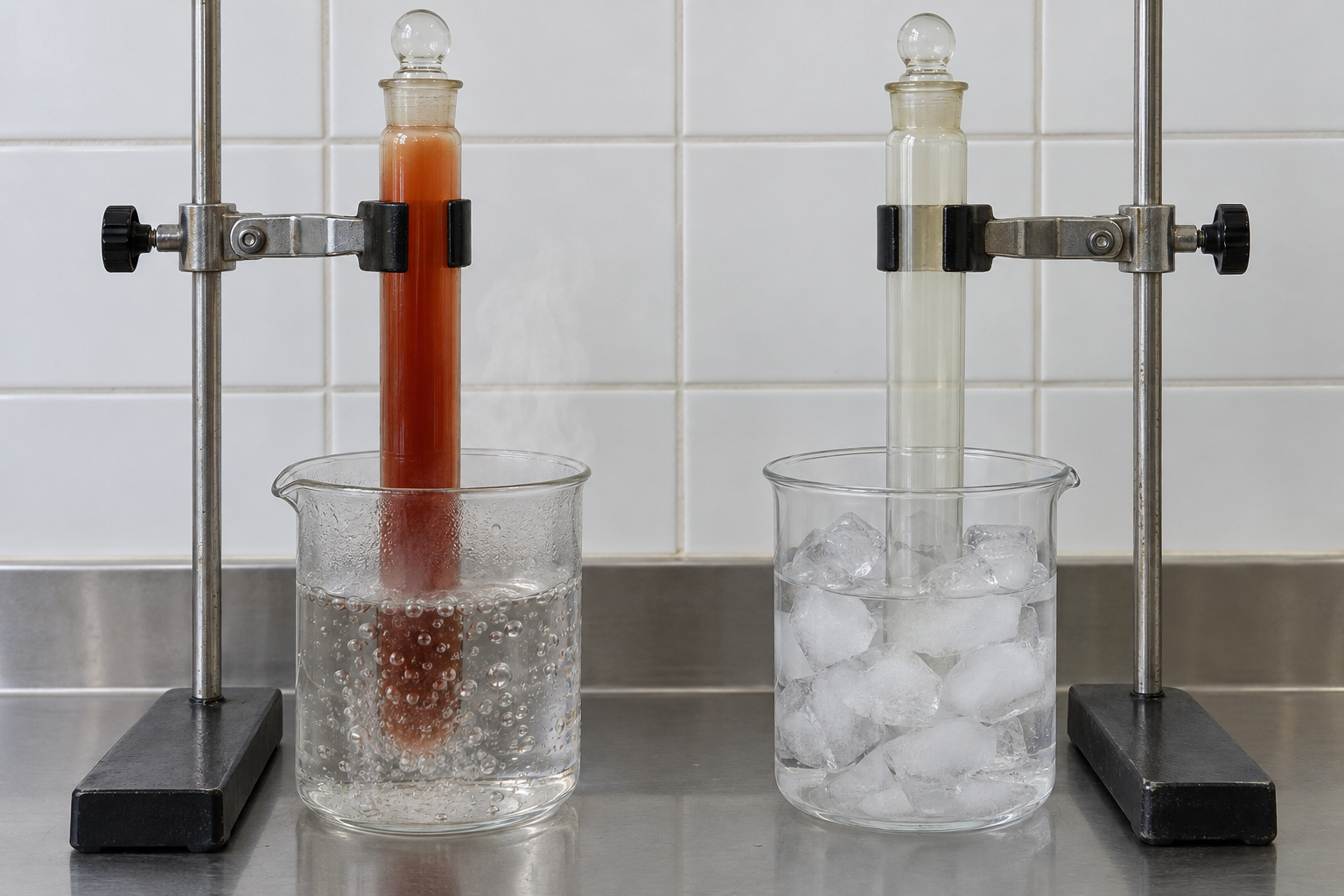
The two tubes settle at different mixtures, because chemists measure a different equilibrium constant Kc for N₂O₄ ⇌ 2 NO₂ at each temperature.
Here are the measured values, one per temperature.
| temperature | measured Kc for N₂O₄ ⇌ 2 NO₂ |
|---|---|
| 25 °C | 4.6 × 10⁻³ |
| 100 °C | 0.38 |
Drawn on one scale, the two equilibrium constants sit far apart.
Exactly why a temperature change moves K needs ideas that this course teaches later.
For now, we take the fact as measured: temperature is the one stress that moves K.
After the temperature change, the system still shifts until the reaction quotient Q equals K.
The shift now carries Q to the new K.
The same question now gets a different answer at the ammonia reactor.
The engineer turns up the thermostat. Does this stress change K?
Yes. The heated reactor settles at a new K, because the temperature changed.
At the new temperature, the engineer pumps extra NH₃ in once more. Does this stress change K?
No. The pour changes concentrations, never the temperature — K stays at its new value, and only Q moves.
State that a change in temperature is the one stress that changes the value of K, and that the system then shifts to bring Q into agreement with the new K.
Part 3Check what you just learned
Check — multiple choice
A sealed vessel holds a gas-phase equilibrium mixture. A heater raises its temperature, and the system shifts and settles. The settled mixture's Q now equals which K?
Feedback if chosen: Correct. The temperature change moved K itself, and the shift carried Q to that new K.
Feedback if chosen: This option is wrong — a temperature change is the one stress that changes K, so the old value is gone; the shift carries Q to the new K.
Check — multiple choice
An engineer turns up the thermostat on a heated, settled 2 H₂S ⇌ 2 H₂ + S₂ reactor. After the system shifts and settles, does the mixture sit at the same K or a new one?
Feedback if chosen: This option is wrong — the stress changed the temperature, and a temperature change moves K itself.
Feedback if chosen: Correct. The temperature changed, so K changed; the shift carried Q to the new K.
Check — multiple choice
Extra H₂ is pumped into a heated, settled 2 H₂S ⇌ 2 H₂ + S₂ mixture, its temperature held steady. After the system shifts and settles, does the mixture sit at the same K or a new one?
Feedback if chosen: Correct. The pour changed concentrations, never the temperature, so the system returns to the same K.
Feedback if chosen: This option is wrong — only a temperature change moves K, and the pour changed no temperature.
Check — multiple choice
A piston compresses a heated, settled 2 H₂S ⇌ 2 H₂ + S₂ mixture, its temperature held steady. After the system shifts and settles, does the mixture sit at the same K or a new one?
Feedback if chosen: Correct. The squeeze changed every concentration, never the temperature, so the system returns to the same K.
Feedback if chosen: This option is wrong — only a temperature change moves K, and the squeeze changed no temperature.
Check — multiple choice
A chiller lowers the temperature of a heated, settled CO + H₂S ⇌ COS + H₂ mixture. After the system shifts and settles, does the mixture sit at the same K or a new one?
Feedback if chosen: This option is wrong — cooling is a temperature change, and a temperature change moves K itself.
Feedback if chosen: Correct. Cooling changes the temperature, so K changes; the shift carries Q to the new K.
Check — multiple choice
Argon is pumped at constant volume into a heated, rigid 2 H₂S ⇌ 2 H₂ + S₂ vessel, its temperature held steady. After the pump stops, does the mixture sit at the same K or a new one?
Feedback if chosen: Correct. No temperature change, so the same K — and the argon changed no reacting gas's concentration, so Q never moved either: no shift at all.
Feedback if chosen: This option is wrong — only a temperature change moves K; the argon changed no temperature and no reacting gas's concentration.
Which way K changes with temperature
Outcome: Predict whether K increases or decreases when the temperature changes, from the sign of the reaction's ΔH.
Part 1The tube that answers in color
Here are the two sealed tubes we've seen: each holds the brown gas NO₂ and its colorless partner N₂O₄ at equilibrium.
In hot water, the brown deepens.
In ice water, the brown nearly vanishes.
We've seen the measured pair for this tube: the equilibrium constant Kc is 4.6 × 10⁻³ at 25 °C and 0.38 at 100 °C.
Heating raised K for this reaction.
Would heating raise K for every reaction, or lower it for some?
Part 2Read the direction from the sign
Check — multiple choice
A reaction's ΔH is +150 kJ/mol. Which class is the reaction?
Feedback if chosen: Correct. A positive ΔH marks an endothermic reaction.
Feedback if chosen: This option is wrong — a negative ΔH marks an exothermic reaction, and this ΔH is positive.
You read which way K moves from the sign of the reaction's ΔH.
We've seen that a positive ΔH marks an endothermic reaction.
We've seen that a negative ΔH marks an exothermic reaction.
An endothermic reaction absorbs energy from the surroundings.
An exothermic reaction releases energy to the surroundings.
Raising the temperature raises K for an endothermic reaction.
Raising the temperature lowers K for an exothermic reaction.
Lowering the temperature reverses each verdict.
| sign of ΔH | raising the temperature | lowering the temperature |
|---|---|---|
| positive (endothermic) | raises K | lowers K |
| negative (exothermic) | lowers K | raises K |
N₂O₄ ⇌ 2 NO₂ is endothermic: its ΔH is +57.2 kJ/mol.
So heating the tube raises its K.
That is the measured rise, from 4.6 × 10⁻³ to 0.38.
The deepened brown says the same thing.
The hot tube settles with more NO₂.
The extra NO₂ came from the N₂O₄, so the N₂O₄ fell as the NO₂ rose.
The equilibrium constant here is Kc = [NO₂]²/[N₂O₄].
A larger numerator over a smaller denominator is a larger Kc.
The ammonia reactor closes the story.
The ammonia reaction is exothermic: its ΔH is −92 kJ/mol.
So heating the reactor lowers its K.
We've seen that the heated reactor shifts toward the reactants.
A smaller K says the same thing: the heated reactor settles with less ammonia in its mixture.
A concentration pour still moves only the reaction quotient Q; the constant moves only with temperature.
Predict whether K increases or decreases when the temperature changes: raising the temperature increases K for an endothermic reaction and decreases K for an exothermic one.
Part 3Check what you just learned
Check — multiple choice
PCl₅ ⇌ PCl₃ + Cl₂ sits at equilibrium in a heated, sealed vessel; the reaction's ΔH is +88 kJ/mol. A heater raises the mixture's temperature further. What happens to the value of K?
Feedback if chosen: Correct. The ΔH is positive, so the reaction is endothermic, and raising the temperature raises K for an endothermic reaction.
Feedback if chosen: This option is wrong — K decreases on heating only for an exothermic reaction, and this ΔH is positive.
Feedback if chosen: This option is wrong — temperature is the one stress that does move K.
Check — multiple choice
CO + Cl₂ ⇌ COCl₂ sits at equilibrium in a sealed vessel; the reaction's ΔH is −108 kJ/mol. A heater raises the mixture's temperature. What happens to the value of K?
Feedback if chosen: This option is wrong — K increases on heating only for an endothermic reaction, and this ΔH is negative.
Feedback if chosen: Correct. The ΔH is negative, so the reaction is exothermic, and raising the temperature lowers K for an exothermic reaction.
Feedback if chosen: This option is wrong — temperature is the one stress that does move K.
Check — multiple choice
PCl₅ ⇌ PCl₃ + Cl₂ sits at equilibrium in a heated, sealed vessel; the reaction's ΔH is +88 kJ/mol. A chiller lowers the mixture's temperature. What happens to the value of K?
Feedback if chosen: This option is wrong — cooling raises K only for an exothermic reaction, and this ΔH is positive.
Feedback if chosen: Correct. The ΔH is positive, so the reaction is endothermic, and lowering the temperature lowers K for an endothermic reaction.
Feedback if chosen: This option is wrong — temperature is the one stress that does move K.
Check — multiple choice
2 NO + O₂ ⇌ 2 NO₂ sits at equilibrium in a sealed vessel; the reaction's ΔH is −116.2 kJ/mol. A chiller lowers the mixture's temperature. What happens to the value of K?
Feedback if chosen: Correct. The ΔH is negative, so the reaction is exothermic, and lowering the temperature raises K for an exothermic reaction.
Feedback if chosen: This option is wrong — cooling lowers K only for an endothermic reaction, and this ΔH is negative.
Feedback if chosen: This option is wrong — temperature is the one stress that does move K.
Check — multiple choice
CO + Cl₂ ⇌ COCl₂ sits at equilibrium in a sealed vessel. An engineer pumps in extra CO, the temperature held steady. What happens to the value of K?
Feedback if chosen: This option is wrong — the pour raised a concentration inside Q; only a temperature change can raise K.
Feedback if chosen: This option is wrong — the pour changed nothing about the temperature; only a temperature change can lower K.
Feedback if chosen: Correct. The pour changed a concentration, never the temperature, so K stays the same; only Q moved.
Check — multiple choice
A solid compound sits at equilibrium with its dissolved ions in water, and the dissolving is endothermic. A heater raises the water's temperature. What happens to the value of K for the dissolving?
Feedback if chosen: Correct. The dissolving is endothermic, and raising the temperature raises K for an endothermic process.
Feedback if chosen: This option is wrong — K decreases on heating only for an exothermic process, and this dissolving is endothermic.
Feedback if chosen: This option is wrong — the heater changed the temperature, the one stress that moves K.
Checkpoint — Le Châtelier's principle and justifying shifts with Q and K
Check — multiple choice
A rigid, sealed vessel held at a high, fixed temperature holds PCl₅, PCl₃, and Cl₂ at equilibrium: PCl₅(g) ⇌ PCl₃(g) + Cl₂(g). A pump draws off part of the Cl₂, and the contents settle back into equilibrium. Compared with just before the withdrawal, which of the following describes [PCl₅] and [PCl₃] in the settled mixture?
Feedback if chosen: This option is wrong — you treated the removed Cl₂ like a removed reactant. Removing a product makes the net forward reaction run: PCl₅ is consumed, and PCl₃ is produced.
Feedback if chosen: Correct. The net forward reaction replaces part of the removed Cl₂: it consumes PCl₅ and produces PCl₃, so the settled mixture holds less PCl₅ and more PCl₃.
Feedback if chosen: This option is wrong — you treated the pump as venting the whole mixture. Only Cl₂ left the vessel, and the net forward reaction then produces more PCl₃.
Feedback if chosen: This option is wrong — only the Cl₂ amount was changed directly, but the response changes the others: the net forward reaction consumes PCl₅ and produces PCl₃.
Check — multiple choice
A rigid, sealed vessel at a fixed temperature holds the gases L and V at equilibrium: L(g) ⇌ 2 V(g). A pump injects neon, a gas that reacts with neither L nor V, into the rigid vessel. Which of the following describes the mixture once the neon has mixed in?
Feedback if chosen: This option is wrong — the neon's own particles strike the vessel walls, so the total pressure rises above its value before the injection.
Feedback if chosen: This option is wrong — the injected neon raises the total pressure; and with no reacting gas's partial pressure changed, the mixture stays at equilibrium.
Feedback if chosen: Correct. The neon raises the total pressure, but the partial pressure of every reacting gas is unchanged, so there is no shift: the mixture is still at equilibrium.
Feedback if chosen: This option is wrong — the total pressure does rise, but no reacting gas's partial pressure changes, so no shift begins: the mixture is still at equilibrium.
Check — multiple choice
Iodine dissolves in a solution of potassium iodide, and the dissolved species settle at equilibrium: I₂(aq) + I⁻(aq) ⇌ I₃⁻(aq). A chemist then pours in enough water to double the solution's volume. Which of the following describes the mixture's response?
Feedback if chosen: Correct. Dilution shifts the equilibrium toward the side with more dissolved particles. I₂ and I⁻ are two dissolved particles against one I₃⁻, so part of the I₃⁻ comes apart.
Feedback if chosen: This option is wrong — you shifted toward the single particle. Dilution shifts the equilibrium toward the side with more dissolved particles: I₂ and I⁻, two against one.
Feedback if chosen: This option is wrong — halving every concentration does not leave Q equal to K. The bottom of Q halves twice while the top halves once, so a net reaction begins.
Feedback if chosen: This option is wrong — the shift only partly counteracts the dilution. No net reaction can undo the added water: the settled concentrations differ from the values before the pour.
Check — multiple choice
A rigid, sealed vessel held at a high, fixed temperature holds solid Ag₂CO₃, solid Ag₂O, and CO₂ gas at equilibrium: Ag₂CO₃(s) ⇌ Ag₂O(s) + CO₂(g). A chemist injects more CO₂ through a valve, and the contents settle back into equilibrium at the same temperature. Compared with before the injection, which of the following describes the amounts of the two solids?
Feedback if chosen: This option is wrong — you predicted a shift toward more CO₂. The system responds by consuming CO₂: the net reverse reaction turns Ag₂O and CO₂ into Ag₂CO₃.
Feedback if chosen: This option is wrong — a pure solid's concentration is fixed, but its amount is not. The net reverse reaction still converts Ag₂O into Ag₂CO₃, mole by mole.
Feedback if chosen: Correct. The injected CO₂ lifts Q above K, so the net reverse reaction proceeds: CO₂ combines with Ag₂O to form more Ag₂CO₃.
Feedback if chosen: This option is wrong — the net reverse reaction does not run to completion. The contents settle back into equilibrium, and that settled mixture still holds both solids.
Check — multiple choice
The gases E and X sit at equilibrium in a cylinder fitted with a piston, at a fixed temperature: E(g) ⇌ 2 X(g), Kc = 7.5. A chemist pushes the piston in, halving the mixture's volume. In the instant after the push, before any net reaction occurs, how does Q compare with Kc, and in which direction does the net reaction then proceed?
Feedback if chosen: This option is wrong — you inverted Q and read [E] over [X]². The squeeze doubles each concentration, so Q's top multiplies by four, its bottom by two, and Q doubles.
Feedback if chosen: This option is wrong — with Q below Kc the net reaction would run forward, not in reverse. And the squeeze actually doubles Q: Q sits above Kc.
Feedback if chosen: This option is wrong — you read the comparison backward. Q sits above Kc, meaning the mixture holds too much X, so the net reverse reaction proceeds.
Feedback if chosen: Correct. The squeeze doubles [E] and [X], so Q's top, [X]², multiplies by four while its bottom, [E], doubles: Q rises above Kc, and the net reverse reaction proceeds.
Check — multiple choice
A chemist prepares four identical samples of a gas-phase equilibrium mixture, each in its own sealed container, and makes a different change to each sample. Which change gives that sample's mixture a new value of the equilibrium constant, K?
Feedback if chosen: This option is wrong — a catalyst speeds the forward and reverse reactions equally, so the mixture settles faster, at the same K.
Feedback if chosen: This option is wrong — compressing the mixture changes the concentrations, and through them Q. The sample then settles again at the K it already had.
Feedback if chosen: This option is wrong — injecting a reacting gas changes Q, never K. After the shift, the sample's constant is unchanged.
Feedback if chosen: Correct. Temperature is the one change that alters the value of K itself. The heated sample settles into a new composition, set by its new K.
Check — multiple choice
A gas-phase reaction with ΔH = −76 kJ/mol is at equilibrium in a sealed vessel at 600 K. A chemist cools the vessel to 450 K, and the mixture settles into a new equilibrium. Which of the following describes the reaction's equilibrium constant at 450 K?
Feedback if chosen: Correct. A negative ΔH marks the reaction exothermic, and lowering the temperature increases an exothermic reaction's K.
Feedback if chosen: This option is wrong — you applied the heating rule. Raising the temperature decreases an exothermic reaction's K; this vessel was cooled, so K increases.
Feedback if chosen: This option is wrong — temperature is the one stress that changes K itself. At 450 K the reaction settles with a different K from the one it had at 600 K.
Feedback if chosen: This option is wrong — K does not depend on the mixture's composition. At one temperature a reaction has one K, whatever amounts the vessel holds.
U7-S11 — Solubility equilibria
12 lessons
Dissolution reaches equilibrium
Outcome: State that the dissolution of a slightly soluble salt is a reversible process that reaches a dissolution–precipitation equilibrium.
Part 1The beaker that stopped changing
We've seen that mixing lead ions (Pb²⁺) with iodide ions (I⁻) makes a bright yellow solid, lead iodide (PbI₂).
The yellow powder settles at the bottom of the beaker.
The beaker then sits untouched for a week.
Nothing about the beaker looks different after the week.
We've also seen sealed flasks whose constant appearance hid two opposite changes that had not stopped.
What is still happening where the solid touches the solution?
In the beaker, the dissolving of lead iodide is the change PbI₂(s) ⇌ Pb²⁺(aq) + 2 I⁻(aq).
Lead ions and iodide ions keep leaving the yellow solid.
Lead ions and iodide ions keep rejoining the yellow solid.
The leaving and the rejoining settle at equal rates.
A dissolution that has settled at equal rates is a dissolution–precipitation equilibrium.
So the amount of solid and the concentrations of the dissolved ions stay constant.
Dissolving is one more reversible process that reaches equilibrium.
Any slightly soluble salt behaves the same way.
Here is a lump of solid silver chloride (AgCl) resting in water, settled.
At the lump's surface, silver ions (Ag⁺) and chloride ions (Cl⁻) keep leaving the solid.
At the same surface, dissolved ions keep re-forming the solid.
The two rates are equal, so the beaker shows no change.
State that the dissolution of a slightly soluble salt is a reversible process that reaches a dissolution–precipitation equilibrium.
Part 2Check what you just learned
Check — multiple choice
We've seen that mixing two solutions can make a solid that settles out. What is that solid called?
Feedback if chosen: Correct. A solid that forms when two solutions are mixed is a precipitate.
Feedback if chosen: This option is wrong — a spectator ion stays dissolved and unchanged. The solid that forms is a precipitate.
Feedback if chosen: This option is wrong — the solvent is the liquid doing the dissolving. The solid that forms is a precipitate.
Check — multiple choice
A lump of solid calcium sulfate rests under its settled solution. What is happening at the lump's surface?
Feedback if chosen: This option is wrong — the stillness hides two changes. Ions keep leaving the solid, and ions keep rejoining it, at equal rates.
Feedback if chosen: This option is wrong — if no ions rejoined, the lump would keep shrinking. Ions leave and rejoin at equal rates.
Feedback if chosen: Correct. Dissolving and re-forming both continue at the lump's surface, at equal rates.
Check — multiple choice
The calcium sulfate beaker sits sealed for a month. The amount of solid and the ion concentrations stay constant. Why?
Feedback if chosen: This option is wrong — neither change stops. The dissolving and the re-forming continue at equal rates, so their effects cancel.
Feedback if chosen: Correct. Every ion that leaves the solid is matched by an ion that rejoins it, so nothing observable changes.
Feedback if chosen: This option is wrong — the water still touches the lump. The dissolving and the re-forming continue at equal rates.
Check — multiple choice
A lump of calcium sulfate has sat under its solution for a day. The lump's size and the ion concentrations are constant. Has the dissolution reached equilibrium?
Feedback if chosen: Correct. Constant amounts with solid present mean the dissolving and the re-forming have settled at equal rates.
Feedback if chosen: This option is wrong — constant amounts with solid present are the mark of equilibrium. The two rates have become equal.
Check — multiple choice
Another beaker of calcium sulfate was stirred together an hour ago. Its lump is still visibly shrinking. Has the dissolution reached equilibrium?
Feedback if chosen: This option is wrong — a shrinking lump means the dissolving still outruns the re-forming. The two rates are not yet equal.
Feedback if chosen: Correct. The lump is still shrinking, so dissolving outruns re-forming, and the two rates are not yet equal.
The solubility-product constant Ksp
Outcome: State that the solubility-product constant Ksp is the equilibrium constant for the dissolution of a slightly soluble salt.
Part 1One constant for each salt's dissolving
Now imagine two beakers of water.
One beaker of water receives a spoonful of silver chloride.
A second beaker of water receives a spoonful of lead(II) chloride.
Each dissolution reaches equilibrium with solid left over.
Yet the water dissolved about a thousand times more lead(II) chloride than silver chloride.
Every equilibrium so far has carried its own equilibrium constant K.
Which single quantity should record how far each salt's dissolution proceeds?
The dissolution of a slightly soluble salt is an equilibrium.
So the dissolution has an equilibrium constant, like every equilibrium.
That constant is called the solubility-product constant, written Ksp.
Ksp is the ordinary K of the dissolution equation.
Silver chloride dissolves into silver ions (Ag⁺) and chloride ions (Cl⁻).
Ksp for silver chloride describes how far AgCl(s) ⇌ Ag⁺(aq) + Cl⁻(aq) proceeds.
We've seen that a small K marks an equilibrium whose reactants dominate.
So a salt that barely dissolves has a very small Ksp.
Here are the two beakers' salts and their Ksp values at 25 °C.
| Salt | Ksp at 25 °C |
|---|---|
| silver chloride (AgCl) | 1.8 × 10⁻¹⁰ |
| lead(II) chloride (PbCl₂) | 1.6 × 10⁻⁵ |
Silver chloride's Ksp is far smaller than lead(II) chloride's.
That matches the beakers: the salt that dissolved about a thousand times less carries the far smaller Ksp.
State that the solubility-product constant Ksp is the equilibrium constant for the dissolution of a slightly soluble salt.
Part 2Check what you just learned
Check — multiple choice
A reference table lists Ksp = 6.3 × 10⁻⁹ at 25 °C for copper(I) bromide. Which process does this Ksp describe?
Feedback if chosen: Correct. Ksp is the equilibrium constant for the salt's dissolution, and for nothing else.
Feedback if chosen: This option is wrong — burning is a different reaction with its own constant. Ksp describes the salt's dissolution.
Feedback if chosen: This option is wrong — melting is a phase change, not the dissolution. Ksp describes the salt's dissolution.
Check — multiple choice
Which kind of quantity is a salt's Ksp?
Feedback if chosen: This option is wrong — a rate says how fast a change proceeds. Ksp is an equilibrium constant: it says how far the dissolution proceeds.
Feedback if chosen: Correct. Ksp is the equilibrium constant of the dissolution equation.
Feedback if chosen: This option is wrong — a concentration describes one dissolved species. Ksp is the equilibrium constant of the whole dissolution.
Check — multiple choice
Copper(I) bromide's dissolution has a very small Ksp at 25 °C. What does the very small Ksp say about the dissolution?
Feedback if chosen: This option is wrong — a near-complete dissolution would carry a large K. A very small Ksp marks a dissolution that barely proceeds.
Feedback if chosen: This option is wrong — you read the constant as a speed. K says how far an equilibrium proceeds, never how fast.
Feedback if chosen: Correct. A very small equilibrium constant marks an equilibrium whose reactant dominates, so barely any of the salt dissolves.
Check — multiple choice
Copper(I) bromide has Ksp = 6.3 × 10⁻⁹ at 25 °C. A second salt, which also releases two ions per formula unit, has a table row reading Ksp = 6.3 × 10⁻³ at 25 °C. Which dissolution proceeds further before settling?
Feedback if chosen: This option is wrong — you picked the smaller constant. The larger Ksp marks the dissolution that proceeds further.
Feedback if chosen: Correct. The second salt's Ksp is a million times larger, so its dissolution proceeds further before settling.
Part 3Quick quiz: the solubility-product constant
Check — multiple choice
A chemist lets a salt's dissolution settle at 25 °C, then pours in more water and lets it settle again, still at 25 °C. Undissolved solid remains both times. Which statement about Ksp holds after the second settling?
Feedback if chosen: This option is wrong — you tied the constant to the amount of water. Ksp is an equilibrium constant, so the water amount does not change it.
Feedback if chosen: Correct. Ksp is an ordinary equilibrium constant, so at one temperature it keeps one value.
Check — multiple choice
Like every equilibrium constant, a salt's Ksp is fixed by which two things?
Feedback if chosen: This option is wrong — you tied the constant to the amounts present. Like every K, Ksp is fixed by the salt's identity and the temperature.
Feedback if chosen: This option is wrong — water amount and stirring change nothing about an equilibrium constant. Ksp is fixed by the salt's identity and the temperature.
Feedback if chosen: Correct. Ksp is an ordinary equilibrium constant: one salt, one temperature, one value.
Check — multiple choice
A salt's dissolution settles at 25 °C with barely any of the salt in solution. Which Ksp fits the salt?
Feedback if chosen: Correct. A dissolution that barely proceeds carries a very small equilibrium constant.
Feedback if chosen: This option is wrong — a Ksp above 1 marks a dissolution that proceeds far. This salt barely dissolves, so its Ksp is very small.
Check — multiple choice
Which of the following names the equilibrium constant for the dissolution of a slightly soluble salt?
Feedback if chosen: Correct. Ksp is the dissolution equation's own equilibrium constant.
Feedback if chosen: This option is wrong — a rate says how fast. The dissolution's equilibrium constant is the solubility-product constant, Ksp.
Feedback if chosen: This option is wrong — Q describes any mixture, settled or not. The dissolution's equilibrium constant is the solubility-product constant, Ksp.
Write the dissolution equation
Outcome: Write the dissolution equation for an ionic solid, dissociating it into its aqueous ions with correct formulas and coefficients.
Part 1From the salt's formula to its dissolution equation
Now suppose a lump of solid lead(II) chloride rests in water.
The dissolution of lead(II) chloride has its own solubility-product constant Ksp.
We've seen that an aqueous ionic compound splits into its separate ions, each ion keeping its own charge and its (aq).
A Ksp needs the dissolution written as an equation first.
How is the dissolving of lead(II) chloride written as an equation?
The dissolution equation starts from the solid salt on the left.
The salt dissociates into its separate aqueous ions on the right.
Each ion keeps its own charge and its (aq) state symbol.
We've seen that the two ion charges fix the formula: count each kind of ion until the charges cancel, write the metal first, and divide out any common factor.
Lead(II) chloride is PbCl₂: one lead ion (Pb²⁺) balances two chloride ions (Cl⁻).
Each subscript in the formula becomes that ion's coefficient.
The dissolution equation for lead(II) chloride is PbCl₂(s) ⇌ Pb²⁺(aq) + 2 Cl⁻(aq).
The double arrow marks the dissolving and the re-forming as one reversible pair.
The reference table now carries each salt's dissolution equation beside its Ksp.
| Salt | Dissolution equation | Ksp at 25 °C |
|---|---|---|
| silver chloride (AgCl) | AgCl(s) ⇌ Ag⁺(aq) + Cl⁻(aq) | 1.8 × 10⁻¹⁰ |
| lead(II) chloride (PbCl₂) | PbCl₂(s) ⇌ Pb²⁺(aq) + 2 Cl⁻(aq) | 1.6 × 10⁻⁵ |
Write the dissolution equation for an ionic solid with the equilibrium double arrow, dissociating it into its aqueous ions with correct formulas and coefficients.
Part 2Check what you just learned
Check — multiple choice
We've seen complete ionic equations. When an aqueous ionic compound is written as its separate ions, what does each ion keep?
Feedback if chosen: Correct. Each dissolved ion keeps its own charge and carries (aq).
Feedback if chosen: This option is wrong — the compound is neutral overall, but each separate ion keeps its own charge, with (aq).
Feedback if chosen: This option is wrong — a dissolved ion is aqueous. Each ion keeps its own charge and carries (aq).
Check — multiple choice
Solid strontium fluoride, SrF₂, rests in water, and some of it dissolves. Which equation shows the dissolution?
Feedback if chosen: Correct. The subscript 2 becomes the coefficient 2 on the fluoride ion, each ion keeps its charge and (aq), and the double arrow marks the reversible pair.
Feedback if chosen: This option is wrong — you dropped the coefficient. The subscript 2 in SrF₂ means two fluoride ions are released per formula unit.
Feedback if chosen: This option is wrong — you used the one-way arrow. Dissolving and re-forming are a reversible pair, marked ⇌.
Feedback if chosen: This option is wrong — you gave strontium a 1+ charge. Two F⁻ ions balance one Sr²⁺ ion, so the charge is 2+.
Check — multiple choice
Solid silver sulfate, Ag₂SO₄, rests in water, and some of it dissolves. Which equation shows the dissolution?
Feedback if chosen: This option is wrong — you put the coefficient on the wrong ion. The subscript 2 sits on the silver, so two silver ions are released.
Feedback if chosen: Correct. The subscript 2 becomes the coefficient 2 on the silver ion, and each ion carries its charge and (aq).
Feedback if chosen: This option is wrong — you gave silver a 2+ charge. Two Ag⁺ ions balance one SO₄²⁻ ion.
Feedback if chosen: This option is wrong — you left off the state symbols. Each dissolved ion carries (aq).
Check — multiple choice
A salt's formula carries the subscript 3 on its anion, as in MX₃. Which coefficient does that anion take in the dissolution equation?
Feedback if chosen: Correct. Each subscript in the formula becomes that ion's coefficient.
Feedback if chosen: This option is wrong — you dropped the count. The subscript 3 means three of that anion are released per formula unit.
Check — multiple choice
Solid lead(II) sulfate, PbSO₄, rests in water, and some of it dissolves. Which equation shows the dissolution?
Feedback if chosen: This option is wrong — you used the one-way arrow. Dissolving and re-forming are a reversible pair, marked ⇌.
Feedback if chosen: Correct. One lead ion and one sulfate ion are released, each with its charge and (aq), under the double arrow.
Feedback if chosen: This option is wrong — you halved both charges. The lead ion is Pb²⁺ and the sulfate ion is SO₄²⁻, and the charges cancel one to one.
Check — multiple choice
In a dissolution equation, what does the ⇌ arrow mark?
Feedback if chosen: This option is wrong — a slightly soluble salt barely dissolves, yet it still carries the double arrow. The arrow marks the dissolving and the re-forming as one reversible pair.
Feedback if chosen: Correct. The double arrow says the change goes both ways: ions leave the solid, and ions rejoin it.
Feedback if chosen: This option is wrong — an arrow never carries a speed. The double arrow marks the dissolving and the re-forming as one reversible pair.
Write the Ksp expression
Outcome: Write the Ksp expression for a salt from its dissolution equation, omitting the solid.
Part 1The expression with no denominator
We've seen that every K puts the product concentrations over the reactant concentrations.
The dissolution equation for lead(II) chloride has exactly one reactant: the solid salt itself.
We've also seen that a pure solid contributes no term to a K expression.
What remains of the K expression when the only reactant is a pure solid?
The solubility-product constant Ksp keeps the familiar form: each ion concentration is raised to its coefficient.
The pure solid is omitted from the expression.
We've seen why: the concentration of a pure solid or pure liquid is a fixed property of the substance, unchanged by how much of it is present, so it contributes no variable term.
So no denominator remains.
Lead(II) chloride dissolves into lead ions (Pb²⁺) and chloride ions (Cl⁻): PbCl₂(s) ⇌ Pb²⁺(aq) + 2 Cl⁻(aq).
The Ksp expression for lead(II) chloride is Ksp = [Pb²⁺][Cl⁻]².
The coefficient 2 on the chloride ion becomes the exponent 2.
Every Ksp expression is a plain product of ion terms.
That product shape is why the constant is named the solubility product.
The reference table now carries each salt's Ksp expression.
| Salt | Dissolution equation | Ksp expression | Ksp at 25 °C |
|---|---|---|---|
| silver chloride (AgCl) | AgCl(s) ⇌ Ag⁺(aq) + Cl⁻(aq) | Ksp = [Ag⁺][Cl⁻] | 1.8 × 10⁻¹⁰ |
| lead(II) chloride (PbCl₂) | PbCl₂(s) ⇌ Pb²⁺(aq) + 2 Cl⁻(aq) | Ksp = [Pb²⁺][Cl⁻]² | 1.6 × 10⁻⁵ |
Write the Ksp expression for a salt from its dissolution equation, omitting the solid, and say why the solid is omitted.
Part 2Check what you just learned
Check — multiple choice
We've seen K expressions for reactions involving solids. Which species appear in the expression?
Feedback if chosen: This option is wrong — a pure solid contributes no term. Only species whose concentrations can vary appear.
Feedback if chosen: Correct. A pure solid's concentration is fixed, so the expression keeps only the species whose concentrations can vary.
Feedback if chosen: This option is wrong — the pure solids are exactly what the expression leaves out. The dissolved species carry the terms.
Check — multiple choice
Lead(II) bromide dissolves: PbBr₂(s) ⇌ Pb²⁺(aq) + 2 Br⁻(aq). Which is the Ksp expression?
Feedback if chosen: Correct. The solid is omitted, and the coefficient 2 on the bromide ion becomes the exponent 2.
Feedback if chosen: This option is wrong — you kept the solid as a denominator. A pure solid contributes no term, so no denominator remains.
Feedback if chosen: This option is wrong — you dropped the exponent. The coefficient 2 on the bromide ion becomes the exponent 2.
Feedback if chosen: This option is wrong — you squared the wrong ion. The coefficient 2 sits on the bromide ion, so [Br⁻] carries the exponent.
Check — multiple choice
Strontium chromate dissolves: SrCrO₄(s) ⇌ Sr²⁺(aq) + CrO₄²⁻(aq). Which is the Ksp expression?
Feedback if chosen: This option is wrong — you kept the solid as a denominator. A pure solid contributes no term, so no denominator remains.
Feedback if chosen: This option is wrong — you invented exponents. Both coefficients are 1, so neither ion term carries an exponent.
Feedback if chosen: Correct. The solid is omitted, and each ion's coefficient of 1 leaves its term unsquared.
Check — multiple choice
A dissolution equation carries the coefficient 3 on its anion. Which exponent does that ion's concentration take in the Ksp expression?
Feedback if chosen: This option is wrong — you dropped the coefficient. Each ion concentration is raised to its coefficient, so the exponent is 3.
Feedback if chosen: Correct. Each ion concentration is raised to its coefficient.
Free-response question
Source note (not shown as part of the question): authored to archetype: AP Topic 7.11 justify-the-omitted-solid (EK 7.11.A.1)
A student writes the dissolution equation SrCrO₄(s) ⇌ Sr²⁺(aq) + CrO₄²⁻(aq), and then the expression Ksp = [Sr²⁺][CrO₄²⁻], whose value is Ksp = 3.6 × 10⁻⁵ at 25 °C. The solid strontium chromate appears nowhere in the expression.
a Explain why the solid contributes no term to the Ksp expression. [2 points]
✓ Model response (the key)
Model answer
The undissolved strontium chromate is a pure solid.
The concentration of a pure solid or pure liquid is a fixed property of the substance, unchanged by how much of it is present, so it contributes no variable term.
So the expression keeps only the two ion terms.
Scoring rubric — 2 points available
- States that the undissolved salt is a pure solid, or that a pure solid's concentration is a fixed property of the substance. [1 pt]
- Explains that a fixed concentration contributes no variable term, so the solid is left out of the expression (equivalent reasoning accepted). [1 pt]
Check — multiple choice
Calcium phosphate dissolves: Ca₃(PO₄)₂(s) ⇌ 3 Ca²⁺(aq) + 2 PO₄³⁻(aq). Which is the Ksp expression?
Feedback if chosen: This option is wrong — you swapped the exponents. The calcium ion's coefficient 3 and the phosphate ion's coefficient 2 become their own exponents.
Feedback if chosen: Correct. Each ion concentration is raised to its own coefficient: 3 on the calcium ion, 2 on the phosphate ion.
Feedback if chosen: This option is wrong — you dropped both exponents. Each ion concentration is raised to its coefficient.
Saturated solutions
Outcome: State that a saturated solution is one in dissolution equilibrium with excess undissolved solute, the condition under which Ksp applies.
Part 1When no more will dissolve
Now suppose a student stirs silver chloride into a glass of water, a spoonful at a time.
The first trace dissolves completely.
Soon every extra spoonful just sinks to the bottom.
No more of the salt dissolves, however much the student adds.
Why does the extra solid stay undissolved?
With solid present, the dissolving and the rejoining have settled at equal rates.
A solution in dissolution equilibrium with excess undissolved solid is called saturated.
In a saturated solution, the ion concentrations sit at their equilibrium values.
Adding more solid changes nothing.
We've seen that a pure solid's concentration is a fixed property of the substance.
The solubility-product constant Ksp applies exactly when the solution is saturated.
For example, here is the student's glass just after the first trace dissolved, with nothing resting on the bottom.
Is this solution saturated? No. This solution is not saturated, because no undissolved solid sits in dissolution equilibrium with it.
Now the same glass holds extra solid resting on the bottom, and the ion concentrations are constant.
Is this solution saturated? Yes. This solution is saturated, because excess undissolved solid sits in dissolution equilibrium with it.
Now one more spoonful of solid lands in the same glass, and the glass settles again.
Is this solution saturated? Yes. This solution is still saturated, because excess undissolved solid still sits in dissolution equilibrium with it.
The amount of extra solid changes nothing.
Now rewind the same glass to moments after a spoonful went in, while the solid is still shrinking.
Is this solution saturated? Not yet. This solution is not yet saturated, because the dissolution has not settled at equal rates.
So two features decide the verdict: undissolved solid present, and the dissolution settled.
Here are the two kinds of glass side by side.
State that a saturated solution is one in dissolution equilibrium with excess undissolved solute, which is the condition under which Ksp applies.
Part 2Check what you just learned
Check — multiple choice
A beaker of magnesium fluoride solution holds no solid, and the next spoonful of the salt dissolves completely. Is the solution saturated?
Feedback if chosen: This option is wrong — more of the salt still dissolves, so the solution is not in equilibrium with excess solid.
Feedback if chosen: Correct. No undissolved solid sits in equilibrium with the solution, and more of the salt still dissolves.
Check — multiple choice
A beaker holds undissolved magnesium fluoride under its solution, and the ion concentrations have been constant for a day. Is the solution saturated?
Feedback if chosen: Correct. Excess undissolved solid sits in dissolution equilibrium with the solution.
Feedback if chosen: This option is wrong — solid is present and the concentrations are constant, so the solution is in dissolution equilibrium with excess solid: saturated.
Check — multiple choice
A chemist doubles the lump of undissolved magnesium fluoride in a settled beaker. After the beaker settles, is the solution saturated?
Feedback if chosen: Correct. Excess solid still sits in dissolution equilibrium with the solution. The amount of extra solid changes nothing.
Feedback if chosen: This option is wrong — extra solid changes nothing. The solution is still in dissolution equilibrium with excess solid: saturated.
Check — multiple choice
Magnesium fluoride was stirred into a beaker a moment ago, and the solid is still shrinking. Is the solution saturated?
Feedback if chosen: This option is wrong — a shrinking solid means the dissolution has not yet settled, so the solution is not yet saturated.
Feedback if chosen: Correct. The dissolution has not yet settled at equal rates, so the solution is not yet saturated.
Check — multiple choice
In a warm room, every grain of magnesium fluoride in a beaker has dissolved, the clear solution sits settled, and the next spoonful would dissolve too. Is the solution saturated?
Feedback if chosen: This option is wrong — no undissolved solid sits in equilibrium with the solution, so it is not saturated.
Feedback if chosen: Correct. The solution holds no excess undissolved solid, so it is not in dissolution equilibrium with solid: not saturated.
Check — multiple choice
A sealed bottle holds magnesium fluoride solution over a resting lump of the solid, and nothing about the bottle has changed for a week. Is the solution saturated?
Feedback if chosen: Correct. Excess undissolved solid sits in dissolution equilibrium with the solution.
Feedback if chosen: This option is wrong — constant appearance with solid present marks dissolution equilibrium with excess solid: saturated.
Part 3Quick quiz: saturated solutions
Check — multiple choice
A saturated solution of magnesium fluoride sits over its solid. A student adds one more spoonful of the solid. What happens to the dissolved-ion concentrations?
Feedback if chosen: Correct. The solution is already at its equilibrium values, and extra solid changes nothing.
Feedback if chosen: This option is wrong — the solution already sits at equilibrium. Extra solid changes nothing, so the concentrations stay.
Feedback if chosen: This option is wrong — nothing removes dissolved ions. Extra solid changes nothing, so the concentrations stay.
Check — multiple choice
In which solution do the ion concentrations sit at the values that Ksp fixes?
Feedback if chosen: This option is wrong — an unsaturated solution sits below its equilibrium values. Ksp applies exactly when the solution is saturated.
Feedback if chosen: Correct. Ksp is the dissolution's equilibrium constant, and a saturated solution is the one at that equilibrium.
Check — multiple choice
What is a solution in dissolution equilibrium with excess undissolved solute called?
Feedback if chosen: This option is wrong — dilute describes a low concentration, not the equilibrium condition. The named condition is saturated.
Feedback if chosen: This option is wrong — concentrated describes a high concentration, not the equilibrium condition. The named condition is saturated.
Feedback if chosen: Correct. Saturated names the solution in dissolution equilibrium with excess undissolved solute.
Molar solubility
Outcome: State that the molar solubility s of a salt is the number of moles that dissolve per liter of saturated solution.
Part 1How much actually dissolves
The solubility-product constant Ksp records the whole equilibrium as one combined product of ion concentrations.
A plainer question matters in the lab: how much of the salt actually dissolves?
We've seen that molarity measures the moles of solute in each liter of solution.
How many moles of silver chloride dissolve in one liter before the dissolution settles?
The amount that dissolves is measured in moles per liter of saturated solution.
That amount is called the salt's molar solubility, written s.
The molar solubility of silver chloride is about 1.3 × 10⁻⁵ mol/L.
One liter of saturated silver chloride solution carries just 1.3 × 10⁻⁵ mol of dissolved salt.
s is a molarity.
So s always carries the unit mol/L.
The reference table now carries an s column, and the lead(II) chloride cell is still unknown.
| Salt | Ksp at 25 °C | s (mol/L) |
|---|---|---|
| silver chloride (AgCl) | 1.8 × 10⁻¹⁰ | about 1.3 × 10⁻⁵ |
| lead(II) chloride (PbCl₂) | 1.6 × 10⁻⁵ | ? |
The question mark marks the amount we cannot yet compute.
State that the molar solubility s of a salt is the number of moles of it that dissolve per liter of saturated solution.
Part 2Check what you just learned
Check — multiple choice
A table lists s = 5.8 × 10⁻⁴ mol/L at 25 °C for strontium sulfate. Which statement does this value license?
Feedback if chosen: Correct. The molar solubility counts the moles that dissolve per liter of saturated solution.
Feedback if chosen: This option is wrong — an unsaturated solution holds less. s counts the moles per liter of saturated solution.
Feedback if chosen: This option is wrong — you read moles as grams. s is a molarity, in mol/L.
Check — multiple choice
Can more than 5.8 × 10⁻⁴ mol of strontium sulfate dissolve in one liter of plain water at 25 °C?
Feedback if chosen: This option is wrong — stirring or waiting speeds the approach but never moves the settling point. The molar solubility is the equilibrium amount.
Feedback if chosen: Correct. The molar solubility is the settled, equilibrium amount, and no more dissolves past it.
Check — multiple choice
A classmate reads the strontium sulfate row and writes s = 5.8 × 10⁻⁴ with no unit. Which unit does s always carry?
Feedback if chosen: This option is wrong — s counts moles, not grams. s is a molarity, in mol/L.
Feedback if chosen: This option is wrong — a bare mole count names no volume. s is a molarity, in mol/L.
Feedback if chosen: Correct. s is a molarity: the moles that dissolve per liter of saturated solution.
Check — multiple choice
A different salt's row reads s = 2.1 × 10⁻³ mol/L at 25 °C. One liter of its saturated solution is prepared. How many moles of the salt have dissolved?
Feedback if chosen: Correct. One liter of saturated solution carries s moles of the dissolved salt.
Feedback if chosen: This option is wrong — s counts moles per liter, not grams.
Feedback if chosen: This option is wrong — the saturated liter carries exactly the settled amount, s moles.
Part 3Quick quiz: molar solubility
Check — multiple choice
Two salts have molar solubilities of 3 × 10⁻³ mol/L and 3 × 10⁻⁵ mol/L at 25 °C. Which salt leaves more moles dissolved per liter of saturated solution?
Feedback if chosen: Correct. The larger molar solubility counts more dissolved moles per liter of saturated solution.
Feedback if chosen: This option is wrong — you picked the smaller amount. The larger s counts more dissolved moles per liter.
Check — multiple choice
A salt's molar solubility at 25 °C is large. What does the large s say about the salt?
Feedback if chosen: This option is wrong — you read the amount as a speed. s counts how much dissolves, never how fast.
Feedback if chosen: Correct. A large molar solubility means many moles dissolve per liter of saturated solution.
Check — multiple choice
Which of the following names the number of moles of a salt that dissolve per liter of saturated solution?
Feedback if chosen: This option is wrong — Ksp is the dissolution's equilibrium constant, a combined product of ion concentrations. The dissolved amount is the molar solubility, s.
Feedback if chosen: Correct. The molar solubility s counts the moles that dissolve per liter of saturated solution.
Feedback if chosen: This option is wrong — the water is the solvent, not the dissolved salt. The dissolved amount is the molar solubility, s.
s is an amount; Ksp is a constant
Outcome: Classify a quoted quantity as a molar solubility or a solubility-product constant.
Part 1Two quantities, told apart
Two quantities now describe silver chloride's dissolving at 25 °C: 1.3 × 10⁻⁵ mol/L and 1.8 × 10⁻¹⁰.
One quantity is the molar solubility.
The other quantity is the solubility-product constant.
A reference table may quote either quantity.
Mixing the two up wrecks every calculation that follows.
What tells the two kinds of quantity apart?
s is an equilibrium amount.
Ksp is an equilibrium constant.
s carries a unit.
Ksp carries no unit.
The unit of s is mol/L.
A table sets the two quantities side by side, feature by feature.
| Quantity | What it is | Unit | Value for silver chloride |
|---|---|---|---|
| s | an equilibrium amount | mol/L | 1.3 × 10⁻⁵ |
| Ksp | an equilibrium constant | none | 1.8 × 10⁻¹⁰ |
You classify a quoted quantity from its unit.
For example, a table row for silver chloride reads 1.3 × 10⁻⁵ mol/L.
Is this quantity a molar solubility or a solubility-product constant? It is a molar solubility, because it carries the unit mol/L.
Another row for silver chloride reads 1.8 × 10⁻¹⁰, with no unit.
Is this quantity a molar solubility or a solubility-product constant? It is a solubility-product constant, because it carries no unit.
Now a row for a different salt reads 2.1 × 10⁻⁴, with no unit.
Is this quantity a molar solubility or a solubility-product constant? It is a solubility-product constant, because it carries no unit.
The size of the value never decides.
The unit decides.
Classify a quoted quantity as a molar solubility (an equilibrium amount, in mol/L) or a solubility-product constant (a unitless equilibrium constant).
Part 2Check what you just learned
Check — multiple choice
A table row for silver iodide reads 9.2 × 10⁻⁹ mol/L at 25 °C. Which quantity is quoted?
Feedback if chosen: Correct. The value carries the unit mol/L, so it is an equilibrium amount: the molar solubility.
Feedback if chosen: This option is wrong — Ksp carries no unit. A value in mol/L is the molar solubility.
Check — multiple choice
Another table row for silver iodide reads 8.5 × 10⁻¹⁷ at 25 °C, with no unit. Which quantity is quoted?
Feedback if chosen: This option is wrong — a molar solubility always carries mol/L. A unitless value is the solubility-product constant.
Feedback if chosen: Correct. The value carries no unit, so it is the equilibrium constant: Ksp.
Check — multiple choice
A row for a different salt reads 2.1 × 10⁻⁴ at 25 °C, with no unit. Which quantity is quoted?
Feedback if chosen: This option is wrong — you judged the quantity by its size. The size never decides: the value carries no unit, so it is a Ksp.
Feedback if chosen: Correct. The value is s-sized, but the size never decides. No unit means a solubility-product constant.
Check — multiple choice
A handbook entry for silver iodide reads: 'the moles of the salt that dissolve per liter of saturated solution'. Which quantity is described?
Feedback if chosen: Correct. Moles dissolved per liter of saturated solution is the molar solubility's own definition.
Feedback if chosen: This option is wrong — Ksp is a combined product of ion concentrations, not a dissolved amount. The described quantity is s.
Check — multiple choice
A student measures the moles of a salt that dissolve in one liter of saturated solution and writes the result in mol/L. Which quantity has the student measured?
Feedback if chosen: Correct. The measured amount, in mol/L, is the molar solubility.
Feedback if chosen: This option is wrong — a measured amount in mol/L is s. Ksp is the unitless equilibrium constant.
Check — multiple choice
A lab report states: 'the equilibrium constant for the salt's dissolution at 25 °C is 4.7 × 10⁻¹¹'. Which quantity is stated?
Feedback if chosen: This option is wrong — the report names an equilibrium constant, and the dissolution's equilibrium constant is Ksp.
Feedback if chosen: Correct. The dissolution's equilibrium constant is the solubility-product constant, Ksp.
Solubility of a 1:1 salt
Outcome: Calculate the molar solubility of a 1:1 salt from its Ksp, using Ksp = s².
Part 1From Ksp to s for a one-to-one salt
A reference table supplies the solubility-product constant for silver chloride: Ksp = 1.8 × 10⁻¹⁰ at 25 °C.
A chemist wants the molar solubility s instead: the moles that dissolve per liter.
Suppose s mol of silver chloride dissolves in each liter.
Each dissolved formula unit releases one silver ion (Ag⁺) and one chloride ion (Cl⁻).
So both ion concentrations equal s.
How can the chemist compute s from the supplied Ksp?
The Ksp expression for silver chloride is Ksp = [Ag⁺][Cl⁻].
Both concentrations equal s.
So the expression becomes Ksp = s × s.
The product s × s is s².
Taking the square root undoes the square: s = √Ksp.
Here is the whole calculation.
Q: At 25 °C, Ksp for silver chloride is 1.8 × 10⁻¹⁰. What is the salt's molar solubility s, in M?
Write down the values from the question
Ksp = 1.8 × 10⁻¹⁰
Write down the expression, in s
Ksp = [Ag⁺][Cl⁻]
[Ag⁺] = s and [Cl⁻] = s
Ksp = s²
Make s the subject
s = √Ksp
Substitute in the values, and calculate
s = √(1.8 × 10⁻¹⁰)
s = 1.34 × 10⁻⁵ M
So the molar solubility of silver chloride is 1.34 × 10⁻⁵ mol/L.
Rounded to two figures, that is the 'about 1.3 × 10⁻⁵ mol/L' the reference table carries: one value, stated exactly here.
The s² shape belongs to salts that release exactly one of each ion.
Calculate the molar solubility of a salt that dissolves into one cation and one anion from its Ksp, using Ksp = s².
Part 2Check what you just learned
Check — multiple choice
Silver bromide dissolves: AgBr(s) ⇌ Ag⁺(aq) + Br⁻(aq). Which is the Ksp expression?
Feedback if chosen: Correct. Both coefficients are 1, so the expression is the plain product of the two ion concentrations.
Feedback if chosen: This option is wrong — you squared the bromide term. Its coefficient is 1, so it carries no exponent.
Feedback if chosen: This option is wrong — a Ksp expression is a product of ion terms, never a fraction. The solid leaves no denominator.
Check — multiple choice
Suppose s mol of silver bromide dissolves per liter, so both ion concentrations equal s. Which equation gives Ksp in terms of s?
Feedback if chosen: This option is wrong — you doubled instead of multiplying the two concentrations. Ksp = [Ag⁺][Br⁻] = s × s = s².
Feedback if chosen: This option is wrong — you kept only one ion term. Ksp = [Ag⁺][Br⁻] = s × s = s².
Feedback if chosen: Correct. Both concentrations equal s, so Ksp = s × s = s².
Check — numeric entry
At 25 °C, Ksp for silver bromide is 5.4 × 10⁻¹³. Calculate the salt's molar solubility s, in M. Give your answer to 3 significant figures.
Tolerance: 5e-10
Feedback when correct: Correct. s = √(5.4 × 10⁻¹³) = 7.35 × 10⁻⁷ M: the moles of silver bromide that dissolve per liter of saturated solution.
Anticipated wrong answers (feedback shown):
| 5.4e-13 | You stopped at Ksp itself without taking the root. Ksp = s², so s = √(5.4 × 10⁻¹³) = 7.35 × 10⁻⁷ M. |
| 2.7e-13 | You halved Ksp instead of taking its square root. Halving undoes a doubling, not a squaring: s = √(5.4 × 10⁻¹³) = 7.35 × 10⁻⁷ M. |
| 2.92e-25 | You squared Ksp instead of taking its square root. The square root undoes s²: s = √(5.4 × 10⁻¹³) = 7.35 × 10⁻⁷ M. |
Worked solution revealed after a second miss
Write down the values from the question
Ksp = 5.4 × 10⁻¹³
Write down the expression, in s
Ksp = [Ag⁺][Br⁻] = s²
Make s the subject, substitute, and calculate
s = √Ksp
s = √(5.4 × 10⁻¹³)
s = 7.35 × 10⁻⁷ M
Check — multiple choice
What does s = 7.35 × 10⁻⁷ M mean for silver bromide?
Feedback if chosen: Correct. The molar solubility counts the moles that dissolve per liter of saturated solution.
Feedback if chosen: This option is wrong — the value carries the unit M, so it is an amount, not the unitless constant Ksp.
Check — numeric entry
At 25 °C, Ksp for copper(I) chloride is 1.7 × 10⁻⁷, and the salt dissolves into one copper(I) ion and one chloride ion. Calculate the molar solubility s, in M. Give your answer to 3 significant figures.
Tolerance: 5e-07
Feedback when correct: Correct. s = √(1.7 × 10⁻⁷) = 4.12 × 10⁻⁴ M: the moles of copper(I) chloride that dissolve per liter of saturated solution.
Anticipated wrong answers (feedback shown):
| 1.7e-7 | You stopped at Ksp itself without taking the root. Ksp = s², so s = √(1.7 × 10⁻⁷) = 4.12 × 10⁻⁴ M. |
| 8.5e-8 | You halved Ksp instead of taking its square root. Halving undoes a doubling, not a squaring: s = √(1.7 × 10⁻⁷) = 4.12 × 10⁻⁴ M. |
Worked solution revealed after a second miss
Write down the values from the question
Ksp = 1.7 × 10⁻⁷
Write down the expression, in s
Ksp = s²
Make s the subject, substitute, and calculate
s = √Ksp
s = √(1.7 × 10⁻⁷)
s = 4.12 × 10⁻⁴ M
Solubility of a non-1:1 salt
Outcome: Calculate the molar solubility of a salt whose ions are released in unequal numbers, applying each coefficient to both the concentration and the exponent.
Part 1When the ions arrive in unequal numbers
Lead(II) chloride releases one lead ion (Pb²⁺) and two chloride ions (Cl⁻) per formula unit.
The molar solubility s again counts the moles that dissolve in each liter.
Suppose s mol of lead(II) chloride dissolves in each liter.
Each liter then gains s mol of lead ions.
Each liter then gains 2s mol of chloride ions.
We've seen that the solubility-product constant obeys Ksp = s² when a salt releases one of each ion.
What shape does the Ksp expression take when the ions arrive in unequal numbers?
We've seen that every species' change is the one variable scaled by its coefficient.
The same scaling puts 2s on the chloride ion.
The coefficient 2 enters the expression twice.
The chloride-ion concentration itself equals 2s.
The chloride term is also raised to the power 2.
Here is the whole calculation, every algebra step shown.
Q: At 25 °C, Ksp for lead(II) chloride is 1.6 × 10⁻⁵. What is the salt's molar solubility s, in M?
Write down the values from the question
Ksp = 1.6 × 10⁻⁵
Write the ion concentrations in s
PbCl₂(s) ⇌ Pb²⁺(aq) + 2 Cl⁻(aq)
[Pb²⁺] = s
[Cl⁻] = 2s
Write down the expression, and substitute the concentrations
Ksp = [Pb²⁺][Cl⁻]²
Ksp = (s)(2s)²
(2s)² = 4s²
Ksp = (s)(4s²)
Ksp = 4s³
Make s the subject
s³ = Ksp/4
s = ∛(Ksp/4)
Substitute in the values, and calculate
s³ = (1.6 × 10⁻⁵)/4
s³ = 4.0 × 10⁻⁶
s = ∛(4.0 × 10⁻⁶)
s = 1.59 × 10⁻² M
So the molar solubility of lead(II) chloride is 1.59 × 10⁻² mol/L.
The reference table's question mark fills in: rounded to two figures, lead(II) chloride's s is 1.6 × 10⁻² mol/L.
| Salt | Ksp at 25 °C | s (mol/L) |
|---|---|---|
| silver chloride (AgCl) | 1.8 × 10⁻¹⁰ | about 1.3 × 10⁻⁵ |
| lead(II) chloride (PbCl₂) | 1.6 × 10⁻⁵ | 1.6 × 10⁻² |
Each coefficient enters twice: once inside the concentration, once as the exponent.
Calculate the molar solubility of a salt whose ions are released in unequal numbers from its Ksp, applying each coefficient to both the concentration and the exponent.
Part 2Check what you just learned
Check — multiple choice
We've seen the ICE table's Change row. When a reaction proceeds, each species' amount changes by the single variable scaled by which number?
Feedback if chosen: This option is wrong — charge balances the formula, not the change. Each species changes by the variable scaled by its coefficient.
Feedback if chosen: Correct. Each species' change is the one variable scaled by its own coefficient, and the same scaling puts 2s on a coefficient-2 ion.
Feedback if chosen: This option is wrong — molar mass converts moles to grams. Each species changes by the variable scaled by its coefficient.
Check — multiple choice
Suppose s mol of silver chromate dissolves per liter: Ag₂CrO₄(s) ⇌ 2 Ag⁺(aq) + CrO₄²⁻(aq). Which pair gives the two ion concentrations?
Feedback if chosen: Correct. Each dissolved formula unit releases two silver ions and one chromate ion, so [Ag⁺] = 2s and [CrO₄²⁻] = s.
Feedback if chosen: This option is wrong — you swapped the coefficients. The 2 sits on the silver ion: [Ag⁺] = 2s.
Feedback if chosen: This option is wrong — a coefficient scales the concentration, never squares it. [Ag⁺] = 2s.
Check — multiple choice
Silver chromate dissolves with molar solubility s: Ag₂CrO₄(s) ⇌ 2 Ag⁺(aq) + CrO₄²⁻(aq). Which equation gives Ksp in terms of s?
Feedback if chosen: This option is wrong — you dropped the exponent. [Ag⁺] = 2s is also squared: Ksp = (2s)²(s) = 4s³.
Feedback if chosen: This option is wrong — you dropped the coefficient inside the concentration. [Ag⁺] = 2s, and (2s)² = 4s², so Ksp = 4s³.
Feedback if chosen: Correct. [Ag⁺] = 2s and [CrO₄²⁻] = s, so Ksp = (2s)²(s) = 4s³.
Check — numeric entry
Silver chromate's dissolution has Ksp = 1.1 × 10⁻¹² at 25 °C, and Ksp = 4s³. Make s³ the subject and calculate its value. Give your answer to 3 significant figures.
Tolerance: 5e-16
Feedback when correct: Correct. s³ = Ksp/4 = (1.1 × 10⁻¹²)/4 = 2.75 × 10⁻¹³ M³. The cube root comes next.
Anticipated wrong answers (feedback shown):
| 4.4e-12 | You multiplied by 4 instead of dividing. Undoing the 4 in Ksp = 4s³ takes a division: s³ = Ksp/4 = 2.75 × 10⁻¹³. |
Worked solution revealed after a second miss
Make s³ the subject
s³ = Ksp/4
Substitute in the values, and calculate
s³ = (1.1 × 10⁻¹²)/4
s³ = 2.75 × 10⁻¹³ M³
Check — numeric entry
Using your value of s³ for silver chromate (Ksp = 1.1 × 10⁻¹² and s³ = 2.75 × 10⁻¹³ M³), calculate the molar solubility s, in M. Give your answer to 3 significant figures.
Tolerance: 5e-08
Feedback when correct: Correct. s = ∛(2.75 × 10⁻¹³) = 6.50 × 10⁻⁵ M.
Anticipated wrong answers (feedback shown):
| 1.05e-6 | You took the square root of Ksp, as if the salt released one of each ion. s is the cube root of s³: s = ∛(2.75 × 10⁻¹³) = 6.50 × 10⁻⁵ M. |
| 1.03e-4 | You took the cube root of Ksp itself, skipping the division by 4. s is the cube root of s³ = 2.75 × 10⁻¹³, so s = 6.50 × 10⁻⁵ M. |
Worked solution revealed after a second miss
Take the cube root
s = ∛(2.75 × 10⁻¹³)
s = 6.50 × 10⁻⁵ M
Check — numeric entry
Silver phosphate dissolves: Ag₃PO₄(s) ⇌ 3 Ag⁺(aq) + PO₄³⁻(aq), with Ksp = 8.9 × 10⁻¹⁷ at 25 °C. Here [Ag⁺] = 3s and [PO₄³⁻] = s, so Ksp = (3s)³(s) = 27s⁴. Calculate the molar solubility s, in M. Give your answer to 3 significant figures.
Tolerance: 5e-08
Feedback when correct: Correct. s⁴ = Ksp/27 = 3.30 × 10⁻¹⁸ M⁴, and the fourth root gives s = 4.26 × 10⁻⁵ M.
Anticipated wrong answers (feedback shown):
| 9.71e-5 | You took the fourth root of Ksp itself, dropping the 27. First divide: s⁴ = Ksp/27 = 3.30 × 10⁻¹⁸, then s = 4.26 × 10⁻⁵ M. |
| 2.81e-6 | You used the 4s³ shape on a salt that releases three cations. Here Ksp = 27s⁴, so s = ∜(Ksp/27) = 4.26 × 10⁻⁵ M. |
Worked solution revealed after a second miss
Make s the subject
s⁴ = Ksp/27
s = ∜(Ksp/27)
Substitute in the values, and calculate
s⁴ = (8.9 × 10⁻¹⁷)/27 = 3.30 × 10⁻¹⁸
s = ∜(3.30 × 10⁻¹⁸)
s = 4.26 × 10⁻⁵ M
Check — numeric entry
Barium fluoride dissolves: BaF₂(s) ⇌ Ba²⁺(aq) + 2 F⁻(aq), with Ksp = 1.8 × 10⁻⁷ at 25 °C. Calculate the molar solubility s, in M. Give your answer to 3 significant figures.
Tolerance: 5e-06
Feedback when correct: Correct. Ksp = (s)(2s)² = 4s³, so s = ∛(Ksp/4) = ∛(4.5 × 10⁻⁸) = 3.56 × 10⁻³ M.
Anticipated wrong answers (feedback shown):
| 4.24e-4 | You took the square root of Ksp, as if the salt released one of each ion. Barium fluoride releases two fluoride ions: Ksp = 4s³, so s = ∛(Ksp/4) = 3.56 × 10⁻³ M. |
| 5.65e-3 | You took the cube root of Ksp without dividing by 4 first. s = ∛(Ksp/4) = ∛(4.5 × 10⁻⁸) = 3.56 × 10⁻³ M. |
Worked solution revealed after a second miss
Write the ion concentrations in s
[Ba²⁺] = s
[F⁻] = 2s
Write down the expression, and substitute the concentrations
Ksp = [Ba²⁺][F⁻]²
Ksp = (s)(2s)² = 4s³
Make s the subject, substitute, and calculate
s³ = Ksp/4 = (1.8 × 10⁻⁷)/4 = 4.5 × 10⁻⁸
s = ∛(4.5 × 10⁻⁸)
s = 3.56 × 10⁻³ M
Ksp from a measurement
Outcome: Calculate Ksp from a measured molar solubility or from the ion concentrations of a saturated solution.
Part 1Rebuilding Ksp from a measurement
Every solubility-product constant Ksp in the reference table came from somebody's measurement.
Now suppose a student saturates water with lead(II) chloride.
The student measures how much dissolved: the molar solubility s = 1.6 × 10⁻² mol/L.
No Ksp is supplied this time.
How does one measured s rebuild the table's Ksp?
The measured s fixes both ion concentrations.
The lead-ion concentration equals s.
The chloride-ion concentration equals 2s.
The student substitutes both concentrations into the Ksp expression.
The same stoichiometric factors apply in both directions.
Q: A saturated lead(II) chloride solution at 25 °C has s = 1.6 × 10⁻² mol/L. What is Ksp for PbCl₂(s) ⇌ Pb²⁺(aq) + 2 Cl⁻(aq)?
Write down the values from the question
s = 1.6 × 10⁻² M
Write the ion concentrations
[Pb²⁺] = s = 1.6 × 10⁻² M
[Cl⁻] = 2s = 3.2 × 10⁻² M
Write down the expression, substitute, and calculate
Ksp = [Pb²⁺][Cl⁻]²
Ksp = (1.6 × 10⁻²)(3.2 × 10⁻²)²
Ksp = (1.6 × 10⁻²)(1.024 × 10⁻³)
Ksp = 1.64 × 10⁻⁵
So the measured solubility rebuilds Ksp = 1.64 × 10⁻⁵, matching the reference table's 1.6 × 10⁻⁵ at two figures.
One measurement fills a table row that every later problem can reuse.
Calculate Ksp from a measured molar solubility, or from the ion concentrations of a saturated solution, applying the stoichiometric factors.
Part 2Check what you just learned
Check — multiple choice
A table row for a salt reads s = 2.0 × 10⁻³ mol/L at 25 °C. What does the value state?
Feedback if chosen: Correct. The molar solubility counts the moles that dissolve per liter of saturated solution.
Feedback if chosen: This option is wrong — the value carries mol/L, so it is an amount, not the unitless constant.
Feedback if chosen: This option is wrong — s counts moles, not grams.
Check — multiple choice
A saturated lead(II) fluoride solution at 25 °C has s = 2.0 × 10⁻³ M: PbF₂(s) ⇌ Pb²⁺(aq) + 2 F⁻(aq). Which pair gives the two ion concentrations?
Feedback if chosen: Correct. Each dissolved formula unit releases one lead ion and two fluoride ions, so [F⁻] = 2s.
Feedback if chosen: This option is wrong — you forgot to double the fluoride concentration. Each formula unit releases two fluoride ions, so [F⁻] = 2s = 4.0 × 10⁻³ M.
Feedback if chosen: This option is wrong — you doubled the wrong ion. The coefficient 2 sits on the fluoride ion: [F⁻] = 2s.
Check — multiple choice
For the same saturated lead(II) fluoride solution, [Pb²⁺] = 2.0 × 10⁻³ M and [F⁻] = 4.0 × 10⁻³ M. Which substitution gives Ksp?
Feedback if chosen: This option is wrong — you left the fluoride term unsquared. Its coefficient 2 is also its exponent: Ksp = [Pb²⁺][F⁻]².
Feedback if chosen: Correct. Ksp = [Pb²⁺][F⁻]², with the already-doubled fluoride concentration squared.
Feedback if chosen: This option is wrong — you squared the lead term. The exponent 2 belongs to the fluoride ion: Ksp = [Pb²⁺][F⁻]².
Check — numeric entry
Evaluate lead(II) fluoride's Ksp = (2.0 × 10⁻³)(4.0 × 10⁻³)². Give your answer to 2 significant figures.
Tolerance: 5e-10
Feedback when correct: Correct. Ksp = (2.0 × 10⁻³)(1.6 × 10⁻⁵) = 3.2 × 10⁻⁸.
Anticipated wrong answers (feedback shown):
| 8.0e-6 | You left the fluoride term unsquared when evaluating. (4.0 × 10⁻³)² = 1.6 × 10⁻⁵, so Ksp = (2.0 × 10⁻³)(1.6 × 10⁻⁵) = 3.2 × 10⁻⁸. |
Worked solution revealed after a second miss
Square the fluoride term
(4.0 × 10⁻³)² = 1.6 × 10⁻⁵ M²
Multiply, and calculate
Ksp = (2.0 × 10⁻³)(1.6 × 10⁻⁵)
Ksp = 3.2 × 10⁻⁸
Check — numeric entry
A student saturates water with lead(II) sulfate and measures s = 1.58 × 10⁻⁴ M at 25 °C. The salt dissolves into one lead ion and one sulfate ion. Calculate Ksp. Give your answer to 3 significant figures.
Tolerance: 5e-11
Feedback when correct: Correct. Both ion concentrations equal s, so Ksp = s² = (1.58 × 10⁻⁴)² = 2.50 × 10⁻⁸.
Anticipated wrong answers (feedback shown):
| 1.26e-2 | You took the square root of s, as if computing s from a supplied Ksp. A measured s rebuilds Ksp by squaring: Ksp = s² = 2.50 × 10⁻⁸. |
| 3.16e-4 | You doubled s instead of squaring it. Ksp = [Pb²⁺][SO₄²⁻] = s × s = s² = 2.50 × 10⁻⁸. |
Worked solution revealed after a second miss
Write the ion concentrations
[Pb²⁺] = s = 1.58 × 10⁻⁴ M
[SO₄²⁻] = s = 1.58 × 10⁻⁴ M
Write down the expression, substitute, and calculate
Ksp = [Pb²⁺][SO₄²⁻] = s²
Ksp = (1.58 × 10⁻⁴)²
Ksp = 2.50 × 10⁻⁸
Check — numeric entry
A saturated silver sulfate solution at 25 °C holds silver ions (Ag⁺) at 2.9 × 10⁻² M and sulfate ions (SO₄²⁻) at 1.4 × 10⁻² M: Ag₂SO₄(s) ⇌ 2 Ag⁺(aq) + SO₄²⁻(aq). Calculate Ksp. Give your answer to 3 significant figures.
Tolerance: 5e-08
Feedback when correct: Correct. Ksp = [Ag⁺]²[SO₄²⁻] = (2.9 × 10⁻²)²(1.4 × 10⁻²) = 1.18 × 10⁻⁵.
Anticipated wrong answers (feedback shown):
| 4.06e-4 | You multiplied the two concentrations without squaring the silver term. The coefficient 2 on Ag⁺ is also its exponent: Ksp = (2.9 × 10⁻²)²(1.4 × 10⁻²) = 1.18 × 10⁻⁵. |
| 5.68e-6 | You squared the sulfate term instead of the silver term. The coefficient 2 sits on the silver ion: Ksp = (2.9 × 10⁻²)²(1.4 × 10⁻²) = 1.18 × 10⁻⁵. |
| 4.71e-5 | You doubled the measured silver concentration before squaring. The measured 2.9 × 10⁻² M is already [Ag⁺]: Ksp = (2.9 × 10⁻²)²(1.4 × 10⁻²) = 1.18 × 10⁻⁵. |
Worked solution revealed after a second miss
Write down the values from the question
[Ag⁺] = 2.9 × 10⁻² M
[SO₄²⁻] = 1.4 × 10⁻² M
Write down the expression, substitute, and calculate
Ksp = [Ag⁺]²[SO₄²⁻]
Ksp = (2.9 × 10⁻²)²(1.4 × 10⁻²)
Ksp = (8.41 × 10⁻⁴)(1.4 × 10⁻²)
Ksp = 1.18 × 10⁻⁵
Rank solubilities
Outcome: Rank the relative solubilities of salts from their Ksp values, comparing Ksp directly only for salts that release the same number of ions.
Part 1Ranking solubilities honestly
A reference table lists the solubility-product constants for silver chloride and for calcium fluoride.
Calcium fluoride's Ksp is about five times smaller than silver chloride's.
A student reads the smaller Ksp as the mark of the less soluble salt.
Yet a liter of water dissolves about fifteen times more calcium fluoride than silver chloride.
How can the salt with the smaller Ksp dissolve more?
Comparing Ksp values directly is valid only among salts that release the same number of ions.
Silver chloride releases two ions per formula unit.
Calcium fluoride releases three ions per formula unit.
The two Ksp expressions take different shapes: s² against 4s³.
A Ksp from the s² shape and a Ksp from the 4s³ shape cannot be ranked directly.
For a mixed set, you compute each salt's molar solubility s first.
For example, may silver chloride's Ksp and barium sulfate's Ksp be compared directly? Yes: each salt releases two ions per formula unit, so the counts match.
Now swap silver chloride for lead(II) chloride. May lead(II) chloride's Ksp and barium sulfate's Ksp be compared directly? No: lead(II) chloride releases three ions and barium sulfate two, so the counts differ.
Now swap barium sulfate for calcium fluoride. May lead(II) chloride's Ksp and calcium fluoride's Ksp be compared directly? Yes: each salt releases three ions per formula unit, so the counts match.
The count of released ions decides, not the pattern of the formula.
Back to the student's pair: the counts differ, so each s must be computed.
| Salt | Ions released per formula unit | Ksp at 25 °C |
|---|---|---|
| silver chloride (AgCl) | 2 | 1.8 × 10⁻¹⁰ |
| calcium fluoride (CaF₂) | 3 | 3.5 × 10⁻¹¹ |
Q: At 25 °C, Ksp is 1.8 × 10⁻¹⁰ for silver chloride and 3.5 × 10⁻¹¹ for calcium fluoride. Which salt is more soluble?
Check whether the Ksp values may be compared directly
silver chloride releases 2 ions; calcium fluoride releases 3
the counts differ, so compute each s
Compute s for silver chloride (one of each ion)
s = √Ksp = √(1.8 × 10⁻¹⁰)
s = 1.34 × 10⁻⁵ M
Compute s for calcium fluoride (one Ca²⁺ and two F⁻)
Ksp = (s)(2s)² = 4s³
s³ = (3.5 × 10⁻¹¹)/4 = 8.75 × 10⁻¹²
s = ∛(8.75 × 10⁻¹²)
s = 2.06 × 10⁻⁴ M
Compare the two amounts
2.06 × 10⁻⁴ M is larger than 1.34 × 10⁻⁵ M
So calcium fluoride dissolves more, about fifteen times more, despite its smaller Ksp.
The two Ksp values live in different expressions, so their sizes cannot be read side by side.
Rank the relative solubilities of salts from their Ksp values, comparing Ksp directly only for salts that release the same number of ions and computing s first otherwise.
Part 2Check what you just learned
Check — multiple choice
Strontium fluoride dissolves: SrF₂(s) ⇌ Sr²⁺(aq) + 2 F⁻(aq), with molar solubility s. Which equation gives Ksp in terms of s?
Feedback if chosen: Correct. [Sr²⁺] = s and [F⁻] = 2s, so Ksp = (s)(2s)² = 4s³.
Feedback if chosen: This option is wrong — s² belongs to salts that release one of each ion. Strontium fluoride releases three ions: Ksp = 4s³.
Feedback if chosen: This option is wrong — you doubled instead of squaring the fluoride term. (2s)² = 4s², so Ksp = 4s³.
Check — multiple choice
Barium chromate releases two ions per formula unit (Ba²⁺ and CrO₄²⁻), and copper(I) iodide releases two (Cu⁺ and I⁻). May their Ksp values be compared directly?
Feedback if chosen: Correct. Both salts release two ions, so their Ksp values share the s² shape and compare directly.
Feedback if chosen: This option is wrong — both salts release two ions per formula unit, so the direct comparison is valid.
Check — multiple choice
Barium chromate releases two ions per formula unit, and strontium fluoride releases three (one Sr²⁺ and two F⁻). May their Ksp values be compared directly?
Feedback if chosen: This option is wrong — the counts differ: two ions against three. The two Ksp values live in different shapes, so compute each s first.
Feedback if chosen: Correct. The counts differ, so the Ksp values live in different shapes. Compute each salt's s first.
Check — multiple choice
Strontium fluoride releases three ions per formula unit (one Sr²⁺ and two F⁻), and silver sulfate releases three (two Ag⁺ and one SO₄²⁻). May their Ksp values be compared directly?
Feedback if chosen: Correct. Both salts release three ions, so their Ksp values share the 4s³ shape. A 1:2 salt and a 2:1 salt both release three ions.
Feedback if chosen: This option is wrong — the patterns differ, but the counts match: three ions each. The count decides, not the pattern.
Check — multiple choice
Three salts each release two ions per formula unit. At 25 °C, barium chromate has Ksp = 1.2 × 10⁻¹⁰, copper(I) iodide has Ksp = 1.1 × 10⁻¹², and strontium sulfate has Ksp = 3.4 × 10⁻⁷. Which salt is the most soluble?
Feedback if chosen: This option is wrong — you picked the smallest Ksp. Among same-count salts, the largest Ksp marks the most soluble: strontium sulfate.
Feedback if chosen: Correct. All three salts release two ions, so the Ksp values compare directly, and strontium sulfate's is the largest.
Feedback if chosen: This option is wrong — barium chromate's Ksp sits in the middle. The largest, strontium sulfate's 3.4 × 10⁻⁷, marks the most soluble.
Check — numeric entry
Strontium fluoride dissolves: SrF₂(s) ⇌ Sr²⁺(aq) + 2 F⁻(aq), with Ksp = 4.3 × 10⁻⁹ at 25 °C. Calculate the molar solubility s, in M. Give your answer to 3 significant figures.
Tolerance: 5e-06
Feedback when correct: Correct. Ksp = 4s³, so s = ∛(4.3 × 10⁻⁹/4) = ∛(1.075 × 10⁻⁹) = 1.02 × 10⁻³ M.
Anticipated wrong answers (feedback shown):
| 6.56e-5 | You took the square root of Ksp, as if the salt released one of each ion. Strontium fluoride releases three ions: s = ∛(Ksp/4) = 1.02 × 10⁻³ M. |
| 1.63e-3 | You took the cube root of Ksp without dividing by 4 first. s = ∛(4.3 × 10⁻⁹/4) = ∛(1.075 × 10⁻⁹) = 1.02 × 10⁻³ M. |
Worked solution revealed after a second miss
Write the ion concentrations in s
[Sr²⁺] = s
[F⁻] = 2s
Write down the expression, and substitute
Ksp = [Sr²⁺][F⁻]² = (s)(2s)² = 4s³
Make s the subject, substitute, and calculate
s³ = Ksp/4 = (4.3 × 10⁻⁹)/4 = 1.075 × 10⁻⁹
s = ∛(1.075 × 10⁻⁹)
s = 1.02 × 10⁻³ M
Check — multiple choice
At 25 °C, strontium sulfate (two ions, Ksp = 3.4 × 10⁻⁷) has s = 5.83 × 10⁻⁴ M, and strontium fluoride (three ions, Ksp = 4.3 × 10⁻⁹) has s = 1.02 × 10⁻³ M. Which salt dissolves more per liter?
Feedback if chosen: This option is wrong — you ranked by Ksp across different ion counts. With unequal counts, the computed s values decide, and strontium fluoride's s is larger.
Feedback if chosen: Correct. The computed amounts decide: 1.02 × 10⁻³ M beats 5.83 × 10⁻⁴ M, even though strontium fluoride's Ksp is about 79 times smaller.
The solubility rules on the Ksp scale
Outcome: State that the qualitative solubility rules correspond quantitatively to Ksp.
Part 1What insoluble really means
Hospital patients drink a thick white suspension of barium sulfate before an abdominal X-ray.
Dissolved barium ions (Ba²⁺) are poisonous.
We've seen that the memory list calls only sodium, potassium, ammonium and nitrate salts soluble.
Every other salt's solubility arrives with the question.
Barium sulfate's supplied line reads insoluble.
'Insoluble' sounds like a promise that nothing dissolves.
How much of an insoluble salt actually dissolves?
Every dissolution has its solubility-product constant Ksp.
No salt dissolves to exactly zero extent.
Salts called insoluble are really sparingly soluble salts with very small Ksp values.
Barium sulfate's Ksp is 1.1 × 10⁻¹⁰ at 25 °C.
Q: Barium sulfate dissolves as BaSO₄(s) ⇌ Ba²⁺(aq) + SO₄²⁻(aq), with Ksp = 1.1 × 10⁻¹⁰ at 25 °C and molar mass 233.4 g/mol. What mass of it dissolves per liter?
Compute the molar solubility
Ksp = s²
s = √(1.1 × 10⁻¹⁰)
s = 1.05 × 10⁻⁵ M
Convert the moles to a mass
mass = 1.05 × 10⁻⁵ × 233.4
mass = 2.45 × 10⁻³ g
So each liter of the patient's suspension dissolves about 2.4 mg of barium sulfate.
2.4 mg of dissolved barium sulfate is too little to harm the patient.
So the rules' word insoluble is a coarse reading, not a promise of zero.
A salt the rules call soluble corresponds to a Ksp greater than 1.
Here is the Ksp scale, with the rules' reading marked as a band.
Sodium chloride sits beyond the scale's right edge, far into the soluble band: its dissolution proceeds far past any sparingly soluble salt's.
The rules are a named coarse reading of the Ksp scale, never an exceptionless law.
State that the qualitative solubility rules correspond quantitatively to Ksp: Ksp values greater than 1 go with soluble salts, and salts classified as insoluble have small Ksp values.
Part 2Check what you just learned
Check — multiple choice
Noor says an insoluble salt dissolves to exactly zero extent. Is Noor correct?
Feedback if chosen: This option is wrong — no salt dissolves to exactly zero extent. An insoluble salt is really sparingly soluble, with a very small Ksp.
Feedback if chosen: Correct. Every salt has a nonzero Ksp, so even a salt the rules call insoluble dissolves a little before its dissolution settles.
Check — multiple choice
Silver iodate has Ksp = 3.2 × 10⁻⁸ at 25 °C. Which description fits the salt?
Feedback if chosen: Correct. A very small Ksp marks a dissolution that proceeds a little and then settles.
Feedback if chosen: This option is wrong — a soluble salt corresponds to a Ksp greater than 1. This Ksp is far below 1.
Feedback if chosen: This option is wrong — no salt dissolves to exactly zero extent. A very small Ksp means a little dissolves.
Check — multiple choice
Lithium nitrate is a nitrate salt, so the memory list calls it soluble. In principle, which statement about its Ksp fits a soluble salt?
Feedback if chosen: This option is wrong — a Ksp far below 1 marks a sparingly soluble salt. A soluble salt's Ksp is greater than 1.
Feedback if chosen: Correct. The rules' soluble reading corresponds to a Ksp greater than 1.
Feedback if chosen: This option is wrong — every dissolution has its equilibrium constant. A soluble salt's Ksp is greater than 1.
Check — multiple choice
Two salts' table rows at 25 °C read Ksp = 25 and Ksp = 3.2 × 10⁻⁸. Which salt would the rules call soluble?
Feedback if chosen: Correct. A Ksp greater than 1 goes with the salts the rules call soluble.
Feedback if chosen: This option is wrong — a Ksp far below 1 marks a sparingly soluble salt. The rules' soluble reading goes with Ksp = 25.
U7-S12 — The common-ion effect
4 lessons
The common ion
Outcome: State what a common ion is, and name the common ion a solution holds for a given salt.
Part 1One ion from two sources
Suppose a student stirs a spoonful of silver chloride powder into a beaker of 0.10 M sodium chloride solution.
We've seen that a dissolved ionic compound splits into its separate aqueous ions.
The sodium chloride dissolved as NaCl(s) → Na⁺(aq) + Cl⁻(aq).
So the solution already holds sodium ions and chloride ions.
Any silver chloride that dissolves releases silver ions and chloride ions.
Silver chloride dissolves as AgCl(s) ⇌ Ag⁺(aq) + Cl⁻(aq).
One kind of ion comes from both the dissolved sodium chloride and the dissolving silver chloride.
Which ion in the solution is also an ion the silver chloride releases?
An ion already in a solution before the salt goes in that the dissolving salt also releases is called a common ion.
The beaker held chloride ions before the silver chloride went in.
So the chloride ion is a common ion for silver chloride here.
The beaker held no silver ions before the silver chloride went in.
So the silver ion is not a common ion for silver chloride here.
A common ion can be the salt's cation or its anion.
Now ask the same question of four beakers, each holding the same silver chloride.
For example, here is the first beaker again: the silver chloride sits in 0.10 M sodium chloride solution.
Does the solution hold a common ion for the silver chloride? Yes. The solution already holds chloride ions, and chloride is an ion the silver chloride releases.
Now the same beaker holds 0.50 M sodium chloride solution instead, and the same silver chloride sits in it.
Does the solution hold a common ion for the silver chloride? Yes. The concentration changed and the verdict survives, because chloride is still an ion the silver chloride releases.
Now the same beaker holds 0.50 M sodium nitrate solution, and the same silver chloride sits in it.
Does the solution hold a common ion for the silver chloride? No. The solution holds sodium ions and nitrate ions, and the silver chloride releases neither.
Now the same beaker holds 0.50 M silver nitrate solution, and the same silver chloride sits in it.
Does the solution hold a common ion for the silver chloride? Yes. The solution already holds silver ions, and silver is an ion the silver chloride releases.
So the sodium chloride beakers and the silver nitrate beaker hold a common ion for the silver chloride, but the sodium nitrate beaker does not.
Every solubility problem that starts from a solution other than pure water opens by naming the common ion.
State that a common ion is an ion already present in a solution before the salt goes in that is also one of the ions produced when a given salt dissolves.
Part 2Check what you just learned
Check — multiple choice
We've seen dissolution equations for sparingly soluble salts. Which pair of aqueous ions does silver iodide, AgI, release when it dissolves?
Feedback if chosen: Correct. AgI(s) ⇌ Ag⁺(aq) + I⁻(aq): one silver cation and one iodide anion.
Feedback if chosen: This option is wrong — two positive ions cannot come from a neutral salt. Iodide carries a 1− charge: Ag⁺ and I⁻.
Feedback if chosen: This option is wrong — silver's ion is Ag⁺ and iodide is I⁻; the charges in AgI are 1+ and 1−.
Check — multiple choice
Sparingly soluble silver iodide is stirred into 0.10 M silver nitrate solution. Does the solution hold a common ion for the silver iodide?
Feedback if chosen: Correct. The solution already holds silver ions, and silver is an ion the silver iodide releases.
Feedback if chosen: This option is wrong — the solution already holds silver ions, and the silver iodide releases silver ions too. A common ion can be the salt's cation.
Check — multiple choice
Sparingly soluble strontium sulfate is stirred into 0.20 M sodium chloride solution. Does the solution hold a common ion for the strontium sulfate?
Feedback if chosen: This option is wrong — the solution holds sodium ions and chloride ions, and strontium sulfate releases strontium ions and sulfate ions. No ion is shared.
Feedback if chosen: Correct. The solution holds sodium ions and chloride ions, and the strontium sulfate releases neither.
Check — multiple choice
Sparingly soluble silver iodide is stirred into 0.10 M potassium nitrate solution. Does the solution hold a common ion for the silver iodide?
Feedback if chosen: This option is wrong — the solution holds potassium ions and nitrate ions, and the silver iodide releases silver ions and iodide ions. No ion is shared.
Feedback if chosen: Correct. The solution holds potassium ions and nitrate ions, and the silver iodide releases neither.
Check — multiple choice
Sparingly soluble strontium sulfate is stirred into 0.20 M sodium sulfate solution. Does the solution hold a common ion for the strontium sulfate?
Feedback if chosen: Correct. The solution already holds sulfate ions, and sulfate is an ion the strontium sulfate releases.
Feedback if chosen: This option is wrong — the dissolved sodium sulfate already put sulfate ions in the solution, and the strontium sulfate releases sulfate ions too.
Check — multiple choice
A beaker holds 0.20 M sodium sulfate solution, and sparingly soluble strontium sulfate rests in it. Which ion in the solution is the common ion for the strontium sulfate?
Feedback if chosen: Correct. The strontium sulfate releases sulfate ions, and the solution already held sulfate ions from the dissolved sodium sulfate.
Feedback if chosen: This option is wrong — the strontium sulfate never releases sodium ions. The shared ion is the sulfate ion.
Part 3Quick quiz: the common ion
Check — multiple choice
A beaker of 0.10 M potassium nitrate solution holds no iodide ions. Sparingly soluble silver iodide is stirred in, and every iodide ion now in the solution came from the salt itself. Is the iodide ion a common ion here?
Feedback if chosen: This option is wrong — a common ion is already in the solution before the salt dissolves. These iodide ions all came from the dissolving salt itself.
Feedback if chosen: Correct. A common ion is already in the solution from another source. These iodide ions all came from the dissolving salt itself.
Check — multiple choice
A sodium chloride solution holds sodium ions and chloride ions. Sparingly soluble strontium sulfate is stirred in. Is the sodium ion a common ion for the strontium sulfate?
Feedback if chosen: This option is wrong — the sodium ion is already in the solution, but the strontium sulfate never releases sodium ions. Both conditions must hold.
Feedback if chosen: Correct. The sodium ion is already in the solution, but the strontium sulfate never releases sodium ions, so it is not a common ion for this salt.
Check — multiple choice
Which solution holds a common ion for sparingly soluble silver iodide?
Feedback if chosen: This option is wrong — potassium ions and nitrate ions are not ions the silver iodide releases.
Feedback if chosen: Correct. The silver nitrate solution already holds silver ions, and silver is an ion the silver iodide releases.
Check — multiple choice
What is an ion called when it is already present in a solution and is also one of the ions a dissolving salt releases?
Feedback if chosen: Correct. An ion already in the solution that the dissolving salt also releases is a common ion.
Feedback if chosen: This option is wrong — a spectator ion stays dissolved and unchanged through a reaction. The ion described here is a common ion.
Feedback if chosen: This option is wrong — a polyatomic ion is an ion built from several atoms, whatever solution it sits in. The ion described here is a common ion.
The common-ion effect
Outcome: State the common-ion effect: a salt is less soluble in a solution that already contains one of its ions than in pure water.
Part 1Two beakers of silver chloride
Suppose a student adds one spoonful of silver chloride to each of two beakers.
The first beaker holds pure water.
The second beaker holds 0.10 M sodium chloride solution.
We've seen that the chloride ion in the second beaker is a common ion for silver chloride.
The student stirs both beakers until each solution is saturated.
More undissolved powder rests at the bottom of the second beaker.
| Beaker | What the student sees after stirring |
|---|---|
| Pure water | Less powder rests undissolved at the bottom |
| 0.10 M sodium chloride solution | More powder rests undissolved at the bottom |
Does the amount of silver chloride that dissolves depend on what the solution already held?
A salt is less soluble in a solution that already contains one of its ions than it is in pure water.
Chemists call this drop in solubility the common-ion effect.
In the pure-water beaker, more of the silver chloride dissolves.
In the sodium chloride beaker, less of the silver chloride dissolves.
Here are the two saturated solutions at the particle scale.
In the sodium chloride beaker, most of the chloride ions came from the dissolved sodium chloride.
Fewer silver ions sit in that solution, because less silver chloride dissolved.
A solute that shares an ion with the salt lowers the salt's solubility.
A solute that shares no ion with the salt does not change the salt's solubility.
A salt dissolves least where one of its own ions already sits in the solution.
State the common-ion effect: a salt is less soluble in a solution that already contains one of its ions than it is in pure water.
Part 2Check what you just learned
Check — multiple choice
We've seen the molar solubility s. A salt's s in one solution is smaller than its s in another. In which solution does less of the salt dissolve per liter?
Feedback if chosen: Correct. The molar solubility s counts the moles that dissolve per liter, so a smaller s means less of the salt dissolves.
Feedback if chosen: This option is wrong — s counts the moles that dissolve per liter, so the larger s marks the solution where more dissolves, not less.
Check — multiple choice
Sparingly soluble calcium sulfate is stirred into 0.15 M sodium sulfate solution until the solution is saturated. Compared with pure water, how soluble is the calcium sulfate here?
Feedback if chosen: Correct. The solution already holds sulfate ions, an ion the calcium sulfate releases, so the salt is less soluble than in pure water.
Feedback if chosen: This option is wrong — the dissolved sodium sulfate already put sulfate ions in the solution, and a shared ion lowers the salt's solubility.
Feedback if chosen: This option is wrong — extra dissolved ions never raise a salt's solubility. A solute that shares an ion lowers it; one that shares none leaves it unchanged.
Check — multiple choice
Sparingly soluble calcium sulfate is stirred into 0.15 M sodium nitrate solution until the solution is saturated. Compared with pure water, how soluble is the calcium sulfate here?
Feedback if chosen: This option is wrong — the solution holds sodium ions and nitrate ions, and the calcium sulfate releases neither. With no shared ion, the solubility does not change.
Feedback if chosen: Correct. The solution shares no ion with the calcium sulfate, so the salt dissolves just as much as in pure water.
Feedback if chosen: This option is wrong — extra dissolved ions never raise a salt's solubility. With no shared ion, the solubility does not change.
Check — multiple choice
Sparingly soluble strontium fluoride is stirred into 0.10 M sodium fluoride solution until the solution is saturated. Compared with pure water, how soluble is the strontium fluoride here?
Feedback if chosen: Correct. The solution already holds fluoride ions, an ion the strontium fluoride releases, so the salt is less soluble than in pure water.
Feedback if chosen: This option is wrong — the dissolved sodium fluoride already put fluoride ions in the solution, and a shared ion lowers the salt's solubility.
Feedback if chosen: This option is wrong — extra dissolved ions never raise a salt's solubility. A shared ion lowers it.
Check — multiple choice
Sparingly soluble strontium fluoride is stirred into 0.10 M strontium nitrate solution until the solution is saturated. Compared with pure water, how soluble is the strontium fluoride here?
Feedback if chosen: Correct. The solution already holds strontium ions, and strontium is an ion the strontium fluoride releases. A common ion from the cation side lowers the solubility too.
Feedback if chosen: This option is wrong — the dissolved strontium nitrate already put strontium ions in the solution, and the strontium fluoride releases strontium ions. The shared cation lowers the solubility.
Feedback if chosen: This option is wrong — extra dissolved ions never raise a salt's solubility. The shared strontium ion lowers it.
Check — multiple choice
Sparingly soluble strontium fluoride is stirred into 0.10 M potassium nitrate solution until the solution is saturated. Compared with pure water, how soluble is the strontium fluoride here?
Feedback if chosen: This option is wrong — the solution holds potassium ions and nitrate ions, and the strontium fluoride releases neither. With no shared ion, the solubility does not change.
Feedback if chosen: Correct. The solution shares no ion with the strontium fluoride, so the salt dissolves just as much as in pure water.
Feedback if chosen: This option is wrong — extra dissolved ions never raise a salt's solubility. With no shared ion, the solubility does not change.
Part 3Quick quiz: the common-ion effect
Check — multiple choice
Sparingly soluble calcium sulfate dissolves less in 0.20 M sodium sulfate solution than in pure water. Is this drop in solubility the common-ion effect?
Feedback if chosen: Correct. The solution already held sulfate ions, an ion the calcium sulfate releases, and the salt dissolved less there than in pure water.
Feedback if chosen: This option is wrong — the solution already held an ion the salt releases, and the salt dissolved less there. That drop is exactly the common-ion effect.
Check — multiple choice
A student finds that sparingly soluble strontium fluoride dissolves less in cold 0.10 M potassium nitrate solution than in the same solution when warm. Is this drop in solubility the common-ion effect?
Feedback if chosen: This option is wrong — the potassium nitrate solution holds no ion the strontium fluoride releases. The temperature moved, and that is a different cause.
Feedback if chosen: Correct. The potassium nitrate solution holds no ion the strontium fluoride releases. The temperature moved, and the common-ion effect needs an ion already in the solution.
Check — multiple choice
Sparingly soluble calcium sulfate dissolves just as much in 0.20 M sodium nitrate solution as in pure water. Is the common-ion effect at work in the sodium nitrate solution?
Feedback if chosen: This option is wrong — the solution holds no ion the calcium sulfate releases, so there is no common ion and no drop in solubility.
Feedback if chosen: Correct. The solution holds no ion the calcium sulfate releases, so there is no common ion, and the solubility did not drop.
Check — multiple choice
A salt is less soluble in a solution that already contains one of its ions than in pure water. What is this drop in solubility called?
Feedback if chosen: This option is wrong — saturation names the state of a solution in dissolution equilibrium with excess solid, not a drop in solubility.
Feedback if chosen: This option is wrong — dissolution equilibrium names the settled two-way dissolving, not a drop in solubility.
Feedback if chosen: Correct. The drop in solubility caused by an ion already in the solution is the common-ion effect.
Why a common ion lowers a salt's solubility
Outcome: Explain why a common ion lowers a salt's solubility, using Q and Ksp.
Part 1Q reaches Ksp sooner
Here are the two beakers of silver chloride again.
We've seen that less silver chloride dissolves in the beaker that already holds chloride ions.
The dissolved sodium chloride does not react with the silver chloride.
The chloride ions from the sodium chloride sit in the solution before any silver chloride dissolves.
Somehow those waiting ions stop part of the silver chloride from ever dissolving.
How do ions that react with nothing stop a salt from dissolving?
We've seen that the reaction quotient Q for a dissolution multiplies the ion concentrations at any moment, each raised to its coefficient. And we've seen that the solubility-product constant Ksp is the dissolution's K.
We've seen that Q below K means net forward reaction.
For a dissolving salt, the forward reaction is the dissolving itself.
So the salt keeps dissolving only while Q for its dissolution stays below Ksp.
Just after the silver chloride goes in, the solution holds no silver ions yet.
A product with one zero factor is zero, so Q starts at zero in both beakers.
The common ion does not start Q above zero. Instead, each dissolved portion raises Q by more than it would in pure water.
Each portion of silver chloride that dissolves raises Q.
In pure water, Q multiplies the growing silver ion concentration by a tiny chloride concentration.
In the sodium chloride solution, Q multiplies the growing silver ion concentration by the full 0.10 M chloride concentration.
So Q reaches Ksp after far less silver chloride has dissolved.
We've seen that Ksp for silver chloride is 1.8 × 10⁻¹⁰ at 25 °C.
Here is Q on a number line, partway through the dissolving in the sodium chloride beaker.
With one ion already present, Q for the dissolution reaches Ksp after less salt has dissolved, because the system shifts in the direction that brings Q back into equality with K: Q < K means net forward reaction, Q > K means net reverse reaction, Q = K means no net change.
In the pure-water beaker, Q reaches Ksp after much silver chloride has dissolved.
In the sodium chloride beaker, Q reaches Ksp after far less silver chloride has dissolved.
That is the whole mechanism of the common-ion effect: nothing reacts with the salt, and the waiting ion still ends the dissolving early.
Explain why a common ion reduces a salt's solubility: with one ion already present, Q for the dissolution reaches Ksp after less salt has dissolved.
Part 2Check what you just learned
Check — multiple choice
We've seen that where Q sits against K fixes the net direction. At some moment, Q for a reaction sits below K. What happens next?
Feedback if chosen: Correct. While Q sits below K, the forward reaction outruns the reverse one.
Feedback if chosen: This option is wrong — net reverse reaction happens while Q sits above K, not below it.
Feedback if chosen: This option is wrong — no net change happens only when Q equals K.
Check — multiple choice
Sparingly soluble barium fluoride is stirred into two beakers until each solution is saturated: one holds pure water, the other 0.20 M sodium fluoride solution. In which beaker does Q for the dissolution reach Ksp after less barium fluoride has dissolved?
Feedback if chosen: Correct. That beaker's solution already holds fluoride ions, so each dissolved portion raises Q by more, and Q reaches Ksp after less barium fluoride has dissolved.
Feedback if chosen: This option is wrong — in pure water both ion concentrations start at zero, and Q reaches Ksp only after more barium fluoride has dissolved.
Free-response question
Source note (not shown as part of the question): authored to archetype: AP common-ion justification with Q and Ksp (EK 7.12.A.1)
At 25 °C, sparingly soluble lead(II) bromide has Ksp = 6.6 × 10⁻⁶. A student stirs the salt into 0.25 M potassium bromide solution until the solution is saturated. Less lead(II) bromide dissolves than dissolves in pure water.
a Explain why less lead(II) bromide dissolves in the potassium bromide solution than in pure water. [3 points]
✓ Model response (the key)
Model answer
The potassium bromide solution already holds bromide ions.
The salt keeps dissolving only while Q for its dissolution stays below Ksp, because the system shifts in the direction that brings Q back into equality with K: Q < K means net forward reaction, Q > K means net reverse reaction, Q = K means no net change.
Each portion of lead(II) bromide that dissolves raises Q.
In the potassium bromide solution, Q multiplies the growing lead ion concentration by the square of a bromide concentration that is already large.
So Q reaches Ksp after less lead(II) bromide has dissolved.
So less lead(II) bromide dissolves than in pure water.
Scoring rubric — 3 points available
- Names the bromide ion already present in the solution (or: the solution starts with a large bromide concentration). [1 pt]
- States that the salt dissolves only while Q is below Ksp, or that the dissolving stops when Q reaches Ksp (equivalent reasoning accepted). [1 pt]
- Concludes that with bromide already present, Q reaches Ksp after less salt has dissolved, so less dissolves. [1 pt]
Check — multiple choice
Sparingly soluble barium fluoride is stirred into 0.15 M barium nitrate solution until the solution is saturated. Compared with pure water, does more, less, or the same amount of barium fluoride dissolve?
Feedback if chosen: Correct. The solution already holds barium ions, so Q for the dissolution reaches Ksp after less barium fluoride has dissolved.
Feedback if chosen: This option is wrong — the solution already holds barium ions, an ion the salt releases, so Q reaches Ksp after less has dissolved.
Feedback if chosen: This option is wrong — extra dissolved ions never raise a salt's solubility. The shared barium ion makes Q reach Ksp sooner, so less dissolves.
Solubility with a common ion
Outcome: Calculate a salt's molar solubility in a solution that already contains a common ion, and validate the small-x shortcut.
Part 1How much less
The two beakers of silver chloride are back one last time.
We've seen that about 1.3 × 10⁻⁵ moles of silver chloride dissolve in each liter of pure water.
Less dissolves in each liter of the 0.10 M sodium chloride solution.
The question is how much less.
How many moles of silver chloride dissolve in one liter of the 0.10 M sodium chloride solution?
A reference table supplies each salt's solubility-product constant Ksp.
| Salt | Dissolution equation | Ksp at 25 °C |
|---|---|---|
| silver chloride (AgCl) | AgCl(s) ⇌ Ag⁺(aq) + Cl⁻(aq) | 1.8 × 10⁻¹⁰ |
| barium sulfate (BaSO₄) | BaSO₄(s) ⇌ Ba²⁺(aq) + SO₄²⁻(aq) | 1.1 × 10⁻¹⁰ |
| silver bromide (AgBr) | AgBr(s) ⇌ Ag⁺(aq) + Br⁻(aq) | 5.4 × 10⁻¹³ |
| calcium fluoride (CaF₂) | CaF₂(s) ⇌ Ca²⁺(aq) + 2 F⁻(aq) | 3.5 × 10⁻¹¹ |
The ICE table handles a solution that starts with one ion already present.
In this table, the change x is the molar solubility s, so we write s in its place.
The initial row carries 0.10 M under the chloride ion and zero under the silver ion.
AgCl(s) ⇌ Ag⁺(aq) + Cl⁻(aq)
| Ag⁺(aq) | Cl⁻(aq) | |
|---|---|---|
| Initial (M) | 0 | 0.10 |
| Change (M) | +s | +s |
| Equilibrium (M) | s | 0.10 + s ≈ 0.10 |
At equilibrium, Ksp equals (s)(0.10 + s).
We've seen that a small s may be neglected next to a large starting concentration, and never where s stands alone.
Neglecting s next to 0.10 leaves Ksp = 0.10s.
We've seen the 5% rule: after solving, the neglected value must stay under 5% of the initial amount it was neglected against.
Here is the whole calculation.
Q: At 25 °C, Ksp for silver chloride is 1.8 × 10⁻¹⁰. What is the molar solubility of silver chloride in 0.10 M sodium chloride solution, in M?
Write down the values from the question
Ksp = 1.8 × 10⁻¹⁰
initial [Cl⁻] = 0.10 M
Write down the expression, in s
Ksp = [Ag⁺][Cl⁻]
[Ag⁺] = s and [Cl⁻] = 0.10 + s
Ksp = (s)(0.10 + s)
Neglect s next to 0.10
0.10 + s ≈ 0.10
Ksp = 0.10s
Make s the subject, substitute, and calculate
s = Ksp/0.10
s = 1.8 × 10⁻¹⁰/0.10
s = 1.8 × 10⁻⁹ M
Validate the shortcut with the 5% rule
s/0.10 = 1.8 × 10⁻⁹/0.10 = 1.8 × 10⁻⁸
1.8 × 10⁻⁸ = 1.8 × 10⁻⁶ %, far below 5%
So about 1.8 × 10⁻⁹ moles of silver chloride dissolve in each liter of the sodium chloride solution.
We've seen that s = √Ksp in pure water, which gives 1.34 × 10⁻⁵ mol/L for silver chloride.
Here is the whole comparison in one table.
| Solution | Molar solubility of silver chloride at 25 °C |
|---|---|
| Pure water | 1.34 × 10⁻⁵ M |
| 0.10 M sodium chloride solution | 1.8 × 10⁻⁹ M |
| About 7 500 times less silver chloride dissolves in the sodium chloride solution. | |
About 7 500 times less silver chloride dissolves there than in each liter of pure water.
Now a second case: a student stirs sparingly soluble barium sulfate into 0.10 M sodium sulfate solution until the solution is saturated.
Calculate the solubility of a salt in a solution that already contains a common ion from its supplied Ksp, using the small-x approximation and validating it with the 5% rule.
Part 2Check what you just learned
Check — multiple choice
We've seen the pure-water route for a salt that releases one cation and one anion. Which equation gives its molar solubility from Ksp?
Feedback if chosen: This option is wrong — halving undoes a doubling, not a squaring. Ksp = s², so s = √Ksp.
Feedback if chosen: This option is wrong — squaring Ksp moves away from s. Ksp = s², so s = √Ksp.
Feedback if chosen: Correct. In pure water both ion concentrations equal s, so Ksp = s² and s = √Ksp.
Check — multiple choice
We've seen the 5% rule. After a small-x solve, what must be true for the neglect to be valid?
Feedback if chosen: This option is wrong — the comparison is with the initial amount the value was neglected against, not with the supplied Ksp.
Feedback if chosen: Correct. The neglected value is compared with the initial amount it was neglected against, and it must stay under 5% of it.
Feedback if chosen: This option is wrong — the comparison is with the initial amount the value was neglected against, not with the answer itself.
Check — numeric entry
A student stirs sparingly soluble barium sulfate into 0.10 M sodium sulfate solution. Each formula unit of sodium sulfate, Na₂SO₄, releases two sodium ions and one sulfate ion. Before any barium sulfate dissolves, what is the sulfate ion concentration, in M?
Feedback when correct: Correct. Each liter holds 0.10 mol of dissolved sodium sulfate, and each formula unit releases one sulfate ion, so the sulfate ion concentration is 0.10 M.
Anticipated wrong answers (feedback shown):
| 0.20 | You doubled for the two sodium ions. The sodium ions double; each formula unit releases exactly one sulfate ion, so the sulfate ion concentration is 0.10 M. |
| 0.050 | You halved the concentration. The two-to-one ratio belongs to the sodium ions, not the sulfate ion: each formula unit releases one sulfate ion, so the sulfate ion concentration is 0.10 M. |
Check — multiple choice
BaSO₄(s) ⇌ Ba²⁺(aq) + SO₄²⁻(aq)
| Ba²⁺(aq) | SO₄²⁻(aq) | |
|---|---|---|
| Initial (M) | 0 | 0.10 |
| Change (M) | +s | +s |
| Equilibrium (M) | ? | ? |
The barium sulfate dissolves as BaSO₄(s) ⇌ Ba²⁺(aq) + SO₄²⁻(aq), with Ksp = 1.1 × 10⁻¹⁰ at 25 °C. Let s be the molar solubility of barium sulfate in the 0.10 M sodium sulfate solution. Which expression holds at equilibrium?
Feedback if chosen: This option is wrong — you used s for both ions. The sulfate ion starts at 0.10 M, so its equilibrium concentration is 0.10 + s.
Feedback if chosen: Correct. The barium ion starts at zero and reaches s; the sulfate ion starts at 0.10 M and reaches 0.10 + s.
Feedback if chosen: This option is wrong — you used the initial 0.10 for both ions. The barium ion starts at zero, so its equilibrium concentration is just s.
Check — numeric entry
For the barium sulfate in the 0.10 M sodium sulfate solution, use Ksp = 1.1 × 10⁻¹⁰ (25 °C) and neglect s next to 0.10. Calculate the molar solubility s, in M. Give your answer to 2 significant figures.
Feedback when correct: Correct. Ksp = (s)(0.10 + s) ≈ 0.10s, so s = 1.1 × 10⁻¹⁰/0.10 = 1.1 × 10⁻⁹ M.
Anticipated wrong answers (feedback shown):
| 1.1e-8 | You divided by 0.10 twice: Ksp = (s)(0.10)² is the shape for a salt releasing two of the common ion. Barium sulfate releases one sulfate ion, so s = Ksp/0.10 = 1.1 × 10⁻⁹ M. |
| 1.05e-5 | You took √Ksp — the pure-water route. This solution already holds 0.10 M sulfate ion, so Ksp = 0.10s and s = 1.1 × 10⁻⁹ M. |
Worked solution revealed after a second miss
Write down the values from the question
Ksp = 1.1 × 10⁻¹⁰
initial [SO₄²⁻] = 0.10 M
Write down the expression, in s
Ksp = [Ba²⁺][SO₄²⁻]
Ksp = (s)(0.10 + s)
Neglect s next to 0.10
Ksp = 0.10s
Make s the subject, substitute, and calculate
s = Ksp/0.10
s = 1.1 × 10⁻¹⁰/0.10
s = 1.1 × 10⁻⁹ M
Check — multiple choice
The solve gave s = 1.1 × 10⁻⁹ M after neglecting s next to 0.10. Is the neglect valid by the 5% rule?
Feedback if chosen: Correct. s/0.10 = 1.1 × 10⁻⁸, which is 1.1 × 10⁻⁶ % of the initial 0.10 — far below 5%, so the neglect is valid.
Feedback if chosen: This option is wrong — s/0.10 = 1.1 × 10⁻⁸, which is 1.1 × 10⁻⁶ % of the initial 0.10. That sits far below 5%, so the neglect is valid.
Check — numeric entry
In pure water, the molar solubility of barium sulfate is 1.05 × 10⁻⁵ M. Using s = 1.1 × 10⁻⁹ M in the 0.10 M sodium sulfate solution, how many times more barium sulfate dissolves per liter in pure water? Give your answer to 2 significant figures.
Tolerance: 100
Feedback when correct: Correct. 1.05 × 10⁻⁵/1.1 × 10⁻⁹ = 9.5 × 10³: about nine and a half thousand times more barium sulfate dissolves per liter in pure water.
Anticipated wrong answers (feedback shown):
| 1.0e-4 | You divided the smaller solubility by the larger one. The question asks how many times MORE dissolves in pure water, so divide the pure-water value by the common-ion value: 1.05 × 10⁻⁵/1.1 × 10⁻⁹ = 9.5 × 10³. |
Check — numeric entry
At 25 °C, Ksp for sparingly soluble silver bromide is 5.4 × 10⁻¹³. Calculate the molar solubility of silver bromide in 0.050 M sodium bromide solution, in M. Give your answer to 2 significant figures.
Tolerance: 5e-13
Feedback when correct: Correct. Ksp = (s)(0.050 + s) ≈ 0.050s, so s = 5.4 × 10⁻¹³/0.050 = 1.1 × 10⁻¹¹ M. The 5% check: s is 2.2 × 10⁻⁸ % of 0.050 — valid.
Anticipated wrong answers (feedback shown):
| 7.3e-7 | You took √Ksp — the pure-water route. This solution already holds 0.050 M bromide ion, so Ksp = (s)(0.050 + s) ≈ 0.050s and s = 1.1 × 10⁻¹¹ M. |
| 2.2e-10 | You multiplied by the bromide concentration twice: Ksp = (s)(0.050)² is the shape for a salt releasing two bromide ions. Silver bromide releases one, so s = Ksp/0.050 = 1.1 × 10⁻¹¹ M. |
Worked solution revealed after a second miss
Write down the values from the question
Ksp = 5.4 × 10⁻¹³
initial [Br⁻] = 0.050 M
Write down the expression, in s
Ksp = [Ag⁺][Br⁻]
Ksp = (s)(0.050 + s)
Neglect s next to 0.050
Ksp = 0.050s
Make s the subject, substitute, and calculate
s = Ksp/0.050
s = 5.4 × 10⁻¹³/0.050
s = 1.1 × 10⁻¹¹ M
Validate the shortcut with the 5% rule
s/0.050 = 2.2 × 10⁻¹⁰
2.2 × 10⁻¹⁰ = 2.2 × 10⁻⁸ %, far below 5%
Check — numeric entry
At 25 °C, Ksp for sparingly soluble calcium fluoride is 3.5 × 10⁻¹¹, and the salt dissolves as CaF₂(s) ⇌ Ca²⁺(aq) + 2 F⁻(aq). Calculate the molar solubility of calcium fluoride in 0.10 M sodium fluoride solution, in M. Give your answer to 2 significant figures.
Feedback when correct: Correct. Ksp = (s)(0.10 + 2s)² ≈ (s)(0.10)², so s = 3.5 × 10⁻¹¹/0.010 = 3.5 × 10⁻⁹ M. The 5% check: 2s is 7.0 × 10⁻⁶ % of 0.10 — valid.
Anticipated wrong answers (feedback shown):
| 3.5e-10 | You wrote Ksp = (s)(0.10). The fluoride concentration enters squared — Ksp = [Ca²⁺][F⁻]² — so Ksp = (s)(0.10)² and s = 3.5 × 10⁻¹¹/0.010 = 3.5 × 10⁻⁹ M. |
| 2.1e-4 | You used the pure-water route, s = (Ksp/4)^⅓. This solution already holds 0.10 M fluoride ion, so Ksp = (s)(0.10)² and s = 3.5 × 10⁻⁹ M. |
Worked solution revealed after a second miss
Write down the values from the question
Ksp = 3.5 × 10⁻¹¹
initial [F⁻] = 0.10 M
Write down the expression, in s
Ksp = [Ca²⁺][F⁻]²
[Ca²⁺] = s and [F⁻] = 0.10 + 2s
Ksp = (s)(0.10 + 2s)²
Neglect 2s next to 0.10
Ksp = (s)(0.10)²
Ksp = 0.010s
Make s the subject, substitute, and calculate
s = Ksp/0.010
s = 3.5 × 10⁻¹¹/0.010
s = 3.5 × 10⁻⁹ M
Validate the shortcut with the 5% rule
2s/0.10 = 7.0 × 10⁻⁸
7.0 × 10⁻⁸ = 7.0 × 10⁻⁶ %, far below 5%
AP practice — two real short questions: solubility and the common ion
Outcome: Score two real 4-point short questions against their released rubrics: the solubility ladder from a particulate drawing to Ksp, and the common-ion effect explained for the point.
Part 1What a solubility point pays for
On the free-response section, a justify point pays for three things together: the claim, the principle, and this system's own species or numbers.
The chief reader's warning is standing: naming 'the common-ion effect' or 'Le Châtelier's principle' with no explanation earns nothing.
A calculate point pays only with the work shown — the exam's own directions say so, and graders enforce them.
A particulate-diagram point pays for what the drawing asserts: the ion ratio, the charge balance, and where the solid sits.
The two questions below are real short questions — question 7 from the 2023 exam and question 6 from the 2021 exam. Each is worth 4 points with a budget of about 9 minutes. Answer each on paper, showing every setup with its units; then reveal the model response and score yourself one rubric line at a time.
Free-response question
Source note (not shown as part of the question): 2023 FRQ Q7 (real past question, VERBATIM from ap23-frq-chemistry pp. 21–22; reserved for U7 practice per §E-ASSESS and past_exams/USAGE.md reservations; rubric from ap23-sg-chemistry; the student-drawing figure reconstructed in the particlebox family at the released counts 4:4 — review-accuracy flag P-1 in the ledger block)
Strontium hydroxide dissolves in water according to the following equation. The Ksp expression for strontium hydroxide is provided. Sr(OH)₂(s) ⇌ Sr²⁺(aq) + 2 OH⁻(aq), with Ksp = [Sr²⁺][OH⁻]².
(a) A student draws the particulate diagram shown to represent the ions present in an aqueous solution of Sr(OH)₂. (Water molecules are intentionally omitted.) Identify the error in the student's drawing. [1 point]
(b)(i) The student prepares a saturated solution by adding excess Sr(OH)₂(s) to distilled water and stirring until no more solid dissolves. The student then determines that [Sr²⁺] = 0.043 M in the solution. Calculate the value of [OH⁻] in the solution. [1 point]
(b)(ii) Calculate the value of Ksp for Sr(OH)₂. [1 point]
(c) The student prepares a second saturated solution of Sr(OH)₂ in aqueous 0.10 M Sr(NO₃)₂ instead of water. Will the value of [OH⁻] in the second solution be greater than, less than, or equal to the value in the first solution? Justify your answer. (Assume constant temperature.) [1 point]
✓ Model response (the key)
(a)
Each formula unit of Sr(OH)₂ that dissolves releases one Sr²⁺ ion and two OH⁻ ions.
So the drawing should show twice as many OH⁻ ions as Sr²⁺ ions.
The drawing shows four of each.
The error is the ratio of the ions: there should be two OH⁻ ions for every Sr²⁺ ion.
(b)(i)
Every Sr²⁺ ion in the solution entered it alongside two OH⁻ ions.
[OH⁻] = 2 × [Sr²⁺] = 2 × 0.043 M = 0.086 M
(b)(ii)
Ksp = [Sr²⁺][OH⁻]²
Ksp = (0.043)(0.086)² = 3.2 × 10⁻⁴, at the temperature of the experiment.
(c)
The value of [OH⁻] will be less than the value in the first solution.
The 0.10 M Sr(NO₃)₂ solution already holds Sr²⁺ ions, and Sr²⁺ is an ion that Sr(OH)₂ releases when it dissolves.
Dissolution stops when the product [Sr²⁺][OH⁻]² reaches Ksp.
With Sr²⁺ already in the solution, the product reaches Ksp after less Sr(OH)₂ has dissolved.
Less dissolved Sr(OH)₂ releases fewer OH⁻ ions, so [OH⁻] is lower.
Scoring rubric — 4 points available
- (a) One point is earned for identifying the error. Accept one of: the drawing shows an incorrect ratio of Sr²⁺ to OH⁻ ions (it should show two OH⁻ ions for every Sr²⁺ ion); OR the drawn solution is not charge-balanced. [1 pt]
- (b)(i) One point is earned for the correct calculated value with the work shown: [OH⁻] = 2 × 0.043 = 0.086 M. [1 pt]
- (b)(ii) One point is earned for the correct calculated value, consistent with your part (b)(i) value: Ksp = [Sr²⁺][OH⁻]² = (0.043)(0.086)² = 3.2 × 10⁻⁴. [1 pt]
- (c) One point is earned for 'less than' AND a valid justification: the Sr(NO₃)₂ solution already contains Sr²⁺, a common ion, so less Sr(OH)₂ dissolves before the solution is saturated, and [OH⁻] is lower. Naming 'the common-ion effect' alone, with no explanation, does not earn the point. [1 pt]
Part 2A qualitative short: evidence first, then the equilibrium
A real short question may open outside this unit: part (a) below is a Unit 2 point about ionic solids, asked exactly as the exam asked it.
Parts (b) to (d) are this unit's points: reading relative solubility from measured evidence, describing a saturated beaker at the particle level, and explaining what a common ion does.
Set a 9-minute timer and answer all four parts on paper before revealing the model. One of the released parts asks for a drawing; here you describe the drawing instead, and the rubric pays for the same three features.
Free-response question
Source note (not shown as part of the question): 2021 FRQ Q6 (real past question, VERBATIM from ap21-frq-chemistry pp. 14–15; reserved for U7 practice per §E-ASSESS and past_exams/USAGE.md reservations; rubric from ap21-sg-chemistry; part (c) draw→describe conversion per the CARD-ASSESS-2 / U5-P2 precedent, released wording quoted in qa/PRACTICE_RECORD_U7.md — JAMES CARD; the left-beaker figure reconstructed in the satbeaker family at the released ion counts 3:3 — review-accuracy flag P-2 in the ledger block)
A student is studying the properties of CaSO₄ and PbSO₄. The student has samples of both compounds, which are white powders. The figure shows a particulate representation of the contents of the beaker containing the CaSO₄(s) from the solution conductivity experiment described in part (b).
(a) The student tests the electrical conductivity of each solid and observes that neither solid conducts electricity. Describe the structures of the solids that account for their inability to conduct electricity. [1 point]
(b) The student places excess CaSO₄(s) in a beaker containing 100 mL of water and places excess PbSO₄(s) in another beaker containing 100 mL of water. The student stirs the contents of the beakers and then measures the electrical conductivity of the solution in each beaker. The student observes that the conductivity of the solution in the beaker containing the CaSO₄(s) is higher than the conductivity of the solution in the beaker containing the PbSO₄(s). Which compound is more soluble in water, CaSO₄(s) or PbSO₄(s)? Justify your answer based on the results of the conductivity test. [1 point]
(c) On the exam, this part asks you to draw the PbSO₄ beaker: a particulate representation of the PbSO₄(s) and the ions dissolved in its solution, with the particles drawn to look like those in the figure and an appropriate number of dissolved ions relative to the CaSO₄ beaker. Describe that drawing instead: state what you would draw at the bottom of the beaker, which particles you would draw in the solution, and how their number compares with the dissolved ions in the CaSO₄ beaker. [1 point]
(d) The student attempts to increase the solubility of CaSO₄(s) by adding 10.0 mL of 2 M H₂SO₄(aq) to the beaker, and observes that additional precipitate forms in the beaker. Explain this observation. [1 point]
✓ Model response (the key)
(a)
CaSO₄ and PbSO₄ are ionic solids: each is a lattice of ions held in fixed positions.
Conducting electricity requires charged particles that are free to move.
In the solids, the ions cannot move from their lattice positions.
So neither solid conducts electricity.
(b)
CaSO₄ is the more soluble compound.
A solution's conductivity comes from the ions dissolved in it: more dissolved ions give a higher conductivity.
The CaSO₄ solution conducts better than the PbSO₄ solution, so it holds a higher concentration of dissolved ions.
Those ions came from the solid dissolving and dissociating, so CaSO₄ dissolved to the greater extent.
(c)
At the bottom of the beaker: a lump of undissolved PbSO₄(s), like the solid drawn in the CaSO₄ beaker.
In the solution: Pb²⁺ ions and SO₄²⁻ ions, in equal numbers, because PbSO₄ releases one of each.
Fewer dissolved ions than the CaSO₄ beaker shows, because PbSO₄ is the less soluble compound.
(d)
The sulfuric acid supplies extra SO₄²⁻ ions, and SO₄²⁻ is an ion that CaSO₄ releases when it dissolves.
The solution was already saturated, so its dissolved ions were already at the concentrations a saturated solution holds.
The added SO₄²⁻ lifts the product [Ca²⁺][SO₄²⁻] above that saturation value.
Re-forming then outruns dissolving, and dissolved Ca²⁺ and SO₄²⁻ ions join the solid.
That new solid is the additional precipitate: CaSO₄(s).
Scoring rubric — 4 points available
- (a) One point is earned for a description of both ionic solids in which the ions are fixed in place in a lattice, so no free-moving charged particles are available to carry a current. [1 pt]
- (b) One point is earned for CaSO₄ AND a justification from the conductivity data: the higher conductivity of the CaSO₄ solution means a higher concentration of dissolved ions, which comes from CaSO₄ dissolving (dissociating) to a greater extent. A bare 'CaSO₄' with no conductivity ground does not earn the point. [1 pt]
- (c) One point is earned for a description with all three features: solid PbSO₄ at the bottom of the beaker; dissolved Pb²⁺ and SO₄²⁻ ions in equal numbers; and fewer dissolved ions than the CaSO₄ beaker. [1 pt]
- (d) One point is earned for an explanation that identifies the added SO₄²⁻ as a common ion AND connects it to the formation of more solid: the extra SO₄²⁻ lifts the product [Ca²⁺][SO₄²⁻] above its saturation value (equivalently, the dissolution equilibrium of CaSO₄ shifts toward the solid), so additional CaSO₄(s) forms. Naming the common-ion effect or Le Châtelier's principle alone does not earn the point. [1 pt]
AP practice — a real long question: the AlCl₃ system
Outcome: Score five points of a real 10-point long question: Unit 4 and Unit 6 callbacks on the way in, then this unit's Kp expression and a Kp computed from a particle-level diagram.
Part 1Pacing a ten-point long question
The free-response section gives you 7 questions in 105 minutes: questions 1 to 3 are 10-point long questions, so each has a budget of about 23 minutes.
The question below is the real question 2 from the 2023 exam — its wording is the exam's. One question walks one substance, AlCl₃, from stoichiometry through bond energetics to its gas-phase equilibrium.
Two of its parts are omitted here: part (c) reads a potential-energy graph and part (d) judges three drawn Lewis diagrams — Unit 2 skills on drawings this course does not reproduce. The parts below carry the question's other five points.
Part (a) reaches back to Unit 4 stoichiometry, and part (b) to Unit 6's combine-the-given-reactions skill — a real long question folds earlier units in exactly like this.
Parts (e) and (f) are this unit's points: the Kp expression, and Kp computed from a particle-level diagram.
Answer both items below on paper as one question — about 12 minutes for these five points — before revealing either model. Keep your periodic table beside you, as in the exam — part (a) needs the molar mass of Cl, 35.45 g/mol. Show the work for every calculated value: the exam awards no calculation point without it, and a calculated value is reported to the correct number of significant figures.
Free-response question
Source note (not shown as part of the question): 2023 FRQ Q2, parts (a)–(b) (real past question, VERBATIM from ap23-frq-chemistry pp. 7–8; reserved for U7 practice per §E-ASSESS — last-taught point U7 via parts (e)/(f); SPLIT-USE: parts (c)/(d) NOT consumed, JAMES CARD + coordinator USAGE.md row; rubric from ap23-sg-chemistry; (a) deliberate U4 retrieval, (b) deliberate U6 retrieval — the page says so above)
| Reaction number | Equation | ΔH°rxn (kJ/mol_rxn) |
|---|---|---|
| 2 | Al(s) + 3/2 Cl₂(g) → AlCl₃(g) | −583 |
| 3 | Al(s) → Al(g) | +326 |
| 4 | Cl₂(g) → 2 Cl(g) | +243 |
In the gas phase, AlCl₃ is a molecular substance. A reaction of gaseous AlCl₃ at high temperature is represented by the following balanced equation. Reaction 1: AlCl₃(g) → Al(g) + 3 Cl(g), with ΔH₁° = ? Additional reactions that involve Al or Cl are shown in the table.
(a) How many grams of Cl(g) can be formed from 1.25 mol of AlCl₃(g)? [1 point]
(b) Calculate the value of ΔH₁°, in kJ/mol_rxn, for reaction 1 above using reactions 2, 3, and 4. [2 points]
✓ Model response (the key)
(a)
Write down the values in the question: 1.25 mol AlCl₃; reaction 1 forms 3 mol Cl from 1 mol AlCl₃. And, from the periodic table, the molar mass of Cl: 35.45 g/mol.
Moles of Cl = 1.25 mol × 3 = 3.75 mol.
Mass of Cl = 3.75 mol × 35.45 g/mol = 132.9 g.
Reported to three significant figures: 133 g of Cl(g).
(b)
Reaction 1 takes one AlCl₃(g) apart into Al(g) and 3 Cl(g), so arrange reactions 2, 3, and 4 to add up to it.
Reverse reaction 2, so that AlCl₃(g) is a reactant: for reaction 2 as written, ΔH₂ = −583 kJ/mol_rxn, so the reversed reaction carries +583 kJ/mol_rxn.
Keep reaction 3 as written, to form Al(g): +326 kJ/mol_rxn.
Multiply reaction 4 by 3/2, to form 3 Cl(g): (3/2) × (+243) = +364.5 kJ/mol_rxn.
The Al(s) and the 3/2 Cl₂(g) appear on both sides and cancel, leaving reaction 1.
ΔH₁° = 583 + 326 + 364.5 = 1,273.5 → +1,274 kJ/mol_rxn
Scoring rubric — 3 points available
- (a) One point is earned for the correct calculated value, with work shown, reported with the correct number of significant figures: 1.25 mol AlCl₃ × 3 × 35.45 g/mol = 133 g. [1 pt]
- (b) One point is earned for a correct algebraic manipulation of ΔH₂ or ΔH₄ (may be implicit). Accept one of: reversing reaction 2, giving +583 kJ/mol_rxn; OR multiplying reaction 4 by 3/2, giving +364.5 kJ/mol_rxn (the scoring guidelines print the rounded +365). [1 pt]
- (b) One point is earned for the correct calculated value, consistent with your manipulations: ΔH₁° = +583 + 326 + 364.5 = +1,274 kJ/mol_rxn. Accept +1,273.5 kJ/mol_rxn. [1 pt]
The question's last two points arrive at this unit: AlCl₃'s own gas-phase equilibrium, read from a particle-level diagram.
Free-response question
Source note (not shown as part of the question): 2023 FRQ Q2, parts (e)–(f) (real past question, continued from the previous item — the engine shows one figure per item; VERBATIM from ap23-frq-chemistry pp. 9–10; the dimerization equation is the booklet's own interstitial text, carried into this stem; the particle-level diagram reconstructed in the particlebox family at counts 7 AlCl₃ : 3 Al₂Cl₆, verified against the SG's mole fractions — review-accuracy flag P-3 in the ledger block; fresh U7 points)
AlCl₃ is known to dimerize reversibly in the gas phase. The dimerization equilibrium is represented by the following equation: 2 AlCl₃(g) ⇌ Al₂Cl₆(g). A particle-level diagram of an equilibrium mixture of AlCl₃(g) and Al₂Cl₆(g) at 400 °C in a 25 L closed container is shown.
(e) Write the expression for the equilibrium constant, Kp, for this reaction. [1 point]
(f) Using the particle-level diagram, calculate the value of Kp for the reaction if the total pressure in the container is 22.1 atm. [1 point]
✓ Model response (the key)
(e)
Kp takes each gas's equilibrium partial pressure, raised to the power of its coefficient, products over reactants.
Kp = P_Al₂Cl₆/(P_AlCl₃)²
(f)
Count the particles in the diagram: 7 AlCl₃ molecules and 3 Al₂Cl₆ molecules, 10 particles in all.
The mole fraction of AlCl₃ is 7/10 = 0.70, and the mole fraction of Al₂Cl₆ is 3/10 = 0.30.
Each partial pressure is the gas's mole fraction times the total pressure: P_AlCl₃ = 0.70 × 22.1 atm = 15.47 atm, and P_Al₂Cl₆ = 0.30 × 22.1 atm = 6.63 atm.
Kp = P_Al₂Cl₆/(P_AlCl₃)² = 6.63 ÷ (15.47)² = 6.63 ÷ 239.3 = 0.0277
Kp = 0.0277 at 400 °C, consistent with the expression in part (e).
Scoring rubric — 2 points available
- (e) One point is earned for the correct expression: Kp = P_Al₂Cl₆/(P_AlCl₃)². [1 pt]
- (f) One point is earned for the correct calculated value, consistent with your part (e) expression and with work shown: Kp = (0.30 × 22.1) ÷ (0.70 × 22.1)² = 6.63 ÷ 239.3 = 0.0277. [1 pt]
Checkpoint — the whole unit, from Q and K to the common-ion effect
Check — multiple choice
A sealed flask holds the gases E and R, which react as 2 E(g) ⇌ R(g). Which of the following is the reaction quotient expression, Qc, for the reaction as written?
Feedback if chosen: Correct. Qc places the product over the reactant, and E's coefficient 2 becomes the exponent on [E]: the term [E]² sits in the denominator.
Feedback if chosen: This option is wrong — you dropped the coefficient. Each species enters Qc raised to the power of its own coefficient, and E carries the coefficient 2.
Feedback if chosen: This option is wrong — you put the exponent on the wrong species. The coefficient 2 sits on E, so [E] carries the exponent, not [R].
Feedback if chosen: This option is wrong — you inverted the expression. Qc places the product, R, over the reactant, E, with [E] squared underneath.
Check — multiple choice
At one temperature, a gas-phase reaction has Kc = 3 × 10²⁰. A sealed flask holds the reaction's mixture at equilibrium at that temperature. Which of the following describes the mixture?
Feedback if chosen: This option is wrong — a reactant-dominated mixture goes with a Kc far below 1. Kc = 3 × 10²⁰ sits far above 1, so the products dominate.
Feedback if chosen: This option is wrong — comparable amounts go with a Kc near 1. Kc = 3 × 10²⁰ sits far above 1, so the products dominate the mixture.
Feedback if chosen: Correct. A Kc far above 1 marks a product-dominated equilibrium: the flask holds almost entirely products, with essentially no reactants left.
Feedback if chosen: This option is wrong — speed sets how long the mixture takes to settle, never the settled composition. The magnitude of Kc fixes the composition.
Check — multiple choice
At one temperature, Kc = 1.5 for L(g) ⇌ 2 Y(g). A vessel at that temperature holds 0.300 M of L and 0.900 M of Y. Which of the following compares Q with Kc and gives the way the net reaction proceeds?
Feedback if chosen: This option is wrong — you inverted the expression. Q places the product over the reactant: Q = (0.900)²/0.300 = 2.7, which sits above Kc = 1.5.
Feedback if chosen: This option is wrong — Q = (0.900)²/0.300 = 2.7 sits above Kc = 1.5; and a Q below Kc would mean net forward, never net reverse.
Feedback if chosen: This option is wrong — you read the comparison backward. A Q above Kc means the vessel holds too much Y, so the net reverse reaction proceeds.
Feedback if chosen: Correct. Q = (0.900)²/0.300 = 2.7, and 2.7 sits above Kc = 1.5, so the net reaction proceeds in the reverse direction.
Check — numeric entry
At one temperature, Kc = 11 for E(g) ⇌ T(g). A chemist fills a rigid flask with 0.800 M of E and 0.400 M of T, and the mixture comes to equilibrium at that temperature. Calculate the equilibrium concentration of T. Give your answer to 3 significant figures.
Feedback when correct: Correct. Q = 0.400/0.800 = 0.50, below Kc, so the net reaction is net forward: 11(0.800 − x) = 0.400 + x gives x = 0.700, and [T] = 0.400 + 0.700 = 1.10 M.
Anticipated wrong answers (feedback shown):
| 0.700 | You reported the change, x. The question asks for the equilibrium concentration: [T] = 0.400 + x = 1.10 M. |
| 0.100 | You reported [E] — or inverted the expression. Kc places [T] over [E], and the question asks for [T] = 0.400 + x = 1.10 M. |
| 0.400 | You carried the initial concentration. T is produced on the way to equilibrium, so [T] ends above 0.400 M. |
Worked solution revealed after a second miss
Write down the values in the question:
Initial: [E] = 0.800 M, [T] = 0.400 M
Kc = 11
Find the direction, and complete the ICE table:
Q = 0.400/0.800 = 0.50, below Kc: the net reaction is net forward
Change row for E, T: −x, +x
Equilibrium row: [E] = 0.800 − x, [T] = 0.400 + x (in M)
Write down the expression:
Kc = [T]/[E]
11 = (0.400 + x)/(0.800 − x)
Substitute in the values, and calculate:
11(0.800 − x) = 0.400 + x, so 8.80 − 11x = 0.400 + x
8.40 = 12x, so x = 0.700
[T] = 0.400 + 0.700 = 1.10 M
Check — multiple choice
Calcium oxalate, a sparingly soluble salt, dissolves as CaC₂O₄(s) ⇌ Ca²⁺(aq) + C₂O₄²⁻(aq) — the C₂O₄²⁻ ion is the oxalate ion. Which of the following is the Ksp expression for this dissolution?
Feedback if chosen: This option is wrong — you turned the oxalate ion's 2− charge into an exponent. Exponents come from the equation's coefficients, and each coefficient here is 1.
Feedback if chosen: This option is wrong — you used each ion's charge as its exponent. The exponents come from the coefficients in the dissolution equation, which are both 1.
Feedback if chosen: Correct. Each ion enters raised to its coefficient — both are 1 — and the pure solid stays out of the expression: Ksp = [Ca²⁺][C₂O₄²⁻].
Feedback if chosen: This option is wrong — you kept the solid as a denominator. Solid CaC₂O₄'s concentration cannot change, so CaC₂O₄(s) stays out of Ksp; only the two ions appear.
Check — numeric entry
A sparingly soluble salt releases one cation and one anion per formula unit when it dissolves. At 25 °C, the salt's Ksp is 3.6 × 10⁻¹⁵. Calculate the salt's molar solubility s, in M. Give your answer to 2 significant figures.
Feedback when correct: Correct. One cation and one anion each sit at s, so Ksp = s² and s = √(3.6 × 10⁻¹⁵) = 6.0 × 10⁻⁸ M: the moles of salt that dissolve per liter of saturated solution.
Anticipated wrong answers (feedback shown):
| 3.6e-15 | You stopped at Ksp itself without taking the root. Ksp = s², so s = √(3.6 × 10⁻¹⁵) = 6.0 × 10⁻⁸ M. |
| 1.8e-15 | You halved Ksp instead of taking its square root. Halving undoes a doubling, not a squaring: s = √(3.6 × 10⁻¹⁵) = 6.0 × 10⁻⁸ M. |
| 1.3e-29 | You squared Ksp instead of taking its square root. The square root undoes s²: s = √(3.6 × 10⁻¹⁵) = 6.0 × 10⁻⁸ M. |
Worked solution revealed after a second miss
Write down the values from the question:
Ksp = 3.6 × 10⁻¹⁵
Write down the expression, in s:
Each dissolved formula unit releases one cation and one anion, so both ion concentrations equal s
Ksp = s²
Make s the subject, substitute, and calculate:
s = √Ksp
s = √(3.6 × 10⁻¹⁵)
s = 6.0 × 10⁻⁸ M
Check — numeric entry
A sparingly soluble salt releases one cation and two anions per formula unit when it dissolves. At 25 °C, the salt's Ksp is 4.0 × 10⁻¹². Calculate the salt's molar solubility s, in M. Give your answer to 2 significant figures.
Feedback when correct: Correct. The cation sits at s and the two anions give 2s, so Ksp = (s)(2s)² = 4s³ and s = ∛(Ksp/4) = ∛(1.0 × 10⁻¹²) = 1.0 × 10⁻⁴ M.
Anticipated wrong answers (feedback shown):
| 1.6e-4 | You took the cube root of Ksp without dividing by 4 first. s = ∛(Ksp/4) = ∛(1.0 × 10⁻¹²) = 1.0 × 10⁻⁴ M. |
| 1.3e-4 | You divided Ksp by 2 before the cube root. The anion term is (2s)² = 4s², so Ksp = 4s³ and s = ∛(Ksp/4) = 1.0 × 10⁻⁴ M. |
| 2.0e-6 | You took the square root of Ksp, as if the salt released one of each ion. This salt releases two anions: Ksp = 4s³, so s = ∛(Ksp/4) = 1.0 × 10⁻⁴ M. |
Worked solution revealed after a second miss
Write the ion concentrations in s:
The cation's concentration is s
The two anions give an anion concentration of 2s
Write down the expression, and substitute the concentrations:
Ksp = (s)(2s)²
Ksp = 4s³
Make s the subject, substitute, and calculate:
s³ = Ksp/4 = (4.0 × 10⁻¹²)/4 = 1.0 × 10⁻¹²
s = ∛(1.0 × 10⁻¹²)
s = 1.0 × 10⁻⁴ M
Check — multiple choice
At 25 °C, lead(II) chromate, PbCrO₄, has Ksp = 2.8 × 10⁻¹³, and calcium oxalate, CaC₂O₄, has Ksp = 2.3 × 10⁻⁹. Each salt releases two ions per formula unit — one cation and one anion. Which of the following statements about the two salts' molar solubilities in pure water is true?
Feedback if chosen: This option is wrong — you matched the smaller Ksp with the higher solubility. Among salts releasing the same number of ions, the larger Ksp marks the higher solubility.
Feedback if chosen: Correct. Both salts release two ions, so their Ksp values share the s² shape and compare directly: CaC₂O₄'s 2.3 × 10⁻⁹ is the larger, so CaC₂O₄ is the more soluble.
Feedback if chosen: This option is wrong — equal ion counts license the direct comparison; they do not make the salts dissolve equally. The two Ksp values differ, so the solubilities differ.
Feedback if chosen: This option is wrong — computing each s is needed only where the salts release different numbers of ions. These two both release two ions, so the Ksp values compare directly.
Check — multiple choice
A chemist prepares four beakers: one holds pure water, one holds 0.15 M potassium chromate (K₂CrO₄), one holds 0.050 M sodium oxalate, and one holds 0.20 M sodium oxalate. Sodium oxalate, Na₂C₂O₄, is a soluble salt that supplies C₂O₄²⁻ ions; potassium chromate is also a soluble salt. The chemist stirs an excess of calcium oxalate, CaC₂O₄, into each beaker, and each mixture settles into equilibrium at 25 °C. In which beaker does the least calcium oxalate dissolve?
Feedback if chosen: This option is wrong — pure water starts with neither ion of the salt, so each dissolved portion raises Q the least, and the most calcium oxalate dissolves before Q reaches Ksp.
Feedback if chosen: This option is wrong — you treated any dissolved salt as lowering the solubility. Potassium chromate supplies neither Ca²⁺ nor C₂O₄²⁻, so the dissolution behaves as it does in pure water.
Feedback if chosen: This option is wrong — this beaker holds the common ion, but only 0.050 M of it. The more oxalate a beaker already holds, the less calcium oxalate dissolves in it.
Feedback if chosen: Correct. This beaker already holds the most C₂O₄²⁻ — an ion the salt releases — so each dissolved portion raises Q by more, and Q reaches Ksp after the least salt has dissolved.
Check — numeric entry
At 25 °C, Ksp for sparingly soluble lead(II) chromate, PbCrO₄, is 2.8 × 10⁻¹³. Calculate the molar solubility of lead(II) chromate in 0.10 M potassium chromate (K₂CrO₄) solution, in M. Give your answer to 2 significant figures.
Feedback when correct: Correct. K₂CrO₄ supplies 0.10 M of CrO₄²⁻, so Ksp = (s)(0.10 + s) ≈ 0.10s and s = 2.8 × 10⁻¹³/0.10 = 2.8 × 10⁻¹² M. The 5% check: s is 2.8 × 10⁻⁹ % of the initial 0.10 M — far below 5%, so the neglect is valid.
Anticipated wrong answers (feedback shown):
| 5.3e-7 | You took √Ksp — the pure-water route. This solution already holds 0.10 M chromate ion, so Ksp = (s)(0.10 + s) ≈ 0.10s and s = 2.8 × 10⁻¹² M. |
| 1.4e-12 | You doubled the chromate concentration to 0.20 M. Each formula unit of K₂CrO₄ releases two potassium ions but only one chromate ion, so the initial [CrO₄²⁻] is 0.10 M. |
| 2.8e-11 | You divided by 0.10 twice: Ksp = (s)(0.10)² is the shape for a salt releasing two of the common ion. Lead(II) chromate releases one chromate ion, so s = Ksp/0.10 = 2.8 × 10⁻¹² M. |
Worked solution revealed after a second miss
Write down the values from the question:
Ksp = 2.8 × 10⁻¹³
the solution holds 0.10 M K₂CrO₄
Find the initial common-ion concentration:
Each formula unit of K₂CrO₄ releases two K⁺ ions and one CrO₄²⁻ ion
initial [CrO₄²⁻] = 0.10 M
Write down the expression, in s:
Ksp = [Pb²⁺][CrO₄²⁻]
Ksp = (s)(0.10 + s)
Neglect s next to 0.10:
Ksp = 0.10s
Make s the subject, substitute, and calculate:
s = Ksp/0.10
s = 2.8 × 10⁻¹³/0.10
s = 2.8 × 10⁻¹² M
Validate the shortcut with the 5% rule:
s/0.10 = 2.8 × 10⁻¹¹
2.8 × 10⁻¹¹ is 2.8 × 10⁻⁹ %, far below 5% — the neglect is valid
Unit 7 test
Check — multiple choice
A sealed flask of reacting gases reaches equilibrium, and its temperature is held constant. Which statement describes the concentrations of the species in the flask from that point on?
Feedback if chosen: This option is wrong — you read "no change" as "all equal". At equilibrium each concentration stops changing; the values can differ widely from species to species.
Feedback if chosen: This option is wrong — you took the reaction to completion. Reactants and products are both present at equilibrium; the amounts simply stop changing.
Feedback if chosen: Correct. At equilibrium no observable change occurs: each species' concentration holds its own constant value from then on.
Feedback if chosen: This option is wrong — you made the mixture oscillate. Once equilibrium is reached, each concentration holds one steady value; nothing swings about it.
Check — multiple choice
A sealed vessel holds a reversible gas-phase reaction at equilibrium. At the particle level, which statement describes the forward and reverse reactions at equilibrium?
Feedback if chosen: This option is wrong — you stopped the chemistry. Both reactions continue; their effects cancel because the two rates are equal.
Feedback if chosen: This option is wrong — you kept only the forward reaction. Alone, it would keep building product; the constant amounts need the reverse reaction too.
Feedback if chosen: This option is wrong — you left the forward reaction faster. A faster forward reaction would mean net production of product; at equilibrium the two rates are equal.
Feedback if chosen: Correct. The equilibrium state is dynamic: the forward and reverse reactions both continue, at equal rates, so no net change shows.
Check — multiple choice
A reversible reaction is started in a sealed vessel with only the reactant present. The graph shows the reactant and product concentrations over time. At which time is equilibrium first established?
Feedback if chosen: This option is wrong — you took the steepest stretch for equilibrium. At 10 s both concentrations are still changing quickly; equilibrium needs every concentration constant.
Feedback if chosen: This option is wrong — you stopped near the crossing. Crossing curves mean equal values for one instant, not constant values; both concentrations are still changing there.
Feedback if chosen: Correct. From 60 s on, neither curve changes — both run flat along the gridlines. Constant concentrations mark the equilibrium state.
Feedback if chosen: This option is wrong — you read the end of the axis. Both curves are already flat well before 100 s; equilibrium is first established at 60 s.
Check — multiple choice
A reversible reaction is started in a sealed vessel with only reactants present — no product. Each graph shows a forward-rate curve and a reverse-rate curve from the moment of mixing. Which graph is consistent with this start and with the approach to equilibrium?
Feedback if chosen: Correct. The forward rate starts high and falls; the reverse rate starts at zero and rises; the two curves become equal and stay equal at a value above zero.
Feedback if chosen: This option is wrong — you let both rates die to zero. The reactions do not stop at equilibrium; the two rates become equal and stay above zero.
Feedback if chosen: This option is wrong — you let the curves cross and separate. The two rates converge and then stay equal; the reverse rate never overtakes the forward rate.
Feedback if chosen: This option is wrong — you levelled the two rates at different values. Unequal steady rates would keep changing the amounts; at equilibrium the two rates are equal.
Check — multiple choice
A reversible gas-phase reaction is underway in a sealed vessel, and its reaction quotient Q is tracked. A valve withdraws part of one product gas. What happens to Q at that instant?
Feedback if chosen: This option is wrong — you raised Q by removing product. Product concentrations sit in Q's numerator, so removing product makes the numerator — and Q — smaller.
Feedback if chosen: This option is wrong — you held Q fixed through a concentration change. Q is computed from the current concentrations, and one of them just fell.
Feedback if chosen: This option is wrong — you sent Q straight to K. The withdrawal moves Q away at once; only the system's later response carries Q back toward K.
Feedback if chosen: Correct. The withdrawn product's concentration falls, so Q's numerator shrinks and Q decreases at that instant.
Check — multiple choice
A student opens an equilibrium problem. Its data table lists each species' concentration in mol/L, and the problem supplies one equilibrium constant for the reaction. Which constant matches data in this form?
Feedback if chosen: Correct. Concentrations in mol/L are Kc's own quantities: Kc is built from molar concentrations.
Feedback if chosen: This option is wrong — you reached for the pressure form. Kp is built from partial pressures in atm; this problem supplies mol/L concentrations.
Feedback if chosen: This option is wrong — you reached for the solubility constant. Ksp belongs to the dissolution of a sparingly soluble salt, not to a general equilibrium data set.
Feedback if chosen: This option is wrong — you made the two constants interchangeable. Kc and Kp are generally different numbers for the same reaction; mol/L data pairs with Kc.
Check — multiple choice
A pure gaseous compound is sealed into a vessel at 0.86 M and held at a constant temperature. It decomposes reversibly, each molecule of it giving one molecule of each of two different product gases. At equilibrium, each product's concentration is measured as 0.24 M. What is the compound's equilibrium concentration?
Feedback if chosen: This option is wrong — you copied the product value. The compound's change is −0.24 M from its start: 0.86 − 0.24 = 0.62 M.
Feedback if chosen: Correct. Each product rose by 0.24 M, and the one-to-one coefficients make the compound's change −0.24 M: 0.86 − 0.24 = 0.62 M.
Feedback if chosen: This option is wrong — you left the compound at its initial value. Making 0.24 M of each product consumed 0.24 M of the compound: 0.86 − 0.24 = 0.62 M.
Feedback if chosen: This option is wrong — you added the change: 0.86 + 0.24 = 1.10. The compound is consumed as the products form, so its change is negative: 0.86 − 0.24 = 0.62 M.
Check — multiple choice
A sealed flask holds a reaction mixture at equilibrium. Analysis finds the mixture is almost entirely products, with only traces of the reactants left. Which describes the reaction's equilibrium constant at this temperature?
Feedback if chosen: This option is wrong — you matched a reactant-dominated mixture. Trace reactants under a large product term make the equilibrium ratio very large, not very small.
Feedback if chosen: This option is wrong — you called the amounts comparable. K near 1 goes with reactants and products present in comparable amounts; this mixture is nearly all products.
Feedback if chosen: Correct. K is the products-over-reactants ratio at equilibrium: a mixture that is almost all products gives a very large ratio, so K is much greater than 1.
Feedback if chosen: This option is wrong — you demanded exact values. The composition alone settles the class: products dominating means K is much greater than 1.
Check — multiple choice
A gas-phase reaction has K = 70 at 650 K. Every coefficient in its balanced equation is multiplied by 2. What is K for the doubled equation, at 650 K?
Feedback if chosen: This option is wrong — you took the square root: √70 ≈ 8.4. The square root undoes a halving; doubling the coefficients squares K: 70² = 4.9 × 10³.
Feedback if chosen: This option is wrong — you halved K: 70 ÷ 2 = 35. Multiplying the coefficients by 2 raises K to the power 2: 70² = 4.9 × 10³.
Feedback if chosen: This option is wrong — you doubled K: 70 × 2 = 140. K is not scaled with the equation; it is raised to the power: 70² = 4.9 × 10³.
Feedback if chosen: Correct. Multiplying every coefficient by c raises K to the power c: K for the doubled equation is 70² = 4.9 × 10³.
Check — multiple choice
Two gas-phase reactions are added to give an overall equation. At 650 K, the first reaction has K = 15 and the second has K = 0.80. What is K for the overall reaction at 650 K?
Feedback if chosen: Correct. Adding reactions multiplies their constants: K for the overall reaction is 15 × 0.80 = 12.0.
Feedback if chosen: This option is wrong — you subtracted: 15 − 0.80 = 14.2. Adding reactions multiplies their constants: 15 × 0.80 = 12.0.
Feedback if chosen: This option is wrong — you added the two constants: 15 + 0.80 = 15.8. Adding reactions multiplies their constants: 15 × 0.80 = 12.0.
Feedback if chosen: This option is wrong — you divided: 15 ÷ 0.80 ≈ 18.8. Adding reactions multiplies their constants: 15 × 0.80 = 12.0.
Check — multiple choice
A reversible gas-phase reaction converts a single reactant gas into a single product gas, one molecule to one molecule, with Kc = 2.0 at 550 K. A sealed mixture is at equilibrium with the product at 0.84 M. What is the reactant's equilibrium concentration?
Feedback if chosen: Correct. Kc = [product]/[reactant], so [reactant] = [product]/Kc = 0.84/2.0 = 0.42 M.
Feedback if chosen: This option is wrong — you set the two concentrations equal. Kc = 2.0 means the product sits at twice the reactant: [reactant] = 0.84/2.0 = 0.42 M.
Feedback if chosen: This option is wrong — you multiplied: 0.84 × 2.0 = 1.68. Kc = [product]/[reactant], so [reactant] = 0.84/2.0 = 0.42 M.
Feedback if chosen: This option is wrong — you divided K by the concentration: 2.0/0.84 = 2.38. Solve Kc = [product]/[reactant] for the reactant: 0.84/2.0 = 0.42 M.
Check — multiple choice
A gas mixture is prepared. Its reaction quotient Q is greater than K at the mixture's temperature. An ICE table is set up for the approach to equilibrium. Which signs do the Change-row entries carry?
Feedback if chosen: This option is wrong — you grew every amount. A reaction converts one side into the other: one side's changes are negative while the other side's are positive.
Feedback if chosen: This option is wrong — you shrank every amount. Whatever one side loses, the other side gains: the two sides' changes carry opposite signs.
Feedback if chosen: This option is wrong — you sent the net change forward. Q greater than K means the product side is overloaded; the net change is in the reverse direction.
Feedback if chosen: Correct. Q greater than K means too much product for equilibrium: the net change is in the reverse direction, so the product changes are negative and the reactant changes are positive.
Check — multiple choice
A gas-phase equilibrium has 2 mol of gas on the reactant side of its equation and 3 mol of gas on the product side. A piston compresses the mixture to half its volume at constant temperature. After the system responds, which way has the equilibrium shifted?
Feedback if chosen: This option is wrong — you shifted toward the side with more gas. Compression raises the total pressure; the system counteracts by making fewer gas molecules.
Feedback if chosen: Correct. Compression favors the side with fewer moles of gas: 2 mol on the reactant side against 3 mol on the product side, so the shift is toward the reactants.
Feedback if chosen: This option is wrong — the two sides differ, 2 mol of gas against 3, so compression does shift the system — toward the fewer-moles side.
Feedback if chosen: This option is wrong — you asked for K. The direction of a compression shift comes from comparing the gas moles on the two sides; K's value is not needed.
Check — multiple choice
A gas-phase equilibrium's forward reaction is endothermic. The mixture, at equilibrium, is cooled and allowed to settle at the lower temperature. How does the system respond?
Feedback if chosen: This option is wrong — you cooled toward the endothermic side. The forward, endothermic direction absorbs energy; cooling favors the energy-releasing reverse direction.
Feedback if chosen: Correct. The forward reaction is endothermic, so the reverse reaction releases energy. Cooling favors the energy-releasing direction: the system shifts toward the reactants.
Feedback if chosen: This option is wrong — you left temperature off the stress list. A temperature change shifts any equilibrium whose reaction has an energy change; here the shift is toward the reactants.
Feedback if chosen: This option is wrong — you froze the chemistry. Cooling slows both reactions but stops neither; the mixture settles at a new equilibrium, shifted toward the reactants.
Check — multiple choice
A flask holds a gas-phase equilibrium at a fixed temperature. Extra reactant gas is injected through a valve, and the system has not yet responded. Which of Q and K have changed at that instant?
Feedback if chosen: This option is wrong — you moved K with the mixture. K is fixed by the temperature alone; only Q, computed from the current concentrations, has moved.
Feedback if chosen: Correct. The injection raises a reactant concentration, so Q changes at once; K depends only on the temperature, which has not changed.
Feedback if chosen: This option is wrong — you swapped the two. Q is built from the current concentrations, so the injection changes Q; K stays fixed at a fixed temperature.
Feedback if chosen: This option is wrong — you held Q still through a concentration change. Q is computed from the concentrations, and one of them just rose, so Q changed instantly.
Check — multiple choice
A handbook entry for a sparingly soluble salt at 25 °C reads: 9.0 × 10⁻⁵ mol/L. Which quantity is this?
Feedback if chosen: Correct. A value in mol/L is an equilibrium amount: the moles of salt that dissolve per liter of saturated solution — the molar solubility.
Feedback if chosen: This option is wrong — you read a unitless constant. Ksp is an equilibrium constant and carries no units; a mol/L value is an amount, the molar solubility.
Feedback if chosen: This option is wrong — you read grams. The unit is mol/L — moles per liter, not grams per liter.
Feedback if chosen: This option is wrong — you gave the undissolved solid a tabulated concentration. The listed mol/L value is the dissolved amount per liter: the molar solubility.
Check — multiple choice
Silver oxalate dissolves as Ag₂C₂O₄(s) ⇌ 2 Ag⁺(aq) + C₂O₄²⁻(aq), with Ksp = 5.40 × 10⁻¹² at 25 °C. What is the molar solubility of Ag₂C₂O₄?
Feedback if chosen: This option is wrong — you used Ksp = s²: √(5.40 × 10⁻¹²) = 2.3 × 10⁻⁶. The 2 Ag⁺ makes Ksp = (2s)²(s) = 4s³, and s = 1.1 × 10⁻⁴ M.
Feedback if chosen: Correct. Ksp = [Ag⁺]²[C₂O₄²⁻] = (2s)²(s) = 4s³, so s³ = 5.40 × 10⁻¹²/4 = 1.35 × 10⁻¹², and s = 1.1 × 10⁻⁴ M.
Feedback if chosen: This option is wrong — you dropped the 4: the cube root of 5.40 × 10⁻¹² is 1.8 × 10⁻⁴. The coefficient 2 both doubles and squares [Ag⁺]: Ksp = 4s³, so s = 1.1 × 10⁻⁴ M.
Feedback if chosen: This option is wrong — you reported [Ag⁺], which is 2s. The molar solubility is s itself: s³ = 5.40 × 10⁻¹²/4, so s = 1.1 × 10⁻⁴ M.
Check — multiple choice
At 20 °C, rubidium chloride, RbCl, has Ksp = 57. A sample of RbCl is dissolved to saturation in 1.0 M KCl(aq) at 20 °C. How does RbCl's molar solubility in the 1.0 M KCl(aq) compare with its molar solubility in pure water?
Feedback if chosen: This option is wrong — you let an added ion raise the solubility. The KCl supplies chloride, one of RbCl's own ions, and a shared ion lowers a salt's solubility.
Feedback if chosen: This option is wrong — you treated K⁺ and Cl⁻ as both spectators. The chloride ion is one of the ions RbCl itself produces, so it is not a spectator here.
Feedback if chosen: Correct. The 1.0 M KCl already supplies chloride ions, an ion RbCl produces when it dissolves, so less RbCl dissolves than in pure water.
Feedback if chosen: This option is wrong — you asked for the numbers. The direction needs no values: a solution already holding one of the salt's own ions dissolves less of the salt.
Free-response question
Source note (not shown as part of the question): 2024 FRQ Q5, VERBATIM (real past question, reserved in past_exams/USAGE.md; re-verified against ap24-frq-chemistry.pdf pp. 17–18 on 2026-10-10; part (b)(i)'s draw task converted to a determine-the-number task — see the note in part (b)(i); the particle diagram and graph redrawn to course figure conventions; ΔH subscripts written in the course's U7 notation)
Hydrogen gas and iodine gas react to form hydrogen iodide at an elevated temperature, as represented by the following equation. H₂(g) + I₂(g) ⇌ 2 HI(g) ΔH = −12.19 kJ/mol
(a) Write the expression for the equilibrium constant, Kc, for this reaction. [1 point]
(b)(i) H₂(g) and I₂(g) are added to a previously evacuated container and allowed to react. At a certain time, the value of the reaction quotient, Q, is 0.67. The following particle diagram is an incomplete representation of the system at this time. The diagram shows the relative number of H₂(g) and I₂(g) molecules, but the HI(g) molecules are not included. Determine the number of HI(g) molecules needed to complete the diagram so that it accurately represents the system. (On the real exam, this part says: "Draw the number of HI(g) molecules needed to complete the diagram so that it accurately represents the system." This course takes no drawing, so state the number you would draw, for the same point.) [1 point]
(b)(ii) A student monitors the number of moles of HI(g) over time. Hypothesize an experimental change that could have been applied to the system in the rigid container at time t to result in the change in the number of moles of HI(g) shown in the graph. Assume that the student did not add more HI(g) to the system. [1 point]
(b)(iii) After equilibrium is established, the mixture is transferred to a larger container at constant temperature. As a result, would the number of moles of HI(g) increase, decrease, or remain the same? Justify your answer. [1 point]
✓ Model response (the key)
(a)
Kc is the product concentration over the reactant concentrations, each raised to its own coefficient.
Kc = [HI]²/([H₂][I₂])
(b)(i)
Q has the same form as Kc, with each molecule count standing in for its concentration.
The diagram shows 3 H₂(g) molecules and 2 I₂(g) molecules, so Q = n²/(3 × 2), where n is the number of HI(g) molecules.
0.67 = n²/6, so n² = 4, so n = 2.
2 HI(g) molecules complete the diagram.
(b)(ii)
The graph shows the moles of HI(g) constant, then rising at time t to a new, higher constant value: the change produced more HI.
ΔH is negative, so the forward reaction releases energy.
Lowering the temperature favors the energy-releasing direction, which makes more HI.
Decreasing the temperature at time t would produce the change shown.
(b)(iii)
The number of moles of HI(g) would remain the same.
The equation has 2 mol of gas on each side: the moles of gaseous reactants equal the moles of gaseous products.
The larger container lowers every concentration by the same factor, and Q multiplies two concentrations on top and two on the bottom, so Q does not change.
Q still equals K, so there is no net reaction in either direction, and the moles of HI(g) stay the same.
Scoring rubric — 4 points available
- (a) One point is earned for the correct expression: Kc = [HI]²/([H₂][I₂]). (Released scoring guidelines.) Square brackets — molar concentrations — are required; pressure notation does not earn the point (course note: the question supplies concentrations, so the expression must be Kc). [1 pt]
- (b)(i) One point is earned for the correct number, consistent with the part (a) expression: 2 HI(g) molecules, from Q = n²/(3 × 2) = 0.67. (The released point is earned for the correct drawing alone; here, stating 2 earns it — working not required.) [1 pt]
- (b)(ii) One point is earned for a valid hypothesis. Accept one of the following (released scoring guidelines): decreased the temperature; added more H₂ and/or I₂ to the reaction vessel. An unsigned "changed the temperature" or a generic "increased the pressure" does not earn the point (released scoring commentary). [1 pt]
- (b)(iii) One point is earned for the correct answer AND a valid justification: remain unchanged, because the balanced equation has equal moles of gas on the two sides, so the volume increase leaves Q unchanged and still equal to K — no shift in the equilibrium position. (Released scoring guidelines; the equal-proportion argument is also accepted.) [1 pt]
Free-response question
Source note (not shown as part of the question): authored to the AP solubility-equilibrium archetype (FRQ playbook; the released 2022 Q7(b), 2023 Q7 and 2026 Q1(f) short shapes extended to the 10-point long form); no unit-7-pure real long FRQ exists in the 2021–2026 archive
Thallium(I) chloride, TlCl, is a sparingly soluble salt. At 25 °C its solubility-product constant is Ksp = 1.9 × 10⁻⁴. A student studies the dissolution of TlCl in several solutions, all at 25 °C.
(a) Write the equation for the dissolution of TlCl(s) in water. [1 point]
(b) Write the Ksp expression for the dissolution of TlCl. [1 point]
(c) Calculate the molar solubility of TlCl in pure water. Include units. [2 points]
(d) Calculate the molar solubility of TlCl in 0.20 M NaCl(aq). Include units. [2 points]
(e) Less TlCl dissolves in the 0.20 M NaCl(aq) than in pure water. Explain why, in terms of Q and Ksp. [2 points]
(f) Determine whether the molar solubility of TlCl in 0.20 M NaNO₃(aq) is greater than, less than, or equal to its molar solubility in pure water. Justify your answer. [1 point]
(g) Two solutions are mixed; at the instant of mixing, [Tl⁺] = 8.0 × 10⁻³ M and [Cl⁻] = 8.0 × 10⁻³ M. Predict whether solid TlCl will form as the mixture approaches equilibrium. Justify your prediction with a calculation. [1 point]
✓ Model response (the key)
(a)
TlCl(s) ⇌ Tl⁺(aq) + Cl⁻(aq)
(b)
The pure solid is omitted from the expression.
Ksp = [Tl⁺][Cl⁻]
(c)
Let s be the molar solubility: each formula unit that dissolves gives one Tl⁺ and one Cl⁻, so [Tl⁺] = [Cl⁻] = s.
Ksp = s² = 1.9 × 10⁻⁴
s = √(1.9 × 10⁻⁴)
s = 1.4 × 10⁻² M
(d)
The solution starts with [Cl⁻] = 0.20 M from the NaCl.
Let s be the molar solubility: Ksp = [Tl⁺][Cl⁻] = s(0.20 + s).
Ksp is small, so s is small beside 0.20: 0.20 + s ≈ 0.20.
s = 1.9 × 10⁻⁴/0.20 = 9.5 × 10⁻⁴ M
Check: 9.5 × 10⁻⁴ is 0.48% of 0.20 — under 5%, so the approximation is valid.
(e)
The sodium chloride solution already holds chloride ions, one of the two ions TlCl produces.
TlCl keeps dissolving only while Q for the dissolution, [Tl⁺][Cl⁻], is still below Ksp; once Q reaches Ksp, the solution is saturated and no more dissolves.
With chloride already at 0.20 M, each portion of TlCl that dissolves pushes Q up from a larger chloride factor, so Q reaches Ksp after less TlCl has dissolved.
So less TlCl dissolves than in pure water.
(f)
Equal.
Sodium nitrate supplies Na⁺ and NO₃⁻, and neither appears in Ksp = [Tl⁺][Cl⁻]: neither is an ion TlCl produces.
With no shared ion, Q reaches Ksp after the same amount of TlCl has dissolved as in pure water.
So the molar solubility is equal to the pure-water value.
(g)
Q = [Tl⁺][Cl⁻] = (8.0 × 10⁻³)(8.0 × 10⁻³) = 6.4 × 10⁻⁵
Ksp = 1.9 × 10⁻⁴, and 6.4 × 10⁻⁵ < 1.9 × 10⁻⁴: Q is below Ksp.
Q below Ksp means the solution is unsaturated — the mixture could hold more dissolved TlCl than it does.
So no solid TlCl forms.
Scoring rubric — 10 points available
- (a) One point is earned for the correct equation: TlCl(s) ⇌ Tl⁺(aq) + Cl⁻(aq), with the equilibrium arrow and the correct ion charges. Accept with or without state symbols (released-exam convention: state symbols not required). [1 pt]
- (b) One point is earned for the correct expression, omitting the solid: Ksp = [Tl⁺][Cl⁻]. Square brackets are required. [1 pt]
- (c) One point is earned for the correct setup: [Tl⁺] = [Cl⁻] = s and Ksp = s² (or the equivalent substitution into the part (b) expression). [1 pt]
- (c) One point is earned for the correct value with units: s = √(1.9 × 10⁻⁴) = 1.4 × 10⁻² M (accept 0.014 M; 2 significant figures expected from the given Ksp). [1 pt]
- (d) One point is earned for the correct setup with the common ion dominating: Ksp = s(0.20), with the approximation 0.20 + s ≈ 0.20 stated or used. [1 pt]
- (d) One point is earned for the correct value with units: s = 1.9 × 10⁻⁴/0.20 = 9.5 × 10⁻⁴ M. Accept a value consistent with an exact solution of s(0.20 + s) = Ksp. [1 pt]
- (e) One point is earned for naming the chloride already present in the solution as an ion TlCl itself produces (a common ion). [1 pt]
- (e) One point is earned for the Q-against-Ksp reasoning: dissolving continues only while Q is below Ksp, and with chloride already present Q reaches Ksp after less TlCl has dissolved (equivalent reasoning accepted). Naming "the common-ion effect" with no explanation does not earn the point (released 2023 commentary). [1 pt]
- (f) One point is earned for "equal" AND the ground: neither Na⁺ nor NO₃⁻ appears in the Ksp expression (no common ion), so the solubility matches the pure-water value. A bare "equal" with no ground does not earn the point. [1 pt]
- (g) One point is earned for the computed Q = (8.0 × 10⁻³)(8.0 × 10⁻³) = 6.4 × 10⁻⁵ compared with Ksp = 1.9 × 10⁻⁴ AND the consistent conclusion: Q < Ksp, so no solid forms. The conclusion must be consistent with the computed Q. [1 pt]
Your notes — review, then send
Every note you typed on this page is gathered below, in page order. Notes save in this browser as you type; nothing leaves this page until you press Send.
They land in the inbox James reads, and the build session implements them. Sending twice is safe — later notes supersede earlier ones.