Unit 8 — Acids and Bases
Every lesson, checkpoint, FRQ practice set and test of this unit, in course order. Answer keys are marked ✓ KEY. Feedback, model responses and rubrics are shown in full.
Contents — 15 sequences, 137 lessons
U8-S01 — Water and the ion product
7 lessons
Amphoteric species
Outcome: Classify a species as amphoteric when it can act as either a Brønsted-Lowry acid or a Brønsted-Lowry base, depending on its partner.
Part 1Baking soda in a glass of water
We've seen that water plays both parts in proton transfers.
Beside HCl, water accepts a proton.
Beside NH₃, water donates a proton.
Which part water plays depends on its partner.
A chemist now stirs baking soda into a glass of water.
The dissolved baking soda supplies HCO₃⁻ ions.
Can an ion like HCO₃⁻ play both parts too?
Part 2A species that plays both parts
Yes: HCO₃⁻ plays both parts too.
Beside an acid, HCO₃⁻ accepts a proton.
Beside a base, HCO₃⁻ donates a proton.
Here is HCO₃⁻ beside each partner, in one table.
| Beside an acid | Beside a base | |
|---|---|---|
| What HCO₃⁻ does | accepts a proton | donates a proton |
| What HCO₃⁻ becomes | H₂CO₃ | CO₃²⁻ |
| Written out | HCO₃⁻ + a proton → H₂CO₃ | HCO₃⁻ → CO₃²⁻ + a proton |
Which part HCO₃⁻ plays depends on its partner.
A species that can act as either a Brønsted-Lowry acid or a Brønsted-Lowry base is called amphoteric.
'Amphi' means both ways: the species can go either way, depending on its partner.
Chemists also call such a species amphiprotic.
Water and HCO₃⁻ are both amphoteric.
Part 3Testing more species
The test is always the same two questions.
Can the species donate a proton? Can it accept one?
Consider H₂O first. Can it donate a proton? Can it accept one?
We've seen both answers are yes: water donates beside NH₃ and accepts beside HCl. So H₂O is amphoteric.
Now add one proton to water: H₃O⁺. Can it donate a proton? Can it accept one?
H₃O⁺ can donate a proton: donating would leave H₂O.
H₃O⁺ does not accept another proton: its positive charge turns a second proton away.
So H₃O⁺ is not amphoteric: it passes only the donating test.
Now return to the chemist's ion, HCO₃⁻. Can it donate a proton? Can it accept one?
Both answers are yes: donating would leave CO₃²⁻, and accepting would form H₂CO₃. So HCO₃⁻ is amphoteric.
Now remove HCO₃⁻'s one donatable proton: CO₃²⁻. Can it donate a proton? Can it accept one?
CO₃²⁻ has no proton to donate. It can only accept. So CO₃²⁻ is not amphoteric.
Last, consider a species from a different family: HSO₄⁻. Can it donate a proton? Can it accept one?
Both answers are yes: donating would leave SO₄²⁻, and accepting would form H₂SO₄. So HSO₄⁻ is amphoteric.
Water, HCO₃⁻ and HSO₄⁻ are amphoteric. H₃O⁺ and CO₃²⁻ are not: H₃O⁺'s charge turns a second proton away, and CO₃²⁻ has no proton to donate.
Classify a species as amphoteric (amphiprotic) when it can act as either a Brønsted-Lowry acid or a Brønsted-Lowry base, depending on its reaction partner.
Part 4Check what you just learned
Check — multiple choice
In a proton transfer, which species acts as the Brønsted-Lowry acid?
Feedback if chosen: This option is wrong — the proton acceptor is the Brønsted-Lowry base. The acid is the donor.
Feedback if chosen: Correct. A Brønsted-Lowry acid donates a proton; the base accepts it.
Check — multiple choice
Can H₂PO₄⁻ act as either a Brønsted-Lowry acid or a Brønsted-Lowry base, depending on its partner?
Feedback if chosen: Correct. H₂PO₄⁻ has a proton to donate (donating would leave HPO₄²⁻) and room to accept one (accepting would form H₃PO₄). It is amphoteric.
Feedback if chosen: This option is wrong — H₂PO₄⁻ passes both tests: donating a proton would leave HPO₄²⁻, and accepting one would form H₃PO₄.
Check — multiple choice
Can HSO₃⁻ act as either a Brønsted-Lowry acid or a Brønsted-Lowry base, depending on its partner?
Feedback if chosen: Correct. HSO₃⁻ has a proton to donate (donating would leave SO₃²⁻) and room to accept one (accepting would form H₂SO₃). It is amphoteric.
Feedback if chosen: This option is wrong — HSO₃⁻ passes both tests: donating a proton would leave SO₃²⁻, and accepting one would form H₂SO₃.
Check — multiple choice
Can SO₄²⁻ act as either a Brønsted-Lowry acid or a Brønsted-Lowry base, depending on its partner?
Feedback if chosen: This option is wrong — SO₄²⁻ has no proton to donate, so it fails the donating test. It can only accept.
Feedback if chosen: Correct. SO₄²⁻ has no proton to donate; it can only accept. A species that fails either test is not amphoteric.
Check — multiple choice
In water, what can NH₄⁺ act as?
Feedback if chosen: Correct. NH₄⁺ has protons to donate (donating would leave NH₃), and its nitrogen has no free lone pair left to bind an extra proton.
Feedback if chosen: This option is wrong — accepting is the part NH₄⁺ cannot play: its nitrogen has no free lone pair left to bind an extra proton. It can donate.
Feedback if chosen: This option is wrong — NH₄⁺ passes only the donating test. With no free lone pair on the nitrogen, it has no room to accept another proton.
Check — multiple choice
A classmate reads that a dissolved species is amphoteric. What does that say about the species?
Feedback if chosen: This option is wrong — amphoteric says the species can play either part, one at a time, depending on its partner. It never plays both parts in one transfer.
Feedback if chosen: This option is wrong — a species that can do neither fails both tests. Amphoteric says the species passes both: it can donate, and it can accept.
Feedback if chosen: Correct. An amphoteric (amphiprotic) species can play either part; its partner decides which part it plays.
Check — multiple choice
What do chemists call a species that can act as either a Brønsted-Lowry acid or a Brønsted-Lowry base?
Feedback if chosen: This option is wrong — a Brønsted-Lowry acid names the donor part only. A species that can play either part has its own name: amphoteric.
Feedback if chosen: Correct. A species that can play either part, depending on its partner, is called amphoteric. Chemists also say amphiprotic.
Feedback if chosen: This option is wrong — a conjugate base is what remains after an acid donates its proton. The either-part species is called amphoteric.
Water autoionizes
Outcome: State that water autoionizes, so every sample of water contains both H₃O⁺ and OH⁻ ions.
Part 1The meter in the distilled water
A teacher dips a sensitive conductivity meter into distilled water.
Distilled water should contain only H₂O molecules.
Yet the meter finds that the water carries a tiny electric current.
Only ions can carry a current through water.
So the distilled water must contain ions.
The teacher added no solute.
Where do the ions in pure water come from?
Part 2The ions come from water itself
The ions come from water itself.
One water molecule donates a proton to another.
The donor becomes an OH⁻ ion.
The acceptor becomes an H₃O⁺ ion.
Here is one proton transfer, close up.
Water ionizing with no added partner is called autoionization.
'Auto' means self: water ionizes itself, with no partner added.
Chemists write the autoionization 2 H₂O(l) ⇌ H₃O⁺(aq) + OH⁻(aq).
We've seen that the double arrow means the reaction does not go to completion: both directions occur.
We've seen that a reversible reaction can settle with its reactants strongly dominating. Water's autoionization settles that way: almost every water molecule stays intact.
So every sample of water contains both ions.
Those ions carry the meter's tiny current through the distilled water.
State that water autoionizes: one water molecule transfers a proton to another, 2 H₂O(l) ⇌ H₃O⁺(aq) + OH⁻(aq), so every sample of water contains both ions.
Part 3Check what you just learned
Check — multiple choice
An ionization is written with the double arrow ⇌. What does the double arrow say about the ionization?
Feedback if chosen: This option is wrong — a reaction that goes to completion is written with the one-way arrow →. The double arrow says both directions occur.
Feedback if chosen: Correct. The double arrow says the reaction does not go to completion: the forward and reverse directions both occur.
Feedback if chosen: This option is wrong — the double arrow says both directions occur, the forward direction included.
Check — multiple choice
In the autoionization of water, what does one water molecule transfer to another?
Feedback if chosen: This option is wrong — autoionization is a proton transfer, the same kind of transfer water makes beside HCl or NH₃. No electron moves between the molecules.
Feedback if chosen: Correct. One water molecule donates a proton to another: the donor becomes OH⁻, and the acceptor becomes H₃O⁺.
Feedback if chosen: This option is wrong — the oxygen atoms stay where they are. One molecule hands a proton to the other.
Check — multiple choice
Every sample of pure water contains which ions?
Feedback if chosen: This option is wrong — each transfer makes one OH⁻ ion alongside each H₃O⁺ ion, so the two kinds appear together.
Feedback if chosen: This option is wrong — each transfer makes one H₃O⁺ ion alongside each OH⁻ ion, so the two kinds appear together.
Feedback if chosen: Correct. Each proton transfer makes one H₃O⁺ ion and one OH⁻ ion, so every sample of water contains both.
Feedback if chosen: This option is wrong — water ionizes itself. Even with nothing dissolved, every sample of water contains both ions.
Check — multiple choice
Priya says a sealed bottle of distilled water contains H₃O⁺ ions, even though nothing was dissolved in it. Is Priya correct?
Feedback if chosen: Correct. Water autoionizes: one water molecule transfers a proton to another, so every sample of water contains both H₃O⁺ and OH⁻ ions, with no solute needed.
Feedback if chosen: This option is wrong — distilled water still autoionizes. One water molecule transfers a proton to another, so every sample of water contains both H₃O⁺ and OH⁻ ions.
Check — multiple choice
A textbook says that another liquid autoionizes, just as water does. What happens in that liquid?
Feedback if chosen: This option is wrong — 'auto' means self. An autoionizing liquid ionizes with no solute added.
Feedback if chosen: This option is wrong — transfers to a dissolved partner are ordinary ionizations. Autoionization needs no partner: the liquid's own molecules trade the proton.
Feedback if chosen: Correct. Autoionization means the liquid ionizes itself: one molecule transfers a proton to another, with no added partner.
Check — multiple choice
With no added partner, one water molecule transfers a proton to another. What do chemists call this process?
Feedback if chosen: This option is wrong — dissociation is a dissolved ionic compound separating into the ions it already has. Water ionizing itself has its own name: autoionization.
Feedback if chosen: Correct. Water ionizing with no added partner is called autoionization.
Feedback if chosen: This option is wrong — neutralization is an acid and a base reacting with each other. Water ionizing itself is called autoionization.
The ion-product constant Kw
Outcome: State that [H₃O⁺][OH⁻] equals Kw, 1.0×10⁻¹⁴ at 25 °C, in every aqueous solution.
Part 1Three beakers on a bench
Three beakers stand on a bench: pure water, salt water, and soda water.
Each liquid is mostly water.
In each beaker, water molecules keep transferring protons to one another.
We've seen that a reversible reaction settles where its reaction quotient reaches the constant K.
Autoionization is a reversible reaction.
So autoionization has its own equilibrium constant.
What value does that constant take in each of the three beakers?
Part 2One product in every aqueous solution
We've seen how to write an equilibrium expression from a balanced equation.
We've seen that pure liquids are left out of the expression.
The autoionization's reactant is liquid water, a pure liquid. So nothing sits on the bottom of the expression.
For autoionization, the expression multiplies the two ion concentrations: [H₃O⁺][OH⁻].
Chemists call this product the ion-product constant, Kw: Kw = [H₃O⁺][OH⁻].
At 25 °C, Kw equals 1.0×10⁻¹⁴.
Now return to the three beakers. Water autoionizes inside salt water and soda water too.
So in every aqueous solution at 25 °C, the product [H₃O⁺][OH⁻] equals 1.0×10⁻¹⁴.
Return to the salt water: in 0.1 M NaCl at 25 °C, [H₃O⁺][OH⁻] still equals 1.0×10⁻¹⁴.
Here are measured ion concentrations in three solutions at 25 °C.
| Solution | [H₃O⁺] (M) | [OH⁻] (M) | [H₃O⁺][OH⁻] |
|---|---|---|---|
| Solution 1 | 1.0×10⁻³ | 1.0×10⁻¹¹ | 1.0×10⁻¹⁴ |
| Solution 2 | 1.0×10⁻⁷ | 1.0×10⁻⁷ | 1.0×10⁻¹⁴ |
| Solution 3 | 1.0×10⁻¹⁰ | 1.0×10⁻⁴ | 1.0×10⁻¹⁴ |
The two ion concentrations differ from solution to solution. At 25 °C, their product stays at 1.0×10⁻¹⁴.
At other temperatures, Kw takes other values.
State that the product [H₃O⁺][OH⁻] equals Kw, 1.0×10⁻¹⁴ at 25 °C, in every aqueous solution, not only in pure water.
Part 3Check what you just learned
Check — multiple choice
Which species stay out of an equilibrium expression?
Feedback if chosen: This option is wrong — dissolved species go into the expression as their concentrations. It is pure solids and pure liquids that stay out.
Feedback if chosen: Correct. Pure solids and pure liquids stay out of an equilibrium expression; dissolved species and gases go in.
Feedback if chosen: This option is wrong — gases go into the expression. It is pure solids and pure liquids that stay out.
Check — multiple choice
Water autoionizes: 2 H₂O(l) ⇌ H₃O⁺(aq) + OH⁻(aq). Which expression is the ion-product constant Kw?
Feedback if chosen: This option is wrong — you added the two concentrations. An equilibrium expression multiplies concentrations; it never adds them.
Feedback if chosen: This option is wrong — you divided one concentration by the other. Both ions are products, so their concentrations multiply.
Feedback if chosen: This option is wrong — you kept the pure liquid in. Liquid water stays out of the expression, so nothing sits on the bottom.
Feedback if chosen: Correct. Both ions are products, so their concentrations multiply, and liquid water, a pure liquid, stays out of the expression.
Check — multiple choice
In pure water at 25 °C, what does the product [H₃O⁺][OH⁻] equal?
Feedback if chosen: This option is wrong — pure water contains both ions, so neither concentration is zero and their product is not zero.
Feedback if chosen: This option is wrong — 1.0×10⁻⁷ is one ion's concentration in pure water at 25 °C, not the product of the two.
Feedback if chosen: Correct. At 25 °C the ion-product constant Kw equals 1.0×10⁻¹⁴, in pure water as in every aqueous solution.
Check — multiple choice
A beaker of 0.050 M KNO₃(aq) stands at 25 °C. Which statement is true of the product [H₃O⁺][OH⁻] in this solution?
Feedback if chosen: This option is wrong — K⁺ and NO₃⁻ are not H₃O⁺ or OH⁻, and water's own equilibrium is still in place. The product stays at Kw.
Feedback if chosen: This option is wrong — no extra measurement is needed. Water autoionizes in every aqueous solution, so the product sits at Kw.
Feedback if chosen: Correct. Water autoionizes inside the salt solution too, so at 25 °C the product [H₃O⁺][OH⁻] equals 1.0×10⁻¹⁴.
Check — multiple choice
A chemist dissolves sucrose (table sugar) in water at 25 °C. Does the product [H₃O⁺][OH⁻] still equal 1.0×10⁻¹⁴?
Feedback if chosen: Correct. Sucrose supplies no ions and water's own equilibrium is still in place, so the product stays at Kw.
Feedback if chosen: This option is wrong — the sugar changes nothing about water's own equilibrium. In every aqueous solution at 25 °C, the product equals 1.0×10⁻¹⁴.
Check — multiple choice
What does the ion-product constant Kw multiply together?
Feedback if chosen: This option is wrong — liquid water is a pure liquid, so [H₂O] appears nowhere in the expression. Kw multiplies [H₃O⁺] by [OH⁻].
Feedback if chosen: Correct. Kw is the product of the two ion concentrations, [H₃O⁺][OH⁻].
Feedback if chosen: This option is wrong — the solute plays no part in the expression. Kw multiplies [H₃O⁺] by [OH⁻].
Check — multiple choice
At 25 °C, every aqueous solution has [H₃O⁺][OH⁻] = 1.0×10⁻¹⁴. What do chemists call this constant?
Feedback if chosen: Correct. The product [H₃O⁺][OH⁻] is called the ion-product constant, Kw.
Feedback if chosen: This option is wrong — Q is the value of an expression at any moment, for any mixture. This settled product of the two ion concentrations has its own name: the ion-product constant, Kw.
Feedback if chosen: This option is wrong — the constant belongs to water's own autoionization, not to the solute. It is called the ion-product constant, Kw.
When [H₃O⁺] rises, [OH⁻] falls
Outcome: Predict that raising [H₃O⁺] lowers [OH⁻], and vice versa, because their product stays fixed at the ion-product constant Kw.
Part 1A little HCl lands in the beaker
A beaker of water stands at 25 °C.
We've seen that [H₃O⁺][OH⁻] must equal 1.0×10⁻¹⁴ at 25 °C.
A chemist now dissolves a little HCl in the beaker.
The dissolved HCl supplies extra H₃O⁺ ions to the water.
So [H₃O⁺] rises.
If [OH⁻] stayed the same, the product would now sit above Kw.
What happens to [OH⁻]?
Part 2Back down to Kw
[OH⁻] falls.
We've seen that a quotient above K falls back to K.
Here the reverse of autoionization brings the product back down.
H₃O⁺ ions and OH⁻ ions recombine into water molecules.
The recombination uses up OH⁻ until the product equals Kw again.
Here is the beaker before and after the HCl dissolves.
| Before the HCl dissolves | After the HCl dissolves | |
|---|---|---|
| [H₃O⁺] | 1.0×10⁻⁷ M | above 1.0×10⁻⁷ M |
| [OH⁻] | 1.0×10⁻⁷ M | below 1.0×10⁻⁷ M |
| [H₃O⁺][OH⁻] | 1.0×10⁻¹⁴ | 1.0×10⁻¹⁴ |
Now try the mirror case.
Suppose a chemist dissolves a little NaOH in water instead.
We've seen that a dissolved ionic compound separates into its ions: the NaOH supplies Na⁺ ions and OH⁻ ions.
So [OH⁻] rises. If [H₃O⁺] stayed the same, the product would sit above Kw.
The recombination uses up H₃O⁺ until the product equals Kw again.
So raising [H₃O⁺] lowers [OH⁻].
Raising [OH⁻] lowers [H₃O⁺].
Could the falling concentration reach zero?
No. If [OH⁻] were zero, the product [H₃O⁺][OH⁻] would be zero. At 25 °C the product stays at 1.0×10⁻¹⁴, which is small but not zero.
So every aqueous solution contains both ions, however much acid or base dissolves.
Predict that raising [H₃O⁺] in an aqueous solution lowers [OH⁻], and vice versa, because their product stays fixed at Kw.
Part 3Check what you just learned
Check — multiple choice
A chemist raises [H₃O⁺] in an aqueous solution at 25 °C. What happens to [OH⁻]?
Feedback if chosen: This option is wrong — you moved the two concentrations together. Their product must stay fixed, so when one rises the other falls.
Feedback if chosen: Correct. The recombination uses up OH⁻ until the product [H₃O⁺][OH⁻] sits back at Kw.
Feedback if chosen: This option is wrong — if [OH⁻] stayed the same, the product would sit above Kw. The recombination pulls [OH⁻] down.
Check — multiple choice
A chemist raises [OH⁻] in an aqueous solution at 25 °C. What happens to [H₃O⁺]?
Feedback if chosen: This option is wrong — you moved the two concentrations together. Their product must stay fixed, so when one rises the other falls.
Feedback if chosen: Correct. The recombination uses up H₃O⁺ until the product [H₃O⁺][OH⁻] sits back at Kw.
Feedback if chosen: This option is wrong — if [H₃O⁺] stayed the same, the product would sit above Kw. The recombination pulls [H₃O⁺] down.
Check — multiple choice
At 25 °C, a dissolving solute consumes H₃O⁺ ions. What happens to [OH⁻]?
Feedback if chosen: Correct. With [H₃O⁺] pulled down, the product would sit below Kw, so more water ionizes and [OH⁻] rises until the product is back at Kw.
Feedback if chosen: This option is wrong — you moved the two concentrations together. Lowering one concentration raises the other, because their product must stay fixed.
Feedback if chosen: This option is wrong — if [OH⁻] stayed the same while [H₃O⁺] fell, the product would sit below Kw. More water ionizes, and [OH⁻] rises.
Check — multiple choice
A chemist lowers [OH⁻] in an aqueous solution at 25 °C. What happens to the product [H₃O⁺][OH⁻]?
Feedback if chosen: This option is wrong — the product is fixed by water's own equilibrium. As [OH⁻] falls, [H₃O⁺] rises, and the product returns to Kw.
Feedback if chosen: This option is wrong — you let the product fall with [OH⁻]. The product is fixed at Kw; it is the other ion's concentration that moves.
Feedback if chosen: Correct. The product stays at Kw, 1.0×10⁻¹⁴ at 25 °C: as [OH⁻] falls, [H₃O⁺] rises until the product is back.
Check — multiple choice
Leah says that after enough HCl dissolves in water, the solution contains no OH⁻ ions at all. Is Leah correct?
Feedback if chosen: This option is wrong — the falling [OH⁻] never reaches zero. If [OH⁻] were zero, the product [H₃O⁺][OH⁻] would be zero, and at 25 °C the product stays at 1.0×10⁻¹⁴.
Feedback if chosen: Correct. [OH⁻] falls, but it never reaches zero: at 25 °C the product [H₃O⁺][OH⁻] stays at 1.0×10⁻¹⁴, so both ions remain in the solution.
Check — multiple choice
Leah is not correct: at 25 °C, the solution still contains OH⁻ ions. Why?
Feedback if chosen: This option is wrong — HCl supplies H₃O⁺ ions, not OH⁻ ions. The OH⁻ comes from water's own autoionization.
Feedback if chosen: This option is wrong — water keeps autoionizing in every aqueous solution. The recombination uses up ions, but the transfers never stop.
Feedback if chosen: This option is wrong — you have the direction backwards: raising [H₃O⁺] lowers [OH⁻], because their product stays fixed at Kw.
Feedback if chosen: Correct. A zero [OH⁻] would make the product zero. At 25 °C the product must stay at 1.0×10⁻¹⁴, so [OH⁻] falls without ever reaching zero.
Calculating with the ion-product constant Kw
Outcome: Calculate [OH⁻] from [H₃O⁺], or [H₃O⁺] from [OH⁻], by rearranging Kw = [H₃O⁺][OH⁻] at 25 °C.
Part 1One measurement fixes the other ion
A chemist measures [H₃O⁺] = 1.0×10⁻² M in a solution at 25 °C.
The solution still contains OH⁻ ions.
We've seen that [H₃O⁺][OH⁻] equals 1.0×10⁻¹⁴ at 25 °C.
So the measured [H₃O⁺] fixes [OH⁻].
How large must [OH⁻] be?
Part 2One division finds the answer
One division finds [OH⁻].
Q: A chemist measures [H₃O⁺] = 1.0×10⁻² M in a solution at 25 °C. How large is [OH⁻]?
Write down the values from the question
[H₃O⁺] = 1.0×10⁻² M
Kw = 1.0×10⁻¹⁴(at 25 °C)
Write down the equation, and make [OH⁻] the subject
Kw = [H₃O⁺][OH⁻]
[OH⁻] = Kw ÷ [H₃O⁺]
Substitute in the values, and calculate
[OH⁻] = (1.0×10⁻¹⁴) ÷ (1.0×10⁻²)
1.0 ÷ 1.0 = 1.0(divide the coefficients first)
10⁻¹⁴ ÷ 10⁻² = 10⁻¹²(subtract the powers: −14 − (−2) = −12)
[OH⁻] = 1.0×10⁻¹² M
Check the direction before moving on.
We've seen that raising [H₃O⁺] lowers [OH⁻].
The answer agrees: the measured [H₃O⁺] is high, and the computed [OH⁻] came out low.
From a known [OH⁻], the chemist computes [H₃O⁺] = Kw ÷ [OH⁻].
So either ion concentration at 25 °C fixes the other.
Calculate [OH⁻] from [H₃O⁺], or [H₃O⁺] from [OH⁻], by rearranging Kw = [H₃O⁺][OH⁻] at 25 °C.
Part 3Check what you just learned
Check — multiple choice
A solution at 25 °C has [OH⁻] = 2.0×10⁻⁵ M. Which rearrangement of Kw = [H₃O⁺][OH⁻] finds [H₃O⁺]?
Feedback if chosen: This option is wrong — multiplying Kw by [OH⁻] does not undo the product. Divide Kw by the known concentration.
Feedback if chosen: This option is wrong — the division is upside down. Divide Kw by [OH⁻], not [OH⁻] by Kw.
Feedback if chosen: Correct. Dividing both sides of Kw = [H₃O⁺][OH⁻] by [OH⁻] leaves [H₃O⁺] on its own.
Check — numeric entry
A solution at 25 °C has [OH⁻] = 2.0×10⁻⁵ M. Calculate [H₃O⁺]. Give your answer in M, to 2 significant figures.
Tolerance: 5e-12
Feedback when correct: Correct. [H₃O⁺] = (1.0×10⁻¹⁴) ÷ (2.0×10⁻⁵) = 0.50×10⁻⁹ M, which is 5.0×10⁻¹⁰ M.
Anticipated wrong answers (feedback shown):
| 2.0e-19 | This value multiplies Kw by [OH⁻]. Make [H₃O⁺] the subject first: [H₃O⁺] = Kw ÷ [OH⁻]. |
| 2.0e9 | This value divides [OH⁻] by Kw — the division is upside down, and no solution could hold 2.0×10⁹ mol in a liter. Divide Kw by [OH⁻]. |
| 5.0e-9 | Right coefficient, wrong power of ten. 10⁻¹⁴ ÷ 10⁻⁵ = 10⁻⁹, and 0.50×10⁻⁹ = 5.0×10⁻¹⁰. |
Worked solution revealed after a second miss
Write down the values from the question
[OH⁻] = 2.0×10⁻⁵ M
Kw = 1.0×10⁻¹⁴ at 25 °C
Write down the equation, and make [H₃O⁺] the subject
Kw = [H₃O⁺][OH⁻]
[H₃O⁺] = Kw ÷ [OH⁻]
Substitute in the values, and calculate
[H₃O⁺] = (1.0×10⁻¹⁴) ÷ (2.0×10⁻⁵)
1.0 ÷ 2.0 = 0.50
10⁻¹⁴ ÷ 10⁻⁵ = 10⁻⁹
[H₃O⁺] = 0.50×10⁻⁹ = 5.0×10⁻¹⁰ M
Check — numeric entry
A solution at 25 °C has [H₃O⁺] = 4.0×10⁻⁴ M. Calculate [OH⁻]. Give your answer in M, to 2 significant figures.
Tolerance: 5e-13
Feedback when correct: Correct. [OH⁻] = (1.0×10⁻¹⁴) ÷ (4.0×10⁻⁴) = 0.25×10⁻¹⁰ M, which is 2.5×10⁻¹¹ M.
Anticipated wrong answers (feedback shown):
| 4.0e-18 | This value multiplies Kw by [H₃O⁺]. Make [OH⁻] the subject first: [OH⁻] = Kw ÷ [H₃O⁺]. |
| 4.0e10 | This value divides [H₃O⁺] by Kw — the division is upside down, and no solution could hold 4.0×10¹⁰ mol in a liter. Divide Kw by [H₃O⁺]. |
| 2.5e-10 | Right coefficient, wrong power of ten. 10⁻¹⁴ ÷ 10⁻⁴ = 10⁻¹⁰, and 0.25×10⁻¹⁰ = 2.5×10⁻¹¹. |
Worked solution revealed after a second miss
Write down the values from the question
[H₃O⁺] = 4.0×10⁻⁴ M
Kw = 1.0×10⁻¹⁴ at 25 °C
Write down the equation, and make [OH⁻] the subject
Kw = [H₃O⁺][OH⁻]
[OH⁻] = Kw ÷ [H₃O⁺]
Substitute in the values, and calculate
[OH⁻] = (1.0×10⁻¹⁴) ÷ (4.0×10⁻⁴)
1.0 ÷ 4.0 = 0.25
10⁻¹⁴ ÷ 10⁻⁴ = 10⁻¹⁰
[OH⁻] = 0.25×10⁻¹⁰ = 2.5×10⁻¹¹ M
Check — numeric entry
A solution at 25 °C has [OH⁻] = 8.0×10⁻³ M. Calculate [H₃O⁺]. Give your answer in M, to 2 significant figures.
Tolerance: 5e-14
Feedback when correct: Correct. [H₃O⁺] = (1.0×10⁻¹⁴) ÷ (8.0×10⁻³) = 0.125×10⁻¹¹ M, which is 1.25×10⁻¹² M, or 1.3×10⁻¹² M to 2 significant figures.
Anticipated wrong answers (feedback shown):
| 8.0e-17 | This value multiplies Kw by [OH⁻]. Make [H₃O⁺] the subject first: [H₃O⁺] = Kw ÷ [OH⁻]. |
| 8.0e11 | This value divides [OH⁻] by Kw — the division is upside down, and no solution could hold 8.0×10¹¹ mol in a liter. Divide Kw by [OH⁻]. |
| 1.3e-11 | Right coefficient, wrong power of ten. 10⁻¹⁴ ÷ 10⁻³ = 10⁻¹¹, and 0.125×10⁻¹¹ = 1.25×10⁻¹², which rounds to 1.3×10⁻¹². |
Worked solution revealed after a second miss
Write down the values from the question
[OH⁻] = 8.0×10⁻³ M
Kw = 1.0×10⁻¹⁴ at 25 °C
Write down the equation, and make [H₃O⁺] the subject
Kw = [H₃O⁺][OH⁻]
[H₃O⁺] = Kw ÷ [OH⁻]
Substitute in the values, and calculate
[H₃O⁺] = (1.0×10⁻¹⁴) ÷ (8.0×10⁻³)
1.0 ÷ 8.0 = 0.125
10⁻¹⁴ ÷ 10⁻³ = 10⁻¹¹
[H₃O⁺] = 0.125×10⁻¹¹ = 1.25×10⁻¹²
[H₃O⁺] = 1.3×10⁻¹² M to 2 significant figures
Neutral solutions
Outcome: Classify a solution as neutral when [H₃O⁺] equals [OH⁻].
Part 1A glass of pure water
A glass of pure water stands on the bench at 25 °C.
Each proton transfer between two water molecules makes one H₃O⁺ ion and one OH⁻ ion.
Nothing else in the glass adds either ion.
So the water contains the two ions in equal numbers.
We've seen that [H₃O⁺][OH⁻] equals 1.0×10⁻¹⁴ at 25 °C.
How large is each ion concentration in pure water?
Part 2Equal, and equal to one value
At 25 °C, the two equal concentrations must multiply to 1.0×10⁻¹⁴.
We've seen that chemists call this product the ion-product constant, Kw.
Q: How large is each ion concentration in pure water at 25 °C?
Write down the values from the question
[H₃O⁺] = [OH⁻](the water contains the two ions in equal numbers)
Kw = 1.0×10⁻¹⁴(at 25 °C)
Write down the equation
Kw = [H₃O⁺][OH⁻]
[H₃O⁺]² = Kw([OH⁻] replaced by the equal [H₃O⁺])
Substitute in the values, take the square root, and calculate
[H₃O⁺]² = 1.0×10⁻¹⁴
[H₃O⁺] = √(1.0×10⁻¹⁴)(a perfect square)
[H₃O⁺] = 1.0×10⁻⁷ M
[OH⁻] = 1.0×10⁻⁷ M(equal to [H₃O⁺])
So pure water at 25 °C has [H₃O⁺] and [OH⁻] each equal to 1.0×10⁻⁷ M.
A solution in which [H₃O⁺] equals [OH⁻] is called neutral.
Pure water is the model case. Its own autoionization makes the two ions in equal numbers. Nothing else in the glass adds either ion.
The equality belongs to the definition.
The value belongs to 25 °C.
Classify a solution as neutral when [H₃O⁺] equals [OH⁻], as in pure water, where at 25 °C each equals 1.0×10⁻⁷ M.
Part 3Check what you just learned
Check — multiple choice
A solution at 25 °C has [H₃O⁺] = 1.0×10⁻⁷ M and [OH⁻] = 1.0×10⁻⁷ M. Is the solution neutral?
Feedback if chosen: Correct. The two ion concentrations are equal, and the equality is the definition of neutral.
Feedback if chosen: This option is wrong — the two ion concentrations are equal, and a solution with [H₃O⁺] = [OH⁻] is neutral.
Check — multiple choice
A solution at 25 °C has [H₃O⁺] = 3.2×10⁻⁵ M and [OH⁻] = 3.1×10⁻¹⁰ M. Is the solution neutral?
Feedback if chosen: This option is wrong — the two concentrations differ by five powers of ten. Neutral means [H₃O⁺] equals [OH⁻].
Feedback if chosen: Correct. The two ion concentrations are not equal, so the solution is not neutral.
Check — numeric entry
A sample of pure water stands at 25 °C. What is [H₃O⁺]? Give your answer in M, to 2 significant figures.
Tolerance: 5e-09
Feedback when correct: Correct. The two equal concentrations multiply to 1.0×10⁻¹⁴ at 25 °C, so each is the square root: 1.0×10⁻⁷ M.
Anticipated wrong answers (feedback shown):
| 1.0e-14 | This value is the product of the two ion concentrations, not one ion's concentration. Each concentration is the square root of the product: 1.0×10⁻⁷ M. |
Worked solution revealed after a second miss
Write down the values from the question
[H₃O⁺] = [OH⁻]
Kw = 1.0×10⁻¹⁴ at 25 °C
Write down the equation
Kw = [H₃O⁺][OH⁻]
[H₃O⁺]² = Kw
Substitute in the values, take the square root, and calculate
[H₃O⁺]² = 1.0×10⁻¹⁴
[H₃O⁺] = √(1.0×10⁻¹⁴)
[H₃O⁺] = 1.0×10⁻⁷ M
Check — multiple choice
A solution at 25 °C has [H₃O⁺] = 4.0×10⁻⁷ M. Must [OH⁻] also equal 4.0×10⁻⁷ M?
Feedback if chosen: This option is wrong — the product fixes the other concentration: [OH⁻] = (1.0×10⁻¹⁴) ÷ (4.0×10⁻⁷) = 2.5×10⁻⁸ M. If both were 4.0×10⁻⁷ M, the product would sit above Kw.
Feedback if chosen: Correct. The product fixes the other concentration: [OH⁻] = (1.0×10⁻¹⁴) ÷ (4.0×10⁻⁷) = 2.5×10⁻⁸ M, not 4.0×10⁻⁷ M.
Check — multiple choice
A label describes a solution as neutral. What does that say about the solution?
Feedback if chosen: This option is wrong — the value belongs to 25 °C, not to the definition. Neutral means the two ion concentrations are equal.
Feedback if chosen: Correct. The equality is the definition of neutral. The value 1.0×10⁻⁷ M belongs to 25 °C, not to the definition.
Feedback if chosen: This option is wrong — every aqueous solution contains both ions. Neutral means the two concentrations are equal.
Check — multiple choice
Which name belongs to a solution in which [H₃O⁺] = [OH⁻]?
Feedback if chosen: Correct. A solution in which the two ion concentrations are equal is called neutral.
Feedback if chosen: This option is wrong — saturated describes a solution that contains as much dissolved solute as it can. Equal ion concentrations make a solution neutral.
Feedback if chosen: This option is wrong — dilute describes how little solute is dissolved. Equal ion concentrations make a solution neutral.
Acidic and basic solutions
Outcome: Classify a solution as acidic when [H₃O⁺] is larger and basic when [OH⁻] is larger.
Part 1Two measured concentrations
We've seen that every aqueous solution contains both H₃O⁺ ions and OH⁻ ions.
We've seen that raising one ion concentration lowers the other.
So in most solutions, one ion outnumbers the other.
A chemist measures both ion concentrations in one solution at 25 °C.
In the solution, [H₃O⁺] is 1×10⁻³ M.
In the solution, [OH⁻] is 1×10⁻¹¹ M.
Does the solution sit on the acid side or the base side?
Part 2Compare the two concentrations
You classify a solution by comparing its two ion concentrations.
A solution where [H₃O⁺] is the larger concentration is called acidic.
A solution where [OH⁻] is the larger concentration is called basic.
A solution where the two concentrations are equal is neutral, as we've seen.
The labels come from what we've seen in proton transfers.
We've seen that an acid donates protons to water. So an acid leaves the solution with extra H₃O⁺.
We've seen that a base accepts protons from water. So a base leaves the solution with extra OH⁻.
Now classify the measured solution. The first move is always the same: compare the two powers of ten.
10⁻³ is far larger than 10⁻¹¹: the more negative the exponent, the smaller the number.
Which concentration is larger? [H₃O⁺] is. So the measured solution is acidic.
Now swap the two numbers between the ions.
In the swapped solution, [H₃O⁺] is 1×10⁻¹¹ M.
In the swapped solution, [OH⁻] is 1×10⁻³ M.
Which concentration is larger? Now [OH⁻] is. So the swapped solution is basic.
Next, consider a solution at 25 °C where each concentration is 1.0×10⁻⁷ M.
Which concentration is larger? Neither. So the solution is neutral, as we've seen.
Last, consider a close call: [H₃O⁺] is 2.0×10⁻⁷ M and [OH⁻] is 5.0×10⁻⁸ M.
Both values sit near 1.0×10⁻⁷ M. You can only classify the solution by comparing the two.
Compare the powers first: 10⁻⁷ is larger than 10⁻⁸.
Which concentration is larger? [H₃O⁺] is. So the close-call solution is acidic.
Here are the four solutions in one table.
| Solution | [H₃O⁺] (M) | [OH⁻] (M) | Which ion concentration is larger? |
|---|---|---|---|
| Measured | 1×10⁻³ | 1×10⁻¹¹ | [H₃O⁺], so acidic |
| Swapped | 1×10⁻¹¹ | 1×10⁻³ | [OH⁻], so basic |
| Equal | 1.0×10⁻⁷ | 1.0×10⁻⁷ | neither, so neutral |
| Close call | 2.0×10⁻⁷ | 5.0×10⁻⁸ | [H₃O⁺], so acidic |
You classify every aqueous solution the same way, by the same comparison.
Classify a solution as acidic when [H₃O⁺] is the larger concentration, and as basic when [OH⁻] is the larger concentration.
Part 3Check what you just learned
Check — multiple choice
Which is the larger concentration, 1×10⁻⁴ M or 1×10⁻¹⁰ M?
Feedback if chosen: Correct. The more negative the exponent, the smaller the number: 10⁻¹⁰ is a million times smaller than 10⁻⁴.
Feedback if chosen: This option is wrong — you read the larger exponent digit as the larger number. The more negative the exponent, the smaller the number.
Check — multiple choice
A solution at 25 °C has [H₃O⁺] = 1×10⁻⁵ M and [OH⁻] = 1×10⁻⁹ M. Classify the solution.
Feedback if chosen: Correct. 10⁻⁵ is larger than 10⁻⁹, so [H₃O⁺] is the larger concentration, and the solution is acidic.
Feedback if chosen: This option is wrong — you took 10⁻⁹ as larger than 10⁻⁵. The more negative the exponent, the smaller the number: [H₃O⁺] is larger here.
Feedback if chosen: This option is wrong — the two concentrations differ by four powers of ten, so they are not equal.
Check — multiple choice
A solution at 25 °C has [H₃O⁺] = 1×10⁻⁹ M and [OH⁻] = 1×10⁻⁵ M. Classify the solution.
Feedback if chosen: This option is wrong — here [OH⁻] is the larger concentration, not [H₃O⁺]. Compare the two values before reaching for a label.
Feedback if chosen: Correct. 10⁻⁵ is larger than 10⁻⁹, so [OH⁻] is the larger concentration, and the solution is basic.
Feedback if chosen: This option is wrong — the two concentrations differ by four powers of ten, so they are not equal.
Check — multiple choice
A solution at 25 °C has [H₃O⁺] = 5.0×10⁻⁸ M and [OH⁻] = 2.0×10⁻⁷ M. Classify the solution.
Feedback if chosen: This option is wrong — compare the powers first: 10⁻⁷ is larger than 10⁻⁸, so [OH⁻] is the larger concentration here.
Feedback if chosen: Correct. 10⁻⁷ is larger than 10⁻⁸, so [OH⁻] is the larger concentration, and the solution is basic.
Feedback if chosen: This option is wrong — the two concentrations are close, but they are not equal: 2.0×10⁻⁷ is four times 5.0×10⁻⁸.
Check — multiple choice
A solution at 25 °C has [H₃O⁺] = 1.0×10⁻⁷ M and [OH⁻] = 1.0×10⁻⁷ M. Classify the solution.
Feedback if chosen: This option is wrong — neither concentration is larger. Equal concentrations make the solution neutral.
Feedback if chosen: This option is wrong — neither concentration is larger. Equal concentrations make the solution neutral.
Feedback if chosen: Correct. The two ion concentrations are equal, so the solution is neutral.
Check — multiple choice
A chemist classifies a solution as basic. What does that say about its two ion concentrations?
Feedback if chosen: This option is wrong — a larger [H₃O⁺] makes a solution acidic. Basic means [OH⁻] is the larger concentration.
Feedback if chosen: This option is wrong — equal concentrations make a solution neutral. Basic means [OH⁻] is the larger concentration.
Feedback if chosen: Correct. Basic means [OH⁻] outnumbers [H₃O⁺] in the solution.
Check — multiple choice
What do chemists call a solution in which [H₃O⁺] is the larger concentration?
Feedback if chosen: Correct. A solution where [H₃O⁺] is the larger concentration is called acidic.
Feedback if chosen: This option is wrong — basic means [OH⁻] is the larger concentration. A larger [H₃O⁺] makes the solution acidic.
Feedback if chosen: This option is wrong — neutral means the two concentrations are equal. A larger [H₃O⁺] makes the solution acidic.
U8-S02 — The pH and pOH scales
13 lessons
Higher [H₃O⁺] means lower pH
Outcome: State that pH is a compressed, inverted scale for [H₃O⁺]: the higher the [H₃O⁺], the more acidic the solution and the lower its pH.
Part 1Two liquids on a kitchen shelf
A student compares the acidity of two kitchen liquids.
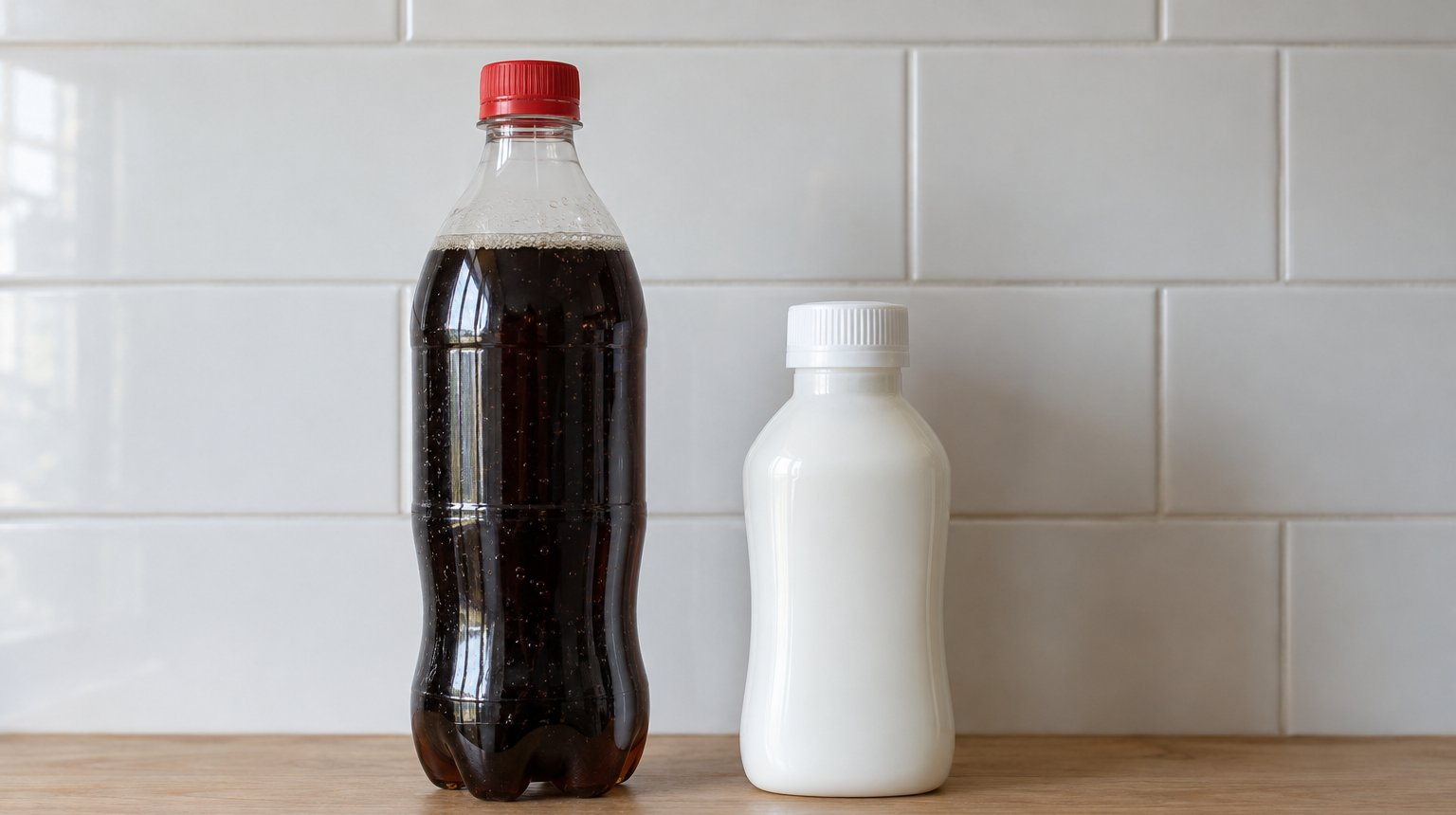
The soft drink's hydronium-ion concentration, [H₃O⁺], is 3.2×10⁻⁴ M.
The antacid mixture's hydronium-ion concentration is 8.9×10⁻¹¹ M.
The soft drink is the more acidic liquid.
But saying how much more acidic forces a count across seven powers of ten.
Chemists compare acidity like this every day.
How can chemists compare acidity without counting powers of ten?
Part 2One short scale for every solution
Chemists compress the whole range of [H₃O⁺] onto one short scale.
The short scale is called pH.
On the pH scale, most solutions land between 0 and 14.
The pH scale is inverted.
A solution with a higher [H₃O⁺] is more acidic.
A more acidic solution has a lower pH.
So the soft drink has a lower pH than the antacid mixture.
A pH meter measures a solution's pH directly.
Here are the two liquids on the pH scale, as a pH meter reads them.
An exact rule turns each concentration into its pH.
State that pH is a compressed scale for [H₃O⁺] that is inverted: the higher the [H₃O⁺], the more acidic the solution and the lower its pH.
Part 3Check what you just learned
Check — multiple choice
We've seen square brackets around a formula. Which quantity does the notation [H₃O⁺] name?
Feedback if chosen: This option is wrong — a raw count would grow with the sample's size. Square brackets name a concentration: [H₃O⁺] names the hydronium-ion concentration, in mol/L.
Feedback if chosen: Correct. Square brackets name a concentration: [H₃O⁺] names the hydronium-ion concentration, in mol/L.
Feedback if chosen: This option is wrong — the ion's charge is written on the formula itself, as the superscript plus. Square brackets name a concentration, in mol/L.
Check — multiple choice
One sample has [H₃O⁺] = 2.0×10⁻³ M. A second sample has [H₃O⁺] = 2.0×10⁻⁹ M. Which sample is more acidic?
Feedback if chosen: Correct. The higher the [H₃O⁺], the more acidic the solution, and 2.0×10⁻³ M is the higher concentration.
Feedback if chosen: This option is wrong — you picked the lower concentration. The higher the [H₃O⁺], the more acidic the solution.
Check — multiple choice
One sample sits at pH 4.2. A second sample sits at pH 9.3. Which sample is more acidic?
Feedback if chosen: Correct. The pH scale is inverted, so the more acidic sample has the lower pH.
Feedback if chosen: This option is wrong — you read the scale the wrong way round. The pH scale is inverted: the more acidic sample has the LOWER pH.
Check — multiple choice
One sample has [H₃O⁺] = 5×10⁻⁸ M. A second sample has [H₃O⁺] = 5×10⁻² M. Which sample has the lower pH?
Feedback if chosen: This option is wrong — you paired the lower concentration with the lower pH. A higher [H₃O⁺] means a more acidic sample, and a more acidic sample has a LOWER pH.
Feedback if chosen: Correct. 5×10⁻² M is the higher concentration, so that sample is more acidic, and the more acidic sample has the lower pH.
Check — multiple choice
One sample's pH is higher than another sample's pH. Is the higher-pH sample more acidic or less acidic?
Feedback if chosen: This option is wrong — you read the scale the wrong way round. The pH scale is inverted: a higher pH marks a LESS acidic sample.
Feedback if chosen: Correct. The pH scale is inverted: the higher the pH, the less acidic the sample.
Check — multiple choice
Which quantity does the pH scale compress onto one short range?
Feedback if chosen: This option is wrong — [OH⁻] is the hydroxide-ion concentration. The pH scale compresses [H₃O⁺].
Feedback if chosen: Correct. The pH scale compresses the whole range of [H₃O⁺], the hydronium-ion concentration, onto one short, inverted scale.
Feedback if chosen: This option is wrong — liquid water is the solvent itself, and no acidity scale compresses the solvent's concentration. The pH scale compresses [H₃O⁺].
Check — multiple choice
Chemists compress the whole range of [H₃O⁺] onto one short, inverted scale. Which name belongs to the scale?
Feedback if chosen: This option is wrong — Kw is a single number at a given temperature, not a scale. The compressed, inverted scale for [H₃O⁺] is the pH scale.
Feedback if chosen: This option is wrong — molarity is the unit the brackets already carry, not the compressed scale. The compressed, inverted scale for [H₃O⁺] is the pH scale.
Feedback if chosen: Correct. The compressed, inverted scale for [H₃O⁺] is called the pH scale.
One pH unit is a factor of ten
Outcome: State that each decrease of 1 pH unit corresponds to a tenfold increase in [H₃O⁺], and extend the rule to steps of 2 and 3 units.
Part 1Two pools, one unit apart
A pool keeper tests the water of two pools on the same morning.
Pool A's water sits at pH 7.5.
Pool B's water sits at pH 6.5.
The two pools sit one unit apart on the pH scale.
One unit looks like a small difference.
How large is the real difference in [H₃O⁺] between the two pools?
Part 2Ten times per unit
Each step of 1 unit down the pH scale multiplies [H₃O⁺] by ten.
Pool B's pH sits 1 unit below pool A's pH.
So pool B's water carries ten times the [H₃O⁺] of pool A's water.
Here is the pH scale with each even tick's [H₃O⁺] printed beneath it.
A step of 2 units down the pH scale multiplies [H₃O⁺] by one hundred.
Each extra unit multiplies by another ten.
So a small step on the pH scale hides a large change in [H₃O⁺].
State that each decrease of 1 pH unit corresponds to a tenfold increase in [H₃O⁺], and extend the rule to steps of 2 and 3 units.
Part 3Check what you just learned
Check — numeric entry
Two samples sit at pH 6.5 and pH 7.5. How many times greater is the pH-6.5 sample's [H₃O⁺]? Give a whole number.
Feedback when correct: Correct. The pH-6.5 sample sits 1 unit lower on the scale, and each unit down multiplies [H₃O⁺] by ten.
Anticipated wrong answers (feedback shown):
| 1 | This value is the difference in pH units, not the factor in concentration. Each unit of pH is a FACTOR of ten in [H₃O⁺]. |
| 0.1 | This value points the factor the wrong way. The pH-6.5 sample is the LOWER-pH sample, so its [H₃O⁺] is ten times GREATER, not ten times smaller. |
Check — numeric entry
Two samples sit at pH 3.0 and pH 5.0. How many times greater is the pH-3.0 sample's [H₃O⁺]? Give a whole number.
Feedback when correct: Correct. The pH-3.0 sample sits 2 units lower, and each unit multiplies [H₃O⁺] by ten: ten times ten is one hundred.
Anticipated wrong answers (feedback shown):
| 2 | This value is the difference in pH units, not the factor in concentration. Each unit is a factor of ten, so 2 units make a factor of one hundred. |
| 10 | This value counts one unit's factor only. The pH-3.0 sample sits 2 units lower, so the factor is ten times ten: one hundred. |
| 0.01 | This value points the factor the wrong way. The LOWER-pH sample carries the larger [H₃O⁺]. |
Check — multiple choice
Two samples sit at pH 8.2 and pH 6.2. Which sample's [H₃O⁺] is one hundred times the other's?
Feedback if chosen: This option is wrong — you gave the factor to the higher-pH sample. The pH-6.2 sample sits 2 units lower, and each unit down multiplies [H₃O⁺] by ten.
Feedback if chosen: Correct. The pH-6.2 sample sits 2 units lower, and two factors of ten make one hundred.
Check — numeric entry
Two samples sit at pH 11 and pH 12. How many times greater is the pH-11 sample's [H₃O⁺]? Give a whole number.
Feedback when correct: Correct. The factor-of-ten rule works on the basic side of the scale too: the pH-11 sample sits 1 unit lower, so its [H₃O⁺] is ten times greater.
Anticipated wrong answers (feedback shown):
| 1 | This value is the difference in pH units, not the factor in concentration. Each unit of pH is a factor of ten in [H₃O⁺], on every part of the scale. |
| 0.1 | This value points the factor the wrong way. The pH-11 sample is the lower-pH sample, so its [H₃O⁺] is ten times greater. |
The pH equation
Outcome: State that pH = −log[H₃O⁺], the definition that produces the inverse, factor-of-ten scale.
Part 1The pattern behind the scale
We've seen that each factor of ten in [H₃O⁺] moves the pH by exactly 1 unit.
A solution with [H₃O⁺] = 1.0×10⁻³ M has a pH of exactly 3.00.
A solution with [H₃O⁺] = 1.0×10⁻⁵ M has a pH of exactly 5.00.
In each case the pH matches the power of ten with its sign flipped.
What rule turns any [H₃O⁺] into its pH?
Part 2The definition
One definition produces the whole scale: pH = −log[H₃O⁺].
A logarithm reads off an exponent: the log of a power of ten is its exponent.
So the log of 10⁻³ equals −3.
The minus sign in the definition turns −3 into +3.
So a solution with [H₃O⁺] = 1.0×10⁻³ M has pH 3.00.
Part 3The definition explains both patterns
Each factor of ten in [H₃O⁺] changes the log by exactly 1.
So each factor of ten in [H₃O⁺] moves the pH by exactly 1 unit.
The minus sign flips the direction.
So a higher [H₃O⁺] produces a lower pH.
Here is the scale again: each even tick's [H₃O⁺] sits beneath it, and the pH is the power of ten with its sign flipped.
The definition pH = −log[H₃O⁺] explains both patterns we have seen.
State that pH = −log[H₃O⁺], the definition that produces the inverse, factor-of-ten scale.
Part 4Check what you just learned
Check — numeric entry
A solution has [H₃O⁺] = 1.0×10⁻⁸ M. Use pH = −log[H₃O⁺] to calculate the pH. Give your answer to 2 decimal places.
Tolerance: 0.005
Feedback when correct: Correct. The log of 10⁻⁸ is −8, and the definition's minus sign flips −8 to +8. The definition works on the basic side of the scale too: pH = 8.00.
Anticipated wrong answers (feedback shown):
| -8.00 | This value is the bare log. The definition carries a minus sign: pH = −log[H₃O⁺], so the −8 flips to +8.00. |
| 6.00 | This value subtracts 8 from 14. No subtraction lives in this definition: pH = −log[H₃O⁺] = 8.00. |
Worked solution revealed after a second miss
Write down the values from the question
[H₃O⁺] = 1.0×10⁻⁸ M
Write down the equation
pH = −log[H₃O⁺]
Substitute in the values, and calculate
pH = −log(1.0×10⁻⁸)
pH = 8.00
Check — numeric entry
A solution has [H₃O⁺] = 1.0×10⁻² M. Use pH = −log[H₃O⁺] to calculate the pH. Give your answer to 2 decimal places.
Tolerance: 0.005
Feedback when correct: Correct. The log of 10⁻² is −2, and the minus sign flips −2 to +2: pH = 2.00.
Anticipated wrong answers (feedback shown):
| -2.00 | This value is the bare log. The definition carries a minus sign: pH = −log[H₃O⁺], so the −2 flips to +2.00. |
| 12.00 | This value subtracts 2 from 14. No subtraction lives in this definition: pH = −log[H₃O⁺] = 2.00. |
Worked solution revealed after a second miss
Write down the values from the question
[H₃O⁺] = 1.0×10⁻² M
Write down the equation
pH = −log[H₃O⁺]
Substitute in the values, and calculate
pH = −log(1.0×10⁻²)
pH = 2.00
Check — multiple choice
Which change to a solution lowers its pH by exactly 1 unit?
Feedback if chosen: This option is wrong — halving [H₃O⁺] moves the pH the other way, and by less than 1 unit. A full unit down needs a factor of TEN up in [H₃O⁺].
Feedback if chosen: This option is wrong — you added to the concentration instead of multiplying it. The log in the definition turns FACTORS into steps: a factor of ten up in [H₃O⁺] moves the pH down 1 unit.
Feedback if chosen: Correct. The log of a tenfold-larger number is larger by exactly 1, and the minus sign turns that +1 into a 1-unit DROP in pH.
Higher [OH⁻] means lower pOH
Outcome: State that pOH is the parallel scale for [OH⁻]: the higher the [OH⁻], the more basic the solution and the lower its pOH.
Part 1Two cleaning liquids
A student now compares the basicity of two cleaning liquids.
The bleach solution's hydroxide-ion concentration, [OH⁻], is 3.2×10⁻² M.
The soap solution's hydroxide-ion concentration is 1.1×10⁻⁴ M.
The bleach solution is the more basic liquid.
But saying how much more basic forces the same count across powers of ten.
Does a compressed scale exist for [OH⁻] too?
Part 2The mirror scale
The same compression works for [OH⁻].
The compressed scale for [OH⁻] is called pOH.
A solution with a higher [OH⁻] is more basic.
A more basic solution has a lower pOH.
So the bleach solution has a lower pOH than the soap solution.
Here are the two scales in one table.
| The pH scale | The pOH scale | |
|---|---|---|
| Compressed concentration | [H₃O⁺] | [OH⁻] |
| A higher concentration means | a more acidic solution | a more basic solution |
| Direction | higher [H₃O⁺], lower pH | higher [OH⁻], lower pOH |
Here are the two cleaning liquids on the pOH scale.
Chemists read pOH for basicity exactly as they read pH for acidity.
State that pOH is the parallel scale for [OH⁻]: the higher the [OH⁻], the more basic the solution and the lower its pOH.
Part 3Check what you just learned
Check — multiple choice
One sample has [OH⁻] = 4.0×10⁻⁶ M. A second sample has [OH⁻] = 4.0×10⁻² M. Which sample is more basic?
Feedback if chosen: This option is wrong — you picked the lower concentration. The higher the [OH⁻], the more basic the solution.
Feedback if chosen: Correct. The higher the [OH⁻], the more basic the solution, and 4.0×10⁻² M is the higher concentration.
Check — multiple choice
One sample sits at pOH 2.5. A second sample sits at pOH 8.5. Which sample is more basic?
Feedback if chosen: Correct. The pOH scale is inverted, so the more basic sample has the lower pOH.
Feedback if chosen: This option is wrong — you read the scale the wrong way round. The pOH scale is inverted: the more basic sample has the LOWER pOH.
Check — multiple choice
One sample has [OH⁻] = 7×10⁻³ M. A second sample has [OH⁻] = 7×10⁻¹⁰ M. Which sample has the lower pOH?
Feedback if chosen: Correct. 7×10⁻³ M is the higher concentration, so that sample is more basic, and the more basic sample has the lower pOH.
Feedback if chosen: This option is wrong — you paired the lower concentration with the lower pOH. A higher [OH⁻] means a more basic sample, and a more basic sample has a LOWER pOH.
Check — multiple choice
One sample is more basic than another. Is the more basic sample's pOH higher or lower?
Feedback if chosen: This option is wrong — you read the scale the wrong way round. The pOH scale is inverted, exactly as the pH scale is: more basic means LOWER pOH.
Feedback if chosen: Correct. The pOH scale is inverted: the more basic the sample, the lower the sample's pOH.
Check — multiple choice
Which quantity does the pOH scale compress?
Feedback if chosen: This option is wrong — [H₃O⁺] already has its own compressed scale, the pH scale. The pOH scale compresses [OH⁻], the hydroxide-ion concentration.
Feedback if chosen: Correct. The pOH scale compresses [OH⁻], the hydroxide-ion concentration.
Feedback if chosen: This option is wrong — a formula mass measures the solute's particles, not the solution's basicity. The pOH scale compresses [OH⁻], the hydroxide-ion concentration.
Check — multiple choice
What is the name of the compressed scale for [OH⁻], on which more basic solutions sit lower?
Feedback if chosen: Correct. The compressed, inverted scale for [OH⁻] is called the pOH scale.
Feedback if chosen: This option is wrong — the pH scale compresses [H₃O⁺]. The parallel scale for [OH⁻] is the pOH scale.
Feedback if chosen: This option is wrong — molarity is the unit the brackets already carry, not the compressed scale. The scale for [OH⁻] is the pOH scale.
The pOH equation
Outcome: State that pOH = −log[OH⁻], the mirror of the pH definition.
Part 1The rule for the mirror scale
We've seen the rule that turns [H₃O⁺] into pH: pH = −log[H₃O⁺].
We've seen that chemists compress [OH⁻] onto the pOH scale.
A soap solution's [OH⁻] is 1.0×10⁻⁵ M.
The soap solution's pOH is exactly 5.00.
What rule turns an [OH⁻] into its pOH?
Part 2The pOH definition
The rule is the same log move with [OH⁻] in the slot: pOH = −log[OH⁻].
The log of 10⁻⁵ equals −5.
The minus sign flips −5 to +5.
So a solution with [OH⁻] = 1.0×10⁻⁵ M has pOH 5.00.
Each factor of ten in [OH⁻] moves the pOH by exactly 1 unit.
State that pOH = −log[OH⁻].
Part 3Check what you just learned
Check — numeric entry
A solution has [OH⁻] = 1.0×10⁻⁴ M. Use pOH = −log[OH⁻] to calculate the pOH. Give your answer to 2 decimal places.
Tolerance: 0.005
Feedback when correct: Correct. The log of 10⁻⁴ is −4, and the minus sign flips −4 to +4: pOH = 4.00.
Anticipated wrong answers (feedback shown):
| -4.00 | This value is the bare log. The definition carries a minus sign: pOH = −log[OH⁻], so the −4 flips to +4.00. |
| 10.00 | This value subtracts 4 from 14. No subtraction lives in this definition: pOH = −log[OH⁻] = 4.00. |
Worked solution revealed after a second miss
Write down the values from the question
[OH⁻] = 1.0×10⁻⁴ M
Write down the equation
pOH = −log[OH⁻]
Substitute in the values, and calculate
pOH = −log(1.0×10⁻⁴)
pOH = 4.00
Check — numeric entry
A solution has [OH⁻] = 1.0×10⁻¹¹ M. Use pOH = −log[OH⁻] to calculate the pOH. Give your answer to 2 decimal places.
Tolerance: 0.005
Feedback when correct: Correct. The log of 10⁻¹¹ is −11, and the minus sign flips it to +11. A pOH exists for every aqueous solution, even one holding very little OH⁻: pOH = 11.00.
Anticipated wrong answers (feedback shown):
| -11.00 | This value is the bare log. The definition carries a minus sign: pOH = −log[OH⁻], so the −11 flips to +11.00. |
| 3.00 | This value subtracts 11 from 14. No subtraction lives in this definition: pOH = −log[OH⁻] = 11.00. |
Worked solution revealed after a second miss
Write down the values from the question
[OH⁻] = 1.0×10⁻¹¹ M
Write down the equation
pOH = −log[OH⁻]
Substitute in the values, and calculate
pOH = −log(1.0×10⁻¹¹)
pOH = 11.00
Check — multiple choice
A student computes a solution's pOH. Which concentration goes into the pOH definition?
Feedback if chosen: Correct. The pOH definition reads the hydroxide-ion concentration: pOH = −log[OH⁻].
Feedback if chosen: This option is wrong — you swapped in the mirror scale's concentration. [H₃O⁺] feeds the pH definition; the pOH definition reads [OH⁻].
Feedback if chosen: This option is wrong — the solute's own concentration is neither ion's concentration. The pOH definition reads [OH⁻].
Calculating pH and pOH
Outcome: Calculate pH from [H₃O⁺] and pOH from [OH⁻] with the log definitions, rounding so the decimal places match the concentration's significant figures.
Part 1Between 3.00 and 4.00
Real concentrations rarely land on an exact power of ten.
An apple juice sample at 25 °C has [H₃O⁺] = 4.2×10⁻⁴ M.
The concentration sits between 1.0×10⁻³ M and 1.0×10⁻⁴ M.
So the juice's pH sits somewhere between 3.00 and 4.00.
Where exactly between 3.00 and 4.00 does the juice's pH sit?
Part 2The calculator's log key
The only way to find the exact pH is to compute −log(4.2×10⁻⁴) on a calculator.
Q: An apple juice sample at 25 °C has [H₃O⁺] = 4.2×10⁻⁴ M. What is the juice's pH?
Write down the values from the question
[H₃O⁺] = 4.2×10⁻⁴ M
Write down the equation
pH = −log[H₃O⁺]
Substitute in the values, and calculate
pH = −log(4.2×10⁻⁴)
pH = 3.3768…(the calculator's full readout)
Round so the decimal places match the given significant figures
4.2×10⁻⁴ M carries 2 significant figures
pH = 3.38(so the pH keeps 2 decimal places)
Part 3How many decimal places to keep
The rounding step fixes the precision.
The given concentration, 4.2×10⁻⁴ M, carries two significant figures.
So the pH keeps two decimal places: pH = 3.38.
The 3 before the decimal point only marks the power of ten.
The two decimal places carry the measured precision.
So the rule is: the significant figures of the concentration become the decimal places of the pH.
The same routine turns any [OH⁻] into its pOH.
Calculate pH from [H₃O⁺], and pOH from [OH⁻], using the log definitions, and round so the result's decimal places match the concentration's significant figures.
Part 4Check what you just learned
Check — multiple choice
A black-tea sample at 25 °C has [H₃O⁺] = 7.1×10⁻⁶ M. Which expression gives the tea's pH?
Feedback if chosen: This option is wrong — you dropped the definition's minus sign, so the result would come out negative. The pH is −log[H₃O⁺].
Feedback if chosen: Correct. The definition is pH = −log[H₃O⁺], with the given concentration in the slot.
Feedback if chosen: This option is wrong — you flipped the sign of the exponent inside the log. The given concentration is 7.1×10⁻⁶ M, not 7.1×10⁶ M.
Check — numeric entry
Evaluate the black-tea sample's pH at 25 °C from [H₃O⁺] = 7.1×10⁻⁶ M. Give your answer to 2 decimal places.
Tolerance: 0.005
Feedback when correct: Correct. pH = −log(7.1×10⁻⁶) = 5.15, and the two decimal places match the concentration's two significant figures.
Anticipated wrong answers (feedback shown):
| -5.15 | This value is the bare log. The definition carries a minus sign: pH = −log[H₃O⁺] = 5.15. |
| 8.85 | This value subtracts 5.15 from 14.00 — at 25 °C that computes the pOH of this sample, not its pH. The pH comes straight from pH = −log[H₃O⁺]. |
Worked solution revealed after a second miss
Write down the values from the question
[H₃O⁺] = 7.1×10⁻⁶ M
Write down the equation
pH = −log[H₃O⁺]
Substitute in the values, and calculate
pH = −log(7.1×10⁻⁶)
pH = 5.1487…
Round so the decimal places match the given significant figures
7.1×10⁻⁶ M carries 2 significant figures
pH = 5.15
Check — multiple choice
The black-tea calculation's full readout is 5.1487…. How many decimal places does the reported pH keep, and why?
Feedback if chosen: Correct. The concentration's significant figures become the pH's decimal places: two significant figures in 7.1×10⁻⁶ M, so two decimal places in 5.15.
Feedback if chosen: This option is wrong — the calculator prints every digit it computes, measured or not. The given concentration's significant figures set the pH's decimal places.
Feedback if chosen: This option is wrong — two is right for THIS sample, but only because the sample's concentration carries two significant figures. A three-figure concentration would keep three decimal places.
Check — numeric entry
A basic solution at 25 °C has [OH⁻] = 2.4×10⁻³ M. Calculate the pOH. Give your answer to 2 decimal places.
Tolerance: 0.005
Feedback when correct: Correct. pOH = −log(2.4×10⁻³) = 2.62, with two decimal places for the concentration's two significant figures.
Anticipated wrong answers (feedback shown):
| 11.38 | This value subtracts 2.62 from 14.00 — that computes the pH of this solution, not its pOH. The pOH comes straight from pOH = −log[OH⁻]. |
| -2.62 | This value is the bare log. The definition carries a minus sign: pOH = −log[OH⁻] = 2.62. |
Worked solution revealed after a second miss
Write down the values from the question
[OH⁻] = 2.4×10⁻³ M
Write down the equation
pOH = −log[OH⁻]
Substitute in the values, and calculate
pOH = −log(2.4×10⁻³)
pOH = 2.6198…
Round so the decimal places match the given significant figures
2.4×10⁻³ M carries 2 significant figures
pOH = 2.62
Check — numeric entry
A solution at 25 °C has [H₃O⁺] = 9.3×10⁻⁹ M. Calculate the pH. Give your answer to 2 decimal places.
Tolerance: 0.005
Feedback when correct: Correct. pH = −log(9.3×10⁻⁹) = 8.03. The routine works on the basic side of the scale too.
Anticipated wrong answers (feedback shown):
| 5.97 | This value subtracts 8.03 from 14.00 — that computes the pOH of this solution, not its pH. The pH comes straight from pH = −log[H₃O⁺]. |
| -8.03 | This value is the bare log. The definition carries a minus sign: pH = −log[H₃O⁺] = 8.03. |
Worked solution revealed after a second miss
Write down the values from the question
[H₃O⁺] = 9.3×10⁻⁹ M
Write down the equation
pH = −log[H₃O⁺]
Substitute in the values, and calculate
pH = −log(9.3×10⁻⁹)
pH = 8.0315…
Round so the decimal places match the given significant figures
9.3×10⁻⁹ M carries 2 significant figures
pH = 8.03
From pH back to the concentration
Outcome: Calculate [H₃O⁺] from pH, and [OH⁻] from pOH, by rearranging the log definitions to the 10-to-the-power form.
Part 1A meter reading, backwards
We've seen the routine that turns a concentration into its pH.
A student dips a pH meter into a kettle-descaler solution at 25 °C.
The meter shows pH 2.50.
The student needs the [H₃O⁺] itself, in mol/L.
The log routine starts from the concentration, not from the pH.
How do you get back from a pH to the concentration behind it?
Part 2A power of ten undoes the log
A power of ten undoes the log.
pH = −log[H₃O⁺] rearranges to [H₃O⁺] = 10^(−pH).
Q: A kettle-descaler solution at 25 °C has pH 2.50. What is its [H₃O⁺]?
Write down the values from the question
pH = 2.50
Write down the equation, and make [H₃O⁺] the subject
pH = −log[H₃O⁺]
[H₃O⁺] = 10^(−pH)(a power of ten undoes the log)
Substitute in the values, and calculate
[H₃O⁺] = 10^(−2.50)
[H₃O⁺] = 3.162…×10⁻³ M(the calculator's full readout)
Round so the significant figures match the given decimal places
pH 2.50 carries 2 decimal places
[H₃O⁺] = 3.2×10⁻³ M(so the concentration keeps 2 significant figures)
Part 3Reading the precision backwards
The pH shows two decimal places.
So the concentration keeps two significant figures.
The precision rule from before works backwards too: the decimal places of the pH become the significant figures of the concentration.
The same undo works for pOH: [OH⁻] = 10^(−pOH).
Calculate [H₃O⁺] from pH, and [OH⁻] from pOH, by rearranging the log definitions to [H₃O⁺] = 10^(−pH) and [OH⁻] = 10^(−pOH).
Part 4Check what you just learned
Check — multiple choice
A solution at 25 °C has pH 8.25. Which expression gives its [H₃O⁺]?
Feedback if chosen: This option is wrong — you lost the minus sign, so the concentration would come out enormous. The rearranged definition is [H₃O⁺] = 10^(−pH).
Feedback if chosen: Correct. The rearranged definition is [H₃O⁺] = 10^(−pH), with the given pH in the slot.
Feedback if chosen: This option is wrong — taking −log is the FORWARD routine, from a concentration to its pH. Going backwards needs the undo: a power of ten.
Check — numeric entry
Evaluate [H₃O⁺] for the pH-8.25 solution at 25 °C. Give your answer in M, to 2 significant figures.
Tolerance: 5e-11
Feedback when correct: Correct. [H₃O⁺] = 10^(−8.25) = 5.6×10⁻⁹ M, and the two significant figures match the pH's two decimal places.
Anticipated wrong answers (feedback shown):
| 1.8e8 | This value computes 10^(+8.25) — the minus sign was lost. The undo is [H₃O⁺] = 10^(−pH) = 5.6×10⁻⁹ M. |
| 1.8e-6 | This value subtracts the pH from 14.00 first and then undoes the log — that returns the [OH⁻] of this solution. The [H₃O⁺] comes straight from 10^(−pH). |
Worked solution revealed after a second miss
Write down the values from the question
pH = 8.25
Write down the equation, and make [H₃O⁺] the subject
pH = −log[H₃O⁺]
[H₃O⁺] = 10^(−pH)
Substitute in the values, and calculate
[H₃O⁺] = 10^(−8.25)
[H₃O⁺] = 5.623…×10⁻⁹ M
Round so the significant figures match the given decimal places
pH 8.25 carries 2 decimal places
[H₃O⁺] = 5.6×10⁻⁹ M
Check — multiple choice
The pH-8.25 calculation's full readout is 5.623…×10⁻⁹. How many significant figures does the reported concentration keep, and why?
Feedback if chosen: This option is wrong — decimal places belong to the pH's own half of the rule. Going back to a concentration, the pH's decimal places set the SIGNIFICANT FIGURES.
Feedback if chosen: Correct. The precision rule read backwards: the pH's decimal places become the concentration's significant figures.
Feedback if chosen: This option is wrong — the calculator prints every digit it computes, measured or not. The pH's decimal places set the concentration's significant figures.
Check — numeric entry
A solution at 25 °C has pOH 4.80. Calculate [OH⁻]. Give your answer in M, to 2 significant figures.
Tolerance: 5e-07
Feedback when correct: Correct. [OH⁻] = 10^(−4.80) = 1.6×10⁻⁵ M, with two significant figures for the pOH's two decimal places.
Anticipated wrong answers (feedback shown):
| 6.3e4 | This value computes 10^(+4.80) — the minus sign was lost. The undo is [OH⁻] = 10^(−pOH) = 1.6×10⁻⁵ M. |
| 6.3e-10 | This value subtracts the pOH from 14.00 first and then undoes the log — that returns the [H₃O⁺] of this solution. The [OH⁻] comes straight from 10^(−pOH). |
Worked solution revealed after a second miss
Write down the values from the question
pOH = 4.80
Write down the equation, and make [OH⁻] the subject
pOH = −log[OH⁻]
[OH⁻] = 10^(−pOH)
Substitute in the values, and calculate
[OH⁻] = 10^(−4.80)
[OH⁻] = 1.584…×10⁻⁵ M
Round so the significant figures match the given decimal places
pOH 4.80 carries 2 decimal places
[OH⁻] = 1.6×10⁻⁵ M
Check — numeric entry
A solution at 25 °C has pH 11.62. Calculate [H₃O⁺]. Give your answer in M, to 2 significant figures.
Tolerance: 5e-14
Feedback when correct: Correct. [H₃O⁺] = 10^(−11.62) = 2.4×10⁻¹² M. The undo works on the basic side of the scale too.
Anticipated wrong answers (feedback shown):
| 4.2e11 | This value computes 10^(+11.62) — the minus sign was lost. The undo is [H₃O⁺] = 10^(−pH) = 2.4×10⁻¹² M. |
| 4.2e-3 | This value subtracts the pH from 14.00 first and then undoes the log — that returns the [OH⁻] of this solution. The [H₃O⁺] comes straight from 10^(−pH). |
Worked solution revealed after a second miss
Write down the values from the question
pH = 11.62
Write down the equation, and make [H₃O⁺] the subject
pH = −log[H₃O⁺]
[H₃O⁺] = 10^(−pH)
Substitute in the values, and calculate
[H₃O⁺] = 10^(−11.62)
[H₃O⁺] = 2.399…×10⁻¹² M
Round so the significant figures match the given decimal places
pH 11.62 carries 2 decimal places
[H₃O⁺] = 2.4×10⁻¹² M
pH plus pOH is 14.00 at 25 °C
Outcome: State that taking −log of Kw = [H₃O⁺][OH⁻] produces pKw = pH + pOH = 14.00 at 25 °C.
Part 1Two sums that match
We've seen that in every aqueous solution at 25 °C, the product [H₃O⁺][OH⁻] equals Kw = 1.0×10⁻¹⁴.
We've now built two scales: pH for [H₃O⁺] and pOH for [OH⁻].
A soap solution at 25 °C has pH 10.04 and pOH 3.96.
A soft drink at 25 °C has pH 3.49 and pOH 10.51.
Add the pH and the pOH for each liquid.
Both sums land on exactly 14.00.
Why do both sums land on the same total?
Part 2Kw in disguise
The total of 14.00 is Kw in disguise.
Take the −log of both sides of Kw = [H₃O⁺][OH⁻].
The log of a product is the sum of the logs.
So −log Kw equals −log[H₃O⁺] plus −log[OH⁻].
The right side is pH + pOH.
Chemists call the left side pKw.
The p in front of a symbol means: take the −log of it. pH, pOH and pKw all use the same p.
Part 3The total of 14.00 belongs to 25 °C
At 25 °C, pKw comes out as −log(1.0×10⁻¹⁴) = 14.00.
So pH + pOH equals 14.00 in every aqueous solution at 25 °C.
Here is the pairing drawn along the scale.
The total of 14.00 belongs to 25 °C.
At another temperature, Kw takes a different value.
So pH + pOH lands on a different total there.
State that taking −log of Kw = [H₃O⁺][OH⁻] produces pKw = pH + pOH = 14.00 at 25 °C.
Part 4Check what you just learned
Check — multiple choice
In every aqueous solution at 25 °C, pH + pOH = 14.00. Where does the 14.00 come from?
Feedback if chosen: This option is wrong — the axis is drawn 0 to 14 BECAUSE of the chemistry, not the other way round. The 14.00 is −log Kw at 25 °C.
Feedback if chosen: Correct. Taking −log of Kw = [H₃O⁺][OH⁻] turns the product into pH + pOH, and −log(1.0×10⁻¹⁴) = 14.00 at 25 °C.
Feedback if chosen: This option is wrong — adding the two concentrations gives a tiny number of mol/L, not 14.00. The 14.00 is −log Kw at 25 °C.
Check — numeric entry
A solution at 25 °C has pH 6.35. Use pH + pOH = 14.00 at 25 °C to calculate the pOH. Give your answer to 2 decimal places.
Tolerance: 0.005
Feedback when correct: Correct. pOH = 14.00 − 6.35 = 7.65 at 25 °C.
Anticipated wrong answers (feedback shown):
| 20.35 | This value adds the pH to 14.00. The total 14.00 is the SUM of the two quantities, so the missing one is 14.00 MINUS the pH. |
| 6.35 | This value repeats the pH. The two quantities differ unless both equal 7.00: pOH = 14.00 − pH = 7.65. |
Worked solution revealed after a second miss
Write down the values from the question
pH = 6.35
pH + pOH = 14.00 at 25 °C
Make pOH the subject
pOH = 14.00 − pH
Substitute in the values, and calculate
pOH = 14.00 − 6.35
pOH = 7.65
Check — multiple choice
A beaker of solution stands at 60 °C. Does pH + pOH still total exactly 14.00 at 60 °C?
Feedback if chosen: This option is wrong — the 14.00 is −log Kw, and Kw sits at 1.0×10⁻¹⁴ only at 25 °C. At 60 °C, Kw takes a different value, so the total moves too.
Feedback if chosen: Correct. The total is −log Kw, and Kw sits at 1.0×10⁻¹⁴ only at 25 °C. At another temperature, Kw takes a different value, so pH + pOH lands on a different total.
Check — multiple choice
A solution at 25 °C has pH 2.00 and pOH 12.00, so the two sum to 14.00. The sum equals the −log of which quantity?
Feedback if chosen: Correct. Taking −log of Kw = [H₃O⁺][OH⁻] turns the product of the two concentrations into the sum pH + pOH.
Feedback if chosen: This option is wrong — −log[H₃O⁺] is the pH alone, one term of the sum. The whole sum is −log of Kw.
Feedback if chosen: This option is wrong — −log[OH⁻] is the pOH alone, one term of the sum. The whole sum is −log of Kw.
Check — multiple choice
What do chemists call −log Kw?
Feedback if chosen: This option is wrong — pOH is −log[OH⁻], one ion's own value. The −log of the ion-product constant Kw is pKw.
Feedback if chosen: Correct. The −log of the ion-product constant Kw is called pKw, and at 25 °C pKw comes out as 14.00.
Feedback if chosen: This option is wrong — pH is −log[H₃O⁺], one ion's own value. The −log of the ion-product constant Kw is pKw.
From pH to pOH and back
Outcome: Calculate pH from pOH, and pOH from pH, using pH + pOH = 14.00 at 25 °C.
Part 1One fact, one ask
A student knows one fact about a basic solution at 25 °C: its pOH is 3.20.
A quiz asks for the solution's pH.
The log routine needs a concentration.
The student has no concentration.
We've seen that pH + pOH equals 14.00 at 25 °C.
The long way exists: undo the pOH to [OH⁻], cross Kw to [H₃O⁺], then take −log.
Can one subtraction replace all three moves?
Part 2One subtraction replaces all three moves
One subtraction replaces all three moves.
pH + pOH = 14.00 rearranges to pH = 14.00 − pOH, at 25 °C.
For this solution, the subtraction leaves pH = 14.00 − 3.20 = 10.80.
The same rearrangement works the other way: pOH = 14.00 − pH.
The 14.00 is pKw at 25 °C.
At another temperature, pKw takes a different value.
So the subtraction uses 14.00 only at 25 °C.
Calculate pH from pOH, and pOH from pH, using pH + pOH = 14.00 at 25 °C, in both directions.
Part 3Check what you just learned
Check — numeric entry
A solution at 25 °C has pH 1.35. Calculate the pOH. Give your answer to 2 decimal places.
Tolerance: 0.005
Feedback when correct: Correct. pOH = 14.00 − 1.35 = 12.65 at 25 °C.
Anticipated wrong answers (feedback shown):
| 15.35 | This value adds the pH to 14.00. The 14.00 is the SUM of pH and pOH, so the missing one is 14.00 MINUS the known one. |
| 1.35 | This value repeats the pH. The ask is the pOH: pOH = 14.00 − pH = 12.65 at 25 °C. |
Worked solution revealed after a second miss
Write down the values from the question
pH = 1.35
pH + pOH = 14.00 at 25 °C
Make pOH the subject
pOH = 14.00 − pH
Substitute in the values, and calculate
pOH = 14.00 − 1.35
pOH = 12.65
Check — numeric entry
A solution at 25 °C has pOH 7.85. Calculate the pH. Give your answer to 2 decimal places.
Tolerance: 0.005
Feedback when correct: Correct. pH = 14.00 − 7.85 = 6.15 at 25 °C. A pOH above 7.00 pairs with a pH below 7.00: this solution sits on the acidic side.
Anticipated wrong answers (feedback shown):
| 21.85 | This value adds the pOH to 14.00. The 14.00 is the SUM of pH and pOH, so the missing one is 14.00 MINUS the known one. |
| 7.85 | This value repeats the pOH. The ask is the pH: pH = 14.00 − pOH = 6.15 at 25 °C. |
Worked solution revealed after a second miss
Write down the values from the question
pOH = 7.85
pH + pOH = 14.00 at 25 °C
Make pH the subject
pH = 14.00 − pOH
Substitute in the values, and calculate
pH = 14.00 − 7.85
pH = 6.15
Check — numeric entry
A solution at 25 °C has pH 13.20. Calculate the pOH. Give your answer to 2 decimal places.
Tolerance: 0.005
Feedback when correct: Correct. pOH = 14.00 − 13.20 = 0.80 at 25 °C. The subtraction works right up to the ends of the scale.
Anticipated wrong answers (feedback shown):
| 27.20 | This value adds the pH to 14.00. The 14.00 is the SUM of pH and pOH, so the missing one is 14.00 MINUS the known one. |
| 13.20 | This value repeats the pH. The ask is the pOH: pOH = 14.00 − pH = 0.80 at 25 °C. |
Worked solution revealed after a second miss
Write down the values from the question
pH = 13.20
pH + pOH = 14.00 at 25 °C
Make pOH the subject
pOH = 14.00 − pH
Substitute in the values, and calculate
pOH = 14.00 − 13.20
pOH = 0.80
Acidic, basic or neutral from pH at 25 °C
Outcome: Classify a solution at 25 °C as acidic, neutral or basic from its pH, using the 7.00 benchmark.
Part 1Four samples on a bench
Four labelled samples stand on a bench at 25 °C.
The soft drink's pH is 4.5.
The tap water's pH is 6.95.
The seawater's pH is 8.1.
The milk of magnesia's pH is 10.5.
Which samples count as acidic, and which count as basic?
Part 2The benchmark at 25 °C
We've seen that neutral water at 25 °C has [H₃O⁺] = [OH⁻] = 1.0×10⁻⁷ M.
Take the −log of 1.0×10⁻⁷.
Neutral water's pH comes out as 7.00 at 25 °C.
Neutral water's pOH comes out as 7.00 as well.
So pH 7.00 marks the neutral point at 25 °C.
A solution with pH below 7.00 at 25 °C is acidic.
A solution with pH above 7.00 at 25 °C is basic.
Part 3Sorting the bench
The test is one question, asked the same way every time.
The soft drink's pH is 4.5 at 25 °C. Is the soft drink acidic, basic, or neutral?
Acidic: 4.5 sits below 7.00.
Milk's pH is 6.6 at 25 °C. Is the milk acidic, basic, or neutral?
Acidic: 6.6 sits below 7.00, closer but still below.
Tap water from a first tap reads pH 6.95 at 25 °C. Is the sample acidic, basic, or neutral?
Acidic: 6.95 sits below 7.00, only just.
Tap water from a second tap reads pH 7.00 at 25 °C. Is the sample acidic, basic, or neutral?
Neutral: 7.00 sits exactly at the benchmark.
Tap water from a third tap reads pH 7.05 at 25 °C. Is the sample acidic, basic, or neutral?
Basic: 7.05 sits above 7.00.
Seawater's pH is 8.1 at 25 °C. Is the seawater acidic, basic, or neutral?
Basic: 8.1 sits above 7.00.
Milk of magnesia's pH is 10.5 at 25 °C. Is the milk of magnesia acidic, basic, or neutral?
Basic: 10.5 sits far above 7.00.
Here is the bench on the scale.
Back at the bench, the soft drink and the tap water (pH 6.95) are acidic. The seawater and the milk of magnesia are basic.
Classify a solution at 25 °C as acidic (pH < 7.00), neutral (pH = 7.00) or basic (pH > 7.00).
Part 4Check what you just learned
Check — multiple choice
Black coffee at 25 °C has pH 5.0. Is the coffee acidic, basic, or neutral?
Feedback if chosen: Correct. 5.0 sits below 7.00, so at 25 °C the coffee is acidic.
Feedback if chosen: This option is wrong — a pH BELOW 7.00 at 25 °C marks an acidic solution, and 5.0 sits below 7.00.
Feedback if chosen: This option is wrong — only pH 7.00 exactly is neutral at 25 °C, and 5.0 sits well below it.
Check — multiple choice
A swimming-pool sample at 25 °C has pH 7.5. Is the sample acidic, basic, or neutral?
Feedback if chosen: This option is wrong — a pH ABOVE 7.00 at 25 °C marks a basic solution, and 7.5 sits above 7.00.
Feedback if chosen: Correct. 7.5 sits above 7.00, so at 25 °C the pool sample is basic, even though it sits close to neutral.
Feedback if chosen: This option is wrong — only pH 7.00 exactly is neutral at 25 °C. At 7.5, the sample is basic.
Check — multiple choice
A distilled-water sample, protected from air, has pH 7.00 at 25 °C. Is the sample acidic, basic, or neutral?
Feedback if chosen: This option is wrong — an acidic solution at 25 °C sits BELOW 7.00, and this sample sits exactly at 7.00.
Feedback if chosen: This option is wrong — a basic solution at 25 °C sits ABOVE 7.00, and this sample sits exactly at 7.00.
Feedback if chosen: Correct. At 25 °C, pH 7.00 is the neutral point exactly.
Check — multiple choice
Lemon juice at 25 °C has pH 2.3. Is the juice acidic, basic, or neutral?
Feedback if chosen: Correct. 2.3 sits far below 7.00, so at 25 °C the juice is acidic.
Feedback if chosen: This option is wrong — a basic solution at 25 °C sits ABOVE 7.00, and 2.3 sits far below it.
Feedback if chosen: This option is wrong — only pH 7.00 exactly is neutral at 25 °C, and 2.3 sits far below it.
Kw depends on temperature
Outcome: State that Kw is temperature dependent, so pure water's pH deviates from 7.00 away from 25 °C.
Part 1A kettle and an accurate meter
A kettle heats pure water to 50 °C.
A student dips an accurate pH meter into the hot pure water.
The meter shows pH 6.63, not 7.00.
Nothing has been added to the water.
Has heating turned the pure water acidic?
Part 2Temperature changes K itself
No: heating has not turned the water acidic.
We've seen that a change in temperature changes an equilibrium constant itself.
Kw is an equilibrium constant.
So heating changes Kw too.
Part 3What heating does to Kw
We've seen that a temperature rise raises K for an endothermic reaction.
The autoionization of water, 2 H₂O(l) ⇌ H₃O⁺(aq) + OH⁻(aq), is endothermic.
So heating raises Kw.
At 50 °C, the supplied value is Kw = 5.5×10⁻¹⁴.
Part 4What the meter read
A larger Kw means more autoionization.
So hot pure water contains more H₃O⁺ and more OH⁻ than cool pure water.
A larger [H₃O⁺] means a lower pH.
So hot pure water shows a pH below 7.00.
Here is the scale at 25 °C.
And here is the same scale at 50 °C, with the supplied Kw.
Whether the hot water still counts as neutral comes next.
State that Kw is temperature dependent, so the pH of pure water deviates from 7.00 at temperatures other than 25 °C.
Part 5Check what you just learned
Check — multiple choice
We've seen several stresses pushed on equilibrium systems. Which stress changes the value of the equilibrium constant K itself?
Feedback if chosen: This option is wrong — a concentration change moves Q, and the system settles back to the SAME K. Only a temperature change moves K itself.
Feedback if chosen: This option is wrong — extra reactant moves Q, and the system settles back to the SAME K. Only a temperature change moves K itself.
Feedback if chosen: Correct. A change in temperature changes the equilibrium constant itself; every other stress leaves K where it was.
Check — multiple choice
A chemist heats pure water from 25 °C to 50 °C. What happens to Kw?
Feedback if chosen: Correct. The autoionization of water is endothermic, and a temperature rise raises K for an endothermic reaction, so heating raises Kw.
Feedback if chosen: This option is wrong — a temperature rise LOWERS K only for an exothermic reaction. Water's autoionization is endothermic, so heating raises Kw.
Feedback if chosen: This option is wrong — temperature is exactly the one stress that changes an equilibrium constant itself. Heating raises Kw, because the autoionization is endothermic.
Check — multiple choice
At 50 °C the supplied value is Kw = 5.5×10⁻¹⁴. Does neutral pure water at 50 °C show a pH below 7.00, above 7.00, or at exactly 7.00?
Feedback if chosen: Correct. The larger Kw means more autoionization, so the water carries more H₃O⁺ than at 25 °C, and a larger [H₃O⁺] means a lower pH.
Feedback if chosen: This option is wrong — 7.00 belongs to Kw = 1.0×10⁻¹⁴ at 25 °C. At 50 °C the larger Kw puts more H₃O⁺ in the water, so the pH sits below 7.00.
Feedback if chosen: This option is wrong — more autoionization means MORE H₃O⁺, and a larger [H₃O⁺] means a LOWER pH, not a higher one.
Check — multiple choice
A chemist cools pure water to 10 °C, where the supplied value is Kw = 2.9×10⁻¹⁵. Does the cold pure water show a pH below 7.00, above 7.00, or at exactly 7.00?
Feedback if chosen: This option is wrong — below 7.00 is the HOT direction. Cooling lowers Kw, so the water carries less H₃O⁺ than at 25 °C, and a smaller [H₃O⁺] means a higher pH.
Feedback if chosen: This option is wrong — 7.00 belongs to Kw = 1.0×10⁻¹⁴ at 25 °C. At 10 °C the smaller Kw leaves less H₃O⁺ in the water, so the pH sits above 7.00.
Feedback if chosen: Correct. Cooling is the mirror direction: the smaller Kw means less autoionization, less H₃O⁺, and a pH above 7.00.
Judging acidity away from 25 °C
Outcome: Judge a solution away from 25 °C as acidic, basic or neutral by comparing [H₃O⁺] with [OH⁻], and explain why the pH-7.00 benchmark fails there.
Part 1The same kettle, a bold claim
The kettle water from before sits at 50 °C with pH 6.63.
At 25 °C, a pH below 7.00 marks an acidic solution.
A student, Dana, calls the hot water acidic.
But nothing has been added to the water.
Is the hot pure water acidic, or does the pH-7.00 benchmark fail away from 25 °C?
Part 2Compare the ions, not the benchmark
The hot pure water is not acidic: the hot pure water is neutral.
Neutral always means [H₃O⁺] = [OH⁻].
Autoionization makes H₃O⁺ and OH⁻ in equal amounts.
Pure water contains no other source of either ion.
So in pure water at any temperature, [H₃O⁺] equals [OH⁻].
At 50 °C, with the supplied Kw = 5.5×10⁻¹⁴, each concentration equals √(5.5×10⁻¹⁴) = 2.3×10⁻⁷ M.
The two equal concentrations make the hot water neutral.
Here is the hot water on the 50 °C scale.
From here on, the test away from 25 °C is one comparison, asked the same way every time.
Compare [H₃O⁺] with [OH⁻]. Is the solution acidic, basic, or neutral?
Pure water at 50 °C: [H₃O⁺] = 2.3×10⁻⁷ M and [OH⁻] = 2.3×10⁻⁷ M. Compare them.
Neutral: the two concentrations are equal. The water's pH is 6.63.
A solution at 50 °C arrives with its concentrations given: [H₃O⁺] = 1.0×10⁻⁷ M and [OH⁻] = 5.5×10⁻⁷ M. Compare them.
Basic: [OH⁻] is the larger concentration. And this solution's pH is exactly 7.00.
The mirror solution at 50 °C: [H₃O⁺] = 5.5×10⁻⁷ M and [OH⁻] = 1.0×10⁻⁷ M. Compare them.
Acidic: [H₃O⁺] is the larger concentration.
Pure water at 10 °C: [H₃O⁺] = 5.4×10⁻⁸ M and [OH⁻] = 5.4×10⁻⁸ M. Compare them.
Neutral: equal again, this time at pH 7.27.
The pH-7.00 benchmark belongs to 25 °C alone.
Away from 25 °C, you judge a solution by comparing [H₃O⁺] with [OH⁻], never by comparing its pH with 7.00.
Part 3Almost the same pH, opposite verdicts
Milk at 25 °C has pH 6.6. The milk is acidic.
Pure water at 50 °C has pH 6.63. The water is neutral.
Here are the two side by side.
| Sample | Neutral mark | pH | Verdict |
|---|---|---|---|
| Milk at 25 °C | pH 7.00 | pH 6.6 | acidic |
| Pure water at 50 °C | pH 6.63 | pH 6.63 | neutral |
So Dana's claim fails: a pH below 7.00 marks an acidic solution only at 25 °C.
Judge whether a solution away from 25 °C is acidic, basic or neutral by comparing [H₃O⁺] with [OH⁻], not by comparing its pH with 7.00, and explain why the benchmark fails there.
Part 4Check what you just learned
Check — multiple choice
Pure water at 50 °C, where the supplied Kw = 5.5×10⁻¹⁴, shows pH 6.63. Is the water acidic, basic, or neutral?
Feedback if chosen: This option is wrong — you compared the pH with 7.00, and that benchmark belongs to 25 °C. In pure water, [H₃O⁺] = [OH⁻] at any temperature, and equal concentrations mean neutral.
Feedback if chosen: This option is wrong — nothing in pure water supplies extra OH⁻. Autoionization makes the two ions one-for-one, so [H₃O⁺] = [OH⁻], and equal concentrations mean neutral.
Feedback if chosen: Correct. Autoionization makes the two ions one-for-one and nothing else supplies either ion, so [H₃O⁺] = [OH⁻], and equal concentrations mean neutral, whatever the meter shows.
Free-response question
Source note (not shown as part of the question): Authored fresh to the ACB-019 register behaviour (EK 8.1.A.4); no released FRQ consumed.
A student heats pure water to 40 °C. At 40 °C, the supplied value is Kw = 2.9×10⁻¹⁴. An accurate pH meter reads pH 6.77. Explain why this water is neutral although its pH sits below 7.00.
(a) Explain why the 40 °C water is neutral, and why the pH-7.00 benchmark does not apply at 40 °C. [3 points]
✓ Model response (the key)
Part (a)
Autoionization makes H₃O⁺ and OH⁻ in equal amounts, one of each per transfer.
Pure water contains no other source of either ion.
So in the 40 °C water, [H₃O⁺] equals [OH⁻].
Equal concentrations are what neutral means. So the water is neutral.
The 7.00 benchmark is −log(1.0×10⁻⁷).
1.0×10⁻⁷ M is the neutral concentration only where Kw = 1.0×10⁻¹⁴, at 25 °C.
At 40 °C the supplied Kw is larger, 2.9×10⁻¹⁴, so neutral water carries more of each ion, and its pH sits below 7.00.
Scoring rubric — 3 points available
- (a) States that [H₃O⁺] = [OH⁻] in the pure water (autoionization makes the ions one-for-one and nothing else supplies either ion) [1 pt]
- (a) States that equal [H₃O⁺] and [OH⁻] is what neutral means, so the water is neutral [1 pt]
- (a) States that the pH-7.00 benchmark belongs to 25 °C, because it rests on Kw = 1.0×10⁻¹⁴ at 25 °C, and the 40 °C Kw differs (equivalent reasoning accepted) [1 pt]
Check — multiple choice
Noor says: "Any solution with pH 7.00 is neutral, whatever its temperature." A beaker of solution with pH 7.00 stands at 50 °C, where the supplied Kw = 5.5×10⁻¹⁴. Is Noor correct?
Feedback if chosen: This option is wrong — at 50 °C a pH-7.00 solution has [H₃O⁺] = 1.0×10⁻⁷ M and [OH⁻] = 5.5×10⁻¹⁴ ÷ 1.0×10⁻⁷ = 5.5×10⁻⁷ M. The OH⁻ outnumbers the H₃O⁺, so the solution is basic, not neutral.
Feedback if chosen: Correct. At 50 °C a pH-7.00 solution has [H₃O⁺] = 1.0×10⁻⁷ M and [OH⁻] = 5.5×10⁻¹⁴ ÷ 1.0×10⁻⁷ = 5.5×10⁻⁷ M. The OH⁻ outnumbers the H₃O⁺, so the solution is basic — pH 7.00 means neutral only at 25 °C.
Check — multiple choice
Noor is wrong about the pH-7.00 solution at 50 °C. Why?
Feedback if chosen: Correct. At 50 °C, [OH⁻] = Kw ÷ [H₃O⁺] = 5.5×10⁻¹⁴ ÷ 1.0×10⁻⁷ = 5.5×10⁻⁷ M, which is larger than the 1.0×10⁻⁷ M of H₃O⁺ — so the pH-7.00 solution is basic there.
Feedback if chosen: This option is wrong — a pH meter reads correctly at 50 °C; the meter read 6.63 in the hot kettle water. The benchmark fails because the neutral POINT moved, not the measurement.
Feedback if chosen: This option is wrong — nothing in the question changes with time. The benchmark fails because the neutral point at 50 °C sits below 7.00, not because the pH drifts.
Check — multiple choice
Human blood at body temperature, 37 °C, has pH 7.40. At 37 °C, the supplied value is Kw = 2.4×10⁻¹⁴. By comparing [H₃O⁺] with [OH⁻], is the blood acidic, basic, or neutral?
Feedback if chosen: This option is wrong — work the comparison: [H₃O⁺] = 10^(−7.40) = 4.0×10⁻⁸ M and [OH⁻] = 2.4×10⁻¹⁴ ÷ 4.0×10⁻⁸ = 6.0×10⁻⁷ M. The OH⁻ is the larger concentration.
Feedback if chosen: Correct. [H₃O⁺] = 10^(−7.40) = 4.0×10⁻⁸ M and [OH⁻] = 2.4×10⁻¹⁴ ÷ 4.0×10⁻⁸ = 6.0×10⁻⁷ M. The OH⁻ outnumbers the H₃O⁺, so blood at 37 °C is basic.
Feedback if chosen: This option is wrong — neutral needs the two concentrations EQUAL. Here [H₃O⁺] = 4.0×10⁻⁸ M and [OH⁻] = 6.0×10⁻⁷ M, which differ by more than a factor of ten.
From any one of the four to the other three
Outcome: Calculate the remaining three of [H₃O⁺], [OH⁻], pH and pOH at 25 °C from any one of them, by chaining Kw, the log definitions and the 14.00 total.
Part 1A report form with four blanks
A lab partner reports one fact about an all-purpose cleaner at 25 °C: the cleaner's pOH is 3.55.
The report form demands four entries: [H₃O⁺], [OH⁻], pH, and pOH.
We've built every tool: the two log definitions, the two 10^x undos, Kw, and the pH + pOH total at 25 °C.
In which order do the tools fill the other three entries?
Part 2The four-quantity square
The four quantities form one connected square.
pH and pOH sit on one side, joined by pH + pOH = 14.00 at 25 °C.
[H₃O⁺] and [OH⁻] sit on the other side, joined by Kw = 1.0×10⁻¹⁴ at 25 °C.
Each log definition joins a concentration to its own p-quantity.
Here is the square.
Two routes reach every corner: through Kw, or through the total pH + pOH = 14.00 at 25 °C.
Both routes land on the same answer.
A cross-check ends every calculation: multiply the two concentrations; the product lands back on 1.0×10⁻¹⁴ at 25 °C.
Part 3Filling the cleaner's square
For the cleaner, the subtraction comes first.
Q: An all-purpose cleaner at 25 °C has pOH 3.55. What are its pH, [H₃O⁺] and [OH⁻]?
Write down the values from the question
pOH = 3.55
pH + pOH = 14.00(at 25 °C)
Kw = 1.0×10⁻¹⁴(at 25 °C)
Use the total to find the pH
pH = 14.00 − pOH
pH = 14.00 − 3.55 = 10.45
Undo each log to find the two concentrations
[H₃O⁺] = 10^(−pH) = 10^(−10.45) = 3.5×10⁻¹¹ M
[OH⁻] = 10^(−pOH) = 10^(−3.55) = 2.8×10⁻⁴ M
Cross-check the finished square
[H₃O⁺][OH⁻] = (3.5×10⁻¹¹) × (2.8×10⁻⁴)
The product comes out as 9.8×10⁻¹⁵, within rounding of the ion-product constant Kw = 1.0×10⁻¹⁴ at 25 °C.
Here is the cleaner's finished square.
The Kw route lands within rounding of the same corner: Kw ÷ [OH⁻] = 1.0×10⁻¹⁴ ÷ 2.8×10⁻⁴ = 3.6×10⁻¹¹ M, against 3.5×10⁻¹¹ M from the route through the total, at 25 °C.
Calculate the remaining three of [H₃O⁺], [OH⁻], pH and pOH at 25 °C from any one of them, by chaining Kw, the log definitions and pH + pOH = 14.00.
Part 4Check what you just learned
Check — numeric entry
A solution at 25 °C has [OH⁻] = 4.7×10⁻⁵ M. First find the pOH. Give your answer to 2 decimal places.
Tolerance: 0.005
Feedback when correct: Correct. pOH = −log(4.7×10⁻⁵) = 4.33, with two decimal places for the concentration's two significant figures.
Anticipated wrong answers (feedback shown):
| 9.67 | This value sits at a different corner of the square. The ask is the pOH: pOH = −log[OH⁻] = 4.33. |
| -4.33 | This value is the bare log. The definition carries a minus sign: pOH = −log[OH⁻] = 4.33. |
Worked solution revealed after a second miss
Write down the values from the question
[OH⁻] = 4.7×10⁻⁵ M
Write down the equation
pOH = −log[OH⁻]
Substitute in the values, and calculate
pOH = −log(4.7×10⁻⁵)
pOH = 4.33
Check — numeric entry
The same solution at 25 °C: [OH⁻] = 4.7×10⁻⁵ M, pOH 4.33. Now find the pH. Give your answer to 2 decimal places.
Tolerance: 0.005
Feedback when correct: Correct. pH = 14.00 − 4.33 = 9.67 at 25 °C.
Anticipated wrong answers (feedback shown):
| 4.33 | This value repeats the pOH. The pH is the total's other half: pH = 14.00 − pOH = 9.67 at 25 °C. |
| 18.33 | This value adds the pOH to 14.00. The 14.00 is the SUM of the two quantities, so the pH is 14.00 MINUS the pOH. |
Worked solution revealed after a second miss
Write down the values from the question
pOH = 4.33
pH + pOH = 14.00 at 25 °C
Make pH the subject
pH = 14.00 − pOH
Substitute in the values, and calculate
pH = 14.00 − 4.33
pH = 9.67
Check — numeric entry
The same solution at 25 °C: [OH⁻] = 4.7×10⁻⁵ M, pOH 4.33, pH 9.67. Finish the square: find [H₃O⁺]. Give your answer in M, to 2 significant figures.
Tolerance: 5e-12
Feedback when correct: Correct. [H₃O⁺] = 10^(−9.67) = 2.1×10⁻¹⁰ M. The Kw route agrees: 1.0×10⁻¹⁴ ÷ 4.7×10⁻⁵ returns 2.1×10⁻¹⁰ M as well, at 25 °C.
Anticipated wrong answers (feedback shown):
| 4.7e-5 | This value is the given [OH⁻], the opposite corner. The ask is [H₃O⁺]: undo the pH, 10^(−9.67) = 2.1×10⁻¹⁰ M. |
| 4.7e9 | This value computes 10^(+9.67) — the minus sign was lost. The undo is [H₃O⁺] = 10^(−pH) = 2.1×10⁻¹⁰ M. |
Worked solution revealed after a second miss
Write down the values from the question
pH = 9.67
Kw = 1.0×10⁻¹⁴ at 25 °C
Write down the equation, and make [H₃O⁺] the subject
pH = −log[H₃O⁺]
[H₃O⁺] = 10^(−pH)
Substitute in the values, and calculate
[H₃O⁺] = 10^(−9.67)
[H₃O⁺] = 2.1×10⁻¹⁰ M
Check — numeric entry
A solution at 25 °C has pH 5.85. Calculate [OH⁻]. Give your answer in M, to 2 significant figures.
Tolerance: 5e-11
Feedback when correct: Correct. Either route works at 25 °C: pOH = 14.00 − 5.85 = 8.15, then [OH⁻] = 10^(−8.15) = 7.1×10⁻⁹ M; or [H₃O⁺] = 10^(−5.85) = 1.4×10⁻⁶ M, then [OH⁻] = Kw ÷ [H₃O⁺] with Kw = 1.0×10⁻¹⁴ — both land on 7.1×10⁻⁹ M.
Anticipated wrong answers (feedback shown):
| 1.4e-6 | This value is the [H₃O⁺] of this solution — the square's other bottom corner. One more move finishes it: [OH⁻] = Kw ÷ [H₃O⁺], or undo the pOH. |
| 8.15 | This value is the pOH, still on the p-side of the square. One more undo reaches the concentration: [OH⁻] = 10^(−8.15) = 7.1×10⁻⁹ M. |
Worked solution revealed after a second miss
Write down the values from the question
pH = 5.85
pH + pOH = 14.00 at 25 °C
Find the pOH, then make [OH⁻] the subject
pOH = 14.00 − 5.85 = 8.15
[OH⁻] = 10^(−pOH)
Substitute in the values, and calculate
[OH⁻] = 10^(−8.15)
[OH⁻] = 7.1×10⁻⁹ M
Check — numeric entry
A solution at 25 °C has [H₃O⁺] = 6.2×10⁻⁴ M. Calculate the pOH. Give your answer to 2 decimal places.
Tolerance: 0.005
Feedback when correct: Correct. pH = −log(6.2×10⁻⁴) = 3.21, then pOH = 14.00 − 3.21 = 10.79 at 25 °C.
Anticipated wrong answers (feedback shown):
| 3.21 | This value is the pH — the move stopped one corner short. The ask is the pOH: 14.00 − 3.21 = 10.79 at 25 °C. |
| 17.21 | This value adds the pH to 14.00. The 14.00 is the SUM of the two p-quantities, so the pOH is 14.00 MINUS the pH. |
Worked solution revealed after a second miss
Write down the values from the question
[H₃O⁺] = 6.2×10⁻⁴ M
pH + pOH = 14.00 at 25 °C
Find the pH, then make pOH the subject
pH = −log(6.2×10⁻⁴) = 3.21
pOH = 14.00 − pH
Substitute in the values, and calculate
pOH = 14.00 − 3.21
pOH = 10.79
Check — numeric entry
A solution at 25 °C has pOH 9.40. Calculate [H₃O⁺]. Give your answer in M, to 2 significant figures.
Tolerance: 5e-07
Feedback when correct: Correct. pH = 14.00 − 9.40 = 4.60, then [H₃O⁺] = 10^(−4.60) = 2.5×10⁻⁵ M at 25 °C.
Anticipated wrong answers (feedback shown):
| 4.0e-10 | This value undoes the pOH — it is the [OH⁻] of this solution. The ask is [H₃O⁺]: cross to pH = 4.60 first, then undo, or divide Kw = 1.0×10⁻¹⁴ (at 25 °C) by the [OH⁻]. |
| 4.0e4 | This value computes 10^(+4.60) — the minus sign was lost. The undo is [H₃O⁺] = 10^(−pH) = 2.5×10⁻⁵ M. |
Worked solution revealed after a second miss
Write down the values from the question
pOH = 9.40
pH + pOH = 14.00 at 25 °C
Find the pH, then make [H₃O⁺] the subject
pH = 14.00 − 9.40 = 4.60
[H₃O⁺] = 10^(−pH)
Substitute in the values, and calculate
[H₃O⁺] = 10^(−4.60)
[H₃O⁺] = 2.5×10⁻⁵ M
U8-S03 — Strong acids and bases
12 lessons
The six strong acids
Outcome: Identify HCl, HBr, HI, HClO₄, H₂SO₄, and HNO₃ as the common strong acids.
Part 1A question with no help
An AP question names nitric acid, HNO₃, dissolved in water.
The question asks for the pH of the solution.
The question never says how fully HNO₃ ionizes in water.
Until now, every question told you whether a named acid ionizes completely or only partially.
This question tells you nothing of the kind.
How can you know what HNO₃ does in water?
Part 2A memory list of six
We've seen that a near-complete proton donor is called a strong acid.
Chemists expect you to know the common strong acids by name.
The list contains six acids: HCl, HBr, HI, HClO₄, H₂SO₄, and HNO₃.
| Formula | Name |
|---|---|
| HCl | hydrochloric acid |
| HBr | hydrobromic acid |
| HI | hydroiodic acid |
| HClO₄ | perchloric acid |
| H₂SO₄ | sulfuric acid |
| HNO₃ | nitric acid |
HNO₃ sits on the list, so HNO₃ is a strong acid.
From now on, these six acids are yours to know.
No AP question will tell you which acids are strong.
Part 3Judging acids against the list
Now judge some acids against the list.
Is HClO₄ on the list of strong acids?
Yes: HClO₄ sits on the list. So HClO₄ is identified as a strong acid.
Is HI on the list of strong acids?
Yes: HI sits on the list. So HI is identified as a strong acid.
Is HF on the list of strong acids?
No: HF does not sit on the list. So HF is not identified as a strong acid.
HF shares its halogen family with HCl, HBr, and HI, but membership is judged against the list alone.
Is HCl on the list of strong acids?
Yes: HCl sits on the list. So HCl is identified as a strong acid.
Is HNO₂ on the list of strong acids?
No: HNO₂ does not sit on the list. So HNO₂ is not identified as a strong acid.
Read the formula carefully: HNO₂ carries one oxygen fewer than HNO₃.
Is HNO₃ on the list of strong acids?
Yes: HNO₃ sits on the list. So HNO₃ is a strong acid.
That is how you know what HNO₃ does in water: the list says so.
Identify HCl, HBr, HI, HClO₄, H₂SO₄, and HNO₃ as the common strong acids.
Part 4Check what you just learned
Check — multiple choice
We've seen that some acids hand over their protons almost completely. What did we call a near-complete proton donor?
Feedback if chosen: Correct. A near-complete proton donor is called a strong acid.
Feedback if chosen: This option is wrong — concentrated describes how much acid is dissolved, not how completely the acid donates protons.
Feedback if chosen: This option is wrong — corrosive describes a hazard, not how completely the acid donates protons.
Check — multiple choice
Which of the following acids is one of the six strong acids?
Feedback if chosen: Correct. HBr sits on the list of six strong acids.
Feedback if chosen: This option is wrong — HF is not on the list. The list's halogen acids are HCl, HBr, and HI.
Feedback if chosen: This option is wrong — H₂CO₃ is not on the list of six strong acids.
Check — multiple choice
One of these three acids is a strong acid. Which one?
Feedback if chosen: This option is wrong — HClO is not on the list. Read the formula carefully: HClO₄ is the listed acid.
Feedback if chosen: Correct. HClO₄ sits on the list of six strong acids.
Feedback if chosen: This option is wrong — HCN is not on the list of six strong acids.
Check — multiple choice
Which of the following acids is identified as a strong acid?
Feedback if chosen: This option is wrong — H₂S is not on the list of six strong acids.
Feedback if chosen: This option is wrong — H₂CO₃ is not on the list of six strong acids.
Feedback if chosen: Correct. H₂SO₄ sits on the list of six strong acids.
Check — multiple choice
Which of the following acids is NOT one of the six strong acids?
Feedback if chosen: This option is wrong — HNO₃ is on the list of six strong acids.
Feedback if chosen: Correct. HNO₂ is not on the list. It carries one oxygen fewer than HNO₃, which is.
Feedback if chosen: This option is wrong — HI is on the list of six strong acids.
Strong acids ionize completely
Outcome: State that a strong acid ionizes essentially completely in water, leaving virtually no intact acid molecules.
Part 1Out of every thousand molecules
A chemist dissolves 0.010 mol of HNO₃ in enough water to make one liter of solution.
We've seen that HNO₃ is one of the six strong acids.
We've seen that a strong acid is a near-complete proton donor.
"Near-complete" is a loose phrase.
Out of every thousand dissolved HNO₃ molecules, how many actually hand over a proton?
Part 2Essentially every molecule transfers
Essentially every dissolved HNO₃ molecule transfers its proton to a water molecule.
Each transfer leaves one H₃O⁺ ion and one NO₃⁻ ion in the solution.
Virtually no intact HNO₃ molecules remain.
A strong acid ionizes essentially completely in water.
That is the sharper meaning "strong acid" now carries.
How much acid is dissolved is a separate question: strong describes the ionization, never the concentration.
We've seen that the one-way arrow → marks a change that goes to completion.
So chemists write HNO₃ + H₂O → H₃O⁺ + NO₃⁻.
State that a strong acid ionizes essentially completely in water, leaving virtually no intact acid molecules.
Part 3Check what you just learned
Check — multiple choice
A 0.0050 M HClO₄ solution contains H₃O⁺ ions and ClO₄⁻ ions, with virtually no intact HClO₄ molecules. Which statement describes HClO₄?
Feedback if chosen: Correct. Virtually no intact molecules remain, so the ionization is essentially complete.
Feedback if chosen: This option is wrong — the described solution holds virtually no intact molecules, so the molecules did not stay intact.
Feedback if chosen: This option is wrong — you tied the ionization to the dilution. A strong acid ionizes essentially completely whether the solution is dilute or not.
Check — multiple choice
What does a strong acid do in water?
Feedback if chosen: This option is wrong — a partial ionization would leave many intact molecules. A strong acid leaves virtually none.
Feedback if chosen: Correct. A strong acid ionizes essentially completely in water, leaving virtually no intact acid molecules.
Feedback if chosen: This option is wrong — concentration describes how much acid is dissolved. Strong describes how completely the dissolved acid ionizes.
Check — multiple choice
A chemist prepares 0.010 M HNO₃. Which particles fill the solution?
Feedback if chosen: Correct. Essentially every dissolved HNO₃ molecule has transferred its proton to water, so the solution holds the ions and virtually no intact molecules.
Feedback if chosen: This option is wrong — that picture fits an acid that barely ionizes. HNO₃ ionizes essentially completely.
Feedback if chosen: This option is wrong — that picture is a halfway hedge. HNO₃ ionizes essentially completely, leaving virtually no intact molecules.
Check — multiple choice
HBr ionizes essentially completely in water. Which equation writes this change?
Feedback if chosen: Correct. The one-way arrow → marks a change that goes to completion, and this ionization goes to completion.
Feedback if chosen: This option is wrong — we've seen that ⇌ marks a change that does not go to completion. This ionization goes essentially to completion, so it takes the one-way arrow →.
Check — multiple choice
Leo says 0.0010 M HNO₃ is not a strong acid, because its concentration is so low. Is Leo correct?
Feedback if chosen: This option is wrong — you read the low concentration as a lack of strength. Strong describes how completely the dissolved acid ionizes, not how much acid is dissolved.
Feedback if chosen: Correct. 0.0010 M says how much HNO₃ is dissolved — nothing about how completely it ionizes.
Dilute HNO₃ still ionizes essentially completely, so HNO₃ is still a strong acid.
Hydronium equals the acid concentration
Outcome: State that in a solution of a strong acid that donates one proton per molecule, [H₃O⁺] equals the acid's initial concentration.
Part 1A label names the acid, not the ion
A bottle label says 0.010 M HNO₃.
We've seen that pH comes from [H₃O⁺], the hydronium-ion concentration.
The label states the acid's concentration, not the hydronium concentration.
Essentially every dissolved HNO₃ molecule has already handed its proton to water.
So what is [H₃O⁺] in this bottle?
Part 2Count the protons handed over
Each HNO₃ molecule that ionizes makes exactly one H₃O⁺ ion.
Essentially every dissolved HNO₃ molecule has ionized.
So 0.010 mol of acid per liter makes 0.010 mol of H₃O⁺ per liter.
So [H₃O⁺] equals 0.010 M.
In a solution of a strong acid that donates one proton per molecule, [H₃O⁺] equals the acid's initial concentration.
H₂SO₄ can donate a second proton.
So the pH work in this course never computes a pH from an H₂SO₄ concentration.
State that in a solution of a strong acid that donates one proton per molecule, [H₃O⁺] equals the acid's initial concentration.
Part 3Check what you just learned
Check — multiple choice
A chemist dissolves 0.040 mol of solute in enough water to make 2.0 L of solution. What is the solution's molarity?
Feedback if chosen: Correct. Molarity is moles of solute per liter of solution: 0.040 mol ÷ 2.0 L = 0.020 M.
Feedback if chosen: This option is wrong — you reported the moles themselves. Molarity divides the moles by the liters: 0.040 mol ÷ 2.0 L = 0.020 M.
Feedback if chosen: This option is wrong — you multiplied the moles by the liters. Molarity divides: 0.040 mol ÷ 2.0 L = 0.020 M.
Check — numeric entry
A bottle is labeled 0.025 M HClO₄. What is [H₃O⁺] in the solution? Give your answer in M, to 2 significant figures.
Tolerance: 0.0005
Feedback when correct: Correct. HClO₄ is a strong acid that donates one proton per molecule, so [H₃O⁺] equals the acid's initial concentration: 0.025 M.
Anticipated wrong answers (feedback shown):
| 1.60 | This value is −log(0.025), the solution's pH. The question asks for [H₃O⁺] itself, which equals the acid's initial concentration: 0.025 M. |
Check — numeric entry
What is [H₃O⁺] in 0.15 M HBr? Give your answer in M, to 2 significant figures.
Tolerance: 0.005
Feedback when correct: Correct. HBr is a strong acid that donates one proton per molecule, so [H₃O⁺] equals the acid's initial concentration: 0.15 M.
Anticipated wrong answers (feedback shown):
| 0.82 | This value is −log(0.15), the solution's pH. The question asks for [H₃O⁺] itself, which equals the acid's initial concentration: 0.15 M. |
Check — numeric entry
A chemist dilutes stock HCl down to 0.0020 M. What is [H₃O⁺] in the diluted solution? Give your answer in M, to 2 significant figures.
Tolerance: 5e-05
Feedback when correct: Correct. Dilution changes the acid's concentration, not the rule. HCl is a strong acid that donates one proton per molecule, so [H₃O⁺] equals the acid's initial concentration: 0.0020 M.
Anticipated wrong answers (feedback shown):
| 2.70 | This value is −log(0.0020), the solution's pH. The question asks for [H₃O⁺] itself, which equals the acid's initial concentration: 0.0020 M. |
Check — multiple choice
For which of these acids does [H₃O⁺] NOT simply equal the acid's labeled concentration?
Feedback if chosen: This option is wrong — HCl donates one proton per molecule, so [H₃O⁺] equals its labeled concentration.
Feedback if chosen: This option is wrong — HI donates one proton per molecule, so [H₃O⁺] equals its labeled concentration.
Feedback if chosen: Correct. H₂SO₄ can donate a second proton. So the one-proton counting rule does not give [H₃O⁺] from the label, and this course never computes a pH from an H₂SO₄ concentration.
pH of a strong acid solution
Outcome: Calculate the pH and pOH of a strong acid solution from its initial concentration.
Part 1The safety sheet asks for a pH
A chemist prepares 0.010 M HNO₃ for a demonstration.
The lab's safety sheet asks for the solution's pH.
We've seen that pH comes from the definition pH = −log[H₃O⁺].
We've seen that in this solution [H₃O⁺] equals 0.010 M.
So what pH does the chemist write on the sheet?
Part 2Two short steps
The whole calculation takes two steps.
First the acid's concentration gives [H₃O⁺]: [H₃O⁺] = 0.010 M.
Then the log definition gives the pH: pH = −log(0.010) = 2.00.
The concentration 0.010 M carries two significant figures, so the pH carries two decimal places.
pH + pOH = 14.00 at 25 °C gives pOH = 12.00.
So two short steps turn a strong acid's concentration into its pH.
Q: A chemist prepares 0.010 M HNO₃ at 25 °C. What are the pH and the pOH of the solution?
Write down the values from the question
concentration of HNO₃ = 0.010 M
Find [H₃O⁺] from the strong-acid counting rule
[H₃O⁺] = 0.010 M(HNO₃ donates one proton per molecule)
Write down the equation
pH = −log[H₃O⁺]
Substitute in the values, and calculate
pH = −log(0.010)
pH = 2.00(0.010 M carries 2 significant figures, so the pH keeps 2 decimal places)
Find the pOH from the pH
pH + pOH = 14.00 at 25 °C
pOH = 14.00 − 2.00 = 12.00
Calculate the pH, and the pOH, of a strong acid solution from its initial concentration.
Part 3Check what you just learned
Check — numeric entry
Calculate the pH of 0.050 M HClO₄. Give your answer to 2 decimal places.
Tolerance: 0.005
Feedback when correct: Correct. HClO₄ gives [H₃O⁺] = 0.050 M, and pH = −log(0.050) = 1.30 — two decimal places for the concentration's two significant figures.
Anticipated wrong answers (feedback shown):
| 12.70 | This value subtracts 1.30 from 14.00 — that computes the pOH at 25 °C, not the pH. The pH comes straight from pH = −log[H₃O⁺] = 1.30. |
| -1.30 | This value is the bare log. The definition carries a minus sign: pH = −log(0.050) = 1.30. |
Worked solution revealed after a second miss
Write down the values from the question
concentration of HClO₄ = 0.050 M
Find [H₃O⁺] from the strong-acid counting rule
[H₃O⁺] = 5.0 × 10⁻² M
Write down the equation
pH = −log[H₃O⁺]
Substitute in the values, and calculate
pH = −log(5.0 × 10⁻²)
pH = 1.3010…
Round so the decimal places match the given significant figures
0.050 M carries 2 significant figures
pH = 1.30
Check — numeric entry
Calculate the pH of 0.0032 M HNO₃. Give your answer to 2 decimal places.
Tolerance: 0.005
Feedback when correct: Correct. HNO₃ gives [H₃O⁺] = 0.0032 M, and pH = −log(0.0032) = 2.49.
Anticipated wrong answers (feedback shown):
| 11.51 | This value subtracts 2.49 from 14.00 — that computes the pOH at 25 °C, not the pH. The pH comes straight from pH = −log[H₃O⁺] = 2.49. |
| -2.49 | This value is the bare log. The definition carries a minus sign: pH = −log(0.0032) = 2.49. |
Worked solution revealed after a second miss
Write down the values from the question
concentration of HNO₃ = 0.0032 M
Find [H₃O⁺] from the strong-acid counting rule
[H₃O⁺] = 3.2 × 10⁻³ M
Write down the equation
pH = −log[H₃O⁺]
Substitute in the values, and calculate
pH = −log(3.2 × 10⁻³)
pH = 2.4948…
Round so the decimal places match the given significant figures
0.0032 M carries 2 significant figures
pH = 2.49
Check — numeric entry
A bottle holds 0.20 M HBr at 25 °C. Calculate the pOH of the solution. Give your answer to 2 decimal places.
Tolerance: 0.005
Feedback when correct: Correct. HBr gives [H₃O⁺] = 0.20 M, pH = −log(0.20) = 0.70, and pOH = 14.00 − 0.70 = 13.30 at 25 °C.
Anticipated wrong answers (feedback shown):
| 0.70 | This value is the solution's pH. The question asks for the pOH: pOH = 14.00 − 0.70 = 13.30 at 25 °C. |
Worked solution revealed after a second miss
Write down the values from the question
concentration of HBr = 0.20 M
Find [H₃O⁺] from the strong-acid counting rule
[H₃O⁺] = 0.20 M
Write down the equation
pH = −log[H₃O⁺]
Substitute in the values, and calculate
pH = −log(0.20)
pH = 0.70
Find the pOH from the pH
pH + pOH = 14.00 at 25 °C
pOH = 14.00 − 0.70 = 13.30
Strong acid concentration from pH
Outcome: Calculate the initial concentration of a strong acid from its measured pH.
Part 1A display shows pH 1.70
A pH meter sits in a vat of hydrochloric acid at a bottling plant.
The display shows pH 1.70.
The plant's log sheet needs the acid's concentration in M.
We've seen that a strong acid's concentration gives [H₃O⁺], and pH = −log[H₃O⁺].
Can the chemist run the same path in reverse?
Part 2Every step has a reverse step
Yes: every step of the path has a reverse step.
We've seen that 10^(−pH) gives [H₃O⁺].
pH 1.70 gives [H₃O⁺] = 10^(−1.70) = 0.020 M.
HCl is a strong acid, so each dissolved HCl molecule made exactly one H₃O⁺ ion.
So the acid's concentration equals [H₃O⁺]: the vat contains 0.020 M HCl.
The pH shows two decimal places, so the concentration carries two significant figures.
Q: A pH meter in a vat of hydrochloric acid shows pH 1.70. What is the acid's concentration?
Write down the values from the question
pH = 1.70
Write down the equation
[H₃O⁺] = 10^(−pH)
Substitute in the values, and calculate
[H₃O⁺] = 10^(−1.70)
[H₃O⁺] = 0.020 M(2 decimal places in the pH give 2 significant figures)
Find the concentration from the strong-acid counting rule
concentration of HCl = [H₃O⁺] = 0.020 M(each dissolved HCl molecule made exactly one H₃O⁺ ion)
Calculate the initial concentration of a strong acid from its measured pH.
Part 3Check what you just learned
Check — numeric entry
An HBr solution shows pH 2.30. Calculate the acid's concentration. Give your answer in M, to 2 significant figures.
Tolerance: 5e-05
Feedback when correct: Correct. [H₃O⁺] = 10^(−2.30) = 5.0 × 10⁻³ M, and HBr made one H₃O⁺ ion per molecule, so the concentration is 5.0 × 10⁻³ M.
Anticipated wrong answers (feedback shown):
| 2.3e-3 | You read the pH's digits as the concentration. The concentration comes from 10^(−2.30) = 5.0 × 10⁻³ M. |
| 2.0e-12 | This value subtracts the pH from 14.00 first — at 25 °C that route finds [OH⁻], not [H₃O⁺]. For the acid: [H₃O⁺] = 10^(−2.30) = 5.0 × 10⁻³ M. |
Worked solution revealed after a second miss
Write down the values from the question
pH = 2.30
Write down the equation
[H₃O⁺] = 10^(−pH)
Substitute in the values, and calculate
[H₃O⁺] = 10^(−2.30)
[H₃O⁺] = 5.0 × 10⁻³ M
Find the concentration from the strong-acid counting rule
concentration of HBr = [H₃O⁺] = 5.0 × 10⁻³ M
Check — numeric entry
An HI solution shows pH 1.00. Calculate the acid's concentration. Give your answer in M, to 2 significant figures.
Tolerance: 0.005
Feedback when correct: Correct. [H₃O⁺] = 10^(−1.00) = 0.10 M, and HI made one H₃O⁺ ion per molecule, so the concentration is 0.10 M.
Anticipated wrong answers (feedback shown):
| 1.0e-13 | This value subtracts the pH from 14.00 first — at 25 °C that route finds [OH⁻], not [H₃O⁺]. For the acid: [H₃O⁺] = 10^(−1.00) = 0.10 M. |
Worked solution revealed after a second miss
Write down the values from the question
pH = 1.00
Write down the equation
[H₃O⁺] = 10^(−pH)
Substitute in the values, and calculate
[H₃O⁺] = 10^(−1.00)
[H₃O⁺] = 0.10 M
Find the concentration from the strong-acid counting rule
concentration of HI = [H₃O⁺] = 0.10 M
Check — numeric entry
An HNO₃ solution shows pH 3.52. Calculate the acid's concentration. Give your answer in M, to 2 significant figures.
Tolerance: 5e-06
Feedback when correct: Correct. [H₃O⁺] = 10^(−3.52) = 3.0 × 10⁻⁴ M, and HNO₃ made one H₃O⁺ ion per molecule, so the concentration is 3.0 × 10⁻⁴ M.
Anticipated wrong answers (feedback shown):
| 3.3e-11 | This value subtracts the pH from 14.00 first — at 25 °C that route finds [OH⁻], not [H₃O⁺]. For the acid: [H₃O⁺] = 10^(−3.52) = 3.0 × 10⁻⁴ M. |
Worked solution revealed after a second miss
Write down the values from the question
pH = 3.52
Write down the equation
[H₃O⁺] = 10^(−pH)
Substitute in the values, and calculate
[H₃O⁺] = 10^(−3.52)
[H₃O⁺] = 3.0 × 10⁻⁴ M
Find the concentration from the strong-acid counting rule
concentration of HNO₃ = [H₃O⁺] = 3.0 × 10⁻⁴ M
The common strong bases
Outcome: Identify the group 1 and group 2 hydroxides as the common strong bases.
Part 1The warning on the drain cleaner
A bottle of drain cleaner lists sodium hydroxide, NaOH, as its working ingredient.
The label warns about severe burns.
We've seen that a base accepts protons.
The acids came with a memory list of six.
Which bases belong on the bases' own short list?
Part 2The bases' own short list
Chemists keep the bases' list short as well.
We've seen that bases differ in strength: the stronger the acid, the weaker its conjugate base.
The list contains the group 1 hydroxides: LiOH, NaOH, and KOH.
| Formula | Name | Group |
|---|---|---|
| LiOH | lithium hydroxide | 1 |
| NaOH | sodium hydroxide | 1 |
| KOH | potassium hydroxide | 1 |
| Ca(OH)₂ | calcium hydroxide | 2 |
| Sr(OH)₂ | strontium hydroxide | 2 |
| Ba(OH)₂ | barium hydroxide | 2 |
The list also contains three group 2 hydroxides: Ca(OH)₂, Sr(OH)₂, and Ba(OH)₂.
These listed hydroxides are the common strong bases.
From now on, these hydroxides are yours to know as well.
Part 3Judging bases against the list
Now judge some species against the list.
Is Sr(OH)₂ on the list of common strong bases?
Yes: Sr(OH)₂ sits on the list. So Sr(OH)₂ is identified as a strong base.
Is KOH on the list of common strong bases?
Yes: KOH sits on the list. So KOH is identified as a strong base.
Is NH₃ on the list of common strong bases?
No: NH₃ does not sit on the list. So NH₃ is not identified as a strong base.
NH₃ accepts protons, so NH₃ is a base. But membership is judged against the list alone.
Is NaOH on the list of common strong bases?
Yes: NaOH sits on the list. So NaOH is identified as a strong base.
That is why the drain cleaner's label carries its warning.
Is CH₃OH on the list of common strong bases?
No: CH₃OH does not sit on the list. So CH₃OH is not identified as a strong base.
The letters O and H sit inside the formula, but CH₃OH is not a metal hydroxide.
Is Ba(OH)₂ on the list of common strong bases?
Yes: Ba(OH)₂ sits on the list. So Ba(OH)₂ is identified as a strong base.
Identify the group 1 and group 2 hydroxides (LiOH, NaOH, KOH, Ca(OH)₂, Sr(OH)₂, and Ba(OH)₂) as the common strong bases.
Part 4Check what you just learned
Check — multiple choice
We've seen the Brønsted-Lowry definitions. What does a Brønsted-Lowry base do?
Feedback if chosen: This option is wrong — donating a proton is the acid's job. A Brønsted-Lowry base accepts a proton.
Feedback if chosen: Correct. A Brønsted-Lowry base accepts a proton.
Feedback if chosen: This option is wrong — splitting water is not the definition. A Brønsted-Lowry base accepts a proton.
Check — multiple choice
Which of the following is a common strong base?
Feedback if chosen: Correct. NaOH is a group 1 hydroxide, one of the six common strong bases.
Feedback if chosen: This option is wrong — NH₃ is a base, but it is not on the list of common strong bases.
Feedback if chosen: This option is wrong — CH₃OH carries the letters O and H, but it is not a metal hydroxide and is not on the list.
Check — multiple choice
One of these barium compounds is a strong base. Which one?
Feedback if chosen: This option is wrong — BaCl₂ carries no hydroxide (OH⁻) ions and is not on the list of common strong bases.
Feedback if chosen: This option is wrong — BaSO₄ carries no hydroxide (OH⁻) ions and is not on the list of common strong bases.
Feedback if chosen: Correct. Ba(OH)₂ is a group 2 hydroxide, one of the six common strong bases.
Check — multiple choice
Which of the following is NOT a common strong base?
Feedback if chosen: This option is wrong — KOH is a group 1 hydroxide, on the list of common strong bases.
Feedback if chosen: This option is wrong — Sr(OH)₂ is a group 2 hydroxide, on the list of common strong bases.
Feedback if chosen: Correct. NH₃ is a base, but it is not on the list of common strong bases.
Check — multiple choice
Which of the following species is on the list of common strong bases?
Feedback if chosen: This option is wrong — HF is an acid, not a hydroxide, and it is on neither memory list.
Feedback if chosen: Correct. LiOH is a group 1 hydroxide, one of the six common strong bases.
Feedback if chosen: This option is wrong — H₂O is not a metal hydroxide and is not on the list of common strong bases.
Strong bases dissociate completely
Outcome: State that a strong base dissociates completely in water into its metal cation and hydroxide ions.
Part 1A powder that barely dissolves
A teacher stirs a spoonful of solid Ca(OH)₂ into a beaker of water.
Most of the powder sinks and sits on the bottom.
A spoonful of NaOH dissolves almost fully in a beaker of water.
A spoonful of Ca(OH)₂ dissolves barely at all in a beaker of water.
Yet the stock bottle's label calls Ca(OH)₂ a strong base.
How can a base that barely dissolves count as strong?
Part 2Strong describes the dissolved portion
Strong describes what happens to the portion that dissolves.
Every dissolved NaOH unit splits completely into its ions, Na⁺ and OH⁻.
So chemists write NaOH(s) → Na⁺(aq) + OH⁻(aq).
Every dissolved Ca(OH)₂ unit splits completely into its ions, Ca²⁺ and OH⁻.
A strong base dissociates completely in water into its metal cation and hydroxide ions.
Whatever dissolves splits fully: that is what strong means.
How much dissolves is a separate question, and for Ca(OH)₂ the answer is very little.
So a sparingly soluble hydroxide can still be a strong base.
State that a strong base dissociates completely in water into its metal cation and hydroxide (OH⁻) ions.
Part 3Check what you just learned
Check — multiple choice
What does a strong base do in water?
Feedback if chosen: This option is wrong — that describes solubility. Strong describes what the dissolved portion does: it dissociates completely.
Feedback if chosen: Correct. A strong base dissociates completely in water into its metal cation and hydroxide (OH⁻) ions.
Feedback if chosen: This option is wrong — donating protons is the acids' job. A base accepts protons, and a strong base dissociates completely into its ions.
Check — multiple choice
A compound dissociates completely in water into its metal cation and hydroxide ions. What is this kind of compound called?
Feedback if chosen: Correct. A compound that dissociates completely in water into its metal cation and hydroxide (OH⁻) ions is a strong base.
Feedback if chosen: This option is wrong — a salt releases no hydroxide (OH⁻) ions. The released hydroxide is what makes this compound a base.
Feedback if chosen: This option is wrong — an acid donates protons. A compound releasing hydroxide (OH⁻) ions is a base.
Check — multiple choice
A student dissolves a spoonful of KOH in water, and it dissolves fully. Which particles fill the solution?
Feedback if chosen: This option is wrong — that picture fits a base that barely dissociates. KOH dissociates completely.
Feedback if chosen: This option is wrong — that picture is a halfway hedge. KOH dissociates completely, leaving essentially no intact units.
Feedback if chosen: Correct. Every dissolved KOH unit has split into K⁺ and OH⁻, so the solution holds the ions and essentially no intact units.
Check — multiple choice
What does "strong" describe about a base?
Feedback if chosen: This option is wrong — how much dissolves is solubility, a separate question. Ca(OH)₂ barely dissolves and is still strong.
Feedback if chosen: Correct. Strong describes the dissolved portion: whatever dissolves, dissociates completely into its ions.
Feedback if chosen: This option is wrong — corrosive describes a hazard. Strong describes how completely the dissolved portion dissociates.
Check — multiple choice
Omar says a saturated Ca(OH)₂ solution still counts as a solution of a strong base, even though very little of the solid has dissolved. Is Omar correct?
Feedback if chosen: Correct. Whatever dissolves splits fully into Ca²⁺ and OH⁻ ions, and that complete split is what strong means.
Feedback if chosen: This option is wrong — you judged the base by how much dissolves. Strong describes the dissolved portion: every dissolved Ca(OH)₂ unit has split fully into its ions.
Hydroxide from a group 1 hydroxide
Outcome: State that in a solution of a group 1 hydroxide, [OH⁻] equals the base's initial concentration.
Part 1From the base's label to [OH⁻]
A bottle contains 0.010 M NaOH.
We've seen that pH and pOH come from the two ion concentrations, [H₃O⁺] and [OH⁻].
Every dissolved NaOH unit has split into one Na⁺ ion and one OH⁻ ion.
So what is [OH⁻] in this bottle?
Part 2Count the hydroxide ions released
Each dissolved NaOH unit releases exactly one OH⁻ ion.
Every unit has split.
So 0.010 mol of NaOH per liter releases 0.010 mol of OH⁻ per liter.
So [OH⁻] equals 0.010 M.
In a solution of a group 1 hydroxide, [OH⁻] equals the base's initial concentration.
State that in a solution of a group 1 hydroxide, [OH⁻] equals the base's initial concentration.
Part 3Check what you just learned
Check — numeric entry
What is [OH⁻] in 0.035 M KOH? Give your answer in M, to 2 significant figures.
Tolerance: 0.0005
Feedback when correct: Correct. KOH is a group 1 hydroxide: each unit releases one OH⁻ ion, so [OH⁻] equals the base's initial concentration, 0.035 M.
Anticipated wrong answers (feedback shown):
| 1.46 | This value is −log(0.035), the solution's pOH. The question asks for [OH⁻] itself, which equals the base's initial concentration: 0.035 M. |
Check — numeric entry
What is [OH⁻] in 0.0080 M LiOH? Give your answer in M, to 2 significant figures.
Tolerance: 5e-05
Feedback when correct: Correct. LiOH is a group 1 hydroxide: each unit releases one OH⁻ ion, so [OH⁻] equals the base's initial concentration, 0.0080 M.
Anticipated wrong answers (feedback shown):
| 2.10 | This value is −log(0.0080), the solution's pOH. The question asks for [OH⁻] itself, which equals the base's initial concentration: 0.0080 M. |
Check — numeric entry
A student prepares 0.050 M NaOH. What is [OH⁻] in the solution? Give your answer in M, to 2 significant figures.
Tolerance: 0.0005
Feedback when correct: Correct. NaOH is a group 1 hydroxide: each unit releases one OH⁻ ion, so [OH⁻] equals the base's initial concentration, 0.050 M.
Anticipated wrong answers (feedback shown):
| 1.30 | This value is −log(0.050), the solution's pOH. The question asks for [OH⁻] itself, which equals the base's initial concentration: 0.050 M. |
Hydroxide from a group 2 hydroxide
Outcome: State that in a solution of a group 2 hydroxide, [OH⁻] is twice the base's initial concentration.
Part 1Two bottles, one concentration
Two bottles stand side by side on a shelf.
One bottle contains 0.010 M NaOH.
The other bottle contains 0.010 M Ba(OH)₂.
The two labels state the same concentration.
Does the same concentration mean the same [OH⁻]?
Part 2Two hydroxide ions per unit
No: the two formulas release different numbers of OH⁻ ions.
Each NaOH unit releases one OH⁻ ion.
Each Ba(OH)₂ unit releases two OH⁻ ions.
So chemists write Ba(OH)₂(s) → Ba²⁺(aq) + 2 OH⁻(aq).
We've seen that a mole ratio converts moles of one species into moles of another.
So 0.010 M Ba(OH)₂ gives [OH⁻] = 2 × 0.010 M = 0.020 M.
In a solution of a group 2 hydroxide, [OH⁻] is twice the base's initial concentration.
State that in a solution of a group 2 hydroxide, [OH⁻] is twice the base's initial concentration, because each formula unit releases two hydroxide ions.
Part 3Check what you just learned
Check — multiple choice
A compound releases 2 mol of hydroxide ions for every 1 mol that dissolves. A student dissolves 0.010 mol of the compound. How many moles of hydroxide ions are released?
Feedback if chosen: This option is wrong — you divided by the mole ratio. The ratio multiplies: 2 × 0.010 mol = 0.020 mol.
Feedback if chosen: This option is wrong — you ignored the mole ratio. Each dissolved mole releases 2 mol of hydroxide ions: 2 × 0.010 mol = 0.020 mol.
Feedback if chosen: Correct. The mole ratio converts: 2 mol of hydroxide ions per 1 mol dissolved, so 2 × 0.010 mol = 0.020 mol.
Check — numeric entry
What is [OH⁻] in 0.0040 M Sr(OH)₂? Give your answer in M, to 2 significant figures.
Tolerance: 5e-05
Feedback when correct: Correct. Sr(OH)₂ is a group 2 hydroxide: each unit releases two OH⁻ ions, so [OH⁻] = 2 × 0.0040 M = 0.0080 M.
Anticipated wrong answers (feedback shown):
| 0.0040 | This value forgets the factor of two. Each Sr(OH)₂ unit releases two OH⁻ ions, so [OH⁻] = 2 × 0.0040 M = 0.0080 M. |
Check — numeric entry
What is [OH⁻] in 0.0060 M Ca(OH)₂? Give your answer in M, to 2 significant figures.
Tolerance: 0.0005
Feedback when correct: Correct. Ca(OH)₂ is a group 2 hydroxide: each unit releases two OH⁻ ions, so [OH⁻] = 2 × 0.0060 M = 0.012 M.
Anticipated wrong answers (feedback shown):
| 0.0060 | This value forgets the factor of two. Each Ca(OH)₂ unit releases two OH⁻ ions, so [OH⁻] = 2 × 0.0060 M = 0.012 M. |
Check — numeric entry
What is [OH⁻] in 0.025 M KOH? Give your answer in M, to 2 significant figures.
Tolerance: 0.0005
Feedback when correct: Correct. KOH is a group 1 hydroxide: each unit releases one OH⁻ ion, so [OH⁻] equals the base's initial concentration, 0.025 M. The factor of two belongs to the group 2 hydroxides only.
Anticipated wrong answers (feedback shown):
| 0.050 | This value doubles a group 1 hydroxide. KOH releases one OH⁻ ion per unit, so [OH⁻] equals the base's initial concentration: 0.025 M. |
pH of a strong base solution
Outcome: Calculate the pOH and pH of a strong base solution from its initial concentration, including the factor of two for a group 2 hydroxide.
Part 1A pH from a base's label
A chemist prepares 0.010 M Ba(OH)₂.
The safety sheet asks for the solution's pH.
We've seen that pH comes from the definition pH = −log[H₃O⁺].
But this solution's label states a base's concentration.
The direct handle here is [OH⁻], not [H₃O⁺].
How does a base's concentration reach a pH?
Part 2One extra step on the base side
The base side takes one extra step.
First the concentration gives [OH⁻]: two OH⁻ per unit, so [OH⁻] = 0.020 M.
Then the log definition gives the pOH: pOH = −log(0.020) = 1.70.
Then pH + pOH = 14.00 at 25 °C gives the pH: pH = 14.00 − 1.70 = 12.30.
We've seen every one of these steps on its own.
The base route simply chains them, with pOH in the middle.
Q: A chemist prepares 0.010 M Ba(OH)₂ at 25 °C. What are the pOH and the pH of the solution?
Write down the values from the question
concentration of Ba(OH)₂ = 0.010 M
Find [OH⁻] from the formula's ion count
[OH⁻] = 2 × 0.010 M = 0.020 M(each Ba(OH)₂ unit releases two OH⁻ ions)
Write down the equation
pOH = −log[OH⁻]
Substitute in the values, and calculate
pOH = −log(0.020)
pOH = 1.70(0.010 M carries 2 significant figures, so the pOH keeps 2 decimal places)
Find the pH from the pOH
pH + pOH = 14.00 at 25 °C
pH = 14.00 − 1.70 = 12.30
Calculate the pOH and pH of a strong base solution from its initial concentration, including the factor of two for a group 2 hydroxide.
Part 3Check what you just learned
Check — numeric entry
Calculate the pH of 0.025 M KOH at 25 °C. Give your answer to 2 decimal places.
Tolerance: 0.005
Feedback when correct: Correct. [OH⁻] = 0.025 M, pOH = −log(0.025) = 1.60, and pH = 14.00 − 1.60 = 12.40 at 25 °C.
Anticipated wrong answers (feedback shown):
| 1.60 | This value is the pOH. The question asks for the pH: pH = 14.00 − 1.60 = 12.40 at 25 °C. |
Worked solution revealed after a second miss
Write down the values from the question
concentration of KOH = 0.025 M
Find [OH⁻] from the formula's ion count
[OH⁻] = 0.025 M
KOH releases one OH⁻ ion per unit
Write down the equation
pOH = −log[OH⁻]
Substitute in the values, and calculate
pOH = −log(0.025)
pOH = 1.60
Find the pH from the pOH
pH + pOH = 14.00 at 25 °C
pH = 14.00 − 1.60 = 12.40
Check — numeric entry
Calculate the pH of 0.0040 M Sr(OH)₂ at 25 °C. Give your answer to 2 decimal places.
Tolerance: 0.005
Feedback when correct: Correct. [OH⁻] = 2 × 0.0040 M = 0.0080 M, pOH = −log(0.0080) = 2.10, and pH = 14.00 − 2.10 = 11.90 at 25 °C.
Anticipated wrong answers (feedback shown):
| 11.60 | This value forgets the factor of two. Each Sr(OH)₂ unit releases two OH⁻ ions, so [OH⁻] = 0.0080 M, pOH = 2.10, and pH = 11.90. |
| 2.10 | This value is the pOH. The question asks for the pH: pH = 14.00 − 2.10 = 11.90 at 25 °C. |
Worked solution revealed after a second miss
Write down the values from the question
concentration of Sr(OH)₂ = 0.0040 M
Find [OH⁻] from the formula's ion count
[OH⁻] = 2 × 0.0040 M = 0.0080 M
each Sr(OH)₂ unit releases two OH⁻ ions
Write down the equation
pOH = −log[OH⁻]
Substitute in the values, and calculate
pOH = −log(0.0080)
pOH = 2.10
Find the pH from the pOH
pH + pOH = 14.00 at 25 °C
pH = 14.00 − 2.10 = 11.90
Check — numeric entry
Calculate the pOH of 0.0025 M Ba(OH)₂. Give your answer to 2 decimal places.
Tolerance: 0.005
Feedback when correct: Correct. [OH⁻] = 2 × 0.0025 M = 0.0050 M, and pOH = −log(0.0050) = 2.30. The question asks for the pOH, so the route stops here.
Anticipated wrong answers (feedback shown):
| 11.70 | You continued to the pH. The question asks for the pOH: pOH = −log(0.0050) = 2.30. |
| 2.60 | This value forgets the factor of two. Each Ba(OH)₂ unit releases two OH⁻ ions, so [OH⁻] = 0.0050 M and pOH = 2.30. |
Worked solution revealed after a second miss
Write down the values from the question
concentration of Ba(OH)₂ = 0.0025 M
Find [OH⁻] from the formula's ion count
[OH⁻] = 2 × 0.0025 M = 0.0050 M
each Ba(OH)₂ unit releases two OH⁻ ions
Write down the equation
pOH = −log[OH⁻]
Substitute in the values, and calculate
pOH = −log(0.0050)
pOH = 2.30
Strong base concentration from pH
Outcome: Calculate the initial concentration of a strong base from its measured pH or pOH, including the factor of two for a group 2 hydroxide.
Part 1The meter reading on the base side
A meter dipped in a Ba(OH)₂ solution shows pH 12.00.
The stockroom log needs the solution's concentration in M.
On the acid side, we reversed the path with 10^(−pH).
The base side carried an extra step on the way out.
Where does that extra step sit on the way back?
Part 2Each step reversed, in reverse order
Each step reverses, in the opposite order.
pH 12.00 gives pOH = 14.00 − 12.00 = 2.00 at 25 °C.
pOH 2.00 gives [OH⁻] = 10^(−2.00) = 0.010 M.
Each Ba(OH)₂ unit released two OH⁻ ions.
So you divide by two on the way back, where you multiplied on the way out.
The concentration is 0.010 M ÷ 2 = 0.0050 M Ba(OH)₂.
Q: A meter dipped in a Ba(OH)₂ solution at 25 °C shows pH 12.00. What is the base's concentration?
Write down the values from the question
pH = 12.00
Find the pOH from the pH
pH + pOH = 14.00 at 25 °C
pOH = 14.00 − 12.00 = 2.00
Write down the equation
[OH⁻] = 10^(−pOH)
Substitute in the values, and calculate
[OH⁻] = 10^(−2.00)
[OH⁻] = 0.010 M
Find the concentration from the formula's ion count
concentration of Ba(OH)₂ = 0.010 M ÷ 2 = 0.0050 M(each unit released two OH⁻ ions, so divide by two on the way back)
Calculate the initial concentration of a strong base from its measured pH or pOH, including the factor of two for a group 2 hydroxide.
Part 3Check what you just learned
Check — numeric entry
A KOH solution shows pH 11.60 at 25 °C. Calculate the base's concentration. Give your answer in M, to 2 significant figures.
Tolerance: 5e-05
Feedback when correct: Correct. pOH = 14.00 − 11.60 = 2.40 at 25 °C, [OH⁻] = 10^(−2.40) = 4.0 × 10⁻³ M, and KOH releases one OH⁻ ion per unit, so the concentration equals [OH⁻].
Anticipated wrong answers (feedback shown):
| 2.0e-3 | This value divides [OH⁻] by two. KOH releases one OH⁻ ion per unit, so the concentration of KOH equals [OH⁻] = 4.0 × 10⁻³ M — no division by two. |
Worked solution revealed after a second miss
Write down the values from the question
pH = 11.60
Find the pOH from the pH
pH + pOH = 14.00 at 25 °C
pOH = 14.00 − 11.60 = 2.40
Write down the equation
[OH⁻] = 10^(−pOH)
Substitute in the values, and calculate
[OH⁻] = 10^(−2.40)
[OH⁻] = 4.0 × 10⁻³ M
Find the concentration from the formula's ion count
concentration of KOH = [OH⁻] = 4.0 × 10⁻³ M
Check — numeric entry
A Sr(OH)₂ solution shows pOH 2.52. Calculate the base's concentration. Give your answer in M, to 2 significant figures.
Tolerance: 5e-05
Feedback when correct: Correct. The pOH is given directly: [OH⁻] = 10^(−2.52) = 3.0 × 10⁻³ M, and each Sr(OH)₂ unit released two OH⁻ ions, so the concentration is 3.0 × 10⁻³ M ÷ 2 = 1.5 × 10⁻³ M.
Anticipated wrong answers (feedback shown):
| 3.0e-3 | This value skips the division by two. Each Sr(OH)₂ unit released two OH⁻ ions, so the concentration is [OH⁻] ÷ 2 = 1.5 × 10⁻³ M. |
Worked solution revealed after a second miss
Write down the values from the question
pOH = 2.52
Write down the equation
[OH⁻] = 10^(−pOH)
Substitute in the values, and calculate
[OH⁻] = 10^(−2.52)
[OH⁻] = 3.0 × 10⁻³ M
Find the concentration from the formula's ion count
concentration of Sr(OH)₂ = 3.0 × 10⁻³ M ÷ 2 = 1.5 × 10⁻³ M
Check — numeric entry
A Ca(OH)₂ solution shows pH 11.50 at 25 °C. Calculate the base's concentration. Give your answer in M, to 2 significant figures.
Tolerance: 5e-05
Feedback when correct: Correct. pOH = 14.00 − 11.50 = 2.50 at 25 °C, [OH⁻] = 10^(−2.50) = 3.2 × 10⁻³ M, and each Ca(OH)₂ unit released two OH⁻ ions, so the concentration is 1.6 × 10⁻³ M.
Anticipated wrong answers (feedback shown):
| 3.2e-3 | This value skips the division by two. Each Ca(OH)₂ unit released two OH⁻ ions, so the concentration is [OH⁻] ÷ 2 = 1.6 × 10⁻³ M. |
| 3.2e-12 | You used the pH directly in the power of ten — that route gives [H₃O⁺]. First find the pOH: pOH = 14.00 − 11.50 = 2.50 at 25 °C, then [OH⁻] = 10^(−2.50) = 3.2 × 10⁻³ M, then divide by two. |
Worked solution revealed after a second miss
Write down the values from the question
pH = 11.50
Find the pOH from the pH
pH + pOH = 14.00 at 25 °C
pOH = 14.00 − 11.50 = 2.50
Write down the equation
[OH⁻] = 10^(−pOH)
Substitute in the values, and calculate
[OH⁻] = 10^(−2.50)
[OH⁻] = 3.2 × 10⁻³ M
Find the concentration from the formula's ion count
concentration of Ca(OH)₂ = 3.2 × 10⁻³ M ÷ 2 = 1.6 × 10⁻³ M
pH of any strong acid or base solution
Outcome: Calculate pH and pOH for any strong acid or strong base solution, in either direction between concentration and pH.
Part 1Any bottle on the shelf
A stockroom shelf carries a row of labeled bottles.
One label says 0.0050 M Ca(OH)₂.
Another label says 0.0075 M HI.
A third bottle's meter tag shows pH 2.72 for an HClO₄ solution.
An AP part can hand you any bottle, in either direction.
Can you run the right route for any bottle on the shelf?
Part 2Decide the side, then run the route
Every route passes through the same four quantities: [H₃O⁺], [OH⁻], pH, and pOH.
First decide which side the solute sits on: a strong acid sets [H₃O⁺]; a strong hydroxide sets [OH⁻].
Then apply the formula's own ion count: a group 2 hydroxide releases two OH⁻ per unit.
Then chain the three tools: the log definitions, 10^(−pH), and pH + pOH = 14.00 at 25 °C.
| Acid route | Base route | |
|---|---|---|
| Entry step | [H₃O⁺] equals the acid's concentration | [OH⁻] comes from the base's concentration and its OH⁻ count |
| Log step | pH = −log[H₃O⁺] | pOH = −log[OH⁻] |
| Extra step | none | pH = 14.00 − pOH at 25 °C |
0.0050 M Ca(OH)₂ gives [OH⁻] = 0.010 M, pOH = 2.00, and pH = 12.00.
The same chain works in either direction.
Q: A bottle is labeled 0.0050 M Ca(OH)₂. What is the pH of the solution at 25 °C?
Decide which side the solute sits on
Ca(OH)₂ is a strong hydroxide, so it sets [OH⁻]
Find [OH⁻] from the formula's ion count
[OH⁻] = 2 × 0.0050 M = 0.010 M(a group 2 hydroxide releases two OH⁻ ions per unit)
Write down the equation
pOH = −log[OH⁻]
Substitute in the values, and calculate
pOH = −log(0.010)
pOH = 2.00
Find the pH from the pOH
pH + pOH = 14.00 at 25 °C
pH = 14.00 − 2.00 = 12.00
Calculate pH and pOH for any strong acid or strong base solution, deciding which side the solute sits on and applying the factor of two for a group 2 hydroxide where needed, in either direction between concentration and pH.
Part 3Check what you just learned
Check — numeric entry
Calculate the pH of 0.0075 M HI. Give your answer to 2 decimal places.
Tolerance: 0.005
Feedback when correct: Correct. HI is a strong acid, so [H₃O⁺] equals its concentration, 7.5 × 10⁻³ M, and pH = −log(7.5 × 10⁻³) = 2.12.
Anticipated wrong answers (feedback shown):
| 11.88 | This value subtracts the pH from 14.00 — the base side's move at 25 °C. HI is a strong acid: [H₃O⁺] equals its concentration, and pH = −log(7.5 × 10⁻³) = 2.12. |
Worked solution revealed after a second miss
Decide which side the solute sits on
HI is a strong acid, so it sets [H₃O⁺]
Find [H₃O⁺] from the strong-acid counting rule
[H₃O⁺] = 7.5 × 10⁻³ M
Write down the equation
pH = −log[H₃O⁺]
Substitute in the values, and calculate
pH = −log(7.5 × 10⁻³)
pH = 2.12
Check — numeric entry
Calculate the pH of 0.0065 M NaOH at 25 °C. Give your answer to 2 decimal places.
Tolerance: 0.005
Feedback when correct: Correct. NaOH sets [OH⁻] = 0.0065 M, pOH = −log(0.0065) = 2.19, and pH = 14.00 − 2.19 = 11.81 at 25 °C.
Anticipated wrong answers (feedback shown):
| 2.19 | This value is the pOH. The question asks for the pH: pH = 14.00 − 2.19 = 11.81 at 25 °C. |
| 12.11 | This value doubles a group 1 hydroxide. NaOH releases one OH⁻ ion per unit, so [OH⁻] = 0.0065 M, pOH = 2.19, and pH = 11.81. |
Worked solution revealed after a second miss
Decide which side the solute sits on
NaOH is a strong hydroxide, so it sets [OH⁻]
Find [OH⁻] from the formula's ion count
[OH⁻] = 0.0065 M
NaOH releases one OH⁻ ion per unit
Write down the equation
pOH = −log[OH⁻]
Substitute in the values, and calculate
pOH = −log(0.0065)
pOH = 2.19
Find the pH from the pOH
pH + pOH = 14.00 at 25 °C
pH = 14.00 − 2.19 = 11.81
Check — numeric entry
An HClO₄ solution shows pH 2.72. Calculate the acid's concentration. Give your answer in M, to 2 significant figures.
Tolerance: 5e-05
Feedback when correct: Correct. HClO₄ is a strong acid, so [H₃O⁺] = 10^(−2.72) = 1.9 × 10⁻³ M, and the concentration equals [H₃O⁺].
Anticipated wrong answers (feedback shown):
| 5.2e-12 | This value subtracts the pH from 14.00 first — the base side's route at 25 °C. HClO₄ is a strong acid: [H₃O⁺] = 10^(−2.72) = 1.9 × 10⁻³ M, and that is the concentration. |
Worked solution revealed after a second miss
Decide which side the solute sits on
HClO₄ is a strong acid, so its concentration equals [H₃O⁺]
Write down the equation
[H₃O⁺] = 10^(−pH)
Substitute in the values, and calculate
[H₃O⁺] = 10^(−2.72)
[H₃O⁺] = 1.9 × 10⁻³ M
Find the concentration from the strong-acid counting rule
concentration of HClO₄ = [H₃O⁺] = 1.9 × 10⁻³ M
Check — numeric entry
A Ca(OH)₂ solution shows pH 11.30 at 25 °C. Calculate the base's concentration. Give your answer in M, to 2 significant figures.
Tolerance: 5e-05
Feedback when correct: Correct. pOH = 14.00 − 11.30 = 2.70 at 25 °C, [OH⁻] = 10^(−2.70) = 2.0 × 10⁻³ M, and each Ca(OH)₂ unit released two OH⁻ ions, so the concentration is 1.0 × 10⁻³ M.
Anticipated wrong answers (feedback shown):
| 2.0e-3 | This value skips the division by two. Each Ca(OH)₂ unit released two OH⁻ ions, so the concentration is [OH⁻] ÷ 2 = 1.0 × 10⁻³ M. |
| 5.0e-12 | You used the pH directly in the power of ten — that route gives [H₃O⁺]. First find the pOH: pOH = 14.00 − 11.30 = 2.70 at 25 °C, then [OH⁻] = 10^(−2.70) = 2.0 × 10⁻³ M, then divide by two. |
Worked solution revealed after a second miss
Decide which side the solute sits on
Ca(OH)₂ is a strong hydroxide, so it sets [OH⁻]
Find the pOH from the pH
pH + pOH = 14.00 at 25 °C
pOH = 14.00 − 11.30 = 2.70
Write down the equation
[OH⁻] = 10^(−pOH)
Substitute in the values, and calculate
[OH⁻] = 10^(−2.70)
[OH⁻] = 2.0 × 10⁻³ M
Find the concentration from the formula's ion count
concentration of Ca(OH)₂ = 2.0 × 10⁻³ M ÷ 2 = 1.0 × 10⁻³ M
Checkpoint — water's ion product, the pH and pOH scales, and strong acids and bases
Check — multiple choice
A solute dissolves in a beaker of water at 25 °C, and [OH⁻] rises to four times its previous value. What happens to [H₃O⁺]?
Feedback if chosen: This option is wrong — you moved both ion concentrations the same way. The product [H₃O⁺][OH⁻] stays fixed at Kw, so when one factor rises, the other must fall.
Feedback if chosen: This option is wrong — you treated the two concentrations as unlinked. The product [H₃O⁺][OH⁻] stays fixed at Kw, so a fourfold rise in [OH⁻] forces [H₃O⁺] down.
Feedback if chosen: Correct. The product [H₃O⁺][OH⁻] stays fixed at Kw, so when [OH⁻] rises to four times its value, [H₃O⁺] must fall to one-quarter of its value to keep the product unchanged.
Feedback if chosen: This option is wrong — you emptied the solution of H₃O⁺. If [H₃O⁺] were zero, the product [H₃O⁺][OH⁻] would be zero, not Kw. Some H₃O⁺ remains in every aqueous solution.
Check — multiple choice
Two stream samples are tested: one has pH 5.2, the other pH 3.2. Which of the following correctly compares their [H₃O⁺]?
Feedback if chosen: This option is wrong — you pointed the factor the wrong way. The lower pH means the larger [H₃O⁺], so the pH-3.2 sample holds the hundredfold larger concentration.
Feedback if chosen: This option is wrong — you read the pH difference itself as the factor. Each pH unit of decrease multiplies [H₃O⁺] by ten, so two units give 10 × 10 = 100 times.
Feedback if chosen: This option is wrong — you multiplied ten by the pH difference. Each pH unit of decrease multiplies [H₃O⁺] by ten, so two units give 10 × 10 = 100 times, not 10 × 2.
Feedback if chosen: Correct. The pH-3.2 sample sits two pH units lower, and each unit of decrease is a tenfold rise in [H₃O⁺]: 10 × 10 = 100 times.
Check — numeric entry
A solution at 25 °C has pH 6.44. Calculate [H₃O⁺]. Give your answer in M, to 2 significant figures.
Tolerance: 5e-09
Feedback when correct: Correct. [H₃O⁺] = 10^(−pH) = 10^(−6.44) = 3.6 × 10⁻⁷ M, reported to 2 significant figures because the pH carries 2 decimal places.
Anticipated wrong answers (feedback shown):
| 2.8e-8 | This value is the partner ion's: you went through pOH = 14.00 − pH at 25 °C and found [OH⁻]. The question asks for [H₃O⁺], which comes straight from 10^(−pH). |
| 2.8e6 | You dropped the minus sign and computed 10^(6.44). pH = −log[H₃O⁺], so [H₃O⁺] = 10^(−pH), and a concentration this size is impossible in water. |
Worked solution revealed after a second miss
Write down the values from the question
pH = 6.44
Write down the expression
[H₃O⁺] = 10^(−pH)
Substitute in the values, and calculate
[H₃O⁺] = 10^(−6.44)
[H₃O⁺] = 3.6 × 10⁻⁷ M
Check — multiple choice
Four solutions stand at 25 °C, with pH 7.60, pH 7.00, pH 6.90, and pH 3.10. Which solution is basic?
Feedback if chosen: Correct. At 25 °C a solution is basic when its pH is above 7.00, and 7.60 is the only pH here above 7.00.
Feedback if chosen: This option is wrong — pH 7.00 at 25 °C is the neutral point, where [H₃O⁺] = [OH⁻]. Basic means pH above 7.00.
Feedback if chosen: This option is wrong — you rounded 6.90 up to the benchmark. At 25 °C a pH below 7.00 is acidic, however close to 7.00 it sits.
Feedback if chosen: This option is wrong — you read the scale backward. A low pH means a large [H₃O⁺], so pH 3.10 is strongly acidic. Basic solutions sit above pH 7.00 at 25 °C.
Check — multiple choice
A beaker of solution stands at 50 °C, where Kw = 5.5×10⁻¹⁴. The solution has [H₃O⁺] = 1.2×10⁻⁷ M, and a pH meter reads 6.92. Mika computes [OH⁻] = (5.5×10⁻¹⁴) ÷ (1.2×10⁻⁷) = 4.6×10⁻⁷ M and says: "This solution is basic, even though its pH is below 7.00." Is Mika correct?
Feedback if chosen: This option is wrong — the verdict is right but the reason is not. Warmth does not make a solution basic: the solution is basic because [OH⁻] = 4.6×10⁻⁷ M exceeds [H₃O⁺] = 1.2×10⁻⁷ M.
Feedback if chosen: Correct. Away from 25 °C the pH-7.00 benchmark fails, because neutral no longer sits at pH 7.00. Here [OH⁻] = 4.6×10⁻⁷ M exceeds [H₃O⁺] = 1.2×10⁻⁷ M, so the solution is basic.
Feedback if chosen: This option is wrong — the pH-7.00 benchmark holds only at 25 °C. At 50 °C neutral sits below pH 7.00, so a pH just under 7.00 can belong to a basic solution. Compare [H₃O⁺] with [OH⁻] instead.
Feedback if chosen: This option is wrong — the product [H₃O⁺][OH⁻] equals Kw in every aqueous solution, acidic, basic, or neutral. Neutral means [H₃O⁺] = [OH⁻], and here [OH⁻] is almost four times [H₃O⁺].
Check — numeric entry
A solution at 25 °C has [OH⁻] = 8.3×10⁻⁶ M. Calculate the pH. Give your answer to 2 decimal places.
Tolerance: 0.005
Feedback when correct: Correct. pOH = −log(8.3 × 10⁻⁶) = 5.08, and pH = 14.00 − pOH at 25 °C, so pH = 14.00 − 5.08 = 8.92.
Anticipated wrong answers (feedback shown):
| 5.08 | This value is the pOH: the given ion is OH⁻, so −log(8.3 × 10⁻⁶) gives pOH, not pH. Finish the chain with pH = 14.00 − pOH at 25 °C. |
| 19.08 | You added the pOH to 14.00. At 25 °C the two p-values share the total 14.00, so pH = 14.00 − pOH: subtract. |
Worked solution revealed after a second miss
Write down the values from the question
[OH⁻] = 8.3 × 10⁻⁶ M
Write down the expression
pOH = −log[OH⁻]
pH = 14.00 − pOH at 25 °C
Substitute in the values, and calculate
pOH = −log(8.3 × 10⁻⁶) = 5.08
pH = 14.00 − 5.08
pH = 8.92
Check — numeric entry
Calculate [OH⁻] in 0.0085 M Ba(OH)₂. Give your answer in M, to 2 significant figures.
Tolerance: 0.0005
Feedback when correct: Correct. Each formula unit of Ba(OH)₂ releases two hydroxide ions, so [OH⁻] = 2 × 0.0085 M = 0.017 M.
Anticipated wrong answers (feedback shown):
| 0.0085 | You carried the base's concentration across unchanged. Each formula unit of Ba(OH)₂ releases two hydroxide ions, so [OH⁻] is twice 0.0085 M. |
| 0.0043 | You halved the base's concentration. Each formula unit of Ba(OH)₂ releases two hydroxide ions, so [OH⁻] is twice 0.0085 M, not half of it. |
Worked solution revealed after a second miss
Write down the values from the question
[Ba(OH)₂] = 0.0085 M
Write down the expression
[OH⁻] = 2 × [Ba(OH)₂]
Substitute in the values, and calculate
[OH⁻] = 2 × 0.0085
[OH⁻] = 0.017 M
Check — numeric entry
A solution of LiOH shows pH 10.60 at 25 °C. Calculate the base's concentration. Give your answer in M, to 2 significant figures.
Tolerance: 5e-06
Feedback when correct: Correct. pOH = 14.00 − 10.60 = 3.40 at 25 °C, and [OH⁻] = 10^(−3.40) = 4.0 × 10⁻⁴ M. Each formula unit of LiOH releases one hydroxide ion, so the base's concentration equals [OH⁻]: 4.0 × 10⁻⁴ M.
Anticipated wrong answers (feedback shown):
| 2.5e-11 | You computed 10^(−pH), which is [H₃O⁺] — and this solution is basic. Go through the hydroxide side: pOH = 14.00 − pH at 25 °C, then [OH⁻] = 10^(−pOH). |
| 2.0e-4 | You halved [OH⁻] as if LiOH released two hydroxide ions per formula unit. LiOH is a group 1 hydroxide: each formula unit releases one, so the concentration equals [OH⁻]. |
Worked solution revealed after a second miss
Write down the values from the question
pH = 10.60
Write down the expression
pOH = 14.00 − pH at 25 °C
[OH⁻] = 10^(−pOH)
[LiOH] = [OH⁻]
Substitute in the values, and calculate
pOH = 14.00 − 10.60 = 3.40
[OH⁻] = 10^(−3.40) = 4.0 × 10⁻⁴ M
[LiOH] = 4.0 × 10⁻⁴ M
U8-S04 — Weak acid and base equilibria
14 lessons
Weak acids ionize partially
Outcome: State that a weak acid ionizes only partially in water: most of its molecules stay intact.
Part 1Two acids, two measurements
We've seen that a strong acid ionizes essentially completely in water.
In the hydrochloric acid, nearly every unit has formed ions.
So 0.10 M hydrochloric acid contains H₃O⁺ at 0.10 M.
A chemist now measures 0.10 M acetic acid, the acid in vinegar.
The measured concentration of H₃O⁺ is only 1.3×10⁻³ M.
| Solution | Initial acid concentration | Measured [H₃O⁺] |
|---|---|---|
| 0.10 M hydrochloric acid | 0.10 M | 0.10 M |
| 0.10 M acetic acid | 0.10 M | 1.3×10⁻³ M |
In the acetic acid, hardly any unit has formed ions.
Why does the acetic acid solution contain so little H₃O⁺?
Part 2Most molecules keep their protons
Most of the acetic acid molecules keep their protons.
A strong acid gives nearly every proton to water.
A weak acid gives only a few protons to water.
At equilibrium, about 99 of every 100 acetic acid molecules stay intact.
We've seen that chemists call the reluctant proton donor a weak acid.
From here, weak acid means exactly this: the acid ionizes only partially in water.
Exactly why most molecules stay intact needs a constant we have not yet seen.
State that a weak acid ionizes only partially in water: at equilibrium the measured H₃O⁺ concentration is far smaller than the initial acid concentration, and most acid molecules stay intact.
Part 3Check what you just learned
Check — multiple choice
| Initial acid concentration | Measured [H₃O⁺] |
|---|---|
| 0.050 M | 8.1×10⁻⁴ M |
A chemist prepares the propanoic acid solution shown in the table. From the data, is propanoic acid a weak acid or a strong acid?
Feedback if chosen: Correct. The measured [H₃O⁺], 8.1×10⁻⁴ M, sits far below the initial 0.050 M, so most propanoic acid molecules stay intact.
Feedback if chosen: This option is wrong — you read the data as a complete ionization. The measured [H₃O⁺] sits far below the initial 0.050 M, so most molecules stay intact.
Check — multiple choice
| Initial acid concentration | Measured [H₃O⁺] |
|---|---|
| 0.020 M | 0.020 M |
A chemist prepares the HBr solution shown in the table. From the data, is HBr a weak acid or a strong acid?
Feedback if chosen: This option is wrong — you read the matched concentrations as a partial ionization. The measured [H₃O⁺] equals the initial concentration, so essentially every HBr molecule has ionized.
Feedback if chosen: Correct. The measured [H₃O⁺] equals the initial 0.020 M, so essentially every HBr molecule has ionized.
Check — multiple choice
| Initial acid concentration | Measured [H₃O⁺] |
|---|---|
| 0.0050 M | 0.0050 M |
A chemist prepares the HI solution shown in the table. From the data, is HI a weak acid or a strong acid?
Feedback if chosen: This option is wrong — you read the low concentration as weakness. The measured [H₃O⁺] equals the initial concentration, so essentially every HI molecule has ionized; dilute and weak are different things.
Feedback if chosen: Correct. The measured [H₃O⁺] equals the initial 0.0050 M, so essentially every HI molecule has ionized.
Check — multiple choice
| Initial acid concentration | Measured [H₃O⁺] |
|---|---|
| 0.10 M | 5.4×10⁻⁵ M |
A chemist prepares the HOCl solution shown in the table. From the data, is HOCl a weak acid or a strong acid?
Feedback if chosen: Correct. The measured [H₃O⁺], 5.4×10⁻⁵ M, sits far below the initial 0.10 M, so almost every HOCl molecule stays intact.
Feedback if chosen: This option is wrong — you read the data as a complete ionization. The measured [H₃O⁺] sits far below the initial 0.10 M, so almost every HOCl molecule stays intact.
Check — multiple choice
A chemist dissolves an acid in water. At equilibrium, only a small fraction of the dissolved molecules have formed ions; the rest sit intact. Which term names this acid?
Feedback if chosen: This option is wrong — a strong acid leaves virtually no intact molecules, and this solution holds mostly intact molecules.
Feedback if chosen: Correct. An acid that ionizes only partially in water is a weak acid.
Check — multiple choice
Which statement gives the formal meaning of "weak acid"?
Feedback if chosen: This option is wrong — complete ionization is what "strong acid" means.
Feedback if chosen: This option is wrong — concentration says how much acid is dissolved, never how completely the dissolved acid ionizes.
Feedback if chosen: Correct. A weak acid ionizes only partially in water, so most of its molecules stay intact.
The weak-acid equilibrium
Outcome: State that a weak acid solution is an equilibrium between the intact acid and its conjugate base.
Part 1The transfers have not stopped
We've seen that about 1 in 100 acetic acid molecules has given its proton to water at equilibrium.
The transfers have not stopped.
Protons keep moving from the acetic acid onto the water.
Protons keep moving from the H₃O⁺ back onto the acetate.
Acetic acid is one weak acid among hundreds.
Which one equation describes every weak acid in water?
Part 2One equation for every weak acid
Every weak acid gives its proton to water the same way.
Chemists write the general acid as HA: H for the proton it can give, A for the rest.
The ionization settles into an equilibrium: HA(aq) + H₂O(l) ⇌ H₃O⁺(aq) + A⁻(aq).
The intact acid and its conjugate base sit on opposite sides.
We've seen that a conjugate pair's two formulas differ by exactly one proton.
We've seen that the double arrow says the forward and reverse changes both occur.
We've seen a reversible proton transfer written this way before: HNO₂(aq) + H₂O(l) ⇌ H₃O⁺(aq) + NO₂⁻(aq).
A weak ionization takes the double arrow from its first writing.
Acetic acid ionizes the same way: CH₃COOH(aq) + H₂O(l) ⇌ H₃O⁺(aq) + CH₃COO⁻(aq).
State that a weak acid solution is an equilibrium between the intact acid and its conjugate base: HA + H₂O ⇌ H₃O⁺ + A⁻.
Part 3Check what you just learned
Check — multiple choice
Which arrow marks an ionization that does not go to completion?
Feedback if chosen: This option is wrong — we've seen that → marks a change that goes to completion.
Feedback if chosen: Correct. We've seen that the double arrow ⇌ marks a reaction that does not go to completion.
Check — multiple choice
HOCl is a weak acid. Which equation shows HOCl ionizing in water?
Feedback if chosen: Correct. A weak acid's partial ionization takes the double arrow, and water accepts the proton to become H₃O⁺.
Feedback if chosen: This option is wrong — you gave a weak acid the one-way arrow. A weak ionization does not go to completion, so it takes ⇌.
Feedback if chosen: This option is wrong — you made water donate a proton. In an acid's ionization, water accepts the proton and becomes H₃O⁺.
Check — multiple choice
Benzoic acid ionizes in water: C₆H₅COOH(aq) + H₂O(l) ⇌ H₃O⁺(aq) + C₆H₅COO⁻(aq). Which species is benzoic acid's conjugate base?
Feedback if chosen: This option is wrong — H₃O⁺ is water's conjugate acid; it differs from H₂O by one proton, not from benzoic acid.
Feedback if chosen: Correct. C₆H₅COO⁻ differs from C₆H₅COOH by exactly one proton, so it is the conjugate base.
Feedback if chosen: This option is wrong — H₂O is the proton acceptor in this equation, not benzoic acid's conjugate partner.
Check — multiple choice
A 0.10 M lactic acid solution stands at equilibrium. Which species does the solution contain?
Feedback if chosen: This option is wrong — no intact molecules would mean a complete ionization, and a weak acid's ionization does not go to completion.
Feedback if chosen: Correct. The double arrow asserts the forward and reverse changes both continue, so the intact acid and both ions are present together at equilibrium.
Feedback if chosen: This option is wrong — no ions at all would mean no ionization, and some molecules have given their protons to water.
The Ka expression
Outcome: State that Ka is the equilibrium constant for a weak acid's ionization, with liquid water omitted.
Part 1Two acids, two equilibrium positions
We've seen that 0.10 M acetic acid reaches an equilibrium [H₃O⁺] of 1.3×10⁻³ M.
A chemist measures 0.10 M hydrofluoric acid the same way.
The measured [H₃O⁺] sits near 7.9×10⁻³ M.
Both acids leave most of their molecules intact.
Yet HF ionizes about six times further than acetic acid at the same concentration.
Two equilibria that settle in different places must differ in some constant.
Which constant measures how far a weak acid's ionization goes?
Part 2The ionization gets its own constant
We've seen that every equilibrium equation gets its own constant expression: products over reactants, each raised to its coefficient.
The weak-acid ionization gets one as well.
Chemists call this constant the acid-ionization constant, Ka.
The expression reads Ka = [H₃O⁺][A⁻]/[HA].
We've seen that a pure liquid never appears in an equilibrium expression.
So liquid water stays out of the Ka expression.
Each weak acid carries its own Ka at a stated temperature.
State that Ka is the equilibrium constant for a weak acid's ionization, Ka = [H₃O⁺][A⁻]/[HA], with liquid water omitted.
Part 3Check what you just learned
Check — multiple choice
Which rule builds an equilibrium constant expression from a balanced equation?
Feedback if chosen: Correct. We've seen that K puts the product concentrations over the reactant concentrations, each raised to its coefficient.
Feedback if chosen: This option is wrong — you inverted the fraction. The products sit on top.
Feedback if chosen: This option is wrong — you added where the expression multiplies, and the coefficients become exponents.
Check — multiple choice
HOBr is a weak acid: HOBr(aq) + H₂O(l) ⇌ H₃O⁺(aq) + OBr⁻(aq). Which expression gives its Ka?
Feedback if chosen: This option is wrong — you inverted the fraction. The product ions sit on top of the intact acid.
Feedback if chosen: Correct. The ion products sit over the intact acid, and liquid water stays out of the expression.
Feedback if chosen: This option is wrong — you kept liquid water in the expression. A pure liquid never appears in an equilibrium expression.
Check — multiple choice
A weak acid is written in the general form HA. Which expression gives its Ka?
Feedback if chosen: Correct. The ionization's products, H₃O⁺ and A⁻, sit over the intact acid HA.
Feedback if chosen: This option is wrong — you inverted the fraction. The products sit on top.
Check — multiple choice
Why does water's concentration stay out of the Ka expression?
Feedback if chosen: Correct. The water here is a pure liquid, and we've seen that pure liquids never appear in an equilibrium expression.
Feedback if chosen: This option is wrong — liquid water's concentration is large, about 55.5 M; size is not the reason it stays out.
Feedback if chosen: This option is wrong — water accepts the proton in every weak-acid ionization; it takes part, yet stays out of the expression as a pure liquid.
Check — multiple choice
A weak acid's ionization settles into an equilibrium. Which constant is the equilibrium constant of that ionization?
Feedback if chosen: This option is wrong — Kw belongs to water's own autoionization, not to an acid's ionization.
Feedback if chosen: Correct. Ka is the equilibrium constant of a weak acid's ionization.
Check — multiple choice
Which name belongs to Ka?
Feedback if chosen: This option is wrong — that name belongs to Kw.
Feedback if chosen: Correct. Ka is the acid-ionization constant: the equilibrium constant of a weak acid's ionization.
Feedback if chosen: This option is wrong — that name belongs to Ksp.
Why weak acids stay intact
Outcome: Explain that a weak acid stays mostly intact because its Ka is much less than 1.
Part 1The missing reason
We've seen that about 99 of every 100 acetic acid molecules stay intact at equilibrium.
Until now, that fact carried no reason.
The missing tool has arrived.
That tool is the acid-ionization constant Ka.
Acetic acid's Ka equals 1.8×10⁻⁵ at 25 °C.
Written out, that Ka is 0.000018.
Why does such a small Ka keep the molecules intact?
Part 2A small Ka favors the reactant side
We've seen that a very small K means the reactants strongly dominate the equilibrium mixture.
Ka is the K of the ionization equilibrium.
Acetic acid's Ka, 1.8×10⁻⁵, sits far below 1.
So the ionization equilibrium strongly favors the reactant side.
The reactant side carries the intact acid molecules.
So a weak acid stays mostly intact because its Ka is much less than 1.
Keep this mechanism close.
Explain that a weak acid stays mostly intact because its Ka is much less than 1, so the ionization equilibrium strongly favors the reactant side.
Part 3Check what you just learned
Check — multiple choice
A 0.10 M lactic acid solution stands at equilibrium. Lactic acid's Ka = 1.4×10⁻⁴ at 25 °C. Which side of the ionization equilibrium dominates the mixture?
Feedback if chosen: Correct. Lactic acid's Ka sits far below 1, so the equilibrium strongly favors the reactant side — mostly intact lactic acid.
Feedback if chosen: This option is wrong — a product-dominated mixture needs a large K, and this Ka sits far below 1.
Feedback if chosen: This option is wrong — an evenly balanced mixture needs a K near 1, and this Ka sits far below 1.
Free-response question
Source note (not shown as part of the question): Authored fresh to the ACB-036 register behaviour (EK 8.3.A.1/8.3.A.2); no released FRQ consumed.
HOBr has Ka = 2.5×10⁻⁹ at 25 °C. A student dissolves HOBr in water and lets the solution reach equilibrium. Explain why almost every HOBr molecule stays intact at equilibrium.
(a) Explain why almost every HOBr molecule stays intact at equilibrium. [3 points]
✓ Model response (the key)
Part (a)
Ka is the equilibrium constant of HOBr's ionization.
HOBr's Ka, 2.5×10⁻⁹, sits far below 1.
A very small K means the reactants strongly dominate the equilibrium mixture.
The reactant side carries the intact HOBr molecules.
So almost every HOBr molecule stays intact.
Scoring rubric — 3 points available
- (a) States that Ka is the equilibrium constant of the ionization and that HOBr's Ka is much less than 1 [1 pt]
- (a) States that a very small equilibrium constant means the reactant side strongly dominates (equivalent reasoning accepted) [1 pt]
- (a) States that the reactant side carries the intact HOBr, so almost every molecule stays intact [1 pt]
Check — multiple choice
Butanoic acid has Ka = 1.5×10⁻⁵ at 25 °C. A chemist dissolves butanoic acid in water. Which way does its ionization equilibrium lean?
Feedback if chosen: This option is wrong — an ion-dominated mixture needs a large K, and this Ka sits far below 1.
Feedback if chosen: Correct. Butanoic acid's Ka sits far below 1, so the equilibrium strongly favors the reactant side: the intact acid.
Feedback if chosen: This option is wrong — an even balance needs a K near 1, and this Ka sits far below 1.
Larger Ka, stronger acid
Outcome: State that a larger Ka means a stronger weak acid: more ionization at the same initial concentration.
Part 1Reading a Ka table
We've seen that Ka, the acid-ionization constant, measures how far a weak acid's ionization goes.
Chemists keep long tables of Ka constants.
At 25 °C, HF's Ka, 6.8×10⁻⁴, sits about forty times above acetic acid's 1.8×10⁻⁵.
We've seen that 0.10 M HF also reaches about six times the [H₃O⁺] of 0.10 M acetic acid.
The larger Ka arrives together with the larger ionization.
What does a larger Ka say about an acid's strength?
Part 2Strength sits in the constant
A larger Ka means the ionization equilibrium sits further toward the ions.
So at the same initial concentration, the larger-Ka acid ionizes more.
More ionization at the same concentration is what stronger means for a weak acid.
HF, Ka 6.8×10⁻⁴, is a stronger acid than acetic acid, Ka 1.8×10⁻⁵.
| Acid | Ka at 25 °C |
|---|---|
| hydrofluoric acid, HF | 6.8×10⁻⁴ |
| acetic acid, CH₃COOH | 1.8×10⁻⁵ |
To compare two weak acids' strengths, you compare their Ka constants.
Strength sits in Ka, never in concentration: a concentrated weak acid is still a weak acid.
State that a larger Ka means a stronger weak acid: more ionization at the same initial concentration.
Part 3Check what you just learned
Check — multiple choice
| Acid | Ka at 25 °C |
|---|---|
| benzoic acid | 6.3×10⁻⁵ |
| propanoic acid | 1.3×10⁻⁵ |
The table gives two weak acids at 25 °C. Which acid is stronger?
Feedback if chosen: Correct. 6.3×10⁻⁵ is the larger Ka, and the larger Ka marks the stronger acid.
Feedback if chosen: This option is wrong — you picked the smaller Ka. The larger Ka, 6.3×10⁻⁵, marks the stronger acid.
Check — multiple choice
| Acid | Ka at 25 °C |
|---|---|
| HOCl | 2.9×10⁻⁸ |
| HOBr | 2.5×10⁻⁹ |
The table gives two weak acids at 25 °C. Which acid is stronger?
Feedback if chosen: Correct. 2.9×10⁻⁸ sits one power of ten above 2.5×10⁻⁹, so HOCl carries the larger Ka and is the stronger acid.
Feedback if chosen: This option is wrong — you picked the smaller Ka. 2.9×10⁻⁸ is the larger constant, so HOCl is the stronger acid.
Check — multiple choice
| Solution | Acid concentration | Ka at 25 °C |
|---|---|---|
| the dilute solution | 0.010 M | 1.6×10⁻⁴ |
| the concentrated solution | 1.0 M | 1.6×10⁻⁴ |
A chemist prepares two solutions of one weak acid, as the table shows. In which solution is the acid stronger?
Feedback if chosen: This option is wrong — you read dilution as strength. Strength sits in Ka, and both solutions share the same Ka.
Feedback if chosen: This option is wrong — you read concentration as strength. Strength sits in Ka, and both solutions share the same Ka.
Feedback if chosen: Correct. Strength sits in Ka, never in concentration, and the two solutions share the same Ka.
Check — multiple choice
| Acid | Ka at 25 °C |
|---|---|
| benzoic acid | 6.3×10⁻⁵ |
| lactic acid | 1.4×10⁻⁴ |
The table gives two weak acids at 25 °C. At the same initial concentration, which acid ionizes further?
Feedback if chosen: This option is wrong — you picked the smaller Ka. 1.4×10⁻⁴ is the larger constant, so lactic acid's equilibrium sits further toward the ions.
Feedback if chosen: Correct. Lactic acid carries the larger Ka, 1.4×10⁻⁴, so its ionization equilibrium sits further toward the ions.
The pKa scale
Outcome: State that pKa = −log Ka, the logarithmic scale for acid strength.
Part 1A table of awkward exponents
We've seen that each weak acid carries its own acid-ionization constant Ka.
A Ka table at 25 °C spans many powers of ten.
HF's Ka, 6.8×10⁻⁴, sits five powers of ten above HOBr's 2.5×10⁻⁹.
Comparing such exponents takes deliberate counting.
We've seen this problem before, with [H₃O⁺] itself.
The pH scale packs that whole span into small, readable numbers.
Could the same move pack Ka constants into small numbers too?
Part 2The same move works
The same move works.
Chemists define pKa = −log Ka.
We've seen the pattern in pH = −log[H₃O⁺]: take the log, then flip the sign.
At 25 °C, acetic acid's Ka, 1.8×10⁻⁵, becomes pKa 4.74.
A table of pKa entries reads at a glance.
One or two digits now carry each acid's strength.
We've seen that a concentration's 2 significant figures become 2 decimal places in its p-value. A Ka works the same way.
State that pKa = −log Ka, the logarithmic scale for acid strength.
Part 3Check what you just learned
Check — numeric entry
Benzoic acid has Ka = 6.3×10⁻⁵ at 25 °C. Find its pKa. Give your answer to 2 decimal places.
Tolerance: 0.005
Feedback when correct: Correct. pKa = −log Ka = −log(6.3×10⁻⁵) = 4.20.
Anticipated wrong answers (feedback shown):
| -4.20 | This value is log Ka with its sign kept. pKa flips the sign: pKa = −log(6.3×10⁻⁵) = 4.20. |
| 5.00 | This value reads the exponent alone. The mantissa 6.3 moves the log: pKa = −log(6.3×10⁻⁵) = 4.20. |
| -0.80 | This value is −log of the mantissa alone. The whole Ka, 6.3×10⁻⁵, goes inside the log: pKa = 4.20. |
Worked solution revealed after a second miss
Write down the values from the question
Ka = 6.3×10⁻⁵
Write down the expression
pKa = −log Ka
Substitute in the values, and calculate
pKa = −log(6.3×10⁻⁵)
pKa = 4.20
Check — multiple choice
An acid has Ka = 1.0×10⁻⁶ at 25 °C. Without a calculator, what is its pKa?
Feedback if chosen: Correct. −log(1.0×10⁻⁶) = 6.00 — a clean power of ten reads straight off the exponent.
Feedback if chosen: This option is wrong — 8.00 is 14 − 6, the pH-and-pOH complement habit. No 14 enters a pKa: pKa = −log(1.0×10⁻⁶) = 6.00.
Check — multiple choice
Which quantity does pKa compress into small, readable numbers?
Feedback if chosen: This option is wrong — the hydronium ion concentration is pH's job, not pKa's.
Feedback if chosen: This option is wrong — no logarithmic scale here reads the amount of dissolved acid; pKa compresses the acid's own constant.
Feedback if chosen: Correct. pKa packs the acid-ionization constant Ka into a small, readable number.
Check — multiple choice
An acid's Ka is written as a power of ten with a negative exponent. Which quantity packs that Ka into a small positive number?
Feedback if chosen: This option is wrong — pH packs the hydronium concentration, not the acid's constant.
Feedback if chosen: Correct. pKa = −log Ka turns the awkward power of ten into a small positive number.
Feedback if chosen: This option is wrong — the molar mass measures the acid's particles' mass and carries no information about the ionization.
Check — multiple choice
Which definition gives pKa?
Feedback if chosen: Correct. pKa is the negative log of the acid-ionization constant.
Feedback if chosen: This option is wrong — the negative log of [H₃O⁺] is the pH, not the pKa.
Feedback if chosen: This option is wrong — you subtracted a constant from 14; no such definition exists for pKa.
Stronger acid, smaller pKa
Outcome: State that a stronger acid has a larger Ka but a smaller pKa.
Part 1The stronger acid wears the smaller number
We've seen that HF is a stronger acid than acetic acid.
Yet HF takes the smaller pKa: 3.17 against acetic acid's 4.74.
The stronger acid wears the smaller pKa.
On the pH scale, more H₃O⁺ also means a lower pH.
Why does the stronger acid get the smaller pKa?
Part 2The negative log flips the ordering
We've seen that a larger acid-ionization constant Ka marks a stronger weak acid.
Taking −log flips every ordering.
So the larger Ka lands on the smaller pKa.
And a stronger acid carries the larger Ka.
So a stronger acid carries the smaller pKa.
We've seen the same inversion before: more H₃O⁺ means a lower pH.
Read any pKa pair this way: the smaller pKa marks the stronger acid.
The larger pKa marks the weaker acid.
State that a stronger acid has a larger Ka but a smaller pKa, because the negative log inverts the direction of the scale.
Part 3Check what you just learned
Check — multiple choice
| Acid | pKa at 25 °C |
|---|---|
| lactic acid | 3.85 |
| propanoic acid | 4.89 |
The table gives two weak acids at 25 °C. Which acid is stronger?
Feedback if chosen: Correct. 3.85 is the smaller pKa, and the smaller pKa marks the stronger acid.
Feedback if chosen: This option is wrong — you picked the larger pKa. On the pKa scale the ordering is flipped: the smaller pKa marks the stronger acid.
Check — multiple choice
| Acid | pKa at 25 °C |
|---|---|
| HOCl | 7.54 |
| HOBr | 8.60 |
The table gives two weak acids at 25 °C. Which acid is stronger?
Feedback if chosen: This option is wrong — you picked the larger pKa. The smaller pKa, 7.54, marks the stronger acid.
Feedback if chosen: Correct. 7.54 is the smaller pKa, so HOCl is the stronger acid.
Check — multiple choice
| Acid | pKa at 25 °C |
|---|---|
| the first acid | 2.9 |
| the second acid | 5.1 |
The table gives two acids at 25 °C. Which acid carries the larger Ka?
Feedback if chosen: This option is wrong — you applied the inversion the wrong way. The smaller pKa comes from the larger Ka.
Feedback if chosen: Correct. The negative log flips the ordering, so the smaller pKa, 2.9, comes from the larger Ka.
Check — multiple choice
| Acid | pKa at 25 °C |
|---|---|
| the first acid | 3.1 |
| the second acid | 5.6 |
| the third acid | 9.8 |
The table lists three acids with pKa rising down the column. Does acid strength rise or fall down the column?
Feedback if chosen: Correct. As pKa rises, Ka shrinks, so acid strength falls down the column.
Feedback if chosen: This option is wrong — you read the rising numbers as rising strength. A rising pKa means a shrinking Ka, so strength falls.
Weak bases react partially
Outcome: State that a weak base reacts only partially with water: most of its molecules stay intact.
Part 1Two bases, two measurements
We've seen that a strong base dissociates completely in water.
In the NaOH solution, nearly every unit has formed ions.
So 0.10 M NaOH contains OH⁻ at 0.10 M.
A chemist now measures 0.10 M aqueous ammonia.
The measured concentration of OH⁻ is only 1.3×10⁻³ M.
| Solution | Initial base concentration | Measured [OH⁻] |
|---|---|---|
| 0.10 M NaOH | 0.10 M | 0.10 M |
| 0.10 M aqueous ammonia | 0.10 M | 1.3×10⁻³ M |
In the ammonia solution, hardly any unit has formed ions.
Why does the ammonia solution contain so little OH⁻?
Part 2Most molecules never take the proton
Most ammonia molecules never take a proton from water.
At equilibrium, about 99 of every 100 ammonia molecules stay intact.
A base that reacts only partially with water is a weak base.
We've seen why a weak acid stays mostly intact: its ionization constant sits far below 1.
A weak base stays mostly intact for the same reason.
The ion this equilibrium makes is OH⁻, not H₃O⁺.
We've seen that pH + pOH = 14.00 at 25 °C.
So finding a weak base's pH takes one extra step, through pOH.
State that a weak base reacts only partially with water: at equilibrium the measured OH⁻ concentration is far smaller than the initial base concentration, and most base molecules stay intact.
Part 3Check what you just learned
Check — multiple choice
| Initial base concentration | Measured [OH⁻] |
|---|---|
| 0.025 M | 0.025 M |
A chemist prepares the NaOH solution shown in the table. From the data, is NaOH a weak base or a strong base?
Feedback if chosen: This option is wrong — you read the matched concentrations as a partial reaction. The measured [OH⁻] equals the initial concentration, so essentially every unit has dissociated.
Feedback if chosen: Correct. The measured [OH⁻] equals the initial 0.025 M, so essentially every NaOH unit has dissociated.
Check — multiple choice
| Initial base concentration | Measured [OH⁻] |
|---|---|
| 0.10 M | 1.3×10⁻⁵ M |
A chemist prepares the pyridine solution shown in the table. From the data, is pyridine a weak base or a strong base?
Feedback if chosen: Correct. The measured [OH⁻], 1.3×10⁻⁵ M, sits far below the initial 0.10 M, so almost every pyridine molecule stays intact.
Feedback if chosen: This option is wrong — you read the data as a complete reaction. The measured [OH⁻] sits far below the initial 0.10 M, so almost every molecule stays intact.
Check — multiple choice
| Initial base concentration | Measured [OH⁻] |
|---|---|
| 0.050 M | 4.5×10⁻³ M |
A chemist prepares the ethylamine solution shown in the table. From the data, is ethylamine a weak base or a strong base?
Feedback if chosen: Correct. The measured [OH⁻], 4.5×10⁻³ M, sits well below the initial 0.050 M, so most ethylamine molecules stay intact.
Feedback if chosen: This option is wrong — you read the data as a complete reaction. The measured [OH⁻] sits well below the initial 0.050 M, so most molecules stay intact.
Check — multiple choice
| Initial base concentration | Measured [OH⁻] |
|---|---|
| 0.010 M | 0.020 M |
A chemist prepares the Ba(OH)₂ solution shown in the table. From the data, is Ba(OH)₂ a weak base or a strong base?
Feedback if chosen: This option is wrong — you read the numbers as a partial reaction. We've seen that each dissolved Ba(OH)₂ unit releases two OH⁻ ions, so 0.010 M giving 0.020 M OH⁻ is complete dissociation.
Feedback if chosen: Correct. Each dissolved Ba(OH)₂ unit releases two OH⁻ ions, so the measured 0.020 M from 0.010 M means essentially every unit has dissociated.
Check — multiple choice
A base dissolves in water. At equilibrium, only a few of its molecules have taken a proton from water; most sit intact. Which term names this base?
Feedback if chosen: This option is wrong — a strong base dissociates completely, and this solution holds mostly intact molecules.
Feedback if chosen: Correct. A base that reacts only partially with water is a weak base.
Check — multiple choice
Which statement gives the meaning of "weak base"?
Feedback if chosen: Correct. A weak base reacts only partially with water, so most of its molecules stay intact.
Feedback if chosen: This option is wrong — complete dissociation is what "strong base" means.
Feedback if chosen: This option is wrong — concentration says how much base is dissolved, never how completely the dissolved base reacts.
The weak-base equilibrium
Outcome: State that a weak base solution is an equilibrium between the intact base and its conjugate acid.
Part 1The transfers have not stopped
We've seen that about 1 in 100 ammonia molecules has taken a proton from water at equilibrium.
The transfers have not stopped.
Protons keep moving from the water onto the ammonia.
Protons keep moving from the NH₄⁺ back onto the OH⁻.
Ammonia is one weak base among many.
Which one equation describes every weak base in water?
Part 2One equation for every weak base
Every weak base takes a proton from water the same way.
Chemists write the general base as B.
The reaction settles into an equilibrium: B(aq) + H₂O(l) ⇌ HB⁺(aq) + OH⁻(aq).
The intact base and its conjugate acid sit on opposite sides.
This time water gives the proton away.
We've seen that the same water molecule can play both parts: it accepts a proton beside an acid, and donates one beside a base.
A weak base's reaction with water takes the double arrow from its first writing.
We've seen ammonia react the same way: NH₃(aq) + H₂O(l) ⇌ NH₄⁺(aq) + OH⁻(aq).
State that a weak base solution is an equilibrium between the intact base and its conjugate acid: B + H₂O ⇌ HB⁺ + OH⁻.
Part 3Check what you just learned
Check — multiple choice
We've seen conjugate acid-base pairs in an earlier unit. By how much do the two formulas of a conjugate pair differ?
Feedback if chosen: This option is wrong — electron transfer belongs to a different kind of chemistry; a conjugate pair trades a proton.
Feedback if chosen: Correct. A conjugate acid-base pair is two species whose formulas differ by exactly one proton.
Feedback if chosen: This option is wrong — the two formulas keep the same oxygen count; they differ by one proton.
Check — multiple choice
Pyridine, C₅H₅N, is a weak base. Which equation shows pyridine reacting with water?
Feedback if chosen: This option is wrong — you made water accept a proton. In a base's reaction, water donates the proton, so the solution gains OH⁻.
Feedback if chosen: This option is wrong — you gave a weak base the one-way arrow. The reaction does not go to completion, so it takes ⇌.
Feedback if chosen: Correct. A weak base's partial reaction takes the double arrow, and water donates the proton that makes C₅H₅NH⁺ and leaves OH⁻.
Check — multiple choice
Ethylamine reacts with water: C₂H₅NH₂(aq) + H₂O(l) ⇌ C₂H₅NH₃⁺(aq) + OH⁻(aq). Which species is ethylamine's conjugate acid?
Feedback if chosen: This option is wrong — OH⁻ is water's conjugate base; it differs from H₂O by one proton, not from ethylamine.
Feedback if chosen: This option is wrong — H₂O is the proton donor in this equation, not ethylamine's conjugate partner.
Feedback if chosen: Correct. C₂H₅NH₃⁺ differs from C₂H₅NH₂ by exactly one proton, so it is the conjugate acid.
Check — multiple choice
Which part does water play in a weak base's reaction with water?
Feedback if chosen: This option is wrong — accepting the proton is water's part beside an acid. Beside a base, water gives the proton away.
Feedback if chosen: Correct. In a weak base's reaction, water donates the proton, so the solution gains OH⁻.
The Kb expression
Outcome: State that Kb is the equilibrium constant for a weak base's reaction with water, with liquid water omitted.
Part 1Two bases, two equilibrium positions
We've seen that 0.10 M ammonia reaches an equilibrium [OH⁻] of 1.3×10⁻³ M.
A chemist measures 0.10 M methylamine, another weak base, the same way.
The measured [OH⁻] sits near 6.4×10⁻³ M.
Both bases leave most of their molecules intact.
Yet methylamine reacts about five times further than ammonia at the same concentration.
Which constant measures how far a weak base's reaction goes?
Part 2The base reaction gets its own constant
The base reaction gets its own constant as well.
Chemists call this constant the base-ionization constant, Kb.
The expression reads Kb = [HB⁺][OH⁻]/[B].
We've seen that a pure liquid never appears in an equilibrium expression.
So liquid water stays out of the Kb expression.
Each weak base carries its own Kb at a stated temperature.
Same frame as Ka, one change: the ions on top are now HB⁺ and OH⁻.
State that Kb is the equilibrium constant for a weak base's reaction with water, Kb = [HB⁺][OH⁻]/[B], with liquid water omitted.
Part 3Check what you just learned
Check — multiple choice
Pyridine reacts with water: C₅H₅N(aq) + H₂O(l) ⇌ C₅H₅NH⁺(aq) + OH⁻(aq). Which expression gives its Kb?
Feedback if chosen: Correct. The ion products sit over the intact base, and liquid water stays out of the expression.
Feedback if chosen: This option is wrong — you kept liquid water in the expression. A pure liquid never appears in an equilibrium expression.
Feedback if chosen: This option is wrong — you inverted the fraction. The product ions sit on top of the intact base.
Check — multiple choice
A weak base is written in the general form B. Which expression gives its Kb?
Feedback if chosen: This option is wrong — you inverted the fraction. The products sit on top.
Feedback if chosen: Correct. The reaction's products, HB⁺ and OH⁻, sit over the intact base B.
Check — multiple choice
Which species never appears in a Kb expression?
Feedback if chosen: Correct. Liquid water is a pure liquid, and pure liquids never appear in an equilibrium expression.
Feedback if chosen: This option is wrong — HB⁺ is a product of the reaction, so it sits in the numerator.
Feedback if chosen: This option is wrong — OH⁻ is a product of the reaction, so it sits in the numerator.
Check — multiple choice
Ammonia has Kb = 1.8×10⁻⁵ at 25 °C. Why does 0.10 M aqueous ammonia stay mostly intact at equilibrium?
Feedback if chosen: This option is wrong — speed and equilibrium position are different things; the mixture has already settled, and it settled on the reactant side.
Feedback if chosen: This option is wrong — concentration never sets how completely a base reacts; the constant does.
Feedback if chosen: Correct. A very small equilibrium constant means the reactant side strongly dominates, and the reactant side carries the intact ammonia.
Check — multiple choice
A weak base's reaction with water settles into an equilibrium. Which constant is the equilibrium constant of that reaction?
Feedback if chosen: This option is wrong — Ka belongs to a weak acid's ionization, not to a base's reaction with water.
Feedback if chosen: This option is wrong — Kw belongs to water's own autoionization.
Feedback if chosen: Correct. Kb is the equilibrium constant of a weak base's reaction with water.
Check — multiple choice
Which name belongs to Kb?
Feedback if chosen: Correct. Kb is the base-ionization constant: the equilibrium constant of a weak base's reaction with water.
Feedback if chosen: This option is wrong — that name belongs to Ka.
Feedback if chosen: This option is wrong — that name belongs to Kw.
Larger Kb, stronger base
Outcome: State that a larger Kb means a stronger weak base: more reaction with water at the same initial concentration.
Part 1Reading a Kb table
We've seen that Kb, the base-ionization constant, measures how far a weak base's reaction with water goes.
Chemists keep Kb tables beside the Ka tables.
At 25 °C, methylamine's Kb, 4.4×10⁻⁴, sits about twenty-five times above ammonia's 1.8×10⁻⁵.
We've seen that 0.10 M methylamine also reaches about five times the [OH⁻] of 0.10 M ammonia.
The larger Kb arrives together with the larger reaction.
What does a larger Kb say about a base's strength?
Part 2Strength sits in the constant
A larger Kb means the equilibrium sits further toward the ions.
So at the same initial concentration, the larger-Kb base reacts more with water.
More reaction with water at the same concentration is what stronger means for a weak base.
Methylamine, Kb 4.4×10⁻⁴, is a stronger base than ammonia, Kb 1.8×10⁻⁵.
| Base | Kb at 25 °C |
|---|---|
| methylamine, CH₃NH₂ | 4.4×10⁻⁴ |
| ammonia, NH₃ | 1.8×10⁻⁵ |
To compare two weak bases' strengths, you compare their Kb constants.
Strength sits in Kb, never in concentration: a concentrated weak base is still a weak base.
State that a larger Kb means a stronger weak base: more reaction with water at the same initial concentration.
Part 3Check what you just learned
Check — multiple choice
| Base | Kb at 25 °C |
|---|---|
| ethylamine | 4.5×10⁻⁴ |
| pyridine | 1.7×10⁻⁹ |
The table gives two weak bases at 25 °C. Which base is stronger?
Feedback if chosen: Correct. 4.5×10⁻⁴ sits five powers of ten above 1.7×10⁻⁹, so ethylamine carries the larger Kb and is the stronger base.
Feedback if chosen: This option is wrong — you picked the smaller Kb. The larger Kb, 4.5×10⁻⁴, marks the stronger base.
Check — multiple choice
| Base | Kb at 25 °C |
|---|---|
| aniline | 4.3×10⁻¹⁰ |
| pyridine | 1.7×10⁻⁹ |
The table gives two weak bases at 25 °C. Which base is stronger?
Feedback if chosen: This option is wrong — you picked the smaller Kb. 1.7×10⁻⁹ sits one power of ten above 4.3×10⁻¹⁰, so pyridine is the stronger base.
Feedback if chosen: Correct. 1.7×10⁻⁹ is the larger Kb, one power of ten above 4.3×10⁻¹⁰, so pyridine is the stronger base.
Check — multiple choice
| Solution | Base concentration | Kb at 25 °C |
|---|---|---|
| the dilute solution | 0.0050 M | 2.0×10⁻⁶ |
| the concentrated solution | 2.0 M | 2.0×10⁻⁶ |
A chemist prepares two solutions of one weak base, as the table shows. In which solution is the base stronger?
Feedback if chosen: This option is wrong — you read dilution as strength. Strength sits in Kb, and both solutions share the same Kb.
Feedback if chosen: This option is wrong — you read concentration as strength. Strength sits in Kb, and both solutions share the same Kb.
Feedback if chosen: Correct. Strength sits in Kb, never in concentration, and the two solutions share the same Kb.
Check — multiple choice
| Base | Kb at 25 °C |
|---|---|
| ethylamine | 4.5×10⁻⁴ |
| aniline | 4.3×10⁻¹⁰ |
The table gives two weak bases at 25 °C. At the same initial concentration, which base reacts further with water?
Feedback if chosen: Correct. Ethylamine carries the larger Kb, so its equilibrium sits further toward the ions.
Feedback if chosen: This option is wrong — you picked the smaller Kb. The larger Kb, 4.5×10⁻⁴, marks the base whose equilibrium sits further toward the ions.
The pKb scale
Outcome: State that pKb = −log Kb, with the same inversion as pKa.
Part 1The bases' exponents sprawl too
We've seen that Kb, the base-ionization constant, measures how far a weak base's reaction with water goes.
Kb constants spread across powers of ten as well.
At 25 °C, ethylamine's Kb, 4.5×10⁻⁴, sits six powers of ten above aniline's 4.3×10⁻¹⁰.
We've seen that pKa packs the Ka span into small, readable numbers.
Does the same move cover the bases?
Part 2The same move, the same inversion
Chemists define pKb = −log Kb.
At 25 °C, ammonia's Kb, 1.8×10⁻⁵, becomes pKb 4.74.
The inversion carries over unchanged.
A stronger base carries the larger Kb.
So a stronger base carries the smaller pKb.
The smaller pKb marks the stronger base.
Same frame as pKa, one change: the constant inside the log is Kb.
State that pKb = −log Kb, with the same inversion as pKa: a stronger base has a smaller pKb.
Part 3Check what you just learned
Check — numeric entry
Pyridine has Kb = 1.7×10⁻⁹ at 25 °C. Find its pKb. Give your answer to 2 decimal places.
Tolerance: 0.005
Feedback when correct: Correct. pKb = −log Kb = −log(1.7×10⁻⁹) = 8.77.
Anticipated wrong answers (feedback shown):
| -8.77 | This value is log Kb with its sign kept. pKb flips the sign: pKb = −log(1.7×10⁻⁹) = 8.77. |
| 9.00 | This value reads the exponent alone. The mantissa 1.7 moves the log: pKb = −log(1.7×10⁻⁹) = 8.77. |
| -0.23 | This value is −log of the mantissa alone. The whole Kb, 1.7×10⁻⁹, goes inside the log: pKb = 8.77. |
Worked solution revealed after a second miss
Write down the values from the question
Kb = 1.7×10⁻⁹
Write down the expression
pKb = −log Kb
Substitute in the values, and calculate
pKb = −log(1.7×10⁻⁹)
pKb = 8.77
Check — multiple choice
| Base | pKb at 25 °C |
|---|---|
| ethylamine | 3.35 |
| aniline | 9.37 |
The table gives two weak bases at 25 °C. Which base is stronger?
Feedback if chosen: This option is wrong — you picked the larger pKb. The inversion is the same as pKa's: the smaller pKb marks the stronger base.
Feedback if chosen: Correct. 3.35 is the smaller pKb, and the smaller pKb marks the stronger base.
Check — multiple choice
| Base | pKb at 25 °C |
|---|---|
| the first base | 4.2 |
| the second base | 6.8 |
The table gives two bases at 25 °C. Which base carries the larger Kb?
Feedback if chosen: Correct. The negative log flips the ordering, so the smaller pKb, 4.2, comes from the larger Kb.
Feedback if chosen: This option is wrong — you applied the inversion the wrong way. The smaller pKb comes from the larger Kb.
Check — multiple choice
Kb constants span many powers of ten. Which quantity packs a Kb into a small, readable number?
Feedback if chosen: Correct. pKb = −log Kb turns the awkward power of ten into a small, readable number.
Feedback if chosen: This option is wrong — pOH packs the hydroxide ion concentration, not the base's constant.
Feedback if chosen: This option is wrong — a concentration says how much base is dissolved; it compresses nothing.
Check — multiple choice
Which definition gives pKb?
Feedback if chosen: This option is wrong — the negative log of [OH⁻] is the pOH, not the pKb.
Feedback if chosen: This option is wrong — a reciprocal spreads the span out; the log is what packs it.
Feedback if chosen: Correct. pKb is the negative log of the base-ionization constant.
Strong or weak from particles
Outcome: Classify an acid or base as strong or weak from a particulate drawing, using the fraction of split units.
Part 1Two boxes, no names
Here are two boxes of drawn particles, each showing one acid solution.
In the first box, every acid unit has split into H₃O⁺ and its partner ion.
In the second box, most acid units sit intact, beside a few ion pairs.
The boxes name no real acid and carry no constants.
Which box shows the strong acid, and which shows the weak acid?
Part 2The fraction split carries the answer
The fraction of split units carries the answer.
We've seen that a strong acid ionizes essentially completely.
So a strong-acid box shows every unit split into ions.
We've seen that a weak acid ionizes only partially.
So a weak-acid box shows mostly intact units, beside a few ion pairs.
So in the opening pair, the first box shows the strong acid, and the second box shows the weak acid.
You read strength from the fraction split, never from the count of drawn units.
A base box reads the same way: mostly intact means weak, fully split means strong.
Part 3Judging boxes
Now judge a run of boxes.
Is the acid in this box strong or weak?
Almost none of the units have split, so the acid is weak.
Now the same box shows a new picture.
Is the acid in this box strong or weak?
All of the units have split, so the acid is strong.
Now the same box returns to its first picture.
Is the acid in this box strong or weak?
Almost none of the units have split, so the acid is weak.
Now consider a base box: the drawn species are B, HB⁺, and OH⁻.
Is the base in this box strong or weak?
Almost none of the units have split, so the base is weak.
Now the same base box shows a new picture.
Is the base in this box strong or weak?
All of the units have split, so the base is strong.
Part 4More ions, weaker acid?
Here are two more acid solutions, drawn side by side.
Read the first solution's box first.
All of the units have split, so the acid is strong.
Now read the second solution's box.
Only a quarter of the units have split, so the acid is weak.
Count the drawn ions: the weak acid's box shows more ions in total.
A box with more drawn units can show more ions in total while most of its units sit intact.
So you read strength from the fraction split, never from the total count of drawn ions.
Classify an acid or base as strong or weak from a particulate drawing, using the fraction of ionized units against intact units.
Part 5Check what you just learned
Check — multiple choice
The box shows a solution of HI in water. From the drawing, is HI a strong acid or a weak acid?
Feedback if chosen: Correct. Every drawn unit has split into ions, so the drawing shows a strong acid.
Feedback if chosen: This option is wrong — a weak-acid box holds mostly intact units, and this box holds none.
Check — multiple choice
The box shows a solution of HOBr in water. From the drawing, is HOBr a strong acid or a weak acid?
Feedback if chosen: This option is wrong — a strong-acid box shows every unit split, and this box holds mostly intact units.
Feedback if chosen: Correct. Almost none of the drawn units have split, so the drawing shows a weak acid.
Check — multiple choice
The box shows a solution of aniline in water. From the drawing, is aniline a strong base or a weak base?
Feedback if chosen: This option is wrong — a strong-base box shows every unit split, and this box holds mostly intact units.
Feedback if chosen: Correct. Almost none of the drawn units have split, so the drawing shows a weak base.
Check — multiple choice
The box shows a solution of KOH in water. From the drawing, is KOH a strong base or a weak base?
Feedback if chosen: Correct. Every drawn unit has split into ions, so the drawing shows a strong base.
Feedback if chosen: This option is wrong — a weak-base box holds mostly intact units, and this box holds none.
Check — multiple choice
A student drew this box for 0.050 M HBr, a strong acid. Does the drawing match HBr's strength?
Feedback if chosen: This option is wrong — you accepted a mostly intact box for a strong acid. A strong acid ionizes essentially completely, leaving virtually no intact units.
Feedback if chosen: Correct. HBr ionizes essentially completely, and this drawing holds mostly intact units — the drawn fraction contradicts the stated strength.
Check — multiple choice
Ravi looks at the two drawn solutions and says the box showing more ions in total always shows the stronger acid. Is Ravi correct?
Feedback if chosen: This option is wrong — you accepted Ravi's rule. The second box shows more ions in total, yet most of its units sit intact.
Feedback if chosen: Correct. The second box out-counts the first in ions, yet most of its units sit intact — Ravi's rule fails on this very pair.
Check — multiple choice
Ravi is not correct. Why does the total count of drawn ions not show an acid's strength?
Feedback if chosen: This option is wrong — the count of drawn units says how big the sample is, never how completely its acid ionizes.
Feedback if chosen: This option is wrong — pair counts follow the sample's size and fraction together, so two different strengths can still show equal counts.
Feedback if chosen: Correct. The fraction split carries strength, so a larger sample of a weak acid can out-count a small sample of a strong one.
Draw a strength-consistent particle picture
Outcome: Draw the particle picture of an acid or base solution consistent with its strength.
Part 1The pencil is yours
We've seen how to read a particle box: the fraction split tells you the strength.
Now the pencil is yours.
A question names a weak base and asks for its particle picture.
A drawing that splits every unit would claim a strong base.
A drawing that pairs no ions would claim no reaction at all.
What must your drawing show, so that a reader sees a weak base?
Part 2Three rules for an honest drawing
A strength-consistent drawing follows three rules.
Rule 1: draw the three correct species. These are the intact unit, its partner ion, and the gained ion. The gained ion is H₃O⁺ for an acid and OH⁻ for a base.
Rule 2: match the split fraction to the strength. Mostly intact units show a weak acid or base.
Fully split units show a strong acid or base.
Rule 3: pair the ions. Each split makes one partner ion and one gained ion together.
Counts are drawn, never written: the reader counts circles, not digits.
A drawing that breaks any rule claims the wrong chemistry.
After you draw, a model answer and a feature checklist let you mark your own work.
Draw the particle picture of an acid or base solution consistent with its strength: mostly intact units for weak, fully split units for strong, with the ions paired.
Part 3Check what you just learned
Check — multiple choice
Jon drew this box for a 0.025 M KOH solution, a strong base. Does the drawing match KOH's strength?
Feedback if chosen: Correct. Every unit is drawn split, with equal counts of K⁺ and OH⁻ — a strong base's complete dissociation, drawn honestly.
Feedback if chosen: This option is wrong — you read the full split as a flaw. A strong base dissociates completely, so a box with no intact units is the right drawing.
Check — drawing task (pen and paper, self-marked)
Take a pen and paper and draw the particles in a dilute solution of dimethylamine, (CH₃)₂NH, a weak base. Show about ten base units, give each drawn species its own symbol, and add a legend naming the three species. When you are done, select Check to compare your answer with the model answer.
Model answer shown to the student
Self-mark checklist — the drawing should show:
- Your drawing shows the three correct species for a base: intact (CH₃)₂NH units, (CH₃)₂NH₂⁺ ions, and OH⁻ ions.
- Your drawing keeps most units intact, with only a few split — a weak base's fraction.
- Your drawing shows the two ion types in equal counts: each split made one of each.
- Your drawing shows its counts as drawn particles, never as written numbers.
Check — multiple choice
Which drawing shows a solution of aniline, a weak base?
Feedback if chosen: This option is wrong — Drawing 1 splits every unit, which claims a strong base, and aniline is a weak base.
Feedback if chosen: Correct. Drawing 2 keeps most units intact, pairs its two ion types in equal counts, and gains OH⁻ — every feature of the checklist holds.
Feedback if chosen: This option is wrong — Drawing 3 breaks the paired-ion rule: its two ion types are drawn in unequal counts.
Feedback if chosen: This option is wrong — Drawing 4 gains the wrong ion: a base's reaction with water makes OH⁻, and this box's solid circles are H₃O⁺.
U8-S05 — Weak equilibrium calculations
12 lessons
From pKa to Ka and back
Outcome: Calculate an ionization constant from its p-value, and the reverse, for Ka and pKa and for Kb and pKb.
Part 1A table that gives the log, not the constant
We've seen that each weak acid carries its own acid-ionization constant Ka, and each weak base its own base-ionization constant Kb.
A chemist plans an equilibrium solve for hydrocyanic acid, HCN.
The reference table lists only pKa 9.21 for HCN at 25 °C.
The Ka expression needs Ka itself, not pKa.
We've seen that pKa is −log Ka.
The table gives the chemist the log, not the constant.
How does the chemist get Ka back from pKa 9.21?
Part 2The exponential undoes the log
The exponential undoes the log.
We've seen that concentration comes back from pH as [H₃O⁺] = 10^(−pH).
Ka comes back from pKa the same way: Ka = 10^(−pKa).
For HCN, Ka comes out as 10^(−9.21) = 6.2×10⁻¹⁰.
The same two routines serve Kb and pKb unchanged.
So the chemist can move between any ionization constant and its p-form, in either direction.
Q: The table lists pKa 9.21 for HCN at 25 °C. What is Ka for HCN?
Write down the values from the question
pKa of HCN = 9.21, at 25 °C
Write down the equation
Ka = 10^(−pKa)
Substitute in the values, and calculate
Ka = 10^(−9.21)
Ka = 6.2×10⁻¹⁰(pKa carries 2 decimal places, so Ka keeps 2 significant figures)
Q: Dimethylamine has Kb = 5.4×10⁻⁴ at 25 °C. What is its pKb?
Write down the values from the question
Kb of dimethylamine = 5.4×10⁻⁴, at 25 °C
Write down the equation
pKb = −log Kb
Substitute in the values, and calculate
pKb = −log(5.4×10⁻⁴)
pKb = 3.27(Kb carries 2 significant figures, so pKb keeps 2 decimal places)
Calculate an ionization constant from its p-value, and the reverse, for Ka and pKa and for Kb and pKb.
Part 3Check what you just learned
Check — numeric entry
Hypochlorous acid, HOCl, has pKa = 7.54 at 25 °C. Calculate its Ka. Give your answer to 2 significant figures.
Tolerance: 5e-10
Feedback when correct: Correct. Ka = 10^(−7.54) = 2.9×10⁻⁸ — the exponential undoes the log, minus sign and all.
Anticipated wrong answers (feedback shown):
| 3.5e7 | This value is 10^(+7.54) — you dropped the minus sign. The routine is Ka = 10^(−pKa), so the exponent is −7.54. |
| -0.88 | This value is −log(7.54) — you applied the routine backwards. A p-value converts back to its constant with Ka = 10^(−pKa). |
Worked solution revealed after a second miss
Write down the values from the question
pKa of HOCl = 7.54, at 25 °C
Write down the equation
Ka = 10^(−pKa)
Substitute in the values, and calculate
Ka = 10^(−7.54)
Ka = 2.9×10⁻⁸
Check — numeric entry
Aniline is a weak base with pKb = 9.37 at 25 °C. Calculate its Kb. Give your answer to 2 significant figures.
Tolerance: 5e-12
Feedback when correct: Correct. Kb = 10^(−9.37) = 4.3×10⁻¹⁰ — the base routine is the acid routine with Kb and pKb in place of Ka and pKa.
Anticipated wrong answers (feedback shown):
| 2.3e9 | This value is 10^(+9.37) — you dropped the minus sign. The routine is Kb = 10^(−pKb), so the exponent is −9.37. |
| -0.97 | This value is −log(9.37) — you applied the routine backwards. A p-value converts back to its constant with Kb = 10^(−pKb). |
Worked solution revealed after a second miss
Write down the values from the question
pKb of aniline = 9.37, at 25 °C
Write down the equation
Kb = 10^(−pKb)
Substitute in the values, and calculate
Kb = 10^(−9.37)
Kb = 4.3×10⁻¹⁰
Check — numeric entry
Butanoic acid has Ka = 1.5×10⁻⁵ at 25 °C. Calculate its pKa. Give your answer to 2 decimal places.
Tolerance: 0.005
Feedback when correct: Correct. pKa = −log(1.5×10⁻⁵) = 4.82 — two decimal places for the constant's two significant figures.
Anticipated wrong answers (feedback shown):
| -4.82 | This value is the bare log. The definition carries a minus sign: pKa = −log(1.5×10⁻⁵) = 4.82. |
| 9.18 | This value subtracts 4.82 from 14.00 — the pH + pOH move applied to a pKa. That subtraction belongs to pH and pOH; the acid's own pKa comes straight from pKa = −log Ka = 4.82. |
Worked solution revealed after a second miss
Write down the values from the question
Ka of butanoic acid = 1.5×10⁻⁵, at 25 °C
Write down the equation
pKa = −log Ka
Substitute in the values, and calculate
pKa = −log(1.5×10⁻⁵)
pKa = 4.82
Monoprotic and polyprotic acids
Outcome: Classify an acid as monoprotic or polyprotic from the number of protons one molecule can donate.
Part 1Two bottles on one bench
A bottle of hydrochloric acid, HCl, sits beside a bottle of phosphoric acid, H₃PO₄.
We've seen that an acid is a proton donor.
Each HCl molecule can donate exactly one proton.
One H₃PO₄ molecule carries three hydrogens bonded to oxygen atoms.
Each of those three hydrogens can leave as a proton.
Do all acids donate just one proton?
Part 2Counting donatable protons
No: chemists classify an acid by how many protons one molecule can donate.
An acid whose molecule can donate one proton is called monoprotic.
An acid whose molecule can donate more than one proton is called polyprotic.
HCl is monoprotic; H₃PO₄ is polyprotic.
A polyprotic acid donates its protons one step at a time.
Each later step ionizes far less than the step before it.
So in a polyprotic acid solution, the first ionization supplies nearly all the H₃O⁺.
Part 3Judge each acid
How many protons can one molecule of HCl donate?
One. So it is monoprotic.
Now only the acid changes: H₂SO₄.
How many protons can one molecule of H₂SO₄ donate?
Two. So it is polyprotic.
HCl and H₂SO₄ are both strong acids.
So the donatable-proton count is a separate question from strength.
How many protons can one molecule of H₃PO₄ donate?
Three. So it is polyprotic.
How many protons can one molecule of acetic acid, CH₃COOH, donate?
CH₃COOH carries four hydrogens.
Only the hydrogen bonded to an oxygen atom can leave as a proton.
The three hydrogens bonded to carbon stay put.
One. So it is monoprotic.
How many protons can one molecule of oxalic acid, H₂C₂O₄, donate?
Both of its acidic hydrogens are bonded to oxygen atoms.
Two. So it is polyprotic.
| Monoprotic | Polyprotic | |
|---|---|---|
| Protons one molecule can donate | exactly one | more than one |
| Examples from this run | HCl, CH₃COOH | H₂SO₄, H₃PO₄, H₂C₂O₄ |
| Which hydrogens count | the donatable one | every donatable one |
Classify an acid as monoprotic or polyprotic from the number of protons one molecule can donate.
Part 4Check what you just learned
Check — multiple choice
Hydrobromic acid has the formula HBr. How should a chemist classify it?
Feedback if chosen: Correct. One HBr molecule carries one hydrogen, so it can donate exactly one proton.
Feedback if chosen: This option is wrong — you counted more donatable protons than HBr has. One HBr molecule carries one hydrogen, so it donates exactly one proton: monoprotic.
Check — multiple choice
Sulfurous acid has the formula H₂SO₃. How should a chemist classify it?
Feedback if chosen: This option is wrong — you stopped at one proton. One H₂SO₃ molecule carries two hydrogens bonded to oxygen atoms, and each can leave as a proton: polyprotic.
Feedback if chosen: Correct. One H₂SO₃ molecule can donate two protons, so it is polyprotic.
Check — multiple choice
Malonic acid has the formula CH₂(COOH)₂. How should a chemist classify it?
Feedback if chosen: This option is wrong — you counted only one donatable proton. The two (COOH) units each hold a hydrogen bonded to an oxygen atom; the two CH₂ hydrogens stay put: polyprotic.
Feedback if chosen: Correct. Each (COOH) unit holds one hydrogen bonded to an oxygen atom, so one molecule can donate two protons — the same counting move as for CH₃COOH, run twice.
Check — multiple choice
Hydrocyanic acid has the formula HCN. How should a chemist classify it?
Feedback if chosen: Correct. One HCN molecule carries one hydrogen, so it can donate exactly one proton.
Feedback if chosen: This option is wrong — you counted more donatable protons than HCN has. One HCN molecule carries one hydrogen: monoprotic.
Check — multiple choice
In a carbonic acid, H₂CO₃, solution, which ionization supplies nearly all of the H₃O⁺?
Feedback if chosen: This option is wrong — you put the larger share on the later step. Each later step ionizes far less than the step before it, so the first ionization dominates.
Feedback if chosen: This option is wrong — you shared the H₃O⁺ equally between the steps. Each later step ionizes far less than the step before it, so the first ionization dominates.
Feedback if chosen: Correct. A polyprotic acid donates its protons one step at a time, and each later step ionizes far less than the step before it — so the first ionization supplies nearly all the H₃O⁺.
Check — multiple choice
One molecule of a certain acid can donate three protons. Which term describes the acid?
Feedback if chosen: This option is wrong — monoprotic names an acid whose molecule donates exactly one proton. Three donatable protons makes the acid polyprotic.
Feedback if chosen: Correct. Three donatable protons is more than one, so the acid is polyprotic.
Check — multiple choice
Which description defines a monoprotic acid?
Feedback if chosen: This option is wrong — how completely a proton leaves is strength, a separate question from the donatable-proton count.
Feedback if chosen: Correct. Monoprotic means one molecule can donate exactly one proton.
Feedback if chosen: This option is wrong — more than one donatable proton defines a polyprotic acid.
Checking the small-x shortcut on weak acids
Outcome: State when the small-x approximation is valid in a weak acid or base calculation, and check every answer with the 5% rule.
Part 1A shortcut answer that looks too big
We've seen that a weak acid's acid-ionization constant Ka measures how far its ionization settles.
A chemist mixes 0.20 M hydrofluoric acid, HF, with Ka = 6.8×10⁻⁴ at 25 °C.
The ICE table gives Ka = x² ÷ (0.20 − x).
HF(aq) + H₂O(l) ⇌ H₃O⁺(aq) + F⁻(aq)
| HF(aq) | H₃O⁺(aq) | F⁻(aq) | |
|---|---|---|---|
| Initial (M) | 0.20 | ≈ 0 | 0 |
| Change (M) | −x | +x | +x |
| Equilibrium (M) | 0.20 − x | x | x |
We've seen that a tiny x may be neglected inside a sum or a difference: 0.20 − x ≈ 0.20.
The shortcut then gives x = √(6.8×10⁻⁴ × 0.20) = 0.012 M.
But 0.012 M does not look tiny next to 0.20 M.
May the chemist keep this answer?
Part 2The check decides
The small-x licence carries over to weak acid and weak base solves unchanged.
The small-x approximation is licensed only when K is very small compared with the initial amounts.
Never neglect an x that stands alone.
Every answer from the small-x approximation must also pass an after-the-fact check: the 5% rule.
Q: The shortcut gave x = 0.012 M for the 0.20 M HF solution. May the chemist keep this answer?
Keep x unrounded for the check
x = √(6.8×10⁻⁴ × 0.20) = 0.0117 M(rounding comes after the check, never before)
Compare x with the smallest initial amount it was neglected against
x ÷ initial = 0.0117 ÷ 0.20 = 5.8%
Apply the 5% rule
The answer may be kept only when x stays below 5% of that amount
5.8% is not below 5%, so the answer may not be kept
Name the way forward
A failed check sends you back to the exact route
Here x sits at 5.8% of 0.20 M, so the check fails.
| Shortcut answer | x ÷ initial | Verdict |
|---|---|---|
| x = 0.012 M | 0.0117 ÷ 0.20 = 5.8% | fails the 5% rule |
A failed check sends you back to the exact route.
Most weak acids carry a far smaller Ka, so the shortcut usually passes; the check decides every time.
State when the small-x approximation is valid in a weak acid or base calculation, and check every answer with the 5% rule.
Part 3Check what you just learned
Check — multiple choice
We've seen the 5% rule for a small-x answer. When may the answer be kept?
Feedback if chosen: This option is wrong — you compared the constant instead of the answer. The 5% rule compares x, the solved change, with the smallest initial amount it was neglected against.
Feedback if chosen: Correct. The rule compares x itself with the smallest initial amount it was neglected against, after the solve.
Feedback if chosen: This option is wrong — you read the licence's shape rule as the check. The sum-or-difference rule says where the shortcut may act; keeping the answer still needs the 5% comparison.
Check — multiple choice
Hypobromous acid, HOBr, has Ka = 2.5×10⁻⁹ at 25 °C. A solution starts at 0.050 M HOBr, and the small-x shortcut gives x = 1.1×10⁻⁵ M. Apply the 5% rule. May the chemist keep this answer?
Feedback if chosen: Correct. x ÷ initial = 1.1×10⁻⁵ ÷ 0.050 = 0.022%, far below 5%, so the answer may be kept.
Feedback if chosen: This option is wrong — you rejected an answer the check accepts. x ÷ initial = 1.1×10⁻⁵ ÷ 0.050 = 0.022%, far below 5%.
Check — multiple choice
Chlorous acid, HClO₂, is a weak acid with Ka = 1.1×10⁻² at 25 °C. A solution starts at 0.040 M HClO₂, and the small-x shortcut gives x = 0.021 M. Apply the 5% rule. May the chemist keep this answer?
Feedback if chosen: This option is wrong — you kept an answer the check rejects. x ÷ initial = 0.021 ÷ 0.040 = 52%, far above 5%.
Feedback if chosen: Correct. x ÷ initial = 0.021 ÷ 0.040 = 52%, far above 5%, so the small-x answer may not be kept.
Check — multiple choice
Methylamine, CH₃NH₂, is a weak base with Kb = 4.4×10⁻⁴ at 25 °C. A solution starts at 0.090 M methylamine, and the small-x shortcut gives x = 6.3×10⁻³ M. Apply the 5% rule. May the chemist keep this answer?
Feedback if chosen: This option is wrong — you kept an answer the check rejects. x ÷ initial = 6.3×10⁻³ ÷ 0.090 = 7.0%, and 7.0% is not below 5%.
Feedback if chosen: Correct. x ÷ initial = 6.3×10⁻³ ÷ 0.090 = 7.0%, and 7.0% is not below 5%, so the small-x answer may not be kept.
Check — multiple choice
The 0.040 M HClO₂ answer failed the 5% check. What does the chemist do next?
Feedback if chosen: This option is wrong — you kept an answer the check rejected. A failed check sends you back to the exact route.
Feedback if chosen: This option is wrong — you reached for a second neglect. Never neglect an x that stands alone; a failed check sends you back to the exact route.
Feedback if chosen: Correct. A failed check sends you back to the exact route.
The pH of a weak acid solution
Outcome: Calculate the pH of a weak acid solution from its initial concentration and Ka, using an ICE table and a validated small-x approximation.
Part 1A weak acid on the strong acid's shelf
We've seen that Ka, the acid-ionization constant, sets how far a weak acid's ionization proceeds.
We've seen that a 0.10 M solution of a strong monoprotic acid has pH 1.00.
A bottle on the same shelf contains 0.10 M benzoic acid, a weak acid.
Most benzoic acid molecules stay intact in water.
So [H₃O⁺] sits far below 0.10 M.
So the pH sits somewhere above 1.00.
What is the pH of the 0.10 M benzoic acid solution?
Part 2One stepped routine
One stepped routine answers every question of this kind.
Write the ionization equilibrium and its Ka expression.
The ICE table comes straight from that equation.
C₆H₅COOH(aq) + H₂O(l) ⇌ H₃O⁺(aq) + C₆H₅COO⁻(aq)
| C₆H₅COOH(aq) | H₃O⁺(aq) | C₆H₅COO⁻(aq) | |
|---|---|---|---|
| Initial (M) | 0.10 | ≈ 0 | 0 |
| Change (M) | −x | +x | +x |
| Equilibrium (M) | 0.10 − x ≈ 0.10 | x | x |
The small-x approximation then gives x.
The 5% rule checks x after the fact.
Then pH = −log x, because x is [H₃O⁺].
Q: What is the pH of the 0.10 M benzoic acid solution? Benzoic acid, C₆H₅COOH, has Ka = 6.3×10⁻⁵ at 25 °C.
Write the ionization equilibrium and its Ka expression
C₆H₅COOH + H₂O ⇌ H₃O⁺ + C₆H₅COO⁻
Ka = [H₃O⁺][C₆H₅COO⁻]/[C₆H₅COOH]
Read the equilibrium cells from the ICE table
Ka = x²/(0.10 − x)(x stands for the ionized concentration)
State the licence, then neglect x inside the difference
Ka = 6.3×10⁻⁵ is very small compared with 0.10 M
0.10 − x ≈ 0.10
Multiply both sides by 0.10, and take the square root
x² ÷ 0.10 = 6.3×10⁻⁵
x² = 6.3×10⁻⁵ × 0.10 = 6.3×10⁻⁶
x = 2.51×10⁻³ M
Check the answer with the 5% rule
2.51×10⁻³ ÷ 0.10 = 2.5%
2.5% is below 5%, so the answer may be kept
Take the negative log, because x is [H₃O⁺]
pH = −log(2.51×10⁻³)
pH = 2.60(0.10 M carries 2 significant figures, so the pH keeps 2 decimal places)
For 0.10 M benzoic acid, the routine gives pH 2.60.
Calculate the pH of a weak acid solution from its initial concentration and Ka, using an ICE table and a validated small-x approximation.
Part 3Check what you just learned
Check — multiple choice
We've seen the ICE table. What does each entry in its Equilibrium row equal?
Feedback if chosen: This option is wrong — the change alone skips where the species started. Equilibrium = initial + change.
Feedback if chosen: This option is wrong — the initial amount alone ignores the reaction's progress. Equilibrium = initial + change.
Feedback if chosen: Correct. Equilibrium = initial + change, species by species.
Check — numeric entry
Hypochlorous acid, HOCl, has Ka = 2.9×10⁻⁸ at 25 °C. A solution starts at 0.20 M HOCl. Use the small-x approximation to find x, the equilibrium [H₃O⁺]. Give your answer to 2 significant figures.
Tolerance: 5e-07
Feedback when correct: Correct. x = √(2.9×10⁻⁸ × 0.20) = 7.6×10⁻⁵ M.
Anticipated wrong answers (feedback shown):
| 5.8e-9 | This value is Ka × 0.20 — you skipped the square root. The shortcut leaves x² = Ka × 0.20, so x = √(5.8×10⁻⁹) = 7.6×10⁻⁵ M. |
| 2.9e-8 | This value is Ka itself. Ka is the equilibrium constant, not the ionized concentration; solve x = √(Ka × 0.20). |
Worked solution revealed after a second miss
Read the equilibrium cells from the ICE table
Ka = x²/(0.20 − x)
State the licence, then neglect x inside the difference
Ka = 2.9×10⁻⁸ is very small compared with 0.20 M
0.20 − x ≈ 0.20
Multiply both sides by 0.20, and take the square root
x² ÷ 0.20 = 2.9×10⁻⁸
x² = 2.9×10⁻⁸ × 0.20 = 5.8×10⁻⁹
x = 7.6×10⁻⁵ M
Check — multiple choice
A 0.20 M HOCl solution's small-x solve gave x = 7.6×10⁻⁵ M. Does x pass the 5% rule against the 0.20 M start?
Feedback if chosen: Correct. 7.6×10⁻⁵ ÷ 0.20 = 0.038%, far below 5%, so the answer may be kept.
Feedback if chosen: This option is wrong — you rejected an answer the check accepts. 7.6×10⁻⁵ ÷ 0.20 = 0.038%, far below 5%.
Check — numeric entry
Hypochlorous acid, HOCl, has Ka = 2.9×10⁻⁸ at 25 °C. Its 0.20 M solution holds x = [H₃O⁺] = 7.6×10⁻⁵ M at equilibrium. Calculate the pH. Give your answer to 2 decimal places.
Tolerance: 0.005
Feedback when correct: Correct. pH = −log(7.6×10⁻⁵) = 4.12 — two decimal places for the concentration's two significant figures.
Anticipated wrong answers (feedback shown):
| 8.24 | This value is −log(5.8×10⁻⁹) — you took the log of x² instead of x. An acid solution with a basic pH is the tell: pH = −log(7.6×10⁻⁵) = 4.12. |
| 7.54 | This value is −log Ka, the acid's pKa. The pH comes from the ionized concentration: pH = −log(7.6×10⁻⁵) = 4.12. |
| -4.12 | This value is the bare log. The definition carries a minus sign: pH = −log(7.6×10⁻⁵) = 4.12. |
| 0.70 | This value is −log(0.20) — the strong-acid move. A weak acid ionizes only partially, so [H₃O⁺] is x = 7.6×10⁻⁵ M, not 0.20 M. |
Worked solution revealed after a second miss
Write down the values from the question
x = [H₃O⁺] = 7.6×10⁻⁵ M
Write down the equation
pH = −log[H₃O⁺]
Substitute in the values, and calculate
pH = −log(7.6×10⁻⁵)
pH = 4.12
Check — numeric entry
Hydrocyanic acid, HCN, has Ka = 6.2×10⁻¹⁰ at 25 °C. Calculate the pH of a 0.10 M HCN solution. Give your answer to 2 decimal places.
Tolerance: 0.005
Feedback when correct: Correct. x = √(6.2×10⁻¹⁰ × 0.10) = 7.9×10⁻⁶ M; the check passes at 0.0079%; pH = −log(7.9×10⁻⁶) = 5.10.
Anticipated wrong answers (feedback shown):
| 9.21 | This value is −log Ka, the acid's pKa. The pH comes from x: x = √(6.2×10⁻¹⁰ × 0.10) = 7.9×10⁻⁶ M, and pH = −log(7.9×10⁻⁶) = 5.10. |
| 1.00 | This value is −log(0.10) — the strong-acid move. HCN ionizes only partially: x = √(6.2×10⁻¹⁰ × 0.10) = 7.9×10⁻⁶ M, and pH = 5.10. |
| 8.90 | This value subtracts 5.10 from 14.00 — that computes the pOH at 25 °C, not the pH. The pH comes straight from pH = −log(7.9×10⁻⁶) = 5.10. |
Worked solution revealed after a second miss
Read the equilibrium cells from the ICE table
Ka = x²/(0.10 − x)
State the licence, then neglect x inside the difference
Ka = 6.2×10⁻¹⁰ is very small compared with 0.10 M
0.10 − x ≈ 0.10
Multiply both sides by 0.10, and take the square root
x² ÷ 0.10 = 6.2×10⁻¹⁰
x² = 6.2×10⁻¹¹
x = 7.9×10⁻⁶ M
Check the answer with the 5% rule
7.9×10⁻⁶ ÷ 0.10 = 0.0079%, below 5% — the answer may be kept
Take the negative log, because x is [H₃O⁺]
pH = −log(7.9×10⁻⁶)
pH = 5.10
Ka from a measured pH
Outcome: Calculate Ka of a weak acid from its initial concentration and the measured pH of its solution.
Part 1A meter reading and no table entry
We've seen that Ka, the acid-ionization constant, can be read from a reference table.
A chemist dissolves propanoic acid in water to make a 0.30 M solution.
Propanoic acid is a weak acid used to keep stored grain from spoiling.
A pH meter in the solution reads pH 2.70.
The chemist wants the acid's Ka.
No table to hand lists propanoic acid.
Can the chemist reach Ka from the measured pH alone?
Part 2x comes back from the measured pH
Yes: the chemist brings x back from the measured pH first.
[H₃O⁺] comes back as 10^(−2.70) = 2.0×10⁻³ M.
That concentration is the x of the ICE table.
C₂H₅COOH(aq) + H₂O(l) ⇌ H₃O⁺(aq) + C₂H₅COO⁻(aq)
| C₂H₅COOH(aq) | H₃O⁺(aq) | C₂H₅COO⁻(aq) | |
|---|---|---|---|
| Initial (M) | 0.30 | ≈ 0 | 0 |
| Change (M) | −0.0020 | +0.0020 | +0.0020 |
| Equilibrium (M) | 0.2980 | 0.0020 | 0.0020 |
The ionization produced one propanoate ion for every H₃O⁺ ion, so [C₂H₅COO⁻] is x as well.
The intact acid concentration is 0.30 − 0.0020 = 0.298 M.
Ka comes out as (2.0×10⁻³)² ÷ 0.298 = 1.3×10⁻⁵.
Nothing was neglected along the way, so the answer needs no 5% check.
Q: A 0.30 M propanoic acid solution reads pH 2.70 at 25 °C. What is the acid's Ka?
Bring [H₃O⁺] back from the pH
[H₃O⁺] = 10^(−pH) = 10^(−2.70)
[H₃O⁺] = 2.0×10⁻³ M
Fill the ICE table from the measurement
x = 2.0×10⁻³ M
[C₂H₅COO⁻] = x = 2.0×10⁻³ M(one propanoate ion formed for every H₃O⁺ ion)
[C₂H₅COOH] = 0.30 − 0.0020 = 0.298 M
Substitute into the Ka expression
Ka = (2.0×10⁻³)² ÷ 0.298
Ka = 1.3×10⁻⁵(nothing was neglected, so no 5% check is owed)
Calculate Ka of a weak acid from its initial concentration and the measured pH of its solution.
Part 3Check what you just learned
Check — numeric entry
Lactic acid builds up in muscles during hard exercise. A chemist prepares a 0.10 M lactic acid solution, and a pH meter reads pH 2.43 at 25 °C. Find x, the equilibrium [H₃O⁺]. Give your answer to 2 significant figures.
Tolerance: 5e-05
Feedback when correct: Correct. x = [H₃O⁺] = 10^(−2.43) = 3.7×10⁻³ M.
Anticipated wrong answers (feedback shown):
| 2.43 | This value is the pH itself. The concentration comes back from the pH as [H₃O⁺] = 10^(−pH) = 10^(−2.43) = 3.7×10⁻³ M. |
| 269 | This value is 10^(+2.43) — you dropped the minus sign. [H₃O⁺] = 10^(−pH) = 10^(−2.43) = 3.7×10⁻³ M. |
Worked solution revealed after a second miss
Write down the values from the question
pH = 2.43
Write down the equation
[H₃O⁺] = 10^(−pH)
Substitute in the values, and calculate
[H₃O⁺] = 10^(−2.43)
[H₃O⁺] = 3.7×10⁻³ M
Check — numeric entry
The same 0.10 M lactic acid solution holds x = 3.7×10⁻³ M at equilibrium, for both [H₃O⁺] and the lactate ion. Calculate Ka for lactic acid. Give your answer to 2 significant figures.
Tolerance: 5e-06
Feedback when correct: Correct. Ka = (3.7×10⁻³)² ÷ (0.10 − 0.0037) = 1.4×10⁻⁴.
Anticipated wrong answers (feedback shown):
| 0.038 | This value is x ÷ (0.10 − x) — you forgot to square x. The numerator multiplies the two ion concentrations: Ka = (3.7×10⁻³)² ÷ 0.0963 = 1.4×10⁻⁴. |
| 59 | This value uses the pH 2.43 as if it were x. The concentration comes back first: x = 10^(−2.43) = 3.7×10⁻³ M, then Ka = x² ÷ (0.10 − x) = 1.4×10⁻⁴. |
| 7.0e3 | This value is (0.10 − x) ÷ x² — the fraction upside down. The Ka expression puts the product ions on top: Ka = x² ÷ (0.10 − x) = 1.4×10⁻⁴. |
Worked solution revealed after a second miss
Fill the ICE table from the measurement
x = [H₃O⁺] = [lactate ion] = 3.7×10⁻³ M
[lactic acid] = 0.10 − 0.0037 = 0.0963 M
Substitute into the Ka expression
Ka = (3.7×10⁻³)² ÷ 0.0963
Ka = 1.4×10⁻⁴
Check — numeric entry
A 0.50 M solution of hydrazoic acid, HN₃, reads pH 2.45 at 25 °C. Calculate Ka for HN₃. Give your answer to 2 significant figures.
Tolerance: 5e-07
Feedback when correct: Correct. x = 10^(−2.45) = 3.5×10⁻³ M, and Ka = (3.5×10⁻³)² ÷ (0.50 − 0.0035) = 2.5×10⁻⁵.
Anticipated wrong answers (feedback shown):
| 7.1e-3 | This value is x ÷ (0.50 − x) — you forgot to square x. Ka = x² ÷ (0.50 − x) = 2.5×10⁻⁵. |
| 3.9e4 | This value is (0.50 − x) ÷ x² — the fraction upside down. The Ka expression puts the product ions on top: Ka = x² ÷ (0.50 − x) = 2.5×10⁻⁵. |
Worked solution revealed after a second miss
Bring [H₃O⁺] back from the pH
x = [H₃O⁺] = 10^(−2.45) = 3.5×10⁻³ M
Fill the ICE table from the measurement
[N₃⁻] = x = 3.5×10⁻³ M
[HN₃] = 0.50 − 0.0035 = 0.4965 M
Substitute into the Ka expression
Ka = (3.5×10⁻³)² ÷ 0.4965
Ka = 2.5×10⁻⁵
The pH of a weak base solution
Outcome: Calculate the pH of a weak base solution from its initial concentration and Kb, converting pOH to pH at the end.
Part 1A solve that ends at the wrong ion
We've seen that Kb, the base-ionization constant, sets how far a weak base reacts with water.
A bottle contains 0.10 M ammonia, NH₃, with Kb = 1.8×10⁻⁵ at 25 °C.
We've seen that ammonia reacts only partially with water: NH₃ + H₂O ⇌ NH₄⁺ + OH⁻.
The ionization here produces OH⁻, not H₃O⁺.
The ICE route will therefore deliver [OH⁻], not [H₃O⁺].
Yet the question still asks for pH.
How does the chemist reach pH when the solve ends at [OH⁻]?
Part 2The mirror, plus one step
The weak-base solve mirrors the weak-acid solve, with one extra step at the end.
Build the ICE table on the base reaction, with Kb in place of Ka.
NH₃(aq) + H₂O(l) ⇌ NH₄⁺(aq) + OH⁻(aq)
| NH₃(aq) | NH₄⁺(aq) | OH⁻(aq) | |
|---|---|---|---|
| Initial (M) | 0.10 | 0 | ≈ 0 |
| Change (M) | −x | +x | +x |
| Equilibrium (M) | 0.10 − x ≈ 0.10 | x | x |
The small-x solve gives x = [OH⁻] = 1.34×10⁻³ M.
The 5% check passes at 1.3%.
pOH comes out as −log(1.34×10⁻³) = 2.87.
We've seen that pH + pOH equals 14.00 at 25 °C.
So the pH comes to 14.00 − 2.87 = 11.13.
Q: What is the pH of the 0.10 M ammonia solution? Kb = 1.8×10⁻⁵ at 25 °C.
Write the base reaction and its Kb expression
NH₃ + H₂O ⇌ NH₄⁺ + OH⁻
Kb = [NH₄⁺][OH⁻]/[NH₃]
Read the equilibrium cells from the ICE table
Kb = x²/(0.10 − x)(x stands for the reacted concentration)
State the licence, then neglect x inside the difference
Kb = 1.8×10⁻⁵ is very small compared with 0.10 M
0.10 − x ≈ 0.10
Multiply both sides by 0.10, and take the square root
x² ÷ 0.10 = 1.8×10⁻⁵
x² = 1.8×10⁻⁶
x = [OH⁻] = 1.34×10⁻³ M
Check the answer with the 5% rule
1.34×10⁻³ ÷ 0.10 = 1.3%
1.3% is below 5%, so the answer may be kept
Take the negative log, because x is [OH⁻]
pOH = −log(1.34×10⁻³)
pOH = 2.87
Convert pOH to pH
pH + pOH = 14.00 at 25 °C
pH = 14.00 − 2.87 = 11.13(0.10 M carries 2 significant figures, so the pH keeps 2 decimal places)
Calculate the pH of a weak base solution from its initial concentration and Kb, converting pOH to pH at the end.
Part 3Check what you just learned
Check — multiple choice
We've seen the relation between pH and pOH. Which equation holds at 25 °C?
Feedback if chosen: Correct. At 25 °C the two p-values always sum to 14.00.
Feedback if chosen: This option is wrong — the relation adds the two p-values; it never multiplies them. pH + pOH = 14.00 at 25 °C.
Feedback if chosen: This option is wrong — the relation adds the two p-values; it never subtracts them. pH + pOH = 14.00 at 25 °C.
Check — numeric entry
Ethylamine, C₂H₅NH₂, is a weak base with Kb = 4.5×10⁻⁴ at 25 °C. A solution starts at 0.50 M ethylamine. Use the small-x approximation to find x, the equilibrium [OH⁻]. Give your answer to 2 significant figures.
Tolerance: 0.0005
Feedback when correct: Correct. x = √(4.5×10⁻⁴ × 0.50) = √(2.25×10⁻⁴) = 0.015 M.
Anticipated wrong answers (feedback shown):
| 2.25e-4 | This value is Kb × 0.50 — you skipped the square root. The shortcut leaves x² = Kb × 0.50, so x = √(2.25×10⁻⁴) = 0.015 M. |
| 4.5e-4 | This value is Kb itself. Kb is the equilibrium constant, not the reacted concentration; solve x = √(Kb × 0.50). |
Worked solution revealed after a second miss
Read the equilibrium cells from the ICE table
Kb = x²/(0.50 − x)
State the licence, then neglect x inside the difference
Kb = 4.5×10⁻⁴ is very small compared with 0.50 M
0.50 − x ≈ 0.50
Multiply both sides by 0.50, and take the square root
x² ÷ 0.50 = 4.5×10⁻⁴
x² = 2.25×10⁻⁴
x = 0.015 M
Check — multiple choice
The 0.50 M ethylamine solve gave x = 0.015 M. Does x pass the 5% rule against the 0.50 M start?
Feedback if chosen: This option is wrong — you rejected an answer the check accepts. 0.015 ÷ 0.50 = 3.0%, below 5%.
Feedback if chosen: Correct. 0.015 ÷ 0.50 = 3.0%, below 5%, so the answer may be kept.
Check — numeric entry
The 0.50 M ethylamine solution holds [OH⁻] = 0.015 M at equilibrium. Calculate its pOH at 25 °C. Give your answer to 2 decimal places.
Tolerance: 0.005
Feedback when correct: Correct. pOH = −log(0.015) = 1.82.
Anticipated wrong answers (feedback shown):
| 12.18 | This value is the pH. This step asks for the pOH, which comes straight from the hydroxide concentration: pOH = −log(0.015) = 1.82. |
| -1.82 | This value is the bare log. The definition carries a minus sign: pOH = −log(0.015) = 1.82. |
Worked solution revealed after a second miss
Write down the values from the question
[OH⁻] = 0.015 M
Write down the equation
pOH = −log[OH⁻]
Substitute in the values, and calculate
pOH = −log(0.015)
pOH = 1.82
Check — numeric entry
The same ethylamine solution has pOH = 1.82 at 25 °C. Calculate its pH. Give your answer to 2 decimal places.
Tolerance: 0.005
Feedback when correct: Correct. pH = 14.00 − 1.82 = 12.18 at 25 °C — the weak-base solve's one extra step.
Anticipated wrong answers (feedback shown):
| 1.82 | This value is the pOH entered as the pH. The base solve ends at [OH⁻], so its p-value is the pOH; the pH comes from pH = 14.00 − pOH = 12.18 at 25 °C. |
Worked solution revealed after a second miss
Write down the equation
pH + pOH = 14.00 at 25 °C
Substitute in the values, and calculate
pH = 14.00 − 1.82
pH = 12.18
Check — numeric entry
Trimethylamine, (CH₃)₃N, is a weak base with Kb = 6.3×10⁻⁵ at 25 °C. Calculate the pH of a 0.20 M trimethylamine solution. Give your answer to 2 decimal places.
Tolerance: 0.005
Feedback when correct: Correct. x = [OH⁻] = √(6.3×10⁻⁵ × 0.20) = 3.55×10⁻³ M; the check passes at 1.8%; pOH = 2.45; pH = 14.00 − 2.45 = 11.55.
Anticipated wrong answers (feedback shown):
| 2.45 | This value is the pOH reported as the pH. The base solve delivers [OH⁻], so −log gives the pOH; the pH needs the extra step pH = 14.00 − pOH = 11.55 at 25 °C. |
| 9.10 | This value skips the square root: −log(Kb × 0.20) gives 4.90, and 14.00 − 4.90 = 9.10. Take the root first: x = √(6.3×10⁻⁵ × 0.20) = 3.55×10⁻³ M, so pOH = 2.45 and pH = 11.55. |
Worked solution revealed after a second miss
Read the equilibrium cells from the ICE table
Kb = x²/(0.20 − x)
State the licence, then neglect x inside the difference
Kb = 6.3×10⁻⁵ is very small compared with 0.20 M
0.20 − x ≈ 0.20
Multiply both sides by 0.20, and take the square root
x² ÷ 0.20 = 6.3×10⁻⁵
x² = 1.26×10⁻⁵
x = [OH⁻] = 3.55×10⁻³ M
Keep x unrounded to the end — x rounded mid-route to 3.5×10⁻³ M shifts the final pH to 11.54
Check the answer with the 5% rule
3.55×10⁻³ ÷ 0.20 = 1.8%, below 5% — the answer may be kept
Take the negative log, because x is [OH⁻]
pOH = −log(3.55×10⁻³) = 2.45
Convert pOH to pH
pH = 14.00 − 2.45
pH = 11.55
Kb from a measured pH
Outcome: Calculate Kb of a weak base from its initial concentration and the measured pH of its solution.
Part 1A pH reading for a base
We've seen that Kb, the base-ionization constant, can be rebuilt from measurements.
Pyridine is a weak base used in making medicines.
A chemist prepares a 0.20 M pyridine solution.
A pH meter in the solution reads pH 9.27.
The chemist wants Kb for pyridine.
The measured 9.27 is a pH, but the base equilibrium is written in [OH⁻].
Which conversions take the chemist from pH 9.27 to Kb?
Part 2Convert first, then reverse as before
The reverse route works here too, once the chemist converts pH to pOH.
The pOH comes to 14.00 − 9.27 = 4.73 at 25 °C.
[OH⁻] comes back as 10^(−4.73) = 1.86×10⁻⁵ M.
That concentration is the x of the base's ICE table.
The reaction produced one pyridinium ion for every OH⁻ ion.
Kb comes out as x² ÷ (0.20 − x) = 1.7×10⁻⁹.
The conversion chain reads: pH → pOH → [OH⁻] → Kb.
Q: A 0.20 M pyridine solution reads pH 9.27 at 25 °C. What is Kb for pyridine?
Convert the pH to the pOH
pOH = 14.00 − 9.27 = 4.73(at 25 °C)
Bring [OH⁻] back from the pOH
[OH⁻] = 10^(−4.73)
[OH⁻] = 1.86×10⁻⁵ M
Fill the ICE table from the measurement
x = [OH⁻] = [pyridinium ion] = 1.86×10⁻⁵ M
[pyridine] = 0.20 − 0.0000186 = 0.20 M, to 2 significant figures
Substitute into the Kb expression
Kb = (1.86×10⁻⁵)² ÷ 0.20
Kb = 1.7×10⁻⁹(nothing was neglected, so no 5% check is owed)
Calculate Kb of a weak base from its initial concentration and the measured pH of its solution.
Part 3Check what you just learned
Check — numeric entry
Hydroxylamine, NH₂OH, is a weak base. A 0.10 M solution reads pH 9.52 at 25 °C. Convert first: calculate the pOH. Give your answer to 2 decimal places.
Tolerance: 0.005
Feedback when correct: Correct. pOH = 14.00 − 9.52 = 4.48 at 25 °C.
Anticipated wrong answers (feedback shown):
| 9.52 | This value is the pH itself. The base route needs the pOH first: pOH = 14.00 − pH = 4.48 at 25 °C. |
Worked solution revealed after a second miss
Write down the equation
pH + pOH = 14.00 at 25 °C
Substitute in the values, and calculate
pOH = 14.00 − 9.52
pOH = 4.48
Check — numeric entry
The same 0.10 M hydroxylamine solution has pOH = 4.48 at 25 °C. Find x, the equilibrium [OH⁻]. Give your answer to 2 significant figures.
Tolerance: 5e-07
Feedback when correct: Correct. x = [OH⁻] = 10^(−4.48) = 3.3×10⁻⁵ M.
Anticipated wrong answers (feedback shown):
| 3.0e-10 | This value is 10^(−9.52) — you used the pH where the route needs the pOH. [OH⁻] = 10^(−pOH) = 10^(−4.48) = 3.3×10⁻⁵ M. |
Worked solution revealed after a second miss
Write down the equation
[OH⁻] = 10^(−pOH)
Substitute in the values, and calculate
[OH⁻] = 10^(−4.48)
[OH⁻] = 3.3×10⁻⁵ M
Check — numeric entry
The 0.10 M hydroxylamine solution holds x = 3.3×10⁻⁵ M at equilibrium, for both [OH⁻] and the NH₃OH⁺ ion. Calculate Kb for hydroxylamine. Give your answer to 2 significant figures.
Tolerance: 5e-10
Feedback when correct: Correct. Kb = (3.3×10⁻⁵)² ÷ (0.10 − 0.000033) = 1.1×10⁻⁸.
Anticipated wrong answers (feedback shown):
| 3.3e-4 | This value is x ÷ 0.10 — you forgot to square x. The numerator multiplies the two product concentrations: Kb = (3.3×10⁻⁵)² ÷ 0.10 = 1.1×10⁻⁸. |
| 3.3e-5 | This value divides x² by x instead of by the base's own concentration. The denominator holds the intact base: Kb = (3.3×10⁻⁵)² ÷ 0.10 = 1.1×10⁻⁸. |
Worked solution revealed after a second miss
Fill the ICE table from the measurement
x = [OH⁻] = [NH₃OH⁺] = 3.3×10⁻⁵ M
[NH₂OH] = 0.10 − 0.000033 = 0.10 M, to 2 significant figures
Substitute into the Kb expression
Kb = (3.3×10⁻⁵)² ÷ 0.10
Kb = 1.1×10⁻⁸
Check — numeric entry
A 0.25 M solution of the weak base ethanolamine reads pH 11.45 at 25 °C. Calculate Kb for ethanolamine. Give your answer to 2 significant figures.
Tolerance: 5e-07
Feedback when correct: Correct. pOH = 14.00 − 11.45 = 2.55; x = 10^(−2.55) = 2.8×10⁻³ M; Kb = (2.8×10⁻³)² ÷ (0.25 − 0.0028) = 3.2×10⁻⁵.
Anticipated wrong answers (feedback shown):
| 5.0e-23 | This value used 10^(−11.45) as x — the pH where the route needs the pOH. An absurdly small constant is the tell. Convert first: pOH = 2.55, x = 10^(−2.55) = 2.8×10⁻³ M, Kb = 3.2×10⁻⁵. |
| 1.1e-2 | This value is x ÷ (0.25 − x) — you forgot to square x. Kb = x² ÷ (0.25 − x) = 3.2×10⁻⁵. |
Worked solution revealed after a second miss
Convert the pH to the pOH
pOH = 14.00 − 11.45 = 2.55, at 25 °C
Bring [OH⁻] back from the pOH
x = [OH⁻] = 10^(−2.55) = 2.8×10⁻³ M
Fill the ICE table from the measurement
[ethanolamine] = 0.25 − 0.0028 = 0.2472 M
Substitute into the Kb expression
Kb = (2.8×10⁻³)² ÷ 0.2472
Kb = 3.2×10⁻⁵
Percent ionization
Outcome: State that percent ionization is the ionized concentration divided by the initial concentration, times 100%.
Part 1An unfair comparison
A 0.50 M solution of one weak acid contains 2.0×10⁻³ M H₃O⁺ at equilibrium.
A 0.050 M solution of another weak acid contains 1.0×10⁻³ M H₃O⁺ at equilibrium.
The first solution contains twice the H₃O⁺ concentration of the second.
But the first solution also started with ten times more acid.
A fair comparison must allow for the different starting amounts.
Which acid turned the larger share of its molecules into ions?
Part 2Divide by the start
Divide what ionized by what was there at the start.
For the first acid, 2.0×10⁻³ ÷ 0.50 gives 0.0040.
For the second acid, 1.0×10⁻³ ÷ 0.050 gives 0.020.
The first acid ionized 0.40% of its molecules.
The second acid ionized 2.0% of its molecules.
| First acid's solution | Second acid's solution | |
|---|---|---|
| Initial concentration | 0.50 M | 0.050 M |
| [H₃O⁺] at equilibrium | 2.0×10⁻³ M | 1.0×10⁻³ M |
| Ionized share | 0.40% | 2.0% |
Chemists call this ionized share, written as a percentage, the percent ionization.
Percent ionization equals the ionized concentration, divided by the initial concentration, times 100%.
State that percent ionization is the ionized concentration divided by the initial concentration, times 100%.
Part 3Check what you just learned
Check — multiple choice
Which ratio gives the percent ionization of a weak acid solution?
Feedback if chosen: This option is wrong — you divided by the acid left over instead of the starting amount. The definition divides the ionized concentration by the initial concentration.
Feedback if chosen: Correct. The definition divides what ionized by what was there at the start, then writes the share as a percentage.
Feedback if chosen: This option is wrong — this ratio gives the share that stayed intact. Percent ionization divides the ionized concentration by the initial concentration.
Check — numeric entry
Butanoic acid gives rancid butter its smell. A 0.080 M butanoic acid solution holds [H₃O⁺] = 1.1×10⁻³ M at equilibrium at 25 °C. Calculate the percent ionization. Give your answer to 2 significant figures.
Tolerance: 0.05
Feedback when correct: Correct. Percent ionization = 1.1×10⁻³ ÷ 0.080 × 100% = 1.4%.
Anticipated wrong answers (feedback shown):
| 0.014 | This value stops at the fraction. A percentage multiplies the fraction by 100%: 1.1×10⁻³ ÷ 0.080 × 100% = 1.4%. |
Worked solution revealed after a second miss
Write down the values from the question
initial concentration = 0.080 M
ionized concentration = [H₃O⁺] = 1.1×10⁻³ M
Write down the equation
percent ionization = (ionized ÷ initial) × 100%
Substitute in the values, and calculate
percent ionization = 1.1×10⁻³ ÷ 0.080 × 100%
percent ionization = 1.4%
Check — numeric entry
Chloroacetic acid, CH₂ClCOOH, is a weak acid used in making dyes and medicines. A 0.050 M chloroacetic acid solution holds [H₃O⁺] = 7.7×10⁻³ M at equilibrium at 25 °C. Calculate the percent ionization. Give your answer to 2 significant figures.
Tolerance: 0.5
Feedback when correct: Correct. Percent ionization = 7.7×10⁻³ ÷ 0.050 × 100% = 15%. Nothing was neglected along the way, so no 5% check is owed.
Anticipated wrong answers (feedback shown):
| 0.15 | This value stops at the fraction. A percentage multiplies the fraction by 100%: 7.7×10⁻³ ÷ 0.050 × 100% = 15%. |
| 85 | This value divides the remaining acid by the start — the intact share. The ionized amount is what ionized: [H₃O⁺] = 7.7×10⁻³ M, giving 15%. |
Worked solution revealed after a second miss
Write down the values from the question
initial concentration = 0.050 M
ionized concentration = [H₃O⁺] = 7.7×10⁻³ M
Write down the equation
percent ionization = (ionized ÷ initial) × 100%
Substitute in the values, and calculate
percent ionization = 7.7×10⁻³ ÷ 0.050 × 100%
percent ionization = 15%
Check — multiple choice
A weak acid solution is described as 1.5% ionized. What does the 1.5% state?
Feedback if chosen: Correct. Percent ionization is the ionized share of the acid, written as a percentage.
Feedback if chosen: This option is wrong — the intact share is the rest of the solution's acid, 98.5% here. Percent ionization names the share that ionized.
Feedback if chosen: This option is wrong — an equilibrium constant is never a percentage of anything. Percent ionization names the ionized share of the acid.
Check — multiple choice
A chemist divides the ionized concentration by the initial concentration, then multiplies by 100%. Which quantity results?
Feedback if chosen: This option is wrong — percent yield compares a reaction's actual product with its theoretical product. This ratio compares the ionized share with the start: the percent ionization.
Feedback if chosen: This option is wrong — an equilibrium constant comes from the equilibrium concentrations in the mass-action form, never from a single share. This ratio is the percent ionization.
Feedback if chosen: Correct. The ionized concentration divided by the initial concentration, times 100%, is the percent ionization.
Percent ionization from measured concentrations
Outcome: Calculate percent ionization from the initial concentration and the equilibrium concentration of any species in the ionization equation.
Part 1Nobody measured the H₃O⁺
A chemist prepares a 0.20 M solution of hydrazoic acid, HN₃.
At equilibrium the solution contains 2.2×10⁻³ M azide ion, N₃⁻.
Nobody measured [H₃O⁺] directly in this experiment.
The percent-ionization definition asks for the ionized concentration.
Can the azide concentration play that part?
Part 2Any species can supply the ionized amount
Yes: every ionized HN₃ molecule produced exactly one N₃⁻ ion.
So the ionized concentration equals [N₃⁻] = 2.2×10⁻³ M.
The percent ionization comes to 2.2×10⁻³ ÷ 0.20 × 100% = 1.1%.
Any species in the ionization equation can supply the ionized amount.
A product ion gives the ionized amount directly.
The remaining acid gives the ionized amount by subtraction.
For the remaining acid, ionized = initial − remaining.
The definition stays the same whichever concentration was measured.
Q: A 0.20 M HN₃ solution holds [N₃⁻] = 2.2×10⁻³ M at equilibrium. What percent of the acid ionized?
Take the ionized amount from the product ion
ionized concentration = [N₃⁻] = 2.2×10⁻³ M(one azide ion formed for every ionized HN₃ molecule)
Write down the equation
percent ionization = (ionized ÷ initial) × 100%
Substitute in the values, and calculate
percent ionization = 2.2×10⁻³ ÷ 0.20 × 100%
percent ionization = 1.1%
Calculate percent ionization from the initial concentration and the equilibrium concentration of any species in the ionization equation.
Part 3Check what you just learned
Check — numeric entry
Dimethylamine, (CH₃)₂NH, is a weak base. A 0.40 M solution holds [OH⁻] = 1.5×10⁻² M at equilibrium at 25 °C. Calculate the percent ionization. Give your answer to 2 significant figures.
Tolerance: 0.05
Feedback when correct: Correct. The OH⁻ ion is a product of the base's reaction with water, so it supplies the reacted amount directly: 1.5×10⁻² ÷ 0.40 × 100% = 3.8%.
Anticipated wrong answers (feedback shown):
| 0.038 | This value stops at the fraction. A percentage multiplies the fraction by 100%: 1.5×10⁻² ÷ 0.40 × 100% = 3.8%. |
| 96 | This value divides the remaining base by the start — the intact share. The ionized amount is what reacted: [OH⁻] = 1.5×10⁻² M, giving 3.8%. |
Worked solution revealed after a second miss
Take the ionized amount from the product ion
reacted concentration = [OH⁻] = 1.5×10⁻² M
Write down the equation
percent ionization = (ionized ÷ initial) × 100%
Substitute in the values, and calculate
percent ionization = 1.5×10⁻² ÷ 0.40 × 100%
percent ionization = 3.8%
Check — numeric entry
A chemist dissolves the weak acid HA to make a 0.20 M solution. At equilibrium the solution holds [HA] = 0.15 M. Calculate the percent ionization. Give your answer to 2 significant figures.
Tolerance: 0.5
Feedback when correct: Correct. The remaining acid gives the ionized amount by subtraction: ionized = 0.20 − 0.15 = 0.050 M, and 0.050 ÷ 0.20 × 100% = 25%.
Anticipated wrong answers (feedback shown):
| 33 | This value divides the ionized amount by the remaining acid, 0.050 ÷ 0.15. The definition divides by the initial concentration: 0.050 ÷ 0.20 × 100% = 25%. |
| 75 | This value uses the remaining acid as the ionized amount. The remaining acid stayed intact; ionized = initial − remaining = 0.050 M, giving 25%. |
| 0.25 | This value stops at the fraction. A percentage multiplies the fraction by 100%: 0.050 ÷ 0.20 × 100% = 25%. |
Worked solution revealed after a second miss
Take the ionized amount by subtraction
ionized = initial − remaining = 0.20 − 0.15 = 0.050 M
Write down the equation
percent ionization = (ionized ÷ initial) × 100%
Substitute in the values, and calculate
percent ionization = 0.050 ÷ 0.20 × 100%
percent ionization = 25%
Percent ionization from Ka
Outcome: Calculate percent ionization of a weak acid or base from its pKa or pKb and its initial concentration.
Part 1No measurement at all this time
We've seen that Ka, the acid-ionization constant, can stand in for a measurement.
Vinegar's sourness comes from acetic acid, CH₃COOH, with pKa 4.74 at 25 °C.
A chemist makes a 0.10 M acetic acid solution.
This time no equilibrium concentration has been measured at all.
Only pKa 4.74 and the 0.10 M start are known.
What percent of the acetic acid molecules ionize?
Part 2Three routines, chained
The solve chains three taught routines end to end.
First the chemist converts pKa back to Ka: Ka = 10^(−4.74) = 1.8×10⁻⁵.
Next the ICE solve gives x = √(1.8×10⁻⁵ × 0.10) = 1.34×10⁻³ M.
The 5% check passes: 1.34×10⁻³ sits at 1.3% of 0.10.
The percent ionization comes to 1.34×10⁻³ ÷ 0.10 × 100% = 1.3%.
The 5% check and the percent ionization use the same ratio: x ÷ initial.
About one acetic acid molecule in seventy-five hands its proton to water at this concentration.
Calculate percent ionization of a weak acid or base from its pKa or pKb and its initial concentration.
Part 3Check what you just learned
Check — numeric entry
Nicotinic acid is a weak acid with Ka = 1.4×10⁻⁵ at 25 °C. A solution starts at 0.40 M. Use the small-x approximation to find x, the equilibrium [H₃O⁺]. Give your answer to 2 significant figures.
Tolerance: 5e-05
Feedback when correct: Correct. x = √(1.4×10⁻⁵ × 0.40) = √(5.6×10⁻⁶) = 2.4×10⁻³ M.
Anticipated wrong answers (feedback shown):
| 5.6e-6 | This value is Ka × 0.40 — you skipped the square root. x = √(5.6×10⁻⁶) = 2.4×10⁻³ M. |
| 1.4e-5 | This value is Ka itself. Ka is the equilibrium constant, not the ionized concentration; solve x = √(Ka × 0.40). |
Worked solution revealed after a second miss
Read the equilibrium cells from the ICE table
Ka = x²/(0.40 − x)
State the licence, then neglect x inside the difference
Ka = 1.4×10⁻⁵ is very small compared with 0.40 M
0.40 − x ≈ 0.40
Multiply both sides by 0.40, and take the square root
x² ÷ 0.40 = 1.4×10⁻⁵
x² = 5.6×10⁻⁶
x = 2.4×10⁻³ M
Check — numeric entry
Nicotinic acid has Ka = 1.4×10⁻⁵ at 25 °C. Its 0.40 M solution holds x = 2.37×10⁻³ M at equilibrium. Calculate the percent ionization. Give your answer to 2 significant figures.
Tolerance: 0.005
Feedback when correct: Correct. Percent ionization = 2.37×10⁻³ ÷ 0.40 × 100% = 0.59% — and the same ratio settles the 5% check, which passes.
Anticipated wrong answers (feedback shown):
| 0.24 | This value multiplies x by 100% without dividing by the initial concentration. Percent ionization = 2.37×10⁻³ ÷ 0.40 × 100% = 0.59%. |
| 0.0035 | This value divides Ka by the concentration instead of using x. The share comes from the solved x: 2.37×10⁻³ ÷ 0.40 × 100% = 0.59%. |
Worked solution revealed after a second miss
Write down the equation
percent ionization = (ionized ÷ initial) × 100%
Substitute in the values, and calculate
percent ionization = 2.37×10⁻³ ÷ 0.40 × 100%
percent ionization = 0.59%
Check — numeric entry
Hypobromous acid, HOBr, has pKa = 8.60 at 25 °C. Calculate the percent ionization of a 0.10 M HOBr solution. Give your answer to 2 significant figures.
Tolerance: 0.0005
Feedback when correct: Correct. Ka = 10^(−8.60) = 2.5×10⁻⁹; x = √(2.5×10⁻⁹ × 0.10) = 1.6×10⁻⁵ M; the share is 1.6×10⁻⁵ ÷ 0.10 × 100% = 0.016%, which also passes the 5% check.
Anticipated wrong answers (feedback shown):
| 0.0016 | This value multiplies x by 100% without dividing by the initial concentration. Percent ionization = 1.6×10⁻⁵ ÷ 0.10 × 100% = 0.016%. |
| 1.6e-4 | This value stops at the fraction. A percentage multiplies the fraction by 100%: 1.6×10⁻⁵ ÷ 0.10 × 100% = 0.016%. |
| 2.5e-7 | This value skips the square root: it divides Ka × 0.10 by 0.10 and writes the result as a percentage. Take the root first: x = √(2.5×10⁻¹⁰) = 1.6×10⁻⁵ M, giving 0.016%. |
Worked solution revealed after a second miss
Convert pKa back to Ka
Ka = 10^(−8.60) = 2.5×10⁻⁹
Run the ICE solve
Ka = 2.5×10⁻⁹ is very small compared with 0.10 M, so 0.10 − x ≈ 0.10
x = √(2.5×10⁻⁹ × 0.10) = √(2.5×10⁻¹⁰)
x = 1.6×10⁻⁵ M
Check the answer with the 5% rule
1.6×10⁻⁵ ÷ 0.10 = 0.016%, below 5% — the answer may be kept
Compute the ionized share
percent ionization = 1.6×10⁻⁵ ÷ 0.10 × 100%
percent ionization = 0.016%
Dilution raises percent ionization
Outcome: State that diluting a weak acid or weak base solution raises its percent ionization.
Part 1Water goes in; which way does the share move?
A chemist takes the 0.10 M acetic acid solution and adds water until it reaches 0.010 M.
The solution is now one tenth as concentrated.
A student, Erin, expects the ionized share to shrink as well.
The chemist computes the percent ionization for both concentrations.
Which way does the percent ionization move on dilution?
Part 2The share rises
The percent ionization rises.
Q: What share of the acetic acid ionizes at 0.010 M? Acetic acid has pKa 4.74 at 25 °C.
Convert the pKa back to the acid-ionization constant Ka
Ka = 10^(−4.74) = 1.8×10⁻⁵
Run the ICE solve at the new concentration
Ka = 1.8×10⁻⁵ is very small compared with 0.010 M, so 0.010 − x ≈ 0.010
x = √(1.8×10⁻⁵ × 0.010)
x = 4.2×10⁻⁴ M
Check the answer with the 5% rule
4.2×10⁻⁴ ÷ 0.010 = 4.2%
4.2% is below 5%, so the answer may be kept
Compute the ionized share
percent ionization = 4.2×10⁻⁴ ÷ 0.010 × 100% = 4.2%
At 0.10 M, x comes to 1.34×10⁻³ M.
At 0.010 M, x comes to 4.2×10⁻⁴ M.
At 0.10 M, the acetic acid sits 1.3% ionized.
At 0.010 M, the acetic acid sits 4.2% ionized.
| 0.10 M acetic acid | 0.010 M acetic acid | |
|---|---|---|
| x, the ionized concentration | 1.34×10⁻³ M | 4.2×10⁻⁴ M |
| Percent ionization | 1.3% | 4.2% |
On dilution, the H₃O⁺ concentration falls, yet the percent ionization rises.
Why the share rises needs the reaction quotient Q.
State that diluting a weak acid or weak base solution raises its percent ionization.
Part 3Check what you just learned
Check — multiple choice
A chemist prepares two nicotinic acid solutions at 25 °C: one 0.50 M, one 0.050 M. Which solution shows the higher percent ionization?
Feedback if chosen: This option is wrong — you gave the larger share to the more concentrated solution. Dilution raises the percent ionization, so the 0.050 M solution shows the higher share.
Feedback if chosen: Correct. The more dilute solution shows the higher percent ionization.
Feedback if chosen: This option is wrong — the share does depend on the concentration. Dilution raises the percent ionization, so the 0.050 M solution shows the higher share.
Check — multiple choice
Tom tells Erin that adding water to a weak acid solution raises the fraction of its molecules that ionize. Is Tom correct?
Feedback if chosen: Correct. Diluting a weak acid solution raises its percent ionization, even though the H₃O⁺ concentration falls.
Feedback if chosen: This option is wrong — you kept Erin's expectation. Diluting a weak acid solution raises the share of its molecules that ionize; what falls is the H₃O⁺ concentration.
Check — multiple choice
After the chemist dilutes a weak acid solution, what happens to [H₃O⁺] and to the percent ionization?
Feedback if chosen: This option is wrong — you moved the two quantities together, the expectation Erin voiced. The ionized concentration falls, but the ionized share of the acid rises.
Feedback if chosen: This option is wrong — adding water lowers every concentration, so [H₃O⁺] cannot rise. [H₃O⁺] falls while the percent ionization rises.
Feedback if chosen: Correct. The two quantities move opposite ways: the H₃O⁺ concentration falls, and the ionized share rises.
Feedback if chosen: This option is wrong — adding water lowers every concentration, so [H₃O⁺] cannot rise; and the ionized share rises rather than falls.
Why dilution raises percent ionization
Outcome: Explain why dilution raises percent ionization: every concentration falls, Q falls below Ka, and more acid ionizes until Q returns to Ka.
Part 1Two correct calculations, pointing opposite ways
We've seen that diluting acetic acid lowers [H₃O⁺] yet raises the percent ionization.
Seen alone, the falling H₃O⁺ concentration means less ionization.
Seen alone, the rising ionized share means more ionization.
Both observations came from the same two correct calculations.
How can dilution push the ionized share up while [H₃O⁺] falls?
Part 2Q falls faster than its bottom
We've seen the reaction quotient Q: Q measures the relative amounts of products and reactants present at any moment.
We've seen that Ka, the acid-ionization constant, is the value Q reaches at equilibrium.
At the old equilibrium, Q equals Ka exactly.
For acetic acid, Q = [H₃O⁺][CH₃COO⁻]/[CH₃COOH].
The added water makes every concentration fall. Suppose each concentration falls to half.
The top of Q contains two concentrations; the bottom of Q contains one concentration.
So the top of Q falls to one quarter, while the bottom of Q falls to one half.
Q therefore drops below Ka, and more acetic acid ionizes until Q returns to Ka.
The extra ionization raises the ionized share without lifting [H₃O⁺] back to its old level.
Explain why dilution raises percent ionization: every concentration falls, Q falls below Ka, and more acid ionizes until Q returns to Ka.
Part 3Check what you just learned
Check — multiple choice
We've seen the reaction quotient Q. What does Q measure?
Feedback if chosen: Correct. Q can be computed at any moment; at equilibrium it equals K.
Feedback if chosen: This option is wrong — the value that belongs only to equilibrium is K. Q measures the mixture at any moment, at equilibrium or not.
Feedback if chosen: This option is wrong — Q does not measure speed. Q measures the relative amounts of products and reactants present at any moment.
Check — multiple choice
A nicotinic acid solution sits at equilibrium. The chemist adds water, and every concentration falls to half. Why does the ionized share of the acid rise?
Feedback if chosen: This option is wrong — you sent Q the wrong way. Two concentrations fall on top of Q and only one on the bottom, so Q falls below Ka; the forward ionization then proceeds, not the reverse.
Feedback if chosen: This option is wrong — you let the water change the constant. Only a temperature change moves an equilibrium constant; the dilution moves Q, which falls below the unchanged Ka.
Feedback if chosen: This option is wrong — you gave the water a reaction it does not have here. The extra ionization comes from the acid itself, driven by Q falling below Ka.
Feedback if chosen: Correct. The top of Q holds two concentrations and falls to one quarter; the bottom holds one and falls to one half; Q drops below Ka, and more acid ionizes until Q returns to Ka.
Check — multiple choice
A chemist dilutes a solution of the weak base B with water. Once equilibrium is restored, what has happened to the percent of B that reacted?
Feedback if chosen: Correct. The same Q argument applies to Kb: every concentration falls, the two-concentration top of Q falls faster than the bottom, Q falls below Kb, and more B reacts.
Feedback if chosen: This option is wrong — you moved the share with the concentrations. Q falls below Kb on dilution, so more B reacts and the reacted share rises.
Feedback if chosen: This option is wrong — the share does change. Q falls below Kb on dilution, so more B reacts and the reacted share rises.
U8-S06 — Conjugate pairs and strength comparison
5 lessons
The product of a pair's two constants
Outcome: State that for any conjugate acid–base pair, Ka × Kb = Kw, and show why by multiplying the pair's two expressions.
Part 1A product that keeps coming out the same
A reference table lists Ka for acetic acid: 1.8×10⁻⁵ at 25 °C.
The same table lists Kb for acetate: 5.6×10⁻¹⁰ at 25 °C.
A student multiplies acetic acid's Ka by acetate's Kb.
The product is 1.0×10⁻¹⁴ — Kw at 25 °C.
The student tries NH₄⁺ and NH₃ next.
That pair's product is also 1.0×10⁻¹⁴.
Why does Ka × Kb equal Kw for every conjugate pair?
Part 2Multiplying the two expressions
We've seen that acetic acid and acetate are a conjugate acid–base pair: their formulas differ by exactly one proton.
We've seen acetic acid's ionization: CH₃COOH + H₂O ⇌ H₃O⁺ + CH₃COO⁻.
We've seen acetate's own ionization as a base: CH₃COO⁻ + H₂O ⇌ CH₃COOH + OH⁻.
We've seen that Kw = [H₃O⁺][OH⁻] holds in every aqueous solution, with Kw = 1.0×10⁻¹⁴ at 25 °C.
Multiplying a pair's Ka by its Kb rebuilds the expression for Kw.
Ka for acetic acid is [H₃O⁺][CH₃COO⁻] divided by [CH₃COOH].
Kb for acetate is [CH₃COOH][OH⁻] divided by [CH₃COO⁻].
In the product, the [CH₃COOH] factors cancel.
In the product, the [CH₃COO⁻] factors cancel.
| Factor | In Ka | In Kb | In the product |
|---|---|---|---|
| [H₃O⁺] | on top | not in Kb | stays |
| [CH₃COO⁻] | on top | on the bottom | cancels |
| [CH₃COOH] | on the bottom | on top | cancels |
| [OH⁻] | not in Ka | on top | stays |
Only [H₃O⁺][OH⁻] remains.
So for any conjugate acid–base pair, Ka × Kb equals Kw.
The numbers agree with the algebra.
Multiplying the two table values gives (1.8×10⁻⁵) × (5.6×10⁻¹⁰) = 1.0×10⁻¹⁴ — Kw at 25 °C, within rounding.
The relation holds only within one conjugate pair: the cancellation needs the same acid and base formulas in both expressions.
State that for any conjugate acid–base pair, Ka × Kb = Kw.
Part 3Check what you just learned
Check — multiple choice
We've seen conjugate acid–base pairs in earlier work. What makes two species a conjugate acid–base pair?
Feedback if chosen: This option is wrong — you described a neutralization partnership, not a conjugate pair. Two species form a conjugate acid–base pair when their formulas differ by exactly one proton.
Feedback if chosen: Correct. Two species form a conjugate acid–base pair when their formulas differ by exactly one proton — CH₃COOH and CH₃COO⁻, for example.
Feedback if chosen: This option is wrong — charge is not the test. Two species form a conjugate acid–base pair when their formulas differ by exactly one proton.
Check — multiple choice
For any conjugate acid–base pair in water at 25 °C, what does Ka × Kb equal?
Feedback if chosen: Correct. Multiplying the pair's two expressions cancels the acid and base concentrations, leaving [H₃O⁺][OH⁻] — Kw, 1.0×10⁻¹⁴ at 25 °C.
Feedback if chosen: This option is wrong — you took a neutral solution's [H₃O⁺], which is the square root of Kw. The product of the pair's two constants is Kw itself: 1.0×10⁻¹⁴ at 25 °C.
Feedback if chosen: This option is wrong — 14.00 is pKw at 25 °C, the −log of the product. Ka × Kb itself equals Kw: 1.0×10⁻¹⁴.
Check — multiple choice
Hypochlorous acid, HOCl, has Ka = 2.9×10⁻⁸ at 25 °C. Which value of Kb for OCl⁻ is consistent with Ka × Kb = Kw?
Feedback if chosen: This option is wrong — a conjugate pair does not share one constant. Check the product: (2.9×10⁻⁸) × (2.9×10⁻⁸) = 8.4×10⁻¹⁶, far from Kw's 1.0×10⁻¹⁴ at 25 °C.
Feedback if chosen: This option is wrong — the exponent slipped by one: (2.9×10⁻⁸) × (3.4×10⁻⁶) = 9.9×10⁻¹⁴, ten times Kw. The consistent Kb is 3.4×10⁻⁷.
Feedback if chosen: Correct. (2.9×10⁻⁸) × (3.4×10⁻⁷) = 9.9×10⁻¹⁵, which is 1.0×10⁻¹⁴ within rounding — the pair's product lands on Kw at 25 °C.
Check — multiple choice
Benzoic acid, C₆H₅COOH, has Ka = 6.3×10⁻⁵ at 25 °C. Pyridine, C₅H₅N, has Kb = 1.7×10⁻⁹ at 25 °C. Does Ka for benzoic acid times Kb for pyridine equal Kw?
Feedback if chosen: This option is wrong — you applied the pair relation across two unrelated species. C₆H₅COOH and C₅H₅N do not differ by exactly one proton, so they are not a conjugate pair, and their product is (6.3×10⁻⁵) × (1.7×10⁻⁹) = 1.1×10⁻¹³, not 1.0×10⁻¹⁴.
Feedback if chosen: Correct. C₆H₅COOH and C₅H₅N do not differ by exactly one proton, so they are not a conjugate pair. Their product is (6.3×10⁻⁵) × (1.7×10⁻⁹) = 1.1×10⁻¹³, not Kw's 1.0×10⁻¹⁴ at 25 °C: the relation holds only within one pair.
Stronger acid, weaker conjugate base
Outcome: State that because Ka × Kb is fixed at Kw, the stronger the acid, the weaker its conjugate base, and the reverse.
Part 1Two bases, one question
We've seen that HF is a stronger acid than acetic acid.
HF donates its proton to water more completely than acetic acid does.
Both conjugate bases, F⁻ and acetate, can accept a proton from water.
One of the two bases accepts protons more readily.
Which base is the stronger base, F⁻ or acetate?
Part 2The trade across a pair
We've seen the direction already: the stronger the acid, the weaker its conjugate base.
Within one conjugate pair, Ka × Kb always equals Kw: 1.0×10⁻¹⁴ at 25 °C.
So a larger Ka sits with a smaller Kb.
HF has the larger Ka of the two acids.
So F⁻ has the smaller Kb of the two bases.
So acetate, not F⁻, is the stronger base.
A stronger acid always pairs with a weaker conjugate base.
A weaker acid always pairs with a stronger conjugate base.
| Pair | Ka of the acid | Kb of the base | Ka × Kb |
|---|---|---|---|
| HF / F⁻ | 6.8×10⁻⁴ | 1.5×10⁻¹¹ | 1.0×10⁻¹⁴ |
| acetic acid / acetate | 1.8×10⁻⁵ | 5.6×10⁻¹⁰ | 1.0×10⁻¹⁴ |
Part 3The trade on real pairs
The trade reads straight off the table.
Which acid has the larger Ka?
HF has the larger Ka: 6.8×10⁻⁴ against 1.8×10⁻⁵, both at 25 °C.
So which conjugate base is the weaker base?
HF has the larger Ka, so F⁻ is the weaker base.
Now consider acetic acid beside a new partner, hydrocyanic acid, HCN.
Which acid has the larger Ka?
Acetic acid has the larger Ka: 1.8×10⁻⁵ against 6.2×10⁻¹⁰ for HCN, both at 25 °C.
So which conjugate base is the weaker base?
Acetic acid has the larger Ka, so acetate is the weaker base.
Against HF, acetic acid was the weaker acid; against HCN, it is the stronger one.
Stronger and weaker are relative verdicts, so one acid can sit on either side.
The same trade reads from the base side.
Now consider two bases: methylamine, with Kb = 4.4×10⁻⁴, and ammonia, NH₃, with Kb = 1.8×10⁻⁵, both at 25 °C.
Which base has the larger Kb?
Methylamine has the larger Kb.
So which conjugate acid is the weaker acid?
Methylamine has the larger Kb, so CH₃NH₃⁺ is the weaker acid.
Part 4The far end of the trade
The trade reaches the strong acids too.
We've seen that HCl ionizes essentially completely in water.
So its partner, Cl⁻, is a base far too weak to change the pH of water.
A near-complete donor pairs with a base that barely accepts protons.
State that the stronger the acid, the weaker its conjugate base, and the reverse, because Ka × Kb is fixed at Kw.
Part 5Check what you just learned
Check — multiple choice
We've seen the strength trade across a conjugate pair. A stronger acid has which kind of conjugate base?
Feedback if chosen: This option is wrong — you paired strength with strength. Ka × Kb is fixed at Kw, so a larger Ka must sit with a smaller Kb: a stronger acid has a weaker conjugate base.
Feedback if chosen: Correct. The stronger the acid, the weaker its conjugate base — the fixed product Ka × Kb = Kw forces the trade.
Feedback if chosen: This option is wrong — conjugate strength is not independent of the acid's strength. Because Ka × Kb is fixed at Kw, a stronger acid must have a weaker conjugate base.
Check — multiple choice
Nitrous acid, HNO₂, has Ka = 4.5×10⁻⁴ at 25 °C. Hypochlorous acid, HOCl, has Ka = 2.9×10⁻⁸ at 25 °C. Which ion is the stronger base?
Feedback if chosen: This option is wrong — you paired the stronger acid with the stronger base. HNO₂ has the larger Ka, so NO₂⁻ is the weaker base; the weaker acid's partner, OCl⁻, is the stronger base.
Feedback if chosen: Correct. HOCl is the weaker acid, with the smaller Ka, so its conjugate base, OCl⁻, has the larger Kb and is the stronger base.
Check — multiple choice
Benzoic acid has Ka = 6.3×10⁻⁵ at 25 °C. Hydrocyanic acid, HCN, has Ka = 6.2×10⁻¹⁰ at 25 °C. Why must Kb for CN⁻ be larger than Kb for benzoate?
Feedback if chosen: Correct. Both pairs share the same product, Kw. HCN brings the smaller Ka to that product, so its partner CN⁻ must bring the larger Kb.
Feedback if chosen: This option is wrong — at the same concentration, a weaker acid produces less H₃O⁺, not more, and an acid's own ionization does not set its partner's Kb. The fixed product Ka × Kb = Kw fixes it: the smaller Ka sits with the larger Kb.
Feedback if chosen: This option is wrong — neither constant is always the larger one. HF's Ka, 6.8×10⁻⁴, is far larger than F⁻'s Kb, 1.5×10⁻¹¹, both at 25 °C. The fixed product Ka × Kb = Kw is what forces the trade.
Check — multiple choice
Ethylamine has Kb = 4.5×10⁻⁴ at 25 °C. Pyridine has Kb = 1.7×10⁻⁹ at 25 °C. Which cation is the weaker acid, C₂H₅NH₃⁺ or C₅H₅NH⁺?
Feedback if chosen: Correct. Ethylamine is the stronger base, with the larger Kb, so its conjugate acid, C₂H₅NH₃⁺, is the weaker acid: the trade reads the same from the base side.
Feedback if chosen: This option is wrong — you paired the weaker base with the weaker acid. Pyridine is the weaker base, so its conjugate acid, C₅H₅NH⁺, is the stronger acid of the two; the stronger base's partner, C₂H₅NH₃⁺, is the weaker acid.
Check — multiple choice
In class, Zoe says: "HBr is a strong acid, so Br⁻ must be a strong base." Is Zoe correct?
Feedback if chosen: This option is wrong — you accepted the strength-with-strength pairing. The trade works the other way: a stronger acid has a weaker conjugate base, so Br⁻ sits among the weakest bases.
Feedback if chosen: Correct. The strengths trade: because Ka × Kb is fixed at Kw, HBr's essentially complete ionization pairs it with a base far too weak to change the pH of water. Br⁻ is one of the weakest bases, not a strong one.
Adding pKa and pKb
Outcome: State that pKa + pKb = pKw = 14.00 at 25 °C for any conjugate acid–base pair, and find either p-value from the other.
Part 1The same move on a new product
We've seen one −log move already.
Taking −log of Kw = [H₃O⁺][OH⁻] gave pH + pOH = 14.00 at 25 °C.
A conjugate pair now has its own product rule: Ka × Kb = Kw.
The same −log move should work on this product too.
What does taking −log of Ka × Kb = Kw give?
Part 2Taking the negative log of the product
Taking −log of a product gives the sum of the two −logs.
−log Ka is pKa.
−log Kb is pKb.
−log Kw is pKw.
We've seen that pKw equals 14.00 at 25 °C.
For a solution, pH + pOH equals 14.00 at 25 °C.
For a conjugate pair, pKa + pKb equals 14.00 at 25 °C.
The two sums look alike but name different things.
pH and pOH belong to one solution; pKa and pKb belong to one conjugate pair.
Q: Acetic acid has pKa = 4.74 at 25 °C. What is pKb for its conjugate base, acetate?
Write down the values from the question
pKa of acetic acid = 4.74, at 25 °C
Write down the equation
pKa + pKb = 14.00 at 25 °C
Make pKb the subject
pKb = 14.00 − pKa
Substitute in the values, and calculate
pKb = 14.00 − 4.74
pKb = 9.26(pKa carries 2 decimal places, so pKb keeps 2 decimal places)
State that pKa + pKb = pKw = 14.00 at 25 °C for any conjugate acid–base pair.
Part 3Check what you just learned
Check — multiple choice
For any conjugate acid–base pair at 25 °C, what does pKa + pKb equal?
Feedback if chosen: Correct. pKa + pKb = pKw, and pKw = 14.00 at 25 °C.
Feedback if chosen: This option is wrong — 7.00 is a neutral solution's pH at 25 °C, half the scale. The pair's two p-values add to pKw itself: 14.00 at 25 °C.
Feedback if chosen: This option is wrong — 1.0×10⁻¹⁴ is Kw, the product of the constants. After the −log move the p-values add, and the sum is pKw: 14.00 at 25 °C.
Check — numeric entry
Hydrocyanic acid, HCN, has pKa = 9.21 at 25 °C. Calculate pKb for CN⁻. Give your answer to 2 decimal places.
Tolerance: 0.005
Feedback when correct: Correct. pKb = 14.00 − 9.21 = 4.79 — the pair's two p-values add to pKw, 14.00 at 25 °C.
Anticipated wrong answers (feedback shown):
| 23.21 | This value adds 9.21 to 14.00. The pair's two p-values have a fixed sum, 14.00 at 25 °C, so the given one is subtracted: pKb = 14.00 − 9.21 = 4.79. |
| 9.21 | This value reuses the acid's own pKa. A conjugate pair does not share one p-value: the two add to 14.00 at 25 °C, so pKb = 14.00 − 9.21 = 4.79. |
Worked solution revealed after a second miss
Write down the values from the question
pKa of HCN = 9.21, at 25 °C
Write down the equation
pKa + pKb = 14.00 at 25 °C
Make pKb the subject
pKb = 14.00 − pKa
Substitute in the values, and calculate
pKb = 14.00 − 9.21
pKb = 4.79
Check — multiple choice
A weak acid HA has Ka = 2.0×10⁻⁵ (pKa = 4.70) at 25 °C. A 0.15 M solution of HA has pH 2.76. Which quantity equals 14.00 − 2.76 = 11.24?
Feedback if chosen: This option is wrong — you mixed the solution's scale with the pair's. pKb belongs to the pair and comes from pKa: pKb = 14.00 − 4.70 = 9.30 at 25 °C. Subtracting the pH from 14.00 gives the solution's pOH.
Feedback if chosen: Correct. pH and pOH belong to the solution, and they add to 14.00 at 25 °C: pOH = 14.00 − 2.76 = 11.24.
Feedback if chosen: This option is wrong — a solution does not have a pKa; pKa belongs to the acid, and here it is given as 4.70. Subtracting the pH from 14.00 gives the solution's pOH, 11.24.
Convert constants across a pair
Outcome: Calculate Kb from Ka, or pKb from pKa, and the reverse, by the route that matches the given form.
Part 1The table lists acids only
A lab task needs Kb for the fluoride ion at 25 °C.
Most reference tables list acids only.
The bench table lists Ka for HF at 25 °C: 6.8×10⁻⁴.
No row lists F⁻ or its Kb.
How do you find Kb for F⁻ from Ka for HF?
Part 2Two routes across a pair
The pair's product rule converts either constant into the other.
The K route divides Kw by the given constant.
At 25 °C, Kb for F⁻ equals 1.0×10⁻¹⁴ divided by 6.8×10⁻⁴: 1.5×10⁻¹¹.
The p route subtracts the given p-value from 14.00, at 25 °C.
pKb for acetate equals 14.00 minus 4.74: 9.26.
Pick the route that matches the table's own form.
Both routes land on the same answer within rounding.
Q: The bench table lists Ka = 6.8×10⁻⁴ for HF at 25 °C. What is Kb for F⁻?
Write down the values from the question
Ka of HF = 6.8×10⁻⁴, at 25 °C
Kw = 1.0×10⁻¹⁴ at 25 °C
Write down the equation
Kb = Kw/Ka
Substitute in the values, and calculate
Kb = 1.0×10⁻¹⁴ ÷ 6.8×10⁻⁴
Kb = 1.5×10⁻¹¹(Kw carries 2 significant figures, so Kb keeps 2 significant figures)
Q: Acetic acid has pKa = 4.74 at 25 °C. The task needs pKb for acetate. What is it?
Write down the values from the question
pKa of acetic acid = 4.74, at 25 °C
Write down the equation
pKb = 14.00 − pKa, at 25 °C
Substitute in the values, and calculate
pKb = 14.00 − 4.74
pKb = 9.26(pKa carries 2 decimal places, so pKb keeps 2 decimal places)
The two routes sit side by side in one table.
| Route | You are given | The one operation | The worked case |
|---|---|---|---|
| K route | Ka or Kb | divide Kw by the given constant | HF → F⁻: 1.0×10⁻¹⁴ ÷ 6.8×10⁻⁴ = 1.5×10⁻¹¹ |
| p route | pKa or pKb | subtract the given p-value from 14.00 | acetic acid → acetate: 14.00 − 4.74 = 9.26 |
Calculate Kb from Ka, or pKb from pKa, and the reverse, using the route that matches the given form.
Part 3Check what you just learned
Check — numeric entry
Nitrous acid, HNO₂, has Ka = 4.5×10⁻⁴ at 25 °C, and Kw = 1.0×10⁻¹⁴ at 25 °C. Calculate Kb for NO₂⁻. Give your answer to 2 significant figures.
Tolerance: 5e-13
Feedback when correct: Correct. The table gives a K form, so the K route applies: Kb = Kw ÷ Ka = 1.0×10⁻¹⁴ ÷ 4.5×10⁻⁴ = 2.2×10⁻¹¹.
Anticipated wrong answers (feedback shown):
| 4.5e10 | This value divides Ka by Kw — the quotient is upside down. A base constant near 10¹⁰ would mean an impossibly strong base; the route is Kb = Kw/Ka, which gives 2.2×10⁻¹¹. |
| 4.5e-18 | This value multiplies Ka by Kw. The product rule says Ka × Kb = Kw, so dividing recovers the partner constant: Kb = Kw/Ka = 2.2×10⁻¹¹. |
| 4.5e-4 | This value reuses the acid's own Ka. A conjugate pair does not share one constant: Kb = Kw/Ka = 2.2×10⁻¹¹. |
Worked solution revealed after a second miss
Write down the values from the question
Ka of HNO₂ = 4.5×10⁻⁴, at 25 °C
Kw = 1.0×10⁻¹⁴ at 25 °C
Write down the equation
Kb = Kw/Ka
Substitute in the values, and calculate
Kb = 1.0×10⁻¹⁴ ÷ 4.5×10⁻⁴
Kb = 2.2×10⁻¹¹
Check — numeric entry
Pyridine has Kb = 1.7×10⁻⁹ at 25 °C, and Kw = 1.0×10⁻¹⁴ at 25 °C. Calculate Ka for the pyridinium ion, C₅H₅NH⁺. Give your answer to 2 significant figures.
Tolerance: 5e-08
Feedback when correct: Correct. Ka = Kw ÷ Kb = 1.0×10⁻¹⁴ ÷ 1.7×10⁻⁹ = 5.9×10⁻⁶ — the same route serves base-to-acid.
Anticipated wrong answers (feedback shown):
| 1.7e5 | This value divides Kb by Kw — the quotient is upside down. The route is Ka = Kw/Kb = 1.0×10⁻¹⁴ ÷ 1.7×10⁻⁹, which gives 5.9×10⁻⁶. |
| 1.7e-23 | This value multiplies Kb by Kw. The product rule says Ka × Kb = Kw, so dividing recovers the partner constant: Ka = Kw/Kb = 5.9×10⁻⁶. |
| 1.7e-9 | This value reuses the base's own Kb. A conjugate pair does not share one constant: Ka = Kw/Kb = 5.9×10⁻⁶. |
Worked solution revealed after a second miss
Write down the values from the question
Kb of pyridine = 1.7×10⁻⁹, at 25 °C
Kw = 1.0×10⁻¹⁴ at 25 °C
Write down the equation
Ka = Kw/Kb
Substitute in the values, and calculate
Ka = 1.0×10⁻¹⁴ ÷ 1.7×10⁻⁹
Ka = 5.9×10⁻⁶
Check — numeric entry
Benzoic acid has pKa = 4.20 at 25 °C. Calculate pKb for the benzoate ion. Give your answer to 2 decimal places.
Tolerance: 0.005
Feedback when correct: Correct. The table gives a p form, so the p route applies: pKb = 14.00 − 4.20 = 9.80 at 25 °C.
Anticipated wrong answers (feedback shown):
| 18.20 | This value adds 4.20 to 14.00. The pair's two p-values have a fixed sum, 14.00 at 25 °C, so the given one is subtracted: pKb = 14.00 − 4.20 = 9.80. |
| 4.20 | This value reuses the acid's own pKa. A conjugate pair does not share one p-value: pKb = 14.00 − 4.20 = 9.80 at 25 °C. |
| 2.80 | This value subtracts 4.20 from 7.00 — half the scale. The pair's p-values add to 14.00 at 25 °C, not 7.00: pKb = 14.00 − 4.20 = 9.80. |
Worked solution revealed after a second miss
Write down the values from the question
pKa of benzoic acid = 4.20, at 25 °C
Write down the equation
pKb = 14.00 − pKa, at 25 °C
Substitute in the values, and calculate
pKb = 14.00 − 4.20
pKb = 9.80
Check — numeric entry
Aniline is a weak base with pKb = 9.37 at 25 °C. Calculate pKa for the anilinium ion, C₆H₅NH₃⁺. Give your answer to 2 decimal places.
Tolerance: 0.005
Feedback when correct: Correct. pKa = 14.00 − 9.37 = 4.63 at 25 °C — the p route reversed: the same subtraction serves base-to-acid.
Anticipated wrong answers (feedback shown):
| 23.37 | This value adds 9.37 to 14.00. The pair's two p-values have a fixed sum, 14.00 at 25 °C, so the given one is subtracted: pKa = 14.00 − 9.37 = 4.63. |
| 9.37 | This value reuses the base's own pKb. A conjugate pair does not share one p-value: pKa = 14.00 − 9.37 = 4.63 at 25 °C. |
| -2.37 | This value subtracts 9.37 from 7.00 — half the scale, and the negative result is the warning sign. The pair's p-values add to 14.00 at 25 °C: pKa = 14.00 − 9.37 = 4.63. |
Worked solution revealed after a second miss
Write down the values from the question
pKb of aniline = 9.37, at 25 °C
Write down the equation
pKa = 14.00 − pKb, at 25 °C
Substitute in the values, and calculate
pKa = 14.00 − 9.37
pKa = 4.63
Rank strength from a K table
Outcome: Rank acids or bases by strength from tabulated Ka, Kb, pKa or pKb values, remembering that a smaller pKa means a stronger acid.
Part 1A table read the wrong way
A table lists three acids with their pKa constants at 25 °C.
| Acid | pKa at 25 °C |
|---|---|
| HF | 3.17 |
| acetic acid | 4.74 |
| hydrocyanic acid, HCN | 9.21 |
HF sits at pKa 3.17.
Acetic acid sits at pKa 4.74.
HCN sits at pKa 9.21.
A student reads the largest pKa, 9.21, as the strongest acid.
Does the largest pKa mark the strongest acid?
Part 2The ordering flips with the scale
No: the −log flips the ordering.
We've seen that a stronger acid has a larger Ka but a smaller pKa.
The strongest acid has the highest Ka.
The strongest acid has the lowest pKa.
HF is the strongest of the three acids.
HCN is the weakest of the three acids.
Before ranking, check whether the table shows K or pK.
The same read serves a base table.
| Base | pKb at 25 °C |
|---|---|
| methylamine | 3.36 |
| ammonia, NH₃ | 4.74 |
The strongest base has the lowest pKb.
Methylamine, at pKb 3.36, is the stronger of the two bases.
Rank acids or bases by strength from a table of Ka, Kb, pKa or pKb values; a smaller pKa means a stronger acid.
Part 3Check what you just learned
Check — multiple choice
| Acid | pKa at 25 °C |
|---|---|
| benzoic acid | 4.20 |
| phenol | 10.00 |
| chloroacetic acid | 2.85 |
The table lists three acids with their pKa values at 25 °C. Rank the acids from strongest to weakest.
Feedback if chosen: Correct. A smaller pKa means a stronger acid, so the ranking reads from the lowest pKa up: 2.85, then 4.20, then 10.00.
Feedback if chosen: This option is wrong — you read the largest pKa as the strongest acid. The −log flips the ordering: a smaller pKa means a stronger acid, so chloroacetic acid, at pKa 2.85, is the strongest.
Feedback if chosen: This option is wrong — you took the table's top row as the strongest acid and ranked the other two correctly. The row order is not a ranking: the smallest pKa, chloroacetic acid's 2.85, marks the strongest acid.
Check — multiple choice
| Acid | Ka at 25 °C |
|---|---|
| hydrazoic acid, HN₃ | 2.5×10⁻⁵ |
| phenol | 1.0×10⁻¹⁰ |
| hydrocyanic acid, HCN | 6.2×10⁻¹⁰ |
The table lists three acids with their Ka values at 25 °C. Rank the acids from strongest to weakest.
Feedback if chosen: Correct. This table shows Ka, so no flip applies: the largest Ka marks the strongest acid. HCN and phenol share the 10⁻¹⁰ exponent, so their leading digits settle the order: 6.2×10⁻¹⁰ is larger than 1.0×10⁻¹⁰.
Feedback if chosen: This option is wrong — you flipped an ordering that was never flipped. The flip belongs to pKa tables; this table shows Ka, where the largest value marks the strongest acid: HN₃.
Feedback if chosen: This option is wrong — you ranked the two 10⁻¹⁰ acids by row position, not by their leading digits. HCN's 6.2×10⁻¹⁰ is larger than phenol's 1.0×10⁻¹⁰, so HCN is the stronger of the two.
Check — multiple choice
| Base | pKb at 25 °C |
|---|---|
| pyridine | 8.77 |
| aniline | 9.37 |
| ethylamine | 3.35 |
The table lists three bases with their pKb values at 25 °C. Which base is the strongest?
Feedback if chosen: This option is wrong — you read the largest pKb as the strongest base. The flip works for bases too: a smaller pKb means a stronger base, so ethylamine, at pKb 3.35, is the strongest.
Feedback if chosen: This option is wrong — you took the table's top row as the strongest base. The row order is not a ranking: the smallest pKb, ethylamine's 3.35, marks the strongest base.
Feedback if chosen: Correct. A smaller pKb means a stronger base, the same flip as pKa, so ethylamine, at pKb 3.35, is the strongest of the three.
Check — multiple choice
Propiolic acid, HC≡CCOOH, has Ka = 1.4×10⁻² at 25 °C. Benzoic acid, C₆H₅COOH, has pKa = 4.20 at 25 °C. Which acid is the stronger acid?
Feedback if chosen: Correct. The two values sit on different scales, so convert one first: pKa of HC≡CCOOH = −log(1.4×10⁻²) = 1.85, lower than benzoic acid's 4.20. On either scale, propiolic acid is the stronger acid.
Feedback if chosen: This option is wrong — you compared a Ka with a pKa as if they sat on one scale. Convert first: pKa of HC≡CCOOH = −log(1.4×10⁻²) = 1.85, lower than benzoic acid's 4.20, so propiolic acid is the stronger acid.
Checkpoint — weak acids and bases, their equilibrium calculations, and conjugate strength
Check — multiple choice
A weak acid is dissolved in water, giving a 0.50 M solution at 25 °C. The acid's Ka is 4.0×10⁻⁶. At equilibrium, measurements show that more than 99% of the acid's molecules are still un-ionized. Which of the following explains why?
Feedback if chosen: This option is wrong — you read Ka as a speed and the mixture as unfinished. The solution is already at equilibrium; Ka measures the extent of ionization there, not its rate.
Feedback if chosen: Correct. Ka = 4.0×10⁻⁶ sits far below 1, so at equilibrium the ionization lies far toward the reactant side, and most of the acid's molecules stay un-ionized.
Feedback if chosen: This option is wrong — you tied weakness to dilution. Water is the solvent, so every acid molecule sits surrounded by water molecules; the small Ka, not scarcity, limits the ionization.
Feedback if chosen: This option is wrong — you froze the equilibrium. At equilibrium the forward and reverse reactions both continue at equal rates; the equilibrium's position, not a halt, limits the ions.
Check — multiple choice
Two weak acids are compared at 25 °C: one has pKa = 5.40, the other has pKa = 7.90. Which of the following statements about the two acids is correct?
Feedback if chosen: Correct. A smaller pKa means a larger Ka, because the negative log inverts the scale's direction — and the larger Ka marks the stronger acid.
Feedback if chosen: This option is wrong — you matched the stronger acid with the smaller Ka. The stronger acid ionizes further, so its Ka is larger; the negative log then makes its pKa smaller.
Feedback if chosen: This option is wrong — you read the larger pKa as marking the stronger acid. The negative log inverts the scale: the stronger acid has the larger Ka but the smaller pKa.
Feedback if chosen: This option is wrong — you read the larger pKa as marking the stronger acid. The negative log inverts the scale: pKa 5.40 means the larger Ka, and the larger Ka means the stronger acid.
Check — multiple choice
A weak acid has Ka = 3.0×10⁻⁴ at 25 °C. For its 0.080 M solution, the small-x approximation gives x = 4.9×10⁻³ M. Which of the following correctly judges this result against the 5% check?
Feedback if chosen: This option is wrong — you slipped a factor of ten in the ratio. x ÷ initial = 4.9×10⁻³ ÷ 0.080 = 6.1%, not 0.61%, and 6.1% sits above the 5% bar.
Feedback if chosen: This option is wrong — the ratio is right but the verdict is not. The bar is 5%: at 6.1% of 0.080 M, x is too large a change, so the approximation fails its check.
Feedback if chosen: This option is wrong — the verdict is right but the ratio is not. 4.9×10⁻³ ÷ 0.080 = 6.1%, not 61%; the approximation fails because 6.1% is above the 5% bar.
Feedback if chosen: Correct. 4.9×10⁻³ ÷ 0.080 = 6.1%, and 6.1% is above the 5% bar, so x is not small next to 0.080 M and the approximation is not valid.
Check — numeric entry
A weak base has Kb = 1.9×10⁻⁷ at 25 °C. Calculate its pKb. Give your answer to 2 decimal places.
Tolerance: 0.005
Feedback when correct: Correct. pKb = −log Kb = −log(1.9×10⁻⁷) = 6.72 — two decimal places for the constant's two significant figures.
Anticipated wrong answers (feedback shown):
| -6.72 | This value is the bare log. The definition carries a minus sign: pKb = −log(1.9×10⁻⁷) = 6.72. |
| 7.28 | This value is 14.00 − 6.72, the conjugate acid's pKa at 25 °C. The question asks for the base's own pKb, which comes straight from pKb = −log Kb = 6.72. |
Worked solution revealed after a second miss
Write down the values from the question
Kb = 1.9×10⁻⁷
Write down the expression
pKb = −log Kb
Substitute in the values, and calculate
pKb = −log(1.9×10⁻⁷)
pKb = 6.72
Check — numeric entry
Acrylic acid, CH₂=CHCOOH, is a monoprotic weak acid with Ka = 5.6×10⁻⁵ at 25 °C. Calculate the pH of a 0.14 M acrylic acid solution. Give your answer to 2 decimal places.
Tolerance: 0.005
Feedback when correct: Correct. x = √(5.6×10⁻⁵ × 0.14) = 2.8×10⁻³ M; the check passes at 2.0%; pH = −log(2.8×10⁻³) = 2.55.
Anticipated wrong answers (feedback shown):
| 0.85 | This value is −log(0.14) — the strong-acid move. A weak acid ionizes only partially: x = √(5.6×10⁻⁵ × 0.14) = 2.8×10⁻³ M, and pH = −log(2.8×10⁻³) = 2.55. |
| 5.11 | This value skips the square root: −log(5.6×10⁻⁵ × 0.14) = −log(7.84×10⁻⁶) = 5.11. Take the root first: x = 2.8×10⁻³ M, so pH = 2.55. |
Worked solution revealed after a second miss
Read the equilibrium cells from the ICE table
Ka = x²/(0.14 − x)
State the licence, then neglect x inside the difference
Ka = 5.6×10⁻⁵ is very small compared with 0.14 M
0.14 − x ≈ 0.14
Multiply both sides by 0.14, and take the square root
x² ÷ 0.14 = 5.6×10⁻⁵
x² = 7.84×10⁻⁶
x = [H₃O⁺] = 2.8×10⁻³ M
Check the answer with the 5% rule
2.8×10⁻³ ÷ 0.14 = 2.0%, below 5% — the answer may be kept
Take the negative log, because x is [H₃O⁺]
pH = −log(2.8×10⁻³)
pH = 2.55
Check — numeric entry
Propylamine, C₃H₇NH₂, is a weak base with Kb = 3.5×10⁻⁴ at 25 °C. Calculate the pH of a 0.50 M propylamine solution. Give your answer to 2 decimal places.
Tolerance: 0.005
Feedback when correct: Correct. x = [OH⁻] = √(3.5×10⁻⁴ × 0.50) = 1.32×10⁻² M; the check passes at 2.6%; pOH = 1.88; pH = 14.00 − 1.88 = 12.12 at 25 °C.
Anticipated wrong answers (feedback shown):
| 1.88 | This value is the pOH reported as the pH. The base solve delivers [OH⁻], so −log gives the pOH; the pH needs the extra step pH = 14.00 − pOH = 12.12 at 25 °C. |
| 13.70 | This value is 14.00 − (−log 0.50) at 25 °C — the strong-base move. Propylamine ionizes only partially: x = [OH⁻] = 1.32×10⁻² M, so pOH = 1.88 and pH = 12.12. |
Worked solution revealed after a second miss
Read the equilibrium cells from the ICE table
Kb = x²/(0.50 − x)
State the licence, then neglect x inside the difference
Kb = 3.5×10⁻⁴ is very small compared with 0.50 M
0.50 − x ≈ 0.50
Multiply both sides by 0.50, and take the square root
x² ÷ 0.50 = 3.5×10⁻⁴
x² = 1.75×10⁻⁴
x = [OH⁻] = 1.32×10⁻² M
Keep x unrounded to the end — x rounded mid-route to 1.3×10⁻² M shifts the final pH to 12.11
Check the answer with the 5% rule
1.32×10⁻² ÷ 0.50 = 2.6%, below 5% — the answer may be kept
Take the negative log, because x is [OH⁻]
pOH = −log(1.32×10⁻²) = 1.88
Convert pOH to pH at 25 °C
pH = 14.00 − 1.88
pH = 12.12
Check — numeric entry
A weak acid has pKa = 4.52 at 25 °C. Calculate the percent ionization of its 0.30 M solution. Give your answer in %, to 2 significant figures.
Tolerance: 0.05
Feedback when correct: Correct. Ka = 10^(−4.52) = 3.0×10⁻⁵; x = √(3.0×10⁻⁵ × 0.30) = 3.0×10⁻³ M; percent ionization = (3.0×10⁻³ ÷ 0.30) × 100% = 1.0%, and 1.0% is below 5%, so the small-x route holds.
Anticipated wrong answers (feedback shown):
| 0.010 | This value is the ionized fraction, x ÷ 0.30, left as a decimal. Percent ionization multiplies the fraction by 100%: 0.010 × 100% = 1.0%. |
| 3.0e-3 | This value is x, the ionized concentration in M. Percent ionization compares x with the initial concentration: (3.0×10⁻³ ÷ 0.30) × 100% = 1.0%. |
Worked solution revealed after a second miss
Convert the pKa to Ka
Ka = 10^(−4.52) = 3.0×10⁻⁵
Read the equilibrium cells from the ICE table
Ka = x²/(0.30 − x)
State the licence, then neglect x inside the difference
Ka = 3.0×10⁻⁵ is very small compared with 0.30 M
0.30 − x ≈ 0.30
Multiply both sides by 0.30, and take the square root
x² ÷ 0.30 = 3.0×10⁻⁵
x² = 9.0×10⁻⁶
x = 3.0×10⁻³ M
Divide x by the initial concentration, and multiply by 100%
percent ionization = (3.0×10⁻³ ÷ 0.30) × 100%
percent ionization = 1.0%
Check the answer with the 5% rule
x is 1.0% of 0.30 M, below 5% — the answer may be kept
Check — multiple choice
Three acids and their Ka values at 25 °C: phenylacetic acid, Ka = 4.9×10⁻⁵; dimethylammonium ion, (CH₃)₂NH₂⁺, Ka = 1.9×10⁻¹¹; chlorous acid, HClO₂, Ka = 1.1×10⁻². Which of the following ranks their conjugate bases — phenylacetate, dimethylamine, and chlorite — from strongest base to weakest?
Feedback if chosen: This option is wrong — you ranked the bases in the parent acids' own strength order. Ka × Kb = Kw fixes the see-saw: the strongest acid, chlorous acid, has the weakest conjugate base, chlorite.
Feedback if chosen: This option is wrong — this is the stem's own list order, not a ranking. Dimethylammonium's Ka, 1.9×10⁻¹¹, is the smallest of the three, so dimethylamine is the strongest base here.
Feedback if chosen: Correct. Ka × Kb = Kw, so the weaker the acid, the stronger its conjugate base. Ka falls from 1.1×10⁻² to 4.9×10⁻⁵ to 1.9×10⁻¹¹, so base strength rises in that same order: dimethylamine strongest, chlorite weakest.
Feedback if chosen: This option is wrong — you applied the see-saw only at the ends. The middle pair follows the same rule: phenylacetic acid (Ka = 4.9×10⁻⁵) is a weaker acid than chlorous acid (Ka = 1.1×10⁻²), so phenylacetate is a stronger base than chlorite.
U8-S07 — Acid strength from molecular structure
11 lessons
Why one acid gives its proton away
Outcome: State that whatever stabilizes an acid's conjugate base makes the acid stronger, and apply the rule in both directions.
Part 1Two acids, one kind of proton
A chemist dissolves HF in water.
We've seen that HF is a weak acid: most HF molecules keep their protons.
The chemist then dissolves HClO₄ in water.
We've seen that HClO₄ sits on the strong-acid list: essentially every molecule gives its proton to water.
HF + H₂O ⇌ F⁻ + H₃O⁺ against HClO₄ + H₂O → ClO₄⁻ + H₃O⁺.
Each acid parts with the same particle, a single proton.
Why does one molecule let its proton go almost completely, while the other mostly keeps it?
Part 2The leftover ions decide
We've seen that the attraction between two charges grows with the sizes of the charges and shrinks with distance.
Compare the two leftover ions.
ClO₄⁻ spreads its negative charge over four oxygen atoms.
F⁻ keeps its negative charge on one single atom.
A concentrated charge pulls a returning proton back strongly.
A spread-out charge pulls a returning proton back weakly.
| Ion | Where the charge sits | How hard the ion pulls a proton back |
|---|---|---|
| ClO₄⁻ | spread over four oxygen atoms | weakly |
| F⁻ | concentrated on one atom | strongly |
So F⁻ keeps re-forming HF, while ClO₄⁻ almost never re-forms HClO₄.
Chemists say ClO₄⁻ is the more stabilized conjugate base: whatever stabilizes the conjugate base makes its acid stronger.
For any acid HA, the rule reads the same: whatever stabilizes its conjugate base A⁻ makes HA the stronger acid.
The rule reads forward: a stabilized base pulls the returning proton back weakly, so the acid stays ionized. We've seen that a larger acid-ionization constant Ka marks a stronger acid.
The rule also reads backward: we've seen that the stronger the acid, the weaker its conjugate base. So a stronger acid always leaves a more stabilized base.
State that whatever stabilizes an acid's conjugate base makes the acid stronger.
Part 3Check what you just learned
Check — multiple choice
Two acids, HX and HY, each give one proton to water. X⁻ spreads its negative charge over several atoms; Y⁻ keeps its whole charge on one atom. Which acid is the stronger acid?
Feedback if chosen: Correct. X⁻ is the more stabilized conjugate base: its spread-out charge pulls the returning proton back weakly, so HX stays ionized and is the stronger acid.
Feedback if chosen: This option is wrong — you paired the concentrated charge with the stronger acid. Y⁻'s whole charge sits on one atom, so Y⁻ pulls its proton back strongly and keeps re-forming HY: HY is the weaker acid.
Check — multiple choice
Nitric acid, HNO₃, is a strong acid. Nitrous acid, HNO₂, is a weak acid. Which ion is the more stabilized conjugate base?
Feedback if chosen: This option is wrong — you paired the weaker acid with the more stabilized base. The rule reads backward from strength: the stronger acid leaves the more stabilized base, so NO₃⁻, nitric acid's leftover ion, is the more stabilized of the two.
Feedback if chosen: Correct. The stronger acid leaves the more stabilized conjugate base. HNO₃ is the strong one, so its leftover ion, NO₃⁻, is the more stabilized base.
Check — multiple choice
The cyanide ion, CN⁻, pulls a returning proton back strongly. Is its acid, HCN, a strong acid or a weak acid?
Feedback if chosen: This option is wrong — you paired a strong pull-back with a strong acid. A base that pulls the proton back strongly keeps re-forming its acid, so the acid mostly keeps its protons: HCN is weak.
Feedback if chosen: Correct. CN⁻ pulls the returning proton back strongly, so HCN keeps re-forming and mostly keeps its protons: HCN is a weak acid.
Find the acidic protons
Outcome: Identify from a structure which hydrogens can transfer to water as protons.
Part 1Four hydrogens, one leaver
One acetic acid molecule, CH₃COOH, contains four hydrogen atoms.
Yet in water, each acetic acid molecule gives up at most one proton.
Three of the four hydrogens never leave, however long the solution stands.
The structure drawing shows where each hydrogen sits: three on a carbon, one on an oxygen.
CH₃COOH + H₂O ⇌ CH₃COO⁻ + H₃O⁺.
Which hydrogen is the one that transfers, and how can you tell from the drawing?
Part 2Read the drawing
We've seen what a Lewis diagram shows: the lines are shared bonding pairs, and the dots are lone pairs.
The hydrogen that transfers is the one on the oxygen.
We've seen that electronegativity measures a pull on a shared bonding pair, and oxygen pulls far harder than carbon.
The oxygen drags the O–H pair toward itself, so the hydrogen can leave as a bare proton.
When the proton leaves, the negative charge lands on the oxygen. The oxygen's harder pull on electrons holds that charge in place.
A hydrogen bonded to an oxygen can leave as a proton.
A hydrogen bonded to a carbon cannot leave as a proton.
Read a neutral molecule's structure, find the H on an oxygen or a halogen, and you have found its acidic protons.
A positive ion like NH₄⁺, as we've seen, gives up the proton its charge rides — a different case.
Identify which hydrogens on a molecule can transfer as protons, from its structure.
Part 3Reading real structures
Can this highlighted hydrogen leave as a proton in water?
Yes. A hydrogen bonded to an oxygen can leave as a proton.
Can this highlighted hydrogen leave as a proton in water?
No. A hydrogen bonded to a carbon cannot leave as a proton.
Can this highlighted hydrogen leave as a proton in water?
Yes. A hydrogen bonded to an oxygen can leave as a proton.
Can this highlighted hydrogen leave as a proton in water?
No. A hydrogen bonded to a carbon cannot leave as a proton.
This hydrogen sits directly on the carbon that carries both oxygens, and it still cannot leave: the bond to carbon decides, not the distance to an oxygen.
Can this highlighted hydrogen leave as a proton in water?
Yes. A hydrogen bonded to a halogen can leave as a proton.
Part 4Check what you just learned
Check — multiple choice
The structure of methanol, CH₃OH, is shown. How many of its four hydrogen atoms can transfer to water in an acid-base reaction?
Feedback if chosen: Correct. Only the hydrogen bonded to the oxygen can leave as a proton. The three hydrogens on the carbon stay put.
Feedback if chosen: This option is wrong — you counted the three C–H hydrogens, the ones that cannot leave. The one transferable hydrogen is the O–H hydrogen.
Feedback if chosen: This option is wrong — you counted every hydrogen in the formula. A hydrogen bonded to a carbon cannot leave as a proton, so only the O–H hydrogen counts: 1.
Check — multiple choice
The structure of propanoic acid, CH₃CH₂COOH, is shown. Which hydrogen is the acidic one?
Feedback if chosen: This option is wrong — you picked a hydrogen bonded to a carbon, and a C–H hydrogen cannot leave as a proton. The acidic hydrogen is the one on the oxygen.
Feedback if chosen: Correct. The one hydrogen bonded to an oxygen is the acidic hydrogen; every hydrogen on a carbon stays put.
Feedback if chosen: This option is wrong — you picked a hydrogen bonded to a carbon, and a C–H hydrogen cannot leave as a proton. The acidic hydrogen is the one on the oxygen.
Check — multiple choice
The structure of HCl is shown. Can its hydrogen transfer to water as a proton?
Feedback if chosen: Correct. A hydrogen bonded to a halogen can leave as a proton, and we've seen that HCl gives its proton to water essentially completely.
Feedback if chosen: This option is wrong — you ruled out a hydrogen on a halogen. The rule reads: find the H on an oxygen or a halogen, and you have found an acidic proton.
Check — multiple choice
The structure of ethane, C₂H₆, is shown. How many of its hydrogens can leave as protons in water?
Feedback if chosen: Correct. Every hydrogen in ethane is bonded to a carbon, and a C–H hydrogen cannot leave as a proton.
Feedback if chosen: This option is wrong — you counted every hydrogen in the formula. All six are bonded to carbons, so none can leave as a proton.
Check — multiple choice
In class, Mason looks at the structure of acetic acid and says: "Each CH₃COOH molecule carries four hydrogen atoms, so each molecule can give up to four protons to water." Is Mason correct?
Feedback if chosen: This option is wrong — you counted every hydrogen in the formula. Only the O–H hydrogen can transfer; the three C–H hydrogens never leave, so each molecule gives at most one proton.
Feedback if chosen: Correct. Only the hydrogen on the oxygen can leave as a proton. The three hydrogens on the carbon stay bonded to it, however long the solution stands, so each CH₃COOH molecule gives at most one proton.
Carboxylic acids
Outcome: Identify carboxylic acids, molecules containing the –COOH group, as a common class of weak acids.
Part 1Three sour things, one shared group
Vinegar tastes sour because vinegar contains acetic acid.
A lemon tastes sour because lemon juice contains citric acid.
An ant's bite burns because the ant sprays formic acid into it.
The three structures differ in size and shape.
Yet one identical four-atom group appears in every one of the three drawings.
Which group of atoms do the three structures share, and what does that group do in water?
Part 2The –COOH group
In each drawing, one carbon bonds twice to one oxygen and once to an O–H group.
Chemists write this four-atom group as –COOH.
A molecule that contains the –COOH group is called a carboxylic acid.
The –COOH group's O–H hydrogen is the acidic proton, the kind we've seen can transfer to water.
Carboxylic acids are a common class of weak acids: acetic, formic, benzoic and citric acids all belong.
Spot the –COOH group, and you have spotted a weak acid.
Identify carboxylic acids, the molecules containing the –COOH group, as a common class of weak acids.
Part 3More structures to sort
Does this structure contain the –COOH group?
Yes. This structure contains the –COOH group, so benzoic acid is a carboxylic acid.
Does this structure contain the –COOH group?
No. This structure does not contain the –COOH group, so acetone is not a carboxylic acid.
Its C=O half is there; the O–H half is missing.
Does this structure contain the –COOH group?
No. This structure does not contain the –COOH group, so ethanol is not a carboxylic acid.
Its O–H half is there; the C=O half is missing.
Does this structure contain the –COOH group?
Yes. This structure contains the –COOH group, so propanoic acid is a carboxylic acid.
Part 4Check what you just learned
Check — multiple choice
The structure of butanoic acid, the acid that gives rancid butter its smell, is shown. Is butanoic acid a carboxylic acid?
Feedback if chosen: Correct. One carbon bonds twice to one oxygen and once to an O–H group, so the –COOH group is there: butanoic acid is a carboxylic acid.
Feedback if chosen: This option is wrong — you missed the group at the chain's end. One carbon bonds twice to one oxygen and once to an O–H group, so butanoic acid is a carboxylic acid.
Check — multiple choice
The structure of lactic acid is shown. Is lactic acid a carboxylic acid?
Feedback if chosen: Correct. The –COOH group is there at the end of the chain. The extra plain O–H on the middle carbon does not disqualify the molecule: it contains the –COOH group, so it belongs to the class.
Feedback if chosen: This option is wrong — you let the extra O–H group disqualify the molecule. The test is whether the –COOH group is present, and it is: lactic acid is a carboxylic acid.
Check — multiple choice
The structure of methyl acetate, CH₃COOCH₃, is shown. Is methyl acetate a carboxylic acid?
Feedback if chosen: This option is wrong — you matched the carbon and the two oxygens without checking for the O–H. The second oxygen bonds to a CH₃ group, not to a hydrogen, so the –COOH group is incomplete.
Feedback if chosen: Correct. Both oxygens are there, but the O–H is not: the second oxygen bonds to a CH₃ group instead of a hydrogen, so methyl acetate is not a carboxylic acid.
Check — multiple choice
The structure of glucose in its ring form is shown. It carries several O–H groups. Is glucose a carboxylic acid?
Feedback if chosen: This option is wrong — you counted the O–H groups alone. In this ring form, no carbon bonds twice to an oxygen AND to an O–H group, so the –COOH group is absent.
Feedback if chosen: Correct. Glucose's ring form carries plenty of O–H groups, but no carbon bonds twice to one oxygen and once to an O–H group, so glucose is not a carboxylic acid.
Check — multiple choice
A molecule contains one carbon that is double-bonded to one oxygen and also bonded to an O–H group. Is the molecule a carboxylic acid?
Feedback if chosen: Correct. A carbon bonded twice to one oxygen and once to an O–H group is the –COOH group, and a molecule that contains the –COOH group is a carboxylic acid.
Feedback if chosen: This option is wrong — the described carbon carries exactly the –COOH group: one C, two oxygens, one hydrogen. A molecule containing that group is a carboxylic acid.
Check — multiple choice
What is a molecule that contains the –COOH group called?
Feedback if chosen: This option is wrong — you reached for the strength word. The –COOH group marks a class of weak acids, and the class is called the carboxylic acids.
Feedback if chosen: This option is wrong — a hydroxide delivers the OH⁻ ion as a base. A molecule containing the –COOH group is called a carboxylic acid.
Feedback if chosen: Correct. A molecule that contains the –COOH group is called a carboxylic acid, and the carboxylic acids are a common class of weak acids.
Strong bases leave negligible acids
Outcome: State that strong bases such as the group I and II hydroxides have very weak conjugate acids.
Part 1The acid a strong base leaves behind
We've seen that NaOH dissolves in water as Na⁺ and OH⁻, with essentially no intact NaOH units.
The OH⁻ ion is a strong base: it takes a proton from almost any donor in the solution.
When OH⁻ takes a proton, OH⁻ becomes H₂O.
So water is the conjugate acid of the hydroxide ion.
We've seen that the stronger the base, the weaker its conjugate acid.
Just how weak is the acid that a strong base leaves behind?
Part 2Negligible acids
The water that OH⁻ becomes almost never gives its new proton back.
An acid too weak to change the chemistry around it is called a negligible acid.
In the OH⁻/H₂O pair, the base end of the pair is strong.
In the OH⁻/H₂O pair, the acid end of the pair is negligible.
We've seen that the group I and group II hydroxides are the common strong bases.
Each hydroxide delivers the same OH⁻ ion, so each leaves the same negligible conjugate acid, water.
Strong bases have very weak conjugate acids.
State that strong bases such as the group I and II hydroxides have very weak conjugate acids.
Part 3Check what you just learned
Check — multiple choice
We've seen that a conjugate acid-base pair differs by exactly one proton. Which species is the conjugate acid of the hydroxide ion, OH⁻?
Feedback if chosen: This option is wrong — H₃O⁺ sits two protons above OH⁻, not one. Adding exactly one proton to OH⁻ gives H₂O, so water is the conjugate acid.
Feedback if chosen: This option is wrong — O²⁻ is one proton BELOW OH⁻: it is the conjugate base of the hydroxide ion, not its conjugate acid. Adding one proton to OH⁻ gives H₂O.
Feedback if chosen: Correct. Adding exactly one proton to OH⁻ gives H₂O, so water is the conjugate acid of the hydroxide ion.
Check — multiple choice
Calcium hydroxide, Ca(OH)₂, dissolves only sparingly in water, but every unit that does dissolve dissociates completely. The OH⁻ ions it releases take protons and become water molecules. Is that water a significant source of protons for the solution?
Feedback if chosen: This option is wrong — you treated a strong base's conjugate acid as a proton source. OH⁻ is a strong base, so the water it becomes is a negligible acid; solubility is a separate question.
Feedback if chosen: Correct. OH⁻ is a strong base, so its conjugate acid, water, is negligible: far too weak to change the chemistry around it. How much Ca(OH)₂ dissolves is a separate fact about solubility; the conjugate acid stays negligible either way.
Check — multiple choice
A reference table marks the conjugate acid of base B as negligible. What does that mark say about B?
Feedback if chosen: Correct. The strengths trade across a pair: a negligible conjugate acid sits with a strong base, so B is strong.
Feedback if chosen: This option is wrong — you paired a negligible acid with a weak base. The strengths trade across a pair: the weaker the conjugate acid, the stronger the base, so B is a strong base.
Feedback if chosen: This option is wrong — a species with a conjugate acid is a base: it accepts a proton to form that acid. The negligible mark says the trade reaches the strong end: B is a strong base.
The common weak bases
Outcome: Identify the common weak bases: ammonia, the amines, and the carboxylate ions.
Part 1Three bases without a hydroxide ion
Household ammonia cleans grease because NH₃ is a base.
Methylamine, CH₃NH₂, smells of fish, and it is a base too.
The acetate ion is what acetic acid leaves behind, and it is also a base.
None of the three contains a hydroxide ion.
Each one still accepts a proton from water, only partially, as we've seen weak bases do.
What do the three structures have that lets each one accept a proton?
Part 2Find the lone pair
Each structure offers a lone pair of electrons, and the lone pair binds the incoming proton.
Ammonia's nitrogen carries one lone pair.
A molecule built like ammonia, with carbon groups bonded to the nitrogen, is called an amine, and its nitrogen carries a lone pair too.
An ion that a carboxylic acid leaves behind is called a carboxylate ion, and its oxygens carry the lone pairs.
The common weak bases are ammonia, the amines, and the carboxylate ions.
Find the lone pair, and you have found where the proton will land.
Identify the common weak bases: ammonia, the amines, and the carboxylate ions.
Part 3Sorting real particles
Will this particle accept a proton from water?
Yes. A lone pair on its nitrogen binds the incoming proton.
Will this particle accept a proton from water?
Yes. A lone pair on its nitrogen binds the incoming proton.
Will this particle accept a proton from water?
Yes. A lone pair on its oxygens binds the incoming proton.
Will this particle accept a proton from water?
No. No lone pair on the molecule can bind the incoming proton.
Part 4Check what you just learned
Check — multiple choice
The structure of ethylamine, CH₃CH₂NH₂, is shown. Is ethylamine a weak base?
Feedback if chosen: Correct. Ethylamine is an amine: a molecule built like ammonia, with a carbon group bonded to the nitrogen. Its nitrogen's lone pair can bind a proton.
Feedback if chosen: This option is wrong — you passed over the nitrogen. Ethylamine is built like ammonia, with a carbon group on the nitrogen, so it is an amine, one of the common weak bases.
Check — multiple choice
The structure of the formate ion, HCOO⁻, is shown. Formic acid leaves this ion behind when it gives up its proton. Is the formate ion a weak base?
Feedback if chosen: Correct. The formate ion is a carboxylate ion, the ion a carboxylic acid leaves behind, and its oxygens carry the lone pairs that can bind a proton.
Feedback if chosen: This option is wrong — you ruled out an ion a carboxylic acid leaves behind. The formate ion is a carboxylate ion, one of the common weak bases: its oxygens carry lone pairs.
Check — multiple choice
Sodium hydroxide, NaOH, dissolves in water as Na⁺ and OH⁻ ions. Does NaOH belong with the weak bases?
Feedback if chosen: This option is wrong — you filed a hydroxide with the lone-pair bases. NaOH delivers the OH⁻ ion itself and sits on the strong-base list we've seen.
Feedback if chosen: Correct. NaOH is one of the common strong bases: it delivers the OH⁻ ion itself. The common weak bases are ammonia, the amines, and the carboxylate ions.
Check — multiple choice
The structure of ethane, C₂H₆, is shown. Is ethane a weak base?
Feedback if chosen: This option is wrong — look for a lone pair. Ethane has none: every electron pair is a bonding pair, so there is nowhere for a proton to land.
Feedback if chosen: Correct. Ethane carries no lone pair, so it has nowhere to bind an incoming proton: it is not a base at all.
Electronegative atoms boost acidity
Outcome: Explain that electronegative atoms near the acidic proton make an acid stronger, by pulling electron density through the bonds and spreading the conjugate base's charge.
Part 1Chlorines three bonds away
A table lists three acids whose structures differ only in hydrogen-to-chlorine swaps, each with its acid-ionization constant Ka at 25 °C.
| Acid | Chlorines | Ka at 25 °C |
|---|---|---|
| acetic acid, CH₃COOH | 0 | 1.8×10⁻⁵ |
| chloroacetic acid, CH₂ClCOOH | 1 | 1.4×10⁻³ |
| trichloroacetic acid, CCl₃COOH | 3 | 2.2×10⁻¹ |
Acetic acid, CH₃COOH, has Ka = 1.8×10⁻⁵ at 25 °C.
One chlorine swap raises Ka about eighty-fold.
Three chlorine swaps raise Ka about twelve-thousand-fold.
The chlorines sit three bonds away from the O–H group whose proton actually transfers.
CCl₃COOH + H₂O ⇌ CCl₃COO⁻ + H₃O⁺.
How do atoms three bonds away loosen a proton they never touch?
Part 2The pull through the bonds
We've seen that electronegativity measures a pull on a shared bonding pair, and chlorine pulls hard.
Each chlorine drags electron density toward itself, bond by bond, across the molecule.
In the conjugate base, that drag pulls part of the negative charge away from the oxygens.
The charge ends up spread across more of the ion instead of piled on the oxygens.
A spread-out charge pulls the returning proton back weakly, as we've seen.
So the chlorinated conjugate base rarely re-forms its acid, and the acid ionizes further.
This pull relayed through the bonds is called the inductive effect: electronegative atoms near the acidic proton make the acid stronger.
The more chlorines pull, the further the charge spreads, and the stronger the acid.
Explain that electronegative atoms near the acidic proton make an acid stronger.
Part 3Check what you just learned
Check — multiple choice
The structures of fluoroacetic acid and acetic acid are shown. Which is the stronger acid?
Feedback if chosen: Correct. Fluorine is strongly electronegative: it drags electron density through the bonds and spreads the conjugate base's negative charge, stabilizing it, so fluoroacetic acid is the stronger acid.
Feedback if chosen: This option is wrong — you kept the unsubstituted acid on top. The fluorine pulls electron density toward itself and spreads the conjugate base's charge, so fluoroacetic acid ionizes further.
Check — multiple choice
Bromoacetic acid, CH₂BrCOOH, is a stronger acid than acetic acid, CH₃COOH. Why?
Feedback if chosen: This option is wrong — mass is not the lever, and a heavier molecule is not a readier donor. The bromine is electronegative: it pulls electron density through the bonds and spreads the conjugate base's charge.
Feedback if chosen: Correct. Bromine is electronegative, so it pulls electron density toward itself through the bonds. The conjugate base's negative charge spreads over more of the ion, the base is stabilized, and the acid is stronger.
Feedback if chosen: This option is wrong — a bromine replaces a hydrogen; it adds none, and only the O–H hydrogen transfers either way. The bromine's job is the pull through the bonds that spreads the base's charge.
Feedback if chosen: This option is wrong — both acids carry exactly one O–H bond. The change is the pull: bromine pulls electron density through the bonds and spreads the conjugate base's charge.
Check — multiple choice
The structures of chloroacetic acid and dichloroacetic acid are shown. Which acid's conjugate base is more stabilized?
Feedback if chosen: This option is wrong — you stopped at one pull. Two chlorines drag electron density with two pulls, spreading the conjugate base's charge further, so the dichloroacetate ion is the more stabilized base.
Feedback if chosen: Correct. Two chlorines pull electron density with two pulls where one chlorine pulls with one, so the charge spreads further and the dichloroacetate ion is the more stabilized conjugate base.
Resonance boosts acidity
Outcome: Explain that resonance in the conjugate base makes an acid stronger, by spreading the base's negative charge over equivalent atoms.
Part 1One extra oxygen
Ethanol, CH₃CH₂OH, carries an O–H group, just as acetic acid does.
Yet ethanol shows almost no acidity in water, while acetic acid is the classic weak acid.
The structures differ by one feature: acetic acid carries a second oxygen, double-bonded to the same carbon.
One extra oxygen separates a molecule with almost no acidity from a weak acid.
What does that second oxygen do for the ion each molecule leaves behind?
Part 2Two drawings, one ion
Here are the two ions left behind when each molecule gives up its proton.
The ion ethanol leaves behind, called the ethoxide ion, carries its negative charge on one oxygen.
Acetate spreads its negative charge over two oxygens.
We've seen that acetate has two valid Lewis diagrams, the same atoms connected the same way with the electrons placed differently.
We've seen that the real ion is one resonance hybrid, never a structure flipping between the forms.
In the hybrid, each oxygen carries half the charge, and a half charge pulls the returning proton back weakly.
Resonance spreads the conjugate base's charge, stabilizes it, and makes the acid stronger.
Ethanol stays un-ionized, while CH₃COOH + H₂O ⇌ CH₃COO⁻ + H₃O⁺.
Explain that resonance in the conjugate base makes an acid stronger.
Part 3Check what you just learned
Check — multiple choice
The structures of formic acid, HCOOH, and methanol, CH₃OH, are shown. Each carries one O–H group. Which is the stronger acid?
Feedback if chosen: Correct. Formic acid's conjugate base, the formate ion, spreads its negative charge over two equivalent oxygens by resonance; methanol's conjugate base keeps the whole charge on one oxygen. The spread charge is the stabilized one, so formic acid is the stronger acid.
Feedback if chosen: This option is wrong — methanol's conjugate base has no second oxygen to share the charge, so the whole charge sits on one atom and pulls the proton straight back.
Check — multiple choice
The formate ion, HCOO⁻, pulls a returning proton back more weakly than the methoxide ion, CH₃O⁻. Why?
Feedback if chosen: This option is wrong — the hydrogen count is not the lever. The difference is where the charge sits: formate spreads it over two oxygens by resonance; methoxide piles it on one.
Feedback if chosen: This option is wrong — mass is not the lever. The difference is where the charge sits: formate spreads it over two oxygens by resonance; methoxide piles it on one.
Feedback if chosen: Correct. Resonance spreads formate's charge over two equivalent oxygens, so each carries half a charge, and a half charge pulls the returning proton back weakly. Methoxide's whole charge sits on one oxygen and pulls strongly.
Feedback if chosen: This option is wrong — a hydrogen bonded to a carbon cannot leave as a proton, and a lost hydrogen would not loosen the ion's grip anyway. The lever is the charge spread by resonance.
Check — multiple choice
The nitrite ion's two resonance forms are drawn. What does this resonance do to nitrous acid, HNO₂?
Feedback if chosen: Correct. Resonance spreads NO₂⁻'s negative charge over its two equivalent oxygens, so the ion pulls a returning proton back weakly and nitrous acid ionizes further than it would if its base kept the whole charge on one oxygen.
Feedback if chosen: This option is wrong — you sent the stabilization the wrong way. A stabilized conjugate base pulls its proton back weakly, so its acid stays ionized: the resonance makes nitrous acid STRONGER than it would be without it.
More oxygens, stronger oxyacid
Outcome: Explain that for oxyacids with the same central atom, acid strength increases with the number of oxygen atoms.
Part 1Four acids, one family
Four acids each contain one chlorine, one O–H proton, and a changing count of extra oxygen atoms.
HClO keeps nearly all of its protons in water.
HClO₄ gives nearly all of its protons to water.
In between, each added oxygen raises the acid-ionization constant Ka enormously: from 2.9×10⁻⁸ for HClO to 1.1×10⁻² for HClO₂, both at 25 °C.
| Acid | Extra oxygens | Ka at 25 °C |
|---|---|---|
| HClO | 0 | 2.9×10⁻⁸ |
| HClO₂ | 1 | 1.1×10⁻² |
| HClO₃ | 2 | ionizes essentially completely |
| HClO₄ | 3 | ionizes essentially completely |
HClO + H₂O ⇌ ClO⁻ + H₃O⁺ against HClO₄ + H₂O → ClO₄⁻ + H₃O⁺.
The O–H proton itself sits on the same kind of bond in all four acids.
What do the extra oxygen atoms do to the ion each acid leaves behind?
Part 2Counting the oxygens
Each added oxygen applies both effects we've seen.
An added oxygen is electronegative, so it drags electron density toward itself through the bonds. That is the same pull the chlorine applied in chloroacetic acid.
An added oxygen also gives the conjugate base one more atom to spread its negative charge over.
Both effects thin the charge, so the conjugate base pulls its proton back ever more weakly.
An acid built from a central atom, oxygen atoms and at least one O–H group is called an oxyacid.
Acetic acid, CH₃COOH, fits those words too.
But its oxygens sit in the one specific –COOH arrangement, so an acid that carries –COOH is sorted as a carboxylic acid, not an oxyacid.
For oxyacids with the same central atom, more oxygen atoms mean a stronger acid.
So the order reads HClO < HClO₂ < HClO₃ < HClO₄.
Explain that for oxyacids with the same central atom, acid strength increases with the number of oxygen atoms.
Part 3Check what you just learned
Check — multiple choice
Nitrous acid, HNO₂, and nitric acid, HNO₃, are both built on the same central nitrogen atom, each with one O–H group. Which is the stronger acid?
Feedback if chosen: Correct. Same central atom, one more oxygen: the extra oxygen pulls electron density and gives the conjugate base one more atom for its charge, so HNO₃ is the stronger acid.
Feedback if chosen: This option is wrong — you ranked the smaller oxygen count higher. For oxyacids on one central atom, more oxygens mean a stronger acid, so HNO₃ sits above HNO₂.
Check — multiple choice
Sulfurous acid, H₂SO₃, and sulfuric acid, H₂SO₄, are both built on a central sulfur atom. Which is the stronger acid?
Feedback if chosen: This option is wrong — you ranked the smaller oxygen count higher. Same central sulfur, one more oxygen: H₂SO₄ is the stronger acid.
Feedback if chosen: Correct. The two acids share their central sulfur, and H₂SO₄ carries one more oxygen, so H₂SO₄ is the stronger acid.
Check — multiple choice
Hypobromous acid, HBrO, and HBrO₂ are both built on a central bromine atom. Which is the stronger acid?
Feedback if chosen: This option is wrong — you ranked the smaller oxygen count higher. Same central bromine, one more oxygen: HBrO₂ is the stronger acid.
Feedback if chosen: Correct. The rule carries to a fresh halogen unchanged: same central bromine, one more oxygen, so HBrO₂ is the stronger acid.
Check — multiple choice
Which of the two acids, HNO₃ or HBr, is an oxyacid?
Feedback if chosen: Correct. HNO₃ is built from a central nitrogen, oxygen atoms and an O–H group, so it is an oxyacid. HBr contains no oxygen.
Feedback if chosen: This option is wrong — HBr contains no oxygen at all: it is hydrogen bonded to a halogen. HNO₃, a central nitrogen with oxygen atoms and an O–H group, is the oxyacid.
Check — multiple choice
An acid is built from a central atom, oxygen atoms and at least one O–H group. What is this class of acids called?
Feedback if chosen: Correct. An acid built from a central atom, oxygens and at least one O–H group is called an oxyacid: HClO₄ and HNO₃ both belong.
Feedback if chosen: This option is wrong — a carboxylic acid is marked by the –COOH group, one specific carbon-and-oxygen arrangement. The general central-atom-plus-oxygens class is the oxyacids.
Feedback if chosen: This option is wrong — strength is a separate verdict: some oxyacids are strong and some are weak. The class built from a central atom, oxygens and an O–H group is the oxyacids.
Binary acids down a group
Outcome: Explain that binary acid strength increases down a group, because the H–X bond grows longer and weaker.
Part 1The electronegativity trap
Fluorine is the most electronegative element of all.
If electronegativity alone set acid strength, HF would top the four hydrogen halides.
The measured strengths say the opposite.
HF is the weak one: its acid-ionization constant Ka is 6.8×10⁻⁴ at 25 °C.
| Acid | Verdict |
|---|---|
| HF | a weak acid: Ka = 6.8×10⁻⁴ at 25 °C |
| HCl | on the strong-acid list |
| HBr | on the strong-acid list |
| HI | on the strong-acid list |
HCl, HBr and HI all sit on the strong-acid list we've memorized.
Down the group, each acid grips its proton less tightly than the one above it.
HF + H₂O ⇌ F⁻ + H₃O⁺ against HI + H₂O → I⁻ + H₃O⁺.
What actually decides acid strength down a group?
Part 2The bond decides
Down the group, each halogen adds one more occupied electron shell.
We've seen that added shells put the outer electrons farther from the nucleus and shield them from its pull.
The atom grows, and the H–X bond grows longer with it.
We've seen that a longer bond between larger atoms is a weaker bond.
A proton on a long, weak bond transfers to water easily. The shared pair that grips the proton is stretched over the long bond. A stretched grip is a feeble grip.
So for two acids in one group, the bond strength, not the electronegativity, sets the order: the longer, weaker bond makes the stronger acid.
An acid built from hydrogen and one other element is called a binary acid.
Down a group the bond changes most, so the bond strength sets the order. The charge-spread reasoning still holds underneath it.
The same rule reaches group 16: sulfur sits one row below oxygen, so the H–S bond is longer and weaker than the O–H bond, and H₂S is the stronger acid of the two.
Both are feeble acids; the rule orders the pair all the same.
Explain that binary acid strength increases down a group, because the H–X bond grows longer and weaker.
Part 3Check what you just learned
Check — multiple choice
Water, H₂O, and hydrogen sulfide, H₂S, sit in one group of the periodic table, with sulfur one row below oxygen. Which is the stronger acid?
Feedback if chosen: Correct. Sulfur sits one shell lower, so the H–S bond is longer and weaker than the O–H bond, and its proton transfers more easily: H₂S is the stronger acid.
Feedback if chosen: This option is wrong — you kept the acid of the more electronegative atom on top. Down a group the bond decides: the H–S bond is longer and weaker, so H₂S is the stronger acid.
Check — multiple choice
Selenium sits one row below sulfur in the same group, and H₂Se is a stronger acid than H₂S. Why?
Feedback if chosen: This option is wrong — and the claim itself is false: electronegativity falls down a group. The driver is the bond: one more shell makes the H–Se bond longer and weaker.
Feedback if chosen: Correct. One more occupied shell makes the selenium atom larger and the H–Se bond longer and weaker, so the proton transfers more easily: the bond decides down a group.
Feedback if chosen: This option is wrong — both molecules carry exactly two hydrogens, and a hydrogen count never sets strength anyway. The driver is the longer, weaker H–Se bond.
Feedback if chosen: This option is wrong — HSe⁻ has no equivalent positions to spread its charge over. Down a group the driver is the bond: longer and weaker, one shell at a time.
Check — multiple choice
In class, Lena says: "Fluorine is the most electronegative halogen, so HF must be the strongest of the four hydrogen halides." Is Lena correct?
Feedback if chosen: This option is wrong — you ranked by electronegativity on a group series. Down a group the bond decides: the H–I bond is the longest and weakest, so HI is the strongest of the four.
Feedback if chosen: Correct. Down the group the bond decides, not the electronegativity. The H–F bond is the shortest and strongest of the four, so HF holds its proton hardest and is the one weak hydrogen halide.
Check — multiple choice
Lena is wrong. Why is HI a stronger acid than HF?
Feedback if chosen: This option is wrong — and the claim itself is false: fluorine is the more electronegative of the two. HI wins on the bond: longer and weaker, so the proton transfers more completely.
Feedback if chosen: This option is wrong — and the claim itself is false: each molecule carries exactly one hydrogen. A hydrogen count never sets strength anyway; HI wins on the bond, longer and weaker.
Feedback if chosen: Correct. Iodine is three shells larger than fluorine, so the H–I bond is far longer and weaker than the H–F bond, and its proton transfers to water almost completely.
Feedback if chosen: This option is wrong — I⁻ is a single atom: there are no equivalent positions to spread the charge over. HI wins on the bond: longer and weaker.
Check — multiple choice
Which of these three acids is a binary acid?
Feedback if chosen: This option is wrong — HClO contains three elements, including oxygen: it is an oxyacid. A binary acid is built from hydrogen and one other element, like HCl.
Feedback if chosen: This option is wrong — CH₃COOH contains carbon, hydrogen and oxygen: it is a carboxylic acid. A binary acid is built from hydrogen and one other element, like HCl.
Feedback if chosen: Correct. HCl is built from hydrogen and one other element, chlorine, so it is a binary acid.
Check — multiple choice
H₂S is built from hydrogen and one other element, sulfur. What is this class of acids called?
Feedback if chosen: This option is wrong — an oxyacid is built around oxygen atoms and an O–H group, and H₂S contains no oxygen. Hydrogen plus one other element is a binary acid.
Feedback if chosen: Correct. An acid built from hydrogen and one other element is called a binary acid: H₂S and HCl both belong. CH₃COOH, with its three elements, does not.
Feedback if chosen: This option is wrong — a carboxylic acid is marked by the –COOH group, and H₂S has no carbon or oxygen. Hydrogen plus one other element is a binary acid.
Binary acids across a period
Outcome: Explain that binary acid strength increases across a period with the electronegativity of X.
Part 1Two neighbours, one shell
Ammonia, NH₃, and water, H₂O, sit side by side in the same period.
Both keep their hydrogens tightly: neither is anything like a strong acid.
Yet water molecules do hand protons to one another.
We've seen that autoionization makes H₃O⁺ and OH⁻ in pure water.
H₂O + H₂O ⇌ H₃O⁺ + OH⁻.
Ammonia molecules almost never hand protons to one another.
Nitrogen and oxygen fill the same shell, so the N–H and O–H bonds are nearly the same length.
If bond length cannot decide this pair, what does?
Part 2The pull decides
We've seen that across a period, the effective nuclear charge rises while the shielding stays roughly constant.
So oxygen pulls a shared bonding pair harder than nitrogen does.
The harder pull makes the O–H bond more polar, and its hydrogen leaves as a proton more readily.
The leftover negative charge lands on the oxygen. The oxygen's harder pull on electrons holds that charge in place.
Both are feeble acids: we've seen that water is a negligible acid beside OH⁻, yet against ammonia, water is still the stronger of the two.
Stronger and weaker are relative verdicts.
For two acids in one period, the electronegativity sets the order.
For two acids in one group, the bond strength sets the order.
Together the two rules order any pair of binary acids.
Explain that binary acid strength increases across a period with the electronegativity of X.
Part 3Check what you just learned
Check — multiple choice
The structures of methane, CH₄, and ammonia, NH₃, are shown. Carbon and nitrogen sit side by side in one period. Both compounds are feeble acids, but one is the stronger. Which?
Feedback if chosen: Correct. Nitrogen pulls a shared bonding pair harder than carbon, so the N–H bond is more polar and its proton leaves more readily: NH₃ is the stronger of the two feeble acids.
Feedback if chosen: This option is wrong — carbon is the weaker puller of the two. Across a period the electronegativity sets the order, so NH₃, whose nitrogen pulls the shared pair harder, is the stronger acid.
Check — multiple choice
Phosphorus and sulfur sit side by side in one period, and H₂S is a stronger acid than PH₃. Why?
Feedback if chosen: This option is wrong — phosphorus and sulfur fill the same shell, so the two bonds are nearly the same length. Across a period the pull decides, not the bond length.
Feedback if chosen: This option is wrong — and the claim itself is false: H₂S carries two hydrogens to PH₃'s three. A hydrogen count never sets strength anyway; the driver is sulfur's harder pull on the shared pair.
Feedback if chosen: This option is wrong — HS⁻ has no equivalent positions to spread its charge over. The driver is sulfur's harder pull on the shared pair.
Feedback if chosen: Correct. Across a period the effective nuclear charge rises while the shielding stays roughly constant, so sulfur pulls the shared pair harder than phosphorus: the H–S bond is more polar and its proton leaves more readily.
Check — multiple choice
Two pairs of acids are listed: H₂Se and H₂S, and H₂S and PH₃. For which pair does the electronegativity rule set the order?
Feedback if chosen: Correct. Sulfur and phosphorus sit in one period, so the electronegativity sets that pair's order. Selenium and sulfur sit in one group, where the bond strength sets the order.
Feedback if chosen: This option is wrong — selenium sits one row BELOW sulfur, so that pair is a group pair and the bond strength sets its order. The period pair, H₂S and PH₃, is the one the electronegativity rule orders.
Rank strength from structure
Outcome: Rank acids or bases by strength from structure alone, picking the factor that fits the pair.
Part 1Three pairs, three factors
An exam question lines up three pairs of acids and asks for the stronger acid in each pair.
One pair differs in oxygen count: HBrO₄ against HBrO₃.
One pair steps down a group: H₂O against H₂S.
One pair swaps hydrogens for chlorines: CCl₃COOH against CH₃COOH.
No single rule we've seen answers all three pairs.
How do you pick the factor that decides each pair?
Part 2Name the difference, pick the factor
Start by naming the one structural difference between the two acids.
The difference names the deciding factor.
For two acids in one group, the bond strength sets the order.
For two acids in one period, the electronegativity sets the order.
For two oxyacids on the same central atom, the oxygen count sets the order.
For two acids that differ by electronegative substitutions or by resonance, the charge spread in the conjugate base sets the order.
| The one structural difference | The deciding factor | The stronger acid |
|---|---|---|
| one more oxygen on the same central atom | the oxygen count | the acid with more oxygens |
| one step down a group | the bond strength | the acid with the longer, weaker H–X bond |
| one step across a period | the electronegativity of X | the acid whose X pulls the shared pair harder |
| an electronegative swap, or resonance in the base | the charge spread in the conjugate base | the acid whose base spreads its charge further |
Name the difference, pick its factor, rank the acids.
Take HBrO₄ against HBrO₃: the one difference is one more oxygen on the same central atom, so the oxygen count decides, and HBrO₄ is the stronger acid.
Take H₂O against H₂S: the one difference is one step down a group, so the bond strength decides, and H₂S, with the longer, weaker bond, is the stronger acid, as we've seen.
Take CCl₃COOH against CH₃COOH: the difference is three electronegative swaps, so the charge spread decides, and CCl₃COOH is the stronger acid.
The routine ranks bases too: rank the acids, then reverse the order, because we've seen that the stronger the acid, the weaker its conjugate base.
Rank acids or bases by strength from structure alone, picking the factor that fits the pair.
Part 3Check what you just learned
Check — multiple choice
The structures of selenous acid, H₂SeO₃, and selenic acid, H₂SeO₄, are shown. Which factor decides which of the two is the stronger acid?
Feedback if chosen: Correct. The two acids share their central selenium and differ by one oxygen, so the oxygen count decides: H₂SeO₄ is the stronger acid.
Feedback if chosen: This option is wrong — nothing steps down a group here: both acids are built on the same selenium atom. The one difference is the oxygen count.
Feedback if chosen: This option is wrong — nothing steps across a period here: both acids are built on the same selenium atom. The one difference is the oxygen count.
Feedback if chosen: This option is wrong — no hydrogen was swapped for an electronegative atom, and the structures differ by a whole oxygen on the central atom. The oxygen count is the factor.
Check — multiple choice
The structures of acetic acid, CH₃COOH, and trifluoroacetic acid, CF₃COOH, are shown. Which factor decides which of the two is the stronger acid?
Feedback if chosen: This option is wrong — both acids carry exactly the same two oxygens in their –COOH group. The difference is the three fluorines swapped onto the first carbon.
Feedback if chosen: This option is wrong — nothing steps down a group here: the acids differ in their substituents, not their central bond. The three fluorines decide, through the charge spread.
Feedback if chosen: This option is wrong — nothing steps across a period here. The three fluorines swapped in are the difference, and they act through the charge spread in the conjugate base.
Feedback if chosen: Correct. The difference is electronegative substitution: three fluorines drag electron density through the bonds and spread the conjugate base's charge, so trifluoroacetic acid is the stronger acid.
Check — multiple choice
| The one structural difference | The deciding factor | The stronger acid |
|---|---|---|
| one more oxygen on the same central atom | the oxygen count | the acid with more oxygens |
| one step down a group | the bond strength | the acid with the longer, weaker H–X bond |
| one step across a period | the electronegativity of X | the acid whose X pulls the shared pair harder |
| an electronegative swap, or resonance in the base | the charge spread in the conjugate base | the acid whose base spreads its charge further |
Oxygen sits at the top of its group, with sulfur one row below it and selenium below sulfur. Rank H₂Se, H₂S and H₂O from strongest acid to weakest.
Feedback if chosen: This option is wrong — you ranked by electronegativity, the period rule, on a group series. Down a group the bond decides: each step down makes the H–X bond longer and weaker, so H₂Se ranks first.
Feedback if chosen: Correct. The three acids step down one group, so the bond strength decides: H₂Se's bond is the longest and weakest, then H₂S's, then H₂O's.
Feedback if chosen: This option is wrong — you swapped H₂Se and H₂S. Selenium sits below sulfur, so the H–Se bond is longer and weaker than the H–S bond: H₂Se outranks H₂S.
Check — multiple choice
The acids HClO, HClO₂ and HClO₄ leave the conjugate bases ClO⁻, ClO₂⁻ and ClO₄⁻. Rank the three bases from strongest to weakest.
Feedback if chosen: Correct. Rank the acids first: HClO₄ > HClO₂ > HClO by oxygen count. Then reverse for the bases, because the stronger the acid, the weaker its conjugate base: ClO⁻ is the strongest base.
Feedback if chosen: This option is wrong — you ranked the bases in the acids' own order. The strengths trade across a pair: the strongest acid, HClO₄, leaves the WEAKEST base, so ClO₄⁻ sits last.
Feedback if chosen: This option is wrong — the middle acid keeps the middle seat either way. Rank the acids by oxygen count, then reverse the whole order: ClO⁻ > ClO₂⁻ > ClO₄⁻.
Checkpoint — acid strength from molecular structure
Check — multiple choice
Potassium hydroxide, KOH, dissolves in water as K⁺ and OH⁻ ions, and the OH⁻ ion is a strong base. Which of the following gives the conjugate acid of OH⁻ and correctly describes that acid's strength?
Feedback if chosen: This option is wrong — the strength word is right but the species is not. H₃O⁺ sits two protons above OH⁻; adding exactly one proton to OH⁻ gives H₂O.
Feedback if chosen: This option is wrong on both counts — adding one proton to OH⁻ gives H₂O, not H₃O⁺, and a strong base's conjugate acid is negligible, never strong.
Feedback if chosen: Correct. Adding exactly one proton to OH⁻ gives H₂O, and because OH⁻ is a strong base, the water it becomes is a negligible acid — far too weak to change the chemistry around it.
Feedback if chosen: This option is wrong — the species is right but the strength is not. The strengths trade across a conjugate pair: OH⁻ is a strong base, so its conjugate acid, water, is negligible.
Check — multiple choice
The structure of butanoic acid, CH₃CH₂CH₂COOH, is shown. When one butanoic acid molecule transfers a proton to water, which bond breaks?
Feedback if chosen: This option is wrong — you took the proton from a carbon. A hydrogen bonded to a carbon cannot leave as a proton, so every C–H bond survives the transfer.
Feedback if chosen: This option is wrong — you broke the bond between the two heavy atoms. The C=O double bond holds the carbon and its oxygen together; the proton that leaves rides the O–H bond.
Feedback if chosen: This option is wrong — breaking the C–O single bond would send the whole –OH group away as a hydroxide ion. An acid transfers a bare proton, so the O–H bond is the one that breaks.
Feedback if chosen: Correct. The transferable hydrogen is the one bonded to the oxygen: the O–H bond breaks, both bonding electrons stay with the oxygen, and the leftover negative charge sits on that oxygen.
Check — multiple choice
Hexanoic acid, CH₃(CH₂)₄COOH, is a far stronger acid in water than hexan-1-ol, CH₃(CH₂)₅OH. Which of the following best explains the difference?
Feedback if chosen: This option is wrong — mass is not the lever, and a heavier molecule is not a readier proton donor. The lever is where the conjugate base's charge sits: spread over two oxygens by resonance, or piled on one.
Feedback if chosen: Correct. Resonance spreads the hexanoate ion's negative charge over its two equivalent oxygens, so each oxygen carries half a charge and the ion pulls the returning proton back weakly. Hexan-1-ol's conjugate base keeps its whole charge on one oxygen and pulls the proton straight back.
Feedback if chosen: This option is wrong — read the –COOH group again: it holds one O–H hydrogen beside one double-bonded oxygen, so each molecule transfers at most one proton. The lever is the resonance in the conjugate base.
Feedback if chosen: This option is wrong — both bonds join a hydrogen to an oxygen, so their lengths barely differ. The longer-weaker-bond rule orders acids down a group; here the lever is the resonance in the conjugate base.
Check — multiple choice
Pentanoic acid, CH₃CH₂CH₂CH₂COOH, ionizes only slightly in water. Which one change to its structure would make it a stronger acid?
Feedback if chosen: Correct. Chlorine pulls electron density toward itself through the bonds, spreading the conjugate base's negative charge over more of the ion. The spread-out charge pulls the returning proton back weakly, so the acid ionizes further.
Feedback if chosen: This option is wrong — a CH₃ group has no strong pull on the bonding electrons, so the conjugate base's charge stays piled on the oxygens and the acid stays about as weak as before.
Feedback if chosen: This option is wrong — the swapped-in hydrogens sit on a carbon, and a hydrogen bonded to a carbon never transfers. The swap also removes an electronegative oxygen, so the leftover ion's charge spreads less and the molecule becomes a far weaker acid.
Feedback if chosen: This option is wrong — that swap removes the acidic proton itself. With no O–H hydrogen left, the molecule has no proton to transfer; an electronegative substituent strengthens an acid only while the O–H group stays.
Check — multiple choice
Tellurium sits directly below selenium in group 16 of the periodic table. Which of the following correctly compares the acid strengths of H₂Te and H₂Se and gives the reason?
Feedback if chosen: This option is wrong — the bond fact is right but the verdict is not. A longer, weaker H–X bond lets the proton transfer more easily, so H₂Te is the stronger acid of the two.
Feedback if chosen: This option is wrong — you ranked by electronegativity on a group pair. Down a group the bond decides: tellurium's extra occupied electron shell makes the H–Te bond longer and weaker, so H₂Te is the stronger acid.
Feedback if chosen: Correct. Tellurium's atoms carry one more occupied electron shell than selenium's, so the H–Te bond is longer and weaker than the H–Se bond, and its proton transfers to water more easily.
Feedback if chosen: This option is wrong — and the claim itself is false: electronegativity falls down a group, so tellurium is less electronegative than selenium. The ground that decides is the bond, longer and weaker.
Check — multiple choice
Three compounds are compared: propan-1-ol, CH₃CH₂CH₂OH; 2-chloropropanoic acid, CH₃CHClCOOH; and propanoic acid, CH₃CH₂COOH. Which of the following ranks them from strongest acid to weakest?
Feedback if chosen: Correct. The chlorine pulls electron density through the bonds, so 2-chloropropanoate's charge is spread further than propanoate's. Both carboxylate ions spread their charge over two oxygens by resonance, while propan-1-ol's conjugate base keeps its whole charge on one oxygen — so the alcohol ranks last.
Feedback if chosen: This option is wrong — you read the chlorine as weakening the acid. Chlorine pulls electron density through the bonds and spreads the conjugate base's negative charge, so the chlorinated acid is the stronger of the two carboxylic acids.
Feedback if chosen: This option is wrong — you ranked the alcohol first. Its conjugate base keeps the whole negative charge on one oxygen, with no resonance to spread it, so propan-1-ol is by far the weakest acid of the three.
Feedback if chosen: This option is wrong — this is the stem's own list order, not a ranking. Propan-1-ol's conjugate base keeps its whole charge on one oxygen, so the alcohol sits last; the chlorine's pull then puts CH₃CHClCOOH above CH₃CH₂COOH.
U8-S08 — Neutralization reactions
5 lessons
Strong acid plus strong base
Outcome: State that mixing a strong acid with a strong base gives quantitative neutralization, with the net ionic equation H₃O⁺(aq) + OH⁻(aq) → 2 H₂O(l).
Part 1Two corrosive bottles
A bottle of hydrochloric acid carries a corrosive warning label.
A bottle of sodium hydroxide carries the same corrosive warning label.
A chemist mixes the two solutions, matching the moles of HCl and NaOH.
The mixed solution can no longer burn skin.
The beaker now contains water with dissolved table salt.
How did two corrosive solutions make harmless salt water?
Part 2From molecular to net ionic
We've seen that a strong acid ionizes essentially completely in water.
We've seen that a strong base dissociates essentially completely in water.
So mixing the two solutions brings H₃O⁺ ions and OH⁻ ions together.
Each H₃O⁺ ion gives a proton to an OH⁻ ion.
The transfer turns both ions into plain water: H₃O⁺(aq) + OH⁻(aq) → 2 H₂O(l).
The Na⁺ ions and Cl⁻ ions take no part and stay dissolved as table salt.
An acid and a base consuming each other this way is called a neutralization reaction.
We've seen how to write a net ionic equation: cancel the spectator ions, then check that atoms and charge still balance.
Here is that walk for the HCl and NaOH mixture.
Writing the dissolved acid as H₃O⁺ and Cl⁻ shows the proton riding a water molecule. So the product side carries two water molecules.
The net ionic equation's balance check holds: four H atoms, two O atoms, and zero net charge on each side.
Chemists often write the same equation in a compact form: H⁺(aq) + OH⁻(aq) → H₂O(l).
The H⁺ is the proton that H₃O⁺ carries, written without its water molecule. So the compact form is the same equation in shorter notation.
You may write either form in your answers.
Every equation here carries the one-way arrow →, because the reaction goes essentially to completion.
Why these reactions go essentially to completion is a question this unit answers later.
Part 3The limiting reactant is fully consumed
This neutralization is quantitative: the limiting reactant is consumed completely.
We've seen how to find the limiting reactant: compare the moles available with the moles the mole ratio requires.
Suppose the chemist mixes 0.020 mol of HCl with 0.030 mol of NaOH.
The solutions supply 0.020 mol of H₃O⁺ and 0.030 mol of OH⁻.
The ions react 1:1, so the H₃O⁺ is the limiting reactant.
The reaction consumes all 0.020 mol of H₃O⁺, and 0.020 mol of OH⁻ with it.
0.030 mol − 0.020 mol = 0.010 mol of OH⁻ remains dissolved.
What pH the finished mixture has is worked out later in the unit.
A base can also supply more than one OH⁻ per formula unit.
We've seen that each formula unit of a group II hydroxide, such as Ba(OH)₂, releases two OH⁻ ions.
Count the moles of ions, not the moles of compound, before you compare the moles available with the moles the ratio requires.
State that mixing a strong acid with a strong base gives a quantitative neutralization: the net ionic equation is H₃O⁺(aq) + OH⁻(aq) → 2 H₂O(l), and the limiting reactant is fully consumed.
Part 4Check what you just learned
Check — multiple choice
We've seen net ionic equations in earlier work. Which species cancel when you write one?
Feedback if chosen: This option is wrong — water is the product the reaction forms, so it stays in the equation; nothing cancels a species the reaction makes.
Feedback if chosen: Correct. We've seen the routine: cancel the spectator ions, the ions that appear unchanged on both sides, then check that atoms and charge still balance.
Feedback if chosen: This option is wrong — a salt's ions cancel only when they stay dissolved and unchanged on both sides. The rule picks ions by behavior, not by which compound they came from.
Check — multiple choice
A chemist mixes HNO₃ solution with KOH solution. Which is the net ionic equation for the reaction?
Feedback if chosen: This option is wrong — you left the strong acid as a whole molecule. HNO₃ ionizes essentially completely, so the solution holds H₃O⁺ and NO₃⁻ before any base arrives.
Feedback if chosen: This option is wrong — you combined the spectator ions as if they reacted. K⁺ and NO₃⁻ stay dissolved and unchanged, so they cancel from the equation.
Feedback if chosen: Correct. HNO₃ and KOH are both strong, so the solutions hold H₃O⁺, NO₃⁻, K⁺, and OH⁻. The K⁺ and NO₃⁻ ions appear unchanged on both sides and cancel, leaving H₃O⁺(aq) + OH⁻(aq) → 2 H₂O(l).
Feedback if chosen: This option is wrong — you cancelled nothing. This is the molecular equation; the net ionic equation removes the spectator ions K⁺ and NO₃⁻.
Check — multiple choice
A chemist mixes 0.040 mol of HCl with a solution holding 0.030 mol of dissolved Ba(OH)₂. Which ion is fully consumed?
Feedback if chosen: Correct. The dissolved Ba(OH)₂ supplies 2 × 0.030 = 0.060 mol of OH⁻, and the HCl supplies 0.040 mol of H₃O⁺. The ions react 1:1, so the 0.040 mol of H₃O⁺ is consumed completely, along with 0.040 mol of the OH⁻; 0.020 mol of OH⁻ remains in excess.
Feedback if chosen: This option is wrong — you counted one OH⁻ per Ba(OH)₂ formula unit. Each formula unit releases two OH⁻ ions, so the base supplies 0.060 mol of OH⁻ and stays in excess.
Check — multiple choice
In which case has a neutralization reaction occurred?
Feedback if chosen: Correct. An acid and a base consuming each other this way is called a neutralization reaction — the mixing leaves water and a dissolved salt.
Feedback if chosen: This option is wrong — an acid ionizing on its own is an ionization, with no base consumed. A neutralization needs an acid and a base consuming each other.
Feedback if chosen: This option is wrong — ions spreading through a solution is mixing, with no reaction at all. A neutralization is an acid and a base consuming each other.
Check — multiple choice
What is the reaction in which an acid and a base consume each other called?
Feedback if chosen: This option is wrong — ionization is one substance splitting into ions in water, not two substances consuming each other.
Feedback if chosen: Correct. An acid and a base consuming each other is called a neutralization reaction.
Feedback if chosen: This option is wrong — dissociation is an ionic compound's ions separating as it dissolves, not an acid and a base consuming each other.
Weak acid plus strong base
Outcome: State that a weak acid reacts essentially to completion with a strong base, written with the weak acid molecular.
Part 1The acid swap
A chemist now swaps the hydrochloric acid for acetic acid, the acid in vinegar.
We've seen that acetic acid is a weak acid: most of its molecules stay intact in water.
A student, Sofia, writes the net ionic equation she already knows: H⁺(aq) + OH⁻(aq) → H₂O(l).
But the acetic acid beaker contains almost no free H⁺.
Nearly every acid molecule still keeps its proton.
Which species really reacts with the OH⁻ ions?
Part 2The intact molecule reacts
The intact acid molecule itself reacts.
A CH₃COOH molecule gives its proton straight to an OH⁻ ion.
The transfer makes an acetate ion and a water molecule: CH₃COOH(aq) + OH⁻(aq) → CH₃COO⁻(aq) + H₂O(l).
The weak acid appears in the equation as the whole molecule, because most of the acid really is intact molecules.
The reaction still goes essentially to completion.
The OH⁻ ions consume acid molecules until the limiting partner is gone.
Why the weak acid still gives up every proton is a question this unit answers later.
Here are the particles before and after an equal-moles mix.
Sofia's equation would be right for a strong acid, whose protons already sit on water as H₃O⁺.
Acetic acid keeps its protons, so the molecule itself must appear in the equation.
After an equal-moles mix, the beaker holds acetate ions, Na⁺ ions, and water.
We've seen that carboxylate ions such as acetate are weak bases.
So the finished solution is not simply water with spectator ions: a weak base remains in it.
What pH that solution has is worked out later in the unit.
State that a weak acid reacts essentially to completion with a strong base, HA(aq) + OH⁻(aq) → A⁻(aq) + H₂O(l), with the weak acid kept molecular.
Part 3Check what you just learned
Check — multiple choice
In 0.10 M acetic acid, what are most of the acid's molecules doing?
Feedback if chosen: This option is wrong — only a tiny fraction of the molecules have ionized. We've seen that acetic acid is weak: nearly every molecule keeps its proton.
Feedback if chosen: This option is wrong — the acid molecules do not react with one another in the solution. Most of them simply stay intact, holding their protons.
Feedback if chosen: Correct. We've seen that acetic acid is a weak acid: in 0.10 M solution, nearly every molecule stays intact and keeps its proton.
Check — multiple choice
KOH solution is added to a solution of nitrous acid, HNO₂, a weak acid. Which is the net ionic equation for the reaction?
Feedback if chosen: This option is wrong — you wrote the weak acid as if it were fully ionized. The HNO₂ solution holds almost no free H₃O⁺: the intact molecule itself reacts.
Feedback if chosen: Correct. The weak acid stays molecular, because most HNO₂ really is intact molecules, and the spectator K⁺ cancels, leaving HNO₂(aq) + OH⁻(aq) → NO₂⁻(aq) + H₂O(l), written with → because the reaction goes essentially to completion.
Feedback if chosen: This option is wrong — you cancelled nothing. K⁺ appears unchanged on both sides, so it is a spectator and cancels from the equation.
Feedback if chosen: This option is wrong — right species, wrong arrow. A weak acid with a strong base reacts essentially to completion, so the equation carries the one-way arrow →.
Check — multiple choice
A dilute solution of benzoic acid, C₆H₅COOH, is mixed with NaOH solution, with equal moles of acid and base. The reaction goes essentially to completion. Besides water, which species remain in the solution?
Feedback if chosen: Correct. Every acid molecule hands its proton to an OH⁻ ion, so equal moles consume each other completely — benzoate, C₆H₅COO⁻, remains beside the spectator Na⁺.
Feedback if chosen: This option is wrong — you assumed no reaction. A weak acid still reacts essentially to completion with a strong base, so the intact acid is consumed; its conjugate base, C₆H₅COO⁻, remains.
Feedback if chosen: This option is wrong — you left OH⁻ over despite equal moles. The acid and the OH⁻ react 1:1, so equal moles consume each other completely.
Feedback if chosen: This option is wrong — you kept both reactants and made no product. The reaction goes essentially to completion: the acid and the OH⁻ consume each other, leaving C₆H₅COO⁻ and the spectator Na⁺.
Check — multiple choice
Sofia looks at the finished benzoic acid and NaOH mixture and says: "The acid and the base used each other up, so the pH must be exactly 7." Is Sofia correct?
Feedback if chosen: This option is wrong — you treated the mixture as plain water plus spectator ions. Benzoate, a weak base, remains in the solution. What pH the mixture has is worked out later in the unit.
Feedback if chosen: Correct. The finished solution is not plain water plus spectator ions: benzoate, a weak base, remains in it. What pH the solution has is worked out later in the unit.
Weak base plus strong acid
Outcome: State that a weak base reacts essentially to completion with a strong acid, written with the weak base molecular.
Part 1The ammonia cleaner
Household ammonia cleaner contains NH₃ dissolved in water.
We've seen that NH₃ is a weak base.
Most NH₃ molecules stay intact in the water.
A chemist adds hydrochloric acid to the cleaner.
The acid's H₃O⁺ ions find almost no free OH⁻ ions to react with.
Which species accepts the protons?
Part 2The intact molecule accepts the proton
The intact NH₃ molecule itself accepts the proton.
An NH₃ molecule takes a proton straight from an H₃O⁺ ion.
The transfer makes an ammonium ion and a water molecule: NH₃(aq) + H₃O⁺(aq) → NH₄⁺(aq) + H₂O(l).
The weak base appears in the equation as the whole molecule, because most of the base really is intact molecules.
This reaction also goes essentially to completion.
The H₃O⁺ ions consume NH₃ molecules until the limiting partner is gone.
Why the weak base still takes up every proton is a question this unit answers later.
Here are the particles before and after an equal-moles mix.
After an equal-moles mix, the beaker holds ammonium ions, Cl⁻ ions, and water.
We've seen that NH₄⁺ is ammonia's conjugate acid.
What pH that solution has is worked out later in the unit.
State that a weak base reacts essentially to completion with a strong acid, B(aq) + H₃O⁺(aq) → HB⁺(aq) + H₂O(l), with the weak base kept molecular.
Part 3Check what you just learned
Check — multiple choice
At equilibrium, what does an aqueous solution of a weak base B contain?
Feedback if chosen: Correct. A weak base ionizes only partly: most B stays intact, and the small ionized fraction sits as HB⁺ and OH⁻.
Feedback if chosen: This option is wrong — you ionized the base completely. A weak base ionizes only partly, so most of it stays as intact B molecules.
Feedback if chosen: This option is wrong — you stopped the ionization entirely. A weak base does ionize a little, so some HB⁺ and OH⁻ sit beside the intact B.
Check — multiple choice
HBr solution is added to a solution of methylamine, CH₃NH₂, a weak base. Which is the net ionic equation for the reaction?
Feedback if chosen: This option is wrong — right species, wrong arrow. A weak base with a strong acid reacts essentially to completion, so the equation carries the one-way arrow →.
Feedback if chosen: This option is wrong — you wrote the molecular equation with its product unseparated. In solution the salt stays dissolved as CH₃NH₃⁺ and Br⁻ ions; Br⁻ is a spectator and cancels.
Feedback if chosen: Correct. The weak base stays molecular, because most CH₃NH₂ really is intact molecules, and the spectator Br⁻ cancels, leaving CH₃NH₂(aq) + H₃O⁺(aq) → CH₃NH₃⁺(aq) + H₂O(l), with → because the reaction goes essentially to completion.
Feedback if chosen: This option is wrong — you treated the weak base as a supply of OH⁻ ions. A methylamine solution holds almost no free OH⁻: the intact molecule itself accepts the proton.
Check — multiple choice
A chemist mixes 0.040 mol of methylamine, CH₃NH₂, a weak base, with 0.040 mol of HBr in solution. Besides water and Br⁻, what does the solution contain after the reaction?
Feedback if chosen: This option is wrong — you assumed the weak base refuses to react. The reaction goes essentially to completion: the 0.040 mol of H₃O⁺ consumes the 0.040 mol of CH₃NH₂.
Feedback if chosen: Correct. The base and the acid react 1:1 and essentially to completion, so equal moles consume each other: 0.040 mol of CH₃NH₃⁺ forms, and essentially no CH₃NH₂ remains.
Feedback if chosen: This option is wrong — you halved the base instead of consuming it. Each H₃O⁺ ion consumes one CH₃NH₂ molecule, and the moles are equal, so essentially no CH₃NH₂ remains.
Why these neutralizations go to completion
Outcome: Explain why neutralizations with at least one strong partner go essentially to completion.
Part 1A reluctant donor
Acetic acid is a reluctant proton donor.
In 0.10 M acetic acid, only 1.3% of the molecules have ionized.
Its acid-ionization constant, Ka, is tiny: 1.8×10⁻⁵ at 25 °C.
Yet against added OH⁻, the same reluctant acid reacts essentially to completion.
Every acid molecule ends up handing over its proton.
Why does a reluctant donor lose every proton to OH⁻?
Part 2A different reaction, a different constant
The reaction with OH⁻ is a different reaction, with its own equilibrium constant.
We've seen Kw, the ion-product constant of water: 1.0×10⁻¹⁴ at 25 °C.
For CH₃COOH + OH⁻, that constant equals Ka/Kw, which is 1.8×10⁹ at 25 °C.
Q: Acetic acid has Ka = 1.8×10⁻⁵ at 25 °C, and Kw = 1.0×10⁻¹⁴ at 25 °C. What is K for CH₃COOH(aq) + OH⁻(aq) → CH₃COO⁻(aq) + H₂O(l)?
Write down the values from the question
Ka = 1.8×10⁻⁵ at 25 °C
Kw = 1.0×10⁻¹⁴ at 25 °C
Write down the expression
K = Ka/Kw(the supplied form for a weak acid reacting with OH⁻)
Substitute in the values, and calculate
K = 1.8×10⁻⁵/1.0×10⁻¹⁴
K = 1.8×10⁹ at 25 °C
Here is the contrast as a table.
| Reaction | Equilibrium constant |
|---|---|
| CH₃COOH against water | Ka = 1.8×10⁻⁵ at 25 °C |
| CH₃COOH against OH⁻ | K = 1.8×10⁹ at 25 °C |
We've seen that a very large K means the products strongly dominate the equilibrium mixture.
A K near 10⁹ leaves essentially no intact acid at equilibrium.
Against water, the constant sits far below 1. So the acid stays mostly intact.
Against OH⁻, the constant sits far above 1. So the acid loses essentially every proton.
We've seen Kb, the base-ionization constant.
A weak base with a strong acid follows the same rule: that constant equals Kb/Kw, again enormous.
For NH₃, Kb is 1.8×10⁻⁵ at 25 °C, so the constant is again 1.8×10⁹ at 25 °C.
For a strong acid with a strong base, chemists find K = 1/Kw, which is 1.0×10¹⁴ at 25 °C.
Any neutralization with at least one strong partner has a very large K.
So these reactions go essentially to completion, and chemists write them with the one-way arrow →.
Explain that a neutralization with at least one strong partner goes essentially to completion because its equilibrium constant is very large, so products overwhelmingly dominate at equilibrium.
Part 3Check what you just learned
Check — multiple choice
We've seen equilibrium constants in earlier work. What does a very large K say about the equilibrium mixture?
Feedback if chosen: This option is wrong — K does not describe speed. We've seen that K describes where the equilibrium mixture settles, not how fast it gets there.
Feedback if chosen: Correct. A very large K means the products strongly dominate the equilibrium mixture: essentially all reactant has become product.
Feedback if chosen: This option is wrong — you read the scale backwards. A very small K leaves reactants dominating; a very large K means the products strongly dominate.
Check — multiple choice
Propanoic acid, C₂H₅COOH, has Ka = 1.3×10⁻⁵ at 25 °C, and Kw is 1.0×10⁻¹⁴ at 25 °C. A chemist adds NaOH solution. Why does the acid react essentially to completion?
Feedback if chosen: Correct. The reaction with OH⁻ has its own equilibrium constant, Ka/Kw = 1.3×10⁻⁵/1.0×10⁻¹⁴ = 1.3×10⁹ at 25 °C. A K that large leaves essentially no intact acid at equilibrium.
Feedback if chosen: This option is wrong — propanoic acid is not on the strong-acid list: its Ka, 1.3×10⁻⁵, sits far below 1, and in plain water it stays mostly intact.
Feedback if chosen: This option is wrong — water itself is a base, and in plain water the weak acid stays mostly intact.
Feedback if chosen: This option is wrong — Kw is tiny: 1.0×10⁻¹⁴ at 25 °C. The large constant belongs to the neutralization itself: K = Ka/Kw, about 1.3×10⁹ at 25 °C, so products dominate.
Check — numeric entry
Hypochlorous acid, HOCl, has Ka = 2.9×10⁻⁸ at 25 °C, and Kw is 1.0×10⁻¹⁴ at 25 °C. Calculate K for HOCl(aq) + OH⁻(aq) → OCl⁻(aq) + H₂O(l). Give your answer to 2 significant figures.
Tolerance: 50000.0
Feedback when correct: Correct. K = Ka/Kw = 2.9×10⁻⁸/1.0×10⁻¹⁴ = 2.9×10⁶ at 25 °C — a very large K, so this neutralization goes essentially to completion.
Anticipated wrong answers (feedback shown):
| 3.4e-7 | You divided Kw by Ka. That quotient, 1.0×10⁻¹⁴/2.9×10⁻⁸ = 3.4×10⁻⁷ at 25 °C, is OCl⁻'s own Kb, not K for this reaction. Divide Ka by Kw. |
| 2.9e-22 | You multiplied Ka by Kw instead of dividing. The supplied form is K = Ka/Kw: 2.9×10⁻⁸/1.0×10⁻¹⁴ = 2.9×10⁶ at 25 °C. |
| 2.9e-8 | You gave Ka itself. Ka is the constant for HOCl reacting with water; the reaction with OH⁻ has its own constant, K = Ka/Kw. |
Worked solution revealed after a second miss
Write down the values from the question
Ka = 2.9×10⁻⁸ at 25 °C
Kw = 1.0×10⁻¹⁴ at 25 °C
Write down the expression
K = Ka/Kw
Substitute in the values, and calculate
K = 2.9×10⁻⁸/1.0×10⁻¹⁴
K = 2.9×10⁶ at 25 °C
Check — multiple choice
A weak base B has Kb = 4.2×10⁻⁴ at 25 °C, and Kw is 1.0×10⁻¹⁴ at 25 °C. What is K for B(aq) + H₃O⁺(aq) → HB⁺(aq) + H₂O(l), and does the reaction go essentially to completion?
Feedback if chosen: This option is wrong — you divided Kw by Kb, which inverts the quotient. The supplied form is K = Kb/Kw = 4.2×10⁻⁴/1.0×10⁻¹⁴ = 4.2×10¹⁰ at 25 °C.
Feedback if chosen: This option is wrong — you multiplied Kb by Kw instead of dividing. K = Kb/Kw = 4.2×10⁻⁴/1.0×10⁻¹⁴ = 4.2×10¹⁰ at 25 °C.
Feedback if chosen: Correct. K = Kb/Kw = 4.2×10⁻⁴/1.0×10⁻¹⁴ = 4.2×10¹⁰ at 25 °C — an enormous K, so products dominate and the reaction goes essentially to completion.
Weak acid plus weak base
Outcome: State that a weak acid and a weak base reach an equilibrium, and judge any acid–base mixture by asking whether at least one partner is strong.
Part 1Both partners weak
A chemist now mixes acetic acid solution with ammonia solution.
The acid is weak, and the base is weak.
Neither substance is one of the strong acids or strong bases.
CH₃COOH can still donate a proton.
NH₃ can still accept a proton.
Does this reaction also go to completion?
Part 2The mixture settles at an equilibrium
No: the mixture settles at an equilibrium instead.
The proton transfer occurs in both directions: CH₃COOH(aq) + NH₃(aq) ⇌ CH₃COO⁻(aq) + NH₄⁺(aq).
At equilibrium, all four species stay present in the mixture.
We've seen that the double arrow ⇌ marks a reaction that does not go to completion.
One strong partner is what drives a neutralization essentially to completion.
A weak acid with a weak base reaches an equilibrium mixture instead.
For the weak–weak mixture, no calculation is ever asked: you write the equilibrium equation and stop there.
You judge any acid–base mixing the same way: ask first whether at least one partner is strong.
Part 3Judging the mixtures
Now judge the familiar mixtures, one at a time.
Is at least one partner strong?
The acid HCl is strong.
The base NaOH is strong.
One partner is strong, so the mixture goes essentially to completion: →.
Now the same bench, with the acid swapped.
Is at least one partner strong?
The acid CH₃COOH is weak.
The base NaOH is strong.
One partner is strong, so the mixture goes essentially to completion: →.
Now consider hydrochloric acid mixed into ammonia solution.
Is at least one partner strong?
The acid HCl is strong.
The base NH₃ is weak.
One partner is strong, so the mixture goes essentially to completion: →.
Now the base swaps too.
Is at least one partner strong?
The acid CH₃COOH is weak.
The base NH₃ is weak.
Neither partner is strong, so the mixture settles at an equilibrium: ⇌.
Now the strong base returns.
Is at least one partner strong?
The acid CH₃COOH is weak.
The base NaOH is strong.
One partner is strong, so the mixture goes essentially to completion: →.
Here is the whole map as a table.
| The base is strong | The base is weak | |
|---|---|---|
| The acid is strong | goes essentially to completion: → | goes essentially to completion: → |
| The acid is weak | goes essentially to completion: → | settles at an equilibrium: ⇌ |
State that mixing a weak acid with a weak base reaches an equilibrium, HA(aq) + B(aq) ⇌ A⁻(aq) + HB⁺(aq), that does not in general go to completion; no calculation is asked for this mixture.
Part 4Check what you just learned
Check — multiple choice
We've seen the double arrow in earlier work. What does ⇌ say about a reaction?
Feedback if chosen: Correct. The double arrow marks a reaction that does not go to completion: the forward and reverse directions both occur, and the mixture settles at an equilibrium.
Feedback if chosen: This option is wrong — you froze the mixture. We've seen that at equilibrium both directions still occur; the amounts stop changing, not the reactions.
Feedback if chosen: This option is wrong — a reaction cannot go to completion in both directions at once. The double arrow says the mixture settles at an equilibrium, short of completion.
Check — multiple choice
HCN is a weak acid, and KOH is a strong base. A chemist mixes the two solutions. Does the reaction go essentially to completion?
Feedback if chosen: Correct. One partner, KOH, is strong, so the mixture goes essentially to completion: HCN(aq) + OH⁻(aq) → CN⁻(aq) + H₂O(l).
Feedback if chosen: This option is wrong — you treated the weak acid as unable to finish. One strong partner is enough: KOH is strong, so the reaction goes essentially to completion.
Check — multiple choice
HI is one of the six strong acids. Ethylamine, C₂H₅NH₂, is a weak base. A chemist mixes the two solutions. Does the reaction go essentially to completion?
Feedback if chosen: Correct. One partner, HI, is strong, so the mixture goes essentially to completion: C₂H₅NH₂(aq) + H₃O⁺(aq) → C₂H₅NH₃⁺(aq) + H₂O(l).
Feedback if chosen: This option is wrong — you asked both partners to be strong. One strong partner is enough: HI is strong, so the reaction goes essentially to completion.
Check — multiple choice
Phenol, C₆H₅OH, is a weak acid. Methylamine, CH₃NH₂, is a weak base. A chemist mixes the two solutions. Does the reaction go essentially to completion?
Feedback if chosen: This option is wrong — you treated every neutralization as complete. Completion needs at least one strong partner, and here the acid and the base are both weak: the mixture settles at an equilibrium.
Feedback if chosen: Correct. Neither partner is strong, so the mixture settles at an equilibrium: C₆H₅OH(aq) + CH₃NH₂(aq) ⇌ C₆H₅O⁻(aq) + CH₃NH₃⁺(aq).
U8-S09 — Buffers and their mechanism
10 lessons
What a buffer contains
Outcome: State what a buffer contains: large amounts of both members of a conjugate acid-base pair.
Part 1A runner's blood
A runner finishes a hard sprint.
The sprint makes her muscles release lactic acid into her blood.
We've seen that an added acid raises a solution's [H₃O⁺], and a higher [H₃O⁺] means a lower pH.
Yet a blood sample taken right after the race shows a pH still close to 7.4 — only a little below its pre-race value.
In a flask of pure water, that much acid would lower the pH by whole pH units.
A healthy body keeps its blood pH between 7.35 and 7.45.
What does blood contain that protects its pH against the added acid?
Part 2Both members of a conjugate pair
Blood contains a weak acid together with its conjugate base, both in large amounts.
We've seen that a conjugate acid-base pair is two species whose formulas differ by exactly one proton.
Blood's pair is carbonic acid, H₂CO₃, and its conjugate base, the hydrogen carbonate ion, HCO₃⁻.
Chemists mix the same kind of protection in the lab: a weak acid plus a soluble salt of its conjugate base.
For example, mixing acetic acid with sodium acetate gives large amounts of both CH₃COOH and CH₃COO⁻.
A solution containing large amounts of both members of a conjugate acid-base pair is called a buffer.
How the two members protect the pH needs ideas that this unit teaches later.
Part 3Where the conjugate base comes from
Where does the acetate come from?
The sodium acetate supplies it directly.
We've seen that sodium salts dissolve freely in water.
We've seen that a dissolved ionic compound exists in the solution as its separate ions.
So every mole of dissolved sodium acetate puts a mole of CH₃COO⁻ into the solution, beside a mole of Na⁺.
The acid's own ionization supplies almost none of the acetate.
We've seen that a weak acid ionizes only partially: most CH₃COOH molecules stay intact.
We've seen that an ion already in a solution before the salt goes in that the dissolving salt also releases is called a common ion.
The acetate is exactly that: the acid's ionization releases it, and the dissolving sodium acetate releases it too.
Here is a particle look at the acetate buffer.
A conjugate pair can also stand on the base side: mixing ammonia, NH₃, with ammonium chloride gives the same shape, a conjugate pair with both members abundant.
State that a buffer contains large concentrations of both members of a conjugate acid-base pair: a weak acid together with its conjugate base.
Part 4Check what you just learned
Check — multiple choice
We've seen conjugate acid-base pairs in earlier work. Which two species form a conjugate acid-base pair?
Feedback if chosen: This option is wrong — you paired the acid with a base from somewhere else. HNO₂ minus one proton is NO₂⁻, not OH⁻.
Feedback if chosen: This option is wrong — you picked the spectator. Na⁺ never donates or accepts a proton, so it belongs to no conjugate pair.
Feedback if chosen: Correct. HNO₂ and NO₂⁻ differ by exactly one proton, so they form a conjugate acid-base pair.
Check — multiple choice
A buffer is prepared by dissolving HNO₂ and NaNO₂ together in water. Which species does the solution contain in large amounts?
Feedback if chosen: This option is wrong — you dropped the salt's contribution. The NaNO₂ dissolves completely and supplies NO₂⁻ ions in large amounts.
Feedback if chosen: Correct. The weak acid stays mostly intact, and the salt supplies the conjugate base directly — the solution holds large amounts of both members.
Feedback if chosen: This option is wrong — you dropped the acid. HNO₂ is a weak acid, so most of its molecules stay intact in the solution.
Check — multiple choice
A buffer contains large amounts of ethylamine, C₂H₅NH₂, and ethylammonium ion, C₂H₅NH₃⁺. Which member is the conjugate acid of the pair?
Feedback if chosen: This option is wrong — you picked the base member. The conjugate acid carries one more proton, and C₂H₅NH₂ carries one fewer.
Feedback if chosen: Correct. C₂H₅NH₃⁺ carries one more proton than C₂H₅NH₂, so it is the pair's conjugate acid.
Check — multiple choice
A chemist wants a buffer that holds large amounts of both members of HCN's conjugate pair. The HCN bottle supplies the weak-acid member. Which compound supplies the conjugate base?
Feedback if chosen: Correct. NaCN dissolves completely and supplies CN⁻, HCN's conjugate base, directly.
Feedback if chosen: This option is wrong — you picked a salt of the wrong anion. HCN minus one proton is CN⁻, not Cl⁻.
Feedback if chosen: This option is wrong — you picked a strong base. OH⁻ is not HCN's conjugate base; the pair's base member is CN⁻, and NaCN supplies it.
Check — multiple choice
A buffer contains large amounts of which two species?
Feedback if chosen: This option is wrong — you made the acid strong. A strong acid ionizes completely, so no intact acid member would remain in the solution.
Feedback if chosen: This option is wrong — you paired members from two different pairs. A buffer's two members form one conjugate acid-base pair.
Feedback if chosen: Correct. A buffer contains large amounts of a weak acid together with its conjugate base.
Check — multiple choice
What is a solution containing large amounts of both members of a conjugate acid-base pair called?
Feedback if chosen: Correct. A solution containing large amounts of both members of a conjugate acid-base pair is called a buffer.
Feedback if chosen: This option is wrong — many mixtures sit at equilibrium without holding both members of a conjugate pair in large amounts. The name for this composition is a buffer.
Feedback if chosen: This option is wrong — a neutral solution is one where [H₃O⁺] equals [OH⁻], a statement about pH, not about composition. The name for this composition is a buffer.
What a buffer does
Outcome: State what a buffer does: a small addition of strong acid or base changes its pH far less than the same addition changes an unbuffered solution.
Part 1The pool and the rain barrel
A pool owner tests her pool water every week with a pH strip.
All summer, rain washes acid into the pool.
Week after week, a strip dipped in the pool shows a pH close to 7.5.
The owner also collects rain in a barrel beside the pool.
Week after week, a strip dipped in the barrel shows a pH close to 5.
The pool and the barrel received the same rain.
Why does the pool water keep its pH while the barrel water does not?
Part 2A buffer resists pH change
The pool water contains a buffer, added as part of the pool's weekly treatment.
The barrel water is nearly pure rainwater, with no buffer in it.
A buffer resists pH change.
Adding a small amount of strong acid or base changes a buffer's pH far less than the same addition would change an unbuffered solution's pH.
One drop of 1.0 M HCl lowers a liter of pure water from pH 7.00 to pH 4.30.
The same drop added to a liter of buffer leaves the measured pH within a few hundredths of its starting pH.
How the buffer consumes what the chemist adds needs ideas that this unit teaches later.
Part 3The same drop, two beakers
Where does the water side's pH 4.3 come from?
We've seen that a strong acid's concentration gives [H₃O⁺], and that pH = −log[H₃O⁺].
One drop is about 0.05 mL (5.0 × 10⁻⁵ L). So one drop of 1.0 M HCl carries about 5.0 × 10⁻⁵ mol of HCl.
In 1.00 L of water, that amount gives [H₃O⁺] = 5.0 × 10⁻⁵ M.
pH = −log(5.0 × 10⁻⁵) = 4.30.
The buffer side is different: chemists measure the buffer's pH after the drop, and this course never computes it.
Here is the comparison as a table.
| A liter of pure water | A liter of buffer | |
|---|---|---|
| Starting pH | 7.00 | 7.40 (measured) |
| The addition | one drop of 1.0 M HCl | one drop of 1.0 M HCl |
| pH after the drop | 4.30 | 7.38 (measured) |
Notice that neither protected pH is 7.
The pool holds its pH close to 7.5, and blood holds its pH close to 7.4.
A buffer guards its own pH, whatever that pH is.
Why a given buffer settles at its particular pH needs ideas that this unit teaches later.
A buffer's protection has one honest limit: the protection can be used up.
A large enough addition overwhelms the protection; how much it takes needs ideas that this unit teaches later.
State that a buffer resists pH change: a small addition of strong acid or base changes its pH far less than the same addition changes an unbuffered solution.
Part 4Check what you just learned
Check — multiple choice
We've seen how [H₃O⁺] and pH move together. Does raising a solution's [H₃O⁺] give it a higher or a lower pH?
Feedback if chosen: This option is wrong — you flipped the scale's direction. A higher [H₃O⁺] means a lower pH.
Feedback if chosen: Correct. A higher [H₃O⁺] means a lower pH, so raising [H₃O⁺] lowers the pH.
Check — multiple choice
One drop of 1.0 M HCl goes into beaker W, which holds pure water, and an identical drop goes into beaker B, which holds a buffer. Which beaker's measured pH changes more?
Feedback if chosen: Correct. Beaker W has no buffer, so the drop changes its pH by whole units; the buffer's members absorb the addition, and beaker B's pH barely moves.
Feedback if chosen: This option is wrong — you gave the buffer the larger change. A buffer resists pH change: the same drop moves the buffered beaker's pH far less than the water's.
Check — multiple choice
A pellet's worth of NaOH is dissolved in a buffered pond sample, and an identical amount in an unbuffered rain sample. Which sample's measured pH stays closer to its starting pH?
Feedback if chosen: This option is wrong — you protected the sample with no protection. The rain sample has no buffer, so the added base changes its pH sharply.
Feedback if chosen: Correct. The buffered sample resists the change: the same addition moves its measured pH far less than the rain sample's.
Check — multiple choice
A bottle on the lab shelf is labeled "buffer solution, pH 4.74". Maya's lab partner says the label must be a misprint, because a buffer is supposed to hold a solution's pH at 7. Maya says the label is fine: a buffer resists changes to its own pH, and this solution's own pH is 4.74. Is Maya correct?
Feedback if chosen: Correct. A buffer resists pH change around its own pH, whatever that pH is.
This buffer holds its pH near 4.74, not near 7.
Feedback if chosen: This option is wrong — you judged the buffer against pH 7. Nothing ties a buffer to pH 7: a buffer guards its own pH, and this solution's own pH is 4.74.
Is this mixture a buffer?
Outcome: Judge whether a directly mixed solution is a buffer from what it contains.
Part 1Two recipes from the stockroom
A technician wants to mix a buffer from stockroom bottles.
One recipe mixes HF with its sodium salt, NaF.
Another recipe mixes HCl with its sodium salt, NaCl.
The two recipes look alike: each mixes an acid with that acid's own sodium salt.
Only one of the two mixtures is a buffer.
Which of the two mixtures is a buffer?
Part 2One question judges every mixture
The HF mixture is the buffer.
A buffer needs large amounts of both members of a conjugate acid-base pair.
We've seen that a weak acid ionizes only partially, while a strong acid ionizes completely.
In the HF recipe, intact acid molecules remain in the solution.
In the HCl recipe, no intact acid molecules remain in the solution.
So the HF recipe contains both members: intact HF beside the F⁻ that the NaF supplies.
Here is what each recipe's solution actually contains, as a table.
| HF mixed with NaF | HCl mixed with NaCl | |
|---|---|---|
| The weak-acid member | HF, mostly intact | none — the HCl ionized completely |
| The conjugate-base member | F⁻, supplied by the NaF | Cl⁻, supplied by the NaCl |
| A buffer? | yes — both members large | no — the acid member is missing |
One question judges every mixture: does the solution contain large amounts of both members of a conjugate acid-base pair?
Part 3Judging the mixtures
Now judge a run of mixtures on the technician's bench, one at a time.
First, the HF recipe: HF mixed with NaF.
Does the solution contain large amounts of both members of a conjugate acid-base pair? Yes.
The weak-acid member: HF, mostly intact.
The conjugate-base member: F⁻, supplied by the NaF.
So the mixture is a buffer.
Now the same bench, with the acid's strength swapped: HCl mixed with NaCl.
Does the solution contain large amounts of both members of a conjugate acid-base pair? No.
The weak-acid member: none — the HCl ionized completely, so no intact acid molecules remain.
The conjugate-base member: Cl⁻, supplied by the NaCl.
So the mixture is not a buffer.
Now the salt bottle stays on the shelf: CH₃COOH alone, dissolved in water.
Does the solution contain large amounts of both members of a conjugate acid-base pair? No.
The weak-acid member: CH₃COOH, mostly intact.
The conjugate-base member: almost none — the acid's own ionization releases only a trace of CH₃COO⁻.
So the mixture is not a buffer.
Now a pair with no acid bottle anywhere: ammonia, NH₃, mixed with ammonium chloride, NH₄Cl.
Does the solution contain large amounts of both members of a conjugate acid-base pair? Yes.
The weak-acid member: NH₄⁺, supplied by the NH₄Cl.
The conjugate-base member: NH₃, a weak base, mostly unreacted in water.
So the mixture is a buffer.
Now the first recipe returns: HF mixed with NaF.
Does the solution contain large amounts of both members of a conjugate acid-base pair? Yes.
The weak-acid member: HF, mostly intact.
The conjugate-base member: F⁻, supplied by the NaF.
So the mixture is a buffer.
Judge whether a directly mixed solution is a buffer by asking the one question: does it contain large amounts of both members of a conjugate acid-base pair?
Part 4Check what you just learned
Check — multiple choice
We've seen the six common strong acids. Which of the following is a strong acid?
Feedback if chosen: This option is wrong — you read the formula as nitric acid's. HNO₂, nitrous acid, is not on the six-acid list; it is a weak acid.
Feedback if chosen: Correct. HBr is one of the six common strong acids.
Feedback if chosen: This option is wrong — HCN is not on the six-acid list; it is a weak acid.
Check — multiple choice
Propanoic acid, CH₃CH₂COOH, is a weak acid. A solution is prepared by dissolving propanoic acid and sodium propanoate together in water, both in large amounts. Is the solution a buffer?
Feedback if chosen: Correct. The weak acid stays mostly intact, and the salt supplies the conjugate base, CH₃CH₂COO⁻ — the solution holds large amounts of both members.
Feedback if chosen: This option is wrong — you lost one of the members. The propanoic acid supplies the intact weak-acid member, and the sodium propanoate supplies the conjugate base.
Check — multiple choice
A second solution is prepared by dissolving sodium propanoate alone in water. Is the solution a buffer?
Feedback if chosen: This option is wrong — you kept the acid member that this recipe never added. Only the salt went in, so the solution lacks large amounts of the weak acid.
Feedback if chosen: Correct. The salt supplies the conjugate base, but no bottle supplied the weak acid — one member is missing, so the solution is not a buffer.
Check — multiple choice
HNO₃ is a strong acid. A solution is prepared by dissolving HNO₃ and KNO₃ together in water. Is the solution a buffer?
Feedback if chosen: This option is wrong — you treated HNO₃ like a weak acid. HNO₃ ionizes completely, so no intact acid molecules remain in the solution.
Feedback if chosen: Correct. HNO₃ ionizes completely, so the solution holds no intact weak-acid member — it is not a buffer.
Check — multiple choice
A solution is prepared by dissolving NaH₂PO₄ and Na₂HPO₄ together in water, both in large amounts. Is the solution a buffer?
Feedback if chosen: Correct. H₂PO₄⁻ and HPO₄²⁻ differ by exactly one proton, so the two salts supply both members of a conjugate acid-base pair in large amounts.
Feedback if chosen: This option is wrong — you asked for an acid bottle. The two salts themselves supply a conjugate pair: H₂PO₄⁻ is the weak-acid member and HPO₄²⁻ is its conjugate base.
Check — multiple choice
Methylamine, CH₃NH₂, is a weak base. A solution is prepared by dissolving methylamine and methylammonium chloride, CH₃NH₃Cl, together in water, both in large amounts. Is the solution a buffer?
Feedback if chosen: Correct. CH₃NH₃⁺ and CH₃NH₂ form a conjugate acid-base pair, and both members sit in the solution in large amounts.
Feedback if chosen: This option is wrong — you looked for a weak-acid bottle. The pair stands on the base side: CH₃NH₃⁺ is the weak-acid member and CH₃NH₂ is its conjugate base.
Buffers by partial neutralization
Outcome: Judge whether a partly neutralized mixture is a buffer: work the completion reaction on the moles, then ask the buffer question of what remains.
Part 1The stockroom is out of salt
The technician now needs an HF/F⁻ buffer, but the stockroom has no NaF left.
The stockroom still offers plenty of HF solution and plenty of NaOH solution.
NaOH is a strong base, not a member of HF's conjugate pair.
We've seen that a weak acid reacts essentially to completion with a strong base: HA + OH⁻ → A⁻ + H₂O.
So every mole of NaOH she adds converts one mole of HF into F⁻ on the spot.
Could the right amount of NaOH turn the HF bottle's contents into a buffer?
Part 2Partly neutralizing a weak acid
Yes: partly neutralizing a weak acid makes a buffer.
The completion reaction converts exactly as many moles of HF into F⁻ as the moles of OH⁻ added.
When the added OH⁻ moles are fewer than the HF moles, the reaction leaves intact HF and new F⁻ side by side.
For example, 0.30 mol of HF with 0.10 mol of NaOH leaves 0.20 mol of HF beside 0.10 mol of F⁻: a buffer.
Here is that worked case as a mole table.
| Moles of HF | Moles of F⁻ | Moles of OH⁻ | |
|---|---|---|---|
| Before the reaction | 0.30 | 0 | 0.10 |
| Change | −0.10 | +0.10 | −0.10 |
| After the reaction | 0.20 | 0.10 | ≈ 0 |
Equal moles of NaOH consume essentially every HF molecule. The pair's acid member is gone, so no buffer remains.
To judge a partly neutralized mixture, first work the completion reaction on the moles, then ask of what remains: does the solution hold large amounts of both members of a conjugate acid-base pair?
A buffer is judged by what the solution contains, never by how the chemist mixed it.
Judge whether a partly neutralized mixture is a buffer: work the completion reaction on the moles, then ask whether both conjugate members remain in large amounts.
Part 3Check what you just learned
Check — multiple choice
We've seen the reaction of a weak acid with a strong base. How far does that reaction go?
Feedback if chosen: Correct. We've seen that a weak acid reacts essentially to completion with a strong base: one strong partner is enough.
Feedback if chosen: This option is wrong — you asked for comparable amounts. With a strong partner in the mixture, the products strongly dominate, so essentially nothing of the limiting partner remains.
Feedback if chosen: This option is wrong — you let the acid's weakness stop the reaction. In plain water a weak acid stays mostly intact, yet against OH⁻ it reacts essentially to completion.
Check — numeric entry
Lactic acid, HC₃H₅O₃, is a weak acid. A chemist mixes 0.30 mol of lactic acid with 0.10 mol of KOH, and the reaction goes essentially to completion. How many moles of lactic acid remain after the reaction? Give your answer in mol, to 2 decimal places.
Tolerance: 0.005
Feedback when correct: Correct. Each mole of OH⁻ consumes one mole of lactic acid.
0.30 − 0.10 = 0.20 mol of lactic acid remains.
Anticipated wrong answers (feedback shown):
| 0.10 | You gave the moles of KOH, not the acid that remains. Each mole of OH⁻ consumes one mole of lactic acid: 0.30 − 0.10 = 0.20 mol remains. |
| 0.30 | You left the acid unreacted. The KOH consumes lactic acid mole for mole: 0.30 − 0.10 = 0.20 mol remains. |
Check — numeric entry
For that same mixture of 0.30 mol of lactic acid and 0.10 mol of KOH: how many moles of lactate ion does the reaction form? Give your answer in mol, to 2 decimal places.
Tolerance: 0.005
Feedback when correct: Correct. The reaction forms one lactate ion for every mole of OH⁻ it consumes.
0.10 mol of OH⁻ gives 0.10 mol of lactate.
Anticipated wrong answers (feedback shown):
| 0.20 | That is the lactic acid that remains, not the lactate that formed. The reaction forms one lactate ion per mole of OH⁻ consumed: 0.10 mol. |
| 0.30 | That is the lactic acid the chemist started with. The lactate formed matches the OH⁻ consumed: 0.10 mol. |
Check — multiple choice
After the reaction, the solution holds 0.20 mol of lactic acid beside 0.10 mol of lactate ion. Is the solution a buffer?
Feedback if chosen: Correct. Both members of the conjugate pair, lactic acid and lactate, sit in the solution in large amounts.
Feedback if chosen: This option is wrong — you asked for a salt recipe. The contents decide: the completion reaction left both members in large amounts, so the solution is a buffer.
Check — multiple choice
Methylamine, CH₃NH₂, is a weak base. A chemist mixes 0.20 mol of methylamine with 0.08 mol of HCl, and the reaction goes essentially to completion. Is the resulting solution a buffer?
Feedback if chosen: Correct. The HCl converts 0.08 mol of methylamine into 0.08 mol of CH₃NH₃⁺, and 0.20 − 0.08 = 0.12 mol of CH₃NH₂ remains — both members in large amounts.
Feedback if chosen: This option is wrong — you asked both bottles to hold the pair. Work the completion reaction first: 0.08 mol of base becomes conjugate acid, and 0.12 mol remains.
Check — multiple choice
HCN is a weak acid. A chemist mixes 0.20 mol of HCN with 0.20 mol of NaOH, and the reaction goes essentially to completion. Is the resulting solution a buffer?
Feedback if chosen: This option is wrong — you stopped before the bookkeeping. Equal moles of NaOH consume the HCN essentially completely, so no weak-acid member remains.
Feedback if chosen: Correct. Equal moles consume essentially every HCN molecule: 0.20 − 0.20 = 0 mol of the weak acid remains, and a solution holding only CN⁻ is not a buffer.
How a buffer absorbs added base
Outcome: State which buffer member neutralizes added base, and write the reaction: HA + OH⁻ → A⁻ + H₂O.
Part 1The added base disappears
A liter of acetate buffer contains large amounts of acetic acid, CH₃COOH, and acetate ion, CH₃COO⁻.
A chemist pours in a small amount of NaOH solution.
Every OH⁻ ion the NaOH brings is a strong proton acceptor.
In pure water, that much OH⁻ would raise the pH sharply.
Here, the buffer's measured pH barely changes.
Almost none of the added OH⁻ remains free in the solution.
What consumed the added OH⁻?
Part 2The weak-acid member consumed it
The buffer's weak-acid member consumed it.
We've seen that a weak acid reacts essentially to completion with a strong base.
In this buffer, acetic acid gives each added OH⁻ a proton: CH₃COOH + OH⁻ → CH₃COO⁻ + H₂O.
The reaction destroys the added strong base.
In its place, the reaction makes more acetate, the buffer's own conjugate-base member.
In any buffer, the weak-acid member neutralizes added base: HA + OH⁻ → A⁻ + H₂O.
The arrow is →, because we've seen these neutralizations have very large equilibrium constants: the products strongly dominate.
Here is the general equation with its parts named.
State that the weak-acid member of a buffer neutralizes added base: HA + OH⁻ → A⁻ + H₂O.
Part 3Check what you just learned
Check — multiple choice
A buffer contains large amounts of hypobromous acid, HOBr, and hypobromite ion, OBr⁻. A chemist pours in a small amount of KOH solution. Which buffer member reacts with the added OH⁻?
Feedback if chosen: Correct. The weak-acid member donates a proton to each added OH⁻: the HOBr hands over a proton and becomes OBr⁻.
Feedback if chosen: This option is wrong — you sent a base to meet a base. Each added OH⁻ needs a proton, and only the weak-acid member, HOBr, has one to give.
Check — multiple choice
For that same addition of KOH to the HOBr/OBr⁻ buffer, which equation shows the reaction that consumes the added OH⁻?
Feedback if chosen: This option is wrong — you wrote the conjugate-base member's reaction with water. That reaction makes OH⁻; the buffer must consume the added OH⁻, and the weak-acid member does it.
Feedback if chosen: This option is wrong — you kept the two-way arrow. A weak acid reacts essentially to completion with a strong base, so this neutralization takes the one-way arrow →.
Feedback if chosen: Correct. The weak-acid member consumes the added base, and the one-way arrow records an essentially complete reaction.
Check — multiple choice
A buffer consumes an addition of OH⁻. After the reaction, which member has the reaction made more of?
Feedback if chosen: This option is wrong — you reversed the conversion. Each HA that reacts becomes A⁻, so the weak-acid member is consumed, not made.
Feedback if chosen: Correct. The reaction converts the weak-acid member into its partner: HA + OH⁻ → A⁻ + H₂O, so the solution gains conjugate-base member.
How a buffer absorbs added acid
Outcome: State which buffer member neutralizes added acid, and write the reaction: A⁻ + H₃O⁺ → HA + H₂O.
Part 1The added acid disappears
Now the chemist adds a small amount of HCl to a fresh portion of the same acetate buffer.
Every H₃O⁺ ion the HCl makes is a strong proton donor.
In pure water, that much H₃O⁺ would lower the pH sharply.
Here, the buffer's measured pH again barely changes.
Almost none of the added H₃O⁺ remains free in the solution.
Acetic acid cannot have consumed it: an acid donates protons, and H₃O⁺ needs an acceptor.
Which buffer member consumed the added acid?
Part 2The conjugate-base member consumed it
The conjugate-base member consumed it.
We've seen that a Brønsted-Lowry base accepts a proton.
In this buffer, acetate accepts a proton from each added H₃O⁺: CH₃COO⁻ + H₃O⁺ → CH₃COOH + H₂O.
The reaction destroys the added strong acid.
In its place, the reaction makes more acetic acid, the buffer's own weak-acid member.
In any buffer, the conjugate-base member neutralizes added acid: A⁻ + H₃O⁺ → HA + H₂O.
The two members guard both directions: the acid member consumes added base, and the base member consumes added acid.
Here is the mirrored equation with its parts named.
State that the conjugate-base member of a buffer neutralizes added acid: A⁻ + H₃O⁺ → HA + H₂O.
Part 3Check what you just learned
Check — multiple choice
The same HOBr/OBr⁻ buffer now receives a small amount of HNO₃ solution. Which buffer member reacts with the added H₃O⁺?
Feedback if chosen: This option is wrong — you sent an acid to meet an acid. Each added H₃O⁺ needs a proton acceptor, and only the conjugate-base member, OBr⁻, can take one.
Feedback if chosen: Correct. The conjugate-base member accepts a proton from each added H₃O⁺ and becomes HOBr.
Check — multiple choice
For that same addition of HNO₃ to the HOBr/OBr⁻ buffer, which equation shows the reaction that consumes the added H₃O⁺?
Feedback if chosen: This option is wrong — you gave the defence against base. That equation consumes added OH⁻; this addition is acid, and the member that consumes H₃O⁺ is OBr⁻.
Feedback if chosen: Correct. The conjugate-base member consumes the added acid, and the one-way arrow records an essentially complete reaction.
Feedback if chosen: This option is wrong — you wrote the acid's own ionization. That reaction makes H₃O⁺ instead of consuming it.
Check — multiple choice
A buffer consumes an addition of strong acid. After the reaction, which member has grown?
Feedback if chosen: Correct. Each A⁻ that accepts a proton becomes HA: A⁻ + H₃O⁺ → HA + H₂O, so the solution gains weak-acid member.
Feedback if chosen: This option is wrong — you reversed the conversion. The conjugate-base member is consumed by added acid; the weak-acid member grows in its place.
Why buffered pH barely moves
Outcome: Explain why a buffer's pH changes only slightly: the buffer converts a strong addition into more of its own weak partner, and the member ratio barely moves.
Part 1The composition changed — why not the pH?
The two reactions say where an added acid or base goes.
They do not yet say why the pH stays so steady.
The acetate buffer converted the added OH⁻ into extra acetate.
So the addition did change the buffer's composition: a little less acetic acid, a little more acetate.
The composition changed, yet the measured pH barely changed.
Why does converting the addition leave the pH almost where it started?
Part 2Two reasons work together
Two reasons work together.
First, the buffer converts the added strong base into more of its own weak conjugate base.
The extra acetate is a weak base.
Free OH⁻ lowers [H₃O⁺] enormously.
The extra acetate lowers [H₃O⁺] only slightly.
Second, both members started in large amounts, and the reaction moved only a small fraction from one member to the other.
So the ratio of conjugate base to weak acid changes only slightly.
We've seen that the acid's ionization equilibrium ties [H₃O⁺] to Ka, the acid-ionization constant, and to the mix of HA and A⁻.
A barely changed mix means a barely changed [H₃O⁺].
A barely changed [H₃O⁺] means a barely changed pH.
Here is the acetate buffer before and after a small addition of base, drawn as particle boxes.
Count the particles in each box: the addition converted only a small fraction of one member into the other.
A large enough addition would use a member up; what that takes needs ideas that this unit teaches later.
Explain that a buffer stabilizes pH because it converts added strong acid or base into more of the weak conjugate partner, so the ratio of the two members, and hence the pH, changes only slightly.
Part 3Check what you just learned
Check — multiple choice
A buffer receives a small addition of strong acid. What does the buffer convert the added H₃O⁺ into?
Feedback if chosen: Correct. The conjugate-base member accepts the proton, so each added H₃O⁺ becomes more of the weak-acid member, plus a water molecule.
Feedback if chosen: This option is wrong — you reversed the conversion. Added acid is consumed by the conjugate-base member, which becomes more of the weak-acid member.
Feedback if chosen: This option is wrong — you let the addition vanish. The proton each H₃O⁺ carried survives: it now sits on the weak-acid member the reaction made.
Free-response question
Source note (not shown as part of the question): Authored fresh to the ACB-084 register behaviour (EK 8.8.A.1, EK 8.9.A.1 qualitative clause); no released FRQ consumed.
A buffer contains large amounts of pyridine, C₅H₅N, and pyridinium ion, C₅H₅NH⁺. A chemist adds a few drops of HCl solution. The buffer's measured pH changes by less than 0.1.
(a) Explain why the measured pH change is so small. [3 points]
✓ Model response (the key)
Part (a)
Pyridine, the conjugate-base member, accepts a proton from each added H₃O⁺: C₅H₅N + H₃O⁺ → C₅H₅NH⁺ + H₂O.
The reaction destroys the added strong acid.
In its place, the reaction makes more pyridinium ion, a weak acid.
A weak acid raises [H₃O⁺] only slightly.
Free H₃O⁺ raises [H₃O⁺] directly and enormously.
Both members started in large amounts, and the reaction moved only a small fraction from one member to the other.
So the ratio of the two members changes only slightly, and so the pH changes only slightly.
Scoring rubric — 3 points available
- (a) States that pyridine (the conjugate-base member) consumes the added H₃O⁺, converting it into pyridinium (equation or words) [1 pt]
- (a) States the strong-to-weak swap: the added strong acid becomes more of the buffer's own weak acid, which affects [H₃O⁺] far less than free H₃O⁺ would (equivalent reasoning accepted) [1 pt]
- (a) States that both members are present in large amounts, so the ratio of the two members, and hence the pH, changes only slightly (equivalent reasoning accepted) [1 pt]
Check — multiple choice
A buffer contains large amounts of aniline, C₆H₅NH₂, and anilinium ion, C₆H₅NH₃⁺. A chemist pours in a small amount of NaOH solution. Which member grows?
Feedback if chosen: This option is wrong — you grew the member that reacts. The anilinium ion, the pair's weak-acid member, donates a proton to the added OH⁻ and is consumed.
Feedback if chosen: Correct. The weak-acid member, C₆H₅NH₃⁺, consumes the added OH⁻ and becomes more aniline — the base member grows.
Read a buffer particle picture
Outcome: Evaluate whether a particle drawing is consistent with a buffer: both members plentiful, and counts shifted by the reaction.
Part 1Two students, two drawings
We've seen particle drawings of acid solutions: mostly intact particles for a weak acid, fully ionized for a strong one.
A drawn box can also claim to show a buffer.
Two students each draw the same buffer after two OH⁻ ions arrive.
Here are the two drawings, beside the buffer they started from.
In Maya's drawing, the A⁻ count rises by two.
In Caleb's drawing, the A⁻ count falls by two.
The two drawings cannot both be right.
Which drawing shows what the buffer really does?
Part 2The two checks of a buffer drawing
Maya's drawing is right.
A true buffer drawing passes two checks.
First, the box shows plenty of HA particles and plenty of A⁻ particles.
The two counts need not be equal: plenty of each is what the check asks.
Second, after an addition, the counts shift by the reaction's own stoichiometry.
Two added OH⁻ ions consume exactly two HA particles and create exactly two A⁻ particles.
Maya's drawing shows that shift, and Caleb's drawing shows the reverse shift.
Read any buffer drawing against the two checks: both members plentiful, and counts shifted by the reaction.
Evaluate whether a particle drawing is consistent with a buffer: both conjugate members present in large amounts, and counts that shift by the reaction stoichiometry after an addition.
Part 3Check what you just learned
Check — multiple choice
Hypochlorous acid, HOCl, is a weak acid. The drawn box is offered as a picture of an HOCl/OCl⁻ buffer. Could the box show a buffer?
Feedback if chosen: This option is wrong — you accepted a trace member. The box shows plenty of HOCl beside a single OCl⁻: a trace, not a buffer's large amounts of both members.
Feedback if chosen: Correct. Plenty of both members is what the first check asks, and this box holds only a single OCl⁻ particle, so it fails.
Check — multiple choice
A second box is offered as a picture of an HOCl/OCl⁻ buffer. Could this box show a buffer?
Feedback if chosen: Correct. The box shows plenty of HOCl and plenty of OCl⁻ — plenty of both members is what the first check asks.
Feedback if chosen: This option is wrong — you asked for matching counts. The two members need not be equal; both are plentiful here, and that is what the first check asks.
Check — multiple choice
The before box shows an HOCl/OCl⁻ buffer. Two H₃O⁺ ions are then added, and the buffer's reaction consumes them. Which after box is consistent with the reaction?
Feedback if chosen: This option is wrong — you shifted the counts the wrong way. Added H₃O⁺ converts OCl⁻ into HOCl: the HOCl count must rise by two and OCl⁻ fall by two.
Feedback if chosen: Correct. Each added H₃O⁺ converted one OCl⁻ into one HOCl: the counts moved from eight and six to ten and four, and the total held.
Check — multiple choice
The before box shows a buffer of a weak acid HA and its conjugate base A⁻. Two OH⁻ ions are then added, and the buffer's reaction consumes them. Which after box is consistent with the reaction?
Feedback if chosen: This option is wrong — you reversed the shift. Added OH⁻ consumes HA and makes A⁻, so the HA count must fall and the A⁻ count rise.
Feedback if chosen: This option is wrong — you let an A-unit vanish. The box holds one particle too few: the reaction only converts HA into A⁻, so the total never changes.
Feedback if chosen: Correct. The counts moved from eight and eight to six and ten — the right direction, with the total conserved.
Draw a buffer particle picture
Outcome: Draw a buffer's particle boxes before and after a small addition, shifting the counts by the reaction stoichiometry.
Part 1Your pencil's turn
On the AP exam, a particle-drawing question — the exam calls it a particulate representation — can ask you to draw the box yourself.
Suppose a box shows eight HA particles and eight A⁻ particles.
Two OH⁻ ions then arrive in the box.
Your pencil must show what the buffer does to them.
How do you redraw the box after the reaction?
Part 2Work the counts, then draw
Work the buffer's own reaction on the counts, then draw the result.
Each OH⁻ consumes one HA and creates one A⁻.
Two OH⁻ turn the counts from eight HA and eight A⁻ into six HA and ten A⁻.
Here is the worked case, drawn.
No OH⁻ particles remain in the after box: the completion reaction consumes them essentially completely.
The total count of HA plus A⁻ never changes, because the reaction only converts one member into the other.
Both members stay plentiful in the after box, so the drawing still shows a buffer.
A correct answer shows the same solution twice: once before the addition, and once after the reaction has consumed it.
Draw a buffer's particle boxes before and after a small addition of strong acid or base, keeping both members abundant and shifting the counts by the reaction stoichiometry.
Part 3Check what you just learned
Check — numeric entry
A buffer box shows seven HA particles and five A⁻ particles. Three H₃O⁺ ions then arrive, and the buffer's reaction consumes them completely. How many HA particles does the after box show? Give a whole number.
Tolerance: 0
Feedback when correct: Correct. Each H₃O⁺ converts one A⁻ into one HA.
7 + 3 = 10 HA particles.
Anticipated wrong answers (feedback shown):
| 4 | You reversed the shift. Added H₃O⁺ makes more HA, not less: each H₃O⁺ converts one A⁻ into one HA, so 7 + 3 = 10. |
| 7 | You ignored the addition. The three H₃O⁺ ions react: each converts one A⁻ into one HA, so 7 + 3 = 10. |
Check — numeric entry
The same buffer box (seven HA and five A⁻) receives the same three H₃O⁺ ions. How many A⁻ particles does the after box show? Give a whole number.
Tolerance: 0
Feedback when correct: Correct. Each added H₃O⁺ consumed one A⁻.
5 − 3 = 2 A⁻ particles.
Both members are still drawn, but only just: this pair barely stays a buffer after the addition.
Anticipated wrong answers (feedback shown):
| 8 | You reversed the shift. Added H₃O⁺ consumes A⁻: 5 − 3 = 2 A⁻ particles remain. |
| 5 | You ignored the addition. The three H₃O⁺ ions each consumed one A⁻: 5 − 3 = 2 remain. |
Check — drawing task (pen and paper, self-marked)
Take a pen and paper and draw the particle boxes for a buffer, before and after an addition. The before box holds six HA particles and eight A⁻ particles. Two OH⁻ ions are then added, and the buffer's reaction consumes them. Draw the before box and the after box, give each species its own symbol, and add a legend naming the two species. When you are done, select Check to compare your answer with the model answer.
Model answer shown to the student
Self-mark checklist — the drawing should show:
- Your drawing shows both members, HA and A⁻, in the before box and in the after box.
- Your after box shows the HA count down by exactly two: the two added OH⁻ ions each consumed one HA.
- Your after box shows the A⁻ count up by exactly two: the reaction made one A⁻ for each HA it consumed.
- Your after box shows no OH⁻ particles remaining: the completion reaction consumed the addition essentially completely.
- Your two boxes hold the same total count of HA plus A⁻: the reaction only converts one member into the other.
Check — multiple choice
A drawing task starts from that same before box (six HA and eight A⁻) with two OH⁻ ions added and consumed. Which after box correctly shows the result?
Feedback if chosen: Correct. The two added OH⁻ consumed two HA and made two A⁻: four HA beside ten A⁻, with the total conserved.
Feedback if chosen: This option is wrong — you reversed the shift. Added OH⁻ consumes HA, so the HA count must fall and the A⁻ count rise.
Feedback if chosen: This option is wrong — you ignored the addition. Two OH⁻ ions reacted, so the counts must shift by two; unchanged counts show no reaction at all.
Predict a buffer's response
Outcome: Predict which buffer component reacts with an addition, write that reaction, and explain why the pH change is small.
Part 1Three asks in a row
A free-response question describes an acetate buffer and says a chemist adds a small amount of HCl.
The question asks three things in a row.
First: which buffer component — which member of the pair — reacts with the added acid?
Second: what is the equation for that reaction?
Third: why does the buffer's pH change only slightly?
Can you answer all three in one pass, with no calculator?
Part 2The three-part answer
Yes: the whole answer is qualitative.
The conjugate-base member consumes added acid, and the weak-acid member consumes added base.
Give that neutralization with a one-way arrow: CH₃COO⁻ + H₃O⁺ → CH₃COOH + H₂O.
Then explain the small change: the buffer converted the strong addition into more of its own weak partner.
Both members stayed large, so the member ratio changed only slightly.
No pH arithmetic is needed, and the question does not ask for any.
Every buffer free-response asks for the same three parts: the component, the equation, and the reason.
Predict which buffer component reacts when strong acid or base is added, write that neutralization reaction, and explain why the resulting pH change is small.
Part 3Check what you just learned
Check — multiple choice
A buffer contains large amounts of benzoic acid, C₆H₅COOH, and benzoate ion, C₆H₅COO⁻. A chemist pours in a small amount of NaOH solution. Which component reacts with the addition?
Feedback if chosen: Correct. Added base is consumed by the weak-acid member: benzoic acid donates a proton to each added OH⁻.
Feedback if chosen: This option is wrong — you sent a base to meet a base. Each added OH⁻ needs a proton, and the benzoate ion has none to give.
Check — multiple choice
The same benzoate buffer now receives a small amount of HBr solution. Which component reacts with the addition?
Feedback if chosen: This option is wrong — you sent an acid to meet an acid. Each added H₃O⁺ needs an acceptor, and the conjugate-base member, benzoate, accepts it.
Feedback if chosen: Correct. Added acid is consumed by the conjugate-base member: benzoate accepts a proton from each added H₃O⁺.
Check — multiple choice
For that same addition of HBr to the benzoate buffer, which equation shows the reaction that consumes the added H₃O⁺?
Feedback if chosen: This option is wrong — you gave the defence against base. That equation consumes added OH⁻; this addition is acid, and the conjugate-base member consumes it.
Feedback if chosen: This option is wrong — you kept the two-way arrow. A neutralization with a strong partner goes essentially to completion, so the one-way arrow → records it.
Feedback if chosen: Correct. The conjugate-base member consumes the added acid, written with the one-way arrow of an essentially complete reaction.
Free-response question
Source note (not shown as part of the question): Authored fresh to the ACB-087 register behaviour (LO 8.8.A, EK 8.8.A.1); no released FRQ consumed.
A buffer contains large amounts of butanoic acid, C₃H₇COOH, and butanoate ion, C₃H₇COO⁻. A chemist adds a small amount of KOH solution, and the measured pH changes only slightly.
(a) Identify the buffer component that reacts with the added KOH. [1 point]
(b) Write the balanced equation for that reaction. [1 point]
(c) Explain why the buffer's pH changes only slightly. [1 point]
✓ Model response (the key)
Part (a)
Butanoic acid, the weak-acid member, reacts with the added OH⁻.
Part (b)
C₃H₇COOH + OH⁻ → C₃H₇COO⁻ + H₂O
Part (c)
The reaction converts the added strong base into more butanoate, a weak base.
A weak base changes [H₃O⁺] only slightly.
Free OH⁻ changes [H₃O⁺] directly and enormously.
Both members started in large amounts, and the reaction moved only a small fraction from one member to the other.
So the ratio of the two members changes only slightly, and so the pH changes only slightly.
Scoring rubric — 3 points available
- (a) Identifies butanoic acid (the weak-acid member) as the component that reacts with the added base [1 pt]
- (b) Writes C₃H₇COOH + OH⁻ → C₃H₇COO⁻ + H₂O, with a one-way arrow (the reaction goes essentially to completion); state symbols are not required [1 pt]
- (c) Explains that the reaction converts the added OH⁻ into more of the weak partner (butanoate), and that with both members large the member ratio, and hence the pH, changes only slightly (equivalent reasoning accepted) [1 pt]
U8-S10 — The Henderson-Hasselbalch relationship
7 lessons
The pKa anchors a buffer's pH
Outcome: State that a buffer's pH sits near the pKa of its weak-acid member: ratio held fixed, the lower-pKa acid gives the lower buffer pH.
Part 1Two recipes, one ratio
A technician mixes a buffer from formic acid and sodium formate, two parts formate to one part acid.
A second technician mixes a buffer from acetic acid and sodium acetate, again two parts acetate to one part acid.
A pH meter shows 4.05 in the formic buffer.
The same meter shows 5.04 in the acetate buffer.
| Buffer | Recipe | Meter reading (pH) |
|---|---|---|
| formic acid + sodium formate | two parts formate to one part acid | 4.05 |
| acetic acid + sodium acetate | two parts acetate to one part acid | 5.04 |
The two recipes share the same two-to-one ratio.
Yet the two buffers sit a whole pH unit apart.
What decides where a buffer's pH lands?
Part 2The weak acid sets the neighborhood
The weak acid's pKa sets the neighborhood.
We've seen that pKa = −log Ka, and that the pKa places each weak acid on the strength scale.
A buffer's pH lands near the pKa of its weak-acid member.
At 25 °C, formic acid's pKa is 3.75, so formic buffers sit near 3.75.
At 25 °C, acetic acid's pKa is 4.74, so acetate buffers sit near 4.74.
Here is the picture: each buffer's measured pH drawn beside its own acid's pKa.
With the mixing ratio held fixed, the lower-pKa acid gives the lower buffer pH.
Which way the mixing ratio nudges the pH inside that neighborhood is taught just ahead.
State that a buffer's pH sits near the pKa of its weak-acid member: with the mixing ratio held fixed, the lower-pKa acid gives the lower buffer pH.
Part 3Check what you just learned
Check — multiple choice
Two buffers are mixed at the same two-to-one base-to-acid ratio: one from lactic acid and lactate, the other from benzoic acid and benzoate. At 25 °C, lactic acid's pKa is 3.85 and benzoic acid's pKa is 4.20. Which buffer is more acidic?
Feedback if chosen: Correct. At the same mixing ratio, the buffer built on the lower-pKa acid sits at the lower pH. Lactic acid's pKa of 3.85 sits below benzoic acid's 4.20, so the lactic buffer is more acidic.
Feedback if chosen: This option is wrong — you picked the higher-pKa acid. Benzoic buffers sit near 4.20, above the lactic buffers' neighborhood of 3.85, so the benzoic buffer is the less acidic one.
Check — multiple choice
Two buffers hold their members at the same ratio: one is built on hypobromous acid, HOBr, with pKa 8.60 at 25 °C, the other on hydrocyanic acid, HCN, with pKa 9.21 at 25 °C. Which buffer's pH sits lower?
Feedback if chosen: This option is wrong — you picked the higher-pKa acid as the lower-sitting buffer. The pKa anchors the pH, so the HCN buffer sits near 9.21, above the HOBr buffer's neighborhood of 8.60.
Feedback if chosen: Correct. At the same ratio the lower-pKa acid gives the lower buffer pH, and HOBr's pKa of 8.60 sits below HCN's 9.21.
Check — multiple choice
A buffer is built on the methylammonium/methylamine pair. The pKa of CH₃NH₃⁺ is 10.64 at 25 °C. Near which pH does this buffer sit?
Feedback if chosen: This option is wrong — you subtracted the pKa from 14 and anchored there. That arithmetic gives the buffer's approximate pOH at 25 °C, not its pH.
Feedback if chosen: This option is wrong — you reached for neutral. A buffer's pH is not pinned to 7; it lands near the pKa of its weak-acid member, 10.64 here.
Feedback if chosen: Correct. A buffer's pH lands near the pKa of its weak-acid member, and 10.64 sits near 11.
Equal partners put the pH at the pKa
Outcome: State that pH = pKa exactly when the conjugate acid and base concentrations are equal.
Part 1A match to the last digit
A technician mixes an acetate buffer with both members at 0.50 M exactly.
The pH meter shows 4.74.
Acetic acid's pKa at 25 °C is 4.74.
The pH and the pKa match to the last digit.
The technician repeats the mix with formic acid and formate, both members equal again.
The meter shows 3.75, and formic acid's pKa at 25 °C is 3.75.
Why does an equal-parts buffer land exactly on its acid's pKa?
Part 2Equal partners cancel
Equal partners cancel, and the cancellation pins the pH to the pKa.
We've seen that a weak acid in water obeys its acid-ionization constant's expression, Ka = [H₃O⁺][A⁻]/[HA].
A buffer with [A⁻] = [HA] carries matching concentrations on the top and the bottom of that fraction.
The matching concentrations cancel.
The cancellation leaves Ka = [H₃O⁺].
Taking the same negative log of both sides gives pKa = pH.
So pH = pKa exactly when [HA] = [A⁻], and any imbalance breaks the exact match.
Here is the match on the scale.
State that pH = pKa exactly when the conjugate acid and conjugate base concentrations are equal.
Part 3Check what you just learned
Check — numeric entry
A buffer holds propanoic acid and propanoate at equal concentrations. For propanoic acid, pKa = 4.89 at 25 °C. What is the buffer's pH? Give your answer to 2 decimal places.
Tolerance: 0.005
Feedback when correct: Correct. The two members' concentrations are equal, so the buffer's pH equals the pKa.
pH = 4.89
Anticipated wrong answers (feedback shown):
| 7.00 | You reached for neutral. Equal members do not mean equal [H₃O⁺] and [OH⁻]; they mean the pH equals the acid's pKa. pH = 4.89. |
| 9.11 | You subtracted the pKa from 14.00 — that gives the pOH at 25 °C, not the pH. Equal members put the pH at the pKa: pH = 4.89. |
Check — multiple choice
A buffer holds HNO₂ and NO₂⁻ at equal concentrations. For HNO₂, pKa = 3.35 at 25 °C. What is the buffer's pH?
Feedback if chosen: Correct. The two members are equal, so the pH sits exactly at the pKa, 3.35.
Feedback if chosen: This option is wrong — you read equal members as a neutral solution. Equal members pin the pH to the acid's pKa, 3.35, not to 7.00.
Feedback if chosen: This option is wrong — you computed 14.00 − 3.35, which is the pOH at 25 °C. The pH itself equals the pKa, 3.35.
Check — multiple choice
A buffer holds twice as much phenolate as phenol. The pKa of phenol is 10.00 at 25 °C. Does the buffer's pH equal the pKa?
Feedback if chosen: This option is wrong — you applied the equal-partners match to an unequal mix. This buffer holds twice as much phenolate as phenol.
Feedback if chosen: Correct. pH = pKa only when the two members' concentrations are equal; here they are not, so the exact match breaks.
Check — multiple choice
A chloroacetic acid/chloroacetate buffer's measured pH is 2.85, and the pKa of chloroacetic acid is 2.85 at 25 °C. What does the match say about the buffer's composition?
Feedback if chosen: This option is wrong — you read the match as the acid being used up. A pH sitting exactly at the pKa says the opposite: both members are present, and their concentrations are equal.
Feedback if chosen: Correct. pH = pKa exactly when the conjugate acid and base concentrations are equal, so the measured match reads backwards into the composition: [chloroacetic acid] = [chloroacetate].
Feedback if chosen: This option is wrong — you read the match as neutrality. Neutral means [H₃O⁺] = [OH⁻], which at 25 °C sits at pH 7.00; a pH of 2.85 is acidic.
The ratio tips the pH around the pKa
Outcome: State that with the acid fixed, the component ratio tips the pH around pKa: excess conjugate base above, excess conjugate acid below.
Part 1Stirring in more of one member
An acetate buffer starts with equal members and a pH of 4.74.
A chemist stirs extra sodium acetate into the beaker.
The meter's reading rises above 4.74.
The chemist instead stirs extra acetic acid into a fresh equal-parts buffer.
The meter's reading falls below 4.74.
Which way does each member tip the pH?
Part 2Which member is in excess
The ratio tips the pH around the pKa anchor.
We've seen that the conjugate-base member consumes H₃O⁺.
Extra conjugate base leaves less H₃O⁺ in the solution, so the pH rises above the pKa.
Extra conjugate acid donates more H₃O⁺, so the pH falls below the pKa.
More A⁻ than HA puts the pH above the pKa.
More HA than A⁻ puts the pH below the pKa.
Equal members keep the pH exactly at the pKa.
Watch the three cases, all in the same acetate buffer. For each mix, ask: where does the pH sit against the pKa?
The mix holds extra acetate, so the pH sits above the pKa.
The mix holds extra acetic acid, so the pH sits below the pKa.
The mix holds neither member in excess, so the pH sits exactly at the pKa.
| The mix | Where the pH sits |
|---|---|
| more CH₃COO⁻ than CH₃COOH | above the pKa |
| equal members | exactly at the pKa |
| more CH₃COOH than CH₃COO⁻ | below the pKa |
State that with the acid fixed, the component ratio tips the pH around the pKa: excess conjugate base puts it above, excess conjugate acid puts it below.
Part 3Check what you just learned
Check — multiple choice
An acetylsalicylic acid buffer holds more of the acid than of its conjugate base. The pKa of acetylsalicylic acid is 3.49 at 25 °C. Where does the buffer's pH sit?
Feedback if chosen: This option is wrong — you tipped the pH the wrong way. The extra acid member donates more H₃O⁺, and more H₃O⁺ means a lower pH, below the pKa.
Feedback if chosen: Correct. The acid member is in excess, extra acid donates more H₃O⁺, and more H₃O⁺ pushes the pH below the pKa of 3.49.
Feedback if chosen: This option is wrong — you kept the equal-partners match for an unequal mix. pH = pKa needs equal members; an excess of the acid member pushes the pH below 3.49.
Check — multiple choice
A pyridinium/pyridine buffer holds more pyridine, the base member, than pyridinium. The pKa of pyridinium is 5.23 at 25 °C. Where does the buffer's pH sit?
Feedback if chosen: Correct. The base member is in excess, the extra conjugate base consumes H₃O⁺, and less H₃O⁺ means a pH above the pKa of 5.23.
Feedback if chosen: This option is wrong — you tipped the pH the wrong way. The extra base member consumes H₃O⁺, and less H₃O⁺ means a higher pH, above the pKa.
Feedback if chosen: This option is wrong — you kept the equal-partners match for an unequal mix. pH = pKa needs equal members; an excess of the base member pushes the pH above 5.23.
Check — multiple choice
A hypobromous acid/hypobromite buffer holds its two members at equal concentrations. The pKa of HOBr is 8.60 at 25 °C. Where does the buffer's pH sit?
Feedback if chosen: This option is wrong — you tipped an equal mix upward. Neither member is in excess, so nothing tips the pH; it sits exactly at the pKa.
Feedback if chosen: This option is wrong — you tipped an equal mix downward. Neither member is in excess, so nothing tips the pH; it sits exactly at the pKa.
Feedback if chosen: Correct. Equal members keep the pH exactly at the pKa, 8.60.
Check — multiple choice
A lactic acid buffer holds more lactate than lactic acid. The pKa of lactic acid is 3.85 at 25 °C. Where does the buffer's pH sit?
Feedback if chosen: Correct. The conjugate-base member is in excess, the extra lactate consumes H₃O⁺, and less H₃O⁺ means a pH above the pKa of 3.85.
Feedback if chosen: This option is wrong — you tipped the pH the wrong way. The extra lactate consumes H₃O⁺, and less H₃O⁺ means a higher pH, above the pKa.
Feedback if chosen: This option is wrong — you kept the equal-partners match for an unequal mix. pH = pKa needs equal members; an excess of lactate pushes the pH above 3.85.
The Henderson-Hasselbalch equation
Outcome: State the Henderson-Hasselbalch equation, pH = pKa + log([A⁻]/[HA]).
Part 1How far above?
A technician mixes an acetate buffer with two parts acetate to one part acetic acid.
We've seen that extra conjugate base puts the pH above the pKa.
So the pH sits somewhere above 4.74, acetic acid's pKa at 25 °C.
The method sheet asks for the pH to two decimal places.
"Near the pKa" and "above the pKa" name a region, not a pH.
How far above the pKa does the two-to-one mix sit?
Part 2One equation carries all three
One short equation carries all three relationships we've seen and hands over the missing pH.
Chemists write pH = pKa + log([A⁻]/[HA]).
Chemists call this line the Henderson-Hasselbalch equation.
The equation is the acid-ionization constant's expression, the Ka expression, rearranged, and the rearranging itself is never an exam task.
The pKa term anchors the pH, as the two buffer neighborhoods showed.
The log term reads the ratio: equal members give log(1) = 0, so the pH equals the pKa.
More A⁻ makes the log term positive, so the pH sits above the pKa; more HA makes it negative.
| Ratio | The log term | Where the pH sits |
|---|---|---|
| equal to 1 | 0 | exactly at the pKa |
| above 1 | positive | above the pKa |
| below 1 | negative | below the pKa |
In words, the ratio is the conjugate-base member's concentration over the conjugate-acid member's.
That reading covers pairs built on bases too: the conjugate-base member goes on top, even when the acid member is the one carrying the charge.
The two-to-one mix lands at pH = 4.74 + log(2) = 4.74 + 0.30 = 5.04.
The equation now explains the opening pair of buffers, the formic and acetate recipes.
The formic buffer lands at pH = 3.75 + log(2) = 3.75 + 0.30 = 4.05, the meter's own reading.
The acetate buffer lands at pH = 4.74 + log(2) = 4.74 + 0.30 = 5.04, again the meter's own reading.
State the Henderson-Hasselbalch equation, pH = pKa + log([A⁻]/[HA]).
Part 3Check what you just learned
Check — multiple choice
A buffer holds a weak acid HA and its conjugate base A⁻. Which line is the Henderson-Hasselbalch equation?
Feedback if chosen: This option is wrong — you flipped the sign. Subtracting the log term would push the pH below the pKa when the base is in excess, the opposite of the taught direction.
Feedback if chosen: This option is wrong — you swapped the roles of pH and pKa. The equation hands over the pH; the pKa is the given anchor.
Feedback if chosen: Correct. pH = pKa + log([A⁻]/[HA]): the pKa anchors the pH, and the log of the base-over-acid ratio nudges it.
Feedback if chosen: This option is wrong — you inverted the ratio. With [HA] on top, extra base would make the log term negative and push the pH below the pKa, the opposite of the taught direction.
Check — multiple choice
In pH = pKa + log([A⁻]/[HA]), which part sets the neighborhood the pH sits in?
Feedback if chosen: This option is wrong — you handed the anchor's job to the log term. The log term only nudges the pH around the pKa; the pKa sets the neighborhood.
Feedback if chosen: Correct. The pKa term anchors the pH; the log term only nudges it around that anchor.
Feedback if chosen: This option is wrong — you split the ratio apart. The two concentrations act only through their ratio, inside the log term, and that term only nudges the pH around the pKa.
Check — multiple choice
A buffer's ratio [A⁻]/[HA] equals 1. What does the Henderson-Hasselbalch equation give for its pH?
Feedback if chosen: Correct. log(1) = 0, so the equation gives pH = pKa.
Feedback if chosen: This option is wrong — you gave a ratio of 1 a positive log term. log(1) = 0, so nothing nudges the pH: pH = pKa exactly.
Feedback if chosen: This option is wrong — you gave a ratio of 1 a negative log term. log(1) = 0, so nothing nudges the pH: pH = pKa exactly.
Check — multiple choice
A buffer holds [A⁻] greater than [HA], so its log term is positive. Where does the equation put the pH?
Feedback if chosen: Correct. A positive log term adds to the pKa, so the pH sits above it — the equation's restatement of the extra-base direction.
Feedback if chosen: This option is wrong — you subtracted the positive log term. The equation adds it to the pKa, so the pH sits above the anchor.
Feedback if chosen: This option is wrong — you dropped the log term. pH = pKa needs a ratio of exactly 1, and this ratio sits above 1.
Check — multiple choice
Two buffers both hold the ratio [A⁻]/[HA] = 2. One is built on an acid with pKa 5.0, the other on an acid with pKa 3.0, both at 25 °C. Which buffer's pH is lower?
Feedback if chosen: This option is wrong — you picked the higher anchor. The two buffers share the same log term, log(2), so the smaller pKa gives the smaller sum and the lower pH.
Feedback if chosen: Correct. Both buffers add the same log(2) to their anchor, so the pKa-3.0 acid's buffer lands lower — the anchor decides.
Check — multiple choice
pH = pKa + log([A⁻]/[HA]). Which option names this equation?
Feedback if chosen: This option is wrong — you named the Ka expression, Ka = [H₃O⁺][A⁻]/[HA]. The line that hands a buffer's pH over from the pKa and the ratio is the Henderson-Hasselbalch equation.
Feedback if chosen: Correct. Chemists call this line the Henderson-Hasselbalch equation.
Feedback if chosen: This option is wrong — you named Kw's expression, [H₃O⁺][OH⁻]. The line that hands a buffer's pH over from the pKa and the ratio is the Henderson-Hasselbalch equation.
Calculate a buffer's pH
Outcome: Calculate the pH of a buffer from the pKa and the concentrations, or the moles, of the conjugate pair.
Part 1Moles, not molarities
A recipe tells a technician to dissolve 0.060 mol of sodium formate and 0.030 mol of formic acid in water, up to 250 mL in total.
The Henderson-Hasselbalch equation asks for the two concentrations.
The recipe hands over moles instead.
Must the technician convert both amounts to molarity before anything else works?
Part 2The shared volume cancels
The shared volume cancels, so the mole ratio already equals the concentration ratio.
Both members sit in the same 250 mL of solution.
Each member's concentration is its moles divided by that same volume.
Dividing one concentration by the other divides the volume away.
So [A⁻]/[HA] = 0.060/0.030 = 2, straight from the moles.
Moles and molarities give the same ratio. The rest of the equation stays unchanged.
Part 3The routine, worked twice
The first worked case is a buffer given as concentrations, the same acetate buffer.
| Given | Value |
|---|---|
| [CH₃COOH] | 0.20 M |
| [CH₃COO⁻] | 0.10 M |
| pKa of CH₃COOH at 25 °C | 4.74 |
Q: A buffer holds 0.20 M CH₃COOH and 0.10 M CH₃COO⁻. The pKa of CH₃COOH is 4.74 at 25 °C. What is the buffer's pH, to 2 decimal places?
Write down the values from the question
[HA] = [CH₃COOH] = 0.20 M
[A⁻] = [CH₃COO⁻] = 0.10 M
pKa = 4.74
Write down the expression
pH = pKa + log([A⁻]/[HA])
Substitute in the values, and calculate
pH = 4.74 + log(0.10/0.20)
pH = 4.74 + log(0.5)
pH = 4.74 − 0.30
pH = 4.44
The second worked case is the opening recipe, given as moles.
| Given | Value |
|---|---|
| moles of sodium formate | 0.060 mol |
| moles of formic acid | 0.030 mol |
| total volume, shared by both members | 250 mL |
| pKa of formic acid at 25 °C | 3.75 |
Q: The recipe dissolves 0.060 mol of sodium formate and 0.030 mol of formic acid in water, up to 250 mL in total. The pKa of formic acid is 3.75 at 25 °C. What is the buffer's pH, to 2 decimal places?
Write down the values from the question
n(A⁻) = n(formate) = 0.060 mol
n(HA) = n(formic acid) = 0.030 mol
pKa = 3.75
The 250 mL is shared, so the mole ratio equals the concentration ratio.
Write down the expression
pH = pKa + log([A⁻]/[HA])
Substitute in the values, and calculate
pH = 3.75 + log(0.060/0.030)
pH = 3.75 + log(2)
pH = 3.75 + 0.30
pH = 4.05
Some questions hand you the acid-ionization constant, Ka, instead of pKa.
We've seen the conversion: pKa = −log Ka.
For acetic acid, Ka = 1.8 × 10⁻⁵ at 25 °C, so pKa = −log(1.8×10⁻⁵) = 4.74.
Convert first; the equation itself stays unchanged.
Calculate a buffer's pH from the pKa and the concentrations, or the moles, of the conjugate pair.
Part 4Check what you just learned
Check — multiple choice
We've seen molarity in earlier work. A solution's molarity equals what?
Feedback if chosen: Correct. Molarity is moles of solute per liter of solution: M = n/V.
Feedback if chosen: This option is wrong — you inverted the definition. Molarity is moles of solute divided by liters of solution, M = n/V.
Feedback if chosen: This option is wrong — you multiplied where the definition divides. Molarity is moles of solute divided by liters of solution, M = n/V.
Check — numeric entry
A buffer holds 0.30 M benzoic acid and 0.15 M benzoate. The pKa of benzoic acid is 4.20 at 25 °C. What is the buffer's pH? Give your answer to 2 decimal places.
Tolerance: 0.005
Feedback when correct: Correct. The acid member is in excess, so the pH lands below the pKa.
pH = 4.20 + log(0.15/0.30) = 4.20 − 0.30 = 3.90
Anticipated wrong answers (feedback shown):
| 4.50 | You inverted the ratio — with [HA] on top the log flips its sign. The conjugate base goes on top: pH = 4.20 + log(0.15/0.30) = 4.20 − 0.30 = 3.90. |
| 4.70 | You added the bare ratio instead of its log. The equation adds log(0.5) = −0.30, not 0.50: pH = 4.20 − 0.30 = 3.90. |
Worked solution revealed after a second miss
Write down the values from the question
[A⁻] = [benzoate] = 0.15 M
[HA] = [benzoic acid] = 0.30 M
pKa = 4.20
Write down the expression
pH = pKa + log([A⁻]/[HA])
Substitute in the values, and calculate
pH = 4.20 + log(0.15/0.30)
pH = 4.20 − 0.30
pH = 3.90
Check — numeric entry
A chemist prepares a buffer from 0.080 mol of methylamine, CH₃NH₂, and 0.040 mol of methylammonium chloride, CH₃NH₃Cl, mixed in water up to 500. mL in total. For CH₃NH₃⁺, pKa = 10.64 at 25 °C. What is the buffer's pH? Give your answer to 2 decimal places.
Tolerance: 0.005
Feedback when correct: Correct. The volume never enters: both members share the 500. mL, so the mole ratio is the concentration ratio.
pH = 10.64 + log(0.080/0.040) = 10.64 + 0.30 = 10.94
Anticipated wrong answers (feedback shown):
| 10.34 | You inverted the ratio. The conjugate-base member goes on top, and here the base member is the neutral methylamine: pH = 10.64 + log(0.080/0.040) = 10.64 + 0.30 = 10.94. |
Worked solution revealed after a second miss
Write down the values from the question
n(base member) = n(CH₃NH₂) = 0.080 mol
n(acid member) = n(CH₃NH₃⁺) = 0.040 mol
pKa = 10.64
The 500. mL is shared, so the mole ratio equals the concentration ratio.
Write down the expression
pH = pKa + log([A⁻]/[HA])
Substitute in the values, and calculate
pH = 10.64 + log(0.080/0.040)
pH = 10.64 + 0.30
pH = 10.94
Check — numeric entry
A buffer holds 0.25 M HNO₂ and 0.50 M NaNO₂, mixed together in water. For HNO₂, Ka = 4.5 × 10⁻⁴ at 25 °C. What is the buffer's pH? Give your answer to 2 decimal places.
Tolerance: 0.005
Feedback when correct: Correct. Convert the Ka first, then run the equation.
pKa = −log(4.5×10⁻⁴) = 3.35
pH = 3.35 + log(0.50/0.25) = 3.35 + 0.30 = 3.65
Anticipated wrong answers (feedback shown):
| 3.05 | You inverted the ratio — with the acid on top the log flips its sign. The conjugate base goes on top: pH = 3.35 + log(0.50/0.25) = 3.35 + 0.30 = 3.65. |
| 0.30 | You put the Ka itself into the equation's pKa slot. Convert first: pKa = −log(4.5×10⁻⁴) = 3.35, then pH = 3.35 + 0.30 = 3.65. |
Worked solution revealed after a second miss
Write down the values from the question
Ka = 4.5 × 10⁻⁴ at 25 °C
[A⁻] = [NO₂⁻] = 0.50 M
[HA] = [HNO₂] = 0.25 M
Write down the expression
pKa = −log Ka
pH = pKa + log([A⁻]/[HA])
Substitute in the values, and calculate
pKa = −log(4.5×10⁻⁴) = 3.35
pH = 3.35 + log(0.50/0.25)
pH = 3.35 + 0.30
pH = 3.65
When the shortcut applies
Outcome: State when the Henderson-Hasselbalch shortcut is valid: both conjugate members present in significant amounts; it fails when one member is essentially exhausted.
Part 1A salt alone
A student dissolves sodium fluoride alone in water.
We've seen that a buffer holds large amounts of both members of a conjugate pair.
This solution holds plenty of F⁻ and essentially no HF.
The student still reaches for pH = pKa + log([A⁻]/[HA]).
The amounts the student mixed put essentially nothing in the ratio's bottom slot.
The equation is a shortcut: it reads the pH straight from the mixed-in amounts.
The shortcut returns a pH far from what the meter shows.
When does the Henderson-Hasselbalch shortcut earn our trust?
Part 2Both members, really there
The shortcut holds only while both members stay present in large amounts.
A buffer holds large amounts of both conjugate members, and there the equation applies.
With both members abundant, the mixed-in amounts stand in for the equilibrium amounts, and the ratio reads true.
When one member is essentially absent, the mixture is not a buffer, and the mixed-in amounts mislead.
A solution of NaF alone carries essentially no HF, so the equation does not apply.
A reaction can also exhaust one member: enough strong base converts essentially all of the HA into A⁻.
After that conversion, the equation no longer applies; other tools find such a pH; that is a later lesson's story.
Part 3Five mixtures, one question
Here is the question to ask of any mixture: are both members present in large amounts?
Now consider the acetate beaker. Are both members present in large amounts? — Yes.
The beaker holds plenty of acetic acid and plenty of acetate, so the equation applies.
Now consider a beaker of HF mixed with NaF. Are both members present in large amounts? — Yes.
The beaker holds plenty of HF and plenty of F⁻, so the equation applies.
Now consider NaF alone in water, with no HF mixed in. Are both members present in large amounts? — No.
The beaker holds essentially no HF and plenty of F⁻, so the equation does not apply.
Now consider HF mixed with an equal-mole amount of NaOH.
We've seen that a weak acid reacts essentially to completion with a strong base.
Are both members present in large amounts? — No.
The reaction leaves essentially no HF and plenty of F⁻, so the equation does not apply.
Now consider HF mixed with half as much NaOH.
The reaction consumes half of the HF and leaves the other half intact.
Are both members present in large amounts? — Yes.
The reaction leaves plenty of HF and plenty of F⁻, so the equation applies.
| The mixture | Both members in large amounts? | The equation |
|---|---|---|
| acetic acid + sodium acetate | yes | applies |
| HF + NaF | yes | applies |
| NaF alone | no — essentially no HF | does not apply |
| HF + an equal-mole amount of NaOH | no — the reaction leaves essentially no HF | does not apply |
| HF + half as much NaOH | yes — plenty of HF remains | applies |
State when the Henderson-Hasselbalch shortcut is valid: both conjugate members present in significant amounts; it fails when one member is essentially exhausted.
Part 4Check what you just learned
Check — multiple choice
A chemist mixes 0.20 mol of propanoic acid with 0.10 mol of NaOH. The reaction goes essentially to completion, and comparable amounts of propanoic acid and propanoate remain. Does the Henderson-Hasselbalch equation apply to the resulting solution?
Feedback if chosen: Correct. The reaction leaves both members present in large amounts, plenty of propanoic acid beside plenty of propanoate, so the equation applies.
Feedback if chosen: This option is wrong — you treated every reaction with NaOH as an exhaustion. Here only half the acid is consumed, so both members remain in significant amounts and the equation applies.
Check — multiple choice
A chemist mixes 0.10 mol of phenol with 0.10 mol of NaOH. The reaction goes essentially to completion, converting essentially all the phenol into phenolate. Does the Henderson-Hasselbalch equation apply to the resulting solution?
Feedback if chosen: This option is wrong — you kept the equation after the acid member was used up. The equal-mole reaction leaves essentially no phenol, and with one member essentially exhausted the equation no longer applies.
Feedback if chosen: Correct. The equal-mole reaction converts essentially all the phenol into phenolate, so one member is essentially exhausted and the equation does not apply.
Check — multiple choice
A solution is prepared by dissolving KCN alone in water. The Henderson-Hasselbalch equation does not apply to this solution. Why not?
Feedback if chosen: This option is wrong — CN⁻ is exactly HCN's conjugate base. The equation fails here for a different reason: the acid member, HCN, is essentially absent.
Feedback if chosen: This option is wrong — the pKa only anchors where the pH would sit; no pKa is too high for the equation. The equation fails here because the acid member, HCN, is essentially absent.
Feedback if chosen: Correct. The dissolved KCN supplies CN⁻ alone. With essentially no HCN present, one member of the conjugate pair is missing, so the equation does not apply.
Feedback if chosen: This option is wrong — the volume never decides. We've seen that the shared volume cancels in the ratio; the equation fails here because the acid member, HCN, is essentially absent.
Design a buffer
Outcome: Choose a conjugate pair with pKa near the target, and calculate the component ratio, to design a buffer of a specified pH.
Part 1A target pH
A quality-control lab must prepare a reference solution that holds steady at pH 7.50.
We've seen that a buffer resists pH change, and the Henderson-Hasselbalch equation hands over a buffer's pH.
The stockroom shelf offers acetic acid, hypochlorous acid, and ammonium chloride, each beside its conjugate partner.
| Shelf pair | pKa of the acid member at 25 °C |
|---|---|
| acetic acid / sodium acetate | 4.74 |
| hypochlorous acid / sodium hypochlorite | 7.54 |
| ammonium chloride / ammonia | 9.26 |
Three conjugate pairs sit on the shelf, and only one suits the target.
Which pair should the lab pick, and in what ratio should the lab mix it?
Part 2Nearest pKa, then the ratio
Pick the pair whose pKa sits nearest the target pH, then set the ratio with the equation.
The pKa anchors the pH, and the log term only nudges it around that anchor.
A pKa near the target keeps the ratio near one.
An extreme ratio starves one member, and the shortcut itself fails for a starved member.
Rearranging the Henderson-Hasselbalch line itself solves for the ratio: [A⁻]/[HA] = 10^(pH − pKa).
The move only rearranges the equation we already have.
Q: Design an acetate buffer with pH 5.00. The pKa of CH₃COOH is 4.74 at 25 °C. What ratio [CH₃COO⁻]/[CH₃COOH] does the target need? Give the ratio to 2 significant figures.
Write down the values from the question
target pH = 5.00
pKa = 4.74
Write down the expression
[A⁻]/[HA] = 10^(pH − pKa)
Substitute in the values, and calculate
[CH₃COO⁻]/[CH₃COOH] = 10^(5.00 − 4.74)
[CH₃COO⁻]/[CH₃COOH] = 10^(0.26)
the ratio [CH₃COO⁻]/[CH₃COOH] = 1.8
Now the shelf problem, whole: choose the pair, then set its ratio.
Q: Which shelf pair suits the pH 7.50 target, and in what ratio should the lab mix it?
Pick the pair whose pKa sits nearest the target
The target pH is 7.50.
Acetic acid's pKa of 4.74 sits 2.76 away.
Hypochlorous acid's pKa of 7.54 sits 0.04 away.
The ammonium ion's pKa of 9.26 sits 1.76 away.
The hypochlorous acid / hypochlorite pair sits nearest.
Write down the expression
[OCl⁻]/[HOCl] = 10^(pH − pKa)
Substitute in the values, and calculate
[OCl⁻]/[HOCl] = 10^(7.50 − 7.54)
[OCl⁻]/[HOCl] = 10^(−0.04)
the ratio [OCl⁻]/[HOCl] = 0.91
Here is the whole design solve in two lines.
The mix at that ratio lands on pH 7.50, and the pair's pKa kept the ratio near one.
How much added acid or base such a mix can absorb is a later lesson's story.
Choose a conjugate pair with pKa near the target, and calculate the component ratio, to design a buffer of a specified pH.
Part 3Check what you just learned
Check — multiple choice
| Conjugate pair | pKa of the acid member at 25 °C |
|---|---|
| hypobromous acid / hypobromite | 8.60 |
| ethanolammonium ion / ethanolamine | 9.51 |
| lactic acid / lactate | 3.85 |
A lab needs a buffer that holds pH 9.50. The table gives three conjugate pairs. Which pair should the lab pick?
Feedback if chosen: This option is wrong — you picked a pKa 5.65 units from the target. No workable ratio reaches pH 9.50 from an anchor at 3.85 without starving one member.
Feedback if chosen: This option is wrong — you stopped at a pKa 0.90 units from the target. The ethanolammonium pair's pKa of 9.51 sits only 0.01 away, and the nearest pKa keeps the ratio near one.
Feedback if chosen: Correct. The pKa of 9.51 sits nearest the target of 9.50, so this pair keeps the ratio near one.
Check — numeric entry
A buffer must hold pH 2.60. It is built on chloroacetic acid, whose pKa is 2.85 at 25 °C. What ratio of chloroacetate to chloroacetic acid, [A⁻]/[HA], does the target need? Give the ratio to 2 significant figures.
Tolerance: 0.005
Feedback when correct: Correct. The target sits below the pKa, so the mix needs more acid than base and a ratio below 1.
[A⁻]/[HA] = 10^(2.60 − 2.85) = 10^(−0.25) = 0.56
Anticipated wrong answers (feedback shown):
| 1.8 | You flipped the exponent's sign — 10^(0.25) answers a target ABOVE the pKa. This target sits 0.25 below it: [A⁻]/[HA] = 10^(−0.25) = 0.56. |
Worked solution revealed after a second miss
Write down the values from the question
target pH = 2.60
pKa = 2.85
Write down the expression
[A⁻]/[HA] = 10^(pH − pKa)
Substitute in the values, and calculate
[A⁻]/[HA] = 10^(2.60 − 2.85)
[A⁻]/[HA] = 10^(−0.25)
the ratio [A⁻]/[HA] = 0.56
Check — multiple choice
A pyridinium/pyridine buffer must land at pH 5.00, and the pKa of pyridinium is 5.23 at 25 °C. Compared with an equal mix, does the recipe need more of the acid member or more of the base member?
Feedback if chosen: Correct. The target sits below the anchor, and only an excess of the acid member pushes the pH below the pKa.
Feedback if chosen: This option is wrong — you tipped the pH the wrong way. Extra base member pushes the pH above the pKa, and this target sits below it, at 5.00 against 5.23.
Check — numeric entry
| Conjugate pair | pKa of the acid member at 25 °C |
|---|---|
| methylammonium ion / methylamine | 10.64 |
| acetylsalicylic acid / acetylsalicylate | 3.49 |
| hypobromous acid / hypobromite | 8.60 |
A reference solution must hold pH 3.60. The table gives three conjugate pairs. Pick the pair whose pKa sits nearest the target, and give the ratio [A⁻]/[HA] that pair needs. Give the ratio to 2 significant figures.
Tolerance: 0.05
Feedback when correct: Correct. Acetylsalicylic acid's pKa of 3.49 sits nearest the 3.60 target, and the target sits 0.11 above it.
the ratio [A⁻]/[HA] = 10^(3.60 − 3.49) = 10^(0.11) = 1.3
Anticipated wrong answers (feedback shown):
| 0.78 | You flipped the exponent's sign — the target sits 0.11 ABOVE the nearest pKa of 3.49, so the ratio is 10^(0.11) = 1.3, above 1. |
| 1.0e-5 | You built the buffer on a far-pKa pair. Its 10^(pH − pKa) exponent sits far below zero, and so extreme a ratio would leave essentially no conjugate base — the shortcut itself fails for a starved member. Pick the nearest pKa: acetylsalicylic acid at 3.49, giving 10^(0.11) = 1.3. |
Worked solution revealed after a second miss
Write down the values from the question
target pH = 3.60
The nearest pKa on the table is acetylsalicylic acid's 3.49.
Write down the expression
[A⁻]/[HA] = 10^(pH − pKa)
Substitute in the values, and calculate
[A⁻]/[HA] = 10^(3.60 − 3.49)
[A⁻]/[HA] = 10^(0.11)
the ratio [A⁻]/[HA] = 1.3
Checkpoint — neutralization, buffers, and the Henderson-Hasselbalch relationship
Check — multiple choice
Pivalic acid, (CH₃)₃CCOOH, is a weak acid. A chemist mixes a solution holding 0.10 mol of pivalic acid with a solution holding 0.12 mol of NaOH. Which of the following happens?
Feedback if chosen: Correct. The hydroxide ion takes protons directly from intact pivalic acid molecules: (CH₃)₃CCOOH(aq) + OH⁻(aq) → (CH₃)₃CCOO⁻(aq) + H₂O(l). A weak acid reacts essentially to completion with a strong base, so essentially all 0.10 mol of the acid converts.
Feedback if chosen: This option is wrong — you carried the acid's partial ionization into its reaction with a strong base. Alone in water the acid ionizes only partly, but the hydroxide ion drives the proton transfer on until essentially no pivalic acid remains.
Feedback if chosen: This option is wrong — you let only the already-ionized molecules react. The hydroxide ion takes protons directly from intact pivalic acid molecules, so the whole 0.10 mol reacts, not just the ionized few.
Feedback if chosen: This option is wrong — weak describes how far the acid ionizes in plain water, not whether it reacts with a strong base. Pivalic acid reacts essentially completely with the hydroxide ion.
Check — multiple choice
Perchloric acid, HClO₄, is one of the strong acids. HClO₄ solution is mixed with NaOH solution, and the neutralization H₃O⁺(aq) + OH⁻(aq) → 2 H₂O(l) occurs, with K = 1.0 × 10¹⁴ at 25 °C. Which of the following explains why this reaction goes essentially to completion?
Feedback if chosen: This option is wrong — you read K as a speed. The mixture does reach equilibrium; K = 1.0 × 10¹⁴ at 25 °C describes where that equilibrium sits, not how quickly the mixture gets there.
Feedback if chosen: This option is wrong — you removed the reverse reaction. At equilibrium both directions continue; the large K means the forward direction dominates the balance, leaving the ions at only trace concentrations.
Feedback if chosen: Correct. A very large K puts the equilibrium overwhelmingly on the product side: essentially all the H₃O⁺ and OH⁻ have become water by the time the mixture settles, and only traces of the ions remain.
Feedback if chosen: This option is wrong — both strength facts are true, but they are not the ground. Completion follows from the large K: a weak partner also reacts essentially to completion when its reaction's constant is large.
Check — multiple choice
Sorbic acid, HC₆H₇O₂, is a weak acid, and HI is one of the strong acids. Which of the following mixtures is a buffer?
Feedback if chosen: This option is wrong — the solution holds only one member of a conjugate pair. Sorbate ion arrives in a large amount, but essentially no sorbic acid, the pair's weak acid, comes with it.
Feedback if chosen: Correct. The solution holds large amounts of both members of a conjugate acid-base pair — sorbic acid, the weak acid, and sorbate ion, its conjugate base — and that composition is what makes a buffer.
Feedback if chosen: This option is wrong — the salt must supply the acid's own conjugate base. Sodium iodide supplies iodide ion, not sorbate ion, so the solution holds the weak acid beside a spectator salt: one member only.
Feedback if chosen: This option is wrong — a buffer needs a weak conjugate pair. HI is a strong acid, so it hands essentially every proton to water, and its conjugate base, iodide ion, is negligible.
Check — multiple choice
A buffer contains large amounts of a weak acid HA and its conjugate base A⁻. A chemist pours in a small amount of NaOH solution, and the measured pH rises by only 0.03. Which of the following explains why the pH change is so small?
Feedback if chosen: This option is wrong — the hydroxide ion does react: the buffer consumes it essentially completely. The pH barely moves because the consumed base becomes more of a weak member, not because the base sits idle.
Feedback if chosen: This option is wrong — dilution alone would not protect the solution. The same small amount of NaOH spreads just as widely through plain water and still sends the pH up sharply; the buffer's reaction, not the volume, absorbs the base.
Feedback if chosen: This option is wrong — the two members do not react with each other: a conjugate pair differs by one proton and coexists in solution. The buffer's response is a reaction with the addition, not a reaction between the members.
Feedback if chosen: Correct. The buffer's reaction converts the added strong base into more of one of its own weak members. Both members started in large amounts, so the small conversion shifts their ratio — and with it the pH — only slightly.
Check — multiple choice
A weak acid HA has pKa = 7.80 at 25 °C. One buffer holds 0.80 M HA and 0.80 M A⁻; a second buffer, built on the same conjugate pair, holds 0.20 M HA and 0.20 M A⁻. Which of the following correctly compares the pH values of the two buffers?
Feedback if chosen: This option is wrong — a buffer holds the pH it was built at, not the neutral point. With the two members equal, the pH equals the weak acid's pKa: 7.80, not 7.00.
Feedback if chosen: Correct. In each buffer the two members are equal, so the log term is zero and the pH equals the pKa, 7.80 — at both concentration levels.
Feedback if chosen: This option is wrong — you read the 0.80 M acid as a lone acid. Its conjugate base rises in step with it: with the members equal, the ratio is one at either level, and the pH sits at the pKa.
Feedback if chosen: This option is wrong — a more dilute pair does not drift toward neutral. Both members fall together, the ratio stays one, and the pH sits at the pKa, 7.80, at the lower level too.
Check — multiple choice
A buffer contains large amounts of diethylamine, (C₂H₅)₂NH, and diethylammonium ion, (C₂H₅)₂NH₂⁺. A chemist divides the buffer into two samples, pours a small amount of HCl solution into the first, and pours a small amount of NaOH solution into the second. Which of the following identifies the member that consumes each addition?
Feedback if chosen: Correct. Each addition is consumed by the member that can take it on: the base member accepts protons, (C₂H₅)₂NH + H₃O⁺ → (C₂H₅)₂NH₂⁺ + H₂O, and the acid member gives its proton up, (C₂H₅)₂NH₂⁺ + OH⁻ → (C₂H₅)₂NH + H₂O. Each reaction swaps a strong addition for more of a weak member, so the pH changes only slightly.
Feedback if chosen: This option is wrong — you paired each addition with its own kind. An added acid needs a proton acceptor, and that is the base member, diethylamine; an added base needs a proton donor, and that is the acid member, diethylammonium ion.
Feedback if chosen: This option is wrong — diethylamine can only accept a proton, so it consumes the added H₃O⁺ but has no proton to give the added OH⁻. The OH⁻ is consumed by the acid member, diethylammonium ion.
Feedback if chosen: This option is wrong — diethylammonium ion can only give its proton up, so it consumes the added OH⁻ but cannot accept the added H₃O⁺. The H₃O⁺ is consumed by the base member, diethylamine.
Check — multiple choice
Crotonic acid, CH₃CH=CHCOOH, is a weak acid; HBr and LiOH are a strong acid and a strong base. In each mixture below, any reaction between the acid and the base goes essentially to completion. For which of the following solutions is the Henderson-Hasselbalch equation a valid route to the pH?
Feedback if chosen: This option is wrong — the NaOH matches the acid mole for mole, so the reaction converts essentially all the crotonic acid to crotonate ion. One member is essentially exhausted, and the equation fails without both.
Feedback if chosen: This option is wrong — the solution starts with only one member of the pair. Crotonate ion arrives in a large amount, but essentially no crotonic acid comes with it, and the equation needs both members present.
Feedback if chosen: Correct. The 0.10 mol of NaOH converts 0.10 mol of the acid, leaving 0.15 mol of crotonic acid beside 0.10 mol of crotonate ion — both conjugate members in large amounts, exactly where the Henderson-Hasselbalch equation holds.
Feedback if chosen: This option is wrong — the LiOH is consumed completely, leaving 0.15 mol of excess HBr beside the dissolved LiBr: a strong acid beside a spectator salt, with no weak conjugate pair. The equation reads a weak acid's pKa against its member ratio, and this solution has neither.
Check — numeric entry
| Conjugate pair | pKa of the acid member at 25 °C |
|---|---|
| phenylacetic acid / phenylacetate | 4.31 |
| propylammonium ion / propylamine | 10.54 |
| triethanolammonium ion / triethanolamine | 7.76 |
A lab needs a buffer that holds pH 8.10. The table gives three conjugate pairs. Pick the pair whose pKa sits nearest the target, and give the ratio of base member to acid member that the buffer needs. Give the ratio to 2 significant figures.
Tolerance: 0.05
Feedback when correct: Correct. Triethanolammonium's pKa of 7.76 sits nearest the 8.10 target, the target sits 0.34 above it, and the base member, triethanolamine, goes on top.
the ratio [A⁻]/[HA] = 10^(8.10 − 7.76) = 10^(0.34) = 2.2
Anticipated wrong answers (feedback shown):
| 0.46 | You flipped the exponent's sign — the target sits 0.34 ABOVE the nearest pKa, 7.76, so the base member outweighs the acid member: the ratio is 10^(0.34) = 2.2, above 1. |
| 3.6e-3 | You built the buffer on a far-pKa pair. Its 10^(pH − pKa) exponent sits far below zero, and a mix that extreme would hold essentially none of its base member — the equation cannot describe so starved a mixture. Pick the nearest pKa: 7.76, giving 10^(0.34) = 2.2. |
Worked solution revealed after a second miss
Pick the pair whose pKa sits nearest the target
target pH = 8.10
phenylacetic acid: 8.10 − 4.31 = 3.79 away
propylammonium ion: 10.54 − 8.10 = 2.44 away
triethanolammonium ion: 8.10 − 7.76 = 0.34 away — the nearest
Write down the expression, and make the ratio the subject
pH = pKa + log([A⁻]/[HA])
[A⁻]/[HA] = 10^(pH − pKa)
The base member, triethanolamine, takes the top slot.
Substitute in the values, and calculate
[A⁻]/[HA] = 10^(8.10 − 7.76)
[A⁻]/[HA] = 10^(0.34)
the ratio [A⁻]/[HA] = 2.2
U8-S11 — Protonation state and indicators
4 lessons
Protonation state versus pH
Outcome: State which form of a weak acid dominates: protonated below the pKa, deprotonated above it, the two forms equal at pH = pKa.
Part 1A drop of acid into a held pH
We've seen that a buffer with more acetate than acetic acid has a pH above 4.74, acetic acid's pKa at 25 °C.
In that sentence, the chemist chooses the mixture, and the pH follows.
Now turn the question around.
A chemist adds one drop of acetic acid to a flask whose own acids hold the pH at 3.
The drop is far too small to move that pH.
Each added molecule can keep its proton or give it up to the water.
Do the added molecules keep their protons at pH 3, or give them up?
Part 2Compare the pH with the pKa
Compare the solution's pH with the acid's pKa.
We've seen that the pH equals the pKa exactly when the acid and its conjugate base are present in equal amounts.
When the pH is below the pKa, the protonated form dominates.
When the pH is above the pKa, the deprotonated form dominates.
We've already seen the equation behind this rule: pH = pKa + log([A⁻]/[HA]).
When the pH is below the pKa, the log term is negative.
A negative log term means less A⁻ than HA.
When the pH is above the pKa, the log term is positive.
A positive log term means more A⁻ than HA.
Whether a molecule keeps its proton or has given it up is called its protonation state.
Here is the comparison drawn for acetic acid.
Now watch the comparison decide four cases. For each case, ask: is the pH below, above, or at the pKa?
First, the added drop of acetic acid at pH 3. Is the pH below, above, or at the pKa? — Below: pH 3 sits under the pKa of 4.74.
So the protonated form dominates, and the added molecules keep their protons, staying mostly CH₃COOH.
Now consider the same acid in a solution at pH 6. Is the pH below, above, or at the pKa? — Above: pH 6 sits over 4.74.
So the deprotonated form dominates, and the acid is mostly acetate, CH₃COO⁻.
Now consider the same acid in a solution at pH 4.74 exactly. Is the pH below, above, or at the pKa? — At the pKa, exactly.
So the two forms are present in equal amounts, the case we've already seen where the pH equals the pKa.
Now consider a different weak acid, HA, with pKa 3.8 at 25 °C, in a solution at pH 6. Is the pH below, above, or at the pKa? — Above: pH 6 sits over 3.8.
So the deprotonated form dominates, and this acid sits mostly as A⁻.
State which form of a weak acid dominates at a given pH: when the solution's pH is below the acid's pKa the protonated form dominates, when the pH is above the pKa the deprotonated form dominates, and at pH = pKa the two forms are equal.
Part 3Check what you just learned
Check — multiple choice
For benzoic acid, pKa = 4.20 at 25 °C. In a solution at pH 2, which form of benzoic acid dominates?
Feedback if chosen: Correct. pH 2 sits below the pKa of 4.20, so the protonated form dominates and the acid keeps its protons.
Feedback if chosen: This option is wrong — you flipped the comparison. A pH BELOW the pKa means the protonated form dominates, and pH 2 sits below 4.20.
Feedback if chosen: This option is wrong — equal forms need the pH to sit exactly at the pKa, and pH 2 sits well below 4.20.
Check — multiple choice
For lactic acid, pKa = 3.85 at 25 °C. In a solution at pH 7, which form of lactic acid dominates?
Feedback if chosen: This option is wrong — you kept the acid whole because its name says acid. The comparison decides: pH 7 sits above the pKa of 3.85, so the deprotonated form dominates.
Feedback if chosen: Correct. pH 7 sits above the pKa of 3.85, so the deprotonated form, lactate, dominates.
Feedback if chosen: This option is wrong — equal forms need the pH to sit exactly at the pKa, and pH 7 sits more than three units above 3.85.
Check — multiple choice
For lactic acid, pKa = 3.85 at 25 °C. In a solution at pH 3.85, which form of lactic acid dominates?
Feedback if chosen: This option is wrong — you read the acid as protonated by default. At pH 3.85 the pH sits exactly at the pKa, so neither form dominates.
Feedback if chosen: This option is wrong — you treated 3.85 as sitting above the pKa. The pH sits exactly at the pKa, so neither form dominates.
Feedback if chosen: Correct. The pH sits exactly at the pKa, so the two forms are present in equal amounts.
Check — multiple choice
For chloroacetic acid, pKa = 2.85 at 25 °C. In a solution at pH 5, which form of chloroacetic acid dominates?
Feedback if chosen: This option is wrong — you kept the acid whole because its name says acid. The comparison decides: pH 5 sits above the pKa of 2.85, so the deprotonated form dominates. An acid in a solution well above its pKa sits mostly as its conjugate base.
Feedback if chosen: Correct. pH 5 sits more than two units above the pKa of 2.85, so the deprotonated form, chloroacetate, dominates.
Feedback if chosen: This option is wrong — equal forms need the pH to sit exactly at the pKa, and pH 5 sits more than two units above 2.85.
Check — multiple choice
A weak acid HA sits in a solution whose pH is below the acid's pKa. What protonation state does the acid take in this solution?
Feedback if chosen: Correct. A pH below the pKa means the protonated form dominates: most molecules keep their protons.
Feedback if chosen: This option is wrong — you flipped the comparison. Below the pKa, the protonated form dominates; the deprotonated form takes over only above the pKa.
Feedback if chosen: This option is wrong — equal forms need the pH to sit exactly at the pKa, and this pH sits below it.
Check — multiple choice
Whether a molecule keeps its proton or has given it up is called what?
Feedback if chosen: Correct. Whether a molecule keeps its proton or has given it up is called its protonation state.
Feedback if chosen: This option is wrong — you named the constant Ka, which measures how readily an acid gives protons up. The kept-or-given-up status itself is the molecule's protonation state.
Feedback if chosen: This option is wrong — you named the acid-and-base partnership. The kept-or-given-up status of one molecule is called its protonation state.
Predict the predominant form
Outcome: Predict the predominant form of a weak acid or base at a given pH, converting a pKb into the conjugate acid's pKa when needed.
Part 1A bite of dressing
Blood's own buffers hold its pH near 7.4.
A bite of salad dressing sends a trace of acetic acid into that blood.
Inside the dressing, the vinegar's pH is about 2.4.
We've seen that acetic acid keeps its protons when the pH is below its pKa of 4.74 at 25 °C.
So in the bottle, the acid travels as whole CH₃COOH molecules.
Which form does the same acid take once it reaches the blood at pH 7.4?
Part 2The same comparison, plus one step
Make the same comparison as always: the pH against the pKa of the conjugate acid.
At pH 7.4, the blood's pH is far above acetic acid's pKa of 4.74.
So the deprotonated form dominates: the acid travels as acetate ions.
A weak base needs one extra step.
We've seen that pKa plus pKb equals 14.00 at 25 °C for any conjugate acid-base pair.
Convert the base's pKb into its conjugate acid's pKa first.
Then compare the pH with that pKa, exactly as before.
Q: Ammonia, NH₃, is a weak base. For ammonia, the base-ionization constant Kb = 1.8 × 10⁻⁵ at 25 °C. In a solution at pH 7, does the ammonia sit mostly as NH₃ molecules or mostly as NH₄⁺ ions?
Write down the values from the question
Kb = 1.8 × 10⁻⁵ at 25 °C
pH = 7
Write down the expression
pKb = −log Kb
pKa = 14.00 − pKb, at 25 °C
Substitute in the values, and calculate
pKb = −log(1.8×10⁻⁵) = 4.74
pKa = 14.00 − 4.74 = 9.26
Compare the pH with the pKa, and name the dominant form
pH 7 sits below the pKa of 9.26.
So the protonated form dominates: the ammonia sits mostly as NH₄⁺ ions.
Here is the comparison drawn for the NH₄⁺/NH₃ pair.
Now only one thing changes: the pH.
In a solution at pH 11, the pH sits above the pKa of 9.26.
So the deprotonated form dominates: the base sits mostly as NH₃ molecules.
Predict the predominant form of a weak acid or base at a given pH by comparing the pH with the pKa of the relevant conjugate acid, converting from pKb when needed.
Part 3Check what you just learned
Check — multiple choice
We've seen a relationship that holds for any conjugate acid-base pair at 25 °C. Which line completes it: pKa + pKb = …?
Feedback if chosen: This option is wrong — you reached for the neutral pH. For any conjugate pair, pKa + pKb = pKw = 14.00 at 25 °C.
Feedback if chosen: Correct. For any conjugate acid-base pair, pKa + pKb = pKw = 14.00 at 25 °C.
Feedback if chosen: This option is wrong — you gave the value of the ion-product constant of water, Kw, itself. The p-forms add instead: pKa + pKb = pKw = 14.00 at 25 °C.
Check — numeric entry
Methylamine, CH₃NH₂, is a weak base. For methylamine, Kb = 4.4 × 10⁻⁴ at 25 °C. What is methylamine's pKb? Give your answer to 2 decimal places.
Tolerance: 0.005
Feedback when correct: Correct. pKb = −log(4.4×10⁻⁴) = 3.36
Anticipated wrong answers (feedback shown):
| 10.64 | You converted all the way to the conjugate acid's pKa. This step asks for the pKb itself: pKb = −log(4.4×10⁻⁴) = 3.36. |
| -3.36 | You kept the raw logarithm. The p-form flips the sign: log(4.4×10⁻⁴) = −3.36, so pKb = −log Kb = 3.36. |
Worked solution revealed after a second miss
Write down the values from the question
Kb = 4.4 × 10⁻⁴ at 25 °C
Write down the expression
pKb = −log Kb
Substitute in the values, and calculate
pKb = −log(4.4×10⁻⁴)
pKb = 3.36
Check — numeric entry
Methylamine's pKb is 3.36 at 25 °C. What is the pKa of its conjugate acid, the methylammonium ion CH₃NH₃⁺? Give your answer to 2 decimal places.
Tolerance: 0.005
Feedback when correct: Correct. The conversion subtracts at 25 °C.
pKa = 14.00 − 3.36 = 10.64
Anticipated wrong answers (feedback shown):
| 3.36 | You gave the base's pKb itself. The conjugate acid's pKa comes from the subtraction: pKa = 14.00 − pKb = 14.00 − 3.36 = 10.64 at 25 °C. |
Worked solution revealed after a second miss
Write down the values from the question
pKb = 3.36 at 25 °C
Write down the expression
pKa = 14.00 − pKb, at 25 °C
Substitute in the values, and calculate
pKa = 14.00 − 3.36
pKa = 10.64
Check — multiple choice
For CH₃NH₃⁺, pKa = 10.64 at 25 °C. In a solution at pH 9, which form of methylamine dominates?
Feedback if chosen: Correct. pH 9 sits below the pKa of 10.64, so the protonated form, CH₃NH₃⁺, dominates.
Feedback if chosen: This option is wrong — you read a basic-looking pH as enough to free the base. The comparison reads the pH against the conjugate acid's pKa, 10.64, and pH 9 sits below it, so the protonated form dominates.
Feedback if chosen: This option is wrong — equal forms need the pH to sit exactly at the pKa, and pH 9 sits more than a unit below 10.64.
Check — multiple choice
For hypochlorous acid, HOCl, pKa = 7.54 at 25 °C. A pool water sample sits at pH 8.5. Which form of the acid dominates in the sample?
Feedback if chosen: This option is wrong — you flipped the comparison. pH 8.5 sits above the pKa of 7.54, so the deprotonated form dominates.
Feedback if chosen: Correct. pH 8.5 sits above the pKa of 7.54, so the deprotonated form, OCl⁻, dominates.
Feedback if chosen: This option is wrong — equal forms need the pH to sit exactly at the pKa, and 8.5 sits nearly a full unit above 7.54.
Check — multiple choice
For hydrocyanic acid, HCN, the acid-ionization constant Ka = 6.2 × 10⁻¹⁰ at 25 °C. In a solution at pH 7, which form of the acid dominates?
Feedback if chosen: Correct. pKa = −log(6.2×10⁻¹⁰) = 9.21, and pH 7 sits below 9.21, so the protonated form dominates: the acid keeps its protons.
Feedback if chosen: This option is wrong — you compared the pH with 7 instead of with the acid's own pKa. The pKa is −log(6.2×10⁻¹⁰) = 9.21, and pH 7 sits below it, so whole HCN molecules dominate.
Feedback if chosen: This option is wrong — equal forms need the pH to sit exactly at the pKa, which is −log(6.2×10⁻¹⁰) = 9.21 here, more than two units above pH 7.
What an indicator is
Outcome: State that an acid-base indicator is itself a weak acid whose two forms show different colors, so the dominant form reports the solution's pH.
Part 1Three glasses, three colors
A student pours red-cabbage water into three glasses.
She stirs vinegar into the first, nothing into the second, and washing soda into the third.
In vinegar, the dye shows pink.
In plain water, the dye shows purple.
In washing-soda water, the dye shows blue-green.
We've seen that a dye added to supply a visible signal is called an indicator.
How can one dye show a different color in each glass?
Part 2The dye is a weak acid
The dye is itself a weak acid.
Its protonated form and its deprotonated form have different colors.
We've seen that comparing the pH with the pKa names the dominant form.
So at each pH, one form of the dye dominates.
The dominant form gives the glass its color.
A weak acid whose two forms show different colors is called an acid-base indicator.
So one dye shows a different color wherever a different form dominates.
Chemists write HIn for an indicator's protonated form and In⁻ for its deprotonated form.
The indicator ionizes exactly as any weak acid does: HIn(aq) + H₂O(l) ⇌ In⁻(aq) + H₃O⁺(aq).
So the dye itself takes part in the reaction.
Each HIn molecule can give a proton to the water.
Each In⁻ ion can take a proton back from the water.
Here is the same mechanism on one named indicator, bromothymol blue.
Bromothymol blue's protonated form, HIn, is yellow; its deprotonated form, In⁻, is blue.
Here is bromothymol blue drawn on a pH axis, one swatch for each form's color.
Wherever the yellow HIn form dominates, the liquid shows yellow; wherever the blue In⁻ form dominates, the liquid shows blue.
The color is a report: the dominant form reports where the solution's pH sits against the dye's pKa.
Back to the three glasses: in each glass a different form of the cabbage dye dominates, so each glass shows a different color.
State that an acid-base indicator is itself a weak acid whose protonated and deprotonated forms show different properties, such as color, so the dominant form reports the solution's pH.
Part 3Check what you just learned
Check — multiple choice
Bromocresol purple is an acid-base indicator. Its protonated form, HIn, is yellow; its deprotonated form, In⁻, is purple. In a solution where most of the dye molecules keep their protons, what color does the solution show?
Feedback if chosen: This option is wrong — you picked the deprotonated form's color. Most of the dye molecules keep their protons, so the protonated form, HIn, dominates, and HIn is yellow.
Feedback if chosen: Correct. The dominant form gives the solution its color: most molecules keep their protons, so the yellow HIn form dominates.
Feedback if chosen: This option is wrong — you mixed the two colors. A mixed color needs comparable amounts of the two forms, and this case says most of the dye keeps its protons, so one form dominates.
Check — multiple choice
A few drops of one dye are added to two different solutions, and the dye shows a different color in each. Why can one dye show two different colors?
Feedback if chosen: This option is wrong — you removed the dye instead of changing its form. The dye stays in both solutions; what differs is which of its two forms dominates.
Feedback if chosen: This option is wrong — you made the color a matter of amount. The color difference comes from which form of the dye dominates at each solution's pH, not from how much dye each solution holds.
Feedback if chosen: Correct. The dye is a weak acid with two forms of different colors; at each pH one form dominates, and the dominant form gives the solution its color.
Check — multiple choice
A dye is a weak acid, and its protonated and deprotonated forms show exactly the same color. Can this dye work as an acid-base indicator?
Feedback if chosen: This option is wrong — you kept the weak-acid half of the definition and dropped the visible half. The two forms must show different properties, such as color, for the dominant form to report the pH.
Feedback if chosen: Correct. An indicator reports the pH through the visible difference between its two forms. With no color difference, nothing visible changes whichever form dominates, so the dye reports nothing.
Check — multiple choice
Rosa says an acid-base indicator is an inert dye: it displays the solution's pH without taking part in any reaction. Ben replies that the indicator is itself a weak acid, and that its molecules give up protons and take them back as the solution around them changes. Is Ben correct?
Feedback if chosen: Correct. An indicator is itself a weak acid: HIn gives its proton to the water, and In⁻ takes one back, so the dye takes part in a real proton-transfer reaction. Rosa's inert-dye picture is the part that is wrong — the color reports the pH exactly because the dye reacts.
Feedback if chosen: This option is wrong — you sided with the inert-dye picture. The indicator reacts: its molecules gain and lose protons, and the balance between its two forms is exactly what reports the pH.
Check — multiple choice
A pigment dissolved from flower petals is a weak acid. Its protonated form is red; its deprotonated form is blue. Does the pigment fit the definition of an acid-base indicator?
Feedback if chosen: Correct. The pigment is a weak acid whose two forms show different colors, so it fits the definition of an acid-base indicator.
Feedback if chosen: This option is wrong — you looked for a laboratory bottle. The definition asks only for a weak acid whose two forms show different properties, such as color, and this pigment has exactly that.
Check — multiple choice
A weak acid whose protonated and deprotonated forms show different colors is called what?
Feedback if chosen: Correct. A weak acid whose two forms show different colors is called an acid-base indicator.
Feedback if chosen: This option is wrong — you named a mixture that resists pH change. A weak acid whose two forms show different colors is called an acid-base indicator.
Feedback if chosen: This option is wrong — you named the acid-and-base partnership itself. The colored weak acid is called an acid-base indicator.
Predict an indicator's color
Outcome: Predict an indicator's color at a given pH from its pKa and the colors of its two forms.
Part 1Three flasks of methyl orange
A chemist adds a drop of methyl orange to each of three flasks.
Methyl orange is an acid-base indicator with a pKa of 3.5 at 25 °C.
The solution at pH 2 turns red.
The solution at pH 6 turns yellow.
The solution at pH 3.5 turns orange, a mixture of red and yellow.
Where along the pH scale does each color take over?
Part 2Read the color from the pKa
Compare the pH with the indicator's pKa, exactly as for any weak acid.
Below the pKa, the protonated form dominates, so its color shows.
Above the pKa, the deprotonated form dominates, so its color shows.
Within about one pH unit of the pKa, the two forms are present in comparable amounts, so the eye sees a mixed color.
The "about one unit" comes from a relationship we've already seen: pH = pKa + log([A⁻]/[HA]).
One pH unit from the pKa puts the ratio of the two forms at ten to one.
Farther from the pKa, one form outnumbers the other by more than ten to one.
Then only the dominant form's color shows.
The stretch of about one pH unit either side of the pKa, where the eye sees the mixed color, is called the indicator's color-change window.
So methyl orange shows red below about pH 2.5, orange near 3.5, and yellow above about 4.5.
Here are three indicators on one pH axis, each with its own color-change window.
Now consider four cases. For each case, ask: is the pH below, above, or within about one unit of the pKa?
First, the flask at pH 2. Is the pH below, above, or within about one unit of methyl orange's pKa of 3.5? — Below, by more than one unit.
So the protonated form dominates, and the flask shows red.
Now consider the flask at pH 6. Is the pH below, above, or within about one unit of the pKa? — Above, by more than one unit.
So the deprotonated form dominates, and the flask shows yellow.
Now consider the flask at pH 3.5. Is the pH below, above, or within about one unit of the pKa? — At the pKa itself, inside the window.
So the two forms are present in comparable amounts, and the flask shows orange, the mix of red and yellow.
Here are the three reads drawn on methyl orange's color-change window.
Now consider bromothymol blue, whose pKa is 7.1 at 25 °C, in a solution at pH 9. Is the pH below, above, or within about one unit of the pKa? — Above, by more than one unit.
So the deprotonated form dominates, and the solution shows blue.
Predict an indicator's color at a given pH from its pKa and the colors of its two forms.
Part 3Check what you just learned
Check — multiple choice
For phenolphthalein, pKa = 9.4 at 25 °C; its protonated form is colorless and its deprotonated form is pink. A few drops are added to a solution at pH 7. What appearance does the solution take?
Feedback if chosen: Correct. pH 7 sits more than one unit below the pKa of 9.4, so the colorless protonated form dominates and the solution stays colorless.
Feedback if chosen: This option is wrong — you flipped the comparison. Pink needs the pH above the pKa, and 7 sits well below 9.4.
Feedback if chosen: This option is wrong — you placed pH 7 inside the color-change window. The window spans about 8.4 to 10.4, and 7 sits below it, so only the dominant colorless form shows.
Check — multiple choice
For methyl red, pKa = 5.0 at 25 °C; its protonated form is red and its deprotonated form is yellow. A few drops are added to a solution at pH 5.0. What color does the solution show?
Feedback if chosen: This option is wrong — you gave one form the whole color. At pH 5.0 the pH sits exactly at the pKa, so the two forms are present in comparable amounts and the eye sees their mix.
Feedback if chosen: This option is wrong — you gave one form the whole color. At pH 5.0 the pH sits exactly at the pKa, so the two forms are present in comparable amounts and the eye sees their mix.
Feedback if chosen: Correct. The solution's pH sits exactly at the pKa, inside the color-change window, so comparable amounts of the red and yellow forms show together as orange.
Check — multiple choice
For methyl red, pKa = 5.0 at 25 °C; its protonated form is red and its deprotonated form is yellow. A few drops are added to a solution at pH 8. What color does the solution show?
Feedback if chosen: This option is wrong — you flipped the comparison. Red is the protonated form's color, and pH 8 sits three units above the pKa of 5.0, so the deprotonated form dominates.
Feedback if chosen: Correct. pH 8 sits three units above the pKa of 5.0, far outside the color-change window, so only the yellow deprotonated form's color shows.
Feedback if chosen: This option is wrong — you placed pH 8 inside the color-change window. The window reaches only about one unit above the pKa of 5.0, and pH 8 sits three units above it.
Check — multiple choice
For phenolphthalein, pKa = 9.4 at 25 °C; its protonated form is colorless and its deprotonated form is pink. A few drops are added to a solution at pH 10.8. What appearance does the solution take?
Feedback if chosen: This option is wrong — you flipped the comparison. Colorless is the protonated form's appearance, and pH 10.8 sits above the pKa of 9.4, so the deprotonated form dominates.
Feedback if chosen: Correct. pH 10.8 sits well more than one unit above the pKa of 9.4, so the pink deprotonated form dominates and the solution shows pink.
Feedback if chosen: This option is wrong — you placed pH 10.8 inside the color-change window. The window spans about 8.4 to 10.4, and 10.8 sits clear of its top, where the pink form outnumbers the colorless form by more than ten to one.
Check — multiple choice
A few drops of methyl red in a solution show pure yellow, with no trace of red. For methyl red, pKa = 5.0 at 25 °C; its protonated form is red and its deprotonated form is yellow. What does the pure yellow show about the solution's pH?
Feedback if chosen: Correct. Pure yellow means the yellow deprotonated form outnumbers the red form by more than about ten to one, which needs the pH more than about one unit above the pKa: above about 6.
Feedback if chosen: This option is wrong — you read yellow as the protonated form's color. Red is the protonated form's color; pure yellow puts the pH well above the pKa, above about 6.
Feedback if chosen: This option is wrong — at the pKa the two forms are present in comparable amounts, and the eye sees their orange mix, not pure yellow.
Feedback if chosen: This option is wrong — you tied the color to the neutral point. The read compares the pH with methyl red's own pKa of 5.0. Pure yellow shows the pH sits above about 6; the neutral point plays no part in the read.
Check — multiple choice
Nadia says every acid-base indicator changes color at pH 7. Is Nadia correct?
Feedback if chosen: This option is wrong — you tied every color change to the neutral point. An indicator changes color near its own pKa, inside its color-change window; methyl orange's window, about 2.5 to 4.5, closes long before pH 7.
Feedback if chosen: Correct. An indicator changes color near its own pKa, inside its color-change window, and pKa values differ dye by dye. Methyl orange's change is finished long before pH 7, near its pKa of 3.5.
Check — multiple choice
For methyl red, pKa = 5.0 at 25 °C. Which pH stretch is methyl red's color-change window?
Feedback if chosen: This option is wrong — you centred the window on pH 7. The window centres on the indicator's own pKa, 5.0, spanning about 4.0 to 6.0.
Feedback if chosen: This option is wrong — you started the window at the pKa. The window spreads about one unit on each side of the pKa, so it spans about 4.0 to 6.0.
Feedback if chosen: Correct. The window spans about one pH unit either side of the pKa: about 4.0 to 6.0.
Check — multiple choice
The stretch of about one pH unit either side of an indicator's pKa, where the eye sees a mixed color, is called what?
Feedback if chosen: This option is wrong — you named the pair of forms themselves. The stretch of pH where the eye sees the mixed color is the indicator's color-change window.
Feedback if chosen: Correct. Chemists call this stretch the indicator's color-change window.
Feedback if chosen: This option is wrong — you named the kept-or-given-up status of one molecule. The stretch of pH where the eye sees the mixed color is called the indicator's color-change window.
U8-S12 — pH of acid-base mixtures
9 lessons
Acid left over after a strong mix
Outcome: Calculate the pH after mixing a strong acid and a strong base when acid is in excess: excess moles over the total volume, then pH.
Part 1Does the base cancel all of the acid?
A student pours 25.0 mL of 0.10 M HCl into a flask.
The acid solution alone has pH 1.00.
She adds 20.0 mL of 0.10 M NaOH.
The base solution alone has pH 13.00.
We've seen that a strong acid and a strong base react to completion: H₃O⁺(aq) + OH⁻(aq) → 2 H₂O(l).
Does the base cancel all of the acid?
What is the pH of the mixed solution?
Part 2Count the moles, then let the reaction finish
First, count what each solution brought in.
We've seen that moles come from molarity times volume: 0.10 mol/L × 0.0250 L = 0.00250 mol of H₃O⁺.
A thousandth of a mole is a millimole, written mmol: the flask received 2.50 mmol of H₃O⁺.
Mixture arithmetic stays friendlier in mmol.
And mmol divided by mL gives M, exactly as mol divided by L does.
Here is the whole mix as a mole table.
| H₃O⁺ | OH⁻ | |
|---|---|---|
| start | 2.50 mmol | 2.00 mmol |
| change | −2.00 mmol | −2.00 mmol |
| after | 0.50 mmol | 0 mmol |
The flask received 2.50 mmol of H₃O⁺ and 2.00 mmol of OH⁻.
We've seen how to spot the limiting reactant: compare the available mole ratio with the required mole ratio.
The reaction consumes all 2.00 mmol of OH⁻, and 2.00 mmol of H₃O⁺ with it.
That leaves 0.50 mmol of H₃O⁺ in the flask.
The leftover H₃O⁺ sits in the combined volume, 45.0 mL.
So the leftover concentration comes to 0.50 mmol ÷ 45.0 mL = 0.0111 M.
Taking −log(0.0111) gives pH = 1.95.
One error is classic here: dividing by the acid's own 25.0 mL, as if the base's water never arrived.
| divide by the total volume | divide by the acid's volume only | |
|---|---|---|
| the division | 0.50 mmol ÷ 45.0 mL | 0.50 mmol ÷ 25.0 mL |
| the concentration | 0.0111 M | 0.020 M |
| the pH | 1.95 | 1.70 |
| verdict |
The OH⁻'s water carried its volume in too, so the division is by 45.0 mL.
Now suppose she had added 25.0 mL of the NaOH instead: matched amounts, 2.50 mmol of each.
The reaction consumes both completely, leaving only water and the spectator ions Na⁺ and Cl⁻.
Nothing remains that reacts with water, so that mixture sits at pH 7.00 at 25 °C.
Q: What is the pH of the mixture of 25.0 mL of 0.10 M HCl and 20.0 mL of 0.10 M NaOH?
Write down the values from the question
25.0 mL of 0.10 M HCl
20.0 mL of 0.10 M NaOH
Count the moles of each reacting ion
H₃O⁺: 25.0 mL × 0.10 M = 2.50 mmol
OH⁻: 20.0 mL × 0.10 M = 2.00 mmol
Let the completion reaction consume the smaller amount
all 2.00 mmol of OH⁻ reacts, taking 2.00 mmol of H₃O⁺ with it
excess H₃O⁺ = 2.50 − 2.00 = 0.50 mmol
Divide the excess moles by the total volume
[H₃O⁺] = 0.50 mmol ÷ 45.0 mL = 0.0111 M(the total volume is 25.0 mL + 20.0 mL = 45.0 mL)
Substitute in the values, and calculate
pH = −log(0.0111)
pH = 1.95(the given concentrations carry 2 significant figures, so the pH keeps 2 decimal places)
Calculate the pH after mixing a strong acid and a strong base with acid in excess: divide the excess H₃O⁺ moles by the total volume, then take −log.
Part 3Check what you just learned
Check — multiple choice
We've seen limiting reactants before this unit. How do you spot which reactant is limiting?
Feedback if chosen: This option is wrong — you judged by mass. A small mass of a light substance can still supply the most moles; the comparison uses mole ratios.
Feedback if chosen: Correct. You compare the available mole ratio with the required mole ratio, and the reactant that falls short is limiting.
Feedback if chosen: This option is wrong — you judged by the equation's coefficients alone. The coefficients set what is required; the limiting reactant also depends on what is available.
Check — numeric entry
A chemist mixes 50.0 mL of 0.20 M HBr with 50.0 mL of 0.12 M KOH, and the reaction goes to completion. How many millimoles of H₃O⁺ remain after the reaction? Give your answer to 2 significant figures.
Tolerance: 0.05
Feedback when correct: Correct. The acid brought 50.0 × 0.20 = 10.0 mmol of H₃O⁺ and the base 50.0 × 0.12 = 6.0 mmol of OH⁻; the reaction removes 6.0 mmol of each, leaving 10.0 − 6.0 = 4.0 mmol of H₃O⁺.
Anticipated wrong answers (feedback shown):
| 10.0 | This value is the H₃O⁺ that went IN, not what remains: the 6.0 mmol of OH⁻ reacted 6.0 mmol of it away, leaving 10.0 − 6.0 = 4.0 mmol. |
| 6.0 | This value is the OH⁻ that reacted, not the H₃O⁺ that remains. The reaction removes 6.0 mmol of each ion; the excess H₃O⁺ is 10.0 − 6.0 = 4.0 mmol. |
Worked solution revealed after a second miss
Count the moles of each reacting ion
H₃O⁺: 50.0 mL × 0.20 M = 10.0 mmol
OH⁻: 50.0 mL × 0.12 M = 6.0 mmol
Let the completion reaction consume the smaller amount
all 6.0 mmol of OH⁻ reacts, taking 6.0 mmol of H₃O⁺ with it
Substitute in the values, and calculate
excess H₃O⁺ = 10.0 − 6.0 = 4.0 mmol
Check — numeric entry
A chemist mixes 50.0 mL of 0.20 M HBr with 50.0 mL of 0.12 M KOH, and the reaction goes to completion. Calculate the pH of the mixed solution. Give your answer to 2 decimal places.
Tolerance: 0.005
Feedback when correct: Correct. The excess is 10.0 − 6.0 = 4.0 mmol of H₃O⁺; [H₃O⁺] = 4.0 mmol ÷ 100.0 mL = 0.040 M; pH = −log(0.040) = 1.40.
Anticipated wrong answers (feedback shown):
| 1.10 | This value divides the excess by one solution's 50.0 mL. The ions sit in BOTH solutions' water: 4.0 mmol ÷ 100.0 mL = 0.040 M, so pH = 1.40. |
| 1.00 | This value uses the acid that went in, not the excess: 10.0 mmol went in, but 6.0 mmol reacted away, leaving 4.0 mmol. 4.0 ÷ 100.0 = 0.040 M, so pH = 1.40. |
Worked solution revealed after a second miss
Count the moles of each reacting ion
H₃O⁺: 50.0 mL × 0.20 M = 10.0 mmol
OH⁻: 50.0 mL × 0.12 M = 6.0 mmol
Let the completion reaction consume the smaller amount
excess H₃O⁺ = 10.0 − 6.0 = 4.0 mmol
Divide the excess moles by the total volume
[H₃O⁺] = 4.0 mmol ÷ 100.0 mL = 0.040 M
Substitute in the values, and calculate
pH = −log(0.040)
pH = 1.40
Base left over after a strong mix
Outcome: Calculate the pH after mixing a strong acid and a strong base when base is in excess: excess OH⁻ over the total volume, then pOH, then pH.
Part 1Swapping the two volumes
The same student now swaps the two volumes: 20.0 mL of 0.10 M HCl into 25.0 mL of 0.10 M NaOH.
This time the flask holds more base than acid.
The reaction again consumes the smaller amount completely.
Now 0.50 mmol of OH⁻ is left over, not H₃O⁺.
Dividing by 45.0 mL and taking −log gives 1.95 again.
Is the mixture's pH really 1.95?
Part 2The leftover ion owns the number
No: the 1.95 belongs to the pOH, because the leftover species is OH⁻.
Here is the swapped mix as a mole table.
| H₃O⁺ | OH⁻ | |
|---|---|---|
| start | 2.00 mmol | 2.50 mmol |
| change | −2.00 mmol | −2.00 mmol |
| after | 0 mmol | 0.50 mmol |
Dividing the excess OH⁻ by the total volume gives [OH⁻] = 0.0111 M.
Taking −log(0.0111) gives pOH = 1.95.
We've seen that pH and pOH add up to 14.00 at 25 °C.
So the pH equals 14.00 − 1.95 = 12.05.
A base-excess mixture takes one extra step: pOH first, then pH.
Q: What is the pH of the mixture of 20.0 mL of 0.10 M HCl and 25.0 mL of 0.10 M NaOH?
Count the moles of each reacting ion
H₃O⁺: 20.0 mL × 0.10 M = 2.00 mmol
OH⁻: 25.0 mL × 0.10 M = 2.50 mmol
Let the completion reaction consume the smaller amount
all 2.00 mmol of H₃O⁺ reacts, taking 2.00 mmol of OH⁻ with it
excess OH⁻ = 2.50 − 2.00 = 0.50 mmol
Divide the excess moles by the total volume
[OH⁻] = 0.50 mmol ÷ 45.0 mL = 0.0111 M
Take the negative log, because the leftover ion is OH⁻
pOH = −log(0.0111)
pOH = 1.95
Convert pOH to pH
pH + pOH = 14.00 at 25 °C
pH = 14.00 − 1.95 = 12.05
Calculate the pH after mixing a strong acid and a strong base with base in excess: excess OH⁻ moles over the total volume, then pOH, then pH.
Part 3Check what you just learned
Check — numeric entry
A chemist mixes 30.0 mL of 0.10 M HNO₃ with 45.0 mL of 0.10 M KOH, and the reaction goes to completion. Calculate [OH⁻] in the mixed solution. Give your answer to 2 significant figures.
Tolerance: 0.0005
Feedback when correct: Correct. The acid brought 3.0 mmol of H₃O⁺ and the base 4.5 mmol of OH⁻; the excess 1.5 mmol of OH⁻ sits in 75.0 mL, so [OH⁻] = 1.5 ÷ 75.0 = 0.020 M.
Anticipated wrong answers (feedback shown):
| 0.033 | This value divides the excess by the base's own 45.0 mL. The ions sit in BOTH solutions' water: 1.5 mmol ÷ 75.0 mL = 0.020 M. |
| 0.060 | This value uses the OH⁻ that went in, not the excess: 4.5 mmol went in, but 3.0 mmol reacted away, leaving 1.5 mmol. 1.5 ÷ 75.0 = 0.020 M. |
Worked solution revealed after a second miss
Count the moles of each reacting ion
H₃O⁺: 30.0 mL × 0.10 M = 3.0 mmol
OH⁻: 45.0 mL × 0.10 M = 4.5 mmol
Let the completion reaction consume the smaller amount
excess OH⁻ = 4.5 − 3.0 = 1.5 mmol
Divide the excess moles by the total volume
[OH⁻] = 1.5 mmol ÷ 75.0 mL = 0.020 M
Check — numeric entry
A chemist mixes 30.0 mL of 0.10 M HNO₃ with 45.0 mL of 0.10 M KOH, and the reaction goes to completion. Calculate the pH of the mixed solution at 25 °C. Give your answer to 2 decimal places.
Tolerance: 0.005
Feedback when correct: Correct. Excess OH⁻ = 1.5 mmol ÷ 75.0 mL = 0.020 M; pOH = −log(0.020) = 1.70; pH = 14.00 − 1.70 = 12.30 at 25 °C.
Anticipated wrong answers (feedback shown):
| 1.70 | This value is the pOH. The leftover species is OH⁻, so −log gives the pOH; the pH needs the extra step pH = 14.00 − 1.70 = 12.30 at 25 °C. |
| 12.52 | This value divides the excess by the base's own 45.0 mL, giving 0.033 M. The ions sit in both solutions' water: 1.5 ÷ 75.0 = 0.020 M, so pOH = 1.70 and pH = 12.30 at 25 °C. |
Worked solution revealed after a second miss
Count the moles of each reacting ion
H₃O⁺: 30.0 mL × 0.10 M = 3.0 mmol
OH⁻: 45.0 mL × 0.10 M = 4.5 mmol
Let the completion reaction consume the smaller amount
excess OH⁻ = 4.5 − 3.0 = 1.5 mmol
Divide the excess moles by the total volume
[OH⁻] = 1.5 mmol ÷ 75.0 mL = 0.020 M
Take the negative log, because the leftover ion is OH⁻
pOH = −log(0.020) = 1.70
Convert pOH to pH
pH = 14.00 − 1.70 = 12.30 at 25 °C
Check — multiple choice
Before any arithmetic: a strong acid and a strong base have reacted, and OH⁻ is left in excess. At 25 °C, where must the mixture's pH sit?
Feedback if chosen: This option is wrong — you read the leftover species as an acid. The excess ion is OH⁻, a base, so the solution sits above pH 7 at 25 °C.
Feedback if chosen: Correct. Excess OH⁻ makes the solution basic, so its pH sits above 7 at 25 °C — a one-second check that catches a pOH mistaken for a pH.
Feedback if chosen: This option is wrong — exactly 7 belongs to a mixture with nothing left over. Here OH⁻ remains, so the solution sits above pH 7 at 25 °C.
Leftover weak acid makes a buffer
Outcome: Calculate the pH of a weak acid–strong base mixture with the weak acid in excess: completion first, recognize the buffer, then Henderson-Hasselbalch.
Part 1A third of the way to neutral
A chemist dissolves 30 mmol of a weak acid HA in water.
She adds 10 mmol of NaOH, a third of what complete neutralization would demand.
We've seen that a weak acid reacts essentially to completion with a strong base: HA(aq) + OH⁻(aq) → A⁻(aq) + H₂O(l).
So all 10 mmol of OH⁻ is consumed.
What does the flask hold now, and how do you find its pH?
Part 2What remains is a buffer
Here is the reaction as a mole table.
| HA | OH⁻ | A⁻ | |
|---|---|---|---|
| start | 30 mmol | 10 mmol | 0 mmol |
| change | −10 mmol | −10 mmol | +10 mmol |
| after | 20 mmol | 0 mmol | 10 mmol |
The reaction leaves 20 mmol of HA unreacted and forms 10 mmol of A⁻.
Both members of the conjugate pair now sit in the flask in large amounts.
We've seen that exactly this composition is a buffer.
You find a buffer's pH from the Henderson-Hasselbalch equation: pH = pKa + log([A⁻]/[HA]).
The shared volume cancels in the ratio, so the mole amounts go straight in.
Here is the whole route in one stack.
So the pH equals pKa + log(10/20) = pKa − 0.30.
The classic error inverts the ratio: log(20/10) gives pKa + 0.30 instead.
The base form goes on top: A⁻ over HA.
Partial neutralization of a weak acid leaves a buffer problem you've already seen how to solve.
Q: 30 mmol of the weak acid HA reacts with 10 mmol of NaOH. What is the pH of the solution, in terms of the acid's pKa?
Work the completion reaction on the moles
HA + OH⁻ → A⁻ + H₂O: all 10 mmol of OH⁻ reacts
20 mmol of HA remains; 10 mmol of A⁻ has formed
Name what remains
both members of the conjugate pair, in large amounts: a buffer
Write down the equation
pH = pKa + log([A⁻]/[HA])
Substitute in the values, and calculate
pH = pKa + log(10/20)(the shared volume cancels, so the moles go straight in)
pH = pKa − 0.30
Calculate the pH of a weak acid–strong base mixture with the weak acid in excess: completion first, recognize the buffer, then Henderson-Hasselbalch.
Part 3Check what you just learned
Check — multiple choice
A chemist mixes 25.0 mmol of butanoic acid with 10.0 mmol of NaOH, and the reaction goes to completion. What does the solution then hold in large amounts?
Feedback if chosen: This option is wrong — you kept the acid at its starting amount. The reaction converted 10.0 mmol of the acid into butanoate, leaving 25.0 − 10.0 = 15.0 mmol of acid.
Feedback if chosen: Correct. The 10.0 mmol of OH⁻ converts 10.0 mmol of butanoic acid into butanoate, leaving 15.0 mmol of acid beside 10.0 mmol of butanoate — a buffer.
Feedback if chosen: This option is wrong — you let the base consume all of the acid. Only 10.0 mmol of OH⁻ arrived, so only 10.0 mmol of the 25.0 mmol of acid reacted; 15.0 mmol of acid remains.
Feedback if chosen: This option is wrong — you dropped the product. Every mole of OH⁻ consumed converts one mole of acid INTO butanoate, so 10.0 mmol of butanoate now sits beside the leftover acid.
Check — numeric entry
A chemist mixes 25.0 mmol of butanoic acid with 10.0 mmol of NaOH, and the reaction goes to completion. The pKa of butanoic acid is 4.82 at 25 °C. Calculate the solution's pH. Give your answer to 2 decimal places.
Tolerance: 0.005
Feedback when correct: Correct. The reaction leaves 15.0 mmol of butanoic acid and 10.0 mmol of butanoate; pH = 4.82 + log(10.0/15.0) = 4.82 − 0.18 = 4.64.
Anticipated wrong answers (feedback shown):
| 5.00 | This value inverts the ratio: log(15.0/10.0) puts the acid on top. The base form goes on top: pH = 4.82 + log(10.0/15.0) = 4.64. |
| 4.42 | This value uses the acid that went in, not what remains: 25.0 mmol went in, but 10.0 mmol reacted away, leaving 15.0 mmol. pH = 4.82 + log(10.0/15.0) = 4.64. |
Worked solution revealed after a second miss
Work the completion reaction on the moles
all 10.0 mmol of OH⁻ reacts
15.0 mmol of butanoic acid remains; 10.0 mmol of butanoate has formed
Write down the equation
pH = pKa + log([A⁻]/[HA])
Substitute in the values, and calculate
pH = 4.82 + log(10.0/15.0)
pH = 4.82 − 0.18 = 4.64
Check — numeric entry
A solution holds 20.0 mmol of lactic acid. A chemist adds 5.0 mmol of KOH, and the reaction goes to completion. The pKa of lactic acid is 3.85 at 25 °C. Calculate the solution's pH. Give your answer to 2 decimal places.
Tolerance: 0.005
Feedback when correct: Correct. The reaction leaves 15.0 mmol of lactic acid and 5.0 mmol of lactate; pH = 3.85 + log(5.0/15.0) = 3.85 − 0.48 = 3.37.
Anticipated wrong answers (feedback shown):
| 4.33 | This value inverts the ratio: log(15.0/5.0) puts the acid on top. The base form goes on top: pH = 3.85 + log(5.0/15.0) = 3.37. |
| 3.25 | This value uses the acid that went in, not what remains: 20.0 mmol went in, but 5.0 mmol reacted away, leaving 15.0 mmol. pH = 3.85 + log(5.0/15.0) = 3.37. |
Worked solution revealed after a second miss
Work the completion reaction on the moles
all 5.0 mmol of OH⁻ reacts
15.0 mmol of lactic acid remains; 5.0 mmol of lactate has formed
Write down the equation
pH = pKa + log([A⁻]/[HA])
Substitute in the values, and calculate
pH = 3.85 + log(5.0/15.0)
pH = 3.85 − 0.48 = 3.37
Strong base in excess overwhelms the weak acid
Outcome: Calculate the pH of a weak acid–strong base mixture with the strong base in excess: refuse the buffer shortcut, then excess OH⁻ over the total volume, pOH, pH.
Part 1The reverse recipe
Now the chemist mixes the reverse recipe: 10 mmol of HA with 30 mmol of NaOH, in 100 mL of mixed solution.
The reaction consumes every HA molecule.
A full 20 mmol of OH⁻ remains with nothing left to neutralize it.
Can the Henderson-Hasselbalch equation still give the pH?
Part 2Refuse the shortcut, pick up the excess route
No: one member of the pair is gone, so no buffer remains.
| HA | OH⁻ | A⁻ | |
|---|---|---|---|
| start | 10 mmol | 30 mmol | 0 mmol |
| change | −10 mmol | −10 mmol | +10 mmol |
| after | 0 mmol | 20 mmol | 10 mmol |
We've seen that the Henderson-Hasselbalch shortcut fails when one member is essentially exhausted.
The solution is a strong-base problem with some A⁻ alongside.
A⁻ is a far weaker base than OH⁻, so its contribution is negligible beside 0.20 M OH⁻.
So the leftover concentration comes to 20 mmol ÷ 100 mL = 0.20 M OH⁻.
Taking −log(0.20) gives pOH = 0.70.
So the pH equals 14.00 − 0.70 = 13.30 at 25 °C.
When the strong partner is in excess, you go back to the excess-over-total-volume route.
Q: 10 mmol of the weak acid HA reacts with 30 mmol of NaOH in 100 mL of mixed solution. What is the pH at 25 °C?
Work the completion reaction on the moles
all 10 mmol of HA reacts, consuming 10 mmol of OH⁻
excess OH⁻ = 30 − 10 = 20 mmol
Name what remains, and refuse the shortcut
essentially no HA remains, so no buffer remains and the Henderson-Hasselbalch equation does not apply
the leftover OH⁻ sets the pH; the A⁻ alongside is a far weaker base, so it may be ignored
Divide the excess moles by the total volume
[OH⁻] = 20 mmol ÷ 100 mL = 0.20 M
Take the negative log, because the leftover ion is OH⁻
pOH = −log(0.20) = 0.70
Convert pOH to pH
pH = 14.00 − 0.70 = 13.30 at 25 °C
Calculate the pH of a weak acid–strong base mixture with the strong base in excess: refuse the buffer shortcut, then excess OH⁻ over the total volume, pOH, pH.
Part 3Check what you just learned
Check — multiple choice
5.0 mmol of HOBr reacts with 15.0 mmol of NaOH, and the reaction goes to completion. Why does the Henderson-Hasselbalch equation not give this solution's pH?
Feedback if chosen: This option is wrong — you blamed the constant. The equation never asks how small Ka is; it asks whether both conjugate members are present in large amounts, and here the acid member is gone.
Feedback if chosen: This option is wrong — the equation does not care which partner was in excess when mixed; it asks what the solution HOLDS. Here the strong base's excess exhausted the acid member, so no pair remains.
Feedback if chosen: Correct. The 15.0 mmol of OH⁻ converts all 5.0 mmol of HOBr into OBr⁻, so essentially no HOBr remains — one member of the pair is gone, and the shortcut no longer applies.
Check — numeric entry
A chemist mixes 5.0 mmol of HOBr with 15.0 mmol of NaOH in 200.0 mL of mixed solution, and the reaction goes to completion. Calculate the pH at 25 °C. Give your answer to 2 decimal places.
Tolerance: 0.005
Feedback when correct: Correct. Excess OH⁻ = 15.0 − 5.0 = 10.0 mmol; [OH⁻] = 10.0 ÷ 200.0 = 0.050 M; pOH = −log(0.050) = 1.30; pH = 14.00 − 1.30 = 12.70 at 25 °C.
Anticipated wrong answers (feedback shown):
| 1.30 | This value is the pOH. The leftover species is OH⁻, so −log gives the pOH; the pH needs the extra step pH = 14.00 − 1.30 = 12.70 at 25 °C. |
| 12.88 | This value uses the OH⁻ that went in, not the excess: 15.0 mmol went in, but 5.0 mmol reacted away, leaving 10.0 mmol. 10.0 ÷ 200.0 = 0.050 M, so pOH = 1.30 and pH = 12.70 at 25 °C. |
Worked solution revealed after a second miss
Work the completion reaction on the moles
all 5.0 mmol of HOBr reacts
excess OH⁻ = 15.0 − 5.0 = 10.0 mmol
Divide the excess moles by the total volume
[OH⁻] = 10.0 mmol ÷ 200.0 mL = 0.050 M
Take the negative log, because the leftover ion is OH⁻
pOH = −log(0.050) = 1.30
Convert pOH to pH
pH = 14.00 − 1.30 = 12.70 at 25 °C
Check — multiple choice
Two flasks each mix butanoic acid with NaOH, and each reaction goes to completion: one flask mixed acid and base in a 3 : 1 mole ratio, the other in a 1 : 3 mole ratio. Which flask holds a buffer after the reaction?
Feedback if chosen: Correct. At 3 : 1 the base converts a third of the acid, leaving plenty of butanoic acid beside the new butanoate — both members in large amounts, a buffer.
Feedback if chosen: This option is wrong — at 1 : 3 the base is in excess, so it consumes every molecule of the acid. One member of the pair is gone, and what remains is leftover OH⁻, not a buffer.
Equal moles leave only the conjugate base
Outcome: Calculate the pH of an equimolar weak acid–strong base mixture: only the conjugate base remains, so convert its constant through the ion-product of water and solve its water equilibrium.
Part 1The meter refuses to read 7
A chemist mixes 25.0 mL of 0.20 M acetic acid with 25.0 mL of 0.20 M NaOH.
She uses exactly matched moles: 5.00 mmol of each.
The reaction consumes both completely and forms 5.00 mmol of acetate.
A pH meter in the mixed solution reads 8.87, not 7.00.
Why does an exactly matched mixture come out basic?
Part 2The leftover ion has chemistry of its own
Only acetate is left in large amount, and acetate is itself a weak base.
The acetate reacts with water: CH₃COO⁻(aq) + H₂O(l) ⇌ CH₃COOH(aq) + OH⁻(aq).
That reaction makes a little OH⁻, so the solution sits above pH 7.
Its constant is Kb, the base-ionization constant.
We've seen that Kb = Kw/Ka for a conjugate pair: the ion-product constant of water, Kw, divided by the acid's own acid-ionization constant, Ka.
So Kb equals (1.0×10⁻¹⁴) ÷ (1.8×10⁻⁵) = 5.6×10⁻¹⁰ at 25 °C.
From there, the ICE-and-small-x routine we've already practiced gives [OH⁻], then pOH, then pH = 8.87.
CH₃COO⁻(aq) + H₂O(l) ⇌ CH₃COOH(aq) + OH⁻(aq)
| CH₃COO⁻(aq) | CH₃COOH(aq) | OH⁻(aq) | |
|---|---|---|---|
| Initial (M) | 0.10 | 0 | ≈ 0 |
| Change (M) | −x | +x | +x |
| Equilibrium (M) | 0.10 − x ≈ 0.10 | x | x |
The classic error uses the acid's own Ka unconverted: √(1.8×10⁻⁵ × 0.10) read as [OH⁻] gives pH 11.13, far too basic.
The acetate reacts as a base, so its constant is Kb = Kw/Ka, never the acid's own Ka.
An equimolar weak-strong mixture is really a solution of the leftover conjugate ion.
Dissolving sodium acetate in water gives exactly the same solution.
We've seen this question deferred once before: when benzoic acid and NaOH used each other up, benzoate, a weak base, remained — and what pH that mixture has was left for later in the unit.
Later is now: the leftover benzoate reacts with water the same way, so that solution also sits above pH 7.
Q: 25.0 mL of 0.20 M acetic acid reacts with 25.0 mL of 0.20 M NaOH. What is the pH of the mixed solution? Ka(CH₃COOH) = 1.8×10⁻⁵ and Kw = 1.0×10⁻¹⁴, both at 25 °C.
Work the completion reaction on the moles
5.00 mmol of acetic acid reacts with 5.00 mmol of OH⁻
5.00 mmol of acetate forms; essentially nothing else remains in large amount
Divide by the total volume
[CH₃COO⁻] = 5.00 mmol ÷ 50.0 mL = 0.10 M
Write the leftover ion's reaction with water, and convert the constant
CH₃COO⁻ + H₂O ⇌ CH₃COOH + OH⁻
Kb = Kw/Ka = (1.0×10⁻¹⁴) ÷ (1.8×10⁻⁵) = 5.6×10⁻¹⁰ at 25 °C
State the licence, then neglect x inside the difference
Kb = 5.6×10⁻¹⁰ is very small compared with 0.10 M
0.10 − x ≈ 0.10
Multiply both sides by 0.10, and take the square root
x² ÷ 0.10 = 5.6×10⁻¹⁰
x² = 5.6×10⁻¹¹
x = [OH⁻] = 7.48×10⁻⁶ M
Check the answer with the 5% rule
7.48×10⁻⁶ ÷ 0.10 = 0.0075%
0.0075% is below 5%, so the answer may be kept
Take the negative log, because x is [OH⁻]
pOH = −log(7.48×10⁻⁶)
pOH = 5.13
Convert pOH to pH
pH + pOH = 14.00 at 25 °C
pH = 14.00 − 5.13 = 8.87(the meter's reading, recovered)
Calculate the pH of an equimolar weak acid–strong base mixture: only the conjugate base remains; convert Kb = Kw/Ka and solve its water equilibrium.
Part 3Check what you just learned
Check — multiple choice
We've seen the 5% rule. When may a small-x answer be kept?
Feedback if chosen: Correct. You compare x with the smallest initial amount it was neglected against, and the answer may be kept only when x stays below 5% of that amount.
Feedback if chosen: This option is wrong — you compared x with the constant. The rule compares x with the smallest initial amount it was neglected against, never with K.
Feedback if chosen: This option is wrong — being smaller than other concentrations is not the test. The rule compares x with the smallest initial amount it was neglected against, with 5% as the line.
Check — numeric entry
A 0.25 M solution of potassium nitrite, KNO₂, contains K⁺ and NO₂⁻ ions. Calculate its pH. Ka(HNO₂) = 4.5×10⁻⁴ and Kw = 1.0×10⁻¹⁴, both at 25 °C. Give your answer to 2 decimal places.
Tolerance: 0.005
Feedback when correct: Correct. NO₂⁻ is the leftover conjugate base in disguise: Kb = (1.0×10⁻¹⁴) ÷ (4.5×10⁻⁴) = 2.2×10⁻¹¹; x = [OH⁻] = √(2.2×10⁻¹¹ × 0.25) = 2.35×10⁻⁶ M; the 5% check passes, at about 0.001%; pOH = 5.63; pH = 14.00 − 5.63 = 8.37 at 25 °C.
Anticipated wrong answers (feedback shown):
| 5.63 | This value is the pOH. The NO₂⁻ reaction with water makes OH⁻, so −log(x) is the pOH; the pH needs the extra step pH = 14.00 − 5.63 = 8.37 at 25 °C. |
| 12.03 | This value uses the acid's Ka unconverted. The nitrite ion reacts as a base, so its constant is Kb = Kw/Ka = 2.2×10⁻¹¹ — converting first gives pOH = 5.63 and pH = 8.37. |
Worked solution revealed after a second miss
Write the ion's reaction with water, and convert the constant
NO₂⁻ + H₂O ⇌ HNO₂ + OH⁻
Kb = Kw/Ka = (1.0×10⁻¹⁴) ÷ (4.5×10⁻⁴) = 2.2×10⁻¹¹ at 25 °C
State the licence, then neglect x inside the difference
Kb is very small compared with 0.25 M
0.25 − x ≈ 0.25
Multiply both sides by 0.25, and take the square root
x² = 2.2×10⁻¹¹ × 0.25 = 5.5×10⁻¹²
x = [OH⁻] = 2.35×10⁻⁶ M
Check the answer with the 5% rule
2.35×10⁻⁶ ÷ 0.25 is about 0.001%, below 5%, so the answer may be kept
Take the negative log, because x is [OH⁻]
pOH = −log(2.35×10⁻⁶) = 5.63
Convert pOH to pH
pH = 14.00 − 5.63 = 8.37 at 25 °C
Check — multiple choice
Imani says mixing equal moles of lactic acid and NaOH gives a neutral solution, because the acid and the base exactly cancel. Felix replies: "No — the mixed solution comes out basic, because the lactate left behind is a strong base." Is Felix correct?
Feedback if chosen: This option is wrong — Felix's direction is right, but his reason is not. Lactate is a weak base, not a strong one.
Feedback if chosen: Correct. The mixture does come out basic — Imani's exact-cancel picture misses the leftover lactate — but Felix calls lactate a strong base, and it is a weak one. His verdict is right for the wrong reason.
Check — multiple choice
Felix had the direction right: the matched lactic acid and NaOH mixture does sit above pH 7 at 25 °C. Why?
Feedback if chosen: This option is wrong — you let some NaOH survive. The moles were exactly matched, so the lactic acid consumed every mole of the OH⁻; none stays behind.
Feedback if chosen: This option is wrong — you gave the spectator a job. Na⁺ neither takes nor gives protons in water; it leaves the pH alone.
Feedback if chosen: Correct. The completion reaction leaves lactate, and lactate is itself a weak base: it reacts with water to make a little OH⁻ — so the solution sits above pH 7.
Feedback if chosen: This option is wrong — a finished reaction does not speed up water's autoionization, and autoionization alone keeps water neutral. The basic reading comes from the leftover lactate reacting with water.
A weak-base buffer uses the conjugate acid's pKa
Outcome: Calculate the pH of a weak base–strong acid mixture with the weak base in excess: completion, recognize the buffer, convert to the conjugate acid's pKa, then Henderson-Hasselbalch.
Part 1Whose pKa goes in?
A chemist dissolves 30 mmol of NH₃ in water and adds 10 mmol of HCl.
We've seen that a weak base reacts essentially to completion with a strong acid: B(aq) + H₃O⁺(aq) → HB⁺(aq) + H₂O(l).
The reaction leaves 20 mmol of NH₃ and forms 10 mmol of NH₄⁺.
Both members of a conjugate pair sit in the flask, so this is a buffer again.
But the Henderson-Hasselbalch equation wants a pKa, and NH₃ is tabulated with a Kb, its base-ionization constant.
Whose pKa goes into the equation?
Part 2One conversion step in front
The pair's acid member is NH₄⁺, so the equation takes the pKa of NH₄⁺.
| NH₃ | H₃O⁺ | NH₄⁺ | |
|---|---|---|---|
| start | 30 mmol | 10 mmol | 0 mmol |
| change | −10 mmol | −10 mmol | +10 mmol |
| after | 20 mmol | 0 mmol | 10 mmol |
We've seen that pKa and pKb add up to 14.00 at 25 °C for a conjugate pair.
NH₃'s pKb is 4.74, so the pKa of NH₄⁺ comes to 14.00 − 4.74 = 9.26.
The base form is NH₃ and the acid form is NH₄⁺, so the ratio is [NH₃]/[NH₄⁺] = 20/10.
Here is the route in one stack.
So the pH equals 9.26 + log(20/10) = 9.26 + 0.30 = 9.56.
The classic error feeds the pKb in as if it were the pKa: 4.74 + 0.30 = 5.04, an acidic pH for an ammonia buffer, which cannot be right.
A weak-base buffer is the same buffer routine with one conversion step in front.
Q: 30 mmol of NH₃ reacts with 10 mmol of HCl. What is the pH of the solution? pKb(NH₃) = 4.74 at 25 °C.
Work the completion reaction on the moles
NH₃ + H₃O⁺ → NH₄⁺ + H₂O: all 10 mmol of H₃O⁺ reacts
20 mmol of NH₃ remains; 10 mmol of NH₄⁺ has formed
Name what remains
both members of the NH₃/NH₄⁺ pair, in large amounts: a buffer
Convert the pKb to the conjugate acid's pKa
pKa + pKb = 14.00 at 25 °C
pKa = 14.00 − 4.74 = 9.26(the pKa of NH₄⁺, by the subtraction route)
Write down the equation
pH = pKa + log([NH₃]/[NH₄⁺])(the base form on top, the acid form underneath)
Substitute in the values, and calculate
pH = 9.26 + log(20/10)
pH = 9.26 + 0.30 = 9.56
Calculate the pH of a weak base–strong acid mixture with the weak base in excess: completion, recognize the buffer, convert to the conjugate acid's pKa, then Henderson-Hasselbalch.
Part 3Check what you just learned
Check — multiple choice
18.0 mmol of trimethylamine reacts with 6.0 mmol of HCl to completion, leaving a buffer. The pKb of trimethylamine is 4.20 at 25 °C. Which number goes into the Henderson-Hasselbalch equation as the pKa?
Feedback if chosen: This option is wrong — you fed the pKb in unconverted. The equation takes the pKa of the pair's ACID member, trimethylammonium: 14.00 − 4.20 = 9.80 at 25 °C.
Feedback if chosen: Correct. The pair's acid member is trimethylammonium, and its pKa comes from the subtraction: 14.00 − 4.20 = 9.80 at 25 °C.
Feedback if chosen: This option is wrong — pKa and pKb do not match; they ADD to 14.00 at 25 °C. The equation takes the acid member's pKa, 9.80, never the base's own 4.20.
Check — numeric entry
A chemist mixes 18.0 mmol of trimethylamine with 6.0 mmol of HCl, and the reaction goes to completion. The pKb of trimethylamine is 4.20 at 25 °C. Calculate the solution's pH. Give your answer to 2 decimal places.
Tolerance: 0.005
Feedback when correct: Correct. The reaction leaves 12.0 mmol of trimethylamine and 6.0 mmol of trimethylammonium; pKa = 14.00 − 4.20 = 9.80 at 25 °C; pH = 9.80 + log(12.0/6.0) = 9.80 + 0.30 = 10.10.
Anticipated wrong answers (feedback shown):
| 4.50 | This value feeds the pKb in as if it were the pKa: 4.20 + 0.30. The equation takes the conjugate acid's pKa, 14.00 − 4.20 = 9.80 at 25 °C, so pH = 9.80 + 0.30 = 10.10. |
| 9.50 | This value inverts the ratio: log(6.0/12.0) puts the acid form on top. The base form goes on top: pH = 9.80 + log(12.0/6.0) = 10.10. |
Worked solution revealed after a second miss
Work the completion reaction on the moles
all 6.0 mmol of H₃O⁺ reacts
12.0 mmol of trimethylamine remains; 6.0 mmol of trimethylammonium has formed
Convert the pKb to the conjugate acid's pKa
pKa = 14.00 − 4.20 = 9.80 at 25 °C
Substitute in the values, and calculate
pH = 9.80 + log(12.0/6.0)
pH = 9.80 + 0.30 = 10.10
Check — numeric entry
One solution holds 8.0 mmol of pyridine and 16.0 mmol of pyridinium. The pKb of pyridine is 8.77 at 25 °C. Calculate the solution's pH. Give your answer to 2 decimal places.
Tolerance: 0.005
Feedback when correct: Correct. pKa(pyridinium) = 14.00 − 8.77 = 5.23 at 25 °C; pH = 5.23 + log(8.0/16.0) = 5.23 − 0.30 = 4.93. A buffer can sit below pH 7: this pair's acid member is simply the stronger presence.
Anticipated wrong answers (feedback shown):
| 8.47 | This value feeds the pKb in as if it were the pKa: 8.77 − 0.30. The equation takes the conjugate acid's pKa, 14.00 − 8.77 = 5.23 at 25 °C, so pH = 5.23 − 0.30 = 4.93. |
| 5.53 | This value inverts the ratio: log(16.0/8.0) puts the acid form on top. The base form goes on top: pH = 5.23 + log(8.0/16.0) = 4.93. |
Worked solution revealed after a second miss
Convert the pKb to the conjugate acid's pKa
pKa = 14.00 − 8.77 = 5.23 at 25 °C
Write down the equation
pH = pKa + log([pyridine]/[pyridinium])
Substitute in the values, and calculate
pH = 5.23 + log(8.0/16.0)
pH = 5.23 − 0.30 = 4.93
Strong acid in excess overwhelms the weak base
Outcome: Calculate the pH of a weak base–strong acid mixture with the strong acid in excess: excess H₃O⁺ over the total volume, then pH.
Part 1The reverse recipe, again
Now the chemist mixes the reverse recipe: 10 mmol of NH₃ with 30 mmol of HCl, in 100 mL of mixed solution.
The reaction converts every NH₃ molecule to NH₄⁺.
A full 20 mmol of H₃O⁺ remains unreacted.
The flask also holds 10 mmol of freshly made NH₄⁺, itself a weak acid.
Does the NH₄⁺ change the pH that the leftover H₃O⁺ gives?
Part 2A strong excess sets the pH by itself
No: beside 0.20 M of strong acid, a weak acid's own ionization adds a negligible trace of H₃O⁺.
| NH₃ | H₃O⁺ | NH₄⁺ | |
|---|---|---|---|
| start | 10 mmol | 30 mmol | 0 mmol |
| change | −10 mmol | −10 mmol | +10 mmol |
| after | 0 mmol | 20 mmol | 10 mmol |
We've seen that a weak acid stays mostly intact in solution, ionizing only slightly.
You go back to the excess-over-total-volume route we've already used for strong mixtures.
So the leftover concentration comes to 20 mmol ÷ 100 mL = 0.20 M H₃O⁺.
So the pH equals −log(0.20) = 0.70.
Whichever partner is weak, a strong excess sets the pH by itself.
Q: 10 mmol of NH₃ reacts with 30 mmol of HCl in 100 mL of mixed solution. What is the pH?
Work the completion reaction on the moles
all 10 mmol of NH₃ reacts, consuming 10 mmol of H₃O⁺
excess H₃O⁺ = 30 − 10 = 20 mmol
Name what remains
leftover strong acid, plus 10 mmol of NH₄⁺ — a weak acid whose trace of extra H₃O⁺ is negligible beside the excess
Divide the excess moles by the total volume
[H₃O⁺] = 20 mmol ÷ 100 mL = 0.20 M
Substitute in the values, and calculate
pH = −log(0.20)
pH = 0.70
Calculate the pH of a weak base–strong acid mixture with the strong acid in excess: excess H₃O⁺ over the total volume, then pH.
Part 3Check what you just learned
Check — numeric entry
A chemist mixes 50.0 mL of 0.10 M pyridine with 200.0 mL of 0.100 M HNO₃, and the reaction goes to completion. Calculate the pH of the mixed solution. Give your answer to 2 decimal places.
Tolerance: 0.005
Feedback when correct: Correct. The pyridine brought 5.0 mmol and the acid 20.0 mmol of H₃O⁺; excess H₃O⁺ = 20.0 − 5.0 = 15.0 mmol; [H₃O⁺] = 15.0 ÷ 250.0 = 0.060 M; pH = −log(0.060) = 1.22.
Anticipated wrong answers (feedback shown):
| 1.12 | This value divides the excess by the acid's own 200.0 mL. The ions sit in BOTH solutions' water: 15.0 mmol ÷ 250.0 mL = 0.060 M, so pH = 1.22. |
| 1.10 | This value uses the acid that went in, not the excess: 20.0 mmol went in, but 5.0 mmol reacted away, leaving 15.0 mmol. 15.0 ÷ 250.0 = 0.060 M, so pH = 1.22. |
Worked solution revealed after a second miss
Count the moles of each reactant
pyridine: 50.0 mL × 0.10 M = 5.0 mmol
H₃O⁺: 200.0 mL × 0.100 M = 20.0 mmol
Work the completion reaction on the moles
excess H₃O⁺ = 20.0 − 5.0 = 15.0 mmol
Divide the excess moles by the total volume
[H₃O⁺] = 15.0 mmol ÷ 250.0 mL = 0.060 M
Substitute in the values, and calculate
pH = −log(0.060)
pH = 1.22
Check — multiple choice
A finished pyridine/HNO₃ mixture holds 15.0 mmol of leftover H₃O⁺ in 250.0 mL of solution, and the reaction also formed 5.0 mmol of pyridinium. Why may the pyridinium be ignored when finding the pH?
Feedback if chosen: Correct. Pyridinium is a weak acid: it ionizes only slightly, so its trace of extra H₃O⁺ disappears beside the 0.060 M the leftover strong acid supplies.
Feedback if chosen: This option is wrong — an acid does not react with H₃O⁺. The pyridinium is still there; it is ignored because its own slight ionization adds a negligible trace beside the strong excess.
Feedback if chosen: This option is wrong — pyridinium is the pair's ACID member: it supplies a little H₃O⁺, it does not remove any. It is ignored only because that little is negligible beside 0.060 M of strong acid.
Check — multiple choice
A mixture of pyridine and HNO₃ reacts to completion, and this time the pyridine is left in excess. Does the excess-over-total-volume plan still find the pH?
Feedback if chosen: This option is wrong — that plan reads a leftover STRONG species, and none remains. With pyridine in excess, both members of the pyridine/pyridinium pair sit in the flask: a buffer, solved with the Henderson-Hasselbalch equation.
Feedback if chosen: Correct. With pyridine in excess, the reaction leaves both members of the pyridine/pyridinium pair in large amounts — a buffer — so the pH comes from the Henderson-Hasselbalch equation instead.
Equal moles leave only the conjugate acid
Outcome: Calculate the pH of an equimolar weak base–strong acid mixture: only the conjugate acid remains, so convert its constant through the ion-product of water and solve its water equilibrium.
Part 1The matched mixture that reads acidic
A chemist mixes 50.0 mL of 0.20 M NH₃ with 50.0 mL of 0.20 M HCl.
She uses exactly matched moles: 10.0 mmol of each.
The reaction consumes both completely and forms 10.0 mmol of NH₄⁺.
The mixed flask now holds what dissolved NH₄Cl would give: NH₄⁺ and Cl⁻ ions in water.
A pH meter reads 5.13.
Why does this matched mixture come out acidic?
Part 2The leftover ion is now an acid
Only NH₄⁺ is left in large amount, and NH₄⁺ is itself a weak acid.
The NH₄⁺ reacts with water: NH₄⁺(aq) + H₂O(l) ⇌ NH₃(aq) + H₃O⁺(aq).
That reaction makes a little H₃O⁺, so the solution sits below pH 7.
Its constant is Ka, the acid-ionization constant.
We've seen that Ka = Kw/Kb for a conjugate pair: the ion-product constant of water, Kw, divided by the base's own base-ionization constant, Kb.
So Ka equals (1.0×10⁻¹⁴) ÷ (1.8×10⁻⁵) = 5.6×10⁻¹⁰ at 25 °C.
The ICE-and-small-x routine then gives [H₃O⁺] = 7.48×10⁻⁶ M, so the pH equals 5.13.
NH₄⁺(aq) + H₂O(l) ⇌ NH₃(aq) + H₃O⁺(aq)
| NH₄⁺(aq) | NH₃(aq) | H₃O⁺(aq) | |
|---|---|---|---|
| Initial (M) | 0.10 | 0 | ≈ 0 |
| Change (M) | −x | +x | +x |
| Equilibrium (M) | 0.10 − x ≈ 0.10 | x | x |
The classic error feeds the base's own Kb in as if it were Ka: √(1.8×10⁻⁵ × 0.10) read as [H₃O⁺] gives pH 2.87, far too acidic.
The NH₄⁺ reacts as an acid, so its constant is Ka = Kw/Kb, never the base's own Kb.
The Cl⁻ leaves the pH alone: it is the conjugate base of a strong acid, far too weak a base to matter.
The acetate story has flipped: the leftover ion is now an acid, so the matched mixture lands acidic.
Q: 50.0 mL of 0.20 M NH₃ reacts with 50.0 mL of 0.20 M HCl. What is the pH of the mixed solution? Kb(NH₃) = 1.8×10⁻⁵ and Kw = 1.0×10⁻¹⁴, both at 25 °C.
Work the completion reaction on the moles
10.0 mmol of NH₃ reacts with 10.0 mmol of H₃O⁺
10.0 mmol of NH₄⁺ forms; the Cl⁻ is a spectator
Divide by the total volume
[NH₄⁺] = 10.0 mmol ÷ 100.0 mL = 0.10 M
Write the leftover ion's reaction with water, and convert the constant
NH₄⁺ + H₂O ⇌ NH₃ + H₃O⁺
Ka = Kw/Kb = (1.0×10⁻¹⁴) ÷ (1.8×10⁻⁵) = 5.6×10⁻¹⁰ at 25 °C
State the licence, then neglect x inside the difference
Ka = 5.6×10⁻¹⁰ is very small compared with 0.10 M
0.10 − x ≈ 0.10
Multiply both sides by 0.10, and take the square root
x² ÷ 0.10 = 5.6×10⁻¹⁰
x² = 5.6×10⁻¹¹
x = [H₃O⁺] = 7.48×10⁻⁶ M
Check the answer with the 5% rule
7.48×10⁻⁶ ÷ 0.10 = 0.0075%
0.0075% is below 5%, so the answer may be kept
Take the negative log, because x is [H₃O⁺]
pH = −log(7.48×10⁻⁶)
pH = 5.13(the meter's reading, recovered)
Calculate the pH of an equimolar weak base–strong acid mixture: only the conjugate acid remains; convert Ka = Kw/Kb and solve its water equilibrium.
Part 3Check what you just learned
Check — numeric entry
A 0.20 M solution of pyridinium chloride contains pyridinium and chloride ions. Calculate its pH. Kb(pyridine) = 1.7×10⁻⁹ and Kw = 1.0×10⁻¹⁴, both at 25 °C. Give your answer to 2 decimal places.
Tolerance: 0.005
Feedback when correct: Correct. Pyridinium is the leftover conjugate acid in disguise: Ka = (1.0×10⁻¹⁴) ÷ (1.7×10⁻⁹) = 5.9×10⁻⁶; x = [H₃O⁺] = √(5.9×10⁻⁶ × 0.20) = 1.09×10⁻³ M; the 5% check passes, at about 0.5%; pH = −log(1.09×10⁻³) = 2.96.
Anticipated wrong answers (feedback shown):
| 4.73 | This value uses the base's Kb unconverted. The pyridinium ion reacts as an acid, so its constant is Ka = Kw/Kb = 5.9×10⁻⁶ — converting first gives [H₃O⁺] = 1.09×10⁻³ M and pH = 2.96. |
| 11.04 | This value treats the ion as a base and converts the answer through pOH. Pyridinium is the conjugate ACID of pyridine: its water reaction makes H₃O⁺, so pH = −log(1.09×10⁻³) = 2.96 directly. |
Worked solution revealed after a second miss
Write the ion's reaction with water, and convert the constant
pyridinium + H₂O ⇌ pyridine + H₃O⁺
Ka = Kw/Kb = (1.0×10⁻¹⁴) ÷ (1.7×10⁻⁹) = 5.9×10⁻⁶ at 25 °C
State the licence, then neglect x inside the difference
Ka is very small compared with 0.20 M
0.20 − x ≈ 0.20
Multiply both sides by 0.20, and take the square root
x² = 5.9×10⁻⁶ × 0.20 = 1.18×10⁻⁶
x = [H₃O⁺] = 1.09×10⁻³ M
Check the answer with the 5% rule
1.09×10⁻³ ÷ 0.20 is about 0.5%, below 5%, so the answer may be kept
Take the negative log, because x is [H₃O⁺]
pH = −log(1.09×10⁻³) = 2.96
Check — multiple choice
Methylammonium bromide, CH₃NH₃Br, dissolves in water. Is the solution acidic, basic, or neutral?
Feedback if chosen: Correct. CH₃NH₃⁺ is the conjugate acid of the weak base methylamine, so it reacts with water to make a little H₃O⁺; Br⁻, the conjugate base of a strong acid, is a spectator. The solution sits below pH 7.
Feedback if chosen: This option is wrong — you gave the Br⁻ a job. Br⁻ is the conjugate base of a strong acid, far too weak a base to matter; the active ion is CH₃NH₃⁺, a weak acid, so the solution is acidic.
Feedback if chosen: This option is wrong — neutral needs BOTH ions inert. CH₃NH₃⁺ is the conjugate acid of a weak base and reacts with water to make a little H₃O⁺, so the solution is acidic.
Check — multiple choice
In a solution of trimethylammonium iodide, which ion sets the pH, and which is a spectator?
Feedback if chosen: This option is wrong — you swapped the jobs. I⁻ is the conjugate base of a strong acid, far too weak a base to matter; the trimethylammonium ion is the weak acid that reacts with water.
Feedback if chosen: This option is wrong — only one ion has chemistry here. I⁻, the conjugate base of a strong acid, does not react with water; the trimethylammonium ion alone makes the little H₃O⁺ that sets the pH.
Feedback if chosen: Correct. (CH₃)₃NH⁺ is the conjugate acid of the weak base trimethylamine, so it reacts with water and sets the pH; I⁻, the conjugate base of a strong acid, is a spectator.
Feedback if chosen: This option is wrong — that holds only when BOTH ions come from strong partners. (CH₃)₃NH⁺ is the conjugate acid of the weak base trimethylamine, and it does react with water.
Decide the route before any arithmetic
Outcome: Identify the major species left after any acid-base mixture reacts, and decide how to find the pH, before doing any arithmetic.
Part 1An ICE table for a solution that no longer exists
An exam question mixes 40.0 mL of 0.10 M HF with 40.0 mL of 0.10 M NaOH and asks for the pH.
A student reaches straight for an ICE table built on HF's own Ka, the acid-ionization constant.
But the mixture reacted before any equilibrium mattered: the NaOH consumed the HF completely.
Her ICE table describes a solution that no longer exists.
Which plan finds this pH?
And how do you pick the right plan every time?
Part 2The leftover species pick the route
First let the neutralization finish on paper, and list what is left in large amounts.
The species present in large amounts are called the major species.
The leftover species pick the route.
Leftover strong acid or base: divide the excess moles by the total volume.
Both members of a conjugate pair: use the Henderson-Hasselbalch equation.
Only a conjugate ion: set up its own equilibrium with water, converting the constant through Kw, the ion-product constant of water.
Here, equal moles leave only F⁻, so the route is F⁻'s own equilibrium with water, with its base-ionization constant Kb = Kw/Ka = 1.5×10⁻¹¹ at 25 °C.
One question comes first, before any route: did a strong partner drive the reaction to completion?
We've seen that mixing a weak acid with a weak base reaches an equilibrium of all four species; no standard routine applies there, and none is expected.
Here is the whole decision as one table.
| what is left in large amounts | how you find the pH |
|---|---|
| only excess strong acid (H₃O⁺) | divide the excess moles by the total volume, then take −log |
| only excess strong base (OH⁻) | divide the excess moles by the total volume, find the pOH, then the pH |
| both members of a conjugate pair | use the Henderson-Hasselbalch equation |
| only a conjugate ion | set up its reaction with water; convert the constant through Kw |
| both ions from strong partners | nothing reacts with water; the pH is 7.00 at 25 °C |
| First ask: did a strong partner drive the reaction to completion? If no, no standard routine applies. | |
Now consider four quick cases.
First, consider a finished mixture left holding excess H₃O⁺ beside spectator ions. Only excess H₃O⁺ remains in large amount, so you find the pH from the excess moles divided by the total volume.
Now consider a finished mixture left holding excess OH⁻. Only excess OH⁻ remains in large amount, so you find the pH from the excess moles divided by the total volume, through pOH.
Now consider a finished mixture left holding plenty of HA and plenty of A⁻. Both members of the pair remain in large amounts, so you find the pH from the Henderson-Hasselbalch equation.
Now consider a finished mixture left holding A⁻ alone. Only one member of the pair remains in large amount, so you find the pH from that ion's own equilibrium with water.
One more case flips the first question itself: a weak acid mixed with a weak base has no strong partner, so nothing guarantees the reaction finishes, and no leftover count exists to read — no standard routine applies.
And when both leftover ions come from strong partners, like Na⁺ and Cl⁻ after a matched strong mix, nothing reacts with water, and the pH is 7.00 at 25 °C.
The decision comes before the arithmetic, every time.
Q: 40.0 mL of 0.10 M HF is mixed with 40.0 mL of 0.10 M NaOH. Which plan finds the pH? Ka(HF) = 6.8×10⁻⁴ and Kw = 1.0×10⁻¹⁴, both at 25 °C.
Ask the first question
NaOH is a strong base, so the reaction goes to completion
Let the reaction finish on paper, and list the major species
4.00 mmol of HF reacts with 4.00 mmol of OH⁻
only F⁻, beside the spectator Na⁺, remains in large amount
Read the route off what remains
only a conjugate ion remains, so the pH comes from F⁻'s own equilibrium with water
Kb = Kw/Ka = (1.0×10⁻¹⁴) ÷ (6.8×10⁻⁴) = 1.5×10⁻¹¹ at 25 °C(the decision is made; the solve itself is the routine you have already practiced)
Identify the major species left after any acid-base mixture reacts, and decide how to find the pH, before doing any arithmetic.
Part 3Check what you just learned
Check — multiple choice
A chemist mixes 40.0 mL of 0.10 M HI with 10.0 mL of 0.10 M NaOH, and the reaction goes to completion. Which plan finds the mixed solution's pH?
Feedback if chosen: Correct. HI brought 4.0 mmol of H₃O⁺ and the NaOH only 1.0 mmol of OH⁻, so 3.0 mmol of strong acid remains — excess strong acid, read straight from the division.
Feedback if chosen: This option is wrong — you put the excess on the wrong side. The acid brought 4.0 mmol and the base 1.0 mmol, so H₃O⁺ remains, not OH⁻.
Feedback if chosen: This option is wrong — you treated the mixture as a buffer, but HI is a strong acid: no weak conjugate pair exists here, only leftover H₃O⁺ beside spectator ions.
Feedback if chosen: This option is wrong — you treated the leftover as a lone conjugate ion. The leftover species is excess strong acid, and I⁻, the conjugate base of a strong acid, does not react with water.
Check — multiple choice
A chemist mixes 16.0 mmol of HOBr with 6.0 mmol of KOH, and the reaction goes to completion. Which plan finds the solution's pH?
Feedback if chosen: This option is wrong — no strong acid exists in this mixture at all: HOBr is weak, and the KOH was consumed.
Feedback if chosen: This option is wrong — the OH⁻ was the smaller amount, so the reaction consumed all of it; no OH⁻ is left to divide.
Feedback if chosen: Correct. The 6.0 mmol of OH⁻ converts 6.0 mmol of HOBr into OBr⁻, leaving 10.0 mmol of HOBr beside 6.0 mmol of OBr⁻ — both members of the pair in large amounts, a buffer.
Feedback if chosen: This option is wrong — a lone conjugate ion needs the OTHER member gone, and here 10.0 mmol of HOBr survives beside the new OBr⁻: that composition is a buffer.
Check — multiple choice
A chemist mixes equal moles of trimethylamine and HI, and the reaction goes to completion. Which plan finds the solution's pH?
Feedback if chosen: This option is wrong — the matched amounts consumed the strong acid completely; no excess H₃O⁺ remains to divide.
Feedback if chosen: This option is wrong — no OH⁻ ever entered this mixture: HI is an acid, and trimethylamine makes its own OH⁻ only slightly, through its water reaction.
Feedback if chosen: This option is wrong — equal moles exhaust the base member completely, so only ONE member of the pair remains; a buffer needs both in large amounts.
Feedback if chosen: Correct. Equal moles leave only trimethylammonium, the pair's conjugate acid. Its own equilibrium with water, with Ka = Kw/Kb, gives the pH — the solution lands acidic.
Check — multiple choice
Potassium bromide, KBr, dissolves in water. Which plan finds the solution's pH?
Feedback if chosen: This option is wrong — no acid exists here: KBr supplies no H₃O⁺, and neither of its ions makes any.
Feedback if chosen: Correct. K⁺ is the cation of a strong base and Br⁻ the conjugate base of a strong acid; neither reacts with water, so the solution sits at pH 7.00 at 25 °C with nothing to calculate.
Feedback if chosen: This option is wrong — no OH⁻ exists here: KBr supplies no hydroxide, and neither of its ions makes any.
Feedback if chosen: This option is wrong — you gave an ion from a strong partner its own water equilibrium. Br⁻ is the conjugate base of a strong acid, far too weak a base to react with water at all.
Check — multiple choice
A chemist mixes butanoic acid with trimethylamine — a weak acid with a weak base. Which plan finds the solution's pH?
Feedback if chosen: This option is wrong — the excess route reads a leftover STRONG species, and this mixture has no strong partner at all.
Feedback if chosen: This option is wrong — the buffer equation needs a completed reaction's leftover amounts, and a weak-weak mixture cannot be counted on to go to completion, so no clean leftover count exists. And even a finished reaction would not help: the products, butanoate and trimethylammonium, are not two members of one conjugate pair, so the equation has no ratio to take.
Feedback if chosen: Correct. With no strong partner, the mixture settles at an equilibrium of all four species; the first question's answer is No, and no standard routine applies — none is expected.
Feedback if chosen: This option is wrong — the lone-ion route needs a completed reaction that left exactly one conjugate ion, and a weak-weak mixture cannot be counted on to finish reacting. And even a finished reaction would leave two reacting ions, not one: the products, butanoate and trimethylammonium, are not two members of one conjugate pair.
Check — multiple choice
Equal moles of phenol, C₆H₅OH, and NaOH react, and the reaction goes to completion. What does the solution then hold in large amounts?
Feedback if chosen: Correct. The strong base converts every phenol molecule into phenoxide, so the major species are C₆H₅O⁻, the spectator Na⁺, and water.
Feedback if chosen: This option is wrong — you let nothing react. A weak acid reacts essentially to completion with a strong base, so neither phenol nor NaOH survives in large amount.
Feedback if chosen: This option is wrong — you stopped the reaction halfway. Equal moles convert ALL of the phenol, so no C₆H₅OH remains in large amount beside the phenoxide.
Feedback if chosen: This option is wrong — you used the base twice. The OH⁻ was consumed converting the phenol; only the spectator Na⁺ survives from the NaOH.
Checkpoint — protonation states, indicators, and the pH of acid-base mixtures
Check — multiple choice
Propanoic acid, CH₃CH₂COOH, has pKa = 4.89 at 25 °C. A chemist uses a base to raise a propanoic acid solution's pH from 2.7 to 6.7. What happens to the balance between the acid's two forms?
Feedback if chosen: This option is wrong — you read the shift backward. At pH 2.7, below the pKa of 4.89, the protonated form dominates; the raise ends at pH 6.7, above the pKa, where the deprotonated form dominates.
Feedback if chosen: Correct. pH 2.7 sits below the pKa of 4.89, so the protonated form dominates at first. pH 6.7 sits above the pKa, so after the raise the deprotonated form, CH₃CH₂COO⁻, dominates.
Feedback if chosen: This option is wrong — you kept the acid protonated because its name says acid. Once the chemist raises the pH past the acid's pKa of 4.89, most of the molecules give their protons up.
Feedback if chosen: This option is wrong — you tied the balance to the amount dissolved. The balance follows where the pH sits against the pKa: 2.7 sits below 4.89 and 6.7 sits above it, so the dominant form changes even though the amount of acid does not.
Check — numeric entry
A chemist mixes 40.0 mL of 0.15 M KOH with 60.0 mL of 0.050 M HClO₄, and the reaction goes to completion. Calculate the pH of the mixed solution at 25 °C. Give your answer to 2 decimal places.
Tolerance: 0.005
Feedback when correct: Correct. The 3.0 mmol of H₃O⁺ consumes 3.0 mmol of the OH⁻, leaving 3.0 mmol of OH⁻ in 100.0 mL of mixed solution: [OH⁻] = 0.030 M, pOH = 1.52, and pH = 14.00 − 1.52 = 12.48 at 25 °C.
Anticipated wrong answers (feedback shown):
| 1.52 | This value is the pOH. The leftover ion is OH⁻, so −log gives the pOH; finish with pH = 14.00 − pOH at 25 °C. |
| 12.78 | You skipped the neutralization and used all 6.0 mmol of OH⁻. The 3.0 mmol of H₃O⁺ consumes 3.0 mmol of the OH⁻ first, leaving only 3.0 mmol in the mixed solution. |
| 12.88 | You divided the leftover OH⁻ by the base's own 40.0 mL. The two solutions mix, so the 3.0 mmol of leftover OH⁻ sits in 40.0 + 60.0 = 100.0 mL. |
Worked solution revealed after a second miss
Write down the values from the question
KOH: 40.0 mL × 0.15 M = 6.0 mmol of OH⁻
HClO₄: 60.0 mL × 0.050 M = 3.0 mmol of H₃O⁺
React the acid and the base, and find the leftover
H₃O⁺(aq) + OH⁻(aq) → 2 H₂O(l)
3.0 mmol of H₃O⁺ consumes 3.0 mmol of OH⁻
leftover OH⁻ = 6.0 − 3.0 = 3.0 mmol
Divide the leftover moles by the total volume
total volume = 40.0 + 60.0 = 100.0 mL
[OH⁻] = 3.0 mmol ÷ 100.0 mL = 0.030 M
Find the pOH, then the pH at 25 °C
pOH = −log(0.030) = 1.52
pH = 14.00 − 1.52
pH = 12.48
Check — multiple choice
The benzoate ion, C₆H₅COO⁻, has pKb = 9.80 at 25 °C. Its conjugate acid is benzoic acid, C₆H₅COOH. Which of the following correctly identifies the form that dominates in a solution at pH 6.2, and gives the reason?
Feedback if chosen: This option is wrong — you compared the pH with the base's own pKb. Convert first: pKa = 14.00 − 9.80 = 4.20 at 25 °C; pH 6.2 sits above it, so the deprotonated form dominates.
Feedback if chosen: This option is wrong — the comparison is the right one, but the rule points the other way: above the conjugate acid's pKa, the deprotonated form dominates, and benzoate is the deprotonated form.
Feedback if chosen: This option is wrong — the verdict is right but the ground is not. The pKb is not the number the pH is read against; the read uses the conjugate acid's pKa, 4.20 (14.00 − 9.80 at 25 °C).
Feedback if chosen: Correct. Compare the pH with the conjugate acid's pKa: pKa = 14.00 − 9.80 = 4.20 at 25 °C. pH 6.2 sits two units above 4.20, so the deprotonated form, benzoate, dominates.
Check — multiple choice
Anilinium chloride, C₆H₅NH₃Cl, is the salt of aniline, C₆H₅NH₂, a weak base, and hydrochloric acid, a strong acid. The salt dissolves fully in water, giving anilinium ions and chloride ions, and the resulting solution is acidic. Which of the following explains why the solution is acidic?
Feedback if chosen: Correct. The anilinium ion is the conjugate acid of a weak base, so it is itself a weak acid: C₆H₅NH₃⁺ + H₂O ⇌ C₆H₅NH₂ + H₃O⁺. That proton transfer supplies the extra H₃O⁺, and the chloride ion, the conjugate base of a strong acid, is negligible.
Feedback if chosen: This option is wrong — you handed the chemistry to the chloride ion. Cl⁻ is the conjugate base of a strong acid, so it is negligible as a base: it does not take protons back from water, and no HCl re-forms.
Feedback if chosen: This option is wrong — you dissolved the wrong species. The salt releases anilinium ions, C₆H₅NH₃⁺, not aniline molecules — and aniline is a base: in water it would make OH⁻, not H₃O⁺.
Feedback if chosen: This option is wrong — autoionization alone leaves water neutral, with [H₃O⁺] equal to [OH⁻]. The extra H₃O⁺ comes from a reaction: the anilinium ion gives protons to water molecules.
Check — multiple choice
Bromocresol green is an acid-base indicator with pKa = 4.7 at 25 °C. Its protonated form is yellow, and its deprotonated form is blue. A few drops are added to a solution at pH 6.5. What color does the solution show?
Feedback if chosen: This option is wrong — you placed the color change at pH 7. An indicator changes color around its own pKa, 4.7 here, and pH 6.5 sits almost two units above it: the deprotonated, blue form dominates.
Feedback if chosen: Correct. pH 6.5 sits well above the pKa of 4.7 — past the top of the color-change window — so the deprotonated form dominates and the solution shows blue.
Feedback if chosen: This option is wrong — you placed pH 6.5 inside the color-change window. The window spans about 3.7 to 5.7, one unit either side of the pKa, and 6.5 sits clear of its top.
Feedback if chosen: This option is wrong — you gave bromocresol green a colorless form. Both of its forms are colored, yellow and blue, so a solution of it always shows one of those colors or their mix.
Check — numeric entry
A 0.20 M solution of potassium propanoate, CH₃CH₂COOK, contains K⁺ and CH₃CH₂COO⁻ ions. Calculate its pH. Ka(propanoic acid) = 1.3×10⁻⁵ and Kw = 1.0×10⁻¹⁴, both at 25 °C. Give your answer to 2 decimal places.
Tolerance: 0.005
Feedback when correct: Correct. Propanoate is the conjugate base of a weak acid: it takes protons from water molecules, leaving OH⁻. Kb = Kw/Ka = 7.7 × 10⁻¹⁰ at 25 °C; x = [OH⁻] = 1.24 × 10⁻⁵ M; the 5% check passes; pOH = 4.91; pH = 14.00 − 4.91 = 9.09 at 25 °C.
Anticipated wrong answers (feedback shown):
| 4.91 | This value is the pOH. The solve delivers [OH⁻], so −log gives the pOH; finish with pH = 14.00 − pOH at 25 °C. |
| 11.21 | You used the acid's Ka as the propanoate ion's own constant. The ion reacts as a base; convert first: Kb = Kw/Ka = 7.7 × 10⁻¹⁰ at 25 °C, then solve for [OH⁻]. |
| 7.00 | You treated potassium propanoate as a neutral salt. The propanoate ion is the conjugate base of a weak acid: it takes protons from water molecules, leaving OH⁻, so the pH sits above 7.00 at 25 °C. |
Worked solution revealed after a second miss
Convert the supplied Ka to the propanoate ion's Kb
Kb = Kw/Ka
Kb = (1.0 × 10⁻¹⁴)/(1.3 × 10⁻⁵) = 7.7 × 10⁻¹⁰, at 25 °C
Read the equilibrium cells from the ICE table
CH₃CH₂COO⁻(aq) + H₂O(l) ⇌ CH₃CH₂COOH(aq) + OH⁻(aq)
Kb = x²/(0.20 − x)
State the licence, then neglect x inside the difference
Kb = 7.7 × 10⁻¹⁰ is very small compared with 0.20 M
0.20 − x ≈ 0.20
Multiply both sides by 0.20, and take the square root
x² ÷ 0.20 = 7.7 × 10⁻¹⁰
x² = 1.54 × 10⁻¹⁰
x = [OH⁻] = 1.24 × 10⁻⁵ M
Check the answer with the 5% rule
1.24 × 10⁻⁵ ÷ 0.20 = 0.0062%, far below 5% — the answer may be kept
Take the negative log, because x is [OH⁻]
pOH = −log(1.24 × 10⁻⁵) = 4.91
Convert pOH to pH at 25 °C
pH = 14.00 − 4.91
pH = 9.09
Check — multiple choice
A chemist mixes a solution holding 0.40 mol of 3-methylbutanoic acid, (CH₃)₂CHCH₂COOH, a weak acid, with a solution holding 0.15 mol of NaOH, and the reaction goes to completion. Which of the following identifies what the mixed solution holds in large amounts, and the correct plan for its pH?
Feedback if chosen: This option is wrong — you converted all 0.40 mol of the acid with only 0.15 mol of NaOH. The base is consumed first: 0.15 mol of the acid converts, and 0.25 mol of acid remains beside the new (CH₃)₂CHCH₂COO⁻.
Feedback if chosen: This option is wrong — you left the NaOH standing. The acid is present in excess (0.40 mol against 0.15 mol), so the OH⁻ is consumed essentially completely, and none is left over.
Feedback if chosen: This option is wrong — you dropped the 0.15 mol of (CH₃)₂CHCH₂COO⁻ the reaction formed. The conjugate base sits beside the leftover acid in a large amount, and the lone-acid equilibrium ignores it.
Feedback if chosen: Correct. The 0.15 mol of NaOH converts 0.15 mol of the acid, leaving 0.25 mol of (CH₃)₂CHCH₂COOH beside 0.15 mol of (CH₃)₂CHCH₂COO⁻ — both members of a conjugate pair in large amounts. That composition is a buffer, and the Henderson-Hasselbalch equation gives its pH.
U8-S13 — Titration curves
16 lessons
Anatomy of a titration curve
Outcome: Identify the four regions of a titration curve: the initial pH, the buffer region, the steep rise through the equivalence point, and the region beyond it.
Part 1A pH probe joins the titration
We've seen that a titration reveals an analyte's amount from the volume of titrant it consumes.
A chemist sets up exactly that experiment: 25.0 mL of acetic acid solution under a buret of NaOH solution.
This time she also stands a pH probe in the flask.
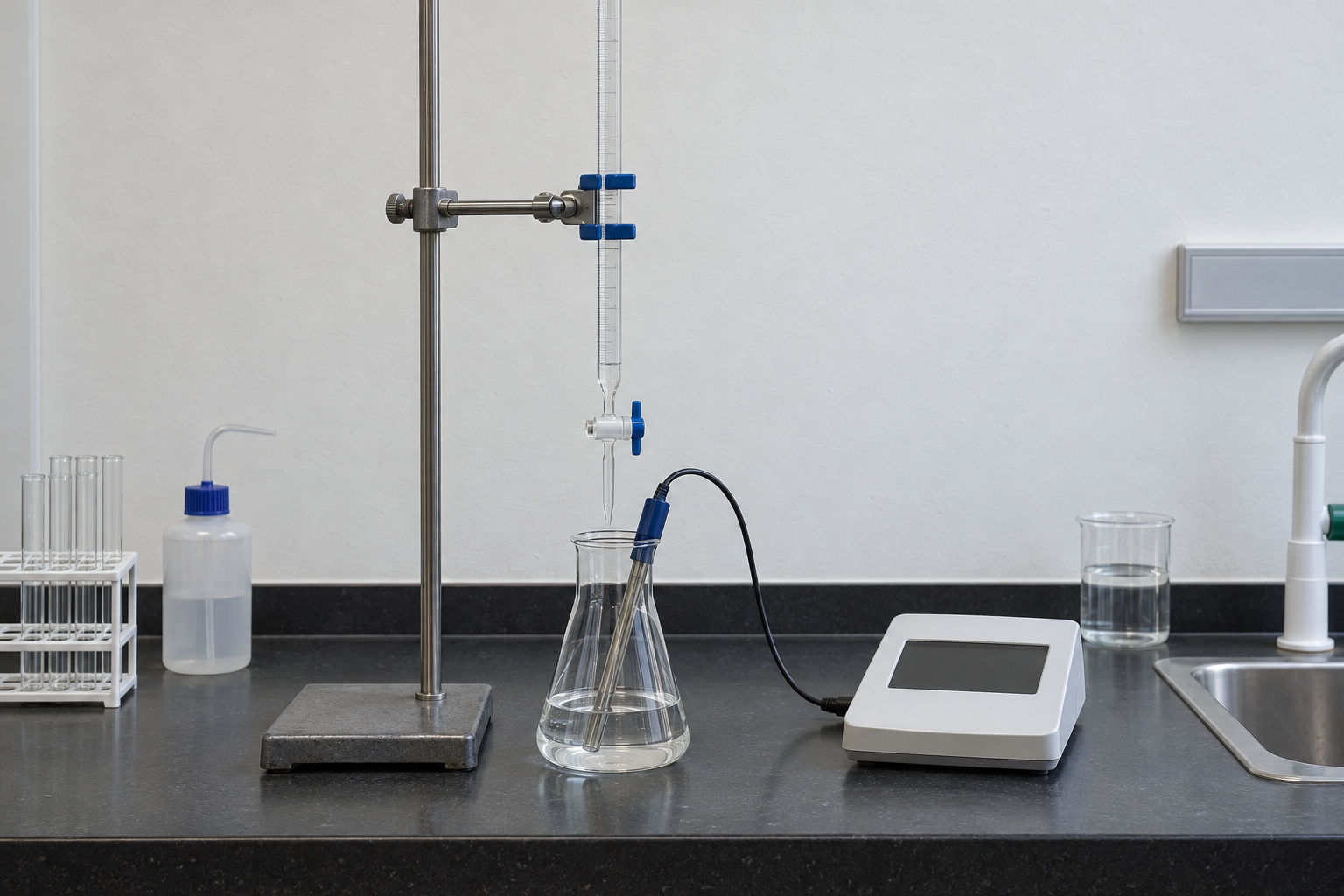
After every few drops, she records the pH and the buret volume.
Then she plots pH against the volume of NaOH added.
The points trace a strange shape: a low start, a long gentle slope, a sudden steep climb, then a high flattening.
Why does the curve rise gently for so long and then jump all at once?
Part 2The story the curve tells
The whole graph is the experiment's story, told in four parts.
At the start, the flask contains mostly intact acetic acid, so the pH is low.
Through the long gentle stretch, the flask contains acetic acid and acetate together — we've seen that a weak acid with its conjugate base is a buffer.
So chemists call that gentle stretch the buffer region.
Near 25.0 mL, the curve rises almost vertically through the equivalence point.
Beyond the steep rise, the extra NaOH remains unreacted, so the pH stays high.
A graph of pH against titrant volume with this shape is called a titration curve.
Identify the regions of a titration curve: the initial pH, the buffer region, the steep rise through the equivalence point, and the region beyond it.
Part 3Check what you just learned
Check — multiple choice
The curve shows 20.0 mL of 0.150 M propanoic acid, a weak acid, titrated with 0.150 M NaOH. Which numbered interval is the buffer region?
Feedback if chosen: This option is wrong — you picked the start of the curve. Interval 1 holds mostly intact acid with little conjugate base formed, so it is not yet the buffer mixture.
Feedback if chosen: Correct. Interval 2 is the long gentle stretch, where the flask holds the acid and its conjugate base together — the buffer region.
Feedback if chosen: This option is wrong — you picked the steep rise. There the buffer is used up and one drop carries the pH a long way; the buffer region is the gentle stretch before it.
Feedback if chosen: This option is wrong — you picked the stretch beyond the rise. There the extra NaOH remains unreacted; no buffer is left.
Check — multiple choice
On the same propanoic acid curve, which numbered interval contains the equivalence point?
Feedback if chosen: This option is wrong — you placed the mole-matching moment at the start, before any real conversion has happened.
Feedback if chosen: This option is wrong — you placed it in the buffer region, where plenty of intact acid still remains.
Feedback if chosen: Correct. The equivalence point sits inside the steep rise — interval 3 — where the moles of added base match the moles of acid.
Feedback if chosen: This option is wrong — you placed it after the rise, where the acid is already used up and the extra base is pushing the pH high.
Check — multiple choice
Still on the propanoic acid curve: which numbered interval shows mostly intact propanoic acid, with little propanoate yet formed?
Feedback if chosen: Correct. At the start almost no base has arrived, so the flask still holds mostly intact propanoic acid.
Feedback if chosen: This option is wrong — in the buffer region a large share of the acid has already been converted; acid and propanoate sit together there.
Feedback if chosen: This option is wrong — by the steep rise nearly all the acid has been converted to propanoate.
Feedback if chosen: This option is wrong — beyond the rise the acid is gone; the flask holds propanoate and unreacted NaOH.
Check — multiple choice
The curve shows 30.0 mL of 0.120 M HBr, a strong acid, titrated with 0.150 M KOH. This curve has three numbered intervals. Which interval contains the equivalence point?
Feedback if chosen: This option is wrong — interval 1 is the early stretch, where added base is still being consumed by plenty of remaining acid.
Feedback if chosen: Correct. The equivalence point sits inside the steep rise — and notice this strong-acid curve has no gentle buffer stretch at all before it.
Feedback if chosen: This option is wrong — interval 3 lies beyond the rise, where extra KOH is accumulating unreacted.
Check — multiple choice
A chemist plots the pH of the flask against the volume of titrant added. What is such a graph called?
Feedback if chosen: Correct. A graph of pH against titrant volume is called a titration curve.
Feedback if chosen: This option is wrong — you named the 0-to-14 ladder a single solution's pH sits on, not a graph of a whole experiment.
Feedback if chosen: This option is wrong — you named one region of the graph; the buffer region is the gentle stretch, not the whole plot.
Check — multiple choice
Which stretch of a weak acid's titration curve is called the buffer region?
Feedback if chosen: This option is wrong — you picked the jump. The steep rise is where the buffer has just run out, not where it works.
Feedback if chosen: This option is wrong — you picked the stretch of excess titrant; the acid is gone there, so no buffer remains.
Feedback if chosen: Correct. The long gentle stretch holds the weak acid and its conjugate base together, and that mixture is a buffer — so chemists call the stretch the buffer region.
Locate the equivalence point
Outcome: Identify the equivalence point on a supplied curve as its steepest point, and read off the titrant volume and pH there.
Part 1Where on the rise do the moles match?
We've seen that the equivalence point is the exact mole-matching moment of a titration.
On a bare buret, that moment passes invisibly between two drops.
A titration curve puts the moment in plain sight.
Somewhere on the steep rise, the moles of added NaOH exactly match the moles of acetic acid.
But the steep rise spans a stretch of the graph, not a single dot.
Where on the steep rise does the mole-matching moment lie?
Part 2The steepest point
Here is our acetic acid curve again, with the equivalence point marked.
The equivalence point is the steepest point of the curve.
Near the equivalence point, one drop of titrant carries the pH further than one drop anywhere else.
So the curve is steepest exactly where the moles match.
To read it, you find the steepest point, then look straight down for the volume and straight across for the pH.
On our acetic acid curve, the steepest point lies at 25.0 mL and pH 8.7.
The steepness is about pH sensitivity per drop, never about reaction speed.
Identify the equivalence point on a supplied curve as the point of steepest slope, and read off its titrant volume and pH.
Part 3Check what you just learned
Check — numeric entry
The curve shows 20.0 mL of 0.150 M propanoic acid titrated with 0.150 M NaOH. Read the equivalence point's titrant volume from the curve. Give your answer to 1 decimal place.
Tolerance: 1.0
Feedback when correct: Correct. The curve is steepest at 20.0 mL: that is where the moles of added NaOH match the moles of propanoic acid.
Anticipated wrong answers (feedback shown):
| 10.0 | This volume is the middle of the gentle stretch, not the steepest point. The equivalence point sits where one drop moves the pH furthest — on the steep rise, at 20.0 mL. |
Check — numeric entry
On the same propanoic acid curve, read the pH at the equivalence point, to the nearest 0.1. Read the pH where the curve crosses the equivalence volume.
Tolerance: 0.25
Feedback when correct: Correct. The steepest point sits at 20.0 mL; reading straight across from it gives pH 8.9.
Anticipated wrong answers (feedback shown):
| 4.9 | This value is the pH in the middle of the gentle stretch, read at half the equivalence volume. The equivalence point sits on the steep rise; reading across from the steepest point gives pH 8.9. |
| 2.9 | This value is the pH at the very start of the curve, before any base went in. The equivalence point sits on the steep rise, at pH 8.9. |
Check — numeric entry
The curve shows 30.0 mL of 0.120 M HBr titrated with 0.150 M KOH. Read the equivalence point's titrant volume from the curve. Give your answer to 1 decimal place.
Tolerance: 1.0
Feedback when correct: Correct. The steepest point lies at 24.0 mL — the read works the same way on a strong-acid curve, even without a buffer stretch in front of the rise.
Anticipated wrong answers (feedback shown):
| 30.0 | This value is the acid sample's own volume, taken from the stem. The equivalence volume is read from the curve, at its steepest point: 24.0 mL. |
| 12.0 | This volume is only halfway along the gentle early stretch. The equivalence point sits where the curve is steepest, at 24.0 mL. |
Check — multiple choice
Watching a titration like this one, the pH jumps several units within two drops near the equivalence point. Theo says the neutralization reaction has suddenly sped up there. Is Theo correct?
Feedback if chosen: This option is wrong — you read the jump as a speed story. The jump reports pH sensitivity per drop; the reaction's own speed is unchanged, from the first drop to the last.
Feedback if chosen: Correct. The steepness is about pH sensitivity per drop, never about reaction speed: near equivalence almost nothing is left to consume the added base, so one drop carries the pH across several units.
Mole equality at equivalence
Outcome: State that at the equivalence point of a monoprotic titration, moles of titrant added equal the moles of analyte originally present, for weak and strong analytes alike.
Part 1A reluctant donor meets the buret
We've seen that at the equivalence point, the moles decide, in the reaction's own mole ratio.
Acetic acid is a reluctant proton donor: only about 1% of its molecules are ionized at any moment.
A student, Marco, expects the weak acid to consume less NaOH than a strong acid would.
After all, most acetic acid molecules keep their proton at any instant.
Yet 25.0 mL of 0.100 M acetic acid reaches equivalence at exactly 25.0 mL of 0.100 M NaOH — the same volume that HCl would need.
Why does a reluctant donor consume exactly as much base as a complete one?
Part 2Every molecule is counted
Titration stoichiometry counts every acid molecule, ionized or not.
We've seen that a weak acid reacts essentially to completion with a strong base.
The added OH⁻ reacts with the intact acid molecules too, not only with the few ionized ones.
So every acetic acid molecule eventually surrenders its proton to the added base.
At the equivalence point, moles of titrant added equal the moles of analyte originally present.
In symbols: moles of NaOH added = moles of acid originally present.
The curve's shape depends on acid strength; the equivalence volume does not.
State that at the equivalence point of a monoprotic titration, moles of titrant added equal the moles of analyte originally present, because titration stoichiometry does not depend on acid strength.
Part 3Check what you just learned
Check — multiple choice
We've seen the equivalence point before this unit. What exactly matches at the equivalence point of a titration?
Feedback if chosen: This option is wrong — you matched volumes. Two solutions of different concentrations reach equivalence at different volumes; the equivalence point is about moles, never about equal volumes.
Feedback if chosen: This option is wrong — you matched concentrations. The flask and the buret can hold very different molarities; what matches at equivalence is the moles, in the reaction's mole ratio.
Feedback if chosen: Correct. At the equivalence point the moles decide, in the reaction's own mole ratio.
Check — multiple choice
Equal volumes of 0.10 M HNO₂, a weak acid, and 0.10 M HBr, a strong acid, are each titrated with the same 0.10 M NaOH. Which acid needs more base to reach its equivalence point?
Feedback if chosen: Correct. Each flask holds the same moles of acid, and titration stoichiometry counts every acid molecule, ionized or not — so both reach equivalence at the same volume of NaOH.
Feedback if chosen: This option is wrong — you gave the weak acid extra demand. Its molecules hold their protons more tightly, but the added OH⁻ still reacts them all away; the moles are equal, so the volumes are equal.
Feedback if chosen: This option is wrong — you gave the strong acid extra demand. Full ionization changes the curve's shape, not the moles present; the equivalence volumes are equal.
Check — numeric entry
A sample of a weak monoprotic acid contains 2.00 mmol of the acid. How many mmol of NaOH must be added to reach the equivalence point? Give your answer to 2 decimal places.
Tolerance: 0.005
Feedback when correct: Correct. Mole equality is the whole rule: 2.00 mmol of a monoprotic acid needs exactly 2.00 mmol of NaOH, however weak the acid is.
Anticipated wrong answers (feedback shown):
| 0.02 | This value counts only the ionized 1% of the acid. The added OH⁻ reacts with the intact molecules too, so every one of the 2.00 mmol must be matched. |
| 4.00 | This value doubles the acid's moles, as if each molecule needed two OH⁻. A monoprotic acid gives one proton per molecule, so 2.00 mmol of acid needs 2.00 mmol of NaOH. |
Analyte concentration from a titration
Outcome: Calculate the analyte's concentration, moles, or molar mass from the titrant volume and concentration at the equivalence point.
Part 1The bottle with no label
A storeroom bottle of a monoprotic acid has lost its concentration label.
A chemist titrates 25.00 mL of the acid with 0.1000 M NaOH.
She records the full curve as the base goes in.
The curve is steepest at 22.40 mL.
At that volume, moles of added NaOH equal moles of the acid.
How does 22.40 mL of titrant become the acid's concentration?
Part 2From volume to moles to concentration
You work from volume to moles to concentration, one labeled step at a time.
First you count the titrant's moles: 22.40 mL × 0.1000 M = 2.240 mmol of NaOH.
The 1:1 mole ratio turns 2.240 mmol of NaOH into 2.240 mmol of acid.
Then you divide the acid's moles by the acid's own volume: 2.240 mmol ÷ 25.00 mL.
The concentration is 0.0896 M.
The same route also yields a sample's moles, or its molar mass from a weighed mass.
Q: A chemist titrates 25.00 mL of a monoprotic acid of unknown concentration with 0.1000 M NaOH, and the curve is steepest at 22.40 mL. What is the acid's concentration?
Write down the values from the question
25.00 mL of the acid, concentration unknown
equivalence at 22.40 mL of 0.1000 M NaOH
Count the titrant's moles at equivalence
NaOH: 22.40 mL × 0.1000 M = 2.240 mmol
Apply the mole ratio
the ratio is 1:1, so the sample held 2.240 mmol of acid
Divide the acid's moles by the acid's own volume, and calculate
[acid] = 2.240 mmol ÷ 25.00 mL(the acid's own 25.00 mL, never the buret's)
[acid] = 0.0896 M
Calculate the analyte's concentration, moles, or molar mass from the titrant volume and concentration at the equivalence point.
Part 3Check what you just learned
Check — numeric entry
A 25.00 mL sample of a monoprotic acid reaches its equivalence point after 18.60 mL of 0.1500 M KOH. Calculate the acid's concentration. Give your answer to 4 significant figures.
Tolerance: 5e-05
Feedback when correct: Correct. The KOH brought 18.60 mL × 0.1500 M = 2.790 mmol; the 1:1 ratio makes that 2.790 mmol of acid; dividing by the acid's own 25.00 mL gives 0.1116 M.
Anticipated wrong answers (feedback shown):
| 0.2016 | This value swaps the two volumes: it counts moles from the acid's 25.00 mL and divides by the titrant's 18.60 mL. The moles come from the TITRANT (18.60 mL × 0.1500 M = 2.790 mmol) and the division is by the acid's own 25.00 mL: 0.1116 M. |
| 0.0640 | This value divides the 2.790 mmol by the combined 43.60 mL. A titration asks what the original sample held, so the division is by the acid's own 25.00 mL: 0.1116 M. |
Worked solution revealed after a second miss
Count the titrant's moles at equivalence
KOH: 18.60 mL × 0.1500 M = 2.790 mmol
Apply the mole ratio
the ratio is 1:1, so the sample held 2.790 mmol of acid
Divide the acid's moles by the acid's own volume, and calculate
[acid] = 2.790 mmol ÷ 25.00 mL
[acid] = 0.1116 M
Check — numeric entry
A 10.00 mL sample of a monoprotic acid reaches equivalence after 21.50 mL of 0.0800 M NaOH. Calculate the acid's concentration. Give your answer to 3 significant figures.
Tolerance: 0.0005
Feedback when correct: Correct. The NaOH brought 21.50 mL × 0.0800 M = 1.720 mmol; the 1:1 ratio makes that 1.720 mmol of acid; dividing by the acid's own 10.00 mL gives 0.172 M. The sample is more concentrated than its titrant, which is why it needed more than its own volume of base.
Anticipated wrong answers (feedback shown):
| 0.0372 | This value swaps the two volumes: 10.00 mL × 0.0800 M divided by 21.50 mL. The moles come from the titrant (21.50 mL × 0.0800 M = 1.720 mmol) and the division is by the acid's own 10.00 mL: 0.172 M. |
| 0.0546 | This value divides the 1.720 mmol by the combined 31.50 mL. The question asks what the original 10.00 mL sample held, so the division is by 10.00 mL: 0.172 M. |
Worked solution revealed after a second miss
Count the titrant's moles at equivalence
NaOH: 21.50 mL × 0.0800 M = 1.720 mmol
Apply the mole ratio
the ratio is 1:1, so the sample held 1.720 mmol of acid
Divide the acid's moles by the acid's own volume, and calculate
[acid] = 1.720 mmol ÷ 10.00 mL
[acid] = 0.172 M
Check — numeric entry
A chemist dissolves 0.2440 g of an unknown monoprotic acid in water and titrates it. Equivalence arrives at 20.00 mL of 0.1000 M NaOH. Calculate the acid's molar mass. Give your answer to 4 significant figures.
Tolerance: 0.05
Feedback when correct: Correct. The NaOH brought 20.00 mL × 0.1000 M = 2.000 mmol, so the sample held 2.000 mmol = 0.002000 mol of acid; molar mass = 0.2440 g ÷ 0.002000 mol = 122.0 g/mol.
Anticipated wrong answers (feedback shown):
| 0.122 | This value divides the mass by 2.000 as if the millimoles were moles. 2.000 mmol is 0.002000 mol, so the molar mass is 0.2440 g ÷ 0.002000 mol = 122.0 g/mol. |
| 0.0082 | This value divides the moles by the mass. Molar mass is mass ÷ moles: 0.2440 g ÷ 0.002000 mol = 122.0 g/mol. |
Worked solution revealed after a second miss
Count the titrant's moles at equivalence
NaOH: 20.00 mL × 0.1000 M = 2.000 mmol
Apply the mole ratio
the ratio is 1:1, so the sample held 2.000 mmol = 0.002000 mol of acid
Divide the mass by the moles, and calculate
molar mass = 0.2440 g ÷ 0.002000 mol
molar mass = 122.0 g/mol
The half-equivalence point
Outcome: State that at the half-equivalence point, half the equivalence volume has been added, so [HA] = [A⁻].
Part 1Pausing at half the volume
Our acetic acid titration reaches equivalence at 25.0 mL of NaOH.
A student pauses the titration at exactly 12.5 mL, half the equivalence volume.
We've seen that each added OH⁻ ion converts one acetic acid molecule into one acetate ion.
The base added so far is enough to convert exactly half the acid.
So half of the original acid has become acetate.
The other half remains intact acetic acid.
What special mixture fills the flask at half the equivalence volume?
Part 2A buffer with equal members
The flask contains equal concentrations of acetic acid and acetate: [HA] = [A⁻].
We've seen that a weak acid together with its conjugate base forms a buffer.
So at half the equivalence volume, the flask contains a buffer with equal members.
Chemists call this point the half-equivalence point.
Here it is on the curve.
It lies at exactly half the equivalence volume.
On the curve, it marks the middle of the buffer region.
State that at the half-equivalence point, half the equivalence volume has been added, converting half the weak acid to its conjugate base, so that [HA] = [A⁻].
Part 3Check what you just learned
Check — multiple choice
At the half-equivalence point of a weak-acid titration, which statement about [HA] and [A⁻] is true?
Feedback if chosen: This option is wrong — you left too much acid intact. The added base has converted exactly half the acid, so the two concentrations are equal.
Feedback if chosen: Correct. Half the acid has been converted and half remains intact, so [HA] = [A⁻].
Feedback if chosen: This option is wrong — you converted too much acid. Only half the equivalence amount of base has arrived, so exactly half the acid has become A⁻.
Check — numeric entry
A titration reaches its equivalence point at 30.0 mL of titrant. At what volume does the half-equivalence point lie? Give your answer to 1 decimal place.
Tolerance: 0.05
Feedback when correct: Correct. The half-equivalence point lies at exactly half the equivalence volume: 30.0 mL ÷ 2 = 15.0 mL.
Anticipated wrong answers (feedback shown):
| 60.0 | This answer doubles the equivalence volume of titrant instead of halving it. The half-equivalence point comes BEFORE equivalence, at 30.0 ÷ 2 = 15.0 mL. |
| 7.5 | This answer halves the volume of titrant twice. One halving is the whole rule: 30.0 ÷ 2 = 15.0 mL. |
Check — multiple choice
A titration reaches its equivalence point at 44.0 mL of titrant. A chemist pauses the run at 22.0 mL. Which point of the titration is this?
Feedback if chosen: This option is wrong — the equivalence point is the mole-matching moment, at the full 44.0 mL.
Feedback if chosen: This option is wrong — the endpoint is the visible signal from an added indicator, not a volume halfway along.
Feedback if chosen: Correct. 22.0 mL is exactly half of 44.0 mL, so this pause is the half-equivalence point.
Check — multiple choice
Which description defines the half-equivalence point?
Feedback if chosen: Correct. At half the equivalence volume, half the acid has been converted, so the acid and its conjugate base sit at equal concentrations.
Feedback if chosen: This option is wrong — you halved the flask's pH. The halving is of the equivalence VOLUME; the pH there is set by the equal mixture, not by any halving of pH.
Feedback if chosen: This option is wrong — ALL of the added base has reacted by this point; what is halved is the acid converted, because only half the equivalence amount of base has gone in.
Read pKa from the half-equivalence point
Outcome: Identify a weak acid's pKa, and hence its Ka, from the pH at the half-equivalence point of an experimental curve.
Part 1An acid with no table entry
A chemist titrates an unidentified weak monoprotic acid and records the curve.
No table names the acid, so no table supplies its Ka, the acid-ionization constant.
We've seen that pH equals pKa exactly when the conjugate acid and base concentrations are equal.
The half-equivalence point is exactly such a mixture: [HA] = [A⁻].
The experiment already passed through that point on its way to equivalence.
Can the curve itself reveal the unknown acid's Ka?
Part 2Cut the volume in half, read the pH
Here is the recorded curve.
At the half-equivalence point, [HA] = [A⁻], so the pH there equals the acid's pKa.
You find the steepest point first: equivalence lies at 25.0 mL.
You cut that volume in half: 12.5 mL.
You read the pH at 12.5 mL from the curve: pH 4.7.
So the unknown acid's pKa is 4.7.
One inverse step recovers Ka: Ka = 10⁻⁴·⁷ ≈ 2 × 10⁻⁵.
So an experimental curve reveals an acid's Ka with no table at all.
Q: An unidentified weak monoprotic acid is titrated with NaOH, and its curve is steepest at 25.0 mL. What are the acid's pKa and Ka?
Find the steepest point of the curve
equivalence lies at 25.0 mL
Cut the equivalence volume in half
the half-equivalence point lies at 12.5 mL
Read the pH at that volume from the curve
pH = 4.7 at 12.5 mL, so pKa = 4.7(at half-equivalence, pH = pKa)
Recover Ka with the inverse step
Ka = 10⁻⁴·⁷ ≈ 2 × 10⁻⁵
Identify the pKa, and hence the Ka, of a weak acid from the pH at the half-equivalence point of an experimental titration curve.
Part 3Check what you just learned
Check — multiple choice
We've seen this case before. When does a weak acid solution's pH equal the acid's pKa?
Feedback if chosen: Correct. The pH equals the pKa exactly when the conjugate acid and base members sit at equal concentrations — and the half-equivalence point is exactly that mixture.
Feedback if chosen: This option is wrong — you matched two different kinds of quantity; a concentration equalling a constant is not the case we've seen. The pH equals the pKa when the MEMBER concentrations are equal.
Feedback if chosen: This option is wrong — at the equivalence point the acid has been fully converted, so the members are far from equal. The equal-members mixture is the HALF-equivalence point.
Check — numeric entry
The curve shows a weak monoprotic acid titrated with a strong base. Find the acid's pKa from the curve, to the nearest 0.1.
Tolerance: 0.15
Feedback when correct: Correct. The curve is steepest at 40.0 mL; half of that is 20.0 mL, and the pH there reads 4.2 — the acid's pKa.
Anticipated wrong answers (feedback shown):
| 8.5 | This value is the pH AT the equivalence point. The pKa is read at HALF the equivalence volume, 20.0 mL, where the curve gives pH 4.2. |
| 2.6 | This value is the pH at the very start of the curve. The pKa read belongs at half the equivalence volume, 20.0 mL, where the curve gives pH 4.2. |
Check — numeric entry
A second weak monoprotic acid is titrated with a strong base. Find this acid's pKa from its curve, to the nearest 0.1.
Tolerance: 0.15
Feedback when correct: Correct. The steepest point lies at 24.0 mL; half of that is 12.0 mL, and the pH there reads 5.6 — this acid's pKa.
Anticipated wrong answers (feedback shown):
| 9.2 | This value is the pH at the equivalence point itself. The pKa is read at HALF the equivalence volume, 12.0 mL, where the pH is 5.6. |
| 3.3 | This value is the starting pH of the curve. The pKa belongs at half the equivalence volume, 12.0 mL, where the pH is 5.6. |
Check — numeric entry
A curve read gives a weak monoprotic acid's pKa as 4.20. Find the acid's Ka. Give your answer to 2 significant figures.
Tolerance: 5e-07
Feedback when correct: Correct. Ka = 10^(−pKa) = 10^(−4.20) = 6.3 × 10⁻⁵.
Anticipated wrong answers (feedback shown):
| 16000 | This value drops the minus sign: 10^(4.20) instead of 10^(−4.20). A pKa above zero belongs to a Ka below one: Ka = 10^(−4.20) = 6.3 × 10⁻⁵. |
| 4.2 | This value reports the pKa itself. The question asks for Ka, the constant the pKa encodes: Ka = 10^(−4.20) = 6.3 × 10⁻⁵. |
Worked solution revealed after a second miss
Write down the expression
Ka = 10^(−pKa)
Substitute in the values, and calculate
Ka = 10^(−4.20)
Ka = 6.3 × 10⁻⁵
What sets the equivalence-point pH
Outcome: State that the equivalence-point pH is set by the major species present there, and that strong acid–strong base titrations end at pH 7.00 at 25 °C.
Part 1Two flasks at their matched moments
Keiko follows two titrations side by side, each to its equivalence point.
The first flask pairs HCl with NaOH; the second pairs acetic acid with the same NaOH.
At equivalence, each flask has received exactly matched moles of base.
Keiko expects both flasks to be neutral at that matched moment.
The HCl flask ends its titration neutral.
The acetic acid flask ends its titration basic.
Why do matched moles leave one flask neutral and the other basic?
Part 2The major species decide
Here are Keiko's two titrations on one frame.
We've seen that the species present in large amounts are called the major species.
The major species left in the flask decide the equivalence pH.
At equivalence, the original acid and the added base have consumed each other completely.
Whatever remains in the water tells the whole story.
The flask contains only Na⁺ ions, Cl⁻ ions, and water.
Neither ion makes H₃O⁺ ions or OH⁻ ions.
So the equivalence pH is 7.00 at 25 °C.
Every strong acid–strong base titration reaches equivalence at pH 7.00 at 25 °C.
State that the pH at the equivalence point is set by the major species present there, and that strong acid–strong base titrations end neutral at pH 7.00 at 25 °C.
Part 3Check what you just learned
Check — multiple choice
We've seen what neutral means earlier in this unit. What makes a solution neutral?
Feedback if chosen: Correct. Neutral means the two water ions sit at equal concentrations — which at 25 °C puts the pH at 7.00.
Feedback if chosen: This option is wrong — you dropped the condition. Neutral water sits at pH 7.00 only at 25 °C; at other temperatures the neutral point moves.
Feedback if chosen: This option is wrong — you emptied the water. Water always makes some H₃O⁺ and OH⁻ by its own ionization; neutral means the two are EQUAL.
Check — multiple choice
HNO₃, a strong acid, is titrated with KOH, a strong base, to its equivalence point. What does the flask contain as major species there?
Feedback if chosen: This option is wrong — you left acid behind. At equivalence the matched moles of KOH have consumed the HNO₃ completely.
Feedback if chosen: Correct. The acid and base have consumed each other completely, leaving only the ions K⁺ and NO₃⁻ in water.
Feedback if chosen: This option is wrong — you left base behind. At equivalence the moles match exactly, so no KOH remains either.
Check — multiple choice
HBr, a strong acid, is titrated with KOH, a strong base. At 25 °C, where does the equivalence pH sit?
Feedback if chosen: Correct. The flask at equivalence holds only K⁺, Br⁻, and water; neither ion makes H₃O⁺ or OH⁻, so the pH is 7.00 at 25 °C.
Feedback if chosen: This option is wrong — you pushed the pH up, but nothing basic remains: the ions left behind by a strong acid and a strong base leave the water alone.
Feedback if chosen: This option is wrong — you pushed the pH down, but nothing acidic remains: the matched moles consumed the HBr completely, and Br⁻ does not make H₃O⁺.
Why weak acid titrations end basic
Outcome: Explain that a weak acid–strong base titration ends basic: the conjugate base present at equivalence reacts with water.
Part 1The flask that ends basic
Return to the acetic acid flask at its own equivalence point.
Every acetic acid molecule has surrendered its proton to the added OH⁻.
The flask contains only Na⁺ ions, acetate ions, and water.
The moles match, the reaction is complete, and nothing acidic seems left.
Yet the pH is 8.7, not 7.
Keiko's expectation missed by nearly two pH units.
What pushes the pH above 7 when the neutralization is complete?
Part 2The leftover base in the water
Here is the acetic acid curve with its equivalence point marked.
The acetate ion itself is a base, and it remains in the flask.
Acetate is the conjugate base of a weak acid, and it reacts with water.
A⁻ + H₂O ⇌ HA + OH⁻: acetate takes protons from water and leaves OH⁻ behind.
The acetate ion makes OH⁻ ions.
So the equivalence pH is above 7.
A leftover conjugate base pushes the equivalence pH above 7.
Every weak acid–strong base titration reaches equivalence above pH 7 at 25 °C.
Now wind the same titration back to its half-equivalence point.
There the flask holds acetic acid AND acetate together, both in large amounts.
Both members are present there, so the flask holds a buffer, not the lone conjugate base — this rule speaks only about the equivalence point.
Explain that the equivalence point of a weak acid–strong base titration is basic because the solution there is the conjugate base, which reacts with water: A⁻ + H₂O ⇌ HA + OH⁻.
Part 3Check what you just learned
Check — multiple choice
HOCl, a weak acid, is titrated with NaOH to its equivalence point, and the solution there is basic. Why?
Feedback if chosen: Correct. The equivalence mixture is a solution of OCl⁻, the conjugate base; it takes protons from water and leaves OH⁻ behind, so the pH sits above 7.
Feedback if chosen: This option is wrong — you left extra base in the flask. At equivalence the moles match exactly; the basicity comes from the OCl⁻ itself reacting with water.
Feedback if chosen: This option is wrong — you reversed the proton transfer's direction. OCl⁻ is a base: it TAKES protons from water, producing OH⁻, not H₃O⁺.
Check — multiple choice
Benzoic acid, a weak acid, is titrated with KOH. At 25 °C, where does the equivalence pH sit?
Feedback if chosen: This option is wrong — you made the flask acidic, but no acid remains at equivalence; what remains is benzoate, a base.
Feedback if chosen: Correct. The equivalence mixture is a solution of benzoate, the conjugate base of a weak acid; it reacts with water and leaves OH⁻ behind, so the pH sits above 7.
Feedback if chosen: This option is wrong — exactly 7.00 belongs to a strong–strong titration, whose leftover ions leave the water alone. Benzoate is a base, and it pushes the pH up.
Check — multiple choice
Asha says the equivalence pH of an HBr/KOH titration is exactly 7.00 at 25 °C. Is Asha correct?
Feedback if chosen: Correct. HBr and KOH are both strong, and every strong acid–strong base titration reaches equivalence at pH 7.00 at 25 °C.
Feedback if chosen: This option is wrong — you doubted a strong–strong equivalence point. HBr/KOH is a strong acid–strong base titration, and such titrations reach equivalence at exactly pH 7.00 at 25 °C.
Check — multiple choice
Asha is right: that HBr/KOH equivalence pH is exactly 7.00 at 25 °C. Why?
Feedback if chosen: This option is wrong — you treated a completed neutralization as a guarantee of pH 7. A completed neutralization can still leave a basic or an acidic ion behind; the acetic acid flask ended basic for exactly that reason.
Feedback if chosen: Correct. The equivalence mixture holds only K⁺, Br⁻, and water, and neither ion reacts with water — so nothing disturbs [H₃O⁺], and the pH stays at water's own 7.00 at 25 °C.
Feedback if chosen: This option is wrong — you gave K⁺ a cleanup job. K⁺ does not react with water at all; the pH is 7.00 because NEITHER leftover ion touches the water ions.
Why weak base titrations end acidic
Outcome: Explain that a weak base–strong acid titration ends acidic: the conjugate acid present at equivalence donates protons to water.
Part 1The roles reversed
Now the chemist reverses the roles of weak and strong.
The buret delivers 0.100 M HCl, the strong partner.
The flask contains 25.0 mL of 0.100 M aqueous ammonia, the weak partner.
At equivalence, every NH₃ molecule has accepted a proton from the added acid.
The flask contains only NH₄⁺ ions, Cl⁻ ions, and water.
This time the pH is 5.3, below 7.
Why is this equivalence pH below 7 instead of above?
Part 2The leftover acid in the water
Here is the ammonia titration's curve: adding acid makes it fall.
The NH₄⁺ ion itself is an acid, and it remains in the flask.
NH₄⁺ is the conjugate acid of a weak base, and it reacts with water.
NH₄⁺ + H₂O ⇌ NH₃ + H₃O⁺: ammonium donates protons to water.
The NH₄⁺ ion makes H₃O⁺ ions.
So the equivalence pH is below 7.
A leftover conjugate acid pushes the equivalence pH below 7.
In general, the leftover conjugate acid reacts as HB⁺ + H₂O ⇌ B + H₃O⁺.
Every weak base–strong acid titration reaches equivalence below pH 7 at 25 °C.
Explain that the equivalence point of a weak base–strong acid titration is acidic because the solution there is the conjugate acid, which donates protons to water: HB⁺ + H₂O ⇌ B + H₃O⁺.
Part 3Check what you just learned
Check — multiple choice
Pyridine, a weak base, is titrated with HCl to its equivalence point, and the solution there is acidic. Why?
Feedback if chosen: This option is wrong — you reversed the proton transfer's direction. Pyridinium is an ACID: it gives protons to water, making H₃O⁺.
Feedback if chosen: This option is wrong — you left extra acid in the flask. At equivalence the moles match exactly; the acidity comes from the pyridinium ion itself reacting with water.
Feedback if chosen: Correct. The equivalence mixture is a solution of pyridinium, the conjugate acid; it donates protons to water and raises [H₃O⁺], so the pH sits below 7.
Check — multiple choice
Aniline, a weak base, is titrated with HCl. At 25 °C, where does the equivalence pH sit?
Feedback if chosen: This option is wrong — you made the flask basic, but no base remains at equivalence; what remains is anilinium, a weak acid.
Feedback if chosen: This option is wrong — exactly 7.00 belongs to strong–strong titrations. Here the leftover anilinium ion reacts with water and moves the pH.
Feedback if chosen: Correct. The equivalence mixture is a solution of anilinium, the conjugate acid of a weak base; it donates protons to water, so the pH sits below 7.
Check — multiple choice
Ethylamine, a weak base, is titrated with HBr. At 25 °C, where does the equivalence pH sit?
Feedback if chosen: Correct. At equivalence the flask holds the ethylammonium ion, a conjugate acid; it donates protons to water, so the pH sits below 7.
Feedback if chosen: This option is wrong — exactly 7.00 needs BOTH partners strong, so that the leftover ions leave the water alone. Ethylammonium is an acid.
Feedback if chosen: This option is wrong — above 7 is where a weak ACID's titration ends, because a conjugate BASE is left behind. Here the leftover ion is a conjugate acid.
Sketch the expected curve
Outcome: Sketch the expected curve shape for a given pairing, placing the starting pH, any buffer region, and the equivalence pH against 7 correctly.
Part 1A question with no curve supplied
An AP question supplies no curve at all.
It names only the pairing: aqueous ammonia titrated with a strong acid.
It asks you to sketch the expected titration curve on paper.
You have three honest features to place: the starting pH, the buffer region, and the equivalence pH against 7.
A sketch can tell the truth or lie in each of the three.
Which features must your sketch place correctly, and where does each one go?
Part 2Three features, placed honestly
Here are a strong-acid curve and a weak-acid curve side by side on one frame.
You make the sketch feature by feature, from the pairing alone.
First you place the starting pH: a strong analyte starts at an extreme pH, and a weak analyte starts closer to neutral.
Next you decide the plateau: a weak analyte's curve shows a buffer region, and a strong analyte's curve shows none.
Then you place the equivalence pH: at 7 for strong–strong, above 7 for weak acid–strong base, below 7 for weak base–strong acid.
Adding base makes the curve rise.
Adding acid makes the curve fall.
A sketch that places those features correctly tells the truth about the chemistry.
Sketch the expected titration-curve shape for a given acid-base pairing, placing the starting pH, any buffer region, and the equivalence pH at, above, or below 7 correctly.
Part 3Check what you just learned
Check — multiple choice
Dimethylamine, a weak base, is titrated with HCl, a strong acid. Which drawn curve shows the expected shape?
Feedback if chosen: This option is wrong — Curve 1 rises as titrant is added and starts low: that is a weak ACID titrated with a base, not a base titrated with acid.
Feedback if chosen: This option is wrong — Curve 2 rises from an extreme low start with no plateau: a strong acid titrated with a strong base.
Feedback if chosen: This option is wrong — Curve 3 falls, but it starts at an extreme pH, shows no buffer region, and crosses its equivalence at exactly 7: that is a STRONG base's curve, and dimethylamine is weak.
Feedback if chosen: Correct. Curve 4 starts moderately high, falls through a buffer region, and passes its equivalence below 7 — every feature of a weak base titrated with a strong acid.
Check — drawing task (pen and paper, self-marked)
Take a pen and paper and sketch the expected titration curve for 25.0 mL of 0.100 M HNO₃ titrated with 0.100 M KOH. Label the pH axis, and mark where the equivalence point sits. When you are done, select Check to compare your answer with the model answer.
Model answer shown to the student
Self-mark checklist — the drawing should show:
- Your curve starts at a low pH, near 1: the analyte is a strong acid.
- Your curve shows no buffer region: no long gentle plateau sits before the rise.
- Your curve's steep rise passes through pH 7 at the equivalence point, at 25.0 mL of added KOH — pH 7.00 at 25 °C.
- Your curve rises as the base is added, then flattens at a high pH.
Check — multiple choice
Which drawn curve shows a weak acid titrated with a strong base?
Feedback if chosen: This option is wrong — Curve 1 starts at an extreme low pH and rises with no plateau: a strong acid's curve, with its equivalence at exactly 7.
Feedback if chosen: This option is wrong — Curve 2 falls as titrant is added: that curve's analyte is a base, being titrated with acid.
Feedback if chosen: Correct. Curve 3 starts moderately low, rises through a buffer plateau, and passes its equivalence above 7 — a weak acid titrated with a strong base.
Count acidic protons from a curve
Outcome: Identify the number of acidic protons of a polyprotic acid from the number of equivalence points on its curve.
Part 1A curve with two steep rises
Every curve so far showed exactly one steep rise.
A chemist titrates phosphoric acid and the curve surprises her: two separate steep rises appear.
We've seen that a polyprotic acid can donate more than one proton.
Between the rises, the curve flattens into a second gentle stretch.
One acid and one buret make a curve with more than one step.
What do two steep rises say about the acid's protons?
Part 2One step per proton
Here is the phosphoric acid curve.
Each steep rise marks one equivalence point.
A diprotic acid's molecules surrender their first proton, then their second, in separate stages.
Each stage produces its own equivalence point on the curve.
So the number of equivalence points equals the number of acidic protons shown.
Two steep rises mean a diprotic acid; three mean a triprotic acid.
Phosphoric acid's third proton is so weakly acidic that its step fails to appear in water.
So you count the steep rises to count the protons an acid surrenders in water.
Identify the number of acidic protons of a polyprotic acid from the number of equivalence points on its titration curve.
Part 3Check what you just learned
Check — multiple choice
The curve shows an unnamed weak acid titrated with NaOH. How many acidic protons does the curve show?
Feedback if chosen: This option is wrong — you counted one rise, but the curve climbs steeply twice, with a gentle stretch between the two climbs.
Feedback if chosen: Correct. The curve shows two steep rises, so it shows two equivalence points — one per acidic proton. The acid surrenders two protons in water.
Feedback if chosen: This option is wrong — you counted a rise too many. Follow the curve from left to right and count: the acid's curve climbs steeply exactly twice.
Check — multiple choice
A second unnamed weak acid is titrated with NaOH. How many acidic protons does its curve show?
Feedback if chosen: This option is wrong — you stopped at the first rise. The curve climbs steeply three separate times.
Feedback if chosen: This option is wrong — you missed a rise. Count the separate steep climbs from left to right: there are three.
Feedback if chosen: Correct. Three steep rises mean three equivalence points, one per acidic proton — three protons surrendered in water.
Check — multiple choice
A third weak acid is titrated with NaOH. How many acidic protons does its curve show?
Feedback if chosen: Correct. This curve climbs steeply once, so it shows one equivalence point: a monoprotic acid, the single-rise shape we've seen on every curve so far.
Feedback if chosen: This option is wrong — you counted the gentle buffer stretch as a second rise. Only the steep climbs mark equivalence points, and there is one.
Feedback if chosen: This option is wrong — this curve climbs steeply only once; the flat stretches before and after the rise are not equivalence points.
Read each proton's pKa
Outcome: Identify the pKa of each proton of a weak polyprotic acid from the half-equivalence pH in each successive buffer region.
Part 1Two protons, two constants, one curve
We've seen that one half-equivalence read reveals a monoprotic acid's pKa.
A diprotic acid donates two different protons, each with its own acid-ionization constant Ka.
Its curve flattens into two buffer regions, one before each steep rise.
Each buffer region contains its own half-equivalence point.
Carbonic acid's curve climbs through both stages, one after the other.
Can one curve reveal pKa₁ and pKa₂ together?
Part 2One read per stage
Here is a supplied curve for carbonic acid titrated with NaOH.
Each buffer region repeats the one-proton story for its own proton.
Halfway through stage one, half the first protons have left the acid.
So the pH there equals pKa₁.
Halfway through stage two, half the second protons have left the acid.
So the pH there equals pKa₂.
On carbonic acid's curve, the first plateau's midpoint pH is 6.35 and the second's is 10.33.
So you read pKa₁ = 6.35 and pKa₂ = 10.33 straight off the curve, with no arithmetic.
Identify the pKa associated with each proton of a weak polyprotic acid from the half-equivalence pH in each successive buffer region of its curve.
Part 3Check what you just learned
Check — numeric entry
The curve shows phthalic acid, an acid with two acidic protons, titrated with NaOH. Find pKa₁, the first proton's pKa, from the curve, to the nearest 0.1.
Tolerance: 0.15
Feedback when correct: Correct. The first steep rise lies at 18.0 mL, so the first half-equivalence point lies at 9.0 mL; the pH there reads 2.9 — the first proton's pKa.
Anticipated wrong answers (feedback shown):
| 4.2 | This value is the mixture's pH AT the first steep rise. The pKa₁ read belongs at HALF the first equivalence volume, 9.0 mL, where the plateau's midpoint gives pH 2.9. |
Check — numeric entry
On the same phthalic acid curve, find pKa₂, the second proton's pKa, to the nearest 0.1.
Tolerance: 0.15
Feedback when correct: Correct. Stage two spans 18.0 mL to 36.0 mL, so its midpoint lies at 27.0 mL; the pH there reads 5.5 — the second proton's pKa.
Anticipated wrong answers (feedback shown):
| 8.8 | This value is the mixture's pH AT the second steep rise. The pKa₂ read belongs at the midpoint of the second plateau, 27.0 mL, where the curve gives pH 5.5. |
Check — multiple choice
A weak acid with two acidic protons is titrated with NaOH, and its curve's first equivalence point lies at 18.0 mL. At what volume of added NaOH do you read pKa₂, the second proton's pKa?
Feedback if chosen: This option is wrong — 9.0 mL is the FIRST half-equivalence point, which reads pKa₁.
Feedback if chosen: This option is wrong — 18.0 mL is the first equivalence point itself, in the middle of a steep rise; no plateau midpoint sits there.
Feedback if chosen: Correct. Stage two spans 18.0 mL to 36.0 mL; halfway through it, at 27.0 mL, half the second protons have left the acid, so the pH there is pKa₂.
Feedback if chosen: This option is wrong — 36.0 mL is the SECOND equivalence point, where stage two is complete; the read belongs halfway through the stage, at 27.0 mL.
Major species along a curve
Outcome: Identify the species present in large versus small concentrations at any point along a mono- or polyprotic titration curve.
Part 1Any volume, not only the landmarks
Choose any volume along carbonic acid's curve, not only the landmarks.
At that volume, the flask contains some mixture of carbon species.
H₂CO₃, HCO₃⁻, and CO₃²⁻ are the candidates.
Which of them is abundant depends on how far the titration has come.
An AP item asks which species are present in large amounts and which in small.
How do you name the abundant species at any chosen volume?
Part 2Name the region first
We've seen that the species present in large amounts are called the major species.
Here is the carbonic acid curve with each region's major species written in.
The curve's landmarks fence the graph into regions.
Each added portion of OH⁻ converts the carbon one stage onward: H₂CO₃ to HCO₃⁻, then HCO₃⁻ to CO₃²⁻.
Before the first steep rise, H₂CO₃ and HCO₃⁻ share the flask.
Between the rises, HCO₃⁻ is the dominant carbon species.
Beyond the rises, CO₃²⁻ is the dominant carbon species.
Each half-equivalence point marks an even split between neighboring species.
To name the major species, you name the region first.
Identify the species present in large versus small concentrations at any point along a mono- or polyprotic titration curve.
Part 3Check what you just learned
Check — multiple choice
A weak diprotic acid is titrated with NaOH, through both of its equivalence points. Between the two equivalence points, which form of the acid is dominant?
Feedback if chosen: This option is wrong — by the first equivalence point, stage one is complete: essentially every molecule has already given up its first proton.
Feedback if chosen: Correct. Between the rises, stage one is complete and stage two has not finished: the form that has lost exactly one proton dominates.
Feedback if chosen: This option is wrong — the fully deprotonated form takes over only beyond the SECOND equivalence point, once stage two is complete.
Check — multiple choice
The curve shows 25.0 mL of oxalic acid solution titrated with NaOH. After 20.0 mL of base has been added, which carbon species is dominant in the flask?
Feedback if chosen: This option is wrong — you stayed in the first region. The curve's first steep rise lies at 15.0 mL, and 20.0 mL is past it: stage one is complete, so little intact H₂C₂O₄ remains.
Feedback if chosen: Correct. The steep rises lie at 15.0 mL and 30.0 mL, so 20.0 mL sits between them: stage one is complete, stage two is not, and HC₂O₄⁻ dominates.
Feedback if chosen: This option is wrong — you went one region too far. C₂O₄²⁻ takes over beyond the second rise at 30.0 mL, and 20.0 mL has not reached it.
Check — multiple choice
The curve shows 25.0 mL of 0.100 M chloroacetic acid titrated with 0.100 M NaOH. After 8.0 mL of base has been added, which is more abundant in the flask?
Feedback if chosen: Correct. The curve's steep rise lies at 25.0 mL, so half-conversion arrives at 12.5 mL; at 8.0 mL less than half the acid has been converted, and the intact acid still dominates.
Feedback if chosen: This option is wrong — the conjugate base overtakes the acid only past the half-equivalence point at 12.5 mL, and 8.0 mL has not reached it.
Feedback if chosen: This option is wrong — equal amounts belong to exactly the half-equivalence point, at 12.5 mL; 8.0 mL sits before it.
Match the indicator's pKa to the equivalence pH
Outcome: State that for accurate titration results, the chosen indicator's pKa should be close to the pH at the equivalence point.
Part 1A titration with no probe
Not every titration brings a pH probe to the bench.
We've seen that an indicator supplies the visible endpoint: the color change signals the stopping volume.
We've also seen that an indicator is itself a weak acid whose two forms differ in color.
An indicator's color changes within about one pH unit of its own pKa.
The shelf stocks five indicators, each with a different pKa.
| Indicator | pKa |
|---|---|
| methyl orange | 3.5 |
| methyl red | 5.0 |
| bromothymol blue | 7.1 |
| phenolphthalein | 9.4 |
| alizarin yellow R | 11.0 |
If the color turns far from the equivalence point, the chemist stops at the wrong volume.
Which pKa must the chosen indicator have for an honest stopping volume?
Part 2Put the window on the steep rise
We've seen that the stretch of pH across which an indicator changes color is called its color-change window.
Here is phenolphthalein's color-change window beside the pH jump of our acetic acid titration.
Choose the indicator whose pKa is close to the expected equivalence pH.
Near the equivalence point, one drop of titrant carries the pH across several units.
If the indicator's window brackets the equivalence pH, the steep rise crosses the whole window in a drop or two.
So the color turns at nearly the exact equivalence volume.
If the window sits far from the equivalence pH, the color turns too early or too late.
The endpoint then reports the wrong volume.
So chemists match the indicator's pKa to the equivalence pH of the titration at hand.
State that for accurate titration results, the chosen indicator's pKa should be close to the pH at the equivalence point.
Part 3Check what you just learned
Check — multiple choice
We've seen these two words before this unit. Which statement tells the endpoint and the equivalence point apart?
Feedback if chosen: This option is wrong — you merged the two. The color change only APPROXIMATES the mole-matching moment; an AP answer names the color change the endpoint, never the equivalence point.
Feedback if chosen: This option is wrong — you swapped the two names. The color change is the ENDPOINT; the mole-matching moment is the EQUIVALENCE point.
Feedback if chosen: Correct. The endpoint is the visible signal from the added indicator; the equivalence point is the invisible moment the moles match.
Check — multiple choice
Why should the chosen indicator's pKa lie near the titration's equivalence pH?
Feedback if chosen: Correct. A nearby pKa puts the color-change window on the steep rise, and the rise crosses the whole window within a drop or two — so the endpoint lands at nearly the equivalence volume.
Feedback if chosen: This option is wrong — you made the match about brightness. The colors are fixed properties of the indicator; the match controls WHERE the change happens, not how vivid it looks.
Feedback if chosen: This option is wrong — you gave the indicator a speed job. The indicator responds to the solution's pH; the match controls the volume at which its color turns.
Check — multiple choice
A titration's expected equivalence pH is 5.3. Which indicator pKa fits best?
Feedback if chosen: This option is wrong — a pKa of 3.5 puts the color-change window around pH 2.5 to 4.5, below the equivalence pH; the color would turn too early.
Feedback if chosen: Correct. A pKa of 5.0 sits closest to the equivalence pH of 5.3, so the steep rise carries the solution through that indicator's window at nearly the equivalence volume.
Feedback if chosen: This option is wrong — a pKa of 9.4 puts the window around pH 8.4 to 10.4, far above this equivalence pH; the color would turn far too late, if at all.
Check — multiple choice
Marisol says the indicator's color change marks the exact moment the moles of acid and base match. Is Marisol correct?
Feedback if chosen: This option is wrong — you merged the endpoint with the equivalence point. The color change is the endpoint, the observable signal; it only approximates the invisible mole-matching moment.
Feedback if chosen: Correct. The color change is the endpoint, never the equivalence point itself. A well-chosen indicator makes the gap between the two as small as a drop — but the names stay distinct.
Choose an indicator
Outcome: Judge which indicator from a supplied pKa table suits a specific titration, and justify the choice from the expected equivalence-point pH.
Part 1Five indicators, one titration
An AP item supplies a table of five indicators, each with its pKa.
The item describes a titration of a weak acid with a strong base.
We've seen that such a titration reaches equivalence above pH 7.
We've seen that a good indicator's pKa is close to the equivalence pH.
One question now needs both ideas at once.
Which indicator in the table suits this titration, and how do you defend the choice?
Part 2Predict, then match
Here is the shelf's table again, beside our acetic acid curve with phenolphthalein's window drawn on it.
You predict first, then you match.
First you classify the pairing and predict whether the equivalence pH is at, above, or below 7.
Then you read the table and pick the pKa closest to that prediction.
Phenolphthalein changes color near pH 9.
The change lands close to the equivalence pH, so phenolphthalein suits this titration.
Methyl red changes color near pH 5.
The change lands far from the equivalence pH, so methyl red does not suit this titration.
The same two moves also pick methyl red as a fine match for our ammonia titration, whose equivalence pH sits near 5.
Judge which indicator from a supplied pKa table suits a specific titration, and justify the choice from the expected equivalence-point pH.
Part 3Check what you just learned
Check — multiple choice
| Indicator | pKa |
|---|---|
| methyl orange | 3.5 |
| methyl red | 5.0 |
| bromothymol blue | 7.1 |
| phenolphthalein | 9.4 |
| alizarin yellow R | 11.0 |
A weak acid is titrated with a strong base; the expected equivalence pH is near 8.9. Which indicator from the table suits this titration best?
Feedback if chosen: This option is wrong — methyl red's pKa of 5.0 sits almost four units below the equivalence pH; its color would turn long before the moles match.
Feedback if chosen: This option is wrong — bromothymol blue's pKa of 7.1 suits a titration ending near 7; this one ends near 8.9, nearly two units higher.
Feedback if chosen: This option is wrong — alizarin yellow R's pKa of 11.0 sits two units above the equivalence pH; its color would turn late, deep into the excess-base region.
Feedback if chosen: Correct. Phenolphthalein's pKa of 9.4 sits closest to the expected equivalence pH of 8.9, so the steep rise carries the solution through its window at nearly the equivalence volume.
Check — multiple choice
| Indicator | pKa |
|---|---|
| methyl orange | 3.5 |
| methyl red | 5.0 |
| bromothymol blue | 7.1 |
| phenolphthalein | 9.4 |
| alizarin yellow R | 11.0 |
A weak base is titrated with a strong acid; the expected equivalence pH is near 3.3. Which indicator from the table suits this titration best?
Feedback if chosen: Correct. Methyl orange's pKa of 3.5 sits closest to the expected equivalence pH of 3.3, so its color turns during the steep fall, at nearly the equivalence volume.
Feedback if chosen: This option is wrong — methyl red's pKa of 5.0 sits almost two units above this equivalence pH; the color would turn before the fall reaches the mole-matching moment.
Feedback if chosen: This option is wrong — bromothymol blue's pKa of 7.1 belongs to titrations ending near 7; this one ends near 3.3.
Feedback if chosen: This option is wrong — alizarin yellow R's pKa of 11.0 sits nearly eight units from this equivalence pH; its window is never crossed near the right volume.
Check — multiple choice
| Indicator | pKa |
|---|---|
| methyl orange | 3.5 |
| methyl red | 5.0 |
| bromothymol blue | 7.1 |
| phenolphthalein | 9.4 |
| alizarin yellow R | 11.0 |
A strong acid is titrated with a strong base. Which indicator from the table suits this titration best?
Feedback if chosen: This option is wrong — methyl orange's pKa of 3.5 sits far below 7; its color would turn while plenty of acid still remained.
Feedback if chosen: Correct. A strong acid–strong base titration reaches equivalence at pH 7.00 at 25 °C, and bromothymol blue's pKa of 7.1 sits closest to it.
Feedback if chosen: This option is wrong — methyl red's pKa of 5.0 sits two units below the 7.00 this titration ends at.
Feedback if chosen: This option is wrong — phenolphthalein's pKa of 9.4 sits over two units above 7.00; the steep rise does cross it eventually, but a closer pKa gives the more accurate stopping volume.
Check — multiple choice
Bromothymol blue, with its pKa of 7.1, suits a strong acid–strong base titration. Why?
Feedback if chosen: Correct. The titration's equivalence pH is 7.00 at 25 °C; a pKa of 7.1 puts the color-change window on the steep rise, so the color turns at nearly the exact equivalence volume.
Feedback if chosen: This option is wrong — you judged by brightness. The match is about WHERE the color turns, and that is set by the pKa sitting near the equivalence pH.
Feedback if chosen: This option is wrong — you gave the indicator a reaction-speed job. An indicator reports the solution's pH; the suitability comes from its pKa sitting near the equivalence pH.
Interpret a full titration curve
Outcome: Evaluate a complete, unfamiliar titration curve: classify the analyte, locate its landmarks, and extract its pKa values and concentration.
Part 1A curve with a thin caption
A curve arrives with a thin caption: 25.0 mL of an unknown acid, titrated with 0.100 M NaOH.
The curve rises through two separate steep stretches.
It flattens twice on the way up, once before each steep stretch.
The exam asks for everything at once: proton count, strength, concentration, each pKa, and the species in every region.
You have read every one of those features before, one at a time.
Can you read them all from this one curve?
Part 2Landmark by landmark
Here is the routine, demonstrated on the carbonic acid curve we have already read.
You work the curve landmark by landmark, in a fixed order.
Count the steep rises first: two rises mean two acidic protons.
Look for buffer plateaus next: plateaus mean a weak acid, because a strong acid's curve shows none.
Read the first equivalence volume, and count the analyte's moles from the titrant it consumed.
Q: The carbonic acid curve's first equivalence point lies at 20.0 mL of 0.100 M NaOH, for a 25.0 mL sample. What is the sample's concentration?
Count the titrant's moles at the first equivalence point
NaOH: 20.0 mL × 0.100 M = 2.00 mmol
Apply the mole ratio
the first stage is 1:1, so the sample held 2.00 mmol of the acid
Divide the acid's moles by the acid's own volume, and calculate
[acid] = 2.00 mmol ÷ 25.0 mL
[acid] = 0.0800 M
Halfway to each equivalence point, the plateau's midpoint pH equals that proton's pKa.
Name each region's dominant species last.
Six reads give the acid's whole story: protons, strength, concentration, and both pKa constants.
Evaluate a complete, unfamiliar titration curve: classify the analyte as strong or weak and mono- or polyprotic, locate the equivalence and half-equivalence points, extract the pKa values and the analyte concentration, and identify the major species in each region.
Part 3Check what you just learned
Check — multiple choice
Using the whole curve: which description fits the analyte?
Feedback if chosen: This option is wrong — a strong monoprotic acid's curve shows ONE steep rise and NO plateau; this curve shows two rises and two plateaus.
Feedback if chosen: This option is wrong — a monoprotic acid's curve shows one steep rise; this curve climbs steeply twice.
Feedback if chosen: This option is wrong — you counted the protons right, but a strong acid's curve shows no buffer plateaus, and this curve flattens before each rise.
Feedback if chosen: Correct. Two steep rises mean two acidic protons, and the plateau before each rise means the acid holds its protons weakly: a weak diprotic acid.
Check — numeric entry
Read the first equivalence point's volume from the curve. Give your answer to 1 decimal place.
Tolerance: 1.25
Feedback when correct: Correct. The curve is steepest first at 12.5 mL — and the second rise at exactly twice that volume, 25.0 mL, confirms the read.
Anticipated wrong answers (feedback shown):
| 25.0 | This volume is the SECOND steep rise, where the acid's second-proton stage completes. The first equivalence point is the first steep rise, at 12.5 mL. |
Check — numeric entry
The curve's first steep rise lies at 12.5 mL of the 0.100 M NaOH, and the sample's volume is 25.0 mL. Calculate the acid's concentration. Give your answer to 3 significant figures.
Tolerance: 5e-05
Feedback when correct: Correct. The NaOH brought 12.5 mL × 0.100 M = 1.25 mmol by the first equivalence point; the first stage is 1:1, so the sample held 1.25 mmol; dividing by its own 25.0 mL gives 0.0500 M.
Anticipated wrong answers (feedback shown):
| 0.100 | This value counts the titrant up to the SECOND rise at 25.0 mL. The analyte's moles are counted at the FIRST equivalence point: 12.5 mL × 0.100 M = 1.25 mmol, so 0.0500 M. |
| 0.200 | This value swaps the two volumes, dividing the sample's moles by the titrant's 12.5 mL. The division is by the acid's own 25.0 mL: 1.25 mmol ÷ 25.0 mL = 0.0500 M. |
Worked solution revealed after a second miss
Count the titrant's moles at the first equivalence point
NaOH: 12.5 mL × 0.100 M = 1.25 mmol
Apply the mole ratio
the first stage is 1:1, so the sample held 1.25 mmol of the acid
Divide the acid's moles by the acid's own volume, and calculate
[acid] = 1.25 mmol ÷ 25.0 mL
[acid] = 0.0500 M
Check — numeric entry
Find pKa₁, the first proton's pKa, from the curve, to the nearest 0.1.
Tolerance: 0.15
Feedback when correct: Correct. The first stage's half-equivalence point lies at 6.25 mL, half of 12.5 mL; the pH there reads 1.9 — the first proton's pKa.
Anticipated wrong answers (feedback shown):
| 4.1 | This value is the mixture's pH AT the first steep rise. The pKa₁ read belongs at HALF the first equivalence volume, about 6.3 mL, where the plateau midpoint gives pH 1.9. |
Check — numeric entry
Find pKa₂, the second proton's pKa, from the curve, to the nearest 0.1.
Tolerance: 0.15
Feedback when correct: Correct. Stage two spans 12.5 mL to 25.0 mL, so its midpoint lies at 18.75 mL; the pH there reads 6.3 — the second proton's pKa.
Anticipated wrong answers (feedback shown):
| 9.2 | This value is the mixture's pH AT the second steep rise. The pKa₂ read belongs at the midpoint of the second plateau, near 18.8 mL, where the curve gives pH 6.3. |
Check — multiple choice
Between the curve's two steep rises, which form of the acid is dominant?
Feedback if chosen: This option is wrong — by the first steep rise, stage one is complete: essentially every molecule has already surrendered its first proton.
Feedback if chosen: Correct. Between the rises, stage one is complete and stage two has not finished, so the one-proton-down form HA⁻ dominates.
Feedback if chosen: This option is wrong — A²⁻ takes over only beyond the second steep rise, once the second stage is complete.
U8-S14 — Buffer capacity
8 lessons
Buffer capacity
Outcome: State that buffer capacity is the amount of added acid or base a buffer can neutralize before its pH changes substantially.
Part 1Two buffers that look identical
A teacher prepares two acetate buffers in matching flasks.
A pH meter shows pH 4.74 in the first flask.
The same meter shows pH 4.74 in the second flask.
On the meter, the two buffers look identical.
The teacher pours the same small dose of hydrochloric acid into each flask.
The added acid barely disturbs the first buffer.
The added acid overwhelms the second buffer.
The second mixture turns strongly acidic.
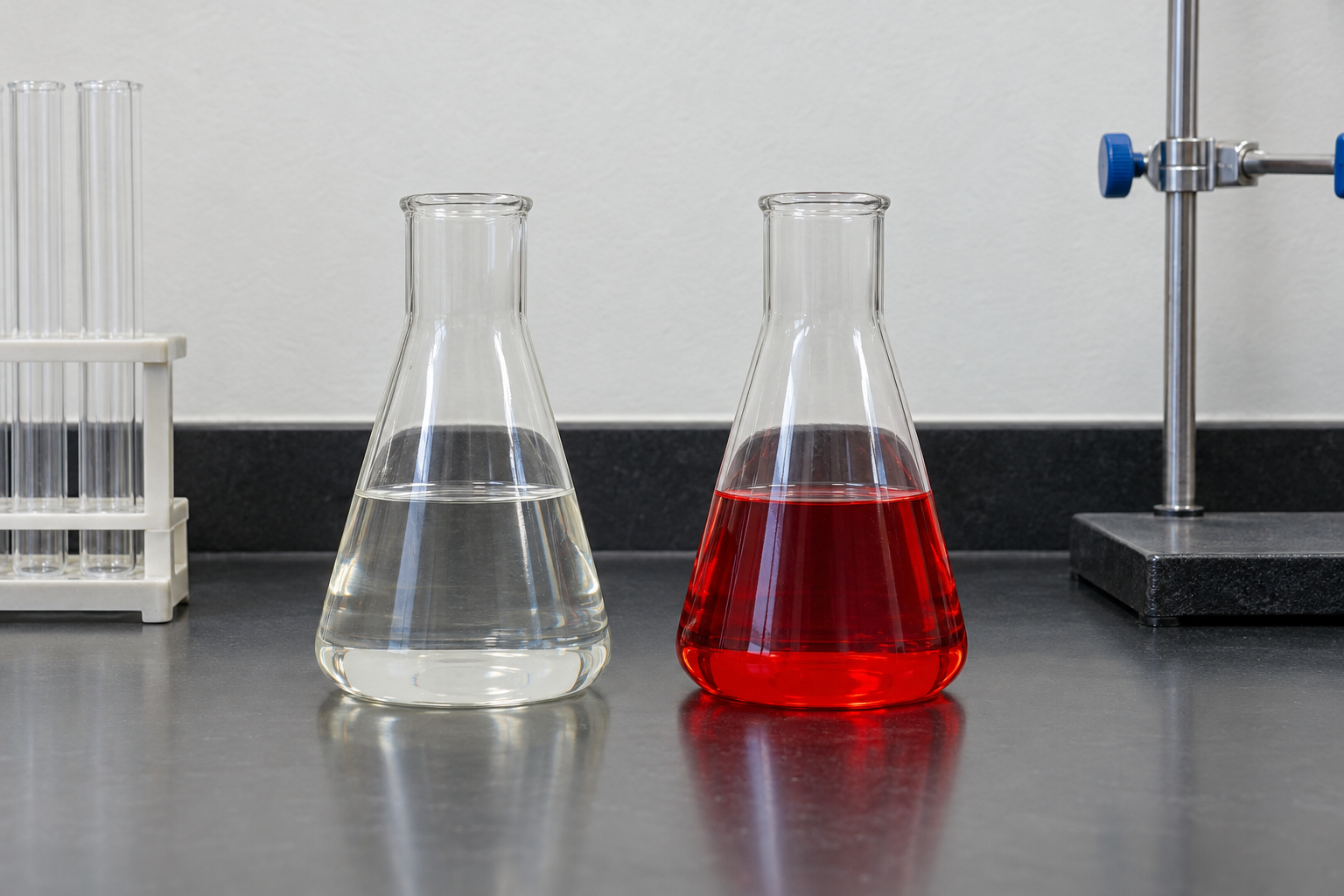
Why does the same dose of acid barely disturb one buffer and overwhelm the other?
Part 2The amounts behind the matching readings
The first buffer contains ten times more of each conjugate member than the second.
We've seen that a buffer with equal conjugate members sits at a pH equal to the pKa.
Acetic acid's pKa is 4.74 at 25 °C.
Both buffers hold their members in a one-to-one ratio, so the meter shows pH 4.74 for both.
The meter hides the difference in amounts.
The acetate member consumes the added acid.
We've seen this consumption in symbols: CH₃COO⁻ + H₃O⁺ → CH₃COOH + H₂O.
The second buffer's stock of acetate is used up by the dose.
Here is the second buffer before and after the dose.
No acetate remains to consume the next dose.
The first buffer's stock of acetate outlasts the dose.
Here is the first buffer before and after the same dose.
The amount of added acid or base a buffer can neutralize before its pH changes substantially is called the buffer's capacity.
Two buffers can share a pH and still differ in capacity.
State what buffer capacity is: the amount of added acid or base a buffer can neutralize before its pH changes substantially.
Part 3Check what you just learned
Check — multiple choice
Two benzoate buffers sit at the same pH. The first absorbs 0.080 mol of added HCl with little pH change. The second is overwhelmed by 0.010 mol of added HCl. Which buffer has the higher buffer capacity?
Feedback if chosen: Correct. The first buffer neutralizes far more added acid before its pH changes substantially, and that absorbable amount is exactly what buffer capacity measures.
Feedback if chosen: This option is wrong — you picked the buffer the acid overwhelmed. Capacity is the amount of added acid or base a buffer can neutralize before its pH changes substantially, and the second buffer's pH changed substantially after only 0.010 mol.
Check — multiple choice
A benzoate buffer absorbs a 0.020 mol dose of added NaOH, and its pH barely changes. Has the dose exceeded the buffer's capacity?
Feedback if chosen: This option is wrong — you read a small pH change as failure. The buffer neutralized the dose and kept its pH close to where it was, so the dose sits within the buffer's capacity.
Feedback if chosen: Correct. The buffer's pH barely changed, so the buffer neutralized the whole dose — the dose sits within its capacity.
Check — multiple choice
A chemist adds a 0.050 mol dose of HCl to a benzoate buffer, and the mixture turns strongly acidic. Has the dose exceeded the buffer's capacity?
Feedback if chosen: Correct. The strongly acidic result means the buffer could not neutralize the whole dose before its pH changed substantially — the dose exceeded its capacity.
Feedback if chosen: This option is wrong — you kept the buffer's protection alive. A buffer with capacity to spare would have kept its pH close to where it was; this mixture turned strongly acidic, so the capacity was exceeded.
Check — multiple choice
Two benzoate buffers share the same pH. The first absorbs far more added acid than the second before its pH changes substantially. Do the two buffers have the same buffer capacity?
Feedback if chosen: This option is wrong — you read the matching pH as a matching capacity. Capacity is the absorbable amount of acid or base, not the pH, and the two buffers absorb very different amounts.
Feedback if chosen: Correct. The two buffers share a pH and still differ in capacity: the pH comes from the members' ratio, and the capacity from their amounts.
Check — multiple choice
Dmitri says a buffer keeps its pH steady no matter how much acid the chemist adds. Is Dmitri correct?
Feedback if chosen: This option is wrong — you gave the buffer unlimited protection. A buffer neutralizes added acid only while its stock of the consuming member lasts.
Feedback if chosen: Correct. Every buffer has a capacity: once the stock of the member that consumes the added acid is used up, the pH changes substantially.
Check — multiple choice
A teacher adds acid to a buffer one small dose at a time, counting the doses until the pH finally changes substantially. Which property of the buffer does the dose count measure?
Feedback if chosen: Correct. The counted doses are the amount of added acid the buffer neutralized before its pH changed substantially — its buffer capacity.
Feedback if chosen: This option is wrong — you named the quantity the meter reads. The dose count measures how much acid the buffer absorbed, and that absorbable amount is its buffer capacity.
Feedback if chosen: This option is wrong — you named the quantity that sets the buffer's pH. The dose count measures the absorbable amount of acid, and that amount is the buffer's capacity.
Check — multiple choice
Which term names the amount of added acid or base a buffer can neutralize before its pH changes substantially?
Feedback if chosen: Correct. That absorbable amount is the buffer's capacity.
Feedback if chosen: This option is wrong — you named the stretch of a titration curve where the mixture is a buffer, not the absorbable amount of acid or base.
Feedback if chosen: This option is wrong — you named the fraction of a weak acid's molecules that ionize in water, not the amount of added acid or base a buffer can neutralize.
Scaling both members leaves the pH alone
Outcome: State that buffer pH is set by the member ratio, so multiplying both concentrations by the same factor leaves the pH unchanged.
Part 1Ten times the acid in the beaker
A student compares two acetate buffer recipes.
The first recipe mixes 0.10 mol of acetic acid and 0.10 mol of acetate into a liter of solution.
The second recipe mixes 1.0 mol of each member into a liter of solution.
The second recipe packs ten times more acid molecules into the same volume.
Ten times more acid in the beaker suggests a far more acidic mixture.
Does the more concentrated buffer sit at a lower pH?
Part 2Only the ratio enters the equation
No: both recipes give the same pH.
We've seen that a buffer's pH comes from the pKa and the ratio of conjugate base to conjugate acid.
Only the ratio of the two members enters the equation pH = pKa + log([A⁻]/[HA]).
Both recipes hold their members in a one-to-one ratio.
Here are the two recipes side by side.
| mol of acetic acid | mol of acetate | ratio of acetate to acid | |
|---|---|---|---|
| the first recipe | 0.10 mol | 0.10 mol | 1 to 1 |
| the second recipe | 1.0 mol | 1.0 mol | 1 to 1 |
So multiplying both amounts by ten leaves the pH where it was.
Diluting a buffer multiplies both concentrations by the same factor below one.
So a dilution also leaves the ratio, and with it the pH, essentially unchanged.
Part 3Four pairs, one question
Consider the two recipes from the opening: 0.10 mol of each member against 1.0 mol of each member.
Do the two buffers share the same pH?
The first buffer's ratio of acetate to acetic acid is 1 to 1.
The second buffer's ratio is 1 to 1.
The ratios match.
So the two buffers share the same pH.
Now consider a lopsided pair: 0.20 mol of acetic acid with 0.40 mol of acetate, against 0.10 mol of acetic acid with 0.20 mol of acetate.
Do the two buffers share the same pH?
The first buffer's ratio of acetate to acetic acid is 2 to 1.
The second buffer's ratio is 2 to 1.
The ratios match.
So the two buffers share the same pH.
Now consider the first pair with one amount raised: 0.10 mol of each member, against 0.10 mol of acetic acid with 0.30 mol of acetate.
Do the two buffers share the same pH?
The first buffer's ratio of acetate to acetic acid is 1 to 1.
The second buffer's ratio is 3 to 1.
The ratios differ.
So the two buffers sit at different pHs.
Now consider one buffer twice: the 1.0 mol recipe's buffer, before and after the chemist dilutes it tenfold.
Do the two share the same pH?
Before the dilution, the ratio of acetate to acetic acid is 1 to 1.
After the dilution, both concentrations are ten times smaller, so the ratio is still 1 to 1.
The ratios match.
So the diluted buffer keeps essentially the same pH.
State that buffer pH is set by the member ratio, so multiplying both concentrations by the same factor, up or down, leaves the pH essentially unchanged.
Part 4Check what you just learned
Check — multiple choice
We've seen the Henderson-Hasselbalch equation. Together with the pKa, which quantity sets a buffer's pH?
Feedback if chosen: This option is wrong — you added the two amounts. The Henderson-Hasselbalch equation reads only their ratio; the total never appears in it.
Feedback if chosen: Correct. The pH equals the pKa plus the log of the ratio [A⁻]/[HA] — the ratio, beside the pKa, is all the equation uses.
Feedback if chosen: This option is wrong — you kept the volume. The shared volume cancels inside the ratio, so the volume never reaches the equation.
Check — multiple choice
One 2-methylpropanoate buffer holds 0.20 mol of 2-methylpropanoic acid and 0.20 mol of 2-methylpropanoate. A second holds 0.60 mol of each member. Do the two buffers share the same pH?
Feedback if chosen: Correct. Both buffers hold their members in a one-to-one ratio, and only the ratio sets the pH, so the two pHs match.
Feedback if chosen: This option is wrong — you let the amounts set the pH. The second buffer holds three times the moles, but the ratio of the members is 1 to 1 in both, so the two pHs match.
Check — multiple choice
One 2-methylpropanoate buffer holds 0.10 mol of 2-methylpropanoic acid and 0.30 mol of 2-methylpropanoate. A second holds 0.20 mol of the acid and 0.60 mol of the base member. Do the two buffers share the same pH?
Feedback if chosen: Correct. Each buffer holds three times more conjugate base than acid — both ratios are 3 to 1 — so the two pHs match.
Feedback if chosen: This option is wrong — you compared the amounts instead of the ratios. 0.30 mol against 0.10 mol and 0.60 mol against 0.20 mol are both 3 to 1, so the two pHs match.
Check — multiple choice
One 2-methylpropanoate buffer holds 0.20 mol of each member. A second holds 0.20 mol of 2-methylpropanoic acid and 0.40 mol of 2-methylpropanoate. Do the two buffers share the same pH?
Feedback if chosen: This option is wrong — you matched the acid amounts and stopped. The ratios decide: 1 to 1 against 2 to 1, so the two pHs differ.
Feedback if chosen: Correct. The first ratio is 1 to 1 and the second is 2 to 1; different ratios give different pHs.
Check — multiple choice
A chemist dilutes a 2-methylpropanoate buffer fivefold with water. Does the diluted buffer have essentially the same pH as before?
Feedback if chosen: Correct. The dilution divides both members' concentrations by five, so their ratio survives — and with it the pH, essentially unchanged.
Feedback if chosen: This option is wrong — you let the dilution move the pH. Both concentrations shrink by the same factor of five, so the ratio of the two members, and with it the pH, stays essentially where it was.
Concentration buys capacity
Outcome: State that buffer capacity increases with the members' absolute concentrations at a fixed ratio.
Part 1Same pH, different capacity
Two acetate buffers hold their members in the same one-to-one ratio.
The first buffer holds 1.0 mol of each member per liter.
The second buffer holds 0.10 mol of each member per liter.
We've seen that the two buffers share the same pH.
A chemist adds hydrochloric acid to each buffer, one small dose at a time.
Which buffer absorbs more acid before its pH changes substantially?
Part 2The moles set the capacity
The buffer with more moles absorbs more acid.
The acetate member consumes each dose of added acid.
The first buffer stocks ten times more acetate than the second.
Here are the two buffers side by side.
Here are the two buffers' stocks as a table.
| mol of acetic acid per liter | mol of acetate per liter | |
|---|---|---|
| the first buffer | 1.0 mol | 1.0 mol |
| the second buffer | 0.10 mol | 0.10 mol |
So the first buffer neutralizes ten times more acid before its acetate is gone.
The ratio of the members sets the pH.
The absolute amounts of the members set the capacity.
A dilution leaves the ratio alone but cuts the moles in every measured portion, so the pH essentially holds while the capacity falls.
State that buffer capacity grows with the members' absolute concentrations at a fixed ratio: more moles of each member mean more added acid or base neutralized.
Part 3Check what you just learned
Check — multiple choice
Two propanoate buffers hold their members in the same one-to-one ratio: the first holds 0.80 mol of each member, the second 0.080 mol of each, in equal volumes. Which buffer neutralizes more added NaOH?
Feedback if chosen: Correct. The propanoic acid member consumes the added OH⁻, and the first buffer stocks ten times more of it, so the first buffer neutralizes ten times more base.
Feedback if chosen: This option is wrong — you picked the buffer with fewer moles. Each mole of added OH⁻ consumes one mole of the propanoic acid member, and the second buffer stocks only a tenth as much.
Check — multiple choice
Two propanoate buffers hold their members in a one-to-one ratio: 0.80 mol of each member against 0.080 mol of each, in equal volumes. Which buffer has the higher buffer capacity?
Feedback if chosen: Correct. Capacity grows with the amounts at a fixed ratio: ten times the moles of each member buy ten times the capacity.
Feedback if chosen: This option is wrong — you gave the smaller stocks the higher capacity. Capacity is the absorbable amount of acid or base, and the buffer with ten times the moles absorbs ten times more.
Check — multiple choice
A chemist dilutes a propanoate buffer tenfold, then measures out two equal 100 mL portions: one of the diluted buffer and one of the original. Which portion absorbs more added HCl?
Feedback if chosen: This option is wrong — you let the surviving pH stand in for the moles. The pH survives the dilution, but a 100 mL portion of the diluted buffer holds only a tenth the moles of each member, so it absorbs only a tenth the acid.
Feedback if chosen: Correct. Equal portions hold very different amounts: the original's 100 mL holds ten times the moles of each member, so it absorbs ten times more acid.
Check — multiple choice
A chemist dilutes a propanoate buffer tenfold and takes equal portions of the original and the diluted buffer. Do the two portions have essentially the same pH?
Feedback if chosen: Correct. The dilution leaves the ratio of the members unchanged, so the diluted portion's pH stays essentially the original's — even though its capacity is lower.
Feedback if chosen: This option is wrong — you let the dilution move the pH. The ratio of the two members survives a dilution, and the ratio sets the pH.
Check — multiple choice
Yusuf says diluting a buffer changes nothing about the buffer, because its pH stays the same. Is Yusuf correct?
Feedback if chosen: This option is wrong — you read the steady pH as the whole story. The pH survives because the ratio survives, but every measured portion of the diluted buffer holds fewer moles of each member, so its capacity falls.
Feedback if chosen: Correct. The diluted buffer keeps essentially its pH, but any measured portion of it holds fewer moles of each member, so its capacity is lower.
Why concentration buys capacity
Outcome: Explain why a more concentrated buffer has a greater capacity: more moles of each member are available to consume added acid or base.
Part 1Counting the doses
A beaker holds an acetate buffer with 0.10 mol of each conjugate member.
A chemist adds sodium hydroxide to the beaker, 0.020 mol at a time.
The acetic acid member consumes each dose of hydroxide.
After five doses, the acetic acid is gone.
No acetic acid remains to consume the sixth dose of hydroxide.
The unconsumed hydroxide turns the mixture strongly basic.
What sets how many doses a buffer can absorb?
Part 2One mole consumes one mole
The moles of the consuming member set the limit.
We've seen the consumption in symbols: CH₃COOH + OH⁻ → CH₃COO⁻ + H₂O.
Each mole of added hydroxide consumes one mole of acetic acid.
Here is the whole addition as a dose-by-dose ledger.
| mol of NaOH added in all | mol of CH₃COOH left | mol of CH₃COO⁻ | |
|---|---|---|---|
| at the start | 0 mol | 0.10 mol | 0.10 mol |
| after one dose | 0.020 mol | 0.08 mol | 0.12 mol |
| after two doses | 0.040 mol | 0.06 mol | 0.14 mol |
| after three doses | 0.060 mol | 0.04 mol | 0.16 mol |
| after four doses | 0.080 mol | 0.02 mol | 0.18 mol |
| after five doses | 0.100 mol | 0 mol | 0.20 mol |
A buffer holding 0.10 mol of acetic acid absorbs 0.10 mol of hydroxide, and then the protection ends.
A buffer holding 1.0 mol of acetic acid absorbs 1.0 mol of hydroxide.
Ten times the moles buy ten times the capacity.
The same counting works for added acid against the acetate member.
We've seen how to spot the limiting reactant: compare the available mole ratio with the required mole ratio.
Here every consumption is one mole per mole, so the smaller stock is used up first.
So a more concentrated buffer lasts longer because it stocks more moles of each conjugate member.
Explain why a more concentrated buffer has a greater capacity: it holds more moles of each conjugate member available to consume added acid or base before either member is used up.
Part 3Check what you just learned
Check — multiple choice
We've seen how a buffer answers added base. Which buffer member consumes the added OH⁻?
Feedback if chosen: Correct. The weak-acid member hands the added OH⁻ a proton, forming its conjugate base and water.
Feedback if chosen: This option is wrong — you picked the member that consumes added ACID. The conjugate base accepts protons from H₃O⁺; added OH⁻ is consumed by the weak-acid member.
Feedback if chosen: This option is wrong — you gave the job to the solvent. The water is the background; the weak-acid member consumes the added OH⁻.
Check — multiple choice
A hypochlorite buffer holds 0.060 mol of HOCl and 0.060 mol of OCl⁻. A chemist adds 0.100 mol of NaOH. Which is used up first, the HOCl or the added NaOH?
Feedback if chosen: Correct. Each mole of OH⁻ consumes one mole of HOCl, and only 0.060 mol of HOCl stands against 0.100 mol of added OH⁻ — the buffer is overwhelmed.
Feedback if chosen: This option is wrong — you gave the buffer more consumer than it stocks. The OH⁻ arrives 0.100 mol strong, but only 0.060 mol of HOCl is there to consume it, so the HOCl is gone first.
Check — multiple choice
Two hypochlorite buffers hold their members in the same one-to-one ratio: 0.60 mol of each member against 0.060 mol of each. Both face added NaOH. Why does the first buffer absorb ten times more of the base?
Feedback if chosen: This option is wrong — you split the pHs. Both buffers hold a one-to-one ratio, so they share one pH; and the pH would not set the absorbable amount anyway.
Feedback if chosen: Correct. The consumption uses one mole of HOCl per mole of OH⁻, so ten times the stock of HOCl absorbs ten times the added base.
Feedback if chosen: This option is wrong — you changed the acid. Both buffers are built on the same HOCl, so neither acid is stronger; the difference sits in the amounts.
Feedback if chosen: This option is wrong — you bent the stoichiometry. Every mole of NaOH consumes exactly one mole of HOCl in both buffers; the first simply stocks more HOCl.
Check — multiple choice
Two hypochlorite buffers hold their members at the same fixed ratio: one stocks 0.50 mol of OCl⁻, the other 0.050 mol of OCl⁻. Which buffer absorbs more added HCl, and by roughly what factor?
Feedback if chosen: Correct. The OCl⁻ member consumes the added H₃O⁺, one mole per mole, and the first buffer stocks ten times more OCl⁻.
Feedback if chosen: This option is wrong — you shrank the factor. The stocks differ tenfold, 0.50 mol against 0.050 mol, and each mole of added acid consumes one mole of OCl⁻, so the absorbable acid differs tenfold too.
Feedback if chosen: This option is wrong — you handed the capacity to the smaller stock. The buffer with 0.50 mol of OCl⁻ consumes ten times more added acid than the one with 0.050 mol.
Acid-heavy buffers absorb more base
Outcome: State that a buffer with more conjugate acid than conjugate base has a greater capacity for added base than for added acid.
Part 1Two additions, one lopsided buffer
A beaker holds an acetate buffer with 0.30 mol of acetic acid and 0.10 mol of acetate.
The lopsided buffer faces two different additions.
An added dose of sodium hydroxide is one.
An added dose of hydrochloric acid is the other.
Does the lopsided buffer hold out equally long against both additions?
Part 2The bigger stock serves one direction
No: this buffer holds out three times longer against added base.
We've seen that the acetic acid member consumes added hydroxide.
In symbols: CH₃COOH + OH⁻ → CH₃COO⁻ + H₂O.
The buffer stocks 0.30 mol of acetic acid for that job.
We've seen that the acetate member consumes added acid.
The buffer stocks 0.10 mol of acetate for that job.
Here is the lopsided buffer before and after a dose of base.
So the acid-heavy buffer has the greater capacity for added base.
The member that consumes an addition provides the capacity against that addition.
Part 3The same question on a bigger batch
Now consider a bigger batch of the same recipe: 0.60 mol of acetic acid with 0.20 mol of acetate.
Against which addition does this buffer hold out longer?
The acetic acid member consumes added hydroxide.
The buffer stocks 0.60 mol of that member.
The acetate member consumes added acid.
The buffer stocks 0.20 mol of that member.
So the buffer holds out longer against added base.
State that a buffer with more conjugate acid than conjugate base has a greater capacity for added base than for added acid.
Part 4Check what you just learned
Check — multiple choice
We've seen the reaction an acetate buffer uses against added base. Complete it: CH₃COOH + OH⁻ → ?
Feedback if chosen: Correct. The acetic acid hands the OH⁻ a proton, leaving acetate and water.
Feedback if chosen: This option is wrong — you made the added base produce hydronium. The OH⁻ accepts a proton and becomes water; no H₃O⁺ forms.
Feedback if chosen: This option is wrong — you left the acetic acid unchanged. The OH⁻ takes its proton FROM the acetic acid, converting it into acetate.
Check — multiple choice
A chloroacetate buffer holds 0.40 mol of chloroacetic acid and 0.10 mol of chloroacetate. Against which addition does the buffer hold out longer?
Feedback if chosen: This option is wrong — added acid is consumed by the chloroacetate member, and the buffer stocks only 0.10 mol of it. The 0.40 mol of chloroacetic acid serves added base.
Feedback if chosen: Correct. The chloroacetic acid member consumes added OH⁻, and the buffer stocks four times more of it than of chloroacetate, so the buffer holds out longer against added base.
Check — multiple choice
A chloroacetate buffer holds 0.25 mol of chloroacetic acid and 0.05 mol of chloroacetate. Against which addition does the buffer hold out longer?
Feedback if chosen: This option is wrong — the chloroacetate member consumes the added acid, and its stock is the small one, 0.05 mol. The fivefold stock of chloroacetic acid serves added base.
Feedback if chosen: Correct. The 0.25 mol of chloroacetic acid consumes added OH⁻ — five times the 0.05 mol of chloroacetate that consumes added acid.
Check — multiple choice
A chloroacetate buffer holds 0.10 mol of chloroacetic acid and 0.10 mol of chloroacetate. Against which addition does the buffer hold out longer?
Feedback if chosen: This option is wrong — you gave the acid direction a bigger stock. Both members stand at 0.10 mol, so neither direction outlasts the other.
Feedback if chosen: This option is wrong — you gave the base direction a bigger stock. Both members stand at 0.10 mol, so the two directions last equally long.
Feedback if chosen: Correct. Equal stocks serve the two directions equally: 0.10 mol of chloroacetic acid against added base, and 0.10 mol of chloroacetate against added acid.
Base-heavy buffers absorb more acid
Outcome: State that a buffer with more conjugate base than conjugate acid has a greater capacity for added acid than for added base.
Part 1The recipe flipped
A second acetate buffer flips the recipe.
This beaker holds 0.10 mol of acetic acid and 0.30 mol of acetate.
The same two additions apply.
An added dose of sodium hydroxide is one.
An added dose of hydrochloric acid is the other.
Against which addition does the flipped buffer hold out longer?
Part 2The same rule, the other direction
The flipped buffer holds out three times longer against added acid.
The acetate member consumes added acid.
In symbols: CH₃COO⁻ + H₃O⁺ → CH₃COOH + H₂O.
The buffer stocks 0.30 mol of acetate for that job.
The acetic acid member consumes added hydroxide.
The buffer stocks 0.10 mol of acetic acid for that job.
Here is the flipped buffer before and after a dose of acid.
So the base-heavy buffer has the greater capacity for added acid.
The same rule decides both recipes: the member that consumes the addition provides the capacity.
Part 3The same question on a deeper flip
Now consider a deeper flip: 0.05 mol of acetic acid with 0.50 mol of acetate.
Against which addition does this buffer hold out longer?
The acetate member consumes added acid.
The buffer stocks 0.50 mol of that member.
The acetic acid member consumes added hydroxide.
The buffer stocks 0.05 mol of that member.
So the buffer holds out longer against added acid.
State that a buffer with more conjugate base than conjugate acid has a greater capacity for added acid than for added base.
Part 4Check what you just learned
Check — multiple choice
A chloroacetate buffer holds 0.05 mol of chloroacetic acid and 0.45 mol of chloroacetate. Against which addition does the buffer hold out longer?
Feedback if chosen: Correct. The chloroacetate member consumes added H₃O⁺, and the buffer stocks nine times more of it than of chloroacetic acid.
Feedback if chosen: This option is wrong — you handed the base direction the big stock. Added base is consumed by the chloroacetic acid member, and only 0.05 mol of it is there; the 0.45 mol of chloroacetate serves added acid.
Check — multiple choice
A chloroacetate buffer holds 0.10 mol of chloroacetic acid and 0.60 mol of chloroacetate. Against which addition does the buffer hold out longer?
Feedback if chosen: Correct. The 0.60 mol of chloroacetate consumes added acid — six times the 0.10 mol of chloroacetic acid that consumes added base.
Feedback if chosen: This option is wrong — the member that consumes added base is the chloroacetic acid, and its stock is the small one. The buffer's big stock, 0.60 mol of chloroacetate, serves added acid.
Check — multiple choice
A chloroacetate buffer holds 0.50 mol of chloroacetic acid and 0.10 mol of chloroacetate. Against which addition does the buffer hold out longer?
Feedback if chosen: This option is wrong — you read this buffer as base-heavy. Here the big stock is 0.50 mol of chloroacetic acid, and that member consumes added BASE.
Feedback if chosen: Correct. This buffer is acid-heavy: its 0.50 mol of chloroacetic acid consumes added OH⁻, five times the chloroacetate stock that consumes added acid.
Check — multiple choice
A benzoate buffer is described as holding far more benzoate than benzoic acid. Which addition does the buffer absorb better?
Feedback if chosen: Correct. The benzoate member consumes added H₃O⁺, and benzoate is the abundant member, so the buffer absorbs added acid better.
Feedback if chosen: This option is wrong — you gave the scarce member the job. Added base is consumed by the benzoic acid member, which this buffer holds least of; the abundant benzoate serves added acid.
Why lopsided buffers are lopsided
Outcome: Explain why a buffer's capacity is greater in the direction its more abundant member handles.
Part 1Two facts, one suspicion
We've seen that an acid-heavy buffer lasts longer against added base.
We've seen that a base-heavy buffer lasts longer against added acid.
The two facts mirror each other exactly.
One mechanism should sit behind both.
Why does the more abundant member decide the direction a buffer resists best?
Part 2Count the consuming member
Each addition is consumed by exactly one member.
The conjugate acid consumes added hydroxide.
The conjugate base consumes added hydronium.
In general: HA + OH⁻ → A⁻ + H₂O, and A⁻ + H₃O⁺ → HA + H₂O.
Each mole of addition uses up one mole of the consuming member.
A larger stock of the consuming member lasts longer.
Here are the two directions side by side, read through the two beakers we've seen.
| the addition | the member that consumes it | stock in the acid-heavy beaker | stock in the base-heavy beaker |
|---|---|---|---|
| added OH⁻ | the conjugate acid | 0.30 mol | 0.10 mol |
| added H₃O⁺ | the conjugate base | 0.10 mol | 0.30 mol |
So a buffer's capacity is greater in the direction its more abundant member handles.
Count the moles of the consuming member, and the verdict follows.
Explain why a buffer's capacity is greater in the direction its more abundant member handles: that member supplies more moles of the neutralizing reaction before it is used up.
Part 3Check what you just learned
Check — multiple choice
A benzoate buffer holds 0.40 mol of benzoic acid and 0.08 mol of benzoate. A chemist adds hydrochloric acid, dose by dose. Which member is gone first?
Feedback if chosen: Correct. Added acid is consumed by the benzoate member alone, so its 0.08 mol stock shrinks with every dose while the benzoic acid grows.
Feedback if chosen: This option is wrong — you spent the wrong member. Added H₃O⁺ converts benzoate INTO benzoic acid, so the benzoic acid stock grows during the additions.
Feedback if chosen: This option is wrong — you spent both members at once. Each addition is consumed by exactly one member, and added acid consumes only the benzoate.
Check — multiple choice
An ethylamine buffer holds 0.60 mol of ethylammonium, C₂H₅NH₃⁺, and 0.10 mol of ethylamine, C₂H₅NH₂. Why does this buffer absorb more added base than added acid?
Feedback if chosen: This option is wrong — you let the weak base cancel the addition. Added OH⁻ reacts with the ethylammonium member however weak the ethylamine is.
Feedback if chosen: This option is wrong — you reasoned from the pH and pOH values. Capacity is set by the moles of the consuming member, not by where the pH sits beside the pOH.
Feedback if chosen: This option is wrong — you flipped the consumer. Added OH⁻ is consumed by the conjugate-acid member, the ethylammonium — not by the ethylamine.
Feedback if chosen: Correct. Each mole of added OH⁻ consumes one mole of ethylammonium, and the buffer stocks six times more of it, so the base direction lasts six times longer.
Check — multiple choice
A methylamine buffer is described as holding more methylammonium, CH₃NH₃⁺, than methylamine, CH₃NH₂. Which addition does the buffer absorb better?
Feedback if chosen: This option is wrong — added acid is consumed by the methylamine member, the scarce one. The abundant methylammonium consumes added base.
Feedback if chosen: Correct. The methylammonium member consumes added OH⁻, and it is the abundant member, so the buffer absorbs added base better.
Check — numeric entry
A chloroacetate buffer holds 0.80 mol of chloroacetic acid and 0.20 mol of chloroacetate. How many moles of added HCl can the buffer absorb before the chloroacetate is gone? Give your answer to 2 decimal places.
Tolerance: 0.005
Feedback when correct: Correct. Each mole of added H₃O⁺ consumes one mole of chloroacetate, and the buffer stocks 0.20 mol of chloroacetate, so 0.20 mol of HCl uses it up exactly.
Anticipated wrong answers (feedback shown):
| 0.80 | This value is the chloroacetic acid's stock. The chloroacetic acid consumes added BASE; added acid is consumed by the chloroacetate, and 0.20 mol of it is there. |
| 1.00 | This value adds the two stocks together. Only the chloroacetate consumes added acid, one mole per mole, so the limit is its own 0.20 mol. |
| 0.60 | This value subtracts the two stocks. The consumption spends only the chloroacetate, one mole per mole of added acid: the limit is 0.20 mol. |
Worked solution revealed after a second miss
Write down the values from the question
0.80 mol of chloroacetic acid
0.20 mol of chloroacetate
Name the member that consumes the added acid
the chloroacetate consumes the added H₃O⁺, one mole per mole
Substitute in the values, and calculate
absorbable HCl = the chloroacetate's whole stock = 0.20 mol
Compare two buffers
Outcome: Judge which of two buffer compositions better resists a specified addition, arguing from the moles of the member that consumes it.
Part 1Two buffers on the shelf
A lab keeps two acetate buffers on the shelf.
Buffer T holds 0.80 mol of acetic acid and 0.05 mol of acetate.
Buffer U holds 0.10 mol of acetic acid and 0.50 mol of acetate.
A technician must protect a sample against a planned dose of hydrochloric acid.
Buffer T holds more total moles than buffer U.
Should the technician pick the buffer with the larger total?
Part 2The addition picks the member
No: the technician should pick buffer U.
The planned addition decides which member matters.
The acetate member consumes added hydrochloric acid.
Buffer U stocks 0.50 mol of acetate.
Buffer T stocks 0.05 mol of acetate.
So buffer U absorbs ten times more of the planned acid.
To compare two buffers, first name the member the addition consumes, then compare the moles of that member.
Part 3Four comparisons, one routine
Consider buffer R, holding 1.0 mol of acetic acid and 1.0 mol of acetate, and buffer S, holding 0.30 mol of acetic acid and 0.10 mol of acetate.
Here are the two compositions as a table.
| mol of acetic acid | mol of acetate | |
|---|---|---|
| buffer R | 1.0 mol | 1.0 mol |
| buffer S | 0.30 mol | 0.10 mol |
The chemist plans a dose of NaOH.
Which buffer resists the stated addition longer?
The added NaOH is consumed by the acetic acid member.
Buffer R stocks 1.0 mol of that member.
Buffer S stocks 0.30 mol.
So buffer R resists the addition longer.
Now only the addition changes: the same buffers R and S face a dose of HCl.
The added HCl is consumed by the acetate member.
Buffer R stocks 1.0 mol of that member.
Buffer S stocks 0.10 mol.
So buffer R resists the addition longer.
A buffer with more of everything wins in both directions.
Now consider the shelf pair: buffer T and buffer U, against the planned HCl.
Here are their compositions as a table.
| mol of acetic acid | mol of acetate | |
|---|---|---|
| buffer T | 0.80 mol | 0.05 mol |
| buffer U | 0.10 mol | 0.50 mol |
The added HCl is consumed by the acetate member.
Buffer U stocks 0.50 mol of that member.
Buffer T stocks 0.05 mol.
So buffer U resists the addition longer.
Buffer T holds more moles in all, and still absorbs less of the planned acid: the total is the wrong count to compare.
Now only the addition changes on the same pair: T and U face a dose of NaOH.
The added NaOH is consumed by the acetic acid member.
Buffer T stocks 0.80 mol of that member.
Buffer U stocks 0.10 mol.
So buffer T resists the addition longer.
One flipped addition flips the verdict: the deciding feature is which member the addition consumes.
Judge which of two buffer compositions better resists a specified addition: name the member the addition consumes, then compare the two buffers' moles of that member.
Part 4Check what you just learned
Check — multiple choice
Buffer G holds 0.60 mol of lactic acid and 0.06 mol of lactate. Buffer H holds 0.08 mol of lactic acid and 0.60 mol of lactate. A chemist plans an addition of HCl. Which species will consume the added acid?
Feedback if chosen: Correct. The conjugate-base member accepts the added proton: lactate and hydronium give lactic acid and water.
Feedback if chosen: This option is wrong — you picked the member that consumes added BASE. The lactic acid donates protons; the added H₃O⁺ is consumed by the lactate.
Feedback if chosen: This option is wrong — you gave the job to the solvent. The water is the background; in a buffer the added H₃O⁺ is consumed by the conjugate-base member, the lactate.
Check — multiple choice
Buffer G holds 0.60 mol of lactic acid and 0.06 mol of lactate. Buffer H holds 0.08 mol of lactic acid and 0.60 mol of lactate. Which buffer resists a planned addition of HCl longer?
Feedback if chosen: This option is wrong — you compared the acid members. Added HCl is consumed by the lactate, and buffer H stocks 0.60 mol of lactate against buffer G's 0.06 mol.
Feedback if chosen: Correct. The added acid is consumed by the lactate member, and buffer H stocks ten times more lactate than buffer G.
Check — multiple choice
Buffer G holds 0.60 mol of lactic acid and 0.06 mol of lactate. Buffer H holds 0.08 mol of lactic acid and 0.60 mol of lactate. Which buffer resists a planned addition of NaOH longer?
Feedback if chosen: Correct. The added base is consumed by the lactic acid member, and buffer G stocks 0.60 mol of lactic acid against buffer H's 0.08 mol.
Feedback if chosen: This option is wrong — you carried the acid verdict over. Against NaOH the consuming member is the lactic acid, and buffer G holds nearly eight times more of it.
Check — multiple choice
Buffer V holds 0.40 mol of methylamine, CH₃NH₂, and 0.05 mol of methylammonium, CH₃NH₃⁺. Buffer W holds 0.05 mol of methylamine and 0.40 mol of methylammonium. Which buffer resists a planned addition of HCl longer?
Feedback if chosen: Correct. The routine decides it: name the member that consumes the added acid, then compare the two buffers' stocks of that member — buffer V's is the larger.
Feedback if chosen: This option is wrong — you compared the wrong stocks. Name the member that consumes the added acid first, then compare the two buffers' moles of that member: buffer W's stock of it is the small one.
Check — multiple choice
Buffer V holds 0.40 mol of methylamine, CH₃NH₂, and 0.05 mol of methylammonium, CH₃NH₃⁺. Buffer W holds 0.05 mol of methylamine and 0.40 mol of methylammonium. Buffer V resists an addition of HCl longer than buffer W. Why?
Feedback if chosen: This option is wrong — you counted the totals, and the totals are equal: 0.45 mol in each buffer. The total cannot decide this comparison.
Feedback if chosen: Correct. The methylamine consumes the added H₃O⁺, and buffer V stocks 0.40 mol of it against buffer W's 0.05 mol — eight times more.
Feedback if chosen: This option is wrong — you flipped the consumer. The methylammonium is the conjugate ACID member; it consumes added OH⁻. Added H₃O⁺ is consumed by the methylamine.
Feedback if chosen: This option is wrong — you let the pH carry the capacity. Buffer V's pH does sit higher, but the pH comes from the members' ratio; what the buffer can absorb comes from the moles of the consuming member.
U8-S15 — pH and solubility
4 lessons
Which salts feel pH
Outcome: Identify the salts whose solubility is pH sensitive: those with an ion that is a weak acid, a weak base, or hydroxide.
Part 1Four jars, one acid
Four stoppered jars stand on a bench, one salt in each: CaF₂, Mg(OH)₂, NaCl, and KNO₃.
Each jar holds a saturated solution with leftover solid salt on the bottom.
The chemist stirs a few drops of dilute strong acid into every jar.
In the CaF₂ jar and the Mg(OH)₂ jar, the leftover solid shrinks.
In the NaCl jar and the KNO₃ jar, the leftover solid stays the same size.
The same acid freed more of two salts and left the other two alone.
Which salts dissolve further when a chemist lowers the pH?
Part 2The ions decide
A salt feels a pH change through its own ions.
We've seen the solubility-product constant: Ksp is the equilibrium constant for the dissolution of a slightly soluble salt.
So each jar holds a dissolution at equilibrium.
We've seen that the weaker the acid, the stronger its conjugate base.
HF is a weak acid.
So F⁻ is a weak base.
Mg(OH)₂ supplies hydroxide itself, and NH₄⁺ in an ammonium salt is a weak acid.
Neither ion of NaCl and neither ion of KNO₃ is a weak acid, a weak base, or hydroxide.
A salt's solubility is pH sensitive when one of its ions is a weak acid, a weak base, or hydroxide.
Part 3Five salts, one question
Is CaF₂'s solubility pH sensitive?
Name the ions: Ca²⁺ and F⁻.
Ca²⁺ is not a weak acid.
HF is a weak acid.
So F⁻ is a weak base.
So CaF₂'s solubility is pH sensitive.
Is CaCl₂'s solubility pH sensitive?
Name the ions: Ca²⁺ and Cl⁻.
Ca²⁺ is not a weak acid.
HCl is a strong acid.
So Cl⁻ is not a weak base.
So CaCl₂'s solubility is not pH sensitive.
Is Mg(OH)₂'s solubility pH sensitive?
Name the ions: Mg²⁺ and OH⁻.
Mg²⁺ is not a weak acid.
OH⁻ is hydroxide itself.
So Mg(OH)₂'s solubility is pH sensitive.
One caution about Mg(OH)₂: only a little of it dissolves in water.
We've seen that a strong base dissociates completely; strong says what the dissolved portion does, never how much of a solid dissolves.
Is NaCl's solubility pH sensitive?
Name the ions: Na⁺ and Cl⁻.
Na⁺ is not a weak acid, and Cl⁻ is not a weak base.
So NaCl's solubility is not pH sensitive.
KNO₃ reads the same way: HNO₃ is a strong acid, so NO₃⁻ is not a weak base, and K⁺ is not a weak acid.
So KNO₃'s solubility is not pH sensitive.
Now consider a slightly soluble salt whose cation is NH₄⁺.
Is its solubility pH sensitive?
Name the ions: NH₄⁺ and the salt's anion.
We've seen that NH₄⁺ donates protons to water: NH₄⁺ is a weak acid.
So the salt's solubility is pH sensitive.
Here are the six cases in one table.
| salt | its ions | a weak acid, a weak base, or hydroxide? | verdict |
|---|---|---|---|
| CaF₂ | Ca²⁺ and F⁻ | F⁻ is a weak base | pH sensitive |
| CaCl₂ | Ca²⁺ and Cl⁻ | none | not pH sensitive |
| Mg(OH)₂ | Mg²⁺ and OH⁻ | OH⁻ is hydroxide | pH sensitive |
| NaCl | Na⁺ and Cl⁻ | none | not pH sensitive |
| KNO₃ | K⁺ and NO₃⁻ | none | not pH sensitive |
| an NH₄⁺ salt | NH₄⁺ and its anion | NH₄⁺ is a weak acid | pH sensitive |
Identify the salts whose solubility is pH sensitive: name the salt's ions and look for one that is a weak acid, a weak base, or hydroxide.
Part 4Check what you just learned
Check — multiple choice
Which phrase says what Ksp is?
Feedback if chosen: This option is wrong — you made Ksp a speed. Ksp is an equilibrium constant; it says where the dissolution settles, not how fast the salt gets there.
Feedback if chosen: Correct. Ksp is the equilibrium constant for the dissolution of a slightly soluble salt.
Feedback if chosen: This option is wrong — you made Ksp a measured mass. Ksp is the equilibrium constant for the dissolution; the dissolved amount follows from it, but the amount is not the constant itself.
Check — multiple choice
MgF₂ is a slightly soluble salt. Is MgF₂'s solubility pH sensitive?
Feedback if chosen: Correct. HF is a weak acid, so F⁻ is a weak base, and a salt with a weak-base ion feels a pH change.
Feedback if chosen: This option is wrong — you read F⁻ as a neutral ion. HF is a weak acid, so F⁻ is a weak base, and a salt with a weak-base ion feels a pH change.
Check — multiple choice
Is NaBr's solubility pH sensitive?
Feedback if chosen: This option is wrong — you gave one of NaBr's ions an acid-base job. Na⁺ is not a weak acid, and HBr is a strong acid, so Br⁻ is not a weak base.
Feedback if chosen: Correct. Neither Na⁺ nor Br⁻ is a weak acid, a weak base, or hydroxide, so NaBr's solubility is not pH sensitive.
Check — multiple choice
BaCO₃ is a slightly soluble salt. Is BaCO₃'s solubility pH sensitive?
Feedback if chosen: Correct. CO₃²⁻ is the conjugate base of the weak acid HCO₃⁻, so CO₃²⁻ is a weak base, and a salt with a weak-base ion feels a pH change.
Feedback if chosen: This option is wrong — you read CO₃²⁻ as a neutral ion. CO₃²⁻ is the conjugate base of the weak acid HCO₃⁻, so it is a weak base, and a salt with a weak-base ion feels a pH change.
Acid frees basic anions
Outcome: Explain why lowering the pH makes more of a salt dissolve when the salt's anion is a weak base or hydroxide.
Part 1The jar the acid changed
Look again at the jar of CaF₂, one of the two salts that felt the acid.
We've seen that CaF₂ barely dissolves in pure water.
Its dissolution reached equilibrium while plenty of solid still sat on the bottom.
Then the chemist stirred in a few drops of dilute strong acid.
The leftover solid shrank within minutes.
More CaF₂ dissolved, yet the acid brought no calcium and no fluoride with it.
How does added H₃O⁺ make more CaF₂ dissolve?
Part 2The acid consumes the fluoride
We've seen that when a system at equilibrium is disturbed by a stress, the system shifts in the direction that partially counteracts the imposed stress.
The shift establishes a new equilibrium state; the old one is never restored.
Here are the two reactions in the acidified jar, with the species they share ringed.
The added H₃O⁺ consumes fluoride ions: F⁻ + H₃O⁺ → HF + H₂O.
We've seen that consumption shape before: a buffer's conjugate-base member consumes added acid the same way, essentially to completion, so the equation takes the full arrow.
The consumption removes one product of the dissolution.
Removing a product is a stress on the dissolution equilibrium.
The dissolution shifts toward the side that replaces the lost fluoride ions.
Replacing fluoride ions means dissolving more solid CaF₂.
Compare the two jars: the same CaF₂, and one change, because the chemist adds acid to one of them.
In the pure-water jar, nothing consumes the fluoride ions.
In the acidified jar, the added H₃O⁺ consumes the fluoride ions.
So in the pure-water jar, no further CaF₂ dissolves.
So in the acidified jar, further CaF₂ dissolves.
Part 3What you see when the shift happens
We've seen the three-step chain: first name the stress, second predict the shift, third say what the shift changes.
So far the things you could watch change have been the color, the temperature, and the amount of a solid.
The solution's pH now joins that list: the chemist can read it on a meter.
Read this jar with the chain: the stress is the added H₃O⁺; the shift is toward dissolving; you see the leftover solid shrink.
The counteraction is partial: the system consumes part of the added H₃O⁺, never all of it.
So the pH you read at the new equilibrium sits part of the way back toward the pure-water reading.
Now consider the Mg(OH)₂ jar in the same acid.
The consumed ion is hydroxide itself: OH⁻ + H₃O⁺ → 2 H₂O.
The dissolution shifts toward replacing the lost hydroxide ions, so more Mg(OH)₂ dissolves.
Lowering the pH raises the solubility of any salt whose anion is a weak base or hydroxide.
Explain why lowering the pH increases the solubility of a salt whose anion is a weak base or hydroxide: the added H₃O⁺ consumes the anion, and the dissolution shifts toward replacing it.
Part 4Check what you just learned
Check — multiple choice
A system at equilibrium is disturbed by a stress. What does the system do?
Feedback if chosen: This option is wrong — you gave the counteraction full strength. The system counteracts the stress only partially; part of the stress always remains.
Feedback if chosen: Correct. The system shifts in the direction that partially counteracts the imposed stress, establishing a new equilibrium state.
Feedback if chosen: This option is wrong — you sent the system back to where it was. The shift establishes a new equilibrium state; the old one is never restored.
Check — multiple choice
ZnS is a slightly soluble salt. A chemist stirs a few drops of dilute strong acid into a saturated ZnS mixture. Which species does the added H₃O⁺ consume?
Feedback if chosen: This option is wrong — you sent the acid after the cation. Zn²⁺ is not a base; the added H₃O⁺ reacts with the basic anion instead.
Feedback if chosen: This option is wrong — you spent the acid on the solvent. The added H₃O⁺ reacts with the strongest base in the jar, and that is the sulfide ion, a weak base.
Feedback if chosen: Correct. S²⁻ is a weak base, so the added H₃O⁺ consumes sulfide ions.
Check — multiple choice
Cu(OH)₂ is a slightly soluble salt. A few drops of dilute strong acid make more Cu(OH)₂ dissolve. Why?
Feedback if chosen: Correct. OH⁻ + H₃O⁺ → 2 H₂O removes one product of the dissolution, and the dissolution shifts toward replacing the lost hydroxide ions.
Feedback if chosen: This option is wrong — you matched the added ion instead of reacting it. A common ion is an ion the salt itself releases, and Cu(OH)₂ releases Cu²⁺ and OH⁻, never H₃O⁺; we've also seen that a common ion lowers a salt's solubility, never raises it.
Feedback if chosen: This option is wrong — you let the acid change the constant. We've seen that only a temperature change changes an equilibrium constant; the added acid moves the system, not its Ksp.
Feedback if chosen: This option is wrong — you gave the acid power over every salt. Acid frees only a salt with an ion it can consume; NaCl and KNO₃ sat unmoved in the same acid.
Check — multiple choice
Fe(OH)₃ is a slightly soluble salt sitting as leftover solid under its saturated solution. A chemist stirs in a few drops of dilute strong acid. Using the three-step chain, what do you expect to see?
Feedback if chosen: This option is wrong — you shifted the dissolution backward. The added H₃O⁺ consumes hydroxide ions, and the system replaces a consumed ion by dissolving more salt, never by growing the solid.
Feedback if chosen: Correct. The stress is the added H₃O⁺; the shift is toward dissolving; what you see is the leftover solid shrinking.
Feedback if chosen: This option is wrong — you froze the pH at the moment of the addition. The system consumes part of the added H₃O⁺, so the reading you take at the new equilibrium sits part of the way back.
Base frees acidic cations
Outcome: Explain why raising the pH makes more of a salt dissolve when the salt has an acidic cation.
Part 1A salt that feels added base
A different slightly soluble salt sits at the bottom of its saturated solution.
This salt's cation is NH₄⁺, an ion we've seen donate protons to water.
This time the chemist raises the pH: she stirs in a little strong base.
The added base shares no ion with the salt.
Yet the leftover solid shrinks again.
How does added OH⁻ make more of this salt dissolve?
Part 2The base consumes the ammonium
The salt's dissolution holds the solid in equilibrium with dissolved NH₄⁺ ions and the salt's anion.
The added OH⁻ consumes ammonium ions: NH₄⁺ + OH⁻ → NH₃ + H₂O.
We've seen that reaction shape before: it is how a buffer's weak-acid member neutralizes added base.
The consumption removes one product of the dissolution.
Removing a product is a stress on the dissolution equilibrium.
The dissolution shifts toward the side that replaces the lost ammonium ions.
Replacing ammonium ions means dissolving more of the solid salt.
The chain we've seen reads this jar too: the stress is the added OH⁻, the shift is toward dissolving, and you see the leftover solid shrink.
To free a basic anion, the chemist lowers the pH.
To free an acidic cation, the chemist raises the pH.
Here is the pair as a table.
| the ion to free | what the chemist does |
|---|---|
| a basic anion | lowers the pH |
| an acidic cation | raises the pH |
Explain why raising the pH increases the solubility of a salt with an acidic cation: the added OH⁻ consumes that ion, and the dissolution shifts toward replacing it.
Part 3Check what you just learned
Check — multiple choice
A slightly soluble salt's cation is CH₃NH₃⁺, the conjugate acid of methylamine. A chemist stirs a little strong base into the salt's saturated solution. Which species does the added OH⁻ consume?
Feedback if chosen: This option is wrong — you sent the base after the anion. The acidic ion here is the cation: CH₃NH₃⁺ donates a proton to the added OH⁻.
Feedback if chosen: This option is wrong — you consumed the product. CH₃NH₂ is what the consumption makes; before the base went in, the solution held CH₃NH₃⁺ ions, not CH₃NH₂ molecules.
Feedback if chosen: Correct. CH₃NH₃⁺ is a weak acid, so the added OH⁻ consumes it: CH₃NH₃⁺ + OH⁻ → CH₃NH₂ + H₂O.
Check — multiple choice
Raising the pH makes more of a salt with an acidic cation dissolve. Why?
Feedback if chosen: This option is wrong — you matched the added ion instead of reacting it. A common ion is an ion the salt itself releases, and this salt releases its acidic cation and its anion, not OH⁻; we've also seen that a common ion lowers a salt's solubility, never raises it.
Feedback if chosen: Correct. The consumption removes one product of the dissolution, and the dissolution shifts toward replacing the lost cation.
Feedback if chosen: This option is wrong — you let the added base change the constant. We've seen that only a temperature change changes an equilibrium constant; the added OH⁻ moves the system, not its Ksp.
Feedback if chosen: This option is wrong — you gave the base power over every salt. Base frees only a salt with an ion it can consume; a salt of neutral ions sits unmoved.
Check — multiple choice
Another slightly soluble salt's cation is NH₄⁺. A chemist stirs a little strong base into its saturated mixture. Reading the three-step chain end to end, what do you see?
Feedback if chosen: This option is wrong — you shifted the dissolution backward. The added OH⁻ consumes NH₄⁺ ions, and the system replaces a consumed ion by dissolving more salt, never by growing the solid.
Feedback if chosen: This option is wrong — you gave the base no target. NH₄⁺ is a weak acid, so the added OH⁻ consumes it, and the leftover solid shrinks as the dissolution replaces the loss.
Feedback if chosen: Correct. The stress is the added OH⁻; the shift is toward dissolving; what you see is the leftover solid shrinking.
Verdict on pH and solubility
Outcome: Judge whether a salt's solubility increases, decreases, or stays the same when a chemist changes the pH, and justify the verdict from the fate of the salt's ions.
Part 1Milk of magnesia in the stomach
A spoonful of milk of magnesia is solid Mg(OH)₂ stirred into water.
In the glass, almost none of the Mg(OH)₂ has dissolved.
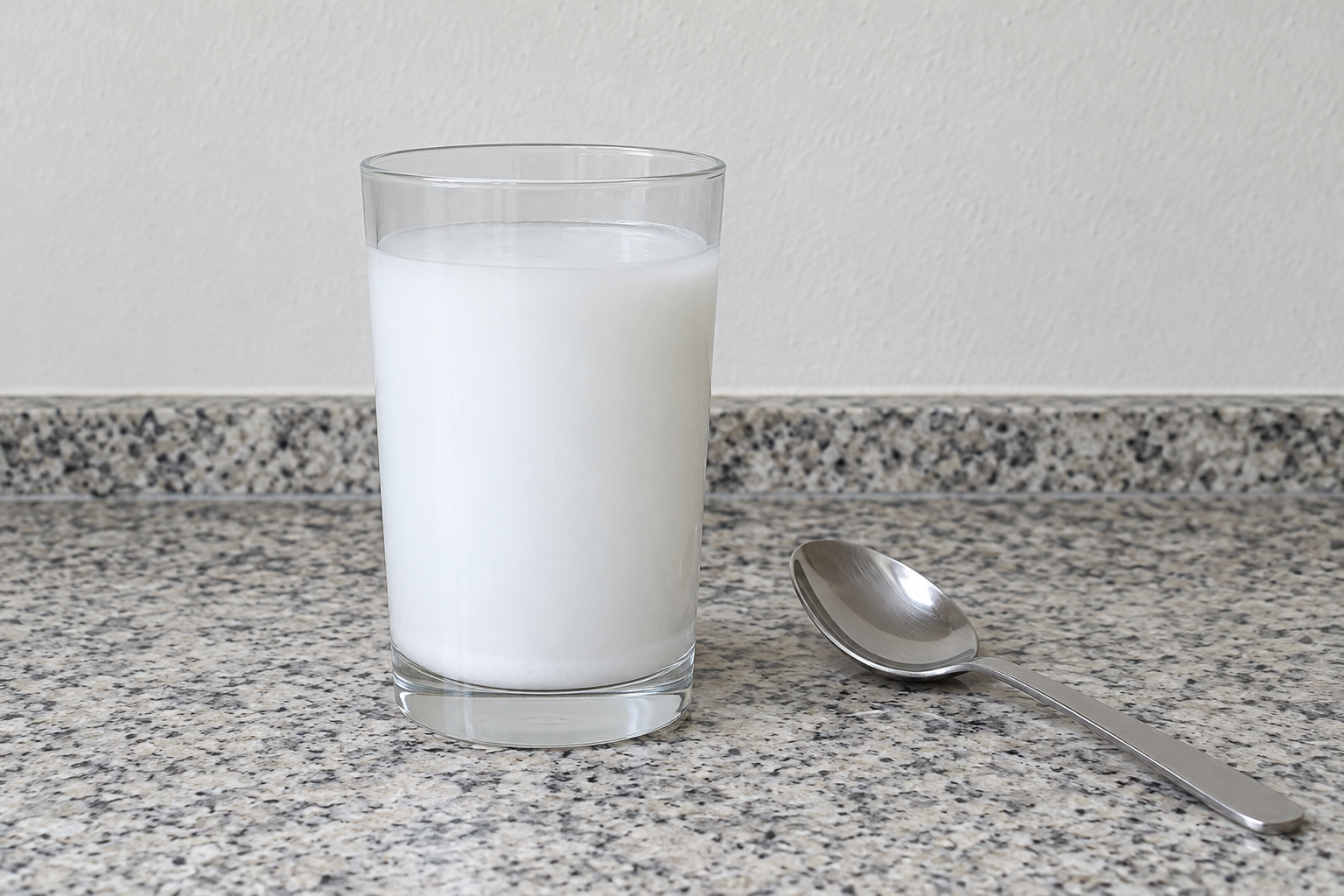
Stomach acid keeps the stomach's contents near pH 2.
In the stomach, the same Mg(OH)₂ dissolves within minutes.
Yet in the NaCl jar and the KNO₃ jar, the acid freed nothing.
Given a salt and a pH change, which way does the salt's solubility move?
Part 2Three steps to a verdict
You judge the salt from the fate of its ions.
First, name the salt's ions.
Second, name what the pH change adds to the solution: H₃O⁺ when the chemist lowers the pH, OH⁻ when the chemist raises it.
Third, ask whether the added ion consumes one of the salt's ions, matches one of them, or neither.
The system replaces a consumed ion by dissolving more salt, so the solubility increases.
A matched ion is a common ion, and we've seen that a common ion lowers a salt's solubility.
When the added ion neither consumes nor matches any ion of the salt, the solubility stays the same.
Part 3Three salts, three verdicts
First case: CaF₂, and the chemist lowers the pH.
The ions are Ca²⁺ and F⁻, and the lowered pH means added H₃O⁺.
The added H₃O⁺ consumes CaF₂'s fluoride ions.
So the amount of dissolved CaF₂ grows.
Verdict: CaF₂'s solubility increases.
Second case: AgCl in the same few drops of dilute nitric acid. The pH change is the same; only the salt has changed.
The ions are Ag⁺ and Cl⁻: Ag⁺ is not a weak acid, and HCl is a strong acid, so Cl⁻ is not a weak base.
The added H₃O⁺ consumes none of AgCl's ions.
It matches none of them either: AgCl releases no H₃O⁺.
So the amount of dissolved AgCl does not change.
Verdict: AgCl's solubility stays the same.
Third case: Mg(OH)₂ again, and this time the chemist raises the pH with a little strong base.
The ions are Mg²⁺ and OH⁻, and the raised pH means added OH⁻.
The added OH⁻ matches one of the salt's own ions: Mg(OH)₂ releases OH⁻ itself.
We've seen that an ion already in a solution that the dissolving salt also releases is called a common ion.
We've seen that a salt is less soluble in a solution that already contains one of its ions than it is in pure water.
So less Mg(OH)₂ dissolves in the base than in pure water.
Verdict: Mg(OH)₂'s solubility decreases.
Only a matched ion gives a decrease, and H₃O⁺ is never one of a salt's own ions.
Here are the three verdicts in one table.
| salt | the pH change | what the added ion does | verdict |
|---|---|---|---|
| CaF₂ | the chemist lowers the pH | H₃O⁺ consumes F⁻ | solubility increases |
| AgCl | the chemist lowers the pH | H₃O⁺ consumes none, matches none | solubility stays the same |
| Mg(OH)₂ | the chemist raises the pH | OH⁻ matches the salt's own OH⁻ | solubility decreases |
Back to the milk of magnesia: in the stomach, the added H₃O⁺ consumes the salt's hydroxide ions, so the solid Mg(OH)₂ dissolves within minutes.
Judge whether a salt's solubility increases, decreases, or stays the same under a stated pH change, and justify the verdict from the acid-base fate of the salt's ions.
Part 4Check what you just learned
Check — multiple choice
PbF₂ is a slightly soluble salt. A chemist stirs a few drops of dilute strong acid into a saturated PbF₂ mixture, lowering the pH. What happens to PbF₂'s solubility?
Feedback if chosen: Correct. The ions are Pb²⁺ and F⁻; the lowered pH means added H₃O⁺; and F⁻ is an ion the added H₃O⁺ consumes, so the verdict is increases.
Feedback if chosen: This option is wrong — you gave a consumed ion the common-ion verdict. A decrease needs a matched ion, and the added H₃O⁺ is not one of PbF₂'s own ions.
Feedback if chosen: This option is wrong — you read F⁻ as a neutral ion. HF is a weak acid, so F⁻ is a weak base, and the added H₃O⁺ consumes it.
Check — multiple choice
More PbF₂ dissolves after a chemist lowers the pH of its saturated mixture. Why?
Feedback if chosen: This option is wrong — you matched the added ion instead of reacting it. A common ion is an ion the salt itself releases, and PbF₂ releases Pb²⁺ and F⁻, never H₃O⁺; we've also seen that a common ion lowers a salt's solubility, never raises it.
Feedback if chosen: This option is wrong — you let the acid change the constant. Only a temperature change changes an equilibrium constant; the added H₃O⁺ moves the system, not its Ksp.
Feedback if chosen: This option is wrong — you dissolved the solid with no equilibrium at all. The acid reacts with dissolved fluoride ions, and the dissolution then shifts to replace them.
Feedback if chosen: Correct. The consumption removes a product of the dissolution, and the system shifts toward replacing the lost fluoride ions by dissolving more PbF₂.
Check — multiple choice
Ni(OH)₂ is a slightly soluble salt. A chemist stirs a little strong base into a saturated Ni(OH)₂ mixture, raising the pH. What happens to Ni(OH)₂'s solubility?
Feedback if chosen: This option is wrong — you sent the added OH⁻ to consume an ion. Ni(OH)₂ has no weak-acid ion for the OH⁻ to react with; the added OH⁻ matches the salt's own hydroxide instead.
Feedback if chosen: Correct. The added OH⁻ matches an ion the salt itself releases, a common ion, and a salt is less soluble in a solution that already contains one of its ions.
Feedback if chosen: This option is wrong — you gave the added OH⁻ no relation to the salt. Ni(OH)₂ releases OH⁻ itself, so the added OH⁻ is a matched ion, and a matched ion lowers the solubility.
Check — multiple choice
AgBr is a slightly soluble salt. Nina says that stirring a little dilute nitric acid into a saturated AgBr mixture will not change how much AgBr dissolves, because neither Ag⁺ nor Br⁻ is a weak acid, a weak base, or hydroxide. Is Nina correct?
Feedback if chosen: Correct. The added H₃O⁺ consumes none of AgBr's ions and matches none of them, so the solubility stays the same.
Feedback if chosen: This option is wrong — you let the acid free a salt of neutral ions. HBr is a strong acid, so Br⁻ is not a weak base, and Ag⁺ is not a weak acid; the added acid finds nothing to react with.
AP practice — a real long question: methanoic acid
Outcome: Score a real 10-point long question against its released rubric: a weak acid walked from its Ka expression through a pH calculation, a mixture verdict, and three earlier-unit callbacks.
Part 1Pacing a ten-point long question
The free-response section gives you 7 questions in 105 minutes: questions 1 to 3 are 10-point long questions, so each has a budget of about 23 minutes.
The question below is the real question 1 from the 2021 exam — its wording is the exam's, apart from the two adapted parts the note below names. One question walks one substance, methanoic acid, through five units of the course.
The exam names the acid by its systematic name: methanoic acid, HCOOH, is the acid these pages have called formic acid.
Parts (a), (b) and (d) are this unit's points: the Ka expression, a weak-acid pH, and the verdict on an acid-base mixture.
Parts (c), (e), (f) and (g) reach back: a Lewis diagram from Unit 2, a redox verdict from Unit 4, a gas calculation from Unit 3, and a catalyst fact from Unit 5. A real long question folds earlier units in exactly like this.
Set a 23-minute timer and answer every part on paper before revealing the model. Keep your periodic table and equation sheet beside you, as in the exam. Show the work for every calculated value — the exam awards no calculation point without it — and report each value to the number of digits the data justify. Two parts are adapted: the exam's Lewis-diagram part asks you to describe the completed diagram instead of drawing it, and the exam's pressure graph is given as its reading.
Free-response question
Source note (not shown as part of the question): 2021 FRQ Q1 (real past question, COMPLETE 10-pt conversion, VERBATIM from ap21-frq-chemistry pp. 2–4; the D2 formic/methanoic assessment reservation consumed per the ledger and ADJUDICATIONS D2(adj); rubric from ap21-sg-chemistry; part (c) draw→describe and part (f) graph→stated-datum conversions per CARD-ASSESS-2 and the record — JAMES CARD lines owed; interstitial equations folded into part prompts per the U7-P1 departure precedent)
Methanoic acid, HCOOH, ionizes according to the following equation. HCOOH(aq) + H₂O(l) ⇌ H₃O⁺(aq) + HCOO⁻(aq), with Ka = 1.8 × 10⁻⁴.
(a) Write the expression for the equilibrium constant, Ka, for the reaction. [1 point]
(b) Calculate the pH of a 0.25 M solution of HCOOH. [2 points]
(c) On the exam, this part shows a box with the atoms of HCOOH already placed — an O above the C, and the row H, C, O, H — and asks you to complete the Lewis electron-dot diagram, showing all bonding and nonbonding valence electrons. Describe the completed diagram instead: state which carbon-oxygen bond is a double bond, what every other bond is, and how many nonbonding pairs sit on each atom. [1 point]
(d)(i) In aqueous solution, the compound H₂NNH₂ reacts according to the following equation. H₂NNH₂(aq) + H₂O(l) ⇌ H₂NNH₃⁺(aq) + OH⁻(aq), with Kb = 1.3 × 10⁻⁶. A 50.0 mL sample of 0.25 M H₂NNH₂(aq) is combined with a 50.0 mL sample of 0.25 M HCOOH(aq). Write the balanced net ionic equation for the reaction that occurs when H₂NNH₂ is combined with HCOOH. [1 point]
(d)(ii) Is the resulting solution acidic, basic, or neutral? Justify your answer. [1 point]
(e) When a catalyst is added to a solution of HCOOH(aq), the reaction represented by the following equation occurs. HCOOH(aq) → H₂(g) + CO₂(g). Is the reaction a redox reaction? Justify your answer. [1 point]
(f) The reaction occurs in a rigid 4.3 L vessel at 25 °C, and the total pressure is monitored as the reaction proceeds. On the exam, a graph shows the total pressure against time: it rises from 0 atm and levels off at 24 atm, where it stays. The vessel originally did not contain any gas. Calculate the number of moles of CO₂(g) produced in the reaction. (Assume that the amount of CO₂(g) dissolved in the solution is negligible.) [2 points]
(g) After the reaction has proceeded for several minutes, does the amount of catalyst increase, decrease, or remain the same? Justify your answer. [1 point]
✓ Model response (the key)
(a)
Ka takes the equilibrium concentrations of the two product ions over the molecular acid; water is a pure liquid and stays out of the expression.
Ka = [H₃O⁺][HCOO⁻]/[HCOOH]
(b)
The solution starts at 0.25 M HCOOH. Let x be the [H₃O⁺] the ionization produces: at equilibrium, [H₃O⁺] = [HCOO⁻] = x and [HCOOH] = 0.25 − x.
1.8 × 10⁻⁴ = x²/(0.25 − x)
Assume x is small next to 0.25, so that 0.25 − x ≈ 0.25.
x² = 1.8 × 10⁻⁴ × 0.25, so x = 0.0067 M.
Check the assumption: 0.0067 ÷ 0.25 = 2.7%, which is below 5%, so the approximation is valid.
pH = −log(0.0067) = 2.17
(c)
The carbon bonds to three neighbors: the lone H, the O above it, and the O of the O–H group.
The bond from the carbon to the O above it is a double bond; every other bond is a single bond.
Each oxygen carries two nonbonding pairs; the carbon and the hydrogens carry none.
That places five bonds (10 bonding electrons) and four nonbonding pairs (8 electrons): 18 valence electrons in all, exactly what the atoms supply (4 + 2 × 6 + 2 × 1 = 18).
(d)(i)
Both HCOOH and H₂NNH₂ are weak, so each stays mostly molecular in solution, and each is written whole in the net ionic equation.
The acid transfers a proton to the base:
H₂NNH₂(aq) + HCOOH(aq) → H₂NNH₃⁺(aq) + HCOO⁻(aq)
(d)(ii)
The solution is acidic.
Equal moles of acid and base react, so the mixture holds H₂NNH₃⁺ and HCOO⁻.
H₂NNH₃⁺ is the acid among the major species: Ka(H₂NNH₃⁺) = Kw/Kb = (1.0 × 10⁻¹⁴)/(1.3 × 10⁻⁶) = 7.7 × 10⁻⁹, with Kw taken at 25 °C.
HCOO⁻ is the base: Kb(HCOO⁻) = Kw/Ka = (1.0 × 10⁻¹⁴)/(1.8 × 10⁻⁴) = 5.6 × 10⁻¹¹, with Kw taken at 25 °C.
The Ka of H₂NNH₃⁺ is greater than the Kb of HCOO⁻, so the production of H₃O⁺(aq) occurs to a greater extent than the production of OH⁻(aq).
(e)
The reaction is a redox reaction.
In HCOOH the oxidation number of hydrogen is +1; in H₂(g) it is 0, so hydrogen is reduced.
Equally acceptable: in HCOOH the oxidation number of carbon is +2; in CO₂(g) it is +4, so carbon is oxidized. Either change earns the point.
(f)
The balanced equation makes H₂(g) and CO₂(g) in equal numbers of moles, so each gas supplies half of the total pressure.
P_CO₂ = 24 atm ÷ 2 = 12 atm
The ideal gas equation, PV = nRT, rearranges to give n.
n = (12 atm)(4.3 L)/((0.08206 L·atm·mol⁻¹·K⁻¹)(298 K)) = 2.1 mol
(g)
The amount of catalyst remains the same.
In a catalyzed reaction, the net amount of catalyst stays constant: the reaction consumes the catalyst in one step and re-forms it in another, so the reaction does not use it up.
Scoring rubric — 10 points available
- (a) One point is earned for the correct expression: Ka = [H₃O⁺][HCOO⁻]/[HCOOH]. [1 pt]
- (b) One point is earned for the correct calculated concentration of H₃O⁺, with the work shown: x² /(0.25 − x) = 1.8 × 10⁻⁴, and with x assumed small next to 0.25, x = [H₃O⁺] = 0.0067 M. [1 pt]
- (b) One point is earned for the correct calculated value of the pH, consistent with your [H₃O⁺]: pH = −log(0.0067) = 2.17. [1 pt]
- (c) One point is earned for describing the correct completed diagram: the carbon-oxygen bond to the O above the C is a double bond; the C–H, C–O and O–H bonds are single bonds; each oxygen carries two nonbonding pairs, and no other atom carries any. [1 pt]
- (d)(i) One point is earned for the correct balanced equation (state symbols not required): H₂NNH₂ + HCOOH → H₂NNH₃⁺ + HCOO⁻. [1 pt]
- (d)(ii) One point is earned for 'acidic' AND a valid justification: the Ka of H₂NNH₃⁺ is greater than the Kb of HCOO⁻, so the production of H₃O⁺(aq) occurs to a greater extent than the production of OH⁻(aq). A bare 'acidic' with no comparison of a valid pair of constants (Ka of H₂NNH₃⁺ vs Kb of HCOO⁻, or equivalently Ka of HCOOH vs Kb of H₂NNH₂) does not earn the point. [1 pt]
- (e) One point is earned for 'yes' AND a valid justification. Accept one of the following: the oxidation number of hydrogen changes from +1 in HCOOH to 0 in H₂; OR the oxidation number of carbon changes from +2 in HCOOH to +4 in CO₂. [1 pt]
- (f) One point is earned for the correct calculated pressure of CO₂ (may be implicit in later work): 24 atm total × 1 atm CO₂ per 2 atm of product = 12 atm CO₂. [1 pt]
- (f) One point is earned for the correct calculated number of moles of CO₂, with the work shown: n = PV/RT = (12 atm)(4.3 L)/((0.08206 L·atm·mol⁻¹·K⁻¹)(298 K)) = 2.1 mol. [1 pt]
- (g) One point is earned for 'remain the same' AND a valid justification: in a catalyzed reaction the net amount of catalyst is constant. [1 pt]
AP practice — a real long question: the titration of ascorbic acid
Outcome: Score six points of a real 10-point long question: a Unit 1 callback on the way in, then this unit's points — a molarity read off a titration curve, a pKa from the half-equivalence point, and a buffer ratio from the pH.
Part 1A long question built around one titration curve
The question below is the real question 2 from the 2025 exam — its wording is the exam's. One question walks one substance, ascorbic acid (vitamin C), from its chemical composition to its titration curve.
Four of its ten points are omitted here: two parts ask Unit 5 questions about the reaction's rate data, and one part reads a pair of drawn Lewis diagrams this course does not reproduce. The parts below carry the question's other six points.
Part A reaches back to Unit 1: moles from a mass, and an empirical formula from combustion data.
Part B is this unit's territory: everything the exam asks there is read off, or computed from, one titration curve.
Answer both items below on paper as one question — about 14 minutes for these six points — before revealing either model. Keep your periodic table and equation sheet beside you, as in the exam. Show the work for every calculated value, and report each value to the number of digits the data justify.
Free-response question
Source note (not shown as part of the question): 2025 FRQ Q2, parts A(i)–A(ii) (real past question, VERBATIM from ap25-frq-chemistry p. 6; SPLIT-USE: parts C(i)/C(ii)/D NOT consumed — kinetics fence + the U7-P2 Lewis-exclusion class, JAMES CARD + coordinator USAGE.md row; rubric from ap25-sg-chemistry points 01–03; A parts are deliberate U1 retrieval — the page says so above)
Answer the following questions about ascorbic acid (vitamin C). A student combusts a sample of ascorbic acid, CₓHᵧOₓ, to determine its chemical composition. The only products of the reaction are 0.2400 mol of CO₂ and 2.883 g of H₂O.
A(i) Calculate the number of moles of H₂O produced. [1 point]
A(ii) The mole ratio of carbon (C) to oxygen (O) is 1:1 in ascorbic acid. Based on this information and your answer to part A(i), determine the empirical formula of ascorbic acid. [2 points]
✓ Model response (the key)
A(i)
Moles of H₂O = 2.883 g ÷ 18.02 g/mol = 0.1600 mol
A(ii)
Each H₂O carries two H atoms: moles of H = 2 × 0.1600 mol = 0.3200 mol.
Each CO₂ carries one C atom: moles of C = 0.2400 mol.
The C:O mole ratio is 1:1, so moles of O = 0.2400 mol.
C : H : O = 0.2400 : 0.3200 : 0.2400 = 3 : 4 : 3
The empirical formula of ascorbic acid is C₃H₄O₃.
Scoring rubric — 3 points available
- A(i) One point is earned for the correct calculated value, with the work shown: 2.883 g H₂O × (1 mol H₂O / 18.02 g H₂O) = 0.1600 mol H₂O. [1 pt]
- A(ii) One point is earned for the correct calculated number of moles of H (may be implicit): 0.1600 mol H₂O × 2 mol H per 1 mol H₂O = 0.3200 mol H. [1 pt]
- A(ii) One point is earned for the correct empirical formula, from the ratio (moles of C) : (moles of H) : (moles of O) = 0.2400 : 0.3200 : 0.2400 = 3 : 4 : 3, with the C:O ratio given as 1:1: C₃H₄O₃. [1 pt]
The question's remaining points arrive at this unit: the same acid, now in a flask under a buret.
Free-response question
Source note (not shown as part of the question): 2025 FRQ Q2, parts B(i)–B(iii) (real past question, continued from the previous item — the engine shows one figure per item; VERBATIM from ap25-frq-chemistry p. 6; rubric from ap25-sg-chemistry points 04–06; the released titration curve reconstructed in the course titracurve family, computed from the released chemistry — review-accuracy flag P-1 in qa/REVIEW_PRACTICE_U8.md; fresh U8 points)
Ascorbic acid, HAsc(aq), acts as a weak acid, as shown in the equation. HAsc(aq) + H₂O(l) ⇌ H₃O⁺(aq) + Asc⁻(aq). The following titration curve was produced when a 10.0 mL sample of HAsc(aq) was titrated using 0.0550 M NaOH(aq).
B(i) Calculate the molar concentration of the ascorbic acid solution. [1 point]
B(ii) From the titration curve, determine the approximate pKa of ascorbic acid. [1 point]
B(iii) What is the value of the ratio [Asc⁻]/[HAsc] when the pH of the solution is 4.7? [1 point]
✓ Model response (the key)
B(i)
The curve's steep rise sits at 16.0 mL of added NaOH: the equivalence volume.
Moles of NaOH at equivalence = 0.0160 L × 0.0550 mol/L = 8.80 × 10⁻⁴ mol.
HAsc and NaOH react one to one, so the sample held 8.80 × 10⁻⁴ mol of HAsc.
[HAsc] = 8.80 × 10⁻⁴ mol ÷ 0.0100 L = 0.0880 M
B(ii)
At half the equivalence volume, half of the HAsc has been converted to Asc⁻, so [HAsc] = [Asc⁻] and the pH equals the pKa.
Half the equivalence volume is 8.0 mL, and the curve reads pH ≈ 4.1 there.
pKa ≈ 4.1
B(iii)
pH = pKa + log([Asc⁻]/[HAsc])
4.7 = 4.1 + log([Asc⁻]/[HAsc]), so log([Asc⁻]/[HAsc]) = 0.6.
Undoing the log, the ratio is 10 raised to the power 0.6.
[Asc⁻]/[HAsc] = 4.0
Scoring rubric — 3 points available
- B(i) One point is earned for the correct calculated value, using the equivalence volume read from the titration curve, with the work shown: 0.0160 L × 0.0550 mol/L = 8.80 × 10⁻⁴ mol of HAsc, and 8.80 × 10⁻⁴ mol ÷ 0.0100 L = 0.0880 M. [1 pt]
- B(ii) One point is earned for the correct pKa, read as the pH at the half-equivalence point: pKa ≈ 4.1 (the released scoring guidelines accept 4.0 to 4.3). [1 pt]
- B(iii) One point is earned for the correct ratio, consistent with your part B(ii) pKa, with the work shown: 4.7 = pKa + log([Asc⁻]/[HAsc]), so the ratio = 10 raised to the power (4.7 − 4.1) = 4.0. [1 pt]
Checkpoint — the whole unit, from pH arithmetic to titration curves, buffer capacity, and solubility
Check — numeric entry
Gastric juice is the acidic fluid of the stomach. A sample at 25 °C has pOH = 12.57. Calculate the sample's [H₃O⁺]. Give your answer in M, to 2 significant figures.
Tolerance: 0.0005
Feedback when correct: Correct. pH = 14.00 − 12.57 = 1.43 at 25 °C, and [H₃O⁺] = 10^(−1.43) = 3.7 × 10⁻² M — strongly acidic, as stomach fluid is.
Anticipated wrong answers (feedback shown):
| 2.7e-13 | A value this small comes from the hydroxide side of the chain: 10^(−pOH) gives [OH⁻], not [H₃O⁺]. Go through pH = 14.00 − pOH at 25 °C first, then take 10^(−pH). |
| 1.43 | This value is the pH, not a concentration. Finish the chain: [H₃O⁺] = 10^(−pH). |
Worked solution revealed after a second miss
Write down the values from the question
pOH = 12.57
Write down the expression
pH = 14.00 − pOH at 25 °C
[H₃O⁺] = 10^(−pH)
Substitute in the values, and calculate
pH = 14.00 − 12.57 = 1.43
[H₃O⁺] = 10^(−1.43)
[H₃O⁺] = 3.7 × 10⁻² M
Check — numeric entry
The curve shows 20.0 mL of 0.200 M butanoic acid, a weak acid, titrated with 0.100 M NaOH. Read the equivalence point's titrant volume from the curve. Give your answer to 1 decimal place.
Tolerance: 1.0
Feedback when correct: Correct. The equivalence point sits at the curve's steepest climb, at 40.0 mL. The arithmetic agrees: the acid starts with 20.0 × 0.200 = 4.00 mmol, and matching it takes 4.00 mmol of the 0.100 M NaOH — 40.0 mL.
Anticipated wrong answers (feedback shown):
| 20.0 | This volume is the acid sample's own 20.0 mL — and also half the equivalence volume. Equal volumes are not the match: the moles match at the equivalence point, which sits at the curve's steepest climb. Read the volume there. |
| 8.8 | This value is the pH at the equivalence point, not its volume. Read down from the steepest climb to the volume axis instead. |
Check — multiple choice
A chemist needs a solution whose pH sits exactly at a chosen weak acid's pKa. Which of the following compositions gives that pH?
Feedback if chosen: This option is wrong — pH = pKa is a property of a half-and-half mixture, not of the acid alone. A lone weak acid ionizes only slightly, and its pH moves with its concentration; nothing pins it at the pKa.
Feedback if chosen: This option is wrong — with more acid than base, the ratio [A⁻]/[HA] sits below one, its log is negative, and the pH sits below the pKa.
Feedback if chosen: This option is wrong — with more base than acid, the ratio [A⁻]/[HA] sits above one, its log is positive, and the pH sits above the pKa.
Feedback if chosen: Correct. With the two members equal, the ratio [A⁻]/[HA] is one, the log term is zero, and the pH equals the pKa exactly.
Check — multiple choice
Two nitrous acid buffers are prepared at 25 °C, each holding HNO₂ and NaNO₂ in a two-to-one ratio: the first holds 0.60 M HNO₂ with 0.30 M NaNO₂, and the second holds 0.060 M HNO₂ with 0.030 M NaNO₂. Which of the following correctly compares the two buffers?
Feedback if chosen: This option is wrong — you read dilution as changing nothing. The ratio survives dilution, so the pH claim holds; but capacity follows the absolute amounts, and the 0.060 M/0.030 M buffer holds a tenth the members, so it consumes a tenth the addition.
Feedback if chosen: This option is wrong on both halves — capacity follows the absolute member amounts, which differ tenfold between the buffers, and the pH follows the member ratio, which is the same two-to-one in both.
Feedback if chosen: Correct. The pH follows the member ratio, and both buffers hold the same two-to-one ratio, so they hold essentially the same pH. Capacity follows the absolute amounts: the 0.60 M/0.30 M buffer holds ten times the members, so it consumes ten times the addition before its ratio moves far.
Feedback if chosen: This option is wrong — the capacity half is right, but the pH follows the member ratio, not the absolute concentrations, and both buffers hold the same two-to-one ratio.
Check — numeric entry
The curve shows 40.0 mL of 0.0500 M glycolic acid, a weak monoprotic acid, titrated with 0.100 M NaOH. Find the acid's pKa from the curve, to the nearest 0.1.
Tolerance: 0.15
Feedback when correct: Correct. The equivalence point sits at the steepest climb, at 20.0 mL, so the half-equivalence point sits at 10.0 mL. There the acid and its conjugate base are present in equal concentrations, and the pH equals the pKa: about 3.8.
Anticipated wrong answers (feedback shown):
| 8.2 | This value is the pH at the equivalence point itself. The pKa is read earlier, at half the equivalence volume, where the acid and its conjugate base are equal. |
| 2.6 | This value is the starting pH, before any base went in. The pKa is read at half the equivalence volume, where the acid and its conjugate base are equal. |
Check — multiple choice
MnCO₃, manganese(II) carbonate, is a slightly soluble salt. A chemist stirs a few drops of dilute nitric acid into a saturated MnCO₃ mixture. Which of the following identifies the species the added H₃O⁺ consumes, and the direction the dissolution equilibrium then shifts?
Feedback if chosen: Correct. The carbonate ion is a weak base, so the added H₃O⁺ consumes carbonate ions in the solution. That removes a dissolution product, and the equilibrium shifts toward more dissolving, partially replacing what was consumed.
Feedback if chosen: This option is wrong — you pointed the shift at the solid. The shift partially counteracts the stress: with carbonate ions consumed, the dissolution shifts toward replacing them, and that direction is more dissolving.
Feedback if chosen: This option is wrong — you sent the H₃O⁺ after the cation. Mn²⁺ is not a base: it cannot accept a proton. The ion the acid consumes is the carbonate ion, the weak base.
Feedback if chosen: This option is wrong — you read both ions as spectators. Mn²⁺ is a spectator here, but the carbonate ion is a weak base, and the added H₃O⁺ consumes it.
Check — multiple choice
| Acid | pKa at 25 °C |
|---|---|
| lactic acid | 3.85 |
| hypobromous acid, HOBr | 8.60 |
| cyanoacetic acid | 2.47 |
The table lists three weak acids with their pKa values at 25 °C. Which of the following ranks the acids from strongest to weakest?
Feedback if chosen: This option is wrong — this is the table's own row order, not a ranking. Rank by pKa: the smallest pKa, cyanoacetic acid's 2.47, marks the strongest acid.
Feedback if chosen: Correct. A smaller pKa means a larger Ka, so the strongest acid has the smallest pKa: cyanoacetic acid at 2.47, then lactic acid at 3.85, with hypobromous acid, pKa 8.60, the weakest.
Feedback if chosen: This option is wrong — you ranked the largest pKa as the strongest. The negative log inverts the scale: a larger Ka gives a smaller pKa, so the smallest pKa marks the strongest acid.
Feedback if chosen: This option is wrong — the strongest acid is placed right, but the other two are ranked with the larger pKa as stronger. One rule orders the whole list: lactic acid's 3.85 sits below hypobromous acid's 8.60, so lactic acid is the stronger of those two.
Check — numeric entry
The curve shows malonic acid, an acid with two acidic protons, titrated with NaOH. Find pKa₂, the second proton's pKa, from the curve, to the nearest 0.1.
Tolerance: 0.15
Feedback when correct: Correct. The second proton's buffer region lies between the first equivalence point, at 15.0 mL, and the second, at 30.0 mL. Its half-equivalence point sits midway, at 22.5 mL, and the pH there reads the second proton's pKa: about 5.7.
Anticipated wrong answers (feedback shown):
| 2.9 | This value is read in the first buffer region, so it is pKa₁, the first proton's pKa. Read pKa₂ in the region between the two equivalence points. |
| 4.3 | This value is the pH at the first equivalence point, at 15.0 mL — half of the second equivalence volume, but not a half-equivalence point. The second proton's half-equivalence sits midway through its own buffer region, at 22.5 mL. |
Check — multiple choice
| Indicator | pKa at 25 °C |
|---|---|
| methyl orange | 3.5 |
| phenolphthalein | 9.4 |
| bromothymol blue | 7.1 |
| alizarin yellow R | 11.0 |
A chemist titrates a solution of hydroxylamine, NH₂OH, a weak base, with hydrochloric acid. The table lists four indicators with their pKa values at 25 °C. Which indicator from the table suits this titration best?
Feedback if chosen: Correct. At this titration's equivalence point the flask holds the hydroxylammonium ion, a weak acid, so the equivalence pH sits below 7. The chosen indicator's pKa should sit near that pH, so the color changes on the steep fall — and methyl orange's 3.5 is the only pKa on the table below 7.
Feedback if chosen: This option is wrong — you placed the equivalence point at neutral. At equivalence the flask holds hydroxylammonium ions, a weak acid, so the equivalence pH sits below 7, not at it.
Feedback if chosen: This option is wrong — you carried the weak acid–strong base habit across. Phenolphthalein suits a titration whose equivalence pH sits above 7; this titration, a weak base titrated with a strong acid, ends below 7.
Feedback if chosen: This option is wrong — you matched the indicator to the basic analyte. The choice follows the equivalence solution, not the starting one: at equivalence the base has all been converted to its conjugate acid, and the pH sits below 7.
Check — multiple choice
Buffer P holds 0.20 mol of hypobromous acid, HOBr, and 0.90 mol of its conjugate base, OBr⁻. Buffer Q holds 0.50 mol of HOBr and 0.50 mol of OBr⁻, in the same total volume. A chemist plans to pour the same small amount of NaOH solution into each buffer. Which buffer better resists the planned addition, and why?
Feedback if chosen: This option is wrong — the total misleads here. Added OH⁻ is consumed by the acid member, HOBr, and buffer P holds only 0.20 mol of it: P's larger total sits mostly in the member the addition never touches.
Feedback if chosen: This option is wrong — the base member cannot consume added base. OBr⁻ has no proton to give an added OH⁻; the member that consumes added base is the acid member, HOBr, and buffer Q holds more of it.
Feedback if chosen: This option is wrong — the verdict is right but the ground is false twice over: buffer Q's total, 1.00 mol, is the smaller of the two, and capacity against a named addition follows the consuming member, not the total.
Feedback if chosen: Correct. Added OH⁻ is consumed by the acid member: HOBr + OH⁻ → OBr⁻ + H₂O. Buffer Q holds 0.50 mol of HOBr against buffer P's 0.20 mol, so Q consumes more added base before its member ratio, and with it its pH, moves far.
Check — multiple choice
Cesium perchlorate, CsClO₄, is a slightly soluble salt. A chemist stirs a few drops of dilute hydrochloric acid into a saturated CsClO₄ mixture, lowering the pH. What happens to CsClO₄'s solubility?
Feedback if chosen: This option is wrong — you treated the perchlorate ion as a base the added H₃O⁺ consumes. ClO₄⁻ is the conjugate base of a strong acid, HClO₄, so it is negligible as a base: the H₃O⁺ leaves it untouched.
Feedback if chosen: Correct. Neither of the salt's ions reacts with the added H₃O⁺: Cs⁺ is neither an acid nor a base, and ClO₄⁻, the conjugate base of a strong acid, is negligible as a base. Nothing the dissolution produces is consumed, so the equilibrium does not shift and the solubility stays the same.
Feedback if chosen: This option is wrong — you expected the added ions to crowd the salt out of solution. The acid supplies H₃O⁺ and Cl⁻, and neither is an ion of CsClO₄, so no common-ion effect operates here.
Feedback if chosen: This option is wrong — the direction needs no Ksp value. Ksp sets how much of the salt dissolves; whether a pH change moves that amount follows from the ions' acid-base fates, and neither Cs⁺ nor ClO₄⁻ reacts with H₃O⁺.
Check — multiple choice
The curve shows a 25.0 mL sample of a monoprotic acid solution titrated with 0.100 M NaOH. Which of the following gives both the acid's pKa and the concentration of the original acid solution?
Feedback if chosen: This option is wrong — 2.4 is the starting pH, before any base went in, not the pKa. The pKa is read at half the equivalence volume, 17.5 mL, where the pH sits near 4.0.
Feedback if chosen: This option is wrong — the pKa read is right, but 0.100 M is the titrant's own concentration. At equivalence the acid's moles equal the added titrant's: 35.0 mL × 0.100 M = 3.50 mmol, and 3.50 mmol in the acid's own 25.0 mL gives 0.140 M.
Feedback if chosen: This option is wrong — 8.4 is the pH at the equivalence point, not the pKa. The pKa is read at half the equivalence volume, 17.5 mL, where the two members are equal.
Feedback if chosen: Correct. The steepest climb sits at 35.0 mL, so the acid held 35.0 × 0.100 = 3.50 mmol in its 25.0 mL — a 0.140 M solution. At half the equivalence volume, 17.5 mL, the two members are equal and the pH reads the pKa: about 4.0.
Unit 8 test
Check — multiple choice
Which of the following describes the Brønsted-Lowry behavior available to the hydrogen oxalate ion, HC₂O₄⁻, in aqueous solution?
Feedback if chosen: This option is wrong — you saw only the donatable proton. HC₂O₄⁻ can donate that proton to give C₂O₄²⁻, and it can also accept one to form H₂C₂O₄.
Feedback if chosen: This option is wrong — you saw only the open site. HC₂O₄⁻ can accept a proton to form H₂C₂O₄, and it can also donate its remaining proton to give C₂O₄²⁻.
Feedback if chosen: Correct. HC₂O₄⁻ can donate its remaining proton (giving C₂O₄²⁻) and can accept a proton (forming H₂C₂O₄): it is amphoteric.
Feedback if chosen: This option is wrong — you ruled out both roles. The ion still carries one donatable proton, and it has room to accept one back.
Check — multiple choice
A solution has pH 8.30 at 25 °C. What is [H₃O⁺] in the solution, to 2 significant figures?
Feedback if chosen: Correct. [H₃O⁺] = 10^(−pH) = 10^(−8.30) = 5.0 × 10⁻⁹ M.
Feedback if chosen: This option is wrong — you read the pH's digits as the concentration. The pH is an exponent: [H₃O⁺] = 10^(−8.30) = 5.0 × 10⁻⁹ M.
Feedback if chosen: This option is wrong — you used only the whole-number part of the pH: 10⁻⁸. The 0.30 matters: 10^(−8.30) = 5.0 × 10⁻⁹ M.
Feedback if chosen: This option is wrong — you raised 10 to the negative pOH: 10^(−5.70) = 2.0 × 10⁻⁶ M is [OH⁻]. [H₃O⁺] = 10^(−8.30) = 5.0 × 10⁻⁹ M.
Check — multiple choice
At 10 °C, water's ion-product constant is Kw = 2.9 × 10⁻¹⁵. An aqueous solution held at 10 °C has pH 7.10. Which of the following classifies the solution?
Feedback if chosen: Correct. [H₃O⁺] = 10^(−7.10) = 7.9 × 10⁻⁸ M, and [OH⁻] = Kw/[H₃O⁺] = 2.9 × 10⁻¹⁵/7.9 × 10⁻⁸ = 3.7 × 10⁻⁸ M. [H₃O⁺] exceeds [OH⁻], so the solution is acidic.
Feedback if chosen: This option is wrong — you took pH 7.00 as the neutral mark. Neutral means [H₃O⁺] = [OH⁻]; with Kw = 2.9 × 10⁻¹⁵ that happens at pH 7.27, not at 7.00.
Feedback if chosen: This option is wrong — you read a pH above 7.00 as basic. The 7.00 benchmark belongs to 25 °C; here [H₃O⁺] = 7.9 × 10⁻⁸ M exceeds [OH⁻] = 3.7 × 10⁻⁸ M, so the solution is acidic.
Feedback if chosen: This option is wrong — the information given is enough. The supplied Kw turns [H₃O⁺] into [OH⁻], and comparing the two ion concentrations settles the classification.
Check — multiple choice
A potassium hydroxide solution has pH 11.80 at 25 °C. What is the concentration of the KOH, to 2 significant figures?
Feedback if chosen: This option is wrong — you computed 10^(−pH). That is [H₃O⁺], the scarce ion here. pOH = 14.00 − 11.80 = 2.20 at 25 °C, and [OH⁻] = 10^(−2.20) = 6.3 × 10⁻³ M.
Feedback if chosen: This option is wrong — you read the pOH's digits as the concentration. The pOH is an exponent: [OH⁻] = 10^(−2.20) = 6.3 × 10⁻³ M.
Feedback if chosen: Correct. pOH = 14.00 − 11.80 = 2.20 at 25 °C, and [OH⁻] = 10^(−2.20) = 6.3 × 10⁻³ M. KOH dissociates completely, so the KOH concentration equals [OH⁻].
Feedback if chosen: This option is wrong — you used only the whole-number part of the pOH: 10⁻². The 0.20 matters: 10^(−2.20) = 6.3 × 10⁻³ M.
Check — multiple choice
A weak acid, HA, ionizes in water: HA(aq) + H₂O(l) ⇌ H₃O⁺(aq) + A⁻(aq). Which of the following is the expression for its acid-ionization constant, Ka?
Feedback if chosen: This option is wrong — you inverted the ratio. The ionization's products go on top: Ka = [H₃O⁺][A⁻]/[HA].
Feedback if chosen: This option is wrong — you kept liquid water in the expression. A pure liquid is left out, so Ka = [H₃O⁺][A⁻]/[HA].
Feedback if chosen: This option is wrong — you wrote Kw, the ion product of water. The acid's own ionization gives Ka = [H₃O⁺][A⁻]/[HA].
Feedback if chosen: Correct. Ka puts the ionization's products over the intact acid, with liquid water omitted: Ka = [H₃O⁺][A⁻]/[HA].
Check — multiple choice
Separate solutions of 0.25 M HCl and 0.25 M HCN (Ka = 6.2 × 10⁻¹⁰ at 25 °C) are prepared. Which of the following compares the two solutions?
Feedback if chosen: This option is wrong — you matched the concentrations and stopped. Equal concentrations do not mean equal ionization: HCl ionizes completely, HCN barely ionizes, so [H₃O⁺] differs sharply.
Feedback if chosen: Correct. HCl ionizes completely, so its [H₃O⁺] is 0.25 M; HCN, with its tiny Ka, stays almost entirely intact. More H₃O⁺ means the lower pH.
Feedback if chosen: This option is wrong — you gave the weak acid the lower pH. HCN keeps most of its protons; HCl hands all of its to water, so the HCl solution holds far more H₃O⁺.
Feedback if chosen: This option is wrong — you asked for the volumes. pH follows the concentrations, not the amounts: the comparison stands at any volume.
Check — multiple choice
Phenol, C₆H₅OH, is a weak acid with Ka = 1.0 × 10⁻¹⁰ at 25 °C. What is the pH of a 0.20 M phenol solution, to 2 decimal places?
Feedback if chosen: This option is wrong — you dropped the concentration: √(1.0 × 10⁻¹⁰) = 1.0 × 10⁻⁵ gives 5.00. x = √(Ka × 0.20) = 4.5 × 10⁻⁶ M, so pH = 5.35.
Feedback if chosen: Correct. x²/0.20 = 1.0 × 10⁻¹⁰, so x = √(2.0 × 10⁻¹¹) = 4.5 × 10⁻⁶ M (0.0022% of 0.20 M, so the approximation is valid), and pH = −log(4.5 × 10⁻⁶) = 5.35.
Feedback if chosen: This option is wrong — you treated x as [OH⁻] and took 14.00 − 5.35. Phenol donates protons: x is [H₃O⁺], so pH = 5.35.
Feedback if chosen: This option is wrong — you computed the acid's pKa, −log Ka = 10.00. The question asks the solution's pH: x = √(Ka × 0.20) = 4.5 × 10⁻⁶ M, and pH = 5.35.
Check — multiple choice
Hydroxylamine, HONH₂, is a weak base with Kb = 1.1 × 10⁻⁸ at 25 °C. What is Ka of its conjugate acid, the hydroxylammonium ion, HONH₃⁺, to 2 significant figures?
Feedback if chosen: This option is wrong — you multiplied Kb by Kw. The pair's constants multiply to give Kw: Ka × Kb = Kw, so Ka = Kw/Kb = 1.0 × 10⁻¹⁴/1.1 × 10⁻⁸ = 9.1 × 10⁻⁷.
Feedback if chosen: This option is wrong — you handed the conjugate acid its base's own constant. The two differ: Ka × Kb = Kw at 25 °C, so Ka = 1.0 × 10⁻¹⁴/1.1 × 10⁻⁸ = 9.1 × 10⁻⁷.
Feedback if chosen: Correct. For any conjugate acid-base pair, Ka × Kb = Kw at 25 °C: Ka = 1.0 × 10⁻¹⁴/1.1 × 10⁻⁸ = 9.1 × 10⁻⁷.
Feedback if chosen: This option is wrong — you took the reciprocal of Kb alone: 1/(1.1 × 10⁻⁸) = 9.1 × 10⁷. Kw sits on top: Ka = Kw/Kb = 9.1 × 10⁻⁷.
Check — multiple choice
Arsenic acid, H₃AsO₄, is a far stronger acid in water than arsenous acid, H₃AsO₃. In each acid, every hydrogen atom is bonded to an oxygen atom. Which of the following best explains the difference in strength?
Feedback if chosen: Correct. The fourth oxygen pulls electron density away from the O–H bonds and spreads the conjugate base's negative charge over more oxygen atoms, so the proton leaves more easily.
Feedback if chosen: This option is wrong — you counted protons. Both acids carry three O–H hydrogens, and the number of donatable protons does not set how easily each one leaves.
Feedback if chosen: This option is wrong — you read a stronger bond as a stronger acid. A stronger O–H bond holds its proton more tightly; the extra oxygen in H₃AsO₄ weakens its O–H bonds.
Feedback if chosen: This option is wrong — you inverted the comparison. The extra oxygen gives H₃AsO₄'s conjugate base more oxygen atoms to spread its negative charge over, not fewer.
Check — multiple choice
Aqueous butanoic acid, CH₃CH₂CH₂COOH, a weak acid, is mixed with aqueous potassium hydroxide. Which of the following is the net ionic equation for the reaction that occurs?
Feedback if chosen: This option is wrong — you ionized the weak acid first. Butanoic acid stays mostly intact, so the acid molecule itself reacts: CH₃CH₂CH₂COOH + OH⁻ → CH₃CH₂CH₂COO⁻ + H₂O.
Feedback if chosen: This option is wrong — you wrote the molecular equation. KOH is a dissolved strong base and K⁺ never changes: a net ionic equation writes OH⁻ and drops the spectator.
Feedback if chosen: This option is wrong — you joined the two product ions into one formula. Potassium salts stay dissolved as separate ions, and the reaction consumes the acid molecule, not its anion.
Feedback if chosen: Correct. The weak acid keeps its proton until OH⁻ takes it: CH₃CH₂CH₂COOH + OH⁻ → CH₃CH₂CH₂COO⁻ + H₂O, with K⁺ a spectator throughout.
Check — multiple choice
Ethanolamine, HOCH₂CH₂NH₂, is a weak base. Each of the following mixtures is dissolved in enough water to make 1.0 L of solution. Which mixture produces a buffer?
Feedback if chosen: This option is wrong — you paired a strong acid with its salt. HBr ionizes completely and Br⁻ is a negligible base, so nothing in the mixture can absorb added acid.
Feedback if chosen: Correct. The HCl converts 0.15 mol of the ethanolamine into its conjugate acid, leaving 0.25 mol of the weak base beside 0.15 mol of its conjugate acid: both members, in large amounts.
Feedback if chosen: This option is wrong — you left no base member behind. The 0.20 mol of HCl converts all 0.20 mol of ethanolamine into its conjugate acid, and one member alone is not a buffer.
Feedback if chosen: This option is wrong — you mixed two strong partners. The neutralization leaves excess strong acid beside dissolved NaCl; no conjugate pair of a weak acid or base remains.
Check — multiple choice
A buffer with pH 3.80 is needed. It will be prepared from acrylic acid (pKa = 4.25 at 25 °C) and sodium acrylate. Which value is closest to the ratio [acrylate]/[acrylic acid] that the buffer requires?
Feedback if chosen: Correct. pH = pKa + log([acrylate]/[acrylic acid]), so log(ratio) = 3.80 − 4.25 = −0.45, and the ratio = 10^(−0.45) = 0.35: less acrylate than acid, as a pH below the pKa requires.
Feedback if chosen: This option is wrong — you reported the pH gap itself. The gap, −0.45, is the log of the ratio: the ratio = 10^(−0.45) = 0.35.
Feedback if chosen: This option is wrong — you set the members equal. Equal members put the pH at the pKa, 4.25; reaching 3.80 needs extra acid member: the ratio = 10^(−0.45) = 0.35.
Feedback if chosen: This option is wrong — you inverted the ratio: 10^(0.45) = 2.8 would put the pH at 4.70, above the pKa. The target sits below the pKa, so the ratio = 10^(−0.45) = 0.35.
Check — multiple choice
Hypochlorous acid, HOCl, has pKa = 7.54 at 25 °C. In a solution held at pH 6.00, which of the following describes the HOCl/OCl⁻ pair?
Feedback if chosen: Correct. The pH sits 1.54 units below the pKa, so the protonated form dominates: [HOCl]/[OCl⁻] = 10^(1.54), about 35 to 1.
Feedback if chosen: This option is wrong — you put the deprotonated form on top. OCl⁻ dominates only where the pH sits above the pKa, and 6.00 sits below 7.54.
Feedback if chosen: This option is wrong — equal forms need pH = pKa. The pH here sits 1.54 units below the pKa.
Feedback if chosen: This option is wrong — you brought in the total amount. The ratio of the two forms follows the pH and the pKa alone; the total sets how much of each form, never which one dominates.
Check — multiple choice
Ethylammonium nitrate, C₂H₅NH₃NO₃, is dissolved in water at 25 °C. Which of the following describes the resulting solution?
Feedback if chosen: This option is wrong — you classified by the parent amine. The dissolved cation is C₂H₅NH₃⁺, the conjugate acid of ethylamine, and it donates protons to water.
Feedback if chosen: This option is wrong — you treated both ions as spectators. NO₃⁻ is one, but C₂H₅NH₃⁺ is the conjugate acid of a weak base and donates protons to water.
Feedback if chosen: Correct. C₂H₅NH₃⁺ is the conjugate acid of a weak base, so it donates protons to water; NO₃⁻, from a strong acid, is a spectator. The solution is acidic.
Feedback if chosen: This option is wrong — you asked for a value. The direction needs none: a weak base's conjugate acid beside a spectator anion makes the solution acidic.
Check — multiple choice
A weak base is titrated with a strong acid, and the pH at the equivalence point is expected to be 5.6. Four indicators are available, with these pKa values at 25 °C: methyl orange (3.5), methyl red (5.0), bromothymol blue (7.1), and phenolphthalein (9.4). Which indicator best suits this titration?
Feedback if chosen: This option is wrong — you reached for the lowest pKa on the table. Its 3.5 sits 2.1 units below the expected equivalence pH; methyl red's 5.0 sits only 0.6 away.
Feedback if chosen: Correct. The chosen indicator's pKa should sit close to the equivalence pH: methyl red's 5.0 lies nearest to 5.6, so its color change lands on the steep rise through the equivalence point.
Feedback if chosen: This option is wrong — you matched the near-7 habit. The equivalence pH here is 5.6, and 7.1 sits 1.5 units above it; methyl red's 5.0 sits far closer.
Feedback if chosen: This option is wrong — you carried a familiar default across. This titration's equivalence pH is 5.6, and phenolphthalein's 9.4 sits 3.8 units from it; methyl red's 5.0 sits 0.6 away.
Check — multiple choice
The drawn curve is proposed for the titration of 25.0 mL of a 0.10 M weak monoprotic acid with 0.10 M NaOH at 25 °C, with the equivalence point marked. The drawing contains one error. Which of the following identifies it?
Feedback if chosen: This option is wrong — you treated the weak acid as strong. A 0.10 M weak acid ionizes only partly, so a starting pH near 3 is right.
Feedback if chosen: Correct. At the equivalence point the flask holds the acid's conjugate base, a weak base, so the equivalence pH sits above 7.00 at 25 °C; a marker at 7.00 belongs to a strong acid-strong base titration.
Feedback if chosen: This option is wrong — you flipped the direction. Adding base consumes H₃O⁺, so the pH climbs; a falling curve belongs to a base titrated with acid.
Feedback if chosen: This option is wrong — you erased the buffer region. Mid-titration the flask holds both conjugate members, and that mixture resists pH change: the gentle slope is correct.
Check — multiple choice
One buffer contains 0.10 mol each of pyridine and pyridinium chloride per liter; a second buffer contains 0.50 mol of each per liter. The second buffer neutralizes more added strong base before its pH changes substantially. Which of the following explains why?
Feedback if chosen: This option is wrong — you moved the pH with the amounts. Both buffers hold their members in a 1:1 ratio, and the ratio sets the pH: the two buffers start at the same pH.
Feedback if chosen: This option is wrong — you let concentration change a constant. Kb depends on the temperature alone; larger amounts change how much base the buffer can absorb, never its constant.
Feedback if chosen: This option is wrong — you sent the added base to the base member. Added OH⁻ is consumed by the conjugate-acid member, the pyridinium ion.
Feedback if chosen: Correct. Added strong base is consumed by the pyridinium ion, and the second buffer holds five times as much of it, so far more base is absorbed before the member ratio moves far.
Check — multiple choice
Separate saturated solutions of four salts stand at 25 °C, each above some undissolved solid. A few drops of dilute nitric acid are added to each. For which salt does the molar solubility stay essentially the same?
Feedback if chosen: This option is wrong — you kept the carbonate fixed. CO₃²⁻ is a weak base: the added acid consumes it, the dissolution shifts toward more dissolving, and the solubility increases.
Feedback if chosen: This option is wrong — hydroxide reacts with the added acid. Consuming OH⁻ pulls the dissolution toward more dissolving, so the solubility increases.
Feedback if chosen: This option is wrong — sulfite is a weak base. The added acid consumes SO₃²⁻, so the dissolution shifts toward more dissolving and the solubility increases.
Feedback if chosen: Correct. K⁺ is neither an acid nor a base, and ClO₄⁻ is the negligible conjugate base of a strong acid: the added acid consumes neither ion, so nothing shifts, and the solubility stays essentially the same.
Free-response question
Source note (not shown as part of the question): 2024 FRQ Q1, VERBATIM (real past question, reserved to this test in past_exams/USAGE.md; text re-verified against ap24-frq-chemistry.pdf pp. 5-7 at this build; rubric point-for-point from ap24-apc-chemistry-q1.txt). FIVE declared departures, each with the released wording quoted in its part or listed here: (1) part (a) circle-the-atom converted to identify-in-words; (2) part (d)(i) draw-an-X converted to state-a-volume; (3) part (d)(iii) draw-the-curve converted to describe (all three the CARD-ASSESS-2 draw-conversion class); (4) the four figures redrawn in course families — the structural formula in structframe, the titration curve COMPUTED from the chemistry (lactic Ka pin as render parameter; drawn half-equivalence pH 3.85 sits inside the released accept range 3.7-4.0; axis to 1.6×Veq, the family frame, vs the released 34 mL), the particle diagram as a particlebox with the released counts 4 lactic acid, 2 lactate, 2 Na⁺ preserved, the experiments table as a datatable with the released cells; (5) kJ/mol_rxn written kJ/mol (course typography). Parts (b) and (e) are deliberate backward retrieval (U3 molarity; U6 calorimetry and molar enthalpy), per the 2021-Q3/2024-Q4 precedent; the question's last-taught point is U8 (topics 8.5/8.6/8.7), so the whole question sits at this test under the topic-purity ruling.
C₃H₆O₃(aq) + NaOH(aq) → NaC₃H₅O₃(aq) + H₂O(l) A student is studying the reaction between lactic acid, C₃H₆O₃, and sodium hydroxide, NaOH, as represented in the balanced equation above.
(a) The structural formula of lactic acid is shown in the preceding diagram. Identify the hydrogen atom that most readily participates in the chemical reaction with sodium hydroxide. (On the real exam, this part says: "Circle the hydrogen atom that most readily participates in the chemical reaction with sodium hydroxide." This course takes no drawing, so state in words which hydrogen atom you would circle, for the same point.) [1 point]
(b) The student begins the experiment by dissolving 10.22 g of sodium hydroxide (molar mass 40.00 g/mol) in enough water to produce 500. mL of solution. Calculate the molarity of the sodium hydroxide solution. [1 point]
(c) The student uses the sodium hydroxide solution from part (b), a buret, a pH meter, and a 100 mL Erlenmeyer flask to titrate a 25.0 mL sample of lactic acid solution. The student's data are shown in the preceding graph. Use the information in the graph to determine the approximate pKa of lactic acid. [1 point]
(d)(i) The preceding diagram represents the relative amounts of major species in a sample of the solution in the flask at one point during the titration. (Note that water molecules are omitted.) State one volume of added NaOH(aq) at which the reaction mixture would be represented by this diagram. (On the real exam, this part says: "Draw an X on the preceding titration curve at a point in the titration where the reaction mixture would be represented by this diagram." This course takes no drawing, so state a volume at which your X would sit, for the same point.) [1 point]
(d)(ii) Justify your answer. [1 point]
(d)(iii) The student repeats the experiment but uses a solution of NaOH(aq) with twice the concentration, as shown in the preceding table. Describe the titration curve that would be expected for experiment 2: give the volume of NaOH(aq) at which its equivalence point would occur, and state how its initial pH, its pH after the equivalence point, and its overall shape would compare with the curve for experiment 1. (On the real exam, this part says: "On the following graph, draw the titration curve that would be expected for experiment 2." This course takes no drawing, so describe the expected curve, for the same two points.) [2 points]
(e)(i) In a third experiment, the student investigates the enthalpy of the reaction between lactic acid and sodium hydroxide. The student combines 100.0 mL of a 0.500 M lactic acid solution at 20.0 °C with 100.0 mL of a 0.500 M NaOH solution at 20.0 °C in a calorimeter. The final temperature of the resulting combined solution is 23.2 °C. Assume that the density of each solution before combining is 1.00 g/mL and that the specific heat capacity of the combined solution is 4.2 J/(g·°C). Calculate the quantity of heat produced in the reaction, in J. [1 point]
(e)(ii) Calculate the molar enthalpy of reaction, in kJ/mol. Include the sign in your answer. [1 point]
(e)(iii) The student claims that if heat is lost from the calorimeter to the surrounding air during the reaction, then the experimental value of the molar enthalpy of reaction will be smaller in magnitude than the actual value. Do you agree or disagree with the student's claim? Justify your answer. [1 point]
✓ Model response (the key)
(a)
The hydrogen of the carboxyl group's O–H bond, at the right-hand end of the structure, reacts most readily with sodium hydroxide.
That is the acidic proton; the hydrogens bonded to carbon, and the O–H on the middle carbon, are not donated to OH⁻.
(b)
The moles of NaOH: 10.22 g ÷ 40.00 g/mol = 0.2555 mol.
The molarity: 0.2555 mol ÷ 0.500 L = 0.511 M.
(c)
At the half-equivalence point, the pH equals the pKa.
The steep rise sits at 16 mL, so the half-equivalence point sits at 8 mL.
The curve reads pH ≈ 3.9 at 8 mL.
pKa ≈ 3.9.
(d)(i)
The diagram shows 4 lactic acid molecules and 2 lactate ions: more acid than conjugate base.
More acid than conjugate base places the mixture before the half-equivalence point, which sits at 8 mL.
2 of the 6 lactic acid units have reacted (one third), so the volume is near one third of 16 mL: about 5 mL.
Any volume from 3 mL up to, but not including, 8 mL matches the diagram; 5 mL is one such volume.
(d)(ii)
The diagram holds more lactic acid particles than lactate ions.
The two amounts become equal at the half-equivalence point, so this mixture sits before the half-equivalence point.
That places the X between the start of the titration and 8 mL.
(d)(iii)
Experiment 2's NaOH is twice as concentrated, so equivalence needs half the volume: the equivalence point sits at 8 mL.
The initial pH is the same, because the lactic acid sample is unchanged.
The curve keeps the same overall weak acid-strong base shape, rises sharply at 8 mL instead of 16 mL, and ends at a similar (or very slightly higher) pH.
(e)(i)
q = mcΔT
q = (200.0 g)(4.2 J/(g·°C))(23.2 °C − 20.0 °C)
q = 2700 J
(e)(ii)
The reaction released the heat the solution absorbed: q(reaction) = −2700 J = −2.7 kJ.
The moles that reacted: (0.100 L)(0.500 mol/L) = 0.0500 mol.
ΔH = −2.7 kJ ÷ 0.0500 mol = −54 kJ/mol.
(e)(iii)
Agree.
Heat lost to the air lowers the final temperature the calorimeter reaches, so the measured ΔT is smaller.
A smaller ΔT gives a smaller q, and dividing by the same moles gives a molar enthalpy smaller in magnitude than the actual value.
Scoring rubric — 10 points available
- (a) One point is earned for identifying the correct hydrogen atom: the O–H hydrogen of the carboxyl (COOH) group, the rightmost hydrogen in the released diagram. (The released point is earned for circling it; here, naming it in words earns the same point.) [1 pt]
- (b) One point is earned for the correct calculated value: (10.22 g)(1 mol/40.00 g)/(0.500 L) = 0.511 M. (Released scoring guidelines.) [1 pt]
- (c) One point is earned for the correct pKa: 3.9, with the released acceptable range 3.7 to 4.0. [1 pt]
- (d)(i) One point is earned for a volume greater than or equal to 3 mL and less than 8 mL. (The released point is earned for an X drawn at such a point on the curve.) [1 pt]
- (d)(ii) One point is earned for a correct justification: more acid particles are present than conjugate base particles, meaning that the titration is before the half-equivalence point. (Released scoring guidelines.) [1 pt]
- (d)(iii) One point is earned for the correct equivalence point: 8 mL. [1 pt]
- (d)(iii) One point is earned for a curve with the appropriate initial and final pH and the correct shape: it begins at the same pH as the first curve, rises sharply at a volume different from 16 mL, and ends at a similar pH. Accept 'ends at a similar or slightly higher pH': the excess base is twice as concentrated, so past the equivalence point the pH sits ≈0.1–0.3 unit above experiment 1's at corresponding volumes. (Here, the description must state these features; on the released exam the drawn curve shows them.) [1 pt]
- (e)(i) One point is earned for the correct calculated value: q = mcΔT = (200.0 g)(4.2 J/(g·°C))(23.2 °C − 20.0 °C) = 2700 J. (Released scoring guidelines; 2688 J unrounded.) [1 pt]
- (e)(ii) One point is earned for the correct calculated value with the sign: ΔH = −2.7 kJ/((0.100 L)(0.500 mol/L)) = −54 kJ/mol. (Released scoring guidelines.) [1 pt]
- (e)(iii) One point is earned for agreeing AND a valid justification: the heat lost from the system gives a lower final temperature, which makes ΔT, q, and the molar enthalpy smaller in magnitude than the actual values. (Released scoring guidelines.) [1 pt]
Free-response question
Source note (not shown as part of the question): authored to the AP conjugate-base-salt archetype (FRQ playbook: equation for the anion's reaction with water, the Kw conversion, the pH of the salt solution — the released salt-hydrolysis short part shapes extended to a 4-point short). No unconsumed unit-8-pure released short exists in the 2021-2026 archive: 2023 Q4 is EXPOSED (its (a) scored and its (c) model taught in the exam-skills module; a consumed question is never re-weighed), 2025 Q7 is BARRED (its glycolate system is the U8-G6 reserve family), 2023 Q5's part (b) is consumed at U3-P2 and its remaining parts sit on U3 content, and 2022 Q7's unit-8-adjacent move is already spent as U7-T1's Q17.
Benzoic acid, C₆H₅COOH, is a weak acid with Ka = 6.3 × 10⁻⁵ at 25 °C. Solid sodium benzoate, NaC₆H₅COO, is dissolved in water to produce a 0.30 M solution of sodium benzoate at 25 °C.
(a) The benzoate ion reacts with water. Write the net ionic equation for the reaction. [1 point]
(b) Calculate the value of Kb for the benzoate ion at 25 °C. [1 point]
(c) Calculate the pH of the 0.30 M sodium benzoate solution. Give the pH to 2 decimal places. [2 points]
✓ Model response (the key)
(a)
C₆H₅COO⁻ + H₂O ⇌ C₆H₅COOH + OH⁻
The benzoate ion takes a proton from water, and the reaction reaches an equilibrium far short of completion, so it carries the equilibrium arrow.
(b)
For a conjugate acid-base pair, Ka × Kb = Kw at 25 °C.
Kb = Kw/Ka = 1.0 × 10⁻¹⁴/6.3 × 10⁻⁵
Kb = 1.6 × 10⁻¹⁰
(c)
Let x be the [OH⁻] the reaction produces: x²/(0.30 − x) = Kb, and Kb is tiny, so 0.30 − x ≈ 0.30.
x = √(Kb × 0.30) = √(1.6 × 10⁻¹⁰ × 0.30) = 6.9 × 10⁻⁶ M
Check: 6.9 × 10⁻⁶ is 0.0023% of 0.30, far under 5%, so the approximation is valid.
pOH = −log(6.9 × 10⁻⁶) = 5.16
pH = 14.00 − 5.16 = 8.84 at 25 °C
Scoring rubric — 4 points available
- (a) One point is earned for the correct net ionic equation with the equilibrium arrow: C₆H₅COO⁻ + H₂O ⇌ C₆H₅COOH + OH⁻. Accept with or without state symbols; a one-way arrow does not earn the point (the reaction reaches equilibrium far short of completion). [1 pt]
- (b) One point is earned for the correct value from the conjugate-pair relationship: Kb = Kw/Ka = 1.0 × 10⁻¹⁴/6.3 × 10⁻⁵ = 1.6 × 10⁻¹⁰. [1 pt]
- (c) One point is earned for the correct setup: [OH⁻] = √(Kb × 0.30) (the ICE table's x with the small-x approximation, or an equivalent exact treatment). [1 pt]
- (c) One point is earned for the correct value: pOH = 5.16, so pH = 8.84 at 25 °C. Accept a pH consistent with the student's part (b) value of Kb. [1 pt]
Your notes — review, then send
Every note you typed on this page is gathered below, in page order. Notes save in this browser as you type; nothing leaves this page until you press Send.
They land in the inbox James reads, and the build session implements them. Sending twice is safe — later notes supersede earlier ones.