Unit 9 — Applications of Thermodynamics
Every lesson, checkpoint, FRQ practice set and test of this unit, in course order. Answer keys are marked ✓ KEY. Feedback, model responses and rubrics are shown in full.
Contents — 12 sequences, 107 lessons
U9-S01 — Entropy and dispersal
11 lessons
What entropy measures
Outcome: State what entropy (S) measures, and say which of two systems has the greater entropy.
Part 1Two one-way changes
An ice cube sits on a plate in a warm room.
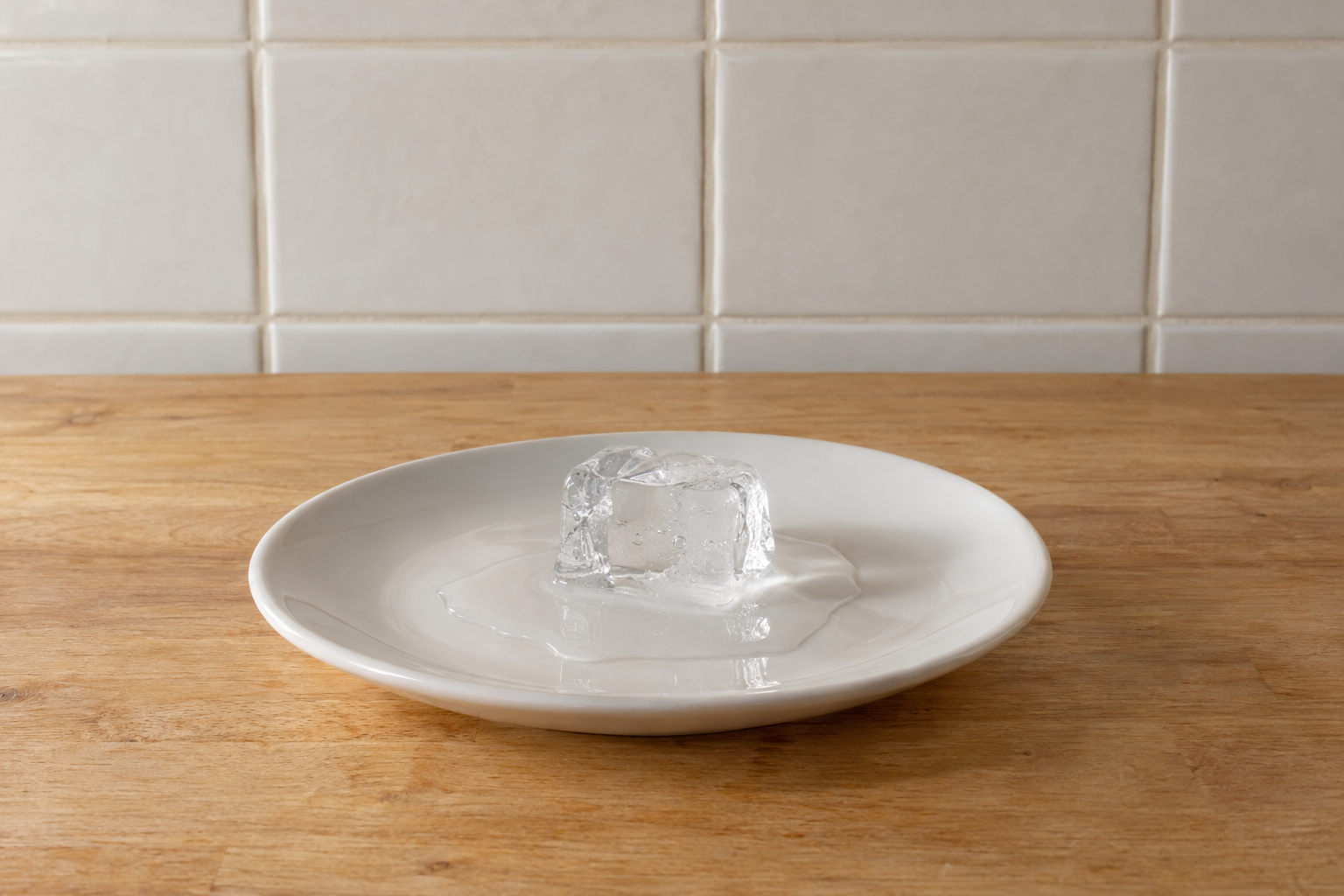
The warm air melts the ice cube into a puddle.
The puddle never turns back into an ice cube.
A drop of ink falls into a glass of still water.
The ink spreads until the whole glass is evenly tinted.
The ink never turns back into a single drop.
Why do these changes happen by themselves, in one direction only?
Part 2The measure of spreading
Both changes spread the system's matter out.
The reverse changes would gather matter back in.
Those gathering changes never happen on their own.
Chemists measure how spread out a system's matter and energy are.
The measure of that spreading is called entropy, written S.
Part 3Five pairs of systems
Here are five pairs of systems.
For each pair, we ask the same question.
The first pair is 1 mol of ice and 1 mol of steam: the same water in two states.
Which system has the greater entropy?
The answer is the steam.
This system has the greater entropy, because its matter is more spread out.
Its molecules are spread through a far larger volume.
The second pair is one neon sample in a 1 L flask, and the same sample spread through a 10 L flask.
Which system has the greater entropy?
The answer is the sample in the 10 L flask.
This system has the greater entropy, because its matter is more spread out.
The same particles are spread through a larger volume.
The third pair is a sealed container of 1 mol of nitrogen, and an identical container of 2 mol of nitrogen at the same temperature.
Which system has the greater entropy?
The answer is the 2 mol system.
This system has the greater entropy, because its matter is more spread out.
More particles are spread through the same volume.
The fourth pair is the same nitrogen sample at 300 K and at 400 K.
Which system has the greater entropy?
The answer is the sample at 400 K.
This system has the greater entropy, because its energy is more spread out.
Its particle kinetic energies are spread across a wider range.
The fifth pair is helium and neon kept in two separate bulbs, and the same gases mixed through both bulbs.
Which system has the greater entropy?
The answer is the mixed system.
This system has the greater entropy, because its matter is more spread out.
Each gas's particles are spread through the whole of both bulbs.
The more spread out a system's matter is, the higher its entropy.
The more spread out a system's energy is, the higher its entropy.
The more spread out a system's matter and energy are, the higher the system's entropy.
The melting ice spread the water's molecules out.
The spreading ink spread the ink's particles out.
State that entropy (S) measures how spread out a system's matter and energy are, with more spreading meaning higher entropy.
Part 4Check what you just learned
Check — multiple choice
A bulb of O₂ and a bulb of He are connected, and the two gases mix through both bulbs. Which system has the greater entropy: the separated gases, or the mixed gases?
Feedback if chosen: This option is wrong — you read kept-apart gases as more spread out. Mixing spreads each gas's particles through the whole of both bulbs, so the mixed system's matter is more dispersed.
Feedback if chosen: Correct. After mixing, each gas's particles are spread through the whole of both bulbs, so the mixed system's matter is more spread out.
Check — multiple choice
One CO₂ sample is studied at 350 K, and the same sample is studied at 250 K. Which system has the greater entropy?
Feedback if chosen: Correct. At 350 K the particle kinetic energies are spread across a wider range, so the sample's energy is more spread out.
Feedback if chosen: This option is wrong — you picked the colder sample. At 250 K the particle kinetic energies sit in a narrower range, so the sample's energy is less spread out.
Check — multiple choice
An argon sample sits in a 1 L flask. The same sample is then spread through a 3 L flask. Which system has the greater entropy?
Feedback if chosen: This option is wrong — you picked the crowded sample. In the 1 L flask the same particles sit in a smaller volume, so the matter is less spread out.
Feedback if chosen: Correct. The same particles are spread through a larger volume, so the sample's matter is more spread out.
Check — multiple choice
One mole of liquid ethanol sits beside one mole of ethanol vapor. Which system has the greater entropy?
Feedback if chosen: This option is wrong — you picked the state whose molecules stay close together. The liquid's molecules touch one another, so its matter is less spread out.
Feedback if chosen: Correct. The vapor's molecules are spread through a far larger volume, so its matter is more spread out.
Check — multiple choice
What does a system's entropy measure?
Feedback if chosen: This option is wrong — you named the quantity temperature measures. Entropy measures how spread out the system's matter and energy are.
Feedback if chosen: This option is wrong — you kept only the matter side. Entropy also measures how spread out the system's energy is, not just the space its matter fills.
Feedback if chosen: Correct. Entropy measures how spread out a system's matter and energy are.
Check — multiple choice
Which quantity is the measure of how spread out a system's matter and energy are?
Feedback if chosen: This option is wrong — temperature measures the average kinetic energy of the particles, not how spread out the matter and energy are.
Feedback if chosen: Correct. That measure is entropy, written S.
Feedback if chosen: This option is wrong — volume is only the space the matter fills. The measure of the spreading of matter and energy together is entropy.
Why spreading out raises entropy
Outcome: Explain why a more spread-out system has higher entropy.
Part 1The same particles, higher entropy
We've seen that a gas spread through a large flask has higher entropy than the same gas crowded into a small flask.
The particles are the same particles in both flasks.
Nothing about any single particle changes when the gas spreads out.
Yet the spread-out gas has the higher entropy.
Why does spreading out raise a system's entropy?
Part 2More ways to arrange the system
In the large flask, the gas's particles can be arranged in many more ways.
In the small flask, the gas's particles can be arranged in far fewer ways.
A spread-out system has higher entropy because there are more ways to arrange the particles and energy of the system.
We compare more ways against fewer ways; we never count them.
Here is the volume pair again: the same neon sample in a 1 L flask, and spread through a 10 L flask.
In the 10 L flask, a neon particle can sit near the top, near the bottom, or anywhere between.
In the 1 L flask, far fewer positions exist for the same particles.
More possible positions mean more ways to arrange the particles.
Energy counts too: the system's energy can be shared out among the particles in more ways or fewer ways.
The spread-out system can be arranged in more ways, so it has the higher entropy.
Explain that a system has higher entropy when its particles and energy can be arranged in more ways, so a more spread-out system has higher entropy.
Part 3Check what you just learned
Check — multiple choice
A drop of ether evaporates inside a sealed jar, and the ether vapor fills the jar. Why does the ether vapor have higher entropy than the liquid drop had?
Feedback if chosen: This option is wrong — you reached for speed. Entropy compares how many ways the particles and energy can be arranged, not how fast any one particle moves.
Feedback if chosen: Correct. Spread through the whole jar, the molecules can be arranged in many more positions, so the system can be arranged in more ways.
Feedback if chosen: This option is wrong — you reached for attractions. The question is positions: spread through the jar, the molecules can be arranged in many more ways.
Check — multiple choice
A technician compresses a neon sample into a smaller tank. Can the neon's particles and energy now be arranged in more ways or fewer ways?
Feedback if chosen: This option is wrong — you read compression as spreading. The smaller tank leaves fewer possible positions for the same particles, so the system can be arranged in fewer ways.
Feedback if chosen: Correct. The smaller tank leaves fewer possible positions for the same particles, so the system can be arranged in fewer ways, and its entropy is lower.
Matter dispersal raises entropy
Outcome: State that entropy increases when matter becomes more dispersed.
Part 1A gas with no pump
A full gas cylinder is connected to an evacuated tank by a closed valve.
A technician opens the valve.
The gas spreads out of the cylinder until it fills both containers evenly.
No pump pushes the gas into the empty tank.
The gas never crowds itself back into the cylinder.
What happens to the gas's entropy as its particles spread out?
Part 2The dispersal rule
Entropy increases when matter becomes more dispersed — particles gain freedom of motion and occupy a larger volume or more possible positions.
The gas that spreads into both containers occupies a larger volume.
So the spreading gas's entropy increases.
Phase changes, volume changes, changes in moles of gas, and dissolving each disperse matter in this same way.
We've seen that entropy measures how spread out a system's matter and energy are.
We've seen that a spread-out system can be arranged in more ways.
We will judge each kind of matter dispersal on its own.
State that entropy increases when matter becomes more dispersed.
Part 3Check what you just learned
Check — multiple choice
Dry ice, solid CO₂, sublimes into gas in an open room. Does the CO₂'s entropy increase or decrease?
Feedback if chosen: Correct. A solid lump becomes a gas spread through the whole room, so the CO₂'s matter is far more dispersed.
Feedback if chosen: This option is wrong — you read the solid's disappearance as a loss. The CO₂'s molecules leave the lump and spread through the whole room, so its matter is more dispersed.
Check — multiple choice
A technician compresses propane gas into a storage cylinder, where it becomes a liquid. Does the propane's entropy increase or decrease?
Feedback if chosen: This option is wrong — you read the change as spreading. The gas becomes a liquid packed into a small cylinder, so the propane's matter is far less dispersed.
Feedback if chosen: Correct. Gas to liquid in a small cylinder leaves the propane's matter far less dispersed.
Check — multiple choice
A student opens a perfume bottle, and the scent's molecules spread through the room. Does the perfume vapor's entropy increase or decrease?
Feedback if chosen: Correct. The molecules spread from the bottle through the whole room, so the vapor's matter is more dispersed.
Feedback if chosen: This option is wrong — you read spreading as gathering. The scent's molecules occupy far more space in the room than in the bottle, so the matter is more dispersed.
The sign of ΔS for a phase change
Outcome: Predict the sign of ΔS for a phase change.
Part 1From liquid to steam
A stove heats a pot of water.
The boiling water turns to steam.
The steam spreads through the whole kitchen.
In the liquid, the water molecules touch one another.
In the steam, the water molecules are spread far apart.
Did the water's entropy rise or fall as the liquid became steam?
Part 2The sign of the change
Vaporizing water spreads its molecules through a far larger space, so its entropy rises.
The change in entropy is written ΔS.
A phase change that leaves the matter more dispersed has ΔS > 0.
A phase change that leaves the matter less dispersed has ΔS < 0.
The table sorts the four most common phase changes by this rule.
| Phase change | What the matter does | Sign of ΔS |
|---|---|---|
| Melting | the particles spread out a little | ΔS > 0 |
| Vaporization | the particles spread out hugely | ΔS > 0 |
| Freezing | the particles gather into a pattern | ΔS < 0 |
| Condensation | the particles gather back together | ΔS < 0 |
We've seen the particle pictures of the three phases.
In a solid, the particles touch, and the arrangement repeats in a regular pattern.
In a liquid, the particles still touch, but the arrangement has no pattern.
In a gas, the particles are widely separated and scattered through the whole container.
Melting and vaporization leave the matter more dispersed, so each has ΔS > 0.
Freezing and condensation leave the matter less dispersed, so each has ΔS < 0.
Predict the sign of ΔS for a phase change.
Part 3Check what you just learned
Check — multiple choice
We've seen the particle pictures of the three phases. In which phase are the particles scattered through the whole container?
Feedback if chosen: This option is wrong — in a solid the particles touch and sit in a regular repeating pattern.
Feedback if chosen: This option is wrong — in a liquid the particles still touch one another; only the pattern is gone.
Feedback if chosen: Correct. In a gas the particles are widely separated and scattered through the whole container.
Check — multiple choice
Liquid bromine vaporizes in a warm room: Br₂(l) → Br₂(g). What is the sign of ΔS?
Feedback if chosen: Correct. Liquid to gas spreads the bromine molecules through a far larger space, so the matter is more dispersed and ΔS is positive.
Feedback if chosen: This option is wrong — you gave vaporization the gathering sign. The Br₂ molecules spread from a liquid into a gas, so the matter is more dispersed and ΔS is positive.
Check — multiple choice
Molten silver is poured into a mold and freezes. What is the sign of ΔS?
Feedback if chosen: This option is wrong — you gave freezing the spreading sign. The silver atoms settle into a regular solid pattern, so the matter is less dispersed and ΔS is negative.
Feedback if chosen: Correct. Liquid to solid gathers the silver atoms into a regular pattern, so the matter is less dispersed and ΔS is negative.
Check — multiple choice
Acetone vapor condenses on a cold window. What is the sign of ΔS?
Feedback if chosen: This option is wrong — you gave condensation the spreading sign. Gas to liquid gathers the acetone molecules together, so the matter is less dispersed and ΔS is negative.
Feedback if chosen: Correct. Gas to liquid gathers the acetone molecules into a small drop, so the matter is less dispersed and ΔS is negative.
Check — multiple choice
A piece of solid gallium melts in a student's hand. What is the sign of ΔS?
Feedback if chosen: Correct. Melting frees the gallium atoms from their regular pattern, so the matter is more dispersed and ΔS is positive.
Feedback if chosen: This option is wrong — you gave melting the gathering sign. The gallium atoms leave their regular solid pattern, so the matter is more dispersed and ΔS is positive.
The sign of ΔS when a gas changes volume
Outcome: Predict the sign of ΔS when a gas expands or is compressed at constant temperature.
Part 1Two bulbs and a valve
Two glass bulbs are joined by a closed valve.
The left bulb contains a sample of gas.
The right bulb contains nothing at all: it is evacuated.
A student opens the valve.
The gas spreads until it fills both bulbs.
The temperature does not change.
What sign does ΔS take when a gas expands into a larger volume?
Part 2Expansion and compression
Expansion leaves the same particles in a larger volume.
Compression leaves the same particles in a smaller volume.
More volume for the same particles means more dispersal.
Expansion has ΔS > 0.
Compression has ΔS < 0.
The temperature must stay constant: then only the volume changes.
We've seen the kinetic molecular theory picture of a gas: the particles are in constant random motion.
So the gas needs no push to spread into the empty bulb.
Predict the sign of ΔS when a gas changes volume at constant temperature.
Part 3Check what you just learned
Check — multiple choice
We've seen the kinetic molecular theory picture of a gas. How do its particles move?
Feedback if chosen: This option is wrong — gas particles need no push. The kinetic molecular theory picture has them always moving.
Feedback if chosen: This option is wrong — the motion has no preferred direction. The particles move in every direction.
Feedback if chosen: Correct. Gas particles are in constant random motion: always moving, in no preferred direction.
Check — multiple choice
Neon expands from a 2 L bulb into an attached evacuated 3 L bulb, filling both. The temperature does not change. What is the sign of ΔS?
Feedback if chosen: Correct. The same particles end spread through 5 L instead of 2 L, so the neon's matter is more dispersed and ΔS is positive.
Feedback if chosen: This option is wrong — you gave expansion the gathering sign. The same particles spread through a larger volume, so ΔS is positive.
Check — multiple choice
A piston compresses a krypton sample from 6 L to 2 L at constant temperature. What is the sign of ΔS?
Feedback if chosen: This option is wrong — you gave compression the spreading sign. The same particles end in a smaller volume, so the krypton's matter is less dispersed and ΔS is negative.
Feedback if chosen: Correct. Compression leaves the same particles in a smaller volume, so the matter is less dispersed and ΔS is negative.
Check — multiple choice
A gas spreads from a 1 L container through an open line into an evacuated 4 L container at constant temperature. What is the sign of ΔS?
Feedback if chosen: Correct. The same particles spread through a larger volume, so the matter is more dispersed and ΔS is positive.
Feedback if chosen: This option is wrong — you gave expansion the gathering sign. The particles end spread through five times the volume, so ΔS is positive.
The sign of ΔS from moles of gas
Outcome: Predict the sign of ΔS for a reaction from the change in moles of gas.
Part 1A bottle with a bulging cap
An old bottle of hydrogen peroxide solution has a bulging cap.
Over months, the hydrogen peroxide has been decomposing: 2 H₂O₂(aq) → 2 H₂O(l) + O₂(g).
The reactants include no gas at all.
The products include 1 mol of O₂ gas for every 2 mol of hydrogen peroxide.
Gas particles spread far more widely than dissolved or liquid particles.
What sign does ΔS take when a reaction creates new moles of gas?
Part 2Counting the moles of gas
You can predict the sign of ΔS from the change in moles of gas.
Count the moles of gas on each side of the balanced equation.
More moles of gas on the product side generally means ΔS > 0.
Fewer moles of gas on the product side generally means ΔS < 0.
The peroxide reaction forms 1 mol of gas where there was none, so its ΔS is positive.
Here is the counting move on the taught case.
| Moles of gas among reactants | Moles of gas among products | Change | Sign of ΔS |
|---|---|---|---|
| 0 | 1 | up by 1 mol of gas | ΔS > 0 |
Predict the sign of ΔS for a reaction from the change in moles of gas.
Part 3Check what you just learned
Check — multiple choice
An airbag inflates by this reaction: 2 NaN₃(s) → 2 Na(s) + 3 N₂(g). What is the sign of ΔS?
Feedback if chosen: Correct. The reactants include no gas, and the products include 3 mol of gas, so the matter is far more dispersed.
Feedback if chosen: This option is wrong — you missed the new gas. Count the moles of gas: 0 on the reactant side, 3 on the product side, so ΔS is positive.
Check — multiple choice
At high temperature, chloroethane gas decomposes: C₂H₅Cl(g) → C₂H₄(g) + HCl(g). What is the sign of ΔS?
Feedback if chosen: Correct. 1 mol of gas becomes 2 mol of gas, so the matter is more dispersed and ΔS is positive.
Feedback if chosen: This option is wrong — you counted only the reactant side. The moles of gas go from 1 to 2, so the matter is more dispersed and ΔS is positive.
Check — multiple choice
Nitrogen and fluorine react: N₂(g) + 3 F₂(g) → 2 NF₃(g). What is the sign of ΔS?
Feedback if chosen: This option is wrong — you saw gases and read the change as spreading. Count both sides: 4 mol of gas become 2 mol of gas, so ΔS is negative.
Feedback if chosen: Correct. 4 mol of gas become 2 mol of gas, so the matter is less dispersed and ΔS is negative.
Check — multiple choice
In a sulfur-recovery plant, these gases react: 2 H₂S(g) + SO₂(g) → 3 S(s) + 2 H₂O(l). What is the sign of ΔS?
Feedback if chosen: This option is wrong — you read the 3 in front of S(s) as 3 mol of new gas being made. S is a solid here: the 3 mol of reactant gas become a solid and a liquid, 0 mol of gas remain, so ΔS is negative.
Feedback if chosen: Correct. 3 mol of gas become a solid and a liquid, so 0 mol of gas remain, and the matter is far less dispersed.
The sign of ΔS for dissolving a solid
Outcome: Predict the sign of ΔS for dissolving an ionic solid.
Part 1Salt into water
A cook stirs a spoonful of table salt into a glass of water.
In the crystal, the salt's ions sat locked in a regular, repeating pattern.
As the salt dissolves, the ions spread through the whole glass.
The ions end far more spread out than they began.
What sign does ΔS take when an ionic solid dissolves?
Part 2Dispersal against ordering
Dissolving disperses the ions.
So for most ionic solids, the ΔS of dissolving is positive.
But water molecules become ordered around small, highly charged ions.
Ordered water molecules are less spread out than free water molecules.
When the ordering outweighs the ions' dispersal, ΔS is negative instead.
For lithium fluoride, measurements show the ordering wins: dissolving LiF has ΔS < 0.
We've seen that dissolving replaces solute-solute and solvent-solvent interactions with solute-solvent interactions.
When NaCl dissolves, its Na⁺ and Cl⁻ ions leave the crystal and spread through the whole glass.
Some water molecules become ordered around each ion.
For NaCl, the ions' dispersal is the larger change, so ΔS is positive.
Lithium fluoride, LiF, dissolves into Li⁺ and F⁻, two very small ions.
Around these small ions, many water molecules become ordered.
For LiF, the ordering outweighs the ions' dispersal, so ΔS is negative.
| Solid | What disperses | What becomes ordered | Which effect wins? |
|---|---|---|---|
| NaCl | the dissolved ions | a few water molecules | dispersal wins: ΔS > 0 |
| LiF | the dissolved ions | many water molecules | ordering wins: ΔS < 0 |
Predict the sign of ΔS for dissolving an ionic solid, allowing for the ordering of water molecules around small, highly charged ions.
Part 3Check what you just learned
Check — multiple choice
Sodium iodide dissolves in water: NaI(s) → Na⁺(aq) + I⁻(aq). What is the sign of ΔS?
Feedback if chosen: Correct. Na⁺ and I⁻ carry single charges, and I⁻ is a large ion: few water molecules become ordered, so the ions' dispersal wins and ΔS is positive.
Feedback if chosen: This option is wrong — you gave the ordering the win. Na⁺ and I⁻ carry single charges and order few water molecules, so the ions' dispersal is the larger change.
Check — multiple choice
Aluminum chloride dissolves in water: AlCl₃(s) → Al³⁺(aq) + 3 Cl⁻(aq). What is the sign of ΔS?
Feedback if chosen: This option is wrong — you counted only the spreading ions. Al³⁺ is small and triply charged: many water molecules become ordered around it, and the ordering outweighs the dispersal.
Feedback if chosen: Correct. Al³⁺ is small and carries a 3+ charge, so many water molecules become ordered around it, and the ordering outweighs the ions' dispersal: ΔS is negative.
Check — multiple choice
In class, Bianca says: "Dissolving an ionic solid in water always gives ΔS > 0." Is Bianca correct?
Feedback if chosen: This option is wrong — dissolving usually disperses the ions, but around small, highly charged ions the ordering of water molecules can win, and then ΔS < 0. LiF is a measured case.
Feedback if chosen: Correct. Bianca is not right: for some solids, such as LiF, many water molecules become ordered around the small ions, and the ordering outweighs the dispersal, so ΔS < 0.
Check — multiple choice
Bianca is wrong: dissolving an ionic solid does not always give ΔS > 0. Why can dissolving some ionic solids give ΔS < 0?
Feedback if chosen: Correct. Ordered water molecules are less spread out than free ones; when the ordering outweighs the ions' dispersal, ΔS is negative.
Feedback if chosen: This option is wrong — you kept the ions gathered. A dissolved solid's ions do spread through the water; the negative sign comes from the water molecules that become ordered around them.
Feedback if chosen: This option is wrong — you reached for the liquid's volume. The small volume change does not set the sign; the ordering of water molecules around the ions does.
Energy dispersal raises entropy
Outcome: State that entropy increases when energy is dispersed.
Part 1A warmed flask, a fixed volume
A sealed steel flask contains a sample of nitrogen gas.
A technician warms the flask from 300 K to 400 K.
The nitrogen's particles stay inside the same flask.
The nitrogen cannot spread into any new space.
We've seen that Kelvin temperature is proportional to the particles' average kinetic energy.
Does the nitrogen's entropy rise when the flask is warmed, even though its particles stay inside the same volume?
Part 2The energy side of the rule
Yes: the warmed nitrogen's entropy rises.
Entropy increases when energy is dispersed — the distribution of kinetic energies among particles broadens as temperature increases.
At 400 K, the nitrogen's particle kinetic energies are spread across a wider range than at 300 K.
So the same nitrogen sample has higher entropy at 400 K than at 300 K.
Spreading its energy raises a system's entropy even when its matter stays in place.
The flask did not change.
The particle count did not change.
Only the spread of the particles' energies changed.
That spreading alone raises the nitrogen's entropy.
State that entropy increases when energy is dispersed.
Part 3Check what you just learned
Check — multiple choice
We've seen that Kelvin temperature is proportional to the average kinetic energy of the particles. A sample's Kelvin temperature doubles. What happens to the average kinetic energy of its particles?
Feedback if chosen: Correct. Kelvin temperature is proportional to the average kinetic energy, so doubling one doubles the other.
Feedback if chosen: This option is wrong — you froze the energy while the temperature moved. The two are proportional: double the Kelvin temperature, and the average kinetic energy doubles.
Feedback if chosen: This option is wrong — you squared the change. The relationship is a proportion, not a square: doubling the Kelvin temperature doubles the average kinetic energy.
Check — multiple choice
A sealed flask of xenon is warmed from 280 K to 350 K. What is the sign of ΔS?
Feedback if chosen: Correct. The xenon's matter stays in the same flask, but its particle kinetic energies spread across a wider range, so its energy is more dispersed.
Feedback if chosen: This option is wrong — you looked only at the fixed flask. The sample stays inside the same flask, but warming spreads the particle kinetic energies across a wider range, so ΔS is positive.
Check — multiple choice
A copper block cools from 400 K to 300 K. What is the sign of ΔS?
Feedback if chosen: This option is wrong — you treated cooling as spreading. Cooling narrows the spread of the copper particles' energies, so the energy is less dispersed and ΔS is negative.
Feedback if chosen: Correct. Cooling narrows the spread of the copper particles' kinetic energies, so its energy is less dispersed and ΔS is negative.
Check — multiple choice
Carmen says a sealed tank of neon gains entropy when it is warmed, even though the neon stays in the same tank. Is Carmen correct?
Feedback if chosen: Correct. Carmen is right: warming spreads the neon's particle kinetic energies across a wider range, and spreading its energy raises a system's entropy even when its matter stays in place.
Feedback if chosen: This option is wrong — you kept entropy on the matter side only. Energy counts too: warming disperses the neon's energy, so its entropy rises even in a fixed tank.
Why heating raises entropy
Outcome: Explain why heating any sample raises its entropy, using the broadening of the Maxwell–Boltzmann distribution.
Part 1A one-sentence reason, drawn
We've seen that the same nitrogen sample has higher entropy at 400 K than at 300 K.
The reason given was one sentence: the particle kinetic energies spread over a wider range.
We've seen how to sketch the energy distribution of a sample at two temperatures.
How does that sketch show the energy of a warmer sample spreading out?
Part 2The broadening curve
Here is the distribution for the same N₂ sample at 300 K and at 500 K.
The Maxwell–Boltzmann distribution shows how many particles have each kinetic energy.
For a warmer sample, the peak of the curve moves to a higher energy.
For a warmer sample, the peak of the curve sits lower.
The area under the curve stays the same, because the sample still contains the same number of particles.
A lower, wider curve means the same particles are spread across more kinetic energies.
That spreading of energy is why heating any sample raises its entropy.
The same reasoning covers solids and liquids: their particles also have kinetic energies, and warming spreads those energies too.
Explain why the entropy of any sample increases as its temperature rises, using the broadening of the Maxwell–Boltzmann distribution.
Part 3Check what you just learned
Check — multiple choice
We've seen how to sketch the distribution for one sample at two temperatures. Compared with the cooler curve, what is true of the warmer sample's curve?
Feedback if chosen: This option is wrong — you grew the area. The sample still contains the same number of particles, so the area under the curve stays the same.
Feedback if chosen: This option is wrong — you moved the peak the wrong way. For a warmer sample the peak moves toward a higher energy; the area stays the same.
Feedback if chosen: Correct. The peak moves to a higher energy and sits lower, and the area stays the same, because the sample still contains the same number of particles.
Check — multiple choice
A sample of CO₂ is heated from 300 K to 450 K in a rigid container. What is the sign of ΔS?
Feedback if chosen: Correct. Heating spreads the particle kinetic energies across a wider range, so the sample's energy is more dispersed.
Feedback if chosen: This option is wrong — you read the fixed container as fixed entropy. The matter stays in place, but the energy spreads across a wider range, so ΔS is positive.
Check — multiple choice
The two curves show one O₂ sample at two temperatures. Which feature of the warmer curve shows that the sample's energy is more dispersed?
Feedback if chosen: Correct. Lower and wider means the same particles are spread across more kinetic energies: the energy is more dispersed.
Feedback if chosen: This option is wrong — you read the areas as unequal. The two areas are equal, because the sample contains the same number of particles at both temperatures.
Feedback if chosen: This option is wrong — you moved the peak the wrong way. The warmer peak sits at a higher energy; the drawn feature that shows dispersal is the lower, wider curve.
Check — multiple choice
A sample of methane gas is warmed inside a rigid tank. Why does its entropy rise?
Feedback if chosen: This option is wrong — you gave every particle one speed. Warming broadens the distribution: the particles' energies spread over a wider range; they never share one value.
Feedback if chosen: Correct. The tank fixes the matter, but warming spreads the particles' kinetic energies over a wider range, and more dispersed energy means higher entropy.
Feedback if chosen: This option is wrong — you reached for the matter side. The rigid tank keeps the volume fixed; what spreads is the particles' kinetic energies.
Check — multiple choice
A sample of argon is cooled from 400 K to 250 K. What happens to the spread of its particles' kinetic energies?
Feedback if chosen: Correct. Cooling reverses the broadening: the kinetic energies gather into a narrower range, so the argon's entropy falls.
Feedback if chosen: This option is wrong — you applied the warming direction. Cooling narrows the range of the particles' kinetic energies.
Feedback if chosen: This option is wrong — you froze the distribution. The distribution narrows as the sample cools; only the particle count stays the same.
Which change has the larger ΔS
Outcome: Rank processes by the relative magnitude of their entropy change.
Part 1Two burners, two changes
On one burner, ice melts into liquid water.
On another burner, liquid water boils into steam.
Both changes disperse the water's matter, so both have ΔS > 0.
Melting spreads the water's molecules a small amount.
Vaporizing spreads the water's molecules a huge amount.
Which change has the larger ΔS?
Part 2Ranking by the size of the dispersal
Vaporization of water has a larger-magnitude ΔS than melting of ice.
A larger dispersal change means a larger magnitude of ΔS.
You rank processes by comparing how much each one disperses matter and energy.
Among the four most common phase changes, liquid-to-gas is the largest dispersal step.
More new moles of gas mean a larger positive ΔS.
After melting, the water's molecules still touch one another.
| Change | What the particle picture shows | Size of the dispersal step |
|---|---|---|
| Melting of ice | the molecules leave the pattern but still touch | a small step |
| Vaporization of water | the molecules spread far apart | a very large step |
After vaporizing, the water's molecules are spread through a far larger volume.
So vaporization's ΔS has the far larger magnitude.
Rank processes by the relative magnitude of their entropy change, treating a larger dispersal change as a larger magnitude of ΔS.
Part 3Check what you just learned
Check — multiple choice
Carbon tetrachloride, CCl₄, can vaporize and can melt. Which change has the larger-magnitude ΔS?
Feedback if chosen: This option is wrong — you picked the small step. Melting leaves the molecules touching; vaporization spreads them through a far larger volume, the larger dispersal change.
Feedback if chosen: Correct. Among the four most common phase changes, liquid-to-gas is the largest dispersal step, so vaporization has the larger-magnitude ΔS.
Check — multiple choice
Reaction 1 forms 3 mol of gas from solid reactants. Reaction 2 forms 1 mol of gas from solid reactants. Which reaction has the larger ΔS?
Feedback if chosen: Correct. Three new moles of gas disperse more matter than one, so reaction 1's ΔS is larger.
Feedback if chosen: This option is wrong — you picked the smaller gas count. More new moles of gas mean a larger dispersal change, so reaction 1 has the larger ΔS.
Check — multiple choice
Three processes: a solid melting, a gas warming slightly at constant volume, and a liquid vaporizing. Rank them by the magnitude of ΔS, largest first.
Feedback if chosen: This option is wrong — you put the small phase step first. Vaporizing is the far larger dispersal change; melting is the small one.
Feedback if chosen: Correct. Of these, liquid-to-gas is the largest dispersal step, melting is a small one, and a slight warming at constant volume spreads only a little energy.
Feedback if chosen: This option is wrong — you put the gentlest change first. A slight warming disperses only a little energy, far less than either phase change.
The full ΔS verdict
Outcome: Judge the sign and the relative size of ΔS by finding the dominant dispersal change.
Part 1Smelling salts, warmed
A chemist warms a lump of ammonium carbonate, the solid in smelling salts.
The solid decomposes: (NH₄)₂CO₃(s) → 2 NH₃(g) + CO₂(g) + H₂O(g).
One mole of solid becomes four moles of gas.
We've seen how to judge each kind of dispersal change on its own.
Real processes often change phase, gas moles and temperature at once.
How large is this reaction's ΔS, and which sign does it take?
Part 2The two-step judgment
You judge ΔS in two steps.
First, find the dominant dispersal change: the largest change in how spread out matter or energy is.
Second, read the sign and the relative size of ΔS from that dominant change.
For the smelling-salts reaction, the dominant change is four new moles of gas from a solid.
So its ΔS is positive and large.
A reaction producing 2 additional moles of gas has a larger positive ΔS than one producing 1 additional mole.
Walk the smelling-salts case through the two steps.
In the solid, the particles sit in a regular pattern.
The products are four moles of gas, spread through the whole container.
The dominant change is the four new moles of gas.
Four new moles of gas is a large dispersal change, so ΔS is positive and large.
Judge both the sign and the relative magnitude of ΔS by identifying the dominant dispersal change.
Part 3Check what you just learned
Check — multiple choice
Copper(II) nitrate decomposes: 2 Cu(NO₃)₂(s) → 2 CuO(s) + 4 NO₂(g) + O₂(g). Another reaction forms 1 mol of gas from solid reactants. Which reaction has the larger positive ΔS?
Feedback if chosen: Correct. The decomposition forms 5 mol of gas where there was none; five new moles of gas disperse far more matter than one.
Feedback if chosen: This option is wrong — you picked the smaller gas count. The decomposition's products include 4 mol of NO₂ and 1 mol of O₂: 5 new moles of gas against 1.
Check — multiple choice
Molten iron is poured into a mold, becomes solid, and then cools. What is the sign of ΔS?
Feedback if chosen: This option is wrong — you gave a gathering change the spreading sign. Freezing gathers the iron's matter into a pattern, and cooling narrows its energy spread: both changes lower the dispersal.
Feedback if chosen: Correct. Freezing gathers the matter into a regular pattern, and cooling narrows the spread of the particles' energies: both changes lower the dispersal, so ΔS is negative.
Check — multiple choice
Three processes: a gas sample warmed at constant volume, 2 mol of gas combining into 1 mol of solid, and a solid decomposing into 3 mol of gas. Rank them by ΔS, from most positive to most negative.
Feedback if chosen: This option is wrong — you put the small energy change above the large matter change. Three new moles of gas is the big positive; the warming is a small positive.
Feedback if chosen: This option is wrong — you reversed both ends. Combining gas into a solid gathers the matter, so it is the most negative, not the most positive.
Feedback if chosen: Correct. Decomposing a solid into 3 mol of gas is a large positive ΔS, the warming is a small positive, and combining 2 mol of gas into a solid is strongly negative.
U9-S02 — Standard entropies and ΔS°
4 lessons
The standard-state conventions
Outcome: State the standard-state conditions the ° symbol assumes: the most stable form, gases at 1 atm, solutions at 1.0 M, measured at a stated temperature — tables usually use 25 °C.
Part 1Two labs, two answers
We've seen that a small degree symbol, as in ΔH°, marks a quantity measured with every substance in its standard state.
Two labs now measure the heat released by the same reaction between two solutions.
Lab A mixes its solutions at 2.0 M.
Lab B mixes its solutions at 0.5 M.
The two labs report slightly different heats per mole.
Both labs measured honestly.
Which lab's heat should the data table print?
Part 2One agreed set of conditions
Chemists agree one fixed set of conditions.
The table prints the heat measured under those conditions.
We've seen two of the agreed conditions: a pressure of 1 atm and a temperature of 25 °C.
We've seen that each substance takes its most stable form, called its standard state.
The full convention holds one more condition we have not needed before: dissolved substances at a concentration of 1.0 M.
So the table prints the heat measured with both solutions at 1.0 M.
The small degree symbol on a quantity says every substance sat in its standard state when the value was measured.
Here is the full convention as one checklist.
| Condition | Agreed value |
|---|---|
| Form | the most stable form |
| Gas pressure | 1 atm |
| Temperature | measured at a stated temperature — tables usually use 25 °C |
| Dissolved substances | 1.0 M |
The form row, the pressure row and the temperature row restate what we've seen.
The solution row is the new member.
The two labs' reaction happens between dissolved substances, so the convention needs a solution condition.
Some data tables set the standard pressure at 1 bar, a nearly identical pressure.
Every quantity that wears the ° mark was measured under these agreed conditions.
Part 3Is it in its standard state?
We can judge any described sample against the checklist.
For each case, we ask the same question.
The first pair restates two cases we've seen.
At 25 °C, is O₂ gas at 1 atm in its standard state?
Yes.
Oxygen's most stable form is O₂ gas.
At 25 °C, is O₃ gas at 1 atm in its standard state?
No.
O₃ is not oxygen's most stable form.
At 25 °C, is solid I₂ at 1 atm in its standard state?
Yes.
Iodine's most stable form is the solid.
At 25 °C, is I₂ gas at 1 atm in its standard state?
No.
Iodine's most stable form is the solid, not the gas.
At 25 °C, is KNO₃ dissolved at 1.0 M in its standard state?
Yes.
A dissolved substance's standard concentration is 1.0 M.
At 25 °C, is the same KNO₃ dissolved at 0.10 M in its standard state?
No.
A concentration of 0.10 M is not the standard concentration of 1.0 M.
O₂ gas, solid I₂ and the 1.0 M solution are standard states.
O₃ gas, I₂ gas and the 0.10 M solution are not.
State the standard-state conditions the ° symbol assumes: each substance in its most stable form, gases at 1 atm, dissolved substances at 1.0 M, measured at a stated temperature — tables usually use 25 °C.
Part 4Check what you just learned
Check — multiple choice
We've seen the agreed form a substance takes under standard conditions. Which form is that?
Feedback if chosen: This option is wrong — you gave every substance the same phase. Many substances are solids or liquids under standard conditions.
Feedback if chosen: Correct. Each substance takes its most stable form under standard conditions.
Feedback if chosen: This option is wrong — you picked the reactive form. The convention picks the most stable form.
Check — multiple choice
What is the standard state of nitrogen at 25 °C?
Feedback if chosen: Correct. Nitrogen's most stable form at 25 °C and 1 atm is the diatomic gas, N₂(g).
Feedback if chosen: This option is wrong — you split the molecule. Nitrogen's most stable form is the diatomic molecule N₂, not single atoms.
Feedback if chosen: This option is wrong — you picked the liquid. At 25 °C and 1 atm, nitrogen is a gas.
Check — multiple choice
A salt is dissolved in water at 0.10 M, at 25 °C and 1 atm. Is the dissolved salt in its standard state?
Feedback if chosen: This option is wrong — you checked the pressure and the temperature only. A dissolved substance must also sit at 1.0 M, and this solution sits at 0.10 M.
Feedback if chosen: Correct. The standard concentration for a dissolved substance is 1.0 M, and this solution sits at 0.10 M.
Check — multiple choice
A table lists a reaction's ΔH°. What does the small ° on ΔH° say?
Feedback if chosen: This option is wrong — you read the ° as a temperature of zero. The mark names the agreed conditions; tables usually measure at 25 °C.
Feedback if chosen: This option is wrong — you read the ° as a precision claim. The mark does not report a precision; it names the agreed conditions.
Feedback if chosen: Correct. The ° says every substance sat in its standard state when the value was measured.
Check — multiple choice
A substance's most stable form at 25 °C is a solid. A sample of that solid sits at 1 atm and 25 °C. Is the sample in its standard state?
Feedback if chosen: Correct. The sample takes its most stable form at the agreed pressure and temperature, so every condition on the checklist holds.
Feedback if chosen: This option is wrong — you refused a sample that satisfies every condition. The most stable form, 1 atm and 25 °C are the whole checklist for a pure solid.
Check — multiple choice
Which list gives the full set of standard-state conditions?
Feedback if chosen: This option is wrong — you stopped at the conditions we recapped. The full convention also sets dissolved substances at 1.0 M.
Feedback if chosen: Correct. The full convention is the most stable form, gases at 1 atm, solutions at 1.0 M, usually at 25 °C.
Feedback if chosen: This option is wrong — you swapped in the gaseous form and 0 °C. The convention takes the most stable form at 25 °C.
Standard molar entropy
Outcome: State what the standard molar entropy S° of a substance is, and read a table of S° values.
Part 1Two rows for water
The back of a chemistry data book lists a column headed S°.
Water takes two rows in the table: H₂O(l) at 70.0 J/(mol·K) and H₂O(g) at 188.8 J/(mol·K).
| Substance | S° at 25 °C, in J/(mol·K) |
|---|---|
| H₂O(l) | 70.0 |
| H₂O(g) | 188.8 |
We've seen that one mole of steam has higher entropy than one mole of liquid water.
The table agrees: the gas row carries the larger S°.
But no table ever listed water's enthalpy on its own.
Every enthalpy we've seen arrived as a change, marked by the Δ.
Why can a table list an entropy on its own, with no Δ?
Part 2A scale with a true zero
Entropy sits on a scale with a true zero, so each substance owns its own entropy value.
The scale's zero sits at the coldest possible temperature, where a substance's matter and energy are spread as little as they can be.
The entropy of one mole of a substance in its standard state is called its standard molar entropy, S°.
Every S° value carries the unit J/(mol·K).
Because the scale has a true zero, the table lists S° outright, with no Δ.
We've seen that more spread-out matter and energy mean higher entropy.
So a substance's S° reports how spread out one mole's matter and energy are in its standard state.
For one substance, S° is highest for the gas, lower for the liquid, and lower still for the solid.
The table's two water rows show the gas above the liquid.
Ice sits lower still on the same scale.
Part 3An element's S° is not zero
An element in its standard state takes ΔHf° equal to zero by agreement, but its S° is a positive value of its own.
The table gives O₂'s formation enthalpy as exactly zero by agreement.
The same table gives O₂'s standard molar entropy as 205.2 J/(mol·K), a value of O₂'s own.
The zero is an agreement about formation enthalpies; the entropy scale starts from a real zero instead.
State that the standard molar entropy S° of a substance is the entropy of one mole of the substance in its standard state, tabulated on an absolute scale.
Part 4Check what you just learned
Check — multiple choice
A data table shows nitrogen's formation enthalpy, ΔHf°(N₂(g)), as exactly zero. What does the same table's S° column show for N₂(g)?
Feedback if chosen: This option is wrong — you carried the formation-enthalpy zero onto the entropy column. The zero is an agreement about ΔHf°; the entropy scale has a real zero, and N₂'s S° is 191.6 J/(mol·K).
Feedback if chosen: Correct. The entropy scale has a true zero, so every substance owns a positive S°; the table lists 191.6 J/(mol·K) for N₂(g).
Feedback if chosen: This option is wrong — you left elements out of the S° column. Every substance, elements included, owns an S° value.
Check — multiple choice
A data table lists pentane twice: C₅H₁₂(l) and C₅H₁₂(g). Which row carries the larger S°?
Feedback if chosen: This option is wrong — you put the liquid above the gas. A gas spreads its matter through a far larger space, so the gas row carries the larger S°.
Feedback if chosen: Correct. For one substance, the gas spreads its matter and energy more than the liquid, so the gas row carries the larger S°.
Check — multiple choice
A chemist looks up CO₂(g) in an S° table. Which unit does the tabulated value carry?
Feedback if chosen: Correct. Every S° value carries the unit J/(mol·K).
Feedback if chosen: This option is wrong — you scaled the unit up to kilojoules. Tabulated S° values stay in joules: J/(mol·K).
Feedback if chosen: This option is wrong — you dropped the kelvin. S° carries J/(mol·K), with the temperature unit in place.
Check — multiple choice
| Substance | S° at 25 °C, in J/(mol·K) |
|---|---|
| Ar(g) | 154.8 |
| CO₂(g) | 213.8 |
The table lists S° for two gases. One mole of which gas holds the more spread-out matter and energy at 25 °C?
Feedback if chosen: This option is wrong — you picked the smaller S°. A larger S° reports more spread-out matter and energy, and CO₂'s value is the larger one.
Feedback if chosen: Correct. CO₂'s S° is the larger value, and a larger S° reports more spread-out matter and energy.
Check — multiple choice
A chemistry data table has a column headed S° at 25 °C. Each number in the column is the entropy of what amount of its substance?
Feedback if chosen: Correct. S° is the entropy of one mole of the substance in its standard state.
Feedback if chosen: This option is wrong — you counted by mass. S° is a per-mole value, measured in the substance's standard state.
Feedback if chosen: This option is wrong — you let the amount float. The table fixes the amount at one mole, in the standard state.
Check — multiple choice
Which name does a data table give the entropy of one mole of a substance in its standard state?
Feedback if chosen: This option is wrong — you named the agreed form and conditions, not the entropy value measured under them.
Feedback if chosen: This option is wrong — you named the enthalpy column. The entropy of one mole in its standard state is the standard molar entropy.
Feedback if chosen: Correct. The entropy of one mole of a substance in its standard state is its standard molar entropy, S°.
Calculating ΔS° from an S° table
Outcome: Calculate ΔS° for a reaction from a table of S° values, weighting each value by its coefficient.
Part 1Making oxygen from potassium chlorate
A technician heats potassium chlorate, KClO₃, to make oxygen gas for a demonstration.
The solid decomposes: 2 KClO₃(s) → 2 KCl(s) + 3 O₂(g).
Three moles of gas appear where only solid stood.
We've seen that creating moles of gas raises the entropy.
The data table lists an S° for each of the three substances.
| Substance | S° at 25 °C, in J/(mol·K) |
|---|---|
| KClO₃(s) | 143.1 |
| KCl(s) | 82.6 |
| O₂(g) | 205.2 |
By how many J/(mol·K) does the entropy rise?
Part 2One subtraction
One subtraction answers it.
We've seen the formation-sum routine: multiply each substance's value by its coefficient, sum the products' side, and subtract the reactants' sum.
The entropy change under these standard conditions is written ΔS°, the standard entropy change.
The same routine applies to S° values: ΔS° = ΣS°(products) − ΣS°(reactants).
For the decomposition, the routine gives ΔS° = +494.6 J/(mol·K).
The positive sign matches the gas the reaction creates.
Every value in the sums, and the answer, carries the unit J/(mol·K).
We've seen that a reaction's enthalpy change is counted per mole of reaction.
A reaction's ΔS° states its entropy change per mole of reaction.
Q: By how many J/(mol·K) does the entropy rise when 2 KClO₃(s) decompose to 2 KCl(s) + 3 O₂(g)?
Write down the S° values from the table
S°(KClO₃(s)) = 143.1 J/(mol·K)
S°(KCl(s)) = 82.6 J/(mol·K)
S°(O₂(g)) = 205.2 J/(mol·K)
Write down the equation
ΔS° = ΣS°(products) − ΣS°(reactants)
Substitute in the values, and calculate
ΔS° = [2(82.6) + 3(205.2)] − 2(143.1)(each value × its coefficient)
ΔS° = [165.2 + 615.6] − 286.2
ΔS° = 780.8 − 286.2
ΔS° = +494.6 J/(mol·K)
The reaction creates three moles of gas, and the computed ΔS° is positive.
The computed sign and the dispersal change agree.
Calculate ΔS° for a reaction using ΔS° = ΣS°(products) − ΣS°(reactants), multiplying each S° by its coefficient in the balanced equation.
Part 3Check what you just learned
Check — multiple choice
We've seen the formation-sum routine. In that routine, what happens to each substance's value before the sums are taken?
Feedback if chosen: Correct. Each value is multiplied by its coefficient before the two sums are taken.
Feedback if chosen: This option is wrong — you divided where the routine multiplies. Each value is multiplied by its coefficient.
Feedback if chosen: This option is wrong — you ignored the coefficients. Two moles of a substance contribute twice its value.
Check — multiple choice
| Substance | S° at 25 °C, in J/(mol·K) |
|---|---|
| NO(g) | 210.8 |
| O₂(g) | 205.2 |
| NO₂(g) | 240.1 |
Nitrogen monoxide reacts with oxygen: 2 NO(g) + O₂(g) → 2 NO₂(g). The table lists each gas's S°. Which expression should you use to calculate ΔS° for this reaction?
Feedback if chosen: This option is wrong — you subtracted the products' sum from the reactants' sum. ΔS° is the products' sum minus the reactants' sum.
Feedback if chosen: This option is wrong — you dropped the coefficients. Each S° is multiplied by its coefficient before the sums are taken.
Feedback if chosen: Correct. Each S° is weighted by its coefficient, and the reactants' sum is subtracted from the products' sum.
Check — numeric entry
| Substance | S° at 25 °C, in J/(mol·K) |
|---|---|
| NO(g) | 210.8 |
| O₂(g) | 205.2 |
| NO₂(g) | 240.1 |
Nitrogen monoxide reacts with oxygen: 2 NO(g) + O₂(g) → 2 NO₂(g). Using the supplied S° table, calculate ΔS° in J/(mol·K), to one decimal place.
Tolerance: 0.05
Feedback when correct: Correct. The products' sum is 2(240.1) = 480.2, the reactants' sum is 2(210.8) + 205.2 = 626.8, and 480.2 − 626.8 = −146.6 J/(mol·K). Three moles of gas become two, so the negative sign fits.
Anticipated wrong answers (feedback shown):
| -386.7 | This answer comes from a dropped coefficient: you used 240.1 instead of 2(240.1) for NO₂. The balanced equation makes 2 NO₂, so the products' sum is 480.2. |
| -175.9 | This answer comes from ignoring every coefficient: 240.1 − (210.8 + 205.2) = −175.9. Each S° is multiplied by its coefficient before the sums are taken. |
Sign-error retry feedback:
| 146.6 | Right size, wrong sign: you subtracted the products' sum from the reactants' sum. ΔS° is the products' sum minus the reactants' sum. |
Worked solution revealed after a second miss
Write down the S° values from the table
S°(NO(g)) = 210.8 J/(mol·K)
S°(O₂(g)) = 205.2 J/(mol·K)
S°(NO₂(g)) = 240.1 J/(mol·K)
Write down the equation
ΔS° = ΣS°(products) − ΣS°(reactants)
Substitute in the values, and calculate
ΔS° = 2(240.1) − [2(210.8) + 205.2]
ΔS° = 480.2 − 626.8
ΔS° = −146.6 J/(mol·K)
Check — numeric entry
| Substance | S° at 25 °C, in J/(mol·K) |
|---|---|
| C₂H₄(g) | 219.3 |
| H₂(g) | 130.7 |
| C₂H₆(g) | 229.2 |
Ethene reacts with hydrogen: C₂H₄(g) + H₂(g) → C₂H₆(g). Using the supplied S° table, calculate ΔS° in J/(mol·K), to one decimal place.
Tolerance: 0.05
Feedback when correct: Correct. The products' sum is 229.2, the reactants' sum is 219.3 + 130.7 = 350.0, and 229.2 − 350.0 = −120.8 J/(mol·K). Two moles of gas become one, so the negative sign fits.
Anticipated wrong answers (feedback shown):
| 9.9 | This answer comes from a dropped reactant: 229.2 − 219.3 = 9.9 leaves H₂ out of the reactants' sum. Every reactant's S° joins the sum. |
Sign-error retry feedback:
| 120.8 | Right size, wrong sign: you subtracted the products' sum from the reactants' sum. ΔS° is the products' sum minus the reactants' sum. |
Worked solution revealed after a second miss
Write down the S° values from the table
S°(C₂H₄(g)) = 219.3 J/(mol·K)
S°(H₂(g)) = 130.7 J/(mol·K)
S°(C₂H₆(g)) = 229.2 J/(mol·K)
Write down the equation
ΔS° = ΣS°(products) − ΣS°(reactants)
Substitute in the values, and calculate
ΔS° = 229.2 − (219.3 + 130.7)
ΔS° = 229.2 − 350.0
ΔS° = −120.8 J/(mol·K)
Check — numeric entry
| Substance | S° at 25 °C, in J/(mol·K) |
|---|---|
| H₂(g) | 130.7 |
| Cl₂(g) | 223.1 |
| HCl(g) | 186.9 |
Hydrogen burns in chlorine: H₂(g) + Cl₂(g) → 2 HCl(g). Using the supplied S° table, calculate ΔS° in J/(mol·K), to one decimal place.
Tolerance: 0.05
Feedback when correct: Correct. The products' sum is 2(186.9) = 373.8, the reactants' sum is 130.7 + 223.1 = 353.8, and 373.8 − 353.8 = +20.0 J/(mol·K). Two moles of gas become two moles of gas, so the change is small.
Anticipated wrong answers (feedback shown):
| 727.6 | This answer comes from adding the two sums: 373.8 + 353.8 = 727.6. The reactants' sum is subtracted from the products' sum. |
Sign-error retry feedback:
| -20.0 | Right size, wrong sign: you subtracted the products' sum from the reactants' sum. ΔS° is the products' sum minus the reactants' sum. |
Worked solution revealed after a second miss
Write down the S° values from the table
S°(H₂(g)) = 130.7 J/(mol·K)
S°(Cl₂(g)) = 223.1 J/(mol·K)
S°(HCl(g)) = 186.9 J/(mol·K)
Write down the equation
ΔS° = ΣS°(products) − ΣS°(reactants)
Substitute in the values, and calculate
ΔS° = 2(186.9) − (130.7 + 223.1)
ΔS° = 373.8 − 353.8
ΔS° = +20.0 J/(mol·K)
Checking a calculated ΔS°
Outcome: Judge whether a calculated ΔS° matches the dispersal prediction, and name the sign or coefficient error when it does not.
Part 1A sign that cannot be right
Suppose a student computes ΔS° for the reaction PCl₃(g) + Cl₂(g) → PCl₅(g).
The student reports ΔS° = +170.3 J/(mol·K).
But the reaction turns two moles of gas into one.
We've seen that losing moles of gas lowers the entropy.
So the dispersal prediction says ΔS° should be negative.
The computed sign and the predicted sign disagree.
Which one should the student trust?
Part 2Trust the prediction, hunt the error
The student should trust the dispersal prediction and hunt for the arithmetic error.
A computed ΔS° must match the sign the dispersal change predicts.
When the two disagree, the calculation carries one of two common errors.
Subtracting the products' sum from the reactants' sum flips the sign.
Forgetting a coefficient drops part of one sum.
That loss can flip the sign too.
Here the student subtracted in the wrong order: the correct value is ΔS° = −170.3 J/(mol·K).
A value that fails the sign check goes back for one of these two repairs.
Here is the whole hunt on the student's report.
| Substance | S° at 25 °C, in J/(mol·K) |
|---|---|
| PCl₃(g) | 311.8 |
| Cl₂(g) | 223.1 |
| PCl₅(g) | 364.6 |
Q: The student reported ΔS° = +170.3 J/(mol·K) for PCl₃(g) + Cl₂(g) → PCl₅(g). Where is the error?
Predict the sign from the dispersal change
gas moles: 2 → 1
prediction: ΔS° < 0(losing gas lowers the entropy)
Recompute ΔS° forward
ΔS° = 364.6 − (311.8 + 223.1)
ΔS° = 364.6 − 534.9
ΔS° = −170.3 J/(mol·K)
Compare, and name the error
reported +170.3; recomputed −170.3(the exact flip)
The student subtracted the products' sum from the reactants' sum.
Now consider a second student's report.
The student computes ΔS° for the reaction CO₂(g) + C(s) → 2 CO(g), and reports ΔS° = −21.8 J/(mol·K).
The reaction turns one mole of gas into two.
Creating moles of gas raises the entropy, so ΔS° should be positive.
The negative report fails the sign check.
| Substance | S° at 25 °C, in J/(mol·K) |
|---|---|
| CO₂(g) | 213.8 |
| C(s, graphite) | 5.7 |
| CO(g) | 197.7 |
Q: The report says ΔS° = −21.8 J/(mol·K) for CO₂(g) + C(s) → 2 CO(g). Where is the error?
Predict the sign from the dispersal change
gas moles: 1 → 2
prediction: ΔS° > 0(creating gas raises the entropy)
Recompute ΔS° forward
ΔS° = 2(197.7) − (213.8 + 5.7)
ΔS° = 395.4 − 219.5
ΔS° = +175.9 J/(mol·K)
Compare, and name the error
reported −21.8; recomputed +175.9
197.7 − 219.5 = −21.8(one 197.7 where the equation makes 2 CO)
The student forgot the coefficient 2 on CO.
The sign check catches an error only when the error flips the sign.
A value with the right sign can still hide a wrong step.
Judge whether a calculated ΔS° is consistent with the dispersal prediction, and identify a sign or coefficient error when it is not.
Part 3Check what you just learned
Check — multiple choice
| Substance | S° at 25 °C, in J/(mol·K) |
|---|---|
| MgCO₃(s) | 65.7 |
| MgO(s) | 26.9 |
| CO₂(g) | 213.8 |
Magnesium carbonate decomposes when heated: MgCO₃(s) → MgO(s) + CO₂(g). Using the supplied table, a student reports ΔS° = −175.0 J/(mol·K). Is the reported value consistent with the dispersal prediction?
Feedback if chosen: This option is wrong — you accepted a negative ΔS° for a reaction that creates a mole of gas. Creating gas raises the entropy, so the sign should be positive.
Feedback if chosen: Correct. The reaction creates a mole of gas, so ΔS° should be positive. The forward computation gives +175.0 J/(mol·K); the report is its sign flip.
Check — multiple choice
| Substance | S° at 25 °C, in J/(mol·K) |
|---|---|
| HgO(s) | 70.3 |
| Hg(l) | 75.9 |
| O₂(g) | 205.2 |
Mercury(II) oxide decomposes when heated: 2 HgO(s) → 2 Hg(l) + O₂(g). Using the supplied table, a student reports ΔS° = +216.4 J/(mol·K). Is the reported value consistent with the dispersal prediction?
Feedback if chosen: Correct. The reaction creates a mole of gas, so a positive ΔS° fits the prediction. The forward computation, [2(75.9) + 205.2] − 2(70.3), gives the same +216.4 J/(mol·K).
Feedback if chosen: This option is wrong — you rejected a value that fits. The reaction creates a mole of gas, the prediction is positive, and the report is positive.
Check — multiple choice
| Substance | S° at 25 °C, in J/(mol·K) |
|---|---|
| NOCl(g) | 261.7 |
| NO(g) | 210.8 |
| Cl₂(g) | 223.1 |
Nitrosyl chloride decomposes: 2 NOCl(g) → 2 NO(g) + Cl₂(g). Using the supplied table, a student reports ΔS° = −89.5 J/(mol·K). The reaction gains a mole of gas, so the negative report is inconsistent. Which error produced it?
Feedback if chosen: Correct. With one 210.8 where the equation makes 2 NO, the sum is 210.8 + 223.1 − 2(261.7) = −89.5 J/(mol·K), exactly the report.
Feedback if chosen: This option is wrong — you named the sign flip. The true value is +121.3 J/(mol·K), so a reversed subtraction gives −121.3, not −89.5.
Feedback if chosen: This option is wrong — you removed every coefficient. That computes 210.8 + 223.1 − 261.7 = +172.2 J/(mol·K), a positive value, not −89.5.
Check — multiple choice
| Substance | S° at 25 °C, in J/(mol·K) |
|---|---|
| NH₄I(s) | 117.0 |
| NH₃(g) | 192.8 |
| HI(g) | 206.6 |
Ammonium iodide breaks down when heated: NH₄I(s) → NH₃(g) + HI(g). Using the supplied table, a student reports ΔS° = −282.4 J/(mol·K). Which statement describes the report?
Feedback if chosen: This option is wrong — you accepted a negative ΔS° for a solid becoming two moles of gas. Creating gas raises the entropy, so the sign should be positive.
Feedback if chosen: Correct. Two moles of gas appear where a solid stood, so ΔS° should be positive. The forward computation gives +282.4 J/(mol·K), and −282.4 is its exact flip.
Feedback if chosen: This option is wrong — you blamed a coefficient. Every coefficient in this equation is 1, and dropping one product gives +89.6 or +75.8 J/(mol·K), never −282.4.
U9-S03 — Gibbs free energy and favorability
17 lessons
The Gibbs free energy change, ΔG°
Outcome: State what the Gibbs free energy change ΔG° describes, and tell ΔG° apart from ΔG under other conditions.
Part 1A change that goes one way
A steel nail left outside slowly turns to rust.
The rust never turns back into a shiny nail by itself.
So this change goes one way by itself.
It does not go the other way by itself.
We've seen that ΔH° measures the energy a process releases or absorbs.
We've seen that ΔS° measures how much the matter and energy spread out.
Chemists read a third quantity to judge which direction a process goes by itself.
What does the third quantity measure?
Part 2The third quantity
The third quantity is an energy change called the Gibbs free energy change, written ΔG°.
Its unit is kJ/mol, like ΔH°.
We've seen that the small ° mark means every substance is in its standard state.
For a dissolved substance, the standard state is a concentration of 1.0 M.
Written without the ° mark, ΔG describes the same process under other conditions.
Suppose a reaction between two dissolved substances is prepared with every solution at 1.0 M.
The handbook's ΔG° describes that mixture.
Now suppose one solution is prepared at 2.0 M instead.
A standard-state condition is broken, so the symbol loses its ° mark.
The free energy change of the 2.0 M mixture is written ΔG.
The ° mark pins the states; it does not pin the temperature.
The temperature is stated beside each ΔG° value.
A handbook may list ΔG° for one reaction at 298 K and for another at 1200 K.
The verdict rule for ΔG° arrives next.
State that ΔG° is the Gibbs free energy change for a process in which every reactant and product is in its standard state, and tell it apart from ΔG under other conditions.
Part 3Check what you just learned
Check — multiple choice
A reaction vessel holds every dissolved substance at 1.0 M, at 298 K. Which symbol describes the free energy change of the reaction in this vessel?
Feedback if chosen: Correct. Every substance sits in its standard state, so the ° conditions are satisfied and the symbol is ΔG°.
Feedback if chosen: This option is wrong — you dropped the ° mark from a mixture that earns it. Every solution sits at 1.0 M, so every substance is in its standard state.
Check — multiple choice
The same reaction is prepared again with one solution at 2.0 M, at 298 K. Which symbol describes the free energy change now?
Feedback if chosen: This option is wrong — you kept the ° mark after a standard-state condition broke. A 2.0 M solution is not at the standard concentration of 1.0 M.
Feedback if chosen: Correct. One solution sits at 2.0 M, a condition outside the standard state, so the symbol is the plain ΔG.
Check — multiple choice
What unit does a ΔG° value carry?
Feedback if chosen: This option is wrong — you gave ΔG° the unit of ΔS°. J/(mol·K) is an entropy unit; ΔG° is an energy change in kJ/mol.
Feedback if chosen: Correct. ΔG° is an energy change, and its unit is kJ/mol, the same unit as ΔH°.
Feedback if chosen: This option is wrong — you gave ΔG° a temperature unit. The kelvin measures temperature; ΔG° is an energy change in kJ/mol.
Check — multiple choice
A handbook lists the energy change chemists read to judge which direction a process goes by itself, measured with every substance in its standard state. Which quantity is that?
Feedback if chosen: This option is wrong — you named the quantity that measures released or absorbed energy. ΔH° does not by itself judge the direction a process goes by itself.
Feedback if chosen: Correct. The Gibbs free energy change, ΔG°, is the quantity chemists read to judge which direction a process goes by itself.
Feedback if chosen: This option is wrong — you named the quantity that measures the spread of matter and energy, not an energy change read for direction.
Check — multiple choice
Which name goes with the symbol ΔG°?
Feedback if chosen: This option is wrong — you named ΔH°'s quantity. ΔG° is the Gibbs free energy change.
Feedback if chosen: This option is wrong — you named S°'s quantity. ΔG° is the Gibbs free energy change.
Feedback if chosen: Correct. ΔG° is the Gibbs free energy change.
Thermodynamically favored
Outcome: State that a process is called thermodynamically favored when ΔG° < 0.
Part 1The sign of the rusting
The steel nail keeps rusting.
Nobody heats the nail.
Nobody pushes the change along.
The rusting goes by itself.
Chemists have measured ΔG° for the rusting of iron at 298 K.
The measured ΔG° is a negative number.
What does the negative sign say about the rusting?
Part 2One sign, one verdict
A negative ΔG° marks a process that can proceed without outside help.
A process with a negative ΔG° is called thermodynamically favored.
The rusting of iron at 298 K has a negative ΔG°.
So the rusting of iron at 298 K is thermodynamically favored.
A process with a positive ΔG° is not thermodynamically favored.
“Not thermodynamically favored” is also said in one word: unfavored.
One sign carries the whole verdict.
State that a process is called thermodynamically favored when its ΔG° is less than zero.
Part 3Check what you just learned
Check — multiple choice
A process has ΔG° < 0 at 298 K. Is the process thermodynamically favored?
Feedback if chosen: Correct. A negative ΔG° is the whole condition: the process is thermodynamically favored.
Feedback if chosen: This option is wrong — you refused a process whose ΔG° is negative. A negative ΔG° is exactly the condition for thermodynamically favored.
Check — multiple choice
A process has ΔG° > 0 at 298 K. Is the process thermodynamically favored?
Feedback if chosen: This option is wrong — you accepted a process whose ΔG° is positive. A positive ΔG° marks a process that is not thermodynamically favored.
Feedback if chosen: Correct. The ΔG° is positive, so the process is not thermodynamically favored.
Check — multiple choice
Which fact makes a process thermodynamically favored?
Feedback if chosen: This option is wrong — you read a speed into the verdict. The verdict comes from the sign of ΔG°, not from any speed.
Feedback if chosen: Correct. A process is thermodynamically favored exactly when its ΔG° is less than zero.
Feedback if chosen: This option is wrong — you used the sign of ΔH°. Releasing energy is ΔH° < 0; the favored verdict reads the sign of ΔG°.
Check — multiple choice
Measurements show a process can proceed without outside help, and its ΔG° at 298 K is negative. What do chemists call such a process?
Feedback if chosen: This option is wrong — you named an ΔH° class. Endothermic says the process absorbs energy; the negative ΔG° earns the name thermodynamically favored.
Feedback if chosen: This option is wrong — you named the measurement conditions. The standard state is where ΔG° is measured, not the verdict the sign carries.
Feedback if chosen: Correct. A process with a negative ΔG° is called thermodynamically favored.
Check — multiple choice
A process is called thermodynamically favored exactly when…
Feedback if chosen: Correct. ΔG° < 0 is the defining condition for thermodynamically favored.
Feedback if chosen: This option is wrong — you made the definition about ΔH°. An energy-releasing process can be favored or unfavored; the sign of ΔG° decides.
Feedback if chosen: This option is wrong — you made the definition about ΔS°. A dispersing process can be favored or unfavored; the sign of ΔG° decides.
Why not “spontaneous”
Outcome: Explain why this course says thermodynamically favored rather than the historical term, and state that neither term promises a fast change.
Part 1The diamond that never changes
A diamond sits in a jeweler's window.
For diamond turning into graphite at 298 K, the measured ΔG° is −2.9 kJ/mol.
The sign is negative.
So diamond turning into graphite is thermodynamically favored.
Yet the diamond sits unchanged for millions of years.
Why does a favored change never seem to happen?
Part 2The verdict is a direction, not a speed
“Thermodynamically favored” names the direction thermodynamics supports.
The verdict does not include the speed.
A favored process can be fast, slow, or too slow to see.
Diamond turning into graphite is favored.
Diamond turning into graphite is also immeasurably slow.
Older books call a favored process “spontaneous.”
The word spontaneous wrongly suggests the change happens suddenly, without cause.
Neither word promises a fast change.
This course says thermodynamically favored.
Explain why “thermodynamically favored” is preferred over the historical term “spontaneous”: spontaneous wrongly suggests a sudden, uncaused change, and neither term says anything about rate.
Part 3Check what you just learned
Check — multiple choice
Does a negative ΔG° promise that a process is fast?
Feedback if chosen: This option is wrong — you read a speed into the sign. The sign carries the direction only; diamond's conversion is favored and immeasurably slow.
Feedback if chosen: Correct. The sign carries the direction only. Diamond turning into graphite is favored, and it is immeasurably slow.
Check — multiple choice
What does “thermodynamically favored” name?
Feedback if chosen: This option is wrong — you read the term as a speed claim. A favored process can be fast, slow, or too slow to see.
Feedback if chosen: This option is wrong — you read the term as an ΔH° claim. Released energy is ΔH°'s business; the favored verdict reads ΔG°.
Feedback if chosen: Correct. The term names the direction thermodynamics supports, and nothing about speed.
Check — multiple choice
Wren says that a reaction with a negative ΔG° must happen quickly. Is Wren correct?
Feedback if chosen: This option is wrong — you accepted a speed promise the sign never makes. The sign carries direction only; diamond's conversion is favored and immeasurably slow.
Feedback if chosen: Correct. The sign carries direction only. Diamond turning into graphite has a negative ΔG°, and it is immeasurably slow.
Check — multiple choice
Older books call a thermodynamically favored process “spontaneous.” What does the word spontaneous wrongly suggest?
Feedback if chosen: This option is wrong — you named an ΔH° reading. The trouble with the old word is a suggestion of suddenness, not of energy.
Feedback if chosen: Correct. Spontaneous wrongly suggests a sudden, uncaused change, which the measured verdict never promises.
Feedback if chosen: This option is wrong — you reversed the term's meaning. A favored process can proceed without outside help; the old word's trouble is its suggestion of suddenness.
Check — multiple choice
What does neither “spontaneous” nor “thermodynamically favored” promise about a process?
Feedback if chosen: Correct. Neither term says anything about rate; a favored process can be too slow to see.
Feedback if chosen: This option is wrong — you picked the thing both terms do say. A favored process can proceed without outside help.
Feedback if chosen: This option is wrong — you picked the defining condition itself. Both terms apply exactly when ΔG° is negative.
The verdict from a ΔG° value
Outcome: Judge whether a process is thermodynamically favored from a given ΔG° value.
Part 1Two listed values
A handbook lists ΔG° for two reactions at 298 K.
One reaction has ΔG° = −34 kJ/mol.
The other reaction has ΔG° = +12 kJ/mol.
Which reaction is thermodynamically favored?
Part 2Read the sign first
The sign alone decides the verdict.
The reaction with ΔG° = −34 kJ/mol is thermodynamically favored.
The reaction with ΔG° = +12 kJ/mol is not thermodynamically favored.
The size of the number does not change the verdict.
A small negative ΔG° and a large negative ΔG° carry the same verdict: favored.
You read the sign first, every time.
Part 3Judging five reactions
We judge each case with the same question.
A reaction at 298 K has ΔG° = −34 kJ/mol.
Is ΔG° less than zero?
Yes.
So the reaction is thermodynamically favored.
A reaction at 298 K has ΔG° = +12 kJ/mol.
Is ΔG° less than zero?
No.
So the reaction is not thermodynamically favored.
A reaction at 298 K has ΔG° = −0.9 kJ/mol.
Is ΔG° less than zero?
Yes.
So the reaction is thermodynamically favored, even though the value is barely negative.
A reaction at 298 K has ΔG° = −1,250 kJ/mol.
Is ΔG° less than zero?
Yes.
So the reaction is thermodynamically favored; the huge size leaves the verdict unchanged.
A reaction at 298 K has ΔG° = +0.4 kJ/mol.
Is ΔG° less than zero?
No.
So the reaction is not thermodynamically favored; the sign, not the size, decides.
Judge whether a process is thermodynamically favored from a given ΔG° value, reading the sign first.
Part 4Check what you just learned
Check — multiple choice
A reaction has ΔG° = −58 kJ/mol at 298 K. Is the reaction thermodynamically favored?
Feedback if chosen: Correct. The sign is negative, so the reaction is thermodynamically favored.
Feedback if chosen: This option is wrong — you refused a negative ΔG°. The sign is negative, and the sign alone decides: favored.
Check — multiple choice
A reaction has ΔG° = +23 kJ/mol at 298 K. Is the reaction thermodynamically favored?
Feedback if chosen: This option is wrong — you accepted a positive ΔG°. The sign is positive, so the reaction is not thermodynamically favored.
Feedback if chosen: Correct. The sign is positive, so the reaction is not thermodynamically favored.
Check — multiple choice
A reaction has ΔG° = −3.1 kJ/mol at 298 K. Is the reaction thermodynamically favored?
Feedback if chosen: Correct. The value is barely negative, and the sign alone decides: favored.
Feedback if chosen: This option is wrong — you let the small size overrule the sign. A barely negative ΔG° still carries the favored verdict.
Check — multiple choice
A reaction has ΔG° = −0.2 kJ/mol at 298 K. Is the reaction thermodynamically favored?
Feedback if chosen: Correct. The sign is negative, so the reaction is thermodynamically favored, however small the value.
Feedback if chosen: This option is wrong — you read the near-zero size as a refusal. The sign is negative, and the sign alone decides.
Check — multiple choice
A reaction has ΔG° = +310 kJ/mol at 298 K. Is the reaction thermodynamically favored?
Feedback if chosen: This option is wrong — you let the large size impress you. The sign is positive, so the reaction is not thermodynamically favored.
Feedback if chosen: Correct. The sign is positive, so the reaction is not thermodynamically favored, however large the value.
ΔG° from formation values
Outcome: Calculate ΔG° for a reaction from a table of ΔGf° values, with ΔGf° = 0 for an element in its standard state.
Part 1A camping stove and a handbook
A camping stove burns methane.
A chemist wants ΔG° for the combustion at 298 K.
No direct measurement is at hand.
A handbook table lists the free energy change to form each substance from its elements.
That tabulated quantity is written ΔGf°.
We've used a formation-sum routine for ΔH°.
The routine multiplies each formation value by its coefficient, then subtracts the reactants' sum from the products' sum.
Does the same routine deliver ΔG°?
Part 2The same routine, on ΔGf°
Yes: the same routine delivers ΔG°.
ΔG° equals the sum of ΔGf° for the products minus the sum of ΔGf° for the reactants.
Each ΔGf° is multiplied by its coefficient first.
An element in its standard state forms from itself with no change at all.
So an element in its standard state has ΔGf° = 0.
The table supplies every ΔGf° value a problem needs.
One pass of the routine turns the table into ΔG° for the whole reaction.
Here is the handbook table for the stove's combustion, CH₄(g) + 2 O₂(g) → CO₂(g) + 2 H₂O(l).
| Substance | ΔGf° at 25 °C, in kJ/mol |
|---|---|
| CH₄(g) | −50.5 |
| CO₂(g) | −394.4 |
| H₂O(l) | −237.1 |
Q: What is ΔG° for the combustion of methane, CH₄(g) + 2 O₂(g) → CO₂(g) + 2 H₂O(l), at 298 K?
Write down the ΔGf° values from the table
ΔGf°(CH₄(g)) = −50.5 kJ/mol
ΔGf°(CO₂(g)) = −394.4 kJ/mol
ΔGf°(H₂O(l)) = −237.1 kJ/mol
Apply the element rule
ΔGf°(O₂(g)) = 0 kJ/mol(an element in its standard state)
Write down the equation
ΔG° = ΣΔGf°(products) − ΣΔGf°(reactants)
Substitute in the values, and calculate
ΔG° = [−394.4 + 2(−237.1)] − [−50.5](each value × its coefficient)
ΔG° = −868.6 + 50.5
ΔG° = −818.1 kJ/mol
Calculate ΔG° for a reaction using ΔG° = ΣΔGf°(products) − ΣΔGf°(reactants), with ΔGf° = 0 for an element in its standard state.
Part 3Check what you just learned
Check — multiple choice
We've used the formation-sum routine before. In that routine, what multiplies each formation value before the sums are taken?
Feedback if chosen: Correct. Each formation value is multiplied by its coefficient in the balanced equation before the sums are taken.
Feedback if chosen: This option is wrong — you reached for a mass. The routine weights each value by its coefficient, not by any mass.
Feedback if chosen: This option is wrong — you brought the temperature into the routine. The formation sum weights each value by its coefficient only.
Check — multiple choice
| Substance | ΔGf° at 25 °C, in kJ/mol |
|---|---|
| C₆H₆(l) | +124.5 |
| C₆H₁₂(l) | +26.8 |
Hydrogen converts benzene into cyclohexane: C₆H₆(l) + 3 H₂(g) → C₆H₁₂(l). Using the supplied ΔGf° table, which expression should you use to calculate ΔG° for this reaction?
Feedback if chosen: Correct. Cyclohexane is the product and benzene the reactant; H₂ is an element in its standard state, so it enters as 0.
Feedback if chosen: This option is wrong — you added the two sums. The routine subtracts the reactants' sum from the products' sum.
Feedback if chosen: This option is wrong — you subtracted the products' sum from the reactants' sum. The routine reads products minus reactants.
Check — numeric entry
| Substance | ΔGf° at 25 °C, in kJ/mol |
|---|---|
| C₆H₆(l) | +124.5 |
| C₆H₁₂(l) | +26.8 |
For the same reaction, C₆H₆(l) + 3 H₂(g) → C₆H₁₂(l), calculate ΔG° at 298 K in kJ/mol, to one decimal place.
Tolerance: 0.05
Feedback when correct: Correct. The product's sum is +26.8, the reactants' sum is +124.5 + 3(0) = +124.5, and 26.8 − 124.5 = −97.7 kJ/mol.
Anticipated wrong answers (feedback shown):
| 151.3 | This answer comes from adding the two sums: 26.8 + 124.5 = 151.3. The routine subtracts the reactants' sum from the products' sum. |
Sign-error retry feedback:
| 97.7 | Right size, wrong sign: you subtracted the product's sum from the reactants' sum. ΔG° is the products' sum minus the reactants' sum. |
Worked solution revealed after a second miss
Write down the ΔGf° values from the table
ΔGf°(C₆H₆(l)) = +124.5 kJ/mol
ΔGf°(C₆H₁₂(l)) = +26.8 kJ/mol
Apply the element rule
ΔGf°(H₂(g)) = 0 kJ/mol
Substitute in the values, and calculate
ΔG° = [+26.8] − [+124.5 + 3(0)]
ΔG° = 26.8 − 124.5
ΔG° = −97.7 kJ/mol
Check — numeric entry
| Substance | ΔGf° at 25 °C, in kJ/mol |
|---|---|
| Al₂O₃(s) | −1,582.3 |
Aluminum oxide resists breaking down into its elements: 2 Al₂O₃(s) → 4 Al(s) + 3 O₂(g). Using the supplied ΔGf° table, calculate ΔG° for this decomposition at 298 K in kJ/mol, to one decimal place.
Tolerance: 0.05
Feedback when correct: Correct. Both products are elements in their standard states, so each contributes 0; ΔG° = 0 − 2(−1,582.3) = +3,164.6 kJ/mol. The table's one row and the element rule carry the whole calculation.
Anticipated wrong answers (feedback shown):
| 1582.3 | This answer comes from a dropped coefficient: you used −1,582.3 instead of 2(−1,582.3). The balanced equation breaks down 2 Al₂O₃. |
Sign-error retry feedback:
| -3164.6 | Right size, wrong sign: the reactants' sum is negative, and subtracting 2(−1,582.3) from zero leaves a positive ΔG°. |
Worked solution revealed after a second miss
Write down the ΔGf° values from the table
ΔGf°(Al₂O₃(s)) = −1,582.3 kJ/mol
Apply the element rule
ΔGf°(Al(s)) = 0 kJ/mol
ΔGf°(O₂(g)) = 0 kJ/mol
Substitute in the values, and calculate
ΔG° = [4(0) + 3(0)] − [2(−1,582.3)]
ΔG° = 0 + 3,164.6
ΔG° = +3,164.6 kJ/mol
Check — numeric entry
| Substance | ΔGf° at 25 °C, in kJ/mol |
|---|---|
| CS₂(l) | +65.3 |
| CO₂(g) | −394.4 |
| SO₂(g) | −300.1 |
Carbon disulfide burns: CS₂(l) + 3 O₂(g) → CO₂(g) + 2 SO₂(g). Using the supplied ΔGf° table, calculate ΔG° at 298 K in kJ/mol, to one decimal place.
Tolerance: 0.05
Feedback when correct: Correct. The products' sum is −394.4 + 2(−300.1) = −994.6, the reactant's sum is +65.3 + 3(0) = +65.3, and −994.6 − 65.3 = −1,059.9 kJ/mol. Subtracting the positive reactant value pushes the result further down.
Anticipated wrong answers (feedback shown):
| -929.3 | This answer comes from adding the reactant's value: −994.6 + 65.3 = −929.3. The reactants' sum is subtracted, and subtracting +65.3 lowers the result. |
| -759.8 | This answer comes from a dropped coefficient: you used −300.1 instead of 2(−300.1) for SO₂. The balanced equation makes 2 SO₂. |
Sign-error retry feedback:
| 1059.9 | Right size, wrong sign: you subtracted the products' sum from the reactant's sum. ΔG° is the products' sum minus the reactants' sum. |
Worked solution revealed after a second miss
Write down the ΔGf° values from the table
ΔGf°(CS₂(l)) = +65.3 kJ/mol
ΔGf°(CO₂(g)) = −394.4 kJ/mol
ΔGf°(SO₂(g)) = −300.1 kJ/mol
Apply the element rule
ΔGf°(O₂(g)) = 0 kJ/mol
Substitute in the values, and calculate
ΔG° = [−394.4 + 2(−300.1)] − [+65.3 + 3(0)]
ΔG° = −994.6 − 65.3
ΔG° = −1,059.9 kJ/mol
The effect of ΔH° alone
Outcome: Predict how the sign of ΔH° alone shifts favorability when ΔS° and temperature are held constant.
Part 1Two reactions, one difference
Suppose two reactions have equal ΔS° at the same temperature.
Reaction 1 releases energy: its ΔH° is negative.
Reaction 2 absorbs energy: its ΔH° is positive.
Everything else about the two reactions matches.
Which reaction is more favored?
Part 2The energy-releasing reaction wins
We've seen that a negative ΔH° marks an exothermic reaction, and a positive ΔH° an endothermic one.
Here are the two reactions side by side.
| Reaction 1 | Reaction 2 | |
|---|---|---|
| ΔH° | negative | positive |
| ΔS° | the same value | the same value |
| Temperature | the same | the same |
The energy-releasing reaction is the more favored one.
Making ΔH° more negative makes ΔG° more negative.
A more negative ΔG° marks a more favored process.
So the exothermic reaction, with the more negative ΔH°, is more favored.
This rule compares reactions with equal ΔS° at the same temperature.
Only ΔH° changed between the two reactions.
Predict how the sign of ΔH° alone shifts favorability when ΔS° and temperature are held constant: a more negative ΔH° makes ΔG° more negative and the process more favored.
Part 3Check what you just learned
Check — multiple choice
We've seen the sign classes of ΔH°. A reaction has ΔH° < 0. Which class is it?
Feedback if chosen: Correct. A negative ΔH° marks an exothermic reaction; the sign alone sets the class.
Feedback if chosen: This option is wrong — you swapped the sign classes. A negative ΔH° marks an exothermic reaction.
Check — multiple choice
Two reactions have equal ΔS° at the same temperature. Reaction 1 has ΔH° = −90 kJ/mol; reaction 2 has ΔH° = +15 kJ/mol. Which reaction is more favored?
Feedback if chosen: Correct. With ΔS° and the temperature matched, the more negative ΔH° makes the more negative ΔG°, so reaction 1 is more favored.
Feedback if chosen: This option is wrong — you picked the energy-absorbing reaction. With everything else equal, the more negative ΔH° makes the more negative ΔG°.
Check — multiple choice
With ΔS° and the temperature held constant, a reaction's ΔH° is made more negative. What happens to ΔG°?
Feedback if chosen: This option is wrong — you reversed the direction. Making ΔH° more negative makes ΔG° more negative.
Feedback if chosen: Correct. Making ΔH° more negative makes ΔG° more negative, and the process more favored.
Feedback if chosen: This option is wrong — you disconnected ΔG° from ΔH°. With the other two held constant, ΔG° follows ΔH° directly.
Check — multiple choice
Two reactions have equal ΔS° at the same temperature. Reaction 1 has ΔH° = −20 kJ/mol; reaction 2 has ΔH° = −310 kJ/mol. Which reaction is more favored?
Feedback if chosen: This option is wrong — you treated any negative ΔH° as equally good. The axis is a scale: the more negative ΔH° makes the more negative ΔG°.
Feedback if chosen: Correct. Both values are negative, and the more negative one, −310 kJ/mol, makes the more negative ΔG°.
The effect of ΔS° alone
Outcome: Predict how the sign of ΔS° alone shifts favorability when ΔH° and temperature are held constant.
Part 1Two more reactions, one difference
Now suppose two reactions have equal ΔH° at the same temperature.
Reaction 1 disperses matter and energy: its ΔS° is positive.
Reaction 2 does the opposite: its ΔS° is negative.
Everything else about the two reactions matches.
Which reaction is more favored?
Part 2The dispersing reaction wins
We've seen that a positive ΔS° marks a process that spreads its matter and energy out.
Here are the two reactions side by side.
| Reaction 1 | Reaction 2 | |
|---|---|---|
| ΔH° | the same value | the same value |
| ΔS° | positive | negative |
| Temperature | the same | the same |
The dispersing reaction is the more favored one.
Making ΔS° more positive makes ΔG° more negative.
A more negative ΔG° marks a more favored process.
So the dispersing reaction, with the more positive ΔS°, is more favored.
This rule compares reactions with equal ΔH° at the same temperature.
Only ΔS° changed between the two reactions.
Lowering ΔH° lowers ΔG°, yet raising ΔS° lowers ΔG°: the equation that explains the flip arrives soon.
Predict how the sign of ΔS° alone shifts favorability when ΔH° and temperature are held constant: a more positive ΔS° makes ΔG° more negative and the process more favored.
Part 3Check what you just learned
Check — multiple choice
Two reactions have equal ΔH° at the same temperature. Reaction 1 has ΔS° = +120 J/(mol·K); reaction 2 has ΔS° = −35 J/(mol·K). Which reaction is more favored?
Feedback if chosen: Correct. With ΔH° and the temperature matched, the more positive ΔS° makes the more negative ΔG°, so reaction 1 is more favored.
Feedback if chosen: This option is wrong — you picked the ordering reaction. With everything else equal, the more positive ΔS° makes the more negative ΔG°.
Check — multiple choice
With ΔH° and the temperature held constant, a reaction's ΔS° is made more positive. What happens to ΔG°?
Feedback if chosen: Correct. Making ΔS° more positive makes ΔG° more negative, and the process more favored.
Feedback if chosen: This option is wrong — you reversed the direction. Raising ΔS° lowers ΔG°; the flip against the ΔH° rule is real, and the equation ahead explains it.
Feedback if chosen: This option is wrong — you disconnected ΔG° from ΔS°. With the other two held constant, ΔG° moves when ΔS° moves.
Check — multiple choice
With ΔS° and the temperature held constant, a reaction's ΔH° is made more positive. What happens to ΔG°?
Feedback if chosen: This option is wrong — you carried the ΔS° direction onto the ΔH° axis. Making ΔH° more positive makes ΔG° more positive.
Feedback if chosen: Correct. This is the other axis: making ΔH° more positive makes ΔG° more positive, and the process less favored.
Feedback if chosen: This option is wrong — you disconnected ΔG° from ΔH°. With the other two held constant, ΔG° follows ΔH° directly.
Check — multiple choice
Two reactions have equal ΔH° at the same temperature. Reaction 1 has ΔS° = −200 J/(mol·K); reaction 2 has ΔS° = −10 J/(mol·K). Which reaction is more favored?
Feedback if chosen: This option is wrong — you picked the more ordering reaction. Both values are negative, and the one closer to zero carries the lesser penalty.
Feedback if chosen: Correct. Both values are negative; −10 J/(mol·K) is the more positive of the two, so reaction 2 has the more negative ΔG°.
Temperature's weighting role
Outcome: Predict that raising the temperature magnifies the ΔS° contribution to favorability while leaving the ΔH° contribution unchanged.
Part 1One process, two temperatures
Suppose a process disperses matter: its ΔS° is positive.
At 300 K, the process is barely favored.
Now judge the same process at 600 K.
Nothing about the process itself changed.
Is the process more favored or less favored at 600 K?
Part 2The entropy term carries the temperature
At 600 K, the dispersing process is more favored.
Raising the temperature magnifies the ΔS° contribution to the verdict.
Raising the temperature does not change the ΔH° contribution to the verdict.
A positive ΔS° counts for more at high temperature.
A negative ΔS° also counts for more at high temperature, against the process.
The entropy term, not the enthalpy term, carries the temperature.
Predict that raising the temperature magnifies the ΔS° contribution to favorability while leaving the ΔH° contribution unchanged.
Part 3Check what you just learned
Check — multiple choice
A process has ΔS° > 0. A chemist judges it at one temperature, then judges the same process at a higher temperature. At the higher temperature, is the process more favored, less favored, or equally favored?
Feedback if chosen: Correct. Raising the judging temperature magnifies a positive ΔS° contribution, so the process is more favored.
Feedback if chosen: This option is wrong — you turned the magnified help into a penalty. A positive ΔS° helps, and heat magnifies the help.
Feedback if chosen: This option is wrong — you froze the verdict across temperatures. The ΔS° contribution grows with temperature.
Check — multiple choice
A process has ΔS° < 0. A chemist judges it at one temperature, then at a higher temperature. At the higher temperature, is the process more favored, less favored, or equally favored?
Feedback if chosen: This option is wrong — you read heat as help in every case. A negative ΔS° counts against the process, and heat magnifies the penalty.
Feedback if chosen: Correct. A negative ΔS° counts against the process, and raising the temperature magnifies that penalty.
Feedback if chosen: This option is wrong — you froze the verdict across temperatures. The ΔS° contribution, here a penalty, grows with temperature.
Check — multiple choice
A process is judged at a higher temperature. What happens to the ΔH° contribution to the verdict?
Feedback if chosen: This option is wrong — you gave the enthalpy term the entropy term's behavior. Only the ΔS° contribution grows with temperature.
Feedback if chosen: This option is wrong — you flipped ΔH° with the thermometer. The ΔH° contribution keeps its sign and its size.
Feedback if chosen: Correct. The temperature magnifies the ΔS° contribution only; the ΔH° contribution is unchanged.
When the two terms oppose
Outcome: State that when ΔH° and ΔS° push favorability in opposite directions, the outcome depends on their balance at the given temperature.
Part 1Water freezing on a winter pond
Water freezes into ice on a winter pond.
Freezing releases energy: ΔH° = −6.01 kJ/mol.
Freezing also orders the water: ΔS° = −22.0 J/(mol·K).
A negative ΔH° makes ΔG° more negative.
A negative ΔS° makes ΔG° more positive.
The two effects oppose each other.
Does water freezing come out favored or not?
Part 2The balance decides
Neither sign alone decides the verdict.
The outcome depends on the balance of the two terms at the given temperature.
On the winter pond at 263 K, the water freezes.
In the summer sun at 293 K, the water stays liquid.
So the same process is favored at one temperature and unfavored at another.
The equation that settles the balance arrives next, converting the two terms to one unit.
State that when ΔH° and ΔS° push favorability in opposite directions, the outcome depends on their balance at the given temperature, so neither sign alone decides.
Part 3Check what you just learned
Check — multiple choice
A process has ΔH° < 0 and ΔS° > 0. Do the two signs agree or oppose?
Feedback if chosen: Correct. A negative ΔH° pushes toward favored, and a positive ΔS° pushes toward favored: the two agree.
Feedback if chosen: This option is wrong — you reversed both pushes. A negative ΔH° and a positive ΔS° each push toward favored.
Feedback if chosen: This option is wrong — you set the two signs against each other. Here both pushes point the same way, toward favored.
Check — multiple choice
A process has ΔH° > 0 and ΔS° < 0. Do the two signs agree or oppose?
Feedback if chosen: This option is wrong — you reversed both pushes. A positive ΔH° and a negative ΔS° each push away from favored.
Feedback if chosen: Correct. A positive ΔH° pushes away from favored, and a negative ΔS° pushes away too: the two agree, against the process.
Feedback if chosen: This option is wrong — you set the two signs against each other. Here both pushes point the same way, away from favored.
Check — multiple choice
A process has ΔH° < 0 and ΔS° < 0. Do the two signs agree or oppose?
Feedback if chosen: This option is wrong — you read both minus signs as the same push. A negative ΔH° pushes toward favored, but a negative ΔS° pushes away.
Feedback if chosen: This option is wrong — you read both minus signs as the same push. A negative ΔH° pushes toward favored; only the negative ΔS° pushes away.
Feedback if chosen: Correct. A negative ΔH° pushes toward favored and a negative ΔS° pushes away: the two oppose, and the balance at the given temperature decides.
Check — multiple choice
A process has ΔH° > 0 and ΔS° > 0. What decides whether this process is favored?
Feedback if chosen: This option is wrong — you let one sign decide an opposing pair. The positive ΔH° pushes away from favored, but the positive ΔS° pushes toward it: the balance at the given temperature decides.
Feedback if chosen: Correct. The two signs oppose each other, so neither sign alone decides: the balance of the ΔH° and TΔS° terms at the given temperature settles the verdict.
Feedback if chosen: This option is wrong — you let one sign decide an opposing pair. The positive ΔS° pushes toward favored, but the positive ΔH° pushes away: the balance at the given temperature decides.
The Gibbs equation
Outcome: State the equation ΔG° = ΔH° − TΔS°, identify each symbol, keep T in kelvin, and convert a ΔS° in J/(mol·K) to kJ/(mol·K) before combining.
Part 1We need the score, not just the signs
For water freezing, the ΔH° term opposes the ΔS° term.
We need the score, not just the two signs.
The score must combine ΔH°, ΔS°, and the temperature.
A handbook lists ΔH° in kJ/mol.
The same handbook lists ΔS° in J/(mol·K).
How do the three numbers combine into one ΔG°?
Part 2One equation finds the score
One equation finds the score: ΔG° = ΔH° − TΔS°.
T is the temperature in kelvin, always.
To convert a Celsius temperature, add 273: 25 °C becomes 298 K.
The term TΔS° multiplies the temperature by the entropy change.
A ΔS° listed in J/(mol·K) is converted first: dividing by 1,000 turns it into kJ/(mol·K).
For example, 22.0 J/(mol·K) becomes 0.0220 kJ/(mol·K).
Then ΔH° and TΔS° carry the same unit, kJ/mol.
One subtraction leaves ΔG°.
Part 3The minus sign explains the spine
The equation reproduces everything we've seen about ΔH°, ΔS°, and the temperature.
Making ΔH° more negative makes ΔG° more negative: ΔH° enters directly.
Making ΔS° more positive makes ΔG° more negative: the minus sign flips the entropy term's push.
The temperature multiplies only the ΔS° term, so heat magnifies the entropy contribution and leaves the ΔH° contribution alone.
State the equation ΔG° = ΔH° − TΔS°, identify each symbol, keep T in kelvin, and convert a ΔS° in J/(mol·K) to kJ/(mol·K) as a named step before combining it with a ΔH° in kJ/mol.
Part 4Check what you just learned
Check — multiple choice
In ΔG° = ΔH° − TΔS°, what does T stand for?
Feedback if chosen: This option is wrong — you left the temperature in Celsius. The equation takes kelvin; convert by adding 273.
Feedback if chosen: This option is wrong — you read T as a time. No clock sits in the equation, and the verdict does not include the speed.
Feedback if chosen: Correct. T is the temperature in kelvin, always; a Celsius value is converted first.
Check — numeric entry
A handbook lists a reaction's entropy change as ΔS° = 85.0 J/(mol·K). Convert this value to kJ/(mol·K). Give your answer to three significant figures.
Tolerance: 5e-05
Feedback when correct: Correct. Dividing by 1,000 turns 85.0 J/(mol·K) into 0.0850 kJ/(mol·K).
Anticipated wrong answers (feedback shown):
| 85000 | This answer comes from multiplying by 1,000. A joule is the smaller unit, so the kilojoule count is smaller: divide by 1,000. |
Check — numeric entry
A handbook lists a reaction's entropy change as ΔS° = −110.5 J/(mol·K). Convert this value to kJ/(mol·K). Give your answer to four significant figures.
Tolerance: 5e-05
Feedback when correct: Correct. Dividing by 1,000 turns −110.5 J/(mol·K) into −0.1105 kJ/(mol·K); the sign rides through the conversion unchanged.
Anticipated wrong answers (feedback shown):
| -110500 | This answer comes from multiplying by 1,000. Divide by 1,000: −110.5 J/(mol·K) is −0.1105 kJ/(mol·K). |
Sign-error retry feedback:
| 0.1105 | Right size, wrong sign: a conversion changes the unit, never the sign. A negative ΔS° stays negative in kJ/(mol·K). |
Check — multiple choice
Which term of ΔG° = ΔH° − TΔS° carries the temperature?
Feedback if chosen: This option is wrong — you attached the temperature to the enthalpy term. T multiplies ΔS° only.
Feedback if chosen: This option is wrong — you spread the temperature over both terms. T multiplies ΔS° only, which is why heat magnifies the entropy contribution alone.
Feedback if chosen: Correct. T multiplies only ΔS°, so the temperature weights the entropy contribution and leaves the ΔH° contribution unchanged.
Check — numeric entry
A reaction has ΔH° = −100.0 kJ/mol and ΔS° = −100.0 J/(mol·K). Calculate ΔG° at 500 K, in kJ/mol to one decimal place.
Tolerance: 0.05
Feedback when correct: Correct. Converting first, −100.0 J/(mol·K) is −0.1000 kJ/(mol·K); then ΔG° = −100.0 − (500)(−0.1000) = −100.0 + 50.0 = −50.0 kJ/mol.
Anticipated wrong answers (feedback shown):
| 49900 | This answer comes from skipping the convert step: −100.0 − (500)(−100.0) = +49,900. Divide the ΔS° by 1,000 first. |
| -150.0 | This answer comes from a sign slip in the subtraction: subtracting (500)(−0.1000), a negative quantity, raises the result by 50.0 rather than lowering it. |
Sign-error retry feedback:
| 50.0 | Right size, wrong sign: the ΔH° of −100.0 outweighs the +50.0 from the entropy term, so ΔG° stays negative. |
Worked solution revealed after a second miss
Write down the values from the question
ΔH° = −100.0 kJ/mol
ΔS° = −100.0 J/(mol·K)
T = 500 K
Convert the entropy change to kilojoules
ΔS° = −0.1000 kJ/(mol·K)
Substitute in the values, and calculate
ΔG° = −100.0 − (500 × −0.1000)
ΔG° = −100.0 + 50.0
ΔG° = −50.0 kJ/mol
Calculate ΔG° from ΔH°, ΔS°, and T
Outcome: Calculate ΔG° from given ΔH°, ΔS°, and T values using ΔG° = ΔH° − TΔS°.
Part 1Ice on the lab bench
Ice melts on a lab bench at 298 K.
Melting absorbs energy: ΔH° = +6.01 kJ/mol.
Melting disperses the water: ΔS° = +22.0 J/(mol·K).
The two terms oppose each other again.
Is the melting favored at 298 K?
Part 2The equation settles it
Q: What is ΔG° for ice melting at 298 K, given ΔH° = +6.01 kJ/mol and ΔS° = +22.0 J/(mol·K)?
Write down the values from the question
ΔH° = +6.01 kJ/mol
ΔS° = +22.0 J/(mol·K)
T = 298 K
Convert the entropy change to kilojoules
ΔS° = +0.0220 kJ/(mol·K)(divide by 1,000)
Substitute in the values, and calculate
ΔG° = 6.01 − (298 × 0.0220)
ΔG° = 6.01 − 6.56
ΔG° = −0.55 kJ/mol
The sign is negative.
So ice melting at 298 K is favored, and ice on the bench does melt.
The routine's answer matches the world.
Calculate ΔG° from given ΔH°, ΔS°, and T values using ΔG° = ΔH° − TΔS°, converting the entropy change first and keeping T in kelvin.
Part 3Check what you just learned
Check — multiple choice
Carbon monoxide reacts with hydrogen: CO(g) + 3 H₂(g) → CH₄(g) + H₂O(g), with ΔH° = −206.1 kJ/mol and ΔS° = −214.7 J/(mol·K), at 25 °C. After the convert step, which substitution is correct?
Feedback if chosen: Correct. The ΔS° is converted to −0.2147 kJ/(mol·K), and the 25 °C becomes 298 K before it enters.
Feedback if chosen: This option is wrong — you skipped the convert step. A ΔS° in J/(mol·K) is divided by 1,000 before it joins a ΔH° in kJ/mol.
Feedback if chosen: This option is wrong — you left the temperature in Celsius. T enters in kelvin: 25 °C becomes 298 K.
Check — numeric entry
For the same reaction, CO(g) + 3 H₂(g) → CH₄(g) + H₂O(g), with ΔH° = −206.1 kJ/mol and ΔS° = −214.7 J/(mol·K), calculate ΔG° at 25 °C, in kJ/mol to one decimal place.
Tolerance: 0.05
Feedback when correct: Correct. Converting gives −0.2147 kJ/(mol·K), and 25 °C is 298 K; then ΔG° = −206.1 − (298)(−0.2147) = −206.1 + 64.0 = −142.1 kJ/mol.
Anticipated wrong answers (feedback shown):
| -200.7 | This answer comes from leaving the temperature in Celsius: −206.1 − (25)(−0.2147) = −200.7. T enters in kelvin, 298 K. |
| 63774.5 | This answer comes from skipping the convert step: −206.1 − (298)(−214.7) = +63,774.5. Divide the ΔS° by 1,000 first. |
Sign-error retry feedback:
| 142.1 | Right size, wrong sign: the −206.1 outweighs the +64.0 the entropy term adds, so ΔG° stays negative. |
Worked solution revealed after a second miss
Write down the values from the question
ΔH° = −206.1 kJ/mol
ΔS° = −214.7 J/(mol·K)
T = 25 °C = 298 K
Convert the entropy change to kilojoules
ΔS° = −0.2147 kJ/(mol·K)
Substitute in the values, and calculate
ΔG° = −206.1 − (298 × −0.2147)
ΔG° = −206.1 + 64.0
ΔG° = −142.1 kJ/mol
Check — numeric entry
Sulfuryl chloride breaks apart: SO₂Cl₂(g) → SO₂(g) + Cl₂(g), with ΔH° = +67.2 kJ/mol and ΔS° = +159.4 J/(mol·K). Calculate ΔG° at 87 °C, in kJ/mol to one decimal place.
Tolerance: 0.05
Feedback when correct: Correct. Converting gives +0.1594 kJ/(mol·K), and 87 °C is 360 K; then ΔG° = 67.2 − (360)(0.1594) = 67.2 − 57.4 = +9.8 kJ/mol. The positive sign says the breakdown is not favored at 360 K.
Anticipated wrong answers (feedback shown):
| 53.3 | This answer comes from leaving the temperature in Celsius: 67.2 − (87)(0.1594) = +53.3. T enters in kelvin, 360 K. |
| -57316.8 | This answer comes from skipping the convert step: 67.2 − (360)(159.4) = −57,316.8. Divide the ΔS° by 1,000 first. |
Sign-error retry feedback:
| -9.8 | Right size, wrong sign: the 67.2 outweighs the 57.4 the entropy term removes, so ΔG° stays positive. |
Worked solution revealed after a second miss
Write down the values from the question
ΔH° = +67.2 kJ/mol
ΔS° = +159.4 J/(mol·K)
T = 87 °C = 360 K
Convert the entropy change to kilojoules
ΔS° = +0.1594 kJ/(mol·K)
Substitute in the values, and calculate
ΔG° = 67.2 − (360 × 0.1594)
ΔG° = 67.2 − 57.4
ΔG° = +9.8 kJ/mol
The temperature at which ΔG° changes sign
Outcome: Calculate the temperature at which ΔG° changes sign by setting ΔG° = 0 and rearranging to T = ΔH°/ΔS°.
Part 1Somewhere, the verdict flips
Ice melting is favored at 298 K: we computed ΔG° = −0.55 kJ/mol.
Inside a freezer at 263 K, the same computation comes out positive: ΔG° = +0.22 kJ/mol.
Somewhere between 263 K and 298 K, the verdict flips.
At the flip temperature, ΔG° is exactly zero.
At what temperature does ΔG° change sign?
Part 2Set ΔG° to zero
Setting ΔG° to zero leaves 0 = ΔH° − TΔS°.
Rearranged, the equation reads T = ΔH° ÷ ΔS°.
Q: At what temperature does ΔG° for ice melting change sign, given ΔH° = +6.01 kJ/mol and ΔS° = +22.0 J/(mol·K)?
Write down the values, in matching units
ΔH° = 6,010 J/mol(6.01 kJ/mol × 1,000)
ΔS° = 22.0 J/(mol·K)
Write down the rearranged equation
T = ΔH° ÷ ΔS°(at ΔG° = 0)
Substitute in the values, and calculate
T = 6,010 ÷ 22.0
T ≈ 273 K
The worked example entered both values in joules. Entering both in kilojoules lands on the same temperature. A mixed pair, one in joules and one in kilojoules, lands on a wrong temperature.
The division lands on 273 K, the melting point of ice: the routine's answer matches the world.
Above 273 K, ice melting is favored.
Below 273 K, ice melting is not favored.
Here is the whole story as one computed line.
This calculation treats ΔH° and ΔS° as approximately constant as temperature changes.
Calculate the temperature at which ΔG° changes sign by setting ΔG° = 0 and rearranging to T = ΔH°/ΔS°, treating ΔH° and ΔS° as approximately constant with temperature.
Part 3Check what you just learned
Check — multiple choice
Setting ΔG° to zero, which rearrangement finds the temperature at which ΔG° changes sign?
Feedback if chosen: This option is wrong — you inverted the ratio. Solving 0 = ΔH° − TΔS° for T divides ΔH° by ΔS°.
Feedback if chosen: This option is wrong — you multiplied the two changes. Solving 0 = ΔH° − TΔS° for T divides ΔH° by ΔS°.
Feedback if chosen: Correct. From 0 = ΔH° − TΔS°, the temperature is T = ΔH° ÷ ΔS°.
Check — numeric entry
Underground sulfur deposits are mined by melting the sulfur with superheated water. For sulfur melting, ΔH° = +1.72 kJ/mol and ΔS° = +4.43 J/(mol·K). To divide ΔH° by ΔS°, first convert: how many J/mol is +1.72 kJ/mol?
Tolerance: 0.5
Feedback when correct: Correct. Multiplying by 1,000 turns 1.72 kJ/mol into 1,720 J/mol, matching the J/(mol·K) unit of the ΔS°.
Anticipated wrong answers (feedback shown):
| 0.00172 | This answer comes from dividing by 1,000. A kilojoule is 1,000 joules, so the joule count is larger: multiply by 1,000. |
Check — numeric entry
For sulfur melting, ΔH° = +1.72 kJ/mol and ΔS° = +4.43 J/(mol·K). Find the temperature at which ΔG° for sulfur melting changes sign. Answer in kelvin, to the nearest kelvin.
Tolerance: 0.5
Feedback when correct: Correct. T = 1,720 J/mol ÷ 4.43 J/(mol·K) ≈ 388 K, and 388 K is the handbook melting point of sulfur: the routine's answer matches the world.
Anticipated wrong answers (feedback shown):
| 0.39 | This answer comes from a unit mismatch: 1.72 ÷ 4.43 divides kilojoules by joules. Convert the ΔH° to 1,720 J/mol first; a melting point below one kelvin is the giveaway. |
| 2.58 | This answer comes from the inverted ratio: 4.43 ÷ 1.72. The temperature is ΔH° ÷ ΔS°, with both values in joules. |
Worked solution revealed after a second miss
Write down the values, in matching units
ΔH° = 1,720 J/mol
ΔS° = 4.43 J/(mol·K)
Write down the rearranged equation
T = ΔH° ÷ ΔS°
Substitute in the values, and calculate
T = 1,720 ÷ 4.43
T ≈ 388 K
Check — numeric entry
Naphthalene, the mothball solid, melts with ΔH° = +19.0 kJ/mol and ΔS° = +53.8 J/(mol·K). Find the temperature at which ΔG° for naphthalene melting changes sign. Answer in kelvin, to the nearest kelvin.
Tolerance: 0.5
Feedback when correct: Correct. T = 19,000 J/mol ÷ 53.8 J/(mol·K) ≈ 353 K, the handbook melting point of naphthalene: the routine's answer matches the world.
Anticipated wrong answers (feedback shown):
| 0.35 | This answer comes from a unit mismatch: 19.0 ÷ 53.8 divides kilojoules by joules. Convert the ΔH° to 19,000 J/mol first. |
| 2.83 | This answer comes from the inverted ratio: 53.8 ÷ 19.0. The temperature is ΔH° ÷ ΔS°, with both values in joules. |
Worked solution revealed after a second miss
Write down the values, in matching units
ΔH° = 19,000 J/mol
ΔS° = 53.8 J/(mol·K)
Write down the rearranged equation
T = ΔH° ÷ ΔS°
Substitute in the values, and calculate
T = 19,000 ÷ 53.8
T ≈ 353 K
Favored at every temperature
Outcome: Predict that a process with ΔH° < 0 and ΔS° > 0 is thermodynamically favored at all temperatures, without any calculation.
Part 1The brown bottle
Hydrogen peroxide in a brown bottle slowly breaks down into water and oxygen.
The breakdown releases energy: ΔH° = −196 kJ/mol.
The breakdown also disperses matter, releasing oxygen gas: ΔS° = +126 J/(mol·K).
Both signs now push toward favored.
Do we still need to know the temperature?
Part 2Two helping signs need no thermometer
No: when both terms push toward favored, the process is favored at every temperature.
A negative ΔH° lowers ΔG° at every temperature.
A positive ΔS°, through the minus sign, also lowers ΔG° at every temperature.
ΔG° stays negative from the coldest temperature to the hottest.
Nothing needs converting and nothing needs calculating: the two signs alone decide.
The breakdown of hydrogen peroxide is favored at all temperatures.
Here is the computed line for the breakdown.
Predict that a process with ΔH° < 0 and ΔS° > 0 is thermodynamically favored at all temperatures, without any ΔG° calculation.
Part 3Check what you just learned
Check — multiple choice
Chlorine dioxide breaks apart: 2 ClO₂(g) → Cl₂(g) + 2 O₂(g), with ΔH° = −205.0 kJ/mol and ΔS° = +119.9 J/(mol·K). Over what temperatures is the breakdown favored?
Feedback if chosen: Correct. The negative ΔH° and the positive ΔS° both push toward favored, so the breakdown is favored at every temperature.
Feedback if chosen: This option is wrong — you reversed both pushes. A negative ΔH° and a positive ΔS° each lower ΔG° at every temperature.
Feedback if chosen: This option is wrong — you reached for a temperature range the signs never set. The two signs agree toward favored, so no range divides the verdict.
Check — multiple choice
A process has ΔH° = −45 kJ/mol and ΔS° = −120 J/(mol·K). Over what temperatures is the process favored?
Feedback if chosen: This option is wrong — you read the negative ΔH° as the whole story. The negative ΔS° pushes against the process, and its penalty grows with temperature.
Feedback if chosen: This option is wrong — you read the negative ΔS° as the whole story. The negative ΔH° pushes toward favored, and at low temperature it dominates.
Feedback if chosen: Correct. One sign flipped from the always-favored pair: the two terms now oppose, so the process is favored only in part of the temperature range.
Check — multiple choice
For a process with ΔH° < 0 and ΔS° > 0, why is no temperature check needed?
Feedback if chosen: This option is wrong — you crowned one term the winner. Neither term needs to win: both lower ΔG°, at every temperature.
Feedback if chosen: Correct. The negative ΔH° lowers ΔG° directly, and the positive ΔS°, through the minus sign, lowers it too, at every temperature.
Feedback if chosen: This option is wrong — you froze ΔG° against the thermometer. ΔG° does change with temperature; here it only falls further below zero.
Unfavored at every temperature
Outcome: Predict that a process with ΔH° > 0 and ΔS° < 0 is thermodynamically unfavored at all temperatures, without any calculation.
Part 1Ozone overhead
Oxygen high in the atmosphere can turn into ozone: 3 O₂(g) → 2 O₃(g).
The change absorbs energy: ΔH° = +285 kJ/mol.
The change also gathers three gas molecules into two: ΔS° = −138 J/(mol·K).
Both signs now push away from favored.
Do we need the temperature this time?
Part 2Two opposing signs need no thermometer either
No: when both terms push away from favored, the process is unfavored at every temperature.
A positive ΔH° raises ΔG° at every temperature.
A negative ΔS°, through the minus sign, also raises ΔG° at every temperature.
ΔG° stays positive from the coldest temperature to the hottest.
Nothing needs converting and nothing needs calculating: the two signs alone decide.
Turning oxygen into ozone is unfavored at all temperatures.
Here are the two computed lines on one frame: the peroxide breakdown beside the ozone change.
Yet ozone exists overhead: sunlight supplies an outside push. That story comes later.
Predict that a process with ΔH° > 0 and ΔS° < 0 is thermodynamically unfavored at all temperatures, without any ΔG° calculation.
Part 3Check what you just learned
Check — multiple choice
A process has ΔH° = +88 kJ/mol and ΔS° = −60 J/(mol·K). Over what temperatures is the process favored?
Feedback if chosen: This option is wrong — you reversed both pushes. A positive ΔH° and a negative ΔS° each raise ΔG° at every temperature.
Feedback if chosen: Correct. The positive ΔH° and the negative ΔS° both push away from favored, so the process is unfavored at every temperature.
Feedback if chosen: This option is wrong — you reached for a temperature range the signs never set. The two signs agree against the process, so no range rescues it.
Check — multiple choice
A process has ΔH° = +88 kJ/mol and ΔS° = +60 J/(mol·K). Over what temperatures is the process favored?
Feedback if chosen: This option is wrong — you let the helping ΔS° erase the costing ΔH°. The two terms oppose, and only above some temperature does the entropy term win.
Feedback if chosen: Correct. One sign flipped from the never-favored pair: the terms now oppose, so the process is favored only in part of the temperature range.
Feedback if chosen: This option is wrong — you rode the last case's verdict onto a new sign pair. One sign flipped: the positive ΔS° now pushes toward favored.
Check — multiple choice
Idris says that a reaction with ΔH° > 0 and ΔS° < 0 cannot be thermodynamically favored at any temperature. Is Idris correct?
Feedback if chosen: Correct. A positive ΔH° raises ΔG°, and a negative ΔS°, through the minus sign, raises it too — at every temperature, so no temperature makes the reaction favored.
Feedback if chosen: This option is wrong — you looked for a rescuing temperature. Both terms raise ΔG° at every temperature, so ΔG° never reaches zero.
Favored only at high temperature
Outcome: Predict that a process with ΔH° > 0 and ΔS° > 0 is favored only above the temperature at which ΔG° changes sign.
Part 1The pot that will not boil
Water in a pot does not boil at 298 K.
Water boils above 373 K.
Vaporizing absorbs energy: ΔH° = +40.7 kJ/mol.
Vaporizing disperses the molecules into gas: ΔS° = +109 J/(mol·K).
The ΔH° sign pushes away from favored.
The ΔS° sign pushes toward favored.
When is water vaporizing favored?
Part 2Above the sign-change temperature
Water vaporizing is favored only above the temperature at which ΔG° changes sign.
Converting, +40.7 kJ/mol is 40,700 J/mol.
That temperature is T = ΔH° ÷ ΔS° = 40,700 ÷ 109 ≈ 373 K.
Above 373 K, the entropy term is the stronger term.
Below 373 K, the enthalpy term is the stronger term.
When ΔH° and ΔS° are both positive, the process is favored only above its sign-change temperature.
High temperature here means above that process's own sign-change temperature, not hot in any everyday sense.
Here is the computed line for water vaporizing.
Predict that a process with ΔH° > 0 and ΔS° > 0 is favored only above the temperature at which ΔG° changes sign, where the entropy term is the stronger term.
Part 3Check what you just learned
Check — multiple choice
Ammonia vaporizes: NH₃(l) → NH₃(g), with ΔH° = +23.4 kJ/mol and ΔS° = +97.5 J/(mol·K). The temperature at which ΔG° changes sign is 240 K. At 298 K, is ammonia vaporizing thermodynamically favored?
Feedback if chosen: Correct. 298 K sits above the sign-change temperature of 240 K, so the entropy term is the stronger term and vaporizing is favored. Ammonia stays liquid on the move only in chilled or pressurized tanks.
Feedback if chosen: This option is wrong — you placed 298 K on the unfavored side. The sign-change temperature is 240 K, and 298 K sits above it.
Check — multiple choice
At 220 K, is ammonia vaporizing thermodynamically favored?
Feedback if chosen: This option is wrong — you placed 220 K on the favored side. Both signs are positive, so the process is favored only above 240 K, and 220 K sits below it.
Feedback if chosen: Correct. With both signs positive, vaporizing is favored only above the sign-change temperature of 240 K, and 220 K sits below it: the enthalpy term is still the stronger term.
Check — multiple choice
Farah says a process that absorbs energy can never be thermodynamically favored. Is Farah correct?
Feedback if chosen: This option is wrong — you let the ΔH° sign decide alone. Above 373 K the entropy term outweighs the +40.7 kJ/mol, and water does boil.
Feedback if chosen: Correct. An energy-absorbing process with a positive ΔS° is favored above its sign-change temperature: above 373 K the entropy term outweighs the +40.7 kJ/mol, and water does boil.
Favored only at low temperature
Outcome: Predict that a process with ΔH° < 0 and ΔS° < 0 is favored only below the temperature at which ΔG° changes sign.
Part 1Steam on a cold window
Steam from a kettle meets a cold window and turns back into liquid drops.
Condensing releases energy: ΔH° = −40.7 kJ/mol.
Condensing gathers the molecules together: ΔS° = −109 J/(mol·K).
The ΔH° sign pushes toward favored.
The ΔS° sign pushes away from favored.
When is water condensing favored?
Part 2Below the sign-change temperature
Water condensing is favored only below the temperature at which ΔG° changes sign.
That temperature is the same 373 K, because the two minus signs cancel in the division.
Below 373 K, the enthalpy term is the stronger term.
Above 373 K, the entropy term is the stronger term.
When ΔH° and ΔS° are both negative, the process is favored only below its sign-change temperature.
Here is the computed line for water condensing.
Water freezing carries the same sign pair, with its own sign-change temperature.
Converting, 6.01 kJ/mol is 6,010 J/mol, and 6,010 ÷ 22.0 ≈ 273 K.
So water freezes only below 273 K, exactly as the winter pond showed.
Predict that a process with ΔH° < 0 and ΔS° < 0 is favored only below the temperature at which ΔG° changes sign, where the enthalpy term is the stronger term.
Part 3Check what you just learned
Check — multiple choice
Mercury freezes with ΔH° = −2.29 kJ/mol and ΔS° = −9.77 J/(mol·K); the temperature at which ΔG° changes sign is 234 K. A thermometer in a polar winter reads 250 K. At 250 K, is mercury freezing thermodynamically favored?
Feedback if chosen: This option is wrong — you placed 250 K on the favored side. Both signs are negative, so freezing is favored only below 234 K, and 250 K sits above it.
Feedback if chosen: Correct. With both signs negative, freezing is favored only below the sign-change temperature of 234 K, and 250 K sits above it: the mercury stays liquid.
Check — multiple choice
The polar night deepens and the same thermometer reads 220 K. At 220 K, is mercury freezing thermodynamically favored?
Feedback if chosen: Correct. 220 K sits below the sign-change temperature of 234 K, so the enthalpy term is the stronger term and the mercury freezes — a mercury thermometer fails in a deep polar winter.
Feedback if chosen: This option is wrong — you placed 220 K on the unfavored side. The sign-change temperature is 234 K, and 220 K sits below it.
Check — multiple choice
Below the sign-change temperature of a process with ΔH° < 0 and ΔS° < 0, which term is the stronger term?
Feedback if chosen: Correct. Below the sign-change temperature the enthalpy term is the stronger term, and the favored verdict follows the negative ΔH°.
Feedback if chosen: This option is wrong — you swapped the two terms' regions. The entropy term is the stronger term above the sign-change temperature, not below it.
Feedback if chosen: This option is wrong — you called the balance a tie. The two terms balance exactly at the sign-change temperature only; below it, the enthalpy term wins.
The full favorability analysis
Outcome: Judge the favorability of a process end to end: read the sign pair, find the sign-change temperature when the signs oppose, and state the favored temperature range.
Part 1Why must the kiln be hot?
We've seen the lime kiln: limestone, CaCO₃, breaks down into lime and carbon dioxide.
The breakdown absorbs energy: ΔH° = +178 kJ/mol_rxn.
The breakdown also releases a gas: ΔS° = +159 J/(mol·K).
Kiln operators roast the limestone at 1200 K, never at room temperature.
Why must the kiln be hot?
Part 2The analysis in three steps
The full analysis takes three steps.
First, read the sign pair: positive ΔH° and positive ΔS° mean favored only at high temperature.
Second, find the sign-change temperature: T = 178,000 ÷ 159 ≈ 1120 K.
Third, judge each stated temperature against 1120 K.
At 298 K, ΔG° = +131 kJ/mol_rxn: not favored.
At 1200 K, ΔG° = −13 kJ/mol_rxn: favored.
Only above about 1120 K is the breakdown favored, so the kiln must be hot.
Here is the breakdown's computed line, with the kiln's answer on it.
When the signs alone decide, the analysis stops at step one.
When the signs oppose, the sign-change temperature and the stated temperature settle the verdict.
Judge the thermodynamic favorability of a process end to end: identify the sign combination, calculate ΔG° at a stated temperature when the signs alone do not decide, and state the temperature range over which the process is favored.
Part 3Check what you just learned
Check — multiple choice
A process has ΔH° = −120 kJ/mol and ΔS° = +85 J/(mol·K). What does the full favorability analysis require here?
Feedback if chosen: This option is wrong — you went to step two when the signs already decide. A sign-change temperature exists only when the two signs oppose each other.
Feedback if chosen: This option is wrong — you computed a value the verdict never needs. With both signs pushing toward favored, ΔG° is negative at every temperature.
Feedback if chosen: Correct. The signs agree toward favored, so the analysis stops at step one: favored at all temperatures.
Check — multiple choice
Lead carbonate breaks down when roasted: PbCO₃(s) → PbO(s) + CO₂(g), with ΔH° = +88.3 kJ/mol and ΔS° = +151.5 J/(mol·K). Read the sign pair: over what temperatures is the breakdown favored?
Feedback if chosen: This option is wrong — you read the positive ΔS° as the whole story. The positive ΔH° opposes it, and at low temperature the enthalpy term wins.
Feedback if chosen: This option is wrong — you read the positive ΔH° as the whole story. The positive ΔS° helps, and at high temperature the entropy term wins.
Feedback if chosen: Correct. Both signs are positive, so the breakdown is favored only above its sign-change temperature.
Feedback if chosen: This option is wrong — you took the both-negative pair's side. Both signs here are positive, and the entropy term wins at high temperature, not low.
Check — numeric entry
For the same breakdown, PbCO₃(s) → PbO(s) + CO₂(g), with ΔH° = +88.3 kJ/mol and ΔS° = +151.5 J/(mol·K), find the temperature at which ΔG° changes sign. Answer in kelvin, to the nearest kelvin.
Tolerance: 0.5
Feedback when correct: Correct. T = 88,300 J/mol ÷ 151.5 J/(mol·K) ≈ 583 K: above 583 K the breakdown is favored.
Anticipated wrong answers (feedback shown):
| 0.58 | This answer comes from a unit mismatch: 88.3 ÷ 151.5 divides kilojoules by joules. Convert the ΔH° to 88,300 J/mol first. |
| 1.72 | This answer comes from the inverted ratio: 151.5 ÷ 88.3. The temperature is ΔH° ÷ ΔS°, with both values in joules. |
Worked solution revealed after a second miss
Write down the values, in matching units
ΔH° = 88,300 J/mol
ΔS° = 151.5 J/(mol·K)
Write down the rearranged equation
T = ΔH° ÷ ΔS°
Substitute in the values, and calculate
T = 88,300 ÷ 151.5
T ≈ 583 K
Check — numeric entry
For the same breakdown, PbCO₃(s) → PbO(s) + CO₂(g), with ΔH° = +88.3 kJ/mol and ΔS° = +151.5 J/(mol·K), calculate ΔG° at 800 K, in kJ/mol to one decimal place.
Tolerance: 0.05
Feedback when correct: Correct. Converting gives +0.1515 kJ/(mol·K); then ΔG° = 88.3 − (800)(0.1515) = 88.3 − 121.2 = −32.9 kJ/mol. The negative sign agrees with step two: 800 K sits above 583 K.
Anticipated wrong answers (feedback shown):
| -121111.7 | This answer comes from skipping the convert step: 88.3 − (800)(151.5) = −121,111.7. Divide the ΔS° by 1,000 first. |
Sign-error retry feedback:
| 32.9 | Right size, wrong sign: at 800 K the entropy term's 121.2 outweighs the 88.3, so ΔG° is negative. |
Worked solution revealed after a second miss
Write down the values from the question
ΔH° = +88.3 kJ/mol
ΔS° = +151.5 J/(mol·K)
T = 800 K
Convert the entropy change to kilojoules
ΔS° = +0.1515 kJ/(mol·K)
Substitute in the values, and calculate
ΔG° = 88.3 − (800 × 0.1515)
ΔG° = 88.3 − 121.2
ΔG° = −32.9 kJ/mol
Check — numeric entry
Magnesium hydroxide breaks down when heated: Mg(OH)₂(s) → MgO(s) + H₂O(g), with ΔH° = +81.1 kJ/mol and ΔS° = +152.6 J/(mol·K). Above what temperature is the breakdown favored? Answer in kelvin, to the nearest kelvin.
Tolerance: 0.5
Feedback when correct: Correct. Both signs are positive, so the breakdown is favored above its sign-change temperature: T = 81,100 ÷ 152.6 ≈ 531 K.
Anticipated wrong answers (feedback shown):
| 0.53 | This answer comes from a unit mismatch: 81.1 ÷ 152.6 divides kilojoules by joules. Convert the ΔH° to 81,100 J/mol first. |
| 1.88 | This answer comes from the inverted ratio: 152.6 ÷ 81.1. The temperature is ΔH° ÷ ΔS°, with both values in joules. |
Worked solution revealed after a second miss
Write down the values, in matching units
ΔH° = 81,100 J/mol
ΔS° = 152.6 J/(mol·K)
Write down the rearranged equation
T = ΔH° ÷ ΔS°
Substitute in the values, and calculate
T = 81,100 ÷ 152.6
T ≈ 531 K
Check — multiple choice
State the temperature range over which the breakdown of magnesium hydroxide is favored.
Feedback if chosen: Correct. Both signs are positive, so the entropy term wins above the sign-change temperature: favored above 531 K, not favored below.
Feedback if chosen: This option is wrong — you took the both-negative pair's side. With both signs positive, the favored range sits above the sign-change temperature.
Feedback if chosen: This option is wrong — you promoted an opposing pair to favored-everywhere. The positive ΔH° wins below 531 K, so the low range is unfavored.
Here are the four sign pairs and their verdicts in one table.
| ΔH° sign | ΔS° sign | Verdict |
|---|---|---|
| negative | positive | favored at all temperatures |
| positive | negative | not favored at any temperature |
| positive | positive | favored only above the sign-change temperature |
| negative | negative | favored only below the sign-change temperature |
Checkpoint — entropy and dispersal, standard entropies, and thermodynamic favorability
Check — multiple choice
A helium sample expands from a 2 L container into an attached, evacuated 6 L container; the temperature does not change. Separately, a carbon dioxide sample is compressed from 4 L into 1 L, also at constant temperature. What are the signs of ΔS for the two changes?
Feedback if chosen: This option is wrong — you gave the compressed carbon dioxide a positive ΔS. Its matter is squeezed into a smaller volume, so its entropy falls.
Feedback if chosen: Correct. The helium spreads through a larger volume, so its ΔS > 0; the carbon dioxide is squeezed into a smaller volume, so its ΔS < 0.
Feedback if chosen: This option is wrong — you flipped both signs. Expansion spreads the matter out; compression squeezes it together.
Feedback if chosen: This option is wrong — you gave the expanding helium a negative ΔS. Its matter spreads through a larger volume, so its entropy rises.
Check — multiple choice
Magnesium sulfate, MgSO₄, dissolves in water, giving Mg²⁺(aq) and SO₄²⁻(aq) ions. Potassium sulfate, K₂SO₄, dissolves in water, giving K⁺(aq) and SO₄²⁻(aq) ions. What are the signs of ΔS for the two dissolutions?
Feedback if chosen: This option is wrong — you applied the dispersal rule to both salts. Water molecules order around the small, highly charged Mg²⁺ strongly enough to make its ΔS negative.
Feedback if chosen: This option is wrong — you put the ordering on the wrong ion. K⁺ is larger and carries a smaller charge than Mg²⁺, so dispersal wins for K₂SO₄.
Feedback if chosen: Correct. Water molecules order tightly around the small, highly charged Mg²⁺, outweighing the ions' dispersal; around the larger, singly charged K⁺, dispersal wins.
Feedback if chosen: This option is wrong — you read both dissolutions as ordering. Dispersal usually wins; only the small, highly charged Mg²⁺ orders enough water to flip the sign.
Check — multiple choice
Three changes are compared: two gas samples mixing together with no reaction, a solid subliming entirely into gas, and a gas condensing into a liquid. Rank the three changes by ΔS, from most positive to most negative.
Feedback if chosen: Correct. Solid to gas is the largest dispersal step; mixing spreads matter with no phase change, a smaller rise; condensing gathers gas into liquid, so its ΔS is negative.
Feedback if chosen: This option is wrong — you ranked by the size of each change and ignored the signs. Condensing lowers entropy, so it sits below both positive changes.
Feedback if chosen: This option is wrong — you put mixing above subliming. Solid to gas is the larger dispersal step; mixing changes no phase.
Feedback if chosen: This option is wrong — you read condensing as a rise in entropy. A gas gathering into a liquid disperses less, not more.
Check — numeric entry
| Substance | S° at 25 °C, in J/(mol·K) |
|---|---|
| S(s) | 32.1 |
| F₂(g) | 202.8 |
| SF₆(g) | 291.5 |
Sulfur burns in fluorine, forming sulfur hexafluoride: S(s) + 3 F₂(g) → SF₆(g). Using the supplied S° table, calculate ΔS° for this reaction in J/(mol·K), to one decimal place.
Tolerance: 0.05
Feedback when correct: Correct. The product's S° is 291.5, the reactants' sum is 32.1 + 3(202.8) = 640.5, and 291.5 − 640.5 = −349.0 J/(mol·K).
Anticipated wrong answers (feedback shown):
| 56.6 | This answer comes from a dropped coefficient: you used 202.8 instead of 3(202.8) for F₂. The balanced equation uses 3 F₂, so the reactants' sum is 640.5. |
| 291.5 | This answer comes from leaving out the reactants: S(s) and F₂(g) each have their own S°, and their sum, 640.5, is subtracted from 291.5. |
Sign-error retry feedback:
| 349.0 | Right size, wrong sign: you subtracted the product's S° from the reactants' sum. ΔS° is the products' sum minus the reactants' sum. |
Worked solution revealed after a second miss
Write down the S° values from the table
S°(S(s)) = 32.1 J/(mol·K)
S°(F₂(g)) = 202.8 J/(mol·K)
S°(SF₆(g)) = 291.5 J/(mol·K)
Write down the equation
ΔS° = ΣS°(products) − ΣS°(reactants)
Substitute in the values, and calculate
ΔS° = 291.5 − [32.1 + 3(202.8)]
ΔS° = 291.5 − 640.5
ΔS° = −349.0 J/(mol·K)
Check — multiple choice
Aragonite and calcite are two solid forms of calcium carbonate. The conversion of aragonite into calcite has ΔG° ≈ −1.0 kJ/mol at 298 K, yet aragonite specimens in museums stay unchanged for centuries. Older books call the conversion 'spontaneous'; newer books call it 'thermodynamically favored.' What does each term say about the rate of the conversion?
Feedback if chosen: This option is wrong — you read both terms as speed claims. The unchanged aragonite shows a favored process can be immeasurably slow.
Feedback if chosen: This option is wrong — you kept the everyday sense of 'spontaneous.' The thermodynamic term makes no claim about rate, which is why newer books avoid it.
Feedback if chosen: This option is wrong — you read 'thermodynamically favored' as a speed claim. It names the direction thermodynamics supports, not a rate.
Feedback if chosen: Correct. Both terms name the direction thermodynamics supports; neither says how fast the process goes. The conversion is favored, yet immeasurably slow.
Check — multiple choice
| Substance | S° at 25 °C, in J/(mol·K) |
|---|---|
| Cl₂(g) | 223.1 |
| F₂(g) | 202.8 |
| ClF₃(g) | 281.6 |
Chlorine reacts with fluorine: Cl₂(g) + 3 F₂(g) → 2 ClF₃(g). Using the supplied table, a student reports ΔS° = +268.3 J/(mol·K). Which statement describes the report?
Feedback if chosen: This option is wrong — you skipped the dispersal check: four moles of gas become two, so ΔS° should be negative, and the report is positive.
Feedback if chosen: Correct. The true value is 2(281.6) − [223.1 + 3(202.8)] = 563.2 − 831.5 = −268.3 J/(mol·K); the report is its exact flip.
Feedback if chosen: This option is wrong — you named the wrong error: forgetting the 3 on F₂ gives 563.2 − 425.9 = +137.3 J/(mol·K), not the reported value.
Feedback if chosen: This option is wrong — you named the wrong error: forgetting the 2 on ClF₃ gives 281.6 − 831.5 = −549.9 J/(mol·K), not the reported value.
Check — multiple choice
Consider the breakdown of carbon dioxide into its elements: CO₂(g) → C(s) + O₂(g), with ΔH° = +393.5 kJ/mol and ΔS° = −2.9 J/(mol·K). Over what temperatures is this breakdown thermodynamically favored?
Feedback if chosen: This option is wrong — you read the positive ΔH° as pushing toward favored. Both signs here push away from favored.
Feedback if chosen: This option is wrong — you treated the sign pair as ΔH° > 0 with ΔS° > 0. Only that pair becomes favored above its sign-change temperature; here ΔS° is negative.
Feedback if chosen: This option is wrong — you treated the sign pair as ΔH° < 0 with ΔS° < 0. Only that pair is favored below its sign-change temperature; here ΔH° is positive.
Feedback if chosen: Correct. ΔH° > 0 and ΔS° < 0 both push away from favored, so ΔG° = ΔH° − TΔS° is positive at every temperature; no calculation is needed.
Check — numeric entry
Strontium carbonate breaks down when strongly heated: SrCO₃(s) → SrO(s) + CO₂(g), with ΔH° = +234.6 kJ/mol and ΔS° = +171.1 J/(mol·K). Calculate ΔG° for this breakdown at 1200 K, in kJ/mol to one decimal place.
Tolerance: 0.05
Feedback when correct: Correct. Converting gives +0.1711 kJ/(mol·K); then ΔG° = 234.6 − (1200)(0.1711) = 234.6 − 205.3 = +29.3 kJ/mol. At 1200 K the enthalpy term still outweighs the entropy term, so the breakdown is not yet favored.
Anticipated wrong answers (feedback shown):
| -205085.4 | This answer comes from skipping the convert step: 234.6 − (1200)(171.1) = −205,085.4. Divide the ΔS° by 1,000 first. |
| 439.9 | This answer comes from adding the TΔS° term: ΔG° = ΔH° − TΔS°, so 205.3 is subtracted from 234.6, not added. |
Sign-error retry feedback:
| -29.3 | Right size, wrong sign: at 1200 K the 234.6 outweighs the 205.3, so ΔG° comes out positive. |
Worked solution revealed after a second miss
Write down the values from the question
ΔH° = +234.6 kJ/mol
ΔS° = +171.1 J/(mol·K)
T = 1200 K
Convert the entropy change to kilojoules
ΔS° = +0.1711 kJ/(mol·K)
Substitute in the values, and calculate
ΔG° = 234.6 − (1200 × 0.1711)
ΔG° = 234.6 − 205.3
ΔG° = +29.3 kJ/mol
U9-S04 — Thermodynamic and kinetic control
5 lessons
Favored does not mean fast
Outcome: State that many thermodynamically favored processes occur at extremely slow rates or to no measurable extent.
Part 1A spill that never catches fire
A driver spills a little gasoline at a filling station.
The spilled gasoline evaporates into the air.
We've seen that a reaction with a negative ΔG° is thermodynamically favored.
For gasoline burning in air, ΔG° is strongly negative.
Yet no fire starts.
The vapor and the air sit together all day, unchanged.
Why does this favored reaction not happen?
Part 2Direction, never speed
A negative ΔG° tells us the reaction is favored.
A negative ΔG° never tells us the reaction is fast.
Some favored reactions proceed at an extremely slow rate.
Some favored reactions proceed at no measurable rate.
Gasoline burning in air is one of them.
Until a spark is supplied, the vapor and the air stay unchanged.
Why the mixture needs a spark is answered later.
The sign of ΔG° settles the direction question, never the speed question.
State that many thermodynamically favored processes occur at extremely slow rates or to no measurable extent.
Part 3Check what you just learned
Check — multiple choice
A reaction has ΔG° = −150 kJ/mol. Does the sign of ΔG° tell you that the reaction will proceed quickly?
Feedback if chosen: This option is wrong — you read the sign of ΔG° as a speed claim. The sign settles the direction question only. Some favored reactions proceed at no measurable rate.
Feedback if chosen: Correct. A negative ΔG° tells us the direction the reaction goes by itself. It never tells us the speed.
Check — multiple choice
A reaction has ΔG° = −150 kJ/mol, so it is thermodynamically favored. Could this favored reaction proceed at no measurable rate?
Feedback if chosen: Correct. Some favored reactions proceed at no measurable rate. The sign of ΔG° settles the direction question, never the speed question.
Feedback if chosen: This option is wrong — you assumed a favored reaction must visibly proceed. Some favored reactions proceed at no measurable rate.
Check — multiple choice
A chemist finds that a thermodynamically favored reaction is proceeding extremely slowly. Does the slow rate show that ΔG° is actually positive?
Feedback if chosen: This option is wrong — you read the speed back onto the sign. A reaction with a negative ΔG° may proceed quickly, extremely slowly, or at no measurable rate.
Feedback if chosen: Correct. The sign of ΔG° cannot carry a speed claim. A favored reaction may proceed at any rate, including no measurable rate.
Check — multiple choice
Elio says that a reaction with a large negative ΔG° must proceed quickly. Is Elio correct?
Feedback if chosen: This option is wrong — you agreed with a speed claim the sign cannot carry. Neither the sign nor the size of ΔG° says anything about rate. Some favored reactions proceed at an extremely slow rate. Some proceed at no measurable rate.
Feedback if chosen: Correct. The sign of ΔG° settles the direction question, never the speed question. Neither the sign nor the size of ΔG° says anything about rate. Gasoline burning in air is strongly favored, yet the mixture stays unchanged until a spark is supplied.
Kinetic control
Outcome: Classify a change as under kinetic control, or not, from whether it is favored and whether it proceeds at a measurable rate.
Part 1The jeweler's diamond
A jeweler keeps a diamond in a shop window for thirty years.
We've seen that diamond converting to graphite is favored yet immeasurably slow.
The diamond looks the same on the last day as on the first.
We've seen that gasoline in air burns only after a spark arrives.
Both changes are favored.
Neither change proceeds at a measurable rate.
Will the jeweler's diamond ever visibly turn into graphite?
Part 2Two questions for a still change
At room temperature, the diamond never measurably turns into graphite.
The conversion stays favored the whole time.
The conversion simply proceeds at no measurable rate.
Chemists judge a change like this with two questions.
Is the change favored? Does the change proceed at a measurable rate?
First, judge the diamond converting to graphite.
Is the change favored? It is favored.
Does the change proceed at a measurable rate? It proceeds at no measurable rate.
Now consider the reverse change: graphite converting to diamond, on the same bench.
Is the change favored? It is not favored.
Does the change proceed at a measurable rate? It proceeds at no measurable rate.
No favored change exists here for anything to block.
Part 3A name for the frozen kind of change
The diamond's conversion is favored, yet it proceeds at no measurable rate.
Chemists have a name for this kind of change.
A thermodynamically favored process that does not proceed at a measurable rate is described as being under kinetic control.
The diamond's conversion to graphite is under kinetic control.
A change that is not favored is never under kinetic control.
So graphite converting to diamond is not under kinetic control.
Now judge the gasoline vapor from the filling station, watched at room temperature, with nothing visibly happening.
Is the change favored? It is favored.
Does the change proceed at a measurable rate? It proceeds at no measurable rate.
So the gasoline's burning in air is under kinetic control too.
Now a spark arrives, and the same mixture burns.
Is the change favored? It is favored.
Does the change proceed at a measurable rate? It proceeds.
A change that is proceeding is not under kinetic control.
So the burning gasoline is not under kinetic control.
Here are the four cases in one table.
| Change | Is the change favored? | Does the change proceed at a measurable rate? | Under kinetic control? |
|---|---|---|---|
| Diamond converting to graphite | Yes | No | |
| Graphite converting to diamond | No | No | |
| Gasoline burning in air, before the spark | Yes | No | |
| Gasoline burning in air, after the spark | Yes | Yes |
The conversion of diamond to graphite is under kinetic control.
The gasoline's burning in air is under kinetic control too.
The conversion of graphite to diamond is not under kinetic control.
The gasoline's burning after the spark is not under kinetic control.
State that a thermodynamically favored process that does not proceed at a measurable rate is under kinetic control, and classify fresh changes with the two questions.
Part 4Check what you just learned
Check — multiple choice
The burning of a dry log's cellulose in air is thermodynamically favored. A stack of seasoned firewood, stored dry, shows no measurable change for decades. Which verdict fits the firewood's burning?
Feedback if chosen: Correct. The burning is favored, and it proceeds at no measurable rate. A favored change that does not proceed at a measurable rate is under kinetic control.
Feedback if chosen: This option is wrong — you classified a favored, non-proceeding change as outside the category. Favored plus no measurable rate is exactly the definition of kinetic control.
Check — multiple choice
Sugar dissolving in hot tea is thermodynamically favored. A spoonful of sugar stirred into the tea finishes dissolving within minutes. Which verdict fits the dissolving?
Feedback if chosen: This option is wrong — you skipped the second question. The dissolving proceeds at an easily measured rate, so it is not under kinetic control.
Feedback if chosen: Correct. The dissolving is favored, and it proceeds. A change that is proceeding at a measurable rate is not under kinetic control.
Check — multiple choice
A reaction has ΔG° = +72 kJ/mol. A sealed container holds the reactant mixture, and nothing changes. Which verdict fits the reaction?
Feedback if chosen: This option is wrong — you skipped the first question. ΔG° is positive, so the reaction is not favored. A change that is not favored is never under kinetic control.
Feedback if chosen: Correct. ΔG° is positive, so the reaction is not favored. No favored change exists here for anything to block.
Check — multiple choice
The burning of butane in air is thermodynamically favored. Butane flows from an unlit camping stove and mixes with the air, and nothing happens until the igniter sparks. Before the spark, which verdict fits the butane's burning?
Feedback if chosen: Correct. Before the spark, the burning is favored, and it proceeds at no measurable rate. That pair of answers is kinetic control.
Feedback if chosen: This option is wrong — you judged the mixture by its stillness. The burning is favored, and before the spark it proceeds at no measurable rate, so it is under kinetic control.
Check — multiple choice
A change is under kinetic control. Is the change thermodynamically favored?
Feedback if chosen: Correct. Kinetic control describes a thermodynamically favored process that does not proceed at a measurable rate. Favored is half of the definition.
Feedback if chosen: This option is wrong — you dropped the favored half of the definition. Only a thermodynamically favored process can be under kinetic control.
Check — multiple choice
Which kind of process is described as being under kinetic control?
Feedback if chosen: This option is wrong — you dropped the favored requirement. A slow process that is not favored is simply not favored. Nothing blocks a favored change there.
Feedback if chosen: This option is wrong — you picked the kind that can never qualify. A process that is not favored is never under kinetic control.
Feedback if chosen: Correct. Under kinetic control means the process is thermodynamically favored and does not proceed at a measurable rate.
Why kinetic control happens
Outcome: Explain that a high activation energy is the common cause of kinetic control.
Part 1A cylinder that never reacts
A steel cylinder contains hydrogen gas mixed with oxygen gas.
We've seen that for 2 H₂ + O₂ ⇌ 2 H₂O(g), K is about 1 × 10⁸⁰.
We've seen that a K much greater than 1 means the products strongly dominate.
So the reaction that forms water is strongly favored.
Yet the mixture shows no measurable change, year after year.
We've seen that such a process is under kinetic control.
What blocks this strongly favored reaction?
Part 2The energy barrier
A high activation energy blocks the pathway.
We've seen that a collision must supply a minimum energy for the reaction to occur.
We've seen that this minimum is called the activation energy, Ea.
For hydrogen reacting with oxygen, the activation energy is high.
At room temperature, almost no collision supplies that much energy.
So almost no collisions are able to react.
Here is the mixture's collision-energy distribution, with the activation energy marked.
We've seen that the tail's share of the whole area shows, qualitatively, the fraction of collisions able to react.
Against this high Ea, the shaded tail is a tiny share of the whole area.
This is why the gasoline vapor at the filling station needed a spark.
The spark supplies the energy the first collisions lack.
The energy barrier, not the thermodynamics, blocks the pathway.
Explain that a high activation energy is the common cause of kinetic control: the energy barrier, not the thermodynamics, blocks the pathway.
Part 3Check what you just learned
Check — multiple choice
What is the activation energy of a reaction?
Feedback if chosen: This option is wrong — you named the released energy. The activation energy is the minimum energy a collision must supply for the reaction to occur.
Feedback if chosen: Correct. A collision must supply a minimum energy for the reaction to occur. That minimum is the activation energy, Ea.
Feedback if chosen: This option is wrong — you named the overall energy difference. The activation energy is the minimum energy a collision must supply for the reaction to occur.
Check — multiple choice
A reaction has ΔG° = −96 kJ/mol. A freshly prepared reactant mixture shows no measurable change at room temperature. What most likely blocks the reaction's pathway?
Feedback if chosen: This option is wrong — you read the supplied value as positive. ΔG° = −96 kJ/mol is negative, so the reaction is favored.
Feedback if chosen: This option is wrong — you assumed equilibrium from stillness. The mixture is freshly prepared, so essentially no product has formed. With ΔG° negative, the equilibrium mixture would be mostly product — this mixture sits far from equilibrium.
Feedback if chosen: Correct. A high activation energy is the common cause. At room temperature, almost no collision supplies that much energy, so the favored reaction does not proceed.
Check — multiple choice
The burning of magnesium in dry air is thermodynamically favored. A strip of magnesium sits in dry air, and no visible burning starts. Why does the favored burning not proceed?
Feedback if chosen: Correct. The activation energy for the burning is high. At room temperature, almost no collision supplies that much energy, so almost no collisions are able to react.
Feedback if chosen: This option is wrong — you contradicted the given. The stem states that the burning is favored.
Feedback if chosen: This option is wrong — you read the stillness as equilibrium. Nothing shows the strip and the air have reached equilibrium. The burning is simply not proceeding.
Check — multiple choice
The reaction of cooking oil with the oxygen in air is thermodynamically favored, yet an opened bottle of oil keeps for months. What is the likely cause?
Feedback if chosen: This option is wrong — you contradicted the given. The stem states that the reaction is favored.
Feedback if chosen: Correct. A high activation energy is the likely cause. Almost no collision at room temperature supplies the energy the reaction needs, so the oil reacts too slowly to notice.
Feedback if chosen: This option is wrong — you removed the collisions. Oil molecules and oxygen molecules collide constantly. Almost no collision supplies the activation energy.
Kinetic control is not equilibrium
Outcome: Explain that a process showing no measurable change is not necessarily at equilibrium.
Part 1Still, like equilibrium?
The steel cylinder of hydrogen and oxygen shows no measurable change, year after year.
We've seen a sealed flask of water where nothing observable changed for a month.
That flask was at dynamic equilibrium.
We've seen that at dynamic equilibrium, the forward and reverse processes continue to occur at equal rates while nothing observable changes.
In the hydrogen-oxygen cylinder, nothing observable changes either.
Is the still cylinder at equilibrium too?
Part 2Far from equilibrium, and merely slow
The cylinder is not at equilibrium.
We've seen that K for this reaction is about 1 × 10⁸⁰.
The mixture at equilibrium contains essentially all water.
The mixture in the cylinder contains essentially no water.
So the mixture sits far from equilibrium.
The reaction is merely too slow to measure.
Stillness alone never proves equilibrium.
Explain that a process that fails to proceed at a measurable rate is not necessarily at equilibrium.
Part 3Check what you just learned
Check — multiple choice
At dynamic equilibrium, what is true of the forward and reverse processes?
Feedback if chosen: Correct. The forward and reverse processes continue to occur at equal rates, so nothing observable changes.
Feedback if chosen: This option is wrong — you stopped both processes. At dynamic equilibrium, both processes continue to occur, at equal rates.
Feedback if chosen: This option is wrong — you kept only the forward process. At dynamic equilibrium, the forward and reverse processes both continue, at equal rates.
Check — multiple choice
A thermodynamically favored reaction in a sealed flask proceeds at no measurable rate. Is the mixture necessarily at equilibrium?
Feedback if chosen: This option is wrong — you read the stillness as proof. A mixture far from equilibrium shows the same stillness when the reaction is too slow to measure.
Feedback if chosen: Correct. The mixture may sit far from equilibrium with the reaction merely too slow to measure. Stillness alone never proves equilibrium.
Check — multiple choice
Suppose a sealed flask contains carbon monoxide mixed with oxygen. For 2 CO(g) + O₂(g) → 2 CO₂(g), K is much greater than 1. The flask contains essentially no CO₂, and nothing observable changes. Why is the mixture not at equilibrium?
Feedback if chosen: This option is wrong — you contradicted the supplied K. K is much greater than 1, so at equilibrium the products strongly dominate.
Feedback if chosen: This option is wrong — you treated stillness as proof of equilibrium. A still mixture can sit far from equilibrium when its reaction is too slow to measure.
Feedback if chosen: Correct. At equilibrium, the products would strongly dominate. The flask contains essentially no CO₂, so the mixture sits far from equilibrium. The reaction is merely too slow to measure.
Check — multiple choice
Tessa says a mixture can sit far from equilibrium even though nothing observable is changing. Is Tessa correct?
Feedback if chosen: Correct. A reaction can be too slow to measure, so its mixture stays far from equilibrium while nothing observable changes. The hydrogen-oxygen cylinder is such a mixture.
Feedback if chosen: This option is wrong — you treated every still mixture as an equilibrium mixture. A mixture whose reaction is too slow to measure shows no observable change, yet sits far from equilibrium.
Infer kinetic control
Outcome: Judge whether a still mixture is under kinetic control, citing a high activation energy as the likely cause.
Part 1Two still cylinders
Two steel cylinders stand side by side in a lab.
One cylinder contains hydrogen mixed with oxygen.
The other cylinder contains nitrogen mixed with oxygen.
Neither mixture shows any measurable change.
We've seen that for the hydrogen-oxygen reaction, K is about 1 × 10⁸⁰.
We've seen that for N₂ + O₂ ⇌ 2 NO, K is about 4.5 × 10⁻³¹.
Which mixture is under kinetic control?
Part 2The two-question routine
You judge a still mixture with two questions.
First, is the reaction thermodynamically favored?
Second, does the reaction proceed at a measurable rate?
We've seen that a process with a negative ΔG° is thermodynamically favored.
So when ΔG° is given, its sign settles the first question.
We've seen that a K much greater than 1 means the products strongly dominate.
We've seen that a K much less than 1 means the reactants strongly dominate.
Part 3The two cylinders, judged
The hydrogen-oxygen reaction is favored.
The nitrogen-oxygen reaction is not favored.
Both mixtures are still, so neither reaction proceeds at a measurable rate.
So only the hydrogen-oxygen mixture is under kinetic control.
In the nitrogen-oxygen cylinder, no favored change exists for anything to block.
When the verdict is kinetic control, a high activation energy is the likely cause.
A high activation energy likely blocks the hydrogen-oxygen reaction.
Here is the two-cylinder contrast as a table.
| Hydrogen + oxygen | Nitrogen + oxygen | |
|---|---|---|
| K | ≈ 1 × 10⁸⁰ | ≈ 4.5 × 10⁻³¹ |
| Is the reaction favored? | Yes | No |
| Does it proceed at a measurable rate? | No | No |
| Verdict | Under kinetic control | Not thermodynamically favored |
Judge that a process is under kinetic control when it is known to be thermodynamically favored yet is not observed to proceed, citing a high activation energy as the likely cause.
Part 4Check what you just learned
Check — multiple choice
Ethane gas and chlorine gas fill a sealed glass bulb, and the bulb is kept in the dark. For C₂H₆(g) + Cl₂(g) → C₂H₅Cl(g) + HCl(g), ΔG° = −123.7 kJ/mol. Is the reaction thermodynamically favored?
Feedback if chosen: Correct. ΔG° is negative, so the reaction is thermodynamically favored.
Feedback if chosen: This option is wrong — you read the sign backwards. ΔG° = −123.7 kJ/mol is negative, and a process with a negative ΔG° is thermodynamically favored.
Check — multiple choice
The ethane-chlorine mixture in the dark bulb shows no measurable change, and its reaction is thermodynamically favored. Which verdict fits the mixture?
Feedback if chosen: Correct. The reaction is favored, and it proceeds at no measurable rate. That pair of answers is the kinetic-control verdict.
Feedback if chosen: This option is wrong — you read the stillness as proof of equilibrium. A favored reaction that has not yet proceeded leaves its mixture far from equilibrium.
Feedback if chosen: This option is wrong — you contradicted the given. The stem states that the reaction is thermodynamically favored.
Check — multiple choice
An open bottle of hexane, a liquid solvent, stands in a fume hood, and hexane vapor mixes with the air above it. For 2 C₆H₁₄(l) + 19 O₂(g) → 12 CO₂(g) + 14 H₂O(l), ΔG° = −8,044 kJ/mol. The vapor-air mixture shows no measurable change. Which verdict fits the hexane's burning?
Feedback if chosen: This option is wrong — you read the sign backwards. ΔG° = −8,044 kJ/mol is negative, so the burning is thermodynamically favored.
Feedback if chosen: Correct. ΔG° is strongly negative, so the burning is favored, and the mixture shows no measurable change. A favored change proceeding at no measurable rate is under kinetic control.
Feedback if chosen: This option is wrong — you contradicted the observation. The mixture shows no measurable change, so the burning is not proceeding.
Check — multiple choice
For the burning of hexane in air, ΔG° = −8,044 kJ/mol. An open bottle of hexane in a fume hood shows no measurable change, and the burning is under kinetic control. What is the likely cause?
Feedback if chosen: This option is wrong — you read the stillness as equilibrium. Essentially no CO₂ or water has formed, so the mixture sits far from equilibrium.
Feedback if chosen: Correct. A high activation energy is the likely cause. At room temperature, almost no collision supplies that much energy, so the favored burning does not proceed.
Feedback if chosen: This option is wrong — you contradicted the supplied value. ΔG° = −8,044 kJ/mol is negative, so the burning is favored.
Check — multiple choice
Suppose a tank holds pure oxygen. For 3 O₂(g) → 2 O₃(g), ΔG° = +326.4 kJ/mol. The oxygen never develops a measurable amount of ozone. Which verdict fits the change?
Feedback if chosen: This option is wrong — you skipped the first question. ΔG° is positive, so the change is not favored. A change that is not favored is never under kinetic control.
Feedback if chosen: This option is wrong — you contradicted both givens. ΔG° is positive, and the tank never develops a measurable amount of ozone.
Feedback if chosen: Correct. ΔG° = +326.4 kJ/mol is positive, so the change is not thermodynamically favored. No ozone appears because the change does not go that way by itself.
U9-S05 — Free energy and equilibrium
8 lessons
The sign of ΔG° and the position of equilibrium
Outcome: State how the sign of ΔG° and the side of 1 that K sits on always agree.
Part 1A sealed tube of two gases
We've seen that a reaction with a negative ΔG° is thermodynamically favored.
We've seen that K marks the resting point of a reaction.
Suppose a sealed tube contains the mixture N₂O₄(g) ⇌ 2 NO₂(g).
We've seen that K for this reaction equals 4.6 × 10⁻³ at 25 °C.
So the reactants strongly dominate in the tube.
A chemist now looks up the sign of ΔG° for the same reaction.
Can the chemist predict that sign without looking it up?
Part 2The two verdicts agree
The two verdicts always agree.
A reaction with ΔG° below zero has K above 1.
A reaction with ΔG° above zero has K below 1.
We've seen that K above 1 means products are favored at equilibrium.
We've seen that K below 1 means reactants are favored at equilibrium.
Here is the correspondence as one table.
| At a given temperature | ΔG° < 0 | ΔG° > 0 |
|---|---|---|
| Side favored at equilibrium | Products | Reactants |
| K relative to 1 | Above 1 | Below 1 |
Now consider a reaction with K = 4 × 10⁸.
That K sits far above 1.
We've seen that a K much greater than 1 means the products strongly dominate.
So ΔG° for that reaction must be negative.
In the tube, K sits below 1.
So ΔG° for the N₂O₄ reaction must be positive.
The chemist never needed the table of ΔG° values.
State the correspondence: a reaction with ΔG° below zero has products favored at equilibrium (K above 1), and a reaction with ΔG° above zero has reactants favored (K below 1).
Part 3Check what you just learned
Check — multiple choice
We've seen how to read K from an equilibrium mixture. A mixture at equilibrium holds essentially all products. What does that say about K?
Feedback if chosen: Correct. A mixture of essentially all products means K is much greater than 1.
Feedback if chosen: This option is wrong — you placed an all-products mixture in the middle class. Comparable amounts of products and reactants are what make K near 1.
Feedback if chosen: This option is wrong — you read the mixture backwards. A mixture of essentially all reactants is what makes K much less than 1.
Check — multiple choice
A reaction has ΔG° < 0. Which species are favored at equilibrium?
Feedback if chosen: Correct. A ΔG° below zero pairs with a K above 1, and a K above 1 means products are favored at equilibrium.
Feedback if chosen: This option is wrong — you read the correspondence backwards. A ΔG° below zero pairs with a K above 1, and a K above 1 means products are favored.
Check — multiple choice
A reaction has K < 1. Is ΔG° positive or negative?
Feedback if chosen: Correct. A K below 1 pairs with a ΔG° above zero.
Feedback if chosen: This option is wrong — you paired a K below 1 with a negative ΔG°. A negative ΔG° pairs with a K above 1.
Check — multiple choice
A reaction has a K much greater than 1. Is ΔG° positive or negative?
Feedback if chosen: This option is wrong — you paired a large K with a positive ΔG°. A K above 1 pairs with a ΔG° below zero.
Feedback if chosen: Correct. A K much greater than 1 sits above 1, and a K above 1 pairs with a ΔG° below zero.
Judging a reaction from ΔG° or from K
Outcome: Judge which species are favored from a given ΔG°, and infer the sign of ΔG° from a given K.
Part 1Two rows, one blank each
A handbook table lists two gas-phase reactions at 298 K.
For the first reaction, the table supplies only ΔG°: +24 kJ/mol.
For the second reaction, the table supplies only K: 3 × 10⁻⁴.
We've seen that the sign of ΔG° and the side of 1 that K sits on always agree.
Each row leaves one of the two quantities blank.
Can one supplied quantity settle each verdict?
Part 2Either quantity settles it
Either supplied quantity settles the verdict alone.
The supplied ΔG° sits above zero.
So reactants are favored in the first reaction.
The supplied K sits below 1.
So ΔG° for the second reaction sits above zero.
Reactants are favored in the second reaction too.
A K of 3 × 10⁻⁴ is much less than 1.
So the reactants strongly dominate in the second reaction.
The agreement reads in both directions.
Part 3What a positive ΔG° does not mean
A positive ΔG° means reactants are favored at equilibrium.
It does not mean that no product forms.
A K below 1 is still above zero.
So the equilibrium mixture holds some product.
Judge which species are favored from a supplied ΔG° value, and infer the sign of ΔG° from a supplied K value.
Part 4Check what you just learned
Check — multiple choice
At 298 K, a reaction has ΔG° = +52 kJ/mol. Which species are favored at equilibrium?
Feedback if chosen: This option is wrong — you read the sign backwards. A ΔG° above zero pairs with a K below 1, so reactants are favored.
Feedback if chosen: Correct. A ΔG° above zero pairs with a K below 1, so reactants are favored.
Check — multiple choice
A reaction has K = 6 × 10⁷. Is ΔG° positive or negative?
Feedback if chosen: Correct. A K of 6 × 10⁷ sits far above 1, and a K above 1 pairs with a ΔG° below zero.
Feedback if chosen: This option is wrong — you paired a K above 1 with a positive ΔG°. A K above 1 pairs with a ΔG° below zero.
Check — multiple choice
At 298 K, a reaction has ΔG° = −2 kJ/mol. Which species are favored at equilibrium?
Feedback if chosen: Correct. The sign alone sets the side: products are favored. The small magnitude changes how far K sits above 1, not which side.
Feedback if chosen: This option is wrong — you let the small magnitude flip the verdict. The sign of −2 kJ/mol is still negative, so products are favored.
Check — multiple choice
Iris says that because a reaction's ΔG° is positive, its flask will contain no product at all at equilibrium. Is Iris correct?
Feedback if chosen: This option is wrong — you read a positive ΔG° as a ban on product. A positive ΔG° means reactants are favored; some product still forms at equilibrium.
Feedback if chosen: Correct. A positive ΔG° means reactants are favored at equilibrium — it does not mean the flask holds no product.
Check — multiple choice
Iris is wrong. Why does the flask still hold some product at equilibrium?
Feedback if chosen: This option is wrong — you sent the reaction to completion. A reaction with K below 1 rests with reactants dominating; it never converts everything.
Feedback if chosen: This option is wrong — you let ΔG° change as the flask reacts. ΔG° is one number for the reaction at its temperature.
Feedback if chosen: Correct. Zero product would mean K = 0. A K below 1 is small, but it is still above zero.
Feedback if chosen: This option is wrong — you invented a switch-on temperature. At the stated temperature, the equilibrium mixture already holds some product.
How far K sits from 1
Outcome: Predict how far K sits from 1 from the size of ΔG°, at a fixed temperature.
Part 1Two negative signs, two sizes
Two gas-phase reactions both carry a negative ΔG° at 298 K.
The first reaction has ΔG° = −6 kJ/mol.
The second reaction has ΔG° = −60 kJ/mol.
We've seen that each reaction must have K above 1.
The two magnitudes differ by a factor of ten.
Does the size of ΔG° change how far above 1 K sits?
Part 2The size sets the distance
The size of ΔG° sets how far K sits from 1.
Chemists measured both quantities for four reactions at 298 K.
| Reaction | ΔG° (kJ/mol) | K (measured) |
|---|---|---|
| 1 | −6.0 | 11 |
| 2 | −60. | 3.3 × 10¹⁰ |
| 3 | +6.0 | 0.089 |
| 4 | +60. | 3.0 × 10⁻¹¹ |
A ΔG° of −6 kJ/mol puts K a little above 1.
A ΔG° of −60 kJ/mol puts K far above 1.
A ΔG° of +6 kJ/mol puts K a little below 1.
A ΔG° of +60 kJ/mol puts K far below 1.
The sign picks the side of 1.
The size sets the distance from 1, in both directions.
At a fixed temperature, the farther ΔG° sits from zero, the farther K sits from 1.
Predict that K sits farther from 1 as ΔG° moves farther from zero in either direction, at a fixed temperature.
Part 3Check what you just learned
Check — multiple choice
At 298 K, reaction 1 has ΔG° = −3 kJ/mol and reaction 2 has ΔG° = −50 kJ/mol. Which K sits farther above 1?
Feedback if chosen: This option is wrong — you picked the smaller magnitude. The −50 kJ/mol magnitude sits farther from zero, so its K sits farther above 1.
Feedback if chosen: Correct. Both signs are negative, so both K values sit above 1. The −50 kJ/mol magnitude sits farther from zero, so its K sits farther above 1.
Feedback if chosen: This option is wrong — you treated the two magnitudes as equal. They differ: 50 kJ/mol sits much farther from zero than 3 kJ/mol.
Check — multiple choice
At 298 K, reaction 1 has ΔG° = +80 kJ/mol and reaction 2 has ΔG° = +8 kJ/mol. Which K sits farther below 1?
Feedback if chosen: Correct. Both signs are positive, so both K values sit below 1. The +80 kJ/mol magnitude sits farther from zero, so its K sits farther below 1.
Feedback if chosen: This option is wrong — you picked the smaller magnitude. The +80 kJ/mol magnitude sits farther from zero, so its K sits farther below 1.
Feedback if chosen: This option is wrong — you treated the two magnitudes as equal. They differ: 80 kJ/mol sits much farther from zero than 8 kJ/mol.
Check — multiple choice
At 298 K, reaction 1 has ΔG° = −25 kJ/mol and reaction 2 has ΔG° = +25 kJ/mol. Which K sits farther from 1?
Feedback if chosen: This option is wrong — you let the negative sign win. The sign picks the side of 1; the distance comes from the magnitude, and the two magnitudes are equal.
Feedback if chosen: This option is wrong — you let the positive sign win. The sign picks the side of 1; the distance comes from the magnitude, and the two magnitudes are equal.
Feedback if chosen: Correct. The two magnitudes are equal, so the two K values sit equally far from 1: one above, one below.
Comparing ΔG° with RT
Outcome: Predict whether K is close to or far from 1 by comparing ΔG° with RT.
Part 1Is 1 kJ/mol small?
A reaction has ΔG° = −1 kJ/mol at 298 K.
The sign is negative.
So K for this reaction sits above 1.
We've seen that a larger ΔG° magnitude puts K farther from 1.
But a magnitude on its own is neither large nor small.
You can only call 1 kJ/mol small beside a yardstick.
What do you compare ΔG° with, to predict whether K lands near 1?
Part 2The yardstick is RT
The yardstick is RT, the gas constant multiplied by the kelvin temperature.
We've seen the gas constant R = 8.314 J/(mol·K).
At 298 K: 8.314 × 298 = 2,477.6 J/mol.
Dividing by 1,000 converts the product to kilojoules.
At 298 K, RT is about 2.5 kJ/mol.
A ΔG° magnitude well below RT puts K close to 1.
A ΔG° magnitude well above RT puts K far from 1.
Part 3Three measured reactions
Chemists measured ΔG° and K for three reactions at 298 K.
| |ΔG°| (kJ/mol) | Compared with RT | K (measured) |
|---|---|---|
| 1.0 | below RT | 1.5 |
| 2.3 | about RT | 2.5 |
| 30. | well above RT | 1.8 × 10⁵ |
The first row's magnitude sits below RT.
That reaction's measured K is 1.5, only slightly above 1.
The middle row is the butane ⇌ isobutane equilibrium we've seen, with K ≈ 2.5 at 25 °C.
The measured ΔG° for that equilibrium is −2.3 kJ/mol, a magnitude almost exactly RT.
The third row's magnitude sits well above RT.
That reaction's measured K is 1.8 × 10⁵, far above 1.
A magnitude of 1 kJ/mol sits below RT.
So a ΔG° of −1 kJ/mol puts K only slightly above 1.
Predict whether K is close to or far from 1 by comparing the magnitude of ΔG° with RT, about 2.5 kJ/mol at 298 K.
Part 4Check what you just learned
Check — multiple choice
At 298 K, RT is about 2.5 kJ/mol. A reaction has ΔG° = −0.50 kJ/mol. Is K close to 1 or far from 1?
Feedback if chosen: This option is wrong — you read a sub-RT magnitude as large. A magnitude of 0.50 kJ/mol sits well below RT, so K stays close to 1.
Feedback if chosen: Correct. The magnitude 0.50 kJ/mol sits well below RT, so K stays close to 1.
Check — multiple choice
At 298 K, RT is about 2.5 kJ/mol. A reaction has ΔG° = +45 kJ/mol. Is K close to 1 or far from 1?
Feedback if chosen: Correct. The magnitude 45 kJ/mol sits far above RT, so K sits far from 1.
Feedback if chosen: This option is wrong — you read 45 kJ/mol as small. That magnitude sits far above RT, so K sits far from 1.
Check — multiple choice
At 298 K, RT is about 2.5 kJ/mol. Reaction 1 has ΔG° = −2.0 kJ/mol and reaction 2 has ΔG° = −40 kJ/mol. Which K lies farther from 1?
Feedback if chosen: This option is wrong — you picked the magnitude near RT. A magnitude of 2.0 kJ/mol holds K near 1; the 40 kJ/mol magnitude pushes K far from 1.
Feedback if chosen: Correct. The magnitude 40 kJ/mol sits far above RT, so reaction 2's K lies far from 1; reaction 1's magnitude is below RT, so its K stays near 1.
Check — multiple choice
At 298 K, RT is about 2.5 kJ/mol. A reaction has ΔG° = +0.80 kJ/mol. Where does K sit?
Feedback if chosen: This option is wrong — you read the sub-RT magnitude as large. A magnitude of 0.80 kJ/mol sits below RT, so K stays close to 1.
Feedback if chosen: Correct. The positive sign puts K below 1, and the sub-RT magnitude keeps it only slightly below.
Feedback if chosen: This option is wrong — you read the sign backwards. A positive ΔG° puts K below 1; the small magnitude keeps it only slightly below.
The ΔG°–K equation
Outcome: State the equation ΔG° = −RT ln K and what each symbol needs.
Part 1Three rules, one equation
We've seen that a ΔG° farther from zero puts K farther from 1.
We've seen that RT sets the yardstick for that distance.
We've seen that K for a given reaction depends only on temperature.
The same three quantities appear in every one of those rules: ΔG°, T, and K.
So far, every rule has stayed qualitative.
One exact equation sits behind all three.
Which equation fixes K from ΔG° and T?
Part 2The equation
One equation fixes K from ΔG° and T: ΔG° = −RT ln K.
R is the gas constant, 8.314 J/(mol·K).
T is the kelvin temperature.
R carries joule units.
So a ΔG° given in kJ/mol converts to J/mol before the substitution.
For example, a ΔG° of −28.5 kJ/mol enters the equation as −28,500 J/mol.
Raising e to a power has an inverse, called the natural logarithm, written ln.
So ln K is the power that e must be raised to, to give K.
Solved for K, the equation reads K = e^(−ΔG°/RT).
Part 3Why K depends only on temperature
We've seen that K for a given reaction depends only on temperature.
Here is why.
ΔG° is a property of a reaction at a given temperature.
The equation ΔG° = −RT ln K then fixes K from ΔG° and T alone.
So nothing except temperature can change K.
This equation is the reason K depends only on temperature.
State the equation ΔG° = −RT ln K, with R = 8.314 J/(mol·K) and T in kelvin, and that solving for K means raising e to the power −ΔG°/RT.
Part 4Check what you just learned
Check — multiple choice
For a given reaction, which change alters the value of K?
Feedback if chosen: This option is wrong — you let the amount of reactant move K. Adding reactant disturbs the mixture, and the mixture reacts until Q equals the same K again.
Feedback if chosen: This option is wrong — you let removing product move K. Removing product lowers Q for a moment, and the reaction returns Q to the same K.
Feedback if chosen: Correct. For a given reaction, K depends only on temperature.
Check — multiple choice
A reaction has ΔG° = −28.5 kJ/mol. Before this value is substituted into ΔG° = −RT ln K, with R = 8.314 J/(mol·K), what must happen first?
Feedback if chosen: Correct. R carries joule units, so a ΔG° in kJ/mol converts to J/mol first.
Feedback if chosen: This option is wrong — you mixed kilojoules with R's joules. Convert: −28.5 kJ/mol = −28,500 J/mol.
Feedback if chosen: This option is wrong — you sent the temperature the wrong way. T enters the equation in kelvin.
Check — multiple choice
Solving ΔG° = −RT ln K for K means raising e to which power?
Feedback if chosen: This option is wrong — you dropped the minus sign. Dividing ΔG° = −RT ln K by −RT leaves ln K = −ΔG°/(RT).
Feedback if chosen: Correct. Dividing both sides by −RT leaves ln K = −ΔG°/(RT), so K = e^(−ΔG°/RT).
Feedback if chosen: This option is wrong — you inverted the quotient. Dividing by −RT puts RT underneath: the power is −ΔG°/(RT).
Check — numeric entry
At 298 K, a reaction has K = 10. Using ΔG° = −RT ln K with R = 8.314 J/(mol·K), calculate ΔG° in kJ/mol, to two significant figures.
Tolerance: 0.05
Feedback when correct: Correct. ln 10 = 2.3026, so ΔG° = −(8.314)(298)(2.3026) = −5,705 J/mol = −5.7 kJ/mol. A K above 1 returns a negative ΔG°, as the correspondence demands.
Anticipated wrong answers (feedback shown):
| -2.5 | This answer comes from log₁₀ 10 = 1 instead of ln 10. The equation uses the natural logarithm: ln 10 = 2.3026. |
| -5705 | This answer is in J/mol: you skipped the final ÷1,000. ΔG° = −5,705 J/mol = −5.7 kJ/mol. |
Sign-error retry feedback:
| 5.7 | Right size, wrong sign: ln 10 is positive, and the equation carries a minus, so ΔG° comes out negative. |
Worked solution revealed after a second miss
Write down the values from the question
K = 10
T = 298 K
R = 8.314 J/(mol·K)
Write down the equation
ΔG° = −RT ln K
Substitute in the values, and calculate
ln 10 = 2.3026
ΔG° = −(8.314)(298)(2.3026)
ΔG° = −5,705 J/mol
ΔG° = −5.7 kJ/mol
Calculating ΔG° from K
Outcome: Calculate ΔG° from K and T.
Part 1A sign without a size
At 298 K, a reaction has K = 1 × 10⁵.
That K sits far above 1.
So ΔG° must sit well below zero.
We've seen the equation ΔG° = −RT ln K.
The sign of ΔG° is already settled.
Its size in kilojoules per mole is not.
How many kilojoules per mole is ΔG° for this reaction?
Part 2One substitution finds ΔG°
One substitution finds ΔG°.
Q: At 298 K, a reaction has K = 1 × 10⁵. What is ΔG° for this reaction, in kJ/mol?
Write down the values from the question
K = 1 × 10⁵
T = 298 K
R = 8.314 J/(mol·K)
Write down the equation
ΔG° = −RT ln K
Substitute in the values, and calculate
ln(1 × 10⁵) = 11.513(the natural logarithm first)
ΔG° = −(8.314)(298)(11.513)
ΔG° = −28,524 J/mol
ΔG° = −28.5 kJ/mol(divide by 1,000)
The J→kJ conversion is its own visible step.
We've seen that a K above 1 pairs with a ΔG° below zero.
The computed sign is negative, so the answer passes that check.
The negative sign matches the verdict read from K.
Calculate ΔG° from K and T using ΔG° = −RT ln K, converting the result to kJ/mol.
Part 3Check what you just learned
Check — multiple choice
At 298 K, a reaction has K = 2.4 × 10³ and R = 8.314 J/(mol·K). Which substitution finds ΔG° in J/mol?
Feedback if chosen: Correct. The equation is ΔG° = −RT ln K: the minus stays, and the logarithm is the natural one.
Feedback if chosen: This option is wrong — you swapped the natural logarithm for log₁₀. The equation uses ln, the inverse of raising e to a power.
Feedback if chosen: This option is wrong — you dropped the minus sign. The equation is ΔG° = −RT ln K, so the product keeps its minus.
Check — numeric entry
At 298 K, a reaction has K = 2.4 × 10³. Using ΔG° = −RT ln K with R = 8.314 J/(mol·K), calculate ΔG° in kJ/mol, to three significant figures.
Tolerance: 0.05
Feedback when correct: Correct. ln(2.4 × 10³) = 7.7832, so ΔG° = −(8.314)(298)(7.7832) = −19,283 J/mol = −19.3 kJ/mol.
Anticipated wrong answers (feedback shown):
| -19283 | This answer is in J/mol: you skipped the final ÷1,000. ΔG° = −19,283 J/mol = −19.3 kJ/mol. |
| -8.4 | This answer comes from log₁₀(2.4 × 10³) = 3.38 instead of ln. The equation uses the natural logarithm: ln(2.4 × 10³) = 7.78. |
Sign-error retry feedback:
| 19.3 | Right size, wrong sign: ln(2.4 × 10³) is positive, and the equation carries a minus, so ΔG° comes out negative. |
Worked solution revealed after a second miss
Write down the values from the question
K = 2.4 × 10³
T = 298 K
R = 8.314 J/(mol·K)
Write down the equation
ΔG° = −RT ln K
Substitute in the values, and calculate
ln(2.4 × 10³) = 7.7832
ΔG° = −(8.314)(298)(7.7832)
ΔG° = −19,283 J/mol
ΔG° = −19.3 kJ/mol
Check — numeric entry
At 298 K, a reaction has K = 2.0 × 10⁻⁶. Using ΔG° = −RT ln K with R = 8.314 J/(mol·K), calculate ΔG° in kJ/mol, to three significant figures.
Tolerance: 0.05
Feedback when correct: Correct. ln(2.0 × 10⁻⁶) = −13.122, so ΔG° = −(8.314)(298)(−13.122) = +32,512 J/mol = +32.5 kJ/mol. A K below 1 returns a positive ΔG°.
Anticipated wrong answers (feedback shown):
| 14.1 | This answer comes from log₁₀(2.0 × 10⁻⁶) = −5.70 instead of ln. The equation uses the natural logarithm: ln(2.0 × 10⁻⁶) = −13.12. |
| 32512 | This answer is in J/mol: you skipped the final ÷1,000. ΔG° = +32,512 J/mol = +32.5 kJ/mol. |
Sign-error retry feedback:
| -32.5 | Right size, wrong sign: ln(2.0 × 10⁻⁶) is negative, and the equation's minus flips it, so ΔG° comes out positive. |
Worked solution revealed after a second miss
Write down the values from the question
K = 2.0 × 10⁻⁶
T = 298 K
R = 8.314 J/(mol·K)
Write down the equation
ΔG° = −RT ln K
Substitute in the values, and calculate
ln(2.0 × 10⁻⁶) = −13.122
ΔG° = −(8.314)(298)(−13.122)
ΔG° = +32,512 J/mol
ΔG° = +32.5 kJ/mol
Check — numeric entry
At 500 K, a reaction has K = 1.2 × 10⁴. Using ΔG° = −RT ln K with R = 8.314 J/(mol·K), calculate ΔG° in kJ/mol, to three significant figures.
Tolerance: 0.05
Feedback when correct: Correct. RT = 8.314 × 500 = 4,157 J/mol, and ln(1.2 × 10⁴) = 9.3927, so ΔG° = −(4,157)(9.3927) = −39,045 J/mol = −39.0 kJ/mol.
Anticipated wrong answers (feedback shown):
| -23.3 | This answer keeps RT at its 298 K value. The temperature here is 500 K: RT = 8.314 × 500 = 4,157 J/mol. |
| -39045 | This answer is in J/mol: you skipped the final ÷1,000. ΔG° = −39,045 J/mol = −39.0 kJ/mol. |
Sign-error retry feedback:
| 39.0 | Right size, wrong sign: ln(1.2 × 10⁴) is positive, and the equation carries a minus, so ΔG° comes out negative. |
Worked solution revealed after a second miss
Write down the values from the question
K = 1.2 × 10⁴
T = 500 K
R = 8.314 J/(mol·K)
Write down the equation
ΔG° = −RT ln K
Substitute in the values, and calculate
RT = 8.314 × 500 = 4,157 J/mol
ln(1.2 × 10⁴) = 9.3927
ΔG° = −(4,157)(9.3927)
ΔG° = −39,045 J/mol
ΔG° = −39.0 kJ/mol
Calculating K from ΔG°
Outcome: Calculate K from ΔG° and T.
Part 1How small is K?
At 298 K, a reaction has ΔG° = +11.4 kJ/mol.
That ΔG° sits above zero.
So K must sit below 1.
We've seen that solving ΔG° = −RT ln K for K means raising e to the power −ΔG°/RT.
How small is K for this reaction?
Part 2Three moves find K
Three moves find K: convert, divide, then raise e to the power.
Q: At 298 K, a reaction has ΔG° = +11.4 kJ/mol. What is K for this reaction?
Write down the values from the question
ΔG° = +11.4 kJ/mol
T = 298 K
R = 8.314 J/(mol·K)
Convert ΔG° to joules
ΔG° = +11,400 J/mol(multiply by 1,000)
Write down the equation, solved for K
K = e^(−ΔG°/RT)
Substitute in the values, and calculate
−ΔG°/RT = −11,400/(8.314 × 298)
−ΔG°/RT = −4.601
K = e^(−4.601)
K = 0.010
The answer sits below 1, matching the sign of ΔG°.
A K of almost exactly 1 is the self-check for a skipped conversion.
An exponent built from unconverted kilojoules sits near zero.
And e raised to a near-zero power gives nearly 1.
Calculate K from ΔG° and T by raising e to the power −ΔG°/RT, converting ΔG° to J/mol first.
Part 3Check what you just learned
Check — multiple choice
At 298 K, a reaction has ΔG° = +9.5 kJ/mol and R = 8.314 J/(mol·K). Determine the exponent −ΔG°/RT in K = e^(−ΔG°/RT).
Feedback if chosen: This option is wrong — you dropped the minus sign on the exponent. A positive ΔG° makes the exponent negative.
Feedback if chosen: This option is wrong — you divided the kJ value by RT in joules. Convert first: +9.5 kJ/mol = +9,500 J/mol.
Feedback if chosen: Correct. Convert first: +9.5 kJ/mol = +9,500 J/mol. Then −ΔG°/RT = −9,500/(8.314 × 298) = −3.83.
Check — numeric entry
At 298 K, a reaction has ΔG° = +9.5 kJ/mol. Using K = e^(−ΔG°/RT) with R = 8.314 J/(mol·K), calculate K, to two significant figures.
Tolerance: 0.0005
Feedback when correct: Correct. The exponent is −9,500/(8.314 × 298) = −3.834, and e^(−3.834) = 0.022. A positive ΔG° returns a K below 1.
Anticipated wrong answers (feedback shown):
| 46.3 | This answer comes from a dropped minus: e^(+3.834) = 46.3. A positive ΔG° must return a K below 1, so the exponent is negative. |
| 1.0 | A K of almost exactly 1 is the skipped-conversion giveaway: −9.5/2,477.6 is nearly zero. Convert first: +9.5 kJ/mol = +9,500 J/mol. |
| 0.00015 | This answer comes from raising 10 to the exponent instead of e. The inverse of ln is e to the power: K = e^(−3.834). |
Worked solution revealed after a second miss
Write down the values from the question
ΔG° = +9.5 kJ/mol
T = 298 K
R = 8.314 J/(mol·K)
Convert ΔG° to joules
ΔG° = +9,500 J/mol
Write down the equation, solved for K
K = e^(−ΔG°/RT)
Substitute in the values, and calculate
−ΔG°/RT = −9,500/(8.314 × 298)
−ΔG°/RT = −3.834
K = e^(−3.834)
K = 0.022
Check — numeric entry
At 298 K, a reaction has ΔG° = +120 kJ/mol. Using K = e^(−ΔG°/RT) with R = 8.314 J/(mol·K), calculate K, to one significant figure.
Tolerance: 5e-23
Feedback when correct: Correct. The exponent is −120,000/(8.314 × 298) = −48.43, and e^(−48.43) = 9 × 10⁻²². A ΔG° this far above zero leaves almost no product.
Anticipated wrong answers (feedback shown):
| 1.1e21 | This answer comes from a dropped minus: e^(+48.43) = 1.1 × 10²¹. A positive ΔG° must return a K below 1, so the exponent is negative. |
| 0.95 | A K near 1 is the skipped-conversion giveaway: −120/2,477.6 is nearly zero. Convert first: +120 kJ/mol = +120,000 J/mol. |
| 4e-49 | This answer comes from raising 10 to the exponent instead of e. The inverse of ln is e to the power: K = e^(−48.43). |
Worked solution revealed after a second miss
Write down the values from the question
ΔG° = +120 kJ/mol
T = 298 K
R = 8.314 J/(mol·K)
Convert ΔG° to joules
ΔG° = +120,000 J/mol
Write down the equation, solved for K
K = e^(−ΔG°/RT)
Substitute in the values, and calculate
−ΔG°/RT = −120,000/(8.314 × 298)
−ΔG°/RT = −48.43
K = e^(−48.43)
K = 9 × 10⁻²²
Check — numeric entry
At 298 K, a reaction has ΔG° = −17.1 kJ/mol. Using K = e^(−ΔG°/RT) with R = 8.314 J/(mol·K), calculate K, to two significant figures.
Tolerance: 5
Feedback when correct: Correct. The exponent is −(−17,100)/(8.314 × 298) = +6.902, and e^(+6.902) = 9.9 × 10². A negative ΔG° returns a K above 1.
Anticipated wrong answers (feedback shown):
| 0.0010 | An answer near or below 1 cannot be right here: a negative ΔG° puts K above 1. Check the exponent's sign, and check the kJ→J conversion: −17.1 kJ/mol = −17,100 J/mol. |
Worked solution revealed after a second miss
Write down the values from the question
ΔG° = −17.1 kJ/mol
T = 298 K
R = 8.314 J/(mol·K)
Convert ΔG° to joules
ΔG° = −17,100 J/mol
Write down the equation, solved for K
K = e^(−ΔG°/RT)
Substitute in the values, and calculate
−ΔG°/RT = −(−17,100)/(8.314 × 298)
−ΔG°/RT = +6.902
K = e^(+6.902)
K = 9.9 × 10²
Connecting K, ΔG°, and T
Outcome: Connect K, ΔG°, and T in one argument and judge whether a process is favored.
Part 1The clean-air flask
We've seen the clean-air flask: N₂(g) + O₂(g) ⇌ 2 NO(g), K ≈ 4.5 × 10⁻³¹ at 25 °C.
The nitrogen and oxygen in every breath sit at that equilibrium.
Almost no NO forms.
So the air stays clean.
We've seen that ΔG° = −RT ln K converts one quantity into the other.
How far above zero does ΔG° sit for the clean-air reaction?
Part 2One chained argument
One chained argument connects K, ΔG°, and T.
The argument has four moves: read the given quantity, derive the missing one, place the magnitude against RT, and give the verdict.
Q: At 25 °C, the reaction N₂(g) + O₂(g) ⇌ 2 NO(g) has K ≈ 4.5 × 10⁻³¹. How far above zero does ΔG° sit?
Write down the values from the question
K = 4.5 × 10⁻³¹
T = 25 °C = 298 K(convert to kelvin)
R = 8.314 J/(mol·K)
Write down the equation
ΔG° = −RT ln K
Substitute in the values, and calculate
ln(4.5 × 10⁻³¹) = −69.88
ΔG° = −(8.314)(298)(−69.88)
ΔG° = +173,133 J/mol
ΔG° = +173 kJ/mol(divide by 1,000)
A magnitude of 173 kJ/mol is about seventy times RT.
So the reaction is strongly thermodynamically unfavored.
At equilibrium, the reactants strongly dominate: almost no NO forms.
That is why the air in every breath stays clean.
Given K and T, the equation finds ΔG°.
Given ΔG° and T, the equation finds K.
Judge whether a process is thermodynamically favored by connecting K, ΔG°, and T, deriving whichever quantity is not given.
Part 3Check what you just learned
Check — numeric entry
At 298 K, a reaction has K = 5.0 × 10⁻¹². Using ΔG° = −RT ln K with R = 8.314 J/(mol·K), calculate ΔG° in kJ/mol, to three significant figures.
Tolerance: 0.05
Feedback when correct: Correct. ln(5.0 × 10⁻¹²) = −26.02, so ΔG° = +64,470 J/mol = +64.5 kJ/mol. That magnitude sits far above RT: the reactants strongly dominate.
Anticipated wrong answers (feedback shown):
| 28.0 | This answer comes from log₁₀(5.0 × 10⁻¹²) = −11.3 instead of ln. The equation uses the natural logarithm: ln(5.0 × 10⁻¹²) = −26.02. |
| 64470 | This answer is in J/mol: you skipped the final ÷1,000. ΔG° = +64,470 J/mol = +64.5 kJ/mol. |
Sign-error retry feedback:
| -64.5 | Right size, wrong sign: ln(5.0 × 10⁻¹²) is negative, and the equation's minus flips it, so ΔG° comes out positive. A K below 1 pairs with a ΔG° above zero. |
Worked solution revealed after a second miss
Write down the values from the question
K = 5.0 × 10⁻¹²
T = 298 K
R = 8.314 J/(mol·K)
Write down the equation
ΔG° = −RT ln K
Substitute in the values, and calculate
ln(5.0 × 10⁻¹²) = −26.02
ΔG° = −(8.314)(298)(−26.02)
ΔG° = +64,470 J/mol
ΔG° = +64.5 kJ/mol
Check — numeric entry
At 500 K, a reaction has ΔG° = −40.0 kJ/mol. Using K = e^(−ΔG°/RT) with R = 8.314 J/(mol·K), calculate K, to two significant figures.
Tolerance: 500
Feedback when correct: Correct. RT = 8.314 × 500 = 4,157 J/mol, so the exponent is +40,000/4,157 = +9.622, and e^(+9.622) = 1.5 × 10⁴. A negative ΔG° returns a K above 1.
Anticipated wrong answers (feedback shown):
| 1.0e7 | This answer keeps RT at its 298 K value. The temperature here is 500 K: RT = 8.314 × 500 = 4,157 J/mol. |
| 1.0 | An answer near or below 1 cannot be right here: a negative ΔG° puts K above 1. Check the kJ→J conversion, and keep the exponent −ΔG°/RT positive for a negative ΔG°. |
Worked solution revealed after a second miss
Write down the values from the question
ΔG° = −40.0 kJ/mol
T = 500 K
R = 8.314 J/(mol·K)
Convert ΔG° to joules
ΔG° = −40,000 J/mol
Write down the equation, solved for K
K = e^(−ΔG°/RT)
Substitute in the values, and calculate
RT = 8.314 × 500 = 4,157 J/mol
−ΔG°/RT = −(−40,000)/4,157
−ΔG°/RT = +9.622
K = e^(+9.622)
K = 1.5 × 10⁴
Check — multiple choice
At 298 K, a reaction has K = 2 × 10⁻⁹. Is the reaction thermodynamically favored?
Feedback if chosen: This option is wrong — you read a K far below 1 as favored. A K below 1 pairs with a ΔG° above zero, so the reaction is not thermodynamically favored.
Feedback if chosen: Correct. A K far below 1 pairs with a ΔG° above zero: here ΔG° ≈ +49.6 kJ/mol, far above RT. The reactants strongly dominate.
U9-S06 — Free energy of dissolution
5 lessons
Three contributions to dissolving
Outcome: Identify the three contributions to the free energy change of dissolution.
Part 1A spoonful of crystals
A student stirs a spoonful of KBr crystals into a glass of water.
We've seen that the ions of a solid salt sit in a regular, repeating, three-dimensional arrangement called a crystal lattice.
After a minute of stirring, the crystals are gone.
Each K⁺ ion and each Br⁻ ion now floats among water molecules.
Every ion has left the lattice.
Water molecules now surround every ion.
What has to happen between the particles for the crystal to dissolve?
Part 2Three changes in the glass
Three things happened in the glass.
First, the K⁺ and Br⁻ ions of the lattice separated from one another.
Second, water molecules moved apart and reorganized around each dissolved ion.
Third, new attractions formed between each ion and the water molecules around it.
We've seen that dissolving replaces solute-solute and solvent-solvent interactions with solute-solvent interactions.
The three changes name where those interactions are given up and formed.
The same three changes happen whenever a salt dissolves.
Here are the three changes as one table.
| The change | What is overcome or formed |
|---|---|
| Separating the particles of the solid | The attractions between the solid's own particles are overcome |
| Reorganizing solvent molecules around the dissolved particles | Some attractions between water molecules are overcome |
| Forming new attractions between the dissolved particles and the solvent | New solute–solvent attractions are formed |
Each change contributes to the free energy change of dissolution.
Identify the three contributions to the free energy change of dissolution: separating the particles of the solid, reorganizing solvent molecules around the dissolved particles, and forming new attractions between the dissolved particles and the solvent.
Part 3Check what you just learned
Check — multiple choice
We've seen that the ions of a solid salt form a crystal lattice. Which of the following describes the arrangement of the particles in a crystal lattice?
Feedback if chosen: Correct. A crystal lattice is a regular, repeating, three-dimensional arrangement of particles.
Feedback if chosen: This option is wrong — you pictured the particles as a random jumble. In a crystal lattice the particles repeat in a regular, three-dimensional pattern.
Feedback if chosen: This option is wrong — you built the solid from separate molecules. A solid salt contains no separate molecules; its ions sit in one regular, repeating arrangement.
Check — multiple choice
A salt dissolves in water. Water molecules move apart from one another and make room around each dissolved ion. Which of the three contributions is this?
Feedback if chosen: This option is wrong — you placed the moving particles in the solid. Here the particles moving apart are the water molecules, so this change reorganizes the solvent.
Feedback if chosen: Correct. The water molecules are the solvent, and moving apart to make room around the dissolved ions reorganizes them.
Feedback if chosen: This option is wrong — you read making room as making attractions. In this change the water molecules only move apart; no new attraction forms yet.
Check — multiple choice
A salt dissolves in water. The ions of the solid break away from the lattice and move off into the liquid. Which of the three contributions is this?
Feedback if chosen: Correct. The ions breaking away from the lattice are the solid's own particles separating from one another.
Feedback if chosen: This option is wrong — you moved the wrong particles. The particles leaving the lattice are the solid's ions, not the water molecules.
Feedback if chosen: This option is wrong — you read leaving the lattice as forming attractions. Breaking away from the lattice gives up attractions; it forms none.
Check — multiple choice
A salt dissolves in water. Each dissolved ion and the water molecules around it attract one another. Which of the three contributions is this?
Feedback if chosen: This option is wrong — you read the change as a separation. Nothing moves apart here: new attractions appear between the ions and the water molecules.
Feedback if chosen: This option is wrong — you stopped at the water molecules' positions. The change here is the new attractions appearing, not the room being made.
Feedback if chosen: Correct. New attractions between the dissolved ions and the water molecules are attractions between solute and solvent forming.
The enthalpy sign of each contribution
Outcome: Predict the sign of the enthalpy contribution of each dissolution step.
Part 1Absorb or release?
We've seen that dissolving a salt may release energy or absorb energy.
We've seen that the outcome depends on the relative strengths of the attractions broken and formed.
We've seen that three changes happen in every dissolution.
Pulling two attracted particles apart absorbs energy.
Letting two attracted particles come together releases energy.
So each of the three changes either absorbs energy or releases energy.
Which of the three changes absorb energy, and which release it?
Part 2The sign of each step
Separating the ions of the solid absorbs energy.
Separating the water molecules from one another absorbs energy.
Forming attractions between the ions and the water molecules releases energy.
Steps that pull particles apart absorb energy.
Steps that bring particles together release energy.
Suppose a spoonful of KBr crystals dissolves in a glass of water.
The K⁺ and Br⁻ ions of the lattice separate from one another.
Does this step move the particles apart, or together?
This step moves the particles apart, so the step absorbs energy.
The water molecules move apart to make room around each dissolved ion.
Does this step move the particles apart, or together?
This step moves the particles apart, so the step absorbs energy.
The K⁺ and Br⁻ ions and the water molecules around them form new attractions.
Does this step move the particles apart, or together?
This step moves the particles together, so the step releases energy.
Now consider a single Na⁺ ion entering water.
New attractions form between the Na⁺ ion and the water molecules around it.
Does this step move the particles apart, or together?
This step moves the particles together, so the step releases energy.
Now the same Na⁺ ion is pulled back out of its water surroundings.
Does this step move the particles apart, or together?
This step moves the particles apart, so the step absorbs energy.
Here is the sign of each contribution on one ledger.
The signs of the three contributions are the same for every salt.
The sizes of the three contributions differ from salt to salt.
We've seen that dissolving NaOH releases energy overall, while dissolving NH₄NO₃ absorbs energy overall.
We've seen that one salt's dissolving is no guide to another's.
No single contribution fixes whether the whole dissolution releases or absorbs energy.
Predict the sign of the enthalpy contribution of each dissolution factor: separating solid particles and separating solvent molecules absorb energy; forming solute–solvent attractions releases energy.
Part 3Check what you just learned
Check — multiple choice
Whether a salt's dissolving releases energy or absorbs energy overall depends on which of the following?
Feedback if chosen: This option is wrong — you let the amount of salt pick the direction. More salt means more energy exchanged, not a different direction of exchange.
Feedback if chosen: This option is wrong — you let the amount of water pick the direction. The direction comes from the attractions broken and formed, not the water's volume.
Feedback if chosen: Correct. The outcome depends on the relative strengths of the attractions broken and formed.
Check — multiple choice
When Li₂SO₄ dissolves in water, new attractions form between its ions and the water molecules around them. Does this step absorb or release energy?
Feedback if chosen: This option is wrong — you gave an energy cost to particles coming together. Forming attractions brings particles together, and steps that bring particles together release energy.
Feedback if chosen: Correct. Forming ion–water attractions brings particles together, and steps that bring particles together release energy.
Check — multiple choice
During a dissolution, water molecules move apart from one another to make room for the dissolved ions. Does this step absorb or release energy?
Feedback if chosen: Correct. The water molecules attract one another, so moving them apart takes energy in.
Feedback if chosen: This option is wrong — you let a separation give energy out. Pulling attracted particles apart absorbs energy.
Check — multiple choice
Which of the three contributions to the free energy change of dissolution releases energy?
Feedback if chosen: This option is wrong — you picked a separation. Pulling the solid's attracted particles apart absorbs energy.
Feedback if chosen: This option is wrong — you picked the solvent's separation. Moving the attracted water molecules apart absorbs energy.
Feedback if chosen: Correct. Forming new attractions brings particles together, and steps that bring particles together release energy.
The entropy sign of each contribution
Outcome: Predict the sign of the entropy contribution of each dissolution factor.
Part 1Does dissolving raise the entropy?
We've seen that entropy measures how spread out matter and energy are.
When a salt dissolves, its ions leave the lattice and spread through the whole liquid.
Spreading through the liquid looks like a clear rise in entropy.
Now consider a single dissolved Mg²⁺ ion.
Around the Mg²⁺ ion, water molecules stand in a tightly ordered shell.
Order has appeared where the water once moved freely.
Does dissolving raise the entropy, or lower it?
Part 2Spreading against ordering
The dissolved ions spread out through the whole liquid.
When the ions spread out, the entropy rises.
The water molecules line up in a shell around each dissolved ion.
When the water molecules line up, the entropy falls.
Here is one salt dissolving in a glass of water, one change at a time.
The ions leave the lattice and spread through the whole liquid.
Does this change make the particles spread out, or line up?
This change makes the particles spread out, so the entropy rises.
Water molecules gather into a shell around one dissolved ion.
Does this change make the particles spread out, or line up?
This change makes the particles line up, so the entropy falls.
Around a small, highly charged Mg²⁺ ion, the shell stands tighter still.
Does this change make the particles spread out, or line up?
This change makes the particles line up, so the entropy falls.
Around the Mg²⁺ ion, the fall is large.
Here are the two contributions as one table.
| The change | The entropy |
|---|---|
| The ions spread out through the liquid | The entropy rises |
| The water molecules line up around each dissolved ion | The entropy falls |
We've seen that for most salts the rise from dispersal is larger than the fall from ordering.
So the net ΔS° of dissolution is a balance of two contributions with opposite signs.
Predict the sign of the entropy contribution of each dissolution factor: dispersal of the solute raises entropy; ordering of solvent molecules around dissolved ions lowers it.
Part 3Check what you just learned
Check — multiple choice
When SrCl₂ dissolves in water, its ions spread through the whole liquid. Does this contribution raise or lower the entropy?
Feedback if chosen: Correct. The ions spreading through the liquid is a dispersal of matter, and dispersal raises the entropy.
Feedback if chosen: This option is wrong — you read a spreading as an ordering. Ions spreading through the liquid disperse matter, and dispersal raises the entropy.
Check — multiple choice
Water molecules gather into an ordered shell around each dissolved ion. Does this contribution raise or lower the entropy?
Feedback if chosen: This option is wrong — you read a lining-up as a spreading. Water molecules standing in an ordered shell are less spread out than free water molecules.
Feedback if chosen: Correct. The water molecules line up in the shell, and particles lining up lowers the entropy.
Check — multiple choice
Na⁺ ions and Ca²⁺ ions are nearly the same size, but a Ca²⁺ ion carries twice the charge. Around which ion do water molecules form the more tightly ordered shell?
Feedback if chosen: This option is wrong — you picked the ion with less charge. The sizes are nearly equal, so the ion with more charge pulls the water molecules into the tighter shell.
Feedback if chosen: Correct. At nearly the same size, the ion with more charge pulls the water molecules into the tighter shell.
Check — multiple choice
Which contribution to the entropy change of dissolution is negative?
Feedback if chosen: Correct. Water molecules lining up around the dissolved ions lowers the entropy, so that contribution is negative.
Feedback if chosen: This option is wrong — you flipped the dispersal's sign. Ions spreading through the liquid raise the entropy.
Feedback if chosen: This option is wrong — you crossed to the enthalpy axis. Forming attractions is the step that releases energy; the two entropy contributions are the dispersal and the ordering.
Why the net ΔG° is hard to call
Outcome: Explain why predicting the overall ΔG° of dissolution is challenging.
Part 1The thermometer that barely moves
A student stirs a spoonful of NaCl into a glass of water and watches the thermometer.
We've seen that separating the ions and the water molecules absorbs energy.
We've seen that forming ion–water attractions releases energy.
Both amounts are large, so the water should warm sharply or cool sharply.
Yet the thermometer reading barely moves.
The reading drifts so little that no one can call a direction.
Why does a change built from large energy steps show almost no net effect?
Part 2Large contributions, small difference
The large contributions nearly cancel.
The energy absorbed by the separating steps is large.
The energy released by the forming step is large.
Only the difference between the two reaches the thermometer.
For NaCl, that difference is close to zero.
The entropy contributions balance the same way: a rise from dispersal against a fall from ordering.
Here are the two axes as one table.
| The enthalpy axis (ΔH°) | The entropy axis (ΔS°) |
|---|---|
| The separating steps absorb a large amount of energy | The ions' dispersal gives a large rise |
| The forming step releases a large amount of energy | The water's ordering gives a large fall |
| Net: a small difference of large contributions | Net: a small difference of large contributions |
So the net ΔG° of dissolution is a small difference between large contributions.
No one can predict its sign from the profile alone.
The sign of ΔG° needs measured values.
Explain why predicting the overall ΔG° of dissolution is challenging: the large enthalpic and entropic contributions of the three factors partially cancel.
Part 3Check what you just learned
Check — multiple choice
For one salt, separating the solid's particles and separating the solvent molecules absorb 710 kJ/mol in total. Forming ion–water attractions releases 705 kJ/mol. What is the net enthalpy change of dissolution?
Feedback if chosen: This option is wrong — you took the release step alone. The absorbed 710 kJ/mol counts too: 710 − 705 = +5 kJ/mol.
Feedback if chosen: Correct. The separating steps absorb 710 kJ/mol and the forming step releases 705 kJ/mol, so the net change is 710 − 705 = +5 kJ/mol, a small difference of large contributions.
Feedback if chosen: This option is wrong — you added the two amounts. The absorbing steps and the releasing step pull in opposite directions: 710 − 705 = +5 kJ/mol.
Check — multiple choice
RbBr dissolves in water with a net enthalpy change of +21.9 kJ/mol, yet its separate contributions each involve hundreds of kilojoules per mole. Why is the net change so much smaller than the contributions?
Feedback if chosen: This option is wrong — you shrank the contributions. The contributions each involve hundreds of kilojoules per mole.
Feedback if chosen: This option is wrong — you left the solvent out. Separating the water molecules absorbs energy, and forming ion–water attractions releases it.
Feedback if chosen: Correct. The absorbing steps and the releasing step are nearly equal in size, so only their small difference appears as the net change.
Feedback if chosen: This option is wrong — you crossed the two axes. The enthalpy contributions cancel among themselves; the entropy change is a separate axis.
Check — multiple choice
In class, Harper says: "A salt can dissolve with almost no overall energy change, even though pulling its lattice apart absorbs a large amount of energy." Is Harper correct?
Feedback if chosen: Correct. Forming the ion–water attractions releases a comparably large amount of energy, so the two large steps can nearly cancel.
Feedback if chosen: This option is wrong — you counted only the energy taken in. A dissolution also has a step that gives energy out.
Check — multiple choice
For a newly made salt, chemists measure all three contributions and find that each one is large. Can they tell from this alone whether the salt's dissolution is thermodynamically favored?
Feedback if chosen: This option is wrong — you read size as direction. Large contributions nearly cancel on both axes, and the sign of the small remainder is not fixed by their size.
Feedback if chosen: Correct. The large contributions partially cancel on both axes, so the sign of the small net ΔG° needs measured values.
Feedback if chosen: This option is wrong — you let temperature settle it. Without measured values, the signs of the net ΔH° and ΔS° are unknown at any temperature.
Solubility from ΔH° and ΔS°
Outcome: Judge how a salt's observed solubility follows from the signs of its dissolution ΔH° and ΔS°.
Part 1A dissolution that absorbs energy
We've seen that NH₄NO₃ dissolving in water absorbs energy.
That absorption is why a cold pack turns cold.
A process that absorbs energy has a positive ΔH°.
We've seen that a negative ΔG° marks a thermodynamically favored process.
If ΔG° simply matched the sign of ΔH°, this dissolution would be unfavored.
Yet the NH₄NO₃ dissolves completely, every time.
How can a dissolution that absorbs energy be thermodynamically favored?
Part 2The signs, read through the equation
We've seen that ΔG° equals ΔH° − TΔS°.
Dissolving NH₄NO₃ spreads its ions through the liquid, so its ΔS° is positive.
A positive ΔS° makes the term −TΔS° negative.
When −TΔS° is larger in size than ΔH°, the sum ΔG° comes out negative.
A negative ΔG° marks a favored process, as we've seen.
So a salt whose dissolution absorbs energy can still dissolve readily.
The signs of ΔH° and ΔS°, read through the equation, explain a salt's observed solubility.
We've seen that a process with ΔH° > 0 and ΔS° > 0 is favored above the temperature at which ΔG° changes sign.
That reasoning treats ΔH° and ΔS° as approximately independent of temperature.
Now consider a measured case.
NaNO₃ dissolves readily in water, and its dissolution absorbs energy.
Q: For NaNO₃, ΔH° of dissolution = +20.5 kJ/mol and ΔS° of dissolution = +89 J/(mol·K). What is ΔG° of dissolution at 298 K?
Write down the values from the question
ΔH° = +20.5 kJ/mol
ΔS° = +89 J/(mol·K)
T = 298 K
Convert the entropy change to kilojoules
ΔS° = +0.089 kJ/(mol·K)(divide by 1,000)
Write down the equation
ΔG° = ΔH° − TΔS°
Substitute in the values, and calculate
ΔG° = 20.5 − (298 × 0.089)
ΔG° = 20.5 − 26.5
ΔG° = −6.0 kJ/mol
ΔG° is negative, so the dissolution is thermodynamically favored.
The verdict matches the observation: NaNO₃ dissolves readily.
Here is the whole judgment as one table.
| Quantity | NaNO₃ dissolving in water |
|---|---|
| ΔH° | +20.5 kJ/mol |
| ΔS° | +89 J/(mol·K) = +0.089 kJ/(mol·K) |
| T | 298 K |
| ΔG° | −6.0 kJ/mol |
| ΔG° < 0: the dissolution is thermodynamically favored, matching NaNO₃ dissolving readily. | |
Judge how a salt's observed solubility follows from the signs of its dissolution ΔH° and ΔS° through ΔG° = ΔH° − TΔS°.
Part 3Check what you just learned
Check — numeric entry
CsBr dissolves readily in water. For its dissolution, ΔH° = +25.9 kJ/mol and ΔS° = +102 J/(mol·K). Convert the entropy change to kJ/(mol·K), then calculate ΔG° of dissolution at 298 K, in kJ/mol, to one decimal place.
Tolerance: 0.05
Feedback when correct: Correct. 102 J/(mol·K) = 0.102 kJ/(mol·K), and 298 × 0.102 = 30.4 kJ/mol, so ΔG° = 25.9 − 30.4 = −4.5 kJ/mol. ΔG° < 0: the dissolution is thermodynamically favored, matching CsBr dissolving readily.
Anticipated wrong answers (feedback shown):
| -30370 | This answer keeps ΔS° in J/(mol·K). Convert first: 102 J/(mol·K) = 0.102 kJ/(mol·K), so ΔG° = 25.9 − 30.4 = −4.5 kJ/mol. |
| 56.3 | This answer adds the TΔS° term. The equation subtracts it: ΔG° = 25.9 − 30.4 = −4.5 kJ/mol. |
| 23.4 | This answer uses T = 25. Temperature enters in kelvin: T = 298 K, so ΔG° = 25.9 − 30.4 = −4.5 kJ/mol. |
Sign-error retry feedback:
| 4.5 | Right size, wrong sign: 30.4 is larger than 25.9, so ΔG° = 25.9 − 30.4 comes out negative. |
Worked solution revealed after a second miss
Write down the values from the question
ΔH° = +25.9 kJ/mol
ΔS° = +102 J/(mol·K)
T = 298 K
Convert the entropy change to kilojoules
ΔS° = +0.102 kJ/(mol·K)
Write down the equation
ΔG° = ΔH° − TΔS°
Substitute in the values, and calculate
ΔG° = 25.9 − (298 × 0.102)
ΔG° = 25.9 − 30.4
ΔG° = −4.5 kJ/mol
Check — numeric entry
CaBr₂ dissolves readily in water. For its dissolution, ΔH° = −103.1 kJ/mol and ΔS° = −18.3 J/(mol·K). Calculate ΔG° of dissolution at 298 K, in kJ/mol, to one decimal place.
Tolerance: 0.05
Feedback when correct: Correct. ΔS° = −0.0183 kJ/(mol·K), and 298 × (−0.0183) = −5.5 kJ/mol, so ΔG° = −103.1 + 5.5 = −97.6 kJ/mol. ΔG° < 0: the dissolution is thermodynamically favored, matching CaBr₂ dissolving readily.
Anticipated wrong answers (feedback shown):
| -108.6 | This answer treats ΔS° as positive. Here ΔS° = −0.0183 kJ/(mol·K), so −TΔS° = +5.5 and ΔG° = −103.1 + 5.5 = −97.6 kJ/mol. |
| 5350.3 | This answer keeps ΔS° in J/(mol·K). Convert first: −18.3 J/(mol·K) = −0.0183 kJ/(mol·K), so ΔG° = −103.1 + 5.5 = −97.6 kJ/mol. |
Sign-error retry feedback:
| 97.6 | Right size, wrong sign: ΔH° is −103.1 kJ/mol and −TΔS° adds only +5.5, so ΔG° stays negative. |
Worked solution revealed after a second miss
Write down the values from the question
ΔH° = −103.1 kJ/mol
ΔS° = −18.3 J/(mol·K)
T = 298 K
Convert the entropy change to kilojoules
ΔS° = −0.0183 kJ/(mol·K)
Write down the equation
ΔG° = ΔH° − TΔS°
Substitute in the values, and calculate
ΔG° = −103.1 − (298 × −0.0183)
ΔG° = −103.1 + 5.5
ΔG° = −97.6 kJ/mol
Check — multiple choice
In class, Louis says: "A process that absorbs energy can never be thermodynamically favored." Is Louis correct?
Feedback if chosen: This option is wrong — you treated the sign of ΔH° as the sign of ΔG°. The equation subtracts TΔS° before the sign is settled.
Feedback if chosen: Correct. A process that absorbs energy can still have a negative ΔG°, so the sign of ΔH° alone never settles the verdict.
Check — multiple choice
Louis is wrong. Why can a process with ΔH° > 0 still be thermodynamically favored?
Feedback if chosen: Correct. A positive ΔS° makes −TΔS° negative, and when that term is larger in size than ΔH°, the sum ΔG° = ΔH° − TΔS° comes out negative.
Feedback if chosen: This option is wrong — you let temperature change ΔH° itself. Temperature multiplies ΔS° in the equation; ΔH° keeps its sign.
Feedback if chosen: This option is wrong — you flipped Louis's claim into its opposite. A process that absorbs energy is favored only when −TΔS° outweighs its positive ΔH°.
Feedback if chosen: This option is wrong — you dropped the taught rule. A negative ΔG° is exactly what marks a thermodynamically favored process.
U9-S07 — Coupled reactions and external energy
6 lessons
External energy can drive an unfavored process
Outcome: State that an external source of energy can make a thermodynamically unfavored process occur.
Part 1The empty phone
Your phone's battery sits empty.
All day, a thermodynamically favored chemical reaction inside the battery supplied the phone's energy.
By evening, that reaction has used up its reactants.
You put the phone on its wall charger.
One hour later, the battery is full: the reaction's products have turned back into its reactants.
Reversing a reaction flips the sign of its ΔG°, so the reverse of a favored reaction is unfavored.
How did an unfavored process occur?
Part 2An external source of energy
The wall charger drove the unfavored process.
The charger pushed electrical energy into the battery.
An external source of energy can make a thermodynamically unfavored process occur.
The external energy supply does not change the process's ΔG°.
The process stays unfavored.
Unplug the charger, and the unfavored process stops.
We've seen that a reaction with a negative ΔG° is thermodynamically favored.
We've seen that a reaction with a positive ΔG° is thermodynamically unfavored.
Yet an unfavored reaction can still occur.
Now consider a process with ΔG° = +37.0 kJ/mol.
Here is the process drawn as an energy bar, with its external supply marked.
The supply makes the process occur.
The bar does not move: the process's ΔG° stays +37.0 kJ/mol.
State that an external source of energy can make a thermodynamically unfavored process occur; the supply does not change the process's ΔG°.
Part 3Check what you just learned
Check — multiple choice
A reaction has ΔG° = +40 kJ/mol. Can an external source of energy make the reaction occur?
Feedback if chosen: Correct. An external source of energy can make a thermodynamically unfavored process occur.
Feedback if chosen: This option is wrong — you read the positive ΔG° as a ban. An external source of energy can make a thermodynamically unfavored process occur.
Check — multiple choice
A reaction has ΔG° = −12 kJ/mol. Can the reaction occur without an external source of energy?
Feedback if chosen: Correct. A reaction with a negative ΔG° is thermodynamically favored, so it needs no external source of energy. We've seen that a favored reaction may still be slow.
Feedback if chosen: This option is wrong — you asked a favored reaction to be driven. A reaction with a negative ΔG° is thermodynamically favored and occurs without an external source.
Check — multiple choice
A power supply makes a process with ΔG° = +25 kJ/mol occur. Does the supply change the sign of the process's ΔG°?
Feedback if chosen: This option is wrong — you let the supply flip the sign. The supply makes the process occur, and the process's ΔG° stays +25 kJ/mol.
Feedback if chosen: Correct. The supply makes the process occur, and the process's ΔG° stays +25 kJ/mol. The process stays thermodynamically unfavored.
Check — multiple choice
In class, Tariq says: "A reaction with a positive ΔG° can never occur, under any circumstances." Is Tariq correct?
Feedback if chosen: This option is wrong — you accepted the ban. An external source of energy can make a reaction with a positive ΔG° occur.
Feedback if chosen: Correct. An external source of energy can make a reaction with a positive ΔG° occur.
Electrical energy drives unfavored redox reactions
Outcome: State that electrical energy can drive a thermodynamically unfavored oxidation–reduction reaction.
Part 1The sodium plant
Chemical plants sell sodium metal and chlorine gas by the ton.
Both come from one starting material: molten sodium chloride.
Splitting NaCl into sodium metal and chlorine gas is thermodynamically unfavored: its ΔG° is positive.
No amount of waiting makes the decomposition occur on its own.
The plant passes a strong electric current through the molten salt.
Sodium metal forms.
Chlorine gas bubbles out.
What makes the unfavored decomposition occur?
Part 2The electric current supplies the energy
The electric current supplies the energy.
Electrical energy can drive a thermodynamically unfavored oxidation–reduction reaction.
We've seen that a redox reaction transfers one or more electrons from one species to another.
The electric current delivers electrons to the sodium ions.
Each sodium ion becomes a sodium atom.
Each chloride ion gives up its extra electron.
While the electric current supplies energy, the unfavored decomposition occurs.
Switch off the electric current, and the decomposition stops.
In the hot melt, the sodium chloride is a liquid.
The sodium forms as a liquid metal.
The chlorine leaves as a gas.
The decomposition is 2 NaCl(l) → 2 Na(l) + Cl₂(g).
Here are the two directions of the sodium chloride reaction as one table.
| The favored direction | The unfavored direction |
|---|---|
| Sodium and chlorine combine into sodium chloride. | Sodium chloride splits into sodium and chlorine. |
| The reaction occurs on its own. | The reaction occurs only while the electric current supplies energy. |
The electric current makes the decomposition occur.
The decomposition's ΔG° stays positive, so the decomposition stays unfavored.
State that electrical energy can drive a thermodynamically unfavored oxidation–reduction reaction, as when an electric current decomposes molten NaCl into Na and Cl₂.
Part 3Check what you just learned
Check — multiple choice
We've seen reactions called oxidation–reduction reactions. What does such a reaction transfer from one species to another?
Feedback if chosen: Correct. A reaction that transfers one or more electrons from one species to another is an oxidation–reduction reaction, redox for short.
Feedback if chosen: This option is wrong — you moved the protons. The protons stay inside their nuclei; a redox reaction moves electrons from one species to another.
Feedback if chosen: This option is wrong — you moved whole atoms. Atoms regroup in many reactions; a reaction is redox when electrons move from one species to another.
Check — multiple choice
An electric current passed through molten CaCl₂ decomposes it into calcium metal and chlorine gas, a process with ΔG° > 0. Which of the following explains why the decomposition occurs?
Feedback if chosen: This option is wrong — you let melting flip the sign. The decomposition's ΔG° stays positive in the molten salt; the electric current's energy makes it occur.
Feedback if chosen: Correct. The decomposition is thermodynamically unfavored, so it occurs only while the electric current supplies energy.
Feedback if chosen: This option is wrong — you dropped the supply. Switch off the electric current, and the decomposition stops.
Check — multiple choice
An electric current decomposes molten CaCl₂. Each calcium ion gains two electrons, and each chloride ion gives up one electron. Is the decomposition an oxidation–reduction reaction?
Feedback if chosen: Correct. Electrons move from the chloride ions to the calcium ions, and a reaction that transfers electrons from one species to another is redox.
Feedback if chosen: This option is wrong — you looked past the electrons. Electrons move from the chloride ions to the calcium ions, and a reaction that transfers electrons is redox.
Check — multiple choice
An electric current drives the decomposition of molten CaCl₂, a process with ΔG° > 0. While the electric current drives it, does the decomposition's ΔG° become negative?
Feedback if chosen: This option is wrong — you let the electric current flip the sign. The electric current makes the decomposition occur, and the decomposition's ΔG° stays positive.
Feedback if chosen: Correct. The electric current supplies the energy that makes the decomposition occur, and the decomposition's ΔG° stays positive.
Light drives unfavored processes
Outcome: State that light can drive a thermodynamically unfavored process.
Part 1The leaf in sunlight
A leaf in sunlight makes glucose from carbon dioxide and water.
The overall equation is 6 CO₂ + 6 H₂O → C₆H₁₂O₆ + 6 O₂.
The reaction's ΔG° is +2879 kJ/mol.
The reaction is thermodynamically unfavored.
On the bench, a mixture of carbon dioxide and water never makes glucose.
In the leaf, a mixture of carbon dioxide and water makes glucose.
What supplies the energy?
Part 2Light supplies the energy
Sunlight supplies the energy.
Light can drive a thermodynamically unfavored process.
The leaf absorbs light.
The absorbed light supplies the energy that converts carbon dioxide and water into glucose and oxygen.
The products hold more free energy than the reactants held.
The absorbed light supplies the difference.
Take away the light, and the process stops.
We've seen that an external source of energy can make a thermodynamically unfavored process occur.
Light now joins electrical energy as a second external source.
State that light can drive a thermodynamically unfavored process, as when absorbed light converts CO₂ and H₂O to glucose and O₂, an overall process with ΔG° > 0.
Part 3Check what you just learned
Check — multiple choice
A reaction with ΔG° = +85 kJ/mol proceeds in a flask while the mixture absorbs light. Which of the following explains why the reaction occurs?
Feedback if chosen: This option is wrong — you let the light flip the sign. The reaction's ΔG° stays +85 kJ/mol; the absorbed light supplies the energy that makes the reaction occur.
Feedback if chosen: This option is wrong — you read the reaction as favored. Its ΔG° is +85 kJ/mol, so it is unfavored; the absorbed light supplies the energy that makes it occur.
Feedback if chosen: Correct. The reaction is thermodynamically unfavored, so it occurs only while the absorbed light supplies the energy.
Check — multiple choice
A chemist proposes storing energy by using light to make a process with ΔG° = +85 kJ/mol occur. Is the proposal possible?
Feedback if chosen: Correct. Light can drive a thermodynamically unfavored process; the absorbed light supplies the energy the process needs.
Feedback if chosen: This option is wrong — you read the positive ΔG° as a ban. Light can drive a thermodynamically unfavored process while the mixture absorbs the light.
Check — multiple choice
Light drives a process with ΔG° > 0. Do the products hold more or less free energy than the reactants held?
Feedback if chosen: Correct. The process's ΔG° is positive, so the products hold more free energy than the reactants held; the absorbed light supplied the difference.
Feedback if chosen: This option is wrong — you sent the free energy downhill. The process's ΔG° is positive, so the products hold more free energy; the absorbed light supplied the difference.
Coupled reactions
Outcome: State that coupled reactions pair an unfavored product-forming reaction with a favored reaction through shared intermediates, so that the summed ΔG° is negative.
Part 1The copper smelter
Copper smelters pull copper metal from the ore Cu₂S.
Splitting Cu₂S into copper and sulfur is thermodynamically unfavored: ΔG° = +86.2 kJ/mol.
The smelters use no electric current.
They use no light.
They pump air through the hot ore.
The sulfur burns to SO₂, a reaction with ΔG° = −300.1 kJ/mol.
The copper comes out.
How can burning sulfur make the unfavored splitting of Cu₂S occur?
Part 2One reaction drives the other
The burning sulfur drives the splitting.
The splitting reaction produces the sulfur.
The burning reaction consumes the sulfur.
Together, the two reactions add into one overall reaction with ΔG° = +86.2 − 300.1 = −213.9 kJ/mol.
The overall reaction is thermodynamically favored.
When a favored reaction makes an unfavored reaction occur through a shared species, we call the pair coupled reactions.
The pairing succeeds only when the summed ΔG° is negative.
We've seen that the enthalpy change of an overall process equals the sum of the enthalpy changes of its individual steps.
The overall ΔG° adds up the same way.
We've seen that when two equations are added, a species that appears on both sides cancels out.
Here is the smelter's pair stacked as two equations.
Add the two reactions, and the sulfur cancels out.
The overall reaction is Cu₂S(s) + O₂(g) → 2 Cu(s) + SO₂(g).
We've seen that when a species is made by one step and used up by a later step, we call it a reaction intermediate.
The sulfur is the pair's shared intermediate.
Here are the pair's ΔG° values drawn as bars.
Now judge some pairs of reactions, one pair at a time.
Case 1. Cu₂S → 2 Cu + S, with ΔG° = +86.2 kJ/mol, paired with S + O₂ → SO₂, with ΔG° = −300.1 kJ/mol.
Does one reaction produce a species that the other reaction consumes?
Yes: the splitting produces the sulfur, and the burning consumes it.
Do the two ΔG° values sum to a negative number?
Yes: (+86.2) + (−300.1) = −213.9 kJ/mol.
So the favored reaction can drive the unfavored reaction.
Case 2. The same splitting, Cu₂S → 2 Cu + S, with ΔG° = +86.2 kJ/mol, now paired with C + O₂ → CO₂, with ΔG° = −394.4 kJ/mol.
Does one reaction produce a species that the other reaction consumes?
No: neither reaction produces a species that the other consumes.
Do the two ΔG° values sum to a negative number?
Yes: (+86.2) + (−394.4) = −308.2 kJ/mol.
So the favored reaction cannot drive the unfavored reaction.
A negative sum alone is not enough to couple two reactions.
Case 3. SnO₂ → Sn + O₂, with ΔG° = +515.8 kJ/mol, paired with C + O₂ → CO₂, with ΔG° = −394.4 kJ/mol.
Does one reaction produce a species that the other reaction consumes?
Yes: the splitting produces the oxygen, and the burning consumes it.
Do the two ΔG° values sum to a negative number?
No: (+515.8) + (−394.4) = +121.4 kJ/mol.
So the favored reaction cannot drive the unfavored reaction.
A shared species alone is not enough to couple two reactions.
We've seen that raising the temperature can change the sign of ΔG°.
Tin smelters make this pairing succeed by heating the ore far above 25 °C.
Case 4. Creatine phosphate + water → creatine + phosphate, with ΔG° = −43.0 kJ/mol, paired with ADP + phosphate → ATP + water, with ΔG° = +30.5 kJ/mol.
Does one reaction produce a species that the other reaction consumes?
Yes: the phosphate and the water each appear in both reactions, on opposite sides.
Do the two ΔG° values sum to a negative number?
Yes: (−43.0) + (+30.5) = −12.5 kJ/mol.
So the favored reaction can drive the unfavored reaction.
This time the driven reaction builds ATP.
A coupled pair needs both features: a shared species, and a negative sum.
When a favored reaction makes an unfavored reaction occur through a shared species, we call the pair coupled reactions.
Coupling needs no external source of energy: the favored partner supplies the energy.
Cells constantly build large molecules through reactions that are thermodynamically unfavored.
Cells couple the favored ATP → ADP conversion to those unfavored building reactions.
State that coupled reactions pair a thermodynamically unfavored product-forming reaction with a favored reaction through one or more shared intermediates, so that the summed overall reaction has ΔG° < 0.
Part 3Check what you just learned
Check — multiple choice
Copper(I) oxide can be split into its elements: 2 Cu₂O(s) → 4 Cu(s) + O₂(g), with ΔG° = +292.0 kJ/mol. Carbon burns: C(s) + O₂(g) → CO₂(g), with ΔG° = −394.4 kJ/mol. Can the burning reaction drive the decomposition as a coupled pair?
Feedback if chosen: Correct. The decomposition produces O₂, the burning consumes it, and (+292.0) + (−394.4) = −102.4 kJ/mol. A shared species and a negative sum couple the pair.
Feedback if chosen: This option is wrong — you missed one of the two features. The decomposition produces O₂, the burning consumes it, and the sum −102.4 kJ/mol is negative.
Check — multiple choice
Nickel(II) oxide can be split into its elements: 2 NiO(s) → 2 Ni(s) + O₂(g), with ΔG° = +423.4 kJ/mol. Aluminum reacts with chlorine: 2 Al(s) + 3 Cl₂(g) → 2 AlCl₃(s), with ΔG° = −1,257.6 kJ/mol. Can the aluminum reaction drive the decomposition as a coupled pair?
Feedback if chosen: This option is wrong — you stopped at the negative sum. Neither reaction produces a species that the other consumes, and a negative sum alone is not enough to couple two reactions.
Feedback if chosen: Correct. Neither reaction produces a species that the other consumes, so the pair shares no intermediate. A negative sum alone is not enough to couple two reactions.
Check — multiple choice
Nickel(II) oxide can be split into its elements: 2 NiO(s) → 2 Ni(s) + O₂(g), with ΔG° = +423.4 kJ/mol. Carbon burns: C(s) + O₂(g) → CO₂(g), with ΔG° = −394.4 kJ/mol. Using the ΔG° values given, can the burning reaction drive the decomposition as a coupled pair?
Feedback if chosen: This option is wrong — you stopped at the shared O₂. The sum (+423.4) + (−394.4) = +29.0 kJ/mol is positive, and a shared species alone is not enough to couple two reactions.
Feedback if chosen: Correct. The decomposition produces O₂ and the burning consumes it, but the sum +29.0 kJ/mol is positive. A shared species alone is not enough to couple two reactions.
Check — multiple choice
Two reactions share an intermediate species: one produces it, and the other consumes it. Their ΔG° values sum to −75 kJ/mol, and the favored reaction makes the unfavored one occur. What do we call this pair of reactions?
Feedback if chosen: This option is wrong — you named the electron-transfer class. No electron transfer is described; a favored reaction driving an unfavored one through a shared intermediate is a coupled pair.
Feedback if chosen: This option is wrong — you described the favored partner alone. The pair of reactions working through a shared intermediate is called coupled reactions.
Feedback if chosen: Correct. A favored reaction driving an unfavored one through a shared intermediate, with a negative summed ΔG°, is a pair of coupled reactions.
Check — multiple choice
Which of the following describes coupled reactions?
Feedback if chosen: Correct. Coupled reactions pair a favored reaction with an unfavored one through one or more shared intermediates, and the summed ΔG° is negative.
Feedback if chosen: This option is wrong — you coupled by location. Sharing a vessel couples nothing; the pair needs a shared intermediate and a negative summed ΔG°.
Feedback if chosen: This option is wrong — you dropped the shared intermediate. A negative sum alone is not enough to couple two reactions.
Adding the ΔG° values
Outcome: Calculate the overall ΔG° of a coupled reaction system by summing the ΔG° values of the individual reactions.
Part 1One number for the pair
We've seen that the smelter's two coupled reactions add into one overall reaction.
Now a chemist couples a different pair of reactions.
The unfavored step has ΔG° = +29 kJ/mol.
The favored step has ΔG° = −61 kJ/mol.
The chemist needs one number: the overall ΔG° of the coupled pair.
What is the overall ΔG°?
Part 2The sum of the steps
Add the ΔG° values of the individual steps.
We've seen that the enthalpy change of an overall process equals the sum of the enthalpy changes of its individual steps.
The overall ΔG° follows the same rule.
The overall ΔG° equals the sum of the steps' ΔG° values.
Here, the overall ΔG° = (+29) + (−61) = −32 kJ/mol.
The negative sign means the overall reaction is thermodynamically favored.
Each value keeps its sign when you add.
The rule extends to any number of steps: sum every step's ΔG°.
Q: The copper smelter couples Cu₂S(s) → 2 Cu(s) + S(s), with ΔG° = +86.2 kJ/mol, to S(s) + O₂(g) → SO₂(g), with ΔG° = −300.1 kJ/mol. What is the overall ΔG° of the coupled pair?
Write down the values from the question
ΔG°(step 1) = +86.2 kJ/mol
ΔG°(step 2) = −300.1 kJ/mol
Write down the equation
ΔG°(overall) = ΔG°(step 1) + ΔG°(step 2)
Substitute in the values, and calculate
ΔG°(overall) = (+86.2) + (−300.1)(each value keeps its sign)
ΔG°(overall) = −213.9 kJ/mol
The overall ΔG° is negative, so the coupled pair's overall reaction is thermodynamically favored.
Here is the worked pair drawn as bars.
One contrast is worth marking.
Adding two reactions adds their ΔG° values.
Adding two reactions multiplies their K values.
We've seen that ΔG° sits in an exponent's position in the ΔG°–K relationship.
Calculate the overall ΔG° of a coupled reaction system by summing the ΔG° values of the individual reactions, with each value keeping its sign.
Part 3Check what you just learned
Check — multiple choice
A coupled pair's unfavored step and favored step each have a ΔG° value. Which operation combines the steps' ΔG° values into the overall ΔG°?
Feedback if chosen: This option is wrong — you dropped the signs. Subtracting the sizes always gives one fixed sign; the overall ΔG° is the sum, with each value keeping its sign.
Feedback if chosen: Correct. The overall ΔG° equals the sum of the steps' ΔG° values, with each value keeping its sign.
Feedback if chosen: This option is wrong — you multiplied the values. Adding two reactions adds their ΔG° values.
Check — numeric entry
A chemist couples an unfavored step with ΔG° = +42 kJ/mol to a favored step with ΔG° = −105 kJ/mol. Calculate the overall ΔG° of the coupled pair, in kJ/mol.
Tolerance: 0.5
Feedback when correct: Correct. ΔG°(overall) = (+42) + (−105) = −63 kJ/mol. The sum is negative, so the overall reaction is thermodynamically favored.
Anticipated wrong answers (feedback shown):
| 147 | This answer adds the two sizes and drops the signs. Keep each sign: (+42) + (−105) = −63 kJ/mol. |
| -147 | This answer gives both steps a negative sign. The unfavored step keeps its +: (+42) + (−105) = −63 kJ/mol. |
Sign-error retry feedback:
| 63 | Right size, wrong sign: the favored step's −105 outweighs the +42, so the sum comes out negative. |
Worked solution revealed after a second miss
Write down the values from the question
ΔG°(step 1) = +42 kJ/mol
ΔG°(step 2) = −105 kJ/mol
Write down the equation
ΔG°(overall) = ΔG°(step 1) + ΔG°(step 2)
Substitute in the values, and calculate
ΔG°(overall) = (+42) + (−105)
ΔG°(overall) = −63 kJ/mol
Check — numeric entry
An unfavored step has ΔG° = +74 kJ/mol. A favored step has ΔG° = −210 kJ/mol. The two steps couple. Calculate the overall ΔG°, in kJ/mol.
Tolerance: 0.5
Feedback when correct: Correct. ΔG°(overall) = (+74) + (−210) = −136 kJ/mol. The negative sign means the overall reaction is thermodynamically favored.
Anticipated wrong answers (feedback shown):
| -284 | This answer flips the unfavored step's sign. The +74 keeps its +: (+74) + (−210) = −136 kJ/mol. |
| 284 | This answer adds the two sizes and drops the signs. Keep each sign: (+74) + (−210) = −136 kJ/mol. |
Sign-error retry feedback:
| 136 | Right size, wrong sign: the favored step's −210 outweighs the +74, so the sum comes out negative. |
Worked solution revealed after a second miss
Write down the values from the question
ΔG°(step 1) = +74 kJ/mol
ΔG°(step 2) = −210 kJ/mol
Write down the equation
ΔG°(overall) = ΔG°(step 1) + ΔG°(step 2)
Substitute in the values, and calculate
ΔG°(overall) = (+74) + (−210)
ΔG°(overall) = −136 kJ/mol
Check — numeric entry
A coupled system has three steps, with ΔG° = +120 kJ/mol, ΔG° = −95 kJ/mol and ΔG° = −80 kJ/mol. Calculate the overall ΔG°, in kJ/mol.
Tolerance: 0.5
Feedback when correct: Correct. ΔG°(overall) = (+120) + (−95) + (−80) = −55 kJ/mol. The sum includes every step, however many steps the system has.
Anticipated wrong answers (feedback shown):
| 295 | This answer adds the three sizes and drops the signs. Keep each sign: (+120) + (−95) + (−80) = −55 kJ/mol. |
Sign-error retry feedback:
| 55 | Right size, wrong sign: the two favored steps together outweigh the +120, so the sum comes out negative. |
Worked solution revealed after a second miss
Write down the values from the question
ΔG°(step 1) = +120 kJ/mol
ΔG°(step 2) = −95 kJ/mol
ΔG°(step 3) = −80 kJ/mol
Write down the equation
ΔG°(overall) = ΔG°(step 1) + ΔG°(step 2) + ΔG°(step 3)
Substitute in the values, and calculate
ΔG°(overall) = (+120) + (−95) + (−80)
ΔG°(overall) = −55 kJ/mol
Check — multiple choice
The two steps of a proposed coupling have ΔG° = +88 kJ/mol and ΔG° = −61 kJ/mol, and the overall ΔG° is their sum, +27 kJ/mol. Is the overall reaction thermodynamically favored, or unfavored?
Feedback if chosen: This option is wrong — you read a coupled sum as favored by default. The overall ΔG° is +27 kJ/mol, and a positive ΔG° marks an unfavored reaction.
Feedback if chosen: Correct. The overall ΔG° is +27 kJ/mol, and a positive ΔG° marks an unfavored reaction. This pairing fails to make the product-forming reaction occur.
Analyzing a coupled system
Outcome: Explain how coupling makes a product-forming reaction occur: find the shared intermediates, add the reactions so they cancel, and show that the overall ΔG° is negative.
Part 1A cell with no charger
A cell needs glucose-6-phosphate.
The direct route attaches a phosphate to glucose: glucose + phosphate → glucose-6-phosphate + water.
That reaction has ΔG° = +13.8 kJ/mol.
The reaction is thermodynamically unfavored.
A muscle cell has no wall charger and no sunlight inside it.
Yet cells make glucose-6-phosphate constantly.
Cells also carry a favored reaction: ATP + water → ADP + phosphate, with ΔG° = −30.5 kJ/mol.
How does the favored ATP reaction make the unfavored glucose reaction occur?
Part 2Three steps
You analyze a coupled system in three steps.
First, find the shared intermediates.
Second, add the two reactions so that each shared species cancels out.
Third, sum the two ΔG° values.
A negative sum means the overall reaction is thermodynamically favored.
We've seen that when two equations are added, a species that appears on both sides cancels out.
Q: In a cell, glucose + phosphate → glucose-6-phosphate + water has ΔG° = +13.8 kJ/mol, and ATP + water → ADP + phosphate has ΔG° = −30.5 kJ/mol. Analyze the coupled system: find the shared intermediates, add the reactions, and calculate the overall ΔG°.
Find the shared intermediates
The ATP reaction produces phosphate; the glucose reaction consumes phosphate.
The glucose reaction produces water; the ATP reaction consumes water.
The shared intermediates are the phosphate and the water.
Add the reactions so the shared species cancel
glucose + phosphate + ATP + water → glucose-6-phosphate + water + ADP + phosphate
glucose + ATP → glucose-6-phosphate + ADP(the phosphate and the water cancel)
Sum the two ΔG° values
ΔG°(overall) = (+13.8) + (−30.5)
ΔG°(overall) = −16.7 kJ/mol
The overall ΔG° is negative, so the overall reaction is thermodynamically favored.
The coupling makes the cell's glucose-6-phosphate formation occur.
Here is the coupled system drawn as bars.
We've seen three external drivers: the wall charger recharging the battery, the electric current splitting molten sodium chloride, and the sunlight making glucose in the leaf.
A cell uses none of those sources: a coupled favored partner supplies the energy.
Either route makes an unfavored reaction occur: an external source of energy, or a coupled favored reaction.
In both routes, the driven reaction's own ΔG° stays positive.
Explain how coupling makes a desired product-forming reaction occur: identify the shared intermediate in two given reactions, sum the reactions so the intermediate cancels, and show that the overall ΔG° < 0.
Part 3Check what you just learned
Check — multiple choice
Iron smelters couple Fe₂O₃(s) → 2 Fe(s) + 3/2 O₂(g), with ΔG° = +742.2 kJ/mol, to 3 CO(g) + 3/2 O₂(g) → 3 CO₂(g), with ΔG° = −771.6 kJ/mol. Which species is the pair's shared intermediate?
Feedback if chosen: Correct. The splitting produces 3/2 O₂ and the burning consumes 3/2 O₂, so the O₂ cancels when the reactions are added.
Feedback if chosen: This option is wrong — you picked a species from one side only. The pair only produces CO₂; a shared intermediate is produced by one reaction and consumed by the other.
Feedback if chosen: This option is wrong — you picked a species from one side only. The pair only produces Fe; a shared intermediate is produced by one reaction and consumed by the other.
Check — numeric entry
Iron smelters couple Fe₂O₃(s) → 2 Fe(s) + 3/2 O₂(g), with ΔG° = +742.2 kJ/mol, to 3 CO(g) + 3/2 O₂(g) → 3 CO₂(g), with ΔG° = −771.6 kJ/mol. Calculate the overall ΔG° of the coupled system, in kJ/mol, to one decimal place.
Tolerance: 0.05
Feedback when correct: Correct. ΔG°(overall) = (+742.2) + (−771.6) = −29.4 kJ/mol. The O₂ cancels when the reactions are added, and the negative sum means the overall reaction is thermodynamically favored.
Anticipated wrong answers (feedback shown):
| 1513.8 | This answer adds the two sizes and drops the signs. Keep each sign: (+742.2) + (−771.6) = −29.4 kJ/mol. |
| -1513.8 | This answer gives both steps a negative sign. The splitting keeps its +: (+742.2) + (−771.6) = −29.4 kJ/mol. |
Sign-error retry feedback:
| 29.4 | Right size, wrong sign: the burning's −771.6 outweighs the +742.2, so the sum comes out negative. |
Worked solution revealed after a second miss
Write down the values from the question
ΔG°(step 1) = +742.2 kJ/mol
ΔG°(step 2) = −771.6 kJ/mol
Write down the equation
ΔG°(overall) = ΔG°(step 1) + ΔG°(step 2)
Substitute in the values, and calculate
ΔG°(overall) = (+742.2) + (−771.6)
ΔG°(overall) = −29.4 kJ/mol
Check — multiple choice
A chemist couples two reactions through a shared intermediate, and the overall ΔG° of the summed reaction is −9 kJ/mol. Does the coupling make the product-forming reaction occur?
Feedback if chosen: Correct. The overall ΔG° is negative, so the summed reaction is thermodynamically favored and the coupling makes the product-forming reaction occur.
Feedback if chosen: This option is wrong — you refused a negative sum. An overall ΔG° of −9 kJ/mol marks a favored summed reaction, so the coupling succeeds.
Check — numeric entry
Metal refiners couple 2 PbO(s) → 2 Pb(s) + O₂(g), with ΔG° = +377.8 kJ/mol, to C(s) + O₂(g) → CO₂(g), with ΔG° = −394.4 kJ/mol. Calculate the overall ΔG° of the coupled system, in kJ/mol, to one decimal place.
Tolerance: 0.05
Feedback when correct: Correct. The O₂ cancels when the reactions are added, and ΔG°(overall) = (+377.8) + (−394.4) = −16.6 kJ/mol. The negative sum means the coupling makes the splitting occur.
Anticipated wrong answers (feedback shown):
| 772.2 | This answer adds the two sizes and drops the signs. Keep each sign: (+377.8) + (−394.4) = −16.6 kJ/mol. |
| -772.2 | This answer gives both steps a negative sign. The splitting keeps its +: (+377.8) + (−394.4) = −16.6 kJ/mol. |
Sign-error retry feedback:
| 16.6 | Right size, wrong sign: the burning's −394.4 outweighs the +377.8, so the sum comes out negative. |
Worked solution revealed after a second miss
Write down the values from the question
ΔG°(step 1) = +377.8 kJ/mol
ΔG°(step 2) = −394.4 kJ/mol
Write down the equation
ΔG°(overall) = ΔG°(step 1) + ΔG°(step 2)
Substitute in the values, and calculate
ΔG°(overall) = (+377.8) + (−394.4)
ΔG°(overall) = −16.6 kJ/mol
Check — multiple choice
Two reactions share an intermediate. The product-forming step has ΔG° = +52 kJ/mol, and its partner has ΔG° = −48 kJ/mol. Does the coupling make the product-forming reaction occur?
Feedback if chosen: This option is wrong — you let the shared intermediate settle it. The sum (+52) + (−48) = +4 kJ/mol is positive, so the summed reaction is unfavored and the coupling fails.
Feedback if chosen: Correct. The sum (+52) + (−48) = +4 kJ/mol is positive, so the summed reaction is thermodynamically unfavored and the coupling fails.
Checkpoint — kinetic control, free energy and equilibrium, dissolution thermodynamics, and coupled reactions
Check — numeric entry
Phosphorus pentachloride vapor can break apart into phosphorus trichloride and chlorine: PCl₅(g) → PCl₃(g) + Cl₂(g), with ΔH° = +87.9 kJ/mol and ΔS° = +170.3 J/(mol·K). Calculate ΔG° for this reaction at 400 K, in kJ/mol, to one decimal place.
Tolerance: 0.05
Feedback when correct: Correct. Converting gives +0.1703 kJ/(mol·K); then ΔG° = 87.9 − (400)(0.1703) = 87.9 − 68.1 = +19.8 kJ/mol.
Anticipated wrong answers (feedback shown):
| -68032.1 | This answer comes from skipping the convert step: 87.9 − (400)(170.3) = −68,032.1. Divide the ΔS° by 1,000 first. |
| 156.0 | This answer comes from adding the TΔS° term: ΔG° = ΔH° − TΔS°, so 68.1 is subtracted from 87.9, not added. |
Sign-error retry feedback:
| -19.8 | Right size, wrong sign: at 400 K the 87.9 outweighs the 68.1, so ΔG° comes out positive. |
Worked solution revealed after a second miss
Write down the values from the question
ΔH° = +87.9 kJ/mol
ΔS° = +170.3 J/(mol·K)
T = 400 K
Convert the entropy change to kilojoules
ΔS° = +0.1703 kJ/(mol·K)
Substitute in the values, and calculate
ΔG° = 87.9 − (400 × 0.1703)
ΔG° = 87.9 − 68.1
ΔG° = +19.8 kJ/mol
Check — multiple choice
Tin melts: Sn(s) → Sn(l), with ΔH° = +7.0 kJ/mol and ΔS° = +13.9 J/(mol·K). On a workbench, a bar of tin stays solid, yet it melts at the hot tip of a soldering iron. Over what temperatures is the melting thermodynamically favored?
Feedback if chosen: This option is wrong — you let the positive ΔS° settle it alone. Below the sign-change temperature the ΔH° term outweighs the TΔS° term, and ΔG° stays positive: the bench-top bar stays solid.
Feedback if chosen: Correct. With ΔH° > 0 and ΔS° > 0, ΔG° turns negative only above T = ΔH°/ΔS° = 7.0 ÷ 0.0139 ≈ 504 K, matching tin's melting point near 505 K. The bench sits below that temperature; the iron's tip sits above it.
Feedback if chosen: This option is wrong — you matched this sign pair to ΔH° < 0 with ΔS° < 0. That pair is favored below its sign-change temperature; here both signs are positive.
Feedback if chosen: This option is wrong — you read the positive ΔH° as final. Above the sign-change temperature, T = ΔH°/ΔS°, a process with both signs positive becomes favored.
Check — multiple choice
A rigid, sealed flask holds ethane gas mixed with air at 298 K. For the combustion of ethane, K at 298 K is much greater than 1. A year later, the mixture is unchanged: essentially no ethane has burned. Which statement about the mixture is correct?
Feedback if chosen: Correct. With K much greater than 1, an equilibrium mixture would be nearly all products, and this flask holds essentially none. A process that fails to proceed is not necessarily at equilibrium.
Feedback if chosen: This option is wrong — you read a year of no change as equilibrium. At equilibrium with this K, the products would dominate; this mixture has not moved toward them at all.
Feedback if chosen: This option is wrong — you inferred the thermodynamics from the missing reaction. The supplied K is much greater than 1: the combustion is strongly favored.
Feedback if chosen: This option is wrong — you read the resting composition as the equilibrium composition. The supplied K is much greater than 1; the mixture simply has not moved toward equilibrium.
Check — multiple choice
At 298 K, reaction 1 has ΔG° = +14 kJ/mol, and reaction 2 has K = 2 × 10⁶. Which species does reaction 1 favor at equilibrium, and what is the sign of reaction 2's ΔG°?
Feedback if chosen: This option is wrong — you flipped both readings. A positive ΔG° leaves the reactants favored, and a K far above 1 comes from a negative ΔG°.
Feedback if chosen: This option is wrong — you read the positive ΔG° as favoring products. At equilibrium, a positive ΔG° leaves the reactants dominant.
Feedback if chosen: This option is wrong — you gave the large K a positive ΔG°. A K far above 1 means products dominate at equilibrium, which comes from ΔG° < 0.
Feedback if chosen: Correct. Reaction 1's positive ΔG° leaves its reactants favored at equilibrium; reaction 2's K of 2 × 10⁶ is far above 1, so its ΔG° is negative.
Check — multiple choice
Two changes at room temperature are both thermodynamically favored: each has ΔG° < 0. In household air carrying traces of hydrogen sulfide, a silver spoon slowly darkens over months as tarnish builds up: 2 Ag(s) + H₂S(g) → Ag₂S(s) + H₂(g). Nearby, a paraffin candle sits in air, unlit and unchanged for years, though the burning of paraffin is strongly favored. Which change is under kinetic control?
Feedback if chosen: This option is wrong — you read the tarnish's slowness as kinetic control. The tarnishing proceeds at a measurable rate: the spoon visibly darkens over months.
Feedback if chosen: This option is wrong — you picked the change that is actually happening. A favored change that proceeds, however slowly, is not under kinetic control.
Feedback if chosen: Correct. The burning of paraffin is favored yet fails to proceed at any measurable rate, and a high activation energy is the likely cause; the tarnishing, though slow, visibly proceeds.
Feedback if chosen: This option is wrong — you found kinetic control in neither change. A favored change that fails to proceed at all, like the unlit candle's burning, is the very case kinetic control names.
Check — multiple choice
At 298 K, RT is about 2.5 kJ/mol. Reaction 1 has ΔG° = +32 kJ/mol, and reaction 2 has ΔG° = −1.5 kJ/mol. Which reaction has an equilibrium constant close to 1?
Feedback if chosen: This option is wrong — you took both magnitudes as small. Compare each with RT: 32 kJ/mol is about thirteen times RT, which pushes K far from 1.
Feedback if chosen: This option is wrong — you compared the signs instead of the magnitudes against RT. The size of 32 kJ/mol, not its sign, sets how far K moves from 1 — here K ≈ 2.5 × 10⁻⁶.
Feedback if chosen: Correct. Reaction 2's magnitude, 1.5 kJ/mol, sits below RT, so its K stays near 1 — K ≈ 1.8. Reaction 1's 32 kJ/mol sits far above RT, pushing its K far from 1 — K ≈ 2.5 × 10⁻⁶.
Feedback if chosen: This option is wrong — you required ΔG° to be exactly zero for K near 1. A magnitude below RT, like 1.5 kJ/mol, already leaves K close to 1.
Check — numeric entry
At 350 K, a reaction has K = 0.050. Using ΔG° = −RT ln K with R = 8.314 J/(mol·K), calculate ΔG° in kJ/mol, to one decimal place.
Tolerance: 0.05
Feedback when correct: Correct. ln(0.050) = −2.996, so ΔG° = −(8.314)(350)(−2.996) = +8,718 J/mol = +8.7 kJ/mol. At 350 K this reaction is not thermodynamically favored.
Anticipated wrong answers (feedback shown):
| 3.8 | This answer comes from log₁₀(0.050) = −1.301 instead of ln. The equation uses the natural logarithm: ln(0.050) = −2.996. |
| 8718 | This answer is in J/mol: you skipped the final ÷1,000. ΔG° = +8,718 J/mol = +8.7 kJ/mol. |
Sign-error retry feedback:
| -8.7 | Right size, wrong sign: ln(0.050) is negative, and the equation's minus flips it, so ΔG° comes out positive. |
Worked solution revealed after a second miss
Write down the values from the question
K = 0.050
T = 350 K
R = 8.314 J/(mol·K)
Write down the equation
ΔG° = −RT ln K
Substitute in the values, and calculate
ln(0.050) = −2.996
ΔG° = −(8.314)(350)(−2.996)
ΔG° = +8,718 J/mol
ΔG° = +8.7 kJ/mol
Check — multiple choice
Magnesium nitrate, Mg(NO₃)₂, dissolves in water, giving Mg²⁺(aq) and NO₃⁻(aq) ions. Two contributions set the entropy change: the dissolved ions disperse through the whole liquid, and water molecules gather into ordered shells around the ions. What are the signs of the two contributions?
Feedback if chosen: This option is wrong — you gave the ordering a positive sign. Water molecules locking into a shell around an ion disperse less, so that contribution lowers the entropy.
Feedback if chosen: Correct. Ions spreading through the whole liquid disperse matter, a positive contribution; water molecules locking into ordered shells disperse less, a negative one.
Feedback if chosen: This option is wrong — you flipped both signs. Spreading through the liquid raises entropy; gathering into ordered shells lowers it.
Feedback if chosen: This option is wrong — you gave the dispersal a negative sign. Ions spreading through the whole liquid raise the entropy.
Check — multiple choice
Potassium chloride, KCl, the common salt substitute, dissolves readily in water at 298 K, even though its dissolution is endothermic: ΔH° = +17.0 kJ/mol and ΔS° = +76.4 J/(mol·K). Which statement follows from these values at 298 K?
Feedback if chosen: This option is wrong — you compared 17.0 with 0.0764 without multiplying by T. The entropy enters ΔG° as TΔS° = 298 × 0.0764 = +22.8 kJ/mol.
Feedback if chosen: This option is wrong — you let the sum come out positive anyway. When TΔS° (+22.8 kJ/mol) outweighs ΔH° (+17.0 kJ/mol), ΔG° = 17.0 − 22.8 = −5.8 kJ/mol.
Feedback if chosen: This option is wrong — you credited the enthalpy term with the favorable sign. A positive ΔH° pushes ΔG° up; here the entropy term is what brings ΔG° below zero.
Feedback if chosen: Correct. TΔS° = 298 × 0.0764 = +22.8 kJ/mol outweighs ΔH° = +17.0 kJ/mol, so ΔG° = 17.0 − 22.8 = −5.8 kJ/mol, matching how readily KCl dissolves.
Check — multiple choice
Powdered titanium dioxide, TiO₂, a photocatalyst, is suspended in water. In the dark nothing changes; under ultraviolet light the water splits steadily: 2 H₂O(l) → 2 H₂(g) + O₂(g), with ΔG° = +474.2 kJ/mol at 298 K. What is the sign of ΔG° for the splitting in the dark, and while the light shines?
Feedback if chosen: Correct. ΔG° is the reaction's own property: +474.2 kJ/mol in the dark and under the light alike. The light does not make the splitting favored; it supplies the energy that drives an unfavored process.
Feedback if chosen: This option is wrong — you let the light flip the sign. Light supplies the energy that drives the unfavored splitting; it does not change the reaction's own ΔG°.
Feedback if chosen: This option is wrong — you flipped both readings. The splitting's ΔG° is positive, and lighting the suspension does not change it.
Feedback if chosen: This option is wrong — you read the steady splitting as proof the process is favored. It proceeds only because the light drives it; ΔG° stays at +474.2 kJ/mol.
Check — multiple choice
Metal refiners can couple the decomposition of silver(I) oxide, 2 Ag₂O(s) → 4 Ag(s) + O₂(g), with ΔG° = +22.4 kJ/mol, to the burning of carbon, C(s) + O₂(g) → CO₂(g), with ΔG° = −394.4 kJ/mol. Sum the two reactions so that the shared intermediate cancels. Which overall equation, with its ΔG°, results?
Feedback if chosen: This option is wrong — you subtracted the two ΔG° values. Summed reactions add their ΔG° values: (+22.4) + (−394.4) = −372.0 kJ/mol.
Feedback if chosen: Correct. O₂ is produced by the first reaction and consumed by the second, so it cancels from the sum, and ΔG° = (+22.4) + (−394.4) = −372.0 kJ/mol: the coupled conversion is favored.
Feedback if chosen: This option is wrong — you added the ΔG° values but left the shared O₂ on both sides. The intermediate is produced by one step and consumed by the other, so it cancels from the overall equation.
Feedback if chosen: This option is wrong — you reversed the silver(I) oxide step to make both values negative. That reverses the job too: this overall reaction forms silver(I) oxide instead of silver.
U9-S08 — Electrochemical cells
16 lessons
Galvanic cells
Outcome: State that a galvanic (voltaic) cell uses a thermodynamically favored redox reaction to convert chemical energy into electrical energy.
Part 1The separated reaction
We've seen that zinc metal transfers electrons to dissolved copper(II) ions.
In a single beaker, that reaction only warms the mixture.
A chemist now separates the zinc strip and the copper(II) solution into two beakers.
A wire connects the zinc strip to a copper strip in the second beaker.
A tube of salt solution connects the two beakers.
A small bulb in the wire lights up.
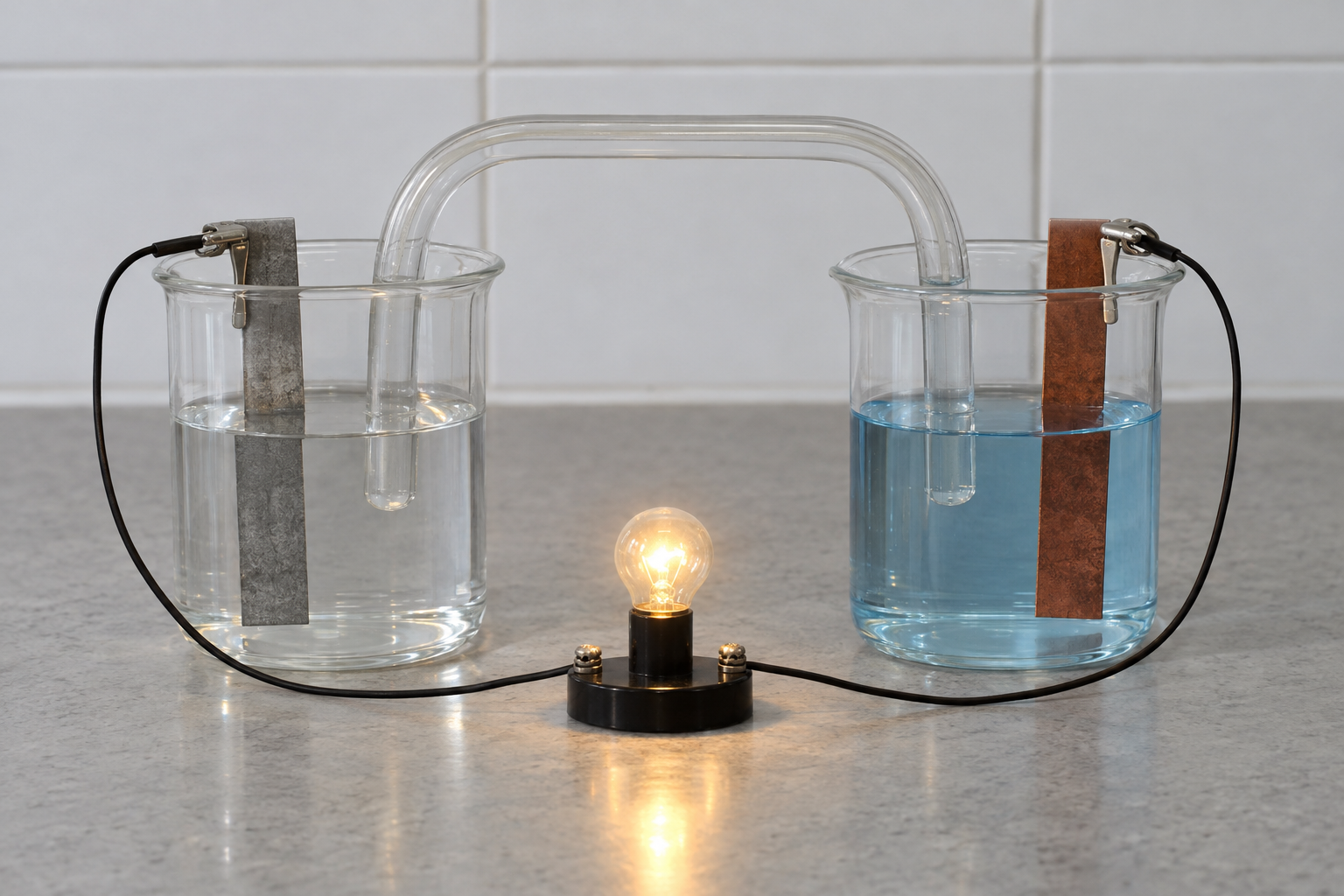
Where does the bulb's electrical energy come from?
Part 2The reaction supplies the energy
The bulb's electrical energy comes from the chemical reaction.
The separated reaction still transfers electrons from the zinc metal to the copper(II) ions.
The electrons now travel from the zinc, through the wire, to the copper(II) ions.
The traveling electrons light the bulb on their way.
The zinc–copper reaction proceeds on its own, so the reaction is thermodynamically favored.
A device that uses a favored reaction to convert chemical energy into electrical energy is called a galvanic cell.
Chemists also call a galvanic cell a voltaic cell.
We've seen that the zinc–copper reaction is an oxidation–reduction reaction, because the reaction transfers one or more electrons from the species that is oxidized to the species that is reduced.
Every galvanic cell uses an oxidation–reduction reaction.
An everyday battery contains one or more galvanic cells.
State that a galvanic (voltaic) cell uses a thermodynamically favored oxidation–reduction reaction to convert chemical energy into electrical energy.
Part 3Check what you just learned
Check — multiple choice
We've seen the class of reactions called oxidation–reduction reactions, redox for short. What does a redox reaction transfer from one species to another?
Feedback if chosen: Correct. A redox reaction transfers one or more electrons from one species to another.
Feedback if chosen: This option is wrong — you named the acid–base transfer. We've seen that an acid donates a proton; a redox reaction transfers one or more electrons.
Feedback if chosen: This option is wrong — you moved the neutrons. Neutrons stay inside their nuclei; a redox reaction transfers electrons.
Check — multiple choice
A device uses its own thermodynamically favored reaction to push electrons through a wire. Is the device a galvanic cell?
Feedback if chosen: Correct. A galvanic cell uses a thermodynamically favored redox reaction to convert chemical energy into electrical energy.
Feedback if chosen: This option is wrong — you refused the definition's own case. A device whose favored reaction pushes electrons through a wire is a galvanic cell.
Check — multiple choice
A power supply forces a reaction to happen inside a device. Is the device a galvanic cell?
Feedback if chosen: This option is wrong — you accepted a driven device. A galvanic cell's own favored reaction supplies the energy; no outside power supply drives it.
Feedback if chosen: Correct. A galvanic cell's own favored reaction supplies the energy. A device that needs a power supply to force its reaction is not a galvanic cell.
Check — multiple choice
Which energy conversion does a galvanic cell perform?
Feedback if chosen: This option is wrong — you reversed the conversion. A galvanic cell converts chemical energy into electrical energy.
Feedback if chosen: Correct. A galvanic cell converts chemical energy into electrical energy.
Feedback if chosen: This option is wrong — you named what a bulb does. The cell converts chemical energy into electrical energy.
Check — multiple choice
A chemist builds a device in which a thermodynamically favored redox reaction converts chemical energy into electrical energy. What is the device called?
Feedback if chosen: This option is wrong — you named the single-beaker case. Mixed in one beaker, the reaction only warms the mixture; the separated, wired reaction is a galvanic cell.
Feedback if chosen: This option is wrong — you named an outside energy source. A galvanic cell supplies its own energy from its favored reaction.
Feedback if chosen: Correct. A device that uses a favored redox reaction to convert chemical energy into electrical energy is called a galvanic cell.
Check — multiple choice
Chemists use a second name for a galvanic cell. What is the second name?
Feedback if chosen: This option is wrong — you named a cell driven by heat. Chemists also call a galvanic cell a voltaic cell.
Feedback if chosen: This option is wrong — you named a cell driven by light. Chemists also call a galvanic cell a voltaic cell.
Feedback if chosen: Correct. Chemists also call a galvanic cell a voltaic cell: two names, one device.
Electrolytic cells and electrolysis
Outcome: State that an electrolytic cell uses an external power source to drive a thermodynamically unfavored redox reaction, converting electrical energy into chemical energy.
Part 1Splitting water
Splitting water into hydrogen and oxygen is thermodynamically unfavored.
We've seen that an external energy source can drive an unfavored process.
A chemist stands two metal strips in a beaker of water.
A power supply connects the two strips.
Hydrogen gas bubbles off one strip.
Oxygen gas bubbles off the other strip.
What drove the unfavored splitting forward?
Part 2The power supply drives the splitting
The power supply pushed the splitting forward.
The power supply pushes electrons through the circuit.
The pushed electrons force the unfavored reaction forward.
A cell that uses an external power source to drive an unfavored reaction is called an electrolytic cell.
The driven splitting process is called electrolysis.
The name electrolysis has two parts.
Electro names the electrical energy; lysis means splitting.
So electrolysis means splitting by electricity.
An electrolytic cell converts electrical energy into chemical energy.
A galvanic cell converts chemical energy into electrical energy.
State that an electrolytic cell uses an external power source to drive a thermodynamically unfavored oxidation–reduction reaction, converting electrical energy into chemical energy; the driven process is called electrolysis.
Part 3Check what you just learned
Check — multiple choice
Which energy conversion does an electrolytic cell perform?
Feedback if chosen: This option is wrong — you named the galvanic conversion. An electrolytic cell converts electrical energy into chemical energy.
Feedback if chosen: Correct. An electrolytic cell converts electrical energy into chemical energy.
Check — multiple choice
A reaction is thermodynamically unfavored. Can an electrolytic cell make the reaction occur?
Feedback if chosen: Correct. The cell's external power source supplies the energy that drives the unfavored reaction forward.
Feedback if chosen: This option is wrong — you read unfavored as impossible. We've seen that an external energy source can drive an unfavored process; the electrolytic cell's power source supplies that energy.
Check — multiple choice
A device converts chemical energy into electrical energy. Is the device an electrolytic cell?
Feedback if chosen: This option is wrong — you reversed the conversion. An electrolytic cell converts electrical energy into chemical energy; the device described is a galvanic cell.
Feedback if chosen: Correct. An electrolytic cell converts electrical energy into chemical energy. The device described performs the opposite conversion, so it is a galvanic cell.
Check — multiple choice
A cell uses an external power source to drive a thermodynamically unfavored redox reaction. What is the cell called?
Feedback if chosen: Correct. A cell that uses an external power source to drive an unfavored reaction is called an electrolytic cell.
Feedback if chosen: This option is wrong — you named the self-driven device. A galvanic cell's own favored reaction supplies its energy; the described cell needs an external power source, so it is electrolytic.
Check — multiple choice
A power source drives a splitting process forward inside a cell. What is the driven splitting process called?
Feedback if chosen: This option is wrong — you named burning in oxygen. A splitting process driven by electrical energy is called electrolysis.
Feedback if chosen: This option is wrong — you named a separation by boiling. A splitting process driven by electrical energy is called electrolysis.
Feedback if chosen: Correct. A splitting process driven by electrical energy is called electrolysis: electro for the electrical energy, lysis for the splitting.
The parts of a cell
Outcome: Identify the role of each part of an electrochemical cell: electrodes, half-cell solutions, salt bridge, and meter or power source.
Part 1Four kinds of part
We've seen that the zinc–copper cell lights a small bulb.
A labeled drawing of that cell names four kinds of part.
Two metal strips stand in the two solutions.
A tube of salt solution joins the two beakers.
A meter sits in the wire.
Each part earns its place in the drawing.
What job does each part do?
Part 2Four parts, four jobs
The half-reactions occur on the two solid metal strips, called the electrodes.
Each electrode stands in a solution that supplies its dissolved reacting species.
One electrode together with its solution is called a half-cell.
The tube of salt solution lets ions migrate between the two half-cells.
That tube is called a salt bridge.
In a galvanic cell, the circuit carries a meter.
In an electrolytic cell, the circuit carries a power source.
The power source supplies the electrical energy that drives the cell's reaction.
We've seen that chemists write one electron as e⁻, and write each half of a redox reaction as its own half-reaction.
Identify the role of each part of an electrochemical cell: the electrodes host the half-reactions, each half-cell solution supplies its dissolved species, the salt bridge lets ions migrate between the half-cells, and the circuit carries a meter or a power source.
Part 3Check what you just learned
Check — multiple choice
We've seen half-reactions written in earlier units. What does a written half-reaction include that the overall equation never shows?
Feedback if chosen: Correct. A half-reaction writes its electrons explicitly, as e⁻; the overall equation never shows them.
Feedback if chosen: This option is wrong — you picked a feature both forms carry. State symbols appear on every species in the overall equation too.
Feedback if chosen: This option is wrong — you picked a feature both forms carry. Coefficients appear in the overall equation too.
Check — multiple choice
Which part of a galvanic cell lets ions migrate between the two half-cells?
Feedback if chosen: This option is wrong — you sent the ions along the electron path. The wire carries electrons; the salt bridge lets ions migrate between the half-cells.
Feedback if chosen: Correct. The salt bridge is the tube of salt solution that lets ions migrate between the two half-cells.
Feedback if chosen: This option is wrong — you picked the device in the wire. The meter sits in the circuit; the salt bridge lets ions migrate between the half-cells.
Check — multiple choice
Where do the half-reactions of an electrochemical cell occur?
Feedback if chosen: This option is wrong — you placed the chemistry in the ion path. The salt bridge only lets ions migrate; the half-reactions occur on the electrodes.
Feedback if chosen: This option is wrong — you placed the chemistry in the electron path. The wire only carries electrons; the half-reactions occur on the electrodes.
Feedback if chosen: Correct. The half-reactions occur on the two solid electrodes.
Check — multiple choice
One electrode, together with the solution it stands in, forms one unit of the cell. What is that unit called?
Feedback if chosen: This option is wrong — you named the connecting tube. One electrode together with its solution is called a half-cell.
Feedback if chosen: Correct. One electrode together with its solution is called a half-cell.
Feedback if chosen: This option is wrong — you named the device in the wire. One electrode together with its solution is called a half-cell.
Check — multiple choice
A chemist stands a solid metal strip in a solution, and a half-reaction occurs on the strip. What is the strip called?
Feedback if chosen: This option is wrong — you named the connecting tube. The solid conductor where a half-reaction occurs is called an electrode.
Feedback if chosen: This option is wrong — you named the strip plus its solution. The strip alone is called an electrode; the strip together with its solution is a half-cell.
Feedback if chosen: Correct. The solid conductor where a half-reaction occurs is called an electrode.
Check — multiple choice
A tube of salt solution connects the two half-cells of a galvanic cell and lets ions migrate between them. What is the tube called?
Feedback if chosen: This option is wrong — you named the solid conductor. The tube of salt solution that connects the half-cells is called a salt bridge.
Feedback if chosen: This option is wrong — you named the electron path. The tube of salt solution that connects the half-cells is called a salt bridge.
Feedback if chosen: Correct. The tube of salt solution that connects the two half-cells is called a salt bridge.
Anode and cathode
Outcome: State that in every electrochemical cell, oxidation occurs at the anode and reduction occurs at the cathode.
Part 1Two electrodes, two names
We've seen that a loss of one or more electrons by a species is called oxidation.
We've seen that a gain of one or more electrons by a species is called reduction.
The zinc–copper cell splits its reaction between the two electrodes.
Zinc atoms lose electrons at the zinc strip.
Copper(II) ions gain electrons at the copper strip.
Every electrochemical cell splits its reaction the same way.
Which electrode is which?
Part 2AN OX and RED CAT
The two electrodes take fixed names.
The electrode where oxidation occurs is called the anode.
The electrode where reduction occurs is called the cathode.
The same names apply in every electrochemical cell, galvanic or electrolytic.
A memory aid keeps the pairs straight: AN OX and RED CAT.
AN OX says the anode hosts oxidation.
RED CAT says the cathode hosts reduction.
State that in every electrochemical cell, oxidation occurs at the anode and reduction occurs at the cathode.
Part 3Check what you just learned
Check — multiple choice
A species loses two electrons during a reaction. Which process is the species undergoing?
Feedback if chosen: Correct. A loss of one or more electrons by a species is called oxidation.
Feedback if chosen: This option is wrong — you swapped the definitions. A gain of electrons is reduction; a loss of one or more electrons is oxidation.
Check — multiple choice
At which electrode does oxidation occur, in any electrochemical cell?
Feedback if chosen: This option is wrong — you swapped the names. RED CAT: the cathode hosts reduction. Oxidation occurs at the anode.
Feedback if chosen: Correct. AN OX: the anode hosts oxidation, in every electrochemical cell.
Check — multiple choice
An electrolytic cell drives an unfavored reaction. At which electrode of this cell does reduction occur?
Feedback if chosen: This option is wrong — you let the cell type move the names. The names apply in every electrochemical cell: reduction occurs at the cathode, in a galvanic cell and in an electrolytic cell alike.
Feedback if chosen: Correct. The same names apply in every electrochemical cell: reduction occurs at the cathode, galvanic or electrolytic.
Check — multiple choice
A described electrode hosts a half-reaction in which species gain electrons. Is the electrode the anode or the cathode?
Feedback if chosen: This option is wrong — you placed a gain of electrons at the anode. A gain of electrons is reduction, and RED CAT says the cathode hosts reduction.
Feedback if chosen: Correct. A gain of electrons is reduction, and reduction occurs at the cathode.
Check — multiple choice
The electrode where reduction occurs has a fixed name. What is it called?
Feedback if chosen: Correct. The electrode where reduction occurs is called the cathode, as RED CAT says.
Feedback if chosen: This option is wrong — you named the oxidation electrode. The electrode where reduction occurs is called the cathode.
Check — multiple choice
The electrode where oxidation occurs has a fixed name. What is it called?
Feedback if chosen: Correct. The electrode where oxidation occurs is called the anode, as AN OX says.
Feedback if chosen: This option is wrong — you named the reduction electrode. The electrode where oxidation occurs is called the anode.
Which electrode is which
Outcome: Identify the anode and the cathode of a specific cell from the half-reactions occurring at each electrode.
Part 1The unlabeled strips
A drawing shows the zinc–copper cell with a half-reaction written at each electrode.
The zinc strip's half-reaction releases electrons.
The copper strip's half-reaction consumes electrons.
We've seen that the anode is the electrode where oxidation occurs.
We've seen that the cathode is the electrode where reduction occurs.
The drawing labels neither strip as anode or cathode.
Which strip is the anode?
Part 2The half-reactions settle it
The two half-reactions settle which electrode is which.
We've seen that an oxidation half-reaction carries its electrons on the product side.
The zinc strip's half-reaction, Zn(s) → Zn²⁺(aq) + 2e⁻, carries its electrons on the product side.
So the zinc strip hosts oxidation.
The electrode that hosts oxidation is the anode.
So the zinc strip is the anode.
The copper strip, where the electrons are consumed, is the cathode.
We've seen that AP answers name the species as written in the equation.
Identify the anode and the cathode of a specific cell from the half-reactions occurring at each electrode.
Part 3Check what you just learned
Check — multiple choice
We've seen that a balanced half-reaction must balance its atoms and one more thing. What else must it balance?
Feedback if chosen: This option is wrong — you asked for a species count no rule fixes. A half-reaction must balance its atoms and its charge, electrons included.
Feedback if chosen: Correct. A half-reaction must balance its atoms and its charge, with the electrons counted in the charge.
Feedback if chosen: This option is wrong — you reached for the apparatus. A half-reaction balances its atoms and its charge, electrons included.
Check — multiple choice
A galvanic cell is built from a nickel electrode and a copper electrode. The diagram shows the half-reaction at each electrode. Which half-reaction shows oxidation?
Feedback if chosen: Correct. The electrons sit on the product side, so the nickel strip's half-reaction releases electrons: oxidation.
Feedback if chosen: This option is wrong — you picked the half whose electrons sit on the reactant side. That half consumes electrons, so it shows reduction.
Check — multiple choice
In a nickel–copper galvanic cell, the nickel strip's half-reaction is Ni(s) → Ni²⁺(aq) + 2e⁻. Which electrode is the anode?
Feedback if chosen: Correct. The nickel half-reaction carries its electrons on the product side, so the nickel strip hosts oxidation. And the electrode that hosts oxidation is the anode.
Feedback if chosen: This option is wrong — you placed the anode at the electron-consuming strip. The nickel half-reaction releases electrons, so the nickel electrode hosts oxidation and is the anode.
Check — multiple choice
Suppose a galvanic cell is built from a zinc electrode and a lead electrode, with the half-reactions Zn(s) → Zn²⁺(aq) + 2e⁻ and Pb²⁺(aq) + 2e⁻ → Pb(s). Which electrode is the cathode?
Feedback if chosen: This option is wrong — you swapped the definitions. The zinc half-reaction carries its electrons on the product side, so the zinc electrode hosts oxidation: the anode.
Feedback if chosen: Correct. The lead half-reaction, Pb²⁺(aq) + 2e⁻ → Pb(s), consumes electrons, so the lead electrode hosts reduction: the cathode.
Why the salt bridge matters
Outcome: Explain why a cell stops working without its salt bridge: with no ion path, charge builds up in both half-cells and halts the half-reactions.
Part 1The lifted salt bridge
The zinc–copper cell stands lit on the bench.
A student lifts the salt bridge out of the cell.
The bulb goes dark at once.
The wire still connects the two strips.
The student puts the salt bridge back.
The bulb relights.
Why does the cell stop without its salt bridge?
Part 2Charge buildup stops the cell
Charge buildup stops the cell.
The solution around the anode gains positive ions.
The solution around the cathode loses positive ions.
Anions from the salt bridge migrate into the anode half-cell.
Cations from the salt bridge migrate into the cathode half-cell.
The migrating ions cancel the charge buildup on both sides.
With no ion path, the unbalanced charge halts both half-reactions.
Explain why a cell stops working without its salt bridge: with no ion path, charge builds up in both half-cells, and the buildup halts the half-reactions.
Part 3Check what you just learned
Check — multiple choice
A galvanic cell lights a small bulb. A student lifts the salt bridge out of the cell. What happens to the cell's electrical output?
Feedback if chosen: Correct. With no ion path, charge builds up in both half-cells and the buildup halts the half-reactions, so the output falls to zero.
Feedback if chosen: This option is wrong — you kept the cell going on the wire alone. The wire carries electrons, but without an ion path the charge buildup halts both half-reactions.
Feedback if chosen: This option is wrong — you rewarded the cell for losing a part. Without an ion path the charge buildup halts the half-reactions, so the output falls to zero.
Check — multiple choice
In class, Dalia says: "The salt bridge supplies the electrons that light the bulb." Is Dalia correct?
Feedback if chosen: This option is wrong — you let the bridge supply electrons. The oxidation half-reaction at the anode releases the electrons; the salt bridge supplies migrating ions.
Feedback if chosen: Correct. The electrons come from the oxidation half-reaction at the anode. The salt bridge supplies migrating ions, never electrons.
Check — multiple choice
Dalia is wrong. What does the salt bridge actually do?
Feedback if chosen: This option is wrong — you kept Dalia's belief with new words. Electrons travel through the wire; ions migrate through the salt bridge.
Feedback if chosen: This option is wrong — you gave the bridge a heater's job. The salt bridge lets ions migrate between the half-cells.
Feedback if chosen: Correct. The salt bridge lets ions migrate between the half-cells, and the migrating ions cancel the charge buildup that would otherwise halt the half-reactions.
Feedback if chosen: This option is wrong — you made the bridge a reactant supply. The cathode's Cu²⁺ ions come from its own half-cell solution; the bridge supplies migrating spectator ions.
Free-response question
Source note (not shown as part of the question): authored to archetype: AP short-answer cell-explanation class (fresh apparatus-variant case; no released FRQ reproduced)
A student replaces a working galvanic cell's salt bridge with a solid glass rod of the same shape. Glass conducts no ions. The bulb in the cell's wire stays dark.
(a) Explain why the bulb stays dark. [3 points]
✓ Model response (the key)
Model response
The glass rod lets no ions migrate between the two half-cells.
So the anode half-cell's solution gains positive ions with nothing to cancel the gain, and the cathode half-cell's solution loses positive ions with nothing to replace them.
The charge buildup halts both half-reactions, so no electrons travel through the wire and the bulb stays dark.
Scoring rubric — 3 points available
- States that the glass rod provides no ion path between the half-cells (no ions can migrate). [1 pt]
- States that charge builds up in the half-cells (the anode side gains positive charge, or the cathode side loses it). [1 pt]
- States that the charge buildup halts the half-reactions or stops the electron flow, so no electrons travel through the wire. [1 pt]
Which way the electrons travel
Outcome: Identify the direction of electron flow in an operating cell: from the anode, through the external wire, to the cathode.
Part 1Two paths between the electrodes
The zinc–copper cell lights its bulb.
We've seen that the anode's half-reaction releases electrons.
We've seen that the cathode's half-reaction consumes electrons.
The released electrons must reach the cathode.
The wire connects the electrodes above.
The salt bridge connects the half-cells below.
Which path carries the electrons?
Part 2The wire carries the electrons
The wire carries the electrons.
Electrons leave the anode.
The electrons travel through the external wire.
The electrons enter the cathode.
No electron travels through the solutions or the salt bridge.
Ions, not electrons, carry the charge inside the cell.
In an electrolytic cell, the power source forces the electrons along the same anode-to-cathode path.
Identify the direction of electron flow in an operating cell: electrons leave the anode, travel through the external wire, and enter the cathode, in a galvanic cell and in an electrolytic cell alike.
Part 3Check what you just learned
Check — multiple choice
A galvanic cell is built from an iron electrode and a nickel electrode, with the half-reactions shown in the diagram. Which way do the electrons travel through the wire?
Feedback if chosen: Correct. The iron half-reaction releases electrons (product side), so the iron electrode is the anode. And electrons leave the anode, travel through the wire, and enter the cathode.
Feedback if chosen: This option is wrong — you reversed the flow. The iron half-reaction releases electrons, so the iron electrode is the anode, and electrons leave the anode.
Check — multiple choice
Between the electrodes of an operating galvanic cell, through which part do the electrons travel?
Feedback if chosen: This option is wrong — you sent the electrons through the salt bridge. Ions, not electrons, carry the charge inside the cell; the electrons travel through the external wire.
Feedback if chosen: Correct. The electrons travel through the external wire. Inside the cell, migrating ions carry the charge.
Feedback if chosen: This option is wrong — you sent the electrons through the solutions. Ions, not electrons, carry the charge inside the cell; the electrons travel through the external wire.
Check — multiple choice
In an electrolytic cell, the power source forces the electrons along the wire. From which electrode to which do the electrons travel?
Feedback if chosen: This option is wrong — you reversed the path. In an electrolytic cell too, the electrons travel from the anode, through the wire, to the cathode.
Feedback if chosen: Correct. The power source forces the electrons along the same anode-to-cathode path that a galvanic cell's electrons take.
Check — multiple choice
In class, Jonas says: "The electrons travel only through the wire, never through the solutions." Is Jonas correct?
Feedback if chosen: Correct. Electrons travel from the anode, through the external wire, to the cathode. Inside the cell, migrating ions carry the charge.
Feedback if chosen: This option is wrong — you sent electrons through the solutions. Ions, not electrons, carry the charge inside the cell; the electrons keep to the wire.
Electrode mass changes
Outcome: Predict electrode mass changes from the half-reactions: the electrode whose metal dissolves loses mass; the electrode where metal deposits gains mass.
Part 1The weighed strips
The zinc–copper cell has worked for a whole afternoon.
A student lifts out both electrodes.
The student weighs each strip.
The zinc strip weighs less than it did in the morning.
The copper strip weighs more than it did in the morning.
Where did the missing zinc metal go?
Part 2The half-reactions explain both changes
The two half-reactions explain both changes.
At the anode, zinc atoms dissolve into the solution as Zn²⁺ ions.
Every dissolving atom leaves the strip.
So the electrode whose metal dissolves away loses mass.
At the cathode, Cu²⁺ ions deposit onto the strip as copper atoms.
Every depositing ion adds one atom to the strip.
So the electrode where new metal deposits gains mass.
Predict electrode mass changes from the half-reactions: an electrode whose metal is oxidized into dissolved ions loses mass, and an electrode where metal ions are reduced onto the surface gains mass.
Part 3Check what you just learned
Check — multiple choice
A galvanic cell is built from an aluminum electrode and a nickel electrode, with the half-reactions shown in the diagram. The cell operates all afternoon. What happens to the aluminum electrode's mass?
Feedback if chosen: Correct. The aluminum half-reaction, Al(s) → Al³⁺(aq) + 3e⁻, dissolves aluminum atoms into the solution, and every dissolving atom leaves the strip.
Feedback if chosen: This option is wrong — you deposited metal at the anode. The aluminum half-reaction dissolves the strip's atoms into the solution as Al³⁺ ions, so the strip loses mass.
Check — multiple choice
In the same aluminum–nickel cell, the nickel electrode's half-reaction is Ni²⁺(aq) + 2e⁻ → Ni(s). What happens to the nickel electrode's mass?
Feedback if chosen: Correct. Ni²⁺ ions deposit onto the strip as nickel atoms, and every depositing ion adds one atom to the strip.
Feedback if chosen: This option is wrong — you dissolved the cathode. The nickel half-reaction deposits Ni²⁺ ions onto the strip as nickel atoms, so the strip gains mass.
Check — multiple choice
Suppose a galvanic cell is built from a magnesium electrode and a zinc electrode, with the half-reactions Mg(s) → Mg²⁺(aq) + 2e⁻ and Zn²⁺(aq) + 2e⁻ → Zn(s). What happens to the zinc electrode's mass?
Feedback if chosen: This option is wrong — you dissolved the depositing electrode. The zinc half-reaction, Zn²⁺(aq) + 2e⁻ → Zn(s), deposits zinc atoms onto the strip.
Feedback if chosen: Correct. The zinc half-reaction deposits Zn²⁺ ions onto the strip as zinc atoms, so the zinc electrode gains mass.
Check — multiple choice
In the same magnesium–zinc cell, the magnesium electrode's half-reaction is Mg(s) → Mg²⁺(aq) + 2e⁻. What happens to the magnesium electrode's mass?
Feedback if chosen: This option is wrong — you deposited metal at the anode. The magnesium half-reaction dissolves the strip's atoms into the solution as Mg²⁺ ions.
Feedback if chosen: Correct. The magnesium half-reaction dissolves magnesium atoms into the solution as Mg²⁺ ions, so the magnesium electrode loses mass.
Gas at an electrode
Outcome: Predict that a gas is produced at an electrode whose half-reaction forms a gaseous product.
Part 1One cell bubbles, one never does
We've seen water split in an electrolytic cell.
Hydrogen gas bubbles off one electrode.
Oxygen gas bubbles off the other electrode.
The zinc–copper cell never bubbles.
Its electrodes only gain or lose solid metal.
Both cells host two half-reactions each.
When does a gas form at an electrode?
Part 2The half-reaction fixes the product
The electrode's half-reaction fixes the product.
A gas forms at an electrode whose half-reaction forms a gaseous product.
In the water cell, the cathode's half-reaction produces hydrogen gas.
So hydrogen bubbles rise from the cathode.
In the zinc–copper cell, each half-reaction forms a solid metal or a dissolved ion.
Neither half-reaction forms a gas.
So the zinc–copper cell never bubbles.
Here is the move on a molten salt, where the half-reactions are written out.
The anode's half-reaction is 2 Cl⁻ → Cl₂(g) + 2e⁻.
The product Cl₂ carries the state symbol (g).
So chlorine gas forms at the anode.
Predict that a gas is produced at an electrode whose half-reaction forms a gaseous product.
Part 3Check what you just learned
Check — multiple choice
A power source drives the electrolysis of molten calcium chloride, with the half-reactions shown in the diagram. At which electrode does a gas form?
Feedback if chosen: Correct. The anode's half-reaction, 2 Cl⁻ → Cl₂(g) + 2e⁻, forms a gaseous product, so chlorine gas forms at the anode.
Feedback if chosen: This option is wrong — you placed the gas at the metal-forming electrode. The cathode's half-reaction forms calcium, and calcium is not a gas here.
Check — multiple choice
In the same molten calcium chloride cell, the anode's half-reaction is 2 Cl⁻ → Cl₂(g) + 2e⁻. Which product is the gas?
Feedback if chosen: This option is wrong — you picked the other electrode's product. Calcium forms at the cathode, and its half-reaction forms no gaseous product.
Feedback if chosen: Correct. The anode's product Cl₂ carries the state symbol (g), so the gas is chlorine.
Check — multiple choice
In the same cell, the cathode's half-reaction is Ca²⁺ + 2e⁻ → Ca. Does a gas form at the cathode?
Feedback if chosen: This option is wrong — you bubbled the metal. The cathode's half-reaction forms calcium metal, not a gas.
Feedback if chosen: Correct. The cathode's half-reaction forms calcium metal, not a gas. A gas forms only at an electrode whose half-reaction forms a gaseous product.
Galvanic or electrolytic?
Outcome: Classify a described or drawn cell as galvanic or electrolytic from its features.
Part 1Two cells, opposite jobs
Two cells stand side by side on the bench.
The first cell lights a bulb from its own favored reaction.
The second cell takes energy from a power supply to force its reaction.
Both cells contain two electrodes each.
Both cells host an oxidation and a reduction.
Yet the two cells do opposite jobs.
How do you tell the two kinds of cell apart?
Part 2One question sorts every cell
One question sorts every cell: what pushes the electrons?
In a galvanic cell, the favored reaction itself pushes the electrons through the wire.
In an electrolytic cell, an external power source pushes the electrons through the wire.
A galvanic cell converts chemical energy into electrical energy.
An electrolytic cell converts electrical energy into chemical energy.
A meter in the circuit marks a galvanic cell.
A power source in the circuit marks an electrolytic cell.
Now sort five cells, one at a time.
Case 1. The zinc–copper cell stands on the bench with its meter, and its bulb is lit by its own reaction.
What pushes the electrons through the wire: the cell's own favored reaction, or an external power source?
The cell's own favored reaction pushes the electrons.
So the cell is galvanic.
Case 2. A chemist swaps the same cell's meter for a power source, and the power source drives the reaction in reverse.
What pushes the electrons through the wire: the cell's own favored reaction, or an external power source?
An external power source pushes the electrons.
So the cell is electrolytic.
Case 3. The chemist removes the power source from the same cell and reconnects the meter.
What pushes the electrons through the wire: the cell's own favored reaction, or an external power source?
The cell's own favored reaction pushes the electrons again.
So the cell is galvanic.
Case 4. A heated vessel of molten sodium chloride stands with two electrodes and a power source, and sodium metal and chlorine gas form.
What pushes the electrons through the wire: the cell's own favored reaction, or an external power source?
An external power source pushes the electrons.
So the cell is electrolytic.
Case 5. Two metal strips stand in a beaker of water, a power supply connects them, and hydrogen and oxygen bubble off.
What pushes the electrons through the wire: the cell's own favored reaction, or an external power source?
An external power source pushes the electrons.
So the cell is electrolytic.
| The cell | What pushes the electrons through the wire? | Galvanic or electrolytic? |
|---|---|---|
| The zinc–copper cell with its meter | Its own favored reaction | Galvanic |
| The same cell, meter swapped for a power source | An external power source | Electrolytic |
| The same cell, power source removed, meter back | Its own favored reaction | Galvanic |
| The molten sodium chloride cell | An external power source | Electrolytic |
| The water-splitting cell | An external power source | Electrolytic |
In a galvanic cell, the favored reaction itself pushes the electrons through the wire.
In an electrolytic cell, an external power source pushes the electrons through the wire.
Classify a described or drawn cell as galvanic or electrolytic from its features.
Part 3Check what you just learned
Check — multiple choice
An external power source drives a cell's reaction. Is the cell galvanic or electrolytic?
Feedback if chosen: Correct. An external power source pushes the electrons, so the cell is electrolytic.
Feedback if chosen: This option is wrong — you let a driven cell count as self-driven. A galvanic cell's own favored reaction pushes its electrons; a cell driven by an external power source is electrolytic.
Check — multiple choice
A cell converts chemical energy into electrical energy. Is the cell galvanic or electrolytic?
Feedback if chosen: Correct. A galvanic cell converts chemical energy into electrical energy.
Feedback if chosen: This option is wrong — you reversed the conversion. An electrolytic cell converts electrical energy into chemical energy; the described cell is galvanic.
Check — multiple choice
A cell lights a bulb with no outside energy source. Is the cell galvanic or electrolytic?
Feedback if chosen: This option is wrong — you gave the cell a power source it does not have. With no outside energy source, the cell's own favored reaction pushes the electrons: galvanic.
Feedback if chosen: Correct. With no outside energy source, the cell's own favored reaction pushes the electrons, so the cell is galvanic.
Check — multiple choice
A cell's reaction is thermodynamically unfavored, yet the reaction proceeds. Is the cell galvanic or electrolytic?
Feedback if chosen: This option is wrong — you let an unfavored reaction push its own electrons. An unfavored reaction proceeds only while an external power source drives it, so the cell is electrolytic.
Feedback if chosen: Correct. An unfavored reaction proceeds only while an external power source drives it, the electrolytic tell.
Read a cell diagram
Outcome: Identify on a labeled cell diagram the anode and cathode, the half-reaction at each electrode, the electron-flow direction, and the ion-migration directions.
Part 1Everything at once
A labeled diagram of the zinc–copper cell lies on the exam desk.
We've seen the cell's parts one at a time.
The exam asks for everything at once.
One part asks which electrode is the anode.
Another part asks which way the electrons travel.
A third part asks which way the salt-bridge ions migrate.
How do you read all of that from one drawing?
Part 2Every answer sits in the diagram
Every answer sits in the diagram itself.
The half-reaction written at each electrode marks the anode and the cathode.
The electron arrow points from the anode, through the wire, to the cathode.
The salt-bridge anions migrate toward the anode half-cell.
The salt-bridge cations migrate toward the cathode half-cell.
One diagram answers all five reads.
Identify on a labeled cell diagram the anode and cathode, the half-reaction at each electrode, the electron-flow direction, and the ion-migration directions in the salt bridge.
Part 3Check what you just learned
Check — multiple choice
The diagram shows a labeled galvanic cell built from a zinc electrode and a cobalt electrode. Read the diagram: which electrode is the anode?
Feedback if chosen: Correct. The diagram labels the zinc electrode as the anode, and its half-reaction carries the electrons on the product side.
Feedback if chosen: This option is wrong — you read the wrong label. The cobalt electrode is labeled cathode; the anode label sits on the zinc electrode.
Check — multiple choice
Read the same labeled zinc–cobalt diagram: which half-reaction occurs at the cobalt electrode?
Feedback if chosen: This option is wrong — you reversed the written half. The diagram writes the cobalt electrode's half-reaction with the electrons on the reactant side.
Feedback if chosen: Correct. The diagram writes Co²⁺(aq) + 2e⁻ → Co(s) at the cobalt electrode: the reduction half, matching its cathode label.
Check — multiple choice
Read the same labeled zinc–cobalt diagram: which way do the electrons travel through the wire?
Feedback if chosen: Correct. The drawn electron arrow leaves the zinc electrode, the anode, and enters the cobalt electrode through the wire.
Feedback if chosen: This option is wrong — you read the arrow backwards. The drawn arrow leaves the anode, the zinc electrode.
Check — multiple choice
Read the same labeled zinc–cobalt diagram: toward which half-cell do the salt-bridge anions migrate?
Feedback if chosen: Correct. The drawn anion arrow points toward the zinc half-cell, the anode half-cell, where positive ions build up.
Feedback if chosen: This option is wrong — you followed the cation arrow. The cations migrate toward the cobalt half-cell; the anions migrate toward the zinc half-cell.
Mark the flows
Outcome: Sketch the electron-flow arrow and the salt-bridge ion-migration arrows on a supplied cell diagram.
Part 1No arrows drawn
A cell diagram shows the electrodes and solutions, fully labeled.
No arrow shows where the electrons travel.
No arrow shows where the ions migrate.
The exam asks you to draw every flow arrow yourself.
Which way does each arrow point?
Part 2Three arrows complete the diagram
Three arrows complete the diagram.
Here is the zinc–copper diagram before the arrows.
The electron arrow points from the anode, through the wire, to the cathode.
The anion arrow points from the salt bridge into the anode half-cell.
The cation arrow points from the salt bridge into the cathode half-cell.
You find each direction from the half-reactions, as we've seen.
The finished diagram then shows every flow in the cell.
Sketch the electron-flow arrow and the salt-bridge ion-migration arrows on a supplied cell diagram whose electrodes and solutions are labeled.
Part 3Check what you just learned
Check — multiple choice
A galvanic cell is built from a magnesium electrode and a lead electrode, with the half-reactions shown in the diagram and no arrows drawn. Which electrode is the anode?
Feedback if chosen: Correct. The magnesium half-reaction carries its electrons on the product side, so the magnesium electrode hosts oxidation: the anode. Every arrow direction hangs on this.
Feedback if chosen: This option is wrong — you placed the anode at the electron-consuming strip. The lead half-reaction consumes electrons, so the lead electrode is the cathode; the magnesium electrode is the anode.
Check — drawing task (pen and paper, self-marked)
Take a pen and paper and copy the magnesium–lead diagram shown, without its arrows. Draw the electron-flow arrow and both salt-bridge ion-migration arrows on your copy. When you are done, select Check to compare your answer with the model answer.
Model answer shown to the student
Self-mark checklist — the drawing should show:
- Your electron-flow arrow starts at the magnesium electrode (the anode), passes through the wire, and ends at the lead electrode (the cathode).
- Your anion arrow points from the salt bridge into the magnesium half-cell (the anode half-cell).
- Your cation arrow points from the salt bridge into the lead half-cell (the cathode half-cell).
Draw a galvanic cell
Outcome: Draw and fully label a galvanic cell for a given overall reaction.
Part 1A drawing from one equation
An exam question supplies one line: the net ionic equation of a nickel–silver reaction.
The question asks for a complete, labeled drawing of the galvanic cell.
No diagram comes with the question.
The drawing must show every part and every flow.
How do you build the whole drawing from one equation?
Part 2The equation builds the drawing
The equation builds the drawing step by step.
The worked equation is Ni(s) + 2 Ag⁺(aq) → Ni²⁺(aq) + 2 Ag(s).
First split the equation into its two half-reactions, as we've seen: Ni(s) → Ni²⁺(aq) + 2e⁻ and 2 Ag⁺(aq) + 2e⁻ → 2 Ag(s).
The oxidation half-reaction fixes the anode and its solution.
So a nickel electrode stands in a solution of Ni²⁺ ions.
The reduction half-reaction fixes the cathode and its solution.
So a silver electrode stands in a solution of Ag⁺ ions.
Then add the salt bridge, the meter, and the wire.
Last, draw the electron arrow and both ion arrows, as we've seen.
A checklist of required features scores the finished drawing.
Draw and fully label a galvanic cell for a given overall reaction: electrodes, half-cell solutions, salt bridge with ion directions, electron arrow, and meter.
Part 3Check what you just learned
Check — multiple choice
Suppose a chemist must draw the galvanic cell for the reaction Pb(s) + Cu²⁺(aq) → Pb²⁺(aq) + Cu(s). Which metal is the anode electrode?
Feedback if chosen: Correct. The equation oxidizes Pb(s) into Pb²⁺(aq), so the lead electrode hosts oxidation: the anode.
Feedback if chosen: This option is wrong — you picked the metal the equation deposits. Cu²⁺ is reduced onto the copper electrode, so copper is the cathode; lead is the anode.
Check — multiple choice
For the same reaction, Pb(s) + Cu²⁺(aq) → Pb²⁺(aq) + Cu(s), which solution belongs in the cathode half-cell?
Feedback if chosen: This option is wrong — you placed the anode's product around the cathode. Pb²⁺ is what the anode's half-reaction produces; the cathode's half-reaction needs its own Cu²⁺ ions.
Feedback if chosen: Correct. The reduction half, Cu²⁺(aq) + 2e⁻ → Cu(s), consumes Cu²⁺ ions, so the cathode half-cell's solution must supply them.
Check — drawing task (pen and paper, self-marked)
Take a pen and paper and draw the complete, labeled galvanic cell for the reaction Pb(s) + Cu²⁺(aq) → Pb²⁺(aq) + Cu(s). Show the electrodes, the solutions, the salt bridge, the meter, the wire, the electron arrow, both ion arrows, and the half-reaction at each electrode. When you are done, select Check to compare your answer with the model answer.
Model answer shown to the student
Self-mark checklist — the drawing should show:
- Your drawing labels both electrodes: a lead electrode and a copper electrode.
- Your drawing places each half-reaction at the correct electrode: Pb(s) → Pb²⁺(aq) + 2e⁻ at the lead electrode (the anode), and Cu²⁺(aq) + 2e⁻ → Cu(s) at the copper electrode (the cathode).
- Your electron-flow arrow points from the lead electrode, through the wire, to the copper electrode.
- Your salt-bridge ion arrows point the anions into the lead half-cell and the cations into the copper half-cell.
- Your external circuit carries a meter.
Draw an electrolytic cell
Outcome: Draw and fully label an electrolytic cell for a given driven reaction.
Part 1A different drawing
Molten sodium chloride sits in a single heated container.
An exam question asks for the drawing of the cell that splits it into sodium metal and chlorine gas.
We've practiced drawing a galvanic cell.
This cell has no favored reaction to push its own electrons.
The drawing needs different parts.
What changes in the drawing?
Part 2A power source replaces the meter
A power source replaces the meter.
The power source drives the unfavored reaction.
Both electrodes stand in one container of the molten salt.
The melt itself lets the ions migrate.
So the drawing needs no salt bridge.
The electron arrow still points from the anode, through the wire, to the cathode.
A half-reaction labeled at each electrode completes the drawing.
Draw and fully label an electrolytic cell for a given driven reaction: electrodes, the molten substance, external power source, electron arrow, and the electrode of each half-reaction.
Part 3Check what you just learned
Check — multiple choice
A chemist must draw the electrolytic cell for the electrolysis of molten potassium bromide. Which part replaces the galvanic cell's meter?
Feedback if chosen: Correct. The driven reaction is unfavored, so an external power source sits in the circuit where a galvanic cell carries its meter.
Feedback if chosen: This option is wrong — you added an ion path the cell does not need. The melt itself lets the ions migrate; the circuit needs a power source.
Check — multiple choice
For the same molten potassium bromide cell, the half-reactions are K⁺ + e⁻ → K and 2 Br⁻ → Br₂ + 2e⁻. At which electrode does the bromine form?
Feedback if chosen: This option is wrong — you placed the bromine at the electron-consuming electrode. The bromide half-reaction releases electrons (product side), so it occurs at the anode.
Feedback if chosen: Correct. The half-reaction 2 Br⁻ → Br₂ + 2e⁻ carries its electrons on the product side: oxidation. So the bromine forms at the anode.
Check — drawing task (pen and paper, self-marked)
Take a pen and paper and draw the complete, labeled electrolytic cell for the electrolysis of molten potassium bromide. The half-reactions are K⁺ + e⁻ → K and 2 Br⁻ → Br₂ + 2e⁻. Show the container, both electrodes, the power source, the electron arrow, and the half-reaction at each electrode. When you are done, select Check to compare your answer with the model answer.
Model answer shown to the student
Self-mark checklist — the drawing should show:
- Your drawing shows both electrodes standing in ONE container, with the molten substance named in it.
- Your drawing places each half-reaction at the correct electrode: 2 Br⁻ → Br₂ + 2e⁻ at the anode, and K⁺ + e⁻ → K at the cathode.
- Your electron-flow arrow points from the anode, through the external circuit, to the cathode.
- Your external circuit carries a power source, not a meter.
- Your drawing shows no salt bridge: the melt itself is the ion path.
Spot the flaw in a cell diagram
Outcome: Evaluate a supplied cell diagram for correctness, identifying the specific error when one is present.
Part 1The marked-wrong homework
A classmate's homework shows a finished zinc–copper cell diagram.
Every part carries a label.
Every arrow sits in place.
The grader still marks the diagram wrong.
One feature contradicts the cell's own chemistry.
How do you find the error?
Part 2Compare the drawing with the chemistry
Compare the drawing with the cell's own chemistry, feature by feature.
The half-reactions name the true anode and cathode.
The electron arrow must leave the anode and enter the cathode.
The anion arrow must point toward the anode half-cell.
The cation arrow must point toward the cathode half-cell.
A feature that breaks one of these facts is the diagram's error.
A diagram that breaks none of them passes.
Here is a correct zinc–copper diagram, with its half-reactions written.
Every feature matches the half-reactions, so this diagram passes.
Now here is the same diagram with one feature changed.
The zinc half-reaction releases electrons, so electrons must leave the zinc electrode.
This drawn electron arrow enters the zinc electrode instead.
So the electron arrow is this diagram's error.
Here is the same diagram with a different single feature changed.
The half-reactions name the zinc strip as the electrode that releases electrons.
Yet the label under the zinc strip reads cathode.
So the swapped labels are this diagram's error.
Here is the same diagram with one more single feature changed.
Anions must migrate toward the anode half-cell.
This drawn anion arrow points toward the cathode half-cell instead.
So the ion arrows are this diagram's error.
Evaluate a supplied cell diagram for correctness, identifying the specific error when one is present.
Part 3Check what you just learned
Check — multiple choice
A student's diagram of an iron–copper galvanic cell is shown, with its half-reactions written. Compare the diagram with the cell's chemistry. Which statement describes the diagram?
Feedback if chosen: This option is wrong — you faulted a correct arrow. The drawn electron arrow leaves the iron electrode, whose half-reaction releases electrons.
Feedback if chosen: Correct. The iron half-reaction releases electrons, so the iron electrode is the anode. Yet its label reads cathode, so the labels are swapped.
Feedback if chosen: This option is wrong — you faulted correct ion arrows. The drawn anion arrow points toward the iron half-cell, where the positive ions build up.
Feedback if chosen: This option is wrong — you passed a flawed diagram. Check the word labels against the half-reactions: the electrode that releases electrons must be labeled anode.
Check — multiple choice
A second student's diagram of an iron–copper galvanic cell is shown, with its half-reactions written. Compare the diagram with the cell's chemistry. Which statement describes the diagram?
Feedback if chosen: This option is wrong — you faulted a correct arrow. The drawn electron arrow leaves the iron electrode, whose half-reaction releases electrons.
Feedback if chosen: This option is wrong — you faulted correct labels. The iron electrode's half-reaction releases electrons, and its label reads anode.
Feedback if chosen: This option is wrong — you faulted correct ion arrows. The drawn anion arrow points toward the iron half-cell, the anode half-cell.
Feedback if chosen: Correct. Every feature matches the half-reactions: the electron arrow leaves the anode, the labels match the halves, and the ion arrows point into their half-cells.
Check — multiple choice
A third student's diagram of an iron–copper galvanic cell is shown, with its half-reactions written. Compare the diagram with the cell's chemistry. Which statement describes the diagram?
Feedback if chosen: Correct. The iron half-reaction releases electrons, so electrons must leave the iron electrode. Yet this drawn arrow enters it.
Feedback if chosen: This option is wrong — you faulted correct labels. The iron electrode's half-reaction releases electrons, and its label reads anode.
Feedback if chosen: This option is wrong — you faulted correct ion arrows. The drawn anion arrow points toward the iron half-cell, the anode half-cell.
Feedback if chosen: This option is wrong — you passed a flawed diagram. Check the electron arrow against the half-reactions: electrons must leave the electrode whose half-reaction releases them.
Check — multiple choice
A fourth student's diagram of an iron–copper galvanic cell is shown, with its half-reactions written. Compare the diagram with the cell's chemistry. Which statement describes the diagram?
Feedback if chosen: This option is wrong — you faulted a correct arrow. The drawn electron arrow leaves the iron electrode, whose half-reaction releases electrons.
Feedback if chosen: This option is wrong — you faulted correct labels. The iron electrode's half-reaction releases electrons, and its label reads anode.
Feedback if chosen: Correct. Anions must migrate toward the anode half-cell, the iron side. Yet this drawn anion arrow points toward the copper half-cell.
Feedback if chosen: This option is wrong — you passed a flawed diagram. Check the ion arrows: the anion arrow must point into the anode half-cell, where positive ions build up.
How the whole cell works
Outcome: Explain the operation of a specific cell at the macroscopic and particulate levels, connecting each observable change to the particle-level event that causes it.
Part 1The cell by evening
The zinc–copper cell has lit its bulb all day.
By evening, the bulb glows dimmer.
The zinc strip stands visibly thinner.
Fresh copper coats the copper strip.
Every change is visible without any instrument.
What particle-level event causes each visible change?
Part 2Every visible change has a particle-level cause
Electrons traveling through the wire light the bulb.
Metal dissolves away at the zinc strip.
Zinc atoms leave that strip as Zn²⁺ ions.
Metal builds up at the copper strip.
Cu²⁺ ions land on that strip as copper atoms.
The dimming bulb marks the depletion of the dissolved copper(II) ions.
Ions migrating through the salt bridge keep both solutions electrically neutral.
Here are the four visible changes and their particle-level causes as one table.
| Visible change | Particle-level cause |
|---|---|
| The bulb glows | Electrons travel through the wire |
| The zinc strip thins | Zinc atoms leave the strip as Zn²⁺ ions |
| The copper strip thickens | Cu²⁺ ions land on the strip as copper atoms |
| Both solutions stay electrically neutral | Ions migrate through the salt bridge |
This unit explains later exactly why the cell's electrical output falls as the reactants are used up.
Explain the operation of a specific cell at the macroscopic and particulate levels, connecting each observable change to the particle-level event that causes it.
Part 3Check what you just learned
Check — multiple choice
Suppose a galvanic cell is built from a zinc electrode and a nickel electrode, with the half-reactions Zn(s) → Zn²⁺(aq) + 2e⁻ and Ni²⁺(aq) + 2e⁻ → Ni(s). The cell operates overnight. What happens to the nickel electrode's mass?
Feedback if chosen: Correct. Ni²⁺ ions deposit onto the strip as nickel atoms, and every depositing ion adds one atom to the strip.
Feedback if chosen: This option is wrong — you dissolved the cathode. The nickel half-reaction deposits metal onto the strip; the zinc electrode is the one that loses mass.
Feedback if chosen: This option is wrong — you froze the cathode. The nickel half-reaction keeps depositing Ni²⁺ ions onto the strip as atoms, so the strip gains mass all through the night.
Free-response question
Source note (not shown as part of the question): authored to archetype: AP short-answer cell-explanation class (fresh case against the what item's observable; no released FRQ reproduced)
The same zinc–nickel cell operates all night. Zinc ions keep entering the zinc half-cell's solution the whole time, yet that solution stays electrically neutral.
(a) Explain why the zinc half-cell's solution stays electrically neutral. [3 points]
✓ Model response (the key)
Model response
Each zinc atom that dissolves enters the solution as a Zn²⁺ ion, adding positive charge.
Anions migrate from the salt bridge into the zinc half-cell.
The migrating anions cancel the added positive charge, so the solution stays electrically neutral.
Scoring rubric — 3 points available
- States that the dissolving zinc adds positive charge to the solution (Zn²⁺ ions enter it). [1 pt]
- States that anions migrate from the salt bridge into the zinc half-cell. [1 pt]
- States that the migrating anions cancel the added positive charge, keeping the solution neutral. [1 pt]
Check — multiple choice
In the same zinc–nickel cell, a small bulb in the wire glows. Which particle-level event causes the glow?
Feedback if chosen: This option is wrong — you sent ions down the wire. Ions migrate through the salt bridge and the solutions; electrons travel through the wire and light the bulb.
Feedback if chosen: Correct. The electrons released at the zinc electrode travel through the wire to the nickel electrode, and the traveling electrons light the bulb on their way.
Feedback if chosen: This option is wrong — you sent whole atoms through the wire. The zinc atoms dissolve into their own half-cell's solution as ions; only electrons travel through the wire.
U9-S08A — Balance redox equations in solution
5 lessons
Water joins the half-reaction
Outcome: State that a half-reaction in aqueous solution can include species supplied by the solution itself: H₂O and H⁺ in acidic solution, H₂O and OH⁻ in basic solution.
Part 1The stuck oxygen atoms
Suppose a student balances the change MnO₄⁻ → Mn²⁺ as a half-reaction.
We've seen that a half-reaction must balance its atoms and its charge, electrons included.
The manganese already balances: one Mn on each side.
The left side holds four oxygen atoms.
The right side holds none.
No species in MnO₄⁻ → Mn²⁺ can carry those oxygen atoms across.
Where can the four oxygen atoms go?
Part 2The solution supplies species
The four oxygen atoms leave in water molecules.
The half-reaction happens in aqueous solution.
The solution itself can supply species to the half-reaction.
We've seen that a solution where [H₃O⁺] is the larger concentration is called acidic.
We've seen that a solution where [OH⁻] is the larger concentration is called basic.
We've seen that a base leaves the solution with extra OH⁻.
In acidic solution, the solution supplies H₂O and H⁺.
In basic solution, the solution supplies H₂O and OH⁻.
Chemists write the extra H₃O⁺ of an acidic solution as H⁺ in redox equations.
Part 3The finished half-reaction
We've seen that a loss of one or more electrons by a species is called oxidation.
We've seen that a gain of one or more electrons by a species is called reduction.
We've seen that chemists write one electron as e⁻.
We've seen that every species in a half-reaction carries its state symbol.
We've seen that an oxidation's electrons sit on the product side, and a reduction's electrons sit on the reactant side.
In MnO₄⁻ → Mn²⁺, the manganese species gains electrons: the change is a reduction.
Here is the finished half-reaction for MnO₄⁻ → Mn²⁺ in acidic solution.
The reduction of MnO₄⁻ to Mn²⁺ in acidic solution consumes 8 H⁺ and produces 4 H₂O.
We've seen that five short rules assign the oxidation number of any atom in any formula.
So a finished half-reaction can include species the solution supplied.
State that a half-reaction in aqueous solution can include species supplied by the solution itself: H₂O and H⁺ in acidic solution, H₂O and OH⁻ in basic solution, alongside the species being oxidized or reduced.
Part 4Check what you just learned
Check — multiple choice
We've seen that a half-reaction writes its electrons explicitly. For an oxidation, on which side of the arrow do the electrons appear?
Feedback if chosen: This option is wrong — you placed the electrons where a reduction puts them. An oxidation releases electrons, so its electrons appear on the product side.
Feedback if chosen: This option is wrong — you split the electrons. A half-reaction shows one process, and an oxidation's electrons appear on the product side only.
Feedback if chosen: Correct. An oxidation releases electrons, so its electrons appear on the product side.
Check — multiple choice
In acidic solution, which species may the solution itself supply to a half-reaction?
Feedback if chosen: Correct. An acidic solution carries extra H₃O⁺, written H⁺ in redox equations, and water is always present: the solution supplies H₂O and H⁺.
Feedback if chosen: This option is wrong — you supplied the basic solution's species. An acidic solution holds almost no OH⁻; it supplies H₂O and H⁺.
Feedback if chosen: This option is wrong — you supplied the electrons. Electrons come from the species that is oxidized, never from the solution; the solution supplies H₂O and H⁺.
Check — multiple choice
In basic solution, which species may the solution itself supply to a half-reaction?
Feedback if chosen: This option is wrong — you supplied the acidic solution's species. A basic solution holds almost no H⁺; it supplies H₂O and OH⁻.
Feedback if chosen: Correct. A base leaves the solution with extra OH⁻, and water is always present: the solution supplies H₂O and OH⁻.
Feedback if chosen: This option is wrong — you supplied the electrons. Electrons come from the species that is oxidized, never from the solution; the solution supplies H₂O and OH⁻.
Check — multiple choice
The half-reaction ClO₄⁻(aq) + 8H⁺(aq) + 8e⁻ → Cl⁻(aq) + 4H₂O(l) is balanced for acidic solution. Which of its species came from the solution itself?
Feedback if chosen: This option is wrong — you picked the redox pair. ClO₄⁻ is the species being reduced and Cl⁻ is its product; the solution supplied the H⁺ and the H₂O.
Feedback if chosen: This option is wrong — you picked the electrons. The electrons arrive from the other half-reaction, never from the solution; the solution supplied the H⁺ and the H₂O.
Feedback if chosen: Correct. ClO₄⁻ is the species being reduced and Cl⁻ is its product; the acidic solution supplied the 8 H⁺ and the 4 H₂O.
Check — multiple choice
The half-reaction CrO₄²⁻(aq) + 4H₂O(l) + 3e⁻ → Cr(OH)₃(s) + 5OH⁻(aq) is balanced for basic solution. Which of its species came from the solution itself?
Feedback if chosen: Correct. CrO₄²⁻ is the species being reduced and Cr(OH)₃ is its product; the basic solution supplied the 4 H₂O and the 5 OH⁻.
Feedback if chosen: This option is wrong — you picked the redox pair. CrO₄²⁻ is the species being reduced and Cr(OH)₃ is its product; the solution supplied the H₂O and the OH⁻.
Feedback if chosen: This option is wrong — you picked the electrons. The electrons arrive from the other half-reaction, never from the solution; the solution supplied the H₂O and the OH⁻.
Balance a half-reaction in acidic solution
Outcome: Balance a half-reaction in acidic solution: atoms other than O and H first, then H₂O to balance the oxygen, then H⁺ to balance the hydrogen, then electrons to balance the charge.
Part 1Three kinds of species to place
We've seen that in acidic solution, the solution supplies H₂O and H⁺.
The student returns to MnO₄⁻ → Mn²⁺ in acidic solution.
Three kinds of species now need placing: H₂O, H⁺, and the electrons.
Each kind could sit on either side of the arrow.
Guessed placements rarely balance on the first try.
In what order should the student add H₂O, H⁺, and the electrons?
Part 2The four-step order
One fixed order balances every acidic half-reaction.
First, balance the atoms other than O and H.
Then add H₂O to balance the oxygen.
Then add H⁺ to balance the hydrogen.
Then add electrons to balance the charge.
For MnO₄⁻ → Mn²⁺, the order gives MnO₄⁻ + 8H⁺ + 5e⁻ → Mn²⁺ + 4H₂O.
The charge step comes last, because the earlier steps can change the charge.
The routine opens from oxidation numbers.
We've seen the numbering routine: work one formula at a time, and the sum rule fixes the one atom the other rules left unknown.
In MnO₄⁻, each O takes −2.
The numbers sum to the ion's −1 charge.
So the manganese takes +7.
In Mn²⁺, the manganese takes +2.
The manganese's number falls from +7 to +2, so the change is a reduction.
We've seen that a reduction's electrons sit on the reactant side.
So the electrons must arrive on the reactant side.
Watch the four steps balance MnO₄⁻ → Mn²⁺.
Before the electrons, the left side's charge is −1 + 8 = +7.
The right side's charge is +2.
Five electrons on the left bring +7 down to +2.
The electrons landed on the reactant side.
That matches the falling oxidation number: a reduction consumes electrons.
Balance a half-reaction in acidic solution: balance the atoms other than O and H first, then add H₂O to balance the oxygen, then add H⁺ to balance the hydrogen, then add electrons to balance the charge.
Part 3Check what you just learned
Check — numeric entry
We've seen the five oxidation-number rules: a free element takes 0; a monatomic ion takes its charge; O takes −2 except in peroxides; H takes +1 except in metal hydrides; the numbers sum to the species' overall charge. What is the oxidation number of Mn in MnO₄⁻?
Tolerance: 0.5
Feedback when correct: Correct. The four O contribute 4 × (−2) = −8, and the numbers sum to the ion's −1 charge, so Mn = −1 − (−8) = +7.
Anticipated wrong answers (feedback shown):
| 8 | You summed the numbers to zero. MnO₄⁻ carries a 1− charge: the numbers sum to −1, so Mn = +7. |
| 2 | You read the charge of the product ion Mn²⁺. In MnO₄⁻, the four O contribute −8 against the ion's −1 charge, so Mn = +7. |
Sign-error retry feedback:
| -7 | Right size, wrong sign: the four O contribute −8, and the numbers must sum to −1, so the manganese sits at positive 7. |
Worked solution revealed after a second miss
Write down what the rules fix
Each O takes −2, so the four O contribute −8
The numbers sum to the ion's overall charge, −1
Solve for the manganese
Mn + (−8) = −1
The oxidation number of Mn = +7
Now consider the change Cr₂O₇²⁻(aq) → Cr³⁺(aq) in acidic solution.
The chromium's oxidation number falls from +6 to +3: the change is a reduction.
Balance it one step at a time.
Check — numeric entry
Step 1: how many Cr³⁺ balance the chromium?
Tolerance: 0.5
Feedback when correct: Correct. Cr₂O₇²⁻ carries two chromium atoms, so two Cr³⁺ balance the chromium.
Anticipated wrong answers (feedback shown):
| 1 | You left the subscript uncounted. Cr₂O₇²⁻ carries two chromium atoms, so the right side needs two Cr³⁺. |
| 7 | You counted the oxygen atoms. The chromium count is the subscript 2 in Cr₂O₇²⁻. |
Check — numeric entry
Step 2: how many H₂O on the right balance the oxygen?
Tolerance: 0.5
Feedback when correct: Correct. Cr₂O₇²⁻ carries seven O, and each H₂O carries one O, so seven H₂O balance the oxygen.
Anticipated wrong answers (feedback shown):
| 3.5 | You gave each H₂O two oxygen atoms. Each H₂O carries one O, so the seven O need seven H₂O. |
Check — numeric entry
Step 3: how many H⁺ on the left balance the hydrogen?
Tolerance: 0.5
Feedback when correct: Correct. Seven H₂O carry fourteen H, so fourteen H⁺ balance the hydrogen.
Anticipated wrong answers (feedback shown):
| 7 | You added one H⁺ per H₂O. Each H₂O carries two H, so seven H₂O need fourteen H⁺. |
Check — multiple choice
Step 4: how many electrons complete the half-reaction, and on which side?
Feedback if chosen: This option is wrong — you placed the electrons where an oxidation puts them. The chromium's number falls: the change is a reduction, and its electrons sit on the reactant side.
Feedback if chosen: Correct. Before the electrons, the left side sits at −2 + 14 = +12 and the right side at +6; six electrons on the left bring +12 down to +6.
Feedback if chosen: This option is wrong — you counted the fall for one chromium. Each Cr falls by 3 and there are two Cr, so six electrons arrive.
Here are the four finished steps for Cr₂O₇²⁻ → Cr³⁺.
| Step | Question | Count |
|---|---|---|
| 1 | How many Cr³⁺ balance the chromium? | 2 |
| 2 | How many H₂O balance the oxygen? | 7 |
| 3 | How many H⁺ balance the hydrogen? | 14 |
| 4 | How many electrons balance the charge? | 6 |
Check — multiple choice
Which is the balanced half-reaction for H₂O₂(aq) → O₂(g) in acidic solution?
Feedback if chosen: Correct. The oxygen already balances, two H⁺ balance the hydrogen, and two electrons on the product side bring the right side's charge back to 0.
Feedback if chosen: This option is wrong — you placed the electrons on the reactant side: the left side's charge would be −2 against +2 on the right. An oxidation's electrons sit on the product side.
Feedback if chosen: This option is wrong — you left the charge unbalanced: 0 on the left against +2 on the right. Two electrons on the product side finish the half-reaction.
Feedback if chosen: This option is wrong — you balanced a different change. The question names O₂ as the product; this candidate turns the peroxide into water instead.
Check — drawing task (pen and paper, self-marked)
Take a pen and paper and balance SO₄²⁻(aq) → SO₂(g) as a half-reaction for acidic solution. Include state symbols on every species. When you are done, select Check to compare your answer with the model answer.
Model answer shown to the student
Self-mark checklist — the drawing should show:
- Your half-reaction reads SO₄²⁻(aq) + 4H⁺(aq) + 2e⁻ → SO₂(g) + 2H₂O(l)
- The sulfur balanced first: one S on each side
- Two H₂O on the right complete the oxygen count: four O on each side
- Four H⁺ on the left balance the hydrogen
- Two electrons on the left bring each side's charge to 0
- Every species carries its state symbol
Balance a half-reaction in basic solution
Outcome: Balance a half-reaction in basic solution: balance it as if acidic, add one OH⁻ to each side for every H⁺, combine each pair into H₂O, and cancel the H₂O on both sides.
Part 1A solution with almost no H⁺
We've seen that a solution where [OH⁻] is the larger concentration is called basic.
We've seen that a base leaves the solution with extra OH⁻.
A basic solution holds almost no H⁺.
Suppose a student balances MnO₄⁻ → MnO₂ for a basic solution.
The acidic routine would write H⁺ into the equation.
An equation for a basic solution should not lean on H⁺.
How can the routine balance a half-reaction when the solution supplies OH⁻ instead?
Part 2Balance as if acidic, then convert
Balance the half-reaction first as if the solution were acidic.
Then convert the H⁺ into basic-solution species.
Add one OH⁻ to each side for every H⁺.
Each H⁺ and OH⁻ pair combines into H₂O.
Cancel the H₂O that appears on both sides.
For MnO₄⁻ → MnO₂, the conversion gives MnO₄⁻ + 2H₂O + 3e⁻ → MnO₂ + 4OH⁻.
The OH⁻ step is its own step, and the checks test it on its own.
Balanced as if acidic, MnO₄⁻ → MnO₂ becomes MnO₄⁻(aq) + 4H⁺(aq) + 3e⁻ → MnO₂(s) + 2H₂O(l).
The acidic form shows 4 H⁺.
So add 4 OH⁻ to each side.
Adding the same species to both sides keeps the equation balanced.
On the left, the 4 H⁺ and the 4 OH⁻ combine into 4 H₂O.
The left side now carries 4 H₂O, and the right side carries 2 H₂O.
Cancel 2 H₂O from each side.
No H⁺ remains: the equation now leans only on H₂O and OH⁻.
The conversion removes every H⁺ the acidic routine wrote.
Balance a half-reaction in basic solution: balance it as if the solution were acidic, add one OH⁻ to each side for every H⁺, combine each H⁺ and OH⁻ pair into H₂O, and cancel the H₂O that appears on both sides.
Part 3Check what you just learned
Check — multiple choice
At 25 °C, a solution has [H₃O⁺] = 1 × 10⁻¹⁰ M and [OH⁻] = 1 × 10⁻⁴ M. Is the solution acidic or basic?
Feedback if chosen: Correct. [OH⁻] is the larger concentration, and a solution where [OH⁻] is the larger concentration is called basic.
Feedback if chosen: This option is wrong — you picked the smaller concentration's class. Compare the two powers of ten: 10⁻⁴ is larger than 10⁻¹⁰, so [OH⁻] is larger and the solution is basic.
Now consider ClO⁻(aq) → Cl⁻(aq) in basic solution.
Convert it one move at a time.
Check — multiple choice
Balanced as if the solution were acidic, which is the correct form for ClO⁻ → Cl⁻?
Feedback if chosen: Correct. One H₂O balances the oxygen, two H⁺ balance the hydrogen, and two electrons on the reactant side bring each side's charge to −1.
Feedback if chosen: This option is wrong — you placed the electrons on the product side. The chlorine's number falls from +1 to −1: a reduction, so the electrons arrive on the reactant side.
Feedback if chosen: This option is wrong — you left the hydrogen unbalanced: one H on the left against two in the H₂O. Two H⁺ balance the hydrogen.
Check — numeric entry
The acidic form shows 2 H⁺. How many OH⁻ must be added to each side?
Tolerance: 0.5
Feedback when correct: Correct. The conversion adds one OH⁻ for every H⁺, on each side: two H⁺ need two OH⁻ on the left and two on the right.
Anticipated wrong answers (feedback shown):
| 4 | You counted every hydrogen in the equation. The conversion adds one OH⁻ for every H⁺ only: two H⁺ need two OH⁻ on each side. |
| 1 | You added one OH⁻ for the pair of H⁺. Each H⁺ takes its own OH⁻: two H⁺ need two OH⁻ on each side. |
Check — multiple choice
After each H⁺ and OH⁻ pair combines into H₂O, and the H₂O on both sides cancels, which is the basic-solution form for ClO⁻ → Cl⁻?
Feedback if chosen: This option is wrong — you skipped the cancel step: one H₂O still appears on both sides. Cancel it from each side to finish the conversion.
Feedback if chosen: Correct. The 2 H⁺ and 2 OH⁻ on the left became 2 H₂O; one H₂O canceled against the right side's H₂O, leaving one H₂O on the left and 2 OH⁻ on the right.
Feedback if chosen: This option is wrong — you added the OH⁻ to one side only, and the charge broke: −3 on the left against −1 on the right. One OH⁻ goes on each side for every H⁺.
Check — multiple choice
Which is the balanced half-reaction for SO₃²⁻(aq) → SO₄²⁻(aq) in basic solution?
Feedback if chosen: This option is wrong — you stopped at the acidic form: H⁺ still appears. An equation for a basic solution leans on H₂O and OH⁻ instead; convert the 2 H⁺ with 2 OH⁻ on each side.
Feedback if chosen: Correct. The sulfite is oxidized, so the two electrons leave on the product side, and after the OH⁻ conversion no H⁺ remains: each side's charge is −4.
Feedback if chosen: This option is wrong — you placed the electrons on the reactant side. The sulfur's number rises: an oxidation, so the two electrons leave on the product side.
Check — drawing task (pen and paper, self-marked)
Take a pen and paper and balance ClO₃⁻(aq) → Cl⁻(aq) as a half-reaction for basic solution: balance it as if acidic first, then convert. Include state symbols on every species. When you are done, select Check to compare your answer with the model answer.
Model answer shown to the student
Self-mark checklist — the drawing should show:
- Your acidic-first form reads ClO₃⁻(aq) + 6H⁺(aq) + 6e⁻ → Cl⁻(aq) + 3H₂O(l)
- You added one OH⁻ for every H⁺, on each side: six and six
- Each H⁺ and OH⁻ pair combined into H₂O
- You canceled 3 H₂O from each side
- No H⁺ remains in your finished half-reaction
- The atoms balance, and each side's total charge is −7
Redox equation in solution, end-to-end
Outcome: Write the balanced overall redox equation for a reaction in acidic or basic solution.
Part 1The purple drop
A drop of deep purple MnO₄⁻ solution falls into an acidic solution of Fe²⁺ ions.
The purple color vanishes as the drop mixes in.
The solution now holds Mn²⁺ and Fe³⁺ ions.
An exam question asks for the balanced equation for the overall reaction.
We've seen how to balance each half-reaction for its solution.
We've seen that scaled half-reactions add into an overall equation.
Which steps take the two ions all the way to one balanced overall equation?
Part 2Five steps to the overall equation
Five steps finish the job.
Balance each half-reaction for the solution it sits in, acidic or basic.
We've seen the rule: scale each half until the electrons released equal the electrons consumed.
Add the two scaled halves.
Cancel the electrons, and cancel any H₂O, H⁺, or OH⁻ that appears on both sides.
We've seen that electrons cannot be left over in a finished equation.
For the purple drop, the five steps give MnO₄⁻ + 5Fe²⁺ + 8H⁺ → Mn²⁺ + 5Fe³⁺ + 4H₂O.
The reduction half is the one we've seen: MnO₄⁻(aq) + 8H⁺(aq) + 5e⁻ → Mn²⁺(aq) + 4H₂O(l).
The oxidation half is Fe²⁺(aq) → Fe³⁺(aq) + e⁻.
The permanganate half consumes five electrons, and the iron half releases one.
So take the iron half five times.
The 8 H⁺ stays: H⁺ appears on the left side only.
A species on one side only never cancels.
Part 3A basic-solution pairing
Now consider permanganate and iodide ions, in a solution kept just basic.
In basic solution, we've seen the reduction MnO₄⁻(aq) + 2H₂O(l) + 3e⁻ → MnO₂(s) + 4OH⁻(aq).
The iodide oxidation is 2I⁻(aq) → I₂(s) + 2e⁻.
The permanganate half consumes three electrons, and the iodide half releases two.
Scale both halves until each electron count reaches six.
Take the permanganate half twice and the iodide half three times.
In this overall equation, the H₂O sits on the left and the OH⁻ on the right: a basic solution's species.
H₂O, H⁺, or OH⁻ can appear in both halves of a pairing.
When a species appears on both sides of the added line, cancel it, count for count.
In some baths, the water itself is the species that is oxidized.
The oxygen's number rises from −2 to 0.
So O₂ gas forms.
Write the balanced overall redox equation for a reaction in acidic or basic solution: balance each half for that solution, scale until the electrons released equal the electrons consumed, then cancel the electrons and any H₂O, H⁺, or OH⁻ appearing on both sides.
Part 4Check what you just learned
Check — multiple choice
In a finished overall equation, how many electrons may remain?
Feedback if chosen: This option is wrong — you left the scaled electrons in place. Electrons cannot be left over in a finished equation: the matched counts cancel.
Feedback if chosen: This option is wrong — you kept a token electron per half. Electrons cannot be left over in a finished equation: every released electron is consumed.
Feedback if chosen: Correct. Electrons cannot be left over in a finished equation: every electron the oxidation releases, the reduction consumes.
Now combine two printed halves in acidic solution: Cr₂O₇²⁻(aq) + 14H⁺(aq) + 6e⁻ → 2Cr³⁺(aq) + 7H₂O(l) and H₂O₂(aq) → O₂(g) + 2H⁺(aq) + 2e⁻.
Check — multiple choice
By what must each half be multiplied, using the smallest whole numbers, so the electrons released equal the electrons consumed?
Feedback if chosen: This option is wrong — you multiplied both halves by the matched count, 6. Each half is multiplied by 6 divided by its own electron count: the peroxide half by 3, and the dichromate half by 1.
Feedback if chosen: Correct. The dichromate half consumes six electrons and the peroxide half releases two: 2 × 3 = 6, so the peroxide half is taken three times.
Feedback if chosen: This option is wrong — you scaled the wrong half. The dichromate half already consumes six electrons; the peroxide half releases two, so that half is taken three times.
Check — multiple choice
After the scaled halves are added, 14 H⁺ stand on the left and 6 H⁺ on the right. What cancels?
Feedback if chosen: This option is wrong — you canceled the two sides' counts added together. A cancellation removes the same count from each side: 6 from each, leaving 8 on the left.
Feedback if chosen: This option is wrong — you kept the solution species out of the cancel step. H₂O, H⁺, and OH⁻ cancel exactly like electrons when they appear on both sides.
Feedback if chosen: Correct. A species on both sides cancels count for count: 6 H⁺ from each side, leaving 14 − 6 = 8 H⁺ on the left.
Check — multiple choice
Which is the finished overall equation?
Feedback if chosen: Correct. The six electrons canceled, and 6 H⁺ canceled from each side, leaving 8 H⁺ on the left: the atoms balance, and each side's charge is +6.
Feedback if chosen: This option is wrong — you skipped the H⁺ cancel: H⁺ still stands on both sides. Cancel 6 H⁺ from each side to finish.
Feedback if chosen: This option is wrong — you left the electrons in. Electrons cannot be left over in a finished equation: the 6 e⁻ on each side cancel.
Here is the whole combination, with the canceled species struck.
Check — multiple choice
The halves ClO⁻(aq) + H₂O(l) + 2e⁻ → Cl⁻(aq) + 2OH⁻(aq) and SO₃²⁻(aq) + 2OH⁻(aq) → SO₄²⁻(aq) + H₂O(l) + 2e⁻ are balanced for basic solution. They combine into which finished overall equation?
Feedback if chosen: This option is wrong — you kept a canceled H₂O on both sides. A finished equation cancels every species that appears on both sides, count for count.
Feedback if chosen: This option is wrong — you kept the canceled OH⁻ on both sides. The 2 OH⁻ one half consumes, the other half releases: they cancel from the finished equation.
Feedback if chosen: Correct. The electrons already match at two, and every solution species cancels: one H₂O against one H₂O, and 2 OH⁻ against 2 OH⁻. Only the redox pairs remain.
Free-response question
Source note (not shown as part of the question): authored to archetype: electrolytic-bath overall redox equation (EK 9.9.A.2); fresh system
An object hangs in an acidic bath of Bi³⁺(aq) ions. A power source drives an electric current through the bath: bismuth metal deposits on the object, and oxygen gas bubbles off at the other electrode. The oxygen comes from the water itself. Answer on paper, then reveal the model response and score yourself.
(a) Write the balanced half-reaction for the bismuth deposit and the balanced half-reaction for the oxygen gas. The oxygen half-reaction starts from H₂O. [2 points]
(b) Write the balanced overall equation for the bath, showing that the electrons released equal the electrons consumed. [2 points]
✓ Model response (the key)
(a)
The bismuth half is a reduction: Bi³⁺(aq) + 3e⁻ → Bi(s).
The water half is an oxidation: 2H₂O(l) → O₂(g) + 4H⁺(aq) + 4e⁻.
(b)
Take the bismuth half four times and the water half three times: twelve electrons released, twelve consumed.
4Bi³⁺(aq) + 12e⁻ → 4Bi(s) and 6H₂O(l) → 3O₂(g) + 12H⁺(aq) + 12e⁻.
Adding and canceling the electrons: 4Bi³⁺(aq) + 6H₂O(l) → 4Bi(s) + 3O₂(g) + 12H⁺(aq).
Check: four Bi, six O, and twelve H on each side, and a total charge of +12 on each side.
Scoring rubric — 4 points available
- Part (a): one point for the reduction half-reaction Bi³⁺(aq) + 3e⁻ → Bi(s), with the electrons on the reactant side; one point for the oxidation half-reaction 2H₂O(l) → O₂(g) + 4H⁺(aq) + 4e⁻, with the electrons on the product side. Accept the halves with or without state symbols. [2 pts]
- Part (b): one point for scaling so the electrons match (the bismuth half taken four times and the water half three times, or any working showing twelve electrons each way); one point for the finished equation 4Bi³⁺(aq) + 6H₂O(l) → 4Bi(s) + 3O₂(g) + 12H⁺(aq), with no electrons remaining. [2 pts]
Spot the flaw in a solution-balanced equation
Outcome: Evaluate a proposed half-reaction or overall redox equation balanced for aqueous solution, and identify the error if present.
Part 1A balanced equation can still be wrong
Suppose a student offers MnO₄⁻ + 4H⁺ + 3e⁻ → MnO₂ + 2H₂O as the half-reaction for a basic solution.
Count the atoms: one Mn, four O, and four H on each side.
Count the charge: zero on each side.
We've seen three checks for a finished redox construction.
This equation passes every check we've seen.
Yet the equation is wrong for a basic solution.
Which question would catch the error?
Part 2The extended checklist
The old checklist never asks about the solution.
Solution balancing adds new questions to the checks we've seen.
Is the oxygen balanced with H₂O?
Is the hydrogen balanced with H⁺ in acidic solution, or through the OH⁻ conversion in basic solution?
Does H⁺ remain in an equation offered for a basic solution?
The student's equation fails that last question.
We've seen the closing rule: the first question that fails names the error.
We've seen the three checks: 1. Did the electrons released equal the electrons consumed? 2. Did every electron cancel from the final equation? 3. Do the atoms and the total charge balance on both sides?
Solution balancing extends that list.
Ask the new questions in order: oxygen, then hydrogen, then charge, then the basic-solution question.
For an overall equation, the three checks we've seen come first.
Here is the student's equation under the extended checklist.
| Check | Verdict |
|---|---|
| Is the oxygen balanced with H₂O? | passes |
| Is the hydrogen balanced? | passes |
| Is the charge balanced with the electrons? | passes |
| Does H⁺ remain in the equation? | fails |
The hydrogen row counts atoms only: four H on each side, so the check passes.
The fourth question owns the route.
The equation balances, yet H⁺ remains.
The OH⁻ conversion never happened.
We've seen its correct basic form: MnO₄⁻ + 2H₂O + 3e⁻ → MnO₂ + 4OH⁻.
Now consider a second offer, for acidic solution: SO₄²⁻(aq) + 2H⁺(aq) + 2e⁻ → SO₂(g) + 2H₂O(l).
Ask the questions in order.
| Check | Verdict |
|---|---|
| Is the oxygen balanced with H₂O? | passes |
| Is the hydrogen balanced with H⁺? | fails |
| Is the charge balanced with the electrons? | fails |
The hydrogen question fails first: the left side carries two H and the right side four.
The first question that fails names the error: the hydrogen is not balanced with H⁺.
We've seen the correct form: SO₄²⁻ + 4H⁺ + 2e⁻ → SO₂ + 2H₂O.
Evaluate a proposed half-reaction or overall redox equation balanced for aqueous solution and identify the error if present: oxygen not balanced with H₂O; hydrogen not balanced with H⁺ or OH⁻; charge not balanced with electrons; or H⁺ appearing in a basic-solution equation.
Part 3Check what you just learned
Check — multiple choice
The half-reaction BrO₃⁻(aq) + 4H⁺(aq) + 4e⁻ → Br⁻(aq) + 2H₂O(l) is offered for acidic solution. Which error does the checklist find?
Feedback if chosen: This option is wrong — you failed a passing question. Four H on the left and four in the 2 H₂O: the hydrogen balances.
Feedback if chosen: Correct. The left side carries three O and the right side two: the oxygen is not balanced with H₂O. The correct form is BrO₃⁻(aq) + 6H⁺(aq) + 6e⁻ → Br⁻(aq) + 3H₂O(l).
Feedback if chosen: This option is wrong — you failed a passing question. Each side's total charge is −1: the charge balances.
Feedback if chosen: This option is wrong — you passed the equation. Count the oxygen: three on the left against two on the right.
Check — multiple choice
The half-reaction ClO₂⁻(aq) + 4H⁺(aq) + 4e⁻ → Cl⁻(aq) + 2H₂O(l) is offered for basic solution. Which error does the checklist find?
Feedback if chosen: Correct. The equation itself balances, but H⁺ remains: for a basic solution, the conversion to H₂O and OH⁻ still has to happen.
Feedback if chosen: This option is wrong — you failed a passing question. Two O on the left and two on the right: the oxygen balances.
Feedback if chosen: This option is wrong — you failed a passing question. Each side's total charge is −1: the charge balances.
Feedback if chosen: This option is wrong — you read only the old checks. The equation balances, yet H⁺ remains in an equation offered for a basic solution: the last question fails.
Check — multiple choice
The overall equation BrO₃⁻(aq) + 5Br⁻(aq) + 6H⁺(aq) + 3e⁻ → 3Br₂(l) + 3H₂O(l) + 3e⁻ is offered for acidic solution. Which error does the checklist find?
Feedback if chosen: This option is wrong — you failed a passing question. Three O on the left and three in the 3 H₂O: the oxygen balances.
Feedback if chosen: This option is wrong — you failed a passing question. Six Br, three O, and six H sit on each side, and each side's total charge is −3.
Feedback if chosen: Correct. Three e⁻ stand on each side, and every electron must cancel from the final equation: a check we've seen, carried into the extended list. The finished form is BrO₃⁻(aq) + 5Br⁻(aq) + 6H⁺(aq) → 3Br₂(l) + 3H₂O(l).
Feedback if chosen: This option is wrong — you passed an unfinished equation. The 3 e⁻ on each side must cancel before the equation is finished.
Check — multiple choice
The half-reaction 2Br⁻(aq) → Br₂(l) + 2e⁻ is offered for acidic solution. Which error does the checklist find?
Feedback if chosen: This option is wrong — you looked for missing H₂O. The half-reaction carries no oxygen at all, so the oxygen question passes.
Feedback if chosen: This option is wrong — you looked for missing H⁺. The half-reaction carries no hydrogen at all, so the hydrogen question passes.
Feedback if chosen: This option is wrong — you miscounted. The left side sits at −2, and the right side at 0 − 2 = −2: the charge balances.
Feedback if chosen: Correct. This half-reaction carries no O and no H, so the solution questions pass with nothing to check, and each side's total charge is −2.
U9-S09 — Cell potential and free energy
14 lessons
Cell potential
Outcome: State that a cell's potential E, measured in volts, is the electrical driving force of its oxidation–reduction reaction, read from a meter connected across the cell.
Part 1Two cells, two pushes
We've seen the Zn–Cu cell push electrons through its wire.
The moving electrons can light a small bulb.
One cell lights a bulb brightly.
Another cell barely lights the same bulb.
The two cells push their electrons with different strengths.
A chemist connects a meter across the Zn–Cu cell.
How strongly does the Zn–Cu cell push its electrons?
Part 2The meter's answer
The meter measures the strength of the cell's push.
Chemists call this strength the cell potential, written E.
The cell potential is the electrical driving force of the cell's oxidation–reduction reaction.
Cell potential is measured in volts, written V.
The meter across a fresh Zn–Cu cell shows +1.10 V.
A larger cell potential means a stronger push on the electrons.
State that a cell's potential E, measured in volts, is the electrical driving force of its oxidation–reduction reaction, read from a meter connected across the cell.
Part 3Check what you just learned
Check — multiple choice
A meter is connected across a working galvanic cell. The meter shows 0.47 V. Which quantity did the meter measure?
Feedback if chosen: This option is wrong — you named a balance's quantity. A balance measures mass in grams; a meter connected across a cell measures the cell potential, E, in volts.
Feedback if chosen: Correct. A meter connected across a cell measures the cell potential, E — the electrical driving force of the cell's oxidation–reduction reaction — in volts.
Feedback if chosen: This option is wrong — you named a thermometer's quantity. A thermometer measures temperature; a meter connected across a cell measures the cell potential, E, in volts.
Check — multiple choice
One cell's meter shows 1.4 V. Another cell's meter shows 0.2 V. Which cell pushes its electrons more strongly?
Feedback if chosen: Correct. A larger cell potential means a stronger push on the electrons, and 1.4 V is larger than 0.2 V.
Feedback if chosen: This option is wrong — you picked the smaller potential. A larger cell potential means a stronger push on the electrons, so the 1.4 V cell pushes more strongly.
Check — numeric entry
The drawn cell's meter shows its reading. What is E for this cell? Give your answer in volts, to two decimal places.
Tolerance: 0.005
Feedback when correct: Correct. The meter face reads +0.74 V, so E for this cell is +0.74 V.
Anticipated wrong answers (feedback shown):
| 74 | This answer misreads the meter's unit: the face reads +0.74 V, and the reading is already in volts — no conversion is needed. |
Sign-error retry feedback:
| -0.74 | Right size, wrong sign: the meter face shows +0.74 V, a positive reading. |
Check — multiple choice
Cell potential is measured in which unit?
Feedback if chosen: This option is wrong — you named an energy unit. We've seen energy measured in joules; cell potential is measured in volts.
Feedback if chosen: This option is wrong — you named the unit of amount of substance. Cell potential is measured in volts.
Feedback if chosen: Correct. Cell potential is measured in volts, written V.
Check — multiple choice
Which quantity is the electrical driving force of a cell's oxidation–reduction reaction?
Feedback if chosen: This option is wrong — you named the ratio quantity K. We've seen that K compares products with reactants at equilibrium; the electrical driving force of a cell's reaction is the cell potential.
Feedback if chosen: Correct. The cell potential, E, is the electrical driving force of a cell's oxidation–reduction reaction.
Feedback if chosen: This option is wrong — you named a heat quantity. We've seen that ΔH° reports heat absorbed or released; the electrical driving force of a cell's reaction is the cell potential.
The sign of the cell potential
Outcome: State that a thermodynamically favored cell reaction produces a positive cell potential, while an unfavored one has a negative cell potential and proceeds only with an externally applied potential.
Part 1A meter can read negative
A fresh Zn–Cu cell shows +1.10 V on the meter.
The reaction inside the Zn–Cu cell proceeds on its own.
We've seen that an electrolytic cell behaves differently.
An electrolytic cell's reaction proceeds only when an external power source drives it.
A meter can also show a negative potential.
What does the sign of a cell potential say about the cell's reaction?
Part 2The sign carries the verdict
The sign of E carries the favorability verdict.
A cell reaction with a positive E is thermodynamically favored.
A cell reaction with a negative E is unfavored.
The unfavored reaction proceeds only when an external potential drives it.
The Zn–Cu reaction, at +1.10 V, is favored.
The size of E never sets the verdict: the sign alone does.
State that a thermodynamically favored cell reaction produces a positive cell potential, while an unfavored one has a negative cell potential and proceeds only with an externally applied potential.
Part 3Check what you just learned
Check — multiple choice
A cell reaction has E = +0.47 V. Is the reaction thermodynamically favored or unfavored?
Feedback if chosen: Correct. The cell potential is positive, and a positive E marks a thermodynamically favored cell reaction.
Feedback if chosen: This option is wrong — you read a positive potential as unfavorable. A positive E marks a thermodynamically favored cell reaction.
Check — multiple choice
A cell reaction has E = +0.05 V. Is the reaction thermodynamically favored or unfavored?
Feedback if chosen: Correct. The potential is small but positive, and the sign alone sets the verdict: the reaction is thermodynamically favored.
Feedback if chosen: This option is wrong — you judged the size of the potential. The size of E never sets the verdict: +0.05 V is positive, so the reaction is favored.
Check — multiple choice
A cell reaction has E = −0.29 V. Is the reaction thermodynamically favored or unfavored?
Feedback if chosen: This option is wrong — you read a negative potential as favorable. A negative E marks an unfavored cell reaction, which proceeds only when an external potential drives it.
Feedback if chosen: Correct. The cell potential is negative, so the reaction is unfavored: it proceeds only when an external potential drives it.
Check — multiple choice
A cell reaction proceeds only when an external potential drives it. What is the sign of its E?
Feedback if chosen: Correct. A reaction that proceeds only when an external potential drives it is unfavored, and an unfavored cell reaction has a negative E.
Feedback if chosen: This option is wrong — you gave the favored sign. A reaction with a positive E proceeds on its own; a reaction that must be driven has a negative E.
The standard reduction potential
Outcome: State that the standard reduction potential E° measures a half-reaction's tendency to occur as a reduction under standard conditions, with a more positive E° meaning a greater tendency to be reduced.
Part 1Comparing half-reactions
We've seen that a meter across a whole cell shows one potential.
A cell joins two half-reactions.
In the working cell, electrons leave one half-reaction and enter the other.
Some half-reactions gain electrons readily.
Other half-reactions gain electrons only when a potential forces them.
A chemist wants to compare two half-reactions before building any cell.
How can the chemist measure each half-reaction's tendency to gain electrons?
Part 2A table of tendencies
Chemists measure each half-reaction's tendency to occur as a reduction.
The measured tendency is called the standard reduction potential, written E°.
The ° mark means standard conditions, as we've seen.
A more positive E° means a greater tendency to be reduced.
The half-reaction Cu²⁺(aq) + 2e⁻ → Cu(s) has E° = +0.34 V.
| Half-reaction | E° (V) |
|---|---|
| Cu²⁺(aq) + 2e⁻ → Cu(s) | +0.34 |
| Ag⁺(aq) + e⁻ → Ag(s) | +0.80 |
| Zn²⁺(aq) + 2e⁻ → Zn(s) | −0.76 |
| Cd²⁺(aq) + 2e⁻ → Cd(s) | −0.40 |
A table supplies every E° a task needs.
You never need to memorize an E°.
State that the standard reduction potential E° measures a half-reaction's tendency to occur as a reduction under standard conditions, with a more positive E° meaning a greater tendency to be reduced; E° values are supplied in a table.
Part 3Check what you just learned
Check — multiple choice
We've seen the half-reaction Ag⁺(aq) + e⁻ → Ag(s). The electron sits on the reactant side. Why?
Feedback if chosen: Correct. The silver ion gains the electron, so the change is a reduction, and a reduction's electrons sit on the reactant side.
Feedback if chosen: This option is wrong — you named the opposite change. An oxidation loses electrons and writes them on the product side; here the silver ion gains the electron, so the change is a reduction.
Feedback if chosen: This option is wrong — you made the convention universal. An oxidation's electrons sit on the product side; only a reduction's electrons sit on the reactant side.
Check — multiple choice
| Half-reaction | E° (V) |
|---|---|
| Ag⁺(aq) + e⁻ → Ag(s) | +0.80 |
| Cd²⁺(aq) + 2e⁻ → Cd(s) | −0.40 |
The supplied table lists two half-reactions. Which species has the greater tendency to be reduced?
Feedback if chosen: This option is wrong — you picked the more negative E°. A more positive E° means a greater tendency to be reduced, and +0.80 V is more positive than −0.40 V.
Feedback if chosen: Correct. A more positive E° means a greater tendency to be reduced, and the silver half-reaction's +0.80 V is more positive than the cadmium half-reaction's −0.40 V.
Check — multiple choice
| Half-reaction | E° (V) |
|---|---|
| Co²⁺(aq) + 2e⁻ → Co(s) | −0.28 |
| Mn²⁺(aq) + 2e⁻ → Mn(s) | −1.18 |
The supplied table lists two half-reactions. Which species has the greater tendency to be reduced?
Feedback if chosen: This option is wrong — you picked the more negative E°. Both values are negative, and −1.18 V is the more negative of the two; the more positive value, −0.28 V, marks the greater tendency.
Feedback if chosen: Correct. More positive means less negative here: −0.28 V is more positive than −1.18 V, so Co²⁺ has the greater tendency to be reduced. Neither value needs to be positive.
Check — multiple choice
What does the ° mark in E° show?
Feedback if chosen: This option is wrong — you read the mark as a direction. The table's half-reactions are written as reductions; the ° mark says the measurement is under standard conditions.
Feedback if chosen: This option is wrong — you invented a repeat. The ° mark does not count measurements; it marks standard conditions.
Feedback if chosen: Correct. We've seen the ° convention: the mark means every substance is in its standard state.
Check — multiple choice
What does a half-reaction's standard reduction potential E° measure?
Feedback if chosen: Correct. E° measures a half-reaction's tendency to occur as a reduction under standard conditions.
Feedback if chosen: This option is wrong — you counted the electrons. The electron count is read from the half-reaction itself; E° measures the tendency to occur as a reduction.
Feedback if chosen: This option is wrong — you weighed the product. A balance measures deposited mass; E° measures the tendency to occur as a reduction.
Check — multiple choice
A table lists each half-reaction's measured tendency to gain electrons under standard conditions. What is the listed quantity called?
Feedback if chosen: This option is wrong — you named the dispersal quantity. We've seen that the standard entropy reports how spread out matter and energy are; the measured reduction tendency is the standard reduction potential.
Feedback if chosen: Correct. The measured tendency of a half-reaction to occur as a reduction under standard conditions is called the standard reduction potential.
Feedback if chosen: This option is wrong — you named the ratio quantity. We've seen that the equilibrium constant compares products with reactants at equilibrium; the measured reduction tendency is the standard reduction potential.
Which half-reaction occurs as the reduction
Outcome: Identify the half-reaction that occurs as the reduction in a galvanic cell built from two half-reactions: the more positive E° occurs as the reduction at the cathode.
Part 1Two rows, one reduction
A chemist builds a cell from two half-reactions.
A table lists both half-reactions as reductions, with their standard reduction potentials.
| Half-reaction | E° (V) |
|---|---|
| Cu²⁺(aq) + 2e⁻ → Cu(s) | +0.34 |
| Zn²⁺(aq) + 2e⁻ → Zn(s) | −0.76 |
The table lists Cu²⁺(aq) + 2e⁻ → Cu(s), E° = +0.34 V.
The table lists Zn²⁺(aq) + 2e⁻ → Zn(s), E° = −0.76 V.
In the working cell, only one half-reaction can occur as a reduction.
The other must occur in reverse, as an oxidation.
Which half-reaction occurs as the reduction?
Part 2The more positive half-reaction
The half-reaction with the more positive E° occurs as the reduction.
We've seen that reduction occurs at the cathode.
So the more positive half-reaction occurs at the cathode.
The other half-reaction is reversed.
The reversed half-reaction occurs as the oxidation at the anode.
Here +0.34 V is more positive than −0.76 V.
So Cu²⁺(aq) + 2e⁻ → Cu(s) occurs as the reduction at the cathode.
Part 3More examples
Now consider a second table.
| Half-reaction | E° (V) |
|---|---|
| Cd²⁺(aq) + 2e⁻ → Cd(s) | −0.40 |
| Mn²⁺(aq) + 2e⁻ → Mn(s) | −1.18 |
Chemists shorten a half-reaction to its pair, ion first: Cd²⁺/Cd.
The table lists Cd²⁺/Cd at −0.40 V and Mn²⁺/Mn at −1.18 V. Which half-reaction occurs as the reduction?
Both E° values are negative.
The rule still compares: the more positive E° occurs as the reduction.
−0.40 V is more positive than −1.18 V.
So Cd²⁺(aq) + 2e⁻ → Cd(s) occurs as the reduction at the cathode.
A shortcut that picks the positive E° fails here: neither E° is positive.
Identify the half-reaction that occurs as the reduction in a galvanic cell built from two half-reactions: the more positive E° occurs as the reduction at the cathode; the other half-reaction is reversed and occurs as the oxidation at the anode.
Part 4Check what you just learned
Check — multiple choice
| Half-reaction | E° (V) |
|---|---|
| Fe²⁺(aq) + 2e⁻ → Fe(s) | −0.44 |
| Pb²⁺(aq) + 2e⁻ → Pb(s) | −0.13 |
A galvanic cell is built from the two half-reactions in the supplied table. Which half-reaction occurs as the reduction?
Feedback if chosen: This option is wrong — you picked the more negative E°. The more positive E° occurs as the reduction, and −0.13 V is more positive than −0.44 V.
Feedback if chosen: Correct. −0.13 V is more positive than −0.44 V, so the lead half-reaction occurs as the reduction at the cathode.
Check — multiple choice
| Half-reaction | E° (V) |
|---|---|
| Co²⁺(aq) + 2e⁻ → Co(s) | −0.28 |
| Mg²⁺(aq) + 2e⁻ → Mg(s) | −2.37 |
A galvanic cell is built from the two half-reactions in the supplied table. Which half-reaction occurs as the reduction?
Feedback if chosen: Correct. Both values are negative, and −0.28 V is the more positive of the two, so the cobalt half-reaction occurs as the reduction at the cathode.
Feedback if chosen: This option is wrong — you picked the more negative E°. More positive means less negative: −0.28 V is more positive than −2.37 V, so the cobalt half-reaction occurs as the reduction.
Check — multiple choice
| Half-reaction | E° (V) |
|---|---|
| Sn²⁺(aq) + 2e⁻ → Sn(s) | −0.14 |
| Cu²⁺(aq) + 2e⁻ → Cu(s) | +0.34 |
A galvanic cell is built from the two half-reactions in the supplied table. Which half-reaction occurs as the reduction?
Feedback if chosen: This option is wrong — you picked the more negative E°. The more positive E° occurs as the reduction, and +0.34 V is more positive than −0.14 V.
Feedback if chosen: Correct. +0.34 V is more positive than −0.14 V, so the copper half-reaction occurs as the reduction at the cathode.
Check — multiple choice
| Half-reaction | E° (V) |
|---|---|
| Sn²⁺(aq) + 2e⁻ → Sn(s) | −0.14 |
| Cu²⁺(aq) + 2e⁻ → Cu(s) | +0.34 |
The same tin–copper cell is built from the supplied table's two half-reactions. Which half-reaction occurs at the anode?
Feedback if chosen: This option is wrong — you kept the table's reduction form. The anode's half-reaction is the reversed one: the tin half is reversed to occur as the oxidation, Sn(s) → Sn²⁺(aq) + 2e⁻.
Feedback if chosen: This option is wrong — you reversed the wrong half. The copper half-reaction has the more positive E°, so it occurs as the reduction at the cathode; the tin half is the one reversed.
Feedback if chosen: Correct. The copper half has the more positive E° and occurs at the cathode, so the tin half is reversed: Sn(s) → Sn²⁺(aq) + 2e⁻ occurs as the oxidation at the anode.
Calculate the standard cell potential
Outcome: Calculate the standard cell potential as E°cell = E°(cathode) − E°(anode), using the tabulated reduction potentials of the two half-reactions.
Part 1Calculating before building
We've seen which half-reaction occurs as the reduction in the Zn–Cu cell.
The chemist has not yet built the cell.
| Half-reaction | E° (V) |
|---|---|
| Cu²⁺(aq) + 2e⁻ → Cu(s) | +0.34 |
| Zn²⁺(aq) + 2e⁻ → Zn(s) | −0.76 |
The table lists E° = +0.34 V for the copper half-reaction.
The table lists E° = −0.76 V for the zinc half-reaction.
A meter would show the whole cell's potential.
Can the chemist calculate that potential from the two table entries?
Part 2One subtraction
One subtraction finds the standard cell potential, E°cell.
The equation is E°cell = E°(cathode) − E°(anode).
Both E° entries come from the table as reductions.
Never add the two potentials: the equation subtracts the anode's E° from the cathode's.
For the Zn–Cu cell, E°cell equals +0.34 V − (−0.76 V).
That subtraction leaves E°cell = +1.10 V.
The calculated potential matches the meter, as we've seen.
Calculate the standard cell potential as E°cell = E°(cathode) − E°(anode), using the tabulated reduction potentials of the two half-reactions.
Q: What is E°cell for the Zn–Cu cell, from the table's two entries?
Decide which half-reaction occurs at the cathode
E°(Cu²⁺/Cu) = +0.34 V is more positive than E°(Zn²⁺/Zn) = −0.76 V
So the copper half-reaction occurs as the reduction, at the cathode(the zinc half occurs at the anode)
Write down the equation
E°cell = E°(cathode) − E°(anode)
Substitute in the values, and calculate
E°cell = +0.34 − (−0.76)(subtracting a negative adds)
E°cell = +1.10 V
Part 3Check what you just learned
Check — multiple choice
| Half-reaction | E° (V) |
|---|---|
| Cd²⁺(aq) + 2e⁻ → Cd(s) | −0.40 |
| Cu²⁺(aq) + 2e⁻ → Cu(s) | +0.34 |
A galvanic cell is built from the two half-reactions in the supplied table. Which half-reaction occurs at the cathode?
Feedback if chosen: This option is wrong — you picked the more negative E°. The more positive E° occurs as the reduction at the cathode, and +0.34 V is more positive than −0.40 V.
Feedback if chosen: Correct. +0.34 V is more positive than −0.40 V, so the copper half-reaction occurs as the reduction at the cathode.
Check — numeric entry
| Half-reaction | E° (V) |
|---|---|
| Cd²⁺(aq) + 2e⁻ → Cd(s) | −0.40 |
| Cu²⁺(aq) + 2e⁻ → Cu(s) | +0.34 |
Calculate E°cell for the cadmium–copper cell built from the supplied table's two half-reactions. Give your answer in volts, to two decimal places.
Tolerance: 0.005
Feedback when correct: Correct. The copper half has the more positive E° and occurs at the cathode, so E°cell = +0.34 − (−0.40) = +0.74 V.
Anticipated wrong answers (feedback shown):
| -0.06 | This answer comes from 0.34 + (−0.40) = −0.06 V: you joined the two table entries with a plus sign. The equation subtracts: E°cell = E°(cathode) − E°(anode) = +0.34 − (−0.40). |
Sign-error retry feedback:
| -0.74 | Right size, wrong sign: you subtracted the cathode's E° from the anode's. E°cell = E°(cathode) − E°(anode), and the copper half — the more positive E° — is the cathode. |
Worked solution revealed after a second miss
Decide which half-reaction occurs at the cathode
E°(Cu²⁺/Cu) = +0.34 V is more positive than E°(Cd²⁺/Cd) = −0.40 V
So the copper half-reaction occurs at the cathode
Write down the equation
E°cell = E°(cathode) − E°(anode)
Substitute in the values, and calculate
E°cell = +0.34 − (−0.40)
E°cell = +0.74 V
Check — numeric entry
| Half-reaction | E° (V) |
|---|---|
| Pb²⁺(aq) + 2e⁻ → Pb(s) | −0.13 |
| Ag⁺(aq) + e⁻ → Ag(s) | +0.80 |
Calculate E°cell for the lead–silver cell built from the supplied table's two half-reactions. Give your answer in volts, to two decimal places.
Tolerance: 0.005
Feedback when correct: Correct. The silver half has the more positive E° and occurs at the cathode, so E°cell = +0.80 − (−0.13) = +0.93 V.
Anticipated wrong answers (feedback shown):
| 0.67 | This answer comes from 0.80 + (−0.13) = +0.67 V: you joined the two table entries with a plus sign. The equation subtracts: E°cell = E°(cathode) − E°(anode) = +0.80 − (−0.13). |
Sign-error retry feedback:
| -0.93 | Right size, wrong sign: you subtracted the cathode's E° from the anode's. The silver half — the more positive E° — is the cathode, so E°cell = +0.80 − (−0.13). |
Worked solution revealed after a second miss
Decide which half-reaction occurs at the cathode
E°(Ag⁺/Ag) = +0.80 V is more positive than E°(Pb²⁺/Pb) = −0.13 V
So the silver half-reaction occurs at the cathode
Write down the equation
E°cell = E°(cathode) − E°(anode)
Substitute in the values, and calculate
E°cell = +0.80 − (−0.13)
E°cell = +0.93 V
Check — numeric entry
| Half-reaction | E° (V) |
|---|---|
| Co²⁺(aq) + 2e⁻ → Co(s) | −0.28 |
| Cu²⁺(aq) + 2e⁻ → Cu(s) | +0.34 |
Calculate E°cell for the cobalt–copper cell built from the supplied table's two half-reactions. Give your answer in volts, to two decimal places.
Tolerance: 0.005
Feedback when correct: Correct. The copper half has the more positive E° and occurs at the cathode, so E°cell = +0.34 − (−0.28) = +0.62 V.
Anticipated wrong answers (feedback shown):
| 0.06 | This answer comes from 0.34 + (−0.28) = +0.06 V: you joined the two table entries with a plus sign. The equation subtracts: E°cell = E°(cathode) − E°(anode) = +0.34 − (−0.28). |
Sign-error retry feedback:
| -0.62 | Right size, wrong sign: you subtracted the cathode's E° from the anode's. The copper half — the more positive E° — is the cathode, so E°cell = +0.34 − (−0.28). |
Worked solution revealed after a second miss
Decide which half-reaction occurs at the cathode
E°(Cu²⁺/Cu) = +0.34 V is more positive than E°(Co²⁺/Co) = −0.28 V
So the copper half-reaction occurs at the cathode
Write down the equation
E°cell = E°(cathode) − E°(anode)
Substitute in the values, and calculate
E°cell = +0.34 − (−0.28)
E°cell = +0.62 V
Multiplying a half-reaction leaves its E° unchanged
Outcome: State that an E° value is unchanged when its half-reaction is multiplied by a coefficient, because potential measures energy per unit of charge rather than a total amount.
Part 1Tripling a half-reaction
Suppose a table of standard reduction potentials lists Ag⁺(aq) + e⁻ → Ag(s) at E° = +0.80 V.
A balanced cell equation needs this half-reaction three times.
The chemist writes 3 Ag⁺(aq) + 3e⁻ → 3 Ag(s).
The tripled half-reaction moves three times as many electrons.
Does tripling the half-reaction triple its E°?
Part 2Energy per unit of charge
No: the tripled half-reaction still has E° = +0.80 V.
A potential measures energy per unit of charge, not a total amount.
Tripling the half-reaction triples the electrons moved.
Tripling the half-reaction also triples the energy released.
The energy carried by each unit of charge stays the same.
So multiplying a half-reaction by a coefficient never changes its E°.
State that an E° value is unchanged when its half-reaction is multiplied by a coefficient, because potential measures energy per unit of charge rather than a total amount.
Part 3Check what you just learned
Check — multiple choice
Suppose a student multiplies the half-reaction Cd²⁺(aq) + 2e⁻ → Cd(s), E° = −0.40 V, by two. What is the E° of the doubled half-reaction?
Feedback if chosen: This option is wrong — you doubled the E° with the coefficients. Doubling moves twice the electrons and releases twice the energy, so the energy per unit of charge — the E° — is unchanged at −0.40 V.
Feedback if chosen: Correct. Multiplying a half-reaction by a coefficient never changes its E°: the potential measures energy per unit of charge, not a total amount.
Feedback if chosen: This option is wrong — you halved the E°. Multiplying the half-reaction changes no per-charge quantity: the E° stays at −0.40 V.
Free-response question
Source note (not shown as part of the question): authored to archetype: per-charge-vs-total explanation class (fresh single-half case; no released FRQ reproduced)
Suppose a table lists Pb²⁺(aq) + 2e⁻ → Pb(s) with E° = −0.13 V. The student triples the half-reaction and writes 3 Pb²⁺(aq) + 6e⁻ → 3 Pb(s). The tripled half-reaction still has E° = −0.13 V.
(a) Explain why the E° value is unchanged. [3 points]
✓ Model response (the key)
Model response
Tripling the half-reaction triples the electrons moved, so it triples the charge.
Tripling the half-reaction also triples the energy released.
A potential measures energy per unit of charge, and tripling both the energy and the charge leaves the energy per unit of charge the same, so E° stays at −0.13 V.
Scoring rubric — 3 points available
- States that tripling the half-reaction triples the charge moved (three times the electrons). [1 pt]
- States that tripling the half-reaction triples the energy released (accept: triples the energy change). [1 pt]
- States that a potential measures energy per unit of charge, so the two triplings cancel and E° is unchanged. [1 pt]
Check — multiple choice
Hana multiplies a half-reaction by 3. She says its E° becomes three times as large. Is Hana correct?
Feedback if chosen: This option is wrong — you scaled the E° with the coefficients. Multiplying a half-reaction by 3 triples both the energy released and the charge moved, so the energy per unit of charge — the E° — is unchanged.
Feedback if chosen: Correct. Hana is wrong: multiplying a half-reaction by a coefficient never changes its E°, because a potential measures energy per unit of charge, not a total amount.
Check — multiple choice
Hana is wrong: the E° does not change. Why does E° stay the same when a half-reaction is multiplied by 3?
Feedback if chosen: This option is wrong — you froze the charge. Multiplying the half-reaction scales BOTH the energy released and the charge moved, and the two scalings cancel in the per-charge quantity.
Feedback if chosen: This option is wrong — you reached for a condition that is not in play. The ° mark already fixes standard conditions; the reason E° survives multiplication is that it is a per-charge quantity.
Feedback if chosen: Correct. E° is energy per unit of charge. Multiplying the half-reaction scales the energy and the charge together, so their ratio — the E° — stays the same.
Feedback if chosen: This option is wrong — you answered a different question. Electrons do cancel when two halves are added into an overall equation, but that is about assembling a cell equation, not about the E° of one half-reaction.
Check — multiple choice
Suppose a student halves the half-reaction Mn²⁺(aq) + 2e⁻ → Mn(s), E° = −1.18 V. What is the E° of the halved half-reaction?
Feedback if chosen: This option is wrong — you halved the E° with the coefficients. Halving the half-reaction halves both the energy and the charge, so the energy per unit of charge is unchanged at −1.18 V.
Feedback if chosen: Correct. Scaling down changes nothing either: the potential is a per-charge quantity, so the halved half-reaction still has E° = −1.18 V.
Feedback if chosen: This option is wrong — you doubled the E°. No multiplication of a half-reaction, up or down, changes its E°: it stays at −1.18 V.
Faraday's constant
Outcome: State that Faraday's constant F ≈ 96,485 C/mol e⁻ is the total electric charge of one mole of electrons, where the coulomb (C) is the unit of electric charge.
Part 1Counting charge in moles
A half-reaction counts its electrons one by one.
One electron carries a tiny electric charge.
Working chemists count electrons in moles instead.
We've seen that one mole contains 6.022 × 10²³ particles.
A balanced equation may transfer two moles of electrons.
How much electric charge do two moles of electrons carry?
Part 2One mole of electrons
Electric charge is measured in coulombs, written C.
One mole of electrons carries about 96,485 coulombs.
That charge per mole is called Faraday's constant, written F.
Chemists write F ≈ 96,485 C/mol e⁻.
Two moles of electrons carry 2 × 96,485 C.
That charge comes to about 1.93 × 10⁵ C.
State that Faraday's constant F ≈ 96,485 C/mol e⁻ is the total electric charge of one mole of electrons, where the coulomb (C) is the unit of electric charge.
Part 3Check what you just learned
Check — multiple choice
One mole of any substance contains how many particles?
Feedback if chosen: This option is wrong — you counted charge, not particles. 96,485 is the number of coulombs one mole of electrons carries; the particle count in one mole is 6.022 × 10²³.
Feedback if chosen: Correct. We've seen that one mole of any substance contains 6.022 × 10²³ particles.
Feedback if chosen: This option is wrong — the power of ten slipped by three. One mole contains 6.022 × 10²³ particles.
Check — multiple choice
A chemist reports the electric charge that passed through a cell. In which unit is the charge reported?
Feedback if chosen: Correct. Electric charge is measured in coulombs, written C.
Feedback if chosen: This option is wrong — you named the potential's unit. Volts measure the cell potential; electric charge is measured in coulombs.
Feedback if chosen: This option is wrong — you named the unit of amount of substance. Moles count particles; electric charge is measured in coulombs.
Check — multiple choice
One mole of electrons carries about how much charge?
Feedback if chosen: This option is wrong — you wrote the particle count as a charge. One mole holds 6.022 × 10²³ electrons, but the charge those electrons carry together is 96,485 C.
Feedback if chosen: Correct. One mole of electrons carries about 96,485 coulombs — that is Faraday's constant.
Feedback if chosen: This option is wrong — you answered in the wrong quantity. Volts measure potential, not charge; one mole of electrons carries about 96,485 C.
Check — numeric entry
How much charge do 3 mol of electrons carry? Use F = 96,485 C/mol e⁻. Give your answer in coulombs, to three significant figures.
Tolerance: 500
Feedback when correct: Correct. 3 × 96,485 = 289,455 C, which is 2.89 × 10⁵ C to three significant figures.
Anticipated wrong answers (feedback shown):
| 96485 | This answer is one mole's charge. The question asks for 3 mol of electrons: multiply Faraday's constant by 3. |
| 1.81e24 | This answer counts electrons instead of charge: 3 × 6.022 × 10²³ is a particle count. The charge is 3 × 96,485 C. |
Worked solution revealed after a second miss
Write down the values from the question
n(e⁻) = 3 mol
F = 96,485 C/mol e⁻
Substitute in the values, and calculate
charge = 3 × 96,485
charge = 289,455 C
charge ≈ 2.89 × 10⁵ C
Check — multiple choice
The unit of electric charge is called the…
Feedback if chosen: Correct. The coulomb, written C, is the unit of electric charge.
Feedback if chosen: This option is wrong — the volt is the unit of cell potential. The unit of electric charge is the coulomb.
Feedback if chosen: This option is wrong — the joule is a unit of energy. The unit of electric charge is the coulomb.
Check — multiple choice
The total electric charge of one mole of electrons, about 96,485 C/mol e⁻, is called…
Feedback if chosen: This option is wrong — you named the particle count. Avogadro's number counts the 6.022 × 10²³ particles in a mole; the charge of one mole of electrons is Faraday's constant.
Feedback if chosen: Correct. Faraday's constant, F ≈ 96,485 C/mol e⁻, is the total electric charge of one mole of electrons.
Feedback if chosen: This option is wrong — you named a half-reaction's tendency measure. E° measures the tendency to occur as a reduction; the charge of one mole of electrons is Faraday's constant.
E° and ΔG° have opposite signs
Outcome: State that E° and ΔG° always have opposite signs for the same cell reaction: positive E° means negative ΔG°, and negative E° means positive ΔG°.
Part 1Two verdicts, one reaction
We've now met the two favorability verdicts.
We've seen that a favored reaction has a negative standard free energy change, ΔG°.
We've seen that a favored cell reaction, under standard conditions, shows a positive standard cell potential, E°.
One reaction cannot be favored by one verdict and unfavored by the other.
So one sign must fix the other.
How do the signs of E° and ΔG° pair up for one reaction?
Part 2Opposite signs
E° and ΔG° always carry opposite signs for the same reaction.
A positive E° means a negative ΔG°.
Both of those signs say: favored.
A negative E° means a positive ΔG°.
Both of those signs say: unfavored.
| Sign of E° | Sign of ΔG° | Verdict |
|---|---|---|
| positive | negative | favored |
| negative | positive | unfavored |
The two verdicts never disagree about one reaction.
State that E° and ΔG° always have opposite signs for the same cell reaction: positive E° means negative ΔG° (favored); negative E° means positive ΔG° (unfavored).
Part 3Check what you just learned
Check — multiple choice
A cell reaction has E° = +0.34 V. Which sign does its ΔG° carry?
Feedback if chosen: Correct. E° and ΔG° always carry opposite signs, so a positive E° means a negative ΔG° — both signs say favored.
Feedback if chosen: This option is wrong — you matched the signs. E° and ΔG° always carry opposite signs for the same reaction, so a positive E° means a negative ΔG°.
Check — multiple choice
A reaction has ΔG° = −85 kJ/mol. Which sign does its E° carry?
Feedback if chosen: Correct. The rule applies in both directions: a negative ΔG° means a positive E°, and both signs say favored.
Feedback if chosen: This option is wrong — you matched the signs. E° and ΔG° always carry opposite signs, so a negative ΔG° means a positive E°.
Check — multiple choice
A cell reaction has a negative E°. Is the reaction thermodynamically favored or unfavored?
Feedback if chosen: This option is wrong — you read the negative sign as favorable. For E°, the favored sign is positive; a negative E° marks an unfavored reaction, and its ΔG° is positive.
Feedback if chosen: Correct. A negative E° marks an unfavored reaction — and its ΔG° is positive, so the two verdicts agree.
Check — multiple choice
Can one reaction have both a positive E° and a positive ΔG°?
Feedback if chosen: This option is wrong — those two signs would disagree about one reaction. A positive E° says favored while a positive ΔG° says unfavored, and the two verdicts never disagree: the signs always oppose.
Feedback if chosen: Correct. E° and ΔG° always carry opposite signs for the same reaction, so a matching pair of positives cannot happen.
More electrons, more energy
Outcome: State that the magnitude of ΔG° for a cell reaction scales with the moles of electrons transferred, while E° does not.
Part 1Doubling the equation
We've seen that multiplying a half-reaction leaves its standard reduction potential, E°, unchanged.
ΔG° measures a different kind of quantity.
The standard free energy change, ΔG°, totals the energy change for the equation as written.
A chemist doubles every coefficient in the Zn–Cu equation.
The doubled equation transfers four moles of electrons instead of two.
What happens to the magnitude of ΔG°?
Part 2The total doubles
The magnitude of ΔG° doubles.
Doubling the equation doubles the moles of electrons transferred.
Doubling the equation therefore doubles the total energy change.
Doubling the equation leaves E° unchanged, because E° measures energy per unit of charge.
| Quantity | Equation as written | Doubled equation |
|---|---|---|
| Moles of electrons transferred | 2 | 4 |
| E° | unchanged | unchanged |
| Magnitude of ΔG° | ×1 | ×2 |
So the magnitude of ΔG° scales with the moles of electrons transferred.
E° does not.
State that the magnitude of ΔG° for a cell reaction scales with the moles of electrons transferred, while E° does not: doubling every coefficient doubles the magnitude of ΔG° but leaves E° the same.
Part 3Check what you just learned
Check — multiple choice
A chemist doubles every coefficient in a balanced cell equation. What happens to the magnitude of ΔG°?
Feedback if chosen: Correct. Doubling the equation doubles the moles of electrons transferred, so it doubles the total energy change — the magnitude of ΔG° doubles.
Feedback if chosen: This option is wrong — you scaled the total downward. Doubling the equation doubles the electrons transferred, so the magnitude of ΔG° doubles.
Feedback if chosen: This option is wrong — you treated ΔG° as a per-charge quantity. E° is the per-charge quantity; ΔG° totals the energy change for the equation as written, so it doubles.
Check — multiple choice
The same chemist doubles every coefficient in the balanced cell equation. What happens to E°?
Feedback if chosen: This option is wrong — you scaled the per-charge quantity. Doubling the equation doubles both the energy and the charge, so the energy per unit of charge — the E° — is unchanged.
Feedback if chosen: This option is wrong — you scaled the per-charge quantity downward. E° measures energy per unit of charge, and the doubling leaves that ratio the same.
Feedback if chosen: Correct. E° measures energy per unit of charge, not a total amount, so doubling the equation leaves E° the same.
Check — multiple choice
A chemist halves every coefficient in a balanced cell equation. What happens to the magnitude of ΔG°?
Feedback if chosen: Correct. Halving the equation halves the moles of electrons transferred, so the total energy change — the magnitude of ΔG° — halves with it.
Feedback if chosen: This option is wrong — you scaled the total the wrong way. Halving the equation halves the electrons transferred, so the magnitude of ΔG° halves.
Feedback if chosen: This option is wrong — you treated ΔG° as a per-charge quantity. ΔG° totals the energy change for the equation as written, so halving the equation halves it.
Check — multiple choice
Milo doubles every coefficient in a balanced cell equation. He says the magnitude of ΔG° doubles while E° stays the same. Is Milo correct?
Feedback if chosen: Correct. Milo named both facts: ΔG° totals the energy change, so it scales with n; E° measures energy per unit of charge, so it does not.
Feedback if chosen: This option is wrong — Milo has both behaviors right. ΔG° scales with the moles of electrons transferred, and E°, a per-charge quantity, does not.
The equation ΔG° = −nFE°
Outcome: State the equation ΔG° = −nFE°, identifying n as the moles of electrons transferred in the balanced equation and F as Faraday's constant.
Part 1Two requirements, one equation
Both the standard cell potential E° and the standard free energy change ΔG° belong to the same reaction.
We've seen that their signs always oppose each other.
We've seen that the magnitude of ΔG° scales with the moles of electrons transferred while E° does not.
One equation should join the two quantities.
The equation must flip the sign.
The equation must also count the moles of electrons.
Which equation joins ΔG° and E°?
Part 2The equation and its units
The equation is ΔG° = −nFE°.
n counts the moles of electrons transferred in the balanced equation.
For Zn(s) + Cu²⁺(aq) → Zn²⁺(aq) + Cu(s), the zinc atom loses two electrons and the copper ion gains the same two, so n = 2.
F is Faraday's constant, 96,485 C/mol e⁻.
The minus sign turns a positive E° into a negative ΔG°.
One volt means one joule of energy for each coulomb of charge.
So the units multiply as (C/mol e⁻) × V = J/mol.
The product comes out in joules per mole of reaction.
State the equation ΔG° = −nFE°, identifying n as the moles of electrons transferred in the balanced equation and F as Faraday's constant, with the units multiplying as (C/mol e⁻) × V = J/mol.
Part 3Check what you just learned
Check — multiple choice
For the reaction Fe(s) + Cd²⁺(aq) → Fe²⁺(aq) + Cd(s), what is n?
Feedback if chosen: This option is wrong — you read a coefficient. The one Fe atom loses 2 electrons and the one Cd²⁺ ion gains 2, so n = 2.
Feedback if chosen: Correct. The iron atom loses 2 electrons and the cadmium ion gains 2, so n = 2 moles of electrons.
Feedback if chosen: This option is wrong — you added the two charges. The 2 electrons the iron releases are the same 2 electrons the cadmium consumes, so n = 2, not 4.
Check — multiple choice
For the reaction 3 Mg(s) + 2 Cr³⁺(aq) → 3 Mg²⁺(aq) + 2 Cr(s), what is n, the moles of electrons transferred?
Feedback if chosen: This option is wrong — you read the chromium coefficient. Each of the 3 Mg atoms loses 2 electrons, so n = 3 × 2 = 6.
Feedback if chosen: This option is wrong — you read the magnesium coefficient. Each of the 3 Mg atoms loses 2 electrons, so n = 3 × 2 = 6.
Feedback if chosen: Correct. Each of the 3 Mg atoms loses 2 electrons, and each of the 2 Cr³⁺ ions gains 3, so n = 6 moles of electrons.
Feedback if chosen: This option is wrong — you added the two coefficients. The electron count multiplies atoms by electrons per atom: 3 Mg × 2 electrons each makes n = 6.
Check — multiple choice
The units (C/mol e⁻) × V multiply to which unit?
Feedback if chosen: Correct. One volt means one joule for each coulomb, so coulombs times volts make joules — and the per-mole stays: J/mol.
Feedback if chosen: This option is wrong — you kept the volt. The volt itself means joules per coulomb, so multiplying by coulombs leaves joules: the product is J/mol.
Feedback if chosen: This option is wrong — you kept the coulomb. The coulombs multiply against the joules-per-coulomb inside the volt, leaving J/mol.
Check — multiple choice
A cell reaction has a positive E°. In ΔG° = −nFE°, what sign does the right side force onto ΔG°?
Feedback if chosen: Correct. n and F are always positive, so the minus sign does the flip: a positive E° forces a negative ΔG°, and both signs say favored.
Feedback if chosen: This option is wrong — you dropped the minus sign. n and F are always positive, so −nFE° with a positive E° comes out negative.
Calculate ΔG° from E°
Outcome: Calculate ΔG° from n and E°cell using ΔG° = −nFE°.
Part 1From potential to energy change
We've seen that the Zn–Cu cell has a standard cell potential E°cell = +1.10 V.
The balanced equation is Zn(s) + Cu²⁺(aq) → Zn²⁺(aq) + Cu(s).
That equation transfers two moles of electrons, so n = 2.
The equation ΔG° = −nFE° turns the potential into the standard free energy change.
How large is ΔG° for the Zn–Cu reaction?
Part 2One substitution
One substitution finds ΔG°.
ΔG° = −nFE° takes n = 2, Faraday's constant F = 96,485 C/mol e⁻ and E°cell = +1.10 V.
The product −2 × 96,485 × 1.10 comes to −212,267 J/mol.
The joules then convert to kilojoules in one more step: divide by 1,000.
Dividing by 1,000 leaves ΔG° ≈ −212 kJ/mol.
The negative sign confirms the verdict we've seen: a positive E° marks a favored reaction.
Calculate ΔG° from n and E°cell using ΔG° = −nFE°, converting joules to kilojoules in a separate step.
Q: What is ΔG° for the Zn–Cu reaction, with n = 2 and E°cell = +1.10 V?
Write down the values from the question
n = 2
F = 96,485 C/mol e⁻
E°cell = +1.10 V
Write down the equation
ΔG° = −nFE°((C/mol e⁻) × V = J/mol)
Substitute in the values, and calculate
ΔG° = −2 × 96,485 × 1.10
ΔG° = −212,267 J/mol
Convert the joules to kilojoules
ΔG° = −212 kJ/mol(divide by 1,000)
Part 3Check what you just learned
Check — multiple choice
A cell reaction has n = 2 and E°cell = +0.50 V. Using ΔG° = −nFE° with F = 96,485 C/mol e⁻, which substitution is correct?
Feedback if chosen: This option is wrong — you dropped the minus sign. Without it, a positive E° would hand ΔG° a positive sign, and the two verdicts would disagree; the equation is ΔG° = −nFE°.
Feedback if chosen: Correct. ΔG° = −nFE° = −2 × 96,485 × 0.50, with the minus sign carried and n = 2.
Feedback if chosen: This option is wrong — you used n = 1. The reaction transfers 2 moles of electrons, so n = 2.
Check — numeric entry
A cell reaction has n = 2 and E°cell = +0.50 V. Using ΔG° = −nFE° with F = 96,485 C/mol e⁻, calculate ΔG° in kJ/mol, to three significant figures.
Tolerance: 0.05
Feedback when correct: Correct. ΔG° = −2 × 96,485 × 0.50 = −96,485 J/mol, and dividing by 1,000 leaves −96.5 kJ/mol. The negative sign fits the positive E°.
Anticipated wrong answers (feedback shown):
| -96485 | This answer is in joules per mole: −2 × 96,485 × 0.50 = −96,485 J/mol. The question asks for kJ/mol — divide by 1,000 in its own step. |
| -48.2 | This answer comes from n = 1: −96,485 × 0.50 = −48,242 J/mol. The reaction transfers 2 moles of electrons, so n = 2. |
Sign-error retry feedback:
| 96.5 | Right size, wrong sign: you dropped the minus in ΔG° = −nFE°. A positive E° marks a favored reaction, so its ΔG° is negative. |
Worked solution revealed after a second miss
Write down the values from the question
n = 2
F = 96,485 C/mol e⁻
E°cell = +0.50 V
Write down the equation
ΔG° = −nFE°
Substitute in the values, and calculate
ΔG° = −2 × 96,485 × 0.50
ΔG° = −96,485 J/mol
Convert the joules to kilojoules
ΔG° = −96.5 kJ/mol
Check — numeric entry
A cell reaction has n = 3 and E°cell = +0.40 V. Using ΔG° = −nFE° with F = 96,485 C/mol e⁻, calculate ΔG° in kJ/mol, to three significant figures.
Tolerance: 0.5
Feedback when correct: Correct. ΔG° = −3 × 96,485 × 0.40 = −115,782 J/mol, and dividing by 1,000 leaves −116 kJ/mol to three significant figures.
Anticipated wrong answers (feedback shown):
| -115782 | This answer is in joules per mole. The question asks for kJ/mol — divide by 1,000 in its own step. |
| -38.6 | This answer comes from n = 1: −96,485 × 0.40 = −38,594 J/mol. The reaction transfers 3 moles of electrons, so n = 3. |
Sign-error retry feedback:
| 116 | Right size, wrong sign: you dropped the minus in ΔG° = −nFE°. A positive E° marks a favored reaction, so its ΔG° is negative. |
Worked solution revealed after a second miss
Write down the values from the question
n = 3
F = 96,485 C/mol e⁻
E°cell = +0.40 V
Write down the equation
ΔG° = −nFE°
Substitute in the values, and calculate
ΔG° = −3 × 96,485 × 0.40
ΔG° = −115,782 J/mol
Convert the joules to kilojoules
ΔG° = −116 kJ/mol
Check — numeric entry
A cell reaction has n = 2 and E°cell = −0.25 V. Using ΔG° = −nFE° with F = 96,485 C/mol e⁻, calculate ΔG° in kJ/mol, to three significant figures.
Tolerance: 0.05
Feedback when correct: Correct. ΔG° = −2 × 96,485 × (−0.25) = +48,242.5 J/mol, and dividing by 1,000 leaves +48.2 kJ/mol. A negative E° marks an unfavored reaction, so its ΔG° is positive.
Anticipated wrong answers (feedback shown):
| 48242 | This answer is in joules per mole: +48,242.5 J/mol. The question asks for kJ/mol — divide by 1,000 in its own step. |
Sign-error retry feedback:
| -48.2 | Right size, wrong sign: the two minus signs multiply to a plus. A negative E° marks an unfavored reaction, so its ΔG° is positive. |
Worked solution revealed after a second miss
Write down the values from the question
n = 2
F = 96,485 C/mol e⁻
E°cell = −0.25 V
Write down the equation
ΔG° = −nFE°
Substitute in the values, and calculate
ΔG° = −2 × 96,485 × (−0.25)
ΔG° = +48,242.5 J/mol
Convert the joules to kilojoules
ΔG° = +48.2 kJ/mol
Calculate E° from ΔG°
Outcome: Calculate E°cell from ΔG° and n by rearranging ΔG° = −nFE° to E° = −ΔG°/(nF).
Part 1No meter needed
A meter can only measure a cell someone has built.
We've seen that a formation-sum routine finds a reaction's standard free energy change, ΔG°, from a table.
Suppose a chemist knows ΔG° = −212 kJ/mol for the Zn–Cu reaction.
The chemist also knows that the reaction transfers two moles of electrons: n = 2.
No meter is connected.
How large is E°cell?
Part 2The rearranged equation
Rearranging ΔG° = −nFE° finds the standard cell potential, E°cell.
The rearranged equation is E° = −ΔG°/(nF).
F is Faraday's constant, and n counts the moles of electrons, as we've seen.
Kilojoules convert to joules first: −212 kJ/mol equals −212,000 J/mol.
E° then equals −(−212,000) ÷ (2 × 96,485).
That division comes to +1.10 V.
The calculated potential matches the measured one, as we've seen.
Calculate E°cell from ΔG° and n by rearranging ΔG° = −nFE° to E° = −ΔG°/(nF), converting kilojoules to joules as the first step.
Q: What is E°cell for the Zn–Cu reaction, with ΔG° = −212 kJ/mol and n = 2?
Convert the kilojoules to joules
ΔG° = −212 kJ/mol = −212,000 J/mol(multiply by 1,000)
Write down the values from the question
ΔG° = −212,000 J/mol
n = 2
F = 96,485 C/mol e⁻(Faraday's constant)
Write down the equation
E° = −ΔG°/(nF)(the rearranged ΔG° = −nFE°)
Substitute in the values, and calculate
E° = −(−212,000) ÷ (2 × 96,485)
E° = 212,000 ÷ 192,970
E° = +1.10 V
Part 3Check what you just learned
Check — multiple choice
A cell reaction has n = 2 and ΔG° = −193 kJ/mol. What is the first step in calculating E°cell?
Feedback if chosen: Correct. F is measured in C/mol e⁻, and (C/mol e⁻) × V = J/mol: the substitution comes out in joules. So the kilojoules convert to joules first.
Feedback if chosen: This option is wrong — you substituted kilojoules where the product comes out in joules: (C/mol e⁻) × V = J/mol. Convert −193 kJ/mol to −193,000 J/mol first.
Feedback if chosen: This option is wrong — you scaled the given value. n already enters the equation through the nF product; ΔG° is substituted as given, after the kilojoule-to-joule conversion.
Check — numeric entry
A cell reaction has n = 2 and ΔG° = −193 kJ/mol. Using E° = −ΔG°/(nF) with F = 96,485 C/mol e⁻, calculate E°cell in volts, to two decimal places.
Tolerance: 0.005
Feedback when correct: Correct. −193 kJ/mol is −193,000 J/mol, and E° = 193,000 ÷ (2 × 96,485) = 193,000 ÷ 192,970 = +1.00 V.
Anticipated wrong answers (feedback shown):
| 0.0010 | This answer kept the kilojoules: 193 ÷ 192,970 lands three powers of ten small. Convert −193 kJ/mol to −193,000 J/mol first. |
| 2.00 | This answer comes from n = 1: 193,000 ÷ 96,485 = 2.00. The reaction transfers 2 moles of electrons, so the divisor is 2 × 96,485. |
Sign-error retry feedback:
| -1.00 | Right size, wrong sign: you dropped the minus in E° = −ΔG°/(nF). A negative ΔG° marks a favored reaction, so its E° is positive. |
Worked solution revealed after a second miss
Convert the kilojoules to joules
ΔG° = −193 kJ/mol = −193,000 J/mol
Write down the equation
E° = −ΔG°/(nF)
Substitute in the values, and calculate
E° = −(−193,000) ÷ (2 × 96,485)
E° = 193,000 ÷ 192,970
E° = +1.00 V
Check — numeric entry
A cell reaction has n = 1 and ΔG° = −77.2 kJ/mol. Using E° = −ΔG°/(nF) with F = 96,485 C/mol e⁻, calculate E°cell in volts, to two decimal places.
Tolerance: 0.005
Feedback when correct: Correct. −77.2 kJ/mol is −77,200 J/mol, and E° = 77,200 ÷ 96,485 = +0.80 V.
Anticipated wrong answers (feedback shown):
| 0.0008 | This answer kept the kilojoules: 77.2 ÷ 96,485 lands three powers of ten small. Convert −77.2 kJ/mol to −77,200 J/mol first. |
Sign-error retry feedback:
| -0.80 | Right size, wrong sign: you dropped the minus in E° = −ΔG°/(nF). A negative ΔG° marks a favored reaction, so its E° is positive. |
Worked solution revealed after a second miss
Convert the kilojoules to joules
ΔG° = −77.2 kJ/mol = −77,200 J/mol
Write down the equation
E° = −ΔG°/(nF)
Substitute in the values, and calculate
E° = −(−77,200) ÷ (1 × 96,485)
E° = +0.80 V
Check — numeric entry
A cell reaction has n = 2 and ΔG° = +45.0 kJ/mol. Using E° = −ΔG°/(nF) with F = 96,485 C/mol e⁻, calculate E°cell in volts, to two decimal places.
Tolerance: 0.005
Feedback when correct: Correct. +45.0 kJ/mol is +45,000 J/mol, and E° = −45,000 ÷ 192,970 = −0.23 V. A positive ΔG° marks an unfavored reaction, so its E° is negative.
Anticipated wrong answers (feedback shown):
| -0.00023 | This answer kept the kilojoules: 45.0 ÷ 192,970 lands three powers of ten small. Convert +45.0 kJ/mol to +45,000 J/mol first. |
Sign-error retry feedback:
| 0.23 | Right size, wrong sign: the given ΔG° is positive, and the minus in E° = −ΔG°/(nF) turns it negative. A positive ΔG° marks an unfavored reaction, so its E° is negative. |
Worked solution revealed after a second miss
Convert the kilojoules to joules
ΔG° = +45.0 kJ/mol = +45,000 J/mol
Write down the equation
E° = −ΔG°/(nF)
Substitute in the values, and calculate
E° = −(+45,000) ÷ (2 × 96,485)
E° = −0.23 V
The verdict from E°cell
Outcome: Judge whether a cell reaction is thermodynamically favored from the sign of E°cell, and state the operational consequence.
Part 1A reaction written backward
The supplied table of standard reduction potentials lists Ag⁺(aq) + e⁻ → Ag(s) at E° = +0.80 V.
| Half-reaction | E° (V) |
|---|---|
| Ag⁺(aq) + e⁻ → Ag(s) | +0.80 |
| Cu²⁺(aq) + 2e⁻ → Cu(s) | +0.34 |
The table also lists Cu²⁺(aq) + 2e⁻ → Cu(s) with E° = +0.34 V.
The chemist wants silver metal to reduce copper ions: 2 Ag(s) + Cu²⁺(aq) → 2 Ag⁺(aq) + Cu(s).
For that direction, the copper half occurs as the reduction.
The subtraction +0.34 V − (+0.80 V) leaves E°cell = −0.46 V.
What happens when the chemist builds this cell?
Part 2The verdict and the consequence
A cell reaction with a negative E°cell will not proceed on its own.
The sign of E°cell carries the verdict and the consequence.
Written with a positive E°cell, a reaction proceeds on its own as a galvanic cell.
Written with a negative E°cell, a reaction proceeds only under electrolysis.
We've seen that the standard free energy change, ΔG°, carries the same verdict with the opposite sign.
We've seen that an electrolytic cell uses an external power source to drive an unfavored reaction.
| Sign of E°cell | Sign of ΔG° | Verdict | What the reaction does |
|---|---|---|---|
| positive | negative | favored | proceeds on its own as a galvanic cell |
| negative | positive | unfavored | proceeds only under electrolysis |
So the silver-to-copper reaction, at −0.46 V, must be driven.
Part 3One reaction, two directions
Written in this direction — Cu(s) + 2 Ag⁺(aq) → Cu²⁺(aq) + 2 Ag(s) — E°cell is +0.46 V. Can the reaction proceed on its own?
Yes: written with a positive E°cell, the reaction proceeds on its own as a galvanic cell.
Written in the reverse direction — 2 Ag(s) + Cu²⁺(aq) → 2 Ag⁺(aq) + Cu(s) — E°cell is −0.46 V. Can the reaction proceed on its own?
No: written with a negative E°cell, the reaction proceeds only under electrolysis.
Now consider a proposed cell reaction with E°cell = +0.03 V. Can the reaction proceed on its own?
Yes: the potential is small but positive, so the reaction proceeds on its own as a galvanic cell.
The sign, not the size, decides.
Judge whether a cell reaction is thermodynamically favored from the sign of E°cell, and state the operational consequence: positive E°cell operates as a galvanic cell; negative E°cell requires electrolysis.
Part 4Check what you just learned
Check — multiple choice
A proposed cell reaction has E°cell = +0.28 V. What happens when the cell is built?
Feedback if chosen: Correct. The E°cell is positive, so the reaction is favored and proceeds on its own as a galvanic cell.
Feedback if chosen: This option is wrong — you drove a favored reaction. A positive E°cell marks a favored reaction, which proceeds on its own; only a negative E°cell needs electrolysis.
Check — multiple choice
A proposed cell reaction has E°cell = −0.52 V. What happens when the cell is built?
Feedback if chosen: This option is wrong — you let an unfavored reaction proceed on its own. A negative E°cell marks an unfavored reaction, which proceeds only when an external power source drives it.
Feedback if chosen: Correct. The E°cell is negative, so the reaction is unfavored and proceeds only under electrolysis.
Check — multiple choice
A proposed cell reaction has E°cell = +0.03 V. What happens when the cell is built?
Feedback if chosen: Correct. The potential is small but positive, and the sign, not the size, decides: the reaction proceeds on its own as a galvanic cell.
Feedback if chosen: This option is wrong — you judged the size of the potential. The sign alone carries the verdict, and +0.03 V is positive, so the reaction proceeds on its own.
Check — multiple choice
A cell reaction proceeds only when an external power source drives it. What is the sign of its E°cell?
Feedback if chosen: Correct. A reaction that proceeds only under electrolysis is unfavored, and an unfavored cell reaction has a negative E°cell.
Feedback if chosen: This option is wrong — you gave the galvanic sign. A reaction with a positive E°cell proceeds on its own; a reaction that must be driven has a negative E°cell.
From two half-reactions to the verdict
Outcome: Calculate the favored overall reaction, n, E°cell and ΔG° from two half-reactions and their standard reduction potentials, and judge favorability.
Part 1Two half-reactions, four questions
The supplied table of standard reduction potentials lists Ag⁺(aq) + e⁻ → Ag(s) at E° = +0.80 V.
| Half-reaction | E° (V) |
|---|---|
| Ag⁺(aq) + e⁻ → Ag(s) | +0.80 |
| Ni²⁺(aq) + 2e⁻ → Ni(s) | −0.26 |
The table also lists Ni²⁺(aq) + 2e⁻ → Ni(s) with E° = −0.26 V.
A chemist will build the one cell these two halves can make.
Four questions shape the design.
Which overall reaction is favored?
What is n?
How large are E°cell and ΔG°?
Part 2The steps to the verdict
The half-reaction with the more positive E° occurs as the reduction: Ag⁺(aq) + e⁻ → Ag(s).
The nickel half is reversed and occurs as the oxidation: Ni(s) → Ni²⁺(aq) + 2e⁻.
The silver half doubles so the electrons match, and doubling leaves its E° at +0.80 V.
The favored overall reaction is 2 Ag⁺(aq) + Ni(s) → 2 Ag(s) + Ni²⁺(aq).
That equation transfers two moles of electrons, so n = 2.
E°cell equals +0.80 V − (−0.26 V), which is +1.06 V.
The equation ΔG° = −nFE°, with Faraday's constant F = 96,485 C/mol e⁻, turns the potential into the standard free energy change.
ΔG° equals −2 × 96,485 × 1.06, about −205,000 J/mol, so ΔG° ≈ −205 kJ/mol.
Both signs carry one verdict: the reaction is favored, and the cell operates as a galvanic cell.
Calculate the favored overall reaction, n, E°cell and ΔG° = −nFE° from two half-reactions and their standard reduction potentials, and judge favorability.
Q: What are E°cell and ΔG° for the silver–nickel cell, from the table's two entries?
Decide which half-reaction occurs at the cathode
E°(Ag⁺/Ag) = +0.80 V is more positive than E°(Ni²⁺/Ni) = −0.26 V
So the silver half occurs as the reduction, at the cathode(the nickel half is reversed, at the anode)
Scale the halves until the electrons match
2 Ag⁺(aq) + 2e⁻ → 2 Ag(s)(E° stays +0.80 V)
Ni(s) → Ni²⁺(aq) + 2e⁻
Overall: 2 Ag⁺(aq) + Ni(s) → 2 Ag(s) + Ni²⁺(aq)(n = 2)
Write down the equation
E°cell = E°(cathode) − E°(anode)
Substitute in the values, and calculate
E°cell = +0.80 − (−0.26)
E°cell = +1.06 V
Calculate ΔG° from the potential
ΔG° = −nFE° = −2 × 96,485 × 1.06((C/mol e⁻) × V = J/mol)
ΔG° = −204,548 J/mol
Convert the joules to kilojoules
ΔG° ≈ −205 kJ/mol(divide by 1,000)
Part 3Check what you just learned
Check — multiple choice
Before two half-reactions are added into an overall equation, what must match?
Feedback if chosen: This option is wrong — the two potentials never need to match. We've seen the combining rule: scale each half until the electrons released equal the electrons consumed.
Feedback if chosen: Correct. We've seen that each half is scaled until the electrons released equal the electrons consumed — electrons cannot be left over in a finished equation.
Feedback if chosen: This option is wrong — the metals may appear in any amounts the halves demand. What must match is the electrons: released equals consumed.
Check — multiple choice
| Half-reaction | E° (V) |
|---|---|
| Mg²⁺(aq) + 2e⁻ → Mg(s) | −2.37 |
| Pb²⁺(aq) + 2e⁻ → Pb(s) | −0.13 |
A cell is built from the two half-reactions in the supplied table. Which half-reaction occurs as the reduction?
Feedback if chosen: This option is wrong — you picked the more negative E°. Both values are negative, and −0.13 V is the more positive, so the lead half-reaction occurs as the reduction.
Feedback if chosen: Correct. More positive means less negative: −0.13 V is more positive than −2.37 V, so the lead half-reaction occurs as the reduction at the cathode.
Check — numeric entry
The magnesium–lead cell's overall equation is Mg(s) + Pb²⁺(aq) → Mg²⁺(aq) + Pb(s). What is n, the moles of electrons transferred?
Tolerance: 0.5
Feedback when correct: Correct. The magnesium atom releases 2 electrons and the lead ion consumes 2. The electron count is n = 2; no scaling is needed.
Anticipated wrong answers (feedback shown):
| 4 | This answer adds the two halves' electrons. The 2 electrons the magnesium releases are the same 2 electrons the lead ion consumes, so n = 2. |
Check — numeric entry
| Half-reaction | E° (V) |
|---|---|
| Mg²⁺(aq) + 2e⁻ → Mg(s) | −2.37 |
| Pb²⁺(aq) + 2e⁻ → Pb(s) | −0.13 |
Calculate E°cell for the magnesium–lead cell built from the supplied table's two half-reactions. Give your answer in volts, to two decimal places.
Tolerance: 0.005
Feedback when correct: Correct. The lead half — the more positive E° — is the cathode, so E°cell = −0.13 − (−2.37) = +2.24 V.
Anticipated wrong answers (feedback shown):
| -2.50 | This answer comes from −0.13 + (−2.37) = −2.50 V: you joined the two table entries with a plus sign. The equation subtracts: E°cell = E°(cathode) − E°(anode) = −0.13 − (−2.37). |
Sign-error retry feedback:
| -2.24 | Right size, wrong sign: you subtracted the cathode's E° from the anode's. The lead half — the more positive E° — is the cathode, so E°cell = −0.13 − (−2.37). |
Worked solution revealed after a second miss
Decide which half-reaction occurs at the cathode
E°(Pb²⁺/Pb) = −0.13 V is more positive than E°(Mg²⁺/Mg) = −2.37 V
So the lead half-reaction occurs at the cathode
Write down the equation
E°cell = E°(cathode) − E°(anode)
Substitute in the values, and calculate
E°cell = −0.13 − (−2.37)
E°cell = +2.24 V
Check — numeric entry
The magnesium–lead cell has n = 2 and E°cell = +2.24 V. Using ΔG° = −nFE° with F = 96,485 C/mol e⁻, calculate ΔG° in kJ/mol, to three significant figures.
Tolerance: 0.5
Feedback when correct: Correct. ΔG° = −2 × 96,485 × 2.24 = −432,253 J/mol, and dividing by 1,000 leaves −432 kJ/mol. The negative sign fits the positive E°cell.
Anticipated wrong answers (feedback shown):
| -216 | This answer comes from n = 1: −96,485 × 2.24 = −216,126 J/mol. The cell transfers 2 moles of electrons, so n = 2. |
| -432253 | This answer is in joules per mole. The question asks for kJ/mol — divide by 1,000 in its own step. |
Sign-error retry feedback:
| 432 | Right size, wrong sign: you dropped the minus in ΔG° = −nFE°. A positive E°cell marks a favored reaction, so its ΔG° is negative. |
Worked solution revealed after a second miss
Write down the values from the question
n = 2
F = 96,485 C/mol e⁻
E°cell = +2.24 V
Write down the equation
ΔG° = −nFE°
Substitute in the values, and calculate
ΔG° = −2 × 96,485 × 2.24
ΔG° = −432,253 J/mol
Convert the joules to kilojoules
ΔG° = −432 kJ/mol
Check — numeric entry
| Half-reaction | E° (V) |
|---|---|
| Cr³⁺(aq) + 3e⁻ → Cr(s) | −0.74 |
| Cu²⁺(aq) + 2e⁻ → Cu(s) | +0.34 |
Suppose a cell's overall equation is 2 Cr(s) + 3 Cu²⁺(aq) → 2 Cr³⁺(aq) + 3 Cu(s), built from the supplied table's two half-reactions. Calculate E°cell in volts, to two decimal places.
Tolerance: 0.005
Feedback when correct: Correct. The copper half — the more positive E° — is the cathode, and the scaling that balanced the equation changes neither E°: E°cell = +0.34 − (−0.74) = +1.08 V.
Anticipated wrong answers (feedback shown):
| 2.50 | This answer scaled the potentials with the coefficients: 3 × (+0.34) − 2 × (−0.74) = +2.50 V. An E° never scales with the coefficients — subtract the table values as they stand. |
Sign-error retry feedback:
| -1.08 | Right size, wrong sign: you subtracted the cathode's E° from the anode's. The copper half — the more positive E° — is the cathode, so E°cell = +0.34 − (−0.74). |
Worked solution revealed after a second miss
Decide which half-reaction occurs at the cathode
E°(Cu²⁺/Cu) = +0.34 V is more positive than E°(Cr³⁺/Cr) = −0.74 V
So the copper half-reaction occurs at the cathode
Write down the equation
E°cell = E°(cathode) − E°(anode)
the scaling leaves both E° values unchanged
Substitute in the values, and calculate
E°cell = +0.34 − (−0.74)
E°cell = +1.08 V
Check — numeric entry
The same chromium–copper cell's overall equation is 2 Cr(s) + 3 Cu²⁺(aq) → 2 Cr³⁺(aq) + 3 Cu(s), and its E°cell is +1.08 V. Using ΔG° = −nFE° with F = 96,485 C/mol e⁻, calculate ΔG° in kJ/mol, to three significant figures.
Tolerance: 0.5
Feedback when correct: Correct. Each of the 2 Cr atoms releases 3 electrons, so the electron count is n = 6. Then ΔG° = −6 × 96,485 × 1.08 = −625,223 J/mol, which is −625 kJ/mol. The negative sign fits the positive E°cell.
Anticipated wrong answers (feedback shown):
| -208 | This answer comes from n = 2: the chromium coefficient. Each of the 2 Cr atoms releases 3 electrons, so n = 2 × 3 = 6. |
| -313 | This answer comes from n = 3: one chromium atom's electrons. Each of the 2 Cr atoms releases 3 electrons, so n = 2 × 3 = 6. |
Sign-error retry feedback:
| 625 | Right size, wrong sign: you dropped the minus in ΔG° = −nFE°. A positive E°cell marks a favored reaction, so its ΔG° is negative. |
Worked solution revealed after a second miss
Write down the values from the question
n = 6 (each of the 2 Cr atoms releases 3 electrons)
F = 96,485 C/mol e⁻
Write down the equation
ΔG° = −nFE°
Substitute in the values, and calculate
ΔG° = −6 × 96,485 × 1.08
ΔG° = −625,223 J/mol
Convert the joules to kilojoules
ΔG° = −625 kJ/mol
Check — multiple choice
The chromium–copper cell has E°cell = +1.08 V and ΔG° = −625 kJ/mol. What happens when the cell is built?
Feedback if chosen: Correct. We've seen that a positive E°cell and a negative ΔG° both say favored: the reaction proceeds on its own, and the operating cell is a galvanic cell.
Feedback if chosen: This option is wrong — you read the verdict as unfavored. A cell needs an external power source only when its reaction is unfavored, with a negative E°cell. This cell's E°cell is +1.08 V, so the reaction proceeds on its own.
Feedback if chosen: This option is wrong — you read the negative ΔG° as a verdict against the forward reaction. A negative ΔG° marks the forward reaction as favored, so the forward reaction proceeds.
Feedback if chosen: This option is wrong — you read the two opposite signs as verdicts that cancel. E° and ΔG° always carry opposite signs for one reaction: a positive E°cell and a negative ΔG° are the same verdict, favored.
Checkpoint — electrochemical cells, redox equations in solution, and cell potential and free energy
Check — multiple choice
Two galvanic cells operate on a bench. In cell 1, the half-reactions are Zn(s) → Zn²⁺(aq) + 2e⁻ at the zinc strip and Sn²⁺(aq) + 2e⁻ → Sn(s) at the tin strip. In cell 2, they are Al(s) → Al³⁺(aq) + 3e⁻ at the aluminum strip and Fe²⁺(aq) + 2e⁻ → Fe(s) at the iron strip. Which electrode is the anode of each cell?
Feedback if chosen: Correct. Oxidation occurs at the anode. The zinc strip's half-reaction releases electrons (Zn → Zn²⁺ + 2e⁻), and so does the aluminum strip's (Al → Al³⁺ + 3e⁻).
Feedback if chosen: This option is wrong — you read cell 2's reduction as its oxidation. The aluminum strip's half-reaction releases electrons, so the aluminum strip is cell 2's anode; the iron strip's half-reaction consumes them.
Feedback if chosen: This option is wrong — you read cell 1's reduction as its oxidation. The zinc strip's half-reaction releases electrons, so the zinc strip is cell 1's anode; the tin strip's half-reaction consumes them.
Feedback if chosen: This option is wrong — you named the electron-consuming electrode in both cells. Reduction consumes electrons at the cathode; each cell's anode is the electrode whose half-reaction releases electrons.
Check — multiple choice
A galvanic cell spins a small fan. A technician lifts the cell's salt bridge clear of the two solutions, touching nothing else, and the fan stops at once. Why does the cell stop?
Feedback if chosen: This option is wrong — you sent the electrons through the salt bridge. Electrons travel only through the external wire, from anode to cathode; the salt bridge lets ions migrate, never electrons.
Feedback if chosen: This option is wrong — you made the salt bridge the source of the electrons. The anode's half-reaction releases the electrons; the salt bridge only lets ions migrate between the two half-cells.
Feedback if chosen: Correct. As the half-reactions proceed, each half-cell solution builds up charge; ions migrating through the salt bridge neutralize that buildup. With no ion path, the buildup halts the half-reactions.
Feedback if chosen: This option is wrong — you read the sudden stop as equilibrium. The reaction mixture has not changed; the half-reactions halt because charge builds up with no ion path to neutralize it.
Check — multiple choice
Four electrochemical cells are described. Which cell is electrolytic?
Feedback if chosen: This option is wrong — you classified a self-driving cell as electrolytic. A cell whose own favored reaction pushes the electrons converts chemical energy into electrical energy: it is galvanic.
Feedback if chosen: This option is wrong — you read the meter as a power source. A meter only measures the cell's voltage; the cell's own favored reaction produces that voltage, so the cell is galvanic.
Feedback if chosen: This option is wrong — you read the slowing as a sign of external driving. A cell that powers a clock from its own reaction is galvanic; the clock slows as the cell's reactants are used up, with no external power source anywhere.
Feedback if chosen: Correct. A cell that needs an external power source to make its reaction proceed is driving a thermodynamically unfavored reaction: it is electrolytic.
Check — multiple choice
Suppose a galvanic cell is built from a magnesium electrode in a solution of Mg²⁺ ions and a nickel electrode in a solution of Ni²⁺ ions. The half-reactions are Mg(s) → Mg²⁺(aq) + 2e⁻ and Ni²⁺(aq) + 2e⁻ → Ni(s). As the cell operates, the magnesium electrode slowly shrinks. Which particle-level event causes the loss of mass?
Feedback if chosen: This option is wrong — you sent whole atoms through the wire. Only electrons travel through the wire; the magnesium leaves its strip as Mg²⁺ ions dissolving into the half-cell's solution.
Feedback if chosen: Correct. Oxidation at the anode turns magnesium atoms into Mg²⁺ ions: each atom gives up two electrons to the strip and dissolves into the solution, so the strip loses mass.
Feedback if chosen: This option is wrong — you made the salt bridge carry the strip's magnesium. The salt bridge lets its own ions migrate between the half-cells; the strip shrinks because its atoms dissolve as Mg²⁺ ions.
Feedback if chosen: This option is wrong — you gave the electrons the strip's mass. An electron's mass is negligible; the strip shrinks because whole magnesium atoms leave it as Mg²⁺ ions in the solution.
Check — multiple choice
In basic solution, nitrate ions can be reduced to nitrite ions: NO₃⁻(aq) → NO₂⁻(aq). Which is the balanced half-reaction for basic solution?
Feedback if chosen: This option is wrong — you stopped at the acidic form. The atoms and the charge balance, yet H⁺ appears: a basic solution holds almost no H⁺, so each H⁺ converts with an OH⁻ into H₂O before the form is finished.
Feedback if chosen: This option is wrong — you kept an extra H₂O. Count the oxygen: five on the left and four on the right, so the oxygen question fails.
Feedback if chosen: Correct. Converting the acidic form NO₃⁻ + 2H⁺ + 2e⁻ → NO₂⁻ + H₂O with 2 OH⁻ on each side gives this form. Oxygen counts 4 and 4, hydrogen 2 and 2, charge −3 and −3.
Feedback if chosen: This option is wrong — you dropped an electron. Count the charge: −2 on the left and −3 on the right, so the charge question fails.
Check — multiple choice
In acidic solution, iodate ions react with tin(II) ions: the iodate is reduced to iodine, and the tin(II) is oxidized to tin(IV). The two balanced half-reactions are 2IO₃⁻(aq) + 12H⁺(aq) + 10e⁻ → I₂(s) + 6H₂O(l) and Sn²⁺(aq) → Sn⁴⁺(aq) + 2e⁻. Which is the balanced overall equation?
Feedback if chosen: Correct. The tin half is taken five times, so ten electrons are released and ten are consumed; the electrons cancel, and the finished equation balances: I 2 and 2, Sn 5 and 5, O 6 and 6, H 12 and 12, charge +20 and +20.
Feedback if chosen: This option is wrong — you left the electrons in. The ten electrons appear on both sides of the sum and cancel completely: no electrons may remain in a finished overall equation.
Feedback if chosen: This option is wrong — you added the halves without scaling the tin half. Count the charge: +12 on the left and +4 on the right. The tin half must be taken five times, so ten electrons are released for the ten consumed.
Feedback if chosen: This option is wrong — you wrote one H₂O for each H⁺. Count the oxygen: six on the left and twelve on the right. The iodate half already fixes six H₂O on the right.
Check — multiple choice
In a table of standard reduction potentials, the half-reaction Fe²⁺(aq) + 2e⁻ → Fe(s) has E° = −0.44 V. For a cell's overall equation, Sana writes the half-reaction tripled: 3 Fe²⁺(aq) + 6e⁻ → 3 Fe(s). She says: "Scaling a half-reaction scales its E° by the same factor, so the tripled half-reaction should have E° = −1.32 V." Is Sana correct, and what is E° for the tripled half-reaction?
Feedback if chosen: This option is wrong — you scaled the E° with the coefficients. Tripling the half-reaction triples the energy and the charge together, so the energy per unit of charge is unchanged.
Feedback if chosen: Correct. A potential measures energy per unit of charge, not a total amount: tripling the half-reaction triples the energy and the charge together, so E° stays at −0.44 V.
Feedback if chosen: This option is wrong — you divided the E° by three. Scaling a half-reaction changes the total energy and the total charge together; the energy per unit of charge is unchanged.
Feedback if chosen: This option is wrong — you flipped the sign, which is reversing, not scaling. The tripled half-reaction is written in the same direction, and its E° is unchanged at −0.44 V.
Check — multiple choice
Reaction 1 has E°cell = −0.37 V. Reaction 2 has ΔG° = −270 kJ/mol. What is the sign of ΔG° for reaction 1, and the sign of E°cell for reaction 2?
Feedback if chosen: Correct. E° and ΔG° always carry opposite signs for the same reaction: reaction 1's negative E°cell pairs with a positive ΔG°, and reaction 2's negative ΔG° pairs with a positive E°cell.
Feedback if chosen: This option is wrong — you matched reaction 2's signs. E° and ΔG° carry opposite signs for the same reaction, so reaction 2's negative ΔG° pairs with a positive E°cell.
Feedback if chosen: This option is wrong — you matched reaction 1's signs. E° and ΔG° carry opposite signs for the same reaction, so reaction 1's negative E°cell pairs with a positive ΔG°.
Feedback if chosen: This option is wrong — you matched the signs in both reactions. E° and ΔG° always carry opposite signs for the same reaction.
Check — multiple choice
A proposed cell reaction has E°cell = −0.58 V. Which statement follows?
Feedback if chosen: This option is wrong — you read the negative E°cell as favored. A negative E°cell means the reaction is unfavored, and an unfavored reaction does not proceed on its own.
Feedback if chosen: This option is wrong — you kept the favored verdict. The consequence is right for this cell, but a negative E°cell means the reaction is thermodynamically unfavored.
Feedback if chosen: This option is wrong — you let an unfavored reaction drive itself. An unfavored reaction proceeds only when an external power source drives it: that cell is electrolytic.
Feedback if chosen: Correct. A negative E°cell means the reaction is thermodynamically unfavored, so it proceeds only when an external power source drives it: the cell must operate as an electrolytic cell.
Check — numeric entry
Suppose a galvanic cell is built from the two half-reactions Ag⁺(aq) + e⁻ → Ag(s), E° = +0.80 V, and Cd²⁺(aq) + 2e⁻ → Cd(s), E° = −0.40 V. For the cell's thermodynamically favored overall reaction, calculate ΔG° using ΔG° = −nFE° with F = 96,485 C/mol e⁻. Give your answer in kJ/mol, to three significant figures.
Tolerance: 0.5
Feedback when correct: Correct. The silver half has the more positive E°, so it occurs as the reduction; doubled to match the two electrons, its E° stays +0.80 V. E°cell = 0.80 − (−0.40) = +1.20 V. Two moles of electrons are transferred, and −nFE° works out as −231,564 J/mol ≈ −232 kJ/mol: the overall reaction is favored.
Anticipated wrong answers (feedback shown):
| -386 | This answer comes from doubling the silver half's E° when scaling it. Scaling a half-reaction leaves its E° unchanged, so E°cell is +1.20 V, not +2.00 V. |
| -231564 | This answer is in J/mol: you skipped the final ÷1,000. ΔG° = −231,564 J/mol ≈ −232 kJ/mol. |
Sign-error retry feedback:
| 232 | Right size, wrong sign: you subtracted the cathode's E° from the anode's. The silver half, with the more positive E°, is the cathode, so E°cell = 0.80 − (−0.40) = +1.20 V, and ΔG° comes out negative. |
Worked solution revealed after a second miss
Write down the values from the question
E°(Ag⁺/Ag) = +0.80 V
E°(Cd²⁺/Cd) = −0.40 V
F = 96,485 C/mol e⁻
Identify the reduction, and find E°cell
+0.80 V is more positive, so the silver half occurs as the reduction, at the cathode
E°cell = E°(cathode) − E°(anode)
E°cell = 0.80 − (−0.40) = +1.20 V
Find n from the matched electrons
The silver half is doubled: 2 Ag⁺(aq) + 2e⁻ → 2 Ag(s); doubling leaves its E° at +0.80 V
Cd(s) → Cd²⁺(aq) + 2e⁻
n = 2
Substitute in the values, and calculate
ΔG° = −nFE°
ΔG° = −(2)(96,485)(1.20)
ΔG° = −231,564 J/mol
ΔG° = −232 kJ/mol
U9-S10 — Cells under nonstandard conditions
8 lessons
Concentration changes the voltage
Outcome: State that under nonstandard conditions the cell potential varies with the concentrations of the active species, because of the drive toward equilibrium.
Part 1A cell built twice
We've seen that the standard cell potential E° of the Zn–Cu cell is +1.10 V.
A chemist builds the cell with every ion concentration at 1.0 M.
The meter shows +1.10 V.
The chemist builds the same cell again, with the Cu²⁺ concentration at 0.010 M.
The meter now shows about +1.04 V.
The cell is the same, yet the potential is different.
Why does changing a concentration change the cell potential?
Part 2The drive toward equilibrium
The cell potential depends on the concentrations of the species that take part in the cell reaction, the active species.
At standard concentrations, the potential is E°.
At other concentrations, the potential moves away from E°.
Cell potential is a driving force toward equilibrium — the farther the reaction mixture is from equilibrium, the greater the magnitude of the cell potential.
We've seen that the reaction quotient Q measures the relative amounts of products and reactants at any moment.
Diluting the Cu²⁺ solution moved the reaction mixture closer to equilibrium.
| Build 1 | Build 2 | |
|---|---|---|
| The concentrations | every ion at 1.0 M | Cu²⁺(aq) at 0.010 M |
| What the meter shows | +1.10 V | about +1.04 V |
| Where the mixture sits | at Q = 1 | closer to equilibrium |
A mixture closer to equilibrium produces a weaker driving force.
So the meter shows a smaller potential.
State that under nonstandard conditions the cell potential varies with the concentrations of the active species, because of the drive toward equilibrium.
Part 3Check what you just learned
Check — multiple choice
We've seen the reaction quotient Q. What does Q measure?
Feedback if chosen: This option is wrong — you saved Q for equilibrium. Q exists at every moment; the value Q reaches at equilibrium is K.
Feedback if chosen: This option is wrong — you read Q as a rate. Q compares amounts present, not how fast the reaction proceeds.
Feedback if chosen: Correct. Q measures the relative amounts of products and reactants at any moment, even for a fresh mixture.
Check — multiple choice
A galvanic cell operates with every ion at its standard concentration. The chemist then dilutes one half-cell solution. What happens to the cell potential?
Feedback if chosen: Correct. E° belongs to standard concentrations. At other concentrations, the cell potential takes a different value.
Feedback if chosen: This option is wrong — you read the table value as the cell's voltage under every condition. E° belongs to standard concentrations only; changing a concentration changes the potential.
Check — multiple choice
Two otherwise identical cells are built with different concentrations. Cell 1's reaction mixture sits farther from equilibrium than Cell 2's. Which meter shows the greater magnitude of potential?
Feedback if chosen: Correct. The farther mixture produces the stronger driving force, so cell 1's meter shows the greater magnitude.
Feedback if chosen: This option is wrong — you picked the mixture closer to equilibrium. A closer mixture produces a weaker driving force and a smaller magnitude of potential.
Feedback if chosen: This option is wrong — you let the potential ignore the mixtures. The potential depends on where each mixture sits, and the two mixtures sit at different distances from equilibrium.
Check — multiple choice
A cell is built with every ion concentration at 1.0 M. A second, otherwise identical cell is built with one ion concentration at 0.10 M. Do the two meters show the same potential?
Feedback if chosen: This option is wrong — you treated the potential as fixed by the metals alone. The second cell's concentrations are nonstandard, so its potential differs from the first cell's.
Feedback if chosen: Correct. The second cell's mixture sits at different concentrations, so its potential differs from the first cell's E°.
No Le Châtelier here
Outcome: Explain why Le Châtelier's principle must not be used for an operating cell, and compare Q with K instead.
Part 1A cell that keeps changing
We've seen Le Châtelier's principle: a system at equilibrium shifts in the direction that partially counteracts the imposed stress.
Now consider a Zn–Cu cell that lights a small bulb.
While the cell drives the bulb's electric current, we say the cell discharges.
While the bulb glows, the zinc electrode keeps losing mass.
The copper electrode keeps gaining mass.
The amounts in the mixture keep changing.
A mixture whose amounts keep changing is not at equilibrium.
Can Le Châtelier's principle describe this cell?
Part 2Compare Q with K instead
We must not use Le Châtelier's principle on an operating cell.
Le Châtelier's principle describes a system at equilibrium.
An operating cell is not at equilibrium.
Instead, we compare the reaction quotient Q with the equilibrium constant K.
| A sealed mixture at equilibrium | An operating cell | |
|---|---|---|
| Is net change occurring? | no | yes |
| Is the system at equilibrium? | yes | no |
| Which tool reasons about it? | Le Châtelier's principle | comparing Q with K |
We've seen that when Q is less than K, the net reaction is forward.
So Q rises toward K.
We describe a discharging cell's changes as Q moving toward K, never as a "shift".
Explain why Le Châtelier's principle must not be used for an operating cell: the cell is not at equilibrium, so reasoning compares Q with K instead.
Part 3Check what you just learned
Check — multiple choice
We've seen Le Châtelier's principle. It describes a system in which state?
Feedback if chosen: Correct. Le Châtelier's principle describes a system at equilibrium responding to an imposed stress.
Feedback if chosen: This option is wrong — you gave the principle to a changing system. A system whose amounts keep changing is not at equilibrium, and the principle does not describe it.
Feedback if chosen: This option is wrong — you gave the principle to an operating cell. A cell producing an electric current is not at equilibrium, and the principle does not describe it.
Check — multiple choice
While a galvanic cell discharges, is its reaction mixture at equilibrium?
Feedback if chosen: This option is wrong — you treated the concentrations as fixed. While the cell discharges, the electrode masses and the ion amounts keep changing, so the mixture is not at equilibrium.
Feedback if chosen: Correct. A mixture whose amounts keep changing is not at equilibrium.
Check — multiple choice
Anya looks at a discharging cell and says, "Adding extra product ions will make the equilibrium shift to counteract the addition." Is Anya correct?
Feedback if chosen: This option is wrong — you accepted equilibrium reasoning for an operating cell. The discharging cell is not at equilibrium, so Le Châtelier's principle does not apply to it.
Feedback if chosen: Correct. The discharging cell is not at equilibrium, so Le Châtelier's principle does not apply; we compare Q with K instead.
Check — multiple choice
Anya is wrong. Why must her reasoning not be used for this cell?
Feedback if chosen: This option is wrong — you narrowed the principle to gases. The principle covers any system at equilibrium; this cell fails the condition because it is not at equilibrium at all.
Feedback if chosen: This option is wrong — you froze the concentrations. Extra product ions do raise that ion's concentration; Anya's error is using an equilibrium principle on a cell not at equilibrium.
Feedback if chosen: Correct. Le Châtelier's principle describes a system at equilibrium, and the discharging cell is not at equilibrium.
Feedback if chosen: This option is wrong — you took Q away from the cell. Q exists at every moment, for any mixture; the cell simply is not at equilibrium.
E° at Q = 1, zero at equilibrium
Outcome: State that E equals E° when Q = 1, and E equals 0 at equilibrium, when Q = K.
Part 1The dead battery
A flashlight glows for hours, then goes dim.
The flashlight's battery is dead.
Yet the dead battery still holds plenty of unreacted chemicals.
A chemist connects a meter across the dead battery.
The meter shows 0.00 V.
Why does a cell that still holds reactants produce no potential?
Part 2The two anchor facts
The dead battery's reaction mixture has reached equilibrium.
Its reaction quotient Q has reached the equilibrium constant K.
We've seen that when Q equals K, the mixture is at dynamic equilibrium.
At equilibrium, no net reaction remains.
With no net reaction, no electrons flow through the wire.
So at equilibrium, the cell potential E equals 0.
At standard concentrations, the cell potential equals the standard cell potential E°.
At standard concentrations, every ion concentration is 1.0 M, so Q equals 1.
When Q equals 1, E equals E°.
When Q equals K, E equals 0.
| Where the mixture sits | The cell potential E |
|---|---|
| Q = 1 | E equals E° |
| between Q = 1 and Q = K | E sits between E° and 0 |
| Q = K | E equals 0 |
State that E equals E° when Q = 1, and E equals 0 at equilibrium, when Q = K.
Part 3Check what you just learned
Check — numeric entry
A galvanic cell has E° = +0.46 V, and its reaction mixture sits at Q = 1. What is E for this cell? Give your answer in volts, to two decimal places.
Tolerance: 0.005
Feedback when correct: Correct. At Q = 1, E equals E°, and this cell's E° is +0.46 V.
Anticipated wrong answers (feedback shown):
| 0 | This answer places the Q = 1 mixture at equilibrium. At Q = 1, E equals E°; E reaches 0 only at equilibrium, not at Q = 1. |
Sign-error retry feedback:
| -0.46 | Right size, wrong sign: E° = +0.46 V is positive, and at Q = 1 the cell potential equals E°. |
Check — multiple choice
The reaction mixture of an operating cell reaches Q = K. Which value does E take?
Feedback if chosen: Correct. At Q = K the mixture is at equilibrium, no net reaction remains, and E equals zero.
Feedback if chosen: This option is wrong — you stopped the mixture short of equilibrium. At Q = K the mixture is at equilibrium, and E equals zero exactly.
Feedback if chosen: This option is wrong — you placed E° at equilibrium. E equals E° at Q = 1; at Q = K, the mixture is at equilibrium and E equals 0.
Check — multiple choice
Every ion concentration in a freshly built cell is 1.0 M. What is Q for the cell reaction?
Feedback if chosen: This option is wrong — you read a fresh mixture as holding no product. Every concentration is 1.0 M, so the ratio of products to reactants comes out as 1.
Feedback if chosen: Correct. With every concentration at 1.0 M, the ratio of products to reactants comes out as 1, so Q = 1.
Feedback if chosen: This option is wrong — you saved Q for equilibrium. Q exists at every moment, and with every concentration at 1.0 M it comes out as 1.
Check — multiple choice
A cell's meter shows 0 V, and the cell still holds plenty of unreacted chemicals. Is the reaction mixture at equilibrium?
Feedback if chosen: Correct. E equals 0 at Q = K, so a zero reading means the mixture has reached equilibrium, whatever amounts remain.
Feedback if chosen: This option is wrong — you required the chemicals to be used up. Equilibrium is Q reaching K, not the reactants reaching zero; at Q = K, E equals 0.
Check — multiple choice
Jorge says a battery stops producing a potential because its reaction mixture has reached equilibrium. Is Jorge correct?
Feedback if chosen: Correct. A dead battery's mixture has reached Q = K, and at Q = K, E equals 0.
Feedback if chosen: This option is wrong — you read a dead battery as one whose chemicals are all used up. The mixture has reached equilibrium: Q equals K, so E equals 0.
Farther from equilibrium than Q = 1
Outcome: Predict that the magnitude of E exceeds the magnitude of E° when a change moves the cell farther from equilibrium than Q = 1.
Part 1Extra reactant ions
We've seen that the cell potential E equals the standard cell potential E° when the reaction quotient Q equals 1.
A chemist builds a Zn–Cu cell with every ion concentration at 1.0 M.
The meter shows +1.10 V.
The chemist stirs extra copper(II) sulfate into the copper half-cell.
The added Cu²⁺ raises the reactant-ion concentration.
Does the meter now show more than +1.10 V, or less?
Part 2Farther from equilibrium
The meter shows more than +1.10 V.
Raising the Cu²⁺ concentration moves the reaction quotient Q below 1.
We've seen that a thermodynamically favored reaction has K greater than 1.
A mixture at Q below 1 sits farther from K than a mixture at Q equals 1.
The farther mixture sits farther from equilibrium.
So the magnitude of E is greater than the magnitude of E°.
Stirring in water lowers the Cu²⁺ concentration. Lowering a reactant-ion concentration raises Q above 1.
Where does the change leave Q? Does the mixture now sit farther from equilibrium than at Q = 1? The same two questions sort every case.
| The change | Where is Q? | Farther than at Q = 1? |
|---|---|---|
| Extra copper(II) sulfate stirred into the copper half-cell | below 1 | yes |
| Still more copper(II) sulfate stirred in | farther below 1 | yes |
| Extra zinc sulfate stirred into the zinc half-cell | above 1 | no |
| Water stirred into the copper half-cell, diluting it | above 1 | no |
Predict that the magnitude of E exceeds the magnitude of E° when a change moves the cell farther from equilibrium than Q = 1.
Part 3Check what you just learned
Check — multiple choice
A chemist dissolves extra salt into one half-cell of an operating cell, raising a reactant-ion concentration. What happens to Q?
Feedback if chosen: Correct. Adding a reactant raises the denominator of Q, so Q falls.
Feedback if chosen: This option is wrong — you moved Q the product direction. Adding a reactant raises the denominator of Q, so Q falls; adding a product would raise Q.
Feedback if chosen: This option is wrong — you froze Q. Q compares the amounts present, and the added reactant changes those amounts.
Check — multiple choice
A favored cell reaction has K greater than 1. One cell's mixture sits at Q = 1; a second, otherwise identical cell's mixture sits at Q = 0.01. Which mixture sits farther from equilibrium?
Feedback if chosen: This option is wrong — you measured distance from Q = 1 instead of from K. Equilibrium sits at K, above 1, and Q = 0.01 lies farther from K than Q = 1 does.
Feedback if chosen: Correct. K is greater than 1, so a mixture at Q = 0.01 sits farther below K than a mixture at Q = 1.
Check — multiple choice
A favored cell reaction has K greater than 1, and the cell's mixture sits at Q = 0.01. How does the magnitude of E compare with the magnitude of E°?
Feedback if chosen: Correct. At Q = 0.01 the mixture sits farther from equilibrium than at Q = 1, and a farther mixture produces a greater magnitude of potential.
Feedback if chosen: This option is wrong — you read Q below 1 as closer to equilibrium. K is greater than 1, so Q = 0.01 sits farther from K, and the magnitude of E is greater.
Feedback if chosen: This option is wrong — you kept E at its standard value. E equals E° only at Q = 1, and this mixture sits at Q = 0.01.
Check — multiple choice
In a galvanic cell, the reaction Sn(s) + 2 Ag⁺(aq) → Sn²⁺(aq) + 2 Ag(s) proceeds, with every ion at its standard concentration. The chemist dissolves extra silver nitrate into the silver half-cell. What happens to the magnitude of the cell potential?
Feedback if chosen: Correct. Ag⁺ is a reactant ion, so the addition moves Q below 1, the mixture sits farther from equilibrium, and the magnitude of E grows.
Feedback if chosen: This option is wrong — you treated the added Ag⁺ as a product ion. Ag⁺ sits on the reactant side, so the addition moves Q below 1 and the magnitude of E grows.
Feedback if chosen: This option is wrong — you kept the potential at its standard value. The addition changes a concentration, so the mixture leaves Q = 1 and E leaves E°.
Closer to equilibrium than Q = 1
Outcome: Predict that the magnitude of E falls below the magnitude of E° when a change moves the cell closer to equilibrium than Q = 1.
Part 1Extra product ions
We've seen that raising a reactant-ion concentration makes the magnitude of the cell potential E greater than the magnitude of the standard cell potential E°.
A chemist builds the same Zn–Cu cell with every ion concentration at 1.0 M.
The meter shows +1.10 V.
The chemist stirs extra zinc sulfate into the zinc half-cell.
The added Zn²⁺ raises the product-ion concentration.
Does the meter now show more than +1.10 V, or less?
Part 2Closer to equilibrium
The meter shows less than +1.10 V.
Raising the Zn²⁺ concentration moves the reaction quotient Q above 1.
We've seen that a thermodynamically favored reaction has K greater than 1.
A mixture at Q above 1 sits closer to K than a mixture at Q equals 1.
The closer mixture sits closer to equilibrium.
So the magnitude of E is less than the magnitude of E°.
The same two questions sort these cases too: where does the change leave Q, and does the mixture now sit closer to equilibrium than at Q = 1?
| The change | Where is Q? | Closer than at Q = 1? |
|---|---|---|
| Extra zinc sulfate stirred into the zinc half-cell | above 1 | yes |
| Water stirred into the copper half-cell, diluting it | above 1 | yes |
| Extra copper(II) sulfate stirred into the copper half-cell | below 1 | no |
Predict that the magnitude of E falls below the magnitude of E° when a change moves the cell closer to equilibrium than Q = 1.
Part 3Check what you just learned
Check — multiple choice
A chemist dissolves extra salt into one half-cell of an operating cell, raising a product-ion concentration. What happens to Q?
Feedback if chosen: This option is wrong — you moved Q the reactant direction. Adding a product raises the numerator of Q, so Q rises; adding a reactant would lower Q.
Feedback if chosen: Correct. Adding a product raises the numerator of Q, so Q rises.
Feedback if chosen: This option is wrong — you froze Q. Q compares the amounts present, and the added product changes those amounts.
Check — multiple choice
A favored cell reaction has K much greater than 100. One cell's mixture sits at Q = 100; a second, otherwise identical cell's mixture sits at Q = 1. Which mixture sits closer to equilibrium?
Feedback if chosen: Correct. Equilibrium sits at K, far above both values, and Q = 100 lies closer to K than Q = 1 does.
Feedback if chosen: This option is wrong — you measured distance from Q = 1 instead of from K. Equilibrium sits at K, far above both values, so the Q = 100 mixture sits closer to it.
Check — multiple choice
A favored cell reaction has K much greater than 100, and the cell's mixture sits at Q = 100. How does the magnitude of E compare with the magnitude of E°?
Feedback if chosen: This option is wrong — you read Q above 1 as farther from equilibrium. K sits above both values, so Q = 100 lies closer to K, and the magnitude of E is less.
Feedback if chosen: Correct. At Q = 100 the mixture sits closer to equilibrium than at Q = 1, and a closer mixture produces a smaller magnitude of potential.
Feedback if chosen: This option is wrong — you kept E at its standard value. E equals E° only at Q = 1, and this mixture sits at Q = 100.
Check — multiple choice
In a galvanic cell, the reaction Sn(s) + 2 Ag⁺(aq) → Sn²⁺(aq) + 2 Ag(s) proceeds, with every ion at its standard concentration. The chemist dissolves extra tin(II) sulfate into the tin half-cell. What happens to the magnitude of the cell potential?
Feedback if chosen: This option is wrong — you treated the added Sn²⁺ as a reactant ion. Sn²⁺ sits on the product side, so the addition moves Q above 1 and the magnitude of E shrinks.
Feedback if chosen: Correct. Sn²⁺ is a product ion, so the addition moves Q above 1, the mixture sits closer to equilibrium, and the magnitude of E shrinks.
Feedback if chosen: This option is wrong — you kept the potential at its standard value. The addition changes a concentration, so the mixture leaves Q = 1 and E leaves E°.
Check — multiple choice
In a galvanic cell, the reaction Sn(s) + 2 Ag⁺(aq) → Sn²⁺(aq) + 2 Ag(s) proceeds, with every ion at its standard concentration. This time the chemist dissolves extra silver nitrate into the silver half-cell. What happens to the magnitude of the cell potential?
Feedback if chosen: Correct. Ag⁺ is a reactant ion, so this addition moves Q below 1, the mixture sits farther from equilibrium, and the magnitude of E grows.
Feedback if chosen: This option is wrong — you treated this addition like the last one. Ag⁺ is a reactant ion, so Q falls below 1 and the magnitude of E grows.
Feedback if chosen: This option is wrong — you kept the potential at its standard value. The addition changes a concentration, so the mixture leaves Q = 1 and E leaves E°.
Concentration cells
Outcome: Predict the direction of electron flow in a concentration cell from the direction that moves the system toward equilibrium.
Part 1Two identical electrodes
Every galvanic cell we have built so far used two different metals.
A chemist now builds a cell from two copper electrodes.
The left half-cell holds 0.010 M Cu²⁺ solution.
The right half-cell holds 1.0 M Cu²⁺ solution.
The meter shows a small, steady potential.
The two electrodes are identical.
What drives the electron flow in this cell?
Part 2Reduction on the concentrated side
This cell, like every cell, moves its reaction mixture toward equilibrium.
For two identical electrodes, equilibrium means equal Cu²⁺ concentrations in the two half-cells.
Reduction lowers a Cu²⁺ concentration.
Oxidation raises a Cu²⁺ concentration.
So reduction occurs in the more concentrated half-cell.
So oxidation occurs in the more dilute half-cell.
We've seen which electrode is which: reduction occurs at the cathode, and oxidation occurs at the anode.
The two standard electrodes are identical, so E° for this cell equals 0.
The potential comes from the concentration difference alone.
The drawn side never settles where reduction occurs. Now consider a 0.10 M and 1.0 M pair with the concentrated beaker on the left: reduction still occurs in the more concentrated half-cell.
With 1.0 M on both sides, the mixture is at equilibrium: E equals 0, and no net electron flow occurs.
| The two concentrations | Where does reduction occur? |
|---|---|
| 0.010 M and 1.0 M | in the 1.0 M half-cell |
| 0.10 M and 1.0 M | in the 1.0 M half-cell |
| 0.10 M and 1.0 M, beakers swapped left for right | still in the 1.0 M half-cell |
| 1.0 M and 1.0 M | neither half-cell: the mixture is at equilibrium, and E equals 0 |
A cell built from two half-cells that differ only in the concentration of the same ion is called a concentration cell.
Predict the direction of electron flow in a concentration cell from the direction that moves the system toward equilibrium: reduction occurs in the more concentrated half-cell, and oxidation occurs in the more dilute one.
Part 3Check what you just learned
Check — multiple choice
A cell is built from two silver electrodes. One half-cell holds 0.010 M Ag⁺ solution; the other holds 1.0 M Ag⁺ solution. In which half-cell does reduction occur?
Feedback if chosen: This option is wrong — you put reduction on the dilute side. Reduction lowers an Ag⁺ concentration, so reduction in the dilute half-cell would push the two concentrations further apart.
Feedback if chosen: Correct. Reduction lowers an Ag⁺ concentration, so it occurs in the more concentrated half-cell, moving the two concentrations toward equality.
Check — multiple choice
A cell holds two silver electrodes: one in 0.010 M Ag⁺ solution, the other in 1.0 M Ag⁺ solution. Through the wire, toward which electrode do the electrons flow?
Feedback if chosen: Correct. Reduction occurs in the more concentrated half-cell, so that electrode is the cathode, and the electrons flow toward it.
Feedback if chosen: This option is wrong — you sent the electrons to the anode. The dilute half-cell hosts the oxidation, so electrons leave its electrode and flow toward the concentrated side.
Check — multiple choice
A silver concentration cell holds 0.010 M Ag⁺ solution in one beaker and 1.0 M Ag⁺ solution in the other. The chemist moves the 1.0 M beaker to the other side of the bench and reconnects the same cell. Does the half-cell where reduction occurs change?
Feedback if chosen: This option is wrong — you moved the answer with the beaker. Reduction follows the concentration: it stays in the 1.0 M half-cell wherever that beaker stands.
Feedback if chosen: Correct. Reduction follows the concentration, not the position: it still occurs in the 1.0 M half-cell.
Check — multiple choice
Both half-cells of a silver concentration cell now hold 0.50 M Ag⁺ solution. What net electron flow occurs through the wire?
Feedback if chosen: Correct. Equal concentrations mean the mixture is at equilibrium, E equals 0, and no net electron flow occurs.
Feedback if chosen: This option is wrong — you kept the cell operating with nothing left to equalize. Equal concentrations mean equilibrium, and at equilibrium E equals 0.
Check — multiple choice
A chemist builds two cells. Cell 1 holds two silver electrodes in Ag⁺ solutions of two different concentrations. Cell 2 holds two half-cells with different metals, every ion at 1.0 M. Which cell is a concentration cell?
Feedback if chosen: Correct. Cell 1 matches the cell we built: the same metal in both half-cells, with the one ion at two different concentrations.
Feedback if chosen: This option is wrong — you picked the two-metal cell. A cell built from two different metals takes its potential from the metals, not from a concentration difference alone.
Check — multiple choice
Which description defines a concentration cell?
Feedback if chosen: This option is wrong — you stopped at the matching electrodes. With equal concentrations, same-metal electrodes give E equal to 0; the defining feature is the concentration difference.
Feedback if chosen: This option is wrong — you removed the difference that drives the cell. Equal concentrations mean equilibrium and E equals 0.
Feedback if chosen: Correct. The concentration difference in the one ion is the deciding feature: it alone drives the cell.
Reading the Nernst equation
Outcome: Predict the direction of change of E qualitatively: as Q increases, E decreases, through E° at Q = 1, to zero at Q = K.
Part 1Three facts, one graph
We've seen three facts relating the cell potential E, the standard cell potential E° and the reaction quotient Q.
E equals E° when Q equals 1.
E equals 0 when Q equals K.
Between those two points, a mixture farther from equilibrium produces a greater magnitude of E.
One graph can show all three facts at once.
What shape does the plot of E against Q take?
Part 2The equation behind the sketch
One equation collects the three facts.
The equation reads E = E° − (RT/nF) ln Q.
In this equation, R is the gas constant; T is the temperature; n counts the moles of electrons; and F is Faraday's constant, the charge on one mole of electrons.
Chemists call this equation the Nernst equation.
We read the Nernst equation qualitatively: we never substitute numbers into it.
As Q increases, E decreases.
The plotted line passes through E = E° at Q = 1.
The plotted line passes through E = 0 at Q = K.
Between the anchors, read E from the line's height: a mixture partway between Q = 1 and Q = K has an E between E° and 0.
Predict the direction of change of E using the Nernst equation qualitatively: as Q increases, E decreases, passing through E° at Q = 1 and reaching zero at Q = K.
Part 3Check what you just learned
Check — multiple choice
A discharging cell's mixture moves from Q = 10² to Q = 10⁴. Both values sit far below K. What happens to E?
Feedback if chosen: Correct. As Q increases, E decreases: the mixture has moved closer to equilibrium.
Feedback if chosen: This option is wrong — you read the line uphill. As Q increases, the mixture moves toward equilibrium, and E decreases.
Feedback if chosen: This option is wrong — you froze E while Q moved. E depends on where the mixture sits, and the mixture moved.
Check — numeric entry
A cell has E° = +0.34 V, and its mixture sits at Q = 1. What is E? Give your answer in volts, to two decimal places.
Tolerance: 0.005
Feedback when correct: Correct. The plotted line passes through E = E° at Q = 1, and this cell's E° is +0.34 V.
Anticipated wrong answers (feedback shown):
| 0 | This answer places the Q = 1 mixture at equilibrium. The line reaches zero only at equilibrium; at Q = 1, E equals E°. |
Sign-error retry feedback:
| -0.34 | Right size, wrong sign: E° = +0.34 V is positive, and at Q = 1 the cell potential equals E°. |
Check — multiple choice
The sketch shows a cell's E against Q, with the Q = 1 point marked. At which Q does E reach 0?
Feedback if chosen: This option is wrong — you placed zero at the standard anchor. At Q = 1 the line passes through E°, not zero.
Feedback if chosen: Correct. E reaches 0 at Q = K: the mixture is then at equilibrium.
Feedback if chosen: This option is wrong — you let the cell keep producing a potential past equilibrium. The net reaction stops at Q = K, and E reaches 0 exactly there.
Check — multiple choice
A discharging cell approaches equilibrium. What happens to the magnitude of its potential?
Feedback if chosen: Correct. As the mixture approaches Q = K, the driving force weakens, and the magnitude of E falls toward zero.
Feedback if chosen: This option is wrong — you sent the potential back to its standard value. A discharging cell's E only falls: Q rises toward K, and E falls toward zero.
Feedback if chosen: This option is wrong — you froze the potential while the mixture moved. The driving force weakens as the mixture approaches equilibrium.
Check — multiple choice
Which quantities does the Nernst equation relate as a cell's mixture changes?
Feedback if chosen: This option is wrong — you dropped the mixture from the equation. The equation reads E from E° and the mixture's Q.
Feedback if chosen: Correct. The equation gives E in terms of E° and the mixture's Q, read qualitatively in this course.
Feedback if chosen: This option is wrong — you kept only the standard quantities. The equation's job is the nonstandard cell: it gives E from E° and the mixture's Q.
Check — multiple choice
One equation collects the three facts relating E, E° and Q, and we read it qualitatively. What do chemists call this equation?
Feedback if chosen: This option is wrong — you named K's own expression. The equilibrium constant expression gives K from the equilibrium concentrations; the equation relating E to Q is the Nernst equation.
Feedback if chosen: This option is wrong — you named the standard computation. E° comes from the two standard reduction potentials; the equation relating E to Q is the Nernst equation.
Feedback if chosen: Correct. The Nernst equation collects the three facts: E falls as Q rises, through E° at Q = 1, to zero at Q = K.
Change the cell, predict the potential
Outcome: Predict the direction of change in cell potential for a described perturbation, using Q-based reasoning.
Part 1A precipitate in the half-cell
A Zn–Cu cell stands at standard concentrations, with the meter showing +1.10 V.
A chemist stirs sodium hydroxide solution into the copper half-cell.
Solid copper(II) hydroxide precipitates out of the solution.
The precipitation removes Cu²⁺ ions from the half-cell.
Which way does the cell potential change?
Part 2The three-step routine
A dilution, an added ion or a precipitation changes an operating cell. Chemists call such a change a perturbation.
Every perturbation question takes the same three steps.
**1.** Name the ion concentration that the change raises or lowers.
**2.** Decide which way the reaction quotient Q moves.
**3.** Read the direction of E: as Q rises, E falls.
Here, the precipitation lowers the Cu²⁺ concentration.
Lowering a reactant-ion concentration raises Q.
So the cell potential falls.
| The routine | The worked case |
|---|---|
| 1. Name the ion concentration the change raises or lowers | the precipitation lowers the Cu²⁺ concentration |
| 2. Decide which way Q moves | lowering a reactant-ion concentration raises Q |
| 3. Read the direction of E: as Q rises, E falls | the cell potential falls |
The sketch shows the same change: the perturbation slides the mixture along the line, toward K.
Predict the direction of change in cell potential for a described perturbation (dilution, adding an ion, or removing an ion by precipitation), using Q-based reasoning.
Part 3Check what you just learned
Check — multiple choice
In a galvanic cell, the reaction Sn(s) + 2 Ag⁺(aq) → Sn²⁺(aq) + 2 Ag(s) proceeds. The chemist stirs sodium chloride solution into the silver half-cell, and solid silver chloride precipitates. Which ion concentration of the cell reaction does the precipitation lower?
Feedback if chosen: This option is wrong — you moved the change to the other half-cell. The precipitate forms in the silver half-cell and removes Ag⁺ ions; the Sn²⁺ concentration is untouched.
Feedback if chosen: Correct. The precipitate is silver chloride, so the precipitation pulls Ag⁺ ions out of the solution, and Ag⁺ is an ion of the cell reaction.
Feedback if chosen: This option is wrong — you read the added reagent as a cell species. Chloride does not appear in the cell reaction; the cell-reaction ion the precipitation removes is Ag⁺.
Check — multiple choice
In a tin–silver galvanic cell, tin metal reacts with silver ions. The reaction quotient Q places the Sn²⁺ concentration in the numerator and the Ag⁺ concentration, squared, in the denominator. A precipitation lowers [Ag⁺]. Which way does Q move?
Feedback if chosen: This option is wrong — you placed [Ag⁺] in the numerator. [Ag⁺] sits in the denominator of Q, squared, so lowering it raises Q.
Feedback if chosen: Correct. [Ag⁺] sits in the denominator of Q, so lowering it raises Q.
Check — multiple choice
An operating cell's perturbation has raised Q, and Q now rises toward K. What happens to the cell potential?
Feedback if chosen: Correct. As Q rises, E falls: the mixture has moved closer to equilibrium.
Feedback if chosen: This option is wrong — you applied the direction rule backwards. As Q rises, the mixture moves closer to equilibrium, and E falls.
Feedback if chosen: This option is wrong — you froze E while Q moved. E depends on where the mixture sits, and the perturbation moved the mixture.
Check — multiple choice
In a galvanic cell, the reaction 2 Al(s) + 3 Cu²⁺(aq) → 2 Al³⁺(aq) + 3 Cu(s) proceeds. The chemist dilutes the copper(II) half-cell solution with water. What happens to the cell potential?
Feedback if chosen: Correct. The dilution lowers the reactant-ion concentration [Cu²⁺], so Q rises, the mixture moves closer to equilibrium, and E falls.
Feedback if chosen: This option is wrong — you reasoned that the cell acts to oppose the dilution. The cell is not at equilibrium; the dilution lowers [Cu²⁺], Q rises, and E falls.
Feedback if chosen: This option is wrong — you let the added water leave every concentration alone. The dilution lowers [Cu²⁺], so Q rises and E falls.
Check — multiple choice
In a galvanic cell, the reaction Cr(s) + 3 Ag⁺(aq) → Cr³⁺(aq) + 3 Ag(s) proceeds. The chemist dissolves extra silver nitrate into the silver half-cell. What happens to the cell potential?
Feedback if chosen: This option is wrong — you read the added Ag⁺ as a product ion. Ag⁺ sits on the reactant side, so the addition lowers Q, and E rises.
Feedback if chosen: Correct. The addition raises the reactant-ion concentration [Ag⁺], so Q falls, the mixture moves farther from equilibrium, and E rises.
Feedback if chosen: This option is wrong — you kept the potential fixed while a concentration changed. The addition raises [Ag⁺], so Q falls and E rises.
One table collects the three kinds of change.
| The change | Which way Q moves | Which way E moves |
|---|---|---|
| Water dilutes a reactant-ion solution | Q rises | E falls |
| Extra reactant ion is dissolved in | Q falls | E rises |
| A precipitation removes a reactant ion | Q rises | E falls |
U9-S11 — Electrolysis and Faraday's law
8 lessons
Electric current
Outcome: State that electric current is the rate of charge flow, I = q/t, and that 1 ampere (A) equals 1 coulomb per second.
Part 1A factory plating spoons
A factory coats steel spoons with a thin layer of silver.
Each spoon hangs as the cathode of an electrolytic cell.
We've seen that the power source forces electrons from the anode, through the external wire, into the cathode.
Silver builds up on the spoon as the electrons arrive.
A meter on the wire reads 1.50 A.
The factory wants to know how many grams of silver the cell will deposit in twenty minutes.
How fast is charge arriving at the spoon?
Part 2The rate of charge flow
The meter already answers the question.
The rate at which charge flows is called the electric current.
We've seen that charge is measured in coulombs (C).
Current I equals the charge passed divided by the time taken: I = q/t.
The unit of current is called the ampere (A).
One ampere is one coulomb per second.
So the meter's 1.50 A says that 1.50 C of charge arrives at the spoon each second.
The current is not used up along the way.
The same charge per second passes every point of the circuit.
We've seen that one mole of electrons carries 96,485 C, Faraday's constant.
The meter's reading alone cannot tell the factory the grams of silver.
We will build that answer one step at a time.
State that electric current is the rate of charge flow, and that 1 ampere equals 1 coulomb per second: I = q/t.
Part 3Check what you just learned
Check — numeric entry
A wire passes 6.0 C of charge in 2.5 s. What is the current in the wire? Give your answer in amperes.
Tolerance: 0.05
Feedback when correct: Correct. Current is the charge divided by the time: I = q/t = 6.0 ÷ 2.5 = 2.4 A.
Anticipated wrong answers (feedback shown):
| 15 | This answer multiplies the charge by the time. Current is the charge DIVIDED by the time: 6.0 ÷ 2.5 = 2.4 A. |
| 0.42 | This answer divides the time by the charge. Current is the charge divided by the time: 6.0 ÷ 2.5 = 2.4 A. |
Worked solution revealed after a second miss
Write down the values from the question
q = 6.0 C
t = 2.5 s
Write down the equation
I = q/t
Substitute in the values, and calculate
I = 6.0 ÷ 2.5
I = 2.4 A
Check — numeric entry
A plating cell receives 240 C of charge in 120 s. What is the current? Give your answer in amperes.
Tolerance: 0.05
Feedback when correct: Correct. I = q/t = 240 ÷ 120 = 2.0 A.
Anticipated wrong answers (feedback shown):
| 28800 | This answer multiplies the charge by the time, and its size says so: no plating bench supply delivers 28,800 A. I = q/t = 240 ÷ 120 = 2.0 A. |
| 0.5 | This answer divides the time by the charge. Current is the charge divided by the time: 240 ÷ 120 = 2.0 A. |
Worked solution revealed after a second miss
Write down the values from the question
q = 240 C
t = 120 s
Write down the equation
I = q/t
Substitute in the values, and calculate
I = 240 ÷ 120
I = 2.0 A
Check — numeric entry
A meter in a plating circuit shows a current of 0.50 A. How much charge arrives at the cell each second? Give your answer in coulombs.
Tolerance: 0.005
Feedback when correct: Correct. One ampere is one coulomb per second, so a 0.50 A current delivers 0.50 C of charge each second.
Anticipated wrong answers (feedback shown):
| 2 | This answer divides 1 by the current. One ampere is one coulomb per second, so 0.50 A delivers 0.50 C each second. |
Worked solution revealed after a second miss
Write down what the reading means
0.50 A = 0.50 C/s
State the charge arriving each second
charge each second = 0.50 C
Check — multiple choice
Owen watches the factory's plating cell and says, “The cell uses up the current, so less current leaves the cell than enters it.” Is Owen correct?
Feedback if chosen: This option is wrong — you accepted the claim. Current is a rate of flow: the same charge per second enters and leaves the cell.
Feedback if chosen: Correct. The current is a rate of flow: the same charge per second enters and leaves. The cell uses the energy the charge delivers, never the charge itself.
Check — multiple choice
Which of the following is the electric current in a wire?
Feedback if chosen: Correct. Electric current is the rate of charge flow: the charge passing each point, each second.
Feedback if chosen: This option is wrong — you named the total so far. Current is a rate: the charge passing each second, not the charge gathered since the circuit closed.
Feedback if chosen: This option is wrong — you named an energy rate. Current counts charge per second, not energy per second.
Check — multiple choice
One coulomb of charge passing each second is called…
Feedback if chosen: This option is wrong — the volt does not count charge passing. One coulomb passing each second is one ampere.
Feedback if chosen: Correct. One ampere (A) is one coulomb of charge passing each second.
Feedback if chosen: This option is wrong — the joule measures energy. One coulomb passing each second is one ampere.
Charge from current and time
Outcome: Calculate the total charge passed from the current and the elapsed time using q = I × t.
Part 1Adding up the per-second deliveries
We've seen that one ampere delivers one coulomb each second.
A current of 2.0 A flows through a plating cell.
So the cell receives 2.0 C of charge each second.
The current flows for 300 s.
The per-second deliveries repeat 300 times.
How much charge arrives in total?
Part 2Charge from current and time
Multiplying the current by the time adds up the per-second deliveries.
The total charge equals the current multiplied by the time: q = I × t.
Q: How much charge does a 2.0 A current deliver in 300 s?
Write down the values from the question
I = 2.0 A
t = 300 s
Write down the equation
q = I × t
Substitute in the values, and calculate
q = 2.0 × 300
q = 600 C
The units prove the route: (C/s) × s → C.
The ampere counts coulombs per second. So the time must be in seconds.
So 2.0 A flowing for 300 s delivers 600 C.
Calculate the total charge passed from the current and the elapsed time: q = I × t, with the time in seconds.
Part 3Check what you just learned
Check — numeric entry
A current of 0.75 A flows for 400 s. How much charge passes? Give your answer in coulombs.
Tolerance: 0.5
Feedback when correct: Correct. q = I × t = 0.75 × 400 = 300 C.
Anticipated wrong answers (feedback shown):
| 533 | This answer divides the time by the current. Charge is current MULTIPLIED by time: 0.75 × 400 = 300 C. |
Worked solution revealed after a second miss
Write down the values from the question
I = 0.75 A
t = 400 s
Write down the equation
q = I × t
Substitute in the values, and calculate
q = 0.75 × 400
q = 300 C
Check — numeric entry
A current of 4.0 A flows for 25 s. How much charge passes? Give your answer in coulombs.
Tolerance: 0.5
Feedback when correct: Correct. q = I × t = 4.0 × 25 = 100 C.
Anticipated wrong answers (feedback shown):
| 6.25 | This answer divides the time by the current. Charge is current multiplied by time: 4.0 × 25 = 100 C. |
| 0.16 | This answer divides the current by the time. Charge is current multiplied by time: 4.0 × 25 = 100 C. |
Worked solution revealed after a second miss
Write down the values from the question
I = 4.0 A
t = 25 s
Write down the equation
q = I × t
Substitute in the values, and calculate
q = 4.0 × 25
q = 100 C
Check — numeric entry
A current of 1.2 A flows for 5.0 minutes. How much charge passes? Give your answer in coulombs.
Tolerance: 0.5
Feedback when correct: Correct. 5.0 min is 300 s, and q = I × t = 1.2 × 300 = 360 C.
Anticipated wrong answers (feedback shown):
| 6 | This answer multiplies by the minutes. The ampere counts coulombs per SECOND: convert 5.0 min to 300 s first, then q = 1.2 × 300 = 360 C. |
Worked solution revealed after a second miss
Write down the values from the question
I = 1.2 A
t = 5.0 min
Convert the time to seconds
t = 5.0 × 60 = 300 s
Write down the equation
q = I × t
Substitute in the values, and calculate
q = 1.2 × 300
q = 360 C
Time or current from charge
Outcome: Calculate the time or the current required to pass a given charge by rearranging I = q/t for the unknown.
Part 1When the time is the unknown
We've seen that q = I × t gives the total charge from the current and the time.
A plating cell must pass 600 C of charge to finish its deposit.
The power source supplies a steady 2.0 A.
The unknown is no longer the charge.
The unknown is now the time.
How long must the 2.0 A current flow to pass 600 C?
Part 2Rearranging for the time or the current
One rearrangement finds the time.
q = I × t rearranges to t = q ÷ I.
Q: How long must a 2.0 A current flow to pass 600 C?
Write down the values from the question
q = 600 C
I = 2.0 A
Write down the equation
q = I × t
Make t the subject
t = q ÷ I
Substitute in the values, and calculate
t = 600 ÷ 2.0
t = 300 s
To find the current instead, divide the charge by the time: I = q ÷ t.
t = q ÷ I is the same equation rearranged, not a new equation to memorize.
So delivering 600 C at 2.0 A takes 300 s.
Calculate the time or the current required to pass a given charge by rearranging I = q/t for the unknown.
Part 3Check what you just learned
Check — numeric entry
A cell must pass 630 C of charge, and the power source supplies a steady 1.8 A. How long must the current flow? Give your answer in seconds.
Tolerance: 0.5
Feedback when correct: Correct. t = q ÷ I = 630 ÷ 1.8 = 350 s.
Anticipated wrong answers (feedback shown):
| 1134 | This answer multiplies the charge by the current, and the units say so: C × A gives no seconds. t = q ÷ I = 630 ÷ 1.8 = 350 s. |
| 0.0029 | This answer divides the current by the charge. The time is the charge divided by the current: 630 ÷ 1.8 = 350 s. |
Worked solution revealed after a second miss
Write down the values from the question
q = 630 C
I = 1.8 A
Write down the equation
q = I × t
Make t the subject
t = q ÷ I
Substitute in the values, and calculate
t = 630 ÷ 1.8
t = 350 s
Check — numeric entry
A cell passes 720 C of charge in 600 s. What steady current flows? Give your answer in amperes.
Tolerance: 0.05
Feedback when correct: Correct. I = q ÷ t = 720 ÷ 600 = 1.2 A.
Anticipated wrong answers (feedback shown):
| 432000 | This answer multiplies the charge by the time, and its size says so: no bench supply delivers 432,000 A. I = q ÷ t = 720 ÷ 600 = 1.2 A. |
| 0.83 | This answer divides the time by the charge. The current is the charge divided by the time: 720 ÷ 600 = 1.2 A. |
Worked solution revealed after a second miss
Write down the values from the question
q = 720 C
t = 600 s
Write down the equation
I = q ÷ t
Substitute in the values, and calculate
I = 720 ÷ 600
I = 1.2 A
Check — numeric entry
How long does it take to deliver 100 C of charge at a steady 0.40 A? Give your answer in seconds.
Tolerance: 0.5
Feedback when correct: Correct. t = q ÷ I = 100 ÷ 0.40 = 250 s.
Anticipated wrong answers (feedback shown):
| 40 | This answer multiplies the charge by the current. The time is the charge divided by the current: 100 ÷ 0.40 = 250 s. |
| 0.004 | This answer divides the current by the charge. The time is the charge divided by the current: 100 ÷ 0.40 = 250 s. |
Worked solution revealed after a second miss
Write down the values from the question
q = 100 C
I = 0.40 A
Write down the equation
t = q ÷ I
Substitute in the values, and calculate
t = 100 ÷ 0.40
t = 250 s
Charge from moles of electrons
Outcome: Calculate the total charge carried by a given amount of electrons using q = n(e⁻) × F.
Part 1Half a mole of electrons
A half-reaction at a cathode consumes 0.50 mol of electrons.
We've seen that Faraday's constant F ≈ 96,485 C/mol e⁻ is the charge of one mole of electrons.
One full mole of electrons would carry 96,485 C.
This cathode receives only half a mole.
How much charge does the 0.50 mol of electrons deliver?
Part 2Converting moles of electrons to coulombs
Multiplying by Faraday's constant converts moles of electrons to coulombs.
The charge equals the moles of electrons multiplied by Faraday's constant: q = n(e⁻) × F.
Q: How much charge does 0.50 mol of electrons deliver?
Write down the values from the question
n(e⁻) = 0.50 mol
F = 96,485 C/mol e⁻
Write down the equation
q = n(e⁻) × F
Substitute in the values, and calculate
q = 0.50 × 96,485
q = 48,242.5 C
q ≈ 4.8 × 10⁴ C(two significant figures, from the 0.50)
The units prove the route: mol × (C/mol) → C.
So 0.50 mol of electrons delivers about 4.8 × 10⁴ C.
Calculate the total charge carried by a given amount of electrons: q = n(e⁻) × F, with F ≈ 96,485 C/mol e⁻.
Part 3Check what you just learned
Check — numeric entry
How much charge do 0.25 mol of electrons carry? Use F = 96,485 C/mol e⁻. Give your answer in coulombs, to two significant figures.
Tolerance: 500
Feedback when correct: Correct. q = n(e⁻) × F = 0.25 × 96,485 = 24,121 C, which is 2.4 × 10⁴ C to two significant figures.
Anticipated wrong answers (feedback shown):
| 2.6e-6 | This answer divides by Faraday's constant. Each mole of electrons CARRIES 96,485 C, so multiply: 0.25 × 96,485 = 2.4 × 10⁴ C. |
Worked solution revealed after a second miss
Write down the values from the question
n(e⁻) = 0.25 mol
F = 96,485 C/mol e⁻
Write down the equation
q = n(e⁻) × F
Substitute in the values, and calculate
q = 0.25 × 96,485
q = 24,121 C
q ≈ 2.4 × 10⁴ C
Check — numeric entry
How much charge do 1.50 mol of electrons carry? Use F = 96,485 C/mol e⁻. Give your answer in coulombs, to three significant figures.
Tolerance: 500
Feedback when correct: Correct. q = 1.50 × 96,485 = 144,728 C, which is 1.45 × 10⁵ C to three significant figures.
Anticipated wrong answers (feedback shown):
| 1.6e-5 | This answer divides by Faraday's constant. Each mole of electrons carries 96,485 C, so multiply: 1.50 × 96,485 ≈ 1.45 × 10⁵ C. |
Worked solution revealed after a second miss
Write down the values from the question
n(e⁻) = 1.50 mol
F = 96,485 C/mol e⁻
Write down the equation
q = n(e⁻) × F
Substitute in the values, and calculate
q = 1.50 × 96,485
q = 144,727.5 C
q ≈ 1.45 × 10⁵ C
Check — numeric entry
How much charge do 0.040 mol of electrons carry? Use F = 96,485 C/mol e⁻. Give your answer in coulombs, to two significant figures.
Tolerance: 50
Feedback when correct: Correct. q = 0.040 × 96,485 = 3,859 C, which is 3.9 × 10³ C to two significant figures.
Anticipated wrong answers (feedback shown):
| 4.1e-7 | This answer divides by Faraday's constant. Each mole of electrons carries 96,485 C, so multiply: 0.040 × 96,485 ≈ 3.9 × 10³ C. |
Worked solution revealed after a second miss
Write down the values from the question
n(e⁻) = 0.040 mol
F = 96,485 C/mol e⁻
Write down the equation
q = n(e⁻) × F
Substitute in the values, and calculate
q = 0.040 × 96,485
q = 3,859.4 C
q ≈ 3.9 × 10³ C
Moles of electrons from charge
Outcome: Calculate the moles of electrons delivered by a given charge by rearranging to n(e⁻) = q ÷ F.
Part 1From coulombs back to moles
A power source pushes 9.65 × 10⁴ C of charge through a cell.
Every balanced half-reaction states its electrons in moles.
To use the half-reaction, we need moles of electrons, not coulombs.
We've seen Faraday's constant: each mole of electrons carries 96,485 C.
How many moles of electrons did the 9.65 × 10⁴ C deliver?
Part 2Rearranging for the moles of electrons
The same equation, rearranged, converts coulombs back to moles of electrons.
q = n(e⁻) × F rearranges to n(e⁻) = q ÷ F.
Q: How many moles of electrons does 9.65 × 10⁴ C deliver?
Write down the values from the question
q = 9.65 × 10⁴ C
F = 96,485 C/mol e⁻
Write down the equation
q = n(e⁻) × F
Make n(e⁻) the subject
n(e⁻) = q ÷ F
Substitute in the values, and calculate
n(e⁻) = 96,500 ÷ 96,485
n(e⁻) = 1.00 mol
The units prove the route: C ÷ (C/mol) → mol.
So 9.65 × 10⁴ C delivers 1.00 mol of electrons.
Calculate the moles of electrons delivered by a given charge: n(e⁻) = q ÷ F.
Part 3Check what you just learned
Check — numeric entry
A cell receives 1.93 × 10⁴ C of charge. Use F = 96,485 C/mol e⁻. How many moles of electrons is this? Give your answer in moles, to three significant figures.
Tolerance: 0.0005
Feedback when correct: Correct. n(e⁻) = q ÷ F = 19,300 ÷ 96,485 = 0.200 mol.
Anticipated wrong answers (feedback shown):
| 1.9e9 | This answer multiplies by Faraday's constant, and its size says so: no small cell receives two billion moles of electrons. Divide: 19,300 ÷ 96,485 = 0.200 mol. |
Worked solution revealed after a second miss
Write down the values from the question
q = 1.93 × 10⁴ C
F = 96,485 C/mol e⁻
Write down the equation
n(e⁻) = q ÷ F
Substitute in the values, and calculate
n(e⁻) = 19,300 ÷ 96,485
n(e⁻) = 0.200 mol
Check — numeric entry
A cell receives 2.5 × 10³ C of charge. Use F = 96,485 C/mol e⁻. How many moles of electrons is this? Give your answer in moles, to two significant figures.
Tolerance: 0.0005
Feedback when correct: Correct. n(e⁻) = q ÷ F = 2,500 ÷ 96,485 = 0.0259 mol, which is 0.026 mol to two significant figures.
Anticipated wrong answers (feedback shown):
| 2.4e8 | This answer multiplies by Faraday's constant. Coulombs become moles of electrons by DIVISION: 2,500 ÷ 96,485 ≈ 0.026 mol. |
Worked solution revealed after a second miss
Write down the values from the question
q = 2.5 × 10³ C
F = 96,485 C/mol e⁻
Write down the equation
n(e⁻) = q ÷ F
Substitute in the values, and calculate
n(e⁻) = 2,500 ÷ 96,485
n(e⁻) = 0.0259 mol
n(e⁻) ≈ 0.026 mol
Check — multiple choice
A chemist has a charge in coulombs and needs the moles of electrons it carries. Which operation gives the moles of electrons?
Feedback if chosen: This option is wrong — you used Faraday's constant upside down. Multiplying coulombs by C/mol e⁻ gives no moles; divide the charge by F.
Feedback if chosen: This option is wrong — you inverted the ratio. The moles of electrons are the charge divided by Faraday's constant: n(e⁻) = q ÷ F.
Feedback if chosen: Correct. n(e⁻) = q ÷ F: the units prove the route, C ÷ (C/mol) → mol.
Electrons per atom
Outcome: Calculate the moles of substance oxidized or reduced from the moles of electrons, or the reverse, using the electron coefficient of the balanced half-reaction.
Part 1Two cells, one mole of electrons
One plating cell deposits copper.
A second plating cell deposits silver.
We've seen the half-reactions: Cu²⁺ + 2e⁻ → Cu and Ag⁺ + e⁻ → Ag.
Each Cu²⁺ ion needs two electrons.
Each Ag⁺ ion needs one electron.
The number written in front of e⁻ in the half-reaction is called the electron coefficient.
The same 1.00 mol of electrons flows into each cell.
How many moles of each metal do the electrons deposit?
Part 2The electron coefficient
The electron coefficient fixes the moles of electrons needed per mole of substance.
Depositing 1 mol of Cu uses 2 mol of electrons.
Depositing 1 mol of Ag uses 1 mol of electrons.
So 1.00 mol of electrons deposits 0.50 mol of Cu but 1.00 mol of Ag.
| Half-reaction | mol e⁻ per mol of metal | mol of metal per mol e⁻ |
|---|---|---|
| Cu²⁺ + 2e⁻ → Cu | 2 | 0.50 |
| Ag⁺ + e⁻ → Ag | 1 | 1 |
The moles of electrons equal the electron coefficient multiplied by the moles of substance.
To go from electrons back to substance, divide by the coefficient instead.
The same coefficient serves both directions.
Calculate the moles of substance oxidized or reduced from the moles of electrons, or the reverse, using the electron coefficient of the balanced half-reaction.
Part 3Check what you just learned
Check — multiple choice
What must a balanced half-reaction balance?
Feedback if chosen: This option is wrong — you stopped at the atoms. A half-reaction must balance its atoms and its charge, electrons included.
Feedback if chosen: Correct. We've seen that a half-reaction must balance its atoms and its charge, electrons included.
Feedback if chosen: This option is wrong — you stopped at the charge. A half-reaction must balance its atoms and its charge, electrons included.
Check — numeric entry
One plating cell deposits cadmium by the half-reaction Cd²⁺ + 2e⁻ → Cd. The cell deposits 0.30 mol of cadmium. How many moles of electrons does the deposit use? Give your answer in moles.
Tolerance: 0.005
Feedback when correct: Correct. Each Cd²⁺ ion needs two electrons, so 0.30 mol of cadmium uses 2 × 0.30 = 0.60 mol of electrons.
Anticipated wrong answers (feedback shown):
| 0.30 | This answer skips the electron coefficient. Each Cd²⁺ ion needs TWO electrons: 2 × 0.30 = 0.60 mol of electrons. |
| 0.15 | This answer divides by the coefficient. Going from metal to electrons MULTIPLIES: 2 × 0.30 = 0.60 mol of electrons. |
Worked solution revealed after a second miss
Write down the values from the question
n(Cd) = 0.30 mol
electron coefficient = 2
Write down the equation
n(e⁻) = coefficient × n(Cd)
Substitute in the values, and calculate
n(e⁻) = 2 × 0.30
n(e⁻) = 0.60 mol
Check — numeric entry
One cell electrolyzes molten sodium chloride. The cathode half-reaction is Na⁺ + e⁻ → Na. The cathode receives 0.40 mol of electrons. How many moles of sodium form? Give your answer in moles.
Tolerance: 0.005
Feedback when correct: Correct. Na⁺ + e⁻ → Na uses one electron per sodium ion, so 0.40 mol of electrons deposits 0.40 mol of sodium.
Anticipated wrong answers (feedback shown):
| 0.20 | This answer divides by two. Na⁺ + e⁻ → Na uses ONE electron per sodium ion, so 0.40 mol of electrons deposits 0.40 mol of sodium. |
| 0.80 | This answer multiplies by two. Na⁺ + e⁻ → Na uses ONE electron per sodium ion, so 0.40 mol of electrons deposits 0.40 mol of sodium. |
Worked solution revealed after a second miss
Write down the values from the question
n(e⁻) = 0.40 mol
electron coefficient = 1
Write down the equation
n(Na) = n(e⁻) ÷ coefficient
Substitute in the values, and calculate
n(Na) = 0.40 ÷ 1
n(Na) = 0.40 mol
Check — numeric entry
The same molten sodium chloride cell's anode half-reaction is 2 Cl⁻ → Cl₂ + 2e⁻. The anode releases 0.40 mol of electrons. How many moles of chlorine gas form? Give your answer in moles.
Tolerance: 0.005
Feedback when correct: Correct. The half-reaction releases two electrons per Cl₂ molecule, so 0.40 mol of electrons means 0.40 ÷ 2 = 0.20 mol of Cl₂.
Anticipated wrong answers (feedback shown):
| 0.80 | This answer multiplies where division applies. Two electrons leave per Cl₂ formed, so divide: 0.40 ÷ 2 = 0.20 mol of Cl₂. |
Worked solution revealed after a second miss
Write down the values from the question
n(e⁻) = 0.40 mol
electron coefficient = 2
Write down the equation
n(Cl₂) = n(e⁻) ÷ coefficient
Substitute in the values, and calculate
n(Cl₂) = 0.40 ÷ 2
n(Cl₂) = 0.20 mol
Check — numeric entry
One plating cell deposits bismuth by the half-reaction Bi³⁺ + 3e⁻ → Bi. The cathode receives 0.90 mol of electrons. How many moles of bismuth deposit? Give your answer in moles.
Tolerance: 0.005
Feedback when correct: Correct. Each Bi³⁺ ion needs three electrons, so 0.90 mol of electrons deposits 0.90 ÷ 3 = 0.30 mol of bismuth.
Anticipated wrong answers (feedback shown):
| 0.90 | This answer skips the electron coefficient. Each Bi³⁺ ion needs THREE electrons: 0.90 ÷ 3 = 0.30 mol of bismuth. |
| 0.45 | This answer divides by two. Bi³⁺ + 3e⁻ → Bi uses THREE electrons per bismuth ion: 0.90 ÷ 3 = 0.30 mol of bismuth. |
| 2.7 | This answer multiplies by the coefficient. Going from electrons to metal DIVIDES: 0.90 ÷ 3 = 0.30 mol of bismuth. |
Worked solution revealed after a second miss
Write down the values from the question
n(e⁻) = 0.90 mol
electron coefficient = 3
Write down the equation
n(Bi) = n(e⁻) ÷ coefficient
Substitute in the values, and calculate
n(Bi) = 0.90 ÷ 3
n(Bi) = 0.30 mol
Mass from current and time
Outcome: Calculate the mass deposited on an electrode from the current and the elapsed time by chaining the charge, the moles of electrons, the electron coefficient, and the molar mass.
Part 1The factory's question returns
The factory's silver cell still holds its spoon.
The meter still reads 1.50 A.
The cell will deposit silver for 20.0 min.
We've seen Faraday's constant: each mole of electrons carries 96,485 C.
We've seen every step: q = I × t, n(e⁻) = q ÷ F, the electron coefficient, and m = n × M.
The four steps now join into one chain.
How many grams of silver will the cell deposit on the spoon?
Part 2The chain from current to mass
The chain converts the current and the time into a mass, one step at a time.
Q: How many grams of silver does the factory's cell deposit at 1.50 A for 20.0 min?
Write down the values from the question
I = 1.50 A
t = 20.0 min
M(Ag) = 107.87 g/mol
F = 96,485 C/mol e⁻
Convert the time to seconds
t = 20.0 × 60
t = 1200 s
Find the charge
q = I × t
q = 1.50 × 1200
q = 1800 C
Find the moles of electrons
n(e⁻) = q ÷ F
n(e⁻) = 1800 ÷ 96,485
n(e⁻) = 0.01866 mol(four significant figures carried)
Find the moles of silver
Ag⁺ + e⁻ → Ag: one electron per silver ion
n(Ag) = 0.01866 mol
Find the mass
m = n × M
m = 0.01866 × 107.87
m = 2.01 g
The working carries four significant figures in each middle step. So the final digit of the answer survives the rounding.
| Current I (A) | Time t (s) | Charge q (C) | n(e⁻) (mol e⁻) | Amount of Ag (mol) | Mass of Ag (g) |
|---|---|---|---|---|---|
| 1.50 | 1200 | 1800 | 0.0187 | 0.0187 | 2.01 |
So twenty minutes at 1.50 A deposits 2.01 g of silver.
This is the number the factory wanted: the spoon gains 2.01 g of silver.
Calculate the mass deposited on or removed from an electrode from the current and the elapsed time by chaining q = I × t, n(e⁻) = q ÷ F, the electron coefficient, and m = n × M.
Part 3Check what you just learned
Check — multiple choice
To find the mass of a deposit from its amount in moles, which equation applies?
Feedback if chosen: Correct. We've seen that m = n × M: the units prove the route, mol × (g/mol) → g.
Feedback if chosen: This option is wrong — dividing moles by molar mass gives no grams. The mass is m = n × M.
Feedback if chosen: This option is wrong — dividing molar mass by moles gives no grams. The mass is m = n × M.
Check — numeric entry
A cell deposits cadmium at a current of 0.80 A for 30.0 min. How much charge passes? Give your answer in coulombs, to three significant figures.
Tolerance: 5
Feedback when correct: Correct. 30.0 min is 1800 s, and q = I × t = 0.80 × 1800 = 1440 C. 1440 C is 1.44 × 10³ C to three significant figures.
Anticipated wrong answers (feedback shown):
| 24 | This answer multiplies by the minutes. The ampere counts coulombs per SECOND: 30.0 min is 1800 s, so q = 0.80 × 1800 = 1440 C. |
Worked solution revealed after a second miss
Write down the values from the question
I = 0.80 A
t = 30.0 min
Convert the time to seconds
t = 30.0 × 60 = 1800 s
Write down the equation
q = I × t
Substitute in the values, and calculate
q = 0.80 × 1800
q = 1440 C
Check — numeric entry
| Current I (A) | Time t (s) | Charge q (C) | n(e⁻) (mol e⁻) |
|---|---|---|---|
| 0.80 | 1800 | 1440 | ? |
The table shows the cadmium cell's chain so far. Use F = 96,485 C/mol e⁻. How many moles of electrons arrive at the cathode? Give your answer in moles, to four significant figures.
Tolerance: 5e-06
Feedback when correct: Correct. n(e⁻) = q ÷ F = 1440 ÷ 96,485 = 0.01492 mol, with the fourth figure carried so the chain's final digit survives.
Anticipated wrong answers (feedback shown):
| 1.4e8 | This answer multiplies by Faraday's constant, and its size says so. Coulombs become moles by division: 1440 ÷ 96,485 = 0.01492 mol. |
Worked solution revealed after a second miss
Write down the values from the question
q = 1440 C
F = 96,485 C/mol e⁻
Write down the equation
n(e⁻) = q ÷ F
Substitute in the values, and calculate
n(e⁻) = 1440 ÷ 96,485
n(e⁻) = 0.01492 mol
Check — numeric entry
The cadmium cell's cathode receives 0.01492 mol of electrons. The half-reaction is Cd²⁺ + 2e⁻ → Cd. How many moles of cadmium deposit? Give your answer in moles, to three significant figures.
Tolerance: 5e-06
Feedback when correct: Correct. Each Cd²⁺ ion needs two electrons, so n(Cd) = 0.01492 ÷ 2 = 0.00746 mol.
Anticipated wrong answers (feedback shown):
| 0.02984 | This answer multiplies by the coefficient. Going from electrons to metal DIVIDES: 0.01492 ÷ 2 = 0.00746 mol. |
Worked solution revealed after a second miss
Write down the values from the question
n(e⁻) = 0.01492 mol
electron coefficient = 2
Write down the equation
n(Cd) = n(e⁻) ÷ coefficient
Substitute in the values, and calculate
n(Cd) = 0.01492 ÷ 2
n(Cd) = 0.00746 mol
Check — numeric entry
| Current I (A) | Time t (s) | Charge q (C) | n(e⁻) (mol e⁻) | Amount of Cd (mol) | Mass of Cd (g) |
|---|---|---|---|---|---|
| 0.80 | 1800 | 1440 | 0.0149 | 7.46 × 10⁻³ | ? |
The table shows the cadmium cell's chain, one cell left to fill. The molar mass of cadmium is 112.41 g/mol. What mass of cadmium deposits? Give your answer in grams, to two significant figures.
Tolerance: 0.005
Feedback when correct: Correct. m = n × M = 0.00746 × 112.41 = 0.839 g, which is 0.84 g to two significant figures.
Anticipated wrong answers (feedback shown):
| 6.6e-5 | This answer divides by the molar mass. The mass is moles MULTIPLIED by molar mass: 0.00746 × 112.41 ≈ 0.84 g. |
Worked solution revealed after a second miss
Write down the values from the question
n(Cd) = 0.00746 mol
M = 112.41 g/mol
Write down the equation
m = n × M
Substitute in the values, and calculate
m = 0.00746 × 112.41
m = 0.84 g
Check — numeric entry
One cell deposits lead for 16.0 min at a current of 2.50 amperes. The half-reaction is Pb²⁺ + 2e⁻ → Pb; the molar mass of lead is 207.2 g/mol; F = 96,485 C/mol e⁻. What mass of lead deposits? Give your answer in grams, to three significant figures.
Tolerance: 0.005
Feedback when correct: Correct. 960 s at 2.50 A gives 2400 C; 2400 ÷ 96,485 = 0.02487 mol of electrons; ÷ 2 = 0.01244 mol of lead; × 207.2 = 2.58 g.
Anticipated wrong answers (feedback shown):
| 0.043 | This answer leaves the time in minutes. 16.0 min is 960 s: q = 2.50 × 960 = 2400 C, and the chain then gives 2.58 g. |
| 5.15 | This answer skips the electron coefficient. Each Pb²⁺ ion needs TWO electrons, so halve the moles of electrons before taking the mass: 2.58 g. |
| 2.4e10 | This answer multiplies by Faraday's constant, and its size says so: a spoon-sized electrode cannot gain billions of grams. Divide the charge by 96,485 C/mol e⁻. |
Worked solution revealed after a second miss
Convert the time to seconds
t = 16.0 × 60 = 960 s
Find the charge
q = 2.50 × 960
q = 2400 C
Find the moles of electrons
n(e⁻) = 2400 ÷ 96,485
n(e⁻) = 0.02487 mol
Find the moles of lead
n(Pb) = 0.02487 ÷ 2
n(Pb) = 0.01244 mol
Find the mass
m = 0.01244 × 207.2
m = 2.58 g
Current, time, or charge from mass
Outcome: Calculate the charge, current, or time required for a given electrode mass change by working the chain in reverse: mass → moles of substance → moles of electrons → charge → current or time.
Part 1Starting from the mass
A workshop cell plates copper from Cu²⁺ ions.
This time the question starts from the mass.
The cell must deposit 0.50 g of copper.
The power source supplies a steady 2.0 A.
The forward chain turns a current and a time into a mass. The reverse chain turns a mass into a current or a time.
How long must the 2.0 A current flow to deposit 0.50 g of copper?
Part 2The chain in reverse
The same chain, reversed, converts the mass into a time.
Faraday's constant still makes the middle conversion: each mole of electrons carries 96,485 C.
Q: How long must a 2.0 A current flow to deposit 0.50 g of copper?
Write down the values from the question
m = 0.50 g
I = 2.0 A
M(Cu) = 63.55 g/mol
F = 96,485 C/mol e⁻
Find the moles of copper
n = m ÷ M
n = 0.50 ÷ 63.55
n = 0.00787 mol(the extra figure carried)
Find the moles of electrons
Cu²⁺ + 2e⁻ → Cu: two electrons per copper ion
n(e⁻) = 2 × 0.00787
n(e⁻) = 0.01574 mol
Find the charge
q = n(e⁻) × F
q = 0.01574 × 96,485
q = 1.52 × 10³ C
Find the time
t = q ÷ I
t = 1,520 ÷ 2.0
t = 7.6 × 10² s
So depositing 0.50 g of copper at 2.0 A takes about 760 s.
The factory's question from the first lesson is now answered in both directions.
Given a current and a time, the chain gives the mass: current × time → charge → moles of electrons → moles of metal → mass.
Given a mass, the same chain run backwards gives the charge, the current, or the time.
Every electrolysis calculation is one walk along this chain.
Calculate the charge, current, or time required for a given electrode mass change by working the chain in reverse: mass → moles of substance → moles of electrons → charge → current or time.
Part 3Check what you just learned
Check — multiple choice
To find the amount in moles from a sample's mass, which equation applies?
Feedback if chosen: This option is wrong — multiplying mass by molar mass gives no moles. The amount is n = m/M.
Feedback if chosen: This option is wrong — you inverted the ratio. The amount is the mass divided by the molar mass: n = m/M.
Feedback if chosen: Correct. We've seen that n = m/M: the units prove the route, g ÷ (g/mol) → mol.
Check — numeric entry
A workshop must plate 1.50 g of lead. The molar mass of lead is 207.2 g/mol. How many moles of lead is this? Give your answer in moles, to three significant figures.
Tolerance: 5e-06
Feedback when correct: Correct. n = m/M = 1.50 ÷ 207.2 = 0.00724 mol.
Anticipated wrong answers (feedback shown):
| 310.8 | This answer multiplies the mass by the molar mass. The amount is the mass DIVIDED by the molar mass: 1.50 ÷ 207.2 = 0.00724 mol. |
Worked solution revealed after a second miss
Write down the values from the question
m = 1.50 g
M = 207.2 g/mol
Write down the equation
n = m/M
Substitute in the values, and calculate
n = 1.50 ÷ 207.2
n = 0.00724 mol
Check — numeric entry
The lead deposit is 7.24 × 10⁻³ mol. The half-reaction is Pb²⁺ + 2e⁻ → Pb. How many moles of electrons does the deposit use? Give your answer in moles, to four significant figures.
Tolerance: 5e-06
Feedback when correct: Correct. Each Pb²⁺ ion needs two electrons, so n(e⁻) = 2 × 0.00724 = 0.01448 mol.
Anticipated wrong answers (feedback shown):
| 3.62e-3 | This answer divides by the coefficient. Going from metal to electrons MULTIPLIES: 2 × 0.00724 = 0.01448 mol. |
Worked solution revealed after a second miss
Write down the values from the question
n(Pb) = 7.24 × 10⁻³ mol
electron coefficient = 2
Write down the equation
n(e⁻) = coefficient × n(Pb)
Substitute in the values, and calculate
n(e⁻) = 2 × 0.00724
n(e⁻) = 0.01448 mol
Check — numeric entry
The lead deposit uses 0.01448 mol of electrons. Use F = 96,485 C/mol e⁻. What charge must pass? Give your answer in coulombs, to three significant figures.
Tolerance: 5
Feedback when correct: Correct. q = n(e⁻) × F = 0.01448 × 96,485 = 1,397 C, which is 1.40 × 10³ C to three significant figures.
Anticipated wrong answers (feedback shown):
| 1.5e-7 | This answer divides by Faraday's constant. Moles of electrons become coulombs by MULTIPLICATION: 0.01448 × 96,485 ≈ 1.40 × 10³ C. |
Worked solution revealed after a second miss
Write down the values from the question
n(e⁻) = 0.01448 mol
F = 96,485 C/mol e⁻
Write down the equation
q = n(e⁻) × F
Substitute in the values, and calculate
q = 0.01448 × 96,485
q = 1,397 C
q ≈ 1.40 × 10³ C
Check — numeric entry
The cell must pass 1.40 × 10³ C at a steady 0.50 A. How long must the current flow? Give your answer in seconds, to two significant figures.
Tolerance: 50
Feedback when correct: Correct. t = q ÷ I = 1,400 ÷ 0.50 = 2,800 s, which is 2.8 × 10³ s.
Anticipated wrong answers (feedback shown):
| 700 | This answer multiplies the charge by the current. The time is the charge DIVIDED by the current: 1,400 ÷ 0.50 = 2.8 × 10³ s. |
Worked solution revealed after a second miss
Write down the values from the question
q = 1.40 × 10³ C
I = 0.50 A
Write down the equation
t = q ÷ I
Substitute in the values, and calculate
t = 1,400 ÷ 0.50
t = 2,800 s
t ≈ 2.8 × 10³ s
Check — numeric entry
One cell deposits 1.12 g of cadmium in 25.0 min. The half-reaction is Cd²⁺ + 2e⁻ → Cd; the molar mass of cadmium is 112.41 g/mol; F = 96,485 C/mol e⁻. What steady current flows? Give your answer in amperes, to three significant figures.
Tolerance: 0.005
Feedback when correct: Correct. 1.12 ÷ 112.41 = 0.009964 mol of cadmium; × 2 = 0.01993 mol of electrons; × 96,485 = 1,923 C; 25.0 min is 1500 s, and 1,923 ÷ 1500 = 1.28 A.
Anticipated wrong answers (feedback shown):
| 76.9 | This answer leaves the time in minutes, and its size says so: 76.9 A would melt the bench wiring. 25.0 min is 1500 s, and 1,923 ÷ 1500 = 1.28 A. |
| 0.64 | This answer skips the electron coefficient. Each Cd²⁺ ion needs TWO electrons: double the moles of cadmium before converting to charge, giving 1.28 A. |
| 144 | This answer uses the mass as if it were moles. Divide by the molar mass first: 1.12 ÷ 112.41 = 0.009964 mol of cadmium, and the chain then gives 1.28 A. |
Worked solution revealed after a second miss
Find the moles of cadmium
n = 1.12 ÷ 112.41
n = 0.009964 mol
Find the moles of electrons
n(e⁻) = 2 × 0.009964
n(e⁻) = 0.01993 mol
Find the charge
q = 0.01993 × 96,485
q = 1,923 C
Convert the time to seconds
t = 25.0 × 60 = 1500 s
Find the current
I = q ÷ t
I = 1,923 ÷ 1500
I = 1.28 A
Check — multiple choice
We have followed the chain from a meter reading to a mass, and back. Which list gives the chain's steps in order, starting from a mass?
Feedback if chosen: Correct. We've seen the whole chain in reverse: mass → moles of substance → moles of electrons → charge → current or time.
Feedback if chosen: This option is wrong — you converted the mass straight to moles of electrons. The molar mass gives moles of the substance first; the electron coefficient then gives moles of electrons.
Feedback if chosen: This option is wrong — you converted moles of substance straight to charge. Faraday's constant converts moles of ELECTRONS to charge; the electron coefficient comes first.
AP practice — the whole unit, then two real exam questions
Outcome: Work sixteen exam-style items that span the whole unit, then score two real 4-point free-response questions against their released rubrics.
Part 1Sixteen items across the whole unit
The exam gives you 90 minutes for 60 multiple-choice questions: about 90 seconds each.
The sixteen items below mix the whole unit in that style, from entropy to electrolysis. Set a 25-minute timer for the set.
Answer each item before moving on, and keep your periodic table and equation sheet beside you, as in the exam. For each numeric item, write the chain of steps on paper before you type the answer.
Check — multiple choice
One mole of a solid compound decomposes into one mole of a solid product and one mole of a gas. Which option describes ΔS° for this reaction?
Feedback if chosen: This option is wrong — you read the energy needed to break up the solid as the sign of ΔS°. Energy absorbed is an enthalpy question; the mole of gas produced makes ΔS° positive.
Feedback if chosen: Correct. The reactant side has no gas and the product side has one mole of gas, so the gas count rises and ΔS° is positive.
Feedback if chosen: This option is wrong — you counted only the solids. The solid-to-solid match does not decide the sign; the mole of gas produced does, and it makes ΔS° positive.
Feedback if chosen: This option is wrong — you tied the sign of ΔS° to energy released. Whether energy is released is an enthalpy question, and many decompositions absorb energy; ΔS° is positive here because the reaction produces a gas.
Check — numeric entry
Nickel is refined industrially through the gas nickel tetracarbonyl: Ni(s) + 4 CO(g) → Ni(CO)₄(g). Using S° = 29.9 J/(mol·K) for Ni(s), S° = 197.7 J/(mol·K) for CO(g), and S° = 410.6 J/(mol·K) for Ni(CO)₄(g), calculate ΔS° for the reaction. Give your answer in J/(mol·K), to one decimal place.
Tolerance: 0.05
Feedback when correct: Correct. ΔS° = 410.6 − (29.9 + 4 × 197.7) = 410.6 − 820.7 = −410.1 J/(mol·K). Four moles of gas become one, so the strongly negative value is exactly what the mole count predicts.
Anticipated wrong answers (feedback shown):
| 183.0 | This answer counts one CO instead of four: 410.6 − 29.9 − 197.7. Weight each S° by its coefficient — the four moles of CO contribute 4 × 197.7 = 790.8 J/(mol·K). |
| -380.2 | This answer leaves out the solid. A solid's entropy is small, never zero: include S° = 29.9 J/(mol·K) for Ni(s) in the reactant sum. |
Sign-error retry feedback:
| 410.1 | Right size, wrong sign: you subtracted the products from the reactants. ΔS° = ΣS°(products) − ΣS°(reactants), and here the reactants hold more entropy. |
Worked solution revealed after a second miss
Write down the values from the question
S° of Ni(s) = 29.9 J/(mol·K)
S° of CO(g) = 197.7 J/(mol·K)
S° of Ni(CO)₄(g) = 410.6 J/(mol·K)
Weight each S° by its coefficient, and subtract the reactants from the products
ΔS° = ΣS°(products) − ΣS°(reactants)
ΔS° = 410.6 − (29.9 + 4 × 197.7)
ΔS° = 410.6 − 820.7
ΔS° = −410.1 J/(mol·K)
Check — multiple choice
A reaction has ΔH° > 0 and ΔS° > 0. Which option describes its thermodynamic favorability?
Feedback if chosen: This option is wrong — you read the positive ΔS° alone. The positive ΔH° works against favorability, and at low temperatures it wins.
Feedback if chosen: This option is wrong — you read the positive ΔH° alone. At high temperatures the TΔS° term outgrows ΔH°, and ΔG° turns negative.
Feedback if chosen: Correct. ΔG° = ΔH° − TΔS° is positive at low temperatures and falls as T rises; above T = ΔH°/ΔS°, the TΔS° term outweighs ΔH° and ΔG° is negative.
Feedback if chosen: This option is wrong — you placed the favored range on the wrong side. With both signs positive, raising T makes the −TΔS° term more negative, so the favored range sits above the sign-change temperature.
Check — numeric entry
For a reaction, ΔH° = −41.0 kJ/mol and ΔS° = −94.0 J/(mol·K). Calculate ΔG° for the reaction at 350 K. Give your answer in kJ/mol, to three significant figures.
Tolerance: 0.005
Feedback when correct: Correct. ΔG° = −41.0 − (350 × −0.0940) = −41.0 + 32.9 = −8.10 kJ/mol, so the reaction is thermodynamically favored at 350 K.
Anticipated wrong answers (feedback shown):
| 32859 | This answer keeps ΔS° in J/(mol·K): you computed −41.0 + 350 × 94.0. Convert first: ΔS° = −0.0940 kJ/(mol·K), so TΔS° = −32.9 kJ/mol. |
| -73.9 | This answer treats the −TΔS° term as negative: −41.0 − 32.9. Here TΔS° = 350 × (−0.0940) = −32.9 kJ/mol, so subtracting it ADDS 32.9. |
Sign-error retry feedback:
| 8.10 | Right size, wrong sign: ΔG° = −41.0 + 32.9, and that sum lands just below zero. |
Worked solution revealed after a second miss
Write down the values from the question
ΔH° = −41.0 kJ/mol
ΔS° = −94.0 J/(mol·K)
T = 350 K
Convert the entropy change to kilojoules
ΔS° = −94.0 ÷ 1,000 = −0.0940 kJ/(mol·K)
Substitute in the values, and calculate
ΔG° = ΔH° − TΔS°
ΔG° = −41.0 − (350 × −0.0940)
ΔG° = −41.0 + 32.9
ΔG° = −8.10 kJ/mol
Check — multiple choice
A sealed flask holds the reactants of a reaction with ΔG° = −95 kJ/mol, yet no change can be measured over several days. Which option best accounts for the observation?
Feedback if chosen: Correct. A ΔG° value says where the reaction can end up, never how fast it gets there; a favored reaction can proceed at no measurable rate.
Feedback if chosen: This option is wrong — you read no visible change as equilibrium. With ΔG° = −95 kJ/mol, K is enormous, so a mixture still holding its reactants is far from equilibrium: it is stuck, not settled.
Feedback if chosen: This option is wrong — you tied favorability to speed. ΔG° carries no rate information, so a favored reaction can still be immeasurably slow.
Feedback if chosen: This option is wrong — you inverted the sign rule. ΔG° < 0 means the products are favored at equilibrium.
Check — numeric entry
At 298 K, a reaction has K = 92. Calculate ΔG° for the reaction using ΔG° = −RT ln K, with R = 8.314 J/(mol·K). Give your answer in kJ/mol, to three significant figures.
Tolerance: 0.05
Feedback when correct: Correct. ln 92 = 4.522, so ΔG° = −(8.314)(298)(4.522) = −11,203 J/mol ≈ −11.2 kJ/mol. K above 1 and a negative ΔG° say the same thing: products are favored at equilibrium.
Anticipated wrong answers (feedback shown):
| -11203 | This answer is in J/mol: you skipped the final ÷1,000. ΔG° = −11,203 J/mol ≈ −11.2 kJ/mol. |
| -4.87 | This answer uses log₁₀ 92 = 1.964 instead of the natural log. The equation ΔG° = −RT ln K takes ln: ln 92 = 4.522. |
Sign-error retry feedback:
| 11.2 | Right size, wrong sign: K is greater than 1, so ln K is positive, and −RT ln K comes out negative. |
Worked solution revealed after a second miss
Write down the values from the question
K = 92
T = 298 K
R = 8.314 J/(mol·K)
Substitute in the values, and calculate
ΔG° = −RT ln K
ΔG° = −(8.314)(298) × ln 92
ΔG° = −(2,477.6) × 4.522
ΔG° = −11,203 J/mol
ΔG° = −11.2 kJ/mol
Check — multiple choice
At 298 K, a reaction has K = 6 × 10⁻⁹. Which option gives the sign of ΔG° and the side favored at equilibrium?
Feedback if chosen: This option is wrong — you matched a small K to a negative ΔG°. K far below 1 means little product at equilibrium: the reactants are favored, and ΔG° is positive.
Feedback if chosen: This option is wrong — you paired the right side with the wrong sign. Reactants favored goes with K < 1 and ΔG° > 0.
Feedback if chosen: Correct. K far below 1 means the equilibrium mixture holds mostly reactants, and K < 1 pairs with ΔG° > 0.
Feedback if chosen: This option is wrong — you kept K's verdict out of both answers. K < 1 means the reactants are favored, and that pairs with ΔG° > 0.
Check — multiple choice
An ionic solid dissolves in water. Which option names a change that contributes a negative amount to the entropy change of dissolution?
Feedback if chosen: This option is wrong — you picked an entropy-raising change. Ions freed from fixed lattice positions raise the entropy.
Feedback if chosen: This option is wrong — you picked an entropy-raising change. Ions spreading through the solution raise the entropy.
Feedback if chosen: This option is wrong — you picked an entropy-raising change. Mixing two kinds of particles raises the entropy.
Feedback if chosen: Correct. Water molecules locked into a shell around an ion are more ordered than free water molecules, so this change lowers the entropy. For small, highly charged ions it can outweigh the other changes.
Check — numeric entry
A desired product-forming reaction has ΔG° = +44 kJ/mol. It is coupled to a second reaction that shares an intermediate with it and has ΔG° = −81 kJ/mol. Calculate ΔG° for the overall coupled process, in kJ/mol.
Tolerance: 0.5
Feedback when correct: Correct. The ΔG° values of coupled reactions add: +44 + (−81) = −37 kJ/mol. The overall process is thermodynamically favored, so the coupling lets the unfavored step occur.
Anticipated wrong answers (feedback shown):
| 125 | This answer adds the sizes and ignores the signs: 44 + 81. Keep each reaction's sign: +44 + (−81) = −37 kJ/mol. |
Sign-error retry feedback:
| 37 | Right size, wrong sign: the favored reaction's −81 kJ/mol outweighs the +44 kJ/mol, so the sum is negative. |
Worked solution revealed after a second miss
Add the two ΔG° values
ΔG°(overall) = +44 + (−81)
ΔG°(overall) = −37 kJ/mol
Part 2Cells, cell potential, and electrolysis
Check — multiple choice
Suppose a galvanic cell is built from the two half-reactions Cr³⁺(aq) + 3 e⁻ → Cr(s), E° = −0.74 V, and Ni²⁺(aq) + 2 e⁻ → Ni(s), E° = −0.26 V. Which option identifies the cathode and the direction of electron flow in the external wire?
Feedback if chosen: This option is wrong — you picked the half with the more negative E° as the reduction. The reduction occurs at the half with the more positive E°, and −0.26 V beats −0.74 V, so the nickel electrode is the cathode.
Feedback if chosen: This option is wrong — you picked the more negative E° as the cathode. The reduction occurs at the nickel half, whose −0.26 V is the more positive, so electrons flow toward nickel.
Feedback if chosen: Correct. −0.26 V is more positive than −0.74 V, so the nickel half occurs as the reduction and the nickel electrode is the cathode; electrons leave the chromium anode and travel through the wire to the nickel cathode.
Feedback if chosen: This option is wrong — you reversed the flow. Electrons leave the anode and enter the cathode, so they travel from the chromium electrode to the nickel electrode.
Check — numeric entry
Suppose a galvanic cell is built from the two half-reactions Fe³⁺(aq) + e⁻ → Fe²⁺(aq), E° = +0.77 V (at an inert platinum electrode), and Cu²⁺(aq) + 2 e⁻ → Cu(s), E° = +0.34 V. Calculate E°cell for the cell's thermodynamically favored overall reaction. Give your answer in V, to two decimal places.
Tolerance: 0.005
Feedback when correct: Correct. The iron half has the more positive E°, so it occurs as the reduction: E°cell = E°(cathode) − E°(anode) = 0.77 − 0.34 = +0.43 V, with copper metal oxidized at the anode.
Anticipated wrong answers (feedback shown):
| 1.11 | This answer adds the two reduction potentials: 0.77 + 0.34. E°cell = E°(cathode) − E°(anode), so the anode's E° is subtracted. |
| -0.43 | This answer subtracts the cathode from the anode. The more positive half, Fe³⁺/Fe²⁺ at +0.77 V, occurs as the reduction, so E°cell = 0.77 − 0.34 = +0.43 V. |
Worked solution revealed after a second miss
Identify the reduction, and find E°cell
+0.77 V is more positive, so the iron half occurs as the reduction, at the cathode
E°cell = E°(cathode) − E°(anode)
E°cell = 0.77 − 0.34 = +0.43 V
Check — multiple choice
A half-reaction's standard reduction potential is listed in a table. To match electrons in a cell's overall equation, the half-reaction is multiplied through by 3. What happens to its E° value?
Feedback if chosen: Correct. E° measures energy per unit of charge, not a total amount: tripling the half-reaction triples the energy and the charge together, so the ratio is unchanged.
Feedback if chosen: This option is wrong — you scaled E° with the coefficients. Tripling triples both the energy and the charge, and E° is their ratio, so it does not change.
Feedback if chosen: This option is wrong — you divided E° by the coefficient. The energy and the charge scale together, so their ratio does not change.
Feedback if chosen: This option is wrong — a sign reversal belongs to reversing the half-reaction's direction, not to scaling it. Scaling leaves E° unchanged.
Check — numeric entry
The overall reaction Ni(s) + 2 Fe³⁺(aq) → Ni²⁺(aq) + 2 Fe²⁺(aq) has E°cell = +1.03 V. Calculate ΔG° for the reaction using ΔG° = −nFE°, with F = 96,485 C/mol e⁻. Give your answer in kJ/mol, to three significant figures.
Tolerance: 0.5
Feedback when correct: Correct. The two Fe³⁺ ions each gain one electron, matched by the one Ni(s) losing two, so two moles of electrons transfer: ΔG° = −2 × 96,485 × 1.03 = −198,759 J/mol ≈ −199 kJ/mol, and the reaction is favored.
Anticipated wrong answers (feedback shown):
| -99.4 | This answer uses n = 1. Two Fe³⁺ ions each gain one electron, matched by the one Ni(s) losing two, so n = 2. |
| -198759 | This answer is in J/mol: you skipped the final ÷1,000. Multiplying C/mol e⁻ by V gives J/mol, and −198,759 J/mol ≈ −199 kJ/mol. |
Sign-error retry feedback:
| 199 | Right size, wrong sign: E°cell is positive, so ΔG° = −nFE° comes out negative — the two always carry opposite signs. |
Worked solution revealed after a second miss
Write down the values from the question
E°cell = +1.03 V
F = 96,485 C/mol e⁻
Find n from the balanced equation
2 Fe³⁺(aq) + 2 e⁻ → 2 Fe²⁺(aq)
Ni(s) → Ni²⁺(aq) + 2 e⁻
n = 2
Substitute in the values, and calculate
ΔG° = −nFE°
ΔG° = −(2)(96,485)(1.03)
ΔG° = −198,759 J/mol
ΔG° = −199 kJ/mol
Check — multiple choice
A galvanic cell delivers current, and its reaction mixture changes as the reaction proceeds, so Q rises toward K. Which option describes the cell potential E as this happens?
Feedback if chosen: This option is wrong — you froze E at its standard value. E equals E° only when Q = 1; once the cell operates, Q moves and E moves with it.
Feedback if chosen: Correct. As the reaction proceeds, Q rises toward K, and E falls as the gap closes; at Q = K the mixture is at equilibrium and E = 0.
Feedback if chosen: This option is wrong — you put the maximum at equilibrium. At equilibrium Q = K and E = 0: the smallest E, not the largest.
Feedback if chosen: This option is wrong — E does not hold steady and then jump. It falls continuously as Q rises, and it reaches zero at Q = K, where reactants still remain.
Check — multiple choice
In acidic solution, nitrate ions can be reduced to nitrogen monoxide gas: NO₃⁻(aq) → NO(g). Which is the balanced half-reaction for acidic solution?
Feedback if chosen: This option is wrong — you lost two H⁺. Count the hydrogen: two on the left and four on the right, so the hydrogen question fails.
Feedback if chosen: This option is wrong — you dropped an electron. Count the charge: −1 + 4 − 2 gives +1 on the left and 0 on the right, so the charge question fails.
Feedback if chosen: This option is wrong — you balanced for basic solution. The atoms and the charge balance, yet OH⁻ appears: an acidic solution holds almost no OH⁻, so H⁺ and H₂O carry the balance instead.
Feedback if chosen: Correct. Oxygen counts 3 and 3, hydrogen counts 4 and 4, and the charge is −1 + 4 − 3 = 0 on each side.
Check — numeric entry
A steel bracket is galvanized by depositing zinc onto it in an electrolytic cell, where each Zn²⁺ ion gains two electrons as it deposits. A current of 3.00 A is maintained for 10.0 minutes. Calculate the mass of zinc deposited, using F = 96,485 C/mol e⁻ and a molar mass of 65.38 g/mol for zinc. Give your answer in grams, to three significant figures.
Tolerance: 0.002
Feedback when correct: Correct. q = 3.00 × 600 = 1,800 C; n(e⁻) = 1,800 ÷ 96,485 = 0.01866 mol; each Zn²⁺ needs two electrons, so 0.009328 mol of zinc deposits, and 0.009328 × 65.38 = 0.610 g.
Anticipated wrong answers (feedback shown):
| 0.0102 | This answer uses t = 10.0 in the charge step. q = I × t needs t in seconds: 10.0 minutes is 600 s, so q = 1,800 C. |
| 1.22 | This answer skips the two-electron step. Each Zn²⁺ gains 2 e⁻, so the moles of zinc are half the moles of electrons. |
Worked solution revealed after a second miss
Write down the values from the question
I = 3.00 A
t = 10.0 min = 600 s
F = 96,485 C/mol e⁻
M = 65.38 g/mol
Find the charge
q = I × t
q = 3.00 × 600 = 1,800 C
Find the moles of electrons, then the moles of zinc
n(e⁻) = q/F = 1,800 ÷ 96,485 = 0.01866 mol e⁻
n(Zn) = 0.01866 ÷ 2 = 0.009328 mol
Find the mass
m = n × M = 0.009328 × 65.38
m = 0.610 g
Part 3Two real short free-response questions
The two questions below are the real question 5 from the 2021 exam and the real question 6 from the 2025 exam. Their wording is the exams' own, apart from the one adapted part the note below names.
On the exam, questions 4 to 7 are 4-point short questions, with a budget of about 9 minutes each.
The 2021 question drives a molten salt apart with a power source; the 2025 question reads a working galvanic cell from its mass changes. Between them they walk this unit's electrochemistry end to end.
Set a 9-minute timer per question and answer every part on paper before revealing the model. Keep your periodic table and equation sheet beside you, as in the exam. Show the work for every calculated value — the exam awards no calculation point without it. One part is adapted: the 2021 question's draw-an-arrow part asks you to state the direction of electron flow instead of drawing it.
Free-response question
Source note (not shown as part of the question): 2021 FRQ Q5 (real past question, COMPLETE 4-pt short, VERBATIM from ap21-frq-chemistry p. 13; rubric from ap21-sg-chemistry Question 5; part (a) draw→state conversion per CARD-ASSESS-2 — JAMES CARD line owed; released half-reaction table folded into the stem and the released cell drawing reconstructed in the course cell family per the record — flag P-2)
Molten MgCl₂ can be decomposed into its elements if a sufficient voltage is applied using inert electrodes. The products of the reaction are liquid Mg (at the cathode) and Cl₂ gas (at the anode). A simplified representation of the cell is shown above. The reduction half-reactions related to the overall reaction in the cell are given in the table.
(a) On the exam, this part asks you to draw an arrow on the diagram showing the direction of electron flow through the external circuit as the cell operates. State the direction instead: name the electrode the electrons leave, and the electrode they enter, as the cell operates. [1 point]
(b) Would an applied voltage of 2.0 V be sufficient for the reaction to occur? Support your claim with a calculation as part of your answer. [1 point]
(c) If the current in the cell is kept at a constant 5.00 amps, how many seconds does it take to produce 2.00 g of Mg(l) at the cathode? [2 points]
✓ Model response (the key)
(a)
Electrons flow from the Cl₂ electrode (the anode), through the external circuit, into the Mg electrode (the cathode).
In any operating cell, electrons leave the electrode where oxidation occurs and enter the electrode where reduction occurs; the question places Cl₂ at the anode and Mg at the cathode.
(b)
No. An applied voltage of 2.0 V is not sufficient.
E°cell = E°(cathode) − E°(anode)
E°cell = −2.37 − (+1.36) = −3.73 V
The power source must supply at least 3.73 V for the decomposition to occur, and 2.0 V is less than 3.73 V.
(c)
Moles of Mg: 2.00 g ÷ 24.30 g/mol = 0.08230 mol
Each Mg²⁺ gains two electrons: 0.08230 × 2 = 0.1646 mol e⁻
Charge: q = 0.1646 mol e⁻ × 96,485 C/mol e⁻ = 1.588 × 10⁴ C
Time: t = q ÷ I = 1.588 × 10⁴ C ÷ 5.00 A = 3,176 s ≈ 3,180 s
Scoring rubric — 4 points available
- (a) One point is earned for the correct direction, stated for the exam's drawn arrow: electrons flow from the Cl₂ anode, through the external circuit, to the Mg cathode. [1 pt]
- (b) One point is earned for 'no' AND the supporting calculation: E°cell = −2.37 − (+1.36) = −3.73 V, so the minimum voltage needed for the electrolysis to occur is 3.73 V, and 2.0 V is less than 3.73 V. [1 pt]
- (c) One point is earned for the correct calculated moles of electrons (may be implicit in later work): 2.00 g Mg × (1 mol Mg / 24.30 g Mg) × (2 mol e⁻ / 1 mol Mg) = 0.165 mol e⁻. [1 pt]
- (c) One point is earned for the correct calculated number of seconds: 0.165 mol e⁻ × (96,485 C / 1 mol e⁻) × (1 s / 5.00 C) ≈ 3,180 s. [1 pt]
Free-response question
Source note (not shown as part of the question): 2025 FRQ Q6 (real past question, COMPLETE 4-pt short, VERBATIM from ap25-frq-chemistry pp. 13–14; rubric from ap25-sg-chemistry Question 6 points 01–04; released first table folded into the stem, released second table carried as part D's table figure in the released row order, released cell drawing reconstructed in the course cell family per the record — flag P-3; the Mn −1.19 V value-channel declaration in the record)
A scientist constructs a galvanic cell as shown in the diagram. As the cell operates, the Zn(s) electrode increases in mass and the Al(s) electrode decreases in mass. A data table with the standard reduction potentials for the substances follows the diagram.
A Write the half-reaction for the oxidation that occurs at the anode. [1 point]
B Write the balanced net ionic equation for the overall reaction that occurs in the galvanic cell. [1 point]
C Initially, each electrode has a mass of 50.0 g. The cell is allowed to run for a period of time and is then stopped. Which electrode's mass changed the most? Justify your answer with a calculation. [1 point]
D The standard Zn/Al cell has a value of E°cell equal to 0.90 V. The scientist needs a galvanic cell that produces a greater voltage. The scientist has access to the chemical systems in the table. If the scientist uses the Zn half-cell and one of the other options from the table, what is the MAXIMUM voltage that could be generated at standard conditions? [1 point]
✓ Model response (the key)
A
The Al electrode loses mass, so aluminum atoms leave the electrode as Al³⁺ ions: aluminum is oxidized, and the Al electrode is the anode.
Al(s) → Al³⁺(aq) + 3 e⁻
B
Scale the two half-reactions to the same number of electrons: the aluminum half by 2 and the zinc half by 3, so each transfers 6 electrons, then add them.
2 Al(s) + 3 Zn²⁺(aq) → 2 Al³⁺(aq) + 3 Zn(s)
C
The Zn electrode's mass changed the most.
For every 2 mol of Al consumed, 3 mol of Zn deposit.
Mass of Al lost: 2 mol × 26.98 g/mol = 53.96 g
Mass of Zn gained: 3 mol × 65.38 g/mol = 196.1 g
So for any amount of reaction that occurs, the Zn electrode gains more mass than the Al electrode loses.
D
The largest E°cell comes from pairing the zinc oxidation with the most positive reduction in the table: Au³⁺(aq) + 3 e⁻ → Au(s), E° = +1.50 V.
E°cell = E°(cathode) − E°(anode)
E°cell = 1.50 − (−0.76) = 2.26 V
The maximum voltage is 2.26 V.
Scoring rubric — 4 points available
- A One point is earned for the correct equation (state symbols not required): Al(s) → Al³⁺(aq) + 3 e⁻. [1 pt]
- B One point is earned for the correct balanced net ionic equation (state symbols not required): 2 Al(s) + 3 Zn²⁺(aq) → 2 Al³⁺(aq) + 3 Zn(s). [1 pt]
- C One point is earned for 'the Zn electrode' AND a valid justification that compares the masses of Al and Zn from their molar masses and the stoichiometry of the balanced equation: for every 2 mol of Al consumed (2 × 26.98 = 53.96 g), 3 mol of Zn form (3 × 65.38 = 196.1 g), so the Zn electrode's mass changes by the greater amount. [1 pt]
- D One point is earned for the correct calculated value, from the Au³⁺/Au reduction paired with the zinc oxidation: E°cell = E°(cathode) − E°(anode) = 1.50 − (−0.76) = 2.26 V. [1 pt]
Checkpoint — cells under nonstandard conditions, quantitative electrolysis, and earlier ground revisited
Check — multiple choice
Reaction 1 has ΔG° = −120 kJ/mol. Reaction 2 has ΔG° = +47 kJ/mol. Which reaction is thermodynamically favored?
Feedback if chosen: Correct. Thermodynamically favored means ΔG° < 0: reaction 1's −120 kJ/mol marks it favored, and reaction 2's +47 kJ/mol marks it unfavored.
Feedback if chosen: This option is wrong — you flipped the sign rule for both reactions. Favored means ΔG° < 0, which is reaction 1's sign, not reaction 2's.
Feedback if chosen: This option is wrong — you read the positive ΔG° as favored too. A reaction with ΔG° > 0 is thermodynamically unfavored.
Feedback if chosen: This option is wrong — you read the negative ΔG° as unfavored. ΔG° < 0 is exactly what thermodynamically favored means.
Check — numeric entry
At 298 K, a reaction has ΔG° = +23.0 kJ/mol. Using K = e^(−ΔG°/RT) with R = 8.314 J/(mol·K), calculate K, to two significant figures.
Tolerance: 5e-07
Feedback when correct: Correct. Converting gives +23,000 J/mol; the exponent is −23,000/(8.314 × 298) = −9.283, and e^(−9.283) = 9.3 × 10⁻⁵. A positive ΔG° lands K below 1.
Anticipated wrong answers (feedback shown):
| 0.99 | This answer comes from skipping the convert step: −23.0/(8.314 × 298) is nearly zero, and e raised to nearly zero is nearly 1. Convert first: +23.0 kJ/mol = +23,000 J/mol. |
| 1.1e4 | This answer comes from dropping the minus sign in the exponent: e^(+9.283) = 1.1 × 10⁴. The equation raises e to the power −ΔG°/RT. |
Worked solution revealed after a second miss
Write down the values from the question
ΔG° = +23.0 kJ/mol
T = 298 K
R = 8.314 J/(mol·K)
Convert the free energy change to joules
ΔG° = +23,000 J/mol
Substitute in the values, and calculate
−ΔG°/RT = −23,000/(8.314 × 298)
−ΔG°/RT = −9.283
K = e^(−9.283)
K = 9.3 × 10⁻⁵
Check — multiple choice
Suppose a galvanic cell is built from an iron electrode in a solution of Fe²⁺ ions and a zinc electrode in a solution of Zn²⁺ ions. The half-reactions are Fe²⁺(aq) + 2e⁻ → Fe(s) and Zn(s) → Zn²⁺(aq) + 2e⁻. The cell operates overnight. What happens to each electrode's mass?
Feedback if chosen: This option is wrong — you deposited metal at both electrodes. The zinc half-reaction releases electrons: zinc atoms enter the solution as Zn²⁺ ions, so the zinc electrode loses mass.
Feedback if chosen: Correct. Fe²⁺ ions are reduced onto the iron electrode, so it gains mass; zinc atoms are oxidized and enter the solution as Zn²⁺ ions, so the zinc electrode loses mass.
Feedback if chosen: This option is wrong — you read each half-reaction in reverse. The iron half-reaction deposits metal onto its electrode, and the zinc half-reaction dissolves its electrode.
Feedback if chosen: This option is wrong — you dissolved both electrodes. The iron half-reaction consumes electrons: Fe²⁺ ions deposit onto the iron electrode as metal, so it gains mass.
Check — multiple choice
Suppose a galvanic cell is built from a cobalt electrode in a solution of Co²⁺ ions and a lead electrode in a solution of Pb²⁺ ions, every ion at 1.0 M. As the cell operates over several weeks, its measured cell potential falls steadily from its standard value, E°. Yara says: "The falling potential is temporary. The reaction mixture shifts to oppose the change, as Le Châtelier's principle requires, so E will rise back to E°." Is Yara correct, and what value does E approach as the cell continues to discharge?
Feedback if chosen: This option is wrong — you accepted the shift reasoning. An operating cell's reaction mixture is not at equilibrium, so Le Châtelier's principle does not apply to it.
Feedback if chosen: This option is wrong — you kept the dead cell's potential at its standard value. E equals E° only at Q = 1; at equilibrium, Q equals K and E is 0.
Feedback if chosen: Correct. While it operates, the cell's reaction mixture is not at equilibrium, so Le Châtelier's principle does not apply. The discharging mixture approaches equilibrium, where E is 0.
Feedback if chosen: This option is wrong — you let E keep falling past equilibrium. The fall stops when Q reaches K: at equilibrium E is 0, and no net reaction remains.
Check — multiple choice
Two otherwise identical galvanic cells each pair a magnesium electrode in a solution of Mg²⁺ ions with a tin electrode in a solution of Sn²⁺ ions, every ion at its standard concentration. The thermodynamically favored overall reaction is Mg(s) + Sn²⁺(aq) → Mg²⁺(aq) + Sn(s). Into cell 1's tin half-cell, a chemist dissolves a tin(II) salt, raising the Sn²⁺ concentration. Into cell 2's magnesium half-cell, a chemist dissolves a magnesium salt, raising the Mg²⁺ concentration. Is each cell's potential magnitude now greater or less than the magnitude of E°?
Feedback if chosen: This option is wrong — you moved both mixtures closer to equilibrium. Cell 1's extra Sn²⁺ is a reactant ion: its Q falls below 1, farther from equilibrium.
Feedback if chosen: This option is wrong — you swapped the two ions' roles. In the overall reaction, Sn²⁺ is a reactant ion and Mg²⁺ is a product ion.
Feedback if chosen: Correct. Cell 1's extra reactant ions push its Q below 1, farther from equilibrium, so its magnitude now exceeds E°'s; cell 2's extra product ions push its Q above 1, toward K, so its magnitude falls below E°'s.
Feedback if chosen: This option is wrong — you moved both mixtures farther from equilibrium. Cell 2's extra Mg²⁺ is a product ion: its Q rises from 1 toward K, closer to equilibrium.
Check — multiple choice
A cell is built from two lead electrodes in two solutions of Pb²⁺ ions, one at 0.050 M and the other at 1.0 M, connected by a wire and a salt bridge. In which half-cell does reduction occur, and what potential would an otherwise identical cell with both solutions at 1.0 M produce?
Feedback if chosen: This option is wrong on both counts. Reduction occurs in the more concentrated half-cell; and with equal concentrations the mixture is at equilibrium, so E = 0.
Feedback if chosen: This option is wrong — you sent reduction to the dilute side. Consuming Pb²⁺ in the 1.0 M half-cell moves the two concentrations toward each other, toward equilibrium.
Feedback if chosen: This option is wrong — you kept a potential with no concentration difference to produce it. With both solutions at 1.0 M the mixture is at equilibrium, and E = 0.
Feedback if chosen: Correct. Reduction consumes Pb²⁺ in the 1.0 M half-cell, moving the system toward equal concentrations; with no concentration difference, the cell is at equilibrium and produces E = 0.
Check — multiple choice
Every ion in an operating galvanic cell sits at its standard concentration. In the cell's thermodynamically favored reaction, magnesium metal reacts with Cu²⁺ ions, forming Mg²⁺ ions and copper metal. The chemist pours distilled water into the copper(II) half-cell, diluting it. What happens to Q, and what happens to the cell potential E?
Feedback if chosen: This option is wrong — you raised E with Q. A rising Q moves the mixture closer to equilibrium, and E falls as Q rises toward K.
Feedback if chosen: Correct. Diluting the copper(II) half-cell lowers [Cu²⁺], a reactant-ion concentration, so Q rises above 1; as Q rises toward K, E falls.
Feedback if chosen: This option is wrong — you read the dilution as lowering a product-ion concentration. Cu²⁺ is a reactant ion: lowering its concentration raises Q, and E falls.
Feedback if chosen: This option is wrong — you paired a falling Q with a falling E. Lowering the reactant-ion concentration [Cu²⁺] raises Q above 1; a falling Q would raise E.
Check — numeric entry
An electrolytic cell must pass 840 C of charge to finish a deposit. The power source supplies a steady current of 0.70 A. How long must the current flow? Give your answer in seconds.
Tolerance: 0.5
Feedback when correct: Correct. t = q ÷ I = 840 ÷ 0.70 = 1200 s. A smaller current needs a longer time to deliver the same charge.
Anticipated wrong answers (feedback shown):
| 588 | This answer comes from multiplying the charge by the current. The time is the charge divided by the current. |
| 0.00083 | This answer comes from dividing the current by the charge. The division goes the other way: the time is the charge divided by the current. |
Worked solution revealed after a second miss
Write down the values from the question
q = 840 C
I = 0.70 A
Write down the equation, and make t the subject
I = q/t
t = q/I
Substitute in the values, and calculate
t = 840 ÷ 0.70
t = 1200 s
Check — numeric entry
An electrolytic cell deposits indium by the half-reaction In³⁺(aq) + 3e⁻ → In(s). The cell receives 4.05 × 10⁴ C of charge. Use F = 96,485 C/mol e⁻. How many moles of indium deposit? Give your answer in moles, to three significant figures.
Tolerance: 0.0005
Feedback when correct: Correct. The charge carries 40,500 ÷ 96,485 = 0.4198 mol of electrons, and each In³⁺ ion needs three of them: 0.4198 ÷ 3 = 0.140 mol of indium.
Anticipated wrong answers (feedback shown):
| 0.420 | This answer is the moles of electrons. Each In³⁺ ion needs three electrons, so the moles of electrons are divided by 3. |
| 1.26 | This answer comes from multiplying the moles of electrons by 3. Each In³⁺ ion needs three electrons, so the division goes the other way. |
Worked solution revealed after a second miss
Write down the values from the question
q = 4.05 × 10⁴ C
F = 96,485 C/mol e⁻
In³⁺(aq) + 3e⁻ → In(s)
Find the moles of electrons
n(e⁻) = q/F
n(e⁻) = 40,500 ÷ 96,485 = 0.4198 mol
Use the electron coefficient
Each mole of In needs 3 mol of electrons
n(In) = 0.4198 ÷ 3
n(In) = 0.140 mol
Check — numeric entry
One plating cell deposits cadmium by the half-reaction Cd²⁺(aq) + 2e⁻ → Cd(s). The cell operates at a steady 1.25 amperes for 60.0 minutes. The molar mass of cadmium is 112.41 g/mol; F = 96,485 C/mol e⁻. What mass of cadmium deposits? Give your answer in grams, to three significant figures.
Tolerance: 0.005
Feedback when correct: Correct. The time is 3,600 s, so q = 1.25 × 3,600 = 4,500 C; that is 4,500 ÷ 96,485 = 0.04664 mol of electrons, giving 0.02332 mol of cadmium, and 0.02332 × 112.41 = 2.62 g.
Anticipated wrong answers (feedback shown):
| 5.24 | This answer comes from skipping the electron coefficient. Each Cd²⁺ ion needs two electrons, so the moles of electrons are divided by 2 before the molar-mass step. |
| 0.0437 | This answer comes from leaving the time in minutes. The ampere counts coulombs per second, so convert: 60.0 min = 3,600 s. |
Worked solution revealed after a second miss
Write down the values from the question
I = 1.25 A
t = 60.0 min
M(Cd) = 112.41 g/mol
F = 96,485 C/mol e⁻
Convert the time to seconds
t = 60.0 × 60 = 3,600 s
Find the charge
q = I × t
q = 1.25 × 3,600 = 4,500 C
Find the moles of electrons
n(e⁻) = q/F = 4,500 ÷ 96,485 = 0.04664 mol
Use the electron coefficient
Cd²⁺(aq) + 2e⁻ → Cd(s): each mole of Cd needs 2 mol of electrons
n(Cd) = 0.04664 ÷ 2 = 0.02332 mol
Find the mass
m = n × M
m = 0.02332 × 112.41
m = 2.62 g
Check — numeric entry
An electrolytic cell deposits lead by the half-reaction Pb²⁺(aq) + 2e⁻ → Pb(s), at a steady 2.25 amperes. The molar mass of lead is 207.2 g/mol; F = 96,485 C/mol e⁻. How long does the cell take to deposit 3.60 g of lead? Give your answer in seconds, to three significant figures.
Tolerance: 5
Feedback when correct: Correct. 3.60 ÷ 207.2 = 0.01737 mol of lead needs 0.03475 mol of electrons; that charge is 0.03475 × 96,485 = 3,353 C, and 3,353 ÷ 2.25 = 1,490 s.
Anticipated wrong answers (feedback shown):
| 745 | This answer comes from skipping the electron coefficient. Each Pb²⁺ ion needs two electrons, so the moles of lead are doubled before the charge step. |
| 24.8 | This answer is in minutes: you divided the time in seconds by 60. The question asks for the time in seconds. |
Worked solution revealed after a second miss
Write down the values from the question
m = 3.60 g
M(Pb) = 207.2 g/mol
I = 2.25 A
F = 96,485 C/mol e⁻
Find the moles of electrons
n(Pb) = m ÷ M = 3.60 ÷ 207.2 = 0.01737 mol
Pb²⁺(aq) + 2e⁻ → Pb(s): each mole of Pb needs 2 mol of electrons
n(e⁻) = 0.03475 mol
Find the charge
q = n(e⁻) × F
q = 0.03475 × 96,485 = 3,353 C
Find the time
t = q ÷ I
t = 3,353 ÷ 2.25
t = 1,490 s
Unit 9 test
Check — multiple choice
Zinc metal reacts with oxygen: 2 Zn(s) + O₂(g) → 2 ZnO(s). Which of the following correctly gives the sign of ΔS° for this reaction and the reason for that sign?
Feedback if chosen: Correct. The reaction consumes one mole of gas and produces only solid, so the system's matter becomes far less dispersed: ΔS° is negative.
Feedback if chosen: This option is wrong — you reasoned from the energy change. Released energy belongs to ΔH°; the entropy sign follows the dispersal of matter, and the consumed gas decides it.
Feedback if chosen: This option is wrong — you treated a new compound as more dispersed matter. Forming ZnO consumes the gas, and losing a gas lowers the system's entropy.
Feedback if chosen: This option is wrong — you read two elements in one solid as mixing. The gas disappears into an ordered solid, so dispersal falls and ΔS° is negative.
Check — multiple choice
Consider the formation of liquid carbon tetrachloride from its elements: C(s, graphite) + 2 Cl₂(g) → CCl₄(l). S°: C(s, graphite) = 5.7 J/(mol·K); Cl₂(g) = 223.1 J/(mol·K); CCl₄(l) = 216.2 J/(mol·K). Which of the following is the value of ΔS° for this reaction?
Feedback if chosen: Correct. ΔS° = 216.2 − (5.7 + 2 × 223.1) = −235.7 J/(mol·K). Two moles of gas are consumed, so the large negative value is consistent with the dispersal prediction.
Feedback if chosen: This option is wrong — you dropped the graphite. The reactant sum is 5.7 + 2 × 223.1 = 451.9 J/(mol·K).
Feedback if chosen: This option is wrong — you took one mole of Cl₂. The equation consumes two: weight each S° by its coefficient.
Feedback if chosen: This option is wrong — you subtracted the products from the reactants. ΔS° is ΣS°(products) − ΣS°(reactants), which is negative here.
Check — multiple choice
A reaction has ΔH° = −125.0 kJ/mol and ΔS° = −245.0 J/(mol·K). Which of the following is closest to the value of ΔG° for this reaction at 400 K?
Feedback if chosen: This option is wrong — you subtracted 98.0 instead of adding it. The TΔS° term is negative, and subtracting a negative adds: −125.0 + 98.0.
Feedback if chosen: Correct. ΔS° = −0.2450 kJ/(mol·K), so ΔG° = −125.0 − (400 × −0.2450) = −125.0 + 98.0 = −27.0 kJ/mol.
Feedback if chosen: This option is wrong — you flipped the final sign. The enthalpy term is the larger one: −125.0 + 98.0 = −27.0 kJ/mol.
Feedback if chosen: This option is wrong — you left ΔS° in J/(mol·K). Convert it to kJ/(mol·K) before substituting: −0.2450, not −245.0.
Check — multiple choice
A reaction is thermodynamically favored only at high temperatures: ΔG° is positive at 298 K and becomes negative above a certain temperature. Which of the following gives the signs of ΔH° and ΔS° for this reaction?
Feedback if chosen: This option is wrong — this pair favors the reaction only at LOW temperatures: raising T makes the positive −TΔS° term grow until it wins.
Feedback if chosen: This option is wrong — with ΔH° < 0 and ΔS° > 0, both terms pull ΔG° negative, so the reaction is favored at every temperature.
Feedback if chosen: This option is wrong — with ΔH° > 0 and ΔS° < 0, both terms keep ΔG° positive, so no temperature makes the reaction favored.
Feedback if chosen: Correct. A positive ΔH° keeps ΔG° positive at low T, and a positive ΔS° makes the −TΔS° term grow more negative as T rises, flipping ΔG° negative at high T.
Check — multiple choice
Carbon monoxide forms when carbon reacts with a limited supply of oxygen: 2 C(s, graphite) + O₂(g) → 2 CO(g). ΔGf° of CO(g) is −137.2 kJ/mol. Which of the following is the value of ΔG° for this reaction at 298 K?
Feedback if chosen: Correct. Graphite and O₂ are elements in their standard states, so each has ΔGf° = 0: ΔG° = 2 × (−137.2) − 0 = −274.4 kJ/mol.
Feedback if chosen: This option is wrong — you took one mole of CO. The equation forms two: multiply ΔGf° by the coefficient.
Feedback if chosen: This option is wrong — you reversed the subtraction and dropped the coefficient. Products minus reactants: 2 × (−137.2) − 0.
Feedback if chosen: This option is wrong — you subtracted the products from the reactants. ΔG° = ΣΔGf°(products) − ΣΔGf°(reactants) = −274.4 kJ/mol.
Check — multiple choice
Two gases are mixed at 298 K. Their reaction has ΔG° = −134 kJ/mol at 298 K, yet no measurable amount of product forms, even after several weeks. Which quantity best explains why the reaction does not proceed?
Feedback if chosen: This option is wrong — ΔH° feeds into ΔG°, and ΔG° is already given as negative. The block is kinetic, not thermodynamic.
Feedback if chosen: This option is wrong — ΔS° feeds into ΔG°, and ΔG° is already given as negative. The favorability is settled; the barrier is kinetic.
Feedback if chosen: This option is wrong — a ΔG° of −134 kJ/mol means K is far greater than 1: products dominate at equilibrium.
Feedback if chosen: Correct. A thermodynamically favored reaction can still be blocked by a high activation energy: the pathway's energy barrier, not the thermodynamics, stops it.
Check — multiple choice
A reaction has ΔG° = −35.6 kJ/mol at 298 K. R = 8.314 J/(mol·K). Which of the following is closest to the value of the equilibrium constant K at 298 K?
Feedback if chosen: This option is wrong — you dropped the minus sign in the exponent. With ΔG° negative, −ΔG° is positive: the exponent is +14.37 and K is large.
Feedback if chosen: This option is wrong — you left ΔG° in kJ/mol while R is in J/(mol·K). Converted, the exponent is +14.37, not +0.0144.
Feedback if chosen: Correct. The exponent is 35,600 ÷ (8.314 × 298) = +14.37, and K = e^(+14.37) = 1.74 × 10⁶.
Feedback if chosen: This option is wrong — you raised 10 to the exponent. ΔG° = −RT ln K uses the natural log: raise e, not 10.
Check — multiple choice
A salt dissolves readily in water at 298 K, and the solution becomes colder as the salt dissolves. Which of the following gives the signs of ΔG° and ΔS° for the dissolution at 298 K?
Feedback if chosen: This option is wrong — with the dissolution absorbing energy and ΔS° negative, both terms would make ΔG° positive, and the salt would not dissolve readily.
Feedback if chosen: Correct. Dissolving readily means ΔG° < 0. The cooling shows the dissolution absorbs energy (ΔH° > 0), so the −TΔS° term must be negative and larger: ΔS° is positive.
Feedback if chosen: This option is wrong — a salt that dissolves readily has a negative ΔG° for its dissolution, and both of this pair's terms fight the dissolving.
Feedback if chosen: This option is wrong — a salt that dissolves readily has a negative ΔG° for its dissolution.
Check — multiple choice
Two reactions share an intermediate, so they can run as a coupled pair. Reaction 1 has ΔG° = +58 kJ/mol, and reaction 2 has ΔG° = −131 kJ/mol. Which of the following is the value of ΔG° for the overall coupled process?
Feedback if chosen: This option is wrong — you flipped reaction 2's sign. The favored reaction keeps its negative ΔG°: (+58) + (−131) = −73 kJ/mol.
Feedback if chosen: This option is wrong — you dropped the sign of the sum. (+58) + (−131) = −73 kJ/mol, not +73.
Feedback if chosen: Correct. Coupled reactions add their ΔG° values: (+58) + (−131) = −73 kJ/mol. The negative sum means the coupled pair is thermodynamically favored.
Feedback if chosen: This option is wrong — you flipped reaction 1's sign before adding. Coupling sums the ΔG° values as given: (+58) + (−131).
Check — multiple choice
A galvanic cell is built from a magnesium electrode in Mg²⁺(aq) and an iron electrode in Fe²⁺(aq), joined by a salt bridge and an external wire. E°(Mg²⁺/Mg) = −2.37 V; E°(Fe²⁺/Fe) = −0.44 V. Which of the following gives the direction of electron flow through the wire and the direction the salt-bridge anions migrate?
Feedback if chosen: This option is wrong — you reversed both directions. Magnesium, with the more negative E°, is oxidized: electrons leave the magnesium electrode, and anions head toward that same half-cell.
Feedback if chosen: This option is wrong — you reversed the electron flow. Magnesium is oxidized, so electrons leave the magnesium electrode and travel to the iron electrode.
Feedback if chosen: This option is wrong — you sent the anions toward the cathode. Positive charge builds in the magnesium half-cell as Mg²⁺ forms, so the anions migrate toward the magnesium side.
Feedback if chosen: Correct. Mg²⁺/Mg has the more negative E°, so magnesium is oxidized: electrons leave the magnesium anode through the wire, and anions migrate toward the magnesium half-cell to balance its growing positive charge.
Check — multiple choice
A student draws the diagram shown for a galvanic cell built from a cobalt electrode in Co²⁺(aq) and a silver electrode in Ag⁺(aq). E°(Co²⁺/Co) = −0.28 V; E°(Ag⁺/Ag) = +0.80 V. The diagram contains one error. Which of the following identifies it?
Feedback if chosen: This option is wrong — the labels are right. Cobalt, with the more negative E°, is oxidized, so the cobalt electrode is correctly labeled the anode.
Feedback if chosen: Correct. Silver has the more positive E°, so the silver electrode is the cathode: electrons must flow from the cobalt anode to the silver cathode, opposite to the drawn arrow.
Feedback if chosen: This option is wrong — the ion arrows are right. Anions head toward the cobalt half-cell, where positive charge builds as the anode dissolves.
Feedback if chosen: This option is wrong — the notes are right. The cobalt anode loses mass as Co²⁺ forms, and the silver cathode gains mass as Ag⁺ deposits.
Check — multiple choice
A galvanic cell is built from an aluminum electrode in Al³⁺(aq) and a tin electrode in Sn²⁺(aq). E°(Al³⁺/Al) = −1.66 V; E°(Sn²⁺/Sn) = −0.14 V. As the cell operates, what happens to the mass of the tin electrode, and at which electrode does oxidation occur?
Feedback if chosen: Correct. Tin has the less negative E°, so Sn²⁺ is reduced and tin metal deposits on the tin cathode; aluminum, with the more negative E°, is oxidized at the anode.
Feedback if chosen: This option is wrong — a gaining electrode is the cathode, where reduction happens. The oxidation occurs at the aluminum electrode.
Feedback if chosen: This option is wrong — you named the right anode but removed tin. Reduction at the tin cathode deposits tin metal, so that electrode gains mass.
Feedback if chosen: This option is wrong — you reversed the cell. Sn²⁺/Sn has the higher E°, so Sn²⁺ is reduced: tin deposits, and the oxidation happens at aluminum.
Check — multiple choice
The half-reaction AsO₂⁻(aq) + H₂O(l) → AsO₄³⁻(aq) + 4H⁺(aq) + 2e⁻ is offered for basic solution. Checked in the standard order — other atoms, then oxygen, then hydrogen, then charge, then the medium — which error is found first?
Feedback if chosen: Correct. The left side carries three O (two in AsO₂⁻ and one in H₂O) and the right side four. The oxygen question is the checklist's first, and it fails here.
Feedback if chosen: This option is wrong — you failed a passing question. Each side's total charge is −1: the left is −1, and the right is −3 + 4 − 2 = −1.
Feedback if chosen: This option is wrong — you jumped to the solution question. H⁺ does sit in a basic-offered equation, but the checklist asks its questions in order, and the oxygen count already fails: three O on the left, four on the right.
Feedback if chosen: This option is wrong — you passed a failing equation. Count the oxygen: three on the left, four on the right.
Check — multiple choice
A cell reaction has ΔG° = −139.0 kJ/mol, and its balanced equation transfers 3 moles of electrons (n = 3). F = 96,485 C/mol e⁻. Which of the following is closest to the value of E°cell for this reaction?
Feedback if chosen: This option is wrong — you dropped n. Three moles of electrons carry the charge, so divide by 3 × 96,485 C/mol e⁻.
Feedback if chosen: Correct. E°cell = 139,000 J/mol ÷ (3 × 96,485 C/mol e⁻) = +0.48 V.
Feedback if chosen: This option is wrong — you left ΔG° in kJ/mol. (C/mol e⁻) × V = J/mol, so ΔG° enters in joules: 139,000 J/mol.
Feedback if chosen: This option is wrong — you dropped the minus sign in front of ΔG°. A negative ΔG° gives a positive E°: the two always carry opposite signs.
Check — multiple choice
Every coefficient in the balanced equation for a galvanic cell's reaction is doubled. Compared with the original equation, which of the following gives the E°cell and the ΔG° of the doubled equation?
Feedback if chosen: This option is wrong — you scaled the potential. The potential measures energy per unit of charge, not a total amount, so it does not change when the equation is doubled.
Feedback if chosen: This option is wrong — you swapped the two behaviors. The potential stays the same, and the free-energy change doubles.
Feedback if chosen: Correct. E° is energy per unit of charge, not a total amount, so it stays the same; ΔG° = −nFE° doubles because doubling the equation doubles n.
Feedback if chosen: This option is wrong — you froze both quantities. ΔG° scales with the amount reacting: doubling every coefficient doubles n, so ΔG° doubles.
Check — multiple choice
A cell reaction has E°cell = −0.85 V, and its balanced equation transfers 2 moles of electrons (n = 2). F = 96,485 C/mol e⁻. Which of the following is closest to the value of ΔG° for this reaction?
Feedback if chosen: This option is wrong — you kept joules and called them kilojoules. (C/mol e⁻) × V = J/mol, so divide the 164,000 J/mol by 1,000.
Feedback if chosen: Correct. ΔG° = −nFE° = −(2)(96,485 C/mol e⁻)(−0.85 V) = +164,000 J/mol = +164 kJ/mol.
Feedback if chosen: This option is wrong — you took one mole of electrons. The equation transfers two: multiply by n = 2.
Feedback if chosen: This option is wrong — you lost a sign. With E° negative, −nFE° comes out positive.
Check — multiple choice
A galvanic cell's reaction has K much greater than 1. The cell is assembled with every concentration at 1.0 M, so Q = 1. Before the cell delivers any current, one concentration is changed so that Q falls below 1. Which of the following describes the cell potential E after the change?
Feedback if chosen: This option is wrong — E is zero only at equilibrium, when Q has risen all the way to K. This mixture moved farther from equilibrium, not to it.
Feedback if chosen: This option is wrong — you moved the cell closer to equilibrium. Q fell below 1, away from K, so the driving force grows rather than shrinks.
Feedback if chosen: This option is wrong — E equals E° only while Q = 1. The change moved Q away from 1, so E moves away from E°.
Feedback if chosen: Correct. At Q = 1, E = E°. Pushing Q below 1 moves the mixture farther from equilibrium (Q = K), and a cell farther from equilibrium has a larger driving force: E rises above E°.
Check — multiple choice
An electrolytic cell passes 90.0 C of charge in 45.0 s. Which of the following is the constant current?
Feedback if chosen: This option is wrong — you multiplied the charge by the time. Current is the rate of charge flow: divide the charge by the time, 90.0 ÷ 45.0 = 2.00 A.
Feedback if chosen: This option is wrong — you converted the seconds to minutes. The ampere is defined per second: 90.0 C ÷ 45.0 s.
Feedback if chosen: Correct. Current is charge per second: 90.0 C ÷ 45.0 s = 2.00 A. One ampere is one coulomb per second.
Feedback if chosen: This option is wrong — you divided the time by the charge. Current is charge per second: 90.0 ÷ 45.0 = 2.00 A.
Free-response question
Source note (not shown as part of the question): 2024 FRQ Q3, VERBATIM AND WHOLE (real past question, TEST-RESERVED to this seat in past_exams/USAGE.md and consumed here; text re-verified against the ap24-frq-chemistry.pdf page images, printed pages 12-14, at this build; rubric point-for-point from ap24-apc-chemistry-q3.pdf with the SG's own values; parts (a)-(c) are the released question's own deliberate backward retrieval — U4 oxidation numbers, U1/U2 atomic structure and alloys, U1/U4 stoichiometry — and the last-taught point is U9 (9.7/9.8/9.9/9.11). Declared departures: (1) the three released tables ride as verbatim datatable part figures at the parts that first use them (rows and values byte-faithful); (2) part (a)'s two answer blanks are the exam's answer SPACES, not a drawing act — presented as the same question without the printed blanks; (3) part (e) adds the supplied-datum line for rhodium's molar mass 102.9 g/mol (the exam's periodic table supplies it; the SG's own value); (4) rubric and model lines write the course word 'thermodynamically favored' where the SG prints 'thermodynamically favorable' (same content; SG wording quoted in qa/TEST_RECORD_U9.md); (5) typography: Unicode sub/superscripts and the course's E°cell form, as printed in the released booklet.
Sterling silver is an alloy that is commonly used to make jewelry and consists of 92.5% silver and 7.5% other metals, such as copper, by mass. Over time, the alloy can form a tarnish of Ag₂S(s) when it reacts with hydrogen sulfide, as represented by the following equation. 2 Ag(s) + H₂S(g) → Ag₂S(s) + H₂(g)
(a) What are the oxidation numbers of silver in Ag(s) and Ag₂S(s)? [1 point]
(b)(i) The following table contains the atomic radii for silver and copper. Explain why sterling silver is better classified as a substitutional alloy than as an interstitial alloy. [1 point]
(b)(ii) Using principles of atomic structure and Coulomb's law, explain why silver has a larger atomic radius than copper does. [1 point]
(c) The Ag₂S tarnish on sterling silver can be removed until only sterling silver remains. A student weighs a tarnished sterling silver sample both before and after removing the Ag₂S(s) (molar mass 247.80 g/mol) and records the data in the following table. Assuming that only Ag₂S(s) is removed, calculate the number of moles of silver atoms removed. [2 points]
(d)(i) Rhodium plating is a process used to protect sterling silver from tarnishing. This involves electroplating (depositing) solid rhodium, Rh(s), onto the surface of the metal from an acidified solution of Rh₂(SO₄)₃(aq). Oxygen gas is produced during this process. A table of half-reactions related to the overall reaction is provided. Write the balanced net ionic equation for plating Rh(s) from the acidified Rh₂(SO₄)₃(aq) solution. [1 point]
(d)(ii) Calculate the value of E°cell for the reaction in part (d)(i). [1 point]
(d)(iii) Based on your answer to part (d)(ii), explain why this process requires the use of an external power source. [1 point]
(e) Calculate the length of time, in seconds, required to plate 2.8 g of Rh(s) onto a piece of sterling silver if 2.0 C/s of current is applied. (The exam's periodic table supplies the molar mass of rhodium: 102.9 g/mol.) [2 points]
✓ Model response (the key)
(a)
In Ag(s), silver is an element in its standard state, so its oxidation number is 0.
In Ag₂S(s), sulfur is −2, so each of the two silver atoms is +1.
(b)(i)
Silver atoms (165 pm) and copper atoms (145 pm) have similar radii.
Atoms of similar size replace one another in the lattice rather than occupying the small holes between atoms.
So the copper atoms substitute for silver atoms, and the alloy is substitutional rather than interstitial.
(b)(ii)
A silver atom has one more occupied electron shell than a copper atom: its outermost electrons sit in the fifth shell (n = 5), copper's in the fourth (n = 4).
Electrons in the fifth shell sit farther from the nucleus, so the Coulombic attraction pulling them inward is weaker.
With its outer electrons held farther out, silver's atomic radius is larger than copper's.
(c)
mass of Ag₂S removed = 409.21 g − 398.94 g = 10.27 g
n(Ag₂S) = 10.27 g ÷ 247.80 g/mol = 0.04144 mol
Each Ag₂S holds 2 Ag: n(Ag) = 0.04144 mol × 2 = 0.08289 mol Ag
(d)(i)
Rh³⁺ is reduced: Rh³⁺(aq) + 3 e⁻ → Rh(s), taken four times.
Water is oxidized: 2 H₂O(l) → O₂(g) + 4 H⁺(aq) + 4 e⁻, taken three times.
Twelve electrons cancel, leaving:
4 Rh³⁺(aq) + 6 H₂O(l) → 4 Rh(s) + 3 O₂(g) + 12 H⁺(aq)
(d)(ii)
E°cell = E°(cathode) − E°(anode)
E°cell = +0.80 V − (+1.23 V)
E°cell = −0.43 V
(d)(iii)
E°cell is negative, so the plating reaction is not thermodynamically favored.
A reaction that is not favored does not proceed on its own, so an external power source must drive it.
(e)
n(Rh) = 2.8 g ÷ 102.9 g/mol = 0.02721 mol
n(e⁻) = 0.02721 mol × 3 = 0.08163 mol
q = 0.08163 mol × 96,485 C/mol e⁻ = 7,876 C
t = q ÷ I = 7,876 C ÷ 2.0 C/s = 3,938 s
t = 3,900 seconds (to 2 significant figures)
Scoring rubric — 10 points available
- (a) One point is earned for both correct oxidation numbers: 0 for silver in Ag(s) and +1 for silver in Ag₂S(s). [1 pt]
- (b)(i) One point is earned for a valid explanation: silver and copper have similar radii, so the alloy is substitutional rather than interstitial. [1 pt]
- (b)(ii) One point is earned for a valid explanation: silver has more occupied electron shells (n = 5) than copper (n = 4); the electrons in the fifth shell experience weaker Coulombic attractions and are farther from the nucleus. [1 pt]
- (c) One point is earned for the correct calculated mass of Ag₂S, 409.21 g − 398.94 g = 10.27 g (may be implicit). One point is earned for the correct calculated moles of Ag: 10.27 g × (1 mol Ag₂S / 247.80 g Ag₂S) × (2 mol Ag / 1 mol Ag₂S) = 0.08289 mol Ag. [2 pts]
- (d)(i) One point is earned for the correct balanced equation (state symbols not required): 4 Rh³⁺(aq) + 6 H₂O(l) → 4 Rh(s) + 3 O₂(g) + 12 H⁺(aq). [1 pt]
- (d)(ii) One point is earned for the correct calculated value, consistent with part (d)(i): E°cell = +0.80 V − 1.23 V = −0.43 V. [1 pt]
- (d)(iii) One point is earned for a correct explanation, consistent with part (d)(ii): E°cell is negative, which means the reaction is not thermodynamically favored, so the plating cannot proceed on its own and requires an external power source. (The SG's wording for this point reads 'not thermodynamically favorable'.) [1 pt]
- (e) One point is earned for the correct calculated moles of electrons (may be implicit): 2.8 g Rh × (1 mol Rh / 102.9 g Rh) × (3 mol e⁻ / 1 mol Rh) = 0.082 mol e⁻. One point is earned for the correct calculated time, expressed to the correct number of significant figures: 0.082 mol e⁻ × (96,485 C / 1 mol e⁻) × (1 second / 2.0 C) = 3,900 seconds. [2 pts]
Free-response question
Source note (not shown as part of the question): authored to the AP thermodynamic-favorability short archetype (phase-change favorability with the ΔG°-K connection — the released 2021 Q2(d)-(f) / 2024 Q2(d)-(e) family shape; no released question consumed). CS₂ vaporization is FRESH at this seat, declared beside U9-S03's CS₂(l) combustion check (a different process at process grain) and U7's CCl₄ vapor-equilibrium checks (a different substance). The computed sign-change temperature, 320 K, lands on carbon disulfide's handbook normal boiling point, 319 K — the matches-the-world design. Part (d) is an authored reported-speech claim on registered misconception row 4 (a positive ΔG° read as the reaction never occurring; licensed sites TEC-038/TEC-050), keyed disagree; the claim-maker is the released exams' own unnamed 'a student'.
Carbon disulfide, CS₂, is a volatile liquid at 298 K. Its vaporization is represented by the following equation. CS₂(l) ⇌ CS₂(g) ΔH° = +27.7 kJ/mol; ΔS° = +86.5 J/(mol·K) ΔH° and ΔS° may be treated as independent of temperature.
(a) Calculate the value of ΔG° for the vaporization at 298 K. [1 point]
(b) Determine whether the value of the equilibrium constant K for the vaporization at 298 K is greater than 1 or less than 1. Justify your answer. (R = 8.314 J/(mol·K).) [1 point]
(c) Calculate the temperature at which ΔG° for the vaporization equals zero. [1 point]
(d) A sample of CS₂(l) sits in a closed container at 298 K. A student claims that, because ΔG° for the vaporization is positive at 298 K, the container holds no CS₂ vapor at all. Do you agree or disagree with the student's claim? Justify your answer. [1 point]
✓ Model response (the key)
(a)
ΔS° = +86.5 J/(mol·K) = +0.0865 kJ/(mol·K)
ΔG° = ΔH° − TΔS°
ΔG° = +27.7 − (298 × 0.0865)
ΔG° = +27.7 − 25.78
ΔG° = +1.9 kJ/mol
(b)
ΔG° at 298 K is positive.
ΔG° = −RT ln K, so a positive ΔG° makes ln K negative.
So K is less than 1: at equilibrium, the liquid is favored over the vapor.
(c)
At the sign-change temperature, ΔG° = 0, so T = ΔH°/ΔS°.
T = 27,700 J/mol ÷ 86.5 J/(mol·K)
T = 320 K
(d)
Disagree.
A positive ΔG° means K is less than 1; it does not mean K is zero.
The liquid and its vapor reach equilibrium when Q = K, so some CS₂ vapor is present in the closed container.
The vapor's equilibrium pressure is below 1 atm, but it is not zero.
Scoring rubric — 4 points available
- (a) One point is earned for the correct substitution and value: ΔG° = +27.7 kJ/mol − (298 K)(+0.0865 kJ/(mol·K)) = +27.7 − 25.78 = +1.9 kJ/mol. Accept +1.9 to +2.0 kJ/mol. [1 pt]
- (b) One point is earned for stating that K is less than 1, justified by the positive ΔG° (through ΔG° = −RT ln K, or through the correspondence that a positive ΔG° means the reactant side is favored at equilibrium). [1 pt]
- (c) One point is earned for T = ΔH°/ΔS° = 27,700 J/mol ÷ 86.5 J/(mol·K) = 320 K. Accept 319 K to 321 K. [1 pt]
- (d) One point is earned for disagreeing AND justifying: a positive ΔG° means K is less than 1, not zero, so the closed container reaches an equilibrium in which some CS₂ vapor is present (an equilibrium vapor pressure below 1 atm, but not zero), or equivalent: Q = 0 < K initially, so ΔG < 0 and vaporization proceeds until Q = K. [1 pt]
Your notes — review, then send
Every note you typed on this page is gathered below, in page order. Notes save in this browser as you type; nothing leaves this page until you press Send.
They land in the inbox James reads, and the build session implements them. Sending twice is safe — later notes supersede earlier ones.